
Holly Township City Zoning Code
ARTICLE V
- ENVIRONMENTAL REGULATIONS4
Cross reference— Environment, ch. 10.
State Law reference— Natural resources and environmental protection act, MCL 324.101 et seq.
Sec. 32-191.- Purpose.
Environmental standards are established in order to preserve the short and long-term environmental health, safety, and quality of the township. No parcel, lot, building or structure in any district shall be used or occupied in any manner so as to create any dangerous, injurious, noxious or otherwise objectionable element or condition so as to adversely affect the surrounding area or adjoining premises. Any use permitted by this chapter may be undertaken and maintained if acceptable measures and safeguards are employed to limit dangerous and objectionable elements to acceptable limits as established by the following performance standards. No use, otherwise allowed, shall be permitted within any district which does not conform to the following standards of use, occupancy, and operation. The standards in this article are established as minimum requirements to be maintained.
(Ord. No. 50, § 6.1, 11-17-1992)
Sec. 32-192. - Landscaping, greenbelts and buffers, and screening.
(a)
Intent. The intent of this section is to promote the public health, safety, and welfare and improve the visual appearance of the township by requiring landscaping for each development for which site plan and subdivision plat review is required. It is further the intent of this section to achieve the following:
(1)
Minimize noise, air, and visual pollution.
(2)
Improve the overall aesthetics and appearance, divide the expanse of pavement, and define parking areas and vehicular circulation within off-street parking lots and other vehicular use areas.
(3)
Require buffering of residential areas from more intense land uses and public road rights-of-way.
(4)
Prevent soil erosion and soil depletion and promote subsurface water retention.
(5)
Encourage an appropriate mixture of plant material, such as evergreen and deciduous trees and shrubs, to protect against insect and disease infestation and produce a more aesthetic and cohesive design.
(6)
Encourage the integration of existing woodlands in landscape plans.
(7)
Protect and preserve the appearance, character, and value of the community.
(b)
Application of requirements. These requirements shall apply to all uses for which site plan review is required under article VI of this chapter and subdivision plat review as required under chapter 14, article III, regarding subdivision control. No site plan, site condominium plan, or subdivision plat shall be approved unless a landscape plan is provided which meets the requirements set forth in this section.
(c)
Landscape plan requirements. A separate detailed landscape plan shall be required to be submitted to the planning commission as part of the site plan review and tentative preliminary plat review. The landscape plan shall demonstrate that all requirements of this section are met and shall include, but not necessarily be limited to, the following items:
(1)
Location, spacing, size, and root type (bare root (BR) or balled and burlapped (BB)) and descriptions for each plant type proposed for use within the required landscape area.
(2)
Minimum scale: One inch equals 50 feet for property less than three acres or one inch equals 100 feet for property three acres or more.
(3)
On parcels of more than one acre, existing and proposed contours on-site and 50 feet beyond the site at intervals not to exceed two feet.
(4)
Typical straight cross section including slope, height, and width of berms and type of ground cover, or height and type of construction of wall, including footings.
(5)
Significant construction details to resolve specific site conditions, such as tree wells to preserve existing trees or culverts to maintain natural drainage patterns.
(6)
Details in either text or drawing form to ensure proper installation and establishment of proposed plant materials.
(7)
Identification of existing trees and vegetative cover to be preserved.
(8)
Identification of grass and other ground cover and method of planting.
(9)
Identification of landscape maintenance program including statement that all diseased, damaged, or dead materials shall be replaced in accordance with standards of this chapter.
(d)
Screening between land uses.
(1)
Upon any improvement for which a site plan is required, a landscape buffer shall be constructed to create a visual screen at least six feet in height along all adjoining boundaries between either a conflicting nonresidential or conflicting residential land use and residentially zoned or used property. A landscape buffer may consist of earthen berms and/or living materials so as to maintain a minimum opacity of at least 80 percent. Opacity shall be measured by observation of any two square yard area of landscape screen between one foot above the established grade of the area to be concealed and the top or the highest point of the required screen. The plantings must meet this standard based upon reasonably anticipated growth over a period of three years.
(2)
Where there is a need to provide a greater noise or dust barrier or to screen more intense development, a solid wall or fence shall be required by the planning commission. Such wall or fence shall be a minimum of six feet in height as measured on the side of the proposed wall having the higher grade. A required wall shall be located on the lot line except where underground utilities interfere and except in instances where this chapter requires conformity with front yard setback requirements. Upon review of the landscape plan, the planning commission may approve an alternate location of a wall. The planning commission and the building official shall approve the construction materials of the wall or fence which may include face brick, poured-in-place simulated face brick, precast brick face panels having simulated face brick, stone or wood.
(e)
Parking lot landscaping.
(1)
Required landscaping within parking lots. Separate landscape areas shall be provided within parking lots in accordance with the following requirements:
a.
There shall be a minimum of one tree for every eight parking spaces.
b.
Landscaping shall be arranged in curbed islands within the parking lot which shall not be less than 50 square feet in area.
c.
A minimum distance of three feet from the backside of the curb and the proposed landscape plantings shall be provided. Where vehicles overhang a landscape island or strip, a minimum distance of five feet from the backside of the curb and the proposed landscape plantings shall be provided.
d.
The planning commission, at its discretion, may approve alternative landscape plantings at the perimeter of parking lots where landscaping within parking lots would be impractical due to the size of the parking lot or detrimental to safe and efficient traffic flow, or would create an unreasonable burden for maintenance and snowplowing.
(2)
Required landscaping at the perimeter of parking lots. Separate landscape areas shall be provided at the perimeter of parking lots in accordance with the following requirements:
a.
Parking lots which are considered to be a conflicting land use as defined by this section shall meet the screening requirements set forth in this section.
b.
Parking lots shall be screened from view with a solid wall at least four feet in height along the perimeter of those sides which are visible from a public road. The planning commission, at its discretion, may approve alternative landscape plantings in lieu of a wall.
(f)
Greenbelts. A greenbelt shall be provided which is an area established at a depth of the required front yard setback within a zoning district and landscaped in accordance with the following requirements:
(1)
The greenbelt shall be landscaped with a minimum of one tree for every 30 lineal feet, or fraction thereof, of frontage abutting a public road right-of-way. Nonornamental deciduous trees within a greenbelt shall be a minimum caliper of 2½ inches or greater. Evergreen trees within a greenbelt shall be a minimum height of six feet.
(2)
If ornamental deciduous trees are substituted for either nonornamental deciduous trees or evergreen trees, they shall be provided at a minimum of one tree for every 20 lineal feet, or fraction thereof, of frontage abutting a public road right-of-way. Ornamental deciduous trees within a greenbelt shall be a minimum caliper of two inches or greater.
(3)
In addition to the required trees within the greenbelt, the remainder of the greenbelt shall be landscaped in grass, ground cover, shrubs and other natural landscape materials.
(4)
Access drives from public rights-of-way through required greenbelts shall be permitted, but such drives shall not be subtracted from the lineal dimension used to determine the minimum number of trees required.
(g)
Site landscaping. In addition to any landscape greenbelt and/or parking lot landscaping required by this section, ten percent of the site area, excluding existing public rights-of-way, shall be landscaped. Such site area landscaping may include a combination of the preservation of existing tree cover, planting of new trees and plant material, landscape plazas and gardens and building foundation planting beds. Site area landscaping shall be provided to screen potentially objectionable site features such as, but not limited to, retention/detention ponds, transformer pads, air conditioning units, and loading areas. Up to five percent of the net site area in a required landscape area may consist of landscaped areas used for storm drainage purposes, such as drain courses and retention areas, which are located in front or side yards, subject to the following conditions:
(1)
The area may not have a slope greater than one on six.
(2)
The area within a fenced drain course or retention pond may not be included in the required landscape area.
(3)
Drain courses or stream bottoms may not be included in the required landscape area.
(4)
Materials used to landscape these areas must be those which will not be damaged by intermittent water conditions and shall be maintained in a healthy and growing condition as well as being neat and orderly in appearance.
(h)
Subdivision and site condominium landscaping. Landscaping for single-family residential subdivisions and site condominiums shall be provided in accordance with the following requirements:
(1)
Street trees. The frontage of all internal public or private streets shall be landscaped with a minimum of one tree for every 50 lineal feet, or fraction thereof. Such street trees shall meet the minimum size and spacing requirements set forth in subsection (j) of this section.
(2)
Screening between land uses. Where a subdivision or site condominium contain uses which are defined as conflicting land uses by this section, the screening requirements set forth in subsection (d) of this section shall be met.
(3)
Screening from public roads. Where a subdivision or site condominium abuts a public road right-of-way located outside of the proposed subdivision or site condominium, the screening requirements set forth in subsection (d) of this section shall be met.
(4)
Other site improvements. A landscape plan for a subdivision or site condominium development shall also include landscaping details of the entrance to the development, stormwater retention and/or detention areas, community buildings and other recreational areas, and any other site improvement which would be enhanced through the addition of landscaping.
(i)
Screening of trash containers.
(1)
Outside trash disposal containers shall be screened on all sides with an opaque fence or wall, and gate at least as high as the container, but no less than six feet in height, and shall be constructed of material which is compatible with the architectural materials used in the site development.
(2)
Containers shall be consolidated to minimize the number of collection sites, and located so as to reasonably equalize the distance from the building they serve.
(3)
Containers and enclosures shall be located away from public view insofar as possible.
(4)
Containers and enclosures shall be situated so that they do not cause excessive nuisance or offense to occupants of nearby buildings.
(5)
Concrete pads of appropriate size and construction shall be provided for containers or groups of containers having a capacity of six 30-gallon cans or more. Aprons shall be provided for loading of bins with a capacity of 1.5 cubic yards or more.
(6)
For storage of recyclable materials, the enclosure area and pad size shall be increased to amply accommodate the extra materials and their containers.
(7)
Screening and gates shall be of a durable construction.
(j)
Landscape elements. The following minimum standards shall apply:
(1)
Quality. Plant materials shall be of generally acceptable varieties and species, free from insects and diseases, hardy to the county, conform to the current minimum standard of the American Association of Nurserymen, and shall have proof of any required governmental regulations and/or inspections.
(2)
Composition. A mixture of plant material, such as evergreen deciduous trees and shrubs, is recommended as a protective measure against insect and disease infestation. A limited mixture of hardy species is recommended rather than a large quantity of different species to produce a more aesthetic, cohesive design and avoid a disorderly appearing arrangement.
(3)
Berms. Berms shall be constructed with slopes not to exceed a 1:3 gradient. Berm slopes shall be protected with sod, seed, or other form of natural ground cover.
(4)
Existing trees. The preservation and incorporation of existing trees in a landscape is encouraged. Where existing trees are used to satisfy the requirements of this section, the following requirements shall apply:
a.
Paving, or other site improvements, shall not encroach upon the dripline of the existing trees to be preserved.
b.
If existing plant material is labeled "To Remain" on-site plans by the applicant or required by the township, protective techniques, such as, but not limited to, fencing or barriers placed at the dripline around the perimeter of the plant material shall be installed during construction. No vehicle or other construction equipment shall be parked or stored within the dripline of any plant material intended to be saved. Other protective techniques may be used provided such techniques are approved by the township.
c.
If healthy trees which are used to meet the minimum requirements of this chapter or those labeled to remain are cut down, destroyed, damaged, or excavated at the dripline, as determined by the township, the contractor shall replace them with trees which meet the requirements of this chapter.
(5)
Installation, maintenance, and completion.
a.
All landscaping required by this chapter shall be planted before obtaining a certificate of occupancy or the appropriate financial guarantee, as set forth in section 32-36, shall be placed in escrow in the amount of the cost of landscaping to be released only after landscaping is completed.
b.
All landscaping and landscape elements shall be planted, and earth moving or grading performed, in a sound workmanlike manner, according to accepted planting and grading procedures.
c.
The owner of property required to be landscaped by this chapter shall maintain such landscaping in a strong and healthy condition, free from refuse, debris and insects. All materials used to satisfy the requirements of this chapter which become unhealthy or dead shall be replaced within one year of damage or death or the next appropriate planting period, whichever comes first. All landscaped areas shall be provided with a readily available and acceptable water supply.
(k)
Minimum size and spacing requirements. Where landscaping is required the following schedule sets forth minimum size and spacing requirements; for representative landscape materials:
SIZE AND SPACING REQUIREMENTS
(Ord. No. 50, § 6.2, 11-17-1992)
Sec. 32-193. - Airborne emissions.
(a)
Smoke and air contaminants. It shall be unlawful for any person to permit the emission of any smoke or air contaminant from any source whatsoever to a density greater than that permitted by Federal Clean Air Standards and those standards promulgated by the state department of environmental quality according to Part 55 of Public Act No. 451 of 1994 (MCL 324.5501 et seq.), either of which act may be amended or superseded from time to time. There shall not be discharged from any source whatsoever such quantities of air contaminants or other material which cause injury, detriment or nuisance to the public or which endanger comfort, repose, health, or safety of persons or which cause injury or damage to business or property.
(b)
Odors. Any condition or operation which results in the creation of odors of such intensity and character as to be detrimental to the health and welfare of the public or which interferes unreasonably with the comfort of the public shall be removed, stopped, or so modified as to remove the odor. The provisions of this section are not intended to apply to farming activities.
(c)
Gases. The escape or emission of any gas which is injurious or destructive, harmful to person or property, or explosive shall be unlawful and shall be abated.
(Ord. No. 50, § 6.3, 11-17-1992)
Sec. 32-194. - Noise and vibration.
(a)
Maximum noise levels. Noise which is objectionable as determined by the township due to volume, frequency, or beat shall be muffled, attenuated, or otherwise controlled, subject to the following schedule of maximum noise levels permitted:
(b)
Intermittent noise. In addition, objectionable sounds of an intermittent nature, or sounds characterized by high frequencies, even if falling below the decibel readings in subsection (a) of this section, shall be so controlled so as not to become a nuisance to adjacent uses. Sirens and related apparatus used solely for public purposes are exempt from this requirement. Noise resulting from temporary construction activity shall also be exempt from this requirement.
(c)
Vibration generally. No use shall generate any ground transmitted vibration in excess of the limits set forth in subsection (f) of this section. Vibration shall be measured at the nearest adjacent lot line.
(d)
Measurement instrument. The instrument used to measure vibrations shall be a three-compartment measuring system capable of simultaneous measurement of vibration in three mutually perpendicular directions.
(e)
Computation of vibration maximums. The vibration maximums set forth in subsection (f) of this section are stated in terms of particle velocity, which may be measured directly with suitable instrumentation or computed on the basis of displacement and frequency. When computed, the following formula shall be used:
PV = 6.28 F × D
Where:
PV = Particle velocity, inches-per-second
F = Vibration frequency, cycles-per-second
D = Single amplitude displacement of the vibration, inches
The maximum velocity shall be the vector sum of the three components recorded.
(f)
Table of maximum ground-transmitted vibration.
TABLE OF MAXIMUM GROUND-TRANSMITTED VIBRATION
Particle Velocity, Inches-Per Second
(g)
Multiplication of values for impact vibrations. The values stated in subsection (f) of this section may be multiplied by two for impact vibrations, i.e., noncyclic vibration pulsations not exceeding one second in duration and having a pause of at least two seconds between pulses.
(h)
Vibrations from temporary construction activity. Vibrations resulting from temporary construction activity shall be exempt from the requirements of this section.
(Ord. No. 50, § 6.4, 11-17-1992)
Sec. 32-195. - Use, storage and handling of hazardous substance; storage and disposal of solid, liquid, and sanitary wastes.
(a)
Pollution or impairment of natural resources prohibited. It shall be unlawful for any person to pollute, impair or destroy the air, water, soils or other natural resources within the township through the use, storage and handling of hazardous substances and/or wastes or the storage and disposal of solid, liquid, gaseous and/or sanitary wastes.
(b)
Permits and approvals. Any person operating a business or conducting an activity which uses, stores or generates hazardous substances shall obtain the appropriate permits or approval from the state department of environmental quality, or other designated enforcing agencies.
(c)
Hazardous chemicals survey form. Any person operating a business or conducting an activity which uses, stores or generates hazardous substances shall complete and file a hazardous chemicals survey on a form supplied by the township in conjunction with the following:
(1)
Upon submission of a site plan.
(2)
Upon any change of use or occupancy of a structure or premises.
(3)
Upon any change of the manner in which such substances are handled, and/or in the event of a change in the type of substances to be handled.
(d)
Standards for certain businesses and facilities. All businesses and facilities which use, store, or generate hazardous substances in quantities greater than 100 kilograms per month (equal to or greater than 25 gallons or 220 pounds) shall comply with the following standards:
(1)
Above-ground storage and use areas for hazardous substances.
a.
Secondary containment of hazardous substances and polluting materials shall be provided. Secondary containment shall be sufficiently impervious to contain the substance for the maximum anticipated period of time necessary for the recovery of any released substance.
b.
Outdoor storage of hazardous substances and polluting materials shall be prohibited except in product-tight containers which are protected from weather, leakage, accidental damage and vandalism.
c.
Secondary containment structures such as out buildings, storage rooms, sheds and polebarns shall not have floor drains.
d.
Areas and facilities for loading/unloading of hazardous substances and polluting materials, as well as areas where such materials are handled and used, shall be designed and constructed to prevent discharge or runoff.
(2)
Underground storage tanks.
a.
Existing and new underground storage tanks shall be registered with the authorized state agency in accordance with requirements of the U.S. Environmental Protection Agency, the state department of consumer and industry services, and/or any other federal, state or local authority having jurisdiction.
b.
Installation, operation, maintenance, closure, and removal of underground storage tanks shall be in accordance with requirements of the state department of consumer and industry services. Leak detection, corrosion protection, spill prevention and overfill protection requirements shall be met. Records of monthly monitoring or inventory control must be retained and available for review by state or local officials.
c.
Out-of-service abandoned underground tanks shall be emptied and removed from the ground in accordance with the requirements of the state department of consumer and industry services, the state department of environmental quality, the township, and/or any other federal, state or local authority having jurisdiction.
(3)
Loading and unloading areas. Areas used for the loading and unloading of hazardous substances shall be designed and constructed to prevent the harmful release to the environment of hazardous materials which may be spilled or leaked.
(e)
Review prior to approval. All site plans for business or facilities which use, store or generate hazardous substances shall be reviewed by the township fire department, township engineer and any other appropriate experts determined necessary by the planning commission prior to approval by the planning commission.
(Ord. No. 50, § 6.5, 11-17-1992)
Sec. 32-196. - Electrical disturbance, electromagnetic, or radio frequency interference.
No use shall:
(1)
Create any electrical disturbance that adversely affects any operations or equipment other than those of the creator of such disturbance.
(2)
Cause, create, or contribute to the interference with electronic signals (including television and radio broadcasting transmission) to the extent that the operation of any equipment not owned by the creator of such disturbance is adversely affected.
(Ord. No. 50, § 6.6, 11-17-1992)
Sec. 32-197. - Glare and exterior lighting.
(a)
Light and glare from indirect sources.
(1)
Glare from any process (such as or similar to arc welding or acetylene torch cutting) which emits harmful ultraviolet rays shall be performed in such a manner as not to be seen from any point beyond the property line, and so as not to create a public nuisance or hazard along lot lines.
(2)
The design and/or screening of the development shall ensure that glare from automobile and commercial or industrial vehicle headlights shall not be directed into any adjacent property, including residential property.
(3)
Exterior doors shall be located, operated and maintained so as to prevent any glare and light from creating a nuisance or safety hazard to operators of motor vehicles, pedestrians and neighboring land uses.
(b)
Exterior lighting from direct sources.
(1)
General standards. Subject to the provisions set forth in this chapter, all parking areas, walkways, driveways, building entryways, off-street parking and loading areas, other outdoor pedestrian ways, and building complexes with common areas shall be sufficiently illuminated to ensure the security of property and the safety of persons using such public or common areas. Exterior lighting shall be located and maintained to prevent the reflection and glare of light in a manner which creates a nuisance or safety hazard to operators of motor vehicles, pedestrians and neighboring occupants and land uses. The following additional standards shall apply:
a.
Only nonglare, color-corrected lighting shall be permitted. Lighting shall be placed, directed and shielded so as to direct the light onto the site and away from adjoining properties. Downward shielded light fixtures shall be used to prevent lighting from being permitted in an upward direction. Lighting shall be shielded so that it does not cause glare for motorists.
b.
Lighting for uses adjacent to residentially zoned or used property shall be designed and maintained such that illumination levels do not exceed 0.5 footcandles at ground level along common property lines. Lighting for uses adjacent to nonresidential properties shall be designed and maintained such that illumination levels do not exceed 1.0 footcandles at ground level along common property lines. Maximum light levels shall not exceed 20.0 footcandles in any given area measured at ground level.
c.
Except as noted above, lighting fixtures shall not exceed a height of 25 feet. In portions of a site adjacent to residential areas, lighting fixtures shall not exceed a height of 18 feet, and shall be located so as to result in the minimum interference with residential users.
(2)
Required lighting information. The location and illumination patterns of exterior light fixtures shall be required per article VI of this chapter, regarding site plan review. Plans showing and describing the type of fixtures, lamps, supports and other lighting devices, including catalog cuts, photometric reports and cross sections, should be provided for review of this information.
(3)
Prohibited exterior lighting.
a.
Building or roof mounted lighting intended to attract attention to the building and/or use and not strictly designed for security purposes;
b.
The use of search lights except by law enforcement agencies and civil authorities;
c.
Unshielded dusk to dawn lighting in all zoning districts, except such lighting permitted in residential districts if they comply with other requirements of this chapter.
(4)
Exterior lighting exempt from this chapter.
a.
Exterior light fixtures installed prior to the effective date of the ordinance from which this chapter is derived are exempt from the provisions of this chapter; provided, however, that when there is any change in the use, or any replacement, structural alteration or restoration of such outdoor light fixture, then the fixture shall thereafter conform to all provisions of this chapter;
b.
Exterior light fixtures which use an incandescent light bulb of 150 watts or less, except where they create a hazard or nuisance from glare or spill light;
c.
Lighting necessary for road or utility construction or emergencies.
(5)
Exterior recreation lighting. An outdoor recreational facility, whether public or private, shall not be illuminated after 11:00 p.m., except to conclude any recreational or sporting event or activity conducted at the facility, where the event or activity was in progress prior to 11:00 p.m.
(6)
Night lighting. Exterior light fixtures for off-street parking lots shall be turned off no later than one hour after the ending of the use on the site, except for lighting which is necessary for security purposes.
(Ord. No. 50, § 6.7, 11-17-1992; Ord. of 7-15-2003)
Sec. 32-198. - Fire hazard.
Any activity involving the use or storage of flammable or explosive materials shall be protected by adequate firefighting and fire suppression equipment and such safety devices as are normally used in the handling of any such material. Such hazards shall be kept removed from adjacent activities to a distance which is compatible with the potential danger involved.
(Ord. No. 50, § 6.8, 11-17-1992)
Cross reference— Fire prevention and protection, ch. 12.
Sec. 32-199. - Enclosure of hazards.
Existing hazards or potential hazards and nuisances, such as construction sites, junkyards, landfills, sanitary landfills, demolition sites, unused basements, abandoned wells or cisterns and sand, gravel, and stone pits or piles are to be enclosed by suitable fencing or barriers so as not to endanger public health, safety and welfare.
(Ord. No. 50, § 6.09, 11-17-1992)
Sec. 32-200. - Stormwater management.
(a)
Stormwater management standards. All developments and earth changes subject to review under the requirements of this chapter shall be designed, constructed, and maintained to prevent flooding and protect water quality. The particular facilities and measures required on site shall reflect the natural features, wetlands, and watercourses on the site; the potential for on-site and off-site flooding, water pollution, and erosion; and the size of the site. Stormwater management shall comply with the following standards:
(1)
The design of storm sewers, detention facilities, and other stormwater management facilities shall comply with the standards of the township.
(2)
Stormwater management conveyance, storage and infiltration measures and facilities shall be designed to prevent flood hazards and water pollution related to stormwater runoff and soil erosion from the proposed development.
(3)
The use of swales and vegetated buffer strips is encouraged in cases where the planning commission deems to be safe and otherwise appropriate as a method of stormwater conveyance so as to decrease runoff velocity, allow for natural infiltration, allow suspended sediment particles to settle, and to remove pollutants.
(4)
Alterations to natural drainage patterns shall not create flooding or water pollution for adjacent or downstream property owners.
(5)
Discharge of runoff from any site which may contain oil, grease, toxic chemicals, or other polluting materials is prohibited. If a property owner desires to propose measures to reduce and trap pollutants, the owner must meet the requirements of the state department of environmental quality and the township, based upon professionally accepted principles, such a proposal shall be submitted and reviewed by the township engineer, with consultation of appropriate experts.
(6)
Drainage systems shall be designed to protect public health and safety and to be visually attractive, taking into consideration viable alternatives.
(b)
On-site stormwater detention. For the purpose of controlling drainage to off-site properties and drainage ways, all properties which are developed under this chapter, whether new or improved shall provide for on-site detention storage of stormwater in accordance with the current county drain commission's standards.
(Ord. No. 50, § 6.10, 11-17-1992)
Sec. 32-201. - Regulation of floodplain areas.
(a)
Purpose and intent.
(1)
The floodplains of the township are subject to periodic inundation of floodwaters which result in loss of property, health, and safety hazards, disruption of commerce and governmental service, and impairment of tax base.
(2)
It is the purpose of this section to comply with the provisions and requirements of the National Flood Insurance Program, as constituted in accordance with the National Flood Insurance Act of 1968, and subsequent enactments and rules and regulations promulgated in furtherance of this program by the Federal Emergency Management Agency (FEMA), as published in the Federal Register, Vol. 41, No. 207, October 26, 1976, and redesignated at 44FR 31177, May 31, 1979.
(3)
The provisions of this section are intended to:
a.
Help protect human life, prevent or minimize material losses, and reduce the cost to the public for rescue and relief efforts;
b.
Restrict or prohibit uses which are dangerous to health, safety, or property in times of flooding or cause excessive increases in flood heights or velocities;
c.
Require that uses vulnerable to floods, including public facilities which serve such uses, shall be protected against flood damage at the time of initial construction;
d.
Protect individuals from buying lands which are designated to be unsuited for intended purposes because of flooding;
e.
Permit reasonable economic use of property located within a designated floodplain area.
(b)
Delineation of floodplain areas.
(1)
Designated floodplain areas shall overlay existing zoning districts delineated on the zoning district map of the township. The boundaries of the floodplain areas are identified in the report entitled, the Flood Insurance Study, Holly Township, prepared by the Federal Emergency Management Agency. The study and accompanying maps are adopted by reference, appended, and declared to be part of this chapter.
(2)
The standard applied to establishing the floodplain area is the base floodplain delineated by the base flood. In areas associated with riverine flooding, a floodway is designated within the floodplain area.
(3)
Where there are disputes as to the location of a floodplain area boundary, the zoning board of appeals shall resolve the dispute in accordance with article II, division 2 of this chapter.
(c)
Application of regulations.
(1)
In addition to other requirements of this chapter applicable to development in the underlying zoning district, compliance with the requirements of this section shall be necessary for all development occurring within designated floodplain areas. Conflicts between the requirements of this section and other requirements of this chapter or any other ordinance shall be resolved in favor of this section, except where the conflicting requirement is more stringent and would further the objectives of this section. In such cases, the more stringent requirement shall be applied.
(2)
Upon application for land use permits, the zoning administrator shall determine whether such use is located within a designated floodplain area utilizing the documents cited in subsection (b) of this section. The issuance of a land use permit within the floodplain area shall comply with the following standards:
a.
The requirements of this section shall be met;
b.
The requirement of the underlying districts and all other applicable provisions of this chapter shall be met; and
c.
All necessary development permits shall have been issued by appropriate local state, and federal authorities, including a floodplain permit, approval, or letter of authority from the state department of environmental quality under authority of Part 31 of Public Act No. 451 of 1994 (MCL 324.3101 et seq.). Where a development permit cannot be issued prior to the issuance of a zoning compliance permit, a letter from the issuing agency indicating intent to issue contingent only upon proof of zoning compliance shall be acceptable.
(3)
Floodplain management administrative duties.
a.
With regard to the National Flood Insurance Program, and the regulation of development within the flood hazard area zone as prescribed in subsection (d) of this section, the duties of the zoning administrator shall include, but are not limited to:
1.
Notification to adjacent communities and the state department of environmental quality of the proposed alteration or relocation of any watercourse, and the submission of such notifications to the Federal Emergency Management Agency;
2.
Verification and recording of the actual elevation in relation to mean sea level of the lowest floor, including basement, of all new or substantially improved structures constructed within the flood hazard area, and in the case of floodproofed structures, the elevation to which the structure was floodproofed; and
3.
Recording of all certificates of floodproofing, and written notification to all applicants to whom variances are granted in flood hazard area zone indicating the terms of the variance, the increased danger to life and property, and that the cost of flood insurance will increase commensurate with the increased flood risk, and may reach amounts in excess of $25.00 for $100.00 of insurance coverage per year. A record of all variance notifications and variance actions shall be maintained together with the justification for each variance.
b.
All records and maps pertaining to the National Flood Insurance Program shall be maintained in the office of the zoning administrator and shall be open for public inspection.
c.
It shall be the responsibility of the zoning administrator to obtain and utilize the best available flood hazard data for purposes of administering this chapter in the absence of data from the Federal Emergency Management Agency.
(d)
Floodplain standard and requirements.
(1)
General standards and requirements. The following general standards and requirements shall be applied to all uses proposed to be located within the floodplain area:
a.
All new construction and substantial improvements within a floodplain, including the placement of prefabricated buildings and mobile homes, shall:
1.
Be designed and anchored to prevent flotation, collapse, or lateral movement of the structure;
2.
Be constructed with materials and utility equipment resistant to flood damage;
3.
Be constructed by methods and practices that minimize flood damage.
b.
All new and replacement water supply systems shall minimize or eliminate infiltration of floodwaters into the systems.
c.
All new and replacement sanitary sewage systems shall minimize or eliminate infiltration of floodwaters into the systems and discharges from systems into floodwaters. On-site waste disposal systems shall be located to avoid impairment to the system or contamination from the system during flooding.
d.
All public utilities and facilities shall be designed, constructed, and located to minimize or eliminate flood damage.
e.
Adequate drainage shall be provided to reduce exposure to flood hazards.
f.
The township engineer or his representative shall review development proposals to determine compliance with the standards in this section, and shall transmit his determination to the zoning administrator.
g.
Land shall not be divided in a manner creating parcels or lots which cannot be used in conformance with the requirements of this article.
h.
The flood carrying capacity of any altered or relocated watercourse not subject to state and federal regulations designed to ensure flood carrying capacity shall be maintained.
i.
Available flood hazard data from federal, state, or other sources shall be reasonably utilized in meeting the standards of this section. Data furnished by the Federal Emergency Management Agency shall take precedence over data from other sources.
(2)
Specific standards. The following specific standards shall be applied to all uses proposed to be located within the floodplain area but not within the floodway portion of the floodplain area.
a.
All new construction and substantial improvements of nonresidential structures shall have either;
1.
The lowest floor, including basement, elevated at least one-tenth of a foot above the base flood level;
2.
Be constructed such that below base flood level, together with attendant utility and sanitary facilities, the structure is watertight with walls substantially impermeable to the passage of water and with structural components having the capability of resisting hydrostatic and hydrodynamic loads and effects of buoyancy. A registered professional engineer or architect shall certify that the standards of this subparagraph are satisfied, and that the floodproofing methods employed are adequate to withstand the flood depths, pressures, velocities, impact and uplift forces and other factors associated with base flood in the location of the structure.
(3)
Mobile home standards. The following general standards and requirements shall be applied to mobile homes located within floodplain areas:
a.
Anchoring must meet HUD specifications, per rule 605.
b.
An evacuation plan indicating alternate vehicular access and escape routes shall be filed with the county sheriff's department for mobile home parks and mobile home subdivisions.
c.
Mobile homes within zones A1-30 on the flood insurance rate map shall be located in accord with the following standards:
1.
All mobile homes shall be placed on stands or lots which are elevated on compacted fill or on pilings so that the lowest floor of the mobile home will be at or above the base flood level.
2.
Adequate surface drainage away from all structures and access for a mobile home hauler shall be provided.
3.
In the instance of elevation on pilings, lots shall be large enough to permit steps, piling foundations shall be placed in stable soil no more than ten feet apart; and reinforcement shall be provided for piers more than six feet above ground level.
4.
In mobile home parks and mobile home subdivisions which exist at the time this subsection is adopted, where repair, reconstruction or improvement of streets, utilities, and pads equals or exceeds 50 percent of the value of the streets, utilities, and pads before the repair, the standards in subsection (d)(3)c of this section shall be complied with.
(4)
Standards applied to all uses in the floodway and floodplain. The following standards shall be applied to all uses proposed to be located within the floodway portion of the floodplain area.
a.
Encroachments, including fill, new construction, substantial improvements, and other development shall be prohibited. Exception to this prohibition shall only be made upon certification by a registered professional engineer or the state department of environmental quality that the development proposed will not result in any increases in flood levels during a base flood discharge, and compliance with Part 31 of Public Act No. 451 of 1994 (MCL 324.3101 et seq.).
b.
The placement of mobile homes shall be prohibited.
c.
The uses of land permitted in an underlying zoning district shall not be construed as being permitted within the regulatory floodway, except upon compliance with the provisions of this section.
(e)
Warning and disclaimer of liability.
(1)
The degree of flood protection required by provisions of this section is considered reasonable for regulatory purposes and is based on engineering and scientific methods of study. Larger floods may occur on rare occasions.
(2)
The provisions of this section do not imply that areas outside the floodplain or land uses permitted within such districts will be free from flooding or flood damages nor shall the township or any officer or employee thereof be liable for any flood damages that result from reliance on the provisions of this section or any administrative decision lawfully made thereunder.
(Ord. No. 50, § 6.11, 11-17-1992)
Sec. 32-202. - Building grades.
(a)
General flow of surface waters. Any building requiring yard space shall be located at such an elevation that a finished grade shall be maintained to cause the flow of surface water to run away from the walls of the building. All grades shall be established and maintained so that surface water runoff damage does not occur to adjoining properties prior to, during, and after construction.
(b)
Determination of grade; grading of yard. When a new building is constructed on a vacant lot between two existing buildings or adjacent to an existing building, the building official shall use the existing established finished grade or the minimum established grade, in determining the proper grade around the new building. The yard around the new building shall be graded in such a manner as to meet existing codes and to preclude normal run off of surface water to flow onto the adjacent property.
(c)
Approval of final grade. Final grades shall be approved by the building official who may require a grading plan which has been duly completed and certified by a registered engineer or land surveyor.
(Ord. No. 50, § 6.12, 11-17-1992)
Sec. 32-203. - Special land use approval required for lake access.
(a)
Generally. For purposes of this section the term "lake access" means the use of a lake for any purpose. Except as provided in subsection (b) of this section, special land use approval shall be required to use property to:
(1)
Provide lake access, regardless of the means, to persons who do not reside on the property over which lake access is provided;
(2)
Provide lake access to benefited property which does not have lake frontage;
(3)
Provide lake access by license or some other mechanism, to individuals who, as of the effective date of the ordinance from which this section is derived, cannot trace title to a common grantor, within the last conveyance, whose property had direct lake frontage; or
(4)
Provide lake access to proposed lots, units, or parcels in a subdivision development, condominium development, or development created by division of an acreage parcel, where such proposed lot, unit, or parcel does not itself have lake access.
(b)
Exceptions to special land use approval. Special land use approval is not required to:
(1)
Provide lake access over or through property which possesses lake frontage at the time of passage of the ordinance from which this section is derived, for the benefit of property which also possesses lake frontage; or
(2)
Provide lake access for the sole purpose of swimming, or launching nonmotorized watercraft that is capable of being hand-carried.
(Ord. of 4-25-2001, § 2)
Sec. 32-204. - Non-single family residential tree and woodlands protection.
(a)
Purpose and intent. The purpose and intent of this section is to help prevent unregulated and, in many cases, unnecessary removal of trees. This will help to protect and maintain trees and woodlands within the township for the following reasons:
(1)
The protection of trees within the township is desirable and essential to the present and future health, safety, and welfare of all the citizens of the township;
(2)
Trees contribute significantly to the natural beauty, character, and value of property within the township;
(3)
The protection of trees is consistent with the goal of the Holly Township Master Plan to maintain the trees and woodlands that contribute to the unique character of the community.
(4)
Trees and woodlands help protect ground water recharge areas, reducing risk of groundwater contamination.
(5)
Trees and woodlands help protect public health through the absorption of air pollutants and contamination and reducing carbon dioxide content in ambient air.
(b)
Applicability—Tree removal permit requirements.
(1)
A tree removal permit is required for removal of regulated trees, unless exempt under subsection (c) of this section.
(2)
Any tree removal which is not subject to exemption must comply with the subsection (d) or subsection (e) of this section, as applicable.
(3)
The application for a tree removal permit shall be submitted to the zoning administrator or designee for review and approval pursuant to subsection (d) or subsection (e).
(4)
No tree that was planted or preserved as part of any landscape plan or in accordance with any street tree requirements approved in conjunction with a subdivision or site plan shall be removed, except for such trees directed to be removed pursuant to sections (d), (e), and (f).
(c)
Exemptions. Notwithstanding the provisions of this article, the following activities are exempt from the provisions of this article, unless otherwise prohibited by statute or ordinance.
(1)
Public utilities. The trimming of trees necessitated by the installation, repair or maintenance work performed in a public utility easement or approved private easement for public utilities which grants such permission. Removal of trees for public utilities shall comply with subsection (e).
(2)
Public agencies. The removal or trimming of trees if performed by or on behalf of the township, county, state or other public agencies in a public right-of-way, on public property or on an easement for public utilities in connection with a publicly awarded construction project such as the installation of public streets or public sidewalks.
(3)
Routine maintenance. The trimming and pruning of trees as part of normal maintenance if performed in accordance with accepted forestry or agricultural standards and techniques.
(4)
Public safety. The removal or trimming of dead, diseased or damaged trees if performed by or on behalf of the township, county, state, public utility, or other public agencies in a public right-of-way, utility easement, or on public property if done to prevent injury or damage to persons or property.
(5)
Dead, diseased, or damaged trees. The removal or trimming of dead, diseased or damaged trees provided that the damage resulted from an accident or non-human cause and provided further that the removal or trimming is accompanied through the use of standard forestry practices and techniques.
(6)
Disasters and emergencies. Actions made necessary by an emergency, such as tornado, windstorm, flood, freeze or dangerous and infectious insect infestation or disease or other disaster, in order to prevent injury or damage to persons or property or to restore order.
(7)
Removable trees. The removal of removable trees as defined in subsection (d).
(8)
Individual parcels for residential use, excluding parcels being divided or subdivided into three or more lots or units.
(d)
Definitions. The following terms, words and phrases shall have the following meaning for purposes of this section.
Activity shall mean any operation, development or action, including but not limited to constructing buildings or other structures; depositing or removing material; land balancing; draining, pumping or diverting water; paving; tree removal or other vegetation removal.
Building envelope shall mean that area between the setback and the building pad, as defined herein.
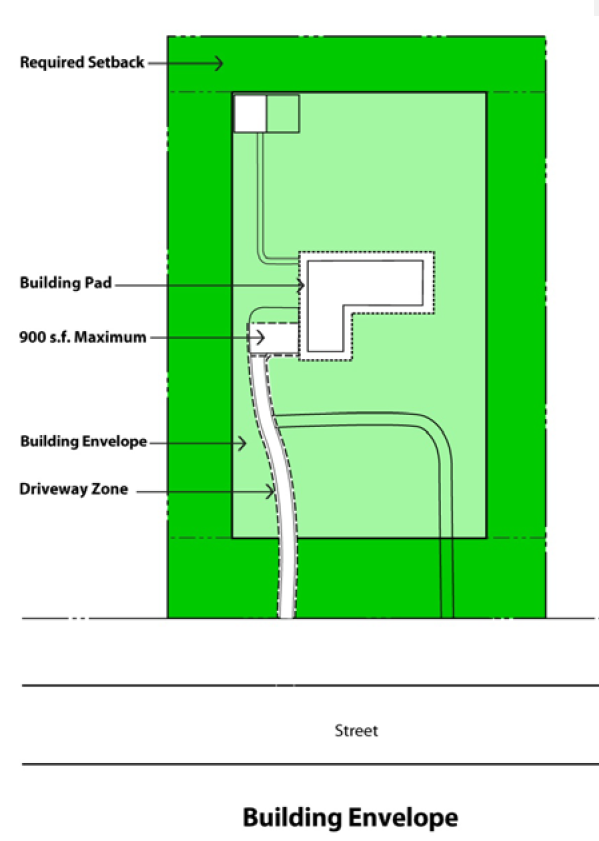
Building pad shall mean the building footprint plus that area within 15 feet of the building footprint of any principal structure and the applicable area for accessory structures as defined in section 32-134 of the zoning ordinance, and required septic fields.
Diameter breast height (DBH) shall mean the diameter in inches measured four and one-half feet above ground of a regulated tree.
Drip line shall mean an imaginary vertical line extending downward from the outermost tips of the tree branches to the ground.
Driveway zone shall mean an area leading from the street to either the garage in the case of a residence, or the main building in the case of a non-residential parcel. The driveway zone may include an area up to 900 square feet located directly in front of the garage or main building. The driveway zone shall not apply to circular driveways for residential property or parking lots for non-residential parking lots.
Land clearing shall mean operations which remove trees and vegetation in connection with the installation of storm or sanitary sewers, public or private utilities, streets, parking, or any other clearing or grading of the property at any time prior to construction of a building.
Regulated tree shall mean any tree eight inches DBH or greater that is not a removable tree.
Removable tree shall mean those trees designated by resolution of the planning commission as being appropriate for removal due to their nuisance characteristics. Such trees shall be listed by common and botanical name. Such list shall be maintained by the township and shall initially include the following tree species. Additional trees may be added to this list by township board resolution:
• Ash (diseased only)
• Autumn Olive
• Box Elder
• Catalpa
• Common or Glossy Buckthorn
• Elm, except American
• Horse Chestnut (nut bearing)
• Poplar
• Russian Olive
• Soft Maples (Silver)
• Tree-of-Heaven
• Weeping Willow
Replacement tree shall mean any tree not listed as a removable tree, as defined above. Replacement trees shall be species, varieties or cultivars that are commonly grown and available in Michigan tree nursery stock. Replacement trees may not be counted toward landscaping required by other ordinances.
Setback shall mean a distance of 25 feet from all property lines for the purpose of this section.
Tree survey shall mean a drawing and listing prepared and sealed or signed by a registered land surveyor, landscape architect, or civil engineer and verified by a registered arborist, forester, or landscape architect containing all of the following information:
1.
The shape and dimensions of the property and the location of any existing and proposed structure or improvement;
2.
The identification (common and botanical name), size, location and tagging in the field of all regulated trees using numbered, non-corrosive metal tags, and shown on the plan with the corresponding number.
Undeveloped shall mean a parcel of land which is substantially unimproved with buildings or structures on the effective date of this section.
(e)
Tree removal on non-residential parcels or residential parcels being divided or subdivided into three or more lots or units.
(1)
Submittal requirements. An applicant shall submit the following materials to the township:
a.
Tree removal permit application. A completed tree removal permit application on a form prescribed by the township which shall include the following information:
1.
The name, address and telephone number of the applicant and/or the applicant's agent;
2.
The name, address and telephone number of the owner of the property and written authorization from the owner allowing the proposed activity;
3.
The project location, including as applicable, the address, the street, road or highway, section number, lot or unit number and the name of the subdivision or development;
4.
A detailed description of the activity to be undertaken including a tree survey and landscape plan as described below; and
5.
A tree removal permit application fee in the amount established by resolution of the township board.
b.
Tree survey. A sufficient number of copies as determined by the building official of a tree survey and a plan for proposed tree removal shall be provided.
c.
Landscape plan. A sufficient number of copies of a landscape plan prepared by a registered landscape architect shall be submitted with the application for tree removal, and shall include the following information:
1.
The total number and location of regulated trees on site and regulated trees to be removed.
2.
The replacement plan showing the type, location, and size of replacement trees on the plan and in a separate tabular summary.
(2)
Review standards. Reviews of an application for a tree removal permit for shall be conducted by the zoning administrator, unless the tree removal permit is applied for along with an application for site plan approval, in which case, the planning commission shall conduct the review. The following points shall be considered in the review and approval of an application for a tree removal permit, if required by this section.
a.
The protection and conservation of natural resources from pollution, impairment or destruction is of paramount concern. Therefore, all woodlands, trees and related natural resources shall have priority over development when there are feasible and prudent location alternatives on the site for proposed buildings, structures or other improvements. The applicant must consider and pursue alternative development options available under the zoning ordinance in order to preserve the woodlands and trees.
b.
The developer may remove regulated trees within those portions of the site that are set aside or required for installation of storm water management, sanitary and water lines, roads, utilities, and other requirements of the township without replacement. The developer may not clear cut woodland areas on the property and must consider routes for sewer and utilities that preserve the established woodlands on the property.
c.
The developer may remove regulated trees within other areas of the site, including those for building construction, provided they comply with the applicable replacement requirements in subsection (f) of this section. The integrity of woodland areas shall be maintained to the greatest extent reasonably possible, regardless of whether such woodlands cross property lines.
d.
Where the proposed activity involves residential development, the residential structures shall, to the extent reasonably feasible, be designed and constructed to use the natural features of the site.
e.
The suitability of the landscape and replacement plan based on maintaining the character and harmony of the surrounding area.
(3)
Reviewing body. The planning commission shall be the reviewing body for tree removal permits on subdivisions of three or more lots.
(4)
Appeals. If, in the opinion of the planning commission, the request for tree removal does not satisfy the above criteria, then within 30 days from the planning commission's decision, an applicant may appeal in writing to the zoning board of appeals for review and decision.
(f)
Relocation and replacement.
(1)
Replacement ratio. The permit holder shall provide replacement trees for each regulated tree to be removed in excess of exemption in accordance with the following schedule based on the location of the tree to be removed. When the number of replacement trees results in a fraction, any fraction up to one-half shall be disregarded, and any fraction over and including one-half shall require one replacement tree. The minimum size for replacement trees is eight feet in height for coniferous trees and two and one-half inches in caliper for deciduous trees.
1. No replacement trees are required within the building pad and driveway zone as defined in this section.
2. An applicant may request a modification of the number or replacement trees required to the planning commission for the use of coniferous replacement trees greater than 12 feet in height and deciduous trees greater than six inches in caliper.
3. For non-single family lots located in a sending zone, as defined in the Holly Township Master Plan, the number of replacement trees per tree to be removed shall be doubled.
(2)
Minimum requirements. All replacement trees shall satisfy current American standards for nursery stock and shall be as follows:
a.
Nursery grown or comparable, or relocated from the same parcel.
b.
Number one grade, with a straight, unsecured trunk and a well-developed uniform crown.
c.
Guaranteed for one year from the time of planting.
d.
A species not included on the list of removable trees.
e.
Tree replacement shall occur within one year of permit issuance except for parcels greater than ten acres. For parcels greater than ten acres replacement trees shall be planted within three years or prior to a change in use, whichever occurs first or by providing an acceptable tree removal and replacement plan approved by the planning commission.
(3)
Location. The location of any replacement tree shall be on the same parcel as the removed tree whenever feasible, as determined by the reviewing body. If the tree replacement on the same parcel is not feasible the reviewing body may:
a.
Designate another planting location for the replacement tree within the township, approved by the township board; or
b.
Require the permit holder to deposit into the township general fund, tree preservation line, an amount determined by resolution of the township board for tree replacement that would otherwise be required. These funds shall be utilized for the planting, maintenance and preservation of trees and woodland areas within the township.
(4)
Maintenance. Replacement trees shall be staked (where practical), fertilized, watered and mulched to ensure their survival in a healthy, growing condition.
(5)
Property owners are responsible to take all measures necessary to ensure the health of replacement trees.
(6)
Performance guarantees.
a.
For permits issued under subsection (e), if the replacement requirement is not satisfied within one year of the permit issuance, then the township may bill the property owner for the cost of said replacement trees and their planting. At the end of each fiscal year the zoning administrator shall report any such charges to the township board. When reported, the charges shall become a lien upon the property on which such replacement trees should have been planted and shall be assessed and collected and the township may deposit any funds received in the township's tree fund. In the case where the tree removal permit was issued in connection with a building permit, the zoning administrator may withhold final project approval until the replacement obligation is satisfied or bond is provided. The property owner shall be responsible for timely advising the township when the required replacement trees have been planted on the property owner's property.
b.
For permits issued under subsection (f), the applicant shall post an acceptable form of an irrevocable letter of credit, cash escrow, certified check, or other township-approved performance security in an amount determined by the building official, equal to one and one-half times the amount required for the required replacement trees according to the approved landscape plan, together with reasonable administrative expenses. Required performance guarantees shall be provided to the township after approval of the proposed tree removal permit but prior to the initiation of any tree removal. After determination by the building official that all replacement trees are in compliance with the approved landscape plan, the letter of credit or other securities shall be released.
(7)
Terms of permit.
a.
Any and all tree removal permits issued by the township to a developer shall expire (unless extended) at the same time as the contemporaneous approval granted by the township, for the development, if any (i.e. tentative preliminary plat, preliminary site plan, special land use, site plan approval, etc.).
b.
Any and all tree removal permits issued by the township to any persons for an activity regulated under this section for which a contemporaneous approval of the development is not required by the township (i.e. removal of trees by a builder in connection with construction of a residence upon a parcel) shall expire one year from the date of issuance.
c.
Any activity regulated under this section which is to be commenced after expiration of a tree removal permit shall require a new applicant, additional fees and new review and approval.
(8)
Display of permit. The permit holder shall conspicuously display the tree removal permit on-site. The permit shall be displayed continuously while trees are being removed or while activities authorized under the permit are performed and for ten days following completion of those activities. The permit holder shall allow the township to enter and inspect the premises during reasonable business hours or any other time during which activity is conducted as regulated by this section. Failure to allow an inspection authorized under this section is a violation of sections (e) or (f) above.
(9)
Enforcement and administration. To ensure enforcement of this section and the approved plan for tree removal, various inspections may be performed at the site at the direction of the township. The applicant will be responsible for all inspection fees. The township shall have the authority to promulgate additional regulations to implement the terms of this section.
(10)
Violations. A violation of this article shall be subject to the same penalty provisions as violations of the zoning ordinance.
(11)
Variance. Applicants may seek variances from the provisions of this section by filing a written request with the township which variances may be granted by the zoning board of appeals upon a showing of practical difficulty.
(12)
Tree protection. The following tree protection standards shall be followed:
a.
All trees which have been approved for removal shall be so identified on site by fluorescent orange spray paint (chalk base) or by red flagging tape prior to any activity. Trees selected for transplanting shall be flagged with a separate distinguishing color.
b.
No person shall conduct activity within the drip line of any tree designated to remain, including but not limited to the placing of solvents, building materials, construction equipment or soil deposits.
c.
During construction, no person shall attach a device or wire to any remaining tree, except to cordon off protected areas as required.
(Ord. of 5-16-2018(1), § 1)
Sec. 32-205. - Wellhead Protection Overlay District.
(a)
Intent. The Wellhead Protection Overlay District is designed to safeguard the health, safety and welfare of all public and/or private water systems, including but not limited to those citizens and institutions that are customers and/or users of the Holly Township, Michigan, water system, by regulating the land use and the storage, handling, use and/or production of regulated substances within the Wellhead Protection Overlay Districts. The intent of this designation is to protect the community's entire water system, including but not limited to its Class 1 drinking and/or potable water systems and supply, against contamination.
(b)
Applicable area. The Wellhead Protection Overlay District is generally described as the land area adjacent to and upgradient from existing and proposed municipal water well fields. This area is illustrated in the Wellhead Protection Overlay District Map, which is attached as an amendment to and made part of the official zoning map of the township.
(c)
Permitted uses. The permitted uses in the Wellhead Protection Overlay District shall include all those permitted uses as allowed in the underlying zoning district, except for the following:
(1)
The processing, storage, transfer or compounding of chemicals or drugs or bulk storage thereof.
(2)
Foundries.
(3)
Heavy Equipment Repair.
(4)
Sanitary landfills of any kind, including but not limited to the so-called "Type I, II, or III" landfills as defined by the Natural Resources and Environmental Protection Act (451 PA 1994, and as amended), the County Solid Waste Management Act (186 PA 1989, and as amended), all hazardous waste management rules and regulations, and/or any other or additional state or federal regulations enacted thereunder, pursuant thereto, or in any way related to landfill siting and regulation.
(d)
Special uses. The following special uses shall be permitted in the Wellhead Protection Overlay District, subject to the conditions hereinafter required for each use, and also subject to any and all reasonable conditions which may be imposed in accordance with this chapter.
(1)
The permitted uses subject to special conditions in the Wellhead Protection Overlay District shall include all those special approval uses as allowed in the underlying zoning district, except for the following:
a.
Sanitary landfills of any kind, including but not limited to the hazardous waste and/or the so-called "Type I, II, or III" landfills as defined by the Natural Resources and Environmental Protection Act (451 PA 1994, and as amended), the County Solid Waste Management Act (186 PA 1989, and as amended), all hazardous waste management rules and regulations, and/or any other or additional state or federal regulations enacted thereunder, pursuant thereto, or in any way related to landfill siting and regulation. This prohibited use also expressly includes all related facilities and/or systems for processing, treatment, transfer, transportation, and/or storage of landfill material or hazardous waste.
b.
The mining or excavation, extraction, or processing of sand, gravel and limestone, except such activity which is already lawfully underway and subject to township regulation consistent with this ordinance and/or court order.
c.
Gasoline service stations.
d.
Bus or truck terminals, except such mass transit or commuter service as the township may approve consistent with this chapter.
e.
Junk or material salvage yards.
f.
Automobile and truck body shops.
g.
Redi-mix concrete or asphalt plants.
h.
Metal processing plants and/or electroplating plants.
i.
Paint and coating manufacturing.
j.
Sewage treatment plants.
k.
Waste water processing facilities.
l.
Transfer stations as defined by MDEQ.
m.
Composting yards.
(e)
Additional site plan information requirements. Site plan applications for any uses, buildings, or structures which are within the Wellhead Protection Overlay District shall also comply with the following additional site plan requirements.
In addition to the information required by article 6 site plan review, an application for site plan review shall submit the following information:
(1)
A copy of the MIOSHA and/or MDEQ material safety data sheet or "hazardous reporting form for site plan review" for each chemical proposed to be on site. Also include maximum quantities to be stored or on site at one time.
(2)
Location of existing and proposed facilities and structures, above and below ground, including but not limited to the following:
a.
Public and private groundwater supply wells on site and on adjacent properties.
b.
Septic systems and other waste water treatment systems.
c.
All interior and exterior areas to be used for the storage, use, transfer, loading/unloading, recycling or disposal of hazardous substances.
d.
Location of all underground and aboveground storage tanks for such uses as fuel storage, waste oil, chemical storage, regulated or hazardous substance storage, hazardous waste storage, collection of contaminated storm water or wash water, and all similar uses.
e.
Location of interior and exterior drains, dry wells, catch basins, retention/detention areas, storm water/retention ponds, sumps and other facilities designed to collect, store or transport storm water or waste water, The point of discharge for all drains and pipes shall be identified on the site plan.
(3)
Location of existing wetlands, water bodies, water courses and floodplains.
(4)
Soil characteristics of the site, through sufficient soil borings classified continuously to bedrock to map the site.
(5)
Delineation of areas on the site which are known to be contaminated, together with a report on the status of site cleanup.
(f)
Site design requirements and site plan review standards in Wellhead Protection District. In addition to the criteria set forth in article 6 site plan review, in reviewing a site plan and approving, disapproving or modifying same, the planning commission shall be governed by the following standards:
(1)
Groundwater protection standards.
a.
The project and related improvements shall be designed to protect the natural environment, including wetlands, water bodies, water courses, floodplains, groundwater and soils.
b.
Storm water management and drainage facilities shall be designed to retain the natural retention and storage capacity of any wetland, water body or water course and shall not increase flooding or the possibility of polluting surface or groundwater, on site or off site.
c.
General purpose floor drains shall be connected to a public sewer system, or an on site holding tank.
d.
Chemical loading and unloading areas shall not have drains which discharge into the storm sewer piping or collection system unless equipped with an appropriate sump pump which can be shut down in the case of a spill. Further, chemical loading and unloading areas shall be designed to contain or direct spillage in such a manner as to prevent potential discharge to the ground or groundwaters, storm water piping or recharge ponds or lagoons.
e.
Sites at which hazardous substances are loaded and unloaded, stored, used or generated shall be designed to prevent spills and discharges to the air, surface of the ground, wetlands, water bodies, water courses or groundwater.
f.
State and federal agency requirements for storage, spill prevention, record keeping, emergency response, transport and disposal of hazardous substances shall be met. No discharges to groundwater, including direct and indirect discharges, shall be allowed without required permits and approvals.
(2)
Aboveground storage and use areas for hazardous substances and polluting materials.
a.
Secondary containment of hazardous substances shall be provided. Secondary containment shall be sufficient to store 150 percent of the stored substance for the maximum anticipated period of time necessary for the recovery of any released substance.
b.
Secondary containment structures such as buildings, storage rooms, sheds and pole barns shall not have floor drains which outlet to nearby drains, soils, wetlands, water bodies, water courses or groundwater. Where allowed, the secondary containment provided in (2)a. above, shall apply.
c.
Outdoor storage of hazardous substance shall be prohibited except in product-tight containers which are protected from weather, leakage, accidental damage and vandalism.
d.
Areas and facilities for loading and unloading of hazardous substances, as well as areas where such materials are handled and used, shall be designed and constructed to prevent discharge or runoff to nearby drains, soils, wetlands, water bodies, watercourses or groundwater.
e.
All storage of fuel and lubricants or vehicle operation and fuel for building and/or processing in conjunction with permitted and conditional uses for same shall be above ground.
(3)
Underground storage tanks.
a.
Existing underground storage tanks or replacements allowed under chapter 32 Zoning, section 32-195, shall be registered with the appropriate state or federal agency or department according to the requirements of the State of Michigan Department of Natural Resources, and/or the U.S. Environmental Protection Agency, as necessary.
b.
Installation, operation, maintenance, closure and removal of underground storage tanks shall be in accordance with the requirements of the appropriate local, state and/or federal agency or department according to the requirements of Holly Township, the State of Michigan Department of Natural Resources, and/or the U.S. Environmental Protection Agency, as necessary. Leak detection, corrosion protection, spill prevention and overfill protection requirements shall be met. Records of monthly monitoring or inventory control must be retained and available for review by township and other applicable government officials.
c.
Out-of-service or abandoned underground tanks shall be emptied and removed from the ground in accordance with the requirements of the appropriate local, state and/or federal agency or department according to the requirements of Holly Township, the State of Michigan Department of Natural Resources, and/or the U.S. Environmental Protection Agency, as necessary.
(4)
Sites with contaminated soils and/or groundwater.
a.
Site plans shall take into consideration the location and extent of any contaminated soils and/or groundwater on the site and the need to protect the public health and the environment.
b.
Development shall not be allowed on or near contaminated areas of a site unless pursuant to a Holly Township approved cleanup plan, including but not limited to an approved remedial action plan or an approved brownfield clean up plan, and also involving the Michigan Department of Natural Resources and all other state or federal agencies with regulatory oversight which shall confirm that cleanup has or will proceed in a timely and appropriate fashion.
(g)
Additional restriction and exclusions.
(1)
Use of regulated/hazardous substances in conjunction with the permitted and conditional uses allowed in this district shall be limited to:
a.
The aggregate of regulated/hazardous substances in use may not exceed 20 gallons or 160 pounds at any time.
b.
The total use of regulated substances may not exceed 50 gallons or 400 pounds in any 12 month period.
(2)
A limited exclusion from the provisions of permitted uses, section CB, is hereby authorized for non-routine maintenance or repair of property in the Wellhead Protection Overlay District provided the uses are limited as follows:
a.
The aggregate of regulated substances in use may not exceed 50 gallons or 400 pounds at any time.
b.
The total use of regulated substances may not exceed 100 gallons or 800 pounds in any 12 month period.
(3)
A limited exclusion from the provisions of permitted uses, section C, is hereby authorized for regulated substances which are cleaning agents, provided however such cleaning agents are packaged for personal or household use or are present in the same form and concentration as a product packaged for use by the general public, and provided the aggregate inventory of such cleaning agents shall not exceed 100 gallons or 800 pounds at any time. In no case shall regulated substances claimed under the exclusion include hydrocarbon or halogenated hydrocarbon solvents.
(4)
A limited exclusion from the provisions of permitted uses, section C, is hereby authorized for medical and research laboratory uses in the Wellhead Protection Overlay District, provided however regulated substances shall be stored, handled or used in containers not to exceed five gallons or 40 pounds of each substance and the aggregate inventory of regulated substances shall not exceed 250 gallons or 2,000 pounds.
(5)
Storage of fuel and lubricants for vehicle operations and fuel for building and/or processing heating in conjunction with permitted and conditional uses in this district shall be in aboveground tanks.
(6)
Notwithstanding other provisions of this chapter, non-conforming uses in this district presently utilizing underground storage tanks for fuel and lubricants for vehicle operations and fuel for building and/or processing heating shall be permitted to replace existing tanks with those constructed as per the specifications of Act 451 of 1994, Part 211, and as amended, and all regulations enacted pursuant thereto and not exceeding the capacity of existing tanks. Replacement of underground tanks for regulated substances other than the above-noted fuels and lubricants is not permitted.
(Ord. of 2-20-2019(1), § 1)

