
Holly Township City Zoning Code
ARTICLE IV
SUPPLEMENTARY REGULATIONS3
Cross reference— Buildings and building regulations, ch. 8.
Sec. 32-131.- Intent.
The intent of this article is to provide for those regulations which generally apply regardless of the particular zoning district.
(Ord. No. 50, § 5.1, 11-17-1992)
Sec. 32-132. - Cluster housing option.
The cluster housing option may be applied for a special use in AGRE, RE, SR, R-1, R-2, and RM-1 and RM-2 districts subject to the standards set forth in section 32-33 and this section.
(1)
Intent. The intent of the cluster housing option is to permit the development of single-family residential patterns which, through design innovation, will:
a.
Allow greater flexibility;
b.
Encourage a more creative approach to the development of single-family residential areas;
c.
Encourage a more efficient, aesthetic, and desirable use of the land;
d.
Provide a more desirable living environment through the preservation and conservation of natural features such as topography, wetlands, woodlands, bodies of water, and other natural assets;
e.
Encourage the provision of open space so that benefits may accrue directly to the residents of the development;
f.
Provide for optimum setbacks from major thoroughfares and/or freeways;
(2)
Qualification of parcels. The parcel must be located in a district zoned for residential use and must meet one or more of the following characteristics listed below. Requests for qualification under these conditions must be supported by documented evidence:
a.
The parcel contains natural assets which would be preserved through the use of cluster development. Such assets may include natural stands of large trees, land which serves as a natural habitat for wildlife, wetlands, bodies of water, unusual topographic features, or other natural assets which should be preserved. Requests for qualification under these conditions must be supported by documented evidence.
b.
The parcel contains major topographic conditions which make development under the normal subdivision approach impractical. In considering qualification under this subsection, the planning commission shall determine that the following conditions exist:
1.
The natural land forms are so arranged that the change of elevation within the site includes slopes in excess of 15 percent between these elevations. These elevation changes and slopes shall appear as the predominant feature of the site rather than the exceptional or infrequent feature of the site.
2.
Mass grading of the site would be necessary in order to achieve the maximum road grade permitted by the county road commission and the use of one-family clusters will allow for a greater preservation of a desirable natural setting.
c.
The parcel contains substantial portions of floodplain and wetlands. A floodplain and wetlands map indicating the extent of the wetlands and floodplain area shall be submitted to the planning commission in order to support the proposal for the parcel's qualification for cluster development.
d.
The parcel, due to its size or shape, cannot be reasonably platted as a conventional subdivision development.
(3)
Site design requirements. All cluster developments submitted under this option shall conform to the following site design requirements:
a.
Generally. Development is permitted as either attached or detached dwelling units, provided the number of attached units shall not exceed 50 percent of the total number of units.
b.
Open space. When completed, the development shall have 20 percent of the gross acreage in the development devoted to open space, which shall remain in its natural state and/or be restricted for use for active and/or passive outdoor recreational purposes harmonious with peaceful, single-family residential uses in and surrounding the development. Dedication of open space shall comply with the standards set forth in section 32-155. Designated open space shall include area within any greenbelts required by subsections (3)c and (3)d of this section, subject to the restrictions contained in this section. The computation of designated open space shall not include: rights-of-way or easements designated for road purposes; areas within the minimum setbacks of a dwelling unit; land which is under water (lakes, streams, water courses, and other similar bodies of water); any area to be improved into a lake or pond; and/or more than 25 percent of the area of regulated wetlands.
c.
Greenbelt adjacent and parallel to county certified primary and local roads. In addition to any required minimum setback specified in subsection (3) of this section, a greenbelt, the minimum width as set forth in this section, shall be required along any adjacent county certified primary or local road. The greenbelt shall be measured from the future right-of-way line in accordance with the county right-of-way plan adopted by the township board, and as amended from time to time. The planning commission, at its discretion, may permit either reductions in width or variations in width of the greenbelt taking into consideration topographic and/or other natural resource conditions, density of existing vegetation to be preserved, and size and shape of the development site. The following minimum greenbelt from adjacent county certified primary and local roads shall be applied:
d.
Transition from adjacent parcels. In order to provide an orderly transition of density when a cluster development abuts a single-family residential district of equal or lower density, the planning commission, at its discretion, may require designation of open space along the common boundaries; screening in accordance with the requirements of section 32-192(d); and/or an area or row of lots of commensurate size as neighboring residential lots.
e.
Density. The number of dwelling units within any subdivision or site condominium permitted under this section shall not exceed the number of dwelling units permitted in the zoning district in which the proposed development is located without application of the cluster housing option. The applicant must submit a concept site plan that illustrates a site layout without the cluster option, in accordance with subsection (4)a of this section.
f.
Setbacks. Minimum setback requirements are established in a manner which permits variation in the siting of individual dwelling units in order to encourage creativity in design and compatibility with natural resource features. The following minimum setback requirements for each dwelling unit shall be applied:
1.
In the case of single-family detached dwellings, the following minimum setbacks shall be applied:
2.
In the case of single-family attached dwellings and multiple-family dwellings, the following minimum setbacks and distances between buildings shall be required:
3.
The planning commission, in its discretion, may permit variations from the provisions of subsection (3)f.1 or (3)f.2 of this section, where it can be determined that such variations meet the overall intent of the cluster housing option as set forth in subsection (1) of this section.
g.
Required street frontage. Any cluster lot contained within a cluster lot development shall comply with section 32-93(b)(5) regarding required street frontage. The extent of street frontage shall be determined by the planning commission, in its discretion, taking into consideration topographic and/or other natural resource considerations, size and shape of the development site, and public safety factors.
h.
Preservation and maintenance. The effectiveness of any approval of a cluster lot development under this section shall be conditioned upon recording of appropriate conservation easements or other instruments for the purpose of providing for long-term maintenance and preservation of common areas, open space areas, wooded areas and/or other areas with natural resources or features to be preserved on the property. Such easement and/or other instrumentation shall be in a form and contain the content approved by the township attorney.
(4)
Procedures for review and approval. A two-part process will be followed in the review and approval of applications for the cluster housing option, described as follows:
a.
Concept plan review. The application for a cluster housing option shall require the review and approval of a concept plan and relevant supportive material by the planning commission. The concept plan review shall be made in conjunction with special use review of the cluster housing option, and shall meet all requirements of section 32-33. The following procedures shall be followed for preliminary review:
1.
The applicant shall file a request for a special use review by the planning commission. The special use application shall be filed with the zoning administrator, and shall include an application requesting the cluster housing option, the applicable fee, and 14 copies of the following information:
i.
Project narrative and site analysis: A summary explanation and graphic illustration of the development concept and the manner in which the qualification of parcels in subsection (2) of this section are met.
ii.
Density concept plan: A plan which illustrates achievable development of the property without application of the cluster option and with all applicable ordinance and laws observed.
iii.
Cluster concept plan: A plan which illustrates development of the property with application of the cluster option.
2.
Both the density and cluster concept plans shall contain the following information:
i.
Evidence of ownership; location and description of site; dimensions and areas.
ii.
General topography, soils information, woodlands, wetlands, floodplains and surface waters.
iii.
Scale, north arrow, date of plan.
iv.
Existing zoning of site; existing land use and zoning of adjacent parcels; location of existing buildings, drives, and streets on the site and within 100 feet of the site.
v.
Lot and street layout.
vi.
Location, size and uses of open space.
vii.
General description of proposed water, sewage disposal, and storm drainage systems.
3.
Upon receipt of an application for special use/preliminary review, the zoning administrator shall transmit the application and related material to the planning commission, township planner and township engineer. Preliminary review shall be scheduled at the first available planning commission meeting.
4.
The planning commission shall conduct a preliminary review and shall be entitled to make reasonable inquiries of and receive answers from the applicant. Upon conclusion of the public hearing procedures required for the special use, the planning commission shall approve, approve with conditions, table or deny the proposed special use and concept plan.
b.
Final review. Within six months following receipt of the township's special use/preliminary review approval, the applicant shall submit a final plan in accordance with the procedures set forth in article VI of this chapter and conforming with this section. If a final plan is not submitted by the applicant for approval within six months following receipt of township comments, and no extensions are granted, the preliminary review becomes null and void. The planning commission may grant an extension for good cause for a period not to exceed six months.
(Ord. No. 50, § 5.2, 11-17-1992; Ord. of 7-17-2001; Ord. of 11-19-2002)
Sec. 32-133. - Site condominium project regulations.
(a)
Intent. Pursuant to the authority conferred by the condominium act, preliminary and final, site plans shall be regulated by the provisions of this chapter and approved by the planning commission.
(b)
General requirements.
(1)
Each condominium lot shall be located within a zoning district that permits the proposed use.
(2)
Each condominium lot shall front on and have direct access to a public street or a private street approved by the township board. Approval for a private street may be conferred by the township board between preliminary and final site plan approval by the planning commission.
(3)
For the purposes of this chapter, each condominium lot shall be considered equivalent to a single lot and shall comply with all regulations of the zoning district in which located, and the provisions of any other statutes, laws, ordinances, and/or regulations applicable to lots in subdivisions.
(c)
Site plan approval requirements. Preliminary approval of the site plan and final approval of the site plan and condominium documents by the planning commission shall be required as a condition to the right to construct, expand or convert a site condominium project. Preliminary and final approval shall not be combined.
(1)
Preliminary approval.
a.
A site plan pursuant to the standards and procedures set forth in article VI of this chapter shall be submitted to the planning commission for preliminary review.
b.
If the site plan conforms in all respects to applicable laws, ordinances and design standards, preliminary approval shall be granted by the planning commission.
c.
If the site plan fails to conform, the planning commission shall either deny the application, or grant preliminary approval with conditions, provided such conditions are met before final approval.
(2)
Final approval.
a.
Following preliminary approval, the applicant shall submit the condominium documents to the township for the review by the township attorney and other appropriate staff and consultants. The condominium documents shall be reviewed with respect to all matters subject to regulation by the township including, without limitation: ongoing preservation and maintenance of drainage, retention, wetland and other natural and/or common area; maintenance of private roads, if any; and maintenance of stormwater, sanitary, and water facilities and utilities.
b.
Following receipt of preliminary approval, the applicant shall also submit a final site plan and engineering plans in sufficient detail for the township, to determine compliance with applicable laws, ordinances and design standards for construction of the project. The township shall submit engineering plans to the township engineer and planner for review.
c.
Upon completion of the review of the condominium documents and engineering plans and receipt of the recommendations and findings from the township attorney, engineer and planner, the site plan shall be submitted to the planning commission for final review.
d.
If the site plan, condominium documents and/or engineering plans conform in all respects to applicable laws, ordinances and design standards, final approval shall be granted by the planning commission.
e.
If the site plan, condominium documents and/or engineering plans fail to conform, final approval shall be denied by the planning commission.
f.
In the interest of ensuring compliance with this chapter and protecting the health, safety and welfare of the residents of the township, the planning commission, as a condition of final approval of the site plan, shall require the applicant to deposit a performance guarantee as set forth in section 32-36 for the completion of improvements associated with the proposed use.
(d)
Information required prior to occupancy. Prior to the issuance of occupancy permits for any condominium units, the applicant shall submit the following to the township clerk:
(1)
A copy of the recorded condominium documents (including exhibits).
(2)
A copy of any recorded restrictive covenants.
(3)
A copy of the site plan on laminated photostatic copy or mylar sheet.
(4)
Evidence of completion of improvements associated with the proposed use including two copies of an "as-built survey."
(e)
Revision of site condominium plan. If the site condominium subdivision plan is revised, the final site plan shall be revised accordingly and submitted for review and approval or denial by the planning commission before any building permit may be issued, where such permit is required.
(f)
Amendment of condominium documents. Any amendment to a master deed or bylaws that affects the approved preliminary or final site plan, or any conditions of approval of a preliminary or final site plan, shall be reviewed and approved by the township attorney and planning commission before any building permit may be issued, where such permit is required. The planning commission may require its review of an amended site plan if, in its opinion, such changes in the master deed or bylaws require corresponding changes in the site plan.
(Ord. No. 50, § 5.3, 11-17-1992)
Sec. 32-134. - Accessory buildings and uses.
(a)
Application to single-family residential uses.
(1)
Where the accessory building is structurally attached to a principal building or structure, it shall be subject to, and must conform to, all setback regulations of this chapter and building codes applicable to principal buildings or structures.
(2)
Accessory buildings may only be constructed at the same time as or after the construction of the principal building or structure on the same lot or parcel of land. Accessory buildings may only be maintained in conjunction with a principal building or structure on the same lot or parcel. If the principal building or structure is destroyed, demolished or removed, the accessory building shall also be demolished or removed.
(3)
Manufactured homes, semi-trailers, storage containers, shipping containers or vehicles shall not be used as accessory buildings.
(4)
An accessory building may be located in a front yard provided it is not in the required front yard setback. For properties with lake frontage, the detached accessory building shall be located no closer to the lot line of the water frontage than the single-family dwelling. All detached accessory buildings must conform to all other setback restrictions for a single-family dwelling in the applicable zoning district in which it is located. A minimum setback of ten feet from the dwelling and five feet from a side or rear lot line shall be required.
(5)
In no instance shall an accessory building or structure be located within a dedicated easement or right-of-way.
(6)
The accessory building and/or accessory structure shall not create a nuisance or hazard.
(7)
The total area of all detached accessory roofed buildings or structures located on a parcel shall be subject to maximum lot coverage requirements and shall be subject to the restrictions in floor area based upon parcel size listed in the schedule of regulations contained within this chapter.
(8)
No detached accessory building in an R-1 and R-2 district shall exceed 14 feet in height. Accessory buildings in all other districts shall not exceed 22 feet in height.
(9)
Nothing contained in this section shall be construed to affect the size of accessory buildings in conjunction with a legitimate farming operation as defined in this chapter, provided that all yard requirements are complied with.
(10)
Private swimming pools and decks shall be subject to the following:
a.
No portion of the swimming pool, deck or associated structures shall be permitted to encroach upon any easement or right-of-way that has been granted for public utility use.
b.
All setbacks shall be complied with in accordance with the required setbacks specified within this chapter and consistent with the zoning district wherein the pool or deck is located.
c.
All swimming pools shall be enclosed in accordance with the single state construction code.
(11)
An enlargement or alteration of an existing nonconforming building line shall be permitted provided that the accessory structure is not enlarged more than 50 percent of its existing gross floor area and provided that the accessory building is setback at least three feet from the lot line.
(12)
The construction or placement of any accessory building or structure greater than 200 square feet shall require a building permit under the single state construction code.
The applicant, as part of the permit application, shall submit a detailed site sketch, drawn to scale, that provides sufficient information with the building permit application to determine that the construction of the accessory building and the single-family residential dwelling will be in complete compliance with the requirements of the zoning ordinance especially in regard to setbacks, building size, building location, etc.
(b)
Application to all other uses. Accessory buildings or structures and uses for all uses other than single-family residences shall comply with applicable setback and height restrictions specified for the zoning district wherein the accessory use, building or structure is located.
(Ord. No. 50, § 5.4, 11-17-1992; Ord. of 4-18-1995; Ord. of 8-19-2003; Ord. of 5-15-2013, § 1; Ord. of 12-21-2022(1), § 1)
Sec. 32-135. - Minimum dwelling unit floor area.
Minimum floor areas per dwelling unit shall apply in accordance with the following schedule:
(a)
The planning commission may at their discretion allow a variation of the minimum dwelling unit floor area for a planned residential development or a cluster housing option special use.
(Ord. No. 50, § 5.5, 11-17-1992; Ord. of 9-18-2007(1), § 1)
Sec. 32-136. - Temporary dwellings and structures.
(a)
Emergency temporary dwellings.
(1)
When permitted. Emergency temporary dwellings may be permitted upon finding by the township that the main or principal residential structure has been destroyed in whole or in part by fire, explosion or natural disaster and therefore is uninhabitable and the standards set forth in this section have been met.
(2)
Permit application and review.
a.
An application for a permit for the emergency temporary use and installation of a mobile home, modular, or prefabricated dwelling unit shall be made to the township clerk. The application shall be accompanied by a plot plan showing the location of each proposed structure and water supply and sewage treatment facilities.
b.
The application shall be reviewed by a committee composed of the zoning administrator and two elected township officers, other than the zoning administrator. Approval of the application may be granted by a majority vote of the committee upon a finding that all of the following conditions are met:
1.
The main or principal residential structure has been destroyed in whole or in part by fire, explosion, or natural disaster and therefore is uninhabitable.
2.
The temporary dwelling unit shall be served by approved water supply and sewage treatment facilities.
3.
The temporary dwelling unit shall comply with all applicable zoning district requirements including setback, area, bulk, and other requirements, except minimum house size requirements.
c.
The granting of a permit for an emergency temporary dwelling unit shall be for a period of up to one year from the date of approval by the committee. Any conditions of approval shall be specified in writing on the permit.
d.
To guarantee compliance with the provisions of the ordinance and removal of the emergency temporary dwelling upon expiration of the permit, the township board may require a cash bond to be posted prior to the issuance of a permit.
(b)
Temporary construction offices. Temporary buildings may be used as a construction office in conjunction with an ongoing construction project, provided that a permit is obtained for such use from the zoning administrator, following a recommendation from the building inspector. The zoning administrator shall in each case establish a definite time limit on the use of such facilities, limits on the uses to which such facilities may be put, and a date by which such facilities are to be removed from the premises. A financial guarantee as set forth in section 32-36, shall be provided to ensure compliance with this section and shall be removed upon expiration of the permitted period. The applicant shall be required to submit an application, accompanied by a fee set by the township board and including all necessary information indicated on the application.
(c)
Temporary real estate, sale and rental office. Temporary buildings may be used as a real estate sales or rental office in conjunction with an ongoing development project, provided that a permit is obtained for such use from the zoning administrator, following a recommendation from the building inspector. The zoning administrator shall in each case establish a definite time limit on the use of such facilities, limits on the uses to which such facilities may be put, and a date by which such facilities are to be removed from the premises. A financial guarantee as set forth in section 32-36, shall be provided to ensure compliance with this section and shall be removed upon expiration of the permitted period. The applicant shall be required to submit an application, accompanied by a fee set by the township board and including all necessary information indicated on the application.
(Ord. No. 50, § 5.6, 11-17-1992; Ord. of 6-17-2003)
Sec. 32-137. - Single-family dwellings, mobile homes, prefabricated housing.
No single-family dwelling (site built), mobile home, modular housing, or prefabricated housing located outside a mobile home park or mobile home subdivision shall be permitted unless such dwelling unit conforms to the following standards:
(1)
Square footage. Each such dwelling unit shall comply with the minimum square footage requirements of this chapter for the zone in which it is located.
(2)
Dimensions. Each such dwelling unit shall have a minimum width across any front, side, or rear elevation of 20 feet and shall comply in all respects with the township building code, including minimum heights for habitable rooms. Where a dwelling is required by law to comply with any federal or state standards or regulations for construction and where such standards or regulations for construction are different than those imposed by the state construction code commission, then and in that event such federal or state standard or regulation shall apply.
(3)
Foundation. Each such dwelling unit shall be firmly attached to a permanent foundation constructed on the site in accordance with the township building code and shall have a wall of such dimensions to adequately support the dwelling. All dwellings shall be securely anchored to the foundation in order to prevent displacement during windstorms.
(4)
Undercarriage. Dwelling units shall not be installed with attached wheels. Additionally, no dwelling shall have any exposed towing mechanism, undercarriage, or chassis.
(5)
Sewage disposal or water supply. Each such dwelling unit shall be connected to a public sewer and water supply or to such private facilities approved by the local health department.
(6)
Storage area. Each such dwelling unit shall contain a storage capability area either in a basement located under the dwelling, in an attic area, or in a separate or attached structure of standard construction similar to or of better quality than the principal dwelling, which storage area shall be equal to ten percent of the square footage of the dwelling or 100 square feet, which ever shall be less.
(7)
Architecture and compatibility. The compatibility of design and appearance shall be determined in the first instance by the zoning administrator. All dwellings shall be aesthetically compatible in design and appearance with other residences in the vicinity. All homes shall have a roof overhang of not less than six inches on all sides or alternatively with window sills or roof drainage systems concentrating roof drainage at collection points along the sides of the dwelling. The dwellings shall not have less than two exterior doors with the second one being in either the rear or side of the dwelling. Steps shall also be required for exterior door areas or to porches connected to such door areas where a difference in elevation requires such steps. Any determination of compatibility shall be based upon the character, design, and appearance of one or more residential dwellings located outside of mobile home parks within 2,000 feet of the subject dwelling where such area is developed with dwellings to the extent of not less than 20 percent of the lots situated within such area; or, where such area is not so developed, by the character, design, and appearance of one or more residential dwellings located outside of mobile home parks throughout the township. The provisions of this subsection shall not be construed to prohibit innovative design concepts involving such matters as solar energy, view, unique land contour, or relief from the common or standard designed home.
(8)
Additions. Each such dwelling unit shall contain no addition or room or other area which is not constructed with similar quality workmanship as the original structure, including permanent attachment to the principal structure and construction of a foundation as required in this chapter.
(9)
Code compliance. Each such dwelling unit shall comply with all pertinent building and fire codes. In the case of a mobile home, all construction and all plumbing, electrical apparatus, and insulation within and connected to such mobile home shall be of a type and quality conforming to the "Mobile Home Construction and Safety Standards" as promulgated by the United States Department of Housing and Urban Development, being 24 CFR 3280, and as from time to time such standards may be amended or superseded. Additionally, all dwellings shall meet or exceed all applicable roof snow load and strength requirements.
(10)
Building permit. All construction required in this section shall be commenced only after a building permit has been obtained in accordance with the applicable township building code provisions and requirements.
(11)
Exceptions. The standards of this section shall not apply to a mobile home located in a licensed mobile home park except to the extent required by state or federal law or otherwise specifically required in this chapter and pertaining to such parks. Mobile homes which do not conform to the standards of this section shall not be used for dwelling purposes within the township unless located within a mobile home park or a mobile home subdivision district for such uses, or unless used as a temporary residence as otherwise provided in this chapter.
(Ord. No. 50, § 5.7, 11-17-1992)
Sec. 32-138. - Fences, walls and screens.
(a)
Definitions.
(1)
Fence. Any artificial permanent fence, wall, (except a retaining wall), screen, partition or similar structure existing on a yard, which either encloses or divides land into distinct areas, separates contiguous properties, obstructs the passage of light and air into adjacent land, or obstructs the vision of motorists or pedestrians on or near public roads.
(b)
Requirements. It shall be unlawful for any persons to construct or cause to have constructed any fence upon any property within the township, except in accordance with the requirements and restrictions herein provided.
(c)
Permit. Any person desiring to build or cause to be built a fence over 7 foot tall upon property within the township shall first apply to the building department for a permit to do so. Application for such permit shall contain any and all information, including drawings, required and necessary for the determination of whether the erection of such fence would be contrary to the provisions of this chapter or the laws of the State of Michigan.
(d)
Permit fees. Fee for the permit shall be established by resolution of the township board as amended from time to time.
(e)
[Regulations.] Except as otherwise required by this chapter, the following regulations shall apply:
(1)
Within the limits of the front yard space of a lot within a residential district, no fence, wall, or other screening structure shall exceed three feet in height or shall not exceed four foot in height providing the fence, wall, or other structure is of an open air type and shall permit visibility through at least 80 percent of its area. No such fence or wall located within a side or rear yard shall exceed six feet in height. Fences between two properties shall be located on the property line and the fence owner is responsible for maintaining the fence.
(2)
In a commercial, industrial, or office district, no fence, wall, or other screening structure shall exceed 12 feet in height.
Temporary construction fences and fences required for protection around excavations shall not be maintained for a period greater than a year without special approval of the zoning board of appeals.
(3)
The use of barbed wire, spikes, nails, or any other sharp point or instrument of any kind on top or on the sides of any fence, electric current, or charge in such fences is prohibited except in conjunction with agricultural operations. Barbed wire cradles may be placed on top of fences enclosing public utility buildings or wherever deemed necessary in the interests of public safety.
(4)
On lakefront lots, fences which are located between the rear of the main building and the lake shoreline shall be of an open air type, permitting visibility through at least 80 percent of its area. Fences shall be a maximum of four feet in height.
(5)
Retaining walls shall be designed and constructed in accordance with applicable building code requirements.
(6)
On any corner lot in any district having front and side yards, no fence, wall, screen, hedge, sign, or other structure or planting shall obstruct the visibility of street vehicular traffic between the heights of three feet and ten feet in an area measuring 30 feet from the point of intersection of the street right-of-way lines and the tangent connecting the 30-foot extremities of the intersecting right-of-way lines.
(7)
Fences on residentially zoned parcels of record shall be a maximum of six feet in height measured from the surrounding grade at every point along the fence line. Fences having one finished side and shall have the exposed fence posts facing inward with the finished side of the fence facing outward unless otherwise approved by the building inspector. There shall not be more than two inches separating the bottom of the face board and the surface of the ground.
Wooden fences having one finished side shall have the exposed fence posts facing inward with the finished side of the fence facing outward unless otherwise approved by the building inspector.
(f)
Maintenance of nuisances. All fences shall be maintained in a good condition, in an upright position and shall not constitute an unreasonable hazard. Fences shall be maintained so as not to endanger life or property. Any fence which, through lack of repair, type of construction or otherwise, endangers life or property is hereby deemed a nuisance. If an unsafe condition exists in regard to a fence, the building inspector shall serve on the owner, agent or person in control of the property upon which such fence is located, a written notice describing the unsafe condition and specifying the required repairs or modifications to be made to render the fence safe or requiring the unsafe fence or any portion thereof to be removed, and shall provide a time limit for such repair, modification or removal.
(g)
Power of the board of appeals. Upon appeal in writing by any person directly or indirectly affected hereby, the zoning board of appeals of the Township of Holly may, after a hearing in accordance with the established procedure of the board, in its sound discretion and in the interests of the public health, safety or welfare of the inhabitants of the community, reduce or remit the requirements of this chapter in individual cases.
(h)
Regulations by the planning commission. The zoning administrator may make such other rules and regulations, not in conflict herewith nor inconsistent with public safety, as may be necessary to effectuate the purposes of this chapter.
(Ord. No. 50, § 5.8, 11-17-1992; Ord. of 4-20-11(1), §§ I—VIII)
Sec. 32-139. - Day care facilities.
(a)
Intent. It is the intent of this section to establish standards for day care facilities which will ensure compatibility with adjacent land uses and maintain the character of the neighborhood.
(b)
Application of regulations.
(1)
A state licensed family day care home shall be considered a residential use of property and a permitted use in all residential districts. Family day care homes shall be prohibited in all other districts.
(2)
The planning commission may, by issuance of a special use permit, authorize the establishment of group day care homes and day care centers in the following zoning districts: AGRE, RE, SR, R-1, R-2, RM-1, RM-2, C-1, C-2, and OS. Group day care homes and day care centers shall be prohibited in all other districts.
(c)
Standards for group day care homes. Group day care homes shall be considered as special land use only after proper notice has been given and public hearing held in accordance with state law and after review by the township planning commission subject to the requirements and standards of section 32-33 and the following additional standards:
(1)
A group day care home shall be located no closer than 1,500 feet to any of the following facilities:
a.
Another licensed group day care home.
b.
An adult foster care small or large group home licensed by the state.
c.
A facility offering substance abuse treatment and rehabilitation service to seven or more people which is licensed by the state.
d.
A community correction center, resident home, halfway house or other similar facility which houses an inmate population under the jurisdiction of the state department of corrections.
(2)
The subject parcel shall meet the minimum lot area requirements for the zoning district in which it is located.
(3)
The property is maintained in a manner that is consistent with the character of the neighborhood.
(4)
There shall be an outdoor play area of at least 500 square feet provided on the premises. Such play area shall not be located within the front yard setback. The requirement in this subsection may be waived by the planning commission if a public play area is within 500 feet of the subject parcel.
(5)
All outdoor play areas shall be enclosed by a fence that is designed to discourage climbing, and is at least four feet in height, but no higher than six feet.
(6)
The hours of operation do not exceed 16 hours within a 24-hour period. Activity between the hours of 10:00 p.m. and 6:00 a.m. shall be limited so that the drop-off and pick-up of children is not disruptive to neighboring residents.
(7)
One off-street parking space per employee not a member of the group day care home family shall be provided.
(8)
Appropriate licenses with the state shall be maintained.
(9)
Subsequent establishment of any facilities listed in subsections (c)(1)a through (c)(1)d of this section, within 1,500 feet of the licensed or registered group day care home will not affect any subsequent special land use permit renewal pertaining to the group day care home.
(d)
Standards for day care centers. Day care centers shall be considered as a special land use only after proper notice has been given and public hearing held in accordance with state law and after review and approval has been granted by the planning commission subject to the requirements and standards of section 32-33 and the following standards:
(1)
The day care center shall be served by public sewer and water or private water and wastewater treatment system approved by the county health department.
(2)
A separate drop-off and pick-up area shall be provided adjacent to the main building entrance, located off of a public street and the parking access lane, and shall be of sufficient size so as to not create congestion on the site or within a public roadway.
(3)
Off-street parking shall be provided at a rate of one space per employee plus one space for every five children enrolled at the facility.
(4)
There shall be an outdoor play area of at least 1,000 square feet provided on the premises. Such play area shall not be located within the front setback. This requirement may be waived by the planning commission if public play area is available 500 feet from the subject parcel.
(5)
Appropriate licenses with the state shall be maintained.
(Ord. No. 50, § 5.9, 11-17-1992)
State Law reference— Zoning requirement for family day care homes and group day care homes, MCL 125.268g; child care organizations, MCL 722.111 et seq.
Sec. 32-140. - Buildings to be moved.
(a)
Inspection; compliance with building code; performance bond. No permit shall be granted for the moving of buildings or structures from without or within the limits of the township to be placed on property within such limits unless the building official shall have made an inspection of the building to be moved and has found that it is structurally safe, will not adversely affect the character of existing buildings in the neighborhood of the new location and will fully comply with the building code and other codes regulating the health, safety, and general welfare of the township. A performance bond as established by the township board of sufficient amount to ensure the cost of completing the building for occupancy within a period of not less than six months from date of permit shall be furnished before permit is issued.
(b)
Compliance with use, construction and permit requirements. Any building moved within a district and placed upon a foundation or any building moved into a district from without shall be considered a new building and be subject to all the limitations and requirements set forth in this chapter relating to uses, construction, permits, and certificates.
(Ord. No. 50, § 5.10, 11-17-1992)
Sec. 32-141. - Home occupations.
All home occupations shall be allowed in single-family residences or the permitted accessory structures subject to the following requirements:
(1)
A home occupation must be clearly incidental and secondary to the primary use of the dwelling unit for dwelling purposes.
(2)
A home occupation use shall not change the character of the residential nature of the premises, both in terms of use and appearance.
(3)
A home occupation use shall not create a nuisance or endanger the health, safety, welfare, or enjoyment of any other person in the area, by reason of noise, vibration, glare, fumes, odor, unsanitary or unsightly conditions, fire hazards, or the like, involved in or resulting from such home occupation.
(4)
A home occupation shall not generate sewage or water use in excess of what is normally generated from a single-family dwelling in a residential area.
(5)
No employees shall be permitted other than members of the immediate family resident in the dwelling unit.
(6)
All activities shall be carried on within an enclosed structure There shall be no outside display of any kind, or other external or visible evidence of the conduct of a home occupation.
(7)
There shall be no vehicular traffic permitted for the home occupation, other than as is normally generated for a single dwelling unit in a residential area, both as to volume and type of vehicles.
(Ord. No. 50, § 5.11, 11-17-1992; Ord. of 1-16-2007(3), § 1)
State Law reference— Zoning requirement for home occupation to give instruction in a craft or fine art, MCL 125.271a.
Sec. 32-142. - Garage sales, rummage sales and similar activities.
Garage sales, rummage sales, yard sales, moving sales and similar activities shall be considered temporary accessory uses within any residential zoning district subject to the conditions contained in this section. Any garage sale, rummage sale, or similar activity shall be allowed without a land use permit for a period not to exceed four consecutive days nor more often than four times in any one year period. All such sales shall be conducted in a manner so as not to create a traffic hazard or a nuisance to neighboring properties. Overnight outside storage of goods or merchandise offered at such a sale is prohibited. No signs advertising a garage sale or similar activity shall be placed upon public property and all permitted signs shall be removed within two days of sale.
(Ord. No. 50, § 5.12, 11-17-1992; Ord. of 11-18-2015(1))
Sec. 32-143. - Seasonal sales.
(a)
The sale of Christmas trees, pumpkins, firewood farmer's market off-site and other seasonal items shall be considered permitted temporary uses within the AGRE Agricultural Residential District and the General and Local Commercial Districts subject to the following conditions:
(1)
All such sales shall be conducted so as not to create a traffic hazard or a nuisance to neighboring properties.
(2)
Adequate parking and ingress and egress to the premises shall be provided.
(3)
Upon discontinuance of the seasonal use, any temporary structures must be removed within 15 business days.
(4)
Signs shall conform to the provisions of the district in which the seasonal sales use occurs.
(5)
Seasonal sales may be allowed on a vacant lot provided the location of all buildings, structures, and parking do not create a traffic hazard or nuisance to neighboring properties.
(6)
Seasonal sales must not prevent the continued use of sidewalks, trails, rights-of-way, fire lanes, or other means of access and circulation.
(7)
A preliminary plan as described under section 32-274(b)(1) shall be provided.
(8)
Seasonal sales shall be reviewed by the zoning administrator. The zoning administrator may refer a proposal to the planning commission, at their discretion, if they believe the potential impacts warrant planning commission review.
(9)
The following items will activate planning commission review:
a.
Paved parking is located on the site;
b.
Traffic generation will exceed 40 trips per hour;
c.
A permanent building is proposed for retail sale and display of items;
d.
Significant permanent improvements are being made to the site;
e.
The proposed use requires special land use approval;
f.
Other potential significant impacts, as determined by the zoning administrator.
(10)
Seasonal sales for more than 150 days shall be reviewed by the planning commission.
(11)
A permit shall be used for a continuous period of 150 days, with a maximum of one permit per year.
(12)
If a seasonal sales use is to be converted to a permanent use, then the applicant must apply for site plan review the township 45 days in advance of the seasonal sales permit expiration.
(Ord. No. 50, § 5.13, 11-17-1992; Ord. of 9-18-2019, § 1)
Sec. 32-144. - Essential services.
Essential services shall be permitted as authorized and regulated by law and other ordinances of the township. All buildings and uses associated with essential services shall be subject to the provisions of article VI of this chapter regarding site plan review. Otherwise, the construction, maintenance, and alteration of essential services shall be exempt from the provisions of this chapter.
(Ord. No. 50, § 5.14, 11-17-1992; Ord. of 12-21-2016(1), § 1)
Sec. 32-145. - Reserved.
Editor's note— Ord. of 9-18-2019, § 1, repealed § 32-145 which pertained to maintenance of animals and derived from Ord. No. 50, § 5.15, adopted Nov. 17, 1992; Ord. of 8-15-1995; and Ord. of 4-17-2019, § 1.
Sec. 32-146. - Outdoor storage of recreational vehicles.
In all residential districts, a recreational vehicle may be parked or stored subject to the following conditions:
(1)
Storage or parking shall not be permitted on vacant lots or parcels, except as approved by the zoning administrator during construction of a single-family dwelling.
(2)
Unless within a completely enclosed building, a recreational vehicle shall be parked or stored in one of the following manners.
a.
Within the side or rear yard, but no closer than five feet from any side or rear lot line; or
b.
In those instances where the side or rear yard is not accessible or has insufficient clearance for the passage of a recreational vehicle, the zoning administrator may allow the parking or storage of a recreational vehicle in the front yard. In those instances where a recreational vehicle is to be parked or stored in a front yard, only the driveway portion of such yard shall be utilized and in no instance shall such recreational vehicle be parked or stored in a manner which obstructs pedestrian or vehicular visibility.
(3)
No recreational vehicle shall be used for living, sleeping, or housekeeping purposes on the premises, except for occasional living purposes to accommodate visitors not to exceed a continuous period of two weeks.
(4)
No recreational vehicle shall be stored on a public street or right-of-way or private road easement.
(5)
A recreational vehicle stored outside shall be in a condition for the safe and effective performance of its intended function.
(Ord. No. 50, § 5.16, 11-17-1992)
Sec. 32-147. - Golf courses.
Golf courses and country clubs, including accessory clubhouses, driving ranges, pro shops, maintenance buildings and recreational facilities shall be subject to the following conditions:
(1)
Minimum site area. The minimum site area shall be 40 acres.
(2)
Location of structures. The location of structures, such as the club house and accessory buildings, and their operations shall be reviewed by the planning commission to ensure minimum disruption of the adjacent properties, and as much distance as is practicable shall be provided between golf course structures and activities and abutting residential properties. In no case shall any structure be located any closer than 50 feet from adjacent residentially zoned or used property.
(3)
Storage, service and maintenance areas. All storage, service and maintenance areas when visible from adjoining residentially zoned or used land shall be screened from view by either a wall or fence at least six feet in height, or landscaping approved by the township.
(4)
Outdoor lighting. All proposed outdoor lighting shall be specifically reviewed by the planning commission to ensure that it does not impact on adjacent land use. In no case shall such speakers or lights be directed towards residentially zoned or used property.
(5)
Winter activities. Winter activities such as skating, cross country skiing, sledding and tobogganing shall be permitted.
(Ord. No. 50, § 5.17, 11-17-1992)
Sec. 32-148. - Campgrounds.
Publicly or privately owned and operated Type I or II campgrounds and Type III camp buildings providing temporary living quarters for campers on a daily, weekly or seasonal basis shall be subject to the following:
(1)
The minimum site area shall be 20 acres.
(2)
The site shall have direct accessibility to a paved public road.
(3)
A minimum 100 feet setback shall be established around the perimeter of the property for the purpose of buffering a private campground or recreational vehicle park in relation to adjacent residentially zoned or used properties. The perimeter buffer shall be kept in its natural state. Where natural vegetation or land contour are insufficient to buffer a private campground or recreational vehicle park in relation to surrounding properties, the planning commission may require additional setback, landscaping, and/or berming.
(4)
Temporary campgrounds are strictly prohibited.
(5)
Mobile homes shall not be permitted to be located within a campground.
(6)
The use and occupancy of a campground shall be in strict compliance with the current laws and requirements of the state governing such uses.
(Ord. No. 50, § 5.18, 11-17-1992)
State Law reference— Campground licensing and registration, MCL 333.12501 et seq.
Sec. 32-149. - Cemeteries.
Cemeteries shall be subject to the following conditions:
(1)
No building shall be located closer than 100 feet from any property line.
(2)
The site shall be protected with security fencing not less than six feet in height.
(3)
Adequate off-street waiting space shall be provided for funeral processions so that no vehicle stands or waits in a dedicated right-of-way.
(Ord. No. 50, § 5.19, 11-17-1992)
Sec. 32-150. - Kennels and stables.
Kennels and horse riding stables, including breeding, or boarding facilities shall be subject to the following conditions:
(1)
Hobby kennels and kennels.
a.
Hobby kennels shall be permitted as an accessory use in any zoning district where single-family dwellings are permitted uses. No hobby kennel shall keep or maintain more than two litters of dogs or cats within any one consecutive 12-month period, without first obtaining a permit for a kennel as set forth in subsection (1)b of this section.
b.
Kennels shall be a permitted use in the C-1 and C-2 districts and a special use in the AGRE, RE and SR districts subject to the following conditions:
1.
A minimum lot size for five acres in the C-1 and C-2 districts and ten acres in the AGRE, RE and SR districts shall be required.
2.
Any building or fenced area where animals are kept shall be located a minimum of 200 feet from any public right-of-way, 100 feet from any property line, and 150 feet from any residential dwelling located off the premises.
3.
The kennel shall be established and maintained in accordance with all applicable state, county and township sanitation regulations. Odor, dust, noise, drainage or insects shall not constitute a nuisance to adjoining properties.
(2)
Hobby and commercial horse stables.
a.
Hobby stables shall be permitted as an accessory use in the AGRE, RE and SR districts, subject to the restrictions of section 32-145.
b.
Commercial stables shall be a conditional use in the AGRE, RE and SR districts, subject to the restrictions set forth in section 32-145, and the following additional conditions:
1.
The minimum lot area required for a commercial stable shall be ten acres. The number of horses shall be subject to the provisions of section 32-145(b)(1).
2.
A commercial stable shall be established and maintained in accordance with all applicable state, county and township sanitation regulations.
(Ord. No. 50, § 5.20, 11-17-1992; Ord. of 4-18-1995; Ord. of 8-15-1995)
Sec. 32-151. - Intensive livestock operations.
It is the intent of this section to allow for intensive livestock operations while providing additional protection to the township and neighboring land uses in order to minimize noise and odors and prevent surface water and groundwater contamination, and further subject to the following conditions:
(1)
Minimum site area shall be 20 acres for Class II animals and ten acres for Class III animals.
(2)
There shall be adequate fencing, or other restraining device, for the purpose of maintaining animals within a restricted area.
(3)
The refuse and wastes resulting from the feeding and maintenance of animals shall be controlled upon the premises, and shall be cared for or disposed of within a reasonable time so as to minimize hazards of health and offensive effects upon neighboring people and uses and prevent the contamination of groundwater and surface waters. At the time of application for the special land use permit, the applicant shall provide a specific plan for the management of refuse and wastes.
(4)
All feed and other materials used for the maintenance of animals shall be appropriately stored so as to not attract rats, mice, or other vermin.
(5)
Feedlots and structures housing animals shall be located at a minimum of 500 feet from any dwelling which exists on an adjacent lot at the time of special land use approval, 300 feet from any adjacent lot line, and 300 feet from any public road right-of-way.
(Ord. No. 50, § 5.21, 11-17-1992)
Sec. 32-152. - Self-storage facilities.
Self-storage facilities shall be subject to the following requirements and conditions:
(1)
No activity other than rental of storage units and the rental of outside storage space for recreational vehicles shall be allowed. No commercial, wholesale, retail, industrial or other business use on, or operated from, the facility shall be allowed.
(2)
The storage of any toxic, explosive, corrosive, flammable or hazardous materials is prohibited. Fuel tanks on any motor vehicle, boat, lawn mower or similar property will be drained or removed prior to storage. Batteries will be removed from vehicles before storage.
(3)
Other than the storage of recreational vehicles, all storage shall be contained within a building. All recreational vehicle storage shall be screened from the view of neighboring properties and public roads in accordance with section 32-192.
(4)
Exterior walls of all storage units shall be of masonry construction. No space or spaces within a building shall exceed 5,000 square feet in size unless separated by a firewall. All compartments or rental spaces shall have smoke detectors with an alarm audible on the exterior.
(5)
All storage units must be accessible by safe circular drives clearly marked to distinguish direction (if one-way) and separate from parking lanes. Parking lanes a minimum of ten feet wide shall be provided for loading and unloading adjacent to all storage units. A combination parking lane-driveways must meet the following minimum standards:
a.
When storage units open onto one side only, 26 feet wide for one-way traffic and 30 feet for two-way traffic.
b.
When storage units open onto both sides, 36 feet wide for one-way traffic and 40 feet for two-way traffic.
(Ord. No. 50, § 5.22, 11-17-1992)
Sec. 32-153. - Outdoor sales lots.
Outdoor sales for automobiles, trucks, trailers, boats, mobile homes, and similar uses shall be subject to the following provisions:
(1)
All outdoor lighting shall be shielded from projecting onto or into an adjoining residential district and shall not interfere with driver visibility on a public right-of-way.
(2)
There shall be no strings of flags, pennants or bare light bulbs permitted.
(3)
No vehicles or merchandise for sale shall be displayed within any required front yard setback.
(4)
There shall be no broadcast of continuous music or announcements over any loudspeaker or public address system.
(Ord. No. 50, § 5.23, 11-17-1992)
Sec. 32-154. - Mineral mining and extractive operations overlay district.
(a)
Intent and purpose. It is the intent and purpose of this section to promote the underlying spirit and intent of this chapter, but at the same time allow for the extraction of minerals in locations where they have been naturally deposited, and to ensure that mineral mining activity shall be compatible with adjacent uses of land, the natural environment, and the capacities of public services and facilities affected by the land use, and, to ensure that mineral mining activities are consistent with the public health, safety and welfare of the township.
(b)
Applicability. The request for new or expansion of existing approved mineral mining and extractive operations may be considered as a special use in the AGRE, RE, LI or GI districts. The extraction, removal, and/or processing of sand, gravel, stone and/or other mineral mining in the township shall be prohibited unless first authorized by the grant of a special use application by the planning commission in accordance with this section and section 32-33. Grant of special approval by the township does not relieve the applicant of obtaining an annual operating permit in accordance with chapter 10, article IV, regarding mining control. In the event of a conflict between provisions of this section and the provisions of chapter 10, article IV, regarding mining control, those provisions which are deemed more restrictive shall apply.
(c)
Exemption. Usual and customary land balancing by cutting and filling, in preparation for immediately planned and approved development in accordance with this and all other applicable ordinances and law, shall be exempted from the provisions of this section.
(d)
Application. An application shall be filed with the zoning administrator and shall include the following:
(1)
Site plan prepared in accordance with article VI of this chapter.
(2)
Vertical aerial photograph, enlarged to a scale to fit on a 24 inches by 36 inches blueprint. The date of the aerial photograph shall be certified, and shall have been flown at such time as the foliage shall be off of on-site trees, provided, if there are changes in the topography from the date of the photograph, an accompanying text shall be provided explaining each change. The photograph shall be provided from an aerial flight having occurred within six months, prior to the application filing date. The vertical photograph shall cover:
a.
All land anticipated to be mined in the application, together with adjoining land owned and/or controlled by the applicant.
b.
All contiguous land which is or has been used by the owner or leasehold applicant for mineral extraction and/or processing and/or storage, and all contiguous (land) in which the applicant or any affiliate has a current interest.
c.
All lands within 1,000 feet of the proposed mining area.
d.
All private and public roads from which access to the property may be immediately gained.
e.
Boundary of the entire planned mining area.
(3)
Duration and phasing of proposed operation, exact type and the estimated number of cubic yards of materials to be removed, location and type of any processing plant, proposed method of removal, and any other relevant details with respect to the characteristics, phasing and progression of work on the site.
(4)
Land use study/drawing showing the existing land uses with specification of type of use, e.g., single-family residential, multiple-family residential, retail, office, etc., and density of individual units in areas shown, including:
a.
Property within 1,000 feet of the site; and
b.
The property fronting on all vehicular routes within the township contemplated to be utilized by trucks which will enter and leave the site.
(5)
Geological/hydrological/engineering survey prepared by appropriate and qualified experts, indicating:
a.
Level of water table throughout the proposed mining areas;
b.
Opinion as to each and every effect on the water table and private wells and property owners within the reasonably anticipated area of impact during and subsequent to the operation;
c.
All qualitative and quantitative aspects of surface water, ground water, and water shed anticipated to be impacted during and subsequent to the operation to the geographical extent reasonably expected to be affected; and
d.
Opinion whether the exposure of subterranean waters and/or the impoundment of surface waters, where permitted, will establish a suitable water level at the level or levels proposed as part of the operation, and whether the exposure or impoundment will not interfere with the existing subterranean water or cause any harm or impairment to the general public.
(6)
Description of the vehicles, machinery and equipment proposed for use on the property, specifying with respect to each, the anticipated noise and vibration levels.
(7)
Reclamation plan demonstrating that the requirements set forth in subsection (g) of this section shall be met.
(8)
If the land anticipated to be mined, together with adjoining land owned and/or controlled by the applicant, is situated within the resource protection overlay district, as set forth in section 32-159, all requirements of such section shall also apply.
(9)
All other information required to satisfy the requirements of chapter 10, article IV, regarding mining control.
(e)
Review procedure.
(1)
The zoning administrator shall retain the original of the application for the file, and forward the copies of the application and other materials to the township engineer and township planner. Plans shall also be submitted to the road commission for review of the haul route.
(2)
The township engineer and the township planner shall each file a report with the zoning administrator, together with a recommendation on the need for additional experts.
(3)
The zoning administrator shall request a report from the road commission regarding traffic safety relevant to the application and any road improvements deemed appropriate to protect the public health, safety and welfare.
(4)
After receiving all reports, including any additional reports of experts recommended by the township engineer and/or planner, if deemed appropriate, the planning commission shall conduct a public hearing following the procedures set forth in section 32-33.
(5)
Following the public hearing, the planning commission shall approve, approve with conditions, or deny the special use application.
(6)
Reasonable conditions may be required with the approval of the application for the special land use, to ensure that public services and facilities affected by proposed land use or activity will be capable of accommodating increased service and facility loads caused by the land use or activity, to protect the natural environment and conserve natural resources and energy, to ensure compatibility with adjacent uses of land, and to promote the use of land in a socially and economically desirable manner. Conditions imposed shall be reasonable and shall be in compliance with applicable law.
(f)
Requirements and standards. The determination on applications submitted under this section shall be based upon the following requirements and standards, as determined in the discretion of the planning commission, and if the application is approved, such standards and requirements shall be maintained as a condition to continued operation and use by the applicant and will automatically be attached as conditions of the annual operating permit required by chapter 10, article IV, regarding mining control:
(1)
Demonstration by the applicant that the proposed special land use shall not result in a probable impairment, pollution, and/or destruction of the air, water, natural resources, and public trust therein.
(2)
Demonstration by the applicant that the proposed special land use shall not result in a probable impairment to the water table and/or private wells of property owners within the reasonably anticipated area of impact during and subsequent to the operation.
(3)
Demonstration by the applicant that the proposed special land use shall not create a probable impairment of and/or unreasonable alteration in the course, quantity, and quality of surface water, ground water, and/or the water shed anticipated to be impacted by the operation.
(4)
Taking into consideration the duration and size of the operation, viewed within the context of the surrounding land uses in existence, or reasonably anticipated to be in existence during the operation, the proposed special land use shall not be incompatible with such surrounding uses, based upon an application of generally accepted planning standards and principles.
(5)
The proposed special land use shall not unreasonably burden the capacity of public services and facilities.
(6)
The proposed special land use shall have immediate and direct access to a paved road having a planned right-of-way of not less than 120 feet and having necessary and appropriate load bearing and traffic volume capacity in relation to the proposed intensity of the use.
(7)
The proposed special land use shall not unreasonably impact upon surrounding property and/or property along haul routes, in terms of noise, dust, air, water, odor, light, and/or vibration, and further, shall not unreasonably impact upon persons perceiving the operation in terms of aesthetics.
(8)
All active mining and extraction conducted in connection with the operation shall occur at least 160 feet from the nearest property line. All processing and stockpiling shall be conducted at least 200 feet from the nearest property line. The planning commission, in their sole discretion, may reduce the setback distance of active mining and extraction when there would be no demonstrated detriment to adjacent uses.
(9)
The hours of operation shall be limited to 6:00 a.m. to 7:00 p.m., extended to 8:00 p.m. during daylight savings time, and prohibited on Sundays. Operation shall be defined as the operation of mining machinery, the processing plant and/or any related trucking activities.
(10)
The maximum duration of the proposed special land use, if conducted in or immediately adjacent to a residential zoning district, shall be ten years. However, the planning commission may grant extensions in up to five-year increments, based upon a finding that such an extension would pose no unreasonable burden on adjacent properties or the township as a whole.
(11)
The site shall be secured with fencing and screened from all adjacent public highways and residentially used parcels in a manner which meets the minimum requirements of chapter 10, article IV, regarding mining control.
(12)
The total area being mined, and which has not been reclaimed, shall at no time exceed the lesser of 75 acres and 40 percent of the entire parcel approved as a special use.
(13)
The activities of the proposed special land use shall not result in a demand for local services and/or facilities which are or become unavailable, including, without limitation, road and/or drainage facilities, maintenance and repair.
(14)
The proposed transportation route or routes within the township shall be as direct and minimal in detrimental impact as reasonably possible, as determined in the discretion of the planning commission at the time of application, and thereafter.
(g)
Reclamation. Reclamation of the site shall be in accordance with a reclamation plan approved by the planning commission as part of the application review process. The reclamation plan shall demonstrate that final slopes have a grade that does not exceed one foot vertical to three feet horizontal, and, for permanent water areas, for a distance of not less than ten feet nor more than 50 feet, the submerged slopes shall not exceed one foot vertical to seven feet horizontal. The reclamation plan shall also demonstrate that the entire site shall be planted with sufficient vegetation so as to sustain short-term and long-term growth, in order to avoid erosion and washout, and, to the extent necessary to achieve this objective, suitable soils shall be placed on the property; and, all structures, machinery, equipment and improvements shall be removed from the site, unless, following approval of the planning commission the structures, machinery, equipment and improvements are deemed consistent with the zoning district in which the site is situated. The planning commission shall have the right to impose performance bonds or letters of credit to ensure that the reclamation and restoration plans as submitted are implemented.
(Ord. No. 50, § 5.24, 11-17-1992; Ord. of 3-18-2003)
Sec. 32-155. - Open space preservation.
(a)
Whenever the preservation of open space is required by this chapter, the applicant shall provide a demonstrated means that all open space portions of the development will be maintained in the manner approved. Documents shall be presented that bind all successors and future owners in fee title to commitments made as a part of the proposal. This subsection shall not prohibit a transfer of ownership or control, provided notice of such transfer is provided to the township and the land uses continue as approved in the open space community plan. The dedicated open space shall be set aside by the applicant through an irrevocable conveyance that is found acceptable to the planning commission, such as:
(1)
Recorded deed restrictions.
(2)
Covenants that run perpetually with the land.
(3)
Conservation easements such as those established per Part 21, Subpart 11 of Public Act No. 451 of 1994 (MCL 324.2140 et seq.)
(b)
Such conveyance shall assure that the open space will be protected from all forms of development, except as shown on an approved site plan, and shall never be changed to another use. Such conveyance shall:
(1)
Indicate the proposed allowable use of the dedicated open space.
(2)
Demonstrate to the satisfaction of the township that dedicated open space shall be maintained.
(3)
Provide standards for scheduled maintenance of the open space.
(4)
Provide for maintenance to be undertaken by the township in the event that the dedicated open space is inadequately maintained, or is determined by the township to be a public nuisance, with the assessment of costs upon property owners within the proposed development.
(Ord. No. 50, § 5.25, 11-17-1992)
Sec. 32-156. - General, building and landscape contractor's offices and yards.
(a)
The contractor's office building shall be of permanent construction. Temporary construction trailers shall not be permitted to be occupied as the office of the contractor. Outdoor storage shall be strictly and clearly accessory to the contractor's principal office use of the property. Only products, materials and equipment owned and operated by the principal use shall be permitted for storage.
(b)
Storage shall not be located within the area between the front face of the building, as extended across the entire width of the lot, and the street right-of-way, or in any required side or rear yard. Such storage shall not be located in any required parking or loading space.
(c)
Storage shall be screened from the view of public roads and adjacent properties zoned either residential, commercial, or office. Screening measures shall meet the requirements of section 32-92(d).
(d)
The location and size of areas for storage, nature of items to be stored therein, and details of the enclosure, including description of materials, height, and typical elevation of the enclosure shall be provided as part of the information submitted under article VI of this chapter regarding site plan review.
(Ord. No. 50, § 5.26, 11-17-1992; Ord. of 6-21-1994)
Sec. 32-157. - Adult foster care facilities.
(a)
Intent. It is the intent of this section to establish standards for adult foster care facilities which will ensure compatibility with adjacent land uses and maintain the character of the neighborhood.
(b)
Application of regulations.
(1)
A state licensed adult foster care small group home serving six persons or less and adult foster care family home shall be considered a residential use of property and a permitted use in all residential districts.
(2)
The planning commission may, by issuance of a special use permit, authorize the establishment of adult foster care small group homes serving more than six persons and adult foster care large group homes in the following zoning districts: AGRE, RE, SR, R-1, R-2, RM-1 and RM-2. Such facilities shall be prohibited in all other districts.
(3)
The planning commission may, by issuance of a special use permit, authorize the establishment of an adult foster care congregate facility in the following zoning districts: RM-1, RM-2, C-1, C-2 and OS. Such facilities shall be prohibited in all other districts.
(c)
Standards for adult foster care small group homes serving more than six persons and adult foster care large group homes. Such homes shall be considered as special land use only after proper notice has been given and public hearing held in accordance with state law and after review by the township planning commission subject to the requirements and standards of section 32-3 and the following additional standards:
(1)
A site plan, prepared in accordance with article VI of this chapter, shall be required to be submitted.
(2)
The subject parcel shall meet the minimum lot area requirements for the zoning district in which it is located, provided there is a minimum site area of 3,000 square feet per adult, excluding employees and/or care givers.
(3)
The property is maintained in a manner that is consistent with the character of the neighborhood.
(4)
One off-street parking space per employee and/or caregiver shall be provided.
(5)
In its sole discretion, the planning commission may determine that landscape screening in accordance with section 32-192(d) is required.
(6)
Appropriate licenses with the state shall be maintained.
(d)
Standards for adult foster care congregate facilities. Such facilities shall be considered as a special land use only after proper notice has been given and public hearing held in accordance with state law and after review and approval has been granted by the township planning commission subject to the requirements and standards of section 32-33 and the following standards:
(1)
A site plan, prepared in accordance with article VI of this chapter, shall be required to be submitted.
(2)
The subject parcel shall meet the minimum lot area requirements for the zoning district in which it is located, provided there is a minimum site area of 3,000 square feet per adult, excluding employees and/or caregivers.
(3)
Parking requirements as required for convalescent homes and similar facilities, set forth in section 32-424 shall be met.
(4)
In its sole discretion, the planning commission may determine that landscape screening in accordance with section 32-424 is required.
(5)
Appropriate licenses with the state shall be maintained.
(Ord. No. 50, § 5.27, 11-17-1992; Ord. of 4-18-1995)
State Law reference— Zoning requirement for state licensed residential facilities of foster family home, foster family group home, adult foster care family home, MCL 125.286a; adult foster care facility licensing act, MCL 400.701 et seq.; child care licensing act, MCL 722.111 et seq.
Sec. 32-158. - Wireless communication facilities.
(a)
Purpose and intent. It is the general purpose and intent of the township to carry out the will of the United States Congress by authorizing communication facilities needed to operate wireless communication systems. However, it is the further purpose and intent of the township to provide for such authorization in a manner which will retain the integrity of neighborhoods and the character, property values and aesthetic quality of the community at large. In fashioning and administering the provisions of this section, attempt has been made to balance these potentially competing interests. Recognizing the number of providers authorized to establish and operate wireless communication services and coverage, it is the further purpose and intent of this section to:
(1)
Facilitate adequate and efficient provision of sites for wireless communication facilities.
(2)
Establish predetermined districts or zones of the number, shape, and in the location, considered best for the establishment of wireless communication facilities, subject to applicable standards and conditions.
(3)
Recognize that operation of a wireless communication system may require the establishment of facilities in locations not within the predetermined districts or zones. In such cases, it has been determined that it is likely that there will be greater adverse impact upon neighborhoods and areas within the community. Consequently, more stringent standards and conditions should apply to the review, approval and use of such facilities.
(4)
Ensure that wireless communication facilities are situated in appropriate locations and relationships to other land uses, structures and buildings.
(5)
Limit inappropriate physical and aesthetic overcrowding of land use activities and avoid adverse impact upon existing population, transportation systems, and other public services and facility needs.
(6)
Promote the public health, safety and welfare.
(7)
Provide for adequate information about plans for wireless communication facilities in order to permit the community to effectively plan for the location of such facilities.
(8)
Minimize the adverse impacts of technological obsolescence of such facilities, including a requirement to remove unused and/or unnecessary facilities in a timely manner.
(9)
Minimize the negative visual impact of wireless communication facilities on neighborhoods, community land marks, historic sites and buildings, natural beauty areas and public rights-of-way. This contemplates the establishment of as few structures as reasonably feasible, and the use of structures which are designed for compatibility, including the use of existing structures and the avoidance of lattice and guy wire structures that are unnecessary, taking into consideration the purposes and intent of this section.
(10)
The township board finds that the presence of numerous tower structures, particularly if located within residential areas, would decrease the attractiveness and destroy the character and integrity of the community. Therefore, it is necessary to minimize the adverse impact from the presence of numerous relatively tall tower structures having low architectural and other aesthetic appeal to most persons, recognizing that the absence of regulation may result in a material impediment to the maintenance and promotion of property values, and further recognizing that this economic component is an important part of the public health, safety and welfare.
(b)
Authorization.
(1)
Subject to the standards and conditions set forth in subsection (c) of this section, wireless communication facilities shall be permitted uses in the following circumstances, and in the following districts:
a.
Circumstances creating permitted use treatment. In all zoning districts, a proposal to establish a new wireless communication facility shall be deemed a permitted use in the following circumstances:
1.
An existing structure which will serve as an attached wireless communication facility within a nonresidential zoning district, where the existing structure is not, in the discretion of the zoning administrator, proposed to be either materially altered or materially changed in appearance.
2.
A proposed collocation upon an attached wireless communication facility which had been preapproved for such collocation as part of an earlier approval by the township.
3.
An existing structure which will serve as an attached wireless communication facility consisting of a utility pole located within a right-of-way, where the existing pole is not proposed to be modified in a manner which, in the discretion of the zoning administrator, would materially alter the structure and/or result in an impairment of sight lines or other safety interests.
4.
A wireless communication support structure established within a utility right-of-way having an existing width of more than 204 feet.
b.
Permitted use districts.
1.
Wireless communication facilities shall be a permitted use in the GI general industry district.
2.
Locations outside of the GI general industrial district shall be permitted on the following sites, subject to following outlined minimum site-specific standards, and application of all other standards contained in this section:
i.
Municipally owned site.
ii.
Other governmentally owned site.
iii.
Public park.
iv.
Public school site.
3.
The following site-specific standards shall apply to all wireless communication facilities proposed to be located under the circumstances listed in subsection (b)(1)b.2 of this section, in addition to all other standards in this section. In the event that conflicting regulations occur, the more restrictive shall apply.
i.
The minimum parcel size required for location of a wireless communication facility on a site listed in subsection (b)(1)b.2 of this section, shall be five acres.
ii.
The construction of the wireless communication facility shall be of a monopole design and provide for collocation.
iii.
The setback of a wireless communication facility from any adjacent residential use or district shall be at least 400 feet from the base of any structure on the premises. The setback of the facility from any existing or proposed public street rights-of-way shall be no less than the height of the facility.
iv.
The maximum height of the facility shall be 200 feet.
v.
The wireless communication facility shall have a landscaped buffer or masonry wall around the base compound so that the base of the facility and the accessory equipment area is screened from any right-of-way, residential use, or residential zoning district. Such buffer shall be placed in a manner which will maximize the aesthetic and environmental benefits while also providing the visual buffer required. If a landscaped buffer is proposed, the buffer shall provide a minimum opacity of 80 percent in summer and 60 percent in winter, after two years growth.
vi.
A signed letter of agreement or understanding between the wireless carrier and parcel owner shall be provided indicating intention to construct a wireless communication facility.
(2)
If it is demonstrated by an applicant that a wireless communication facility is required to be established outside of a district identified in subsections (b)(1)a and b of this section, in order to operate, such wireless communication facilities may be permitted as a special land use in the LI limited industrial district. If demonstrated by an applicant that a wireless communications facility cannot be located under the criteria identified in subsection (b)(1)a of this section, or within the LI or GI industrial districts, in order to operate, such facility may be located elsewhere in the community, subject to the following:
a.
At the time of submittal, the applicant shall demonstrate that a location within the districts identified in subsections (b)(1)a and b of this section cannot reasonably meet the coverage and/or capacity needs of the applicant.
b.
Wireless communication facilities shall be of a design such as (without limitation) a steeple, bell tower, or the form of which is compatible with the existing character of the proposed site, neighborhood and general area, as approved by the township.
c.
All other criteria and standards set forth in subsection (c) and (d) of this section are met.
(c)
General regulations.
(1)
Standards and conditions applicable to all facilities. All applications for wireless communication facilities shall be reviewed in accordance with the following standards and conditions, and, if approved, shall be constructed and maintained in accordance with such standards and conditions. In addition, if the facility is approved, it shall be constructed and maintained with any additional conditions imposed by the planning commission in its discretion:
a.
Facilities shall not be demonstrably injurious to neighborhoods or otherwise detrimental to the public safety and welfare.
b.
Facilities shall be located and designed to be harmonious with the surrounding area.
c.
Wireless communication facilities shall comply with applicable federal and state standards relative to the environmental effects of radio frequency emissions.
d.
Applicants shall demonstrate a justification for the proposed height of the structures and an evaluation of alternative designs which might result in lower heights.
e.
The following additional standards shall be met:
1.
The maximum height of the new or modified support structure and antenna shall be the minimum height demonstrated to be necessary for reasonable communication by the applicant (and by other entities to collocate on the structure). The accessory building contemplated to enclose such things as switching equipment shall be limited to the maximum height for accessory structures within the respective district.
2.
The setback of the support structure from any residential district shall be at least the height of the highest point of any structure on the premises. The setback of the support structure from any existing or proposed rights-of-way or other publicly traveled roads shall be no less than the height of the structure.
3.
Where the proposed new or modified support structure abuts a parcel of land zoned for a use other than residential, the minimum setback of the structure, and accessory structures, shall be in accordance with the required setbacks for main or principal buildings as provided in the schedule of regulations for the zoning district in which the support structure is located. (See subsection (d)(3) of this section.)
4.
There shall be unobstructed access to the support structure, for operation, maintenance, repair and inspection purposes, which may be provided through or over an easement. This access shall have a width and location determined by such factors as: the location of adjacent thoroughfares and traffic and circulation within the site; utilities needed to service the tower and any attendant facilities; the location of buildings and parking facilities; proximity to residential districts and minimizing disturbance to the natural landscape; and, the type of equipment which will need to access the site.
5.
The division of property for the purpose of locating a wireless communication facility is prohibited unless all zoning requirements and conditions are met.
6.
Where an attached wireless communication facility is proposed on the roof of a building, if the equipment enclosure is proposed as a roof appliance or penthouse on the building, it shall be designed, constructed and maintained to be architecturally compatible with the principal building. Equipment enclosure may be located within the principal building or may be an accessory building. If proposed as an accessory building, it shall conform with all district requirements for principal buildings, including yard setbacks.
7.
The planning commission shall, with respect to the color of the support structure and all accessory buildings, review and approve so as to minimize distraction, reduce visibility, maximize aesthetic appearance, and ensure compatibility with surroundings. It shall be the responsibility of the applicant to maintain the wireless communication facility in a neat and orderly condition.
8.
The support system shall be constructed in accordance with all applicable building codes and shall include the submission of a soils report from a geotechnical engineer, licensed in the state. This soils report include soil borings and statements indicating the suitability of soil conditions for the proposed use. The requirements of the Federal Aviation Administration, Federal Communication planning commission, and Michigan Aeronautics Commission shall be noted.
9.
A maintenance plan, and any applicable maintenance agreement, shall be presented and approved as part of the site plan for the proposed facility. Such plan shall be designed to ensure the long term, continuous maintenance to a reasonably prudent standard.
10.
New wireless communication facilities shall not be constructed or established closer than two miles to any other such facility, measured as a straight line distance.
11.
The proposed wireless communication shall be designed such that collocation of publicly operated radio antennae, weather instruments, severe weather warning equipment, etc., is possible. The owner of the tower shall allow public agencies such as police departments and severe weather warning organizations reasonable access to use the towers for expansion of their respective networks by collocating equipment on the tower.
(2)
Standards and conditions applicable to special land use facilities. Applications for wireless communication facilities which may be approved as special land uses under subsection (b)(2) of this section, shall be reviewed, and if approved, constructed and maintained, in accordance with the standards and conditions in subsection (c)(1) of this section and in accordance with the following standards:
a.
The applicant shall demonstrate the need for the proposed facility to be located as proposed based upon the presence of one or more of the following factors:
1.
Proximity to an interstate or major thoroughfare.
2.
Areas of population concentration.
3.
Concentration of commercial, industrial, and/or other business centers.
4.
Areas where signal interference has occurred due to tall buildings, masses of trees, or other obstructions.
5.
Topography of the proposed facility location in relation to other facilities with which the proposed facility is to operate.
6.
Other specifically identified reason creating facility need.
b.
The proposal shall be reviewed in conformity with the collocation requirements of this section.
(d)
Application requirements.
(1)
A site plan prepared in accordance with article VI of this chapter shall be submitted, showing the location, size, screening and design of all buildings and structures, including fences, and the location and size of outdoor equipment, and the location, number, and species of proposed landscaping.
(2)
The site plan shall also include a detailed landscaping plan where the support structure is being placed at a location which is not otherwise developed, or where a developed area will be disturbed. The purpose of landscaping is to provide screening and aesthetic enhancement for the structure base, accessory buildings and enclosure. In all cases, there shall be shown on the plan fencing which is required for protection of the support structure and security from children and other persons who may otherwise access facilities.
(3)
The application shall include a signed certification by a state licensed professional engineer with regard to the manner in which the proposed structure will fall, which certification will be utilized, along with other criteria such as applicable regulations for the district in question, in determining the appropriate setback to be required for the structure and other facilities.
(4)
The application shall include a description of security to be posted at the time of receiving a building permit for the facility to ensure removal of the facility when it has been abandoned or is no longer needed, as provided in subsection (f) of this section. In this regard, the security shall, at the election of the applicant, be in the form of: (i) cash; (ii) surety bond; (iii) letter of credit; or (iv) an agreement in a form approved by the township attorney and recordable at the office of the register of deeds, establishing a promise of the applicant and owner of the property to timely remove the facility as required under this section of this ordinance, with the further provision that the applicant and owner shall be responsible for the payment of any costs and attorneys fees incurred by township in securing removal.
(5)
The application shall include a map showing existing and known proposed wireless communication facilities within the township and the Village of Holly, and further showing existing and known proposed wireless communication facilities within areas surrounding the borders of the township in the location, and in the area, which are relevant in terms of potential collocation or in demonstrating the need for the proposed facility. If and to the extent the information in question is on file with the community, the applicant shall be required only to update as needed. Any proprietary information may be submitted with a request for confidentiality in connection with the development of governmental policy, in accordance with MCL 15.243(1)(g). This chapter shall serve as the promise to maintain confidentiality to the extent permitted by law. The request for confidentiality must be prominently stated in order to bring it to the attention of the community.
(6)
The name, address, and phone number of the person to contact for engineering, maintenance and other notice purposes. This information shall be continuously updated during all times the facility is on the premises.
(e)
Collocation.
(1)
Statement of policy. It is the policy of the township to minimize the overall number of newly established locations for wireless communication facilities and wireless communication support structures within the community, and encourage the use of existing structures for attached wireless communication facility purposes, consistent with the statement of purpose and intent, set forth in subsection (a) of this section. Each licensed provider of a wireless communication facility must, by law, be permitted to locate sufficient facilities in order to achieve the objectives promulgated by the United States Congress. However, particularly in light of the dramatic increase in the number of wireless communication facilities reasonably anticipated to occur as a result of the change of federal law and policy in and relating to the Federal Telecommunications Act of 1996, it is the policy of the township that all users should collocate on attached wireless communication facilities and wireless communication support structures in the interest of achieving the purposes and intent of this section, as stated in this subsection, and as stated in subsection (a) of this section. If a provider fails or refuses to permit collocation on a facility owned or otherwise controlled by it, where collocation is feasible, the result will be that a new and unnecessary additional structure will be compelled, in direct violation of and in direct contradiction to the basic policy, intent and purpose of the township. The provisions of this subsection are designed to carry out and encourage conformity with the policy of the township.
(2)
Feasibility of collocation. Collocation shall be deemed to be "feasible" for purposes of this section where all of the following are met:
a.
The wireless communication provider entity under consideration for collocation will undertake to pay market rent or other market compensation for collocation.
b.
The site on which collocation is being considered, taking into consideration reasonable modification or replacement of a facility, is able to provide structural support.
c.
The collocation being considered is technologically reasonable, e.g., the collocation will not result in unreasonable interference, given appropriate physical and other adjustment in relation to the structure, antennas, and the like.
d.
The height of the structure necessary for collocation will not be increased beyond a point deemed to be permissible by the township, taking into consideration the several standards contained in subsections (b) and (c) of this section.
(3)
Requirements for collocation.
a.
A special land use permit for the construction and use of a new wireless communication facility shall not be granted unless and until the applicant demonstrates that a feasible collocation is not available for the coverage area and capacity needs.
b.
All new and modified wireless communication facilities shall be designed and constructed so as to accommodate collocation.
c.
The policy of the community is for collocation. Therefore, if a party who owns or otherwise controls a facility shall fail or refuse to alter a structure so as to accommodate a proposed and otherwise feasible collocation, such facility shall thereupon and thereafter be deemed to be a nonconforming structure and use, and shall not be altered, expanded or extended in any respect.
d.
If a party who owns or otherwise controls a facility shall fail or refuse to permit a feasible collocation, and this requires the construction and/or use of a new facility, the party failing or refusing to permit a feasible collocation shall be deemed to be in direct violation and contradiction of the policy, intent and purpose of the township, and, consequently such party shall take responsibility for the violation, and shall be prohibited from receiving approval for a new wireless communication support structure within the township for a period of five years from the date of the failure or refusal to permit the collocation. Such a party may seek and obtain a variance from the zoning board of appeals if and to the limited extent the applicant demonstrated entitlement to variance relief which, in this context, shall mean a demonstration that enforcement of the five-year prohibition would unreasonably discriminate among providers of functionally equivalent wireless communication services, or that such enforcement would have the effect of prohibiting the provision of personal wireless communication services.
(4)
Incentive. Review of an application for collocation, and review of an application for a permit for use of a facility permitted under subsection (e)(1) of this section, shall be expedited by the township.
(f)
Removal.
(1)
The township reserves the right to request evidence of ongoing operation at any time after the construction of an approved tower.
(2)
A condition of every approval of a wireless communication facility shall be adequate provision for removal of all or part of the facility by users and owners upon the occurrence of one or more of the following events:
a.
When the facility has not been used for 180 days or more. For purposes of this section, the removal of antennas or other equipment from the facility, or the cessation of operations (transmission and/or reception of radio signals) shall be considered as the beginning of a period of nonuse.
b.
Six months after new technology is available at reasonable cost as determined by the municipal legislative body, which permits the operation of the communication system without the requirement of the support structure.
(3)
The situations in which removal of a facility is required, as set forth in subsection (f)(2)a and (f)(2)b of this section, may be applied and limited to portions of a facility.
(4)
Upon the occurrence of one or more of the events requiring removal, specified in subsections (f)(2)a and (f)(2)b of this section, the property owner or persons who had used the facility shall immediately apply or secure the application for any required demolition or removal permits, and immediately proceed with and complete the demolition/removal, restoring the premises to an acceptable condition as reasonably determined by the zoning administrator.
(5)
If the required removal of a facility or a portion thereof has not been lawfully completed within 60 days of the applicable deadline, and after at least 30 days' written notice, the township may remove or secure the removal of the facility or required portions thereof, with its actual cost and reasonable administrative charge to be drawn or collected from the security posted at the time application was made for establishing the facility.
(Ord. No. 50, § 5.28, 11-17-1992; Ord. of 10-25-1995; Ord. of 9-16-1997; Ord. of 3-12-2001; Ord. of 5-15-2001)
Sec. 32-159. - Resource protection overlay district.
(a)
Purpose. The purpose of this section is to ensure that property is developed in a manner consistent with its zoning designation, and the proposed physical elements are designed and arranged to protect the priority resource protection areas both on the site, and in the vicinity of the site, as identified by the township as resource conservation areas on Map 5, Land Use Plan, and valuable natural areas indicated on Map 1, Natural Features, within the township master plan. The overlay district establishes procedures to enable the applicant and the township to achieve the mutually compatible objectives of reasonable use of land and protection of vital natural resources.
(b)
Applicability. To the maximum extent feasible, any development plan (i.e., site plan, subdivision plat and site condominium plan) shall be designed and arranged to ensure that disturbance to any priority resource protection area as a result of the development, and that impacts any disturbance to such areas and the plants and wildlife inhabiting those areas, shall be minimized through the use of natural area buffers, conservation easements and creative land development techniques. To that end, the township has established that this section shall apply to lands that meet both of the following criteria:
(1)
The property is indicated on the township zoning map, entirely or in part, as AGRE, agricultural residential or RE, rural estate, or SR, suburban residential; and
(2)
The property is designated entirely or partially as resource conservation on Map 5, Land Use Plan, of the township master plan.
(c)
Ecological characterization. It is intended that the requirements in this section be applied based upon reliable and factual data. Applicants are encouraged to consult the state natural features data base. In addition, information contained in the Survey of Natural Areas in Holly Township, by The Nature Conservancy, dated December 13, 1988 is useful to determine important natural areas of the township, of which 22 valuable natural areas have been identified within the township. These areas have significant value to the community and are indicated on Map 1, Natural Features, of the township master plan. If a development site is determined by the township, based on additional information or from inspection, that the site likely includes areas with wildlife, plant life and/or other natural characteristics in need of protection, and if the township does not then possess the information required to apply review standards, then the developer shall provide to the township a report prepared by a professional qualified in the areas of ecology, botany, wildlife biology or other relevant discipline that describes, without limitation, the following:
(1)
The wildlife use and habitat showing the species of wildlife using the area, the times or seasons that the area is used by those species and the "value" (meaning feeding, watering, cover, nesting, roosting, perching) that the area provides for such wildlife species;
(2)
The boundary of wetlands in the area and a description of the ecological functions and characteristics provided by those wetlands;
(3)
Any prominent views from or across the site;
(4)
The pattern, species and location of any significant native trees and other native site vegetation;
(5)
The bank, shoreline and high water mark of any stream or body of water on the site;
(6)
Life movement corridors; and
(7)
The general ecological functions provided by the site and its features.
The township may employ their own consultants with the relevant expertise to review materials submitted by the applicant. The applicant shall be required to provide and present the credentials for all qualified professionals hired for the purpose of fulfillment of this subsection. The credentials and qualifications of these individuals shall be sufficient, in the opinion of the township, to demonstrate competence in the area in which the expertise will be provided.
(d)
Establishment of priority protection. For every development subject to this chapter, the applicant shall propose areas of priority protection. The township shall review these areas for appropriateness. If acceptable, the township shall accept and establish on the project development plan, areas of priority protection. The development plan shall establish the development capability of the site and indicate the specific area of a site within which the developed project may be constructed and within which the development activity shall be contained. In establishing the development capability of a site, the township shall consider and apply the following criteria:
(1)
The actual boundary of development capability designation to be shown on a development plan shall be proposed by the applicant, and established by the township through site evaluations and reconnaissance, and shall be based on the ecological characterization of the area.
(2)
In establishing the development capability of the site, the following shall be taken into account, as evaluated by a qualified professional and/or certified consultant:
a.
Visual impacts, including but not limited to ridgeline protection areas and protection of scenic views.
b.
Erosion prevention and control, including but not limited to protection of natural drainage channels and compliance with an approved stormwater drainage management plan.
c.
Preservation of significant native trees and other native site vegetation, including protection of natural area buffers zones.
d.
Conservation of water, including but not limited to preservation of existing native vegetation, reduction in amounts of irrigated areas and similar considerations.
e.
Stream corridor and wetland protection and buffering.
f.
Site topography, including, but not limited to, such characteristics as steepness of slopes, existing drainage features, rock outcroppings, river and stream terraces, valley walls, ridgelines and scenic topographic features.
g.
Floodplains and floodways.
h.
Wildlife movement corridors.
i.
Natural area buffer zones as delineated in subsection (e)(2) of this section.
j.
The practical needs of approved construction activity in terms of ingress and egress to the developed project and necessary staging and operational areas.
k.
Hydrology and groundwater flow.
(e)
Development standards and guidelines.
(1)
Generally. To the maximum extent feasible, no construction activity, including, without limitation, grading, excavation or stockpiling of fill material, shall be permitted within priority protection areas whether to provide for a building site, on-site utilities or services, or for any roads or driveways except as provided for as follows:
a.
Mitigation of development activities;
b.
Restoration of previously disturbed or degraded areas;
c.
Emergency public safety activities and utility installations, installed with the utmost sensitivity to natural features, when such activities and installations cannot reasonably be contained to areas outside of those identified as significant;
d.
Construction of trails or pedestrian walkways that will provide access in an environmentally appropriate manner;
e.
The enhancement of the habitat values and/or other natural resource values of a natural area.
(2)
Establishment of buffer zones. Buffer zones shall be established adjacent to areas of priority protection. Such buffers shall be up to 100 feet in width. The township may reduce the perimeter setback and buffer zones in cases where the density of the proposed use is compatible with adjacent uses and/or natural features, such as woodlands and topographical features. In establishing the buffer zone, the township shall consider and apply the following criteria:
a.
The foreseeable impacts of development on the wildlife usage or ecological character or function of the natural area.
b.
The ecological and wildlife use characterization of the natural area.
c.
The existence of wildlife movement corridors.
d.
The extent of floodplains and floodways.
e.
The type, amount and extent of existing vegetation on the site.
f.
The existence of special wildlife habitat features.
g.
The character of the proposed development in terms of use, density, traffic generation, quality of runoff water, noise, lighting and similar potential development impacts.
h.
Site topography, including but not limited to such characteristics as steepness of slopes, existing drainage features, ridgelines and scenic topographic features.
(3)
Mitigation of disturbance. While development is anticipated outside of priority protection areas, the applicant shall avoid disturbance to priority protection areas and undertake mitigation measures to restore any damaged or lost natural resource. Any such mitigation or restoration shall be roughly equivalent to the loss suffered by the community because of the disturbance, and shall be based on such mitigation and restoration plans and reports as have been requested, reviewed and approved by the township. The mitigation plan shall include a timeline for restoration and mitigation of disturbed areas, which must be acceptable to the township. The township may require performance guarantees pursuant to section 32-36 ensuring fulfillment of, and compliance with, the mitigation plan. In addition, the township may issue a cease and desist order of the site development activities if determined to be in violation of the approved mitigation plan.
(4)
Connections. If the development site contains priority protection areas that connect to other off-site areas of a similar nature, to the maximum extent feasible, the development plan shall preserve such connections. If priority protection areas lie adjacent to the development site, but such areas are not presently connected across the development site, then the development plan shall, to the extent reasonably feasible, provide such connection. Such connections shall be designed and constructed to allow for the continuance of existing wildlife movement between natural areas and to enhance the opportunity for the establishment of new connections between areas for the movement of wildlife.
(5)
Lakes, reservoirs and ponds. If the development site contains a lake, reservoir or pond, the development plan shall include such enhancements and restoration as are necessary to provide reasonable wildlife habitat and improve aesthetic quality in areas of shoreline transition and areas subject to wave erosion. The development plan shall also include a design that requires uniform and ecologically and aesthetically compatible treatment among the lots or tracts surrounding a lake, reservoir or pond with regard to the establishment of erosion control protection and shoreline landscaping on or adjacent to such lots or tracts.
(6)
Design and aesthetics. Projects located within the overlay district, shall be designed to complement the visual context of the natural area. Techniques such as architectural design, site design, the use of native landscaping and choice of colors and building materials shall be utilized in such manner that scenic views across or through the site are protected, and manmade facilities are screened from off-site observers and blend with the natural visual character of the area.
(7)
Stormwater drainage/erosion control. All stormwater drainage and erosion control plans shall meet the standards adopted by the township for design and construction and shall, to the maximum extent feasible, utilize nonstructural control techniques, including, but not limited to:
a.
Limitation of land disturbance and grading;
b.
Maintenance of vegetated buffers and natural vegetation;
c.
Minimization of impervious surfaces;
d.
Use of terraces, contoured landscapes, runoff spreaders, grass or rock-lined swales;
e.
Use of infiltration devices.
(Ord. No. 50, § 5.29, 11-17-1992; Ord. of 6-20-2000; Ord. of 7-18-2000)
Sec. 32-160. - Adult businesses.
(a)
Intent and purpose. There are some uses which, because of their very nature, are recognized as having serious objectionable, operational characteristics when concentrated with certain other uses under certain circumstances, thereby having a deleterious effect upon adjacent areas, as well as the community as a whole. Relying upon studies undertaken and reported by other communities, the township board has concluded that special regulation of these uses is necessary to ensure that these adverse effects will not contribute to the blighting or downgrading of surrounding residential areas and uses which cater to those residential areas. These special regulations are itemized in this section. The primary control or regulation is for the purpose of preventing a concentration of these uses in any one area.
(b)
Regulated uses. The following uses are considered "regulated uses" for the purposes of this section:
Adult uses, including the following:
(1)
Adult arcade, defined as a place to which the public is permitted or invited to view motion pictures, video or laser disc pictures or other products of image-producing devices where the images displayed are distinguished or characterized by the depicting or describing of specified sexual activities or specified anatomical areas.
(2)
Adult book store, adult novelty store or adult video store, defined as a commercial establishment which, as one of its principal purposes, offers for sale or rental for any form of consideration reading materials, photographs, films, motion pictures, video cassettes or video reproductions, slides or other visual representations characterized by the depiction or description of specified sexual activities or specified anatomical areas; or instruments, devices or paraphernalia which are designed for use in connection with specified sexual activities.
(3)
Adult cabaret, defined as a night club, bar, restaurant, or similar commercial establishment which regularly features: persons who appear in a state of nudity or semi-nudity; live performances which are characterized by the exposure of specified anatomical areas or by specified sexual activities; or, films, motion pictures, videos cassettes, slides or other photographic reproductions which are characterized by the depiction or description of specified sexual activities or specified anatomical areas.
(4)
Adult motion picture theater, defined as a commercial establishment where, for any form of consideration, films, motion pictures, video cassettes, slides, or similar photographic reproductions are regularly shown which are characterized by the depiction or description of specified sexual activities or specified anatomical areas.
(5)
Adult theater, defined as a theater, concert hall, auditorium, or similar commercial establishment which regularly features persons who appear in a state of nudity or semi-nudity, or live performances which are characterized by the exposure of specified anatomical areas or by specified sexual activities.
(c)
Other definitions.
(1)
Nudity or a state of nudity means the showing of the human male or female genitals, pubic area, vulva, anus, anal cleft or cleavage with less than a fully opaque covering, the showing of the female breast with less than a fully opaque covering of any part of the nipple, or a showing of the covered male genitals in a discernibly turgid state.
(2)
Principal/primary purpose or primarily means the sale or display of regulated material that comprises 35 percent or more of sales volume or occupies 35 percent or more of the floor area or visible inventory within the establishment.
(3)
Semi-nude or semi-nude condition means the showing of the female breast below a horizontal line across the top of the areola at its highest point or the showing of the male or female buttocks. This definition shall include the entire lower portion of the human female breast, but shall not include any portion of the cleavage of the human female breast, exhibited by a dress, blouse, skirt, leotard, bathing suit or other wearing apparel provided the areola is not exposed in whole or in part.
(4)
Specified anatomical areas means: the human male genitals in a discernibly turgid state, even if completely or opaquely covered; or less than completely and opaquely covered human genitals, pubic region, buttocks or a female breast below a point immediately above the top of the areola.
(5)
Specified sexual activities means any of the following: the fondling or other erotic touching of human genitals, pubic region, buttocks, anus, or female breasts; sex acts, normal or perverted, actual or simulated, including intercourse, oral copulation, masturbation or sodomy; or excretory functions as part of or in connection with any of the activities previously mentioned in this definition.
(d)
Location requirements. In addition to compliance with the other provisions of this section, the following location requirements apply to regulated uses:
(1)
No regulated use may be located within 1,000 feet of another regulated use.
(2)
No regulated use may be located within 500 feet of any residential zoning district, school property, licensed day care home or center, church, library, public park or other use which is primarily oriented to youth (less than 18 years of age) activities.
(3)
All regulated uses shall be located within the general commercial (C-2) or the limited industrial (LI) zoning districts, and shall be subject to all setbacks and other applicable requirements of the respective district within this chapter.
(4)
No regulated use business shall be located in any principal or accessory structure already containing a sexually oriented business.
(5)
For the purpose of subsection (d)(2) of this section, measurement shall be made in a straight line, without regard to intervening structures or objects, from the nearest portion of the building or structure used as a part of the premises where an adult regulated use is conducted, to the nearest property line of any lot or parcel in residential use, school property, church or place of worship, public park, child care facility, nursery school, preschool or other use which is primarily oriented to youth (less than 18 years of age) activities.
(6)
For the purposes of subsection (d)(1) of this section, the distance between any two regulated uses shall be measured in a straight line, without regard to intervening structures or objects, from the closest exterior wall of the structure in which the business is located.
(e)
Miscellaneous requirements. In addition to compliance with the other provisions of this section, the following requirements apply to regulated uses:
(1)
Existing structures and/or uses which are in violation of this Section shall be subject to the regulations set forth in article XII of this chapter, governing non-conforming structures and uses.
(2)
All off-street parking areas shall comply with article XI of this chapter. Additionally, any regulated use business parking area shall be illuminated during all hours of operation, and until one hour after the business closes.
(3)
The hours of operation of any regulated use business shall be limited to 10:00 a.m. to 2:00 a.m. Monday through Saturday.
(4)
No person operating a regulated use business shall permit any person under the age of 18 years of age to be on the premises.
(5)
Alcohol is prohibited on the premises of any regulated use business.
(6)
No person shall reside in or permit any person to reside in the premises of a regulated use.
(7)
The merchandise or activities of the establishment shall not be visible from any point outside the establishment.
(8)
The exterior portions of the establishment or signs shall not have any words, lettering, photographs, silhouettes, drawings or pictorial representations of any specified anatomical area or sexually explicit activity as defined in this section.
(9)
Entrances to a proposed regulated use business must be posted on both the exterior and interior walls, in a location clearly visible to those entering and exiting the business, and using lettering no less than two inches in height, indicating that: a) "Persons under the age of 18 are not permitted to enter the premises", and b) "No alcoholic beverages of any type are permitted within the premises".
(10)
Regulated uses shall conform to all standards of the zoning district.
(11)
Regulated uses shall comply with all other laws and ordinances applicable to the particular type of uses, including without limitation, certification and licensing laws.
(Ord. of 4-19-2005, §§ 1—5)
Cross reference— Adult entertainment, § 5-31 et seq.
Sec. 32-161. - Bed and breakfast establishments.
Bed and breakfast establishments shall be permitted in the AGRE, RE, and SR districts subject to the following provisions:
(1)
The establishment must be operated entirely within the principal structure for the owner, who must operate and occupy the structure.
(2)
The establishment may have no more rental rooms than the number of bedrooms which exist at the time of the enactment of this ordinance. The number of rooms to be rented shall not exceed eight.
(3)
One off-street parking space per room to be rented shall be provided on site, in addition to the parking required for a single-family dwelling. Parking shall be screened from adjacent residential parcels.
(4)
The operator shall provide a scaled floor plan to the zoning administrator.
(5)
One non-illuminated sign, not to exceed four square feet shall be permitted.
(6)
The establishment of a bed and breakfast must meet all applicable building and fire protection codes as adopted by Holly Township.
(7)
The establishment shall contain at least two exits to the outdoors.
(8)
No guest room shall be located in a basement or cellar.
(9)
Guests are not allowed to stay longer than 14 consecutive days or 30 days in one calendar year at any bed and breakfast location.
(10)
All bed and breakfast operations shall maintain on the premises a guest register and all guests shall be legibly registered and such register is subject to inspection during reasonable hours by the township employees and/or agents.
(11)
The operator shall be required to comply with all state and county regulations and laws concerning bed and breakfast operations.
(12)
Lavatories and bathing facilities shall be available to all persons using the premises.
(13)
No separate or additional kitchen facilities shall be provided for the guests.
(14)
Retail sales are not permitted beyond those activities serving the registered overnight patrons.
(15)
The operator shall permit township, county and state officials to enter upon the premises at all reasonable times to determine compliance with the requirements of this ordinance and other applicable township, county, and state ordinances and statutes.
(16)
The outdoor storage of trash or rubbish shall be screened per the requirements of section 32-192(i).
(Ord. Of 4-15-2008(3), § 1)
Sec. 32-162. - Grange Hall/Fish Lake Overlay District.
(a)
Purpose. The purpose of the Grange Hall/Fish Lake Overlay District shall be to encourage the use of property in accordance with the Holly Township Master Plan, including the Grange Hall Road Corridor and Grange Hall/Fish Lake Intersection Recommendations. Consistent with the Grange Hall Road Corridor recommendations, these regulations establish an overlay district that will: allow mixed use development; arrive at a development pattern which addresses both style and architecture appropriate for the area; encourage the redevelopment and reuse of certain properties which are no longer capable of properly serving their intended purpose; ensure safe and complementary vehicular and pedestrian circulation patterns; and, control vehicular access. The provisions of this district are intended to establish Grange Hall/Fish Lake intersection as an area which:
(1)
Promotes the goals and policies of the master plan.
(2)
Promotes for a compatible mixture of use in close proximity to one another.
(3)
Improves the physical appearance of the district by coordinating design of buildings, site arrangement and landscaping, signs, and other elements.
(4)
Encourages redevelopment of property consistent with the intent and provisions of this section.
(5)
Manages access to businesses and future development while simultaneously preserving the flow of traffic on the surrounding road system in terms of safety, capacity needs, and speed.
(b)
Applicable area and requirements. The Grange Hall/Fish Lake Overlay District encompasses the area as illustrated in the district overlay map which is attached to and made part of the official Zoning Map of Holly Township. The requirements of this section shall be applied in addition to the requirements of the underlying zoning district.
(c)
Permitted uses and structures. All uses shall be restricted to those listed as both permitted principal uses and structures and special land uses in the underlying zoning districts except as noted in subsection 32-162(d), provided all standards of the overlay district are met.
(d)
Planned development option. Although consistent with the master plan, certain projects may deviate from the underlying zoning and/or contemplate redevelopment or reuse of otherwise nonconforming properties. The planned development option is intended to provide for various types of land uses planned in a manner which shall: encourage the use of land in accordance with its character and adaptability; conserve natural resources and energy; encourage innovation in land use planning; provide enhanced housing, employment, shopping, traffic circulation and recreational opportunities for the people of the township; and bring about a greater compatibility of design and use. The provisions of this article provide enabling authority and standards for the submission, review, and approval of applications for planned developments.
(1)
A planned development option may be applied for in any zoning district within the Grange Hall/Fish Lake Overlay District. Approval of the planned development option shall require special land use approval from the planning commission.
(2)
Any land use authorized with the exception of those permitted principal uses and structures and special uses in general industrial, limited industrial and mobile home park zoning district designations in this section may be included in a planned development option, subject to adequate public health, safety, and welfare protection mechanisms being designed into the development to ensure the compatibility of varied land uses both within and outside the development.
(3)
The applicant for a planned development option must demonstrate all of the following as a condition to being entitled to planned development option treatment:
a.
Grant of the planned development option will result in one of the following:
1.
A recognizable and material benefit to the ultimate users of the project and to the community, where such benefit would otherwise be unfeasible or unlikely to be achieved without application of the planned development option regulations; or
2.
Long-term protection and preservation of natural resources and natural features of a significant quantity and/or quality, where such benefit would otherwise be unfeasible or unlikely to be achieved without application of the planned development option regulations; or
3.
A nonconforming use shall, to a material extent, be rendered more conforming, or less offensive, to the zoning district in which it is situated.
b.
The proposed type and density of use shall not result in an unreasonable increase in the need for or burden on public services, facilities, roads and utilities.
c.
The proposed development shall be consistent with the public health, safety and welfare of the township.
d.
The proposed development shall not result in an unreasonable negative environmental impact on the subject site or surrounding land.
e.
The proposed development shall not result in an unreasonable negative economic impact upon surrounding properties.
f.
The proposed development shall be under, single ownership and/or control such that there is a single person having responsibility for completing the project in conformity with this Ordinance.
g.
The proposed development shall be consistent with the Goals and Policies of the Holly Township Master Plan.
(e)
General design standards. All proposed development and construction within the overlay district shall comply with the following standards:
(1)
Development patterns. The intent of the overlay district is to create a coordinated development pattern that is consistent with the character of Holly Township and provides a smooth transition between uses and properties. Transition may be created through coordination of building styles and setbacks, landscape buffers, and cross-access between properties.
(2)
Site access, parking and loading. Overall street and/or driveway design and layout shall be an integral component of site design providing for both internal access to service the development of properties and cross-access between individual properties. In addition, off-street parking for nonresidential uses shall be located predominantly within the side or rear yard areas. Up to 40 percent of the off-street parking may be permitted within the front yard, outside of the front yard setback, when abutting a public right-of-way. The township recognizes that strict application of the parking standards set forth in this section may result in a development with unsafe vehicular movements or pedestrian/vehicle conflicts would result in the location of the parking area not in close proximity to the primary patron entrance. Therefore, the planning commission may permit deviations from the requirements of this section, provided the following criteria are met:
(a)
There is compliance with other provisions in the zoning ordinance.
(b)
The development meets the intent of the Grange Hall/Fish Lake Overlay District.
(c)
The development meets the Goals and Policies of the Holly Township Master Plan.
(d)
The health, safety and general welfare of employees and patrons of the development, and the public, is maintained.
(3)
Pedestrian pathways and sidewalks. Emphasis shall be placed on providing a pedestrian circulation system which promotes safety and connects neighborhoods with open space, community facilities and commercial/office/mixed use areas. Vehicular access and circulation shall be planned to ensure safe pedestrian movement within the development. Pedestrian pathway connections to parking areas, buildings, other amenities and between on-site and perimeter pedestrian systems and safety paths shall be planned and installed wherever feasible. Appropriate provisions shall be included to ensure that the pedestrian pathways and sidewalks are appropriately maintained.
(4)
Signage. All signs permitted within this district shall be subject to the provisions of article X, signs, and the following requirements and standards.
a.
All signs shall be designed so as to be integral and compatible with the architecture and landscaping component of the development.
b.
A comprehensive sign plan shall be submitted with each development project.
(5)
Lighting. All lighting shall conform to the requirements of section 32-197. In addition, in order to maintain pedestrian safety, site security, and accentuate architectural details, pedestrian lighting shall be provided for pedestrian walkways, building entries and other areas where illumination is needed to permit safe pedestrian travel.
(6)
Landscaping/greenbelts/buffers/screening elements. All landscape features of the site shall conform to the requirements set forth in section 32-192.
(7)
General site design/architectural guidelines for nonresidential uses. It is the intent of the district to provide an environment of high quality and complementary building architecture and site design. Special emphasis shall be placed upon methods that tend to reduce the visual impact of large buildings, to encourage tasteful, imaginative design for individual buildings, and to create a complex of buildings compatible with the streetscape. Building design shall contribute to improving the character and economic vitality of the Grange Hall/Fish Lake Overlay District with predominant materials, elements, features and color range.
(Ord. of 8-19-2008(3), § 1; Ord. of 2-17-2009(2), § 1)
Sec. 32-163. - Architectural and design standards.
(a)
Intent and purpose. For all uses subject to site plan review, the following architecture and site design standards shall be met:
(1)
Building facades and exterior walls:
(a)
Building facades greater than 100 feet in length, measured horizontally, shall incorporate architectural interest through the use of color, texture and relief. In addition to meeting the standards set forth in section 32-163(1)(b), no uninterrupted length of any facade shall exceed 100 horizontal feet.
(b)
Building facades shall include a repeating pattern that includes no less than two of the following elements:
(1)
Building color change;
(2)
Building material texture change; and/or,
(3)
Projections, recesses or windows extending along at least 20 percent of the facade.
(2)
Roofs. Roofs shall exhibit the following features:
(a)
Flat roofs: Parapets concealing flat roofs and rooftop equipment such as HVAC units from public view are required. Parapets shall not exceed one-third of the height of the supporting wall at any point.
(b)
Pitched roof: Overhanging eaves, extending no less than three feet past the supporting walls; an average slope greater than or equal to one foot of vertical rise for every three feet of horizontal run and less than or equal to one foot of vertical rise for every one foot of horizontal run; and three or more roof slope planes.
(3)
Materials and colors.
(a)
Predominant exterior building materials shall be attractive, durable and maintainable including, but not limited to, brick, stone, wood, vinyl, aluminum, and integrally tinted/textured concrete masonry units.
(b)
Facade colors shall be low reflectance, subtle, neutral or earth tone colors. The use of high-intensity colors, metallic colors, black or fluorescent colors shall be prohibited.
(c)
Building trim and accent areas may feature brighter colors, including primary colors, but neon light shall not be permitted as an acceptable feature for building trim, window trim, or accent areas.
(d)
Exterior building materials shall not include smooth-faced concrete block, tilt-up concrete panels or prefabricated steel panels, unless such materials are consistent with materials used for buildings within the immediately surrounding area.
(4)
Modifications. The planning commission may approve modifications to the standards set forth in section 32-163, either in whole or in part, as long as the modification will not create a negative visual impact, when the building is viewed from a public thoroughfare and/or a neighboring property and where one or more of the following can be demonstrated:
a.
The modification will achieve a specific architectural objective or purpose,
b.
The standard creates a practical difficulty, or
c.
Proposed building facades, roofs, materials and colors are consistent with those within the immediately surrounding area.
(Ord. of 8-19-2008(3), § 1)
Sec. 32-164. - Medicinal marijuana regulations.
(a)
The growing, cultivation, and/or use of marijuana by a single patient (or by a married couple, both of whom are patients) in premises owned or leased by that patient(s) and for that patient's exclusive use, as permitted under the Act, shall not be regulated under this Code.
(b)
Use of a facility by a single caregiver to cultivate, use and distribute marijuana for that caregiver or that caregiver's patients, as permitted by the Act, shall not be regulated under this Code, except as provided in subsection (d).
(c)
It is a violation of this Code for a facility or premises to be used as a dispensary by more than one caregiver.
(d)
The cultivation, use and/or distribution of marijuana by a single caregiver within a facility owned or leased by that caregiver shall be allowed as a permitted principal use in the C1, C2, LI, GI, RM-1, RM-2 and OS zoning districts; and shall be permitted in all other zoning districts as a home occupation, subject to compliance with the Act and compliance with all of the standards of section 32-141.
(Ord. of 6-22-2011, § 2)
Editor's note— Ord. of 6-22-2011, § 2, added § 32-162 to the Code. Inasmuch as §§ 32-162 and 32-163 already existed, the new provisions have been redesignated as herein set out at the editor's discretion in consultation with the city.
Sec. 32-165. - Solar energy facilities.
(a)
Purpose. The purpose of the ordinance is to facilitate the construction, installation and operation of a solar energy facilities (SEFs) in Holly Township in a manner that protects public health, safety and welfare and avoids significant impacts to protected resources such as important agricultural lands, endangered species, high value biological habitats and other protected resources. It is the intent of this section to encourage solar facilities that reduce reliance on foreign petroleum supplies, increase local economic development and job creation, reduce greenhouse gas emissions, and/or promote economic development diversification.
(b)
Definitions.
Applicant is the landowner, developer, facility owner, and/or operator with legal control of the project, including heirs, successors and assigns, who has filed an application for development of a solar energy facility under this section.
Landowner means the persons or entities possessing legal title to the parcel(s) upon which a SEF is located
Parcel means all land within a legally established parcel.
Practicable means it is available and capable of being done after taking into consideration cost, existing technology, and logistics in light of overall project purposes.
Protected lands means, for the purpose of this section only, lands containing resources that are protected or regulated by established regulatory standards of local, state, and federal agencies, conservation easements or other contractual instruments in such a way that prohibits or limits development of those lands.
Renewable energy combining zone means a zoning district that may be combined with other base zoning and applied to specific geographic areas within the township, where the township has determined the land is suitable for a specified variety of solar energy facilities and where permitting for such facilities may be expedited if specified conditions are met.
Review authority means Holly Township.
Solar electric system (SES) means the components and subsystems that, in combination, convert solar energy into electric or thermal energy suitable for use, and may include other appurtenant structures and facilities. The term includes, but is not limited to, photovoltaic power systems, solar thermal systems, and solar hot water systems.
Solar energy facility (SEF) means an energy facility, an area of land, or a structural rooftop principally used to convert solar energy to electricity, which includes, but is not limited to, the use of one or more solar energy systems.
Uses allowed means one of the following:
(1)
Direct use — A SEF designed and installed to provide on-site energy demand for any legally established use of the property.
(2)
Primary use — A SEF that uses over 50 percent of the parcel(s) and is devoted to solar electric power generation primarily for use off-site.
(3)
Secondary use — A SEF that is not the primary use of the property and uses less than 50 percent of the parcel(s) land area.
(c)
Applicability.
(1)
This section applies to the construction of any new SEF within the township.
(2)
A SEF legally established or permitted prior to the effective date of this section shall not be required to meet the requirements of this section, however:
a.
Physical modification or alteration to an existing SEF that materially alters the size, type or components of the SEF shall be subject to this section. Only the modification or alteration is subject to this section;
b.
Substantial conformance review determinations are not major amendments to a project's existing permits; and
c.
Routine operation and maintenance or like-kind replacements do not require a permit.
(d)
Permit required. The type of permit required for SEFs shall be as shown in table 1, permit requirements.
(e)
Parcel line setbacks. The following setbacks from the parcel line to the closest part of the SEF shall be established as shown in table 2, fencing, roads and landscaping may occur within the setback.
Table 2. Setbacks
(f)
Height. For ground mounted systems, height restrictions will be measured from natural grade below each module in the event the site has topographic changes.
Table 3. Height Limits
(g)
General requirements (apply to all SEF uses unless otherwise noted).
(1)
Building permits are required.
a.
Nothing in this chapter modifies the minimum building standards required to construct a SEF, consistent with applicable building and fire codes. The SEF components and all accessory equipment shall comply with the most recently adopted building code as determined by the building official and fire code as determined by the fire official.
b.
A site plan shall be provided at the time of the building permit application demonstrating compliance with the setbacks in tables 1 and 2.
c.
The building permit shall include review by local permitting departments including, but not limited to, the local fire authority, for health and safety requirements.
(2)
Supplemental information required.
a.
The manufacturers or installer's identification and appropriate warning sign shall be posted on or near the panels in a clearly visible manner.
b.
On site power lines between solar panels and inverters shall be placed underground.
c.
If the solar energy facility consists of batteries or storage of batteries, adequate design must be provided to ensure all local, state and federal requirements regulating outdoor battery storage have been met.
d.
A copy of the application to the utility company that will be purchasing electricity from the proposed site shall be provided to the township.
e.
An affidavit or evidence of an agreement between the lot owner and the facility's owner or operator confirming the owner or operator has permission of the property owner to apply for the necessary permits for construction and operation of the solar energy facility.
f.
A description of the proposed technology to include type of solar panel and system, fixed mounted verses solar tracking, number of panels, and angles of orientation.
g.
An information sign shall be posted and maintained at the entrance(s) which lists the name and phone number of the operator.
h.
For ground mounted SEF, a description of the ground covering of native Michigan plantings beneath the solar panels (i.e. grass, plantings) and a plan for maintaining the ground cover.
(3)
Off-site facilities. When the SEF is located on more than one Parcel, there shall be proper easement agreement or other approved methods for the notification of all impacted parties.
(4)
Glare. Any glass, plastic, or metal panels must not produce excessive glare that is visible from the street or any neighboring home.
(5)
Septic system avoidance. The SEF shall not be located over a septic system, leach field area or identified reserve area unless approved by the Department of Environmental Health;
(6)
Floodplain avoidance. If located in a floodplain as designated by FEMA, or an area of known localized flooding, all panels, electrical wiring, automatic transfer switches, inverters, etc. shall be located above the base flood elevation; and, shall not otherwise create a fire or other safety hazard as determined by the building official.
(7)
Conform to development standards for underlying zone. The SEF shall be ground mounted, or when located on structures, the SEF shall conform to the development standards for a principal structure in the zone in which such facilities and structures are to be located, except as otherwise provided herein;
(8)
Abandonment.
a.
A SEF that ceases to produce energy on a continuous basis for 12 months will be considered abandoned unless the current responsible party (or parties) with ownership interest in the SEF provides substantial evidence (updated every six months after 12 months of no energy production) to the planning director or his designee of the intent to maintain and reinstate the operation of that facility. It is the responsibility of the responsible party (or parties) to remove all equipment and facilities and restore the Parcel to its condition prior to development of the SEF.
b.
Upon determination of abandonment, the zoning administrator shall notify the party (or parties) responsible they must remove the SEF and restore the site to its condition prior to development of the SEF within 360 days of notice by the planning director or his designee.
c.
If the responsible party (or parties) fails to comply, the zoning administrator or their designee may remove the SEF, sell any removed materials, and initiate judicial proceedings or take any other steps legally authorized against the responsible parties to recover the costs required to remove the SEF and restore the site to a nonhazardous pre-development condition.
d.
Facilities deemed by the township to be unsafe and facilities erected in violation of this section shall also be subject to this section. The code enforcement officer or any other employee of the planning and building departments shall have the right to request documentation and/or affidavits from the applicant regarding the system's usage, and shall make a determination as to the date of abandonment or the date on which other violation(s) occurred.
e.
Upon a determination of abandonment or other violation(s), the township shall send a notice hereof to the applicant and/or landowner, indicating that the responsible party shall remove the SEF and all associated facilities, and remediate the site to its approximate original condition within 90 days of notice by the township, unless the township determines that the facilities must be removed in a shorter period to protect public safety. Alternatively, if the violation(s) can be addressed by means short of removing the SEF and restoration of the site, the township may advise the applicant and/or landowner of such alternative means of resolving the violation(s).
f.
If the applicant and/or landowner do not comply, the township may remove the SEF and restore the site and may thereafter (a) draw funds from any bond, security or financial assurance that may have been provided or (b) initiate judicial proceedings or take other steps authorized by law against the responsible parties to recover only those costs associated with the removal of structures deemed a public hazard.
(h)
Solar energy facilities—Direct use.
(1)
General requirements. Direct use solar energy facilities are ground mounted SEFs that provide energy primarily for on-site use, or rooftop systems that provide energy for any use. Rooftops or ground mounted systems covering developed parking areas or other hardscape areas are encouraged as preferred locations for a SEF. In addition to the general requirements in subsection (g), the following standards shall apply to all direct use SEFs, notwithstanding the development standards for the underlying zone:
a.
Lot coverage. Rooftop systems can be any size, ground mounted systems allowable lot coverage varies by the underlying zoning district.
b.
Setbacks. Ground mounted structures shall conform to the setbacks as shown in table 2.
c.
Height limits. Facilities shall conform to the height limits of table 3, unless demonstrated by a structural engineer to meet public safety standards.
d.
Floodplain. An direct use SEF shall not be located in a floodplain.
(2)
Biological resources. The protection of high value biological resources is an important consideration. Direct use SEF projects shall not be located on lands that support listed, candidate or other fully protected species, species of special concern, or species protected by local, State, or Federal agencies.
(i)
Solar energy facilities—Primary and secondary uses.
(1)
General requirements. Primary or secondary uses that provide energy for on-site or off-site use as shown in table 1 subject to a special land use permit. In addition to the general requirements in subsection (g), the following standards shall apply to all primary and secondary SEF, notwithstanding the development standards for the underlying zone:
a.
Lot coverage. Over 50 percent lot coverage for a primary use, under 50 percent lot coverage for a secondary use;
b.
Setbacks. Ground mounted structures shall conform to the setbacks as shown in table 2. The buffer may be reduced if the decision-making body determines that there is a substantial screen such as existing topography or landscaping vegetation and/or an operational management plan and/or an agricultural operation easement is provided;
c.
Height limits. Facilities shall conform to the height limits of table 3;
d.
Grading. Grading within the township shall be limited to only that necessary to construct access roads and install equipment, unless the areas are determined to be chemically or physically impaired.
(2)
Biological resources. The protection of high value biological resources is an important consideration. Primary or secondary use SEF projects shall not be located on lands that support listed, candidate or other fully protected species, species of special concern, or species protected by local, state, or federal agencies.
(3)
Soil stabilization, erosion control and ground water management. For primary and secondary use SEFs, the following requirements shall apply:
a.
To the extent feasible and compatible with the climate and pre-project landscaping of the property the site shall be restored with native vegetation. The re-vegetation plans shall be reviewed and approved by the township and Oakland County. All areas occupied by the facility that are not utilized for access to operate and maintain the installation shall be planted and maintained with a native shade tolerant grass or other vegetation for the purpose of soil stabilization or other methods approved by the planning department.
b.
A storm water management plan showing existing and proposed grading and drainage demonstrating no net increase in runoff shall be provided subject to approval by the review authority.
c.
A maintenance plan shall be submitted for the continuing maintenance of the SEF, which may include, but not be limited to, planned maintenance of vegetation or ground cover, equipment maintenance, and plans for cleaning of solar panels if required.
d.
Prior to issuing a final building permit, an as-built grading and drainage plan, prepared by a licensed professional surveyor or other approved qualified professional shall be submitted to the reviewing agency's engineer for review and approval. The plan shall show that the as-built conditions are substantially the same as those shown on the approved grading and drainage plan.
(4)
Visibility.
a.
All solar energy facilities located in a residential area shall have a minimum landscape buffer of 25 feet. The buffer shall contain evergreen trees or bushes planted no more than eight feet apart and at least four feet tall at time of planting. The buffer shall obtain a height of eight feet within three growing seasons. The trees or bushes may be trimmed but no lower than a height of eight feet. A buffer area will not be required between a solar energy facility and an industrial or commercial use. A planted buffer will not be required if an opaque fence is installed. The planning commission has the authority to reduce the buffer requirements based on site conditions.
b.
All areas. Additionally, all ground mounted facilities shall:
1.
If lighting is required, it shall be activated by motion sensors, fully shielded and downcast type where the light does not spill onto the adjacent parcel or the night sky;
2.
Not display advertising, except for reasonable identification of the panel, inverter or other equipment manufacturer, and the facility owner;
3.
Be sited behind existing vegetation (which shall be supplemented with landscaping where not adequate to screen the project) or be sited using the natural topography to screen the project; and
4.
Be enclosed by a fence, barrier, barbwire, or other appropriate means as determined by the planning commission to prevent or restrict unauthorized persons or vehicles from entering the parcel(s). Fences or barriers shall incorporate wildlife friendly design. No barrier shall be required where projects employ full-time security guards or video surveillance.
(5)
Locations requiring special land use approval. The following principles shall apply to the review of primary and secondary use locations: No portion of the SEF or their structures shall occupy protected lands. Protected lands that are potentially incompatible locations, requiring special land use permits, include:
a.
Floodways.
b.
Wetlands, wetland transition areas, riparian corridors, or open water.
c.
Habitat of special status, threatened, endangered, candidate, or fully protected species, species of special concern, or species protected local, state, and federal agencies.
d.
Lands within easements where SEF is a prohibited use.
(6)
Decommission plan.
a.
The SEF project must contain a decommissioning plan to ensure it is properly decommissioned upon the end of the project life or facility abandonment.
b.
Decommissioning shall include: Removal of all structures (including transmission equipment and fencing) and debris to a depth of four feet, restoration of the soil, and restoration of vegetation within six months of the end of project life or facility abandonment.
c.
The decommissioning plan shall state how the facility will be decommissioned, the professional engineer's estimated cost of decommissioning, the financial resources to be used to accomplish decommissioning, and the escrow agent with which the resources shall be deposited.
d.
The decommissioning plan shall also include an agreement between the applicant and the township as part of the special land use application and prior to the beginning of construction that:
e.
The applicant shall post a performance bond or equivalent financial instrument for decommissioning. The bond shall accrue to Holly Township and shall be in an amount equal to the total estimated cost for decommissioning, including contingencies, as determined by the township board. Evidence of decommissioning bond shall be in the form of an escrow agreement as approved by the township board, or surety bond with a surety company authorized to do business in the state and acceptable to the township board.
f.
The township shall have access to the escrow account funds, performance bond and/or surety bond for the expressed purpose of completing decommissioning if decommissioning is not completed by the applicant within six months of the end of the project life or facility abandonment as defined.
g.
The township is granted the right of entry onto the site, pursuant to reasonable notice, to effect or complete decommissioning.
h.
The township is granted the right to seek injunctive relief to effect or complete decommissioning, as well as the township's right to seek reimbursement from the applicant or applicant successor for decommissioning costs in excess of the amount deposited in escrow, performance bond and/or equivalent financial instrument and to file a lien against any real estate owned by the applicant or applicant's successor, or in which they have an interest, for the amount of the excess, and to take all steps allowed by law to enforce said lien.
i.
The applicant agrees to all the terms of this section.
(Ord. of 11-21-2018(1), § 1)
Sec. 32-166. - Wind Energy Conversion Systems (WECS).
A wind energy conversion system (WECS) as defined by section 32-6 of this chapter is allowed as a conditional use when approved by the planning commission in accordance with the process defined herein. In addition to the standards and requirements for issuance of a special use permit specified in section 32-33 of this chapter, the planning commission shall not approve the issuance of a special use permit unless the following requirements shall be met:
(1)
Purpose and intent. The purpose of this section is to establish standards and procedures by which the installation and operation of a Wind Energy Conversion System (WECS) for both residential and commercial use and shall be governed within the township to protect the health, welfare, safety, and quality of life of the general public, and to ensure compatible land uses in the vicinity of the areas affected by wind energy facilities.
Holly Township recognizes the potential impact on the broad landscape and rural character currently enjoyed throughout the community. On a site-specific scale, safety implications such as falling towers and ice throw are a concern, as are the potential impositions of constant or cyclical sound and shadow flicker. For these reasons, and others, including those listed above, the township finds it prudent and necessary to develop regulations for the responsible placement of wind energy conversion systems.
(2)
Supplementary definitions.
a.
Ambient means the decibel measurement (dB(A) or dB(C)) of background sound pressure level exceeded 90 percent of the time at a given location prior to the installation of the WECS (also known as L 90 ).
b.
Anemometer Tower (MET) means a freestanding tower containing instrumentation such as anemometers that is designed to provide present moment wind data for use by the supervisory control and data acquisition (SCADA) system which is an accessory land use to a utility grid wind energy conversion system.
c.
dB(A) means the sound pressure level in decibels. It refers to the "a" weighted scale defined by ANSI S1.32 (1997 or most recent) for sound frequencies below the 1,000 HZ octave band.
d.
dB(C) means the sound pressure level in decibels. It refers to the "c" weighted scale defined by ANSI S1.32 (1997 or more recent) for acoustic energy from the 20HZ octave band and higher.
e.
Decibel means the unit of measure used to express the magnitude of sound pressure and sound intensity.
f.
FAA means The Federal Aviation Administration
g.
IEC means The International Electrotechnical Commission
h.
ISO means The International Organization for Standardization
i.
LMax (LAMax or LCMax) means the maximum dB(A) or DB(C) sound level measured using the "fast response" setting of the sound meter (equivalent to 0.125 second exponential averaging time).
j.
Lease unit boundary means the boundary around a property(ies) leased or purchased for purposes of operating a wind energy facility, including leased or purchased adjacent parcels to the parcel on which the wind energy facility tower or equipment is located. For purposes of setback, the lease unit boundary shall not cross road rights-of-way.
k.
On-site wind energy conversion system means a wind energy conversion system more than 40 feet in height intended to generate electric power from wind solely for the use of the site on which the system is located. WECS primarily intended to provide on-site power, but contribute surplus energy to the grid, may also be considered on-site WECS.
l.
Participating and non-participating parcels.
1.
Participating parcel shall mean a parcel of record that is to be used, occupied, maintained, let, leased or authorized to be used for any purposes of developing or operating a WECS, including construction of improvements, providing access to improvements, providing space for collection or distribution lines, or to meet requirements and regulations set forth herein.
2.
Non-participating parcel shall mean a parcel of record that is not a participant parcel.
m.
Shadow flicker means alternating changes in light intensity caused by the moving blade of a wind energy conversion system casting shadows on the ground and stationary objects, such as but not limited to a window of a dwelling.
n.
Sound pressure means an average rate at which sound energy is transmitted through a unit area in a specified direction. The pressure of the sound measured at a receiver.
o.
Sound pressure level means the sound pressure mapped to a logarithmic scale and reported in decibels (dB).
p.
Utility-scale wind energy conversion system means a wind energy conversion system intended to generate power from wind primarily to supplement the greater electric utility grid. Utility-scale WECS include accessory uses such as, but not limited to, SCADA towers, anemometers, or electric substations.
q.
Wind Energy Conversion System (WECS) shall mean a combination of:
1.
A surface area (typically a blade, rotor, or similar device), either variable or fixed, for utilizing the wind for electrical powers; and
2.
A shaft, gearing, belt, or coupling utilized to convert the rotation of the surface area into a form suitable for driving a generator, alternator, or other electricity-producing device; and
3.
The generator, alternator, or other device to convert the mechanical energy of the surface area into electrical energy; and
4.
The tower, pylon, or other structure upon which any, all or some combination of the above are mounted.
5.
Other components not listed above but associated with the normal construction, operation, and maintenance of a WECS such as substations, anemometer towers (MET), cables and wires and other buildings accessory to such facility.
r.
Wind energy facility means clusters of two or more utility grid wind energy conversion systems, placed upon a lot or parcel with the intent to sell or provide electricity to a site or location other than the premises upon which the wind energy conversion systems are located. Said wind energy conversion systems may or may not be owned by the owner of the property upon which they are placed.
(3)
On-site wind energy conversion system standards. The following standards shall apply to on-site WECS, including anemometer towers, in addition to the general special use approval requirements of section 32-33 of this chapter:
a.
Purpose. Designed to primarily serve the needs of a home, farm, or small business.
b.
Height. Shall have a total height of 75 feet or less; except where state and federal regulations may require a lesser height; or where, as a condition of special use approval, the planning commission requires a lesser height. Height is measured from the average grade at the base of the pole to the highest point of WECS when a blade is in its vertical orientation.
c.
Setbacks. The distance between an on-site WECS and the property lines shall be equal to 400 percent of the height of the tower including the top of the blade in its vertical position. The distance between an anemometer tower and the owner's property lines shall be equal to 150 percent of the height of the tower. No part of the WECS structure, including guy wire anchors, may extend closer than 20 feet to the owner's property lines, or the distance of the required setback in the respective zoning district, whichever results in the greater setback.
d.
Minimum lot area size. The minimum lot size for a property to be eligible to have an on-site WECS shall be two acres.
e.
Minimum ground clearance. The minimum vertical blade tip clearance from grade and any structure, adjoining property, or tree shall be 20 feet for an on-site WECS employing a horizontal axis rotor.
f.
Noise emission. On-site WECS shall not exceed 45 dB(A) (L max ) or 55 dB(C) (L max ) at the property line closest to the WECS.
g.
Construction codes, towers, and interconnection standards. On-site WECS including towers shall comply with all applicable state construction and electrical codes and local building permit requirements. On-site WECS including towers shall comply with Federal Aviation Administration requirements, the Michigan Airport Zoning Act, the Michigan Tall Structures Act, and other applicable local and state regulations. An interconnected on-site WECS shall comply with Michigan Public Service Commission (MPSC) and Federal Energy Regulatory Commission (FERC) standards. Off-grid systems are exempt from MPSC and FERC requirements.
h.
Safety. The WECS shall meet the following safety requirements:
1.
The WECS shall be designed to prevent unauthorized access to electrical and mechanical components and shall have access doors that are kept securely locked at all times when service personnel are not present.
2.
All spent lubricants and cooling fluids shall be properly and safely removed in a timely manner from the site of the WECS.
3.
A sign shall be posted near the tower or operations and maintenance office building that shall contain emergency contact information. Signage placed at the road access shall be used to warn visitors about the potential danger of falling ice.
4.
All collection system wiring shall comply with all applicable safety and stray voltage standards.
5.
WECS towers shall not be climbable on the exterior.
6.
Each WECS shall be equipped with both a manual and automatic braking device capable of stopping the WECS operation in high winds within 80 percent of design limits of the breaking system.
7.
A copy of the un-redacted safety manual from the turbine manufacturer shall be submitted to the township and the turbine must comply with all requirements therein.
i.
Shadow flicker. On-site WECS shall produce no off-site shadow flicker. Measures to eliminate all effects of shadow flicker on adjacent properties, such as programming the WECS to stop rotating during times when shadow crosses occupied structures, may be required.
(1)
This shadow flicker limit may be waived if the owner of the affected property owner submits for records a signed and notarized letter of acknowledgement that verifies the owner's understanding that shadow flicker at the residence or structure may result from installation and waives the township requirement for no shadow flicker on the property. If the affected property owner wants this waiver to apply to future owners of the affected property, the signed and notarized letter of acknowledgment must be recorded with the Oakland County Register of Deeds.
(4)
Utility-scale wind grid energy conversion system standards. The following standards shall apply to utility-scale WECS, including anemometer towers, in addition to the general special use requirements of section 32-33 of this chapter:
a.
Height. The maximum height of any utility-scale WECS is 500 feet. The height of a WECS is measured from the average grade at the base of the pole to the highest point of the WECS when a blade is in its vertical orientation.
b.
Setbacks. A distance equal to 400 percent of the height of the tower to the tip of the blade in its vertical position shall be maintained from the outside edge of the base of the turbine to all non-participating parcel property lines for WECS, public roads, and communication or electrical lines. In no event shall a turbine be located less than 1,760 feet from the nearest non-participating parcel lease unit boundary line. Operations and maintenance office building, a substation, or ancillary equipment shall be setback a minimum of 50 feet from all single parcel property lines, or from lease unit boundary lines, and overhead transmission lines power poles. Such maintenance buildings and equipment shall be bordered by green space and screened by trees and shrubs to help blend into the rural setting and the planning commission will review the location and makeup of same as part of the site plan review.
c.
Tower separation. Turbine/tower separation shall be based on the following standards:
1.
Between any two utility-scale WECS: No less than 150 percent the height of both towers including the top of the bladed in their vertical position.
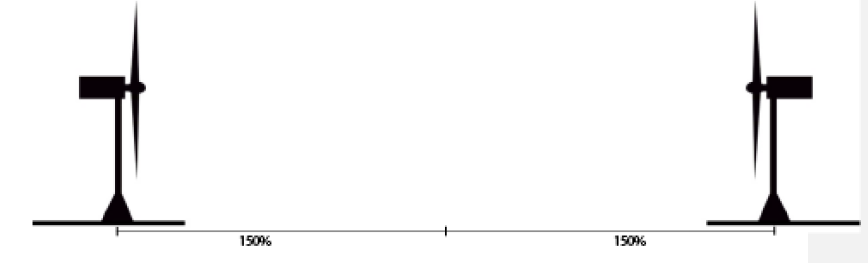
Separation between two utility-scale WECS
2.
Between any two utility-scale WECS: No less than 150 percent of the height of both towers including the tops of the blades in their vertical positions.
d.
Minimum lot size. The size of a single property, or a leased unit to be used for a utility-scale WECS shall be sufficient to comply with all setback requirements in this section.
e.
Minimum ground clearance. The minimum vertical blade tip clearance from grade and any structure, adjoining property, or tree shall be 75 feet for a utility-scale WECS employing a horizontal axis rotor.
f.
Transmission lines. New transmission lines required to connect a WECS with a new or existing network for the distribution of electricity shall be installed underground to a depth of at least six feet. This requirement applies to all new transmission lines associated with the WECS, regardless of whether they are within the property boundary or lease unit boundary or outside of said boundary.
g.
Sound pressure level. Utility-scale WECS shall not exceed 45 dB(A) (L max ) / 55 dB(C) (L max ) at the property line or lease unit boundary closest to the WECS, measured in accordance with the protocol set forth in section 32-166(5)m.2.
h.
Construction codes, towers, and interconnection standards. Utility-scale WECS including towers shall comply with all applicable state construction and electrical codes and local building permit requirements. Utility-scale WECS including towers shall comply with Federal Aviation Administration requirements, the Michigan Airport Zoning Act, the Michigan Tall Structures Act, and other applicable local and state regulations. An interconnected utility-scale WECS shall comply with Michigan Public Service Commission and Federal Energy Regulatory Commission standards. Off-grid systems are exempt from this requirement.
i.
Safety. The WECS shall meet the following safety requirements:
1.
The WECS shall be designed to prevent unauthorized access to electrical and mechanical components and shall have access doors that are kept securely locked at all times when service personnel are not present.
2.
All spent lubricants and cooling fluids shall be properly and safely removed in a timely manner from the site of the WECS.
3.
A sign shall be posted near the tower or operations and maintenance office building that shall contain emergency contact information. Signage placed at the road access shall be used to warn visitors about the potential danger of falling ice.
4.
All collection system wiring shall comply with all applicable safety and stray voltage standards.
5.
WECS towers shall not be climbable on the exterior.
6.
Each WECS shall be equipped with both a manual and automatic braking device capable of stopping the WECS operation in high winds within 80 percent of design limits of the breaking system.
7.
A copy of the un-redacted safety manual from the turbine manufacturer shall be submitted to the township and the turbine must comply with all requirements therein.
j.
Visual impact.
1.
WECS shall be mounted on tubular towers, painted a non-reflective, non-obtrusive neutral color.
2.
The appearance of turbines, towers, and buildings shall be maintained throughout the life of the wind energy facility pursuant to industry standards (i.e. condition of exterior paint, signs, landscaping).
3.
A certified registered engineer and authorized factory representative shall certify that the construction and installation of the WECS meets or exceeds the manufacturer's construction and installation standards.
4.
The design of the wind energy facility's buildings and related structures shall, to the extent reasonably possible, use materials, colors, textures, screening, and landscaping that shall blend facility components with the natural setting and the environment existing at the time of installation.
k.
Shadow flicker. No amount of shadow flicker may fall on or in a non-participating parcel. Site plan and other documents and drawings shall show mitigation measures to eliminate potential impacts from shadow flicker, as identified in the shadow flicker impact analysis. Measures to eliminate all effects of shadow flicker on all non-participating parcels beginning at the property lines, such as programming the WECS to stop rotating during times when shadow crosses occupied structures, shall be required.
1.
If the shadow flicker impact analysis shows potential for shadow flicker to fall on any non-participating parcel and the affected property owners wishes to waive his/her rights to the protections provided by this chapter, the property owner shall submit for records a signed and notarized letter of acknowledgement that verifies the owner's understanding that shadow flicker on his/her parcel may result from installation and waives the township requirement for no shadow flicker on the non-participating parcel. If the affected property owner wants this waiver to apply to future owners of the affected property, the signed and notarized letter of acknowledgment must be recorded with the Oakland County Register of Deeds.
l.
Lighting. A lighting plan that includes all proposed lighting for each WECS shall be approved by the planning commission. The plan shall include, but is not limited to, the planned number and location of lights, light color, whether any lights shall be flashing, and all proposed shielding mechanisms. All tower-mounted lighting shall be of the radar-activated variety and shielded from view at ground level, unless otherwise directed by the FAA. All tower lighting shall comply with FAA regulations and guidance and shall be consistent with U.S. Fisheries and Wildlife Service/Michigan Department of Natural Resources guidelines.
m.
Interference. No utility-scale WECS shall be installed in any location where its proximity to existing fixed broadcast, retransmission, or reception antennae for radio, television, or wireless phone or other personal communication systems would produce interference with signal transmission or reception. Any signal interference incurred following the installation of a WECS shall be resolved to the satisfaction of the person receiving that signal interference. No utility-scale WECS shall be installed in any location within the line of sight of an existing microwave communications link where operation of the WECS is likely to produce interference in the link's operation unless the interference is insignificant.
n.
Substations and accessory buildings. Structures related to a WECS shall be subject to the dimensional and locational standards of structures in the zoning district. Where structures are visible from adjacent properties, vegetative or manmade screening may be required to minimize visual impact off-site.
o.
Inspection. The township shall have the right upon issuing any WECS or wind energy facility special use permit to inspect the premises on which each WECS is located at any reasonable time. The township may hire a consultant to assist with any such inspections at a reasonable cost to be charged to the operator of the WECS.
p.
Decommissioning.
1.
The applicant shall engage a certified professional engineer acceptable to the township to estimate the total cost of decommissioning the structure in accordance with the requirements of this chapter, including reclamation to the original site conditions. The cost of decommissioning shall be reviewed between the operator and the township zoning administrator every two years to ensure adequate funds are allocated for decommissioning; the security bond, defined herein, shall be appropriately adjusted to reflect the then current decommissioning estimate.
2.
All above and below ground materials shall be removed when the WECS is decommissioned.
3.
The ground shall be restored to its original condition within 60 days of removal of the structures. Acceptable ground covers include grasses, trees, crops, or other material demonstrated to be characteristic of the surrounding land.
4.
In the event that the WECS owner or operator fails to comply with the decommissioning requirements of this chapter, the township may, upon 30 days written notice to the WECS owner and/or operator, utilize the security bond referenced in section 32-166(4)s.1 to complete the decommissioning process.
q.
Abandonment. Any WECS that is not used to produce energy for a period of six successive months or longer shall be deemed to be abandoned and shall be promptly dismantled and removed from the property in accordance with the decommissioning regulations of this ordinance, unless the applicant receives a written extension of that period from the township board in a case involving an extended repair schedule for good cause.
r.
Reasonable conditions. In addition to the requirements of this section, the planning commission may impose additional reasonable conditions on the approval of WECS as a special use.
s.
Security bond.
1.
The owner(s) and/or operator of the WECS shall post a security bond in a form acceptable to the township equal to 150 percent of the total estimated decommissioning and reclamation costs. The cost of decommissioning shall be reviewed between the operator and the township board every two years to ensure adequate funds are allocated for decommissioning; the security bond, defined herein, shall be appropriately adjusted to reflect the current decommissioning estimate.
2.
The security bond shall be posted and maintained with a bonding company licensed in the State of Michigan or a Federal- or State-chartered lending institution acceptable to the township.
3.
Any bonding company or lending institution shall provide the township with 90 days' notice of the expiration of the security bond. Lapse of a valid security bond is grounds for the actions defined in subpart 5, below.
4.
In the event of sale or transfer of ownership and/or operation of the WECS, the security bond shall be maintained throughout the entirety of the process.
5.
If at any time during the operation of the WECS or prior to, during, or after the sale or transfer of ownership and/or operation of the WECS the security bond is not maintained, the township may take any action permitted by law, revoke the special land use, order a cessation of operations, and order removal of the structure and reclamation of the site.
t.
Transfer or sale.
1.
In the event of a transfer or sale of the WECS, the township shall be notified and the special land use, without a public hearing, may be amended administratively by the zoning administrator.
2.
Change in ownership alone shall be considered a minor amendment to the special land use and may be approved administratively.
3.
Any proposed changes to the operating procedure or approved site plan shall be amended and resubmitted for township review according to the procedures for all WECS as outlined herein, including a public hearing.
4.
Upon transfer or sale, the security bond shall be maintained at all times, the estimated costs of decommissioning shall be resubmitted, and the security bond adjusted to account for the new estimate.
(5)
Wind energy conversion system site plan review procedure. An application for a WECS shall be reviewed in accordance with all applicable requirements in section 32-233 Criteria of Site Plan Review and section 32-33 Special Use Requirements of this chapter. In addition to these requirements, site plans and supporting documents for WECS shall include the following additional information, as appropriate:
a.
Documentation that noise emissions, construction code, tower, and safety requirements have been reviewed by the appropriate third-party professional and the submitted site plan is prepared to show compliance with these issues.
b.
Proof of the applicant's public liability insurance for the project.
c.
A copy of that portion of all the applicant's lease(s) with the land owner(s) granting authority to install the WECS and/or anemometer tower; legal description of the property(ies), lease unit(s); and the site plan shows the boundaries of the leases as well as the boundaries of the lease unit boundary, as well as a copy of any letters waiving the sound and/or shadow flicker limit on non-participating parcels.
d.
An un-redacted safety manual from the turbine manufacturer and a statement from the applicant verifying that the WECS is or will be operated in compliance with all requirements therein.
e.
The phases, or parts of construction, with a construction schedule.
f.
The project area boundaries.
g.
The location, height, and dimensions of all existing and proposed structures and fencing.
h.
The location, grades, and dimensions of all temporary and permanent on-site and access roads from the nearest county or state maintained road.
i.
A description of the routes to be used by construction and delivery vehicles and of any road improvements that shall be necessary in the township to accommodate construction vehicles, equipment or other deliveries, and an agreement or bond which guarantees the repair of damage to public roads and other areas caused by construction of the WECS.
j.
All new infrastructure above and below ground related to the project, including transmission line locations.
k.
A copy of manufacturers' material safety data sheet(s) which shall include the type and quantity of all materials used in the operation of all equipment including, but not limited to, all lubricants and coolants.
l.
Description of operations, including anticipated regular and unscheduled maintenance.
m.
Additional requirements for utility-scale wind energy conversion systems only:
1.
A wind assessment study conducted within a potential project area shall be completed within 18 months of the date of application for a WECS. The study must show analysis for a period of time no less than one year. The height of an anemometer (or similar) device measuring wind availability shall be placed within the potential vertical swept blade area of the proposed WECS. Temporary (one-year) installation of said device may be applied for through the township site plan approval process and may be approved for a height acceptable to determine feasibility of a WECS height allowed by this ordinance. The anemometer shall be decommissioned in accordance with section 32-166(4)p of this chapter, including the provision of a security bond covering decommissioning costs.
2.
A copy of a noise modeling and analysis report completed by a third-party acoustician acceptable to the township and the site plan shall show locations of equipment identified as a source of noise which is placed, based on the analysis, so that the utility grid WECS shall not exceed the maximum permitted sound pressure levels. The noise modeling and analysis shall conform to the most current protocol for The International Electrotechnical Commission (IEC) 61400, Parts 11 and 14, The International Organization for Standardization (ISO) 9613-2, and ANSI S12.62, including all tolerances and uncertainties. After installation of the WECS, sound pressure level measurements shall be performed by a third party, acoustician acceptable to the township according to the procedures in the most current version of The American National Standards Institute (ANSI) S12.9, Part 3 and ANSI S12.100 for measurements (with an observer). All sound pressure levels shall be measured with a sound meter that meets or exceeds the most current version of ANSI S1.4 specifications for a Type II sound meter. Documentation of the actual sound pressure level measurements shall be provided to Holly Township within 60 days of the commercial operation of the project and as requested to respond to a noise complaint from a resident.
3.
A visual impact simulation showing the completed site as proposed on the submitted site plan. The visual impact simulation shall be from four viewable angles.
4.
A copy of an environmental analysis by a third party qualified professional acceptable to the township to identify and assess any potential impacts on the natural environment including, but not limited to wetlands and other fragile ecosystems, historical and cultural sites, and antiquities. The applicant shall take appropriate measures to minimize, eliminate or mitigate adverse impacts identified in the analysis, and shall show those measures on the site plan. The applicant shall identify and evaluate the significance of any net effects or concerns that shall remain after mitigation efforts.
5.
A copy of a shadow flicker analysis at non-participating parcel property lines to identify the locations of shadow flicker that may be caused by the project and the expected durations of the flicker at these locations from sunrise to sunset over the course of a year. The site plan shall identify problem areas where shadow flicker may affect the owners and/or occupants of the non-participating parcels and show measures that shall be taken to eliminate the problems.
6.
The restoration plan for the site after completion of the project which includes the following supporting documentation:
i.
The anticipated life of the project.
ii.
The estimated decommissioning costs as defined in this ordinance.
iii.
The security bond, or similar township-approved security, ensuring that funds shall be available for decommissioning and restoration.
iv.
The anticipated manner in which the project shall be decommissioned, and the site restored.
7.
A contact person/address to which any notice of complaint, as defined by this ordinance, may be sent.
(6)
Deposit to defray cost of hiring consultants and experts. To administer the provisions relating to WECS, the township may hire consultants and experts as are reasonably necessary in the sole discretion of the township. The applicant shall pay the township in advance for the costs of such consultants and experts. The township may charge an annual fee to be determined by the Holly Township Board and assess additional fees in order to execute its responsibilities related to a project. Any fees charged must be reasonable in light of efforts required.
(Ord. of 1-16-2019(1), § 1)
Sec. 32-167. - Special accommodation use.
(a)
Intent. This section is intended to authorize the grant of relief from the strict terms of the ordinance in order to provide equal housing opportunities particularly suited to the needs of persons entitled to reasonable accommodation under law and to encourage innovation in land use and variety in design and layout. In the event state or federal law, e.g., The Federal Fair Housing Amendments Act of 1988, requires the township to make "reasonable accommodation" for a particular proposed user of property, the township board, following a public hearing, may administratively approve a special accommodation use under the authority of MCL 125.3502, subject to and in accordance with this section.
(b)
Applicability. As a condition to approval of a special accommodation use, the applicant must comply with all the terms of this section, and must demonstrate all of the following:
(1)
The ultimate residential user or users of the property shall be persons for whom state or federal law mandates the township to make reasonable accommodations in connection with proposed uses of land; and
(2)
Taking into consideration the needs, facts, and circumstances which exist throughout the community, and within the population to be served by the use, making the proposed reasonable accommodation shall be necessary to afford such persons equal opportunity to the proposed use and enjoyment within the community; and
(3)
Approval of the proposed housing shall not require or will not likely result in a fundamental alteration in the nature of the zoning district and surrounding area in which the property is situated. The interests of the community shall be balanced against the need for accommodation on a case-by-case basis, considering cumulative impact of one or more other uses and activities in, or likely to be in, the area.
(4)
No other specific ordinance provision exists and is available to provide the relief sought.
(c)
Application requirements. The application for a special accommodation use shall include the following:
(1)
A site plan drawn to scale showing the proposed use and development, meeting the requirements of section 32-234 (Information Required on Site Plan).
(2)
A separate document providing a summary of the basis on which the applicant asserts entitlement to approval of a special accommodation use, covering each of the requirements of paragraph 2a through 2c, above. This summary shall include the documentation on which the applicant relies, as well as the name, address and a summary of all statements with regard to each person whose statements shall be relied upon by the applicant (and, if such persons are relied upon for their expertise, a resume of their backgrounds shall be included).
(d)
Public notification. The township board shall conduct a public hearing in accordance with the notification requirements set forth in section 32-33 Special Uses, except that all proceedings shall be before the township board.
(e)
Standards and regulations. In order to be entitled to the approval of a special accommodation use, the following must be demonstrated by the applicant to the township board:
(1)
All of the requirements for entitlement to approval under subsections (b) (1) through (4), above, will be met.
(2)
If the proposed housing does not constitute a permitted use in the zoning district in which the property is situated, the intensity of the use (e.g. number of residents in the residential facility) shall be the minimum required in order to achieve feasibility of the use.
(3)
The use, and all improvements on the property shall be designed and constructed to meet the following standards and conditions:
a.
Taking into consideration the size, location and character of the proposed use, viewed within the context of existing and planned land uses of the surrounding area, the proposed use shall be established in such a manner to be compatible and harmonious.
b.
The proposed use shall be designed to ensure that vehicular traffic shall not create a hazard or under burden for existing and planned land uses of the surrounding area, taking into consideration turning movements, proximity and relationship to intersections, adequacy of sight distances, location and access of off-street parking and relationship to pedestrian traffic.
c.
The proposed use shall be designed and operated so as not to unreasonably impact upon surrounding property in terms of noise, dust, fumes, smoke, air, water, odor, light and/or vibration.
d.
The proposed use shall not interfere with or discourage the appropriate development and use of adjacent land and buildings and will not have a detrimental effect upon their value.
e.
The proposed use shall be designed, located, planned and operated in such a manner that the public health, safety and welfare will be protected.
(f)
Design standards. All regulations and standards for buildings, structures and site improvements within the district in which the property is situated shall apply, subject to the right of the township board, following recommendation of the township supervisor, to alter and supplement such standards and regulations the board finds to be needed given the facts and circumstances attendant to a particular case. In all events, the spirit of the ordinance shall be observed, and standards and regulations shall be enforced so that the essential character of the neighborhood and/or district is not altered.
(g)
Conditions. In connection with the approval of a special accommodation use, the township board may impose such conditions as are authorized by law.
(h)
Effect of approval.
(1)
Approval of a special accommodation use shall be solely for the benefit of the particular class of users who were the basis of requiring the township to make a reasonable accommodation under applicable state and/or federal law, and not for the benefit of any other persons. Accordingly, the effect of an approval under this section shall be for the exclusive benefit and occupancy of such class of persons. If a change in such use occurs such that it is occupied by others, all of the regulations applicable within the district in which the property is situated shall thereupon immediately and fully apply. An approval under this section shall not be final until such time as the applicant records an affidavit at the office of the register of deeds in connection with the property, in a form approved by the township attorney, providing notice of the terms of this provision.
(2)
An approval under this section shall be effective for a period of one year, and shall thereafter be void unless there is an occurrence of actual occupancy by persons for whom the special accommodation has been made in granting approval.
(Ord. of 5-15-2013(1), § 1)
Editor's note— An ordinance, adopted May 15, 2013, amended the Code by adding provisions designated as § 32-165. Inasmuch as there were already provisions so designated, the provisions have been redesignated as § 32-167, at the discretion of the editor.
Sec. 32-168. - Special events.
(a)
Special event, as defined in [section] 32-6 must be clearly accessory or secondary to the principal uses or activities occurring within a permanent building on the same site.
(b)
Special event as defined in this section may be approved in any zoning district. The approval/disapproval of any such special event is discretionary based on the nature of the special event and the special demands it imposes on the site and the community.
(c)
Special events must file application for a permit with the township if they:
(1)
Temporarily occupy off-street parking areas, spaces, or drive aisles;
(2)
Utilize public lands or road right-of-way;
(3)
Use equipment, speakers, or instruments that create increased sound audible at the property line;
(4)
Seek a temporary liquor license or a bingo, raffle, and charity gaming license;
(5)
Set up temporary buildings; or
(6)
Will erect temporary signs.
(d)
An application must be filed with the township at least 30 days prior to the event that describes the event in detail. The application will request the information required for review by township departments and consultants, including but not limited to required drawings, documents, permit fees, and performance guarantees.
(e)
The event shall not cause disruption to the public including streets, walks or other rights-of-way and adjoining properties. Fire lanes must be maintained to the township fire marshal's satisfaction. Temporary barriers placed on the site to restrict or direct traffic flow on-site must be approved by the fire marshal, building official and the zoning administrator. Further, the applicant must provide any special emergency lanes required by the fire marshal.
(f)
The building official will review the application and require any building permits for temporary buildings per the Michigan Building Code.
(g)
The activities, instruments, or equipment that generate sound levels that may be a nuisance to surrounding properties shall be identified by the applicant in the "application" submitted to the township. Activities, equipment, or instruments considered nuisances by the township departments shall be prohibited or regulated. The applicant will not use any equipment or instruments or conduct any activities at the special event to produce a sound level that is plainly audible at the property line between the hours of 11:00 p.m. and 7:00 a.m. during the special event.
(h)
The zoning administrator will approve or reject the application based on their review, other review reports, and recommendations.
(i)
The applicant shall be responsible for restoring the site to its condition prior to the special event. Cleanup of site shall occur immediately following the completion of the special event. Cleanup shall include but not be limited to removal of all waste and debris generated by the event; removal of any signs, banners, temporary barriers or markers, tents, trailers portable/temporary seating, tables, dumpsters, and portable toilets.
(j)
If the site has not been cleaned up and restored within two days of the special event completion, the township may arrange for necessary cleanup and all charges for the cleanup must be paid by the performance guarantee. If that guarantee is insufficient, a lien will be placed on the land up to the amount of the difference between the cost of the cleanup and the performance guarantee.
(k)
A special event may not occur for more than five consecutive days unless extended by the township board.
(l)
The size, type, locations and tenure of all signs to be used as part of the special event must be identified in the application and approved prior to installation. Removal of all the special event signs is part of the clean-up process.
(m)
The applicant shall be responsible for any licenses or permits required by other governmental agencies including Oakland County or State of Michigan. Evidence of any required license, permit, or certificates shall be included with the "application for special event approval."
(Ord. of 9-18-2019, § 1)
Sec. 32-169. - Agricultural tourism.
(a)
Intent. The intent of these zoning provisions are to promote and maintain local farming. The activities that are described have become necessary for the sustainability of farms. The provisions are intended to provide standard definitions related to agricultural tourism operations, provide a list of permitted activities under an agricultural tourism operation, and to provide for a clear understanding of the expectations for agricultural tourism businesses for operators, local residents, other businesses and local officials.
(b)
Special uses permitted by district. The following table indicates in which zoning district an agricultural tourism use is permitted by special use permit in accordance with section 32-33:
(c)
Accessory uses. If a special use is approved for any of the above-described uses, the applicant may request the special use include any or all the following accessory uses.
(1)
Educational activities, such as tours, classes, seminars and lectures;
(2)
Bakeries selling baked goods containing produce grown primarily on site, subject to compliance with all local, state and federal laws governing food safety;
(3)
Playgrounds or recreational equipment typical of a school playground, such as slides, monkey bars, and swings (not including motorized vehicles or rides);
(4)
Nature trails;
(5)
Open air or covered picnic area;
(6)
Historical exhibits and interpretative opportunities;
(7)
Kitchen facilities, processing/cooking items for sale, subject to compliance with all local, state and federal laws regulating such uses;
(8)
Gift shops for the sale of agricultural products and agriculturally related products;
(9)
Gifts shops for the sale of non-agriculturally related products such as antiques or crafts, limited to 25 percent of gross sales;
(10)
Greenhouses.
(d)
Minimum lot size. All special uses contained in this section shall comply with the following minimum lot size depending on the district in which they are located. All other dimensional requirements shall conform to the standards of section 32-104 schedule of regulations.
(e)
Special use standards for agricultural tourism. All special uses contained in this section shall be subject to the following conditions:
(1)
All uses must comply with local, state and federal rules and regulations, including the Michigan Right to Farm Act.
(2)
In residential districts, all uses shall be clearly incidental to a principal farm agricultural use.
(3)
Buildings, structures, and activities shall be separated from adjacent residential land uses by a 50-foot planted buffer. The buffer shall be required in addition to the minimum setbacks within the zoning district. The buffer may consist of berms, ground cover, shrubs, ornamental or evergreen trees, and/or fencing subject to planning commission approval.
(4)
Hours of operation for all agricultural tourism uses shall be no earlier than 7:00 a.m. and no later than 11:00 p.m. for indoor uses and no earlier than 9:00 a.m. and no later than 10:00 p.m. for outdoor uses.
(5)
Amplified music is permitted only within a permanent structure. All events shall be required to meet the regulations of section 32-194 noise and vibrations and section 32-168 special events of the Holly Township Zoning Ordinance.
(6)
Applicants for special uses must secure all necessary permits from all applicable local, state or federal agency, including, but not limited to the Michigan Department of Agriculture and Rural Development, the Oakland County Health Division, the Township Building Department, the Fire Department, the Road Commission for Oakland County, the Michigan Liquor Control Commission, and appropriate law enforcement agency(s).
(7)
Sanitary facilities that consist of portable stations, must be properly maintained and located within a side or rear yard and screened from public view.
(8)
All waste products shall be screened from public view, properly disposed of on a regular basis and shall in no way be allowed to become a nuisance to adjacent properties.
(9)
Building or structure occupancies shall not exceed the limit as established by the fire department based on the maximum occupancy load of the building(s) or structure(s).
(10)
Licenses, insurance certificate, permits, and event dates must be submitted to the township zoning administrator annually, for review and approval, by January 30 of each calendar year.
(11)
The performance standards described in chapter 10, article II of this chapter shall apply to all agricultural tourism uses.
(12)
Applicant shall submit maximum number of days of operation per year, which shall be subject to planning commission approval.
(13)
All customer ingress and egress shall be from a public road.
(Ord. of 6-22-2020, § 1)

