
Jacksonville City Zoning Code
PART 15
- COMMUNICATION TOWER AND ANTENNA REGULATIONS15
Editor's note— Ord. 2001-600-E, §§ 2 and 3, effective August 23, 2001, amended the Code by repealing former Part 15, §§ 656.1501—656.1531, and adding a new Part 15, §§ 656.1501—656.1533. Former Part 15 pertained to similar subject matter, and derived from Ord. 96-305-296; Ord. 96-760-412; Ord. 96-810-482; Ord. 1999-243-E; Ord. 1999-1330-E; and Ord. 2001-293-E.
Sec. 656.1501.- Purpose and intent.
The City Council finds that the promulgation of these regulations is warranted and necessary to promote the health, safety and general welfare of residents of the City by:
(a)
Providing uniform standards for the provision of both radio and television broadcast signals and telecommunication services, including two-way radio, paging, PCS, cellular and related wireless services;
(b)
Protecting the natural features and aesthetic character of the City by regulating the location, design and operation of wireless communication facilities, with special attention to residential neighborhoods, public parks, transportation view corridors, historic districts, historic landmarks, and environmentally sensitive lands;
(c)
Minimizing the adverse visual and aesthetic impacts of wireless communication facilities through innovative design, siting and landscaping standards, including incentives to promote the use of Camouflaged Towers, Stealth Towers, co-location of new antennas on existing communication towers and the placement of antennas on roofs, walls, existing towers and other existing structures;
(d)
Accommodating the growing demand for wireless communication services, consistent with the Federal Telecommunications Act of 1996 and the Florida Wireless Emergency Communications Act, and ensuring an efficient and high-quality wireless communications network; and
(e)
Expediting the review process for those applications choosing the least intrusive alternative of deploying wireless telecommunication services.
These regulations are not intended to prohibit or have the effect of prohibiting the provision of personal wireless services, nor shall they be used to unreasonably discriminate among providers of functionally equivalent services, consistent with federal regulations.
(Ord. 2001-600-E, §§ 2, 3; Ord. 2007-561-E, § 1)
Sec. 656.1502. - Definitions.
For purposes of this Part, the following terms, words, and phrases shall have the following meanings:
Antenna means a device used to receive or transmit radio frequency signals. Examples include, but are not limited to, whip antennas, panel antennas and dish antennas.
Broadcast tower means a tower designed and constructed for the principal purpose of supporting one or more radio and/or television antenna, but also allowing for other secondary purposes such as those regulated by Part 15 of this Zoning Code, including two-way radio, paging, PCS, cellular and related wireless services.
Camouflaged tower means any wireless communication tower that is designed to hide, obscure or conceal the presence of antennas and the tower. Examples include, but are not limited to, clock towers, bell towers, church steeples, utility poles, flag poles, light poles, tree towers, stadium lights and water towers.
Collocation means the situation when a second or subsequent wireless provider uses an existing structure to locate a second or subsequent antennae.
Conventional wireless tower means a monopole designed and constructed to support multiple antennas. This term does not include camouflaged towers, low impact/stealth towers, broadcast towers or amateur radio towers.
Distance means, where used in connection with required setbacks and separation requirements, the distance from the center of a wireless communication tower.
Environmentally sensitive lands means those areas of land or water which are determined necessary by the local government (based on locally determined criteria) to conserve or protect natural habitats and ecological systems, as more fully set forth in the City's 2010 Comprehensive Plan.
Federal Communications Commission (FCC) means the federal agency charged with licensing and regulating wireless communications at the national level.
Height means the vertical distance measured in feet from the ground level of the tower to its highest point, including any antenna or other appurtenances.
Lattice tower means a nonmonopole tower of lattice construction.
Low impact/stealth tower means a tapered monopole that is equipped with visually low impact antenna mounts of wireless communication service providers. Examples include, but are not limited to, low-profile mounts, close-mounts, cobra-mounts and side-arm antennas.
Search ring means that area in which the antenna of a wireless communication service provider must be located in order to provide the provider's designed wireless communication service to a defined geographic area.
Transportation view corridor means any public right-of-way, including roads, waterways and trails; provided, however, that this definition shall not include those public, unopened rights-of-way platted prior to 1968.
Urban/suburban area boundary means that boundary depicted in the Future Land Use Map series of the City of Jacksonville 2010 Comprehensive Plan, identifying the separation between the rural/agricultural and urban/suburban areas of the City.
Wireless Communications Coordinator ("the Coordinator") means the person charged with primary responsibility for coordinating the filing and processing of all wireless communication tower and antenna applications, maintaining a central database of all wireless communication towers and antennas located within the City and performing other duties as described in this Part.
Wireless communications facility means any equipment or facility used to provide service and may include, but is not limited to, antennae, towers, equipment enclosures, cabling, antenna brackets, and other such equipment. Placing a wireless communications facility on an existing structure does not cause the existing structure to become a wireless communications facility.
Wireless communication service provider means the holder of an FCC license to provide wireless telecommunication service, including, but not limited to, cellular, personal communication services (PCS), specialized mobilized radio (SMR), enhanced specialized mobilized radio (ESMR), paging and similar services that are marketed to the general public.
Wireless communication tower means any structure designed and constructed for the purpose of supporting one or more communication antennas, including camouflaged towers, conventional wireless towers and low impact/stealth towers. This term does not include broadcast towers, amateur radio towers or those towers used solely for private-use dispatch purposes.
(Ord. 2001-600-E, §§ 2, 3; Ord. 2001-1058-E, § 2; Ord. 2002-709-E, § 1; Ord. 2007-561-E, § 1; Ord. 2025-410-E, § 3)
SUBPART A. - WIRELESS COMMUNICATION FACILITIES[16]
Editor's note— Ord. 2007-561-E, § 2, amended the Code by repealing former Subpart A, §§ 656.1503—656.1515, and adding a new Subpart A. Former Subpart A pertained to similar subject matter, and derived from Ords. 2001-600-E, 2001-1058-E, and 2002-709-E.
Sec. 656.1503. - Applicability.
(a)
New towers. All new wireless communication towers on land within the City shall be subject to these zoning regulations. In the event of a conflict between any zoning district regulations and the regulations contained in this Part, the provisions of this Part shall override and supersede such other regulations, unless otherwise specifically set forth herein.
(b)
Existing towers. Any wireless communication tower existing as of August 23, 2001, that does not comply with the height and design requirements of this Subpart shall be deemed a legally permitted nonconforming use. Expansion of the footprint of an existing wireless communication facility to accommodate collocation shall not be deemed an expansion of a nonconforming use. Notwithstanding their status as legally permitted nonconforming uses, all existing wireless communication towers shall comply with the registration and reporting requirements set forth in Section 656.1516, Ordinance Code.
(c)
Replacement towers. An existing wireless communication tower, including a legally permitted nonconforming tower, may be replaced, subject to building permit review, if the overall height of the tower is not increased and the replacement tower is a monopole tower or, if the existing tower is a camouflaged tower, the replacement tower is a like-camouflaged tower. All replacement towers shall comply with the originally approved landscape plan. The City Council may grant waivers from the originally approved landscape plan according to Section 656.1508, Ordinance Code, and in accordance with the notice and public hearing requirements for rezonings set forth in Section 656.124, Ordinance Code.
(d)
Height increases. An antenna placement or collocation proposal that increases the height of a tower shall be subject to the requirements set forth in Section 656.1510, Ordinance Code. An increase in the height of an existing wireless communication tower beyond that permitted in Section 656.1510, Ordinance Code, shall be treated as a new tower and shall be subject to all the requirements of this Subpart A, except for those requirements concerning the minimum distance requirements.
(Ord. 2007-561-E, § 2; Ord. 2025-410-E, § 4)
Sec. 656.1504. - Wireless communication towers.
The construction of a wireless communication tower in any zoning district within the City may be initiated only upon approval of an application in accordance with the relevant procedures set forth herein. The original application, along with eight copies, shall be filed with the Coordinator by the owner of the land upon which the proposed tower is to be located, or his authorized agent. Within ten working days of receipt of an application, the Coordinator shall determine if the application form has been fully completed and all required items submitted. Upon making this determination, the Coordinator shall notify the applicant, in writing, of the status of the application. If the Coordinator determines that the application is incomplete, he shall advise the applicant of those items that need to be submitted. If the Coordinator determines that the application is complete, he shall advise the applicant of the estimated schedule for processing the application and projected date for obtaining either an approval or denial of same. Additionally, the Coordinator shall forward a complete copy of the application and all correspondence with the applicant to the Council President, the District Council Member and the Office of General Counsel.
(Ord. 2007-561-E, § 2)
Sec. 656.1505. - Track I Towers.
(a)
Applications for wireless communication towers that meet the location and design requirements to be "Track I" towers shall be assigned for processing on an expedited "Track I" schedule. Upon a determination by the Coordinator that the application is complete, the Coordinator shall determine whether the application satisfies the criteria for a Track I Tower and issue an order granting or denying the application for a Track I Tower, within the timeframe set forth in Section 656.1511(b), Ordinance Code. If the Coordinator determines that the application satisfies the criteria, the Coordinator shall issue an order approving the application and forward a copy of the order and application to the District Council Member, and if there is no District Council Member, the At-large Council Member from the Group which contains the appropriate district.
(b)
Track I requirements. A tower may be considered a Track I camouflaged tower if it satisfies all of the following criteria:
(1)
The tower is an appropriate approved camouflaged design, pursuant to Section 656.1509(c), Ordinance Code, or the tower is less than 50 feet and less than the maximum height allowed of a principal structure on the site per Chapter 656 and meets the definition for "small wireless facilities", as defined in Part 4, Chapter 711, Ordinance Code;
(2)
The tower is located in a non-residential zoning district;
(3)
The tower height shall be:
(i)
150 feet or less, if located in an industrial use category of the Future Land Use Plan;
(ii)
130 feet or less, if located in a Community/General Commercial, Regional Commercial or Central Business District category of the Future Land Use Plan;
(iii)
110 feet or less, if located in a Neighborhood Commercial or Public Buildings and Facilities category of the Future Land Use Plan;
(iv)
90 feet or less, if located in any other non-residential category of the Future Land Use Plan, except the Conservation category;
(4)
The tower will be located at least 100 feet or 100% of the tower height, whichever distance is greater, from the property line of any property within a Residential category of the Future Land Use Plan and with residential zoning, or from a portion of a Planned Unit Development zoned for residential uses;
(5)
The tower will be set back a minimum distance of 50 feet from any transportation view corridor, a public park, a historic district, a historic landmark, and any environmentally sensitive land, unless the camouflaged tower is designed to resemble a utility or light pole, or the tower is 50 feet or less and less than the maximum height allowed of a principle structure on the site per Chapter 656 and meets the definition and the design guidelines for "small wireless facilities", as defined in Part 4, Ch. 711, Ordinance Code.
(6)
There is no technologically and structurally suitable space available on commercially reasonable terms on an existing or proposed tower or structure within the search ring; and
(7)
The view of the base of the wireless communication facility from any residentially neighborhoods, environmentally sensitive lands, historic districts, historic landmarks, public parks or transportation view corridors will be mitigated through the use of either: (i) meeting performance standards of Sec. 656.1512, Ordinance Code; (ii) intervening structures or existing vegetation that provide the equivalent screening, or (iii) the tower is 50 feet or less and less than the maximum height allowed of a principle structure on the site per the Chapter 656 and meets the definition for "small wireless facilities", as defined in Part 4, Ch. 711, Ordinance Code.
(8)
Separation. For towers over 50 feet, no tower shall be permitted to be constructed within 750 feet of another tower over 50 feet.
(c)
Appeal. If the Coordinator determines that an application satisfies all of the criteria, the District Council Member, or if there is no District Council Member, the At-large Council Member from the Group which contains the appropriate district, shall have 14 days to appeal the determination in the following manner:
(1)
The District Council Member shall file a formal notice of appeal with the Coordinator within 14 days of receiving the application;
(2)
The Coordinator shall set the matter for a hearing before the Commission;
(3)
The Commission's review is limited to whether or not the camouflaged design was appropriate for the site and/or whether there is no technologically and structurally suitable space available on commercially reasonable terms on an existing or proposed tower or structure within the search ring.
(4)
The parties to the proceeding are the District Council Member, the Department, and the applicant. No other parties shall be permitted to comment.
(5)
The Commission shall issue a finding regarding the appeal on the date of the hearing and this finding shall be the final agency action for the City, with appeals to a court of competent jurisdiction.
(Ord. 2007-561-E, § 2; Ord. 2018-463-E, § 1)
Sec. 656.1506. - Track II Towers.
(a)
Application and review. Applications to construct a camouflaged tower not satisfying the criteria set forth in Section 656.1505, Ordinance Code, or low impact/stealth tower shall be assigned for processing on a "Track II" schedule. Within 15 days of notification from the Coordinator that the application is complete, a Track II application shall be scheduled for review at the next regularly scheduled meeting of the Commission. The Commission shall approve, deny or conditionally approve the application where it finds that the proposed tower (1) complies with the tower siting and design requirements and performance standards of this Subpart; and (2) is compatible with the existing contiguous uses or zoning and compatible with the general character and aesthetics of the surrounding neighborhood or area, considering (a) the design and height of the wireless communication tower; and (b) the potential adverse impact upon any environmentally sensitive lands, historic districts or historic landmarks, public parks or transportation view corridors.
(b)
Camouflaged towers; Siting and Design Requirements. Except as set forth in Section 656.1514, Ordinance Code, Track II camouflaged towers shall be permitted in all zoning districts, including Planned Unit Development Districts, and shall meet the compatibility requirements set forth in subsection (a) above and shall be subject to the following siting and design requirements:
(1)
Height. Track II camouflaged towers shall not be subject to a maximum height requirement, so long as the proposed tower is architecturally and aesthetically compatible with the surrounding community. Towers meeting the definition for "small wireless facilities", as defined in Part 4, Chapter 711, Ordinance Code, shall not exceed the maximum height allowed of a principle structure on the site per Chapter 656, or 50 feet, whichever is less.
(2)
Setbacks. Regardless of the zoning district in which a camouflaged tower is proposed to be constructed, the tower shall be set back a distance of at least 100 feet or 100 percent of the tower height, whichever distance is greater, from the nearest residential lot line of any single family residence or single family residentially-zoned property, including residential PUD districts and properties with a single-family residential component in a mixed-use PUD district, or AGR IV land use category; provided, however, that this setback shall not be required where legal title to the nearest residential parcel is held by the owner of the tower site. In the event that the proposed tower is to be located within a mixed use Planned Unit Development (PUD), the minimum distance set forth herein shall be measured from the nearest residential use. Camouflaged towers shall also be set back a minimum distance of 50 feet from any transportation view corridor or environmentally sensitive lands; provided, however, that the set back from the transportation view corridor shall not apply where the camouflaged tower is designed to resemble a utility or light pole, or the tower is 50 feet or less, and less than the maximum height allowed of a principle structure on the site per Chapter 656, and meets the definition and the design guidelines for "small wireless facilities," as defined in Part 4, Chapter 711, Ordinance Code.
(3)
Collocation. Any camouflaged tower in excess of 100 feet in height shall be designed to accommodate antennas for at least two separate wireless communication service providers.
(4)
Separation. For towers over 50 feet, no camouflaged tower shall be permitted to be constructed within 750 feet of another camouflaged tower;
(c)
Low impact/stealth towers; Siting and Design Requirements. Except as set forth in Section 656.1514, Ordinance Code, low impact/stealth towers shall be permitted in all zoning districts, including Planned Unit Development Districts, and shall meet the compatibility requirements set forth in subsection (a) above and shall be subject to the following siting and design requirements:
(1)
Height. The maximum height of low impact/stealth towers in any residential zoning district is 110 feet. In all other districts, the maximum height of low impact/stealth towers is 130 feet; provided, however, that a variance may be sought from the City Council in accordance with the provisions of this Subpart to increase the maximum height of a proposed low impact/stealth tower in a nonresidential zoning district up to an additional 30 feet. No variance shall be required, however, where close-mount antennas are proposed to be located on that portion of a low impact/stealth tower in excess of 130 feet, so long as the overall tower height of the tower does not exceed 160 feet and the tower is located in a nonresidential zoning district.
(2)
Setbacks. Regardless of the zoning district in which a low impact/stealth tower is located; the tower shall be set back a distance of at least: (a) 250 feet or 200 percent of the tower height, whichever distance is greater, from the nearest residential lot line of any single family residence or single family residentially-zoned property, including residential PUD districts and properties with a single-family residential component in a mixed-use PUD district or AGR IV land use category; provided, however, that this setback shall not be required where legal title to the nearest residential parcel is held by the owner of the tower site; and (b) 150 feet or 100 percent of the tower height, whichever distance is greater, from the nearest residential lot line of any Residential Medium Density (RMD), Residential Office (RO), Commercial/Residential/Office (CRO) or Residential High Density (RHD) zoning districts; provided, however, that this setback shall not be required where legal title to the nearest residential parcel is held by the owner of the tower site. In the event that the proposed tower is to be located within a mixed use Planned Unit Development (PUD), the minimum distances set forth herein shall be measured from the nearest residential use. Stealth towers shall also be set back a minimum distance of 250 feet or 200 percent of the tower height, whichever distance is greater, from the nearest boundary of a public park, historic district, historic landmark, Neighborhood Conservation District or environmentally sensitive lands, and a minimum distance of 100 feet from any transportation view corridor.
(3)
Separation. No low impact/stealth tower shall be permitted to be constructed within 1,500 feet of another stealth tower or a conventional wireless tower.
(4)
Collocation. Any low impact/stealth tower proposed to be constructed between 100 and 110 feet in height shall be designed to accommodate antennas for at least two separate wireless communication service providers. Any low impact/stealth tower proposed to be constructed in excess of 110 feet in height shall be designed to accommodate antennas for at least three separate wireless communication service providers.
(d)
Public hearings. A public hearing shall be held by the Commission on all Track II Tower applications. Notice of the public hearing shall be given pursuant to the written notice and posting of sign requirements of Section 656.137(a),(c) and (d). No published advertisement shall be required.
(e)
Appeals. When the Commission acts on a Track II application, such action shall be deemed the final action of the City as of the effective date of the final action by the Commission. A final action under this Section shall not be reviewed further by the City Council. Any person with standing may challenge a final action taken by the Commission as authorized by law.
(Ord. 2007-561-E, § 2; Ord. 2010-613-E, § 1; Ord. 2015-338-E, § 1; Ord. 2018-463-E, § 1; Ord. 2025-410-E, § 4)
Sec. 656.1507. - Conventional wireless towers ("Track III").
Applications to construct a conventional wireless tower shall be assigned for processing on a "Track III" schedule. Within 30 days of notification from the Coordinator that the application is complete, a Track III application shall be assigned a legislative bill number and scheduled for a public hearing before the appropriate committee of reference of the City Council. The committee shall recommend approval, denial, or conditional approval of the application based upon its compliance with the review criteria and the siting and design standards set forth in this Section, as well as the performance standards for all wireless communication towers set forth in this Subpart.
(a)
Siting and design standards. Conventional wireless communication towers shall only be allowed in those zoning districts and land use categories located outside the urban/suburban area boundary that do not allow for residential uses, subject to the siting and design requirements set forth in this Section.
(1)
Height. The maximum height of a conventional wireless tower is 199 feet.
(2)
Design. All conventional wireless towers must be of a monopole design.
(3)
Setbacks. Regardless of the zoning district in which a conventional wireless tower is located, the tower shall be set back a distance of at least: (a) 250 feet or 200 percent of the tower height, whichever distance is greater, from the nearest residentially zoned parcel; provided, however, that this setback shall not be required where legal title to the nearest residential parcel is held by the owner of the tower site. In the event that the proposed tower is to be located within a mixed use Planned Unit Development (PUD), the minimum distance set forth herein shall be measured from the nearest residential use. Conventional wireless towers shall also be set back a minimum distance of 250 feet or 200 percent of the tower height, whichever distance is greater, from the nearest boundary of a public park, historic district, historic landmark, Neighborhood Conservation District or environmentally sensitive lands, and a minimum distance of 100 percent of the tower height from any transportation view corridor.
(4)
Separation. No conventional wireless tower shall be permitted to be constructed within 2,640 feet of another conventional wireless tower.
(5)
Collocation. Conventional wireless towers shall be designed to accommodate collocation of antennas for multiple wireless communication service providers, as follows:
(b)
Public hearing. A public hearing shall be held by the Council to consider all conventional wireless tower applications. Notice of the time and place of the public hearing shall be made as provided in Section 656.124, Ordinance Code. Additionally, the notice shall specify the proposed height of the tower and the number of wireless communications service provider(s) that can be located on the tower.
The Department shall be responsible for making an advisory recommendation to the Council on each application for a conventional wireless tower. Said recommendation shall be in writing and furnished to the assigned committee members, the Council President, the District Council Member and the applicant at least three days prior to the scheduled hearing.
(c)
Balloon test. Applications for conventional wireless towers shall be required to conduct a "balloon test," unless otherwise prohibited by law. The test shall be conducted as follows:
(1)
The balloon shall be red and a minimum of four feet in diameter, anchored to the ground so that it flies at the same height and location as the proposed tower.
(2)
The balloon shall be flown continuously from 7:00 a.m. until sunset for two separate days within the same week.
(3)
The test shall be conducted during the week prior to the first scheduled public hearing for the conventional wireless tower before the Council committee of reference. Notice of the scheduled week of the balloon test shall be given along with the notice of the public hearing in accordance with Section 656.124, Ordinance Code.
(d)
Review criteria. An application for a conventional wireless tower permit shall be granted only if the Council finds, from a preponderance of the record evidence, that the proposed tower meets the following standards and criteria:
(1)
The proposed tower shall be consistent with the Comprehensive Plan, including any subsequent plan adopted by the Council pursuant thereto;
(2)
The proposed tower shall comply with both the siting and design standards for conventional wireless towers and the performance standards for all wireless communication towers;
(3)
The proposed tower site shall be sufficiently accessible to permit entry onto the property by fire, police, rescue and other services;
(4)
The height of the proposed tower shall be deemed necessary to provide the wireless provider's designed service,
(5)
The absence of any existing or proposed towers, buildings or other structures that could provide technologically and structurally suitable space for collocation on commercially reasonable terms;
(6)
The proposed tower shall be compatible with the existing contiguous uses or zoning and compatible with the general character and aesthetics of the surrounding neighborhood or the area, considering:
(i)
The design and height of the communication tower;
(ii)
The potential adverse impact upon any environmentally sensitive lands, historic districts or historic landmarks, public parks or transportation view corridors; and
(iii)
The mitigating effect of any existing or proposed landscaping, fencing or other structures in the area, as well as the proximity of the communications tower to existing or proposed buildings or structures.
(Ord. 2007-561-E, § 2)
Sec. 656.1508. - Application requirements.
(a)
Application fees. The fees contained within this Section are subject to the Annual Review of Fees provision found in Section 106.112, Ordinance Code.
(1)
Track I applications. The base application fee for review of an application to construct a Track I camouflaged tower shall be as found in www.coj.net/fees.
(2)
Track II applications. The base application fee for review of an application to construct a non-Track I camouflaged tower or low impact/stealth tower shall be as found in www.coj.net/fees.
(3)
Track III applications. The base application fee for review of an application to construct a conventional wireless tower shall be as found in www.coj.net/fees.
(4)
Technical consultants. The City shall have the right to retain independent technical consultants and experts that it deems necessary to properly evaluate applications for individual wireless communication towers. The applicant shall be responsible for paying the costs of said review, which costs shall be based upon a reasonable hourly rate. Payment is due upon receipt of the billing invoice, and proof of same shall be required prior to consideration of the application by the appropriate reviewing authority.
(b)
Submittal information. Applications to construct a wireless communication tower shall contain the following information:
(1)
The identity of the owner(s) of the proposed tower and the land on which the tower is to be located.
(2)
The location of the proposed tower, including street address and parcel real estate number, as well as longitude and latitude coordinates;
(3)
A current zoning map showing the location of the proposed tower;
(4)
A legal description of the parent tract and tower site (if applicable);
(5)
A scaled site plan clearly indicating the tower size, type and height, the location of any accessory buildings, on-site land uses and zoning, adjacent land uses and zoning, adjacent roadways, proposed means of access, distances from property lines, elevation drawings of the proposed tower, and any other proposed structures;
(6)
Distance between the proposed tower and the nearest residentially zoned lands;
(7)
Distance between the proposed tower and the nearest boundary of any public park or environmentally sensitive lands located within two miles of the proposed tower;
(8)
A landscape plan showing specific landscape materials;
(9)
The method of fencing, finished color and, if applicable, the method of aesthetic mitigation and illumination;
(10)
A map depicting (a) all existing wireless communication towers within a one-half mile radius of the proposed tower, (b) all proposed wireless communication towers within a one-half mile radius of the proposed tower that are currently in the permitting process, and (c) all structures in excess of 80 feet that could reasonably support a wireless communication antenna and are located within the search ring of the proposed tower. The location of proposed towers currently in the permitting process may be obtained from the Coordinator.
(11)
Written evidence that there is no technologically and structurally suitable space available on commercially reasonable terms on an existing or proposed tower or structure within the search ring;
(12)
Details of all proposed antennas and mounting equipment, including size and color;
(13)
A design drawing including cross section and elevation of the proposed tower. A description of the tower's capacity, including the number and type of antennas it can accommodate as well as the proposed location of all mounting positions for co-located antennas and the minimum separation distances between antennas;
(14)
Certified statement from a licensed professional engineer attesting to the structural integrity of the tower and its ability to accommodate additional antennas;
(15)
A photographic simulation of the proposed wireless communication facility in order to help the approving authority ascertain the visual impacts associated with such proposal. Where the tower does not meet the minimum setback requirements set forth in this Subpart, the applicant shall provide a view-shed analysis showing various angles from which the tower would be visible from the nearest boundary of said lands;
(16)
Confirmation in the form of a copy of a lease or contract that the proposed tower will be used by at least one wireless communication service provider, including the identification of said provider(s), but redacting any financial or proprietary information;
(17)
Any additional information deemed necessary by the Coordinator to complete its review of the application.
(c)
Conditions to issuance of final permit. Prior to issuance of the final permit authorizing construction of a proposed tower, the applicant shall submit written documentation to the Coordinator of the following:
(1)
FCC license and registration numbers, if applicable;
(2)
Evidence of compliance with Federal Aviation Administration requirements concerning the affect on navigable airspace; and
(3)
Confirmation in the form of a copy of a lease or contract that the proposed tower will be used by at least one wireless communication service provider, including the identification of said provider(s), but redacting any financial or proprietary information.
(Ord. 2007-561-E, § 2; Ord. 2010-216-E, § 10; Ord. 2017-665-E, § 29)
Sec. 656.1509. - Waivers and Variances.
A waiver from the minimum setback and separation requirements, waiver from the landscape requirements of this Part 15, variance from the maximum height requirements for low impact/stealth towers, variance from the maximum height and projection requirements for side-mount and rooftop antennas, variance from the other maximum height requirements in this Subpart A, or declaration that a proposed tower or antenna qualifies as either a camouflaged or low impact/stealth tower or antenna may only be obtained from the City Council. When the City Council acts on an application for a waiver from the minimum setback and separation requirements, a waiver from the landscaping requirements of this Part 15, a variance from the maximum height requirements for low impact/stealth towers, a variance from the maximum height and projection requirements for side-mount and rooftop antennas, a variance from the other maximum height requirements in this Subpart A, or a declaration that a proposed tower or antenna constitutes an acceptable low impact/stealth or camouflage design, such action shall be deemed the final action of the City.
(a)
Public hearing. A public hearing shall be held by the Council Committee of reference handling quasi-judicial matters to consider all applications for a waiver of the minimum setback and separation requirements of this Subpart A, a waiver from the landscaping requirements of this Part 15, a variance from the maximum height requirements for low impact/stealth towers, a variance from the maximum height and projection requirements for side-mount and rooftop antennas, a variance from the other maximum height requirements in this Subpart A, or a declaration that a proposed tower or antenna qualifies as either a camouflaged or low impact/stealth tower or antenna. Notice of the public hearing shall be given pursuant to the written notice and posting of sign requirements of Section 656.137(a), (c) and (d). No published advertisement shall be required.
The Department shall be responsible for making an advisory recommendation to the Council Committee of reference handling quasi-judicial matters on each application for a waiver or variance. Said recommendation shall be in writing and furnished to the Council Committee of reference handling quasi-judicial matters and the applicant at least three days prior to the scheduled hearing.
(b)
Waiver and variance criteria. The City Council may grant a waiver from the minimum setback and separation requirements of this Subpart A, a waiver from the landscaping requirements of this Part 15, a variance from the maximum height requirements for low impact/stealth towers, a variance from the maximum height and projections requirements for side-mount and rooftop antennas, or a variance from the other maximum height requirements in this Subpart A, only upon proof that there are no less intrusive means for siting the tower or antenna to meet the coverage needs of a Wireless Communications Service Provider. This burden may only be met where the applicant proves, by a preponderance of the evidence, that the request meets the following standards and criteria, to the extent applicable:
(1)
The location of existing uses, structures or other features on or adjacent to the property create a need for the waiver or variance;
(2)
The request is not based exclusively upon the desire to reduce the cost of developing the site or to circumvent the requirements or Chapter 656, Part 15, Subpart A (Wireless Communication Facilities);
(3)
The proposed waiver or variance is the minimum necessary to address the need for the request;
(4)
The proposed waiver or variance will reflect, to the greatest extent reasonably practicable, the physical character, massing, scale and architecture of the surrounding land uses;
(5)
The proposed waiver or variance will not have a significant detrimental impact on adjacent property values;
(6)
The proposed waiver or variance will be compatible with the existing contiguous uses or zoning, as well as the general character and aesthetics of the neighborhood or area, considering the design and height of the tower or antenna, the mitigating effect of any existing or proposed landscaping, fencing or other structures in the area, and for towers, the proximity of the tower to existing or proposed buildings or other structures, and similar factors; and
(7)
The strict application of the requirements of this Section would constitute a substantial hardship to the applicant, which hardship is not self-created or self-imposed.
(c)
Declaration criteria. The Council Committee of reference handling quasi-judicial matters may add to the initial list of approved camouflaged and low impact/stealth tower and antenna-mount designs. The Council Committee of reference handling quasi-judicial matters may add to those lists by issuing a declaration that a proposed tower or antenna mount constitutes an acceptable camouflage or low impact/stealth design only upon proof of the following:
(1)
The proposed design is consistent with the intent and purpose of this Section; and
(2)
The proposed design does not detract from the physical character, massing, scale and architecture of the surrounding structures and land uses.
(d)
Appeals. City Council decisions under this subsection shall be deemed the final action of the City. Any person with standing may challenge a final action taken by the City Council in whatever way authorized by federal or State law.
(e)
Application fees. The application fee for a waiver, variance, or declaration of tower or antenna type under this Section shall be as found in www.coj.net/fees. The fees contained within this Section are subject to the Annual Review of Fees provision found in Section 106.112, Ordinance Code.
(Ord. 2007-561-E, § 2; Ord. 2010-216-E, § 10; Ord. 2010-613-E, § 1; Ord. 2017-665-E, § 29; Ord. 2025-410-E, § 4)
Sec. 656.1510. - Wireless communication antennas.
The placement of a new wireless communication antenna on any structure within the City may be initiated only upon approval of an application in accordance with the relevant procedures set forth in this Section; provided, however, "small wireless facilities", as defined in Part 4, Ch. 711, Ordinance Code, to be placed, maintained or collocated in City Rights-of-Way shall be governed by Part 4, Ch. 711, Ordinance Code, and not by this Ch. 656, Ordinance Code. Applications shall be filed with the Coordinator by the owner of the structure upon which the proposed antenna is to be located, or his authorized agent. Within ten working days of receipt of an application, the Coordinator shall determine if the application form has been fully completed and all required items submitted. Upon making this determination, the Coordinator shall notify the applicant, in writing, of the status of the application. If the Coordinator determines that the application is incomplete, the Coordinator shall advise the applicant of those items that need to be submitted. If the Coordinator determines that the application is complete, the Coordinator shall advise the applicant of the estimated schedule for processing the application and projected date for obtaining either an approval or denial of same.
(a)
Collocation on existing wireless communication towers. Applications for collocations on existing towers shall be filed as part of the building permit application process and routed to the Coordinator for review. Upon proof of compliance with the application requirements set forth in this Section, and proof that either the proposed communication antenna is an approved low impact/stealth or camouflaged design pursuant to Section 656.1509(c), Ordinance Code, or that the antenna is consistent with the design or placement requirements that were in effect at the time of the initial antennae placement approval, then the Coordinator shall issue an order authorizing the placement of the proposed collocation on an existing wireless communication tower. The permitting of such a collocation shall not abrogate the characterization of a tower as a legally permitted nonconforming use, and the tower site's original landscape plan shall remain in effect. Additionally, expansions of the footprint of an existing wireless communication facility compound to accommodate collocation shall not be deemed an expansion of a nonconforming use; provided, however, that all additional accessory equipment shall be landscaped pursuant to Section 656.1512(c), or as otherwise determined by the Coordinator so long as the visual impacts of the additional accessory equipment are mitigated. Final orders issued by the Coordinator under this Section may be appealed to the Commission. When the Commission acts on an appeal filed under this Section, such action shall be deemed the final action of the City as of the effective date of the final action by the Commission. A final action under this Section shall not be reviewed further by the City Council. Any person with standing may challenge a final action taken by the Commission in whatever way authorized by federal or State law.
(b)
Administratively approved antennas. Except for: (i) a historic building, structure, site, object, or district; (ii) a single family structure; (iii) a small wireless facilities governed by Part 4, Ch. 711, Ordinance Code; or (iv) a tower included in Section 656.1510(a), the Coordinator shall issue an order authorizing the placement of a communication antenna on an existing structure that meets the requirements set forth in subsections (1)—(5) below.
(1)
The antenna does not increase the height of the existing structure to which the antennae are to be attached, measured to the highest point of any part of the structure or any existing antenna attached to the structure, by more than 15 feet;
(2)
The antenna does not increase the area of the wireless communication facility, if any, approved in the site plan for equipment enclosures and ancillary facilities;
(3)
The antennae, equipment enclosures, and ancillary facilities are of an appropriate camouflaged or low-impact/stealth design or are of a design consistent with the design of an initial antennae placed on the structure, if applicable; and
(4)
There is no technologically and structurally suitable manner on commercially reasonable terms to place the antenna on an existing structure within the search ring without increasing the height.
(5)
Neither rooftop nor side-mount antennas shall be sited on any lot containing a single-family dwelling unit as the principal structure.
(c)
Public hearing for antennas. Those antennas that do not satisfy the requirements set forth in Sections 656.1510(a) and 656.1510(b), are not governed by the provisions of Part 4, Ch. 711, Ordinance Code, shall be reviewed by the Commission. Within seven days of notification from the Coordinator that the application is complete, an application for an antenna which is subject to a public hearing before the Commission, shall be scheduled for review before the next meeting of the Commission. When the Commission acts on an antenna application, such action shall be deemed the final action of the City as of the effective date of the final action by the Commission. A final action under this Section shall not be reviewed further by the City Council. Any person with standing may challenge a final action taken by the Commission in whatever way authorized by federal or State law. The Commission shall approve, deny or conditionally approve an application for a wireless communication antenna based upon its compliance with the applicable siting and design standards, as follows:
(1)
Low impact/stealth or camouflaged design rooftop antennas, design approved pursuant to Section 656.1509(c) Ordinance Code, not extending more than 25 feet above the roof line shall be permitted in all zoning districts, subject to the antenna application requirements set forth in this Subpart.
(2)
Non low impact/stealth or noncamouflaged design rooftop antennas not extending more than ten feet above the roof line shall be permitted in all zoning districts, subject to the application requirements set forth in this Subpart.
(3)
Side-mount antennas not projecting more than 20 inches from the face of the structure shall be permitted in all zoning districts, subject to the application requirements set forth in this Subpart. Side-mount antennas shall be designed and placed so as to be architecturally and aesthetically compatible with the structure.
(4)
Neither rooftop nor side-mount antennas shall be sited on any lot containing a single-family dwelling unit as the principal structure.
(d)
Variance from side-mount and rooftop height and projection requirements on non-tower structures. A variance from the maximum height and projection requirements on non-tower structures set forth in this Subpart may only be obtained from the City Council in accordance with the procedures and criteria set forth in Section 656.1509, Ordinance Code.
(e)
Application requirements.
(1)
Application fee. The application fee for review of an application to site a wireless communication antenna on an existing tower or structure shall be as found in www.coj.net/fees.
(2)
Submittal information. Applications to site a wireless communication antenna on an existing tower or structure shall contain the following information:
(i)
The identity of the wireless communication service provider, as well as the owner(s) of the structure and land upon which the antenna will be located;
(ii)
A written legal description of the site and a boundary/improvements survey;
(iii)
A site plan clearly indicating the antenna size, type and height, and the location of any accessory buildings;
(iv)
A landscape plan showing specific landscape materials for accessory equipment located at ground-level;
(v)
The method of fencing, finished color and, if applicable, the method of aesthetic mitigation and illumination.
(f)
Notification. Upon approval of an application for a side-mount and rooftop antenna, the Coordinator shall notify the Jacksonville Sheriff's Office, Jacksonville Aviation Authority and Jacksonville Information Technology Division, and the District Council Member.
(Ord. 2007-561-E, § 2; Ord. 2010-216-E, § 10; Ord. 2011-732-E; Ord. 2016-113-E, § 1; Ord. 2017-665-E, § 29; Ord. 2017-863-E, § 2; Ord. 2018-463-E, § 1; Ord. 2025-410-E, § 4)
Sec. 656.1511. - Time Periods; automatic approval.
(a)
The Coordinator shall grant or deny each properly completed application for a collocation in no case later than 45 business days after the date the application is determined to be properly completed by the Coordinator.
(b)
The Coordinator, Commission or the City Council shall grant or deny each completed application for any other wireless communication facility in no case later than 90 business days after the date the application is determined to be properly completed by the Coordinator.
(c)
If the Commission or the City Council does not act within the time periods set forth in this Section, then the application for the collocation or wireless communication facility shall be deemed to be automatically approved.
(Ord. 2007-561-E, § 2; Ord. 2025-410-E, § 4)
Sec. 656.1512. - Performance standards.
In addition to the siting and design standards set forth in this Subpart, all wireless communication towers shall satisfy the following performance standards, except towers 50 feet or less and less than the maximum height allowed of a principle structure on the site per Chapter 656 and meets the definition for "small wireless facilities", as defined in Part 4, Ch. 711, Ordinance Code, are excluded from these requirements:
(a)
No advertising. The wireless communication tower shall not be used for any advertising purpose, including signage, designs or logos.
(b)
Security wall or fence. A minimum eight-foot high finished masonry wall or wooden fence shall be required around all portions of noncamouflaged wireless communication tower sites visible from the public view. In industrial zoned sites, however, the fence may be a chain link fence or other type of security fence. For purposes of this Section, a finished masonry wall includes, but is not limited to, stucco, brick or any other decorative cover or finish.
(c)
Landscaping. The visual impacts of wireless communication tower sites shall be mitigated through the use of a landscaping buffer outside the perimeter of the security fence or wall. The landscape buffer shall be a minimum of ten feet on all sides subject to and consisting of the following:
(1)
A row of evergreen shade trees a minimum of 15 feet tall (at the time of planting) with a four-inch caliper, spaced a maximum of 15 feet apart; and
(2)
A row of evergreen shrubs such as viburnum, ligustrum, holly or juniper, a minimum of four-feet tall (at the time of planting) and potted in seven-gallon containers, planted four feet on center, in order to maintain 80 percent opacity within one year of planting.
(3)
The landscaping buffer shall be properly maintained through an irrigation system.
(d)
Illumination. No signals, lights or illumination shall be permitted on any wireless communication tower, unless otherwise required by the Federal Aviation Administration or such lighting or illumination is part of the design of a camouflage scheme.
(e)
Color. Noncamouflaged towers shall either have a dull gray or galvanized finish or have a noncontrasting finish that minimizes the visibility of the tower from public view, except where contrasting color is required by federal or State regulation.
(f)
Required signs. The security fence or wall surrounding the tower site shall contain a sign, measuring no more than 30 inches wide by 24 inches high, identifying the primary party responsible for the operation and maintenance of the facility, the address and telephone number of that party, the FCC registration and site identification numbers of the tower and the street address of the tower site, where applicable.
(g)
Flags. One flag shall be allowed on each flag pole designed camouflaged tower that is located within 1,000 feet of the centerline of a designated interstate highway. This provision shall also be applicable to all previously approved flag pole designed camouflaged towers, notwithstanding any conditions to the contrary. Prior to installing a flag on an existing pole designed camouflaged tower as permitted herein, an applicant shall submit a building permit application meeting the structural requirements of the Building Inspection Division, and a copy to the Wireless Communications Coordinator, for review and approval.
(Ord. 2007-561-E, § 2; Ord. 2010-613-E, § 1; Ord. 2012-168-E, § 1; Ord. 2018-463-E, § 1)
Sec. 656.1513. - Temporary towers.
Temporary antenna support facilities ("Cells on Wheels" or "COWS") shall be permitted at a maximum height of 130 feet and for a period not to exceed 90 days. Applications to permit a COW shall be filed with the Coordinator and shall be granted upon payment of the required application fee as found in www.coj.net/fees. The fees contained within this Section are subject to the Annual Review of Fees provision found in Section 106.112, Ordinance Code.
(Ord. 2007-561-E, § 2; Ord. 2010-216-E, § 10; Ord. 2017-665-E, § 29)
Sec. 656.1514. - Historic Landmarks, Historic Districts and Neighborhood Conservation Districts.
A wireless communication tower may only be located in an Historic District if it is a camouflaged tower or the tower is 50 feet or less and meets the definition and the design guidelines for "small wireless facilities", as defined in Part 4, Chapter 711, Ordinance Code. Applications to site a camouflaged tower or place a wireless communication antenna in a Historic District will not be processed until such time as the applicant has obtained a Certificate of Appropriateness, pursuant to Chapter 307, Ordinance Code.
Any alteration made to an historical structure to accommodate the siting of a wireless communication antenna shall be fully reversible.
(Ord. 2007-561-E, § 2; Ord. 2018-463-E, § 1)
Sec. 656.1515. - Performance guarantee.
No permit for the construction, replacement or modification of a wireless communication tower shall be issued until the applicant has provided the City with a performance guarantee (proof of which shall be provided to the Coordinator) to ensure that the City has the necessary funds for the following:
(a)
Tower removal. The owner of any wireless communication tower shall provide to the City an irrevocable evergreen standby letter of credit in a form acceptable to the Office of General Counsel and in an amount equal to the lesser of $25,000 or 150 percent of the estimated cost of removing the tower in the event of abandonment, as evidenced by a certificate of a licensed professional engineer or licensed contractor in the business of removing wireless communication towers. The City may require an increase in the security amount after five-year intervals to reflect increases in the Consumer Price Index. The performance security shall be payable to the City and shall be maintained in effect until the tower and its associated equipment are removed and the City has certified that the owner has met all of its obligations hereunder.
(b)
Landscaping and screening. In addition to the performance security for removal of an abandoned tower, the owner of any wireless communication tower shall also provide to the City an irrevocable evergreen standby letter of credit in a form acceptable to the Office of General Counsel and in an amount equal to 150 percent of the estimated cost of landscaping and screening the perimeter of the tower site in accordance with this Subpart, as evidenced by a certificate of a professional landscape architect. The performance security shall be payable to the City and shall be maintained in effect for three years or until the City has certified that the owner has met all of its obligations hereunder.
(Ord. 2007-561-E, § 2)
Sec. 656.1516. - Registration and reporting requirements.
(a)
Annual registration. On or before June 1 of each calendar year, the owner of every wireless communication tower within the City shall file with the Coordinator a declaration as to the continuing operation of the facility, as well as the name and address of the tower owner, the service provider's tower identification number, the address of the tower (if no numerical address then general site location), and the real estate number for the subject parcel, including identification of all wireless communication service providers located on the tower, complete with names, addresses, and phone numbers of the respective contact persons and the service provider's tower identification number.
(b)
Transfer of wireless communication tower ownership; declaration. Should there be a transfer of tower ownership or lease, within 30 days of the transfer, the new wireless communication tower owner shall file with the Coordinator a declaration with the updated name and address of the tower owner, the service provider's tower identification number, the address of the tower (if no numerical address then general site location), and the real estate number for the subject parcel.
(c)
Certification of structural integrity. Every five years after issuance of the initial permit, or as otherwise requested by the City, the owner of every wireless communication tower within the City shall file with the Coordinator a "Certification of Structural Integrity." This certification shall be prepared by a licensed professional engineer, who shall attest that a thorough and complete inspection of the tower was conducted and that the tower and accessory structures are continuing to perform as originally designed.
(d)
Noncompliance. Failure to timely file the annual declaration, transfer declaration, or Certification of Structural Integrity shall result in a presumption that the tower is either unused or unsafe, thereby subjecting the tower to removal under the abandonment provisions of this Subpart.
(e)
Signage for public contact information on the base of ground mounted wireless communication towers. Each ground mounted wireless communication tower owner shall place on the tower compound fence, facing a public right-of-way or private road, a permanent sign, no higher than five feet and no lower than four feet in height from the base of the ground, which provides for the name and address of the wireless communication tower owner, the name and phone number of a point of contact for the wireless communication tower owner, and the service provider's tower identification number. The sign area for the sign must be at least 24 inches wide and at least 18 inches tall, or be clearly visible and legible to an individual standing no more than 15 feet from the sign, but no greater in sign area than six square feet. The purpose of this signage is to provide the public with contact information for the wireless communication tower owner and a point of contact who can assist the public with questions regarding the wireless communication tower.
(Ord. 2007-561-E, § 2; Ord. 2022-170-E, § 1)
Sec. 656.1517. - Abandonment.
(a)
Discontinuation of use. In the event that the use of any wireless communication tower is discontinued for a period of 180 consecutive days, the tower shall be deemed to be abandoned. Upon determination that a tower has been abandoned, the Coordinator shall provide written notice of same, by certified mail, to the owner of the tower and all wireless communication service providers located on said tower, as evidenced by the records of the Coordinator.
(b)
Evidence of abandonment. The following shall constitute prima facie evidence that a wireless communication tower has been abandoned:
(1)
Failure or refusal of the tower owner to respond within 20 days to the Notice of Determination of Abandonment;
(2)
Failure of the tower owner to submit the annual registration or certification structural integrity; or
(3)
Discontinuation of the use of the tower for a period of 180 consecutive days.
(c)
Response to notice of abandonment. Upon receipt of the Notice of Determination of Abandonment, the tower owner shall have 90 days within which to:
(1)
Activate the use of the tower;
(2)
Transfer the tower to another owner who shall make actual use of the tower within the 90-day period; or
(3)
Dismantle and remove the tower.
(d)
Removal of abandoned tower. An abandoned wireless communication tower and all associated equipment shall be removed by the tower owner within 90 days of receipt of a Notice of Determination of Abandonment. If the tower is not removed within 180 days of the date of abandonment, the City may remove the tower and all associated equipment using the funds posted as security for the tower in accordance with this Subpart.
(Ord. 2007-561-E, § 2)
Sec. 656.1520. - Purpose and declaration of policy.
The purpose of Subpart B, Broadcast Tower Overlay Zoning District (the "Broadcast Tower Overlay"), is to formally designate defined area(s) for the siting of new and replacement FM and television broadcast towers within the boundaries set forth on the Eastern Broadcast Tower Overlay, formerly the Broadcast Tower Overlay, (Figure 15-A), a copy of which is on file with the Legislative Services Division as Exhibit "A" to Ordinance 2001-293-E, and the siting of new and replacement AM and FM broadcast towers within the boundaries set forth in the Western Broadcast Tower Overlay, Figure 15-B, a copy of which is on file with Legislative Services Division as Revised Exhibit "A" to Ordinance 2005-730-E (collectively referred to as the "Broadcast Tower Overlay"). The land included within the Broadcast Tower Overlay shall be subject to the Broadcast Tower regulations contained in this Subpart, Part 15, Chapter 656, Ordinance Code, and the siting of new broadcast towers shall be limited to the Broadcast Tower Overlay. These regulations shall supersede any and all conflicting provisions of Chapter 656, Ordinance Code, except as otherwise specifically provided herein.
The purpose of Subpart B, Broadcast Tower Overlay Zoning District (the "Broadcast Tower Overlay"), is to formally designate defined area(s) for the siting of new and replacement FM and television broadcast towers within the boundaries set forth on the Eastern Broadcast Tower Overlay, formerly the Broadcast Tower Overlay, (Figure 15-A), a copy of which is on file with the Legislative Services Division as Exhibit "A" to Ordinance 2001-293-E, and the siting of new and replacement AM and FM broadcast towers within the boundaries set forth in the Western Broadcast Tower Overlay, Figure 15-B, a copy of which is on file with Legislative Services Division as Revised Exhibit "A" to Ordinance 2005-730-E (collectively referred to as the "Broadcast Tower Overlay"). The land included within the Broadcast Tower Overlay shall be subject to the Broadcast Tower regulations contained in this Subpart, Part 15, Chapter 656, Ordinance Code, and the siting of new broadcast towers shall be limited to the Broadcast Tower Overlay. These regulations shall supersede any and all conflicting provisions of Chapter 656, Ordinance Code, except as otherwise specifically provided herein.
(Ord. 2001-600-E, §§ 2, 3; Ord. 2005-730-E, § 1)
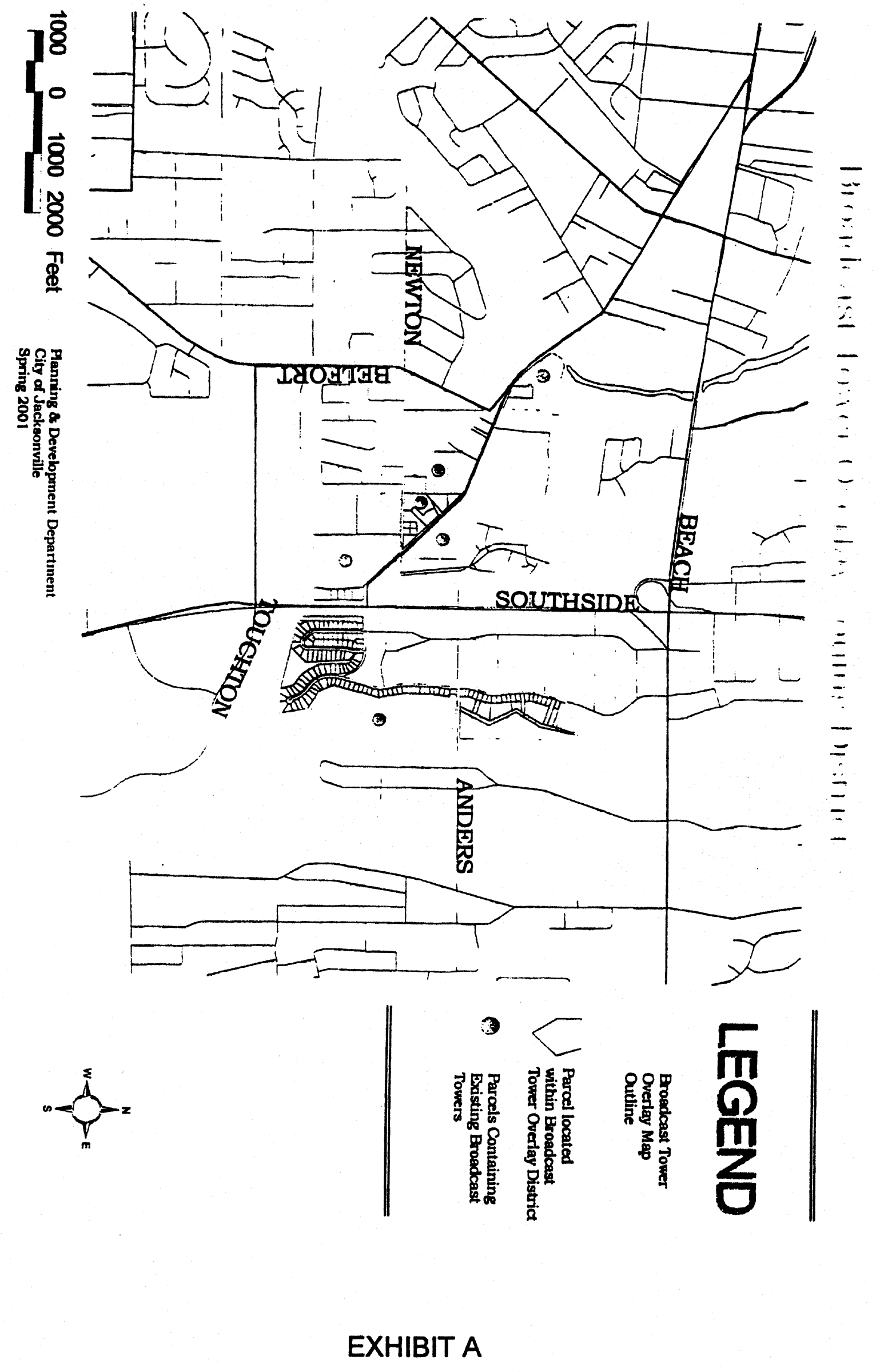
Figure 15-A Broadcast Tower Overlay Map
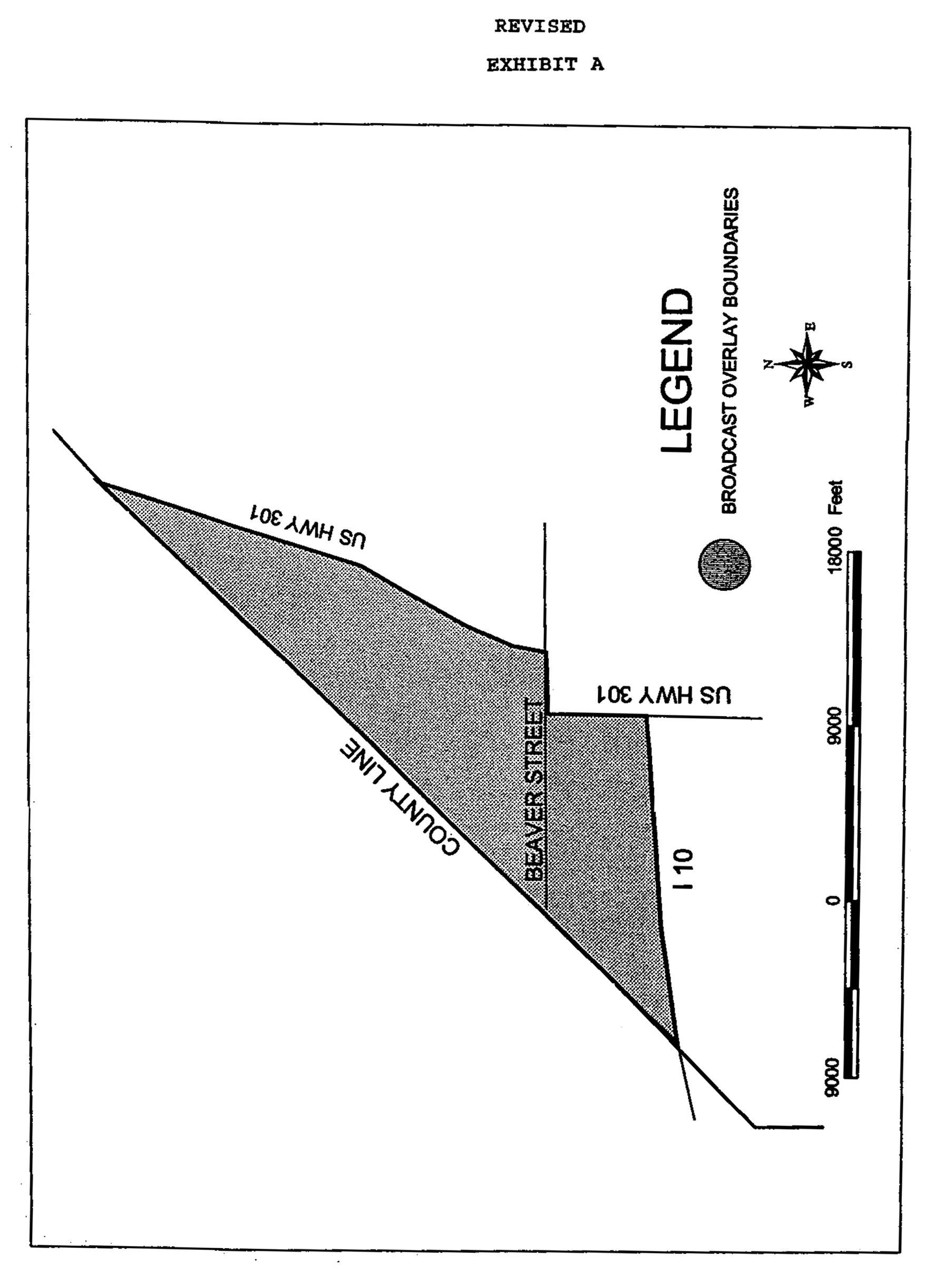
Figure 15-B Broadcast Overlay Boundaries
Sec. 656.1521. - Applicability; use of existing structures.
(a)
No new broadcast tower shall be constructed on land within Duval County other than within the Broadcast Tower Overlay. No new television broadcast towers may be constructed within the Western Broadcast Tower Overlay. Any existing broadcast tower located anywhere in the County other than the Broadcast Tower Overlay shall be deemed a legal nonconforming use after the date of this Broadcast Tower Overlay is enacted. Notwithstanding their status as legal nonconforming uses, all existing broadcast towers shall comply with the permitting and inspection requirements set forth in this Subpart.
(b)
Broadcast towers shall be considered a principal use in the Broadcast Tower Overlay. A different existing use or an existing structure on the same lot shall not preclude the installation of a broadcast tower on such lot. For purposes of determining whether the installation of a broadcast tower complies with the Broadcast Tower Regulations, including but not limited to set-back requirements, lot-coverage requirements and other such requirements, the dimensions of the entire lot shall control, even though the broadcast towers may be located on leased parcels within such lots.
(Ord. 2001-600-E, §§ 2, 3; Ord. 2005-730-E, § 1)
Sec. 656.1522. - Replacement broadcast towers.
(a)
Any existing broadcast tower located outside the Broadcast Tower Overlay may be replaced as a matter of right, so long as (1) the replacement broadcast tower and antennae do not exceed the height of the existing structure, and (2) the broadcast tower owner has complied with all permitting and inspection requirements set forth in this Subpart.
(b)
Any existing broadcast tower located within the Broadcast Tower Overlay may be replaced as a matter of right, so long as (1) the replacement broadcast tower and antennae do not exceed the height of the existing structure by more than 50 feet, and (2) the broadcast tower owner has complied with all permitting and inspection requirements set forth in this Subpart.
(Ord. 2001-600-E, §§ 2, 3)
Sec. 656.1523. - New broadcast towers.
(a)
Permission to site and construct a new broadcast tower shall only be given upon a showing of need. An application for a new broadcast tower permit must be reviewed and approved by the City Council.
(b)
An application for a new broadcast tower permit shall only be granted upon an affirmative showing that:
(1)
One or more broadcast towers in Duval County having a combined height equal to or exceeding that of the proposed broadcast tower, will be permanently removed upon construction of the new broadcast tower; or
(2)
Co-location of the proposed antennae on an existing tower within the Broadcast Tower Overlay is not financially feasible. Co-location on existing towers within the Broadcast Tower Overlay shall be presumed financially feasible, absent a finding that the fees and costs associated with co-location exceed 100 percent of the cost of constructing a new broadcast tower of the same type; or
(3)
The proposed broadcast tower in the Eastern Broadcast Tower Overlay will be used to support two or more television broadcast signals for the transmission of separate DTV broadcast channels.
(c)
Any new broadcast tower constructed in the Western Broadcast Tower Overlay shall be constructed to allow for co-location of multiple wireless communication providers.
(d)
Any new broadcast tower constructed in the Western Broadcast Tower Overlay shall be setback at least:
(1)
150 percent of the tower height from RR, RLD, RMD and RHD, ROS, PBF and CSV zoned properties;
(2)
150 percent of the tower height from transportation view corridors, public parks, and environmentally sensitive lands; and
(3)
100 percent of the tower height from AGR zoned properties.
(Ord. 2001-600-E, §§ 2, 3; Ord. 2005-730-E, § 1)
Sec. 656.1524. - Broadcast tower permitting requirements.
(a)
A permit authorizing the construction, replacement or structural modification of a broadcast tower must be obtained from the Public Works Department prior to commencement of any such work. Structural modification of a broadcast tower shall include activities such as adding or relocating any transmission line or appurtenance involving a line of three inches or more in diameter, or adding or relocating any transmission line located more than 500 feet above the ground.
(b)
The permit application requirements of this Subpart shall not apply to nonstructural modifications or maintenance activities.
(c)
A building permit authorizing the construction or replacement of a broadcast tower shall be transferable and run with the land, unless otherwise provided herein.
(d)
The permit application fee for a new broadcast tower shall be as found in www.coj.net/fees, and the application shall include the following information, in a form approved by the Public Works Department:
(1)
An inventory of the applicant's existing radio and television broadcast towers in the County, including specific information about the location, height, and design of each broadcast tower, along with existing and planned antennae. For purposes of this Section, the "applicant" means both the entity proposing to construct the broadcast tower and the broadcast carrier(s) whose antenna(e) will be located on the broadcast tower. The Coordinator shall create and maintain a single database for storing this information and identifying all radio and television broadcast towers, along with associated antennae, within the County.
(2)
The legal description of the land upon which the broadcast tower is to be located, evidencing that the site of the broadcast tower is within the Broadcast Tower Overlay.
(3)
Proof that the applicant owns the broadcast tower location or has a leasehold interest in the tower location. If a leasehold interest, the lease must evidence a term of at least ten years, and the fee simple owner must consent in writing to the proposed use of the broadcast tower location.
(4)
A survey prepared by a licensed Florida surveyor showing:
(i)
Property boundary lines of the broadcast tower location, all adjacent lands and adjacent streets or rights-of-way.
(ii)
Broadcast tower and guy wire locations.
(iii)
Location and square footage of all buildings and other structures located, or to be located, on the tower location.
(iv)
Driveways and parking area locations and materials, showing the number of parking spaces and handicapped parking spaces.
(v)
Fence locations showing height and materials.
(vi)
Elevation and broadcast tower loading design drawings of the proposed broadcast tower, showing antenna types and locations, and specifying the elevations of the broadcast tower and each antennae above the ground and mean sea level.
(5)
A certification signed and sealed by a professional engineer registered in the State of Florida attesting to the following:
(i)
Written description of the method, materials, equipment, and contractors (if known) to be used in the construction of the broadcast tower and installation of antennae a statement that the broadcast tower is structurally capable of withstanding such construction activities.
(ii)
Structural integrity of the broadcast tower as it is planned to be constructed and loaded.
(6)
FAA's determination of no hazard to air navigation.
(7)
Signed indemnity agreement promulgated by the Department, as may be amended from time to time.
(Ord. 2001-600-E, §§ 2, 3; Ord. 2001-1058-E, § 10; Ord. 2017-665-E, § 29)
Sec. 656.1525. - Antenna permitting requirements.
A permit authorizing the placement of a communications antenna on an existing broadcast tower must be obtained from the Public Works Department prior to commencement of any such work. The permit application fee for any such antenna shall be as found in www.coj.net/fees, and the application shall include the following information, in a form approved by the Public Works Department:
(1)
An inventory of the applicant's communication antennae in Duval County;
(2)
The legal description of the land upon which the broadcast tower is located;
(3)
The owner of the proposed antenna;
(4)
A description of the proposed antenna, including the specific type of antenna and its intended purpose (e.g., two-way radio, paging, PCS, cellular, etc.);
(5)
An elevation and design drawing of the proposed antenna, identifying the proposed placement of the antenna on the broadcast tower and specifying the elevation of the proposed antenna above the ground and mean sea level.
(Ord. 2001-600-E, §§ 2, 3; Ord. 2017-665-E, § 29)
Sec. 656.1526. - Periodic inspections and maintenance.
(a)
The owners of all broadcast towers shall perform periodic inspections and maintenance to ensure safety and extend the service life of the broadcast tower. All broadcast towers shall perform major inspection within one year from the effective date of this Part or from completion of construction of a new broadcast tower, and at least once every three years thereafter, in accordance with the following procedure:
(1)
The tower owner shall perform necessary inspections of the broadcast tower, including the structural integrity of the broadcast tower and condition of associated appurtenances, and prepare a report of such inspections.
(2)
The tower owner shall engage a professional engineer registered in the State and familiar with broadcast tower construction to review the report and issue a letter detailing recommended repairs to be made to the broadcast tower and the recommended timing thereof.
(3)
The tower owner shall cause the recommended repairs to be made to the broadcast tower, and the professional engineer shall re-inspect the broadcast tower and certify to the Department that all recommended repairs have been made.
(4)
Within 120 days after the major inspection deadline, the tower owner shall furnish the professional engineer's initial inspection report to the Public Works Department.
(b)
Failure of a tower owner to fully and timely comply with the inspections, repairs, maintenance, and reporting obligations set forth herein shall result in a fine of $2,000 per day for every day of noncompliance after the deadlines established herein. The time period for compliance set forth above may be extended by the Chief, Building Inspection Division, for good cause shown.
(Ord. 2001-600-E, §§ 2, 3)
Sec. 656.1527. - Design criteria.
(a)
The design criteria set forth in this Subpart apply only to new and replacement broadcast towers.
(b)
The tower compound area of all new and replacement broadcast towers shall be surrounded by a fence at least eight feet in height with at least three strands of barbed wire on top, which the tower owner shall maintain in good repair. Additionally the base and the guy wires of the broadcast tower shall be protected by a fence at least eight feet in height with at least three strands of barbed wire on the top, which the tower owner shall maintain in good repair.
(c)
The maximum height of any broadcast tower allowed in the Broadcast Tower Overlay is 1,149 feet above the mean sea level.
(d)
All new broadcast towers must meet or exceed current standards and regulations of the FAA, the FCC, and any other agency of the federal government with the authority to regulate towers and antennae. All existing broadcast towers shall comply with all standards and regulations of the FAA, the FCC, and any other agency in effect at the time the broadcast tower was constructed. To ensure the structural integrity of broadcast towers, the tower owner shall ensure that it is maintained in compliance with standards contained in the applicable local building codes and the applicable standards in effect at the time the broadcast tower was constructed.
If, upon inspection, the governing authority inspection department concludes that a broadcast tower fails to comply with such codes and standards, then upon notice being provided to the owner of the broadcast tower, the tower owner shall have 150 days to bring such broadcast tower into compliance with such codes and standards. If the tower owner fails to bring such broadcast tower into compliance within said 150-day period, the governing authority may remove such broadcast tower at the tower owner's expense. The time period for compliance set forth above may be extended by the Chief, Building Inspection Division, for good cause shown.
(e)
The tower owner shall landscape the entire boundary of those portions of the broadcast tower location located contiguous to residentially zoned districts to provide visual screening of the guy lines and related structures provided, however, that no such landscaping shall be required if existing vegetation provides a comparable vegetative buffer to the landscaping requirements set forth below. The landscaping shall encompass an area 15 feet in width, as measured from the property line, and shall include the following:
(1)
A row of shade trees a minimum of eight feet tall and a maximum of ten feet apart;
(2)
A continuous hedge at least 30 inches high at the time of planting, capable of growing to at least 36 inches in height within 18 months, shall be planted in front of the tree line referenced above;
(3)
All required landscaping shall be of the evergreen variety;
(4)
All required landscaping shall be xeriscape tolerant or irrigated and properly maintained to ensure good health and vitality.
(Ord. 2001-600-E, §§ 2, 3)
Sec. 656.1528. - Termination of use.
Abandoned or vacated broadcast towers must be disassembled and removed by the broadcast tower owner no later that six months after the broadcast tower ceases to be used as an active broadcast tower for a period of 12 continuous months.
(Ord. 2001-600-E, §§ 2, 3)
Sec. 656.1530. - Purpose and declaration of policy.
The purpose of this Subpart is to exempt those wireless communication facilities owned and/or operated by a governmental entity which are used primarily for public service and public safety purposes, such as the First Coast Radio System, System Control and Data Acquisition (SCADA), and other wireless networks devoted to internal and/or interagency communications.
(Ord. 2001-600-E, §§ 2, 3)
Sec. 656.1531. - First Coast Radio System.
Communication antennas and towers owned and operated by a governmental entity and which are a part of the First Coast Radio System approved pursuant to Ordinance 1999-1330-E are hereby exempted from the requirements of this Part 15, Ordinance Code, and from the requirement of obtaining a zoning exception or variance in connection with any tower which is part of the system, provided each tower site is a minimum of six acres in size and meets the minimum distance standards provided in the following table:
_____
REQUIRED MINIMUM DISTANCE REQUIREMENTS
FOR LATTICE OR GUYED TOWERS EXCEEDING
250 FEET IN HEIGHT
_____
The minimum distance shall be measured from the center of the tower base to the nearest private property line. The size of the site shall be based upon the height of the tower in accordance with the Guyed Tower Land Area Requirements on file in the Council Secretary's Office.
(Ord. 2001-600-E, §§ 2, 3)
Sec. 656.1532. - JEA/City of Jacksonville Tower Sites.
Wireless communication towers owned and/or operated by the JEA or the City for public service and public safety purposes, such as system control and data acquisition (SCADA), shall be permitted on those public lands owned by either JEA or the City, subject to the permitting and inspection requirements of Subpart A and the minimum distance requirements of Section 656.1531, Ordinance Code.
(Ord. 2001-600-E, §§ 2, 3)
Sec. 656.1533. - Severability.
If any portion of this Part is for any reason held to be unconstitutional, inoperative or void, such holding shall not affect the remaining portions of this ordinance. If this Part or any provision thereof is held to be inapplicable to any person, property or circumstance, such holding shall not affect its applicability to any other person, property or circumstance.
(Ord. 2001-600-E, §§ 2, 3)

