
Jacksonville City Zoning Code
PART 4
- SUPPLEMENTARY REGULATIONS
Sec. 656.401. - Performance standards and development criteria.
It is the intent of the City of Jacksonville that these supplementary regulation standards and criteria be read in addition to, rather than in lieu of, any other requirement in this Chapter. The following uses, whether permitted or permissible by exception, must meet the criteria listed under each use as a prerequisite for further consideration under this Zoning Code.
(a)
Animals.
(1)
Horses and ponies are kept for private riding use only and the minimum lot area shall be not less than one and one-half acres. The same shall be kept inside a fenced enclosure.
(2)
Goats, sheep or swine shall not be kept or permitted within 200 feet of a private property line.
(3)
A shelter shall be provided for any poultry, which shall be located not less than 50 feet from any property line. Poultry shall be permitted in the AGR and RR Districts only.
(4)
Animals other than household pets shall not be kept for commercial purposes.
(b)
Bed and breakfast.
(1)
One off-street parking space for each bedroom used as a guest room and two off-street parking spaces for the operator or owner thereof shall be provided.
(2)
No cooking facilities shall be allowed in the guest rooms.
(3)
The structure shall be compatible with the character of the neighborhood and any modifications thereto shall also comply with such character.
(4)
No long term rental of guest rooms [maximum stay seven days] shall be allowed.
(5)
Check-in/check-out time shall be between 6:00 a.m. and 9:00 p.m.
(6)
The maximum number of guest rooms shall be limited to three in the RR, RLD and AGR Districts; six in the RMD District; and 12 in all other districts.
(7)
The bed and breakfast establishment shall be located only within a locally or federally designated historic district or landmark.
(c)
Bird sanctuaries.
(1)
The minimum lot size shall be seven acres.
(2)
There shall be a 50-foot open space buffer between the bird sanctuaries and contiguous properties.
(d)
Building trades contractors.
(1)
A six-foot high visual barrier not less than 95 percent opaque shall be erected along the area used for outside storage.
(2)
The premises shall be maintained free of litter and any other junk materials.
(e)
Care centers/day care centers.
(1)
Child or adult care centers/day care centers located with between one and 14 children or adults shall meet the minimum lot requirements for the district of which it is a part.
(2)
Child or adult care centers/day care centers in the AGR, RLD, RMD, RHD and RR Zoning Districts shall be limited to a maximum of 50 children or adults. Centers with between 15 and 50 children or adults shall be located on a site not less than two acres in size and be contiguous to a street classified as a collector street or higher classification, as designated on the Functional Highway Classification Map of the Comprehensive Plan unless the center is located within a church or elementary, middle or high school, with no access from local residential streets.
(3)
Child or adult care centers/day care centers in the CO, CRO and CN Zoning Districts shall be limited to a maximum of 150 children or adults as a permitted use, but may be increased through grant of a zoning exception.
(4)
Child or adult care centers/day care centers in the PBF-2 zoning district shall be limited to a maximum of 150 children or adults. Provided however that when the facility has a minimum of two acres of land and is contiguous to a street classified as a collector street or higher classification, as designated on the functional highway classification map of the Comprehensive Plan the facility may have an additional 50 children or adults for each acre over two acres.
(5)
Child or adult care centers/day care centers in all other zoning districts shall be limited to a maximum of 300 children or adults.
(6)
All centers shall provide an adequate off-street area for the stacking of vehicles and required parking.
(7)
Where a center is contiguous to a residentially-zoned property, a six-foot visual barrier, not less than 95 percent opaque, shall be provided along the property line, excluding any required front yards.
(8)
Child care centers/day care centers shall provide a fenced outdoor play area which meets the minimum requirements set forth by the State licensing agency and which shall be located in the rear or side yards of the subject property.
(9)
Day care centers shall be limited to the following hours of operation: 6:00 a.m. to 7:00 p.m.; and that care centers shall have unlimited hours of operation.
(10)
After January 1, 2015, new day care centers shall not be located within 2,500 feet of a sexual predator residence. The change of name, or continuation of a day care center within the same location that has been in operation within the last six months by another party, shall not be considered "new" in this context. The Planning and Development Department shall produce a neighborhood search map using the Florida Department of Law Enforcement database of registered sexual predators to determine if such residence exists within a radius of 2,500 feet of the proposed day care center. The day care center shall be considered to be established on the date the State license to operate said facility is issued.
(f)
Country clubs.
(1)
The term country club shall include swim club, tennis club, racquet club, golf club, yacht club, etc.
(2)
The minimum lot size(s) shall be as follows:
Swim club—Two and one-half acres.
Tennis club—Five acres.
Racquet club—Five acres.
Golf club—100 acres.
Yacht club—Two and one-half acres.
Where any combination of clubs is being developed, the most restrictive minimum lot size shall apply.
(3)
Alcoholic beverages shall be allowed for on premises consumption provided that the country club maintains a club alcohol license as provided by the State Department of Business and Professional Regulation, Division of Alcoholic Beverages and Tobacco.
(4)
The criteria for golf courses in Section 656.401(l) of this Section are met, if applicable.
(g)
Churches.
(1)
Churches which are a permitted use must meet the following criteria:
(i)
The minimum lot size shall be not less than four acres.
(ii)
The site shall be located on a street classified as a collector street or a higher classification on the Functional Highway Classification Map of the Comprehensive Plan.
(iii)
There shall be no direct vehicular access to the church site from any local street within a residential district.
(2)
Churches which are a permissible use by exception must meet the following criteria:
(i)
The minimum lot size in the RR, RLD, RMD, RMH, IBP, IL, IH, IW, AGR, PBF-2 and PBF-3 Districts shall be not less than two acres. Churches in all other districts shall meet the minimum lot size requirements of the districts in which they are located.
(h)
Community residential homes.
(1)
Community residential homes which are a permitted use must meet the following criteria:
(i)
The home shall be limited to six or fewer residents/beds.
(ii)
The home shall not be located within a radius of 1,000 feet of another existing such home with six or fewer residents/beds.
(2)
Community residential homes which are a permissible use by exception must meet the following criteria:
(i)
The home shall be limited to 14 or fewer residents/beds.
(ii)
The home shall not be located within a radius of 1,200 feet of another existing such home with 14 or fewer residents/beds or 500 feet from an area zoned AGR, RR, RLD or RMD-A.
(i)
Essential services.
(1)
Essential services which are permitted uses in the Zoning Code are hereby defined as and are limited to certain installations of water, sewer, gas, telephone, radio, television and electric systems such as substations, lift stations, relay stations, provided that this Section shall not be deemed to permit:
(i)
The location in a district of such installations as electric or gas generating plants or water pumping or aeration facilities from which they would otherwise be prohibited, unless these facilities serve a single subdivision recorded before September 5, 1969, or are intended to serve a single subdivision approved under subdivision regulations in effect after September 5, 1969, or are a part of an internal package system designed and intended to serve a single industrial or commercial use or complex.
(ii)
The erection of structures for commercial activities such as sales of related merchandise or collection of bills in districts from which the activities would otherwise be prohibited.
(2)
Essential services which are permissible uses by exception in the Zoning Code are limited to certain installations of water, sewer, gas, telephone, radio, television and electric systems which could include regional service installations such as electric or gas generating plants or water pumping or aeration facilities or cellular telephone towers or radio towers.
(j)
Family day care homes.
(1)
The family day care home operator shall reside on the premises and shall not change the outside appearance of the residence and there shall be no other visible evidence to indicate any use other than the residential character thereof, including the allowable sign pursuant to Part 13 hereof.
(2)
The family day care home shall be conducted in a single-family dwelling and not in a mobile home or accessory structure.
(3)
The family day care home shall have no more than five children or adults.
(4)
The family day care home shall provide an adequate off-street area for the stacking of vehicles and required parking.
(5)
A fenced outdoor play area be provided meeting the minimum requirements set forth by the State licensing agency be provided and located in the rear or side yards of the subject property.
(6)
The family day care home shall be limited to the following hours of operation: 6:00 a.m. to 7:00 p.m.
(k)
Filling stations and service stations.
1.
No more than two self-service vehicular fueling positions shall be located on each side of a fueling island and no automotive repair or maintenance services may be offered at fuel islands providing self-service fueling. A vehicular fueling position means an area adjacent to fuel dispensers at which a vehicle may be fueled.
2.
No vehicular fueling position shall be located within 25 feet of a street right-of-way line or within 35 feet of an adjacent conforming residential use.
3.
An eight-foot high visual barrier or screen, not less than 95 percent opaque, shall be provided between the filling station or service station and any adjacent conforming residential use.
4.
Except car wash entry and exit openings, service bay doors shall not be permitted to be located facing toward any public rights-of-way. Where a parcel abuts a conforming residential use, service bay doors shall not be permitted to face such residential use.
5.
Service areas in which major automotive repair is conducted, dumpsters, and open car wash bays fronting public rights-of-way (except car wash entry and exit openings) shall be visually screened from public rights-of-way as much as is reasonably practical for the site.
6.
All filling stations and service stations shall be constructed of permanent and durable materials. No prefabricated metal structures (except trade or other fixtures such as ice or propane storage) shall be permitted. This shall not include canopies designed to cover pump islands.
7.
Any filling station shall have well-lit access points at the pedestrian scale.
8.
Primary building entrances shall be designed to incorporate pedestrian connections to public sidewalks where applicable, via a five-foot minimum concrete sidewalk or crosswalk designated by special paving materials or treatments (including striping).
9.
In areas where pedestrian and vehicular traffic are in conflict with each other, special paving materials and treatments (including striping) shall be used to define pedestrian routes across the site.
10.
Bike racks shall be located within visible proximity of the main entrance to any retail store.
11.
ATMs shall be located inside principal structures to the greatest extent possible.
12.
Filling station canopy fascias shall not be transparent, reflective or encircled in unshielded light bulbs. Backlit fascia components and translucent fascia components that otherwise meet canopy illumination property line level requirements provided in this subsection (k) comply with this requirement.
13.
All primary structures, accessory structures, and roofs shall use consistent architectural themes and colors and shall be consistent with any adopted design guidelines.
14.
Bulk displays of product or merchandise (such as packs or cases of soft drinks or automotive products) shall not be located on or in fuel islands.
15.
Any signage, including corporate logos or images (but not including corporate color banding), provided on a canopy shall be deducted from the allowable wall signage of the primary structure.
16.
Rooftop (directed skyward) signage is prohibited.
17.
All sag lenses, drop lenses and convex lenses shall be prohibited. Illumination levels at all property lines shall not exceed 0.5 foot candles ("f.c.") when the building or parking areas are located adjacent to a conforming residential use, and shall not exceed 1.0 f.c. when abutting other non-residential properties. All lighting lamp sources within parking and pedestrian areas shall be metal halide, compact fluorescent or LED. The maximum light pole height in all parking areas should not exceed 21 feet above ground level. An exterior lighting design plan, including a photo metrics plan, pole and fixtures schedules shall be submitted for review and approval by the Planning and Development Department.
(l)
Golf courses/driving ranges.
(1)
The parcel of land (excluding any residential lots, streets and accompanying residentially supportive uses) shall contain not less than 100 acres minimum for 18 holes and not less than 50 acres for a nine-hole golf course.
(2)
All buildings, including the pro-shop, club house, maintenance building and office, shall be located no closer than 100 feet from any property line.
(3)
Any lighting associated with the golf course shall be designed and installed so as to prevent glare. No source of illumination shall be allowed if such source of illumination would be visible from a residentially-zoned district to the extent that it interferes with the residential use of that area.
(4)
A driving range as an accessory use to a golf course, shall be allowed, subject to the following conditions:
(i)
The area developed as the driving range shall be located not less than 100 feet from adjacent residentially-zoned property, and that natural buffering, as well as a six-foot high visual barrier, not less than 95 percent opaque, shall be provided along the property lines of such adjacent residentially-zoned property.
(ii)
Any lighting associated with the driving range shall be designed and installed so as to prevent glare or excessive light on adjacent residentially-zoned property. No source of illumination shall be allowed if such source of illumination would be visible from a residentially-zoned district to the extent that it interferes with the residential use of that area.
(5)
A driving range which is not an accessory use to a golf course, shall be allowed, subject to the following conditions:
(i)
The basic criteria set forth in subsection (l)(4) of this Section shall apply; provided that, due to the unique nature of a driving range not associated as an accessory use to a golf course, the chief may and is hereby authorized to require different or additional criteria such as natural buffering, lighting, setback areas, visual buffers, minimum property width and length and netting or other similar requirements to prevent or minimize any intrusion of the driving range activities into the surrounding or adjacent areas. Such criteria shall be as consistent as possible but may be tailored to fit the specific property or circumstances of each driving range in order to meet the minimal intrusion objectives of this subsection.
(m)
Group care homes.
(1)
No group care home shall be located within 1,000 feet of another group care home.
(2)
The applicant for a group care home shall provide the Chief with a notarized affidavit stating that there are no group care homes within 1,000 feet of the proposed facility measured as required by this Part.
(3)
Distance requirements in this Part shall be measured by following a straight line from the nearest property line of the site of the proposed facility to the nearest point of the property line of the site of the existing facility.
(4)
Where a location for a group care home has been approved by the Chief as complying with the requirements of this Part and there is no building for such use at the location approved, he shall not then approve for a period of six months any further locations which would violate distance limitations with respect to such previously approved location.
(5)
Any approval of a group care home by the Chief or Planning Commission, as the case may be, based upon the filing of an erroneous affidavit required by this Part shall automatically become null and void upon notification by the aforesaid of such erroneous affidavit.
(n)
Home occupations/permitted use.
(1)
Home occupations which are a permitted use must meet the following criteria:
(i)
No person shall be engaged in the occupation unless such person resides on the premises and that the premises shall be the primary residence of each of the persons engaged in the occupation;
(ii)
The use of the premises for the home occupation shall be clearly incidental and subordinate to its use for residential purposes by its occupants and shall, under no circumstances, change the residential character thereof;
(iii)
There shall be no change in the outside appearance of the building or premises or other visible evidence of the conduct of the home occupation, including the allowable sign pursuant to Part 13 hereof;
(iv)
No one shall call upon the premises in connection with the home occupation for such purposes as retail or wholesale sales, services negotiations, contractual agreements, etc.; no traffic shall be generated by the home occupation;
(v)
There shall be no flammable or hazardous material stored on premises;
(vi)
There shall be no equipment or process used in the home occupation which creates noise, vibration, glare, fumes, odors or electrical interference detectable to the normal senses off the lot;
(vii)
In the case of electrical interference, no equipment or process shall be used which creates visual or audible interference in the radio or television receiver off the premises or causes fluctuations in line voltage off the premises;
(viii)
No home occupation shall be conducted in an accessory building or structure which is not attached to and part of the principal structure or an open porch or carport;
(ix)
No home occupation shall occupy more than 250 square feet or ten percent of the gross floor area of the dwelling unit, exclusive of the area of an open porch or attached garage or similar space not suited or intended for occupancy as living quarters;
(x)
Any supplies stored on the premises shall be for the purpose of maintaining and operating the home occupation;
(xi)
The address of the home occupation shall not be advertised;
(2)
No person shall begin a home occupation under the preceding subsection (n)(1) of this Section without first executing a disclosure statement which shall contain a place for the applicant to certify that the applicant has received a copy of, understands, and will comply with the requirements in subsection (n)(1) of this Section.
(3)
Home occupations which are a permissible use by exception must meet the following criteria:
(i)
No person or independent contractor other than members of the family residing on the premises shall be engaged in the occupation.
(ii)
The use of the premises for the home occupation shall be clearly incidental and subordinate to its use for residential purposes by its occupants and shall, under no circumstances, change the residential character thereof.
(iii)
There shall be no change in the outside appearance of the building or premises or other visible evidence of the conduct of the home occupation, including the allowable sign pursuant to Part 13 hereof.
(iv)
No home occupation shall be conducted in an accessory building or structure which is not attached to and part of the principal structure or an open porch or carport.
(v)
No home occupation shall occupy more than 25 percent of the gross floor area of the dwelling unit, exclusive of the area of an open porch or attached garage or similar space not suited or intended for occupancy as living quarters.
(vi)
No excessive traffic shall be generated by the home occupation.
(vii)
No equipment or process shall be used in the home occupation which creates noise, vibration, glare, fumes, odors or electrical interference detectable to the normal senses off the lot. In the case of electrical interference, no equipment or process shall be used which creates visual or audible interference in the radio or television receiver off the premises or causes fluctuations in line voltage off the premises.
(4)
Fabrication of articles which are commonly classified under the terms of arts and handicrafts, including the production of food products such as breads, cakes, pies, and candy, etc., may be deemed a home occupation, subject to the terms and conditions of subsections (n)(1) and (2) of this Section. No excessive or outside storage, fabrications or sales of any type shall be permitted on premises.
(o)
Off-street parking.
(1)
Off-street parking lots in the CO, CRO, RO, and CN zoning districts shall be limited to the following criteria:
(i)
The parking lots shall be within 400 feet of the premises requiring off-street parking. No public parking lots are allowed.
(ii)
The hours of use shall be limited to the hours of 7:00 a.m. to 11:00 p.m.
(iii)
There shall be no storage, sales or service activity of any kind on these lots.
(iv)
Vehicles parked on the lot shall be limited to automobiles for employee and customer parking.
(v)
These parking lots shall be designed to meet the requirements of Part 12 of the Zoning Code, (Landscape and Tree Protection Regulations).
(vi)
If the facilities are lighted, lighting shall be designed and installed so as to prevent glare or excessive light on adjacent property. No source of illumination shall be allowed in connection with a parking lot if such source of illumination would be visible from a residentially-zoned district to the extent that it interferes with the residential use of that area.
(2)
Off-street parking lots in the CCG-2, IL, IH and PBF-3 zoning districts shall be limited to the following:
(i)
There shall be no storage, sleeping, parking for more than 24 hours, or sales or service activity of any kind on these lots.
(ii)
These parking lots shall be designed to meet the requirements of Part 12 of the Zoning Code (Landscape and Tree Protection Regulations).
(3)
Off-street parking lots in the CCG-1 and IBP zoning districts shall be limited to the following:
(i)
If the parking lot is adjacent to a residential district or use, then the hours of parking lot use shall be limited to the hours of 7:00 a.m. to 11:00 p.m.
(ii)
If the parking lot is not adjacent to a residential district or use, then a zoning exception may be granted to remove the hours of operation limitation.
(iii)
There shall be no storage, sleeping, parking for more than 24 hours, or sales or service activity of any kind on these lots.
(iv)
These parking lots shall be designed to meet the requirements of Part 12 of the Zoning Code (Landscape and Tree Protection Regulations).
(p)
Neighborhood parks, pocket parks, playfields or recreational structures.
(1)
The owner or developer of a neighborhood park, playfield or recreational structure which is a part of a PUD (Planned Unit Development) or which is shown on a site plan or a master plan for a subdivision must provide documentation and instrumentation to indicate the ownership and maintenance responsibility for these areas to the Planning and Development Department and the Office of General Counsel for review and approval prior to verification of substantial compliance with the PUD district pursuant to Section 656.341(g), Ordinance Code, or the recording of the plat, as the case may be.
(2)
Neighborhood parks, pocket parks, playfields or recreational structures which are not part of a PUD or which are not shown on a site plan or a master plan for a subdivision must meet the following criteria:
(i)
Where use or membership is not limited to residents of adjacent residential areas, the site shall have direct access to an arterial or collector street;
(ii)
A site plan showing ingress and egress to the site, parking area, structures, total enclosed area of each building and proposed landscaping and signage shall be submitted to the Planning and Development Department and City Traffic Engineer for review and approval, prior to the issuance of any final development permits, to ensure that access to the site will not result in undue traffic congestion and to ensure that the potential for any negative impacts upon adjacent residential neighborhoods, such as noise, light and traffic, is not out of keeping with the residential character of the neighborhood;
(iii)
Active recreational uses are restricted to daylight hours only.
(iv)
Documentation and instrumentation to indicate the ownership and maintenance responsibility for the site or facility shall be provided to the Planning and Development Department and the Office of the General Counsel for review and approval prior to the issuance of any final development permits.
(q)
Personal property storage facilities.
(1)
Storage buildings shall be subdivided by permanent partitions into spaces containing not more than 300 square feet each.
(2)
Storage of goods shall be limited to personal property with no retail sales, service establishments, offices, apartments (other than manager's office and apartment), commercial distribution or warehousing allowed.
(3)
The minimum lot size shall be not less than two acres.
(4)
If the facilities are lighted, lighting shall be designed and installed so as to prevent glare or excessive light on adjacent property. No source of illumination shall be allowed if such source of illumination would be visible from a residentially-zoned district to the extent that it interfered with the residential use of that area.
(5)
Minimum yard requirements:
(i)
Front—30 feet.
(ii)
Side and rear—Zero feet if adjacent to a commercial district; 15 feet side yard and ten feet rear yard if adjacent to residential district.
(6)
Perimeter landscaping adjacent to streets: All vehicular use areas (VUAs) which are not entirely screened by an intervening building from any abutting dedicated public street, to the extent such areas are not so screened, shall contain the following:
(i)
A landscaped area of not less than 20 square feet for each linear foot of vehicular use area (VUA) street frontage;
(ii)
No less than one tree, of four-inch caliper or greater, located within 25 feet of the street right-of-way, for each 25 linear feet, or fraction thereof, of VUA street frontage.
(7)
The requirements of Section 656.1214(a) may be met by increasing the minimum perimeter landscaping requirements.
(r)
Private clubs.
(1)
The minimum lot size shall be not less than one acre.
(2)
Any food and beverage service, including alcoholic beverages, shall be limited to service incidental to the primary activity of the facility.
(3)
There shall be no direct vehicular access to the private club site from any local street within a residential district.
(s)
Recycling collection point.
(1)
A letter indicating that the facility meets the criteria below shall be issued by the Chief.
(2)
The collection point facility may not be a trailer unless attended when open; provided, however, that no more than one trailer may be on one parcel of land.
(3)
The collection point facility:
(i)
Be established in conjunction with an existing commercial use or community service facility which is in compliance with the Zoning Code and the Building Code.
(ii)
Be no larger than 500 square feet not including space that will be periodically needed for removal of materials or exchange of containers.
(iii)
Be set back at least ten feet from any street line and shall not obstruct pedestrian or vehicular circulation.
(iv)
Be located not less than 100 feet from a residential zoning district.
(v)
Accept only glass, aluminum, plastic containers and paper products.
(vi)
Use no power-driven processing equipment except for reverse vending machines which are permitted.
(vii)
Use containers that are constructed and maintained with durable waterproof and rustproof material, covered when site is not attended, secured from unauthorized entry or removal of material, and shall be of a capacity sufficient to accommodate materials collected and collection schedule.
(viii)
Store all recyclable material in containers or structures, and shall not leave materials outside of containers when attendant is not present.
(ix)
Be maintained free of litter and any other undesirable materials, shall be swept at the end of each collection day.
(x)
Not exceed noise levels of 60 dbA as measured at the property line of residentially-zoned or occupied property; otherwise shall not exceed 70 dbA.
(4)
Containers shall be clearly marked to identify the type of material which may be deposited; the facility shall be clearly marked to identify the name and telephone number of the facility operator and the hours of operation, and display a notice stating that no material shall be left outside the recycling enclosure or containers.
(5)
The facility shall not impair the landscaping required by Part 12, for any concurrent use or any permit issued pursuant thereto.
(6)
No additional parking spaces will be required for customers of a small collection facility located at the established parking lot of a host use. One space shall be provided for an attendant, if needed.
(7)
Mobile recycling units shall have an area clearly marked to prohibit other vehicular parking during hours when the mobile unit is scheduled to be present.
(8)
Occupation of parking spaces by the facility and by the attendant may not reduce available parking spaces below the minimum number required for the primary host use unless, in the opinion of the Chief adequate parking is otherwise available.
(9)
If the administrative permit expires without renewal, the collection facility shall be removed from the site within five days following permit expiration.
(t)
Schools.
(1)
The minimum lot size shall be two acres. The site shall be adequate in size to accommodate the number of students proposed and shall contain adequate space for recreation and/or playground area and a parking area sufficient to accommodate the number of parking spaces required by the Zoning Code.
(2)
All recreational areas and playing fields shall provide a six-foot high visual barrier, not less than 95 percent opaque, where adjoining residential properties.
(3)
Lighting associated with the school, as well as the recreation areas and playing fields, shall be so designed and installed so as to prevent glare or excessive light on adjacent property. No source of illumination shall be allowed if such source of illumination would be visible from a residentially-zoned district to the extent that it interferes with the residential use of that area.
(4)
The site plan showing internal traffic circulation, including bus and/or automobile drop-off and pick-up, recreation and/or playground area, existing and proposed parking area, structures and total enclosed area of each building and existing and proposed signage and landscaping shall be submitted to the Planning and Development Department and the City Traffic Engineer for review and approval and also to insure that access to the site will not result in undue traffic congestion.
(u)
School buses.
(1)
The school bus shall not be parked in the required front yard.
(2)
The school bus shall not be parked or permitted within 25 feet of a side or rear property line.
(3)
No repairs or maintenance shall be made to the bus while on the subject property.
(4)
Only the residents of the subject property engaged in the business of driving a school bus shall park a school bus on the subject property.
(v)
Swimming lessons.
(1)
Swimming lessons are permitted as home occupations which are a permitted use, or as home occupations which are a permissible use by exception, subject to all criteria for home occupations in subsection (n), except as otherwise provided, or modified, by this subsection.
(2)
The swimming pool may be above ground or in ground, may be any size, and may be enclosed with a screen or unenclosed.
(3)
Adequate off-street area for parking shall be provided and vehicles shall not park in the right-of-way.
(4)
Where contiguous to a residentially-zoned property, a six-foot visual barrier, not less than 95 percent opaque, shall be provided along the property line, excluding any required front yards.
(5)
Hours of operation are limited to between 8:00 a.m. and 7:00 p.m.
(6)
There shall be no signage identifying swimming lessons on the property.
(7)
The swimming lesson use shall be personal to the property owner and shall not be transferable.
(w)
Travel trailer parks and campgrounds.
(1)
A travel trailer park or campground shall be located so that no entrance or exit from park shall discharge traffic into a residential district. A travel trailer park or campground fronting on a public street shall have a minimum frontage of 100 feet.
(2)
The Public Health Unit shall notify the Chief of its approval from a public health perspective as to the conditions of soil, ground water level, drainage and topography of a travel trailer park or campground before the issuance of a permit by the Chief.
(3)
Spaces in travel trailer parks and campgrounds may be used by travel trailers, pickup campers, converted buses, tent trailers, tents or similar devices used for temporary portable housing. Permanent occupancy (occupancy for more than 120 days) for dwelling purposes in this equipment is prohibited. Spaces shall be rented by the day, week or month.
(4)
Management headquarters, recreational facilities, toilets, showers, coin-operated laundry facilities and other uses and structures customarily incidental to the operation of a travel trailer park or campground are permitted as accessory uses to the park in a district in which travel trailer parks or campgrounds are permitted. In addition, stores, restaurants, laundry and dry cleaning agencies, beauty parlors, barbershops and other convenience establishments shall be permitted as accessory uses in trailer parks and districts where these uses are not allowed as principal uses, subject to the following restrictions:
(i)
These establishments and the parking areas primarily related to their operation shall not occupy more than ten percent of the area of the park.
(ii)
These establishments shall present no visible evidence of their commercial character which would attract customers other than occupants of the park.
(iii)
The structures housing these facilities shall not be located closer than 100 feet to a public street.
(5)
No space intended for occupancy under this Section shall be located so that a part intended for occupancy for sleeping purposes shall be within 50 feet of the right-of-way line of an arterial street or within 25 feet of the right-of-way line of another street.
(6)
Twenty-five-foot front, rear and side yards shall be provided for the travel trailer parks or campgrounds.
(7)
Entrances and exits to travel trailer parks and campgrounds shall be designed for safe and convenient movement of traffic into and out of the park and to minimize marginal friction with free movement of traffic on adjacent streets. Traffic into or out of the park shall be through the entrances and exits.
(8)
Each travel trailer park or campground shall provide adequate off-street parking, loading and maneuvering space.
(x)
Veterinarians.
(1)
The building be completely soundproof in the CN, CCG-1, CCG-2 and the IL zoning districts.
(2)
The building be located on an individual and separate lot, provided all yards, area, frontage and other requirements of the Zoning Code are met for each structure within the zoning district of which it is a part.
(3)
Animals shall be kept in the enclosed soundproof buildings during the hours of 9:00 p.m. to 6:00 a.m. in the CN, CCG-1, CCG-2 and IL zoning districts.
(4)
A veterinarian may be a part of any development when the same meets the following criteria:
(i)
The facility shall be heated and cooled by a unit separate from such unit for the rest of the development.
(ii)
The facility shall be serviced by a water supply separate from the water supply for the rest of the development or a back flow preventer shall be installed on the facility's water supply.
(iii)
The facility shall be soundproofed from the rest of the development.
(iv)
The facility shall have its own independent exterior entrance exclusive from any common entrances.
(y)
Scrap processing.
(1)
Before operations begin the facility must obtain any permit required under City, federal or State laws or regulations.
(2)
The facility shall operate at all times in compliance with all City, State and federal permits, laws, ordinances and rules and regulations.
(3)
Whenever the facility is operating pursuant to an exception, that exception terminates upon suspension or revocation of any permit; provided, that a new application for an exception can be applied for.
(z)
Recycling facilities and recycling facilities and yards.
(1)
Before operations begin the facility must obtain any permit required under City, federal or State laws or regulations.
(2)
The facility shall operate at all times in compliance with all City, State and federal permits, laws, ordinances and rules and regulations.
(3)
Whenever the facility is operating pursuant to an exception, that exception terminates upon suspension or revocation of any permit; provided, that a new application for an exception can be applied for.
(aa)
Yard composting facility.
(1)
Before operations begin the facility must obtain any permit required under City, federal or State laws or regulations.
(2)
The facility shall operate at all times in compliance with all City, State and federal permits, laws, ordinances and rules and regulations.
(3)
Whenever the facility is operating pursuant to an exception, that exception terminates upon suspension or revocation of any permit; provided, that a new application for an exception can be applied for.
(bb)
Construction and demolition debris landfills.
(1)
Before operations begin the facility must obtain a certificate of public convenience and necessity under Chapter 380, Ordinance Code, and a service agreement under Chapter 386, Ordinance Code, as well as obtain any permit required under federal or State laws or regulations.
(2)
The facility shall operate at all times in compliance with all City, State and federal permits, laws, ordinances and rules and regulations.
(3)
Whenever the facility is operating pursuant to an exception, that exception terminates upon suspension or revocation of any permit; provided, that a new application for an exception can be applied for.
(cc)
Sanitary landfills. Sanitary landfills (also known as solid waste disposal facilities or areas), as defined and classified by the Florida Administrative Code.
(1)
Before operations begin the facility must obtain a certificate of public convenience and necessity under Chapter 380, Ordinance Code, and a service agreement under Chapter 386, Ordinance Code, as well as obtain any permit required under federal or State laws or regulations.
(2)
The facility shall operate at all times in compliance with all City, State and federal permits, laws, ordinances and rules and regulations.
(3)
Whenever the facility is operating pursuant to an exception, that exception terminates upon suspension or revocation of any permit; provided, that a new application for an exception can be applied for.
(4)
Any exception granted must precisely identify the disposal area or footprint for any landfill.
(5)
The disposal area or footprint for any Class I sanitary landfill shall be at least eight miles from the disposal area or footprint of any operational or fully permitted Class I sanitary landfill, which is fully permitted, under construction or operational or which has received a certificate of public convenience and necessity under Chapter 380, Ordinance Code, for the operation of a Class I sanitary landfill.
(dd)
Transfer stations.
(1)
Before operations begin the facility must obtain a certificate of public convenience and necessity under Chapter 380, Ordinance Code, and a service agreement under Chapter 386, Ordinance Code, as well as obtain any permit required under federal or State laws or regulations.
(2)
The facility shall operate at all times in compliance with all City, State and federal permits, laws, ordinances and rules and regulations.
(3)
Whenever the facility is operating pursuant to an exception, that exception terminates upon suspension or revocation of any permit; provided, that a new application for an exception can be applied for.
(ee)
Outside sale and service of alcoholic beverages.
(1)
Restricted outside sale and service shall be allowed subject to the following criteria:
(i)
Restricted outside sale and service must be for a special event occurring within the City, generally recognized by the community as a whole, as determined by the Chief.
(ii)
Restricted outside sale and service may occur no more than six times during one calendar year and on no more than two consecutive days.
(iii)
The area for the restricted outside sale and service shall be limited to an area which is contiguous to an existing licensed facility or establishment and the area shall be equal to or less than the area of the existing licensed facility.
(2)
Permanent outside sale and service shall be allowed subject to the following criteria:
(i)
The area for the outside sale and service shall be limited to an area which is contiguous to an existing licensed facility or establishment.
(ii)
The outside area shall be no greater than the inside area for sale and service.
(iii)
The outside area shall be surrounded by a permanent railing or other barrier at least three and a half feet high; provided, that the barrier may be broken by up to two entranceways no more than four feet wide each.
(3)
These regulations do not apply to uses in the right-of-way which are governed by Part 8 and Part 9 of Chapter 250, Ordinance Code.
(ff)
Hazardous waste transfer stations.
(1)
The waste container berm, transfer station building(s) and waste handling area(s) shall be at least 2,640 feet from the nearest:
(i)
Residentially zoned property;
(ii)
Hospital;
(iii)
Military base;
(iv)
Nursing home;
(v)
Church;
(vi)
Electrical generating station, not including on-site self-generating equipment; or
(vii)
School.
(2)
The waste container berm, transfer station building(s) and waste handling area(s) shall be at least 2,640 feet from the Jacksonville Municipal Stadium, Veterans Memorial Coliseum, Times-Union Center for the Performing Arts, Convention Center, Metropolitan Park and Jacksonville Zoological Gardens.
(3)
The waste container berm, transfer station building(s) and waste handling area(s) shall be at least 1,000 feet from a Special Management Area as set out in the Comprehensive Plan.
(4)
The waste container berm, transfer station building(s) and waste handling area(s) shall be at least 200 feet from the nearest property containing a public water supply system as defined in Section 366.603, Ordinance Code.
(5)
The measurements from (1)(i), (ii), (iv), (v), and (vii) through (4) of this subsection shall be taken by drawing a straight line from the nearest edge of the waste container berm, transfer station building(s) and waste handling area(s) to the nearest point of the property containing those uses. The measurements from (1)(iii) and (vi) of this subsection shall be taken by drawing a straight line from the nearest edge of the waste container berm, transfer station building(s) and waste handling area(s) within the property containing those uses.
(6)
The applicant shall provide the Chief with a map of the proposed location and vicinity to include a certification that the distance requirements of this Section have been met. Both the map and the certificate shall be prepared and executed by a land surveyor registered in the State of Florida.
(7)
Before operations begin the facility must obtain a Certificate of Public Convenience and Necessity under Chapter 380, Ordinance Code, and a service agreement under Chapter 386, Ordinance Code, as well as obtain any permit required under federal or State law or regulations.
(8)
The facility shall operate at all times in compliance with all City, State and federal permits, laws, ordinances and rules and regulations.
(9)
Whenever the facility is operating pursuant to an exception, that exception terminates upon suspension or revocation of any permit. However, if an exception is lost in this manner, a new exception may be applied for immediately. All incoming waste operations must cease until the permits and exception are restored. Outbound waste shipments may continue if authorized by appropriate environmental regulatory authorities.
(gg)
Outside retail sales of holiday items.
(1)
Outside retail sales of holiday items shall be limited to 30 days prior to New Year's Day, Christmas Day, Hanukkah, the Fourth of July and Halloween.
(2)
The holiday items sold shall be limited to those items which are related to the holiday immediately upcoming at the end of the applicable 30-day period. For example, prior to New Year's Day and the Fourth of July - legal fireworks; prior to Christmas - Christmas trees and ornaments; prior to Halloween - costumes and decorations related to Halloween. Whether an items is related to the upcoming holiday shall be determined by the Director of the Planning and Development Department or the Director's designee.
(3)
The site shall be a minimum of one acre in size and shall contain another nonresidential principal use, such as a shopping center or other existing building or facility which is in compliance with the Zoning Code and the Building Code.
(4)
There shall be adequate parking sufficient to accommodate the additional temporary retail sales without reducing the number of available parking spaces required by the Zoning Code in connection with the other principal use(s), unless, in the opinion of the Chief, adequate parking is otherwise available.
(5)
There shall be adequate access to the site from the right-of-way, such that the temporary outside retail sales will not result in undue traffic congestion. The site plan for the site shall be submitted to the City Traffic Engineer for review and approval to ensure that access to the site from the right-of-way will not result in undue traffic congestion, prior to the issuance of the permit by the Chief.
(6)
Outside retail sales of holiday items shall occur only by permit issued by the Chief.
(7)
Notwithstanding subsection (3) above or anything express or implied to the contrary in any other provision of the Zoning Code, the outside retail sales of holiday items shall be permitted in any zoning district where:
(i)
The subject property is owned by a not-for-profit entity recognized as "tax exempt" under Section 501(a) of the Code of 1986 pursuant to Section 501(c)(3) or other like provision of the Code, and where occupied and used primarily for educational, charitable, religious or other not-for-profit purposes including but not limited to churches, institutions, colleges, schools or fraternal lodges;
(ii)
The principal use or occupancy of the subject property is nonresidential and permissible by right, by way of exception or by way of lawful nonconforming use compliant with the Zoning Code;
(iii)
The subject property contains adequate parking determined pursuant to subsection (4) hereinabove;
(iv)
The subject property contains adequate access as determined pursuant to subsection (5) hereinabove; and,
(v)
The use of the subject property will not be incompatible with the character of the surrounding neighborhood or otherwise constitute a nuisance.
(hh)
Private helicopter landing sites.
(1)
General requirements.
(a)
The helicopter landing site shall not pose an unreasonable threat to the environment or the public health, safety or welfare.
(b)
Helicopter landing sites shall not be incompatible or inconsistent with adjacent land uses and environments.
(c)
The landing pad shall be located on the same lot as the principal use and shall be used only by occupants and/or persons conducting business with the occupants of the lot, and no commercial helicopter operations shall be conducted on the lot.
(d)
Any ancillary structures shall be constructed to comply with all provisions of the Zoning Code.
(e)
Helicopter landing location siting for medical, police, Mosquito Control, governmental, bona fide agricultural or emergency purposes is exempt from these performance standards and development criteria.
(f)
Roof-top landing sites are anticipated as an acceptable use in this Section and must conform to these performance criteria, unless the applicant can affirmatively demonstrate that any of these criteria are not necessary to protect the public health, safety, and welfare. In determining whether the exemption under this subsection is applicable, the Planning Commission may rely on State and federal criteria, which regulate and govern helicopter landing sites, as demonstrated by the applicant, if applicable.
(g)
The applicant must demonstrate the ability to comply with all other applicable rules, regulations, and statutory requirements, as necessary. Approval of this use does not exempt the use from compliance with all other applicable existing and future laws, rules, and regulations.
(2)
Safety and nuisance related requirements.
(a)
No helicopter landing site shall be located on a residentially-zoned property five acres or less in size or on a commercially-zoned property three acres or less in size or, alternatively, in any zoning category, helicopter landing sites shall have a minimum setback of at least 500 feet from any lot line.
(b)
Heavy maintenance and all fueling operations are prohibited.
(c)
The applicant shall demonstrate that appropriate safeguards, such as fencing, gates, etc. are in place so as to prevent unauthorized access to the landing site.
(d)
The Planning Commission is authorized to condition this exception in any reasonable manner including, but not limited to, limiting the number of flights allowed.
(e)
If the helicopter landing site is located in, or immediately adjacent to, a residential area, permitted hours of operation shall be limited to between one-half hour after sunrise and one-half hour before sunset.
(ii)
Restaurants and food service establishments allowing for the presence of patrons' dogs within designated outdoor areas. Public food service establishments that provide outdoor dining may allow patrons' dogs within certain designated outdoor portions of the establishment, when application is made and a permit is approved in accordance with Section 165.102, Ordinance Code.
(jj)
Automated Car Washes.
1.
The automated car wash shall be limited to no more than three vacuum machines each capable of vacuuming no more than two vehicles at any one time.
2.
The automated car wash shall be contiguous to a street classified as minor arterial or higher classification, as designated on the Functional Highway Classification Map of Comprehensive Plan.
3.
The entrance and exit openings to the car wash shall be oriented away from any adjacent conforming residential uses.
4.
A 15-foot wide buffer meeting Section 656.1216 of the Zoning Code shall be provided between the property and any institutional use, office use, or any conforming residential use.
5.
The hours of operation shall be limited to 7:00 a.m. to 10:00 p.m. if adjacent to a conforming residential use.
6.
Lighting shall be so designed and installed so as to prevent glare or excessive light on adjacent property. No sources of illumination shall be allowed if such source of illumination would be visible from a residentially-zoned district to the extent that it interferes with the residential use of that area.
7.
All primary structures, accessory structures, and roofs shall use consistent architectural themes and colors and shall be consistent with any adopted design guidelines.
8.
Any signage provided on a car wash shall be deducted from the allowable wall signage of the primary structure.
9.
Car washes and vacuums shall not be located within 100 feet of any conforming residential use.
(kk)
Any game promotions or sweepstakes utilizing electronic equipment and drawings by chance conducted in connection with the sale of a consumer product or service utilizing electronic equipment.
(1)
Distance limitations. Such establishments shall not operate within 750 feet of a church, school or military installation. With respect to the distance between such an establishment and an established church, school, or military installation the distance shall be measured by following a straight line from the nearest point of the building or portion of the building used as part of the proposed location to the nearest point of the grounds used as part of the church, school facilities, or military installation. The applicant for such an establishment which involves a change in location or a new location shall provide the Chief with a map of the proposed location and vicinity. The map shall show existing zoning and all locations of schools, churches and military installations within a radius of 750 feet of the proposed location and the actual distances thereto from the proposed location measured as required herein. The map shall include a certificate that all distance requirements as required herein as it relates to the proposed location have been met and both the map and certificate shall be prepared and executed by a land surveyor registered by the State.
(ll)
Cultivation, Processing, and Dispensing of Marijuana by a Medical Marijuana Treatment Center.
(a)
No cultivation facility or processing facility operated by a Medical Marijuana Treatment Center shall be located within 500 feet of the real property that comprises a public or private elementary school, middle school, or secondary school.
(b)
No Medical Marijuana Dispensing Facility shall be located within 500 feet of the real property that comprises a public or private elementary school, middle school, or secondary school, unless a waiver is granted pursuant to Sec. 656.133(e), Ordinance Code.
(c)
The location of a Medical Marijuana Dispensing Facility shall be limited to only those zoning districts that a pharmacy licensed under F.S. Ch. 465, is allowed to be located.
(d)
All Medical Marijuana Dispensing Facilities shall be required to provide off-street parking spaces in accordance with the requirements for business, commercial or personal service establishments, as found in Section 656.604(f)(1), Ordinance Code.
(e)
An approval to operate a Medical Marijuana Treatment Center in the City shall be exclusively to cultivate, possess, process, transfer, transport, sell, distribute, dispense, or administer marijuana (herein "cultivate, process, or dispense") for medical use. Any established right to cultivate, process, or dispense marijuana for medical use shall not automatically grant a right to cultivate, process, or dispense marijuana for a non-medical use (i.e. recreational use) even if the non-medical use of marijuana becomes legal in the State of Florida or the United States of America, unless such restriction is expressly preempted.
(mm)
Indoor gun ranges.
(1)
Sound attenuation shall be provided within the structure so that the sound of gunshots is not discernable outside of the structure.
(nn)
Auto Laundries in the CN District.
(1)
The entrance and exit bay shall be oriented away from any residentially zoned property.
(2)
A 15-foot wide buffer, which shall include a fence or wall, located at least five feet inside from the property line as a visual screen and otherwise shall meet Section 656.1216 of the Zoning Code, shall be provided between the property and any residentially zoned property or residential use.
(3)
The hours of operation shall be limited to 8:00 a.m. to 8:00 p.m.
(4)
Exterior lighting shall be the minimum necessary to provide security and safety.
(i)
Direct lighting sources shall be shielded or recessed so that light does not directly illuminate adjacent properties.
(ii)
Light poles without shielded luminary shall not exceed 15 feet in height.
(iii)
Light poles with shielded luminary shall not exceed 35 feet in height.
(iv)
Proposed lighting site plan showing the estimated illumination levels shall be shown on all plans submitted for site plan review.
(v)
Maximum contributed illumination at any property line shall be 0.5 foot candles.
(5)
No operation of any motorized equipment on the property, including, but not limited to vacuums, shall emit a noise which exceeds 60 dBA/A-Weighted Sound Level when measured at the property line. dBA/A-Weighted Sound Level means, in decibels, a frequency weighted sound pressure level, determined by the use of the metering characteristics and A-weighted scale specified in the ANSI S1.4-1983, "Specifications for Sound Level Meters" or subsequent revision.
(6)
If the auto laundry is self-service, then it shall contain a fence or other structure that would ensure the hours of operation are met for the car wash and all other equipment.
(oo)
Sale of new or used tires.
(1)
All tires located outside shall be stored and displayed so that the tires are not visible from the right-of-way or adjacent properties.
(2)
All tires must be kept free from standing water at all times.
(3)
The use of tarps or similar temporary material to visually screen the tires is prohibited.
(4)
The visual screening of the tires may be by either:
(i)
A permanent structure, such as a building;
(ii)
A six-foot height fence, at least 85 percent opaque, set inward at least 30 feet from any public or private right-of-way line; or
(iii)
A ten-foot in depth landscape buffer, set inward a minimum of 20 feet from any public or private right-of-way line, but may be closer to the property line if screening from adjacent properties. The landscape buffer shall:
(A)
Be native, evergreen vegetation;
(B)
Be a minimum of a six feet in height at the time of planting that will reach a minimum of ten feet in height two years after planting;
(C)
Reach an 85 percent opacity within two years after planting; and
(D)
Be maintained and preserved in a healthy condition for so long as the use exists. Should vegetation die it shall be immediately replaced.
(5)
The sale, storage and display of tires may not exceed 1,500 tires. If a facility contains more than 1,500 tires, then the facility shall be deemed to be a waste tire site, waste tire processing center, or tire recycle facility and thus regulated by F.S. § 403.717, and Rule 62-717, Florida Administrative Code.
(6)
The storage of waste and used tires must comply with the Florida Fire Prevention Code and Rule 62-711 F.A.C.
(7)
The storage of any tire must comply with all State and federal regulations, as well as these local regulations. The Florida Fire Prevention Code is currently found in Chapter 36 of the Florida Building Code.
(Ord. 91-59-148, § 1; Ord. 91-761-410, § 1; Ord. 91-1290-590, § 6; Ord. 92-433-486, § 2; Ord. 92-955-674, § 7; Ord. 93-178-112, § 2; Ord. 93-1760-1171, § 4; Ord. 94-436-709, § 2; Ord. 94-340-447, § 1; Ord. 94-1079-722, § 1; Ord. 95-146-243, § 1; Ord. 95-868-763, § 2; Ord. 96-986-646, § 2; Ord. 97-405-E, § 2; Ord. 97-639-E, § 1; Ord. 97-805-E, § 1; Ord. 98-458, § 1; Ord. 1999-834-E, § 2; Ord. 2000-90-E, § 3; Ord. 2000-743-E, § 2; Ord. 2001-300-E, § 3; Ord. 2003-1555-E, § 1; Ord. 2008-27-E, § 1; Ord. 2008-473-E, § 2; Ord. 2010-326-E, § 6; Ord. 2011-727-E, § 2; Ord. 2013-209-E, § 16; Ord. 2014-552-E, § 1; Ord. 2015-338-E, § 1; Ord. 2015-782-E, § 6; Ord. 2017-318-E, § 20; Ord. 2017-701-E, § 2; Ord. 2017-231-E, § 4; Ord. 2018-75-E, § 8; Ord. 2018-870-E, § 1; Ord. 2020-730-E, § 1; Ord. 2021-145-E, § 3)
Editor's note— Ordinance 2007-839-E, § 18, authorized updated department/division names pursuant to reorganization.
Sec. 656.402. - Residential districts.
In addition to other provisions of the Zoning Code, the following supplementary regulations shall apply to all residential districts:
(a)
Unless otherwise specifically permitted by the Zoning Code, no person shall sell or conduct the sale of household or personal property, not including animals, in a residential district for more than ten days during a calendar year. For the purposes of this Section, an advertisement or announcement pre-offering of the sales placed in a medium for more than ten days during a calendar year shall be prima facie evidence of a violation of this Section. Not more than two motor vehicles or boats may be sold from the premises during a 12-month period.
(b)
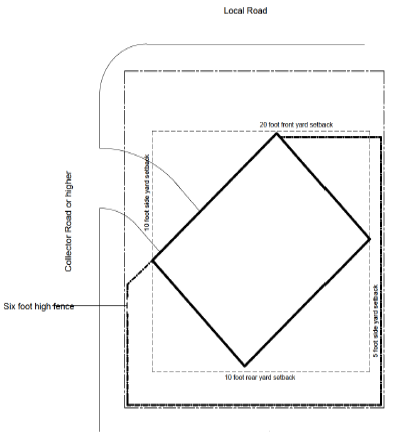
Notwithstanding other provisions of the Zoning Code, fences, walls and hedges may be permitted in a required yard; provided, however, that no fence or wall in excess of eight feet in height shall be permitted in a residential district; and provided further, that no fence in excess of four feet in height shall be permitted in a required front yard in a residential district except that a fence up to eight feet in height may be allowed in one required front yard of a lot with more than one front yard if such fence is approved as part of the site plan or sketch plan approval pursuant to Section 656.404 or Chapter 654 (Subdivision Regulations). Notwithstanding, a fence up to six feet in height shall be allowed in one required front yard of a corner lot if such fence is along a street, road or roadway classified as a collector or higher, and provided that the principal structure is facing a street, road or roadway that is not classified as a collector or higher. Such fence shall not be located forward of the front plane of the principal structure as further illustrated below in Figure A. Further, for single family use lots located in the Rural Residential (RR-Acre) zoning district, a fence up to six feet in height shall be allowed in the required front yard so long as there is a residential subdivision on the adjacent property with a fence at least six feet in height, approved through the site plan or sketch plan approval process, along the same right-of-way functioning as a collector road or higher. This provision shall not be construed to supersede the requirements of Chapter 804 and, in the case of conflict, the more restrictive requirement shall apply. The height of a fence shall be measured from the existing grade to the top of the fence, excluding pilasters or other architectural features, on the property owner's side of the fence.
Figure A
Illustration 1
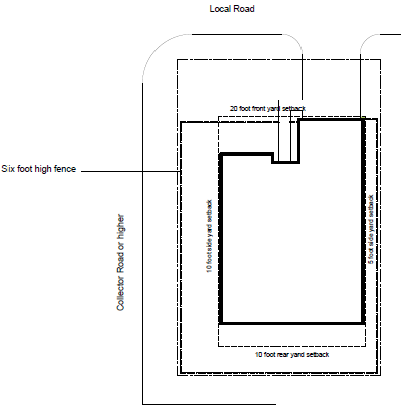
Illustration 2
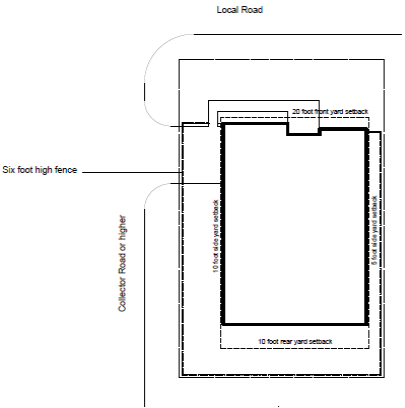
Illustration 3
(Ord. 91-59-148, § 1; Ord. 91-761-410, § 1; Ord. 2013-802-E, § 1; Ord. 2020-27-E, § 1)
Sec. 656.403. - Accessory uses and structures; accessory dwelling units.
Accessory uses and structures are permitted in all districts, if those uses and structures are of a nature customarily incidental and clearly subordinate to a permitted or permissible principal use or structure and, unless otherwise provided, these uses and structures are located on the same lot (or a contiguous lot in the same ownership) as the principal use. Where a building or portion thereof is attached to a building or structure containing the principal use, the building or portion shall be considered as a part of the principal building, and not as an accessory building. Accessory uses shall not involve operations or structures not in keeping with character of the district where located and shall be subject to the following:
(a)
Accessory uses shall not be located in required front or side yards in a residential district except as follows:
(1)
On double frontage lots, through lots and corner lots, accessory uses and structures may be located only in a required side yard except where a double frontage lot has frontage on a navigable waterway.
(2)
Accessory structures for the housing of persons shall not be located in a required yard.
(3)
Air conditioning compressors or other equipment designed to serve the main structure may be located in a required yard but not less than two feet from a lot line.
(b)
Household pets are a permitted accessory use in all residential districts, provided those pets do not become a public nuisance or health hazard.
(c)
Accessory uses and structures in a residential district shall include noncommercial greenhouses and plant nurseries, private garages and private boathouses or shelters (if boathouses or shelters do not exceed 900 square feet in area), toolhouses and garden sheds, garden work centers, children's play areas and play equipment, private barbecue pits and swimming pools, facilities for security guards and caretakers (provided that they do not exceed 50% of the primary structure's building footprint) and similar uses or structures which:
(1)
Do not involve the conduct of business of any kind, unless otherwise permitted or approved pursuant to Chapter 656.
(2)
Are of a nature not likely to attract visitors in larger numbers than would normally be expected in a residential neighborhood.
(3)
Do not involve operations or structures not in keeping with the character of a residential neighborhood.
(d)
Accessory use height:
(1)
Accessory uses or structures less than 15 feet in height may be located in a required rear of side yard, but not less than five feet from a lot line.
(2)
Accessory uses or structures greater than 15 feet in height shall meet the same setback requirements as the primary structure and shall not exceed the height of the primary structure.
(3)
Accessory uses or structures greater than 15 feet in height in the Residential Rural-Acre (RR-Acre) Zoning District, or on a lot at least one acre in size, shall meet the same setback requirements as the primary structure and may exceed the height of the primary structure, up to a maximum height of 35 feet.
(4)
An attached or detached swimming pool enclosure shall not exceed the height of the primary structure.
(e)
Land clearing and processing of land clearing debris shall be accessory uses in all zoning districts; provided, however, land clearing debris may be processed only in conformity with Chapters 360, 380 and 386, to the extent those Chapters are applicable.
(f)
Temporary retail sales of holiday gift items shall be accessory uses in all zoning districts subject to the limitations in this Part 4, including the limitation that the accessory sales shall be subordinate to a permitted or permissible nonresidential principal use.
(g)
Accessory dwelling units. Accessory dwelling units shall be allowed subject to the following criteria:
(1)
Accessory dwelling units must be located behind the primary structure.
(2)
There should be a visual relationship to the main house. For new structures this shall be accomplished through similar roof shape, porches, paint color, and other physical characteristics. For existing structures this shall be accomplished through similar paint color and other physical characteristics.
(3)
The building footprint shall be limited to 25 percent of the gross floor area of principal structure on the lot, or 750 square feet, whichever is less.
(4)
Accessory dwelling units shall not be located in a required yard.
(5)
The maximum height of an accessory dwelling unit shall be limited per Section 656.403, Ordinance Code.
(6)
Accessory dwelling units constructed pursuant to this Section may only be located on property that is subject to an existing homestead exemption or on property that meets the requirements for a homestead exemption which the property owner has applied for through the Duval County Property Appraiser's Office with the expectation that the exemption will be granted.
(7)
Accessory dwelling units shall be accessory to a conforming single-family dwelling and may be attached to or detached from the principal structure. Accessory dwelling units attached to the principal structure shall be physically separated from said structure so as to prevent direct, internal access between the primary structure and the accessory dwelling unit.
(8)
The Department shall include a certification in the permit application for requests to construct an accessory dwelling unit that requires the applicant to certify whether their property is part of a deed restricted community or subject to a homeowner's, neighborhood or master association and, if answered in the affirmative, that the applicant has confirmed an accessory dwelling unit is allowed under the deed restrictions and/or rules of the homeowner's, neighborhood or master association, as applicable.
(Ord. 91-59-148, § 1; Ord. 93-1442-1138, § 10; Ord. 97-539-E, § 9; Ord. 2003-1555-E, § 1; Ord. 2005-1148-E, § 1; Ord. 2006-797-E, § 1; Ord. 2008-969-E, § 3; Ord. 2022-448-E, § 2)
Sec. 656.404. - Requirements for preliminary site development plan review.
Procedures for preliminary site development plan review for a permitted or a permissible use on a lot are as follows:
(a)
More than one multi-family structure on a lot under one ownership, including condominiums, may be erected on a lot, provided the site plan has been approved by the Department.
(b)
A new structure or combination of multiple structures equaling 40,000 square feet or more of enclosed gross floor area may be erected on a lot, provided the site plan has been approved by the Department.
(c)
Site plans for public school facilities shall be reviewed according to performance criteria and standards which have been coordinated with the Duval County School Board prior to approval by the Department.
(d)
A modification from the requirements of Part 12 of the Zoning Code (Landscape and Tree Protection Regulations), may be permitted on a lot, provided the modification has been approved by the Department pursuant to Section 656.1220.
(e)
The subdivision of land into three or more lots or the establishment of a new public or private street in accordance with the standards, specifications, details and criteria set forth in the Land Development Procedures Manual, provided the site plan has been approved by the Department.
(f)
The Department shall establish and adopt performance criteria and standards in order to perform site plan review, which may include requirements for open space, landscaping, building separation, provisions for fire protection, underground utilities and other design parameters as deemed necessary by the Department.
(g)
An applicant may appeal to the Planning Commission any condition of a site plan approval issued by the Department that is not in conflict with a policy of the Comprehensive Plan, a requirement of the Zoning Code, or a provision of the Land Development Procedures Manual.
(h)
The Planning Commission may modify or rescind any condition of a site plan approval issued by the Department, provided the condition is not in conflict with a policy of the Comprehensive Plan, a requirement of the Zoning Code, or a provision of the Land Development Procedures Manual upon finding there is substantial, competent evidence to demonstrate that compliance with the condition would cause unusual or extraordinary difficulties because of exceptional and unique conditions of topography, access, location, shape, size, drainage or other physical features of the site, provided the public interested is protected and the development is in keeping with the general spirit and intent of these regulations. The modification or rescission may be granted by the Planning Commission upon the written application of the applicant on the form provided, subject to a majority vote of the Planning Commission and subject to any additional conditions imposed by the Planning Commission. No modification or rescission shall be granted solely on the basis of economic hardship or if it would nullify the intent and purpose of the performance criteria and standards for site plan review established and adopted by the Department.
Preliminary site development plan review shall not be required for single-family dwellings erected on a single lot so long as required yards, area, lot coverage and all other applicable requirements of the Zoning Code are met for each structure as if it were on an individual and separate lot.
(Ord. 91-59-148, § 1; Ord. 91-761-410, § 1; Ord. 2002-714-E, § 4; Ord. 2004-270-E, § 1)
Sec. 656.405. - Height limits.
The height limitations contained in Part 3 do not apply to spires, belfries, cupolas, antennas, water tanks, ventilators, chimneys or other appurtenances usually required to be placed above the roof level and not intended for human occupancy; provided, however, that notwithstanding the permitted maximum height limitations allowed in the various zoning districts, no structure (including appurtenances and structures normally erected above roof level) shall be erected to a height above adjacent ground level exceeding the most restrictive of the following:
(a)
Five hundred feet.
(b)
The height zones established in Subpart C, Part 10.
(c)
Elevations prescribed by the Federal Aviation Administration, unless the Federal Aviation Administration has issued a determination of no hazard to air navigation on the structure.
(Ord. 91-59-148, § 1)
Sec. 656.406. - Yard encroachments.
Every part of every required yard shall be open and unobstructed from the ground to the sky, except as otherwise permitted in the Zoning Code and except as follows:
(a)
Sills, belt courses, chimneys, fireplaces or pilasters may not project over two feet in a required yard.
(b)
Fire escapes, stairways and balconies which are unroofed and unenclosed may not project over three feet into a required side yard of a multiple-dwelling, hotel or motel.
(c)
Awnings, hoods, roof overhangs, canopies, bay windows or marquees may not project over three feet into a required yard.
(d)
Flagpoles, fences, walls and hedges or ornamental features are permitted in required yards, subject to the provisions of Section 656.402.
(e)
Required off-street parking shall not be located in a required front yard in an Residential Low Density (RLD) District.
(Ord. 91-59-148, § 1)
Sec. 656.407. - Lot to have access.
Except for alterations or additions to or accessory buildings for existing buildings or structures, no permit shall be issued for the use of a lot or parcel of land for the construction, location or erection of a building or structure (including a mobile home) where the lot does not abut, for a distance of not less than 35 feet, upon one of the following:
(a)
A public street which is maintained by the City.
(b)
An approved private street which is connected to a public street which is maintained by the City.
(c)
An accessway, as defined in Chapter 744, registered with the Public Works Department which is connected to a public maintained street which is maintained by the City and for which tender of right-of-way required for acceptance by the City under Section 744.101 is progressing at a timely pace in the opinion of the Director of Public Works.
(d)
A recorded easement for access at least 30 feet in width connected to a public street which is maintained by the City or an approved private street, which easement and parcels of land abutting thereon lie entirely upon lands owned by persons related as siblings or by lineal consanguinity, and all other requirements of the Zoning Code are met. In order to obtain a permit pursuant to this subsection, the owner shall furnish the Zoning Administrator with a recorded affidavit indicating the family relationship with the other owners and acknowledging that any transfer of ownership to someone outside the family may result in the creation of a nonconforming use which would require cessation of the use or removal of the structure.
(e)
Notwithstanding the foregoing, all properties shall make provisions for the accessibility for public safety and municipal services vehicles to enter and exit the properties.
However, no dwelling or dwellings may be constructed on a lot in a residential zoning district unless the lot has frontage on a public or approved private street equal to not less than 80 percent of the minimum lot width, except if located on a cul-de-sac turn around where the minimum required frontage shall be not less than 35 feet or 80 percent of the minimum lot width, whichever is less.
(Ord. 91-59-148, § 1; Ord. 1999-259-E, § 1; Ord. 2014-307-E, § 1)
Sec. 656.408. - Use of property access.
Except for purposes of ingress and egress to an existing use upon property which does not abut a street, no land shall be used for a driveway or access purposes to land which is not within the same zoning districts as follows:
(a)
Land in an AGR, RR and RLD District shall not be used for driveway access to land not within an AGR, RR and RLD district.
(b)
Land in a residential district or AGR District shall not be used as driveway access to land in a commercial or industrial district.
(Ord. 91-59-148, § 1)
Sec. 656.409. - Parking, storage or use of recreational vehicles and boats.
No recreational vehicles shall be used for living, sleeping or housekeeping purposes when parked or stored on a residentially-zoned lot or in another location not approved for this use. Boats, boat trailers, horse trailers or any other trailer and recreational vehicles may be parked or stored in a required rear or side yard but not in required front yards, provided however, that these vehicles may be parked anywhere on residential premises not to exceed 24 hours during loading and unloading.
(Ord. 91-59-148, § 1)
Sec. 656.410. - Parking and storage of certain vehicles without current license plates; repairing of vehicles in certain districts.
(a)
A motor vehicle or trailer that is not operational or appears to be under repair may not be kept in an unenclosed space (including a carport) on a lot for more than ten days.
(b)
Motor vehicles, mobile homes or trailers of any type without current license plates (except vehicles customarily used in agricultural pursuits) shall not be parked or stored other than in completely enclosed buildings on residentially- or agriculturally-zoned property.
(c)
Major repairs shall not be made to a motor vehicle, mobile home or trailers of any type in a residential or agriculture district other than in a completely enclosed building and, if the repairs are made, parts shall be kept inside the enclosed buildings.
(Ord. 91-59-148, § 1)
Sec. 656.411. - Parking and placement of certain vehicles and equipment in certain residential and CO, CRO, RO, CCG-1 and CN Districts.
(1)
The following vehicles and equipment, subject to the license classifications set forth in F.S. § 320.08, shall not be parked or located in off-street parking lots, access to highways, on private property in a residential district (except Residential Rural-Acre (RR-Acre)) or in the CO, CRO, RO, CCG-1 or CN districts, or on any public right-of-way in a residential, CO, CRO, RO, CCG-1 or CN district, except as may be required for normal loading or unloading of such vehicles and during the time normally required for service at dwellings or at structures or activities permitted or permissible in these zoning districts by the terms of the Zoning Code:
(a)
Heavy trucks and truck tractors as defined in subsection (2) below, or box trucks, step-vans, moving vans, delivery trucks, dump trucks, tow trucks, flat bed trucks, buses, cranes, or similar vehicles, or any vehicles used as a platform for a derrick, hoist, crane, compressor, tank(s), ladder racks, or similar equipment, or as a means of transporting or storing a commercial vehicle. The following vehicles are specifically excluded from this definition and shall not be deemed commercial vehicles:
(i)
unaltered automobiles;
(ii)
station wagons;
(iii)
passenger vans; and
(iv)
pickup trucks, including those with toppers campers, winches, ladder racks or other similar minor alterations on private property only.
(v)
commercial vans with ladder racks or other similar minor alterations on private property only.
(b)
Motor vehicles equipped with machinery and designed for the exclusive purpose of well drilling, excavation, construction, wood chipping, spraying or similar activity, or the machinery associated with such activity, including, but not limited to, bulldozers, bobcats, backhoes, ditch diggers concrete mixing trucks and wood chippers, except for so long as the work or construction is actively being performed;
(c)
School buses, commercial wreckers, hearses and ambulances;
(d)
Passenger vehicles for ten persons or more;
(e)
Trucks used for agricultural purposes;
(f)
Semi-trailers drawn by a truck tractor by means of a fifth-wheel arrangement; and
(g)
Trailers used for transporting landscaping and lawn care equipment, whether or not such trailer is attached to another vehicle.
(h)
Temporary personal storage units; provided, however, that temporary personal storage units may be parked or located on private property in a residential district or in the CO, CRO, RO, CCG-1 or CN districts subject to the following limitations:
(i)
The total size of the unit or units may not exceed 300 square feet in area (length multiplied by width) in a residential district; and
(ii)
The duration of placement of the unit or units is limited to 30 days, the duration of an active building permit for the property the unit or units are located on, or a reasonable amount of time for emergency cleanup after a natural disaster as determined by local, State, or federal government emergency preparedness agencies; and
(iii)
The unit or units may be located in driveways, front yards, side yards, or back yards and may be located in a required setback; and
(iv)
The unit or units may not block the flow of pedestrian traffic; and
(v)
The unit provider shall post the delivery date on the unit; and
(vi)
These regulations do not supersede more restrictive limitations contained in any homeowner's association or subdivision covenants, deeds, or restrictions.
(2)
For purposes of this Section, the following words are defined as follows:
(a)
"Heavy truck" means any motor vehicle with an actual scale weight in pounds with complete catalog equipment of more than 10,000 pounds, which is registered on the basis of gross vehicle weight in accordance with F.S. § 320.08(4), and which is designed or used for the carriage of goods or designed or equipped with a connecting device for the purpose of drawing a trailer that is attached or coupled thereto by means of such connecting device and includes any such motor vehicle to which has been added a cabinet box, a platform, a rack, or other equipment for the purpose of carrying goods other than the personal effects of the passengers.
(b)
"Truck tractor" means a motor vehicle which has four or more wheels and is designed and equipped with a fifth wheel for the primary purpose of drawing a semi-trailer that is attached or coupled thereto by means of such fifth wheel and which has no provision for carrying loads independently.
(Ord. 91-59-148, § 1; Ord. 91-761-410, § 1; Ord. 2006-673-E, § 1; Ord. 2007-319-E, § 1; Ord. 2008-969-E, §§ 3, 4; Ord. 2015-338-E, § 1)
Sec. 656.412. - Moving of buildings or structures.
No building or structure shall be moved from one lot to another lot or moved to another location on the same lot unless the building or structure shall thereafter conform to all the applicable provisions of the Zoning Code and the Building Code.
(Ord. 91-59-148, § 1; Ord. 91-761-410, § 1)
Sec. 656.413. - Agricultural zoning.
Lands which become classified as agricultural for ad valorem tax assessment purposes pursuant to F.S. § 193.461 shall be considered to be in an AGR district during the time the classification is maintained, regardless of the zoning district shown on the zoning atlas for the lands. Uses, restrictions and regulations provided in an AGR district shall apply to these lands only during the time this classification is maintained.
(Ord. 91-59-148, § 1)
Sec. 656.414. - Townhouses and Rowhouses.
(a)
Each building or structure to be sold to individual owners containing townhouses or rowhouses or each development of contiguous townhouse units shall comply with all development regulations, including overall lot and yard requirements and density, for multiple-family dwellings, except as provided in this Section. Where lots are to be sold to individual owners of townhouses or rowhouses in a building, the lots shall be developed pursuant to Chapter 654, Ordinance Code, and the following regulations shall apply to such developments and to the individual units or lots:
(1)
Minimum lot width - 15 feet; 25 feet for end units on buildings containing more than two units; 20 feet for end units on buildings containing two units.
(2)
Minimum lot area - 1,500 square feet.
(3)
Maximum lot coverage by all buildings - 70 percent.
(4)
Maximum yard requirements:
(a)
Front - 22 feet from the outside edge of sidewalk to the garage face where sidewalks are located on that side of the street and 15 feet to the building facade; 22 feet from the back edge of curb where no sidewalks are located to the garage face and 15 feet to the building facade; 15 feet, if access to garage is from an alley.
(b)
Side - Zero feet; ten feet for end units on buildings containing more than two units; five feet for end units on buildings containing two units.
(c)
Rear - ten feet.
(5)
Maximum height of structures. 35 feet.
(6)
Minimum open space. The gross density for an RLD Zoning District may not exceed the Land Use Category density. Where individual lot sizes may exceed the Land Use Category density, open space shall be platted as a separate tract and designated as "open space" on such plat.
(Ord. 91-59-148, § 1; Ord. 2008-969-E, § 3; Ord. 2021-174-E, § 2; Ord. 2023-387-E, § 1)
Sec. 656.415. - Fencing or screening of certain uses.
That portion of property adjacent to the public street or right-of-way and occupied or used for the uses listed in this Section, whether existing or created after the effective date of this Chapter, shall be screened from the public street or right-of-way by a fence, wall or evergreen hedge not less than six feet in height which creates a visual barrier, not less than 95 percent opaque. This visual barrier shall have no openings except for entrances and exit facilities and these facilities shall be equipped with gates which maintain the equivalent visual barrier as the fence, wall or evergreen hedge. This provision shall apply to land or premises used for the following:
(a)
Junkyards and automobile wrecking or storage yards.
(b)
Scrap processing yards.
(c)
Loading or unloading zones.
(Ord. 91-59-148, § 1; Ord. 91-761-410, § 1)
Sec. 656.416. - Buffers between uncomplementary districts.
Appropriate landscaping, fencing or walls shall be provided between uncomplementary land uses or zoning districts as provided in Section 656.1216.
(Ord. 91-59-148, § 1)
Sec. 656.417. - Performance standards.
A use, building, structure, development or process regulated by the Zoning Code shall comply with local, State and federal regulations related to environmental protection, including those applicable to noise, vibration, smoke, radiation, odor, toxic emissions and water or air pollution, and the standards adopted or implemented by the Neighborhoods Department.
(Ord. 91-59-148, § 1; Ord. 2008-513-E, § 1; Ord. 2011-732-E; Ord. 2013-209-E, § 40; Ord. 2016-140-E, § 16)
Sec. 656.418. - Helicopter landing sites.
A landing site for helicopters or other vertical take-off aircraft shall be a permissible use by exception in any zoning district. However, flight operations at an approved site shall not be conducted in a location other than an airport, as defined in Section 656.1004(e), Ordinance Code, until F.A.A. airspace authorization and State licensing requirements have also been obtained or met pursuant to F.S. Chapter 330.
(Ord. 91-59-148, § 1; Ord. 2001-300-E, § 1)
Sec. 656.419. - New and redeveloped areas bordering navigable waterway.
New and redeveloped waterfront projects bordering navigable waters shall provide water oriented recreational open space uses dependent upon scales, type, intensity and density to serve the development of which it is to be apart, based upon the following criteria.
(a)
Residential development with up to 50 lots or dwelling units shall provide a minimum 25-foot corridor of unobstructed visual access to the navigable waterway from a public or private rights-of-way, easement, or common area.
(b)
Residential development with more than 50 lots or dwelling units, or commercial, industrial, and institutional uses shall provide recreational or open space use consisting of 100 square feet of recreational or open space use per residential lot or dwelling unit or 50 square feet of recreational or open space use per 1,000 square feet of gross floor area, which provides access to the navigable waterway unless shown to the satisfaction of the Chief that such recreational or open space area is not in the public interest, safety, and general welfare of the City.
(Ord. 91-59-148, § 1)
Sec. 656.420. - Recreation and Open Space Standards.
(a)
A residential subdivision development of 100 lots or more shall provide at least one acre of useable uplands for every 100 lots (and any fraction thereof), or 5 percent of the total useable uplands area to be platted, whichever is less, to be dedicated as common area and set aside for active recreation. There may be up to two areas for each 100 lots, and the areas shall be a minimum of 0.5 acres in size, unless otherwise approved by the Planning and Development Department, or by the City Council as part of a Planned Unit Development Zoning District.
(b)
A residential subdivision development of 25 lots to 99 lots shall pay a recreation and open space fee as found in www.coj.net/fees,per lot, or provide at least 435 square feet of useable uplands for each lot (and any fraction thereof), to be dedicated as common area and set aside for active recreation. The City shall use recreation and open space fees collected pursuant to this subsection to improve, enhance, expand, or acquire recreation areas within the same Planning District in which the fees are paid.
(c)
A residential subdivision development of fewer than 25 lots is not subject to this Section.
(d)
All multiple-family developments of 100 units or more shall provide 150 square feet of active recreation area per dwelling unit. There may be one area for each 100 units, or the areas may be combined, subject to approval by the Planning and Development.
(Ord. 2008-969-E, § 3; Ord. 2017-665-E, § 29)
Sec. 656.421. - Textile Recycling Bins.
(a)
Intent. The requirements of this Section apply to textile recycling bins located outside of a building and which function as accessory uses or structures when used for the purpose of collecting recyclable textile materials.
(b)
Nonapplicability. Nothing herein shall be interpreted to apply to:
(1)
Any textile recycling bin located within a building or a permanent enclosed space.
(2)
Any pick-up of textile material for recycling from any person at his or her residence or place of employment, provided the same is not from an outdoor bin as described herein.
(3)
Any pick-up of textile material for recycling from a business, provided the same is not from an outdoor bin as described herein.
(c)
Definitions. As used in this Section, the following words or phrases shall have the meaning ascribed to them below, unless the context clearly indicates otherwise:
(1)
Annual Permit shall mean a permit issued or renewed on an annual basis by the Zoning Administrator that allows the permittee to place and/or maintain a textile recycling bin on real property subject to the provisions of this Section.
(2)
Bin shall mean a steel (or other durable metal) textile recycling container or receptacle, and having a rust-resistant coating that is exposed to the elements and placed outdoors.
(3)
Operator shall mean a person who owns, operates or maintains a textile recycling bin.
(4)
Permittee shall mean a person over 18 years of age or an entity who is issued a permit authorizing the placement of a textile recycling bin on real property.
(5)
Parcel Owner or Property Owner shall mean the person or entity who is the owner of real property where a bin is located.
(6)
Textile or Textile Materials shall mean items made from cloth or artificial fabric, like vinyl, that can be recycled, including clothing, pants, jeans, skirts, dresses, suits, shorts, shirts, tees, tanks, as well as outerwear (coats, jackets, gloves, hats, scarves), footwear (shoes, boots, heels, sneakers, sandals, socks, tights) undergarments (bras, underwear, slips, camisoles), accessories (hats, belts, ties, scarves, headbands), handbags (wallets, totes, luggage, backpacks, briefcases), and linens (towels, sheets, comforters, blankets, and tablecloths). Textile materials do not include bottles, cans, trash, or debris.
(7)
Textile Recycling Bin shall mean any stationary or free-standing bin, container, receptacle or similar device that is located outdoors within the City and is used for the collection of Textile Materials.
(d)
Performance Standards and Other Criteria.
(1)
Maximum Bin Floor Area. The maximum bin floor area shall not exceed 25 square feet.
(2)
Maximum Bin Height. The bin height shall not exceed seven feet.
(3)
Maximum Number of Bins per Parcel/Clustering. A bin shall be limited to one bin per one acre of a parcel or lot, except that a maximum of five bins total shall be located on a parcel or lot, even if the parcel or lot is larger than five acres total. More than one bin on a parcel or lot shall be clustered in one location so that they are arranged side-by-side and not separated by more than three feet between each bin.
(4)
Bin Maintenance and Construction. A bin shall be made of steel and have a security or safety chute and tamper-proof lock to prevent or deter intrusion and vandalism. A bin shall be kept in good condition and appearance with no structural damage, holes, or visible rust, and shall be free of graffiti. A bin shall be serviced and cleaned on a regular basis, but in no event less than every 14 days.
(5)
Bin Sensors. Every bin shall have a sensor that keeps constant track of the bin volume and that alerts the bin owner whenever the bin reaches capacity.
(6)
Bin Emptying. Every bin shall be emptied at least once per week and whenever the bin has reached capacity based upon the bin sensor. All materials that have been discarded or abandoned on or near the outside perimeter of the bins shall be removed by the permittee immediately but in no case later than upon 24 hours-notice by the City.
(7)
Bin Zoning. Bins may only be located on parcels within the following zoning districts: CCG-1, CCG-2, IBP, PBF-1, PBF-2, PBF-3. Upon request by an applicant, the Director of the Planning and Development Department (herein "Director") may determine that a PUD zoning district that allows for the majority of permitted uses by right consistent with any one of zoning districts CCG-1, CCG-2, IBP, and PBF-1, PBF-2 or PBF-3, may be suitable for location of bins if the uses within the PUD are not entirely dedicated to one or more specialized uses (e.g., a day care facility or veterinary clinic that would not otherwise be an appropriate location for such bins). The Director's determination is appealable pursuant to Section 656.135 of the Zoning Code.
(8)
Signage. Signage shall be required on at least two sides of the bin, provided that one sign shall be located on the front or depositing side of the receptacle. Signage shall be limited to five square feet per side. If textiles deposited into the bin will be sold for profit and not for charitable purposes, the following statement on the depositing side of the bin, not less than two inches below the bin chute, in conspicuous and clear lettering at least two inches high: "[Permittee's name] is not a charitable organization. The materials deposited in this bin are recycled and sold for profit, and are not tax deductible contributions."
(9)
Bin Setbacks. Bins shall be set back as follows:
(i)
From public right-of-way classified as an arterial road or higher: At least 25 feet;
(ii)
From public right-of-way classified as a collector road: At least 50 feet;
(iii)
From public right-of-way classified as a local road: At least 75 feet;
(iv)
From a property adjacent to a residentially zoned district or use: At least 100 feet;
(v)
From the boundary of an adjacent parcel (non-residential): At least 20 feet.
(10)
Non-interference by Bin Placement. Bins shall not be placed in a location that would interfere with:
(i)
A designated fire lane;
(ii)
A building exit;
(iii)
An access drive or drive aisles;
(iv)
An off-street parking lot maneuvering lane or drive aisle;
(v)
A required off-street parking space or loading zone;
(vi)
Public or private right-of-way;
(vii)
Required landscaped areas;
(viii)
Sight triangle; or
(ix)
A pedestrian circulation area.
(11)
Maintenance of Area Surrounding Bin. The area within ten feet of a bin in all directions shall be kept free of abandoned property, discarded items, overflow materials, trash and debris.
(12)
Not Permitted on Unimproved Parcels or Unoccupied Lots. A bin shall not be located on an unimproved parcel or unoccupied lot (a lot with no existing, permanent business activity or one which is without active water or electric service). Bins shall be removed within 24 hours after a business activity ceases on the property.
(13)
Limitation on Number of Bins per Parcel. No more than five bins shall be placed on a single parcel.
(14)
Hurricane Preparedness. Upon a declaration of a hurricane warning for the City that pertains to the approach of a Category 2 or higher level storm, all outdoor textile recycling bins shall be moved to a safe location within 12 hours of the issuance of the hurricane warning and shall remain in a safe location until the warning is no longer in effect.
(15)
Responsibility and Liability of Bin Owner, Bin Permittee, and Parcel Owner. It shall be the responsibility of the bin owner, the bin permittee and the parcel owner identified in the permit to comply with the provisions of this Section. Failure to comply shall constitute a violation of this Section, and shall subject the violator to the penalties provided herein.
(e)
Permit Required. No person shall place or maintain a textile recycling bin on any real property without first obtaining an annual permit issued by the Zoning Administrator.
(f)
Permit Application. A person desiring to secure a permit to place or maintain a textile recycling bin shall first make application to the Director of the Planning and Development Department or his/her designee for each bin proposed by the applicant. The permit application shall be on a form approved by the Zoning Administrator. The permit application shall be signed by the person applying for the permit, and if the person applying is an entity then the application shall be signed by the president (for a corporation), a managing member (for a limited liability company), a general partner (for a general partnership) or the chief executive officer or person in charge for that type of entity. The applicant's signature shall be under oath or affirmation. The application shall contain the following information:
(1)
The Identification of Applicant. The name, street address, and an email address of the applicant, including any and all officers, directors, general partners, limited partners, and shareholders owning more than five percent of the stock of any non-publicly traded corporate applicant, and any person who has a direct financial interest exceeding $10,000 in the ownership and/or operation of the applicant's business address in the City of Jacksonville. The applicant's date of birth if an individual, or the date of formation and Federal Employer Identification Number (FEIN), if an entity.
(2)
The Identification of the Contact Person. The name, street address, email address, and telephone number of a contact person for all matters relating to the bin that is subject to the permit application.
(3)
The Identification of the Bin's Street Address. The street address for the parcel on which the bin is proposed to be located and which is the subject of the permit application.
(4)
The Identification of the Parcel Identification Number. The parcel identification number for the real property on which the bin is proposed to be located. The parcel shall be the same one as is the subject of the permit application.
(5)
Statement of Parcel Owner. A statement by the parcel owner that the parcel owner owns the subject parcel and that the parcel owner has given permission in writing for the bin owner to operate a textile recycling bin on the parcel owner's property, provided that the bin owner maintains a lawful City permit at all times to operate the bin. If a parcel owner has given written permission to a lessee or agent to act on their behalf to provide authorization as to bin placement on their parcel, this shall be sufficient to allow a lessee or agent to provide the statement by the parcel owner. This shall not negate the parcel owner's liability as provided in subparagraph (d)(15) above. By owner's acknowledgement and permission to allow a textile recycling bin on its property, the owner also agrees to allow the City to enter the premises to remove a textile recycling bin, its contents and any recycling materials that are placed near the bin, if the removal provisions of this Section are triggered.
(6)
Applicant's Ownership of Other Bins. Whether or not the applicant owns or operates any other textile recycling bin(s) within the City.
(7)
Applicant's Business Tax Payment. The applicant shall provide a copy of its receipt illustrating that the business tax has been paid as required by Chapter 772, Ordinance Code of the City of Jacksonville.
(8)
Applicant's Annual Permit Fee. The permit application shall be accompanied by a nonrefundable annual permit fee found in www.coj.net/fees.
(g)
Permit Conditions. The permit shall be conditioned upon applicant meeting and staying in compliance with all of the requirements of this Section 656.421.
(h)
Permit Issuance. The permit shall be issued within 15 days after a fully complete application is submitted to the Zoning Administrator and further provided that the application is properly signed under oath or affirmation. When the permit is issued, the permittee shall be given a permit registration sticker with individualized permit registration number which shall be affixed to the bin in the manner and in a location as directed by the Zoning Administrator. The permit registration number will allow the Zoning Administrator to easily track information related to the bin owner and the permit.
(i)
Permit Renewal. A permit may be renewed annually. The application for renewal shall be provided on a form provided by the Zoning Administrator. The permittee shall provide an update to any information that has changed since the previous year, and the renewal application. The renewal application shall be filed between August 1 and September 1 of each year, and shall provide the same information and be signed in the same manner as an original application. The permit renewal fee shall be the same as the fee for a new permit. The Zoning Administrator shall approve the renewal of the permit if the Zoning Administrator finds (1) that no circumstances existed during the term of the permit which would cause a material violation to exist, and (2) that at the time of the submission of the renewal application and at any time during the pendency of the renewal application there were no circumstances inconsistent with any finding required for the approval of a new permit. A new permit registration sticker will be issued with each renewal. No renewal permit shall be issued by the Zoning Administrator until any outstanding violations of the provisions of this or any other applicable Section of the Ordinance Code have been corrected and any outstanding fines have been paid by the permittee. An outstanding violation or fine is defined herein as one that has been previously and finally adjudicated against the permittee and found through the Municipal Code Enforcement Board or any other quasi-judicial or judicial process or was uncontested or admitted.
(j)
Permit Expiration. If a permit expires and is not renewed, the bin must be removed from the real property by the permittee by no later than 48 hours after expiration of the permit. Should permittee fail to remove a bin more than 48 hours after expiration, the City shall be authorized to remove the bin from the property at the permittee's expense.
(k)
Revocation or Suspension of Permit. The Zoning Administrator shall have the right to suspend or revoke any permit issued hereunder for a violation of this Section. The Zoning Administrator, or designee, shall notify the permittee in writing whether the permit is being suspended or revoked and the reason therefore. The notice may allow permittee to make corrective action within a certain cure period, or in cases where the continuation of the permit may result in a detriment to public health and safety, may require the immediate revocation or suspension of the permit upon notice.
(l)
Appeals.
(1)
The Zoning Administrator's decision to deny a permit application or suspend or revoke a permit may be appealed to the Director of the Planning and Development Department. The permittee shall submit a written notice of appeal to the Zoning Administrator within ten days of receipt of the Zoning Administrator's decision. The Planning and Development Department shall schedule a hearing before the Director within 30 days of receiving the notice from permittee.
(2)
The Director shall conduct a hearing on the appeal within 60 days after the filing of the notice of appeal, or as soon thereafter as its calendar reasonably permits. The Director shall issue his or her final decision in writing within 30 days of the appeal. The final decision of the Director shall be final action by the City, effective as of the date of issuance, and the permittee shall thereafter have any remedies available at law.
(3)
The filing of a notice of appeal by a permittee shall stay an order of the Zoning Administrator or Municipal Code Compliance to remove the bin. The bin shall be allowed to remain in place pending disposition of the appeal and final decision of the Director. If Director upholds the action of the Zoning Administrator, the bin shall be removed within 48 hours of the Director's decision.
(m)
Permit Cancellation. Prior to the expiration of a permit, the permittee may voluntarily cancel the permit by notifying the Zoning Administrator in writing of the permittee's intent to cancel the permit. The permit shall become void upon the Zoning Administrator's receipt of a written notice of intent to cancel the permit. The bin subject to the permit shall be removed by permittee no later than the date of receipt by the Zoning Administrator of written notice of cancellation.
(n)
Business Tax Payment. The permittee shall not be eligible to operate a bin unless the permittee has paid the applicable business tax required by Chapter 772, Ordinance Code of the City of Jacksonville.
(o)
No Bins Permitted on Right-of-Way. Notwithstanding the provisions set forth herein, there shall be no textile recycling bins permitted on City or State right-of-way or City-owned property (without the express permission as described in Section (f) above). Should a bin be found within public right-of-way or on City-owned property without permission, the City shall have the right to remove the bin without notice.
(p)
Reporting Requirements. If permittee is required pursuant to F.S. § 403.7046, and Rule 62-722, Florida Administrative Code to report the tonnage per year of any "recovered materials," as defined in F.S. § 403.703, the permittee shall submit a copy of the annual certification and report that was provided to the State each year, first with its initial application and then each year along with its renewal application.
(q)
Removal of bins. Textile recycling bins removed by the City pursuant to the provisions of this Section 656.421 shall be taken to a location designated by the City. Within ten days of removal, the City shall send written notice by certified mail to the permittee and the permittee shall have ten days from receipt of the written notice to re-claim the textile recycling bin by appearing at the designated location to retrieve the textile recycling bin and its contents at the permittee's expense. The permittee shall pay any outstanding fines for violations, including for violations of provisions of this Section prior to taking custody of the removed textile recycling bin. If the permittee does not re-claim the textile recycling bin within the time allotted herein, the textile recycling bin and its contents will be deemed abandoned, and the City may, without any further notice to the permittee and at its sole discretion, recycle or dispose of the textile recycling bin and its contents along with any other materials in the immediate vicinity that were removed with the textile recycling bin. The deadline for retrieval of the textile recycling bin may be extended in writing by the City at its sole discretion.
(r)
Vehicles, trailers and other materials prohibited. No vehicles, trailers or other equipment shall be parked or located in combination with or in lieu of a textile recycling bin as advertising or as an additional source of accepting textile recycling materials. No additional signs or other advertising materials shall be placed in or around the immediate vicinity of a textile recycling bin other than that permitted in Section 656.421(d)(8). Failure to comply with this provision or any other provisions of Section 656.421 shall result in a Class D penalty as provided for in Section 609.109, Ordinance Code.
(Ord. 2017-842-E, § 3)
Editor's note— Ord. 2015-867-E, § 1, amended the Code by repealing former § 656.421 in its entirety. Former § 656.421 pertained to prohibition on donation collection bins, and derived from Ord. 2015-327-E, § 1. Subsequently, Ord. 2017-842-E adopted a new § 656.421.
Sec. 656.422. - Chickens allowed by permit in certain zoning districts.
(a)
For the purpose of this Section, a chicken (Gallus domesticus) refers only to a female chicken. Chickens, also referred to herein as "Backyard hens," are allowed in conjunction with a single family dwelling as defined in Part 16 of the Zoning Code, by permit and subject to the performance standards and development criteria set forth herein.
(b)
A permit is required to ensure compliance with performance standards and development criteria. The application for permit must be submitted to the Planning and Development Department prior to placement of any chickens on the property. A one-time non-refundable permit fee as found in www.coj.net/fees, shall be required at the time of application. Prior to permit application, all residents wishing to have backyard hens must evidence the completion of a chicken keeping seminar from the Duval County Agricultural Extension Office. Upon submission of a completed application as determined by the Planning and Development Department, completion of the seminar, and payment of the permit fee as found in www.coj.net/fees, the Planning and Development Department shall issue the permit. If applicant has prior attended the chicken keeping seminar, applicant shall submit the permit application with fee, along with proof that applicant has completed the chicken keeping seminar at the Duval County Agricultural Extension Office.
(c)
Up to five chickens may be permitted on each residential lot. If the lot is larger than one acre, five additional chickens may be permitted per each additional 21,780 square feet over one acre. The aforementioned land requirements are the gross area of the premises harboring such chickens and include areas used by the resident for residential or other purposes, in addition to the keeping of the chickens, subject to the following performance standards and development criteria:
(1)
Chickens shall be kept within a coop or enclosure (a fenced or wired in area, or pen, required in conjunction with a coop to provide an outside exercise area for chickens free from predators and of a size that allows access to a foraging area, sunlight, etc.) at all times. A coop is herein defined as a covered house, structure or room that will provide chickens with shelter from weather and with a roosting area protected from predators.
(2)
The coop shall be screened from the neighbors' view, using an opaque fence and/or landscape screen.
(3)
Any chicken coop and fenced enclosure shall be located in the rear yard of the property, unless the property is deemed to have double frontage on a navigable waterway. No coop, enclosure or chickens shall be allowed in any front or side yard (corner lots and through lots shall be excluded from side setback restriction) unless as otherwise described above.
(4)
If the coop exceeds 100 square feet in size (10 foot by 10 foot), a building permit must be obtained from the City's Planning and Development Department.
(5)
The coop shall be covered and ventilated, and a fenced enclosure/run is required that is well drained so that there is no accumulation of moisture. The coop and enclosure shall be completely secured from predators, including openings, ventilation holes, doors and gates (fencing or roofing is required over the enclosure in addition to the coop).
(6)
The coop shall provide a minimum of three square feet per chicken and be of sufficient size to afford free movement of the chickens. The coop may not be taller than six feet measured from the natural grade, and must be easily accessible for cleaning and maintenance.
(7)
All stored feed shall be kept in a rodent and predator proof container.
(8)
Chickens may not be kept on duplex, triplex or in multifamily properties. Chickens are allowed in manufactured home subdivisions but are not allowed within mobile home/manufactured home or recreational vehicle home parks or rental communities.
(9)
No male chickens/roosters, ducks, geese, turkeys, peafowl, pheasants, quail or any other poultry or fowl may be kept under this program.
(10)
The slaughtering of chickens on the premises is strictly prohibited and therefore not allowed.
(11)
Chickens shall be kept for personal use only. The selling of chickens, eggs or chicken manure, or the breeding of chickens for commercial purposes is prohibited.
(12)
Chickens shall not be permitted to trespass on neighboring properties, be released or set free and shall be kept within a coop and enclosure at all times.
(13)
Chicken coops and enclosures shall be maintained in a clean and sanitary condition at all times. Chickens shall not be permitted to create a nuisance consisting of odor, noise or pests, or contribute to any other nuisance condition.
(14)
All chicken coops or enclosures shall meet the setbacks for accessory structures pursuant to Section 656.403 of the Zoning Code.
(d)
No dog or cat that kills a chicken shall, for that reason alone, be considered a dangerous and/or aggressive animal.
(e)
Chickens that are no longer wanted by their owners shall not be taken to Animal Care and Protective Services, nor shall they be released. Said chickens shall be taken to certain pre-identified locations, such as Standard Feed that will accept and place any and all unwanted chickens. Animal Care and Protective Services shall maintain a list of approved locations for the owner surrender of chickens.
(f)
As a condition of the issuance of a permit, a permit holder consents to inspection of his or her property upon complaint to the City as related to backyard hens. Following a complaint as to a particular property and upon notice to the permit holder, the permit holder shall allow the Municipal Code Compliance Division to enter onto his or her property during a scheduled visit to ensure compliance with the regulations, performance standards and development criteria herein.
(g)
This Section shall not change the rights granted to properties located in the Agriculture and Rural Residential-Acre zoning districts pursuant to Section 656.401(A)(3), Ordinance Code.
(h)
This Section does not supersede any legally adopted, recorded restriction within any platted neighborhood. Moreover, this Section does not authorize persons to violate applicable restrictive covenants and homeowners' association rules and regulations. Therefore, persons applying for and receiving permits under this Section are required to certify whether their property is part of a deed restricted community or subject to a homeowners, neighborhood or master association, and if they answer in the affirmative, must provide a separate consent form (which is part of the application) signed by an officer of such entity that confirms that chickens are permitted by the entity on the subject property. The City does not police or enforce private restrictive covenants and homeowners', neighborhood and master association bylaws, rules and regulations. Persons applying for and receiving permits under this Section are solely responsible for compliance with all applicable restrictive covenants and homeowners', neighborhood or master association bylaws, rules and regulations.
(Ord. 2015-337-E, § 2; Ord. 2017-665-E, § 29; Ord. 2021-222-E, § 1)
Sec. 656.430. - Findings, intent and public purpose.
(a)
The Council of the City of Jacksonville finds that in order to protect the character and integrity of the many residential subdivisions and neighborhoods of the City, certain minimum standards are necessary to ensure the compatibility of all new homes constructed within the City, or newly sited homes within the City, whether manufactured, modular or conventional "site-built" dwellings.
(b)
It is the intent of this Subpart C to encourage the provision of affordable housing in a general residential environment by permitting the use of both residential design manufactured housing and modular housing, as defined herein, within residential districts in which similar existing dwellings are located, subject to the requirements and procedures set forth herein, to ensure similarity in the exterior appearance of residential manufactured or modular dwellings and dwellings which have been conventionally constructed in the same neighborhood. Manufactured and modular homes are permitted in all zoning districts in which single-family dwellings are permitted, subject to the minimum requirements of those districts. In addition, new or newly sited manufactured, modular, and conventional "site-built" homes in all RLD, RMD-A, and RMD-B zoning districts and all PUD zoning districts which permit single-family residential development must comply with the additional requirements of this Subpart C.
(Ord. 2002-608-E, § 2; Ord. 2003-891-E, § 1)
Sec. 656.431. - Definitions.
As used herein, the following terms and words are defined as follows:
(a)
Manufactured home means any residential dwelling unit constructed in a controlled factory environment in accordance with standards promulgated by the U.S. Department of Housing and Urban Development, Federal Manufactured Housing Construction and Safety Standards, 24 CFR 3280. A manufactured home is always transported as a vehicle and has an integral chassis and undercarriage that supports the floor system. Manufactured homes are governed by F.S. §§ 320.822—320.862, regulated by the Florida Department of Highway Safety and Motor Vehicles and bear a certification label located above the left tail light on each Section.
(b)
Modular home means any residential dwelling unit constructed in a controlled factory environment in accordance with the provisions of the Florida minimum building, plumbing, electrical, fire, accessibility and energy codes and which has building plans. A modular home can be shipped as a vehicle with wheels or may be delivered on a truck and may, or may not, be required to be constructed on an integral chassis. Modular homes are governed by F.S. §§ 553.35—553.41, regulated by the Department of Community Affairs and bear such an insignia over the electrical panel cover.
(c)
Mobile home (see Manufactured home).
(d)
Immediate neighborhood means the five closest residential dwellings with property lines within 350 feet of the property subject to review.
(e)
Permanent foundation means a load-bearing continuous stem wall underneath the entire permanent structure, slab on grade, piers installed pursuant to Chapter 15-C, F.A.C., other foundation systems with exposed tie-downs, or pilings where a dwelling is constructed in a flood prone area, including a floodway or velocity zone, or where soils or topographic conditions necessitate the use of pilings. All piers and exposed tie-downs must be screened on all sides by a nonload bearing facade stem wall. The facade stem wall shall consist of a masonry wall with a poured footer extending from ground level to the base of the structure; provided, however, that dwellings located in designated flood zones are exempt from this screening requirement.
(f)
Projection means a bay window, offsetting portions of the single-family dwelling, garages, dormer windows, recessed doors, or porches and decks (covered or uncovered), so long as these projections meet the size requirements set forth in Section 656.432(a)(2) of this Subpart C; provided, however, that covered structures must use a roofing material consistent with the roofing materials used on the primary structure and uncovered structures shall have a finished floor elevation within eight inches of the finished floor elevation of the primary structure and shall be continuously screened upward from the ground to floor with the same materials as the foundation wall used on the primary structure.
(Ord. 2002-608-E, § 2; Ord. 2003-891-E, § 1)
Sec. 656.432. - Applicability.
In addition to other provisions of the Zoning Code, the following supplementary architectural and aesthetic regulations shall apply to all new and newly sited single-family dwellings in RLD, RMD-A and RMD-B districts and PUD districts which permit single-family development. The following supplementary architectural and aesthetic regulations are also depicted in flow chart form in Figure "D."
(a)
Unless exempt pursuant to Section 656.432(c) hereunder, all new and newly sited single-family dwellings located in RLD, RMD-A and RMD-B zoning districts and PUD zoning districts which permit single-family residential development must be similar in exterior appearance to other existing single-family dwellings in the immediate neighborhood. A dwelling is deemed to be similar in exterior appearance if it meets all of the following requirements, to the extent applicable:
(1)
Minimum square footage requirements for primary structure. The minimum square footage of the living area of the dwelling shall be 650 square feet; provided, however, that the minimum square footage of the living area may be 600 square feet if dwellings in the immediate neighborhood are only 600 square feet.
(2)
Minimum dimensions of exterior facade. The exterior facade of the dwelling's wall which faces the front yard, shall contain projections as described herein. Examples of projections which comply with the requirements of this subsection are visually depicted in Figures "A," "B," and "C." All projections shall be at least two feet and ten inches wide. Front yard facades less than 48 feet long shall contain at least one projection which is at least three feet long. Front yard facades 48 feet or longer shall contain a projection or projections totaling 20 percent of the total length of the facade, with no one projection being less than three feet long. For dwellings placed perpendicularly or diagonally on a lot pursuant to subsection (5) below, the projections shall be as follows:
(a)
As visually depicted in Figure "E," the dwelling shall have a minimum nine feet by 18 feet covered structure located no more than 12 inches from the dwelling. The structure must have roof material consistent with the dwelling's roof material. The dwelling and the structure must have gables and/or hips and the roof pitch of the structure must be equal to or greater than the roof pitch of the dwelling. The structure may not be set back more than five feet from the exterior facade of the dwelling's wall which faces the front yard and the structure may not be located directly in front of the exterior facade of the dwelling's wall which faces the front yard. The structure shall have a continuous fascia extending downward from the soffit around the perimeter of the structure. The fascia shall extend downward at least 24 inches.
(3)
Finished floor elevation. The finished floor elevation shall be compatible with the finished floor elevations in the immediate neighborhood, or as otherwise required by the designated flood zone base flood elevation.
(4)
Permanent foundations. The dwelling shall have a permanent foundation as defined in Section 656.431(e), Ordinance Code, and no dwelling shall be placed or occupied for residential use upon a site until the permanent foundation plan has been submitted to and approved by the Chief of the Building Inspection Division or his designee.
(5)
Site orientation of the structure. The dwelling shall be oriented on the lot so that its long axis is parallel with the street or if it is not, the variation off of parallel shall be less than ten percent. If the dwelling is the first to be constructed in a platted subdivision, or if the dwelling is structurally integrated with an attached garage at the time of original construction or manufactured or modular home move on, this subsection shall not apply.
(6)
Exterior steps. Exterior steps, if any, must be permanently affixed to the foundation or facade stem wall.
(7)
Electric meter box. The electric meter box for each dwelling shall be permanently affixed to the dwelling.
(8)
Garage. The dwelling shall have a minimum nine feet by 18 feet attached garage, unless the residences in the immediate neighborhood do not have a garage. In cases where the proposed single-family home is larger in square footage than the dwellings in the immediate neighborhood, and complies with the projection requirements in subsection (a)(2) above, an attached garage is not mandatory. For the purposes of this Section, attached means architecturally integrated into the design of the dwelling and structurally connected or connected by a breezeway, roof or other similar attachment.
(b)
Any proposed single-family dwelling which fails to meet all of the applicable criteria of (a)(1) through (8) above must comply with the requirements of Sections 656.434 through 656.435 of the Zoning Code, unless exempt pursuant to Section 656.432(c), Ordinance Code.
(c)
A single-family dwelling proposed to be located in a subdivision which is subject to covenants and restrictions which regulate structural or exterior appearance and aesthetics and which apply to all of the lots within the subdivision is deemed to be similar in appearance and is therefore exempt from the requirements of this Section 656.432. In order to qualify for this exemption, the applicant shall furnish recorded copies of both the plat and the applicable covenants and restrictions at the Zoning counter when the application for a building permit is filed. If the plat and the applicable covenants and restrictions for the subdivision are already on file with the Zoning counter, the applicant shall certify that these documents are on file and shall describe the proposed location of the dwelling within the subdivision in a form acceptable to the Zoning Administrator.
Figure A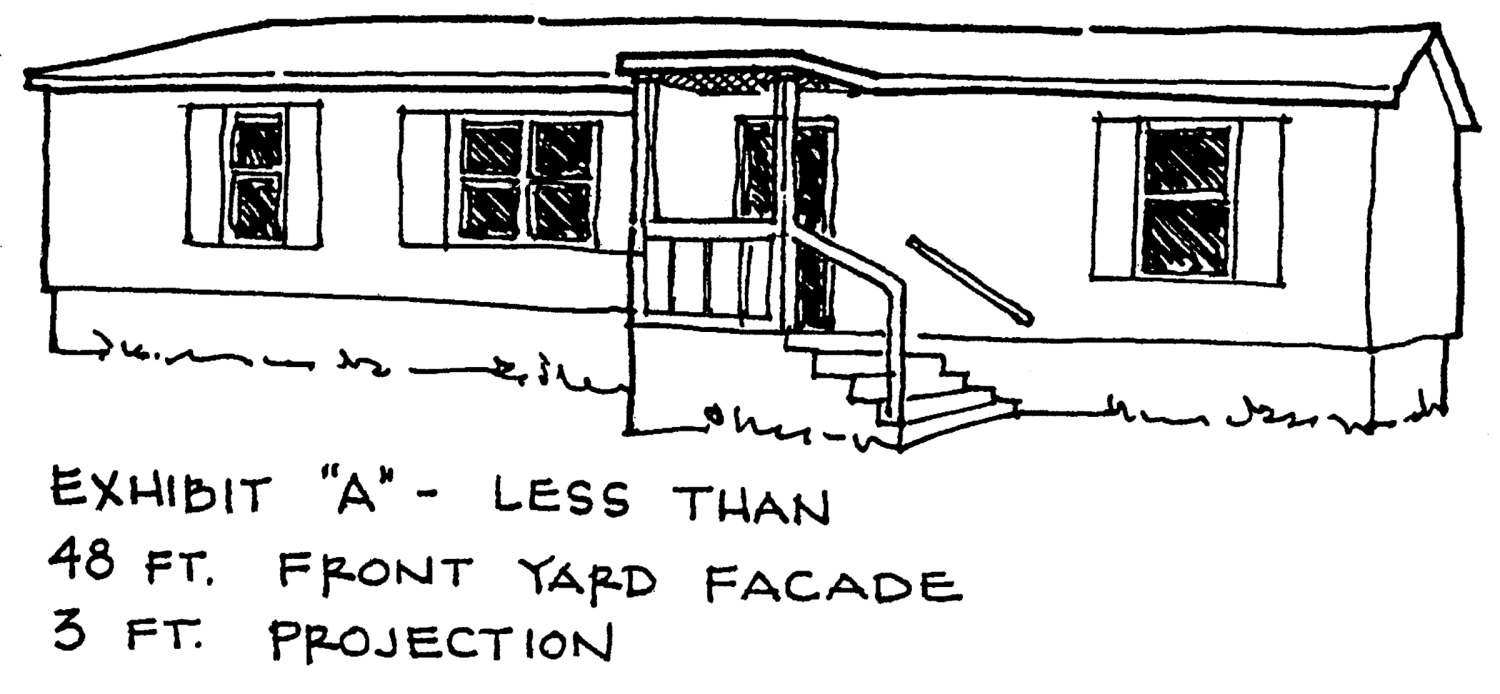
Figure B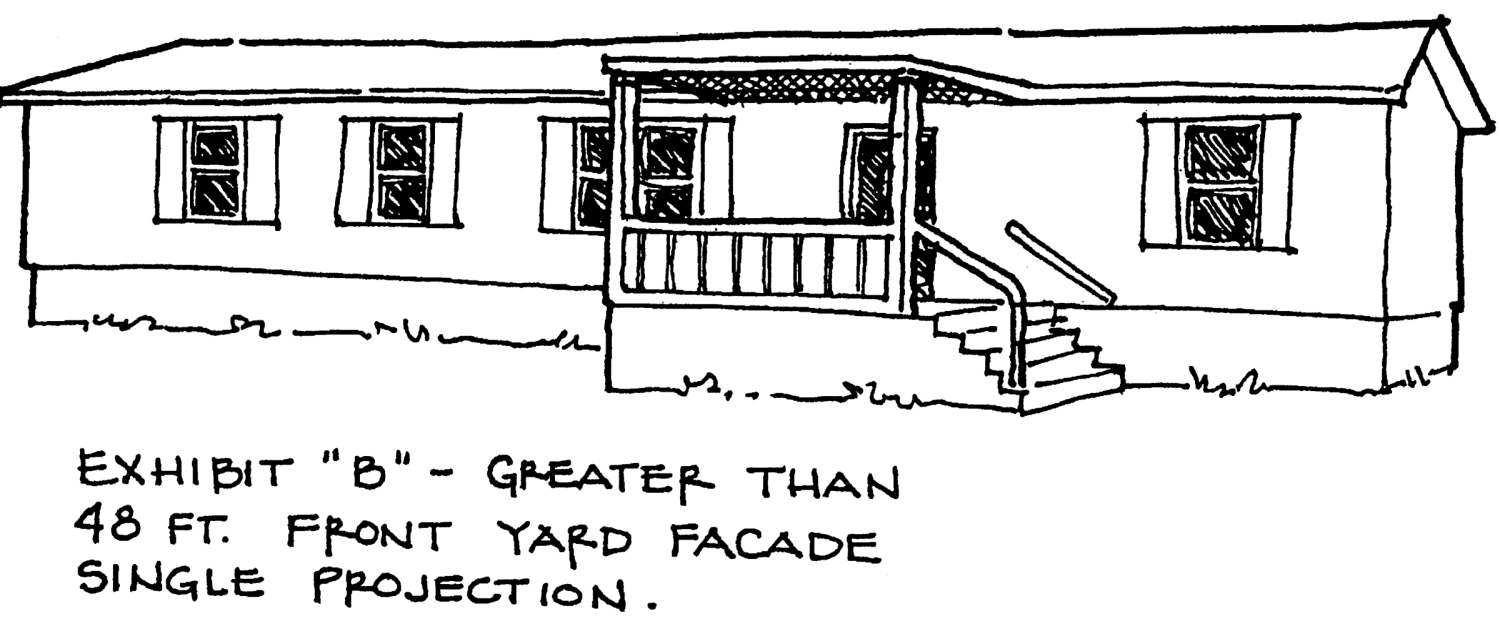
Figure C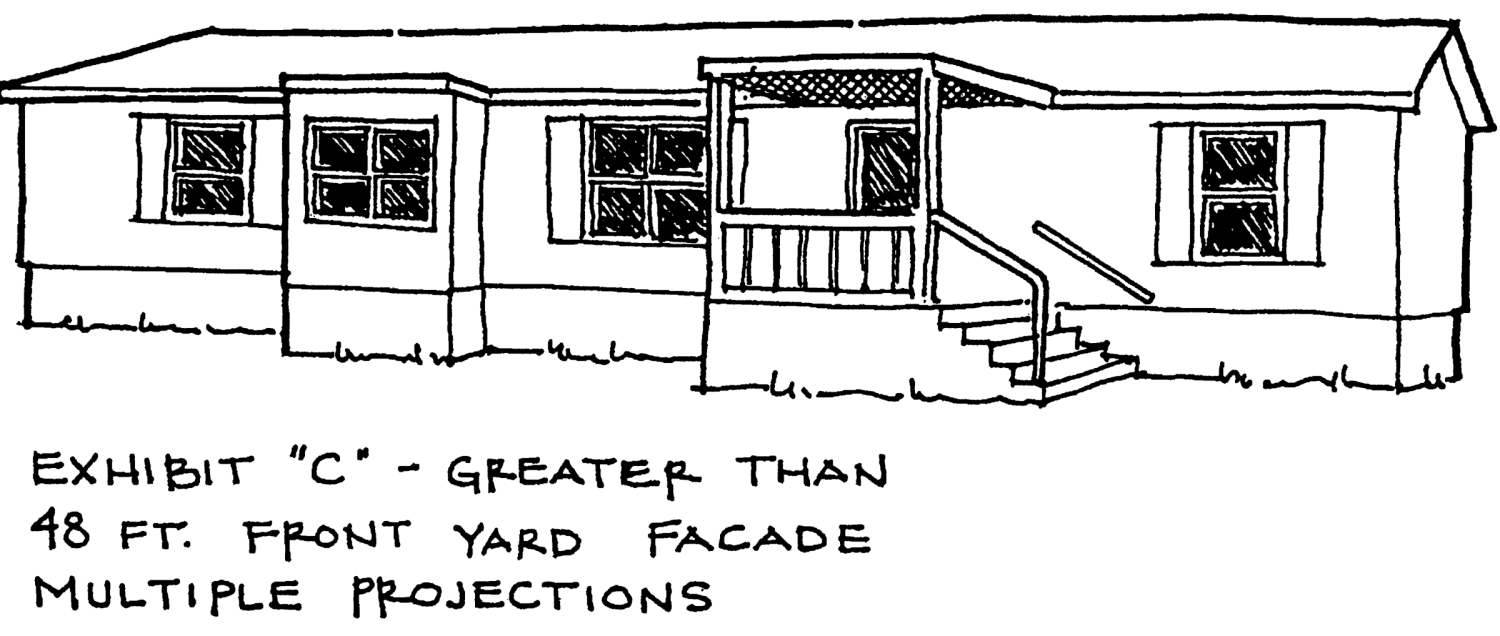
Figure D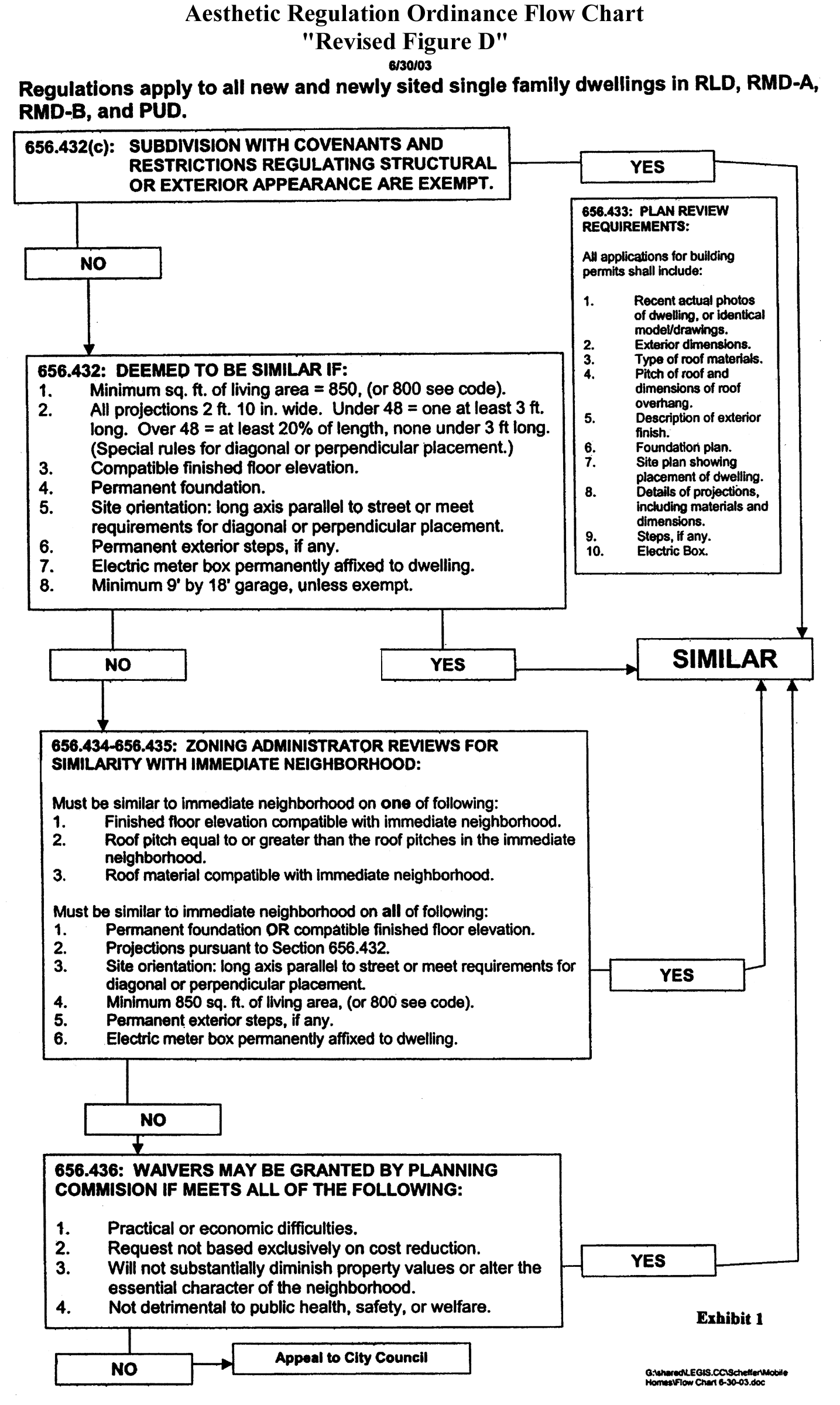
Figure E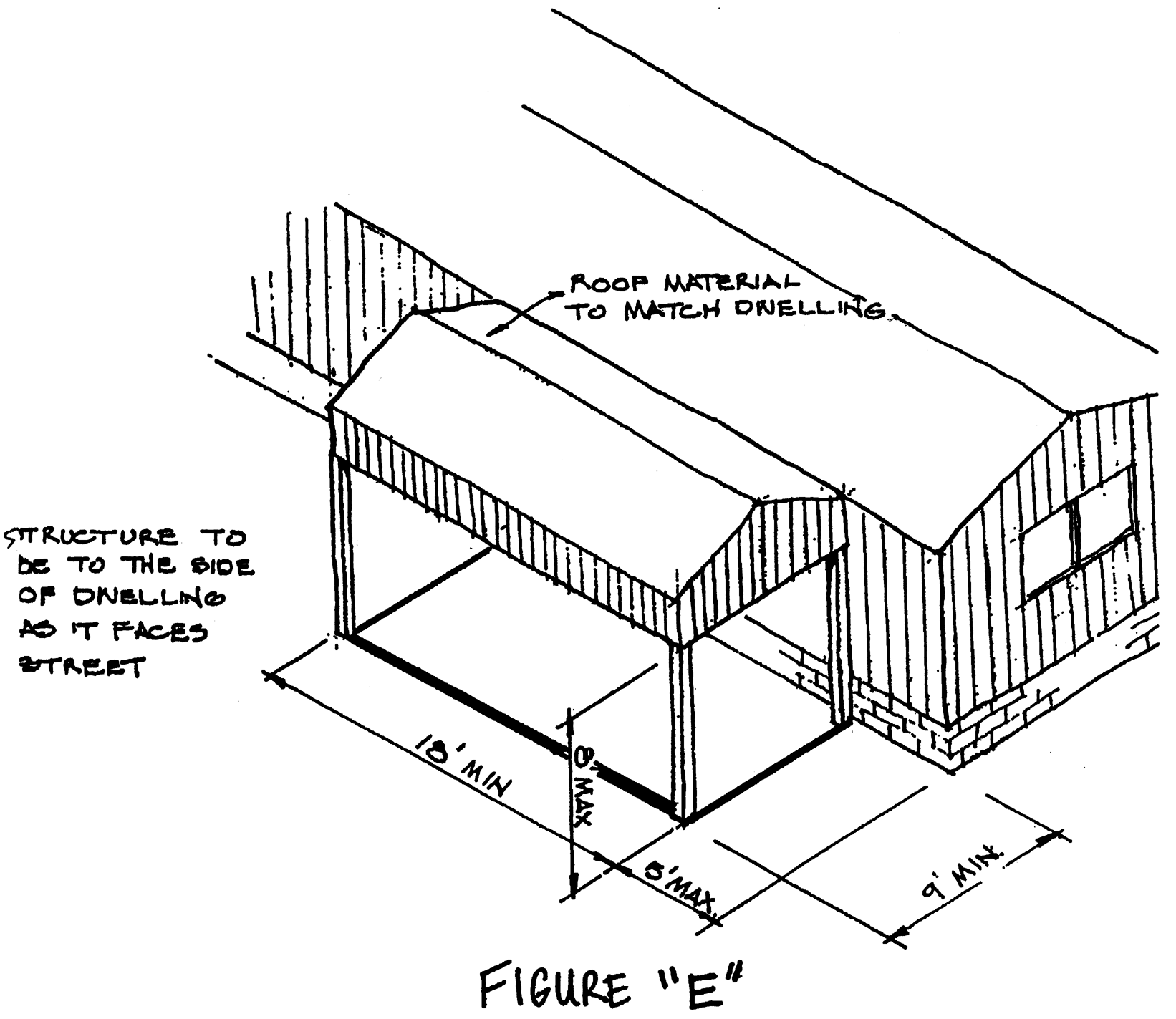
(Ord. 2002-608-E, § 2; Ord. 2003-891-E, § 1; Ord. 2013-44-E, § 1; Ord. 2024-870-E, § 2)
Sec. 656.433. - Plan review requirements.
Unless the lot is exempt pursuant to subsection 656.432(c) above, the following information shall be provided at the Zoning counter in a form acceptable to the Zoning Administrator, with all applications for a building permit:
(a)
Recent actual photographs depicting all sides of the dwelling, or the identical model to be used. If actual photographs are not available, elevation drawings which depict the "as-built" nature of the home may be provided instead;
(b)
Exterior dimensions;
(c)
Type of roof materials to be used;
(d)
Pitch of roof and dimensions of roof overhang;
(e)
Description of exterior finish;
(f)
Foundation plan;
(g)
Site plan clearly showing the placement of the dwelling on the lot; and
(h)
Details of projections, including material and dimensions.
(i)
The placement of steps, if any.
(j)
The placement of the electric meter box.
(Ord. 2002-608-E, § 2; Ord. 2003-891-E, § 1)
Sec. 656.434. - Approval procedures.
(a)
Applications for approval of new or newly sited single-family dwellings which do not comply with the requirements of § 656.432 shall be submitted to the Zoning Administrator, or his designee to review compatibility of exterior appearance with the immediate neighborhood. In addition to such information listed above in § 656.433, such application shall include all other information determined necessary by the Zoning Administrator or his designee to make a determination that the dwelling is similar to and compatible in exterior appearance to other single-family dwellings in the immediate neighborhood.
(b)
Within seven working days of receipt of the application and required supporting materials, the Zoning Administrator or his designee shall make a determination as to compliance with the requirements of this Subpart C and shall notify the applicant in writing of such determination.
(Ord. 2002-608-E, § 2; Ord. 2003-891-E, § 1)
Sec. 656.435. - Criteria for determining similarity in exterior appearance.
All proposed single-family dwellings reviewed hereunder shall be compared with three out of the five residential dwellings in the immediate neighborhood, as defined in Section 656.431(d) above. For the purposes of this Section, if the immediate neighborhood consists of less than five residential dwellings, the proposed single-family dwelling shall be compared to one less than the total number of residential dwellings within 350 feet of the property line of the subject property. In order to be determined similar to and compatible in exterior appearance to other existing single-family dwellings, the proposed dwelling must:
(a)
Meet at least one of the following criteria:
(1)
Finished floor elevation: The finished floor elevation shall be compatible with the finished floor elevations in the immediate neighborhood, which may require site-specific engineering pursuant to the applicable provisions of the Florida Statutes and/or the Florida Administrative Code, and all piers and exposed tie-downs must be screened on all sides by a non-load-bearing facade stem wall. The facade stem wall shall consist of a masonry wall with a poured footer extending from ground level to the base of the structure; provided, however, that dwellings located in designated flood zones are exempt from this screening requirement; or
(2)
Roof pitch: The roof pitch shall be equal to or greater than the roof pitches in the immediate neighborhood; or
(3)
Roof materials: The dwelling shall have asphalt shingles, tile, slate, wood shakes, or wood shingles. Any other roof material shall be compared with the roof material in the immediate neighborhood. If those in the immediate neighborhood have utilized an alternate roof material, the roof material will be considered compatible; and
(b)
Meet all of the following criteria:
(1)
Permanent foundation: The dwelling shall have a load-bearing stem wall with continuous footing, a slab on grade, piers installed pursuant to Chapter 15-C, F.A.C., other foundation systems with exposed tie-downs, or other permanent foundation which complies with the criteria of the flood regulations in flood prone areas, permanent foundation as defined in Section 656.431(e), or foundation similar to the foundations in the immediate neighborhood, or a finished floor elevation compatible with the immediate neighborhood, which may require site-specific engineering pursuant to the applicable provisions of the Florida Statutes and/or the Florida Administrative Code. All piers and exposed tie-downs must be screened on all sides by a non-load-bearing facade stem wall. The facade stem wall shall consist of a masonry wall with a poured footer extending from ground level to the base of the structure; provided, however, that dwellings located in designated flood zones are exempt from this screening requirement.
(2)
Minimum dimensions of exterior facade: The dwelling shall comply with the projection requirements in Section 656.432(a)(2).
(3)
Site orientation of the structure: The dwelling shall be oriented on the lot so that its long axis is parallel with the street. A perpendicular or diagonal placement may be permitted if the dwelling complies with the perpendicular or diagonal placement projection requirements in Section 656.432(a)(2) above; provided, however, if the deficiency along the axis parallel to the street is less than ten percent, then landscaping may be used to cure the deficiency, as approved by the Zoning Administrator.
(4)
Minimum square footage requirements for primary structure. The minimum square footage of the living area of the dwelling shall be 850 square feet; provided, however, that the minimum square footage of the living area may be lowered by the Zoning Administrator if deemed to be substantially similar in size to other primary structures in the immediate neighborhood.
(5)
Exterior steps. Exterior steps, if any, must be permanently affixed to the foundation or facade stem wall.
(6)
Electric meter box. The electric meter box for each dwelling shall be permanently affixed to the dwelling.
(Ord. 2002-608-E, § 2; Ord. 2003-891-E, § 1)
Sec. 656.436. - Waivers, appeals.
If an application submitted pursuant to Sections 656.434 and 656.435 is denied by the Zoning Administrator, the applicant may appeal to the Planning Commission. The Planning Commission is authorized to consider a waiver from these supplementary architectural and aesthetic regulations. Applications for waivers shall be in writing on the form prescribed by the Commission and filed with the Department together with the required number of copies and all required attachments. Upon receipt of the application, the Zoning Administrator shall determine whether the application is complete within five working days. If it is determined that the application is not complete, written notice shall be provided to the applicant specifying the deficiencies. The Zoning Administrator shall take no further action on the application until the deficiencies are remedied. When the application is determined to be complete, all fees must be paid as specified in Section 656.147.
(a)
The waiver may be granted if the Commission finds, based on competent substantial evidence, that the application meets all of the following criteria:
(1)
There are practical or economic difficulties in carrying out the strict letter of the regulation;
(2)
The request is not based exclusively upon the desire to reduce the cost of constructing or siting the single-family dwelling;
(3)
The proposed waiver will not substantially diminish property values in, nor alter the essential character of, the area surrounding the single-family dwelling and will not substantially interfere or injure the rights of others whose property would be affected by the waiver;
(4)
The proposed waiver will not be detrimental to the public health, safety or welfare, result in additional expense, the creation of nuisances or conflict with any other applicable law.
(Ord. 2002-608-E, § 2)

