Jacksonville City Zoning Code
PART 6
- OFF-STREET PARKING, ON-STREET PARKING AND LOADING REGULATIONS10
Editor's note— Ord. 2017-806-E, § 2, amended the title of Part 6.
Cross reference— Traffic and parking, Tit. XXIII.
SUB PART A. - OFF-STREET PARKING, ON-STREET PARKING AND LOADING FOR MOTOR VEHICLES[11]
Sec. 656.601. - Applicability.
Off-street parking and loading facilities shall be provided for all development within the City pursuant to the requirements of the Zoning Code. The facilities shall be maintained as long as the main use for which the facilities were designed to serve continues to exist.
(Ord. 91-59-148, § 1; Ord. 2007-588-E, § 1)
Sec. 656.602. - Definitions.
For purposes of this Part 6, certain terms and words are defined as follows:
(a)
Parking space, off-street means an all-weather surfaced off-street storage space, either outside or within a building, for the parking of motor vehicles. Adequate room for parking a standard-size automobile with ample room for opening of doors on both sides must be provided. In addition, the parking space shall have proper access to a public or approved private street as well as ample on-site maneuverability so that access to the parking space does not require maneuvering on a public or approved private street, except off-street parking areas for two cars or less.
(b)
Loading space, off-street means an all-weather surfaced area, other than a public street or approved private street, logically and conveniently located for loading, unloading, pick ups or deliveries by motor vehicles or trailers and accessible to the vehicles when any required off-street parking spaces are filled. There shall be ample on-site maneuverability so that the loading space does not require maneuvering on a public or approved private street.
(Ord. 91-59-148, § 1; Ord. 91-761-410, § 1; Ord. 2007-588-E, § 1)
Sec. 656.603. - General provisions.
(a)
Existing use.
(1)
Conforming buildings and uses existing as of September 5, 1969, may be modernized, altered or repaired without providing additional off-street parking or off-street loading facilities if there is no increase in area or capacity.
(2)
Where a conforming building or use existed as of September 5, 1969, and the building or use is enlarged in floor area, volume, capacity or space occupied, off-street parking or off-street loading as specified in the Zoning Code shall be provided for the additional floor area, volume, capacity or space so created or used; provided, however, that all off-street loading or parking spaces actually existing on September 5, 1969, shall be maintained and additional required spaces shall be provided for the enlargement, except where the total of the existing spaces and new spaces exceed the number which are required under the Zoning Code for the existing building or use and the enlargement combined.
(3)
A change in the use of a conforming or nonconforming building or use existing as of September 5, 1969, shall require additional off-street loading requirements which would have been required for the new use had the regulations of the Zoning Code been applicable thereto.
(4)
When the capacity of any existing commercial or accessory surface parking lot is increased in capacity by 35 percent or more, singularly or cumulatively within a five-year period, for any reason, the entire lot must be brought into compliance with all the requirements in the zoning code pertaining to same.
(b)
Nonconforming use. Where enlargement of facilities or extensions of use are proposed to be made in a building occupied by a nonconforming use, no enlargement of facilities or extensions shall be permitted unless and until existing off-street parking or loading is retained and additional off-street parking or loading is provided. The additional off-street parking or loading required shall be in the amount required for the enlargement or extension.
(c)
Plans required. A plan shall be submitted with every application for a building permit for a building or use that is required to provide off-street parking or loading. The plan shall accurately designate the required parking or loading spaces, access aisles and driveways and the relation of the off-street parking or loading facilities to the users of structures these facilities are designed to serve.
(d)
Uses not specifically mentioned. Requirements for off-street parking and loading for uses not specifically mentioned in this Part shall be the same as provided for the use most similar to the one sought, it being the intent of the Zoning Code to require all uses to provide off-street parking and loading.
(e)
Minimum requirement. Irrespective of other requirements of this Zoning Code, each separate store, office or other business shall be provided with at least one off-street parking space; provided, however, that this requirement shall not apply in the CCBD District.
(f)
Off-street parking: measurement. Floor area shall mean the gross floor area inside the exterior walls, where floor area is indicated as a basis for determining the amount of off-street parking or loading required. In stadiums, sports arenas, churches and other places of public assembly in which occupants utilize benches, news or other similar seating arrangements, each 24 lineal inches of these seating facilities shall be counted as one seat for the purpose for computing off-street parking requirements.
(g)
Fractional measurement. When units or measurements determining the number of required off-street parking or loading spaces result in the requirement of a fractional space, the fraction equal to or greater than one-half shall require a full off-street parking or loading space.
(h)
ADA accessible parking spaces. Any parking area to be used by the general public shall provide suitable, properly marked parking spaces for disabled individuals. The number, design, and location of these spaces shall be consistent with the requirements of the applicable Florida Statutes, as such may be amended from time to time. A parking space or spaces required for disabled individuals shall be counted as a parking space or spaces in determining compliance with the minimum off-street parking requirements set forth in Section 656.604. All spaces for disabled individuals shall be paved.
(Ord. 91-59-148, § 1; Ord. 2006-596-E, § 1; Ord. 2007-588-E, § 1; Ord. 2009-188-E, § 1; Ord. 2009-907-E, § 3)
Sec. 656.604. - Number of off-street parking spaces required.
Off-street parking spaces shall be provided and maintained in all districts. The parking standards provided herein are minimum requirements, however, except as set forth in subsections (e), (f) and (g) below, the maximum number of off-street parking spaces permitted for any use shall be the minimum required plus 20 percent of the required spaces for parking lots with less than 100 spaces, or ten percent of the required spaces for parking lots with more than 100 spaces. There shall be no maximum number of off-street parking spaces for single-family dwellings. Parking spaces located in parking garages do not apply toward the determination of the maximum number of parking spaces. Additional increases in parking, beyond the allowed, shall require an Administrative Deviation and parking demand analysis.
(a)
Residential uses:
(1)
Single-family dwelling—Two spaces.
(2)
Multiple-family dwellings and cottages - One and one-half spaces for an efficiency, studio or one bedroom dwelling not exceeding 500 square feet, one and three-quarters spaces for one bedroom dwelling containing 500 square feet or more, two spaces for two bedroom dwellings and an additional one-quarter space for each bedroom in excess of two, plus one space for owner or operator and one space for each two employees. In determining the number of bedrooms, rooms depicted as dens, studios and similarly depicted areas shall be construed to be an additional bedroom for the purposes of determining the number of off-street parking spaces required.
Notwithstanding the provisions of this Section, two off-street parking spaces shall be required for each townhome, cottage or condominium. Additionally, one guest parking space shall be provided for every three townhome, cottage or condominium units.
(3)
Rooming and boarding houses—One space for each two bedrooms.
(4)
Mobile home park—Two spaces for each mobile home, plus one space for each 200 square feet of non-storage floor area for manager's office, laundry facilities, recreation building, etc.
(5)
Mobile home on individual lot—Two spaces.
(6)
Housing for the elderly—One space for each two dwelling units.
(7)
Nurses' homes, convents and monasteries—One space for each four lodging units.
(8)
Fraternity and sorority houses—One space for each two residents.
(9)
Hotels and motels—One space for each sleeping room plus the spaces required for accessory uses such as restaurants and meeting rooms.
(10)
CCBD District—No off-street parking space is required when a dwelling unit is created within an existing nonresidential structure. One off-street parking space is required for each dwelling unit for new construction.
(b)
Institutional uses:
(1)
Sanitariums, rest homes, nursing homes, convalescent homes and homes for the aged—One space for each four beds plus one space for each employee or resident manager.
(2)
Community residential homes—One space for each employee or resident manager, plus one space for each four beds.
(3)
Hospitals—One and one-half spaces for each bed.
(4)
Churches and funeral homes—One space for each three seats in a sanctuary or chapel area, or one space per 35 square feet of gross floor area in the main auditorium, whichever is greater.
(5)
Art galleries, libraries and museums—One space for each 500 square feet of gross floor area.
(6)
Orphans' homes—One space for each employee plus one space for each six beds.
(c)
Schools, educational uses and care centers:
(1)
Kindergarten, elementary and junior high schools—Two spaces for each classroom, office room and kitchen.
(2)
Senior high schools—Five spaces for each classroom, office room, kitchen, gymnasium and auditorium.
(3)
Day care/care center—One and one-half spaces for each employee plus adequate provision for loading and unloading of persons.
(4)
Dance, art and music studios—One space for each 300 square feet of gross floor area.
(5)
Vocational, trade and business schools—One space for each 300 square feet of gross floor area.
(6)
Colleges/universities—Four tenths of a space per commuter student plus five tenths of a space per resident student, plus 0.85 of a space per faculty or staff member; provided, however, that the Chief may adjust these requirements where warranted to reflect project mass transit utilization and existing or proposed availability of carpooling and/or vanpooling programs.
(d)
Assembly, recreational and similar uses:
(1)
Private clubs—One space for each four seats or one space for each 200 square feet of gross floor area, whichever is greater.
(2)
Restaurants—One space for each four patron seats (including indoor and outdoor patron seating) plus one space for each two employees on a peak hour shift.
(3)
Theaters—One space for each four seats.
(4)
Bowling alleys—Three spaces for each alley, plus required parking for any other uses on the site.
(5)
Stadiums and arenas—One space for each four seats.
(6)
Community center, meeting rooms, recreational facilities—One space for each 200 square feet of gross floor area or one space for each three seats, whichever is greater.
(7)
Billiard parlors—Three spaces for every two tables.
(8)
Public, private and commercial parks, campgrounds and recreational areas—One space for each campsite or picnic area.
(9)
Golf driving ranges—One space for each tee plus required parking for other ancillary uses on site.
(10)
Nightclubs—Nightclubs not located within the Downtown Overlay Area shall provide parking spaces based on the formula (GFA * .0904) * F = PS where "GFA" is the square footage of Gross Floor Area of the structure(s) occupied by the Nightclub, where ".0904" is a constant number, where "PS" is the total number of parking spaces derived through and resulting from application of the formula rounded up to the nearest whole number, and where "F" is an occupancy factor based on the GFA as follows: 0 to 14,999 GFA - F = .25; 15,000 to 24,999 GFA - F = .2; 25,000 to 39,999 GFA - F = .13; 40,000 GFA and above - F = .12. Nightclubs located within the Downtown Overlay Area shall be treated as "restaurants" for purposes of determining the required number of parking spaces.
(11)
Fitness centers—five parking spaces per 1,000 square feet gross or one space per 200 square feet gross.
(e)
Office and professional uses:
(1)
Professional and business offices, including medical and dental offices or clinics—Three spaces for each 1,000 square feet of gross floor area. There shall be a maximum of six spaces for each 1,000 square feet of gross floor area.
(2)
Research laboratories—One space for each two employees plus one space for each company vehicle plus two spaces for patron parking.
(3)
Radio or television broadcasting office or studio—One space for each 500 square feet of gross floor area.
(f)
Commercial uses:
(1)
Business, commercial or personal service establishments (not otherwise listed)—.Three spaces for each 1,000 square feet of gross floor area. There shall be a maximum of six spaces for each 1,000 square feet of gross floor area.
(2)
Marinas—Two spaces per three boat slips plus one space per four dry boat storage spaces plus spaces for other uses a normally required, including restaurants.
(3)
Auto service station—Two spaces plus four spaces for each service bay.
(4)
Auto repair—One space per 200 square feet of gross floor area.
(5)
Bus, railroad or other transportation terminals—One space for each 400 square feet of non-storage floor area, plus one space for each two employees.
(g)
Industrial, wholesale, warehouse, storage and similar uses: One space per 5,000 square feet of gross floor area.
(Ord. 91-59-148, § 1; Ord. 91-761-410, § 1; Ord. 96-930-558, § 1; Ord. 97-665-E, § 2; Ord. 2004-295-E, § 2; Ord. 2006-596-E, § 1; Ord. 2007-588-E, § 1; Ord. 2009-907-E, § 3; Ord. 2010-449-E, § 2; Ord. 2015-250-E, § 1; Ord. 2017-318-E, § 21; Ord. 2023-347-E, § 2; Ord. 2025-448-E, § 1, 10-28-25)
Sec. 656.605. - Number of off-street loading spaces required.
Off-street loading spaces shall be provided and maintained as follows, except that additional off-street loading spaces shall not be required in the CCBD District for alteration, modernization or repair of existing buildings.
(a)
Each retail store, storage warehouse, wholesale establishment, industrial plant, factory, freight terminal, merchant, restaurant, mortuary, laundry, dry cleaning establishment or similar use which has an aggregate floor area of:
(1)
Over 5,000 square feet but not over 25,000 square feet shall have one space.
(2)
25,000 square feet but not over 60,000 square feet shall have two spaces.
(3)
60,000 square feet but not over 120,000 square feet shall have three spaces.
(4)
120,000 square feet but not over 200,000 square feet shall have four spaces.
(5)
200,000 square feet but not over 290,000 square feet shall have five spaces, plus one additional off-street loading space for each additional 90,000 square feet over 290,000 feet or major thereof.
(b)
Each office or financial institution shall provide one space for the first 75,000 square feet of gross floor area, and one space for each additional 60,000 square feet or major fraction thereof.
(c)
With respect to multiple dwellings:
(1)
For each multiple dwelling or apartment or hotel having at least 20 dwelling units but not over 50 dwelling units—One space.
(2)
For each multiple dwelling unit having over 50 dwelling units—One space plus one space for each additional 50 dwelling units or major fraction thereof.
(d)
For each auditorium, convention hall, exhibition hall, museum, motel, hotel, office building, sports arena, stadium, hospital, sanitarium, welfare institution or similar use which has an aggregate floor area of over 10,000 square feet, but not over 40,000 square feet—One space, plus one space for each additional 60,000 square feet or major fraction thereof.
(e)
For a use not specifically mentioned, the requirements for off-street loading facilities for a use which is so mentioned and to which the unmentioned use is similar shall apply.
(Ord. 91-59-148, § 1; Ord. 2007-588-E, § 1)
Sec. 656.606. - Loading facilities for solid waste.
Except for single-family residences, all buildings or development hereafter constructed shall be provided with off-street spaces or facilities for the storage and emptying of solid waste containers. The spaces shall not be located on publicly-owned land and shall provide convenient access from public streets, driveways, parking area and similar public access with pavement of adequate strength for vehicles normally used to pick up solid waste. The size and physical arrangement of these spaces shall be proportioned to the size of the projects served thereby and the volume of solid waste anticipated and as determined by the Director of Public Utilities.
(Ord. 91-59-148, § 1; Ord. 2008-513-E, § 1; Ord. 2007-588-E, § 1)
Sec. 656.607. - Design standards for off-street, on-street parking and loading facilities.
(a)
Location: The required off-street parking or loading facilities shall be located on the same lot or parcel or land they are intended to serve, unless otherwise provided in Subpart A, Part 4. No off-street parking or loading space shall block a public sidewalk. All off-street loading areas shall be visually screened from a public right-of-way.
(b)
Off-street parking distances from commercial, office, professional, industrial, wholesale, warehouse and storage building entrances: All parking lots with more than 200 spaces located more than 300 feet from a building entrance, measured perpendicular from the parking space to the structure entrance or from each entrance when multiple entrances front on the parking lot, shall have one six foot wide landscaped pedestrian connection from the parking lot to the entrance or entrances that are more than 300 feet from a parking lot with more than 200 spaces. The pedestrian connection(s) shall be centralized, shaded and minimize pedestrian and vehicle conflicts. This six foot wide landscaped and lighted pedestrian connection shall be provided for every three parking aisles, where parking exceeds 300 linear feet from the building entrance.
(c)
Size: Each off-street parking space shall be not less than nine feet by 18 feet; provided, that not more than 30 percent of the spaces may be reduced to eight feet by 16 feet and specifically designated by striping for compact-size automobiles. Signs with the arrows shall be posted at each end of the parking row, not at each individual compact parking stall.
(d)
Parking Reductions: The following parking reductions are available except for those uses described in Sections 656.604(e)(1) and 656.604(f)(1).
(1)
Tree protection offset. The required number of off-street parking spaces may be reduced by the Chief up to 20 percent if that area which would normally be required for parking is utilized for tree protection or landscaping in addition to that required by Part 12 (Landscape and Tree Protection Regulations).
(2)
Shared parking can be used to satisfy required parking.
(a)
When two or more uses occupy the same building and when the hours of operation do not overlap, the parking for the use that needs the most parking shall suffice for all uses.
(b)
Shared parking for mixed uses developments - The total parking requirements for a mixed use development is 90 percent of the sum of the amount required for each separate principal use, provided that the development consists of at least 20,000 square feet of enclosed area and has at least 2 or more lots under separate ownership.
(c)
Shared parking must be provided within 400 feet of the businesses being served.
(d)
A shared parking agreement shall be recorded between cooperating property owners as a deed restriction on both properties and cannot be modified without the consent of the Director.
(3)
On-street Parking. Credit for on-street parking shall be limited to the number of spaces provided along the street frontage adjacent to the use
(4)
Motorcycle parking space. Up to five percent of required parking may be provided as motorcycle parking space with a minimum length of seven feet and a minimum width of four feet per space.
(i)
On-street motorcycle parking spaces: On-street marked motorcycle parking spaces shall have a minimum length of seven feet and a minimum width of four feet. Motorcycle parking does not need to be oriented in the same direction as other vehicle parking spaces on the same block.
(5)
Carpool Parking. Up to ten percent of required parking spaces for parking lots with 100 or more spaces may be designated carpool or vanpool parking spaces. These spaces shall be located in preferential locations and each space shall count as two required spaces.
Each off-street loading space shall be not less than ten feet wide, 25 feet long, provide vertical clearance of 15 feet, and provide adequate area for maneuvering, ingress and egress. The length of one or more of the loading spaces may be increased up to 55 feet if full-length tractor-trailers must be accommodated. If spaces that are larger than the standard are installed, the number of spaces shall not be reduced on that account.
(e)
Access. Off-street parking and loading spaces shall be identified as to purpose and location when such is not clearly evidenced. Required off-street parking areas for three or more automobiles shall have individual spaces marked and shall be so designed, maintained and regulated that no parking or maneuvering incidental to parking shall be on a public or private street or sidewalk and so that an automobile may be parked and unparked without moving another. Each off-street parking or loading space shall be directly accessible from a street without crossing or entering another required off-street parking or loading space. However, off-street parking for townhouses or rowhouses permitted pursuant to Section 656.415 may be arranged to permit stacking or one required space behind another, if necessary. Spaces shall be arranged for convenient access and safety of pedestrians and vehicles. Each loading space shall be accessible from the interior of the building it serves and shall be arranged for convenient and safe egress and ingress by motor truck and/or trailer combination.
(f)
Maintenance/drainage. Off-street parking and loading facilities shall be:
(1)
Maintained in a smooth and well-graded, paved or hard-surfaced condition; provided, however, that off-street parking areas of 50 or more spaces, up to 30 percent of such required spaces may be stabilized and sodded rather than paved. Such stabilized and sodded spaces shall be adequately marked or delineated by area and row and may not be counted as part of the required landscaping.
(2)
Drained so as not to cause a nuisance on adjacent property.
(3)
If a pervious source material is used, such as bark or gravel, it must be at least three inches thick and be contained by a permanent contiguous border or curb.
(g)
Lighting. If the facilities are lighted, lighting shall be designed and installed so as to prevent glare or excessive light on adjacent property. No source of illumination shall be allowed in connection with a parking lot if the source of such illumination would be visible from a residentially-zoned district to the extent that it interfered with the residential use of that area. Lighting plans may be reviewed for consistency with Jacksonville Design Guidelines and Best Practices Handbook.
(h)
Encroachment onto adjoining lots or a public street. Where off-street parking or loading areas for four or more vehicles are located on the perimeter of a lot, barriers shall be provided to ensure that no portion of a parked vehicle or a parked vehicle's door, when open, shall encroach over and onto adjacent private property or over and onto a public street or sidewalk. Barriers may consist of fences, walls, hedges, chains, wheel stops, shrubs, ditches (when necessary to the drainage plan of a lot only) or other method or barrier satisfactory to the Chief.
(i)
Buffers. A six-foot visual barrier, not less than 95 percent opaque, shall be erected along the edges or portions or parking lots for nonresidential areas adjoining land in residential districts, unless releases authorizing the Chief to waive this requirement are secured from all adjoining property owners.
(j)
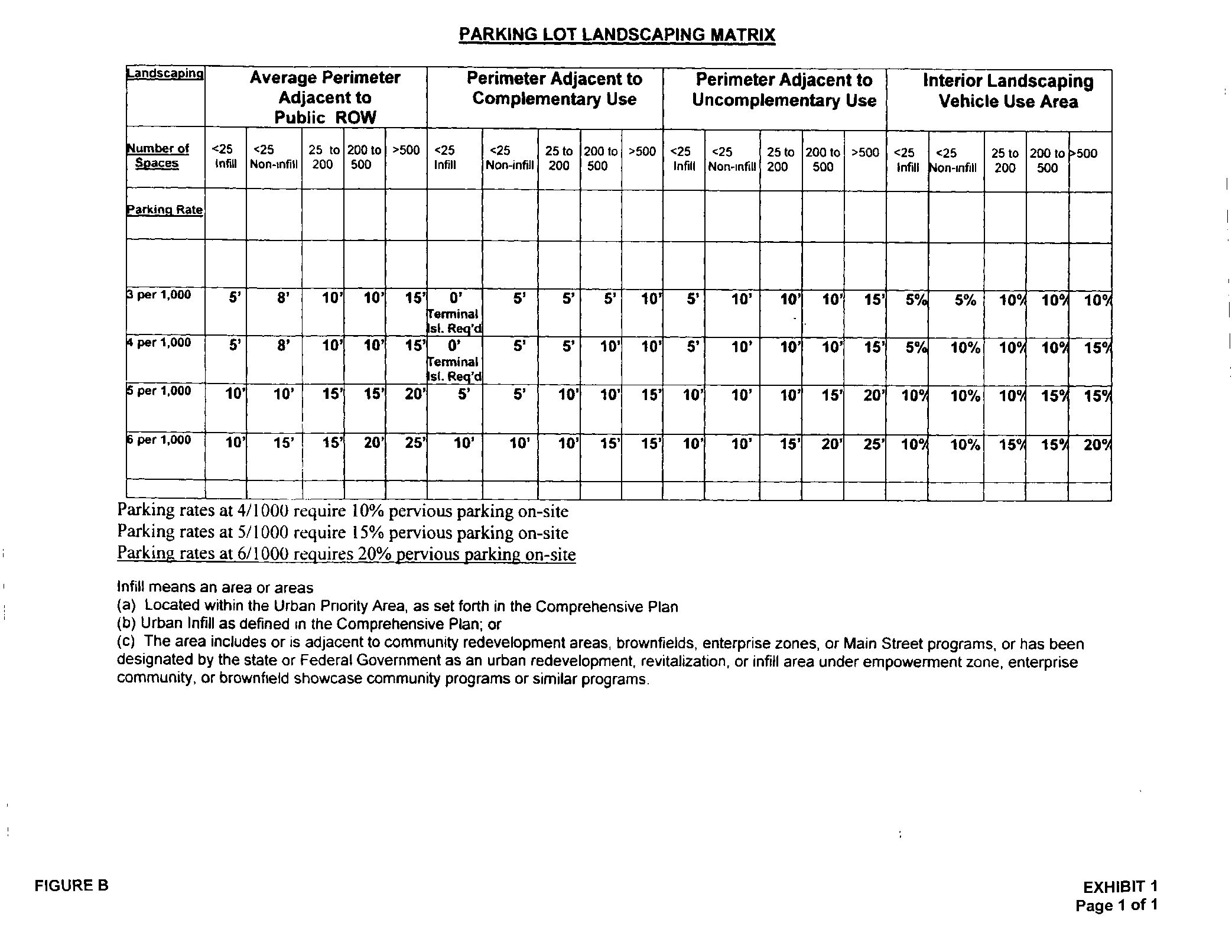
Landscaping. Off-street parking and loading areas shall be landscaped in accordance with the requirements of Part 12 (Landscape and Tree Protection Regulations) and those uses described in Sections 656.604(e)(1) and 656.604(f)(1) shall meet or exceed the landscaping requirements contained within the Parking Lot Landscaping Matrix, Figure B attached.
(k)
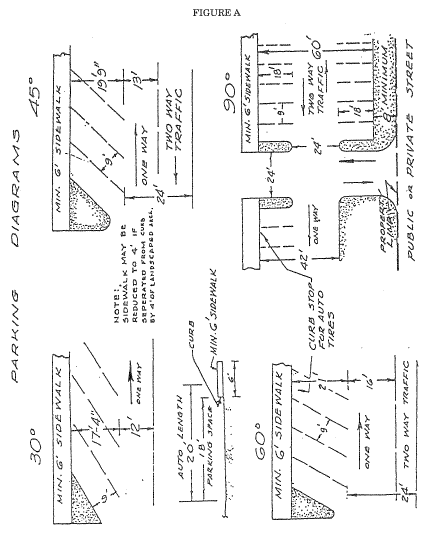
Design requirements: Minimum required design standards for alternative parking layouts are shown on the attached Figure A. Required driveway aisle width, as shown on Figure A, are summarized below:
*Angled parking may be designed to provide either back-in parking spaces or pull-in parking spaces subject to review of Planning and Development Department.
Where existing trees are saved adjacent to parking spaces and the undisturbed area is needed, the end two feet of the parking space may be converted to a landscape area, if a permanent concrete wheel stop is provided at the end of the pavement.
Where parking spaces are adjacent to public sidewalks, they shall be provided with bumper stops set back from the sidewalk in order that no portion of a vehicle may encroach upon such sidewalk.
The aisle width may be reduced to 20 feet for two-way traffic and ten feet for one-way traffic where no parking occurs or where necessary to provide sufficient landscape area around a preserved tree.
Where parking spaces are adjacent to private sidewalks, such sidewalks shall be a minimum of six feet in width in order to accommodate vehicle overhang. Alternatively, a minimum four feet landscape strip may be provided adjacent to the curb. In such case the sidewalk may be reduced to four feet.
(l)
Landscaping. Off-street parking and loading areas shall be landscaped in accordance with the requirements of Part 12 (Landscape and Tree Protection Regulations) and shall meet or exceed the landscaping requirements contained within the Parking Lot Landscaping Matrix, Figure B attached.
(m)
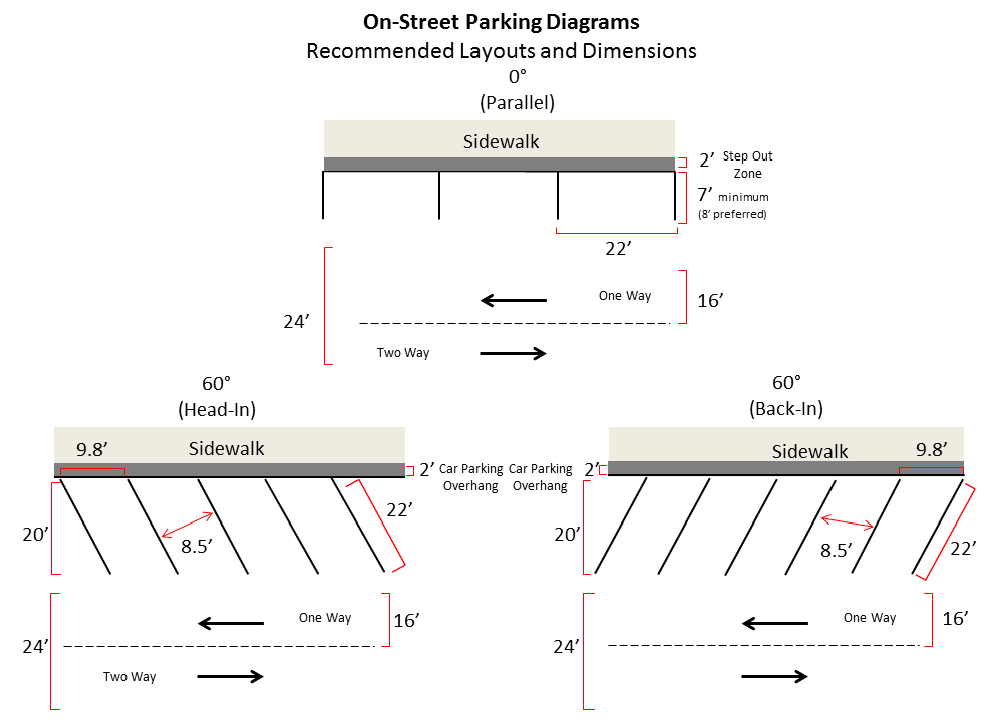
The following dimensions are required for on-street parking:
(1)
On-street parallel parking spaces shall have a seven-foot minimum parking stall width including gutter; however, an eight-foot parking stall width is preferred. Seven-foot wide stalls are recommended in residential areas or streets with limited right-of-way. An eight-foot parking stall width is preferred on functionally classified streets.
(2)
On-street parallel parking shall have a minimum two-foot step out zone along the adjacent curb, in addition to the minimum sidewalk width requirements provided in the Land Development Procedures Manual.
(3)
On-street perpendicular parking is prohibited.
(4)
Back-in or head-in 60-degree angled parking shall contain a minimum two-foot overhang zone in addition to the minimum sidewalk width requirements provided in the Land Development Procedures Manual.
See Table 1 below for On-Street Parking Dimensions and see Figures C, D and E below for dimension diagrams.
Table 1 - On-Street Parking Dimensions
Figure C - Parallel Parking - step out zone requirements
Source: Jacksonville Design Guidelines and Best Practices Handbook (Section 1: Commercial
Development)
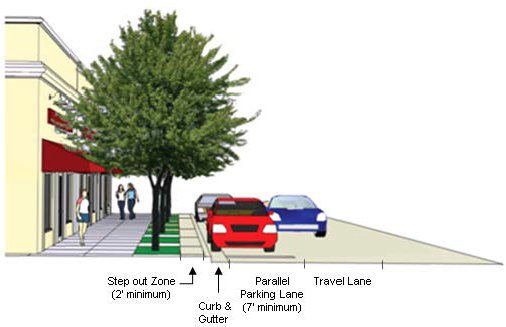
Figure D - Angled Parking - Car parking overhang requirements
Source: Jacksonville Design Guidelines and Best Practices Handbook (Section 1: Commercial
Development)
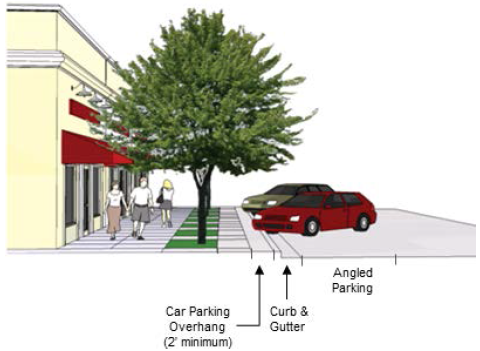
Figure E - On-Street parking diagrams
(Ord. 91-59-148, § 1; Ord. 91-761-410, § 1; Ord. 2006-596-E, § 1; Ord. 2007-588-E, § 1; Ord. 2009-907-E, § 3; Ord. 2010-449-E, §§ 2, 5; Ord. 2017-806-E, § 2)
Sec. 656.608. - Off-street parking of bicycles.
The required number of off-street parking spaces for bicycles is as follows:
(a)
Residential uses:
(b)
Institutional uses:
(c)
Schools, educational uses and day nurseries:
(d)
Assembly, recreational and similar uses:
(e)
Office and professional uses:
(f)
Commercial uses:
(g)
Industrial and similar uses:
(h)
Uses not specifically mentioned. Required off-street parking for bicycles for uses not identified in this ordinance will be determined by the Chief of Current Planning, according to the requirements for similar uses as specified above.
(i)
Minimum requirement. Notwithstanding any other requirements of this Zoning Code, each separate use specified above shall provide at least two off-street bicycle parking spaces; provided, however, that this minimum requirement shall not apply in the Central Business District.
(Ord. 91-59-148, § 1; Ord. 91-761-410, § 1; Ord. 2017-245-E, § 1; Ord. 2017-806-E, § 2)
Sec. 656.609. - Design standards for off-street parking for bicycles.
Off-street parking facilities for bicycles shall follow the City of Jacksonville Bicycle Parking Standards located in Section 3.0 of the Land Development Procedures Manual. The Bicycle Parking Standards provide the location, design, placement and installation requirements.
Bicycle parking facilities shall:
(a)
Be designed to allow each bicycle to be supported by its frame in two places.
(b)
Be designed to allow the frame and wheels of each bicycle to be secured by a lock.
(c)
Be designed to avoid damage to the bicycles.
(d)
Be anchored to resist rust or corrosion, or removal by vandalism.
(e)
Accommodate a range of bicycle shapes and sizes and to facilitate easy locking without interfering with adjacent bicycles.
(f)
Be located to prevent damage to bicycles by cars.
(g)
Be consistent with the surroundings in color and design and be incorporated whenever possible into buildings or street furniture design.
(h)
Be located in convenient, highly-visible, active, well-lighted areas.
(i)
Be located so as not to interfere with pedestrian flow on the sidewalk and should not be placed directly in front of entrances, doors or disabled parking spaces.
(j)
Be located as near to the principal entrance of the building as practicable. Bicycle parking should be located as close to the entrance of the building it serves as the nearest car parking space.
(k)
Provide safe access from the spaces to the right-of-way or bicycle lane.
(l)
Have at least five feet of clearance between any bicycle rack and a driveway or curb cut.
(Ord. 91-59-148, § 1; Ord. 2017-806-E, § 2)