
Jefferson City City Zoning Code
ARTICLE IV
SUPPLEMENTARY CONDITIONS
Sec. 35-40.- Accessory buildings, structures and uses.
A.
Conditions applicable to all accessory buildings, structures and uses.
1.
Accessory uses shall be incidental and subordinate to the principal use permitted in the district in which the use is located and shall be located on the same lot as the principal use or building.
2.
Accessory buildings, structures or use shall not be constructed or established upon a lot until the principal building, structure or use has been constructed or established, and shall not be used unless the principal building, structure or use also is being used or operated.
3.
Accessory buildings and structures shall not be erected in any required front or side setback area, except as allowed in subsection 35-51.B. Accessory buildings and structures shall comply with the minimum front and side setbacks for the zoning district in which they are located, as specified in exhibit 35-51A.
4.
The lot coverage of permitted accessory uses and/or buildings and the principal building it serves shall be calculated together for the purpose of complying with the maximum lot coverage for each district as specified in exhibit 35-51A.
5.
Accessory buildings, structures and uses may be further restricted by the provisions of subsection 35-25.H (N-O District), section 35-27 (PUD), and section 35-41 (Specific use standards).
B.
Accessory buildings, structures and uses associated with residential uses.
1.
On lots less than one acre, a maximum of two accessory buildings shall be permitted. On parcels or tracts larger than one acre, a maximum of three accessory buildings may be permitted. The combined total of all accessory buildings shall not exceed the lot coverage of the principal building.
2.
An accessory structure or building shall not be used for commercial purposes, except as provided for by section 35-41 (Home occupations).
3.
The following accessory buildings, structures and uses are customarily found and permitted in association with residential uses:
a.
Non-commercial greenhouse: Maximum size not to exceed 25 percent of the ground floor area of the principal building.
b.
Private detached residential garage or workshop:
(1)
The maximum size of a single-family or two-family residential garage or workshop shall be as shown in exhibit 35-40A.
(2)
Exhibit 35-40A.
c.
Storage building: Maximum floor area not to exceed 224 square feet, to be used for residential storage only.
d.
Tennis court, swimming pool, garden house, arbor, ornamental gate, barbecue oven, fireplace, gazebo, deck, patio, and similar uses customarily accessory to residential uses.
e.
Solar energy collector.
f.
Children's playhouse and play equipment.
g.
A pool house containing 250 square feet or less, and associated with an in-ground swimming pool, may contain a full bathroom and kitchen. An accessory building other than a pool house may contain a half-bath, but shall not contain a full bathroom and shall not contain a kitchen.
h.
A transmitting or receiving antenna or support structure which does not exceed the maximum height limit of the district in which it is located.
i.
Storage of recreational vehicles, boats, camper trailers, camper shells and similar items stored in accordance with section 35-41, Outdoor storage.
j.
Storm shelters and fallout shelters.
k.
Gates and guard houses.
l.
Fences and walls.
m.
Home occupations in conformance with subsection 35-41.K.
n.
Barns, and related agricultural structures associated with permitted agricultural uses.
o.
Vegetable gardens, which shall be located in the side or rear yard.
p.
Raising and keeping of small animals as pets, in conformance with chapter 5 of the Code, and provided that such pets shall not be kept on a commercial basis. Except in the RU District, dedicated animal pens shall not exceed 200 square feet in total area, and such pens and structures, including dog houses, shall be located in the side or rear yard. All pens and structures shall be located not less than five feet from all property lines.
q.
Keeping of equines: The keeping of equines, as an accessory use to a residential principal use, may be authorized as outlined in section 35-41, Specific use standards.
C.
Accessory buildings, structures and uses associated with non-residential uses. The following accessory buildings, structures and uses are customarily found in association with and may be permitted in association with non-residential uses:
1.
Cafeterias, dining halls and food service, health club, child care and similar services when operated for the sole convenience of the employees, residents, clients or visitors of the principal use.
2.
Offices for the permitted business and industrial use when located within the principal use.
3.
Sales of goods produced as part of the permitted industrial activities on the premises in an M-1 Industrial District.
4.
Gates and guard houses.
5.
Parking garages and parking lots in conformance with section 35-58.
6.
A dwelling unit, other than a mobile home, used for security or maintenance personnel employed on the premises.
7.
Satellite receiving dish in excess of two meters in diameter in conformance with section 35-41, Telecommunications facilities.
8.
A transmitting or receiving antenna or satellite receiving dish two meters or less in diameter, or support structure which does not exceed the maximum height limit of the district in which it is located.
9.
Fences and walls.
10.
Waste bins, which shall be located in the side or rear yard.
11.
Lighting in conformance with section 35-57, Outdoor lighting standards.
12.
Automated teller machine (ATM) is an authorized accessory use in the RA-1, RA-2, N-O, MU-1, C-O, C-1, C-2, C-3, M-1 and M-2 districts.
13.
Other accessory structures or buildings that the Director determines to be appropriate and incidental to the principal use may be permitted, provided the accessory structure or building is compatible with adjacent land uses.
14.
Recycling collection station consisting of drop-off containers authorized by the city recycling program, and similar containers for the purpose of collecting recyclable items, provided that no materials shall accumulate outside such collection stations, collection stations shall be set back at least five feet from any property line, the area around the container or collection station shall be kept free of debris and no excessive odors or glare shall be detected beyond the property lines.
(Ord. No. 16466, §§ 4, 5, 10-22-2024)
Sec. 35-41. - Specific use standards.
A.
Standards applicable to all specific uses.
1.
All uses shall be developed, used and operated in conformance with the standards of this ordinance. Specific uses may require a conditional use permit, special exception use permit, or a temporary use permit in conformance with article VII of this ordinance. All uses shall comply with applicable building, life safety, fire and health codes adopted by the city in addition to regulations of the county, state or federal governments. The applicant may be required to provide evidence of compliance with the applicable requirement.
2.
All signage used for the specific use shall be in conformance with chapter 3 of the Code, Advertising and Signs, unless otherwise provided herein.
3.
The applicant shall obtain a business license and a home occupation permit, if applicable, prior to establishment of the use.
B.
Specific use standards.
1.
Barge docking and warehouse accessory use in the RC District.
a.
General provisions. These provisions for barge docking facilities shall apply to facilities proposed for location in the RC District under a conditional use permit.
b.
Specific provisions.
(1)
The facility shall be a permanent structure, principally constructed of steel and/or concrete and specifically designed for the mooring and unloading of
(2)
The structure shall extend riverward with not less than 100 linear wall feet;
(3)
Applicable permits from the U.S. Army Corps of Engineers, Missouri Department of Natural Resources and City floodplain development permit shall be obtained.
c.
Warehouse accessory use. A warehouse accessory to a barge docking facility for storage of barge shipments may be authorized during the processing or subsequent to the processing of a barge docking facility on a site of at least 40 acres provided that:
(1)
Building coverage shall not be greater than 2.5 percent of the total site.
(2)
All storage of materials and handling equipment shall be enclosed within the warehouse, except that equipment necessary for the barge operation or material off-loaded from barge operations or from permitted mining or extraction operations may be stored outside.
(3)
In order to protect the view of the Missouri River and the flood plain, an irreplaceable natural resource of the City, the Council shall not permit an accessory warehouse in the RC District unless it finds that:
(a)
The building and facilities shall be sited so as not to cause blockage of the view of the Capitol.
(b)
The building and parking areas shall be screened with shrubs and trees.
(c)
All building access points and all parking areas will be screened from the Capitol and the downtown by the building itself or appropriate landscaping.
(d)
Only the following types of signs will be permitted:
i.
Internal directional signs, which shall not exceed an area of four sq. ft. each; and
ii.
Two business identification signs, which shall not exceed an area of 32 sq. ft. each.
(e)
Outside lighting shall be limited to the minimum amount required for safety and security and shall be directed downward and not across the river.
(f)
Building materials and colors used on the building shall blend with the landscape and shall minimize the visual impact of the structure.
(g)
Building height shall not exceed 28 feet interior ceiling height, as measured from the finished floor.
2.
Bed and breakfast establishments.
a.
General provisions. The following provisions shall apply to all bed and breakfast establishments, as authorized by section 35-28, Land use matrix:
(1)
Be subject to the City's health, safety and fire codes.
(2)
Cooking facilities shall not be permitted in individual guest rooms.
(3)
Leasing of dining facilities.
(a)
In non-residential zoning districts, common dining areas for bed and breakfast inns may be leased for social events, provided that adequate off-street parking is provided.
(b)
In residential zoning districts, common dining areas shall not be leased for social events.
b.
Specific provisions for bed and breakfast homes. Bed and breakfast homes shall:
(1)
Provide not more than two guest rooms; and
(2)
Not serve food to the general public besides the families that are overnight guests.
c.
Specific provisions for bed and breakfast inns. Bed and breakfast inns, defined as having three or more guest rooms and classified as lodging in exhibit 35-28, shall:
(1)
Have a toilet and lavatory facilities for overnight guests that are separate from and not used by family/permanent residents, but separate toilet and lavatory facilities are not required for each guest room;
(2)
Be subject to food service establishment licensing and regulations if food is served to overnight guests;
(3)
Be licensed and inspected, in conformance with chapter 28 of the Code, Restaurants, if the inn serves food to the general public;
(4)
Have a smoke detector in working order in each sleeping room; and
(5)
Maintain a fire extinguisher in working order on each floor.
3.
Community residence.
a.
Location. A community residence may be located in districts as authorized in section 35-28, Land use matrix.
b.
Spacing between community residences and group homes or penal halfway houses.
(1)
RU, RS-1, RS-2, RS-3, and RS-4 Districts: No community residence shall be closer than 1,320 feet to another community residence or group home as measured in a straight line between property boundaries.
(2)
All other zoning districts where authorized: No community residence, shall be closer than 600 feet to another community residence or group home as measured in a straight line between property boundaries.
c.
Exterior appearance. The community residence shall maintain a residential appearance so that it is compatible with the architecture and character of the neighborhood in which it is located. Alterations of an existing dwelling unit shall be compatible with the neighborhood and adjacent properties.
d.
Off-street parking. Off street parking shall be provided on the premises but not more than two spaces shall be provided in the driveway. Additional parking and storage of vehicles shall be accommodated in a garage on the premises.
4.
Concrete mixing plants, asphalt plants and cement batch plants.
a.
Applicability. Concrete mixing plants, asphalt plants and cement batch plants operations may be authorized as a conditional use permit.
b.
Permit procedure. The applicant shall file a conditional use permit application in conformance with the requirements of subsection 35-73.A. The application shall include, at a minimum, information indicating compliance with the performance standards in this section and proof of compliance with applicable state regulations of the Missouri Department of Natural Resources (MDNR) in addition to those required by section 35-71.
c.
Minimum setbacks.
(1)
Adjacent to residential zoning districts. The minimum setback for concrete mixing plants, asphalt plants and cement batch plants shall be 35 feet from any property line which abuts a residential zoning district. This setback shall apply to all buildings, structures, internal driveways and parking lots.
(2)
Adjacent to nonresidential zoning districts. Setbacks shall be in accordance with section 35-51 and the zoning district in which the use is located.
d.
Performance standards.
(1)
State and federal regulations. The concrete facility shall comply with state and federal regulations pertaining to drainage, erosion control, and dust mitigation.
(2)
Bufferyard. A type C bufferyard shall be installed in accordance with section 35-59.
(3)
Access, parking and loading. Access shall be provided from arterial streets and facility vehicles shall not make use of residential collectors or minor residential access streets. Driveways and employee and patron parking lots shall be paved, however gravel may be used for heavy equipment operational areas and product storage areas.
(4)
Validity. The concrete mixing plant, asphalt plant or cement batch plant may continue operation until the expiration of the permit as approved by the Board of Adjustment provided all the terms of the permit are met and the land use is operated in a lawful manner.
(5)
Restrictions on use of required setbacks. Structures, exterior storage, and parking areas for vehicles or equipment are not allowed within the required setbacks.
5.
Day care service for children or adults. Day care service providing care for a maximum of six children or adult clients unrelated to provider is permitted as accessory to a residential use.
a.
The day care service shall be operated in a manner that is compatible with and not detrimental to adjacent properties or the neighborhood in general.
b.
The day care service shall be operated and staffed by the applicant and family members only residing at the dwelling. No outside employees or assistants shall assist with the day care service, except that a substitute shall be permitted in the occasional absence of the day care provider.
c.
A day care service seeking a license from the State of Missouri is required to complete separate application through the appropriate State agency. A day care service which is licensed by the State of Missouri must comply with both state licensing requirements and City regulations. A state license shall not override the City's restrictions on the number of clients permitted.
6.
Day care homes for children or adults. Day care for seven to ten children or adult clients may be authorized as provided in exhibit 35-28, land use matrix, subject to the following requirements:
a.
Administrative procedures.
(1)
Inspections, licensing and permits. The following inspections and permits are required:
(a)
Daycare home permit issued by the Department of Planning and Protective Services.
(b)
Annual environmental health services inspection;
(c)
Compliance with State of Missouri licensing requirements, as applicable. A state license shall not override the City's restrictions on the number of clients allowed in a day care home.
(2)
Revocation of day care home permits. If, in the opinion of the Director, any day care home has become a safety hazard to the public, pedestrians, motorists, or to adjacent or nearby properties, residents or businesses, the Director shall institute proceedings to revoke the day care home permit. A revocation hearing shall be scheduled before the Board of Adjustment. Notice of intent to revoke the day care home permit shall state the specific reasons for the revocation, and shall be sent to the day care home provider at the address of the day care home. Notice and procedure shall be in accordance with section 35-70.
(3)
Day care home application content. The application for day care home shall provide the following information and other information requested by the Director in order to provide evidence that the use complies with the requirements of this Section:
(a)
The first and last name of the prospective day care provider (the "applicant") and telephone number.
(b)
The address of the residence to be used for said day care home;
(c)
Name, address, telephone number and authorizing signature of property owner, if different from the applicant;
(d)
Interior floor plan of the dwelling;
(e)
Exterior site plan showing the locations and dimensions of the off-street parking required for the dwelling and the proposed day care home use, the location and dimensions of required indoor area; location and dimensions of outdoor play area, and location of proposed or existing fencing.
(f)
Number of individuals who will be cared for at the day care home;
(g)
Days and hours of operation;
(4)
Operational standards.
(a)
The applicant shall establish occupancy in the dwelling prior to application for a day care home and shall reside in the dwelling in order to retain a valid day care home permit.
(b)
The day care home shall be staffed by the applicant and family members only residing at the dwelling. No outside employees or assistants shall assist with the day care home, except that a substitute shall be permitted in the occasional absence of the day care home provider.
(c)
The day care home permit shall be issued in the name of the applicant and to the address specified in the application. The day care home permit shall not be transferrable to another location or to another day care provider.
(d)
Off street loading. A day care home shall be located on a site that will accommodate and provide space for one off-street passenger loading area to allow safe delivery and pick-up of passengers and to not impede the flow of traffic on abutting streets, in addition to the off-street parking required for the residential use (see exhibit 35-58A).
(e)
Location on arterial streets. Day care homes which are located on designated arterial streets shall provide a means of egress to prevent patrons from backing out onto the arterial street, such as a circle driveway or paved turn-around area with minimum dimensions of ten feet in width by 20 feet in length.
(f)
Indoor and outdoor play spaces shall be provided in accordance with State of Missouri licensing requirements. No outdoor play space shall be permitted in the front yards.
7.
Day care center, child. Day care for more than ten children, not related to the provider by blood, marriage or adoption, or where the day care provider does not reside on the premises may be permitted as authorized by exhibit 35-28, Land use matrix, subject to the following requirements:
a.
Licensing. The operator shall obtain and retain all approvals and licenses required by the Missouri Department of Health and shall provide sufficient evidence that the use complies with the Missouri Department of Health child care regulations.
b.
Outdoor play areas. Outdoor play space shall be provided at the rate of at least 75 square feet for each child, except children in cribs. The area shall be fenced to a minimum of four feet in height. No play areas shall be permitted in the required front setback area.
c.
Indoor areas. At least 35 square feet of indoor space shall be provided for each child, excluding the kitchen, hallway, bathrooms, closets, utility rooms and offices.
d.
Off-street loading. An off-street passenger loading zone capable of holding one car per ten licensed occupants shall be provided in addition to the off-street parking requirements of exhibit 35-58A.
e.
Bufferyard required. A type A bufferyard and a fence or wall along all property lines abutting any residential use, pursuant to sections 35-58 and exhibits 35-59A and 35-59B.
8.
Drive-through/drive-in uses.
a.
Purpose and intent. The purpose of these regulations is to provide standards for drive-through/drive-in facilities to promote compatibility of this use with adjacent land uses and to ensure safe circulation of traffic on and off site. Drive-through/drive-in uses include restaurants, banks and other financial facilities, automatic teller machines, cleaners, pharmacies, and similar uses.
b.
Applicability. Drive through uses, drive through restaurants and drive-in restaurants may be authorized in accordance with section 35-28, Land use matrix. All drive-through and drive-in uses shall be in conformance with the requirements of this section.
c.
Site plan requirements. Drive-through/drive-in facilities shall be shown on site development plans where they are proposed as an accessory use to a principal use. Applicants for drive-through/drive-in facilities proposed as a principal use shall submit complete site development plans.
d.
Location. Drive-through/drive-in facilities as accessory uses shall not be located within the front yard of the principal building.
e.
Traffic impact analysis. A traffic impact analysis may be required in accordance with section 35-60.
f.
Stacking space schedule. The minimum number of stacking spaces required shall be as shown in exhibit 35-41B:
Exhibit 35-41B: Drive-Through/Drive-In Facilities Stacking Space Schedule
g.
Stacking space layout and design.
(1)
Minimum size: Eight feet by 20 feet per space.
(2)
Minimum setback from property line: Five feet.
(3)
Minimum setback from street line: 40 feet.
(4)
Separation from other internal driveways with raised medians and parking spaces: As determined by the Director of Planning and Protective Services.
(5)
Minimum drive-through lane radius: Ten feet, measured at the inside curb.
h.
Order box noise mitigation. The order box loudspeaker shall be positioned so that it is directed toward the vehicle and away from any abutting residential zoning district unless mitigated by a sound wall.
9.
Flea markets/swap meets.
a.
General. Flea market/swap meets may be permitted as authorized by section 35-28, Land use matrix.
b.
Access. Flea markets and swap meets shall be accessible from an arterial street.
10.
Homes for mentally, developmentally and physically disabled persons.
a.
Location. Group homes for mentally, developmentally and physically disabled persons, licensed by the State of Missouri, and as defined by article IX may be authorized in districts specified by exhibit 35-28, Land use matrix.
b.
Spacing. No group home shall be closer than 1,320 feet to another group home, community residence, or penal residential treatment facility as measured in a straight line between property boundaries.
c.
Special conditions for locations in residential and N-O Districts.
(1)
Appearance. When located in a residential district, the residence shall maintain a residential appearance so that it is compatible with the residential architecture and character of the neighborhood in which it is located. Alterations of an existing dwelling unit shall be compatible with the neighborhood and adjacent properties.
(2)
Off-street parking. Off-street parking shall be provided on the premises but not more than two spaces shall be provided in the driveway. Additional parking and storage of vehicles shall be accommodated in the garage on the premises.
11.
Residential treatment facility, penal.
a.
Location. A penal residential treatment facility as defined by article IX may be authorized in districts specified in exhibit 35-28, Land use matrix.
b.
Spacing. No penal residential treatment facility shall be closer to another such facility or to a group home for mentally, developmentally and physically disabled persons, or a community residence than 1,320 feet, as measured in a straight line between property boundaries.
c.
Exterior appearance. The residential treatment facility shall maintain an appearance so that it is compatible with the architecture and character of the area in which it is located. Alterations of an existing building shall be compatible with the area and adjacent properties.
12.
Home occupations.
a.
Purpose. The purpose of these home occupation regulations, standards and requirements are:
(1)
To permit and regulate the conduct of home occupations as an accessory use incidental to a dwelling unit, whether owner or renter occupied;
(2)
To ensure that such home occupations are compatible with, and do not have a injurious effect on adjacent and nearby residential properties and uses;
(3)
To adequately protect existing residential neighborhoods from dust, odors, noise, traffic and/or other potentially adverse effects of home occupations;
(4)
To allow residents of the community to use their homes as a work place and a source of livelihood, under certain specified standards, conditions and criteria;
(5)
To enable the fair and consistent enforcement of these home occupation regulations; and
(6)
To promote and protect the public health, safety and general welfare.
b.
Generally. No home occupation, except as otherwise provided herein, may be initiated, established, or maintained except in conformance with the regulations, administrative procedures and standards set forth in this Section.
c.
Permit required. No home occupation shall be established until a home occupation permit has been issued by the Director.
d.
Home occupation performance standards. Home occupations shall comply with the following performance standards:
(1)
Home occupations may be operated only by a full-time resident of the property in which the activity occurs. A home occupation shall not involve the assistance of on-site employees who do not reside on the premises as full-time residents.
(2)
The home shall maintain a residential appearance and shall not be modified to call attention to the home occupation.
(3)
No more than one non-illuminated sign, with a maximum size of one square foot, and affixed against the wall or a window, shall be permitted for a residence where one or more home occupations are operated.
(4)
The home occupation shall be conducted completely within the residence or accessory structure and the total space used for all home occupations shall not exceed 25 percent of the total floor area, or 400 square feet, whichever is less, of the residence including basement and/or finished attic spaces.
(5)
The applicant for a home occupation shall demonstrate that public facilities and utilities are adequate to safely accommodate any equipment used in conjunction with the home occupation.
(6)
Mechanized equipment, used in conjunction with the home occupation, shall be used only within a completely enclosed structure. No equipment shall be used that creates a nuisance due to odor, vibration, noise, electrical interference or fluctuation in line voltage beyond the property line of the lot upon which the home occupation is conducted. Use of power equipment in open garages, on driveways, or on patios is prohibited. No mechanized equipment shall be stored outside.
(7)
No materials, goods or equipment, including equipment being repaired or used in conjunction with the home occupation, shall be stored or displayed outdoors.
(8)
Only one vehicle may be used for the home occupation and shall not exceed one ton capacity. One trailer only may be used in the conduct of a home occupation and shall be stored in an enclosed garage on the premises or stored off-site at a location approved for such storage.
(9)
Storage or use of dangerous, combustible or volatile materials to be used in conjunction with the home occupation shall be governed by the Jefferson City Fire Code.
(10)
No more than eight additional vehicle trips per day shall be generated by the home occupation.
(11)
Deliveries related to the home occupation shall not occur more frequently than twice per day between 7:00 a.m. and 7:00 p.m., not including any deliveries made by the U.S. Postal Service. Deliveries shall not require the use of vehicles other than parcel post or similar parcel service vehicles. Tractor trailer use for general freight hauling is not permitted.
(12)
Customer and client contact shall be conducted by electronic means, telephone, by mail, or off-site and not on the premises of the home occupation, except for home occupations such as day care service, tutoring, or teaching. The home occupation shall not solicit customers to come to the home address by (1) advertising an "open house" for marketing products or services available; or (2) print or broadcast media including telephone "yellow page" ads.
e.
Prohibited home occupations. The following uses shall not be permitted as home occupations:
(1)
Any home occupation that involves the congregation of non-resident employees at a dwelling unit;
(2)
Barber shops and beauty parlors;
(3)
Cabinet making, furniture making;
(4)
Dancing schools;
(5)
Medical or dental offices or clinics, chiropractors, veterinarians, massage therapy, tattooing, body piercing, and counseling provided at the residence;
(6)
Motor vehicle repair or service;
(7)
Stripping, sanding, refinishing, restoration or painting of vehicles, household appliances or furniture;
(8)
Antique, resale, or second hand shops;
(9)
Repair shop for appliances, computers or equipment, except that an office only for such businesses may be established as a home occupation with no storage or dropping off of the appliances, computers or equipment at the residence;
(10)
Studios, including photography, audio and video production;
(11)
Contractors' operations, including home maintenance, excavating, landscaping or lawn maintenance services; except that an office only for such businesses may be established as a home occupation, with no storage or dropping off of equipment, vehicles, or materials at the residence;
(12)
Home occupations which fail to meet the standards of this Article.
f.
Burden of proof. In any and all procedures, hearings and appeals, the burden of proof regarding compliance and qualification for a home occupational use of property shall be on the person seeking or attempting to retain a home occupation use.
g.
Application content. Any application required for any permit or license related to a home occupation shall include at least the following information:
(1)
The first and last name(s) of the persons operating the home occupation;
(2)
The specific nature of the home occupation;
(3)
The address of the residence to be used for said home occupation;
(4)
Whether or not the home occupation will involve the receiving of clients or customers, and if so, the anticipated volume and frequency of the same;
(5)
The anticipated frequency of the deliveries related to the home occupation; and
(6)
list of chemicals, materials and substances used in conjunction with the home occupation.
h.
Revocation of home occupation permits. If, in the opinion of the Director, any home occupation has become a safety hazard to the public, pedestrians, motorists, or to adjacent or nearby properties, residents or businesses, the Director shall institute proceedings to revoke the home occupation permit. Failure to abide by performance standards in this ordinance, failure to abide by any special conditions of the permit or the operation is not in compliance with the conditions described in the permit application shall be grounds for revocation of the home occupation permit. Notice of intent to revoke the home occupation shall be sent to the property owner on which the home occupation is being undertaken and the operator of the home occupation. Notice and procedure shall be in accordance with section 35-70.
i.
Appeals of decisions involving home occupations. The applicant shall have the right to file an appeal of a decision of the Director with the Board of Adjustment in conformance with subsection 35-73.B or C.
13.
Kennels.
a.
Location. Kennels, as defined in article IX, may be authorized in districts according to exhibit 35-28, Land use matrix.
b.
Indoor kennels. All animal runs and pens shall be completely contained within and accessed from inside an enclosed building.
c.
Performance standards for outdoor kennels.
(1)
Outdoor kennels shall be located on a lot of ten acres or larger.
(2)
Kennel structures, buildings and animal runs and pens shall be located a minimum of 50 feet from side and rear property lines.
(3)
Fencing and landscaping. A minimum six-foot high fence shall enclose outdoor kennels. A type C bufferyard shall be required along all side and rear property lines abutting residential uses or district pursuant to section 35-59 and exhibits 35-59A and 35-59B.
14.
Manufactured home subdivision and park. Manufactured home subdivision and park may be authorized through the planned unit development process subject to the conditions established in subsection 35-74.C and this section.
a.
Design standards. A manufactured home subdivision and park shall comply with the standards established in exhibit 35-41C.
Exhibit 35-41C. Manufactured Home Subdivision and Park (MHS & MHP) Design Standards
b.
Streets. All streets within the subdivision or park shall be constructed in accordance with the residential street standards contained in chapter 33, Subdivision code. There shall be at least two street or drive openings into the mobile home subdivision or park to provide ingress and egress.
c.
Parks. Required playground space shall be separate and in addition to the open space required for each lot or space, and shall be equipped and maintained for the use of the residents of the subdivision or park. Streets, sidewalks, parking areas and accessory buildings shall not be included in the computation of the required recreation space area.
d.
Utilities underground. All power and telephone lines shall be installed underground and shall be in compliance with standards of the utility provider.
e.
Drainage. The site shall be graded so that surface water shall not be permitted to accumulate. The proposed drainage system shall be approved by the Director prior to construction of streets.
f.
Bufferyard. The subdivision shall be surrounded by a Type A landscaped buffer strip of open space 50 feet wide along the street frontage of a collector or arterial street and 25 feet wide along all other lot lines or street frontage in conformance with section 35-59 and exhibits 35-59A and 35-59B.
g.
Driveways and parking areas. Driveways and parking areas within the MHS or MHP shall be constructed in accordance with the minimum maintenance and improvement standards of section 35-58.
15.
Outdoor mini-storage warehouse.
a.
Location. A mini- warehouse may be authorized in the districts specified by exhibit 35-28, Land use matrix.
b.
Site design.
(1)
Fencing and screening. When reviewing applications for conditional use permit for mini-storage uses, the Board of Adjustment may condition approval on installation of a fence and/or landscaping in order to screen the use from view and/or provide security for the site.
(2)
Internal driveways. Driving and parking lanes shall be provided adjacent to the storage buildings. These lanes shall be at least 24 feet wide. Driveways, parking areas and internal driving lanes shall be hard surfaced in conformance with exhibit 35-58B.
c.
Performance standards.
(1)
Commercial activity prohibited. The sale of any item from or at a mini-warehouse is specifically prohibited.
(a)
It shall be unlawful for any owner, operator, or lessee of any mini-warehouse or portion thereof to offer for sale, or to sell any item of personal property or to conduct any type of commercial activity of any kind whatsoever other than leasing of the storage units, or to permit same to occur upon any area designated as a mini-warehouse.
(b)
The prohibition in this section shall not apply to the incidental sale by the owner of facility of storage boxes and storage materials or abandoned property.
(2)
Storage of gas and flammable materials, hazardous chemicals and materials prohibited. The storage of gas and flammable liquids and materials and highly combustible or explosive materials, or hazardous chemicals is prohibited within any structure on a tract of land designated as a mini storage warehouse.
(3)
Storage and limited repair only. The rental of storage units shall be the principal purpose of this use. Only limited repair of vehicles, boats, and other stored items may be permitted.
(4)
Outdoor vehicle storage area. Outdoor vehicle storage areas associated with mini storage warehouse uses are allowed as provided in exhibit 35-28, Land use matrix and the following additional standards:
(a)
Outdoor vehicle storage areas shall only be used for the storage of vehicles, recreational vehicles, boats, trailers, campers, and similar items which are in operational condition.
(b)
Outdoor vehicle storage areas shall be set back at least 25 feet from all street right-of-way lines.
(c)
No outdoor vehicle storage area shall be established in required bufferyards or landscaped areas.
(d)
Items stored shall not project above the screen, provided that landscape screens shall achieve the necessary height within ten years after planting.
(e)
The outdoor vehicle storage area shall be screened from view from streets, rights-of-way, public tracts, and from abutting permitted residential uses and zones with a type C bufferyard, options 1, 2 or 3. Natural and open space bufferyards (C-4 and C-5) are not acceptable for this use.
(f)
Outdoor vehicle storage areas may be added to existing mini-storage warehouse facilities, however, such area shall be enclosed by a fence or wall at least six feet in height, and be in accordance with section 35-59.F.
(g)
Outdoor vehicle storage areas shall be surfaced with a dust-free material including asphalt, concrete, masonry pavers, such as Uniblock® and/or a pervious pavement system incorporating grass or other groundcover with such system as Triblock® or Geoblock®.
16.
Outdoor storage and display.
a.
Standards for all districts.
(1)
Outdoor storage and display, including location restrictions are governed by article II, District regulations and exhibit 35-28, Land use matrix.
(2)
Junk, junk vehicles, salvage yards and wrecked vehicle storage yards shall be permitted in districts only as provided for in exhibit 35-28, Land use matrix and in conformance with section 35-41, Specific use standards.
b.
Specific standards for residential districts.
(1)
Front yard restrictions. No portion of any front yard, including driveway, shall be used for the permanent storage of motor vehicles, boats, trailers, RVs, commercial vehicles, or parts of any of the foregoing. Permanent storage, as used in this section, means presence for a period of 72 or more consecutive hours in the front yard within a 30-day period.
(2)
Accessory to occupied premises. Motor vehicles, recreational vehicles, boats, camper trailers, camper shells, and other items shall be owned by the owner or occupant of the premises upon which the vehicles or other items are located, and shall only be stored as an accessory use to an occupied premises.
(3)
Standards pertaining to motor vehicles intended for restoration or repair. A maximum of two motor vehicles intended for repair or restoration may be kept on a property provided all of the following conditions are satisfied:
(a)
The vehicles shall be kept in an enclosed garage, under an opaque cover designed for the vehicle, or otherwise screened from off-premise view.
(b)
Vehicles shall not be kept within a front yard.
(c)
There shall be no outdoor storage of vehicular parts.
(4)
Standards pertaining to storage of recreational vehicles (RVs).
(a)
In the residential districts, recreational vehicles shall be stored only in the side or rear yard, provided they are located at least two feet from any property line.
(b)
No recreational vehicle shall be used for living or sleeping purposes while stored on the premises.
(5)
Standards pertaining to storage of boats, camper trailers, camper shells.
(a)
In the residential districts, boats, camper trailers, camper shells and similar items shall be stored only in the side or rear yard, provided they are located at least two feet from any property line; and such items shall not extend, project or rest upon any public right-of-way including the public sidewalk, the public street, or greenway trail.
(b)
No boat, camper trailer or camper shell shall be used for living or sleeping purposes while stored on the premises.
(6)
Large vehicles, commercial vehicles. Large vehicles with gross weight exceeding one ton, or any vehicle substantially used for commercial purposes as evidenced by 25 percent or more of its commercial receipts, or by income tax record, shall not be permitted to be stored outside in any residential district.
c.
Specific standards for non-residential districts.
(1)
Front yard restrictions. Where permitted by the provisions in article II, other materials for sale may be displayed in front of the building but not within the landscaped areas or in the parking areas. All display materials, other than motor vehicles, boats and manufactured housing, shall be removed at the end of the day and stored inside the building.
(2)
Standards pertaining to vehicles. Outdoor storage and display of operable vehicles for sale, where authorized by existing zoning, shall be permitted providing the vehicles shall not be located in the landscaped perimeter area or within or on the right-of-way.
(3)
Screening requirements.
(a)
Outdoor storage areas not for display purposes, where authorized, shall be screened from views from streets, rights-of-way and public tracts, and from abutting, permitted residential uses and zones.
(b)
Outdoor storage for uses other than junk and salvage yards shall be enclosed with a type B bufferyard in accordance with section 35-59.
(c)
Except for mechanical equipment and similar units attached to the building, stored items shall not project above the screening.
(d)
Dumpsters and refuse containers shall be screened from view or enclosed by an opaque fence, wall or landscaping, six feet in height.
17.
Parking lots, off-site and commercial.
a.
Off-site parking lot. An off-site parking lot may be permitted as authorized by section 35-28, Land use matrix, under the following conditions:
(1)
The required yard setbacks of the district in which the lot is located shall be followed;
(2)
The parking lot drainage shall be approved by the Director of Planning and Protective Services;
(3)
The parking lot or area shall be screened from abutting property in RS, RD and RA districts by a type B bufferyard in conformance with section 35-59 and exhibits 35-59A and 35-59B; and
(4)
The following conditions shall be satisfied in order to approve a conditional use permit for an off-site parking lot or facility:
(a)
The proposed parking is located within 100 feet of the lot.
(b)
The parking area will not create traffic congestion or impact traffic safety.
(c)
The site plan shows that the configuration of the lot, size of spaces, access to the lot, surface, screening, landscaping and lighting are in conformance with the requirements of this ordinance.
(d)
The parking facility shall be used only for the parking of passenger vehicles.
b.
Commercial parking lots/parking facilities not associated with a particular use.
(1)
A parking facility, that may include a lot or garage or both, that is not associated with a particular use may be permitted in districts authorized by section 35-28, Land use matrix.
(2)
Parking lots shall be constructed, designed and maintained in conformance with the standards and requirements of section 35-58.
(3)
The parking facility shall be used only for the parking of passenger vehicles unless the parking facility is located in an M-1 or M-2 district.
(4)
The parking facility shall be available for short term, paid patron parking only.
18.
Quarries, mines, and sand and gravel pits.
a.
Applicability. Quarries, mines, and sand and gravel pits, referred to herein as the operation, may be permitted as authorized by section 35-28, Land use matrix, under the following conditions:
b.
Procedure. The applicant shall file a conditional use permit application in conformance with the requirements of subsection 35-73.A. The application shall include, at a minimum, the following information in addition to that required by section 35-71:
(1)
Present uses of the land to be included in the requested permit;
(2)
Location map prepared by a registered professional engineer showing:
(a)
The extent of the area to be excavated;
(b)
Boundaries of land to be affected by the operation, including the locations of (i) storage sites for overburden, (ii) access and haulage roads, (iii) storage sites for equipment, and (iv) offices and other structures to be used in conjunction with the operation;
(c)
Boundaries of adjoining lands owned by persons other than the applicant and the existing uses of those lands;
(d)
Location of all watercourses, bodies of water, public rights-of-way, public buildings, public recreation areas or other public property on or within 100 feet of the boundaries of the land to be affected by the operation; and
(3)
A development plan for the areas to be affected by the operation, prepared by a registered professional engineer shall include the following:
(a)
The nature and depth of various strata of overburden above and between mineral seams to be excavated;
(b)
The location and quality of underground water known to be present on the mine site;
(c)
The location of known aquifers and the estimated elevation of the water table;
(d)
The nature and thickness of minerals above the seam to be mined;
(e)
A transportation study demonstrating truck routing and proposing mitigation measures for off site street damage and traffic impacts.
(f)
Existing topography within the boundaries of the project area.
(4)
A detailed land reclamation plan of the area included within the permit, showing:
(a)
Proposed use or uses of the land following the operations;
(b)
Proposed topography of land following the operations (indicated by contour lines of not greater interval than five feet);
(c)
Actions to be taken during the operation to conserve and replace topsoil removed during the operation;
(d)
The effect of the operations and reclamation on surface and subsurface hydrology and drainage patterns;
(e)
The sedimentation and erosion control plan for operation including the type of vegetation to be planted for soil stabilization purposes;
(f)
The proposed location of future roads, private or public rights-of-way, drainage courses and other proposed improvements;
(g)
Reasonable assurances that the applicant will be capable of reclaiming the land in accordance with the plan within one year after completion of the operations to be covered in the requested permit; and
(h)
A discussion of how the proposed reclamation plan is consistent with the future potential uses of the land, according to the zoning and the City's comprehensive plan development plan land use classification.
(5)
Such other information as the approval authority may require by rule and which examination of the application may reveal to be necessary in order to determine that the proposed operation will comply with the requirements of this zoning ordinance.
(6)
Proof of compliance with applicable federal and state regulations.
d.
Minimum setbacks.
(1)
Adjacent to residential districts. Mining, mineral extraction and quarry operations shall be setback 35 feet from all property lines which are adjacent to residential zoning districts.
(2)
Adjacent to nonresidential districts. Mining, mineral extraction and quarry operations shall provide setbacks in accordance with section 35-51.
(3)
Setback requirements shall not apply to property lines adjacent to navigable waterways.
e.
Performance standards.
(1)
Disposal of refuse and water-carried wastes. The site plan shall show graphically and in written detail the methods that will be employed to dispose of refuse and water waste.
(2)
Nuisance mitigation. The applicant shall state in writing and show graphically in the site plan, as applicable, methods that will be employed to prevent obnoxious or offensive odors, dust, smoke, gas, noise or similar nuisances from being emitted beyond the property boundaries of the mine, quarry or mineral extraction operation.
(3)
Required bufferyards. A type C bufferyard, shall be installed as shown in exhibit 35-59.
(4)
Access, parking and loading. Access driveways and employee parking lots shall be paved. Operation areas for heavy equipment and storage areas may be gravel. Access shall be provided from highways or arterial streets and no primary access shall be permitted from local streets abutting residential districts.
f.
Approval criteria. The approval authority shall review and consider approval of the application in conformance with the review criteria in subsection 35-73.A and the following additional standards:
(1)
The use is temporary and restricted to the purpose of extracting minerals.
(2)
The land is appropriate for the purpose of extracting minerals.
(3)
The proposed location will offer reasonable protection to the neighborhood in which the operation will occur against possible detrimental effects of the operations, taking into consideration the physical relationship of the proposed site to surrounding properties and permitted land uses, access to the site from public roads, streets and other public rights-of-way that must be traveled in removing minerals from the site, and the effect of the mining operations on the public water supply.
g.
Validity. The quarry, mine, or sand and gravel pit may continue operation until the expiration of the permit as approved by the City Council provided all the terms of the permit are met and the land use is operated in a lawful manner.
h.
Prohibited activities within the required setback.
(1)
Location, movement, or stockpiling of mineral and aggregate resources or the disposal or storage of waste products within a required setback is prohibited.
(2)
Structures, exterior storage, and parking areas for trucks or equipment are not allowed within the required setbacks.
19.
Recreational vehicle and travel trailer parks. A recreational vehicle and travel trailer park (RV park) may be permitted as authorized by section 35-28, Land use matrix. The following additional standards shall apply.
a.
Required plans. A site plan in accordance with section 35-71 shall be provided.
b.
Access. Access to an RV park shall be provided only from a collector or arterial street.
c.
Minimum area. An RV park shall encompass a minimum of ten acres.
d.
Bufferyard and fencing. A type C bufferyard shall be provided along all property lines. In addition, total or partial fencing of park boundaries may be required to prevent park users from trespassing onto adjacent private property, to restrict vehicular access to designated areas, and to adequately delineate property lines to prevent encroachment by adjacent land owners. The need for fencing shall be determined by the approval authority.
e.
Internal circulation roads. Roads within the RV park shall provide easy access to camp sites and shall comply with the following standards:
(1)
Two-way traffic. Roads designated for two-way traffic shall have a width not less than 26 feet in width.
(2)
One way traffic. Roads designated for one-way traffic shall have a width not less than 20 feet, and be adequately marked as such.
(3)
No parking shall be permitted alongside any internal road, except within turnouts or parking areas so designated.
(4)
Driveways and main internal access roads serving the RV park, including RV park office, solid waste disposal area and service roads shall be designed and constructed in accordance with public street specifications on file in the Department of Planning and Protective Services. Internal circulation roads providing access to camp sites may be paved or hard-surfaced, with adequate grading, drainage or treatment to prevent ruts, depressions and dust.
f.
Camp site design standards. Each camp site shall comply with the following standards:
(1)
Parking pad. Provide a parking pad, with minimum dimensions of 12 feet wide and 45 feet deep. A maximum two percent grade on the rear 30 feet of the parking pad shall be maintained, with a maximum ten percent grade on the entrance.
(2)
Patio area. Provide an outdoor living or patio area adjacent to the parking pad, situated to correspond to the door of the entrance door of the RV. The patio area shall have a minimum area of 120 square feet. The patio area shall be stabilized and shall maintain a grade of zero to two percent. The patio area may be detached from the parking pad and accessed by steps where site conditions require.
(3)
Utility hookups. Where provided, individual hookups at camp sites for wastewater drains, water supply and electrical supply shall comply with applicable state and local codes.
(4)
Location of camp sites. No camp site shall be located within 100 feet of the traveled portion of any public right-of-way.
(5)
Minimum spacing between camp sites. The minimum space between camp sites shall be 50 feet, as measured from center to center.
g.
Water supply. Water from an approved public water supply source shall be provided.
h.
Electric power. All electric power lines shall be placed underground.
i.
Sanitary and wastewater disposal.
(1)
Sanitary and wastewater disposal shall tie into the public wastewater disposal system where feasible. On-site treatment may be provided where it is not feasible to connect to the public wastewater system. Such on-site treatment shall be constructed in conformance with local and state codes.
(2)
Sanitary dump station. A sanitary dump station shall be provided for the dumping and cleaning of campers' sewage holding tanks in a designated area, and shall include washdown facilities which are connected to the approved wastewater disposal system. The sanitary dump station shall be screened from public view by a solid fence or wall six feet in height or a combination of stagger-planted evergreen shrubs and trees to provide a solid visual barrier at the time of planting.
(3)
Camper washhouse. A camper washhouse providing separate toilet, lavatory and shower facilities for each sex as well as unisex facilities, shall be provided. One toilet, lavatory and shower shall be provided for each 25 camp sites. Washhouses shall be constructed and maintained in waterproof condition. The floors of washhouses shall be cement, concrete, tile or other type of waterproof material.
j.
Solid waste, garbage and rubbish. A central collection point or disposal system shall be maintained, which shall be screened from public view.
k.
Safety and security.
(1)
Registration of guests. A register shall be kept at the RV park office and upon arrival, the owner or person in control of the recreational vehicle or vehicle and trailer shall register his or her name and address and all persons using same, the date of arrival, the state vehicle license plate number, together with the name of the state issuing the license. Each day, the applicant shall be responsible for entering the departure of trailers and guests in the register and for keeping such register in a legible form to indicate at all times the trailer count, and population of the RV park. An office area shall be maintained on the site of the RV park or travel trailer park.
(2)
Lighting. Vandal resistant exterior lighting is to be provided where appropriate for the safety and security of the RV park guest, taking care not to over-light any facility. Exterior lights shall be controlled with photoelectric cells or timed switches. At a minimum, the following locations shall be illuminated:
(a)
Driveway entrances and exits from public streets;
(b)
Internal road intersections;
(c)
Office area;
(d)
Washhouses;
(e)
Public pay telephone areas; and
(f)
Other major facilities within the RV park.
(3)
Telephone. Public pay telephone service should be provided where appropriate for the safety and convenience of RV park guests, however a minimum of one public pay telephone shall be located in the vicinity of the RV park office and each washhouse area.
l.
Limitation of trailers. No person, firm or corporation permitted to operate an RV park shall allow the parking of trailers to an excess of the number specified in the application and permit under which the RV park is operated. Except for a single residence for the RV park supervisor or caretaker, no recreational vehicle occupancy may be permitted for longer than 90 days.
20.
Recycling collection stations.
a.
Purpose. The purpose of these regulations is to provide a location for the collection of recyclable materials that will not create a nuisance for the adjacent properties while providing a necessary community service.
b.
Permitted locations.
(1)
Recycling collection points may be authorized as an accessory use in the commercial and industrial districts in accordance with subsection 35-40.C.14.
(2)
Recycling collection stations may be permitted as principal uses where authorized by section 35-28, Land use matrix.
c.
Performance standards. The following standards shall apply:
(1)
The site plan shows adequate circulation of traffic, the location of collection station, and required screening. The collection station and driveways serving the collection station shall be paved in accordance with exhibit 35-58B.
(2)
No collection depositories shall be located in a front yard, and shall be screened from public view from adjoining properties or street rights-of-way with a six feet tall, 100 percent opaque, solid fence or wall.
(3)
Recycling collection depository structures shall be located at least 150 feet from adjacent property zoned for residential purposes.
(4)
Sorting or processing of material at accessory recycling collection stations shall not be permitted.
(5)
Reverse vending machines shall be located and/or soundproofed such that noise of operation at the property line of property zoned or used for residential purposes does not exceed 55 dBA.
(6)
An employee shall be on site during business hours to receive recyclables, maintain recycling collection site in a clean and safe condition, and shall not allow any recyclable materials to blow around the site or adjacent area.
(7)
A sign shall be posted on the recycling enclosure stating the hours when collection of materials may be conducted.
(8)
No directional sign indicating the location of the recycling structure shall be larger than six square feet.
21.
Recycling center, salvage yard, junk yard, wrecking and outdoor storage lots.
a.
Applicability. A salvage yard, junk yard, wrecking yard or outdoor storage lot may be permitted as authorized by section 35-28, Land use matrix. The following additional standards shall apply:
b.
Performance standards. The proposed buildings or use shall be constructed, arranged and operated so as to be compatible with the character of the zoning district and immediate vicinity, and not to interfere with the development and use of adjacent property in accordance with the applicable district regulations. The proposed development shall be maintained to prevent an unsightly, obnoxious or offensive appearance to abutting or nearby properties.
(1)
Setbacks. No materials shall be stored within 25 feet of any property line.
(2)
Buffering. A type C bufferyard, in conformance with section 35-59 and exhibits 35-59A and 35-59B, shall be located on all sides of the yard. An eight-foot high fence or wall shall be used to enclose the site to prevent unauthorized entry.
(3)
Access. Access to the site shall be from an arterial street and facility users shall not make use of residential collectors or residential streets. The development shall provide adequate ingress and egress, vehicular and pedestrian safety, traffic flow and control, and emergency access.
(4)
Parking and loading. The development shall provide paved off-street parking and loading areas as required by this ordinance and the parking spaces shall not be rented or used for vehicular storage.
(5)
Storage yard maintenance.
(a)
Lot surfacing. The lot area used for storage of usable items and materials shall be surfaced at a minimum with gravel. However, driveways providing access from the public street to the parking and loading areas and storage area(s) shall be paved in accordance with exhibit 35-58B.
(b)
Unusable items. Items that cannot be reused shall be disposed of on a regular basis and shall not be allowed to collect on the premises.
(c)
Tire storage. All tires not mounted on a vehicle shall be neatly stacked or placed in racks under a roofed enclosure to prevent collection of water inside the tires. If stacked, the stacks shall not be stacked over six feet in height.
(d)
Other. No garbage or other putrescent waste likely to attract vermin shall be kept on the premises. Gasoline, oil or other hazardous materials which are removed from scrapped vehicles or parts of vehicles kept on the premises shall be disposed of in accordance with applicable federal, state and local regulations.
(6)
Nuisance control. Weeds shall not be permitted to accumulate on the premises. Excessive dust, noise, vibration, smoke, fumes, odors or glare shall not be detected beyond the property lines. Groundwater pollution or other undesirable, hazardous conditions shall not be permitted to exist.
22.
Sanitary landfill. A sanitary landfill for the disposal of solid waste may be permitted as authorized by section 35-28, Land use matrix. The following standards shall apply:
a.
Regulatory compliance. Prior to commencing operation, the operator shall supply evidence that:
(1)
The site meets or exceeds all requirements for such activities as regulated by the Missouri Department of Natural Resources (MDNR).
(2)
Any additional permits required for solid waste disposal and landfilling have been obtained and compliance with the requirements of the USEPA and the MDNR has been achieved.
b.
Performance standards. The proposed sanitary landfill activities shall be arranged and operated so as to be compatible with the zoning district and the character of the immediate vicinity, and not interfere with the development and use of adjacent property in accordance with the applicable district regulations.
(1)
Minimum setbacks. To prevent negative impacts of sanitary landfill operations upon human life and abutting property, downstream residential uses, waterways, streams or drainage channels and environmentally-sensitive lands, a sanitary landfill facility shall be set back from all property lines as follows: "Activity" shall include, but is not limited to, any part of the landfill operation, structures, internal roadways, trenches, and equipment operation:
(a)
Distance between activity and residence: 1,320 feet.
(b)
Distance between activity, structure or land use and boundary of residential district: 1,320 feet.
(2)
Buffering. The following buffering shall be installed on the site:
(a)
A type C bufferyard, with a minimum width of 100 feet.
(b)
A berm with minimum height of eight feet. Landscaping shall be installed on top of the berm that forms an overall height, at the time of planting, of 16 feet.
(c)
The bufferyard, berm and landscaping shall be done in conformance with Section 35-59 of this ordinance.
(3)
Drainage. Natural drainage ditches or streams shall be kept open unless drainage pipe of adequate size, as determined by the Director of Planning and Protective Services, is installed.
(4)
Access. The sanitary landfill shall be located only where there is adequate access to a paved federal or state highway or an arterial street connecting widely separated areas which carries or may be expected to carry a large volume of traffic between such areas. Vehicles accessing the landfill shall not make use of residential collectors or minor residential access streets.
(5)
Vehicular circulation. All private roadways and driveways providing ingress and/or egress to the sanitary landfill shall be approved by the Director of Planning and Protective Services. Such private roadways and driveways shall be designed to public street standards for a distance not less than 100 feet from the public street, shall include adequate turn radii, and shall be designed with particular attention given to vehicular and pedestrian safety and convenience, traffic flow and control, and emergency access.
(6)
Security. A metal fence and gate shall be used at the entrance. Metal fencing shall enclose the site to prevent unauthorized entry, ensure public safety, and to catch litter.
(7)
Scavenging. Scavenging of the site shall not be permitted.
(8)
Maintenance. The site, including fencing, landscaping, buffering and all equipment, shall be maintained in good condition. Trash shall not be allowed to blow around or collect on the site outside of the landfill trenches.
23.
Superstore/big box retail and office development.
a.
Applicability. The following standards and guidelines are applicable to any retail commercial structure and office use in excess of 100,000 square feet. These standards also apply to any of these uses which may be expanded in the future to 100,000 square feet or more in size.
b.
Site design.
(1)
Community spaces. Outdoor spaces and amenities shall be provided to link commercial structures with the community. Bus stops, drop-off/pick-up points shall be integrated with traffic patterns on the site. Special design features shall enhance the building's function as a center of community activity. Each development shall provide at least two of the following design features, which shall be constructed of materials that match the principal structure and shall be linked by pedestrian connections:
(a)
Patio/seating area indoor and/or outdoor;
(b)
Pedestrian plaza with benches;
(c)
Window shopping walkway;
(d)
Outdoor playground area;
(e)
Kiosk area;
(f)
Water feature;
(g)
Clock tower; or
(h)
Other focal feature approved by the Commission.
(2)
Setback. The minimum setback for any building facade shall be 35 feet from the nearest property line. A landscaped berm of not less than four feet in height shall be provided along all property lines abutting a residential district.
(3)
Landscaping.
(a)
Peripheral. A type A landscape buffer shall be provided along all abutting roadways with breaks for approved access points. A type B landscape buffer shall be installed along all other external property lines.
(b)
Parking lots. Landscape plantings shall consist of the number of standard trees, as defined by article IX, needed to shade 35 percent of the parking lot when the trees are mature.
(c)
All landscaped areas shall be protected by raised curbs and shall be a minimum of 150 square feet in area and be a minimum of ten feet in width.
(d)
Separation of large parking areas. No parking area shall contain more than 150 spaces. If a greater number is required, separate parking areas of not more than 150 spaces shall be provided and shall be separated by a landscaped strip at least ten feet in width. Up to ten percent of the landscape strip may be interrupted with driveways to provide access. The use of berms and evergreen trees in the landscaped strip is encouraged but not mandated. Appropriately placed connecting drives between parking lots are permitted.
(e)
Variety of plantings. A minimum of three species each of trees and shrubs, where required, shall be planted to provide a variation in shape, texture and seasonal color.
(f)
Groundcover. Areas not covered by trees and shrubs shall be landscaped with appropriate groundcover, either living or non-living.
(4)
Pedestrian circulation. This section sets forth standards for public sidewalks and internal pedestrian circulation systems that can provide user-friendly pedestrian access as well as pedestrian safety, shelter, and convenience within the center grounds.
(a)
Sidewalks at least five feet in width shall be provided along all sides of the lot that abut a public street.
(b)
Continuous internal pedestrian walkways, not less than five feet in width, shall be provided from the public sidewalk or right-of-way to the principal customer entrance of all principal buildings on the site. At a minimum, walkways shall connect focal points of pedestrian activity such as, but not limited to, transit stops, street crossings, building and store entry points.
(c)
Sidewalks, not less than eight feet in width, shall be provided along the full length of the building along any facade featuring a customer entrance, and along any facade abutting public parking areas.
(d)
All internal pedestrian walkways shall be distinguished from driving surfaces through the use of durable, low maintenance surface materials such as pavers, bricks, or scored concrete to enhance pedestrian safety and comfort, as well as the attractiveness of the walkways.
(5)
Outdoor storage, trash collection and loading areas. The following standards are intended to reduce the impacts of outdoor storage, loading and operations areas on adjacent land uses.
(a)
Areas for truck parking and loading shall be screened by a combination of structures and evergreen landscaping to minimize visibility from adjacent streets and property lines.
(b)
Tractor trailers located on a site for more than 24 hours shall be parked behind the principal building.
(c)
Areas for outdoor storage, trash collection or compaction, loading, or other such uses shall be in the rear of the lot. If that is not feasible, then the side yard can be used but in no case shall such areas be located within 20 feet of any public street, public sidewalk, or internal pedestrian way.
(d)
Outdoor storage, HVAC equipment, trash collection, trash compaction, and other service functions shall be incorporated into the overall design of the building and the landscaping plan. Views of these areas shall be screened from visibility from all property lines and separated from pedestrian areas.
(e)
Screening structures for trash collection, storage and loading areas, such as walls and fences, shall be made of the same materials as the principal structure.
(f)
Non-enclosed areas for the storage and sale of seasonal inventory shall be permanently defined with walls and/or fences. Materials, colors, and design of walls and/or fences shall conform with those used in the principal structure. If such areas are to be covered, then the covering shall conform to the exposed roofing colors on the building.
(6)
Building design. The following standards shall apply to all building facades and exterior walls which are visible from adjoining public streets or properties. Facades greater than 150 feet in length, measured horizontally, shall incorporate wall plane projections or recesses having a depth of at least three percent of the length of the facade and extending at least 20 percent of the length of the facade. No uninterrupted length of any facade shall exceed 150 horizontal feet.
(7)
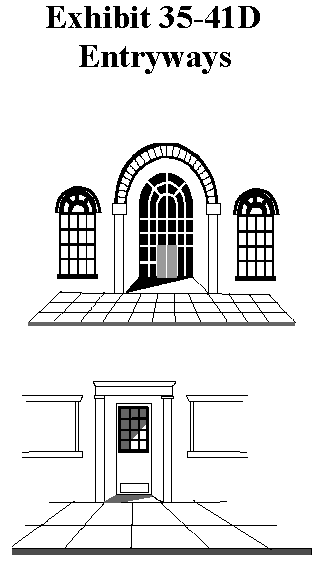
Entryways.
(a)
Large retail or office buildings should feature multiple entrances to reduce walking distances from cars, facilitate pedestrian and bicycle access from public sidewalks, and provide convenience where certain entrances offer access, especially to individual stores or identified departments of a store.
(b)
Entryway design elements and variations should give orientation and aesthetically pleasing character to the building. The following standards identify desirable entryway design features. Each principal building on a site shall have clearly defined, highly visible customer entrances featuring no less than three of the following:
(i)
Canopies or porticos;
(ii)
Overhangs;
(iii)
Recesses/projections;
(iv)
Arcades;
(v)
Raised corniced parapets over the door;
(vi)
Peaked roof forms;
(vii)
Arches;
(viii)
Outdoor patios;
(ix)
Display windows;
(x)
Architectural details such as tile work and moldings which are integrated into the building structure and design;
(xi)
Integral planters or wing walls that incorporate landscaped areas and/or places for sitting.
24.
Temporary uses. This section allows short-term and minor deviations from the requirements of this ordinance for uses which are truly temporary in nature, will not adversely impact the surrounding area and land uses, and which readily can be terminated and removed. Some temporary uses may be subject to other permit requirements, including business licenses or food service permits prior to operation.
a.
Residential sales offices; use permit required. Residential sales offices for major subdivisions or planned unit developments may be allowed at the development site until 80 percent of the lots or dwelling units are sold, subject to a temporary use permit. Use of the sales office to promote sites outside of the project is prohibited.
b.
Miscellaneous sales allowable. The following temporary sales may be established without a temporary use permit provided such uses are not conducted within the required parking or any landscaped or bufferyard areas.
(1)
Christmas Tree sales. Limited to a period of time not to exceed 45 days. This use may include a portable structure no larger than 120 square feet or a recreational vehicle for use as a sales office that shall be removed at the end of the permit period.
(2)
Seasonal greenhouses (accessory to established business). Limited to non-residential districts for a period of time not to exceed six months per calendar year. A maximum of one greenhouse building shall be allowed and may cover a maximum of 2,000 square feet. The structure shall be portable and completely removed at the end of the permit period.
(3)
Seasonal sale of agricultural products. Seasonal sale of agricultural products may be permitted in non-residential zoning districts.
c.
Natural disasters and emergencies. Temporary activities and structures needed as the result of a natural disaster or other health and safety emergencies are allowed for the duration of the emergency.
d.
Travel trailer and recreational vehicles. Such vehicle shall be customarily or ordinarily used for vacation or recreation purposes and not used as a place of human habitation for more than 30 days in any 12 month period, or it shall be classed as a manufactured home, regardless of the size and weight limitation provided herein. This definition shall also include house cars and camp cars having motive power and designed for temporary occupancy as defined herein.
25.
Substance abuse treatment facility.
a.
Location. Substance abuse treatment facilities may be permitted as authorized by section 35-28, Land use matrix.
b.
Spacing. No substance abuse facility, whether inpatient or outpatient, shall be located closer to another such facility than 1,320 feet apart as measured in a straight line between property boundaries.
c.
Exterior appearance. The treatment facility shall maintain a residential appearance if located in a residential district, and shall be compatible with the architecture and character of the neighborhood or area in which it is located. Alterations of an existing building shall likewise be compatible with the neighborhood and adjacent properties.
26.
Reserved.
27.
Standards for outdoor entertainment and recreation facilities, and other outdoor uses.
a.
Standards for athletic fields, amusement park, commercially operated outdoor recreation facilities, major outdoor entertainment facilities, and drive-in theater. Adjacent to residential district. A minimum distance of 1,000 feet shall be maintained between any facility, structure or improvement constructed for the above uses and adjoining land in the following districts: RU, RS-1, RS-2, RS-3, RS-4, RD, RA-1, RA-2, AND N-O.
b.
Where recreation facilities and uses are authorized in the RU, RS-1, RS-2, RS-3, RS-4, RD, RA-1, RA-2 and NO Districts, the following standards shall apply:
(1)
Unlighted facilities. For unlighted facilities, a type B bufferyard shall be provided along all side and rear lot lines adjoining land in the following districts: RU, RS-1, RS-2, RS-3, RS-4, RD, RA-1, RA-2, and N-O.
(2)
Lighted facilities. For lighted facilities, a type C bufferyard shall be provided along all side and rear lot lines adjoining land in the following districts: RU, RS-1, RS-2, RS-3, RS-4, RD, RA-1, RA-2, and N-O.
28.
Performance standards for industrial service, assembly, distribution, manufacturing, production, processing, printing, and publishing uses.
a.
Disposal of refuse and wastes. All refuse and waste shall be disposed of in a manner to comply with the water quality standards of the USEPA and MoDNR.
b.
Odors. Odors shall not be discernable at the property line and shall not exceed the odor threshold concentration indicated in the American Society for Testing and Materials (ASTM) Method DI391-57, "Standard Method for Measurement of Odor in Atmosphere (Dilution Method)" (Philadelphia: ASTM, 1957).
c.
Smoke. Smoke shall be measured at the point of emission and the Ringelmann Smoke Chart, IC 8333, published by the U.S. Bureau of Mines, 1967, shall be used to measure the smoke. Smoke not darker or more opaque than No. 0 on the Smoke Chart may be emitted except that smoke not darker than No. 1 on the Smoke Chart may be emitted for periods not longer than four minutes in any 30-minute period. These provisions shall also apply to any visible smoke with an equivalent apparent opacity.
d.
Gases. Fumes or gases shall not be emitted at any point in concentrations or amounts that are noxious, toxic or corrosive. The values given in table I (Industrial Hygiene Standards - Maximum Allowable Concentration for Eight Hour Day, Five Days per Week), table III (Odor Thresholds), table IV (Concentrations of Substances Causing Pain in the Eyes), and table V (Exposures to Substances Causing Injury to Vegetation) in the latest revision of chapter 5, in the "Air Pollution Abatement Manual" by the Manufacturing Chemists' Association, Inc., Washington, D.C., are hereby established as guides for the determination of permissible concentration or amounts. Detailed plans for the elimination of fumes or gases may be required.
e.
Particulate matter. Solid or liquid particles shall not be emitted at any point in concentrations exceeding 0.1 grains per cubic foot of the conveying gas or air. For measurement of the amount of particles in gases resulting from combustion, standard corrections shall be applied to a stack temperature of 500° Fahrenheit and 50 percent excess air.
f.
Reserved.
g.
Vibration. Vibration shall not be discernible at any property line to the human sense of feeling for three minutes or more duration in any one hour. Vibration at any time shall not produce at any time an acceleration of more than 0.1 gravities or shall result in any combination of amplitudes and frequencies beyond the "safe" range of table 7, United States Bureau of Mines Bulletin No. 442 "Seismic Effects of Quarry Blasting," 1942, on any structure. The methods and equations of Bulletin No. 442 shall be used to compute all values for the enforcement of this provision.
h.
Glare. Glare, whether direct or reflected, such as from floodlights or high temperature processes, and as differentiated from general illumination, shall not be visible at any property line.
i.
Radiation hazards. All uses shall be so operated as to comply with standards of performance adopted by the State of Missouri.
j.
Electromagnetic interference. No use, activity, or process shall be conducted which produces electromagnetic interference with radio or television reception in any residential or commercial district.
k.
Fire and explosion hazards. Each use shall be operated so as to minimize the danger from fire and explosion and to comply with the regulations contained in the adopted Building Code and applicable fire and life safety ordinances.
l.
Humidity, heat, or glare. In any district, any activity producing humidity in the form of steam or moist air, or producing heat or glare, shall be carried on in such a manner that steam, humidity, heat, or glare is not perceptible at any lot line.
29.
Target ranges.
a.
Target ranges, as defined in chapter 17, are allowed in zoning districts where indicated in exhibit 35-28 and in accordance with standards of this section.
b.
Design and size; plans required.
(1)
Site, building and operational plans shall be submitted which meet the requirements of chapter 35, chapter 8 and chapter 17 pertaining to target ranges, as applicable.
(2)
Outdoor ranges shall be designed to prevent rounds from leaving the area enclosed within the range.
(3)
Trap or skeet shooting ranges where only shotguns are allowed to be used shall have sufficient area enclosed within the range to ensure that the spent shot does not fall outside thereof.
c.
Upon receipt, one copy each of the site plans, building plans, and operational plans shall be provided to the chief of police for review pursuant to chapter 17.
d.
Granting of a conditional use permit by the Board of Adjustment shall be conditioned upon the approval or conditional approval by the chief of police.
e.
Granting of a conditional use permit by the Board of Adjustment shall be conditioned upon the property owner maintaining in good standing at all times a business license permit for a target range pursuant to chapter 17, article XIV.
30.
Open land permits (including private open space, natural and conservation areas). Open land permits shall be processed as special exception permits, in accordance with section 35-73.
a.
Purpose. It is the purpose of these standards to encourage the retention of open land and private open space, assure the property subject to an open land permit will be retained predominantly in the condition defined by the permit; prevent any use of the property that will significantly impair or interfere with the use of the property as specified in the permit; and accomplish any one or more of the following objectives:
(1)
Preserve open land and green space for passive recreation, development buffers and stream buffers;
(2)
Improve storm water quality through reductions in impervious cover, pollutant loads to streams, and soil erosion as a result of land clearing;
(3)
Lower capital cost of development by reducing stormwater runoff and by providing alternative sites for storm water best management practices;
(4)
Increase property values by encouraging open land in proximity to developments;
(5)
Create urban wildlife habitat areas;
(6)
Support other community planning goals such as pedestrian movement, neighborhood enhancement, and farmland preservation.
b.
Access/ownership rights.
(1)
No right of access by the general public to any portion of the property covered by an open land permit is conveyed, but may be accomplished by separate instrument. Open land may be accessible to the residents of an associated development and/or the city, or it may contain areas which are not accessible to the public.
(2)
Land may be privately owned or owned in common by an association if approved by the Council. The owner of the property shall be responsible for costs and liabilities of any kind related to the ownership, operation, upkeep and maintenance of the property. Offers of dedication to the public must be approved by the City Counselor; and must be accepted by the City Council;
c.
Agricultural land uses.
(1)
Agricultural land uses located in RC or RU zoning districts may be used for agricultural purposes as allowed by exhibit 35-28, Land use matrix;
(2)
Legal nonconforming agricultural land uses outside of the RC and RU districts are not required to obtain open land/special exception permits;
(3)
Specific agricultural activities may be authorized in any zoning district, as provided by paragraph d, below.
d.
Permitted developments. The following proposed uses may be proposed under an open land permit.
(1)
Green space and recreation areas for non-intensive or passive uses including footpaths, hiking and biking trails, picnic areas, lawns and similar uses;
(2)
Conservation and management of open land in its natural state; such as woodland, fallow field, meadow or prairie (management methods must be identified in the permit application) subject to the other provisions of this section;
(3)
Wildlife habitat;
(4)
Stormwater management area and stream buffers;
(5)
Utility and public infrastructure purposes;
(6)
Horticultural uses, including community gardens, and raising of crops (crop must be specified in the permit application and approved);
(7)
Pasture for horses when specifically permitted by exhibit 35-28, Land use matrix
e.
Allowable accessory activities, uses, structures and hardscape. Structures proposed for the site must be identified in the permit application and shown on the site plan. Such hardscape and structures shall consume no more than ten percent of the total land area covered by the open land permit. Such activities, uses and structures may include, but are not limited to:
(1)
Permanent structures for the storage of mowers, tractors, fuel and maintenance items; not to exceed 2,000 square feet in area; architectural style to be approved as part of the permit;
(2)
Picnic shelters, gazebos and similar structures; with architectural style to be approved as part of the permit;
(3)
Operation of motorized vehicles for maintenance of the site or for a purpose associated with an approved use of the site.
(4)
Roads, bridges, paths, utilities and public improvements;
(5)
Parking areas necessary to serve the permitted uses;
(6)
Other uses commonly associated with an approved principal use.
f.
Prohibited activities and uses. The following activities or uses are prohibited except in compliance with specific authorization, and as provided for in an approved open land permit and approved site plan:
(1)
Use of motor vehicles except within approved driveways and parking areas, (except that maintenance, law enforcement, emergency and farm vehicles are permitted as needed);
(2)
Cutting of trees; and land clearing;
(3)
Regrading, depositing or removal of topsoil;
(4)
Depositing or removal of material from water courses; altering, diverting, or modifying water courses or water bodies;
(5)
Mining, dredging;
(6)
Widespread application of fertilizers, herbicides, insecticides and similar compounds.
g.
Preservation of natural features, animal or plant conservation areas. The Commission, or the Council, may require that the applicant preserve natural features or areas of animal or plant habitats and adequately protect them as preserves or limited access areas. Natural features shall generally be maintained in their natural condition but may be modified to improve their appearance, functioning, or overall condition as recommended by experts in the particular area being modified. The following modifications to natural or conservation areas may be permitted:
(1)
Reforestation;
(2)
Woodland management;
(3)
Meadow or prairie management;
(4)
Buffer area landscaping;
(5)
Streambank protection;
(6)
Wetlands management.
h.
Application and plan required. An application and plan for the open land permit is required; such plan shall include a site plan map and separate typewritten narrative description of the existing and proposed activities, uses and structures, as follows:
(1)
Property/survey/legal description of the subject area;
(3)
Total acreage of the subject area;
(3)
Existing and proposed land cover and estimated acreages;
(4)
Proposed areas of land disturbance and estimated acreages, including areas proposed for burning, clearing, harvesting; etc.
(5)
Proposed uses by acreage and location;
(6)
Proposed plantings by acreage and location, including landscaping, trees and other land cover;
(7)
Proposed crops, if applicable;
(8)
Location of public access areas and areas where access is to be restricted;
(9)
Location of vehicular areas, if any
(10)
Location of any proposed structures and their purposes, bulk (dimensions, height), architectural elevations and description of building materials;
(11)
Land management and maintenance methods, including whether burning, mowing, or other land management methods will be employed, and frequency.
(12)
Proposed time schedule for commencing and completion of the project; and phasing plan, if applicable.
(13)
Proposed ownership (private, association, dedication);
i.
Completion of project and phasing.
(1)
Phasing. When the proposed project or improvements are to be phased, the specific project elements shall be identified with proposed time frame for completion. Each phase is required to be commenced and completed within 24 months of the schedule set in the approved plan. If the phase is not commenced or completed within the approved time period the project shall be subject to review by the Planning and Zoning Commission.
(2)
Time for completion. A project approved under an open land permit shall be completed within 24 months from the date of final approval by the approving authority unless a phasing plan has been approved.
j.
Plan approval or plan amendment/findings. The Planning and Zoning Commission shall find the open land plan or amendment is:
(1)
Compatible with the surrounding land uses;
(2)
Will not have a significant detrimental effect on the character of surrounding residential uses;
(3)
For amendments, such change will not adversely affect the initial basis for granting approval;
k.
Amendments.
(1)
Major amendments shall be processed in the same manner as the original permit. Major amendments include the addition or expansion of structures or hardscape; and proposed change in the composition of use acreage by more than ten percent;
(2)
Minor amendments. Amendments deemed minor may be approved by the Director, provided that the purposes of the open land permit are not compromised. If uncertainty exists as to the impact of the proposed change the Director may refer applications to the Commission to be processed as major amendments.
l.
Effect on successors and assigns. An open land permit shall be binding upon the owner, his or her successors and assigns until such time as the ordinance providing for the special exception use shall be modified or rescinded by the Council.
m.
Enforcement. Enforcement shall be as provided in article VIII, enforcement, violations and penalties.
31.
Keeping of equines as accessory uses to residential uses.
a.
Permit required.
(1)
Equine permit established. An equine permit is hereby established, to be issued by the Director or his or her designee.
(2)
Annual renewal. Equine permits shall be renewed annually. Application for renewal of an equine permit shall be accompanied by documentation that the applicant's property has been inspected and approved by the Department of Planning and Protective Services within 60 days of the date of application for renewal.
(3)
Fees for new equine permits and renewals shall be as set out in appendix Y of the City Code.
(4)
Revocation of permit. Equine permits may be revoked without a hearing if the Director determines that violations of applicable City ordinances or standards of this section have occurred, including nuisance, equine neglect or mistreatment, or land mismanagement.
(5)
Any person aggrieved by a decision of the Director to deny, revoke, or refuse to renew an equine permit shall be entitled to a hearing before the Director to determine whether the decision to deny, revoke, or refuse an equine permit was proper pursuant to subsection 35-41.B.31. Any such person aggrieved must request a hearing in writing to the Director of the Department of Planning and Protective Services within ten days of the date of the action by the Director. If, after said hearing, any person is still aggrieved, they may appeal the decision to the Board of Adjustment, whose decision shall be final. Any such application to the Board of Adjustment must be made within ten days after the decision of the Director which follows the hearing.
b.
Specific provisions. An equine permit may be issued for the keeping of equines, as accessory to the residential use of land, subject to applicable provisions in the City Code, including chapter 5, Animals; chapter 21, Nuisance; chapter 31, Stormwater and floodplain management; and specific provisions as outlined below:
(1)
A minimum of five acres of land area, within the fenced area as described below, exclusive of the residential use or other principal use of the premises, and riparian corridor areas, is required to keep equines under this provision. A maximum of five equines is permitted to be kept on a premises.
(2)
Boarding of equines is not permitted; only equines owned by the property owner shall be kept on the premises covered by the equine permit. No equine breeding operations shall be permitted on properties governed by an equine permit.
(3)
Shelter or stable required.
(a)
A shelter shall be provided for each equine, which shall be roofed and provide dry footing. Such shelter shall be located not less than 50 feet from all lot lines, and not less than 50 feet from a residence on the same premises. The shelter shall have a maximum footprint of 1,750 square feet. Height of the shelter shall not exceed 1½ stories, and shall be subject to additional height regulations of section 35-51, Density and dimensional standards, and exhibits therein.
(b)
Architectural standards. Shelter construction and materials shall match the residence on the premise, including materials, roof and colors. If architectural standards have been recorded or otherwise adopted for the subdivision or development, then those architectural standards shall be incorporated into the design of the shelter.
(c)
Plans required. Plans for structures to be used as shelters shall be submitted to the Department of Planning and Protective Services. The plans shall include a building plan and a site plan. The building plan shall show type of construction, materials and colors to be used. The site plan shall show lot lines, existing and proposed driveways and access points, location of existing and proposed fences, shelter location, and topography. Parcel maps and aerial photographs from the geographic information system may be used as the base for the site plan, but shall be printed to scale.
(1)
Maintenance standards. All structures and the premises shall be maintained in accordance with this section and other City codes.
(2)
Equine trailers. A maximum of one-noncommercial equine trailer may be stored on the property, to be stored inside the shelter or screened from view of adjoining property. Trailer storage location shall be as approved in the equine permit.
(3)
Equine fences. Equine fences erected after May 1, 2009 shall be constructed in accordance with this subsection. The exterior boundary of the fence shall be set back at least ten feet from all property and right-of-way lines. Fence height shall be at least four feet, but no more than six feet in height. The fence setback standard may be waived by the Director if affected neighboring property owner(s) submit written requests for such waivers. Fences adjacent to streets shall be constructed of wood or man-made material, sufficient to contain the equine(s) on the subject property, and shall not be more than 50 percent opaque/solid. Wire fencing is not permitted adjacent to street frontages or within view of adjacent dwellings. Use of barbed wire is prohibited, except in accordance with section 35-59, Fence standards.
(4)
Protection of water courses and riparian corridor required. Fences shall erected to keep equines out of watercourses and be set back 25 feet from the top of any adjacent creek bank, except that the Director may require fences to be set back an additional 35 feet in order to further protect riparian corridors and to meet the requirements of chapter 31, Stormwater and floodplain management. Owners must provide supplementary feed so that pastures and meadows do not become overgrazed. In the event any area becomes denuded as a result of overgrazing, said owner shall cease grazing until pasture is re-established, and shall be required to re-seed that area to bring the ground cover back to a natural condition such as existed prior to the overgrazing.
(5)
Manure management. Manure shall be managed in such a manner as to not create a nuisance.
(6)
Any hay stored on the property shall be stored inside an approved structure or screened from view of adjacent properties.
(7)
No equine shall be allowed to constitute a nuisance. For purposes of this section, a nuisance shall include:
(a)
All definitions found in chapter 21; and
(b)
Noise leaving the permitted property, caused by the equine; and
(c)
Odor leaving the permitted property, caused by the equine; and
(e)
Equine leaving the permitted property without a person in control of the equine.
(8)
Waivers to the specific provisions of this section may be granted at the discretion of the Director. Records of waivers granted shall be maintained.
32.
Crematorium.
a.
Crematoriums are authorized as a permitted accessory use to a funeral home.
b.
Separation requirement. Crematorium smoke stacks shall be located a minimum of 100 feet from any neighboring private property.
c.
Crematoriums shall comply with State of Missouri air pollution control program permit requirements and other permit and licensing requirements, as applicable.
33.
Composting site.
a.
Location. Composting facilities may be authorized in the districts specified by exhibit 35-28, Land use matrix.
b.
Performance standards.
(1)
No materials or compost shall be stored within 25 feet of any property line.
(2)
No excessive dust, noise, vibration, smoke, fumes, odors, or glare shall be detected beyond the property lines.
(3)
Minimum parcel size of four acres is required.
(4)
Subject to other applicable local, state, and federal permits as required.
34.
Nightclubs, after-hours establishments, and smoking lounges.
a.
Location. Nightclubs, after hours establishments, and smoking lounges may be authorized in the districts specified by exhibit 35-28, Land use matrix.
b.
Special exception permit required when near residence.
(1)
Where a new or expanded nightclub, after hours establishment, or smoking lounge use, including the structure and/or parking lot serving the use, is located within 250 feet of a residential dwelling unit (including loft apartments), said use shall require a special exception permit.
c.
Performance standards.
(1)
Nightclubs, after hours establishments, and smoking lounges shall comply with all regulations of chapter 15, Health and sanitation, including regulations pertaining to the Jefferson City Clean Indoor Air Ordinance of 2010.
d.
Special exception permits issued for nightclubs, after hours establishments, and smoking lounges shall be issued in the name of the property owner and are non-transferrable.
35.
Short term rental of a residence or lodging room.
a.
Location. Short term rental of a residence or lodging room may be authorized in the districts specified by exhibit 35-28, Land use matrix.
b.
Specific provisions. Short term rental of a residence or lodging room shall adhere to the following:
(1)
The short term rental shall be located within an existing primary structure residence. Accessory structures shall not be used for sleeping or accommodation purposes.
(2)
Number of guests and rooms. The following shall be applicable for short term rental of a residence or lodging room, as indicated.
(a)
Short term rental of a residence. A maximum of five unrelated persons or any number of persons related by blood, marriage or adoption shall be permitted as lodging guests.
(b)
Short term rental of a lodging room. A maximum of one rental space may be rented to guests, multiple rentals within the same residence is not permitted. A maximum of four people shall be permitted as guests.
(3)
Signage. Exterior signage shall be limited to one sign of a maximum size of one square foot, which must be attached to the structure and shall not be lighted. No other exterior signage, display, or other indication of the variation from the residential character of the building shall be permitted.
(4)
The property shall not be rented or used for receptions, parties, weddings or similar activities.
(5)
Parking. The property shall have sufficient parking spaces to accommodate both residents and guests. Where on-site parking is provided, the minimum parking requirement for a short term rental of a lodging room shall be two on-site parking spaces on streets where on-street parking is permitted, or three on-site parking spaces on streets where on street parking is not permitted.
(6)
The residence shall maintain a residential appearance and adhere to all applicable codes of the City of Jefferson. Trash receptacles shall be placed at the curb only during trash service days. Noise emanating from the residence shall be at a level typical for a residential home. Visitors of guests shall not be excessive in number or out of character with the residential nature of the property.
c.
The advertisement or offering for rent of a short term rental without approval or in conflict with the specific provisions of this section or the other provisions of this chapter shall be considered a violation.
d.
The short term rental of a residence or lodging room shall be subject to all applicable taxes including lodging taxes, sales taxes, and business licensing regulations.
e.
The short term rental of a residence or lodging room shall be subject to Fire Code and Building Code inspection requirements.
36.
Marijuana facilities.
a.
Location.
(1)
Marijuana dispensary facility, marijuana cultivation facility, marijuana-infused products manufacturing facility, marijuana transportation facility, and marijuana testing facility may be authorized in the districts specified by exhibit 35-28 land use matrix.
b.
Specific provisions. Marijuana facilities shall adhere to the following:
(1)
No new marijuana dispensary facility, marijuana cultivation facility, marijuana-infused products manufacturing facility, marijuana transportation facility, or marijuana testing facility shall be located within 1,000 feet of any then-existing elementary or secondary school, child day care center, or church.
(a)
For freestanding marijuana facilities, distance shall be measured from the facility's external wall closest in proximity to the property line of the elementary or secondary school, child day care center, or church. If the elementary or secondary school, child day care center, or church occupies an individual suite or unit within a multi-unit structure, distance shall be measured from the marijuana facility's external wall closest in proximity to the entrance or exit of the elementary or secondary school, child day care center, or church.
(b)
For marijuana facilities that occupy an individual suite or unit within a multi-unit structure, distance shall be measured from the facility's entrance or exit closest in proximity to the property line of the elementary or secondary school, child day care center, or church. If the elementary or secondary school, child day care center, or church occupies an individual suite or unit within a multi-unit structure, distance shall be measured from the marijuana facility's entrance or exit closest in proximity to the entrance or exit of the elementary or secondary school, child day care center, or church.
(c)
Measurements shall be made along the shortest path between the demarcation points that can be legally traveled by foot.
(2)
Any marijuana facility must be properly licensed by the State of Missouri and must comply with State requirements, regulations, and procedures necessary for implementation and enforcement.
(Ord. No. 12655, 9-8-97; Ord. 13493, § 2, 1-21-2003; Ord. 13600, § 17, 9-2-2003; Ord. 13647, § 2, 11-3-2003; Ord. No. 13821, § 2, 1-3-2005; Ord. No. 14531, § 3, 5-18-2009; Ord. No. 14982, § 5, 6-18-2012; Ord. No. 15004, § 1, 9-4-2012; Ord. No. 15033, § 2, 11-5-2012; Ord. No. 15243, § 1, 3-3-2014; Ord. No. 15289, §§ 1, 4, 7-21-2014; Ord. No. 15456, § 5, 11-16-2015; Ord. No. 15686, § 2, 7-17-2017; Ord 15761, § 6, 1-03-2018; Ord. No. 15926, § 2, 6-3-2019; Ord. No. 15934, § 2, 7-15-2019; Ord. No. 15976, § 2, 12-2-2019; Ord. No. 16391, § 1, 12-18-2023; Ord. No. 16392, § 2, 12-18-2023)
Sec. 35-42. - Specific use standards for telecommunications facilities.
A.
Purpose. The purpose of this section is to regulate the placement, construction and modification of telecommunication towers, support structures, and antennas in order to protect the health, safety, and general welfare of the public, while at the same time not unreasonably interfering with the development of the competitive wireless telecommunications marketplace in the City of Jefferson. Specifically, this section is intended to:
1.
Provide for the appropriate location and development of telecommunications facilities and systems to serve the citizens and businesses of the City of Jefferson;
2.
Minimize adverse visual impacts of communications antennas and support structures through the careful design, siting, landscape screening, and innovative camouflaging techniques;
3.
Maximize the use of existing and new support structures so as to minimize the need to construct new or additional facilities;
4.
Maximize the co-location of facilities on any new support structures and facilitate the fewest and least visible new support structures capable of achieving these objectives;
5.
Ensure that any new telecommunications tower or support structure is located in an area compatible with the neighborhood or surrounding community to the extent possible; and
6.
Ensure that regulation of telecommunications towers and structures does not have the effect of prohibiting the provision of personal wireless services, and does not unreasonably discriminate among functionally equivalent providers of such service.
B.
Applicability.
1.
All towers, antenna support structures and telecommunications facilities, any portion of which are located within the City of Jefferson, are subject to this section. All towers within the City of Jefferson, Missouri at the time of passage of this section shall be registered with the Director within 60 days from the effective date hereof, together with the height, width and location thereof, and a registration fee of $50.00. Failure to register an existing tower shall raise a presumption that said tower was not a legal nonconforming use on the date of passage of this section. However, this section shall not apply to tower structures used, or to be used, solely for services provided pursuant to a broadcast radio or television license issued by the Federal Communications Commission or to towers and antennas used solely for private telecommunications services when the equipment is located on the premises of the entity using said private telecommunication service, or the towers and antennas, support structure, or masts are located on the primary business premises of a provider of communications services if used solely to monitor the provider's services and the equipment used by the broadcaster. Provided the private telecommunicator or provider is in compliance with any federal, state, or local laws, and does not encroach on the public rights-of-way.
2.
Notwithstanding any provisions contained in this section, any current legal use being made of an existing tower or antenna support structure on the effective date of this section shall be allowed to continue as a non-conforming structure. Any tower site that has received city approval in the form of either a conditional use permit or building permit, but has not yet been constructed or located within six months of the date of the permit, shall be considered a non-permitted structure.
3.
The term "telecommunications facilities" shall not include:
a.
Any satellite dish two meters in diameter or less which is located in an area zoned and used for industrial or commercial;
b.
Any satellite earth station antenna one meter or less in diameter, regardless of zoning category;
c.
Any satellite earth station in excess of two meters in diameter which is utilized for the reception of broadcast television, video or radio signals and which is an ancillary use to a structure on the premises of the holder of the broadcast license.
4.
The term "this section" throughout section 35-42 refers to section 35-42 in its entirety.
C.
Legislative findings.
1.
On February 8, 1996, congress enacted the Federal Telecommunications Act of 1996 P.L. No. 104-104. The purpose of the Act included deregulation of the telecommunications industry and providing a more competitive environment for wired and wireless telecommunication services in the United States.
2.
The Telecommunications Act of 1996 preserves the authority of the City to regulate the placement, construction and modification of towers and antenna support structures and to protect the health, safety and welfare of the public.
3.
The City has been granted the authority to enact legislation to regulate the construction, placement and operation of telecommunications towers and antennas pursuant to its zoning powers established in RSMo ch. 89 and additionally pursuant to its general and specific police powers established by statute authorizing the regulations herein to protect the public health, safety and welfare.
4.
The Federal Communications Commission (FCC) has exclusive jurisdiction over (1) the regulation of the environmental effects of radio frequency emissions from telecommunications facilities, and (2) the regulation of radio signal interference among users of the radio frequency spectrum.
5.
Consistent with the Telecommunications Act of 1996, the regulations of this section will not have the effect of prohibiting the provision of personal wireless services, and do not unreasonably discriminate among functionally equivalent providers of such service. The regulations also impose reasonable restrictions to protect the public safety and welfare and ensure opportunities for placement of antennas with prompt approval by the City. This section does not attempt to regulate in areas within the exclusive jurisdiction of the FCC.
6.
The uncontrolled proliferation of towers in the City of Jefferson is threatened without adoption of new regulations and would diminish property values, the aesthetic quality of the city, and would otherwise threaten the health, safety, and welfare of the public.
D.
Timing. Applications for telecommunication facility permits or conditional use permits pursuant to this section shall be subject to the supplementary procedures in this section. Applications shall be submitted to the City as a complete application. A "complete application" shall be an application submitted on the forms provided by the City, fully executed by the applicant, identifying the specific approval sought, and containing all attachments, fees and information as required thereon or by the City, consistent with this section. Applications for telecommunication facility permits shall be accompanied by a building permit application and other applicable forms. Applications shall include application fees as may be established to reimburse the City for its inspection and review costs.
1.
Co-location requests. A final decision on applications to co-locate wireless communication facilities on an existing telecommunication tower shall be made no later than 90 days after receipt of a complete application from an applicant, unless extended by the City for good cause or by consent of the applicant.
2.
Other applications and new support structures. A final decision on all other applications under this section, including but not limited to applications for new telecommunication towers, shall be made no later than 150 days after receipt of a complete application from an applicant, unless such period is extended by the City for good cause or by consent of the applicant.
3.
Incomplete applications. Within 30 days after receipt of an incomplete application, the Director shall provide notice to the applicant stating that the application is incomplete and generally identifying the code provisions or application requirements not satisfied or information not provided that the applicant must satisfy for a complete application commencing the City's review process. Nothing in this procedure shall alter the affirmative obligation of each applicant to review the applicable code and satisfy all applicable provisions as may apply to the applicant's specific submission.
E.
General requirements. The requirements set forth in this section shall be applicable to all towers, antennas and other telecommunication facilities installed, built, or modified after the effective date of this section to the full extent permitted by law.
1.
Approval authority over the placement of telecommunications facilities is governed by exhibit 35-28 and this section. For the purposes of this section, the approval authority shall be:
a.
The Board of Adjustment for facilities requiring a conditional use permit,
b.
The City Council with review by the Planning and Zoning Commission for facilities located in a PUD zoning district.
c.
The Director of Planning and Protective Services for permitted uses.
2.
Principal use. Telecommunication facilities, antennas, and towers may be a permitted use or conditional use as outlined in exhibit 35-28 and this section.
3.
Accessory use. Telecommunication facilities, antennas and towers may be an accessory use to existing multiple-family, institutional, commercial, or industrial uses.
4.
Building codes, safety standards and zoning compliance. To ensure the structural integrity of antenna towers, the owner shall see that it is constructed and maintained in compliance with all standards contained in applicable state and local building codes and the applicable standards published by the Electronics Industries Association, as amended from time to time. In addition to any other approvals required by this section, no antenna or tower shall be erected or expanded prior to receipt of a certificate of zoning authorization and the issuance of a building permit.
5.
Regulatory compliance. All antennas and towers shall meet or exceed current standards and regulations of the FAA, FCC and any other state or federal agency with the authority to regulate communications antennas and towers. Should such standards or regulations be amended, then the owner shall bring such devices and structure into compliance with the revised standards or regulations within the time period mandated by the controlling agency. No approval for any placement, construction or modification of any antenna or structure permitted by this section shall be granted for any applicant having an uncured violation of this section or any other governmental regulatory requirement related to such antenna or structures within the City.
6.
Excess capacity and planned future use. Any applicant for a building permit to install, build or modify any tower shall furnish the Director a statement of the excess capacity of the tower and plans, if any, for anticipated growth. In addition, the applicant must design the tower and indicate on the application that the tower will accommodate at least one additional antenna similar to the principal antenna.
F.
Co-location.
1.
Co-location of facilities on new towers. New towers constructed within the City shall be capable of accommodating at least one additional carrier or telecommunications facility for one other provider of communications services (hereinafter referred to as "additional capacity"). A report describing the tower's ability to support additional capacity shall be submitted with the application. Technical limitations regarding disguised support structures shall include limitations as are necessary to maintain the requirements of a disguised support structure. The willful knowing failure of the owner of a tower built for shared use to negotiate in good faith with potential wireless service provider users shall be unlawful and shall be a violation of this section and, among other remedies of the City, shall be cause for the withholding of future permits to the same owner or applicant to install, build or modify wireless communications facilities within the City. The approval authority may waive this requirement for disguised support structures if the applicant submits a written request demonstrating that compliance cannot be achieved without violating one or more of the definitional requirements of a disguised support structure.
2.
Co-location on existing towers. Owners of existing towers shall make such support structures available for use by other wireless service providers subject to reasonable technical limitations and reasonable financial terms. Technical limitations regarding disguised support structures shall include limitations as are necessary to maintain the requirements of a disguised support structure. The willful and knowing failure of a structure owner to agree to shared use or to negotiate in good faith with potential users shall be unlawful and shall, among other remedies of the City, be cause for the withholding of future permits to the same owner to install, build, or modify telecommunication facilities within the City.
3.
Shared use violations. Any party believing that the applicant has breached its duty to negotiate in good faith for shared use shall immediately notify the applicant and the Director in writing. The Director may reject the application upon a finding that shared use has been improperly denied. A notice of breach of duty shall explain the precise basis for the claim and shall be accompanied by payment of the telecommunication facility permit review fee, as outlined in appendix Y, to the City to be used to offset the cost of review. After the applicant's receipt of the notice, the applicant shall have ten calendar days to provide a written submission to the Director responding to the alleged violation of the shared use requirement. If deemed necessary by the Director, he/she may engage, at the cost of the party alleging the violation, a neutral, qualified technical consultant to provide an opinion on feasibility or costs of the shared use request. If the Director receives a notice alleging a violation of the shared use requirement, the time for a decision on an administrative permit is automatically extended for up to 30 days or until the Director has determined that the applicant has complied. Nothing herein shall be deemed to create a cause of action for relief against the City or entitlement to any relief, process or enforcement other than review by the City as provided herein. An application for a new telecommunication tower shall not be deemed complete for acceptance until all information necessary for a decision on compliance has been provided by the applicant.
G.
Tower inventories. Prior to the issuance of any permit to install, build or modify any support structure, such applicant shall furnish the Director an inventory of all support structures owned or controlled by the applicant and by proposed antenna user (if the proposed antenna user is different from the applicant), and all towers owned by any person located within one and one-half miles of the proposed structure. The inventory shall include the structure or antenna reference name or number, the street location, latitude and longitude, structure type, height, type and mounting height of existing antennas, assessment of available space for mounting of additional antennas and an assessment of available ground space for the placement of additional equipment shelters.
H.
Notice of tower applications. Prior to any application for the construction of a new telecommunication tower, a copy of the application or a summary containing the height, design, location and type and frequency of antennas shall be delivered by certified mail to all known potential tower users within the City, including but not limited to all companies providing wireless internet and commercial mobile radio services in the City, and such other potential users, if any, identified on a schedule maintained by the Director. Proof of such delivery shall be documented by the applicant with the application to the City. The Director may establish a form required to be used for such notifications and establish other procedures consistent with and as may facilitate compliance with this section. Any party seeking shared use of a telecommunication tower subject to this provision shall, after responding to notice of an application, negotiate with the applicant for such use. The applicant may on a legitimate and reasonable business basis choose between multiple requests for shared use on the same tower, and may reject any request where legitimate technical obstacles cannot be reasonably overcome or where the party requesting shared use will not agree to reasonable financial terms. The Director shall, before deciding on the application or forwarding it to the Approval Authority for review, allow all persons receiving notice at least 15 calendar days to respond to the City and the applicant and request that the party receiving notice be permitted to share the proposed tower or locate within one mile of such area. The failure of the receiving party to use this process or respond to any such notice shall be considered cause for denying requests by such party for new telecommunication towers.
I.
Exception from maximum height and bufferyards.
1.
Where, as determined by the director, additional co-location opportunities on an existing tower constructed prior to September 8, 1997, are not practical without an increase in the height of the tower, a permittee of an existing tower may modify the height of its tower to accommodate co-location of additional telecommunications facilities as long as the total height of the tower and telecommunications facilities attached thereto does not exceed ten percent of the height of the existing tower or 20 feet, whichever is greater.
2.
Permission to exceed the maximum permitted height pursuant to this subsection shall not require an additional distance separation as set forth in exhibit 35-42A and exhibit 35-42B, nor additional bufferyards or landscaping above that required for the original tower. The tower's premodification height shall be used to calculate such distance separations.
J.
Same tower type. A tower which is modified to accommodate the co-location of additional telecommunications facilities shall be of the same tower type as the existing tower. However, a different type of tower may be permitted by the approval authority pursuant to subsection 35-72.G.
K.
Movement of tower.
1.
A tower which is being replaced to accommodate the co-location of additional telecommunications facilities may be moved on the same premises as it was constructed on, or to an adjacent premises, within 50 feet of its existing location as long as required setbacks and bufferyards are maintained.
2.
A tower that is relocated pursuant to this subsection shall continue to be measured from the original tower site for the purpose of calculating the separation distances between towers pursuant to exhibit 35-42B.
3.
Prior to the relocation of a tower within a residential area, notice shall be given to adjacent property owners within 185 feet of the proposed tower site.
L.
Location on government property. New telecommunication towers shall be located on land owned by an agency of the federal or state government or a political subdivision of the state, where available. Availability of suitable locations on government property shall be determined by the City Administrator. Appeals on the suitability of a location on government property shall be heard by the Board of Adjustment.
M.
Telecommunication facilities as permitted or accessory use.
1.
Permitted use. The placement of telecommunications facilities is a permitted use in several districts as set forth in exhibit 35-28 and this subsection. Permits for permitted facilities are approved by the Director in conformance with subsection 35-72.G.
a.
The attachment of additional or replacement antennas or equipment to any existing telecommunication facility provided that:
(1)
Additional equipment is located within the existing shelter or cabinet or a new shelter or cabinet contained within the fenced telecommunication facility area
(2)
Any expansion of a fenced area of the tower site to accommodate additional ground equipment shall include the upgrade of the fencing to the design standards contained in subsection 35-42.Q and other applicable requirements of this section including the replacement of chain link fencing with solid screening fencing.
(3)
No increase in height occurs, except as permitted by this section.
(4)
All requirements of this section, the zoning code, and other chapters of the City Code are met.
b.
The one-time replacement of any tower existing on September 8, 1997, or subsequently approved in accordance with the telecommunications towers regulations, so long as the purpose of the replacement is to accommodate shared use of the site or to eliminate a safety hazard and the new structure otherwise complies with section 35-42. The new tower shall be of the same type as the original except that a guyed or self-supporting (lattice) tower shall be replaced with a monopole. The height of the new tower may exceed that of the original by not more than 20 feet. Subsequent replacements shall adhere to the requirements for new towers.
c.
The mounting of antennas, including small wireless facilities, on any existing and conforming commercial, industrial, or institutional building or structure other than a support structure (such as a water tower), provided that the presence of the antennas and equipment is in conformance with subsection 35-42.M.2 relating to accessory use and subsection 35-42.Q relating to design and construction standards, and subsection 35-42.P.1 relating to location within historic districts.
d.
The mounting of camouflaged antennas on or within any existing high-voltage electric transmission tower or functioning utility poles. Equipment shall not exceed the height of such tower by more than ten feet and all requirements of this section, the zoning code, and other chapters of the City Code shall be met, except that setbacks provided in this section shall not apply. Any related equipment for antennas permitted by this subsection located within the right-of-way shall be subject to the applicable permitting process. Facilities located within historic districts shall comply with subsection 35-42.P.1.
e.
The installation of antennas or the construction of a telecommunication tower on buildings or land owned by the City following the approval of a lease agreement by the governing body and subject to such specifications, conditions and requirements as set forth in the lease.
f.
Temporary towers erected and maintained for a period not to exceed 60 days for the purpose of replacing an existing tower, testing an existing or proposed network, or providing temporary service. The approval for such a tower shall be limited to the amount of time necessary for its purpose and approval may be further conditioned for public safety and other purposes of this section.
g.
Placement of small wireless facilities inside the right-of-way as follows:
(1)
Placement of small wireless facilities on an existing utility pole where such equipment does not exceed the greater of the height of the existing pole plus ten feet or a total height of 50 feet, is a permitted use in all districts except the National Register Historic Overlay District, where such use is subject to subsection 35-42.P.1. Equipment exceeding said height allowances shall be considered a new pole.
(2)
Placement of small wireless facilities on a new pole, said pole not exceeding the greater of ten feet in height above the tallest existing utility pole in place as of January 1, 2019 located within five hundred (500) feet of the new pole and within the same right-of-way or fifty (50) feet above ground level, is a permitted use in all districts except the Single Family Residential Districts (RS-1, RS-2, RS-3, RS-4, and N-O) and the National Register Historic Overlay District.
(3)
Facilities located on a new pole within the single family residential districts, the National Register Historic Overlay District, or exceeding the height allowances outlined herein shall comply with subsection 35-42.P.
(4)
Small wireless facilities shall comply with design, construction, and location standards of 35-42.S.
2.
Accessory use. Any telecommunications facilities which is not attached to a tower and not permitted by subsection 35-42.M.1 is deemed an accessory use and shall be permitted on any commercial, industrial, institutional or multi-family structure and on land owned by the City, provided that the person making such accessory use registers the telecommunication facility and obtains a telecommunication facility permit and building permit. Such accessory uses shall meet the following standards:
a.
The total height of the antenna support structure and telecommunications facilities shall not exceed the structural height limitations in the applicable zoning district listed in exhibit 35-51A by more than 20 feet and shall not extend above the top of the building by more than 20 feet.
b.
The antenna support structure and telecommunications facilities shall comply with the City's adopted building code and any applicable state law, shall not encroach on the public rights-of-way, and a building permit shall be obtained from the Building Regulations Division.
c.
Any telecommunications facilities and antennas located on the roof or sides of a building shall comply with setbacks required by the City's adopted building code, if any, and shall not extend more than 50 inches in the horizontal plane from the side of such structure unless the purpose of said protrusion is to permit signal coverage in an area that will not receive such coverage but for an extension beyond 50 inches. Any extension beyond 50 inches must be approved by the Director prior to construction of said antenna and such approval shall be dependent upon a showing that coverage is unavailable but for the extension, that the extension does not violate any other building code of the city, state or federal law that is applicable, encroach upon public rights-of-ways, and the extension does not pose any danger to the traveling public.
d.
The telecommunications facility will be side-mounted to an antenna support structure so as to exhibit a minimal profile or will utilize camouflaging techniques in order that the telecommunications facility will harmonize with the character and environment of the area in which it is located. Antennas and support structures shall be painted to blend with the color of the building if such painting will not interfere with functioning of the antenna or support structure. Antennas and support structures shall meet the design and construction standards of subsection 35-42.Q.
e.
All requirements of section 35-42, the zoning code, and the City Code shall be met.
f.
Facilities located within a National Register Historic Overlay District shall obtain a special exception permit in accordance with subsection 35-42.P.1.
N.
Telecommunication facilities as a conditional use.
1.
The placement of telecommunication facilities is a conditional use in several districts as set forth in exhibit 35-28 and this section. All proposals to install, build or modify an antenna or support structure as a conditional use shall require the approval of a conditional use permit following a duly advertised public hearing by the Board of Adjustment, subject to the following.
a.
Applications. Applications for conditional use permits shall be filed and processed subject to and in the manner and timeframe as established in subsection 35-73.A of the Zoning Code and, in addition to such other requirements, shall be accompanied by the applicable fee for a conditional use permit application and a deposit of funds, as outlined in appendix Y, for reimbursement of professional service and staff review costs, or such other deposit amount as may be established by the approval authority reasonably necessary to reimburse the City for such anticipated costs and fees for legal, engineering, contractual or other consultant services determined by the City to be needed in review or action on the application. Any amount not used by the City shall be refunded to the applicant upon written request after a final decision.
b.
Additional minimum requirements. No conditional use permit shall be issued unless the applicant has clearly demonstrated by substantial evidence that placement of a telecommunication facility as a permitted or accessory use pursuant to exhibit 35-28 or subsection 35-42.M is not technologically or economically feasible. The City may consider current industry standards and practices, among other information, in determining feasibility.
c.
Decision. A decision by the approval authority shall be accompanied by substantial evidence supporting the decision, which shall be made a part of the written record of the meeting at which a final decision on the application is rendered. Evidence may be submitted with the application or thereafter, or presented during the public hearing by the applicant or others.
d.
Findings required. In addition to the determinations or limitations specified herein and by subsection 35-73.A for the consideration of conditional use permits, no conditional use permit shall be approved by the governing body unless findings in the affirmative are made that the following conditions exist:
(1)
No existing towers, structures or buildings within the necessary geographic area for the applicant's tower meet the applicant's necessary engineering requirements considering: (a) height; (b) structural strength; (c) resulting signal interference; (d) feasibility of retrofitting; (e) feasibility of redesigning the applicant's tower network; or (f) other limiting conditions that render existing towers, structures or buildings within the applicant's required geographic area unsuitable.
(2)
That the design of the tower or structure, including the antenna, shelter and ground layout maximally reduces visual degradation and otherwise complies with the provisions and intent of this section. New towers shall be of a monopole design, unless it is shown that an alternative design would equally or better satisfy this provision.
(3)
That the proposal minimizes the number and/or height, size, and visibility of towers or structures that will be required in the area. Where alternate technology or design exists or is reasonably available that would satisfy the general need for the proposal, this factor is ordinarily not satisfied.
(4)
That the applicant has not previously failed to take advantage of reasonably available co-location opportunities or procedures provided by this section or otherwise.
(5)
That no land owned by any agency of the federal or state government, or by any political subdivision of the state, is available for locating the structure or tower.
e.
If any one of the findings is not satisfied, approval may be granted only on a finding of unique circumstances otherwise necessitating approval to satisfy the purposes of this section.
f.
Additional limitations.
(1)
No tower shall be approved at a height exceeding 150 feet AGL unless the applicant clearly demonstrates that such height is required for the proper function of the applicant's system. Such showing must also be supported by the opinion of a telecommunications consultant hired by the City at the expense of the applicant. The opinion of the consultant shall include a statement that no available alternatives exist to exceeding the height limit including but not limited to the use of two or more telecommunication towers, and the reason why such alternatives are not viable.
(2)
A conditional use permit shall not be issued for any telecommunication facility that the Board of Adjustment determines would create a significant negative visual impact or otherwise have a significant negative impact on the historical character and quality of any property within a historic preservation district or such district as a whole.
(3)
A decision by the Board of Adjustment shall be accompanied by substantial evidence supporting the decision which shall be made a part of the written record of the meeting at which a final decision on the application is rendered. Evidence shall be under oath and may be submitted with the application or thereafter or presented during the public hearing by the applicant or others.
O.
Telecommunication facilities within a PUD district.
1.
Applications for telecommunication facilities located on property zoned PUD Planned Unit Development shall be processed in accordance with subsection 35-74.C with review by the Planning and Zoning Commission and City Council (rather than the Board of Adjustment).
2.
Findings required. When considering applications for telecommunication facilities greater than 70 feet in height in PUD Districts, the Planning and Zoning Commission and City Council shall base their decisions upon, and shall make findings as to, the existence of the required findings and conditions contained within subsection 35-42.N and subsection 35-73.A.
3.
Towers located in districts zoned PUD shall adhere to the standards and requirements of section 35-42. Variations from the standards and requirements may be approved by the City Council upon finding that such variations would:
a.
Not eliminate an adequate supply of light or air to adjacent property, substantially increase congestion in the public street, increase the danger of fire, or endanger the safety of the public;
b.
Not be unduly injurious to the use and enjoyment of adjacent property nor substantially diminish property values in the neighborhood; and
c.
Be in keeping with the general spirit and intent of this chapter.
P.
Telecommunication facilities located within a National Register Historic Overlay District and small wireless facilities located within a Single Family Residential District.
1.
Telecommunication facilities located within a National Register Historic Overlay District shall be a special exception use and subject to the requirements of subsection 35-73.D. In addition to the review criteria contained in subsection 35-73.D.4, the following additional criteria shall be considered:
a.
Telecommunication facilities shall be found to be visually compatible design for the district in which it is placed.
b.
The telecommunication facilities shall be designed so as not to overly detract from the historic character of the district.
2.
Small wireless facilities located within a Single Family Residential District shall be a special exception use and subject to the requirements of subsection 35-73.D. In addition to the review criteria contained in subsection 35-73.D.4, the following additional criteria shall be considered:
a.
The small wireless facility shall be designed so as not to overly detract from the residential character of the district.
3.
The City Council may impose reasonable conditions on telecommunication facilities approved as special exceptions use into order to ensure compliance with the criteria set forth in this subsection 35-42.P or subsection 35-73.D.4.
Q.
Coverage studies and professional services.
1.
RF engineer certification required; additional studies. The City may require, at the expense of the applicant, any additional studies or the hiring of an external consultant, including technical and legal services, to review exhibits and/or other requirements in accordance with this section. Applications for a new telecommunication tower shall be considered only after a report by a radio frequency engineer stating that the planned telecommunication equipment cannot be accommodated on an existing or already approved tower that is capable of shared use and providing facts, including the alternatives considered and precise cost estimates where cost is a basis for the determination, clearly demonstrating one or more of the following conditions:
a.
Planned telecommunications equipment would exceed the structural capacity of an existing or approved tower, and the tower cannot be reinforced to accommodate planned telecommunication equipment at a reasonable cost;
b.
Planned telecommunications equipment will cause radio frequency interference with other existing or planned telecommunications equipment for that telecommunication tower and the interference cannot be prevented at a reasonable cost;
c.
Existing or approved telecommunication towers do not have space on which the planned telecommunications equipment can be placed so it can function effectively and at least in parity with other similar telecommunications equipment in place or approved by the City or other area jurisdictions; or
d.
Other reasons that make it impractical and not feasible to place the telecommunications equipment planned by the applicant on an existing or approved telecommunication tower.
2.
When requesting a variation from the standards of section 35-42 or when requesting a permit for a location off of government property, the applicant shall provide additional information at the request of City staff in order to support the application. This information may include, but is not limited to, the results of any drive test data and/or other computerized signal area coverage studies conducted by the applicant within the City, including a non-technical description of the results of the studies and implications for the siting of the proposed wireless telecommunication facility.
3.
The Board of Adjustment, Planning and Zoning Commission, or City Council may hire, at the expense of the applicant, any consultant and/or expert necessary to assist in reviewing and evaluating any applications for telecommunication facilities.
R.
Design and construction standards.
1.
Design.
a.
Designs allowed:
(1)
Monopole design. New telecommunication towers shall be of a monopole design. Lattice, guyed towers or other non-monopole tower designs shall not be permitted.
(2)
Disguised support structures. Structures meeting the definition of a disguised support structure contained in section 35-92 may be approved or required by the approval authority in order to satisfy applicable findings. Antennas attached to a disguised support structure shall be contained within the disguised support structure or mounted flush on the surface of the tower to which they are mounted.
(3)
Building mounted. Antennas attached to an existing building or structure shall be of a color identical to the surface to which they are mounted. Antennas extending above the roof of a building shall be side mounted to a support column so as to exhibit a minimal profile.
b.
Color. Subject to the requirements of the FAA or any applicable State or federal agency, towers and attachments shall be painted a neutral color consistent with the natural or built environment of the site or an alternative painting scheme approved by the approval authority, consistent with the requirements of this section. Unpainted galvanized steel support structures are not permitted.
c.
Ground equipment. Equipment shelters or cabinets shall have an exterior finish compatible with the natural or built environment of the site and shall also comply with any design guidelines as may be applicable to the particular zoning district in which the facility is located. All equipment shall be placed underground, contained in a shelter or cabinet, or wholly concealed within a building or approved walled compound.
d.
Towers shall not exceed the height limitation of the Airport Overlay District adopted by the city.
e.
All permittees shall make every reasonable effort to design and construct new towers and telecommunications facilities to blend into the character and environment of the area in which they are located, unless such use shall create a hazard for the traveling public or it is not technically feasible to use such design and co-locate other facilities on the tower.
f.
Advertising. The placement of advertising on structures regulated by this section is prohibited.
g.
Vehicle or outdoor storage on any tower site is prohibited, unless otherwise permitted by the zoning.
h.
Disguised support structure standards. Disguised support structures shall meet the following criteria:
(1)
The structure is consistent with and contributes to and does not detract from the character and property values and use of the area and neighborhood in which it is located.
(2)
The structure does not contain distorted proportions, size, or other features not typically found on the type of structure or feature to which it is designed to replicate.
(3)
The structure cannot be identified as an antenna support structure by persons with reasonable sensibilities and knowledge.
(4)
The structure's equipment, accessory buildings, or other aspects or attachments relating to the structure are wholly concealed using a manner consistent with and typically associated with the architectural or natural structure or feature being replicated.
(5)
The structure is of a height, design and type that would ordinarily occur at the location and neighborhood selected.
2.
Structural requirements. All towers must be designed and certified by an engineer to be structurally sound and, at minimum, in conformance with the City's building code, any applicable state laws and other standards outlined in this section. A building permit shall be obtained before construction may begin.
3.
Setbacks and separation requirements.
a.
All towers shall be set back a distance equal to 50 percent of the height of the tower up to 100 feet, plus one foot for each foot over 100 feet in height.
b.
Setback requirements for towers shall be measured from the center of the tower to the property line of the parcel on which it is located.
c.
In addition to required setbacks outlined in this section, towers shall be separated from the types of areas designated in exhibit 35-42A.
d.
Measurement of tower separation distances for the purpose of compliance with this section shall be measured from the center of a tower to the closest property line of a designated area as specified in the exhibit. Separation distances for towers located on the same property as a designated area shall be measured from the center of the tower to the closest structure of the designated area.
Exhibit 35-42A Separation Requirements
e.
Separation distances set forth in this subsection may be varied by the Board of Adjustment or City Council (as the applicable approval authority) upon finding that:
(1)
The location, shape, appearance, or nature of the use of the proposed tower will not substantially detract from the aesthetics of the area nor change the character of the neighborhood in which the tower is proposed to be located, and that landscaping techniques will be used to screen the tower from any adjacent residential use; and,
(2)
The proposed tower will accommodate at least one additional carrier of various telecommunications services; and,
(3)
The proposed tower and use will not create a blight on adjacent property, or interfere with adjacent uses within the separation area; and
(4)
An exception is necessary for the engineering design of the system of the tower or that no other option is available to provide coverage for the service area.
f.
Proposed towers must meet the following minimum separation requirements (see exhibit 35-42B) from towers existing at the time a permit is granted unless constructed for the purpose of providing co-location capacity on the same site as another tower designed for the same purpose.
Exhibit 35-42B Existing Towers-Types and Minimum Separation Requirements
5.
Method of determining tower height. The height of the tower shall be measured as follows: the vertical distance between the highest point of the tower and the natural grade below this point.
6.
Illumination. Towers shall not be lighted unless required by the FAA or other State or federal agency with authority to regulate, in which case a description of the required lighting scheme shall be made a part of the application to install, build or modify the tower. Lighting may also be approved as a consistent component of a disguised support structure. Equipment cabinets and shelters may have lighting only as approved by the approval authority on the approved site plan. At the time of construction of a tower, dual mode lighting shall be requested from the FAA in cases where there are residential uses located within a distance which is 300 percent of the height of the tower from the tower.
7.
Fencing and screening. All towers shall be:
a.
Surrounded by a minimum of six foot high solid screening wood or maintenance free vinyl fence or decorative wall constructed of brick, stone or masonry materials.
b.
In lieu of the required fence, an alternative means of screening may be approved by the approval authority upon demonstration by the applicant that an equivalent degree of visual screening will be achieved. Landscaping or other improvements may be required for disguised support structures if needed to implement an approved disguise.
8.
Bufferyard and landscape. In addition to the fencing and screening requirements, parcels containing towers, antenna towers or telecommunications facilities shall be in conformance with the applicable bufferyard requirements in the zoning district where the tower, antenna tower or telecommunications facilities are located. Existing vegetation shall be maintained to the extent possible. The approval authority may require additional landscaping if to do so would make the tower, antenna tower or telecommunications facility more reasonably compatible with the surrounding area. All vegetation used in the landscaping shall be located outside any fenced area.
9.
Security. All towers must be secured to protect against trespass or unauthorized use of the property, tower or telecommunications facilities.
10.
Access. All parcels upon which towers are located must provide access to at least two vehicular parking spaces located within 100 feet of the tower. Traffic associated with the facility shall not adversely affect traffic on adjacent streets.
11.
Drainage. All parcels upon which towers are located must contain adequate drainage facilities, which are approved by the Director.
S.
Design, construction, and location standards for small wireless facilities in the right-of-way.
1.
Small wireless facilities and utility poles shall be installed and maintained so as not to:
a.
Materially interfere with the safe operation of traffic control equipment or City-owned communications equipment.
b.
Materially interfere with sight lines or clear zones for transportation, pedestrians, or non-motorized vehicles.
c.
Materially interfere with compliance with the Americans with Disabilities Act, or similar federal or state standards regarding pedestrian access or movement.
d.
Materially obstruct or hinder the usual travel or public safety on the right-of-way.
e.
Materially obstruct the legal use of the right-of-way by the City, utilities, authorized right-of-way users, or other third party.
f.
Fail to comply with applicable codes or nationally recognized engineering standards for utility poles or wireless support structures.
g.
Fail to comply with reasonably objective and documented aesthetics of a decorative pole and the applicant does not agree to pay to match the applicable decorative elements.
h.
Fail to comply with reasonable and nondiscriminatory undergrounding requirements contained in City ordinances as of January 1, 2019, or subsequently enacted for new developments, that require all utility facilities in the area to be placed underground and prohibit the installation of new or the modification of existing utility poles in a right-of-way without prior approval, provided that such requirements may be waived by the City Council for good cause.
2.
Small wireless facilities and supporting poles must be designed and certified by an engineer to be structurally sound.
3.
The City may require, upon adequate notice required by law and at the facility owner's expense, relocation of facilities as may be necessary in the interest of public safety and convenience. Whenever, by reason of changes in the grade or widening of a street or in the location of a utility line, drainage channel, or other city owned structure or facility, it is deemed necessary by the City to move, alter, change, adapt, or conform the facilities of a wireless provider, the wireless provider shall make the alterations or changes, on alternative right-of-way provided by the city if available, as soon as practicable after being so ordered in writing by the City without claim for reimbursement or damages against the City.
4.
Design and aesthetics.
a.
Where replacement of an existing decorative utility pole is necessary for location or collocation of a small wireless facility, the replacement pole shall be of reasonably similar design as the original.
5.
Placement of small wireless facilities within right-of-way shall require receipt of a small wireless facility right-of-way permit as outlined in subsection 35-72.H. Placement of small wireless facilities on public or private property outside of the right-of-way shall require receipt of a telecommunication facility permit as outlined in subsection 35-72.G. Routine maintenance or replacement of previously permitted small wireless facilities that are the same or smaller in size, weight, and height, and otherwise comply with all requirements of this section and any applicable zoning requirements, shall not require a permit.
T.
Maintenance.
1.
Permittees shall at all times employ ordinary and reasonable care and shall install and maintain in use nothing less than commonly accepted methods and devices for preventing failures and accidents which are likely to cause damage, injuries or nuisances to the public.
2.
Permittees shall install and maintain towers, telecommunications facilities, wire, cables, fixtures and other equipment in compliance with the requirements of the National Electric Safety Code and all FCC, state and local regulations, and in such manner that will not interfere with the use of other property.
3.
All towers, telecommunications facilities and antenna towers shall at all times be kept and maintained in good condition, order and repair so that the same shall not menace or endanger the life or property of any person.
U.
Abandonment of tower.
1.
In the event the use of any tower has been discontinued for a period of two years, such tower shall be deemed abandoned.
2.
The Director shall provide the tower owner three months notice and an opportunity to appeal the decision to the Board of Adjustment in accordance with subsection 35-70.J before declaring the tower abandoned and ordering the removal or demolition of the tower. In the event the tower owner provides evidence of intended use of the tower, an extension of no more than one year may be granted by the Director.
3.
After a public hearing is held pursuant to subsection 35-70.J, the Board of Adjustment may order the removal or demolition of the tower.
V.
Commercial operation of unlawful tower or antenna. Notwithstanding any right that may exist for a governmental entity to operate or construct a tower or structure, it shall be unlawful for any person to erect or operate for any private commercial purpose any new antenna, tower or disguised support structure in violation of any provision of this section, regardless of whether such antenna or structure is located on land owned by a governmental entity.
W.
Penalty. Except as may otherwise be provided by law, any person violating this section shall be subject to a fine of not more than $500.00 or 90 days in jail or both. Each day the violation continues shall constitute a separate offense.
X.
Preemption. Notwithstanding any ordinance to the contrary, the procedures set forth in this section, accompanying permitting requirements in Section 35-72, or elsewhere in this Chapter, shall be applicable to all telecommunication facilities existing or installed, built, or modified after the effective date of their passage to the fullest extent permitted by law, provided that no provision of these sections shall apply to any circumstance in which such application shall be unlawful under superseding federal or state law and furthermore, if any section, subsection, sentence, clause, phrase, or portion of this section is now or in the future superseded or preempted by state or federal law or found by a court of competent jurisdiction to be unauthorized, such provision shall be automatically interpreted and applied as required by law.
Y.
Where required by law, terms used in this section 35-42 and in subsection 35-72.G and H shall have the meanings set forth in RSMo §§ 67.5092 and 67.5111.
(Ord. No. 15888, § 1, 3-19-2019)

