
Jefferson City City Zoning Code
ARTICLE IX
DEFINITIONS
Sec. 35-90.- Purpose of definitions.
The purpose of definitions is to simplify the text of the Ordinance to precisely establish the meaning of a word or term to avoid confusion, misinterpretation, vagueness and ambiguity, and to make abstract technical terms meaningful to the reader. In certain case where federal and state regulations apply, the definitions used in the federal or state regulation or Statute will be used to avoid confusion and avoid conflicts. Words not defined in this section shall be defined by reference to the Webster's Third New International Dictionary Unabridged, 1993.
Sec. 35-91. - Abbreviations.
The words and terminology used in the ordinance may from time to time be abbreviated for the sake of brevity. The ordinance will first address these terms in their entirety and follow them with their abbreviation or acronym. Certain abbreviated terms are addressed in this section.
Sec. 35-92. - Definitions.
AASHTO. American Association of State Highway and Transportation Officials.
Abutting. For the purpose of this ordinance, abutting shall mean property joined at a common boundary.
Act. The Federal Communications Act of 1934 as amended by the Telecommunications Act of 1996 and as may, from time to time, be amended.
AGL. Above ground level.
ANSI. American National Standards Institute.
ASTM. American Society for Testing and Materials.
Exhibit 35-92A - Accessory Structure, Building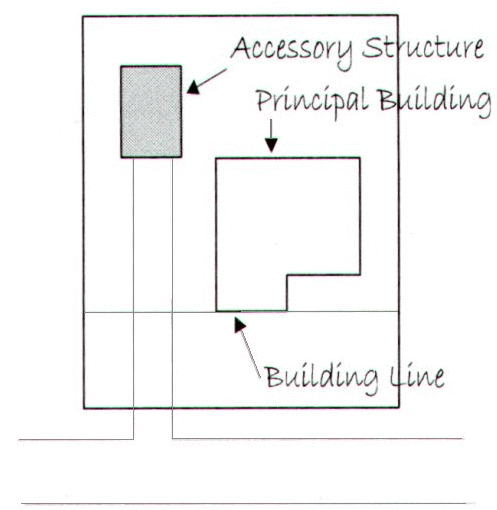
Accessory building/structure. A subordinate building, the use of which is incidental to and customary in connection with the principal building or use and which is located on the same lot with such principal building or use. See exhibit 35-92A for an example of an accessory building. An accessory structure also includes fences, pergolas, decks, arbors and the like.
Accessory use. A subordinate use which is incidental to and customary in connection with the principal building or use and which is located on the same lot with such principal building or use.
Adequate public facilities. Facilities determined to be capable of supporting and servicing the physical area and designated intensity of the proposed subdivision as determined by the Council based upon specific levels of service adopted by the City.
Adjacent. For the purpose of this ordinance, adjacent shall mean lying near or next to the property boundary, exclusive of land within the public right-of-way.
After hours establishment. Any establishment open at any time between the hours of 1:30 a.m. and 4:00 a.m., which has for its primary purpose nightclub, entertainment, teen clubs, dance clubs, and establishments which feature the playing of live or recorded music. If the establishment requires a cover charge upon entry, contains a dance floor, or uses either a disc jockey or live band, it shall be considered an after hours establishment, regardless of whether the establishment serves or sells prepared food for consumption.
Agribusiness. Any agricultural business or activity described in the definition of agricultural activity.
Agricultural activity. Agricultural activity, including forestry and forest products, harvest and management, dairy farming, livestock grazing and pasturage, truck gardening, the raising of crops, fruit and nursery stock, fish farms, and fur bearing animal farms, and the harvesting, processing, packaging, packing, shipping, and selling of products produced on the premises, and incidental farm occupations and uses such as machinery, farm equipment and domestic repair and construction, excluding commercial feed lots and animal kennels.
Airport. A place where airplanes can take off and land, usually equipped with hangars, facilities for refueling and repair, and various accommodations for passengers.
Aliquot. A fractional part of section within the United States public land survey system. Only the fractional parts one-half, one-quarter, one-half of one-quarter, or one-quarter of one-quarter shall be considered an aliquot part of a section.
Alley. A public or private thoroughfare which affords only a secondary means of access to abutting property.
Amusement center. A place in which games including, but not limited to, pinball machines and similar coin-operated machines, electronic video games, table games, billiard tables, skating, bowling and membership sports and health clubs are made available for use by the public.
Amusement park. A facility, primarily outdoors, that may include structures and buildings, where there are various devices for entertainment including rides, booths for the conduct of games or sale of items, buildings for shows and entertainment, restaurants and souvenir sales.
Antenna. Any device that transmits and/or receives radio waves for voice, data or video communications purposes including, but not limited to, television, AM/FM radio, microwave, cellular telephone and similar forms of communications. The term shall exclude satellite earth station antennas less than two meters in diameter (mounted within 3.66 meters or 12 feet of the ground or building-mounted) and any receive-only home television antenna.
Antenna support structure. Any building or other structure other than a tower which can be used for location of telecommunications facilities.
Apartment house. A building divided into three or more dwelling units.
Apartment, efficiency. An apartment building where each individual living unit contains no more than one habitable room with a kitchen and bathroom.
Aquifer recharge area. The outcropping part of the aquifer through which water enters.
Assisted living facility. Residences, for the frail elderly or for the sheltered care of persons with special needs, that provide rooms, meals, personal care and supervision of self-administered medication. Facilities may provide a combination of services such as recreational activities, financial services, social and personal counseling and transportation.
Atrium house. Dwelling units constructed around an open court or central hall. The atrium may be open to the sky or enclosed in glass.
Balconet. A false balcony or railing at the outer plane of a window-opening reaching to the floor, and having, when the window is open, the appearance of a balcony.
Bar or tavern. An establishment serving liquor by the drink on the premises deriving over 50 percent of gross revenue from the sale of alcoholic beverages.
Exhibit 35-92B - Basement: When "A" is greater than "B"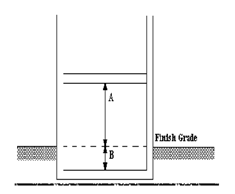
Basement. A story having part but not more than one-half of its height below grade. A basement is counted as a story for the purpose of height regulations if subdivided and used for dwelling purposes other than by a janitor employed on the premises. See exhibit 35-92B for an example of the location of a basement.
Bed and breakfast home. Overnight lodging and morning meal in a dwelling unit for compensation, in accordance with subsection 35-41.B, where not more than two guest rooms are provided.
Bed and breakfast inn. Overnight lodging and morning meal for travelers in a dwelling unit for compensation, in accordance with subsection 35-41.B, where three or more guest rooms are provided.
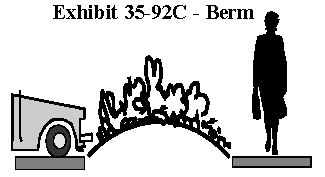
Berm. A mound of earth or the act of pushing earth into a mound. Also used as a verb to describe the act of building a mound of earth for screening or a landscape buffer. Exhibit 35-92C provides an example of a berm.
Board. Means Board of Adjustment as established in article VII of this ordinance.
Boarding house. A building, other than a hotel or apartment hotel, where for compensation and by prearrangement for definite periods, lodging, meals, or lodging and meals are provided for three or more persons.
BOA. Board of Adjustment.
Building. Any structure having a roof supported by columns or walls for the shelter or enclosure of persons or property.
Buildable width. The width of the lot left to be built upon after the side yards are provided.
Cabinet. A structure for the protection and security of communications equipment associated with one or more antenna where direct access to equipment is provided from the exterior and that has a horizontal dimensions that do not exceed four feet by six feet, and vertical height that does not exceed six feet.
Exhibit 35-92D - Caliper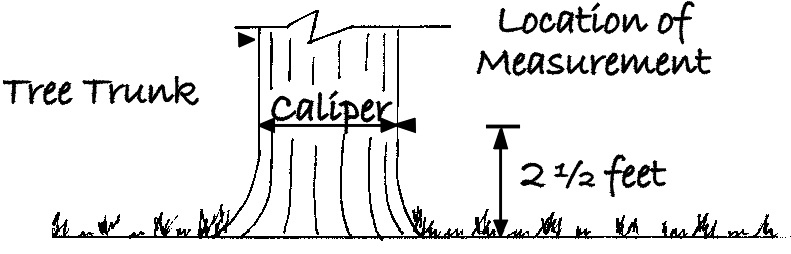
Caliper. The diameter of a tree trunk. See exhibit 35-92D for an example of measuring the caliper of a tree.
Capacity. The maximum number of vehicles that can be accommodated by a given major roadway during a specified time period under prevailing roadway, traffic and control conditions at the adopted level of service.
Car Wash. A structure containing facilities for washing automobiles.
Exhibit 35-92E - Cellar: When "B" is greater than "A" or when "B" is equal to "A"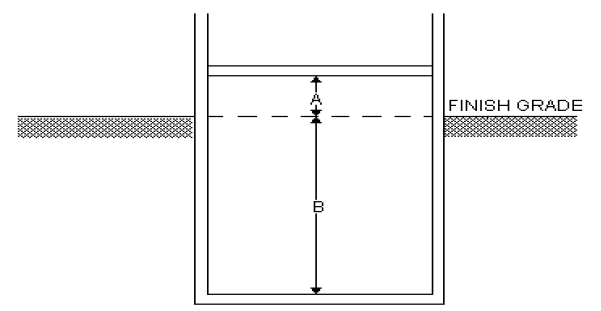
Cellar. That part of a building having more than one-half of its height below the average grade of the adjoining ground. See exhibit 35-92E for an example of how a cellar is located.
Cemetery. Land used or dedicated to the burial of the dead, including related accessory structures such as crematoriums, columbariums, mausoleums, necessary sales facilities, and maintenance facilities. Mortuaries and funeral homes shall be included when operated within the boundary of such cemetery.
Change of use. Any use that substantially differs from the previous use of a building or land.
Church. A building or structure, or group of buildings or structures that are primarily intended for conducting organized religious services and associated accessory uses.
City. The City of Jefferson, a municipal corporation, in the State of Missouri.
Clinic. An outpatient establishment where patients are not lodged overnight but are admitted for examination and treatment by one or more physicians, dentists or medical professionals including chiropractors, psychologists or social workers.
Club. Buildings and facilities owned or operated by a corporation, association, person or persons for a social, educational, or recreational purpose, but not primarily for profit and not primarily to render a service which is customarily carried on as a business.
Cluster development. A design technique whereby buildings are concentrated on a part of the site to allow the remaining land to be used for recreation, common open space and preservation of environmentally-sensitive features.
Exhibit 32-92F
Cluster Subdivision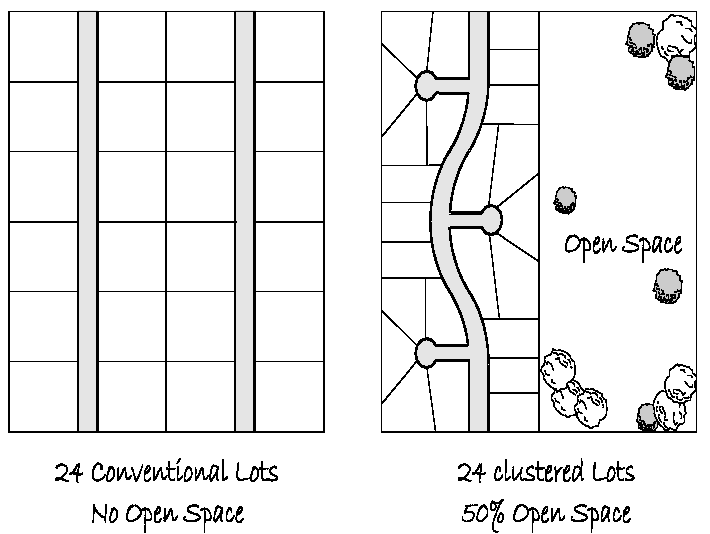
Cluster subdivision. A form of development that provides reduced lot area and bulk without an increase in the number of lots provided or overall density under a conventional subdivision and with the remaining land area devoted to open space, active recreation, preservation of environmentally-sensitive areas, or agriculture. Exhibit 35-92F provides an example of a cluster subdivision.
Code. The Code of the City of Jefferson, Missouri.
Coffee shop or tea room. An informal restaurant primarily offering coffee, tea, and other beverages, and where light refreshments and limited menu meals may also be sold.
College. An educational institution authorized by the state to award post high school associate and secondary degrees.
Commercial feed lot. A confined area or structure used for feeding, breeding or holding livestock for eventual sale, but not including barns, pens or other structures used in a dairy farm operation.
Commercial use. Activity involving the sale of goods or services carried out for a profit.
Commission. The Planning and Zoning Commission of Jefferson City, Missouri.
Committed development. A project that has received a building permit, final development order, or final concurrency determination.
Common open space. An open space area within or related to a developed site, and designed and intended for the use or enjoyment of residents and owners of the development. Common open space may at times contain complementary recreational structures and improvements for the use and enjoyment of residents and owners of the development, as may be approved under a planned-unit or similar plan.
Communications. The transmission, between or among points as specified by the user, of information of the user's choosing, without change in the form or content of the information as set or received, by wire, radio, optical cable, electronic impulses, or other similar means. As used in this definition, "information" means knowledge or intelligence represented by any form of writing, signs, signals, pictures, sounds or any other symbols.
Community residence. A single-family dwelling unit occupied by more than five persons, who may not be related by blood, marriage or adoption, who live as a single housekeeping unit the same as a family. Community residences include assisted living facilities for elderly persons, elder homes, hospices, shelters and other group living arrangements, but for the purposes of this ordinance, do not include group homes, penal halfway houses or treatment facilities for substance abuse which are defined separately.
Community service. Uses of public, nonprofit, philanthropic or charitable nature generally providing a local service to people of the community.
Compostable materials. Leaves, grass clippings, yard and garden vegetation but not stumps, roots or vegetation with intact root balls.
Composting site. A place where the public may bring compostable material which is then recycled into usable compost.
Conditional use. A use allowed in a zoning district after a permit is granted by the Board of Adjustment upon showing that the use will comply with standards established in article VII.
Condominium. A building, or group of buildings in which dwelling units, offices, or floor area are owned individually, and the structure, common areas, and facilities are owned by all owners on a proportional, undivided basis.
Condominium development. A development in which individual ownership in fee is restricted to that which is within the walls or designated bounds of a unit, and collective ownership applies to all other land and facilities beyond the individual units. A residential structure in a condominium development is: (1) a single-family dwelling if the structure contains one dwelling unit; (2) a two-family dwelling if the structure contains two dwelling units; (3) an apartment if the structure contains three or more dwelling units; or (4) a multiple dwelling if the structure contains three or more dwelling units.
Contractor and trade shop. Shop with storage of materials and goods for eventual sale or installation off-site for the use of contractor or tradesman such as upholsterer, plumber or electrician.
Convenience store. Small store serving persons in adjacent areas and limited to the sale of limited grocery items, magazine, newspapers and other limited items where gasoline sales may or may not be permitted.
Council. The City Council of Jefferson City, Missouri.
Cornice. Any horizontal member, structural or nonstructural, of any building, projecting outward from the exterior walls at the roof line, or extension of the roof line of a gable roof.
Cornice bracket. A supporting member for a projecting cornice, typically in the shape of an inverted "L".
Cornice, decorative. A cornice with three or more units of horizontal molding of a minimum one inch height and one inch depth each.
Courtyard. An open space more than one-half of which is surrounded by buildings.
Crematorium. A location containing properly installed, certified apparatus intended for use in the act of cremation.
Cultural facilities. Establishments that document the social, religious, intellectual and artistic manifestations that characterize society, including museums, art galleries and botanical and zoological gardens.
Day care. The care of a person away from his or her own home on either a commercial or non-commercial basis for custodial, educational, religious or other purposes for any part of a 24-hour day, providing that nothing herein contained shall be construed as applying to the regularly established public or parochial schools, colleges, universities, academies or seminaries.
a.
Day care center, adult. A facility other than the provider's permanent residence, or separate from the provider's living quarters, where care is provided for adults for part of the 24-hour day.
b.
Day care home, adult. A dwelling occupied as a permanent residence by the provider, in which family-like care is provided to seven but not more than the ten adults for part of the 24-hour day.
c.
Day care service, adult. A dwelling occupied as a permanent residence by the day care provider, in which family-like care is given to no more than six adults for part of the 24-hour day.
d.
Day care center, child. A facility other than the provider's permanent residence, or separate from the provider's living quarters, where care is provided for children for part of the 24-hour day. For the purposes of these regulations, a day care center includes child care centers and group child care homes as defined and regulated by Missouri Department of Health, RSMo ch. 210.
e.
Day care home, child. A dwelling occupied as a permanent residence by the provider, licensed by the State of Missouri Division of Family Services, in which family-like care is given to seven (7) children but not more than ten (10) children not related to the provider for any part of the 24-hour day.
f.
Day care service, child. A dwelling occupied as a permanent residence by the day care provider, in which family-like care is given to no more than six children not related to the day care provider for part of the 24-hour day.
Decibels or dBA. Decibel is a unit of sound pressure level used to express the noise level and a reference quantity is implied. The reference level is a sound pressure of twenty micro-newtons per square meter.
Development. Any man-made alteration of existing land use or change to improved or unimproved real estate including, but not limited to, building or other structures, mining, dredging, filling, grading, paving, excavation or drilling operations.
Development agreement. An agreement between the City and an applicant through which the Council agrees to vest development use or intensity.
Development plan. The future land use plan of the City of Jefferson, Missouri Comprehensive Plan.
Director. The Director of Planning and Protective Services of the City or a designee.
Public Works Director. The Director of the Department of Public Works of Jefferson City or a duly authorized representative.
Disguised support structure. Any free-standing, man-made structure designed for the support of antennas, the presence of which is camouflaged or concealed as an appropriately placed and designed architectural or natural feature. Depending on the location and type of disguise used, such concealment may require placement underground of the utilities leading to the structure. Such structures may include but are not limited to clock towers, campaniles, observation towers, light standards, flag poles and artificial trees.
Display, outdoor. see "Outdoor display."
District. A part of the City wherein zoning regulations of this ordinance are uniform.
Dog day care and grooming, indoor operations. A facility providing such services as canine day care for part of a day, obedience classes, training, grooming, or behavioral counseling, with no overnight boarding and all animal runs and pens completely contained within and accessed from inside an enclosed building.
Dormitory. A building used as group living quarters for a student body or religious order as an accessory use for a college, university, boarding school, convent, monastery or other similar institution.
Drive-in use. An establishment or facility that, by design of physical facilities or by service or packaging procedures, encourages or permits customers to receive a service or to obtain a product that may be used or consumed in a motor vehicle on the premises or to be entertained while remaining in an automobile.
Drive-in, drive-through use. An accessory or principal use which provides its sales and/or services to individuals in automobiles.
Drive-in theater. An open lot devoted primarily to the showing of motion pictures on a paid admission basis to patrons seated in automobiles.
Duplex. A dwelling containing two single-family dwelling units with totally separated housekeeping and cooking facilities for each.
Dust collection system. An air pollution control device to trap fugitive dust.
Dwelling. Any building or portion thereof which is designed and used for residential purposes by an individual or a family.
Dwelling, multiple. A building designed for or occupied exclusively by three or more families.
Dwelling, single-family. A building designed for or occupied exclusively by one family.
Dwelling, two-family. A building designed for or occupied exclusively by two families.
Dwelling unit. Any building or portion thereof having one or more habitable rooms which are designed and arranged to be occupied by one family with facilities for living, sleeping, cooking, eating, and sanitation.
Easement. An authorization by a property owner for another to use a designated part of his or her property for a specified purpose.
Engineer. Any engineer licensed by the State of Missouri.
Equine. For the purpose of these regulations, horse, pony, mule or donkey.
Essential services. Services provided by public and private utilities necessary for the exercise of the principal use or service of the principal structure. The services include underground, surface, or overhead electrical, gas, steam, water, sanitary sewer, storm water drainage, and communication systems and accessories thereto, such as poles, towers, wires, main drains, vaults, culverts, laterals, cisterns, sewers, pipes, catch basins, water storage tanks, conduit cables, traffic signals, pumps, lift stations, wells, and hydrants or dry hydrants, but not including buildings.
Event center or banquet hall. A facility that is used primarily for the purpose of leasing or renting for private functions on a temporary basis, such as meetings, banquets, weddings, anniversaries and similar celebrations.
FAA. The Federal Aviation Administration.
FAR. Floor area ratio.
FCC. The Federal Communications Commission.
Family. One or more persons occupying a single dwelling unit, living as a single housekeeping unit on a long-term basis, whether or not related to each other by birth or marriage, as distinguished from a group occupying a boarding house, lodging house or hotel. A family, as defined herein, may include up to five unrelated persons or any number of persons related by blood, marriage or adoption, provided that the number of persons residing in the dwelling does not create overcrowded conditions and violate the BOCA Code, Life Safety Code or other adopted building, fire and health codes.
Farm. A parcel of land used for agricultural activities.
Farm, animal husbandry. The raising and management of cattle, horses and other livestock, livestock grazing and pasturage, fish farms, but not including animal kennels or feed lots.
Farm, horticulture. The planting, harvest and management of crops, fruit and nursery stock; truck gardening; including the processing, packaging, packing, shipping and selling of products produced on the premises.
Fault area. Area subject to earth movement.
Fence. A structure for enclosure or screening, provided however, the following shall not be considered as fences under this definition:
1.
A fenced enclosure which is completely covered by a roof.
2.
Protective screens or bars over windows, doors and other openings attached securely to the walls of a building and not extending more than three inches from the wall to which they are attached.
3.
Any structure located in a completely enclosed building.
Fencing, decorative metal. Fencing constructed of wrought iron or other metal similar in appearance to wrought iron and including decorative features such as spears and/or welded metal designs on the fence.
Flea market. A flea market or swap meet is an occasional or periodic market held in an open area or structure where groups of individual sellers offer goods for sale to the public.
Floodplain. The channel and the relatively flat area adjoining the channel of a stream or river that has been or may be covered by flood water.
Floor area. The square feet of floor space within the outside line of walls and includes the total of all space on all floors of a building. It does not include porches, garages, or space in a basement or cellar when said basement or cellar space is used for storage or incidental uses
Exhibit 35-92G - Floor Area Ratio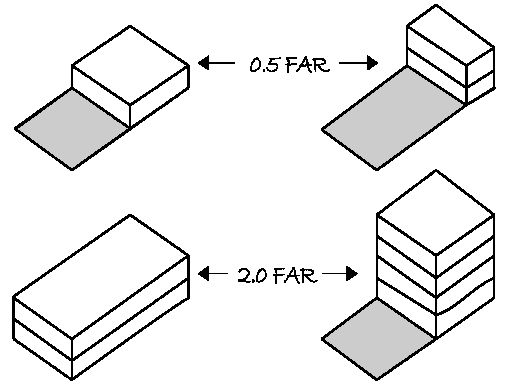
Floor area ratio (FAR). The gross floor area of all buildings on a lot divided by the lot area on which the building or buildings are located.
Foot candle. A measure of illumination on a surface that is everywhere one foot from a uniform point source of light of one candle and equal to one lumen per square foot
Fraternity. A fraternal organization or group of people formally organized for a common interest, usually cultural, religious, or entertainment with regular meetings, rituals and formal written membership requirements. Fraternal organizations include sororities, Knights of Columbus, Mason, Elks, VFW and the like. A fraternal organization may also have a fraternity house which is used exclusively by fraternity members and their guests or visitors and affiliated with an institution of higher learning.
Frontage. All the property on one side of a street between two intersecting streets (crossing or terminating), measured along the line of the street, or if the street is dead ended, then all of the property abutting on one side between an intersecting street and the dead end of the street.
Funeral arrangement service office. An office used for the arrangement of funeral services, with limited facilities for funeral services, viewings, and storage of bodies, and no facilities for embalming or cremation.
Funeral home. A building or part thereof used for human funeral services.
Future land use category. Land uses classified for use in the future as shown in the Development Plan of the comprehensive plan for the City of Jefferson, Missouri.
Garage, parking. A garage, other than a private or storage garage, which is used for the short-term parking of vehicles.
Garage, private. A detached accessory or portion of a main building housing the automobiles of the occupant of the premises.
Garage. Any deck, building, parking structure or premises, or part thereof, used for housing of vehicles.
Gasoline sales, gasoline station. Any premises used for the sale at retail of vehicle fuels or oils, but not including vehicle servicing, lubricating, or repairs.
Glazing. Glass windows, including the trim and frame of a window when calculating the area of glazing within this chapter.
Grade. The average level of the finished surface of the ground abutting the exterior walls of the building.
Gross density. The total number of dwelling units divided by the total acreage of residential and open space land.
GFA. Gross Floor Area.
Gross floor area. The total area of a building measured by taking the outside dimensions of the building at each floor level intended for occupancy or storage, but excluding any space where the floor-to-ceiling height is less than six feet.
Group child care home. As defined and regulated by the Missouri Department of Health under RSMo ch. 210, a child care facility where 11 to 20 children are cared for in a family-like day setting.
Group home for mentally, developmentally and physically handicapped persons. A residential facility, as defined by RSMo § 89.020.2, where up to eight mentally, developmentally and physically disabled persons and two house parents, unrelated by blood, marriage or adoption, reside as a family unit in a single-family residential dwelling, provided, however, that the number of persons residing in the home do not create overcrowded conditions and violate the BOCA Code, Life Safety Code, or other adopted building, fire and health codes. Meals, lodging, supervision and training are provided for the residents.
Group living. A living situation in which a group of persons reside but not as a single housekeeping unit. Group living includes boarding houses and dormitories.
Guest ranch. A ranch or similar facility where people have transient accommodations for lodging and food and ride horseback and participate in other recreational activities.
Habitat, endangered. The natural home of a species of plant or animal whose continued health and existence area at significant risk. The habitat also includes the necessary combination of food, water, cover and other resources that the species required for life.
Halfway house. See "Residential treatment facility, penal."
Hazardous material or waste. Hazardous material or waste shall mean any material or waste which:
1.
Because of its quantity, concentration or physical, chemical or infectious characteristics may cause or significantly contribute to an increase in mortality or an increase in serious, irreversible or incapacitating, reversible illness; or pose a substantial present or potential hazard to human health or the environment when improperly treated, stored, transported or disposed of, or otherwise improperly managed; or
2.
Is identified or listed as a hazardous waste by the administrator, USEPA, pursuant to the Federal Solid Waste Disposal Act (FSWDA), as amended by the Resource Conservation and Recovery Act (RCRA) of 1976, and the Hazardous Solid Waste Amendments (HSWA) of 1984, 42 U.S.C. § 2601 et seq.; or
3.
Is required to be accompanied by a written manifest or shipping document describing the waste as "hazardous waste", pursuant to any state or federal law, including but not limited to the FSWDA, as amended by the RCRA, and the state and federal regulations promulgated thereunder; or
4.
Contains polychlorinated biphenyls or any other substance, the storage, treatment or disposal of which is subject to regulation under the Federal Toxic Substances Control Act, as amended, 42 U.S.C. § 9601 et seq. and the state and federal regulations promulgated thereunder; or
5.
Contains a "reportable quantity" of one or more "hazardous substances", as defined in RCRA as amended, and the state and federal regulations promulgated thereunder; or
6.
Contains a radioactive material, the storage or disposal of which is subject to state or federal law and the regulations promulgated thereunder.
Health care facility. A facility or institute, whether public or private, principally engaged in providing services for health maintenance, diagnoses or treatment of human disease, pain, injury, deformity or physical condition, including, but not limited to, a general hospital, special hospital, mental hospital, public health center, diagnostic center, treatment center, rehabilitation center, extended care facility, skilled nursing home, nursing home, intermediate care facility, outpatient clinic, dispensary, home health care agency, and bioanalytical laboratory or central services facility serving one or more institutions but excluding institutions that provide healing solely by prayer.
Height, building. The vertical distance measured in accordance with Section 35-51.B. of this ordinance.
Height, structure. The vertical distance measured from the average grade of the base of the structure at ground level to its highest point and including the main structure and all attachments thereto.
Heliport. An area, either at ground level or elevated on a structure, licensed by the federal government or appropriate state agency and approved for the loading, landing and takeoff of helicopters and including auxiliary facilities such as parking, waiting room, fueling and maintenance.
Helistop. A heliport but without the auxiliary facilities.
Home occupation. An occupation or a profession which is accessory and incidental to the residential use of the property.
Hospital. An institution providing primary health services and medical or surgical care to persons primarily suffering from illness, disease, injury, deformities and other abnormal conditions. The institution includes, as an integral part of it, related facilities such as laboratories, outpatient facilities, training facilities, medical offices and staff residences.
Hotel. A building in which lodging is provided and offered to the public for compensation, and which is open to transient guests in contradistinction to a boardinghouse, short term rental of a residence or lodging room, or lodging house as herein defined.
Household living. Persons living together acting as a single housekeeping unit in a single dwelling unit, with common access to and having common use of all living and eating areas, and other areas and facilities for the preparation and serving of food within the dwelling unit.
Institution. A non-profit establishment for public use.
Institutional and civic use. Nonprofit, civic, religious or public uses such as libraries, public or private schools, hospitals, government owned or operated building, structure or land used for public purposes.
Interstate highway. U.S. Highways 50, 54, and 63.
Junk. Dismantled and inoperable vehicles, machinery, and appliances or parts of such vehicles, machinery or appliances; scrap copper, brass, rope, rags, batteries, paper, rubber debris, iron, steel or other metals; and any object which does not function as the manufacturer intended. An inoperable vehicle shall mean any motor vehicle which lacks a current registration or a registered vehicle which lacks two or more wheels or any other component parts, the absence of which renders the vehicle illegal for use on the highway.
Junk or salvage yard. Any place not fully enclosed in a building where waste, discarded or salvaged material or equipment are bought, sold, exchanged, baled or packed, disassembled, kept, stored, or handled, including house wrecking yards, auto wrecking activities, used lumber yards and places or yards for storage of salvaged building materials and structural steel materials and equipment, but not including areas where such uses are conducted entirely within a completely enclosed building.
Kennel. An establishment where small animals are boarded for compensation, or where dogs, cats or other small animals are bred or raised on a commercial basis.
Landscaped area. An area that is permanently devoted and maintained to the growing of shrubbery, grass and other plant material.
Laundromat. An establishment providing washing, drying, and/or dry-cleaning equipment machines on the premises for rental use to the general public. A laundromat is primarily a self-service facility but an attendant may provide the service for a patron.
Laundry or dry cleaner. An establishment where a person drops off laundry and/or dry cleaning to be done by others.
Livestock. Any animal or fowl which are being produced primarily for use as food or food products for human consumption.
Living unit. A dwelling unit used for living purposes that includes at least one room but may or may not include a kitchen but does include one full bathroom.
Loading space. A space within the main building or on the same lot for the standing, loading, or unloading of trucks.
Lodge. A place where members of a local chapter of an association or a fraternal, cultural or religious organization hold their meetings; or the local chapter itself.
Lodging or rooming house. A facility in which rental sleeping accommodations are provided and in which meals may be supplied as part of the fee. Also see boarding house.
Long term residence. Residence within a dwelling unit for a period of one month or more.
Exhibit 35-92H - Lots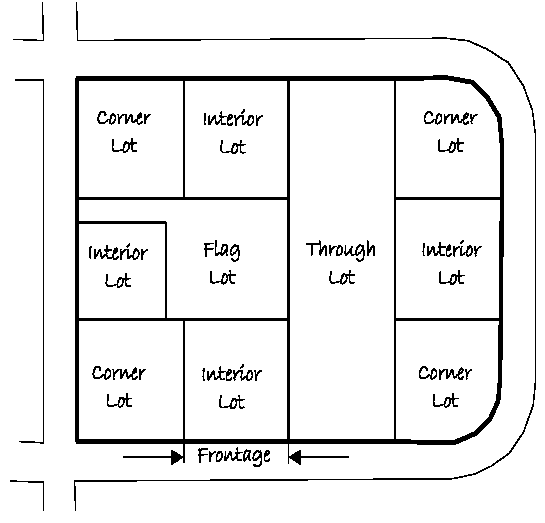
Lot. A parcel of land occupied or intended for occupancy for a use permitted in this chapter, including one main building together with its accessory buildings, open spaces and parking spaces required by this chapter, and having its principal frontage upon a street. See exhibit 35-92H for examples of lot types.
Lot area. See subsection 35-51.B for lot area and measurement.
Lot, corner. A lot abutting upon two or more streets at their intersections.
Lot, depth of. The mean horizontal distance between the front and rear lot lines.
Lot, double frontage or through lot. A lot having a frontage on two non-intersecting roads, as distinguished from a corner lot.
Lot, interior. A lot other than a corner lot.
Lot line. A line of record bounding a lot that divides one lot from another lot or from a street or any public space.
Lot, flag. A lot where access to the public right-of-way is provided by a narrow strip of land referred to in this ordinance as a pole. An example of a flag lot is shown in exhibit 35-92H.
Lot line, front. The lot line separating a lot from a street right-of-way line.
Lot line, rear. The lot line opposite and most distant from the front lot line. In the case of triangular or otherwise irregularly shaped lots, a line 10 feet in length entirely within the lot, parallel to and at a maximum distance from the front lot line.
Lot line, side. Any lot line other than the front or rear lot line. See subsection 35-51.B
Lot of record. A lot or parcel of land, the plat or deed of which has been recorded in the office of the County Recorder, prior to March 17, 1981.
Lot, width. See subsection 35-51.B for lot width and measurement.
Major road ways. All City or County owned and operated streets including minor and major collectors, minor and major arterials, traffic signals and ancillary facilities pursuant to the City Thoroughfare Plan. Major roadways do not include the interstate highway or the principal state highways.
MoDNR. Missouri Department of Natural Resources.
MoDOT. Missouri Department of Transportation.
Manufactured home. As defined in RSMo § 700.010(5), a factory-built structure, which is manufactured or constructed under the authority of 42 U.S.C., § 5403 and is to be used as a place for human habitation.
Manufactured home park. Any site, lot, or tract of land upon which two or more occupied manufactured homes are harbored, either free of charge, or for revenue purpose.
Marijuana. Cannabis, hybrids of such species, and any other strains commonly understood within the scientific community to constitute marijuana, as well as resin extracted from the plant and marijuana-infused products.
Marijuana facility. An establishment that cultivates, manufactures, tests, sells, and/or transports marijuana authorized under Missouri State Law.
a.
Marijuana cultivation facility. A facility licensed by the State of Missouri, to acquire, cultivate, process, store, transport, and sell marijuana to a marijuana dispensary facility, marijuana testing facility, or to a marijuana-infused products manufacturing facility.
b.
Marijuana dispensary facility. A facility licensed by the State of Missouri, to acquire, store, sell, transport, and deliver marijuana, marijuana-infused products, and drug paraphernalia used to administer marijuana as provided for a qualifying patient, a primary caregiver, another marijuana dispensary facility, a marijuana testing facility, or a marijuana-infused products manufacturing facility. A marijuana dispensary facility includes medical, recreational, comprehensive, and microbusiness.
c.
Marijuana-infused products manufacturing facility. A facility licensed by the State of Missouri, to acquire, store, manufacture, transport, and sell marijuana-infused products to a dispensary facility, a marijuana testing facility, or to another marijuana-infused products manufacturing facility.
d.
Marijuana testing facility. A facility licensed by the State of Missouri, to acquire, test, certify, and transport marijuana.
e.
Marijuana transportation facility. A facility licensed by the State of Missouri to transport marijuana to a qualifying patient, a primary caregiver, a marijuana cultivation facility, a marijuana-infused products manufacturing facility, a marijuana dispensary facility, a marijuana testing facility, or another marijuana transportation facility.
Marina/yacht club. A facility located on a navigable waterway for storing, servicing, fueling, berthing and securing of boats and that may include eating, sleeping and retail facilities for owners, crews and guests.
Medical park. A health care complex consisting of more than one of the following uses: hospital; clinic; medical or dental office; medical laboratory; nursing home or convalescent care facility; substance abuse treatment facility; physical or mental rehabilitation facility; exercise or physical fitness facility; assisted or independent living facility; and residential care facility, located in one or more buildings totaling 50,000 square feet or more in the aggregate on one or more adjacent parcels of land totaling five acres or more.
Metes and bounds. A description of land that uses distances and angles, uses distances and bearings, or describes the boundaries of the parcel by reference to physical features of the land.
Mini warehouse/self service storage, outdoor. A structure or group of structures where one or more individual stalls or lockers, which are accessed from the outside, is rented out for storage of customers' goods and provides stalls or lockers with less than 750 square feet of floor area per stall.
Mini warehouse/self service storage, indoor. A structure where one or more individual stalls or lockers, each of which is accessed from inside an enclosed building, is rented out for storage of customers' goods and provides stalls or lockers with less than 750 square feet of floor area per stall.
Mining. The extraction of sand, gravel, rock, soil, coal or other material from the land in the amount of 1,000 cubic yards or more and the removing thereof from the site including coal processing. The only exclusion from this definition shall be removal of materials associated with the construction of a building.
Modification. Any change, including the addition or replacement of antennas to a structure requiring a building permit or other governmental approval, except that the following shall not be deemed a modification requiring a building permit provided the conditions of the original permit and the requirements of this article are not violated: any structural alterations or replacement of antennas to meet safety requirements, any structural alternation or replacement of antennas that does not involve enlargement of the structure height and any alteration for normal maintenance.
Modular dwelling. As defined in RSMo § 700.010(7), a factory-fabricated transportable building unit designed to be used by itself or to be incorporated with similar units at a building site into a modular structure to be used for residential, commercial, educational or industrial purposes. The term is intended to include major assemblies and does not include prefabricated panels, trusses and other prefabricated sub-elements which are to be incorporated into a structure at the site.
Molding. A decorative band or strip of material with a constant profile or section designed to cast interesting shadows. It is generally used in cornices and as trim around window and door openings.
Mortuary. A place for the storage and embalming of human bodies prior to their burial or cremation.
Motel, motor court, motor lodge, or tourist court. Any building or group of buildings containing guest rooms or dwelling units, some or all of which have a separate entrance leading directly from the outside of the building with garage or parking space conveniently located on the lot, and designed, used, or intended wholly or in part for the accommodation of automobile transients.
Multi-family dwelling. A building containing three or more dwelling units.
Nightclub. An establishment in which music, dancing and/or entertainment is conducted during the evening hours in a social setting, but not including bars or taverns as defined in this chapter.
Nonconforming use. The use of land, buildings or structures, or a portion thereof, legally existing at the effective date of this ordinance which does not comply with the zoning district, and any amendments thereto, in which such use is located.
Nonconforming situation or feature. A characteristic of a building or property, such as signs, parking, loading, landscaping, performance standards, or condition of a special exception or conditional use that lawfully existed prior to the enactment of the requirements of this chapter, but does not comply with the current requirements of this chapter.
Nuisance. The interference with the enjoyment and use of property. Nuisances, as referred to in this ordinance include smoke, odors, liquid wastes, solid wastes, radiation, noise, vibration, glare or heat.
Nursery. An area devoted to the raising and care of trees, shrubs or similar plant materials.
Nursing home. As defined in RSMo title 12, ch. 198, § 198.006 (18), any facility, whether proprietary or nonprofit, which provides 24 hour a day accommodation, board and supervision by a nurse to three or more unrelated residents.
Office. A room or group of rooms used for conducting the affairs of a business, profession, service industry or government and generally furnished with desks, tables, files and communications equipment.
Open area. That part of a lot not covered by a building or used as a parking area.
Order window. A window used by drive-through or drive-in facilities where orders are placed.
Outdoor display. Temporary display during a particular season of products for sale primarily outside of a building or structure, including vehicles, garden supplies, gas, tires and motor oil, boats and aircraft, farm equipment and produce, burial monuments, building and landscaping materials and lumber yards but not including outdoor storage.
Outdoor storage. The keeping, in an area outside of a building, of any goods, junk, material, merchandise or vehicles, in the same place for more than 72 hours but not including the temporary outdoor display of seasonal goods or merchandise for sale, but for the storage of trash or other discarded material.
Overlay district. A district which acts in conjunction with the underlying zoning district or districts. Development within the overlay district must conform to the requirements of both zones or the more restrictive of the two.
Owner. The legal entity holding title to the property being divided, or such representative or agent as is fully empowered to act on its behalf.
Parcel. A tract of land under single ownership which has not been divided by deed or subdivision.
Parking lot. An off-street, ground-level open area, usually improved, for the temporary storage of motor vehicles.
Parking lot, facility or garage; off-site. A parking facility providing either required parking spaces for a particular use, or associated with a specific land use, which is not located on the same lot or ownership parcel as the particular or specific land use.
Parking facility, short term. A parking lot, facility or garage where vehicles may be parked for a period not to exceed 72 hours.
Parking space. A surfaced area, enclosed or unenclosed, sufficient in size to store one automobile together with a driveway connecting the parking space with a street, road or alley and permitting ingress or egress of that automobile without the necessity of moving any other automobiles. The last stipulation of this definition requiring the ingress or egress of an automobile without the necessity of moving any other automobile is not applicable to parking spaces provided for single-family and two-family dwellings.
Permitted use. A public or private use which of itself conforms with the purposes, objectives, requirements, regulations and performance standards of a particular district.
Planned capital improvements. A capital improvement which does not presently exist, but which is included within the City thoroughfare plan.
Planned unit development. An area of a minimum contiguous size, as specified by ordinance, to be planned, developed, operated and maintained as a single entity and containing one or more residential clusters or planned unit residential developments and one or more public, quasi-public, commercial or industrial areas in such ranges or ratios of nonresidential uses to residential uses as specified in the ordinance located in the Planned Unit Development District.
Practical difficulties. The term may include, but not necessarily be limited to difficulties caused by parcel size, shape, narrowness, shallowness, topography, physical surroundings or other special circumstance, and the special circumstance is peculiar to the premises and does not generally apply to other lands in similar zoning districts in the city and, further, the circumstance would prevent the applicant from using or developing the property in a manner equivalent to the use or development occurring on neighboring properties in the same zoning district.
Premises. The land, including a lot, plot or parcel of land, together with all buildings, structures and manufactured homes thereon.
Prevailing roadway, traffic and control conditions. The maximum traffic volume during the peak hour at the adopted level of service.
Primary caregiver. In regards to medical marijuana, an individual 21 years of age or older who has significant responsibility for managing the well-being of a qualifying patient.
Principal use. The main use of land or buildings as distinguished from subordinate or accessory uses. A "principal use" may be either permitted or conditional.
Principal highway. U.S. Highways 50, 54 and 63.
Public improvement. Any improvement, facility or service together with its associated site or right-of-way necessary to provide transportation, drainage, utilities or similar essential services and facilities and that are usually owned and operated by a governmental agency.
Public notice. The advertisement of a public hearing in a paper of general circulation, and through other media sources, indicating the time, place and nature of the public hearing and where the application and pertinent documents may be inspected.
Qualifying patient. In regards to medical marijuana, a Missouri resident diagnosed with at least one qualifying medical condition who obtains an identification card.
Quoin, decorative. Outside corner of a building constructed of stones or bricks of large size, distressed or arranged so as to form a decorative contrast with the adjoining walls.
Radio/television broadcast station. An establishment engaging in oral and visual programs for presentation to the public and that consists of a studio, transmitter and antenna.
Recreational facility, private. Park, open space, golf course, tennis court, swimming pool, clubhouse, and other commonly associated facilities owned, operated and maintained in common by the residents of a subdivision or other residential development.
Recreational facility, public. Park, open space, golf course, tennis court, athletic club, skating rink, swimming pool, rec-plex or other recreational facility owned and maintained by city, county or state government.
Recreational facility, commercial outdoor. Any recreational use which is not, by definition, a public recreational facility or private residential recreational facility but includes one or more of the following uses: driving range, miniature golf, batting cages, go cart track, water slide, swimming pool, tennis courts, ball fields or athletic fields.
Recreational vehicle. A vehicular unit mounted on wheels, designed to provide temporary living quarters for recreational, camping or travel use and of such size or weight as not to require special highway movement permits when drawn by a motorized vehicle, and with a living area of less than 320 square feet, including built-in equipment (such as wardrobes, closets, kitchen units or fixtures) and bath and toilet rooms.
Recreational vehicle or travel trailer park. An area licensed and used or offered for use in whole or in part, with or without charge, for the parking of occupied travel trailers, pickup campers, converted buses, motor homes, tent trailers, tents or similar devices used for temporary, portable housing. Unoccupied mobile homes, travel trailers and similar devices may be stored in the park, but only in an area marked for storage. No repair, maintenance, sales or servicing, or such devices are allowed in the park.
Recycling center. A place where recyclable materials, but not compostable materials, may be collected, stored, sorted, compacted, shredded, bundled, packaged or otherwise processed. A recycling center does not include the use of machinery or furnaces for melting, milling, cutting or shredding of metals, or similar industrial processes.
Recycling collection station. A place where recyclable materials, except hazardous wastes, may be dropped off for the sole purpose of collection. A recycling collection station does not include the sorting or processing of material at a station.
Recycling materials. All previously used materials which can be processed for reuse. The term does not include compostable materials.
Recycling processing plant. A recycling center where machinery or furnaces for the melting, milling, cutting of metals or similar industrial processes may be used.
Religious assembly. Meetings for religious activities sponsored by religious institutions such as churches, temple, synagogues and mosques.
Research laboratory. An establishment or other facility for carrying on investigation in the natural, physical or social sciences, which may include engineering and product development.
Residential use in non-residential building. A residential dwelling within a non-residential building that is not located on the main entry floor of the building.
Residential care facility for the elderly. As defined in RSMo title 12, ch. 198, § 198.006 (15) and (16), any facility that provides 24-hour a day accommodations and care for three or more residents who are not related to one another.
Residential treatment facility, penal; other community based sanctions (formerly halfway house, penal). An establishment where persons who are on parole, probation, participating in a penal pre-release program, or otherwise committed to the custody and supervision of the Department of Corrections are housed and supervised outside of the regularly established departmental correctional centers. A penal residential treatment facility may include up to ten total occupants provided, however, that the number of persons residing in the facility do not create overcrowded conditions and violate the BOCA Code, Life Safety Code, or other adopted building, fire and health codes.
Resort cabins/lodge. A facility for transient guests where lodging is provided along with food and drink.
Restaurant. An establishment deriving over 50 percent of gross revenue from the sale of food and drink not including alcoholic beverages.
Restaurant, drive-in. An establishment deriving over 50 percent of gross revenue from the sale of food and drink, not including alcoholic beverages, and which functions as a retail outlet where food or beverages are sold and delivered to patrons in parked motor vehicles.
Restaurant, drive-through. An establishment deriving over 50 percent of gross revenue from the sale of food and drink, not including alcoholic beverages, where food and/or beverages are sold in a form ready for consumption and where ordering and pickup of food may take place standing or from an automobile.
Retail package liquor store. An establishment deriving over 50% of gross revenue from the sale of alcoholic beverages for consumption off premises.
Riding academy. An establishment where horses are boarded and cared for and where instruction in riding, jumping and/or showing is offered and where horses may be hired for riding.
Right-of-way. Property dedicated to the public for use as a public roadway, highway, street, sidewalk, alley, or similar property used for public travel, but not including railroad right-of-way or public or private easement.
Right-of-way line. A dividing line between a lot, tract or parcel and a contiguous street.
Runway. A defined area on an airport prepared for landing and take-off of aircraft along its length.
Sanitary landfill. Land utilized for disposing of solid wastes.
Satellite receiving dish. An earth station antenna which receives and amplifies television, radio, business data and/or telecommunications from satellites. For purposes of this chapter, a satellite receiving dish shall be considered as an accessory structure.
Scale of development. The relationship of a particular project or development in terms of size, height, bulk, intensity and aesthetics, to its surroundings.
School. Any building or part thereof which is designed, constructed or used for education or instruction in any branch of knowledge. The category includes public and private schools at the primary, elementary, middle, junior high or high school level that provide state-mandated basic education.
Screen. To visually shield or obscure any abutting or nearby structure or use from another by fencing, walls, berms or densely planted vegetation.
Self-service storage. A structure or group of structures for the storage of customer's goods and wares where individual stalls or lockers are rented out to different tenants for storage.
Semi-public. A place in which the services rendered or operations performed are of a public nature although the establishment is not operated or owned by a public agency. Example: Salvation Army, Y.M.C.A.
Services, personal. Establishments providing services involving the care of a person, including but not limited to beauty shops, barber shops, spas, tanning salons and reducing salons; dressmaking or tailoring, shoe repair; photography studios and photo finishing.
Services, retail. Establishments providing services or entertainment, as opposed to products, to the general public or business community, including eating and drinking places, hotels and motels, finance, real estate and insurance, advertising and mailing, educational, employment and training services; insurance and real estate services; property management, maintenance and protective services, management and consulting services.
Exhibit 35-92I - Setback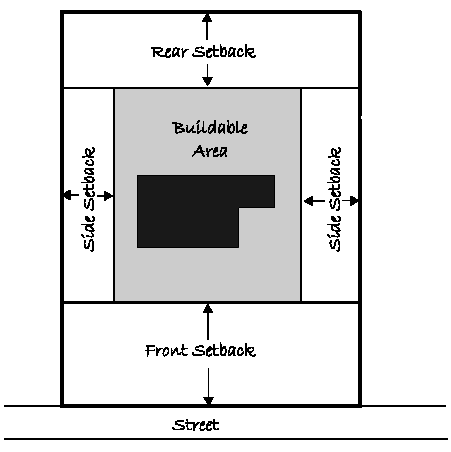
Setback. The minimum required distance from the property line to the furthermost projection of a structure (see section 35-51 and exhibit 35-92I for examples).
Shelter. A building for the protection and security of communications equipment associated with one or more antennas and where access to equipment is gained from the interior of the building.
Shopping center. A separate and distinct commercially used area under single ownership or unified control, including one or more separate business establishments.
Short term rental of a lodging room. The rental of a portion of a dwelling unit or room within a dwelling unit by the occupant of the dwelling unit for a period of less than one month.
Short term rental of a residence. The rental of a dwelling unit for a period of less than one month.
Exhibit 35-92J - Signs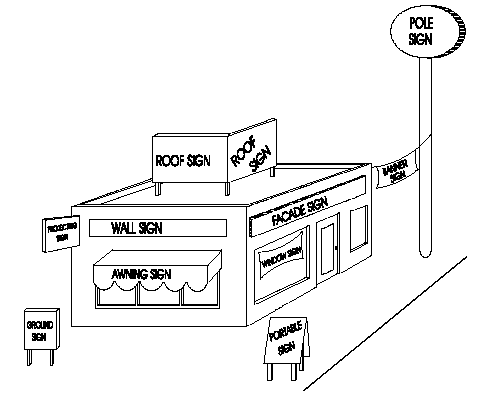
Sign. Any object, device, display or structure or part thereof, consisting of any letter, figure, character, mark, point, plane, marquee sign, design, poster, pictorial, picture, stroke, stripe, line, trademark, reading matter or illuminating device, which is constructed, attached, erected, fastened or manufactured in any manner so that the same shall be used for the attraction of the public to any place, subject, person, corporation, firm, public performance, article, machine or merchandise, and displayed in any manner for recognized advertising purposes (see exhibit 35-92J for examples of signs.)
Sight triangle. See "visual clear zone (VCZ)."
Single-family attached. A single-family dwelling that is attached to other single-family dwellings by a common vertical wall, with each dwelling located on a separate lot.
Single-family detached. A single-family dwelling that is not attached to any other dwelling by any means and is completely surrounded by open space or yards.
Small wireless facility. A telecommunication facility that meets both of the following qualifications:
1.
Each provider's antenna could fit within an enclosure of no more than six cubic feet in volume; and
2.
All other equipment associated with the facility, whether ground or pole mounted, is cumulatively no more than 28 cubic feet in volume, provided that no single piece of equipment on the utility pole shall exceed nine cubic feet in volume; and no single piece of ground mounted equipment shall exceed 15 cubic feet in volume, exclusive of equipment required by an electric utility or municipal electric utility to power the small wireless facility. Electric meters, concealment elements, demarcation boxes, grounding equipment, power transfer switches, cut-off switches and vertical cable runs and related conduit for connection of power and other services shall not be included in the calculation of equipment volume.
Smoking lounge. A retail store used primarily for the sale of smoking materials and where more than 70 percent of the volume of trade or business carried on there is that of the blending of tobaccos or sales of tobaccos, cigarettes, pipes, cigars or smoking sundries and in which the sale of other products is incidental, and in which 50 percent or more of revenue from the sale of tobacco and smoking materials is derived from the sale of tobacco products for consumption on the premises.
Solar energy collectors. Panels, windmills, or other devices used to collect energy from the sun, wind or other natural energy source. For purposes of this ordinance, detached alternate energy collectors shall be considered an accessory building.
Solid waste disposal. The disposal of solid unwanted, discarded material, not intended to be salvaged or recycled.
Special exception use. A use or structure that would not be appropriate generally or without restriction throughout the zoning division or district but which, if controlled as to number, area, location, or relation to the neighborhood, would promote the public health, safety, morals, order, comfort, convenience, appearance, prosperity, or general welfare.
Stable, private. A building or structure used or intended to be used for housing horses belonging to the owner of the property only for non-commercial purposes.
Standard canopy tree. An approved variety of deciduous tree that has a minimum caliper of two inches and has a canopy capable of providing shade.
Standard conifer tree. An approved variety of pine, cedar, fir or other evergreen tree that has a minimum height at planting of five feet.
Standard hedge. An approved variety of evergreen shrub that will attain a height of three feet within three years of planting, and that has a minimum size at planting of five gallons.
Start of construction. Includes substantial improvement, and means the date the development permit was issued, provided the actual start of construction, repair, reconstruction, rehabilitation, addition, placement, or other improvement, was within 180 days of the permit date. The actual start means either the first placement or permanent construction of a structure on a site, such as pouring of a slab or footings, the installation of pile, the construction of columns, or any work beyond the stage of excavation; or the placement of a factory-built home on a foundation. Permanent construction does not include land preparation, such as clearing, grading and filling; nor does it include the installation of streets and/or walkways; nor does it include excavation for a basement, footings, piers, or foundations or the erection of temporary forms; nor does it include the installation on the property of accessory buildings such as garages or sheds not occupied as dwelling units or not part of the main structure. For a substantial improvement, the actual start of construction means the first alteration of any wall, ceiling, floor, or other structural part of the building, whether or not that alteration affects the external dimensions of the building.
Stealth. Includes any free-standing, man-made structure designed for the support of antennas, the presence of which is camouflaged or concealed as an appropriately-placed architectural or natural feature which are designed to blend into the surrounding environment. Such structures may include, but are not limited to, clock towers, campaniles, observation towers, water towers, light standards, flag poles and artificial trees.
Storage units. An enclosed structure containing separate storage spaces of varying sizes leased or rented on an individual basis with no exterior storage.
Storage, unenclosed. An area outside of a building which is used for the storage of usable goods and materials but not for the storage of trash or other discarded material.
Story. That portion of a building, other than a basement or cellar, included between the surface of any floor and the surface of the floor next above it or, if there be no floor above it, the space between the floor and the ceiling next above it.
Story, half. A space under a sloping roof which has a line of intersection of roof decking and wall face not more than four feet above the top floor level.
Street. A public way which affords the principal means of access to abutting property.
Street centerline. The street centerline is a line halfway between the street lines. Also known as the "right-of-way line."
Street, collector. A street that collects traffic from local streets and connects with minor and major arterials. (See the City Thoroughfare Plan.)
Street, cul-de-sac. A street with a single common ingress and egress and a turnaround at the end.
Street frontage. Street frontage is measured between side lot lines along the front lot line.
Street furniture. Constructed, aboveground objects, such as outdoor seating, kiosks, bus shelters, sculpture, tree grids, trash receptacles, fountains and telephone booths, that have the potential for enlivening streets, sidewalks, plazas and other outdoor public spaces.
Street, local. A street designed to provide vehicular access to abutting property (see the City thoroughfare plan.)
Street, loop. A local street that has its only ingress and egress at two points on the same collector street.
Street, major arterial. A street with access control, channelized intersections, restricted parking and that collects and distributes traffic to and from minor arterials (see the City thoroughfare plan.)
Street, minor arterial. A street with signals at important intersections and stop signs in the side streets and that collects and distributes traffic to and from collector streets (see the City thoroughfare plan.)
Street, residential. A local street designed to provide vehicular access to abutting residential lots and to discourage non-local traffic.
Structure. Anything constructed or erected with a fixed location on the ground, or attached to something having a fixed location on the ground. Among other things, structures include buildings, walls, fences, and signs.
Structural alteration. Any change, other than incidental repairs, in the supporting members of the building, such as bearing walls, columns, beams or girders, or any substantive change in the roof, or in the exterior walls beyond ordinary repairs and maintenance.
Subdivider. The owner of the property being subdivided, or such other person or entity empowered to act on the owner's behalf.
Subdivision. The division of land, whether vacant or improved, into two or more parts for the purpose, whether immediate or future, of transfer of ownership or building development, including resubdivision. The term, when appropriate to the context, may refer to the process of subdividing or to land subdivided, or to interests for the purpose of sale or lease, whether by deed, metes and bounds, description, devise, intestacy, map, plat or other recorded instrument.
Subdivision plat. The graphic representation of the subdivision of land, prepared by a registered land surveyor, having a number or letter designation for each lot within the plat and a succinct name or title that is unique for the county where the land is located.
Substance abuse treatment facility - outpatient. Structures and land used for the treatment of alcohol or other substance abuse where neither meals nor lodging is provided.
Substance abuse treatment facility - inpatient residential. Structures and land used for the treatment of alcohol or other substance abuse where one or more patients are provided with care, meals and lodging.
Superstore/big box store. A single retail store, sometimes enclosing smaller ones within the superstore building which exceeds a certain amount of square feet, which stocks and sells large quantities of items (see article IV of this ordinance.)
Support structure. Any building, pole, telescoping mass, tower, tri-pod, or other structure which supports an antenna.
Swap meet. See "flea market."
Swimming pool. A water-filled enclosure, permanently constructed or portable, having a depth of more than 18 inches below the level of the surrounding land, or an aboveground pool having a depth of more than 30 inches, designed, used and maintained for swimming and bathing.
Telecommunications. The transmission, between or among points as specified by the user, or information of the user's choosing, without change in the form or content of the information as sent or received by wire, radio, optical cable, electronic impulses or other similar means. As used in this definition, "information" means knowledge or intelligence represented by any form of writing, signs, signals, pictures, sounds or any other symbols.
Telecommunications facilities. Any cables, wires, lines, wave guides, antennas and any other equipment or facilities associated with the transmission or reception of telecommunications as authorized by the Federal Communications Commission which a person seeks to locate or has installed upon a tower or antenna.
Temporary structure. A structure that has no foundation or footings and is intended to remain for a limited time terminating upon expiration of a specified time period.
Temporary use. A use of limited duration with the intent to terminate upon expiration of a time period.
Tower. A self-supporting lattice, guyed or monopole structure constructed from grade which supports telecommunications facilities. The term "tower" shall not include amateur radio operators' equipment, as licensed by the FCC. The term "tower" does not include utility poles which are utilized for the support of electrical, telephone, cable television, or other similar cable sand wires, are located on public rights-of-ways or easements for that purpose and are a part of a system of such poles throughout the City of Jefferson, Missouri.
Townhouse. A building that has one-family dwelling units erected in a row as a single building on adjoining lots, each being separated from the adjoining unit or units by a masonry party wall or walls extending from the basement floor to the roof along the dividing lot line, and each such building being separated from any other building by space on all sides.
Trailer. A structure standing on wheels, towed or hauled by another vehicle, and used for short-term human occupancy, carrying of materials, goods or objects, or as a temporary construction office.
Transfer station. An intermediate storage facility for solid waste located in or within 1½ miles of the city's limits.
Travel trailer or camping trailer. A vehicle with or without motive power used or so constructed as to permit its being used as a conveyance upon the public streets and highways and so designed to permit the vehicle to be used as a place of human habitation by one or more persons. Said vehicle may be up to 8 feet in width and any length provided its gross weight does not exceed 4,500 pounds, which shall be the manufacturer's shipping or the actual weight of the vehicle fully equipped, or any weight provided its overall length does not exceed 28 feet.
Tree. For the purposes of this ordinance, tree shall mean: (1) Canopy Tree: Trees with an irregular or umbrella canopy providing shade, screening or background; (2) Large tree: A tree which attains a mature height of over 60 feet; (3) Medium tree: A tree which attains a mature height of between 30 feet to 60 feet; and (4) Small tree: A tree which attains a mature height of up to 30 feet.
Trip. A single or one-way motor vehicle movement either to or from a subject property.
Trip ends. The total of trips entering or leaving a specific land use or site over a designated period of time.
Trip generation. The number of trip ends produced by a specific land use or activity during a designated period of time.
Truck sales. The sale of vehicles primarily designed to haul cargo and material.
Truck terminal. An area and building where trucks load and unload cargo and freight and where the cargo and freight may be broken down or aggregated into smaller or larger loads for transfer to other vehicles or modes of transportation.
USEPA. United States Environmental Protection Agency.
Unnecessary hardship. A hardship which is unnecessary in the sense that the preservation of the spirit and intent of this ordinance does not depend on the denial of the variance.
Use. The purpose or activity for which the land or building thereon is designated, arranged or intended, or for which it is occupied, utilized or maintained.
Utilities. Systems for the distribution or collection of water, gas, electricity, wastewater and stormwater.
Utility pole. A pole or similar structure that is or may be used in whole or in part by or for wireline communications, electric distribution, lighting, traffic control, signage, or a similar function, or for the location or collocation of small wireless facilities.
Variance. A variance is a modification of the requirements of the ordinance where such variance will not be contrary to the public interest and where, owing to conditions peculiar to the property, a literal enforcement of the requirements would result in unnecessary and undue hardship.
Vehicle. Vehicle includes: self-propelled devices used for transporting people or goods over land surfaces and licensed as a motor vehicle; off-road vehicles designed for use on a variety of unimproved surfaces, dune buggies, snowmobiles, trail bikes and motor bikes; passenger vehicles with not more than two axles and four tires; trucks with two or more axles and four or more tires; recreational vehicles; and trailers.
Vehicle, large. A vehicle in excess of two tons gross weight.
Vehicle service and repair. Any premises used for the equipping, lubricating, servicing or repairing of motor vehicles, including the installation of parts and accessories; the rebuilding, replacing and the installing of motors, transmissions, drive trains, exhaust systems, upholstery, brakes and radiators, but not including the dismantling or extended storage of wrecked vehicles, nor tire recapping , nor auto painting and body work, nor the open storage of rental vehicles or trailers.
Vehicle storage. A parking lot, facility or garage where vehicles may be parked or kept for a period not to exceed 72 hours.
Vested rights. Right to initiate or continue the establishment of a use which will be contrary to a restriction or regulation coming into effect when the project associated with the use is completed.
Veterinary hospital. A place where animals are given medical care and the boarding of animals is limited to short-term care incidental to the hospital use.
Visual clear zone (VCZ). A triangular shaped portion of land on public and private property established at intersections in which nothing is erected, placed or planted, or allowed to grow in such a manner as to limit or obstruct the sight distance of motorists entering or leaving the intersection. See article V and exhibit 35-55A of this ordinance. Also known as the sight triangle.
Visual runway. A runway intended solely for the operation of aircraft using visual approach procedures with no straight-in instrument approach procedure and no instrument designation indicated on an FAA approved airport layout plan, or by any planning document submitted to the FAA by competent authority.
Vocational/technical schools. A secondary or higher education facility primarily teaching usable skills that prepare students for jobs in trade and meeting the state requirements as a vocational facility.
Watercourse. Any natural or artificial stream, river, creek, ditch, channel, canal, conduit, culvert, drain, waterway, gully, ravine or wash in which water flows in a definite direction or course, either continuously or intermittently, and has a definite channel, bed and banks and includes any area adjacent thereto subject to inundation by reason of overflow or floodwater.
Window, double-hung. A two-part window with an outside sash that slides down and an inside sash that slides up.
Window hood. A projecting shelf-like decorative element over a window.
Window sill. A projecting shelf-like decorative element below a window.
Wireless communications facility. Any "Antenna, Cabinet, Shelter and Support Structure" and associated equipment.
Exhibit 35-92K - Yards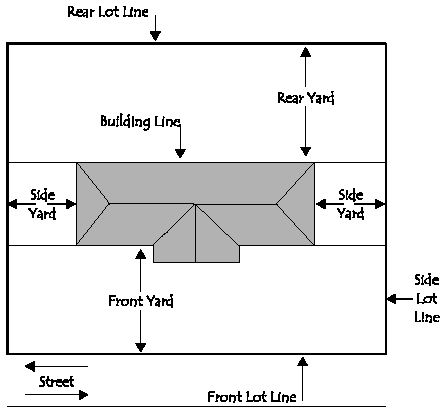
Yard. An open space between a building and the adjoining lot lines, other than a court on a lot, unoccupied and unobstructed by any portion of a structure from 2½ feet above the ground, except as otherwise provided herein (see exhibit 35-92K for examples of yard types).
Yard, front. An open space across the full width of the lot extending from the front line of the main building, or nearest principal building, to the front line of the lot where it fronts or abuts the street. Corner lots and double frontage lots shall be considered by this ordinance to have two front yards.
Yard, side. An open space extending the full length of the lot between the main building, or nearest principal building, and the side line of the lot, and extending from the front yard to the rear yard line.
Exhibit 35-92L- Zero Lot Line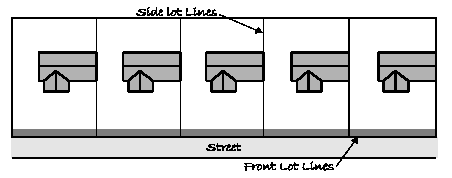
Yard, rear. An open space extending the full width of the lot between the main building, or nearest principal building, and the rear lot line, not including projections of uncovered steps, unenclosed balconies or unenclosed porches, to the closest point of the rear lot line.
Yard width and depth. The shortest horizontal distance from a lot line to the main building.
Zero lot line. The location of a building on a lot in such a manner that one or more of the building's sides rests directly on a lot line (see exhibit 35-92L for examples of zero lot line lots.)
(Ord. 14052, § 3, 6-19-2006; Ord. No. 14829, § 21, 8-1-2011; Ord. No. 15289, § 5, 7-21-2014; Ord. No. 15412, § 2, 7-20-2015; Ord. No. 15541, § 2, 7-26-2016; Ord. No. 15647, § 4, 4-17-2017; Ord. No. 15686, § 4, 7-17-2017, Ord. No. 15761, § 7, 1-03-2018; Ord. No. 15888, § 3, 3-19-2019; Ord. No. 15926, § 3, 6-3-2019; Ord. No. 15934, § 1, 7-15-2019; Ord. No. 16392, § 3, 12-18-2023; Ord. No. 16466, § 9, 10-22-2024)

