
Jefferson City City Zoning Code
ARTICLE VII
ADMINISTRATION AND PROCEDURES
Sec. 35-70.- Application, permit processing, hearing procedures.
A.
Review and approval. The policies and regulations in this ordinance apply to the use and development of land. Any person proposing a land use or development shall comply with the procedures of this article. Exhibit 35-70A summarizes the procedures and agencies and public bodies involved in the development proposal process. Detailed information about the procedures applications and the agencies and public bodies involved in the process are further discussed in this article.
Exhibit 35-70A: Development Review Procedures Summary
B.
Common elements of procedures. The specific procedures followed in reviewing the various proposals differ. Reference should be made to the appropriate section in this ordinance which deals with the procedures and requirements of a particular application. Generally, the procedures for all applications have three common elements: (1) submittal of a complete application, including required fee payment along with appropriate information; (2) review of the submittal by appropriate City staff and related agencies; and (3) action to approve, approve with conditions, or deny approval of the application. The following elements are common to all procedures unless otherwise modified by more specific provisions. The time frames specified for action on the part of the City are maximums. Exhibit 35-70B generally shows the approval review process.
C.
Pre-application conference.
Exhibit 35-70B
Administrative Approval
Review Process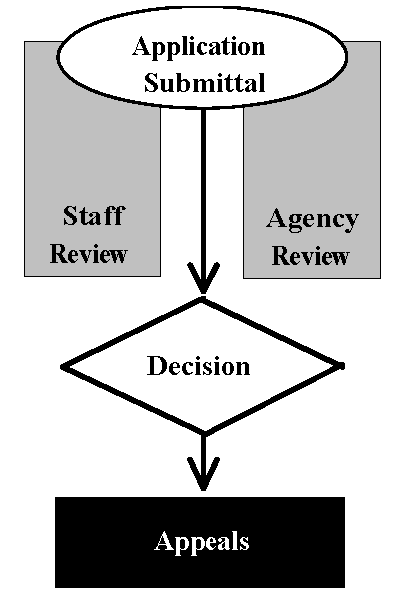
1.
When required. The applicant shall meet with the Director to discuss the nature of the proposed development, application submittal requirements, the procedure for action and the standards for evaluation of the application. Exhibit 35-70 shows when a pre-application conference is required or optional/ recommended.
2.
Submittal requirements defined. Submittal requirements are typical. The type, scope, or location of any specific development application may require different types or levels of information. At the pre-application conference, the Director shall determine what information shall be submitted to provide for an adequate assessment of the project. At any time during the processing of any application, additional information may be required to respond to issues or concerns that may not have been evident at the pre-application conference. Requirements and information from the pre-application conference shall be recorded on a form supplied by the Planning and Protective Services Department and made part of the development file upon submittal of an application.
D.
Application requirements.
1.
Materials. Current application materials, including forms, checklists and schedules for submittal may be obtained during normal business hours from the Office of the Director.
2.
Application time frames for Board of Adjustment or Planning and Zoning Commission. Applications to be referred to the Board of Adjustment or Planning and Zoning Commission shall be filed at least 20 working days prior to the scheduled meeting date.
3.
Number of copies. Four copies of each application, site plan and supporting documentation shall be submitted for initial staff review. Additional copies shall be required for distribution to the Board of Adjustment, Planning and Zoning Commission or and/or City Council, to be submitted at the appropriate time and in the number as specified by staff.
4.
Application fees.
a.
Any action on an application for a development pursuant to this article shall be subject to the required fee in the amount as established by the Council. The filing fee is the approximate cost to cover processing costs, including mailed notices, posting of signs and public hearings, if required.
b.
All fees shall accompany the application, shall be made payable to the "City of Jefferson" and shall be submitted to the Director. Under no condition shall the fee or any part thereof be refunded for failure of said application to be approved or adopted by the Council, Commission, Board or Director.
5.
Review of completeness of application. Within ten days of submission, the Director shall review the application and determine if the application is complete pursuant to the provisions of this article. If the application is incomplete or is submitted prematurely, the Director shall return it to the applicant to be completed and resubmitted in conformance with the standards of this ordinance.
6.
Director's report and recommendation. When the director is required to refer a development application to a decision-making body, the Director shall prepare a report with his or her recommendation for action and provide it to the applicant and the decision-making body at the hearing on the application. The report shall include the recommendations of City departments and other reviewing agencies.
E.
Staff review procedures.
1.
Staff review. All applications shall be reviewed by the Director or staff for compliance with City codes and policies. Upon completion of staff review, staff comments shall be provided in writing to the applicant.
2.
Review by other City departments and outside agencies. The Director or staff may forward copies of the applications to various affected City departments and outside agencies for their review of the material submitted.
3.
Agency and department comments. The Director shall request the above agencies and departments to respond, in writing, to the requested review within 15 days of receipt of the application, however, failure to act within this time period does not deem the request approved. The agencies' and departments' review shall be advisory in character, and does not constitute approval or disapproval. All comments shall be made available to the applicant for response.
4.
Applicant's response. The applicant shall have ten days to respond to staff and agency comments.
F.
Director's decision.
1.
Action. After the applicant has had the opportunity to respond to the comments of staff and other agencies, the Director shall recommend or deny approval of the application based on the applicable review criteria.
2.
Authority to condition development approvals. After review of the application and other pertinent documents, the Director may impose conditions as are reasonable and necessary to assure compliance with applicable general or specific standards stated in this ordinance. The Director shall include a copy of the conditions with the record of the decision. The applicant shall be notified of any conditions imposed on the application.
G.
Public hearings and notice.
1.
Purpose. Public hearings and notice thereof provide the opportunity for input in decisions that may affect the community. Public participation ensures that decisions reflect consideration of the community interest and ensure that the applicant and other interested parties are given due process and the opportunity to be heard.
2.
Published notice. Notification shall be done in conformance with RSMo chs. 89 and 610.
a.
Except as otherwise specifically provided in this section, in any instance in which a public hearing is required, a notice shall be published at least once. The notice of each hearing to be held by decision-making bodies may be included in a single notice. The notice shall be provided in conformance with exhibit 35-70. The Director shall be responsible for publication of the notice.
b.
Notice time shall be computed in accordance with RSMo § 1.040, and section 12.9 of the Charter of the City of Jefferson.
c.
With all other required application materials, the applicant shall provide the information required for the notice to the Director who shall be responsible for preparing the notice for publication.
d.
The notice of public hearing shall contain the following information at a minimum:
(1)
The time, date and place of the hearing; and
(2)
The location of the property including a legal description; and
(3)
The boundaries of the area proposed for amendment or development; and
(4)
A statement that interested parties shall be given a chance to be heard.
e.
The notice of the public hearing shall be published at least once 15 days before the date of the public hearing, in one or more newspapers of general circulation in the City.
3.
Mailed notice of public hearing.
a.
Mailed notice of a public hearing shall be sent by the Director by regular first class U.S. mail. The notice shall be mailed to each affected property owner at the mailing address listed in the official records of the Assessor's Office in the County in which the property is located.
b.
The point at which the distance is measured for the mailed notice shall include the subject property and property within 185 feet of the boundaries of the subject property drawn parallel to the boundaries excluding intervening streets, and other public rights-of-way.
c.
The content of the mailed notice shall be in conformance with subsection 35-71.E.3. The mailed notice must also include a statement explaining that this is a courtesy notice and not required by law.
d.
The failure of a property owner to receive notice by mail shall not be grounds for invalidating any action taken by the responsible decision-making body.
4.
Property sign. When required by exhibit 35-70, the Director shall post distinctive signs, with minimum dimensions of 24 inches by 24 inches giving notice of the date, time and place of the hearing and of the action requested. The Director shall post at least one sign on the subject property at least ten calendar days but not more than 15 calendar days prior to the hearing in conspicuous places visible from every street along the frontage of the subject property. The sign(s) shall remain posted on the property until after the close of the public hearing. The failure to post signs upon the property or retain notification signs upon the property shall not be grounds for invalidating any action taken by the responsible decision-making body.
5.
Agenda notice. Notice of all public hearings shall be posted at City Hall at least 24 hours prior to any public hearing.
6.
Notification of appeal. Whenever an appeal is taken from a final decision from development permit which was obtained following a public hearing, notice of the appeal shall be prepared and made in the manner prescribed by this section or other applicable section.
7.
Notification of revocation. If the final decision making body makes the determination to revoke a variance, conditional use permit, special exception permit or other development permit granted under this ordinance, notice of the revocation shall be prepared and made in the manner prescribed by section 35-70.
H.
Administrative review public hearing procedures.
1.
Purpose. The purpose of an administrative review public hearing is to allow the applicant and all other interested parties a reasonable and fair opportunity to be heard, to present evidence relevant to the application, and to cross-examine witnesses and rebut evidence presented by others. Public hearings are required for administrative hearings such as conditional use permits, special exception use permits, appeals, and variances to provide procedural due process.
2.
Conduct of public hearing. Public hearings shall be conducted in conformance with RSMo ch. 89 and RSMo §§ 536.070, 536.080, 536.083, and 536.095.
a.
Any person or persons may appear at a public hearing and submit evidence, either individually or as a representative of an organization. Each person who appears at a public hearing shall state, for the record, his or her or her name, address, and if appearing on behalf of an organization, the name and mailing address of the organization.
b.
The order of proceedings shall be as follows:
(1)
The Director or appropriate staff member shall present a description of the proposed development and written or oral findings, if required. The findings shall address each factor required by this ordinance to be considered prior to action or approval on the development permit.
(2)
The applicant may present any information that the applicant deems appropriate;
(3)
Public testimony shall be heard first in favor of the proposal, then in opposition to it;
(4)
The Director or other staff member may respond to any statement made by the applicant or any public comment;
(5)
The applicant may respond to any testimony or evidence presented by the staff or public; and
(6)
The body conducting the hearing shall close the public portion of the hearing and conduct deliberations prior to acting on an application.
3.
Notice of proceedings. Proceedings shall be instituted pursuant to RSMo § 536.063, and notice shall be provided pursuant to RSMo § 536.067, provided, however, that (1) notice by mail shall not be required, as notice by publication is permitted by this ordinance and by statute, and (2) responsive pleadings shall not be required, as would otherwise be provided by RSMo § 536.068. Discovery shall be permitted as required by RSMo §§ 536.073 and 536.077. Any proceeding may be disposed of by informal disposition pursuant to RSMo § 536.060. Decisions shall be rendered and transmitted pursuant to RSMo § 536.090.
4.
Record of proceedings.
a.
The body conducting the hearing shall record the proceedings by any appropriate means as prescribed by rule and consistent with RSMo §§ 610.020 and 536.070(4). Such record shall be provided at the request of any person upon application to the City Clerk and payment of a fee set by the Council to cover the cost of duplication of the transcribed record.
b.
Testimony and statements of opinions, the minutes of the secretary, applications, exhibits submitted, all staff and advisory body or Commission reports and recommendations, and the decision and report(s) of the body before which the hearing is heard, shall constitute the record.
c.
The record shall be open for inspection at reasonable times and upon reasonable notice.
d.
The body conducting the hearing shall appoint, by rule, a custodian of records.
5.
Continuance of proceedings.
a.
Any applicant or authorized agent of an applicant shall have the right to one continuance before the Planning and Zoning Commission, Board of Adjustment or Council, provided that a written request is filed.
b.
The hearing body may grant a continuance at any time for good cause shown. All motions to grant a continuance shall state the date on which the matter is to be heard. A majority vote of those members in attendance shall be required to grant a continuance.
(1)
The record shall indicate the reason such continuance was made and any stipulations or conditions placed upon the continuance.
(2)
If the Commission, Board of Adjustment or Council, continues a public hearing on its own motion, it may direct the Director to renotify property owners, if such notice was required in the first instance.
(3)
If the continuance of a public hearing is made at the request of an applicant, the hearing body may direct the Director to renotify property owners, if such notice was required in the first instance.
(4)
Renotification shall be made by regular first class United States mail.
6.
Rehearing procedures. The following procedures apply to rehearing the same request and a rehearing on successive or similar applications.
a.
Any interested party may, in writing and within ten days of the Board's decision, request that the Board reconsider any decision which adversely affects such party. The request for rehearing shall be filed in the office of the Director.
b.
The written statement shall set forth the alleged error or omission; any new, pertinent fact; or the material change in fact or circumstance upon which the request for rehearing, is based. The same procedure shall be used for a new hearing of a previous application for the same property, or portion thereof, or for the same or substantially the same purpose, however, such a request shall be considered a new request.
c.
The Board shall consider and vote on the request for the rehearing, or to hear a previous application, and if approved, shall hear the request at the same meeting unless continued for good cause. When determining whether to rehear a request, or hear a previous application, the Board shall limit the testimony to that presented by the party requesting the rehearing. The Board shall rehear the request for rehearing, or hear the previous application only if it determines:
(1)
Certain pertinent evidence was not presented; or
(2)
An error which warrants correction was made at the original hearing; or
(3)
There is new, pertinent evidence; or
(4)
There has been a material change in fact or circumstance.
d.
Requests for rehearing shall be subject to the application filing fee. A new hearing of a previous application shall require the payment of a new filing fee.
I.
Legislative review public hearing procedures (City Council).
1.
Purpose. The purpose of a legislative review public hearing is to provide an opportunity for the public to have input into the process.
2.
Notice of proceedings. Proceedings shall be instituted pursuant to section 35-70 of this ordinance.
3.
Conduct of the hearing.
a.
Public hearings shall be conducted to review the application and evidence presented. If one public hearing has been conducted at which testimony and evidence were presented, it shall not be necessary for the decision-making body to conduct another review of all the material and testimony formerly reviewed.
b.
Parties to the application may provide additional evidence for review that was not formerly submitted or considered and may present closing arguments to summarize their request. The decision-making body may establish a time limit for testimony.
c.
The interested parties shall not have the right to cross examination.
4.
Record of proceedings.
a.
The body conducting the hearing shall record the proceedings by any appropriate means as prescribed by rule and consistent with RSMo § 610.020. Such record shall be provided at the request of any person upon application to the City Clerk and payment of a fee set by the Council to cover the cost of duplication of the transcribed record.
b.
Testimony and statements of opinions, the minutes of the hearing, applications, exhibits submitted, all staff and advisory body or Commission reports and recommendations, and the decision and report(s) of the body before which the hearing is heard, shall constitute the record.
c.
The record shall be open for inspection at reasonable times and upon reasonable notice. The record of the hearing shall be made available to any interested person in conformance with RSMo §§ 610.023 and 610.026.
d.
The agency conducting the hearing shall appoint, by rule, a custodian of records, in conformance with RSMo § 610.023.
5.
Continuance of proceedings. Proceedings may be continued in accordance with section 35-70 of this ordinance.
J.
Appeals.
1.
Appeals of a Director's decision shall be heard by the Board of Adjustment. Appeals shall be filed within ten days of notification of the Director's decision in accordance with the rules prescribed by the Board of Adjustment. Notice shall be given and a public hearing shall be held to consider the appeal in conformance with section 35-70 of this ordinance.
2.
Appeals of a Board of Adjustment decision shall be appealed to the Circuit Court within the time period prescribed by RSMo § 89.110.
3.
Appeals of a decision of the Planning and Zoning Commission shall be appealed to the City Council within the time period prescribed. Notice of the public hearing shall be given in conformance with section 35-70 of this ordinance.
K.
Withdrawal of application. At any time prior to the hearing on an application, the property owner, property owner's attorney, or representative of the property owner who has a notarized affidavit from the property owner authorizing the representative to make the request, may request in writing that the application be withdrawn from consideration. After a hearing is opened an applicant may request withdrawal; however, the body conducting a hearing shall decide whether or not to approve the request and may approve the request with or without prejudice.
L.
Deferral of application. A property owner, property owner's attorney, or representative of the property owner who has a notarized affidavit from the property owner authorizing the representative to make the request, may request up to one deferral of action on any application. An application submitted with insufficient information or one in which the response to comments from the Department or other agencies is inadequate may be deferred from further review and consideration by the Director. In the event of such a deferral, the Director shall provide a notice and explanation to the applicant.
M.
Action on applications requiring notice. The decision-maker may take any action on an application that is consistent with the notice given, including approval, conditional approval or denial of approval of the application. The decision-maker may allow amendments to the application if the effect of the amendment is to reduce the density or intensity of the original application, reduce the impact of the development, or reduce the amount of land involved from that indicated in the notices of the hearing.
N.
Expiration of development approval.
1.
Time of expiration. Unless otherwise specifically provided for in the ordinance, development applications shall automatically expire, and all activities pursuant to such approval thereafter shall be deemed in violation of the ordinance, when:
a.
The applicant fails to satisfy any condition that was imposed as part of the original or revised approval of the development application, or that was made pursuant to the terms of any development improvement agreement application, including the failure to abide by specified time limits established therein; or
b.
The applicant fails to present a subsequent development application as required by this ordinance within the time required. If no time limit for satisfaction of conditions is specified in the original or revised approval of the development application, the time shall be presumed to be one year from the date of approval.
2.
Extension procedures. Unless otherwise prohibited by the ordinance, the Director may extend the time for expiration of a development permit or approval for a period not to exceed two years from the date of the original decision granting approval, unless stated otherwise. Subsequent extensions may be made by the final decision making body upon finding that conditions at the time of approval have not changed.
O.
Post-decision proceedings.
1.
Appeals of action by final decision-maker. Any appeal of a final action by the Director, Council, Commission or Board of Adjustment shall be filed within 15 days of the action being appealed, unless otherwise provided by law.
2.
Stay of action. An appeal stays all proceedings in furtherance of the action appealed unless the Director or other officer from whom the appeal was taken certifies to the Board of Adjustment, after notice of appeal shall have been filed, that by reason of the facts stated in the certificate, a stay would, in the Director's opinion, cause immediate peril to life or property.
3.
Minor amendments and revisions. The Director may approve minor amendments and revisions to the terms of approval of an application for development. Minor revisions must be authorized in writing by the Director and are subject to appeal to the Board of Adjustment. Minor revisions that may be authorized are limited to those that are necessary in light of technical considerations discovered after the decision on the development application by the applicant or the Director. Minor revisions shall not result in higher densities, additional units or floor area, abandonments of easements or variance from the minimum standards of this ordinance. Major amendments and revisions of a development proposal shall be reviewed by the approving body after a public hearing in accordance with the provisions of exhibit 35-70 and section 35-71 and other applicable sections of the ordinance.
P.
Revocation of permit or approval.
1.
Permits may be revoked. The final decision making body may revoke any development permit, including variance, conditional use permit, special exception permit, or other development permit granted under this ordinance for (1) failure of the owner or applicant of the property to comply with any of the conditions imposed when the variance or permit was granted; or (2) discontinuance of the use by the applicant for a continuous period of nine months.
2.
Duties of Director. If the Director determines that there are grounds for revocation of a development permit or approval, after a reasonable attempt to secure compliance, the Director shall prepare a report outlining the allegations as well as the attempt(s) to secure compliance and set a hearing date before the final decision-maker.
a.
If the decision was made by the Director, the hearing shall be conducted by the Board of Adjustment.
b.
If the Council was the original decision-maker, the Council shall conduct the revocation hearing, however it may refer the proposed revocation to the Planning and Zoning Commission for a recommendation prior to the hearing.
c.
If the Board of Adjustment was the original decision-maker the revocation hearing shall be conducted by the Board of Adjustment.
3.
Notice and public hearing.
a.
If no hearing was held prior to obtaining the development permit notice of revocation shall be given only to the holder of the permit.
b.
Notice of the revocation hearing shall be given in the same manner as required for the original application. If a public hearing was conducted to obtain the permit, a revocation shall be processed in the same manner as the development permit was obtained. A revocation hearing may be scheduled for any regular or special meeting.
c.
The applicant shall be notified by certified mail and receive a copy of the Director's report with the allegations. The owners of record within the notification area shall be notified by regular mail postmarked not less than ten days prior to the revocation hearing.
4.
Decision and notice. After the conclusion of the hearing, the decision-maker shall render a decision to (1) revoke the permit, (2) allow the applicant to retain the development permit, with or without corrective action; or (3) continue the hearing to a future specified date in order to obtain more information or to monitor corrective action. The decision shall be made in writing to the holder of the permit and any other person who has filed a written request for such notice.
5.
Effect and appeals.
a.
If the applicant fails to take action to correct the alleged violations, the decision making body may direct the Director to revoke the permit, compel the structures or uses to be removed at the cost of the violator and secure a judgment against the applicant for such cost.
b.
A decision to revoke a development permit shall become final 15 days after the date the decision is rendered, unless appealed. After such effective date of revocation, any activities continuing pursuant to such permit shall be deemed to be in violation of the ordinance.
6.
Right cumulative. The City's right to revoke a development permit, as provided in this section, shall be cumulative to any other remedy allowed by law.
Q.
Applications filed in the public interest. Applications may be initiated by the Council, Planning and Zoning Commission, Board of Adjustment, City Agencies or City Staff subject to the following:
1.
Applications initiated by the Council, or a City Board or Commission shall be accompanied by a resolution of the body pertaining to such application.
2.
Applications initiated by City staff shall be accompanied by a narrative pertaining to such application.
3.
No fee shall be assessed for applications filed in the public interest.
4.
Applications shall not be subject to the application deadline, except that the procedures established for notice and hearing requirements shall be followed, if required by exhibit 35-70A.
R.
Amendments. A permit shall be amended in the same manner as it was originally approved.
(Ord. No. 16568, § 2, 12-15-2025)
Sec. 35-71. - Site plan review.
A.
Purpose. The purpose of site plan review is to ensure that the new structures, utilities, streets, parking, circulation systems, and open spaces are developed in conformance with the standards of this ordinance and the comprehensive plan.
B.
Applicability. No building permit shall be issued for a development until a site plan has been approved in accordance with this section. A site plan shall be required for all land uses except those specifically exempted below, including new construction, exterior additions or changes in use to any main building, accessory building, structure, land, or parking lot.
1.
Relationship to conditional use or special exception use. When a conditional or special exception use application is reviewed, or when the final plan for a planned development is reviewed, the site plan review may be conducted concurrently with those reviews.
2.
Change of use to a permitted use that does not result in an increased parking demand or increased traffic demand,
3.
For non-residential properties, those remodeling projects which do not change the use or occupancy load of the building;
4.
Fences and walls, if not part of an overall development plan, shall submit plans in accordance with sections 35-59 and 35-72D.
5.
For residential properties, internal remodeling projects which do not change the occupancy of the building or the number of units.
C.
Application and review procedures.
1.
A property owner or designated representative shall initiate site plan review initiation by filing an application with the Director and paying the filing fee, after the completion of a pre-application conference, if one is required.
2.
Where a site plan is submitted for an individual phase of a development on a single parcel, the applicant shall also prepare a conceptual site plan for the remainder of the parcel. The conceptual site plan shall indicate the approximate location of development on the remainder of the parcel, together with proposed driveways, streets and drainage system.
3.
Site plans may be prepared on one or more sheets to show clearly the information required by this article and to facilitate the review and approval of the plan. If prepared on more than one sheet, match lines shall indicate where the several sheets join.
4.
Site plans shall include the information listed in exhibit 35-71A or exhibit 35-71B, as appropriate. The Director may establish additional requirements for preliminary site plans, and in special cases, may waive a particular requirement if, in his or her opinion, the inclusion of that requirement is not essential to a proper decision on the project.
Exhibit 35-71A: Site Plan Content for Buildings with One, Two or Three Units on Individual Lots
Exhibit 35-71B: Site Plan Contents: Residential Buildings with Four or More Units, Non-Residential Uses, Conditional Uses and Special Exception Uses
D.
Review criteria. The application shall demonstrate that the proposed development shall comply with the following:
1.
Adopted plans and policies, such as:
a.
The comprehensive plan and any applicable neighborhood plans; and
b.
The thoroughfare plan, greenway system plan and other applicable plans and policies of the City.
2.
Adopted standards and technical manuals, such as: Storm Drainage Design Manual; Driveway Construction Standards.
3.
Applicable purposes and intents and all development standards of this ordinance, such as:
a.
The underlying zoning district; and
b.
The Site Design and Improvement Standards of this ordinance.
4.
Quality site design principles, such as:
a.
Structures and other site features shall be arranged to permit access by emergency vehicles to all buildings.
b.
The proposed plan shall demonstrate that essential services and roads, recreation and public safety service are available, or shall be available, as necessary to serve the needs created by the proposed development.
E.
Decision-maker. Refer to exhibit 35-70A and the specific application type for information on the approval authority. Site plans shall be approved, conditionally approved or denied.
F.
Validity, duration.
1.
Site plan approval is valid for one year, and shall lapse one year from the date of site plan approval, unless a building permit is issued and construction is commenced. An extension may be granted upon a showing of cause by the applicant but for not more than six additional months.
2.
Site plan approval shall be valid as long as the applicant retains a valid building permit.
3.
Upon completion of the project as approved, site plan approval shall run with the land and shall continue to be valid upon a change of ownership of the site or structure which was the subject of the application.
Sec. 35-72. - Staff approval—Development permits.
A.
Planning clearance.
1.
Purpose. Planning clearances are intended to ensure that all development applications are consistent with the intent of the comprehensive plan and the provisions of City ordinances.
2.
Applicability. No land shall be occupied or used, no building hereafter erected or modified, and no change of use shall be made in any building or part thereof, until a planning clearance has been issued by the Director. No building permit shall be issued to make a change unless the changes are in conformity with the provisions of this ordinance. A planning clearance shall not be required for normal property maintenance that does not alter the structure.
3.
Initiation. A request for a planning clearance may be initiated by the applicant or the Director as follows:
a.
At the applicant's option, a planning clearance may be requested prior to submitting any other development application, or may be processed simultaneously with and within the same time frame as other applications if other applications have been submitted.
b.
A planning clearance for multiple lots in a single-family residential subdivision may be issued simultaneously with the processing of a final subdivision plat, upon request by the applicant.
4.
Review criteria. Planning clearances shall be in such form as prescribed by the Director. A planning clearance shall be approved by the Director if:
a.
The use is consistent with the land use and intensity established in the comprehensive plan for that property;
b.
The use is consistent with the thoroughfare plan, greenway system plan and other plans adopted by the City;
c.
The use or development is on a legally created lot or parcel;
d.
The use is authorized in the zoning district; and
e.
The development complies with the standards and conditions of applicable ordinances.
5.
Decision-maker. The Director shall approve, conditionally approve or deny approval of all planning clearances.
6.
Validity. Planning clearances issued in accordance with the provisions of this section shall expire with the expiration of site plan approval, or the building permit application, as applicable; or within six months from the date of issuance if a business license has not been obtained.
B.
Building permits.
1.
Purpose. The purpose of the building permit regulations is to ensure that all structures comply with the provisions of this ordinance and the adopted building code and any other applicable adopted health and safety codes, and other adopted regulations of the City, County, state or federal agencies.
2.
Applicability. No person shall construct or modify a structure until a planning clearance and a building permit have been obtained. A building permit shall not be required for normal property maintenance that does not alter the structure.
3.
Review criteria. The proposed structure shall:
a.
Have an approved planning clearance;
b.
Be constructed on a legally established parcel or lot;
c.
Have access to essential services, as defined in article IX, to serve the use;
d.
Indicate that all applicable local, state and federal permits have been issued or are in the process of being obtained;
e.
Conform with the adopted building code, fire code, electrical code, mechanical code and any other applicable codes and policies adopted by the City, County, state and federal agencies;
f.
Be constructed and used in a manner that is consistent with:
(1)
The land uses and intensities established in the comprehensive plan;
(2)
The provisions of the adopted building code;
(3)
The provisions of this ordinance;
(4)
The overall site plan approved for the development, if applicable.
4.
Decision-maker. The Director shall approve, conditionally approve or deny approval of all applications for building permits.
5.
Application and review procedures.
a.
An application for a building permit may be submitted by the owner or lessee, or agent of either, or the architect, engineer or builder employed in connection with the proposed work. If the application is submitted by a person other than the owner in fee, the permit shall be accompanied by a duly signed and verified affidavit from the owner in fee authorizing the applicant to make the request for the permit. The permit application shall include a brief description of the project to be accomplished. The permit application shall contain the full names and addresses of the applicant and of the owner, and, if the owner is a corporate body, of its responsible officers.
b.
The application for a building permit shall be accompanied by the building plans showing the proposed work, drawn to scale, including such floor plans, sections, elevations and structure details, as the Director may require. A site plan, in conformance with section 35-71, shall accompany the building permit application. The Director may waive this requirement for any internal remodeling project that is projected to cost less than $25,000 and that does not result in an increased parking demand or increased traffic demand.
c.
A plot diagram, prepared in a form and size suitable for filing permanently with the permit record, shall be submitted with the building permit application and for all residential buildings. It shall be drawn to scale, with all dimensions figured, showing accurately the size and exact location of all proposed new construction or, in the case of demolition, of the structures which are to be demolished, and of all existing buildings.
6.
Amendments and adjustments.
a.
Amendments to the building plans may be filed at any time before the completion of the work for which the permit was sought. Such amendments, after approval, shall be filed with and be deemed a part of the original application. If the amendment changes the building footprint or affects the site plan design, an amended site plan shall be required except as provided in this section.
b.
Field adjustments. Field adjustments for one-, two- and three-unit residential buildings may be authorized if such adjustments do not violate any provision or this chapter or alter the approved stormwater plan.
7.
Completion of buildings.
a.
Nothing contained in this section shall require any change in the plans, construction, size or designated use of a building, for which a valid permit has been issued or lawful approval given before the effective date of the Ordinance which adopted this section.
b.
Residential and non-residential construction. Buildings shall have been started within six months of the issuance of building permit; and the entire building completed within two years.
8.
Condition of the permit. All work performed under a permit issued by the Director shall conform to the approved application and plans, and approved amendments thereof. The location of all new construction as shown on the approved plot diagram, or an approved amendment thereof, shall be strictly adhered to. It shall be unlawful to reduce or diminish the area of a lot or plat of which a plot diagram has been filed and has been used as the basis for a permit, unless a revised plot diagram showing the proposed change in conditions shall have been filed and approved provided that this shall not apply when the lot is reduced by reason of a street opening or widening or other public improvement.
9.
Signatures on permit. The applicant and the Director, or the Director's designee, shall sign the permit.
10.
Posting of permit. A copy of the permit shall be kept on the premises open to public inspection during the work and until the completion of same. The Director may require a certified copy of the approved plans to be kept on the premises at all times from the commencement of the work to the completion thereof.
11.
Notice. The Director shall be given at least four hours notice of the starting of work under a permit.
12.
Revocation. The Director may revoke a permit or approval issued under the provisions of this section in case there have been any false statements or misrepresentation as to a material fact in the application or plans on which the permit or approval was based.
13.
Excavation permit. No permit for excavation for any building shall be issued before application has been made for a building permit.
14.
Validity. The building permit shall be valid for the use for which the building permit was granted, as long as the use is in compliance with applicable codes, providing that within six months of issuance of the planning clearance a certificate of occupancy has been applied for and obtained by the applicant. A one-time extension of six months may be granted by the Director.
C.
Certificate of occupancy.
1.
Purpose. The purpose of a certificate of occupancy is to ensure that all structures and uses comply with the permits issued for the development and the provisions of this ordinance and shall be applied for concurrently with the application for a building permit.
2.
Applicability. No vacant land shall be occupied or used, except for agricultural purposes, and no building or structure shall be occupied or used (including change of use) or hereafter erected or structurally altered until a certificate of occupancy has been issued by the Director.
3.
Content of certificate of occupancy. The certificate of occupancy shall state that the building or proposed use of a building or land complies with all the building codes and health regulations and ordinances and the provisions of these regulations. A record of all certificates shall be kept on file in the office of the Director and copies shall be furnished, upon request, to any person having a proprietary or tenancy interest in the building affected.
4.
Certificate of occupancy review criteria.
a.
Comply with all adopted building codes, fire codes, electrical codes, mechanical codes and any other applicable codes and policies adopted by the City;
b.
Conform with the approved plans and any conditions placed thereon by the Director;
c.
Successfully pass all required inspections which shall include, but not be limited to:
(1)
Building;
(2)
Site;
(3)
Landscaping;
(4)
Parking;
(5)
Drainage and stormwater.
5.
Decision-maker. The Director shall approve, conditionally approve or deny approval of all applications for certificates of occupancy.
6.
Issuance of a certificate of occupancy. The applicant shall notify the Director ten days prior to the date of inspection for a certificate of occupancy. The certificate of occupancy shall be issued within five business days of the date of a satisfactory inspection documenting that the work is complete.
7.
Issuance of a temporary certificate of occupancy.
a.
A temporary certificate of occupancy (TCO) may be issued by the Director for a period not exceeding six months. The applicant shall submit a written request for the TCO explaining the reasons for delay of completion of the work and the timetable for completion. The TCO shall not relieve the applicant of completion of the work as approved nor of the necessity to ensure safety of the occupants during the period of partial occupancy pending completion of the building.
b.
If site improvements can not be completed due to inclement weather, the Director may issue a temporary certificate of occupancy for a period not to exceed six months, provided that the applicant provides security for all improvements that have not been completed equal to 125 percent of their value. The security shall be in the form of a cash deposit made to the City, or a letter of credit or disbursement agreement from an authorized financial institution.
D.
Fence permit.
1.
Purpose. The purpose of a fence permit is to ensure that fences are located and constructed in a safe, durable and aesthetically pleasing manner and in conformance with section 35-59.
2.
Applicability. No person shall erect a fence until a fence permit has been issued by the Director. Agricultural fences are exempt from the provisions of this section.
3.
Application and review procedures. Application requirements shall comply with those described in section 35-70, except as follows:
a.
A fence plan shall show:
(1)
The method of construction and anchoring the fence, posts and gates;
(2)
The distance between the fence and the abutting property lines and right-of-way lines; and
(3)
The height of the fence.
b.
Fence permits shall expire one year from the date of issuance unless the fence has been constructed in accordance with the permit.
4.
Review criteria.
a.
All fences shall be designed, constructed and erected in conformance with the fence standards in section 35-59.
b.
Fences shall comply with the visual clear zone requirements of section 35-55.
c.
No fence shall be permitted on right-of-way.
5.
Decision-maker. The Director shall approve, conditionally approve or deny approval of all applications for fence permits.
E.
Home occupation permit.
1.
Purpose. The purpose of a home occupation permit is to ensure that all home occupations are conducted in a safe manner without adverse affects on adjacent residences.
2.
Applicability. No person shall conduct a home occupation until a home occupation permit has been issued by the Director. Certain home occupations may require a conditional use permit which shall be applied for concurrently with the home occupation permit.
3.
Application and review procedures. The applicant shall file a completed application in conformance with article VII and shall provide the following additional information:
a.
Additional information required:
(1)
Driveway location and dimensions and off-street parking, and if home occupation is to be a day care service, show the area proposed to be used for drop-off.
(2)
Location of existing and proposed fencing, bufferyards, and, if a day care home or day care service, the outdoor play area.
(3)
Interior floor plan showing the location of the home occupation, and, if day care, the child care area, kitchen, bathroom, entrances and exits.
b.
Written information to be included:
(1)
Name, address and phone number of the applicant.
(2)
Name, address and phone number of the owner of the property.
(3)
If applicant is not the owner, include a notarized statement from the owner that the applicant has permission to have a home occupation on the premises.
(4)
Indicate if the applicant resides on the property.
(5)
Days and hours of operation.
(6)
Number and names of persons who will be involved in the home occupation.
(7)
Approximate number of deliveries expected per week and type of delivery vehicle.
(8)
If a day care service, include the number, relationship and ages of the children to be in care.
(9)
Other licenses and permits applied for; day care service applicant to provide evidence that a State day care license has been applied for.
4.
Review criteria. The application shall be approved if the proposed home occupation will be conducted in conformance with the home occupation standards established in section 35-41 of this ordinance.
5.
Decision-maker. The Director shall approve, conditionally approve or deny approval of all home occupation permits unless a conditional use permit is also required.
6.
Validity. A home occupation permit shall be valid for one year and shall be renewed at the same time the city business license is renewed except that a home occupation permit for day care service shall be renewed every two years if it is also required to be licensed by the state.
F.
Temporary use permits.
1.
Purpose. A temporary use permit is intended to ensure that temporary uses are conducted in a safe manner which mitigates potential adverse impacts on City infrastructure and adjacent properties.
2.
Applicability. No person shall establish a temporary use until a temporary use permit has been obtained from the Director. The following temporary uses shall be exempt from the requirements of this section:
a.
Special events and activities conducted on public property such as school sites and City parks; and
b.
Christmas tree sales, seasonal greenhouses (accessory to established business), and seasonal sale of agricultural products.
3.
Application and review procedures. The applicant shall file a completed application in conformance with sections 35-70. The application shall describe the location and operation of the proposed temporary use in sufficient detail to ensure that the use shall be conducted in accordance with the temporary use regulations in section 35-41.
4.
Review criteria. The applicant shall demonstrate that the proposed development shall comply with the following criteria:
a.
The uses are authorized temporary uses pursuant to section 35-41;
b.
The use shall not be detrimental to the public health, safety and general welfare;
c.
The use shall not be located on publicly owned property unless the applicant first obtains applicable permits through the City or other public property owner;
d.
Adequate off-street parking shall be provided to serve the use. The entrance and exit drives comply with this ordinance, except that paving shall not be required for a temporary use;
e.
Structures and/or display of merchandise:
(1)
Shall comply with the yard and property line setback requirements of the zone district within which the use is located;
(2)
Shall not interfere with the visual clear zone of the intersection, in conformance with section 35-55; and
(3)
Shall not use the public right-of-way for any activity but site access.
f.
For temporary sales, a sales tax license shall be obtained from the Missouri Revenue Department;
g.
A City business license shall be obtained; and
h.
Signage for temporary uses shall be in conformance with chapter 3, Advertising and signs.
5.
Decision-maker. The Director shall approve, conditionally approve or deny approval of all temporary use permits.
6.
Validity. A temporary use permit shall be valid for a maximum period of six months and shall be neither transferable nor extendable.
G.
Telecommunications facility permit.
1.
Purpose. The purpose of a telecommunication facility permit is to ensure that the antennas and antenna tower are installed safely, do not pose potential burdens on the public, and comply with the standards of article IV, section 35-42.
2.
Applicability. The placement of telecommunications facilities is a permitted use or a permitted accessory use in several districts as set forth in exhibit 35-28 and section 35-42. Applications for permitted uses shall adhere to the application and review procedures of this section.
3.
Application and review procedures.
a.
Applications for a telecommunications facility permit shall be made on the appropriate forms to the Director and accompanied by a payment of the telecommunication facility permit review fee as outlined in appendix Y. Deposit of funds for reimbursement of professional services, as outlined in appendix Y, shall be submitted with telecommunication facility permit applications for new towers or if requested by city staff for other telecommunication facility permit applications. In addition to the above, upon request by the Director, an applicant shall deposit with the City such additional amounts reasonably necessary to reimburse the City for such anticipated costs and fees for legal, engineering or other contractual or other consultant services determined by the City to be needed in review or action on the application. No application for an administrative permit under this section shall be deemed complete until the applicant has paid all fees and deposits required under this section. Any amount not used by the City shall be refunded to the applicant upon written request after a final decision.
b.
The applicant shall submit, along with its completed application form, a detailed site plan, based on a closed boundary survey of the host parcel, indicating all existing and proposed improvements including buildings, drives, walkways, parking areas and other structures, public rights-of-way, the zoning categories of the subject and adjoining properties, the location of and distance to off-site residential structures, required setbacks, required buffer and landscaped areas, hydrologic features, and the coordinates and height AGL of the existing or proposed telecommunication facility. c. The application shall be reviewed by the Director to determine compliance with the above standards and transmit the application for review and comment by other departments and public agencies as may be affected by the proposed facility. In the event of an incomplete application, the Director shall notify the applicant that their application is incomplete within 30 days, or 15 days for application for small wireless facilities.
d.
The Director shall issue a decision on the permit within 90 days of the date of application for applications requesting co-locations, 45 days for applications requesting co-location of small wireless facilities, 60 days for applications for small wireless facilities that include a new, modified, or replacement utility pole, or 150 days for all other applications or the application shall be deemed approved unless the time period for review and action is extended in writing by the Director or approval authority for reasonable cause. The Director may deny the application or approve the application as submitted or with such modifications as are, in his/her judgment, reasonably necessary to protect the safety or general welfare of the citizens consistent with and to effectuate the purposes of this Chapter. The Director may consider the purposes of section 35-42 and the factors established therein for granting a telecommunication facility permit, as well as any other considerations consistent with section 35-42. A decision to deny an application shall be made in writing and state the specific reasons for the denial.
4.
Appeals. Unless otherwise required by law, appeals from the decision of the Director shall be made first to the Board of Adjustment in accordance with subsection 35-73.C regarding appeals from administrative decisions.
5.
Validity. The telecommunications tower permit shall be valid as long as the facility is in use and is in compliance with all applicable city and federal regulations.
H.
Small wireless facility right-of-way permit.
1.
Purpose. The purpose of a small wireless facility right-of-way permit is to ensure that the small wireless facilities and associated support structures are installed safely, do not pose potential burdens on the public, and comply with the standards of article IV, section 35-42.
2.
Applicability. The placement of small wireless facilities is a permitted use, a permitted accessory use, or a special exception use in several districts as set forth in section 35-42. Applications for permitted uses and applications for uses permitted by special exception permit shall adhere to the application and review procedures of this subsection H.
3.
Application and review procedures.
a.
Applications for a small wireless facility right-of-way permit shall be made on the appropriate forms to the Director and accompanied by a payment of the small wireless facility right-of-way permit review fee as outlined in appendix Y.
b.
Applicants may file a consolidated application and receive a single permit for up to 20 separate small wireless facilities provided that they are for the same or materially same design and geographically proximate.
c.
The applicant shall submit, along with its completed application form, a detailed site plan and construction drawings, indicating all existing and proposed improvements, property lines, existing utilities, height AGL of the existing and proposed facility.
d.
The application shall be reviewed by the Director to determine compliance with the above standards and transmit the application for review and comment by other departments and public agencies as may be affected by the proposed facility. In the event of an incomplete application, the Director shall notify the applicant that their application is incomplete within 15 days for applications for small wireless facilities.
e.
The Director shall issue a decision on the permit within 45 days for applications requesting co-location of small wireless facilities or 60 days for applications for small wireless facilities that include a new, modified, or replacement utility pole, or the application shall be deemed approved unless the time period for review and action is tolled by agreement of the applicant and the City. The Director may deny the application or approve the application as submitted or with such modifications as are, in his/her judgment, reasonably necessary to protect the safety or general welfare of the citizens consistent with and to effectuate the purposes of this chapter. A decision to deny an application shall be made in writing and state the specific reasons for the denial. Applicants may cure the deficiencies identified by the Director and resubmit the application within 30 days of the denial without paying an additional application fee. The Director shall approve or deny the revised application within 30 days. Any subsequent review shall be limited to the deficiencies cited in the denial.
4.
Appeals. Unless otherwise required by law, appeals from the decision of the Director shall be made to the Board of Adjustment in accordance with subsection 35-73.C regarding appeals from administrative decisions.
I.
Change of use permit.
1.
Purpose. The purpose and intent of this regulation are to:
a.
Ensure that the proposed change of use is in conformance with the provisions of the zoning ordinance, the adopted comprehensive plan and other adopted plans.
b.
Ensure that affected review agencies may review the proposed change of use;
c.
Ensure that applicable standards of the adopted building code and the fire code can be complied with; and
d.
Ensure that a planning clearance is issued.
2.
Applicability. This regulation shall apply to a change of use of the principal use of a building or land to another use of a building or land, as defined in article IX. No vacant land shall be used or occupied and no building shall be occupied or used until a change of use permit has been issued.
3.
Application and review procedures. Application requirements shall comply with those described in section 35-70 except as follows:
a.
Provision of adequate on-site parking shall be required for any proposed use requiring more parking than the existing use, except when projected parking demands are increased by fewer than five spaces.
b.
When the property does not comply with existing landscaping standards, the Director may waive up to ten percent of the required parking spaces if additional landscaped area is provided at a ratio of 200 square feet per parking space waived.
c.
The change of use permit shall be valid for the use for which the planning clearance was granted, as long as the use is in compliance with applicable codes, providing that within six months of issuance of the clearance a certificate of occupancy has been obtained by the applicant.
4.
Review criteria. The application shall demonstrate that proposed structure has been constructed and shall be used in conformance with the ordinance, adopted building codes, fire codes, electrical codes, mechanical codes and any other applicable codes and policies adopted by the City. In addition:
a.
The change of use shall be to a use permitted within the zoning district in which it is proposed.
b.
Proposed accessory uses for the proposed change of use shall conform with standards as set forth in article IV.
5.
Decision-maker. The Director shall review all applications for change of use and shall approve, conditionally approve or disapprove all such applications except those involving nonconformities which require a special exception use permit.
6.
Change in use, nonconforming use.
a.
A change of use permit may be approved by the Director for a nonconforming use only if the change in use is to a principal use permitted in the district. Once the change from a nonconforming use to a principal permitted use is completed, no conversion back to the previous non-conforming use shall be permitted.
b.
Change of use from one nonconforming use to another nonconforming use shall be processed as a special exception use permit and in accordance with subsection 35-65.B. Such applications shall be referred to the decision making body with a recommendation from the Director.
(Ord. No. 15888, § 2, 03-19-2019)
Sec. 35-73. - Administrative approval—Development permits.
A.
Conditional use permit.
1.
Purpose. The purpose of conditional use review is to allow the City to exercise some control over the extent of certain activities which, although desirable in limited quantities, could have a detrimental effect on the community if the uses were permitted to exist in large numbers or in certain locations. Therefore, these regulations provide for restrictions or conditions that may be imposed to reduce or mitigate the potential problems associated with the use or its location in relation to the neighboring properties. A conditional use is not a use by right.
Exhibit 35-73A
Conditional Use
Permit Process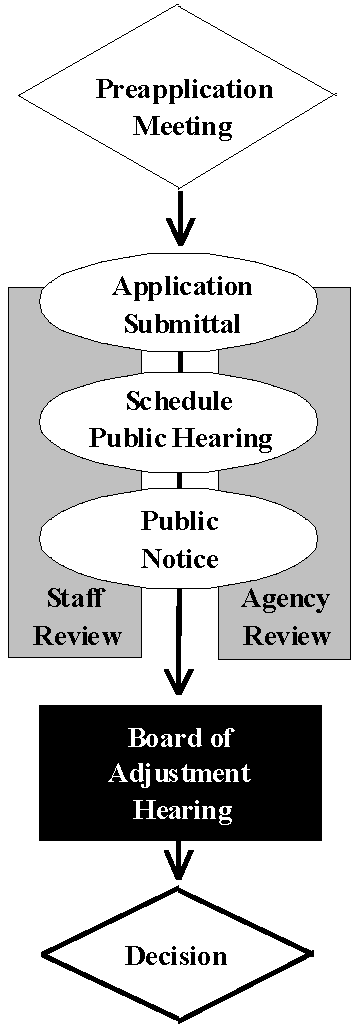
2.
Applicability.
a.
A conditional use, once approved, goes with the land for the approved use only, unless the permit is revoked due to violations enumerated in subsection 35-73.A.7. The designation of a use in a zoning district as a conditional use does not constitute an authorization or assurance that such use will be approved.
b.
An established use which has been reclassified from a permissive to a conditional use by this ordinance shall be permitted to expand onto contiguous land under the ownership of the established use on the effective date of this ordinance. Such expansion may include, but is not limited to, new buildings, building additions, parking lots, and other projects related to and associated with the established use. Such expansion shall be subject to site plan review by staff, outlined in section 35-71. Expansion of the use onto land acquired after May 6, 2002 shall be subject to the conditional use permit process outlined in this section.
3.
Application and review procedures.
a.
The application shall be submitted with a site plan in conformance with section 35-71. The Director shall forward a copy of the complete application and site plans to the Director of Public Works for review. If a zoning amendment is required or requested, such application shall accompany the application for a conditional use permit.
b.
Once the Director has determined that the application is complete, it shall be forwarded with the site plan to the Board of Adjustment for review at a public hearing.
4.
Findings of fact. No conditional use shall be approved unless the Board of Adjustment finds the following:
a.
The proposed use is consistent with the goals, objectives and policies of the comprehensive plan; and
b.
The proposed use complies with all applicable provisions of the zoning district regulations and shall conform to the general intent and purpose of the zoning ordinance; and
c.
The proposed use complies with all fire, health, building, plumbing, electrical and stormwater drainage regulations of the City and regulations of County, state and federal agencies; and
d.
The proposed conditional use is not materially detrimental to the public health, safety, convenience and welfare, or results in material damage or prejudice to other property in the vicinity; and
e.
The proposed use is compatible with and preserves the character and integrity of adjacent development and includes improvements to mitigate adverse development-related impacts, such as traffic, noise, odors, visual nuisances, or other similar adverse effects to adjacent development and neighborhoods; and
f.
The proposed use does not generate pedestrian and vehicular traffic which will be hazardous to the existing and anticipated traffic in the neighborhood; and
g.
Adequate utilities exist to serve the proposed conditional use.
5.
Conditions that the Board of Adjustment may impose. The Board may impose conditions on the use in order to ensure that the use complies with any applicable standards of this ordinance for the use that include, but may not be limited to the conditions listed below:
a.
No conditional use shall be enlarged, extended, increased in intensity or relocated unless an application is made for a new conditional use permit in accordance with the procedures set forth in this section.
b.
Development of the use shall not be carried out until the applicant has secured all the permits and approvals required.
c.
Signage for the use may be limited to protect the neighborhood character. A residence in which one or more home occupations has been permitted shall be limited to one sign, attached to the building, with a maximum size of one square foot, regardless of the number of home occupations operated from the residence.
d.
Due to the operational intensity and nature of the proposed use and the physical development characteristics, the height, bulk and lot coverage, shall be as specified in the permit.
e.
The building materials and architectural style of the building and related structures shall be consistent with and similar to those of adjacent buildings and as specified in the permit.
f.
The Board may determine the type and extent of the bufferyard, and whether a bufferyard is required to mitigate impacts of a proposed conditional use upon adjacent properties, using section 35-59 as a guide.
6.
Decision-maker. The Board of Adjustment shall review the conditional use permit application and any other proposed action related to the permit at a public hearing in conformance with section 35-70, and shall approve, conditionally approve or deny approval of the permit after its hearing. The minutes of the hearing shall reflect the findings of fact demonstrating the reason for the Board's decision. Upon approval of the request, the Board shall authorize the Director to issue the conditional use permit which shall state the conditions and restrictions so that reasonable control may be exercised over the use.
7.
Revocation of a conditional use permit. Any permit by the Board is subject to revocation for any or all of the following reasons.
a.
Non-compliance with any conditions imposed on the conditional use; or
b.
Violation of any provisions of this section and the zoning ordinance pertaining to the use of land, the construction or use of buildings or structures or activities conducted on the premises by the applicant or his or her tenants.
c.
If the Director determines that the conditional use is in violation of the reasons listed, he or she shall prepare a report stating the reasons and forward it to the Board for a public hearing in accordance with section 35-70.
8.
Rehearing procedures. Rehearing requests shall be processed in accordance with section 35-70.
9.
Validity.
a.
The conditional use permit shall run with the land after approval, unless the Board specifically places expiration date on the permit.
b.
The Board may extend a permit for a maximum period of one year if the applicant requests the extension in writing at least 30 days before the expiration of the permit. The request shall be included on the agenda for the next scheduled Board agenda according to the filing calendar.
c.
If after one year of issuance of the conditional permit the construction or use has not commenced, revocation proceedings shall be commenced, using the procedure outlined in section 35-70.
Exhibit 35-73B
Variance procedures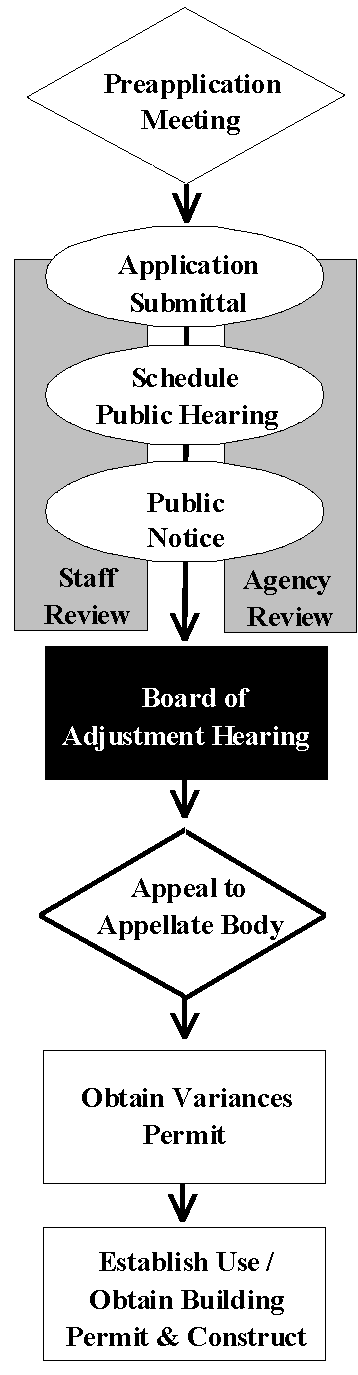
B.
Variances.
1.
Purpose. Variances provide a mechanism for relief from the strict application of this ordinance when it would result in exceptional hardship.
2.
Applicability. The Board of Adjustment shall hear and decide requests for variance from the provisions of this zoning ordinance, chapter 3, Advertising and signs, and chapter 8, article VI, Flood hazard regulations.
3.
Application and procedures. The application shall be filed and processed in accordance with the procedures set forth in RSMo §§ 89.080 through 89.110, and any rules adopted by the Board of Adjustment. The application shall be on a form supplied by the Director. The application shall be signed by all owners of the property and shall include:
a.
The correct legal description of the property,
b.
The current zoning of the property,
c.
The name, address and phone number of at least one property owner, and
d.
A clear description of the request.
e.
In all instances where new construction is involved or where yard or parking variances are requested, a sketch site plan, drawn to scale, showing existing and proposed buildings with their distances from property lines shall be attached to the application.
4.
Findings.
a.
Applicant's responsibilities. When requesting a variance, it shall be the responsibility of the applicant to show how the premises or particular circumstance fully meets all of the findings the Board is required to make.
b.
Required findings, general. Before granting any variance, the Board shall find the proposed variance, if granted, would:
(1)
Not eliminate an adequate supply of light or air to adjacent property, substantially increase congestion in the public street, increase the danger of fire, or endanger the safety of the public; and
(2)
Not be unduly injurious to the use and enjoyment of adjacent property nor would it substantially diminish property values in the neighborhood; and
(3)
Be in keeping with the general spirit and intent of this chapter.
c.
Specific findings. In addition to the general findings, the Board shall also apply the following specific findings, as applicable:
(1)
Variance to density and dimensional standards of section 35-51. The Board shall also find, before granting a variance to any density or dimensional standard that there are practical difficulties associated with the premises which under strict and literal adherence to the provisions of this chapter would cause the applicant an unnecessary hardship.
(2)
Variance to the height regulations. In addition to the general findings, the Board shall also find that the height of the proposed building or structure will not violate any air space height restrictions. In the case of an amateur radio antenna or support structure, the Board in its decision-making process shall make a concerted effort to:
(a)
Strike a balance between the federal interest promoting amateur radio communications and the city's legitimate interest in regulating zoning matters; and
(b)
Make a reasonable accommodation between the federal and city interest.
(3)
Variance to the fence height regulations. The Board shall find, before granting a variance to the fence height regulations, that the applicant has conclusively demonstrated that:
(a)
The specific use of the fence requires a height greater than permitted by this chapter, and
(b)
The variance, if granted, would be the minimum necessary for the fence to serve its purpose.
(4)
Variance to the number of required off-street parking spaces; required specific findings and maximum permitted reductions. In addition to the general findings, the Board shall also find, before granting a variance to the number of off-street parking spaces required by this chapter, that the applicant has conclusively demonstrated that the specific use of a building does not necessitate the total number of required off-street parking spaces. The reduction in the number of spaces which may be authorized by the Board shall not be more than five spaces or 50 percent of the usual requirement, whichever is greater.
(5)
Variance to the location of required off-street parking spaces. In addition to the general findings, the Board shall also find, before granting a variance to the location requirements for off-street parking, that the applicant has conclusively demonstrated that:
(a)
Strict compliance with the location requirements would create an unnecessary hardship, or
(b)
The use associated with the parking does not necessitate close proximity between the parking and the use.
(6)
Variance to the requirements of a neighborhood conservation overlay district. In addition to the general findings, the Board shall also find, before granting a variance to the requirements of a neighborhood conservation overlay district that the applicant has conclusively demonstrated that the variance, if granted, would:
(a)
Not be unduly injurious to the character and visual appearance of the neighborhood.
(b)
Be in keeping with the general spirit and intent of the neighborhood conservation overlay district.
5.
Extent of variance limited and conditions which may be imposed.
a.
Extent of variance limited. A variance, if granted, shall be limited to the minimum variance necessary to resolve, in whole or in part, the particular problem of the applicant.
b.
Minimum practical regulation. The Board's decision, including conditions imposed, if any, shall represent the minimum practicable regulation needed to carry out the intent of this chapter.
c.
Conditions. In granting a variance, the Board may impose such conditions upon the premises receiving the variance as may be necessary to ensure that the variance will not:
(1)
Be unduly injurious to the use and enjoyment of other property in the immediate vicinity.
(2)
Have a significant adverse affect on property values in the neighborhood.
(3)
Endanger or be detrimental to the public health, safety or general welfare of the citizens of the city.
6.
Decision-maker. The Board of Adjustment may grant variances after a public hearing held in conformance with section 35-70.
7.
Rehearing procedures. Rehearing requests shall be processed in accordance with section 35-70.
8.
Validity. A variance shall run with the land after approval. If after one year of issuance of the variance the construction or use has not commenced, revocation proceedings shall be commenced, using the procedure outlined in section 35-70.
C.
Appeals from administrative decisions. Any person, including any officer or agency of the City of Jefferson City, aggrieved by an interpretation of this ordinance by the Director may request appeal of the decision in accordance with this section.
1.
Approval criteria. In granting an appeal to an administrative interpretation, the Board of Adjustment shall determine whether the decision or interpretation by the Director was in accordance with the intent and requirements of this ordinance.
2.
Decision-maker and decision. The Board of Adjustment shall affirm, reverse or remand the decision. In reversing or remanding the decision back to the Director, the Board shall state the rationale for its decision.
3.
Application and review procedures. Requests for an appeal shall be filed in the office of the Director on the forms provided, in accordance with section 35-70. The following information shall be included with the application:
a.
The applicant shall provide a written statement citing the specific provision(s) of this ordinance the applicant believes the Director has incorrectly interpreted and the applicant's own interpretation of the provision(s).
b.
The appropriate fee shall be submitted with the request as may be approved by the Council.
c.
The Director shall prepare a report detailing the specific provision(s) of this ordinance that are in question, his or her interpretation of the provision(s) and the general basis of the interpretation.
d.
The Director shall schedule the appeal to be heard by the Board of Adjustment. The Board shall hold a public hearing in conformance with section 35-70 and render a decision after the close of the hearing.
4.
Rehearing procedures. Rehearing requests shall be processed in accordance with section 35-70.
D.
Special exception use permit.
1.
Purpose. Special exception uses are those uses which generally are compatible with the permitted land uses in a given zoning district, but which require individual review of their location, design and configuration, and require the imposition of conditions to ensure the appropriateness of the use at a particular location.
2.
Applicability.
a.
The designation of a use in a zoning district as a special exception use does not constitute an authorization or assurance that such use will be approved.
b.
Approval of a special exception use permit shall be deemed to authorize only the particular use for which the permit is issued.
c.
No use authorized by a special exception use permit shall be enlarged, extended, increased in intensity or relocated unless an application is made for a new special exception use permit in accordance with the procedures set forth in this section.
d.
Development of a special exception use shall not be carried out until the applicant has secured all the permits and approvals required by this section or by county, state or federal agencies.
Exhibit 35-73C
Special Exception Use
Permit Approval
Plan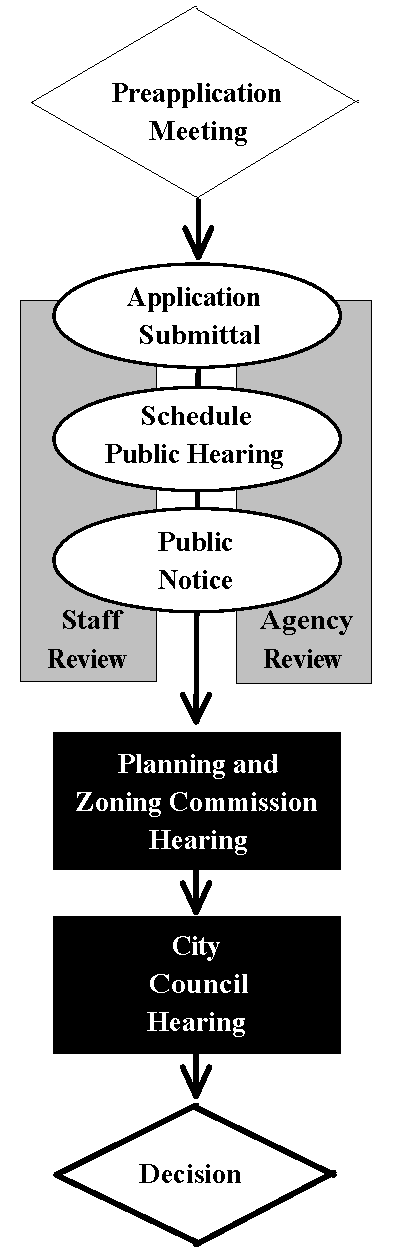
3.
Application and review procedures. Application requirements and processing procedures shall comply with those described in this section and section 35-70.
4.
Review criteria. No special exception use may be approved or established unless the Planning and Zoning Commission shall find that the use:
a.
Is consistent with the purpose and intent of the zoning ordinance; and
b.
Is consistent with the comprehensive plan; and
c.
Shall not substantially and permanently injure the appropriate use of neighboring property; and
d.
Shall serve the public convenience and welfare; and
e.
Shall not over burden the municipal services; and
f.
Shall not cause traffic, parking, population density or environmental problems; and
g.
Shall not adversely affect the health, safety and welfare of the community.
5.
Conditions that may be imposed on the special exception use. Conditions may be imposed on a special exception use. Generally, the conditions applied include the following:
a.
The operation of the use may be limited;
b.
Performance standards may be imposed to ensure that the potential incompatibilities created by the special exception use are mitigated; and
c.
The site design and layout may be adjusted to mitigate potential negative impacts on the neighboring properties.
6.
Decision-maker. The Planning and Zoning Commission shall review the request at a public hearing in conformance with section 35-70 and make a recommendation to the Council. The Council shall review the request at a public hearing and may approve, modify or deny approval of the application. The minutes of the hearing shall reflect the findings of fact based on the review criteria, demonstrating the reason for the Council's decision.
7.
Revocation of a special exception use permit. Any permit granted under the authority of this section is subject to revocation in accordance with subsection 35-70.P for any or all of the following reasons:
a.
Non-compliance with any conditions imposed on the special exception use;
b.
Violation of any provisions of this section and the zoning ordinance pertaining to the use of land, the construction or use of buildings or structures or activities conducted on the premises by the applicant or his or her tenants; and
c.
Violation of any other adopted ordinances, regulations, resolutions or ordinances of the city, county, state or federal law agencies by the applicant or his or her tenants, provided that such violations relate to the conduct or activity authorized by the special exception use permit or the qualifications of the applicant or his or her tenants to engage in such conduct or activity.
(Ord. No. 15344, § 2, 11-17-2014; Ord. No. 15647, § 5, 4-17-2017)
Sec. 35-74. - Legislative approval—Development permits.
A.
Comprehensive plan amendments.
1.
Purpose. The comprehensive plan and development plan land use map (also known as the development plan) may be amended from time to time to ensure they are consistent with the stated goals, objectives and policies included in the plan. The Council may establish a schedule prescribing when and how frequently comprehensive plan and development plan land use map amendments will be considered.
2.
Applicability. All proposed amendments to the text of the comprehensive plan or development plan land use map shall comply with the provisions of this section. Any proposed development that is inconsistent with the goals and policies of the comprehensive plan or development plan land use map shall first receive approval of a comprehensive plan amendment.
Exhibit 35-74A
Comprehensive Plan
Amendment Approval
Process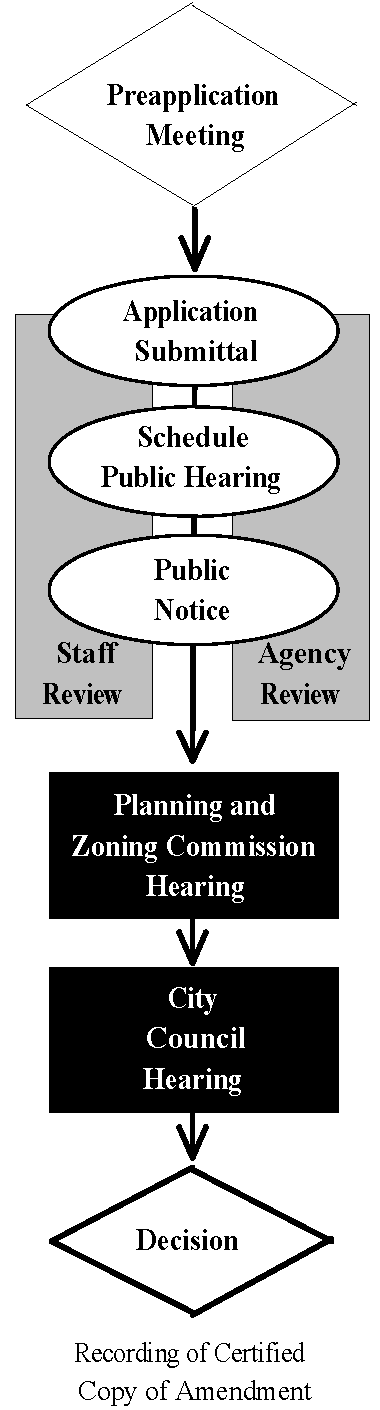
3.
Application and review procedures.
a.
Amendments to the comprehensive plan text or development plan land use map may be initiated by the Director, by the Planning and Zoning Commission, by the Council or by petition of an owner of property located in the City.
b.
Before any application is made, the applicant shall confer with the Director to discuss, in general, the procedures and requirements for a comprehensive plan amendment request.
c.
A comprehensive plan text amendment application shall include a written report that addresses each criteria listed in subsection 35-74.A.4 , and the proposed amendment, the name and address of the person(s) proposing the amendment, and the reasons for the amendment.
d.
A comprehensive plan map amendment application shall include a written report and proposed map amendment that address all the review criteria in subsection 35-74.A.4.
4.
Review criteria. The following criteria shall be considered when reviewing a comprehensive plan amendment application:
a.
Whether there was error in the original comprehensive plan adoption in that the Planning and Zoning Commission failed to take into account then existing facts, projections or trends that were reasonably foreseeable to exist in the future.
b.
Whether events subsequent to the comprehensive plan adoption have invalidated the Commission's original premises and findings made upon plan adoption.
c.
Whether the change is consistent with the goals, objectives and policies of the plan.
d.
Whether events subsequent to the comprehensive plan adoption have changed the character and/or condition of the area so as to make the application acceptable.
e.
Whether the change is needed to improve consistency between the comprehensive plan and other adopted plans.
f.
Whether public and community facilities, such as utilities, sanitary and storm sewers, water, police and fire protection, schools, parks and recreational facilities, roads, libraries, solid waste collection and disposal, and others are adequate to serve development for the type and scope suggested by the proposed zone. If utilities are not available, whether they can be extended reasonably.
g.
Whether there is an adequate supply of land available in the subject area and the surrounding community to accommodate the zoning and community needs.
h.
Whether there will benefits derived by the community or area by the proposed zone.
5.
Decision-makers.
a.
Planning and Zoning Commission action.
(1)
The Planning and Zoning Commission shall hold a public hearing in conformance with section 35-70 on each proposed comprehensive plan amendment.
(2)
When the Planning and Zoning Commission deems it necessary or expedient, the Commission may consider other property for a change or amendment of plan category in addition to the property described in the application provided that such additional property is included in the hearing notices.
(3)
In determining its recommendation of whether the proposed amendment shall be approved, the Planning and Zoning Commission shall consider the review criteria established in subsection 35-74.A.4.
(4)
All actions of the Planning and Zoning Commission shall be in conformance with RSMo § 89.360.
b.
Council action.
(1)
The Council shall schedule a public hearing at which it may approve, modify or deny the proposed amendment.
(2)
The Council shall consider the review criteria established in subsection 35-74.A.4 when making its decision. If the plan amendment is approved, future amendments to the zoning map shall be consistent with the approved comprehensive plan amendment.
B.
Amendment of zoning ordinance text and zoning map.
1.
Purpose. Amendments of zoning ordinance Text and zoning map may be beneficial from time to time to better achieve the goals of the comprehensive plan and to more effectively provide for growth in a manner that is consistent with the comprehensive plan.
2.
Applicability. All proposed amendments to the text of this ordinance and zoning map shall comply with the provisions of this section.
Exhibit 35-74B
Zoning Text and Zoning
Map Amendment
Approval Process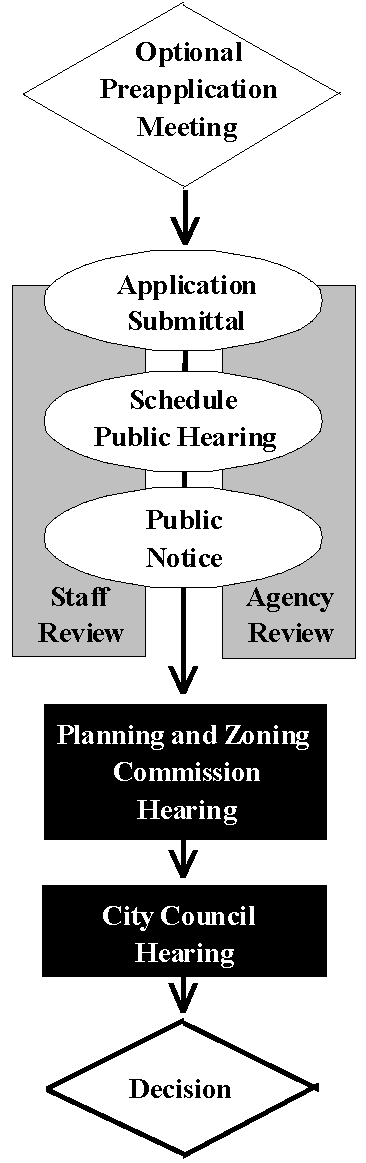
3.
Application requirements. Application requirements and processing procedures shall comply with those described in section 35-70 with the following modifications:
a.
An application for a text amendment may be initiated by the Council, Planning and Zoning Commission, City staff or any owner of property within the City. The application shall be accompanied by a written report that addresses each of the criteria listed in subsection 35-74.B.4.
b.
An owner of real property within the City, or that owner's authorized representative, may apply for an amendment to the zoning district boundaries (rezoning) for that landowner's property. Such amendments also may be initiated by the Planning and Zoning Commission, City staff or the Council. The Commission or the Council may add additional property to be rezoned if it deems it necessary or expedient to the purpose of the ordinance. All property to be rezoned shall be addressed in the public notice in accordance with section 35-70. The process for the zoning map amendment shall be as shown in exhibit 35-74B.
c.
In the case of a protest against changes in the regulations or restriction, or changes in the zoning district applicable to particular land, which protest is filed with the City Clerk at least 24 hours prior to the Council's vote on the change and is signed by 30 percent or more of the property owners, either of the areas of the land (exclusive of streets, alleys and public rights-of-way) included in such proposed change or within 185 feet distant from and parallel to the boundaries of the district proposed to be changed, such amendment shall not become effective except by the favorable vote of two thirds of the entire membership of the Council.
4.
Review criteria. The following criteria shall be considered when reviewing an application to amend the zoning ordinance text and zoning map:
a.
The existing zoning was in error at the time of adoption.
b.
There has been a change in character in the area due to installation of public facilities, other zone changes, new growth trends, neighborhood deterioration, or development transitions.
c.
There is a community need for the proposed rezoning.
d.
The proposed change is consistent with, and in furtherance of, the implementation of the goals and policies of the comprehensive plan, other adopted plans, and the policies, intents and requirements of this ordinance and other City regulations and guidelines.
e.
The proposed zoning is compatible with the zoning and uses of property nearby.
f.
Public and community facilities, which may include, but are not limited to, sanitary and storm sewers, water, electrical service, police and fire protection, schools, parks and recreation facilities, roads, libraries, and solid waste collection and disposal, are available and adequate to serve uses authorized under the proposed zoning.
g.
A traffic impact analysis has been provided to indicate the potential number of new trips generated and provisions are provided to mitigate impacts of high traffic-generating projects.
h.
Authorized uses shall not adversely affect the capacity or safety of the street network in the vicinity of the property.
i.
Potential environmental impacts (e.g., excessive storm water runoff, water pollution, air pollution, noise pollution, excessive lighting, or other environmental harms) of authorized uses shall be mitigated.
j.
There is an adequate supply of land available in the subject area and the surrounding community to accommodate the zoning and community needs.
k.
Benefits shall be derived by the community or area proposed to be rezoned
5.
Decision-maker. The Director and the Planning and Zoning Commission shall review the application at a public hearing in conformance with section 35-70 and shall make recommendations to the Council. The Council shall approve, conditionally approve or deny approval of the application for the zoning ordinance text amendment or zoning map amendment.
C.
Planned unit development.
1.
Applicability. Applications for PUD plan approval shall follow the application, review, and processing requirement of this section. Allowances and requirements of the PUD District are contained in Section 35-27.
2.
Application requirements. Applications for PUD Plan approval shall include the following:
a.
Supporting documentation for applicable portions of Section 35-27 and this section regarding Planned Unit Developments.
b.
PUD site plan showing the following:
(1)
The scale and north point.
(2)
Boundaries of the property to be developed.
(3)
The names of the owners of the property and the individual or firm responsible for the preparation of the preliminary plan.
(4)
The existing zoning of the tract and the zoning of properties which are within 200 feet of the boundaries of the property.
(5)
The location, type and size of structures, on properties within 200 feet of the boundaries of the property.
(6)
Acreage of the property to be included in the Planned District.
(7)
Existing contours on an interval of not more than five feet and not less than two feet.
(8)
The location and direction of drainage of all water courses and a drainage plan with sufficient information to indicate the intent of the owner.
(9)
The location of existing and proposed sanitary sewers.
(10)
The proposed size, location, height, use and arrangement of all buildings except single-family dwellings; the location and capacity of off-street parking areas, entrance and exit driveways and their relationship to existing and proposed streets; building lines; easements; common land and open space; and proposed streets, alleys and pedestrian ways.
(11)
Proposed landscaping and buffer zones.
(12)
Provide for the dedication of any right-of-way for the widening, extension or connection of major streets as shown in the thoroughfare plan.
3.
A PUD plan shall:
a.
Comply with the criteria established in section 35-27, as well as the criteria for rezoning, subsection 35-74.B.4 and preliminary plat approval in the Subdivision Code.
b.
Establish the underlying zoning, mix of uses, density, layout, design and phasing of the proposed planned unit development.
c.
The City may require that a homeowners' association or corporation be created to maintain and administer the project's lands or facilities. The homeowners' association shall be required to maintain all common space in reasonable order and condition on a timely, consistent basis.
4.
Review procedure. The Planning and Zoning Commission shall review the application at a public hearing in conformance with section 35-70 and shall make recommendations to the Council. The Council shall approve, conditionally approve or deny approval of all applications for a PUD plan. See Exhibit 35-74C.
Exhibit 35-74C:
Planned Unit
Development District
Approval Process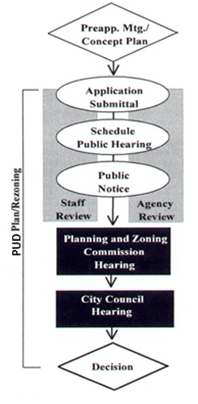
5.
Amendments to the PUD plan.
a.
No changes may be made to the approved PUD plan except upon application to the appropriate agency or agencies under the procedures set forth in this section.
b.
Minor changes may be authorized by the Director under the following conditions, providing those changes are required by engineering, technical, or other circumstances not originally foreseen at the time the PUD plan was approved. The term "minor changes" as used in this section is considered to represent changes which do not alter the overall characteristics of the total plan and which create no adverse impacts on adjacent uses or public services and facilities. Some examples of what can be considered as minor changes are:
(1)
Changes in location and type of landscaping and/or screening so long as the approved character and intent is maintained;
(2)
Changes in the orientation of portions of parking areas so long as the effectiveness of the overall site circulation and parking is maintained; parking areas shall be relocated not closer than 20 feet to any residential structure or ten feet to any street or right-of-way lines; and the number of parking spaces shall not be reduced by the relocation.
(3)
Changes in the location of sidewalks and pathways, provided that continuity of pedestrian circulation remains;
(4)
The reorientation, but not complete relocation, of major structures; or
(5)
Changes resulting in a decrease of building separation or setbacks so long as those changes will not impact adjacent properties or uses.
c.
Application requirements and processing procedures shall comply with those described in section 35-70.
d.
No minor change authorized by this section may cause any of the following:
(1)
Change in the permitted uses or of development character;
(2)
Increased overall coverage of structures;
(3)
Increased intensity of use;
(4)
Increased demand for traffic circulation and public utilities;
(5)
Decrease in public or private open space;
(6)
Decrease in provisions for off-street parking, loading and screening thereof;
(7)
Decrease in pavement and sidewalk widths;
(8)
Increased numbers of dwellings; or
(9)
Increased deviation from the minimum design standards established in section 35.26.
e.
The Director shall approve, conditionally approve or deny approval of all applications for a minor change.
f.
All other changes to the approved PUD plan shall be deemed "major" and shall be processed with the same application and review requirements for a PUD Plan contained in this section 35-74.
6.
Lapse of plan and rezoning. If a planned unit development, or any portion thereof, has not been completed in accordance with an approved development schedule (a "lapse"), the Director shall schedule the project before the Planning and Zoning Commission at which time a revocation of all prior approvals shall be considered. If the Planning and Zoning Commission determines that a lapse has occurred, the Director shall initiate revocation proceedings in accordance with section 35-70. The Director may, if he or she deems it appropriate, initiate, without owner consent, a zoning change to the underlying zone.
7.
Development according to the PUD plan. No building permit shall be issued on any site unless a site plan has been submitted and approved in accordance with the provisions in section 35-71, and unless such site plan conforms with the conditions of the adopted PUD plan.
8.
Review of plans for planned districts designated prior to this ordinance.
a.
Vacant land. Property that is vacant land zoned under a previous zoning code as C-4 Planned Commercial, M-3 Planned Industrial, or PUD Planned Unit Development District that has no approved plan shall be reviewed under the process required in subsection 35-74.C or may be rezoned in accordance with subsection 35-74.B.
b.
Prior-approved plans. Property zoned C-4 Planned Commercial, M-3 Planned Industrial, or PUD Planned Unit Development District with plans approved before adoption of this ordinance may be developed as originally approved. If amendments to the plan are requested by the applicant, the plan amendments shall be reviewed as required for plan amendments in conformance with subsection 35-74.C.5.
c.
Designation of zoning district for prior planned districts. The district designations for all planned districts designated prior to this ordinance shall be modified to "PUD" on the official zoning map.
(1)
Property with previously approved plans. Property with previously approved plans shall be designated with "PUD" plus the appropriate development file or case file number.
(2)
Vacant land with no approved plan. Property which is vacant land for which no plan has been approved shall be designated with "PUD-0" until such time as a new plan is approved, or the property is rezoned.
9.
Transfer in ownership. The requirements, restrictions, conditions and provisions of the approved planned unit development plan shall be binding upon the owners, their heirs and assigns and future owners until such time as the City may release such limitation on the use of the subject property under the procedures provided herein.
(Ord. No. 16568, § 2, 12-15-2025)
Sec. 35-75. - Development agreements.
A.
Development agreements authorized. The Director may defer the requirement for the completion of required improvements if the applicant enters into a development agreement by which the applicant agrees to complete all required public improvements in accordance with an agreed-upon schedule. The Director may require the applicant to complete and dedicate some required public improvements prior to approval of a final plan or final plat and to enter into a development agreement for completion of the remainder of the required improvements. The City Counselor shall approve any development agreement as to form and legality.
B.
Agreement to run with the land. The development agreement shall provide that the requirements contained therein shall run with the land and bind all successors, heirs and assignees of the applicant. The development agreement shall be recorded with the County Recorder in the County in which the property is located. All existing lien holders shall be required to subordinate their liens to the guarantees contained in the development agreement.
C.
Performance security.
1.
Whenever the Director permits an applicant to enter into a development agreement, the applicant shall be required to provide sufficient security to ensure completion of the required public improvements. The security shall be in the form of a cash deposit made to the City or a letter of credit or disbursement agreement from an authorized financial institution.
2.
The guarantee shall be in an amount estimated by the Director of Planning and Protective Services as reflecting 120 percent of the cost of the improvements in the approved construction plan and shall be sufficient to cover all promises and conditions contained in the development agreement.
3.
In addition to all other security, when the City participates in the cost of an improvement, the applicant shall provide a performance bond from the contractor, with the City as a co-obligee.
4.
The issuer of any guarantee shall be subject to the approval of the City in accordance with adopted policies.
D.
Release from development agreement and certificate of completion.
1.
Release of development agreement and guarantee.
a.
The applicant shall submit a written request for a release from the development agreement for the portion which has been accepted for maintenance by the appropriate agency. This request shall be accompanied by proof of acceptance for maintenance and proof that there are no outstanding judgments or liens against the property.
b.
The Council, or its authorized representative, shall review the request. If the requirements of the development agreement concerning that portion requested for release have been complied with, the appropriate document of release shall be recorded with the County Recorder's Office in the County in which the project is located.
c.
Release from the development agreement does not constitute a certificate of completion and release of responsibility.
2.
Certificate of completion and release of responsibility. Upon expiration of the limits of responsibility established in this ordinance, the applicant may request a certificate of completion and release of responsibility from the appropriate agency.
Sec. 35-76. - Annexations.
A.
Purpose. In accordance with state statutes, land may be annexed or de-annexed from the City as deemed appropriate by the Council.
B.
Applicability. Any lands to be added to or deleted from the corporate limits of the City shall comply with this section.
C.
Application and review procedures. Application requirements and processing procedures shall comply with those described in applicable state statutes. A summary of these procedures is available from the office of the Director.
D.
Review criteria. The application shall meet all applicable statutory and city administrative requirements. A complete copy of these requirements is available from the office of the Director.
E.
Decision-maker. The Planning Commission shall review the application at a public hearing in conformance with section 35-70 and shall make recommendations to the Council. The Council shall approve, conditionally approve or deny approval of all applications for annexation or contraction of the municipal limits.
F.
Zoning of annexed properties.
1.
Voluntary annexations and annexations by petition. Land that is voluntarily annexed or annexed by petition shall be classified as RU Rural Use District, unless a plan is submitted for its use with the annexation petition. Where a land use plan is submitted, a zoning plan shall be processed simultaneously with the petition for annexation.
2.
Involuntary annexations and city-initiated annexations. Land that is involuntarily annexed by the City shall be zoned in accordance with the plan of intent to a district that is consistent with existing development patterns, comprehensive plan and development plan map.
3.
Nothing herein shall preclude the filing of an application for rezoning after the property has been annexed.
Sec. 35-77. - Vested rights determination.
A.
Purpose. The vested rights determination procedure is intended to determine whether an applicant has acquired a protected status that requires the City to permit a development to proceed contrary to existing or amended land use regulations.
B.
Applicability. The determination of vested rights applies to developments and permits that were approved or issued or were in the process of being approved on or before the date of the adoption of this ordinance.
C.
Application and review requirements. The Director shall prepare a report detailing the specific provision(s) of this ordinance that are in question, his or her interpretation of the provision(s) and the general basis of the interpretation.
1.
A legal description of the subject property and the names of the legal and equitable owners;
2.
The duration of the development approval and the conditions that shall result in revocation;
3.
The uses permitted on the property, including population densities and/or building intensities and height;
4.
A description of the public facilities that will service the proposed development, including who shall provide such facilities; the date any new facilities, if needed will be constructed; and a schedule to assure public facilities are available concurrent with the impacts of the development;
5.
A description of any reservation or dedication of land for public purposes;
6.
A description of all development approvals, permits, or other local or state approvals needed for the proposed development;
7.
A description of any conditions, terms, restrictions, or other requirements determined to be necessary for the preservation and protection of the public health, safety, or welfare;
8.
A statement indicating that the omission of a limitation or restriction shall not relieve the applicant of the necessity of complying with all applicable City, state and federal laws;
9.
A phasing plan indicating the anticipated commencement and completion date of all phases of the proposed development; and
10.
A statement that the City shall review progress pursuant to the development approval at least once every 12 months to determine if there has been demonstrated good faith compliance with the terms of the development approval. If the City finds, on the basis of substantial competent evidence, that there has been a failure to comply with the terms of the development approval, the approval may be revoked or modified by the City, after a public hearing which has been noticed by publication, and for which notice has been expressly provided to the applicant.
D.
Review criteria. The application shall be denied unless the applicant demonstrates compliance with the following criteria:
1.
Entitlement to development approval on the basis of detrimental reliance, i.e., the initial application for development approval was made by the applicant and approved by the City; the City had an opportunity to require the applicant to submit relevant information, including, but not limited to, adequate public facilities data; the applicant has proceeded in good faith; and no approvals or permits have lapsed or been revoked; or
2.
Entitlement to development approval on the basis of other vested rights under any applicable state law.
E.
Decision-maker. The Planning and Zoning Commission shall review the application at a public hearing in conformance with subsection 35-71.D and shall make recommendations to the Council. The Council shall approve, conditionally approve or deny approval of all vested rights determinations. If the applicant is found to be vested, the Council shall enter into a development agreement with the applicant specifying the terms of continued development. If the applicant is found to be not vested, the development application for which the applicant made the vested rights claim shall be considered void.
F.
Validity. A vested rights determination shall be valid for the term specified in the development agreement. If the applicant fails to enter into a development agreement, the vested rights determination shall be valid for two years.

