
Johnson City City Zoning Code
ARTICLE IV
APPLICATION OF REGULATIONS
4.1 - CONFORMITY TO SUBDIVISION REGULATIONS
No building permit shall be issued or no building shall be erected on any lot or parcel unless the street giving access to the lot or parcel has been accepted and improved, to the minimum specifications of the City Engineer, as a public street or unless said street corresponds in its location and lines with a street shown on a subdivision plat approved by the Johnson City Regional Planning Commission and such approval is entered in writing on the plat by the Secretary of the Planning Commission, and further that a performance bond or other security has been posted with the Planning Commission or the City Recorder in an amount sufficient to insure the improvement of said street within a period of one year.
4.2 - ZONING DISTRICT BOUNDARIES
Unless specifically indicated on the Zoning Map, the boundaries of zoning districts are lot lines, centerlines of streets or alleys or such lines extended, the corporate limit lines, a line midway between the main track of a railroad, or the centerlines of streams or other water bodies. When a zoning district boundary is clearly intended to split a lot—i.e., does not follow the lot line—the rear yard setback shall be measured from the zoning district boundary if the adjoining zone is more restrictive.
4.3 - USE
No building, structure, or land shall be used and no building or part thereof shall be erected, moved, or altered unless for a use expressly permitted by and in conformity with the regulations specified for the district in which it is located.
4.4 - STREET FRONTAGE
No dwelling shall be erected on a lot which does not abut at least one street for at least 50 feet, excluding lots fronting on culs-de-sac which may have a minimum road frontage of 40 feet.
4.5 - LOT SIZE
4.5.1
No lot shall be reduced in area so that required yards, lot area per residential unit (except as provided in section 4.5.2), lot width, building area, or other provisions of this Code cannot be met.
4.5.2
Lot area averaging (LAA) shall be permitted for detached single-family residential developments in the R-1, R-2, R-2A, R-2B and R-2C Districts, as follows:
A.
Minimum lot area shall be no less than 80 percent of the district's minimum lot area;
B.
Maximum lot area to count toward average shall be no more than 120 percent of the district's minimum lot area;
C.
Average lot area shall be no less than the district's minimum lot area;
D.
Lot area averaging does not include allowances for reductions in required yards, lot width, or any other requirements of this Code.
(Ord. No. 4840-23, § 1(Exh. A), 4-20-2023)
4.6 - ONE PRINCIPAL BUILDING PER LOT
Only one principal building and its customary accessory buildings may be erected on any lot in the R-1, R-2, R-2A, R-2B, and R-2C Zoning Districts. Multiple principal structures and customary accessory buildings per lot may be erected in all other zoning districts.
(Ord. No. 4730-20, § 1(Exh. A), 3-5-2020)
4.7 - YARDS AND SETBACKS
4.7.1
REQUIRED YARD:
No part of a yard or other open space required about any building for the purpose of complying with the provisions of this Code shall be included as a part of a yard or other open space required under this Code for another building or structure.
4.7.2
CORNER LOTS:
Except in B-2, B-3, B-4, B-5, and PB districts, the minimum width of the exterior side yard shall be 150 percent of the minimum side yard requirements of the district in which the lot is located, or 50 percent of the minimum required front yard setback of the district in which the lot is located, whichever is greater.
4.7.3
PRINCIPAL USES WITHOUT BUILDINGS:
Where a permitted use of land involves no structures, such use, excluding agricultural uses, shall nonetheless comply with all yards and minimum lot area requirements applicable to the district in which it is located, as well as obtaining any other license or permit applicable to the particular use.
4.7.4
FRONT YARD SETBACK:
The minimum front yard setback for any structure or use located on a lot where the average front yard setback of existing structures on the same side of the street within 200 feet, in either direction from the subject parcel, is less than what is required by this Code, the required setback shall be the average setback of said structures.
4.7.5
MEASUREMENT OF SETBACKS ON NARROW RIGHTS-OF-WAY:
Where the dedicated right-of-way is less than 40 feet for a lane or 50 feet for all other streets, the front yard setback and, for corner lots, the exterior side yard setback, shall be measured starting at a point 20 feet from the center of the right-of-way for a lane or 25 feet from the center of the right-of-way for all other streets.
4.7.6
OUTDOOR DISPLAY OF MERCHANDISE:
Where permitted, merchandise displayed outdoors which exceeds the height of six feet, including new and used mobile homes, trucks, or other motor vehicles, shall set back from street right-of-way lines not less than one-half of the required building setback.
4.7.7
DOUBLE FRONTAGE LOTS:
The required front yard setback shall be observed on both frontages of such lot.
4.7.8
LOT SPLIT:
When a zone line is clearly intended to split a lot—i.e., does not follow the lot line—the rear yard setback must be measured from the zone line if the adjoining zone is more restrictive.
4.7.9
FRONT-FACING GARAGES:
Front-facing garages shall have a minimum front yard setback of 25 feet or the required front yard setback of the zone in which it is located, whichever is greater.
(Ord. No. 4738-20, § 1(Exh. A), 7-2-2020)
4.8 - HEIGHT AND DENSITY
No building or structure shall be erected or altered that exceeds the height limit, accommodates or houses a greater number of families, or creates narrower or smaller front yards or side yards than are permitted in the regulations for the district in which it is located.
4.9 - EXCEPTION ON HEIGHT LIMITS
The height limitations in this Code shall not apply to church spires, belfries, cupolas, and domes not intended for human occupancy; monuments, water towers, observation towers, windmills, chimneys, smokestacks, derrick conveyors, flagpoles, radio towers, masts, and aerials.
4.10 - EXCEPTIONS ON SETBACKS
The following structures subject to the provisions of Section 4.10, shall be permitted to encroach into the minimum yard setbacks of the specific district regulations set forth in Article VI.
4.10.1
Awnings, canopies, and marquees, not to exceed three feet within all zoning districts except the B-2 Central Business District. Within the B-2 Central Business District metal marquees or awnings shall be permitted to extend into the public right-of-way up to 18 inches from the street curb.
4.10.2
Parking spaces, driveways, curbs, sidewalks, and steps, provided, however, steps or stairs to a dwelling, non-enclosed, not to exceed six feet.
4.10.3
Fences, walls, and landscaping.
4.10.4
Flagpoles.
4.10.5
Accessory structures subject to the requirements of Section 4.13 of this Zoning Code. Where a commercial property adjoins a residential development, permanent garbage disposal equipment shall be set at least 20 feet from the property line of the commercial property.
4.10.6
On buildings over 35 feet in height, overhanging of roof, eave, gutter, cornice, or other architectural feature, not to exceed three feet.
4.10.7
Open fire escapes on any building may extend into any required yard not more than six feet.
4.10.8
Signs, subject to the regulations set forth in Article VII.
4.10.9
Decks, not located closer than seven and one-half feet from the side or rear property line except in the R-1 and R-2 districts in which case they shall meet the principal building setback.
4.11 - VISION CLEARANCE
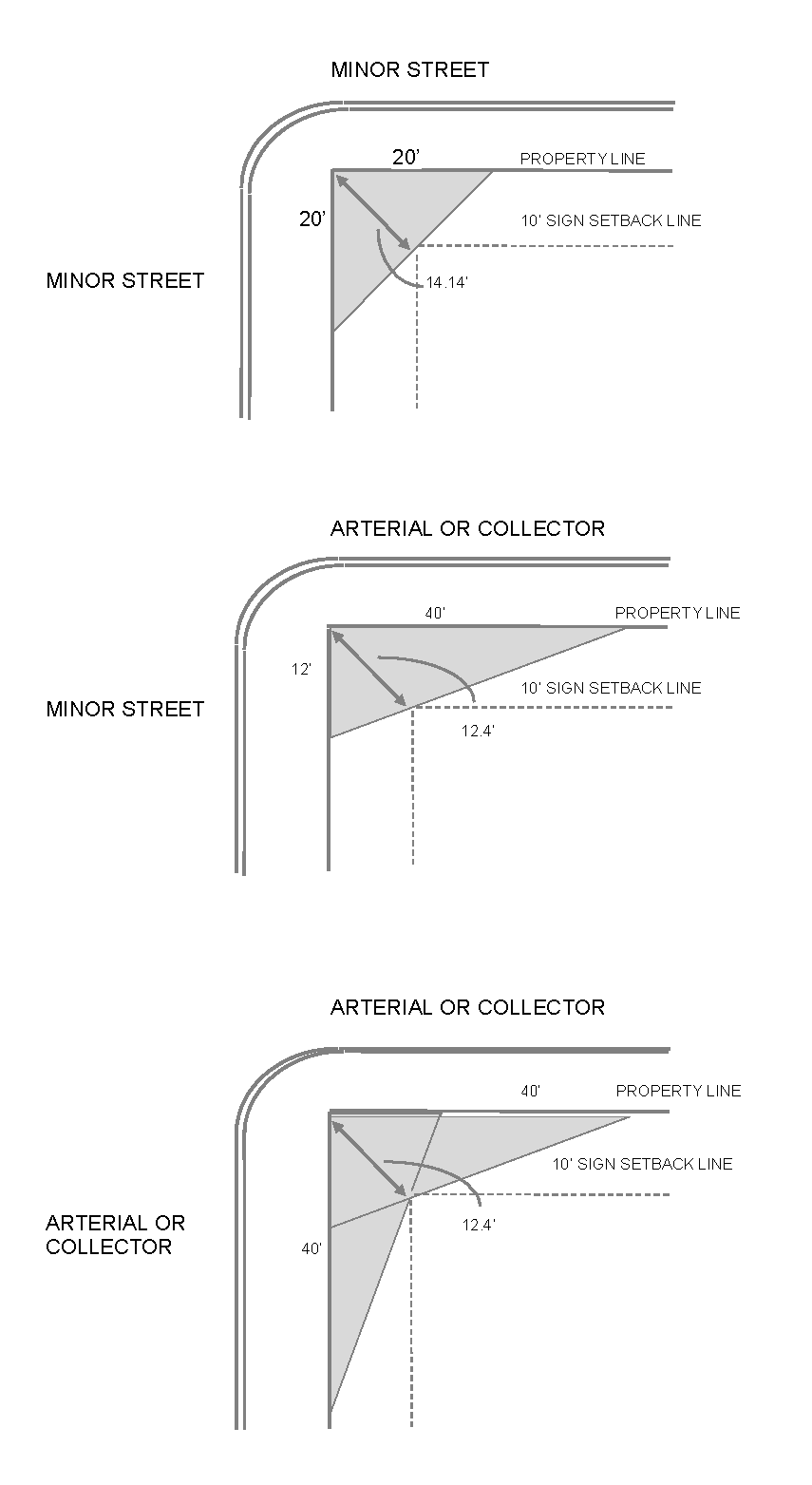
To maintain a safe line of sight for drivers of vehicles in all districts except the B-2 Central Business district, no fence, wall, shrubbery, or other obstruction to vision between the height of three feet and 15 feet shall be permitted within a sight distance triangle located at the intersection of the rights-of-way lines of streets or of streets and railroads. No sight distance triangle will be required in the case of intersecting streets or railroads not located on the same grade (overpasses, underpasses, etc.). The sight distance triangle required shall be the area enclosed by straight lines connecting three points. The first point shall be the intersection of the two street right-of-way lines, and the second and third points shall be located on each street's right-of-way line a specified distance from the first point. In the case of minor intersecting streets, two of these points shall be located on each street's right-of-way line a distance of 20 feet from the point of intersection of the two street rights-of-way. In the case of a minor street intersection with an arterial or collector street, the required sight distance triangle shall measure 12 feet by 40 feet along the street rights-of-way similar to the above method, with the 40-foot measurement being taken along the arterial or collector street. In the case of intersecting arterial or collector streets, as designated on the zoning map, dual 12-foot by 40-foot sight triangles shall be required. In the case of rounded property corners, the point of intersection of the two streets shall be assumed to be the point of intersection of the two streets where the two right-of-way lines would have met without such rounding. All measurements shall be made horizontally from the point of intersection of the two street right-of-way lines. The following diagrams illustrate the required sight triangles.
4.12 - SITE PLAN REQUIREMENTS
4.12.1
PEDESTRIAN WALKS:
To promote pedestrian connection within and between commercial developments, provision for internal pedestrian facilities shall be required where needed to accommodate existing or potential pedestrian use. Such facilities may include concrete, asphalt, stone, brick, or gravel sidewalks, painted lanes or crosswalks, appropriate signage, and similar improvements.
4.12.2
DRAINAGE AND EROSION CONTROL:
The following standards are intended to minimize onsite erosion and sedimentation flow into streets and streams, to improve the general appearance of sites under development, and to ensure that stormwater is handled in a way which will not threaten or injure the health, safety, and welfare of citizens, property, or motorists.
A.
All developments shall meet the drainage and erosion control requirements of the Johnson City Public Works Department's standards of latest issue.
B.
Reseeding or sodding any cleared or graded site shall be required where no building activity has occurred within a three-month period.
4.12.3
WATER AND SEWER:
All water and sewer improvements shall comply with the "Standards of Design for Water and Sewer Lines" as adopted by the Board of Commissioners.
4.13 - ACCESSORY STRUCTURES AND USES
Accessory structures, with the exception of boat docks, and Accessory uses are subject to the provisions of this section.
4.13.1
No accessory structure or use shall be constructed or established on any lot prior to the time of the substantial completion of the construction of the principal dwelling to which it is accessory.
4.13.2
Prohibited accessory structures: Mobile storage units, Accessory Residential Dwelling Units and Motor vehicles or Vehicles, as defined by the Johnson City Municipal Code, including but not limited to, recreational vehicles, semi-trailers, converted vans, or converted buses, shall not be used as accessory structures for storage or human occupancy on any residential lot.
4.13.3
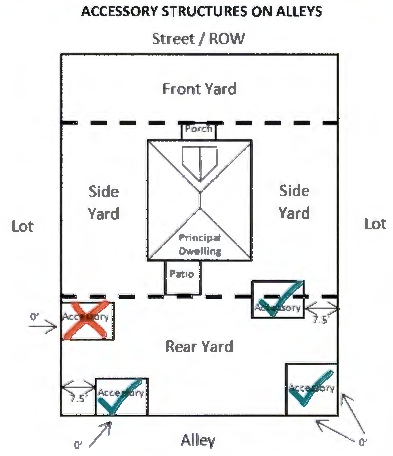
Area regulations. Except where Accessory Structures are otherwise addressed in this ordinance, Accessory Structures in all districts shall meet the following requirements:
A.
Be located only in the rear or side yard (interior side yard for corner lots) and subject to the following setbacks:
1.
Minimum side and rear yard setback of seven and one-half feet with the following exception:
a.
Where adjacent to existing improved dedicated alley rights-of-way, and where there is no conflicting drainage or utility easement, there is no required setback along the property line adjacent to said alley. Additionally, corner placement, where an accessory structure has no side or rear yard setback, may be permitted; however, corner placement of an accessory structure with no setback shall not be permitted on a side property line unless the structure also has no setback on the rear or alley side.
2.
In non-residential or multi-family development, accessory structures shall not encroach into any required landscape or buffer yards.
B.
The cumulative gross floor area of accessory structures shall not exceed 700 square feet or 50 percent of the gross floor area of the principal structure, whichever is greater.
C.
The cumulative footprint of accessory structures shall not exceed 700 square feet or 25 percent of the total rear yard area, whichever is greater.
D.
Shall not exceed the height of the principal structure as defined in this ordinance.
4.13.4
Accessory uses:
A.
Permitted home occupations:
1.
Offices for such professionals as but not limited to architects, counselors, contractors, clergy, draftspersons and cartographers, engineers, financial planners, insurance agents, lawyers, real estate agents, accountants, psychologists, psychiatrists, surveyors, cleaning services, salespersons and manufacturer's representatives;
2.
Personal services including barber and beauty shops (limited to one chair), therapeutic massage, pet grooming, catering, tailors and dressmakers, and typing and word processing services;
3.
Instructional services including but not limited to dance, music, arts and crafts, and tutoring;
4.
Studios for artists, sculptors, musicians, and photographers and similar activities;
5.
Repair services for jewelry, watches and clocks, small appliances, computers, electronic devices, guns, lawnmowers, and small engines, and similar activities;
6.
It is recognized that this list is not totally inclusive. The Director of Development Services, or their designee, shall make the determination of whether an unlisted business qualifies as a permitted use. An appeal of the determination may be made to the Board of Zoning Appeals.
B.
Prohibited home occupations:
1.
Kennels and veterinarian clinics or hospitals;
2.
Medical and dentist offices involving patient visitation;
3.
Motor vehicle repair;
4.
Retail sales of goods on the premises;
5.
Barber and beauty shops exceeding one chair.
C.
Operational standards:
1.
The home occupation shall be clearly incidental to the residential use of the dwelling and shall not change the essential residential character and appearance of the dwelling. No internal or external alterations inconsistent with the residential use shall be permitted.
2.
Use of the dwelling for this purpose shall be limited to 25 percent of one floor of the primary residential dwelling and 50 percent of the floor area of one accessory structure. No outside storage shall be used in connection with the home occupation. Refuse generated in the conduct of the home occupation shall be stored and or disposed of in accordance with city policy.
3.
The equipment used by the business and the operation of the business shall not create any vibrations, heat, glare, dust, odors, or smoke discernible at the property lines. The business and the operation of the business shall comply with all city noise ordinances and regulations. The business and the operation of the business shall not create any electrical, magnetic or other interference off the premises, consume utility quantities that negatively impact the delivery of those utilities to surrounding properties, or use and/or store hazardous/explosive materials in excess of quantities normally found in residential structures.
4.
The home occupation shall have no more than one nonresident employee on the premises at any one time. The number of nonresident employees working at locations other than the home occupation is not limited.
5.
Customer or client visits to the home occupation are limited to the hours from 9:00 a.m. to 8:00 p.m., and no more than two customers or clients shall be present at any one time.
6.
Delivery vehicles used to deliver goods to the home occupation are limited to passenger vehicles, mail carriers, and express carriers such as UPS. Deliveries shall be permitted between 8:00 a.m. and 6:00 p.m. The home occupation shall be limited to the parking or storage of one commercial vehicle on the premises, not exceeding a one-ton capacity. Off-site employees shall not park vehicles at the location of the home occupation.
7.
Signage for home occupations shall be limited to one nameplate attached to the building, not to exceed two square feet in area and may not be internally illuminated. No freestanding signs in the yard used in conjunction with the home occupation shall be permitted.
(Ord. No. 4738-20, § 1(Exh. A), 7-2-2020; Ord. No. 4780-21, § 1 (Exh. A), 7-29-2021)
4.14 - TEMPORARY USES
Temporary structures and uses are permitted subject to the provisions of this section.
4.14.1
Temporary structures, provided:
A.
Temporary storage in a portable shipping container: Temporary storage in a portable shipping container shall be permitted to serve an existing use, subject to the following standards. A portable shipping container shall not be located:
1.
On a lot without prior approval from the Building Division;
2.
In a manner that impedes ingress, egress, or emergency access; and
3.
On an individual parcel or site for more than 60 days.
B.
Temporary building or yard for construction office, material or equipment, provided such use is adjacent to the construction site and is adequately equipped with sanitary facilities and removed when construction is completed. A permit shall be valid for the duration of building construction but every temporary building shall be removed when construction is completed or discontinued for more than 60 days.
C.
Real estate sales office, provided that such use is only for the sales within the development and is only valid for not more than three years, but, may be renewed with one-year extensions. Such office shall be removed upon completion of the development of the subdivision or upon expiration of the permit, whichever occurs first.
4.14.2
Temporary uses, provided:
A.
Show, exhibition, seasonal sales, and other religious or secular gatherings under tent or in open. A temporary use permit, with reasonable conditions related to the impact of the use, may be issued for a period of time not exceeding 14 days. Such activities shall only be permitted on lots with adequate off-street parking.
B.
Garage sales
1.
No garage sale shall be conducted unless and until the person desiring to conduct such sale shall obtain a permit from the city finance department.
2.
Such a garage sale shall be held only between the hours of 7:30 a.m. and 7:00 p.m.
3.
No more than three garage sales shall be held from the same address within any calendar year with not more than two garage sales permitted within a 30-day period.
4.
Each garage sale shall not exceed three consecutive days.
(Ord. No. 4738-20, § 1(Exh. A), 7-2-2020)
4.15 - VESTING RIGHTS
To avoid undue hardship, an approved site plan shall be considered vested for a period of three years from the date of site plan approval provided the developer secures all necessary permits. The vesting period shall be extended an additional two years provided site preparation has begun during the initial three year period. If construction commences and the developer maintains all necessary permits, the site plan remains vested for a period not to exceed ten years from the date of original approval. Developments involving multiple phases are vested for a period not to exceed 15 years.
In the event the city enacts a moratorium on development or construction, the vesting period shall be tolled during the moratorium period.
4.15.1
TERMINATION OF VESTING RIGHTS:
The vested rights of an approved site plan may be terminated upon a written determination by the city under the following circumstances:
A.
When the developer violates the terms and conditions specified in the approved site plan; provided, the applicant is given 90 days from the date of notification to cure the violation; provided further, that the city may, upon a determination that such is in the best interest of the community, grant, in writing, an additional time period to cure the violation;
B.
When the developer violates any of the terms and conditions specified in the local ordinance or resolution; provided, the developer is given 90 days from the date of notification to cure the violation; provided further, that the city may, upon a determination that such is in the best interest of the community, grant, in writing, an additional time period to cure the violation;
C.
Upon a finding by the city that the developer intentionally supplied inaccurate information or knowingly made misrepresentations material to the issuance of site plan approval or intentionally and knowingly did not construct the development in accordance with the approved site plan or an approved amendment for the building permit or the site plan; or
D.
Upon the enactment or promulgation of a state or federal law, regulation, rule, policy, corrective action or other governance, regardless of nomenclature, that is required to be enforced by the city and that precludes development as contemplated in the approved site plan, unless modifications to the development plan or building permit can be made by the developer, within 90 days of notification of the new requirement, which will allow the developer to comply with the new requirements.

