
Johnson City City Zoning Code
ARTICLE VII
SIGN REGULATIONS
7.1 - GENERAL PROVISIONS
7.1.1
PURPOSE:
The purpose of this Article is to provide a comprehensive system of sign regulations which will promote and carry out the objectives of the city of Johnson City, as identified in the Johnson City Comprehensive Plan. It is the intent of this Article to establish regulations which:
A.
Regulate the number, type, location, and size of signs and other graphic devices within the city;
B.
Protect and enhance the scenic beauty of the natural environment and avoid sign clutter in the city and the surrounding area;
C.
Emphasize the assets of community appearance and high environmental quality in promoting industrial recruitment and economic development;
D.
Promote the public health, safety, and welfare by prohibiting improperly designed or located signs which could distract, confuse, mislead, or obstruct vision;
E.
Ensure safe construction and maintenance of signs;
F.
Protect and enhance public and private property; and
G.
Ensure equity in the distribution of the privilege of using the public visual environment to communicate private information;
H.
Improve the appearance of the city's business areas, especially along major thoroughfares.
7.1.2
DEFINITIONS:
Abandoned sign means a sign which identifies or advertises a discontinued business, lessor, owner, product, or activity.
Animated sign means an electronic message board that uses change of lighting to depict motion, with a slightly progressive change. The display of video shall be prohibited.
Awning means a shelter projecting from and supported by the exterior wall of a building constructed of non-rigid materials on a supporting framework.
Awning sign means a sign painted on, printed on, or attached to the surface of an awning or canopy. For purposes of determining permitted use, area, or location within this Code, an awning sign shall be considered a wall sign.
Balloon means a tethered gas- or air-filled figure used for advertising purposes and not certified for flight by the Federal Aviation Administration.
Banner means a temporary sign made of fabric or any non-rigid material with no enclosing framework, and displayed outside of a building. This would include feather banners.
Business sign means a sign which advertises the name, logo, slogan, prices, products, or services offered by the business or activity on the premises.
Canopy means a permanent shelter supported by a framework upon the ground. A canopy may be either freestanding or attached to a building.
Construction sign means a temporary freestanding sign identifying an architect, contractor, subcontractor, engineer, financier, and/or material supplier participating in construction on the property on which the sign is located.
Comprehensive development means a single parcel initially under the ownership of a single entity. Subdivision may occur within the development with access to public streets or private easements.
Directional sign means an on-premise sign giving directions, instructions, or facility information, such as parking, loading, entrance, or exit. The maximum size of each such sign shall be four square feet and the maximum height shall be three feet.
Directional sign—hospital campuses means, in addition to the standard directional signs (four square feet maximum), hospital campuses in excess of seven acres may erect one or more larger directional signs, provided such signs are approved by the city's Traffic Engineer as part of a site plan. Such additional directional signs shall comply with the vision clearance provisions of Section 4.11. Such additional directional signs for hospital campuses shall be limited to:
A.
One directional sign with a maximum height of nine feet and maximum size of 54 square feet to be located near the main entrance; and
B.
Other directional signs with a maximum height of six feet and a maximum size of 24 square feet.
Directory sign means a sign which gives the names and locations of occupants or uses in a multi-occupant, nonresidential development, building, or organized merchant association. Such sign shall be oriented to the view of pedestrians or to vehicles on the site, rather than to view from the adjacent public right-of-way. The maximum size of a directory sign shall not exceed one square foot per listed occupant or use.
Electronic message board means a sign that uses electronic technology to display information.
Feather banners means a sign typically made of a flexible fabric attached to a long pole in the general shape of a feather, teardrop, or similar shape.
Festoons means a string of ribbons, pennants, streamers, tinsel, small flags, or pinwheels.
Flashing sign means a sign or portion thereof, which exhibits sudden changes in lighting or transitory bursts of lighting of less than one second in duration.
Freestanding sign means a sign supported upon the ground by poles, braces, fences or other supports and not attached to any building.
Government sign means any temporary or permanent sign erected and maintained by the city, county, state, or federal government for traffic direction or for designation of, direction to, or announcement of activities at any school, hospital, historic site, or other public property or facility. This definition shall also include signs giving necessary traffic information or warning, such as railroad signs or temporary traffic signs erected by contractors working within or adjacent to a public street.
Ground-mounted sign means a freestanding sign which is mounted directly on the ground, with the entire bottom portion of the structure in contact with the ground.
Human signs means a temporary sign that may be worn as a costume or held or manipulated by a human that is used for commercial advertising purposes.
Mansard means a sloped roof or roof-like facade architecturally comparable to a building wall.
Menu board means a sign associated with drive-thru windows. The sign shall not exceed 32 square feet and oriented toward drive-thru window traffic. A permit is required, but such a sign will not be counted toward the freestanding sign allowance for the business or property.
Nit means a unit of measurement of luminous intensity or brightness of electronic message boards as determined by the PR-650 SpectraScan Colorimeter or an industry approved alternate.
Mural means a singular work of art painted or otherwise directly applied on a building, structure, fence, or other object within public view. The work does not contain text, graphics, or symbols which specifically advertise or promote a business, product, or service.
Off-premise advertising sign means a freestanding, ground mounted, or wall sign directing attention to a business, product, service, or entertainment which:
A.
Is not conducted, sold, or offered on the premises where the sign is located, or
B.
Is a minor and incidental activity upon the premises where the sign is located.
Political sign means a temporary sign used in connection with a political, religious, or civic, noncommercial campaign.
Portable sign means any sign designed to be moved easily and not permanently attached to the ground or to a structure or building.
Projecting sign means a sign attached non-parallel to the wall of a building. A projecting sign may extend no more than four feet from that wall or one-half the distance between the wall of the building and the curb line of the adjacent street, whichever is less. No such sign shall extend above the roof line of its building nor shall it be placed less than ten feet above the sidewalk or ground level.
Real estate sign means a sign which announces the auction, sale, rental, or lease of the property upon which the sign is located
Real estate signs shall be removed within ten days after the property has been sold, rented, or leased.
Sandwich board means a self-supporting, A-shaped freestanding temporary sign with only two visible sides that are situated adjacent to a business, on the sidewalk. The maximum area of a sign shall be no more than six square feet per side of sign with the maximum height being 42 inches.
Scrolling means a type of animated sign that uses change of lighting to create the appearance of words, numbers, or objects moving across the face of the sign horizontally, vertically, or diagonally.
Sign means any device, structure, placard, surface, or fabric using graphics, letters, symbols, pictures, or sculptured matter designed to convey information visually directing attention to a business, product, service, or entertainment conducted, sold, or offered on the premises where the sign is located and exposed to public view from the outside.
Sign area means:
A.
The area of a wall sign shall be the area of the smallest rectangle which will enclose the sign face and its cabinet. If the sign is composed of individual letters or symbols using the wall as a background with no added decoration, the total sign area shall be the sum of the areas of the smallest rectangles which enclose each individual letter or symbol.
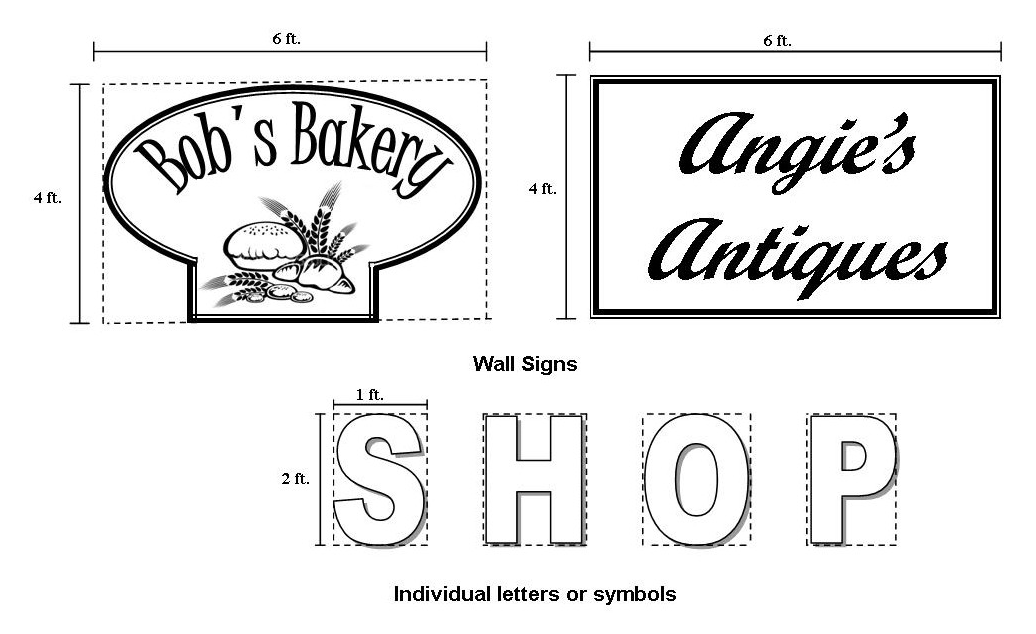
B.
The area of a freestanding sign or ground-mounted sign shall be the area of the smallest rectangle which encloses the sign and its cabinet, if any. For a sign with two parallel faces, only the area of a single face shall be considered. If the faces of a multiple-faced sign are not parallel, then the total sign area shall be the sum of the areas of the individual, non-parallel faces.
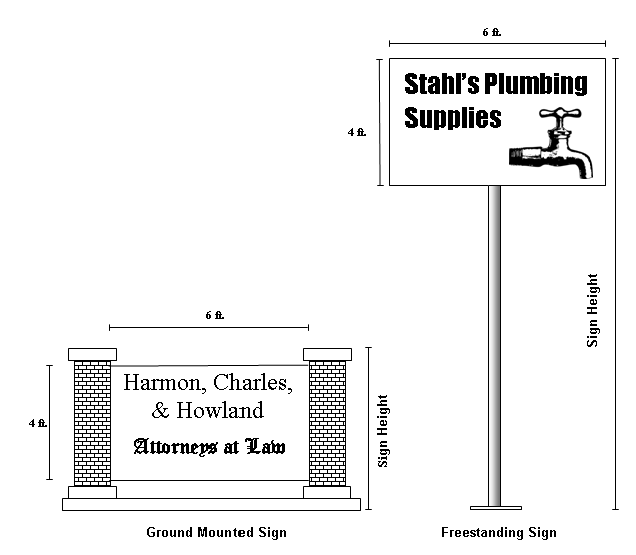
Sign height means the height of a freestanding sign or ground-mounted sign shall be the vertical distance from the highest point of the sign and its structure to either (a) the surface grade at the base of the sign, or (b) the surface grade of the nearest adjacent street granting access to the property upon which the sign is located, whichever is higher.
Subdivision identification sign means a ground-mounted sign identifying a specific development that is located on one or both sides of each principal roadway entrance into the development or in the roadway median inside at the entrance to the development.
Temporary sign means any sign that is intended for temporary use and a limited period. This includes, but is not limited to: real estate signs; construction signs, political signs, garage sales or any other non-commercial messages.
Under-awning sign means a sign located under a permitted awning or canopy at the entrance to the premises. Such sign shall be perpendicular to the entrance wall of the building, and shall be placed at least eight feet above the sidewalk or ground level so as not to constitute a hazard or impediment to pedestrians. The maximum size of an under-awning sign shall be four square feet.
Unsafe sign means any sign or structure or appurtenance which, in the opinion of the Chief Building Official of the city, poses an imminent or potential threat to the public health or safety, whether personal or property.
Video means the display or transmission of moving pictures (not animated) such as television images or video recordings.
Vehicular sign means a sign placed on a vehicle or trailer which is parked or located for the primary purpose of displaying said sign. This does not apply to signs or lettering on buses, taxis, or vehicles operating during the normal course of business.
Wall sign means a sign attached parallel to and extending not more than 18 inches from the wall of a building. This definition includes painted, individual letter, and cabinet signs located on the outside of the building. No such sign shall extend above the roof line of its building or canopy structure.
Window sign means any sign, picture, symbol or combination thereof designed to communicate information about an activity, business, commodity, product, sale, or service that is placed inside or outside of a window and is visible from the exterior of the window.
7.1.3
MINIMUM STANDARDS AND CONFORMANCE:
7.1.3.1
Minimum Standards: The minimum standards set forth herein shall not be construed as relieving any owner or tenant of the responsibility for compliance with other local ordinances, codes, and regulations, including established requirements and provisions of the International Building Code or National Electrical Code or other authority having jurisdiction.
7.1.3.2
Conformance Required: All signs erected, replaced, reconstructed, expanded, or relocated on any property shall conform with the provisions of this Article and with all other pertinent laws or ordinances of the city of Johnson City. For the purposes of sign regulation, this Article shall supersede the provisions of Article III where the two Articles conflict. Properties located within a historic/conservation district shall conform to the Design Guidelines for that district.
7.1.3.3
Electrical Safety: All signs having electric wiring shall bear a seal of approval of a nationally recognized electrical testing laboratory. Each sign with electrical wiring must have an external disconnect. Where appropriate, label numbers shall be registered with the Building Division at the time a sign permit is issued.
7.1.3.4
Setback: The following signs shall be erected no closer than seven and one-half feet to any property line or public street right-of-way. In addition, such signs shall comply with Section 4.11 of the Zoning Code, which deals with vision clearance at street intersections. If the adjoining street right-of-way is less than 50 feet in width, each such sign shall be located no closer than 35 feet from the centerline of the right-of-way.
A.
Freestanding signs, except in the B-2 District;
B.
Construction signs;
C.
Directory signs;
D.
Ground-mounted signs; and
E.
Temporary signs.
7.1.3.5
Noncommercial Copy: Any sign, display, or device allowed under this ordinance may contain, in lieu of any other copy, any otherwise lawful noncommercial message which does not direct attention to a business operated for profit, or to a product or service for sale, provided that such sign complies with the size, height, and location requirements of this ordinance or those regulations in effect at the time the sign was erected.
7.1.3.6
Sign Maintenance: Every sign and its structure shall be maintained in a safe, presentable, and good structural condition at all times, including the replacement of defective parts and wiring, painting, repainting, cleaning, and other acts required for the general maintenance of said sign. Signs not adequately maintained shall result in the owner being cited to court. For the purpose of this regulation, repairing or replacing a sign shall be deemed general maintenance.
7.1.3.7
Mural Application Permit: Applications for a mural permit shall provide the following information:
A.
Address of the property of proposed mural;
B.
Written consent from the property owner giving permission to place the mural on the building;
C.
Contact information of artist/team leader;
D.
Scale drawing and color photo of the building showing proposed size and location of the mural. Drawings shall include the dimensions, construction supports, sizes, foundation, electrical wiring and components, materials of the mural and method of attachment and character of structure members to which attachment is to be made. The design, quality, materials and loading shall conform to the requirements of the Building Code, as amended;
E.
List the type of paints proposed (latex, oil base, acrylic); and
F.
A plan for who will be maintaining the mural.
7.1.4
ADMINISTRATION AND PERMITS:
7.1.4.1
The regulations of this Article shall be administered by the Chief Building Official of the city of Johnson City.
7.1.4.2
Permit Required: Unless otherwise provided, no sign shall be erected, replaced, reconstructed, expanded, or relocated without first securing a permit from the Chief Building Official of the city of Johnson City. No permit shall be required for a mere change of copy on a sign, the customary use of which involves frequent and periodic changes of copy, e.g., reader boards with changeable letters, movie theater marquees, and service station price signs. Any change in a sign associated with a change of ownership or tenancy shall in all cases require a permit.
7.1.4.3
Revocation of Permits: The Chief Building Official is hereby authorized and empowered to revoke any permit upon failure of the holder to comply with any provision of this Code or with the terms of the permit at the time of its issuance.
7.1.4.4
Inspection of Signs: At any time deemed necessary, the Chief Building Official, or designee, shall inspect each sign regulated by this Article to ensure that such sign conforms to this Article and to all other ordinances of the city.
7.1.4.5
Expiration of Permit: A sign permit shall expire if the work has not been substantially initiated within six months from the date of issuance.
(Ord. No. 4705-19, § 1(Exh. A), 10-17-2019)
7.2 - EXEMPT AND PROHIBITED SIGNS
7.2.1
EXEMPT SIGNS:
The following signs shall be allowed in any zoning district without permit. However, these signs are still subject to the applicable size and setback requirements.
A.
Directional signs;
B.
Flags of any nation, government, or noncommercial organization;
C.
Government signs;
D.
Memorial signs, cornerstones, and similar signs containing the name of the building and date of erection, provided such signs are permanently installed on the building;
E.
Window signs which consist entirely of letters, numerals, and symbols, none of which are greater than three inches in height;
F.
Noncommercial seasonal displays customarily associated with a national, local, or religious holiday, provided such are not used to advertise the name of a product, service, or business. Such displays shall be removed promptly after the holiday; and
7.2.2
PROHIBITED SIGNS:
The following signs shall be prohibited in all zoning districts:
A.
Abandoned signs: Any sign, or part thereof, that is not conforming to the minimum standards of this Article, and which is advertising a discontinued use, occupant, product, or service shall be removed or made conforming within 45 days of the discontinuance. If such sign is not removed within this period, the Chief Building Official shall cite the property owner to court;
B.
Unsafe signs: If the Chief Building Official shall find that any sign is unsafe or insecure, or is a menace to the public, or has been constructed or erected or is being maintained in violation of the provisions of this Article, he shall give written notice to the owner of the sign and/or of the property and/or the architect, builder, contractor, or agent for both or either requiring the sign to be made safe and secure or to be removed. If the sign is not removed or altered so as to render it safe and secure, the Chief Building Official shall proceed with action as provided by law. The Chief Building Official may cause any sign which is an immediate danger to persons or property to be removed immediately and without notice. The written notice required in this section is not required for signs allowed in Subsection 7.2.1 above;
C.
Portable signs;
D.
Any sign located within, upon, or over the public right-of-way, except government signs, awning signs, under-awning signs, sandwich board signs (in the B-2 District), projecting signs, and special event banners;
E.
Banners, festoons, pennants, ribbons, streamers, pinwheels, balloons, A-frame, sandwich, and similar temporary signs, except as permitted in Subsections 7.3.3.1, 7.3.4.2-C, 7.3.4.2-D or 7.3.4.2-H of this Code;
F.
Any sign located on a telephone pole, power pole, or streetlight pole, except special event banners in the B-2 (Central Business) district;
G.
Any sign which contains flashing or intermittent red, blue, green, or amber illumination;
H.
Any sign located on the roof of a building which is not an integral part of the building design and construction, except as permitted in Subsection 7.3.4.2-H of this Code;
I.
Reserved.
J.
Any sign which constitutes a traffic hazard; no sign or light shall be positioned and designed to appear official where it may interfere with any authorized official traffic sign, signal, or device. Neither shall it obstruct the view of an official traffic control device. Nor shall any sign interfere with safe navigation of traffic upon any public way. Any such sign or light shall be removed immediately at the direction of the Chief Building Official;
K.
Vehicular signs;
L.
Any sign having or consisting of any rotating, revolving, or otherwise moving parts;
M.
Human signs;
N.
Off-premises advertising signs; and
O.
Any sign not specifically included in these regulations.
7.3 - REGULATIONS BY ZONING DISTRICT
7.3.1
R-1—R-6, RP-2—RP-5, RM-3—RM-5, AND A-1 DISTRICTS:
The following regulations shall apply in the R-1 through R-6, RP-2 through RP-5, RM-3 through RM-5, and A-1 zoning districts.
7.3.1.1
Permitted Signs:
A.
For single- and two-family dwellings. One nameplate attached to the building, not to exceed two square feet in area, shall be permitted for each dwelling unit.
B.
For multi-family residential developments, group dwellings, permitted nonresidential uses, and legal nonconforming uses. One wall or freestanding sign per street frontage granting access to the premises shall be permitted. The maximum size of each sign shall be 32 square feet. Such sign may be externally illuminated, provided the light is directed so that it does not shine into nearby residences. Signs for churches may be internally illuminated.
C.
For bed-and-breakfast inns, one wall or freestanding sign shall be permitted. The maximum size of such sign shall be 12 square feet in area with a sign height of no more than eight feet. Such sign may be externally illuminated, provided the light is directed so that it does not shine into nearby residences.
D.
For restaurants, museums, and art galleries, one wall or freestanding sign shall be permitted. The maximum size of such sign shall be 12 square feet in area with a sign height of no more than eight feet. Such sign may be externally illuminated, provided the light is directed so that it does not shine into nearby residences.
E.
Temporary signs: The maximum area of such signs shall be six square feet. Any sign announcing an event shall be removed within 48 hours after the event.
F.
Subdivision identification signs:
1.
Such sign shall not exceed 52 square feet in area;
2.
Ground mounted signs located within the right-of-way of the entrance shall be located in a median of not less than 50 feet in length and ten feet in width and be setback at least ten feet from the right-of-way line when projected across the entrance. Signs located at the side of the entrance must be located on private property within an easement; and
3.
The petitioner shall provide documentation that a homeowners association has been created to maintain sign.
7.3.1.2
No sign shall be internally illuminated, except as provided in Subsection 7.3.1.1.B.
7.3.2
RO-1, MS-1, B-1, MX-1, AND RTP DISTRICTS:
The following regulations shall apply in the RO-1, MS-1, B-1, MX-1, and RTP districts.
7.3.2.1
Permitted signs:
A.
For single- and two-family dwellings. One nameplate, not to exceed two square feet in area, shall be permitted for each dwelling unit.
B.
For multi-family residential and other permitted group dwellings not otherwise identified. One wall or freestanding sign per street frontage granting access to the premises shall be permitted. The maximum size of each such sign shall be 32 square feet in area. Such sign may be externally illuminated, provided the light is directed so that it does not shine into nearby residences.
C.
For bed-and-breakfast, one wall or freestanding sign shall be permitted. The maximum size of such sign shall be 12 square feet in area with a sign height of no more than eight feet. Such sign may be externally illuminated, provided the light is directed so that it does not shine into nearby residences.
D.
For permitted uses, the following shall be permitted:
1.
One directory sign per development.
2.
In RO-1, B-1, and RTP districts one wall sign for each building side facing an abutting street. An allowable wall sign may be placed either on the building or upon a freestanding canopy, if such exists. The maximum area of each such sign shall be 32 square feet.
In the MS-1 district each nonresidential building shall be permitted one or more wall signs. An allowable wall sign may be placed on the building or upon a freestanding canopy, if such exists. Two square feet of wall sign area shall be allowed for each horizontal linear foot of exterior wall length. If an exterior wall length is less than 16 feet, the maximum allowable sign area on the wall shall be 32 square feet. In multiple-occupant buildings, the owner shall determine how the authorized sign area is allocated among the occupants.
3.
In RO-1, B-1, and RTP districts each business or premise shall be entitled to one freestanding sign, one ground-mounted sign, or one projecting sign for each street frontage granting access to the premises.
In the MS-1 district each comprehensive development shall be permitted one freestanding sign, one ground-mounted sign, or one projecting sign per street frontage granting access to the parcel or center. If the length of a single street abutting the development is greater than 400 feet, the development shall be permitted a second freestanding sign along that frontage. In computing the allowable number of signs for parcels with more than one qualifying frontage, each frontage shall be considered separately. If a development is divided by a street, then only one side of the street is used to compute frontage length.
A permitted sign in RO-1, MS-1, B-1, and RTP districts may be either freestanding or ground-mounted. However, a freestanding sign is not permitted in the MX-1 district. The maximum height of a ground-mounted sign shall be six feet. The maximum height of a freestanding sign shall be as follows:
The maximum areas (measured in square feet) of such freestanding signs shall be as follows:
Corner lot developments in the MS-1, B-1, and RTP districts may combine their pole signage allowance into one larger sign with an area of 96 square feet.
4.
One menu board for each permitted drive-thru lane.
5.
A comprehensive development having one or more road frontages exceeding 1,200 feet in length shall be permitted one directional sign (with maximum height of six feet and maximum area of 24 square feet) at each entrance along that qualifying frontage, in lieu of any other directional signs otherwise permitted. The location, size, height, and orientation of all directional signs permitted under this section shall be shown on a site plan and reviewed and approved by the City Engineer for traffic safety and vision clearance.
E.
Temporary signs: The maximum area of such signs shall be 15 square feet. Any sign announcing an event shall be removed within 48 hours after the event.
F.
Subdivision identification signs:
1.
Such sign shall not exceed 52 square feet in area;
2.
Ground mounted signs located within the right-of-way of the entrance shall be located in a median of not less than 50 feet in length and ten feet in width and be setback at least ten feet from the right-of-way line when projected across the entrance. Signs located at the side of the entrance must be located on private property within an easement; and
3.
The petitioner shall provide documentation that a homeowners association has been created to maintain sign.
G.
Window signs.
7.3.2.2
No residential use/development shall have a sign that is internally illuminated.
7.3.2.3
No sign shall advertise a product, service, or other business not situated on the same premises or within the same comprehensive development.
7.3.3
B-2 AND B-3 DISTRICTS:
In the B-2 Central Business District and B-3, Supporting Central Business District, the following regulations shall apply.
7.3.3.1
Permitted Signs:
A.
For single and two-family dwellings, one nameplate, not to exceed two square feet in area, shall be permitted for each dwelling unit.
B.
For multi-family residential and other permitted group dwellings, one wall sign per street frontage granting access to the premises shall be permitted. The maximum size of each such sign shall be 32 square feet in area.
C.
For permitted nonresidential uses, the following shall be permitted.
1.
Directory sign: One directory sign per development or merchant association.
2.
Wall sign: Each nonresidential building shall be permitted one or more wall signs. Two square feet of wall sign area shall be allowed for each horizontal linear foot of exterior wall length. If an exterior wall length is less than 32 feet, the maximum allowable sign area on that wall shall be 32 square feet. A permitted wall sign must be placed on the wall surface for which it is authorized; sign area for two or more walls cannot be combined and placed on a single wall. In multiple-occupant buildings, the owner shall determine how the authorized sign area is allocated among the occupants.
3.
Freestanding sign:
In the B-2 District, each business or premises shall be entitled to one freestanding sign for each street frontage granting access to the premises. The maximum size of each freestanding sign shall be determined by its setback distance from the adjoining qualifying street, according to the following table:
In the B-3 District, each business or premises shall be entitled to one freestanding sign or one projecting sign for each street frontage granting access to the premises. Maximum height of each freestanding sign shall be 25 feet. Maximum area of each freestanding sign shall be 100 square feet. No freestanding sign shall be permitted which does not meet the required ten-foot setback from any property line or public right-of-way.
4.
Under-awning sign: Each business or premises shall be permitted one such sign per qualifying entrance.
5.
Banner: A business or merchant association shall be permitted to erect a temporary banner for a maximum of 90 days during any one calendar year.
6.
Sandwich board: Each business or premises shall be entitled one sandwich board sign for each street frontage granting access to the premises provided the sign does not encroach into the four-foot unobstructed pedestrian way. The maximum area of a sign shall be no more than six square feet per side of sign with the maximum height being 42 inches. The sign material shall be wood and slate.
7.
Projecting signs: Each business or premises shall be entitled one projecting sign for each street frontage granting access to the premises. A projecting sign may extend no more than four feet from that wall or one-half the distance between the wall of the building and the curb line of the adjacent street, whichever is less. No such sign shall extend above the roof line of its building nor shall it be placed less than ten feet above the sidewalk or ground level. Maximum area of each freestanding sign shall be 32 square feet.
D.
Temporary signs: The maximum area of such signs shall be 15 square feet. Any sign announcing an event shall be removed within 48 hours after the event.
E.
Window sign: The opaque surface of any window sign shall not exceed 25 percent of any window pane.
F.
Murals.
G.
Commercial signs in the B-2 district may be internally or externally illuminated.
7.3.4
B-4, B-5, I-1, I-2, BP, AND PB DISTRICTS:
The following regulations shall apply in the B-3, B-4, B-5, I-1, I-2, BP, and PB zoning districts.
7.3.4.1
Permitted signs for residential uses:
A.
For single- and two-family dwellings. One nameplate, not to exceed two square feet in area, shall be permitted for each dwelling unit.
B.
For multi-family residential and other group dwellings. One wall or freestanding sign per street frontage granting access to the premises shall be permitted.
1.
The maximum size of each sign shall be 32 square feet.
2.
The maximum height of a freestanding development identification sign shall be 15 feet.
7.3.4.2
Permitted signs for nonresidential uses:
A.
Wall signs: Each nonresidential building shall be permitted one or more signs. Two square feet of wall sign area shall be allowed for each horizontal linear foot of exterior wall length. If an exterior wall length is less than 16 feet, the maximum allowable sign area on that wall shall be 32 square feet. In multiple-occupant buildings, the owner shall determine how the authorized sign area is allocated among the occupants.
For a business utilizing a building and a freestanding canopy, the maximum allowable wall sign area shall be based on either the length of the exterior wall or the length of the canopy, but not both combined. The maximum allowable wall sign area may be apportioned between wall and the canopy as the owner chooses.
A permitted wall sign must be placed on the wall surface for which it is authorized; sign areas for two or more walls cannot be combined and placed on a single wall.
B.
Freestanding signs, ground-mounted signs, or projecting signs: Each business or premises in a I-1, I-2 district or each comprehensive development in the B-4, B-5, BP, or PB district shall be permitted one freestanding sign or one projecting sign and one ground-mounted sign for each street frontage under the following conditions:
1.
Number of signs: A parcel in a I-1, or I-2 district or a comprehensive development in a B-4, B-5, BP, or PB district is permitted one freestanding sign or one projecting sign per street frontage, not including Interstate 26 and State of Franklin Road between Sunset Drive and the Bristol Highway. If the length of a single street frontage is greater than 400 feet, the parcel or center shall be permitted a second freestanding sign along that frontage.
In computing the allowable number of signs for parcels with more than one qualifying frontage, each frontage shall be considered separately.
Any freestanding sign allowed under this section may be exchanged for two ground-mounted signs which do not exceed ten feet in height nor 200 square feet in area.
2.
Height and area of freestanding sign:
2.1.
Height of freestanding sign: The maximum height of each freestanding sign shall be determined by its setback distance from the adjoining qualifying street, according to the following table:
2.2.
Area of freestanding sign: The maximum area of each freestanding sign shall be determined by its setback distance from the adjoining qualifying street, according to the following table:
3.
Height and area of ground-mounted sign:
3.1.
Height of ground-mounted sign: The maximum height of each ground-mounted sign shall be ten feet.
3.2.
Area of ground-mounted sign: The maximum area of a ground-mounted sign authorized under Section 7.3.4.2(B)(1) shall be 200 square feet.
C.
Banners: A parcel in a I-1, or I-2 district or a comprehensive development in a B-4, B-5, BP, or PB district shall be permitted to erect a temporary banner for a maximum of 90 days during any one calendar year.
D.
Festoons, pennants, ribbons, and streamers: Such temporary devices may be erected in a B-4, B-5, I-1, I-2, or PB district without limit on the frequency or duration.
E.
Directory signs: One directory sign per development, shopping center, or merchant association shall be permitted.
F.
Under-awning signs: Each business or premises shall be permitted one such sign per qualifying entrance.
G.
One menu board for each permitted drive-thru lane.
H.
Balloons: A balloon shall be allowed to be displayed on the premises of a permitted use for a maximum of seven days per event and not more than four events per calendar year for any premise. The maximum height of any balloon shall not exceed the height permitted for a freestanding sign at the same location, according to the provisions of Subsection 7.3.4.2(B)(2) of this Code. The maximum allowable size of a balloon shall be determined by first calculating the largest plane projection of the balloon on a vertical axis, in square feet. This calculated area shall not exceed the maximum area permitted for a freestanding sign at the same location, according to the provisions of Subsection 7.3.4.2(B)(3) of this Code. Balloons shall be permitted to be placed either on the ground or on the roof of a building.
I.
Temporary signs: The maximum area of such signs shall be 25 square feet. Any sign announcing an event shall be removed within 48 hours after the event.
J.
Subdivision identification signs:
1.
Such sign shall not exceed 52 square feet in area;
2.
Ground mounted signs located within the right-of-way of the entrance shall be located in a median of not less than 50 feet in length and ten feet in width and be setback at least ten feet from the right-of-way line when projected across the entrance. Signs located at the side of the entrance must be located on private property within an easement; and
3.
The petitioner shall provide documentation that a homeowners association has been created to maintain sign.
K.
Window signs:
L.
Commercial signs in the B-4, B-5, I-1, I-2, BP, and PB districts may be internally or externally illuminated.
7.3.4.3
No sign shall have or consist of any rotating, revolving, or otherwise moving part or depict or describe any "specified sexual activities" or "specified anatomical areas" as defined in Article II of this Code.
7.3.5
MX DISTRICT:
In the MX Mixed Use District, the following regulations shall apply.
7.3.5.1
Permitted signs:
A.
For single-family and two-family dwellings, one nameplate, not to exceed two square feet in area, shall be permitted for each dwelling unit.
B.
For multi-family residential and other permitted group dwellings, one wall or freestanding sign per street frontage granting access to the premises shall be permitted. The maximum size of each sign shall be 32 square feet in area. Such sign may be externally illuminated, provided the light is directed so that it does not shine into nearby residences.
C.
Permitted signs for permitted nonresidential uses:
1.
Directory sign: One directory sign per development or merchant association.
2.
Wall sign: Each nonresidential building shall be permitted one or more wall signs. Two square feet of wall sign area shall be allowed for each horizontal linear foot of exterior wall length. If an exterior wall length is less than 16 feet, the maximum allowable sign area on that wall shall be 32 square feet. An allowable wall sign may be placed either on the building or upon a freestanding canopy, if such exists. A permitted wall sign must be placed on the wall for which it is authorized; sign areas for two or more walls cannot be combined and placed on a single wall. In multiple-occupant buildings, the owner shall determine how the authorized sign area is allocated among the occupants.
3.
Freestanding signs, ground-mounted signs, or projecting signs: Each principal building in an MX district shall be permitted one freestanding, one ground-mounted sign, or one projecting sign per street frontage granting access to the site under the following conditions:
General retail and service developments as referenced in Subsection 6.25.2.6 shall be permitted one freestanding sign, one ground-mounted sign, or one projecting sign which shall have a maximum sign area of 96 square feet. Freestanding signs shall have a maximum height of 20 feet as measured from the surface grade at the base of the sign or from the surface grade of the nearest adjacent street. Ground-mounted signs shall have a maximum height of ten feet as measured from the surface grade at the base or from the surface grade of the nearest adjacent street.
All other development in the MX district shall be entitled to one freestanding sign, one ground-mounted sign, or one projecting sign which shall have a maximum sign area of 32 square feet and a maximum height of 20 feet.
4.
Under-awning sign: Each business shall be permitted one such sign per qualifying entrance.
5.
Banner: A business or merchant association shall be permitted to erect a temporary banner for a maximum of 90 days during any one calendar year.
6.
Development identification sign: General retail and service developments as referenced in Subsection 6.25.2.6 shall be permitted one such sign per development. The maximum size shall be 200 square feet, the maximum height shall be 45 feet, and it shall be setback a minimum of 25 feet from the right-of-way line.
D.
Subdivision identification signs:
1.
Such sign shall not exceed 52 square feet in area;
2.
Ground mounted signs located within the right-of-way of the entrance shall be located in a median of not less than 50 feet in length and ten feet in width and be setback at least ten feet from the right-of-way line when projected across the entrance. Signs located at the side of the entrance must be located on private property within an easement; and
3.
The petitioner shall provide documentation that a homeowners association has been created to maintain sign.
E.
Temporary signs: In addition to the other signs identified in this subsection, temporary freestanding signs may be posted on any lot in a residential district at any given time. This category includes, but is not limited to: real estate signs; construction signs, political signs, garage sales or any other non-commercial messages. The maximum area of such signs shall be 25 square feet. Any sign announcing an event shall be removed within 48 hours after the event.
F.
Window signs:
G.
Commercial signs in the MX district may be internally or externally illuminated.
(Ord. No. 4705-19, § 2(Exh. B), 10-17-2019)
7.4 - ANIMATED SIGNS
Animated signs shall be allowed in the following commercial districts: B-4 (Planned Arterial Business); B-5 (Planned Community Business); and PB (Planned Business) only along and facing designated arterial streets as identified on the Zoning Map and only on parcels with a minimum arterial road frontage of 300 feet. Those properties fronting on arterial streets where animated signs shall be allowed are depicted on Figure 1 and include: (1) the Bristol Highway extending northeast from Spring City Drive to Green Valley Drive; and (2) North Roan Street extending north from properties adjoining Canary Street to properties abutting Oakland Avenue. Developments or parcels which are allowed multiple signs, including wall signs, shall be allowed only one electronic message board/animated sign, which shall be counted towards the total allowable signage for the development (including wall signs). Animated signs shall not be permitted in the Corridor Overlay District or the Design Overlay District or on any existing billboard/off-premise sign. Properties located within a historic/conservation district shall conform to the Design Guidelines for that district. Electronic message boards that are animated shall include an automatic dimmer. The maximum allowable brightness of an electronic message board/animated sign shall not exceed 4,000 Nits during the hours between sunrise and sunset and 1,000 Nits after sunset and before sunrise. No permit for an electronic message board/animated sign shall be issued for any sign display that interferes with traffic signal devices as determined by the City Traffic Engineer. Animated signs shall not be used for off-premise advertising, but may be used for noncommercial copy (see Section 7.1.3.5).
The maximum area of an animated wall sign is 62.5 square feet. The minimum area of a freestanding animated sign is 32 square feet. The maximum area of a freestanding animated sign is 32 square feet, or 25 percent of the maximum sign area allowed, whichever is greater. The maximum freestanding sign area allowed is determined by its setback distance from the adjoining qualifying street, according to the following table:
7.4.1
Nonconforming animated signs which have received building permits prior to the effective date of the ordinance from which this Article is derived shall be grandfathered.
7.5 - ELECTRONIC MESSAGE BOARDS
Electronic message boards that are not animated shall be allowed in the following districts: B-3 (Supporting Central Business); B-4 (Planned Arterial Business); B-5 (Planned Community Business); PB (Planned Business); MX (Mixed Use); MS-1 (Medical Services); I-1 (Light Industrial); I-2 (Heavy Industrial) and RTP (Research/Technology Park) only along and facing collector and arterial streets as designated on the Zoning Map and only on parcels with a minimum road frontage of 100 feet. Developments or parcels which are allowed multiple signs, including wall signs, shall be allowed only one electronic message board, which shall be counted towards the total allowable signage for the development (including wall signs). Properties located within a historic/conservation district shall conform to the Design Guidelines for that district. Electronic message boards that are not animated shall include an automatic dimmer. The maximum allowable brightness of an electronic message board shall not exceed 4,000 Nits during the hours between sunrise and sunset and 1,000 Nits after sunset and before sunrise. No permit for an electronic message board shall be issued for any sign display that interferes with traffic signal devices as determined by the City Traffic Engineer. Any display on an electronic message board shall be for a minimum of ten seconds in duration. Electronic message boards shall not be used for off-premise advertising, but may be used for noncommercial copy (see Section 7.1.3.5).
The maximum area of an electronic message board wall sign is 62.5 square feet. The maximum area of an electronic message board on a billboard, not regulated by the state, shall be 62.5 square feet. The maximum area of a freestanding electronic message board is 32 square feet, or 25 percent of the maximum sign area allowed, whichever is greater. The maximum freestanding sign area allowed is determined by its setback distance from the adjoining qualifying street, according to the following table:
7.5.1
Nonconforming electronic message boards which have received building permits prior to the effective date of the ordinance from which this Article is derived shall be grandfathered.

