


Juneau City Zoning Code
CHAPTER 49
80 - DEFINITIONS
49.80.110 - Reserved.
Editor's note— Sec. 2 of Serial No. 2025-15am, adopted April 7, 2025, deleted § 49.80.110, which pertained to the rules of construction, and derived from Serial No. 87-49, 1987; and Serial No. 99-22, adopted June 7, 1999.
49.80.120 - Definitions.
The following words, terms and phrases, when used in this title, shall have the meanings ascribed to them in this section, except where the context clearly indicates a different meaning:
Abut means to physically touch, border upon, or to share a common property line with.
Accent lighting means any directional lighting which emphasizes an object or draws attention to an area.
Access point means any improvement designed for a motor vehicle to travel from or onto a right-of-way including, a driveway, a parking area, or street that intersects an existing street, and any similar improvements.
Access road means a public or private road which affords the principal means of vehicular access to a property, structure, or development.
Accessory dwelling unit(ADU) means an attached or detached residential dwelling unit with complete independent living facilities for one or more persons. An ADU includes permanent provisions for living, sleeping, eating, cooking, and bathing on the same parcel as an existing or proposed residential use.
Accessory use and accessory structure mean a use or structure customarily subordinate or incidental to and located on the same lot as an existing principal use, building or structure. The terms "accessory use" and "accessory structure" include signs, garages, required parking areas, boathouses, smokehouses and storage sheds.
Addition means an increase in gross floor area or height of a building or structure.
ADT means average daily traffic and is determined by calculating the total volume of traffic during a given time period (in whole days), greater than one day and less than one year, divided by the number of days in that time period. The source of this definition is the publication of the American Association of State Highway and Transportation Officials entitled "A Policy on Geometric Design of Highways and Streets" (1984).
Affected surface and surface disturbance mean the surface area which may be disturbed by mining exploration or by a mining operation, including on-site roads, land excavations, spoil piles, evaporation ponds, settling ponds, leaching dumps, placer areas, tailings ponds or dumps, work parking, storage or waste discharge areas, and areas in the immediate vicinity of the exploration or mining operation in which structures, facilities, equipment, machines, tools or other materials or property which may be used in such operations are situated. The terms "affected surface" and "surface disturbance" do not include roads, railways, tramways, utility corridors or rights-of-way necessary to gain access to an exploration or mining operation.
Alley means a public right-of-way providing a secondary means of vehicular access to abutting lots but which is not intended for general traffic circulation.
Alteration means any change, addition or modification in construction.
Amateur radio antenna means any tower used for amateur radio (HAM) transmissions consistent with FCC regulations.
Antenna means communications equipment that transmits and receives electromagnetic radio signals used in the provision of all types of wireless communications services.
Antenna array means a single or group of antenna elements and associated mounting hardware, transmission lines, or other appurtenances which share a common attachment device such as a mounting frame or mounting support structure for the sole purpose of transmitting or receiving electromagnetic waves.
Application means an application form and all accompanying documents and exhibits.
Appurtenant or associated facilities means an accessory facility or structure serving or being used in conjunction with WCF, and located on the same property or lot as the WCF, including, but not limited to, utility or transmission equipment storage shelters or cabinets.
Area of shallow flooding, for the purposes of chapter 49.70.400, flood hazard areas, means a designated Zone AO, AH, AR/AO or AR/AH (or VO) on a community's flood insurance rate map (FIRM) with a one percent or greater annual chance of flooding to an average depth of one to three feet where a clearly defined channel does not exist, where the path of flooding is unpredictable, and where velocity flow may be evident. Such flooding is characterized by ponding or sheet flow.
As-grades means surface conditions after completion of grading.
Assembly means the assembly of the City and Borough of Juneau.
Assisted living means a facility providing housing and institutional care for people unable to live independently or without assistance. Assisted living includes facilities that provide nursing care services or emergency shelter. Assisted living use that occurs within a single-family dwelling is regulated as a single-family dwelling use.
Awning means an architectural projection that provides weather protection, identity, or decoration, and is wholly supported by the building to which it is attached. An awning is comprised of a lightweight, rigid skeleton structure over which a covering, typically of cloth or aluminum, is attached.
Backfill means the material used to refill a ditch or other excavation, or the process of doing so.
Barrier islands and lagoons mean depositional coastal environments formed by deposits of sediment offshore or coastal remnants which form a barrier of low-lying islands and bars protecting a saltwater lagoon with free exchange of water to the sea.
Base flood means a flood having a one percent chance of being equaled or exceeded in any given year.
Base flood elevation (BFE) means the elevation of surface water resulting from a base flood. The BFE is shown on the flood insurance rate map (FIRM) and in the flood insurance study for Zones AE, AH, A1-A30, AR, AR/A, AR/AE, AR/A1-A30, AR/AH, AR/AO, V1-V30, and VE.
Base map means a map showing geographic references such as state survey or municipal boundary lines, streets, easements, parcel line, control lines and other features sufficient to allow the plotting of other data.
Base station means a facility consisting of radio transceivers, antenna, coaxial cable, a regular and back-up power supply, and other electronics associated with the operation of a WCF. It includes a structure that currently supports or houses an antenna, transceiver, or other associated equipment that constitutes part of a bases station. It may encompass such equipment in any technological configuration, including attached WCF.
Basement, for the purposes of chapter 49.70, article IV, flood hazard areas, means any area of a building, including any sunken room or sunken portion of a room, having its floor below ground level on all sides.
Bed and breakfast means a dwelling in which more than two bedrooms are used for commercial lodging provided by the owner or operator who lives on site. The term "bed and breakfast" includes boardinghouses and rooming houses.
Berm means a mound of earth, or the act of pushing earth into a mound.
Bikeway means a pathway intended for the use of bicycles.
Block means a parcel of land entirely surrounded by public highways, streets, shorelines, streams or other physical features.
Boarding stable means a structure designed for the feeding, housing or exercising of horses not owned by the owner of the premises.
Boardinghouse and rooming house mean a dwelling in which more than two bedrooms are used for commercial lodging provided by the owner or operator who lives on site. The term "boardinghouse and rooming house" includes houses offering bed and breakfast.
Body of water and waterway mean the sea or natural or manmade lakes, marshes, ponds, rivers, creeks and streams.
Breakpoint technology means the engineering design of a monopole wherein a specified point on the monopole is designed to be at least five percent more susceptible to failure than any other point along the monopole so that in the event of structural failure, the failure will occur at the breakpoint rather than at the base plate, anchor bolts, or any other point on the monopole.
Buffer strip means land area used to visually separate one use from another or to shield or block noise, lights, views or other impacts. Buffer strips may be required to include fences or berms, as well as shrubs and trees.
Buildable area means the area of a lot remaining after the minimum yard and open space requirements of the zoning ordinance have been met.
Building means any structure having a roof supported by columns or walls and intended for the shelter, housing or enclosure of persons, animals, processes, equipment, goods or materials. For the purposes of chapter 49.70, article IV, building means a structure with two or more outside rigid walls and a fully secured roof, that is affixed to a permanent site; or a manufactured home; or a travel trailer without wheels, built on a chassis and affixed to a permanent foundation, that is regulated under the community's floodplain management and building ordinances or laws.
Building line means a line parallel to the street line at a distance therefrom, equal to the depth of the front yard required for the zoning district in which the lot is located.
Building permit means a permit issued pursuant to section 19.03.120.
Building space means the combined square footage of each floor in the structure.
Bulk storage means the storage of chemicals, petroleum products and other materials in containers for subsequent resale.
Campground means a lot upon which two or more campsites are maintained as noncommercial temporary living quarters, for recreation, education or vacation purposes.
Canopy means an architectural projection that provides weather protection, identity, or decoration and is supported by the building to which it is attached. A canopy is a permanently affixed, horizontal roof-like structure.
Capacity analysis means techniques used to determine the operational characteristics of a transportation facility using the Highway Capacity Manual prepared by the Transportation Research Board.
Caretaker unit means a residential dwelling unit, either attached or detached, in a non-residential zone district, which is designated for the occupancy of one or more persons who provide oversight, security, or maintenance services on the same property where the caretaker unit is located.
Change of use means any use which substantially differs from the previous use of a building or land.
Child care center means a building or portion thereof, used for the purpose of providing for the paid care and supervision of 13 or more children under the age of 12. Child care centers include pre-schools and nursery schools not associated or co-located with an elementary, middle, or high school.
Child care home means a building or portion thereof, used for the purpose of providing for the paid care and supervision of no more than 12 children under the age of 12 at any one time.
Child care institution means a facility operated by a government or private agency providing 24-hour housing for more than nine children under 18 years of age.
Child care residence means a home for no fewer than six, nor more than nine children under 18 years of age, together with not more than two adults who supervise such children for compensation, all of whom live together as a single housekeeping unit.
Church means a building, portion of a building or group of buildings primarily used for the conducting of organized religious services and associated accessory uses but not including a building or portion of a building used primarily for child care, a preschool or a school providing other than religious instruction.
City and Borough means the City and Borough.
Civil engineer means a professional engineer licensed as such by the state.
Clinic means a building where patients are admitted for examination and treatment by one or more physicians, dentists or psychologists and where patients are not usually lodged overnight.
Club means a noncommercial incorporated or unincorporated association of persons organized for social or fraternal purposes.
Cluster means a development design technique that concentrates buildings on portions of the site to allow the remaining land to be used for recreation, common open space, and preservation of environmentally sensitive features.
Cluster wastewater system means a system with individual on-site wastewater treatment and a shared wastewater collection system under some form of common ownership, other than public ownership, that collects wastewater from two or more dwellings and conveys it for disposal to a suitable site near the dwellings.
Coastal development means any physical structure or alteration of coastal resources which is regulated by this title.
Coastal water means all water bodies in the coastal area, including wetlands and the intertidal area.
Coastal zone means the area subject to the policies of this title as depicted on JCMP Map 1.
College means an educational institution authorized by a recognized accrediting agency to award baccalaureate or higher degrees.
College, main campus means that portion of a college or university where dormitories, offices, classrooms, libraries, and related facilities are separated by no more than one-half mile.
College, satellite facilities means those portions of a college or university located more than one-half mile from the main campus.
Collocation means the mounting or installation of transmission equipment on an eligible support structure for the purpose of transmitting and/or receiving radio frequency signals for communications purposes.
Commercial means having profit as a chief aim.
Commercially impracticable means the inability to perform an act on terms that are reasonable in commerce. The inability to achieve a satisfactory financial return on investment or profit, standing alone, shall not be considered "commercial impracticability" and shall not render an act or the terms of an agreement commercially impracticable.
Commission means the City and Borough Planning Commission.
Common driveway means a commonly shared or used pedestrian or vehicular way that connects or serves two or more properties within a common wall development.
Common facilities means streets, sidewalks, parking areas, community buildings, refuse disposal systems, sewer systems, and water systems, held in common ownership by planned unit development homeowners.
Common open area. The common open area is the contiguous area of a cottage housing development that does not include the cottages, other buildings, driveways, parking areas, and the areas within the ghost lines that define the spacing around each cottage.
Common open space means open space held in common ownership by planned unit development homeowners. Buildings, parking areas, and similar improvements may be located in and included in the calculation of common open space if related and necessary to the function of the open space. Stormwater drainage and flood storage may be located in and included in the calculation of the common open space. Common on-site sewage disposal systems, but not individual septic systems, may be located in and included in the calculation of common open space. Streets may be located in but shall not be included in the calculation of common open space.
Community wastewater and disposal system means a system with a shared wastewater treatment and collection system under some form of common ownership, other than public ownership, that collects wastewater from two or more dwellings and conveys it to a treatment plant and disposal system located on a suitable site near the dwellings.
Comprehensive plan means the comprehensive plan and all of its additions listed at CBJ 49.05.200(b).
Conservation lot means an undeveloped or remediated parcel where building development is permanently prohibited. A conservation lot is intended to preserve open space, environmentally sensitive areas, scenic views, wetlands, and buffers.
Convenience store means an establishment, serving a neighborhood market area and engaged in the retail sale or rental, from the premises, of food, beverages, and other frequently or recurrently needed items for household use.
Correctional facility means a facility providing for the imprisonment or physical confinement of persons under guard or 24-hours physical supervision such as a prison, jail, detention center, halfway house, and similar facilities.
Cottage means a cottage is a detached dwelling, not greater than 1,200 square feet in gross floor area, that is developed at a density greater than the underlying zone pursuant to this article.
Cottage housing development means a cottage housing development is a cluster of four to fourteen cottages and common open area. A cottage housing development shall have the following characteristics:
(1)
Each cottage is of a size and function suitable for one to three people;
(2)
Each cottage has the construction characteristics of a single-family house as set forth in this article;
(3)
Cottages are developed as a detached dwelling, common interest community, and share use of common elements such as a common open area, tool shed, workshop and parking areas; and
(4)
The site is designed with a coherent concept in mind, including: shared common open area, off-street parking, access within the site and from the site, and visually consistent landscaping and architecture.
Cottage housing development lot means a cottage housing development lot is the undivided lot on which the cottage housing development takes place.
Council means the Alaska Coastal Policy Council.
Crucial habitat means limited areas that serve as a concentrated use area for fish and wildlife species during a sensitive life history stage where either alteration of the habitat or human disturbance, individually or cumulatively, could result in a permanent loss of a sustained yield of a population of a species that is of significant commercial, recreational or subsistence importance, or species that are threatened or endangered.
Cul-de-sac means a dead-end street that provides for a required vehicle turnaround.
Day care center means a building or portion thereof, used for the purpose of providing paid care for more than 12 people, 12 years of age or older at any one time.
Day care home means a building or portion thereof, which is used for the purpose of providing paid care for fewer than 13 people, 12 years of age or older at any one time.
Dedication means the setting aside of land by a property owner which is accepted by the City and Borough for public purposes.
Density bonus means an increase in allowable density above that otherwise allowed in the zoning district in which the planned unit development is located.
Department means the City and Borough community development department.
Design professional means a licensed engineer, a licensed architect or a graphic artist.
Developer means the person or persons who own or control property used for a development.
Development means any of the following:
(1)
Construction, reconstruction or enlargement of a structure involving more than 120 square feet;
(2)
A subdivision;
(3)
Conduct of a home occupation;
(4)
Change in use of a lot, including any structure thereon;
(5)
Installation or emplacement of a mobile or modular home;
(6)
Removal of substantial vegetative cover;
(7)
Excavation, dredge or fill activity;
(8)
Installation of a sign;
(9)
For the purposes of chapter 49.65, article I, the work performed in relation to a deposit, subsequent to exploration but prior to extraction of commercial quantities of a mineral commodity, aimed at, but not limited to, preparing the site for mining, defining an ore deposit, conducting pilot plant operations, and construction of roads or ancillary facilities;
(10)
Any site work in preparation or anticipation of the above;
(11)
For the purposes of chapter 49.70, article IV, flood hazard areas, means any man-made change to improved or unimproved real estate, including, but not limited to, buildings or other structures, mining, dredging, filling, grading, paving, excavation or drilling operations or storage of equipment or materials.
Development permit means department approvals, subdivision permits and approvals, allowable use permits, special use permits and conditional use permits.
Direct impact for the purposes of chapter 49.65, article I, means the direct or primary effect or consequences that are caused by the activity of a mining operator whether as a mining operation or otherwise, and whether on affected surface or not. Direct impacts generally occur at the same time and place as the mining operation but may also occur at other than the time or the place of the mining operation. Direct impacts include all discharge, emission and other effects that a mining operation may have on the environment as described in subsection 49.65.135(a)(1), (2) and (3).
Director means the community development director of the City and Borough or his or her designee.
District means geographic area within the municipality, within which certain zoning or development regulations apply.
Double-wide unit means two mobile home segments, attached side-by-side to form a complete mobile home.
Drainage means:
(1)
Surface water runoff;
(2)
The removal of surface water or groundwater from land by drains, grading or other runoff controls designed to minimize erosion and sedimentation during and after development, to preserve a water supply or to prevent or alleviate flooding.
Dredged material means material that is excavated from waters of the United States, including wetlands.
Driveway means a private roadway providing vehicular access to a structure.
Duplex means a building on a single lot containing two dwelling units, each of which, except for a common stairwell exterior to both dwelling units, is separated from the other by an unpierced wall extending from floor to roof or an unpierced ceiling and floor extending from exterior wall to exterior wall.
Dwelling means a building or portion thereof, used exclusively for human habitation.
Dwelling, attached, means a one-family dwelling attached to one or more single-family dwellings by common walls.
Dwelling, common wall, means a single-family dwelling attached by a common wall to one other single-family dwelling on a separate lot.
Dwelling, detached, means a dwelling which is not attached to any other dwelling by any means.
Dwelling, multifamily, means a building designed for or occupied by three or more families.
Dwelling, single-family, means a detached dwelling which is designed for and occupied by not more than one family.
Dwelling unit means a residential use consisting of a building or portion thereof, providing independent and complete cooking, living, sleeping and toilet facilities for one family.
Eligible facilities request means any request for modification of an existing wireless tower or base station involving (a) collocation of new transmission equipment; (b) removal of transmission equipment; or (c) replacement of transmission equipment. In this context, the term "existing wireless tower or base station" only means a WCF that has been reviewed and approved per this article.
Eligible support structure means any structure that meets the definition of a wireless tower or base station.
Emergency shelter means a temporary residential facility providing accommodations and minimal supportive services for homeless persons on a short-time basis.
Enclosed industrial use means any industrial use where goods, materials, noise, odor, and glare are wholly contained within a building.
Encroachment means any structure located in a floodway, setback, right-of-way or adjacent lot.
Engineer means an engineer licensed to practice in the state.
Environmental impact statement and EIS mean a detailed statement on the environmental impact of, and alternatives to, major federal actions, as required under Section 102(2)(c) of the National Environmental Policy Act, 42 USC 4331, "NEPA."
Environmental review means an environmental impact statement, an environmental assessment, or other comprehensive environmental analysis by a state or federal agency.
Equipment cabinet or shelter means a small structure shelter, cabinet or vault used to house and protect the electronic equipment necessary for processing wireless communication signals. Associated equipment may include air conditioning and emergency generators.
Estuary means a semiclosed coastal body of water which has a free connection with the sea and within which seawater is measurably diluted with freshwater derived from land drainage.
Excavation means the disturbance of soil.
Existing grade means the grade prior to grading.
Existing use means a structure in existence and the use or uses to which it is put on the effective date of the ordinance codified in this title.
Exploration means the process of advanced mineral commodity investigation subsequent to prospecting and prior to development.
Exposed high-energy coasts means open and unprotected sections of coastline with exposure to ocean generated wave impacts and usually characterized by coarse sand, gravel, boulder beaches, and well-mixed coastal water.
Exterior wall means any wall, one side of which, is exposed to the elements.
FAA means the Federal Aviation Administration or its duly designated and authorized successor agency.
Facade means any vertical wall face of a building, including vertical parapet walls which enclose usable space. Where separate faces are oriented in the same direction, they are to be considered as part of a single facade.
Facilities related to commercial fishing and seafood processing mean hatcheries and related facilities, seafood processing plants and support facilities, marine industrial and commercial facilities, and aquaculture facilities.
Family means one or more persons living as a single housekeeping unit.
Farm animal means horses, cows, sheep, goats, swine, ducks, chickens and other similar animals, but not including domesticated cats and dogs.
FCC means the Federal Communications Administration or its duly designated and authorized successor agency.
Feasible and prudent means consistent with sound engineering practice and not causing environmental, social, or economic costs that outweigh the public benefit to be derived from compliance with the standard which is modified by the term "feasible and prudent."
Feed lines means cables used as the interconnecting media between the transmission/receiving base station and the antenna.
Fence, sight-obscuring means a fence other than one made of chainlink, chicken wire, or similar materials.
Fill means a deposit of material placed by artificial means. Berms are classified as fill.
Fill material means material placed for the primary purpose of replacing an aquatic area, including a wetland, with dry land.
Finished elevation means the proposed elevation of the land surface of a site after completion of all site preparation work.
Finished (habitable) area means an enclosed area having more than 20 linear feet of finished interior walls (paneling, etc.) or used for any purpose other than solely for parking of vehicles, building access, or storage.
Flood (area of shallow flooding) means a designated AO or AH zone on the flood insurance rate map (FIRM). The base flood depths range from one to three feet; a clearly defined channel does not exist; the path of flooding is unpredictable and indeterminate; and, velocity flow may be evident. AO is characterized as sheet flow and AH indicates ponding.
Flood (area of special flood hazard) means the land within a community subject to one percent or greater chance of flooding in any given year. This area is equivalent to the "100-year floodplain." Designation on maps always includes the letters A or V.
Flood (base flood) means the flood having a one percent chance of being equalled or exceeded in any given year. Also referred to as the "100-year flood." Designation on maps always includes the letters A or V.
Flood means:
(1)
A general and temporary condition of partial or complete inundation of two or more acres of normally dry land area or of two or more properties (at least one of which is the policyholder's property) from:
(A)
Overflow of inland or tidal waters;
(B)
Unusual and rapid accumulation or runoff of surface waters from any source; or
(C)
Mudflow; or
(2)
Collapse or subsidence of land along the shore of a lake or similar body of water as a result of erosion or undermining caused by waves or currents of water exceeding anticipated cyclical levels that result in a flood as defined above.
Flood insurance rate map (FIRM) means the official map of a community on which FEMA has delineated the special flood hazard areas (SFHAs), the base flood elevations (BFEs), and the risk premium zones applicable to the community.
Flood insurance study means the official report provided by the Federal Insurance Administration that includes flood profiles, the flood boundary-floodway map, and the water surface elevation of the base flood.
Floodplain or flood-prone area means any land area susceptible to being inundated by water from any source.
Floodplain development permit means a permit issued by the department to allow development that conforms with the standards of chapter 49.70, article IV, flood hazard areas.
Floodplain means the channel and the relatively flat area adjoining the channel of a natural stream or river which has been or may be covered by floodwater.
Floodproofing means a combination of structural provisions, changes or adjustments to properties and structures subject to flooding for the reduction or elimination of flood damage to properties, water and sanitary facilities and other utilities, structures, and the contents of buildings.
Floodway means the channel of a river or other watercourse and the adjacent land areas that must be reserved in order to discharge the base flood without cumulatively increasing the water surface elevation more than one foot.
Flood zones A or V means areas of special flood hazard land within a community subject to one percent or greater chance of flooding in any given year. This area is equivalent to the "100-year floodplain." Designation on maps always includes the letters A or V.
Flood zones AO or AH means areas of shallow flooding on the flood insurance rate map (FIRM). The base flood depths range from one to three feet; a clearly defined channel does not exist; the path of flooding is unpredictable and indeterminate; and, velocity flow may be evident. AO is characterized as sheet flow and AH indicates ponding.
Floor area ratio means the gross floor area of all buildings on a lot, divided by the lot area.
Flush-mounted means any antenna or antenna array attached directly to the face of the support structure or building in a manner that permits mechanical beam tilting if necessary but such that no portion of the antenna extends above the height of the support structure or building.
Footprint means the outermost exterior perimeter of a building at the foundation where it touches the ground plane.
Frontage means that side of lot abutting a street; the front lot line.
Full cutoff lighting fixture means a lighting fixture with a flat lens that eliminates or minimizes direct glare and does not cast light upward or to the side. Full cutoff lighting fixtures are mounted with the lens in a horizontal position. The bulb is shielded on all sides and the top by an opaque housing.
Gas station means buildings and premises where automotive fuel, supplies and equipment are sold and where, in addition, routine automotive servicing and parts replacement may be done. Tire recapping and regrooving and major automotive mechanical and body work, painting, welding, storage, impounding and auto wrecking and motor overhaul are activities specifically excluded from this definition.
General maintenance and repair means activities which over a 36-month period do not change the use of more than 25 percent of the floor area of the structure; do not add more than 20 percent to the usable floor area of the structure; and do not exceed 25 percent of the value of the structure.
Geographic Area Douglas means all lots of record within that area formerly known as Service Area 2, as designated by a Parcel Number beginning with 2.
Geographic Area Juneau means all lots of record within that area formerly known as Service Area 1, as designated by a Parcel Number beginning with 1.
Geographic search area means an area designated by a wireless provider or operator for a new base station or WCF, produced in accordance with generally accepted principles of wireless engineering.
Geophysical hazard areas means those areas which present a threat to life or property from geophysical or geological hazards, including flooding, tsunami or storm surge run-ups, landslides, snowslides, faults, ice hazards, erosion and littoral beach processes.
Grade (adjacent ground elevation) means the lowest point of elevation of the finished surface of the ground, paving, or sidewalk within the area between a building and a property line or, when the property line is more than five feet from the building, between the building and a line five feet from the building.
Grading means a disruption of the natural soil surface.
Gravel pit means an open land area where sand, gravel or rock fragments are mined or excavated for sale or off-tract use.
Greenbelt means an open area which is cultivated or maintained in a natural state surrounding development or used as a buffer between land uses or to mark the edge of an urban or developed area.
Gross area means the total site area of a parcel of land, measured horizontally and excluding bodies of water.
Gross building area means the total horizontal floor areas of all floors, measured to the exterior of the walls, of a principal building, together with all accessory buildings or structures, exclusive of steps and porches. The gross area of a building without surrounding exterior walls shall be measured to the outside line of the supporting structure.
Gross floor area means the total horizontal floor area measured to the outside of surrounding exterior walls or to the centerline of common interior walls. The gross floor area of a building without surrounding exterior walls shall be measured to the outside line of the supporting structure.
Gross leasable floor area means the total gross floor area designed for exclusive tenant use or exclusive owner use in a commercial building.
Ground cover means grasses or other plants grown to keep soil from being blown or washed away.
Guy wire means any wire or cable that provides structural support between a tower and the ground.
Hillside means property which includes a slope in excess of 18 percent extending for a vertical distance of at least five feet on the effective date of the ordinance codified in this title.
Historic building means any building that is:
(A)
Listed individually in the National Register of Historic places (a listing maintained by the Department of the Interior) or preliminarily determined by the Secretary of the Interior as meeting the requirements for individual listing on the National Register; or
(B)
Certified or preliminarily determined by the Secretary of the Interior as contributing to the historical significance of a registered historic district or a district preliminarily determined by the Secretary of the Interior to qualify as a registered historic district; or
(C)
Individually listed in a state inventory of historic places in states with preservation programs that have been approved by the Secretary of the Interior; or
(D)
Individually listed on a local inventory of historic places in communities with historic preservation programs that have been certified either:
(i)
By an approved state program as determined by the Secretary of the Interior; or
(ii)
Directly by the Secretary of the Interior in states without approved programs.
Home occupation means any activity carried out for gain by a resident, conducted as an accessory use in the resident's dwelling unit, and meeting the following criteria:
(1)
The use of a dwelling unit for the home occupation is clearly incidental and subordinate to its use for residential purposes by its occupants, involves no employees, and takes up no more than 25 percent of the net floor area or 500 square feet, whichever is less, in the dwelling;
(2)
The home occupation results in no change to the outside appearance of the building and no other visible nonilluminated evidence of the conduct of such home occupation other than one nonprojecting facade-mounted sign one square foot or less in area;
(3)
The home occupation generates no traffic and requires no parking in excess of that normally to be found in the neighborhood; and
(4)
No equipment or process is used which creates noise, vibration, glare, fumes, odors or electrical interference off the site of the home occupation.
Homeowners' association means a community association, other than a condominium association, which is organized in a development in which individual owners share common interests in, and responsibility for open space, facilities or both.
Hospital means an institution providing primary health services and medical or surgical care to persons, primarily inpatients, suffering from illness, disease, injury, deformity and other abnormal physical or mental conditions, and including, as an integral part of the institution, related facilities such as laboratories, outpatient facilities or training facilities.
Hotel means a building offering transient lodging accommodations to the general public and which may provide additional services such as restaurants, meeting rooms or recreation facilities.
Impact means, for the purposes of chapter 49.65, article I, the reasonably foreseeable effects or consequences of a mining operation. The term "impact" includes social, economic, physical and environmental consequences or effects.
Improved common open space means common open space containing common facilities, recreational equipment, parks, gardens, picnic areas, landscaping, or other outdoor improvements.
Including means including but not limited to.
Indirect impact means, for the purposes of chapter 49.65, article I, the indirect effects or consequences that are caused by a mining operation and are generally later in time or farther removed in distance, but are still reasonably foreseeable and demonstrable. Indirect impacts may include growth-inducing effects and other effects related to induced changes in the pattern of land use, population density or growth rate, and their related effects on air and water and other natural systems, and effects caused by development induced by the mining operation, including effects on governmental services and facilities.
Indirect lighting means lighting systems which distribute 90 percent to 100 percent of the emitted light by reflection rather than by direct illumination.
Infrastructure means facilities and services needed to sustain industrial, residential and commercial activities.
Intensity of use means the degree to which a use is made, carried on or exercised.
Juneau Coastal Management Program or JCMP mean the coastal management program for the City and Borough.
Junk means dismantled, wrecked or unusable aircraft, boats, motor vehicles, machinery, mobile homes, trailers, appliances, furniture and similar items, not scheduled for repair; used, scrap, discarded or salvaged building materials; metals, rubber, paper, plastic, or other waste.
Junkyard means a lot or portion thereof, where junk is bought, sold, exchanged, scrapped, baled, cleaned, packed, disassembled, handled or stored. The term "junkyard" also includes auto-wrecking yards, house-wrecking yards, used-lumber yards, and any storage of junk occupying more than 200 square feet outside an enclosed building.
Kennel means a building in which six or more dogs more than four months of age are kept.
Lacustrine wetland means wetlands situated in a topographic depression or a dammed river channel, lacking persistent vegetation greater than 30 percent aerial coverage, and whose total area exceeds 20 acres.
Landscape means:
(1)
An expanse of natural scenery;
(2)
To add lawns, trees, plants, and other natural and decorative features to land.
Large mine means a mining operation involving more than 20 acres of affected surface disturbance; or having 75 or more personnel employed at the mining operation in the City and Borough, whether direct employees or employees of independent contractors, in any consecutive three-month period; or a mining operation which a federal agency has determined would involve a major federal action significantly affecting the quality of the human environment so that the preparation of an environmental impact statement in accordance with NEPA is required.
Large mine permit means a conditional use permit for a large mine, pursuant to chapter 49.15, article III, and section 49.65.130.
Lighting fixture luminaire means a complete lighting unit consisting of one or more lamps together with the components which are designed to distribute the light, to position and protect the lamps, and to connect the lamps to the electrical power supply; also called the lighting fixture.
Loading space means an off-street space or berth used for the loading or unloading of vehicles.
Local improvements means a public improvement which benefits a specific area and which is usually paid for in whole or part by special assessment of benefiting property owners.
Lot means a continuous parcel, tract or area of land undivided in ownership, established by plat, subdivision, or as otherwise permitted by law, to be used, conveyed, developed, or built upon as a unit.
Lot area means the total area within the property lines of a lot, excluding any street rights-of-way.
Lot, corner, means a lot or parcel of land abutting upon two or more streets at their intersection, or upon two parts of the same street forming an interior angle of less than 135 degrees.
Lot coverage means the percentage of horizontal lot area that is occupied by all buildings on the lot, each measured at the outside of those exterior walls of the floor having the greatest horizontal dimensions.
Lot depth means the average distance measured from the front lot line to the rear lot line.
Lot line, front, means the property line separating the lot from a street right-of-way, other than an alley.
Lot line, rear, means the property line opposite and most distant from a front lot line, except in the case of a corner lot.
Lot line, side, means any property boundary line not a front or rear lot line.
Lot line, street side, means the property line separating the lot from a street right-of-way, other than an alley or the front lot line.
Lot, minimum area of, means the smallest lot area established by the zoning ordinance on which a particular use or structure may be located in a particular district.
Lot, minimum size, means the smallest lot that may be created by subdivision in a particular zoning district.
Lot width means the horizontal distance between the side lines of a lot measured at right angles to its depth along a straight line parallel to the front lot line at the minimum required building setback line.
Lowest floor, for the purposes of chapter 49.70, article IV, flood hazard areas, means the lowest floor of the lowest enclosed area (including a basement). An unfinished or flood-resistant enclosure, usable solely for parking of vehicles, building access, or storage in an area other than a basement area, is not considered a building's lowest floor provided that it does not violate subsection 49.70.400(h)(1).
Lowest floor elevation, for the purposes of section 49.70.400, flood hazard areas, means the measured distance of a building's lowest floor above mean lower low water specified on the flood insurance rate map (FIRM) for the City and Borough of Juneau.
Major development means all development that is not a minor development.
Major energy facility means marine service bases and storage depots, pipelines and rights-of-way, drilling rigs and platforms, petroleum or coal separation, treatment, or storage facilities, liquid natural gas plants and terminals, oil terminals and other port development for the transfer of energy products, petrochemical plants, refineries and associated facilities, hydroelectric and other electric generating plants, transmission lines, uranium enrichment or nuclear fuel processing facilities, and geothermal facilities; "major energy facility" means a development of more than local concern carried out in, or in close proximity to, the coastal area, which meets one or more of the following criteria:
(1)
A facility required to support energy operations for exploration or production purposes;
(2)
A facility used to produce, convert, process or store energy resources or marketable products;
(3)
A facility used to transfer, transport, import or export energy resources or marketable products;
(4)
A facility used for in-state energy use; or
(5)
A facility used primarily for the manufacture, production or assembly of equipment, machinery, products or devices which are involved in any activity described in subsections (1)—(4) of this definition.
Manufactured home means, for purposes of sections 49.70.400—49.70.410, a structure, transportable in one or more sections, which is built on a permanent chassis and is designed for use with or without a permanent foundation when connected to the required utilities. For floodplain management purposes the term "manufactured home" also includes park trailers, travel trailers, and other similar vehicles placed on a site for greater than 180 consecutive days. For insurance purposes, the term "manufactured home" does not include park trailers, travel trailers, and other similar vehicles.
Manufacturing, heavy, means the processing and/or fabrication of materials having the potential to produce noise, dust, glare, odors, or vibration beyond the owner's property line or that may be offensive or obnoxious on adjacent properties. This category includes uses that require storage of large volumes of volatile, highly flammable, toxic, noxious, or explosive substances.
Manufacturing, light, means the processing and/or fabrication of materials or products where no process involved will produce noise, vibration, air pollution, fire hazard or noxious emission that will disturb or endanger neighboring properties.
Manufacturing, medium, means the processing and/or fabrication of materials or products where the process involved will produce noises, vibration, emissions or other impacts that are perceptible to neighboring property owners but are not offensive or obnoxious. These uses do not have a measurable negative effect on other businesses or property values.
Marijuana means all parts of the plant of the genus cannabis whether growing or not, the seeds thereof, the resin extracted from any part of the plant, and every compound, manufacture, salt, derivative, mixture, or preparation of the plant, its seeds, or its resin, including marijuana concentrate; "marijuana" does not include fiber produced from the stalks, oil, or cake made from the seeds of the plant, sterilized seed of the plant which is incapable of germination, or the weight of any other ingredient combined with marijuana to prepare topical or oral administrations, food, drink, or other products.
Marijuana cultivation facility means an entity that cultivates, prepares, and packages marijuana and sells marijuana to retail marijuana stores, to marijuana product manufacturing facilities, and to other marijuana cultivation facilities, but not to consumers.
Marijuana product manufacturing facility means an entity that purchases marijuana; manufactures, prepares, and packages marijuana products; and sells marijuana and marijuana products to other marijuana product manufacturing facilities and to retail marijuana stores, but not to consumers.
Marijuana retail store means an entity that purchases marijuana from marijuana cultivation facilities, purchases marijuana and marijuana products from marijuana product manufacturing facilities, and sells marijuana and marijuana products to consumers.
Marijuana testing facility means an entity that analyzes and certifies the safety and potency of marijuana.
Marquee means any hood, canopy, awning or permanent construction which projects from a wall of a building, usually above an entrance.
Material means any rock, sand, gravel, clay, organic natural soil or fill or any combination thereof.
Mean high water means the average elevation of the high tides.
Mineral commodity means an inanimate constituent of the earth which, when extracted from the earth, is usable in its natural form or is capable of conversion into a form usable as metal, a metallic compound, a chemical, quarry stone, an energy source, or a raw material for manufacturing or construction material. For the purposes of this section, the term "mineral commodity" does not include surface or subsurface water, geothermal resources, sand or gravel, common varieties of construction aggregate, or natural oil, gas, coal and peat, or associated by products recovered therewith.
Mining means the extraction of minerals including: solids, such as coal and ores; liquids, such as crude petroleum; and gases, such as natural gases. The term "mining" also includes quarrying; well operation; milling, such as crushing, screening, washing and flotation; and other preparation customarily done at the mine site or as part of a mining activity.
Mining development. See "Development."
Mining operation means the development, construction or reclamation of a mine, including associated infrastructure, or the exploitation or extraction of a mineral commodity from its occurrence on or in the earth, or the operation of a mine. The term "mining operation" includes open pit mining, placer mining and underground mining, and the disposal of refuse, tailings or waste rock from any such operation. The term "mining operation" also includes transporting, concentrating, milling, evaporating and other on-site processing. The term "mining operation" does not include off-site smelting, refining, cleaning, preparing, transportation or other surface operations not conducted on the affected surface.
Mitigate means:
(1)
Avoiding the impact altogether by not taking a certain action or parts of an action;
(2)
Minimizing impacts by limiting the degree or magnitude of the action and its implementation;
(3)
Rectifying the impact by repairing, rehabilitating or restoring the affected environment;
(4)
Reducing or eliminating the impact over time by preservation and maintenance operations during the life of the action;
(5)
Compensating for the impact by replacing or providing substitute resources or environments.
Mitigation bank means wetland enhancement, restoration, creation or acquisition undertaken to provide compensatory mitigation for wetlands losses from future development activities. The bank involves enhancing, restoring, creating or acquiring wetlands in advance of development of a wetland as part of a mitigation credit program.
Mobile food vendor means a type of food service that is located in a vehicle, trailer or cart, and is capable of moving easily daily. Unless a push cart, these units must be capable of being licensed by the state as a motor vehicle, and can be moved without special conditions (such as a pilot car, flagging, or restricted hours of movement). Mobile units must completely retain their mobility at all times.
Mobile home means a detached residential dwelling unit designed for transportation, after fabrication, on streets or highways on its own wheels or on a truck or trailer, and arriving at the site where it is to be occupied as a dwelling complete and ready for occupancy except for minor and incidental unpacking and assembly operations, location on jacks or other temporary or permanent foundations, connections to utilities, and the like, and includes recreational vehicles used outside of a recreational vehicle park as living quarters, other than as temporary living quarters for recreational, camping, or travel purposes. For the purpose of chapter 49.70, article IV, flood hazard areas, a mobile home is the same as a manufactured home.
Mobile home park means a residential use consisting of a site utilized for occupancy by more than one mobile home, together with accessory uses.
Monopole WCF means a style of freestanding WCF consisting of a single shaft usually composed of two or more hollow sections that are in turn attached to a foundation. This type of WCF is designed to support itself without the use of guy wires or other stabilization devices. These facilities are mounted to a foundation that rests on or in the ground or on a building's roof.
Motel means an establishment providing transient accommodations containing six or more rooms, at least 25 percent of which have direct access to the outside, without the necessity of passing through the main lobby of the building.
Multiple-building complex means a group of structures housing at least one retail business, office, commercial venture, or independent and separate department of a business which shares the same lot, access or parking facilities of a coordinated site plan.
Multiple-tenant building means a single structure housing more than one retail, office, or commercial business.
Natural area park means a lot owned by a government and characterized by areas of natural quality designed to serve the entire community by providing fish and wildlife habitat, open space/natural areas, access to water, and opportunities for passive and dispersed recreation activities. Development is prohibited except for structures, roads, and trails necessary for public use, education, maintenance, and protection of the resource.
Natural grade means the grade unaffected by construction techniques such as fill, landscaping, or berming.
Neighborhood means a physical area, usually residential, the physical or social characteristics of which distinguish it from other areas, or the people in which have certain lifestyle characteristics in common, such as attendance at an elementary school, use of a central area, shared boundaries, or similar auto commutes. The commission shall consider neighborhood elements as necessary on a case-by-case basis.
Net floor area means the total horizontal floor area included within the surrounding walls of a building or portion thereof, exclusive of vent shafts. The net floor area of a building, or portion thereof, not provided with surrounding walls shall be measured to the inside of the supporting structure.
New construction, for the purposes of chapter 49.70, article IV, flood hazard areas and for flood insurance rates, means structures for which the "start of construction" commenced on or after the effective date of an initial flood insurance rate map (FIRM) or after December 31, 1974, whichever is later, and includes any subsequent improvements to such structures. For floodplain management purposes, "new construction" means structures for which the "start of construction" commenced on or after the effective date of a floodplain management regulation adopted by a community and includes any subsequent improvements to such structures.
New land use means a use falling under a different category in the table of permissible uses than the "mining operations" use designation in 14.400.
Non-concealed means a WCF that has not been treated, camouflaged, or disguised to blend with its surroundings and is readily identifiable.
Nonconforming lot means a lot, or lot fractions, that:
(1)
Was allowed or not prohibited by law when established; and
(2)
Due to the subsequent adoption or amendment of a zoning ordinance, the lot(s) fails to conform to this title.
Nonconforming parking means dimensional standards and types of off-street parking and loading that were not in effect when the development was established, and due to the subsequent adoption or amendment of a zoning ordinance, are now required under this title.
Nonconforming residential density means:
(1)
Residential development of a density that was allowed or not prohibited by law when constructed; and
(2)
Due to the subsequent adoption or amendment of a zoning ordinance, is of a greater density than allowed under this title.
Nonconforming situation means a nonconforming use, a nonconforming residential density, a nonconforming structure, a nonconforming lot, and nonconforming parking, whether existing alone or in any combination.
Nonconforming structure means a structure that:
(1)
Was allowed or not prohibited by law when constructed; and
(2)
Due to the subsequent adoption or amendment of a zoning ordinance, fails to conform to this title.
Nonconforming use means a use that:
(1)
Was allowed or not prohibited by law when established; and
(2)
Due to the subsequent adoption or amendment of a zoning ordinance fails to conform to this title.
Nonmotorized recreation means any human-powered vehicular activity undertaken for relaxation or enjoyment.
Nonresidential use means a commercial, service, professional, industrial, or agricultural use, or a public facility.
Nursery means land used to raise flowers, shrubs and plants for sale.
Nursing care home means a facility maintained for the purpose of providing skilled nursing care and medical supervision to not more than nine persons at a lower level than that available in a hospital.
Nursing care institution means an institutional facility maintained for the purpose of providing skilled nursing care and medical supervision to more than nine persons at a lower level than that available in a hospital.
Office means a nonresidential use consisting of the space used for providing services other than vehicle repairs.
Office, professional means an office used for the practice of law, the healing arts, accountancy, architecture, engineering or other use determined similar by the planning commission.
Offshore areas means submerged lands and waters seaward of the coastline.
Off-street parking space means an automobile parking space and access thereto, located on a lot.
Open air food service means a food service located in a structure or area that does not have a permanent means of heat. (Note that woodstoves are not considered a permanent means of heat by the building code official). The director can extend the operation period for cause, such as extended tourist season, community event, or emergency provisions.
Open space means any parcel or area of land or water essentially unimproved and set aside, dedicated, designated or reserved for public or private use or enjoyment, or for the use and enjoyment of owners and occupants of land adjoining or in the same neighborhood as such open space.
Open space, usable, means open space within a proposed development site excluding areas devoted to structures, storage or recreational vehicles, and parking. At least one-half of all areas designated as usable open space must have a slope of less than 20 percent.
Opening date of a development means the date that a business or housing site is operational and open for occupancy.
Operator (mining) means any person engaged in or controlling, or applying to engage in or control, an exploration or a mining operation.
Ordinary high water mark means:
(1)
In the non-tidal portion of a river, lake, or stream: the portion of the bed(s) and banks up to which the presence and action of the non-tidal water is so common and usual, and so long continued in all ordinary years, as to leave a natural line or "mark" impressed on the bank or shore and indicated by erosion, shelving, changes in soil characteristics, destruction of terrestrial vegetation, or other distinctive physical characteristics;
(2)
In a braided river, lake, or stream; the area delimited by the natural line or "mark", as defined in part 1 above, impressed on the bank or shore of the outside margin of the most distant channels; or
(3)
In a tidally influenced portion of a river, lake, or stream, setbacks shall be taken from the mean high water elevation or from the ordinary high water mark, whichever offers greater protection to the water body.
Other agency means any branch, arm, part agency, department or other governmental entity other than the department with the authority to regulate any aspect of a mining operation, pursuant to any other regulatory program.
Other regulatory program means any governmental program other than one administered by the department which program applies to a mining operation or prospecting operation.
Palustrine wetland means a freshwater wetland dominated by trees, shrubs, persistent emergent vegetation, or emergent mosses or lichens.
Panhandle lot means a lot where the only owned access to the right-of-way is a narrow strip of land, the width of which is less than the minimum required by code.
Parent lot means the original lot and the residual area from which unit-lots are created through an alternative residential subdivision.
Park and ride means a parking and loading facility where commuters are provided space to park vehicles and to board transit vehicles. A park and ride facility may be located with a transit center or transit station.
Parking access means the area of a parking lot that allows motor vehicles ingress and egress from the street.
Parking deck is an unenclosed structure on which motor vehicles may be parked. The access to the deck must be at street grade. The deck may have a non-sight-obscuring safety rail.
Parking space, stacked, means a parking space that is separated from a driving aisle or lane by one or more additional parking spaces. In a line of stacked parking spaces, the space with direct access to a driving aisle is not a stacked parking space. This parking arrangement is commonly utilized for valet parking or other situations where immediate access to a particular vehicle is not required, and is sometimes referred to as "tandem" parking.
Party wall means a common shared wall between two separate structures, buildings, or dwelling units.
Pedestrian way means any sidewalk, trail, path, or other way reserved, designed, or developed to provide public, pedestrian access whether such way is held by the municipality by way of an easement, permit, dedication, prescription, fee ownership or other form.
Person means an individual, partnership, firm, or company corporation.
Pioneer path means an access path for pedestrian, equestrian, human powered vehicles, all-terrain vehicles, snow machines, and similar off-road recreational vehicles weighing less than 1,000 pounds gross vehicle weight and having a maximum overall width of 48 inches. Except as identified above, a pioneer path shall be designed and constructed to prevent a vehicle registered or required to be registered under AS 28.10 from traveling on the pioneer path.
Planned unit development means a tract of land at least two acres in area, under single, corporation, firm, partnership, or association ownership, planned and developed as an integral unit in a single development operation or a definitely programmed series of development operations and according to approved preliminary and final development plans. Planned unit developments shall comply with all requirements of the land use code, except to the extent that such requirements are superseded by a permit issued pursuant to this article.
Planting strip means a strip of land which is landscaped and maintained with live vegetative cover.
Plat means the map prepared for the purpose of recording subdivisions of land as provided in this title.
Plat, final, means all or a portion of a plat which is presented to the proper review authority for final approval.
Plat, preliminary, means a plat indicating the proposed layout of a subdivision or site plan which is submitted to the proper review authority for consideration and preliminary approval.
Population means a collective and generally discrete reproducing group of animals of the same species.
Principal use means the primary or predominant use of any lot.
Private improvements means those improvements required as part of a subdivision or other land use permit that will not be maintained by the City and Borough or other agency of government.
Privately maintained access road means a road that the department or the commission has permitted to be constructed at less than full public street standards in an existing right-of-way. Privately maintained access roads can be used by the public and can provide access to more than one parcel, but will not be publicly maintained. A privately maintained access road is distinguished from an ordinary driveway in that an ordinary driveway provides access between a parcel of land and the public portion of the street, and is not for public access (See Figure 5).
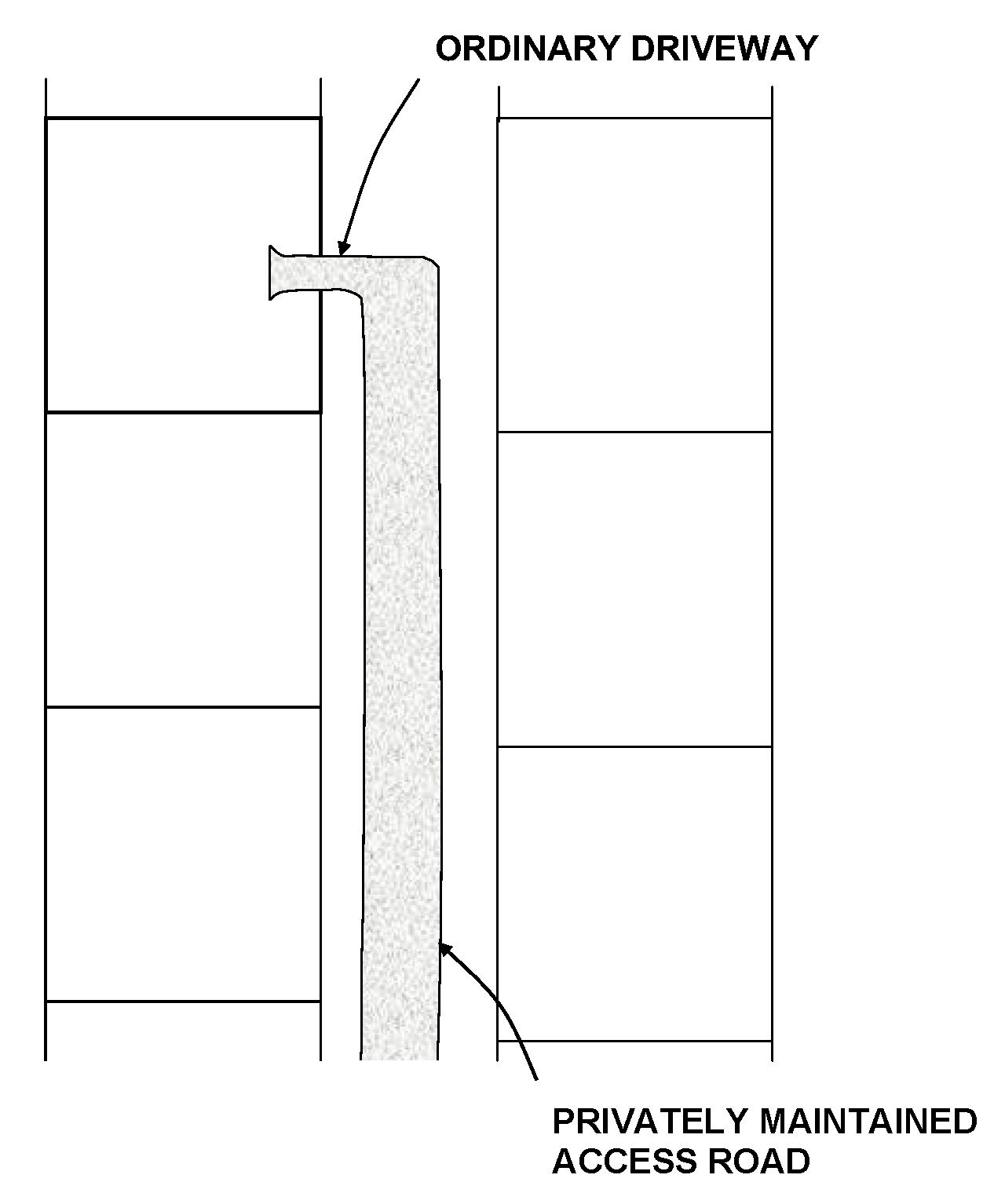
Figure 5
Prohibited use means a use not allowed in a zoning district.
Propagation study means a computer-generated study estimating the signal emanating, and prediction of coverage, from antennas or repeaters sited on a specific tower or structure.
Prospecting means the process of seeking and occasionally removing small samples of mineral commodities for claim staking or further exploration. The term "prospecting" includes only those activities which cause no or very little surface disturbance and which use no mechanized earth-moving equipment.
Public improvements means any construction incidental to servicing or furnishing facilities to a development, including but not limited to: streets; retaining walls; street signs and markings; curbs and gutters; street lights and associated power conduits; sidewalks; shared use pathways; sewer mains, pump stations, service laterals, manholes, cleanouts and all associated parts; storm sewer mains, manholes, catch basins, pump stations, service laterals, and all associated parts; water mains, fire hydrants, service laterals, valves, pump stations, reservoirs, and all associated parts.
Public sewer and water system means any system that is operated by a municipality, governmental agency, or a public utility licensed as such by the state for the collection, treatment and disposal of wastes, furnishing of potable water and fire protection.
Public square means an area dedicated for public use for temporary leisure, assembly, markets, and similar uses.
Public way means pedestrian ways, rights-of-way, and streets and any other way held for or held open by a public entity for purposes of public access.
Public works facility means a facility operated by one or more government agencies and used to maintain public works and public facilities. This is an "umbrella" land use designation that includes land uses typical to public facilities maintenance, including but not limited to outdoor or indoor storage of materials and equipment and administrative offices. This use may include the collection of hazardous waste in any zoning district where public works facilities can be permitted, or the storage of hazardous waste in the Industrial zoning district when authorized by a major development permit. This umbrella land use does not include any category 4.100-4.220, 11.000, 14.000, or 17.000 uses, or any other category 15.000 uses for which a land use permit is required.
Quasi-public means property or infrastructure that is normally owned by the public sector, but owned by the private sector serving in the public interest.
Radial distance means the shortest distance measured along a radius extending from a point of the object being measured from to a point on the object being measured to.
Radio frequency emissions means any electro-magnetic radiation or other communication signal emitted from an antenna that is regulated by the FCC.
Reclamation means procedures to minimize disruption and to rehabilitate the affected surface through grading and the protection and restoration of plant cover, soil stability, water resources, or other features relevant to the subsequent use of such lands.
Recreation facility, commercial means a place designed and equipped for the conduct of sports, leisure time activities, and other customary and usual recreational activities operated as a business and open to the public for a fee.
Recreational vehicle means a vehicle primarily designed and intended as temporary living quarters for recreation, camping, or travel uses, which either has its own motive power or is mounted on or drawn by another vehicle for moving from one location to another without a change in structure or design, and identified or required to be identified by a license number, registration number, serial number, or motor number for operation on state highways. For the purposes of chapter 49.70, article IV, flood hazard areas, recreational vehicle means a vehicle which is:
(A)
Built on a single chassis;
(B)
Four hundred square feet or less when measured at the largest horizontal projection;
(C)
Designed to be self-propelled or permanently towable by a light duty truck; and
(D)
Designed primarily not for use as a permanent dwelling but as temporary living quarters for recreational, camping, travel, or seasonal use.
Recreational vehicle park means a residential use consisting of a site utilized for occupancy by more than one recreational vehicle, together with accessory uses.
Residential use means the occupation of a building as a dwelling.
Resort means a facility for transient guests where the primary attraction is recreational activities.
Resource extraction means an industrial use involving the removal of timber, native vegetation, peat, topsoil, fill, sand, gravel, rock, or any mineral and other operations having similar characteristics.
Restaurant means a retail establishment selling food, drink, or both for consumption on the premises, including lunch counters and refreshment stands selling prepared foods and drinks for immediate consumption.
Rezone means to change the zoning classification of particular lots or parcels of land.
Right-of-way means a defined area of land, including surface, overhead and underground space, reserved or granted by deed, easement or dedication for a street, alley, utility, walkway, sidewalk, or other public ways.
Riverine wetland means wetlands contained in a freshwater channel. A channel may be either naturally or artificially created.
Roadway means that portion of a street intended for vehicular traffic, including shoulders. The sum of the traveled way and shoulder widths constitutes the roadway width.
Rocky islands and seacliffs mean islands of volcanic or tectonic origin with rocky shores and steep faces, offshore rocks, capes and steep rocky seafronts.
Rough grade means the stage at which the grade approximately conforms to the approved plat.
Rural means that part of the City and Borough which is not designated as being within the urban service area boundary in the comprehensive plan.
Sanitary landfill means a site for solid waste disposal.
Satellite earth station means a parabolic or dish antenna that is mounted to a structure, which may include associated equipment cabinets, necessary for the transmission or reception of wireless communication signals with satellites.
Screening means a method of visually shielding or obscuring one abutting or nearby structure or use from another by fencing, walls, berms or densely planted vegetation.
Seawalk means the pedestrian path and access easement described in CBJ 49.70.960(c)(6) and the Long Range Waterfront Plan.
Senior housing means a dwelling unit specifically designed for occupancy by persons 55 years of age or older.
Separate development means a facility or infrastructure located outside the land area encompassing, and not an integral part of, the mining operation for which a development permit already exists.
Setback means the minimum required yard between a building and a parallel lot line. See "Yard."
Shadow plat means the platting of property in such a way as to provide for future subdivision into smaller lots.
Sidewalk means the portion of a street or crosswalk intended for pedestrian use only.
Sight distance means the distance that a driver needs to react appropriately to a situation, including stopping sight distance, passing sight distance, and intersection sight distance.
Sign means any device for visual communication that is used for the purpose of bringing the subject thereof, to the attention of the public, excluding:
(1)
Signs not exceeding 1½ square feet in area and bearing only property numbers, post office box numbers, names of occupants or premises, or other identification of premises not having commercial connotations;
(2)
Flags and insignia of any governmental agency except when displayed in connection with commercial promotion;
(3)
Regulatory, identification, informational, or directional signs erected or required by governmental bodies;
(4)
Integral decorative or architectural features of buildings, except letters, trademarks, moving parts, or moving lights;
(5)
Artwork having no commercial connotations.
Sign, directional, means a permanent sign not exceeding six square feet in area without commercial message that directs the public to a specific place such as an entrance, exit, parking or service area.
Sign, freestanding, means a sign attached to the ground and supported by uprights placed on or in the ground.
Sign, major, means a sign which requires a permit and review by the department.
Sign, marquee, means a sign which is integrated into a marquee or canopy and does not extend beyond the limits of the marquee or canopy.
Sign, master, means a sign which is the primary building or complex sign for a multiple-tenant building or a multiple-building complex.
Sign, menu board, means a sign without commercial message which is intended to inform drive-up or pedestrian customers of the goods which can be ordered from outside the building.
Sign, minor, means a sign which does not require a permit or review by the department, but which must meet the requirements and standards set forth in chapter 49.45.
Sign, political, means a sign which advertises a candidate or candidates for public elective office, a political party, or promotes a position on a ballot issue.
Sign, real estate, means a temporary sign which advertises the real estate on which it is located for rent, lease, or sale.
Sign surface area means the entire area within the smallest regular geometrical form or combination of forms which will include all of the display area of a sign or sign elements. Frames and structural members not bearing advertising matter shall not be included in computation of surface area.
Single-Room Occupancy with private facilities means a dwelling unit composed of a private bathroom and a combined kitchen, living, and sleeping area, designed for occupancy by a single person.
Single-Room Occupancy with shared facilities means living and sleeping space for the exclusive use of one occupant, with shared sanitary and/or food preparation facilities for all occupants of the development.
Site plan means the development plan for one or more lots on which is shown the existing and proposed conditions of the site including: topography, vegetation, drainage, floodplains, marshes and waterways; open spaces, walkways, means of ingress and egress, utility services, landscaping, structures and signs, lighting, and screening devices; any other information that reasonably may be required in order that an informed decision can be made by the approving authority.
Slope means the degree of deviation of a surface from the horizontal, usually expressed in percent or degrees.
Small mine means a mining operation other than a large mine.
Small mine permit means a conditional use permit for a small mine, pursuant to of chapter 49.15, article III, and section 49.65.125.
Small temporary floating structure without amenities means a platform that is afloat at the lowest tide, is held in place by anchor or mooring, is used seasonally and removed when not in use, is no larger than 1900 square feet of decked structure and has no enclosed superstructure over four feet tall.
Snow storage basin means a designated area to store snow that comes from off site. Snow storage basins include grading and drainage improvements to treat melt water. This definition does not apply to areas that are occasionally or temporarily used for snow storage which do not have drainage improvements. This definition does not apply to areas used for storage of snow that accumulates on the same property.
Sobering center means a facility that provides temporary shelter to incapacitated and intoxicated persons taken into emergency protective custody pursuant to AS 47.37.170.
Socioeconomic impact assessment means, for the purposes of chapter 49.65, article I, the ordering, measuring and analysis of beneficial and adverse socioeconomic impacts presented in a report or study format. Specifically, a socioeconomic impact assessment shall address the beneficial and adverse impacts, including direct impacts and indirect impacts, of a mining operation on existing and future local conditions, facilities and services, including the following:
(a)
Transportation and traffic;
(b)
Sewer and water;
(c)
Solid waste;
(d)
Public safety and fire protection;
(e)
Education;
(f)
Native history and culture;
(g)
Health;
(h)
Recreation;
(i)
Housing;
(j)
Employment;
(k)
Local businesses;
(l)
The rate, distribution and demographic characteristics of any population changes induced by the mining operation;
(m)
The fiscal impacts of the mining operation on public facilities and services, including general government functions.
Soil means sediments and other unconsolidated accumulations of solid particles produced by disintegrations of rocks. Includes mixtures of these particles with organics (i.e., topsoil), sand, gravel, silt, etc.
Special flood hazard area (SFHA) means the land in the floodplain subject to a one percent or greater chance of flooding in any given year. It is shown on the flood insurance rate map (FIRM) as Zone A, AO, AH, A, AE, A99, AR (V, VO, VE). "Special flood hazard area" is synonymous in meaning with the phrase "area of special flood hazard".
Spring water means water supplied by a natural flow which rises to the surface of the earth, including water from an artesian well.
Square feet under cultivation means the area of a licensed premises of a cultivation facility that is used for growing marijuana, measured from the perimeter of the floor or growing space for marijuana. "Square feet under cultivation" does not include a processing or storage area, an equipment storage area, an office, a hallway, or another area if that area is not used for growing marijuana.
Stable means a building or land where farm animals are boarded or kept; to keep animals in or on a stable.
Start of construction, for the purposes of section 49.70.400, flood hazard areas, includes substantial improvement, and means the date the building permit was issued, provided the actual start of construction, repair, reconstruction, rehabilitation, addition placement, or other improvement was within 180 days of the permit date. The actual start means either the first placement of permanent construction of a structure on a site, such as the pouring of slab or footings, the installation of piles, the construction of columns, or any work beyond the stage of excavation; or the placement of a manufactured home on a foundation. Permanent construction does not include land preparation, such as clearing, grading and filling; nor does it include the installation of streets and/or walkways; nor does it include excavation for a basement, footings, piers, or foundations or the erection of temporary forms; nor does it include the installation on the property of accessory buildings, such as garages or sheds not occupied as dwelling units or not part of the main structure. For a substantial improvement, the actual start of construction means the first alteration of any wall, ceiling, floor, or other structural part of a building, whether or not that alteration affects the external dimensions of the building.
Street means a thoroughfare improved or intended to be improved for travel, permanently open to general public use that affords the principal means of access, frontage and address to individual buildings, lots and blocks. Streets include a pioneer path, road, avenue, place, drive, boulevard, highway or other similar means of public thoroughfares except an alley. Unless otherwise indicated, the term street shall refer to both public and private streets.
Street, arterial, means a street with access control, channelized intersections, restricted parking, and which collects and distributes traffic to and from minor arterials and collectors.
Street, collector, means a street which collects traffic from local streets and connects the minor and major arterials.
Street, cul-de-sac, means a street with a single common ingress and egress and with a turnaround at the end.
Street, local, means a street intended for vehicular access to abutting property and not intended for through traffic.
Street, minor arterial, means a street with signals at important intersections and stop signs on the side streets, and which collects and distributes traffic to and from collector streets.
Structural alteration means any change to the supporting members of a structure.
Structure means anything which is constructed or erected and located on or under the ground, or attached to something fixed to the ground, including the following:
(1)
A building, regardless of size, purpose, or permanence;
(2)
A tower, sign, antenna, pole or similar structure;
(3)
A basement, foundation, or mobile home pad;
(4)
A fence;
(5)
A sign;
(6)
A street, road, sidewalk, driveway, parking area, or storage area.
Subdivider means the developer or owner of a subdivision.
Subdivision means the division or redivision of a tract or parcel of land into two or more lots, sites or other divisions and the act of developing, constructing or improving property with a subdivision as required by CBJ Title 49.
Substantial damage, for the purposes of section 49.70.400, flood hazard areas, means damage of any origin whereby the cost of restoring the structure to its before damaged condition would equal or exceed 50 percent of the market value of the structure before the damage occurred.
Substantial improvement, for the purposes of section 49.70.400, flood hazard areas, means any reconstruction, rehabilitation, addition, or other improvement of a structure, the cost of which equals or exceeds 50 percent of the market value of the structure before the "start of construction" of the improvement. This term includes structures which have incurred "substantial damage", regardless of the actual repair work performed. This term does not include either:
(1)
Any project or improvement of a building to correct existing violations of a state or local health, sanitary, or safety code specifications that have been identified by the local code enforcement official and which are the minimum necessary to assure safe living conditions; or
(2)
Any alteration of a "historic structure", provided that the alteration will not preclude the structure's continued designation as a "historic structure".
Temporary structure means a structure established in support of and during the construction of a structure.
Tideflats means mostly unvegetated areas that are alternately exposed and inundated tides.
Tideland means land between the lowest and highest tides.
Tower means a structure that is built for the sole or primary purpose of supporting equipment for the transmission and/or reception of radio frequency signals or other wireless communications or meteorological purposes, and usually consisting of an antenna or antenna array, transmission cables, equipment cabinets, and their associated facilities.
Tower base means the foundation, usually concrete, on which the tower and other support equipment is situated. For measurement calculations, the tower base is that point on the foundation reached by dropping a perpendicular from the geometric center of the tower.
Townhouse means a single-family dwelling in a row of at least three such dwellings, in which each dwelling has its own front and rear access to the outside, no unit is located over another unit, and each unit is separated from every other unit by one or more common fire-resistant walls.
Transient structures means all forms of short-term residence, including hotels, motels, boardinghouses, bed and breakfasts, roominghouses, or any other residential use where capacity is measured by rooms rather than dwelling units.
Transit center means a building or facility adjacent to an area where two or more transit vehicles stop for the purposes of layover, transfer, or route termination. A transit center will typically include one or more of the following: information kiosk, vending, snack shop, break room, police substation, bike storage lockers or racks, indoor waiting area, covered platform, private restrooms, public restrooms, and other amenities supporting transit operations.
Transit station means a building or facility within or adjacent to the right-of-way where two or more transit vehicles stop for the purposes of transfer, or route termination. A transit station will typically include one or more of the following: information kiosk, vending, bike storage lockers or racks, covered platform.
Transitional housing means a residential use for people released from a correctional facility or similar facility. Residents may be on probation and parole. Although approval by the Department of Corrections may be necessary for a resident to reside in transitional housing, unlike a correctional facility, a resident is not ordered to live in transitional housing. An owner or manager must live on site.
Transmission equipment means any equipment that facilitates transmission for any FCC licensed or authorized wireless communication service, including, but not limited to, radio transceivers, antennas, coaxial or fiber-optic cable, and regular and backup power supply. The term includes equipment associated with wireless communications services including, but not limited to, private, broadcast, and public safety services, as well as unlicensed wireless services and fixed wireless services such as microwave backhaul.
Transmission facilities, major means electrical power distribution lines rated at 69 kilovolts or more.
Transportation and utility routes and facilities means power transmission lines, mineral slurry lines, oil and gas pipelines, land and marine corridors, railways, highways, roadways, air terminals, water and sewer transfer, and facilities required to operate and maintain the route or facility.
Travel way means the portion of the roadway for the movement of vehicles, exclusive of shoulders.
Tower or wireless tower means any structure built for the sole or primary purpose of supporting any FCC licensed or authorized antennas and their associated facilities, including structures that are constructed for wireless communications services including, but not limited to, private, broadcast, and public safety services, as well as unlicensed wireless services and fixed wireless services such as microwave backhaul, and the associated site.
Undisturbed common open space means common open space left in its natural condition.
Unfinished area means an enclosed area that is used only for the parking of vehicles, building access, or storage purposes and that does not meet the definition of a finished (habitable) area. Drywall used for fire protection is permitted in unfinished areas.
Unit-lot means any lot, site, parcel, unit-site, and similar geographically defined property that is created through an alternative residential subdivision, including a lot that is substantially smaller than the minimum lot size required for the zoning district.
Upland means drainages, aquifers, and lands, the use of which would have a direct and significant impact on coastal water.
Urban service area means the urban service area established in the comprehensive plan.
Urban service boundary means the boundary of the urban service established in the comprehensive plan.
Uses of state concern means the same as set forth in AS 46.40.210(6).
Utilities means all structures involved in the generation, transmission or distribution of electricity, gas, steam, water or sewage.
Utilities, intermediate means utilities that produce noise, vibration, emissions, light, glare or other impacts that are perceptible to neighboring property owners but not offensive or obnoxious, and impacts to adjacent properties do not have a measurable negative effect on other businesses or property values.
Utilities, major means utilities that produce noise, dust, glare, odors, light, glare or vibration that may be offensive or obnoxious on adjacent properties.
Utilities, minor means utilities which do not produce noise, vibration, air pollution, fire hazard, glare or noxious emission which will disturb or endanger neighboring properties. This category includes most underground utilities.
Visitor component means a development or portion thereof designed to accommodate a significant number of people viewing or touring the development.
Walking distance means the distance measured by the shortest route, using pedestrian facilities, from the public entrance of the building in which a use occurs to the outer boundaries of another use.
Walkway means a dedicated right-of-way, which does not include a street and is improved for pedestrian use.
Water-dependent means a use or activity which can be carried out only on, in, or adjacent to water areas because the use requires access to the water body.
Water-oriented means uses or mixtures of uses which would benefit from being near the water and are intrinsic to waterfront development, and which meet all of the following criteria:
(1)
Uses must be part of a larger fully-planned development which also incorporates water-dependent or water-related uses;
(2)
Uses which are not directly water-dependent or water-related must be necessary to the overall development of the project;
(3)
Uses must be integrated functionally by architectural and site designs which are sensitive to the waterfront site;
(4)
Uses must act as economic stimuli and anchor points to enable other forms of development, particularly public access improvements; and
(5)
Uses must contribute to a diverse and healthy downtown core.
Water-related means a use or activity which is not directly dependent upon access to a water body, but which provides goods or services that are directly associated with water dependence and which, if not located adjacent to water, would result in a public loss of quality in the goods or services offered.
Waterway. See "body of water."
WCF Site means towers other than towers in the public rights-of-way, the current boundaries of the leased or owned property surrounding the tower and any other access or utility easements currently related to the site, and, for other eligible support structures, further restricted to that area in proximity to the structures and to other transmission equipment already deployed on the ground.
West Juneau means that portion of the City and Borough from Kowee Creek to Lawson Creek.
Wetlands includes both freshwater and saltwater wetlands; freshwater wetlands means those environments characterized by rooted vegetation which is partially submerged whether continuously or periodically by surface freshwater with less than 0.5 parts per thousand salt content and not exceeding three meters in depth; "saltwater wetlands" means those coastal areas along sheltered shorelines characterized by halophytic, hydrophytes and macroalgae extending from extreme low tide to an area above extreme high tide which is influenced by sea spray or tidally induced water table changes.
Wireless communication facility (WCF) means any manned or unmanned location for the transmission and/or reception of radio frequency signals or other wireless communications, and usually consisting of an antenna or group of antennas, transmission cables, and equipment cabinets, and may include an antenna support structure. The following developments shall be considered a WCF: developments containing new, mitigated, or existing antenna support structures, public antenna support structures, replacement antenna support structures, collocation on existing antenna support structures, attached wireless communications facilities, concealed wireless communication facilities, and non-concealed wireless communication facilities. Excluded from the definition are: noncommercial amateur radio, amateur ham radio and citizen band antennas, satellite earth stations and antenna support structures, and antennas and/or antenna arrays for AM/FM/TV/HDTV broadcasting transmission facilities.
Specific types of WCFs include:
Attached WCF means an antenna or antenna array that is secured to an existing building or structure with any accompanying pole or device which attaches it to the building or structure, together with transmission cables, and an equipment cabinet, which may be located either on the roof or inside/outside of the building or structure. An attached wireless communications facility is considered to be an accessory use to the existing principal use on a site. An attached WCF includes distributed antenna system (DAS) and small cell technologies.
Concealed WCF, sometimes referred to as a concealed or camouflaged facility, means a WCF, ancillary structure, or WCF equipment compound that is not readily identifiable as such, and is designed to be aesthetically compatible with existing and proposed building(s), vegetation, natural features, and uses on a site. There are two types of concealed WCFs: 1) attached and 2) freestanding. Examples of concealed attached WCF include, but are not limited to, those designed to integrate or blend with the building or structure upon which the facility is attached by the use of paint, faux windows, dormers or other architectural features. Freestanding concealed WCFs usually have a secondary, obvious function which may be, but is not limited to, the following: church steeple, windmill, bell tower, clock tower, cupola, light standard, flagpole with or without a flag, or faux tree.
Freestanding WCF means any manned or unmanned location for the transmission and/or reception of radio frequency signals, or other wireless communications, and usually consisting of an antenna or group of antennas, feed lines, and equipment cabinets, and may include an antenna support structure. A freestanding WCF includes, but is not limited to, the following: guyed, lattice, or monopole support structures.
Non-concealed WCF means a wireless communication facility that is readily identifiable as such and can be either freestanding or attached.
Yard means an open space, unoccupied by any building.
Yard, front, means a yard extending the full width of the lot between any building and the front lot line, and measured perpendicular to the building at the closest point to the front lot line.
Yard, rear, means a yard extending across the full width of the lot between the principal building and the rear lot line, and measured perpendicular to the building to the closest point of the rear lot line.
Yard, side, means a yard extending from the front yard to the rear yard between the principal building and the side lot line measured perpendicular from the side lot line to the closest point of the principal building.
Yard, street side, means a yard extending the full width of the lot between any building and the street side lot line, and measured perpendicular from the property line to the building at the closest point to the street side lot line.
(Serial No. 87-49, § 2, 1987; Serial No. 88-21, § 2, 1988; Serial No. 88-21, § 2, 1988; Serial No. 89-01, § 3, 1989; Serial No. 89-05, § 5, 1989; Serial No. 89-47am, §§ 21, 22, 1989; Serial No. 90-41, §§ 11, 12, 1990; Serial No. 90-46, § 11, 1990; Serial No. 91-02, § 3, 1991; Serial No. 92-42, § 3, 1992; Serial No. 93-46, § 5, 1993; Serial No. 95-09, § 4, 1995; Serial No. 97-49, § 7, 1998; Serial No. 99-22, § 15, 1999; Serial No. 2002-29, § 3, 11-4-2002; Serial No. 2003-06, § 3, 2-10-2003; Serial No. 2003-26(am), § 3, 6-9-2003; Serial No. 2003-40, § 3, 9-8-03; Serial No. 2004-09, § 4, 4-12-2004; Serial No. 2004-13, § 4, 9-27-2004; Serial No. 2005-52(b), § 4, 1-30-2006; Serial No. 2006-07, § 3, 4-3-2006; Serial No. 2006-14(b), § 6, 5-15-2006; Serial No. 2007-11, § 3, 4-23-2007; Serial No. 2008-01, § 2, 1-28-2008; Serial No. 2009-22(b), § 5, 10-12-2009; Serial No. 2010-22, § 6, 7-19-2010; Serial No. 2013-19(b), § 3, 7-15-2013; Serial No. 2013-26(am), § 6, 11-4-2013, eff. 12-5-2013; Serial No. 2014-32(e)am, § 3, 9-29-2014, eff. 10-29-2014; Serial No. 2015-07(b)(am), § 7, 2-23-2015, eff. 3-26-2015; Serial No. 2015-12, § 3, 3-16-2015, eff. 4-16-2015; Serial No. 2015-34(am), §§ 3—5, 7-20-2015, eff. 8-20-2015; Serial No. 2015-03(c)(am), §§ 58—60, 8-31-2015; Serial No. 2015-32, § 4, 8-10-2015; Serial No. 2015-39(am), § 8, 11-9-2015; Serial No. 2015-38(b)(am), § 2, 5-2-2016, eff. 6-2-2016; Serial No. 2016-14, § 3, 5-2-2016, eff. 6-2-2016; Serial No. 2016-26(b), §§ 12—14, 4-3-2017, eff. 5-3-2017; Serial No. 2018-31, §§ 4, 5, 6-4-2018, eff. 7-5-2018; Serial No. 2018-41(c), § 3, 12-17-2018, eff. 1-17-2019; Serial No. 2019-08, § 2, 4-22-2019, eff. 5-23-2019; Serial No. 2019-37, § 7, 3-16-2020, eff. 4-16-2020; Serial No. 2021-06, §§ 4—6, 4-26-2021, eff. 5-26-202; Serial No. 2021-19, § 9, 8-2-2021, eff. 9-1-20211; Serial No. 2022-04(b), § 4, 4-25-2022, eff. 5-26-2022; Serial No. 2021-36, § 3, 9-12-2022, eff. 10-13-2022; Serial No. 2022-56, § 2, 11-7-2022, eff. 12-8-2022; Serial No. 2025-15am, § 2, 4-7-2025, eff. 5-6-2025)
Cross reference— Definitions generally, CBJ Code § 01.15.010.