
Jupiter City Zoning Code
ARTICLE I
- IN GENERAL
Sec. 27-1.- Definitions.
For the purpose of this chapter, the terms and words listed in this chapter shall have the meaning herein defined. Words not herein defined shall have the meanings given in Webster's Unabridged Dictionary.
A-frame sign means a sign which is designed with two sign faces constructed in a manner representing a triangular formation such as an "A."
Abandoned sign means a sign which no longer advertises or identifies an active legal business establishment, product or activity.
Abutting property. See Contiguous.
Access means a dedicated or recorded road, lane, place, alley, tract or easement affording perpetual ingress and egress from a subject property to a public thoroughfare, and not less than 20 feet in width.
Accessory building means a structure, the use of which is customarily incidental and subordinate to that of the main building on the same lot, such as detached garage, carport, barn, greenhouse, woodshed, tool shed, kennel or guest cottage.
Accessory residential means a dwelling unit on a nonresidential property that is not a primary use of the parcel or lot.
Accessory use means the use of a structure or lot, or portions thereof, which use is customarily incidental and subordinate to the main use of the structure or lot, but not including a home occupation.
Act of God means some inevitable accident which cannot be prevented by human care, skill, or foresight, but results from natural causes such as hurricanes, tornados, floods, lightning, tempests, earthquakes, inundations and other natural disasters.
Active uses means those uses that promote and encourage pedestrian activity, including, but not limited to, specialty retail stores, restaurants, drug stores, book stores, boutiques, bars, coffee shops, and lounges.
Administrative official means the staff and any staff member, board or commission of the town authorized by the town council to enforce, interpret or administer the regulations or various zoning ordinances or orders.
Advertising structure means a structure of any kind or character erected or maintained for advertising purposes on which any sign, billboard, poster, bill, printing, painting, or other advertisement of any kind may be placed. The advertising may either be commercial or noncommercial in nature.
Affordable housing unit means a dwelling unit for which the mortgage payment (including principal, interest, taxes and insurance) does not exceed 30 percent of the gross income of the very low income household buying the affordable housing dwelling unit.
Agriculture means general farming activities and attendant accessory uses and complementary processing activities.
Airport means any area of land or water which is used, or intended for use, for the landing or takeoff of aircraft, and any appurtenant areas which are used, or intended for use, for airport buildings or other airport facilities or rights-of-way, together with all airport buildings and facilities located thereon. An airport shall be licensed by the state.
Alley means a right-of-way which affords only a secondary means of access to property abutting thereon and is not intended or used for general traffic circulation.
Alteration, building, means any change in a structure which will increase the number of dwelling units, the floor area, or height of the structure, including remodeling.
Alteration, historic, means a change affecting the exterior appearance of an existing structure or improvement by additions, demolitions, reconstruction, remodeling, maintenance or structural changes or other changes in form, texture, materials or color or any changes in landscape topography or geology by the addition or deletion of landscape elements or subsurface excavation in specially designated sites, or historic interiors.
Amusement device means a mechanically operated device which is used to convey persons in any direction as a form of amusement.
Animated sign means any sign which has any visible moving parts, flashing lights, visible mechanical movement of any description, or other apparent visible movement achieved by any means.
Annexation affidavit means a written verification, in letter form, certifying:
(1)
That the applicant owns all of the property proposed to be annexed;
(2)
The consent of the owner to have the subject property annexed; and
(3)
That the owner or applicant will comply with all appropriate provisions of town ordinances and state statutes.
Antenna means an arrangement of wires or metal rods used in transmitting or receiving electromagnetic waves.
Apartment means a room or suite of rooms occupied, or which is intended or designed to be occupied, as the home or residence of one individual, family or household, for use as a dwelling unit.
Apartment, efficiency, means a dwelling unit contained in a multiple unit building or structure consisting of not more than one habitable room together with a kitchen or kitchenette and sanitary facilities.
Apartment, garage, means an accessory building, not a part of or attached to the main building, where a portion thereof contains living facilities for not more than one family and an enclosed space for one or more automobiles.
Apartment, garden, means a structure containing more than four apartments, not exceeding three stories in height, with units located side-by-side and on top of each other.
Apartment, midrise, means a structure containing more than four apartments, not less than four stories nor more than five stories in height, with units located side-by-side and on top of each other.
Appurtenance, historic, means a part, possession, or other incidental part of a structure which is generally subordinate to, or adjoins the principal use of the structure , i.e., fences, walls, steps, paving, sidewalks, signs and light fixtures.
Arcade means a continuous passageway parallel to and open to a street, open space or building covered by an awning, canopy or other permanent roofing, which is accessible to and open to the public. Arcades may include enclosed building space for occupancy above the ground floor.
Archaeological resources means any evidence of past human occupation which can be used to reconstruct the life ways of past peoples and evidence of past animal life in the form of nonhuman vertebrate fossils. These include site, artifact, environmental and all other relevant information and the contexts in which they occur. Archaeological resources are found in prehistoric and historic period sites and areas of occupation and activity.
Archaeological zone means an area designated by this chapter which is likely to yield information on the history and prehistory of the area now within the boundaries of the town based on prehistoric settlement patterns in the local area as determined by the results of historical surveys and/or a predictive site model for the area. These zones will tend to conform to natural physiographic features which were the focal points for prehistoric and historic activities.
Architect means a duly registered and licensed architect in the state.
Architectural detail pattern book means a graphic and textual description of architectural styles outlining the major components, materials, and details which together give a building its style.
Architectural details or schematics means schematic architectural drawings and tabular data for the project, as appropriate.
Architectural elevations orelevations means perspective drawings of all proposed buildings, signs, fences and other structures associated with a specific project.
Area median income means a division of income distribution into two equal parts: one-half above the median and one-half below, as utilized by the United States Census Bureau. The United States Department of Housing and Urban Development (HUD) uses the median incomes for families in metropolitan and non-metropolitan areas to calculate income limits for eligibility in a variety of housing programs. HUD estimates the median family income for an area in the current year and adjusts that amount for different family sizes so that family incomes may be expressed as a percentage of the area median income. For example, a family's income may equal 80 percent of the area median income; a common maximum income level for participation in HUD programs.
Arena means the oval space in an amphitheater or any place of such nature, where contests or shows are held.
Artifact means any object, document, memorabilia, or other nonstructural physical asset that depicts or provides useful information concerning an historic event, lifestyle, cultural attribute, or social condition of the earlier inhabitants of Jupiter.
Assets means all real estate property, stocks, bonds, and cash, or other liquid assets that are not part of a retirement investment plan or pension plan.
Assisted living facility means any building, section or distinct part of a building, private home, boarding home, home for the aged, or other residential facility, whether operated for profit or not, which undertakes through its ownership or management to provide housing, meals, and one or more personal services, as such services are defined by F.S. § 429.02, for a period exceeding 24 hours to one or more adults who are not relatives of the owner or administrator. These facilities shall be licensed by and subject to the regulations of the agency for health care administration of the state.
Attached structures and projections means a structure or projection that is permanently and structurally connected to the primary building. Attached structures include, but are not limited to, the following: bay windows, steps, stoops, terraces, porches, balconies, porte cocheres, colonnades, chimneys, staircases and roof overhangs.
Attic means the area on the top of a structure where the ceiling is angled consistent with the pitch of a roof.
Auditorium means the room, hall or part of a building intended for occupancy by an audience or public gathering.
Authorized agent means an attorney, executor, trustee or other representative of the owner of record which has provided the department of planning and zoning with notarized written authorization to represent the owner of record in all proceedings before the town regarding an application.
Auto-oriented use means any business that is an automotive repair station, automotive paint or body shop, an automobile service station, or an automobile storage yard, and/or any business that operates a drive-through, including, but not limited to, a bank, gas station, fast food, car wash, convenience store, drug store, coffee shop, and food retail.
Automated teller machine (ATM) sign means ATM signage integrated into the exterior face of an automated teller machine.
Automobile storage yards, salvage yards or lots means a lot or group of contiguous lots used for the dismantling or wrecking of used automobiles not in running condition and the storage and sale of used automobile parts.
Automotive fueling station means an area of land, including any structures thereon, that is used for the retail sale and direct delivery of motor fuels to operate motor vehicles. The types of motor fuels sold can include gasoline, diesel, biodiesel, compressed natural gas, E85 ethanol, hydrogen, liquefied natural gas and liquefied propane gas. No repairs to automobiles nor repairs to or installation of automotive accessories are included in this use.
Automotive paint or body shop means a building or other structure used for painting, repainting or retouching body work and/or major body repairs and adjustments of motor vehicles.
Automotive repair station means a building or other structure used for the repair and maintenance of automobiles and other motor vehicles.
Auxiliary dwelling unit means an accessory residential building or structure located on the same lot as the principal building or structure, for use as a residential dwelling unit which is customarily incidental and subordinate to the principal residential structure on the same lot.
Average annual daily traffic (AADT) means the average of 24-hour counts collected every day in the year. In areas of the town where AADT is not available, the AADT shall be obtained by multiplying the ADT, if available, with the seasonal factors published annually by Florida Department of Transportation (FDOT).
Average daily traffic (ADT) means the average of 24-hour counts collected over one or more days but less than a year.
Awning means a shelter projecting from the exterior wall of a building and constructed of nonrigid materials except for the supporting framework.
Awning sign means any sign painted on or attached to or supported by an awning.
Background traffic means the potential traffic generation from previously approved but incomplete developments, and other sources of traffic growth.
Balloon sign means a lighter than air or gas-filled balloon or other inflatable representative devices tethered to a fixed location, that may or may not contain a display of advertising or commercial messages.
Banner means a sign having characters, letters, illustrations or ornamentation, applied to cloth, paper or fabric of any kind.
Base flood elevation means the height above mean sea level expected to be reached by a 100-year flood.
Bed and breakfast means an owner-occupied single-family dwelling that offers overnight lodging for paying transient guests and which serves breakfast to those guests.
Bench means a long seat designed for two or more people that is approximately 18 inches in height from the established grade, with each seat representing 22 inches in length.
Bicycle pathway means a pathway paved and preferably separated from streets and sidewalks, designed to be used by bicycles.
Bicycle rack means a stationary stand which supports a minimum of five bicycles by its frame and to which a user can lock the bicycle and one wheel simultaneously with a security U-shaped lock.
Billboard means a sign, either wall-mounted or freestanding, which includes a noncommercial message or a commercial message which advertises a product, service, or place of business that is not located at or on the site where the sign is located.
Block means a parcel of land or group of lots existing within well-defined and fixed boundaries, usually being an area surrounded by streets, streams, railroad rights-of-way, parks or other physical barriers or the outer perimeter of the boundaries of the plat or a combination thereof, and having an assigned number, letter or other name through which it may be identified.
Boardinghouse. See House, boarding.
Boat lift means a fixed or floating structure used for storing boats on or above water, which may extend from a seawall, the shore or a dock over the water. A personal watercraft lift shall be synonymous with the term "boat lift" for the purpose of this chapter.
Boat mooring space means any place where a boat or vessel can be moored, and the entire portion of a boat lift or a personal watercraft lift, a floating vessel platform, davits, mooring pilings or any related structures or equipment used in the mooring of a boat or vessel.
Boat trailer means a trailer which is being used or is designed for the use of carrying boats.
Boatyard means a facility intended to provide complete construction and repair services for all manner of marine craft.
Bonus means an incentive provided to the developer or applicant of a project within the U.S. Highway One/Intracoastal Waterway Corridor Zoning District (US1/ICW) and/or the Inlet Village Zoning District (IV).
Boundary survey means the establishment or re-establishment of corners, lines, boundaries, and monuments or markers typically at the corners and/or points of inflection of real property, based upon recorded documents, legal descriptions, historical evidence, and present standards of practice which standards shall minimally meet the requirements of the MTS Florida Administrative Code. It is a mathematically closed diagram of the complete peripheral boundary reflecting dimensions, compass bearings and angles and includes metes and bounds or other written descriptions. A map or plat is drafted to provide a representation of the parcel surveyed. The map and/or any description shall be made in reference to the state plane coordinate system NAD 1983/90. This map, at the smallest permissible scale of one inch equals 200 feet, shall reflect an accurate survey performed by a registered licensed Florida Professional Land Surveyor. The total acreage of any parcel surveyed shall be computed to the nearest 1/100 of one acre.
Break point means the location on a communication tower of a designed feature which, in the event of a tower failure, would result in the tower falling entirely within the boundaries of the property on which it is located.
Buffer zone of vegetation means a natural stabilization of shoreline with native vegetation such as, but not limited to, bulrush, arrowhead, black rush, or spartina.
Build-out period means the expected time period between the approval of the first development order and the end of the projected build-out year of a proposed project as assumed in the traffic impact study.
Build-out year means the year when the final certificates of occupancy (CO) for buildings in an approved development are issued. The projected build-out year shall be reviewed and approved by the town engineer based on realistic considerations of the size, type and location of the approved development, market conditions, and any other relevant factors.
Build-to line means the setback to which a building shall be constructed.
Buildable area means that central portion of any lot lying between required yards and/or setback lines or any part thereof.
Building means any structure that encloses a space used for sheltering any occupancy. Each portion of a building separated from other portions by a fire wall shall be considered as a separate building.
Building frontage means the linear dimension of a building which faces upon a public street or public parking lot, if appropriate, and is roughly parallel to it. Where a building faces two or more streets, the frontage containing the principal roadway street address shall be designated as the building frontage.
Building height means the vertical distance measured from the existing median grade elevation at the base of the building or the minimum buildable elevation, whichever is higher, to the highest point of the roof surface for flat shed and mansard roofs, and to the average height between the eaves and ridge for gable, hip and gambrel roofs.
Building identification sign means a sign on which copy is limited to the name and address of a building or institution.
Building line means the line parallel to the street line or easement, whichever is applicable, at a distance equal to the depth of the front yard required for the district in which such lot is located.
Building official means the officer or other designated authority charged with the administration and enforcement of the town building code, or his duly authorized representative.
Building permit means the official document or certificate issued by the town building official authorizing the construction of a building or structure.
Bulkhead means the use of a vertical structure including the cap, either a seawall or retaining wall, which is placed on a property for the purpose of stabilizing the shoreline.
Bus, pole trailer, semi-trailer, trailer, recreational vehicle, truck andtruck trailer mean as set forth in the appropriate, duly enacted statutes of the state providing for the regulation, registration, licensing, and recordation of ownership of motor vehicles.
(1)
In case of doubt as to the proper classification of a specific vehicle under the foregoing terms, the determination by the division of motor vehicles of the state shall be controlling.
(2)
The body description and classification on the motor vehicle certificate of title shall be prima facie evidence of such determination.
Bus bench sign means any sign painted on or attached to a bench or to a shelter for persons awaiting public transportation.
Business identification sign means an on-site sign which serves to identify only the name, address and lawful use of individual businesses and sets forth no other advertisement.
Business office means any commercial activity primarily conducted in an office, not involving the sale of goods or commodities available in the office and not dispensing personal services.
Camp means a group of tents, huts or other shelters, forming a temporary residence.
Canal means a manmade body of water, primarily used for boating or storage of boats.
Canopy means a structure of rigid materials which is attached to and supported by a building or by columns, poles, or braces extended to the ground.
Canopy sign means a sign which is suspended from, attached to, or forming part of a canopy.
Captive balloon sign means a lighter-than-air or gas-filled balloon or other inflatable representative device tethered to a fixed location.
Car wash (automatic or self-service) means a building or area which provides facilities for washing and cleaning motor vehicles, which may use production line methods with a conveyor, blower or other mechanical devices, and which may employ some hand labor.
Carport means a roofed area open on one, two or three sides and attached to a main building, for the storage of one or more vehicles.
Centerline means the line midway between the right-of-way lines or the surveyed and prescribed centerline established by the town council which may or may not be the line midway between the existing or proposed right-of-way lines.
Certificate of appropriateness (administrative or special) means a document issued under the terms and conditions of division 19 of article XI of this chapter permitting certain alterations, modifications, construction, or demolition of an historic resource.
Certificate of occupancy means a statement signed by the building official attesting that a building or structure legally complies with all related codes and ordinances of the town.
Certificate to dig means a document authorizing subsurface disturbances on a designated historical resource property that may result in the disturbance or further uncovering of archaeological artifacts, features, or sites.
Changeable copy sign (automatic) means a sign on which the message copy changes automatically through electrical or electrical-mechanical means.
Changeable copy sign (manual) means a sign on which the message copy is changed manually in the field through the utilization of attached letters, numbers, symbols, and other similar characters or changeable pictorial panels.
Child care facility means any establishment or place which provides daytime care or instruction for a period of less than 24 hours a day for five or more children, seven years of age or under, who are unrelated to the operator of the establishment or place and for which the operator receives compensation in the form of a fee or grant for any of the children receiving care, whether or not operated for profit. The terms "day care," "day care facility," and/or "preschool facility" shall be synonymous with the term "child care."
Civic building means the premises used for any permitted or required common use.
Clear unobstructed space means the minimum unobstructed space required to accommodate pedestrian circulation.
Clinical research means patient-oriented research conducted with human subjects (or on materials of human origin such as tissues, specimens and cognitive phenomena) for which an investigator (or colleague) directly interacts with human subjects. Excluded from this definition are in vitro studies that utilize human tissues that cannot be linked to a living individual. This type of research includes mechanisms of human disease, therapeutic interventions, clinical trials, and development of new technologies.
Close means a road or street that terminates with a circular radius. See section 27-1140(c) for the design details of a close road or street.
Club means a building, buildings, or portions of a building or facilities operated as a corporation, company or partnership or a nationally recognized or chartered fraternal organization, that is operated for a civic, charitable, educational, or recreational purpose. Such clubs include, but are not limited to, golf clubs, tennis clubs, yacht clubs, beach clubs, Moose Lodges, Elks Lodges, Masonic Temples, Sons of Italy, or historical societies. Clubs that are nationally recognized or chartered fraternal organizations, or operated for civic, charitable, or educational purposes shall be registered not-for-profit organizations pursuant to section 501(c)(3) of the Internal Revenue Code. Recreational clubs offer access to on-site recreational facilities or activities associated with a homeowner, property, or condominium owners association and are within a planned unit development. The term "club" shall not include night clubs, bottle clubs or other institutions operated as a business.
Clubhouse means a building or structure designed or intended to house nonresidential accessory uses within a residential development, including the following elements:
(1)
Contains a minimum of 2,000 square feet and is intended to serve only the residents of a residential development; and
(2)
Shall include, but not be limited to, two or more of the following nonresidential accessory uses: restaurants, pro shops and real estate offices for sales or resales within the community only.
Commercial means retail, repair and service activities related to the provision of goods, which are usually easily accessible.
Commercial vessel means any vessel:
(1)
Primarily engaged in the taking or landing of saltwater fish or saltwater products or freshwater fish or freshwater products, or any vessel licensed pursuant to F.S. § 379.361 from which commercial quantities of saltwater products are harvested, from within and without the waters of this state for sale either to the consumer, retail dealer, or wholesale dealer;
(2)
Engaged in any activity wherein a fee is paid for water-related services, either directly or indirectly, to the owner, operator, or custodian of the vessel.
Common passageway means a commonly shared or used pedestrian or vehicular way that connects or serves two or more properties.
Common property line means a line dividing one lot from another.
Common use tract means an area designated for public uses/facilities for the residents/users of each residential and nonresidential subdistrict. These areas may include community buildings, clubhouses, meeting halls, multiuse activity centers, edge areas (only in Residential, Urban Subdistrict (RU)), recreational facilities, neighborhood squares, open space greens, and other similar public buildings, uses or spaces.
Communication tower means a guyed, monopole or self-support tower, constructed as a freestanding structure or in association with a building, other permanent structure or equipment, containing one or more antennas intended for transmitting or receiving television, AM/FM radio, digital, microwave, cellular, telephone, or similar forms of electronic communication.
Community land trust means a nonprofit 501(c)(3) organization with a mission that includes developing, preserving, and managing a permanent supply of affordable housing in Palm Beach County.
Community land trust agreement means the agreement between the town and a community land trust that has within its mission a geography that includes the town to provide administrative and regulatory services in accordance with the workforce housing program.
Comprehensive land use plan means the official public document adopted by the town council as a policy guide to present and future land use decisions.
Condominium dwelling unit. See Apartment.
Conservation easement means a right or interest in real property as defined in F.S. § 704.06.
Construction sign means a temporary sign which identifies the future occupant, purpose for which the building is proposed, and the names, addresses and telephone numbers of those individuals or businesses directly participating in construction on the property on which the sign is located.
Contiguous means lands that abut each other or are separated by streets, ways, easements, pipelines, private road tracts, power lines, conduits or rights-of-way under ownership of the petitioner, or a governmental agency, or subdivision, or public or private utility.
Convalescent facility. See Nursing home.
Convenience store means a small to medium size retail store generally opened for extended hours of business, selling prepackaged food, ready to eat food, beverages, dairy products and sundries, offering a limited selection of items and brands, operated usually by one clerk acting as a cashier at a central check out counter, catering to shoppers who desire to hand pick their items and complete their purchase in a minimum shopping time interval, typified by the 7-11, Lil General, Stop and Go and Cumberland Farms stores.
Corner lot. See Lot.
Court, inner, means an open space which is surrounded by at least 75 percent of a building or buildings.
Court, outer, means an open space between two or more buildings on the same lot.
Courtesy notice means a written notice supplied by the town to the public or an owner of property in the town which is not a required notice pursuant to state law or town ordinance to comply with due process. Rather, such notices are provided, as a courtesy, for general information regarding an impending town action.
Coverage means that percentage of the lot area covered by the aggregate of all buildings, including accessory buildings. (See also Lot coverage and Site coverage.)
Crime prevention through environmental design (CPTED) means a technique that is used to reduce, control and prevent crime through the proper design and effective use of the built environment, and includes three basic concepts: natural access control, natural surveillance, and territorial reinforcement.
Cul-de-sac or dead end street means a minor street with only one outlet terminating at one end with a circular or other acceptable vehicular turn-around area as determined by the town engineer.
Cultural resources means districts, sites, structures, or objects and evidence of some importance to a community for scientific, traditional, or religious reasons, etc. These resources are important for describing and reconstructing past ways of life or customs, and for interpreting human behavior.
Curb radius means the curbed edge of the street at an intersection measured at the inner edge of the curb of the parking or travel lane.
Custom home means a unique home specifically designed for a home buyer to accommodate his needs and input.
DOT means the state department of transportation.
Demolition, historic, means an act or process that destroys, wrecks, razes, or removes in whole or in part any historic improvement.
Density means an existing or projected relationship between numbers of dwelling units and land area.
Descriptive narrative means a written, detailed narrative, included with applications for text amendments to the town's land development regulations, which state:
(1)
The reasons for the requested amendment; and
(2)
The detailed regulations and requirements proposed by the amendment.
Designation of historic resource means a recognition conferred on properties, structures, improvements, artifacts, or documents pursuant to the provisions of division 19 of article XI of this chapter.
Designation report means a comprehensive historic or archaeological research effort, involving the identification and analysis of sites, or improvements of historical, archaeological, architectural, or cultural importance.
Developer means any individual, firm, association, syndicate, co-partnership, corporation, trust or any other legal entity commencing proceedings under this chapter.
Development orto develop.
(1)
Means all of the contiguous ground area and lots which have been legally assembled into one development location.
(2)
Means and includes the construction of any new building or other structures on a lot, the relocation of any existing buildings on another lot, or the use of a tract of land for any new uses.
(3)
The term "to develop" means to initiate the process of development.
Development, large-scale, means all residential developments of greater than 20 dwelling units or new subdivisions of more than 20 residential lots, and all nonresidential development on more than two acres. Redevelopment of a property where a portion of an existing building or buildings is removed and replaced with new a building or buildings of more than 15,000 square feet shall be considered large-scale development, regardless of the size of the parcel.
Development, small-scale, means all residential developments of 20 units or less, all new subdivisions of 20 lots or less, and all nonresidential development on two acres or less.
Development application means an application to receive a development order for one or more of the following: property zoning or rezoning, text amendment to the land development regulations, special exception, small-scale development site plan review, use by right site plan review, large-scale development site plan review, special permit, amendment to the text of the comprehensive plan, amendment to the future land use plan map, abandonment of a public right-of-way or easement, voluntary annexation, planned unit development, development of regional impact, or modification or amendment to any existing approved development order.
Development order means any order granting, denying or granting with conditions an application for a development permit.
Development permit means any official action of the town having the effect of permitting the development of land, including any building permit, zoning permit, subdivision approval, rezoning, certification, special exception or variance.
Directional sign means an on- or off-premises content-neutral sign permanently or temporarily erected by or with the approval of the town or any authorized government agency which is necessary solely to direct pedestrians or vehicular traffic to a place or activity.
Directly accessed means the major thoroughfares or links that serve as the project's means of ingress and egress.
Distribution facilities means facilities for the intake of goods and merchandise, individually or in bulk, the short-term storage of such goods and merchandise, and/or the breaking up into lots or parcels and subsequent shipment off-site of such goods and merchandise.
District means any section of the certain described area of the town zoning map to which these regulations apply and within which the zoning regulations are uniform.
Dock means a fixed or floating structure (i.e., walkway, etc.) on or over the water which is designed or used to provide mooring for and access to one or more boats, personal watercraft, canoes, kayaks, paddle boats, and other such water-dependent vessels. The terms "pier" and "wharf" shall be synonymous with the term "dock" for the purpose of this chapter.
Dock, T-shaped or L-shaped, means those docks which are constructed to resemble a "T" or an "L." A walkway constructed to provide access to a dock constructed parallel with the shoreline qualifies the dock to be considered an L-shaped or T-shaped dock. For the purpose of this definition, the walkway shall be included in determining the shape of a proposed dock.
Double-faced sign means a sign which has two identical display surfaces back-to-back or against the same background, and in which one face is designed to be seen from one direction and the other from the opposite direction. A double-faced sign shall be considered as one sign for the purposes of this chapter and at no point shall the faces be more than 18 inches from one another.
Drainage statement means a narrative statement, prepared and sealed by an engineer licensed by the state, indicating the type of drainage (stormwater retention/detention capabilities) of the subject properties and proposed facilities and providing a description of the extent to which any watercourse will be altered or relocated as a result of proposed development.
Dumpster means a water-tight container with a lid for refuse or solid waste, constructed so that it can be emptied mechanically by specially equipped trucks.
Dumpster enclosure means a structure for solid waste surrounded on three sides by a solid opaque enclosure constructed of brick, concrete, concrete block or other decorative masonry, at a minimum of six feet in height and with one-fourth of the total sides to consist of 100 percent of a solid opaque metal gate or other materials, other than wood, that is not readily degradable due to sunlight, moisture or wind. The gate shall include stop pins to lock the gates in the open or closed positions, as appropriate, for servicing.
Duplex means a detached building containing two dwelling units, each having a separate entrance.
Dwelling means any building or portion thereof which is designed for or used for residential purposes.
Dwelling, multifamily, means a building designed for or occupied exclusively by three or more families.
Dwelling, single-family, means a building designed for or occupied exclusively by one family.
Dwelling, townhouse, means a building that has not less than three, nor more than 12, attached one-family dwelling units, which are located side-by-side.
Dwelling unit means a group of interrelated rooms:
(1)
Intended or designed for the use of one family;
(2)
Separated from other space by lockable doors;
(3)
Having access to the outdoors without crossing another dwelling; and
(4)
Having cooking and sleeping facilities, fixed or portable, and complete sanitary facilities.
Dwelling unit, appreciation of, means the difference between the original purchase price for a dwelling unit and the subsequent price for the sale of the dwelling unit by the owner of the workforce housing dwelling unit minus real estate closing costs.
Dwelling unit, density bonus, means a dwelling unit as a result of an increase in density permitted above the per-acre density established by the town.
Dwelling unit, market rate, means a unit in a residential development other than those designated a workforce housing dwelling unit.
Dwelling unit, resale gap of, means the difference between the required resale price of a workforce housing dwelling unit and the original purchase price plus closing costs.
Dwelling unit, sales price of, means the contracted price as designated at closing as the sale price of a workforce housing dwelling unit.
Dwelling unit, workforce housing owner-occupied, means an owner-occupied dwelling unit for which the mortgage payment (including principal, interest, taxes and insurance) does not exceed 30 percent of the gross income of the middle income, moderate-high income, moderate-low income, and low income household buying the workforce housing dwelling unit, offered to eligible households and restricted by deed restriction for resale.
Dwelling unit, workforce housing renter-occupied, means a dwelling unit for which the rental payment and utility costs do not exceed 30 percent of the gross income of the moderate-high, moderate-low income and low income households renting the workforce housing dwelling unit, offered to eligible households and restricted by deed restriction for rental.
Dwelling, zero lot line, means a single residential dwelling unit, normally sited on a lot contiguous to an interior lot line but not physically attached to another dwelling unit.
EMF means electromagnetic field.
Easement means an interest in land granted for a limited use purpose, but which does not convey title to real property.
Ecotone means a zone of transition between adjacent ecosystems. The nature of the ecotone is uniquely defined by the character of the adjoining environment.
Edge area means a continuous open area around a portion of the neighborhood proper.
Electric vehicle charging station means a designated area (battery or rapid charging) containing external chargers for electric vehicles. Each station shall contain machinery and equipment including a plug that becomes attached to the vehicle, providing it with a current of electrical energy needed for propulsion. A battery charging station contains an electrical component assembly or cluster of component assemblies designed specifically to charge batteries within an electric vehicle. A rapid charging station is an industrial grade electrical outlet that allows for faster recharging of electric vehicle batteries through higher power levels.
Elevations. See Architectural elevations.
Emitting sign means a sign which emits sound, odor or visible matter, such as smoke or steam.
Engineer means a person who is licensed to practice engineering in the state and includes the terms "professional engineer" and "licensed engineer."
Engineering permit means the official document or certificate issued by the town building official authorizing the construction of engineering-related structures or facilities required by the town in conjunction with the construction of a principal building or structure.
Entrance means a driveway providing direct vehicular access to a site from a public or private right-of-way.
Entry features means a combination of elements including signs, landscaping, and other architectural elements placed to one or both sides of a roadway indicating an entrance to a development.
Environmental assessment study means a written assessment of environmentally-sensitive lands and native upland vegetation that is consistent with the town's comprehensive plan and with the town's land development regulations regarding vegetation and environmental preservation.
Equity recapture provision means the division of any funds realized by the owner of a property as a result of the sale of the property in which the sales price exceeds the original purchase price as stated in the original contract for sale.
Exterior, historic, means all visible outside surfaces of an historic improvement.
Facade means the entire elevation of a building as viewed from one side, including all architectural elements, as represented in a two dimensional drawing.
Family means either a single person occupying a dwelling unit and maintaining a household, including not more than one boarder, roomer or lodger as herein described; or two or more persons related by blood, marriage or adoption occupying a dwelling, including not more than one such boarder, roomer or lodger; or not more than four unrelated persons occupying a dwelling unit, living together and maintaining a nonprofit housekeeping unit as distinguished from a group occupying a boardinghouse or lodginghouse, hotel, club or similar dwelling for group use. A common household shall be deemed to exist if all members thereof have access to all parts of the dwelling.
Farm means any plot of land used for agricultural purposes.
Farming means agricultural activity or the keeping or raising of livestock, poultry or small animals upon a lot or plot in single ownership and not constituting a commercial chicken farm or piggery.
Fascia means any flat, horizontal surface to cover the lower ends of the rafters of a roof or the outer edge of an arcade (with or without columns), located perpendicular to the ground.
Fast food restaurant means any restaurant without table service in which the usual and customary operations include four or more of the following characteristics:
(1)
Long hours of service (open for breakfast, lunch and dinner; or open for 12 or more hours).
(2)
Customers pay for food before consuming it.
(3)
A drive-through window is used for take-out food.
(4)
A permanent menu board is provided from which to select and order food.
(5)
A grease fryer is used to prepare food.
Fence means a structural or natural physical barrier or enclosure.
Fenestration means an opening in the building wall allowing light and views between the interior and exterior of the building. Fenestration is measured as glass area (excluding window frame elements with a dimension greater than one inch) for conditioned space, and as open area for parking structures or other unconditioned, enclosed space.
Field review means a review or inspection of property by a qualified archaeologist to determine if further investigation and/or monitoring is warranted.
Filing fees means the fees for development applications prescribed by section 27-232. Such fees are to be used by the town to defer the cost of advertisement for public hearings and application review, and are not refundable.
Firewall means a wall of incombustible construction which subdivides a building or separates buildings to restrict the spread of fire and which starts at the foundation and extends continuously through all stories to and above the roof, except where the roof is of fireproof or fire resistive construction and the wall is carried up tightly against the underside of the roof slab.
First floor means the habitable story in a building that is located at or near the established grade.
First time home buyer means a household that meets the criteria of a first time home buyer as defined by the United States Department of Housing and Urban Development, as amended.
Flat sign means a sign erected parallel to and not projecting more than 12 inches from the facade of any building upon which it is attached, and not projecting or extending above the building.
Flood area means the sum of the gross horizontal areas of the several floors of a building, except that in residential buildings, cellars, basements, garages, carports, patios, porches and attic floor areas not devoted to living use shall be excluded. All dimensions shall be measured to exterior faces of walls.
Floodplain or floodprone area means a land area adjacent to a river, stream, bay, ocean or lake which is likely to be flooded.
Floodplain area having special flood hazards means that area of the floodplain that, on the average, is likely to be flooded once every 100 years.
Floor area ratio means the gross floor area of all buildings or structures on a lot divided by the total lot area.
Floor, rental, means the lower limit beyond which the maximum rent amount for a workforce housing dwelling unit will not be required to fall below.
Floor, sales price, means the lower limit beyond which the maximum sales price for a for-sale workforce housing dwelling unit will not be required to fall below.
Florida master site plan means the listing of historic and archaeological resources maintained by the Florida Department of State, Division of Historical Resources, Bureau of Archaeological Research.
Fowl means any guineas, peafowl, pigeons, pheasants, poultry or similar wild birds.
Freestanding directory signage means a sign that typically contains several businesses or uses, sometimes incorporating directional markings, in a manner much like a menu identifying all businesses within a particular development or shopping center.
Freestanding sign means a sign which is permanently affixed in or upon the ground and is not attached nor a part of a building.
Front, lot, means the narrowest width of a lot adjacent to a street.
Frontage. See Frontage, street.
Frontage, street, means all the property on one side of a street between two intersecting streets (crossing or terminating), or if the street is dead-ended, then all of the property abutting on one side between an intersecting street and the dead end of the street.
Fueling position means an area located at an automotive fueling station, where fuel can be dispensed to a motor vehicle from a fuel dispensing device, other than a portable fuel container. A single fueling position can only serve one motor vehicle at a time.
Garage, commercial, means a building used for the off-street storage of motor vehicles, the provision of incidental gasoline service, the sale of accessories and the repair of motor vehicles excluding body work.
Garage, private, means an accessory building incidental to a dwelling, which accessory building is intended for the off-street storage of motor vehicles belonging to the inhabitants of such house, but in which garage no business service or occupation is conducted or rendered for profit. The rental of storage space for more than two cars not owned by persons residing in the house is considered a business profit.
Garage, public parking, means a building or other structure which provides parking or storage for motor vehicles, but not for commercial nor public utility vehicles or the dead storage of motor vehicles, and some or all of which parking spaces are nonaccessory. A public parking garage may include accessory off-street parking spaces limited to such spaces which are accessory to other uses on the same lot.
Generator, portable, means a device that can be moved with a handle or is mounted on a hand-cart or trailer, which when operated converts mechanical energy obtained from a combustion engine into electrical energy.
Generator, permanent standby, means a fixed device that converts mechanical energy obtained from a combustion engine into electrical energy and operates automatically as a secondary source of electrical power.
Glare means illumination whereby a source of light, producing a reading of 50 or more on a standard Weston photographic light meter or equivalent at a distance of three feet is visible from the public right-of-way, or a reading of 0.8 or more is found when such meter or equivalent is held anywhere on a residential property line.
Grade (sign) means the ground level directly below a sign or immediately adjacent to its base or support.
Grand opening means an event at which a business, profession, organization, office, or other forms of public, private, civic, or charitable association wishes to announce the official opening of its new location or ownership.
Green building means a new building and site that has obtained at least a silver certification and redevelopment that has obtained a minimum certification from the Florida Green Building Coalition (FGBC) or the United States Green Building Council (USGBC), which increases the efficiency with which it uses resources, such as energy, water, and materials, while reducing a building's negative impact on human health and the environment, through better siting, design, construction, operation, maintenance, and removal, completing building life cycle.
Green development means a development approach that goes beyond conventional development practice by integrating the following elements: environmental responsiveness, resource efficiency, and sensitivity to existing culture and community. These elements bring together the green development approach and provide numerous environmental and economic benefits by capitalizing on the interconnections between them.
Green space means that portion of the property that is covered and maintained in natural growth in permeable soil. This includes areas that have been revegetated following construction, preserve areas, and those planting areas required by chapter 23.
Greenhouse means an accessory structure, incidental and subordinate to the principal building, used for the cultivation and protection of plants, in which the temperature and humidity can be controlled conducive to plant growth.
Gross floor area means the sum of the total horizontal areas of all floors of a building, expressed in square feet measured from exterior wall faces or from the centerline of walls separating two buildings. Such floor area shall include basements; elevator shafts; stairwells at each floor; floor space used for mechanical equipment with structural headroom of six feet, six inches or more; penthouses; attic space providing structural headroom of six feet, six inches or more (whether or not a floor has actually been laid); interior balconies; and mezzanines. Excluded from this definition are common lobbies and common atriums not used for commercial purposes and similar, common open-space, architectural features, any enclosed parking area intended to meet the parking requirements of this chapter, and enclosed rooftop mechanical rooms for nonresidential and mixed-use buildings.
Gross site residential area means the total area, including all public and private areas, less any areas devoted specifically to nonresidential uses (i.e., commercial or industrial areas in Large-Scale Planned Unit Development District (PUD)).
Group house means a residential dwelling used for temporary or permanent housing of unrelated elderly, dependent, physically disabled, developmentally disabled and/or nondangerous mentally ill persons.
Guest cottage means living quarters within a detached accessory building located on the same premises as the main building to be used exclusively for housing members of the family occupying the main building, or their nonpaying guests; such quarters having no kitchen facilities and not to be rented or otherwise used as a separate dwelling.
Guest (tourist) home means a private dwelling in which transient sleeping accommodations are provided for compensation, especially motor tourists or travelers.
Guyed tower means a communication tower that is supported, in whole or in part, by guy wires and ground anchors.
Habitable room means a room occupied by one or more persons for living, eating, sleeping or working purposes. The term "habitable room" does not include toilets, laundries, serving and storage pantries, corridors, cellars and spaces that are not used frequently or during extended periods.
Half story means a conditioned floor located in an attic story within the roof structure that is less than two-thirds the gross floor area of the floor below.
Height means the vertical distance from the grade to the top of a sign's highest element, including any structural element.
Height, building. See Building height.
Helicopter means a type of aircraft which is designed to be lifted vertically and moved horizontally in any direction, or kept hovering by large, motor-driven rotary blades mounted horizontally.
Heliport means an area, either at ground level or elevated on a structure, that is used for the landing or takeoff of helicopters, operated in whole or in part as a commercial or business enterprise, where a fee or charge is made for the services available, and which may include some or all of the facilities relative to helicopter operation, including helicopter parking, waiting room, fueling facilities and equipment for the operation of helicopters, licensed by the state.
Helistop means a minimum facility heliport, either at ground level or elevated on a structure, without those auxiliary facilities which are customarily available at a heliport, and which is not operated primarily or directly as a commercial or business enterprise, there being no fees or charges for any landing or takeoff service in connection therewith, the purpose of such facility being intended primarily for the use and benefit of the property owner on whose property the landing facility is located, licensed by the state.
High tech, laboratory, and office research means activities that require a high degree of expertise and training and provide services to clients in a wide variety of industries and, in some cases, households. Specifically, the use consists of research, development and testing laboratories that may be medical, professional, veterinary, physical, chemical, engineering and biological.
High water line shall be a point on the shoreline of the waters of the town, 1.3 feet above mean sea level, or as otherwise established in compliance with the department of natural resources procedures.
Historic district means a geographically defined area with a significant concentration, linkage or continuity of sites, improvements, or landscape features united by historic events or by plans or physical development, and which area has been designated as an historic district pursuant to the provisions of division 19 of article XI of this chapter. Any historic district may have within its area improvements that contribute to the overall visual character of the district and noncontributing improvements.
Historic resource means prehistoric or historic sites, districts, improvements, artifacts, objects, or other real or personal property of archaeological, historic, architectural, or cultural value.
Holiday decoration/sign means a sign or display, including lighting, which is a nonpermanent installation celebrating national, state and local holidays or holiday seasons.
Home occupation means an occupation customarily carried on in a dwelling unit by a member of the family in residence, clearly an accessory use incidental to their residential use, and which occupation gives no external evidence of nonresidential use, and which occupation does not generate traffic nor have related parking requirements in excess of three car spaces, which spaces, if required, are provided off-street on the same lot as the occupation. The term "home occupation" shall include the use of premises by a physician, surgeon, dentist, lawyer, clergyman or other professional person for consultation or emergency treatment, but not for the general practice of his profession.
Hospital means a facility licensed by the state which maintains and operates organized inpatient facilities for one or more persons, for medical or surgical diagnosis, care and treatment of human illness.
Hospital, specialty means a facility licensed by the state which maintains and operates inpatient care for one or more persons, for a restricted range of services appropriate to the diagnosis, care, and treatment of patients with specific categories of medical or psychiatric illnesses or disorders.
Hotel means any building containing principally sleeping rooms in which transient guests are lodged, with or without meals. Such building would be obliged, structurally and for the purposes of safety to conform to the laws of the state regulating hotels. Hotels may have one or more dining rooms, restaurants or cafes as accessory uses.
House, apartment. See Dwelling, multifamily.
House, boarding, means a roominghouse in which the renting individuals are also served with meals prepared in one kitchen by the owner or operator of the house, in return for a valuable consideration.
House, rooming, means any dwelling, or that part of any dwelling, containing one or more rooming units in which space is let by the occupant to three or more persons who are not husband or wife, son or daughter, mother or father, sister or brother of the occupant.
House, trailer. See Mobile home.
Household means one person living alone or two or more persons sharing residency whose income is considered for the workforce housing program.
Household, eligible, means a household that qualifies for participation in the workforce housing program described in division 44 of article XI of this chapter. Priority will be given to persons who work in the town limits prior to the date of application for a workforce housing dwelling unit.
Housing trust fund means the trust fund established by the town for the purpose of collecting and disbursing funds for workforce housing dwelling units in accordance with the workforce housing program. Funds from the housing trust fund shall also be disbursed to enhance county, state and federal affordable housing programs.
Illegal sign means any sign placed, erected or installed without proper approval or permits from the town.
Illuminated sign means a sign for which an artificial source of light is used in order to make the sign's message readable, including internally and externally lighted signs and reflectorized, glowing or radiating signs.
Illuminated sign, externally lit, means any sign illuminated by shielded electric lights (including reverse channel lighting and backlighting) which are not part of the sign.
Illuminated sign, internally lit signage, means a sign that is internally lit with an artificial source of light whereby no glare or off-site saturation of light occurs.
Improvement, historic, means any building, structure, foundation, fence, gate, wall, walkway, courtyard, parking facility, light fixture, bench, sign, work of art, earthworks, sidewalk, or other manmade objects constituting a physical change or betterment of real property, or any part thereof. Improvement of a site shall also include subsurface alterations, site regrading, fill deposition, and paving.
Improvement, substantial, means any repair, reconstruction, or improvement of a structure, the cost of which exceeds 50 percent of the fair market value of the structure either:
(1)
Before improvement is started, or
(2)
If the structure is damaged and being restored, before the damage occurred. Substantial improvement is started when the first alteration of the structural part of the building commences.
Income, low, means household income 61 percent up to 80 percent of the median household income of the West Palm Beach/Boca Raton MSA adjusted for household size.
Income, middle, means household income 121 percent to 140 percent of the median income of the West Palm Beach/Boca Raton MSA adjusted for household size.
Income, moderate-high, means household income 101 percent to 120 percent of the median income of the West Palm Beach/Boca Raton MSA adjusted for household size.
Income, moderate-low, means household income 81 percent to 100 percent of the median income of the West Palm Beach/Boca Raton MSA adjusted for household size.
Income, very low, means household income 30 percent up to 60 percent of the median income of the West Palm Beach/Boca Raton MSA adjusted for household size.
Independent living facility means any buildings, section or distinct part of a building, private home, boarding home, home for the aged, or other residential structure designed and operated to house four or more adults not related to the owner or manager by blood or marriage, while providing meals, transportation, 24-hour security, and other services, which may include on-site medical services, but does not include assistance with activities of daily living as such are defined by F.S. § 429.02(1). Such facilities may not be subject to state licensing and may be operated on either a profit or nonprofit basis.
Individual site, historic, means an archaeological site or improvement that has been designated as an historic resource pursuant to this chapter.
Indoor recreation means recreation related commercial uses, including, but not limited to, dance studios, exercise, art studios, martial arts, pool halls, arcades, bowling alleys and skating rinks.
Industrial means uses involved in the manufacture, assembly, processing, fabrication, repair, warehouse and distribution of goods.
Industrial equipment means farm tractors and implements, bulldozers, drag lines, cranes, derricks, and heavy earth-moving equipment normally used in farming, excavation and/or heavy construction activities.
Infill means a parcel of land one acre or less in size proposed for development that has been bypassed or remained vacant, which is surrounded by developed parcels and is generally served by or has readily accessible existing infrastructure (services and facilities).
Institution means a nonprofit corporation or nonprofit establishment for public use.
Integrated health park means a facility for the prevention and treatment of illness (other than infectious diseases), stress or other lifestyle disorders, which are not of sufficient severity to require hospital-based medical attention.
Internally lit signage means a sign that is internally lit with an artificial source of light whereby no glare or off-site saturation of light occurs.
Intersection means the junction of a major thoroughfare with other major thoroughfares or non-thoroughfare roadways or other points of access.
Inundation means water, in motion or standing, or ponded water of sufficient depth to damage property due to the mere presence of water or the deposit of silt, which may be a nuisance, hazard or health problem.
Junk means any discarded, old or unused waste, iron or other metal, or substance, glass, paper, used lumber, rags, machine parts, accessories, discarded machinery or machinery in whole or in part, unregistered motor vehicles, vehicles which are unfit for use, for sale or highway transportation, used parts of motor vehicles and any material commonly known and generally referred to as junk in the ordinary meaning of the word.
Junkyard means any lot or land or premises in the town on which junk is placed, collected, stored or kept.
Jurisdictional line of the state means the landward extent of wetlands, as defined in F.S. § 373.019(27), which generally includes areas covered in surface water which support the growth of native wetland vegetation, including, but not limited to, mangroves, salt wart or sea ox-eye daisy.
Kennel, commercial, means any buildings at which dogs, cats or birds are kept for sale, breeding, boarding, treatment or grooming purposes. The term "kennel" shall not be held to include any humane society, or animal protection agency.
Kennel, private, means any accessory buildings and/or land designed or arranged for the care of dogs and cats kept for the purposes of show, hunting, or as pets, and belonging to the owner of the property.
Kindergarten means any building or shelter where three or more children not related by blood or marriage to the operator, over four years and six months but under seven years of age, are cared for and taught a definite course or pre-elementary instruction at one and the same time away from their own home.
Kitchen means a space used or designed to be used for the preparation of meals.
Land development, multifamily development and subdivision identification sign, means a freestanding sign that identifies the name of a planned unit development, development of regional impact, or a commercial or residential subdivision and may include a limited number of general uses and give direction.
Land development regulations means ordinances enacted by the town council for the regulation of any aspect of development and includes zoning, rezoning, subdivision, building construction or sign regulations or any other regulations controlling the development of land.
Land use map means a map indicating the land use of the subject property and each abutting property. This map shall be prepared using the official town zoning map as the base map.
Land use plan means the land use element of the town's adopted comprehensive plan as may be amended from time to time.
Landscape architect means a landscape architect registered by the state.
Landscape feature means any improvement or vegetation, including, but not limited to, outbuildings, fences, gates, walls, courtyards, shrubbery, trees, sidewalks, in-ground planters, plantings, fixed street furniture, and exterior lighting.
Landscape plan means a plan that complies with the town's minimum landscaping regulations, and which is signed and sealed by a landscape architect registered in the state. Required landscape plans shall be drawn to scale (minimum scale of one inch equals 20 feet) on sheets no larger than 24 inches by 36 inches.
Landscaping (hard scape) means nonliving, durable material commonly used in landscaping, such as rocks, pebbles, sand, walls or fences, but excluding nonpervious paving materials.
Landscaping (soft scape) means materials consisting of any of the following or combination of, but shall not be limited to, grass, groundcover, shrubs, vines, hedges or trees.
Large-scale development. See Development, large-scale.
Large-Scale Planned Unit Development District (PUD) means a type of application for a parcel of land typically more than ten acres, under unified control, designed and planned to be developed in a single operation or by a series of prescheduled development phases according to an officially approved final master land use plan which does not necessarily correspond to the property development and use regulations of the zoning district in which the development is located.
Laundry and dry cleaning, self-service, means a business that provides home-type washing, drying, dry-cleaning and/or ironing machines for hire, to be used by customers on the premises.
Legal description and property survey means a certified boundary survey and legal description prepared and sealed by a surveyor registered in the state. This survey shall be prepared at a scale of not less than one inch equals 200 feet and shall contain the following information:
(1)
An accurate and complete legal description of the property pertaining to the application; and
(2)
A computation of the total acreage of the parcel to the nearest tenth of an acre. The survey must have been prepared within one year of the application date to be considered current and acceptable.
Letter height means the height of the letter measured from the lowest point to the highest point of a letter in the alphabet.
Levels of service means the ability of a roadway to carry traffic relative to flow characteristics and operating speeds.
(1)
Level of service "C" describes a roadway with high volume and stable flow characteristics, the design capacity for urban roadways.
(2)
Level of service "D" describes a roadway with high volume and tolerable operating speeds where unstable flow characteristics are being approached during peak hour periods.
Licensed service provider facility means a facility licensed under F.S. ch. 397, for the purposes of providing care and treatment for patients with substance abuse illnesses. These facilities provide room, board, supervision, and counseling services for less than 30 days. These facilities may offer medical services to address detoxification, substance dependency and abuse, mental health and therapy services. These establishments generally provide a wide range of social services in addition to counseling through one or more of the following licensable service components:
(a)
Addictions receiving facility, which is a community-based facility designated by the department to receive, screen, and assess clients found to be substance abuse impaired, in need of emergency treatment for substance abuse impairment, or impaired by substance abuse to such an extent as to meet the criteria for involuntary admission in F.S. § 397.675, and to provide detoxification and stabilization. An additions receiving facility must be state-owned, state-operated, or state-contracted, and licensed pursuant to rules adopted by the department's substance abuse program office which include specific authorization for the provision of levels of care and a requirement of separate accommodations for adults and minors. Addictions receiving facilities are designated as secure facilities to provide an intensive level of care and must have sufficient staff and the authority to provide environmental security to handle aggressive and difficult-to-manage behavior and deter elopement.
(b)
Detoxification, which uses medical and psychological procedures and a supportive counseling regimen to assist clients in managing toxicity and withdrawing and stabilizing from the physiological and psychological effects of substance abuse impairment.
(c)
Intensive impatient treatment, which includes a planned regimen of professionally directed evaluation, observation, medical monitoring, and clinical protocols provided 24-hours-per-day, seven-days-per-week, in a highly structured, live-in environment.
(d)
Residential treatment, which provides a structured, live-in environment within a nonhospital setting on a 24-hours-a-day, seven-days-a-week basis, and which includes:
1.
Facilities that provide room and board and treatment and rehabilitation within the primary residential facility; and
2.
Facilities that are used for room and board only and in which treatment and rehabilitation activities are provided on a mandatory basis at locations other than the primary residential facility. In this case, facilities used for room and board and for treatment and rehabilitation are operated under the auspices of the same provider, and licensing and regulatory requirements would apply to both the residential facility and all other facilities in which treatment and rehabilitation activities occur.
(e)
Day and night treatment, which provides a nonresidential environment with a structured schedule of treatment and rehabilitation services.
(f)
Medication and methadone maintenance treatment that uses methadone or other medication as authorized by state and federal law, in conjunction with medical, rehabilitative, and counseling services in the treatment of clients who are dependent upon opioid drugs.
Limited home occupation means a home occupation which, by its nature, has no impact on the surrounding residential neighborhood, and requires no facilities other than those normally provided for a residential dwelling unit. Limited home occupations are typically those businesses that require only telephone service to conduct their transactions.
Limited public use means all public uses defined in sections 27-2905 through 27-2908 with the exception of airports and heliports, water and wastewater treatment facilities, sanitary landfills and trash dumps and incinerators and garbage transfer stations.
Liner building means a series of occupiable spaces that contain either nonresidential and/or residential uses that surround a parking garage.
Link means the roadway between two intersections.
Littoral zone means the partially submerged lands within tidal waters between the mean high and mean low water lines. Within non-tidal water, or stormwater retention areas, the term "littoral zone" means the area immediately upland of the ordinary water level.
Live-work unit means a residential dwelling unit that includes flex space which may be used for commercial, retail, office, and/or services.
Loading space means a space within the main building or on the same lot, providing for the standing, loading or unloading of trucks.
Location map means a map of the subject property which shows the surrounding properties and streets within a one-half-mile radius.
Logo means a trademark or company name symbol identifying the business or service provided and which may be all or part of a sign.
Lot means a parcel of land, lawfully created by deed or conveyance, or by subdivision on subdivision map and which has been recorded in the office of the clerk of the circuit court in the county, typically intended for one primary building, use or structure.
Lot area means the total horizontal area included within lot lines.
Lot area per dwelling unit means that portion of the lot area required for each dwelling unit located on the lot.
Lot, corner, means a lot which adjoins the point of intersection of two or more streets, or a lot entirely bounded by streets.
Lot coverage means that portion of the lot area, expressed as a percentage, occupied by all buildings or structures which are roofed or otherwise covered and that extend more than three feet above the surface ground level. Screen enclosures for swimming pools are considered a structure, but are not included in computing lot coverage.
Lot depth means the horizontal length of a straight line drawn from the midpoint of the front property line of the lot to the midpoint of the rear property line of the lot.
Lot, frontage, means the shortest property line adjacent to a street; also the front property line. When designating the shortest property line on a street as the front creates inconsistencies with the orientation of buildings and structures or traffic volumes on a street, the director of planning and zoning or his designee may designate another frontage.
Lot, interior, means any lot neither a corner lot nor a through lot.
Lot line means the boundary of a lot.
Lot line, front, means the continuous line formed by the lot frontage.
Lot line, rear, means any lot line, except a front or side lot line.
Lot line, side, means a continuous line which runs back from an intersection with the front lot line, and which forms the boundary line between the lot and the adjacent parcel of land.
Lot line, zero means, where permitted by the district regulations on any two or more lots which meet the minimum area and dimension requirements, residential structures may be placed thereon contiguous to the interior property line common to their ownership; provided, however, that the sum of the two required side yards for each lot exists on the opposite sides of the common interior property line.
Lot, through (double frontage), means a lot extending between and having frontage on two generally parallel streets.
Lot width means the horizontal distance between the side lot lines, measured at right angles to the lot depth at a point midway between the front and rear property lines.
Lounge means a building or portion of a building wherein alcoholic beverages are sold by the drink and consumed on the premises.
Maintenance (sign) means the cleaning, painting, repair or replacement of defective parts of a sign in a manner that does not alter the basic copy, design, size or structure of the sign.
Major commercial development means commercial developments of 20,000 square feet or more of building area.
Major thoroughfares means:
(1)
All roads that function as arterials and collector streets as identified in the comprehensive plan or as determined by the town engineer in accordance with accepted traffic engineering principles; or
(2)
All proposed and approved roads that would, if built, function as arterials and collectors during the build-out period of the proposed development as determined by the town engineer in accordance with accepted traffic engineering principles.
Manufactured structure means a building or structure intended or designed to include the following:
(1)
Fabricated in an off-site manufacturing facility and built in compliance within the federal Manufacturing Housing Construction and Safety Standards Act of the United States Department of Housing and Urban Development;
(2)
Is transportable in one or more sections and built on a permanent chassis for installation or assembly at the building site, but which is not constructed with a permanent hitch or device allowing transport of the unit other than for the purpose of delivery to a permanent site, and does not have wheels or axles permanently attached to its body frame; and
(3)
Manufactured housing is not considered mobile structures.
Manufacturing, general, means the basic industrial processing utilizing extracted or raw materials, or warehousing or manufacturing processes that potentially involve hazardous chemicals, toxic byproducts, air or water emissions, noise, odor, vibration or other offensive conditions detectable outside of the structure housing the manufacturing operation.
Manufacturing, light, means the processing, fabrication, assembly, repair, packaging, and incidental warehousing, sales and/or distribution of finished products or parts predominantly from previously prepared materials; excluding basic industrial processing utilizing extracted or raw materials, and excluding warehouse or manufacturing processes that potentially involve hazardous chemicals, toxic byproducts, air or water emissions, noise for a period longer than eight daytime hours, odor, vibration or other offensive conditions detectable outside of the structure housing the light manufacturing operation.
Marginal dock means a dock located immediately adjacent and parallel to a seawall or bulkhead.
Marijuana shall mean all parts of any plant of the genus Cannabis, whether growing or not; the seeds thereof; the resin extracted from any part of the plant; and every compound, manufacture, salt, derivative, mixture, or preparation of the plant or its seeds or resin, including low-THC cannabis as defined in F.S. § 381.986(1)(f), which are dispensed from a medical marijuana treatment center for medical use by a qualified patient pursuant to F.S. § 381.986.
Marina means a facility intended to provide dockage or secure mooring for marine vessels for two or more marine vessels for maritime commercial purposes or a mooring facility that is shared by three or more residential lots. Ancillary uses, such as fueling, repairs and maintenance, hauling and storage, retail sales and yacht club facilities, including restaurants and/or lounges, may be permitted within certain zoning districts.
Market study means an analysis which may be used to evaluate the economic impact of a proposed development on the town, the timing of the proposed development, the effects of traffic conditions on the marketability of the site, and any other relevant information requested by the town.
Marquee means a permanent roof-like shelter attached to and supported by a building wall which may or may not project over a public right-of-way.
Marquee sign means any sign attached to, or supported by, a marquee.
Master site plan means the overall site plan for the entire Mixed Use Development District (MXD) development.
Mechanical equipment means implements and tools produced or operated by a machine, that are used to provide energy, light, heat, air or broadcast telecommunication services to a building, structure and/or property. This includes, but is not limited to, air-conditioning units, pool equipment, satellite dishes, gas tanks (aboveground only), solar panels, antennas and generators.
Medical marijuana treatment center (MMTC) shall mean an entity that acquires, cultivates, possesses, processes (including development of related products such as food, tinctures, aerosols, oils, ointments), transfers, transports, sells, distributes, dispenses, or administers marijuana, products containing marijuana, related supplies, or educational materials to qualifying patients or their caregivers and is registered by the department of health pursuant to Article X, s. 29 of the State Constitution.
Medical or dental clinics means offices and outpatient clinical facilities operated by individuals engaged in the provision of healthcare to the general public, including, but not limited to, physicians, dentists, chiropractors, psychologists, osteopaths, naturopaths and veterinarians, which provide for all of following services or components: medical examinations, treatments or the performance of procedures on patients; continued medical oversight of patients if required; and in the presence of a licensed health care practitioner. This shall not include any retail or medical supply facilities.
Menu board sign means a sign displaying the type and price of food and beverage sold in connection with permitted outdoor dining or in connection with a drive-through restaurant service.
Microbrewery means an establishment that produces malt beverages for sale on-premises and in packages for later consumption off-premises via retail carry-outs, or through distribution.
Minimum channel width means the area of a waterway extended 25 percent of the waterway width on each side of the centerline of the waterway. This area of the waterway is considered to be the navigable zone and therefore must remain unobstructed by boat mooring spaces and permanent structures at all times.
Mixed use means a mixture of land uses where no single use predominates. A mixed use development may allow for a mixture of residential housing types and densities; parks and recreation uses; public and institutional uses; and commercial and industrial uses, as appropriate.
Mobile home means a manufactured detached, transportable, single-family dwelling unit with over 350 square feet of living space, designed for long-term occupancy and arriving at the site where it is to be occupied as a complete dwelling unit, containing all conveniences and facilities, with plumbing and electrical connections provided for attachment to approved utility systems.
Mobile home park means the development of a parcel of land to accommodate the housing needs of those residents who prefer mobile home living and who desire an economic alternative to conventional dwellings.
Mobile structure means a building or structure intended or designed to be occupied as a residence or dwelling unit manufactured as a detached, transportable unit, including the following:
(1)
Contains a minimum of 600 square feet of enclosed habitable space;
(2)
Is designed for long-term occupancy and arriving at the site where it is to be occupied as a complete structure, containing all conveniences and facilities, with plumbing and electrical connections provided for attachment to approved utility systems; and
(3)
Mobile homes are not considered manufactured structures.
Model home means a residential dwelling unit used as a representation to visualize the floor plan of a unit that cannot be directly observed. A model home may be used for a sales office for units within the residential development subject to the standards contained in the town Code, section 27-3113.
Model sign means a sign for a particular dwelling unit design that is not for sale but rather represents other units of similar design that are for sale.
Monopole tower means a communication tower consisting of a single pole, constructed without guy wires and ground anchors.
Monument sign means a freestanding sign where the supporting structure of the sign face is architecturally and aesthetically integrated into the overall design of the sign. The base of the supporting structure is embellished to conceal all structural or support members.
Mooring piling means a post, pillar or stake used for the purpose of berthing buoyant vessels either temporarily or indefinitely, or for a finite period, whether or not used in conjunction with a dock.
Motel means a building or group of buildings which contains sleeping accommodations for transient occupancy, and has individual entrances from outside the building to serve each such sleeping unit but which does not have kitchen, kitchenette or cooking facilities included or provided as part of the individual units. Motels may have one or more dining rooms, restaurants or cafes as accessory uses. An efficiency apartment unit shall not be considered to be a motel unit.
Mural means a picture on an exterior surface of a structure. A mural is a sign only if it is related by language, logo or pictorial depiction to advertising the product or service of a business.
NIER means non-ionizing electromagnetic radiation.
National Register of Historic Places means a list of sites, improvements, and districts which have been recognized as having significance as determined by the Historic Preservation Act of 1966, as amended, and as compiled by the United States Department of Interior.
Natural access control means providing or denying access to an area in the built environment.
Natural area means the waterways, wetlands and upland preserve areas or other open areas to be preserved in perpetuity.
Natural surveillance means the ability to visually survey an area through the delineation of boundaries.
Natural waterway means a natural body of water, river or creek.
Navigable waterway means and includes all rivers, tributaries, lakes, bays, the Intracoastal Waterway, and canals (natural or manmade) which are accessible by boats or vessels.
Neighborhood is defined as an area of common identity, including residential land uses, common uses, open space areas, transportation systems, (i.e., pedestrian, vehicular, bicycle, etc.) and in mixed use districts opportunities for limited commercial land uses.
Neighborhood multiuse activity center(s) means a building(s) equipped and designed for uses to include, but not be limited to, the following uses: public assembly, recreation, human interaction, civic events, etc.
Neighborhood proper means the built-up area planned for development within a mixed use development, including blocks, streets, squares and parks, but excluding edge areas.
Neon sign means a sign with tubing that is internally illuminated by neon or other electrically charged gas.
Nonconforming building or structure means a structure or building existing at the time of the passage of the ordinance from which this chapter was derived, or amendment thereto, which does not conform to the property development regulations of area, height, lot coverage, yard setbacks, lot location or other like requirements of the district in which it is located.
Nonconforming building plan means a complete set of construction plans for reconstructing or altering a nonconforming building. A nonconforming building plan is required to be prepared and sealed by an architect or engineer registered in the state, and must include a description of the scope and intent of the proposed construction.
Nonconforming lot means a single lot, tract or parcel of land shown on a recorded map, plat, drawing or survey under the ownership of a single person, estate, trust, joint tenancy, tenancy by the entireties or other combinations of persons acting as a unit where such map, plat, drawing or survey was in existence as of July 29, 1969, and that fails to meet the requirements for area or width or depth as set forth in this chapter.
Nonconforming lot plan means a site plan indicating the proposed use of a nonconforming lot of record. A nonconforming lot plan is required to be prepared and sealed by an architect, landscape architect or engineer registered in the state, or by a land planner possessing the qualifications to be a member of the American Institute of Certified Planners.
Nonconforming use means a land use existing at the time of passage of the ordinance from which this chapter was derived, or amendment thereto, which does not conform to the provisions, requirements and regulations of the district in which it is located.
Nonresidential property means a parcel of land in a Medical Center (M-C), commercial, industrial, or institutional zoning district.
Notice means any public notice required to be given or published pursuant to state law.
Nuisance means an offensive, annoying, unpleasant or obnoxious thing or practice, a cause or source of annoyance, especially a continuing, or repeating, invasion or disturbance of another's right, including the actual or potential emanation of any physical characteristics of activity or use across a property line, which emanation can be perceived by or affects a human being or the generation of an excessive or concentrated movement of people or things, such as:
(1)
Noise.
(2)
Dust.
(3)
Smoke.
(4)
Fumes.
(5)
Odor.
(6)
Glare.
(7)
Flashes.
(8)
Vibration.
(9)
Shock waves.
(10)
Heat.
(11)
Electronic or atomic radiation.
(12)
Objectionable effluent.
(13)
Noise of congregation of people, especially at night.
(14)
Passenger traffic.
(15)
Transportation of things by truck, rail or other means.
(16)
Invasion of nonabutting street frontage by parking.
Nursing home means a home for aged, chronically ill or incurable persons, in which three or more persons not of the same immediate family are received, kept or provided for, with food, shelter and care, for compensation; but not including hospitals, clinics or similar institutions devoted primarily to the diagnosis and treatment of the sick or injured.
Official zoning map means the official map upon which the boundaries of each district are designated and established as approved and adopted by the town council and made a part of the official public records of the town, and shall be the final authority as the amendment of zoning status of land or water areas, buildings and other structures within the corporate limits of the town.
Off-premises sign means a sign announcing or advertising merchandise, services, or entertainment that is available, sold, produced, manufactured or furnished at a place other than the location of the sign. The sign may contain either a commercial or noncommercial message. Such signs shall include those located on flag lots or property configurations using easements that are clearly intended to evade the on-premises requirements of the town's sign regulations.
On-premises advertising display means any structure, housing, sign, device, figure, statuary, painting, display, message placard or other contrivance, or any part thereof, which has been designed, constructed, created, intended or engineered to have a useful life of 15 years or more, and is intended or used to advertise, or to provide data or information in the nature of advertising, for any of the following purposes:
(1)
To designate, identify or indicate the name of the business of the owner or occupant of the premises upon which the advertising display is located; or
(2)
To advertise the business conducted, services available or rendered, or the goods produced, sold or available for sale upon the property where the advertising display has been lawfully erected.
One hundred percent clear zone means the requirement that in the event of a tower failure, the entire height of the tower would fall completely within the boundaries of the property on which it is located.
Open space means a required exterior open area clear from the ground upward devoid of buildings or structures, accessory structures, roadways, streets and paved parking areas, excepting, however, those buildings and structures used exclusively for recreational purposes, which may be considered as part of the open space.
Ordinary maintenance or repair means any work for which a building permit is not required, done to correct or prevent physical deterioration, damage, or decay of an improvement or any part thereof by restoring it, as nearly as practicable, to its condition prior to such deterioration, decay or damage.
Outdoor storage yard, accessory, means a facility that is subordinate to the principal use which provides for the storage of operable, registered and licensed automobiles, recreational vehicles, and boats as well as equipment, materials and supplies associated with the principal business conducted on the premises.
Outdoor storage yard, primary, means a facility that is the principal use of the property which provides for the commercial storage of operable, registered and licensed automobiles, recreational vehicles and boats, as well as equipment, building supplies and construction materials that would typically be stored outside.
Outside storage means storage of personal property outside a building or structure, including, but not limited to, raw materials, finished goods, and inventory or vehicles which are usual and customary to use and occupancy of the premises. In residentially zoned areas, outside storage shall not be deemed to include lawn maintenance equipment, bicycles, boats or other common and usual items of household goods normally stored outdoors.
Owner:
(1)
In relation to a motor vehicle, means the individual to which the vehicle is registered on the motor vehicle certificate of title and shall include, if under lease, rental agreement, or on loan under any type of arrangement, gratuitous or otherwise, the individual or firm having possession or control of the vehicle.
(2)
In relation to private property in a residential district, means the recorded owner of the property based upon the records of the county, and shall include, if under lease, rental, agreement for deed or similar land contract, the person actually in possession and control of the premises.
Owner of record means a person who, or entity which, alone, jointly or severally with others, or in a representative capacity (including, without limitation, an authorized agent, attorney, executor, personal representative or trustee) has legal or equitable title to any real property in question, as represented by the latest official tax rolls of Palm Beach County, or a tenant, if the tenant is responsible, under a lease agreement, for the maintenance of the property.
Painted sign means a sign which is painted directly onto a building or structure.
Parapet means a vertical false front or wall extension above the roofline.
Parapet sign means a sign erected over or above the top parapet line which is dependent upon the parapet or roof of the building for support.
Park means an outdoor tract of land for common use as open space and/or recreation purposes.
Parking lot means an area, or plot of ground, used for the storage or parking of motor vehicles either for compensation or to provide an accessory service.
Parking space, off-street, means an area not less than ten feet by 20 feet (nine feet by 20 feet when double lines are provided) which is accessible from a street but not located on a street, and which is both suitable and intended for the parking of a passenger motor vehicle.
Passenger car means a motor vehicle with motive power (except a multipurpose passenger motor vehicle, motorcycle, or trailer) designed to carry not more than nine individuals.
Pedestrian amenities means a structure or item placed on a site that promotes and encourages pedestrian activities. These items may include, but are not limited to, bicycle racks, benches, trash receptacles, site furniture, sculptures, fountains, trellises, archways, arbors, pergolas, and gazebos.
Pedestrian pathways means interconnecting paved walkways or paths that provide pedestrian passage from one location to another.
Pennant means devices generally made of flexible materials, such as cloth, paper or plastic with repeating patterns, which may or may not contain copy and which are primarily intended to draw attention.
Personal services shall include such uses as beauty parlors, shops or salons, barber shops, massage, reducing or slenderizing studios, steam or Turkish baths; or any similar use.
Personal watercraft means a vessel less than 16 feet in length which uses an inboard motor powering a water jet pump as its primary source of motive power and which is designed to be operated by a person sitting, standing, or kneeling on the vessel, rather than in the conventional manner of sitting or standing inside of the vessel.
Pharmacy means every location as defined in F.S. § 465.003.
Photographs of subject property means photographs that are less than six months old and which provide an on-site view of the property subject to an application for development approval, any special conditions pertaining to the property, or any other supporting information requested by the town.
Pier. See Dock.
Piggery means a place where pigs are assembled for growth or fattening before slaughter.
Plaza means a public open space area for the gathering of the public for recreational purposes, limited public assembly and social interaction.
Plot shall include both the lot on which a residence is located and any abutting lot which is in the control of the occupant of such residence by virtue of ownership or lease of such abutting lot.
Pole sign means a sign which is elevated from the ground and not part of a planter and not supported by or attached to any building or structure.
Political sign means any sign erected by a political candidate or group or agent thereof for the purpose of advertising a candidate or a position regarding an issue on which the voters of the town shall vote.
Porch means an open, un-air-conditioned, roofed structure attached to a principal building or structure. Awnings, roof overhangs, etc., shall not be considered as porches.
Portable sign means a sign which is capable of being carried, transported, or readily moved from one location to another and which is not permanent in nature. Such signs include, but are not limited to, A-frame signs, sandwich board signs, signs on wheels, signs held by individuals with advertisement of commercial messages or signs which lean onto a stationary object, building or structure.
Primary residence means the legal residence of the household and qualifies for homestead exemption, if an owner-occupied unit.
Private means that which is neither public nor civic. The use is intended solely for the utilization of a select group of individuals or persons.
Prohibited uses means the uses which are not permitted anywhere within this Code. Uses not referenced or listed within this Code shall be considered prohibited uses.
Projecting sign means a sign which projects from and is supported by the wall, front facade or parapet of a building, but not projecting over the roof or parapet line of the building, the sign face being perpendicular or approximately perpendicular to the building facade or wall.
Promotional events means publicity efforts or advertising that is designed to increase customers, sales, or attendance at or for businesses, professions, organizations, offices, or other forms of public, private, civic, or charitable associations.
Proof of property ownership means a complete copy of the last recorded warranty deed or other legal binding document which includes the signatures of all of the owners of the subject property.
Property appraisal means an appraisal by a real estate appraiser, licensed in the state, stating the valuation of real property.
Property owner list means two copies of a complete, typewritten list of the names and mailing addresses for all the owners of property within 300 feet of the subject property, as recorded in the most recent, official property tax roll. One copy of the list shall be certified by Palm Beach County as being official. The other copy shall be on mailing labels.
Property owners association (POA) means the organization of owners of lots and buildings with the responsibility to safeguard the rights of tenants, owners, etc., through the implementation of covenants and restrictions, including, but not limited to, maintenance responsibilities of all common areas, standards for building location, construction, etc.
Public means that for which the use is not for private use or function.
Public hearing means a meeting of the applicable board which has been advertised, per the requirements of this chapter, in a newspaper of general circulation.
Public use means all public uses and as defined in sections 27-2905 through 27-2908.
Pylon sign means a freestanding sign having a vertical dimension greater than its horizontal dimension.
Quarry means any place where stone, sand, gravel, minerals or other natural material except topsoil is removed from its natural site for the purpose of sale or any other commercial purpose, other than such as may be incidental to excavating or regrading in connection with or in anticipation of building development or landscaping on the site.
Radius of development influence means the area surrounding a proposed development as set forth in Table 3 of section 27-3282.
Real estate sign means a sign erected by the owner or his agent, advertising the real property upon which the sign is located for rent, for lease or for sale.
Recognized medical professions means those medical professions such as medical doctors, dentists, chiropractors, psychologists, etc., whether in private practice or in a clinic. This shall not, however, be construed to include any retail or medical supply facilities.
Recorded plat means a copy of the current, recorded subdivision plat which includes the property.
Recreational equipment means structures and unroofed surfaces necessary for sporting activities. These items may include, but are not limited to, sand boxes, playground sets, trampolines, etc. However, this definition shall not include swimming pools and/or hot tubs, and active recreational equipment such as tennis courts, basketball courts, volleyball courts, etc.
Recreational vehicle means a vehicle-type unit, with or without motive power, designed and constructed to travel on public thoroughfares without special permit in accordance with the provisions of the Florida Uniform Traffic Control Law , and which is primarily designed as temporary living quarters for recreational, camping or travel use. This vehicle-type unit shall include travel trailers, camping trailers, truck campers and motor homes, and the total living area shall not exceed 350 square feet.
Recreational vehicle park means a land area under unified control designed and planned to be developed in a single operation or by a series of prescheduled development phases according to an approved site plan. The recreational vehicle park development is intended and designed to accommodate short-term, overnight guests, and is not for permanent residential use.
Redevelopment means the reuse, expansion or change of use of a previously-developed lot or group of lots that increases the intensity (gross floor area and traffic) or density on a site, proposes substantial physical improvements visible to the exterior of a building or the complete internal gutting of an existing structure or building and/or the removal and replacement of an existing building with a new building of the same or less intensity.
Religious institution means places where public worship is conducted.
Representational sign means a sign in the shape of an inanimate object, such as beer cans or bottles, oil cans, soft drink cans or bottles, animals or similar items, indicating a product or service.
Research and development is comprised of theoretical and applied research in all the sciences, engineering and marketing development, assembling, testing and fabrication of products, and includes high tech, laboratory and office research uses.
Restaurant means a building or room where food is prepared and served for pay and for consumption on or off the premises as a principal use.
Retail means any commercial establishment that provides goods and merchandise directly to the consumer as a primary function, where such goods or merchandise is available for immediate purchase or rental and removal from the premises by the purchaser. Such uses may include, but are not limited to, clothing stores; department stores; furniture stores; pharmacies that offer on-site dispensing of prescription and nonprescription drugs (as further described in division 12 of article XI of this chapter); and other similar uses. Other types of retail may include food and/or beverages for off-premises consumption either immediately or with further preparation and may include, but are not limited to, a supermarket, grocery store, bakery, candy store, coffee shop, ice cream shop, butcher, delicatessen (predominant sale of meats and cheeses), and caterers.
Retaining wall means an artificially created vertical shoreline stabilization structure that is located landward of the mean high water line and the coastal construction control line, as determined by the department of environmental protection (DEP). A retaining wall must be landward of wetlands.
Reverse channel wall sign means opaque individual letters or numbers that are mounted directly on the wall with lighting within the letter or number so that they reflect off of the wall, i.e., reverse lighting.
Revetment means the use of a sloping structure, either riprap or the use of other materials that are stacked or placed together (i.e., concrete bags, wood, debris, concrete slabs), which are placed on a property for the purpose of stabilizing the shoreline.
Right-of-way means a strip of land dedicated or deeded to the perpetual use of the public.
Riprap means loose boulders of native limestone, generally 18 to 24 inches in diameter, rocks, or clean concrete rubble, and may require filter cloth, placed along the water's edge to stabilize the shoreline and disperse the energy of wave action.
Roof means the exterior upper covering of a structure or an architectural element that emulates a roof, typically consisting of a pitched surface.
Roof sign means a sign erected upon any portion of the roof whether vertical, horizontal or pitched or parapet wall of a building.
Roofline means the roof surface of a flat shed or mansard roof; or the eaves of a gable, hip or gambrel roof.
Roominghouse. See House, rooming.
Rowhouse is an attached one- or two-family dwelling unit separate from others in a row with not less than three in a row nor more than 12, that includes by a vertical unpierced wall extending from basement to roof.
Salvage means materials, parts or equivalent taken from wrecks, fires or junk which may be considered valuable for recycling and have further useful applications.
School means a place or establishment where instruction is given.
Seasonal factor means a multiplicative correction factor developed by FDOT for a particular week and month in a particular location to convert ADT to AADT.
Seawall means an artificially created vertical shoreline stabilization structure that is located at or waterward of the mean high water mark.
Self-service storage facility means an enclosed storage facility of a commercial nature containing independent units which are leased to persons or business entities exclusively for storage of their household goods, other personal property, or records for commercial businesses. The following types of self-service storage facilities are permitted:
(1)
Limited-access is a self-service storage facility which may be one or more stories and has a limited number of access points from the exterior of the building to the interior halls that provide access to the individual units.
(2)
Multi-access is a self-service storage facility that has multiple access points that permit access to the individual units from the exterior of the building.
Self-support tower means a communication tower that is constructed without guy wires and ground anchors.
Service station. See Gasoline service station.
Setback means a required open space measured from lot lines or the mean high water line, whichever is closest, which shall remain unoccupied and unobstructed by any portion of a building, structure or pool, except for fences, walls, and other accessory structures exempt from the setback requirements as provided in this chapter.
Setback, building front, means the shortest distance between the building line and the front lot line. Where setback lines have been established by the town, county or state on streets, roads or highways for the purpose of future widening, the front and side yards of the property abutting the street, road or highway so affected shall be measured from such ultimate right-of-way lines.
Setback, building rear, means the shortest distance between the building and the rear lot line, or mean high water line, whichever is closest.
Setback, building side, means the shortest distance between the building and the side lot line, or mean high water line, whichever is closest.
Setback, parking front, means the shortest distance between the edge of the pavement of the parking area and the front lot line.
Setback, parking rear, means the shortest distance between the edge of pavement of the parking area and the rear lot line.
Setback, parking side, means the shortest distance between the edge of pavement of the parking area and the side lot line.
Shade house means an open-sided, accessory structure, incidental and subordinate to the principal building, that is constructed for the purpose of providing shade.
Shared appreciation means the percentage of the amount of the appreciation in the value of the workforce housing dwelling unit to be shared by the town and owner at the time of resale of the workforce housing dwelling unit.
Shed means a small, freestanding, single-story, accessory structure used for the storage of items, which is customarily incidental and subordinate to the principal building and located on the same lot as the principal building.
Shopping center means a group of commercial establishments planned, developed, and operated as a unit, with common use off-street parking provided on the property, and related in its location, size and type of shops to the trade area which the unit serves.
Sidewalk sale means the retail sale of merchandise outside and/or adjacent to buildings and structures on privately-owned sidewalks and walkway areas.
Sign means an object or device which is designed, intended, used or located so as to be visible by the public from outdoors for the purpose of advertising the property, establishment or enterprise, including goods and services, upon which the sign is located and may contain either commercial or noncommercial messages. The term "sign" shall include all parts, portions, frame, background, structure, support and anchorage thereof.
Sign area means the entire area within a single continuous perimeter composed of squares or rectangles which enclose the extreme limits of the advertising message, commercial or noncommercial message, announcement, display, logo, picture or any figure of a similar nature, together with any frame, background area of a sign, structural trim or other material, color or condition which forms an integral part of the display, excluding the necessary supports or uprights on which such sign is placed.
Sign copy means any words, letters, numbers, figures, designs, logos or other symbolic representation incorporated into a sign.
Sign face means an exterior display surface of a sign including nonstructural trim exclusive of the supporting structure.
Sign structure means any edifice or framework which supports or is capable of supporting a sign.
Significant effect means a determination of the effect of a proposed project on the major thoroughfare system of the town to establish requirements for traffic impact analysis.
Significant off-site improvement means an improvement required by a governmental entity as part of a development order or to meet concurrency requirements. Such improvements shall be limited to off-site improvements for road, potable water, sanitary sewer, stormwater management or recreation facilities.
Significant traffic impact shall be as defined in section 27-3277.
Site, historic and archaeological preservation, means any area or location occupied as a residence or utilized by humans for a sufficient length of time to leave physical remains or traces of occupancy. Such locations may be variable in size, and may range from a single hunting camp to an extensive land surface with evidence of numerous settlement and activities areas, and the transportation networks linking them. A site may consist of secondarily deposited archaeological remains.
Site area means the total horizontal area, included within the property lines of a site, that contains more than one use or principal structure.
Site coverage means that portion of a site, expressed as a percentage, occupied by all buildings or structures which are roofed or otherwise covered and that extend more than three feet above the surface ground level.
Site depth means the horizontal length of a straight line, drawn from the midpoint of the front property line to the midpoint of the rear property line, of a site that contains more than one use or principal structure.
Site plan means a plan:
(1)
Prepared and sealed by a registered landscape architect, architect, or engineer, or prepared by a land planner possessing the qualifications to be a member of the American Institute of Certified Planners;
(2)
Drawn at a scale of not less than one inch equals 20 feet and printed on a minimum sheet size of 24 inches by 36 inches; and
(3)
Containing all of the following general information:
a.
The existing or proposed development of the site;
b.
Access to a dedicated public road;
c.
Access to or proposed provisions for potable water;
d.
Access to or proposed provisions for sanitary sewer;
e.
Access to or proposed provisions for storm drainage, including positive, legal outfall;
f.
Access to or proposed provisions for electrical power;
g.
Surrounding land uses within 100 feet of the site; and
h.
Any other information which may be needed to review an application commensurate with the intent and purpose of these land development regulations.
Site width means the horizontal distance between the side property lines measured at right angles to the site depth midway between the front and rear property lines, of a site that contains more than one use or principal structure.
Sky glare means a large fraction of poor lighting that shines directly upwards, creating adverse light glows in the sky.
Small-scale development. See Development, small-scale.
Small-Scale Planned Unit Development District (SSPUD) means a type of application for a parcel of land under ten acres, under unified control, designed and planned to be developed in a single phase or by a series of prescheduled development phases according to an officially approved site plan which may be approved, with development waivers, that does not necessarily correspond to the development regulations of the zoning district in which the development is located.
Snipe sign means a sign that is attached to trees, poles, stakes, fences, or other objects with advertising that is not applicable to the present use of the premises upon which the sign is located.
Special event sign means any temporary or nonpermanent sign which advertises or pertains to any civic, patriotic or special event of general public interest.
Special exception means a use that would not be appropriate generally or without restriction throughout the zoning district, but which, if controlled as to number, area, location or relation to the neighborhood, would promote the public health, safety, welfare, morals, order, comfort, convenience, appearance or prosperity, is permissible. Such uses may be permitted in such zoning districts as special exceptions as outlined in the applicable zoning district.
Special mobile equipment means any vehicle not designed or used primarily for the transportation of persons or property and only incidentally operated or moved over a highway, including, but not limited to, ditch digging apparatus, dump trucks, well-boring apparatus, and road construction and maintenance machinery, such as asphalt spreaders, bituminous mixers, bucket loaders, tractors other than truck tractors, ditchers, leveling graders, finishing machines, motor graders, road rollers, scarifiers, earth-moving carryalls and scrapers, power shovels and drag lines, and self-propelled cranes and earth-moving equipment. The term "special mobile equipment" does not include house trailers, truck-mounted transit mixers, cranes or shovels, or other vehicles designed for the transportation of persons or property to which machinery has been attached.
Special permit means a conditional approval by the town manager, the town manager's designee, or the town council, as stipulated in these zoning regulations, for a temporary use not provided for under the regulations of this chapter.
Specialty hospital. See hospital, specialty.
Specific purpose survey means a survey performed for a specific purpose other than the following surveys, such as a quality, hydro-graphic, topographic, control, geodetic, records/as-built, construction layout, land/boundary or title.
Square means a public open space area, spatially defined by its surrounding buildings (as a room is defined by its walls), with frontage on streets on at least two sides.
State client means an individual designated by the state as being eligible for an optional state supplementation to cover the expenses associated with the services provided by an assisted living facility.
Statement of authority means:
(1)
A statement of the applicant's interest in the property, including a copy of the last recorded deed for the property; and
(2)
If joint and several ownership, a written consent by all owners of record authorizing the application; or
(3)
If a contract purchase, written consent of the seller or owner authorizing the application; or
(4)
If an authorized agent, a copy of the agency agreement or written consent of the principal owner; or
(5)
If a lessee, a copy of the lease agreement and written consent of the owner authorizing the application; or
(6)
If a corporation or other business entity, the name of the officer or person responsible for the application and written proof that said representative has the delegated authority to represent the corporation or other business entity, or in lieu thereof, written proof that the applicant is in fact an officer of the corporation; or
(7)
If a group of contiguous property owners, all the owners of the property described in an application must provide written consent.
Statement of use and plan means a written statement of the reasons or basis for a development application, including the intended use and development of the property shown on a site plan. Such statements may be required to include exterior elevations or schematic illustrations of representative buildings to help illustrate the intended use of a property.
Statue means a three-dimensional representation, including a sculpture. A statue that is related to the advertising of any product or service or the identification of a business is a sign.
Storage, open, means the safekeeping of any goods or products in an unoccupied outdoor space for eventual removal not to exceed 72 hours or for continuous replacement by same or similar goods or products.
Storage area means a designated space in an outdoor storage yard that may be used to park a vehicle or vessel or store equipment, building supplies and construction materials.
Storage building means an accessory building or structure, larger than a shed, incidental and subordinate to the principal building, which is constructed for the express purpose of storing.
Store frontage means the linear width of an individual storefront in a multistore strip development which faces onto a public street or public parking lot.
Story means that part of a building between the surface of a floor and the surface of the floor above it, or if there is no floor above it, then the space between the floor and the ceiling above it. For the purposes of this chapter, the minimum elevation change between a story shall be seven feet.
Street means a strip of land, owned privately or publicly, which affords the principal means of access to abutting property. The term "street" includes road, thoroughfare parkway, avenue, boulevard, expressway, lane, throughway place, square or however otherwise designated within this chapter.
Street, centerline. See Centerline.
Street, collector, means a street linking arterial streets with local streets.
Street, expressway, means a street designed and used only for the movement of vehicles, providing for no vehicular or pedestrian access to abutting property except at permitted, authorized and controlled points. The acquisition of right-of-way for expressways includes the acquisition of access rights thereto.
Street, local minor, means a street designed and maintained primarily to provide access to abutting property. A local street is of limited continuity and not for through traffic.
Street, major arterial, means a street of a higher classification than a local street, used primarily for traffic traveling a considerable distance, is of considerable continuity, and is used primarily as a main traffic artery.
Street, minor arterial, means a street of a higher classification than a local street which carries more traffic for greater distances than a collector street. It serves to carry traffic from collector streets to major arterials and expressways.
Street, private, means any street which has not been dedicated for public use.
Street, public, means any street designed to serve more than one property owner which is dedicated to the public use and accepted for ownership and maintenance by the town council or other regulatory public body.
Street, service, means a street which is parallel and adjacent to an expressway, arterial street or limited-access street or in the immediate vicinity of such streets and which has as its principal purpose the relieving of such streets from local service of abutting property by providing protection from conflicts with through traffic. A service street may also be called a frontage street.
Street frontage means the width of a lot or parcel of land along or fronting upon a public road right-of-way.
Street furniture means constructed aboveground objects, such as outdoor seating, kiosks, bus shelters, sculptures, tree grids, trash receptacles, fountains and telephone booths that have the potential for enlivening and giving variety to streets, sidewalks, squares and other outdoor spaces open to and used by the public.
Street vista means the view, framed by buildings, at the termination of the axis of a street.
Structural alteration means any change, except for repair or replacement, in the supporting members of a building, such as bearing walls, columns, beams or girders, floor joists or roof joists.
Structure means anything constructed, assembled or erected, the use of which requires location on the ground or attachment to something having location on or in the ground; this shall include fencing and garden walls, tanks, towers, advertising devices, bins, tents, lunch wagons, trailers, dining cars, camp cars or similar structures on wheels or other supports used for business or living purposes. This includes any structure equipped with a roof, whether permanent or temporary, such as porches, awnings, canopies, summer houses, arbors, balconies and similar elements, fences and signs, but does not include unroofed surfaces prepared for sports. The term "structure" shall not apply to service utilities such as tanks, connection boxes, sewers, etc., entirely below the ground.
Subdistrict means an underlying zoning designation which provides specific development regulations particular to this division. The subdistrict can be either residential, nonresidential uses, or a mixture of both uses.
Subdistrict identification/entrance sign means a sign which designates the name of a subdistrict and is located at or in close proximity to or part of the main entrance or entrance feature.
Subdivision means the division of a parcel of land, whether improved or unimproved, into three or more contiguous lots or parcels of land, designated by reference to the number or symbol of the lot or parcel contained in the plat of such subdivision, or by metes and bounds description for the purpose, whether immediate or future, of transfer of ownership or, if the establishment of a new street is involved, any division of such parcel. However, the division of land into parcels of more than five acres not involving any change in street lines or public easements of whatsoever kind is not deemed to be a subdivision within the meaning of this chapter. The term "subdivision" includes a resubdivision and, when appropriate to the text, relates to the process of subdividing or to the land subdivided.
Sufficiency determination means the determination of the director of planning and zoning or the director's designee as to the completeness and sufficiency of a development application. A complete application shall comply with all requirements in article III of this chapter.
Surety means an instrument providing reasonable financial assurance to the town that funds are available to perform such actions as stipulated improvements, repair of damages to public property, and completion of site clean up.
Survey, refer to definitions in Florida Administrative Code, section 61G17-6.002.
Surveyor means a land surveyor registered in the state.
Sustainable construction means the process of environmentally sensitive, resource efficient site selection, preparation, design and construction of buildings.
Swimming pool means any pool which is constructed, used, or maintained to provide recreational facilities for swimming, bathing or wading and which is capable of containing water to a depth greater than 36 inches and all buildings, equipment and appurtenances thereto.
Swimming pool, commercial, means a swimming pool and attendant equipment operated for profit or nonprofit, open to the public and/or serving more than one family.
Tavern. See Lounge.
Temporary sign means a sign which is constructed of cloth, canvas, light fabric, cardboard, wallboard, plywood, metal or plastic which is intended to be displayed for a limited period of time, as established in this chapter.
Temporary use means a use established for a fixed period of time with the intent to discontinue such use upon the expiration of the designated time period.
Terminal platform means that part of a dock designed to secure and load or unload a vessel or conduct other water-dependent activities located at the end of the dock.
Territorial reinforcement means providing a sense of ownership to an area in the built environment.
Theater means a building for dramatic performances or showing of motion pictures, generally serving the public at large.
Time-sharing means occupancy of a residential dwelling unit pursuant to a written agreement whereby different entities, natural or corporate, have the right to occupy the unit for a specific time each year.
Total traffic means the sum of existing traffic, net external traffic generated from the proposed and unbuilt portions of committed developments, and background traffic.
Townhouse. See Dwelling, townhouse.
Tract means a definite area of land.
Traffic impact statement means a traffic statement prepared, signed and sealed by an engineer registered by the state. Such statements include trip generation and origin data, and the potential traffic impacts of a proposed use.
Traffic impact study means a traffic study prepared, signed and sealed by an engineer registered by the state. Such studies shall address all information required by the town traffic performance standards, and the information required by the Palm Beach County traffic performance standards, as may be applicable to a proposed project.
Trailer means a separate vehicle, not driven or propelled by its own power, but drawn by some independent power.
Trailer, travel, means structures, including canvas or other non-rigid enclosures, designed to be moved from place to place, and which may be partially enclosed with canvas or other material, and which are used for sleeping and other human occupancy during the course of activities commonly known as "camping" or "caravanning," having a maximum length of 32 feet.
Trailer park means a land area under unified control designed and planned to be developed in a single operation or by a series of prescheduled development phases according to an officially approved final master land use plan which does not necessarily correspond to the property development and use regulations of the zoning district in which the development is located.
Trash receptacle means a small container for the disposal of refuse with a minimum size of 35 gallons and not exceeding 50 gallons.
Truck rental and leasing means a business which is licensed by the town to provide for the temporary use of a wheeled vehicle that is not more than 25,000 pounds in gross vehicle weight, does not have air brakes, and the operation of which does not require a special driver's license, for transporting heavy objects, equipment, goods, etc. Associated truck rental equipment shall include dollies for towing automobiles; and trailers for the transport of heavy objects, equipment, and/or other goods.
Unarmored shoreline means a natural shoreline not containing any manmade structures intended to stabilize the shoreline.
Unattached structure means a structure that is not permanently or structurally connected to the primary building.
Unity of title means a document recorded in the office of the clerk of the circuit court of the county stipulating that a lot, lots or parcel of land shall be held under single ownership, shall not be eligible for further subdivision and shall not be transferred, conveyed, sold or divided in any unit other than its entirety.
Universal accessibility means a continuous, unobstructed path that may be utilized by the general public and the disabled.
Use means any purpose for which a building or other structure or a tract of land may be designed, arranged, intended, maintained or occupied; or any activity, occupation, business or operation carried on, or intended to be carried on, in a building or other structure or on a tract of land.
Use, principal, means the primary purpose for which land or a building is used, as permitted by the applicable zoning district.
Use by right means the uses which are enumerated in the district regulations and are compatible with the intent provided for that district.
Utility service facilities means elements of utility distribution, collection or transmission networks required by their nature to be relatively dispersed throughout the service area. Typical utility service facilities include, but are not limited to, electrical distribution substations, sewage lift stations, and telephone exchange buildings and structures.
Utility trailer means a small, single-axle trailer not exceeding 2,000 pounds gross vehicle weight.
Variance means a waiver or relief from the specific area and bulk requirements of this chapter where such variance will not be contrary to the public interest and where, owing to conditions peculiar to the property and not the result of actions of the applicant, a literal enforcement of this chapter would result in unnecessary and undue hardship.
Variance justification means a written, detailed narrative indicating how a requested variance from the town's land development regulations meets the criteria for granting a variance contained in section 27-124.
Vehicle means any self-propelled conveyance designed and used for the purpose of transporting or moving persons, animals, freight, merchandise or any substance, and shall include passenger cars, trucks, buses, motorcycles and scooters.
Vehicle sign means any sign, with a total sign area greater than ten square feet, either attached to or painted on a vehicle of any type which is obviously parked in such a way to advertise any business, product or activity to the passing motorist or pedestrian.
Vehicular use area means any area used by vehicles, except public rights-of-way and thoroughfares, including, but not limited to, areas of parking, loading and circulation for any and all types of vehicles, cars, motorcycles, buses, boats, trailers and campers.
Vested rights means land development rights vested pursuant to the application of state law.
Wall sign means a single-faced sign attached to a wall below a roofline or on the fascia and parallel to the building facade.
Warehouse means an establishment engaged in the storage of materials, equipment, or products within a building for manufacturing use or for distribution to wholesalers or retailers, as well as activities involving significant movement, breaking of bulk and storage of products or equipment. Typical uses include motor freight transportation, cold storage, warehousing and dead storage facilities, but exclude self-service storage facilities and office-warehouse combinations.
Water-oriented uses means uses that use dive boats, sight-seeing boats, water taxis, fishing boats, and non-motorized watercraft rentals.
Waterway means any navigable body of water, including canals and natural waterways.
Waterway width means, with respect to any dock, pier or wharf to which measure applies, the straight line distance from the point at which the centerline of the dock or pier intersects the mean high water line, measured to the nearest point on the mean high water line of the opposite shore of the waterway or canal. The nearest point is determined by the closest landfall on the opposite shore within the 45-degree arc of each side of the straight line intersection.
Way finding sign means a freestanding sign consisting of an index or listing of the names of businesses or tenants in a multiple tenant shopping center, industrial complex or office building development.
Wellness center means a facility affiliated with an accredited medical institution offering programs designed for individuals seeking education and prevention of illness, risk reduction, and/or the promotion of behavior modification to alleviate unhealthy lifestyle behaviors, such as, but not limited to, cardiovascular aerobic/anaerobic fitness, nutrition and weight management, relaxation training, stress reduction, hypertension control, skeletomuscular conditioning, and pain management, etc., under the monitoring or supervision of health care professionals. For the purposes of this definition, a health care professional shall be a person qualified to provide health care related services by virtue of an academic degree from a college or university; credentials from a recognized professional association; and/or licensure by the state.
Window sign means any sign which is attached or painted, either permanently or temporarily, on the interior or exterior of a window or which is placed within 12 inches of the face of such window and is intended to be viewed from the outside.
Workforce housing plan means the plan submitted by the developer as part of site plan approval that, at a minimum, designates the number of workforce housing dwelling units within the residential development.
Workforce housing programs, policies and procedures means the administrative policies and procedures approved by the town council for the implementation of the workforce housing program division.
Yard means a required open space clear from the ground upward, unoccupied and unobstructed by any structure, except for fences, walls and hedges as provided herein.
Yard, front, means the area between the front lot line and the building facade, formed by drawing a straight line from the front corners of the building to the side lot lines or rights-of-way. (See example below.)
Yard, rear, means the area between the rear lot line and the building facade, formed by drawing a straight line from the rear corners of the building to the side lot lines. (See example below.)
Yard, side, means the area between the side lot line and the building facade, formed by drawing a straight line from the front and rear corners of the building to the side lot line. (See example below.)
Yard, side corner, means the area between the corner lot line and the building facade, formed by drawing a straight line from the front and rear corners of the building to the side lot line or right-of-way. (See example below.)
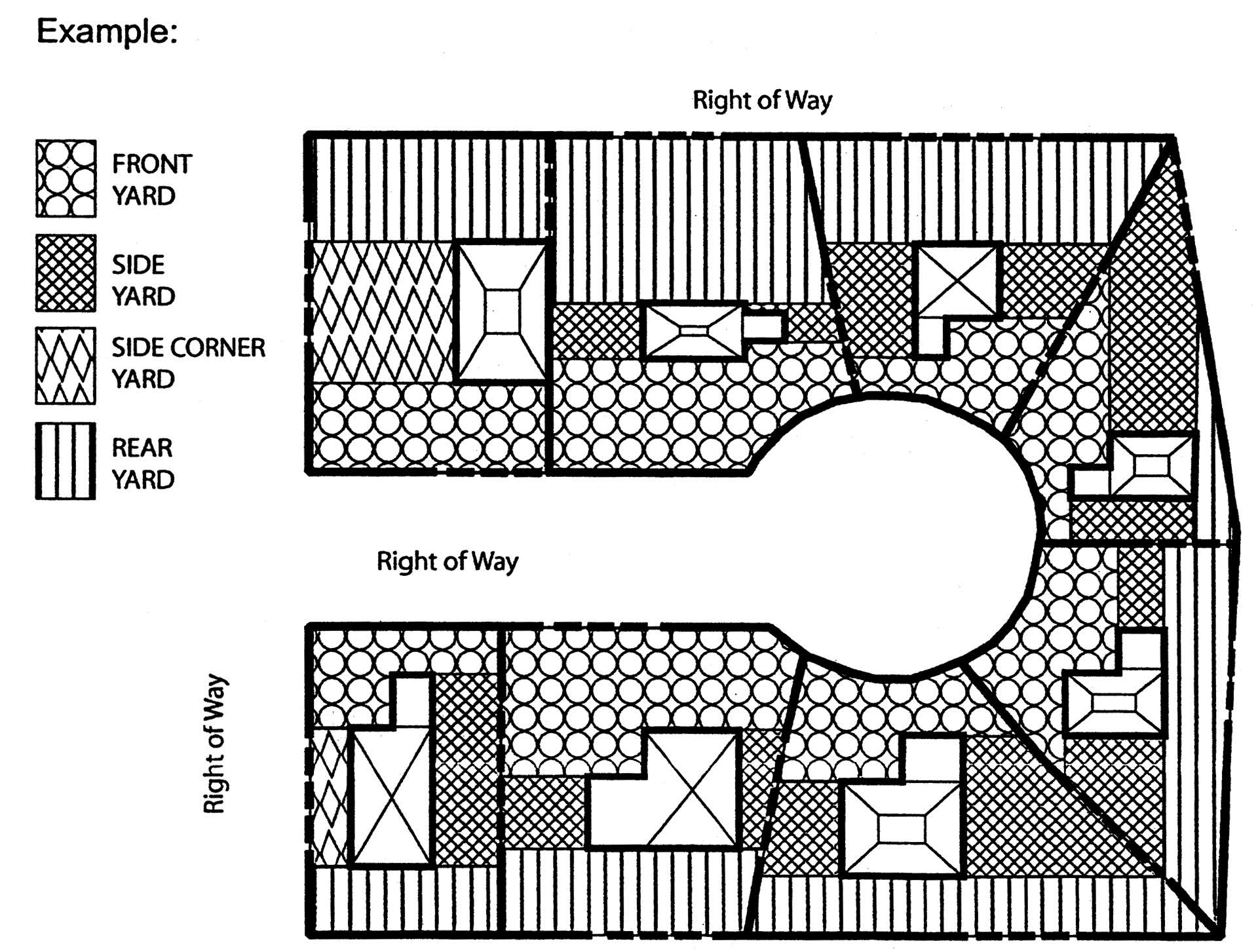
Zoning board of adjustment means the town zoning board of adjustment, as created in division 4 of article II of this chapter.
Zoning director means the officer or other designated authority charged with the administration and enforcement of this chapter or his duly authorized representative.
(Code 1992, § 27-1; Ord. No. 10-88, § 201.1, 3-1-1988; Ord. No. 33-89, § 2, 1-2-1990; Ord. No. 6-91, § 1, 4-2-1991; Ord. No. 31-91, § 1, 1-7-1992; Ord. No. 32-91, § 1, 1-7-1992; Ord. No. 6-92, § 1, 4-20-1993; Ord. No. 18-93, § 2, 10-5-1993; Ord. No. 60-93, § 1, 11-16-1993; Ord. No. 64-94, § 3, 1-17-1995; Ord. No. 43-96, § 14, 10-15-1996; Ord. No. 28-97, § 2, 5-20-1997; Ord. No. 38-98, § 2, 11-17-1998; Ord. No. 64-98, § 2, 1-19-1999; Ord. No. 65-98, § 2, 12-15-1998; Ord. No. 21-99, § 2, 5-18-1999; Ord. No. 27-00, § 2, 6-6-2000; Ord. No. 42-00, § 4, 8-15-2000; Ord. No. 22-00, § 2, 2-20-2001; Ord. No. 14-02, § 2, 7-16-2002; Ord. No. 33-02, § 2, 6-18-2002; Ord. No. 45-02, § 2, 8-20-2002; Ord. No. 20-02, § 2, 10-15-2002; Ord. No. 31-03, § 2, 7-15-2003; Ord. No. 60-03, § 2, 7-20-2004; Ord. No. 01-04, § 2, 11-23-2004; Ord. No. 33-04, § 2, 8-17-2004; Ord. No. 01-05, § 2, 8-16-2005; Ord. No. 35-05, § 3, 12-20-2005; Ord. No. 20-06, §§ 2, 3, 7-18-2006; Ord. No. 21-06, § 2, 9-26-2006; Ord. No. 2-07, § 2, 5-15-2007; Ord. No. 01-07, § 2, 6-5-2007; Ord. No. 45-07, § 2, 3-18-2008; Ord. No. 16-08, § 2, 5-6-2008; Ord. No. 32-08, § 2, 9-16-2008; Ord. No. 33-08, § 3, 10-7-2008; Ord. No. 25-08, § 2, 10-21-2008; Ord. No. 32-09, § 2, 9-22-2009; Ord. No. 41-09, § 2, 1-5-2010; Ord. No. 12-10, § 2, 2-16-2010; Ord. No. 05-10, § 3, 4-6-2010; Ord. No. 15-10, § 2, 9-21-2010; Ord. No. 23-10, § 2, 9-21-2010; Ord. No. 31-10, § 2, 9-21-2010; Ord. No. 19-10, § 2, 12-21-2010; Ord. No. 37-10, § 2, 12-21-2010; Ord. No. 34-10, 2-15-2011; Ord. No. 13-11, § 2, 4-26-2011; Ord. No. 22-12, § 2, 6-19-2012; Ord. No. 1-12, § 2, 8-21-2012; Ord. No. 23-12, § 2, 9-4-2012; Ord. No. 4-13, § 2, 3-19-2013; Ord. No. 10-13, § 2, 4-2-2013; Ord. No. 5-13, § 2, 5-7-2013; Ord. No. 28-13, § 2, 5-21-2013; Ord. No. 39-14, § 2, 2-17-2015; Ord. No. 44-14, § 2, 2-17-2015; Ord. No. 7-15, § 2, 5-19-2015; Ord. No. 4-15, § 2, 6-16-2015; Ord. No. 32-16, § 2, 1-17-2017; Ord. No. 36-17, § 2, 1-16-2018; Ord. No. 4-18, § 2, 9-20-2018; Ord. No. 6-21, § 2, 3-16-2021; Ord. No. 9-21, § 2, 6-15-2021; Ord. No. 6-24, § 2, 3-5-2024)
Sec. 27-2. - Construction of language.
For the purpose of this chapter, the following rules of interpretation shall apply:
(1)
In case of any difference of meaning or implication between the text of this chapter and any caption, illustration, summary table or illustrative table, the text shall control.
(2)
The term "shall" is always mandatory and not discretionary. The term "may" is permissive.
(3)
The term "building" or "structure" includes any part thereof.
(4)
The term "used for" includes the terms "arranged for," "designed for," "maintained for" or "occupied for."
(5)
Unless the context clearly indicates the contrary, where a regulation involves two or more items, conditions, provisions, or events connected by the conjunction "and," "or" or "either … or," the conjunction shall be interpreted as follows:
a.
The term "and" indicates that all the connected items, conditions, provisions or events shall apply.
b.
The term "or" indicates that the connected items, conditions, provisions or events may apply singly or in any combination.
c.
The term "either … or" indicates that the connected items, conditions, provisions or events shall apply singly but not in combination.
d.
The term "such as" implies the term "including, but not limited to, …."
(6)
The term "includes" shall not limit a term to the specified examples, but is intended to extend its meaning to all other instances or circumstances of like kind or character.
(7)
Lot or site areas as set forth herein are minimum area requirements. Lot or site dimensions as set forth herein may need to be exceeded to meet the minimum area requirement.
(Code 1992, § 27-2; Ord. No. 10-88, § 200.1, 3-1-1988)
Sec. 27-3. - Authority.
As provided within the amended town Charter, article IV, section 1, the town council shall have the authority to adopt such ordinances as are deemed necessary or advisable for the good government and general welfare of the town. This authority extends to the adoption of ordinances providing regulations and restrictions governing the height, number of stories and size of buildings and other structures, the percentage and size of buildings and other structures, the percentage and portion of lots that may be occupied, the size of yards, courts and other open spaces and the location and use of buildings, structures and the land for trade, industries, residences, apartment houses and other purposes. Such regulations may be altered and changed as become necessary.
(Code 1992, § 27-3; Ord. No. 10-88, § 100.2, 3-1-1988)
Sec. 27-4. - Scope.
No building or part thereof shall be erected, constructed, moved or altered, and no building or land part thereof shall be used except in conformity with the provisions of this chapter.
(Code 1992, § 27-4; Ord. No. 10-88, § 101.1, 3-1-1988)
Sec. 27-5. - Intent.
(a)
The zoning regulations and districts herein set forth are made in accordance with a comprehensive plan for the general welfare of the community. They are designed to lessen congestion in the streets, secure safety from fire, panic and other dangers, promote health, morals and the general welfare, provide adequate light and air, prevent the overcrowding of land or buildings, avoid undue concentration of population, provide for adequate public facilities and utilities, and preserve the natural resources and storm drainage, and community amenities of beauty and visual interest.
(b)
They are made with reasonable consideration to the character of each district and its peculiar suitability for particular use and with a view of conserving the value of property and encouraging the most appropriate use of land throughout the town.
(c)
Residential district regulations as herein set forth provide for a broad range of housing types to encourage, where appropriate, a mixture of housing and to provide for the opportunity of development of housing in all price ranges where economically feasible.
(Code 1992, § 27-5; Ord. No. 10-88, § 101.1, 3-1-1988)
Sec. 27-6. - Interpretation.
(a)
The interpretation and application of the regulations and provisions of this chapter by the town shall be reasonably and uniformly applied to all property within the town.
(b)
All uses not expressly permitted in a zoning district, either by a use by right or as a special exception use are prohibited in such district. Unnamed uses which are:
(1)
The substantial equivalent of the uses permitted as a use by right or as a special exception in a zoning district;
(2)
Meet the intent and purpose of that zoning district; and
(3)
Would be in harmony with and compatible to the existing uses within that district,
may be permitted upon the determination by the director of planning and zoning or designee. The current edition of the North American Industry Classification System (NAICS) shall be used by the town as a basis to determine equivalent uses. Any other relevant information may also be considered.
(c)
The regulations and provisions of this chapter are adopted pursuant to F.S. § 163.3202, to implement local government comprehensive plans. These regulations are intended to encourage orderly growth and to protect and promote the public health, safety, comfort, convenience, order, appearance, prosperity and general welfare; regulate the use of land and water for those future land-use categories included in the town's comprehensive plan; to ensure the compatibility of adjacent uses and provide for open space; lessen congestion in the streets or roads; ensure safe and convenient on-site traffic flow, considering needed vehicle parking; regulate signage, landscaping and environmental preservation; secure safety from fire and other dangers; provide open space for adequate light and air; prevent the excessive concentration of population, while also discouraging urban sprawl; promote a distribution of population and land utilization and development to facilitate and provide adequate provisions for public improvements, such as transportation, potable water availability, drainage, sanitary sewer, solid waste disposal, educational opportunities, recreation, and for the protection of the tax base and to secure economy in governmental expenditures.
(d)
The zoning regulations in this chapter are not intended to interfere with, abrogate or annul any lawful easements, covenants or other agreements between property owners. The enforcement of such agreements shall be the sole responsibility between the affected property owners.
(e)
When the regulations in this chapter impose a greater restriction upon the use of buildings or premises or upon the height of buildings, or requires larger open spaces than provided by other ordinances, rules, regulations, covenants or plats, the provisions of this chapter shall control.
(f)
The general regulations listed below shall apply within each zoning district, unless expressly modified as part of a town approval for a planned unit development.
(1)
Each lot shall possess at least the minimum area dimensions required in the zoning district in which the lot is located, except substandard or nonconforming lots of record.
(2)
Each building or parking area shall meet or exceed the minimum front, side, rear or district boundary setback required in the zoning district in which the building or parking area is located.
(3)
Each building shall not exceed the maximum building height requirement for the zoning district in which the building is located.
(g)
Whenever the regulations and requirements of this chapter conflict with the requirements of any other rules, regulations, ordinances or laws, the most restrictive shall apply.
(Code 1992, § 27-6; Ord. No. 10-88, § 400.1.I, 3-1-1988; Ord. No. 6-92, § 3, 4-20-1993; Ord. No. 4-13, § 4, 3-19-2013)
Sec. 27-7. - Enforcement.
(a)
Violations reviewed by code enforcement board or special magistrate. Any and all alleged violations of the provisions of the town's land development regulations may be reviewed by the code enforcement board or special magistrate, in accordance with the chapter 8, article II, as may be amended from time to time. However, a review of an alleged violation by the code enforcement board or special magistrate shall not be an exclusive means of enforcing the alleged violations of land development regulations.
(b)
Instituting actions or proceedings. The town may institute or cause to be instituted civil, criminal or administrative law actions or proceedings to prevent, restrain, enforce or abate violations of this chapter, including, but not limited to, the following:
(1)
The unlawful construction, erection, reconstruction, alteration, rehabilitation, expansion, continuation or use of any building or structure;
(2)
The occupancy of such building, structure, land or water;
(3)
The illegal act, conduct, business or use of, in or about such premises; or
(4)
The abandonment of the construction, erection, reconstruction, alteration, rehabilitation, expansion, continuation or use of an abandoned or unfinished structure or building.
(c)
Cease and desist orders. The town shall have the authority to issue cease and desist orders in the form of written notices served upon the property owner of the subject building, property or premises, or to his agent, lessee, tenant, contractor or to any person using the land, building or premises where such violation has been committed or shall exist.
(d)
Notices to appear in county court. Pursuant to F.S. ch. 162, the town may issue notices to appear in county court for violations of this chapter.
(e)
Permits and certificates. All building permits, certificates of occupancy, and interpretations of this chapter shall be subject to the following:
(1)
Issuance. Building permits or certificates of occupancy shall not be issued by the town for any purpose except in compliance with the provisions of this chapter and other applicable ordinances and laws.
(2)
Revocation. The town may revoke a building permit or certificate of occupancy upon determination that false statements or misrepresentations existed as to any material facts contained in the permit application, plans or certificate of occupancy.
(3)
Suspension. The town may suspend a building permit or certificate of occupancy upon a determination that an error or omission on either the part of the permit applicant or government agency existed in the issuance of the permit or certificate approval. A valid permit or certificate shall be issued in place of the incorrect permit or certificate after correction of the error or omission.
(4)
Notice. Town staff decisions concerning applications for the issuance of development orders, building permits or certificates of occupancy, or other administrative interpretations of this chapter, shall be stated in an official written notice, such as a permit, letter or other written correspondence, from an authorized town representative.
(f)
Non-acceptance of applications for development orders, development permits or special permits.
(1)
The town may refuse to accept, or if accepted, suspend or revoke the acceptance of any request or application for the approval of a development permit or order, or the amendment of a previously approved development permit or order, where the director of the planning and zoning department or the director of the building department determines that the request or application pertains to a property or development owned by the same property owner thereon which is alleged to be, or has been determined to be in violation of the Town Code, land development regulations, or the conditions of a development order or permit. Upon the property or business owner, or a tenant's correction of the violation or compliance with a condition of approval, the town may accept and process, or resume processing an application for the approval of an application for a development permit or order.
(2)
The town manager or the town manager's designee shall have the authority to apply this subsection to a property or business owner or tenant making an application for a special permit pertaining to a property or development thereon which is alleged to be in violation, or is in violation of the Town Code, its land development regulations, or the conditions of a development order or special permit.
(Code 1992, § 27-7; Ord. No. 10-88, § 400.2.B, 3-1-1988; Ord. No. 6-92, § 3, 4-20-1993; Ord. No. 9-18, § 2, 5-15-2018)

