
Jupiter City Zoning Code
ARTICLE XI
- SUPPLEMENTARY DISTRICT REGULATIONS
DIVISION 4. - AIRPORTS, LANDING STRIPS, HELIPORTS AND SEAPLANE FACILITIES[4]
State Law reference— Aviation, F.S. ch. 329 et seq.; airport zoning, F.S. ch. 333.
DIVISION 6. - ASSISTED AND INDEPENDENT LIVING FACILITIES[5]
State Law reference— Assisted Living Facilities Act, F.S. § 429.01 et seq.
DIVISION 7. - CEMETERIES[6]
State Law reference— Florida Funeral and Cemetery Services Act, F.S. ch. 497.
DIVISION 8. - CHILD CARE FACILITIES[7]
State Law reference— Child care facilities, F.S. § 402.301 et seq.
DIVISION 16. - FLOOD HAZARD REGULATIONS[8]
State Law reference— Drainage and water control, F.S. ch. 298; water resources, F.S. ch. 373; management and storage of surface waters, F.S. § 373.403 et seq.
DIVISION 17. - FUNERAL HOMES[9]
State Law reference— Funeral, cemetery and consumer services, F.S. ch. 497.
DIVISION 19. - HISTORIC AND ARCHAEOLOGIC PRESERVATION[10]
State Law reference— Historical resources, F.S. ch. 267.
DIVISION 24. - LIGHTING REGULATIONS[11]
State Law reference— Control of beachfront lighting to protect hatching sea turtles, F.S. § 161.163.
DIVISION 25. - MARINE FACILITIES[12]
State Law reference— Florida Vessel Safety Law, F.S. ch. 327.
DIVISION 27. - MOBILE HOME PARKS[13]
State Law reference— Mobile home and recreational vehicle parks, F.S. ch. 513; factory-built housing, F.S. § 553.35 et seq.
DIVISION 29. - NURSING HOMES, CONVALESCENT FACILITIES AND HOSPITALS[14]
Editor's note—Ord. No. 9-21, § 7, adopted June 15, 2021, amended the title of division 29 to read as set out herein.
DIVISION 36. - RECREATIONAL VEHICLE PARKS[15]
State Law reference— Mobile home and recreational vehicle parks, F.S. ch. 513.
DIVISION 37. - REGULATIONS FOR AUTOMOTIVE FUELING STATIONS[16]
State Law reference— Underground storage of petroleum products, F.S.§ 376.317.
DIVISION 38. - SALVAGE YARDS[17]
State Law reference— Resource recovery and management, F.S. § 403.702 et seq.; secondary metal recyclers, F.S. § 538.18 et seq.
DIVISION 40. - SWIMMING POOLS, SPAS, PATIOS AND SCREEN ENCLOSURES[18]
State Law reference— Public swimming and bathing facilities, F.S. ch. 514; residential swimming pool safety act, F.S. ch. 515.
Sec. 27-1888.- Intent.
The general rules and regulations for uses, buildings and structures set forth in this article shall apply to all zoning districts as well as special exception regulations applying to specific zoning districts enumerated herein.
(Code 1992, § 27-1016; Ord. No. 10-88, § 600.1, 3-1-1988)
Sec. 27-1889. - Unity of title.
Any time more than one main building is constructed on a lot or parcel of land, or a building is constructed on more than one lot or parcel of land, other than condominiums, a unity of title shall be recorded to prevent division of such lots or parcels.
(Code 1992, § 27-1017; Ord. No. 10-88, § 628.1, 3-1-1988)
Sec. 27-1890. - Front setback for double frontage lots.
On double frontage lots, a front setback shall be required on each frontage, unless extenuating circumstances can be established to the town staff.
(Code 1992, § 27-1018; Ord. No. 10-88, § 628.2, 3-1-1988)
Sec. 27-1909.- Intent.
This division includes those accessory uses, buildings and structures customarily incidental and subordinate to the main use or building and located on the same lot.
(Code 1992, § 27-1666; Ord. No. 10-88, § 619.1, 3-1-1988; Ord. No. 33-02, § 3, 6-18-2002)
Sec. 27-1910. - Location and setbacks.
(a)
Residential districts. All accessory uses, buildings and structures shall be located on the same lot as the principal or main use and not within any required yard setback except as established in section 27-1910 and subsection 27-2307(g). Structures that are pedestrian amenities and are located in the front or side corner yard, visible and/or usable along the right-of-way, are not structures which are required to meet setbacks residential districts. In residential zoning districts, the following uses, buildings and structures shall be located at least five feet behind the closest front corner line of the principal building (see figure 1). Accessory structures on large lots, which are at least twice the minimum lot area and depth required by the zoning district, may be permitted in the lot's front yard provided there is a 30-foot minimum front setback and the accessory structure is architecturally compatible with the principal structure. Accessory uses, buildings, and structures shall meet the following regulations:
(1)
Sheds and other similar accessory structures identified in this section shall meet the following requirements:
a.
Maximum size of 144 square feet.
b.
Minimum side interior setback shall be three feet. Minimum side corner setback shall be 15 feet. Minimum rear setback shall be five feet. On lots abutting an alley, the minimum rear setback shall be three feet. If a greater easement width exists, the width of the easement shall be the minimum setback.
c.
If a greater easement width exists, the width of the easement shall be the minimum setback.
d.
Maximum height shall be eight feet.
e.
Roof overhangs may encroach into the required setbacks a maximum of 24 inches.
f.
The roof drainage shall be retained on the property and shall not adversely impact adjoining properties.
g.
The use of the shed is limited to the storage of household items and supplies and domestic equipment.
(2)
Storage buildings and other similar accessory structures identified in this section shall meet the following requirements:
a.
Minimum size is greater than 144 square feet. The maximum size shall not exceed 25 percent of the gross floor area of the principal building.
b.
Maximum doorway width shall be six feet.
c.
Side and rear setbacks shall be the same as a screened enclosure on the property, as established in subsections 27-2307(g) and 27-3084(4)(b), unless a greater easement width exists, in which case the width of the easement shall be the minimum setback.
d.
Maximum height shall be ten feet.
e.
The storage building shall be architecturally compatible to the principal building. The siding of a storage building shall not be constructed of metal or plastic unless it is architecturally compatible with the principal building.
(3)
Greenhouses and shade houses and other similar accessory structures shall meet the following requirements:
a.
Side and rear setbacks shall be the same as a screened enclosure on the property unless a greater easement width exists, in which case the width of the easement shall be the minimum setback.
b.
The maximum height of the greenhouse and shade house shall not exceed the height of the existing principal building on the lot.
(4)
Detached garages and other similar accessory structures shall meet the following requirements:
a.
The maximum size shall not exceed 35 percent of the gross floor area of the principal building.
b.
The required side and rear setbacks shall be the same as the principal building located on the same lot.
c.
Shall be a single-story structure and shall not exceed the height of the existing principal building on the lot.
d.
The detached garage shall be architecturally compatible to the principal building. The siding of a detached garage shall not be constructed of metal or plastic unless it is architecturally compatible with the principal building.
(5)
Other similar accessory structures may be determined by the director of planning and zoning or designee to be similar to a shed, storage building, greenhouse, shade house, or detached garage based on height, size, characteristics, and proposed use. Tiki huts that are open sided with a thatched roof may be exempt from the architectural compatibility requirements.
(b)
Commercial and industrial districts. All accessory uses, buildings and structures in commercial and industrial zoning districts, shall meet the required setbacks and regulations of the district in which it is located.
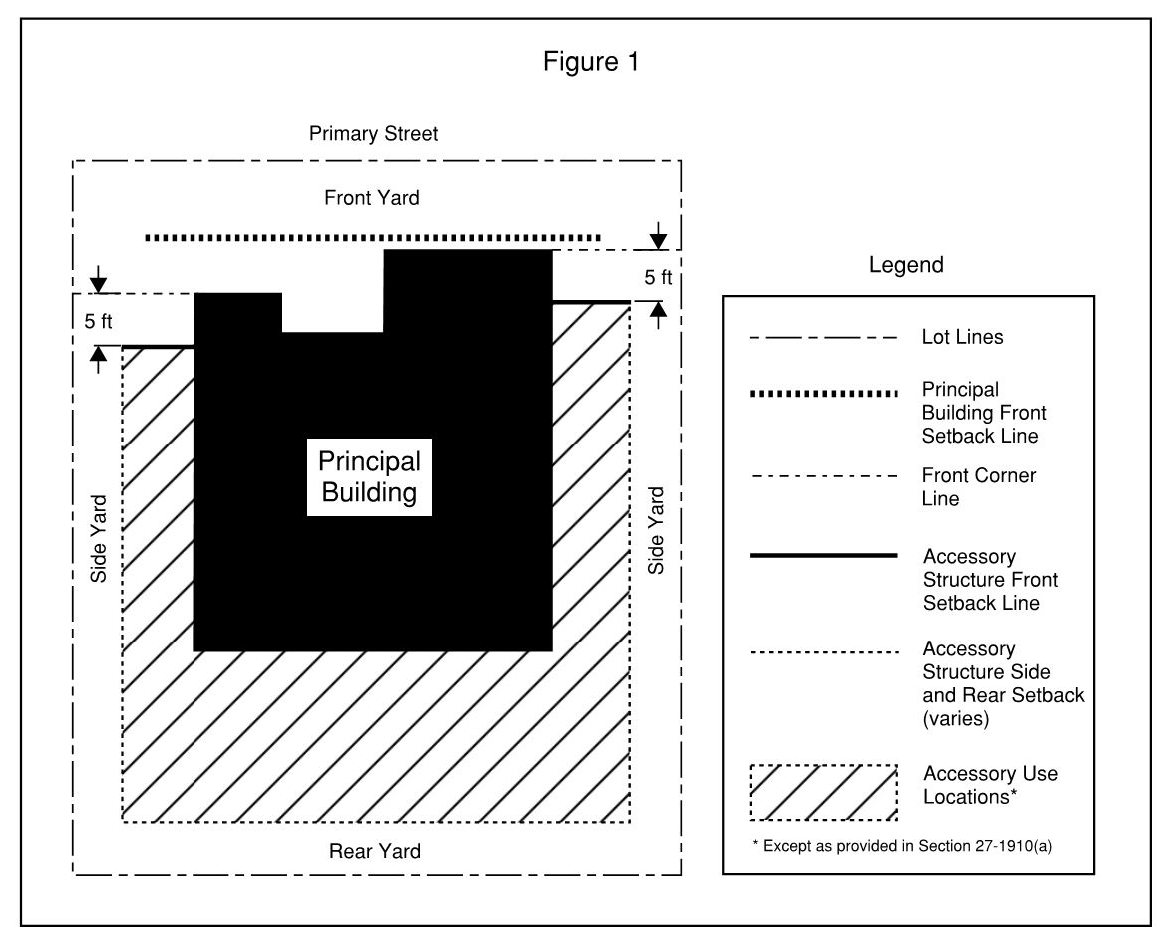
(Code 1992, § 27-1667; Ord. No. 10-88, § 619.2.A, 3-1-1988; Ord. No. 33-02, § 3, 6-18-2002; Ord. No. 31-10, § 3, 9-21-2010; Ord. No. 1-21, § 2, 3-16-2021)
Sec. 27-1911. - Height.
No accessory use, building or structure shall exceed the height permitted in the district in which the principal use is located.
(Code 1992, § 27-1668; Ord. No. 10-88, § 619.2.B, 3-1-1988; Ord. No. 33-02, § 3, 6-18-2002)
Sec. 27-1912. - Use regulations and permit.
(a)
An accessory building or structure in a residential district shall not be rented or otherwise used as a separate dwelling unit, living space or for any income-producing activity, except as allowed by a special exception for home occupations.
(b)
Accessory uses in residential areas such as individual power generation facilities, radio, television or other receiving or transmitting apparatus shall be permitted provided:
(1)
They meet the setback and height restrictions of the district.
(2)
They do not violate the performance standards as enumerated in article XII of this chapter.
(3)
They do not detract from the aesthetic or general character of the residential district as determined by the town council.
(c)
Applications for a building permit shall be reviewed and approved by the planning and zoning director or designee, except when the planning and zoning director considers that the impact of the application is sufficient to bring to the attention of the planning and zoning commission and the town council.
(d)
Building permits for accessory structures shall only be issued if the applicant meets one of the following conditions:
(1)
The principal structure to the accessory use is located and exists on the same lot.
(2)
The principal structure to the accessory use is currently under construction on the same lot.
(3)
A building permit application for the principal structure, on the same lot, is being processed simultaneously with the permit application for the accessory structure.
In the event of conditions subsections (d)(2) and (3) of this section, a certificate of completion (C.O. or C.C.) shall not be issued for an accessory structure, prior to the issuance of a certificate of occupancy for the primary structure.
(Code 1992, § 27-1669; Ord. No. 10-88, § 619.2.C, 3-1-1988; Ord. No. 33-02, § 3, 6-18-2002; Ord. No. 31-10, § 4, 9-21-2010)
Sec. 27-1913. - Accessory residential uses.
(a)
An accessory residential use on a nonresidential property shall adhere to the following requirements:
(1)
A dwelling unit shall be a minimum of 500 square feet and a maximum of 1,200 square feet of gross floor area in total size;
(2)
A dwelling unit shall be a rental apartment or a live-work unit occupied by the property owner;
(3)
No dwelling unit shall be located on the ground floor;
(4)
The dwelling unit shall incorporate CPTED criteria per division 11, article XI of this chapter;
(5)
A shared or individual outdoor space shall be provided for each dwelling unit; and
(6)
A maximum of three dwelling units may be permitted on a lot or parcel or land.
(b)
Administrative approval may be granted for the request for one accessory residential unit.
(c)
Any request for two or three accessory residential units shall be reviewed and approved by the town council. Requests of more than three dwelling units must submit an application for a mixed use land use.
(Code 1992, § 27-1669.1; Ord. No. 15-10, § 16, 9-21-2010)
Sec. 27-1940.- Legislative intent.
This division is intended to provide for the proper location of adult entertainment establishments in the town and to protect the integrity of adjacent neighborhoods, educational institutions, religious institutions, parks and other commercial enterprises. Proper separation of adult entertainment establishments prevents the creation of skid-row areas in the town which otherwise result from the concentration of these establishments and their patrons. It is the intent to limit the secondary effects of adult entertainment establishments as set out in the findings of fact.
(Code 1992, § 27-1036; Ord. No. 84-90, § 1(517.1), 10-16-1990)
Sec. 27-1941. - Supplemental definitions.
In addition to the definitions in section 27-1, the following supplemental definitions shall apply in interpretation of this division. The following words, terms and phrases, when used in this division, shall have the meanings ascribed to them in this section, except where the context clearly indicates a different meaning:
Adult arcade means any place or establishment operated for commercial gain which invites or permits the public to view adult material. For the purposes of this division, the term "adult arcade" is included within the definition of the term "adult theater."
Adult bookstore/adult video store means an establishment which sells, offers for sale or rents adult material for commercial gain; unless the establishment demonstrates either:
(1)
The adult material is accessible only by employees and the gross income from the sale or rental of adult material comprises less than 40 percent of the gross income from the sale or rental of goods or services at the establishment; or
(2)
The individual items of adult material offered for sale or rental comprise less than ten percent of the individual items, as stock in trade, publicly displayed in the establishment and which is not accessible to minors at the establishment.
Adult booth.
(1)
The term "adult booth" means a small enclosed or partitioned area inside an adult entertainment establishment which is:
a.
Designed or used for the viewing of adult material by one or more persons; and
b.
Accessible to any person, regardless of whether a fee is charged for access.
(2)
The term "adult booth" includes, but is not limited to, a peep show booth or other booth used to view adult material.
(3)
The term "adult booth" does not include a foyer through which any person can enter or exit the establishment, or a restroom.
Adult dancing establishment means an establishment where employees display or expose specified anatomical areas to others regardless of whether the employees actually engage in dancing.
Adult entertainment establishment means:
(1)
Any adult arcade, adult theater, adult bookstore/adult video store, adult motel or adult dancing establishment; or any establishment or business operated for commercial gain where any employee, operator or owner exposes his or her specified anatomical area for viewing by patrons; including, but not limited to, massage establishments whether or not licensed pursuant to F.S. ch. 480, tanning salon, modeling studio or lingerie studio.
(2)
Excluded from this definition are any educational institutions where the exposure of specified anatomical areas is associated with a curriculum or program.
(3)
An establishment that possesses an adult entertainment license is presumed to be an adult entertainment establishment.
Adult material means any one or more of the following, regardless of whether it is new or used:
(1)
Books, magazines, periodicals or other printed matter; photographs, films, motion pictures, video cassettes, slides or other visual representations; recordings, other audio matter; and novelties or devices; which have as their primary or dominant theme subject matter depicting, exhibiting, illustrating, describing or relating to specified sexual activities or specified anatomical areas; or
(2)
Instruments, novelties, devices or paraphernalia which are designed for use in connection with specified sexual activities.
Adult motel means any hotel, motel, boardinghouse, roominghouse or other place of temporary lodging which includes the term "adult" in any name it uses or which otherwise advertises the presentation of adult material. The term "adult motel" is included within the definition of the term "adult theater."
Adult theater means an establishment operated for commercial gain which consists of an enclosed building, or a portion or part thereof or an open-air area used for viewing of adult material. The term "adult theater" includes the terms "adult motels," "adult arcade," "adult hotel" and "adult motion picture theater." An establishment which has adult booths is considered to be an adult theater.
Adult video store. See Adult bookstore.
Commercial establishment means any business, location or place which conducts or allows to be conducted on its premises any activity for commercial gain.
Commercial gain means operated for pecuniary gain, which shall be presumed for any establishment which has received a business tax receipt. For the purpose of this division, commercial or pecuniary gain shall not depend on actual profit or loss.
Educational institution means a premises or site within a municipality or within the unincorporated area of the county upon which there is an institution of learning, whether public or private, which conducts regular classes and/or courses of study required for accreditation by or membership in the state department of education, Southern Association of Colleges and Secondary Schools or the Florida Council of Independent Schools. The term "educational institution" includes a premises or site upon which there is a day care center, nursery school, kindergarten, elementary school, junior high school, senior high school; professional institution of higher education, including a community college, junior college, four-year college or university; libraries, art galleries and museums open to the public; or any special institution of learning. The term "educational institution," however, does not include a premises or site upon which there is a vocational institution operated for commercial gain.
Employee means any person who works, performs or exposes his or her specified anatomical areas in an establishment, irrespective of whether said person is paid a salary or wages by the owner or manager of the business establishment, or premises. The term "employee" shall include any person who pays any form of consideration to an owner or manager of an establishment, for the privilege to work, perform or expose his specified anatomical areas within the establishment.
Establishment means the site or premises on which the adult entertainment establishment is located, including the interior of the establishment, or portion thereof, upon which certain activities or operations are being conducted for commercial gain.
Park.
(1)
The term "park" means a tract of land within a municipality or unincorporated area which is:
a.
Kept for ornament and/or recreation, and which is open to the public whether or not the land is publicly owned, or
b.
Land privately-owned which is kept for ornament and/or recreation purposes and which is limited to surrounding landowners.
(2)
A playground shall be considered a park.
Religious institution means a premises or site which is used primarily or exclusively for religious worship and related religious activities. A church, ecclesiastical or denominational organization or established place of worship, retreat site, camp or similar facility owned or operated by a bona fide religious group for religious activities shall be considered a religious institution.
Residential zoning district shall include the following zoning districts in the town which have not been designated in the comprehensive plan as commercial or industrial potential:
(1)
Agricultural District (A-1).
(2)
Rural Residential District (R-R).
(3)
Residential, Single-Family District (R-1).
(4)
Residential, Single-Family-Duplex District (R-2).
(5)
Residential, Limited Multifamily District (R-3).
Specified anatomical areas means:
(1)
Less than completely and opaquely covered:
a.
Human genitals and pubic region;
b.
Cleavage of human buttocks; or
c.
That portion of the human female breast encompassed within an area falling below the horizontal line one would have to draw to intersect a point immediately above the top of the areola (the colored ring around the nipple).
This definition shall include the entire lower portion of the female breast, but shall not include any portion of the cleavage of the human female breast exhibited by a dress, blouse, shirt, leotard, bathing suit or any wearing apparel, provided the areola is not so exposed; or
(2)
Human male genitals in a discernibly turgid state, even if completely and opaquely covered.
Specified sexual activities means:
(1)
Human genitals in a state of sexual stimulation, arousal or tumescence; or
(2)
Acts of human anilingus, bestiality, buggery, cunnilingus, coprophagy, coprophilia, fellation, flagellation, masochism, masturbation, necrophilia, pederasty, pedophilia, sadism, sadomasochism, sexual intercourse, or sodomy; or
(3)
Fondling or other erotic touching of human genitals, pubic region, buttock, anus or female breast; or
(4)
Excretory functions as part of or in connection with any of the activities set forth in subsections (1) through (3) of this definition.
(Code 1992, § 27-1037; Ord. No. 84-90, § 1(517.6), 10-16-1990; Ord. No. 66-06, § 9, 12-19-2006)
Sec. 27-1942. - Findings of fact.
Based on the evidence and testimony which was presented originally to the board of county commissioners, at the time that the county adopted its ordinances in reference to adult entertainment establishments, which is hereby incorporated herein by reference and based upon the evidence and testimony presented at first reading and at the public hearing before the town council, and based upon the findings incorporated in the United States Attorney General's Commission on Pornography (1986), A Summary of a National Survey of Real Estate Appraisers Regarding the Effect of Adult Bookstores on Property Values, conducted by the Division of Planning, Department of Metropolitan Development, City of Indianapolis, January 1984, the town council hereby finds that:
(1)
Commercial establishments exist or may exist within the unincorporated areas of the county where books, magazines, motion pictures, prints, photographs, periodicals, records, novelties and/or devices which depict, illustrate, describe or relate to specified sexual activities are possessed, displayed, exhibited, distributed and/or sold; and
(2)
Such commercial establishments are or may be located within the town or are so close in proximity to the town that the same may seek location within the town for such purpose, and wherein such establishments:
a.
The superficial tissues of one person are manipulated, rubbed, stroked, kneaded and/or tapped by a second person, accompanied by the display or exposure of specified anatomical areas;
b.
Dancers, entertainers or other individuals, who, for any form of commercial gain, perform or are presented while displaying or exposing any specified anatomical area; or
c.
Lap dancing occurs; and
(3)
The activities described in subsections (1) and (2) of this section occur at commercial establishments for the purpose of making a profit, and, as such, are subject to regulation within and by the town in the interest of the health, safety, morals and general welfare of the people of the town; and
(4)
The competitive commercial exploitation of such nudity and seminudity is adverse to the public's interest and the quality of life, tone of commerce, and total community environment in the town; and
(5)
When the activities described in subsections (1) and (2) of this section are presented in commercial establishments within the town, other activities which are illegal, immoral or unhealthful tend to accompany them, concentrate around them and be aggravated by them. Such other activities include, but are not limited to, prostitution, solicitation for prostitution, lewd and lascivious behavior, possession, distribution and transportation of obscene materials, sale or possession of controlled substances and violent crimes against persons and property; and
(6)
When the activities described in subsections (1) and (2) of this section are present in commercial establishments within the town, they tend to blight neighborhoods, adversely affect neighboring businesses, lower property values, promote crime, particularly the kinds detailed in subsection (5) of this section and ultimately lead residents and businesses to move to other location; and
(7)
There is a direct relationship between the display or depiction of specified anatomical areas in subsection (2) of this section and an increase in criminal activities, moral degradation and disturbances of the peace and good order of the community, and the concurrency of these activities is hazardous to the health and safety of those persons in attendance and tends to depreciate the value of adjoining property and harm the economic welfare of the community as a whole. These secondary effects are adverse to the public's interest and quality of life, tone of commerce and total community environment in the town.
(Code 1992, § 27-1038; Ord. No. 84-90, § 1(517.5), 10-16-1990)
Sec. 27-1943. - Application of division.
The locational restrictions contained in this division should not be construed as to apply only to those residential zoning districts, religious institutions, educational institutions, parks and other commercial enterprises which cater to or are attended by persons under 18 years of age. The restrictions within this division are intended to ensure that residential zoning districts, educational institutions, religious institutions, parks and other commercial enterprises are located in areas free from the secondary effects of adult entertainment establishments.
(Code 1992, § 27-1039; Ord. No. 84-90, § 1(517.2), 10-16-1990)
Sec. 27-1944. - Supplemental administrative requirements.
(a)
Rules of construction. This division shall be liberally construed to accomplish its purpose of regulating and dispersing adult entertainment establishments and related activities.
(b)
More restrictive provisions apply. Whenever the regulations and requirements of this division are at variance with the requirements of any other lawfully enacted and adopted rules, regulations, ordinances or laws, the most restrictive shall apply.
(Code 1992, § 27-1040; Ord. No. 84-90, § 1(517.3), 10-16-1990)
Sec. 27-1945. - Preservation of property values.
The town council hereby declares that the location of residential zones, educational institutions, religious institutions, parks and other commercial enterprises within viable, unblighted and desirable areas, supports the preservation of property values and promotes the health, safety and welfare of the town and the public at large.
(Code 1992, § 27-1041; Ord. No. 84-90, § 1(517.4), 10-16-1990)
Sec. 27-1946. - Applicable zoning district.
Adult entertainment establishments may be permitted as provided in this chapter.
(Code 1992, § 27-1042; Ord. No. 84-90, § 1(517.7), 10-16-1990)
Sec. 27-1947. - Supplemental regulations.
Regardless of the district in which it is located, an adult entertainment establishment shall be developed according to the property development criteria, requirements and special regulations of the Commercial, General District (C-2). The property development criteria, requirements and special regulations of the Commercial, General District (C-2) shall apply to adult entertainment establishments located in all industrial zoning districts and in the Workplace Subdistrict (WP) of the Mixed Use Development District (MXD).
(Code 1992, § 27-1043; Ord. No. 84-90, § 1(517.8), 10-16-1990; Ord. No. 46-98, § 2, 9-8-1999)
Sec. 27-1948. - Distance requirements for location.
(a)
No person shall cause or permit the operation of any proposed or existing adult entertainment establishment within the above-referenced zoning districts without following the minimum location distances from the existing specified uses:
(1)
Another adult entertainment establishment: 750 feet.
(2)
Church or religious institution: 750 feet.
(3)
Educational institution: 750 feet.
(4)
Park: 750 feet.
(5)
Residential zoning district: 750 feet.
(b)
The subsequent approval of a religious institution, educational institution, park or residentially zoned land within these distances shall not change the status of the adult entertainment establishment to that of a nonconforming use.
(c)
The location distances set forth shall be measured by drawing a straight line between the closest property lines of the proposed or existing adult entertainment establishment to the nearest point on the property line of such religious institution, educational institution, park residential zoning district or another adult entertainment establishment. Measurement shall be made in a straight line, without regard to intervening structures or objects.
(Code 1992, § 27-1044; Ord. No. 84-90, § 1(517.9), 10-16-1990; Ord. No. 46-98, § 2, 9-8-1999)
Sec. 27-1949. - Variances not applicable.
Variances to the locational standards of this division shall not be included within the scope of approval for the issuance of variances by the town pursuant to the procedure for variances under division 4 of article II of this chapter, and shall not be allowed.
(Code 1992, § 27-1045; Ord. No. 84-90, § 1(517.10), 10-16-1990)
Sec. 27-1950. - Nonconforming establishments.
(a)
Any adult entertainment establishment in operation and open to the public in the town on the effective date of the ordinance from which this section was derived or any adult entertainment establishment existing in an area hereafter annexed into the town, which, by its location, use or occupancy, does not conform to the requirements of this division, is declared to be and shall hereafter be termed nonconforming.
(b)
All nonconforming adult entertainment establishments existing within the town limits shall either be moved and relocated and maintained and operated so as to be in conformity with the provisions and requirements of this division, no later than three years from October 16, 1990, or such use of such location shall cease.
(c)
All nonconforming adult entertainment establishments existing within any area hereinafter annexed into the town shall either be moved and relocated and maintained and operated so as to be in conformity with this division, no later than three years from the effective date of annexation, or such use at such location shall cease.
(Code 1992, § 27-1046; Ord. No. 84-90, § 1(517.11), 10-16-1990)
Sec. 27-1951. - Supplemental special exception standards.
Any petition for a special exception pursuant to this division to authorize the location of an adult entertainment establishment in a Industrial, General District (I-2) shall be subject to the following requirements in addition to the general requirements for special exceptions, the standards in article III of this chapter, and the minimum criteria for review contained in Appendix 1 of the zoning provisions which is on file in the town clerk's office:
(1)
The applicant for a special exception shall bear the burden of demonstrating that the granting of the special exception will be in harmony with the general intent and purpose of this chapter and will not be otherwise detrimental to the public health, safety, morals, comfort, convenience, prosperity or general welfare.
(2)
The petition satisfies each of the performance standards adopted pursuant to article XII.
(3)
Satisfies the requirements of chapter 23.
(4)
Demonstrate that the site meets all of the traffic and access standards utilized by the town engineer.
(5)
Install outdoor low intensity lighting that illuminates the entire parking and vehicular use area. The lighting shall be installed on structures which do not exceed 16 feet from finished grade. The lighting shall also be adjusted and shielded to direct, focus and print all the illumination from the lighting onto the parking and vehicular use area and to avoid any spillage of illumination onto surrounding properties.
(Code 1992, § 27-1047; Ord. No. 84-90, § 1(517.12), 10-16-1990)
Sec. 27-1971.- Intent.
All airports, landing strips, heliports or seaplane facilities not owned and operated by the state, county, town or a helipad for a hospital shall comply with the requirements stated herein.
(Code 1992, § 27-1416; Ord. No. 10-88, § 605.1, 3-1-1988)
Sec. 27-1972. - Where permitted.
(a)
Private landing strips and heliports may be permitted as a special exception in an A-1 district. Heliports may be permitted as a special exception in the Industrial, Park, Light Industry Districts (I-1), Industrial, General Districts (I-2), Industrial, High Technology Districts (I-3), and Industrial, High Technology and Employment Center Districts (I-4).
(b)
Helistops may be allowed as a special exception in the Commercial, General Districts (C-2) and Commercial, Office Districts (C-3). They will not be allowed within 1,000 feet of residential properties.
(Code 1992, § 27-1417; Ord. No. 10-88, § 605.2, 3-1-1988; Ord. No. 50-10, § 3, 12-21-2010)
Sec. 27-1973. - Regulations.
In addition to the regulations as set forth within the district in which the use is located, the following minimum regulations shall apply:
(1)
Airports and landing strips shall provide a minimum landing area of 1,600 feet in length and 150 feet in width. There shall also be provided, running the length of the landing area and on both sides, an emergency buffer strip at least 150 feet wide. Heliports design guide as required by the United States Department of Transportation (F.A.A.).
(2)
The minimum required land area for any type of seaplane operation shall be two acres.
(3)
If the facility is a commercial venture, it shall not be located within 1,000 feet of a residential use.
(4)
All seaplane operations shall comply with the following minimum standards for water landing area:
a.
Length: 3,500 feet.
b.
Width: 300 feet.
c.
Depth: four feet.
No seaplane operation shall be considered unless the aircraft approach to the water landing area is at a slope of 40:1 or flatter for a distance of at least two miles from both ends of the water landing area and is clear of any building structure or portion thereof which extends through and above the aircraft approach plane.
(5)
No building, structure, or navigational aid shall be placed closer than 50 feet from the property line.
(6)
No building or structure shall exceed the height for the district in which the use is located unless otherwise required by federal law or state statute.
(7)
All buildings and structures and aircraft parked on land shall observe a minimum distance from all property lines of at least 50 feet.
(8)
Where deemed necessary by the town council to protect the general public, safety fences of up to a height of six feet may be required. The town council may also require screening of at least 75 percent opaqueness to protect neighboring property from potential loss of use or diminishment of land value.
(Code 1992, § 27-1418; Ord. No. 10-88, § 605.3.A, 3-1-1988)
Sec. 27-1974. - Helicopters.
In addition to all of the regulations in this division, the following minimum regulations shall apply to the takeoff operation and landing of helicopters:
(1)
Generally. No person shall operate a helicopter in the town for the purposes of landing or takeoff except at an airport, heliport or helistop duly designed and intended for such purpose.
(2)
Limitation on helicopter operation. All helicopters operating in, within, and over the town shall avoid unnecessary low flying over inhabited areas and shall be controlled and flown in such manner that the residents and occupants of the ground or water areas adjacent to the helicopter's operation shall not be subject to unusual noise, dirt, wind or other disturbance which is detrimental to their safety or wellbeing, or to the public peace.
(3)
Special or temporary landing permits. The town manager is hereby authorized to issue special or temporary landing permits to the owners or operators of helicopters desiring occasional and noncontinuous permission for individual helicopter landings or takeoffs at and from locations other than airports, heliports or helistops. The owners or operators of helicopters utilizing such special or temporary permits will assume all responsibility for any loss or injury occasioned thereby.
(4)
Exemptions. The provisions of this division shall not apply to helicopters operated by any branch of the Armed Services of the United States of America or by any law enforcement agencies, nor shall it apply to emergency landings by helicopters while engaged in rescue, evacuation or medical transportation activity.
(Code 1992, § 27-1419; Ord. No. 10-88, § 605.3.B, 3-1-1988)
Sec. 27-1975. - Application procedures.
(a)
Applications shall be submitted in conformance with article III of this chapter.
(b)
In addition to the requirements of article III of this chapter, any person, association or corporation desiring to operate an aircraft facility shall submit an application which shall consist of:
(1)
An airspace analysis conducted by the Federal Aviation Administration (F.A.A.), and
(2)
An airport license report by the state department of transportation.
(Code 1992, § 27-1420; Ord. No. 10-88, § 605.4, 3-1-1988)
Sec. 27-2004.- Purpose and intent.
The "whereas" clauses of the ordinance from which this division is derived are incorporated herein as the purpose and intent of this division. In addition, it is the purpose and intent of this division to implement F.S. § 163.3161 and the town's comprehensive plan, by reviewing buildings and structures erected in the town for conformity with certain general and specific architectural and community appearance standards, and general conformity with the character and appearance of surrounding structures. It is the purpose of this division to authorize the town council (hereinafter referred to as the council), upon receipt of a recommendation from the planning and zoning commission (hereinafter referred to as the commission), to review and approve buildings and structures which are proposed as part of a site plan or subdivision that are required by the town's Code to be approved by the town council to maintain and/or enhance the architectural character and community appearance of present and future land use and development in the town consistent with F.S. § 163.3161(7) and the town's comprehensive plan. Further, it is the purpose of this division to prohibit the development of monotonous structures and streetscapes which might result from a site plan or subdivision application, and to promote a diversity and variety of residential home models and nonresidential buildings, as determined by the council to be in keeping with the community appearance and architectural character of the town.
(Code 1992, § 25-281; Ord. No. 60-96, § 1, 12-3-1996)
Sec. 27-2005. - Scope.
This division shall apply to applicants for any new subdivisions or site plans that are required by the town Code to be approved by the town council, and applicants for exterior alterations or additions to existing buildings of a previously approved subdivision or site plans that are required by the town Code to be approved by the town council. The standards set forth in this division shall also be applied by staff to structures which are proposed for site plans or subdivisions which are reviewed as a use by right by town staff, but not the town council. Furthermore, staff may seek direction from the town council for structures which are proposed as part of a use by right. This division shall not apply to permits for single-family residences for site plans approved prior to the adoption of the ordinance from which this division is derived. These provisions shall apply to all site plan or subdivision applications, which are pending but have not yet been approved by the town council.
(Code 1992, § 25-282; Ord. No. 60-96, § 2, 12-3-1996)
Sec. 27-2006. - Architectural and community appearance review standards for site plan or subdivision applications.
(a)
The council shall consider applications for site plans or subdivisions and streetscapes for architectural style and community appearance at the same time as the council conducts its zoning review of a site plan or subdivision application. In determining whether to approve, approve with conditions or deny an application, the council shall apply the following standards to evaluate buildings, structures and streetscapes which are part of a proposed site plan or subdivision:
(1)
Whether the buildings or structures proposed are consistent with the appearance or architectural style and character of other structures in the same master planned or Large-Scale Planned Unit Development (PUD) developments, or any zoning district which has adopted architectural standards.
(2)
Whether the proposed architectural design and appearance of the buildings or structures are of such architectural quality, variety and appearance so as to not cause surrounding properties from materially depreciating in appearance and value.
(3)
Whether the proposed architectural design and appearance of the buildings or structures are in harmony with existing or proposed developments in the general area.
(4)
Whether the proposed buildings or structures are consistent with the standards of this division, the town's land development regulations, other applicable ordinances of the town, and any areas which have been the subject of a special study, including, but not limited to, the Indiantown Road Overlay Zoning District (IOZ), and the U.S. Highway One/Intracoastal Waterway Study Area.
(5)
Whether the proposed buildings or structures, and in particular, residential dwelling units, for a particular site plan or subdivision contain a variety of architectural styles and floor plans or model types so as to avoid a monotonous appearance of residential units and/or streetscapes within a particular site plan or subdivision. In order to avoid the monotonous appearance of residential units and/or streetscapes within a site plan or subdivision, the council may require any number of different residential dwelling unit floor plans or housing model types and/or a variety of architectural styles. In order to implement this policy, the council may adopt conditions to require any number of floor plans or housing model types, and may also specifically address a building's scale, massing, proportion, elevations and architectural details, including, but not limited to, its architectural trim and colors.
(b)
In reviewing an application, the council shall consider the following, and may impose conditions to a site plan or subdivision application to further the architectural variety and to promote the general aesthetics and community appearance:
(1)
The existing and proposed conditions of the lot, including, but not limited to, topography, vegetation, trees, drainage and waterways.
(2)
The design and layout of all existing and proposed buildings to ensure there exists an efficient arrangement of land uses, including a consideration of safety, crime prevention and police and fire protection, the proposed buildings' relationship to surrounding or adjacent neighborhoods, buildings and lands, as well as pedestrian sight lines and view corridors.
(3)
The lighting, landscaping and buffering material, to ensure an adequate relationship with the overall site and surrounding area.
(Code 1992, § 25-283; Ord. No. 60-96, § 3, 12-3-1996)
Sec. 27-2007. - Architectural and community appearance review requirements.
When making a site plan or subdivision application to the town, the following information shall be provided, in addition to the information required by other sections of the town Code:
(1)
Building plans, including floor plans, roof plans and such drawings or plans which accurately reflect the scale, massing, proportions, elevations and architectural styles and character of buildings or structures so that the site plan or subdivision application can be evaluated consistent with the standards set forth in this division.
(2)
All items affecting the architectural details and appearance of buildings or structures. Each elevation shall indicate the following specific items, and any others which may be deemed necessary for adequate review by the council:
a.
Exact colors of all architectural features (including chip samples).
b.
Architectural details.
c.
Facade-mounted lighting fixtures.
d.
Types of building materials.
e.
All architectural features and colors for each elevation.
(3)
Representation of the proposed landscape materials on the building elevation.
(4)
Vehicular use areas and paving features.
(5)
Neighborhood or surrounding use compatibility.
(6)
The architectural styles of residential units, including the level of ornamentation incorporated into the architectural facade treatment for each model and architectural imagery of the variety of model types and/or architectural elevations.
(7)
Pedestrian environment and human scale.
(8)
Presence of historical structures and buildings.
(9)
The type and level of entry features for the site or building incorporated into the design concept.
(10)
Orientation of the building with respect to natural features (e.g., sunlight, view, water bodies, environmental preservation areas, etc.).
(11)
The types and numbers of floor plans and elevations.
(Code 1992, § 25-284; Ord. No. 60-96, § 4, 12-3-1996)
Sec. 27-2008. - Action by the planning and zoning commission.
The town's planning and zoning commission shall review each site plan or subdivision application and shall consider the standards provided in this division.
(Code 1992, § 25-285; Ord. No. 60-96, § 5, 12-3-1996)
Sec. 27-2009. - Town council review.
The town council shall review the recommendations of the commission at a public hearing and shall hear such interested parties as may desire to be heard. The council shall review the application based upon the standards and criteria provided in this division and any other requirements set forth in this Code, and based upon such review, shall approve or deny the application, or shall approve the application with conditions or modifications.
(Code 1992, § 25-286; Ord. No. 60-96, § 6, 12-3-1996)
Sec. 27-2010. - Compliance with other Code provisions.
The requirements of this article are in addition to any other requirements of the town Code. Approval by the council of a given set of plans and specifications does not necessarily constitute evidence of the applicant's compliance with other requirements of this Code.
(Code 1992, § 25-287; Ord. No. 60-96, § 7, 12-3-1996)
Sec. 27-2011. - Enforcement.
Any person alleged to be in violation of these provisions may be subject to a code enforcement board proceeding or other enforcement proceedings available to the town.
(Code 1992, § 25-288; Ord. No. 60-96, § 8, 12-3-1996)
Sec. 27-2012. - Monotony restrictions.
In order to enhance a desired character or appearance and to promote a variety of architecture of structures, the council shall have the authority to require a diversity of floor plans and/or elevations, or a variety of residential housing models and/or architectural styles, including, but not limited to, floor plans, elevations, building scale, building massings, building proportions, architectural trims and architectural details, within a site plan or subdivision. For example, the council may require any number of different floor plans of a particular architectural style within a site plan or subdivision, and may require as a condition of approval that a certain number of lots on either side or on the same side of the street are constructed with any number of different floor plans or housing model types. For purposes of this section, the term "monotonous" means houses with the same floor plans or elevations.
(Code 1992, § 25-289; Ord. No. 60-96, § 9, 12-3-1996)
Sec. 27-2013. - Supplemental criteria.
Pursuant to section 25-303(4), the council, when considering an application for development approval, may regulate architecture appearance by adopting or by requiring conditions which are based on the following standards:
(1)
Building location and scale.
a.
All applications must consider the overall form, pattern and detail of the building.
b.
Applications must be compatible with any neighborhood or redevelopment plan.
c.
Building heights, scale and massing must relate to the height of abutting buildings.
d.
Building footprints must take into account pedestrian and vehicular circulation, including unencumbered pedestrian access to all public spaces.
e.
New construction shall differentiate itself from neighboring buildings in terms of architectural style, while the scale, rhythm, height and setbacks, as well as the locations of windows, doors and balconies, bear some relationship to neighboring buildings and maintain some semblance of compatibility.
f.
Differentiations between office/commercial and residential entrances in mixed use buildings is required.
g.
The surfaces of multiple storefronts within a building should be compatible from storefront to storefront.
h.
No wall/elevation should run continuously for more than 100 feet without providing a change or variation in the roofline or building facade.
(2)
Professional offices.
a.
The ground level portions of office buildings fronting on a street should contain office fronts in conformance with the retail storefront section of this article.
b.
Reflective/mirrored glass is prohibited.
c.
Buildings should not have unfinished surfaces visible to the public.
(3)
Retail and storefronts.
a.
Retail structures should have a recognizable entry feature facing the public street which must be accessible to pedestrians, even if vehicular entrances are located elsewhere.
b.
Retail structures should include a strong pedestrian connection to existing/proposed sidewalks, including pavement treatments at entries and pedestrian crosswalks. These pedestrian connections shall be located to continue existing pedestrian patterns.
c.
Off-street parking should occur behind or on the side of retail structures, allowing stores to front partially or wholly on the sidewalk.
d.
Retail structures are to be encouraged to locate adjacent to the street.
e.
The face of a retail structure should be aligned with existing neighboring buildings. Allowances for courtyards, recessed entrances, etc., may be considered.
f.
Storefront design, relief features and decorative treatments should complement adjacent storefronts and relate to the detailing of the entire building or block.
g.
Site (street) furniture may be required to create a pedestrian-friendly atmosphere, to include a mixture of seating areas, lighting, planters (window boxes) and trash receptacles.
(4)
Paint color.
a.
Paint color should be used to highlight architectural forms and details but not to create them. Architectural murals may be appropriate for a particular building and may be considered on a case-by-case basis.
b.
The color relationship between adjacent buildings should be compatible and complementary, but not necessarily identical.
c.
When a commercial building contains more than one storefront, the building shall have integrity of color. It should not be subdivided to reflect the storefronts.
d.
Stone or tile surfaces shall not be painted.
(5)
Lighting.
a.
Storefront. Intense, glaring illumination of a storefront is prohibited. Lighting should not be used as a method to make a building stand out or as an attention-getting device.
b.
Alleys and parking facilities.
1.
Alleys and rear/side delivery areas should be lit during evening and night hours.
2.
Decorative lighting of landscapes, landscape features, pool decks and recreation areas is permitted subject to council approval.
3.
All parking areas should have sufficient lighting to provide a safe and functional environment. Light fixtures in parking lots shall have a maximum height of 25 feet.
(6)
Air-conditioning equipment.
a.
Air-conditioning equipment which is flush-mounted with a wall is permitted, if it faces an interior with an existing building or a rear lot line, and may not be visible from the street. It must have no more than a one-fourth-inch projection, and grill covers are required to match or be painted to match the building color.
b.
For those buildings which abut a vacant lot, town council approval for flush-mounted units is required.
c.
No air-conditioning equipment is permitted on elevations that face a public street or on portions of elevations which have significant architectural features.
d.
Air-conditioning equipment located on the roof should not be visible from the street and should be located in an area that screens it from view at street level. Large equipment shall be screened or enclosed with an architectural treatment that is compatible with the design of the building. The screening should also conceal it from the view of surrounding mid-rise and high-rise buildings.
(7)
Awnings and canopies.
a.
Form and construction.
1.
Awnings should be an adequate height and depth to form a continuous canopy along the sidewalk. If the formation of a continuous row covers or impedes architectural features and embellishments, recesses or openings may be considered, subject to council approval. In a building containing multiple storefronts, the council may consider permitting individual stores or windows to have their own awning.
2.
The awnings on corner buildings should continue around the corner for compatibility with building forms and pedestrian patterns.
3.
Awnings may extend over a public sidewalk if the building presents a substantially flush facade on the sidewalk.
4.
Awnings proposed for buildings with front porches are reviewed with particular consideration given to the relationship of the proposed awning to the street, the mass and scale, height of the porch and the proposed awning, and the existing setback of the structure.
5.
The size of an awning should be proportional to the scale of the host building and the surrounding streetscape.
6.
Awnings should be supported by poles connected to the building and underneath the awnings.
b.
Appearance and color.
1.
High gloss vinyl (plastic) awnings and awnings with horizontal ribbing are prohibited, as are flowered or similarly patterned designs.
2.
Metal awnings should be subject to the same restrictions and guidelines as other awning material.
3.
All awnings should incorporate straight valances; scalloped awnings may be permitted, subject to commission or council approval, depending on the architecture of the building and the type and shape of awning used.
4.
The awning/canopy and support system should be maintained at the same level as other components of the building. Rusting/peeling support structures should be cleaned and repainted. Rotted or broken supports should be replaced. Faded and dirty awnings should be cleaned or replaced.
(8)
Satellite dishes. Satellite dishes should be mounted such that they are not visible to the general public. If ground-mounted, dishes should be located in the rear or interior side yards and densely screened with landscape where feasible. If roof-mounted, the dish should be as close to the middle of the roof as possible, or a parapet must be installed to screen the view of the dish. If screened, the color of the screen must match the color of the building.
(9)
Waterfront.
a.
Where possible, buildings should provide view, light, and breeze corridors to the water.
b.
Building pedestals should not form a continuous sheer wall along the water. Decorative surfaces, multi-level decks, berming and sufficient setbacks should be used to reduce the impact of the pedestal.
(10)
Service/filling stations.
a.
Service stations should have only those signs necessary to identify themselves to the motorist, and those gasoline price signs required by law. Multiple signs facing the same direction or visible to the same circulation route are prohibited. Accessory use signs, such as "Food Mart" or "Car Wash" may be permitted, subject to council approval. Advertising signs for specific products may be regulated.
b.
Service stations should provide landscape islands, buffers and screens to improve the appearance of the station on the street.
(11)
Crime prevention.
a.
Building-mounted lighting should be installed on alley frontage and side yards, particularly at service/delivery entrances.
b.
Transparent fences/gates or metal pickets should be located to discourage uncontrolled access to service/delivery areas.
c.
Landscaping should be designed to discourage crime. Tree heights/spread should allow sufficient visibility and must not completely block views of/from doors and windows. Shrubs should not be planted where they may become hiding places.
d.
Fences should be largely transparent; low fences/walls are preferred.
(12)
Miscellaneous guidelines.
a.
Design and location of balconies should reinforce the building form.
b.
Gutters and downspouts should either be concealed within the structure or painted to match the building.
c.
Pipes or other similar equipment should be concealed from view.
(Code 1992, § 25-290; Ord. No. 60-96, § 10, 12-3-1996)
Sec. 27-2035.- Intent.
It is the intent of this division to provide locational criteria and minimum standards for the use of property for an assisted or independent living facility (or any combination thereof). These regulations apply to applications for assisted and independent living facilities (or any combination thereof) in addition to the requirements of the zoning district in which the proposed facility is to be located. These regulations do not apply to community residential homes, as such facilities are defined in and regulated by chapter 419, Florida Statutes (F.S. ch. 419).
(Code 1992, § 27-1181; Ord. No. 10-88, § 631.1, 3-1-1988; Ord. No. 22-00, § 11, 2-20-2001)
Sec. 27-2036. - Uses permitted.
Assisted and independent living facilities (or any combination thereof) may be permitted in a Residential, Limited Multifamily District (R-3) and in Commercial, General Districts (C-2), Commercial, Office Districts (C-3), Mixed Use Development Districts (MXD), and Quasi-Public Institutional Districts (QPI) as a special exception, and in the Medical Center Districts (M-C) as a use by right. Assisted and independent living facilities (or any combination thereof) may also be permitted as an approved portion of a planned unit development.
(Code 1992, § 27-1182; Ord. No. 10-88, § 631.2, 3-1-1988; Ord. No. 22-00, § 12, 2-20-2001)
Sec. 27-2037. - Density.
(a)
Nonresidential zoning districts. An assisted or independent living facility (or any combination thereof) located in a nonresidential district shall be allowed a maximum floor area ratio of four-tenths.
(b)
Residential zoning districts.
(1)
Due to the unconventional arrangement of assisted and independent living facilities, the density permitted shall be based on the total occupancy of the property, and shall be calculated by multiplying the allocated density of the future land use designation or zoning district assigned to the property, whichever is less, by the average persons per household for the town, as determined by the most recently completed census of the United States population. The product resulting from this equation shall then be multiplied by the gross acreage of the property, or portion thereof, proposed for the development of an assisted or independent living facility (or any combination thereof) to yield the maximum occupancy of the facility.
(2)
The total occupancy approved for the facility shall include any units provided therein for the occupancy of care providers and shall be made part of the development approval. Any proposed increase in occupancy shall be subject to approval by the town council.
Note: Step 1. Determine the total occupancy permitted on the property. To determine the occupancy of the property, the allocated density of the future land use designation or zoning district assigned to the property, whichever is less, shall be multiplied by the average persons per household for the town of Jupiter, as determined by the most recently completed census of the United States population. The product resulting from this equation is then multiplied by the gross acreage of the property, or portion thereof, proposed for development with an assisted or independent living facility (or any combination thereof) to give the total occupancy of such facility.
Example calculation. For the purposes of this example, the 1990 Census estimate of average persons per unit (2.31) for the town and a two acre parcel designated as Residential High on the future land use map are used.
Step 1(a). 2.31 persons/unit × 6 units/acre = 14 persons/acre.
Step 1(b). 14 persons/acre × 2 acres = 28 persons total occupancy.
(3)
An assisted or independent living facility (or any combination thereof) which is exclusively comprised of single-family or duplex units shall not be eligible to use the total occupancy of the property in order to determine density. Instead, density shall be determined as dwelling units per acre based on the allocated density of the zoning district or land use designation, whichever is less. In the event that a mixture of unit types is proposed, the total occupancy multiplier shall be applied only to those units configured as multifamily (three or more attached units).
(c)
Density considerations. Assisted living facilities located in a residential zoning district, except for the residential subdistricts of the Mixed Use Development District (MXD), may apply for an increase in the density, as indicated in the following table, based upon location and the provision of affordable living units. The town council, shall have sole discretion to determine whether the density is increased. These density considerations shall not be applicable to independent living facilities, properties zoned Mixed Use Development District (MXD), nor in conjunction with a request for variance from the height regulations. These density considerations, when granted, shall be used in lieu of the allocated density to determine the total occupancy for an assisted living facility permitted on the property.
_____
DENSITY CONSIDERATIONS FOR ASSISTED LIVING FACILITIES IN RESIDENTIAL ZONING DISTRICTS
1 An applicant may apply for only one of these density considerations per facility. These factors are not meant to be applied cumulatively. The maximum consideration possible is 20 living units per acre.
2 Determined by the extent to which developed densities in the vicinity exceed the density of the future land use map.
_____
(d)
Conversion to ordinary dwelling units or other uses. Assisted and independent living facilities (or any combination thereof) may be converted only to other uses permitted in the zoning district provided the new use complies with all the district regulations and density provisions of the zoning code and comprehensive plan at the time of conversion. Conversion of assisted and independent living facilities (or any combination thereof) may only occur after review and approval by either the director of the department of planning and zoning or the town council, as appropriate based on the provisions of this chapter.
(e)
Restrictions on beds for state clients. An ALF that receives the density consideration for providing beds to state clients shall maintain no less than the same ratio of state client to private pay client beds approved by the town council for a minimum period of 20 years. Failure to maintain the approved ratio of state clients to private pay clients may result in enforcement action by the town. Such enforcement may include the required conversion of floor area equivalent to the living units designated for state clients to common use areas; a reduction in the approved occupancy to the occupancy that would have been approved without the density consideration accompanied by a request to the state that the license for the facility be amended to reflect this reduced occupancy; or any other enforcement measure deemed appropriate by the town council.
(Code 1992, § 27-1183; Ord. No. 10-88, § 631.3.A.1, 3-1-1988; Ord. No. 22-00, § 13, 2-20-2001)
Sec. 27-2038. - Parking.
(a)
Parking requirements for assisted and independent living facilities shall be as follows:
(1)
One-half parking space per assisted living unit bed.
(2)
One parking space per independent living unit.
(b)
Upon presentation of evidence by the applicant justifying the request, the town council in its sole discretion may approve a waiver of these parking requirements. In addition, the applicant may request that a specified number of parking spaces be reserved as grass area for future use. In no event, however, shall these reserved parking spaces be counted towards meeting the green space requirements enumerated in this division. In the event that the developer chooses to provide reserved parking, such reserved parking shall be paved only after the town council, at a public hearing, approves the use of such parking.
(c)
Parking shall be angled between 30 and 60 degrees. Parallel parking and 90 degree parking spaces are prohibited.
(Code 1992, § 27-1184; Ord. No. 10-88, § 631.3.A.2, 3-1-1988; Ord. No. 22-00, § 14, 2-20-2001)
Sec. 27-2039. - Buffers and green space.
(a)
All assisted and independent living facilities (or any combination thereof) with frontage on an arterial, collector, or local road shall provide a landscape buffer running parallel to such frontage. Assisted and independent living facilities fronting on an arterial road shall have a minimum landscape buffer width of 50 feet, as measured from the right-of-way. Assisted and independent living facilities fronting on a collector road shall have a minimum landscape buffer width of 25 feet, as measured from the right-of-way. Assisted and independent living facilities fronting on a local road in Residential, Single-Family Districts (R-1), Residential, Single-Family-Duplex Districts (R-2), and Residential, Limited Multifamily Districts (R-3) shall have a minimum width of ten feet as measured from the right-of-way.
(b)
Assisted and independent living facilities (or any combination thereof) shall provide at least 35 percent of their site area in green space (as defined by this chapter and regulated by chapter 23). In the event the requirements of this section conflict with the requirements of the zoning district, the most restrictive shall apply.
(Code 1992, § 27-1186; Ord. No. 10-88, § 631.3.A.4, 3-1-1988; Ord. No. 22-00, § 16, 2-20-2001; Ord. No. 50-08, § 2, 2-17-2009)
Sec. 27-2040. - Recreational facilities.
All applications for assisted and independent living facilities (or any combination thereof) shall include a statement outlining the recreational amenities that such a facility shall provide for its residents, and identify any impact they will have on town-owned recreational facilities.
(Code 1992, § 27-1187; Ord. No. 10-88, § 631.3.A.5, 3-1-1988; Ord. No. 22-00, § 17, 2-20-2001)
Sec. 27-2041. - Certification required.
When applicable, assisted and independent living facilities shall meet all governmental (federal, state, county, town) requirements for operation and certification.
(Code 1992, § 27-1188; Ord. No. 10-88, § 631.3.A.6, 3-1-1988; Ord. No. 22-00, § 18, 2-20-2001)
Sec. 27-2042. - Kitchen facilities.
(a)
The town council may approve assisted and independent living facilities which provide kitchen facilities in the individual units provided that the following criteria are met:
(1)
The assisted or independent living facility (or any combination thereof) provides at least two meals per day for the residents in the common dining area and the cost of such meals shall be included in the normal charges to each of the residents.
(2)
The management of the assisted or independent living facility (or any combination thereof) provides protective control facilities to have the ability to discontinue the use of stoves in units where it has been deemed that the occupant or occupants thereof are no longer able to safely use same.
(b)
As part of an application for development, the applicant shall provide a written description of the meal services to be provided to the residents of the facility.
(c)
Assisted or independent living facilities (or any combination thereof) which provide single-family or duplex units shall be permitted one kitchen for each such unit and shall be otherwise exempt from the requirements of this section for such units.
(Code 1992, § 27-1190; Ord. No. 10-88, § 631.3.A.9, 3-1-1988; Ord. No. 22-00, § 20, 2-20-2001)
Sec. 27-2043. - Transportation system.
Assisted and independent living facilities shall establish a managed transportation system as follows:
(1)
As part of an application for development, the applicant shall provide a written description indicating how residents of the assisted or independent living facility (or any combination thereof) shall have access to the services and facilities listed in subsection (2) of this section.
(2)
Access to the following services and facilities shall be available on-site, or by transportation provided by the operator of the assisted or independent living facility (or any combination thereof). Those off-site services and facilities marked by an asterisk (*) are mandatory and transportation to such services and facilities shall be designated as regular routes in the written description of the transportation system.
a.
Grocery store.*
b.
Bank.*
c.
Medical emergency service.
d.
Nursing home or other assisted/independent living facility.
e.
Non-emergency hospital visits.*
f.
Doctor and dentist offices.*
g.
Pharmacy.*
h.
Retail shopping.*
i.
Barber/beauty shop.
j.
Post office.*
k.
Recreational/civic center.
l.
Religious institutions/churches.*
m.
Library.*
n.
Park.*
o.
Cinema/theater.
p.
Restaurant or snack shops.*
q.
Adult education facility.
(3)
The availability of the transportation system and the locations of the services and facilities included in the transportation route shall be determined by the operator of the assisted or independent living facility (or any combination thereof) in a manner that addresses the reasonable needs of the residents. In making this determination, when multiple services and facilities are available, the provision of transportation to services and facilities within seven miles of the assisted or independent (or any combination thereof) living facility shall be presumed to be reasonable.
(Code 1992, § 27-1193; Ord. No. 22-00, § 23, 2-20-2001)
Sec. 27-2065.- Intent.
The regulations and requirements of this division are intended to provide for the orderly, efficient development of cemeteries, mausoleums, crematories and other burial facilities to provide for the needs of the residents of the town.
(Code 1992, § 27-1656; Ord. No. 10-88, § 616.1, 3-1-1988)
Sec. 27-2066. - Where permitted.
Cemeteries and other burial facilities may be permitted in Agricultural Districts (A-1), Rural Residential Districts (R-R), Residential, Single-Family Districts (R-1), Residential, Single-Family-Duplex Districts (R-2), Residential, Limited Multifamily Districts (R-3) and Commercial, General Districts (C-2) as special exceptions.
(Code 1992, § 27-1657; Ord. No. 10-88, § 616.2, 3-1-1988)
Sec. 27-2067. - Regulations.
In addition to the regulations and requirements of the district in which a use under this division is located, the following minimum regulations shall apply:
(1)
All buildings, structures or other aboveground markers or statuary shall be set back a minimum of 50 feet from all property lines.
(2)
All cemeteries must comply with regulations as set forth by the state.
(Code 1992, § 27-1658; Ord. No. 10-88, § 616.3, 3-1-1988)
Sec. 27-2098.- Intent.
It is the intent of this division to provide for the location and development of child care facilities within easy access to residential areas of the town and to provide controls to ensure the safety and well being of the children using such a facility.
(Code 1992, § 27-1516; Ord. No. 10-88, § 610.1, 3-1-1988)
Sec. 27-2099. - Application of division.
The regulations set forth in this division pertain to child care facilities except those listed in F.S. § 402.302(2)(a)—(e).
(Code 1992, § 27-1517; Ord. No. 10-88, § 610.2, 3-1-1988; Ord. No. 28-13, § 2, 5-21-2013)
Sec. 27-2100. - Where permitted.
(a)
Child care facilities may be permitted in the following districts:
(1)
Use by right within the following districts:
a.
Commercial, General District (C-2);
b.
Indiantown Road Overlay Zoning District (IOZ) Alternate A1A with underlying Commercial, General District (C-2) zoning;
c.
Indiantown Road Overlay Zoning District (IOZ) Parkways with underlying Commercial, Office District (C-3) zoning.
(2)
Special exception use within the following districts:
a.
Rural Residential District (R-R), Residential, Single-Family District (R-1), Residential, Compact Single-Family District (R-1A), Residential, Single-Family-Duplex District (R-2), Residential, Limited Multifamily District (R-3), Agricultural District (A-1), Commercial, Neighborhood District (C-1), Commercial, Office District (C-3), and Medical Center District (M-C);
b.
U.S. One/Intracoastal Waterway Corridor Zoning District (US1/ICW) Mixed Use Residential subdistrict;
c.
Indiantown Road Overlay Zoning District (IOZ) Central Boulevard, Center Street/Maplewood Drive, Civic Core, US1 and Parkways with underlying Commercial, General District (C-2) zoning;
d.
Indiantown Road Overlay Zoning District (IOZ) Center Street/Maplewood Drive, Civic Core and US1 with underlying Commercial, Office District (C-3) zoning;
e.
Neighborhood Commercial (NC), Community Commercial (CC), Town Center (TC), Workplace, Limited (WPL), Workplace (WP) and Institutional (IN) subdistricts of the Mixed Use Development District (MXD).
(b)
The owner/operator of an office, industrial, or medical center structure may incorporate a child care facility that meets the requirements of this section into the building or structure for the operation or use of its tenants or staff. Such child care facilities, as an accessory use to a permitted use, may be permitted as:
(1)
A use by right within the following districts, if less than 2,500 gross square feet:
a.
Quasi-Public Institutional District (QPI) and Public/Institutional District (PI);
b.
Indiantown Road Overlay Zoning District (IOZ) Civic Core with underlying Public/Institutional District (PI) zoning;
(2)
A special exception within the following districts:
a.
Industrial, Park, Light Industry District (I-1), Industrial, General District (I-2), Industrial, High Technology District (I-3), and Industrial, High Technology and Employment Center District (I-4);
b.
Quasi-Public Institutional District (QPI) and Public/Institutional District (PI), if more than 2,500 gross square feet, Indiantown Road Overlay Zoning District (IOZ) Parkways with underlying Industrial, General District (I-2) zoning.
(Code 1992, § 27-1518; Ord. No. 10-88, § 610.2, 3-1-1988; Ord. No. 50-10, § 4, 12-21-2010; Ord. No. 28-13, § 2, 5-21-2013)
Sec. 27-2101. - Regulations.
In addition to the regulations contained in the districts which permit child care facilities, the following minimum regulations shall apply:
(1)
The minimum lot area shall be no less than 5,000 square feet.
(2)
For each child in care, there shall be a minimum of 35 square feet of usable indoor space as defined by county health department. Useable indoor floor space shall be calculated by measuring at floor level between interior walls and by deleting space for stairways, hallways, toilets and bath facilities, permanent fixtures and non-moveable furniture, kitchens, offices, laundry rooms, storage areas and other areas not used by children in normal day-to-day operations.
(3)
There shall be a minimum of 75 square feet of outdoor play area per non-infant child as defined by county health department, for at least one-half of the total number of non-infant children for which the facility is licensed. However, a child care facility shall not have less than 1,500 square feet of outdoor play area.
(4)
There shall be a minimum of 45 square feet of outdoor play area per infant as defined by county health department, for at least one-half of the total number of infants for which the facility is licensed.
(5)
All outdoor play areas shall be enclosed by safe and adequate fencing, a wall or a combination of a fence and wall, of no less than four feet high. Fencing, including gates, shall be maintained and shall not have gaps that would allow children to exit the outdoor play area. The base of the fence shall remain at ground level, free from erosion or build-up, to prevent children leaving the play area by easily climbing over the fence or crawling under the fence, and to prevent access by animals.
(6)
A landscape buffer may be required to protect neighboring property from potential loss of use or diminishment of land value.
(7)
In addition to the regulations as herein set forth, all child care facilities shall meet all regulations of the county health department which are not set forth herein, including those as may be amended from time to time.
(Code 1992, § 27-1519; Ord. No. 10-88, § 610.3, 3-1-1988; Ord. No. 28-13, § 2, 5-21-2013)
Sec. 27-2102. - Proximity to filling, service stations.
In order to minimize vehicular and pedestrian conflicts and other safety hazards, no day care, preschool or school facility shall be located in any of the above districts within 400 feet of any gasoline filling station or gasoline service station, except in the Mixed Use Development District (MXD), where there shall be a minimum of 100 feet separation required for day care and preschool facilities. Such distance shall be measured from the property line of the station to the nearest building of the day care, preschool or school facility.
(Code 1992, § 27-1520; Ord. No. 10-88, § 610.1, 3-1-1988; Ord. No. 52-08, § 2, 2-17-2009)
Sec. 27-2123.- Intent.
(a)
The regulations and requirements of this division are intended to protect the residential character of the town by minimizing, where possible, congested and hazardous traffic conditions.
(b)
For the purpose of this division, arenas and auditoriums shall be any structure with a seating capacity of 500 or more, designed or primarily used for meetings, amusements or presentations for which a fee is charged for attendance or participation.
(Code 1992, § 27-1436; Ord. No. 10-88, § 606.1, 3-1-1988)
Sec. 27-2124. - Where permitted.
Arenas and auditoriums may be permitted as special exceptions in a Commercial, Office District (C-3).
(Code 1992, § 27-1437; Ord. No. 10-88, § 606.2, 3-1-1988)
Sec. 27-2125. - Regulations.
In addition to the regulations set forth within the district in which the commercial arena or indoor auditorium is located, the following minimum regulations shall apply:
(1)
In no case shall such structure or use be permitted within 500 feet from any single- or multiple-family zoning district, measured from the exterior of the building or primary use area.
(2)
The minimum lot area required for such use shall be no less than five acres.
(3)
The minimum required frontage on a public street to be used for the primary point of access, shall be 300 feet.
(4)
All points of vehicular access shall be from an arterial highway or major street. Such access points shall be located so as to minimize vehicular traffic to and through local streets in nearby residential neighborhoods.
(5)
Where deemed necessary by the town council to protect the general public, safety fences of a height up to six feet may be required. The town council may also require landscape screens of at least 75 percent opaqueness to protect neighboring property from potential loss of use or diminishment of land value.
(Code 1992, § 27-1438; Ord. No. 10-88, § 606.3, 3-1-1988)
Sec. 27-2154.- Intent.
The regulations and requirements of this division are intended to:
(1)
Provide for the appropriate location and development of communication towers and antennas to serve the residents and businesses of the town;
(2)
Minimize adverse visual effects of towers and antennas through careful design, siting and vegetative screening;
(3)
Avoid potential damage to adjacent properties from tower failure through engineering and careful siting of tower structures;
(4)
Maximize use of any new or existing communication towers or other structures to reduce the number of towers needed; and
(5)
Provide for communication tower and antenna sites and facilities to be reevaluated on a periodic basis to ensure that a continued need for the location, equipment and height are justified based on market, industry and technological advances.
(Code 1992, § 27-1670; Ord. No. 60-93, § 2, 11-16-1993; Ord. No. 44-97, § 3, 3-3-1998; Ord. No. 25-16, § 2(27-1670), 4-4-2017)
Sec. 27-2155. - Where permitted.
(a)
Freestanding communication towers may be permitted in the following zoning districts:
(1)
Commercial, General District (C-2) or Commercial, Office District (C-3) as a special exception; provided, however, such towers do not exceed 50 feet in height;
(2)
Industrial, Park, Light Industry District (I-1), Industrial, General District (I-2), Industrial, High Technology District (I-3), Public/Institutional District (PI) or Medical Center District (M-C) as a special exception;
(3)
Residential and nonresidential planned unit developments (Large-Scale Planned Unit Development Districts (PUD) as a special exception and specific element of an overall master plan; provided, however, when located within a residential Large-Scale Planned Unit Development District (PUD), such towers shall be designed to primarily serve the residents of the development. The town may establish minimum distances between communication towers and adjacent dwelling units when located within a residential Large-Scale Planned Unit Development District (PUD);
(4)
Recreation (REC), Workplaces (WP), or Institutional (IN) Subdistricts of the Mixed Use Development District (MXD) as a special exception regardless of the height of the tower; and,
(5)
Commercial, General (C-2), Commercial, Office (C-3), Public/Institutional (PI), Industrial, Park, Light Industry (I-1), Industrial, General (I-2), Industrial, High Technology (I-3), Industrial, High Technology and Employment Center (I-4) zoning districts; all subdistricts of the Indiantown Road Overlay Zoning District (IOZ) with underlying Commercial, General (C-2), Commercial, Office (C-3), Industrial, General (I-2), and Public/Institutional (PI) zoning; and Community Commercial (CC), Recreation (REC), Workplace (WP), or Institutional (IN) subdistricts of the Mixed Use Development District (MXD) as a use by right, provided all of the following standards are met:
a.
The tower replaces an existing parking lot light pole with a compatible communication tower with a light fixture similar to the existing lights;
b.
Antennas do not exceed 35 feet in height;
c.
The tower is set back 100 feet from residentially zoned properties; and,
d.
No antenna related equipment shall be located on the ground level.
(b)
Rooftop mounted antennas are permitted as a special exception in any Residential, Single-Family-Duplex District (R-2), Residential, Limited Multifamily District (R-3), Commercial, General District (C-2), Commercial, Office District (C-3), Industrial, Park, Light Industry District (I-1), Industrial, General District (I-2), Industrial, High Technology District (I-3) or Medical Center District (M-C); Recreation (REC), Workplace (WP) or Institutional (IN) subdistricts of the Mixed Use Development District (MXD); and within any residential or nonresidential Large-Scale Planned Unit Development District (PUD) subject to all the following:
(1)
The height of the antenna, including support structures, does not extend more than 15 feet above the average height of the roofline;
(2)
The building is a least 24 feet in height;
(3)
Screening may be required to minimize the visual impact of a proposed tower or antenna upon adjacent properties;
(4)
The number and location of communication towers, antennas or other receiving or transmitting devices located on a single structure shall relate to the height, scale, and massing of the building and surrounding buildings and shall not adversely affect adjacent properties; and
(5)
Communication towers and antennas constructed pursuant to this section shall be exempt from the minimum distances from residential zoning districts and separation from towers established in Tables 1 through 5.
(c)
Building mounted antennas are permitted on a building as a use by right in the Commercial, Neighborhood District (C-1), Commercial, General District (C-2), Commercial, Office District (C-3), Commercial, Restricted District (C-4), Industrial, Park, Light Industry District (I-1), Industrial, General District (I-2), Industrial, High Technology District (I-3), Industrial, High Technology and Employment Center District (I-4), Medical Center District (M-C), Quasi-Public Institutional District (QPI) and Public/Institutional District (PI); all subdistricts of the Indiantown Road Overlay Zoning District (IOZ) with underlying Commercial, General District (C-2), Commercial, Office District (C-3), Industrial, General District (I-2), and Public/Institutional District (PI) zoning; Neighborhood Commercial (NC), Community Commercial (CC), Town Center (TC), Recreation (REC), Workplace (WP), Workplace Limited (WPL), or Institutional (IN) subdistricts of the Mixed Use Development District (MXD); and within any residential or nonresidential Large-Scale Planned Unit Development District (PUD) subject to all of the following:
(1)
The antenna does not extend above a building's roofline, parapet wall, or architectural features;
(2)
The antenna is incorporated into an architectural feature that is consistent with the architectural details and style of the building upon which it is to be incorporated;
(3)
The number and location of antennas located on a building shall relate to its height, scale, massing, and architectural style and any surrounding buildings;
(4)
Building mounted antennas within residential Large-Scale Planned Unit Development Districts (PUD) are only permitted on multifamily or community buildings. As a pre-requisite to an application for a building mounted antenna, the applicant shall submit authorization from the owner of the building;
(5)
Building mounted antennas are exempt from the minimum distance requirements established in the town's residential zoning districts and separation from towers as shown in Tables 1 through 5.
(Code 1992, § 27-1671; Ord. No. 60-93, § 2, 11-16-1993; Ord. No. 25-96, § 1, 6-18-1996; Ord. No. 44-97, §§ 4, 5, 3-3-1998; Ord. No. 22-98, § 3, 5-19-1998; Ord. No. 25-16, § 2(27-1671), 4-4-2017)
Sec. 27-2156. - Regulations.
The minimum regulations in this section shall apply in addition to the regulations for the zoning district in which a communication tower is to be located.
(1)
Land use compatibility.
a.
Communication towers shall be located and buffered to ensure compatibility with surrounding land uses. To help ensure such compatibility, each application for special exception for a proposed communication tower shall include a visual impact analysis of a proposed tower on all properties within a radius of 2,000 feet. The visual impact analysis shall include, as a minimum, the following information:
1.
The exact location of the proposed tower located on the town official zoning map;
2.
The maximum height of the proposed tower;
3.
The color or colors of the proposed tower;
4.
The location, type, and intensity of lighting for the proposed tower;
5.
The location of the proposed tower, placed upon an aerial photograph possessing a scale of not more than one inch equals 300 feet, indicating all adjacent land uses within a radius of 3,000 feet from all property lines of the proposed tower location-site;
6.
A line of site analysis, prepared in a professionally acceptable manner; and
7.
Such other additional information as may be required by town staff to fully review and evaluate the potential impact of a proposed tower.
b.
The line of site analysis shall include the following information:
1.
An identification of significant existing natural and manmade features adjacent to the proposed tower location, to indicate those features that will provide buffering for adjacent properties and public rights-of-way;
2.
An identification of at least three specific points within a 2,000-foot radius of the proposed tower from which the line of site analysis is presented;
3.
A statement as to the potential visual and aesthetic impacts of the proposed tower on all adjacent residential zoning districts;
4.
A graphic illustration of the visual impact of the proposed tower, at a scale that does not exceed five degrees of horizontal distance, presented from the specific points identified within the line of site analysis; and
5.
Such other additional information as may be required by town staff to fully review and evaluate the potential impact of a proposed tower.
The exact location of the specific points to be included within the line of sight analysis shall be determined in coordination with the town staff, prior to preparation and completion of the analysis.
c.
The visual impact analysis shall be prepared and sealed by an engineer or architect registered in the state. The town, at the expense of the applicant, may employ consulting assistance to review the findings and conclusions of the visual impact analysis.
d.
The town council, following an advisory recommendation by the planning and zoning commission, may deny any application for a special exception to permit construction of a communication tower if the line of sight analysis indicates any of the following may occur:
1.
The tower will be highly visible from one or more public rights-of-way;
2.
The tower may adversely affect a residential neighborhood, indicated when an average of at least 50 percent of total height of the proposed tower will be visible from the one or more of the specific points utilized for the line of sight analysis;
3.
The tower may adversely affect adjacent nonresidential properties; and
4.
The proposed tower will be of a height, bulk and scale that is not compatible with surrounding residential and nonresidential uses.
(2)
Additional uses permitted on-site.
a.
Communication towers may be located on sites containing another principal use in the same buildable area. Communication towers may occupy a leased parcel on a site meeting the minimum lot size requirement for the zoning district in which it is located. When joint use of a lot is permitted, the town shall require the execution of a unity of title if two or more lots are utilized for setback purposes or to prohibit the unlawful division of a lot containing a tower and another principal use. The minimum distance between a communication tower and other principal uses located on the same lot are indicated in Tables 1 through 4. This separation between communication towers and other on-site principal is required to ensure compatibility of land uses and to provide for the health, safety and welfare of individuals and structures occupying the same site.
b.
The town council or town staff, as appropriate, shall prohibit the joint use of a site when a proposed or existing principal use includes the storage, distribution or sale of volatile, flammable, explosive or hazardous wastes such as LP gas, propane, gasoline, natural gas and corrosive or dangerous chemicals.
(3)
Additional antennas, communication dishes and similar receiving or transmitting devices. Any additional antennas, reception or transmission dishes, or other similar receiving or transmitting devices proposed for attachment to an existing communication tower shall require review in the same manner as the existing tower was originally approved. The intent of this requirement is to ensure the structural integrity, visual aesthetics and land use compatibility of communication towers upon which additional antennas, communication dishes, etc., are to be installed. The application for approval to install additional antennas, dishes or other similar receiving devices shall include certification from an engineer, registered in the state, indicating that the additional device or devices installed will not adversely affect the structural integrity of the communication tower. A visual impact analysis shall be included as part of the application for approval to install one or more additional communication devices to an existing tower.
(4)
Shared use of communication towers. The town may require that each special exception application for a communication tower include the following:
a.
A written statement from the county communications division regarding the availability of any existing or approved, but unbuilt, communication towers in the Jupiter area that may meet the tower needs of the applicant; and
b.
A written evaluation of the feasibility of sharing a communication tower, if an appropriate communication tower or towers is available. The evaluation shall analyze, but is not limited to, the following factors:
1.
Structural capacity of the tower;
2.
Radio frequency interference;
3.
Geographic service area requirements;
4.
Mechanical or electrical incompatibilities;
5.
Inability or ability to locate equipment on the tower;
6.
Cost, if fees and costs for sharing would exceed the cost of a new communication tower over a 25-year period; and
7.
Any restrictions or limitations of the Federal Communications Commission that would preclude the shared use of the tower.
A communication tower that is determined to be inappropriate for sharing shall be assumed to be inappropriate for sharing the same types of facilities in the future. Such towers will not need to be evaluated in the future regarding sharing with the same type of facility for which it has been determined to be inappropriate. The department of planning and zoning shall retain a list of such towers, and will provide a copy of the list to all potential applicants for special exception approval for a communication tower.
(5)
Setbacks and related location requirements.
a.
Communication towers shall comply with the minimum setbacks requirements provided in Tables 1 through 4.
b.
Communication towers shall comply with the minimum requirements relating the height of a proposed communications tower and minimum distances from residential zoning districts, minimum distances from other on-site principal uses, and minimum setbacks for tower supports as provided in Tables 1 through 4.
c.
Communication towers shall comply with the minimum requirements relating to distances between towers as provided in Table 5.
d.
All buildings and other structures to be located on the same property as a communication tower shall conform with the setbacks established for the underlying zoning district.
(6)
Aircraft hazard. Communication towers shall not encroach into or through any established, public or private airport approach path, as established by the Federal Aviation Administration (FAA). Each application to construct a communication tower shall include proof of application for approval from the FAA and shall be submitted with each special exception application for a communication tower. Based upon the location or height of a proposed tower, the town may require a statement of no objection from the department of airports. A building permit for an approved communication tower shall not be issued until FAA approval is obtained.
(7)
Approval required from other governmental agencies. Each special exception application for a communication tower shall include written approval or a statement of no objection from other federal, state or county agencies that regulate communication tower siting, design and construction.
(8)
Radiation standards. All proposed communication towers shall comply with current standards of the Federal Communications Commission for non-ionizing electromagnetic radiation (NIER) and electromagnetic fields (EMF). Each special exception application for a communication tower shall include preliminary or certified documentation or statement from a Florida-registered engineer or other professional accepted by the town, indicating compliance with these standards. The town may hire a consultant to evaluate the required NIER or EMF documentation. The fee charged by the consultant shall be paid by the applicant. In the event only a preliminary statement is submitted with the application, a final, certified statement will be provided and approved by the town prior to the issuance of a building permit.
(9)
Fencing and landscaping.
a.
An eight-foot fence or wall, as measured from the finished grade of the site, shall be required around the base of a communications tower. The required fence or wall may include a maximum of three strands of barbed wire at the top to further prevent unauthorized access to the site. Barbed wire may be utilized within a residential Large-Scale Planned Unit Development District (PUD) with the approval of the town council.
b.
Landscaping, consistent with the requirements of this Code, shall be installed around the entire perimeter of the fence. Additional landscaping may be required around the perimeter of the fence and around any or all anchors or supports if deemed necessary to buffer adjacent properties. The town council may require landscaping in excess of the requirements of this Code in order to enhance compatibility with adjacent residential and nonresidential land uses. Landscaping shall be installed on the outside of the perimeter fence.
(10)
High voltage and no trespassing warning signs.
a.
If high voltage is necessary for the operation of the communications tower or any accessory structures, "HIGH VOLTAGE—DANGER" warning signs shall be permanently attached to the fence or wall and shall be spaced not more than 40 feet apart.
b.
"NO TRESPASSING" warning signs shall be permanently attached to the fence or wall and shall be spaced not more than 40 feet apart.
c.
The letters for the "HIGH VOLTAGE—DANGER" and "NO TRESPASSING" warning signs shall be at least six inches in height. The two warning signs may be combined into one sign. The warning signs shall be installed at least five feet above the finished grade of the fence.
d.
The warning signs may be attached to freestanding poles if the content of the signs may be obstructed by landscaping.
(11)
Equipment storage. Mobile or immobile equipment not used in direct support of a tower facility shall not be stored or parked on the site of the communication tower, unless repairs to the tower are being made.
(12)
Removal of obsolete or unused facilities. All obsolete or unused communication tower facilities shall be removed by the property owner within 12 months of cessation of use.
(13)
Signs and advertising. The use of any portion of a tower for signs or advertising purposes, including company name, banners, streamers, etc., is prohibited.
(14)
Colors. The town may require that towers shall be painted in neutral colors, designed to blend into the surrounding environment. This requirement may be superseded by the requirements of other county, state or federal regulatory agency possessing jurisdiction over communications towers.
(15)
Lighting. Artificial tower lighting shall be limited to mandatory safety lighting required by county, state or federal regulatory agencies possessing jurisdiction over communications towers. Security lighting around the base of a tower may be provided if such lighting does not adversely affect adjacent property owners.
(16)
Inspections. The town council may require periodic inspections of communication towers to ensure structural integrity. Such inspections may be required as follows:
a.
Monopole towers: At least once every ten years;
b.
Self-support towers: At least once every five years; and
c.
Guyed towers: At least once every three years.
Inspections shall be conducted by an engineer licensed to practice in the state. The results of such inspections shall be provided to the director of planning and zoning. Based upon the results of an inspection, the town council may require repair or removal of a communication tower.
(17)
Non-interference. Each application for special exception to allow construction of a communication tower shall include either a preliminary or a certified statement that the construction of the tower, including reception and transmission functions, will not interfere with the usual and customary transmission or reception of radio, television, etc., service enjoyed by adjacent residential and nonresidential properties. In the event only a preliminary statement is submitted with the application, a final, certified statement of non-interference will be provided and approved by the town prior to the issuance of a building permit. The statement shall be prepared by an engineer licensed to practice in the state or other professional accepted by the town.
(18)
Monopoles, communications dishes prohibited. Unless specifically authorized by the town council, communications dishes may not be installed upon monopole communication towers.
(19)
Measurement of tower height. Tower height shall be measured from the crown of the nearest public right-of-way.
(20)
Exemption from minimum distance requirements. Communication towers installed and operated for public purposes by a federal, state or local governmental agency shall be excluded from calculation of minimum distance requirements for communication towers operated for private purposes.
(21)
Certification required. All plans for construction of a communication tower, including foundation plans, shall be certified by an engineer licensed to practice in the state.
(22)
Hurricane evacuation routes. Communication towers shall not be constructed at a height and location that, in the event of tower failure, the tower may totally or partially block or impede any road or street designated as a hurricane evacuation route.
(23)
Replacement of nonconforming communication towers. Any nonconforming communication tower, antenna or similar transmitting and receiving device that becomes damaged shall be repaired or replaced subject to chapter 27, article XIV.
(Code 1992, § 27-1672; Ord. No. 60-93, § 2, 11-16-1993)
_____
Sec. 27-2157. - Tables.
Table 1. Location Requirements: Communications Towers Less than 50 Feet in Height
Notes:
(a)
At least 50 feet from any public right-of-way.
(b)
Measured on a straight line from the two closest points between the nearest residential zoning district line and the base of the tower or antenna supports.
(c)
In those instances where the town council determines that communication towers are vital to the public's health, safety, and welfare, because the communication tower may be used by one or more public safety agencies, the town council may waive or modify the requirements related to setbacks from property lines, minimum distance from residential districts, minimum distance between towers, minimum distance from other on-site principal uses and minimum setbacks for tower supports.
Table 2. Location Requirements: Communications Towers 50—100 Feet in Height
Notes:
(a)
At least 50 feet from any public right-of-way.
(b)
Measured on a straight line from the two closest points between the nearest residential zoning district line and the base of the tower or antenna supports.
(c)
Town council approval as special exception.
(d)
In those instances where the town council determines that communication towers are vital to the public's health, safety, and welfare, because the communication tower may be used by one or more public safety agencies, the town council may waive or modify the requirements related to setbacks from property lines, minimum distance from residential districts, minimum distance between towers, minimum distance from other on-site principal uses and minimum setbacks for tower supports.
Table 3. Location Requirements: Communications Towers 101—150 Feet in Height
Notes:
(a)
At least 50 feet from any public right-of-way.
(b)
Measured on a straight line from the two closest points between the nearest residential zoning district line and the base of the tower or antenna supports.
(c)
Town council approval as special exception.
(d)
In those instances where the town council determines that communication towers are vital to the public's health, safety, and welfare, because the communication tower may be used by one or more public safety agencies, the town council may waive or modify the requirements related to setbacks from property lines, minimum distance from residential districts, minimum distance between towers, minimum distance from other on-site principal uses and minimum setbacks for tower supports.
Table 4. Location Requirements:
Communications Towers More than 150 Feet in Height
Notes:
(a)
Minimum setback from all property lines of at least 110 percent of tower height required unless "breakpoint" structural calculations are provided.
(b)
At least 50 feet from any public right-of-way.
(c)
Measured on a straight line from the two closest points between the nearest residential zoning district line and the base of the tower or antenna supports.
(d)
Town council approval as special exception.
(e)
In those instances where the town council determines that communication towers are vital to the public's health, safety, and welfare, because the communication tower may be used by one or more public safety agencies, the town council may waive or modify the requirements related to setbacks from property lines, minimum distance from residential districts, minimum distance between towers, minimum distance from other on-site principal uses and minimum setbacks for tower supports.
Table 5. Minimum Tower Separation Distances
All communication towers constructed after November 1, 1993, shall conform to the minimum tower separation requirements of this table.
Minimum Tower Separation
Rooftop-mounted communication towers and antennas installed pursuant to section 27-2155(b) and communication tower and antennas installed on structures which are not inhabited that serve a dual purpose, such as a ball park light pole shall be exempt from the minimum distance separation requirements in Table 5 at the discretion of the town council providing the antenna/tower does not exceed 150 feet in height.
(Ord. No. 60-93, table 1—5, 11-16-1993; Ord. No. 44-97, §§ 6—10, 3-3-1998; Ord. No. 22-98, § 4, 5-19-1998)
_____
Sec. 27-2188.- General regulations.
(a)
Purpose and intent. The purpose and intent of this division is to require design criteria to achieve a safer built environment.
(b)
The CPTED standards shall be incorporated into all new development in the district through the following methods:
(1)
Create natural access control by utilizing the following (See Figure 1):
a.
Ornamental fencing with gateways, such as arbors or trellis features;
b.
Continuous hedge, street trees, planting beds, or any other landscape design that delineates an area;
c.
Placement of structures and active uses to effect the movement of circulation.
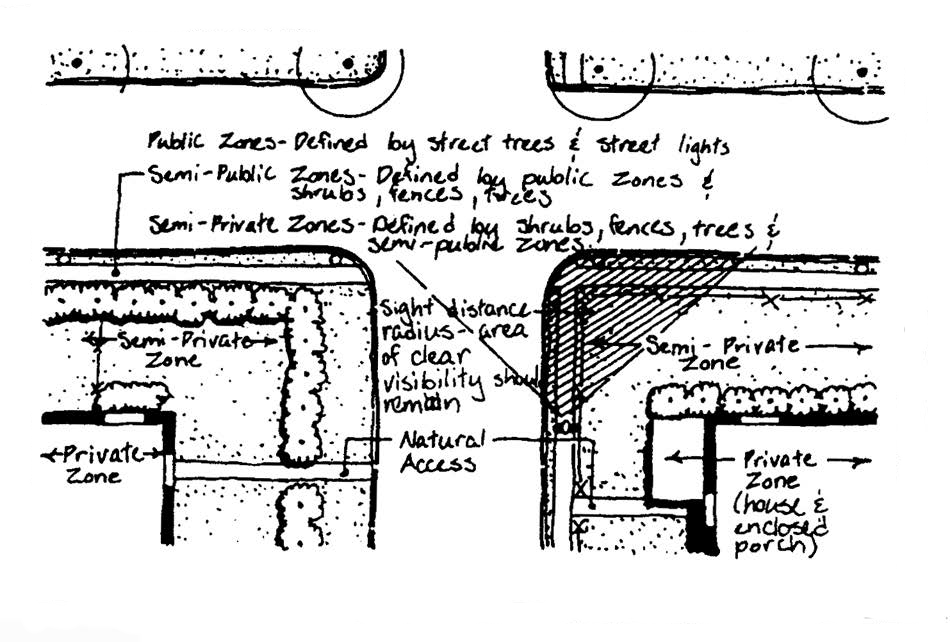
(2)
Promote natural surveillance by encouraging the incorporation of the following into plans (See Figure 2):
a.
Direct proximity and location of adjacent buildings and active uses (commercial and residential) to public access areas;
b.
Balconies, outdoor seating, active uses adjacent to public access areas;
c.
Incorporation of artwork, such as murals and/or sculpture, in public places along blank walls and facades which are visible to the public and creates a public attraction;
d.
A clear view of sight, between three feet to seven feet should be maintained through properties, streets, and vegetation; and
e.
Provide lighting for security in accordance with the standards of this Code.
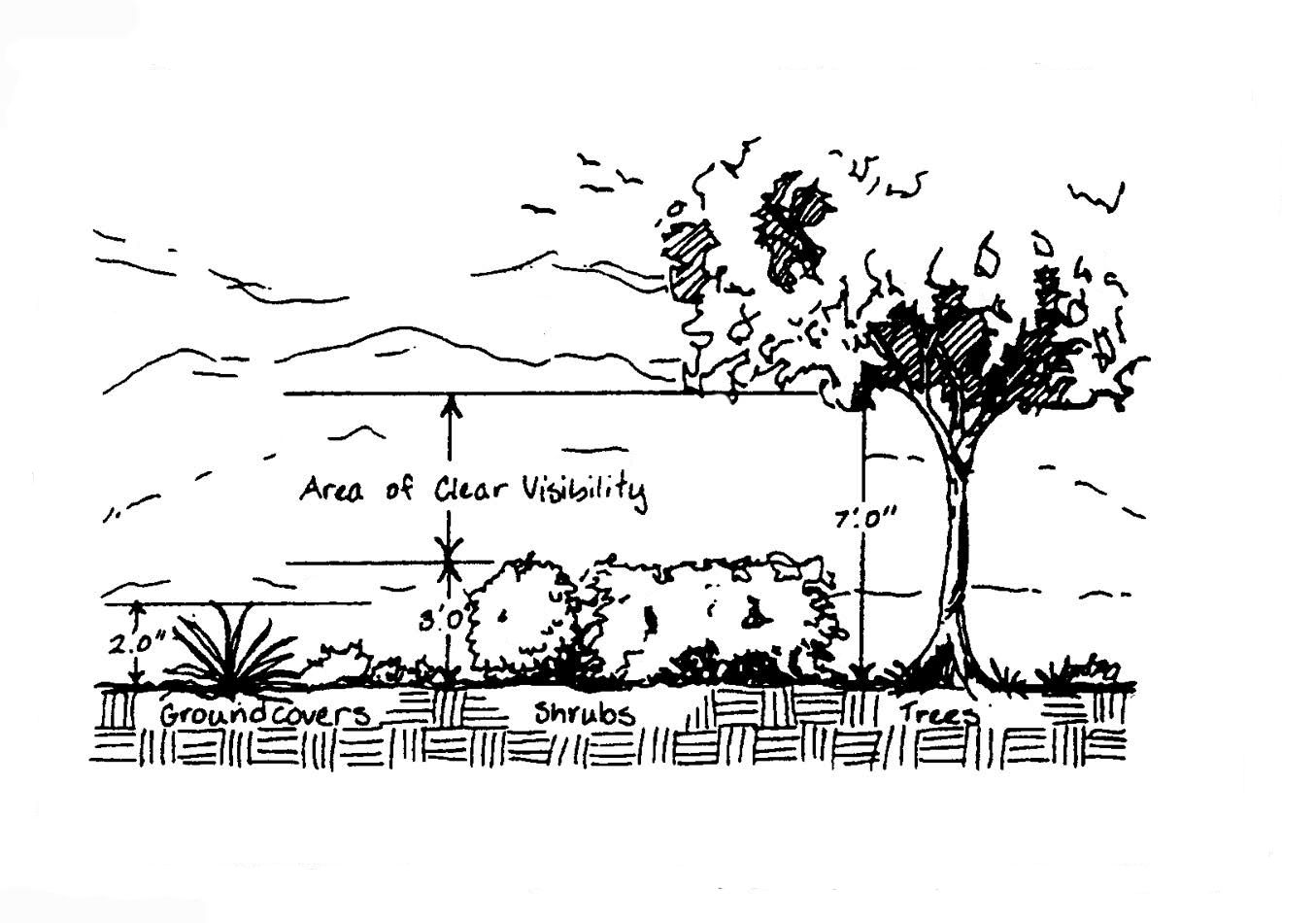
(3)
Provide territorial reinforcement in public, semi-public, semi-private and private areas, as follows (See Figure 3):
a.
Direct proximity and location of adjacent buildings and active uses (commercial and residential) to public access areas;
b.
Provide opportunities for different levels of access for citizens, such as delineating public spaces (rights-of-way, plazas, public parking), semi-public space (interior sidewalks and/or, outdoor seating and/or dining, arcades), semi-private (open space, front or rear yard area), and private spaces (porches, balconies).
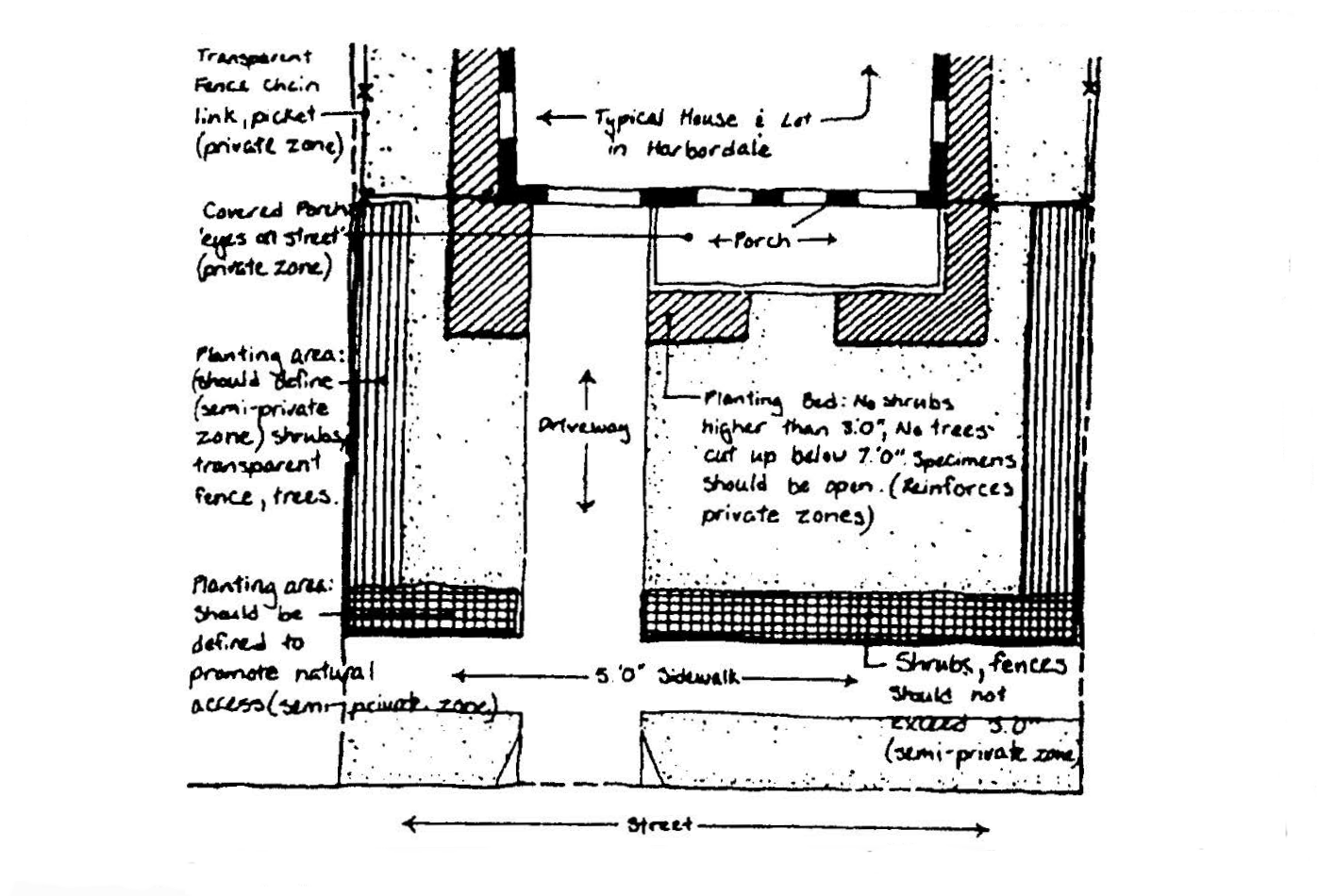
(Code 1992, § 27-1675.16; Ord. No. 38-99, § 2, 11-16-1999)
Sec. 27-2220.- Purpose and intent.
The purpose and intent of these regulations is to control the dispensing of narcotics and other prescription drugs so as to discourage and prevent the misuse and abuse of controlled substances which are commonly prescribed as pain medications. It is also the purpose and intent of these regulations to regulate those land uses that are associated with businesses that operate principally to dispense controlled substances which are used as medications for chronic pain.
(Code 1992, § 27-1675.33; Ord. No. 1-12, § 3, 8-21-2012)
Sec. 27-2221. - Requirements for specific uses.
(a)
Medical and dental clinics. The on-site delivery and dispensing of controlled substances that are identified in schedule II, III or IV in F.S. § 893.03, as further amended by F.S. § 893.035, § 893.0355, or § 893.0356 by medical and dental clinics is prohibited, unless expressly permitted by general law.
(b)
Pharmacies.
(1)
Pharmacies shall not dispense more than 15 percent of their total number of prescriptions filled within a 30-day period from controlled substances identified in schedule II of F.S. § 893.03, and as amended by F.S. § 893.035, § 893.0355, or § 893.0356, as determined by audits or information provided by the state department of health or any other government agency having the legal right to review such records. Pharmacies which are not subject to reporting, pursuant to state statutes, are exempt from the requirements of this subsection.
(2)
All pharmacies which dispense controlled substances identified in subsection (a) of this section, shall be staffed by a state licensed pharmacist who shall be present and on duty as defined in F.S. § 465.003(11)(b) during all hours the pharmacy is open for business.
(Code 1992, § 27-1675.34; Ord. No. 1-12, § 3, 8-21-2012)
Sec. 27-2241.- Intent.
The purpose and intent of this section is to provide regulations for the location and screening of dumpsters; to enhance community amenities, beauty and promote refuse and litter control that is durable and not readily degradable to the natural elements.
(Code 1992, § 27-1161; Ord. No. 10-88, § 630.1, 3-1-1988; Ord. No. 60-03, § 3, 7-20-2004)
Sec. 27-2242. - Application of regulations.
The regulations provided by this section shall apply to all multifamily residential and nonresidential zoned properties within the town having, or using, dumpsters for sanitation service. Temporary dumpsters, such as those which are placed on job sites during construction activity, are not subject to the provisions of this section.
(Code 1992, § 27-1162; Ord. No. 10-88, § 630.2, 3-1-1988; Ord. No. 60-03, § 3, 7-20-2004)
Sec. 27-2243. - Location.
(a)
All dumpsters in the town in the applicable zoning districts shall be located on the property serviced so as to be accessible for trash collection by the sanitation vehicles, and shall not be located within the right-of-way of a public street or alley.
(b)
All new dumpsters on nonresidential properties shall be placed at a minimum of 75 feet from residentially zoned property. The director of planning and zoning may permit a reduction in the dumpster setback, provided that there is a finding that one or more of the following circumstances exist:
(1)
The proposed dumpster shall be located on a property that includes a mix of residential and nonresidential uses and a reduction in the setback requirement will further the intent of this section.
(2)
The proposed dumpster is to be located on a nonconforming lot of record and placing the dumpster at the required setback will result in excessive site design constraints.
(3)
Site constraints will limit the placement of the dumpster in conformity with the required setback.
(Code 1992, § 27-1163; Ord. No. 10-88, § 630.3.1, 3-1-1988; Ord. No. 60-03, § 3, 7-20-2004)
Sec. 27-2244. - Screening.
(a)
All dumpsters shall be screened from public view, from public streets, public rights-of-way, and from abutting or adjacent properties.
(b)
Screening on three sides of the dumpster shall consist of a solid opaque enclosure constructed of brick, concrete, concrete block or other decorative masonry, and shall be consistent with the architectural character of the development or principal building or structure. The open end of the enclosure shall have a 100 percent solid opaque metal gate or shall consist of other materials, other than wood, that include stop pins to lock the gates open for servicing and which are not readily degradable due to sunlight, moisture, or wind, with self closing hinges. The above requirements may be modified or waived based upon criteria established under section 27-2244(i) and/or (j) of this section.
(c)
All exterior sides of the enclosure, except the gates, shall be initially landscaped with a minimum 24-inch-high continuous shrub that grows and is maintained to a height of six feet, spaced 24 inches on center at planting, or an alternative landscape material which is acceptable to the town.
(d)
Recycling enclosures, as required by chapter 16 of the town Code, may be connected to or be a section of the dumpster enclosures.
(e)
Dumpsters do not need to be screened when placed within the rear setback behind buildings and when the dumpster enclosure is not visible by the general public from abutting or adjacent properties.
(f)
The dumpster enclosure shall be constructed in conformity with material approved by the town's building code and shall designed to be consistent with the primary buildings/structures on-site. A permit shall be obtained from the building division prior to the commencement of construction.
(g)
All dumpster enclosures shall be a minimum of six feet in height. If a roof is proposed for the dumpster enclosure, coordination with the town's solid waste service provider is required. The height of the dumpster shall not be visible above the screening.
(h)
Dumpsters shall be placed on a hard surface, and the minimum clear interior dimensions shall be ten feet by ten feet. The director of planning and zoning may reduce the size of a dumpster enclosure provided the owner demonstrates to the sole satisfaction of the town that the reduced size will achieve the town's service provider requirements.
(i)
The director of planning and zoning may authorize that dumpster facilities be deleted, be placed interior within a building, or be shared with a neighboring property, if the owner demonstrates that the town's service provider will be able to adequately service the site. If a change in use occurs on the property, the need for dumpster facilities shall be re-evaluated by the town at time of the application for a building permit.
(j)
The town council or director of planning and zoning, as authorized, may permit dumpster enclosures to be constructed of material other than concrete (i.e., wood, PVC, recycled plastic), provided that site conditions or size of the business justifies the use of alternative materials (i.e., businesses that require less frequent trash pickup, small businesses that could provide adequate enclosures with less financial impacts to the business, businesses in which the enclosure could be placed in a location that is not visible to the general public, etc.).
(k)
All dumpster enclosures shall be maintained in a good and serviceable condition consistent with the owner's approved plans, free of holes, chips, flaking paint, etc. Any dumpster enclosure which do not conform to the provisions of this chapter or approved plans, or which may hamper or injure a collector or the public in general, shall be promptly replaced upon notification by the town.
(l)
Gates on the enclosure must be kept closed at all times except when the dumpster is being serviced. The doors must be kept in good repair at the expense of the owner. A mechanical device shall be provided to allow for gates to be locked in the open position during servicing.
(m)
These regulations cover all existing and future development within the town. In the case of all new development which is approved subsequent to the adoption of the ordinance from which this division is derived, the location of dumpsters shall be shown on the approved site plan.
(n)
Appeals of the decisions and interpretations off the town staff relative to this section shall be as provided in this Code.
(o)
Dumpsters shall not be located in a required landscape buffer.
(Code 1992, § 27-1164; Ord. No. 10-88, § 630.3.2-11, 3-1-1988; Ord. No. 60-03, § 3, 7-20-2004)
Sec. 27-2272.- Intent.
It is the intent of this division to preserve the natural resources of the town, the existing contour and natural drainage patterns and features.
(Code 1992, § 27-1356)
Sec. 27-2273. - Where permitted.
In conformance with the regulations as set forth in this division, activities coming under this division shall be permitted as a special exception in an Agricultural District (A-1) or Rural Residential District (R-R), except as follows:
(1)
As part of the construction or alteration of a building or the grading incidental to a building.
(2)
In connection with normal lawn preparation and maintenance.
(3)
In connection with the construction or alteration of a street or utility improvement.
(4)
In farming operations in those districts where such use is permitted.
(Code 1992, § 27-1357; Ord. No. 10-88, § 602.2, 3-1-1988)
Sec. 27-2274. - Regulations.
The excavation of material for sale or removal to another site shall meet the following minimum regulations as well as those regulations of the district in which the excavation takes place:
(1)
No excavation shall be closer than 50 feet to any property line, nor closer than 200 feet to the district boundary lines.
(2)
All excavations must be left a minimum of three feet below water producing depth or graded or backfilled to original elevations.
(3)
All excavations made below a water producing depth shall be properly sloped down to a water depth of six feet, at a slope not greater than one foot vertical to three feet horizontal.
(4)
All banks will be grassed or surfaced with soil of an equal quality to adjacent land area topsoil uniformly graded, and such topsoil shall be planted with trees, shrubs, legumes or grasses upon the parts of such areas where revegetation is needed to prevent erosion.
(5)
No sharp slopes, pits, depressions or debris accumulation will result and grading will conform to the contour lines and grades on the approved site redevelopment plan.
(6)
Fencing and screening where deemed necessary by the town council to protect the general public, safety fences of a height of up to six feet shall be provided. In addition, where deemed necessary to protect neighboring property from potential loss of use or diminishment of land value, the town council may require a landscape screen of at least 75 percent opaqueness.
(7)
Excavation operations shall commence within six months following the date of approval of the application by the town council, or the approval shall be considered to be null and void.
(Code 1992, § 27-1358; Ord. No. 10-88, § 602.3.A, 3-1-1988)
Sec. 27-2275. - Application procedures.
(a)
Applications under this division shall be submitted in conformance with article II of this chapter.
(b)
In addition to the requirements of article III of this chapter, a site rehabilitation and reclamation plan shall be submitted prior to the commencement of any work and approved by the town council for the subject operation showing that:
(1)
All land excavated will be rehabilitated in accordance with the approved land plan prior to release of the redevelopment bond, such plan to provide for total rehabilitation of the site through grading and revegetation.
(c)
A redevelopment rehabilitation and reclamation bond shall be posted in an amount per acre as specified by the town council of the total acreage included in excavation operations. The surety shall:
(1)
Run to the town.
(2)
Be in a form satisfactory and acceptable to the town council.
(3)
Specify the time for completion of the rehabilitation and reclamation development.
(4)
The surety shall be released only upon written certification to the town council, that all performances guaranteed have been satisfactorily completed.
(Code 1992, § 27-1359; Ord. No. 10-88, § 602.4.C, 3-1-1988)
Sec. 27-2304.- Purpose and intent of division.
The regulations set forth in this division qualify or supplement, as the case may be, the district regulations appearing elsewhere in this chapter.
The purpose and intent of these regulations is to allow for certain mechanical equipment, towers, architectural elements and features to have exceptions to the regulations (items such as height, yard requirements or setbacks limits of their respective districts), provided the mechanical equipment, towers and architectural elements and features are in context with the scale, height and proportion of the building and surrounding development pattern. The purpose and intent of these exceptions are not to create an appearance of additional bulk and mass above any established height, story, yard or setback limitation.
If, in the determination of the director of the planning and zoning department, or his or her designee, the application of a proposed exception to height for a building would serve to evade the purpose and intent of the town's land development regulations, the director may require that the application be subject to major site plan review, including public hearing before the planning and zoning commission and the town council.
(Code 1992, § 27-1116; Ord. No. 10-88, § 627.1, 3-1-1988; Ord. No. 6-24, § 3, 3-5-2024)
Sec. 27-2305. - Height.
(a)
The height limitations stipulated in the applicable districts shall not apply to the following:
(1)
Spires, cupolas and domes.
(2)
Belfries.
(3)
Monuments.
(4)
Tanks.
(5)
Chimneys.
(6)
Elevator bulkheads (no landings or elevator stops shall be placed above the story or height limitations of the applicable zoning district).
(7)
Screened rooftop mechanical equipment in nonresidential or mixed-use buildings, provided the area it encompasses does not exceed 20 percent of the square footage of the entire roof area.
(8)
Stair towers for nonresidential or mixed-use buildings.
(9)
Water towers.
(10)
Fire towers.
(11)
Stage towers and scenery lofts appurtenant to a theater for the performing arts, civic or cultural building.
(12)
Scenery towers.
(13)
Cooling towers.
(14)
Ornamental towers.
(15)
Transmission towers and rooftop mounted antennas (see division 43 of article XI of this chapter).
(b)
In the Commercial, General District (C-2), Commercial, Office District (C-3), Commercial, Restricted District (C-4), Industrial, Park, Light Industry District (I-1), Industrial, General District (I-2), Industrial, High Technology District (I-3), Industrial, High Technology and Employment Center District (I-4) and Mixed Use Development District (MXD) where wet labs or labs with ventilated hoods are constructed in association with bioscience, bioscience technology, high tech, laboratory, and office research uses, the building's height may exceed the maximum building height by six feet for each floor of the building which contains more than 20 percent of gross floor area of wet lab space. Provided, however, that the building height shall not be increased by more than 25 percent of the zoning district's maximum building height. In no case shall the height exceed 62½ feet. Enclosed rooftop mechanical equipment rooms may exceed the maximum building height by no more than ten percent. Rooftop mechanical equipment rooms shall be setback from the edge of the roof at a one-to-one ratio to the height of the mechanical equipment room. No signage is allowed on the side of rooftop mechanical equipment rooms.
(c)
No exceptions to the height or story regulations are permitted for structures, such as roof elements, sail shades, trellises, pergolas, arbors, or other similar structures.
(Code 1992, § 27-1117; Ord. No. 10-88, § 627.1.A, 3-1-1988; Ord. No. 44-07, § 2, 3-18-2008; Ord. No. 23-10, § 8, 9-21-2010; Ord. No. 6-21, § 3, 3-16-2021; Ord. No. 6-24, § 3, 3-5-2024)
Sec. 27-2306. - Yard.
(a)
Private alley. Whenever a lot in either the commercial or industrial districts is contiguous to a private alley, one-half of the alley width may be considered as a portion of the required rear yard, but in no case shall the rear yard be reduced to less than ten feet.
(b)
Railroad access. Industrial uses that abut railroad trackage may reduce the rear yard setback to zero feet along such trackage.
(Code 1992, § 27-1118; Ord. No. 10-88, § 627.1.B, 3-1-1988; Ord. No. 01-04, § 2, 11-23-2004)
Sec. 27-2307. - Setbacks.
(a)
Attached structures.
(1)
The following structures may encroach into the required setbacks a maximum of 36 inches.
a.
Bay windows. In no case shall the window be less than three feet, one inch from a property line.
b.
Chimneys.
c.
Staircases.
d.
Roof overhangs and awnings.
(2)
The following attached structures may encroach into the required front yard a maximum of 35 percent, and side corner setbacks a maximum of 30 percent.
a.
Terraces, steps and stoops.
b.
Porches, balconies, pergolas, porte cocheres and colonnades, provided they are not screened in or otherwise enclosed space. If any of the above structures are screened or enclosed, they shall not be permitted the use of the reduced setbacks.
(3)
For duplex units in the Residential, Limited Multifamily District (R-3), porches, balconies, pergolas, porte cocheres and colonnades, provided they are not screened in or otherwise enclosed space, may encroach into the required side interior yard a maximum of 20 percent.
(b)
Unattached structures.
(1)
The following unattached structures are not required a setback: Fences and walls.
(2)
Recreational equipment are required a minimum setback of three feet when placed in a side or rear yard.
(3)
See section 27-3084 for the required setbacks for pools, decks, patios, and screen enclosures.
(c)
Mechanical equipment.
(1)
Mechanical equipment (including air-conditioning units) for nonresidential and residential multi-story apartment or condominium buildings may encroach upon a side setback up to 50 percent, provided it is not less than three feet from the property line.
(2)
The setback for mechanical equipment from residential buildings, other than multi-story apartment or condominium buildings, may be reduced to two feet from the interior side property line and five feet from the rear property line provided the mechanical equipment is entirely screened from public view.
(3)
Air compressors, permanent standby generators, unless specifically allowed in subsection (4) of this section, or other similar mechanical equipment are required to meet the established setbacks for the primary building.
(4)
The setback for permanent standby generators for residential buildings, except residential apartment or condominium buildings, may be reduced to three feet from the interior side property line and five feet from the rear property line, provided it is:
a.
Fueled by natural gas or liquid propane gas;
b.
Does not exceed four feet in height;
c.
Screened from public view.
(d)
The replacement of mechanical equipment which existed prior to November 16, 2004 is exempt from these requirements.
(e)
No mechanical equipment shall be permitted within any required landscape buffer.
(f)
When a zero setback is utilized for a side or rear setback, the roof overhang may be permitted to extend beyond the property line a maximum of 18 inches, subject to the following requirements:
(1)
The overhang must meet the Florida Building Code;
(2)
A reciprocal maintenance or overhang easement of three feet is dedicated on the abutting property under the overhang;
(3)
Roof gutters shall be placed along all portions of the wall located on the side of the structure or building without a building setback.
(g)
When a property has reduced setbacks for the principal structures, such as nonconforming lots of record and approved planned unit developments, the accessory structures shall be permitted the same reduced setbacks as the principal structure.
(h)
No structures shall encroach into utility easements, unless approval is granted from the utility holder and a hold harmless agreement is submitted to the town, and approved as to legal form and sufficiency by the town attorney.
(i)
The director of the department of planning and zoning or his designee may impose a greater setback than is provided for herein if the director or his designee determines that a structure or use of a structure is inconsistent or incompatible with the neighboring uses, or is substantially likely to cause or result in a nuisance.
(Code 1992, § 27-1119; Ord. No. 01-04, § 2, 11-23-2004; Ord. No. 48-08, § 3, 1-20-2009; Ord. No. 36-17, § 3, 1-16-2018)
Sec. 27-2338.- Application of chapter.
In addition to compliance with all other regulations and requirements set forth in this chapter, all erection, additions or alterations of any building or structure, or other development, including, but not limited to, dredging, filling, grading, paving or excavation, within the town, shall comply with the provisions of chapter 22. Copies of such chapter shall be available for review or purchase at the office of the town clerk. For the purposes of this section, chapter 22 shall be interpreted to include all revisions and amendments thereto, and all flood hazard boundary maps hereafter adopted as a part thereof.
(Code 1992, § 27-1066; Ord. No. 10-88, § 625.1, 3-1-1988)
Sec. 27-2370.- Intent.
The regulations and requirements of this division are intended for the orderly and efficient development of funeral homes to provide for the needs of the residents of the town.
(Code 1992, § 27-1211; Ord. No. 10-88, § 632.1, 3-1-1988)
Sec. 27-2371. - Uses permitted.
Funeral homes may be permitted as special exceptions in Residential, Limited Multifamily Districts (R-3), Commercial, Neighborhood Districts (C-1), Commercial, General Districts (C-2) and Commercial, Office Districts (C-3).
(Code 1992, § 27-1212; Ord. No. 10-88, § 632.2, 3-1-1988)
Sec. 27-2372. - Access.
The property upon which a funeral home is located must have direct access to at least a minor arterial street (as designated in the town comprehensive plan) for the efficient flow of traffic.
(Code 1992, § 27-1213; Ord. No. 10-88, § 632.3.A, 3-1-1988)
Sec. 27-2373. - Minimum lot area, frontage.
The minimum lot area of a funeral home shall be two acres, and shall have a minimum roadway frontage of 100 feet.
(Code 1992, § 27-1214; Ord. No. 10-88, § 632.3.B, 3-1-1988)
Sec. 27-2374. - Architectural design.
All funeral homes located in or abutting a residential district shall be architecturally designed so as to maintain the residential character of the neighborhood.
(Code 1992, § 27-1215; Ord. No. 10-88, § 632.3.C, 3-1-1988)
Sec. 27-2375. - Green space.
Funeral homes located in residential districts shall retain at least 15 percent of the site area in green space.
(Code 1992, § 27-1216; Ord. No. 10-88, § 632.3.D, 3-1-1988)
Sec. 27-2376. - Parking.
(a)
Funeral homes shall provide four parking spaces for each 1,000 square feet of total floor area, plus one space for each two seats in the chapel and viewing area.
(b)
Parking areas shall be designed so as to adequately provide maneuvering space and cueing for funeral processions and so as not to hinder the traffic of adjacent roadways.
(c)
All parking areas shall be buffered from adjacent residential uses by a six-foot wall or fence and a ten-foot landscape buffer.
(Code 1992, § 27-1217; Ord. No. 10-88, § 632.3.E—G, 3-1-1988)
Sec. 27-2377. - License required.
All funeral homes must be licensed with the state in accordance with the state department of financial services, division of funeral, cemetery and consumer services.
(Code 1992, § 27-1218; Ord. No. 10-88, § 632.3.H, 3-1-1988)
State Law reference— State licensing, F.S. § 497.141 et seq.
Sec. 27-2378. - Crematory facilities.
Funeral homes that desire to have crematory facilities must indicate so, on the application for special exception. Crematories are not allowed if the facility is located in a Residential, Limited Multifamily District (R-3).
(Code 1992, § 27-1219; Ord. No. 10-88, § 632.3.I, 3-1-1988)
Sec. 27-2405.- Purpose and intent.
(a)
The purpose of this program is to provide green building standards which promote sustainable construction, water efficiency, energy efficiency, sustainable material selections and improved indoor environmental quality for new development and redevelopment projects.
(b)
It is the intent of this program to provide incentives by providing for waivers from the town's land development regulations provided new development or redevelopment projects achieve green building certification based upon the standards for green developments in either the Florida Green Building Coalition, Inc. (FGBC) or the United States Green Building Council (USGBC).
(Code 1992, § 27-1675.27; Ord. No. 5-16, § 2, 1-17-2017)
Sec. 27-2406. - Applicability, incentives, and public benefits.
The green building program, and the incentives herein, may be applied to Large-Scale Planned Unit Development Districts (PUD) or Small-Scale Planned Unit Developments (SSPUD) which are certified by the Florida Green Building Coalition (FGBC) or the United States Green Building Council (USGBC). As an incentive to incorporating green building standards into an applicant's project, the town may grant waivers to the building standards and land development regulations of the town Code. The number of the waivers to be approved for projects certified by either the FGBC or USGBC shall be commensurate with the number of green building standards incorporated into the buildings and the certification level achieved. Projects which are certified by the FGBC or USGBC shall be entitled to use the green building certification as a public benefit.
(Code 1992, § 27-1675.28; Ord. No. 5-16, § 2, 1-17-2017)
Sec. 27-2407. - Application requirements.
(a)
In addition to meeting the requirements for development applications listed in section 27-266, applicants shall meet with the planning and zoning staff at least 30 days prior to submitting an application to discuss any requested waivers and to submit a completed FGBC or USGBC official certification checklist for the green building project which is the subject of the application. At the preapplication meeting, the applicant shall submit a written description identifying how the green building certification is to be achieved. The applicant shall be responsible for ensuring that an independent commissioning agent of the FGBC or USGBC attends the preapplication meeting.
(b)
The applicant shall identify any other applications that will be processed concurrent with the application for the green building project.
(c)
The applicant's compliance with the approved FGBC or USGBC certification checklist shall be reviewed throughout the development review process, including engineering permits, building permits, and all applicable inspections.
(d)
The applicant shall submit an irrevocable letter of credit in the amount of five percent of the estimated total cost of construction which amount shall be paid in full to the town prior to the issuance of a certificate of occupancy or completion of the green building. Green building certification shall be obtained within 12 months of a certificate of occupancy or completion.
(1)
In the event an applicant has not been certified by the FGBC or USGBC within 12 months of the receipt of a certificate of occupancy or completion for any building, the applicant shall develop and submit an action plan which demonstrates that certification will be obtained within six months. The action plan shall outline the steps necessary to remediate the deficiencies that resulted in noncertification.
(2)
Six-month time extensions may be granted administratively by the director of the department of planning and zoning, provided the applicant submits an action plan, which in the opinion of the department, confirms that the certification process is ongoing, and that the applicant is continuing to act in good faith to obtain certification.
(3)
If certification is not achieved by the expiration date, or if the applicant is not continuing to act in good faith as determined by the director, the town is authorized to call the irrevocable letter of credit which shall be converted into a green building mitigation fee. The green building mitigation fee shall be used to implement green design standards on publicly owned properties in the town.
(4)
The letter of credit shall be released within 60 days following the applicant's submission of the written certification issued by the FGBC or USGBC.
(Code 1992, § 27-1675.29; Ord. No. 5-16, § 2, 1-17-2017)
Sec. 27-2408. - Green certification requirements.
(a)
All new development projects shall obtain a silver certification level and redevelopment approvals shall obtain the minimum certification level from the FGBC or the USGBC.
(b)
The applicant shall provide documentation to the town demonstrating that the project has obtained green certification by the FGBC or USGBC.
(c)
For all green building applications, the following criteria from a completed FGBC or USGBC official certification checklist for a green building project that exceeds the requirements of the Code shall be counted towards justifying any requested waivers pursuant to section 27-1711.
(1)
Energy efficient design.
(2)
Use of renewable energy sources.
(3)
Drought-tolerant plantings.
(4)
Reduced interior potable water usage.
(5)
Enhanced on-site treatment of stormwater.
(6)
Indoor environmental quality (natural daylight, increased ventilation, etc.).
(Code 1992, § 27-1675.30; Ord. No. 5-16, § 2, 1-17-2017)
Sec. 27-2435.- Declaration of legislative intent.
It is hereby declared that the protection, enhancement and preservation of properties, structures, artifacts, documents, memorabilia, and other physical assets of historical, archaeological, architectural, and/or cultural significance are in the interest of the public health, safety and general welfare of the residents of and visitors to the town. Therefore, this division is intended to:
(1)
Effect and accomplish the protection, enhancement, and preservation and study of archaeological sites, properties, structures, improvements, landscape features, artifacts, and other physical assets located within the town which represent distinctive elements of the town's prehistoric, historic, architectural, and/or social character;
(2)
Safeguard the town's history, heritage, and unique attributes;
(3)
Foster civic pride and respect for the accomplishments of the past; and
(4)
Protect and enhance the town's attraction of visitors and support and stimulate the economy from increased tourism.
(Code 1992, § 27-1675.5; Ord. No. 8-99, § 2, 5-4-1999)
Sec. 27-2436. - Scope of regulations.
The land development regulations established herein shall apply to all property in the town and to those properties over which the town has land use planning responsibilities pursuant to F.S. ch. 163. Nothing contained herein shall supersede or conflict with the town's building and land development regulations. The land development regulations contained herein shall be cumulative and read in conjunction with other land development regulations of this Code.
(Code 1992, § 27-1675.6; Ord. No. 8-99, § 3, 5-4-1999)
Sec. 27-2437. - Historic resources board established.
(a)
Establishment. The town council hereby establishes the town historic resources board (board) whose responsibility shall be to perform the duties and responsibilities identified herein and such other duties as may be assigned to it by the town council.
(b)
Membership. The board shall consist of five regular members and two alternate members, designated as the first alternate and the second alternate. Each member of the council shall be entitled to appoint a regular member, who shall serve at the pleasure of the member of the council who makes the appointment. The two alternate members shall be appointed by a majority vote of the town council. If all regular members of the board are present, the alternate members of the board may participate in the discussion, but shall not be entitled to cast a vote. If any regular member is absent from a meeting, the alternate members shall be entitled to participate in discussion and to vote, in a rotating manner, on any items which come before the board. Members of the board shall have professional experience and/or higher educational degrees in the disciplines of history, architecture, landscape architecture, architectural history, archaeology, planning, or other professional experience or degrees in related disciplines such as American studies, American civilization, cultural geography, cultural anthropology, or American history. Two members of the board may be filled by individuals that do not meet the educational or professional experience requirements set forth above, provided they demonstrate a special interest, or knowledge of, the town's history. All applicants for positions on the board shall submit sufficient information to demonstrate their educational or professional experience and qualifications which is relevant to demonstrating that they meet the qualifications established herein. A majority of the membership of the board shall be residents of the town. However, the town council may appoint one member of the board who is not a resident of the town, provided they have the professional or educational qualifications and/or experience requirements recited hereinabove.
(c)
Terms of office. The term of regular board members appointed by the town council shall serve at the pleasure of the appointing council member. The term of an alternate members shall be one year. When a vacancy occurs on the board, it shall be filled by the town council as quickly as possible for the remainder of the unexpired term.
(d)
Quorum, officers, rules of procedure.
(1)
No meeting of the board shall be called to order, nor any business transacted, without a quorum consisting of a majority of the members of the board. A majority of the quorum present shall be necessary for the board to take action.
(2)
The members of the board shall elect a chairman and vice chairman who shall serve terms of one year. The vice chairman shall act as chairman in the absence of the chairman and shall have all powers of the chairman. The chairman shall be in charge of all proceedings before the board.
(3)
The department of planning and zoning shall provide all notices of and shall record all meetings of the board and shall maintain the minutes of these meetings.
(4)
The department of planning and zoning shall furnish the board with administrative support, including fiscal support, subject to budgetary approval by the town council. The department may approve and issue regular certificates of appropriateness.
(5)
All meetings of the board shall be governed by Robert's Rules of Order.
(6)
Meetings of the board shall be held quarterly, or as often as may be necessary for the board to discharge its responsibilities.
The town council may appoint one of its members to serve as an ex officio member of the board.
(e)
Responsibilities. The board shall have the following responsibilities:
(1)
Promote the preservation and conservation of historic and archaeological resources within the town.
(2)
Cooperate and coordinate with property owners, public and private organizations, and businesses to ensure the conservation and preservation of archaeological sites and the contents of identified historic and/or archaeological sites, improvements or districts of historic and/or archaeological significance.
(3)
Advise the town council concerning land use plan amendments and land development regulations as they relate to the preservation of historic and/or archaeological resources.
(4)
To conduct public hearings regarding historic and/or archaeological resources and make recommendations to the town council regarding applications for historic designation, demolition permit applications, and the nomination of properties to the National Register of Historic Places, and to approve and issue special certificates of appropriateness and certificates to dig.
(5)
Subject to town council direction and appropriation, the board may participate in the National Register program in Florida, as defined by the 1981 and subsequent amendments to the Historic Preservation Act of 1966 and regulations and rules drafted pursuant to those amendments by the National Park Service and the Florida State Bureau of Historic Preservation.
(6)
To cooperate with and enlist the assistance of other public or private organizations in matters involving historic preservation, renovations, rehabilitation, and reuse; and to support increased public awareness of the value of historic preservation.
(7)
To maintain a list of all designated historic and archaeological resources within the town's boundaries, irrespective of whether such determination was made by the town, state, or federal authorities. This list shall be known as the "Town of Jupiter List of Designated Historic Resources." For the purposes of this division, the designation of properties on the town's list of designated historic resources shall supersede conflicting determinations by other agencies, authorities, or individual professional opinions.
(8)
To survey and maintain inventories of potential historic and/or archaeological resources in the town and plan for their preservation.
(9)
To maintain a copy of the Florida Master Site File for all recorded historic resources in the town; maintain a series of United States Geological Survey (U.S.G.S.) topographical maps upon which historic and archaeological resources recorded on the Florida Master Site File are shown, and a series of soil survey maps upon which archaeological sensitive zones are shown; maintain a copy of the town's official zoning map upon which all designated historic resources are shown.
(10)
Recommend the design of standardized historic markers and plaques for designated historic and archaeological sites and districts within the town.
(Code 1992, § 27-1675.8; Ord. No. 8-99, § 5, 5-4-1999; Ord. No. 60-00, § 2, 11-21-2000; Ord. No. 32-03, § 3, 8-19-2003; Ord. No. 10-12, § 2, 4-3-2012; Ord. No. 12-17, § 2, 5-24-2017; Ord. No. 11-18, § 2, 7-17-2018; Ord. No. 11-21, § 2, 5-18-2021)
Sec. 27-2438. - Historic resource designation procedures.
(a)
Purpose and intent. This section provides mechanisms to promote historic preservation in the town by the designation of historic sites and districts, and by the regulation of construction and demolition at historic sites and within historic districts.
(b)
Criteria.
(1)
To qualify as a designated historic site or historic district, properties, individual properties, structures, sites and buildings, or groups of properties, structures, sites and buildings, the proposed site or district shall meet one or more of the following criteria:
a.
Is associated in a significant way with the life or activities of a major person important in Jupiter, Palm Beach County, Florida or national history;
b.
Is associated with an historic event with significant effect upon the town, county, state or nation;
c.
Is associated in a significant way with a major historic event whether cultural, economic, military or political;
d.
Exemplifies the historic, political, cultural or economic trends of the community history;
e.
Is associated in a significant way with a past or continuing institution which has contributed to the life of the town;
f.
Portrays the environment in an era of history characterized by one or more distinctive architectural styles;
g.
Embodies those distinguishing characteristics of an architectural style, period or method of construction;
h.
Is an historic or outstanding work of a prominent architect, designer, landscape architect, or builder; or
i.
Contains elements of design, detail, material, or craftmanship of outstanding quality or which represents, in its time, a significant innovation or adaptation to the South Florida environment.
(2)
A building, structure, site, or district will be deemed to have historic significance if, in addition to, or in the place of previously mentioned criteria, the building, structure, site, or district meets the historic development standards as defined by and listed in the regulations of and criteria for the National Register of Historic Places or those of Palm Beach County.
(3)
Properties not generally considered eligible for designation include cemeteries, birthplaces or graves of historic figures, properties owned by religious institutions or used for religious purposes, structures that have been moved from their original locations, buildings or sites primarily commemorative in nature, reconstructed historic buildings, and properties that have achieved significance less than 50 years prior to the date the property is proposed for designation. However, such properties will qualify if they are integral parts of districts that do meet the previously described criteria or if they fall within one or more of the following categories:
a.
A religious property deriving primary significance from architectural or artistic distinction of historic importance.
b.
A building or structure removed from its location but which is primarily significant for architectural value, or is the surviving structure most importantly associated with an historic event or person.
c.
A birthplace or grave of an historic figure of outstanding importance if there is no other appropriate site or building directly associated with his productive life.
d.
A cemetery which derives its primary significance from graves of persons of transcendent importance, from age, distinctive design features, or from association with historic events.
e.
A property primarily commemorative in nature if design, age, tradition or symbolic value have invested it with its own historic significance.
f.
A building, structure, site or district achieving significance less than 50 years from the date it is proposed for designation if it is of exceptional historic importance.
(c)
Application for historic site or historic district designation.
(1)
Applications for historic or archaeological site or district status for privately-owned property may be initiated by the town, the historic resources board or the property owner of a site, except that applications for historic site status for privately-owned single-family homes may only be initiated by the owner of the property. An incorporated homeowners, condominium or community association may apply for historic district status. Application for historic or archaeological site or district status for public property may be initiated by any resident of the town, the town, or the board.
(2)
By resolution of the town council, a fee shall be established and may be amended to cover the town's actual costs of reviewing and processing applications for historic designation. In addition, an application may require that funds be deposited in an escrow account to cover fees for consultants which may be hired by the department when needed to evaluate the eligibility of a property.
(3)
Upon receipt of an application, the department shall conduct a preliminary evaluation of the application to determine whether or not the department has sufficient information to process the application and shall send a copy of the application by certified mail to the property owners of record. The department shall make the determination that an application is sufficient within 15 days working days of receipt of an application. If the application is not sufficient to process, the department shall specify what additional information is necessary.
(4)
When an application is sufficient, the department shall prepare a designation report for consideration by the board which shall contain the following information:
a.
Proposed legal boundaries of the historic improvement, archaeological site, or historic district;
b.
An analysis of the historic or archaeological significance of the nominated property;
c.
For those public buildings which have public access, an analysis of interiors with features of exceptional architectural, aesthetic, artistic or historic significance;
d.
Any proposed specific land development regulations;
e.
Any conditions beyond the standards contained in the land development regulations or conditions based on the development standards for historic districts and sites of section 27-2439.
(d)
Public hearings required for historic site or district designation.
(1)
After the department prepares the designation report, the board shall conduct a public hearing to evaluate and receive comments regarding the application. For each proposed designation of an individual site or district, and except as otherwise provided herein, the board is encouraged to obtain the approval of the owners of properties proposed for designation, by providing information on the benefits of designation. The owners of the property shall be given an opportunity at the public hearing to object to the proposed designation.
(2)
The department shall, by certified mail at least 15 calendar days prior to the public hearing, mail a copy of the designation report and a notice of public hearing to the property owners of record as determined by the most current Palm Beach County property tax rolls then available. Refusal to accept this notice of public hearing shall not invalidate the hearing. In addition, all property owners of record, as determined by the most current Palm Beach County property tax rolls, within a 300-foot radius of the nominated site or district shall be sent courtesy notice of the public hearing. However, failure to receive such courtesy notice shall not invalidate the hearing. Notice shall also be provided by publishing a copy thereof in a newspaper of general circulation within the town at least ten calendar days prior to the date of the hearing. All interested parties shall be given an opportunity to be heard at the public hearing.
(3)
Upon the mailing of the designation report to the property owners, the town shall cease issuing permits for any new construction, alteration, relocation or demolition of the property which is the subject of a proposed designation. No permits shall be issued by the town until after the town council approves or denies the nomination for historic site or district status, or the application is withdrawn by the person or entity who has initiated the application.
(4)
After the close of the public hearing, but no later than 45 calendar days following the close of the public hearing, the board shall vote at a public hearing and make its recommendation to the town council on the designation.
(5)
The town council shall thereafter hold a public hearing following the same notice requirements set forth in subsection (d)(2) of this section.
(6)
If the board recommends designation of a district, a vote of the property owners shall be taken prior to the public hearing before the town council. The town shall send by certified mail to each record owner a ballot, notification of the date the ballot is due back, and a self-addressed, stamped envelope. Each parcel as identified within the proposed district shall have one vote. The marked ballots shall be returned to the town clerk within 30 calendar days from the date of mailing of the ballots. Any ballots not returned within 30 days from the date of mailing shall be disqualified. A two-thirds majority of the votes cast and received by the clerk within the 30 days of mailing in favor of the district shall be a pre-requisite to the town council's designation of a district.
(7)
At its public hearing, the town council shall consider the application, all relevant support materials, the designation report, the recommendations of the board and the criteria for designation, and may, at the conclusion of the hearing, adopt a resolution approving, approving with conditions, or denying the historic site or district designation. For property not owned by a governmental entity, a supermajority vote of the town council is required for designation. For single-family homes, the approval of the property owner is required for designation.
(8)
Amendment or rescission. The town may amend or rescind any designation provided it complies with the same notice and public hearing requirements and other procedures used in approving the original designation.
(e)
Town of Jupiter Register of Historic Places.
(1)
If the town council approves the nomination of an historic site or an historic district, said site or district shall be listed on the town register of historic places. The town list of designated historic resources shall be maintained by the town clerk.
(2)
The town council shall issue an official certificate of historic significance to the owner of properties listed individually on the town list of designated historic resources or judged as contributing to the character of an historic district listed on the town list of designated historic resources. The town manager, or the town manager's designee, is authorized to issue and place official signs denoting the geographic boundaries of each historic site or district listed on the town list of designated historic resources.
(f)
Recording. The resolution designating an historic site or historic district shall be recorded in the public records of Palm Beach County, Florida.
(Code 1992, § 27-1675.9; Ord. No. 8-99, § 6, 5-4-1999; Ord. No. 32-03, § 4, 8-19-2003)
Sec. 27-2439. - Modifications/development of historic sites.
(a)
Certificate of appropriateness.
(1)
Activities requiring a special certificate of appropriateness (approved by the historic resources board).
a.
The erection, alteration, restoration, renovation, excavation, relocation, or demolition of an improvement or landscape feature, of any designated historic site, historic building or which is located within any historic district.
b.
Any material change in existing walls, fences, paving and sidewalks, change of color, or construction of new walls, fences, paving and sidewalks.
c.
Any material change in the landscape features or site improvements of any historic site.
(2)
Activities requiring an administrative certificate of appropriateness.
a.
Those activities listed in subsection (a)(1) of this section, which pertain to locally designated sites contained which are within the United States Department of the Interior's Jupiter Inlet Lighthouse Outstanding Natural Area (JILONA), and which are not otherwise subject to federal review for consistency with all federal laws and statutes contained in the JILONA Comprehensive Management Plan and Environmental Assessment.
b.
Any other activities that are considered routine for design features, including, but not limited to, changes in, roofing materials, window types, shutter types, doors, porches, or other similar appurtenance, as contained in the certificate of appropriateness approval matrix. The official copy of the certificate of appropriateness approval matrix shall be maintained by the department of planning and zoning. The approved certificate of appropriateness matrix and any amendments thereto shall be subject to the review and approval of the town council, after consideration of a recommendation from the historic resources board. The certificate of appropriateness matrix contains a list of those design features and indicates which features may be administratively reviewed and which require approval by the historic resources board through the special certificate of appropriateness process.
(3)
Plans required. No special certificate of appropriateness shall be approved unless those plans necessary for the construction, alteration, restoration, renovation, or excavation of a designated historic structure have been submitted to the town and approved by the historic resources board. No special certificate of appropriateness for the reconstruction, relocation or demolition of a designated historic structure shall be approved unless necessary plans have been submitted to the town and approved by the town council, after consideration of a recommendation from the historic resources board. Applications for administrative certificates of appropriateness for locally designated sites within the United States Department of Interior's JILONA shall submit all plans provided to the state historic preservation officer.
(4)
Activities not requiring a certificate of appropriateness.
a.
General and occasional maintenance and repair of any archaeological or historic improvement or site, or any improvement within an historic district, except where prohibited or regulated by archaeological considerations. General and occasional maintenance and repair shall include lawn and landscaping care and minor repairs that restore or maintain the historic site or current character of the improvement. General and occasional maintenance and repair shall also include any ordinary maintenance which does not require a building permit from the town. General and occasional maintenance and repair shall not include any of the activities described and defined in subsection (a)(1) of this section, nor shall it include exterior color change, addition or change of awnings, signs, or alterations to porches and steps or any alterations which require excavation or disturbance of subsurface resources.
b.
Any interior alteration, construction, reconstruction, restoration or renovation.
(b)
Applications for administrative and special certificates of appropriateness and evaluation guidelines.
(1)
Applications for certificates of appropriateness shall be made on forms approved and provided by the town and shall include such plans, drawings, or surveys, as required by the town.
(2)
Applications shall be submitted to the department a minimum of ten calendar days prior to any meeting of the board at which such application is to be considered.
(3)
An applicant may request a preapplication conference with the town staff to obtain information and guidance regarding the application process.
(4)
In evaluating applications, the department and board shall utilize the most recent United States Secretary of the Interior's Standards for Rehabilitation for the evaluation of applications for a certificate of appropriateness.
(5)
If the department determines that an application is not sufficient, it shall provide written notice to the applicant specifying the application's deficiencies. The department shall take no further action on the application until the deficiencies are remedied. If the applicant fails to correct the deficiencies within 20 working days, the department may consider the application to be withdrawn.
(6)
If the application is determined sufficient, the department director shall determine if it requires an administrative or special certificate of appropriateness. If it is an administrative certificate, then the department shall, within ten days from the date an application is found to be complete, approve or deny the application for the certificate of appropriateness. The determination shall be mailed to the applicant within three working days of the decision, accompanied by a written statement of the staff's determination. If the application is for a special certificate of appropriateness, the director shall place the application on an agenda for the board's consideration.
(7)
An applicant may appeal a decision of the department within 30 days of the decision by filing a written notice of appeal with the board. The notice of appeal shall state the decision which is being appealed, the grounds for the appeal, and a brief summary of the relief which is sought. Within 35 days of the filing of the appeal, the board shall consider the appeal at which time it may affirm, modify or reverse the decision of the staff. Nothing contained herein shall preclude the board from seeking additional information prior to rendering a final decision. The decision of the board shall be in writing and a copy of the decision shall be forwarded to the appealing party.
(8)
The board will act upon the application for a special certificate of appropriateness or an appeal of an administrative certificate of appropriateness within 35 calendar days of receipt of the application, provided that the application meets the filing and technical sufficiency requirements as defined in this section, unless the applicant requests a continuance.
(9)
If the board or department approves the application, a certificate of appropriateness shall be issued. The issuance of a certificate of appropriateness shall not relieve the applicant from obtaining other development permits, orders and approvals required by the town, except in the case of an administrative certificate of appropriateness for a locally designated site within the Department of the Interior's JILONA located on federal public lands. A building permit or other development permit, order or approval shall be invalid if it is obtained without a certificate of appropriateness. Construction for which a certificate of appropriateness has been received, shall commence within 18 months from the date of the certificate's issuance, and said certificate shall expire if 25 percent of the approved improvements have not been completed within 24 months from the date of issuance. If the board denies the application for a special certificate of appropriateness or if the department denies the application for an administrative certificate of appropriateness, a certificate of appropriateness shall not be issued.
(10)
An applicant may appeal a decision of the board within 30 days of the decision by filing a written notice of appeal with the town council. The notice of appeal shall state the decision which is being appealed, the grounds for the appeal, and a brief summary of the relief which is sought. Within 30 days of the filing of the appeal, the town council shall convene a public hearing at which time it may affirm, modify or reverse the decision of the board. Nothing contained herein shall preclude the town council from seeking additional information prior to rendering a final decision. The decision of the town council shall be in writing and a copy of the decision shall be forwarded to the board and the appealing party.
(11)
An applicant may appeal a final decision of the town council within 30 days of the rendition of the final, written decision by filing a petition for writ of certiorari in circuit court of the Fifteenth Judicial Circuit in and for Palm Beach County.
(c)
Development standards for historic districts and sites.
(1)
An historic improvement, site or district shall only be moved, reconstructed, altered or maintained in accordance with this division in a manner that shall preserve the historic and character of the site or district.
(2)
In considering proposals for alterations to the exterior of historic improvements and in applying development and preservation standards, the documented, original design of the improvement may be considered, among other factors.
(3)
An historic or archaeological site, improvement, or appurtenance either within an historic district or individually designated, shall only be altered, restored, preserved, repaired, relocated, demolished, or otherwise changed in accordance with the United States Secretary of the Interior's Standards for Rehabilitation, as same may be amended from time to time.
(4)
The relocation of historic improvements to other sites is prohibited unless it is shown that the preservation of the historic improvement on its existing site is inconsistent with the purposes of this division or would cause undue economic hardship to the property owner. The relocation of any improvement shall not affect the designation of an historic district or archaeological site.
(5)
The demolition of historic sites or historic improvements and appurtenances within historic districts shall be regulated by the town council.
(6)
The construction of new improvements, or the relocation, alteration, reconstruction, or major repair or maintenance of a noncontributing improvement within a designated historic district shall be subject to the same compatibility standards as any material change in the exterior appearance of an existing contributing improvement.
(7)
All improvements to buildings, structures and appurtenances within a designated historic district shall be visually compatible. Visual compatibility shall be defined in terms of the following criteria:
a.
Height. The height of proposed improvements or modifications shall be visually compatible in comparison or relation to the height of existing improvements.
b.
Front facade proportion. The front facade of each improvement shall be visually compatible with and in direct relationship to the width of the improvement and to the height of the front elevation of other adjacent or adjoining buildings within an historic district.
c.
Proportion of openings (windows and doors). The openings of any building within an historic district shall be visually compatible with the openings exemplified by the prevailing historic architectural character within the district. The relationship of the width of windows and doors to the height of windows and doors among buildings within the district shall be visually compatible.
d.
Rhythm of solids to voids—Front facades. The relationship of solids to voids in the front facade of an improvement shall be visually compatible with the front facades of historic improvements within the district.
e.
Rhythm of buildings on streets. The relationship of buildings to open space between it or them and adjoining buildings shall be visually compatible with the relationship between historic sites or improvements within an historic district.
f.
Rhythm of entrance and/or porch projections. The relationship of entrances and porch projections to the sidewalks of a building shall be visually compatible with the prevalent architectural character of entrances and porch projections on historic sites, and improvements within an historic district.
g.
Relationship of materials, texture and color. The relationship of materials, texture and color of the facade of a building shall be visually compatible with the predominant materials used in the historic sites and improvements within an historic district.
h.
Roof shapes. The roof shape of an improvement shall be visually compatible with the roof shapes of an historic site or improvement within an historic district.
i.
Walls of continuity. Appearances of an improvement such as walls, wrought iron, fences, evergreen landscape masses, or building facades, shall form cohesive walls of enclosure along a street to ensure visual compatibility of the building to historic improvements or sites to which it is visually related.
j.
Scale of a building. The size of a building, the building mass in relation to open spaces, windows, door openings, balconies and porches shall be visually compatible with the building size and building mass of historic sites and improvements within an historic district.
k.
Directional expression of front elevation. A building shall be visually compatible with the improvements and sites in its directional character; vertical, horizontal or nondirectional.
(d)
Code provisions.
(1)
The board may recommend that the town council adopt specific land development regulations for designated historic resources or contributing properties to a designated historic district. The adoption of specific land development regulations may occur concurrently with the designation process. Specific land development regulations may include setbacks, lot width, depth, area requirements, height limitations, open space requirements, vehicular requirements, design compatibility requirements, and other similar development regulations other than changes in permitted uses, density increases, or waiver of environmental, health, or safety standards. Before granting a specific set of land development regulations, the town council shall determine:
a.
That the land development regulations will be in harmony with the general appearance and character of the community.
b.
That the land development regulations will not be injurious to the area involved or otherwise detrimental to the public health, safety or welfare.
c.
That the project is designed and arranged on the site in a manner that minimizes visual impact on the adjacent properties while affording the owners a reasonable use of their property.
d.
The land development regulations are the minimum necessary to allow reasonable use of the property while preserving the historic or archaeological attributes of the property.
(2)
In approving the land development regulations, the town council may prescribe any appropriate conditions necessary to protect and further the interests of the area and abutting properties, including, but not limited to, the following:
a.
Landscaping, walls and fences as required buffering.
b.
Modifications of the orientation of any openings.
c.
Modifications for site arrangements.
(3)
Any specific land development regulations may be incorporated into the resolution designating the historic site or district and included with any other conditions and standards applicable to the property or district. If the process of establishing specific land development regulations occurs separately from the designation process, the notification and public hearings procedures required for historic designation shall be followed and a resolution approving the land development regulations shall be recorded in the public records of Palm Beach County.
(e)
Demolition of designated historic structures.
(1)
Public agencies having the authority to demolish unsafe structures shall receive notice of the historic designation of individual sites and districts.
(2)
A certificate of appropriateness for demolition shall not be required when an improvement designated as an historic site, or a contributing improvement within a designated historic district, has been condemned by the town.
(3)
In the event the town council determines that a designated historic site is suffering waste by neglect, it shall notify the property owners of record and shall identify the corrections necessary to return the resource to its condition at designation and shall give the property owner of record 30 calendar days from the date of notice in which to commence work rectifying the evidences of neglect cited by the town. Such notice shall be accomplished in the following manner:
a.
By certified mailing to the address of the property owner of record as determined by the most current Palm Beach County property tax rolls, or
b.
In the event the procedure outlined in subsection (e)(3)a of this section is not successful, then the town shall post a notice consistent with F.S. ch. 162, to the historic site.
c.
Upon the property owner of record's failure to commence work within 30 calendar days of such notice, the town shall notify the property owner in the manner provided above to appear at the next public hearing of the board. The board shall cause to be presented at said public hearing the reasons for the notice, and the property owner shall have the right to present any rebuttal thereto. If, thereafter, the town council determines that the historic site is being demolished by neglect, the council shall forward a motion to the code enforcement division for action.
(4)
When an applicant seeks a certificate of appropriateness for the purpose of demolition of a noncondemned designated historic site or a contributing improvement within a designated historic district, the applicant shall demonstrate to the board that the applicant's plans to improve the property do not adversely affect the historic district. The board shall then make its recommendation to the town council.
(5)
Notice of application for a certificate of appropriateness for demolition shall be posted on the premises of the improvement proposed for demolition in a location and manner clearly visible from the street by the applicant using signage provided by the department. Such notice shall be posted within three working days of the town's receipt of an application for demolition.
(6)
Notice of demolition shall also be published in a newspaper of general circulation at least three times prior to demolition. The first notice shall be published not more than 15 calendar days after the application for a certificate of appropriateness is filed with the department and the final notice shall not be less than 15 calendar days prior to the date of the issuance of the demolition permit.
(7)
The town council's denial of a certificate of appropriateness for the purpose of demolition shall be supported by substantial competent evidence.
(8)
The town council may grant a certificate of appropriateness for demolition which may provide for a delayed effective date. The effective date of the certificate shall be determined by the town council based on the relative significance of the structure and the probable time required to arrange a possible alternative to demolition. The town council may delay the demolition of designated historic sites and contributing improvements within designated historic districts for up to six months from the date of the town council's action, while demolition of noncontributing buildings within historic districts may be delayed for up to three months.
(9)
During the demolition delay period, the town council may ask the department to take such steps as it deems necessary to preserve the structure concerned. Such steps, may include, but not be limited to, consultation with community groups, public agencies, and interested citizens, recommendations for acquisition of property by public or private bodies or agencies, and exploration of the possibility of moving one or more structures or other features.
(10)
In connection with any certificate of appropriateness for demolition of improvements, the town council may require the property owner, at the property owner's expense, to salvage and preserve specified classes of building materials, architectural details and ornaments, fixtures, and the like for reuse in the restoration of other historic properties. The town council may require, at the owner's expense, recording of the historic resource's details for archival purposes, prior to demolition, by an interested, qualified, nonprofit group selected by the town council. The recording may include, but not be limited to, photographs, documents, and scaled architectural drawings. The town council may also require that the owner, at the owner's expense, excavate, record, and conserve archaeological resources threatened by the alterations so permitted. With the owner's consent, an interested, qualified individual selected by the town council may salvage and preserve building materials, architectural details and ornaments, fixtures, and the like at the expense of the selected nonprofit organization.
(11)
The town council shall consider, at a minimum, the guidelines listed below in evaluating applications for a certificate of appropriateness for demolition of designated historic sites or improvements within designated historic districts:
a.
Is the structure of such interest or quality that it would reasonably fulfill criteria for designation for listing on the National Register?
b.
Is the structure of such design, texture, material, detail, size, scale, or uniqueness of location that it could be reproduced only with great difficulty and/or economically unreasonable expense?
c.
Is the structure one of the few remaining examples of its kind in the neighborhood, designated historic district or the town?
d.
Would retaining the structure promote the general welfare of the town by providing an opportunity to study local history, architecture and design, or by developing an understanding of the importance and value of a particular culture and heritage?
e.
Are there definite plans for immediate reuse of the property if the proposed demolition is carried out, and what effect will those plans have on the architectural, historic, archaeological, or environmental character of the surrounding area and district?
f.
Does the improvement contribute significantly to the historic character of a designated historic district and to the overall ensemble of buildings within the designated historic district?
g.
Have reasonable measures been taken to save the building from further deterioration, collapse, arson, vandalism or neglect?
h.
Has demolition of the designated improvement been ordered by the appropriate public agency due to unsafe conditions?
(f)
Guidelines for relocation of historic resources. The board shall consider the following standards in evaluating applications for a certificate of appropriateness for the relocation of all historic improvements and contributing improvements within designated historic districts:
(1)
The contribution made by the historic improvement to its present setting.
(2)
The reasons for the proposed move.
(3)
The proposed new setting and the general environment of the proposed new setting.
(4)
Whether the improvement can be moved without significant damage to its physical integrity, or change in or loss of significant characteristics. Elements removed in order to move the improvement shall be replaced following relocation.
(5)
Whether the proposed relocation-site is compatible with the historical and architectural character of the improvement.
(6)
When applicable, the effect of the move on the distinctive historical and visual character of a designated historic district.
(7)
The effect of relocation on subsurface resources.
(g)
Amendments to designations. Applications for amendments to existing designations of historic sites or designations of historic districts shall be processed according to the provisions and procedures used for the origination of an application for designation. Where the town council has issued a certificate of appropriateness for demolition or relocation, the historic designation classification shall be automatically set aside in the case of demolition or amended to reflect the new location for relocation.
(h)
Economic hardship.
(1)
In any instance where there is a claim of undue economic hardship, the owner may submit, by affidavit, to the board at least 15 days prior to the public hearing, an application containing, at a minimum, the following information:
a.
For all property:
1.
The amount paid for the property, the date of purchase and the party from whom purchased;
2.
The assessed value of the land and improvement thereon according to the two most recent assessments prepared by the Palm Beach County Property Appraiser's office;
3.
Amount of real estate taxes paid for the previous two years;
4.
Annual debt service or mortgage payments, if any, for the previous two years;
5.
All appraisals, if any, obtained within the previous two years by the owner or applicant in connection with the purchase, financing, refinancing, or ownership of the property;
6.
Any listing of the property for sale or rent, price asked and offers received, if any; and
7.
Any consideration by the owner as to profitable adaptive uses for the property, including, but not limited to, possible fair market rents for the property if it were rented or leased in its current condition.
b.
For income-producing property:
1.
Annual gross income from the property for the previous two years;
2.
Itemized operating and maintenance expenses for the previous two years; and
3.
Annual cash flow, if any, for the previous two years.
(2)
The board may require that an applicant furnish such additional information as the board believes is relevant to the board's determination of any alleged undue economic hardship. The board may evaluate the proposed requirements in the certificate of appropriateness and may modify the requirements as it deems necessary to mitigate the economic hardship as demonstrated by the owner.
(3)
The same procedures used above may be used during town council consideration of the certificate of appropriateness.
(Code 1992, § 27-1675.10; Ord. No. 8-99, § 7, 5-4-1999; Ord. No. 32-03, § 5, 8-19-2003; Ord. No. 5-13, § 4, 5-7-2013)
Sec. 27-2440. - Historical and archaeological variances and other incentives for preservation.
The board may recommend to the town's zoning board of adjustment variances to appropriate town land development regulations, such as setbacks, off-street parking, height, lot coverage and floor area ratio for those properties designated as historic sites or buildings, or structures within designated historic districts, or archaeological sites. In evaluating applications under this section, the criteria contained in section 27-124(g) shall not apply. Rather, the zoning board of adjustment may approve variances to the town's land development regulations where it deems the variance to be appropriate and necessary for the continued preservation of the designated historic site or building, structure within a designated historic district or archaeological site, and only to the extent necessary for the preservation.
(1)
Administrative variances.
a.
The planning and zoning director may, by written administrative decision, approve any variance request for any designated historical/archaeological site, district, structure, building or property which has received a certificate of appropriateness from the historic resources board for matters involving setbacks, lot width, depth, area requirements, land development regulations, height limitations, open space requirements, parking requirements, and other similar zoning variances not related to a change in use of the property in question.
b.
Before granting a variance, the planning and zoning director must find:
1.
That the variance will be in harmony with the general appearance and character of the area.
2.
That the variance will not be injurious to the area involved or otherwise detrimental to the public health, safety or welfare.
3.
That the proposed work is designed and arranged on the site in a manner that minimizes adverse impact on the adjacent properties.
(2)
Open space. Historical/archaeological resources that are to be preserved may be utilized to satisfy required setbacks, buffer strips or open space up to the maximum area required by development regulations. Conservation of such historic or archaeological resources shall qualify for any open space requirements mandated by the development regulations.
(Code 1992, § 27-1675.10.1; Ord. No. 32-03, § 6, 8-19-2003)
Sec. 27-2441. - Tax exemptions for historic properties.
(a)
Scope of tax exemptions. A method is hereby created for the town council, at its discretion, to allow tax exemptions for the restoration, renovation, or rehabilitation of historic properties. The exemption shall apply to 100 percent of the assessed value of all improvements to historic properties which result from restoration, renovation, or rehabilitation made on or after the effective date of the ordinance from which this section is derived. The exemption applies only to taxes levied by the town. The exemption shall not apply to taxes levied for the payment of bonds or to taxes authorized by a vote of the electors pursuant to section 9(b) or section 12, article VII of the Florida Constitution. The exemption does not apply to personal property.
(b)
Duration of tax exemptions. Any exemption granted under this section to a particular property shall remain in effect for ten years, beginning January 1 of the year following the year in which final approval is given by the town council and the Palm Beach County Property Appraiser has been instructed to provide such exemption. The town council shall have the discretion to set a lesser term if requested by the property owner in its original application and covenant. The term of the exemption shall be specified in the resolution approving the exemption. The duration of the exemption as established in the resolution granting the exemption shall continue regardless of any change in the authority of the town to grant such exemptions or any change in ownership of the property. In order to retain an exemption, however, the historic character of the property, and improvements which qualified the property for an exemption, must be maintained in their historic state over the entire period for which the exemption was granted.
(c)
Eligible properties and improvements.
(1)
Property is qualified for an exemption under this section if:
a.
At the time the exemption is granted, the property:
1.
Is individually listed in the National Register of Historic Places pursuant to the National Historic Preservation Act of 1966, as amended; or
2.
Is a contributing property to a national-register-listed district; or
3.
Is designated as a historic property, or as a contributing property to a historic district, under the terms of this section; and
b.
The board has certified to the town council that the property for which an exemption is requested satisfies subsection (c)(1)a of this section.
(2)
In order for an improvement to a historic property to qualify the property for an exemption, the improvement must:
a.
Be made after the date of adoption of this section; and
b.
Be consistent with the United States Secretary of Interior's Standards for Rehabilitation; and
c.
Be determined by the board to meet criteria established in rules adopted by the department of state, division of historical resources, F.A.C. 1A-38 as amended; and
d.
Be consistent with any ordinance of the town designating the property as historic or designating the historic district in which the property is located.
(d)
Applications. Any person or business entity such as a partnership or corporation which seeks an ad valorem tax exemption for the improvement of a historic property must, in the year the exemption is desired to take effect, file a written application with the town clerk on a form prescribed by the department of state, division of historical resources. Part I of the application, the preconstruction application shall be submitted before qualifying improvements are initiated and part 2, the final application "Request for Review of Completed Improvements," shall be submitted upon completion of the qualifying improvements.
(1)
Preconstruction application. A preconstruction application shall be filed with the department before the qualifying project is initiated. The application shall include:
a.
The name of the property owner and the location of the property which is the subject of the application;
b.
A description of the improvements to real property for which an exemption is requested and the date of commencement of construction of such improvements;
c.
Proof, to the satisfaction of the board, that the property that is to be rehabilitated or renovated is a historic property under this section;
d.
Proof, to the satisfaction of the board, that the improvements to the property will be consistent with the United States Secretary of Interior's Standards for Rehabilitation and will be made in accordance with guidelines developed by the department of state;
e.
Other information identified in appropriate department of state, division of historic resources regulations, or requested by the board; and
f.
If the property is within the jurisdiction of the board, a completed application for a certificate of appropriateness for the qualifying restoration, renovation, or rehabilitation. The board will review the preconstruction application and approve or deny the application.
(2)
Final application. Upon completion of the work, a final application/request for review of completed improvements shall be filed with the department. The board shall recommend that the town council grant or deny the application and exemption. Such reviews must be conducted in accordance with rules adopted by the department of state. The recommendation, and the reasons therefor, must be provided to the applicant and to the town council before consideration of the application at an official meeting of the town council.
(e)
Required covenant. To qualify for an exemption, the property owner must enter into a covenant with the town for the term for which the exemption is granted. The form of the covenant or agreement must be approved by the department of state and must require that the character of the property, and the qualifying improvements to the property, be maintained during the period that the exemption is granted. The covenant shall be binding on the current property owner, transferees, and their heirs, successors, or assigns. Violation of the covenant results in the property owner being subject to the payment of the differences between the total amount of taxes which would have been due in March in each of the previous years in which the covenant was in effect had the property not received the exemption and the total amount of taxes actually paid in those years, plus interest on the difference calculated as provided in section 212.12(3), Florida Statutes (F.S. § 212.12(3)), as amended.
(f)
Approval by town council. A majority vote of the town council then present and voting shall be required to approve a written application for exemption. Such exemption shall take effect on the January 1 following substantial completion of the improvement. The town council shall include the following in the resolution approving the application for exemption:
(1)
The name of the owner and the address of the historic property for which the exemption is granted.
(2)
The period of time for which the exemption will remain in effect and the expiration date of the exemption.
(3)
A finding that the historic property meets the requirements of this section.
(Code 1992, § 27-1675.10.2; Ord. No. 32-03, § 7, 8-19-2003)
Sec. 27-2442. - Limited commercial uses permitted through adaptive reuse of historic structures.
(a)
Intent. To provide an incentive to preserve and locally designate historic structures in the town by allowing certain commercial uses to be included within the Residential, Single-Family District (R-1). It is the intent of this section to only allow certain types of commercial uses that would have minimal impact on the surrounding residential uses so as to maintain the single-family residential character of the neighborhood.
(b)
Qualification. A commercial use as listed in section 27-1323 is eligible for inclusion in a locally designated historic structure as a special exception use in the Residential, Single-Family District (R-1).
(c)
Locational criteria.
(1)
Shall front on a major collector road which has been identified in the transportation element of the comprehensive plan.
(2)
Shall be a designated local historic structure.
(d)
Additional criteria.
(1)
Shall meet all performance standards of the Residential, Single-Family District (R-1).
(2)
Be compatible and/or consistent with the established character of the neighborhood.
(3)
Shall not create substantial negative impacts on the surrounding or adjacent residential uses.
(4)
Restaurants shall be subject to the following additional limitations:
a.
Drive-thru service is prohibited;
b.
Catering, including transporting food prepared on-site to off-site locations, is prohibited;
c.
A license only for beer and wine consumption on-site is permitted.
(5)
Cooking food shall be limited to utilizing light and medium-duty commercial cooking appliances as defined in the Florida Building Code.
(6)
Hours of operations for all allowed uses, except bed and breakfast, shall not extend beyond the hours of 6:00 a.m. to 10:00 p.m.
(7)
The use of any outdoor sound amplification machine or device, including, but not limited to, a radio receiving set, musical instrument, compact disc, tape, phonograph, loudspeaker, sound amplifier or other machine or device for the production or reproduction of sound shall be prohibited.
(Ord. No. 15-17, § 3(27-1675.10.3), 10-17-2017)
Sec. 27-2443. - Archaeological resources protection.
(a)
Purpose. The purposes of this section are to:
(1)
Establish a procedure for review of development proposals on lands which have been identified as containing archaeological resources;
(2)
Establish a method to review the potential archaeological significance of previously unidentified sites after the discovery of prehistoric or historical artifacts, skeletal or fossilized human remains, or nonhuman vertebrate fossils during development;
(3)
Establish a mechanism to protect, when appropriate, resources of significant archaeological significance identified pursuant to this section that are deemed important by a qualified archaeologist knowledgeable concerning the prehistory or history of the town, Palm Beach County, the State of Florida or the United States of America; and
(4)
Facilitate protection and study of resources of significant archaeological value without substantially delaying development.
(b)
Map of archaeological sites and zones. A map identifying known archaeological sites and areas of greatest potential for archaeological sites and called the town areas of site potential map and attached as Exhibit A is hereby adopted and incorporated herein and shall be maintained by the department. This map may be amended by resolution or ordinance adopted by the town council at a public hearing after considering a recommendation of the board. The map shall be amended upon determination by the town that additional sites of significant archaeological value have been discovered. At a minimum, the map and the Florida Master Site Files shall be reviewed annually for possible map amendment. The owners of the property proposed to be included in an archaeological zone shall be given an opportunity at the public hearing to comment on the proposed designation.
(c)
Applicability. This section is applicable within the incorporated limits of the town and shall apply to:
(1)
All parcels of land which are identified as archaeological sites or potential sites on the map entitled Areas of Site Potential;
(2)
A parcel on which a previously unidentified artifact or any human skeletal or fossilized human remain or nonhuman vertebrate fossils of significant archaeological value is found during site development or during any other activity which may disturb an archaeological site, and,
(3)
All applications for Phase III excavation.
(d)
Development subject to archaeological review.
(1)
Parcels on identified sites. Parcels on the areas of site potential map and proposals for Phase III excavation.
(2)
Parcels on unidentified sites. When archaeological sites are discovered during development, including, but not limited to, a site containing one or more artifacts, human skeletal or fossilized remains; or nonhuman vertebrate fossils are discovered during development or during other activity disturbing the site, all development or disruptive activity on the site shall cease. Before any further development or disruptive activity continues, the owner/developer shall:
a.
Stake the area directly over the find;
b.
Within 72 hours of discovering the potential find, the department and, if applicable, the property owner shall be notified;
c.
Within three working days, a qualified archaeologist shall inspect and evaluate the site for the purpose of determining whether artifacts, human skeletal or fossilized remains; or nonhuman vertebrate fossils are located on the site. If the qualified archaeologist determines a significant archaeological resource is on-site or likely to be on-site, the department shall issue an order suspending construction and define the area where the order applies, based upon the archaeologist's assessment. Such order does not have the effect of a stop work order and shall not stop construction activity that does not directly impact the archaeological resource;
d.
A qualified archaeologist shall evaluate the significance of the archaeological find and submit a written archaeological evaluation report to the property owner and to the director of the department, postmarked within seven working days from issuance of the suspension order; and
e.
If a qualified archaeologist, including the town's archaeological consultant, determines that the site contains artifacts of significant archaeological value, a certificate to dig shall be required before construction may proceed. If a qualified archaeologist determines that there is no reasonable possibility that artifacts of significant archaeological value are contained on the site, the archaeologist shall submit this finding to the department as part of the archaeological evaluation report whereupon the department shall immediately lift its suspension order; and
f.
In order to encourage individuals to bring potential artifacts to the town's attention, private citizens engaged in disruptive activity which does not require a development order and uncovering a potential artifact, fossil, or remains, may request a waiver of application fees and shall not be subject to the notification time frame required in subsection (c)(2)b of this section.
(3)
Loxahatchee River, coastal strand, high and moderate potential zones. Applicants for site plans for large-scale and small-scale (excluding one single-family home) developments located within the Loxahatchee River, coastal strand, high or moderate potential zones identified on the areas of site potential map shall meet with the department prior to submitting an application for site plan review. Applicants for site plans for large-scale and small-scale (excluding one single-family home) developments located within the high or moderate potential zones shall be required to obtain a certificate to dig. Applicants for site plans for large-scale and small-scale (excluding one single-family home) developments located within the Loxahatchee River or coastal strand zone shall meet with the department in a preapplication conference. If recommended by the town's archaeological consultant, applicants shall obtain a cultural resources assessment survey, prepared by a qualified archaeologist and shall submit the archaeologist's cultural resources assessment survey to the department. The criteria used to determine the archaeological protection required includes, but is not limited to, whether the property was previously disturbed and/or developed; is adjacent to, or within, a high potential zone; or is proximate to known archaeological sites. The applicant shall pay to the department, a cost recovery fee for the costs incurred by the department for the town archaeological consultant's review of the cultural resources assessment survey submitted to the department. The department shall review the cultural resources assessment survey to determine if a certificate to dig is required and shall provide the applicant with its written determination within 15 business days of its receipt of the cultural resources assessment survey.
(4)
Field review for certain activities at single-family residential parcels within certain archaeological zones. Owners of single-family residential parcels which are located within a high potential site zone who apply for a new construction or demolition permit are subject to an archaeological field review prior to the commencement of any development or disturbance activity. Owners of single-family residential parcels which are located within the high or moderate potential zone who apply for permits for pool construction, tree removal, or any other activity that may alter or reveal an archaeological site, may voluntarily submit to an archaeological field review. Owners of single-family residential parcels which are located within the high potential zone may request an archaeological field review at any time. Based on characteristics of the zone, owners may be subject to a complete field review and any additional guidelines the board may deem necessary. In such cases, the department shall approve the archaeological field review within ten days from the date a completed application has been submitted. A qualified archaeologist shall perform the archaeological field review and provide it to the department. The archaeological field review shall include a determination as to whether or not there is a reasonable possibility that artifacts of significant archaeological value are contained on the owner's parcel, and, if so, the recommended action. If the owner's parcel is determined to have significant archaeological value, the owner shall obtain a certificate to dig before commencing any activity that alters the owner's parcel.
a.
For single-family residential parcels within a high or moderate potential archaeological zone, the town may elect to:
1.
Bear the cost of the review;
2.
Contract directly with a qualified individual or firm to perform the review; or
3.
Reimburse the owner for pre-approved expenses.
If no town funds are made available for archaeological field reviews, an archaeological field review shall not be required.
b.
The department's approval of an archaeological field review shall include the date at which the proposed activity may begin which date shall not be more than 60 days from the approval date, unless the board decides to recommend the owner's parcel as an historic individual site or district. Archaeological field reviews conducted by the town shall be completed within 30 days unless the owner agrees to extend the time of the review.
(5)
Sites containing human skeletal remains. If human skeletal remains are found, then F.S. § 872.05, as amended, shall control.
(6)
Non-development related subsurface disturbances. All applicants, governmental agencies, public and private utilities who submit an application for a permit for subsurface excavations related to the construction or extension of utilities, roadways, stormwater facilities or for the clearing of exotic vegetation within the Loxahatchee River, coastal strand, high or moderate potential zones and any known archaeological site, shall meet with the department prior to submitting an application. Pursuant to the town's archaeological consultant's evaluation of the area where a permit is being requested, the department may require that the property be monitored as a condition of the issuance of the permit. The applicant shall pay to the department a cost recovery fee for the costs incurred by the department for the archaeological consultant's review of an application. Applicants submitting permit applications for subsurface disturbances listed herein above within listed archaeological zones, are not required to meet with the department provided the applications are solely for maintenance or emergency repair work.
(e)
Certificate to dig.
(1)
Application. Owners of parcels or of properties which include a known archaeological site, or of archaeological sites discovered during development, or sites which are determined to have significant archaeological value, or of large-scale or nonresidential properties within either the high or moderate potential archaeological zone, or of large-scale or nonresidential properties within either the Loxahatchee River or Coastal Strand Zone for which the department has determined, pursuant to subsection (d)(3) of this section, that a certificate to dig is required shall make application for a certificate to dig to the department for review and approval and the issuance of the certificate to dig by the board. Owners shall make such application prior to the issuance of a development order. The application for the certificate to dig shall be made on a form available from the department. Only one certificate to dig shall be required to develop a site unless additional resources are found during site development.
(2)
Report contents of a certificate to dig. The application for a certificate to dig shall be subject to an application fee established by the department, governed by subsection (e)(3)d of this section, and shall include a report prepared by a qualified archaeologist. The report shall at minimum contain a documented search of the Florida Master Site Files, a brief history of the area, an archaeological survey and field inspection performed in a professionally acceptable manner, an assessment of the archaeological significance of the site, and a proposed plan for management. All reports submitted to the department on properties determined to be of archaeological significance shall include the preparation of a Florida Master Site File form, which shall be forwarded by the department to the division of historical resources of the Florida Department of State. Copies of Florida Master Site File forms shall be available at the department.
(3)
Standards for issuance of a certificate to dig. Within three working days of receiving an application, the department shall make a determination of the completeness of the application. If the application is determined to be incomplete, the department shall request additional information by certified mail. When the application is complete, the department shall forward the application to the board. The board shall hold a public hearing within 30 days of the date of receipt of the application by the board. The department shall prepare its evaluation of the application and notify the applicant of its findings at least ten working days prior to the public hearing. Evaluation of the application by the department and the board shall be based upon guidelines in this section and the recommendations included in the archaeologist's report. The board's evaluation shall do one of the following:
a.
If the property is determined to have no significant archaeological value or insignificant value, the board shall, issue the certificate to dig, or lift the construction suspension order, if applicable, and the development may proceed; or
b.
If the property is determined to have significant archaeological value, the board shall issue a certificate to dig with conditions that are deemed necessary to protect the archaeological resources or to permit the excavation of any part of the site found to be of significance, including conditions regarding site design. In order to protect archaeological resources of significant value, the board may require the applicant to do one or more of the following as a condition of the certificate to dig:
1.
Preserve the archaeological site within open space of the development;
2.
Redesign the development to accommodate preservation of all or a portion of a site containing the significant archaeological resources;
3.
The property owner may voluntarily fund or seek funding for excavation of the resource, if agreed to by the town.
c.
If the board finds its impossible to adequately preserve the significant archaeological resource using the standards and procedures in subsection (e)(3)b of this section, and the proposed development plan would adversely affect any significant archaeological resources found on the site, the board may delay issuance of a certificate to dig for up to eight weeks after the submittal of a completed application so that either:
1.
Appropriate archaeological excavation may be conducted to properly extract and interpret the significant archaeological resources found on the site; or
2.
The town may approach any recognized historic preservation agency to seek alternate solutions; or
3.
A buyer may be found to purchase the site for either site preservation or in order to allow detailed excavation, analysis and interpretation of the site.
d.
The department shall charge a fee covering the direct and indirect costs associated with reviewing an application for a certificate to dig, and monitoring compliance with the certificate. Fees for the issuance of a certificate to dig shall be added to the department fee schedule by resolution approved by the town council.
(f)
Appeals. An applicant may appeal a final decision of the board to the town council within 30 days of the rendition of the decision of the board by filing a notice of appeal with the department. An applicant may appeal a final decision of the town council by filing a petition for writ of certiorari in circuit court of the Fifteenth Judicial Circuit in and for Palm Beach County, Florida within the time prescribed by the Florida Rules of Appellate Procedure.
(Code 1992, § 27-1675.11; Ord. No. 8-99, § 8, 5-4-1999; Ord. No. 32-03, § 8, 8-19-2003; Ord. No. 22-05, § 2, 5-17-2005; Ord. No. 01-06, § 2, 3-21-2006; Ord. No. 5-13, § 5, 5-7-2013)
Sec. 27-2444. - Incentives and conservation easements.
(a)
All properties designated as historic sites or as contributing properties within an historic district shall be eligible, upon application by the owners, for any available financial assistance set aside for historic preservation by the town, county, or state contingent on the availability of funds and the scope of the project as described in the application.
(b)
The town shall encourage owners to consider granting, selling, or leasing conservation easements, pursuant to F.S. ch. 704 and common law. The town, at its discretion, may acquire interests in conservation easements and their concurrent rights in order to protect, enhance and perpetuate properties of historical, archaeological, aesthetic and architectural merit for the benefit of the health, prosperity, economic and general welfare of its citizens. Pursuant to F.S. ch. 163, the town may provide an owner of property within the municipal limits of the town with transferable development rights.
(Code 1992, § 27-1675.12; Ord. No. 8-99, § 9, 5-4-1999)
Sec. 27-2445. - Enforcement and penalties.
(a)
The town may enforce any of the provisions of this division either criminally or civilly pursuant to general law.
(b)
Where the town determines that any improvements to the exterior of a designated historic site, or within a designated historic district, are endangered by lack of ordinary maintenance and repair, or of deterioration, or that other improvements in visual proximity to a designated site or designated historic district are endangered by lack of ordinary maintenance and repair, or of deterioration, to such an extent that it detracts from the desirable character of the designated historic site or designated historic district, the town may require correction of such deficiencies.
(c)
The knowing, willful, or negligent attempt by a property owner to create conditions that invite demolition of a designated historic site shall constitute a violation punishable by civil or criminal penalties, including a fine of up to $500.00 per day for each day the violation continues and including a requirement that necessary work to remove the health and safety hazard or conditions caused by neglect since the time of designation must be conducted.
(Code 1992, § 27-1675.13; Ord. No. 8-99, § 10, 5-4-1999)
Sec. 27-2446. - Town archive of historically significant artifacts.
(a)
The town shall locate, identify, collect, record, catalogue, document and preserve historical material and data, including books, pamphlets, maps, charts, manuscripts, family histories, census records, real and personal property, papers, photographs, articles, memorabilia, artifacts and other objects or material illustrative of and relating to the history, prehistory, architecture and culture of the town.
(b)
The town shall procure from appropriate persons written and oral narratives of their experiences relative to the history of the town and preserve the same.
(c)
The town shall make available to other government bodies and to the public at large for study and reference purposes all collected materials, data and objects. Restrictions may be placed on the availability of certain valuable, fragile or sensitive items, and information when such restrictions are in the public interest.
(Code 1992, § 27-1675.14; Ord. No. 8-99, § 11, 5-4-1999)
Sec. 27-2466.- Intent.
It is the intent of this division to preserve the character of residential neighborhoods and minimize traffic and nonresidential disturbances.
(Code 1992, § 27-1336; Ord. No. 10-88, § 601.1, 3-1-1988)
Sec. 27-2467. - Where permitted.
(a)
Limited home occupation may be allowed in Agricultural Districts (A-1), Rural Residential Districts (R-R), Residential, Single-Family Districts (R-1), Residential, Single-Family-Duplex Districts (R-2) and Residential, Limited Multifamily Districts (R-3).
(b)
Home occupation may be allowed as a special exception in Agricultural Districts (A-1), Rural Residential Districts (R-R), Residential, Single-Family Districts (R-1), Residential, Single-Family-Duplex Districts (R-2) and Residential, Limited Multifamily Districts (R-3).
(Code 1992, § 27-1337; Ord. No. 10-88, § 601.2, 3-1-1988)
Sec. 27-2468. - Rules, regulations for limited home occupations.
Limited home occupations shall conform to the following rules and regulations:
(1)
The use must be conducted entirely within the dwelling by a member of the immediate family residing on the premises. No person outside of immediate family members will assist or be employed.
(2)
No chemical equipment is to be used except that which is normally used for purely domestic or household purposes. No electrical or mechanical equipment which causes outside interference may be installed or used.
(3)
No commodity or product shall be dispensed on the premises, nor shall a display of products be visible from the exterior of the dwelling.
(4)
No external evidence or sign that the dwelling is being used for the home occupation shall be allowed.
(5)
There shall be no noise, dirt, fumes, vibration or electric-magnetic disturbances that would disturb the neighborhood area.
(6)
The activity involved shall not noticeably detract from the outward residential character of the neighborhood.
(7)
There will be no pedestrian traffic, vehicle traffic or any type of public nuisance as a result of this minor business activity on the resident's premises.
(8)
Any equipment is to be stored inside an enclosed shelter, shed or garage. No outside storage shall be permitted.
(9)
There will be no vehicles over the size of a pickup truck or van parked at the residence.
(10)
If at any time there is a complaint of noncompliance of the above which is sustained, a special exception for home occupation will be required.
(Code 1992, § 27-1338; Ord. No. 10-88, § 601.3, 3-1-1988)
Sec. 27-2469. - Rules, regulations for home occupations.
Home occupations shall conform to the following rules and regulations:
(1)
The use must be conducted entirely within the dwelling by a member of the immediate family residing on the premises.
(2)
A limitation of two persons outside the immediate family may assist in the operation of the home occupation at any one time.
(3)
No chemical equipment is to be used except that which is normally used for purely domestic or household purposes. No electrical or mechanical equipment which causes outside interference may be installed or used.
(4)
No commodity or products shall be dispensed on the premises nor shall a display of products be visible from the exterior of the dwelling.
(5)
No external evidence or sign that the dwelling is being used for the home occupation shall be allowed.
(6)
There shall be no significant increase in pedestrian or motor vehicle traffic to the premises, over what would be considered normal visitor traffic to a premises where no home occupation is being carried on.
(7)
There shall be no noise, dirt, fumes, vibration or electric-magnetic disturbances that would disturb the neighborhood area.
(8)
The activity involved shall not noticeably detract from the outward residential character of the neighborhood.
(9)
Permitted types of home occupations may include:
a.
Babysitting, not overnight, nor for more than five children at one time.
b.
But is not limited to, doctor, lawyer, engineer, teacher, clergyman or other professional person, provided they have a regular business office located elsewhere.
(10)
The area devoted to the home occupation shall not be the dominant use of the dwelling and in no case shall exceed 15 percent of the total square footage of the living area.
(11)
If a home occupation reaches a level of activity that detracts from the residential character of the area, it shall be considered a commercial or business activity and shall be required to relocate to an appropriate zoning district where such use is permitted.
(Code 1992, § 27-1339; Ord. No. 10-88, § 601.4, 3-1-1988)
Sec. 27-2497.- Intent.
The regulations and requirements of this division are intended to preserve the residential character of the town by minimizing, where possible, congested and hazardous traffic conditions.
(Code 1992, § 27-1456; Ord. No. 10-88, § 607.1, 3-1-1988)
Sec. 27-2498. - Where permitted.
Commercial recreation facilities, amusements and attractions may be permitted as special exceptions in a Commercial, General (C-2) district.
(Code 1992, § 27-1457; Ord. No. 10-88, § 607.2, 3-1-1988)
Sec. 27-2499. - Regulations.
In addition to the regulations set forth within the district in which the commercial recreational facility, amusement or attraction use is located, the following minimum regulations shall apply:
(1)
No building, vehicle, mechanical device or animal shall be located closer to an adjacent residential zoning district boundary than as follows:
a.
Athletic courts: 50 feet.
b.
Camps: 80 feet.
c.
Athletic tracks or fields: 150 feet.
d.
Outdoor attraction or exhibit: 300 feet.
e.
Private recreation facility and structures: 100 feet.
f.
Racetrack: 500 feet.
g.
Wildlife preserve: 500 feet.
(2)
The minimum lot area required for a recreational amusement or attraction, racetrack, camp or preserve shall be three acres.
(3)
Public or private athletic courts or facilities shall have a lot area of no less than 20,000 square feet.
(4)
All points of vehicular access shall be from an arterial highway or major street. Such access points shall be located so as to minimize vehicular traffic to and through local streets in nearby residential neighborhoods.
(5)
Where deemed necessary by the town council to protect the general public, safety fences of a height up to six feet may be required. The town council may also require landscape screens of at least 75 percent opaqueness to protect neighboring property from potential loss of use or diminishment of land value.
(6)
Commercial retail or service facilities may be permitted or denied, after review by the planning and zoning commission and the town council, in a public recreation area as an accessory use. Such use shall be no closer than 100 feet to any adjacent residential district boundary.
(Code 1992, § 27-1458; Ord. No. 10-88, § 607.3.A, 3-1-1988)
Sec. 27-2527.- Intent.
The regulations and requirements of this division are intended to allow facilities to receive nonhospital medical and convalescent care in a quiet, peaceful setting; and to protect and preserve surrounding uses.
(Code 1992, § 27-1136; Ord. No. 10-88, § 629.1, 3-1-1988)
Sec. 27-2528. - Uses permitted.
Health parks and similar convalescent facilities may be located in Medical Center Districts (M-C) as a use by right and in Residential, Single-Family-Duplex Districts (R-2), Residential, Limited Multifamily Districts (R-3), Commercial, General Districts (C-2) and Commercial, Office Districts (C-3) as a special exception.
(Code 1992, § 27-1137; Ord. No. 10-88, § 629.2, 3-1-1988)
Sec. 27-2529. - Regulations.
In addition to the regulations set forth in the district in which the use is located, the following minimum regulations shall apply:
(1)
A facility coming under this division shall be designed to be compatible with the neighborhood in which it is located. The environment created should be of a residential nature and shall minimize adverse conditions which might detract from the primary convalescent purpose of the facility.
(2)
The minimum lot area shall not be less than ten acres.
(3)
Setbacks and building height shall be the maximum for the district in which the facility is located with the exception that a 50-foot setback shall be required to buffer adjacent residential properties where applicable.
(4)
The maximum permitted density shall be based upon the type of patient facilities proposed in the zoning district in which the facility is located.
a.
In the Residential, Single-Family-Duplex District (R-2), and the Residential, Limited Multifamily District (R-3), the density shall be limited to 24 patient beds per acre.
b.
In the commercial districts, and the medical center districts, the density shall be limited to 30 patient beds per acre.
c.
No kitchen facilities shall be allowed in the inpatient rooms.
d.
The facility may not be converted to residential housing in the future.
(Code 1992, § 27-1138; Ord. No. 10-88, § 629.3.D, 3-1-1988)
Sec. 27-2530. - Parking.
(a)
There shall be provided one parking space for every four patient beds; one parking space for the number of staff members on the shift of greatest employment; one parking space per 1,000 square feet of gross floor area set aside for outpatient use.
(b)
Parking for assembly areas shall be provided at the rate of one parking stall for every three seats provided. An allowance may be made for uses already provided for in-patient and outpatient use, if it can be demonstrated that the assembly area will only be utilized in off-hours.
(c)
For facilities located in the residential zoning districts, parking areas which are in view from off the site, shall be compatible with adjacent uses. Not more than six parking spaces shall be located in a single parking bay. A landscape island shall separate such parking bays. Parking areas shall also be screened from adjacent residential properties with a landscape barrier.
(Code 1992, § 27-1139; Ord. No. 10-88, § 629.4, 3-1-1988)
Sec. 27-2531. - Open space designation.
An integrated health park shall contain a minimum of 20 percent of the gross site area to be landscaped open space, if in the commercial or MC zoning districts. A facility located in a residential district shall contain a minimum of 30 percent of the gross area to be landscaped open space.
(Code 1992, § 27-1140; Ord. No. 10-88, § 629.5, 3-1-1988)
Sec. 27-2532. - Landscaping.
In addition to the requirements of chapter 23, an integrated health park shall be designed to provide more than required landscape between the facility and adjacent residential development, in parking areas and along entrance drives.
(Code 1992, § 27-1141; Ord. No. 10-88, § 629.6, 3-1-1988)
Sec. 27-2533. - State regulations.
All integrated health parks and facilities shall meet all state requirements for operation and certification.
(Code 1992, § 27-1142; Ord. No. 10-88, § 629.7, 3-1-1988)
Sec. 27-2565.- Intent.
The regulations and requirements of this division are intended to preserve the residential character of the town and minimize conflicts of noise, odor and health hazards created by the raising of animals and boarding of animals.
(Code 1992, § 27-1496; Ord. No. 10-88, § 609.1, 3-1-1988; Ord. No. 5-97, § 7, 5-19-1998)
Sec. 27-2566. - Private kennels.
(a)
An individual, private kennel may be permitted as an accessory use only for the exclusive use of a residential dwelling unit in all agricultural and residential districts, subject to the regulations as herein set forth.
(b)
If the keeping of such pets becomes a nuisance and outside the general intent of a residential district, the town council may require facilities to adequately control and prevent further nuisance.
(Code 1992, § 27-1497; Ord. No. 10-88, § 609.2.A, 3-1-1988; Ord. No. 5-97, § 7, 5-19-1998; Ord. No. 33-08, § 6, 10-7-2008)
Sec. 27-2567. - Commercial kennels.
(a)
Commercial kennels and stables may be permitted within an Agricultural District (A-1) as a use by right, and within an Rural Residential District (R-R) as a special exception.
(b)
Commercial kennels may be permitted in an Industrial, Park, Light Industry District (I-1), Industrial, General District (I-2) as a use by right.
(Code 1992, § 27-1498; Ord. No. 10-88, § 609.2.B, 3-1-1988; Ord. No. 5-97, § 7, 5-19-1998; Ord. No. 33-08, § 7, 10-7-2008)
Sec. 27-2568. - Regulations.
In addition to the regulations as set forth within the district in which the kennel or stable is located, the following minimum regulations shall apply:
(1)
Private kennel as an accessory use to a residential structure.
a.
No building, structure, stable or outdoor dog run shall be closer than the minimum setbacks of the both the applicable zoning district and the additional setback requirements of section 27-1910.
b.
When deemed necessary by the town council to protect the general public, safety fences up to a height of six feet may be required. The council may also require a landscape screen of at least 75 percent opaqueness to protect neighboring property from potential loss of use or diminishment of land value.
(2)
Private or commercial kennels as a principal use (where the parcel is not used for residential purposes):
a.
All of the requirements of subsection (1) of this section.
b.
Kennels shall be limited to the raising, breeding, boarding, and grooming of dogs, cats and birds. Farm animals such as pigs and chickens or exotic animals such as snakes are expressly prohibited.
c.
The minimum lot size shall be subject to the minimum lot area and dimension regulations of the zoning district in which the use is located.
d.
No animal having a disease harmful to humans shall be boarded or maintained in the facility.
e.
No kennel or any dog run shall be located within 150 feet of any adjacent residential use.
f.
Dog runs in or adjacent to a residential use shall not be used between the hours of 8:00 p.m. and 8:00 a.m.
g.
The owner/operator of a commercial kennel may construct one residential dwelling unit of no less than 800 square feet and no greater than 1,800 square feet. The residential dwelling unit shall be on the second story of the primary structure or above and shall meet all the requirements of division 6 of article VI of this chapter and the Florida Building Code. The residential dwelling unit must be occupied by either the owner or an employee of the kennel.
h.
A residential dwelling unit associated with a kennel is not subject to the standard residential parking requirements per division 32 of article XI of this chapter, Table 1, as the unit is to be occupied by either the owner or an employee of the facility.
i.
Methods shall be used to reduce off-site noise, which may include the use of sound barrier material such as bark-block and/or other approved insulation.
j.
The animals shall be boarded in kennel units with insulation to further abate noise.
k.
Adequate dog runs, either interior or exterior to the building, must be provided for proper care and maintenance of the animals.
l.
The kennel shall have flushing drains which shall be connected to an approved sanitary facility and other physical elements to properly dispose of cleaning waste.
m.
The kennel shall be air conditioned and heated so that any windows, doors or other openings can be closed at all times, except for ingress and egress into the area.
(Code 1992, § 27-1499; Ord. No. 10-88, § 609.2.B, 3-1-1988; Ord. No. 5-97, § 7, 5-19-1998; Ord. No. 33-02, § 8, 6-18-2002; Ord. No. 88-04, § 5, 2-15-2005; Ord. No. 33-08, § 8, 10-7-2008)
Sec. 27-2569. - Animal boarding.
(a)
Domestic animals (dogs, cats and birds) may be boarded in the Commercial, Neighborhood Districts (C-1), Commercial, General Districts (C-2), Commercial, Office Districts (C-3) and Commercial, Restricted Districts (C-4) and the Indiantown Road Overlay Zoning Districts (IOZ) subdistricts with an underlying Commercial, General Districts (C-2) or Commercial, Office Districts (C-3) as an accessory use to veterinary clinic, subject to the regulations as herein set forth.
(b)
In addition to the regulations as set forth within the districts in which veterinary clinics are permitted, the following minimum regulations shall apply for commercial animal boarding as an accessory use:
(1)
Boarding of animals shall be an accessory use to a licensed, approved veterinary clinic run by a Florida registered veterinarian that practices veterinary medicine on-site.
(2)
The facility shall be set back as far as possible from all residentially zoned property. In no case shall the minimum setback be less than 50 feet.
(3)
All boarding of animals, as determined herein, shall be within the confines of the veterinary facility building.
(4)
Methods shall be used to reduce off-site noise, which may include the use sound barrier material such as bark-block and/or other approved insulation.
(5)
The animals shall be boarded in kennel units with insulation to further abate noise.
(6)
The facility shall have flushing drains which shall be properly connected to an approved sanitary facility to properly dispose of cleaning waste.
(7)
The boarding area must be air conditioned and heated so that any windows, doors or other openings can be closed at all times, except for ingress and egress into the area.
(8)
The total area designated for boarding within the building shall not exceed 25 percent of the gross floor area of the facility.
(9)
Boarding shall be limited to domestic dogs, cats and birds, unless otherwise specifically permitted by the town.
(10)
There shall be no outside retaining of animals and no outside service runs.
(Code 1992, § 27-1500; Ord. No. 5-97, § 7, 5-19-1998; Ord. No. 33-08, § 8, 10-7-2008)
Sec. 27-2592.- General regulations.
(a)
Applicability. This section shall apply to all exterior lighting in the town, except street lights. All exterior lighting which may become nonconforming as a result of enactment of this division shall be brought into conformance with all the provisions and requirements of this section as early as January 1, 2010. The town council may require conformance with all the provisions and requirements of this section on or before January 1, 2007, if the nonconforming lighting has been found to create glare that has an adverse visual impact upon the drivers of vehicles within the town, or a governmental agency provides a written notice to the town that the nonconforming lighting is in conflict with that governmental agency's established guidelines and/or regulations.
(b)
Purpose and intent. It is the purpose of this section to design lighting for development and integrate lighting within developments to enhance the aesthetic appearance of developments within the town; to ensure the safety of residents and visitors of the town; to minimize energy costs; to minimize sky glow, and to minimize adverse visual impacts upon the drivers of vehicles within the town. Lighting shall not be used as advertising nor shall it be used to draw attention.
(c)
Definitions. The following words, terms and phrases, when used in this division, shall have the meanings ascribed to them in this section, except where the context clearly indicates a different meaning:
Cutoff-type luminaire means a light fixture with elements such as shield, reflectors, or reflector panels with direct and cutoff the light at an angle that is less than 75 degrees. Typically, this type of fixture conceals the light source, thus reducing glare and spill-over of light.
Footcandles (fc) means a unit of illumination lighting a surface, all points of which are one foot from a uniform light source equivalent to one candle in brightness or illumination.
Glare means the bright light source which causes eye discomfort.
IES means the Illuminating Engineering Society of North America.
Lighting zone means the area in which light intensities are calculated for the maximum to minimum uniformity ratio, the average initial or average maintained footcandle, the maximum footcandle and the minimum footcandle. The lighting zones shall be the automotive fueling station canopy, vehicular use area, pathways, and landscape buffers adjacent to a property line.
Linear pattern of light means two or more light sources that form a straight line.
Photometric plans means a lighting plan that indicates the light intensity in footcandles on a specific site, and shall include the maximum to minimum uniformity ratio, the average initial or average maintained footcandles, the minimum footcandle, the maximum footcandle, details of any proposed light fixtures, and points of calculation for footcandles.
Security lighting means lighting that is provided either from dusk to dawn or when a business is closed that which is 50 percent of the required light levels.
Sky glow means a large fraction of lighting shining directly upward, that washes out the view of a dark night sky.
(d)
Lighting regulations.
(1)
Fixture height standards. Lighting fixtures shall not exceed 30 feet in height in vehicle use areas, and shall not exceed 15 feet in height along pedestrian areas.
(2)
Footcandle standards. The minimum and maximum footcandles in residential and nonresidential areas shall be those listed in Table 1.
_____
Table 1. Minimum and Maximum Footcandle (1)
(1) Unless mandated by other local, state or federal standards.
(2) The maximum average footcandle for automotive fueling stations of 30 fc shall only apply under the building canopy and up to 15 feet from the outside edge of the canopy.
(3) Pathways that are abutting another zone with a greater footcandle requirement may include lighting levels consistent with the adjacent zone.
(3)
Outdoor lighting for sport facilities such as tennis courts, stadiums, soccer and ball fields are exempt from the footcandle standards of Table 1; however, lighting at sports facilities shall not exceed IES standards for the type of field and use, and shall meet IES standards for off-site light spillage and glare.
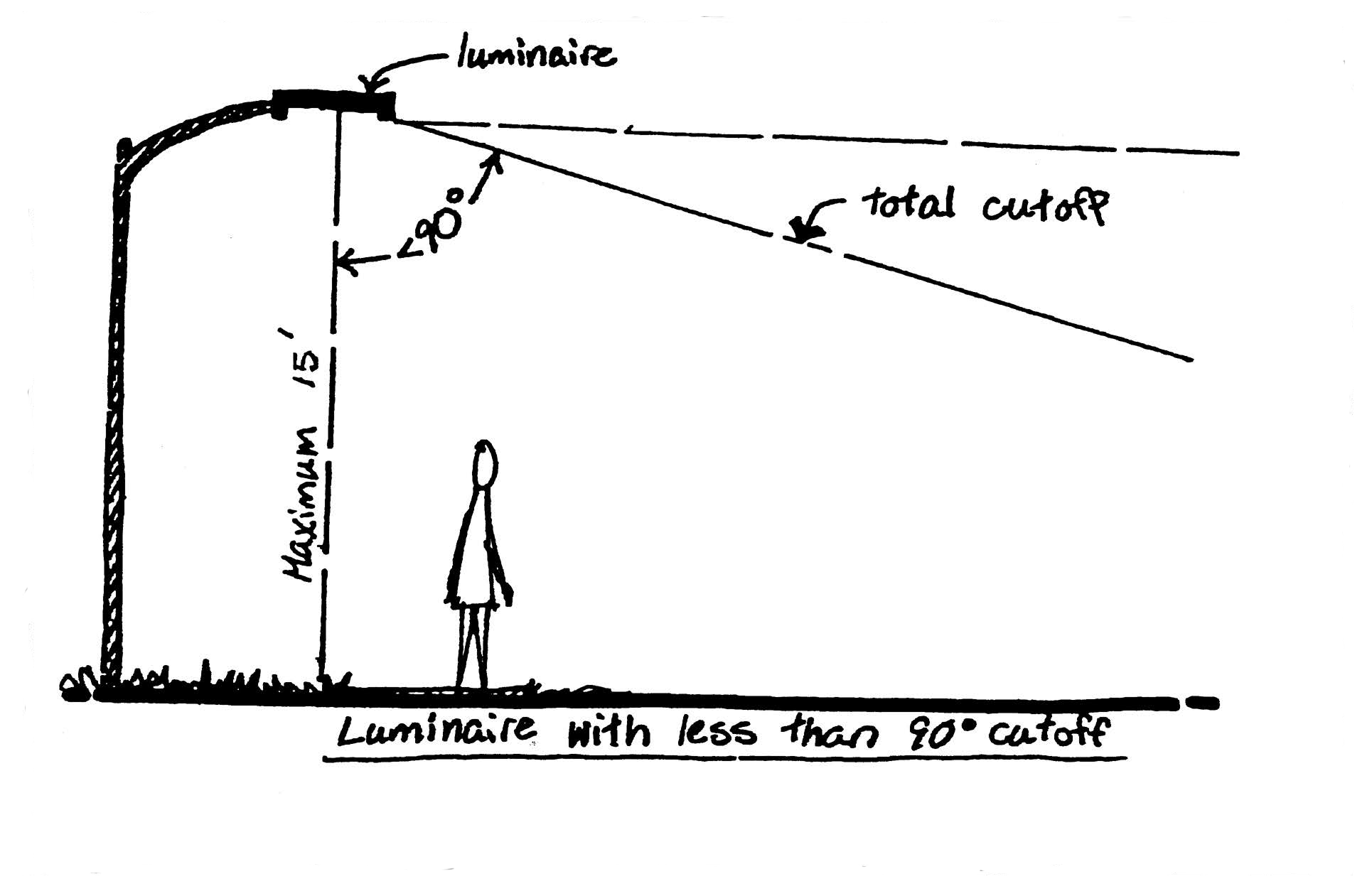
Figure 1
(4)
Any exterior lighting, roof lighting, under canopy lighting, facade lighting, or lighting which forms a linear pattern shall be recessed and shielded or shall contain a cutoff luminaire within the structure or fixture in which it is located. The lighting source shall not be visible from adjacent properties and/or rights-of-way. Only white sources of light such as fluorescent, incandescent, metal halide or other similar lights shall be permitted.
(5)
Where this lighting regulations division conflicts with the Palm Beach County Sea Turtle Protection Ordinance, the Palm Beach County Sea Turtle Protection Ordinance shall govern. If other governmental agencies such as the department of environmental protection, South Florida Water Management District and/or the state department of transportation have established regulations, or through permits require lower lighting levels, the lighting requirements of this section may be reduced.
(6)
All exterior lighting installations shall meet the requirements of Florida Statutes and the Florida Building Code.
(7)
In those areas designated as recreational areas, or within preserves pedestrian paths or multi-purpose paths, or other areas that are either gated and secured, or are closed after dusk, these lighting regulations may be reduced or waived by the town's director of planning and zoning.
(e)
Photometric plans.
(1)
All applications for development applications shall submit, for review by the department of planning and zoning, a photometric plan with points of calculations on a ten-foot by ten-foot grid.
(2)
All photometric plans for all developments shall demonstrate light intensity uniformity in each lighting zone with a maximum to minimum uniformity ratio of a maximum of 12 to one. Automotive fueling station canopies shall demonstrate a maximum to minimum uniformity ratio of 7½ to one. Photometric plans shall provide a breakdown, indicating the maximum footcandle, minimum footcandle, average maintained footcandles and maximum to minimum ratio, for each lighting zone complying with requirements in Table 1.
(3)
All lighting installations shall be designed to minimize direct light spillage, sky glow and hazardous interference with vehicular traffic on adjacent rights-of-way and all adjacent properties. All developments shall utilize a cutoff-type luminaire with less than 75 degree cutoff for all proposed light fixtures. (See Figure 1.)
(4)
Prior to the issuance of a certificate of occupancy or certificate of completion for a development, including the installation of lighting, an inspection shall be completed by the licensed electrical engineer that prepared the photometric plan. A signed and sealed letter shall be submitted to the town confirming that all outdoor lighting has been installed according to the photometric plan approved by the town.
(5)
All photometric plans shall include a note indicating that conflicts between landscaping and lighting installations shall be minimized or eliminated. Prior to final inspection of the lighting installation or issuance of a certificate of occupancy or completion for a development, the project lighting engineer and landscape architect shall provide letters to the department of planning and zoning, confirming that any conflicts between the landscaping and lighting installations are minimized so that landscaping may reach its ultimate growth without reducing the required lighting levels.
(f)
Accent lighting.
(1)
Accent uplighting which is the subject of a development application may be approved by the town on special architectural feature and/or specimen landscaping. Accent uplighting shall be installed consistent with the provisions of section 25-2013;
(2)
Single-family residential homes shall be exempt from the requirement for the approval by the town for accent uplighting.
(3)
Architectural lighting installations on building facades shall include translucent, frosted glass or other comparable materials that do not allow the light source to be visible from the side of the fixture.
(g)
Off-site light spillage.
(1)
Off-site light spillage may be permitted according to Table 1. The maximum footcandle to be spilled off-site to another property, including streets, rights-of-way, road easements, alleys, etc., and shall not exceed 0.3 footcandle.
(2)
Off-site light spillage for residential uses. No off-site light spillage shall occur when residential uses are located adjacent to residential uses. The maximum footcandle to be spilled off-site to a nonresidential property shall not exceed the minimum footcandle requirements for the adjacent lighting zone.
(h)
Method of measurements. The light meter sensor shall be read at ground level or the established grade in a horizontal position. Readings shall be taken only after the light source has been exposed long enough to provide a constant reading. Measurements shall be taken after dark with the light sources to be measure on and subsequently off. The difference between the two readings shall be multiplied by the estimated light loss factor of the fixtures and shall be compared to the permitted illumination level for each lighting zone.
(i)
Security lighting. Developments shall maintain open parking lots and access thereto with a lighting level at least 50 percent of the lighting requirements as listed in Table 1 from dusk to dawn or outside of normal business hours.
(Code 1992, § 27-1675.15; Ord. No. 66-98, §§ 1—9, 8-17-1999; Ord. No. 64-04, § 2, 12-21-2004; Ord. No. 44-14, § 31, 2-17-2015)
Sec. 27-2623.- Intent.
The regulations and requirements of this division are intended to protect, preserve, and enhance the natural shoreline, marine ecosystems, and to ensure navigation of the waterways of the town by regulating and requiring permits for docks, boat lifts, mooring spaces, mooring pilings, installation of bulkheads and revetments, and all other marine associated structures. The intent of these regulations is to provide a balance between the impacts of marine facilities and the natural environment by requiring buffer zones of native vegetation, including mangroves.
(Code 1992, § 27-1396; Ord. No. 10-88, § 604.1, 3-1-1988; Ord. No. 20-02, § 3, 10-15-2002; Ord. No. 2-07, § 3, 5-15-2007; Ord. No. 18-08, § 2, 10-7-2008; Ord. No. 4-15, § 4, 6-16-2015)
Sec. 27-2624. - Shoreline stabilization.
These shoreline stabilization regulations apply to all properties within the town which are located adjacent to tidal waters.
(1)
Existing permitted bulkheads may be replaced provided the location of the new bulkhead is within 18 inches waterward of an existing permitted bulkhead or landward.
a.
Replacement bulkheads constructed in the same location or landward of an existing bulkhead may be replaced.
b.
Replacement bulkheads constructed waterward of an existing bulkhead shall only be permitted one time, as of June 16, 2015. After the one-time extension waterward is permitted, a replacement bulkhead shall be constructed in the same location or landward of the existing bulkhead.
c.
If the top of the new bulkhead extends higher than three feet above the elevation of the mean high water line, then 100 percent of the bulkhead shall be faced with riprap or mangroves in accordance with the regulations set forth in subsections (5) or (6) of this section. Properties designated on the shoreline exemption map (Figure 1) shall be exempt from installing riprap or mangroves. The exemption only applies to that portion of the property at the mouth of the canal as shown on the shoreline exemption map and shall not apply to the portion of property along the natural waterway.
d.
In lieu of a replacement bulkhead, a revetment may be constructed to replace an existing bulkhead in accordance with subsection (7) of this section.
(2)
Existing unpermitted bulkheads may be replaced provided the new bulkhead is within 18 inches waterward of an existing bulkhead or landward.
a.
Replacement bulkheads constructed in the same location or landward of an existing bulkhead may be replaced.
b.
Replacement bulkheads constructed waterward of an existing bulkhead shall only be permitted one time, as of June 16, 2015. After the one-time extension waterward is permitted, a replacement bulkhead shall be constructed in the same location or landward of the existing bulkhead.
c.
At least 50 percent of the bulkhead shall be faced with riprap or mangroves waterward of the new bulkhead in accordance with the regulations set forth in subsections (5) or (6) of this section. Properties designated on the shoreline exemption map (Figure 1) are not required to install riprap or mangroves. This exemption only applies to that portion of the property located at the mouth of the canal as shown on the shoreline exemption map and shall not apply to the portion of property along the natural waterway.
d.
If the top of the new bulkhead extends higher than three feet above the elevation of the mean high water line, then 100 percent of the bulkhead shall be faced with riprap or mangroves in accordance with the regulations set forth in subsection (5) or (6) of this section. Properties designated on the shoreline exemption map (Figure 1) are not required to install riprap or mangroves. This exemption only applies to that portion of the property located at the mouth of the canal as shown on the shoreline exemption map and shall not apply to the portion of property along the natural waterway.
e.
A toe wall to hold in riprap may be required where the water depths adjacent to the bulkhead are too deep.
f.
Existing bulkheads constructed of wood or other degradable materials shall be removed prior to completion of the replacement shoreline stabilization structure.
g.
In lieu of a replacement bulkhead, a revetment may be constructed to replace an existing bulkhead in accordance with subsection (7) of this section.
h.
A property owner who provides a dated survey or historical aerial documenting that a bulkhead existed prior to December 20, 2005, shall not be required to install riprap or mangroves, provided the new bulkhead does not extend higher than three feet above the elevation of the mean high water line.
(3)
Existing revetments, either permitted or unpermitted, may be replaced with a new bulkhead or revetment provided they meet the following standards:
a.
Bulkheads.
1.
The setback shall be five feet from the jurisdictional line of the state, or the mean high water line, whichever is more landward. In those areas where an existing principal building is set back less than 50 feet to the jurisdictional line of the state, or the mean high water line, whichever is more landward, the setback may be reduced. The setback reduction shall be equal to ten percent of the distance between the existing principal building and the jurisdictional line of the state or mean high water line, whichever is more landward. In no case shall the setback be less than one foot.
2.
One hundred percent of the bulkhead shall be faced with riprap or mangroves waterward of the new bulkhead in accordance with the regulations set forth in subsections (5) or (6) of this section.
3.
Properties designated on the shoreline exemption map (Figure 1) shall not be required to install riprap or mangroves. This exemption only applies to that portion of the property at the mouth of a canal as shown on the shoreline exemption map and shall not apply to that portion of the property along the natural waterway.
4.
A toe wall to hold in riprap may be required where water depths adjacent to the bulkhead are too deep.
b.
Revetment.
1.
Shall be constructed in the same place as the existing revetment.
2.
An existing revetment which was constructed with loose boulders, rocks, or clean concrete rubble with no exposed reinforcing rods or protrusions may remain and riprap may be placed over top of the existing materials.
3.
A revetment constructed of material not consistent with loose boulders, rocks, or clean concrete rubble with no exposed reinforcing rods or protrusions shall be removed prior to replacement.
4.
Mangroves shall be planted in accordance with the regulations set forth in subsections (5) or (6) of this section.
(4)
Existing unarmored shorelines may be armored with a new bulkhead or revetment provided they meet the following standards:
a.
Bulkheads.
1.
The setback shall be five feet from the jurisdictional line of the state, or the mean high water line, whichever is more landward. In those areas where an existing principal building is set back less than 25 feet to the jurisdictional line of the state, or the mean high water line, whichever is more landward, the setback may be reduced. The setback reduction shall be equal to 20 percent of the distance between the existing principal building from the jurisdictional line of the state or mean high water line, whichever is more landward. In no case shall the bulkhead setback be less than one foot.
2.
One hundred percent of the bulkhead shall be faced with riprap or mangroves waterward of the new bulkhead in accordance with the regulations set forth in subsections (5) or (6) of this section.
3.
Properties designated on the shoreline exemption map (Figure 1) shall not be required to install riprap or mangroves. This exemption only applies to that portion of a property at the mouth of the canal as shown on the shoreline exemption map and shall not apply to that portion of a property along the natural waterway.
4.
A toe wall to hold in riprap may be required where the water depths adjacent to the bulkhead are too deep.
b.
A riprap revetment may be constructed in accordance with the regulations set forth in subsection (7) of this section.
(5)
These regulations shall apply when riprap is required to be installed with the construction of a bulkhead:
a.
Existing mangroves on the property shall count towards meeting the percentage of shoreline requirement.
b.
Riprap shall be placed such that the bottom 50 percent of the bulkhead is covered, and sloped at a maximum two to one, vertical to horizontal ratio. At no point shall riprap extend more than eight feet waterward of the mean high water line or jurisdictional line of the state. Riprap placed waterward of bulkheads does not require filter cloth.
c.
Within two years of the final inspection of the bulkhead or riprap, mangroves shall be established on at least ten percent of the shoreline faced with riprap.
d.
If, after two years from the final inspection, less than ten percent of the shoreline faced with riprap contains mangroves, then 20 percent of the shoreline shall be planted with mangroves. The mangroves to be planted shall meet the standards of subsection (6)c of this section. If some mangroves have been established, but the minimum requirement of ten percent has not been met, staff may grant a one-year extension to the monitoring period.
(6)
These regulations shall apply when riprap is required to be installed with the construction of a bulkhead and the property owner elects to plant mangroves along the shoreline as an alternative to riprap.
a.
Fifty percent of the face of the required riprap shall be planted with mangroves waterward of the bulkhead. For example, if 50 percent riprap is required to face the bulkhead, then only 25 percent mangroves are required.
b.
Existing mangroves shall count towards meeting the percentage of shoreline requirement.
c.
Following an inspection of the bulkhead or the installation of mangroves, the property owner shall submit a mangrove planting plan to the town, and it shall be subject to the review and approval of the natural resources coordinator.
1.
The mangrove planting plan shall include;
(i)
The species of mangroves appropriate given the location;
(ii)
The size, species, number, and spacing of mangroves to be planted;
(iii)
The identification of the location of at least two photo stations which shall be the designated photo stations from which photos will be provided for each monitoring report;
(iv)
Photos clearly showing the mangrove plantings in their entirety;
(v)
The location of bulkheads, docks or other structures relative to plantings.
2.
The property owner shall submit a time zero monitoring report to the town within 30 days from the town's initial inspection, marking the beginning of the monitoring period.
3.
The property owner shall monitor the mangroves annually for survivability for five years. On or before the anniversary date of the annual time zero report each year, the property owner shall submit at least two photographs taken from each of the designated photo stations and submit these photos to the town for its review and approval. The report shall also identify the number and location of the mangroves which have been planted. If less than 80 percent of originally planted mangroves have survived, the property owner shall replant the number of mangroves which have expired. If photographs are not received by the required date, an inspection will be conducted by natural resources in order to inspect the condition of the mangroves.
4.
The town may require that hand placed riprap be installed to support the growth of mangroves which have been planted in high wave energy areas.
(7)
A riprap revetment may be constructed, extending to the midpoint of the littoral zone, between the mean high and mean low water mark. Riprap shall be hand placed over a filter cloth with a minimum 30-year lifespan designed to retain soils while allowing water to flow through. Mangroves shall be planted or established in accordance with the regulations set forth in subsections (5)c and (5)d of this section.
(8)
The maximum height to the top of a new bulkhead shall be equal to or below a property's required base flood elevation as recorded on the current Federal Emergency Management Agency special flood hazard maps. Exemptions:
a.
Properties east of the Coast Construction Control Line established pursuant to F.S. § 161.053.
b.
For those properties where buildings abut the Riverwalk, the above requirement may be waived if the height difference between the bulkhead and adjacent building on the Riverwalk would create a slope between the bulkhead and the building that does not meet minimum Americans with Disabilities Act slope requirements.
(9)
In the event a jurisdictional agency requires a permit for the placement of riprap within their jurisdiction, but will not issue the permit, then the property shall be exempt from providing riprap in the jurisdictional area.
(10)
Where the placement of riprap or mangroves would reduce the width of a canal to less than 40 feet, the property owner shall not be required to install riprap or mangroves.
(11)
Where the placement of riprap would result in the destruction of sea grasses, the property owner shall not be required to install riprap or mangroves. The property owner must submit a sea grass study, not more than six months old, documenting the location of the sea grasses.
(12)
A new bulkhead may be constructed where there has been severe erosion creating a public safety issue, such as that which may occur as the result of a natural disaster. The construction of the new bulkhead is subject to the approval of any agency with jurisdiction and a finding by the director of planning and zoning that the bulkhead will not adversely impact environmental resources and that no other means of stabilization is feasible.
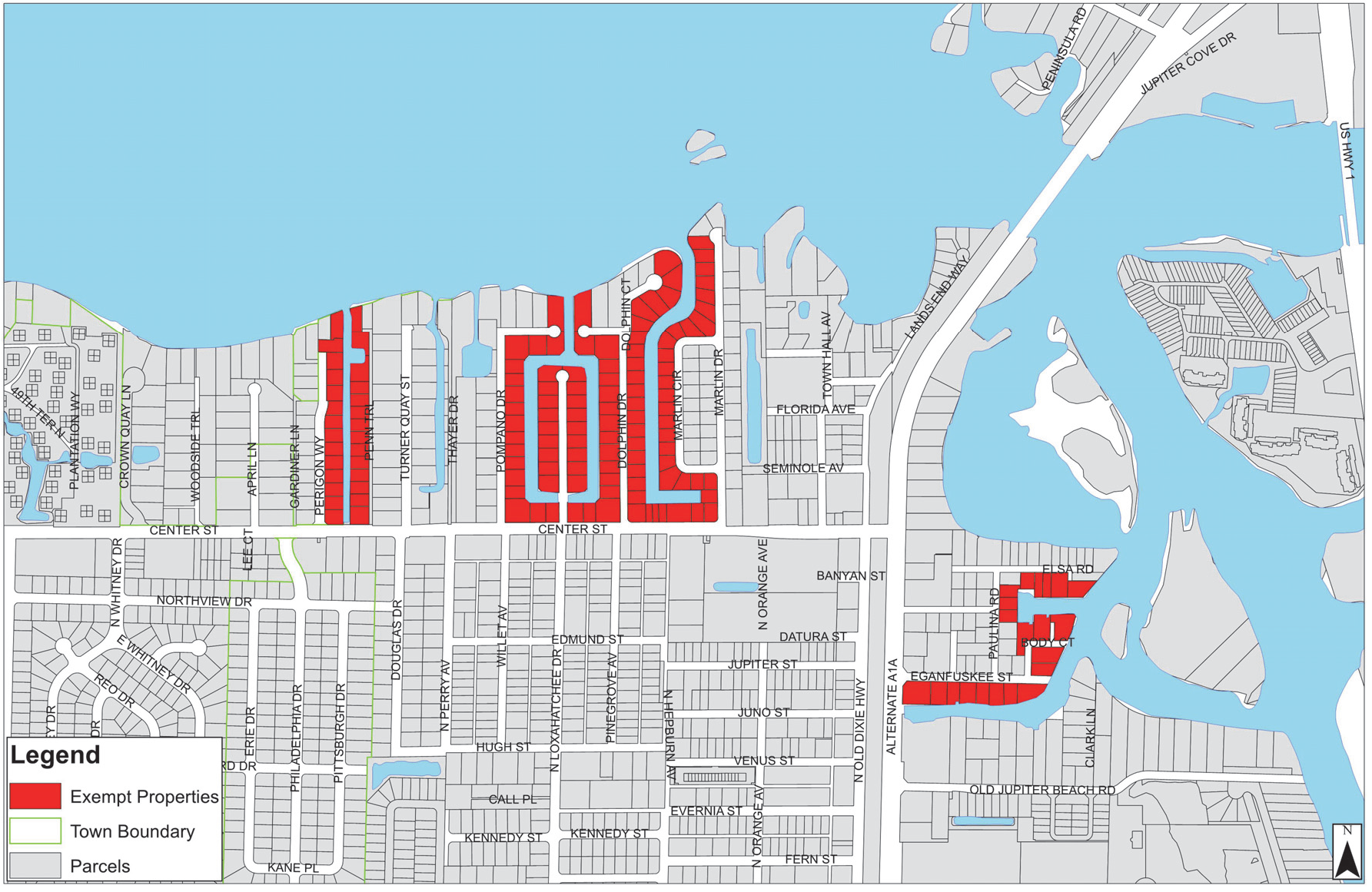
Figure 1. Shoreline Exemption Map
(Code 1992, § 27-1397; Ord. No. 10-88, § 604.2.A, 3-1-1988; Ord. No. 20-02, § 4, 10-15-2002; Ord. No. 35-05, § 4, 12-20-2005; Ord. No. 2-07, § 4, 5-15-2007; Ord. No. 18-08, § 3, 10-7-2008; Ord. No. 4-15, § 5, 6-16-2015)
Sec. 27-2625. - Marinas.
(a)
Marinas are defined as facilities intended to provide dockage or secure mooring for marine vessels, and are permitted as special exceptions in Agricultural Districts (A-1), Rural Residential Districts (R-R), Residential, Limited Multifamily Districts (R-3), U.S. One/Intracoastal Waterway Corridor Zoning Districts (US1/ICW), Commercial, General Districts (C-2), Industrial, General Districts (I-2), and Inlet Village Zoning Districts (IV) and as an approved portion of a Large-Scale Planned Unit Development District (PUD). Standards for dock structures in marinas shall be established on a case by case basis as part of the review and approval of a special exception by the town council.
(b)
Ancillary uses associated with marina operations, such as fueling, repairs and maintenance, hauling and storage, retail sales and yacht club facilities, including restaurant and/or lounge, may be permitted within certain zoning districts as indicated below:
(1)
In Agricultural Districts (A-1), Rural Residential Districts (R-R), Residential, Limited Multifamily Districts (R-3), only fueling may be allowed as an ancillary use if approved as part of the special exception. Live aboard accommodations are not permitted in these districts.
(2)
In U.S. One/Intracoastal Waterway Corridor Zoning Districts (US1/ICW), Commercial, General Districts (C-2), Industrial, General Districts (I-2), and Inlet Village Zoning Districts (IV) and approved Large-Scale Planned Unit Development Districts (PUD), all ancillary uses listed above may be allowed. Marinas offering permanent, seasonal or transient live aboard accommodations shall provide hook-up service to approved on-shore wastewater treatment systems and potable water sources.
(Code 1992, § 27-1398; Ord. No. 10-88, § 604.2.B, 3-1-1988; Ord. No. 20-02, §§ 5, 6, 10-15-2002; Ord. No. 35-05, § 5, 12-20-2005; Ord. No. 4-15, § 6, 6-16-2015)
Sec. 27-2626. - Private dock regulations.
(a)
Individual private docks, for the exclusive use of an adjacent residential unit, are permitted as an accessory use in all residential districts. The mooring of commercial vessels is prohibited in all residential districts. A single private dock for the exclusive use of a commercial building may be permitted as an accessory structure in all commercial districts provided the dock serves only the occupants of the commercial building. A dock that has more than two boat mooring spaces shall be considered a marina.
(b)
In addition to the regulations set forth within the district in which the use is located, the following minimum regulations shall apply:
(1)
No dock, boat mooring space, or mooring pilings shall be built out into a natural waterway by more than 50 feet from the mean high water line; nor shall any dock, boat mooring space, or mooring pilings exceed 20 percent of the natural waterway width, whichever is less. The above regulation may be waived by the planning and zoning director for docks, boat mooring spaces, or mooring pilings to be located in bodies of water in which other agencies also have regulatory jurisdiction and have permitting conditions which allow projections into the natural waterway that are greater than the above maximums, provided that the greater extension does not adversely impact navigation, safety, environmental resource protection, or other similar concerns. In order to qualify for the issuance of a building permit for a dock, boat mooring spaces, or mooring pilings, the applicant must submit with the application a signed and sealed survey showing the location of the proposed improvements. The survey must not be more than six months older than the date of the application for a permit, must accurately depict that the single-family lot or duplex lot, which is the subject of the permit application, extends to the mean high water line, or must reflect that the landowner has riparian rights attached to the uplands for which each landowner holds title.
(2)
Docks which are located on or upon any manmade surface waters (i.e., lakes, retention ponds, or canals), boundaries of such manmade surface waters being totally within a residential area, shall not project more than five feet or ten percent of the width of the waterway, whichever is greater nor extend nearer than the side setback required for the district within which the property is located. In manmade surface waters, boat mooring spaces may project up to 25 percent of the width of the waterway. In order to qualify for the issuance of a building permit for a dock, boat mooring spaces, or mooring pilings, the applicant must submit with the application a signed and sealed survey showing the location of the proposed improvements. The survey must not be more than six months older than the date of the application for a permit, must accurately depict that each single-family lot or duplex lot extends to the mean high water line which is the subject of the permit application or must reflect that the landowner has riparian rights attached to the uplands for which each landowner holds title.
(3)
Shared private docks may be permitted on two contiguous, single-family, or duplex lots located on either a natural waterway, or a manmade surface water, provided that the single-family lot landowners, and the duplex lot landowners, submit a legally sufficient mutual dock maintenance and cross access easement agreement, that is in a form which is legally sufficient to the town attorney and which is approved for consistency with these regulations by pertinent town staff. The mutual dock maintenance and cross access easement agreement shall be recorded in Palm Beach County, Florida at the sole expense of the applicant, and the applicant shall provide the town with a certified copy of the recorded instrument. In order to qualify for the issuance of a building permit for a shared dock, each landowner of a single-family lot and each landowner of a duplex lot who are proposing to share a private dock, must have ownership rights to the property which extends to the mean high water line, or must have legally documentable riparian rights that are attached to the uplands for which each participating landowner holds title. The shared private dock shall be considered the one dock allowed for each lot. No additional docks shall be permitted.
(4)
Dock access walkway shall not exceed four feet in width.
(5)
In natural waterways, the terminal platform or marginal dock shall have a maximum area of 200 square feet. If the dock is constructed over known sea grass beds, the terminal platform or marginal dock shall have a maximum area of 160 square feet. In manmade canals, marginal docks may exceed 200 square feet, provided they meet the required side setbacks and do not adversely impact or encroach upon natural resources.
(6)
No dock, boat lift mooring space, mooring piling, davit, other mooring facility, or floating structure (i.e., dock, walkway, floating vessel platform, etc.) shall be located nearer to the side lot line than the side setback required for the district within which the property is located as measured from a line that extends out from the side property lines into the waterway or canal. Except for boats moored in the inside corner of a canal, boats may be moored without a setback to the extensions of a property's side property line, but no part of the boat shall overhang the vertical plane created by a side property line's extension into the waterway or canal. Boats moored in the inside corner of a canal shall meet the same setbacks as a dock-related structure.
a.
Where the extension of the side property lines converge within a waterway, the director of planning and zoning may grant a waiver or reduction to the required setback for docks, boatlifts, or boat mooring spaces to ensure that a property owner has reasonable access to a navigable channel. The director's approval of a waiver may be permitted provided all of the following are met:
1.
Other jurisdictional agencies having permitted the proposed dock, boat mooring space, mooring piling, davit, other mooring facility, or floating structure with reduced setbacks, based on using alternative methods of calculations for setbacks;
2.
Documentation is provided to the department that written notification was sent to the affected neighboring property owners making them aware of the setback waiver.
b.
In order to qualify for a building permit for a dock, boat mooring spaces, or mooring pilings, the applicant shall submit with the building permit application:
1.
A signed and sealed survey, not more than six months older than the date of the application for a permit, indicating; the location of the proposed improvements; the location of the mean high water line; and shall reflect that the landowner has riparian rights attached to the uplands for which the landowner holds title.
2.
A copy of a permit from the Florida Department of Environmental Protection, U.S. Army Corps of Engineers, or South Florida Water Management District.
(7)
The side setback for docks on natural waterways and manmade surface waters may be waived by the planning and zoning director, where two contiguous single-family or duplex lots, which qualify under the provisions of this Code, are permitted to share one dock (See subsection (b)(3) of this section) and its associated mooring spaces, boat lift, and pilings. The above setback waiver may apply to docks, mooring spaces, boat lifts, and pilings which are associated with each individual portion of the shared dock under the specific use of each single-family or duplex lot. All other setback requirements for the district that are not related to the location of the dock still apply.
(8)
Any T or L terminal platform shall have a maximum length of 20 feet and shall not project into the side setback required for the district within which the property is located. A U-shaped terminal platform may be allowed for shared docks. The U-shaped terminal platform shall also be limited to a maximum length of 20 feet.
(9)
No more than one dock per lot shall be permitted in an Residential, Single-Family District (R-1) or Residential, Single-Family-Duplex District (R-2), except in an approved Large-Scale Planned Unit Development District (PUD). No dock shall be permitted with more than two boat mooring spaces. One boat lift plus one personal watercraft lift shall be allowed per dock in an Residential, Single-Family District (R-1) or Residential, Single-Family-Duplex District (R-2). The personal watercraft lift shall have no more than a 3,000 lb. lift capacity, and shall be limited to two mooring pilings. In lieu of two personal watercrafts, a property owner may store one small boat on the personal watercraft lift, provided the boat does not have a permanent rigid canopy structure (i.e., T-top, tower, or shade structure) extending above the boat's gunwale. A small boat that is stored on the personal watercraft lift, shall retract, lower, or remove any shade structures. Two personal watercrafts may be stored on one personal watercraft lift at one boat mooring space. If two contiguous, single-family and/or duplex lots, that qualify under the provisions of subsection (b)(3) of this section, share one permitted dock and its associated mooring spaces, boat lift, and pilings, each individual property owner may be permitted to have one boat lift and one personal watercraft lift on the portion of the dock that benefits each individual lot owner.
(10)
Except for rectangular shaped, T-shaped and L-shaped docks, and shared docks approved with U-shaped terminal platforms, no other configuration shall be allowed, unless another configuration is approved by the director of planning and zoning as being beneficial for navigation, safety, or environmental resources protection.
(11)
Docks, boat lifts and personal watercraft lifts in canals shall be parallel to the bulkhead in order to promote parallel mooring. The director of the planning and zoning department may permit another configuration provided it is determined that the configuration would be beneficial for navigation, safety, environmental resources protection, or views.
(12)
If there is documentation of known sea grass beds that would be directly impacted by the construction of the dock, the following regulations shall be applied. Height of pier shall be a minimum of five feet above MHW as measured from the top of surface of the decking. Material used to construct the walkway surface shall be no wider than eight inches and shall be spaced a minimum of one-half inch apart.
(13)
Nighttime reflectors shall be affixed to any dock, mooring piling, or davit and elevator structures extending more than five feet into any waterway. Three reflective devices shall be installed above the established mean high water line on each side of all of the mooring pilings. The intent is to provide three devices facing both directions of the waterway.
(14)
Covered boat lifts and docks are not permitted. Boat lifts shall not be modified (i.e., installation of decking, planking, etc.) to serve any other use than for the purpose of elevating a boat or vessel out of the water. There shall be no mooring of any vessel on the waterward side of a boat mooring space.
(15)
At all times, the minimum centerline channel width of 50 percent of the waterway width must remain unobstructed. Where the 50 percent cannot be met, alternative solutions may be approved by the director of planning and zoning provided a 15-foot channel is maintained. Alternative solutions shall be evaluated based on the proximity of adjacent, existing and future marine facilities, the proximity of natural ecosystems and resources, and the navigability of a waterway in order to provide adequate setbacks that are equitable to adjacent properties.
(16)
A four-foot dock walkway is allowed to pass through the rear setback area in order to connect with a deck, patio or sidewalk.
(17)
The re-decking of any portion of a private dock, even if it is in the same configuration and in the same location of an existing, permitted dock, shall require a building permit.
(Code 1992, § 27-1399; Ord. No. 10-88, § 604.3, 3-1-1988; Ord. No. 20-02, § 7, 10-15-2002; Ord. No. 35-05, § 6, 12-20-2005; Ord. No. 2-07, § 5, 5-15-2007; Ord. No. 18-08, § 4, 10-7-2008; Ord. No. 4-15, § 7, 6-16-2015; Ord. No. 21-16, § 2, 10-20-2016; Ord. No. 14-17, § 2, 9-19-2017)
Sec. 27-2646.- Purpose and intent.
The purpose and intent of this division is to regulate microbreweries to ensure that the intensity of the use and any adverse impacts or nuisances associated with these uses can be appropriately addressed.
(Code 1992, § 27-1675.35; Ord. No. 39-14, § 7, 2-17-2015)
Sec. 27-2647. - Regulations.
A microbrewery shall comply with the following regulations:
(1)
The microbrewery shall not produce more than 15,000 barrels (465,000 US gallons/17,602.16 hectoliters) of beer per year, as provided by in an annual report, including the tax documentation from the previous calendar year.
(2)
The owner/operator of the microbrewery shall, prior to February 15 of each year the microbrewery is operating, submit an annual report along with a copy of the annual production information it files with the state or federal government, including the tax documentation contained therein.
(3)
A microbrewery shall be permitted only in conjunction with a commercial retail, restaurant, tavern, or lounge.
(4)
No more than 75 percent of the total gross floor space of the microbrewery shall be used for the brewery function, including, but not limited to, the brewhouse, boiling and water treatment areas, bottling and kegging lines, malt milling and storage, fermentation tanks, conditioning tanks, serving tanks, and/or the storage of materials.
(5)
The commercial portion of the microbrewery that is not used for the brewery function shall be oriented towards the street or public space.
(6)
All brewery equipment within the principal structure which would be visible through windows from adjacent residential uses or residential zoning districts (excluding the mixed use zoning districts) shall be screened using architectural features consistent with the principal structure. Brewery equipment within the principal structure visible through windows from the street or public space may be displayed in a manner that showcases the brewery equipment and function.
(7)
Truck access and loading bays shall not face toward any street (excluding alleys) and the loading bays shall remain closed at all times, except during the movement of materials, supplies, and malt beverages into and out of the building.
(8)
Service trucks loading and unloading malt beverages, materials, supplies shall only visit the microbrewery between the hours of 8:00 a.m. and 8:00 p.m. Monday through Saturday and between 11:00 a.m. and 7:00 p.m. on Sundays.
(9)
No outdoor storage shall be allowed in conjunction with a microbrewery, including the use of portable storage units, cargo containers and tractor trailers. Spent or used grain, may be approved to be temporarily stored outdoors for a period of time not to exceed 24 hours. The temporary storage area of spent or used grain shall be subject to the following:
a.
The area designated for temporary storage must be part of an approved site plan;
b.
Temporary storage is prohibited within any required area (parking, green space, landscape buffers, etc.) or within 75 feet of a residential use or residential zoning district (excluding the mixed use zoning districts);
c.
Fully enclosed within a sealed container, secured and screened behind a solid, opaque fence or wall measuring a minimum five feet in height.
(Code 1992, § 27-1675.36; Ord. No. 39-14, § 8, 2-17-2015)
Sec. 27-2673.- Intent.
The regulations and requirements of this division are intended to provide location for and development of mobile home parks within the town. All mobile homes shall be located within such parks in conformance with the requirements of this chapter.
(Code 1992, § 27-1576; Ord. No. 10-88, § 613.1, 3-1-1988)
Sec. 27-2674. - Where permitted.
Mobile home parks may be permitted in Rural Residential Districts (R-R), Residential, Limited Multifamily Districts (R-3) and Commercial, General Districts (C-2) as a planned unit development, special exception.
(Code 1992, § 27-1577; Ord. No. 10-88, § 613.2, 3-1-1988)
Sec. 27-2675. - Regulations.
(a)
Mobile home parks shall meet all requirements of the planned unit development provisions of this chapter.
(b)
Mobile home parks shall meet the same requirements and site development regulations as set forth for single-family planned unit developments, with the following exceptions:
(1)
Floor area per unit (minimum), 350 square feet.
(2)
Mobile home parks shall have a minimum 50-foot landscaped buffer to all property line boundaries.
(3)
Upon payment of an inspection fee to the building division, mobile homes shall be inspected by the building official at the time of installation in the mobile home park.
(Code 1992, § 27-1578; Ord. No. 10-88, § 613.3, 3-1-1988)
Sec. 27-2676. - Outdoor storage.
Outdoor storage may be permitted as an accessory use in mobile home parks subject to review as a special exception use and subject to site plan review based upon the following criteria:
(1)
Applicability. The provisions contained herein shall only be applicable to storage areas that have been in existence for a minimum of 12 months prior to annexation of the subject property. The applicant shall verify and provide verification of the above criteria is satisfied.
(2)
Minimum acreage. The mobile home park must be at least 25 acres.
(3)
Rental spaces. One hundred percent of the designated spaces may be rented to the general public with first priority to the residents who reside within the mobile home park.
(4)
Maximum permitted space allocation. The maximum permitted outdoor storage area shall not exceed five percent of the total acreage of the mobile home park.
(5)
Maximum storage height. No vehicles which exceeds 14 feet in height shall be stored within the storage areas.
(6)
Minimum setbacks. A minimum setback of 15 feet shall be maintained from all property lines.
(7)
Perimeter buffer requirements. The entire perimeter of the storage area shall be surrounded by a 15-foot landscape buffer with the following improvements subject to the following minimum height requirements at the time of installation:
a.
One hundred percent opaque, six-foot-high vegetative buffer on all sides planted 36 inches on center.
b.
One, 12- to 14-foot native shade tree shall be planted every 25 feet.
(8)
Items permitted to be stored. The following items shall be the only items permitted to be stored within the storage area:
a.
All terrain vehicles;
b.
Automobiles;
c.
Boats;
d.
Campers;
e.
Motor homes;
f.
Motorcycles and similar two-wheeled vehicles;
g.
Recreational vehicles;
h.
Travel trailers;
i.
Trailers;
j.
Trucks no more than two tons in size;
k.
Wave runners;
l.
Utility trailers; and
m.
Vans.
If a vehicle is not listed above, the storage of the vehicle is prohibited within the storage area. Specifically, buses, tractor trailers, semi-tractors, etc., are prohibited.
(9)
Prohibited uses. The following uses or activities shall be prohibited within the storage area:
a.
The storage of merchandise, goods, products, or other similar storage items shall be prohibited.
b.
The repair, refinishing, painting, sanding, or similar repairs or work completed on the vehicles stored shall be prohibited. Vehicles may be washed and waxed within the storage area, however, the area shall be specifically designated/identified as vehicle washing area. Provided, however, that no washing and waxing shall be permitted within the area for commercial purposes.
c.
The storage area shall not be utilized for the use or placement of recreational vehicles as residences. The purpose of the area is exclusively for the purposes of storing vehicles.
d.
The use of vehicles for the means of conducting business within such vehicles is prohibited on-site.
e.
All vehicles shall be stored within the designated storage area within an assigned space. No storage of the above vehicles shall be permitted within driveway aisles, negotiation areas, or within the storage areas or elsewhere within the mobile home park development except for passenger vehicles parked at improved parking spaces located at mobile home lots.
f.
No outdoor loudspeaker system, including, but not limited to, bells, amplified telephone ringers, music paging systems, etc. shall be permitted or be audible outside the confines of the principal structure.
g.
The storage of toxic, flammable materials, or other hazardous materials, etc., shall be prohibited. Fuel storage tanks that are customary, incidental or an accessory to an RV's, automobiles, trucks, etc. (i.e., propane tanks, vehicle gasoline tanks) shall be permitted.
(10)
Improvements. Prior to the issuance of a certificate of completion, the following improvements to the proposed vehicle storage area shall be completed:
a.
Designate or demark the storage spaces with wheel stops, landscape timber, etc., to identify clearly where each vehicle shall be appropriately stored;
b.
Each vehicle storage space shall be designated with a numerical or alphabetical letter to clearly identify each space; and
c.
Stabilize the surface of the area with stabilized grass or other acceptable means of stabilization subject to engineering department approval.
(11)
Signage. No signage advertising the proposed storage shall be permitted.
(Code 1992, § 27-1579; Ord. No. 22-97, § 1, 4-1-1997)
Sec. 27-2701.- Intent.
It is the intent of this division to provide for the location and development of new and used sales facilities for vehicular products that are normally displayed and stored outdoors.
(Code 1992, § 27-1536; Ord. No. 10-88, § 611.1, 3-1-1988)
Sec. 27-2702. - Where permitted.
Uses coming under this division may be permitted within a Commercial, General District (C-2) as a special exception. Mobile home sales may be included within the special exception approval granted a mobile home park.
(Code 1992, § 27-1537; Ord. No. 10-88, § 611.2, 3-1-1988)
Sec. 27-2703. - Regulations.
In addition to the regulations as set forth within the district in which a use coming under this division is located, the following minimum regulations shall apply:
(1)
All display areas shall have a front setback minimum of 25 feet.
(2)
Any and all structures shall meet the setback requirements for the district in which it is located.
(3)
All parking areas for display and sale shall be provided with a pavement having an asphaltic or Portland cement binder and shall be so graded and drained as to dispose of all surface water accumulation.
(4)
Turnouts shall be required to ensure ingress and egress from such lots.
(5)
Only motor vehicles, boats, mobile homes and recreation vehicles that are in operating and saleable condition shall be allowed on such lots. Motor vehicles shall possess a valid state registration sticker.
(6)
Mobile home sales in Commercial, General Districts (C-2) must be located inside a building or must have all mobile homes on the lot anchored as required by the building code of the town.
(7)
Mechanical repairs, body and paint repairs are permitted as an accessory use in Commercial, General Districts (C-2).
(8)
All property lines where vehicles are displayed shall have installed a permanent guard rail, fence or parking block to prevent vehicles from accidentally rolling from the display area.
(Code 1992, § 27-1538; Ord. No. 10-88, § 611.3.A, 3-1-1988)
Sec. 27-2725.- Intent.
The regulations and requirements of this division are intended to provide for health care facilities in the town that are conveniently located and provide safe, efficient facilities on-site for patient care.
(Code 1992, § 27-1636; Ord. No. 10-88, § 615.1, 3-1-1988)
Sec. 27-2726. - Where permitted.
(a)
Nursing homes and convalescent facilities may be located in the Medical Center Districts (M-C) as a use by right; in the Rural Residential Districts (R-R), Residential, Single-Family Districts (R-1), Residential, Single-Family-Duplex Districts (R-2) and Residential, Limited Multifamily Districts (R-3) as an approved element of a planned unit development; and may be located in Residential, Limited Multifamily Districts (R-3), Commercial, General Districts (C-2), Mixed Use Development Districts (MXD), Quasi-Public Institutional Districts (QPI), Public/Institutional Districts (PI), and the Workplace Limited (WPL), Workplace (WP), and Institutional (IN) Subdistricts of the Mixed Use Development (MXD) District as special exception uses.
(b)
Hospitals may be located in the Medical Center Districts (M-C) by right and in Commercial, General Districts (C-2), and Commercial, Office Districts (C-3), Industrial, High Technology and Employment Center (I-4) Districts, and Institutional (IN) Subdistricts of the Mixed Use Development (MXD) districts as special exceptions.
(c)
Specialty hospitals may be located in the Medical Center Districts (M-C) by right and in Commercial, General Districts (C-2), Commercial, Office Districts (C-3), Industrial, High Technology and Employment Center (I-4), Workplace (WP) and Institutional (IN) Subdistricts of the Mixed Use Development (MXD) Districts as special exceptions.
(d)
Licensed service provider facilities offering the licensable service components as listed in F.S. § 397.311(26) may be located in the Medical Center (M-C) zoning district as a use by right. Facilities offering licensable service components as listed in F.S. § 397.311(26) may be located in the Commercial, Office (C-3) zoning district and the Indiantown Road Overlay Zoning (IOZ) Center Street/Maplewood Drive district with underlying Commercial, Office District (C-3) as a special exception. The services listed in F.S. § 397.311(26) may be permitted as a special exception use only in conjunction with, and as a part of, services listed in F.S. § 397.311(26).
(e)
Licensed service provider facilities shall not be located within 1,200 feet of day care facilities in the Medical Center Districts (M-C), Commercial, Office Districts (C-3), and Indiantown Road Overlay Zoning Districts (IOZ) Center Street/Maplewood Drive districts with underlying Commercial, Office District (C-3) zoning. A licensed service provider facility shall not be located within 1,200 feet of another licensed service provider facility in the Commercial, Office District (C-3) or in the Indiantown Road Overlay Zoning District (IOZ) Center Street/Maplewood Drive district.
(Code 1992, § 27-1637; Ord. No. 10-88, § 615.2, 3-1-1988; Ord. No. 16-08, § 7, 5-6-2008; Ord. No. 05-10, § 4, 4-6-2010; Ord. No. 9-21, § 8, 6-15-2021)
Sec. 27-2727. - Regulations.
In addition to the regulations set forth within the district in which the use under this division is located, the following minimum regulations shall apply:
(1)
Nursing homes and convalescent facilities.
a.
Such facilities shall not be located on any arterial or major street unless a landscape buffer of not less than 50 feet is provided. Access to the facility, should the facility require ambulance service, shall be from a collector street and in such manner as to minimize the adverse effects on adjacent property. The environment created should be of a pronounced residential nature and so designed as to minimize any adverse conditions that might detract from the primary convalescent purpose of the facility.
b.
The minimum lot area shall not be less than one acre.
c.
The minimum frontage for the site shall be 100 feet.
d.
Setbacks, building height and lot coverage shall be the minimums for the district in which the facility is located.
e.
The maximum permitted density shall not exceed 43.56 patient rooms per gross acre. Density shall be computed at one patient room for each 1,000 square feet of lot area.
f.
All nursing homes and convalescent facilities shall meet all state requirements for operation and certification.
g.
Nursing homes and convalescent uses located in the bioscience research protection overlay shall include related medical uses and clinical research uses consistent with the intent of the overlay, as described in Future Land Use Element Objective 1.17 and Policy 1.17.1 of the comprehensive plan.
(2)
Hospital and specialty hospital.
a.
The minimum site area shall not be less than five acres.
b.
The minimum frontage for the site shall be 300 feet.
c.
Setbacks, building height and lot coverage shall be the minimums for the district within which the facility is located.
d.
Hospital facilities shall meet all state requirements for operation and certification.
(3)
Licensed service provider facilities.
a.
Minimum floor area for bedrooms and the minimum number of bathrooms shall be governed by the Florida Building Code.
b.
At least ten percent of the total floor area shall be devoted to a common area (wherein a variety of recreational or therapeutic activities may occur), exclusive of halls, corridors, stairs, and elevator shafts.
c.
Parking requirements for licensed service provider facilities shall be 0.50 parking spaces per facility unit bed and one parking space per every 250 square feet of office space or common area.
d.
All licensed service provider facilities with frontage on an arterial or collector shall provide a landscape buffer running parallel to such frontage. The buffer shall have a minimum width of 25 feet on an arterial and 15 feet on a collector. Facilities with frontage on a local road shall provide a minimum buffer width of ten feet running parallel to such frontage.
e.
When a licensed service provider facility directly abuts a residential zoning district, building elevations shall have a residential character, massing and scale.
f.
Nothing in this subsection shall relieve any licensed service provider facility from compliance with F.S. ch. 397 or any Palm Beach County Rules and Regulations pertaining to detoxification facilities. Where applicable, licensed service provider facilities shall meet all governmental (federal, state, county, town) requirements for operation and certification.
(Code 1992, § 27-1638; Ord. No. 10-88, § 615.3.B, 3-1-1988; Ord. No. 16-08, § 7, 5-6-2008; Ord. No. 05-10, § 5, 4-6-2010; Ord. No. 9-21, § 9, 6-15-2021)
Sec. 27-2758.- Intent.
The regulations and requirements of this division are intended to provide for the proper location and minimum standards for outdoor seating areas at restaurants and retail food establishments in the commercial areas of the town.
(Code 1992, § 27-1311; Ord. No. 18-98, § 4, 7-21-1998; Ord. No. 38-17, § 2(27-1311), 2-20-2018)
Sec. 27-2759. - Where permitted.
Outdoor seating areas as an accessory use may be permitted in conjunction with a licensed restaurant or retail food establishment.
(Code 1992, § 27-1312; Ord. No. 18-98, § 4, 7-21-1998; Ord. No. 38-17, § 2(27-1312), 2-20-2018)
Sec. 27-2760. - Regulations.
An outdoor seating area may be established in conjunction with a legally established and licensed restaurant or retail food establishment, provided the following regulations can be met:
(1)
The seating area may only be established adjacent to the business with which the outdoor area is associated. The business operator must receive the permission, in a form acceptable to the town, from the property owner and any adjacent businesses if proposed in front of an adjacent business.
(2)
Alcoholic beverages may be consumed within an outdoor seating area in conjunction with a restaurant provided the primary restaurant operation is licensed to serve alcoholic beverages, and consistent with section 27-2761.
(3)
It shall be unlawful for any person to establish a sidewalk cafe at any site unless approval has been obtained, consistent with section 27-2761.
(4)
If the outdoor seating area is to be provided within the public right-of-way, the applicant shall provide to the town, in a form satisfactory to the town attorney, an agreement to indemnify and save the town harmless from any and all claims of injury to persons or damage to property attributable in whole or in part to the existence, location or operation of the outdoor seating area. Any use of public right-of-way shall be subject to the review of the planning and zoning commission and the town council.
(5)
The outdoor seating area shall not be enclosed, whether temporary or permanent, except that it may be covered with an awning. A physical barrier may be required to contain and define the outdoor seating area.
(6)
An ADA accessible four-foot-wide clear path for through pedestrian traffic, at a minimum shall be maintained. A greater width may be required as a condition of approval.
(7)
Outdoor seating areas shall be compatible in color and style with the exterior of the building.
(8)
In addition to signs permitted by article XIII of this chapter, the sidewalk cafe may have a menu board. The menu board shall be located in the area devoted to outdoor seating, shall not exceed two feet by three feet and must be stored within the restaurant whenever the restaurant is closed.
(9)
The application for the outdoor seating area shall include application, fee and the following information:
a.
The operator shall submit a site plan drawn to scale which shows the delineated area of the proposed outdoor seating area including the location and placement of tables, seats, planters, awnings, umbrellas, and the business's entrance and windows. Photographs and/or brochures depicting the chairs, tables, umbrellas and other private features, including lighting shall be included with the site plan.
b.
Permission from the property owner and any adjacent store owners, if applicable.
(10)
Parking requirements for the outdoor seating areas of restaurants.
a.
Outdoor seating areas approved by the town prior to February 20, 2018 are not required to provide additional parking unless an increase in the outdoor seating is requested.
b.
Existing outdoor seating areas approved prior to February 20, 2018 that are enlarged shall be required to provide parking pursuant to subsection (10)c or d of this section.
c.
For restaurants less than or equal to 1,500 square feet, additional parking is required when the outdoor seating area exceeds 25 percent of the gross floor area of the indoor area of the restaurant. Outdoor seating areas exceeding 25 percent shall provide additional parking for the entire outdoor seating area.
d.
For restaurants greater than 1,500 square feet, additional parking is required where the outdoor seating area exceeds ten percent of the gross floor area of the indoor area of the restaurant. Outdoor seating areas in excess of ten percent shall provide additional parking for the outdoor seating area exceeding ten percent of the restaurant's indoor seating area. Outdoor seating areas exceeding 25 percent shall provide additional parking for the entire outdoor seating area.
(Code 1992, § 27-1313; Ord. No. 18-98, § 4, 7-21-1998; Ord. No. 4-13, § 9, 3-19-2013; Ord. No. 38-17, § 2(27-1313), 2-20-2018)
Sec. 27-2761. - Review authority.
(a)
Applications for an outdoor seating area in conjunction with an approved restaurant or retail food establishment that are less than ten percent of the gross floor area of the approved restaurant or retail food establishment are subject only to administrative review by the planning and zoning department of the previously approved site plan.
(b)
Applications for an outdoor seating area in conjunction with a legally established and approved restaurant or retail food establishment that are greater than ten percent but less than 25 percent shall be reviewed as a minor development review committee (DRC) modification to an approved site plan.
(c)
Applications for an outdoor seating area in conjunction with a legally established and approved restaurant or retail food establishment shall be reviewed by town council after an advisory recommendation by the planning and zoning commission where any of the following criteria apply:
(1)
The outdoor seating area exceeds 500 square feet in any zoning district other than in the Mixed Use Development District (MXD).
(2)
The outdoor seating area is 25 percent or greater of the gross floor area of the approved restaurant in any zoning district.
(3)
The outdoor seating area exceeds 1,500 square feet in any of the Mixed Use Development District (MXD) subdistricts.
(4)
The outdoor seating area is part of a restaurant that serves alcoholic beverages after 11:00 p.m. and is located within any Mixed Use Development District (MXD) subdistrict.
(Code 1992, § 27-1314; Ord. No. 4-13, § 9, 3-19-2013; Ord. No. 38-17, § 2(27-1314), 2-20-2018)
Sec. 27-2786.- Intent.
The regulations and requirements of this division are intended to regulate the manner in which outdoor storage yards are used and sited as a principal use, to minimize the visual impacts created by these uses, and to provide design standards that preserve the character of surrounding residential and/or nonresidential uses.
(Code 1992, § 27-1675.20; Ord. No. 45-07, § 12, 3-18-2008)
Sec. 27-2787. - Where permitted.
Uses under this division may be permitted as a special exception use in the Industrial, Park, Light Industry District (I-1) and as a use by right in the Industrial, General District (I-2).
(Code 1992, § 27-1675.21; Ord. No. 45-07, § 12, 3-18-2008; Ord. No. 50-10, § 6, 12-21-2010)
Sec. 27-2788. - Definitions.
In addition to the definitions provided in section 27-1, the definitions in division 33 of article XI of this chapter shall also apply to this division.
(Code 1992, § 27-1675.22; Ord. No. 45-07, § 12, 3-18-2008)
Sec. 27-2789. - Storage area regulations.
In addition to the zoning regulations, the following minimum regulations shall apply:
(1)
Commercial activities permitted at the outdoor storage yard shall include the rental/sale of storage areas, and the parking, storage and retrieval of vehicles, vessels, equipment, building supplies and construction materials.
(2)
Storage area shall not be used to:
a.
Service, repair, maintain or wash vehicles, boats, engines or electrical equipment; or to conduct similar repair activities of any of the items stored at the outdoor storage yard;
b.
Be occupied or used for living, or sleeping purposes;
c.
Conduct vehicle sales or retail sales of any kind; or
d.
Conduct any other commercial or industrial activity.
(3)
Storage on a site shall meet the following requirements:
a.
Storage areas shall occur in a designated space, approved as part of the overall site plan;
b.
Boats stored on the site shall be placed upon wheeled trailers and have the appropriate license;
c.
No dry stacking of boats shall be permitted on-site;
d.
No more than 50 percent of the total square footage of the outdoor storage area shall be used for equipment, building supplies and construction materials;
e.
No stacking of equipment, building supplies and construction materials above the height of the fence and/or masonry wall;
f.
No loose materials such as sand, lumber, cardboard boxes and/or similar items which may be scattered or blown about the premises by normal weather conditions shall be allowed. All equipment, building supplies and construction materials shall be tied down and secured;
g.
No display or sales of merchandise is permitted on-site.
h.
No construction equipment, commercial vehicle, boat or recreational vehicle over 15 feet in height shall be stored.
(Code 1992, § 27-1675.23; Ord. No. 45-07, § 12, 3-18-2008)
Sec. 27-2790. - Screening and setbacks.
Storage areas shall be screened from the view of adjacent properties and street rights-of-way by the following:
(1)
When an outdoor storage yard abuts an arterial or collector roadway or a residential use or zoning district, the method of screening shall consist of a solid masonry wall ten feet in height. Otherwise, the method of screening may consist of a fence (climb resistant chain link) or a masonry wall ten feet in height. The masonry screening wall may include air vents to provide interior air circulation. All walls and fences must be screened with landscaping as noted in section 27-2791.
(2)
Access from the street shall be provided through opaque gates of the same style as the adjoining screening wall or fence. Gates which are within visual distance of a residential area shall open and close automatically behind vehicles so that the gates are closed at all times when not in use. Access into the storage yard shall not face any abutting property that is zoned for residential uses or on which a residential use exists. When the gates are not in view of any residential use or any residentially zoned property, the gates shall be closed when not in use, but are not required to be automatic. Adequate stacking and queuing space shall be provided at the entrance to the project.
(Code 1992, § 27-1675.24; Ord. No. 45-07, § 12, 3-18-2008)
Sec. 27-2791. - Landscape requirements.
The landscaping of the site shall be in compliance with the following requirements:
(1)
The landscape buffer shall meet the following standards:
a.
Minimum width. Landscape buffer shall be required to be a minimum of 15 feet when adjacent to residential use or zoning district and rights of way, and ten feet from all other properties.
b.
Restrictions. No outdoor storage, buildings or structures, including the screening wall or fence shall be erected or reconstructed within this buffer, except for permitted signs, lighting or required public utilities.
c.
Required planting palette for installed vegetation. As a minimum, 80 percent of the total installed and/or preserved landscape material shall be native plant species.
(2)
Tree and shrub planting requirements.
a.
At the time of installation all tree material shall be heights varying from six feet to 15 feet. The following minimum requirements shall apply:
Table 1. Storage Yard Buffer: Tree Height Requirements
b.
The minimum number of trees and shrubs required in the buffer is as follows:
Table 2. Storage Yard Buffer: Number of Trees and Shrubs Required
c.
Shrub planting requirements. At the time of installation all shrub material shall be from ten to 36 inches with a minimum container size of three gallons for all nursery materials. Tree spade and transplant material shall be a minimum 36 inches in height at the time of planting.
(3)
Maximum number of palm species planting. No more than 20 percent of the total trees required to be installed may consist of palms species. Three palm trees shall account for one tree as required pursuant to these regulations. This shall include preserved/relocated/installed plant materials.
(4)
Preserve plant materials. Viable and preservable existing on-site vegetation shall be preserved where possible within the required buffer widths. Existing native trees and shrubs that are preserved or relocated (where possible) within the buffer areas, will be credited towards satisfying the minimum required installation of landscaping.
(Code 1992, § 27-1675.25; Ord. No. 45-07, § 12, 3-18-2008)
Sec. 27-2792. - Parking requirements.
(a)
Parking requirements for accessory buildings on the property shall be in compliance with division 32 of this article.
(b)
The parking requirements of the primary use shall be in compliance with the following:
(1)
The storage areas should be configured to accommodate parking/driving lanes that are a minimum of 24 feet wide when storage areas open onto one side of the lane only and a minimum of 34 feet when the storage areas open onto both sides of the lane.
(2)
The storage area may be asphalt, concrete, gravel, crushed concrete, or similar material provided that the town's engineering, parks and public works department and utilities department has reviewed and approved the materials and a dust control plan, if required.
(Code 1992, § 27-1675.26; Ord. No. 45-07, § 12, 3-18-2008)
Sec. 27-2826.- Intent.
The regulations and requirements of this section are intended to minimize traffic congestion and facilitate vehicular safety by providing guidelines for the provision of off-street parking for all uses in all zoning districts within the town.
(Code 1992, § 27-1256; Ord. No. 32-91, § 2, 1-7-1992)
Sec. 27-2827. - General requirements.
(a)
A certificate of occupancy shall not be approved for any structure or use until off-street parking spaces have been provided in accordance with the parking standards of this section.
(b)
A change in the use of an existing structure or property shall only require an increase in the number of off-street parking or loading spaces, where there is:
(1)
A proposed change of use that would generate a parking demand exceeding the existing number of parking spaces. Parking demand shall be based on the parking standards provided in Table 1, or on a professional parking study for uses not listed in Table 1; or
(2)
An expansion, alteration or improvement which increases the gross floor area of an existing structure. The number of parking spaces shall be in accordance with the standards contained in Table 1.
(c)
Inadequate parking.
(1)
Where a use or combination of uses on a specific parcel of property has inadequate parking, the director of planning and zoning may require the preparation of a parking demand study by the owner. The parking demand study shall be prepared in a timely manner and according to commonly accepted professional practices, and shall propose one or more remedies for providing adequate parking. The town council may require implementation of one or more of the remedies suggested by the parking demand study, or other solution as determined by the town council, to reduce or eliminate the parking deficiency.
(2)
For the purposes of this section, the term "inadequate parking" means occurring when there is a demand in excess of existing parking spaces characterized by all or virtually all parking spaces being occupied during daily, peak parking demand periods, at a minimum of once every seven days for at least two consecutive weeks. Inadequate parking is characterized by such actions as parking in rights-of-way or landscape medians or areas, illegal parking, parking in fire lanes, and patrons parking in lots associated with another use or structure.
(d)
Each individual use in a development or structure with more than one use shall provide the number of required parking spaces indicated in Table 1. Shared parking may be permitted where the town council or the director of planning and zoning approves a shared parking agreement which meets the requirements of this division.
(Code 1992, § 27-1257; Ord. No. 32-91, § 2, 1-7-1992; Ord. No. 33-10, § 1, 3-15-2011; Ord. No. 32-17, § 2(27-1257), 4-3-2018)
Sec. 27-2828. - Standards for required off-street parking and loading spaces.
(a)
The off-street parking standards for the zoning uses are provided in Table 1. Building types or uses which do not correspond with one of the parking standards provided in Table 1 shall be referred to the director of planning and zoning for a determination of the appropriate parking requirements. The purpose of these standards is to minimize traffic congestion and facilitate vehicular safety by providing guidelines for the provision of off-street parking.
(b)
When more than one land use has been developed on the same structure or lot, the number of parking spaces required shall be calculated by adding the number of off-street parking spaces which are required for each land use which is permitted on the lot or within the structure.
(c)
When the calculation of the number of required off-street parking spaces results in a fraction of one-half space or greater, this shall be counted as one full parking space being required.
(d)
When the calculation of parking spaces is based upon the number of linear seats each 22 inches of the bench, pew or other linear seating form shall be counted as one seat.
(e)
Loading space requirements.
(1)
Commercial and industrial uses shall provide the number of off-street loading spaces indicated in Table 2.
(2)
All loading spaces shall be located so that vehicles loading and unloading do not encroach upon, or interfere with, or block the public use of streets or alleys.
(3)
Required loading spaces shall be clearly marked, and shall not be utilized as storage for garbage or trash containers or any other items.
(4)
All loading spaces shall have a clear height of 13½ feet.
(5)
The director of planning and zoning may waive or increase the requirements for the number of spaces and dimension requirements of Table 2 based upon the projected volume and frequency of deliveries.
(f)
Compact parking space requirements.
(1)
For use in large or Small-Scale Planned Unit Development (SSPUD) applications;
(2)
Compact spaces shall be a minimum of 17 feet deep and nine feet wide;
(3)
Up to 20 percent of the parking spaces within a Small-Scale Planned Unit Development (SSPUD) may be compact parking spaces and may be administratively approved based on the following criteria:
a.
Compact spaces shall be located as close as possible to the front entrance of the building;
b.
The parking spaces shall be designated as compact spaces by signage approved by the town;
c.
The development shall have at least 20 required parking spaces.
(g)
Excessive parking spaces.
(1)
Vehicular parking for a nonresidential use shall not exceed the amount required by this division by more than the following percentages:
a.
Uses that require 25 parking spaces or less, the maximum excessive parking is 20 percent;
b.
Uses that require between 26 and 50 parking spaces, the maximum excessive parking is 15 percent;
c.
Uses that require between 51 and 100 parking spaces, the maximum excessive parking is ten percent;
d.
Uses that require over 101 parking spaces, the maximum excessive parking is five percent.
(2)
Excessive parking shall only be approved during the development review process if a waiver is granted by town council or by the director of planning and zoning. The excessive parking shall be justified by one of the following:
a.
Providing the town a parking demand study verifying the necessity for additional parking spaces;
b.
Providing the additional parking space as compact spaces (as part of a large or Small-Scale Planned Unit Development (SSPUD));
c.
Providing the parking as grass parking spaces;
d.
Deferring the parking spaces; or
e.
Providing a Park and Ride facility on-site.
(h)
Parking deferral. An owner of a parcel of land may defer construction of a portion of the off-street parking spaces, if the town council or the director of planning and zoning determines the following requirements have been satisfied:
(1)
One or more of the following requirements has been provided to the satisfaction of the town:
a.
A parking study is provided that demonstrates the need for parking is less than what is required.
b.
The owner has demonstrated that an alternative means of access to the uses on the site justifies the deferral of the construction of a portion of the required parking spaces. Alternatives that may be considered by the town include, but are not limited to, the following:
1.
Private and public carpools and vanpools;
2.
Subscription bus services;
3.
Flexible work-hour scheduling in which workers are not in the office every day;
4.
Capital improvement for transit services;
5.
Ride sharing;
6.
Public transportation; or
7.
Park and Ride programs.
c.
The owner has demonstrated that the percentage of parking spaces proposed for deferral corresponds to the percentage of residents, employees, and customers who regularly walk, use bicycles and other nonmotorized forms of transportation, or use mass transportation to come to the facility.
(2)
A deferred parking plan has been provided to the town that:
a.
Demonstrates a direct link between the number of spaces being deferred and the reduced demand as noted in subsection (h)(1) of this section.
b.
Is designed to contain sufficient space to meet the full parking requirements of the town Code. The plan shall illustrate the layout for the full number of parking spaces, and shall designate which parking spaces are to be deferred.
c.
Is designed so that the deferred parking spaces are not located in areas required for landscaping, buffer zones, or areas that would otherwise be unsuitable for parking spaces because of the physical characteristics of the land or other requirements of this Code.
d.
Includes a landscaping plan for the area noted as deferred parking.
(3)
If the parking is found to be inadequate by the town, the owner shall construct the parking spaces required by the town Code.
(i)
Garage parking. When calculating the number of parking spaces in a residential development, each parking space located in a private residential garage shall count as between one-half and one parking space based on providing the following:
(1)
Driveway parking is provided behind or next to the garage;
(2)
Additional storage area in the garage;
(3)
The parking spaces are located in a structured parking garage that is not fully enclosed; or
(4)
Other provisions are made to ensure that the garages are used for parking.
(j)
Research and development parking. When calculating the number of parking spaces for research and development uses, if a rate of between one per 500 square feet and one per 1,000 square feet of gross floor area is used, the owner shall demonstrate the ability for the square footage to be parked at a minimum of a rate of one per 500 square feet in the future, to accommodate future changes in uses on the site.
_____
Table 1. Off-Street Parking Requirements
KEY:
EMP—Employees (based on the shift of greatest employment).
GFA—Gross Floor Area.
SF—Square Feet.
1. No additional parking reduction shall be permitted for 1-bedroom units included in any shared parking calculation.
Table 2: Minimum Loading Space Requirements
(Code 1992, § 27-1258; Ord. No. 32-91, § 2, 1-7-1992; Ord. No. 38-98, § 11, 11-17-1998; Ord. No. 64-98, § 6, 1-19-1999; Ord. No. 45-07, § 11, 3-18-2008; Ord. No. 16-08, § 6, 5-6-2008; Ord. No. 33-10, § 2, 3-15-2011; Ord. No. 5-12, § 2, 2-7-2012; Ord. No. 44-14, § 30, 2-17-2015; Ord. No. 32-17, § 2(27-1258), 4-3-2018)
Sec. 27-2829. - Required ADA accessible parking.
(a)
As required by F.S. § 316.1955 , and the Florida Building Code, each use, other than a single-family dwelling or residential duplex, shall provide the number of ADA accessible parking spaces indicated in Table 3.
(b)
ADA accessible parking shall be located, dimensioned, identified with signage, and paved, as required by state law and implemented by the state department of economic opportunity. At a minimum, such parking spaces shall be:
(1)
Located near the front entrance of the main building for the use or, if the use has no buildings, as close as practical to the center of the area where the principal activity associated with the use takes place; and
(2)
Located so that the spaces have accessibility to a curb ramp or curbcut to allow direct access to the main building, if there are buildings, and so that users will not be compelled to move behind parked vehicles.
(c)
Each ADA accessible parking space shall be dimensioned and provided with signage pursuant to state law, as exemplified in Figure 1.
Table 3. Required ADA Accessible Parking
*Required ADA accessible parking shall be based upon the number of total spaces required for a particular use or combination of uses or the total number of spaces provided, whichever is greater.
SOURCE: F.S. § 316.1995.
(Code 1992, § 27-1259; Ord. No. 32-91, § 2, 1-7-1992; Ord. No. 32-17, § 2(27-1259), 4-3-2018)
Sec. 27-2830. - Shared parking.
(a)
General requirements.
(1)
This subsection is intended to allow for a reduction in the total number of required parking spaces when a property is occupied by two or more uses which typically do not generate peak parking demands at the same time.
(2)
The approval of a shared parking agreement shall be in conjunction with a site plan approval, or as a modification to an existing site plan approval.
(3)
All requests for shared parking on properties with less than 250 parking spaces shall be subject to review and approval by the town council after receiving and advisory recommendation from the planning and zoning commission. Approvals for shared parking with more than 250 parking spaces may be approved by the director of planning and zoning, subject to the limitations in subsection (c) of this section.
(4)
Properties which require 250 or more parking spaces shall be eligible to apply for shared parking. Properties which require less than 250 parking spaces may request shared parking, provided the owner submits a shared parking study prepared by a licensed engineer or certified planner with expertise in parking demand and management justifying shared parking on the site and the study is approved by the town council. The hours of operation for nonresidential uses may be limited to ensure adequate parking is available.
(b)
Calculation of shared parking requirements. When any proposed or existing development is to be used for two or more distinguishable uses, as listed in Table 4, the minimum total number of required parking spaces shall be determined by the following procedure:
(1)
Multiply the minimum parking requirement for each individual use, as provided in Table 1, by the appropriate percentage in Table 4 for each of the five designated time periods.
(2)
Add the resulting sum for each of the five vertical columns in the table.
(3)
The minimum requirement for shared parking is the highest sum among the five columns resulting from the calculation in subsection (b)(2) of this section.
(c)
Limitations.
(1)
A shared parking agreement shall not be approved:
a.
By the town council which would reduce by more than 25 percent for the uses on the property if the parking spaces were calculated based on Table 1.
b.
By the director of planning and zoning which would reduce by more than 15 percent for the uses on the property if the parking spaces were calculated based on Table 1 as part of a Small-Scale Planned Unit Development (SSPUD).
(2)
Parking spaces which are reserved for use by specified individuals or classes of individuals shall not count toward meeting shared parking requirements. This does not include ADA accessible parking spaces.
(3)
Required off-site parking may only be approved in conjunction with shared parking, if approved by the town council. This limitation is intended to maximize the amount of parking located directly adjacent to the use or facility it is intended to serve. Off-site parking that exceeds the shared parking requirements for a facility or use may be allowed.
(d)
Shared parking agreement and covenant. The owner of a property who proposes to use shared parking to meet parking requirements shall prepare a written shared parking agreement between the owners of other properties and the town which specifies the terms of the shared parking. The shared parking agreement shall be subject to the approval of the town attorney before it is submitted to the town council or staff for its consideration. The owner who has applied for shared parking shall be responsible for recording the shared parking agreement in the county's official records and providing copies of the agreement with the recording information on it to all parties to the shared parking agreement. At a minimum, the agreement shall:
(1)
List the names and ownership interest of all parties to the agreement and contain the signature of those parties.
(2)
Provide a survey and legal description of the property.
(3)
Include a site plan showing the shared parking area.
(4)
Describe the area of shared parking, reserve it for such use, and leave it unencumbered by any conditions which would interfere with that use.
(5)
Agree and expressly declare the intent of the covenant to run with the land and bind all successors in interest to the covenant.
(6)
Ensure the continued availability of the parking spaces for joint use and provide assurances that all spaces may be used without charge to all participating users.
(7)
Describe the obligations of each party.
(8)
Be made part of the site plan approval for the subject property.
(9)
Describe the manner in which the agreement may be revised.
The shared parking agreement may limit the hours of operation of any existing or future use or uses on the property so that the intent of limiting any potential overlap in peak parking demand is achieved.
(e)
Changes in uses or other conditions. In order to maintain compliance with a shared parking agreement, the owner shall take the actions indicated below to address any change in the uses identified in the agreement which would cause an increase in peak parking demand or to address a finding of any other related change in conditions by the director of planning and zoning:
(1)
Submit new shared parking calculations and an application to officially amend the site plan approval for the property, as appropriate; or
(2)
Provide the required number of parking spaces for each use to negate the need for shared parking, and submit an application to officially amend the site plan approval for the property, as appropriate; and
(3)
Revise or nullify the shared parking agreement, as appropriate.
Until such action is taken, a certificate of occupancy shall not be approved for any proposed use on the property subject to the shared parking agreement which generates a parking demand, as determined by the town's parking requirements, which exceeds that of the previous use identified in the shared parking agreement.
(f)
Other methodologies for the calculation of shared parking requirements. In lieu of using Table 4, the minimum total number of required parking spaces may be determined using one of the following methodologies:
(1)
Shared Parking, Second Edition, Urban Land Institute, Washington D.C., 2005.
(2)
Parking Requirements for Shopping Centers; Summary Recommendations And Research Study Report, Second Edition, Urban Land Institute, Washington, D.C. 1999.
In using either one of these two methodologies, the minimum parking requirement for each individual use, as provided in Table 1, shall be utilized unless the recommended minimum parking requirement in the Urban Land Institute (ULI) methodology being utilized is greater than required in Table 1. If the ULI requirement is greater than Table 1, the ULI requirement shall be utilized.
The above methodologies shall require the submittal of a shared parking study for review and approval. Processing of the above may only be completed in association with a site plan approval outlining the proposed total number and location of parking. Applications for shared parking and site plan shall require consideration and review and approval by the planning and zoning commission and town council.
(Code 1992, § 27-1260; Ord. No. 32-91, § 2, 1-7-1992; Ord. No. 41-97, § 2, 8-5-1997; Ord. No. 18-98, § 4, 7-21-1998; Ord. No. 33-10, § 3, 3-15-2011; Ord. No. 32-17, § 2(27-1260), 4-3-2018)
_____
Sec. 27-2831. - Table 4.
Table 4. Percentage Demand for Off-Street Parking by Type of Use and Time of Day for Weekday and Weekend Time Periods
Uses that are not listed may reduce the number of required parking spaces based on the proposed use having peak parking demands which occur during off-peak hours with other uses on site and provided a development order associated with the approval of a site plan and/or special exception use contains conditions limiting the hours of operation.
SOURCE: Derived from Shared Parking, Urban Land Institute, Washington D.C., 1983, Exhibit 28, page 47.
(Ord. No. 32-91, § 2, 1-7-1992; Ord. No. 32-17, § 2(27-1260(table)), 4-3-2018)
Sec. 27-2832. - Off-site parking.
(a)
General.
(1)
Off-site parking is permitted only in nonresidential zoning districts and only where it would not be practical to provide the required parking on-site.
(2)
Off-site parking for adaptive reuse may be permitted within a residential zoning district on other properties with an adaptive reuse approval, properties with legal nonconforming commercial uses, and properties with approved special exception uses, and only where it would not be practical to provide the required parking on-site.
(3)
The approval of off-site parking shall be in conjunction with a site plan approval, or as a modification to an existing site plan approval.
(b)
Requirements for off-site parking.
(1)
The town may allow required parking to be provided off-site when it is found that it would not be practical to provide the parking on the subject property. Off-site parking may be allowed only within a radius of 300 feet of the subject site (unless a greater distance is approved by the town council), provided that the proposed location of the off-site parking is zoned to permit such parking. Off-site parking within the public right-of-way may be permitted by the town council for any application or by the director of planning and zoning for administrative Small-Scale Planned Unit Developments (SSPUD).
(2)
The owner of a property who proposes to use off-site parking to meet parking requirements shall prepare a written off-site parking agreement between the owner of the subject property and the owner of the site with the off-site parking. This agreement shall specify the terms of the off-site parking. The off-site parking agreement shall be subject to the approval of the town attorney before it is submitted to the town council or staff for its consideration. The owner who has applied for off-site parking shall be responsible for recording the off-site parking agreement in the county's official records and providing copies of the agreement with the recording information on it to all parties to the off-site parking agreement. At a minimum, the agreement shall:
a.
List the names and ownership interest of all parties to the agreement and contain the signature of those parties.
b.
Provide a survey and legal description of the property.
c.
Include a site plan showing the area of off-site parking.
d.
Describe the area of off-site parking, reserve it for such use, and leave it unencumbered by any conditions which would interfere with that use.
e.
Agree and expressly declare the intent of the covenant to run with the land and bind all successors in interest to the covenant.
f.
Ensure the continued availability of the parking spaces for off-site use.
g.
Describe the obligations of each party.
h.
Be made part of the site plan approval for the subject property.
i.
Describe the manner in which the agreement may be revised.
(3)
A paved sidewalk or other access way shall be provided from the off-site parking to the property for which it is approved.
(4)
Signage that complies with the town's sign regulations shall be provided to indicate the location of all off-site parking.
(5)
On-street parking spaces which directly abut a parcel of land or a lot, after determination by town staff, may be counted toward the off-street parking requirement of that parcel of land under the following circumstances:
a.
A public benefit is provided by the owner in exchange for the parking proposed. This public benefit may include, but not be limited to, planting and maintaining street trees and plantings, installation of street lights, or additional traffic calming.
b.
One parking space credit shall be given for each full space abutting a lot. Where an on-street space abuts more than one lot, the parking space credit shall be given to the lot which abuts more than 50 percent of the on-street parking space. On-street parking located on the opposite side of the right-of-way, and within the property lines, as extended to the opposite side of the right-of-way, may be counted toward fulfilling the off-street parking requirement when a determination is made that the adjacent lot is open space or a common use parcel, and it does not warrant parking.
c.
The restriction of the use of on-street parking spaces for an individual tenant is prohibited, unless approved by the town council.
d.
All on-street parking spaces developed in the public right-of-way and created to meet or exceed the development projects total parking requirement, shall be constructed of concrete or paver brick. The design of the on-street space is subject to the approval of the town engineer. If paver bricks are used, a right-of-way maintenance agreement shall be prepared, executed and submitted to the town, obligating the owner of the developed property to perpetually maintain the parking space improvements, exclusive of standard curbing around the parking spaces, shall be provided.
(Code 1992, § 27-1261; Ord. No. 32-91, § 2, 1-7-1992; Ord. No. 33-10, § 4, 3-15-2011; Ord. No. 32-17, § 2(27-1261), 4-3-2018)
Sec. 27-2833. - Regulations.
(a)
General.
(1)
Driveways.
a.
Driveways dedicated to the specific use of a residential dwelling shall be considered as constituting off-street parking spaces for all residential uses when sufficient space is available on such driveways to meet the requirements of this section.
b.
All residential driveways shall meet the requirements as stated in this section and be maintained free of pot holes and deteriorating conditions.
c.
A driveway shall be deemed deteriorated if more than ten percent of the area of the driveway is damaged or degraded.
(2)
Locations of on-site parking spaces.
a.
On-site parking spaces shall be located so that no parking areas are a greater distance than 400 feet from the building or use to which they are assigned; this requirement shall not apply to parking spaces for auditoriums, stadiums, assembly halls, gymnasiums and other places of assembly, industrial, wholesaling and manufacturing establishments, hospitals and large-scale retail, wholesale and consumer service uses.
b.
All required off-street parking spaces for nonresidential uses shall be located a minimum of five feet behind the right-of-way line and on the same lot as the building which they are intended to serve, unless parking is approved that backs directly into the right-of-way or off-site parking is approved in accordance with this section.
c.
A back-out area, of at least five feet in depth, shall be provided between the property line and the first parking stall located adjacent and parallel to such property line, as is indicated in Figure 2, unless approved by the director of the department of engineering and public works.
(3)
Landscaping. All off-street parking areas for all uses except single-family residential dwellings and duplexes, shall be landscaped in accordance with the town's landscaping regulations.
(4)
Paving, driveway and parking materials, drainage and maintenance.
a.
Parking lots, driveways, and vehicle use areas shall be constructed and maintained, including paving and drainage, in a manner consistent with the standards adopted by the town. In addition, all parking areas shall be paved in accordance with the subdivision and land development ordinance of the town. All parking lots, driveways, and vehicle use areas shall be maintained in a manner as to not create an on-site or off-site hazard or nuisance.
b.
Grass parking.
1.
Up to 75 percent of the required parking for churches, funeral homes may be grass or up to 25 percent for other facilities may be grass when deemed appropriate by the town council or the director of planning and zoning.
2.
Grass parking shall be provided in a manner acceptable to the director of the department of engineering and public works.
3.
In the event grassed parking areas become deteriorated, as indicated by dead or dying grass, bare dirt or overgrown grass and weeds, the director of the department of engineering and public works may require the owner of the property to pave all or part of such areas. All grassed parking shall be installed, irrigated, and maintained in accordance with the provisions of the town's landscaping requirements.
c.
Parking which is required to meet these regulations shall be on a driveway for residential uses and shall be paved and conform to the standards of section 25-202. The paving materials shall be concrete, asphalt, pavers, or may be other materials provided the materials are authorized by the director of the department of engineering and public works.
(5)
Parking lot geometrics, signing and marking. All parking shall be dimensioned and delineated by painted lines, curbs or other means to indicate individual spaces, as indicated in Figure 3. Such lines, curbs, etc., shall be subject to the approval of the town.
(6)
Parking access and driveways.
a.
Each parking area and individual parking stall shall have appropriate access to a street or alley.
b.
All maneuvering and access aisle areas shall permit vehicles to enter and leave the parking lot in a forward motion, with the exception of parking next to a public alley, on roadways where the town engineer has approved parking to back out into the right-of-way or on individual residential driveways.
c.
Parking next to a public alley may be designed so that vehicles back into the alley from the parking spaces, provided that such parking is a minimum of 50 feet from the intersection of the alley with another public right-of-way.
d.
Driveways on all properties shall be paved to meet the requirements outlined in this section.
e.
The following requirements shall apply for all driveways:
1.
Driveways shall not intersect a street corner radius, or be closer than 30 feet to the intersection of extended street curb lines.
2.
Driveways on adjacent lots shall be no closer together than six feet measured along a street right-of-way in compliance with Figure 4.
3.
Where driveways cross the right-of-way line, they shall be no closer to a side lot line than three feet. Within the lot limits, driveways shall be no closer than three feet from the side lot line in compliance with Figure 4. In those instances where a driveway has a nonconforming side setback which is proposed to be upgraded or replaced, the three foot minimum side setback may be reduced as follows:
(i)
If the existing setback is 1½ feet or less from the side property line, then the setback shall remain at least as 1½ feet;
(ii)
If the existing setback is more than 1½ feet but less than three feet from the side property line, then the setback shall not be any less than the existing setback.
f.
Single-family and duplex lots shall be permitted a second driveway if the property abuts right-of-way frontage of 75 feet or more, an alley and a local street, or two local streets. Driveways shall be constructed and maintained pursuant to this section and Figure 4 of the town Code.
g.
Multifamily residential parking access and driveways shall be reviewed consistent with the nonresidential requirements of this section.
h.
If an existing single-family or duplex building's side yard setback dimension is ten feet or less, minus the roof overhang dimension, the side lot line driveway setback may be reduced to 1½ feet along the side of the building only, provided a visually opaque fence or wall six feet in height is installed on the side property line. The reduced 1½ foot side yard setback shall be increased to transition from a 1½-foot to a three-foot side yard setback in the front yard to provide adequate maneuvering of vehicles. The transition shall be constructed with a radius, tangent and radius between the different setbacks.
i.
The above requirements of subsections (a)(6)a through h of this section, may be waived by the director of the department of engineering and public works or designee, if warranted, based upon specific site conditions such as: geometry of road and lot, location and orientation of building on lots, neighborhood conditions, proximity to other structures, traffic volumes, location of sidewalks, location of existing utilities, existing nonconformities, etc.
(7)
Guidelines for at-street driveway dimensions.
a.
Nonresidential and multifamily.
1.
Minimum (one-way) width is 12 feet;
2.
Minimum (two-way) width is 24 feet for collector or arterial roads or 18 feet for local roads;
3.
Maximum width is 35 feet;
4.
Edge of pavement radius at intersection (in feet):
(i)
Minimum width is ten feet.
(ii)
Maximum width is 30 feet.
b.
Residential.
1.
All single-family and duplex lots shall provide a three-foot flare on each side of the driveway, extending from the property line to the roadway pavement of the abutting right-of-way, as indicated in Figure 4.
2.
Single-family lot with right-of-way frontage width less than 75 feet.
(i)
One driveway shall be permitted and two driveways may be permitted provided there is 20 feet of green space between the two driveways;
(ii)
Minimum width shall be nine feet;
(iii)
Maximum width for one driveway or two driveways combined shall be 20 feet.
(iv)
Loop, continuous or U-shaped driveways may be permitted if 20 feet of green space is provided between the two driveways.
3.
Single-family lot with 75 feet or greater of right-of-way frontage.
(i)
Up to two driveways may be permitted;
(ii)
Single driveways:
A.
Minimum width shall be nine feet;
B.
Maximum width shall be 20 feet.
(iii)
Two driveways:
A.
Loop, continuous or U-shaped driveways may be permitted;
B.
Minimum width of each driveway shall be nine feet;
C.
Maximum width of each driveway shall be 20 feet;
D.
Maximum total width of two driveways combined shall be 32 feet;
E.
Driveways on a single lot are to be separated by a minimum of 20 feet of green space in right-of-way areas.
4.
Single-family lots with direct access to two local streets.
(i)
Single driveways:
A.
Minimum width shall be nine feet;
B.
Maximum width shall be 20 feet.
(ii)
Two driveways:
A.
Loop, continuous or U-shaped driveways may be permitted;
B.
One driveway on each frontage is allowed;
C.
Minimum width of each driveway shall be nine feet;
D.
Maximum width of each driveway shall be 20 feet;
E.
Maximum total width of two driveways combined shall be 32 feet.
5.
Single-family lots with direct access on both street and alley frontage.
(i)
One driveway on each right-of-way frontage may be permitted;
(ii)
Minimum width of each driveway shall be nine feet;
(iii)
Maximum width of each driveway shall be 20 feet;
(iv)
Maximum total width of two driveways combined shall be 32 feet.
(v)
Driveways abutting alleys shall not exceed 30 feet in width.
6.
Duplex unit lots. Each unit shall have a separate driveway.
(i)
Minimum width of each driveway shall be nine feet;
(ii)
Maximum width of each driveway shall be 20 feet;
(iii)
Driveways on adjacent lots shall be separated by a minimum of ten feet;
(iv)
Driveways on a single lot shall be separated by a minimum of 20 feet of green space in right-of-way areas.
(v)
Driveways abutting alleys shall not exceed 30 feet in width.
7.
Nonconforming driveways. Driveways whose dimensions do not meet the requirements of this Code shall reduce the extent of the nonconforming dimensions at such time as they reconstructed.
(8)
Parking angle dimensions and schematic. Required minimum parking bay dimensions, parking angles, and parking schematics are provided in Figure 5.
(9)
Sight visibility triangles.
a.
Sight triangles shall be maintained for visibility purposes at the intersection of the driveway with a right-of-way or two right-of-ways, as indicated by Figure 6. Within these visibility triangles, there shall be a clear space without vision obstruction, including parked vehicles. All items, including, but not limited to, fences, walls and plantings, shall be restricted to a height of 2½ feet or less above the average grade of each street as measured at the centerlines thereof. Exceptions to this requirement include, but are not limited to, telephone or other utility poles or similar structures.
b.
Adequate sight distances shall be provided at the end of all interior parking aisles in accordance with accepted engineering practices.
c.
Sight triangles for intersecting roadways and intersecting alleys and roadways that are located within areas having a zoning classification of Mixed Use Development District (MXD) and having a designated speed of 20, 25, or 30 miles per hour or less, shall be as depicted in Figure 7. These sight triangles shall be a clear space without vision obstruction, including parked vehicles (off-street or on-street). All items, including, but not limited to, fences, walls, plantings, on-street or off-street parking areas shall be restricted to a height of 2½ feet (30 inches) or less above the average grade of each street or alley as measured from the centerline thereof. Exceptions to this requirement include, but are not limited to, telephone or other utility poles, street signs, traffic control signs or similar structures.
(b)
Appeals. Building types or uses which do not correspond with one of the parking standards provided in Table 1 shall be referred to the director of planning and zoning for a determination of the appropriate parking requirements. Appeals of any administrative decisions regarding this division may be made in accordance with the requirements for appeals in this chapter.
(c)
Variances. No variance from the off-street parking regulations in section 27-2828, Table 1. Off-street Parking Requirements, shall be granted. However, the number of parking spaces required by this section may be reduced by the following methods:
(1)
A reduced number of required parking spaces may be allowed by the approval of shared parking by the town council, in accordance with the provisions for shared parking in this section.
(2)
The approval of a Large-Scale Planned Unit Development District (PUD) by the town council may allow the waiving (i.e., reducing) of the required number of parking spaces. This is to encourage the utilization of the Large-Scale Planned Unit Development District (PUD) approval process for innovative site planning that justifies a reduced number of parking spaces.
(3)
The parking requirements for adaptive reuse may be reduced if the applicant provides a justification for the reduced parking requirements based on section 27-2828(h)(1), subject to the review and approval of the town council.
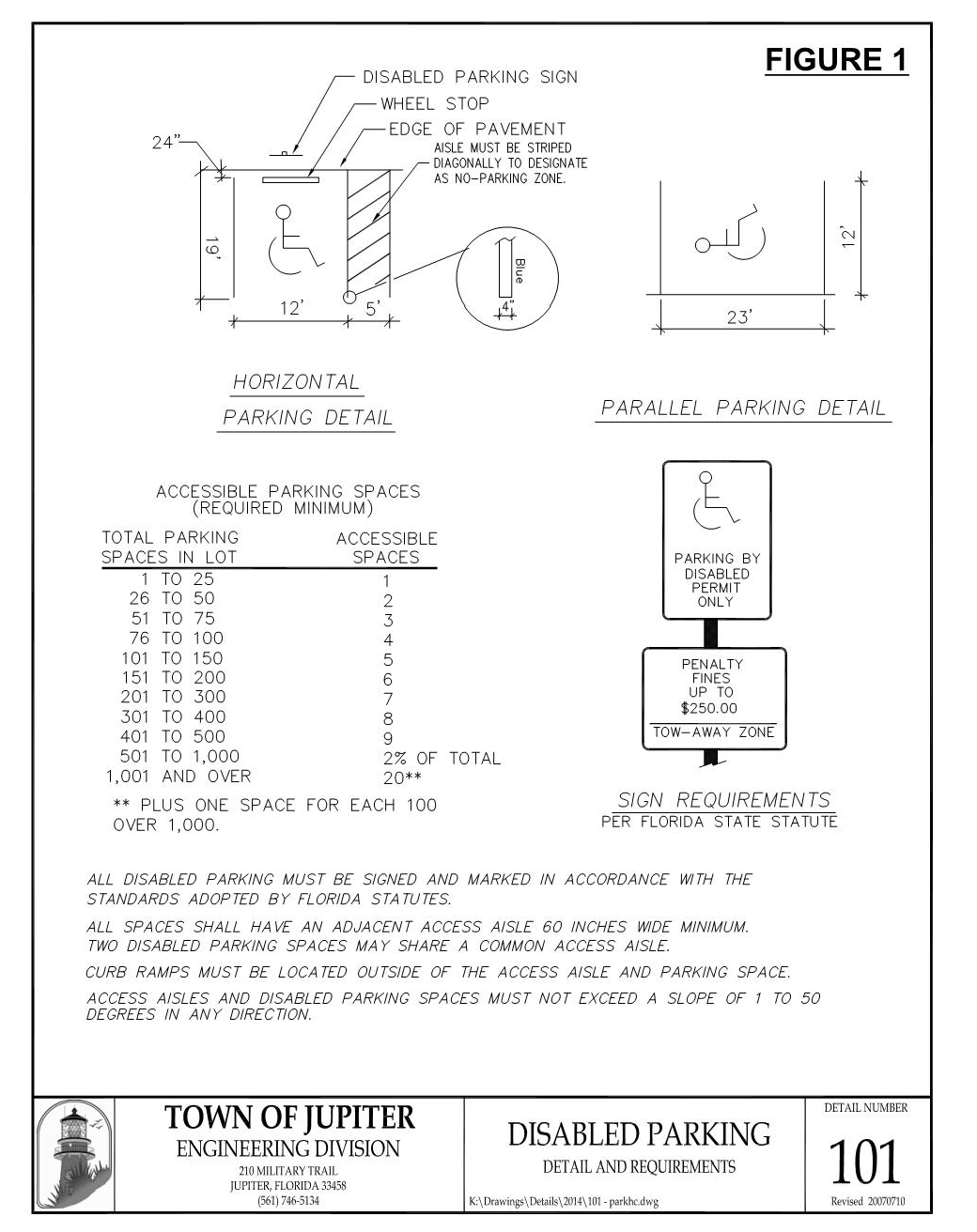
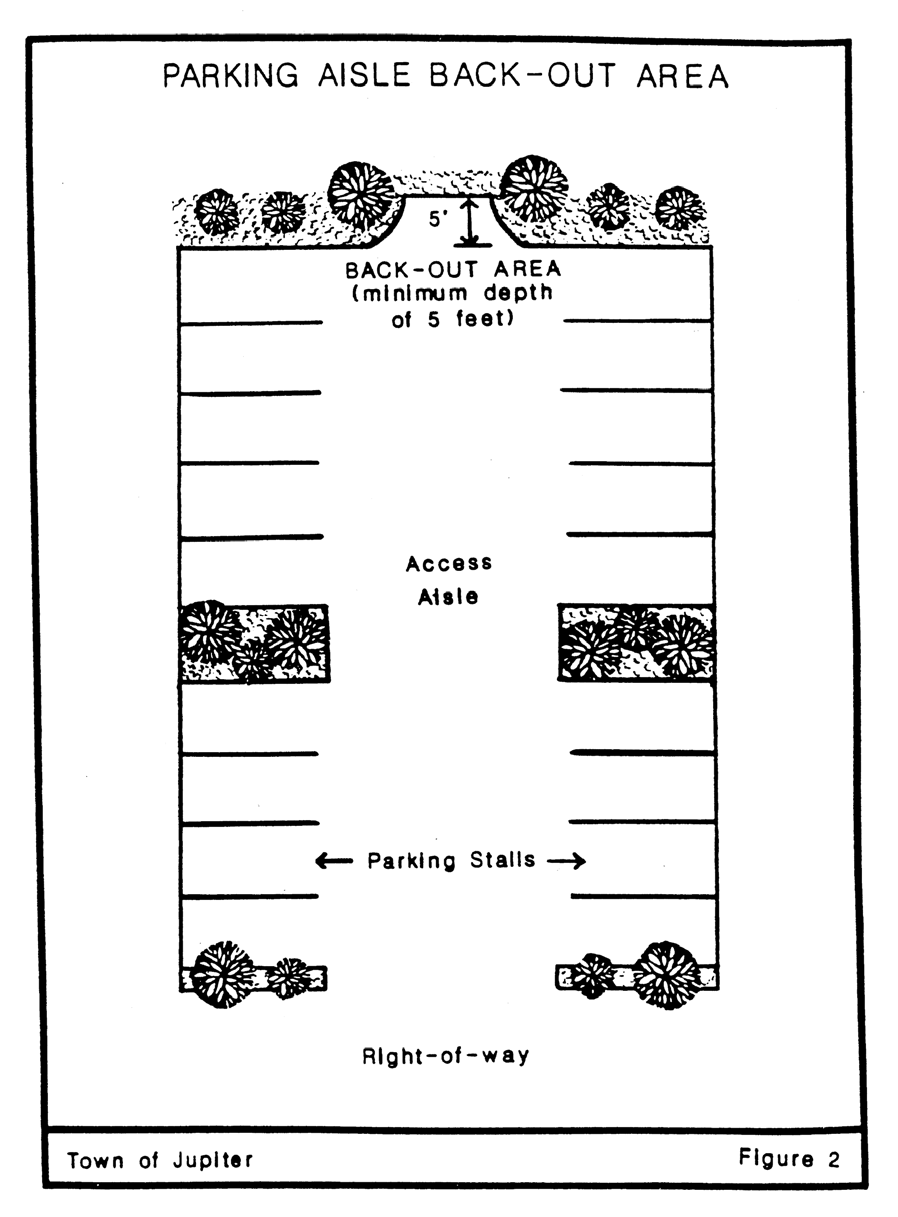
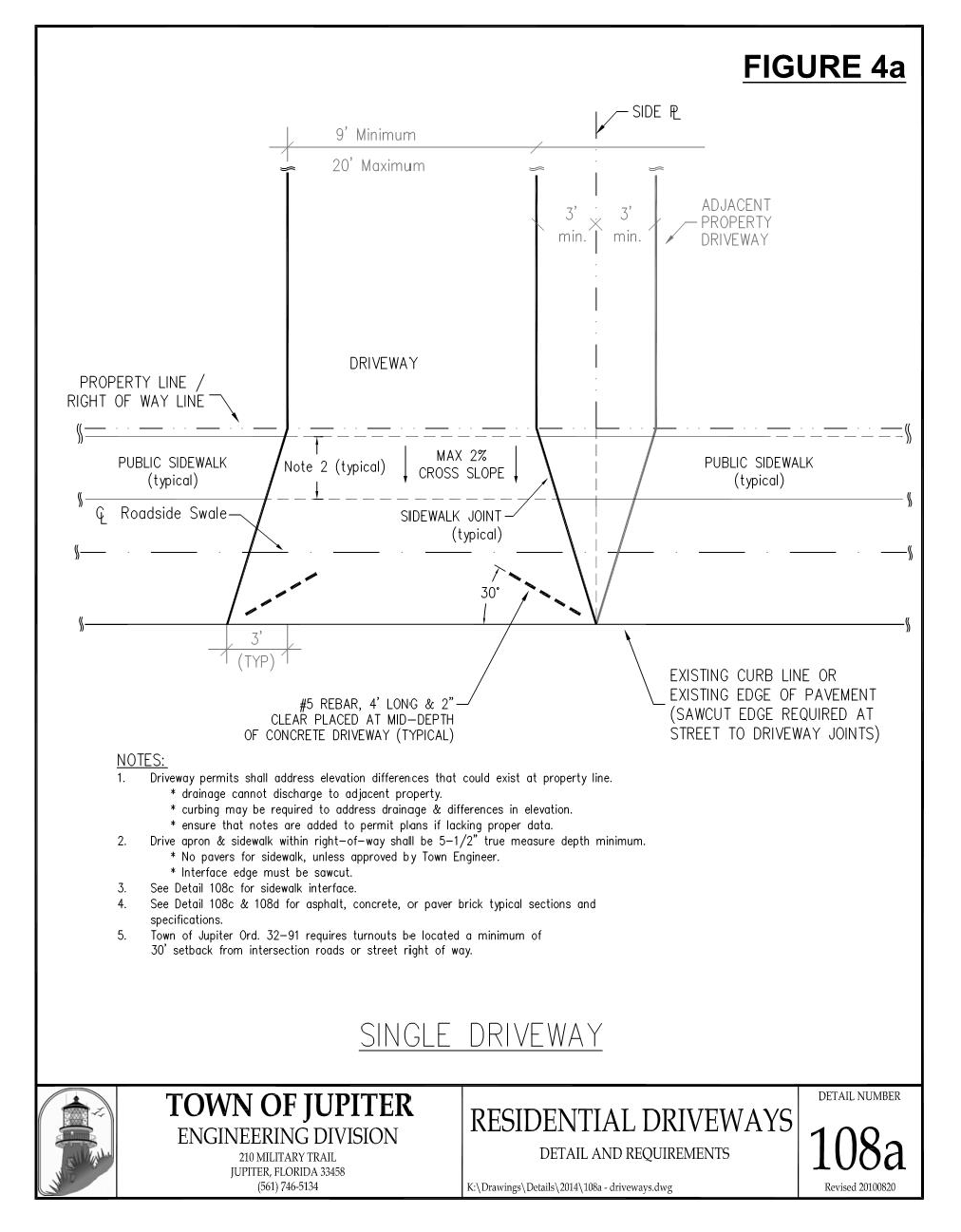
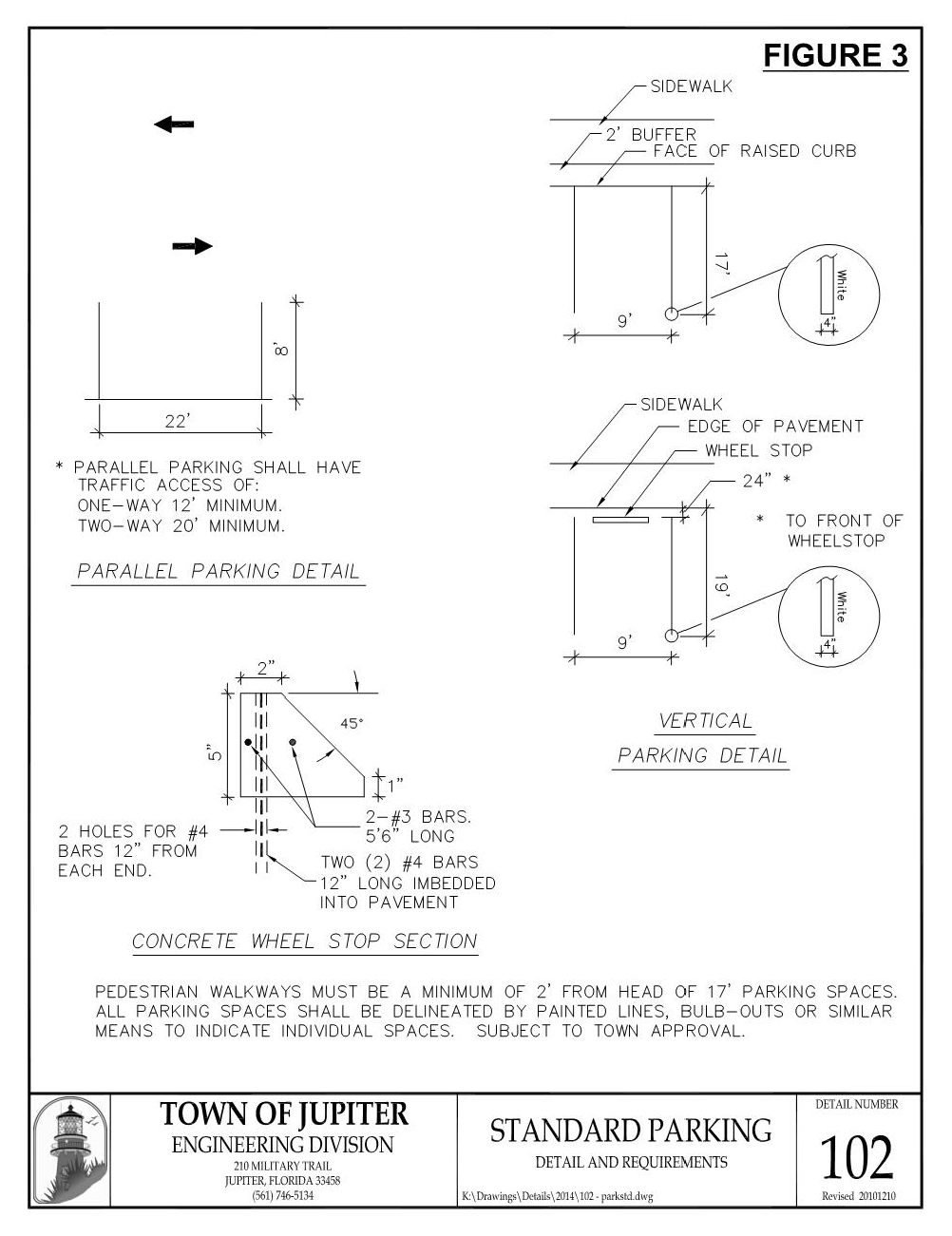
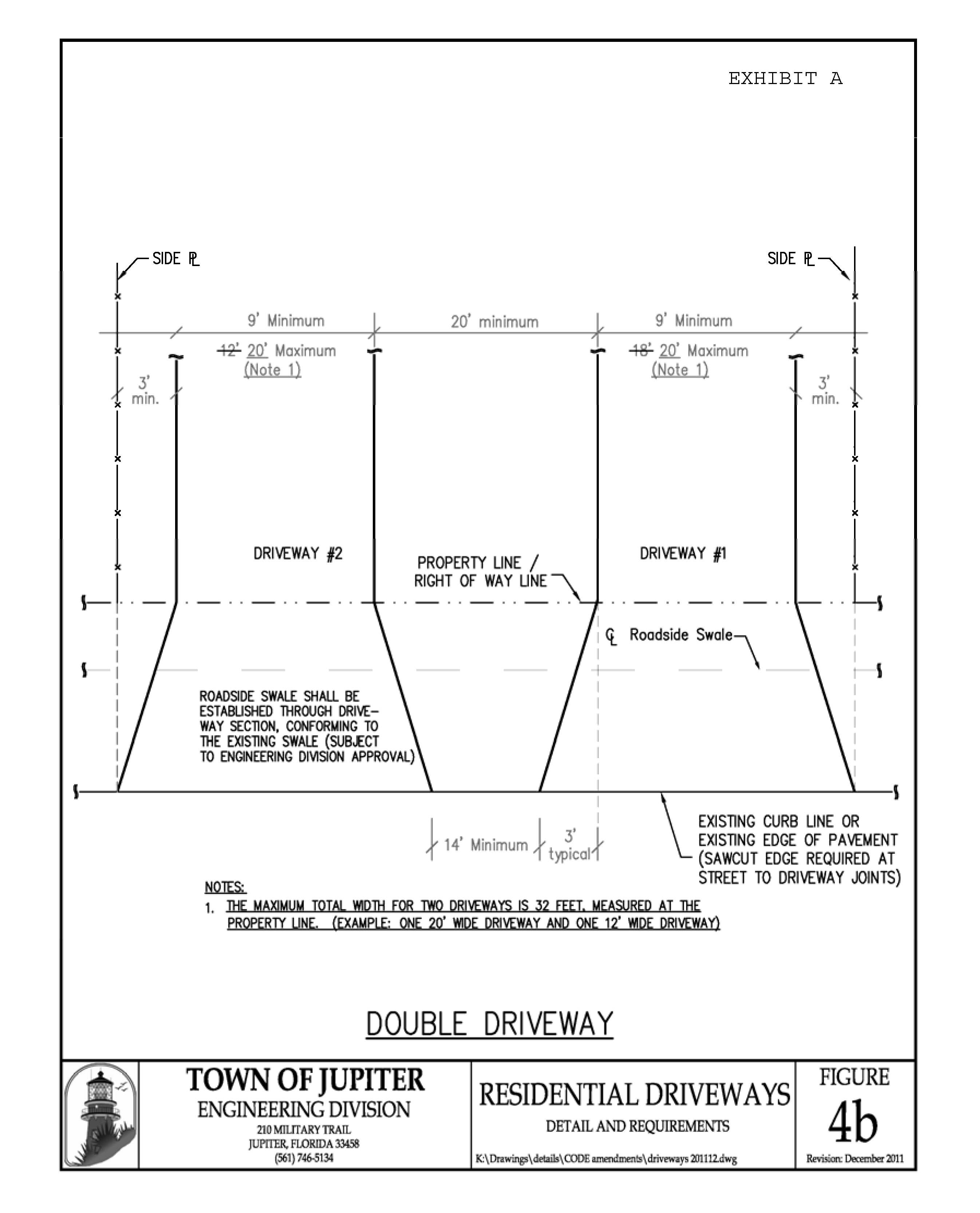
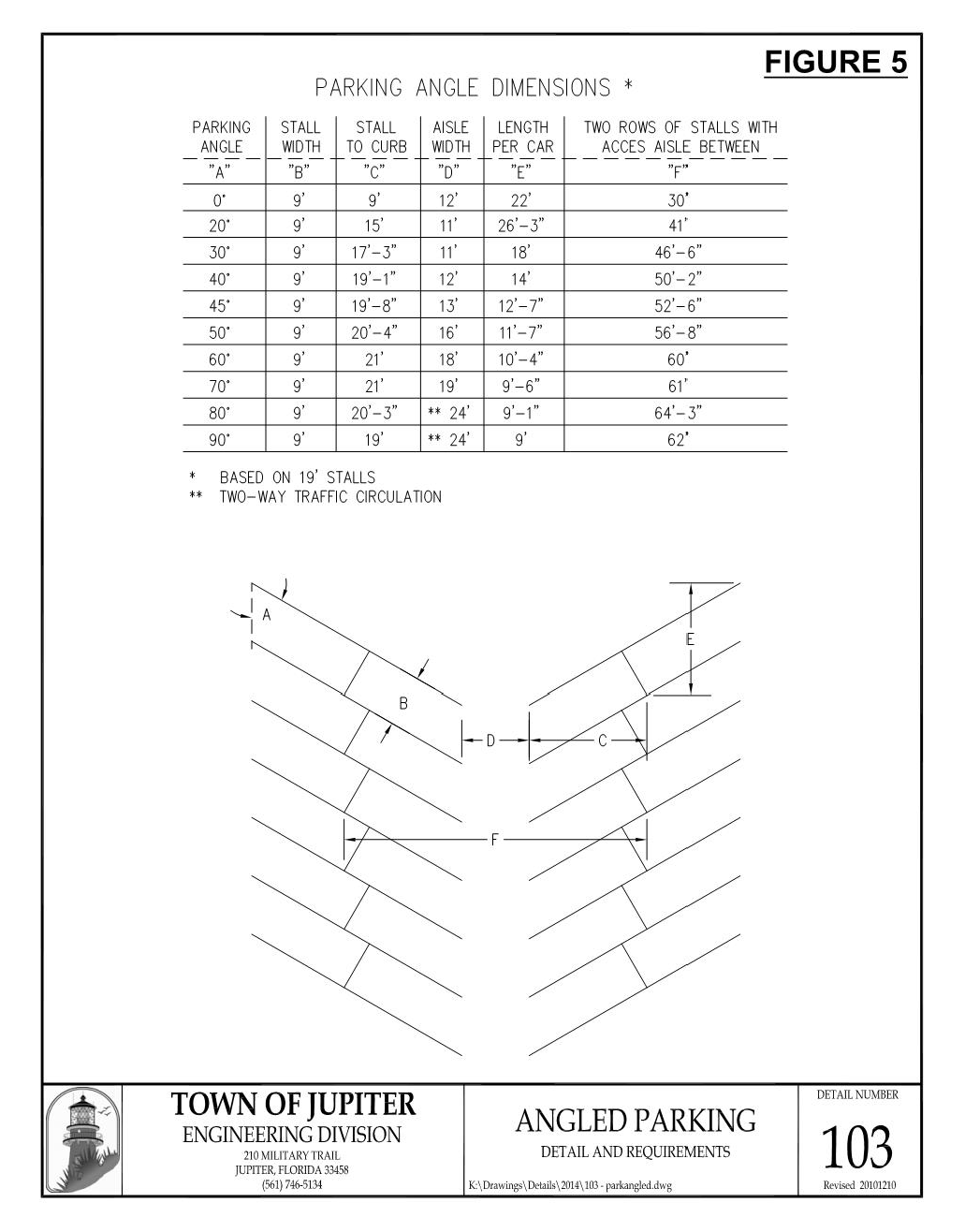
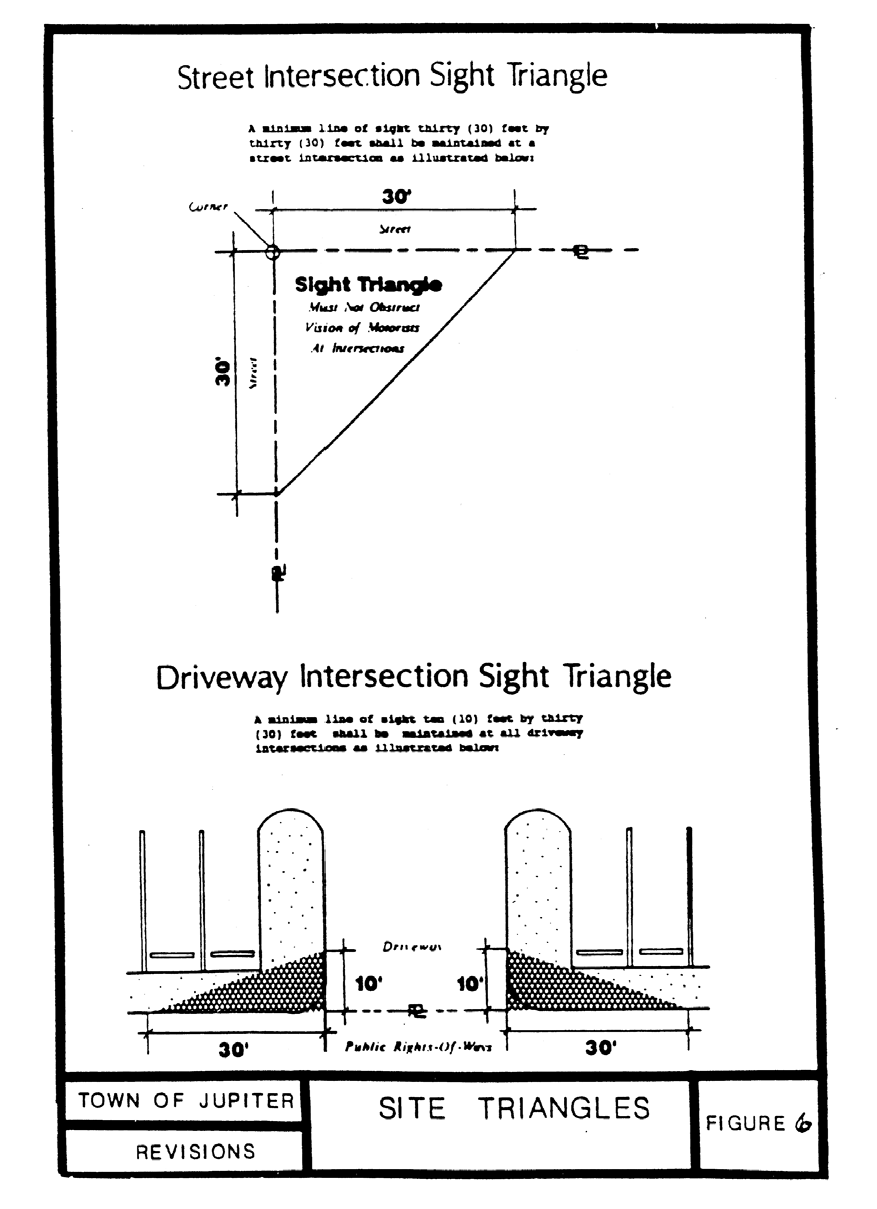
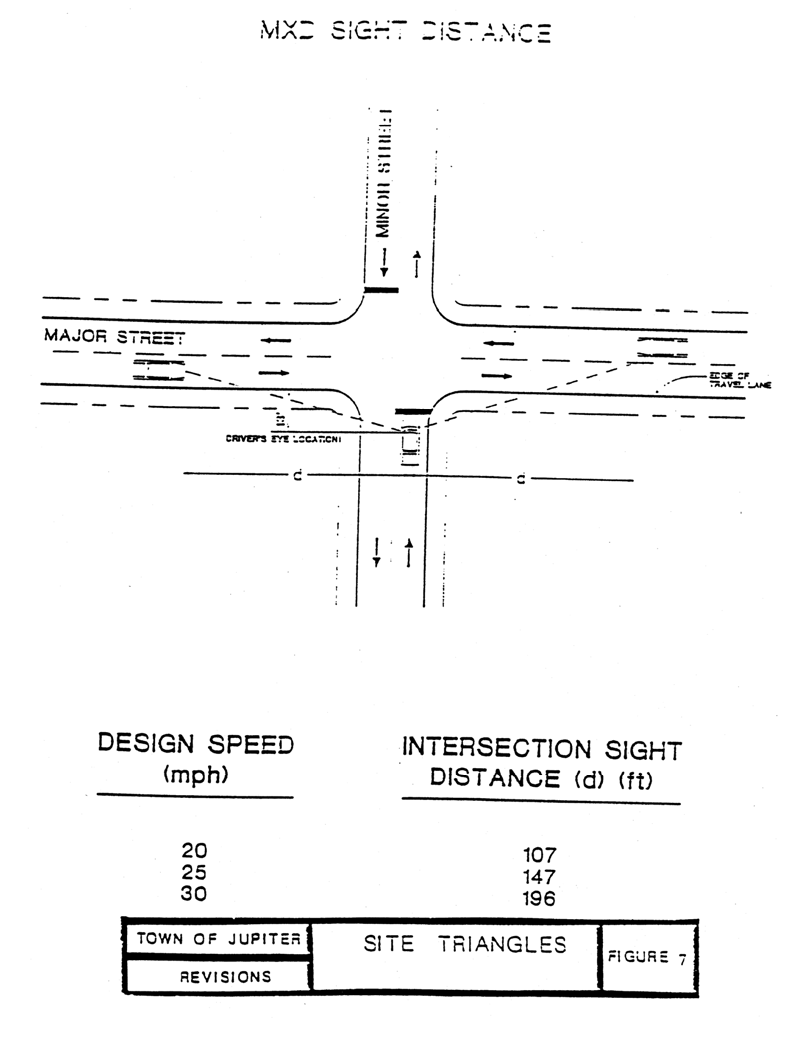
(Code 1992, § 27-1262; Ord. No. 32-91, § 2, 1-7-1992; Ord. No. 57-97, § 2, 11-4-1997; Ord. No. 42-03, § 2, 10-21-2003; Ord. No. 30-06, §§ 4—8, 5-15-2007; Ord. No. 33-10, § 5, 3-15-2011; Ord. No. 22-12, § 3, 6-19-2012; Ord. No. 32-17, § 2(27-1262), 4-3-2018)
Sec. 27-2834. - Parking displacement formula.
(a)
The following parking displacement formula shall apply to all properties abutting A1A in the town. It is the purpose and intent of this formula to provide the following:
(1)
A means of alleviating the current parking congestion along A1A through the construction of parking pods on the west side of A1A, at the developer's expense in lieu of the town's expense;
(2)
Structured parking which will facilitate better traffic control and coastal dune protection; and
(3)
A mixture of parking and landscaping along the town beaches. Parking spaces provided in this manner, together with improved pedestrian access, will enhance the beaches and Inlet Village Redevelopment Overlay Area for all users.
(b)
For the purposes of this parking displacement formula, each 23 linear feet along A1A shall constitute one parking space on each side of the highway except that the number of spaces recognized by conceptual plan for the double roads area (east side of A1A) shall be 94 spaces.
(1)
For parking spaces eliminated on the west side of A1A, the abutting developer shall construct a parking pod on the developer's site containing one parking space for every one space displaced (ratio 1:1).
(2)
For parking spaces eliminated on the east side of A1A, the abutting developer shall construct a parking pod containing two spaces for every one space displaced (ratio 2:1); with the condition that the maximum beachside parking spaces that may be displaced at a 2:1 ratio by pod parking shall be 50 percent. At double roads, the displacement of parking spaces on the east side of A1A in excess of 50 percent of the conceptual plan number of spaces (94 spaces) shall be by negotiations, subject to council approval and shall require a minimum displacement requirement of three pod parking spaces for every one space displaced (3:1 ratio per the conceptual plan) plus other amenities, except that in no case shall the displacement of parking spaces on the east side of A1A exceed 50 percent of the total number of spaces possible using parallel parking spaces, i.e., one space per 23 linear feet.
(3)
For all parking spaces displaced, the developer shall provide, at the developer's expense, landscaping, sidewalks or bikepaths and dune walkovers spaced at a distance acceptable to the town.
(4)
The parking pod for displaced parking shall be constructed at the developer's expense and subject to town approval as to construction specifications and location. Such parking pod shall be within walking distance of the beach. Construction of parking pod shall be completed prior to elimination of displaced parking spaces.
(5)
A developer requesting parking displacement shall be responsible, with the assistance of the town, as appropriate, for obtaining all necessary permits from the appropriate government agencies for all proposed improvements, including, but not limited to, parking pods and dune walkovers.
(6)
All parking pods shall be inspected and accepted by the town based on construction standards adopted by the town. The parking pods so constructed by the developer shall be conveyed by deed to the town for ownership, operation and maintenance.
(7)
Approval for granting any abutting property owner the right to utilize this parking displacement formula shall be contingent upon such property owner conveying his ownership of all abutting beach property to the town for ownership.
(8)
By agreement and approval from the town council, an abutting property owner may construct or pay for construction of displacement pod parking on a site other than the owner abutting side.
(Code 1992, § 27-1263; Ord. No. 32-91, § 2, 1-7-1992; Ord. No. 32-17, § 2(27-1263), 4-3-2018)
Sec. 27-2835. - Parking requirements for theaters contiguous to a retail shopping center.
(Code 1992, § 27-1265; Ord. No. 29-95, § 1, 11-7-1995)
Sec. 27-2853.- Intent.
The regulations and requirements set forth in this division are intended to preserve the residential character of the town by controlling the parking and storing of vehicles, recreational vehicles, boats, buses, trailers and trucks in all residential districts, which includes the Neighborhood Subdistrict of the Mixed Use Development District (MXD), and the Residential Subdistrict of the Inlet Village Zoning District (IV).
(Code 1992, § 27-1286; Ord. No. 10-88, § 622.1, 3-1-1988; Ord. No. 22-12, § 5, 6-19-2012)
Sec. 27-2854. - Motor vehicles prohibited or restricted in residential districts.
(a)
It shall be unlawful for any owner, agent, operator, or person in charge of any bus, pole trailer, semi-trailer, special mobile equipment, trailer, truck in excess of a three-fourths-ton rated capacity and/or truck tractor to park, store or keep such motor vehicle on any public street, avenue, alley or other thoroughfare, or any right-of-way therewith within any residential district in the town for a period in excess of one hour unless engaged in legitimate loading or unloading activities.
(b)
It shall be unlawful for any owner of property in any residential district in the town to park on, cause to be parked on, or allow to be parked on his residential property or in the streets, alleys or parkways abutting his property, any bus, pole trailer, semi-trailer, trailer, truck and/or truck tractor for a period in excess of one hour unless such vehicle is engaged in legitimate loading or unloading activities.
(Code 1992, § 27-1289; Ord. No. 10-88, § 622.4.B, 3-1-1988; Ord. No. 22-12, § 8, 6-19-2012)
Sec. 27-2855. - Delivery and construction vehicles; emergency repairs.
(a)
The restrictions of section 27-2854(a) shall not apply to the temporary parking of such vehicles on private property in residential districts whereon construction is underway, for which a current and valid building permit has been issued by the town and such permit is properly displayed on the premises.
(b)
The restrictions of section 27-2854 (b) of one hour in residential districts shall not apply to routine deliveries by tradesmen, or the use of trucks in making service calls, providing that such time in excess of one hour is actually in the course of business deliveries or servicing, as the case may be.
(c)
The restrictions of section 27-2854 shall not apply to a situation where such vehicle becomes disabled and, as a result of such emergency, is required to be parked within a residential district for longer than one hour. However, any such vehicle shall be removed from the residential district within 24 hours by wrecker towing if necessary, regardless of the nature of the emergency.
(Code 1992, § 27-1290; Ord. No. 10-88, § 622.5.D, 3-1-1988; Ord. No. 64-94, § 1, 1-17-1995)
Sec. 27-2856. - Permitted parking.
(a)
The parking of passenger cars and trucks, including panel, pickup, and vans which do not exceed three-fourths-ton rated capacity is permitted in the front and side corner yard of a single-family or duplex lot which is located in a residential zoning district, subject to the restrictions and conditions set forth below:
(1)
On driveways.
(2)
On unpaved surfaces provided the vehicle is parked parallel to and within eight feet of the edge of the existing driveway, and provided the vehicle is parked on the side of the driveway closest to the side property line. If there is not enough room to park a vehicle, either partially or totally, on an unpaved surface from the edge of the driveway to the side property line, then the vehicle may be parked on an unpaved surface on the other side of the driveway.
(3)
The parking of the passenger cars and trucks referenced hereinabove on an unpaved surface in a front yard or in a side yard corner, other than as provided for in subsection (a)(2) of this section, is prohibited.
(b)
The parking of boats, recreational vehicles or trailers is permitted in the side (interior), side corner or rear yard of a single-family or duplex lot which is located in a residential zoning district, subject to the restricts and conditions set forth below:
(1)
One boat, one boat trailer or utility trailer, and one recreational vehicle, but not more than one of each, shall be permitted.
(2)
Such vehicle, boat, recreational vehicle or trailer permitted in subsection (b)(1) of this section must be for the use of a resident of the premises and shall not be occupied or used for living, sleeping or housekeeping purposes.
(3)
Recreational vehicles, boats, boat trailers, or utility trailers parked in a side corner yard require screening from view of the right-of-way abutting the side corner property line and the front yard property line. Such screening shall consist of a six-foot-high opaque fence and gate, landscaping (a minimum of four feet in height at time of installation) or other screening material that is architecturally compatible with the principal building. No screening of recreational vehicles, boats, boat trailers, or utility trailers, parked in a side corner yard, shall be required across a permitted driveway. If there is no driveway in a side corner yard, then the longest length of the above vehicles, boats and trailers must be parked parallel to the house.
(c)
No more than a total of two passenger cars or trucks as referenced hereinabove shall be permitted to be parked in a side (interior) or rear yard of a single-family or duplex lot which is located in a residential zoning district.
(Code 1992, § 27-1291; Ord. No. 10-88, § 622.6.B, 3-1-1988; Ord. No. 22-12, § 9, 6-19-2012)
Sec. 27-2881.- Purpose and intent.
The purpose and intent of this division is to provide regulations that require developments to locate, install and maintain pedestrian amenities and to provide for controls and regulations to protect the public health, safety and general welfare of the residents and visitors to the town. The requirements for pedestrian amenities will further the town's goals and objectives by providing for alternative means of transportation that improve air quality, reduce energy consumption, efficient use of vehicular parking facilities, proper disposal of waste, and provide for the enhanced physical appearance of the town.
(Code 1992, § 27-1675.17; Ord. No. 42-00, § 2, 8-15-2000)
Sec. 27-2882. - Applicability.
Alterations, expansions, renovations and similar improvements to existing structures shall, to the extent feasible, conform to the requirements of this division and shall apply to all zoning districts in the town.
(Code 1992, § 27-1675.18; Ord. No. 42-00, § 3, 8-15-2000)
Sec. 27-2883. - Requirements for pedestrian amenities.
(a)
A certificate of occupancy shall not be issued for any structure or use until pedestrian amenities are provided in accordance with this division.
(b)
All pedestrian amenities shall be located on the same building site which they serve and situated on a site so that they do not obstruct the flow of pedestrians using the building entrances or sidewalks and shall adhere to the Florida Accessibility Code for Building Construction.
(c)
The owner, tenant and their agent, if any, shall be jointly and severally responsible for the continued proper maintenance of all pedestrian amenities and shall keep them in proper, neat and orderly appearance.
(d)
Bicycle racks and benches are encouraged to be located under an overhang of a building, covered by a separate structure or located under shade and shall be located convenient to the principal entrances, unless an outdoor plaza or outdoor space is provided on-site.
(e)
To the maximum extent feasible, trash receptacles should include ashtrays and be located near other pedestrian amenities.
(f)
The director of planning and zoning may waive pedestrian amenity requirements of Table 1 based on consideration of the number of employees, forecasted volume of customers and projected bicycle and pedestrian traffic.
(g)
The director of planning and zoning shall be authorized to require pedestrian amenities for other land uses not listed in Table 1 on a case by case basis.
(h)
The director of planning and zoning may recommend additional pedestrian amenities depending on need.
_____
Table 1. Pedestrian Amenities
(Code 1992, § 27-1675.19; Ord. No. 42-00, § 5, 8-15-2000)
Sec. 27-2905.- Intent.
The intent of this division is to provide a coordinated land planning approach to the sale, rent, lease, purchase, management or alteration of publicly owned or operated property. This division is primarily concerned with, although not limited to, the enlightened planning of parks and recreation areas, public buildings and facilities, and other capital improvements of a distinctly significant nature, and the coordination with other public agencies in their future land planning efforts.
(Code 1992, § 27-1236; Ord. No. 10-88, § 633.1, 3-1-1988)
Sec. 27-2906. - Uses permitted.
In addition to the uses enumerated as limited public uses, public uses shall also include the following additional items:
(1)
Airports and heliports, public and private (See division 4 of article XI of this chapter).
(2)
Water and wastewater treatment facilities, including towers, storage tanks, reservoirs and plant facilities.
(3)
Sanitary landfill, refuse and trash dumps.
(4)
Incinerators, refuse and garbage transfer stations.
(5)
Sewage treatment and plant facilities.
(6)
Military installations.
(Code 1992, § 27-1237; Ord. No. 10-88, § 633.4.A, 3-1-1988)
Sec. 27-2907. - Limited public uses.
The following uses or their comparable equipment are hereby classified as limited public uses:
(1)
Government services (including, but not limited to, fire stations, police stations, libraries and town halls).
(2)
Public educational institutions (including, but not limited to, schools, colleges and universities).
(3)
Publicly owned and operated parks and recreation facilities.
(4)
Multimode transportation terminals (including, but not limited to, bus terminal facilities).
(5)
Public radio, television, microwave transmission relay stations and towers.
(6)
Utility exchange buildings, substations, regulation stations and relay stations (including, but not limited to, electric, water, sewer, telephone and gas).
(Code 1992, § 27-1238; Ord. No. 10-88, § 633.3.A, 3-1-1988)
Sec. 27-2908. - Where permitted.
(a)
Limited public uses may be allowed in Rural Residential Districts (R-R), Residential, Single-Family Districts (R-1), Residential, Single-Family-Duplex Districts (R-2), Residential, Limited Multifamily Districts (R-3), Residential, Compact Single-Family Districts (R-1A), Industrial, High Technology and Employment Center Districts (I-4), U.S. One/Intracoastal Waterway Corridor Zoning Districts (US1/ICW), Inlet Village Zoning Districts (IV), Indiantown Road Overlay Zoning Districts (IOZ), Mixed Use Development Districts (MXD) and Commercial, Neighborhood Districts (C-1) as a special exception. It may also be permitted in Medical Center Districts (M-C) and Industrial, High Technology Districts (I-3) as a use by right.
(b)
Public uses may be allowed in Agricultural Districts (A-1), Commercial, General Districts (C-2), Commercial, Office Districts (C-3), Commercial, Restricted Districts (C-4), U.S. One/Intracoastal Waterway Corridor Zoning Districts (US1/ICW), Mixed Use Development Districts (MXD) and Indiantown Road Overlay Zoning Districts (IOZ) as special exceptions. They also may be permitted by a use by right in Industrial, Park, Light Industry Districts (I-1) and Industrial, General Districts (I-2).
(Code 1992, § 27-1239; Ord. No. 10-88, § 633.2, 3-1-1988)
Sec. 27-2940.- Intent.
The purpose and intent of this division is to provide regulations for the location and development of a tourist park living environment for transient recreational vehicle use.
(Code 1992, § 27-1596; Ord. No. 10-88, § 614.1, 3-1-1988)
Sec. 27-2941. - Where permitted.
Recreational vehicle parks may be permitted in a Commercial, General District (C-2) as a special exception. They may also be included within a mobile home park's special exception approval, provided the required facilities are installed.
(Code 1992, § 27-1597; Ord. No. 10-88, § 614.2, 3-1-1988)
Sec. 27-2942. - Application of Large-Scale Planned Unit Development District (PUD) requirements.
Recreational vehicle parks shall meet all the requirements of the planned unit development provisions of this chapter.
(Code 1992, § 27-1598; Ord. No. 10-88, § 614.3.A, 3-1-1988)
Sec. 27-2943. - Area, dimension requirements.
Recreational vehicle sites shall meet the following minimum area and dimension requirements:
(Code 1992, § 27-1599; Ord. No. 10-88, § 614.3.A.1, 3-1-1988)
Sec. 27-2944. - Setback area.
No travel trailer, building or structure shall be located closer than 50 feet to any property line. Such 50-foot setback shall be landscaped as a buffer area.
(Code 1992, § 27-1600; Ord. No. 10-88, § 614.3.A.2, 3-1-1988)
Sec. 27-2945. - License required.
It shall be unlawful for any person to maintain or operate a recreational vehicle park within the limits of the town unless such person shall first obtain a license therefor after review and approval of development plans in conformance with article V of this chapter.
(Code 1992, § 27-1601; Ord. No. 10-88, § 614.3.A.3, 3-1-1988)
Sec. 27-2946. - Transfer of license.
The license issued under this division shall be valid for one year from date of issuance and must be reviewed yearly or may be transferred to a new owner as follows:
(1)
Upon application in writing for renewal of license, and upon payment of the annual license fee, the town council may issue a new license.
(2)
Upon application in writing for transfer of a license and payment of the transfer fee, the town council may issue a new license to the transferee.
(Code 1992, § 27-1602; Ord. No. 10-88, § 614.3.A.4, 3-1-1988)
Sec. 27-2947. - Display of license.
The license required by this division shall be conspicuously posted in the office of or on the premises of the recreational vehicle park at all times.
(Code 1992, § 27-1603; Ord. No. 10-88, § 614.3.A.5, 3-1-1988)
Sec. 27-2948. - Revocation of license.
The town council may revoke any license to maintain and operate a recreational vehicle park when the licensee has been found guilty by a court of competent jurisdiction of violating any provision of this division. After such conviction, the license may be reissued if the circumstances leading to conviction have been remedied and the park can be maintained and operated in full compliance with law.
(Code 1992, § 27-1604; Ord. No. 10-88, § 614.3.A.6, 3-1-1988)
Sec. 27-2949. - Electrical outlets.
An electrical outlet supplying at least 110 volts shall be provided for each vehicle space.
(Code 1992, § 27-1605; Ord. No. 10-88, § 614.3.A.11, 3-1-1988)
Sec. 27-2950. - Water supply.
An adequate supply of pure water for drinking and domestic purposes shall be supplied by pipes to all buildings and vehicle spaces within the recreational vehicle park to meet the requirements of the park. Each vehicle space shall be provided with a cold water tap at least four inches above the ground. An adequate supply of hot water shall be provided at all times in the service buildings for all bathing, washing, cleansing and laundry facilities.
(Code 1992, § 27-1606; Ord. No. 10-88, § 614.3.A.12, 3-1-1988)
Sec. 27-2951. - Sanitation facilities.
Each park accommodating recreational vehicles shall be provided with toilets, baths or showers, slop sinks and other sanitation facilities which shall conform to the following requirements:
(1)
Toilet facilities for males shall consist of not less than one flush toilet and one urinal for each 15 recreational vehicle spaces or fraction number thereof.
(2)
Toilet facilities for females shall consist of not less than one flush toilet for each ten recreational vehicle spaces or fractional number thereof.
(3)
Each sex shall be provided with not less than one lavatory and one shower or bath tub with individual dressing accommodations for each ten recreational vehicle spaces or fractional number thereof.
(4)
Each toilet and each shower or bathtub with individual dressing accommodations, for which provision is made in subsections (1), (2) and (3) of this section, shall be in a private compartment or stall.
(5)
The toilet and other sanitation facilities for males and females shall be either in separate buildings or, if in the same building, separated by a soundproof wall.
(6)
There shall be provided in a separate compartment or stall not less than one flush toilet bowl receptacle for emptying bedpans or other containers of human excreta, and an adequate supply of hot running water for cleaning such bedpans or containers.
(Code 1992, § 27-1607; Ord. No. 10-88, § 614.3.A.13, 3-1-1988)
Sec. 27-2952. - Laundry facilities.
Laundry facilities shall be provided at each recreational vehicle park in either of the following ratios:
(1)
No less than one double laundry tray and one conventional washing machine for each 25 recreational vehicle spaces or fractional number thereof.
(2)
Not less than one double laundry tray and one automatic or semi-automatic-type washing machine for each 25 recreational vehicle spaces or fractional number thereof.
(3)
An ample number of electrical outlets shall be provided supplying current sufficient to operate each washing machine. Drying spaces shall be provided sufficient to accommodate the laundry of the park guests if automatic drying equipment is not supplied.
(4)
The laundry facilities shall be either in a separate building, or if in the same building where sanitation facilities are housed, separated from the sanitation facilities by a soundproof wall.
(Code 1992, § 27-1608; Ord. No. 10-88, § 614.3.A.14, 3-1-1988)
Sec. 27-2953. - Sewage and refuse disposal.
(a)
Waste from showers, bathtubs, flush toilets, urinals, lavatories, slop sinks and laundries in service and other buildings within the recreational vehicle park shall be discharged into a public sewer system in compliance with applicable ordinances or into a private sewer and disposal plant or septic tank system of such construction and in such manner as will present no health hazard. Private disposal systems must meet all state, county and local health standards.
(b)
Each recreational vehicle space shall be provided with a sewer at least four inches in diameter, which shall be connected to receive the waste from the shower, bathtub, flush toilet, lavatory, kitchen sink and laundry appurtenances of the vehicle harbored in such space and having any or all of such facilities. Where vehicle construction provides for trapped plumbing, the sewer connection may not be trapped; otherwise, all connections shall be trapped. Provisions shall be made for sewer connections to be capped when not in use. The sewer connection for each space shall discharge vehicle wastes into a public sewer system in compliance with applicable ordinances or into a private sewer and disposal plant or septic tank system of such construction and in such manner as will present no health hazard.
(c)
No less than one garbage container shall be provided for each two recreational vehicle spaces to permit disposal of all garbage and rubbish. Such containers shall be located not farther than 300 feet from any vehicle space, and shall be kept in a sanitary condition at all times. Garbage and rubbish shall be collected and disposed of as frequently as necessary to ensure that the containers do not overflow.
(Code 1992, § 27-1609; Ord. No. 10-88, § 614.3.A.16, 3-1-1988)
Sec. 27-2954. - Driveways at trailer spaces.
All travel trailer spaces in a recreational vehicle park shall abut upon a driveway of not less than 20 feet in width, which shall have unobstructed access to a public street, alley or highway.
(Code 1992, § 27-1610; Ord. No. 10-88, § 614.3.A.7, 3-1-1988)
Sec. 27-2955. - Illumination of driveways, walkways.
All driveways and walkways within the park shall be hard surfaced and lighted at night with electric lamps of not less than 60 watts each, spaced at intervals of not more than 100 feet, and in accordance with the requirements of the town building code.
(Code 1992, § 27-1611; Ord. No. 10-88, § 614.3.A.9, 3-1-1988)
Sec. 27-2956. - Service buildings required.
Each recreational vehicle park shall provide service buildings to house such toilet, bathing and other sanitation facilities and such laundry facilities as prescribed in this division.
(Code 1992, § 27-1612; Ord. No. 10-88, § 614.3.A.10, 3-1-1988)
Sec. 27-2957. - Specifications for service buildings; maintenance.
(a)
Service buildings housing sanitation and laundry facilities, or any of such facilities, shall be permanent structures complying with all applicable ordinances and statutes regulating buildings, electrical installations and plumbing and sanitation systems.
(b)
The service buildings shall be well lighted at all times of day or night, shall be well ventilated with screened openings, shall be constructed of such moisture-proof material, including painted woodwork, as shall permit repeated cleaning and washing, and shall be maintained at a temperature of at least 65 degrees Fahrenheit during the period from October 1 to May 1. The floors of the service buildings shall be of water impervious material.
(c)
All service buildings and the grounds of the park shall be maintained in a clean and sightly condition and kept free of any condition that will menace the health of any occupant or the public or constitute a public nuisance.
(Code 1992, § 27-1613; Ord. No. 10-88, § 614.3.A.15, 3-1-1988)
Sec. 27-2958. - Walkways to service buildings.
Walkways not less than three feet wide shall be provided from the vehicle spaces to the service buildings.
(Code 1992, § 27-1614; Ord. No. 10-88, § 614.3.A.8, 3-1-1988)
Sec. 27-2959. - Fire protection, prevention.
Every recreational vehicle park shall be equipped at all times with fire extinguishing equipment in good working order, of such size, type and number, and so located within the park as to satisfy pertinent regulations of the fire control district. No open fires shall be permitted at any place which may endanger life or property, and no fires shall be left unattended at any time.
(Code 1992, § 27-1615; Ord. No. 10-88, § 614.3.A.17, 3-1-1988)
Sec. 27-2960. - Animal control.
No owner or person in charge of any dog, cat or other pet animal shall permit it to run at-large or commit any nuisance within the limits of any recreational vehicle park.
(Code 1992, § 27-1616; Ord. No. 10-88, § 614.3.A.18, 3-1-1988)
Sec. 27-2961. - Register of occupants.
(a)
It shall be the duty of each licensee and permittee to keep a register containing a record of all recreational vehicle owners and occupants located within the park. Such register shall contain the following information:
(1)
The name and address of each vehicle occupant.
(2)
The name and address of the owner of each travel trailer and motor vehicle by which it is towed.
(3)
The make, model, year and license number of each travel trailer and motor vehicle.
(4)
The state, territory or county issuing such license.
(5)
The dates of arrival and departure of each recreational vehicle.
(b)
The park shall keep the register available for inspection at all times by law enforcement officers, public health officials and other officials whose duties necessitate acquisition of the information contained in the register. The register record for each occupant registered shall not be destroyed for a period of three years following the date of departure of the registrant from the park.
(Code 1992, § 27-1617; Ord. No. 10-88, § 614.3.A.19, 3-1-1988)
Sec. 27-2962. - Maintenance of park.
The recreational vehicle park licensee or permittee or a duly authorized attendant or caretaker shall be in charge at all times to keep the recreational vehicle park, its facilities and equipment in a clean, orderly and sanitary condition. The attendant or caretaker shall be answerable, with the licensee or permittee, for the violation of any provision of this division to which the licensee or permittee is subject.
(Code 1992, § 27-1618; Ord. No. 10-88, § 614.3.A.20, 3-1-1988)
Sec. 27-2963. - Maximum duration of stay.
A recreational vehicle shall not remain in any recreational vehicle park for more than 120 days in any six-month period.
(Code 1992, § 27-1619; Ord. No. 10-88, § 614.3.A.21, 3-1-1988)
Sec. 27-2990.- Intent.
To regulate the development and redevelopment of automotive fueling stations (with or without convenience stores or other commercial uses) so as to minimize impacts upon, and preserve the character of surrounding commercial uses and residential neighborhoods, in furtherance of the public health, safety and general welfare.
(Code 1992, § 27-1086; Ord. No. 10-88, § 626.1, 3-1-1988; Ord. No. 44-14, § 17, 2-17-2015)
Sec. 27-2991. - Where use permitted.
Automotive fueling station uses are permitted as shown in the zoning district use regulations.
(Code 1992, § 27-1087; Ord. No. 10-88, § 626.2.A, 3-1-1988; Ord. No. 44-14, § 18, 2-17-2015)
Sec. 27-2992. - Land development regulations for all automotive fueling stations.
The following land development regulations shall apply to the development and redevelopment of automotive fueling stations:
(1)
The maximum number of fueling positions is 16.
(2)
The locational separation of an automotive fueling station to the uses listed below, as measured by a straight line distance from the nearest property lines between the two uses, shall be:
a.
Place of worship, hospital or school: 400 feet.
b.
Other automobile fueling stations: 750 feet (applies only to new automotive fueling stations approved after the adoption of Ordinance Number 44-14).
(3)
At-street driveway standards are required, as follows:
a.
Separation between at street driveways or intersections:
1.
Local roads shall utilize the driveway separation requirements contained in section 27-2833(a)(6)e.
2.
125 feet (centerline to centerline) on a 80-foot or smaller collector road right-of-way.
3.
245 feet (centerline to centerline) on a 100-foot or greater arterial road right-of-way.
4.
The above separation access requirements may be waived by the director of the department of engineering and public works or designee, based on specific site plans which:
(i)
Propose to reduce the existing number of access driveways; or
(ii)
Cannot meet the applicable separation requirements to obtain at least one driveway.
b.
Fueling position islands shall be positioned at least 15 feet away from driveways to avoid blocking vehicle ingress/egress from adjacent roadways.
c.
Side street driveway connections may be permitted (where applicable).
(4)
Fueling dispenser minimum setbacks:
a.
35 feet front, side corner and rear.
b.
20 feet interior side.
c.
No fueling position shall be located within 100 feet of any residential zoning district or residential subdistrict of the Mixed Use Development District (MXD).
(5)
Fueling area canopies.
a.
Shall be consistent with the architectural design, details, colors, features and style of the principal building (convenience store).
b.
Signage on canopies is prohibited.
c.
Shall not exceed a height of 18 feet to the top of the flat roof or to the midpoint of a pitched roof.
d.
Shall have a maximum length parallel to the primary abutting street of 120 feet.
(6)
Electric vehicle charging station:
a.
At least one electric vehicle rapid charging station containing a CHAdeMO and Combined Charging Standard (CCS) handle (minimum of 50 kw) shall be installed and maintained at any automotive fueling station with a convenience store or other commercial use.
b.
The electric vehicle charging station may be located at a standard parking stall which meets the requirements contained in section 27-2833, provided a sign is posted that prohibits parking of vehicles other than those using the electric vehicle charging station.
(7)
Alternate generated power capacity. Automotive fueling stations shall be prewired with an appropriate transfer switch capable of operating all fuel pumps, dispensing equipment, life-safety systems, and payment-acceptance equipment using an alternate generated power source, for a minimum of 72 hours. In addition, a generator shall be operational within four hours after a storm event.
(Ord. No. 10-88, § 626.2.B, 3-1-1988; Ord. No. 44-14, § 19, 2-17-2015)
Sec. 27-2993. - Regulations for automotive fueling stations with 11 fueling positions to a maximum of 16 fueling positions.
In addition to the land development regulations contained in the above section 27-2992, new or redeveloped automotive fueling stations with 11 to a maximum of 16 fueling positions, shall meet the following land development regulations:
(1)
Design regulations for convenience stores located with fueling stations:
a.
The primary entrance, or entry feature, shall face the principal abutting street (if at a street corner and facing two streets, then the street which has the greater number of average daily trips shall be considered the principal abutting street).
b.
Safe pedestrian access shall be provided from the street to the main entry without pedestrians having to cross vehicular use areas.
(2)
Architecture for fueling area canopies:
a.
Shall be a pitched or hip roof.
b.
The supports of the canopy shall have architectural details consistent with the style of the convenience store (e.g., historically correct columns or posts, bases, arches, brackets, exposed rafter tails, etc.)
(3)
Landscape buffers and screening:
a.
Landscape buffer requirement. The linear frontage of all streets which abut an automotive fueling station, except for driveways or where pedestrian plazas are located, shall be landscaped to a depth of 25 feet from the property line.
b.
Buffer requirement from adjacent residential. A buffer area of at least 25 feet, including a required opaque wall and landscaping, shall be required when abutting residential zoning districts.
c.
Screening for an automotive fueling station which abuts a residential zoning district shall consist of the following:
1.
An opaque concrete or masonry wall of six feet above the established grade on the automotive fueling station-site, located at least three feet from the property line.
2.
In the event the wall abuts and/or runs parallel to a public right-of-way within a front, rear or side corner setback, then the wall shall not exceed 30 inches in height above the proposed grade of the commercial site for a linear distance of 15 feet from the edge of the right-of-way. If the property abuts a preserve area, the requirement for a wall may be waived by the department of planning and zoning.
3.
Landscaping shall include shade trees, groundcover, grass and hedges or shrubs with the following specifications:
(Code 1992, § 27-1089; Ord. No. 10-88, §§ 626.2.C, 626.2.D, 3-1-1988; Ord. No. 50-10, § 2, 12-21-2010; Ord. No. 44-14, § 20, 2-17-2015)
Sec. 27-3020.- Intent.
The regulations and requirements of this division are intended to preserve the residential living environment of the town by controlling the operation of existing salvage yards and additional uses of this type.
(Code 1992, § 27-1376; Ord. No. 10-88, § 603.1, 3-1-1988)
Sec. 27-3021. - Where permitted.
Salvage yards may be permitted as a special exception in an Industrial, General District (I-2).
(Code 1992, § 27-1377; Ord. No. 10-88, § 603.2, 3-1-1988)
Sec. 27-3022. - Compliance.
Any salvage yard use shall meet or exceed the area and dimension regulations and special regulations as set forth in sections 27-807 through 27-819.
(Code 1992, § 27-1378; Ord. No. 10-88, § 603.3.A, 3-1-1988)
Sec. 27-3023. - Fence required.
All salvage yard uses or operations shall be completely enclosed by a fence of not less than six feet in height, 100 percent opaque, which shall be kept in good order and repair.
(Code 1992, § 27-1379; Ord. No. 10-88, § 603.3.B, 3-1-1988)
Sec. 27-3024. - Height restriction.
No materials in a salvage yard may exceed a stack height of six feet above natural grade.
(Code 1992, § 27-1380; Ord. No. 10-88, § 603.3.B, 3-1-1988)
Sec. 27-3052.- Intent.
The regulations and requirements of this division are intended to regulate the manner in which self-service storage facilities (SSSFs) are used, to minimize the visual impacts created by these uses, and to provide for minimal design standards to preserve the character of surrounding residential or commercial uses.
(Code 1992, § 27-1675; Ord. No. 64-98, § 7, 1-19-1999)
Sec. 27-3053. - Where permitted.
Uses under this division may be permitted in the Commercial, General Districts (C-2) and Commercial, Restricted Districts (C-4), and in the Workplace (WP), Workplace, Limited (WPL) and Community Commercial (CC) subdistricts of the Mixed Use Development District (MXD) as a special exception. A warehouse and limited-access self-service storage facility in the Community Commercial (CC) subdistrict and a warehouse and multi-access self-service storage facility in the Workplace, Limited (WPL) subdistrict may be permitted as a special exception use on properties that are within 600 feet of the railroad right-of-way. A warehouse and limited-access self-service storage facility may be permitted as a special exception in the Workplace (WP) and Workplace, Limited (WPL) subdistricts. Uses in this division of a size less than or equal to 10,000 square feet are permitted in the Industrial, Park, Light Industry Districts (I-1) and Industrial, General Districts (I-2) as uses by right. Uses of a size greater than 10,000 square feet are permitted in the Industrial, Park, Light Industry Districts (I-1) and Industrial, General Districts (I-2) as special exceptions. Recreational vehicle and dry boat storage may be included in the site plan approval for these uses located in the Workplace (WP) and Workplace, Limited (WPL) subdistricts of the Mixed Use Development Districts (MXD), Industrial, Park, Light Industry Districts (I-1) and Industrial, General Districts (I-2), as provided below.
(Code 1992, § 27-1675.1; Ord. No. 64-98, § 7, 1-19-1999; Ord. No. 50-10, § 5, 12-21-2010; Ord. No. 6-18, § 3, 4-17-2018)
Sec. 27-3054. - Regulations.
In addition to the zoning regulations, the following minimum regulations shall apply:
(1)
The only commercial activities permitted at a self-service storage facility shall be rental of storage units, pickup and deposit of goods and/or property in dead storage. Storage units shall not be used to: manufacture, fabricate or process goods; service or repair vehicles, boats, small engines or electrical equipment, or to conduct similar repair activities; conduct garage sales or retail sales of any kind; or conduct any other commercial or industrial activity.
(2)
The rental of trucks and trailers used for moving and the installation of hitch and towing packages may be allowed in association with a self-service storage facility, pursuant to the regulations set forth in division 42 of this article as follows:
a.
Subject to site plan approval in the Industrial, Park, Light Industry Districts (I-1) or Industrial, General Districts (I-2).
b.
As a special exception, in the Commercial, General Districts (C-2) (excluding the Indiantown Road Overlay Zoning Districts (IOZ)) and Commercial, Restricted Districts (C-4).
(3)
The maximum size of a storage unit shall be 500 square feet.
(4)
Individual storage units or private postal boxes in a self-service storage facility shall not be considered on premises for the purpose of assigning a legal address in order to obtain a business tax receipt or other governmental permit or license to do business.
(5)
Except as provided in this division, all property stored on a site shall be entirely within enclosed buildings. The storage of recreational vehicles and dry storage of pleasure boats of the type customarily maintained by private individuals for their personal use shall be permitted as an accessory use in a self-service storage facility located in the Workplace (WP) and Workplace, Limited (WPL) subdistricts of the Mixed Use Development Districts (MXD), Industrial, Park, Light Industry Districts (I-1) and Industrial, General Districts (I-2), provided that the following conditions are met:
a.
Such storage shall take place only in a designated area. The area so designated shall be clearly delineated upon the site plan accompanying the application for a self-service storage facility;
b.
The vehicle and boat storage area shall be screened from the view of adjacent commercial and residential areas and/or uses and street rights-of-way by using one or more of the following: a masonry wall or ornamental fence that does not exceed a height of eight feet, and/or dense hedge planting with a minimum height of six feet;
c.
Vehicles shall not be stored in the areas set aside for minimum building setbacks, preservation areas, or the required parking areas;
d.
No vehicle maintenance, washing or repair shall be permitted on a site;
e.
Pleasure boats stored on the site shall be placed and maintained upon wheeled trailers. No dry stacking of boats shall be permitted on a site.
(6)
Storage unit doors in multi-access SSSFs shall not face any abutting property which is zoned for residential use or upon which a residence exists. The unit doors of a multi-access SSSF shall be screened from the view of any street right-of-way through the use of landscaping material or architectural design features.
(7)
The exterior colors, facades, windows, roof, and building materials of all structures shall be compatible with the character of the surrounding area. All SSSFs located in commercial districts that are adjacent to properties designated with a residential land use or existing office or commercial uses shall have a pitched roof and other architectural treatments or features which comparable to the character of the adjacent development.
(8)
In the Commercial, General District (C-2), the maximum floor area ratio shall be 0.40 and the maximum building height shall be 25 feet.
(9)
In the Commercial, Restricted District (C-4), the maximum floor area ratio shall be 0.35 and the maximum building height shall be 15 feet.
(10)
In the Mixed Use Development District (MXD), the maximum floor area ratio in the Community Comercial (CC) subdistrict shall be 0.40; and a SSSF use that is in both the Community Commercial (CC) and Workplace, Limited (WPL) subdistricts shall have a maximum floor area ratio of 0.50 and a minimum setback of 45 feet from all adjacent road rights-of-way.
(Code 1992, § 27-1675.2; Ord. No. 64-98, § 7, 1-19-1999; Ord. No. 66-06, § 9, 12-19-2006; Ord. No. 6-18, § 4, 4-17-2018)
Sec. 27-3082.- Intent.
It is the intent of this division to provide for the location and development of swimming pools, spas, patios and screen enclosures as accessory uses to residential units and swimming pools as private or commercial facilities as a principal use; and to provide controls and regulations to protect the general safety and welfare of the residents of the town.
(Code 1992, § 27-1556; Ord. No. 10-88, § 612.1, 3-1-1988; Ord. No. 10-01, § 2, 4-17-2001)
Sec. 27-3083. - Where permitted.
Swimming pools, spas, patios and screen enclosures may be permitted in the town as follows:
(1)
Residential districts. An individual private swimming pool, spa, patio or screen enclosure for the exclusive use of an adjacent residential dwelling, may be permitted as an accessory use in all agricultural and residential districts.
(2)
Commercial districts. A private or commercial swimming pool may be permitted as a use by right in Commercial, General Districts (C-2) and Commercial, Office Districts (C-3), and as a special exception in a Commercial, Neighborhood District (C-1).
(Code 1992, § 27-1557; Ord. No. 10-88, § 612.2, 3-1-1988; Ord. No. 10-01, § 2, 4-17-2001)
Sec. 27-3084. - Regulations.
The following minimum regulations shall apply:
(1)
Swimming pools or spas as an accessory use.
a.
A swimming pool or spa operated by a residential homeowners association, or by the residents of a single-family dwelling, shall be an accessory use so long as it is developed in conjunction with the principal use on the same lot and meets the setback regulations stated herein.
b.
All swimming pools or spas as a principal use are considered structures which shall comply with all setback requirements of the district in which they are located. Setbacks for a pool or spas as an accessory use to a single-family dwelling shall be a minimum of 10½ feet on the rear and interior sides, 28 feet on the front, and 18 feet on the corner side, unless a greater easement width exists, in which case the width of the easement shall be the minimum setback. Setbacks shall be measured to the edge of water.
1.
Swimming pools or spas in a zero-lot line zoning district shall be a minimum of three feet setback on the side where the residence is constructed without setback.
2.
Swimming pools or spas with or without screen enclosures are not included when calculating percent of total lot coverage.
3.
The rear or side setback may be reduced to six feet along the length abutting open space with a minimum of 50 feet of width provided all construction, earthwork, conveyance/retention (lot specific or subdivision related) and maintenance shall be conducted on that lot.
c.
The rear setback for swimming pools or spas which are an accessory use to Residential, Single-Family District (R-1) lots of 6,500 square feet or less, and which also have a lot depth of 100 feet or less, shall be reduced to six feet provided all of the conditions set forth herein are met. If the single-family dwelling unit is part of an approved planned unit development, then the reduced setback shall not be permitted. In order to be permitted the reduced six-foot setback for an accessory pool or spa, the property owner must submit the following documentation as part of the building permit for review and approval and satisfy the following requirements:
1.
A survey showing the location of the swimming pool and/or spa;
2.
A topographic survey that demonstrates that the proposed pool or spa maintains drainage on-site and that the property has 50 percent impervious area or less;
3.
If a property has more than 50 percent impervious area, the owner shall submit a document indicating the approval from the applicable drainage authority (or authorities) and the town's utility director, and shall submit a grading and drainage plan prepared by a state licensed professional engineer demonstrating that the increase in impervious area does not cause any negative off-site impact;
4.
If a property uses the reduced setback, the owner of the property shall install a six-foot-high opaque fence or wall that provides a six-foot-high screen along the rear property line.
(2)
Swimming pools as a principal use.
a.
Any swimming pool owned and operated by a governmental agency or operated as a private or commercial enterprise existing singularly or in combination with other private or commercial recreation uses on the same property shall be considered as a principal use subject to the regulations of the applicable zoning district, including all yard setback requirements.
b.
Swimming pools located at finished grade shall not be considered as lot coverage.
c.
As deemed necessary by the town council, landscape screening may be required to protect neighboring property from potential loss of use or diminishment of land value.
(3)
Construction of all swimming pools shall be in conformance with the town swimming pool code.
(4)
Screen enclosures and patios as an accessory use.
a.
A screen enclosure or patio shall be an accessory use so long as it is developed in conjunction with the principal use on the same lot and meets the setback regulations stated herein.
b.
Setbacks for a screen enclosure or patio as an accessory use to a single-family dwelling in all residential zoning districts shall be a minimum of 25 feet on the front, 7½ feet on the rear and interior sides, and 15 feet on the corner side, unless a greater easement width exists, in which case the width of the easement shall be the minimum setback.
1.
Screen enclosures or patios in a zero-lot line zoning district are permitted without a setback on the side where the residence is constructed without setback.
2.
Screen enclosures with solid roofs shall meet the setback requirements of the district in which they are located.
3.
The rear or side setback may be reduced to three feet along the length abutting open space with a minimum of 50 feet of width provided all construction, earthwork, drainage conveyance/retention (lot specific or subdivision related) and maintenance shall be conducted on that lot.
4.
Patio means a wood deck or concrete slab that is not covered by a permanent roof.
c.
The rear setback for a screen enclosure or patio as an accessory use to Residential, Single-Family District (R-1) lots of 6,500 square feet or less, and which also have a lot depth of 100 feet or less, shall be three feet provided all of the following conditions as set forth herein are met. If the single-family dwelling unit is part of an approved planned unit development, then the reduced setback shall not be permitted. In order to be permitted the reduced three-foot setback for a screen enclosure or patio, the property owner must submit the following documentation as part of the building permit for review and approval and satisfy the following requirements:
1.
A survey showing the location of a screen enclosure or patio;
2.
A topographic survey that demonstrates that the proposed screen enclosure or patio maintains drainage on-site and that the property has 50 percent impervious area or less;
3.
If a property has more than 50 percent impervious area, the owner shall submit a document indicating the approval from the applicable drainage authority (or authorities) and the town's utility director, and submit a grading and drainage plan prepared by a state licensed professional engineer demonstrating that the increase in impervious area does not cause any negative off-site impact;
4.
If a property uses the reduced setback, the owner of the property shall install a six-foot-high opaque fence or wall that provides a six-foot-high screen along the rear property line.
(Code 1992, § 27-1558; Ord. No. 10-88, § 612.3, 3-1-1988; Ord. No. 24-95, § 1, 6-20-1995; Ord. No. 10-01, § 2, 4-17-2001; Ord. No. 16-06, § 2, 4-18-2006)
Sec. 27-3112.- Intent.
The regulations and requirements of this division are intended to provide:
(1)
For the appropriate location and operation of sales facilities intended to serve the residents of a development.
(2)
The opportunity for developers and builders to market and sell residential dwelling units within a development.
(Code 1992, § 27-1673; Ord. No. 64-94, § 2, 1-17-1995)
Sec. 27-3113. - Regulations.
(a)
Sales facilities. In a residential zoning district, a developer or representative of the developer shall be permitted to maintain one central sales facility within each residential development or within each pod of the development thereof. Such central sales facility may be permitted in either a manufactured structure, mobile structure, model home, permanent sales facility, clubhouse, condominium. The installation and operation of a real estate office in a residential zoning district shall not be permitted until town council or town staff approves a site plan authorizing construction of residential dwelling units.
(b)
Use of model homes "For Sale" by builders. In any residential development, model homes may be used by the builders of the model home for the purpose of conducting sales of their dwelling units within the residential development.
(c)
Discontinuance of sales facilities. Unless otherwise approved by town council through the development review and approval process, when there are fewer than five percent vacant lots/units available for construction as residential dwelling units in a residential development or within each pod of the development, the use of a structure as a sales facility shall be discontinued. If the sales facility is located in a mobile or manufactured structure, such mobile or manufactured structure shall be removed. Model homes may continue to be utilized by builders for showing a unit until 90 days following the time when three lots are available for construction within the development.
(d)
Outside sales activities prohibited. A sales facility located within a residential development shall be used solely and exclusively for the sale, resale, leasing and managing of lots and dwelling units within the residential development and to administer the operation and maintenance of the residential development. Use of the sales facility for real estate activities for property or units outside the residential development shall be prohibited.
(e)
Staff review. Review and approval by town staff shall be required for mobile structures, manufactured structures, model homes pursuant to town Code section 27-450. This review is to ensure that the developer has provided adequate parking, landscaping, disabled access and all other applicable requirements to satisfy town Code requirements. An exception to this requirement shall be the use of model homes as identified in subsection (b) of this section.
(Code 1992, § 27-1674; Ord. No. 64-94, § 2, 1-17-1995; Ord. No. 15-95, § 1, 4-18-1995)
Sec. 27-3140.- Intent.
The regulations and requirements of this division are intended to regulate the manner in which truck rental and leasing businesses are developed, to minimize the visual impacts created by these uses, and to preserve the character of surrounding residential or commercial uses.
(Code 1992, § 27-1675.3; Ord. No. 64-98, § 9, 1-19-1999)
Sec. 27-3141. - Regulations.
All of the standards listed herein below shall apply:
(1)
The property on which the storage of rental trucks and the storage of associated truck rental equipment is located shall be entirely surrounded and contiguous to properties having either a commercial or industrial zoning designation;
(2)
The storage area for the placement of rental trucks and associated truck rental equipment shall satisfy the following development standards:
a.
Setbacks.
1.
Front—35 feet.
2.
Rear—10 feet.
3.
Side—10 feet.
b.
If the property is contiguous to nonindustrial zoning districts or uses, the following screening requirements shall apply. The truck storage area shall be screened by one of the following methods:
1.
Opaque fence or wall a maximum of eight feet in height from average grade; or
2.
Existing or proposed buildings.
At the discretion of the department of planning and zoning, additional vegetative screening may be required to supplement the requirements of chapter 23.
c.
The vehicle storage area shall be paved.
(3)
All rental trucks stored on-site shall be in sound operating condition and shall possess current valid license plates and registrations.
(4)
The rental and outside storage of recreational vehicles, farm equipment, boats, automobiles, semi-tractor trailers, motorcycles, etc. are strictly prohibited in the area designated for truck rental and leasing.
(5)
Rental trucks and associated equipment shall not be stored in the following areas:
a.
Vehicular parking stalls;
b.
Vehicular traffic aisles;
c.
Vehicular negotiation areas;
d.
Pedestrian sidewalks or access points to buildings (i.e., door entrances/exits, etc.); and
e.
Landscape buffer areas.
(6)
In the commercial zoning districts, no more than a total of ten rental trucks and trailers may be stored or displayed at a self-storage facility at any given time. The outside storage or display of merchandise, goods or products not included within the definition of associated truck rental equipment shall be prohibited.
(7)
The repair of any vehicle or associated equipment or machine is prohibited in conjunction with the truck rental and leasing business. The repair of vehicles or associated equipment or machinery shall be subject to a separate special exception, if permissible within the applicable zoning district.
(8)
Trucks with truck beds or cabs which exceed 25 feet or more in length shall be prohibited from being stored on-site in the commercial districts.
(9)
Truck rental and leasing associated with a self-service storage facility shall meet the standards of section 27-2828 for vehicle sales, rental and service, in addition to the parking required for the self-service storage facility.
(Code 1992, § 27-1675.4; Ord. No. 64-98, § 9, 1-19-1999)
Sec. 27-3166.- Intent.
The regulations and requirements of this division are intended to provide for the appropriate location and development of utility service facilities to serve the residents and businesses of the town.
(Code 1992, § 27-1476; Ord. No. 10-88, § 608.1, 3-1-1988; Ord. No. 60-93, § 3, 11-16-1993)
Sec. 27-3167. - Where permitted.
Utility service facilities may be permitted in Agricultural Districts (A-1), Rural Residential Districts (R-R), Residential, Single-Family Districts (R-1), Residential, Single-Family-Duplex Districts (R-2), Residential, Limited Multifamily Districts (R-3), Commercial, Neighborhood Districts (C-1), Commercial, General Districts (C-2), Commercial, Office Districts (C-3), Industrial, Park, Light Industry Districts (I-1), Industrial, General Districts (I-2) and Medical Center Districts (M-C) as a special exception, or in a planned unit development as a special exception.
(Code 1992, § 27-1477; Ord. No. 10-88, § 608.2, 3-1-1988; Ord. No. 60-93, § 3, 11-16-1993)
Sec. 27-3168. - Regulations.
In addition to the regulations as set forth within the zoning district in which a utility service facility is located, the following minimum regulations shall apply:
(1)
Location. All utility service facilities shall be located within a reasonable proximity of the area to be served by the facility.
(2)
Setbacks. All utility service structures shall meet or exceed the minimum setback requirements of the zoning district in which it is located.
(3)
Fencing. Where deemed necessary by the town council to protect the general public, a safety fence, of not less than six feet in height, with access limited by a locked gate, may be required to enclose a utility service facility. The required fence may include a maximum of three strands of barbed wire at the top of the fence to further prevent unauthorized access to the site.
(4)
Land-use compatibility. All proposed utility service facilities shall be properly located and buffered to ensure compatibility with surrounding land uses. If deemed necessary to ensure compatibility with surrounding land uses, the town council shall require landscaping with at least 75 percent opaqueness to protect neighboring property from potential loss of use or diminishment of land value. Such landscaping shall be installed on the outside of a required fence. The required landscaping may be waived by the town council if it would not be visible from adjacent lots or public rights-of-way.
(5)
High-voltage signs. If high voltage is necessary for the operation of the facility, signs, located every 20 feet and attached to the fence or wall, shall display, in large bold letters, the following: "HIGH VOLTAGE DANGER."
(6)
Equipment storage. No equipment, mobile or immobile, not used in direct support of the facility shall not be stored or parked on the site of a utility service facility, unless repairs to the facility are being made.
(7)
Parking requirement. Any utility service facility which requires a full-time attendant or consumer visitation shall provide parking spaces pursuant to section 27, division II.
(8)
Waste disposal. Any utility service facility which requires a full-time attendant or consumer visitation shall provide appropriate means for disposal of all solid waste generated on-site.
(Code 1992, § 27-1478; Ord. No. 10-88, § 608.3, 3-1-1988; Ord. No. 60-93, § 3, 11-16-1993; Ord. No. 05-04, § 2, 3-16-2004)
Sec. 27-3190.- Purpose and intent.
The purpose and intent of the workforce housing program is to:
(1)
Ensure an adequate inventory of owner occupied or rental housing throughout the town that is available to low, moderate-low, moderate-high and middle income households.
(2)
Provide for the creation of a variety of housing options throughout the town for the existing and anticipated workforce in necessary occupational fields, such as, but not limited to, education, government, health care and retail services.
(3)
Create an assistance program which provides access to funds from a housing trust fund, or other housing funds so that lower income residents, those residents who are no longer in the workforce, or living on fixed incomes, can remain in the town.
(Code 1992, § 27-1675.37; Ord. No. 7-15, § 3, 5-19-2015)
Sec. 27-3191. - Commercial and industrial development linkage fee.
(a)
Linkage fee requirement. All new commercial and industrial development exceeding 10,000 square feet of gross floor area, or development which expands or redevelops existing commercial or industrial development by more than 10,000 square feet of new gross floor area is required to pay a linkage fee of $2.00 per square foot.
(b)
Collection of the linkage fee. The fee shall be collected upon the issuance of a building permit and shall be deposited into the town's housing trust fund.
(c)
Exemptions. A linkage fee shall not be required for:
(1)
Public and private nonprofit educational institutions;
(2)
Government buildings; or
(3)
Places of worship.
(d)
Waiving of linkage fee for targeted development.
(1)
The following criteria shall be used to determine whether a desirable targeted development qualifies for the waiving of linkage fees by the town council:
a.
The development must fall into one the following industry clusters:
1.
Bioscience;
2.
Medical or pharmaceutical research and development;
3.
Education related to the above industrial clusters.
b.
The development shall demonstrate the capability to create new employment positions in the town within the first two years of operation or within two years of expansion of its operation within the town.
c.
New employment positions shall be value-added employment based on the average salary paid by the employer. Value-added employment is defined as the average salary for new employment positions created being at least ten percent higher than the current per capita income level in Palm Beach County as reported by the Bureau of Economic and Business Research, University of Florida.
d.
The development shall submit sufficient financial information to the town manager to establish solvency and status as an ongoing business prior to granting the linkage fee waiver. Due diligence reports may include a Dun and Bradstreet report or such other reports as deemed necessary by the town.
e.
Notwithstanding the criteria listed herein, a development shall qualify to have linkage fees waived if the project meets the criteria of section 27-3191(d)(1)a and is sanctioned by the state or other governmental entity economic development organization.
(Code 1992, § 27-1675.38; Ord. No. 7-15, § 3, 5-19-2015; Ord. No. 8-24, § 2, 4-16-2024)
Sec. 27-3192. - Workforce housing requirements.
(a)
Inclusionary housing requirement. Six percent of the dwelling units in a residential development of ten dwelling units or more shall be developed as workforce housing dwelling units. A residential development comprised solely of workforce housing units consistent with the requirements of this division, shall not be required to develop any additional workforce housing dwelling units.
(b)
Land use amendment or rezoning. A developer who proposes a residential development, and is applying for a land use amendment to increase density is required to develop 12 percent of the dwelling units associated with the increased density as workforce housing dwelling units.
(c)
Calculations. In determining the number of workforce housing dwelling units required under this section, any decimal fraction less than 0.5 shall be rounded down to the nearest whole number, and any decimal fraction of 0.5 or more shall be rounded up to the nearest whole number. For sale workforce housing dwelling units required in a residential development shall be equally allocated sequentially amongst the four eligible income household categories (low, moderate-low, moderate-high, and middle incomes), starting with the low income household category. Rental workforce housing units for a residential development shall be equally allocated sequentially amongst the three eligible income household categories (low, moderate-low, and moderate-high incomes) starting with the low income household category.
(d)
Applicability. Developers applying for a site plan, planned unit development, or amendments to either, that meet the thresholds established herein shall meet the workforce housing requirements of this division. With specific regard to amendments to a site plan or planned unit development, only the additional residential dwelling units shall be subject to workforce housing requirements. Redevelopment that removes and replaces existing residential dwelling units shall meet the workforce housing requirements the same as is applicable for new development.
(e)
Exemptions. The requirements of this division shall not apply to:
(1)
Applications which have an approved development order for a planned unit development or site plan prior to effective date of the ordinance from which this division is derived (May 19, 2015);
(2)
Site plans or planned unit developments which are to be developed pursuant to a state- or federally-subsidized housing program;
(3)
Mobile home parks;
(4)
Dormitories associated with public or private educational institutions;
(5)
Nursing homes.
(f)
Tenure of workforce housing dwelling units. The tenure (for sale or rental) of the workforce housing dwelling units shall match the tenure of the market rate dwelling units in the residential development. For example, in a rental residential development, the workforce housing dwelling units shall be developed for rent, and in a for-sale residential development the workforce housing dwelling units shall be developed as for sale dwelling units. In a larger residential development that markets both rental and for sale dwelling units, the workforce housing dwelling units offered shall be proportional to the mix of the rental and for sale dwelling units in the residential development.
(g)
Density bonus dwelling units. Any dwelling units approved as a density bonus under this division, shall not be counted when determining the required number of inclusionary workforce housing dwelling units in a residential development.
(h)
Workforce housing plan. A developer submitting an application for a site plan, planned unit development, or amendments thereto shall submit a workforce housing plan as part of its application to the town.
(i)
Community land trust. The town council may authorize the town manager to enter into an agreement with a community land trust organization registered in the county to administer the town's workforce housing program.
(j)
Fee, off-site construction or donation of land, in lieu. Developers may pay a fee, construct new workforce housing dwelling units or donate land, in lieu of providing the required number of workforce housing dwelling units on-site, consistent with the requirements and eligibility limitations of section 27-3196.
(k)
Recordation. Upon the approval of a site plan for a residential development or a residential Large-Scale Planned Unit Development District (PUD) which includes workforce housing dwelling units, a covenant in the form approved by the town attorney shall be recorded in the public records of the county for those dwelling units which have been designated for workforce housing.
(l)
Listing. The department of planning and zoning shall maintain a list of all developments that include workforce housing dwelling units.
(Code 1992, § 27-1675.39; Ord. No. 7-15, § 3, 5-19-2015; Ord. No. 4-17, § 2, 8-3-2017)
Sec. 27-3193. - Density bonuses and other incentives.
(a)
Density bonuses.
(1)
The town council may award a developer a density bonus of 30 percent of the base density of a property's residential land use designation, provided 40 percent of the bonus dwelling units are designated workforce housing units.
(2)
The town council may award a developer a density bonus of between 31 to 100 percent of the base density of a property's residential land use designation, provided at least 50 percent of the bonus dwelling units are designated workforce housing dwelling units; and the property meets one or more of the following criteria:
a.
The future land use designation is High Density Residential, Inlet Village Residential, Mixed Use, Riverwalk Flex or Inlet Village Flex;
b.
It is within one-half mile of a developed Tri-Rail station, or the Tri-Rail station is funded in a five-year capital improvement plan;
c.
It is within the Toney Penna, Center Street or Inlet Village Redevelopment Overlay Areas;
d.
At least 60 percent of the bonus density units are designated workforce housing units.
The percentage of the density bonus shall be based on how many of the above criteria are met.
(b)
A density bonus of up to 65 percent of a property's land use designation may be awarded by the town council to developers who propose to voluntarily develop low-income dwelling units, provided at least 25 percent of the density bonus units shall meet the low income guidelines of policy 1.2.1 of the housing element of the town's comprehensive plan in each phase of the residential development project, and the property meets one or more of the following criteria:
(1)
The future land use designation is High Density Residential, Inlet Village Residential, Mixed Use, Riverwalk Flex or Inlet Village Flex;
(2)
It is within one-half mile of a developed Tri-Rail station, or the Tri-Rail station is funded in a five-year capital improvement plan;
(3)
It is within the Toney Penna, Center Street or Inlet Village Redevelopment Overlay Areas.
(c)
Prior to the granting of a density bonus associated with the redevelopment of existing residential units, the benefit of the number and affordability of the proposed workforce housing units shall be compared to the number, housing condition and affordability of the existing units, the town council shall determine that there is a net benefit to the town and surrounding development.
(d)
Incentives other than density bonuses.
(1)
Town traffic performance standards on town-maintained roads. All workforce housing units on affected roadway segments and intersections shall be allowed to exceed the adopted LOS volumes on those segments and intersections by up to 15 percent. Any project seeking to utilize this workforce housing traffic concurrency exception, which significant impacts any state strategic intermodal system (SIS), shall be required to address its impacts on the SIS facilities as may be required by applicable state law in effect at the time of the development order application.
(2)
An applicant for a residential development providing workforce housing shall be entitled to the expedited review.
(Code 1992, § 27-1675.40; Ord. No. 7-15, § 3, 5-19-2015)
Sec. 27-3194. - Workforce housing plan.
(a)
A workforce housing plan shall include.
(1)
The type, size and cost (final price) of for sale workforce housing dwelling units and any workforce housing dwelling units;
(2)
The size and corresponding maximum rent of the proposed market-rate units and any workforce housing dwelling units;
(3)
For proposed developments with for sale dwelling units, provide a site plan specifically identifying the location of the proposed workforce housing dwelling units and demonstrating that these dwelling units have been integrated within the development;
(4)
An inventory of the workforce housing units by income level;
(5)
The anticipated timing of the completion and delivery of the workforce housing dwelling units; and
(6)
Any additional information reasonably requested by the town or, by community land trust which has been delegated by the town council the responsibility of implementing the town's workforce housing program.
(b)
The workforce housing plan shall be incorporated into the development order an approved site plan.
(Code 1992, § 27-1675.41; Ord. No. 7-15, § 3, 5-19-2015)
Sec. 27-3195. - Construction standards for workforce housing.
Workforce housing dwelling units which are constructed pursuant to this division shall meet these standards:
(1)
Construction quality. The workforce housing dwelling units which are to be constructed shall be of substantially the same construction quality and exterior design to the market rate dwelling units which are also being constructed within a development project. Provided, however, that workforce housing dwelling units may have different interior finishes and features than the market rate dwelling units, so long as the interior features are of good quality and meet the requirements of the state building code.
(2)
Size of units. The ratio of the number of bedrooms contained in the workforce housing dwelling units shall be proportional to the number of bedrooms in the market rate dwelling units.
(3)
Workforce housing dwelling units shall be no less than 80 percent of the average size of the market rate dwelling units in a development project up to 2,000 square feet.
(4)
Timing of construction. At which time 25 percent of the market rate dwelling units in a development receive certificates of occupancy, a minimum of 25 percent of the total workforce housing units must be constructed and have secured certificate of occupancies. At which time 50 percent of the market rate dwelling units in a development receive certificates of occupancy, a minimum of 50 percent of the total workforce housing units must be constructed and have secured certificate of occupancies. At which time 85 percent of the market rate dwelling units in a development receive certificates of occupancy, 100 percent of the total workforce housing units must be constructed and have secured certificate of occupancies. As an option to the above requirements, if the director of planning and zoning agrees the sequence of construction of a development is designed in such a way that it not feasible to require completion of workforce housing units as prescribed above, the developer will be allowed to submit a letter of credit, equal to the total amount of the in lieu fees for the workforce housing units. The letter of credit will be released upon completion of all of the required workforce housing units.
(Code 1992, § 27-1675.42; Ord. No. 7-15, § 3, 5-19-2015)
Sec. 27-3196. - Payment of fee, off-site construction or donation of land in lieu of constructing on-site workforce dwelling units.
(a)
The requirements of this division may be satisfied by paying a fee in lieu of developing the number of workforce housing dwelling units required by this division. The fee shall be $200,000.00 for each workforce housing dwelling unit offered for sale, or $150,000.00 for each rental workforce housing dwelling unit.
(1)
The fees collected from these payments shall be deposited into the town's housing trust fund.
(2)
The fee shall be paid prior to the issuance of the first building permit for the residential development.
(3)
The fee shall be reviewed periodically as necessary to ensure that the purposes and intent of this division are met.
(b)
The requirements of this division may be satisfied by donating land within the town's boundaries or in a future annexation area in lieu of developing the number of workforce housing dwelling units on-site as required by this division. The land to be donated shall be subject to the review and approval of the town council and be:
(1)
Suitable vacant land; means land that has the appropriate land use and zoning, surveys, title work, environmental studies, soil analysis and infrastructure to allow for at least as many workforce housing units as required for the subject development, and it is ready to begin the permitting process for the construction of workforce housing units);
(2)
Equivalent to at least 90 percent of the value to the applicable fee in lieu;
(3)
The value of the land shall be determined by one appraisal commissioned by the town and paid for by the developer;
(4)
The value of the land to be donated may alternatively be determined by relying on the purchase price of the land provided it has been the subject of a purchase by a bona fide purchaser for value within the past year;
(5)
The conveyance of the land to the town shall occur no later than at the time of application for a building permit.
(c)
In lieu of developing the required number of for sale workforce housing units on-site or paying the in lieu fee, the requirements of this division may be satisfied by construction of an equal or greater number of off-site workforce housing units, subject to the review and approval of the town council that the following standards have been met:
(1)
Off-site workforce housing units shall not exceed 1,800 total square feet under air per unit;
(2)
Off-site workforce housing units shall be constructed either in the town or in an unincorporated enclave located within the town's future annexation area (east of I-95);
(3)
If the average size of the proposed market rate units exceeds 1,600 square feet under air, the following calculation shall be applied to determine the minimum number of off-site workforce housing units to be constructed:
(Average Square Feet Under Air of Proposed Market Rate Units) X (Total Fractional Number of Required Workforce Housing Units)/1,600 square feet
(4)
All off-site workforce housing units shall be the same building type as the proposed building market rate units, except as noted below:
(5)
The town's authorized non-profit housing organization shall administer the conveyance of the workforce housing units;
(6)
Off-site workforce housing units shall meet section 27-3195(1) (Construction quality), (2) (Size of units) and (4) (Timing of construction).
(d)
Properties within the Toney Penna Redevelopment Overlay Area may pay a fee, convey newly constructed off-site dwelling units or donate land to meet 25 percent of the number of the required workforce housing dwelling units.
(e)
Residential developments requiring a land use amendment shall:
(1)
Only be permitted to pay a fee in lieu or donate land for the initial six percent (of available density prior to the proposed land use amendment or rezoning) required as workforce housing dwelling units, consistent with section 27-3192(1). If the property does not have residential density available prior to a land use amendment or rezoning, then the in lieu payment or donation of land is not permitted;
(2)
Be permitted to utilize the off-site construction option of section 27-3196(c).
(f)
Residential developments granted density bonus units pursuant to section 27-3193 are not eligible to pay an in lieu fee, build off-site workforce housing units or donate land in lieu of developing workforce housing dwelling units. Density bonus units granted as part of another program in the town are eligible to pay an in lieu fee, build off-site workforce housing units or donate land in lieu of developing workforce housing units.
(Code 1992, § 27-1675.43; Ord. No. 7-15, § 3, 5-19-2015; Ord. No. 4-17, § 3, 8-3-2017)
Sec. 27-3197. - Sales and rental prices for workforce housing dwelling units.
(a)
Initial sales price. The initial sales price of a workforce housing dwelling unit shall meet the standards established herein, which include the expected monthly mortgage payment and insurance. The maximum workforce housing unit prices established at the time of approval for each for-sale unit within each of the four income ranges shall be the sales price floor. This sales price floor shall serve as the minimum sales price point required in perpetuity.
(b)
The maximum workforce housing dwelling unit purchase prices for each of the four income ranges and household sizes shall be subject to an annual review by the planning and zoning department.
(c)
Resale restriction. The maximum sales price for the resale of a workforce housing dwelling unit shall be in accordance with the either the conditions of approval in the development order for the project, the town's workforce housing policies and procedures to be adopted by reference, or the resale formula of a designated community land trust. The covenant required in section 27-3192(k) shall require that the resale price restriction be recorded with the deed for each workforce housing dwelling unit.
(d)
Rental prices.
(1)
Rental prices shall be established for the various household income levels for one-, two- and three-bedroom size units and shall be in accordance with the Florida Median Rent published by the United States Department of Housing and Urban Development (HUD) and used by the Florida Housing Finance Corporation (FHFC) to establish maximum rents. The rental units shall only be leased to income-eligible households. The established maximum rents shall comply with the town's workforce housing policies and procedures. Three tiers of income-eligible households shall be served by the workforce housing program's rental developments: low income (61 percent to 80 percent of area median income), moderate-low income (81 percent to 100 percent of area median income), and moderate-high income (101 percent to 120 percent of area median income). Rents shall be as defined for those income levels utilized by the FHFC.
(2)
Utilities allowances to be deducted from applicable Florida Median Rents shall be the one-, two- and three-bedroom allowances utilized by the West Palm Beach Housing Authority, as updated annually. The utilities allowances may be modified based on the application of the following:
a.
HUD discounts for the utilization of energy efficiency heating, cooling and hot water tank systems and the use of Energy Star appliances;
b.
One year of actual project averages of water usage costs for one-, two- and three-bedroom size units;
c.
Actual sewer usage costs, as updated by the Loxahatchee River District.
(3)
The minimum workforce housing rents initially established at the time of approval for each rental unit within each of the four income ranges shall be the rental floor. These workforce housing rental floors shall serve as the minimum rental price point required throughout a minimum 30-year term of the rental development covenant, as required in section 27-3200(b).
(4)
After the first lease with an eligible household, any renewal leases may be granted in the following circumstances per household income level:
a.
Low income level household's annual anticipated gross income may increase to an amount not to exceed 140 percent of the maximum allowable median income adjusted for family size;
b.
Moderate-low income level household's annual anticipated gross income may increase to an amount not to exceed 140 percent of the maximum allowable median income adjusted for family size;
c.
Moderate-high income level household's annual anticipated gross income may increase to an amount not to exceed 140 percent of the maximum allowable median income adjusted for family size;
d.
Upon the request of the town, an eligible household shall submit documentation as outlined in the town's workforce housing policies and procedures that the household is eligible to continue occupying a workforce housing dwelling unit.
(Code 1992, § 27-1675.44; Ord. No. 7-15, § 3, 5-19-2015)
Sec. 27-3198. - Qualifications for eligible households and criteria under the workforce homebuyer program.
(a)
The household income of an eligible household shall meet the income criteria for low income, moderate-low income, moderate-high income, or middle income as defined in section 27-1.
(b)
In order to qualify for the homeowner and homebuyer assistance program, an eligible household must qualify for a fixed-rate first mortgage through an institutional lender and meet the requirements of the homeowner and homebuyer assistance program.
(c)
Priority for available workforce housing dwelling units shall be given to eligible households meeting one of the following criteria:
(1)
Qualify as first time homebuyers;
(2)
In order to be given priority for a rental unit, at least one adult member of the household shall be employed by a business located within the town. In order to be given priority for the purchase of a workforce housing dwelling unit, at least one adult member of the household shall be employed by a business in the town at least 12 months prior to submission of an application.
(Code 1992, § 27-1675.45; Ord. No. 7-15, § 3, 5-19-2015)
Sec. 27-3199. - Homeowner and homebuyer assistance program.
The purpose of the homeowner and homebuyer assistance program is to establish an assistance program which shall be made available through the town's neighborhood services division to individuals who meet the criteria for low, moderate-low income, moderate-high income, and middle income.
(1)
The components of the homeowner and homebuyer assistance program include:
a.
Homeowner grants or loans to assist low to moderate-high income owners to improve the exteriors of homes (roofs, windows, doors, driveways, fences);
b.
Rebuilding Together grants for minor exterior improvements for low to moderate-high income (typically used to assist seniors and/or the disabled);
c.
Paint Your Heart Out for free exterior paint;
d.
Grants from the community land trust to write down the purchase price of a home for qualifying households.
(2)
Criteria for the homeowner and homebuyer assistance program:
a.
Meet the household income criteria for low to middle income as established herein;
b.
A second mortgage to evidence a loan provided by the homeowner and homebuyer assistance program shall be due in full upon transfer, lease or sale of property;
c.
An individual acquiring a dwelling unit through the homeowner and homebuyer assistance program shall occupy it full-time and shall register it as homestead property;
d.
Make a down payment of at least three percent toward the purchase of the residential unit from their own resources;
e.
Loans from the homeowner and homebuyer assistance program loans shall not be assigned.
(Code 1992, § 27-1675.46; Ord. No. 7-15, § 3, 5-19-2015)
Sec. 27-3200. - Affordability time period durations for rental and for-sale workforce housing dwelling units.
(a)
A covenant shall be recorded in the public records of the county for any real property which has been developed as for-sale workforce housing pursuant to this division to ensure they remain workforce housing dwelling units to be owned by the applicable low, moderate-low, moderate-high or middle income eligible households in perpetuity (99 years) from the date of first occupancy as a workforce housing dwelling unit. In the event the unit is sold before the minimum 99-year period concludes, the new owner shall assume the requirement for the number of years remaining.
(b)
Rental developments shall record a covenant in the public records of the county that identifies all required workforce housing dwelling units that shall only be rented to low, moderate-low and moderate-high income eligible households for a minimum period of 30 years from the date of occupancy of the first workforce housing dwelling unit. In the event a rental development is sold before a minimum 30-year period concludes, the new owner shall assume the requirement for the number of years remaining.
(Code 1992, § 27-1675.47; Ord. No. 7-15, § 3, 5-19-2015)
Sec. 27-3201. - Housing trust fund.
(a)
The town shall establish a housing trust fund for the purpose of depositing funds collected pursuant to the workforce housing program. Such funds shall include proceeds from loan repayments from the homeowner and homebuyer assistance program.
(b)
The fees in the housing trust fund may be used for these housing programs:
(1)
Second mortgage assistance;
(2)
Down payment assistance;
(3)
Acquisition and construction of workforce housing dwelling units;
(4)
Resale gap;
(5)
Enhancement of county, state and federal affordable housing programs;
(6)
Rehabilitation of existing workforce housing dwelling units; and
(7)
Administrative functions (up to a cap of 20 percent of total funds) necessary for this program.
(c)
The town manager is responsible for ensuring the proper supervision of the housing trust account and annually providing a status report on the housing trust account to the town council on or before October 1.
(Code 1992, § 27-1675.48; Ord. No. 7-15, § 3, 5-19-2015)

