
Jupiter City Zoning Code
ARTICLE XIII
SIGNS20
State Law reference— Right to establish sign ordinances, F.S. § 166.0425; regulation of signs in rights-of-way, F.S. § 337.407; outdoor advertising, F.S. ch. 479.
Sec. 27-3302. - Intent and purpose.
The regulations and requirements set forth in this article are intended to preserve the character of the town by controlling the size, location and use of signs in all zoning districts within the town. It is further intended to protect property values and to create a more attractive economic and business climate through the reinforcement and encouragement of graphic excellence and to reduce conflicts between signs. It is the goal of the town to promote the town's interest in aesthetics, to reduce urban clutter, to eliminate nuisance forms of advertising and to promote traffic safety by the avoidance of distractions to motorists caused by objectionable signage. It is not the intent or purpose of this article to impermissibly regulate signage by giving commercial speech greater protection than noncommercial speech, nor to discriminate among various noncommercial messages exhibited or conveyed by signs. Notwithstanding anything contained in the town's sign code to the contrary, any sign erected pursuant to the provisions of this Code may, at the option of the applicant, contain either a noncommercial message unrelated to the business located on the premises where the sign is erected or a commercial message related to the business and located on the business premises. The noncommercial message may occupy the entire sign face or portion thereof. The sign may be changed from commercial to noncommercial messages as frequently as desired by the owner of the sign, provided that the size and design criteria conform to the applicable portions of this Code, the sign is allowed by this Code, the sign conforms to the requirements of the applicable zoning district, and the appropriate permits are obtained. For the purposes of this sign code, noncommercial messages, by their very nature, shall never be deemed an off-premises sign.
(Code 1992, § 27-1731; Ord. No. 10-88, § 624.1, 3-1-1988; Ord. No. 33-89, § 3(624.1), 1-2-1990; Ord. No. 21-91, § 3, 1-7-1992; Ord. No. 56-01, § 1, 12-4-2001; Ord. No. 45-02, § 4, 8-20-2002)
Sec. 27-3303. - Applicable zoning districts.
The regulations in this article shall apply to all zoning districts of the town, unless otherwise provided for in the specific sign regulations for the U.S. One/Intracoastal Waterway Corridor Zoning District (US1/ICW), the Inlet Village Zoning District (IV), the Indiantown Road Overlay Zoning District (IOZ), and the Mixed Use Development District (MXD). Development orders for individual developments may include additional regulations for signage.
(Code 1992, § 27-1732; Ord. No. 10-88, § 624.2, 3-1-1988; Ord. No. 33-89, § 3(624.2), 1-2-1990; Ord. No. 45-02, § 4, 8-20-2002; Ord. No. 23-12, § 6, 9-4-2012)
Sec. 27-3304. - Prohibited signs.
The following types of signs and related equipment shall not be permitted, erected or maintained within any zoning districts within the town:
(1)
Flashing, moving, emitting or animated signs (except time/temperature devices and barber poles), and signs which emit smoke, visible vapors or particles, sound or odor.
(2)
Temporary and/or permanent signage to include, but not be limited to, the following signs:
a.
A-frame signs.
b.
Signage on benches.
c.
Captive balloons sign.
d.
Off-premises signs, except permitted identification or directional signs.
e.
Portable signs.
f.
Paper, cloth and plastic streamers or spinners.
g.
Pennants.
h.
Flags (with the exception of the American, state, nonprofit, fraternal, civic or private/public organizational or other recognized governmental flag).
i.
Vehicle signs on vehicles parked in a public or private right-of-way or within 25 feet thereof; excluding vehicle signs on government vehicles, signs on licensed taxicabs or political campaign signs.
j.
Directional signs which incorporate the business name, logo or other means of identification.
k.
Permanent come on signs (i.e., sale, stop, look, etc.).
l.
Signage on trash receptacles (sanitation or related recycling signage shall be permitted).
m.
Permanent banners (temporary banners are not prohibited and are to be regulated in the same manner as a temporary signs pursuant to the requirements of a T-5 sign).
n.
Snipe signs.
o.
Painted wall signs.
p.
Statues or similar works of art incorporating a business name or identification, product, logo or similar advertising display which are separate from or greater than the sign area permitted by this section, unless the statue is permitted as a sign.
q.
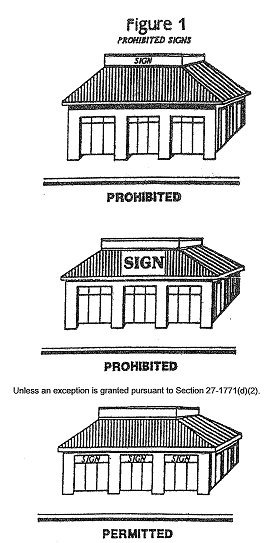
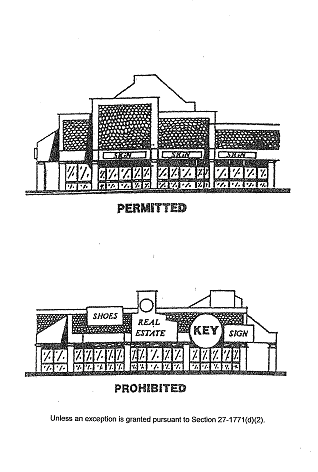
Signs which cover, interrupt or disrupt the major architectural features of a building.
r.
Illuminated awnings that are designed to call attention to, or advertise a place or building.
(3)
Signage painted or attached in any manner through the use of staples, string, nails, rope, glue, paste, tacks or otherwise attached to any trees, utility poles, telephone poles, fences or traffic signage poles.
(4)
String lights used on commercial premises shall be permitted year-round. Such lights shall be only one color throughout the entire development. No multi-colored or flashing lights shall be permitted. Such string lights shall only be permitted in a decorative pattern on vegetation or buildings. String lighting strung between buildings, poles and vegetation shall not be permitted. Interior string lighting visible from the exterior through windows shall conform to the above requirements.
(5)
Any sign which has visible moving, revolving or rotating parts, or visible mechanical movement of any description or other apparent visible movement achieved by electrical, electronic or mechanical means, including intermittent electrical, electronic or mechanical means, including intermittent electrical pulsations or action of nominal current and moving, fading and flashing prices for automotive fuels on a freestanding sign allowed in sections 27-1529(e)(10)d, 27-1271(3)d and 27-3358(p)(4).
(6)
Any sign or sign structure which is structurally unsafe or constitutes a hazard to safety and health by reason of inadequate maintenance, dilapidation or abandonment, or which is not kept in good repair or is capable of causing electrical shocks to persons likely to come into contact with it.
(7)
Any sign which was or is unlawfully installed, erected or maintained under the terms of this article.
(8)
Any sign attached to or painted on a standpipe, gutter drain, fire escape, television antenna, satellite dish or any similar accessory structure.
(9)
Any sign that is supported by visible angular bracing members, guy wires or cables.
(10)
Billboard signs.
(11)
Any addition or enlargement of an existing sign, unless said addition or enlargement has been approved by issuance of a permit in conformance with this article.
(12)
Roof-mounted or parapet wall signs, including flat and angle roofs, shall be prohibited (See Figure 1), except as provided in section 27-3358(d)(2).
(13)
Signs which, by reason of size, location, content, coloring or manner of illumination, obstruct the vision of drivers or detract from the visibility or effectiveness of any traffic sign or control device within rights-of-way.
(14)
Signs producing glare.
(15)
Signs of such a design and location that they interfere with or compete for attention with, or may be mistaken for a traffic signal. This shall include any sign visible from the public right-of-way which uses an arrow device or the words "STOP," "LOOK." It shall also include signs in which the colors red and green are used, either in direct illumination or in high reflection by the use of special preparations such as fluorescent paint or glass.
(16)
Any freestanding or projecting sign within an area bounded by the intersection of two rights-of-way and points 30 feet from such intersection along the rights-of-way, except directional signs less than two feet in height, as permitted by the department of planning and zoning.
(17)
Any on-premises or off-premises sign located in a public or private right-of-way or easement, except those identification, banner or directional signs authorized by a duly constituted government or governmental agency.
(18)
Any sign using exposed incandescent bulbs as a means of attracting attention (but excluding neon tubing commonly used for sign lettering, and neon tubing used to outline windows), and/or mirrors reflecting a direct light source and other devices.
(19)
Signs which obstruct free ingress to or egress from a door, window, fire escape, emergency access or other required entry/exit way.
(20)
Flags and flagpoles shall be permitted as indicated in Table 1.
(21)
Neon signs.
a.
Neon tubing, fluorescent lighting, incandescent lighting or similar lighting devices placed, installed or mounted which outline sign faces or sign structures of freestanding and wall-mounted signs, or which outline the exterior features of buildings, structures, sign structures or landscaping, are prohibited.
b.
The use of neon tubing for the purpose of outlining windows shall be limited to a single strand of neon, no greater than one inch in diameter and shall be placed within three inches of the window casing. The area covered by the neon which is used to outline a window shall be considered as part of the area permitted to be used for a window sign.
_____
Table 1. Flagpoles and Display of Flag Regulations
(1) Subject to satisfying all applicable building and engineering construction requirements.
(2) Flags displayed within residential zoning districts are exempt from flag location requirements.
(3) The above flagpole height restrictions, flag size, etc. are not cumulative.
Height is measured from top of pole. Pole height is measured from the average grade of the centerline of the adjacent roadway.
_____
(Code 1992, § 27-1733; Ord. No. 10-88, § 624.3.A, 3-1-1988; Ord. No. 33-89, § 3(624.3.A), 1-2-1990; Ord. No. 31-91, § 3, 1-7-1992; Ord. No. 20-92, § 1, 9-15-1992; Ord. No. 4-93, § 1, 2-16-1993; Ord. No. 43-96, §§ 4, 8, 10-15-1996; Ord. No. 61-01, § 2, 2-5-2002; Ord. No. 45-02, § 4, 8-20-2002; Ord. No. 23-10, § 9, 9-21-2010; Ord. No. 25-11, § 4, 10-18-2011; Ord. No. 44-14, § 33, 2-17-2015)
Sec. 27-3327. - Application requirements.
(a)
Provided the application complies with this section and other applicable codes and regulations, the department of planning and zoning shall issue a permit for each sign, retaining a copy thereof and a copy of the complete drawings of said sign for town records.
(b)
The following shall be required to apply for a permit for signage:
(1)
Completed department of planning and zoning application.
(2)
Type of sign or high voltage tube lighting to be authorized by said permit.
(3)
The legal description of the property upon which the sign is to be located, a copy of the property deed or lease, as appropriate, and written authorization, signed by the owner or lessee, allowing installation of a sign.
(4)
The exact location of all permanent freestanding signs shall be specified on an as-built property survey, which shall be certified (signed/sealed) by a registered state surveyor and submitted to the department of planning and zoning within one year of permit issuance. A specific purpose survey shall be acceptable, if it includes the above required certifications.
(5)
Elevations of all sign faces detailing height, width, length, square footage per sign face, size of lettering, colors, lighting utilized, total lumens (wattage).
(6)
The name, mailing address, and telephone number of the person erecting the sign.
(7)
All applications for temporary and permanent freestanding signs in excess of 24 square feet shall include calculations from a registered state engineer indicating that the sign complies with the building code.
(8)
For good cause or the submission of an acceptable alternative, the director of planning and zoning or his designee may waive any of the above application requirements.
(Code 1992, § 27-1751; Ord. No. 10-88, § 624.4, 3-1-1988; Ord. No. 33-89, § 3(624.4), 1-2-1990; Ord. No. 31-91, § 3, 1-7-1992; Ord. No. 45-02, § 4, 8-20-2002)
Sec. 27-3358. - General regulations.
(a)
All signs, permanent and temporary, shall be located a minimum of ten feet from the ultimate right-of-way line of the adjacent street or road.
(b)
The sign area for signs on perimeter walls and pedestrian amenities shall be measured by scribing a continuous line around all the wording or symbols. The maximum sign height shall be measured to the top of the sign copy. When a sign is located on a pedestrian amenity, the sign shall meet the required setback of the applicable sign code.
(c)
Permit required. All signs, other than those designated P-1, P-3, P-5 and T-2, shall require the issuance of a building permit prior to erection and in accordance with the procedures established by the town for the issuance of building permits. All building permit applications for signage shall be reviewed for compliance with the locational requirements for signs, as described in this section, as well as for compliance with the building code. A permit for a temporary sign shall indicate the length of time it shall remain installed.
(d)
Nonconforming signs.
(1)
All permanent signs or advertising matter which may become nonconforming as a result of enactment of this article shall be brought into conformance with all the provisions and requirements of this section on or before January 1, 1998.
(2)
The town may permit the following exemptions to the requirements of this section:
a.
The town may exempt any sign from these requirements if the sign owner can demonstrate to the town that the nonconformity of a particular requirement is within ten percent of each of the specific requirements related to height, sign area, setbacks and projection from the building. In order for the town to grant an exemption, it must find that the exemption granted is for a sign that had been previously permitted by the town and that the sign met all requirements of the town Code at the time of permitting.
b.
For buildings that were constructed prior to the adoption of Ordinance No. 33-89, January 2, 1990, the owner may apply to the director of planning and zoning or his designee for an exemption to the prohibition of roof and parapet signs, if the proposed sign adheres to all of the following requirements:
1.
The owner or tenant had a sign permit for a sign on a roof or parapet wall located on a building that received its initial building permit for the primary structure prior to January 2, 1990;
2.
The top of a parapet sign shall not project 42 inches above the bottom of a parapet wall. Roof signs shall be centered at or below the average height between the eaves and ridge for gable, hip and gambrel roofs. In no case shall a sign extend above the top of a roof or parapet wall;
3.
The maximum sign area shall be calculated by multiplying the building frontage by 0.60 for a maximum square footage of 32 square feet. Existing nonconforming signage that was issued a permit is exempt from the size limitations if the sign adheres to all other criteria;
4.
Any roof sign shall consist of individual flat or channel letters, unless a nonconforming roof box or cabinet sign that was issued a permit existed as of January 1, 2002; and
5.
The sign letters shall not exceed 24 inches in height. Existing nonconforming signage that was issued a permit is exempt from letter height limitations if the sign adheres to all other criteria.
(3)
The town council, following an advisory recommendation by the planning and zoning commission, may grant extensions from compliance with the requirements of this section. Extensions, not to exceed a period of three years, may be granted for signs located on nonresidential properties annexed into the town.
(4)
Nonconforming signs that are deemed to possess historic, artistic or other significant value to the town may be allowed to remain on a permanent basis, if approved by the town council following an advisory recommendation from the planning and zoning commission. In order for a sign to qualify as possessing historical value, the sign must have been issued a permit and the sign must be in a valid nonconforming status for a minimum of 25 consecutive years. Modifications to signage, within the minimum 25-year period, shall not preclude consideration of historic status if the general historic integrity of the sign has been maintained. The town council, in determining that a sign qualifies as an historic sign, must find that the sign has unique significance to the town due to its configuration, identity or design. The town council may also consider whether or not the sign is associated with a building, business or activity that has historical significance to the town.
(5)
The provisions of this section shall not preclude necessary and reasonable maintenance to retain the structural integrity of a sign. The provision of this section shall not preclude the replacement of a sign face.
(6)
In the event of loss, damage or destruction of a nonconforming sign, such sign may not be replaced if the cost to repair equals or exceeds 50 percent of the original cost of the sign.
(7)
Illegal signs existing on the effective date of Ordinance Number 33-89 shall continue to be illegal.
(e)
When two sign faces are placed back-to-back and are at no point more than 1½ feet from one another, the area of one side of the sign shall be considered as the total area.
(f)
Any sign now or hereafter existing which no longer advertises a bona fide business conducted, products sold, or forthcoming election, shall be taken down and removed by the agent, owner or person having the beneficial use of the building or land upon which the sign may be found, such removal to take place within a period of 30 days following cessation of such effective use of the sign, or closing of business unless extended by the town council.
(g)
Any sign which presents a safety hazard or encroaches upon a public right-of-way may be removed by the town without notice.
(h)
Any outdoor advertising structure or sign now or hereafter existing which no longer advertises a business conducted, product sold, or not according to the application permit use, or otherwise illegal, shall be taken down and removed by the owner, agent, or person having the beneficial use of the building, structure or land upon which such sign may be found.
(i)
If the department of planning and zoning shall find that any sign regulated herein is unsafe or insecure, or is a menace to the public or has been constructed or erected on or over public property to a greater extent than is permitted by these regulations, or has not been renewed, he shall give written notice to the permittee thereof. If the permittee fails to remove or alter the sign so as to comply with standards set forth within 30 days after such notice, such sign may be removed or altered to comply by the department of planning and zoning at the expense of the permittee or person having the right to use and possession of the property upon which the same is located.
(j)
Two off-site directional real estate signs for residential sales shall be permitted per residence during open house sales in conformance of standards as written for P and T signage. One of the two off-site directional signs shall only indicate open house on such signage with no reference to any associated businesses. No more than one open house sign may be placed on one corner. Such sign can be utilized by all realtors indicating an open house without the clutter of several signs on one corner.
(k)
One off-site directional sign or special event sign shall be permitted for commercial and retail establishments for open houses or grand openings as a department of planning and zoning special permit. Special permits for the above-mentioned will only be permitted at two-week intervals with a maximum of four weeks per calendar year. The permit shall be reissued after the first two weeks. Written approval of the property owner is required pursuant to the above permitted sign.
(l)
All prohibited signs as specified within section 27-3304(2) shall be removed upon final adoption of such sign ordinance amendment.
(m)
No more than 25 percent of the total window area of each individual commercial business may be covered with signage or other opaque material such as display racks, merchandise, or other items. The 25 percent coverage shall be calculated by using all window areas facing streets; however, the business can allocate the total sign coverage to one or more windows, provided that no one window is covered 75 percent or greater with window signs.
(n)
All freestanding or wall-mounted signs over ten feet in height shall be internally (if lighting is utilized) lit and signage less than 15 feet shall provide lighting that in no manner blinds or shines on adjacent vehicular or pedestrian circulation. Appropriate light shields shall be utilized to ensure protection.
(o)
All addresses of the buildings must be included on each freestanding sign. If the address is included within the sign area, the size of the sign shall not exceed the area requirements; however, if the address is outside of the sign area, such as attached to the sign supports, then the address shall not be included in the calculation of the maximum sign area. Street numbers shall be installed in a location that is visible to pedestrian and vehicular traffic. Address number and/or letter height on freestanding signs shall be as follows:
(1)
In multi-unit buildings, two stories and up, directional unit identification signs shall be posted outside of each elevator/stairwell. This will apply only when there is an option for direction of travel.
(2)
All multi-unit buildings that can be accessed from the rear also shall have the address and unit numbers posted at the rear of the building. When property layout, landscaping or driveway design limits the visibility of the address, additional signs shall be posted to identify buildings or direction of travel to reach buildings. Numbers and/or letters shall be a minimum of six inches in height.
(p)
Freestanding changeable copy signage shall adhere to the following:
(1)
All changeable copy signage included within applicable freestanding signage shall be limited to a maximum of eight square feet per sign face.
(2)
Museums, performance theaters, and government services (including, but not limited to, libraries, community centers, town halls, etc.) shall be limited to a maximum of 50 percent of the allowable sign face as changeable copy, not to exceed 25 square feet.
(3)
The maximum permitted lettering height shall be ten inches except as noted in subsection (p)(4) of this section. The type of lettering shall be limited to plastic channel lettering, plastic card type lettering or raised wood lettering. The manufacturing of such lettering shall be of typeset (machine-printed) quality. The following lettering shall be prohibited, including, but not limited to:
a.
All types of freehand lettering;
b.
Chalk on chalkboard surfaces.
(4)
The prices for automotive fuels on a freestanding sign may be displayed by using adjustable light-emitting diode (LED), light-emitting polymer (LEP) or organic electro luminescence (OEL) illumination within the allowable square footage of the changeable copy sign. The prices for automotive fuels shall not move, fade or flash. The maximum permitted letter height shall be 16 inches and the letters shall be of a consistent single color of either green, white, yellow, red, amber or blue.
(5)
The sign face may be illuminated or non-illuminated.
(6)
The signage shall adhere to the applicable total sign area (space) regulations:
Sign code, sections 27-3362 through 27-3364.
(q)
Freestanding changeable copy signage for movie theaters. Movie theaters with multiple auditoriums or screens shall be permitted a freestanding changeable copy sign with a maximum of 100 square feet per sign face.
(1)
The maximum permitted lettering height shall be ten inches. The type of lettering shall be limited to plastic channel lettering, plastic card type lettering or raised wood lettering. The manufacturing of such lettering shall be of typeset (machine-printed) quality. The following lettering shall be prohibited, including, but not limited to, the following:
a.
All types of freehand lettering;
b.
Chalk on chalkboard surfaces.
(2)
The sign face may be illuminated or non-illuminated.
(3)
The signage shall adhere to the applicable total sign area (space) regulations:
Sign code, sections 27-3362 through 27-3364.
(r)
Facade-mounted changeable copy signage for movie theaters. Movie theaters with multiple auditoriums or screens shall be permitted a maximum of 15 square feet of changeable copy signage per auditorium or screen.
(1)
No more than 150 square feet of sign face may be permitted per building or structure.
(2)
The sign box or sign face shall be located a minimum of 300 feet from the front or side property lines.
(3)
The maximum permitted lettering height shall be six inches. The type of lettering shall be limited to plastic channel lettering, plastic card type lettering or raised wood lettering. The manufacturing of such lettering shall be of typeset (machine-printed) quality. The following lettering shall be prohibited, including, but not limited to:
a.
All types of freehand lettering;
b.
Chalk on chalkboard surfaces.
(4)
The sign face may be illuminated or non-illuminated.
(5)
The signage shall adhere to the applicable total sign area (space) regulations:
Sign code, sections 27-3362 through 27-3364.
(s)
The minimum height of the letters on a freestanding sign shall be six inches.
(t)
Tenant signs included as part of a freestanding sign shall be uniform in color and shall be consistent and compatible with the colors of the freestanding sign.
(u)
All signs shall be maintained in substantially similar condition as when the sign was originally permitted and installed/erected. Such maintenance shall include periodic painting and replacement when necessary to achieve the substantially similar appearance as the originally permitted sign. Such maintenance shall include both the sign area and structure, or supporting structure.
(v)
All signs shall have a town sign permit label attached to the sign.
(Code 1992, § 27-1771; Ord. No. 10-88, § 624.3.B, 3-1-1988; Ord. No. 33-89, § 3(624.3.B), 1-2-1990; Ord. No. 31-91, § 3, 1-7-1992; Ord. No. 35-92, § 3, 1-5-1993; Ord. No. 53-94, § 2, 9-20-1994; Ord. No. 51-95, § 2, 12-18-1995; Ord. No. 43-96, §§ 2, 3, 7, 9, 11, 12, 10-15-1996; Ord. No. 65-97, § 1, 12-16-1997; Ord. No. 45-02, § 4, 8-20-2002; Ord. No. 01-07, § 7, 6-5-2007; Ord. No. 19-09, § 4, 8-18-2009; Ord. No. 25-11, § 5, 10-18-2011; Ord. No. 44-14, § 34, 2-17-2015)
Sec. 27-3359. - Permanent signs.
Subject to the other provisions of this article, the following types of permanent signs are permitted throughout the town:
(1)
P-1. All signs and signals owned or operated by governments or governmental agencies.
(2)
P-2. Identification signs for public and semi-public institutions, such as schools, religious institutions, libraries, and public utilities.
(3)
P-3. Nameplates identifying the owner or resident of a private property, or identification of property through the use of addresses.
(4)
P-4. Memorial or historical markers or tablets.
(5)
P-5. Signs indicating the private nature of a road, driveway, or other premises, and signs controlling the use of private property, such as the prohibition of hunting or fishing.
(6)
P-6. Directional signs indicating the route or direction to a place or activity, as permitted by the department of planning and zoning.
a.
An off-premises directional sign shall be permitted solely when necessary to direct vehicles or pedestrians to a hospital or public place.
b.
An on-premises directional sign shall be permitted solely when necessary to direct vehicles or pedestrians to a place or activity.
(7)
P-7. Non-residential "point of purchase" wall signs, attached to the building, for individual establishments in districts other than residential. No wall signs shall be permitted for any business located above the first floor, with the exception for two story buildings as set forth herein. Wall or building signs shall not be located above the bottom of the second floor window line. Tenant wall signs shall be attached to the exterior wall of the tenant space being advertised, with the exception of two story buildings in where the tenant space is accessible through a common exterior walkway (not through a lobby) and the building is subject of a master sign plan. Second floor tenants in buildings with these two features are permitted to have signage on the first floors. For buildings where the owner has received a master sign plan approval which includes second floor tenant signs on the first floor, the master plan and the tenant signs shall:
a.
Not exceed 15 square feet. This requirement does not apply to Building Identification or first floor tenant signs.
b.
Face the primary parking area for the tenant space and the signs shall be installed in a uniform manner.
c.
Be compatible with the architecture of the building and the signs shall be designed to be integral to the building (e.g. fit into arches, bandings, or other architectural elements on the building).
Subsection (7)(c) shall not prohibit the installation of a building identification sign located immediately below the roof line of the building on buildings of more than one story.
(8)
P-8. Freestanding identification or directory signs in districts other than residential, and in addition to those signs allowed as P-7. Freestanding directory signs shall be permitted in lieu of a freestanding identification sign; however, such signage shall be located perpendicular and set back 25 feet from an abutting right-of-way or rights-of-way providing direct vehicle access to the property. A P-8 sign shall be located on the same lot as the nonresidential property it is intended to identify.
(9)
P-9. Land development, multifamily development and subdivision identification sign means a freestanding sign that identifies the name of a planned unit development, development of regional impact, or a commercial or residential subdivision and may include a limited number of general uses or activities, the purpose of which is to give direction or to indicate the general use or activity on a site. In a commercial subdivision, the sign shall be incorporated into an entry wall, perimeter wall or fence and/or a pedestrian amenity. Directions and general uses located on the sign shall be a smaller type face than the name of the overall development.
(10)
P-10. Apartment identification signs either freestanding or attached to the building.
(11)
P-11. Interior mall signs or point-of-purchase signs attached to a storefront facing a mall's interior concourse.
(12)
P-12. Freestanding changeable copy signage.
(13)
P-13. Freestanding changeable copy signage for movie theaters.
(14)
P-14. Facade-mounted changeable copy signage for movie theaters.
(15)
P-15. Menu board signs for the display of the type and price of food and beverage sold in connection with a restaurant's drive-through service. The sign shall not be noticeably visible from the public right-of-way. Menu board signs associated with an outdoor seating area shall be regulated in regards to size and type by division 30 of article XI of this chapter.
(16)
P-16. Way-finding signs are for the listing or indexing of the names of businesses or tenants within a commercial, industrial, public or quasi-public institutional development and may also contain the overall name of the Large-Scale Planned Unit Development District (PUD), DRI, or commercial or residential subdivision. The sign is meant to be informative and provide directional information within a site for pedestrian and vehicular traffic and is not meant to be viewed from the adjacent streets or rights-of-way. Way finding signs shall not include any corporate logos. The sign design and typeface shall be consistent throughout the development.
(17)
P-17. Automatic teller machine (ATM) sign identifying the individual business, logo, and/or principal services associated with an ATM. The sign shall be integrated into the design of the machine. The color of the ATM structure must be compatible with the primary building and non-advertising in nature.
(18)
P-18. Hospital signs are available in the medical center (MC) zoning district for hospitals which have an approved master site plan. The master sign plan shall be submitted to identify the signage of the hospital's individual buildings, and their specific medical units or practices. The master sign plan shall: identify the location of public entrances, identify buildings or additions which are 15,000 square feet or more, the location of the building's signs, and ensure compatibility with the architecture of the building. Wall signs shall be designed and placed upon the building such that they are integral to the building facade. The types of P-18 hospital signs and the description of these types of signs include:
a.
Hospital identification signs—A sign located on the main building to the hospital above 30 feet in height;
b.
Wall signs—A single-faced sign attached to a wall below the roofline, or on the fascia and parallel to the building's facade;
c.
Freestanding monument signs—A sign which is permanently affixed in or upon the ground and is not attached nor a part of the building;
d.
Off-premises directional sign—A hospital with emergency services may place an off-premises content-neutral directional sign provided the Town Council determines that it is necessary to further the health and safety of residents and visitors of the town on arterial roads adjacent to or in the vicinity of a full-service hospital to direct residents and visitors to buildings providing certain medical services; and,
e.
Public entrance identification signs—Freestanding signs may be located at public entrances to a hospital building as shown on an approved master plan.
f.
Freestanding directory signs—A sign which is permanently affixed in or upon the ground and is not attached nor part of the building may be permitted within a hospital campus for purposes of directing persons to the buildings for specific services within the hospital campus.
(Code 1992, § 27-1772; Ord. No. 10-88, § 624.3.C, 3-1-1988; Ord. No. 33-89, § 3(624.3.C), 1-2-1990; Ord. No. 31-91, § 3, 1-7-1992; Ord. No. 35-92, § 2, 1-5-1993; Ord. No. 45-02, § 4, 8-20-2002; Ord. No. 01-07, § 8, 6-5-2007; Ord. No. 23-10, § 10, 9-21-2010; Ord. No. 23-12, § 6, 9-4-2012; Ord. No. 32-16, § 3, 1-17-2017; Ord. No. 29-17, § 3, 12-5-2017; Ord. No. 2-19, § 2, 4-16-2019; Ord. No. 6-23, § 2, 5-2-2023)
Sec. 27-3360. - Temporary signs.
Subject to the other provisions of this article, the following types of temporary signs are permitted throughout the town:
(1)
T-1. Signs identifying architects, engineers, contractors, tradesmen, financial institutions and others engaged in construction work for an approved development application on-premises wherein their work is proceeding. Such temporary signage shall be removed prior to the project receiving a certificate of occupancy or a certificate of completion.
(2)
T-2. Real estate signs for individual tenant space in nonresidential buildings, individual units in residential buildings, or individual properties that are for sale, rent or lease. The sign shall be removed within one week of the date of the sale or when title passes or rental agreement or tenant occupancy. Only one freestanding T-2 sign shall be permitted per site. As an alternative, the T-2 sign area may be incorporated into any freestanding sign located on-site, without increasing the sign's overall square footage, in lieu of providing a freestanding T-2 sign.
(3)
T-3. Real estate sign for the sale or lease of land, buildings or portions of buildings in nonresidential and multifamily residential development. T-3 signs shall only be permitted for developments with more than a five percent vacancy of the property's total square footage. Signs permitted under this section, once approved, shall be permitted for one year or until vacancies fall below the five percent threshold noted above, whichever comes first. Existing temporary signs with valid permits shall be permitted to remain on-site for one year from the adoption of the ordinance from which this article is derived or until vacancies fall below the five percent threshold noted above, whichever comes first. A T-3 sign may not be permitted if a freestanding T-2 sign is provided on-site. As an alternative, the T-3 sign area may be incorporated into any freestanding sign located on-site, without increasing the sign's overall square footage, in lieu of providing a freestanding T-3 sign. If located on the site's permanent freestanding sign, the temporary signage shall not be subject to the time frame restrictions listed above.
(4)
T-4. Real estate signs announcing future development. Such signs shall not be permitted unless a valid site plan is approved for the lot, and such signs shall be removed prior to the issuance of the last certificate of occupancy for the property.
(5)
T-5. Signs for use in special business or civic events or promotions, provided such events and/or promotions do not exceed two weeks in length nor more than a total of eight weeks in any calendar year. A minimum of four weeks shall be provided between the removal of a T-5 sign and installation of the next T-5 sign, except for those T-5 signs attached to a building or arcade facing an off-street parking area. Such signs shall include banners. The time period that is allowed for civic events may be extended to six weeks for a single event upon the approval of the town council.
(6)
T-6. Informational signs in the interior of construction sites and along interior roads only.
(Code 1992, § 27-1773; Ord. No. 10-88, § 624.3.D, 3-1-1988; Ord. No. 33-89, § 3(624.3.D), 1-2-1990; Ord. No. 43-96, § 8, 10-15-1996; Ord. No. 45-02, § 4, 8-20-2002; Ord. No. 01-07, § 9, 6-5-2007; Ord. No. 23-12, § 7, 9-4-2012)
Sec. 27-3361. - Temporary political signs.
The following regulations shall apply to temporary political signs within the town:
(1)
Placement. Temporary political signs may not be erected in the medians of any public rights-of-way or placed upon public property, other than rights-of-way. Temporary political signs shall not be placed or located on any property so as to obstruct vision at corners, intersections, and other similar locations, interfere with the free flow of traffic upon streets and roadways, or deny pedestrians lawful access or flow on the sidewalks and bike paths. Political signs shall not be illuminated.
(2)
Limitation on number of signs. One temporary political sign per candidate or per issue is permitted per residential unit, or residential lot or parcel. One temporary political sign per candidate or per issue is permitted for each 200 feet of frontage of nonresidential property.
(3)
Size. Temporary political signs on residential property may not exceed six square feet. Temporary political signs on nonresidential property may not exceed 16 square feet. Only pole type signs shall be used for temporary political signs. Balloons, buntings, banners, streamers, portable signs, flags, billboards, and similar signs are prohibited. A temporary political sign shall not be higher than six feet above the crown of the road adjacent to the sign.
(4)
Installation.
a.
Temporary political signs on nonresidential properties may be installed no earlier than 30 calendar days before the primary, general or run-off election or referendum. For residential properties, there is no restriction on the installation date for temporary political signs.
b.
No political signs shall be stapled, erected, taped, strung, posted, painted, tacked, nailed or otherwise displayed, placed or located on any tree, utility pole, utility post, street sign or traffic sign.
(5)
Removal.
a.
Temporary political signs on nonresidential properties shall be removed no later than five calendar days after the primary, general or run-off election or referendum. Candidates winning a primary election shall not be required to remove their signs between the primary and general election or run-off election. For residential properties, there is no restriction on the removal date for temporary political signs.
b.
If a political sign is not removed within the specified period, the town shall give notice, by certified mail or hand delivery, to the applicant, and/or property owner, explaining the nature of the violation of this article and requesting that the sign be removed within 24 hours of receipt of such notice. If the sign is not removed within the time specified, the sign shall be considered as abandoned. The town shall have the authority to remove and dispose of any abandoned signs and charge the applicant, and/or property owner, for the actual cost for such removal and disposal. Funds collected for removing and disposing of such signs shall be deposited to the general revenue of the town.
c.
Any political signs not posted in accordance with the provisions of this article, or which exist in violation hereof, shall be deemed to be a public nuisance and shall be subject to removal and disposal by the town.
(6)
The town clerk shall furnish a copy of the ordinance from which this article is derived to candidates for any town office at the time a candidate qualifies to run for any such office.
(Code 1992, § 27-1774; Ord. No. 33-89, § 3(624.3.DD), 1-2-1990; Ord. No. 45-02, § 4, 8-20-2002; Ord. No. 57-04, § 2, 10-19-2004)
Sec. 27-3362. - Space regulations for permanent signs.
The following table shows the standards to which each of the permanent sign types must conform, regardless of the district in which they are located.
(Code 1992, § 27-1775; Ord. No. 10-88, § 624.3.E.1, 3-1-1988; Ord. No. 33-89, § 3(624.3.E.1), 1-2-1990; Ord. No. 45-02, § 4, 8-20-2002; Ord. No. 01-07, § 10, 6-5-2007; Ord. No. 32-09, § 3, 9-22-2009; Ord. No. 23-10, § 11, 9-21-2010; Ord. No. 23-12, § 8, 9-4-2012; Ord. No. 32-16, § 4, 1-17-2017; Ord. No. 2-19, § 3, 4-16-2019; Ord. No. 6-23, § 2, 5-2-2023)
Sec. 27-3363. - Space regulations for P-7, P-8, and P-18 signs.
The maximum permitted area for a P-7, P-8, and P-18 sign, the maximum number of P-7, P-8, and P-18 signs allowed per use and the maximum permitted area of a P-7, P-8, and P-18 sign shall be determined as follows:
(1)
The basic factor shall be the square footage of the building face fronting on a street. Such square footage is computed by multiplying the height of the building by the width, except that for the purposes of this article, the height dimension shall not exceed 30 feet, regardless of actual height. Permissible sign area shall be computed by multiplying the building face square footage by a constant as provided in the chart on the following page.
(2)
When a building fronts on more than one street, one building face shall be considered the primary frontage, and the other face (or faces) shall be considered as secondary frontage, except for P-18 wall signs as regulated by subsection 27-3363(7).
(3)
When there is more than one tenant space in any building, each tenant space on the ground floor shall be permitted one sign (P-7) attached to the building. Second floor tenant signs on the first floor of two story buildings, are only permitted where the owner has an approved master sign plan.
(4)
When one face of a building fronts on a street and a second face fronts an internal or external vehicular access way (i.e., parking lot drive, etc.), then the building face fronting on a street shall be considered as primary frontage and the second face fronting on a vehicular access point other than a street shall be considered as secondary frontage. Buildings on two major roadways shall be considered as primary roadway frontage, except for P-18 wall signs as regulated by subsection 27-3363(7).
(5)
In the event that a building has a unique configuration or the applicant can demonstrate special circumstances, the owner can submit an application for a variance, provided all applicable criteria for granting such are satisfied and maintained. Under no circumstances, except as permitted, pursuant justification for granting a variance, shall the board of adjustment grant a variance to permit a sign not permitted pursuant to this article.
(6)
The maximum permitted area for a freestanding (P-8) sign shall include the area which is used for lighting the perimeter of the signage. Lighting used on the perimeter of a sign shall be covered and shall be a maximum of four inches in width.
(7)
P-18 wall signs shall be considered the primary signage when fronting an internal or external vehicular access way, drive aisle, or parking lot. Buildings or additions of 15,000 or more are permitted one wall sign per frontage with a maximum of two wall signs.
Example: A building 60 feet wide, 35 feet high, and 80 feet deep, on a corner lot, with the 60 feet dimension considered to be primary frontage:
60 feet × 30 feet = 1,800 sq. ft. × .08 = 144 sq. ft. sign area (primary frontage)
80 feet × 30 feet = 2,400 sq. ft. × .04 = 96 sq. ft. sign area (secondary frontage)
(Code 1992, § 27-1776; Ord. No. 10-88, § 624.3.E.1, 3-1-1988; Ord. No. 33-89, § 3(624.3.E.1), 1-2-1990; Ord. No. 43-96, § 10, 10-15-1996; Ord. No. 45-02, § 4, 8-20-2002; Ord. No. 29-17, § 4, 12-5-2017; Ord. No. 2-19, § 4, 4-16-2019)
Sec. 27-3364. - Space regulations for temporary signs.
The following table shows the standards to which each of the permitted temporary sign types must conform, regardless of the district in which they are located.
(Code 1992, § 27-1777; Ord. No. 45-02, § 4, 8-20-2002; Ord. No. 01-07, § 11, 6-5-2007)
_____

