
Kalama City Zoning Code
CHAPTER 17
25.- MIXED USE ZONING DISTRICT
Sec. 17.25.010.- Purpose.
The mixed use zone combines two or more different types of land uses, such as residential, commercial, business, and industrial uses in close horizontal proximity. Vertical integration of these uses is desirable in areas where one use transitions to the next. The range of uses in the zone is diverse to better promote a strong economic mix; and because the diversity of the uses would make screening of individual uses difficult or impractical in some cases, compatibility is first addressed by establishing subzones within the zone, where groups of similar uses will be arranged together. Compatibility between different uses within a subzone is further addressed through standards that limit noise and/or other undesirable features. Transition overlay areas between subzones promote a gradual change in uses and intensities and provides increased design standards such as landscape and screening requirements, and/or gradual transitions in height or density. Providing subzones for similar uses and the transition overlay areas, with increased attention to compatibility, will allow better utilization of the land and maintain a more consistent character for the overall mixed use zone by promoting an integrated mix of uses rather than separating uses into single use zones. Subzone boundaries are incorporated into the master plan approved through the procedures in chapter 16.10 and can be modified within the mixed use zone through the review process identified in article 16.10.020.
The intent of the mixed use zoning district is to promote job growth and orderly and well-coordinated land use while providing complementary services. The mixed use zone includes development subzones to promote grouping of compatible uses. Mixed use zoning districts are further defined in section 17.25.020. Table 17.60.020 reflects the four subzones and the use classification for each.
(Code 2020, § 17.25.010; Ord. No. 1310, § 1, 6-5-2013; Ord. No. 1511, § 11(17.25.010), 3-21-2024)
Sec. 17.25.020. - Subzones within mixed use zone established.
In order to classify and regulate the use of land, buildings, and structures, the mixed use zone is divided into the following use subzones:
A.
Residential (MU-R). The residential subzone is established to supply a select variety of multifamily housing options in close proximity to employers and consumer services, providing mutual benefits to residents and nearby businesses.
B.
Commercial (MU-C). The commercial subzone provides convenient services for adjacent land uses, highway users, and regional service providers.
C.
Business (MU-B). The business subzone is an employment center which offers the flexibility to provide office space, while accommodating professional and technical firms that may require large spaces for operation.
D.
Industrial (MU-I). The industrial subzone is primarily intended to accommodate light industrial employment-generating development.
E.
Transition Overlay Area (TO). The transition overlay areas provide a transition between the residential, commercial, business, and industrial subzones. Through increased development standards, landscaping and screening, location requirements, and use restrictions, this area is intended to act as a buffer between any of the four subzones while accomplishing continuity within the overall mixed use zone. These buffers will be located 250 feet on either side of all the subzone boundaries for a total of 500 feet of transition area. As marketplace demand dictates availability of land within each of the four subzones, the subzone boundaries may be repositioned per the administrative authority of article 16.10.020.
(Code 2020, § 17.25.020; Ord. No. 1310, § 1, 6-5-2013; Ord. No. 1511, § 11(17.25.020), 3-21-2024)
Sec. 17.25.030. - Reserved.
(Code 2020, § 17.25.030; Ord. No. 1310, § 1, 6-5-2013; Ord. No. 1511, § 2, 3-21-2024)
Sec. 17.25.035. - Reserved.
(Code 2020, § 17.25.035; Ord. No. 1310, § 1, 6-5-2013; Ord. No. 1511, § 2, 3-21-2024)
Sec. 17.25.040. - Site design requirements.
A.
Setbacks. Setbacks within the mixed use zoning district are listed below in Table 17.25.040-1. Setbacks between subzones within a mixed use zoning area are addressed in the transition overlay area requirements of section 17.25.050.
Table 17.25.040-1
A Setbacks from city, county or state or other dedicated right-of-way is measured from the ROW line.
B Setbacks from private internal circulation drives are measured from the back of the curb.
C See transition overlay area requirements in section 17.25.050.
_____
B.
Building heights. Maximum building heights within the mixed use zone are listed below in Table 17.25.040-2. Building heights within the transition overlay areas are established in section 17.25.050E.1.
Table 17.25.040-2
C.
Increases in height above allowable height limits in Table 17.25.040-2 may be approved by planning commission through the master planning process only when it can be shown that the increase will be compatible with the surrounding buildings, other buildings and uses in the master plan, and consistent with the remaining design elements of chapter 17.25.
D.
Parking. Frontage on a dedicated right-of-way shall be limited to no more than 25 percent of the frontage length for residential and commercial subzones and no more than 50 percent in the business subzone. There is no limit on parking frontage on streets within the industrial subzone.
E.
Lot coverage. There is no minimum or maximum lot coverage in the mixed use zone. Appropriate views for landscaping, screening, and stormwater treatment and detention are required in other code sections that may limit or reduce maximum lot coverage.
F.
Building coverage. There is no minimum or maximum building coverage within the mixed use zone.
(Code 2020, § 17.25.040; Ord. No. 1310, § 1, 6-5-2013)
Sec. 17.25.050. - Transition overlay area.
A.
Purpose. The transition overlay area provides for a gradual transition between the various land use subzones within the mixed use zone. Where potentially conflicting land use subzones abut one another, development should incorporate additional elements in the site design and building design to soften its impact and result in a compatible transition.
B.
Applicability. This section applies to any portion of property located within the mixed use zone, designated as residential, commercial, business, or industrial, and which is located within 250 feet of a property subzoned as a different designation than that of the subject subzone. Properties located within a transition overlay area are allowed a blend of uses from each of the neighboring subzones to allow for a fluid, compatible transition between subzones. This shall be accomplished by merging the edges of the subzones to see a gradual change of land use in terms of building height, setbacks, and/or other physical characteristics.
C.
Limitations.
1.
Where a transition overlay area abuts or includes a road or utility corridor, the city shall include that portion as part of the required width of the transition area.
2.
If the applicant establishes a native growth protection easement as permanently dedicated for nonbuildable purposes, the city shall include that portion as part of the required width of the transition area.
3.
Development of a building crossing a subzone boundary into a lower intensity subzone must implement additional standards for design for the portion of the building in the transition area of the lower intensity use.
4.
Residential and industrial subzones have significant differences in purpose and uses and are incompatible. These two subzones are prohibited from abutting.
D.
Review requirements. All development within a transition overlay area must be reviewed by the city administrator, or designee, using the evaluation criteria of this section as part of the building permit review process. If any portion of a building is within a transition overlay area, only that portion is subject to the transition overlay area development standards.
E.
Development standards. All development activity within a transition overlay area must comply with the following:
1.
Building height.
a.
Definition. For purposes of this chapter, building height shall be measured as defined in section 17.08.070. Specifically excluded from this definition for the mixed use zone are slender structural elements not intended for usable floor area and not exceeding ten feet above the maximum building height, including chimneys, ventilation stacks, omni-directional antennas, and flagpoles.
b.
Maximum height. Building heights are established in section 17.25.040B. If a permitted use from one subzone proposes development in a neighboring subzone and lies within the transition overlay area, any proposed building heights must be no greater or no less than ten feet of the average height of surrounding building heights, within a radius of 100 feet from the proposed building.
F.
Setbacks. Setbacks are established in section 17.25.040A for each mixed use subzone. Uses proposed in transition overlay areas must utilize the setbacks for the subzone where the predominant portion of the use exists. For example, if a proposed use is 80 percent within the commercial subzone and 20 percent within the business subzone, the commercial setbacks would apply for the entire proposed use. The intent of applying only one setback standard to a use is to avoid awkward sections of a building adjacent to rights-of-way whereby different setback standards apply.
G.
Landscaping and buffering. Additional landscaping around a higher intensity use within a transition overlay area to a lower intensity subzone should include trees or tall shrub plantings to soften the visual impact of the higher intensity use.
1.
Landscaping. All landscaping shall comply with standards set forth in section 17.25.070.
2.
Buffer size. A landscaped buffer, at least 20 feet wide, shall be provided along at least 75 percent of the building for any portion of the building within a transition overlay area for a subzone with a lesser intensity.
3.
Buffer plants. The buffer shall include at least 50 percent native species with the remaining species being adapted to the city planting zone to minimize water usage. The buffer shall include the following as required plantings:
a.
Evergreen and deciduous trees. No more than 40 percent of the required trees shall be deciduous. Trees planted to meet requirements shall be a minimum of six feet in height for evergreens, two inches caliper for deciduous trees.
b.
Evergreen shrubs. A minimum of 24 inches in height at planting with spacing of no greater than 80 percent of the expected mature width measured from the plant center shall be required.
c.
Ground cover. Living ground cover planted to cover the ground within three years, with a maximum of 50 percent to be planted in turf.
H.
Site design standards. All development activity within a transition overlay area must comply with the following standards:
1.
Surface parking lots may be jointly used by all uses in a transition overlay area, provided that a parking demand study is completed to demonstrate there is sufficient parking provided for all uses at the peak demand time.
2.
Site features such as fences, walls, refuse enclosures, light fixtures, carports, and storage units shall be designed to be integrated with the architectural design and character of the primary structure.
I.
Additional design guidelines. All development activity within a transition overlay area must comply with the following guidelines:
1.
Site design guidelines.
a.
Whenever possible, vehicular access should be designed so that truck traffic is not directed through an abutting subzone of lower intensity.
b.
Loading and refuse collection areas should be on the side of a building facing away from an abutting residential subzone, but not in a front yard setback.
c.
Site development should maximize the use of existing mature vegetation in order to soften the visual impact on adjacent lower intensity uses. Refer to section 17.25.070 for general landscaping requirements.
d.
Surrounding vegetation, topography, street patterns, parking configuration, and building massing should be considered in order to result in a compatible fit between the proposed development and the lower intensity subzone development.
2.
Building design guidelines.
a.
Building surfaces facing abutting lower intensity subzones should be clad with materials which are similar to or compatible with surrounding buildings and generally in character with the lower intensity subzone. Specific care should be taken to select materials which minimize reflected lighting.
b.
Building façades should incorporate elements such as stepbacks, offsets, angled facets, deep roof overhangs, recesses, and other architectural features which serve to break down the scale of the higher intensity use. The larger the building, the greater the number and variety of such elements should be applied that may be necessary to achieve the effect of diminishing scale.
c.
Pitched roof forms are preferred; however, under certain circumstances, a stepped roof form or designing pitched roof accent elements could achieve a similar effect.
d.
Materials and colors used on the building façades should be compatible with nearby buildings and the surrounding natural environment; accent colors and materials may be approved.
J.
Refuse containers. All refuse and recycling containers shall be contained within structures enclosed on all four sides and utilize lids made of molded plastic or other sound buffering material when proposed in a transition area to a residential subzone. Refer to section 17.25.070D for additional landscaping and buffering requirements.
K.
Signs. Building design shall provide for architecturally integrated signage consistent with the scale and architecture of the building. Signs shall meet the requirements of chapter 17.38.
(Code 2020, § 17.25.050; Ord. No. 1310, § 1, 6-5-2013)
Sec. 17.25.060. - Pedestrian access within the mixed use zone.
The standards set forth in chapters 11.04 and 11.05 and section 17.44.020J, except sidewalk widths in the mixed use zone, shall be required in this section. The following pedestrian circulation standards shall apply within the boundaries of the mixed use zone:
A.
Sidewalks. Sidewalks must be installed, repaired, and maintained in all subzones in accordance with chapters 11.04 and 11.05. Any sidewalk, curb, and gutter construction pursuant to this chapter shall comply with the following specifications:
1.
Unless otherwise approved by the planning commission, sidewalks or pedestrian walkways shall be separated from vehicle travel lanes on a public street by a curb and landscape strip with street trees;
2.
All other sidewalks or pedestrian walkways shall be separated from vehicle travel lanes by a curb and landscape strip;
3.
Sidewalks shall be designed as a complete network with connections to buildings, public roadways, parks, pedestrian amenities, and significant natural features;
4.
To the extent practicable, the pedestrian circulation system shall be designed to minimize the distance a pedestrian needs to walk between typical origins and destinations on and off the site. Major pedestrian routes shall be designated in the master plan for connections to major on-site uses or groups of uses, amenities, and public rights-of-way;
5.
Sidewalks shall be a minimum of five feet in width;
6.
Sidewalks, as designated in the master plan for the property serving as a major pedestrian circulation route, shall be eight feet in width;
7.
Minimum sidewalk width shall be entirely free of permanent and temporary objects; and
8.
All sidewalks, curbs, and gutters shall be built according to the standard specification for new street construction set forth in the city "Development Guidelines and Public Works Standards," and any amendments thereto, and all specifications required by the director of public works.
B.
Pedestrian crossings of vehicle circulation.
1.
Where pedestrian routes cross access, maneuvering, or loading areas, the crossing must be clearly identified. Identification methods should include striping, different paving material, signage, using elevation changes, refuge islands, curb bulbs or extensions, or other methods that effectively alert drivers, pedestrians, and cyclists of the location and nature of the crossing.
2.
To the extent practicable, there should be a flat sidewalk provided in areas where driveways slope to the roadway.
(Code 2020, § 17.25.060; Ord. No. 1310, § 1, 6-5-2013; Ord. No. 1454, § 4, 1-7-2021)
Sec. 17.25.070. - Mixed use landscaping standards.
A.
Purpose. The impacts associated with development can be reduced through effective use of landscaping. Landscaped areas can provide aesthetic, ecological, and economic value in a number of ways, including:
1.
Providing compatibility between land uses by reducing the visual impacts between abutting uses;
2.
Establishing physical separation of adjacent uses;
3.
Mitigating stormwater runoff throughout development areas by slowing overland flow velocities and volumes and decreasing runoff temperatures;
4.
Improve air quality by filtering dust and pollutants while oxygenating air;
5.
Buffering noise levels through absorption and diffusion;
6.
Unifying development and enhancing public and private spaces; and
7.
Aiding in energy conservation by reducing heat island effect and providing shade from the sun.
This section provides for the inclusion of landscaping to mitigate the impacts associated with development in the mixed use zone. Landscape requirements apply within the mixed use zone, internally, and along the perimeter of the zone. Additional requirements for landscaping are found in section 17.25.050 and throughout this title.
B.
Applicability.
1.
The requirements of this section shall apply to:
a.
New construction. All new structures proposed for development in the mixed use zone;
b.
Existing. Buildings shall only be required to update landscaping in the setbacks and perimeter of the site, when the following limits are met:
i.
All exterior alterations, modifications, and tenant improvements to existing buildings in the mixed use zone or transition overlay areas that exceed 50 percent of the existing assessed building valuation as determined by the county tax records. The cost of the proposed alterations, modifications, and tenant improvements shall be based on the declared value on the building permit application; and/or
ii.
The expansion of any building or development exceeds 20 percent of the existing floor or site area.
iii.
Expansion of any development creating 1,000 square feet or more of impervious surface coverage.
c.
Exemptions. Building modifications exempt from these standards include:
i.
Generally. Repair and maintenance including repair or replacement with comparable materials including the same color of paint; or
ii.
Interior remodeling where improvements do not include modifications to the building shell; or
iii.
Externally visual alterations to structures where the alterations are valued at less than $10,000.00.
2.
All required landscape plans shall be reviewed for approval by the city administrator or their designee using the evaluation criteria of this section as part of the master plan and building permit review processes.
C.
Plan submittal requirements.
1.
Generally. All required landscape plans shall be prepared by a landscape architect licensed in the state, or may be prepared by other qualified professionals as accepted by the city administrator. Landscape plans shall include:
a.
Natural features, including, but not limited to, water bodies or trees to be preserved and the identification of any necessary measures required for survivability or resource protection;
b.
The scale of the drawing, a north arrow, and the date of the plan;
c.
All property lines, abutting streets, and alleys properly labeled;
d.
All existing and proposed site development features and all impervious surfaces; and
e.
The name, address, and contact information for the applicant or their representative.
2.
Master plan applications. A preliminary landscape plan based on the proposed development shall be submitted for review with the master plan for the proposed development within the mixed use zone. The preliminary landscape plan shall include:
a.
A planting plan depicting locations for existing and proposed landscape areas sufficient to demonstrate how the proposed landscaping will meet the minimum requirements;
b.
A plant schedule showing all plant materials keyed to the plans and identified by name, quantities, condition, type and size of plant materials to be used;
c.
Anticipated mature height for proposed materials;
d.
Anticipated percent coverage at maturity for proposed materials; and
e.
A written description or table describing how the plan meets code requirements.
3.
Development applications. Plans submitted with development permit applications within the master planned mixed use zone shall include a final landscape plan in conformance with the approved master plan. Final landscape plans shall also comply with the following requirements:
a.
Plans shall depict locations for existing and proposed landscape areas sufficient to demonstrate how the proposed landscaping will meet the minimum requirements;
b.
Plans shall include a plant schedule showing all plant materials keyed to the plans and identified by name, quantities, condition, type and size of plant materials to be used;
c.
Plans shall include a description of how survival of the plantings will be ensured; and
d.
Plans shall identify how irrigation will be provided, either by providing an irrigation plan for review or identifying a design/build system to be installed. Irrigation systems shall include automatic, weather-based, programmable controllers. Systems shall be designed to provide watering regimes appropriate to the plant materials and based on soil moisture, weather, and/or other appropriate technologies.
D.
General landscape requirements.
1.
Generally. All required landscaping and screening must comply with all of the provisions of this chapter unless specifically superseded. The landscaping standards are minimums; more stringent standards can be substituted as long as all height limitations are met. Crime prevention and safety should be considered when exceeding the landscaping standards for height and density.
2.
Intent. It is the intent of this subsection D to maintain and encourage landscape design innovation and flexibility. The arrangement of plantings in conjunction with other landscape elements will vary according to the requirements of each project, and will maintain consistency with the overall master plan. Less formal groupings of plant materials is encouraged to accomplish a more naturalized appearance and to avoid a linear and visually rigid design. Water conserving techniques and drought-tolerant plantings in lieu of lawns are also encouraged.
3.
Planting requirements. The landscape coverage requirement expressed as a percentage of site area and planting density standards for shrubs and ground cover establishes guidelines for the minimum quantity of plants required by these standards.
4.
Irrigation required. Irrigation systems must be provided for all landscape areas. Irrigation systems shall provide coverage of all landscape areas with sufficient water to support provided plant materials in a healthy, growing condition.
5.
Existing trees and other vegetation. Where existing trees and other vegetation serve the same or similar function as the required landscaping, they may be substituted for the required landscaping, provided that:
a.
The existing plants are healthy and not considered noxious, invasive, or constitute a hazard as determined by a qualified landscape professional;
b.
The existing plants have a mature size that is appropriate for the developed site;
c.
Supplemental landscaping is provided as necessary to accomplish the intent of this section.
6.
Tree protection. The master plan preliminary landscape plan and subsequent final landscape plans should include measures to retain at least 20 percent of the significant trees as defined by section 16.04.010. In the event trees are not proposed for retention, the applicant shall mitigate for the loss of tree canopy by incorporating additional landscaping, tree plantings, and/or buffer enhancements, if applicable, or through other means as approved by the city administrator. Additional vegetation provided as mitigation shall, at a minimum, be consistent in character to the existing or proposed landscape areas on-site. Significant trees that will remain on-site shall be protected during construction, using best management practices. Tree protection measures shall be identified on the required landscape plans. Protection measures provided shall ensure the long-term protection of significant trees.
7.
Screening requirements. When screening is required by this section and for setbacks as required in Table 17.25.040-1, the minimum standards for the required screening shall be as follows:
a.
S1 low screen.
i.
Intent. The S1 standard is a landscape treatment which uses a combination of distance and low level screening to separate uses or development. The standard is applied where a low level of screening is adequate to soften the impact of the use or development, or where visibility between areas is more important than a total visual screen. The S1 screen is typical of loading areas as described in section 17.44.020G.1.
ii.
Required materials. The S1 standard requires shrubs to form a continuous screen three feet high. Seventy-five percent of the provided shrubs must be evergreen. In addition, one tree is required per 30 linear feet of landscaped area. Trees of various sizes may be combined to meet the standard. Ground cover plants must fully cover the remainder of the landscaped area and shall be provided at a density sufficient to provide full ground coverage within three years. A three-foot tall masonry wall or berm may be substituted for the shrubs, but the trees and ground cover plants are still required. When applied along street lot lines, any screen, wall, or fence is to be placed along the interior side of the landscaped area. Where provided, ground cover plants may include turf covering up to 75 percent of the required setback area, provided the turf areas are not within shrub bed areas.
b.
S2 high screen.
i.
Intent. The S2 standard is a landscape treatment which uses partial screening to provide the physical and visual separation between uses or development. It is used in those instances where visual separation is required.
ii.
Required materials. The S2 standard requires enough high shrubs to form a non-continuous screen six feet high. At least 50 percent of the provided shrubs must be evergreen. Required shrubs must be provided at a density sufficient to provide full coverage of at least 50 percent of the ground within five years inside of the required setback area. In addition, one tree is required per 40 linear feet of landscaped area. Ground cover plants must fully cover the remainder of the landscaped area and shall be provided at a density sufficient to provide full ground coverage within three years. Turf grass is acceptable outside shrub bed areas.
c.
G1 general landscaping.
i.
Intent. The G1 standard is a landscape treatment for open areas. It is intended to be applied in situations where distance is used as the principal means of separating uses or development and landscaping is required to enhance the area between uses. While primarily consisting of ground cover plants, it also includes a mixture of trees, high shrubs, and low shrubs.
ii.
Required materials. The G1 standard has two different requirements for trees and shrubs. Ground cover plants must fully cover the remainder of the landscaped area.
(a)
Where the area to be landscaped is less than 30 feet deep, the standard is one tree per 30 linear feet of the planting area, measured on the long axis of the landscape area. Trees may be grouped.
(b)
Where the area is 30 feet deep or greater, the landscaping shall also include either two high shrubs or three low shrubs per 500 square feet of landscaped area. The shrubs and trees may be grouped. Low shrubs have a mature height of four feet or less. High shrubs have a mature height of six feet or greater.
d.
Utility boxes. Above ground utility boxes shall be screened with shrubs having a maximum mature height between three and five feet and planted at a density sufficient to visually screen the items from public rights-of-way and adjacent properties. This standard does not apply to irrigation controller pedestals, fire department connection stand pipes, or above ground backflow prevention devices.
e.
Trash and recycling collection and storage areas. Outdoor trash and recycling collection and storage areas shall be screened on all sides with the exception of areas necessary to access the collection or storage containers. Screening shall be accomplished by one of the following methods:
i.
A continuous planter area five feet in width containing shrubs provided at a spacing sufficient to provide a continuous six-foot high screen. Seventy-five percent of the required shrubs shall be evergreen. Ground cover plantings shall be provided to obtain full ground coverage within three years.
ii.
A six-foot-high, fully sight-obscuring fence. Fences may be made of wood, metal, masonry, bricks, or other permanent materials consistent with the architectural style and materials of the surrounding buildings. Chain link fences do not meet the screening requirements of this section and shall not be used for required screening.
f.
Outdoor storage yards. The exterior boundary of storage yards shall be screened from view of adjacent uses utilizing one of the following methods, except in the case of shared truck courts as in section 17.44.020H.3 or when outdoor storage yards abut adjacent outdoor storage yards for other industrial uses:
i.
A continuous planter area ten feet deep containing shrubs planted at a spacing sufficient to provide a six-foot-high screen. Seventy-five percent of the required shrubs shall be evergreen. Ground cover plantings shall be provided to obtain full ground coverage within three years. In addition, one tree is required per 50 linear feet of landscaped area.
ii.
A six-foot-high, fully sight-obscuring fence. Fences may be made of wood, masonry, bricks, or other permanent materials and must be designed to match the materials and character of the building they serve. Chain link fences do not meet the screening requirements of this section and shall not be used for required screening.
8.
Materials.
a.
All specified plant materials must meet the standards set forth in the latest edition of American Standard for Nursery Stock, published by American Association of Nurserymen, Inc.
b.
New plant material shall include species native to the southwestern region of the state and/or noninvasive species adapted to the climate of the county with supplemental irrigation as required.
c.
Broadleaf trees shall have a caliper size of at least two inches at the time of planting.
d.
Conifer trees shall be at least five feet in height at the time of planting.
e.
Shrubs in buffer areas shall be a minimum of two-gallon size at the time of planting.
f.
Non-turf type ground cover plants shall be a minimum of four-inch pots at the time of planting.
g.
Turf type and lawn groundcover plants shall be seeded or sodded. Seeded areas must be installed in a sufficient quantity to meet the required coverage standards within the first growing season.
9.
Landscape installation.
a.
Landscaping shall be installed according to accepted planting procedures for the type of plant materials called for in this section and by the approved landscape plan. Landscaped areas shall be protected from vehicular and pedestrian encroachment during and after construction.
b.
All planting areas shall provide a sufficient quantity of soil suitable for plant growth and with adequate drainage capable of supporting trees or other vegetation in a healthy and vigorous condition.
c.
No sight-obscuring landscaping, including shrubs greater than a maintained height of 36 inches or trees limbed up less than five feet above grade will be allowed within 25 feet of any vehicular intersection or parking lot entrance. Clear vehicle line of sight must be maintained at all intersections.
10.
Landscape maintenance.
a.
The property owner shall be responsible for the maintenance of all landscape elements required by this chapter for the duration of the approved use.
b.
Landscaped areas shall be kept free of weeds, trash, refuse and debris.
c.
All plant material shall be managed by weed control, selective trimming, mowing, insect control, and fertilizing or other procedures to create a healthy growing condition. Conflicts with public utilities, pedestrian and vehicular circulation, and traffic hazards must be avoided.
d.
Shrubs used in parking lots shall be maintained at a height sufficient to meet the standards and not exceed four feet.
e.
Screening, landscaping, and yard maintenance. All sites shall be maintained in a neat and orderly manner. Non-functional vehicles, machinery, appliances, steel drums, boxes, crates, pallets, and other equipment and materials shall not be openly stored inside yards or rear yards.
f.
Trees in parking areas and along pedestrian pathways must be limbed to a height of at least six feet at maturity to promote pedestrian visibility and safety.
11.
Performance assurance.
a.
Upon completion of the landscape and irrigation installation, a letter shall be submitted by a licensed landscape architect, or other qualified professional as accepted by the city administrator, stating that the landscape requirements have been installed in compliance with the approved final landscape plan.
b.
To ensure survival and maintenance of the required landscaping, the applicant shall provide either a maintenance bond or other performance assurance for a period not to exceed one year from the date of issuance of the certificate of occupancy or final installation of plant materials, whichever is later. The financial assurance or guarantee shall be based upon a reasonable replacement cost of all plant materials plus the cost of installation. Either a maintenance bond or assurance shall be as approved by the city administrator or their designee. Methods other than bonding for performance assurance shall be indicated in the overall master plan.
c.
If landscaping is not properly maintained, the city shall notify the property owner by certified mail. If, after 30 days from the city's notification, the landscaping is still not being maintained then the city may perform, or contract with another party to perform, the required corrective action. The cost of this corrective action shall be the responsibility of the property owner and shall be paid for from the proceeds of the established bond. In the event the bond is insufficient, a lien may be placed on the property until paid in full by the property owner.
E.
Landscaping in the residential subzone.
1.
Landscaping shall be provided for a minimum of 15 percent of the total site area. This standard can be met utilizing the required setback areas, parking lot areas, and screening requirements.
2.
Tree planting requirements. Provide at least two inches of tree diameter per 2,000 square feet of site area. Trees within public or private rights-of-way may not be used to meet this standard. When calculating tree requirements, round figures up to the nearest whole number.
3.
Landscaping shall be provided in the required setback when the principal structure is setback from any lot line.
4.
Use landscaping along the street frontages to integrate the residential development with the community.
5.
In areas visible to the general public, provide site landscaping of appropriate scale in relationship to the building.
6.
Provide for the enhancement of off-street parking lots with landscaping in conformance with parking lot standards.
F.
Landscaping in the commercial subzone.
1.
Landscaping shall be provided for a minimum of 15 percent of the total site area. This standard can be met utilizing the required setback areas, parking lot areas, and screening requirements.
2.
Landscaping shall be provided in the required setback area when the primary structure is setback from any lot line.
3.
Use landscaping along the street frontages to integrate the commercial development with the community.
4.
In areas visible to the general public, provide site landscaping of appropriate scale in relationship to the building.
5.
Provide for the enhancement of off-street parking lots with landscaping in conformance with parking lot standards.
G.
Landscaping in the business subzone.
1.
Landscaping shall be provided for a minimum of 15 percent of the total site area. This standard can be met utilizing the required setback areas, parking lot areas and screening requirements.
2.
Landscaping shall be provided in the required setback area when the primary structure is setback from any lot line.
3.
Use landscaping along the street frontages to integrate the business development with the community.
4.
In areas visible to the general public, provide site landscaping of appropriate scale in relationship to the building.
5.
Provide for the enhancement of off-street parking lots with landscaping in conformance with parking lot standards.
H.
Landscaping in the industrial subzone.
1.
Interior landscaping shall be a minimum of ten percent of the site area and shall be required when the site, exclusive of the building area, or the proposed structure or combination of structures is greater than 5,000 square feet in size. The interior landscaping placed within on-site parking areas shall be counted towards the minimum ten percent requirement. Where unique site specific conditions exist, deviations from this requirement may be authorized by the city administrator.
2.
Landscaping shall be provided in the required setback area when the primary structure is setback from any lot line.
3.
Use landscaping along the street frontages to integrate the industrial development with the community.
4.
In areas visible to the general public, provide site landscaping of appropriate scale in relationship to the building.
5.
Provide for the enhancement of off-street parking lots with landscaping in conformance with parking lot standards.
I.
Landscaping in the transition overlay area.
1.
All landscaping within the transition overlay area shall conform to the additional standards established in section 17.25.050 at the time of planting.
(Code 2020, § 17.25.070; Ord. No. 1310, § 1, 6-5-2013)
Sec. 17.25.080. - Mixed use lighting standards.
A.
Purpose. This section is established to protect adjacent uses, natural areas, pedestrians, and/or vehicular traffic from excessive spillover light and glare generated by exterior building and/or site lighting, promotion of energy conservation and provision of adequate lighting for public safety purposes.
B.
Applicability.
1.
The requirements of this section shall apply to all outdoor lighting associated with:
a.
New construction. All new structures proposed for development in the mixed use zone;
b.
Existing. Buildings are only required to upgrade lighting for pedestrian circulation areas, parking areas, and access drive aisles when the following limits are met:
i.
All exterior alterations, modifications, and tenant improvements to existing buildings in the mixed use zone or transition overlay areas that exceed 50 percent of the existing assessed building valuation as determined by the county tax records. The cost of the proposed alterations, modifications, and tenant improvements shall be based on the declared value on the building permit application; or
ii.
The expansion of any building or development exceeds 20 percent of the existing floor or site area; or
iii.
Expansion of any development creating 1,000 square feet or more of impervious surface coverage.
c.
Exemptions. Building modifications exempt from these standards include:
i.
Generally. Repair and maintenance including repair or replacement with comparable materials including the same color of paint; or
ii.
Interior remodeling where improvements do not include modifications to the building shell; or
iii.
Externally visual alterations to structures where the alterations are valued at less than $10,000.00; or
iv.
Lighting upgrades in excess of ten percent of the total remodel cost unless determined by the city administrator to be required to meet public safety requirements.
2.
All required lighting plans shall be reviewed for approval by the city administrator or their designee using the evaluation criteria of this section as part of the master plan and building permit review processes.
C.
Lighting plan submittal requirements. In order to determine compliance with the provisions of this section, an exterior lighting plan shall be submitted with all development proposals required as follows:
1.
Master plan application. A preliminary lighting plan based on the proposed development shall be submitted for review with the master plan for the proposed development in the mixed use zone. The preliminary lighting plan shall include:
a.
Identification of specific lighting areas and their minimum and/or maximum lighting intensities as required by this section;
b.
Lighting type, intensity, and spacing;
c.
Height of light fixtures; and
d.
A written description or table describing how the plan meets code requirements.
2.
Development application. Plans shall be submitted with development permit applications within the master planned mixed use zone and shall include a final lighting plan in conformance with the approved master plan. Final lighting plans shall include:
a.
Identification of specific lighting areas and their minimum and/or maximum lighting intensities as required by this section;
b.
Identification of fixture types;
c.
Fixture specifications or cut sheets sufficient to illustrate compliance with this section;
d.
Lighting type, intensity and spacing;
e.
Height of light fixtures; and
f.
A written description or table describing how the plan meets code requirements.
D.
Standards.
1.
Generally. All freestanding lighting shall be similar in design style, form, and fixture color while reflecting the architectural style and character of the buildings and the overall design theme of the master planned mixed use zone. Lighting fixtures shall not cast more than one footcandle on the adjacent right-of-way, and shall be directed and shielded to illuminate only the outdoor use area. Outdoor lighting may be installed on the façade of the building.
2.
Allowed lighting. The following lighting conditions and/or types are allowed:
a.
Access roadway lighting;
b.
Freestanding parking lot lighting;
c.
Pedestrian walkway and courtyard lighting;
d.
Landscape accent lighting;
e.
Bollard-style lighting;
f.
Architectural accent lighting;
g.
Ground-mounted fixtures when hidden by landscape materials; and
h.
Upward facing flag lighting.
3.
Prohibition. The following lighting conditions and/or types are prohibited:
a.
Warning and emergency light similarity. To help ensure public safety, any lighting that may be confused with warning signals, emergency signals, or traffic signals is prohibited;
b.
Blinking and flashing. Blinking, flashing, intermittent, and/or moving lights are prohibited unless specifically allowed elsewhere in this Code;
c.
Unshielded building-mounted lighting is prohibited; and
d.
Lighting directed upward above the eaves of the building, above the roofline of any building, or around the sides of any building is prohibited.
4.
Standards. Unless otherwise noted, outdoor lighting shall comply with the following:
a.
Light spillover at property lines shall follow the limitations noted in Table 17.25.080-1.
b.
All light fixtures shall be of full cut-off type and shall be shielded and directed so that lighting is directed on-site with no more than one footcandle crossing the zone or property boundary.
c.
Lighting for access roads, parking/loading areas, and pedestrian spaces should be maintained at the lowest lighting level needed for safety and security. Lighting levels shall be reduced to minimum security levels after business hours to minimize community impact and increase architectural visibility.
d.
Unshielded building-mounted area lighting is prohibited.
e.
Light standards with bases in parking lots, drives, and service areas shall not exceed height limitations noted in Table 17.25.080-1.
f.
Light poles with bases in pedestrian plazas, building entries, and pedestrian areas shall not exceed a maximum of 20 feet in height except for those in truck/trailer parking and loading areas. Poles may be mounted on maximum two-foot-tall concrete base, with combined base and pole heights not to exceed stated maximums.
g.
No more than 25 percent of each building façade may be illuminated. Building lighting shall be limited to the illumination of unique architectural features, provided no light projects above the eaves of the building. Landscape lighting at building entryways, entryway signage, and site entryways is encouraged. All lighting bulb sources of this type should be screened from direct view.
_____
Table 17.25.080-1. Outdoor Lighting Standards
5.
Alternate maximum exterior lighting levels. To provide an increased lighting allowance for specific applications and/or uses where the primary customer and/or user activity regularly takes place outdoors during dark hours, the following alternate maximum exterior lighting levels are allowed:
a.
Activity areas: A maximum of ten footcandles or as otherwise required to meet minimum safety and industry standards in activity areas as defined herein when such areas are in active dark hour use and the tasks conducted require enhanced visibility. At all other times the general maximum stated in Table 17.25.080-1 shall apply.
b.
Automated teller machine (ATM) and night deposit areas: A maximum of ten footcandles.
c.
Auto and truck sales areas: A maximum of 20 footcandles for outdoor auto and truck sales areas provided that such areas are clearly identified on the proposed site plan and do not include those portions of the site not used for sales. The increased lighting allowance shall not apply to an entire parking lot or site for an auto or truck dealership.
d.
Bus boarding platforms: A maximum of ten footcandles for outdoor boarding platforms or similar rider waiting areas provided that such platforms or areas are clearly identified on the proposed site plan and do not include the entire parking lot or site for a bus station, park and ride, transit center, or similar facility.
e.
Gas station fueling areas: A maximum of 15 footcandles for gas station fueling areas, whether open air or under a canopy, provided such areas are clearly identified on the proposed site plan and do not include those portions of the site not used for customer fueling.
6.
Accent lighting. To ensure that lighting fixtures used to accent building façades, architectural features, landscaping, public art, and flags do not create glare or waste energy by being improperly directed, the following provisions apply:
a.
Location. Accent lighting fixtures shall be located as close to the object intended for illumination as possible to achieve the intended lighting effect in a safe manner. For buildings, such lighting shall be mounted as flush to the wall intended for illumination as possible. For merchandise displays adjacent to buildings, walkways, or other site elements adjacent to buildings, such lighting shall be mounted as flush to the adjacent wall as possible.
b.
Direction. Accent lighting fixtures shall be aimed and fully shielded so that light is directed only on those features intended for illumination. Such fixtures shall not be located in a manner that creates glare for pedestrians and/or motorists on the subject site or in any public right-of-way or for any adjacent properties. Mechanisms shall be used to permanently lock the angle of the fixture in place once it is properly aimed to avoid subsequent disturbance.
c.
Projection into the sky. For objects other than buildings, the light shall be confined from projecting into the sky to the fullest extent feasible. For building façades, the light shall be confined from projecting into the sky by full direction onto intended walls and/or by eaves, roofs, overhangs, or similar architectural features.
d.
Limit. Accent lighting that is measurable at the ground level immediately adjacent to the object being illuminated shall be subject to the maximum allowable light levels.
7.
Canopy lighting (including gas and fueling stations). To ensure that lighting fixtures and sources mounted to canopies do not create glare and are not visible in any manner that may create a distraction to motorists, the following standards apply:
a.
Fixtures. All light fixtures mounted on canopies shall be recessed so that the lens cover is recessed or flush with the underside (interior ceiling) of the canopy. When a full cutoff fixture is used, it may project below the underside of the canopy but may not project below the lower edge of the canopy. Lighting levels shall be consistent with the restrictions of this section. In all cases, canopy light shall be shielded so that light is restrained to 85 degrees or less from vertical.
b.
Other lighting. Lights shall not be mounted on the top or sides of the canopy. The top or sides of the canopy shall not be illuminated in a manner other than that prescribed under chapter 17.38.
8.
Security lighting. To help ensure a minimal amount of lighting in activity areas as defined in this section, to provide allowance for common types of security lighting fixtures elsewhere when desired, and to prevent glare from such lights when exceeding certain light levels, the following provisions apply:
a.
Limit. Unshielded lighting fixtures may be used for security purposes only when activated by motion sensors for durations of five minutes or less and located in areas not visible to common areas or public areas. All other security fixtures shall be fully shielded. All other limits and provisions of this section still apply.
b.
Sensitivity. The motion sensors shall not be activated by off-site movement.
c.
Direction. The lighting fixtures shall be aimed downward and located in a manner to prevent glare and off-site light spillover.
d.
Activity areas. Activity areas, as defined in this chapter, such as loading docks and employee-only entrances are not required to be continually illuminated, but shall, at a minimum, be illuminated by motion sensor lighting fixtures meeting the minimum lighting level standards of this section to assist in public safety purposes.
e.
Prohibited poles. Fiberglass lighting poles are prohibited.
E.
Lighting in the residential subzone. Artificial lighting on any lot, building, structure, or parking area shall be oriented away from adjacent residential properties. Outdoor lighting fixtures shall be hooded and oriented towards the ground. No lighting can blink, flash or be of unusually high intensity or brightness. The following lighting is exempt from these standards: seasonal decorative lighting, lighting at public athletic fields, lighting at approved temporary special events and emergency lighting. Street lighting shall meet the standards set forth in the public works standards.
F.
Lighting in the commercial subzone. Outdoor lighting fixtures should complement the style of the building. Artificial lighting on any lot, building, structure, or parking area shall be oriented away from adjacent residential properties. Lighting fixtures shall not create glare visible to motorists or pedestrians on the adjacent right-of-way, and shall illuminate only the outdoor use area. Outdoor lighting may be installed on the façade of the building. Electrical fixtures shall not be permitted in the public right-of-way. Lighting shall be installed by a licensed electrician under an electrical permit issued by the department of labor and industries. Battery-operated lamps will be permitted.
G.
Lighting in the business subzone. Outdoor lighting fixtures should complement the style of the building. Artificial lighting on any lot, building, structure, or parking area shall be oriented away from adjacent residential properties. Lighting fixtures shall not create glare visible to motorists or pedestrians on the adjacent right-of-way, and shall illuminate only the outdoor use area. Outdoor lighting may be installed on the façade of the building. Electrical fixtures shall not be permitted in the public right-of-way. Lighting shall be installed by a licensed electrician under an electrical permit issued by the department of labor and industries. Battery-operated lamps will be permitted.
H.
Lighting in the industrial subzone. Exterior wall-mounted and pole-mounted lighting shall be shielded and directed downward. Exterior lighting on poles shall not exceed the maximum height specified in Table 17.25.080-1.
(Code 2020, § 17.25.080; Ord. No. 1310, § 1, 6-5-2013)
Sec. 17.25.090. - Mixed use building design standards.
A.
Purpose and intent. This section describes the building design standards and guidelines for the mixed use zone of the city. As noted in other sections of this Code, the zone includes the following subzones as well as transition overlay zones between each: mixed use residential (MU-R), mixed use commercial (MU-C), mixed use business (MU-B), and mixed use industrial (MU-I). Each subzone has identified design standards to be used for architectural improvements proposed through the master plan approval process with the intent that a continuity of design is carried through the proposed mixed use development by maintaining a consistency in the quality of materials, providing appropriate standards for subzone specific building articulation, and building orientation. Approval of the projects shall be based upon the appropriateness of a project's design and its relationship to its surroundings, as reflected in the language of this section and the direction contained in these standards. The following design standards shall serve as the criteria for the submittal, approval, and construction of all projects in the mixed use zone. Additional standards for transition overlay areas are established in section 17.25.050.
B.
Applicability. The contents of this section shall apply to:
1.
New construction. All new structures proposed for development in the mixed use zone or transition overlay areas.
2.
Existing buildings.
a.
All exterior alterations, modifications, and tenant improvements to existing buildings in the mixed use zone or transition overlay areas that exceed 50 percent of the existing assessed building valuation as determined by the county tax records. The cost of the proposed alterations, modifications, and tenant improvements shall be based on the declared value on the building permit application; or
b.
The expansion of any building or development exceeds 20 percent of the existing floor or site area; or
c.
Expansion of any development creating 1,000 square feet or more of impervious surface coverage.
3.
Exemptions. Building modifications exempt from these standards include:
a.
The expansion of any building or development exceeds 20 percent of the existing floor or site area.
b.
Expansion of any development creating 1,000 square feet or more of impervious surface coverage.
c.
Repair, maintenance, and/or replacement with comparable materials or the same color of paint; or
d.
Interior remodeling where improvements do not include modifications to the building shell;
e.
Externally visual alterations to structures where the alterations are valued at less than $10,000.00; or
f.
Nonconforming structures are required to provide upgrades of up to either ten percent of the total construction cost to meet standards or add two discretionary standards of the applicable subzone to the existing building.
C.
Mixed use standards applicable to all subzones and transition overlay areas. New buildings and improvements that fit the above criteria of subsection B of this section shall provide architectural relief and interest, with emphasis at building entrances and along sidewalks, to promote and enhance a comfortable pedestrian scale and orientation. Sustainable building practices and conservation measures are encouraged in all subzones. Blank walls shall be avoided to the maximum extent practicable. The following standards are intended to be specific and quantifiable, while still allowing flexibility in design:
1.
Building heights. Conform building height to applicable zoning standards in section 17.25.040B. For transition overlay areas, align building height to the predominant height of other buildings as specified in section 17.25.050E.
2.
Transitions. Ensure that building massing, height, and scale provide sensitive transitions within transition overlay areas.
3.
Pedestrians. Design the project to encourage human activity within the mixed use zone. Provide for clear pedestrian access to the building per section 17.25.060.
4.
Building corners. Treat corner sites as an opportunity for visual focus, if applicable. In these highly visible locations, appropriate features may include turrets, special balcony or bay window design, curved corner façade, sculptural or artistic treatment, recessed corner entry with distinctive weather protection element, or other distinctive corner feature as approved by the city administrator.
5.
Mechanical equipment. Roof-mounted mechanical equipment must be hidden from street view and screened from pedestrian level views on surrounding walkways. Use parapets to screen mechanical equipment; if parapets do not provide adequate screening, then screening walls or enclosures shall be installed as an integral part of the architectural design. On pitched or stepped roof forms, mechanical equipment shall be incorporated into the pitched or stepped forms, and not appear as a separate penthouse or box.
6.
Communication dishes. Communication dishes greater than one meter (3.28 feet) in diameter should not be visible from adjacent subzones.
7.
Screening required. Consolidate trash dumpsters, mechanical equipment, and utilities and use screening to preserve and enhance the pedestrian environment using building materials consistent with the architecture of the building and per section 17.25.070D.7.
8.
Building entrances. Provide a minimum six-foot-deep, weather-protected area over primary entrances of buildings, either with awnings or canopies to protect pedestrians from the weather, aid in pedestrian connections, and add architectural interest.
D.
Mixed use commercial (MU-C) design standards. Development within the mixed use commercial subzone is intended to provide for the highest level of pedestrian circulation within the mixed use zone. Emphasis is intended to be placed on building entries and façades facing sidewalks to encourage street level activity.
1.
Required standards.
a.
Roofline variation. Rooflines shall be varied on façades facing circulation corridors and/or main entry façades to break up the overall bulk and mass of buildings in the mixed use commercial subzone. At least one variation in roof height shall be provided for every 50 linear feet of front or side building walls. Variations can be grouped together along one or more elevations (i.e., grouping roof variations on the front façade of the building in lieu of providing variations on the side) so long as the total number of variations is provided. Roof variations are not required along the rear of buildings, unless the rear is facing a public right-of-way or otherwise as determined by the city administrator. If rear roof variations are required, they shall be applied at the rate of one variation per 50 linear feet. Roofline variation shall be accomplished by using one or more of the following methods:
i.
Vertical offset ridge line;
ii.
Horizontal offset ridge line;
iii.
Variations in roof pitch; and/or
iv.
Other techniques approved by the city administrator, shown to break up the overall bulk and mass of the building.
b.
Windows. Base floor windows used to meet the requirements of this Code must be transparent. Tinted, reflective, completely painted, or completely covered windows are prohibited when used to meet the design requirements of this section.
c.
Blank walls. Modulate, or break up, blank street-facing walls over twenty linear feet with recesses, columns, bands, windows, or textural treatment.
d.
Entry doors. Primary patron entry doors must be comprised of 50 percent or more window area.
e.
Color. Select exterior color schemes that are complementary of the surrounding environment. Consider the building as a whole as well as details that need emphasis. Softer muted colors establish a uniform background and are preferred. In general, one color should be used on similar elements, such as window frames, to show that they are all part of the same façade. Reserve brighter colors for small special accents to emphasize entryways and highlight special structural ornamentation.
f.
Signage. Integrate all commercial signage with the architectural design of the building. Signs shall adhere to the standards established in chapter 17.38.
g.
Security bars. Exterior security bars are prohibited from street-flanking or internal facing façade windows. If interior security bars are used, they shall be hidden during business hours.
h.
Materials. Materials specifically prohibited include vinyl siding, exposed plywood products, corrugated metal, and exposed raw concrete masonry/cinderblock. Architectural metal panels are allowed at the discretion of the city administrator. Concrete masonry material is allowed when the materials include integral colored blocks with textured finish (i.e., split face or ground finish).
i.
Garage doors. Glazing of at least 50 percent shall be incorporated into any garage door fronting a public right-of-way or major pedestrian circulation routes as shown on the approved master plan. Materials and design of garage doors shall complement the architecture of the building and surrounding environment.
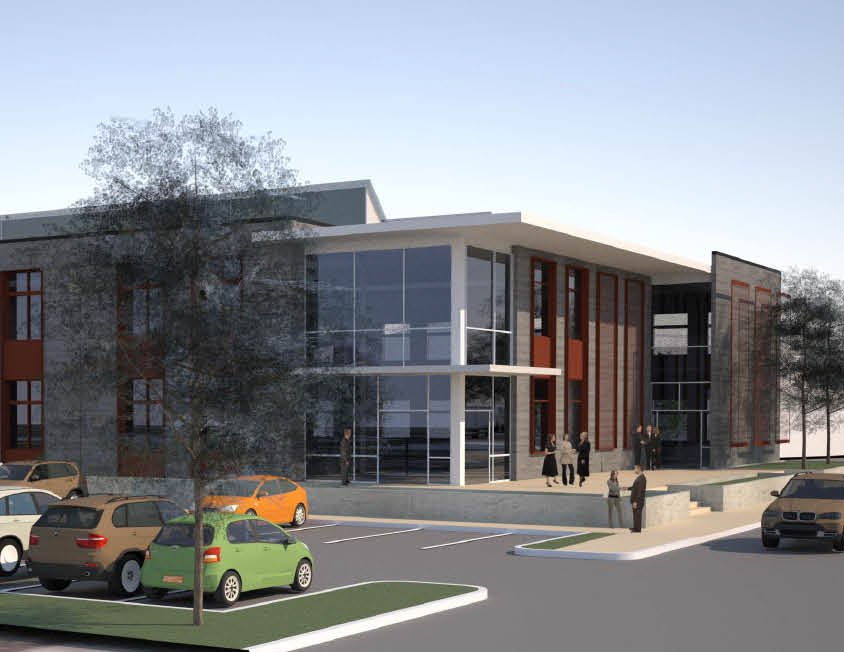
Example of a building that meets the required and discretionary standards for the
mixed use commercial subzone
2.
Discretionary standards. Of the following 13 standards listed below, at least six standards must be incorporated into the design of any new building or improvements meeting the criteria listed above in subsection B of this section:
a.
Relief panels;
b.
Cornice work;
c.
Balconies;
d.
Glazing of at least 40 percent along building façade facing main patron entrance and along major pedestrian circulation routes as shown on the approved master plan;
e.
Alcoves or recessed entryways;
f.
Shade panels or shutters;
g.
Rain protection such as awnings or canopies;
h.
Multiple color palettes consisting of a base, primary trim, and accent;
i.
Staggered wall sections;
j.
Roof terraces and/or gardens are encouraged to soften the building and add visual interest and vitality;
k.
Detailed and ornate hardware applied throughout the building design;
l.
Provide special emphasis to corner entrances through the use of architecture elements; and/or
m.
Detail the building with any of the following diverse materials and forms;
i.
Brick work with pattern articulation, simple corbelling, and accent materials;
ii.
Stone columns, windows, and accent combined with brick;
iii.
Cement or concrete work that has embossed ornamentation, architectural accent, or structural column division;
iv.
Ceramic and terra-cotta (pattern/relief molded), tile ornamentation, or decorative panels.
E.
Mixed use business (MU-B) design standards. Development within the mixed use business subzone is intended to provide for adequate pedestrian circulation for a less intense pedestrian emphasis than the commercial and residential subzones. The mixed use business subzone provides opportunities for larger building footprints that can serve the flexibility of both office and light industrial buildings while still providing a pedestrian friendly building that is integrated into the mixed use zone.
1.
Required standards.
a.
Roofline variation. Rooflines shall be varied on façades facing circulation corridors and/or main entry façades to break up the overall bulk and mass of buildings in the mixed use business subzone. At least one variation in roof height shall be provided for every 75 linear feet of front or side building walls. Variations can be grouped together along one or more elevations (i.e., grouping roof variations on the front façade of the building in lieu of providing variations on the side) so long as the total number of variations is provided. Roof variations are not required along the rear of buildings, unless the rear is facing a public right-of-way or otherwise as determined by the city administrator. If rear roof variations are required, then they shall be applied at a rate of one variation per 75 linear feet. Roofline variation shall be accomplished by using one or more of the following methods:
i.
Vertical offset ridge line;
ii.
Horizontal offset ridge line;
iii.
Variations in roof pitch; and/or
iv.
Other technique approved by the city administrator, shown to break up the overall bulk and mass of the building.
b.
Windows. Base floor windows used to meet the requirements of this Code must be transparent. Tinted, reflective, completely painted or completely covered windows are prohibited when used to meet the design requirements of this section.
c.
Blank walls. Modulate, or break up, blank walls over 30 linear feet in width with recesses, columns, bands, windows or textural treatment on any façade facing arterial/collector streets, pedestrian access ways, or main entries.
d.
Entry doors. Primary patron entry doors must be comprised of 50 percent or more window area.
e.
Color. Select exterior color schemes that are complementary of the surrounding environment. Consider the building as a whole as well as details that need emphasis. Softer muted colors establish a uniform background and are preferred. One color should be used on similar elements, such as window frames, to show that they are all part of the same façade. Reserve brighter colors for small special accents to emphasize entryways and to highlight special structural ornamentation.
f.
Signage. Integrate all signage with the architectural design of the building. Signs shall adhere to the standards established by chapter 17.38.
g.
Security bars. Exterior security bars are discouraged. If interior security bars are used, they shall be hidden during business hours along patron entries and building frontages adjacent to parking areas and pedestrian circulation.
h.
Materials. Materials specifically prohibited include vinyl siding, exposed plywood products, corrugated metal, and exposed raw concrete masonry/cinderblock. Architectural metal panels are allowed at the discretion of the city administrator. Concrete masonry material is allowed when the materials include integral colored blocks with textured finish (i.e., split face or ground finish).
i.
Garage doors. Materials and design of garage doors shall complement the architecture of the building and surrounding environment.
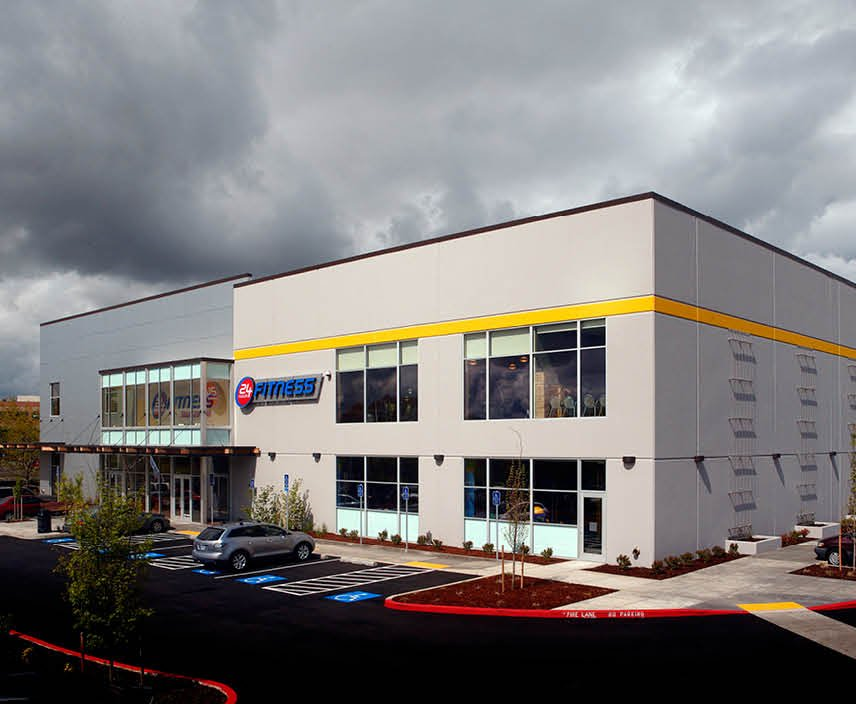
Example of a building that meets the required and discretionary standards for the
mixed use business subzone
2.
Discretionary standards. Of the following 13 standards listed below, at least four standards must be incorporated into the design of any new buildings or improvements meeting the criteria listed above in subsection B of this section:
a.
Relief panels;
b.
Cornice work;
c.
Balconies;
d.
Glazing of at least 25 percent along the building façade facing the main patron entrance and along major pedestrian circulation routes as shown on the approved master plan;
e.
Alcoves or recessed entryways;
f.
Shade panels or shutters;
g.
Rain protection such as awnings or canopies;
h.
Multiple color palettes consisting of a base, primary trim, and accent;
i.
Staggered wall sections;
j.
Roof terraces and/or gardens are encouraged to soften the building and add visual interest and vitality to the street;
k.
Detailed and ornate hardware applied throughout the building design;
l.
Special emphasis to corner entrances through the use of architecture elements, if building is flanked by two streets;
m.
Detail the building with any of the following diverse materials and forms:
i.
Brick work with pattern articulation, simple corbelling, and accent materials;
ii.
Stone columns, windows, and accent combined with brick;
iii.
Cement or concrete work that has embossed ornamentation, architectural accent, or structural column division;
iv.
Ceramic and/or terracotta (pattern/relief molded), tile ornamentation or decorative panels.
F.
Mixed use industrial (MU-I) design standards. Industrial developments within the mixed use zone provide employment opportunities for citizens of the city and the region as a whole. The proposed industrial development within the mixed use zone is designed to enhance areas visible from arterial and collector streets by reducing the "bulk" appearance of large buildings. Industrial buildings within the mixed use zone are intended to maintain pedestrian friendly amenities, be oriented towards the street, and blend well with the surrounding uses. Industrial design standards shall include the following:
1.
In order to break up vast expanses of single-element building elevations and to provide differentiation, the building design shall include a combination of architectural elements, features, and materials on façades. These features should be concentrated on façades facing public entry ways for a minimum of 15 percent of the façade.
2.
Roofline variation. Rooflines shall be varied on façades facing main entries to break up the overall bulk and mass of buildings in the industrial subzone. Roofline variation shall be provided for a minimum of 20 percent of the main entry façade. Roofline variation shall be accomplished by using one or more of the following methods:
a.
Vertical offset ridge line;
b.
Horizontal offset ridge line;
c.
Variations in roof pitch; and/or
d.
Other technique approved by the city administrator, shown to break up the overall bulk and mass of the building.
3.
Discretionary standards. Portions of the proposed industrial development within 200 feet of a city right-of-way and visible from the perspective of a passing motorist (i.e., not behind another building) shall meet any two of the following five design criteria:
a.
Relief panels;
b.
Cornice work;
c.
Multiple color palettes consisting of a base, primary trim, and accent;
d.
Staggered wall sections; and/or
e.
Entry elements serving as weather protection while directing attention to the building entrance.
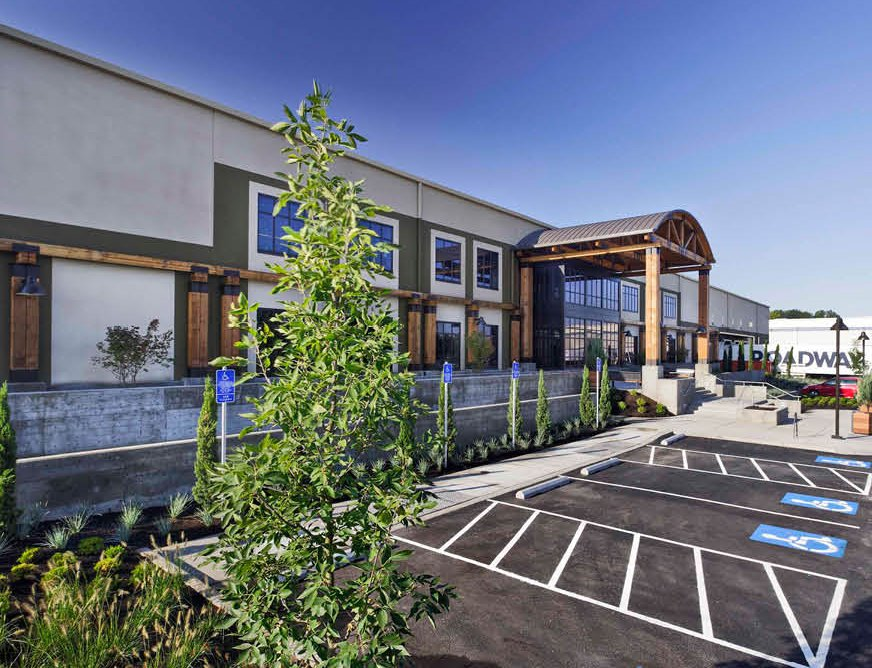
Example of a building that meets the required and discretionary standards for the
mixed use industrial subzone
G.
Mixed use residential (MU-R) design standards. In addition to the standards required in other sections of this chapter, the following provisions shall apply to multifamily development consisting of more than four units:
1.
Building location and orientation. Residential development in the mixed use zone shall be constructed consistent with the following requirements:
a.
Parking lots shall be located to the side and/or behind buildings, unless approved by the city administrator due to special circumstances. Parking lot perimeter landscaping and planting islands shall be included for lots with more than 20 spaces per section 17.25.070. When provided, parking lots will comply with the applicable standards of chapter 17.44.
b.
Units adjacent to public or private streets shall have the primary building entrances facing the street. A minimum of 40 percent of front (i.e., street-facing) elevations and a minimum of 25 percent of side and rear building elevations shall meet this standard. "Percent of elevation" is measured as the horizontal plane (linear feet) containing doors, porches, balconies, terraces and/or windows. The standard applies to each full and partial building story proposing external access to units. For buildings facing multiple streets, the primary frontage shall be determined by using the longest linear frontage on a street. Where building frontage is unclear by length or frontage, the city administrator shall determine which frontage is the primary frontage.
2.
Pedestrian access and circulation. Pedestrian access routes shall be provided according to section 17.25.060.
3.
Building modulation. Building façade modulation or appropriate architectural treatment shall occur at least every 25 linear feet along the façades facing adjacent properties, transition overlay areas, or streets. Minimum modulation depth shall be two feet.
4.
Roofline variation. Rooflines shall be varied to break up the overall bulk and mass of multifamily buildings. Roofline variation shall be accomplished by using one or more of the following methods:
a.
Vertical offset ridge line;
b.
Horizontal offset ridge line;
c.
Variations in roof pitch; and/or
d.
Other technique approved by the city administrator, shown to break up the overall bulk and mass of the building.
5.
Building variation. Developments with multiple structures shall use appropriate variations in character and use of colors to differentiate buildings within the development.
6.
Large multifamily complexes that have more than 25 units shall include an open space and recreational component into the site design, which comprises at least 15 percent of the gross site area. This requirement can be accomplished through the use of landscaping, play areas, and common open space, but may not include any required yard or setback areas. This requirement can be met within the approved master planned area if the allocated open green space is provided within a reasonable distance and with reasonable access from the proposed multifamily complex. A fee in lieu of the open space and recreational component proposal may be considered in accordance with RCW 82.02.020 and such fee shall be paid prior to master plan approval, unless otherwise authorized by the city.
7.
Supplementary standards outlined in section 17.18.070 apply to any development located within the mixed use residential subzone.
(Code 2020, § 17.25.090; Ord. No. 1310, § 1, 6-5-2013)
Sec. 17.25.100. - Reserved.
(Code 2020, § 17.25.100; Ord. No. 1310, § 1, 6-5-2013; Ord. No. 1511, § 2, 3-21-2024)
Sec. 17.25.110. - Reserved.
(Code 2020, § 17.25.110; Ord. No. 1310, § 1, 6-5-2013; Ord. No. 1511, § 2, 3-21-2024)
Sec. 17.25.115. - Reserved.
(Code 2020, § 17.25.115; Ord. No. 1310, § 1, 6-5-2013; Ord. No. 1511, § 2, 3-21-2024)
Sec. 17.25.120. - Development exempt from master plan requirements.
The following development activities are exempt from the master plan requirement:
A.
Renovation, remodeling and maintenance of existing development, provided no increase in impervious surface, no increase in building footprint, no increase in peak hour traffic by more than ten percent, no increase in demand for public water supply or no sanitary sewer service occurs as the result of such renovation, remodeling or maintenance.
B.
Public works projects initiated by the city for the installation, maintenance renovation or repair of any building, facility, utility, street, or related infrastructure which is owned or operated by the city.
C.
Uses which were previously approved through a master planning process are exempt from additional master plan review as long as the change does not increase the total floor area, parking requirements, or any off-site increases in transportation impacts or utility demand beyond what was identified in the previous master plan approval.
(Code 2020, § 17.25.120; Ord. No. 1310, § 1, 6-5-2013)
Sec. 17.25.130. - Reserved.
(Code 2020, § 17.25.130; Ord. No. 1310, § 1, 6-5-2013; Ord. No. 1433, § 4, 2-6-2020; Ord. No. 1511, § 2, 3-21-2024)
Sec. 17.25.135. - Reserved.
(Code 2020, § 17.25.135; Ord. No. 1310, § 1, 6-5-2013; Ord. No. 1511, § 2, 3-21-2024)
Sec. 17.25.140. - Reserved.
(Code 2020, § 17.25.140; Ord. No. 1310, § 1, 6-5-2013; Ord. No. 1511, § 2, 3-21-2024)
Sec. 17.25.145. - Reserved.
(Code 2020, § 17.25.145; Ord. No. 1310, § 1, 6-5-2013; Ord. No. 1511, § 2, 3-21-2024)
Sec. 17.25.150. - Reserved.
(Code 2020, § 17.25.150; Ord. No. 1310, § 1, 6-5-2013; Ord. No. 1511, § 2, 3-21-2024)
Sec. 17.25.155. - Reserved.
(Code 2020, § 17.25.155; Ord. No. 1310, § 1, 6-5-2013; Ord. No. 1511, § 2, 3-21-2024)
Sec. 17.25.160. - Reserved.
(Code 2020, § 17.25.160; Ord. No. 1310, § 1, 6-5-2013; Ord. No. 1511, § 2, 3-21-2024)
Sec. 17.25.165. - Reserved.
(Code 2020, § 17.25.165; Ord. No. 1310, § 1, 6-5-2013; Ord. No. 1511, § 2, 3-21-2024)
Sec. 17.25.170. - Reserved.
(Code 2020, § 17.25.170; Ord. No. 1310, § 1, 6-5-2013; Ord. No. 1511, § 2, 3-21-2024)
Sec. 17.25.180. - Severability.
A.
These regulations shall not be construed as affecting the liability of any person or as waiving the right of the city under any provisions existing at the time of adoption of these regulations, or as annulling any right obtained by any person by lawful action of the city under provisions existing at the time of adoption of the ordinance from which these regulations are derived.
B.
If any part of these regulations or applications thereof to any person or circumstances is adjudged invalid by a court of competent jurisdiction, such judgment shall not impair the validity of the remainder of these regulations.
(Code 2020, § 17.25.180; Ord. No. 1310, § 1, 6-5-2013)

