
Kalama City Zoning Code
CHAPTER 17
26.- COMMERCIAL ZONING8
Editor's note— Ordinance No. 1240, § 6, adopted June 17, 2009, amended ch. 17.26. Former ch. 17.26 pertained to similar subject matter and derived from Ordinance No. 1072, § 3, adopted 2001.
Sec. 17.26.010.- Purpose.
A.
Zones. This chapter describes the authorized uses and development standards for the commercial zones of the city: C-1 Central Business District (CBD); C-2 Highway Commercial District (HWC); Professional Service Overlay Zone (NPS); Sexually Oriented Business Overlay Zone (SOB); and Neighborhood Commercial Floating Zone (NCF). The commercial zones provide a variety of economic opportunities while integrating new development with the existing community. The intent is to protect the integrity of the historic downtown, promote the establishment of new commercial enterprises that will bring services and jobs to the community, maintain and develop an urban environment that is visually pleasing and functionally efficient, encourage pedestrian-oriented development and redevelopment, and minimize any undesirable impacts of these uses on other nearby uses and zoning districts. Each zone will provide for uses that will complement and not compete with other commercial districts.
(Code 2020, § 17.26.010; Ord. No. 1240, § 6, 6-17-2009; Ord. No. 1408, § 2, 8-16-2018; Ord. No. 1418, § 1, 3-21-2019)
Sec. 17.26.020. - Commercial zoning districts.
A.
C-1 Central Business District (CBD). This district provides for a wide range of retail and professional business uses and services with a focus on providing a pedestrian-friendly experience, promoting efficient use of land use and urban services, sustaining the city's identity by preserving the historical character of the community, encouraging mixed uses which promote development and revitalization, and enhancing the livability by providing formal and informal gathering places and areas for socialization.
B.
C-2 Highway Commercial District (HWC). This district provides for commercial activities which are dependent upon or require access by automobiles and trucks, require outdoor storage or display areas as well as off-street parking and loading areas and are not compatible with basic retail and professional business activities.
C.
Professional/Service Overlay Zone (PSO). This overlay of the residential area adjacent to the central business district is to provide for professional offices and service businesses which have little or no environmental impact, require minimal city services and generate little vehicle traffic. This zoning provides a buffered area of commercial transition from the central business district while acting to preserve and protect existing residential architecture and nearby residential zones.
D.
Sexually Oriented Business Overlay Zone (SOB). This overlay zone is established to provide an area for sexually oriented businesses requiring additional standards not common to general commercial activities. To mitigate the adverse impacts caused by such facilities and to maintain compatibility with other land uses and services permitted within the city. All uses must be approved by a conditional use permit.
E.
Neighborhood Commercial Floating Zone (NCF). This is a floating zone to allow for the placement of convenient retail sales and services within residential areas. Location may be limited and consolidated. All uses must be approved by a conditional use permit.
(Code 2020, § 17.26.020; Ord. No. 1240, § 6, 6-17-2009; Ord. No. 1408, § 2, 8-16-2018; Ord. No. 1418, § 1, 3-21-2019)
Sec. 17.26.030. - Allowed uses by zone.
KMC section 17.60.020 includes the list of allowed uses by zone. "P" means permitted outright, "C" means a conditional use permit is required, and "X" means prohibited. If a particular use is not listed and is not deemed substantially similar to another listed use by the city, then the use is prohibited. A use deemed to be prohibited may be appealed, subject to the provisions of section 17.12.050. Note that more specific development standards may apply to various uses as set forth in this chapter and this title.
A.
Conditional uses. All conditional uses shall be subject to the procedures in chapter 16.07 (or as hereafter amended) and shall meet the following additional criteria:
1.
Adverse impacts, as defined in this title, must be mitigated through special design or project limitations as needed to protect other properties in the vicinity of the proposed use and to protect the public interest;
2.
The proposed use must not detract from the intended use of the zone in which the property is located;
3.
If the conditional use is changed from one nonconforming use to another, the relative effects of the size, parking, traffic, light, glare, noise, odor and similar elements of the proposed use must be less detrimental to the intent of the zone and to property in the zone and vicinity than the existing nonconforming use; and
4.
Certain activities such as gambling, sexually oriented businesses, or an activity requesting placement under the neighborhood commercial floating zone must apply for a conditional use permit and meet the standards set for that activity.
B.
Nonconforming uses and structures. Continuation of nonconforming uses shall conform to code requirements and these additional standards:
1.
Continuation of uses.
a.
A structure containing a nonconforming use may be structurally altered as long as a nonconforming structure or use is not expanded.
b.
A conforming business use or building with a nonconforming outdoor storage area may be extended, structurally altered or expanded if the outdoor storage area is not expanded and provided, further, that the outdoor storage area is screened and landscaped according to the standards in this chapter.
2.
Changes from nonconforming uses.
a.
A structure occupied by a nonconforming use may be converted to a conforming use even if in a nonconforming structure.
b.
A nonconforming use may be converted by conditional use authorization to a use not otherwise permitted in the zone, according to the provisions of subsection A of this section.
(Code 2020, § 17.26.030; Ord. No. 1240, § 6, 6-17-2009; Ord. No. 1408, § 2, 8-16-2018; Ord. No. 1418, § 1, 3-21-2019; Ord. No. 1511, § 12, 3-21-2024)
Sec. 17.26.040. - Density and dimensional standards.
Unless otherwise noted in this title, dimensional requirements within commercial districts shall be in accordance with Table 17.26.040-1.
A.
Permanent buildings required. All buildings shall be installed on and attached to a permanent foundation and permanently attached to sewer, water and electrical utilities. The foundation and all building elements must comply with all city building code standards.
B.
Temporary buildings permitted. No temporary or mobile structure can remain on a commercially zoned site for more than 60 days, except temporary buildings approved in the conditional use process or temporary construction offices which can remain on a construction site for the term of the construction work or one year whichever is shorter, unless extended as a conditional use to accommodate a longer construction period.
C.
Professional/service and sexually oriented business overlay zones. These zones must meet all requirements for lot size, lot frontage, setbacks, building height and lot coverage of the zone on which it is overlaid.
D.
Neighborhood commercial floating zone. This zone must meet all requirements for the lot size, setbacks, building height and lot coverage of the zone on which it is located.
Table 17.26.040-1. Density and Dimensional Standards
1 Except to provide room for a sidewalk in conformance with city standards.
2 In cases where a side yard of a property zoned in the CBD zone abuts any residential zone, the side yard setback shall be that required by the residential zone.
3 In cases where a rear yard of a property zoned in the CBD zone abuts any residential zone and there is no alley between the CBD zoned lot and the residential zone, the rear setback shall be that required by the residential zone.
4 In cases where a side yard of a property zoned in the HWC zone abuts any residential zone, the side yard setback shall be a minimum 15 feet and shall be increased one foot for each foot the HWC use building height is increased over 25 feet.
5 In cases where a rear yard of a property zoned in the HWC zone abuts any residential zone, the rear setback shall be that required by the residential zone.
6 Buildings heights for properties fronting N. First Street are subject to the following height limits:
•
South of Geranium Street: 50 feet both sides.
•
North of Geranium Street: 60 feet west side/65 feet east side.
•
North of Holly Street: 70 feet west side/eight feet east side.
•
North of Ivy Street: 90 feet west side/95 feet east side.
(Code 2020, § 17.26.040; Ord. No. 1240, § 6, 6-17-2009; Ord. No. 1408, § 2, 8-16-2018; Ord. No. 1418, § 1, 3-21-2019)
_____
Sec. 17.26.070. - Reserved.
Editor's note— Ordinance No. 1278, § 1, adopted Oct. 5, 2011, repealed § 17.26.070, which pertained to screening, landscaping, and exterior lighting and derived from Ordinance No. 1240, § 6, adopted June 17, 2009.
Sec. 17.26.080. - Maker firms and maker spaces in the central business district.
A.
Purpose. This section establishes use and design standards for the development and operation of maker firms and makerspaces within the C-1 Central Business District. Maker firms are small scale businesses that manufacture, produce, or process and sell artisan or specialty goods direct to the end user using hand tools or small-scale, light mechanical equipment. Examples of maker firms include businesses such as craft breweries, distilleries, specialty foods, coffee roasting, apparel, jewelry, custom recreational equipment, art, and furniture. Makerspaces combine one or more maker firms with retail and/or food service space to sell products created on site, and provide member firms with the ability to design and create together in a collaborative environment.
B.
Makerspace uses. Only land uses listed in Table 17.60.020 as a permitted use may utilize the provisions of this section.
C.
Makerspace buildings. Makerspace buildings are a permitted use in the C-1 Central Business District provided the following standards are met:
1.
Building areas dedicated to manufacturing, production, and processing shall be within the same structure or on the same site as a structure containing a permitted commercial use providing on-site sales directly to the public, such as a retail use or food service establishment;
2.
Goods produced by maker firms shall be sold out of the permitted commercial use, which is the storefront for such sale;
3.
At all times, at least 25 percent of total floor area must be dedicated to commercial uses;
4.
Space devoted manufacturing, production, and processing may be converted to retail and/or food and beverage service during peak hours and used as makerspace during off peak hours, provided the minimum percentage specified in subsection C.3 of this section is met at all time; and
5.
The use is located on a site north of Geranium Street.
D.
Accessory uses. Maker firms may operate as an accessory use to a permitted commercial use within the C-1 Central Business District, provided the following standards are met:
1.
The accessory uses may occupy a maximum 25 percent of the floor area of a primary commercial use providing on-site sales directly to the public, such as a retail or food service; and
2.
Goods produced by maker firms shall be sold out of the permitted commercial use, which is the storefront for such sale;
3.
The accessory space may be converted to retail or food and beverage service during peak business hours, and used by the maker firm for manufacturing, production, and processing during off-peak hours.
E.
Development standards. All primary and accessory uses authorized under this section shall comply with the standards below:
1.
Parking for maker firms shall be calculated at the office rate set forth in section 17.44.020, all other uses are subject to the parking requirements of chapter 17.44.
2.
There shall be no emission of odorous, toxic, noxious matter, or dust in such quantities as to be readily detectable at any point along or outside property lines so as to produce a public nuisance or hazard.
(Code 2020, § 17.26.080; Ord. No. 1418, § 1, 3-21-2019)
Sec. 17.26.100. - Design standards.
This section establishes design standards for site improvements, landscaping, and architectural improvements to be used as the criteria for the preparation, review and action on applications. Approval of projects shall be based upon the appropriateness of a project's design and its relationship to its surroundings, as reflected in the language and direction contained in these standards. The following design standards shall serve as the criteria for the submittal, approval and construction of all reviewable building and planning projects:
A.
Central business district. These standards are supplemented and further defined or explained by that document entitled "Design Standards for the City of Kalama," as currently enacted or as hereafter amended from time to time by the city council, a copy of which shall be maintained in the office of the city clerk-treasurer for use and examination by the public.
1.
Site planning.
a.
Limit the depth of front setbacks to encourage pedestrian activity and strengthen the sense of enclosure along commercial streets.
b.
Conform building height to applicable zoning standards in KMC section 17.26.040. Align building height to the predominant height of other buildings along the same block.
c.
Ensure that building massing, height, and scale provide sensitive transition when adjoining residential zoning districts.
d.
Design the project to encourage human activity along the street. Provide for clear pedestrian access to the building.
e.
Locate off-street parking to the rear of the building.
f.
Treat a corner site as an opportunity for visual focus, if applicable.
g.
Consolidate trash dumpsters, mechanical equipment, and utilities to the rear of the building and screen to preserve and enhance the pedestrian environment.
2.
Existing building design standards. These standards relate to any building that has been issued an occupancy permit or has been legally occupied. These standards shall be applied to all façades bordering public streets.
a.
Applicability.
i.
Exterior modifications to an existing building may occur in incremental phases, not to exceed four years to completion, or in one complete stage. Initial modification must begin within 180 days of permit being issued. Incremental phasing of modifications must be consistent with an overall plan for the building's rehabilitation. Private parcels shall be required to implement these improvements identified in this section for:
(1)
Structural alteration or change other than incidental repairs that would prolong the life of the supporting members of a building, such as bearing walls, columns, beams, girders, or foundations;
(2)
The expansion of any building or development exceeding 20 percent of the existing floor or site area, or any 1,000 square foot addition or increase of impervious surface coverage thereto, whichever is lesser.
ii.
The following activities are exempt from the requirements of this section:
(1)
Routine or emergency repair or maintenance of public or private buildings, structures, landscaping or utilities;
(2)
Interior remodeling;
(3)
Official historically designated structures;
(4)
Changes of signs.
b.
Required standards.
i.
Design new additions to existing buildings and new infill construction to be compatible with the standards of this section.
ii.
Existing windows shall incorporate design elements which gives appeal to the window, such as a window hood, transom, bulkhead, or bay.
iii.
Multi-story building shall organize façade into a three-part horizontal division, including a base, middle and a cap in the architecture.
iv.
Materials specifically prohibited include vinyl siding, exposed plywood products, corrugated metal and exposed concrete masonry/cinderblock. Painting of these materials does not meet the requirement above.
v.
Building materials shall be selected for their sense of permanence. Recycled or renewed products should be utilized where practical. Preferred materials include natural stone, brick, wood, architectural grade metal, architectural grade composite materials, and stucco.
vi.
Preserve distinctive original features, finishes, and examples of skilled craftsmanship. Repair or duplicate deteriorated architectural features, where applicable.
vii.
Select exterior color schemes that fall within a traditional commercial range and are respectful of the surrounding neighborhood. Consider the building as a whole as well as details that need emphasis. Softer muted colors establish a uniform background. In general, use one color on similar elements such as window frames to show that they are all part of the same façade. Reserve brighter colors for small special accents to emphasize entryways and to highlight special structural ornamentation.
c.
Discretionary standards. Architectural detailing should be utilized to provide visual interest and individual character. Of the 12 discretionary standards listed below, at least five standards must be incorporated into the design of the revitalized existing building.
i.
Relief panels;
ii.
Cornice work;
iii.
Balconies;
iv.
Alcoves/recessed entryway;
v.
Shade panels/shutters;
vi.
Rain protection/awnings;
vii.
Multiple color palettes consisting of a base, primary trim, and accent;
viii.
Staggered wall sections;
ix.
Roof terraces and/or gardens are encouraged to soften the building and add visual interest and vitality to the street;
x.
Detailed and ornate hardware;
xi.
Provide special emphasis to corner entrances through the use of architecture elements, if building is flanked by two streets;
xii.
Detail the building with any of the following diverse materials and forms:
(1)
Brick work with pattern articulation, simple corbelling and accent materials;
(2)
Stone columns, windows, and accent combined with brick;
(3)
Cement work that has embossed ornamentation, architectural accent or structural column division;
(4)
Ceramic and terra-cotta (pattern/relief molded), tile ornamentation or decorative panels.
3.
New building design standards. These standards relate to any building that has never been issued an occupancy permit. The standards listed below shall be applied to enhance the city's historic downtown character and promote commerce:
a.
Required standards.
i.
Roof-mounted mechanical equipment must be hidden from street-view by parapet. If parapets do not provide adequate screening, screening walls or enclosures installed as an integral part of the architectural design must be used.
ii.
Organize commercial building façades with three-part horizontal division and vertical column division. A three-part horizontal division must include a base, middle and a cap in the architecture.
iii.
Windows:
(1)
Base floor windows must be transparent. Tinted, reflective, completely painted or completely covered windows are prohibited.
(2)
Windows constructed on the upper stories of the building must be twice as tall as they are wide.
iv.
Modulate, or break up, blank street-facing walls over 20 feet in width with recesses, columns, bands, windows or textural treatment.
v.
Primary doors must be comprised of 50 percent or more window area.
vi.
Select exterior color schemes that fall within a traditional commercial range and are respectful of the surrounding neighborhood. Consider the building as a whole as well as details that need emphasis. Softer muted colors establish a uniform background. In general, use one color on similar elements such as window frames to show that they are all part of the same façade. Reserve brighter colors for small special accents to emphasize entryways and to highlight special structural ornamentation.
vii.
Integrate all commercial signage with the architectural design of the building.
viii.
Exterior security bars are prohibited from street-flanking façade windows. If interior security bars are used, they shall be hidden during business hours.
ix.
Materials specifically prohibited include vinyl siding, exposed plywood products, corrugated metal and exposed concrete masonry/cinderblock. Painting of these materials does not meet the requirement above.
b.
Discretionary standards. Of the 12 standards listed below, at least six standards must be incorporated into the design of the new building:
i.
Relief panels;
ii.
Cornice work;
iii.
Balconies;
iv.
Alcoves/recessed entryway;
v.
Shade panels/shutters;
vi.
Rain protection/awnings;
vii.
Multiple color palettes consisting of a base, primary trim, and accent;
viii.
Staggered wall sections;
ix.
Roof terraces and/or gardens are encouraged to soften the building and add visual interest and vitality to the street;
x.
Detailed and ornate hardware;
xi.
Provide special emphasis to corner entrances through the use of architecture elements, if building is flanked by two streets;
xii.
Detail the building with any of the following diverse materials and forms:
(1)
Brick work with pattern articulation, simple corbelling and accent materials;
(2)
Stone columns, windows, and accent combined with brick;
(3)
Cement work that has embossed ornamentation, architectural accent or structural column division;
(4)
Ceramic and terra-cotta (pattern/relief molded), tile ornamentation or decorative panels.
4.
Landscaping, when principal structure is setback from any lot line.
a.
Use landscaping along the street frontages to integrate the commercial development with the community.
b.
In areas visible to the general public, provide site landscaping of appropriate scale in relationship to the building.
c.
Provide for the enhancement of off-street parking lots with landscaping.
d.
Select plant materials that are suitable to the site and to the city's climate zone.
B.
Highway commercial district.
1.
For new construction or expansion to an existing building for the purpose of creating a highway oriented commercial business as defined in this section, the applicant must submit to the city, site development plans, landscaping, parking and lighting plans, proposed building elevation drawings and other information needed by the city building and planning department to review for conformance with this chapter and other associated city codes.
a.
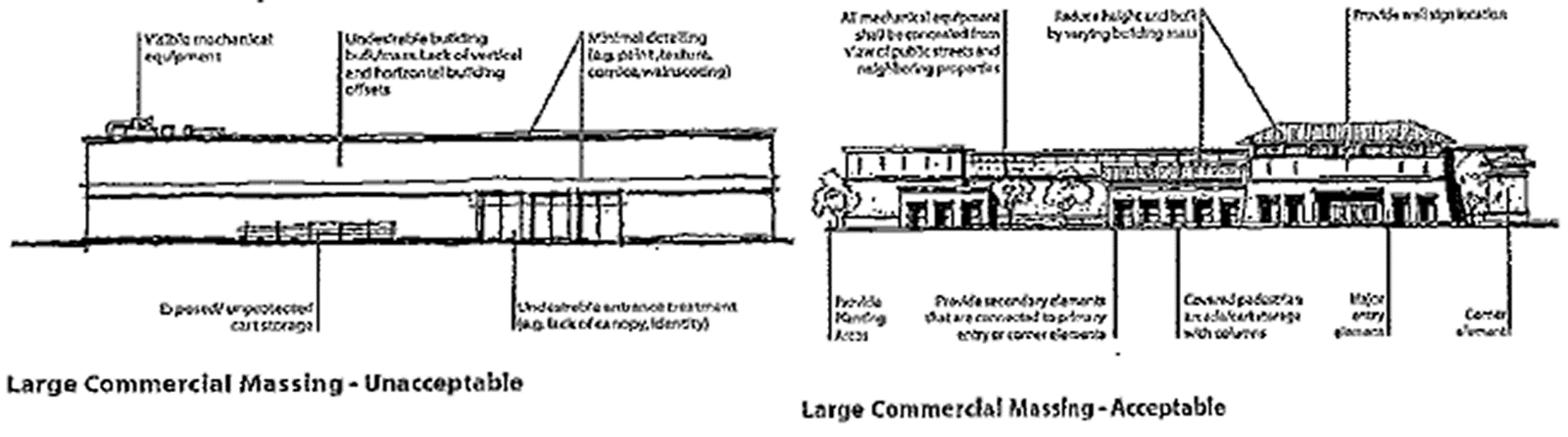
Where buildings with greater than 10,000 square feet of enclosed ground-floor space are proposed, they shall provide articulated façades on all street-facing elevations. This criterion is met when an elevation contains at least one of the following features for every 40 feet of building (horizontal length): windows; primary entrances; weather protection (awnings, canopies, arbors, trellises), building offsets; projections; changes in elevation or horizontal direction; sheltering roofs; terraces; a distinct pattern of divisions in surface materials; ornamentation; screening trees; small-scale lighting (e.g., wall-mounted lighting, or up-lighting); and/or similar features as generally shown in Figure 17.26.100-1. (Note: Figure 17.26.100-1 should not be interpreted as a required architectural style.)
b.
Figure 17.26.100-1.
2.
Gambling oriented business standards; regulated gambling uses. The following gambling oriented businesses as defined in this section are subject to the provisions and regulations contained in this chapter and section:
a.
Definitions.
i.
Mini-casinos with up to five tables, limited to card games.
ii.
Major-casinos with up to 15 tables or the limit of the state gambling commission, plus all gambling apparatuses, such as, slot machines, roulette wheels, etc.
b.
Location.
i.
Gambling establishments shall locate only within zones as identified in chapter 17.60.
ii.
The location of any licensed gambling activity is prohibited within 1,000 feet of the location of any other such gambling activity, or located on the same arterial street as any other such gambling activity.
c.
Building façade. All gambling oriented building façades, exteriors and exits must be indistinguishable from any commercial building, such as those located within the central business district of the city.
d.
Signs. Signs shall be permitted as allowed in accordance with chapter 17.38.
e.
Parking and lighting regulations. On-site parking shall be required as per sections 17.44.020 and 17.44.040.
f.
Number and types of permitted uses per structure. There shall be no sexually oriented business operating in the building, structure, or portion thereof in which a gambling oriented business is currently operating.
C.
Professional/service overlay zone. Activities placed in the professional/service overlay zones must meet the following standards for location, parking, noise, use, business hours, and pedestrian and vehicle traffic:
1.
Location and hours of operation. Professional services identified on Table 17.60.020 as permitted shall locate within the professional services overlay zone as identified on the official zoning map of the city. Businesses locating in the professional services overlay area are limited to hours open to the public between 7:00 a.m. and 9:00 p.m.
2.
Dimensional standards. Shall meet all requirements for lot size, setbacks, building height, and lot coverage of the underlying zone.
3.
Construction standards. New construction or remodeling shall be residential in character to blend with the historical characteristics predominate to the existing neighborhood.
4.
Parking. Adequate parking for occupants, employees, visitors, customers, and patrons shall be provided. A minimum of two parking spaces are required for any professional service site. Any on-street parking spaces immediately adjacent to a use may be counted toward fulfilling that use's parking requirements. The conduct of any home occupation, including, but not limited to, the storage of goods and equipment, shall not reduce or render unusable required off-street parking.
5.
Lighting. Lighting shall comply with the requirements of all applicable ordinances.
6.
Screening/landscaping and yard maintenance. All professional service sites shall be maintained in a neat and orderly manner. No nonfunctional vehicles, machinery, appliances, steel drums, boxes, crates, pallets, and related equipment and materials shall not be openly stored in side and rear yards.
7.
Signs. Signs shall be limited in size to one square foot. Vision clearance areas shall be maintained at all intersections, driveways, and alleys with no sign placed within 15 feet of any intersection. Signs shall not obstruct the view from any other neighboring property. Except with the exceptions herein signs shall be permitted as allowed in accordance with chapter 17.38.
8.
Environment. No noise, dust, odors, noxious fumes or vibrations resulting from a home occupation shall exceed that which is normally produced in a single-family dwelling. Mechanical or electronic equipment incidental to the conduct of a home occupation may be used provided such use does not create visible or audible interference in radio, television or telecommunication receivers or transmitters, or cause fluctuations in line voltage off the premises. Home occupations shall not interfere with the delivery of utilities or other services to the area.
D.
Sexually oriented business overlay zone. The following sexually oriented businesses, as defined in this section, are subject to the provisions and regulations contained in this chapter and section:
1.
Definitions.
a.
Adult arcades means an establishment where, for any form of consideration, one or more still or motion picture projectors, slide projectors, or similar machines, or other image-producing machines, for viewing by five or fewer persons each, are used to show films, motion pictures, video cassettes, slides, or other photographic reproductions which are characterized by the depiction or description of specific sexual activities or specified anatomical areas.
b.
Adult bookstores, novelty stores and/or video stores means a commercial establishment which has a significant or substantial portion of its stock-in-trade or a significant or substantial portion of its revenues or devotes a significant or substantial portion of its interior business or advertising to the sale or rental for any form of consideration, or any one or more of the following:
i.
Books magazines, periodicals, or other printed matter or photographs, films, motion pictures, video cassettes, slides, or other visual representations which are characterized by the depiction or description of specified sexual activities or specified anatomical areas; or
ii.
An establishment may have another significant or substantial portion of its stock-in-trade that does not involve the offering for sale or rental of materials depicting or describing specified sexual activities or specified anatomical areas and still be categorized as adult bookstore, adult novelty store, or adult video store. Such other business purposes will not serve to exempt such establishments from being categorized as an adult bookstore, adult novelty store, or adult video store so long as one of its principal business purposes is offering for sale or rental, for some form of consideration, the specified materials which depict or describe specified sexual activities or specified anatomical areas. Therefore any establishment having 20 percent or more of its stock-in-trade or revenues that come from trading in material depicting or describing specified sexual activities or specified anatomical areas shall be categorized as an adult bookstore, adult novelty store or adult video store.
c.
Adult cabaret means a nightclub, bar, restaurant, or similar commercial establishment, whether or not alcoholic beverages are served, which features:
1)
Persons who appear nude or semi-nude;
2)
Live performances which are characterized by the exposure of specified sexual activities or specified anatomical areas;
3)
Films, motion pictures, video cassettes, slides, or other photographic reproduction which are characterized by the depiction or description of specified sexual activities or specified anatomical areas.
d.
Adult motels/hotels mean a hotel, motel or similar commercial establishment which:
i.
Offers accommodation to the public for any form of consideration and provides patrons with closed-circuit television transmissions, films, motion pictures, video cassettes, slides or other photographic reproductions which are characterized by the depiction or description of specified sexual activities or specified anatomical areas and which has sign visible from the public right-of-way which advertises the availability of this adult type of photographic reproductions; or
ii.
Offers a sleeping room for rent for a period of time that is less than 20 hours; or
iii.
Allows a tenant or occupant of a sleeping room to sub rent the room for a period of time that is less than 20 hours.
e.
Adult motion picture theaters means a commercial establishment where films, motion pictures, video cassettes, slides, or similar photographic reproductions characterized by the depiction or description of specified sexual activities or specified anatomical areas are regularly shown for any form of consideration.
f.
Adult theaters means a concert hall, theater, auditorium, or similar commercial establishment which, for any form of consideration, regularly features persons who appear nude or semi-nude, or live performances which are characterized by exposure of specified sexual activities or specified anatomical areas.
g.
Nude/semi-nude model studios means a place where a person who appears nude or semi-nude or displays specified anatomical areas is provided for money or any form of consideration to be observed, sketched, drawn, painted, sculptured, photographed, or similarly depicted by other persons.
h.
Specified anatomicalareas means specified anatomical areas shall mean and include any of the following:
1)
Less than completely and opaquely covered human genitals, pubic region, buttocks, anus or female breasts below a point immediately above the top of areola;
2)
Human male genitals in a discernibly turgid state, even if completely and opaquely covered.
i.
Specified sexual activities means specified sexual activities shall mean and include any of the following:
1)
The fondling or other intentional touching of human genitals, pubic region, buttocks, anus, or female breasts;
2)
Sex acts, actual or simulated including intercourse, oral copulation or sodomy;
3)
Masturbation, actual or simulated;
4)
Human genitals in a state of sexual stimulation, arousal or tumescence;
5)
Excretory functions as part of or in connection with any of the activities set forth in subdivisions 1 through 4 of this definition.
j.
Youth oriented business or activity means a business utilizing a permanent building or facility where children under the age of 18 years are invited onto the premises in conjunction with such business activity and at least 50 percent of the business revenue is generated from their patronage.
2.
Location. Sexually oriented business establishments, as defined in this chapter, shall be located only within the sexually oriented business overlay zone within such geographical areas of the city as identified on the official zoning map of the city; provided, however, that even within the overlay zone, a sexually oriented business shall not be locate within a distance of 600 feet of an existing youth-oriented business or activity, provided, that the youth-oriented business or activity was operating prior to the proposed location of the sexually oriented business. No structure used for an adult book store, adult novelty store or adult video store or any form of adult sexually oriented business shall be located closer than 1,000 feet from any other structure or building used for such purpose nor shall such business locate closer than 1,200 feet to an existing church, park, or school property. The distances set forth in this section shall be measured in all compass directions, in a straight line, from the exterior wall of the existing building to the closest property line of the subject building.
3.
Building façade of sexually oriented businesses. All sexually oriented business building façades, exteriors and exits must be indistinguishable from any commercial building, such as those located within the central business district of the city. Illustrations depicting partially or totally nude humans shall not be posted, painted or depicted in any manner on any exterior wall, door or apparatus attached to or associated with such building.
4.
Plans required; new construction or expansion. For new construction or expansion to an existing building for the purpose of a sexually oriented business, as defined in this section, the applicant must submit to the city, site development plans, landscaping, parking and lighting plans, proposed building elevation drawings and other information needed by the city building and planning department to review for conformance with this chapter and other associated city codes.
5.
Parking and lighting regulations.
a.
Parking. On-site parking shall be required as per chapter 17.44, and in addition shall meet the following:
i.
All on-site parking areas and premises entries of sexually oriented businesses shall be illuminated from dusk until one hour past closing hour of operation with a lighting system which provides an average maintained horizontal illumination of one footcandle of light on the parking surface and/or walkways. An on-site exterior lighting plan shall be presented to the city police department for approval prior to the operation of any sexually oriented business.
ii.
All parking for sexually oriented businesses must be located to the front of the building. Parking and pedestrian access to the exterior rear of the building shall be denied to any persons other than employees and public officials during the performance of their respective duties and tasks by means of fencing approved by the city police and public works departments.
6.
Number and types of permitted uses per structure for sexually oriented businesses. There shall be no more than one sexually oriented business operation in the same building, structure or portion thereof. In addition, there shall be no other non-sexually oriented business operating in the same building, structure, or portion thereof in which a sexually oriented business is currently operating.
7.
Signs. Signs shall be permitted as allowed in accordance with chapter 17.38.
8.
Nonconforming uses. Any sexually oriented business lawfully operating on the effective date of the ordinance from which this chapter is derived, that as a result of this chapter is in violation of location, structural, uses, or parking or lighting requirements of this section, shall be deemed a nonconforming use. Such nonconforming use shall be permitted to continue at its existing location and in its existing building for a period not to exceed 90 days, unless sooner terminated for any reason, or voluntarily discontinued for a period of three continuous months. Nonconforming uses shall not be increased, extended or altered except if such alterations are to a conforming use.
E.
Neighborhood commercial floating zone.
1.
Location, size and/or consolidation of site shall first be approved by the planning commission at an open meeting with the applicant. Recommendations of the planning commission will be submitted with the conditional use permit application.
2.
Outdoor sales and display areas shall be limited to 40 percent of the lot area or 1,500 square feet, whichever is less.
3.
On-site parking and loading is required as per parking standards in chapter 17.44.
4.
The number of drive-in lanes and curb cuts shall be limited to one drive-in lane and curb cut per business, except for service stations, which shall be allowed a maximum of four drive-in lanes and curb cuts per business.
5.
All outdoor advertising signs placed on stand-alone poles shall be blackened-out on side facing adjacent residentially zoned property.
6.
All outdoor advertising shall be limited to on-site business only (the sign owner cannot rent sign space or erect a sign for a business not located on the immediate property).
7.
In the neighborhood commercial zone, only one business structure per lot shall be permitted.
(Code 2020, § 17.26.100; Ord. No. 1278, § 3, 10-5-2011; Ord. No. 1408, § 2, 8-16-2018; Ord. No. 1418, § 1, 3-21-2019)
Secs. 17.26.110—17.26.150. - Reserved.
Editor's note— Ordinance No. 1278, § 2, adopted Oct. 5, 2011, repealed § 17.26.150, which pertained to requirements applicable in specific zones and conditional use standards and derived from Ordinance No. 1240, § 6, adopted June 17, 2009.

