
Kalama City Zoning Code
CHAPTER 17
08. - DEFINITIONS
Sec. 17.08.010.- Definition of words and phrases.
For the purpose of this title, certain terms and words are defined in this chapter. When not inconsistent with the context, words used in the present tense include the future; the singular tense includes the plural, and the plural the singular; the term "shall" is always mandatory and the term "may" denotes a use of discretion in making a decision; the term "used," unless the context otherwise requires, shall be considered as though followed by the words: "or occupied," "or intended," "or arranged," and, "or designed to be used."
(Code 2020, § 17.08.010; Ord. No. 1227, § 3, 9-17-2008)
Sec. 17.08.020.- City officials.
Commission means the city planning commission.
(Code 2020, § 17.08.020; Ord. No. 1227, § 3, 9-17-2008)
Sec. 17.08.022.- Accessory uses.
Accessory building or accessory use means a subordinate use or subordinate building customarily incidental to and located upon the same lot occupied by the main use or building, excluding accessory dwelling units.
(Code 2020, § 17.08.022; Ord. No. 1227, § 3, 9-17-2008; Ord. No. 1343, § 2, 10-15-2014)
Sec. 17.08.025.- Adult family home.
Adult family home means the regular family abode of a person who is providing personal care, room and board to more than one but not more than four adults who are not related by blood or marriage to the person providing the services; except that a maximum of six adults may be permitted if the state department of social and health services determines that the home and the provider are capable of meeting standards and qualifications provided for by law.
(Code 2020, § 17.08.025; Ord. No. 1227, § 3, 9-17-2008)
Sec. 17.08.026.- Adverse impact.
Adverse impact means a negative impact for the physical, social, or economic environment from an action or project.
(Code 2020, § 17.08.026; Ord. No. 1240, § 4, 6-17-2009)
Sec. 17.08.027.- Ancillary retail use.
Ancillary retail use means a subordinate retail use or retail building customarily incidental to and located upon the same lot occupied by the main use or building. Gross floor area shall be no more than 25 percent of the GFA of the primary use; may be located in a separate building.
(Code 2020, § 17.08.027; Ord. No. 1313, § 1, 6-5-2013)
Sec. 17.08.0275.- Apparel and other related products manufacture and assembly.
Apparel and other related products manufacture and assembly means the fabrication of raw materials or assembly of parts to create clothing and/or other related items such as clothing accessories, trimmings, and gloves.
(Code 2020, § 17.08.0275; Ord. No. 1313, § 1, 6-5-2013)
Sec. 17.08.028.- Assisted living.
Assisted living means any group residential program that provides personal care and support services to people who need help with daily living activities as a result of physical or cognitive disability. Assisted living communities usually offer help with bathing, dressing, meals and housekeeping. The amount of help provided depends on individual needs, however, full-time (24 hours a day) care is not needed. Assisted living communities go by a variety of names: adult homes, personal care homes, retirement residences, etc.
(Code 2020, § 17.08.028; Ord. No. 1227, § 3, 9-17-2008)
Sec. 17.08.030.- Reserved.
Editor's note— Ordinance No. 1313, § 1, adopted June 5, 2013, repealed § 17.08.030 in its entirety. Former § 17.08.030 pertained to agriculture and was derived from Ordinance No. 1227, § 3, adopted September 17, 2008.
Sec. 17.08.040.- Alley.
Alley means a passage or way, open to public travel and dedicated to public use, affording generally a secondary means of vehicular access to abutting lots and not intended for general traffic circulation.
(Code 2020, § 17.08.040; Ord. No. 1227, § 3, 9-17-2008)
Sec. 17.08.043.- Arcade.
Arcade means a building or part of a building in which five or more pinball machines, video games, or other similar player-operated amusement devices are maintained.
(Code 2020, § 17.08.043; Ord. No. 1227, § 3, 9-17-2008)
Sec. 17.08.0435.- Automotive body and fender shop.
Automotive body and fender shop means a facility which provides collision repair services, including frame straightening, repair, painting, or undercoating of the body or frame of vehicles with a gross vehicle weight of 10,000 pounds or less, such as passenger cars, trucks, vans, and trailer bodies and interiors. Body and frame repair does not include mechanical engine or powertrain repair.
(Code 2020, § 17.08.0435; Ord. No. 1313, § 1, 6-5-2013)
Sec. 17.08.0437.- Automobile sales, including auto, truck trailer, boat, motorcycle, recreational vehicles and equipment.
Automobile sales means the storage and display for sale or lease of new or used motor vehicles, such as cars, trucks, boats, motorcycles, recreational vehicles and/or equipment or any type of unoccupied trailer, and where repair or body work is incidental to the operation of the new or used vehicle sales. Motor vehicles sales include motor vehicle retail or wholesale sales.
(Code 2020, § 17.08.0437; Ord. No. 1313, § 1, 6-5-2013)
Sec. 17.08.0438.- Automobile service and repair.
Automobile service and repair means a facility that provides servicing, repairs, and maintenance of automobiles, motorcycles, trucks, trailers, or similar vehicles, including, but not limited to, body, fender, muffler, or upholstery work, oil change and lubrication, painting, tire service and sales, or installation of CB radios, car alarms, stereo equipment, or other electronic equipment. Automobile service repair does include mechanical engine or powertrain repair.
(Code 2020, § 17.08.0438; Ord. No. 1313, § 1, 6-5-2013)
Sec. 17.08.044.- Bed and breakfast inn.
Bed and breakfast inn means an owner-occupied residence which has a maximum of three guest units within a single-family dwelling, the owners of which serve breakfast to guests.
(Code 2020, § 17.08.044; Ord. No. 1227, § 3, 9-17-2008)
Sec. 17.08.0445.- Blacksmith.
Blacksmith means an establishment whose primary use is to create, shape, and/or forge iron objects by hand.
(Code 2020, § 17.08.0445; Ord. No. 1313, § 1, 6-5-2013)
Sec. 17.08.045.- Buffer area.
Buffer area means a landscaped area of predetermined width intended to separate and partially obstruct the view of two adjacent land uses or properties from one another.
(Code 2020, § 17.08.045; Ord. No. 1227, § 3, 9-17-2008)
Sec. 17.08.050.- Building.
Building means any structure having a roof supported by columns or by walls, and intended for the shelter, housing, or enclosure of people, animals, or chattels.
(Code 2020, § 17.08.050; Ord. No. 1227, § 3, 9-17-2008)
Sec. 17.08.060.- Building, accessory.
Accessory building means a detached subordinate building, the use of which is incidental to that of a main building on the same lot, and which does not change or alter the character of the premises.
(Code 2020, § 17.08.060; Ord. No. 1227, § 3, 9-17-2008)
Sec. 17.08.070.- Building height.
Building height means the vertical measurement from average grade at the front of the house to the highest point of the roof beams in the case of flat roofs, to the deck line of mansard roofs, or to the center height between eaves and ridges for gable, hip or gambrel roofs. For this purpose, the level of the eaves shall be taken to mean the highest level where the plane of the roof intersects the plane of the outside wall on a side containing the eaves. The maximum building heights set forth in this title shall be measured utilizing this definition. Chimneys, ventilators, antennas, skylights or solar panels shall not be considered part of the height limit. Domes, towers, or spires which are the integral part of churches or religious buildings shall not be subject to these limitations.
(Code 2020, § 17.08.070; Ord. No. 1227, § 3, 9-17-2008)
Sec. 17.08.080.- Building, main.
Main building means a building in which is conducted the principal use of the lot on which it is situated. In any residential district, a dwelling shall be deemed to be the main building on the lot on which it is situated.
(Code 2020, § 17.08.080; Ord. No. 1227, § 3, 9-17-2008)
Sec. 17.08.085.- Build-to-line.
Build-to-lines are intended to encourage pedestrian-oriented development, while providing more flexibility in site design than what is possible with large setbacks. With buildings placed close to the street, a development can afford good access for emergency service providers in the case of a fire or other emergency. Where no minimum setback is required, all structures and buildings shall conform to the applicable fire and building codes (e.g., for attached structures, firewalls, and related requirements).
(Code 2020, § 17.08.085; Ord. No. 1240, § 4, 6-17-2009)
Sec. 17.08.087.- Business, labor, scientific and professional, civic, social, fraternal, charitable, labor and political organizations.
Business, labor, scientific and professional, civic, social, fraternal, charitable, labor and political organizations means a group of people formally organized for a common purpose or interest, usually cultural, religious, political, or entertainment, with regular meetings and formal written membership requirements.
(Code 2020, § 17.08.087; Ord. No. 1313, § 1, 6-5-2013)
Sec. 17.08.089.- Bungalow.
Bungalow means a freestanding building for overnight housing of travelers for sleeping purposes when part of a larger resort, or bed and breakfast complex.
(Code 2020, § 17.08.089; Ord. No. 1313, § 1, 6-5-2013)
Sec. 17.08.090.- Carport.
Carport means a covered space for the housing of one or more motor vehicles and enclosed on no more than two sides by walls, screens, cabinets, or other types of enclosures.
(Code 2020, § 17.08.090; Ord. No. 1227, § 3, 9-17-2008)
Sec. 17.08.095.- Car washes.
Car washes means the use of a site for washing and cleaning of passenger vehicles, recreational vehicles, or other light-duty vehicles.
(Code 2020, § 17.08.095; Ord. No. 1313, § 1, 6-5-2013)
Editor's note— Ordinance No. 1313, § 1, adopted June 5, 2013, repealed and replaced § 17.08.095 in its entirety. Former § 17.08.095 pertained to child day care center and was derived from Ordinance No. 1227, § 3, adopted September 17, 2008.
Sec. 17.08.097.- Casinos and cardrooms, or other gambling establishments.
Casinos and cardrooms, or other gambling establishments means a commercial facility where patrons wager money or something of value on the outcome of a game, including, but not limited to, a card game, slot machines, video games, bingo, keno, roulette or other types of games of chance.
(Code 2020, § 17.08.097; Ord. No. 1313, § 1, 6-5-2013)
Sec. 17.08.098.- Church.
Church means a building wherein persons regularly assemble for religious worship and which is maintained and controlled by a religious body organized to sustain public worship, together with all accessory buildings and uses customarily associated with such primary purpose. Includes synagogue, temple, mosque, or other such place for worship and religious activities.
(Code 2020, § 17.08.098; Ord. No. 1313, § 1, 6-5-2013)
Sec. 17.08.100.- Clinic.
Clinic means a building or portion of a building containing offices for providing medical, dental, psychiatric, or chiropractic services for out-patients only.
(Code 2020, § 17.08.100; Ord. No. 1227, § 3, 9-17-2008)
Sec. 17.08.102.- Colleges and universities (public or private) without students in residence.
Colleges and universities (public or private) without students in residence means a public or private post-secondary educational institution, granting associate, bachelor and/or graduate degrees and does not offer on-campus housing for student use.
(Code 2020, § 17.08.102; Ord. No. 1313, § 1, 6-5-2013)
Sec. 17.08.104.- Congregate care facility.
Congregate care facility means a multiple dwelling residential facility for senior citizens, featuring a central lobby, common dining area, and recreational rooms. The fee structure shall include at least one meal per day in the common dining area. Domiciliary care services may also be provided. Accessory support uses for tenants, such as pharmacies, banking services, barbers/beauticians, etc., may be included.
(Code 2020, § 17.08.104; Ord. No. 1227, § 3, 9-17-2008)
Sec. 17.08.106.- Continuing care facility.
Continuing care facility means an age-restricted development or facility that provides, to individuals of retirement status, accommodations and care, such as board, independent living, licensed nursing care and medical or other health-related services, and that typically enters into contracts to provide care.
(Code 2020, § 17.08.106; Ord. No. 1227, § 3, 9-17-2008)
Sec. 17.08.107.- Computer equipment manufacture and assembly.
Computer equipment manufacture and assembly means the fabrication of raw materials or assembly of parts to create computer equipment and computer peripheral equipment such as motherboards, disk drives, monitors, printers, and/or computer software.
(Code 2020, § 17.08.107; Ord. No. 1313, § 1, 6-5-2013)
Sec. 17.08.108.- Contractors' shops, and storage yards.
Contractors' shops, and storage yards means the enclosed or unenclosed spaces used for the repair, maintenance, or storage of a contractor's vehicles, equipment, or materials for use in the conduct of any building trade or building craft.
(Code 2020, § 17.08.108; Ord. No. 1313, § 1, 6-5-2013)
Sec. 17.08.1085.- Conference center.
Conference center means a facility used for service organizations, business and professional conferences, and seminars limited to accommodations for conference attendees. The accommodations can include sleeping, eating, and recreation. A conference center is not designed to be only utilized by the general public for overnight purposes.
(Code 2020, § 17.08.1085; Ord. No. 1313, § 1, 6-5-2013)
Sec. 17.08.1087.- Convenience stores.
Convenience stores means a retail store generally containing less than 2,500 square feet of gross floor area that is designed and stocked to sell primarily food, beverages, and other household supplies for the convenience of the neighborhood.
(Code 2020, § 17.08.1087; Ord. No. 1313, § 1, 6-5-2013)
Sec. 17.08.1088.- Cottage industry.
Cottage industry means a business located on the same lot as the operator's residence which functions without altering the residential character of the neighborhood, and which does not create negative impacts on the public health, safety, and general welfare of adjacent property owners.
(Code 2020, § 17.08.1088; Ord. No. 1343, § 2, 10-15-2014)
Sec. 17.08.109.- Day care center.
Day care center means a facility regularly providing care for 13 or more children for periods of less than 24 hours, and licensed for such use by the state. No such center shall be located in a private family residence unless the portion of the residence where the children have access is used exclusively for the children during the hours the center is in operation or is separate from the usual living quarters of the family.
(Code 2020, § 17.08.109; Ord. No. 1227, § 3, 9-17-2008)
Sec. 17.08.110.- Density.
Density means the number of dwelling units or building structures permitted per (net) acre of land. This definition is sometimes referred to as "net density," which excludes streets, easements, water, slope grades greater than 15 to 20 percent, open spaces, etc., from the building calculation formula.
(Code 2020, § 17.08.110; Ord. No. 1227, § 3, 9-17-2008)
Sec. 17.08.120.- Dwelling, multiple-family.
Multiple-family dwelling means a building designed for or containing four or more independent dwelling units.
(Code 2020, § 17.08.120; Ord. No. 1227, § 3, 9-17-2008)
Sec. 17.08.130.- Dwelling, single-family.
Single-family dwelling means a detached building designed for or containing one dwelling unit.
(Code 2020, § 17.08.130; Ord. No. 1227, § 3, 9-17-2008)
Sec. 17.08.140.- Dwelling, two-family.
Two-family dwelling means a detached building designed for or containing two independent dwelling units (e.g., duplex).
(Code 2020, § 17.08.140; Ord. No. 1227, § 3, 9-17-2008)
Sec. 17.08.142.- Dwelling, three-family.
Three-family dwelling means a detached building containing three independent living units (e.g., triplex).
(Code 2020, § 17.08.142; Ord. No. 1227, § 3, 9-17-2008)
Sec. 17.08.144.- Dwelling, four-family.
Four-family dwelling means a detached building containing four independent living units (e.g., fourplex).
(Code 2020, § 17.08.144; Ord. No. 1227, § 3, 9-17-2008)
Sec. 17.08.150.- Dwelling unit.
Dwelling unit means a building or portion of a building, which provides complete housekeeping facilities for one family, meeting all International Building Code and state energy code standards or manufactured home requirements as defined in section 17.08.282.
(Code 2020, § 17.08.150; Ord. No. 1227, § 3, 9-17-2008)
Sec. 17.08.155.- Electrical and electronic goods manufacture and assembly.
Electrical and electronic goods manufacture and assembly means the fabrication of raw materials or assembly of parts to create electrical and electronic equipment such as televisions, cameras, and stereo equipment and audio and video media, such as CDs, DVDs, Blu-Rays, smartphones and tapes.
(Code 2020, § 17.08.155; Ord. No. 1313, § 1, 6-5-2013)
Sec. 17.08.160.- Family.
Family means one or more persons living as a single nonprofit housekeeping unit.
(Code 2020, § 17.08.160; Ord. No. 1227, § 3, 9-17-2008)
Sec. 17.08.165.- Family home day care.
Family home day care means a facility in the family residence of the licensee providing regularly scheduled care for 12 or fewer children, including the children who reside at the home, within a birth through 11-years-of-age range exclusively for periods less than 24 hours, as licensed and regulated by the department of social and health services under WAC 388-155.
(Code 2020, § 17.08.165; Ord. No. 1227, § 3, 9-17-2008)
Sec. 17.08.1655.- Financial institutions, commercial banking, savings institutions, credit unions.
Financial institutions, commercial banking, savings institutions, credit unions means any trust company, savings bank, industrial bank, savings and loan association, building and loan association, commercial bank, credit union, federal association, investment company, or other business association, which is chartered under federal or state law, solicits, receives, or accepts money or its equivalent on deposit and loans money as a regular business.
(Code 2020, § 17.08.1655; Ord. No. 1313, § 1, 6-5-2013)
Sec. 17.08.166.- Financial institutions (non-bank).
Financial institutions (non-bank) means establishments whose principal business provides banking services, but does not meet the legal definition for a bank. Such uses may include transactions processing, reserve, and clearinghouse activities, mortgage and non-mortgage loan brokers, securities and commodity contracts intermediation and brokerage, other financial investment activities, and insurance carriers and related activities.
(Code 2020, § 17.08.166; Ord. No. 1313, § 1, 6-5-2013)
Sec. 17.08.167.- Flag lot.
Flag lot means a lot which consists of a lot or a grouping of contiguous small lots platted prior to 1950, including a narrow strip of property connecting the building site to an existing developed city street. See Figure 17.08-A. Flag lots may also be created in a new land division pursuant to title 16.
(Code 2020, § 17.08.167; Ord. No. 1227, § 3, 9-17-2008)
Sec. 17.08.168.- Flag pole.
Flag pole means that portion of a flag lot which connects a lot or a grouping of continuous small lots which were created prior to 1950 to an existing, developed city street. See Figure 17.08-A. A flag pole shall be a minimum of 12½ feet wide, for a single-family residence and 18 to 20 feet wide for multiple-family dwellings or more than one single-family residence that share the same section of flag pole.
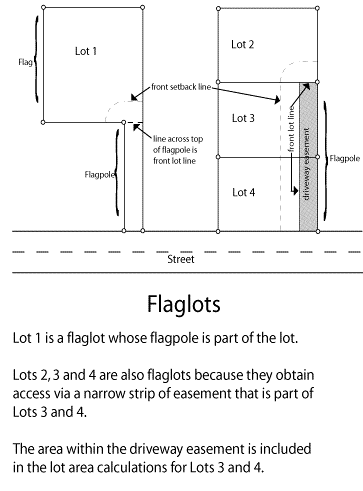
Figure 17.08-A. Flag Lot Schematic
(Code 2020, § 17.08.168; Ord. No. 1227, § 3, 9-17-2008)
Sec. 17.08.1685.- Furniture and fixtures manufacture and assembly.
Furniture and fixtures manufacture and assembly means the fabrication of raw materials or assembly of parts to create furniture and fixtures, such as plumbing, bathroom, and lighting fixtures and finished, hardwood, glass, laboratory, and/or garden furniture.
(Code 2020, § 17.08.1685; Ord. No. 1313, § 1, 6-5-2013)
Sec. 17.08.16855.- Gas and automobile service stations.
Gas and automobile service stations means a facility limited to retail sales to the public of gasoline, motor oil, lubricants, motor fuels, travel aids, and minor automobile accessories. In addition, such a facility may provide minor vehicle servicing, minor repairs, and maintenance, and may provide engine rebuilding but not reconditioning of motor vehicles, collision services such as body, frame, or fender straightening and repair, or overall painting of automobiles.
(Code 2020, § 17.08.16855; Ord. No. 1313, § 1, 6-5-2013)
Sec. 17.08.1686.- General manufacturing up to 40,000 square feet of gross floor area.
General manufacturing up to 40,000 square feet of gross floor area means those industrial or manufacturing activities which are engaged in the production of articles or a product from raw or prepared materials by giving them new forms and qualities. Gross floor area shall not exceed 40,000 square feet.
(Code 2020, § 17.08.1686; Ord. No. 1313, § 1, 6-5-2013)
Sec. 17.08.1687.- General warehouse.
General warehouse means a use characterized by trucking activity, but does not involve manufacturing or production that is engaged in distribution and storage activities of manufactured products, supplies, and equipment, excluding storage of materials that are volatile, explosive, present hazards, or are offensive.
(Code 2020, § 17.08.1687; Ord. No. 1313, § 1, 6-5-2013)
Sec. 17.08.1688.- General wholesale.
General wholesale means an establishment or place of business primarily engaged in selling and/or distributing merchandise to retailers; to industrial, commercial, institutional, or professional business users, or to other wholesalers; or acting as agents or brokers and buying merchandise for, or selling merchandise to, such individuals or companies. The term "merchandise" may include, but is not limited to, electronic or specialized equipment and components for communications, medical and dental, pharmaceutical, computer, optical, photographic, analytical, measurement, controlling and office products.
(Code 2020, § 17.08.1688; Ord. No. 1313, § 1, 6-5-2013)
Sec. 17.08.169.- Green roof.
Green roof means a roof of a building that is partially or completely covered with vegetation and soil, or a growing medium, planted over a waterproofing membrane. This does not refer to roofs which are merely colored green, as with green roof shingles. The term "green roof" may also include additional layers such as a root barrier and drainage and irrigation systems.
(Code 2020, § 17.08.169; Ord. No. 1240, § 4, 6-17-2009)
Sec. 17.08.1695.- Grocery store.
Grocery store means a retail establishment where most of the floor area is devoted to the sale of perishable, processed, and prepackaged food products for home preparation and consumption, which typically also offers other home care and personal care products, and which are substantially larger and carry a broader range of merchandise than convenience stores.
(Code 2020, § 17.08.1695; Ord. No. 1313, § 1, 6-5-2013)
Sec. 17.08.170.- Gross floor area.
Gross floor area means the sum of the areas of all floors included within the surrounding walls of a building or portion thereof, exclusive of vents, shafts, and courts.
(Code 2020, § 17.08.170; Ord. No. 1227, § 3, 9-17-2008)
Sec. 17.08.172.- Group home/rehabilitation center.
Group home/rehabilitation center means a publicly or privately operated residential facility licensed by the state for children, developmentally, physically or mentally disabled individuals, recovering alcoholics or drug addicts, juveniles or adults under the jurisdiction of the criminal justice system and other groups of a similar nature. Group homes or rehabilitation centers shall be limited to 12 residents, including staff.
(Code 2020, § 17.08.172; Ord. No. 1227, § 3, 9-17-2008)
Sec. 17.08.175.- Hazardous waste.
Hazardous waste means and includes all dangerous and extremely hazardous waste as defined in RCW chapter 70.105.
(Code 2020, § 17.08.175; Ord. No. 1227, § 3, 9-17-2008)
Sec. 17.08.178.- Hazardous waste treatment and storage facility.
Hazardous waste treatment and storage facility means a location at which hazardous waste is treated and/or stored.
(Code 2020, § 17.08.178; Ord. No. 1227, § 3, 9-17-2008)
Sec. 17.08.179.- Heavy duty equipment repair and service.
Heavy duty equipment repair and service means service of high-capacity mechanical devices.
(Code 2020, § 17.08.179; Ord. No. 1313, § 1, 6-5-2013)
Sec. 17.08.180.- Home occupation.
Home occupation means any use customarily conducted in a home environment and entirely within a dwelling unit or as allowed, within an accessory structure, which use is clearly incidental and secondary to the use of the dwelling unit for dwelling purposes and does not change the character thereof.
(Code 2020, § 17.08.180; Ord. No. 1227, § 3, 9-17-2008)
Sec. 17.08.183.- Hotel.
Hotel means any building containing six or more guest rooms which are used, rented, or hired for sleeping purposes by temporary guests and with access to units primarily from interior lobbies, courts, or halls.
(Code 2020, § 17.08.183; Ord. No. 1313, § 1, 6-5-2013)
Sec. 17.08.184.- Impervious surface.
Impervious surface means a hard surface area which either prevents or retards the entry of water into the soil mantle as under natural conditions prior to development, and/or a hard surface area which causes water to run off the surface in greater quantities or at an increased rate of flow from the flow present under natural conditions prior to development. Common impervious surfaces include, but are not limited to, roofs, walkways, patios, driveways, parking lots or storage areas, concrete or asphalt paving, gravel roads, packed earthen materials, and oiled, macadam or other surfaces which similarly impede the natural infiltration of stormwater. Open, uncovered retention/detention facilities shall not be considered as impervious surfaces.
(Code 2020, § 17.08.184; Ord. No. 1433, § 2, 2-6-2020)
Sec. 17.08.185.- Incineration facility.
Incineration facility is where municipal refuse is sorted and burned at extremely high temperature to reduce refuse into an ash substance. The ash is then transferred to an approved central sanitary landfill for final disposal in accordance with all applicable local, state and federal regulations.
(Code 2020, § 17.08.185; Ord. No. 1227, § 3, 9-17-2008)
Sec. 17.08.188.- Interested party.
Interested party means a person or group who makes an appearance in a proceeding through the submission of either written or verbal evidence. Groups shall designate one person as a representative or contact.
(Code 2020, § 17.08.188; Ord. No. 1433, § 2, 2-6-2020)
Sec. 17.08.190.- Junkyard.
Junkyard means the use of a lot, or a portion of any lot, for the storage, keeping, or abandonment of junk, including scrap metals or other scrap material, or the use of any area for the dismantling, demolition, or abandonment of automobiles or other vehicles or machinery or parts thereof. This definition shall not be deemed to include uses conducted entirely within an enclosed building or the outdoor display and sale of used automobiles in operable condition.
(Code 2020, § 17.08.189; Ord. No. 1227, § 3, 9-17-2008)
Sec. 17.08.193.- Key viewing areas.
Key viewing areas means those portions of significant public roads, parks, or other vantage points from which the public views the ridgeline, as identified by staff at the time of a land use application. Examples include the Columbia River, Interstate 5, and Marine Park.
(Code 2020, § 17.08.193; Ord. No. 1343, § 2, 10-15-2014)
Sec. 17.08.195.- Large-lot estate.
Large-lot estate means any parcel of property three acres in size or larger permitted within the R-1 zone.
(Code 2020, § 17.08.195; Ord. No. 1227, § 3, 9-17-2008)
Sec. 17.08.198.- Light industrial manufacturing.
Light industrial manufacturing means those industrial or manufacturing activities which are engaged in the production of articles or a product from raw or prepared materials by giving them new forms and qualities and may include, but are not limited to, processing, packaging or treatment of bakery goods, candy, pharmaceuticals, perfume, toiletries, soft drinks and food products and consumer goods, timber, wood and paper products, chemical products, medical and optical products, feed, metal and metal alloy products and the storage of raw materials for such industries.
(Code 2020, § 17.08.198; Ord. No. 1227, § 3, 9-17-2008; Ord. No. 1313, § 1, 6-5-2013)
Sec. 17.08.199.- Light industrial manufacturing up to 40,000 square feet of gross floor area.
Light industrial manufacturing up to 40,000 square feet of gross floor area means those industrial or manufacturing activities which are engaged in the production of articles or a product from raw or prepared materials by giving them new forms and qualities and may include, but are not limited to, processing, packaging or treatment of bakery goods, candy, pharmaceuticals, perfume, toiletries, soft drinks and food products and consumer goods, timber, wood and paper products, chemical products, medical and optical products, feed, metal and metal alloy products and the storage of raw materials for such industries. Gross floor area shall not exceed 40,000 square feet.
(Code 2020, § 17.08.199; Ord. No. 1313, § 1, 6-5-2013)
Sec. 17.08.200.- Lot.
Lot means one or more parcels of land occupied or to be occupied by a use or building or group of buildings and accessory buildings, together with such open spaces as are required under the provisions of this title and having not less than the minimum area required by this title in the district in which such land is situated. The term "lot," as defined herein, is not necessarily the same as a platted lot.
(Code 2020, § 17.08.200; Ord. No. 1227, § 3, 9-17-2008)
Sec. 17.08.210.- Lot, corner.
Corner lot means a lot bounded on two sides by intersecting street lines, provided that the interior angle of intersection or interception of said street lines does not exceed 135 degrees.
(Code 2020, § 17.08.210; Ord. No. 1227, § 3, 9-17-2008)
Sec. 17.08.220.- Lot depth.
Lot depth means the horizontal distance between the midpoints of the front lot line and the rear lot line. For lots with front lot lines containing curves or angles, the measurement shall be taken from a line parallel to and midway between a base line joining the front corners of the lot and a line drawn parallel to said base line tangent to the curve.
(Code 2020, § 17.08.220; Ord. No. 1227, § 3, 9-17-2008)
Sec. 17.08.230.- Lot, interior.
Interior lot means a lot other than a corner lot.
(Code 2020, § 17.08.230; Ord. No. 1227, § 3, 9-17-2008)
Sec. 17.08.240.- Lot line, front.
In the case of an interior lot, the term "front lot line" means the line separating the lot from the street right-of-way; in the case of a corner lot, the term "front lot line" means the line separating the narrowest street frontage of the lot from the street right-of-way, or, where a corner lot has two or more street frontages of equal length or nearly equal length, the front lot line shall be a line separating the narrowest frontage of the lot from a street or accessway or as otherwise approved by the building official. The flag pole on a flag lot shall not be used to determine the front lot line. The front lot line for a flag lot shall be as shown in Figure 17.08-A.
(Code 2020, § 17.08.240; Ord. No. 1227, § 3, 9-17-2008)
Sec. 17.08.250.- Lot line, rear.
Rear lot line means the lot boundary line or lines generally opposite the front lot line. For a triangular lot, the point at the rear shall be deemed to be the rear lot line. For other irregular-shaped lots, the rear lot line is all lot line segments that are most nearly opposite the front lot line. See Figure 17.08-C. In the case of a through lot, there will not be a rear lot line.
(Code 2020, § 17.08.250; Ord. No. 1227, § 3, 9-17-2008; Ord. No. 1454, § 1, 1-7-2021)
Sec. 17.08.260.- Lot line, side.
Side lot line means any lot boundary line which is not a front line or a rear lot line, excluding the flag pole on a flag lot.
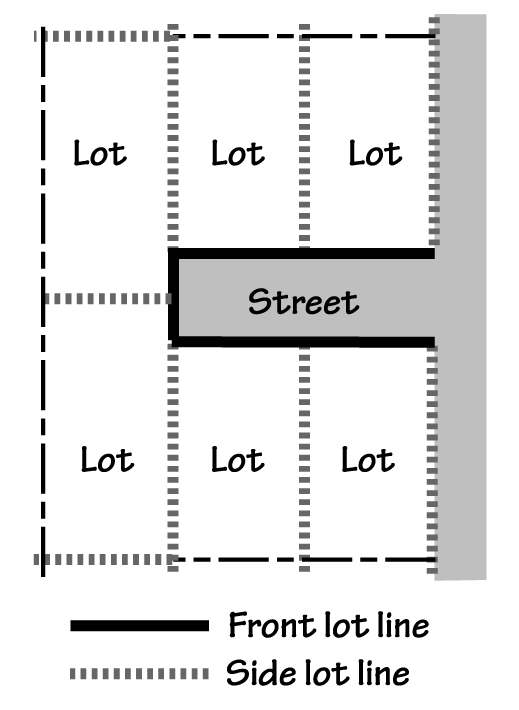
Figure 17.08-B. Lot Line Drawing
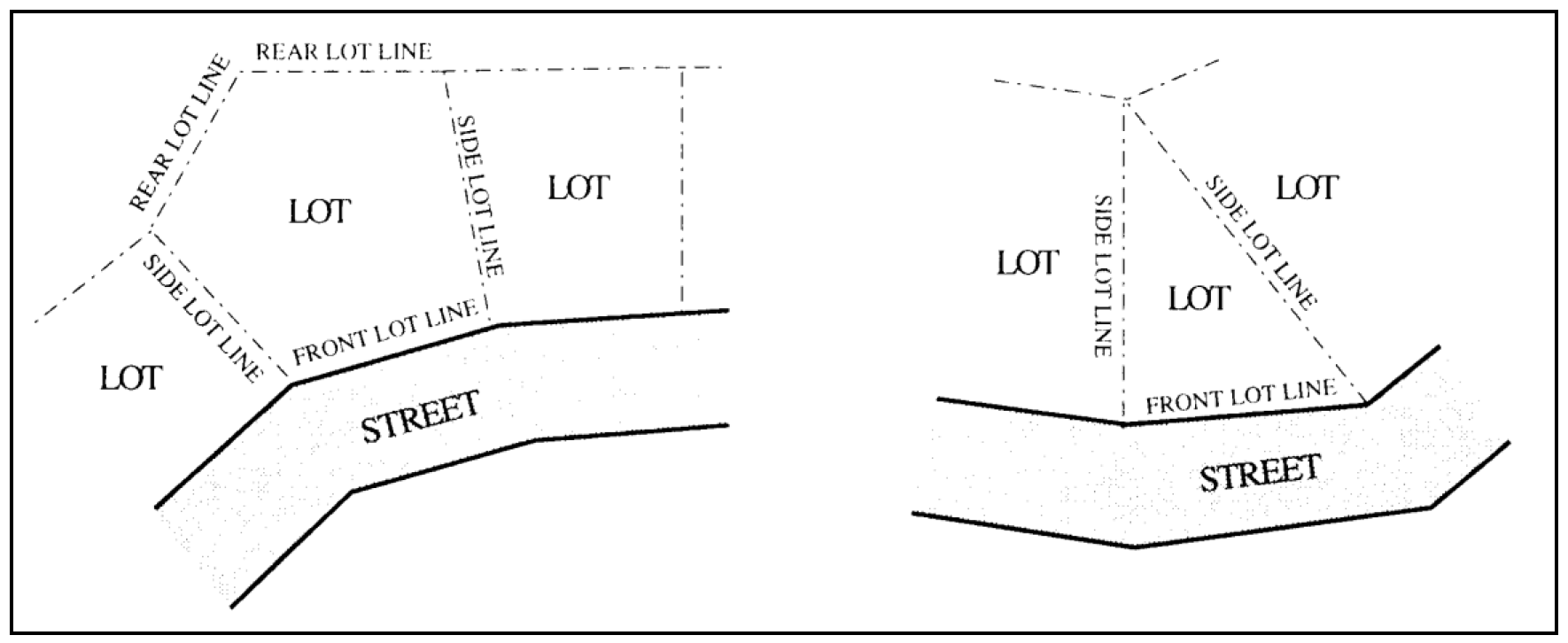
Figure 17.08-C. Lot Lines for Irregular Lots
(Code 2020, § 17.08.260; Ord. No. 1227, § 3, 9-17-2008)
Sec. 17.08.270.- Lot, through.
Through lot means a lot, other than a corner lot, having frontage on more than one street.
(Code 2020, § 17.08.270; Ord. No. 1227, § 3, 9-17-2008)
Sec. 17.08.280.- Lot width.
Lot width means the distance between side lot lines measured at a point 25 feet from the front lot line on each side lot line. The flag stem on a flag lot shall not be used to determine lot width, excluding the flag stem on a flag lot.
(Code 2020, § 17.08.280; Ord. No. 1227, § 3, 9-17-2008)
Sec. 17.08.2805.- Lumber sales, entirely within an enclosed building.
Lumber sales, entirely within an enclosed building means an establishment, contained within an enclosed building, where lumber and other building materials, such as brick, tile, cement, insulation, roofing materials and the like, are sold at retail. The sale of items, such as heating and plumbing supplies, electrical supplies, paint, glass, hardware, and wallpaper, is permitted at retail and deemed to be customarily incidental to the sale of lumber and other building materials at retail.
(Code 2020, § 17.08.2805; Ord. No. 1313, § 1, 6-5-2013)
Sec. 17.08.281.- Machinery/equipment rentals.
Machinery/equipment rentals mean the rental of equipment or machinery commonly stored outside and commonly used in construction and industrial activities or used for transport of goods or equipment.
(Code 2020, § 17.08.281; Ord. No. 1227, § 3, 9-17-2008)
Sec. 17.08.2815.- Maintenance.
Maintenance means actions, such as painting a previously painted surface or re-roofing using the same type of materials, performed to prevent a structure, or one of its constituent systems, from falling into a deteriorated condition.
(Code 2020, § 17.08.2815; Ord. No. 1433, § 2, 2-6-2020)
Sec. 17.08.282.- Manufactured home.
Manufactured home means a single-family residence constructed after June 15, 1976, in accordance with state and federal requirements for manufactured homes, which:
A.
Is comprised of at least two fully enclosed parallel sections each of not less than 12 feet wide by 36 feet long;
B.
Was originally constructed with and now has a composition or wood shake or shingle, coated metal, or similar roof of nominal 3:12 pitch; and
C.
Has exterior siding similar in appearance to siding materials commonly used on conventional site-built International Building Code single-family residences.
(Code 2020, § 17.08.282; Ord. No. 1227, § 3, 9-17-2008)
Sec. 17.08.2825.- Media productions.
Media productions means establishments primarily engaged in mass communications to individuals and/or the public through the following channels, including, but not limited to, TV and radio broadcasting, motion picture production, recording studios, newspaper, Internet content, magazine, book publishing, commercial art, photography, and advertising printing.
(Code 2020, § 17.08.2825; Ord. No. 1313, § 1, 6-5-2013)
Sec. 17.08.2826.- Micro-breweries and wineries.
Micro-breweries and wineries means a facility at which beer or wine is produced, packaged, and/or sold on the premises. The establishment may include other uses such as a standard restaurant, bar, tasting room, live entertainment, retail shops and food, and lodging facilities associated with tourism as otherwise permitted in the zoning district.
(Code 2020, § 17.08.2826; Ord. No. 1313, § 1, 6-5-2013)
Sec. 17.08.2828.- Motel.
Motel means any building containing six or more guest rooms which are used, rented, or hired for sleeping purposes by temporary guests and with access to units primarily from exterior balconies, courts, or halls.
(Code 2020, § 17.08.2828; Ord. No. 1313, § 1, 6-5-2013)
Sec. 17.08.283.- Nursing home.
Nursing home means any home, place or institution which operates or maintains facilities providing convalescent or chronic care, or both, for a period in excess of 24 consecutive hours for three or more patients not related by blood or marriage to the operator. This definition shall not be construed to include general hospitals or other places which provide care and treatment for the acutely sick and maintain and operate facilities for major surgery.
(Code 2020, § 17.08.283; Ord. No. 1227, § 3, 9-17-2008)
Sec. 17.08.284.- Offices, business and professional.
Offices, business and professional means administrative, executive, professional, or research offices, which have incidental functions, having only limited contact with public, provided that no merchandise or merchandising services are sold on the premises, except such as are incidental or accessory to the principal permissible use.
(Code 2020, § 17.08.284; Ord. No. 1313, § 1, 6-5-2013)
Sec. 17.08.2845.- Office support services and facilities.
Office support services and facilities means businesses which provide copy services such as photocopying, duplicating, blueprinting, binding, and other office related services, including printing, facsimile, and mail services, word processing, PC rentals, office product sales, and telephone and Internet access.
(Code 2020, § 17.08.2845; Ord. No. 1313, § 1, 6-5-2013)
Sec. 17.08.285.- Off-site hazardous waste treatment or storage facility.
Off-site hazardous waste treatment or storage facility means facilities that treat and store hazardous waste from generators on properties other than that on which the facility is located.
(Code 2020, § 17.08.285; Ord. No. 1227, § 3, 9-17-2008)
Sec. 17.08.288.- On-site hazardous waste treatment or storage facility.
On-site hazardous waste treatment or storage facility means a facility that stores or treats hazardous wastes generated on the same, geographically contiguous or bordering properties.
(Code 2020, § 17.08.288; Ord. No. 1227, § 3, 9-17-2008)
Sec. 17.08.289.- Open space.
Open space means improved or unimproved area that is:
(1)
Designated and maintained for active or passive recreation, other activities normally carried on outdoors, visual buffering, or for preservation in a natural state because of natural assets or unsuitability for development; and
(2)
Not covered by buildings, accessory structures, parking structures, parking lots, except that structures appropriate for the authorized recreational use of the open space used to conserve or enhance the amenities of the open space may be sited on the open space.
The term "open space" does not include street right-of-way, parking lots, or yards in platted lots at or less than the minimum lot size. Depending upon authorization by the city, open space may be owned either in common by and for the use of the subdivision residents or by a public agency through dedication to the public.
(Code 2020, § 17.08.289; Ord. No. 1240, § 4, 6-17-2009)
Sec. 17.08.290.- Outdoor advertising sign.
Outdoor advertising sign means any lettered, figured, or pictorial matter or other sign of any kind or character whatsoever, made visible for outdoor advertising purposes.
(Code 2020, § 17.08.290; Ord. No. 1227, § 3, 9-17-2008)
Sec. 17.08.299.- Reserved.
Editor's note— Ordinance No. 1313, § 1, adopted June 5, 2013, repealed § 17.08.299 in its entirety. Former § 17.08.299 pertained to places of assembly and was derived from Ordinance No. 1227, § 3, adopted September 17, 2008.
Sec. 17.08.300.- Parking space, off-street.
Off-street parking space means space within a public or private parking area, or within a building used for the parking or storage of motor vehicles.
(Code 2020, § 17.08.300; Ord. No. 1227, § 3, 9-17-2008)
Sec. 17.08.3005.- Public utility or capital facility.
Public utility or capital facility means a private corporation performing a public service and subject to special governmental regulations or a governmental agency or district performing a similar public service, the services by either of which are paid for directly by individual recipients. Such services shall be permitted in the underlying district and include, but are not limited to, water supply, electric power, gas, cable, fiber optic, sanitary sewer conveyance and pump stations, and other utility infrastructure.
(Code 2020, § 17.08.3005; Ord. No. 1313, § 1, 6-5-2013)
Sec. 17.08.301.- Recreation vehicle (RV).
Recreation vehicle (RV) means a vehicle, self-propelled or otherwise, designed for temporary sheltering of persons while traveling. Such vehicles shall have a body width of eight feet or less and a length of less than 41 feet. Such vehicles include truck-mounted campers, self-propelled travel vans and all units classified as motor homes by the state department of labor and industries.
(Code 2020, § 17.08.301; Ord. No. 1227, § 3, 9-17-2008)
Sec. 17.08.302.- Recreation vehicle park (RV park).
Recreation vehicle park (RV park) means an area designed, equipped and maintained under single ownership, for the temporary parking of two or more recreation vehicles being used for living quarters. Temporary parking, for the purposes of this title, shall mean the placement and use of an RV on a designated parking site in an approved RV park for not more than 30 days per designated site.
(Code 2020, § 17.08.302; Ord. No. 1227, § 3, 9-17-2008)
Sec. 17.08.304.- Recreation vehicle sales.
Recreation vehicle sales means the storage and display for sale or lease of new or used recreation vehicles and does not include manufactured homes. Sales lot shall not be larger than ten acres.
(Code 2020, § 17.08.304; Ord. No. 1313, § 1, 6-5-2013)
Sec. 17.08.306.- Recycling facility.
Recycling facility means a facility that accepts recyclable materials and may perform some processing activities. The principal function is to separate and store materials that are ready for shipment to end-use markets, such as paper mills, aluminum smelters, plastic re-manufacturing plants, or disposal. The presence of power-driven processing equipment distinguishes a processing facility from a collection facility. The facility receives and processes only residential and commercial recyclables such as food and beverage containers, paper, discarded computer and electronic equipment, mobile phones, tires, and oil or other liquids.
(Code 2020, § 17.08.306; Ord. No. 1227, § 3, 9-17-2008; Ord. No. 1313, § 1, 6-5-2013)
Sec. 17.08.307.- Repair.
Repair means actions to fix or mend a damaged or deteriorated structure, or one of its constituent systems, with similar material while retaining sound parts or elements.
(Code 2020, § 17.08.307; Ord. No. 1433, § 2, 2-6-2020)
Sec. 17.08.308.- Research and development facilities.
Research and development facilities means businesses that research innovative ideas in technology-intensive fields or scientific, medical, or educational research and testing. Research requiring the use of animal husbandry, including dogs, poultry, rodents, and monkeys, is prohibited. Research, development and testing laboratories do not involve the mass manufacture, fabrication, processing, or sale of products. Development and construction of prototypes may be associated with this use. Examples include, but are not limited to, businesses that engage in research and development of computer software, biotechnology, communication systems, geographic information systems, multimedia and video technology, and industrial or scientific products. The waste from such facilities shall meet the requirements of the appropriate health authority.
(Code 2020, § 17.08.308; Ord. No. 1313, § 1, 6-5-2013)
Sec. 17.08.3085.- Resort.
Resort means a building or series of buildings under common ownership which provide interrelated visitor and vacation services and are intended to serve the community and the travel needs of people traveling through the area. Typical uses include, but are not limited to, overnight accommodations including bungalow style lodging as defined, meeting rooms, convention and banquet facilities, administrative facilities, maintenance and storage facilities, resort recreation facilities, and restaurant and retail uses which are customarily appurtenant to such uses.
(Code 2020, § 17.08.3085; Ord. No. 1313, § 1, 6-5-2013)
Sec. 17.08.309.- Restaurant.
Restaurant means a commercial establishment in which the principal use is the preparation, service, and sale of food and beverages. Restaurants typically provide for on-site consumption of food sold and may also include carry-out, drive-throughs, and prepackaged food services.
(Code 2020, § 17.08.309; Ord. No. 1313, § 1, 6-5-2013)
Sec. 17.08.3096.- Retail sales.
Retail sales means the selling of an assortment of goods, wares, or merchandise not listed in other retail categories, sold directly to the ultimate consumer or a person without a resale license with a gross floor area less than or equal to 25,000 square feet. Retail sales with a gross floor area greater than 25,000 square feet shall only be permitted in the mixed use zone when retailer can demonstrate a market area greater than a 25-mile radius.
(Code 2020, § 17.08.3096; Ord. No. 1313, § 1, 6-5-2013)
Sec. 17.08.3098.- Ridgeline.
Ridgeline means the line that represents the place at which a landform, such as a cliff, bluff or ridge, meets the sky, as viewed from key viewing areas. In areas with thick, unbroken tree cover, the ridgeline is generally formed by the top of the vegetative canopy.
(Code 2020, § 17.08.3098; Ord. No. 1343, § 2, 10-15-2014)
Sec. 17.08.310.- Sign.
Sign. See chapter 17.38 for definition.
(Code 2020, § 17.08.310; Ord. No. 1227, § 3, 9-17-2008; Ord. No. 1266, § 1, 1-19-2011)
Sec. 17.08.312.- Small lot single-family residential.
Small lot single-family residential means a zoning overlay designated that permits single-family residential units to be built on lot sizes less than the standard lot size assigned the underlying residential zone, subject to site plan approval.
(Code 2020, § 17.08.312; Ord. No. 1227, § 3, 9-17-2008)
Sec. 17.08.314.- Specialty store.
Specialty store means retail sales businesses that specialize in one type or line of merchandise.
(Code 2020, § 17.08.314; Ord. No. 1313, § 1, 6-5-2013)
Sec. 17.08.315.- State siting criteria.
State siting criteria means the criteria developed by the state department of ecology under the authority of RCW 70.105.210 for the siting of hazardous waste management facilities.
(Code 2020, § 17.08.315; Ord. No. 1227, § 3, 9-17-2008)
Sec. 17.08.318.- Storage.
Storage means the holding of hazardous waste for a temporary period. Accumulation of hazardous waste by an on-site generator is not storage as long as the generator complies with the applicable requirements of WAC 173-200 and 173-201.
(Code 2020, § 17.08.318; Ord. No. 1227, § 3, 9-17-2008)
Sec. 17.08.319.- Storage mini and covered outdoor storage.
Storage mini and covered outdoor storage means a building or group of buildings divided into separate compartments used to meet the temporary storage needs of small businesses, apartment dwellers, and other residential uses; and may include refrigerated facilities. Units typically do not have water fixtures within its confines and are limited solely to storage of inanimate objects. Storage areas shall not incorporate any other areas of project development such as parking areas, landscaping, and yard areas unless specifically authorized by the applicable land use regulations.
(Code 2020, § 17.08.319; Ord. No. 1313, § 1, 6-5-2013)
Sec. 17.08.320.- Street.
Street means a public right-of-way which affords the principal means of access to abutting property, including avenue, place, way, drive, lane, boulevard, highway, road, and any other thoroughfare except an alley.
(Code 2020, § 17.08.320; Ord. No. 1227, § 3, 9-17-2008)
Sec. 17.08.330.- Street line.
Street line means the boundary line separating a lot from a street.
(Code 2020, § 17.08.330; Ord. No. 1227, § 3, 9-17-2008)
Sec. 17.08.340.- Structure.
Structure means anything constructed or erected which requires location on the ground or attachment to something having location on the ground.
(Code 2020, § 17.08.340; Ord. No. 1227, § 3, 9-17-2008)
Sec. 17.08.350.- Townhouse.
Townhouse means a residential living unit that includes fee ownership of the underlying property, while maintaining one or more common walls.
(Code 2020, § 17.08.350; Ord. No. 1227, § 3, 9-17-2008)
Sec. 17.08.355.- Transportation vehicle, equipment manufacture and assembly.
Transportation vehicle, equipment manufacture and assembly means the manufacturing and fitting or retrofitting of light trucks and utility vehicles (i.e., body additions and chassis modifications), vehicles retrofitted or fitted include light duty vans and trucks, pick-up trucks, minivans, automobiles, motorcycle and sport utility vehicles.
(Code 2020, § 17.08.355; Ord. No. 1313, § 1, 6-5-2013)
Sec. 17.08.360.- Transportation including cargo, parking, towing, passenger terminal, heliports and helistops.
Transportation means facilities and uses whose main activities include transporting people or goods, including, but not limited to, cargo, parking, towing, passenger terminal, heliports and helistops.
(Code 2020, § 17.08.360; Ord. No. 1313, § 1, 6-5-2013)
Sec. 17.08.365.- Treatment.
Treatment means the physical, chemical or biological processing of hazardous waste to make such waste nondangerous or less dangerous, safer for transport, amenable for energy or material resource recovery, amenable for storage, or reduced in volume. A hazardous waste treatment facility requires a state dangerous waste permit under the provisions of chapter 173-303, Washington Administrative Code (WAC).
(Code 2020, § 17.08.365; Ord. No. 1227, § 3, 9-17-2008)
Sec. 17.08.366.- Truck stop.
Truck stop means a facility intended to provide services to the trucking industry, including, but not limited to, the following activities: dispensing of fuel, repair shops, automated washes, restaurants, and motels; all as part of the facility.
(Code 2020, § 17.08.366; Ord. No. 1313, § 1, 6-5-2013)
Sec. 17.08.368.- Truck terminal.
Truck terminal means a building or area in which freight brought by a truck is assembled and/or stored for routing or reshipment, or in which semi-trailers, including tractor and/or manufactured home units and other trucks are parked or stored.
(Code 2020, § 17.08.368; Ord. No. 1227, § 3, 9-17-2008)
Sec. 17.08.370.- Variance.
Variance means a modification of the regulations of this title after finding that the literal application of the provisions of this title would cause undue and unnecessary hardship in view of certain facts and conditions applying to a specific building, structure, or parcel of land.
(Code 2020, § 17.08.370; Ord. No. 1227, § 3, 9-17-2008)
Sec. 17.08.371.- Vehicle storage and maintenance including bus bases, personal transportation services.
Vehicle storage and maintenance means the depository, stockpiling, or safekeeping of vehicles and vehicle related items for a period of over 24 hours and/or the servicing, repairing, or altering of vehicle and vehicle related items. Uses may include bus bases and personal transportation services such as taxi and limousine services.
(Code 2020, § 17.08.371; Ord. No. 1313, § 1, 6-5-2013)
Sec. 17.08.372.- Vocational schools and trade sector training facilities, both public and private.
Vocational schools and trade sector training facilities, both public and private means a specialized instructional establishment that provides on-site training of business, commercial, testing and/or trade skills to students and that does not offer a complete educational curriculum (e.g., beauty school, modeling school, data processing, computer repair).
(Code 2020, § 17.08.372; Ord. No. 1313, § 1, 6-5-2013)
Sec. 17.08.375.- Waste transfer site.
Waste transfer site means an area where municipal refuse is collected in either 40 cubic yard drop boxes or 100 cubic yard transfer manufactured homes, for hauling to an approved central sanitary landfill for final disposal in accordance with all applicable local, state and federal regulations.
(Code 2020, § 17.08.375; Ord. No. 1227, § 3, 9-17-2008)
Sec. 17.08.377.- Welding and fabrication.
Welding and fabrication means to join materials, usually metals or thermoplastics, by coalescence.
(Code 2020, § 17.08.377; Ord. No. 1313, § 1, 6-5-2013)
Sec. 17.08.380.- Yard, front.
Front yard means a yard extending the full width of a lot, and measured as to depth at the least horizontal distance between the front lot line and the exterior wall of building on the lot.
(Code 2020, § 17.08.380; Ord. No. 1227, § 3, 9-17-2008)
Sec. 17.08.390.- Yard, rear.
Rear yard means a yard which extends the full width of a lot, and measured as to depth at the least horizontal distance between the rear lot line and the exterior wall of the main building or structure on the lot.
(Code 2020, § 17.08.390; Ord. No. 1227, § 3, 9-17-2008)
Sec. 17.08.400.- Yard, side.
Side yard means a yard which extends from the front lot line to the rear lot line, and measured as to width at the least horizontal distance between a side lot line and the exterior wall of a main building or structure on the lot.
(Code 2020, § 17.08.400; Ord. No. 1227, § 3, 9-17-2008)
Sec. 17.08.405.- Yard and garden supplies, including nurseries.
Flora products and produce are sold to the consumer. These centers, which may include a nursery and/or greenhouses, import most of the items sold, and include plants, nursery products and stock, potting soil, fertilizers, hardware, power equipment and machinery, hoes, rakes, shovels, and other garden and supplies to support agricultural production including animal feed and farm variety tools and utensils.
(Code 2020, § 17.08.405; Ord. No. 1313, § 1, 6-5-2013)

