
Kalama City Zoning Code
CHAPTER 17
28.- I-1 INDUSTRIAL USE DISTRICT9
Editor's note— Ordinance No. 1240, § 7, adopted June 17, 2009, amended ch. 17. 28. Former ch. 17.28 pertained to similar subject matter and derived from Ordinance No. 491, §§ 6.01—6.05, adopted 1966; Ordinance No. 751, § 4, adopted 1988; and Ordinance No. 1200, § 1, adopted 2007.
Sec. 17.28.010.- Purpose.
The I-1 district provides for manufacturing, warehousing, distribution operations, and recreational opportunities and limited commercial activity.
(Code 2020, § 17.28.010; Ord. No. 1240, § 7, 6-17-2009)
Sec. 17.28.020. - Permitted uses.
The following uses are permitted in any I-1 district:
A.
Commercial, manufacturing, and industrial uses similar in operation as, but not restricted to, the following:
1.
Port facilities, such as ship berthing areas, loading and unloading facilities, and port office buildings;
2.
Wood, coal, and oil fuel yards;
3.
Retail and wholesale lumber and building material yards;
4.
Contractors' offices, shops, and storage yards;
5.
Freight warehouse terminals;
6.
Automotive repair garages and body and fender shops;
7.
Blacksmith, welding, and metal fabricating shops;
8.
Processing, manufacturing, packaging, distribution, and storage operations;
9.
On-site and off-site hazardous waste treatment and storage facilities, provided that such facilities meet the state siting criteria adopted pursuant to the requirements of RCW 70.105.210 as now or hereafter amended;
10.
Within the boundaries specified in Figure 17.28.020-1, cultural institutions and museums;
11.
Within the boundaries of Figure 17.28.020-1, lodging facilities and restaurants, pubs, tasting rooms, retail uses and microbreweries with indoor and outdoor seating, either in standalone buildings or combined into a single building, provided that microbreweries must be an integral part of a restaurant and the product can be brewed only for on-site retail. Uses under this subsection are subject to the following:
a.
Submittal of plans. For new construction or expansion to an existing building, an applicant must submit to the city, site development plans, landscaping, parking and lighting plans, proposed building elevation drawings and other information needed by the city building and planning department to review for conformance with this chapter and other associated city codes;
b.
Signage. Signs shall be permitted as allowed in accordance with the sign standards set forth for commercial districts in section 17.38.110;
c.
Building setbacks. Minimum front yard setback shall be 15 feet from the shoulder of roads and streets. There shall be no limitations on side and rear yard setbacks, provided that all permanent buildings shall be set back a minimum of 35 feet from the Columbia River and all permanent buildings shall be a minimum of 25 feet apart;
d.
Building height. No building shall be more than three and one-half stories high or over 45 feet in height;
e.
Lot coverage. There are no percentage limitations on lot coverage, provided that site landscaping standards are met;
f.
Site lighting. Exterior wall-mounted and pole-mounted lighting shall be shielded and directed downward. Exterior lighting on poles shall not exceed the maximum building height specified herein;
g.
Site landscaping. Interior landscaping of ten percent or more of the site area shall be required when the site, exclusive of the building area, is 5,000 or more square feet, or the proposed structure or combination of structures is greater than 5,000 square feet in size. The interior landscaping placed within the on-site parking area shall be counted towards the minimum ten percent requirement. Where unique site specific conditions exist, deviations from this requirement may be authorized;
h.
Off-street parking. Parking associated with authorized uses shall generally comply with chapter 17.44. Minimum parking requirements for authorized uses may be addressed through joint parking arrangements to reduce the need to construct new parking areas immediately adjacent to Columbia River;
i.
Off-street parking landscaping. Landscaping shall be provided in any newly constructed off-street parking on a site in such a manner to soften the hard-surfaced nature of the parking area and provide shading, where appropriate;
j.
Vision clearance. Vision clearance shall be maintained at all street intersections of private and public roadways, alleys, driveways. A vision clearance setback of 15 feet shall be maintained from the edge of any existing or proposed roadway. Low-height landscaping such as shrubs three feet or less in height or grass or groundcovers shall be planted and maintained in required vision clearance areas;
k.
Permanent buildings required. All buildings shall be installed on and attached to a permanent foundation and permanently attached to sewer, water and electrical utilities. The foundation and all building elements must comply with all current and applicable city building code standards;
l.
Temporary buildings permitted. A temporary or mobile structure or tent associated with an authorized use and intended to support a special event shall be allowed for a maximum of 30 days, except temporary buildings approved in the conditional use process or temporary construction offices which can remain on a construction site for the term of the construction work or one year, whichever is shorter, unless extended as a conditional use to accommodate a longer construction period.
Figure 17.28.020-1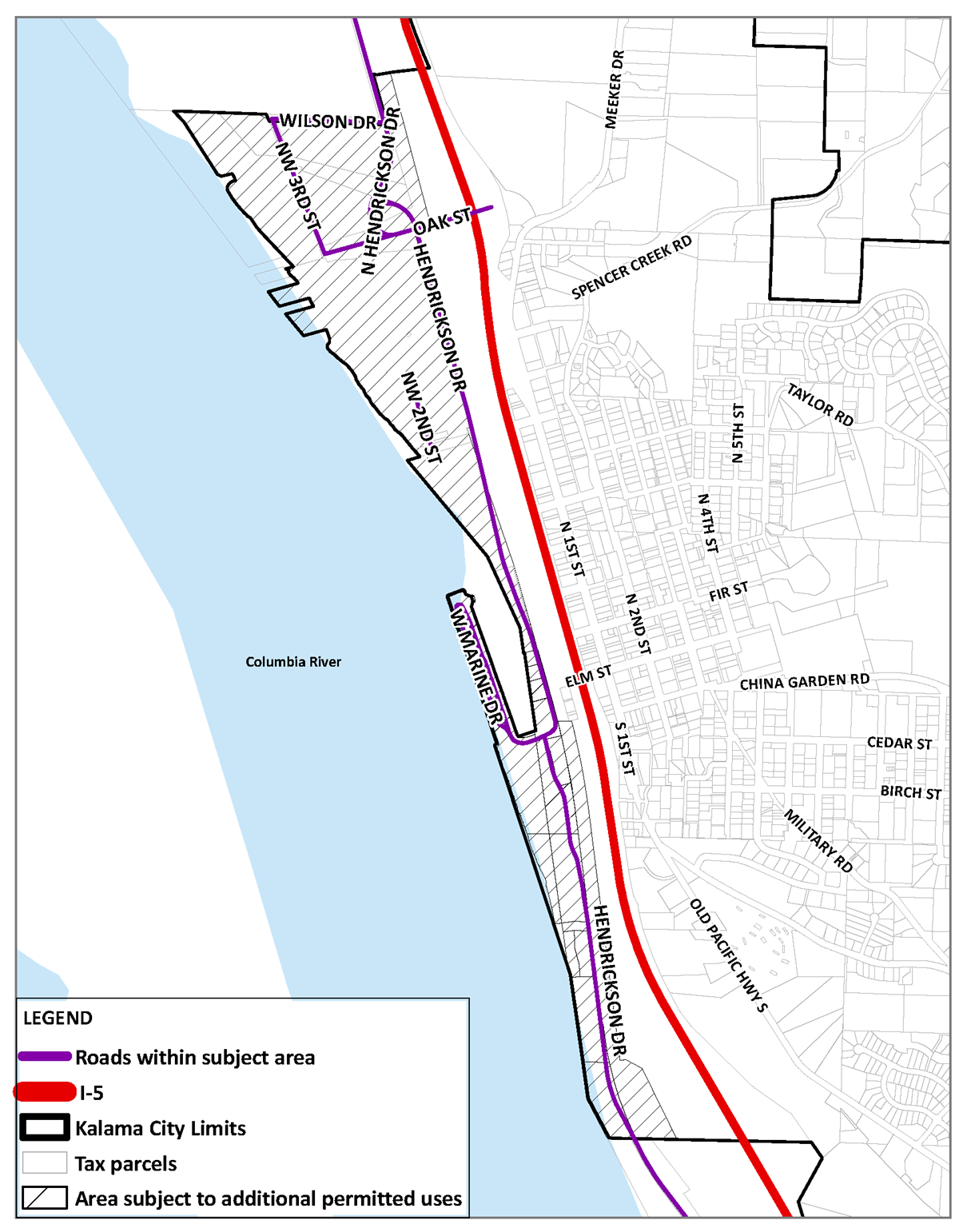
B.
Buildings and developments necessary for the operation of a public utility:
1.
Commercial recreation, such as ice and roller skating rinks, auditoriums, boat harbors, marinas, and related facilities;
2.
Public parks and recreation areas, and related facilities;
3.
Service stations;
4.
Railroad depots;
5.
Agriculture and appurtenant structures, but not including farm dwellings.
(Code 2020, § 17.28.020; Ord. No. 1240, § 7, 6-17-2009; Ord. No. 1433, § 5, 2-6-2020)
Sec. 17.28.030. - Secondary uses.
The following uses are permitted in an I-1 district in conjunction with, but subordinate to, any of the uses permitted in section 17.28.020:
A.
Dwelling unit for the convenience of a resident watchman or custodian only;
B.
Employees' cafeterias, restaurants, and auditoriums;
C.
Parking lots for employees' cars and equipment incidental to the operation of said business or industry.
(Code 2020, § 17.28.030; Ord. No. 1240, § 7, 6-17-2009)
Sec. 17.28.040. - Prohibited uses.
The following uses are prohibited in an I-1 district:
A.
Churches, schools;
B.
Dwellings, except as permitted in section 17.28.030;
C.
Retail business uses other than those permitted in section 17.28.020.
(Code 2020, § 17.28.040; Ord. No. 1240, § 7, 6-17-2009)
Sec. 17.28.050. - Off-street parking.
Off-street parking shall be provided in any I-1 district in accordance with the requirements of chapter 17.44.
(Code 2020, § 17.28.050; Ord. No. 1240, § 7, 6-17-2009)

