
Keego Harbor City Zoning Code
ARTICLE IXA
VILLAGE OVERLAY DISTRICT
Sec. 9A.00.- Intent.
The intent of this overlay district is to transform the Cass Lake Road corridor into a walkable, tree-lined street fronted with small shops, cafes, parks, and residential clusters. Small lots, a mix of uses, and narrow streets are allowed and encouraged. Building setbacks are minimal to create a more walkable and pedestrian-centric experience.
(Ord. No. 2023-02, § 1.01, 3-16-2023)
Sec. 9A.01. - Applicability.
For properties located within the Village Overlay District (VOD) as designated on the Keego Harbor Zoning District Map, compliance with the requirements of this Article IX(A), or sections thereof, shall apply based on the following table. The Planning Commission has the authority to modify or waive the standards for projects that involve re-occupying an existing building. When waiving or modifying these standards, the Planning Commission will consider the size and scope of the project in relation to the requirements. Existing units within a plaza or a strip mall do not need to comply with the requirements in this article.
(Ord. No. 2023-02, § 1.01, 3-16-2023; Ord. No. 2024-08, pt. 1, 10-17-2024)
Sec. 9A.02. - Context zones.
There is hereby established three (3) context zones of the Village Overlay District (VOD), which are shown on the Keego Harbor Zoning District Map, as follows:
(a)
Cass Lake Road (CL) Context Zone.
(b)
Central Business District (CBD) Context Zone.
(c)
Central Business District Fringe (CBD-F) Context Zone.
Where noted within this article, certain provisions of the VOD may apply only within certain context zones of the VOD.
(Ord. No. 2023-02, § 1.01, 3-16-2023)
Sec. 9A.03. - Reserved.
Editor's note— Ord. No. 2024-06, pt. 10, adopted July 17, 2024, repealed § 9A.03, which pertained to use requirements and derived from Ord. No. 2023-02, § 1.01, adopted March 16, 2023.
Sec. 9A.04. - Development standards.
(a)
Required conditions. Except as otherwise noted for specific uses, buildings and uses in the Village Overlay District shall comply with the following required conditions:
(1)
All business establishments shall be retail or service establishments dealing directly with customers. All goods produced and services performed on the premises shall be sold at retail on the premises produced.
(2)
All uses permitted subject to special conditions may be required to submit a Traffic Impact Analysis which shall, at minimum, include: trip generation estimates, the volume of existing traffic on roads adjacent to the site, the peak hour volume of traffic on roads adjacent to the site, the peak hour volume of traffic expected to be generated by the proposed development, estimates of the directional distribution of trips generated by the development, projected assignment of vehicle trip volumes to the roadway network, analysis of anticipated turning movements and required left-or right-turn controls, and recommendations to mitigate the impact of the development on the transportation system. If deemed necessary by the City Planner following review of the site plan, a Traffic Impact Analysis may also be required in conjunction with development of a principal permitted use.
(3)
Sidewalks shall be provided along all street frontages.
a.
A sidewalk no less than ten (10) feet in width must be maintained along all sides of the building facing a road or parking area.
b.
The sidewalk(s) adjacent to the building must be linked to the sidewalk(s) on adjacent properties to maintain the continuity of the pedestrian environment.
c.
Decorative and coordinated pedestrian amenities including benches, planters, waste receptacles, and bicycle racks should be provided to encourage pedestrian activities.
(b)
Site plan review. Site plan review shall be required for all uses in the Village Overlay District in accordance with Section 16.06.
(c)
Area, height, bulk, and placement requirements. Buildings and uses in the Village Overlay District are subject to the requirements and schedule of regulations below:
(1)
Within the Village Overlay District, corner lots shall have just one (1) front setback along the principal frontage.
(2)
Special architectural features will be allowed to exceed the above height if:
a.
The feature is located at a corner; or,
b.
The feature is deemed necessary to the type, use, or style of the building in question.
c.
Special architectural features shall not exceed the height of the remainder of the building by more than thirty-five (35) percent.
(3)
Schedule of Regulations table (see Appendix to this article).
(Ord. No. 2023-02, § 1.01, 3-16-2023)
Sec. 9A.05. - Architectural design standards.
(a)
Building scale.
(1)
The intent of these guidelines is to encourage the construction of principal buildings that are in scale with the majority of the existing buildings in the CBD and CL Context Zones. The majority of the older buildings are narrow in width. The intent of these guidelines is not to limit building width, but, to encourage the subdivision of wider facades, breaking-up the scale and mass of larger buildings, making them more compatible with existing facades.
a.
Large, long facades shall be subdivided into structural bays, through the location and arrangement of columns and/or pilasters, apparent along the facade:
1.
Column or pilaster spacing to be sixteen (16) feet to twenty-eight (28) feet on center.
2.
Minimum twenty-inch column or pilaster width.
(2)
Balconies and porches are permitted in the CBD and CL Context Zones.
(b)
Building roof types.
(1)
All new buildings with a flat roof shall be enclosed by parapets a minimum of forty-two (42) inches high, or as required to conceal mechanical equipment to the satisfaction of the Planning Commission.
(2)
Sloping roofs, gabled or hipped are permitted.
(3)
Mansard roofs are prohibited.
(c)
Street facade.
(1)
The majority of the existing street facades, the facade that faces a public right-of-way, are comprised of common facade components. The arrangement of facade elements shall follow this model which include the following typical components: facade frame, storefront opening and canopy/awning.
a.
Facade frame. The facade frame, or wall, shall be principally in a single plane. The top of the parapet wall shall be flat or step slightly to accentuate end piers. The facade frame shall be capped by a cornice, coping, or narrow cap flashing. Narrow cap flashing as a decorative cap limited to one-story buildings.
b.
Storefront opening. The storefront opening shall be a rectangular opening, ten (10) feet to twelve (12) feet high (excepting a fourteen-inch to twenty-four-inch height, opaque durable base), and extend entirely column-to-column or pilaster-to-pilaster. The opening shall be almost entirely glass (window or showcases) with few subdivisions. The building entry shall be centered in the storefront opening (or left or right justified) and recessed minimum that of the door width. Maximum width of door recess area at right-of-way or build-to-line seven (7) feet. Display windows must be internally lit until 10:00 p.m., 2700k to 3000k color temperature. All openings, including porches, galleries, arcades, and windows, with the exception of shopfronts, shall be square or vertical in proportion.
c.
Canopies/awnings. A canopy or awning is typically located at the top of the storefront opening.
1.
Awnings shall be traditional in design; they shall be triangular in section, sloping outward and down from above the corresponding opening. Narrow front-flaps are allowable.
i.
Round-top, half-round, box, or other unusual awning shapes are prohibited (except in association with existing, ground floor, arched doors and/or windows).
ii.
Internally lit awnings are prohibited. Signage on awnings shall be restricted to the awning-flap and seven-inch height letters.
2.
Canopies shall be limited in thickness, ranging from six (6) inches to twelve (12) inches, flat, and provide for internal drainage. Canopies shall be self-supporting or supported by tension rods. Canopy projections to be limited to sixty (60) inches. Sloping, or unusually shaped, canopies are prohibited.
(d)
Rear facades.
(1)
Exterior building walls not corresponding to rights-of-way must not include decorative facades. Rear entryways may be denoted, however, with signage and lighting. Doors must not be recessed, except for public safety along alley easements or parking aisles.
(2)
Facade frame—Non-facade exterior wall construction. If no parapet is used, downspouts shall be located at the outer sides of the facades, not in the middle of the facade. All openings, including porches, galleries, arcades, and windows, with the exception of shopfronts, shall be square or vertical in proportion.
(3)
Storefront opening. Shopfront frontages (or storefront openings) are prohibited except corresponding to street rights-of way.
a.
Exterior walls not corresponding to rights-of-way may include up to one (1) display window adjacent to each entrance, maximum fifty-four (54) inches in height and eighty-four (84) inches in width. Such an opening shall be almost entirely glass with few subdivisions. The glass framing system shall be painted wood or composite or natural-finish metal. Natural finish aluminum is a typical material and finish. Display windows must be internally lit until 10:00 p.m., 2700k to 3000k color temperature.
(4)
Canopies/awnings. A canopy or awning typically located at the top of the storefront opening is recommended.
a.
Awnings shall be traditional in design; they shall be triangular in section, sloping outward and down from above the corresponding opening. Narrow front-flaps are allowable. Round-top, half-round, box, or other unusual awning shapes are prohibited (except in association with existing, ground floor, arched doors and/or windows). Internally lit awnings are prohibited. Signage on awnings shall be restricted to the awning-flap and seven-inch height letters.
b.
Canopies shall be limited in thickness, ranging from six (6) inches to twelve (12) inches, flat, and provide for internal drainage. Canopies shall be self-supporting or supported by tension rods. Canopy projections to be limited to sixty (60) inches. Sloping, or unusually shaped, canopies are prohibited.
c.
Sloping canopies are permitted at the rear facade. If space is available, rear canopies can be ground supported.
d.
A canopy or awning, typically located at the top of any rear entrance, is recommended.
(e)
Materials.
(1)
Maintaining consistent palette of materials is important to establish continuity within the streetscape and to improving the overall appearance of the Village Overlay District. Allowable materials are identified on the "Village Overlay District Permitted Materials List" on file at Keego Harbor City Hall.
(Ord. No. 2023-02, § 1.01, 3-16-2023; Ord. No. 2025-02, pt. 1, 12-17-2024)
Sec. 9A.06. - Landscaping and screening requirements.
The requirements of this section apply to the Cass Lake Road (CL) and Central Business District (CBD) Context Zones. Within the Central Business District-Fringe (CBD-F) Context Zone, the landscaping standards of Section 15.23 shall apply.
(a)
Compliance. No site plan shall be approved unless said site plan shows landscaping consistent with the requirements of this section. Where landscaping is required, a building permit shall not be issued unless provisions set forth in this section have been met or a performance guarantee has been posted in accordance with Section 15.19.
(b)
Minimum requirements. The requirements set forth herein are minimum requirements, and nothing herein shall preclude the developer and the City from agreeing to more extensive landscaping.
(c)
Design creativity. Creativity in landscape design is encouraged. Accordingly, required trees and shrubs may be planted at uniform intervals, at random, or in groupings, depending on the designer's desired visual effect and, equally important, the intent of the City to coordinate landscaping on adjoining properties.
(d)
Landscaping requirements.
(1)
All developed portions of the site shall conform to the following general landscaping standards, except where specific landscape elements, such as a greenbelt, berms, or screening are required:
a.
All unpaved portions of the site shall be planted with grass, ground cover, shrubbery, or other suitable live plant material.
b.
A mixture of evergreen and deciduous trees shall be planted at the rate of one (1) tree per three thousand (3,000) square feet or portion thereof of unpaved open area. Required trees may be planted at uniform intervals, at random, or in groupings.
c.
All required landscaping shall be served by an in-ground sprinkling system.
d.
Landscaped areas which adjoin paved parking or driveways shall be protected with curbs from encroachment of vehicles.
(2)
Landscaping adjacent to roads. All front, side, and rear yards adjacent to roads in the Village Overlay District shall be landscaped in accordance with the following standards:
a.
A minimum of one (1) deciduous or evergreen tree shall be planted for each forty (40) lineal feet or portion thereof of road frontage, plus, a minimum of one (1) ornamental tree shall be planted for each one hundred (100) lineal feet or portion thereof of road frontage, plus, a minimum of eight (8) shrubs shall be planted for each forty (40) lineal feet or portion thereof of road frontage. For the purposes of computing length of road frontage, openings for driveways and sidewalks shall not be counted. Trees and shrubs may be planted at uniform intervals, at random, or in groupings.
(3)
Screening walls. A screening wall shall be provided in accordance with Section 15.04 for the following:
a.
Where any off-street parking lot or alley is located adjacent to any residential use, whether such adjacent residential use is located within or outside of the Village Overlay District.
b.
Where any non-residential use within the Village Overlay District is located adjacent to a residential use located outside of the Village Overlay District.
c.
The Planning Commission may waive the requirement for a screening wall between non-residential and adjacent residential uses within the Village Overlay District.
(4)
Greenbelts. Where required or proposed, greenbelts shall conform to the following standards:
a.
A required greenbelt may be interrupted only to provide for pedestrian or vehicular access.
b.
Grass, ground cover, or other suitable live plant material shall be planted over the entire greenbelt area, except where paved walkways are used.
c.
A minimum of one (1) deciduous or evergreen tree shall be planted for each thirty (30) lineal feet or portion thereof of required greenbelt length, or alternatively, eight (8) shrubs may be substituted for each required tree. Trees may be planted at uniform intervals, at random, or in groupings.
d.
Plant materials shall not be placed closer than four (4) feet to the property line or right-of-way line when a greenbelt abuts a public sidewalk.
e.
For the purposes of calculating required plant material, greenbelt length shall be measured along the exterior edge of the greenbelt.
(5)
Berms. Where required or proposed, berms shall conform to the following standards:
a.
Berms shall be constructed with slopes no steeper than one (1) foot vertical for each three (3) feet horizontal (thirty-three (33) percent slope), with at least a two-foot flat area on the top.
b.
The planting requirements for greenbelts, above, shall also apply to berms.
(6)
Evergreen or landscaped screening. Where required or proposed, evergreen screening shall consist of closely spaced plantings which form a complete visual barrier that is at least six (6) feet above ground level within five (5) years of planting.
(7)
Parking lot landscaping. All off-street parking areas shall provide landscaping as follows:
a.
Landscaping ratio. Off-street parking areas containing greater than fifteen (15) spaces shall be provided with at least fifteen (15) square feet of interior landscaping per parking space. Whenever possible, parking lot landscaping shall be designed to improve the safety of pedestrian and vehicular traffic, guide traffic movement, and improve the appearance of parking areas.
1.
Parking lot landscaping is not required for parking areas located behind buildings and out of view from the street.
b.
Minimum area. Landscaping areas in parking lots shall be no less than five (5) feet in any single dimension, and no less than one hundred fifty (150) feet in area. Landscaped areas in or adjacent to parking lots shall be protected with curbing or other means to prevent encroachment of vehicles.
c.
Other landscaping. Required landscaping elsewhere on the parcel shall not be counted in meeting the parking lot landscaping requirements.
d.
Required plantings. Requirements for plant material shall be based on the location, size, and shape of the parking lot landscaped area. A minimum of one (1) tree shall be planted per three hundred (300) square feet or fraction thereof of interior landscaped area. The landscape plan shall indicate the types, sizes, and quantities of plant material proposed for such area.
(8)
Landscaping of rights-of-way. Public rights-of-way located adjacent to required landscaping areas and greenbelts shall be planted with grass or other suitable live ground cover and shall be maintained as if the rights-of-way were part of the required landscaped areas or greenbelt.
(e)
Maintenance of unobstructed visibility for drivers.
(1)
Landscaping located at an intersection of two (2) streets shall comply with the requirements in Section 15.03 so as to maintain unobstructed cross-visibility for drivers.
(f)
Standards for landscape materials.
(1)
Plant quality. Plant materials used in compliance with the provisions of this Ordinance shall be nursery grown, free of pests and diseases, hardy in Oakland County, in conformance with the standards of the American Association of Nurserymen and shall have passed inspections required under state regulations.
(2)
Non-living plant material. Plastic and other non-living plant materials shall not be considered acceptable to meet the landscaping requirements of this Ordinance.
(3)
Plant material specifications. The following specifications shall apply to all plant material proposed in accordance with the landscaping requirements in this Ordinance:
a.
Deciduous shade trees shall be a minimum of two (2) inches in caliper measured twelve (12) inches above grade with the first branch a minimum of four (4) feet above grade when planted.
b.
Deciduous ornamental trees shall be a minimum of one and one-half (1½) inches in caliper measured six (6) inches above grade with a minimum height of four (4) feet above grade when planted.
c.
Evergreen trees shall be a minimum of five (5) feet in height when planted, except that juniper, yew and arborvitae species shall be a minimum of three (3) feet in height when planted. Furthermore, evergreen trees shall have a minimum spread of three (3) feet, and the size of the bur lapped root ball shall be at least ten (10) times the caliper measured six (6) inches above grade.
d.
Shrubs shall be a minimum of two (2) feet in height when planted. Low growing shrubs shall have a minimum spread of fifteen (15) inches when planted.
e.
Hedges shall be planted and maintained so as to form a continuous, unbroken, visual screen within two (2) years after planting.
f.
Vines shall have a minimum of three (3) runners, six (6) inches to eight (8) inches long when installed and be a minimum of thirty (30) inches in length after one (1) growing season.
g.
Ground cover used in lieu of turf grasses shall be planted in such a manner as to present a finished appearance and reasonably complete coverage after one (1) complete growing season.
h.
Grass area shall be planted using species normally grown as permanent lawns in Oakland County. Grass, sod, and seed shall be clean and free of weeds, noxious pests, and diseases. Straw or other mulch shall be used to protect newly seeded areas.
i.
Mulch used around trees, shrubs, and vines shall be a minimum of three (3) inches deep and installed in a manner as to present a finished appearance.
j.
A list of recommended and prohibited plant materials is provided in the Appendix to this article. Prohibited plan materials are not encouraged because of susceptibility to storm damage, disease, and other undesirable characteristics.
(4)
Installation and maintenance. The following standards shall be observed where installation and maintenance of landscape materials are required:
a.
Installation.
1.
Landscaping shall be installed in a sound, workmanlike manner to ensure the continued growth of healthy plant material. Trees, shrubs, hedges, and vines shall be generously mulched at the time of planting.
2.
Landscaping shall be protected from vehicles through the use of curbs. Landscape areas shall be elevated above the pavement to a height adequate to protect the plants from snow removal, salt, and other hazards.
3.
If development is completed during the off-season when plants cannot be installed, the owner shall provide a performance guarantee to ensure installation of required landscaping in the next planting season.
b.
Maintenance.
1.
Landscaping required by this Ordinance shall be maintained in a healthy, neat, and orderly appearance, free from refuse and debris. All unhealthy and dead plant material shall be replaced immediately upon notice from the Building Official, unless the season is not appropriate for planting, in which case plant material shall be replaced at the beginning of the next planting season.
2.
All landscaped areas shall be provided with a readily available and acceptable supply of water. Trees, shrubs, and other plantings and lawn areas shall be watered regularly throughout the growing season.
3.
All constructed or manufactured landscape elements, such as but not limited to benches, retaining walls, edging, and so forth, shall be maintained in good condition and neat appearance. Rotted, deteriorated, or damaged landscape elements shall be repaired, replaced, or removed.
(g)
Modifications to landscape regulations.
(1)
In consideration of the overall design and impact of a specific landscape plan, and in consideration of the amount of existing plant materials to be retained on the site, the Planning Commission may modify the specific requirements outlined herein, provided that any such adjustment is in keeping with the intent of this section. In determining whether a modification is appropriate, the Planning Commission shall consider whether the following conditions exist:
a.
Topographic features or other unique features of the site create conditions such that strict application of the landscape regulations would result in a less effective screen than an alternative landscape design.
b.
Parking, vehicular circulation, or land use are such that required landscaping would not enhance the site or result in the desired screening effect.
c.
The public benefit intended by the landscape regulations could be better achieved with a plan that varies from the strict requirements of the Ordinance.
(Ord. No. 2023-02, § 1.01, 3-16-2023)
Sec. 9A.07. - Off-street parking.
Where compliance with Sections 9A.03 through 9A.06 above is achieved, buildings and uses in the Cass Lake Road (CL) and Central Business District (CBD) Context Zones may benefit through flexibility in the application of off-street parking as outlined below. The off-street parking requirements of Article XIII shall also apply, except as modified by this section.
(a)
Location of parking. Required parking for other than residential uses shall be either on the same lot or within three hundred (300) feet of the building it is intended to serve, measured from the nearest point of the building to the nearest point of the off-street parking lot, without crossing any major thoroughfare. Ownership shall be shown of all lots or parcels intended for use as parking by the applicant when an application for a building permit or a certificate of occupancy is filed. The existence of on-street parking along building frontages (or along other frontages within three hundred (300) feet and in excess of other proximate buildings' parking requirements) may be counted toward commercial and/or residential parking requirements.
(b)
Residential off-street parking. Residential off-street parking spaces shall consist of a parking strip, parking bay, driveway, garage, parking lot, on-street parking within three hundred (300) feet, or combination thereof. Such spaces shall be located on the premises they are intended to serve, on-street, or according to other dedications, and in appropriate cases also shall be subject to the provisions of Section 15.13, Accessory buildings, of this Ordinance. Single and two-family residential off-street parking is exempt from regulations of this article governing a parking lot.
(c)
Off-street parking formulas for specific uses. For the following uses, special parking formulas shall apply based on the table below. The off-street parking formulas for uses not specified in the table shall be in accordance with Section 13.01.
(d)
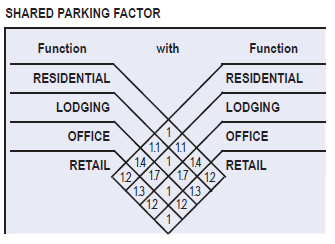
Shared parking. Where the owners of two (2) buildings (or the owner of one (1) building containing a mix of uses) desire(s) to share common parking facilities, application shall be made to the Planning Commission. The Planning Commission may grant approval of such facilities, subject to a finding that the following conditions have been met:
(1)
The common parking meets all location requirements of this Ordinance with respect to each building or use.
(2)
The common parking conforms to the following table:
The shared parking factor for two (2) functions (the number indicated in the corresponding triangular box below), when divided into the total spaces required by Keego Harbor on any particular lot, produces the effective parking needed for that lot. Parking may be also shared in this manner across lot ownership by agreement.
(Ord. No. 2023-02, § 1.01, 3-16-2023)
Sec. 9A.08. - Signage.
See Article XIV.
(Ord. No. 2023-02, § 1.01, 3-16-2023)
Appendix -
SCHEDULE OF REGULATIONS
Footnotes:
1.
Properties with R-T District underlying zoning shall have 15,000 s.f. max and properties with RM District underlying zoning shall have 20,000 s.f. max.
2.
Properties with R-T District or RM District underlying zoning shall have 132 ft. max.
3.
Properties with R-T District underlying zoning shall have a 3.5' minimum setback.
4.
Properties with R-T District underlying zoning shall have a 7' minimum setback.
5.
Properties with R-T District underlying zoning shall have a 3' minimum setback (clear 30' corresponding to garage doors via setback and/or easement).
6.
A fourth story may be allowed within the Central Business District (CBD) Context Zone. Further, such additional story must be stepped back from the front building line by a minimum of ten feet.
7.
Properties with R-T District underlying zoning shall have an 800 s.f. minimum.
(Ord. No. 2023-02, § 1.01, 3-16-2023)
RECOMMENDED PLANT MATERIALS
(Ord. No. 2023-02, § 1.01, 3-16-2023)
PROHIBITED PLANT MATERIALS
(Ord. No. 2023-02, § 1.01, 3-16-2023)
ARTICLE X. - RESERVED[1]
Editor's note—Ord. No. 2024-06, pt. 11, adopted July 17, 2024, repealed Art. X, §§ 10.00—10.06, which pertained to O-1 Office Building Districts and derived from Ord. 377, adopted Nov. 15, 2001; Ord. No. 2023-02, § 1.02(Exh. A), adopted March 16, 2023; and the original ordinance.

