
Keego Harbor City Zoning Code
ARTICLE II
DEFINITIONS
Sec. 2.00.- Definitions.
For the purpose of this Ordinance certain terms, words and phrases shall, whenever used in this Ordinance, have the meaning herewith defined as follows:
The word "person" includes a firm, association, organization, partnership, trust, company, or corporation, public or private, as well as the individual; the present tense includes the future tense, the singular number includes the plural and plural number includes the singular; the word "shall" is mandatory, and the word "may" is permissive; the words "used" or "occupied" include the words "intended", "designed", or "arranged to be used or occupied"; the word "building" includes the word "structure" and the word "dwelling" includes the word "residence"; the word "lot" includes the words "plot" and "parcel".
Terms not herein defined shall have the meaning customarily assigned to them.
Act. The term "act" or "doing of an act" includes "omission to act".
Adult foster care congregate facility. means an adult foster care facility with the approved capacity to receive more than twenty (20) adults to be provided with foster care. Facilities are subject to conditional use approval. See "State licensed residential facilities" defined in this section.
Adult regulated uses. Definitions: As used in this Ordinance, the following definition shall apply to adult regulated uses:
(a)
Halfway house. A facility established by the Michigan Department of Corrections in connection with a jail, prison, or other correctional institution or facility as a residence for three (3) or more persons committed to the jail, prison, or correctional institution prior to full release from supervision including any period of parole.
Alley. A public or legally established private thoroughfare, other than a street, affording a secondary means of vehicular access to abutting property and not intended for general traffic circulation.
Agricultural land. Substantially undeveloped land devoted to the production of plants and animals useful to humans, including, but not limited to, forage and sod crops, grains, feed crops, field crops, dairy products, poultry and poultry products, livestock, herbs, flowers, seeds, grasses, nursery stock, fruits, vegetables, Christmas trees, and other similar uses and activities.
Airport. An airport licensed by the Michigan Department of Transportation, Bureau of Aeronautics under section 86 of the Aeronautics Code of the State of Michigan, 1945 PA 327, MCL 259.86.
Alley. A public or legally established private thoroughfare, other than a street, affording a secondary means of vehicular access to abutting property and not intended for general traffic circulation.
Alterations. Any change, addition or modification in construction or type of occupancy; and change in the structural members of a building, such as walls or partitions, columns, beams or girders; or any change which may be referred to herein as "altered" or "reconstructed".
Apartments. The dwelling units in a multiple dwelling as defined herein:
(a)
Efficiency apartment. A dwelling unit of or less than three hundred fifty (350) square feet of floor area consisting of not more than one (1) room in addition to kitchen and necessary sanitary facilities.
(b)
One-bedroom unit. A dwelling unit containing a minimum floor area of at least six hundred (600) square feet consisting of not more than three (3) rooms, including one (1) bedroom in addition to kitchen and necessary sanitary facilities.
(c)
Two-bedroom unit. A dwelling unit containing a minimum floor area of at least eight hundred (800) square feet, consisting of not more than four (4) rooms, including two (2) bedrooms, in addition to kitchen and necessary sanitary facilities.
(d)
Three or more bedroom units. A dwelling unit wherein for each room in addition or the four (4) rooms permitted in a two-bedroom unit, there shall be provided an additional area of two hundred (200) square feet to the minimum floor area of eight hundred (800) square feet in addition to the kitchen and necessary sanitary facilities.
Artisan manufacturing. Small-scale businesses that produce artisan goods or specialty foods, primarily for direct sales to consumers, such as artisan leather, glass, wood, paper, ceramic, textile, and yarn products, specialty foods, and baked goods.
Attached wireless communications facility. A wireless communications facility affixed to an existing structure, such as an existing building, tower, water tank, utility pole, etc., utilized to receive and transmit federally or state licensed communications services via duly licensed segments of the radio frequency spectrum. This definition shall not include support structures.
Automobile repair garage. A building or premises where the following services may be carried out in a completely enclosed building: general repairs, engine rebuilding, rebuilding or reconditioning of motor vehicles; collision service such as body, frame, or fender straightening and repair; painting and under-coating of automobiles.
Automobile service center. A building or premises used primarily for the sale and installation of major automobile accessories, such as tires, batteries, radios, air conditioners and mufflers, plus such services as brake adjustment, and wheel alignment and balancing; but excluding any major mechanical repairs, collision work, under-coating or painting. Sale of gasoline (stored only in underground tanks) shall be incidental to the above enumerated activities.
Balcony. An elevated platform, covered or uncovered by a roof, screened or unscreened, projecting from the wall of a building or structure. (See Section 15.11(c), Permitted projections into required open space.)
Banquet hall. A building or part of a building used or available for use for the gathering of people for specific functions or for entertaining a large group of people, where food and beverages are generally provided.
Bar/lounge. A bar/lounge is any establishment that serves alcohol to the customer in a ready-to-consume state past 11:00 p.m. [1] Such an establishment may stay open until 2:00 a.m. and may also provide entertainment for patrons.
Basement. That portion of a building which is partly or wholly below grade but so located that the vertical distance from the average grade to the floor is greater than the vertical distance from the average grade to the ceiling. A basement shall not be counted as a story, and shall not be used for dwelling units, offices, retail sales or manufacturing, but may be used for storage, heating and utility facilities, etc. (See "Basement and Story" illustration.)
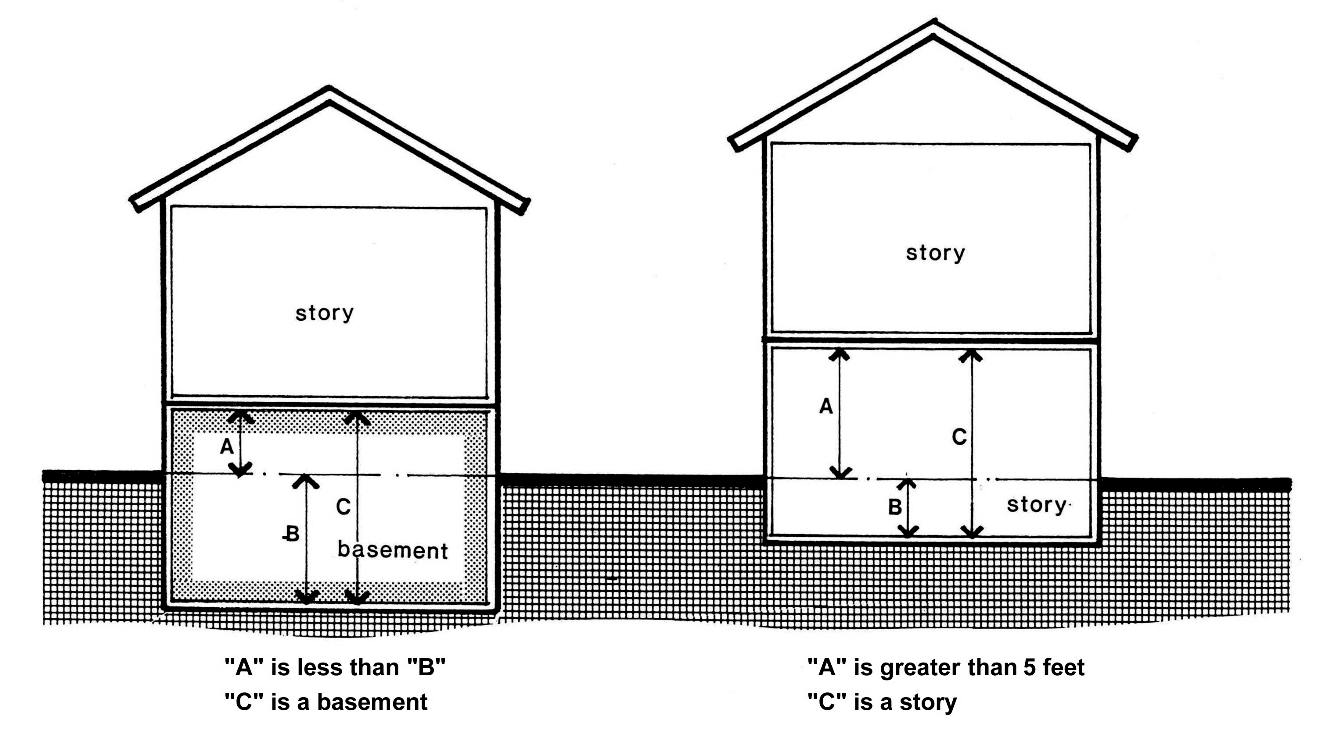
Basement and Story
Bedroom. A room designed or used in whole or in part for sleeping purposes.
Bed-n-Breakfast inn. A dwelling in which overnight accommodations are provided or offered for transient guests for compensation, including provision for a morning meal only and for overnight guests only.
Billboard. Any non-accessory sign, device, design, words, letters, numbers or trademark which makes anything known to the general public and is the principal use of the lot or parcel on which it is located.
Block. A block shall be that property abutting on one (1) side of a street and lying between the two (2) nearest intersecting streets or alleys and extending back to another street or alley or to the City boundary.
Boarding house. The terms boarding house, rooming house and lodging house are used synonymously in this Ordinance. A building, other than a hotel, where for compensation and/or prearrangement for periods exceeding ten (10) days, lodging and meals are provided for three (3) or more persons or together with one (1) dwelling unit for occupancy by management.
Board of Appeals. The Zoning Board of Appeals of the City of Keego Harbor.
Boat. See "Recreation vehicle."
Boat dock/well. The water area in which a boat lies when it is made fast to shore installations.
Boat lift. A device referred to as a hoist, davits, etc., that may be used to raise boats or cargo.
Boat pier. See "Pier."
Boat port. Any covered structure open on all sides designed for the storage of boats and marine equipment.
Buildable area. The space remaining on a lot after compliance with the minimum required setbacks of this Ordinance.
Building. Any structure including a mobile home or mobile structure, or a pre-manufactured or pre-cut structure above or below ground, temporary or permanent, having one (1) or more floors or any structure, temporary or permanent, with a roof and designed or intended primarily for the shelter, support, or enclosure of persons, animals and property of any kind.
Building accessory. A subordinate building.
Building height. The vertical distance measured from the established grade to the highest point of the roof surface if a flat roof; to the deck line of mansard roofs; and to the mean height level between eaves and ridge of gable, studio hip and gambrel roofs; and seventy-five (75) percent of the height of an A-frame.
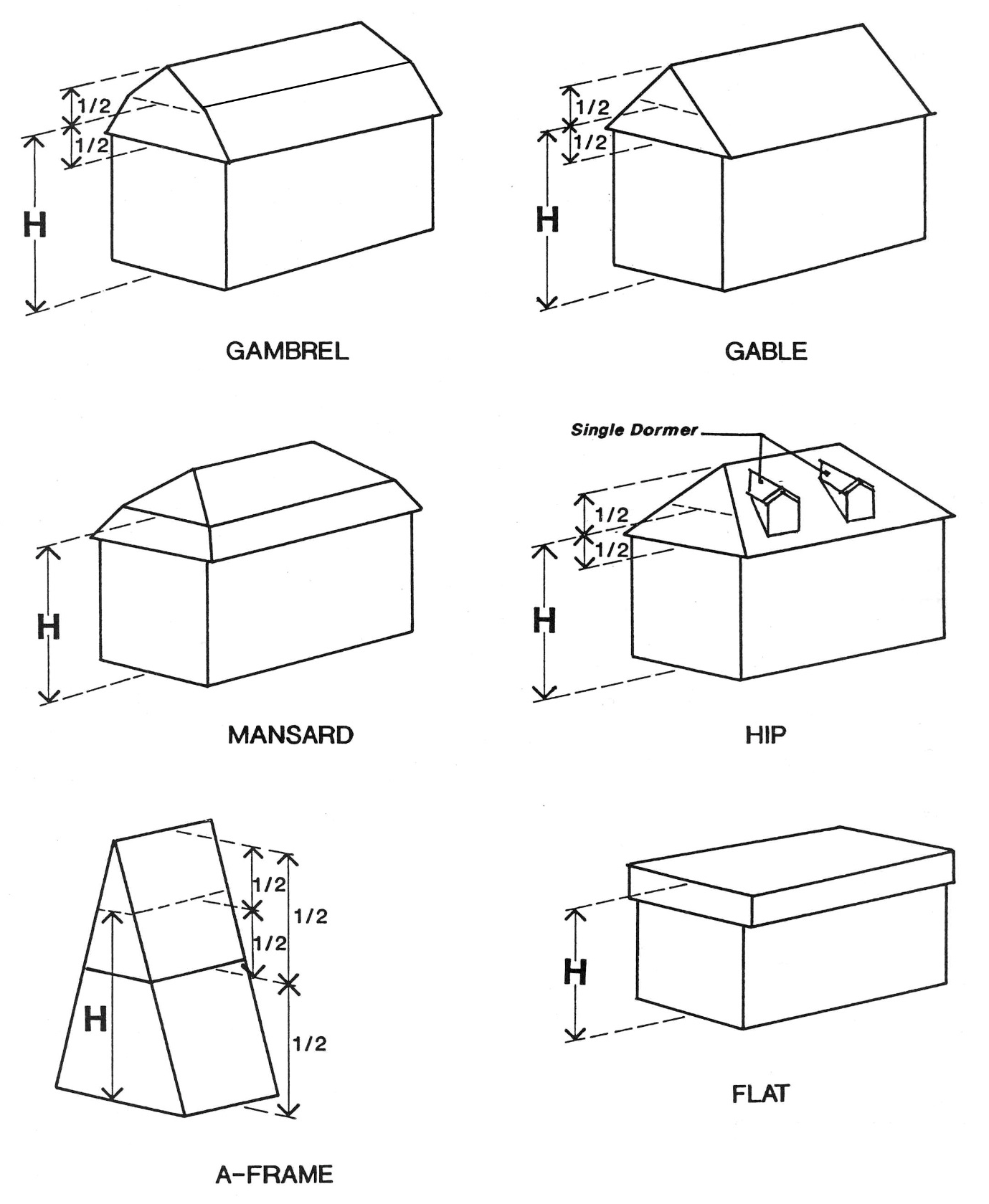
Building Height
Building, main or principal. A building or, where the context so indicates, a group of buildings in which is conducted the main or principal use of the lot on which building or group of buildings is located.
Building line. A line formed by the closest approach of the building foundation to the property line. Where a portion of the building face wider than eight (8) feet projects more than two (2) feet beyond the foundation, the face of the projecting portion of the building shall form the building line.
Business services. A business support establishment primarily engaged in rendering services to other business establishments on a fee or contract basis, such as advertising and mailing; building maintenance; personnel and employment services; management and consulting services; protective services; equipment rental and leasing; photo finishing; copying and printing; travel; office supply; and similar services.
Carport. A roofed structure for the shelter of vehicles only, that is not more than thirty-five (35) percent enclosed by walls and attached to the main building.
Central Business District (CBD). The area along Orchard Lake Road between the centerline of Beechmont and the centerline of Willow Beach Avenue and the area along Cass Lake Road between the intersection of Orchard Lake Road and the centerline of Kenrick.
Central Business District Fringe (CBD-Fringe). The area along Orchard Lake Road east of the centerline of Beechmont and the area along Orchard Lake Road between the centerline or Willow Beach and the centerline of Pridham Road.
Central Business Overlay District. The area along Orchard Lake Road between the centerline of Beechmont and the centerline of Willow Beach Avenue and the area along Cass Lake Road between the intersection of Orchard Lake Road and the centerline of Beland, and as defined in Section 15.05.
Child care center or day care center. A facility, other than a private residence, receiving one (1) or more preschool or school age children for care for periods of less than twenty-four (24) hours a day, and where the parents are not immediately available to the child, as defined in Public Act 116 of 1973.
Clear vision triangle. The clear vision triangle of a waterfront yard shall be defined as the space between the following lines:
(a)
The side lot line;
(b)
The shoreline; and
(c)
A line that commences at the intersection of the side lot line and the waterfront-side building line and runs towards the shoreline at a thirty-degree angle from the side lot line.
Clinic. A place for the care, diagnosis and treatment of sick or injured persons, and those in need of medical or minor surgical attention. A clinic may incorporate customary laboratories and pharmacies incidental or necessary to its operation or to the service of its patients, but may not include facilities for in-patient care or major surgery.
Club. An organization of persons for special purposes or for the promulgation of sports, arts, science, literature, politics or similar activities, but in no way operated for profit.
Common use lot. Any private site, platted lot or other parcel held in common by a subdivision, association, similar agency or group of individuals, or held in common by virtue of the terms of a plat of record; which provides common use riparian access to non-riparian lots or land owners or is utilized for the on-land storage of recreational vehicles.
Condominium. A plan or project as established and approved in conformance with the Michigan Condominium Act, Act 59 of the Public Acts of 1978, as amended.
Conservation easement. That term as defined in section 2140 of the Natural Resources and Environmental Protection Act, 1994 PA 451, MCL 324.2140.
Coping. A finishing or protective course or cap to an exterior masonry wall.
Court. A yard, other than a required open space, on the same lot with a building or group of buildings, and which is bounded on two (2) or more sides by such building or buildings.
Deck. A roofless platform, either freestanding or attached to a building, that is supported by pillars or posts and is at least nine (9) inches from grade but no more than thirty-six (36) inches.
Development rights. The rights to develop land to the maximum intensity of development authorized by law.
District. This term is synonymous with the term "zone" or "zoning district"; a portion of the City within which, on a uniform basis, certain uses of land and buildings are permitted and within which certain regulations and requirements apply under the provisions of this Ordinance.
Dock (boat well). See "Boat dock/well."
Drive-in establishment. A business establishment so developed that its principal retail or service character is dependent on providing a driveway approach or parking spaces for motor vehicles so as to serve motor vehicles or serve patrons while in the motor vehicle (e.g., car wash, gasoline service stations, restaurants, cleaners, banks, theaters, etc.).
Dumpster. A container used for the temporary storage of rubbish, pending collection, having a capacity of at least two (2) cubic yards.
Dwelling unit. One (1) or more rooms with bathroom and principal kitchen facilities designed as a self-contained unit for occupancy by one (1) family for living, cooking and sleeping purposes.
(a)
Dwelling unit, manufactured. A dwelling unit which is substantially built, constructed, assembled, and finished off the premises upon which it is intended to be located.
(b)
Dwelling unit, site built. A dwelling unit which is substantially built, constructed, assembled, and finished on the premises which are intended to serve as its final location. Site built dwelling units shall include dwelling units constructed of pre-cut materials and panelized wall, roof and floor section when such sections require substantial assembly and finishing on the premises which are intended to serve as its final location.
Dwelling, multiple-family. A building or portion thereof containing three (3) or more dwelling units. This definition includes three-family houses, four-family houses, and apartment houses, but does not include trailer camps or mobile home parks.
Dwelling, single-family (one-family). A detached building containing not more than one (1) dwelling unit designed for residential use of one (1) family only, provided:
(a)
It complies with the minimum square footage requirements of this Ordinance for the zone in which it is located.
(b)
It has a minimum width across front, side and rear elevations of twenty (20) feet and complies in all respects with the City building code, including minimum heights for habitable rooms. Where a dwelling is required by law to comply with any federal or state standards or regulations for construction and where such standards or regulations for construction are different than those imposed by the City building code, then and in that event, such federal or state standard or regulation shall apply; further provided that the provisions of this section shall not have the effect of making one-family dwellings, which exist as of the effective date of this Ordinance, nonconforming.
(c)
It is firmly attached to a permanent foundation constructed on the site in accordance with the City building code. Said foundation shall have a wall of the same perimeter dimensions as the dwelling and shall be constructed of such materials and type as required in the applicable building code for one-family dwellings. In the event that the dwelling is a mobile home, as defined herein such dwelling shall be installed pursuant to the manufacturer's setup instructions and shall be secured to the premises by an anchoring system or device complying with the rules and regulations of the Michigan Mobile Home Commission and shall have a perimeter wall as required.
(d)
In the event that a dwelling is a mobile home as defined herein, each mobile home shall be installed with the wheels and towing mechanism removed. Additionally, no dwelling shall have any exposed undercarriage or chassis.
(e)
The dwelling contains a storage capability area in a basement located under the dwelling, in an attic area, in closet areas, or in a separate structure of standard construction equal to or of better quality than the principal dwelling, which storage area shall be equal to ten (10) percent of the square footage of the dwelling or one hundred (100) square feet, whichever shall be less.
(f)
The dwelling is aesthetically compatible in design and appearance with other residences in the vicinity, with either a roof over-hang of not less than six (6) inches on all sides, or alternatively with window sills or roof drainage systems concentrating roof drainage at collection points along the sides of the dwelling; has not less than two (2) exterior doors with the second one being in either the rear or side of the dwelling; and contains steps connected to said exterior door areas or to porches connected to said door areas where a difference in elevation requires the same.
The compatibility of design and appearance shall be determined in the first instance by the Building Official upon review of the plans submitted for a particular dwelling, subject to appeal by an aggrieved party to the Zoning Board of Appeals within a period of thirty (30) days from the receipt of notice of said Building Official's decision. Any determination of compatibility shall be based upon the standards set forth in this definition of single-family "dwelling" as well as the character, design and appearance of one (1) or more residential dwellings to the extent of less than twenty (20) percent of the lots situated within said area; or, where said area is not so developed, by the character, design and appearance of one (1) or more single-family dwellings located outside of mobile home parks throughout the City.
(g)
The dwelling contains no additions or rooms or other areas which are not constructed with a quality of workmanship equal to the original structure, including permanent attachments to the principal structure and construction of foundations as required herein.
(h)
The dwelling complies with all pertinent building and fire codes. In the case of a mobile home, all construction and all plumbing, electrical apparatus and insulation within and connected to said mobile home shall be of a type and quality conforming to the "Mobile Home Construction and Safety Standards" as promulgated by the United States Department of Housing and Urban Development, being 24 CFR 3280, amended. Additionally, all dwellings shall meet or exceed all applicable roof snow load and strength requirements.
(i)
The foregoing standard shall not apply to a mobile home located in a licensed mobile home park except to the extent required by state or federal law.
(j)
All construction required herein shall be commenced only after a building permit has been obtained in accordance with the applicable building code provisions and requirements.
Dwelling, two-family. A detached building containing two (2) dwelling units.
Dwelling, row or town house. A row of three (3) or more attached one-family dwellings, not more than two and one-half (2½) stories in height, in which each dwelling has its own front entrance and rear entrance.
Efficiency apartment. A dwelling unit with a bathroom and principal kitchen facilities designed as a self-contained unit for occupancy for living, cooking and sleeping purposes and having no separate designated bedroom.
Elderly housing, dependent. A multiple-family housing form with central dining facilities provided as a basic daily service to each dwelling unit. Each elderly dwelling unit may or may not contain cooking facilities.
Elderly housing, independent. A multiple-family housing form with full facilities for self-sufficiency in each individual elderly dwelling unit and no central dining facility.
Elderly person. Individuals at least sixty-two (62) years of age, or households in which head of the household is at least sixty-two (62) years of age. If only one (1) member of the household meets the age requirements, the death or hospitalization of that person shall not cause the household to lose the elderly status.
Enclosed. A structure that is surrounded on three (3) or more sides by glass, masonry, brick, screening wall or other similar material, greater than four (4) feet in height is considered to be enclosed.
Erected. Build, constructed, altered, reconstructed, moved upon, or any physical operations on the premises which are required for construction. Excavation, fill, drainage, painting, plastering, sewers and the like shall be considered a part of erection.
Essential services. Those services as outlined below, which are designed and constructed to directly, serve local users within the geographic boundaries of the City. Such essential services include the erection, construction, alteration or maintenance by public utilities or municipal departments of underground, surface, or overhead gas, electrical, steam, fuel or water transmission or distribution systems, collection, communications, supply or disposal systems, including towers, poles, wires, mains, drains, sewers, pipes, conduits, cables, fire alarm and police call boxes, traffic signals, hydrants, and similar equipment, but not including storage yards, sales offices, commercial buildings, or wireless communications facilities that are solely used for private, commercial purposes.
Excavation. Any breaking of ground, except common household gardening and ground care.
Exception (special exception). A use specified in this Ordinance as permissible in a use district only if special conditions are met.
Family. One (1) or more persons related by blood, adoption or marriage, living and cooking together as a single non-profit housekeeping unit, inclusive of household servants. A number of persons living and cooking together as a single non-profit housekeeping unit having a continuing non-transient domestic character though not related by blood, adoption or marriage, shall be deemed to constitute a family. This definition shall not include any society, club, fraternity, sorority, group of students, association, lodge, combine, federation, group, coterie, or organization which is not a recognized religious order, nor include a group of individuals whose association is temporary and resort/seasonal or similar to a boarding house, motel or hotel, or for an anticipated limited duration of a school term or terms on a similar determinable period.
Family day care home. A family day care home is a private home in which one (1) but less than seven (7) minor children are received for care and supervision for periods of less than twenty-four (24) hours a day, unattended by a parent or legal guardian, except children related to an adult member of the family by blood, marriage, or adoption. Family day care home includes a home that gives care to an unrelated minor child for more than four (4) weeks during a calendar year.
Fence. An unroofed man-made structure designed as a barrier. It may be made of wood, metal or other material, such as vinyl. It may be ornamental or intended for or capable of enclosing a piece of land, preventing ingress and egress, dividing, bounding or simply marking a line. A fence, for the purposes of this Ordinance, is any such structure, exceeding twelve (12) inches above grade, and the vertical surface area of which is a minimum of fifty (50) percent open to the free passage of air and light. See "Point of observation."
Filling. The depositing or dumping of any matter onto or into the ground, except common household gardening and ground care.
Financial institution. Banks, savings and loan associations, credit unions, title companies, and other financial institutions providing direct service to customers. Drive-through facilities are not considered a customary part of a financial institution and are regulated separately as accessory to a financial institution use.
Flood hazard area. The flood hazard area shall coincide with the boundaries of the areas indicated within the limits of the 100-year flood in the report titled "The Flood Insurance Study for the City of Keego Harbor", dated June 1982, with accompanying Flood Insurance Rate Maps and Flood Boundary and Floodway Maps.
Floor area. Area measured to the exterior face of exterior walls and to the center line of interior partitions.
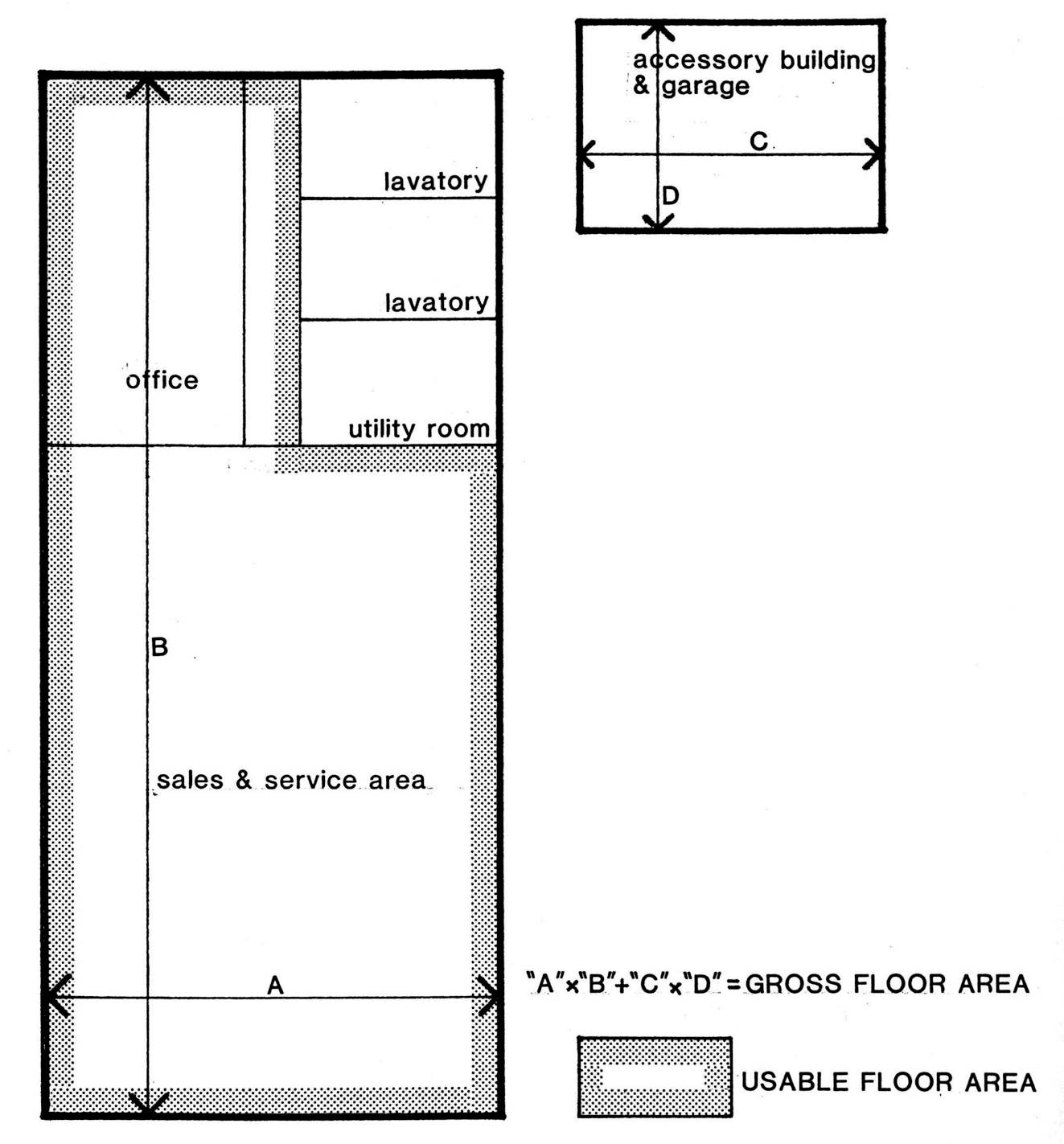
Floor Area Terminology
Floor area, useable residential. The sum of the horizontal area of the first story measured to the exterior walls; plus similarly measured, that area of all other stories having more than eight-four (84) inches of head room which may be made useable for human habitation; but excluding the floor area of basements, attics, attached or unattached garages, breezeways, unenclosed porches, and accessory buildings. (See "Floor Area Terminology" illustration.)
Floor area, useable non-residential. The sum of the horizontal area of the first story measured to the exterior face of exterior walls, plus the similarly measured area of all other stories, including mezzanines which may be made fit for occupancy, including the floor area of basements used for activities related to the principal use, such as storage, but excluding public hallways and corridors, restroom facilities and furnace and utility rooms. [2] Parking space located within a building shall not be considered useable floor area. In those cases where useable floor area cannot be determined (such as in an unoccupied retail building), useable floor area shall be equal to eighty (80) percent of the total floor area of the building. (See "Floor Area Terminology" illustration.)
Floor area ratio. The combined gross floor area of all buildings on a lot, including accessory buildings but excluding the floor area of basements (including walkouts that conform with the definition of "basement"), attics, breezeways, and unenclosed porches, divided by the lot area.
Floor, ground. That portion of a building which is partly below grade but so located that the vertical distance from the average grade to the ceiling is greater than the vertical, distance from the average grade to the floor. A ground floor shall be counted as a story.
Foster care family home. Means a private residence with the approved capacity to receive not more than six (6) adults who shall be provided foster care for five (5) or more days per week and for two (2) or more consecutive weeks. The adult foster care home licensee shall be a member of the household and an occupant of the residence. Halfway houses sponsored by the Michigan Department of Correcting are not considered licensed foster care facilities. (Section 3, subsection 5, Act 218, Public Acts of 1979.) See "State licensed residential facilities" defined in this section.
Gasoline service station. See "Automobile service center."
Garage, repair. See "Automobile repair garage."
Garage, private. An accessory building having not more than seven hundred twenty (720) square feet in area to be used for the storage of non-commercial vehicles, provided that not more than one (1) commercial vehicle of less than one (1) ton capacity may be stored in said private garage and there shall be no services or commodities offered to the public in connection therewith. (See Section 15.13, Accessory buildings.)
Garage community. An accessory building for the storage of non-commercial vehicles, with no public shop or service facilities in connection therewith.
Garage, public parking. A structure available to the public for the parking and storage of motor vehicles, including such accessory uses as the sale at retail of gasoline (stored only in underground tanks) or motor oil and the washing, polishing and lubrication of motor vehicles, all within the structure.
Grade. The ground elevation established for the purpose of regulating the number of stories and the height of the building. The building grade shall be the level of the ground adjacent to the walls of the building if the finished grade is level. If the ground is not entirely level, the grade shall be determined by averaging the elevation of the ground for each face of the building.
Greenway. means a contiguous or linear open space, including habitats, wildlife corridors, and trails, that links parks, nature reserves, cultural features, or historic sites with each other, for recreation and conservation purposes.
Home occupation. An occupation or profession conducted entirely within a dwelling or accessory structure by the inhabitants thereof, where such use is clearly incidental to the principal residential use of the dwelling.
Hospital. An institution providing health services, primarily for in-patients, plus medical and surgical care for the sick or injured including such related facilities as laboratories, out-patient departments, central service facilities and staff offices.
Hotel (including motel). A building or buildings containing primarily rooming units with the number of dwelling units being not greater than ten (10) percent of the total number of rooming units, and, with the exception of the units occupied by the management staff, used only for the accommodation of transients.
Improvement, facade. A structural alteration of doors, windows, or the replacement of basement/foundation walls and footings that alter the exterior appearance of at least one (1) side of the building. These changes will require a sketch plan review, architectural review, or a site plan review. Routine maintenance projects, such as the painting/repainting of the building exterior, replacement of windows and doors that do not involve changing the size, roof reshingling, and similar repairs shall not be considered a facade improvement.
Improvements. Those features and actions associated with a project that are considered necessary by the body or official granting zoning approval to protect natural resources or the health, safety, and welfare of the residents of a local unit of government and future users or inhabitants of the proposed project or project area, including roadways, lighting, utilities, sidewalks, screening, and drainage. Improvements do not include the entire project that is the subject of zoning approval.
Intensity of development. The height, bulk, area, density, setback, use, and other similar characteristics of development.
Junk. For the purpose of this Ordinance, "junk" in addition to including garbage and rubbish shall mean unlicensed motor vehicles, machinery, appliances, product, merchandise with parts missing, or scrap metals, or other scrap materials that are damaged, deteriorated or are in a condition which renders them incapable of performing the function for which they were intended.
Junk yard. An open area of more than two hundred (200) square feet, including an automobile wrecking yard, used for the purchase, sale, exchange, disassembly, storage processing, baling or packaging of junk, including but not limited to scrap metals, unusable machinery or motor vehicles, tires, bottles, and paper, and not including uses established entirely within enclosed buildings.
Kennel. Any lot or premises on which three (3) or more dogs or cats, four (4) months or more old, are permanently or temporarily boarded, or are kept for the purpose of breeding or selling.
Laboratory. An establishment devoted to scientific, industrial or business research and experimental studies including testing and analyzing, but not including manufacturing of any nature.
Landscaping. The treatment of the ground surface with live materials such as, but not limited to, grass, ground cover, trees, shrubs, vines, and other growing horticultural material. In addition, the combination or design may include other decorative surfacing such as wood chips, crushed stone, or mulch materials not to exceed twenty (20) percent of the total for any landscape area. Structural features such as fountains, pools, statues, and benches shall also be considered a part of landscaping, but such objects alone shall not meet the requirements of landscaping. In addition, artificial plant materials and permeable pavers shall not be permitted in required landscape areas. Permeable pavers shall not be construed as or utilized as landscaping or decorative surfaces.
Loading space. An off-street facility or space on the same lot with a building or group of buildings, for temporary parking of a commercial vehicle while loading and unloading merchandise or materials.
Lodging house. See "Boarding house."
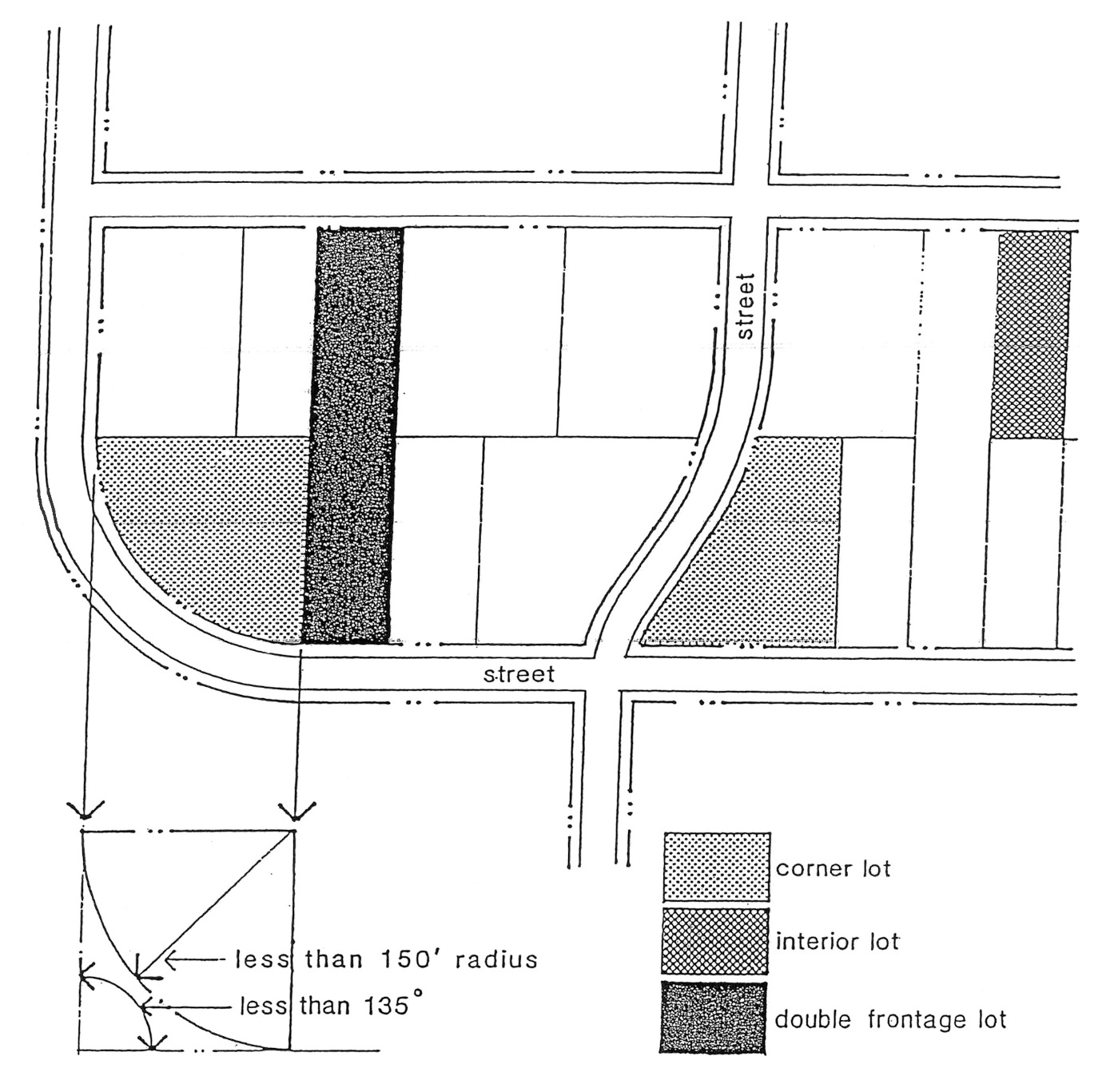
Corner, Interior and Double Frontage Lots
Lot, corner. A lot where the interior angle of two (2) adjacent sides at the intersection of two (2) streets is less than one hundred thirty-five (135) degrees. A lot abutting upon a curved street or streets shall be considered a corner lot for the purposes of this Ordinance if the arc is of less radius than one hundred fifty (150) feet and the tangents to the curve, at the two (2) points where the lot lines meet the curve or the straight street line extended, form an interior angle of less than one hundred thirty-five (135) degrees. (See "Lot" illustration.)
Lot, interior. Any lot other than a corner lot or through lot. (See "Lot" illustration.)
Lot, through or double frontage lot. A double frontage lot, not a corner lot, having a street for both front and rear lot lines. (See "Lot" illustration.)
Lot, waterfront. A waterfront lot is a lot adjoining Cass Lake, Dollar Lake or Sylvan Lake or any of their canals. (See Section 15.15, Waterfront yards.)
Lot, zoning. A tract or parcel of land which is designated by its owner or developer as a tract to be used, developed or built on as a unit, under single ownership or control. A zoning lot may or may not coincide with a lot of record.
Lot area. The total horizontal area within the lot lines of a lot. For lots fronting or adjacent to private streets, lot area shall mean that area within lot lines and not including any portion of said private street. For waterfront lots, lot area shall mean that area within lot lines and not including any submerged area of any lake, canal, river or pond (below the shoreline or ordinary high water mark).
Lot coverage. That part or percent of the lot covered by the area of all buildings including accessory buildings.
Lot depth. The horizontal distance between the front and rear lot lines measured along the median between the side lot lines.
Lot lines. The lines bounding a lot as defined herein:
(a)
Front lot line. In the case of an interior lot, that line separating the lot from the street. In the case of a through lot, the line separating the lot from that street which is designated in an application for a building permit, or in any manner as the front street. In the case of a corner lot, the lines, separating the lot both from that street which is designated as the front street in an application for building permit and from the side street are front lot lines.
(b)
Rear lot line. That line opposite the front lot line. In the case of a lot pointed at the rear, the rear lot line shall be an imaginary line parallel to the front lot line, not less than ten (10) feet long lying farthest from the front lot line, and wholly within the lot.
(c)
Side lot lines. Any lot line other than the front lot line or rear lot line. A side lot line separating a lot from another lot or lots is an interior side lot line. A lot line separating a lot from a side street is a front lot line.
Lot of record. A parcel of land, the dimensions of which are shown on a recorded plat on file with the County Register of Deeds, or any parcel recorded with the Oakland County Register of Deeds, which has been separated, which exists as described. A lot of record must front a public street which is dedicated for access as a public street.
Lot width. The length of a straight line measured between the two (2) points where the building line or setback line intersects the side lot lines. (See "Yard Terms" illustration.)
Major thoroughfares. An arterial street which is designed as a major thoroughfare on the Master Plan for the City.
Manufactured building. Is defined by the following features or characteristics:
(a)
Mass-produced in a factory;
(b)
Designed and constructed for transportation to a site for installation and use when connected to required utilities;
(c)
Either an independent, individual building or a module for combination with other elements to form a building on the site.
Manufactured housing. A manufactured building or portion of a building designed for long-term residential use.
Marginal access road. A service roadway parallel to a feeder road; which provides access to abutting properties and protection from through traffic.
Marina. A facility which extends into or over waterways in the City and provides docking for four (4) or more boats, or offers service to the public or members of the marina for docking, storing and loading of boats. A marina shall include a common lot within a subdivision, a common area within a condominium or any other parcel of land held in common by a subdivision, association, similar agency or group of individuals which provides docking, storing and loading for four (4) or more recreational watercraft. A marina may include boat docking or mooring facilities which are made available for rent or lease, including clubhouses, parking lots, boat service facilities, and other facilities or uses customarily incidental to a marina.
Master Plan (comprehensive plan). The official comprehensive plan, as amended, for the development of Keego Harbor including but not limited graphic and written proposals for thoroughfares, parks, schools, public buildings, land use and the general physical development of the City.
Marquee. A roof-like structure of a permanent nature projecting from the wall of a building.
Mezzanine. An intermediate or fractional story between the floor and ceiling of a main story occupying not more than one-third (⅓) of the floor area of such main story.
Mobile home. A structure, transportable in one (1) or more sections, which is built on a chassis and designed to be used as a dwelling with or without permanent foundation, when connected to the required utilities, and includes the plumbing, heating, air-conditioning, and electrical systems contained in the structure. Mobile home does not include a recreational vehicle.
Mobile home park. A parcel or tract of land under the control of a person upon which three (3) or more mobile homes are located on a continual nonrecreational basis and which is offered to the public for that purpose regardless of whether a charge is made therefore, together with any building, structure, enclosure, street, equipment, or facility used or intended for use incident to the occupancy of a mobile home and which is not intended for use as temporary trailer park.
Mobile vending. Mobile vending is the act of selling items, usually food, from a vehicle that is not permanently affixed to the site of sale and can be readily transported to and from that site. Mobile vendors must abide Chapter 10: Businesses, Article VI: Mobile Food Truck Vendors ordinance of the City's Code of Ordinances.
Mooring. To secure by cable and anchors, as a vessel.
Motel. See "Hotel."
Nonconforming building (nonconforming structure) A building or structure (or portion thereof) lawfully existing at the time of adoption of this Ordinance or a subsequent amendment thereto, that does not conform to the provisions of this Ordinance relative to height, bulk, area, placement or yards for the zoning district in which it is located.
Nonconforming lot of record. A platted or unplatted parcel of land, lawfully existing at the effective date of this Ordinance or amendments thereto, that does not conform to the ordinance provisions for the zoning district in which it is located.
Nonconforming use. A use of a building or structure or of a parcel or tract of land, lawfully existing at the time of adoption of this Ordinance or a subsequent amendment thereto, that does not conform to the regulations of this Ordinance for the zoning district in which it is situated.
Nonconforming use and building. A use and a building lawfully existing at the time of adoption of this Ordinance or a subsequent amendment thereto which do not conform to the use and height, bulk, placement or yard provisions for the zoning district in which situated.
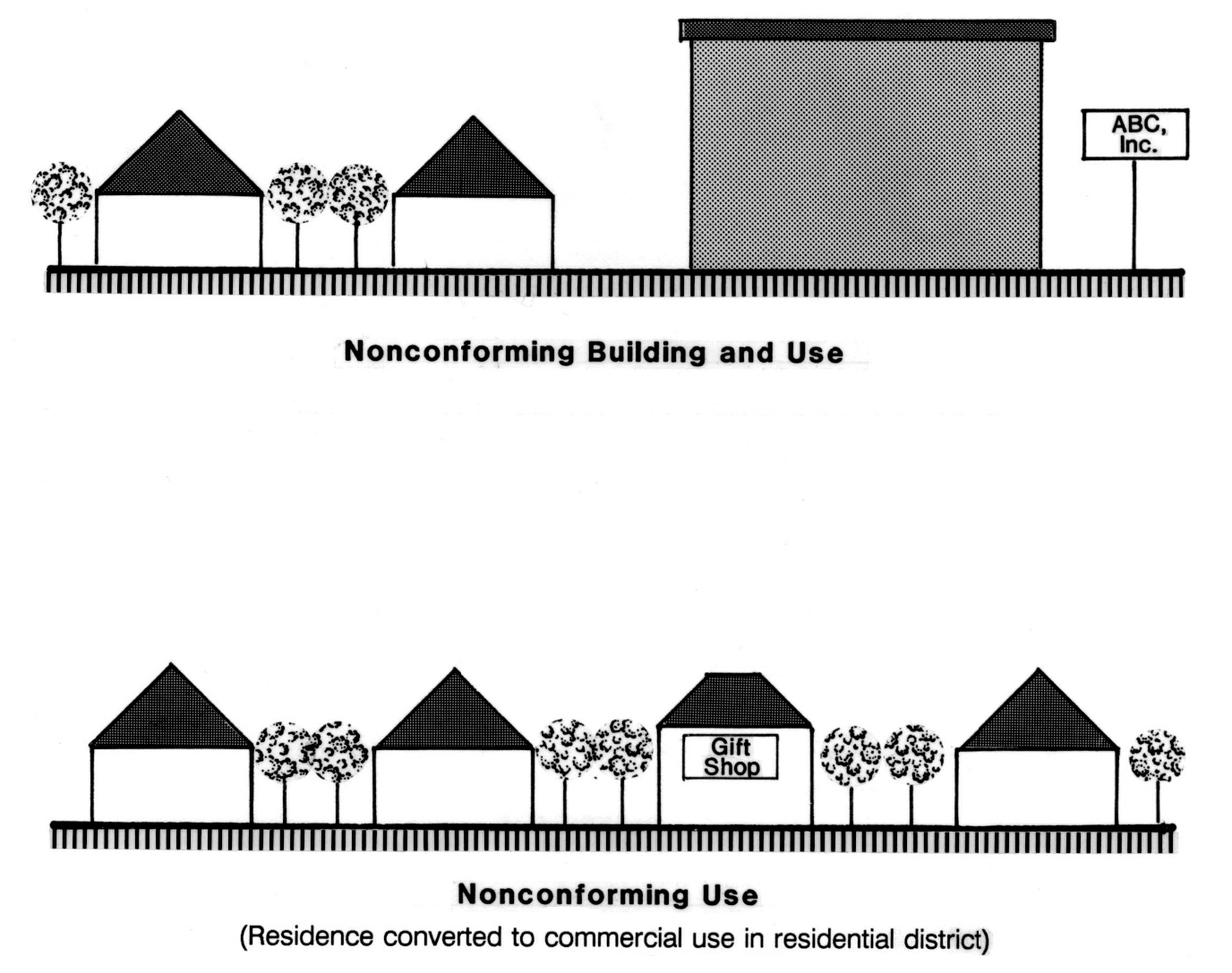
Nonconforming Use
Nursery, plant material. A space, building or structure, or combination thereof, for the storage of live trees, shrubs, or plants offered for retail sale on the premises including products used for gardening or landscaping. The definition of nursery within the meaning of this Ordinance does not include any space, building or structure used for the sale of fruits, vegetables or Christmas trees.
Nursing home. A home for the care of children, the aged, the infirmed, or a place of rest for persons suffering serious bodily disorders, wherein two (2) or more persons are cared for. A convalescent or nursing home is subject to the licensing requirements of applicable state laws. (Public Act 139 of 1956, as amended.)
Occupancy, change of. The term "change of occupancy" shall mean a discontinuance of an existing use and the substitution therefore of a use of a different kind or class, or the expansion of a use.
Occupied. Used in any way at the time in question.
Off-street parking lot. A facility other than for single or two-family dwellings providing parking vehicular parking spaces along with adequate drives and aisles, for maneuvering, so as to provide access for entrance and exit for the parking of more than three (3) vehicles.
Open-front store. A business establishment so developed that service to the patron may be extended beyond the walls of the structure, not requiring the patron to enter the structure. The term "open front store" shall not include automobile service stations or used car lots.
Off-street loading space. A facility or space which permits the standing, loading or unloading of trucks and other vehicles other than on or directly from a public right-of-way.
Outdoor sales establishment. The outdoor display of products by a permanent business establishment or temporary retail operations including but not limited to farmer's market, sidewalk sales, seasonal sales (e.g., Christmas trees, pumpkins), art, etc. Tents and canopies can be considered as part of outdoor sales, but see the General Provisions article for more information.
Parking lot. A lot providing vehicular parking spaces, along with adequate drives and aisles for maneuvering, designed and uses for parking of any operable vehicles by the public or, when used for residential projects, private residences. No storage of vehicles is allowed. Business related vehicles are allowed to park if the vehicles are operable and if the storage of the vehicle is for a period of 24 hours or less.
Parking space. A permanently paved area of land adequate to carry out the off-street parking regulations of this Ordinance, and an area for each motor vehicle of not less than nine (9) feet wide by twenty (20) feet long exclusive of drives, aisles and entrances giving access thereto, and fully accessible for the parking of permitted vehicles.
Parking structure. A structure designed to accommodate vehicular parking spaces that are fully or partially enclosed including parking garages, deck parking, and or underground/under building parking area. A parking structure can be the primary structure or accessory to another use. Parking is only for operable vehicles and no storage of vehicles is allowed.
Patio/terrace. An unroofed, level, and hard-surfaced area no more than nine (9) inches above grade.
Personal service establishment. Establishments providing services such as, but not limited to: barber shops, beauty salons and spas; licensed massage therapy; clothing rental; laundromat and dry cleaning pick-up stores; shoe repair; dressmaking, millinery and tailoring; photographer or artist studios; pet grooming; tattooing, piercing, and permanent makeup studios; and similar uses as determined by the Planning Commission.
Pet. A domesticated dog, cat, canary, parakeet, parrot, gerbil, hamster, guinea pig, turtle, fish, rabbit, or similar animal.
Pier. A structure extending outward from the shore line for use as a promenade or to secure and provide access to boats. Also see "Wharf."
Pile, spring or mooring. A column of timber steel or concrete driven into the ground below the water to tie off or otherwise moor a boat.
Planning commission. The City Planning Commission of Keego Harbor created by ordinance, being the agency designated to prepare a zoning ordinance and to recommend amendments to same ordinance, in accordance with authority of Section 5, Act 207, Public Act 1921, as amended, shall throughout this Ordinance be known as the Planning Commission.
Point of observation. The determination of the percentage of openness to the free passage of air and light in fences, privacy screens and walls shall be made from a specific point of observation. The point of observation shall be a point ten (10) feet away from the structure; perpendicular to the vertical surface plane of the structure and as viewed from a height above grade which is equal to fifty (50) percent of the structure's height.
Porch. (a) A roofed platform at an entrance to a dwelling, or (b) an open or enclosed gallery or room that is not heated or cooled, that is attached to the outside of a building.
Privacy screen. Any unroofed man-made vertical structure intended and used as a visual barrier designed to inhibit or prevent observation of an area, from a point or points off the lot, and the vertical surface of which is less than fifty (50) percent open to the free passage of air and light. See "Point of observation."
Property lines. The lines bounding a lot, the lot lines.
Public utility. Any person, firm or corporation, municipal department or board, duly authorized to furnish and furnishing under federal, state or municipal regulations to the public: gas, steam, electricity, sewage disposal, water, transportation and communications such as telephone, cable television, mobile phone towers, etc.
Recreation land. Any public or private owned lot or land that is utilized for recreation activities such as, but not limited to camping, swimming, picnicking, hiking, nature trails, hunting, boating, and fishing.
Recreation vehicle. "Recreation vehicles" shall include the following:
(a)
Travel trailer. A portable vehicle on a chassis, which is designed to be used as a temporary dwelling during travel, recreational and vacation uses and which may be identified as a "travel trailer" by the manufacturer. Travel trailers generally contain sanitary, water and electrical facilities.
(b)
Camper trailer (pop-up). A canvas folding structure, mounted on wheels and designed for travel and vacation use.
(c)
Pick-up camper. A structure designed to be mounted on a pick-up or truck chassis with sufficient equipment to render it suitable for use as a temporary dwelling during the process of travel, recreational, and vacation uses.
(d)
Boat. A watercraft (including, but not limited to any vessel, ship, motorboat, sailboat, barge, scow, tugboat or rowboat) which is any one (1) of the following:
(1)
Greater than twelve (12) feet in length,
(2)
Having a motor or engine of more than five (5) horsepower,
(3)
Used for rental or other commercial purposes, or
(4)
Registered or required to be registered with the Michigan Department of State.
(e)
Boat/personal watercraft. A vessel that meets all of the following requirements:
(1)
Uses a motor driven propeller or an internal combustion engine powering a water jet pump as its primary source of propulsion,
(2)
Is designed without an open load carrying area that would retain water, and
(3)
Is designed to be operated by one (1) or more persons positioned on, rather than within, the confines of the hull.
(4)
Registered or required to be registered with the Michigan Department of State.
(f)
Motor home. A recreational vehicle intended for temporary human habitation, sleeping, and/or eating, mounted on a chassis with wheels and capable of being moved place to place under its own power. Motor homes generally contain sanitary, water, and electrical facilities.
(g)
Other recreational equipment. Other recreational equipment includes snowmobiles, all-terrain or special terrain vehicles, utility trailers, plus the normal equipment to transport them on the highway.
Religious institution. A facility used for regular organized religious worship and related activities, including living quarters for church ministry or other members of the religious order who carry out their duties primarily on the site, religious education classes, and limited recreation facilities.
Restaurant. A restaurant is any establishment whose principal business is the sale of food and/or beverages to the customer in a ready-to-consume state. Drive-through facilities are not considered a customary part of a restaurant and are regulated separately as accessory to a larger restaurant use.
Retail sale establishment. Sales of goods directly to consumers, including but not limited to pharmacies, convenience stores (general goods and groceries), hardware stores, variety/general merchandise, grocery stores, meat and fish markets, fruit and vegetable markets, confectionery stores, retail bakeries, shoe repair, watch and jewelry stores including repair, music shops, sporting goods and bicycle repair shops, appliance repair, bookstores (excluding adult bookstores), stationery, office supply and office machine repair shops, hobby, toy, and game shops, camera and photo supplies, quilting for individuals, costume or tuxedo rental, pet shops, gift, novelty and souvenir shops, florists, tobacco stores, luggage and leather goods stores, sewing and needlework stores, furniture sales, and similar uses. May also include online sales but must be open to the general public.
Roadside stand. A temporary or existing permanent structure containing not more than two hundred (200) square feet of enclosed floor area and operated for the purpose of selling agricultural, dairy, or poultry products raised or produced only by the proprietor of the stand by his family.
Rooming house. See "Boarding house."
Rooming unit. A room or group of rooms, forming a single habitable unit used for living and sleeping, but not containing kitchen or eating facilities.
Satellite dish antenna. An accessory use which incorporates a solid, open mesh, or bar configured surface, which is typically in the shape of a shallow dish or cone, and which is in excess of thirty-six (36) inches but not greater than ten (10) feet in diameter at its widest dimension. Such devices are designed to receive radio or electromagnetic signals from orbitally based satellites. Because of their weight, mass, and restriction to the free passage of light and air, such uses require specific regulatory guidelines.
Setback line, required. A line, marking the setback distance from the street or lot lines, which establishes minimum required front, side, rear or waterfront open space of area.
Sexually oriented business. Sexually oriented businesses and their operational characteristics are further defined as follows:
(a)
Adult arcade means any place to which the public is permitted or invited wherein coin-operated or slug-operated or electronically, internet or mechanically controlled still or motion picture machines, projectors or other image producing devices are maintained to show images and where the images so displayed are distinguished or characterized by the depicting or describing of "sexually explicit activities" or "specific anatomical areas".
(b)
Adult bookstore or adult video store means an establishment which offers for sale or rental for any form of consideration, as one (1) of its principal business purposes, any one (1) or more of the following:
(1)
Books, computer diskettes, tapes or hard drives, magazines, periodicals or other printed matter or photographs, films, motion pictures, video matter or photographs, cassettes or video reproductions, slides or other visual representation which depict or describe "sexually explicit activities" or "specified anatomical areas"; or
(2)
Instruments, devices or paraphernalia which are designed for use in connection with "sexually explicit activities"; or
(3)
Items, materials, gimmicks, or paraphernalia depicting, displaying, advertising or packaged as "sexually explicit activities" or depict or describe "specified anatomical areas".
(4)
For purposes of this section, "principal business purpose" means:
a.
The devotion of a significant or substantial portion, meaning at least twenty-five (25) percent of its in-store inventory (either measured by display area or retail value) in the items listed above; or
b.
The receipt of twenty-five (25) percent of more of its revenues from the sale of the items listed above; or
c.
The devotion of a significant or substantial portion of its advertising expenditures to the promotion of the sale, rental or viewing, of books, magazines, periodicals or other printed matter, or photographs, film, motion pictures, video cassettes, compact discs, slides or other visual representations, items, materials, gimmicks, or paraphernalia which are characterized by the depiction, description display, advertising or packaging of "sexually explicit activities" or "specified anatomical areas".
d.
An establishment may have other principal business purposes that do not involve the offering for sale, rental or viewing of materials depicting or describing "sexually explicit activities" or "specified anatomical areas", and still be characterized as an adult book store, adult novelty or retail store or adult video store. Such other business purposes will not serve to exempt such establishment from being categorized as an adult bookstore, adult novelty store or adult video store, so long as the establishment falls within the definition of an adult bookstore, adult novelty store or adult video store as set forth above.
(c)
Adult cabaret means a nightclub, bar, restaurant, bottle club, or similar commercial establishment, whether or not alcoholic beverages are sold, which features:
(1)
Persons who appear in a state of restricted nudity; or
(2)
Live performances, exhibitions, shows, dances, revues, floorshows, songs or other similar presentation which are characterized by the partial exposure of "specified anatomical areas"; or
(3)
Films, motion pictures, video cassettes, compact discs, slides or other photographic reproductions which are characterized by the depiction or description of "sexually explicit activities" or "specified anatomical areas".
(4)
This definition does not include a theater which features occasional live nude performances with serious literary, artistic or political value and that have no adverse secondary effects.
(d)
Adult massage parlor means any place where, for any form of consideration or gratuity, massage, alcohol rub, administration of fomentations, electric or magnetic treatments, or any other manipulation of the human body occurs as part of or in connection with specified sexual activities, or where any person providing such treatment, manipulation, or service related thereto, exposes his or her specified anatomical areas. An adult massage parlor, in contrast to a myotherapy establishment, is considered a sexually oriented business for purposes of these regulations.
(e)
Adult motel means a hotel, motel or similar commercial establishment which:
(1)
Offers accommodations to the public for any form of consideration and provide patrons with closed-circuit television transmission, films, motion pictures, video cassettes, compact discs, slides or other photographic reproductions which are regularly characterized by the depiction or description of "sexually explicit activities" or "specified anatomical areas"; or which advertises the availability of this adult type of material by means of a sign, visible from the public right-of-way, or by means of any off-premises advertising, including, but not limited to, newspapers, magazines, pamphlets or leaflets, radio, internet or television; or
(2)
Permits patrons to be filmed or photographed performing "sexually explicit activities" or displaying "specified anatomical areas" for electric transmission over the World Wide Web; or
(3)
Offer a sleeping room for rent for a period of time that is less than ten (10) hours; or
(4)
Allow a tenant or occupant of a sleeping room to sub-rent the room for a period of time that is less than ten (10) hours.
(f)
Adult motion picture theater means a commercial establishment where, for any form of consideration, films, motion pictures, video cassettes, compact discs, slides or similar photographic reproductions are regularly shown which are characterized by the depiction or description of "sexually explicit activities" or "specified anatomical areas".
(g)
Adult theater means a theater, concert hall, auditorium or similar commercial establishment which regularly features persons who appear in a state of nudity or live performances which are characterized by the exposure of "specified anatomical areas" or by the performance of "sexually explicit activities". This definition does not include a theater which features occasional live nude performances with serious literary, artistic or political value and that have no adverse secondary effects.
(h)
Adult use business means an adult arcade, adult bookstore, adult novelty or retail store, adult video store, adult cabaret, adult motel, adult motion picture theater, adult theater, escort agency, nude modeling studio and/or a sexual encounter establishment or any business determined by the City to be an adult use, due to the activities of the business which involve characteristic of adult uses, such as nudity, semi-nudity, exposure of "sexually explicit activities" and/or "specified anatomical areas". The definition of "adult use business" shall not include an establishment where a medical practitioner, psychologist, psychiatrists or similar professional person licensed by the state engages in medically approved and recognized sexual therapy.
(i)
Employee means a person who works or performs in and/or for an adult use business, regardless of whether or not said person is paid a salary, wage or other compensation by the operator of said business.
(j)
Entertainer means a person who performs some type of activity or poses with the intent of allowing others to witness that activity or pose.
(k)
Escort means a person, who for consideration in any form, agrees or offers to act as a companion guide or date for another person, or who agrees or offers to privately perform as an entertainer, including, but not limited to, the modeling of lingerie, the removal of clothing, the performance of a dance or skit, or the providing of specified sexual activities for another person. Under this definition, "privately" shall mean a performance for an individual, or that individual's guests.
(l)
Escort agency means a person or business association who furnishes, offers to furnish or advertises to furnish escorts as one (1) of its primary business purposes, for a fee, tip or other consideration.
(m)
Establishment means and includes any of the following:
(1)
The opening or commencement of any sexually oriented business as a new business;
(2)
The conversion of an existing business, whether or not a sexually oriented business, to any sexually oriented business;
(3)
The location or relocation of any sexually oriented business.
(n)
Licensee means the individual listed as an applicant on the application of a sexually oriented business license, or a person whose name a license to operate an adult use business has been issued.
(o)
Licensing officer means the Clerk of the City of Pontiac or his/her designee.
(p)
Manager means an operator, other than a licensee, who is employed by a sexually oriented business to act as a manager or supervisor of employees, or is otherwise responsible for the operation of the sexually oriented business.
(q)
Massage means the treating of external parts of the body for remedial or hygienic purposes, consisting of stroking, kneading, rubbing, tapping, pounding, vibrating, or stimulating with the hands or with the aid of any mechanical or electrical apparatus or appliances, with or without such supplementary aids as rubbing alcohol, liniments, antiseptics, oils, powder, creams, lotions, ointment or other such similar preparations commonly used in the practice of massage, under such circumstances that it is reasonably expected that the person to whom the treatment is provided shall pay any consideration whatsoever therefore. For purposes of this Ordinance, the term "bodywork" shall mean massage.
(r)
Myotherapy establishment means any individual, group of individuals, person or business which engages in the practice of massage as defined herein, and which has a fixed place of business where any person, firm, association, partnership, limited liability company or corporation carries on any of the activities as defined herein. Myotherapy establishment shall also include, but not be limited to, a Turkish bath parlor, steam bath, sauna, magnetic healing institute, health club, health spa, or physical fitness club or business that offers massages on occasion or incidental to its principal operation, as well as an individual's home where a person is engaged in the practice of massage for consideration. The definition of sexually oriented business shall not include the practice of massage in a licensed hospital, sanitarium, nursing home, medical clinic or the offices of a physician, surgeon, chiropractor, osteopath, psychologist, clinical social worker and family counselor, who are licensed to practice their respective professions in the State of Michigan, or who are permitted to practice temporarily under the auspices of an associate or an establishment duly licensed in the State of Michigan, clergymen, certified members of the American Massage and Therapy Association and certified members of the International Myomassethics Federation.
(s)
Nude model studio means any place where a person appears in a state of nudity or displays "specific anatomical areas", and is provided money or any form of consideration to be observed, sketched, drawn, painted, sculpted, photographed or similarly depicted by other persons. This includes modeling studios that provide for nude modeling on an occasional basis, but it does not include modeling studio whose primary function is to provide art classes as part of a college, university or educational institution and which is certified by the State of Michigan.
(t)
Operator means the owner, licensee, manager or person in charge of any premises.
(u)
Peep booth means an adult motion picture theater with a viewing room or cubical of less than one hundred fifty (150) square feet of floor space.
(v)
Premises or licensed premises means any premises that requires a sexually oriented business license and that is classified as a sexually oriented business.
(w)
Principal owner means any person owning, directly or beneficially:
(1)
Ten (10) percent or more of a corporation's equity securities;
(2)
Ten (10) percent or more of the membership interests in a limited liability company; or
(3)
In the case of any other legal entity, ten (10) percent or more of the ownership interests in the entity.
(x)
Private room means a room in a hotel/motel that is not a peep booth, has a bed and a bath in the room or adjacent room, and is used primarily for lodging.
(y)
Semi-nude means a state of dress in which clothing covers no more than the genitals, pubic region and areola of the female breast, as well as portions of the body covered by supporting straps or devices.
(z)
Sexual encounter center means a business or commercial enterprise that, as one (1) of its primary business purposes, offers a place where two (2) or more persons may congregate, associate or consort for the purpose of "sexually explicit activities" or the exposure of "specified anatomical areas" for any form of consideration, including, but not limited to:
(1)
Physical contact in the form of wrestling or tumbling between persons of the same or opposite sex; or
(2)
Activities when one (1) or more of the persons is in a state of nudity or semi-nudity; or
(3)
Permits patrons to display or be filmed or photographed performing "sexually explicit activities" or displaying "specified anatomical areas" for recording or transmission over the World Wide Web or any other media.
(aa)
Sexually explicit activities means and includes any of the following:
(1)
The fondling or other erotic touching of human genitals, pubic region, buttocks, anus or female breasts; or
(2)
Sex acts, normal or perverted, actual or simulated, including, but not limited to, intercourse, oral copulation or sodomy; or
(3)
Masturbation, actual or simulated; or
(4)
Any activity intended to arouse, appeal to or gratify a person's lust, passions or sexual desires; or
(5)
Human genitals in a state of sexual stimulation, arousal or tumescence; or
(6)
Excretory function as part of or in connection with any of the activity set forth in subsections (1) through (5) above.
(bb)
Sexually oriented business means an establishment that provides adult entertainment appealing to the sexual interests of its customers, including adult arcade, adult bookstore or adult video store, adult novelty or retail store, adult cabaret, adult motel, adult motion picture theater, adult theater, escort agency, nude model studio, sexual encounter center or similar establishment or any place that permits patrons to be filmed or photographed performing "sexually explicit activities" or displaying "specified anatomical areas" for electronic transmission over the internet, film, motion picture, videocassette, DVD, Blue-Ray or other similar photographic reproduction.
"Sexually oriented" when used to describe film, motion picture, videocassette, DVD, slides, or other photographic reproductions shall mean film, movies, motion picture, videocassette, DVD, slides or other photographic reproductions that regularly depict material which is distinguished or characterized by an emphasis on matter depicting or describing "sexually explicit activities" or "specified anatomical areas" offered for observation by the patron(s) on the premises of a sexually oriented business. The definition of "sexually oriented business" shall not include an establishment where a medical practitioner, psychologist, psychiatrist or similar professional person licensed by the state engages in medically approved and recognized sexual therapy or a myotherapy establishment.
(cc)
Specified anatomical areas means and includes any of the following:
(1)
Less than completely and opaquely covered human genitals, pubic region or pubic hair, buttock, or female breast or breasts of any portion thereof that is situated below a point immediately above the top of the areola, or any combination of the foregoing; or
(2)
Human genitals in a state of sexual arousal, even if opaquely and completely covered.
(dd)
Specified criminal acts means sexual crimes against children, sexual abuse, criminal sexual conduct, rape, crimes classified as sexual crimes by the State of Michigan or any other state, or crimes connected with another adult use business, including, but not limited to, the distribution of obscenity, prostitution and/or pandering.
(ee)
Significant or substantial portion means twenty-five (25) percent or more of the term modified by such phrase.
(ff)
Substantial enlargement of a sexually oriented business means the increase in floor area occupied by the business by more than twenty-five (25) percent, as the floor area exists on the date of adoption of this Ordinance.
(gg)
Tenant space means a securable area separated from other area by walls and doors that are available for lease or rent within a multi-tenant building, such as tenant spaces typically found within a shopping mall or strip.
(hh)
Transfer of ownership or control of a sexually oriented business means and includes any of the following:
(1)
The sale, lease or sublease of the business;
(2)
The transfer of securities which constitute a controlling interest in the business, whether by sale, exchange or similar means; or
(3)
The establishment of a trust, gift or other similar legal device which transfers the ownership or control of the business, except for transfer by bequest or other operation of law upon the death of the person possessing the ownership or control.
Shed. A building not exceeding one hundred (100) square feet in area or eight (8) feet in height designed and used for the storage of tools, garden tractors, lawn mowers, other personal property or equipment, or as a children's playhouse or similar purposes.
Shopping center. Any multi-tenant building with two (2) or more tenants having individual entrances, or, any commercial development with two (2) or more buildings sharing a common parking lot.
Shoreline, ordinary high water mark. The line between upland and bottomland which persists through successive changes in water levels, below which the presence and action of the water is so common or recurrent that the character of the land is marked distinctly from the upland and is apparent in the soil, the configuration of the soil surface and the vegetation.
Short term rental. Any dwelling or condominium, duly registered as a principal residence exemption under Section 211.7cc of the General Property Tax Act, or portions thereof, that is available for use or is used for accommodations or lodging of guests, paying a fee or other compensation for a period of less than thirty (30) consecutive days. Short term rentals are commonly referred to as Air B'n'Bs, tourist homes, vacation rentals, VRBOs, or corporate leasing, and include any third party leasing or vacation rental services.
Sign. The use of any words, numerals, figures, devices, designs or trademarks by which anything is made known to the general public and is visible off the lot.
Site plan. A plan showing all salient features of a proposed development, so that it may be evaluated in order to determine whether it meets the provisions of this Ordinance.
Special exception. See "Exception."
State licensed residential facility. Any structure constructed for residential purposes that is licensed by the State of Michigan pursuant to Michigan Public Act 116 of 1973 (the Child Care Licensing Act) or Michigan Public Act 218 of 1979 (the Adult Foster Care Facility Licensing Act). This definition includes adult foster care facilities, foster family homes, foster family group homes, family day care homes, and group day care homes.
Note: that wherever the term "private home" is used in the state licensed residential facilities definitions, it shall mean a private residence in which the licensee or registrant permanently resides as a member of the household, which residency is not contingent upon caring for children or employment by a licensed or approved child placing agency.
(a)
Foster care means the provision of supervision, personal care, and protection in addition to room and board, for twenty-four (24) hours a day, five (5) or more days a week, and for two (2) or more consecutive weeks for compensation.
(b)
Adult foster care facility means a residential structure that is licensed to provide foster care, but not continuous nursing care, for unrelated adults over the age of 17. Adult foster care facilities are subject to all applicable provisions, definitions, and regulations of Michigan Public Act 218 of 1979, as amended (MCL 400.701 et seq.).
(1)
The following types of adult foster care facilities are provided for by this Ordinance:
a.
Adult foster care family home means a private home with the approved capacity to receive not more than six (6) adults to be provided with foster care. The adult foster care family home licensee shall be a member of the household and an occupant of the residence.
b.
Adult foster care small group home means an adult foster care facility with the approved capacity to receive not more than twelve (12) adults to be provided with foster care. Facilities with the approved capacity for seven (7) or more adults are subject to conditional use approval.
c.
Adult foster care large group home means an adult foster care facility with the approved capacity to receive at least thirteen (13) but not more than twenty (20) adults to be provided with foster care. Facilities are subject to conditional use approval.
(2)
Adult foster care facility does not include any of the following:
a.
A licensed child caring institution, children's camp, foster family home, or foster family group home, subject to the limitations contained in section 3(4f) of Michigan Public Act 218 of 1979, as amended (MCL 400.703).
b.
A licensed foster family home that has a person who is eighteen (18) years of age or older placed in the foster family home under section 5(7) of Michigan Public Act 116 of 1973, as amended (MCL 722.115).
c.
An establishment commonly described as an alcohol or a substance abuse rehabilitation center; a residential facility for persons released from or assigned to adult correctional institutions; a maternity home; or a hotel or rooming house that does not provide or offer to provide foster care.
d.
A veterans' facility created by 1885 PA 152, MCL 36.1 to 36.12.
(3)
Adult foster care congregate facility means an adult foster care facility with the approved capacity to receive more than 20 adults to be provided with foster care. Facilities are subject to conditional use approval.
(4)
Family day care home means a private home in which one (1) but fewer than seven (7) minor children are received for care and supervision for periods of less than twenty-four (24) hours a day, unattended by a parent or legal guardian, except children related to an adult member of the family by blood, marriage, or adoption. Family day care home includes a home in which care is given to an unrelated minor child for more than four (4) weeks during a calendar year.
(5)
Foster family home means a private home in which one (1) but not more than four (4) minor children, who are not related to an adult member of the household by blood or marriage, or who are not placed in the household under the Michigan Adoption Code, are given care and supervision for twenty-four (24) hours a day, for four (4) or more days a week, for two (2) or more consecutive weeks, unattended by a parent or legal guardian.
(6)
Foster family group home means a private home in which more than four (4) but fewer than seven (7) minor children, who are not related to an adult member of the household by blood or marriage, or who are not placed in the household under the Michigan Adoption Code, are given care and supervision for twenty-four (24) hours a day, for four (4) or more days a week, for two (2) or more consecutive weeks, unattended by a parent or legal guardian.
(7)
Group child day care home means a private home in which more than six (6) but not more than twelve (12) minor children are given care and supervision for periods of less than twenty-four (24) hours a day unattended by a parent or legal guardian, except children related to an adult member of the family by blood, marriage, or adoption. Group child day care home includes a home in which care is given to an unrelated minor child for more than four (4) weeks during a calendar year.
Story. That portion of a building included between the upper surface of any floor, and the upper surface of any floor above; or any portion of a building between the topmost floor and the roof having a usable floor area to at least fifty (50) percent of the usable floor area of the floor immediately below it. A top floor area under a sloping roof with less than fifty (50) percent of the usable floor area is a half story. The first story shall be considered the lowest story of which the ceiling is more than four (4) feet above the average contact ground level at the exterior walls of the building. (See "Basic Structural Terms" illustration.)
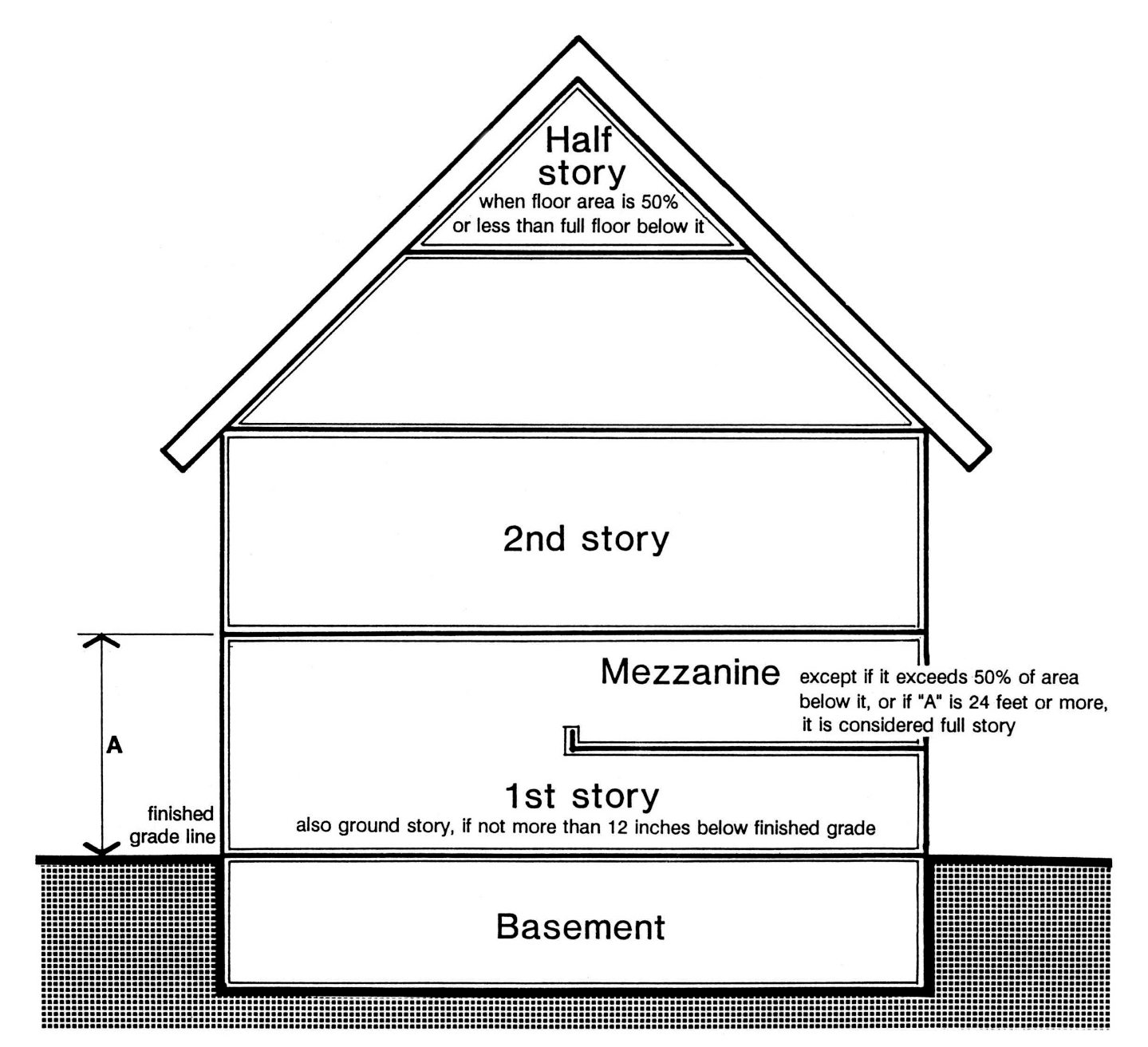
Basic Structural Terms
Street. A public thoroughfare which affords the primary means of access to abutting property.
Street line (right-of-way line). A dividing line between the street and a lot.
Structure. Any constructed or erected material, the use of which requires location on the ground or attachment to something having location on the ground, including, but not limited to, buildings, towers, sheds, decks, fences, and signs, but excepting walks, drives, pavements, and similar access or circulation facilities.
Studio (fitness and art). Studios for indoor instruction in the martial arts, music, dance, visual arts, and physical fitness, including yoga, Pilates, and other similar disciplines.
Temporary use, temporary building. A use or building permitted to exist for a limited period, including during periods of construction of a main building or use, or for special events.
Tourist home. A dwelling in which overnight accommodations are provided or offered for transient guests for compensation, without provision for meals.
Townhouse. One (1) in a row of at least three (3) units in which each unit has its own front and rear access to the outside, no unit is located over another unit, and each unit is separated from any other unit by one (1) or more common and fire-resistant walls.
Toxic/hazardous waste. Waste or a combination of waste and other discarded material including solid, liquid, semisolid, or contained gaseous material which because of its quality; concentration; or physical, chemical, or infectious characteristics may cause or significantly contribute to an increase in mortality or increase in serious irreversible illness or serious incapacitating, but reversible illness, or pose a substantial present or potential hazard to human health or the environment if improperly treated, stored, transported, disposed of, or otherwise managed.
Trailer coach. A vehicle, self-propelled or non-self propelled, so designed and constructed as to permit its being used as a conveyance on the public streets and licensable as such, and of a nature that will permit permanent occupancy as a dwelling unit or rooming unit for one (1) or more persons.
Trash storage area. Any exterior space, which is not a principal use, used for the location of containers, structures, or other receptacles intended for the temporary storage of garbage, rubbish, or other solid waste material.
Truck storage. An area used for the temporary storage of private trucks or trucks for hire.
Truck terminal. A structure to which goods, except raw or unprocessed agricultural products, natural minerals, or other resources, are delivered for immediate distribution or to be amalgamated for delivery in larger units to other points in the metropolitan area; or for distribution or amalgamation involving transfer to other modes of transportation.
Undeveloped state. means a natural state preserving natural resources, natural features, scenic or wooded conditions, agricultural use, open space, or a similar use or condition. Land in an undeveloped state does not include a golf course but may include a recreational trail, picnic area, children's play area, greenway, or linear park. Land in an undeveloped state may be, but is not required to be, dedicated to the use of the public.
Use, accessory. A subordinate use which is customarily incidental to the principal use on the same lot or parcel.
Use, change of. A change from one (1) permitted use to another permitted use in a Zoning District shall not be considered a change of use subject to site plan review requirements unless the change in permitted use requires a substantial change in the design or function of the building or increases traffic and demand for public services.
Variance. A modification of the literal provisions of this Ordinance granted by the Zoning Board of Appeals in situations or under circumstances where permitted by law.
Wall. Any unroofed man-made structure which has a foundation and also has an exterior vertical surface of brick or stone, and no more than twenty-five (25) percent of the vertical surface of which is open to the free passage of air and light.
Watercraft. See "Recreational vehicle."
Wharf. A structure parallel to the shore line.
Wireless communications facility. All facilities, structural, attached, accessory or otherwise, related to the use of the radio frequency spectrum for the purpose of transmitting or receiving radio signals and may include, but is not limited to radio towers, television towers, telephone devices and exchanges, microwave relay towers, telephone transmission equipment building and commercial mobile radio service facilities. Citizen band radio facilities, short wave facilities, ham and amateur radio facilities, television reception antennae, satellite dishes, and government facilities which are subject to state or federal law or regulations which preempt municipal regulatory authority are not included in this definition. A wireless communications facility shall not be included under the existing definition of "essential services".
Wireless communications facility, colocation. The location by two (2) or more wireless communications providers, public authority or other duly authorized party of wireless communications facilities on an existing structure, tower or building, in a manner that reduces the overall need for additional or multiple freestanding single use communications facilities within the City of Keego Harbor.
Wireless communications facility, equipment. The set of equipment and network components used in the provisions of wireless communications services, including but not limited to, antennas, receivers, transmitters, base stations, equipment shelters, cabinets, emergency generators, power supply cables, and coaxial and fiber optic cables, but excluding wireless communications support structures.
Wireless communications facility, equipment compound. An area surrounding or adjacent to the base of a wireless communications support structure and within with wireless communications facility equipment is located.
Wireless communications support structure (tower). Any wireless communications facility erected or modified to support attached wireless communications facilities, or other antennae or facilities, including supporting lines, cables, wires, braces, and masts intended primarily for the purpose of mounting an attached wireless communications facility or similar apparatus above grade. This includes, but are not limited to, any ground or roof-mounted pole, monopoles, lattice towers, light poles, utility support structures, wood pole, guy wired tower, spire, other similar structure, or combination thereof, or other structures which appear to be something other than a mere support structure.
Yard. The open spaces on the same lot with a main building, unoccupied and unobstructed from the ground upward except an otherwise provided in this Ordinance, and as defined herein: (See "Yard" illustration.)
(a)
Front yard. An open space extending the full width of the narrowest side of the lot which faces the street, the depth of which is the minimum horizontal distance between the front lot line and the front setback line.
(b)
Front yard, double. An open space on corner lots (as defined in this Ordinance) extending the full width of the lot on both sides facing the intersecting streets. Unless specifically noted otherwise in this Ordinance, both open spaces facing each street shall be considered front yards with setbacks as required in each particular zoning district.
(c)
Side yard. An open space, extending from the front yard to the rear yard, the width of which is the horizontal distance from the nearest point of the side lot line to the side setback line.
(d)
Rear (back) yard. An open space extending the full width of the lot, the depth of which is the minimum horizontal distance between the rear lot line or established zoning district line and nearest line of the principal buildings.
(e)
Waterfront yard. An open space extending the full width of the lot, the depth of which is the minimum horizontal distance between the shoreline and nearest line of the principal building.
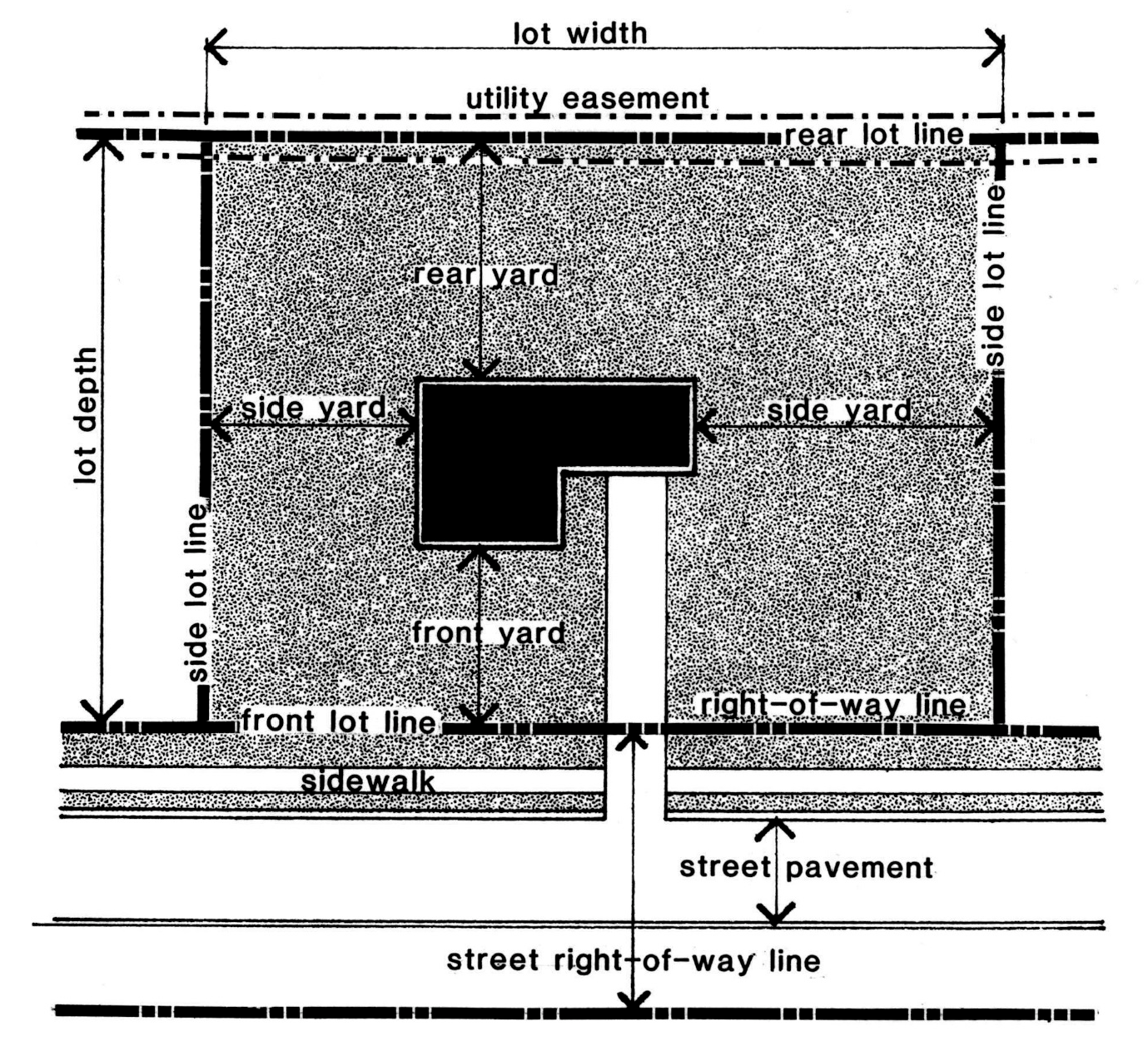
Yard Terms
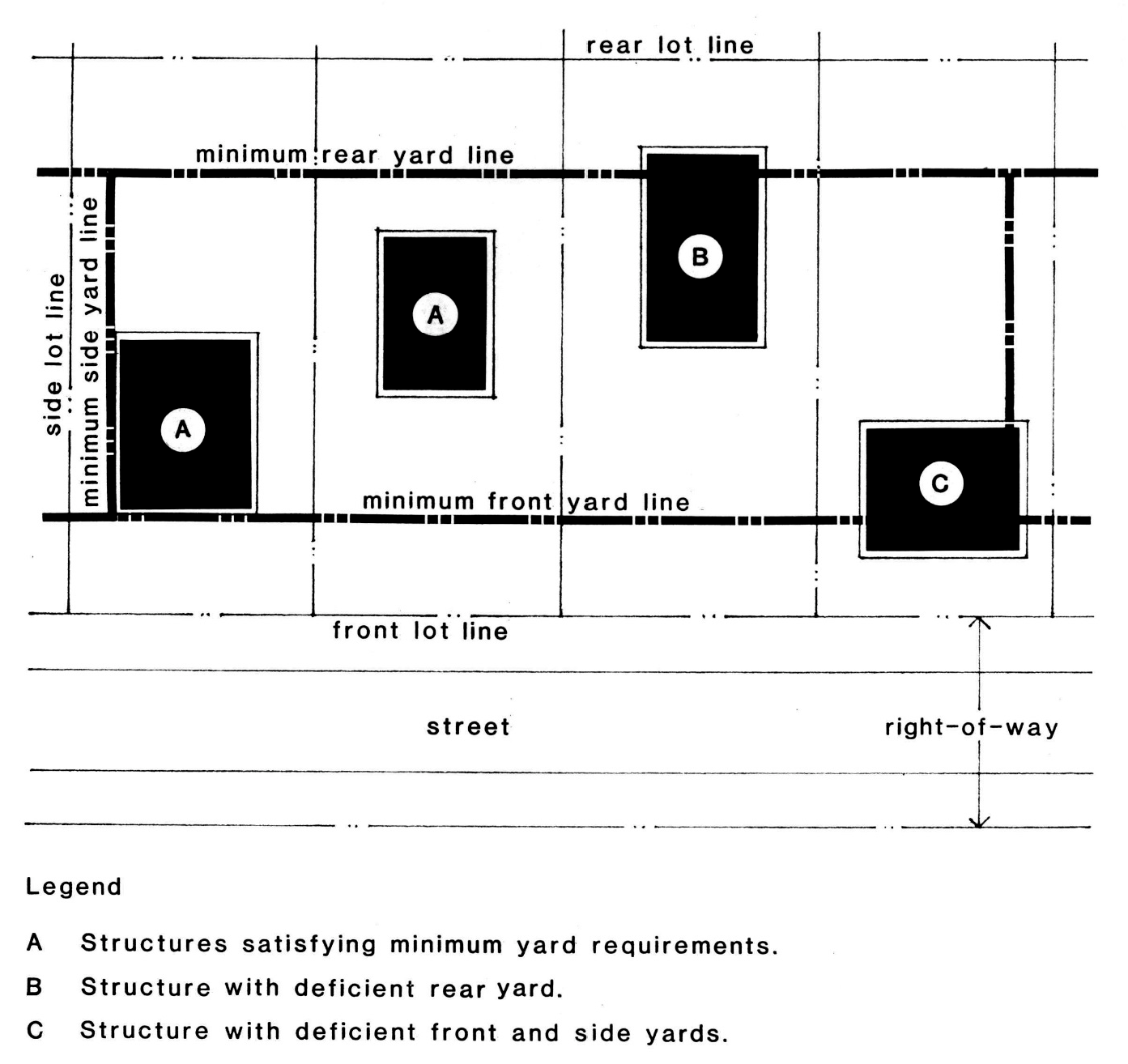
Yard Requirements
(Ord. 338, 2/19/1998; Ord. 340, 4/16/1998; Ord. 364, 12/21/2000; Ord. 377, 11/15/2001; Ord. 386, 3/21/2002; Ord. 428, 12/15/2011; 6/8/2022; Ord. No. 2023-02, § 1.02(Exh. A), 3-16-2023; Ord. No. 2023-04, pt. 1, 11-16-2023; Ord. No. 2024-06, pt. 1, 7-17-2024; Ord. No. 2025-01, pt. 1, 12-17-2024; Ord. No. 2025-03, pt. 1, 9-18-2025)
In a decision issued by Oakland County Circuit Court Judge Richard D. Kuhn on July 20, 1999, the definition of bar/lounge as amended by Ordinance 328 was declared invalid. Judge Kuhn found that the 11 p.m. restriction in the definition was pre-empted by Michigan Liquor Control Law. The definition prior to the amendment reads as follows: A bar or lounge is a type of restaurant which is operated primarily for the dispensing of alcoholic beverages, although the sale of prepared food or snack may also be permitted. If a bar or lounge is part of a larger dining facility, it shall be defined as that part of the structure so designated or operated.
--- (2) ---
The Zoning Board of Appeals has ruled that all storage areas are to be included in the definition of Useable Non-Residential Floor Area. (January 1997)

