
Keego Harbor City Zoning Code
ARTICLE IV
NR NEIGHBORHOOD RESIDENTIAL DISTRICT
Sec. 4.00.- Intent.
Neighborhood residential districts are defined by their collective character. In order to maintain this character, standards that ensure compatibility of size and style are critical. The existing character of Keego Harbor's residential neighborhoods is largely defined by the existing platted lots of record ranging in size from thirty (30) feet to fifty (50) feet. This greatly defines the character of the community as a pedestrian friendly, walkable community and the provisions of this article are intended to preserve and enhance this character.
(Ord. No. 2024-06, pt. 3, 7-17-2024)
Sec. 4.01. - Additional use standards.
(a)
Schools. Public, parochial and other private elementary, intermediate and/or high schools offering courses in general education, subject to the following condition: No building shall be closer than fifty (50) feet to any property line when said property line abuts or is adjacent to land zoned for residential purposes.
(b)
Places of worship.
(1)
Buildings of greater than the maximum height allowed in this district may be permitted provided front, side, and rear yards are increased above the minimum required yards by one (1) foot for each foot of building height that exceeds the maximum height allowed.
(2)
At least one (1) boundary of the lot upon which the church is to be constructed shall border a street designated as a collector thoroughfare having an existing and/or planned right-of-way of at least eighty-six (86) feet in width.
(c)
Bed and breakfast/tourist homes.
(1)
Bed-n-Breakfast inns and/or tourist homes not to exceed a height of three (3) stories.
(2)
Bed-n-Breakfast inns and tourist homes shall remain as single family homes in appearance and shall have no internal or external structural alterations. An example would be enlarging the kitchen for volume food service.
(3)
Off-street parking shall be provided for the households and guests as follows: Two (2) parking spaces plus one (1) additional space per room to be rented.
(4)
There shall be ample open space other than that required to accommodate the required off-street parking. Natural screening by use of plant materials or other screening may be required to screen parking areas from adjoining residential properties. Off-street parking in front yard areas shall not be permitted.
(5)
Food may only be served in an inn to those persons renting an inn room only during their stay at the inn.
(6)
A residential structure shall not have or be converted to more rental rooms than the number of bedrooms which exist at the time of enactment of this Ordinance.
(7)
One (1) wall sign not to exceed a total area of eight (8) square feet shall be permitted for identification purposes only.
(d)
Attached wireless communications facilities. See additional requirements in Article XV.
(1)
No attached wireless communications facilities, with the exception of television antennas, may be erected on a residential structure or associated accessory structure.
(2)
Where an attached wireless communications facility is proposed on the roof of a building, the switching equipment module must be adequately screened or architecturally compatible with the design of the building. The switching equipment module may be located within the principal building or may be an accessory building, provided that an accessory building conforms with all district requirements for principal buildings, including yard setbacks and building height.
(3)
Attached wireless communications facility shall be erected on a building in a manner that is not prominently visible from the ground, injurious to the character of the neighborhood or otherwise detrimental to public safety and welfare. The attached wireless communications facility shall be located and designed to be harmonious with the surrounding area, and to be aesthetically and architecturally compatible with the natural environment, as well as the environment as altered by development.
(e)
Wireless communications support structures. See additional use requirements in Article XV.
(f)
Storage lot, boats and recreational vehicles. Common use lots utilized for the docking or mooring of boats or the storage of recreational vehicles, subject to the following conditions:
(1)
All recreational vehicles docked, moored, or stored on the lot shall be the property of, and currently registered and licensed to a member of the subdivision, association, similar agency or group of individuals who hold the lot in common.
(2)
Docking space shall be limited to the maximum number of boats allowed by the Department of Environmental Quality marina operating permit.
(3)
All waterfront structures and appurtenances shall comply with the requirements of Section 15.15, Waterfront yards.
(4)
There shall be no repair or dismantling of recreational vehicles on the site.
(5)
On-land storage of recreational vehicles shall comply with the standards of Section 3.05, Parking and storage of recreational vehicles on vacant residentially zoned lots.
(Ord. No. 2023-04, pt. 3, 11-16-2023; Ord. No. 2024-06, pt. 3, 7-17-2024)
Sec. 4.02. - Reserved.
Editor's note— Ord. No. 2024-06, pt. 3, adopted July 17, 2024, repealed § 4.02, which pertained to principal uses permitted subject to special conditions and derived from Ord. 338, adopted Feb. 19, 1998.
Sec. 4.03. - Accessory uses permitted.
Accessory buildings and uses, including private garages, garden houses, non-commercial gardening, tool houses, sheds, non-commercial greenhouses, non-commercial swimming pools, and home occupations (See Section 15.13, Accessory buildings and Section 15.29, Home occupations). Off-street parking; storage of not more than two (2) recreational vehicles, as defined in Section 2.00, Definitions, "Recreation vehicles". The storage or parking of recreational vehicles shall be subject to Sections 4.04 and 4.05. In addition, any other use customarily incidental to the principal uses enumerated in Sections 4.01 and 4.02 are permitted.
(Ord. 338, 2/19/1998; Ord. No. 2024-06, pt. 3, 7-17-2024)
Sec. 4.04. - Recreational vehicle parking in residential districts.
Not more than two (2) recreational vehicles, as defined in Section 2.00, may be parked or stored by the owner and/or occupant on residentially used property subject to the following conditions:
(a)
A recreational vehicle must be stored in the rear yard, interior side yard, or side yard facing the street of the lot, but not closer than three (3) feet to a side or rear property line. The length of the recreation vehicle shall not exceed twenty-five (25) feet. No recreational vehicle shall be stored on a public street right-of-way. Recreational vehicles may be stored within the clear vision triangle of a waterfront lot between September 15 and May 15.
(b)
Boats stored out of water shall not exceed twenty-two (22) feet in length, provided pontoon boats may be allowed up to thirty-five (35) feet in length and twelve (12) feet in height.
(c)
A recreational vehicle parked or stored shall not be connected to electricity, water, gas, or sanitary sewer facilities.
(d)
A recreational vehicle shall not be used for living, lodging or housekeeping purposes.
(e)
A recreational vehicle must be stored in the rear yard, interior side yard, or side yard facing the street of the lot, but not closer than three (3) feet to a side or rear property line. The length of the recreation vehicle shall not exceed twenty-five (25) feet. No recreational vehicle shall be stored on a public street right-of-way. Recreational vehicles may be stored within the clear vision triangle of a waterfront lot between September 15 and May 15.
(f)
A recreational vehicle designed for use on the streets and highways may be parked in a driveway of a residence if it is the sole means of transportation to and from work for one (1) or more of the residents.
(g)
Notwithstanding the above provisions concerning "location", a recreational vehicle may be parked elsewhere on the premises prior to or after a trip for loading or unloading purposes for a period of not more than forty-eight (48) hours prior to and forty-eight (48) hours after use of the vehicle within a seven-day period.
(h)
The parked or stored recreational vehicle must be kept in good repair. The vehicle must be capable of being moved from place to place.
(i)
The provisions concerning connection to utilities, use as living quarters, and location may be waived for a period of up to two (2) weeks to permit repair or lodging purposes of the occupant's or owner's recreational vehicle or to permit the parking of a recreational vehicle of a guest. Permits for any such waiver shall be obtained from the Building Inspector or Code Enforcement Officer. No more than two (2) permits shall be issued for each activity (repair, lodging, storage of guest vehicle) per calendar year.
(j)
For the purposes of this section, two (2) personal watercraft, snowmobiles, all terrain vehicles, or motorcycles stored on a single trailer shall be counted as one (1) recreational vehicle.
(Ord. 338, 2/19/1998; 8/19/2021)
Sec. 4.05. - Parking and storage of recreational vehicles on vacant residentially zoned lots.
Not more than two (2) recreational vehicles, as defined in Section 2.00, Definitions, may be parked or stored on a vacant, separate lot of record than the principal structure subject to the following conditions:
(a)
All recreational vehicles shall be currently registered and licensed to a current resident of Keego Harbor and/or the current property owner of record.
(b)
The following recreational vehicles parked, or stored outdoors may not exceed:
(1)
Travel trailer, thirty-five (35) feet or less in length.
(2)
Camper trailer (pop-up), shall be stored in a collapsed position to a height not more than six (6) feet.
(3)
Pick-up camper, thirty-two (32) feet or less in length.
(4)
Watercraft, thirty-five (35) feet or less in length, but not to exceed twelve (12) feet in height, either mounted on a boat trailer or unmounted; also boat trailer without boat mounted.
(5)
Motor home, forty (40) feet or less in length.
(c)
Storage of recreational vehicles shall be in the rear one-third (⅓) of the lot, but, not closer than five (5) feet to a side or rear property line. Recreational vehicles may be stored within the clear vision triangle of a waterfront lot between September 15 and May 15.
(d)
Recreational vehicles which are parked or stored shall be in good repair. Open storage of partially or disassembled component parts is prohibited. The vehicles must be capable of being moved from place to place.
(e)
Recreational vehicles shall not be used for living, lodging or housekeeping purposes.
(f)
Recreational vehicles parked or stored shall not be connected to electricity, water, gas, or sanitary sewer facilities.
(g)
The owner of a recreational vehicle shall not park or store such a recreational vehicle in such a manner as to create a dangerous or unsafe condition on the lot where parked or stored. Parking or storage in such a fashion that the recreational vehicle, whether loaded or not, may readily tip or roll, shall be considered a dangerous and unsafe condition.
(h)
The ground underneath the stored recreational vehicles must be surfaced and maintained to avoid muddy conditions and an unkempt appearance. It can be surfaced with natural ground cover, gravel, or crushed stone.
(i)
Landscaping located at the rear and sides of the storage area shall comply with requirements in Section 15.23(d)(6) so as to create an evergreen or landscaped screen.
(j)
For the purposes of this section, two (2) personal watercraft, snowmobiles, all terrain vehicles, or motorcycles stored on a single trailer shall be counted as one (1) recreational vehicle.
(Ord. 338, 2/19/1998; 8/19/2021)
Sec. 4.06. - Front yard parking in residential districts.
(a)
All proposed front yard parking areas in the Neighborhood Residential (NR) District shall comply with the following standards. Additionally, existing nonconforming front yard parking areas in the NR District shall be required to comply with the following standards when one (1) or more of the following occurs:
(1)
Construction of single-family house.
(2)
Construction or reconstruction of a garage.
(3)
Alterations to an existing house of a value equal to or greater than forty (40) percent of the current taxable value.
(4)
Alteration to the existing footprint of the parking area.
(b)
Driveways may be no wider than twenty-two (22) feet with the exception of that portion of a driveway within thirty (30) feet of the front of a garage and directly in front of the garage doors. The maximum driveway width in front of the garage shall not exceed twenty-four (24) feet. An exception to this driveway width limitation may be sought by the applicant and approved by the City Zoning Administrator where the site can accommodate a garage designed for more than two (2) cars
(c)
The entire parking area shall consist of an improved surface of concrete, asphalt, or brick. Exception will be made for existing unimproved surface on existing homes which will be allowed cut stone, or a minimum four-inch depth of crushed materials (stone, concrete, asphalt, etc.) having a size of at least one-half (½) inch in diameter. All parking areas shall be installed in compliance with Chapter 19, Article III, Division 3, Construction, Section 19.176 of the Keego Harbor Code of Ordinances.
(d)
No vehicle parked in a front yard parking space shall encroach into the public right-of-way or extend over a side lot line.
(e)
The parking area shall be more or less perpendicular (sixty (60) to one hundred twenty (120) degrees) to the street right-of-way and shall not be placed in that portion of the front yard between the principal dwelling and the front lot line except in front of the garage. However, a circular driveway is permitted where the interior greenspace is a minimum of three hundred (300) square feet, and a minimum of fifteen (15) feet in every dimension.
(f)
The front yard area that is not improved as parking area shall be landscaped or traditional turf lawn.
(g)
In no case shall an existing roadside swale be filled without installing a culvert in compliance with Chapter 19, Article III, Division 3, Construction, Section 19.176 of the Keego Harbor Code of Ordinances.
(h)
If a property cannot reasonably accommodate a forty-foot-deep driveway or meet the minimum requirement of two (2) parking spaces per dwelling unit, the following exceptions will be made to subsections (b), (c), and (e) from above:
(1)
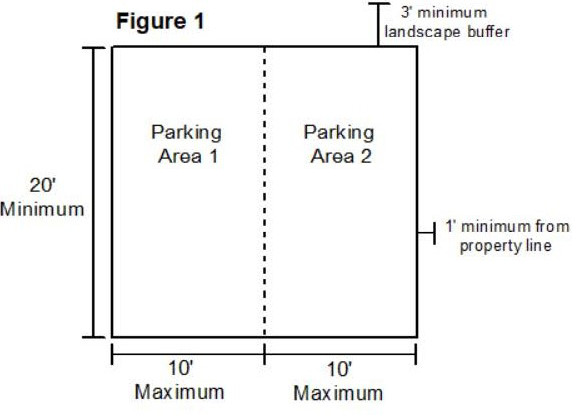
A maximum twenty-foot-wide by a minimum of twenty-foot-deep parking area will be allowed. A minimum three-foot landscape buffer shall be maintained from the primary structure. Additionally, a minimum of a one-foot side yard setback shall be maintained measured from the property line to the parking area edge (see Figure 1).
(2)
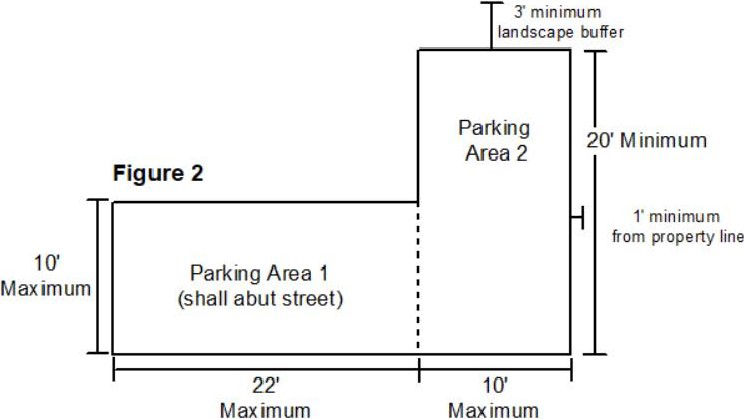
If a parking area as defined in subsection (1) above cannot be accommodated, a maximum ten-foot-wide by a minimum twenty-foot-deep parking area parallel to the road will be allowed with a connected perpendicular parking area that is a maximum of ten (10) feet wide by twenty-two (22) feet deep. A minimum three-foot landscape buffer shall be maintained from the primary structure. Additionally, a minimum of a one-foot side yard setback shall be maintained measured from the property line to the parking area edge (see Figure 2).
(3)
Parking areas allowed by subsections (1) and (2) above shall be surfaced with concrete, asphalt, brick, cut stone, or a minimum four-inch depth of crushed materials (stone, concrete, asphalt, etc.) having a size of at least one-half (½) inch in diameter. All parking areas shall be installed in compliance with Chapter 19, Article III, Division 3, Construction, Section 19.176 of the Keego Harbor Code of Ordinances.
(4)
When existing property conditions prevent compliance with the above front yard parking requirements, the applicant may seek administrative approval from the City Zoning Administrator and City Engineer in order to develop a front yard parking area design that can accommodate the minimum parking spaces for a dwelling unit as defined in Section 13.01(a)(1) of the Keego Harbor Zoning Ordinance.
(Ord. 441, 11/13/2012; Ord. No. 19-04, 8/15/2019)
Sec. 4.07. - Architectural design standards.
All proposed residential development shall utilize quality architecture to ensure that buildings are compatible with surrounding uses, protect the investment of adjacent landowners and blend harmoniously into the streetscape. Single-family detached structures shall comply with the following standards:
(a)
The following standards shall apply to all new residential development, substantial redevelopment (equal to or greater than twenty-five (25) percent of the taxable value of the property), or any facade modification.
(1)
Purpose. Architectural design is a key element in establishing a sense of place for a community. Buildings of high quality contribute to the attractiveness and economic well-being of a community, making it a better place to live and work. Keego Harbor recognizes the importance of good architecture and its lasting impact.
The objective of these design standards is to direct builders toward creating buildings that are in harmony with the natural and built environment. This is a function of good architectural principles such as selecting durable materials, composing elevations using good proportions, selecting compatible colors and combining all the architectural elements in a balanced composition.
(2)
The Residential Architectural Design Checklist, as an attachment to this Ordinance, shall only apply to new single residential development, substantial redevelopment, or facade modification (equal to or greater than twenty-five (25) percent of the taxable value of the property). The checklist contains the following elements of design:
a.
Building materials. Select materials possessing durability and aesthetic appeal.
b.
Windows. Windows are the main element contributing to an inviting facade. They give visual interest to a facade. Provide a large quantity of attractive windows on a facade that fronts a street.
c.
Architectural features. Include architectural features on the building facade that provide texture, rhythm, and ornament to a wall.
d.
Colors. Select natural and neutral colors that are harmonious with both the natural and man-made environment. Stronger colors can be used as accents to provide visual interest to the facade.
e.
Garage location. The need for storage on residential lots must be balanced with the visual impact garages have, especially on small lots. Most of the lots in Keego Harbor either have no garage or have a detached garage. In the case of a front-loaded garage, the garage must be recessed into the building as to not extend beyond the line of the front porch closest to the street. Garage location standard shall not apply to Section 15.15, Waterfront yards.
f.
Porches. Keego Harbor's desire to be a walkable community is enhanced by the provision of front porches throughout the residential neighborhoods of the City. Front porches are encouraged over side entrance houses.
g.
Roof elements. Traditional roof shapes and materials are typically found in the neighborhoods of Keego Harbor and are encouraged. Dormers and other elements are encouraged to break-up large expanses of roofs.
h.
Composition. It is not sufficient to include the desired architectural elements on a facade, but to arrange them in a harmonious and balanced manner. The following category provides weight to the architectural composition of the building.
(3)
Method of evaluation.
a.
A Residential Architectural Design Checklist will be accompanied with all applicable building permit applications. The design standards are not intended to promote buildings that appear uniform and similar. Variety and creativity in design are encouraged. The standards are structured in a point rating system, with desirable architectural elements given positive points and undesirable elements given negative points.
b.
The points assigned for each category are weighted according to its importance. The standards apply to all residential building facades with the facade facing a public road, private road, or water body being more heavily weighted.
c.
The minimum acceptable score is: ninety (90) points.
d.
Any modification to the facade shall not result in a reduction in the score of the building at the time of the requested modification.
(Ord. No. 454, 8/20/2015)
Sec. 4.08. - Area, height, bulk and placement requirements.
(a)
Lot area.
(1)
Any existing lot created prior to January 1, 2003 shall be considered a buildable lot in the NR District provided the lot area is greater than three thousand (3,000) square feet;
(2)
Any lot created after January 1, 2003 must conform to the average lot size of the lots on the same side of the street between two (2) closest intersecting streets or six thousand (6,000) square feet, whichever is less.
(b)
Lot width.
(1)
Any existing lot created prior to January 1, 2003 shall be considered a buildable lot in the NR District provided the lot width is greater than thirty (30) feet;
(2)
Any lot created after January 1, 2003 must conform to the average lot width of the lots on the same side of the street between the two (2) closest intersecting streets or fifty (50) feet, whichever is less.
(c)
Front yard setback.
(1)
The front yard setback shall be determined by the average front yard setbacks of the four (4) nearest conforming lots on each side of the subject lot (a total of eight (8) lots). Where four (4) lots are not present in either direction, thirty-five (35) feet shall be used as the setback for the missing lots. The lot with the largest setback may be excluded when calculating the average. The applicant for a building permit shall provide an engineered drawing supporting the setback calculation. In no case shall the front yard setback be less than thirty-five (35) feet from the centerline of the road. If after calculating the required front yard setback the front building line of the principal building is more than one hundred (100) feet from the front property line, an exception may be made, and the principal building may project into the required front yard setback by a distance not to exceed thirty-five (35) feet, if all other zoning requirements are observed.
(d)
Side yard setback.
(1)
Thirty (30) percent of the lot width with one (1) side no less than ten (10) percent. In no case shall a cantilevered structure project into the side yard setback, except as permitted in Section 15.11.
(e)
Side yard facing a street.
(1)
In no case shall the setback be less than twenty (20) percent of the lot width as measured from the edge of the road pavement.
(f)
Rear yard setback.
(1)
Twenty-five (25) feet from rear property line.
(g)
Through lots.
(1)
The front and rear setbacks on a through lot shall be consistent with the front yard setback requirements of this section.
(h)
Waterfront setback.
(1)
The waterfront setback shall be determined by the average setbacks of the two (2) nearest conforming houses on each side of the subject lot. In the event any of the lots required to determine the average are vacant, a minimum setback of fifty (50) feet shall be used. The waterfront setback shall be determined in accordance with Section 15.15(a).
(i)
Building height.
(1)
Building height shall not exceed thirty-five (35) feet and may contain no more than two and one-half (2½) stories. The building shall not encroach into the day light plane created by a line forming a forty-five (45) degree angle from a point eighteen (18) feet above the grade at the side property line. Eaves and other decorative elements may encroach into the day light plane.
(j)
Lot coverage.
(1)
Maximum lot coverage shall not exceed thirty (30) percent.
(k)
Access standards.
(1)
Any primary structure shall have full frontage on a public ROW or approved private road easement.
(l)
Minimum usable floor area.
(1)
Usable floor area shall be at least eight hundred (800) square feet.
(Ord. No. 455, 8/20/2015; Ord. No. 2024-06, pt. 3, 7-17-2024)

