
Keego Harbor City Zoning Code
ARTICLE XV
GENERAL PROVISIONS
Sec. 15.00.- One single-family dwelling per lot.
Except in the instance of cluster developments or condominium developments where a site plan is approved and except for lots used for education or religious institutions, not more than one (1) single-family dwelling, duplex, triplex, fourplex or bungalow court shall be located on a lot as defined herein, nor shall a single-family dwelling be located on the same lot with another principal building. This provision shall not prohibit the lawful division of land.
(Ord. No. 2023-02, § 1.02(Exh. A), 3-16-2023)
Sec. 15.01. - Exterior lighting.
(a)
Light and glare from indirect sources.
(1)
The design and/or screening of the development shall ensure that glare from automobile and commercial or industrial vehicle headlights shall not be directed into any adjacent property, particularly residential property. Exterior doors shall be located, operated, and maintained so as to prevent any glare and light from creating a nuisance or safety hazard to operators of motor vehicles, pedestrians, and neighboring land uses.
(b)
Exterior lighting from direct sources.
(1)
Ground illumination shall not exceed an intensity ratio of ten (10) to one (1) foot-candles throughout the site. The light intensity at ground level shall not exceed 0.1 foot-candles at the property line adjacent to residentially zoned or used property and 1.0 foot-candle measured at the property line adjacent to all other uses.
(2)
Free standing light standards including base shall not exceed twenty (20) feet in total height.
(3)
All exterior light fixtures shall direct 2700k to 3000k color temperature light downward avoiding glare and sky lighting. Fixtures that allow light to shine on adjoining property or create horizontal glare shall not be approved. Lighting designs that allow light to shine into a public street or right-of-way shall not be approved.
(4)
Free standing light fixtures shall be of a design to direct light into the development and away from adjacent property. House side shields shall be required in residential areas adjacent to any illuminated sites.
(5)
All lighting, including ornamental lighting, shall be shown on site plans in sufficient detail to allow determination of the effects of such lighting upon adjacent properties and traffic safety. Building or roof-mounted lighting, including neon lighting, intended to attract attention to the building and/or use and not strictly designed for security purposes shall not be permitted. Temporary holiday lighting and decorations are exempt from the aforementioned provision. Lighting designer and/or fixture manufacturer shall provide a drawing with photometric layout of the proposed design to show actual initial foot-candle levels on a plot plan sealed by a professional engineer or architect licensed in the State of Michigan. Submitted drawing shall include detailed fixture schedule, which shall include manufacturer's name, catalog number, lamp type and wattage. A complete set of manufacturer's catalog specification sheets for each fixture type used on lighting design shall be included with photometric submittal.
(Ord. No. 2023-02, § 1.02(Exh. A), 3-16-2023)
Sec. 15.02. - Residential entranceway.
In "R" (Residential) Districts, so called entranceway structures including but not limited to walls, columns, and gates, marking entrances to single family subdivisions or multiple housing projects may be permitted and may be located in a required yard except as provided in Section 15.03, Corner clearance, provided that such entranceway structures shall comply with all codes and ordinances of the City, and shall be approved by the Zoning Board of Appeals.
Sec. 15.03. - Corner clearance.
No fence, wall, shrubbery, sign, or other obstruction to vision below a height of ten (10) square feet from the established street grades shall be permitted within the triangular area formed at the intersection of any street right-of-way lines by a straight line drawn between said right-of-way line at a distance along each line of ten (10) feet form their point of intersection.
(Ord. No. 2023-02, § 1.02(Exh. A), 3-16-2023)
Sec. 15.04. - Walls.
(a)
In addition to walls specifically required by other sections of this Ordinance, between the protected use district and uses and districts listed below there shall be provided and maintained a masonry wall of not less than six (6) feet in height. In the case of comer and/or double frontage lots where the screen wall is required alongside and/or rear lot lines adjacent to a local street as designated in the City's Master Plan, said wall shall be four (4) feet in height and subject to Section 15.03 above.
(b)
Required walls shall be located on the lot line except where underground utilities interfere and except in instances where this Ordinance requires conformance with front yard setback lines abutting Residential Districts. Required walls may, upon approval of the Zoning Board of Appeals, be located on the opposite side of an alley right-of-way from a nonresidential zone that abuts a residential zone when mutually agreeable to affected property owners. The continuity of the required wall on a given block shall be a major consideration of the Board of Appeals in reviewing such request.
(c)
Such walls and screening barrier shall have no openings for vehicular traffic or other purposes, except as otherwise provided in this Ordinance and except such openings as may be approved by the Building Inspector for the purposes of public safety. All walls herein required shall be constructed of such masonry.
(d)
The Zoning Board of Appeals may modify or waive wall requirements under circumstances where strict enforcement of such requirements would be unreasonable or serve no good purpose. In such cases as the Board of Appeals determines the residential district to be a future nonresidential area, the Board of Appeals may temporarily waive wall requirements for an initial period not to exceed twelve (12) months. Granting of subsequent waivers shall be permitted, provided that the Board of Appeals shall make a determination as herein-before described, for each subsequent waiver prior to the granting of such waiver by the Board of Appeals. Such waivers shall be in the form of written agreements and filed with the Oakland County Register of Deeds.
(e)
In lieu of a masonry wall, the Zoning Board of Appeals may permit the use of a seventy-two-inch-high manicured hedge or other fencing material with exception to properties located within the Village Overlay District.
(f)
When site alterations involve the addition or expansion of off-street parking, a screen wall shall be constructed in all areas where it is required in order to conform to the regulations of this chapter regardless of whether the absence of the wall was lawfully permitted prior to the effective date of adoption or amendment of this Ordinance.
(Ord. No. 2023-02, § 1.02(Exh. A), 3-16-2023)
Sec. 15.05. - Architectural design standards.
(a)
General commercial architectural standards. The following standards shall apply to all new non-residential development, substantial redevelopment, or any facade modification within the City except the area in the Central Business Design Overlay District.
(1)
Purpose. Architectural design is a key element in establishing a sense of place for a community. Buildings of high quality contribute to the attractiveness and economic well-being of a community, making it a better place to live and work. The community recognizes the importance of good architecture and its lasting impact.
The objective of these design standards is to direct builders toward creating buildings of timeless character that are in harmony with the natural and built environment. This is a function of good architectural principles such as selecting durable materials, composing elevations using good proportions, selecting harmonious colors, and combining all the architectural elements in a balanced composition.
(2)
Architectural design elements.
a.
Building materials. Select materials possessing durability and aesthetic appeal.
b.
Windows. Windows are the main element contributing to an inviting facade. They give visual interest to a facade. Provide a large quantity of attractive windows on a facade that fronts a street.
c.
Architectural features. Include architectural features on the building facade that provide texture, rhythm, and ornament to a wall.
d.
Colors. Select natural and neutral colors that are harmonious with both the natural and man-made environment. Stronger colors can be used as accents to provide visual interest to the facade.
e.
Building form. Provide an interesting form to a building through manipulation of the building massing. This can be achieved through certain roof types, rooflines, and massing elements such as towers, cupolas, and stepping of the building form.
f.
Composition. It is not sufficient to include the desired architectural elements on a facade, but to arrange them in a harmonious and balanced manner. The following category provides weight to the architectural composition of the building.
3.
Method of evaluation. The design standards are not intended to promote buildings that appear uniform and similar. Variety and creativity in design are encouraged. The standards are structured in a point rating system, with desirable architectural elements given positive points and undesirable elements given negative points.
The points assigned for each category are weighted according to its importance. The standards apply to all nonresidential building facades with the facade facing a public road, private road, or water body being more heavily weighted.
Buildings shall be judged by the following scale:
59 points or less = Unacceptable
60—69 = Passing
70—79 = Satisfactory
80—89 = Good
90—99 = Very Good
100 or points = Excellent
The minimum acceptable score is:
60 points for M-1 District
80 points for C-2 District
90 points for C-1 and O-1 Districts.
Any modification to the facade shall not result in a reduction in the score of the building at the time of the requested modification.
KEEGO HARBOR
ARCHITECTURAL DESIGN CHECKLIST
INTRODUCTION
The Architectural Guidelines are in the form of a point rating system. The applicant or representative should assess the front facade of the proposed building using this form.
Questions can be addressed to the City Planner, phone (248) 682-1930.
I. BUILDING MATERIAL
Objective: Select materials possessing durability and aesthetic appeal. Building materials—Scoring method: For primary exterior material composing more than 60% of the facade (including window area), the point allocation for that material should be doubled. For example, for a building consisting primarily of brick (+16 points x 2 = +32 points) with split face block accents (+4 points), the total score would be 36 points. The score for each facade shall be averaged with the facade facing a public road, private road, or water body being double weighted.
II. WINDOWS
Objective: Windows are the main element contributing to an inviting facade. They give visual interest to a facade. Provide a large quantity of attractive windows on a facade that fronts a street.
III. ARCHITECTURAL FEATURES
Objective: Include architectural features on the building facade that provide texture, rhythm, and ornament to a wall.
Description: There are two categories of architectural features. The first category consists of compositional elements, that is, architectural features that contribute to dividing the elevation into interesting parts. Horizontal compositional elements include a cornice and a base, which give the facade a top and a bottom. Vertical compositional elements include pilasters and columns, which give the facade a sense of rhythm. The second category includes decorative elements, which contribute to the visual appeal of the facade.
IV. COLORS
Objective: Select natural and neutral colors that are harmonious with both the natural and man-made environment. Stronger colors can be used as accents to provide visual interest to the facade.
V. BUILDING FORM
Objective: Provide an interesting form to a building through manipulation of the building massing. This can be achieved through certain roof types, rooflines, and massing elements such as towers, cupolas, and stepping of the building form.
VI. COMPOSITION
Objective: It is not sufficient to include the desired architectural elements on a facade, but to arrange them in a harmonious and balanced manner. The following category provides weight to the architectural composition of the building.
TOTAL SCORE:
_______
(c)
Commercial architectural standards.
(1)
Intent and application. The following standards shall apply to all new non-residential development, substantial redevelopment, or any facade modification within the City. Substantial redevelopment is defined as a change to an existing building that does not increase the footprint by more than twenty-five (25) percent.
(2)
Waivers. The Planning Commission has the authority to modify or waive the standards for projects that involve reoccupying an existing building. When waiving or modifying these standards, the Planning Commission will consider the size and scope of the project in relation to the requirements. Existing units within a plaza or a strip mall do not need to comply with the requirements in this section.
(Ord. No. 2023-02, § 1.02(Exh. A), 3-16-2023; Ord. No. 2024-08, pt. 2, 10-17-2024)
Sec. 15.06. - Encumbering of land required to satisfy regulations.
No portions of a lot or parcel used in connection with an existing or proposed building, structure or use and necessary for compliance with the area, height, bulk, density, placement and related provisions of this Ordinance shall through sale or otherwise be used again as part of the lot or parcel required in connection with any other building, structure or use existing or intended to exist at the same time.
Sec. 15.07. - Essential services.
Essential services shall be permitted as authorized and regulated by law and the ordinances of the City.
Sec. 15.08. - Voting place.
The provisions of this Ordinance shall not be so construed as to interfere with the temporary use of any property as a voting place in connection with a municipal or other public election.
Sec. 15.09. - Permitted height.
No building shall be erected, converted, enlarged, reconstructed, or structurally altered to exceed the height limit hereinafter established for the district in which the building is located except that penthouses or roof structures for the housing of elevators, stairways, tanks, ventilating fans, or similar equipment required to operate and maintain the building, and fire or parapet walls, skylights, towers, steeples, stage lofts and screens, flagpoles, chimneys, smokestacks, individual domestic radio and television aerials, water tanks, or similar structures may be erected above the height limits herein prescribed. No such structure may be erected to exceed by more than fifteen (15) feet the height limits of the district in which it is located; nor shall such structure have a total area greater than twenty-five (25) percent of the roof area of the building; nor shall such structure be used for any residential purpose or any commercial or industrial purpose other than a use incidental to the main use of the building. The erection of radio and television transmission, relay, or other types of antenna towers, where permitted, shall abide by the regulations set forth in Sections 15.21 and 16.08. Site plan review is required in specific districts. Wireless communications facilities and support structures, where permitted shall abide by the regulations set forth in Sections 15.28 and 16.08.
Sec. 15.10. - Exception to height limits.
The height limitations of this Ordinance may be modified by the Zoning Board of Appeals in their application to church spires, chimneys, flagpoles, belfries, cupolas, domes, penthouses, water towers, masts and aerials, smokestacks, ventilators, derricks, cooling towers and other similar and necessary mechanical appurtenances, pertaining to and necessary to the permitted uses of the zoning districts in which they are located.
Sec. 15.11. - Permitted projections into required open space.
(a)
Chimneys and bay windows may project a maximum of three (3) feet into the required front or rear yard, and two (2) feet into the required side yard. In no case shall a cantilevered structure project into the required side yard setback.
(b)
A porch covered or balcony may project into the required front yard or open space for a distance not to exceed eight (8) feet or into the required side yard for a distance not closer than three (3) feet from the property line or into the required rear yard or waterfront yard not to exceed five (5) feet.
(c)
A terrace/patio may project into the required front yard or open space for a distance not to exceed eight (8) feet or into the required side yard for a distance not closer than three (3) feet from the property line or into the required rear yard or waterfront yard for a distance not to exceed thirty (30) feet.
(d)
A deck may project into the required side yard or open space for a distance not to exceed five (5) feet or into the required rear yard or waterfront yard for a distance not to exceed thirty (30) feet. A deck may not project into the required front yard.
(e)
A fire escape may project into the required side yard or rear yard or waterfront for a distance not to exceed three (3) feet. A fire escape may not project into the required front yard.
(f)
An awning may project into the required front yard, rear yard or waterfront yard for a distance not to exceed five (45) feet or into the required side yard for a distance not to exceed five (5) feet.
(g)
A vestibule may project into the required front yard or open space for a distance not to exceed four (4) feet or into the required side yard for a distance not to exceed three (3) feet. A vestibule may not project into the required rear yard or waterfront yard.
(h)
An attached carport may project into the required side yard setback as required to shelter the driveway, but in no case may it be closer than one (1) foot from the property line.
(9/2/2015; Ord. No. 2023-02, § 1.02(Exh. A), 3-16-2023; Ord. No. 2025-03, pt. 2, 9-18-2025)
Sec. 15.12. - Fences regulations.
Fences are permitted or required subject to the following:
(a)
Decorative fences a maximum of three (3) feet in height measured from the existing grade at the fence line are permitted in waterfront yards provided the vertical surface area is a minimum of seventy-five (75) percent open to the free passage of air and light. Decorative fences shall be located no closer than the water's edge at a seawall, or in the absence of a seawall, five (5) feet from the ordinary high water mark; fences shall not be placed parallel to the water's edge, except that required pool fences may parallel the shoreline provided they are not located further than ten (10) feet from the edge of the pool. Waterfront yard fences shall not be chain link.
(b)
All fences established on or near the property lines require a registered survey or mortgage survey.
(c)
Fences in single-family residential zones shall comply with the following standards:
(1)
Front yard fences.
a.
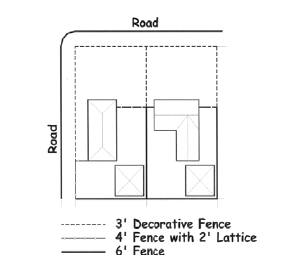
When located within the front yard, fences shall not exceed three (3) feet in height measured from the existing grade at the fence line and may be located on the front property line provided the fence may not be located closer than ten (10) feet to the road pavement.
b.
When located within the front yard, fences shall be of a decorative nature including picket (with a minimum of fifty (50) percent open space between pickets), split rail, or wrought iron and wrought iron type fencing. Chain link and solid wood fencing is prohibited in front yards.
c.
Fences located within the front yard are exempt from Section 15.03, Corner clearance, provided they are a minimum of fifty (50) percent open.
(2)
Side yard facing road.
a.
Fences located between the rear building line and the rear property line and located adjacent to a road my not exceed four (4) feet in height measured from the existing grade at the fence line with a maximum of up to two (2) additional feet of lattice for a total height of six (6) feet and must be setback a minimum of ten (10) feet from the edge of the road pavement or at the property line whichever is greater. Chain link is prohibited in the side yard facing road.
(3)
Interior side yard.
a.
When located in an interior side yard between the front building line and the rear building line, fences must be setback a minimum of five (5) feet from the front building line and may not exceed six (6) feet in height measured from the existing grade at the fence line.
(4)
Rear yard.
a.
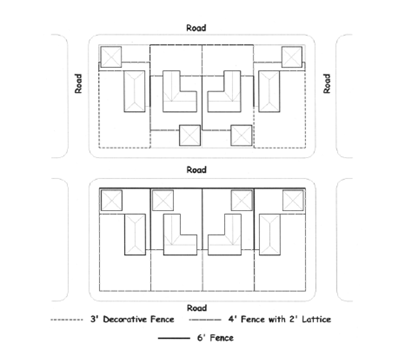
If the property is not a through lot, a fence may be located on the rear property line not to exceed six (6) feet in height measured from the existing grade at the fence line.
(5)
Through lot.
a.
When located within a rear yard on a through lot where all of the lots located on the same side of the street between two (2) intersecting side streets are through lots, fences may not exceed six (6) feet in height measured from the existing grade at the fence line and must be setback a minimum of ten (10) feet from the edge of the road pavement or at the property line whichever is greater.
b.
When located within a rear yard on a through lot where there are a mix of lots with front and rear yards facing the street between two (2) intersecting side streets, fences may not exceed four (4) feet in height measured from the existing grade at the fence line, with a maximum of up to two (2) additional feet of lattice for a total of six (6) feet measured from the existing grade at the fence line and must be setback a minimum of ten (10) feet from the edge of the road pavement or at the property line whichever is greater.
(6)
Waterfront yards.
a.
Decorative fences a maximum of three (3) feet in height measured from the existing grade at the fence line are permitted in waterfront yards provided the vertical surface area is a minimum of seventy-five (75) percent open to the free passage of air and light. Decorative fences must be located no closer than the water's edge at a seawall, or in the absence of a seawall, five (5) feet from the ordinary high-water mark.
(d)
Fences which enclose public or institutional playgrounds shall not exceed seven (7) feet in height measured from the existing grade at the fence line and shall not obstruct vision to an extent greater than twenty-five (25) percent of their total areas.
(e)
Fences shall be permitted in non-residential districts, provided that such fences shall not exceed six (6) feet in height measured from the existing grade at the fence line and shall not extend toward the front of the lot farther than any portion of the main building, except where permitted for the purposes of enclosing outside storage.
Fences shall be required in non-residential zones for the enclosing of areas used for outside storage of goods, material, or equipment. Such fences shall not be less than six (6) feet in height measured from the existing grade at the fence line.
Fences in non-residential districts shall not consist of barbed wire or electrically-charged wiring.
(f)
Fences shall not contain barbed wire, electric current or charge of electricity.
(g)
If, because of the design or construction, one (1) side of a fence has a more finished appearance than the other, the side of the fence with the more finished appearance shall face the exterior of the lot. All wooden fence posts must be properly treated to prevent decay. Posts must be installed inside the property line, facing the interior of the lot.
(h)
Solid material shall not be permitted in chain link fences.
(i)
Maintenance. Fences and walls shall be maintained in a manner so as to prevent rust, corrosion and deterioration, so as to not become a public or private nuisance, and so as not to be dilapidated or a danger to adjoining property owners or the public. Fences shall not create an appearance of patchwork, which is indicative of a state of disrepair. The property owner is responsible for the maintenance of the fence in such a way that it will remain plumb and in good repair.
(j)
On properties with an already existing fence, the existing fence must be removed prior to installation of a new or replacement fence in the same general location.
(Ord. 429, 12/15/2011; Ord. 446, 3/18/2013; Ord. 20-01, 1/16/2020; Ord. No. 2024-06, pt. 14, 7-17-2024)
Sec. 15.13. - Accessory buildings.
Accessory buildings, except as otherwise permitted in this Ordinance shall be subject to the following regulations:
(a)
Regulations. Where the accessory building is structurally attached to a main building, except as provided in Section 15.11, it shall be subject to, and must conform to all area, setback, height, and bulk requirements of this Ordinance applicable to main buildings.
(b)
[Reserved.]
(c)
Location.
(1)
Detached accessory buildings shall not be erected in any required yard except a rear yard.
(2)
No such structure shall be located in the front yard or required side yard or within a permanent easement, except as follows:
a.
When a shed is located in a nonconforming location, and there is not a conforming location that the shed could be moved to without practical difficulty, as determined by the City Planner, the shed may be rebuilt with conforming dimensions in that same location, provided that it does not encroach on a neighboring property or encumber public safety.
b.
On a waterfront lot, where a shed cannot be practically located in the waterfront yard outside of the clear vision triangles due to the presence of other structures, and no non-required side yard is present, such as decks or swimming pools, it may be located in the front yard or required side yard. Such a shed shall not be closer than three (3) feet to a side property line or thirty-five (35) feet to the centerline of the road.
(d)
Accessory buildings may occupy not more than twenty-five (25) percent of a required rear yard, plus twenty (20) percent of any non-required rear yard.
(e)
No detached accessory building shall be located closer than ten (10) feet to any main building nor shall it be located closer than three (3) feet to any side or rear lot line. In those instances where the rear lot line is coterminous with an alley right-of-way, the accessory building shall not be closer than one (1) foot to such rear lot line. In no instance shall an accessory structure be located within a dedicated easement.
(f)
No detached accessory building shall exceed fifteen (15) feet in height in any residential or commercial zone and shall be no larger than sixty-five (65) percent of the principal building.
(g)
[Reserved.]
(h)
Accessory buildings are permitted only in conjunction with, incidental to and on the same lot with a principal building which is permitted in the particular zoning district.
(i)
A central air conditioning unit, central heat pump, compressors, generators, swimming pool heater or any other noise-producing mechanical system which is typically located on the exterior of a residential unit, shall be located as follows:
(1)
Within a rear yard or side yard provided that such system is not located closer to a side lot line than the distance required by the side yard setback.
(2)
Within a required side yard setback provided that such system does not extend into the required setback by more than three (3) feet and if the abutting parcel is:
a.
A street.
b.
Occupied by a use other than a residential use.
(3)
If such system is visible from the street, it shall be screened with landscape material with the starting size not less than one (1) foot higher than the height of the system.
(j)
Accessory buildings within waterfront yards shall be subject to the provisions of Section 15.15.
(k)
The following accessory structures shall be exempt from floor area ratio calculations:
(1)
That portion of a detached accessory building occupying no more than four hundred forty (440) square feet or fifteen (15) percent of the lot area of lots six thousand (6,000) square feet or less, whichever is less.
(2)
That portion of an attached accessory building occupying no more than two hundred twenty (220) square feet or seven and one-half (7½) percent of the lot area of lots six thousand (6,000) square feet or less, whichever is less.
(3)
That portion of a detached accessory building occupying no more than five hundred seventy-six (576) square feet or fifteen (15) percent of the lot area of lots over six thousand (6,000) square feet, whichever is less.
(4)
That portion of an attached accessory building occupying no more than two hundred seventy-eight (278) square feet or seven and one-half (7½) percent of the lot area of lots over six thousand (6,000) square feet, whichever is less.
(l)
The following accessory structures shall be exempt from lot coverage calculations:
(1)
That portion of a detached or attached accessory building occupying no more than four hundred forty (440) square feet or fifteen (15) percent of the lot area of lots six thousand (6,000) square feet or less, whichever is less.
(2)
That portion of a detached or attached accessory building occupying no more than five hundred seventy-six (576) square feet or fifteen (15) percent of the lot area of lots over six thousand (6,000) square feet, whichever is less.
(m)
Building code requirement. All accessory buildings and structures greater than two hundred (200) square feet in area shall comply with the Michigan Uniform Code in effect at the time of application.
(n)
Materials. Compliance with the following standard shall be determined by the Zoning Administrator, the official or board holding final zoning approval authority.
(1)
Permanent accessory buildings, including the walls and roof, shall be constructed of durable, all weather materials, including, but not limited to, wood, masonry, fiber cement. The use of plastic film, canvas or pliable vinyl for a permanent accessory building is prohibited.
(2)
Attached permanent accessory buildings for residential uses, and detached garages, shall utilize the same materials, colors, and architectural style of the principal residential building.
(o)
Foundation. All enclosed detached accessory buildings two hundred (200) square feet or less in area shall be placed on a minimum four-inch-thick poured concrete slab in combination with a rat wall a minimum of four (4) inches wide and twenty-four (24) inches deep below grade.
(p)
Carports.
(1)
Carports shall be structurally attached to the main building. Detached carports are prohibited.
(2)
Carports may be permitted to have a single-slope roof. The roofing materials must be harmonious with the materials on the principal residential building.
(3)
The entire area beneath the roof of a carport must be paved with asphaltic, concrete, or brick paver materials.
(4)
Carports shall be designed so that water runoff is discharged onto the subject property, and carports shall not cause water to be discharged onto neighboring properties.
(5)
Carports may have an attached, enclosed storage area on the rear end of the carport no wider than the width of the carport and no taller than the underside of the carport roof, provided that the enclosed storage area is clad in the same materials as the carport and harmonious with the adjacent principal residential building.
(Ord. 338, 2/19/1998; Ord. 378, 11/15/2001; Ord. 431, 12/15/2011; Ord. No. 2024-06, pt. 14, 7-17-2024; Ord. No. 2025-03, pt. 2, 9-18-2025)
Sec. 15.14. - Noise.
Objectionable sounds, including those of an intermittent nature, shall be controlled so as not to become a nuisance to adjacent uses. The permitted noise in the C-1, C-2, O-1, M-1 and P-1 Districts shall not exceed seventy-five (75) decibels is between the hours of 6:00 a.m. and 10:00 p.m. nor more than seventy (70) decibels between the hours of 10:00 p.m. and 6:00 a.m. All measurements shall be made at the property line. The Zoning Board of Appeals may grant a temporary waiver of this requirement.
Sec. 15.15. - Waterfront yards.
All residential development adjacent to Cass Lake, Dollar Lake or Sylvan Lake or any canal, inlet, or watercourse connected to these lakes shall comply with the applicable sections of this Ordinance, including the following standards.
(a)
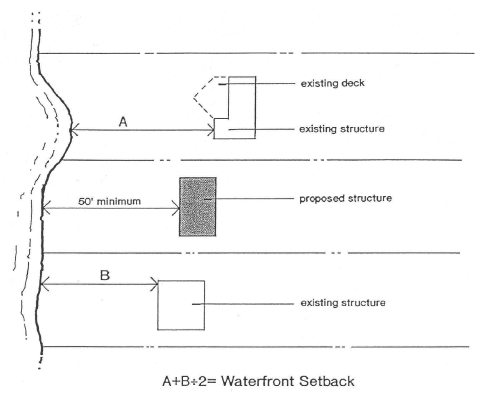
Waterfront yard setbacks. For the purpose of determining the required setback for a lot located on a waterway, the established residential building pattern shall be equal to the average of the waterfront setbacks of the immediate adjacent dwelling on each side, subject to the following requirements: The front yard setback shall be determined by the average front yard setbacks of the four (4) nearest lots on each side of the subject lot (a total of eight (8) lots, regardless of jurisdiction), subject to the following requirements:
(1)
The waterfront setback of a dwelling on an abutting or nearby lot shall be measured at the shortest horizontal distance between the ordinary high-water mark and the nearest building line of the dwelling unit.
(2)
A deck which is attached to a residence shall not be considered a part of the main structure from which the measurements are made.
(3)
Swimming pools, tennis courts, unenclosed decks and similar encroachments into the waterfront setback area shall not be considered in making the determination of established residential building pattern.
(4)
In the event that either or both of the two (2) adjacent parcels are vacant or if either or both of the two (2) adjacent dwellings are located closer than forty (40) feet to a waterway, then a setback of fifty (50) feet shall be used for the adjacent parcel(s) in computation to determine the established residential building pattern. In no instance shall the waterfront setback be less than fifty (50) feet. Where four (4) lots are not present on the same block in either direction, or where any lot is vacant, fifty (50) feet shall be used as the setback for the missing or vacant lots. The lot with the largest setback may be excluded when calculating the average.
(5)
The applicant for a building permit shall provide an engineered drawing supporting the setback calculation.
Waterfront Setback
(b)
Fences. Fences shall be permitted within the waterfront yard in accordance with Section 15.12(c)(6)(a).
(c)
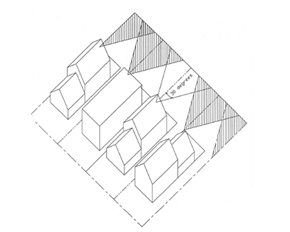
Clear vision triangles. Each lot shall maintain clear vision triangles along both side lot lines between the waterfront yard setback and the shoreline as described below. The area within clear vision triangles shall be maintained free of recreational vehicles, waterfront structures, accessory buildings, and plant material over the height of three (3) feet with the following exceptions:
(1)
Within clear vision triangles, plant material that reaches a mature height of over three (3) feet shall not be newly installed between the shoreline and the midpoint of the waterfront setback line. The midpoint shall be defined as the point halfway between the shoreline and the waterfront yard setback line, as measured at the side lot line.
Between the midpoint of the waterfront yard setback and the waterfront yard setback line, shrubs and evergreen plants shall be trimmed so as to not exceed a height of three (3) feet and deciduous and evergreen trees shall be trimmed so as to not have foliage below a height of six (6) feet, provided that vegetation may occupy a portion of such area between the heights of three (3) feet and six (6) feet as long as it does not significantly obstruct views to the lake or canal, as determined by the Building Official, Code Enforcement Officer, or other City official charged with enforcing the Zoning Ordinance.
(2)
Recreational vehicles and temporary waterfront structures may be stored within the clear vision triangle of a waterfront lot between September 15 and May 15. Such triangles shall be bounded by the following sides:
a.
The side lot line;
b.
The shoreline; and,
c.
A line that commences at the intersection of the side lot line and the waterfront yard setback and runs towards the shoreline at a thirty-degree angle from the side lot line.
Clear Vision Triangle
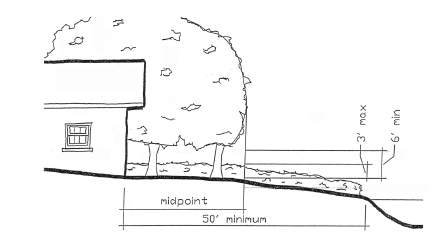
Permitted Vegetation Within the Clear Vision Triangle
(d)
Waterfront structures. The following waterfront structures and appurtenances are permitted within a waterfront yard provided such structures are accessory to a permitted principal use of waterfront property and the use is limited to recreational and personal use of the principal user (occupants) residing on the property. No structure will be approved without an existing primary structure on the parcel.
(1)
Permitted projections as regulated in Section 15.11, Permitted projections into required open space.
(2)
A shed, as defined in this Ordinance, shall be permitted within the waterfront yard, provided that such shed is set back a minimum of twenty-five (25) feet from the shoreline, is not located in a clear vision triangle, and complies with all accessory building standards contained in Section 15.13, and this subsection.
(3)
The following waterfront structures and appurtenances shall be permitted, if they otherwise meet the requirements of subsection (c) clear vision triangles above:
a.
Piers and wharves, including floating types;
b.
Flush mount and swivel hoists, overhead hoists, davits and mooring whips;
c.
Spring or mooring piles; and,
d.
Unenclosed boat port/well having a roof only and not exceeding a height of twenty-two (22) feet above mean high water.
(4)
Within a single-family residential zoning district, a maximum of two (2) boat ports/wells and two (2) hoists or other out of water lifting devices are permitted per residential lot. Within the multiple family residential zoning district, the maximum number of boat ports/wells shall be limited by the marina operating permit issued by the Michigan Department of Environmental Quality.
(5)
Bulkheads or seawalls are permitted, provided no bulkhead or seawall may extend into the waterway beyond the lot line of any lot.
(6)
Construction, installation, storage, docking, or mooring of structures, appurtenances, or watercraft shall not obstruct the natural flow of water or access of boaters to: adjoining or nearby parcels; to deeper waters; or, normal boating routes.
(7)
All permitted structures and appurtenances shall be kept safe, secure and in good repair.
(8)
The placement of aids to navigation and regulatory markings are specifically exempt from the requirements of this section.
(9)
Temporary waterfront structures may be stored within the clear vision triangle of a waterfront lot between September 15 and May 15:
(10)
All temporary waterfront structures such as docks, boat hoists, mooring buoys, etc., shall be removed no later than November 15, and installed no earlier than April 15.
(e)
Number of boats and structures.
(1)
Within the multiple family residential zoning district, the allowable accessory use of the waterfront shall be limited to the specific conditions of special land use approval under Section 5.02.
(2)
On-land storage of boats shall be subject to the requirements of this section and the limitations of the respective zoning district regulations.
(Ord. No. 2024-06, pt. 14, 7-17-2024)
Sec. 15.16. - Keeping of farm animals and other non-domestic animals.
The keeping, raising, or breeding of animals including farm animals and non-domestic animals and reptiles (except domesticated cats, dogs, canaries, parakeets, parrots, gerbils, hamsters, guinea pigs, turtles, fish, rabbits and similar animals commonly kept as pets) shall be prohibited, except as otherwise may be permitted by this Ordinance or under conditions imposed by the Zoning Board of Appeals.
Sec. 15.18. - Moving of buildings.
The Zoning Board of Appeals may permit the moving of any building within a district and placed upon a foundation, or the moving of any building into a district from any other district, provided said building meets all the limitations and requirements set forth in this Ordinance for the district in which it is to be located.
Sec. 15.19. - Performance guarantees.
(a)
Required. To insure compliance with this Ordinance and any conditions imposed under this Ordinance, including conditions of the site plan approval, special approval, cluster development, planned development, and street access approval, the City Council, Planning Commission or Zoning Board of Appeals may require that financial security acceptable to the City be deposited with the City Clerk to insure faithful completion of improvements as defined in (b) below. The amount of the cash deposit, certified check, or irrevocable bank letter of credit shall cover the estimated cost of improvements associated with a project and other reasonable incidental costs associated therewith, for which approval is sought.
(b)
Improvements. "Improvements" means those features and actions associated with a project which are considered necessary to protect natural resources, or the health, safety, and welfare of the residents of the City and future users or inhabitants of the proposed project or project area, including roadways, lighting, utilities, landscaping, parking, paving of parking and circulation areas, screening, drainage and other site improvements. "Improvements" does not include the entire project which is the subject of the approval.
(c)
Timing. The performance guarantee along with a detailed description and schedule of improvements to be completed shall be deposited with the Clerk prior to the issuance of a certificate of occupancy authorizing use of the activity or project.
(d)
Type. The applicant shall be required to provide the performance guarantee or financial security in one (1) or a combination of the following arrangements, whichever the applicant elects.
(1)
Irrevocable letter of credit. An irrevocable letter of credit issued by a bank authorized to do business in Michigan in an amount to cover the cost of the contemplated improvements as estimated by the City.
(2)
Escrow fund. A cash deposit, or deposit by certified check drawn on a bank authorized to do business in Michigan sufficient to cover the cost of the contemplated improvements as estimated by the City shall be deposited with the Clerk. The escrow deposit shall be for the estimated time period necessary to complete the required improvements.
(e)
Rebate. In the case of cash deposits, the Clerk shall rebate or release to the applicant, as the work progresses, amounts equal to the ratio of the completed and accepted work to the entire project, after approvals described below.
(f)
Inspection and certification. Private improvements and acceptance for maintenance of required public improvements.
(1)
Certification by the building department. The applicant shall furnish the Clerk a letter or document signed by the Building Department indicating satisfactory completion of the required improvements in accordance with the above description of improvements.
(2)
Inspection of public improvements by the City Engineer or Building Department. After the completion of the construction of the required public improvements, the Engineer or Building Department, or the County, state or federal agency with jurisdiction to grant approval or accept, shall conduct a final inspection and certify compliance with the above required improvements. This inspection shall be made to assure the improvements are completed according to the approved plans and specifications.
(3)
Partial street. In no case shall acceptance of any partial street be made for maintenance.
(g)
Failure. In case the applicant shall fail to complete the required improvements work within such time period as required by the conditions or guarantees as outlined above, the City Council may proceed to have such work completed and reimburse itself for the cost thereof by appropriating the cash deposit or certified check, or by drawing upon the letter of credit.
(h)
Maintenance bond. The City may require, prior to the acceptance by the City of public improvements, a maintenance bond acceptable to the City for a period of up to three (3) years in an amount not to exceed thirty-five (35) percent of the total cost of the public improvements.
(i)
Subdivisions. This section shall not be applicable to improvements for which a cash deposit, certified check, irrevocable bank letter of credit, or surety bond has been deposited pursuant to the Subdivision Control Act, No. 288 of the Public Acts of 1967, as amended, being MCL 560.101—560.293.
Sec. 15.20. - Temporary and portable buildings, uses and structures.
The Planning Commission may permit temporary buildings, structures, and uses for a period not to exceed six (6) months provided that all requirements and conditions relative to the type of structure and use, and timing and arrangements for termination and removal, are met. The Commission may require safeguards related to setbacks, screening, off-street parking considered necessary to protect the health, safety, welfare and comfort of inhabitants of the City. Further, the Commission may require site plan approval and performance guarantee as conditions of approval. Trucks, truck trailers, vans or other passenger vehicles shall not be used for storage, warehousing, retail sales or service or offices.
Sec. 15.21. - Satellite dish antennas.
In all zoning districts, satellite dish antennas may be permitted as an accessory use, subject to the following regulations:
(a)
Roof-mounted antenna greater than three (3) feet in diameter and up to ten (10) feet in diameter shall be permitted only in commercial and industrial districts. If located on a roof, such antenna shall be considered a roof structure and shall comply with the provisions of Section 15.09 of this Ordinance.
(b)
Ground-mounted antenna greater than three (3) feet in diameter and up to ten (10) feet in diameter shall be subject to the following conditions:
(1)
An accessory use building permit for satellite dishes shall be required.
(2)
Maximum height permitted shall be twenty (20) feet.
(3)
The satellite dish structure shall be securely mounted and anchored to a pole, and secured in accordance with the requirements of the manufacturer and the building code.
(4)
If elevated off of the ground, all such antennas shall be located so that there is an eight-foot clearance between the lowest part of the dish and grade.
(5)
Satellite dish antenna shall not be permitted in front yards.
(6)
Such antenna shall be located a minimum of ten (10) feet from any street line and three (3) feet from any other property line.
(7)
All electrical and antenna wiring shall be placed underground or otherwise obscured from view.
(c)
The surface of roof or ground mounted antennae greater than three (3) feet in diameter shall be open mesh and painted black so as not to reflect glare from sunlight and shall not be used as any sign or message board. All installations shall be placed and constructed to blend with the surroundings.
Sec. 15.22. - Development within flood hazard areas.
Development within flood hazard areas, as defined in Article II herein, shall comply fully with the adopted Flood Hazard Zoning Ordinance, Ordinance No. 211 of 1982, as amended.
Sec. 15.23. - Landscape requirements.
Landscaping, greenbelts, and screening are necessary for the continued protection and enhancement of all land uses. Landscaping and greenbelts are capable of enhancing the visual image of the City, preserving natural features, improving property values, and alleviating the impact of noise, traffic, and visual distraction associated with certain uses. Screening is important to protect less-intensive uses from the impacts of more intensive non-residential uses. Accordingly, the provisions set forth herein are intended to set minimum standards for the design and use of landscaping, greenbelts, and screening, and for the protection and enhancement of the City's environment.
(a)
Scope of application. The requirements set forth herein shall apply to all uses which are developed, expanded, or changed, and to all lots, sites, and parcels which are developed or expanded upon following the effective date of this Ordinance. No site plan shall be approved unless said site plan shows landscaping consistent with the requirements of this section. Where landscaping is required, a building permit shall not be issued unless provisions set forth in this section have been met or a performance guarantee has been posted in accordance with Section 15.19.
(b)
Minimum requirements. The requirements set forth herein are minimum requirements, and nothing herein shall preclude the developer and the City from agreeing to more extensive landscaping.
(c)
Design creativity. Creativity in landscape design is encouraged. Accordingly, required trees and shrubs may be planted at uniform intervals, at random, or in groupings, depending on the designer's desired visual effect and, equally important, the intent of the City to coordinate landscaping on adjoining properties.
(d)
Landscaping requirements.
(1)
General requirements. All developed portions of the site shall conform to the following general landscaping standards, except where specific landscape elements, such as a greenbelt, berms, or screening are required:
a.
All unpaved portions of the site shall be planted with grass, ground cover, shrubbery, or other suitable live plant material.
b.
A mixture of evergreen and deciduous trees shall be planted at the rate of one (1) tree per three thousand (3,000) square feet or portion thereof of unpaved open area. Required trees may be planted at uniform intervals, at random, or in groupings.
c.
All required landscaping shall be served by an in-ground sprinkling system.
d.
Landscaped areas which adjoin paved parking or driveways shall be protected with curbs from encroachment of vehicles.
(2)
Landscaping adjacent to roads. All front, side and rear yards adjacent to roads in commercial, office and industrial districts shall be landscaped in accordance with the following standards: A minimum of one (1) deciduous or evergreen tree shall be planted for each forty (40) lineal feet or portion thereof of road frontage, plus, a minimum of one (1) ornamental tree shall be planted for each one hundred (100) lineal feet or portion thereof of road frontage, plus, a minimum of eight (8) shrubs shall be planted for each forty (40) lineal feet or portion thereof of road frontage. For the purposes of computing length of road frontage, openings for driveways and sidewalks shall not be counted. Trees and shrubs may be planted at uniform intervals, at random, or in groupings.
(3)
Greenbelts. Where required, greenbelts and greenbelt buffers shall conform to the following standards:
a.
A required greenbelt may be interrupted only to provide for pedestrian or vehicular access.
b.
Grass, ground cover, or other suitable live plant material shall be planted over the entire greenbelt area, except where paved walkways are used.
c.
A minimum of one (1) deciduous or evergreen tree shall be planted for each thirty (30) lineal feet or portion thereof of required greenbelt length, or alternatively, eight (8) shrubs may be substituted for each required tree. Trees may be planted at uniform intervals, at random, or in groupings.
d.
Plant materials shall not be placed closer than four (4) feet to the property line or right-of-way line when a greenbelt abuts a public sidewalk.
e.
For the purposes of calculating required plant material, greenbelt length shall be measured along the exterior edge of the greenbelt.
(4)
Berms. Where required or proposed, berms shall conform to the following standards:
a.
Berms shall be constructed with slopes no steeper than one (1) foot vertical for each three (3) feet horizontal (thirty-three (33) percent slope), with at least a two-foot flat area on the top.
b.
The planting requirements for greenbelts, above, shall also apply to berms.
(5)
Parking lot landscaping. In addition to required screening, all off-street parking areas shall provide landscaping.
a.
Landscaping ratio. Off-street parking areas containing greater than fifteen (15) spaces shall be provided with at least fifteen (15) square feet of interior landscaping per parking space. Whenever possible, parking lot landscaping shall be designed to improve the safety of pedestrian and vehicular traffic, guide traffic movement, and improve the appearance of parking areas.
b.
Minimum area. Landscaping areas in parking lots shall be no less than five (5) feet in any single dimension, and no less than one hundred fifty (150) feet in area. Landscaped areas in or adjacent to parking lots shall be protected with curbing or other means to prevent encroachment of vehicles.
c.
Other landscaping. Required landscaping elsewhere on the parcel shall not be counted in meeting the parking lot landscaping requirements.
d.
Required plantings. Requirements for plant material shall be based on the location, size, and shape of the parking lot landscaped area. A minimum of one (1) tree shall be planted per three hundred (300) square feet or fraction thereof of interior landscaped area. The landscape plan shall indicate the types, sizes, and quantities of plant material proposed for such area.
(6)
Evergreen or landscaped screening. Wherever an evergreen or landscaped screen is required or proposed, evergreen screening shall consist of closely-spaced plantings which form a complete visual barrier that is at least six (6) feet above ground level within five (5) years of planting.
(7)
Landscaping of rights-of-way. Public rights-of-way located adjacent to required landscaping areas and greenbelts shall be planted with grass or other suitable live ground cover and shall be maintained as if the rights-of-way were part of the required landscaped areas or greenbelt.
(8)
Maintenance of unobstructed visibility for drivers. Landscaping located at an intersection of two (2) streets shall comply with the requirements in Section 15.03 so as to maintain unobstructed cross-visibility for drivers.
(e)
Standards for landscape materials. Unless otherwise specified, all landscape materials shall comply with the following standards:
(1)
Plant quality. Plant materials used in compliance with the provisions of this Ordinance shall be nursery grown, free of pests and diseases, hardy in Oakland County, in conformance with the standards of the American Association of Nurserymen, and shall have passed inspections required under state regulations.
(2)
Non-living plant material. Plastic and other non-living plant materials shall not be considered acceptable to meet the landscaping requirements of this Ordinance.
(3)
Plant material specifications. The following specifications shall apply to all plant material proposed in accordance with the landscaping requirements in this Ordinance:
a.
Deciduous shade trees shall be a minimum of two (2) inches in caliper measured twelve (12) inches above grade with the first branch a minimum of four (4) feet above grade when planted.
b.
Deciduous ornamental trees shall be a minimum of one and one-half (1½) inches in caliper measured six (6) inches above grade with a minimum height of four (4) feet above grade when planted.
c.
Evergreen trees shall be a minimum of five (5) feet in height when planted, except that juniper, yew and arborvitae species shall be a minimum of three (3) feet in height when planted. Furthermore, evergreen trees shall have a minimum spread of three (3) feet, and the size of the bur lapped root ball shall be at least ten (10) times the caliper measured six (6) inches above grade.
d.
Shrubs shall be a minimum of two (2) feet in height when planted. Low growing shrubs shall have a minimum spread of fifteen (15) inches when planted.
e.
Hedges shall be planted and maintained so as to form a continuous, unbroken, visual screen within two (2) years after planting.
f.
Vines shall have a minimum of three (3) runners, six (6) inches to eight (8) inches long when installed and be a minimum of thirty (30) inches in length after one (1) growing season.
g.
Ground cover used in lieu of turf grasses shall be planted in such a manner as to present a finished appearance and reasonably complete coverage after one (1) complete growing season.
h.
Grass area shall be planted using species normally grown as permanent lawns in Oakland County. Grass, sod, and seed shall be clean and free of weeds, noxious pests, and diseases. Straw or other mulch shall be used to protect newly seeded areas.
i.
Mulch used around trees, shrubs, and vines shall be a minimum of three (3) inches deep and installed in a manner as to present a finished appearance.
j.
Use of the following plant materials or their clones (or cultivars) is not encouraged because of susceptibility to storm damage, disease, and other undesirable characteristics:
(f)
Installation and maintenance. The following standards shall be observed where installation and maintenance of landscape materials are required:
(1)
Installation. Landscaping shall be installed in a sound, workmanlike manner to ensure the continued growth of healthy plant material. Trees, shrubs, hedges, and vines shall be generously mulched at the time of planting.
(2)
Protection from vehicles. Landscaping shall be protected from vehicles through the use of curbs. Landscape areas shall be elevated above the pavement to a height adequate to protect the plants from snow removal, salt and other hazards.
(3)
Off-season planting requirements. If development is completed during the off-season when plants cannot be installed, the owner shall provide a performance guarantee to ensure installation of required landscaping in the next planting season.
(4)
Maintenance. Landscaping required by this Ordinance shall be maintained in a healthy, neat, and orderly appearance, free from refuse and debris. All unhealthy and dead plant material shall be replaced immediately upon notice from the Building Official, unless the season is not appropriate for planting, in which case plant material shall be replaced at the beginning of the next planting season.
All landscaped areas shall be provided with a readily available and acceptable supply of water. Trees, shrubs, and other plantings and lawn areas shall be watered regularly throughout the growing season.
All constructed or manufactured landscape elements, such as but not limited to benches, retaining walls, edging, and so forth, shall be maintained in good condition and neat appearance. Rotted, deteriorated, or damaged landscape elements shall be repaired, replaced, or removed.
(g)
Modifications to landscape regulations. In consideration of the overall design and impact of a specific landscape plan, and in consideration of the amount of existing plant materials to be retained on the site, the Planning Commission may modify the specific requirements outlined herein, provided that any such adjustment is in keeping with the intent of this section. In determining whether a modification is appropriate, the Planning Commission shall consider whether the following conditions exist:
(1)
Topographic features or other unique features of the site create conditions such that strict application of the landscape regulations would result in a less effective screen than an alternative landscape design.
(2)
Parking, vehicular circulation, or land use are such that required landscaping would not enhance the site or result in the desired screening effect.
(3)
The public benefit intended by the landscape regulations could be better achieved with a plan that varies from the strict requirements of the Ordinance.
Sec. 15.24. - Screening of roof top equipment.
Elevators, stairways, tanks, heating and air conditioning equipment and other similar apparatus shall be screened from view by a structure equal in height to the height of the equipment being screened and constructed of the same type of building material used in the principal structure.
Sec. 15.25. - Sidewalks and bikeways.
For all developments requiring site plan approval, either a new public sidewalk or bikeway, or the reconstruction of existing sidewalks or bikeways, shall be required to be constructed to City standards for the perimeter of the lot which abuts a major, intermediate or collector street as defined in the City's Master Plan. New or reconstructed sidewalks or bikeways shall be aligned with existing or proposed sidewalks or bikeways. All multiple family residential projects require interior sidewalks. Other residential and non-residential projects may require interior sidewalks to facilitate pedestrian traffic safety, organization and convenience.
Sec. 15.26. - Site grading.
(a)
Intent. Site grading regulations are established to assure adequate drainage away from structures and to a natural or established drainage course and to assure protection of trees on sites where grading is to take place.
(b)
Scope of application. A Grading Permit shall be required in all instances where grading, excavating, filling, stockpiling, or other alterations to the land are proposed. "Filling" includes the dumping of soil, sand, clay, gravel, or other material on a site. However, where minor alterations to the land that do not affect the storm drainage pattern are proposed, a grading permit shall not be required. The grading permit fee shall be established by resolution of the City Council.
(c)
Grading plan. In the event that a grading permit is required, the applicant shall first submit duplicate copies of the grading plan for review and approval by the Building Official, City Engineer, or other authorities having jurisdiction such as Michigan Department of Environmental Quality or Oakland County Drain Commissioner. Grading plans may be submitted in conjunction with a site plan review, or may be submitted as a separate plan. Such plans shall be prepared by a licensed professional surveyor or licensed professional civil engineer. One (1) signed, approved copy shall be retained by the City and one (1) returned to the applicant.
(d)
Grading plan standards. At a minimum, grading plans shall show existing and proposed grade elevations adjacent to existing and proposed structures on the subject property and at the structures on adjacent properties. In addition, sufficient existing and proposed elevations are needed for the site and for as much of the adjacent property as is necessary to establish the proposed surface drainage pattern. If excavation or filling is proposed, the amount of material to be excavated or filled shall be indicated on the grading plan. All elevations shall be based on U.S.G.S. datum. Elevations and location of benchmarks used for determining elevations shall be shown on the plan.
(1)
Slope away from buildings and finished floor elevations. The grade around buildings and structures shall be constructed at an elevation which provides a sloping grade away from the building or structure, thereby causing surface water to drain away from the walls of the building to a natural or established drainage course. Grading on the subject parcel shall be so developed as to prevent surface from flowing onto adjoining parcels except through a previously defined drainage course. The grade shall not exceed six (6) inches of rise in ten (10) feet from side lot line (five (5) percent slope) at any location perpendicular to the lot line.
The finished floor of the proposed dwelling unit shall not be less than 0.75 feet or exceed two and one-half (2½) feet above the centerline of the fronting street at the median elevation of the fronting street along frontage of subject lot. An exception may be made by the City Engineer and Building Official where the existing geographic conditions of properties within a one-hundred-foot radius of the subject property (measured from the center of the front property line) make it impractical for the proposed dwelling unit to meet this requirement. The proposed finished floor elevation should be within two (2) feet of the first-floor elevations of the majority of properties within the one-hundred-foot radius (fifty (50) percent or more). Grading shall be completed to the Building Official's and City Engineer's satisfaction and shall demonstrate that additional fill is not detrimental to surrounding properties in terms of compatibility and drainage.
(2)
Runoff onto adjacent properties. New grades shall not be established that would permit an increase in the runoff of surface water onto adjacent properties, except through established drainage courses.
(3)
Stockpiling. Stockpiling of soil, sand, clay, gravel and similar material shall be prohibited, except where permitted as part of an approved construction project.
(4)
Clean fill. Fill material brought into the City shall be free of contamination from hazardous substances, debris, junk, or waste. The Building Official or City Engineer may require verification from a qualified soil testing laboratory that the fill is free of all contamination.
(5)
Excavations of holes. The excavation or continued existence of unprotected holes or pits that constitute or are reasonably likely to constitute a danger or menace to the public health, safety, and welfare is prohibited. This section also shall not apply to lakes, streams, ditches, reservoirs, or other bodies of water under the jurisdiction of the State of Michigan, County of Oakland, Keego Harbor, or other governmental agency.
(e)
Review, inspection & approval of procedures. Grading plans shall be reviewed by the Building Official, City Engineer or other authorities having jurisdiction. In the event that the grading plan is submitted in conjunction with a site plan, the Planning Commission shall review the grading plan as a part of normal site plan review. The Building Official shall issue a grading permit after the determination has been made that the requirements set forth herein and in other applicable ordinances have been complied with.
An as-built plan shall be prepared by a licensed professional civil engineer or licensed land surveyor clearly indicating compliance with the approved plan or those areas not in compliance with the approved plan. Compliance must be attained prior to an occupancy permit being issued.
Sec. 15.27. - Screening of trash storage areas (dumpsters).
Outdoor trash storage areas shall be designed, constructed, and maintained according to the standards of this section. Trash storage area locations and details of construction shall be shown on site plans per Section 16.08, Site plan review and approval procedures. The following requirements shall be met whenever an outdoor trash storage area is proposed in conjunction with a use for which site plan approval is required under this Ordinance, where any change in the location or site of an existing trash storage area is proposed, or where an outdoor trash storage area is created for a new or existing use:
(a)
Trash storage areas shall be located in the rear yard or non-required side yard, and no less than twenty (20) feet from any residential district, as far as practical.
(b)
Permitted trash storage areas shall be used to store only the refuse generated onsite which shall be removed on a weekly basis or more frequently, as necessary. Trash storage areas and enclosures shall be continuously maintained in a neat, orderly, and sanitary condition at all times.
(c)
A brick or decorative faced masonry wall, a minimum of six (6) feet in height, shall enclose three (3) sides of the storage area and be at least one (1) foot higher than the trash receptacle. An obscuring gate shall be provided on the remaining side to provide complete enclosure of the trash storage area and said gate shall be kept closed except during loading or unloading.
(d)
The trash storage area shall be located on a concrete pad, at least ten (10) feet wide by twenty (20) feet deep, constructed with a minimum of six (6) inches of three thousand five hundred (3,500) P.S.I. concrete with air entrainment containing six-inch by six-inch ten-gauge welded wire mesh. The above-mentioned concrete pad shall provide an approach no less than ten (10) feet in width or no less than the width of the gate; it shall extend at least eight (8) feet in front of the obscuring gate to support the front axle of a refuse vehicle. In addition, the trash storage area shall be large enough to accommodate recyclables, grease disposal receptacles, etc. The Planning Commission may increase or reduce the size of the enclosure where a different size storage area is deemed necessary.
(e)
Steel bollards, a minimum of six (6) inches in diameter and filled with concrete, shall be placed at both sides of the gate opening and to the rear of the storage area to prevent damage to the walls and gates.
(f)
In no instance shall any garbage or rubbish be stored at a height greater than the required enclosure. The trash receptacle cover shall be kept closed except during loading or unloading.
(g)
Trash storage areas shall be accessible by garbage or rubbish vehicles without endangering buildings, overhead lines, automobiles in designated parking spaces, pedestrians, or impede pedestrian or vehicular access.
(h)
The construction and storage of any such facility shall comply with City building code requirements.
Sec. 15.28. - Wireless communications facilities and services.
(a)
In the following circumstances, a proposal to establish a new wireless communications facility shall be deemed a principal use permitted, subject to site plan review and the conditions set forth in subsection (d) below, and if approved, constructed and maintained in accordance with the standards and conditions of this section.
(1)
Attached wireless communications facilities within all R-M, RME, RMH, O-1, C-1, C-2, P-1, and M-1 Districts, where the existing structure is not, in the determination of the City Council, proposed to be either materially altered or materially changed in appearance.
(2)
Collocation of an attached wireless communications facility which has been preapproved for such collocation as part of an earlier approval by the City Council.
(3)
Attached wireless communications facilities consisting of a utility pole located within a public right-of-way, where the existing pole is not proposed to be modified in a manner which, in the determination of the City Council, would materially alter the structure and/or result in an impairment of sight lines or other safety interests.
(b)
Wireless communications support structures are principal uses permitted subject to special conditions in any district on public or quasi-public/institutional sites, conditioned upon site plan and special land use review and approval. All wireless communications support structures are subject to the conditions provided in subsection (f) below, the application requirements specified in subsection (d) below, and the general special land use approval standards and procedures specified in Section 16.09.
(1)
Site locations shall be permitted on a priority basis on the following sites, subject to application of all other standards contained in this section:
a.
Governmentally owned sites.
b.
Sites owned by public school districts or private schools.
c.
Religious or other institutional sites.
d.
Public parks and other large permanent open space areas when compatible.
(2)
Wireless communications facilities shall be of a design such as a steeple, bell tower, or other form which is compatible with the existing character of the proposed site, neighborhood, and general area, as approved by the Planning Commission.
(c)
If it is demonstrated to the satisfaction of the City Council by an applicant that a wireless communications facility may not reasonably be established as a principal use permitted under subsection (a) above, or as a principal use permitted subject to special conditions under subsection (b) above, and is required to be established in districts or areas other than those identified in subsections (a) and (b) above, in order to operate a wireless communications service, then wireless communications facilities may be permitted in the C-1, C-2, and M-1 Districts, and in the RM, RMH and RME Districts when the site is adjacent to an existing utility tower, conditioned upon site plan and special land use review and approval. All wireless communications support structures are subject to the conditions provided in (f), the application requirements specified in subsection (d) below, and the general special land use approval standards and procedures specified in Section 16.09. At the time of submittal, the applicant shall demonstrate that a location within an allowable district cannot reasonably meet the coverage and/or capacity needs of the applicant.
(d)
All applications to erect construct or modify any part or component of a wireless communications facility shall include the following:
(1)
A site plan prepared in accordance with Section 16.08, showing the location, size, screening and design of all buildings and structures, including fences, and the location and size of outdoor equipment, and the location, number, and species of proposed landscaping, and as-built drawings for all proposed attached wireless communications facilities and/or wireless communications support structures.
(2)
A disclosure of what is proposed, demonstrating the need for the proposed wireless communications support structure to be located as proposed based upon the presence of one (1) or more of the following factors:
a.
Proximity to an interstate highway or major thoroughfare.
b.
Areas of population concentration.
c.
Concentration of commercial, industrial, and/or other business centers.
d.
Areas where signal interference has occurred due to tall buildings, masses of trees, or other obstruction.
e.
Topography of the proposed facility location in relation to other facilities within which the proposed facility is to operate.
(3)
The reason or purpose for the placement, construction or modification with specific reference to the provider's coverage, capacity and/or quality needs goals and objectives.
(4)
The existing form of technology being used and any changes proposed to that technology.
(5)
As applicable, the planned or proposed and existing service area of the facility and the attached wireless communications facility, and wireless communications support structure height and type, and signal power expressed in ERP upon which the service area has been planned. A propagation map should also be provided to illustrate this information.
(6)
The nature and extent of the provider/applicant's ownership or lease interest in the property, building or structure upon which facilities are proposed for placement, construction or modification.
(7)
The identity and address of all owners and other persons with a real property interest in the property, buildings, or structure upon which facilities are proposed for placement, construction or modification.
(8)
A map showing existing and known proposed wireless communications facilities within the City of Keego Harbor, and further showing existing and known proposed wireless communications facilities within areas surrounding the borders of the City in the location, and in the area, which are relevant in terms of potential collocation or in demonstrating the need for the proposed facility. The map shall also show existing buildings and/or other structures of the same approximate height within a one-half (½) mile radius of the proposed site which could accommodate a feasible collocation of the applicant's proposed attached wireless communications facility.
If and to the extent the information in question is on file with the City, the applicant shall be required only to update as needed. Any such information which is trade secret and/or other confidential commercial information which, if released would result in commercial disadvantage to the applicant, may be submitted with a request for confidentiality in connection with the development of governmental policy, MCL 15.243(1)(g). This Ordinance shall serve as the promise to maintain confidentiality to the extent permitted by law. The request for confidentiality must be prominently stated in order to bring it to the attention of the City.
(9)
For each location identified on the applicant/provider's survey maps and drawings, the application shall include the following information, if known, with the applicant/provider expected to exercise reasonable due diligence in attempting to obtain information through lawful means prior to application:
a.
The structural capacity and whether it can accommodate the applicant's facility, as proposed or modified.
b.
Whether property owner approvals exist or have been requested and obtained.
c.
Whether the location could be used by the applicant/provider for placement of its attached wireless communications facility, or if not, a disclosure of the technological considerations involved, with specific reference to how use of the location would prohibit the applicant/provider from providing wireless communications services.
(10)
A certification by a State of Michigan licensed and registered professional engineer regarding the manner in which the proposed structure will fall. The certification will be utilized, along with other criteria such as applicable regulations for the district in question, in determining appropriate setbacks to be required for the structure and other facilities.
(11)
A description of the security to be posted at the time of receiving a building permit for the wireless communications support structure to ensure removal of the structure when it has been abandoned or is no longer needed, as provided in subsection (e) below. The security shall, at the election of the applicant, be in the form of cash, surety bond, letter of credit, or an agreement in a form approved by the City Attorney and recordable at the office of the Oakland County Register of Deeds, a promise of the applicant and owner of the property to remove the facility in a timely manner as required under this section, with the further provision that the applicant and owner shall be responsible for the payment of any costs and attorney's fees incurred by the City in securing removal.
(12)
The site plan shall include a landscape plan illustrating that the wireless communications support structure is being placed at a location which is not otherwise part of another site plan with landscaping requirements. The purpose of landscaping is to provide screening for the wireless communications support structure base, accessory buildings and enclosure. In all cases there shall be fencing of at least eight (8) feet in height which is required for the protection of the tower.
(13)
The applicant must provide a visual simulation of the proposed support structure that illustrates the relationship between the height and the visual appearance of the structure. The visual simulation must be provided from two (2) different perspectives and accurately depict the scale of the proposed structure in the context of the surrounding area.
(e)
Approval procedures.
(1)
Within thirty (30) days of the receipt of an application for site plan review, the City Planning Department shall either: (a) inform the applicant in writing of the specific reasons why the application is incomplete and does not meet the submittal requirements; or (b) deem that the application is complete. If the Planning Department informs the applicant of an incomplete application within thirty (30) days, the overall timeframe for review is suspended until such time that the applicant provides the requested information.
(2)
If an application is deemed incomplete, an applicant may submit additional materials to complete the application. An applicant's unreasonable failure to complete the application within sixty (60) business days after receipt of written notice shall constitute a withdrawal of the application without prejudice. An application withdrawn without prejudice may be resubmitted upon the filing of a new application fee.
(3)
An application deemed complete shall be placed on the agenda of the Planning Commission at their next regularly scheduled meeting for consideration.
(4)
The Planning Commission shall review the application pursuant to Section 16.08 of the Zoning Ordinance and within sixty (60) days, either deny, approve, or conditionally approve the site plan.
(5)
The applicant shall be notified of the Planning Commission's decision in writing by the City Planning Department within one hundred fifty (150) days of the submission of the initial application unless:
a.
The City Planning Department notified the applicant that his/her application was incomplete within thirty (30) days of filing. If so, the remaining time from the one-hundred-fifty-day total review time is suspended until the applicant provides the missing information; or
b.
An extension of time is agreed to by the applicant. Failure to issue a written decision within one hundred fifty (150) days shall constitute an approval of the application.
(f)
When a wireless communications facility has not been used for one hundred eighty (180) days or more, or six (6) months after new technology is available which permits the operation of a wireless communications facility without the requirement of a wireless communications support structure, all and/or part of the wireless communications facility shall be removed by the users and/or owners of the wireless communications facility. The situation(s) in which removal of a wireless communications facility is required may be applied and limited to a portion of the facility.
(1)
Upon the occurrence of one (1) or more of the events requiring removal, the property owner or persons who had used the wireless communications facility shall immediately apply for and secure the application for any required demolition or removal permits, and immediately proceed with and complete the demolition/removal, restoring the condition which existed prior to the construction of the wireless communications facility.
(g)
Wireless communications support structures permitted as principal uses subject to special conditions by subsection (b) or subsection (c) above must meet the following standards:
(1)
The wireless communications support structure shall not be injurious to the neighborhood or otherwise detrimental to the public safety and welfare. The wireless communications support structure shall be located and designed to be harmonious with the surrounding areas, and to be aesthetically and architecturally compatible with the natural environment, as well as the environment as altered by development.
(2)
The maximum height of all attached wireless communications facilities and wireless communications support structures shall be one hundred fifty (150) feet as measured from the average grade surrounding the base of the equipment structure upon which the tower is mounted. The switching equipment enclosure at the base of the wireless communications support structure shall be limited to the maximum height for accessory structures within the respective district. The applicant shall demonstrate a justification for the proposed height of the structures and an evaluation of alternative designs which might result in lower heights.
(3)
Where a monopole wireless communications support structure abuts a parcel of land zoned for residential purposes, the setback from any lot line shall be in accordance with the required setbacks for main or principal buildings as provided in the schedule of regulations for the zoning district in which the monopole is proposed. The minimum setback of all other wireless communications support structures from any lot line shall be no less than the height of the tower, unless it can be demonstrated and certified by a registered professional engineer, to the satisfaction of the City Engineer, that the wireless communications support structure has a shorter fall-zone distance.
(4)
Where the wireless communications support structure abuts a parcel of land zoned for other than residential purposes, the minimum setback of the wireless communications support structure and accessory structures shall be in accordance with the required setbacks for the main or principal buildings as provided in the schedule of regulations for the zoning district in which the wireless communications support structure is located. In all cases, the fall-zone distance for the wireless communications support structure must be provided and certified by a registered professional engineer.
(5)
There shall be an unobstructed access to the wireless communications support structure, which may be provided through an easement. This access is necessary for maintenance of the facility and will have a width and location determined by such factors as: the location of adjacent thoroughfares and traffic circulation within the site; utilities needed to service the wireless communications support structure and any attendant facilities; the location of buildings and parking facilities; proximity to residential districts and minimizing disturbance to the natural landscape; and the type of equipment which will need to access the site.
(6)
The division of property for the purposes of locating a wireless communications support structure is prohibited unless all zoning requirements and conditions are met.
(7)
Where a wireless communications support structure is proposed on the roof of a building, the switching equipment module must be screened or architecturally compatible with the building. The switching equipment module may be located within the principal building or may be an accessory building, provided that an accessory building conforms with all district requirements for principal buildings, including yard setbacks and building height.
(8)
The Planning Commission shall, with respect to the color of the wireless communications support structure and all accessory buildings, review and approve so as to minimize distraction, reduce visibility, and maximize aesthetic appearance. It shall be the responsibility of the applicant to maintain the tower and structure(s) in a neat and orderly condition.
(9)
The wireless communications support structure shall be constructed in accordance with all applicable building codes and shall include the submission of a professional soils report from a soils engineer licensed in the State of Michigan. This soils report shall include soil borings and statements indicating the suitability of soil conditions for the proposed use. The clearance requirements of the Federal Aviation Administration and Federal Communications Commission shall be noted.
(10)
A maintenance plan, and any applicable maintenance agreement shall be presented as part of the site plan for the proposed facility.
(11)
Any proposed commercial wireless communications support structures shall be designed, structurally, electrically, and in all respects, to accommodate both the applicant's attached wireless communications facility and comparable attached wireless communications facilities for additional users. Wireless communications support structures must be designed to allow for future rearrangement of attached wireless communications facilities upon the wireless communications support structure and to accept attached wireless communications facilities mounted at varying heights.
(12)
A proposal for a new wireless communications support structure shall not be approved unless it can be documented by the applicant that the communications equipment planned for the proposed wireless communications support structure cannot be accommodated on an existing or approved wireless communications support structure or building due to one (1) or more of the following reasons:
a.
The planned equipment would exceed the structural capacity of the existing or approved wireless communications support structure or building, as documented by a qualified and licensed professional engineer and the existing or approved wireless communications support structure cannot be reinforced, modified, or replaced to accommodate planned or equivalent equipment.
b.
The planned equipment would cause interference materially impacting the usability of other existing or planned equipment at the wireless communications support structure or building as documented by a qualified and licensed professional engineer and the interference cannot be prevented at a reasonable cost.
c.
Existing or approved wireless communications support structures and buildings within the search radius cannot accommodate the planned equipment at a height necessary for the coverage area and capacity needs to function reasonably as documented by a qualified and licensed professional engineer.
d.
Other unforeseen reasons that make it unfeasible to locate the planned communications equipment upon an existing wireless communications support structure or building.
If a party who owns or otherwise controls a wireless communications support structure shall fail or refuse to alter a structure so as to accommodate a proposed and otherwise feasible collocation, such facility shall thereupon and thereafter be deemed to be a nonconforming structure and use, and shall not be altered, expanded or extended.
If a party who owns or otherwise controls a facility shall fail or refuse to permit a feasible collocation, and this requires the construction and/or use of a new wireless communications support structure, the party failing or refusing to permit a feasible collocation shall be deemed to be in direct violation and contradiction of the policy, intent and purpose of this Section of the Zoning Ordinance, and, consequently such party shall take responsibility for the violation, and shall be prohibited from establishing a new wireless communications facility within the City of Keego Harbor for a period of five (5) years from the date of the failure or refusal to permit the collocation.
(13)
The wireless communications support structure shall comply with applicable federal and state standards relative to electromagnetic impact.
Sec. 15.29. - Home occupations.
Home occupations as defined in Article II, Definitions, are permitted accessory uses in the NR, R-M, R-MH, RT, C-1, C-2, O-1, M-1 Districts subject to the following standards:
(a)
That such occupation is incidental to the residential use to the extent that not more than twenty (20) percent of the useable floor area of the principal building or fifty (50) percent of the accessory building shall be occupied by such occupation.
(b)
No change to the exterior of the building that alters the residential character or appearances of the residence.
(c)
That such occupation shall not require internal or external alterations or construction features or equipment or machinery not customary in residential areas.
(d)
No person other than members of the family residing on the premises shall be engaged in such occupation.
(e)
No equipment or process shall be used in such home occupation which creates noise, vibration, glare, times, odors, or electrical interference detectable to the normal senses off the lot, if the occupation is conducted in a single-family residence, or outside the dwelling unit if conducted in other than a single-family residence. In the case of electrical interference, no equipment or process shall be used which creates visual or audible interference in any radio or television receivers off the premises or causes fluctuations in line voltage off the premises.
(f)
Clinics, hospitals, barber shops, beauty parlors, nursery schools, tourist homes, tea rooms, animal hospitals, kennels, and millinery shops, among others, shall not be deemed to be home occupations and therefore shall not be permitted in residential districts.
(g)
No outdoor display and/or materials, goods, supplies, or equipment used in the home occupations shall be permitted on the premises.
(h)
That there be no sign of any nature advertising said occupation.
(Ord. 11/15/2001; Ord. No. 2023-02, § 1.02(Exh. A), 3-16-2023)
Sec. 15.30. - Short term rentals.
All short term rentals shall be subject to the regulations of Ordinance No. 2023-04, Short Term Rentals.
(Ord. No. 2023-04, pt. 2, 11-16-2023)

