
Keene City Zoning Code
ARTICLE X
- EARTH EXCAVATION
Sec. 102-1350. - Authority.
This article is adopted by the City of Keene (hereinafter "city") in accordance with RSA 155-E, RSA 674:16, and procedure under the guidance of RSA 675:1, II.
(Ord. No. O-2003-08C, § 102-1300, 3-17-2005)
Sec. 102-1351. - Purpose and goals.
This article governs earth excavation within the city and enhances and fulfills the following goals:
(1)
Provide reasonable opportunities for the excavation of earth materials from land situated within the city consistent with the earth resources master plan;
(2)
Minimize safety hazards created by excavation activities;
(3)
Safeguard the public health and welfare;
(4)
Preserve and protect those natural assets of soil, water, forest, wetlands, wildlife, and wildlife habitat located in the vicinity of the area being excavated;
(5)
Preserve and protect the aesthetic quality of the environment located in the vicinity of the area being excavated;
(6)
Prevent land, air, and water pollution; and
(7)
Promote soil stabilization.
(Ord. No. O-2003-08C, § 102-1301, 3-17-2005)
Sec. 102-1352. - Definitions.
The following words, terms, and phrases, when used in this article, shall have the meanings ascribed to them in this section, except where the context clearly indicates a different meaning:
Abutter. Any person whose property is located in New Hampshire and adjoins or is directly across the street, stream or other water body from a proposed excavation site. If the adjoining land or land directly across the street, stream or other water body is a condominium or other collective form of ownership, the term "abutter" shall mean the officers of the collective or association, as defined by state law.
Abandoned excavation. Any excavation, except excavations for stationary manufacturing plants, whether or not subject to a permit under state law or local rules and regulations, for which the affected area has not been brought into complete compliance with the reclamation standards set forth in RSA 155-E, shall be deemed abandoned if it meets any of the following criteria:
(1)
No earth material of sufficient weight or volume to be commercially useful has been removed from that excavation site during any two-year period, either before, on or after August 4, 1989, provided that before the end of such two-year period, the owner or operator may extend said period by submitting to the city's planning board a reclamation timetable to be approved by the planning board and a posting of security in a form and amount prescribed by the city, sufficient to secure reclamation in accordance with the aforementioned standards; or
(2)
The excavation site is in use and is not an excavation or stationary manufacturing plant, but does not conform with the incremental reclamation standards, or the owner or operator has not posted adequate security and submitted a reclamation timetable to be approved by the planning board as described in paragraph (1), above; or
(3)
The owner or operator of the excavation has failed to secure a permit and file a report of an existing excavation in accordance with state law.
Amendment to an issued permit. Any change, or modification to the scope of a project for which an excavation permit has been issued and which proposes to alter said excavation so as to affect either the size or location of the excavation, the rate of removal, or the plan for reclamation. (See also minor amendment)
Applicant. The owner of the proposed excavation site or his/her agent or representative as designated in writing by the property owner and attached to said owner's earth excavation permit application.
Commercially useful volume. Any amount of earth material greater than 1,000 cubic yards.
Contiguous. Land situated within the city, whose perimeter can be circumscribed without interruption in common ownership except for roads or other easements within the city.
Degradation of water quality. Occurs when the excavation activity results in a reduction in ground water quality and/or surface water quality, such that the New Hampshire Ambient Ground Water Quality Standards have been exceeded and/or the New Hampshire Surface Water Quality Standards have been exceeded.
Degradation of water quantity. Occurs when the excavation activity results in a reduction in the elevation of the groundwater table in the area of wetlands or surface water bodies that are within 300 feet of the excavation perimeter, or water wells (either public or private) that are within one half mile of the excavation perimeter.
Dimensional stone. Rock that is cut, shaped, or selected for use in blocks, slabs, sheets, or other construction units of specified shapes or sizes, and used for external or interior parts of buildings, foundations, curbing, paving, flagging, bridges, revetments, or for other architectural or engineering purposes. Dimension stone includes quarry blocks from which selections of dimension stone are to be produced, but does not include "earth" as defined below.
Earth. Sand, gravel, rock, soil, or construction aggregate produced by quarrying, crushing, or any other mining activity or such other naturally occurring unconsolidated materials that normally mask the bedrock.
Earth excavation overlay district. A zoning district that encompasses one or more underlying zones and that permits certain earth excavation activities not otherwise permitted by the underlying zones in accordance with this article.
Existing excavation. Any excavation which lawfully existed as of August 24, 1979, and from which earth of sufficient weight or volume to be commercially useful has been removed during the two-year period before August 24, 1979. Said excavation shall not have expanded, without a permit issued pursuant to the City's Code of Ordinances, beyond the limits of the city in the area which, on August 24, 1979, and at all times subsequent thereto, has been contiguous to and in common ownership with the excavation site as of that date. Moreover, said excavation shall have been appraised and inventoried for property tax purposes as a part of the same tract as the excavation site as of that date.
Excavate/excavation activity/excavation operations/processing activities. The act of moving or removing earth, including but not limited to, all activities associated with the commercial taking of earth, production and processing of construction aggregate, transportation of earth and site restoration. Associated excavation and processing activities also include, but are not limited to: digging, drilling, blasting, bulldozing, crushing, washing, screening, sorting, scaling, weighing, stockpiling, loading, and transporting earth.
Excavation. The land area that is used, or has been used, for the commercial taking of earth,
including all slopes. This area may be also referred to as the "pit".
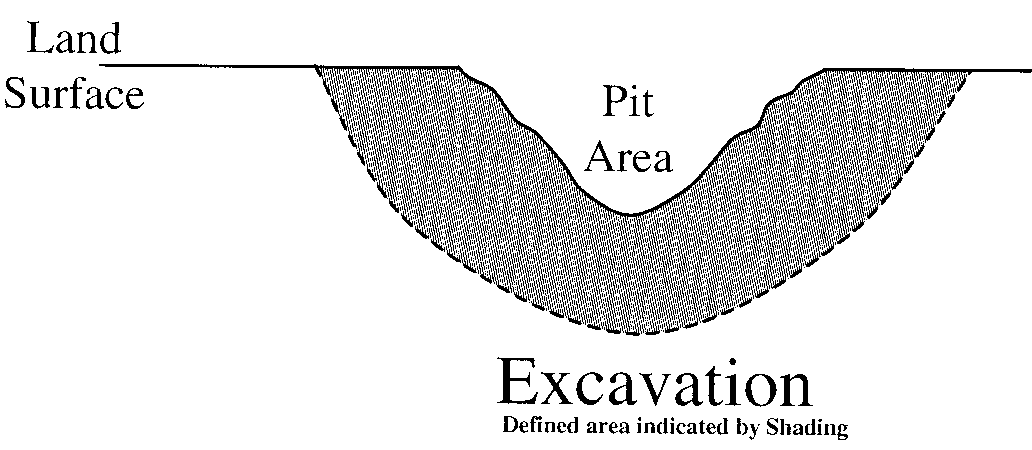
Excavation
Excavation area. The surface area within an excavation site where excavation has occurred or is eligible
to occur under the provisions of this article, the planning board's earth excavation
regulations, and RSA 155-E. This area may be also referred to as the "pit surface
area.
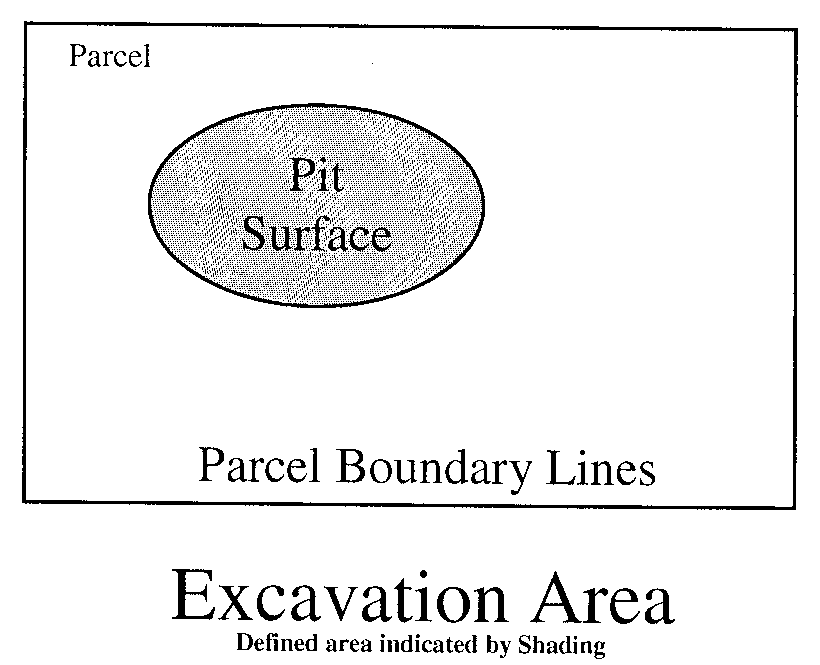
Excavation Area
Excavation parcel. Land within the excavation site that includes only those parcels upon which the excavation
perimeter and the access road are situated.
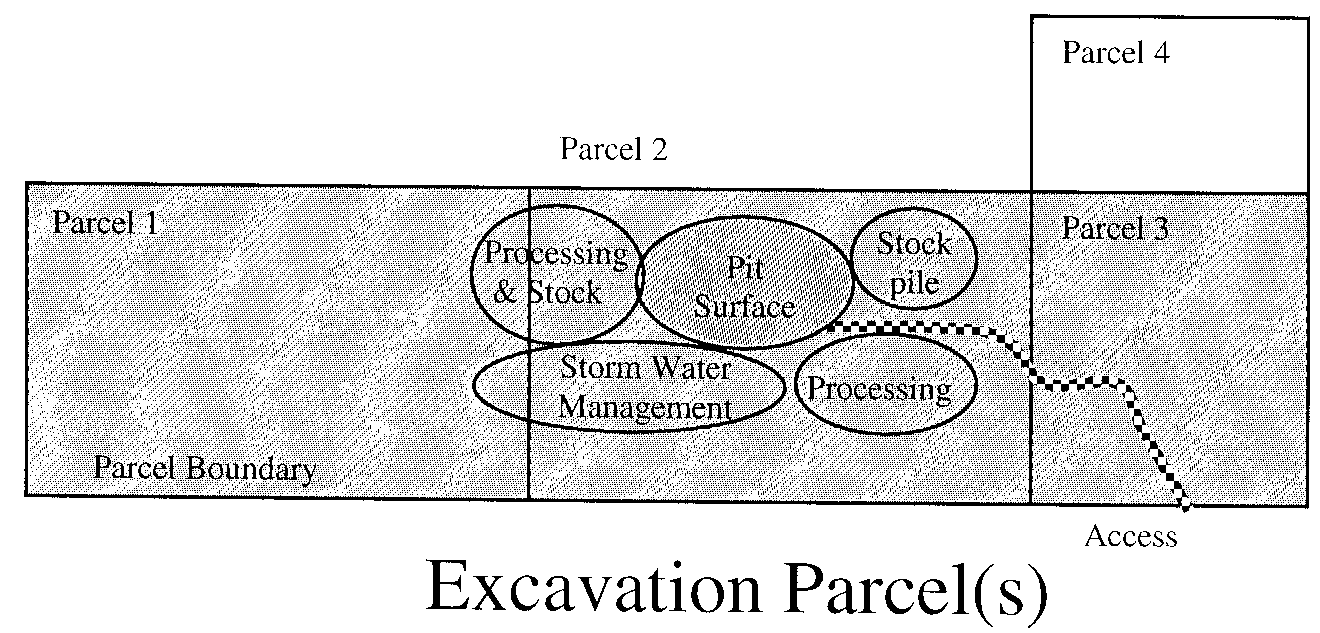
Excavation Parcel
Excavation perimeter. Land within an excavation site, which includes the excavation area, areas where excavation
operations and processing activities are performed, stockpiling areas, and any areas
where earth materials are or will be loaded or unloaded for purposes of transport.
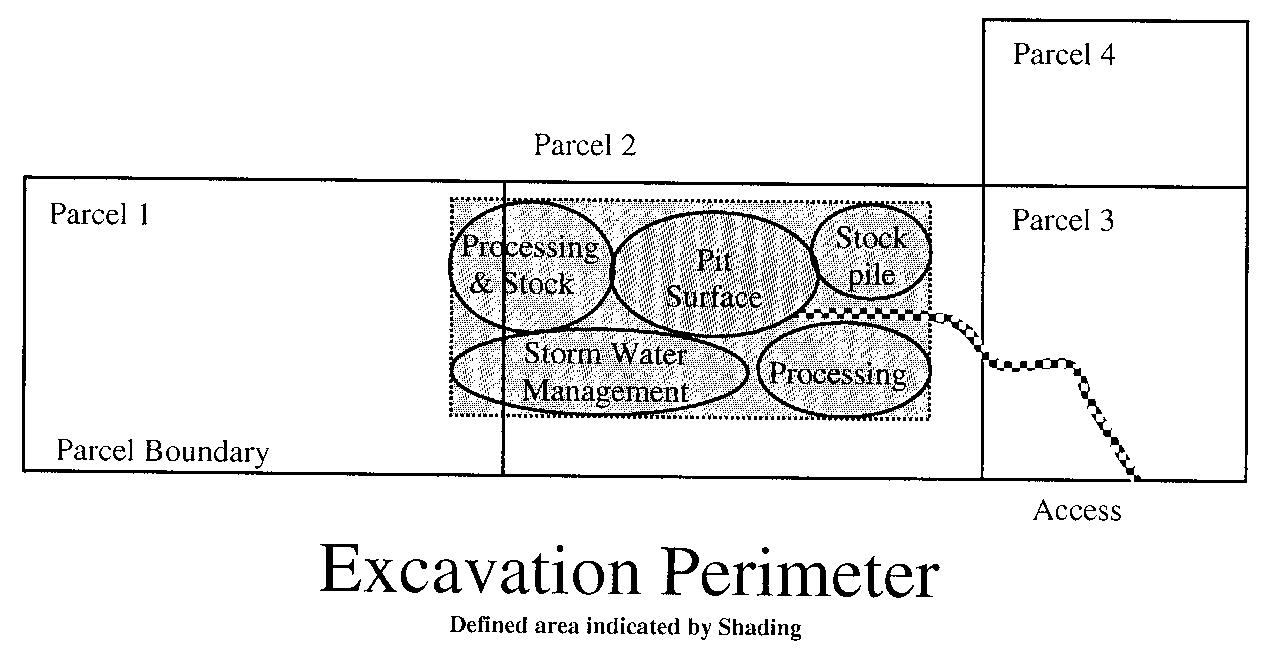
Excavation Perimeter
Excavation permit. A permit issued by the code enforcement department following approval by the planning board, to conduct earth excavation activities.
Excavation phase. A timeframe that includes all excavation activities associated with an individual excavation area.
Excavation project. A timeframe that includes all excavation activities to be conducted on an excavation site, including all excavation phases.
Excavation site. Any area of contiguous land in common ownership upon which excavation takes place.
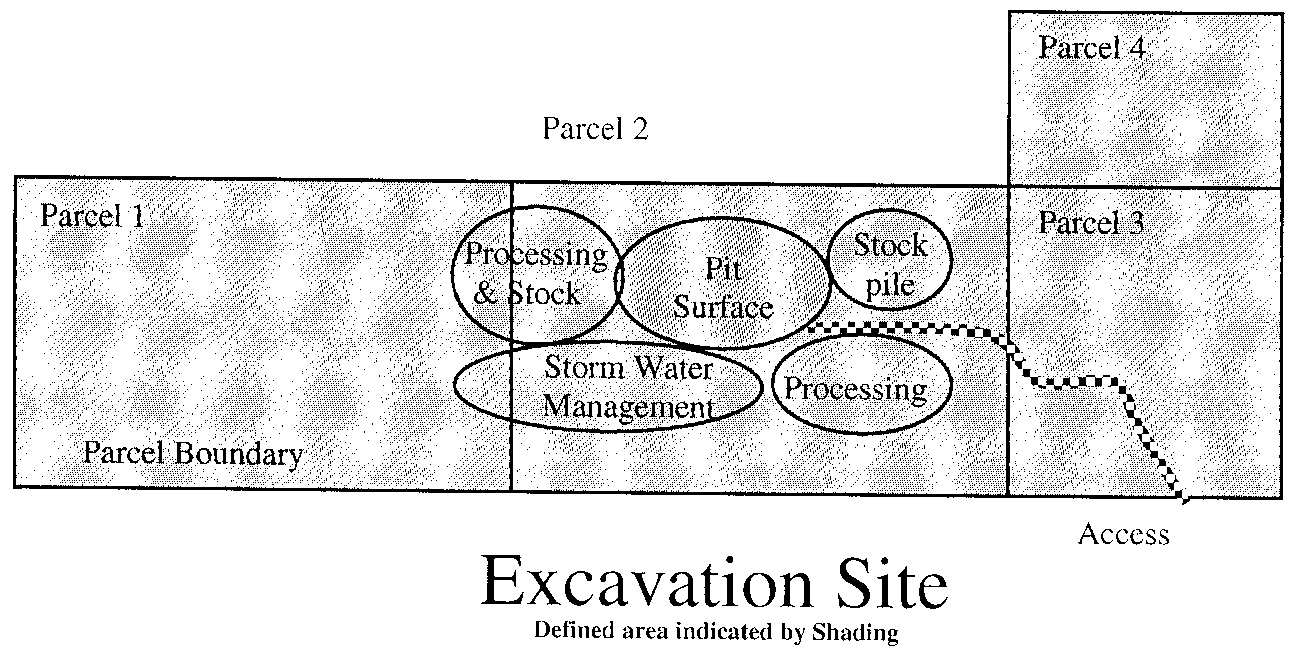
Excavation Site
Express standard. All standards set forth in this article, relevant planning board regulations, and state law, including, but not limited to, operational standards, reclamation standards, and site design standards.
Fee (application). The required fee to be paid upon submission of an excavation permit application to the planning board.
Fragmentation of important habitat. The splitting of a contiguous area of important habitat into two or more smaller areas by the siting of an access driveway, drainage structure, utility, or other area associated with the excavation operation within or through the important habitat.
Highway excavations. Excavation which is performed exclusively for the lawful construction, reconstruction, or maintenance of a Class I, II, III, IV, or V highway by a unit of government having jurisdiction for the highway or an agent of the unit of government which has a contract for the construction, reconstruction, or maintenance of the highway.
Important habitat. Habitat known to support endangered, threatened, or rare species, or species of special concern as defined under federal law or as listed in the New Hampshire Natural Heritage Bureau Database. Important habitat also includes lands identified as 'exemplary natural communities' in the NH Natural Heritage Database. Land areas shall also be considered important habitat when a site-specific natural resource inventory (NRI) has been conducted and demonstrates the importance of the land area to resident or migratory wildlife population(s).
Incidental excavation. Any excavation where no more than 1,000 cubic yards of earth material are removed every two years.
Minor amendment to an issued permit. Any change or modification of the site design or excavation plan of a previously approved project, except for those which propose to alter said excavation so as to affect either the size or location of the excavation, the rate of removal, or the plan for reclamation.
Prominent overlook. Any tract of land or portion of a tract of land other than the excavation site, with an elevation higher than the excavation area, with an established view point or clearing, and a view shed that includes the excavation perimeter and would allow direct viewing of excavation operations within the excavation perimeter from said view point or clearing. An established view point is a cleared or naturally created vantage point, either publicly or privately owned, that can be demonstrated as having been customarily used as a view point.
Reclamation. Restoration of an excavation site to standards at least equal to those outlined in this article, planning board regulations, and in accordance with RSA 155-E.
Sound generating equipment. Any construction vehicles, equipment, machinery, or tools used in the excavation operation including but not limited to back hoes, excavators, graders, loaders, air hammers, dump trucks, crushers, screeners, sorters, rock drilling equipment, conveyors, compressors, and power generation equipment.
Stationary manufacturing and/or processing plants. Facilities or structural improvements which are permanently placed in a specific location on a site, for the purposes of sorting, washing, screening, crushing, classifying, drying, or processing excavated earth materials. For purposes of this article, permanent placement shall mean the intent of operating the plant in a particular location, throughout the life of the excavation operation.
Temporary manufacturing and/or processing plants. Mobile equipment that is temporarily placed on the site for the purposes of sorting, washing, screening, crushing, classifying, drying, or processing excavated earth materials (hereinafter collectively "processing equipment"). For purposes of this article, temporary placement shall mean the plant equipment is placed on the site during an operating season with the intent of relocating the equipment around the site as needed, or moving the equipment off the site for periods of time to accommodate operations on other sites.
Unduly hazardous or injurious to the public or environmental welfare. A substantial present or potential hazard to human health, safety and welfare, or to the environment caused by adverse impacts associated with an excavation project. Examples of such hazards include, but are not limited to, adverse impacts caused by noise, traffic, dust or fumes, and adverse visual impacts, premature degradation of roadways, erosion, soil instability, and sedimentation, as well as, adverse impacts to surface water hydrology, degradation of surface or ground water quality or quantity, loss of fragmentation of important habitat, air quality degradation, pollution of soils and/or water resources, and/or diminution of the value of abutter properties.
Vehicle trip. Each time a vehicle enters an excavation access driveway shall constitute one vehicle trip. Each time a vehicle exits an excavation access driveway shall constitute one vehicle trip.
Water resources. Surface water bodies and wetlands.
Wetlands. As defined by RSA 482-A et seq. and shall include but not be limited to bogs, fens, and vernal pools.
(Ord. No. O-2003-08C, § 102-1302, 3-17-2005)
Sec. 102-1353. - District regulations.
Earth excavation overlay. Incorporated as a part of this article, the earth excavation overlay district as described in the earth excavation overlay map, is hereby adopted as an overlay to the official zoning map of the city. The overlay district includes portions of land located in the following underlying districts: Industrial, industrial park, industrial park limited, corporate park, agriculture, and rural. Earth excavation activities are not permitted within any other zoning districts. In addition, the earth excavation overlay district shall not include any portion of land located within, over, or covering a stratified drift aquifer identified in the city's GIS database and delineated on the following map: Map 9 - Stratified Drift Aquifer, City of Keene Earth Excavation Master Plan, Page 46 of 55. Moreover, the earth excavation overlay district shall not include any portion of land located within, over, or covering the delineated primary and/or secondary wellhead protection areas for the city, maintained municipal wells, and proposed future city maintained municipal wells sites, as shown on the following map: Map 10 - Well Recharge Areas, City of Keene Earth Excavation Master Plan, Page 47 of 55, as said maps may be amended from time to time.
(Ord. No. O-2003-08C, § 102-1303, 3-17-2005)
Sec. 102-1354. - Permit requirement.
(a)
No property owner shall permit any excavation of earth on his or her property without first obtaining permit approval from the planning board, unless said excavation is expressly excepted from the permit requirement as set forth below, or in accordance with RSA 155-E:2, I, II, III, and IV.
(b)
The planning board shall not approve an earth excavation permit until the applicant demonstrates compliance with this article, the planning board's earth excavation regulations, and RSA 155:E, as the same may be amended from time to time.
(Ord. No. O-2003-08C, § 102-1304, 3-17-2005)
Sec. 102-1355. - Exceptions to permit requirement.
In addition to the exceptions expressly set forth in RSA 155-E:2, I, II, III, and IV, relative to existing excavations, abandoned excavations, stationary manufacturing plants, and highway excavations respectively, the following types of excavations shall be excepted from the permit requirements of this article:
(1)
Removal of earth exclusively incidental to construction or alteration of a building, structure, parking lot, or way. No permit shall be required for removal of earth that is exclusively incidental to the lawful construction or alteration of a building or structure or the lawful construction or alteration of a parking lot or way, including a driveway on a portion of the premises where the removal of earth materials occurs, subject to the following.
a.
Removal of earth shall not commence until all required state and local permits have been issued by the authority having jurisdiction.
(2)
Excavation incidental to agricultural or silva-cultural activities, landscaping, and minor topographical adjustments. No permit shall be required for excavation that is incidental to agricultural or silva-cultural activities, normal landscaping, or minor topographical adjustment.
a.
For purposes of this exception, "normal landscaping" shall mean the planting of vegetation over a reasonably short period of time, with the sole purpose of enhancing or beautifying an existing developed condition, and not for the purpose of engaging in the commercial distribution of earth.
b.
For purposes of this exception, "minor topographical adjustments" shall mean the sculpting of topography over a reasonably short period of time to directly support the intended function or effect of the agricultural, silva-cultural or landscaping activity, and not for the purpose of engaging in the commercial distribution of earth.
(3)
Excavation for production of dimensional stone. No permit shall be required under this article for excavation from a granite quarry for the purpose of producing dimension stone, if such excavation requires a permit under RSA 12-E (mining and reclamation).
(4)
Removal of earth from land taken by eminent domain or other governmental taking. Any person owning land abutting a site that was taken by eminent domain or by any other governmental taking, upon which construction is taking place, may stockpile earth taken from the construction site. Said abutter may remove the earth at a later date without a permit after such person provides written notification to the City of Keene Code Enforcement Department.
(Ord. No. O-2003-08C, § 102-1305, 3-17-2005)
Sec. 102-1356. - Permit application.
All applicants for an earth excavation permit shall apply to the planning board for said permit in accordance with the planning board's earth excavation regulations.
(Ord. No. O-2003-08C, § 102-1306, 3-17-2005)
Sec. 102-1357. - Fees.
(a)
Administrative fees. The planning board shall impose a fee upon all applicants for an earth excavation permit, permit renewal, permit modification, or permit transfer to cover all administrative expenses associated with the permit, including, but not limited to, the cost of processing the permit, the cost of reviewing all information pertaining to the proposed excavation, and the cost of all inspections deemed necessary to evaluate the application and verify compliance with a permit once issued. Said administrative fees shall be set forth in the planning board's fee schedule, which may be amended from time to time. Applicants shall also be responsible for paying for all costs associated with outside professionals, experts or consultants hired by the city to complete said reviews, evaluations, and/or inspections.
(b)
Permit fees. In accordance with state law, the applicant shall pay a fee, as may be amended from time to time, not to exceed $50.00, prior to the issuance of an excavation permit, a renewal permit and/or upon transfer of a permit. The amount of the permit fee shall be set forth in the planning board's fee schedule, which may be amended from time to time.
(Ord. No. O-2003-08C, § 102-1307, 3-17-2005)
Sec. 102-1358. - Issuance of permit.
If the planning board, after a public hearing held in accordance with the earth excavation regulations and RSA 155-E:7, approves an application for an earth excavation permit with or without conditions and determines that the proposal set forth in the application is not a prohibited project as set forth in this article and state law, the code enforcement department shall, upon verification that any conditions stipulated by the planning board in its approval have been met, and upon receipt of proper payment of all required fees and the posting of adequate security, issue an earth excavation permit to the applicant.
An earth excavation permit shall not be assignable or transferable without prior written notice to the code enforcement department and the planning department, and payment of a permit fee.
A permit shall specify the date upon which it expires. Such expiration date shall not exceed two years from the date of permit issuance.
Permits shall be renewed in accordance with the procedures set forth in the earth excavation regulations. The renewal permit shall specify the date upon which it expires. Such expiration date shall not exceed two years from the date of the renewal permit issuance.
Verification that all required conditions have been met, and that a permit can be issued, shall be signified by the signing of the approved plans by the chair of the planning board. A copy of the permit shall be prominently posted at the primary entrance to the excavation perimeter.
(Ord. No. O-2003-08C, § 102-1308, 3-17-2005)
Sec. 102-1359. - Prohibited projects.
The planning board shall not grant approval for a permit:
(1)
When the excavation is not permitted by zoning or other applicable ordinance, code, regulation, or state or federal law.
(2)
When all necessary local, state or federal permits have not been obtained.
(3)
When the issuance of a permit would be unduly hazardous or injurious to public or environmental welfare.
(4)
When the excavation would violate the operational standards set forth in this article and in RSA 155-E:4-a and/or when the applicant cannot comply with the reclamation standards set forth in this article and in RSA 155-E:5 and RSA 155-E:5a.
(5)
When the existing visual barriers in the areas specified in RSA 155-E:3, III, would be removed, except to provide access to the excavation.
(6)
When the excavation is proposed to be within 50 feet of the boundary of a disapproving abutter, or within ten feet of the boundary of an approving abutter, unless said abutter requests approval from the planning board.
(7)
When the excavation would substantially damage any known aquifers or existing or potential future well sites or surface water supplies, so designated by the City of Keene Water Supply Master Plan, the City of Keene GIS database, or the U.S. Geological Survey.
(Ord. No. O-2003-08C, § 102-1309, 3-17-2005)
Sec. 102-1366. - Operational standards.
All excavation projects requiring an excavation permit shall comply with the operating standards set forth in this article, the minimum and express operational standards of RSA 155-E:4a and the planning board's earth excavation regulations. All excavation projects excepted from the permit requirement, as set forth in section 102-1355, shall comply with the express operational standards of RSA 155-E:4-a.
(1)
Excavation activities may only occur between the hours of 7:00 a.m. and 5:00 p.m., Monday through Friday. The sale and loading of stockpiled materials may also occur from 8:00 a.m. to 1:00 p.m. on Saturdays. No other excavation activities shall be permitted on this day. No excavation activities, including sale of stock piled materials, shall be permitted on Sundays, on legal holidays, or at times other than those indicated above, except when prior written consent to temporarily operate during other hours is provided by the code enforcement department due to a local or regional emergency.
(2)
Noise levels generated from excavation activities shall not exceed the background ambient "A" weighted sound pressure level exceeded 90 percent of the time during the sound level sampling period, (hereinafter 'dB(A) L(90)') by more than ten dB(A) and in any event shall not exceed 55 dB(A) (hereinafter 'L(max)'). The procedures for determining the background ambient dB(A) L(90) standard and for monitoring noise levels once excavation activities have commenced shall be set forth in the earth excavation regulations.
(3)
All vehicles and equipment used in excavation operations, except the personal vehicles of employees, agents, and representatives of the applicant or operator, shall travel upon streets and highways designated for such use and shown on a plan approved by the planning board during the permitting process.
(4)
No excavation shall occur below any road level within 50 feet of any highway right-of-way, unless such excavation is for the purpose of constructing or maintaining the highway at that location.
(5)
Excavations proposed to be located within view area 1 or view area 2 of the view preservation overlay as defined in the city's zoning ordinance, shall not be permitted unless the applicant demonstrates that the excavation operation will not be visible from any public right-of-way, abutting property, or prominent overlook not located on the excavation site. The zoning board of adjustment shall have no authority or jurisdiction to vary this standard.
(6)
Traffic associated with a proposed excavation operation shall not diminish the safety or capacity of city streets, bridges, or intersections. If an applicant proposes to generate 100 or more vehicle trips per day, the applicant shall be required to provide technical studies to demonstrate compliance with this operational standard. The applicant shall also propose a maximum number of trips per day for trucks used to transport earth materials and shall demonstrate that this number and the respective weight loads do not diminish the safety or capacity of city streets, bridges, or intersections. The excavation operation shall not exceed the proposed number of trips per day for trucks used to transport earth materials without first seeking to amend the earth excavation permit, unless prior written consent to temporarily exceed the number of trips is provided by the code enforcement department due to a local or regional emergency.
(7)
No excavation shall cause premature degradation of a city roadway. Premature degradation of a roadway shall be determined based on a review of the roadway's existing condition at the time the permit application is received and a review of the applicant's proposed traffic volume and load weights.
(8)
All explosives shall be used in accordance with all applicable state and local laws and regulations. No explosive materials shall be stored on an excavation site. Applicants using explosives in an earth excavation operation shall obtain all necessary state and local permits.
(Ord. No. O-2003-08C, § 102-1316, 3-17-2005)
Sec. 102-1367. - Reclamation standards.
All excavation projects requiring an excavation permit shall comply with the minimum and express reclamation standards set forth in RSA 155-E:5 and the permit standards set forth in the planning boards earth excavation regulations. All excavation projects excepted from the permit requirement, as set forth in section 102-1305, shall comply with the express reclamation standards of RSA 155-E:5.
(Ord. No. O-2003-08C, § 102-1317, 3-17-2005)
Sec. 102-1368. - Incremental reclamation.
Except for excavation sites of operating stationary manufacturing plants, any excavated area of five contiguous acres or more which is depleted of commercial earth materials, excluding bedrock, or any excavation from which earth materials of sufficient weight or volume to be commercially useful have not been removed for a two-year period, shall be reclaimed in accordance with these regulations, and pursuant to RSA 155-E:5, within 12 months following such depletion or non-use, regardless of whether other excavation is occurring on adjacent land in contiguous ownership.
Additionally, pursuant to state law, existing operations in use as of the effective date of this article shall complete reclamation in compliance with RSA 155-E:5 within one year following the cessation of the excavation or any completed section thereof. Failure of the city to notify the owner of an existing operation shall not exempt an existing operation from its obligation to comply with the reclamation provisions of this article.
(Ord. No. O-2003-08C, § 102-1318, 3-17-2005)
Sec. 102-1369. - Appeal.
Following the approval or disapproval of an earth excavation permit, or the approval or disapproval of an amended or renewed permit, or the suspension or revocation of an earth excavation permit, or the approval or disapproval of a waiver or exception to permit requirements, any interested party affected by such decision may appeal to the planning board for a rehearing of such decision, or any matter determined thereby, in accordance with the provisions of RSA 155-E:9.
The motion for a rehearing shall fully specify every ground upon which it is alleged that the decision or order complained of is unlawful or unreasonable and said appeal shall be filed within ten days of the date of the decision appealed from. The planning board shall either grant or deny the request for rehearing within ten days, and if the request is granted, a rehearing shall be scheduled within 30 days. Any person affected by the planning board's decision on a motion for rehearing may appeal in conformity with the procedures specified in RSA 677:4-15.
(Ord. No. O-2003-08C, § 102-1319, 3-17-2005)
Sec. 102-1375. - Enforcement.
(a)
After a duly noticed public hearing, the planning board may suspend or revoke the permit of any person who has violated any provision of an earth excavation permit, the earth excavation regulations, this article, RSA 155-E, or of any person who made a material misstatement in the application upon which his/her permit was granted. Such suspension or revocation shall be subject to a motion for rehearing thereon and appeal in accordance with this article and RSA 677.
(b)
Any violation of the requirements of this article or the planning board's earth excavation regulations shall also be subject to the enforcement procedures detailed in RSA-676.
(c)
The code enforcement department or its duly authorized agent shall have the right to enter upon any land for which an earth excavation permit has been issued or upon which there is reason to believe an excavation is being conducted, or has been conducted since August 24, 1979, in order to determine compliance with this article, the earth excavation regulations, RSA 155-E, and the terms and conditions of the permit.
(Ord. No. O-2003-08C, § 102-1325, 3-17-2005)

