
Keene City Zoning Code
ARTICLE VII
TELECOMMUNICATIONS TOWERS AND ANTENNAS16
Cross reference— Telecommunications, ch. 90.
Sec. 102-1261.- Authority.
This article is adopted by the city, on June 7, 2001, in accordance with the authority as granted in RSA 674:16 and 674:21 and procedurally under the guidance of RSA 675:1, II.
(Code 1970, § 2327.1; Ord. No. O-2000-19A, § 2327.1, 6-7-2001)
Sec. 102-1262. - Purpose and goals.
This article is enacted in order to establish general guidelines for the siting of telecommunications towers and antennas and to enhance and fulfill the following goals:
(1)
Preserve the authority of the city to regulate and to provide for reasonable opportunity for the siting of telecommunications facilities, by enhancing the ability of providers of telecommunications services to provide such services to the community quickly, effectively, and efficiently.
(2)
Reduce adverse impacts such facilities may create, including but not limited to impacts on aesthetics, environmentally sensitive areas, historically significant locations, flight corridors, health and safety by injurious accidents to person and property, and prosperity through protection of property values.
(3)
Permit the construction of new ground-mounted towers only in designated zones where all other reasonable opportunities have been exhausted, and to encourage the users of towers and antennas to configure them in a way that minimizes the adverse visual impact of the towers and antennas.
(4)
Provide constant maintenance and safety inspections for any and all facilities.
(5)
Provide for the removal of abandoned facilities that are no longer inspected for safety concerns and code compliance; provide a mechanism for the city to remove these abandoned towers to protect the citizens from imminent harm and danger.
(6)
Provide for the removal or upgrade of facilities that are technologically outdated.
(Code 1970, § 2327.2; Ord. No. O-2000-19A, § 2327.2, 6-7-2001)
Sec. 102-1263. - Definitions.
The following words, terms and phrases, when used in this article, shall have the meanings ascribed to them in this section, except where the context clearly indicates a different meaning:
Alternative telecommunication facilities means innovative siting techniques that shall include manmade trees, clock towers, bell steeples, light poles or flagpoles, architecturally screened roof-mounted antennas, and similar alternative design mounting structures, which camouflage or conceal the presence of antennas.
Antenna means any apparatus designed for telephonic, radio, television, personal communications service (PCS), pager network, or any other communications through the sending and/or receiving of electromagnetic waves of any bandwidth, which is used as a telecommunication facility.
Antenna array means a collection of antennas attached to a mount to send and receive radio signals.
Average tree crown height means an average height found by inventorying the crown height at above-ground level of all trees over 20 feet in height for a defined area, such as the area delineated in section 102-1266(1).
Carrier means a company that provides telecommunication services, also sometimes referred to as a "provider."
Camouflaged means a telecommunication facility that is disguised, hidden, part of an existing or proposed structure, or placed within an existing or proposed structure. Camouflaged facilities include manmade trees.
Collocation means the use of a single mount on the ground by more than one carrier (vertical collocation) or the same carrier with multiple licenses, and/or the use of several mounts on an telecommunication facility by more than one carrier or the same carrier with multiple licenses. Collocation also refers to the attachment of additional antenna to an preexisting mount which does not increase the size, visibility or height of the structure.
Equipment shelter means an enclosed structure, cabinet, shed, vault, or box near the base of the mount within which is housed equipment for telecommunication facilities such as batteries and electrical equipment. Equipment shelters are sometimes referred to as "base transceiver structures."
Existing structure means a structure that was lawfully erected, installed, or constructed for purposes other than the siting of telecommunication facilities at least two years prior to the date of application for a building permit and conditional use permit to site telecommunication facilities thereon.
FAA means the Federal Aviation Administration.
Fall zone means the area on the ground from the base of a ground-mounted telecommunication facility that forms a circle with a diameter equal to twice the height of the facility. The fall zone is the area within which there is a potential hazard from falling debris, such as ice, or collapsing material.
FCC means the Federal Communications Commission. Any references in this article to Federal Communications Commission standards or governing law are to standards or law then prevailing or in effect.
Guyed tower means a monopole or lattice tower that is secured to the ground or other surface by diagonal cables for lateral support.
Height means, when referring to a tower or other structure, the distance measured from ground level to the highest point on the tower or other structure, even if such highest point is an antenna. The term "ground level" means the average existing grade or elevation of the ground surface within the footprint of the structure prior to any alterations such as grading, grubbing, filling, or excavating.
Historic structure means any structure that is:
(1)
Listed individually in the National Register of Historic Places or preliminarily determined by the Secretary of the Interior as meeting the requirements for individual listing on the National Register;
(2)
Certified or preliminarily determined by the Secretary of the Interior as contributing to the historical significance of a registered historic district or a district preliminary determined by the Secretary to qualify as a registered historic district;
(3)
Individually listed on a state inventory of historic places by the state office of historic preservation; or
(4)
Individually listed on a local inventory of historic places that has been either certified by:
a.
The state office of historic preservation; or
b.
The Secretary of the Interior.
Lattice tower means a type of mount with multiple legs and structural cross-bracing between the legs that is self-supporting and freestanding.
Mast means a thin pole that resembles a streetlight standard or a telephone pole. A dual-polarized antenna is typically deployed on a mast.
Monopole means a thicker type of mount than a mast that is self-supporting with a single shaft of wood, steel or concrete, or other material, that is designed for the placement of antennas and arrays along the shaft.
Mount means the structure or surface upon which antennas are mounted, including the following four types of mounts:
(1)
Roof-mounted. Mounted on the roof of a building.
(2)
Side-mounted. Mounted on the side of a building.
(3)
Ground-mounted. Mounted on the ground.
(4)
Structure-mounted. Mounted on a structure other than a building.
Planning board and board mean the city planning board and the regulator of this article.
Preexisting towers and antennas means any tower or antenna lawfully constructed or permitted prior to the adoption of the ordinance from which this article derives; also means any tower or antenna lawfully constructed in accordance with this article that predates an application currently before the board.
Radio frequency radiation (RFR) means the emissions from telecommunication facilities.
Security barrier means a wall, fence, or berm that restricts an area from unauthorized entry or trespass.
Separation means the distance between one carrier's array of antennas and another carrier's array.
Telecommunications facilities means any structure, antenna, tower, or other device, which provides commercial mobile wireless services, unlicensed wireless services, cellular telephone services, specialized mobile radio communications (SMR), and personal communications service (PCS), and common carrier wireless exchange access services or other similar services.
Tower means any structure that is designed and constructed primarily for the purpose of supporting one or more antennas, including self-supporting lattice towers, guyed towers, or monopole towers. The term includes radio and television transmission towers, microwave towers, common-carrier towers, cellular telephone towers, and alternative tower structures.
(Code 1970, § 2327.3; Ord. No. O-2000-19A, § 2327.3, 6-7-2001; Ord. No. O-2002-20, § 2327.3, 2-6-2003)
Cross reference— Definitions generally, § 1-2.
Sec. 102-1264. - Applicability.
(a)
Public property. Antennas or towers located on property owned, leased, or otherwise controlled by the city may be exempt from the requirements of this article, except that users are only permitted in the zones and areas as delineated in section 102-1265(b). This partial exemption shall be available if a license or lease authorizing such antenna or tower has been approved by the city council and the city council elects, subject to state law and local ordinance, to seek the partial exemption from this article.
(b)
Amateur radio. This article shall not govern private use residential satellite dishes, antennas for wireless Internet access, private wireless ham communication antennas, or any tower, or the installation of any antenna that is under 70 feet in height and is owned and operated by a federally licensed amateur radio station operator. This application adopts the provisions and limitations as referenced in RSA 674:16, IV. This exemption does not apply to the building code.
(c)
Essential services and public utilities. Telecommunications facilities shall not be considered infrastructure, essential services, or public utilities, as defined or used elsewhere in this Code or the city's ordinances and regulations. Siting for telecommunication facilities is a use of land and is addressed by this article.
(d)
Federal requirements. All towers must meet or exceed current standards and regulations of the Federal Aviation Administration, Federal Communications Commission, and any other agency of the federal government with the authority to regulate towers and antennas. If such standards and regulations are changed, the owners of the towers and antennas governed by this article shall bring such towers and antennas into compliance with such revised standards and regulations within six months of the effective date of such standards and regulations, unless a more stringent compliance schedule is mandated by the controlling federal agency. Failure to bring towers and antennas into compliance with such revised standards and regulations shall constitute grounds for the removal, in accordance with sections 102-1271 and 102-1272, at the owner's expense, through execution of the posted security.
(e)
Building codes and safety standards. To ensure the structural integrity of towers and antennas, the owner of a tower shall ensure that it is maintained in compliance with standards contained in applicable local building codes. If, upon inspection, the city concludes that a tower fails to comply with such codes and standards and constitutes a danger to persons and property, upon notice being provided to the owner of the tower, the owner shall have 30 days to bring such tower into compliance with such standards. If the owner fails to bring such tower into compliance within 30 days, such action shall constitute an abandonment and grounds for the removal, in accordance with section 102-1272, at the owner's expense, through execution of the posted security.
(f)
Deployment of telecommunication facilities. The provisions of RSA 12-K are incorporated in this article by reference.
(Code 1970, § 2327.4)
Sec. 102-1265. - District regulations.
(a)
View preservation overlay. Incorporated as part of this article, the view preservation overlay as described in the view preservation overlay map, is hereby adopted as an overlay to the official zoning map of the city. The view preservation overlay includes two view areas: view area 1 (high) and view area 2 (moderate). Each of the view areas as shown on the following map are depicted according to the state plane coordinate system, Datum NAD 83, North American Datum 1983, Units: U.S. feet.
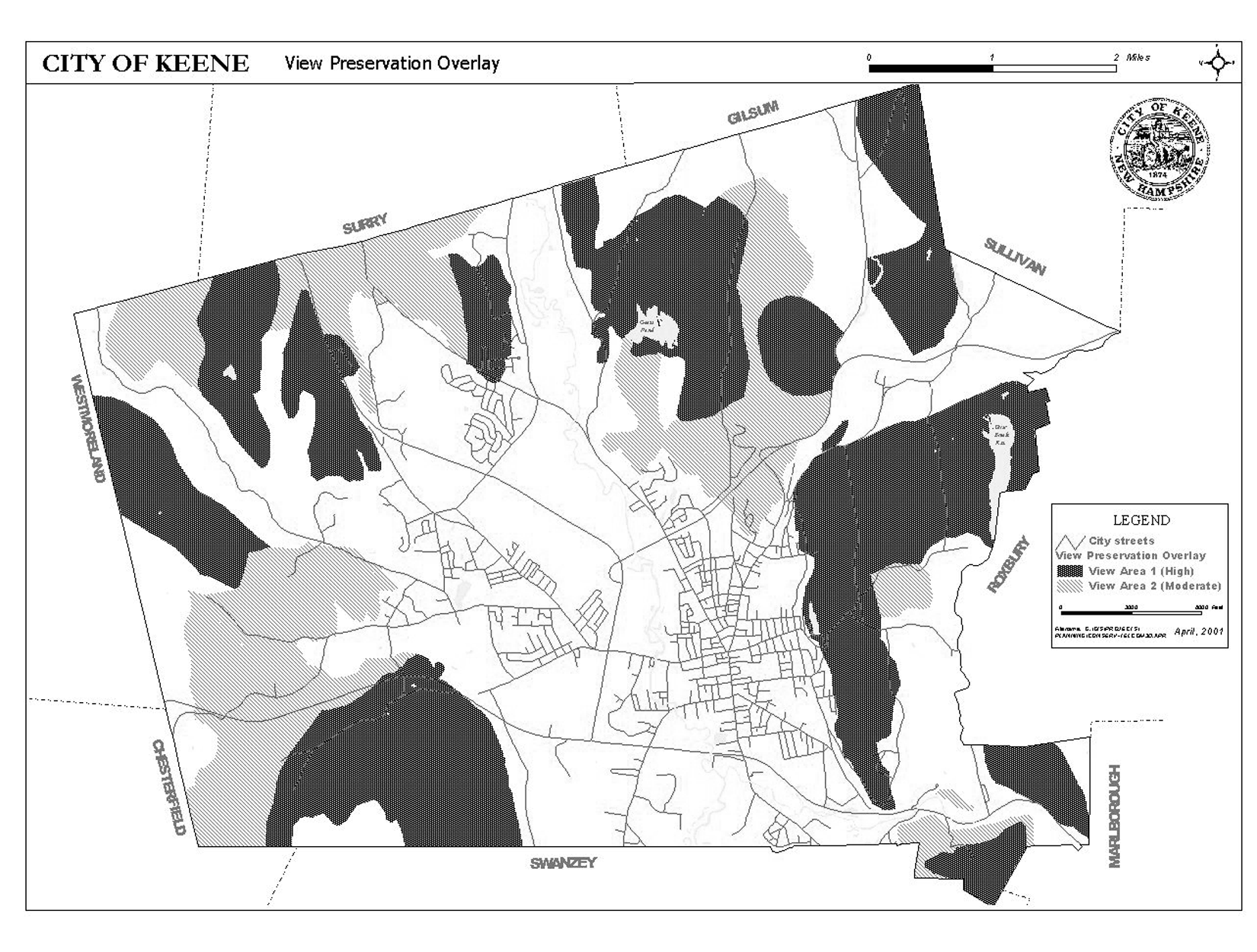
View Preservation Overlay Map
(b)
Use regulations. The telecommunication facilities listed in this subsection are deemed to be permitted uses subject to the requirements of this article. The telecommunication facilities listed in this subsection may require further review under this article in accordance with section 102-1269 pertaining to conditional use permits and the planning board's subdivision and site plan regulations. Modifications or alterations to ground-mounted towers in existence prior to the adoption of the ordinance from which this article derives which would increase the visibility, height and size of the tower shall be subject to site plan review and the issuance of a conditional use permit. However, in all cases telecommunication facilities shall require a building permit and must comply with other applicable sections of this Code and city ordinances and regulations, including site plan review, as applicable.
(1)
Concealed telecommunication facilities located inside buildings and structures. The installation of telecommunication facilities inside buildings or structures (completely concealed from view) is encouraged and may occur within all zones of the city. These facilities consist mainly of antennas or other devices which can transmit through structures or walls. The placement of concealed telecommunication facilities inside buildings or structures is subject to the issuance of a building permit only and this article.
(2)
Collocation of facilities. The installation of telecommunication facilities attached to or mounted upon existing telecommunication facilities is encouraged and may occur on any ground-mounted telecommunication tower, guyed tower, lattice tower, mast or monopole in existence prior to the adoption of the ordinance from which this article derives, or on any ground-mounted telecommunication facility previously approved under this article. Collocation of facilities is subject to the issuance of a building permit only, except under the following situations:
a.
The location of the ground-mounted telecommunication tower or facility is within view area 1 of the view preservation overlay;
b.
There is a change in access to the existing facility; and
c.
There is a change in the area of the security barrier of the existing facility.
Under the situations in this subsection, site plan review and the issuance of a conditional use permit by the planning board shall be required.
(3)
New telecommunication facilities mounted on existing structures. The placement of telecommunication facilities attached or mounted to existing structures such as water towers, utility poles and towers, and other similar structures may occur within all zones of the city. These facilities consist mainly of antennas or other devices which can be vertically or horizontally mounted to a structure and may include facilities which are designed to blend into the surrounding environment or are painted to match the existing structure. Such facilities shall require the issuance of a building permit and a conditional use permit in accordance with this article. The term "existing structure" is defined in section 102-1263.
(4)
New telecommunication facilities mounted on existing buildings. The placement of telecommunication facilities attached or mounted to existing buildings may occur within all zones of the city. These facilities consist mainly of antennas or other devices, which can be mounted to the roof or attached to the side of a building. They can also include architecturally screened roof-mounted antennas, which are integrated into the architectural elements of the building, and building-mounted antennas painted to match the existing building and antennas. Such facilities shall require the issuance of a building permit and a conditional use permit in accordance with this article.
(5)
Camouflaged and alternative telecommunication facilities. The installation of alternative telecommunication facilities, such as clock towers, bell steeples, light poles or flagpoles and other similar facilities, may be located within all zones of the city. New ground-mounted towers and antennas if camouflaged may occur within view area 2 as shown on the map of the city's view preservation overlay. All alternative and camouflaged facilities shall require the issuance of a building permit and a conditional use permit in accordance with this article. Site plan review shall also be required under the planning board's site plan/subdivision regulations.
(6)
New ground-mounted towers and antennas. If an applicant demonstrates that none of the telecommunication facilities identified in subsections (b)(1) through (5) of this section are possible, new ground-mounted towers and antennas may be permitted subject to the issuance of a building permit and a conditional use permit in accordance with this article. Site plan review shall also be required under the planning board's site plan/subdivision regulations. However, new ground-mounted towers and antennas shall be prohibited from locating in those areas identified as view area 1 and view area 2 as shown on the map of the city's view preservation overlay. Additionally, new ground-mounted telecommunication facilities shall not be located within any existing or approved historic district.
(c)
Siting policy. Applicants seeking approval for new ground-mounted telecommunication towers and antennas shall first evaluate the availability of existing structures and buildings for the concealment of telecommunication facilities, as well as collocation at existing telecommunication structures or towers. After exhausting these options, applicants shall consider next the availability of existing structures or buildings for the installation of telecommunication facilities, as well as the use of camouflaged or alternative telecommunication facilities.
(d)
Burden of proof policy. Only after finding that none of the telecommunication facilities options identified in subsections (b)(1) through (5) of this section are possible can an applicant consider or propose a new ground-mounted tower or antenna. When considering a new ground-mounted tower or antenna, the applicant shall have the burden of proving to the planning board that none of options identified in subsections (b)(1) through (5) of this section are possible. To meet this burden, the applicant shall take all the following actions to the extent applicable:
(1)
The applicant shall submit to the planning board a list of all contacts made with owners of potential sites regarding the availability of potential space for a telecommunication facility. If the planning board informs the applicant that additional existing structures or buildings may be satisfactory, the applicant shall contact the property owners of those structures or buildings.
(2)
The applicant shall provide to the planning board copies of all letters of inquiry made to owners of existing structures or buildings and letters of rejection. If letters of rejection are not provided, at a minimum, unanswered return receipt requested forms from the U.S. post office shall be forwarded for each owner of the existing structure or building that was contacted.
(3)
If the applicant claims that a structure or building is not capable of physically supporting a telecommunication facility, a licensed professional civil or structural engineer must certify this claim to the planning board. The certification shall, at a minimum, explain the structural issues and demonstrate that the structure cannot be modified to support the telecommunication facility without unreasonable costs.
If the applicant demonstrates to the planning board that it is not feasible to conceal telecommunication facilities inside an existing structure or building, collocate facilities at existing ground-mounted telecommunication towers or antennas, install or mount telecommunication facilities onto existing structures or buildings, or construct camouflaged or alternative telecommunication facilities, new ground-mounted towers and antennas can be considered subject to this article.
(Code 1970, § 2327.5; Ord. No. O-2000-19A, § 2327.5, 6-7-2001; Ord. No. O-2002-20, § 2327.5.2, 2-6-2003)
Sec. 102-1266. - Dimensional requirements.
The following dimensional requirements and limitations shall preempt all other dimensional limitations as required by this chapter and shall apply only to telecommunications facilities approved under this article, except for concealed telecommunication facilities located inside a building or structure as described in section 102-1265(b):
(1)
Maximum height. In no case shall new ground-mounted towers, ground-mounted camouflaged or alternative towers, or preexisting reconstructed ground-mounted towers or antennas project higher than 20 feet above the average tree crown height within a 150-foot perimeter of the mount, security barrier, or designated clear area for access to equipment, whichever is greater. A licensed landscape architect, certified arborist or forester shall determine the average tree crown height. The height of towers shall be determined by measuring the vertical distance from the tower or telecommunication facility's lowest point of contact with the ground to the highest point of the tower, including all antennas or other attachments. Antennas on top of the tower may be added provided the total height of the tower and antennas does not project higher than 20 feet above the average crown height.
(2)
Height of existing structures and utility poles. Telecommunication facilities mounted on water towers, electric transmission and distribution towers, utility poles and similar existing utility structures, guyed towers, lattice towers, masts, and monopoles may be permitted to increase the height of those structures by no more than 15 feet. No telecommunication facility may be placed on any structure less than 40 feet in height. The height of the structure is measured by including the mount of the proposed telecommunication facility.
(3)
Height of existing buildings. Telecommunication facilities attached to or mounted on existing buildings, including smokestacks attached to buildings, shall not increase the height of the existing building by more than 15 feet, unless the facility is completely camouflaged; for example, a facility completely concealed within a flagpole, steeple, or chimney. The increase in height of the structure shall be in scale and proportion to the building as originally configured. Telecommunication facilities may locate on a building that is legally nonconforming with respect to height, provided that the sections of this article are met. No telecommunication facility may be placed on any structure less than 40 feet in height. The height of the building is measured by including the mount of the proposed telecommunication facility.
(4)
Height for reconstruction of preexisting ground-mounted tower/antenna. An existing ground-mounted guyed tower, lattice tower, monopole, or mast in existence prior to the adoption of the ordinance from which this article derives may be reconstructed provided the standards of this article are met and provided the tower and any antenna placed on top of the tower do not project higher than 20 feet above the average tree crown height. The mount shall be replaced with a similar mount that does not significantly increase the visual impact on the community.
(5)
Setbacks. Telecommunication facilities, guys and accessory equipment shelters shall comply with the building setback requirements of the zoning district in which the facility is located, except for facilities installed within existing structures and buildings or mounted to the exterior of existing structures or buildings, such as a church steeple, light standard, power line support device (e.g., power line tower). Fences shall comply with the setback provisions of the zoning district in which the facility is located if the fence is six feet or more in height.
(6)
Tower setbacks and separation. Towers must be set back a distance equal to 125 percent of the height of the tower from any off-site residential structure, public road or street. New towers shall not be located within the public rights-of-way of any roads.
(7)
Fall zone for ground mounts. In order to ensure public safety, the minimum distance from the base of any ground-mounted telecommunication facility to any property line, public road, residential dwelling, business or institutional use, or public recreational areas shall be, at a minimum, the distance to the fall zone, as defined by this article. The fall zone may cross property lines, so long as the applicant secures a fall zone easement from the affected property owners. The area and terms of the easement shall be shown on all applicable plans submitted to the city.
(8)
Fall zone for non-ground mounts. If an existing structure or building is proposed as a mount for a telecommunication facility, a fall zone shall not be required, but the setback provisions of the zoning district shall apply. For preexisting nonconforming structures or buildings, telecommunication facilities and their related equipment shelters shall not increase any nonconformity.
(Code 1970, § 2327.6.1; Ord. No. O-2000-19A, § 2327.6.1, 6-7-2001; Ord. No. O-2002-20, § 2327.6, 2-6-2003)
Sec. 102-1267. - Other minimum requirements.
The following minimum requirements apply to all telecommunication facilities approved under this article, except for concealed telecommunication facilities located inside a building or structure as described in section 102-1265(b).
(1)
Lighting. Telecommunication facilities shall not be illuminated by artificial means and shall not display strobe lights of any kind, except for aviation caution lights shielded from sight from the ground, unless such lighting is specifically required by the Federal Aviation Administration or other federal or state authority for a specific facility. Light fixtures used to illuminate ballfields, parking lots, or other similar areas may be attached to an approved ground-mounted facility. Lighting of equipment structures and any other facilities on site shall be shielded from abutting properties. Footcandle measurements at the property line shall be zero initial footcandles.
(2)
Signage and advertising. The use of any portion of a telecommunication facility for any permanent or temporary signs, writing, symbols, logos, or any graphic representation of any kind, other than warning or equipment information signs, is prohibited. These signs shall be limited to those needed to identify the property and the owner and warn of any danger and shall comply with the city sign code in chapter 74.
(3)
Noise. Telecommunication facilities shall not generate noise in excess of that permitted under the city noise ordinance.
(4)
Radio frequency radiation (RFR) standards. All equipment proposed for a telecommunication facility shall be fully compliant with the Federal Communications Commission Guidelines for Evaluating the Environmental Effects of Radio Frequency Radiation (FCC Guidelines), under Report and Order, Federal Communications Commission 96-326, published on August 1, 1996, and all subsequent amendments.
(Code 1970, § 2327.6.2; Ord. No. O-2000-19A, § 2327.6.2, 6-7-2001)
Sec. 102-1268. - Design standards and conditional use permit review criteria.
(a)
Application of standards and criteria to facility type. The following tables show the application of standards and criteria to the facility type:
(b)
List of standards and conditional use permit criteria. the following is a list of standards and conditional use permit criteria:
(1)
Concealment. Any telecommunication facility located inside a building or structure must be completely concealed from public view.
(2)
Location. There are no restrictions upon the location of concealed telecommunication facilities mounted inside a building or structure. No telecommunication facility may be mounted on any structure or building facing or fronting on Main Street (between and including Central Square and Route 101), unless the facility is designed to be incorporated into the structure or building such as a clock tower, bell steeple, light pole or flagpole or other similar alternative facility. New ground-mounted camouflaged facilities, towers and antennas shall not be located within residential areas or open areas that are clearly visible from abutting public roads, recreational areas and properties. Manmade trees and other similar camouflaged or ground-mounted towers and antennas must be located in areas containing a dense tree growth that extends continuously for a distance of 150 feet from the mount, security barrier, or designated clear area for access to equipment, whichever is greater. The 150-foot area of dense tree growth shall be protected by a landscape easement or be within the area of the carrier's lease. The easement or lease shall specify that the existing trees shall not be removed or topped, unless the trees are dead or dying and present a hazard to persons and property.
(3)
Historic structure. Any telecommunication facility located inside or upon an existing historic structure shall not alter the historic character-defining features, distinctive construction methods, or original historic materials of the structure. Any alteration made to a historic structure to accommodate a telecommunication facility shall be fully reversible. Telecommunication facilities mounted on the top of a historic building shall be concealed behind the existing architectural features of the building or shall be so located so that they are not visible from public roads and viewing areas.
(4)
Mechanical and electrical equipment. All mechanical and electrical equipment associated with any telecommunication facility located inside a structure or building must be concealed within the structure or building or shall be located so that the equipment and wires are not visible from public roads or viewing areas.
(5)
Scale. All telecommunication facilities must be consistent with community scale, as exhibited in relative height, mass or proportion with the supporting structure or building and/or the immediate surroundings as applicable.
(6)
Color and finish. New ground-mounted towers and antennas shall either maintain a nonreflective finish, subject to any applicable standards of the Federal Aviation Administration, or be painted a neutral color, so as to reduce glare and visual obtrusiveness. Camouflaged or alternative telecommunication facilities and supporting electrical and mechanical equipment must be identical to, or closely compatible with, the color and finish of the surrounding environment, structures and buildings so as to make the facility and related equipment as visually unobtrusive as possible. If a telecommunication facility is mounted on an existing structure or building, the facility and supporting electrical and mechanical equipment shall be a neutral color or one that is identical to, or closely compatible with, the color of the supporting structure or building so as to make the facility and related equipment as visually unobtrusive as possible. If a telecommunication facility is installed on an existing tower or antenna or a new tower or antenna approved under this article for the purpose of collocation, the facility must be constructed of a nonreflective finish, subject to any applicable standards of the Federal Aviation Administration. Additionally, it must be painted a neutral color which blends with the background and immediate surroundings or match the color of the existing tower or antenna so as to reduce glare and visual obtrusiveness.
(7)
Contrast. All telecommunication facilities, except concealed facilities located inside buildings or structures, shall not stand out in terms of color and materials, scale, height, mass or proportion against a contrasting background.
(8)
Antenna type. Narrow profile antenna arrays are recommended and required for new ground-mounted facilities, the collocation of facilities, and facilities mounted on existing structures and buildings.
(9)
Smokestacks. Only camouflaged or alternative telecommunication facilities are permitted to be mounted on smokestacks.
(10)
Side mounts. Facilities, which are side mounted to an existing or proposed new structure, shall blend or match as closely as possible with the design features and materials of the existing structure. Facilities mounted to the side of an existing or proposed new building shall blend or match as closely as possible with the architectural design features of the building and must be painted or shielded with material consistent with the design features and materials of the building.
(11)
Roof mounts. Facilities mounted on a roof shall be stepped back from the front facade in order to limit the visual impact of the facility on the building's silhouette. All roof-mounted facilities with supporting electrical and mechanical equipment shall be screened from view or camouflaged.
(12)
Security fencing. New ground-mounted towers and antennas shall be enclosed by security fencing not less than six feet in height, and towers shall be equipped with an appropriate anticlimbing device. The planning board shall have final authority on whether a camouflaged or alternative telecommunication facility should be surrounded by a security fence or barrier of some sort.
(13)
Equipment shelters. All equipment for a camouflaged or ground-mounted alternative telecommunication facility shall be located in an underground vault. All equipment for new ground-mounted towers or antenna shall be located in an underground vault or equipment shelter. The equipment shelters shall be architecturally consistent with respect to materials and appearance, with the buildings in the area of the facility, or equipment shelters shall be camouflaged behind an effective yearround landscape buffer, equal to the height of the proposed building, as determined by the planning board. All equipment shelters, utility buildings and structures accessory to a ground-mounted facility shall meet the minimum building setback requirements of the underlying zoning district.
(14)
Driveways. If available, existing entrances and driveways to serve a camouflaged or ground-mounted alternative telecommunication facility or a new ground-mounted tower or antenna shall be utilized, unless the applicant can demonstrate that a new entrance and driveway will result in less visual, traffic and environmental impact. New driveways to serve a ground-mounted facility shall not exceed 12 feet in width. A gravel or stone surface is encouraged and the driveway must comply with the city's driveway regulations.
(15)
Ground mounts. New ground-mounted towers and antennas or new towers and antenna constructed as part of a reconstruction project permitted under sections 102-1265(b) and 102-1266(4) shall be of a lattice, guyed or mast-type mount, unless the planning board determines that an alternative design would better blend into the particular site and surrounding environment. Monopoles are expressly prohibited. New ground-mounted towers and antennas must be designed structurally, electrically, and in all other respects, to allow for future rearrangement of antennas upon the tower, to accept antennas mounted at varying heights, and to accommodate antennas from at least two users.
(Code 1970, § 2327.7; Ord. No. O-2000-19A, § 2327.7, 6-7-2001)
Sec. 102-1269. - Conditional use permits.
(a)
Generally. All applicants for telecommunication facilities as required under this article shall apply to the planning board for site plan review in accordance with the requirements as provided for in the city's site plan review regulations. As required under this article, applicants shall also be required to submit the information provided for in this section.
(b)
Issuance. In granting the conditional use permit, the planning board may impose conditions to the extent the board concludes such conditions are necessary to minimize any adverse effect of the proposed tower on adjoining properties, and preserve the intent of this article.
(1)
Procedure on application. The planning board shall act upon the application in accordance with the procedural requirements of the site plan review regulations and RSA 676:4.
(2)
Decisions. Possible decisions rendered by the planning board include approval, approval with conditions, or denial. All decisions shall be rendered in writing, and a denial shall be in writing and based upon substantial evidence contained in the written record.
(3)
Factors considered in granting decisions. In the review of conditional use permit applications, the applicant and the planning board shall address all applicable design standards and conditional use permit review criteria as provided for in section 102-1268 and the general requirements of sections 102-1266 and 102-1267. In addition, the planning board shall consider the following additional factors:
a.
Height of proposed tower or other structures. The planning board shall have the final authority to increase the allowable height of all new, altered, modified or reconstructed ground-mounted towers or antennas based on site conditions in nonresidential areas, provided:
1.
If the structure is readily visible to residential properties, it does not exceed a maximum height of 75 feet; and
2.
If the structure is not readily visible to residential properties, it does not exceed a maximum height of 150 feet.
b.
Availability of alternative facility types and sites as discussed in the siting policy in section 102-1265(c).
c.
Visual impacts on view sheds, ridgelines, and other impacts by means of tower location, tree and foliage clearing and placement of incidental structures.
d.
Compliance with the burden of proof policy in section 102-1265(d).
(c)
Information required. Each applicant requesting a conditional use permit under this article shall submit a scaled site plan in accordance with the planning board's subdivision/site plan regulations and further information including a scaled elevation view, topography, existing vegetation and tree crown coverage, radio frequency coverage, height requirements, setbacks, drives, parking, fencing, landscaping, adjacent uses up to 200 feet away, global positioning (latitude and longitude as referenced to the state plan coordinate system, NAD 83 North American Datum, U.S. feet) and any other information deemed necessary by the planning board to establish compliance with this article. Furthermore, the applicant shall submit the following information as part of the conditional use permit request:
(1)
The applicant shall submit written proof that the proposed telecommunication facility complies with the Federal Communications Commission regulations on radio frequency (RF) exposure guidelines.
(2)
The applicant shall submit written proof that an evaluation has taken place, as well as the results of such evaluation, satisfying the requirements of the National Environmental Policy Act (NEPA) further referenced in applicable Federal Communications Commission rules. If an environmental assessment (EA) or an environmental impact statement (EIS) is required under the Federal Communications Commission rules and NEPA, submission of the EA or EIS to the board prior to the beginning of the federal 30-day comment period, and the city process, shall become part of the application requirements.
(3)
Each applicant for a new ground-mounted tower or antenna shall provide to the planning board an inventory and map of all existing ground-mounted towers and antennas that are located within the city's jurisdiction and those within two miles of the border thereof, including specific information about the location, height, design of each tower and/or antenna, as well as economic and technological feasibility for co-location on the inventoried towers and/or antennas. The planning board may share such information with other applicants applying for approvals or conditional use permits under this article or other organizations seeking to locate telecommunication facilities within the jurisdiction of the governing authority; provided, however, that the planning board is not, by sharing such information, in any way representing or warranting that such sites are available or suitable. If the applicant is proposing to build a new ground-mounted tower or antenna, the applicant shall submit written evidence demonstrating that no existing ground-mounted tower or antenna can accommodate the applicant's proposed telecommunication facilities. This evidence can consist of substantial evidence that:
a.
No existing ground-mounted towers or antennas are located within the geographic area required to meet the applicant's engineering requirements, provided that a description of the geographic area required is also submitted.
b.
Existing ground-mounted towers or antennas are not of sufficient height to meet the applicant's engineering requirements, and why.
c.
The existing ground-mounted towers or antennas do not have sufficient structural strength to support the applicant's proposed telecommunication facility's related equipment.
d.
The applicant's proposed telecommunication facilities would not cause electromagnetic interference with the telecommunication facilities located on the existing ground-mounted towers or antennas, or the telecommunication facilities located on the existing towers or antennas would cause interference with the applicant's proposed telecommunication facilities.
e.
The fees, costs, or contractual provisions required by the owner in order to share the existing ground-mounted tower or antenna are unreasonable. Costs exceeding new ground-mounted tower development are presumed to be unreasonable.
f.
The applicant can demonstrate other limiting factors that render existing ground-mounted towers and antennas unsuitable.
(4)
The applicant proposing to build a new ground-mounted tower or antenna shall submit an agreement with the city that allows for the maximum allowance of co-location upon the new structure. Such statement shall become a condition to any approval. This statement shall, at a minimum, require the applicant to supply available co-location for reasonable fees and costs to other telecommunications providers. Failure to provide such an agreement is evidence of the applicant's unwillingness to cooperate with the orderly and well-planned development of the city, and grounds for a denial.
(5)
The applicant shall submit the engineering information detailing the size and coverage required for the facility location. The planning board may have this information reviewed by a consultant for verification of any claims made by the applicant regarding technological limitations and feasibility for alternative locations. Cost for this review shall be borne by the applicant in accordance with RSA 676:4I(g).
(6)
Appeals. An appeal of a planning board decision relative to a conditional use permit under this section shall be to superior court in accordance with RSA 677:15.
(Code 1970, § 2327.8; Ord. No. O-2000-19A, § 2327.8, 6-7-2001)
Sec. 102-1270. - Waivers.
(a)
Generally. Where the planning board finds that extraordinary hardships, practical difficulties, or unnecessary and unreasonable expense would result from strict compliance with the foregoing sections of this article or the purposes of this article may be served to a greater extent by an alternative proposal, it may approve waivers to this article. The purpose of granting waivers under this article shall be to ensure that an applicant is not unduly burdened as opposed to merely inconvenienced by this article. The board shall not approve any waiver unless a majority of those present and voting find that all of the following apply:
(1)
The granting of the waiver will not be detrimental to the public safety, health or welfare or injurious to other property and will promote the public interest.
(2)
The waiver will not, in any manner, vary the provisions of this chapter, the city master plan, or official maps.
(3)
Such waiver will substantially secure the objectives, standards and requirements of this article.
(4)
A particular and identifiable hardship exists or a specific circumstance warrants the granting of a waiver. Factors to be considered in determining the existence of a hardship shall include but not be limited to the following:
a.
Topography and other site features.
b.
Availability of alternative site locations.
c.
Geographic location of the property.
d.
Size/magnitude of the project being evaluated and availability of collocation.
(5)
In no case shall ground-mounted towers, ground-mounted camouflaged or alternative towers, or preexisting reconstructed ground-mounted towers or antennas be greater than 125 feet in height.
(b)
Conditions. In approving waivers, the board may impose such conditions as it deems appropriate to substantially secure the objectives of the standards or requirements of this article.
(c)
Procedures. A petition for any such waiver shall be submitted in writing by the applicant with the application for board review. The petition shall state fully the grounds for the waiver and all of the facts relied upon by the applicant. Failure to submit the petition in writing shall require an automatic denial.
(d)
Appeals. An appeal of a planning board decision relative to a waiver shall be to the zoning board of adjustment in accordance with RSA 674:33.
(Code 1970, § 2327.9; Ord. No. O-2000-19A, § 2327.9, 6-7-2001)
Sec. 102-1271. - Maintenance, monitoring and security.
(a)
Maintenance. The owner of an approved telecommunication facility shall maintain the facility in good condition. Such maintenance shall include but shall not be limited to painting, structural integrity of the mount and security fencing, and maintenance of the buffer areas and landscaping.
(b)
Monitoring. As part of the issuance of a building permit or conditional use permit, the property owner agrees that the city may enter the subject property to inspect the telecommunication facility or obtain RFR or noise measurements at the expense of the owner of the facility. The city shall provide reasonable written notice to the property owner and the owner of the facility and provide an opportunity to accompany city representatives when the inspection and/or measurements are conducted.
(c)
Security for removal. Recognizing the extremely hazardous situation presented by abandoned and unmonitored telecommunication facilities, the planning board shall set the form and amount of security that represents the cost for removal and disposal of abandoned telecommunication facilities if a facility is abandoned and the facility owner is unwilling or unable to remove the facility in accordance with section 102-1272. The amount of the security shall be based upon the removal cost, plus 15 percent, provided by the applicant and certified by a professional engineer licensed in the state every five years from the date of the issuance of a building permit or the date of planning board approval, whichever is applicable. If the cost has increased more than 15 percent, the owner of the facility shall provide additional security in the amount of the increase. Furthermore, the owner shall submit as part of the issuance of a building permit proof of adequate insurance covering accident or damage.
(Code 1970, § 2327.10; Ord. No. O-2000-19A, § 2327.10, 6-7-2001)
Sec. 102-1272. - Abandonment or discontinuance of use.
(a)
Notification. At such time that an owner or carrier plans to abandon or discontinue operation of a telecommunication facility, such owner or carrier shall notify the city manager by certified U.S. mail of the proposed date of abandonment or discontinuation of operations. Such notice shall be given no less than 30 days prior to abandonment or discontinuation of operations. If an owner or carrier fails to give such notice, the telecommunication facility shall be considered abandoned upon such discontinuation of operations.
(b)
Removal. Upon abandonment or discontinuation of use, the owner of the facility shall physically remove the facility within 90 days from the date of abandonment or discontinuation of use. The term "physically remove" shall include but not be limited to the following:
(1)
Removal of antennas, mount, equipment shelters and security fencing as applicable from the subject property.
(2)
Proper disposal of the waste materials from the site in accordance with local and state solid waste disposal regulations.
(3)
Restoring the location of the facility to its natural condition, except that any landscaping and grading shall remain as finished.
(c)
Failure to remove. If the owner of the facility does not remove the facility upon order of the superintendent of code enforcement, the superintendent of code enforcement shall, after holding a public hearing with notice to the owner and abutters, issue a declaration of abandonment. The owner of the facility shall dismantle and remove the facility within 90 days of receipt of the declaration of abandonment. If the abandoned facility is not removed within 90 days, the city may execute the security to pay for removal. If there are two or more users of a single tower or antenna, this subsection shall not become effective until all users cease using the tower or antenna.
(Code 1970, § 2327.11; Ord. No. O-2000-19A, § 2327.11, 6-7-2001)
Sec. 102-1273. - Facilities installed prior to effective date.
All telecommunication facilities, towers and antennas legally installed prior to the effective date of the ordinance from which this article derives shall be considered permitted, nonconforming uses and structures and may be utilized for siting consistent with the terms of this article.
(Code 1970, § 2327.12; Ord. No. O-2000-19A, § 2327.12, 6-7-2001)

