
Keene City Zoning Code
ARTICLE XIII
SUSTAINABLE ENERGY EFFICIENT DEVELOPMENT OVERLAY
Sec. 102-1430.- Authority.
This article is adopted as an innovative land use control pursuant to the authority granted by RSA 674:16 and 674:21, and procedurally in accordance with RSA 675:1, II.
(Ord. No. O-2010-07-A, 12-16-2010)
Sec. 102-1431. - Purpose.
The purpose of this article is to amend the City of Keene Zoning Ordinance to create the sustainable energy efficient development (SEED) overlay; and to provide the rules, regulations and procedures applicable to the SEED overlay in order to promote smart growth, mixed-uses and green development, and to provide an opportunity for height, density and use incentives to guide development and redevelopment towards the city's urban core, where adequate infrastructure and services can accommodate growth. This purpose will be accomplished by:
(1)
Creating an overlay district within which property owners will have the option of constructing a green building in exchange for zoning incentives;
(2)
Adopting voluntary alternative permitted densities, heights and uses for properties located within the SEED overlay;
(3)
Encouraging new construction and alterations to existing buildings, structures, and sites within the SEED overlay that reflect the city's distinctive architectural identity, unique character, and prevailing scale;
(4)
Strengthening the economy of the city through the provision of zoning incentives that will make it attractive for property owners within the SEED overlay to expand upon Keene's existing mixed-use, urban environment;
(5)
Providing opportunities to expand the city's tax base through encouraging redevelopment and smart growth;
(6)
Increasing property values within the city;
(7)
Discouraging sprawling, unplanned development that can result in unwise use of the city's remaining open space and rural lands;
(8)
Encouraging the reuse of historical buildings in Keene and retrofitting them in a historically sensitive manner.
(Ord. No. O-2010-07-A, 12-16-2010)
Sec. 102-1432. - Sustainable energy efficient development (SEED) overlay map.
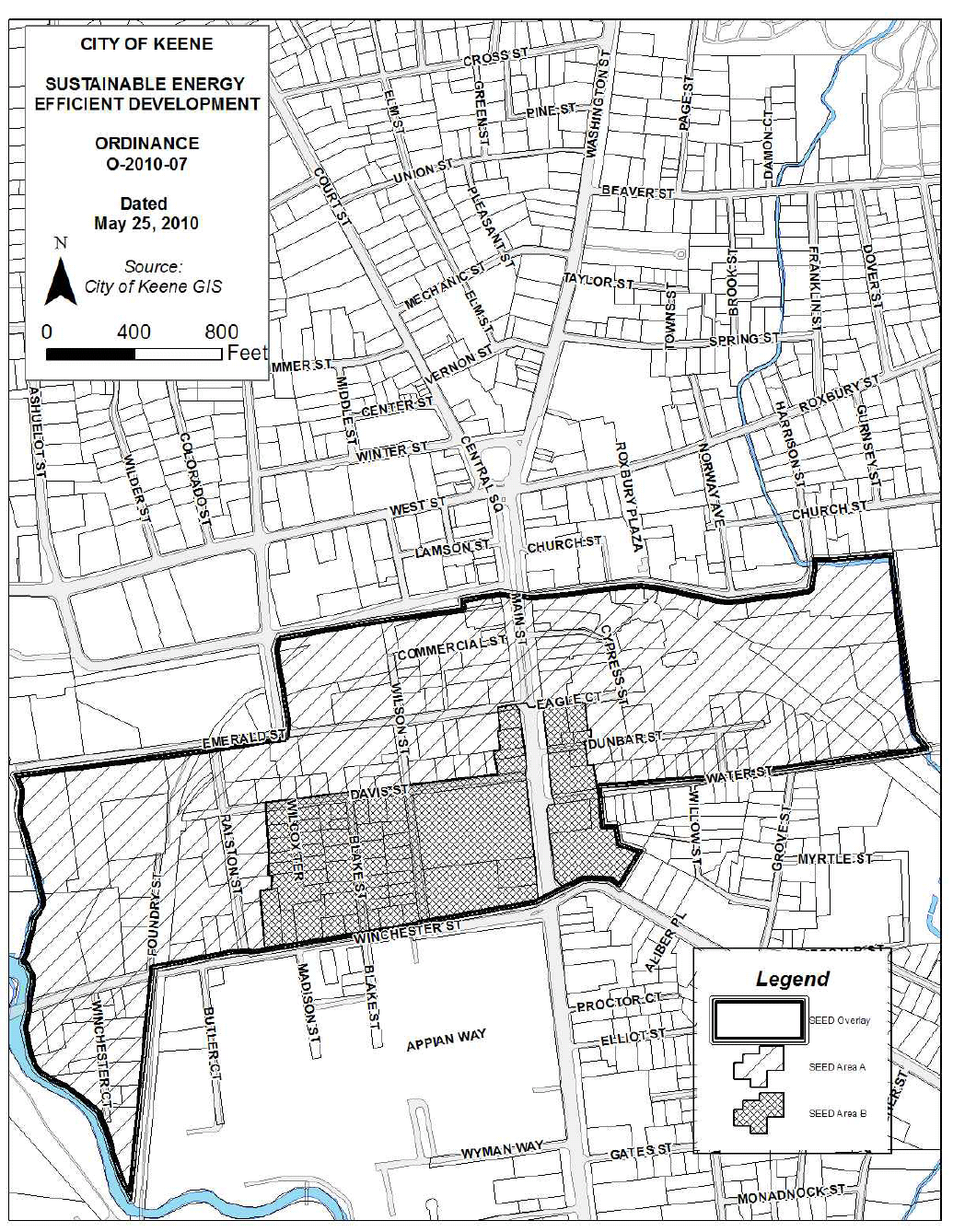
Incorporated as part of this article, the sustainable energy efficient development (SEED) overlay, as described in a map entitled, "Sustainable Energy Efficient Development Overlay" dated May 25, 2010, is hereby adopted in accordance with RSA 674:20 as an overlay district to the official zoning map of the City of Keene. The SEED overlay district is divided into two distinct sub-districts: SEED A and SEED B.
(Ord. No. O-2010-07-A, 12-16-2010)
Sec. 102-1433. - Application procedures and information required.
(a)
Upon application, the zoning administrator shall begin the process for evaluating whether or not a project is eligible for the incentives contained within the SEED overlay. The applicant shall be responsible for submitting a letter of intent, application form and application fee (collectively identified as the "application") to the zoning administrator to initiate this process.
(b)
The letter of intent, signed by the applicant and property owner, or his authorized agent, shall include a narrative that addresses the following:
(1)
A description of the complete project and what strategies will be employed to obtain a green building certification.
(2)
The green building system and level of attainment proposed for the project.
a.
LEED®, Green Globes, the National Green Building Standard (ICC 700), and the International Green Construction Code are the acceptable Green Building Rating systems for this article.
b.
Demonstrated compliance with these systems will permit pre-certification.
(3)
All necessary information to allow an informed decision regarding the applicant's ability to comply with the chosen rating system.
(4)
Statement that the applicant releases the City of Keene, its officers, employees, agents and servants from any liability if the applicant is unsuccessful in efforts to attain green building certification or equivalent, as identified in this article.
(c)
With the letter of intent, the applicant will choose a third party reviewer from a listing of third party reviewers maintained by the code enforcement department. The applicant can provide a third-party nomination to the code enforcement department, but acceptance of the third party shall be at the sole discretion of the department. The costs and expenses of the third-party reviewer shall be paid by the applicant at the time of the filing of the application. Within 35 business days, the third-party reviewer will make a determination of the project's ability to achieve a minimum green building pre-certification status for one of the following rating systems:
(d)
Within ten business days after receipt of third-party review, results and commentary, the zoning administrator shall determine in writing if the project is:
(1)
Eligible for SEED overlay incentives.
(2)
Ineligible for SEED overlay incentives.
(e)
Once the zoning administrator has issued a decision that the project is eligible, the applicant cannot change the proposed green building rating system without first obtaining the approval of the zoning administrator. In making this re-determination, the zoning administrator may require that the proposed change(s) be submitted to a third-party reviewer as provided by this article.
(f)
Upon application for a building permit, the applicant shall submit the review of the third-party and any acceptances or certifications from green rating agencies to demonstrate compliance with the proposed green building rating system or code.
(g)
Prior to the issuance of a certificate of occupancy, the zoning administrator shall receive certification or documentation from the qualified third-party reviewer that the as-built project has achieved the proposed rating system. No certificate of occupancy or temporary certificate of occupancy shall be issued without demonstrated evidence supplied by the applicant and third-party reviewer that the project has achieved the proposed level of green building compliance.
(Ord. No. O-2010-07-A, 12-16-2010)
Sec. 102-1434. - General standards.
(a)
Central business district, central business limited district use regulations: In addition to the uses allowed in the central business district and central business limited district, the following uses shall be permitted in any combination when a proposed development has received a finding of eligibility:
(1)
Mixed-use development.
(b)
Commerce district, industrial district, and high density district within SEED Area A Use Regulations: In addition to the uses allowed in the commerce district, high density and industrial district, the following uses shall be permitted in any combination when a proposed development has received a finding of eligibility:
(1)
All uses allowed within the central business district.
(2)
Mixed-use development.
(c)
High density district within SEED Area B Use Regulations: In addition to the uses allowed in the high density district, the following uses shall be permitted when a proposed development has received a finding of eligibility:
(1)
Mixed-use development;
(2)
Banking or lending institutions;
(3)
Clinic;
(4)
Nursery or child care facility;
(5)
Parking area (lot).
(Ord. No. O-2010-07-A, 12-16-2010)
Sec. 102-1435. - Establishment of density, height, dimensional, and parking incentives.
(a)
Eligible projects within SEED overlay district—Area A and SEED overlay district—Area B shall comply with the height, lot size, setback, and minimum lot size per dwelling unit requirements established in Table I: Dimensional Regulations for Eligible Projects.
(b)
The following parking requirements shall apply for an eligible project:
(1)
This article shall supersede parking requirements established in section 18-253.
(2)
Shared parking shall be permitted, pursuant to section 102-1450 - section 102-1456;
(3)
The maximum allowable distance between any property and the location of any off-site parking shall be 750 feet, pursuant to section 102-978;
(c)
The number of parking spaces required for eligible projects within the SEED overly district shall comply with the parking requirements established in Table II: Parking Calculations for Projects within the SEED overlay.
(Ord. No. O-2010-07-A, 12-16-2010)
Sec. 102-1436. - Screening requirements.
(a)
Within SEED Area B, any structure that has been found eligible for SEED overlay incentives pursuant to section 102-1433 shall be required to construct an architectural or vegetative screen to lessen the impact of noise, dust, debris, and motor vehicle headlight glare on abutting properties.
(b)
Prior to the issuance of a building permit, a property owner, or his authorized agent, shall submit a surveyed plot plan or site plan approved by the planning board to the zoning administrator, or his designee, that is drawn to scale, clearly delineates all existing structures and parking areas, and provides the location, size and description of all architectural screening or vegetative screening materials.
(c)
Any architectural screen or vegetative screen required by this article shall provide a four-season screen between properties and shall not be removed or replaced without the written permission of the zoning administrator.
(d)
Architectural and vegetative screens between any structure in SEED Area B that has been found eligible for overlay incentives pursuant to section 102-1433 and abutting properties shall consist of the following:
(1)
A row of one three-inch caliper deciduous tree for every 20 linear feet of common property line; and
(2)
A forty-eight-seventy-two inch tall solid fence extending along the common property line; or
(3)
An evergreen hedge extending along the common property line with a planting height of at least 36 inches and a mature height of at least 48 inches; or
(4)
Any combination of the above.
(Ord. No. O-2010-07-A, 12-16-2010)
Sec. 102-1437. - Project modifications that require planning board approval.
(a)
In addition to the criteria established in the planning board's site plan and subdivisions regulations, any of the following alterations to a property located within the SEED overlay, for which approval has been granted pursuant to section 102-1433, shall be reviewed by the planning board:
(1)
Exterior alterations to grading, landscaping, architecture or stormwater management;
(2)
A net increase of the approved number of beds or residential dwelling units.
(3)
Alterations to allocation of parking on any property with a recorded site plan, pursuant to section 102-1456.
(Ord. No. O-2010-07-A, 12-16-2010)
Sec. 102-1438. - Historic district commission review.
Projects requiring a certificate of appropriateness from the historic district commission will be decided upon according to the regulations established in the City Code in chapter 18, article V: historic districts.
(Ord. No. O-2010-07-A, 12-16-2010)

