
Keene City Zoning Code
ARTICLE VI
PERFORMANCE STANDARDS
Sec. 102-1166. - Time limitations.
For agricultural-related educational and recreational activity used as a business, no outdoor activities requiring artificial lighting shall be held after 10:00 p.m. No more than 100 visitors shall be allowed for outdoor functions after 10:00 p.m.
(Code 1970, § 2321.1)
Sec. 102-1167. - Outdoor display of equipment for sale.
For agricultural-related educational and recreational activity used as a business, there shall be no outdoor display of equipment for sale.
(Code 1970, § 2321.2)
Sec. 102-1168. - Parking areas.
For agricultural-related educational and recreational activity used as a business, all parking, including special event parking shall be on site with landscape screening from roads and adjacent properties and shall comply with section 102-791 pertaining to basic zone dimensional requirements for setbacks.
(Code 1970, § 2321.3)
Sec. 102-1169. - Roadside spectator parking.
For agricultural-related educational and recreational activity used as a business, roadside spectator parking is prohibited and must be controlled by landscaping, fencing, directional/informational signage, and/or providing traffic control personnel.
(Code 1970, § 2321.4)
Sec. 102-1170. - Toilet facilities.
For agricultural-related educational and recreational activity used as a business, permanent toilet facilities for employees and for visitors must be provided within 300 feet of the primary activity area. Toilet facilities must include running water, sink and toilet. The location and design must be to the satisfaction of the health department.
(Code 1970, § 2321.5)
Sec. 102-1171. - Fire protection.
For agricultural-related educational and recreational activity used as a business, adequate fire protection must be provided for any buildings or structures, for any fuel storage areas and for any areas where campfires will be located. On-site water storage may be required to ensure adequate fire protection if city water of adequate volume and pressure is not available at a hydrant at the site.
(Code 1970, § 2321.6)
Sec. 102-1172. - Road access to site.
For agricultural-related educational and recreational activity used as a business, adequate road access to the site must be available. The burden of proof shall be upon the applicant to demonstrate adequate capacity, and a traffic study prepared for the city at the applicant's expense may be required by the zoning board of adjustment.
(Code 1970, § 2321.7)
Sec. 102-1173. - Solid waste disposal facilities.
For agricultural-related educational and recreational activity used as a business, adequate solid waste disposal facilities must be provided which are screened from the road and adjacent properties and which include provisions for compliance with the city's mandatory recycling requirements.
(Code 1970, § 2321.8)
Sec. 102-1174. - Protection of areas of special environmental sensitivity.
For agricultural-related educational and recreational activity used as a business, areas on the site of special environmental sensitivity, such as rivers, brooks, streams, wetlands, floodplains, wellfields or steep slopes, will be adequately protected as a condition of special exception and/or licensing.
(Code 1970, § 2321.9)
Sec. 102-1175. - Limitation on number of vehicles.
For agricultural-related educational and recreational activity used as a business, there shall be no more than 60 vehicles on the premises at any one time. Of these vehicles, only four may be buses. The intent of this section is to allow no more than 400 persons on the property at any one time. There shall be no more than 250 vehicles within any 24-hour day.
(Code 1970, § 2321.10)
Sec. 102-1176. - Special event management plan and license.
(a)
For agricultural-related educational and recreational activity used as a business, a special event management plan and license application shall be prepared and submitted to the city clerk. The plan shall be reviewed and approved by the departments of police, fire, health and code enforcement. The license, when issued, shall be for the operation of special events on the premises which will exceed the limits of section 102-1175. This license shall be for a period of 12 months and shall allow up to 12 special events during the 12-month period. The operator is responsible for updating the plan as required to keep it current. The following information shall be included in the plan:
(1)
There will be adequate sanitary facilities.
(2)
Litter and solid waste will be properly controlled, and recycled materials will be properly collected.
(3)
Roads are adequate for projected traffic.
(4)
Sufficient on-site parking will be provided in accordance with section 102-1168.
(5)
Roadside parking will be prohibited.
(6)
Adequate traffic control and security will be provided.
(7)
Signage for an event will not be excessive or improperly located, but will also be sufficient to direct and control traffic to and from an event.
(8)
The type and intensity of use is suitable in an agricultural zone.
(9)
The plan shall include a list of special events held in the previous year.
(b)
A notice of intent to hold a special event shall be filed with the city clerk, with a copy sent to the police and fire departments. This notice shall be filed a minimum of two weeks prior to the scheduled date of the event.
(Code 1970, § 2321.11)
Sec. 102-1201. - Golf courses.
(a)
Applicability. This chapter shall apply to construction of new golf courses or any expansion of existing golf courses. For purposes of this section the term "municipal wellfield" refers to the existing West Street and Court Street wellfields and the proposed White Brook (Bent Court) wellfield as depicted on the current adopted water supply plan map as well as any additional wellfields that may be established by the city.
(b)
Site plan review. Site plan review by the planning board shall be required for the construction or expansion of a golf course and shall be subject to the planning board's site plan performance standards. The planning board is also charged with establishing a finding that the proposed construction or expansion complies with the requirements of this chapter. No permits shall be issued or earth moved without written notice of compliance from the planning department.
(c)
Construction/expansion. The construction or expansion of any golf course within the primary or secondary zone of any municipal wellfield or within 100 feet of any river, stream, brook or wetland of 2,000 square feet or more shall also be subject to the requirements of subsection (d) of this section.
(d)
Performance standards. Performance standards are as follows:
(1)
Primary wellfield zone. No golf course will be allowed within the primary protection zone (400-foot radius) of any municipal wellfield, except that in the West Street or Court Street wellfield such use may be allowed if the applicant can demonstrate to the satisfaction of the planning board that the construction, maintenance, and use of the golf course will not endanger the quantity or quality of the municipal drinking water supply. Of particular concern to the city is the prevention of contamination from fertilizers, pesticides, or petrochemicals as a result of golf course maintenance, construction, or an accident. Unless specifically approved, no chemicals will be allowed within the 400-foot radius. The application of chemicals within the 400-foot zone, if approved, will require at a minimum the construction of a barrier approved by the planning board designed to prevent the transport of chemicals from the surface into the groundwater.
(2)
Secondary wellfield zone. Any golf course constructed within the secondary zone of any municipal wellfield or within 100 feet of a river, stream or brook or within 100 feet of a wetland of 2,000 square feet or more must demonstrate to the satisfaction of the planning board that the golf course will be designed, constructed and maintained so as to prevent sedimentation, erosion or the discharge of contaminated stormwater into these systems. Unless specifically approved by the planning board, any drainage from golf course areas receiving the application of chemicals should be directed to a settlement basin or similar device, acceptable to the planning board, prior to discharge into wetlands or surface waters.
(3)
Potential contaminant management plan. Anyone proposing to construct or expand a golf course within the primary or secondary zone of any municipal wellfield shall provide a contaminant management plan which is acceptable to the planning board. This plan shall at a minimum indicate the types of chemicals to be used; the rates, locations, methods and frequency of application; where chemicals will be stored; safety procedures to avoid spillage or contamination of groundwater, surface water or wetlands; and what steps will be taken if an accidental spill or discharge occurs.
(4)
Groundwater monitoring. Any construction or expansion of a golf course within the primary or secondary zone of any municipal wellfield must include a groundwater monitoring plan acceptable to the planning board. This must include an indication of the location and design of monitoring wells, the provision of access to those wells, and when they will be installed, if not already in place. Unless otherwise specified, the city shall undertake the actual monitoring (taking of samples, obtaining laboratory results, etc.).
(Code 1970, § 2324.1)
Sec. 102-1226. - Setbacks of paved and unpaved parking and travel surfaces.
(a)
In commerce (COM), commerce limited (CL), central business limited (CBL) zones and commercial lots in all zones, for setbacks of paved and unpaved parking and travel surfaces, lots shall be classified as follows:
(1)
Small lot: lot sizes up to 10,000 square feet.
(2)
Medium lot: lot sizes greater than 10,000 square feet and up to and including lots of 30,000 square feet.
(3)
Medium large lot: lot sizes greater than 30,000 square feet and up to and including lots of two acres.
(4)
Large lot: Lot sizes greater than two acres.
(b)
The paved and unpaved parking and travel surface setbacks are as follows:
(Code 1970, § 2326.1; Ord. No. O-98-5A, § 2326.1, 7-2-1998)
Sec. 102-1227. - Location of green/open space.
For lots in commerce (COM), commerce limited (CL), central business limited (CBL) zones and commercial lots in all zones, a minimum of 50 percent of the required green/open space must be between the street and the front of the building or must be visible from the street.
(Code 1970, § 2326.2; Ord. No. O-98-5A, § 2326.2, 7-2-1998)
Sec. 102-1228. - Developed portion of lot.
A lot of ten acres or more that is not being completely developed may designate the "developed portion" of the lot, and all sections of this division will apply only to the developed portion of the lot or site.
(Code 1970, § 2326.3; Ord. No. O-98-5A, § 2326.3, 7-2-1998)
Sec. 102-1229. - Parking lots that abut public rights-of-way.
(a)
For lots in commerce (COM), commerce limited (CL), central business limited (CBL) zones and commercial lots in all zones, parking lots that abut public rights-of-way must be landscaped along the border of the public right-of-way using one or more of the following options or by any other landscaping treatment approved by the planning board:
(1)
A minimum of one shade tree per 35 linear feet or portion thereof and ten shrubs per 35 linear feet excluding curb cuts;
(2)
An earthen berm, minimum 2½ feet in height, and one shade tree per 35 linear feet or portion thereof and five shrubs per 35 linear feet excluding curb cuts;
(3)
If there is a minimum three-foot drop (average) from the street to the parking lot, one shade tree per 35 linear feet or portion thereof and five shrubs per 35 linear feet excluding curb cuts;
(4)
A minimum three-foot-high fence of brick, stone or finished concrete (cannot be concrete block) with a minimum four-foot buffer strip between the fence and street and one shade tree per 35 linear foot or portion thereof excluding curb cuts;
(5)
If the area abutting the street is an existing woodland, a 25-foot woodland buffer may be left in lieu of landscaping; or
(6)
Any combination of subsections (a)(1) through (5) of this section or any landscaping plan approved by the planning board.
(b)
In any of the options in subsection (a) of this section, two ornamental or two evergreen trees may be substituted for one shade tree for one-half of the required shade trees.
(c)
There cannot be a gap of more than six feet between trees and shrubs.
(Code 1970, § 2326.4; Ord. No. O-98-5A, § 2326.4, 7-2-1998)
Sec. 102-1230. - Landscaping within parking lot.
(a)
For lots in commerce (COM), commerce limited (CL), central business limited (CBL) zones and commercial lots in all zones, landscaping equal to a minimum of ten percent (five percent for small lots) of the area of parking spaces within a parking lot shall be provided in or adjacent to the parking lot as follows:
(1)
A landscaping island (paving on four sides) or peninsula (paving on three sides) within the parking lot. The island or peninsula shall be a minimum of 160 square feet with no dimension less than eight feet;
(2)
Landscaping on the parking lot side of the paving setback line;
(3)
A large landscaped area/berm (minimum 1,000 square feet, minimum ten feet deep) on the street frontage between the paving setback line and the parking lot or building or in front of the building;
(4)
A combination of subsections (a)(1) through (3) of this section; or
(5)
A parking lot landscaping plan approved by the planning board. The following diagram of landscaping within a parking lot contains examples of a landscaped island, peninsula, etc.
LANDSCAPING WITHIN A PARKING LOT
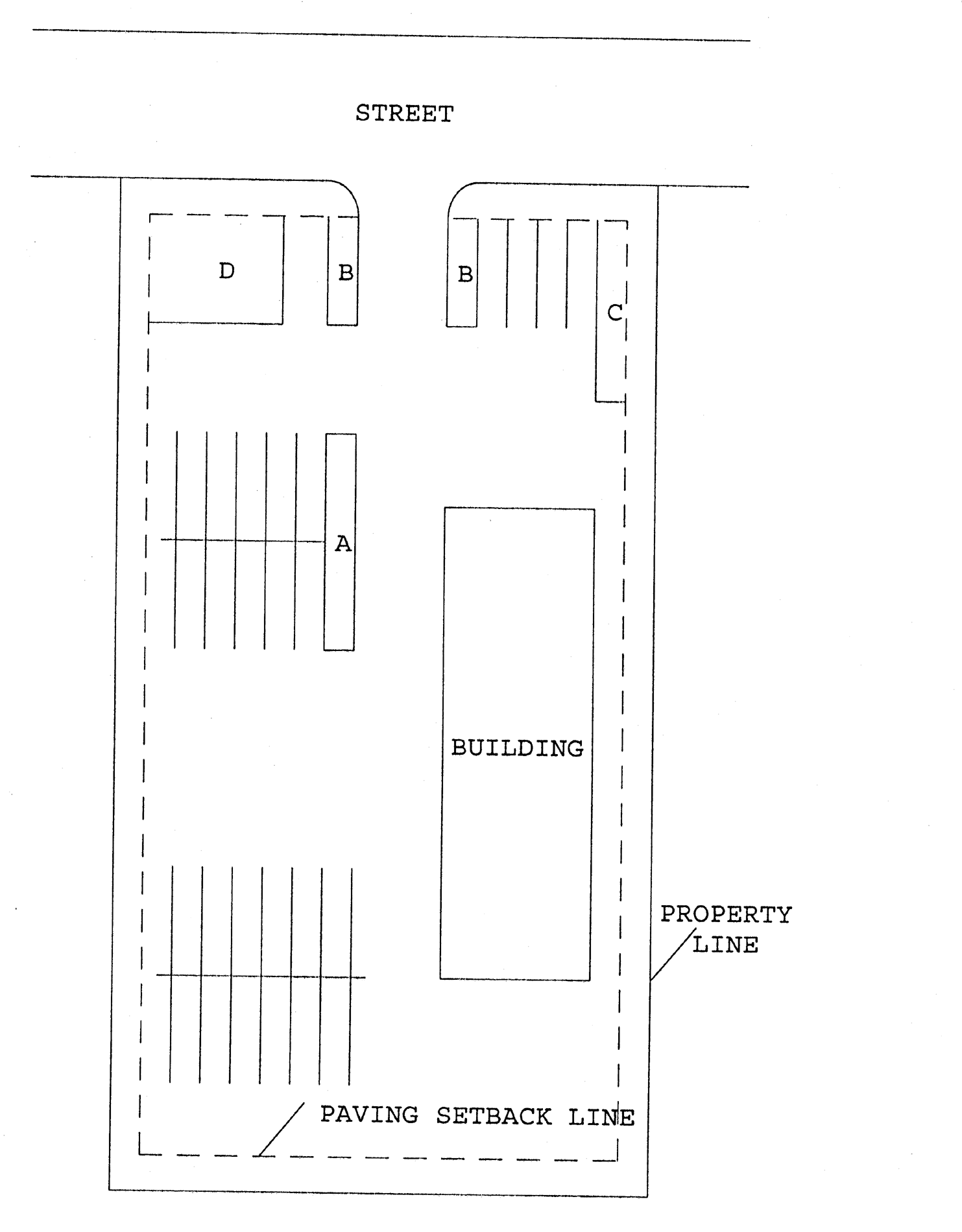
Landscaping Within a Parking Lot
(b)
Within a parking lot, trees shall be located so there is never more than 150 feet between trees, or all parking spaces shall be within 75 feet of a tree, or a combination of the two may be used.
(Code 1970, § 2326.5; Ord. No. O-98-5A, § 2326.5, 7-2-1998)
Sec. 102-1231. - Dimensional requirements for open/green space.
Notwithstanding any section in this division, no lot shall be required to have more open/green space than is shown in section 102-791 pertaining to basic zone dimensional requirements.
(Code 1970, § 2326.6; Ord. No. O-98-5A, § 2326.6, 7-2-1998)

