
Keene City Zoning Code
ARTICLE V
- SUPPLEMENTARY REGULATIONS
DIVISION 5. - HOME OCCUPATIONS[11]
Cross reference— Licenses and permits, ch. 46.
DIVISION 7. - OFF-STREET PARKING REQUIREMENTS[12]
Cross reference— Traffic, parking and public ways, ch. 94.
DIVISION 8. - MANUFACTURED HOUSING[13]
Cross reference— Manufactured housing and recreational vehicles, ch. 50.
DIVISION 9. - HAWKERS AND PEDDLERS[14]
Cross reference— Hawkers, peddlers, § 46-451 et seq.
DIVISION 11. - SEXUALLY ORIENTED BUSINESSES[15]
Cross reference— Licenses and permits, ch. 46.
Sec. 102-791. - Basic zone dimensional requirements.
The following table states the basic zone dimensional requirements for this chapter.
TABLE 1
BASIC ZONE DIMENSIONAL REQUIREMENTS
Footnotes:
(a)
Two acres, with city water and sewer.
(b)
The maximum building height, in stories, may be increased to up to 3½ stories; six stories in the central business zone only, and/or the maximum building height, in feet, may be increased to up to 50 feet; 75 feet in the central business zone only, if a special exception is granted therefor in accordance with section 102-37 pertaining to special exceptions by the zoning board of adjustment, provided that the zoning board of adjustment shall also determine that:
1.
There is adequate carrying capacity on public roads serving the proposed project site to accommodate traffic associated with and anticipated for the proposed project. It shall be the responsibility of the applicant to demonstrate such capacity, the demonstration or proof of which shall include affirmative letters from the state department of transportation, if state roads are within 1,000 linear feet of the proposed project site, and the city engineer and police chief. Traffic studies may be required by the board in its discretion at the applicant's expense in addition to the foregoing; and
2.
All parking requirements can be satisfied on site. A waiver of on-site parking requirements in accordance with division 7 of article V of this chapter pertaining to off-street parking regulations may not be granted. In the central business zone only, parking capacity requirements may be satisfied on site or off site in accordance with division 7 of article V of this chapter, provided that the applicant demonstrates to the satisfaction of the zoning board of adjustment that there is adequate capacity in the proposed off-site parking location, whether a private or public parking area, for the parking required of the use under this chapter. The mere presence of a nearby public parking lot shall not in and of itself be a sufficient demonstration of adequate parking capacity in the off-site parking location to accommodate the required parking for the use.
3.
The design of the proposed building is attractive and compatible with adjacent buildings and those in the vicinity, does not unreasonably obstruct vistas of hills that can be seen from any public ways on the valley floor, or the light and air available to adjacent buildings; and
4.
Adequate capacity and availability of emergency services exists; and
5.
Adequate existing sewer and water are available to serve the proposed building.
(c)
These percentages may be increased in the agricultural zone for bona fide agricultural uses only in the event that a special exception is granted by the zoning board of adjustment in accordance with section 102-37 and it is demonstrated to the satisfaction of the board, and it so finds, that it is essential to increase these percentages to permit the bona fide agricultural use and it is required that they be increased in order to permit the reasonable cooperation of such use. The zoning board of adjustment shall increase these percentages no more than is necessary in order to permit the reasonable operation of the bona fide agricultural use. Any special exception so granted shall be treated as a nonconforming use for purposes of its termination by abandonment as set forth in article III of this chapter pertaining to nonconforming buildings, structures, and uses.
(d)
Fifty feet, if it abuts a residential zone.
(e)
Minimum lot area for group homes in the rural zone shall be 5,445 square feet per unit with a minimum lot size of two acres.
(f)
The larger number is required if property abuts conservation or residential zones.
(g)
The smaller number applies if frontage is on a service road which has been approved by the planning board through subdivision or site plan review.
(h)
Frontage can be on a service road which has been approved by the planning board through subdivision or site plan review.
(i)
For agricultural-related recreational activity as a business:
1.
Minimum lot size: 50 contiguous acres which shall accommodate any building or parking. Additional agricultural acreage, any portion of which is within 500 feet of the primary site, may be used for ancillary agricultural-related recreational activity as a business.
2.
Maximum lot coverage of all related buildings, structures, and parking areas (paved or unpaved excluding special event parking): five percent of lot.
3.
Minimum setback of related buildings, structures and parking areas (paved or unpaved): road or street frontage: 75 feet; side and rear lot lines: 100/200 feet (larger number is required if property abuts conservation or residential zone).
(j)
For the corporate park district the following shall apply:
1.
When two setback figures are given, the larger shall be required as a minimum when the parcel abuts land zoned residential.
2.
The combined side yard setback of both sides of the building shall be a minimum of 100 feet. The normal building setback at each side is 50 feet, except that one side may be reduced to 40 feet, with no parking on this side of the building, where the setback on the opposite side is increased to at least 60 feet in order to provide a parking area.
(k)
The minimum lot area per dwelling unit for the medium density, high density and office zones applies only to the second and succeeding dwelling units.
(l)
The area enclosed by Court St., Mechanic St., Washington St. and Central Square shall have a maximum building height of 35 feet with rooftop mechanical equipment or communication tower or equipment not to exceed 42 feet.
(m)
The setbacks for paved and unpaved parking and travel surfaces are as shown in division 4 of article VI of this chapter pertaining to landscaping standards.
(n)
See division 3 of article IV of this chapter pertaining to conservation residential development for minimum lot size, lot frontage and tract frontage and setbacks when building in a conservation residential development.
(o)
Side and rear setback requirements for buildings and paving shall not apply to internal lot lines within a health care district, provided the lot owners record with the county registry of deeds an easement or other agreement in a form satisfactory to the code enforcement officer. Setback requirements between properties within a health care district and abutting properties outside the health care district are not affected by this amendment.
(p)
If city water is available, lot sizes may be reduced to 20,000 square feet in size.
(q)
Minimum frontage to be 60 feet for lots fronting on a cul-de-sac.
(r)
If city water is available, lot frontage may be reduced to 75 feet.
(Code 1970, § 2306.1; Ord. No. O-98-5A, § 2306.1, 7-2-1998; Ord. No. O-99-4A, § 2306.1, 11-18-1999; Ord. No. O-2001-03, §§ 2305.5, 2306.2, 6-21-2001; Ord. No. O-2001-05, §§ 2306.1, 2306.2, 9-20-2001; Ord. No. O-98-22D, § 2306.2, 5-2-2002; Ord. No. O-2016-01-C, § 5, 10-19-2017 )
Sec. 102-792. - Planned unit development.
Subdivision and site plan review are required for a planned unit development. The following table gives the specifications for a planned unit development:
PLANNED UNIT DEVELOPMENT
Note: Adequate access to a public way satisfying city standards is required.
(Code 1970, § 2306.3)
Sec. 102-793. - Minimum parking requirements.
The parking requirements per use are as follows:
MINIMUM PARKING REQUIREMENTS.
(Code 1970, § 2306.4; Ord. No. O-2004-04-A, 6-3-2004)
Sec. 102-794. - Parking lot and parking space requirements.
(a)
Parking lots. Parking lots shall:
(1)
Have a surface of concrete, gravel, paving or other suitable materials to prevent erosion and raising of dust and be constructed to standards approved by the city engineer.
(2)
Be graded to prevent drainage across sidewalks and curb cuts or onto adjacent property.
(3)
If paved, or of concrete be striped to delineate parking spaces. Accessible spaces shall be paved or of concrete and meet all standards required by New Hampshire law.
(4)
For other than single-family dwellings, have a substantial bumper of concrete, masonry, steel or heavy timber placed at or near the end of each parking space to prevent vehicles from damaging adjacent buildings, lawns, trees or shrubs, or from creating a hazard to pedestrians on any adjacent sidewalk.
(5)
Parking areas not included in article VI, division 4, shall have the parking surface located to the rear of the front setback or building line and the surface shall be at least three feet from the side property line.
(b)
Parking spaces. Parking spaces shall not be less than eight feet by 18 feet. Spaces designed primarily to serve retail establishments shall either provide a one-foot separation between adjacent spaces or shall be not less than nine feet wide. Single spaces with sidewalks or green space on each side may be eight feet wide.
(c)
Driveway. A driveway shall be 12 feet wide per lane or greater and shall correspond to the driveway connection permit issued for the parking area.
(d)
Internal travel lanes. Internal travel lanes shall be not less than the following (see reference drawings below):
(1)
Twenty-two feet wide for 90-degree angle parking.
(2)
Eighteen feet wide for 60-degree angle parking.
(3)
Eleven feet wide for 45-degree angle parking.
(4)
Ten feet wide for 30-degree angle parking.
(Code 1970, § 2306.5; Ord. No. O-2010-10, 12-16-2010)
Cross reference— Traffic, parking and public ways, ch. 94.
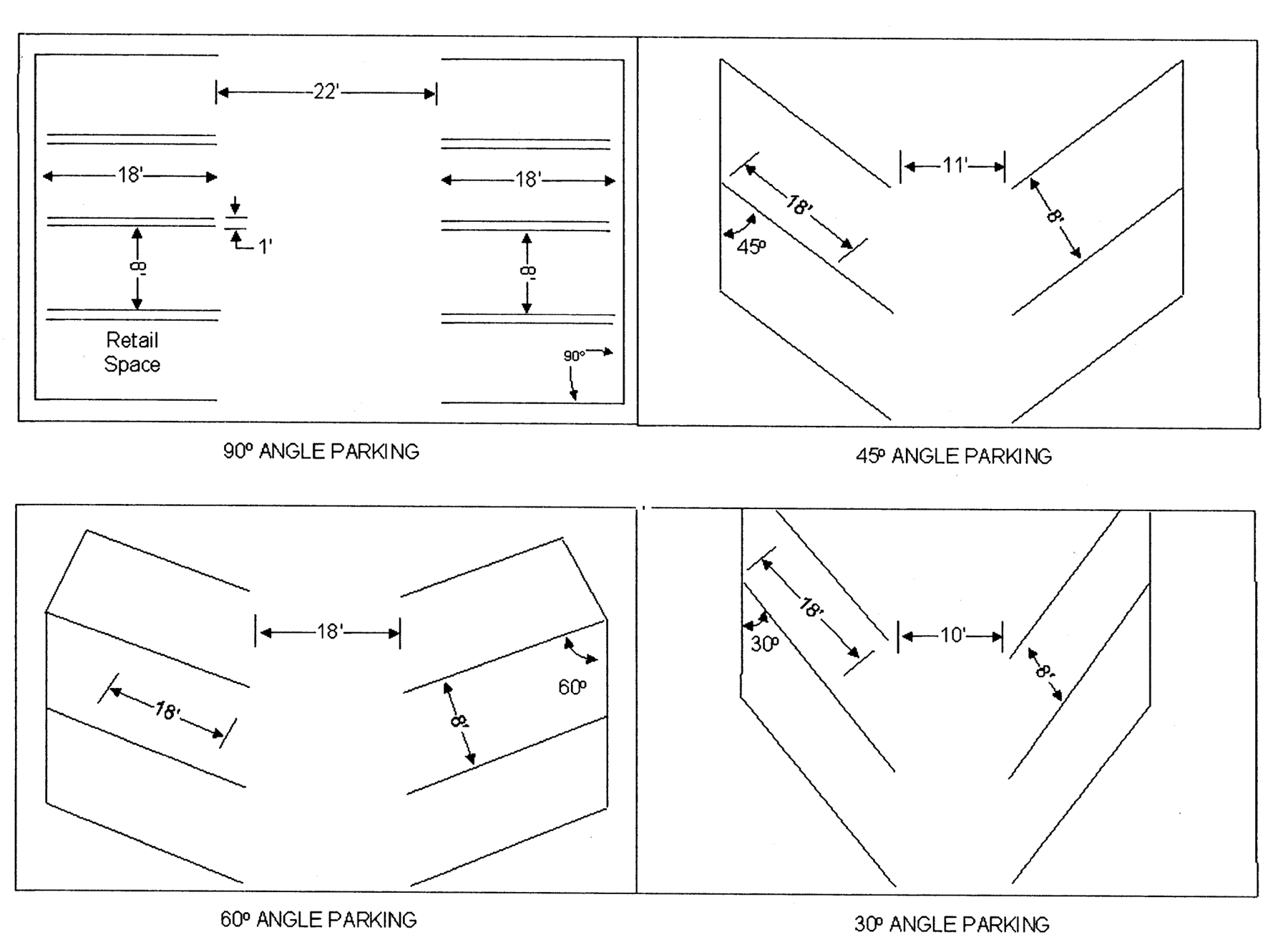
Angle Parking
Sec. 102-821. - Minimum lot size and width.
Where a minimum lot size and width is specified in section 102-791 pertaining to basic zone dimensional requirements, no main building or use shall be erected or established on any lot of lesser size. For exceptions see article III of this chapter pertaining to nonconforming buildings, structures and uses. All lot width requirements shall be measured at the building line. However, in no case shall the frontage measured at the front street property line be less than 50 feet for a residential structure.
(Code 1970, § 2307.1)
Sec. 102-822. - Minimum lot area for additional dwelling units.
Where a minimum lot size is specified in section 102-791 pertaining to basic zone dimensional requirements, the minimum lot area for the first dwelling unit to be provided on a lot shall be the minimum lot size, and for each additional dwelling unit the minimum area to be provided on the lot shall be as specified.
(Code 1970, § 2307.2)
Sec. 102-823. - Percentage of lot occupied.
The maximum percentage of a lot to be occupied by a building on any one lot shall be measured at the outside ground and floor wall lines and shall not exceed the percentage specified in section 102-791 pertaining to basic zone dimensional requirements.
(Code 1970, § 2307.3)
Sec. 102-824. - Reserved.
Editor's note— At the city's instruction these provisions have been moved to § 102-1113.
Sec. 102-825. - On-site sewage disposal.
An on-site sewage disposal system shall not be placed on any lot smaller than one acre in size. See also the table in section 102-792 pertaining to planned unit development.
(Code 1970, § 2307.4)
Sec. 102-826. - Front, side and rear yards.
(a)
Calculation of setback for corner lot. For purposes of calculating setbacks, the narrower side of a corner lot which fronts on a public way shall be considered the front of the lot.
(b)
Front yards. Where a minimum depth of a front setback is specified in section 102-791 pertaining to basic zone dimensional requirements, no building or structure shall be erected within the specified distance from the front lot line.
(c)
Side yards. In the residential districts, the street side setback of a corner lot shall be measured from the property line adjacent to the street, and shall be ten feet greater than the normal side setback requirements specified in section 102-791. No building or structure shall be built within the minimum depth of the setback from the side lot line specified in section 102-791.
(d)
Rear yards. No main building or structure shall be built within the minimum depth of the setback from the rear lot line specified in section 102-791.
(e)
Exclusions. The following are excluded from the setback requirements as defined in section 102-2:
(1)
Steps and stairs necessary to provide access.
(2)
Access landings up to 25 square feet.
(3)
Structures necessary to afford access to the handicapped.
(4)
Canopies and awnings.
(5)
One detached utility accessory building, including but not limited to tool shed, garden shed, etc., of less than 125 square feet of gross floor area.
(6)
Fences.
(7)
Signs as regulated by the sign code in chapter 74.
(8)
Underground fuel storage bunkers less than three feet above ground in the central business, industrial, industrial park, industrial park limited, and corporate park zones shall be exempt from side and rear setback requirements. In the commerce zone underground fuel storage bunkers shall also be exempt from side and rear setbacks except when abutting a residential zone where a ten-foot setback is required.
(Code 1970, §§ 2304.0, 2308.0)
Sec. 102-856. - Building height or number of stories.
The height or number of stories of any building or structure of any type shall not exceed the height specified in section 102-791 pertaining to basic zone dimensional requirements.
(Code 1970, § 2309.1)
Sec. 102-857. - General exceptions.
The following structures may extend above the height and number of story limitations set forth in section 102-791 pertaining to basic zone dimensional requirements without receiving a special exception from the zoning board of adjustment, but only if it is necessary for their function and proper operation. In no case may these excepted structures exceed 60 feet in height or four stories, whichever is less:
(1)
Chimneys, ventilators, tanks, bulkheads, and other necessary accessory features required above roofs including any authorized roof signs.
(2)
Towers, spires, domes and similar ornamental features.
(Code 1970, § 2309.2)
Sec. 102-858. - Special exceptions.
The structures listed in this section may extend above the height and number of story limitations set forth in section 102-791 pertaining to basic zone dimensional requirements only if it is necessary for their function and proper operation and if a special exception is granted therefor by the zoning board of adjustment in accordance with section 102-37. The zoning board of adjustment shall also make the determinations required in footnote (c) to the table in section 102-791. The structures are as follows:
(1)
Towers, spires, domes and similar ornamental features.
(2)
Barns, silos, and other farm buildings and structures.
(3)
Towers and poles for transmission and communication lines, radio towers, fire towers and airplane beacons.
(Code 1970, § 2309.3)
Sec. 102-886. - Percent permitted.
Accessory uses are permitted in all zones, not to exceed 25 percent of the total ground floor area of the main structure or structures.
(Code 1970, § 2310.1)
Sec. 102-887. - Front setback.
No accessory building or use may occupy any part of a front setback unless the front setback extends beyond the front of the building; in such case the portion beyond the front of the building may be used.
(Code 1970, § 2310.2)
Sec. 102-888. - Rear setback.
The following buildings and/or structures may be placed no closer than ten feet from the rear lot line on residential lots:
(1)
Pools, either above or in ground.
(2)
Decks, either attached or detached to the main residential building or accessory building/structure.
(3)
Garage, either attached or detached to the main residential building.
(Code 1970, § 2310.3)
Sec. 102-889. - Subdivision.
A subdivider may maintain an office in one of the units of a subdivision for the administration of the business of the development and original sale of the units within that subdivision, until all dwelling units are completed.
(Code 1970, § 2310.4)
Sec. 102-890. - Motor vehicle storage.
Outside storage of unregistered motor vehicles shall be prohibited in all zones, except at new and/or used motor vehicle dealers and repair garages. Storage or overnight parking of trucks over 16,000 pounds gross weight shall be prohibited in low density, medium density, and high density zones.
(Code 1970, § 2310.5)
Sec. 102-891. - Letting of guestrooms.
Guestrooms may be let in any owner-occupied, single-family detached home to not more than three natural persons in total unrelated to the owner of the dwelling unit. The term "owner-occupied" means that the home is the primary and actual residence of the owner who is regularly present at the home. The term "unrelated" means not related by blood, marriage, or adoption. Guestrooms shall not be let in non-owner-occupied, single-family detached homes.
(Code 1970, § 2310.6)
Sec. 102-892. - Storage trailers/vehicles.
The use of trailers and/or vehicles, registered or unregistered, for storage or warehousing of goods or material is not a permitted accessory use and is prohibited in all zones. This section is not meant to limit or prohibit registered trailers from loading and/or unloading goods or material or trailers parked at a loading dock nor it is meant to limit or prohibit construction trailers at construction sites being used in conjunction with construction.
(Code 1970, § 2310.7)
Sec. 102-893. - Motor vehicle sales.
In residential zones only one motor vehicle may be for sale at any one time for each dwelling unit.
(Code 1970, § 2310.8)
Sec. 102-894. - Vending machines.
Exterior vending machines are prohibited in the central business zone. This prohibition shall not apply to newspaper vending machines.
(Code 1970, § 2310.9)
Sec. 102-895. - Yard sales.
Yard sales and/or garage sales and/or tag sales shall be limited to a maximum of three times per calendar year per lot in the low density, medium density, and high density zones and rural zones. Each separate sale may be for no more than two consecutive days, and setup and takedown of the yard sale is to be included in the two days. Setup includes the placing of display tables, racks, merchandise, etc., in the area where the yard sale is to be held; and takedown includes removal of the remaining merchandise for sale and removal of display tables, racks, etc. Sale of a single item such as a snow blower, lawn mower, vehicle, boat, trailer, etc., is not considered to be a yard sale.
(Code 1970, § 2310.10; Ord. No. O-99-13, § 2310.10, 3-2-2000)
Sec. 102-896. - Accessory dwelling unit.
Attached accessory dwelling units are permitted within or attached to single family dwellings in the agriculture, rural, low density, the low density-1, medium density, high density, high density-1 and office districts. Detached accessory dwelling units are permitted on single family dwellings lots in the agriculture and rural districts subject to the following conditions:
(1)
Only one accessory dwelling unit shall be permitted per lot.
(2)
The record property owner shall occupy either the primary dwelling unit or the accessory dwelling unit as his primary residence (hereinafter "owner occupancy"). The property owner shall submit an affidavit in support of a building permit for an accessory dwelling unit to the code enforcement department with his application, stating under oath that he satisfies the owner occupancy requirement of this subsection.
a.
The term "primary residence" for purposes of determining owner occupancy shall mean the location where the property owner is domiciled and has a place of abode, and the location where the property owner has, through all of his actions, demonstrated a current intent to designate said residence as his principal place of physical presence. Such an intent on the part of the property owner is evidenced by, among other things, his voter's registration, vehicle registration, driver's license, or the placement of his children in local public schools. Any temporary lapse of owner occupancy in the primary residence caused by the death of a property owner shall be permitted for a reasonable period of administration.
b.
If the owner of the property is a trust, the term "property owner" shall mean the creator or beneficiary of the trust.
c.
If the owner of the property is a corporation, the term "property owner" shall mean a stockholder of the corporation; if the owner of the property is a limited liability corporation, then the "property owner" shall mean a member of the limited liability company.
(3)
There shall be no more than two bedrooms in an accessory dwelling unit.
(4)
Floor area.
a.
An attached accessory dwelling unit shall have a minimum floor area of 400 square feet but, in no case, shall the floor area be more than 800 square feet.
b.
A detached dwelling unit shall have a minimum floor area of 400 square feet but, in no case, shall the floor area be more than 50 percent of the gross floor space of the primary single family dwelling or more than 1000 square feet. An accessory dwelling unit shall comply with the city's housing and building codes.
(5)
Public water and sewer shall be required for all accessory dwelling units or in the absence of public sewer, shall have state septic system plan approval prior to the issuance of a building permit.
(6)
A scaled and dimensional plot plan of the property shall be submitted as part of the building permit application. This shall show the location and number of required parking spaces, driveway and paving, buildings building setbacks, utilities, fences, buffer yard and any other relevant features of the site.
(7)
Parking at an accessory dwelling unit shall be restricted to the required parking spaces as shown on the plan. No more than two parking spaces shall be permitted for an accessory dwelling unit, and all parking provided for the accessory dwelling unit shall in accordance with section 102-794 of the zoning ordinance.
(8)
Shared driveways for both the primary single-family dwelling unit preexisting conditions, no more than one driveway access is permitted to each residential lot as required by the City Code.
(9)
Adequate notice in acceptable legal form for recording at the registry of deeds shall be duly executed by the owner of record identifying the property on which the accessory dwelling unit is located by source deed sufficient to notify successor owners that the accessory dwelling unit is subject to the city's zoning ordinance. This notice shall be reviewed by the zoning administrator for acceptable form, and upon signature, it shall be recorded at the registry by the property owner. Evidence of recording shall be submitted to the superintendent of code enforcement and the planning director prior to the issuance of a building permit.
(Ord. No. O-2001-21B, § 2310.11, 9-5-2002; Ord. No. O-2002-13-B, 7-17-2003; Ord. No. O-2017-10-A, 10-19-2017 )
Sec. 102-921. - Criteria.
(a)
Home occupations or home vocational activity may be permitted in all zoning districts provided that:
(1)
It does not result in alteration of the residential appearance of the dwelling unit or the lot on which it is located.
(2)
It does not result in the production of any offensive noise, vibration, light, odor, dust, smoke, or other pollution external to the property.
(3)
The use will not generate vehicular or pedestrian traffic of a quantity or quality as to be injurious, offensive, or otherwise detrimental to the neighborhood. Vehicular traffic of more than ten vehicles per day shall be considered prima facie evidence of traffic which is detrimental to the neighborhood.
(4)
It is not identified by any externally visible sign or externally visible on-premises advertising of any kind or any off-premises advertising which identifies the location of the property.
(5)
It does not result in the use of an area equal to more than ten percent of the total of gross floor area of the dwelling unit up to a maximum of 300 square feet, which may be in the dwelling or an accessory building.
(6)
There shall be no more than one employee of the home occupation who is not a resident of the dwelling unit.
(7)
All activity associated with producing, storing, or selling the goods or services of the home occupation must be performed in the dwelling or an accessory building.
(8)
Retail sales as a primary home occupation that attracts customers to the residence to purchase articles/goods is not permitted. Retail sales that are accessory to a home occupation, such as a beauty salon selling hair care products, is permitted. Retail sales where the customers do not visit the residence is permitted, such as sales over the Internet and the goods are shipped either from the residence or another location.
(b)
The purpose of this section is to permit home occupations as long as such activity does not have a detrimental effect on the residential character of the neighborhood.
(Code 1970, § 2311.0; Ord. No. O-99-13, § 2311.0, 3-2-2000)
Sec. 102-951. - Conditions.
In all zoning districts the following site use impact conditions must be met:
(1)
Fumes, smoke or odors, any of which are noxious, shall not escape the premises on which they originate.
(2)
Noise shall be measured at the property line of the property on which such noise is being generated, or perceived, as appropriate, such measurement to be taken five feet above the ground. The decibel level (dBA) resulting from the use of or proposed in any district shall not exceed 70 dBA.
(3)
No disruption of the natural vegetation or ground cover, as a result of excavation, grading or opening of roads, may take place prior to any necessary subdivision or site plan approval, with the exception of test borings or soil tests. During and after all construction, reasonable measures must be taken to stabilize exposed soil to prevent erosion.
(4)
No increased ground surface drainage runoff shall be permitted to occur as a result of any development, in a manner which permits such increased runoff to pass beyond the property lines of the parcel upon which such development occurs, unless such runoff is within an approved public storm drainage system or extension thereof.
(5)
Any outside storage of dismantled vehicles or vehicle parts, where permitted, shall be screened from view by an impervious fence, hedge, berm or equivalent buffer not less than six feet in height.
(6)
Any outside storage or loading area abutting the bypass system (Route 101, Route 9, and Route 12 north of Route 9) shall be screened from such bypass system by a fence, hedge, berm or equivalent buffer satisfactory to the planning board, in conjunction with site plan review approval.
(7)
Lights shall be shielded so as not to shine directly onto any adjacent property.
(Code 1970, § 2312.0)
Sec. 102-976. - Criteria for granting permit.
Except in the central business zone, no application for a permit for the erection of a new structure, development of a land use, change in use, or expansion of a structure shall be approved unless the off-street parking requirements as set forth in section 102-793, pertaining to minimum parking requirements, and in section 102-794, pertaining to parking lot and space requirements, are met and an approved driveway permit for the location and means of access to such area from the public streets and highways has been issued. When there is a mixed use within a building, each use shall be determined separately with the sum of the requirements being the total parking requirement. In all cases, the entire building shall be categorized for purposes of determining total parking requirements.
(Code 1970, § 2314.1)
Sec. 102-977. - Spaces.
Except in the central business zone, all required off-street parking spaces intended for use by tenants, employees or business invitees shall be on the site and shall be treated to prevent dust and erosion. Reasonable and appropriate off-street parking requirements for structures and land uses which do not fall within the categories listed in section 102-793 pertaining to minimum parking requirements shall be determined in each case by the zoning administrator, and the zoning administrator shall consider all factors entering into the parking needs of such a use.
(Code 1970, § 2314.2)
Sec. 102-978. - Location of required spaces on other lot.
The zoning administrator may permit all or part of the required parking spaces to be located on any other lot owned or leased by the owner of the building, if such lot is within 300 feet of the building, if the zoning administrator determines that it is impractical to provide parking on the same lot with the building. Within the sustainable design and energy efficient development (SEED) overlay the maximum distance between the building and parking spaces located on any other lot owned or leased by the owner shall be 750 feet for any project that has been found eligible for SEED overlay incentives, pursuant to section 102-1433. Once a leased lot is approved to provide parking for any building, an agreement acceptable to the city manager that guarantees the required parking will be provided at the termination of the lease must be recorded at the registry of deeds before any permit may be issued for the building. Once a privately owned lot is approved for parking for any building, it shall not be converted to any other use without approval of the zoning board of adjustment after it makes a finding that the required parking is otherwise provided in accordance with this chapter.
(Code 1970, § 2314.3; Ord. No. O-2010-07-A, 12-16-2010)
Sec. 102-979. - Facilities in central business zone.
In the central business zone, municipal off-street parking facilities shall continue to be developed and maintained by the city on city-owned or leased land as the city in its sole discretion deems appropriate.
(Code 1970, § 2314.4)
Sec. 102-1006. - Permitted.
Manufactured housing is permitted in such zones as shown in divisions 2 through 20 of article IV of this chapter. Also see article II of chapter 50 pertaining to manufactured housing and parks. Manufactured housing shall also be permitted for an owner and occupant of a residence damaged by fire or other disaster on the lot of the residence and the owner or occupant resides there while a residence is being rebuilt. The occupancy is limited to 12 months from the date of placement or the issuance of a certificate of occupancy, whichever comes first. The manufactured housing shall be subject to state and local requirements relating to sewer and water and shall not attain the status of a vested nonconforming use.
(Code 1970, § 2315.0)
Sec. 102-1031. - Mobile vendors.
Mobile vendors who wish to establish themselves for over one hour on private property, for customers to come to them, are permitted in the CB, CBL and COM zones and any other commercial property that is grandfathered or has received permission from the zoning board of adjustment. The site must have sufficient on-site parking and an adequate and safe means of entrance/exit. The vendor and/or parking cannot be on public streets or fire lanes in private lots. Additionally, the vendor and/or parking cannot use private parking that has previously been allocated from zoning or site plan decisions. A city council license is required to locate on city property.
(Code 1970, § 2316.0)
Sec. 102-1056. - Conditions.
In the commerce district, filling stations, service stations, repair garages, paint shops and vehicle body shops as listed in divisions 2 through 20 of article IV of this chapter are permitted only under the following conditions:
(1)
All washing, lubrication and making of repairs, except emergency repairs, are conducted in a building sufficiently insulated to confine noise, flashing, fumes and odors to the premises.
(2)
The location or relocation and method of installation of pumps, tanks and all storage of flammables must be installed in accordance with the fire prevention code.
(3)
Pumps shall be located not less than 20 feet from the traveled portion of the roadway and, in no event, less than 15 feet from the property line.
(4)
Buildings and all accessory structures shall not be less than 20 feet from the side and rear lot lines, and if the use adjoins a residential use, an open and unused space of not less than ten feet in width shall be maintained between such uses.
(5)
Along boundaries between service stations and residential uses, the premises shall be fenced to a point within 20 feet of the front lot line by a solid fence or compact living hedge not less than five feet high.
(6)
All servicing except the supplying of gasoline, oil, water, air and emergency repairs shall be conducted within the building.
(7)
No storage or rental vehicles and equipment shall be permitted within the required front and side yard setbacks.
(8)
No merchandise shall be displayed within the required front and side yard setbacks.
(9)
No more than two automatic vending machines shall be placed outside the building.
(10)
No light shall be directed so as to shine or reflect onto adjacent streets or property.
(11)
All refuse, rubbish and parts shall be stored within the building or an enclosed structure.
(Code 1970, § 2322.0)
Sec. 102-1081. - Purpose and intent.
(a)
It is the intent of this division to establish reasonable and uniform regulations to prevent the concentration of sexually oriented businesses within the city; and it is the intent to promote the health, safety and general welfare of the citizens of the city. It is the intent of this division to prevent problems of blight and deterioration which accompany and are brought about by the concentration of sexually oriented businesses.
(b)
This division has neither the purpose nor the effect of imposing limitations or restrictions on the content of any communicative materials, including sexually oriented materials, and it is not the intent or effect of this division to restrict or deny access by adults to sexually oriented materials protected by the First Amendment or to deny access by the distributors and exhibitors of sexually oriented entertainment to their intended market; neither is it the intent nor effect of this division to condone or legitimize the distribution of obscene material.
(Code 1970, § 2323.1)
Sec. 102-1082. - Location restrictions.
(a)
Sexually oriented businesses, as defined in section 102-1083, shall be subject to all regulations, requirements and restrictions for the zone in which the sexually oriented business is permitted and shall be subject to the following distance requirements:
(1)
No sexually oriented business shall be permitted within 1,000 feet of another sexually oriented business which is either existing as of September 15, 1994, or one for which a building permit has been applied for, and no sexually oriented business shall be permitted within a building, premises, structure or other facility that contains another sexually oriented business.
(2)
No sexually oriented business shall be permitted within 500 feet of any church, YMCA, youth center, city hall or public or private school (preschool through high school).
(3)
Sexually oriented business shall be allowed in the following commerce-zoned areas of the city:
a.
Commerce-zoned land with frontage on West Street. The storefront of a sexually oriented business must face West Street or be in a shopping center/plaza with the storefront facing a parking area that has a common boundary with West Street.
b.
Commerce-zoned land with frontage on that portion of Winchester Street south of Island Street and north of Route 101. The storefront of a sexually oriented business must face Winchester Street or be in a shopping center/plaza with the storefront facing a parking area that has a common boundary with Winchester Street.
c.
Commerce-zoned land with frontage on Ashbrook Road, north of Route 9 and west of the Route 9/10/12 intersection. The storefront of a sexually oriented business must face Ashbrook Road or be in a shopping center/plaza with the storefront facing a parking area having a common boundary with Ashbrook Road.
(b)
The distance requirements in subsection (a) of this section shall be measured in a straight line, without regard to intervening structures from the property line of any site to the closest exterior wall of the sexually oriented business.
(Code 1970, § 2323.2)
Sec. 102-1083. - Definitions.
The following words, terms and phrases, when used in this division, shall have the meanings ascribed to them in this section, except where the context clearly indicates a different meaning:
Sexually oriented business means any place of business at which the following activities are conducted; for an adult motion picture arcade, adult cabaret, adult drive-in theater, adult motel and adult theater, the term "substantial portion of the total presentation time" shall mean the presentation of films or shows described in this subsection for viewing on more than seven days within any 56-consecutive-day period:
(1)
Adult bookstore and adult video store mean a business that devotes more than 15 percent of the total display, shelf, rack, table, stand or floor area for the display, sale and/or rental of the following:
a.
Books, magazines, periodicals or other printed matter or photographs, films, motion pictures, videocassettes, slides, tapes, records, computer disks, CD-ROMs or other forms of visual or audio representations which meet the definition of "harmful to minors" and/or "sexual conduct" as set forth in RSA 571-B:1; or
b.
Instruments or devices which are designed for use in connection with "sexual conduct" as defined by RSA 571-B:1, other than birth control devices.
An adult bookstore or adult video store does not include an establishment that sells or rents books, videos or periodicals representing "harmful to minors" or "sexual conduct" materials as listed in this subsection if sales and rentals of such materials are an incidental or accessory part of its principal stock and trade and does not devote more than 15 percent of the total display, shelf, rack, table, stand or floor area of the establishment.
(2)
Adult cabaret means a nightclub, bar, restaurant, or similar establishment which, during a substantial portion of the total presentation time, features live performances which meet the definition of "harmful to minors" and/or "sexual conduct" as set forth in RSA 571-B:1 and/or features, films, motion pictures, videocassettes, CD-ROMs, computer displays, slides, audio tapes, or other audio or photographic reproductions, a substantial portion of the total presentation time of which is devoted to showing of material which meets the definition of "harmful to minors" and/or "sexual conduct" as set forth in RSA 571-B:1.
(3)
Adult drive-in theater means an open lot or part thereof, with appurtenant facilities devoted primarily to the presentation of motion pictures, films, theatrical productions and other forms of visual productions for any form of consideration to persons in motor vehicles or on outdoor seats in which a substantial portion of the total presentation time being presented for observation by patrons is devoted to the showing of materials which meets the definition of "harmful to minors" and/or "sexual conduct" as set forth in RSA 571-B:1.
(4)
Adult motel means a motel or similar establishment offering public accommodations for any form of consideration which provides patrons with closed circuit television transmissions, films, motion pictures, videocassettes, computers, CD-ROMs, slides or other audio or photographic reproductions, a substantial portion of the total presentation time of which is distinguished or characterized by an emphasis upon the depiction or description of materials which meet the definition of "harmful to minors" and/or "sexual conduct" as set forth in RSA 571-B:1.
(5)
Adult motion picture arcade means any place to which the public is permitted or invited wherein coin- or slug-operated or electronically, electrically or mechanically controlled still or motion picture machines, computers, projectors or other image-producing devices are maintained to show images to five or fewer persons per machine at any one time, in which a substantial portion of the total presentation time of the images so displayed is devoted to the showing of material which meets the definition of "harmful to minors" and/or "sexual conduct" as set forth in RSA 571-B:1.
(6)
Adult motion picture theater means an establishment with a capacity of five or more persons where for any form of consideration films, motion pictures, videocassettes, slides, CD-ROMs, computer displays or similar photographic reproductions are shown, and in which substantial portions of the total presentation is devoted to the showing of material which meets the definition of "harmful to minors" and/or "sexual conduct" as set forth in RSA 571:B-1, for observation by patrons.
(7)
Adult theater means a theater, concert hall, auditorium or similar establishment either indoor or outdoor in nature which for any form of consideration regularly features live performances, a substantial portion of the total presentation time of which is distinguished or characterized by an emphasis on activities which meets the definition of "harmful to minors" and/or "sexual conduct" as set forth in RSA 571-B:1.
(8)
Nude model studio means a place where a person who appears in a state of nudity or displays male genitals in a state of sexual arousal and/or the vulva or more intimate parts of the female genitals and is observed, sketched, drawn, painted, sculptured, photographed or similarly depicted by other persons who pay money or any form of consideration of such display, or where such display is otherwise characterized by an emphasis on activities which meets the definition of "harmful to minors" and/or "sexual conduct" as set forth in RSA 571-B:1.
(9)
Sexual encounter center means a business or commercial enterprise that as one of its primary business purposes offers for any form of consideration: (i) physical contact in the form of wrestling or tumbling between persons of the opposite sex; or (ii) activities between male and female persons and/or persons of the same sex when one or more persons is in the state of nudity; or where the activity in (i) or (ii) is characterized by an emphasis on activities which meets the definition of "harmful to minors" and/or "sexual conduct" as set forth in RSA 571-B:1.
Shopping center/plaza means two or more stores having common parking and/or common entrance/exit.
(Code 1970, § 2323.3)
Cross reference— Definitions generally, § 1-2.
Sec. 102-1111. - Permitted locations.
In addition to permitting institutional use anywhere in the central business (CB), central business limited (CBL), and commerce (COM) zones, institutional use is permitted in other zones as designated in divisions 2 through 20 of article IV of this chapter only on the following streets:
(1)
Arch Street, from Park Avenue to Whitcomb Mill Road.
(2)
Court Street, on the west side from Westview Street to Maple Avenue and on the east side from Evergreen Avenue to Maple Avenue.
(3)
Hastings Avenue, on the west side only from Trowbridge Road to Evans Lane.
(4)
Main Street, on the east side from Central Square to the Swanzey line and on the west side from Central Square to Greenwood Avenue.
(5)
Maple Avenue.
(6)
Marlboro Street, from Main Street to Eastern Avenue.
(7)
Park Avenue.
(8)
Reconstructed Base Hill Road on the east side, from the south edge of the right-of-way of Route 9 southerly, a distance of 800 feet, more or less. This subsection shall expire on July 16, 2008, if Base Hill Road has not previously been reconstructed in substantially the same location as shown on the plan approved by the planning board pursuant to S-16-95.
(9)
Summit Road, from Park Avenue to the Maple Avenue/Hastings Avenue intersection, and continuing northerly on the west side of Summit Road for a distance of 1,000 feet.
(10)
Washington Street.
(11)
West Street, from the intersection on Route 9/10/12 to Park Avenue.
(12)
Winchester Street.
(13)
Wyman Road, on both sides of the road, from the north edge of the right-of-way of Route 12 northerly to the northeasterly boundaries of Tax Map and Lot number 919-8-3.02 and Tax Map and Lot number 919-9-24, said boundaries being a distance of approximately 230 feet northeasterly of Black Brook.
(Code 1970, § 2325.1; Ord. No. O-98-2A, § 2325.1, 7-16-1998; Ord. No. O-2003-02, 5-15-2003; Ord. No. O-2007-04, 10-18-2007; Ord. No. O-2014-12, 7-16-2015 )
Sec. 102-1112. - Special exceptions.
All institutional uses in existence in locations permitting institutional use at the time of adoption of the ordinance from which this section derives shall not require a special exception from the zoning board of adjustment. A special exception is required to change to a different institutional use or to add another institutional use other than in the central business (CB), central business limited (CBL), and commerce (COM) zones.
(Code 1970, § 2325.2)
Sec. 102-1113. - Zone dimensional requirements.
(a)
Other than in the central business (CB), central business limited (CBL), and commerce (COM) zones, all paving, including driveways, must provide a ten-foot setback to all directly abutting residential properties and must provide landscaping/shrubbery and/or fencing a minimum of four feet high to all directly abutting residential properties.
(b)
In the low density (LD), medium density (MD), high density (HD), and office (O) zones, the side and rear building setbacks to directly abutting residential properties are double the figures in the zone dimensional table in section 102-791.
All institutional uses in existence in zones/areas permitting institutional uses at the time of adoption of the ordinance from which this section derives shall have building heights considered conforming.
(Code 1970, §§ 2325.3.1, 2325.3.2, 2325.3.3)

