
Kenner City Zoning Code
ARTICLE XI
General Sign Regulations
Section 11.01 - Purpose and Intent
The purpose of this Article is to establish a comprehensive system of sign controls governing the display, design, construction, location, installation, and maintenance of signs to:
(1)
Comply with and to implement the goals and recommendations of the City of Kenner Comprehensive Plan.
(2)
Promote and protect the health, safety, and welfare of the City by ensuring the compatibility of signs with surrounding architecture and land uses.
(3)
Create a more attractive business and economic climate by enhancing and protecting the orderly and effective display of signs.
(4)
Discourage an excessive number of signs, and unsightly and inappropriate signs.
(5)
Protect the public from hazardous conditions that result from the indiscriminate use and placement of signs, structurally unsafe signs, signs, which obscure the vision of pedestrians or motorists, and signs which compete or conflict with necessary traffic signals and warning signs.
(6)
Avoid visual clutter that is potentially harmful to traffic and pedestrian safety, property values, business opportunities, and community appearance.
Section 11.02 - General
Unless otherwise provided in this Chapter, the following regulations shall apply to signs in all districts:
(1)
The requirements of this Article apply to all signs, sign structures, awnings, and other types of sign devices located in the City of Kenner.
(2)
Where there is a conflict between a land use regulation and a structural regulation, or other conflicts not otherwise addressed by this section, the most restrictive applies.
(3)
Where this Article is silent, or where the rules of this Article do not provide a basis for concluding that a sign is allowed, said sign is therefore prohibited.
(4)
No sign shall be erected to prevent free ingress or egress from any door, window, or fire escape; and, no sign of any kind shall be attached to a standpipe or fire escape.
(5)
No sign shall be erected at the intersection of any streets, in such a manner as to obstruct free and clear vision; or at any location where, by reason of position, it may interfere with or obstruct the view of traffic sight lines or traffic control devices. If located within direct line of vision of a traffic control device, no flashing or intermittent red, green, or amber illumination shall be used.
(6)
Directional or informational signs of a public or quasi-public nature not exceeding four (4) square feet in area may be permitted in any district on approval of the Department of Inspections and Code Enforcement. Any illumination shall be non-flashing, uncolored and confined to the face of the sign. No advertising matter whatsoever shall be permitted on signs of this type.
(7)
Whenever a sign becomes structurally unsafe, or endangers the safety of a building or premises, or endangers the public safety, the Department of Inspections and Code Enforcement shall give written notice to the owner of the sign or the owner of the premises on which the sign is located that such a sign be made safe or removed within ten (10) days of issuance of written notice.
(8)
Any business or outdoor advertising sign legally existing prior to the adoption of these provisions and which does not conform to these provisions, shall not be altered, or changed in overall dimensions, except to conform to the provisions of this Section. If damaged to an extent in excess of one-half (½) of its current replacement value, it shall not be rebuilt, provided that nothing contained herein shall be construed to prevent normal maintenance and repairs, repainting, or posting of such signs or structures.
(9)
Unless otherwise provided by these provisions, all signs shall be constructed and erected in accordance with all applicable building codes for the City of Kenner.
Section 11.03 - Administration and Enforcement
(a)
Sign Permit Required: It is unlawful for any person to erect, relocate, or structurally alter any sign without first obtaining a sign permit in accordance with these sign regulations, unless specifically permitted as an exempt sign by this Article. The Director of the Department of Inspections and Code Enforcement may revoke any sign permit where there has been a violation of the provisions of this ordinance or misrepresentation of fact on the sign permit application.
(b)
Master Sign Plan Required:
(1)
When more than one (1) wall, projecting, awning or canopy sign is proposed on any multi-tenant building, the applicant must submit a master sign plan for review by the Director of the City of Kenner Department of Planning and Zoning or the Director of the Department of Inspections and Code Enforcement, whichever is required.
(2)
A master sign plan must provide a coordinated design for all building-mounted signs and include, at a minimum, criteria and specifications for general appearance, format of message, font size and style, lighting, location and construction materials.
(3)
Where signs are located on the wall of a multi-tenant shopping center, they must be located at a generally uniform height on the building wall and may not cover or overhang any architectural feature.
(c)
Sign Permit Application Process:
(1)
Before any permit is issued, an application shall be filed, together with two (2) sets of drawings and/or specifications (one (1) to be returned to the applicant) as may be necessary to fully advise and acquaint the Director of the Department of Inspections and Code Enforcement with the location, construction, materials, manner of illumination, and/or securing or fastening, the number of signs applied for, and the wording of the sign or advertisement to be carried on the sign, except in the case of general advertising signs or accessory signs where the copy or advertising is anticipated to be changed periodically and where such wording or advertising is not needed in computing the area of the sign.
(2)
All signs, which are electrically illuminated by neon or by any other means, shall require a separate electrical permit and inspection.
(3)
All signs shall be erected on or before the expiration of six (6) months from the date of issuance of the permit; otherwise, the permit will become null and void and a new permit shall be required. Each sign requiring a permit shall be clearly marked with the permit number and name of the person or firm placing the sign on the premises.
(4)
No permit will be issued for any sign that does not conform to the size, location and other criteria in this sign ordinance.
(d)
Computation of Sign Dimensions:
(1)
Computation of Sign Area
a.
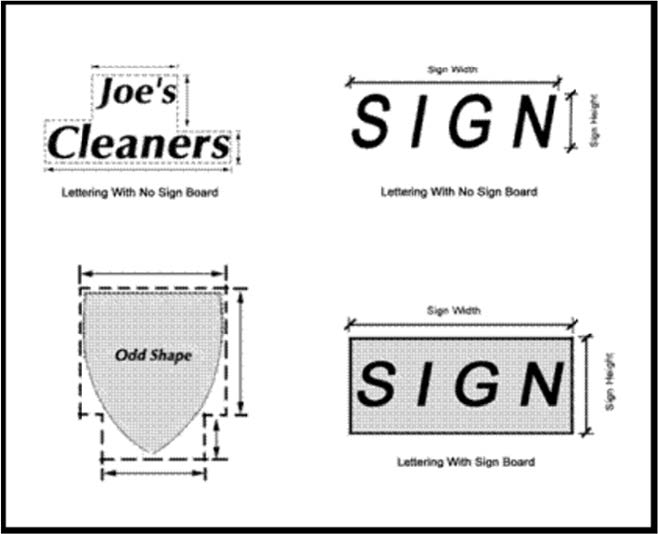
The surface area of a sign shall be calculated by enclosing the extreme limits of all lettering, background, emblem, logo, corporate banding, representation, or other display within a single continuous perimeter composed of squares or rectangles with no more than eight (8) lines drawn at right angles.
Figure XI-1: Sign Area Computation
b.
Sign area calculations do not include any supports or bracing. (Figure XI-1: Sign Area Computation)
c.
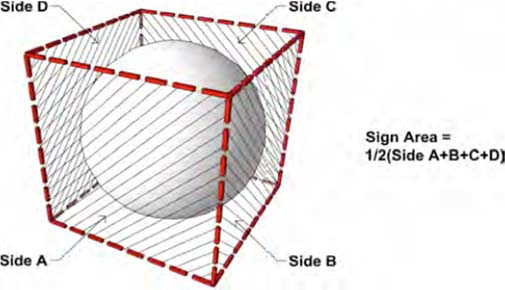
The sign area of a three-dimensional, free form, or sculptural (non-planar) sign is calculated as 50% of the sum of the area of the four vertical sides of the smallest cube that will encompass the sign. (Figure XI-2:3-D Sign Area)
Figure XI-2: 3-D Sign Area
(2)
Measurement of Sign Height
a.
Sign height is measured as follows: When measuring sign height, the height of the entire structure, including decorative elements, must be included. (Figure XI-3: Sign Height)
b.
For freestanding signs, height is calculated as the vertical distance measured from grade to the highest point of the sign.
c.
For signs attached to buildings, height is calculated as the vertical distance from the base of the building to which a sign is attached to the highest point of the sign.
Figure XI-3: Measuring Sign Height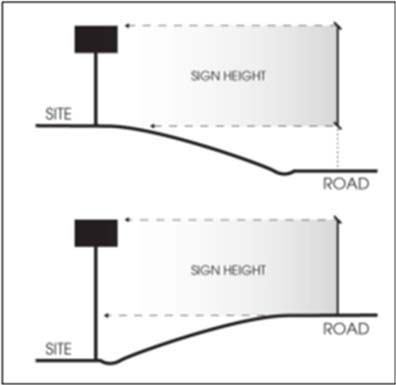
d.
Sign clearance is calculated as the vertical distance from grade or the base of the building to which the sign is attached to the lowest point of the sign. (Figure XI-3: Sign Height)
(e)
Exempt Signs and Activities: The following sign activities do not require a permit:
(1)
Changing of advertising copy or message on an existing legally permitted or legal nonconforming changeable copy sign or similar approved sign.
(2)
Painting, repainting, cleaning, changing permitted items of information, or other normal maintenance and repair of a sign, not involving structural changes or changes in the electrical components of the sign without altering the operation of the sign.
(3)
Except in a residential district, temporary non-illuminated signs not more than sixty-four (64) square feet in area erected in connection with the new construction work and displayed on the premises during such time as the actual construction work is in progress, one (1) such sign for each street frontage.
(4)
Non-illuminated sign, not exceeding ten (10) square feet in area with letters not exceeding one (1) foot in height, painted, stamped, perforated, or stitched on the surface area of an awning, canopy, roller curtain, or umbrella.
(5)
Cornerstone or tablet of bronze, brass or other noncombustible material when built into or attached to the wall of a building or structure, which states only the name of the building or structure, its use, the date of erection, names of owner, architect, municipal number, public officials or which gives information commemorating a person or event.
(6)
For signs necessary for the identification, location, or content on appurtenant structures and equipment, such signs shall be permitted when attached flat against such structures and equipment but shall not exceed one (1) square foot in area.
(7)
Temporary political signs, maximum thirty-two (32) square feet.
(8)
Flags, pennants, or insignia of any governmental or nonprofit organization, when not displayed in connection with a commercial promotion or as an advertising device. The flagpole shall not exceed the allowed height in the district.
(9)
Official traffic signs or sign structures and provisional warning signs or sign structures, when erected or required to be erected by a governmental agency and temporary signs indicating danger.
(10)
Signs directing and guiding traffic on private property that do not exceed four (4) square feet in size, each and that bear no advertising message or logo.
(11)
Signs not exceeding four (4) square feet in size that are customarily associated with residential use and that are not of a commercial nature, such as signs giving names of occupants, signs on mailboxes and newspaper tubes, and signs posted on private property relating to private parking or warning the public against trespassing or danger from animals.
(12)
Hanging signs located below a canopy or awning that are at most 18 inches in height or five (5) square feet in area, provided there is no more than one such sign per customer entrance and the sign maintains a clear height of eight (8) feet above the ground.
(f)
Prohibited Signs: The following types of signs are prohibited within the City of Kenner:
(1)
Abandoned sign
(2)
Audible signs
(3)
Beacons
(4)
Off premises outdoor advertising signs except as allowed in Section 11.04 (a) of these sign regulations
(5)
Signs having flashing, blinking, or fluttering lights which change light intensity, brightness or color
(6)
Inflatable signs except for use in conjunction with grand openings and special events limited to two (2) times per year for a maximum of two (2) days each time (permit required)
(7)
Lasers
(8)
Portable or trailer signs
(9)
Revolving or rotating signs
(10)
Roof signs
(11)
Search lights
(12)
Signs resembling traffic control devices or emergency devices
(13)
Signs which encroach into a public right-of-way, except subdivision name signs, when approved as part of a subdivision approval process
(14)
Signs on vehicles when the vehicle is placed in a location not normally expected for such vehicles, and the location apparently has the primary purpose of attracting attention or providing advertising in addition to that permitted for legal wall and/or freestanding signs on the site
(15)
Snipe signs, when in the public right-of-way, unless specifically permitted
(16)
Any sign not expressly permitted by this ordinance
(g)
Nonconforming Signs:
(1)
All signs legally existing prior to the adoption of this Article and not conforming to these provisions will be allowed to remain (Nonconformity does not include UL - Underwriters Laboratories - requirements).
(2)
No legal nonconforming sign may be enlarged or altered in a way, which would increase its nonconformity with the provisions of this Sign Code.
(3)
No conforming sign or sign structure shall be permitted to be erected for the same occupancy with an existing nonconforming sign until the nonconforming sign has been removed or brought into conformance with the provisions of this Article.
(4)
Nonconforming signs shall be removed if any one of the following conditions occurs:
a.
The sign is relocated on the same premises, moved to different premises, or replaced.
b.
The structure, height, or size of the sign is altered in any way.
c.
The sign is damaged to an extent of one-half (½) of its current replacement value. Such sign shall not be rebuilt and shall be removed. Replacement value shall be determined by the property owner obtaining the cost of the sign's replacement value from several sign companies.
d.
Nothing contained herein shall be construed to prevent normal maintenance and repairs or repainting of such signs or structures.
(5)
Nonconforming temporary signs shall conform to all provisions of this Article upon its adoption. These signs shall be removed within ten (10) days of official notification of nonconforming status by the governing authority.
(6)
Removal by Abandonment or Change of Business
a.
Any nonconforming off-premise (Billboard) sign, the use or copy of which is discontinued or removed for a period of six months, regardless of any intent to resume or not to abandon such sign, shall be deemed to be abandoned and shall not thereafter be re-established. Abandonment or obsolescence of a nonconforming sign shall terminate immediately the right to maintain such sign.
b.
Any nonconforming on premise sign, the use or copy of which is discontinued or removed for a period of six months, regardless of any intent to resume or not to abandon such sign, shall be deemed to be abandoned and shall not thereafter be re-established. Abandonment or obsolescence of a nonconforming sign shall terminate immediately the right to maintain such sign.
(7)
Any period of such discontinuance caused by government actions, strikes or acts of God, without any contributing fault by the nonconforming user/owner, shall not be considered in calculating the length of discontinuance for the purposes of this paragraph.
(8)
Removal by Damage or Destruction - Any nonconforming off-premise sign which is partially damaged or destroyed by any means, to beyond fifty percent (50%) of its current market or replacement value, that is nonconforming to the requirements of this ordinance, shall not be restored, but shall be removed or reconstructed in conformance with the provisions of this ordinance. If a nonconforming sign is damaged in such a manner that the estimated expense of repairs exceeds fifty percent (50%) of its replacement value, the sign must be removed.
(9)
Removal When Not Repaired Within 60 days - Any nonconforming sign removed for any reason, including voluntary removal, whose reconstruction has not commenced within 60 days shall not be permitted to be replaced unless the replacement sign conforms with all requirements of this Sign Code. A nonconforming sign repaired within 60 days may only be reconstructed or repaired to its original condition as to height, area and in the same location.
(h)
Enforcement: The provisions of these Sign Regulations shall be enforced by the City of Kenner Department of Inspections and Code Enforcement.
(1)
Enforcement of Removal - If any sign is not removed as required by this section, the Department of Inspections and Code Enforcement shall initiate the necessary proceedings to secure removal of such illegal or nonconforming sign, or secure compliance with the provisions of this Sign Code.
(2)
Upon the determination of the Department of Inspections and Code Enforcement that a sign remains nonconforming after termination of the allowable time periods provided for above, the Director of the Department of Inspections and Code Enforcement (or his/her designee) shall notify the sign owner and/or the owner of the land on which the nonconforming sign is located and such owner shall have 30 days after such written notice within which to remove said sign or to appeal the administrative decision to remove said sign(s).
(3)
The removal expense may be made a lien upon such real property by the Department of Inspections and Code Enforcement sending by certified mail to the owner of such real property, a notice of lien for the cost of such removal. All costs associated with obtaining said lien shall be part of the cost of such removal.
(i)
Amortization of Legal Non-Conforming Signs:
(1)
Legal nonconforming on-premises signs - All legally nonconforming on-premises signs not otherwise prohibited by the provisions of this Sign Code may be continued until:
a.
The nature or the name of the business changes or the sign is changed or modified either in shape, size or legend, as provided for in these regulations; or
b.
Three (3) years from the date that this adopted code first becomes applicable to the sign, but only if the area of the sign exceeds by greater than fifteen percent (15%) the sign area which otherwise would be applicable under the provisions of this code.
(2)
Legally nonconforming off-premises signs - All legally nonconforming off-premises signs not otherwise prohibited by the provisions of this Sign Code may be continued until five (5) years from the date that the adopted code first becomes applicable to the sign.
Section 11.04 - Permanent Signs
(a)
General Outdoor Advertising Sign (Billboard) Regulations:
(1)
No general advertising sign application shall be accepted that does not conform to the following requirements. The following requirements listed under a through f below cannot be waived or varied by the City Council:
a.
General advertising signs are permitted only in S-I, L-I and H-I Districts and only on lots of record or approved building sites having frontage on a dedicated public street and accepted for maintenance. These signs shall not be located on alleys.
b.
No general advertising sign is permitted within one thousand (1,000) feet, measured radially from the outer extremities, of another general advertising sign. Corner lots can have general advertising signs on only one (1) street.
c.
No general advertising sign is permitted within five hundred (500) feet of any residential district or any residential structures, or any public park or playground of more than one (1) acre, measured radially from the outer extremities of the sign to the nearest residentially zoned or use lot, or to the nearest lot where a public park or playground of more than one (1) acre is located.
d.
No general advertising sign shall exceed forty (40) feet in length, four hundred and twenty (420) square feet in area, or sixty-five (65) feet above ground level.
e.
General advertising signs can be either single- or double-faced.
f.
General advertising signs along canal banks or within canal rights-of-way must have a letter of no objection from the Jefferson Parish Department of Public Works.
(2)
After acceptance of an application, the Planning Department will begin the procedural requirements in compliance with Uniform Development Code Sections 6.01 and 6.02 for advertising, public hearings, planning and zoning commission review, and City Council approval.
(3)
City Council may only consider for approval a general advertising sign application which complies with all of the applicable provisions of section (1) a through f and section (2) above, and only after finding that all of the following criteria are also satisfied:
a.
No general advertising sign shall be located in such a manner as to obscure, obstruct, or otherwise physically interfere with the clear or unobstructed view of an official traffic sign, signal, or device, or obstruct or physically interfere with the driver's view of approaching, merging, or intersecting traffic.
b.
No general advertising sign will be injurious to other property or improvements in the area in which the sign is located, or cause any diminution or depreciation of property values of any surrounding property. Any party claiming injury, diminution, or depreciation of property must show proof by clear and convincing evidence.
c.
The general advertising sign conforms to the Electronic Variable Messaging (EVM) regulations Section 11.04(e) of this Article.
(4)
After City Council approval of a general advertising sign application, a permit shall be issued provided that all the following are provided by the applicant:
a.
The applicable state permit.
b.
Written approval or letter of no objection from the New Orleans Aviation Board.
c.
Federal Aviation Administration. 7460-1 - Notice of proposed construction or alteration.
(5)
Final inspection and approval for electrical service shall not be granted until the applicant has provided an as-built survey, certified by a registered land surveyor, verifying that the structure has been built in accordance with the approved permit application; the plan shall show the height, length, sign area, location of the structure, and the dimensions from all property lines.
(b)
Attached/Wall Signs:
(1)
General Regulations:
a.
Wall signs shall be safely and securely attached to the building wall at no less than seven (7) feet above the ground. Wall signs shall be affixed flat against the building wall and shall not project more than eighteen (18) inches from the building wall.
b.
No wall sign affixed to a structure, including sign support structure, may project beyond the ends or top of the wall to which it is attached. On existing structures, a parapet wall shall not be constructed for the sole purpose of increasing the allowable height of a wall sign. For new construction, when a sign is to be mounted on a parapet wall, that parapet wall shall be consistent with the architectural design of the building, including building materials. Wall signs may not be attached to un-reinforced masonry parapets.
c.
Wall signs shall not cover windows, doors, or architectural features.
(2)
Number and Location:
a.
No variance may be obtained for sign area requirements of this Article.
b.
Maximum sign area:
i.
Three (3) square feet per linear foot of primary building frontage elevation area consisting of the wall on which the business or development has its main entrance; or
ii.
Twenty percent (20%) of the building frontage elevation area on which the sign is to be located.
iii.
No single attached sign shall exceed three hundred (300) square feet.
c.
Illuminated signs inside of windows, within five (5) feet of such windows shall be included in the computation of aggregate sign area, and in addition shall be limited to ten percent (10%) of the total glass area of the window in which the signs are placed.
d.
On corner properties, one (1) additional attached sign shall be permitted on a secondary building frontage elevation area provided the total area of the sign does not exceed fifty percent (50%) of the allowable sign area as for single frontage properties.
e.
Developments meeting the following minimum setback schedule shall be allowed a larger attached sign area.
i.
Permitted dimensions. Projecting wall signs shall be affixed flat against the building wall and shall not project more than eighteen (18) inches from the building wall.
ii.
Permitted height. Attached signs shall be safely and securely attached to the building wall at no less than seven (7) feet above the ground. No attached sign shall be erected above the roof ridgeline of the main building.
iii.
Awning and marquee signs. Awning or marquee sign area shall not exceed twenty (20) square feet per sign.
(c)
Freestanding (Detached) Sign Regulations:
(1)
Only one (1) freestanding sign is permitted per street frontage. Where bulletin board signs are permitted, such sign will count as a freestanding sign.
(2)
No part of a freestanding sign may project or otherwise encroach into a public right-of-way.
(3)
Illumination: Freestanding monument signs may be internally or externally illuminated. Freestanding pole signs may only be internally illuminated.
(4)
Permitted Sign Area.
a.
Maximum of one (1) square foot per linear foot of lot frontage along the adjacent public right-of-way, or three hundred (300) square feet, whichever is less.
b.
On corner and through lots only one (1) lot frontage may be used to determine the allowable detached sign area.
c.
No variance may be obtained for sign area requirements of this Article.
(5)
Permitted Height.
a.
Maximum of thirty-five (35) feet.
(6)
Permitted Materials. The sign shall be constructed of metal or wood, or encased in a wood frame or other such material, which complement and coordinate with the architectural style of the development.
(7)
Design Features. Signs should be coordinated and incorporated into the required landscaped areas. For example, signs should be mounted on earth berms instead of standard support structures whenever possible.
(8)
Corner Lots. On corner lots where either lot line exceeds three hundred (300) feet, a second sign shall be permitted with the same requirements for single frontage properties, provided that no such detached sign shall be located across from, adjacent to or within seventy-five (75) feet of a residential development or district.
(9)
Secondary Signs on Corner or Through Lots. A second sign may be erected on the second front of a through lot provided the following additional provisions are met:
a.
The maximum area of the second sign is one (1) square foot per linear foot of lot frontage along the adjacent side public right-of-way, or seventy (70) square feet, whichever is less.
b.
The maximum area of the second sign is twenty (20) square feet if the through lot is located across from, adjacent to or within seventy-five (75) feet of a residential development or district.
c.
The maximum height of the second sign is twenty (20) feet.
d.
The second sign must be incorporated into a landscaping bed of at least sixty (60) square feet.
e.
The landscaping bed shall consist of shrubs, ground cover (excluding grass), and/or other suitable plant materials, and exclude any impervious surface.
f.
The second sign must be set back from the lot line a distance of no less than fifteen (15) feet.
(d)
Monument Signs: Monument signs are encouraged and the following incentives are offered for the placement of monument signs in lieu of detached pole signs:
(1)
In order to encourage their use, a bonus of twenty percent (20%) of the total square footage of the detached sign shall be allowed for a monument sign in lieu of a freestanding detached pole sign. Any or all of this bonus may be allocated to an approved attached or wall sign or included in any area of the monument sign but may not exceed the maximum allowed height of a monument sign.
(2)
A monument sign may be located in the most rearward five (5) feet of the required ten-foot landscape buffer area.
(3)
Monument signs shall not exceed a height of eight (8) feet from the ground. Mounds or berms on which a monument sign is located shall be no more than two feet in height measured from the average lot elevation.
(e)
Electronic Variable Message (EVM) Signs:
(1)
EVM Sign Lighting: An EVM sign's lighting shall be measured using one (1) of the following methods:
a.
Illuminance measurement using a light meter.
i.
The distance (rounded to the nearest foot) from which the illuminance is to be measured shall be calculated using the following formula:

Where:
x = Measurement distance in feet
L = Allowable luminance of the sign = 323 cd/m 2
A = Area of the sign in square feet
ΔI = Change in illuminance = 0.3 fc
ii.
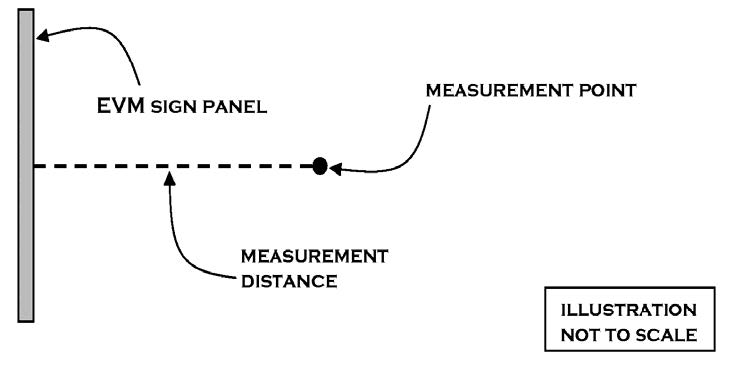
Based on the measurement distance calculated above, the illuminance shall be measured at a corresponding distance perpendicular to the center of the EVM sign face. See Figure XI-4: Illuminance Measurement Point (Plan View)
Figure XI-4: Illuminance Measurement Point (Plan View)
iii.
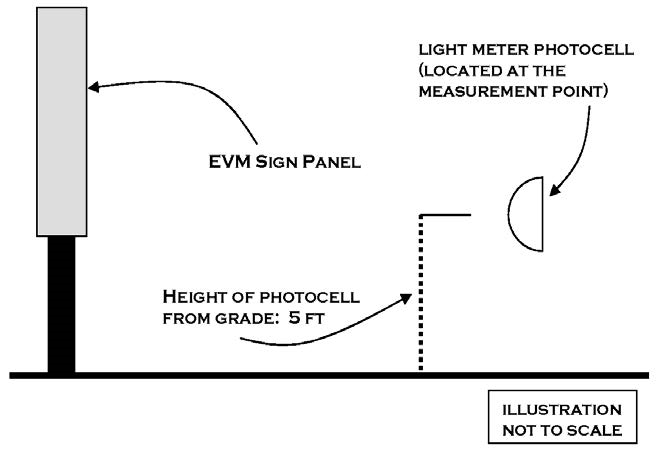
The light meter's photocell shall be set up at the measurement point at a height of five (5) feet above grade. The photocell shall be oriented to face the EVM sign panel. See Figure XI-5, Photocell Orientation (Elevation View).
Figure XI-5: Photocell Orientation (Elevation View)
iv.
With the EVM sign displaying a solid white or whitish grey message, a measure of the illuminance shall be taken. For displays, which utilize one (1) color only, the message shall be the solid color of the display.
v.
With the EVM sign off, a measure of the illuminance shall be taken.
vi.
The illuminance of the sign shall be measured as the change in illumination and shall be calculated using the following formula:
ΔI = Imax- Imin
Where: ΔI = Change in illuminance
I max = Illuminance measured with the sign on
I min = Illuminance measured with the sign off
b.
Luminance measurement using a nit gun. An EVM sign's luminance shall be measured as the brightest part of the sign.
i.
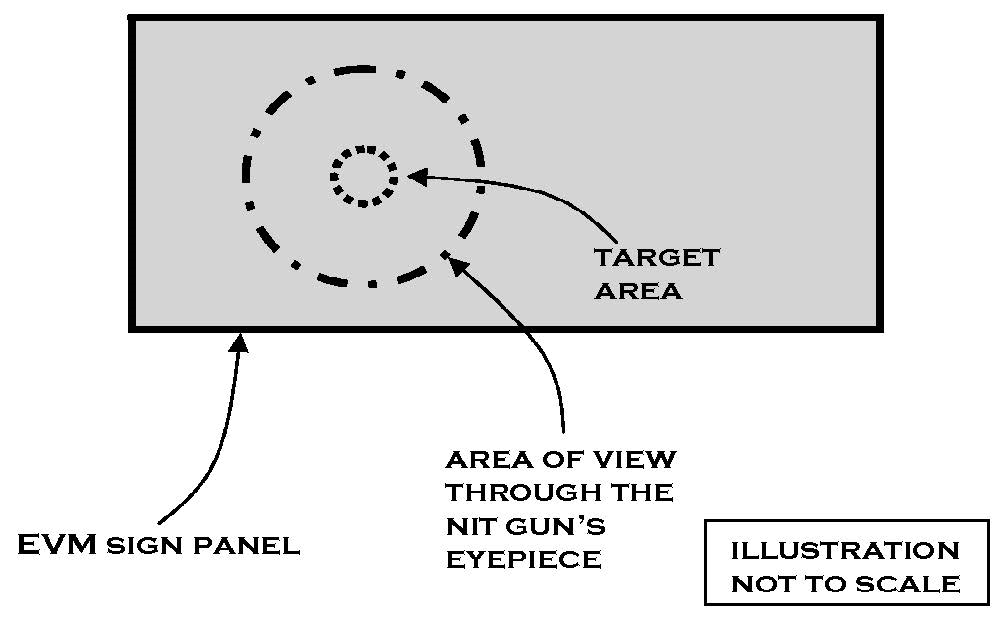
The measurement point shall be located at a distance far enough from the EVM sign that individual LEDs (or other light-emitting source) are not distinguishable but close enough such that only the EVM sign panel is visible in the nit gun's eyepiece (LEDs are grouped in threes: one (1) red, one (1) blue, one (1) green. If these are individually distinguishable, the measurement point must be located further away).
ii.
The nit gun's target area shall be focused on the brightest part of the sign, as determined by the Director of the Department of Inspections and Code Enforcement or the Director's designee, and a measurement shall be taken. See Figure XI-6, Target area.
Figure XI-6: Target Area
(2)
Zoning: EVM signs shall be permitted in the C-1 Neighborhood Commercial and less restrictive zoning districts. EVM signs are prohibited from the Rivertown Historic District, and the RT-C1-PO, Rivertown Neighborhood Commercial Planned Option zoning district.
(3)
Number of Signs: Only one EVM sign shall be permitted per development site.
(4)
Location: EVM signs shall only be located along street frontage.
[a.]
Minimum Yard Setback: Shall be in accordance with the respective zoning district.
[b.]
Maximum Height: Shall be in accordance with the respective zoning district.
(5)
Area: An EVM sign may be a portion of a sign or may comprise the entire area of a sign. If used as a portion of a sign, the image component of any electronic message sign may not exceed thirty-five (35%) percent of the sign's total area. Only one (1) sign panel per sign face may utilize EVM technology.
(6)
Content: The content of the sign for a development containing a single use is limited to identification by letter, numeral, symbol, or design of the use, its name and/or address, product(s) sold and rates of products sold, unless otherwise noted in these sign regulations. The content of a detached EVM sign for a development of multiple uses may identify individual tenants only.
(7)
Spacing:
a.
EVM signs shall be located a minimum of one hundred fifty (150) feet from a residential zoning district as measured radially from the farthest projection of the sign to the nearest boundary of the residential district.
b.
EVM signs shall be located a minimum of one hundred fifty (150) feet of another electronic sign as measured radially as the shortest horizontal distance between the farthest projection of the signs.
(8)
Orientation: The sign face and vision cone must be oriented away from the nearest residential zoning district.
(9)
Lighting: The sign shall be equipped with light sensors in accordance with the following:
a.
Controls: Ambient light sensors shall be installed prior to the sign's erection on a site and shall automatically adjust the light intensity of the sign based on ambient light conditions.
b.
Certification: At the time of application for a sign permit, written certification from the sign manufacturer shall be provided certifying that:
i.
The EVM provides an Underwrites Laboratories (UL) inspection number;
ii.
Ambient light sensors are installed;
iii.
The light intensity of the sign has been preset to not exceed the levels established by this section; and
iv.
The preset intensity is protected from end user manipulation by password protected software or other approved method.
c.
Nighttime lighting: Between sunset and sunrise, as determined by the National Oceanic and Atmospheric Administration, the maximum light intensity shall not exceed three hundred twenty-three (323) candelas per square meter, or three-tenths (0.3) of a foot-candle above ambient light levels.
d.
Daytime lighting: EVM signs shall not exceed a maximum illumination of 500 Candelas per square meter during daylight hours. In addition, the signs shall not vary in luminescent intensity.
(10)
Display: The EVM sign shall display static messages/images only.
(11)
Minimum Duration: Each image and/or message must be maintained for no less than eight (8) seconds.
(12)
Message Transition: The transition time between messages and/or message frames is limited to three (3) seconds. The transition from one (1) static message to the next shall be instantaneous.
(13)
Prohibited Display Types: The following EVM display features and functions are prohibited: continuous scrolling and/or traveling, flashing, spinning, rotating, and similar moving effects, and all dynamic frame effects or patterns of illusionary movement or simulating movement.
(14)
Glare: Lighting on an EVM sign shall not cause glare, which impairs the vision of the driver of a motor vehicle or to otherwise interfere with the safe operation of a motor vehicle.
(15)
Default Image: EVM signs must have a default design or image that will freeze in one position if a malfunction occurs. If a partial or incomplete message freezes or remains static on the sign due to a technical malfunction or a portion of the display face malfunctions, the sign's illumination must be turned off until the sign is repaired.
(16)
Prohibited EVM signs: EVM signs are prohibited for the following sign types:
a.
Attached signs;
b.
Temporary signs;
c.
Portable signs;
d.
Animated signs; and
e.
Vehicle signs which are used as an on-premises sign, a permanent identification, or to circumvent other parts of this Code.
(17)
Audio or Pyrotechnics: Audio or pyrotechnic elements are prohibited.
(18)
Conversion:
a.
Existing, legally conforming signs may be converted to an EVM sign when all applicable requirements are met.
b.
Nonconforming signs shall be prohibited from converting to an EVM sign unless such conversion shall cause the EVM sign to come into full compliance with all applicable regulations of this Code.
(19)
EVM signs shall be permitted for religious structures and uses, public buildings, schools, institutions, and other nonresidential principal uses in residential zoning districts provided:
a.
The EVM portion of the sign shall comprise no more than fifty percent (50%) of the detached sign area or twenty-five (25) square feet, whichever is less. EVM signs must meet applicable criteria set forth in Article XI, Section 11.04 (e), except that the EVM portion of the sign shall be prohibited from changing messages/images between 10 pm and 6 am.
b.
Prohibited signs: The following signs shall be prohibited:
i.
Roof signs.
ii.
Flashing signs and signs with animated and scintillating lights.
iii.
Off-premise signs.
c.
Sign Illumination. All signs shall only be illuminated externally. Illumination shall not be aimed, directed or reflected, focused, or mounted to cause direct light from the luminaire to be directed toward residential or adjoining uses, or to create up light, spill light or glare perceptible to persons operating motor vehicles on public ways. Illumination of the sign face shall not exceed fifty (50) lumens per square foot and flashing, blinking, or scintillating lights are prohibited.
(20)
Variances: Variances to the EVM sign regulations may be granted under the following conditions:
a.
A variance for the EVM sign's height may be granted by the City Council when:
i.
The need for the variance was not created by the applicant; and
ii.
The variance is the minimum amount needed to relieve a hardship that is unique to the property.
(21)
Exceptions:
a.
Pedestrian-oriented Directory and menu signs shall not be considered an EVM sign when the following criteria are met:
i.
Number: For the site, only one (1) Directory sign or one (1) menu sign shall be permitted to use EVM technology.
ii.
Sign area: The sign shall have a maximum area of three (3) square feet.
iii.
Location: The sign shall be attached to the wall within four (4) feet of the building's entrance or window serving walk-up customers.
iv.
Copy changes: The sign's copy does not change more than once per day.
b.
Menu boards for businesses offering drive-thru services shall not be considered an EVM sign and shall be subject to the following criteria:
i.
The EVM portion of the menu board shall comprise no more than fifty (50) percent of the menu board's area.
ii.
The menu board shall not be located within the first twenty (20) feet of the front of the development site and shall be located a minimum of twenty (20) feet from any lot line abutting a residential zoning district.
c.
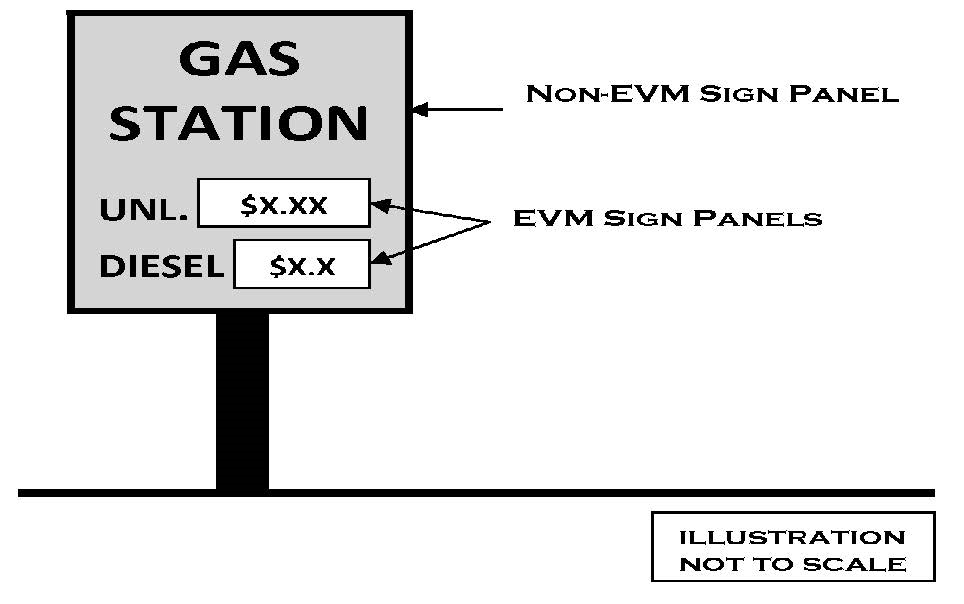
The advertised price of motor fuels dispensed by a retail dealer may be displayed on more than one (1) EVM Sign Panel provided that the EVM Sign Panels shall be embedded in a non-EVM sign panel on a detached sign. See Figure XI-7, Embedded EVM sign panels within a non-EVM sign panel.
Figure XI-7: Embedded EVM Sign Panels within a non-EVM Sign Panel
d.
An EVM sign may use a travelling transition subject to the following criteria:
i.
The sign has an area of fifteen (15) square feet or less.
ii.
If the EVM sign is located in the C-1 Neighborhood Commercial or a more restrictive district, including any residential district, the sign shall have no message/image changes between 10:00 p.m. and 6:00 a.m.
(22)
Enforcement procedure for nighttime lighting requirements: The Department of Inspections and Code Enforcement shall use one (1) of the following procedures to issue citations for an EVM sign's lighting during nighttime hours:
a.
Illuminance measure using a light meter. EVM sign owners and/or operators shall be required to cooperate with the Department of Inspections and Code Enforcement when testing the sign.
i.
Upon receiving a complaint about an EVM sign's lighting, the Department of Inspections and Code Enforcement shall send a letter to the property owner. The letter shall include the following information:
1)
A summary of the City of Kenner's sign lighting requirements for nighttime and daytime hours.
2)
Date and time a Code Enforcement officer will perform the inspection.
3)
Requirement that the sign's owner/operator be present for the inspection of the EVM sign's lighting.
4)
Requirement that a solid white or whitish grey message (for monochrome displays, the message shall be the solid color of the display) be prepared prior to and available during the inspection.
ii.
During the inspection, the Director of the Department of Inspections and Code Enforcement or the Director's designee shall take three (3) measures of the EVM sign's illumination, following the procedure set forth in section 11.04 (e) of this Article. The average of the three (3) measures shall be the sign's illumination.
b.
Luminance measure using a nit gun. During the inspection, the Director of the Department of Inspections and Code Enforcement or the Director's designee shall take three (3) measures of the EVM sign's illumination, following the procedure set forth in section 11.04 (e) of this Article. The average of the three (3) measures shall be the sign's lumination.
(23)
That electronic variable message signs in existence prior to the effective date of this ordinance shall be required to meet the display standards, daytime and nighttime lighting requirements, and dwell time standards not to exceed twelve weeks beginning from the date of the adoption of the ordinance.
(24)
That the Planning Department and Planning Commission are hereby authorized to review and make recommendations concerning the electronic variable message sign regulations every five (5) years in order to address future technological advances which would affect the regulation of such signs.
(Ord. No. 12,559, § 1, 6-6-24)
Section 11.05 - Temporary Signs
(a)
General:
(1)
Signs that meet the standards of this subsection are exempt from the standards for permanent signs and are not counted in the total square footage of signage allowed on any particular property or site. Signs that do not meet the standards of this subsection are subject to the standards for permanent signs.
(2)
Temporary signs may have external or internal illumination.
(3)
Temporary banners: Temporary banners are subject to the following regulations:
[a.]
In all residential zoning districts, temporary banners are not permitted on sites with houses, duplexes, and attached houses. Exception: banners for holidays, religious commemoration, and special family events.
[b.]
In commercial and industrial zones, one banner no larger than thirty-two (32) square feet in size is permitted per single-use development site or, on a multi-use development site, per storefront. Only one (1) of these banners may be hung on each building wall or on each separate structure. Any additional banners, or banners larger than thirty-two (32) square feet in size, must meet the following standards for permanent signs in this Code.
i.
In no case may a site or storefront have more than two (2) temporary banners.
ii.
In no case shall a temporary banner be larger than fifty (50) square feet in size.
iii.
A temporary banner may be displayed no longer than thirty (30) days per calendar year.
[c.]
Banners that do not meet the regulations of this subparagraph, must meet the standards for permanent signs.
(4)
Temporary Wall or Fascia Signs:
a.
One (1) temporary wall sign is allowed per street frontage in the Commercial and Industrial Zones.
b.
Temporary wall signs may be up to thirty-two (32) square feet in area.
c.
Temporary wall signs may not extend above rooflines. Extensions into the right-of-way are prohibited.
d.
A temporary wall sign may be displayed no longer than thirty (30) days per calendar year.
(5)
Temporary Freestanding or Portable Signs:
a.
One (1) temporary freestanding sign is allowed per property in the Commercial Zones and is not counted in the total square footage of permanent signage allowed on the site.
b.
Temporary freestanding signs may be up to thirty-two (32) square feet in area. Extensions into the right-of-way are prohibited.
c.
A temporary freestanding sign may not be displayed longer than thirty (30) days per calendar year.
(b)
Political and Non-Commercial Message Signs: Political and non-commercial message signs are permitted in all districts and are exempt from sign permit requirements subject to the following:
(1)
Signs are limited to thirty-two (32) square feet in area in residential districts and non-residential districts.
(2)
Signs may not be posted on any public property or public rights-of-way.
(3)
Signs posted on private property require the permission of the property owner.
(c)
Garage/Yard Sale Signs: Temporary residential garage/yard sale signs are permitted in all districts and are exempt from sign permit requirements, subject to the following:
(1)
Temporary residential garage/yard sale signs may not exceed nine (9) square feet each.
(2)
Signs shall be posted no more than twenty-four (24) hours prior to the event and all signs shall be removed within twenty-four (24) hours after the event.
(3)
Signs may not be posted in the public right-of-way or off-premises.
(d)
Real Estate Signs: Real estate signs are permitted in all districts and are exempt from sign permit requirements, subject to the following:
(1)
Maximum Size: Real estate signs are limited to:
a.
Six (6) square feet in area in residential districts and may only advertise the sale, rental, lease, or management of the premises upon which said signs are located.
b.
Sixteen (16) square feet in size for non-residential developments under two acres, and
c.
Thirty-two (32) square feet in size or six (6) feet in height for all non-residential developments larger than two (2) acres. Only one (1) sign on each street frontage may be erected.
(2)
Real estate signs are limited to six (6) feet in height when installed as freestanding signs.
(3)
Real estate signs may not encroach into the public right-of-way.
(4)
Real estate signs shall be removed within forty-eight (48) hours of sale or lease.
(e)
Bench Signs: Bench signs are allowed only when associated with a public transit stop. A permit is required from the Kenner Department of Inspections and Code Enforcement.
(f)
Vehicle and Trailer Signs: Vehicle and trailer signs may be displayed on any vehicle or trailer operated in the daily conduct of any business enterprise so long as such signs:
(1)
Are not parked in front of or in line with any greenbelt or planting areas when on the premise of the business entity operating or advertising on such vehicle or trailer;
(2)
Are on a vehicle or trailer which is operable and not parked primarily for the purpose of signage.
(3)
Vehicle and trailer signs shall not be used as off-premise signs and shall not be displayed or parked on sites other than the premise of the business entity operating such vehicle other than when the vehicle is being used in connection with the business operations of the entity operating said vehicle or trailer. Such vehicles and trailers may also be parked at the residence of its operator, so long as such vehicle is operated by a resident of the residential property as conveyance to work on a daily or near daily basis. Billboards may not be erected or displayed on any vehicle or trailer.
(g)
Flags, Streamers, Banners and Pennants: Flags, streamers, banners, pinwheels, spinners, or pennants may be displayed in connection with grand openings or special events no more than twice a year for any one business entity or applicant. Such signs may be displayed for a period not to exceed fourteen (14) consecutive calendar days upon the issuance of a temporary permit by the Department of Inspections and Code Enforcement. Applications for such a temporary permit must state the name of the person, firm, corporation, or organization sponsoring the event, the locations where such device(s) are to be installed and the contemplated dates during which such devices shall remain on display. Banners shall not exceed thirty-two (32) square feet and shall be limited to one banner per premise.
(h)
A-Frame Signs:
(1)
A-frame signs are limited to six (6) square feet in area per sign face and four feet (4') in height.
(2)
The use of A-frame signs is limited to business hours only and must be stored indoors at all other times
(3)
Only one (1) A-frame sign is permitted per business and a minimum twenty-foot (20') separation is required between all A-frame signs.
(4)
An A-frame sign must be placed within twenty feet (20') of the primary entrance of the business, and must not interfere with pedestrian traffic or violate standards of accessibility as required by the ADA or other accessibility codes.
(Ord. No. 12,573, § 2, 6-21-24)
Section 11.06 - Sign Definitions
The following are definitions pertaining to signs:
(1)
Abandoned Sign: A sign that no longer identifies or advertises an ongoing business, product, location, service, idea, or activity on the premises where such sign is displayed, or has fallen into disrepair or otherwise deteriorated as a result of a lack of maintenance, repair or upkeep.

(2)
Accessory Sign: A sign relating only to the main use of the premises on which the sign is located, or indicating the name and address of a building or the occupants or management of a building on the premises where the sign is located.
(3)
A-Frame Sign: An advertising device, ordinarily in the shape of an "A" or some variation such as a "T" shape, located on the ground, not permanently attached, and easily movable.
(4)
Alteration: Any change in copy, color, size, or shape, which changes appearance of a sign, or a change in position, location, construction, or supporting structure of a sign, except that a copy change on a sign is not an alteration.
(5)
Animated Sign: A sign, which has any visible moving part, flashing or oscillating lights, visible mechanical movement of any description, or other apparent visible movement achieved by any means that move, change, flash, oscillate, or visibly alters in appearance in a manner that is not permitted by these regulations.
(6)
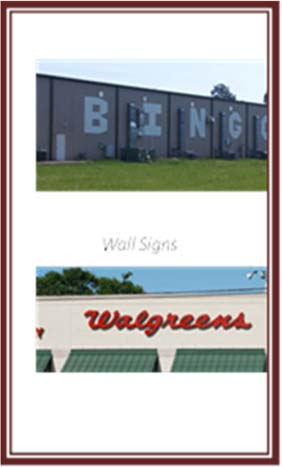
Attached Sign: A sign attached parallel to, but within six (6) inches of, a wall or building, painted on the wall or building surface, or erected and confined within the limits of an outside wall of any building or structure, which is supported by such wall or building and displays only one (1) sign surface. Also called Wall Sign.
(7)
Alteration: Any change in copy, color, size, or shape, which changes appearance of a sign, or a change in position, location, construction, or supporting structure of a sign, except that a copy change on a sign is not an alteration.
(8)
Animated Sign: A sign, which has any visible moving part, flashing or oscillating lights, visible mechanical movement of any description, or other apparent visible movement achieved by any means that move, change, flash, oscillate, or visibly alters in appearance in a manner that is not permitted by these regulations.
(9)
Attached Sign: A sign attached parallel to, but within six (6) inches of, a wall or building, painted on the wall or building surface, or erected and confined within the limits of an outside wall of any building or structure, which is supported by such wall or building and displays only one (1) sign surface. Also called Wall Sign.
(10)
Balloon Sign: An inflatable object or balloon, tethered in a fixed location that has a sign with a message on its surface or attached in any manner to the balloon.
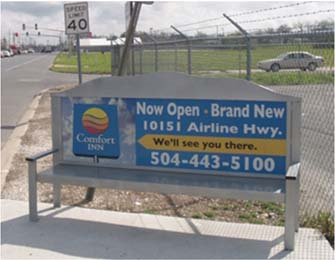
Bench Sign 1
(11)
Banner: A sign of lightweight fabric or similar material attached at one or more edges to a pole, building, or structure. A flag is not a banner.
(12)
Beacon: A strong or bright light focused or directed in one or more directions.
(13)
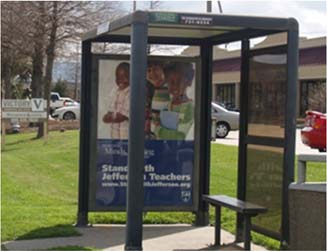
Bench Sign: A sign applied or affixed to the seat or back of a bench.
(14)
Billboard: A permanent off-premise sign that directs attention to a business, commodity, service, or entertainment conducted, sold, or offered at a location other than the premises where the sign is located. A billboard is also called an outdoor general advertising sign.
Bench Sign 2
(15)
Canopy (Awning) Sign: A sign that is part of, or attached to, an awning, canopy, or other fabric, plastic, or structural protective cover over a door, entrance, window, or outdoor service area. A marquee sign is not a canopy sign.
(16)
Canopy (Service Station) Sign: A sign that is part of, or attached to, the canopy cover of a gas station.
(17)
Changeable Copy or Message Sign: A sign or portion thereof with characters, letters, or illustrations that can be changed or rearranged without altering the face or surface of the sign.

Canopy Sign
(18)
Construction Sign: A nonpermanent sign identifying the persons, firms, or business directly connected with a construction project. See also Project Sign.
(19)
Conforming Sign: A sign that is legally installed in conformance to all prevailing jurisdictional laws and ordinances.
(20)
Copy: The graphic content or message of a sign.

Changeable Copy or Message Sign
(21)
Double-faced Sign: A sign with two faces, back to back.
(22)
Electric Sign: Any sign activated or illuminated by means of electrical energy.
(23)
Electronic Variable Message (EVM) Sign: 1) An electrically activated changeable sign, which typically uses light emitting diodes (LED) as a lighting source, whose variable message and/or graphic presentation capability can be electronically programmed by computer from a remote location. 2) A sign whose alphabetic, pictographic, or symbolic informational content can be changed or altered on a fixed display screen such as video, television, or plasma screens; holographic displays, an electronic message center or LED display, composed of electrically illuminated segments. A time and/or temperature sign shall not be considered an electronic message sign.
(24)
Flag: Any fabric or bunting containing distinctive colors, patterns, or symbols and used as a symbol of a government, political subdivision, or other entity. A photo, drawing or similar depiction of a flag on non-fabric material is not included in this definition.
(25)
Foot-Candle: An English unit of measurement of the amount of light equivalent to the illumination produced by a source of one candle at a distance of one foot. One foot-candle is equal to one lumen per square foot and can be measured by means of an illuminance meter. Abbreviation - FC.
(26)
Freestanding Sign: A sign anchored directly to the ground or supported by one or more posts, columns, or other vertical structures or supports and not attached to or dependent for support from any building. See also Pole Sign.
(27)
Home Business or Home Occupation Sign: A sign located in a residential district that contains no commercial message except advertising for goods and/or services offered on the premises, where such goods or services may legally be offered on the premises under this Code and other applicable laws and regulations.
(28)
Identification Sign: a sign used to identify the name of the individual, family, organization, or enterprise occupying the premises, the profession of the occupant, or the name of the building on which the sign is displayed.
(29)
Illuminated Sign: Any sign for which an artificial source of light is used in order to make readable the sign's message, including internally and externally lighted signs and reflectorized, glowing or radiating signs.
(30)
Laser: A device emitting a narrow, very intense beam of light waves that have been amplified and concentrated by stimulated atoms, or the light produced by such device.
(31)
Lux: The SI (metric) unit for illuminance. One lux equals 0.093 foot-candles.
Marquee Sign
(32)
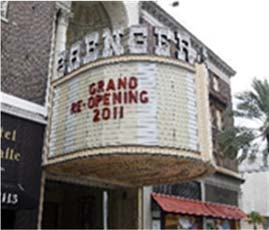
Marquee Sign: A permanent roof-like structure projecting beyond a building or extending along and projecting beyond the wall of the building, generally designed and constructed to provide protection from the weather.
(33)
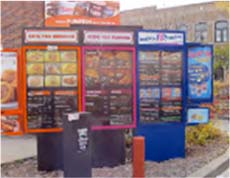
Menu Board Sign: Signs located adjacent to a drive-through lane that identifies food and beverages offered for sale at the restaurant and associated prices and specials.
(34)
Monument Sign: A freestanding sign with the entire length in contact with the ground or a pedestal that rests upon the ground.
Menu Board Sign
(35)
Mural: A picture on an exterior surface of a structure. A mural is a sign only if it is related by language, logo, or pictorial depiction to the advertisement of any product or service or the identification of any business.
(36)
Nit: A photometric unit of measurement referring to luminance. One nit is equal to one cd/m 2 .
(37)
Non-Conforming Sign: A sign in existence on the effective date of this Code that was lawful before this Sign Code took effect but does not comply with the requirements of this Code.
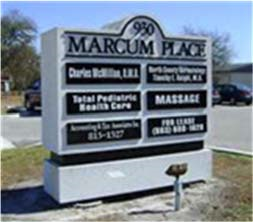
Monument Sign
(38)
Off-Premise Sign: A sign that directs a person to a different premise or location than that on which the sign is located; which identifies advertised goods, products, or services not available on the premises on which the sign is located; or which conveys a non-advertising idea or message; or identifies or advertises a business, person, firm or corporation not located on or occupying the premises where the sign is located; or which is not otherwise defined as an on-premise sign. See also Billboard and Outdoor Advertising Sign.
(39)
On-Premise Sign: A sign identifying or advertising a business, person, firm, corporation, activity, goal, product, or service located or available on the premises where the sign is installed and maintained or which is displayed and maintained by the owner or occupant of the premises on which it is located.
(40)
Outdoor Advertising Sign: A permanent sign erected, maintained or used in the outdoor environment for the purpose of the display of commercial or noncommercial messages not appurtenant to the use of, products sold on, or the sale or lease of, the property on which it is displayed. May also be referenced as an Off-Premise Sign, Billboard, or Commercial Outdoor Advertising Sign.
(41)
Parapet Sign: A sign extending above a roofline or which serves as a parapet.
(42)
Pole Sign: See Freestanding Sign.
(43)
Political Sign: Any sign urging the election or defeat of any candidate seeking any political office, or urging the passage or defeat of any ballot measure, but not including any billboard owned or maintained by a commercial firm or advertising company when leased or used as a political sign.
(44)
Portable Sign: Any sign, display, or advertising device initially designed for being moved or transported, and is not attached permanently to a foundation or a permanent location on the site. Portable signs include, but are not limited to, signs mounted upon a trailer, wheeled carrier or other non-motorized mobile structure, with wheels or with wheels removed.
(45)
Pre-Existing Sign: See Non-conforming Sign.
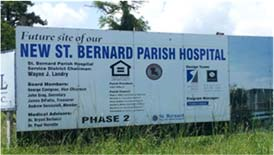
Project or Construction Sign
(46)
Project Sign: A temporary sign announcing a proposed land development or construction project.
(47)
Projected Sign: A sign or visual image created by the projection of light onto a surface.
(48)
Projecting Sign: A sign affixed to a building or wall in such a manner that its leading edge extends more than six (6) inches beyond the surface of such building or wall.
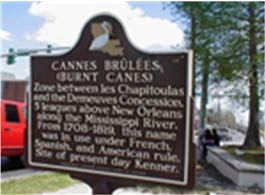
Public Sign
(49)
Public Sign: A sign owned by a governmental entity and installed by a governmental official or employee in the performance of his or her public duty. Such signs include, but are not limited to, safety, danger, trespassing traffic control, memorial, and historic landmark signs.
(50)
Real Estate Sign: Any temporary sign pertaining to the sale, lease, or rental of land or buildings, which is erected or displayed on the lot, structure, or parcel to which it applies.
(51)
Revolving or Rotating Sign: Any sign whose sign face is designed to move or turn on any axis.
(52)
Roof Sign: A sign erected or constructed on the roof of a building and supported by the roof structure or that is attached to the roof of a building that projects above the parapet wall or apex of the roof to which it is attached.
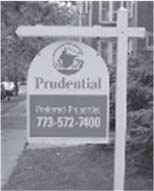
Real Estate Sign
(53)
Searchlight: A strong or bright light with a reflector in a swivel so that its beam may be sent or directed in various directions.
(54)
Sign: Any work, lettering, figures, numbers, phrases, sentences, emblems, devices (including loudspeakers), designs, pictures, trade names or trademarks by which is affixed to, or represented directly or indirectly upon a building, structure, or piece of land and which directs attention to an object, place, activity, person, firm, corporation, institution, business, service, commodity or a product, which are visible from the rights-of-way of any street, road, or highway and designed to attract attention.

Roof Sign
(55)
Sign Area: The area of a sign shall be defined as the square foot area enclosed within the perimeter of the sign face with each face contributing to the aggregate area of any sign. With respect to signs, which are composed of individual symbols, letters, figures, illustrations, messages, forms, or panels, the sign area shall be defined as that area enclosed by one continuous line connecting the extreme points or edges of the advertising message. In cases where there is no definable simple geometric shape, the simplest geometric shape or rectangle enclosing the outer edges of the advertising message shall determine the sign area. In cases of back-lighted awnings with advertising messages, the entire area of the awning shall be considered as the sign area. Criteria for determining sign area are found in Section 11.03 (d) of this Article
(56)
Sign Face: The part of the sign that is or can be used to identify, advertise, communicate, inform, or convey a visual representation, which attracts the attention of the public for any purpose. "Sign face" includes any background material, panel, trim, frame, color and direct or self-illumination that differentiates the sign from the building, structure, backdrop surface or object upon which or against which it is placed. The sign structure shall not be included as a portion of the sign face provided that no message, symbol, or any of the aforementioned sign face criteria are displayed on or designed as part of the sign structure, unless it is outlined in neon.
(57)
Sign Height: The vertical distance from the finished grade to the highest point of either the sign or sign structure.
(58)
Sign Message: The words or symbols on a sign face, which convey a message to those viewing the sign.
(59)
Snipe Sign: A sign, which is tacked, nailed, posted, pasted, glued or otherwise attached to poles, stakes, fences, or to other like objects.

Snipe Sign
(60)
Street Banner Sign: Any banner sign, which is stretched across and hung over a public right-of-way.
(61)
Temporary Sign: Any sign that is not permanently or securely attached to a building, sign pole, other structure, or the ground and that can be used only for a designated period of time. Types of temporary signs include vehicle, trailer- and skid-mounted signs; banners, portable signs but does not include flags displayed on permanent mountings, freestanding signs, or window signs.
(62)
Vehicle Sign: Any sign displayed on or from any mode of transportation, including but not limited to cars, buses, trucks/trailers, trains, boats, or airplanes.
(63)
Wall Sign: See Attached Sign.
(64)
Window Sign: Any sign placed inside a window or upon the panes of glass of a window and visible from the exterior of the window.

