
Kenner City Zoning Code
ARTICLE V
- Definitions
Section 5.01 - Purpose
This Article contains definitions for generic uses allowed in zoning districts and general terms used throughout this ordinance. This section divides definitions into two (2) categories: "Uses" and "General Terms."
Section 5.02 - Terms
(a)
The following terms shall apply to the regulations of this ordinance:
(1)
The word "shall" is always mandatory. The word "may" is permissive.
(2)
The word "building" or "structure" includes any part thereof. The word "building" shall also imply or mean the word "structure."
(3)
Words and terms not defined herein shall be interpreted in accordance with their normal dictionary meaning and customary usage.
(4)
The definitions in this section cannot be waived. No variances to the following terms shall be permitted.
Section 5.03 - Use definitions
The uses defined below are to assist in determining whether the defined use is permitted, prohibited, or permitted with conditions in a particular zoning district. These defined uses may also be used in determining required off-street parking, as specified in this ordinance.
Accessory Structure or Building: A structure detached from a principal building on the same lot and clearly, incidental, and subordinate to the principal building or use in both size and function.
Accessory Use: A subordinate use which is incidental to and customary or necessary in connection with the main building or use and which is located on the same lot with such main building or use.
Adult Use: An adult bookstore, adult motion picture theater, adult mini-motion picture-theater, adult cabaret, or an adult massage business (does not include licensed therapeutic massage establishments). Adult use also means any premises that sells or disseminates explicit sexual material as defined in the City code and thereby must limit the public display of such explicit sexual material by restricting access to young persons as required by the provisions of the City code.
Agriculture: The use of land for dairying, farming, floriculture, horticulture, pasturage, viticulture, and animal and poultry husbandry and the necessary accessory uses for packing, treating, or storing the produce provided, however, that the operation of any such accessory use shall be secondary to that of the normal agricultural activities.
Airport: Land, water, or a structure used for the landing and takeoff of aircraft, including airport buildings, airport structures, or airport rights-of-way. An airport includes passenger terminals for that airport and any accessory uses within the passenger terminal, such as restaurants and retail goods establishments.
Amphitheater: An outdoor structure that accommodates an audience for concerts, public speaking, or other live entertainment, which is open to the general public, with or without an admission charge. An outdoor amphitheater includes band shell structures.
Amusement Place: Any business, place or establishment where three or more amusement-type machines such as, but not limited to, flipper-type machines, target machines, foos-ball machines, and the like are available for the use and enjoyment of the public, in which minors are permitted by law to frequent. Refer to section 7.133-7.135 of the Code of Ordinances for additional requirements. This definition excludes party-places that cater to children twelve years old and younger. Refer to Children's Amusement Place for such establishments.
Antenna: A metallic, graphite, fiberglass or other device which is attached to a transmission tower, telecommunications tower, monopole, mast, building or other structure for transmitting and receiving electromagnetic waves.
Apartment: A portion of a building consisting of a room or suite of rooms intended, designed, or used as a permanent residence by an individual or one family.
Apartment Complex: See Dwellings, multiple.
Assisted Living: A long-term care facility for elderly or disabled citizens who are able to function on their own, but who may need assistance with some activities of daily living. Usually includes meals, private quarters, personal assistance, housekeeping, and nursing services.
Arcade: see Amusement Place.
Artisan Workshop: An establishment, not exceeding two thousand five hundred (2,500) square feet in gross floor area, for the preparation, display and sale of individually crafted artwork, jewelry, furniture, sculpture, pottery, leather craft, hand-woven articles, and related items.
Auditorium: A structure designed or intended for use as a concert, commencement, or lecture hall to accommodate the gathering of people as an audience to experience music, lectures, plays and other performances and presentations.
Automotive Repair, Major: An establishment primarily engaging in the repair or maintenance of motor vehicles, trailers and similar large mechanical equipment, including paint, body and fender, and major engine and engine part overhaul and which may be conducted either outdoor or within a completely enclosed building. All other repairs are considered minor.
Automotive Repair, Minor: An establishment primarily engaging in the repair or maintenance of motor vehicles, trailers and similar large mechanical equipment, including brake, muffler, upholstery work, tire repair and change, lubrication, tune-ups, and transmission work, which are conducted within a completely enclosed building.
Automobile Service Station: Any building, land area or other premises, or portion thereof, used or intended to be used for the retail dispensing or sales of vehicular fuels; and including as an accessory use the sale and installation of lubricants, tires, batteries and similar accessories or the repair or maintenance of motor vehicles, trailers and similar large mechanical equipment, including brake, muffler, upholstery work, tire repair and change, lubrication, tune-ups, oil change and transmission work, which is conducted within a completely enclosed building.
Automobile Sales: An open, partially open, or enclosed area other than a street, used for the display, sale or rental of new or used automobiles and/or where no repair work is done except minor incidental repair of automobiles to be displayed, sold or rented on or from the premises. All vehicles must be operational. Non-operational vehicles must be screened from view by a six (6) foot solid wood or masonry fence.
Bar: An establishment serving alcoholic beverages in which the principal business is the sale of such beverages for consumption on the premises. Snack foods or other prepared food may be available for consumption on the premises as an accessory use only. No retail sales of alcohol for consumption off-premises are permitted. A bar may include a microbrewery on-site as an accessory use only.
Bar, Holding: An area within a restaurant and with patron seating used for the serving of alcoholic and non-alcoholic beverages while restaurant patrons wait for a table, provided there is no entrance to the bar except through the restaurant and no operation of the bar except while food is served in the restaurant and dining room.
Bar, Service: An area without patron seating used for the preparation of alcoholic beverages to be carried to restaurant patrons by the wait staff.
Bed and Breakfast: An owner-occupied residential structure, originally constructed as either a single-family or a two-family dwelling that has been converted to a single-family dwelling, which provides no more than three (3) sleeping rooms for overnight paid occupancy of up to seven (7) nights. Common bathroom facilities may be provided rather than private baths for each room.
Boarding House: A residential building other than an apartment, hotel, motel, or tourist cabin where lodging and meals are served for compensation, and by prearrangement for definite periods. For the purpose of these provisions, this shall not include a mobile home.
Boat Repair Facility: A facility (which could include a boat repair garage, boat storage yard) where boats are repaired and stored until repairs are completed.
Boat Sales/Rental: A marine retail sales and service use in which boats 16 feet or more in length are rented or sold. The sale or rental of smaller boats shall be defined as a major durables sales and service use.
Boathouse: A structure that provides storage for watercraft and may be used for transient residential use.
Booking Transaction: Any contractual agreement between a guest and an owner relative to a short-term rental.
Borrow Pit: Any place or premises where dirt, soil, sand, gravel, or other material is removed by excavation or otherwise, below the grade of surrounding land, for any purpose other than mining operations such as gold, silver, coal, etc., and, that are necessary and incidental to grading or to building construction on the premises.
Brewery/Distillery: A facility for either the production and packaging of malt beverages of low alcoholic content for wholesale distribution, with a capacity of more than fifteen thousand barrels per year, or for the distilling of liquors. Retail sales of alcohol from the brewery directly to the public may be permitted.
Broadcast Studio: Commercial and public communications facilities, including radio, internet and television broadcasting and receiving stations and studios.
Building, Public and Semipublic: A building operated and used for the benefit of the general public or for nonprofit organizations, clubs, lodges, and congregations whose membership is composed of a segment of the general public. Public and semipublic buildings include, but are not limited to, such buildings as schools, churches, government buildings, colleges, libraries, museums, art galleries, auditoriums, lodge halls, and country clubs, and electric and gas substations.
Bus Terminal: see Passenger Terminal.
Campground: An area to be used for transient occupancy by camping in tents, camp trailers, travel trailers, motor homes, or similar movable or temporary sleeping quarters of any kind for a maximum of 15 days.
Car-Share Facility: A membership-based car-sharing service that provides automobile rental to members, billable by the hour or day. Car-sharing is not considered a motor vehicle rental establishment.
Car Wash: A building or structure erected for the primary purpose of washing automobiles.
Carport: A canopy-like structure, open on at least two (2) sides, for the purpose of providing shelter for one (1) or more vehicles.
Casino: A structure, a minimum of fifty thousand square feet of floor area, in which legal gambling is conducted.
Cemetery: Land used or dedicated to the burial of the deceased, including crematoriums, mausoleums, and necessary sales and maintenance facilities. Mortuaries and chapels may be included when operated within the boundary of such cemetery.
Check Cashing Establishment: An establishment, other than a state or federally chartered bank or financial institution, which provides the general public a check cashing service. As a primary element of its operation, the establishment charges either a flat fee for such service or a service fee based upon a percentage of the face value of the check to be cashed.
Child Care Center: See Day Care Center, Child.
Children's Amusement Place: Any indoor or outdoor place that is maintained or operated for the amusement, patronage, or recreation of children, aged 12 years or younger, to include coin-controlled amusement devices of any description.
Church: See Place of Worship.
Cistern: A permanent artificial reservoir built to catch and store rainwater, typically located underground, but may be located above ground.
Clinic: An establishment where patients are admitted for examination and treatment by one or more physicians, dentists, psychologists or social workers and where treatment of persons is solely on an outpatient basis. Medical clinics also include alternative medicine clinics, such as acupuncture and holistic therapies, and physical therapy offices for physical rehabilitation.
Cocktail Lounge: See Bar.
Commercial Use: The purchase, sale, or transaction involving the disposition of any article, substance, commodity, or service, the maintenance or conduct of offices, professions, or recreational or amusement enterprises conducted for profit and also including renting of rooms, business offices, and sales display rooms and premises.
Communication Equipment Shelter: A constructed or prefabricated building or other structure located on a telecommunications site designed principally to enclose equipment, switches, communication lines and other related facilities used in connection with telecommunications transmissions.
Community Center: A facility used as a place of meeting, recreation, or social activity, and not operated for profit, which is open to the public.
Community Garden: An area of land managed and maintained by a group of individuals to grow and harvest food crops and/or non-food, ornamental crops, such as flowers, for personal or group use, consumption, donation, or sale on-site. Community gardens may be divided into separate plots for cultivation by one or more individuals or may be farmed collectively by members of the group.
Community Home: see Group Home.
Composting Facility: A facility to process raw manure or other raw organic by-products into biologically stable organic material.
Condominium: A dwelling unit, townhouse or apartment that is owned in fee simple with the undivided ownership, in common with other purchasers, of the common elements in the structure and including the land and its appurtenances.
Contractor: A general contractor or builder engaged in the construction of buildings, either residences or commercial structures as well as heavy construction contractors engaged in activities such as paving, highway construction, and utility construction. This includes establishments and companies engaged in specific utility trades of a type that are specialized to assist in building construction and remodeling. This definition includes, but is not limited to, heating, air conditioning, painting, plumbing, and roofing.
Contractor Storage Yard: Land or structures used primarily for the storage of equipment, vehicles, machinery or building materials of a contractor in the conduct of any building trade or building craft.
Convenience Store: A retail store with a floor area of less than 2,500 square feet that sells groceries and other household items. May also sell gasoline; does not include automotive service stations or vehicle repair shops.
Correctional Facility: A public or privately operated facility for the detention, confinement, treatment, or rehabilitation of persons arrested or convicted for the violation of civil or criminal law. Such facilities include adult detention centers, juvenile delinquency centers, jails, or prisons.
Country Club: A public or private facility operated for social and outdoor recreation purposes with recreation facilities for members, their families and invited guests. A country club may include bars and restaurants.
Cultural Facility: A use that is open to the public and provides cultural services and facilities including, but not limited to, libraries, museums, aquariums, zoos, botanical gardens, and historical societies. A cultural facility may have accessory retail uses, that offer items related to the facility for sale, and accessory restaurants, which are only open during the hours of operation of the facility. A cultural facility may hold special events and receptions on-site, including events, which take place after closing hours.
Day Care Center, Adult: A facility licensed by the State of Lousiana where, for a portion of a twenty-four (24) hour day, functionally impaired adults that are not related to the owner or operator of the facility are supervised or participate in a training program. This excludes alcohol and drug abuse clientele, former inmates of prisons or correctional institutions or former patients of mental institutions who have been found not guilty by reason of insanity. An adult day care center does not include adult day care home.
(a)
Day care center, small: Up to twelve (12) adults
(b)
Day care center, large: Thirteen (13) to thirty (30) adults
(c)
Day care center, commercial: Thirty-one (31) or more adults
Day Care Center, Child: A facility licensed by the State of Louisiana where care, supervision, and guidance of children that are not related to the owner or operator of the facility is provided on a regular basis. A child day care center does not include a child day care home.
(a)
Day care center, small: Up to twelve (12) children
(b)
Day care center, large: Thirteen (13) to thirty (30) children
(c)
Day care center, commercial: Thirty-one (31) or more children
Drive-in Theater: See Theater, drive-in.
Drive-in Use: An establishment which by design, physical facilities, service, or by packaging procedures encourages or permits customers to receive services, obtain goods, or be entertained while remaining in their motor vehicles.
Drive-Through Establishment: Premises used to provide or dispense products or services through an attendant, window, or automated machine to persons remaining in their vehicle. A drive-through facility may be in combination with other uses such as a financial institution, a retail goods establishment or restaurant. A car wash, gas station or motor vehicle service and repair shall not be considered a drive-through facility.
Driving Range: An area equipped with distance markers, clubs, balls and tees for practicing the hitting of golf balls, which may include a snack-bar and pro-shop.
Duplex: Two dwelling units affixed as one structure located on a lot.
Dwelling: A building, or portion thereof, designed or used exclusively for residential occupancy, but not including trailers, hotels, motels, motor lodges, board and lodging homes, tourist courts, or tourist homes. For the purpose of this ordinance, such building shall have a minimum area of four hundred square feet.
Dwelling, Single-family: A building designed for or occupied exclusively by not more than one family.
Dwelling, Two-family: A building designed for or occupied by two families.
Dwelling, Three-family: A building designed for or occupied by three families.
Dwelling, Four-family: A building designed for or occupied exclusively by four families.
Dwelling, Multiple-family: A building designed or occupied exclusively by five or more families.
Dwelling, Patio Home: A single-family dwelling on a separate lot with open space setbacks (yards) on three sides. The term "patio home dwelling" is synonymous with the term "zero lot line home."
Dwelling, Townhouse: A single-family dwelling in a row of at least three such units in which each unit has its own front and rear access to the outside, no unit is located over another unit, and each unit is separated from any other unit by one or more common fire resistant walls.
Educational Facility, Primary: A public, private, or parochial school offering instruction at the elementary and/or junior high school levels. Places of worship with primary educational facilities are classified as primary educational facilities so long as both uses are located on the same lot, even if in separate buildings.
Educational Facility, Secondary: A public, private, or parochial school offering instruction at the senior high school level. Secondary educational facilities also include secondary theological schools for training ministers, priests, or rabbis. Places of worship with secondary educational facilities are classified as secondary educational facilities so long as both uses are located on the same lot, even if in separate buildings.
Educational Facility, University: A post-secondary institution for higher learning that grants associate or bachelor degrees. The institution may also have research facilities and/or professional schools that grant master and doctoral degree. University educational facilities also include post-secondary theological schools for training ministers, priests, or rabbis. University educational facilities do not include vocational educational facilities.
Educational Facility, Vocational: A school that teaches industrial, clerical, computer, managerial, automotive, repair (electrical, plumbing, carpentry, etc.), commercial or artistic skills, or a school conducted as a commercial enterprise, such as a driving school or school for general educational development. This definition applies to privately operated schools that do not offer a complete educational curriculum. Vocational educational facilities do not include university educational facilities.
Emergency Homeless Shelter: A facility that provides temporary or transitional shelter for the homeless in general or for specific populations of the homeless.
Employment Services: A business that provides employment services for temporary or transient employment of semi-skilled and unskilled workers, and typically operates as a labor pool where workers gather on-site for job placement.
Fabrication and Assembly: The manufacturing from standardized parts of a distinct object differing from the individual components.
Fairgrounds: An area of land used for exhibitions and shows including, but not limited to, concerts, animal shows, carnivals, and other outdoor recreational events. These may include dog and horse racetracks included as part of the fairground development.
Farmers Market: The offering for sale of produce or processed, packaged, or prepared food on pre-established dates in an open area or structure, subject to the procedures and regulations set forth in this ordinance. The individual sellers need not be the same each time the market is in operation.
Financial Institution: A bank, savings and loan, credit union or mortgage office. A financial institution does not include check-cashing establishments or pay day or title loan establishments.
Fishing Camp: Areas reserved for public or private fishing, and structures in support of those activities, excluding transient rentals.
Flea Market: An activity where two or more booths, tables, platforms, racks or similar display areas are set up for the purpose of selling or buying merchandise. Such sales involve new or used items and crafts and may include the sale of fruits, vegetables and other edible items. The individual vendors each operate one or more such booths under the supervision of the flea market proprietor, who rents or otherwise arranges for assigned spaces for each vendor and monitors the activity to ensure that all applicable laws are adhered to. The individual sellers need not be the same each time the market is in operation.
Food Processing: A facility for the preparation, processing, canning, or packaging of food products. Small food processing facilities may include areas for accessory retail sales or specialty restaurants of the products processed on site, but no alcohol is sold. Food processing does not include a brewery or winery.
Food Truck Park: An outdoor business that provides a variety of foods by hosting food trucks on a temporary or permanent basis on a single site.
Forest/Nature Preserve: Designated and managed open space that preserves natural features and protects wildlife and critical environmental features. A forest/nature preserve may include opportunities for passive recreation and environmental education.
Freight Terminal: A facility for freight pick-up or distribution by rail, air, truck, or shipping transport.
Funeral Home: An establishment in which the deceased are prepared for burial or cremation. The facility shall be permitted to include a chapel for the conduct of funeral services and spaces for funeral services and informal gatherings, and/or display of funeral equipment.
Gaming or Gambling: The dealing, operating, carrying on, conducting, maintaining, or exposing for pay of any game.
Gaming Boat: A vessel in which legal gaming is conducted that meets the following criteria:
(a)
Carries a valid certificate of inspection issued by the United States Coast Guard with regard to the carriage of passengers on designated rivers or waterways within or contiguous to the boundaries of the State of Louisiana.
(b)
Carries a valid Certificate of Inspection from the United States Coast Guard for the carriage of a minimum of six hundred passengers and crew.
(c)
Has a minimum length of one hundred fifty feet.
Garage: A deck, building or structure, or part thereof, used or intended to be used for the parking and storage of vehicles.
Garage, Private: An accessory building or portion of a principal building not exceeding 800 square feet in area, per dwelling unit; designed, intended and used for the storage of not more than four motor driven vehicles, per dwelling unit; owned, used and registered in the name of the occupants of the dwelling unit for which said private garage is intended. Not more than one of the vehicles shall be a commercial vehicle and this vehicle shall not be more than of two-ton capacity. The term "private garage" does not include a public garage.
Garage, Repair: see Automobile Service Station, Minor Automotive Repair or Major Automotive Repair.
Garage Sale: The sale or offering for sale to the general public of over five items of personal property on any portion of a lot in a residential zoning district, whether within or outside any building. Sales of programs and food and beverage items shall not be deemed to constitute garage sales.
Gas Station: see Automobile Service Station.
Gazebo: A freestanding outdoor structure that is open-sided and designed for recreational use and not for habitation.
Government Offices: Offices owned, operated, or occupied by a federal, state, or local governmental agency to provide a governmental service to the public.
Golf Course: A tract of land for playing golf, improved with tees, greens, fairways, hazards, and which may include clubhouses and shelters. See Country club.
Green Area: see Open Space, (General Definitions).
Green Market: see Farmer's Market.
Grocery: see Retail Goods Establishment.
Group Home: A group care facility in a residential dwelling, licensed by the state, for twenty-four (24) hour medical or non-medical care of persons in need of personal services, supervision or assistance essential for sustaining the activities of daily living, or for the protection of the individual. Group homes include youth transitional residences, adult residential care facilities, emergency child shelters, and child residential care facilities licensed by the state.
(a)
Small group homes: Up to six (6) residents
(b)
Large group homes: Seven (7) to fifteen (15) residents
(c)
Congregate group homes: Sixteen (16) or more residents
Halfway House, Penal: A licensed home for inmates on release from more restrictive custodial confinement or initially placed in lieu of such more restrictive custodial confinement, wherein supervision, rehabilitation, and counseling are provided to mainstream residents back into society, enabling them to live independently. A halfway house must be licensed by an agency of the State of Louisiana as a halfway house or similar facility, and shall be operated by an entity that is similarly licensed by the State of Louisiana.
Hazardous Waste: A waste, or combination of wastes, regulated by Title 33, Part V of the Louisiana Environmental Regulatory Code (LAC 33.V), which because of its quantity, concentration, or physical, chemical or infectious characteristics may do either of the following: (1) cause or significantly contribute to an increase in mortality or increase or serious irreversible or incapacitating reversible illness; (2) pose a substantial present or potential hazard to human health or the environment when improperly treated, stored, transported, disposed of or otherwise managed.
Hazardous Waste Disposal Facility: All structures, appurtenances, and improvements on the land used for treatment, storage or disposing of hazardous waste, including all operations or storing areas, diked overflows, or emergency spillway areas. A hazardous waste disposal facility may consist of several treatment, storage, or disposal operational units; it includes all areas where hazardous waste may be received, stored, handled, or processed.
Hazardous Waste Incinerator: An enclosed device using controlled flame combustion, where the primary purpose of which is to thermally break down hazardous waste.
Hazardous Waste Processing Facility: Any commercial facility, as defined by LAC 33.V§106, that treats or stores hazardous waste generated on properties other than those on which the processing facilities are located.
Hazardous Waste Storage: Any environmentally sound facility used to store hazardous waste for a temporary period as regulated by LAC 33.V.
Hazardous Waste Treatment: The physical, chemical, or biological processing of any hazardous waste to neutralize such waste or to render such waste nonhazardous, safer for transport, amenable for recovery, amenable for storage, or reduced in volume.
Health Club: An establishment that provides health and fitness facilities such as running, jogging, aerobics, weight lifting, court sports and swimming, and may include accessory facilities such as locker rooms, showers, massage rooms, saunas and other related accessory uses.
Heavy Sales, Rental and Service: Includes retail, rental and/or service establishments that have permanent outdoor service or storage yards, or partially enclosed structures including, but not limited to, rental components, lumberyards, playground equipment sales and rental, truck repair establishments, and uses with permanent outdoor service or storage areas for heavy equipment such as truck rental establishments, large-scale moving centers, and temporary storage container facilities.
Heliport: Land, water or structure used for the landing and take-off of helicopters, and having service facilities for such aircraft or providing for permanent basing of such aircraft.
Home Occupation: A business, profession, occupation or trade conducted within the principal structure of a residential use by a resident of the dwelling which is incidental and secondary to the residential use of the dwelling, does not change the essential residential character of the use, and which complies with the requirements of article XII, section 12.4 of this ordinance "Home Occupations."
Hookah Bar, Lounge, Café:
(a)
An establishment where patrons share shisha from a communal hookah or which is placed at each table or a bar.
(b)
A business that rents hookahs for smoking flavored tobacco on the premises.
Horticulture: A use, other than an urban farm, in which plants, or their products, are grown for sale or for use in any business, and in which other customarily incidental products may be sold. Examples include nurseries with greenhouses and garden stores.
Hospital: A building or group of buildings having room facilities for overnight patients, used for providing services for in-patient medical or surgical care of sick or injured humans and which may include related facilities such as central service facilities and staff offices; provided, however, that such related facilities must be incidental and subordinate to the main use and must be an integral part of the hospital operation.
Hospital, Animal: A building used by a group of professional medical persons for the healing arts or treatment of animals, generally, on an inpatient or boarding basis and shall have outside runs.
Hospitality Center: A facility where visitors can find information related to the community and its neighborhoods, tourist attractions, etc., and may include restrooms, seating areas, and historical displays.
Hotel: A building occupied as the more or less temporary abiding place for travelers and transient guests who are lodged with or without meals and in which there are sleeping rooms usually occupied singly and with no provisions made for cooking in any individual room or a group of rooms occupied by a person and with no provision made for cooking in any of the rooms as specified.
House Trailer: See Mobile Home.
Impervious (or impermeable) Surface: A measure of intensity of land use that represents the portion of a site that is occupied by structures, pavement, and other impervious surfaces that do not allow for the absorption of water. Semi-pervious surface areas (e.g. permeable paving) may be counted as impervious surface at a reduced rate based on the coefficient of permeability. Unroofed, unenclosed accessory structures, where water is allowed to drain to a pervious surface, such as decks constructed of wood slats, are not included in impervious surface calculations.
Incinerator: Any enclosed device using controlled flame combustion, capable of withstanding heat, and designed to efficiently reduce solid, semisolid, liquid or gaseous waste at specified rates and from which residue contains little or no combustible material, as defined in Louisiana Administrative Code (LAC).
Indoor Shooting Range: An enclosed firing range with targets for rifle or handgun practice.
Internet Sales: Business-to-consumer and business-to-business commerce conducted by way of the Internet or other electronic networks.
Industrial Property: Any lot of land containing an industrial use or building of such uses as may be defined herein.
Industrial Use: An establishment engaged in the manufacture, fabrication, processing, reduction, or destruction of any article, substance, or commodity, or any other treatment thereof in such a manner as to change the form, character, or appearance thereof, and includes storage elevators, truck storage yards, warehouses, wholesale storage, and other similar types of enterprise.
Institutional Use: A nonprofit or quasi-public use or organization such as a church, library, public, or private school, hospital, or municipally owned or operated building, structure or land used for public purpose.
Junkyard: An open area where any waste, used or second hand materials are bought, sold, exchanged, stored, baled, packed, disassembled or handled including, but not limited to, scrap iron and other metals, paper, rags, rubber tires and bottles.
(a)
The term "junkyard" includes an auto wrecking yard or the storage or keeping of one or more inoperative motor vehicles unless where otherwise specifically permitted.
(b)
The term "junkyard" does not include uses established entirely within enclosed buildings.
Kennel: Any building, structure, or open space devoted in its entirety or in part to the raising, boarding or harboring of four or more animals at least four months of age.
Laboratory, Research and Development: A use in which research and experiments leading to the development of new products are conducted. This use may be associated with an institutional, clinical, or commercial use. This use includes, but is not limited to, the operation of a laboratory subject to any level of biosafety containment standard described by the U.S. Department of Health and Human Services, Biosafety in Microbiological and Biomedical Laboratories, current edition. Space designed for this use typically includes such features as floor-to-floor ceiling heights of at least fourteen feet to accommodate mechanical equipment, and laboratory benches plumbed for water service.
Laundromat: A business that provides washing, drying and/or ironing machines or dry-cleaning machines for hire to be used by customers on the premises.
Live Entertainment, Secondary Use: Any one or more of the following live performances, by one or more persons, whether or not done for compensation, and whether or not admission is charged: musical act, theatrical play or act, including stand-up comedy and magic, dance clubs, and disc jockey performances using vinyl records, compact discs, computers or digital music players. Live entertainment-secondary use must be part of a standard restaurant, indoor amusement facility, or bar, and must be approved separately. A standard restaurant, indoor amusement facility, or bar may be open to the public when no live performances are scheduled. Live entertainment-secondary use does not include:
(a)
Any adult uses.
(b)
Supper clubs, periodic entertainment by educational facilities or places of worship, performances at cultural facilities, performances at reception facilities, performances at weddings and similar religious events, the playing of recorded music over speakers without a disc jockey, poetry readings, or non-amplified musical accompaniment for patrons at a restaurant.
Live Performance Venue: A facility for the presentation of live performances, including musical acts, theatrical plays or acts, including stand-up comedy and magic, dance clubs, and disc jockey performances using vinyl records, compact discs, computers, or digital music players. A live performance venue is only open to the public when a live performance is scheduled. Unless otherwise restricted by this ordinance, a live performance venue may serve alcohol as an accessory use but only when the venue is open to the public for the live performance. A live performance venue does not include any adult uses.
Live-Work Unit: Shall mean an attached or detached single-family residential unit in which a residential unit is connected to and accessible through non-residential floor area that is associated with the residential unit. For attached residential units each non-residential unit shall have access to only one (1) residential unit. Residential space is generally located above and/or behind the non-residential space. For purposes of this ordinance, a live-work unit is not considered a mixed-use building.
Local Responsible Party: An individual who has his or her primary residence in or maintains a physical office in Jefferson Parish, its municipalities, or the City of New Orleans during the entire length of the short-term rental period; responds to and handles issues from guests or neighbors in connection with the activities of a short-term rental; has twenty-four (24) hour access to the short-term rental premises; and is authorized to make decisions regarding the licensed premises.
Main Building: Any building having the predominant land use which is not an accessory building. See also "Use, Principal."
Manufactured Building: A structure mass-produced in a factory; either an independent, individual building or a module for combination with other elements designed for transportation to the site for installation and use when connected to the required utilities.
Manufactured Housing: A structure built on an integral chassis and designed to be used as a dwelling unit when connected to the required utilities, fabricated in an off-site manufacturing facility built to the federal 42 U.S.C. Sec. 5403 Manufactured Home Construction and Safety Standards (better known as the HUD Code). Designed to be transported for installation or assembly at the building site, the wheels and running gear are removed at the site. A manufactured home shall include "look alike" features that more closely match those of a typical site-built home, including a pitched roof, an entrance porch, and foundation skirting on all sides (unbroken except for ventilation). This definition does not include recreational vehicle, modular home or mobile home.
Manufactured Home Community: A unified development of two (2) or more manufactured home sites, plots or stands, arranged on a large tract usually under single ownership, meeting the area and yard requirements of this article, and designed to accommodate manufactured homes for a more or less permanent duration. Such term may include travel trailer accommodations, if no more than twenty-five percent (25%) of the park is used for such purpose.
Manufacturing: Establishments engaged in the mechanical or chemical transformation of materials or substances into new products, including the assembling of component parts; the manufacturing of products; and the blending of materials such as lubricating oils, plastics, resins, or liquors.
Manufacturing, Heavy: The manufacturing or compounding of raw materials, which may include the storage of large volumes of finished and raw materials that are highly flammable, toxic or explosive. This manufacturing may involve outdoor operations as part of their manufacturing process. Typical heavy industrial uses include, but are not limited to, concrete batch plants, concrete, tile or brick manufacturing, motor vehicle and tire assembly, chemical processing, metal casting or foundries, gas manufacturing, grain milling or processing, refining, smelting or alloying, and petroleum or petroleum products. Heavy manufacturing processes ordinarily have greater than average impacts on the environment or significant impacts on the use and enjoyment of adjacent property in terms of noise, smoke, fumes, odors, and vibration, glare or health and safety hazards.
Manufacturing, Light: The manufacturing from previously prepared materials of finished products or parts, fabrication, assembly, treatment and packaging of such products, and incidental storage, sales and distribution of such products, provided all manufacturing activities are contained entirely within a building and noise, odor, smoke, heat, glare and vibration resulting from the industrial activity are confined entirely within the building.
Marina, Commercial: A place for docking or storage of commercial boats and/or providing services for them, limited to minor repairs to boats while in the water for a maximum thirty day period, and the sale of fuel, ice, food and beverages. No lodging for the occupants, other than the manager or owner of the commercial marina or entertainment, is permitted as accessory to the marina. Vehicular access to the site is limited to automobiles, pickup trucks, and vans with a maximum load capacity of one ton. The sale or processing of seafood at the marina site is expressly prohibited with the exception of bait that may be sold by the operator. The marina must be kept free of noxious odors at all times. Repair facilities for repairs of boats when out of the water are prohibited.
Marina, Recreational: A place for docking or storage of pleasure boats or providing services to pleasure boats and the occupants thereof, including minor servicing and repair to boats while in the water, sale of fuel and supplies, or provision of lodging, food, beverages and entertainment as accessory uses. A yacht club is considered a recreational marina. A hotel/motel, or similar use where docking of boats and provision of services thereto is incidental to other activities, is not considered a recreation marina. Boat docks accessory to a multi-family dwelling where no boat-related services are rendered are not considered a recreational marina, but an accessory use to the multi-family dwelling.
Medical/Dental Clinic: See Clinic.
Medical Waste Treatment or Disposal Facility: Includes any and all facilities for the purpose of changing character of composition of any medical waste so as to reduce or eliminate its potential to causing disease including, but is not limited to: Decontamination by autoclaving and other methods; Incineration; Landfill disposal; or Sanitary sewer disposal; Unless such decontamination shall cause the medical waste to be suitable and destined to become a feedstock for recycling and the decontamination and recycling occur at the same site.
Mini-Storage: A structure that rents individual compartments for storing personal property.
Mining and Drilling Activities: Any pursuit or occupation associated with an area of land where operations are conducted to extract valuable mineral deposits, petroleum, or other materials.
Mixed-Use Building: Building or groups of buildings under one ownership designed to encourage a diversity of compatible land uses, which include a mixture of two or more of the following uses: residential, office, retail, recreational, and other miscellaneous uses.
Mixed Use Developments: Mixed-use developments are multiple story buildings with a mix of retail, office, and residential uses integrated into the same building. Retail is encouraged or required on the first floor with the offices or residential above. A mixed-use development may be designed with or as part of a traditional neighborhood form or as a more typical suburban configuration.
Mobile Home: A structure built on an integral chassis and designed to be used as a dwelling unit when connected to the required utilities. It is fabricated in an off-site manufacturing facility and designed to be transported for installation or assembly at the building site. A mobile home does not meet the definition of a manufactured home due to its age (pre-HUD Code) or lack of "look-alike" features. This definition does not include recreational vehicles, manufactured homes, or modular homes.
Mobile Home Park: Any lot, parcel, or premises subdivided, designed, maintained, intended, or used for supplying a location or accommodation for six (6) or more mobile homes. For the purpose of this chapter, the term "mobile home park" does not include any lot or premises used for the wholesale or retail sale of mobile homes.
Modular Housing: (also Modular Home) A structure designed to be used as a dwelling unit when connected to the required utilities that is in whole or in part manufactured at an off-site facility and complies with the adopted building code of the City of Kenner for residential construction. This definition does not include recreational vehicles, manufactured homes, or mobile homes.
Motor Vehicle Dealership: An establishment that sells or leases new or used automobiles, trucks, vans, trailers, recreational vehicles, boats or motorcycles, or other similar motorized transportation vehicles. A motor vehicle dealership may maintain an inventory of the vehicles for sale or lease either on-site or at a nearby location, and may provide on-site facilities for the repair and service of the vehicles sold or leased by the dealership.
Motor Vehicle Rental Establishment: Rental of passenger vehicles, vans and light trucks, including incidental parking and servicing of rental vehicles. Car sharing services included as part of a parking lot or structure are not considered motor vehicle rental establishments.
Movie Studio: All uses related to the production of motion pictures and film, including stages, exterior sets, laboratories, construction, repair and storage facilities, caretaker and temporary housing, all vehicles used to transport this equipment and other related commercial vehicles, and accessory fabrication activities.
Motel: A group of attached or detached buildings, but not mobile homes, containing individual sleeping or living units for travelers and transient guests, with garage attached or parking facilities conveniently located near each unit. The term "motel" includes tourist courts when related to the context specified in this definition.
Neighborhood Commercial Establishment: A commercial use within a residential neighborhood that is non-residential in its construction and original use.
Nonconforming Use: A use, which lawfully occupied a building or land at the time the zoning ordinance became effective, which has been lawfully continued and which, does not now conform to the use regulations.
Nonresidential Use: A permitted use in residential districts other than dwellings, townhouses, boarding and lodging houses, apartments, condominiums, apartment hotels, rooming houses, or trailers.
Nursery: Any building or lot, or portion thereof, used for the cultivation or growing of plants and including all accessory buildings, but does not include, the wholesale or retail sale of any items other than those incidental to the items raised or grown on said premises.
Nursery School: See Child care center.
Nursing Home: Any private home, institution, building, residence, or other place, serving two or more persons who are not related by blood or marriage to the operator, whether operated for profit or not, and including those places operated by a political subdivision of the state of Louisiana which undertakes, through its ownership or management, to provide maintenance, personal care, or nursing for persons who, by reason of illness or physical infirmity or age, are unable to properly care for themselves.
Office: A room or group of rooms used for conducting the affairs of a business, profession, service, industry, or government.
Off-Track Betting Facility: An establishment that accepts wagers on horse and dog races away from a racetrack.
Operator: Any person who is the proprietor of any short-term rental, whether in the capacity of owner, lessee, receiver, sub-lessee, franchisee, mortgagee in possession, manager, or agent of any of the aforementioned, who offers and accepts payment and retains the right of access to, and control of, the short-term rental.
Outdoor Amusement Facility: Participatory and spectator uses conducted outdoors, which may include partially enclosed facilities. Typical uses include, but are not limited to, miniature golf courses, batting cages, archery ranges, outdoor racetracks, theme parks, and amusement parks. An outdoor amusement facility includes accessory uses, such as food stands, snack bars, or restaurants for the use of patrons, but does not serve alcohol.
Outdoor Sales and Display: Part of a lot used for outdoor sales or display of goods accessory to the principal use and separate from the required off-street parking lot.
Outdoor Storage Yard: The storage of material as a principal use of the lot for more than twenty-four (24) hours, including items for sale, lease, processing and repair not in an enclosed building. Items stored within an outdoor storage yard must be owned, consigned, or leased by the owner of the storage yard.
Parking Building or Garage: A building or portion thereof designed, intended and used exclusively for the temporary parking of self-propelled motor vehicles and may be publicly or privately owned and/or operated and may be for remuneration, free or privately utilized.
Parking Lot: An open area used for temporary parking of operable vehicles, inclusive of adequate pedestrian walks, landscaping, lighting, drains, car stops, drives, curb cuts, traffic control screening and layout. Inoperable wrecked or disabled vehicles or outdoor sales and display areas shall not be permitted to occupy said areas nor shall vehicles or structures be allowed to occupy such areas in an attempt to advertise, sell, or avoid other City codes regulating signs. Nor shall such areas be used as truck stops or sleeping areas.
Parks and Playgrounds: A non-commercial, not-for-profit facility designed to serve the recreation needs of the residents of the community. Parks and playgrounds include, but are not limited to, baseball fields, football fields, soccer fields, basketball courts, tennis courts, dog parks, skateboard parks, playgrounds and park district field houses, which may have indoor recreation facilities.
Passenger Terminal: A facility or location where the principal use is handling, receiving, and transferring passenger traffic for aircraft, rail, buses, and watercraft.
Passive Recreation: Recreational activities that generally do not require a specially developed open space site. This includes, but is not limited to, activities such as hiking, running trails, playgrounds and picnicking.
Pawn Shop: An establishment that lends money on the deposit or pledge of physically delivered personal property, and who may purchase such property on the condition of selling it back again at a stipulated price. A pawnshop includes establishments that buy personal property, such as jewelry or artwork, made of gold or other valuable material for refining. Consignment shops and antique shops are not considered pawnshops.
Pay Day or Title Loan Agency: An establishment providing loans to individuals in exchange for receiving personal checks or titles to the borrowers' motor vehicles as collateral.
Personal Services Establishment: An establishment or place of business primarily engaged in the provision of frequent or recurrent services of a personal nature. Typical uses include, but are not limited to, beauty shops, barbershops, tanning salons, media spas, shoe repair, personal item repair shops, dry cleaners, and tailors. Personal services establishments shall not include any adult uses.
Pervious (or Permeable) Paving: Is designed to allow percolation or infiltration of stormwater through the surface into the soil below where the water is naturally filtered and pollutants are removed. Pervious paving is a recognized runoff-reducing substitute for normal pavements in development or redevelopment sites.
Pet Day Care Service: An establishment where pet animals owned by another person are boarded for the day (no overnight boarding), services such as grooming, dog walking, and pet training are offered. A pet day care service may include accessory retail sales on the site.
Place of Worship: A building or an establishment where persons regularly assemble in a congregation for performing acts of religious praise, honor, or devotion. It also includes places where religious instruction and ceremonies associated with the faith are carried out. Examples include churches, chapels, temples, synagogues, and similar designations used by organized religious sects as defined by the United States Internal Revenue Service. Auxiliary uses not normally associated with worship include residential use, private school, recreational development, and licensed adult and childcare.
Planned Unit Development (PUD): A development guided by a preliminary site plan in which one or more of the zoning or subdivision regulations, other than use regulations, may be waived or varied to allow flexibility and creativity in site and building design and location, in accordance with the general guidelines and procedures of this ordinance.
Platform: One (1) or more portals, listing services, or websites under common ownership or control through which a person, other than an owner of a short-term rental, collects or receives a fee, directly or indirectly, for facilitating booking transactions. A platform shall not include a service that merely posts advertisements for short-term rentals.
Pre-Approved Identification System: A database of information maintained by a short-term rental that requires a registrant to register and identify him or herself in exchange for certain benefits or perquisites offered by the short-term rental.
Primary Residence: A dwelling unit where a person or persons reside for more than fifty (50) percent of the calendar year.
Private Club or Lodge: A building and related facilities owned or operated by a corporation, association, or group of individuals established for the fraternal, social, educational, recreational, or cultural enrichment of its members and not primarily for profit, and whose members meet certain prescribed qualifications for membership and pay dues.
Prison: A facility for the detention, confinement, treatment, or rehabilitation of persons arrested or convicted for the violation of civil or criminal law.
Private Recreation: indoor or outdoor recreation facilities located within a residential development that is limited to use by residents and their guests.
Public Building: Any building open to the general use, participation, or enjoyment of the public or operated for the public's benefit and owned and/or operated by a city, parish, state, or federal government or by a public utility corporation or municipal district or authority.
Public Facilities or Public Improvements: Facilities, whether public or privately owned, that are intended for common use, including, but not limited to, water, sewer, drainage, transportation, parks, schools, and other utilities.
Public Monument: A building, pillar, or similar structure either erected by a public agency or controlled by a public agency in memory of the dead, a person, or event.
Pumping Station: Facilities including pumps and equipment for pumping fluids from one place to another, typically to remove water that has found its way into low-lying areas because of leakage or flooding.
Racetrack: A measured course where animals or machines are entered in competition against one another or against time, including tracks used only in the training of animals.
Real Estate Model Unit: A residential unit temporarily used for display purposes as an example of dwelling units available or to be available for sale or rental in a residential development. Model units may also incorporate sales or rental offices for dwellings within the development.
Reception Hall: A commercial establishment principally used for gatherings, entertainment, exhibits, etc., in which food and drink may be offered for consumption. A reception hall may contain a service bar.
Recreation Facility, Commercial: A recreation facility operated as a business and open to the public for a fee.
Recreation Facility, Public: A recreational facility operated by a governmental agency and open to the general public such as parks, playing courts, etc.
Registrant: A person who rents, pays a fee, or offers other remuneration to occupy a short-term rental for any period of time.
Registration Records: A register maintained by a short-term rental containing the name and method of payment of every person who rents, pays a fee, or offers other remuneration to occupy a short-term rental for any period of time.
Religious Institution: see Place of Worship.
Research and Development: An establishment where research and development is conducted in industries that include, but are not limited to, biotechnology, pharmaceuticals, medical instrumentation or supplies, communications and information technology, electronics and instrumentation, and computer hardware and software. Research and development does not involve the bulk manufacture, fabrication, processing, or sale of products.
Residential Care Facility for the Elderly: See Nursing Home.
Restaurant: An establishment principally offering food for consumption on the premises and deriving at least fifty percent of its gross revenue from food sales. A restaurant may contain a service or holding bar. Restaurants include cafeterias.
Restaurant, Carryout: A structure, which is maintained, operated, or advertised or held out to the public as a place where food, beverage, or desserts are served in disposable containers or wrappers from a serving counter for consumption off the premises. Carryout restaurants may not offer alcoholic beverages for sale.
Restaurant, Drive-in: An establishment which provides food and/or drink items specifically prepared for/or packaged in such a way as to permit consumption outside the building and principally while patrons remain in their vehicles.
Restaurant, Drive-thru: An establishment which provides food and/or drink items specifically prepared for/or packaged in such a way as to permit consumption outside the building, with a window for purchase and pick-up from a vehicle.
Restaurant, Fast Food: An establishment whose principal business is the sale of pre-prepared or rapidly prepared food directly to the customer in a ready-to-consume state for consumption within the restaurant building or off-premises.
Restaurant, Full-Service: A restaurant with table service (order placement and delivery on-site) provided to patrons, also including cafeterias. Carryout service, if any, shall be a limited portion of the facility and activity. Full-service restaurants shall only offer alcoholic beverages for on-premises consumption at the table.
Restaurant, Specialty: Establishments whose primary business is the sale of a single type of food or beverage that is not considered a complete meal (e.g. candy, coffee, or ice cream). The sale of other food, beverages, or merchandise is incidental to the sale of the specialty food or beverage. Food and beverages are for customer consumption on- or off-premises. Specialty restaurants shall not offer alcoholic beverages for sale.
Rest Home: see Nursing Home.
Retail Goods Establishment: A business that provides physical goods, products, or merchandise directly to the consumer, where such goods are typically available for immediate purchase and removal from the premises by the purchaser. A retail goods establishment does not include any adult uses. A retail goods establishment may not sell alcohol unless a retail sale of alcohol is allowed within the district and a separate approval is obtained for such use. A retail goods establishment that sells food products, such as a delicatessen, bakery or grocery, may offer incidental seating areas for consumption of food on the premises.
Retail Sales of Alcoholic Beverages: Retail sales of alcoholic beverages for consumption off-premises, when licensed by the city. Sale of alcohol must be in factory original containers.
Sanitary Landfill: An engineered land burial facility for the disposal of solid waste, which is so located, designed, constructed, and operated to contain and isolate the solid waste so that it does not pose a substantial present or potential hazard to human health or the environment.
Satellite Dish Antenna: A dish antenna designed for transmitting signals to a receiver or receiving station or for receiving television, radio, data, communication, or other signals from other antennas, satellites or other services.
School: see Educational Facilities.
Seasonal Sales: A retail sales operation, generally conducted outdoors, that offers for sale on a temporary, limited basis, holiday-related items. Typical uses include Christmas tree sales lot and pumpkin patches.
Service Facilities, Public Utilities: Includes all facilities of public utilities operating under the jurisdiction of the public service commission, or the department of transportation and development, or Federal Power Commission, and common carriers by rail, other than office space, garage, and warehouse space and include office space, garage space and warehouse space when such space in incidental to a service facility.
Service Station: Any building, structure, or land used for the dispensing, sale, or offering for sale at retail of any automobile fuels, oils, or accessories and in connection with which is performed general automotive servicing as distinguished from automotive repairs.
Semiprivate Athletic Club: A facility used primarily for active physical recreation, sport, or exercise on a commercial membership basis.
Shopping Center: A group of retail and other commercial establishments that is planned, owned, and managed as a single property. The center's size and orientation are generally determined by the market characteristics of the trade area served by the center. The two main configurations of shopping centers are malls and strip centers.
Short-Term Rental (STR): A dwelling unit which provides overnight lodging to no more than one (1) party of transient guests at a time, for compensation, where the length of stay per guest visit is less than thirty (30) consecutive days.
Sno-ball Stand: A place where sno-balls are made and sold. A sno-ball stand may also sell additional food and beverage items, such as ice cream, hot dogs, nachos, and non-alcoholic beverages.
Social Club or Lodge: Structures operated by an organization or association for some common purpose, such as, but not limited to, a fraternal, social, educational, or recreational purpose or a union hall, but not including clubs organized primarily for profit or to render a service, which is customarily carried on as a business. Such organizations and associations must be incorporated under the laws of Louisiana as a nonprofit corporation or registered with the Secretary of State of Louisiana.
Social Service: A service or activity undertaken to advance the welfare of citizens in need. A social service may include supporting office uses, career guiding, supporting medical office or clinic uses, supporting vocational or trade training, supporting personal services, or a food and goods distribution facility.
Social Services Facility: A facility operated by an organization which provides services such as training, counseling, health, or the distribution of food or clothing. This term includes, but is not limited to, a facility offering life skills training, substance abuse counseling, housing services, or a neighborhood recovery center.
Solid Waste: Any garbage, refuse, or sludge from a waste treatment plant, water-supply treatment plant, or air pollution-control facility, and other discarded material, including solid, liquid, semisolid, or contained gaseous material resulting from industrial, commercial, mining, and agricultural operations, and from community activities. However, the term "solid waste" does not include solid or dissolved material in domestic sewage; solid or dissolved materials in irrigation-return flows or industrial discharges that are point sources subject to permits under LA R.S. 30:2074; source, special nuclear, or byproduct material as defined by the Atomic Energy Act of 1954 (68 Stat. 923 et seq.), as amended (42 U.S.C. Section 2011 et seq.); or hazardous waste subject to permits under LA R.S. 30:2171 et seq.
Solid Waste Collection Facility: A facility that is used to accumulate solid waste generated by and delivered by more than one household or commercial establishment for pickup by a transporter, including, but not limited to, facilities typically located in rural areas where garbage collection does not occur. This definition does not include containers that receive only solid waste generated on property that is contiguous with the property on which the container is located (e.g., containers located at and receiving solid waste only from a multiunit dwelling or a commercial establishment or an industrial establishment).
Solid Waste Compost Facility: A facility where organic matter is processed by natural or mechanical means to aid the microbial decomposition of the organic matter.
Solid Waste Transfer Station: A solid waste processing facility where solid waste is transferred from collection vehicles, processed, and placed in other vehicles for transportation (e.g., a facility that separates recyclables from industrial or putrescible waste streams).
Stable, Private: An accessory building located on a lot of at least twenty thousand (20,000) square feet for the housing of not more than two (2) horses or mules owned by a person or persons living on the premises and which horses or mules are not for hire or sale.
Stable, Public: A stable with a capacity for the housing of more than two (2) horses or mules which stable may be operated for remuneration, hire, sale or stabling. This definition includes livery stables.
Stadium: A commercial structure with tiers of seats rising around a field or court, intended to be used primarily for the viewing of athletic events, typically designated for one sport and/or sporting team. Sports arena may also be used for secondary entertainment and other public gathering purposes, such as conventions, circuses, or concerts. Unless otherwise restricted by this ordinance, a stadium may serve alcohol as an accessory use but only when the stadium is open to the public for an event.
Strip Center Development: A pattern of commercial development comprised of two or more separate businesses, generally one lot in depth with commercial activity arranged in a line formation.
Substance Abuse Treatment Facility, Outpatient: A facility used for the treatment of alcohol or other drug abuse where neither meals nor lodging is provided. An outpatient substance abuse treatment facility must be licensed by an agency of the State of Louisiana as an outpatient substance abuse treatment facility or similar facility, and shall be operated by an entity that is similarly licensed by the State of Louisiana.
Supermarket: see Retail Goods Establishment.
Supper Club: A restaurant having a minimum enclosed dining/entertainment area of four thousand square feet and providing live entertainment, but not adult uses. The dining and entertainment area must be composed of standard restaurant tables and seating and a live entertainment stage area or dance floor. The dining area must occupy a minimum of fifty percent of the floor area of the restaurant/entertainment area. A supper club must provide full and continual food service throughout the periods of its operation. No more than twenty percent of the seating area, as approved by the Department of Safety and Permits, may be removed to accommodate special performances. A supper club may offer the sale of alcoholic beverages as incidental to food service.
Swimming Pools: Any portable pool or permanent structure containing a body of water eighteen (18) inches or more in depth and two hundred fifty (250) square feet or more of water surface area, intended for recreational purposes, including a wading pool, but not including an ornamental reflecting pool, a fish pond, or similar type pool, located and designed so as not to create hazard or be used for swimming or wading.
Tattoo Parlor: Establishments where services offered are tattooing, body piercing and non-medical body modification. This definition does not include establishments that offer only ear piercing as an accessory use.
Tavern: See Bar.
Theater, Drive-in: An open lot with its appurtenant facilities devoted primarily to the showing of motion pictures or theatrical productions on a paid admission basis to patrons seated in automobiles.
Tourist Court: See Motel.
Town House: See Dwelling.
Trade Service Establishment: Any establishment whose primary activity is the provision of assistance or trade skills, as opposed to products to individuals, businesses, industry, or government and other enterprises. This includes, but is not limited to, plumbing, carpentry, electrical, and appliance repair.
Trailer Park: See Mobile Home Park.
Transient Guest: A person who resides at a place other than his usual place of residence for no more than thirty (30) consecutive days.
Transmission Towers: A structure or framework, usually of a steel lattice construction, principally intended to support radio, cellular, telecommunications, television, electric utility and/or any other electromagnetic transmissions, and receiving antennas and/or equipment.
Travel Trailer: A vehicular, portable structure built on a chassis, designed to be used as a temporary recreational dwelling, and may be transported by a motor vehicle.
Truck Repair: Establishments involved in the repair and service of trucks. As used in this definition the term truck does not include any vehicle whose maximum gross weight is ten thousand pounds or less as rated by the Louisiana Department of Motor Vehicles.
Truck Stop: A facility engaged primarily in the fueling, servicing, repair, or parking of tractor trucks or similar heavy commercial vehicles, including the sale of accessories and equipment for such vehicles. A truck stop may also include overnight accommodations, showers, or a restaurant primarily for the use of truck crews. The storage of vehicles for the use of parts off such vehicles for sale or repair is prohibited. Such facility may also include gaming machines and uses within as allowed in LA R. S. 33:4862.1 et seq. As used in this definition the term truck does not include any vehicle whose maximum gross weight is ten thousand (10,000) pounds or less as rated by the Louisiana Office of Motor Vehicles.
Tutoring Service: A business providing additional, special, or remedial instruction to a student or a group of students for a fee.
Urban Agriculture: An activity that produces, processes, and markets food and other products within the urban areas of the city, applying large-scale, intensive production methods to yield a diversity of crops.
Use, Permitted: A "permitted use" is a use which may be lawfully established in a particular zoning district or districts, provided it conforms with all requirements, regulations and performance standards (if any) of such district.
Use, Principal: A "principal use" is the main use of land or buildings as distinguished from a subordinate or accessory use. A principal use may be either "permitted" or "conditional."
Use, Temporary: A use established for a fixed period of time with the intent to discontinue such use upon the expiration of the time period.
Verified Call For Service: any and all calls to emergency services that result in a representative being dispatched or directed to the short-term rental and where law enforcement conducts a criminal investigation resulting in a written law enforcement report.
Veterinary Clinic, Small Animal: An establishment used by veterinarians or practitioners in related specialties for the practice of veterinary medicine where small animals are admitted for examination or treatment, but are not lodged or kept overnight. Limited laboratory and other diagnostic services are also provided on an outpatient basis. Reptiles, lizards, hoofed animals, exotic birds, exotic animals, or wild animals shall not be considered as small animals.
Warehouse Facilities or Buildings: These are used primarily for the storage of wholesale goods and materials for industrial, manufacturing, and institutional use; and large-scale terminal facilities for retail storage, leased storage, or temporary storage.
Waste Transfer Station: see Solid Waste Transfer Station
Wedding Chapel: A place, other than a legal court and a church or religious institution, where couples can get legally married.
Wholesale Trade: Establishments or places of business primarily engaged in selling merchandise to retailers; to industrial, commercial, institutional, or professional business users, or to other wholesalers; or acting as agents or brokers and buying merchandise for, or selling merchandise to, such individuals or companies.
Wind Farm: A facility for wind turbines and generators used to generate and produce electric power.
Winery: An agricultural operation where the cultivation, processing, fermentation, and bottling of grapes, berries, or fruits occurs including all related equipment.
Wireless Communications Facility: An un-staffed structure used to house and protect the equipment necessary for processing telecommunications signals, which may include air conditioning equipment and emergency generators.
Wireless Communications Tower: A structure designed and constructed to support one or more wireless communications antennas and including all appurtenant devices attached to it. A tower can be freestanding (solely self-supported by attachment to the ground) or supported (attached directly to the ground and with guy-wires) and of either lattice or monopole construction.
Yard Sale: See Garage Sale.
(Ord. No. 11,337, § 1, 10-5-17; Ord. No. 11,653, § 1, 11-7-19; Ord. No. 11,704, § 1, 3-5-20; Ord. No. 12,558, § 1, 6-6-24)
Section 5.04 - General definitions
Airport Hazard: Any structure or tree or use of land which obstructs the airspace required for the flight of aircraft in landing or taking off at the airport, or is otherwise hazardous to such landing or taking off of aircraft.
Accessory Building: A subordinate building, attached to, or detached from the main building, the use of which is incidental to the main building and not used as a place of habitation, for a living room, kitchen, dining room, parlor, bedroom, or library. When an accessory building is not a portion of the main building, it must be separated from the main building by a minimum horizontal distance of six (6) feet.
Access Way: An all-weather surface for vehicular access to parking and loading spaces, traversing a greenbelt area on a development site.
Accessory Use: A subordinate use which is incidental to and customary or necessary in connection with the main building or use and which is located on the same lot with such main building or use.
Aerial: An antenna extending into the air.
Alley: A way, which affords only a secondary access to property abutting thereon.
Antenna: A metallic, graphite, fiberglass, or other device which is attached to a transmission tower, telecommunications tower, monopole, mast, building or other structure for transmitting and receiving electromagnetic waves.
Balcony: A railing enclosed platform projected from and supported by an outer wall of a building but not supported directly from the ground.
Figure V-1: Buildable Area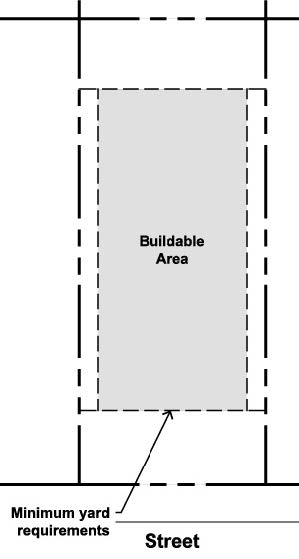
Basement: The portion of a building below the first story and having more than one-half (½) its height below grade.
Berm: A mound of earth.
Best Management Practices: A combination of methods, measures, procedures, and practices that prevents or reduces adverse impacts of development sites such as runoff, spillage or leaks, sludge or waste disposal, or drainage on adjoining site's land, water, or waterways.
Buildable Area: The area of a lot not included within the yards or open spaces herein required (Fig. V-1).
Building: Any structure designed, built, or used for the support, enclosure, or protection of persons, animals, chattels, or property of any kind.
Building, Community: A building used for social, recreational, or educational activities of the residents in the neighborhood or community. Such building owned by a government agency, welfare, religious organization, or nonprofit civic organization, and not operated for commercial gain.
Building, Height of: The vertical distance from the grade to the highest point of the coping of a flat roof or to the deck line or highest point of coping or parapet of a mansard roof, or to the main height level between eaves and ridges for gable, hip, shed, and gambrel roofs. When the highest wall of a building with a shed roof is within thirty (30) feet of the street, the height of such buildings shall be measured to the highest point of coping or parapet.
Figure V-2: Measuring the Height of Buildings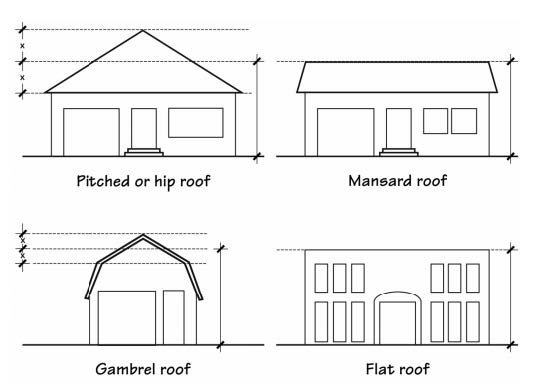
Buffer Yard: A landscaped area to separate and partially obstruct the view of two (2) adjacent land uses or properties from one another.
Caliper: The diameter of a tree, measured at a point six (6) inches above the ground line if the resulting measurement is no more than four (4) inches. If the resulting measurement is more than four (4) inches, the measurement is made at a point twelve (12) inches above the ground line; multi-stem trees must be specified by height, not caliper.
Canopy: A detachable, roof-like cover, supported from the ground, deck, floor or walls of a building for protection from the sun or weather.
Carport: A canopy or shed open on at least two (2) sides for providing shelter for one or more vehicles.
Cellar: That portion of a building below the first story having more than one-half (½) of its height below grade.
Clearing: Includes, but is not limited to, the removal of trees, shrubbery brush, ground cover, and/or topsoil from any part of the land, but does not include maintenance mowing or trimming.
Commercial, Business and Industrial (GFA): The sum of the gross horizontal areas of the several floors of a building measured from the exterior faces of the exterior walls or from the centerline of walls separating two (2) buildings but not including:
(a)
Attic space, providing less than seven (7) feet of head room
(b)
Cellar space not used for retailing
(c)
Outside stairs or fire escapes, roof overhangs and balconies
(d)
Accessory water towers or cooling towers
(e)
Accessory off-street parking spaces
(f)
Accessory off-street loading area
Comprehensive Plan: Also known as, a master or general plan is the collection of information and material including a set of goals, policies, and guidelines intended to direct the present and future physical, social, and economic development that occurs within a city or parish, as required by LA RS 33:104.
Conditional Use: A use that, because of special requirements or characteristics, may be allowed in a particular zoning district only after review by the Planning Commission and granting of a conditional use permit imposing such conditions as necessary to make the use harmonious or compatible with neighboring uses, as outlined in article VI of this ordinance.
Court: An open space at ground level, which may or may not have direct street access around which is arranged a single building or a group of related buildings.
Culinary or Cooking Facilities: A space in a dwelling arranged, intended, designed, or used for the preparation of food for a family. Facilities may include a sink, stove, cabinets, and refrigerator or any kind of combination of these arranged in such space. A refrigerator alone shall not constitute culinary or cooking facilities under this definition.
DBH (diameter at breast height): The method used to measure caliper by the timber industry, which is taken approximately four and one-half (4½) feet high on the trunk of a tree above the ground line.
Development Project: A public or private sector venture involving the development, structural modification, or redevelopment of commercial, industrial, residential, or other properties.
Development Site: A legally established lot or parcel of land occupied or capable of being occupied by a building or group of buildings including accessory structure(s) and accessory use(s), together with such yards or open spaces, off-street parking and vehicular use area, and setback areas as are required by this ordinance and having frontage upon a public or private street.
Developed Site: Premises that contain existing structures or buildings for which a building permit is required.
District, Zoning: An area or areas within the limits of the city for which the regulations and requirements governing use, lot, and size of building and premises are uniform.
District, Commercial: Any district designated in these regulations as a business or commercial district, and permitting the purchase, sale, or transaction for the disposition of any article, substance, commodity, or service; the maintenance or conduct of offices, professions, or recreational or amusement enterprises conducted for profit and also including renting of rooms, business offices, and sales display rooms and premises.
District, Industrial: That portion of the city with designated land uses characterized by production, manufacturing, distribution, or fabrication activities.
District, Residential: Any single-family, two-family or multifamily residential zoning district or a planned unit development where a majority of the land area or floor area is devoted to residential dwelling uses.
Dormitory: A building intended or used principally for sleeping accommodations where such building is related to an educational or public institution, including religious institutions and hospitals.
Drip Line: A vertical line extending from the outermost portion of the tree canopy to the ground.
Drive-in: A term used to describe an establishment designed or operated to serve a patron while seated in an automobile parked in an off-street parking space.
Exotic Dancers: Any male or female performer or male or female impersonator hired to dance, gyrate, twist or do any other physical performance on the floor, tables, stage or other contrivance in a sexually suggestive or provocative manner on the premises of any private or public property, whether said performer is paid a salary or receives compensation by way of gratuities by customers or commission.
Family: One or more persons occupying a single dwelling unit with a single, indoor culinary facility, as a single housekeeping unit, provided that unless all members are related by blood, marriage, or adoption, no such family shall contain over six persons, including any roomers, boarders, and/or domestic servants.
Family-Unit: A single housekeeping unit with complete, independent facilities for living, sleeping, cooking and dining.
Floor Area, Gross (GFA): The total area of all floors of a building, including basements, mezzanines, and upper floors, if any, expressed in square feet and measured from the centerline of joint partitions and from outside wall faces.
Floor Area Ratio (FAR): The floor area of a building or buildings on a lot divided by the lot area.
Figure V-3: Floor Area Ratio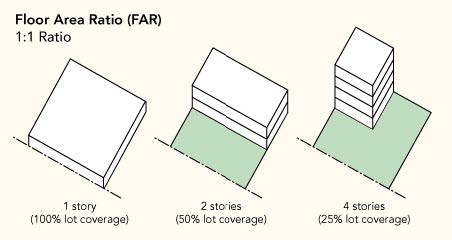
Frontage, Street: The distance along a street line from one intersecting street to another or from one intersecting street to the end of a dead-end street.
Frontage, Lot: The distance for which the front lot line and the street line are coincident.
Gallery: A railing enclosed platform, projected from and supported by an outer wall of a building and supported from the ground by columns.
Grade: The required elevation of the ground at the building or building site as established by the building code of the City of Kenner.
Greenbelt: Required landscaping space adjacent to the property line of any public right-of-way of which the developed site fronts.
Ground Cover: Low growing plant material installed in such manner as to provide a continuous cover of the ground surface that can be maintained at a height of not greater than twelve (12) inches. For example, Asian jasmine or Mondo grass.
Hardship: A restriction on property so unreasonable that it results in an arbitrary and capricious interference with basic property rights. Hardship relates to the physical characteristics of the property, not the personal circumstances of the owner or user. A hardship may occur if the property is rendered unusable without the granting of a variance.
Institution: A building or group of buildings designed or used for the nonprofit, charitable, or public service purposes of providing board, lodging, help, care for persons aged, indigent, or infirm or for the purpose of performing educational or religious services and offering board and lodging to persons in residence.
Institutional Entity: An established organization or corporation, especially of a public or charitable character, including, but not limited to, religious, educational, charitable, public service or cultural organizations.
Junk: Abandoned or dilapidated automobiles, trucks, tractors, and other such vehicles and parts thereof, abandoned or dilapidated wagons and other kinds of vehicles and parts thereof, scrap building materials, scrap contractor's equipment, tanks, casks, cans, barrels, boxes, drums, piping, bottles, glass, old iron, machinery, rags, paper, excelsior, hair mattresses, beds or bedding, or any other kind of scrap or waste material which is stored, kept, handled or displayed.
Junkyard: A lot, land, or structure, or part thereof, used for the collection, storage, and sale of waste paper, rags, scrap metal, or discarded material; or for the collecting, dismantling, storage, salvaging, or sale of parts or machinery or vehicles not in running condition.
Landscaping: Any combination of living plants such as trees, shrubs, vines, ground covers, flowers or lawns. It may include natural features such as rock, stone, and bark or structural features, including, but not limited to, fountains, reflecting pools, art works, screen walls, fences, and benches.
Landscape plan: A scaled plan that clearly delineates vehicular use areas and displays and describes all landscaping, to include methods of irrigation and maintenance, and all other features of landscape areas to comply with the provisions of this ordinance.
Loading Space: A space within the main building or on same lot, providing for the standing, loading or unloading of trucks. The space shall have a minimum area of five hundred forty (540) square feet with a minimum width of twelve (12) feet, a maximum depth of thirty-five (35) feet, a vertical clearance of at least fourteen and one-half (14.5) feet, and must be an impervious, hard-surface area connected to an accepted for maintenance street or alley by an impervious hard surface driveway.
Figure V-4: Lot Types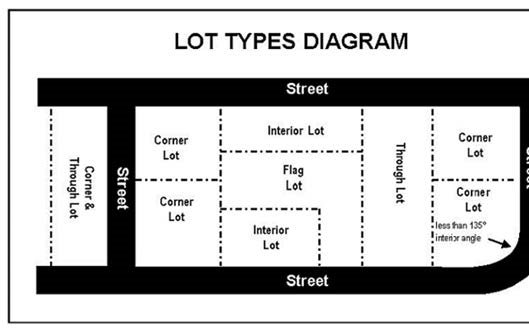
Lot: A parcel of land occupied or which may be hereafter occupied by a building and its accessory buildings, together with such open spaces and parking spaces or area as are required under this ordinance and having its principal frontage upon an officially approved street or place.
Lot Area: The total horizontal area within the lot lines of the lot.
Lot, Corner: A lot abutting on two (2) or more streets at their intersection.
Lot, Depth of: The average horizontal distance between the front and rear lot lines.
Lot, Interior: A lot other than a corner lot.
Lot Line: A line dividing one lot from another or from a street or other public place.
Lot of Record: A lot which is a part of a subdivision, the map of which has been recorded in the office of the clerk of the court and assessor's office or a parcel of land which can be legally established and defined by a deed or act of sale on or before the adoption of this ordinance.
Lot, Through (Double Frontage): A lot having a frontage on two (2) approximately parallel streets or places.
Lot, Width: The average horizontal distance between the side lot lines, measured at the required front yard line and parallel to the front street line, or measured at the street line if no front yard is required.
Main Building: Any building having the predominant land use which is not an accessory building.
Mast: A frame supporting antennas not exceeding thirty-five (35) feet in height which is mounted on a roof or some other structure.
Median: The land in the center of the right-of-way, which is used to separate the directional flow of traffic, and may contain left turn pockets. A median is often locally referred to as a "neutral ground."
Monopole, Standard: A single self-supporting vertical pole with no guy wire anchors, usually consisting of a galvanized or other unpainted metal, or a wooden pole with below grade foundations that is intended to support antennas necessary to deliver and receive telecommunications transmissions.
Monopole, Nonstandard: A monopole, or other freestanding structure containing antennas, which is designed to camouflage the appearance of a standard monopole, such as a clock tower. Nonstandard monopoles shall be designed, subject to the guidelines herein, to be aesthetically compatible with character of the neighborhood in which they are located. Artificial tree designs shall not be permitted as nonstandard monopoles.
Motorized Home: Is a portable dwelling designed and constructed as an integral part of a self-propelled vehicle, and limited to eight (8) feet in width, forty-five hundred (4,500) pounds in weight, and twenty-nine (29) feet in length. A motorized home is considered a recreation vehicle.
Neutral Ground: See "Median."
Nonconforming Structure: A structure, or a portion thereof, that no longer conforms to the site area, coverage, setback, or other regulations prescribing physical development standards for the district in which such structure is located.
Off-Street Parking: Vehicle parking anywhere but on the streets. These are usually parking facilities like garages and lots. Off-street parking can be both indoors and outdoors. Off-street parking also includes private lots, garages and driveways.
On-Street Parking: Vehicle parking on the street, anywhere on or along the curb of streets.
Opacity: An imaginary vertical plane extending from the established grade to a required height, of which a required percentage will be visually screened from adjacent property use.
Open Space: An area or portion of land, either landscaped or essentially unimproved and which is used to meet human recreational or spatial needs, or to protect air, water or plant areas.
Open Space Ratio: The open space on the lot (excluding required parking) divided by the total floor area of any building or buildings on the lot.
Parking Space: An area enclosed in the main building or in an accessory building, or unenclosed, permanently reserved for the storage of one (1) motor vehicle and connected to an accepted-for-maintenance street or alley by a driveway providing unobstructed ingress and egress for motor vehicles.
Permit: An official document authorizing performance of a specific activity regulated by the Code of Ordinances.
Pickup Coach: Is a structure designed primarily to be mounted on a pickup or truck chassis and with sufficient equipment to render it suitable for use as a temporary dwelling for travel, recreation and vacation uses, and limited to eight (8) feet in width, forty-five hundred (4,500) pounds in weight, and twenty-nine (29) feet in length. A pickup coach is considered a recreation vehicle.
Plant Material: Any plant including trees, vines, shrubs, ground covers and annuals or vegetation of any size, species, or description.
Public Monument: A building, pillar, or similar structure either erected in memory of the dead or a person or event by a public agency or controlled by a public agency.
Recreation Vehicle: A vehicle, or similar means of human transportation, used primarily for recreational purposes or as a temporary dwelling for travel. Recreational vehicles include, but are not limited to, dirt bikes, all-terrain vehicles, campers, pop-up campers, travel trailers, motor homes, and pickup coaches designed to be mounted on a truck chassis.
Recreational Watercraft: A watercraft, or similar means of human transportation over water, used primarily for recreational purposes. Recreational vehicles include, but are not limited to, boats, rafts, jet skis, personal watercraft and their trailers.
Residential (GFA): The gross horizontal areas of the several floors of the dwelling exclusive of garages, cellars, and open porches, measured from the exterior faces of the exterior walls of a dwelling.
Residual Areas: Excess space not used for parking, walkways, or other site amenities.
Right-of-Way: Public easement or servitude or property owned by a subdivision of the state containing roadways, medians, berms, utilities, pipelines, drainage ditches and canals.
Shrub: A woody perennial plant differing from a perennial herb by its persistent and woody stems and from a tree by its low stature (generally obtaining a height less than eight (8) feet and its habit of branching from the base. For the purposes of this ordinance, shrubs shall be defined as obtaining a minimum height of thirty-six (36) inches at maturity. For example, Indian hawthorn or azalea.
Sidewalk: A paved surface or leveled area separated from the street and used as a pedestrian walkway.
Sign: For definitions pertaining to signs, see article XI, section 11.06.
Site Plan: A plan (to scale) showing uses and structures proposed for a parcel of land as required by the regulations involved. Its purpose is to show how the intended use relates to the major landscape features, and the surrounding areas. Requirements and procedures for "Site Plan Review" are found in article VI of this ordinance.
Site Plan Approval: A process for the review and approval of a development plan prior to the issuance of a construction permit.
Story: That portion of a building, other than a cellar or basement, included between the surface of any floor and the surface of the floor next above it, or if there be no floor above it, then the space between the floor and the ceiling next above it.
Street: A public or private thoroughfare, which affords a principle, means of access to abutting property.
Street Façade: That exterior side of a building, which faces, and is most nearly parallel to, a public or private street. The façade shall include the entire building walls, including wall faces, parapets, fascia, windows, doors, canopies, and visible roof structures of one (1) complete elevation.
Street Line: A line separating a lot, tract, or parcel of land, and abutting a street right-of-way.
Street, Major: Streets, which serve high-volume travel corridors that, connect major generators of traffic such as commercial centers, large industrial centers, major residential communities, and other major activity centers.
Street, Minor: public streets that provide access to individual single-family residential lots, provide entry and exit to the neighborhood, and provide connectivity to major streets.
Structure: Anything constructed or erected, the use of which requires a location on the ground, or attached to something having a location on the ground, including, but without the generalities of the foregoing, advertising signs, billboards, backstops for tennis courts, fences, and pergolas.
Structural Alteration: Any change in the supporting members of a structure such as footings, foundations, bearing walls, or partitions, columns, beams or girders, or any substantial change in the roof or the exterior walls.
Temporary Building: A structure erected to aid in the construction of a permanent project.
Theater: A building or part of a building devoted to showing motion pictures, or for dramatic, dance, musical, or other live performances.
Traffic Impact Analysis (TIA): An analytical and informational document prepared by a licensed traffic engineer or civil engineer in connection with a specific proposed land use development that forecasts, describes, and suggests ways of off-setting the traffic effects of the proposed new activities within a geographic area. A traffic impact analysis is required for any major new development, Planned Unit Development (PUD), or new residential subdivisions of twenty (20) lots or more anticipated to generate more than one hundred (100) new directional trips in either the AM (6:00 to 9:00) or PM (3:00 to 6:00) peak periods.
Trailer: A vehicle without motive power, designed to be towed by a passenger automobile but not designed for human occupancy and which may include a utility trailer, boat trailer, horse trailer, or snow mobile trailer.
Transmission Tower: A structure or framework, usually of a steel lattice construction, principally intended to support radio, cellular, telecommunications, television, electric utility and/or any other electromagnetic transmissions, and receiving antennas and/or equipment.
Travel Trailer: Is a recreation vehicular, portable structure built on a chassis, designed as a temporary dwelling for travel, recreational, and vacation uses; permanently identified "travel trailer" by the manufacturer of the trailer and, when factory equipped for road, having a body width not exceeding eight (8) feet, a body length not exceeding twenty-nine (29) feet, and a gross weight not exceeding forty-five hundred (4,500) pounds.
Tree - Class A: Any self-supporting woody plant of a species that normally grows to an overall height of fifty (50) feet or more, usually with one (1) main stem or trunk, and many branches. Class A trees may be counted toward Class B tree requirements, however, Class B trees may not be counted toward Class A tree requirements.
Tree - Class B: Any self-supporting woody plant of a species that normally grows to an overall height of twenty-five (25) feet or more, usually with one (1) main stem or trunk, and many branches. It may have multiple stems or trunks; for example, crape myrtle. Class A trees may be counted toward Class B tree requirements, however, Class B trees may not be counted toward Class A tree requirements.
Tree Preservation: Any portion of a site containing existing trees that are proposed to be preserved in order to comply with the requirements of this ordinance.
Vacant: A lot, parcel of land, or building that is not actively used for any purpose, and in which no improvements have been constructed.
Variance: A variance is a relaxation of the terms of the zoning ordinance where such variance will not be contrary to the public interest and where, owing to conditions peculiar to the property and not the result of the actions of the applicant, a literal enforcement of the ordinance would result in unnecessary and undue hardship. As used in this ordinance, a variance is authorized only for height, area, and size of structure or size of yards and open spaces; establishment or expansion of a use otherwise prohibited shall not be allowed by variance, nor shall a variance be granted because of the presence of nonconformities in the zoning district or uses in an adjoining zoning district.
Vegetation: Plant life, including, but not limited to, trees, shrubs, flowering and non-flowering plants.
Vehicle - Commercial: A vehicle bearing or required to bear a commercial license plate, and having a gross vehicle weight of less than 10,000 pounds designed for the transportation of commodities, merchandise, produce, freight, animals, or passengers in the furtherance of any commercial enterprise.
Vehicle - Heavy Commercial: Any vehicle bearing or required to bear commercial license plates and/or any motor vehicle, trailer, or semi-trailer designed or used to carry freight, passengers for a fee, or merchandise, including, but not limited to, dump trucks, motorized heavy construction vehicles, solid waste collection vehicles, commercial haulers, concrete mixer trucks, towing and recovery vehicles, any vehicle in which food or beverages are stored or sold, and any vehicle designed or used to transport heavy construction, landscaping, or lawn care equipment in the furtherance of any commercial enterprise and having a gross weight of more than 10,000 pounds, and has one (1) or more of the following specifications:
(a)
Exceeds eight (8) feet in height which includes the total vertical dimension of any vehicle above the ground surface including any load and/or load-holding devices thereon; and
(b)
Exceeds twenty-one (21) feet in length which includes the total longitudinal dimension of a single vehicle, including load, meaning from the front of the vehicle to its rear and including any load-holding devices thereon;
(c)
Has special equipment that distinguishes it from private passenger automobiles including, but not limited to, a crane or an electronic message board.
Vehicular Use Area: All area subject to vehicular traffic, including access ways, driveways, loading areas, service areas, and parking lots and stalls for all types of vehicles.
Waterway: Any body of water, including any bayou, creek, canal, river, lake, or bay, or any other body of water, natural, artificial, except a swimming pool, or ornamental pool located on a single lot.
Yard: An open space other than a court at existing ground level between a buildable area and the adjoining lot lines, unoccupied and unobstructed by any portion of a structure from the ground upward except as otherwise provided herein. For the purposes of determining yard measurements, the least horizontal distance between a lot line and the buildable area shall be used.
Yard, Front: A yard extending across the front of a lot between the side yard lines, and being the required minimum horizontal distance between the street line and the maximum permissible main building. On corner lots, the front yard shall be considered as parallel to the street upon which the lot has its least dimension.
Yard, Rear: A yard extending across the rear of a lot between the side lot lines and being the required minimum horizontal distance between the rear lot line and the rear of the building area. On both corner lots and interior lots, the rear yard shall in all cases be at the opposite end of the lot from the front yard.
Yard, Side: A yard between the main building and the side lot line and extending from the required front yard to the required rear yard and being the required minimum horizontal distance between the side lot line and the side line of the buildable area.
Figure V-5: Yard Types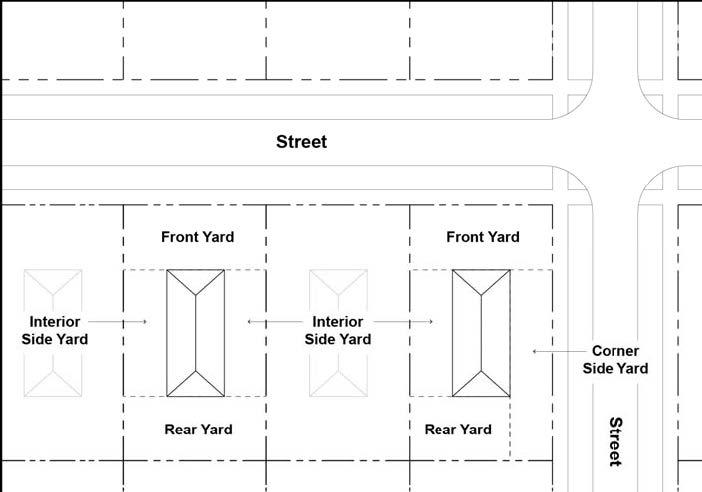
Zoning: A police power measure in which the city is divided into districts or zones within which permitted and special uses are established as are regulations governing lot size, building bulk, placement, and other development standards.
Zoning, Spot: An arbitrary rezoning of a parcel or parcels of land located within a larger zoned area of a markedly or substantially different zoning or land use intensity that is not consistent and noncompliant with the city's comprehensive plan and current zoning restrictions. A spot zoning of land primarily promotes the private interest of the individual owner rather than the general welfare of the greater community.
(Ord. No. 11,337, § 2, 10-5-17; Ord. No. 11,394, § 1, 4-5-18)

