
Kenner City Zoning Code
ARTICLE VII
Off-Street Parking and Loading Regulations
Section 7.01 - Intent and Purpose
The off-street motor-vehicle parking, bicycle parking, and loading regulations of this Article are intended to provide off-street parking and loading areas, and provide the appropriate number of spaces in proportion to the demands of the proposed use for the following purposes:
(1)
To promote and protect the health, safety and welfare of the City by ensuring the compatibility of required parking areas with surrounding architecture and land uses.
(2)
To establish a comprehensive system of controls governing the design, construction, location, installation, maintenance, and number of required off-street parking spaces.
(3)
To create a more attractive business and economic climate by enhancing and protecting the orderly and effective use of parking.
(4)
To properly regulate the number of required off-street parking spaces so as to provide for the needs of occupants, customers, visitors or others involved in use or occupancy of any building, structural improvement or place of assembly.
Section 7.02 - General Provisions
(a)
Existing Facilities:
(1)
No land shall be used or occupied and no structure shall be erected or used unless the off-street parking spaces required herein are provided. Such parking spaces are not required for any structure or use existing at the time of enactment of this ordinance; however, the parking spaces as specified herein shall be provided for any enlargement to any such existing structure or use.
(2)
If a building permit was lawfully issued prior to the effective date of this ordinance, and if substantial construction has begun within one-hundred and eighty (180) days of the issuance of a permit, the number of off-street motor-vehicle, bicycle, and loading spaces that is required by the building permit shall supersede what may be required by this Article.
(b)
Damage or Destruction: In the event that a structure is damaged to an extent of less than fifty percent (50%) of its replacement value, the off-street motor vehicle, bicycle and loading spaces may be restored in the same amount prior to damage. However, it is not necessary to restore or maintain spaces in excess of the amount required by this Ordinance.
(c)
Change in Intensity of Use: Whenever the intensity of a use is increased based on an increase in the number of dwelling units, floor area, seating capacity or other unit of measurement used to calculate the number of required number of vehicle and bicycle parking spaces, additional spaces shall be provided for that increase, except as described below:
(1)
Whenever there is an increase in the intensity of a use that creates a need for additional vehicle parking spaces of ten percent (10%) or more, the additional spaces are required. No additional vehicle parking spaces are required if the greater intensity would result in an increase of spaces of less than ten percent (10%). This also applies to a simultaneous increase in intensity of a group of uses on the same lot which together result in a need for an increase in vehicle parking spaces of ten percent (10%) or more. The ten percent (10%) threshold is calculated by dividing the number of additional spaces required due to the increase in intensity divided by those spaces required before the increase.
(d)
Provision of Additional Vehicle Spaces:
(1)
Nothing in this Article prevents the voluntary establishment of additional off-street vehicle and bicycle parking spaces above that required by this Ordinance, unless the Ordinance specifies a maximum number of vehicle spaces in Section 7.04. There is no limit on the number of bicycle parking spaces that may be provided.
(2)
All regulations governing the location and design of additional facilities shall meet the requirements of this Ordinance.
(3)
Where a use exceeds the minimum number of vehicle spaces required by Section 7.04, the area used for additional spaces may be constructed of permeable paving.
(e)
Shared parking requirements for mixed-use developments:
(1)
Shared parking for mixed-use developments is based on the fact that certain uses operate at different times over a twenty-four-hour period with their greatest demand for parking occurring during mutually exclusive times. These uses are, therefore, able to share parking spaces during particular times and under certain conditions, the total number of parking spaces otherwise required for individual uses may be reduced.
(2)
For purposes of these requirements, shared parking for mixed-use developments refers to two (2) or more land uses occupying the same lot or occupying contiguous lots with parking located on the same lot or contiguous lot upon which the uses sharing the parking are located. Shared parking refers to the use of the same off-street parking stall to satisfy the off-street parking requirements for two (2) or more uses. The following conditions shall apply to all shared parking for mixed-use developments.
(3)
Shared parking is permitted by agreement only. The agreement must:
a.
Be in writing and executed by all owners of the properties affected;
b.
Specify the parking being shared and the hours of operation by the uses involved;
c.
Be enforced by the Director of Inspection and Code Enforcement and the City Attorney;
d.
Be recorded in the office of the clerk of court by the owner(s) of the property affected and a copy furnished to the Director of Inspection and Code Enforcement and the Director of Planning and Zoning.
e.
An affidavit stating that the shared parking agreement is valid and no change in use or hours of operation of the affected properties has occurred shall be submitted annually to the Director of Inspection and Code Enforcement.
f.
A violation shall occur if a use is operated at a time other than during the hours of operation specified in the shared parking agreement. The Director of inspection and code enforcement shall revoke the certificate of use or occupancy for any use operated in violation of a shared parking agreement.
(4)
No variances or exceptions from the parking requirements of this ordinance shall be granted by the Board of Zoning Adjustments.
(f)
Prohibited Use of Parking Spaces: The sale, repair or dismantling or servicing of vehicles, equipment, materials or supplies, or the display of goods in off-street parking areas is prohibited, unless otherwise permitted by this ordinance. Off-street parking areas associated with residential and commercial developments are not to be used for the permanent storage of fleet vehicles.
Section 7.03 - Computation of Parking and Loading Requirements
This section describes how the number of motor vehicle, bicycle, and loading spaces are calculated based upon the requirements of this Article.
(1)
Where multiple uses with different parking requirements occupy the same structure or lot, the required vehicle and bicycle parking and loading spaces is the sum of the requirements for each use computed separately, unless otherwise permitted by this Ordinance.
(2)
Space allocated to any off-street loading space may not be used to satisfy the requirement for any off-street vehicle or bicycle parking space or access aisle or portion thereof. Conversely, the area allocated to any off-street vehicle or bicycle parking space may not be used to satisfy the replacement for any off-street loading space or portion thereof.
(3)
A fraction of less than one-half (½) is disregarded, and a fraction of one-half (½) or more is counted as one (1) parking or loading space.
(4)
For uses where patrons or spectators occupy benches, pews or open floor areas, every eighteen (18) linear inches of benches, pews, or permanent seating areas, or five (5) square feet of open floor area used for seating is counted as one (1) seat for the purpose of determining the required number of spaces or as reflected in the most recent version of the International Building Code by the International Code Council.
Section 7.04 - Required Off-Street Motor Vehicle and Bicycle Parking Spaces
(a)
General Requirements:
(1)
The minimum number of off-street vehicle and bicycle parking spaces to be provided for a principal use is listed in Table VII-1: Off-Street Parking Requirements, except as otherwise provided in this ordinance. All off-street parking shall be completed prior to the issuance of a certificate of occupancy. The location, size, and all other design and construction elements of all required parking spaces shall be provided at the time of issuance of the building permit.
(2)
Table VII-1 lists parking requirements for the principal uses listed in the zoning districts. In some cases, uses that are considered part of a generic use category are listed with specific vehicle parking requirements. These specific uses are listed only for the purposes of this section and do not indicate whether such uses are permitted or special uses within any district.
(3)
For uses not specifically mentioned in this section, the requirements for off-street parking and loading facilities for a similar use specifically mentioned in this section shall apply as determined by the Director of Planning.
(b)
Maximum Vehicle Parking Limitations: The following vehicle parking maximums are applicable to all surface parking lots:
(1)
When new vehicle parking areas are constructed for shopping centers or fast food restaurants, the number of vehicle parking spaces provided may not exceed one-hundred twenty-five percent (125%) of the required minimum.
(2)
When new vehicle parking areas are constructed for all other uses, the number of vehicle parking spaces provided may not exceed one-hundred fifty percent (150%) of the required minimum.
(3)
Parking maximums do not apply in the S-I, L-I, H-I, and AH-I Districts.
Table VII-1: Off-Street Parking Requirements
*GFA - Gross Floor Area
Section 7.05 - Required Off-Street Loading Spaces
(a)
Off-street loading spaces shall be provided for a use that distributes or receives materials or merchandise by truck or other commercial vehicles in accordance with Table VII-2: Off-Street Loading Requirements except as otherwise provided in this ordinance.
(b)
No structure is required to provide more than five (5) loading spaces.
(c)
Structures that are fifty (50) years old or more and were originally constructed without loading areas are exempt from the off-street loading requirements. Any additions or enlargements to such structures require the addition of one (1) off-street loading space.
(d)
In the case of multi-tenant developments, required loading spaces are calculated on the basis of each individual tenant. If the floor area of each individual use is below the minimum for required loading spaces, but the aggregate floor area of all uses is greater than such minimum, then at least one (1) but no more than two (2) off-street loading spaces shall be provided. In such cases, the Director of Inspection and Code Enforcement may make reasonable requirements for the location of required loading spaces.
(e)
In the case of commercial uses that utilize outdoor space for the storage and/or display of saleable goods, such as in the case of automotive sales, at least one (1) off-street loading space must be provided.
(f)
If a use increases, the floor area by twenty-five percent (25%) or more, accessory off-street loading spaces are required in accordance with Table VII-2. However, no structure is required to provide more than five (5) loading spaces.
Table VII-2: Off-Street Loading Requirements
Interpretation of the chart: The loading space requirements apply to all districts but do not limit the special requirements, which may be imposed in the district regulations.
Section 7.06 - Design of Motor Vehicle Parking Spaces
(a)
Design Review Required. A design review shall be conducted by the Department of Inspections and Code Enforcement prior to any construction, alteration, or addition of any motor-vehicle parking lot or structure providing ten (10) or more motor-vehicle parking spaces. For the purposes of this section, construction, alteration, or addition includes:
[(1)]
All paving of previously unpaved surfaces.
[(2)]
Replacement of pavement with new binder and surface courses.
[(3)]
Construction of curbing.
[(4)]
Installation of new parking lot landscapes.
Construction, alteration, or addition does not include maintenance activities such as replacement of existing landscaping, repair of existing curbing, ordinary repairs, sealing, restriping, or placement of surface course pavement over previously paved areas.
(b)
Permitted Motor Vehicle Parking Locations:
(1)
Residential Uses:
a.
All required off-street motor-vehicle parking spaces for residential uses and the residential component of mixed-use developments shall be located on the same lot as the building or use served.
b.
For single-family and townhouse dwellings, required motor-vehicle parking spaces are permitted in private driveways or parking pads, but shall not encroach onto the public right-of-way. Tandem motor vehicle parking is permitted for residential uses but both spaces shall be allotted to the same dwelling unit and located on the same lot as the dwelling.
c.
Parking spaces for single-family dwellings, and two-family dwellings, and in the R-1 and R-1A single-family residential zoning districts, and the R-2 two-family residential zoning district, may be designed so that vehicles back out onto a public street. In all other residential districts, such design is prohibited.
d.
Parking is prohibited between the street curb and the nearest point of the front façade of any building if:
i.
On a corner lot, the building is within ten (10) feet of the front property line.
ii.
On a non-corner lot, the building is within five (5) feet of the front property line.
iii.
This does not include permitted driveways.
e.
All driveways shall have access to a legal parking space as required by this Ordinance.
(2)
Non-Residential Uses:
a.
Off-site motor-vehicle parking for a non-residential use may be located no more than three hundred (300) feet from the use served. Off-street vehicle parking spaces are subject to the following standards:
i.
The three hundred (300) foot distance is measured in a radius beginning from the perimeter lot lines of the off-site vehicular parking lot.
ii.
Off-site parking for a non-residential use is a permitted use in a non-residential district and a conditional use in a residential district.
iii.
Accessory off-street parking lots serving non-residential uses in a residential district require a conditional use permit and are subject to the following requirements:
1)
The parking lot shall be accessory to and used in connection with one (1) or more non-residential uses located in an adjoining district.
2)
The parking lot shall be used solely for the parking of passenger automobiles.
3)
Each access driveway from said parking lot shall be at least fifteen (15) feet from any lot line for a property located in a residential district.
b.
Parking is prohibited between the street line and the nearest point of the front façade of any building or within five (5) feet of the front property line when located on a corner lot for any non-residential uses.
c.
Parking spaces designed so that vehicles must back out onto public streets are not permitted.
(c)
Dimensions of Motor Vehicle Parking Spaces:
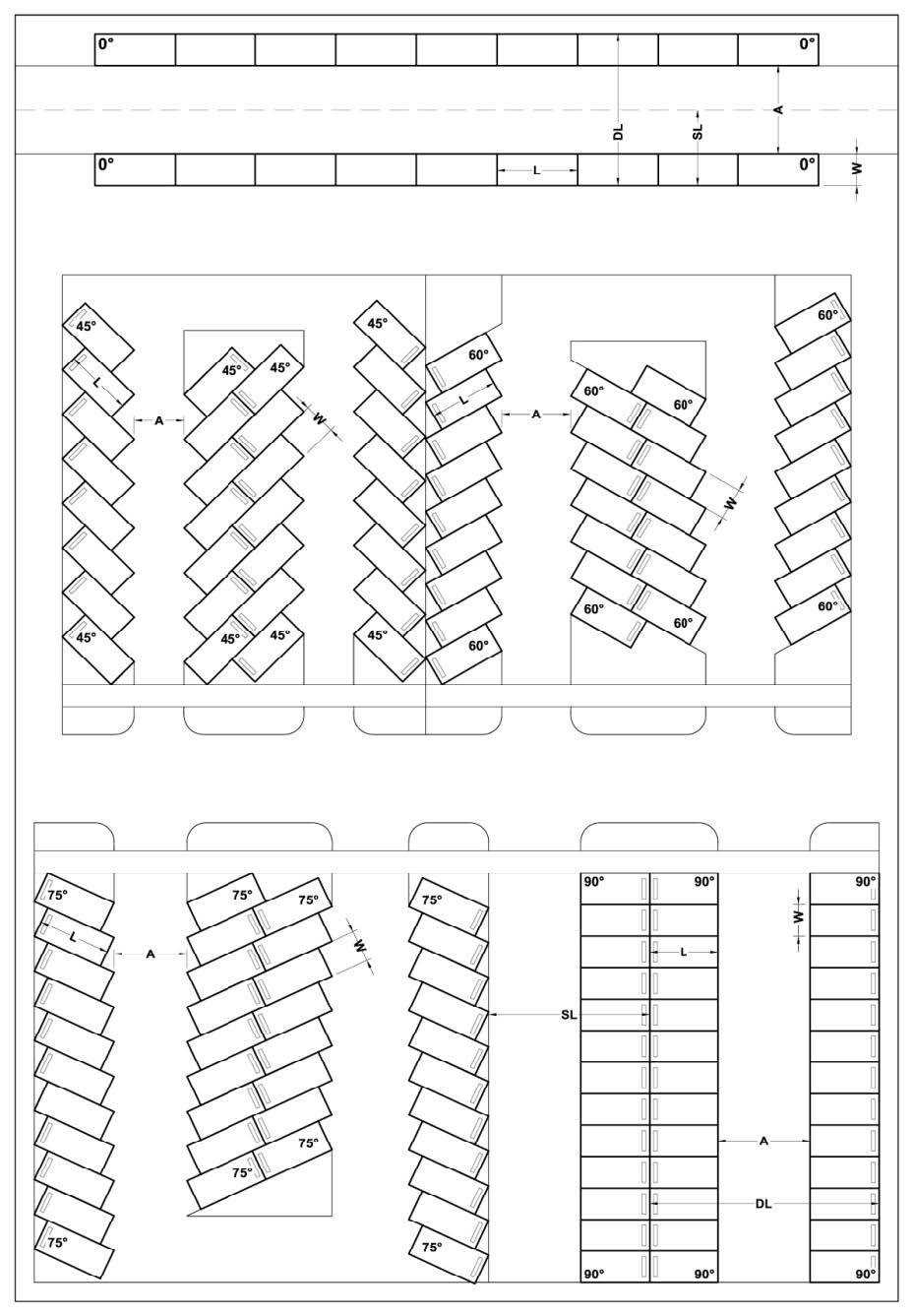
(1)
Off-street motor-vehicle parking spaces shall be designed in accordance with Table VII-3: Off-Street Motor Vehicle Parking Dimensions (Standard Space).
Table VII-3: Off-Street Motor Vehicle Parking Dimensions (Standard Space)
(2)
All motor-vehicle parking spaces shall have a minimum vertical clearance of seven feet six inches (7 '6").
(d)
Access Requirements for Off-Street Vehicle Parking Areas:
(1)
Each off-street motor-vehicle parking space shall open directly upon an aisle or driveway of adequate width to provide access to a motor-vehicle parking space.
(2)
All required off-street motor-vehicle parking facilities shall have vehicular access from a dedicated and accepted for maintenance street or cross-access connection.
(3)
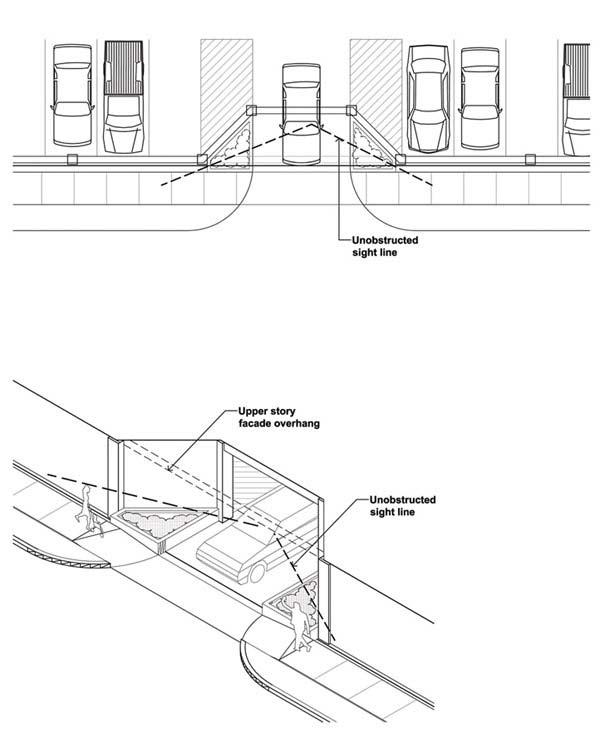
Within off-street parking lots and structures, one-way traffic aisles shall be a minimum of twelve (12) feet in width and two-way traffic aisles shall be a minimum of twenty-four (24) feet in width. Furthermore, all aisles shall be designed in accordance with Figure VII-1: Sight Distance Triangle for Parking Structure Driveways.
(4)
For parking structures that provide a deceleration lane leading to the entrance, the entrance ticket dispensers or access card point, including gates, shall be located at a distance sufficient to accommodate two (2) spaces for motor vehicles a minimum of twenty (20) feet in length for each space. When a deceleration lane is not provided, the entrance ticket dispensers or access card points and gates shall be located at a distance sufficient to accommodate four (4) spaces for vehicles a minimum of twenty (20) feet in length for each space.
(5)
A sight-distance triangle shall be provided for each driveway access point for a parking structure. The triangle is measured from the point where each side of the driveway intersects the property line. At the point of intersection at each side of the driveway and the property line, a line of ten (10) feet in length shall be drawn toward the interior of the structure to form the sight-distance triangle. Parking, fencing, landscape, or other obstructions taller than one (1) foot in height that would block the view of the driver are prohibited in the sight-distance triangle. (See Figure VII-1: Sight Distance Triangle for Parking Structure Driveways)
Figure VII-1: Sight Distance Triangle for parking Structure Driveways
(e)
Surfacing:
(1)
All surface parking lots shall be paved with a durable, all-weather material, or pervious paving. All uneven slabs shall be resurfaced to provide a smooth surface.
(2)
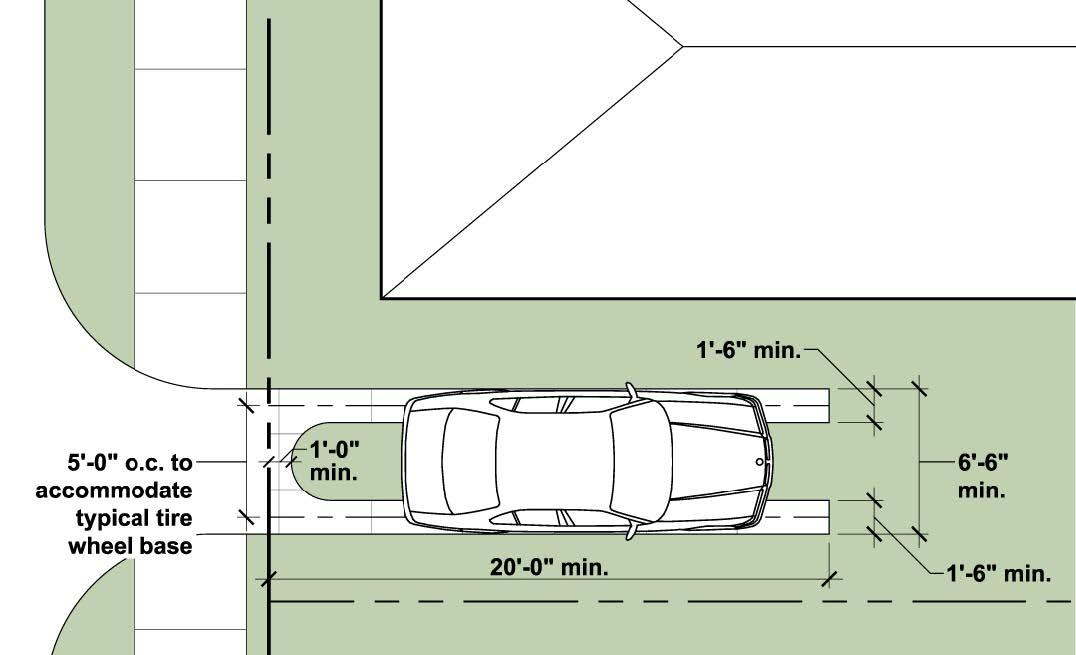
All single-family and two-family dwellings are permitted to construct driveways that consist of two (2) concrete wheel strips, each of which is at least eighteen (18) inches wide and at least twenty (20) feet long. A permeable surface, such as turf, shall be maintained between such wheel strips. (See Figure VII-2: Parallel Parking Strips)
(3)
Shells, gravel, crushed stone and bare earth are permitted paving materials for low volume parking areas or vehicle storage areas for spaces exceeding the minimum required spaces, pending design review by the Department of Inspections and Code Enforcement.
Figure VII-2: Parallel Parking Strips
(f)
Striping: Off-street parking areas shall be marked by painted or paver lines, curbs, or other means to indicate individual spaces, and maintained in clearly visible condition. Signs or markers should be used as necessary to insure efficient and safe circulation within the lot. Vehicle parking spaces for handicapped persons shall be identified with the appropriate sign and visible at all times of the year, regardless of plant growth or similar conditions.
(g)
Curbing and Wheel Stops: Wheel stops or curbing shall be provided to prevent vehicles from damaging or encroaching upon any adjacent parking or loading space, sidewalk, landscaped area, or parking lot island, fence, wall, or building. Within non-residential or mixed-use development parking lots, box curbs at least six (6) inches in height are required.
(h)
Drainage and Maintenance:
(1)
Off-street parking facilities shall be drained to eliminate standing water and prevent damage to abutting property and/or public streets and alleys, and surfaced with erosion resistant material in accordance with applicable City specifications. Post construction stormwater run-off shall not exceed pre-construction stormwater run-off and shall be retained on the development site to prevent damage to abutting property as per Article X: Stormwater Management.
(2)
Additions to existing parking lots of fifteen (15) or more motor-vehicle parking spaces shall be designed to filter or store the first one (1) inch of rainwater during each rain event. This can be accomplished through the use of pervious paving, rain gardens, bioswales, detention areas, constructed wetlands, and other methods deemed appropriate by the Planning Department and the Department of Public Works, as indicated in Landscape and Stormwater section. Parking lots for single-family, two-family, and multi-family dwellings of six (6) units or less are exempt from this requirement.
(3)
Off-street parking areas shall be maintained in a clean, orderly, and debris-free condition at the expense of the owner or lessee. A minimum of one (1) litter receptacle shall be included in any parking lot.
(i)
Lighting: Adequate lighting shall be provided if off-street parking spaces are to be used at night. All lighting shall be arranged to eliminate glare on residential property by location of light fixtures or use of fixtures designed to eliminate direct view of luminaries in fixtures from residential property.
(j)
Landscape and Screening: All parking lots shall be landscaped and screened in accordance with Article IX: Landscaping Regulations.
(k)
Accessible Vehicle Parking Requirements: All parking lots shall comply with the "ADA Accessibility Guidelines for Buildings and Facilities" regulations issued by federal agencies under the Americans with Disabilities Act of 1990 (ADA) for the amount and design of accessible vehicle parking spaces required in parking lots and structures.
(l)
Hydraulic Lifts: If a parking facility or garage utilizes hydraulic lifts to move vehicles, all hydraulic lifts shall be located within the parking structure.
(m)
Pedestrian Walkway Design within Parking Areas:
(1)
Separate vehicular and pedestrian circulation systems shall be provided where possible.
(2)
Clearly delineated crosswalks of paving, brick paver, bituminous brick pattern stamping, or painted striping shall connect landscaped areas and parking lot islands to building entrances to improve safe passageway for pedestrians. Curb cuts shall be included on landscaped areas or islands where such crosswalks are located.
(3)
The use of pervious paving for pedestrian circulation systems is encouraged.
(4)
Parking areas for developments with over fifty (50) parking spaces must have distinct and dedicated pedestrian access from the building entrance to parking areas and public sidewalks, according to the following standards:
a.
One walkway can serve as a collector for up to four (4) bays of parked cars.
b.
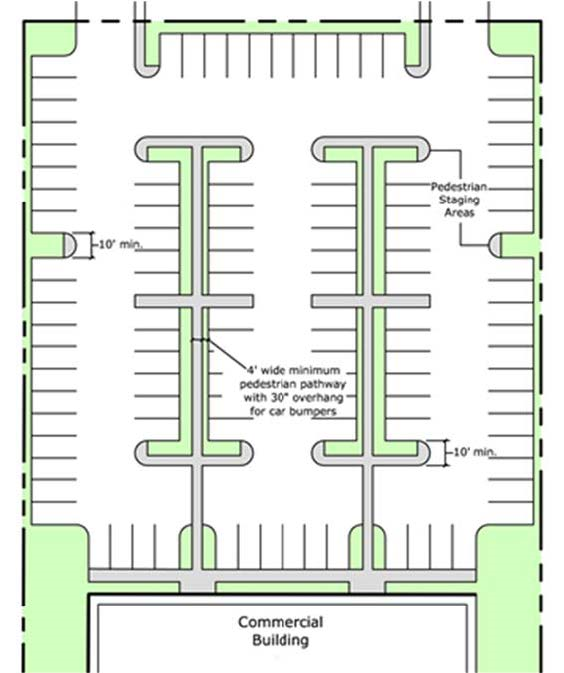
The walkways should be a minimum of four (4) feet wide, allowing an additional thirty (30) inches on each side for overhanging of automobiles.
c.
Pedestrian walkways shall be clearly differentiated from driveways, parking aisles, loading spaces, and parking spaces through the use of elevation changes, a different paving material, or similar method.
d.
Where a pedestrian walkway is parallel and adjacent to an automobile travel lane, it must be raised and separated from the automobile travel lane by a raised curb at least four inches high, bollards, or similar method.
e.
In a retail development, pedestrian staging areas are designed and required in order to separate automobiles circulation from pedestrian movement. Such landscaped areas or parking lot islands shall be ten (10) feet in width.
f.
A bump-out area shall be provided at the building entry in order to slow vehicle speeds in the lanes next to the building entry, and at designated pick-up and drop-off areas. Pick-up and drop-off lanes shall be parallel to vehicle circulation lanes.
For integration of pedestrian walkways with required landscaping, see Section 9.07 (d) for specific landscape requirements.
Figure VII-3: Pedestrian Walkways
Section 7.07 - Design of Bicycle Parking Spaces
If a development provides bicycle parking spaces, the following guidelines apply:
(a)
The bicycle parking area shall be convenient to building entrances and street access, but may not interfere with normal pedestrian and vehicular traffic.
(b)
Bicyclists should not be required to travel over stairs to access parking.
(c)
All bicycle spaces should be located on the same lot as the use or within fifty (50) feet of the lot when on private property.
(d)
Bicycle parking spaces should be located no more than fifty (50) feet from the principal building entrance and at the same grade as the sidewalk or an accessible route.
Section 7.08 - Design of Off-Street Loadings Spaces
(a)
Location: All off-street loading spaces shall be located on the same lot as the use served. No off-street loading spaces may project into a public right-of-way. No off-street loading space is permitted in a required front yard.
(b)
Dimensions:
(1)
All required off-street loading spaces shall be a minimum of twelve (12) feet in width, a minimum of thirty-five (35) feet in length, exclusive of aisle and maneuvering space, and have a vertical clearance of at least fourteen (14) feet.
(2)
Loading spaces for a funeral home may be reduced in size to ten (10) feet by twenty-five (25) feet and vertical clearance reduced to eight (8) feet.
(3)
Structures that are fifty (50) years of age or older, at the time of adoption of this ordinance, and maintain loading spaces that do not comply with the dimensions of this section, are deemed legally conforming in terms of loading space dimensions. If new loading spaces are constructed, such spaces may be designed to match the dimensions of existing loading spaces rather than the requirements of this section.
(c)
Surfacing: All off-street loading spaces shall be paved with a durable, all-weather material or an approved permeable paving system. Chapter 13, Article IV; City of Kenner Code of Ordinances.
(d)
Drainage and Maintenance: Off-street loading facilities shall be drained to eliminate standing water and prevent damage to abutting property and/or public streets and alleys, and surfaced with erosion-resistant material in accordance with applicable City specifications. Off-street loading areas shall be maintained in a clean, orderly, and debris-free condition at the expense of the owner or lessee. Any packing or other material associated with loading and unloading shall be contained within the loading area.
(e)
Access Control and Signs: Each required off-street loading space shall be designed with adequate means of vehicular access to a dedicated for maintenance street, in a manner that will minimize interference with traffic movement. Directional signs leading to loading areas shall be in accordance with Article XI: General Sign Regulations.
(f)
Lighting: Illumination of an off-street loading facility shall be arranged to deflect the direct rays of light away from adjacent properties and streets.
(g)
Landscape and Screening: All loading facilities shall be landscaped and screened in accordance with Article IX: Landscaping Regulations.
Section 7.09 - Driveway Design
(a)
Driveway Design:
(1)
Except for loading berths, driveways are limited to twenty-four (24) feet in width. Driveways shall be a minimum of eleven (11) feet for one-way drives, and a minimum of twenty-two (22) feet for two-way drives. Driveways in excess of twenty-four (24) feet in width may be approved by the Director of Inspections and Code Enforcement when necessary due to the special access required by the type of development.
(2)
More than one driveway may occur on any piece of property provided that each driveway is separated from the abutting driveway by a landscaped island of at least eight (8) feet in width.
(3)
Driveways must start no less than four (4) feet from an interior property line in all multi-family (R-MF) and non-residential zoning districts.
(4)
Driveways on corner lots must start no less than six (6) feet from a corner property line in all residential districts except multi-family (R-MF). For multi-family (R-MF) and non-residential districts, driveways may not start less than twenty (20) feet from a corner property line.
(b)
Cross-Access Servitudes:
(1)
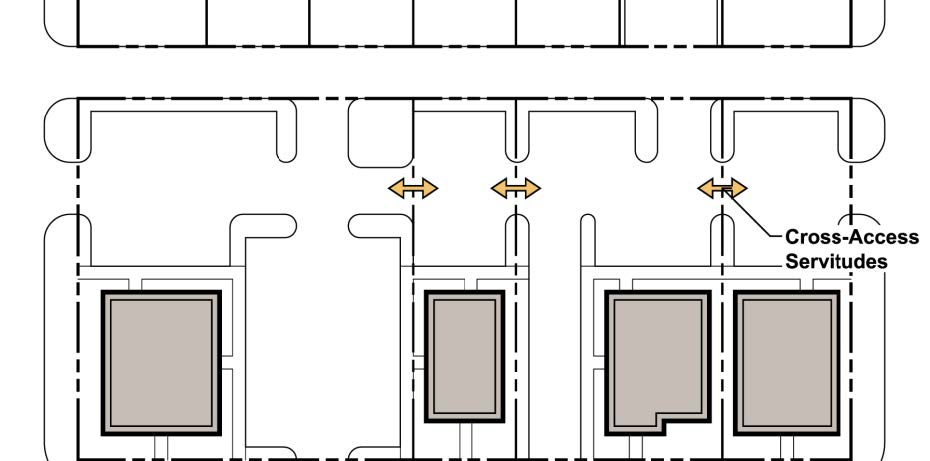
Adjacent commercial uses that possess dedicated parking areas are encouraged to provide a cross-access drive to allow circulation between sites. For new commercial, office, and service uses, a system of joint use driveways and cross-access servitudes is encouraged where feasible. Commercial property owners are encouraged to pursue cross-access with neighboring property owners at the time of development. If cross access is provided, the Director of Inspections and Code Enforcement shall require that the property owner provide proof that adjacent property owners have been contacted in writing regarding the provision of cross-access. (See
(2)
Joint-use driveways and cross-access servitudes shall incorporate the following:
a.
A minimum width of twelve (12) feet with no adjacent parking to ensure two-way travel aisles to accommodate automobiles, service vehicles and loading vehicles.
b.
Bump-outs and other design features to make it visually obvious that the abutting properties are tied together.
c.
A unified access and circulation plan for coordinated or shared parking areas.
(3)
Pursuant to this section, property owners who establish cross-access servitudes shall:
a.
Record a servitude allowing cross-access to and from properties served by the joint use driveways and cross-access servitude.
b.
Record a servitude that remaining access rights along the roadway will be dedicated to the City, and that any pre-existing driveways will be closed and eliminated after construction of the joint-use driveway.
c.
Record a joint maintenance agreement defining the maintenance responsibilities of each property owner.
Figure VII-4: Cross Access Servitudes
Section 7.10 - Vehicle Stacking Spaces for Drive-Through Facilities
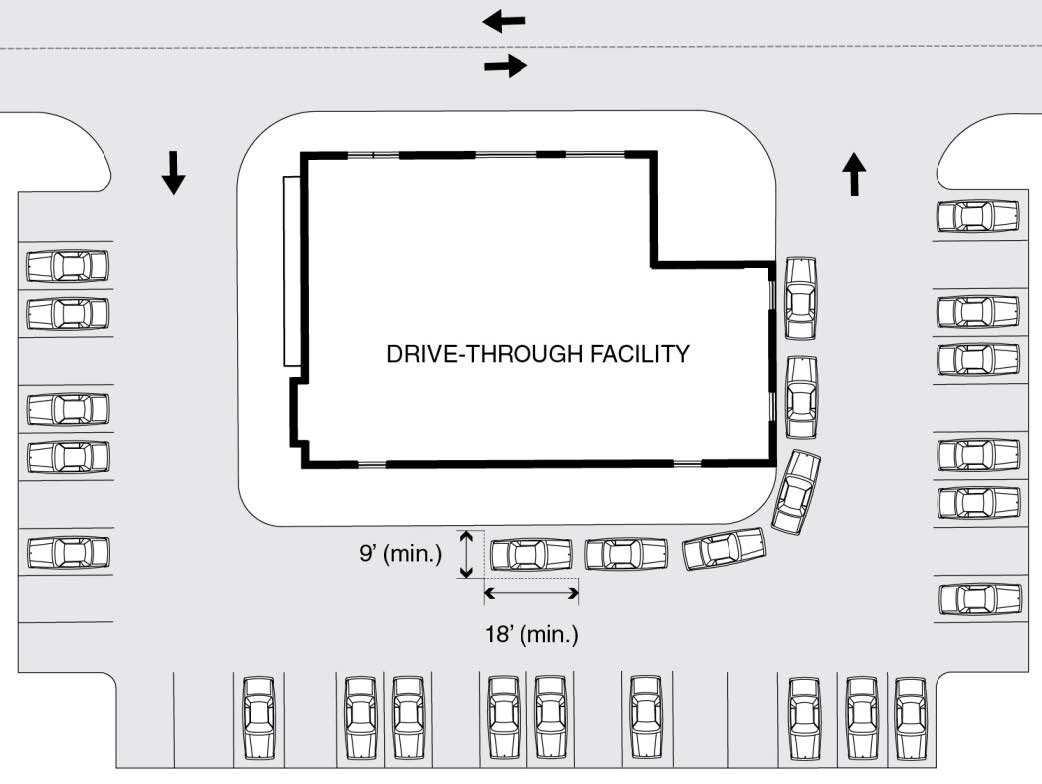
Every drive-through facility shall provide a minimum of three (3) vehicle stacking spaces per bay, unless otherwise required by Figure VII-5 of this Ordinance. Vehicle stacking spaces provided for drive-through uses shall be:
(a)
A minimum of nine (9) feet in width, as measured from the outermost point of any service window to the edge of the driveway, and eighteen (18) feet in length. (See Figure VI-5: Stacking Spaces)
(b)
Placed in a single line behind the drive-through facility.
(c)
Located so that, when in use, they do not obstruct ingress or egress to the site and do not obstruct access to required parking or loading spaces.
(d)
Stacking spaces shall begin behind the vehicle parked at a last point of service, such as a window or car wash bay.
(e)
No stacking spaces are permitted between the front of the building and the adjacent public right-of-way.
Figure VII-5: Stacking Spaces
Section 7.11 - Storage of Commercial and Recreational Vehicles
The following restrictions apply to the parking or storage of commercial vehicles, including school buses, on property located in a residential zoning district.
(a)
Commercial Vehicles:
(1)
This provision shall not apply to owner-operators who have continuously parked their vehicle on their premises since the 14th day of July 1980, and has parked their vehicle in accordance with the following requirements.
(2)
No vehicles licensed or required to be licensed with license plates exceeding the ten thousand (10,000) pounds classification, school bus license plate, or private bus plate, shall be parked on any developed or undeveloped lot in any residential district, except for vehicles engaging in loading, unloading, or current work being done to the adjacent premises.
(3)
Any person who is granted any rights under the above section shall lose any rights granted and shall be prohibited from parking said vehicle if:
a.
Owner-operator should sell said vehicle and not acquire another; or,
b.
The owner-operator shall cease to park said vehicle for a continuous period of six (6) months; or,
c.
The owner-operator is convicted twice within a two-year period for violating any provisions of this ordinance.
(4)
At no time shall anyone granted any rights under this ordinance be allowed to park more than two (2) commercial vehicles, nor may any rights granted be transferred to any other person.
a.
No more than one (1) registered school bus shall be parked on the residential site. Households with two (2) school bus drivers, each with a registered school bus functioning since July 14, 1980, shall be allowed to continue to park a maximum of two (2) school buses per residential site in accordance with the following regulations.
b.
Each school bus shall be parked outside of the front yard area within the rear or side yard area only, excluding the side yard of corner lots on the side of the residential site abutting the side street. A side yard of an interior lot that is used to accommodate the parking of a school bus shall be at least nine (9) feet in width.
c.
Parking of the school buses shall not occupy the required off-street parking space on a residential site.
d.
Each school bus must be properly screened by vegetation or by an opaque fence not to exceed a height of seven (7) feet and consisting of wood, brick or masonry.
e.
No junked, derelict, or inoperable school buses shall be parked on a residential site.
f.
School buses shall not be parked on any street immediately adjacent to any residential site in accordance with Section 15-51.1 of the Kenner Code of Ordinances.
g.
Minor repairs and maintenance shall be screened so as not to be visible from the street and shall only be conducted in the side or rear yard outside of the area between the front property line and the front line of the main building. Any repairs and maintenance shall be conducted so as not to cause excessive noise or odor, and shall only be conducted between the hours of 6:00 a.m. and 8:00 p.m. Only the following minor repairs and maintenance may be conducted by residents on school buses authorized to be parked on a residential site:
i.
Exterior and interior cleaning of the bus;
ii.
Replacing of windshield wiper blades;
iii.
Replacing of light bulbs or other signaling devices;
iv.
Replacing of batteries and belts;
v.
Changing or topping off of fluids, in compliance with section 9 ½-8 of the Kenner Code of Ordinances, which prohibits the disposal of greases, oils and waste by-products into subsurface or open drainage systems;
vi.
Changing of tires, not to include breaking down or repair of tires; and
vii.
Replacement of brake shoes and pads.
(5)
For the purpose of this section, the term "residential site" shall mean a single lot or parcel of land, under single ownership with continuous frontage, and which is improved with a residential dwelling.
(6)
Nothing contained in these regulations shall prohibit a religious institution or school from parking school buses, owned by the religious institution or school or operated under contract to the religious institution or school, on the religious institution or school grounds.
(b)
Recreational Vehicles: Recreational vehicles and recreational watercraft may be parked or stored on the sites of single-family, two-family, and three- and four-family dwellings including manufactured homes and townhouses, subject to the following conditions:
(1)
At no time shall parked or stored recreational vehicles and recreational watercraft be occupied or used for living, sleeping, or housekeeping purposes.
(2)
Setback requirements:
a.
Recreational vehicles not parked or stored inside of a fully enclosed garage shall be parked or stored completely behind the front building line of the principal structure or not less than sixty (60) feet from the front lot line, whichever is closest to the front lot line.
b.
If a variance is granted to the building line or setback requirement for recreational vehicles, they shall comply with the screening requirements of subsection (7) and shall in no case be parked in a required front yard.
c.
Recreational vehicles seven (7) feet or less in height shall be located no less than three (3) feet from a side or rear lot line, unless screened from view of the abutting property in accordance with subsection (7). Recreational vehicles shall be measured from grade to their top edge and shall exclude any minor incidental projections; projections included in the measurement of height shall be considered as substantial by the discretion of the Director of Inspection and Code Enforcement.
d.
Recreational vehicles over seven (7) feet in height shall be located no less than five (5) feet from a side or rear lot line and shall be screened from view of the abutting property and the abutting street right-of-way in accordance with subsection (7).
e.
On corner lots, recreational vehicles shall not be parked or stored closer to the abutting side street than the side building line of the principal structure unless screened in accordance with subsection (7).
(3)
Recreational vehicles and recreational watercraft may be parked anywhere on the premises for loading or unloading purposes no longer than twenty-four (24) hours and shall not extend into any public right-of-way. In situations such as hurricanes or similar weather phenomenon, that necessitates an evacuation, the Director of Inspection and Code Enforcement may waive the limitation on hours for loading and unloading in this section.
(4)
All recreational vehicles and recreational watercraft shall be in an operable condition and parked or stored on a surface that is maintained in good condition, free of weeds, dust, trash, and debris. Recreational watercraft parked or stored in front of the front building line of the principal structure shall be parked or stored on a hard surface and limited to twenty-five (25) feet in length.
(5)
The accessory buildings regulations set forth in Section 12.06 and the following additional criteria shall apply:
a.
Applicant shall present to the Department of Inspections and Code Enforcement a valid Louisiana motor vehicle or boat registration to demonstrate the need for exception to Section 12.06.
b.
The height of the garage door of a detached or attached accessory building in which the recreational vehicle or recreational watercraft is parked or stored shall not exceed a height of thirteen (13) feet.
c.
Private garage structures over thirteen (13) feet shall be setback from the minimum side and rear yard setbacks for accessory structures one (1) foot for every additional one (1) foot or fraction thereof in height over thirteen (13) feet until the minimum side or rear yard setback requirement of the principal structure is reached, and in no case shall exceed nineteen (19) feet in height in a required yard.
d.
Exterior wall material of garages shall be composed of residentially compatible materials as defined in Section 3.02 (c).
(6)
Notwithstanding the regulations of Section 12.03 (b), the following regulations shall apply for detached carports and shelters housing recreational vehicles and recreational watercraft shall comply with the following criteria:
a.
Detached carports and shelters shall not exceed thirteen (13) feet in height or a length of forty (40) feet if located in a required side or rear yard unless an applicant presents to the Department of Inspections and Code Enforcement a valid Louisiana motor vehicle or watercraft registration to demonstrate the need for additional height or length.
b.
Detached carports and shelters over thirteen (13) feet shall be setback from the minimum side and rear yard setbacks one (1) foot for every additional one (1) foot or fraction thereof in height over thirteen (13) feet until the minimum side or rear yard setback requirement of the principal structure is reached, and in no case shall exceed nineteen (19) feet in height in a required yard.
c.
Any vertical surfaces shall be constructed of residentially compatible materials as defined in Section 3.02 (c).
(7)
Screening requirements:
a.
Recreational vehicles must be screened by a living fence (trees, shrubs, hedgerow, etc.) or an opaque wood, brick, vinyl or masonry fence with a minimum height of six (6) feet or any combination thereof.
b.
Living fences shall be at least two (2) feet in height when planted and must be at least a height of six (6) feet within two (2) years and create a continuous opaque buffer.
c.
Recreational vehicles stored completely underneath a freestanding carport or shelter in which at least the two (2) longest sides are covered halfway from the structure's peak height to grade are exempt from the screening requirements of this section.
(Ord. No. 11,229, § 1, 3-9-17; Ord. No. 11,394, § 2, 4-5-18)
Section 7.12 - Parking in Front Yards
(a)
Limitation on Pavement of Required Yard Areas: The pavement of a required front yard shall be limited to forty (40) percent of the required front yard area. The pavement of the side yard required on the side street of a corner lot shall be limited to forty (40) percent of the required side yard area. Pavement includes the placement of impermeable material on the surface of the land such as brick, stone, asphalt, or concrete. A green area of living planted materials shall be provided between the public right-of-way and structure or paved area. The area utilized for a fence, chain wall or masonry fence shall be excluded.
(b)
Parking in Front Yards:
(1)
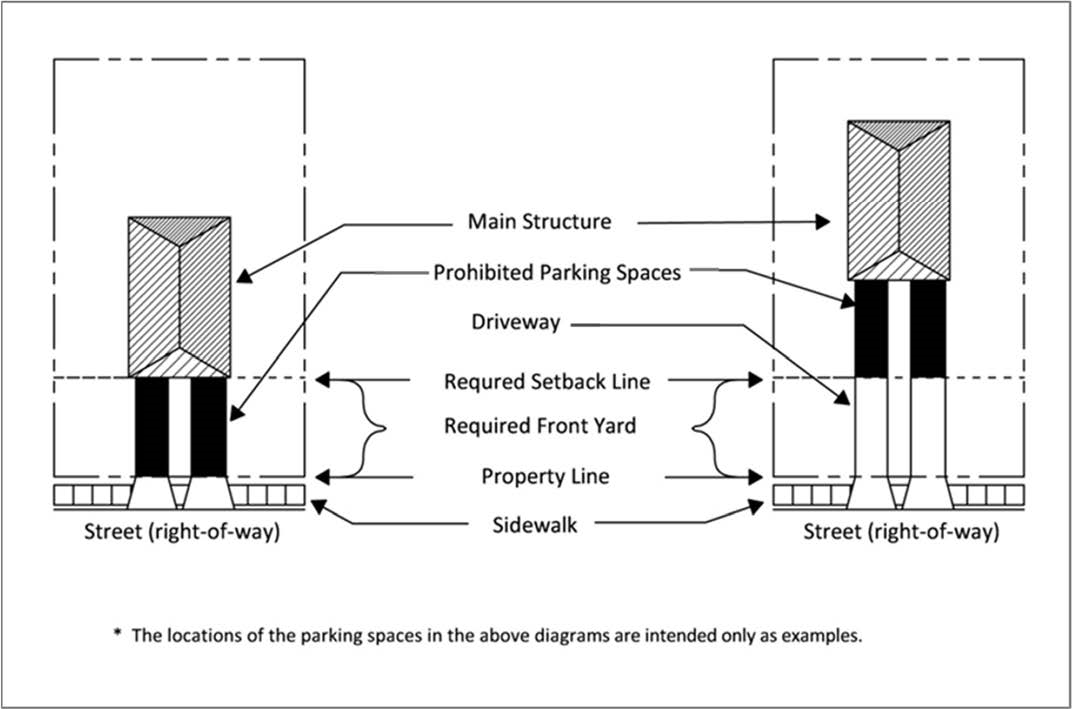
Off-street parking spaces shall not be located between a street line and the nearest point of the front façade of any building, except as otherwise specified in this section (see diagram below):
Figure VII-6: Permanent Location of Off-Street Parking
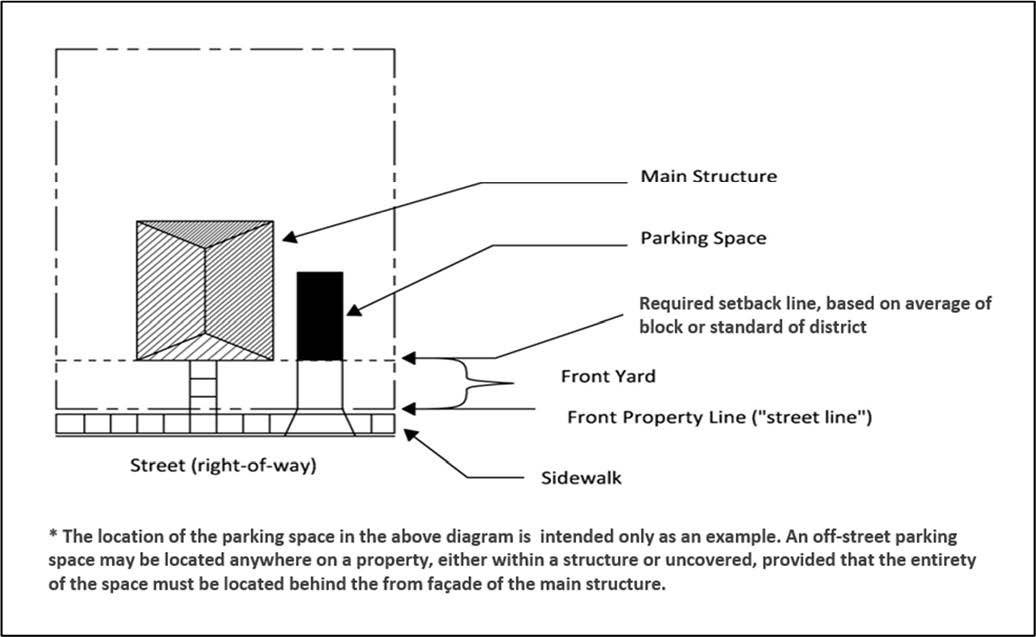
Diagram illustrating the permitted location of off-street parking with respect to the front façade of a building*
Figure VII-7: Permanent Location Off-Street Parking
(2)
In the C-1, C-2, MU and S-I, L-I, H-I Districts, required off-street parking spaces may be located in a required front yard provided the spaces are so arranged as to preclude backing out on a public street.
(3)
In any district where a parking structure is permitted to project into a required front yard, off-street parking spaces may be located within the structure.
(4)
Driveway space for access to parking areas or drive-in service facilities may be located in a required front yard.
(5)
A circular drive shall not be permitted in the front yard in a residential district unless all of the following are met:
a.
An area is provided in the drive for a parking space that does not encroach into the required front yard setback;
b.
There is a minimum of three (3) feet between the drive and the side lot lines;
c.
The lot width is fifty (50) feet or greater;
d.
Approval is received from the Department of Inspections and Code Enforcement regarding curb cuts, and;
e.
The required setback areas continue to meet the standards of subsection (b)(1) above.

