


La Porte City Zoning Code
ARTICLE 25
- PLANNED UNIT DEVELOPMENT
Section 25.01 - Intent
(a)
The Planned Unit Development (PUD) standards are a supplementary list of "overlay" zoning district standards which apply to properties simultaneously with one or more of the other zoning districts established in this Ordinance, hereinafter referred to as the "underlying" zoning district(s).
(b)
The PUD standards are provided as a design option, intended to permit flexibility in the regulation of land development; to encourage innovation in land use, form of ownership, and variety in design, layout, and type of structures constructed; to achieve economy and efficiency in the use of land; to preserve farmland, significant natural, historical, and architectural features and open space; to promote efficient provision of public services and utilities; to minimize adverse traffic impacts; to provide better housing, employment, and shopping opportunities particularly suited to residents; to encourage development of convenient recreational facilities; and to encourage the use and improvement of existing sites when the uniform regulations contained in other zoning districts alone do not provide adequate protection and safeguards for the site or its surrounding areas.
(c)
The standards are intended to accommodate development on sites with significant natural, historical, and architectural features, on land which exhibits difficult development constraints, to encourage redevelopment of urban areas as mixed-use neighborhoods, to provide the opportunity to mix compatible uses or residential types, and to allow clustering of residential units to preserve common open space and natural features. The PUD standards shall not be sought primarily to avoid the imposition of standards and requirements of other zoning classifications rather than to achieve the stated purposes set forth in this section.
(d)
In order to encourage PUD developments on specific properties, these standards may allow the plan commission and legislative body to relax or waive one or more of the requirements of the underlying district through approval of a PUD ordinance. The PUD also allows the developer the opportunity to mix compatible uses or residential types on a single property, allows clustering to reduce construction costs, and may enhance marketability through the preservation of significant natural, historical, and architectural features.
Section 25.02 - Qualifying Conditions
In order to qualify for PUD approval, the applicant must demonstrate in writing that each of the following criteria will be met by the proposed PUD:
(a)
Demonstrated Benefit. The PUD shall provide one or more of the following benefits not possible under the requirements of another zoning district, as determined by the plan commission:
(1)
Preservation of significant natural features or farmland.
(2)
A complementary mixture of uses or a variety of housing types that provides a benefit to the community over conventional development.
(3)
Common open space for passive or active recreational use.
(4)
Off-site mitigation to community impacts resulting from the development, such as public roadway improvements to maintain or improve roadway level of service.
(5)
Redevelopment of an outdated urban site or brownfield site where creative design can address unique site constraints.
(b)
Availability and Capacity of Public Services. The proposed type and density of use(s) shall not result in an unreasonable increase in the use of public services, public facilities, and utility capacities.
(c)
Compatibility with the County Land Development Plan. The proposed PUD shall be compatible with the overall goals and recommendations as proposed in the county or city county land development plan.
(d)
Compatibility with the PUD Purpose. The proposed PUD shall be consistent with the intent of this Article and spirit of this Ordinance.
(e)
Development Impact. The proposed PUD shall not impede the continued use or development of surrounding properties for uses that are permitted in this Ordinance.
Section 25.03 - Permitted Uses
Principal uses permitted under the PUD standards are based on the underlying zoning district(s).
(a)
All permitted uses and special exception uses of the underlying district(s) shall be permitted unless otherwise specified in the PUD ordinance. In agricultural districts the uses may be based on uses permitted in the lowest intensity residential, commercial, or industrial district for the jurisdiction depending on the planned uses of the PUD and based upon the land use recommendations of the County Land Development Plan.
(b)
In addition to those uses otherwise permitted, a mixture of single and multiple-family dwellings on a planned basis, through the use of attached dwellings, townhouses, apartment buildings, zero lot line configurations, and/or other similar building configurations; or any combination of these residential uses may be permitted within any PUD.
(1)
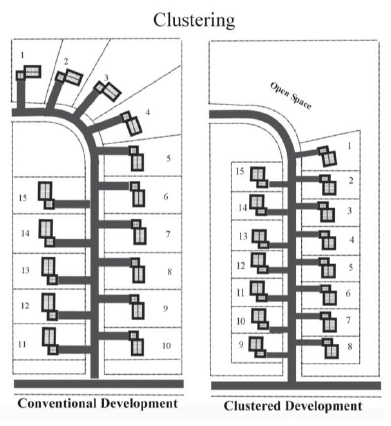
Residential density shall be determined by a conventional development plan that illustrates how the site could be developed as a conventional subdivision, meeting all applicable zoning and subdivision requirements. The plan commission shall review the design and determine the number of buildable lots that could be feasibly constructed, taking into consideration any wetlands or other non-buildable land. This number shall be the maximum number of dwelling units allowable for the PUD. Where the underlying zoning is multiple family, density shall be determined based upon the underlying zoning district density limits. Portions of the site that are currently zoned for a non-residential use or are proposed to be developed with only non-residential uses shall not be included in the plan used to determine density. In agricultural districts, the density may be based on the allowable density in the lowest intensity residential district for the jurisdiction.
(2)
Once the density has been determined, residential units may be clustered on smaller lots on a portion of the site, with the remaining land area being preserved as open space.
(3)
For PUDs located within a city, a density bonus of up to 25 percent may be granted where the development will provide for infill development/redevelopment, create a walkable neighborhood and be in accordance with the city comprehensive plan.
(c)
For a PUD in a residential district that has an area of at least 40 acres, up to ten percent of the total site acreage may be developed with uses permitted in the B1 District. Such uses must front a public street and be developed in conjunction with, or following, development of the residential uses.
(d)
For a PUD in a B1, B2, CBD1, CBD2, MB district, residential uses, such as residential apartments on a second floor above retail or office uses, may be permitted in a mixed use PUD.
Section 25.04 - Dimensional Requirements
(a)
Base Zoning Regulations. Unless modified by the plan commission and legislative body, according to the PUD standards, all Zoning Ordinance requirements for the zoning district shall remain in full force. In agricultural districts the requirements for the lowest intensity residential, commercial, or industrial district in the jurisdiction may be used as the base zoning regulations depending on the planned uses for the PUD and based upon the land use recommendations of the County Comprehensive Land Development Plan.
(b)
Regulatory Flexibility. To encourage flexibility and creativity consistent with the PUD concept, the plan commission and legislative body may grant specific departures from the requirements of the zoning ordinance as a part of the approval process through the PUD ordinance. Development standards for lot area, lot width, building height, setbacks, off-street parking, general provisions, subdivision regulations or other zoning ordinance provisions may be modified, provided that such modifications result in enhanced buffering from adjacent land uses or public rights-of-way, preservation of natural features or creation of a walkable neighborhood. Minimum standards for improvements, such as road construction, sewage, water, and drainage may not be reduced as a part of the PUD ordinance.
(c)
Approval of Modifications. Any regulatory modification shall be approved with the PUD overlay district and preliminary site plan through a finding by the plan commission and legislative body that the deviation shall result in a higher quality of development than would be possible using conventional zoning standards. No part of a PUD plan may be appealed to the board of zoning appeals. This provision shall not preclude an individual lot owner from seeking a variance following final approval of the PUD, provided such variance does not involve alterations to open space areas, as shown on the approved PUD site plan or the requirements of the article.
(d)
Table of Modifications. A table shall be provided on the preliminary PUD site plan that specifically details all deviations from the established zoning district's development standards for lot area, lot width, building height, and setbacks, off-street parking regulations, general provisions, subdivision regulations or other zoning ordinance provisions which would otherwise be applicable to the uses and development proposed in the absence of this PUD article. This specification should include Ordinance provisions, from which deviations are sought, and the reasons and mechanisms to be utilized for the protection of the public health, safety, and welfare in lieu of the regulations from which deviations are sought. Only those deviations consistent with the intent of this ordinance and the county land development plan shall be considered.
Section 25.05 - Open Space
(a)
Open Space Requirement. All PUDs shall set aside a minimum of 25 percent of the total site area as common open space (including residential and non-residential areas).
(1)
Common open space shall be planned in locations visible and accessible to all in the PUD. The common open space may either be centrally located, along the road frontage of the development, located to preserve natural features, located to buffer adjacent farmland, link with adjacent open space or recreation land or located to connect open spaces throughout the development. Open space shall be situated to maximize the preservation of any existing site woodlands, meadows and other high-quality natural areas.
(2)
Land area uses shall meet the minimum 25 percent open space requirement; the land included in the 25 percent open space shall not include stormwater detention/retention basins as approved by the Michigan City Sanitary District, wetlands, open water, or other unbuildable areas. These areas may be preserved as common open spaces but are not to be included in the 25 percent of required open space.
(3)
On urban infill sites within the cities, open space may be in the form of parks, gardens and other green space, pedestrian plazas or walkways.
(b)
Open Space Protection. The dedicated open space shall be set aside in perpetuity by the developer through a conservation easement.
(1)
The conservation easement shall assure that the open space will be protected from all forms of development, except as shown on an approved site plan, and shall never be changed to another use.
(2)
The dedicated open space shall be maintained by parties who have an ownership interest in the open space. A maintenance agreement shall be recorded with approval of the final site plan.
(3)
The dedicated open space shall forever remain open space, subject only to uses on the approved site plan. Further subdivision of open space land or its use for other than recreation, conservation or agricultural purposes shall be strictly prohibited. Any change in use of the open space from what is shown on the approved site plan shall require plan commission approval, and shall not diminish compliance with the requirements of this ordinance.
(4)
The open space or a conservation easement for the open space may be conveyed to a conservation organization or to a public agency for recreational or conservation use; however, any conveyance to a public agency shall be at the owner's discretion.
(Ord. No. 4770, § 2(Exh. B, A.21), 8-4-2025)
Section 25.06 - Application and Review Procedure for Preliminary and Final PUD
The application process for a PUD involves two steps for review of a preliminary and final PUD. The procedures are described below.
(a)
Pre-application Meeting. The applicant shall meet with the enforcement official to review the PUD requirements and ensure that application materials are complete. An optional pre-application workshop with the plan commission may be requested by the applicant to discuss the appropriateness of the PUD concept, solicit feedback, and receive requests for additional materials supporting the proposal. An applicant desiring such a workshop shall request placement on the plan commission agenda.
(b)
Application. The applicant shall submit the preliminary PUD site plan, meeting the requirements of Section 25.07, at least 15 days prior to the meeting at which the plan commission shall first review the request.
(c)
Checkpoint Agency Review. The following agencies shall review the application prior to the plan commission hearing and recommend changes or sign-off that they do not have concerns with the application.
(1)
Natural Resource Conservation Service (NRCS)
(2)
Drainage board and/or MS4 coordinating agency and/or Michigan City Sanitary District
(3)
City or county engineer
(4)
Fire department
(5)
Street or highway department
(6)
Health department
(7)
Utility providers (water, sewer) if applicable
(d)
Public Hearing. The plan commission shall review the preliminary PUD site plan, and shall conduct a public hearing. Legal notice shall be provided to the public by the petitioner consistent with the requirements of IC 5-3-1. Public notice setting forth the time and place shall be given at least ten days before the date of the hearing in a newspaper of general circulation by the community. Notification shall also be provided by certified letter at least ten days before the date of the hearing to all abutting properties in all directions from the subject property and properties across the street. At the public hearing, the petitioner shall provide proof that he has conformed to the above by proof of publication and return-receipt mail or personal sign-off on delivery of notices. The cost of such notices shall be borne by the petitioner.
(e)
Plan Commission Action. During this review, the plan commission may request additional materials supporting the PUD proposal, or recommend modifications or conditions based on the standards of Section 25.08 and comments from the checkpoint agencies. Once the plan commission is satisfied that all of the required information has been provided, the plan commission shall either forward the PUD overlay district and preliminary site plan to the legislative body with a favorable recommendation, an unfavorable recommendation based upon the standards of this article and Article 30. The plan commission shall certify its recommendation by resolution to the legislative body within ten business days of its determination. The plan commission may stipulate conditions to approval, which the applicant shall incorporate into the preliminary PUD site plan and resubmit to the enforcement official prior to legislative action.
(f)
Legislative Action. The legislative body shall vote on the proposed PUD overlay district within 90 days of its certification by the plan commission (per IC 36-7-4-608). The legislative body may either approve or deny the PUD overlay district. The legislative body may also seek modifications or additions to any written commitments, as described in Section 30.08 of this ordinance.
(g)
Commitments. Any commitments attached to the approval of the preliminary PUD site plan shall be made part of the approval and shall be reflected in the final PUD site plan. The county or city attorney, as applicable, shall prepare the written commitments based on the legislative body action. The applicant shall reimburse the county or city attorney, as applicable, for all costs related to the preparation of the written commitments. The shall be signed by the legislative body and the applicant and recorded in the office of the County Recorder. The commitments must be recorded prior to submitting an application for final site plan approval.
(h)
Effect of Approval. Approval of the PUD overlay district and preliminary site plan shall be effective for a period of one year. If a final PUD site plan for at least the first phase of the project is not submitted within one year of the preliminary approval, or an extension applied for, the preliminary PUD site plan shall expire and a new application must then be filed and processed. The one year period for preliminary PUD approval may be extended for one year, if applied for by the petitioner prior to expiration and granted by the plan commission. If a preliminary PUD is allowed to expire, the plan commission and legislative body shall take action to remove the overlay district from the zoning for the site.
(i)
Phased PUD. If the approved preliminary PUD site plan indicated that the proposed development was to occur in phases, final PUD site plan approval may be granted on each phase of the development, provided that each phase contains all the necessary components to insure protection of significant natural, historical, and architectural features, and the health, safety, and welfare of the users of the PUD and the residents of the surrounding area. Roads, utilities and other infrastructure for each phase shall be designed to fully operate in accordance with county or city, as applicable, engineering standards and not be dependent upon the completion of subsequent phases. Subsequent phases shall also follow the process for final PUD site plan outlined in this Article.
(j)
Final Site Plan. The applicant shall submit the final PUD site plan for any or all phases of, the approved preliminary PUD site plan at least 30 days prior to the plan commission meeting at which the plan commission shall first review the request. If the PUD is being developed as a subdivision, then all requirements of the subdivision regulations shall be met and the final PUD application shall also include a primary plat. The primary plat shall be reviewed concurrently with the requirements of this article.
(k)
Checkpoint Agency Review. The agencies in Section 25.06(c) shall review the final site plan for compliance with applicable federal, state, and local ordinances and standards prior to the plan commission review. The agency official shall state any items that need to be address prior to approval or sign-off that the final site plan is acceptable.
(l)
Plan Commission Review. Upon submission of all required materials and fees, the plan commission shall review the final PUD site plan and shall take final action on the final PUD site plan, in accordance with the standards and regulations of this ordinance.
(m)
Conditions. If the final PUD site plan was approved with conditions, the applicant shall submit a revised final PUD site plan to the enforcement official for approval prior to submitting construction plans.
(n)
Subdivision. If the PUD is being developed as a subdivision, then the applicant shall be required to submit construction plans and secondary plat drawings in accordance with the subdivision regulations.
(o)
Final Approval. Approval of the final PUD site plan shall be effective for a period of two years. If construction has not begun on the first phase of the project within two years of the final PUD approval, the right to develop under the PUD site plan shall terminate and a new application must then be filed and processed. If a final PUD is allowed to expire, the plan commission and legislative body shall take action to remove the overlay district from the zoning for the site.
(Ord. No. 4770, § 2(Exh. B, A.22), 8-4-2025)
Section 25.07 - Preliminary PUD Site Plan Submittal Requirements
The preliminary PUD site plan shall set forth the proposed uses to be developed in the PUD. The following specific information shall be provided in the preliminary PUD site plan submittal:
(a)
Proof of Ownership. Current proof of ownership of the land to be utilized or evidence of a contractual ability to acquire the land, such as an option or purchase agreement with written authorization from the owner.
(b)
Written Documentation. Written documentation that the preliminary PUD site plan meets the standards of Section 25.08.
(c)
Application Form and Fees. A completed application form, supplied by the enforcement official, and an application/review fee; a separate escrow deposit shall be required for administrative charges to review the PUD submittal.
(d)
Preliminary PUD Site Plan. Sheet size of submitted drawings shall be at least 24 inches by 36 inches, with graphics at an engineer's scale of one inch equals 20 feet for sites of 20 acres or less; and up to one inch equals 100 feet or less for sites over 20 acres.
(e)
PUD Development Ordinance. A draft written PUD Ordinance specifying all the terms and understandings of the PUD. The content of the ordinance shall be based on the extent of the proposed development, but shall, at a minimum, provide the following:
(f)
Multi-Phased PUD. If a multi-phase PUD is proposed, the areas included in each phase shall be identified. For residential uses identify the number, type, and density of proposed housing units within each phase.
(g)
Any additional graphics or written materials requested by the plan commission to assist in determining the appropriateness of the PUD such as, but not limited to: aerial photography; market studies; impact on public primary and secondary schools; impact on utilities; traffic impact study, impact on significant natural, historical, and architectural features; impact on drainage; stormwater management plan and drawings; impact on the general area and adjacent property; description of how property could be developed under the regulations of the underlying district; preliminary architectural sketches; and estimated construction cost.
(Ord. No. 4770, § 2(Exh. B, A.23, 24), 8-4-2025)
Section 25.08 - PUD Site Plan Standards for Approval
Based upon the following standards, the plan commission may deny, approve, or approve with conditions the proposed preliminary PUD site plan, subject to approval of the PUD ordinance by the legislative body.
(a)
The PUD shall meet the qualifying conditions of Section 25.02.
(b)
The PUD must be consistent with the Michigan City Comprehensive Plan.
(c)
The uses must have a beneficial effect, in terms of public health, safety, welfare, or convenience, on present and future potential surrounding land uses. The uses proposed must not adversely affect the public utility and circulation system, surrounding properties, or the environment. The public benefit shall be one which could not be achieved under the regulations of the underlying district alone or that of any other zoning district.
(d)
Any modifications to the dimensional standards of this Ordinance, such as lot sizes, setbacks, height limits, required facilities, buffers, open space, permitted sign area, and other similar dimensional standards shall be reviewed and approved by the plan commission.
(e)
Any increase in the density requirements of the underlying zoning district must be approved by the plan commission and be included under review of the preliminary PUD site plan and in the PUD ordinance.
(f)
The number and dimensions of off-street parking shall be sufficient to meet the minimum required by Article 18. However, where warranted by overlapping or shared parking arrangements, the plan commission may reduce the required number of parking spaces in the PUD ordinance.
(g)
All roads and parking areas within the PUD shall meet the minimum design standards, unless modified by the plan commission and legislative body in the PUD ordinance.
(h)
Safe, convenient, uncongested, and well defined vehicular and pedestrian circulation within and to the site shall be provided.
(i)
Landscaping shall be preserved and/or provided to ensure that proposed uses will be adequately buffered from one another and from surrounding public and private property. Plantings and other landscape features shall meet or exceed the standards of Article 17.
(j)
Judicious effort shall be used to preserve significant natural, historical, and architectural features and the integrity of the land.
(k)
Adequate water, sewer and stormwater facilities shall be available or shall be provided by the developer as part of the site development.
(Ord. No. 4770, § 2(Exh. B, A.25), 8-4-2025)
Section 25.09 - Final PUD Site Plan Submittal Requirements
The final PUD site plan shall include all the following information, unless the enforcement official determines that some of the required information is not reasonably necessary for the consideration of the PUD:
(a)
All information required for site plan submittal in accordance with Section 23.03. If the PUD is being developed as a subdivision, then all information required for a preliminary plat shall be submitted in accordance with the Subdivision Regulations.
(b)
Any additional graphics or written materials requested by the plan commission to assist in determining the impacts of the proposed PUD site plan, including, but not limited to: economic or market studies; impact on public utilities; traffic impacts; impact on significant natural, historical and architectural features; impact on stormwater drainage and management; impact on the general area and adjacent property; and estimated construction cost.
(c)
A written version of the approved of PUD ordinance specific to the PUD. Such document shall include provisions for site layout, access, vehicular and pedestrian circulation, parking, screening, building design and architecture, landscaping, open space, lighting, and signage. The PUD ordinance shall also include any variations to the dimensional standards of this Ordinance, such as density, lot sizes, setbacks, height limits, required facilities, buffers, open space, permitted sign area, and other similar dimensional standards.
(Ord. No. 4770, § 2(Exh. B, A.26), 8-4-2025)
Section 25.10 - Final PUD Site Plan Standards for Approval
The plan commission shall use the standards for approval in Section 25.08 and any design requirements developed specifically for the PUD, in reviewing the final PUD site plan.
Section 25.11 - Deviations from Approved Final PUD Site Plan
(a)
Minor deviations and amendments from the approved final PUD site plan and associated PUD ordinance shall be reviewed and approved by the enforcement official. The following minor modifications can be approved by the enforcement official without the need for a new preliminary PUD site plan:
(1)
For residential buildings, the size of structures may be reduced; or increased by five percent, provided the overall density of units does not increase and the minimum square footage requirements are met.
(2)
Gross floor area of non-residential buildings may be decreased; or increased by up to five percent.
(3)
Floor plans may be changed if consistent with the character of the use.
(4)
Horizontal and/or vertical elevations may be altered by up to five percent.
(5)
Relocation of a building by up to five feet, if consistent with required setbacks and other standards.
(6)
Designated "Areas not to be disturbed" may be increased.
(7)
Plantings approved in the Final Landscape Plan may be replaced by similar types of landscaping on a one-to-one or greater basis; consistency with the requirements of Article 17 must be maintained.
(8)
Improvements or slight relocation of site access or circulation, such as inclusion of deceleration lanes, boulevards, curbing, pedestrian/bicycle paths, etc.
(9)
Changes of building materials to another of higher quality.
(10)
Internal rearrangement of parking lot which does not affect the number of parking spaces or alter access locations or design, or reduce stormwater management capacity.
(11)
Changes required or requested by the county or city for traffic safety reasons.
(b)
If the enforcement official determines that the modifications to the final PUD site plan significantly alter the intent of the preliminary PUD site plan, a new submittal illustrating the modification shall be required and must be approved by the plan commission and legislative body as a new preliminary PUD site plan.
(c)
Any deviation from the approved final PUD site plan that is not approved shall be considered a violation of this Article and shall invalidate the PUD overlay. The plan commission and legislative body shall take action to remove the overlay district in the event that the PUD is invalidated.