
Lake Park City Zoning Code
ARTICLE XII
ARCHITECTURAL DESIGN GUIDELINES FOR NONRESIDENTIAL BUILDINGS8
Editor's note— Ord. No. 17-2014, § 2, adopted Jan. 7, 2015, renumbered the former Art. XI as Art. XII as set out herein. The historical notation has been retained with the amended provisions for reference purposes.
Sec. 78-330.- General provisions.
(1)
Intent. The provisions of this article are intended to establish orderly and consistent architectural standards and guidelines for new construction and the redevelopment of nonresidential buildings and structures within the town.
(2)
Applicability.
(a)
All new nonresidential buildings or structures shall comply with this article.
(b)
All renovations, additions, or redevelopment to existing structures for which a building permit is required, and where the total cost of the construction is greater than 50 percent of the assessed value of the structure as reflected by the most recent tax roll of Palm Beach County Property Appraiser, or an increase of greater than 20 percent of the square footage of the existing structure must comply with all of the provisions of this article.
(c)
All renovations, additions, or redevelopment of existing structures for which a building permit is required, and where the total cost of the construction is less than 50 percent of the assessed value of the structure as reflected by the most recent tax roll of Palm Beach County Property Appraiser, or an increase of less than 20 percent of the square footage of the existing structure shall comply with the provisions of this article to the greatest extent possible.
(d)
Minor repairs, maintenance, or similar improvements that do not require a building permit, are exempt from the provisions of this article.
(e)
All existing nonresidential buildings that are being repainted shall be subject to the building color and finish provisions of this article.
(3)
Compatibility with setting. Buildings shall be designed to be compatible with the surrounding environment to achieve an overall, unified design and character. Design factors shall consider:
(a)
The massing of buildings to encourage and allow pedestrian access between sites and structures;
(b)
The avoidance of blank walls or similar features without architectural interest;
(c)
The variety of protective features, such as arcades and awnings, building overhangs, landscaping;
(d)
The size, location, and shape of windows and doors.
(4)
Alternative architectural styles. The town commission may authorize the use of an alternative architectural style if, in the exercise of their reasonable discretion, the commission determines the alternative design to be consistent with the surrounding architectural character and design intent of the district in which the property is located.
(5)
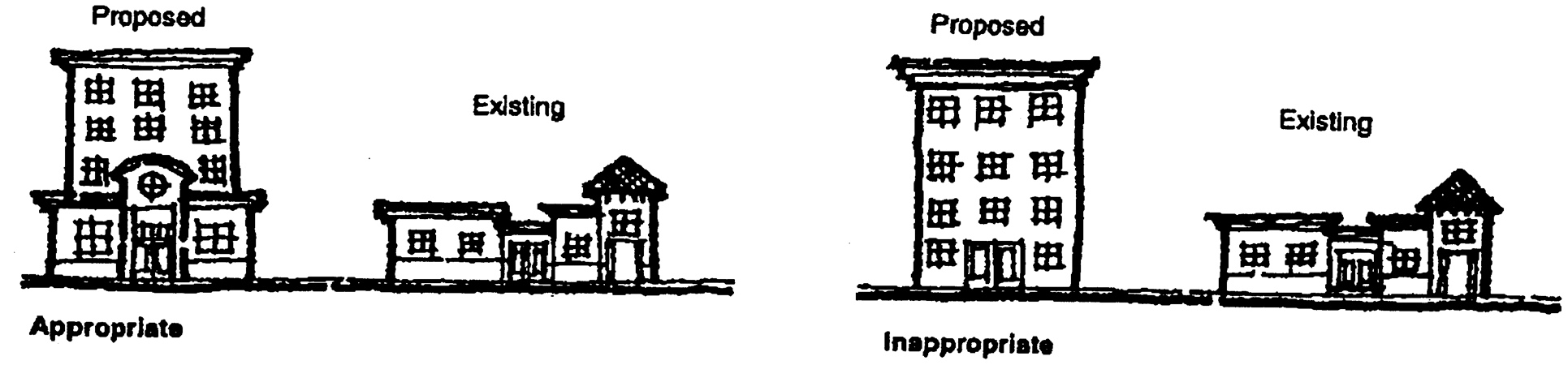
Facade/wall height transition. New structures that are to be located within 150 feet of an existing building, and which are site planned to be more than twice the height of any existing building within 150 feet shall be designed with massing elements in order to provide an appropriate structure transition.
(a)
The transitional massing element can be no more than 100 percent taller than the average height of the adjacent or next closest building(s).
(b)
Facades shall have architectural articulations at both the pedestrian level and at the roofline.
Facades
(6)
Illustrative architectural elements. The drawings located in Figure A [Facades] depict architectural elements that are both appropriate and inappropriate. These drawings are included in this article for illustrative purposes only to demonstrate the design intent of this article. The drawings are not intended to suggest any specific architectural design.
(Ord. No. 16-2007, § 2, 8-1-2007; Ord. No. 17-2014, § 2, 1-7-2015)
Sec. 78-331. - Definitions.
The following words, terms, and phrases, when used in this article, shall have the meanings ascribed to them in this section, except where the context clearly indicates a different meaning.
Architectural composition. The scale, height, mass, proportion, color, form, style, detail, treatment, texture, construction material, and roof design of a project or building.
Articulated parapet. A parapet with a height variation proportional to the building height.
Balustrade. A series of balusters with a top and bottom rail.
Bracket. A decorative support feature located under eaves or overhangs.
Canopy. An ornamental roof-like structure used on commercial (nonresidential) buildings, which provides advertisement space, shade, and protection for the storefront and pedestrian traffic.
Compatible/compatibility. Design that utilizes accepted site planning (e.g. building placement, orientation and siting) and the elements of architectural composition within the context of the surrounding area. Similar adjacent land uses and/or square footage shall not necessarily constitute architectural compatibility.
Complement/complementary. Having similar architectural composition.
Dormer. A secondary feature of a building housing a window or vent, which is set upon the slope of a roof surface. Dormers may provide ventilation, lighting, or auxiliary living space.
Eave. The projecting overhang at the bottom edge of a roof surface.
Exposed beam. A decorative wooden beam that appears to support eaves, prevalent on bungalow-style residences.
Frieze. A wide facing board located at the junction of the exterior wall and roof eaves.
Gable roof. A triangular section at the end of a pitched roof.
Historical "themes". Any building, structure, or other architecture that is historically or architecturally significant such as Spanish Eclectic, Mediterranean Revival, Florida Vernacular, and Bermuda/Island, which are appropriate historical themes pursuant to this article.
Hip roof. A roof with sloping sides and ends.
Lattice. A panel of criss-crossed diagonal or perpendicular slats often utilized as decorative infill between masonry foundation piers.
Lintel. A horizontal beam located above a window or door.
Louver. A door or window comprised of overlapping downward sloping slats, which shed rain while admitting light and air.
Masonry. Brick, block, or stone, which is secured with mortar.
Massing. A term used to define the overall volume or size of a building.
Molding. A continuous decorative strip of material applied to a surface.
Parapet. A solid protective or decorative wall located along the outside edge of a roof.
Rafter. A wooden member of a roof frame, which slopes downward from the ridgeline.
Scale. A term used to define the proportions of a building in relation to its surroundings.
Shed roof. A roof with a single sloping pitch.
Stucco. A masonry material applied as exterior wall fabric.
Substantial renovation. Any expansion, alteration, renovation, addition, or redevelopment to existing structures where the cost of such is greater than 50 percent of the assessed value of the structure as reflected by the most recent tax roll of Palm Beach County Property Appraiser, or an increase of greater than 20 percent of the square footage of the existing structure.
(Ord. No. 16-2007, § 2, 8-1-2007)
Sec. 78-332. - Design treatments.
(1)
Building design. Structures must be designed to provide at least three of the following minimum design treatments:
(a)
The main facades shall incorporate architectural elements, which create a better human scale, such as:
1.
Canopies or porticos integrated with the building's massing and style;
2.
Overhangs proportional in size to the mass of the building; and
3.
Arcades.
(b)
Pedestrian amenities such as benches, sculptures, tables with umbrellas, and trash receptacles;
(c)
Peaked roofs with minimum 12-inch overhangs;
(d)
Ornamental and structural architectural details, which are integrated into the building structure and overall design; and
(e)
Architectural treatment on all four facades/elevations.
1.
Articulation of individual storefronts or facades greater than 50 feet wide;
2.
Window and door openings expressed as individual units as opposed to window wall strips;
3.
Uniform design; and
4.
Any other treatment determined by the jurisdiction to meet the intent of this section.

Architectural Treatment
(2)
Unity of character. Buildings or structures, which are part of an existing or future complex shall have a unity of character and design.

Unity of Character
(3)
Style. Appropriate historical "themes" as defined by this article are permitted.
(4)
Identical buildings. Buildings and structures that are identical or similar in design shall not be permitted unless each building is part of an overall development with uniform architectural themes.
(5)
Scale. New structures shall relate to the form and scale of surrounding architecture. Buildings taller than two stories shall be evaluated as to their visual impacts upon adjacent structures and/or properties.
(6)
Compatible exterior materials and architectural elements.
(a)
Lattice work, decorative moldings.
(b)
Covered porches with columns and railings.
(c)
Arbors, trellises, gazebos, picket fences.
(7)
Incompatible architectural elements. Unarticulated, flat, or blank facades are not permitted.

Incompatible Elements
(8)
Proportion. The proportion of the major elements of any structure such as windows, doors and storefront design shall be consistent throughout the proposed development or redevelopment.
(Ord. No. 16-2007, § 2, 8-1-2007)
Sec. 78-333. - Building facade and elevation.
(1)
Building features and ornamentation. The following building features and ornamentation are encouraged:
(a)
Cornices and parapets, moldings, pilasters, window surrounds, asymmetrical facades, multilevel roofs, and similar elements;
(b)
Tile, plaster, poured concrete, or brick materials, consistent with design and style;
(c)
Functional and ornamental balconies and balustrades located on the walls or facades facing public rights-of-way, excluding alleys;
(d)
Arcades designed with arches; and
(e)
Exterior detail elements such as banding and other applied stucco detailing.
(2)
Preferred exterior materials. Preferred building exterior siding materials shall include stucco and brick, however cast stone, split blocks, ceramic tiles, high quality coated metal panel systems, and stone are acceptable. Materials including wood, metal siding, fluted block and glass window systems are prohibited, except where proposed for buildings along the industrial zoning districts abutting 10 th Court, 12 th Street, 13 th Street, 14 th Street, 15 th Street, Brant Road, Miller Way, Gateway Road, Newman Road, Joule Road, Kinetic Road, South Killian Drive, and North Killian Drive. Buildings on parcels fronting Old Dixie Highway, Watertower Road and Silver Beach Road may use wood, metal siding, fluted block, and glass window systems provided they are combined with the preferred exterior materials listed herein on at least 25 percent of the façade, provided that the wood is stained or painted; metal siding is vinyl-coated or otherwise coated; and fluted block is split and scored or ribbed.
(3)
Recesses/projections.
(a)
All nonresidential buildings with facades greater than 50 feet in length shall incorporate recesses and projections a minimum of 12 inches in depth along a minimum of 20 percent of the total length of the facade. The recesses or projections shall be distributed along the facade with a maximum spacing of 100 feet between each recess or projection.
(b)
All nonresidential buildings abutting 10 th Court, 12 th Street, 13 th Street, 14 th Street, 15 th Street, Brant Road, Miller Way, Gateway Road, Newman Road, Joule Road, South Killian Drive, and North Killian Drive are exempt from subsection (a) above for rear and side façades, provided the length of the façade does not exceed 100 feet and does not front a right-of-way.
(c)
Buildings fronting Old Dixie Highway, Watertower Road, Park Avenue Extension Road and Silver Beach Road shall provide additional façade and entrance treatments and have recesses and projections pursuant to subsection (a) above along their side and rear facades greater than 100 feet.
(4)
Visible facades. All building facades that are or will be visible from a public right-of-way and/or adjacent and abutting properties shall be designed with regard to their surroundings, but should not be designed to create look-alike buildings. Harmony must be achieved through the proper use of scale, proportions, form, materials, texture, and color.
(5)
Trademark forms and colors. Businesses and commercial enterprises which propose the use of trademarks, symbolic forms and/or architecture and/or colors schemes in the construction or redevelopment of a property are prohibited if in the sole discretion of the town commission, the proposed features will create a negative visual impact on the surrounding area.
(6)
Blank walls. Blank walls shall not exceed ten feet in height or 20 feet in length. Control and expansion joints shall constitute a blank wall, unless used in a decorative pattern with varied materials or textures and spaced a maximum of ten feet on center. Relief and reveal depth shall be a minimum of three-quarter inch. Building wall offsets, including projections, recesses and changes in floor level, shall be used to add architectural interest and variety. Walls (except front walls) within industrial zoning districts and abutting 10 th Court, 12 th Street, 13 th Street, 14 th Street, 15 th Street, Brant Road, Miller Way, Gateway Road, Newman Road, Joule Road, Kinetic Road, South Killian Drive, and North Killian Drive, that measure less than 100 feet in length, and that are used primarily for garage bay access are exempt from this requirement, but shall incorporate variation in color and material pursuant to section 78-333 and section 78-334.

Blank Walls
(7)
Other features. Other features, such as gutters, down spouts, vent stacks, vent pipes, and flashing shall be painted so that the color is consistent with the color scheme of the building.
(8)
Storefronts. Individual storefront elements of 50- to 100-foot widths shall be incorporated into the front facade to create a smaller scale for the building. Individual ground-level retail uses with exterior public access that are part of a larger freestanding building shall have display windows along a minimum of 20 percent of the facade length. Windows shall be defined with details such as frames, sills, shutters, planters, relief trims, or lintels.
(Ord. No. 16-2007, § 2, 8-1-2007; Ord. No. 17-2014, § 2, 1-7-2015)
Sec. 78-334. - Building color and finish.
(1)
General. Building materials and color selection shall achieve visual order through the consistent use of compatible color palettes.
(a)
All storefronts within a development shall utilize a consistent palette of materials and textures.
1.
Variation of individual storefronts within a given palette of materials may be permitted, however principal walls and facades must maintain a uniform color.
2.
Different colors for individual storefronts within a development or complex are permitted as long as overall design integrity is not compromised.
(b)
Color should be chosen to add to the retail environment of these buildings.
(c)
The use of color to attract attention to a business from a distance is discouraged and certain color schemes may be prohibited.
(2)
Color palette. The exterior color of a building or structure must reflect the following characteristics:
(a)
Primary colors must be white, light gray, eggshell, pale blue, pale green, coral, peach, pale yellow, buff, beige, and sand.
(b)
Secondary building colors should be limited to 25 percent of the wall area. These colors may consist of a medium intensity of the base building color or a complimentary color.
(c)
Trim colors shall be limited to ten percent of any single wall area. Trim colors are used for accent and identifying purposes and are the brightest group of colors allowed. These colors include greens, blues, yellows, and others that are found in the local landscape and natural features.
(d)
Ornamentation, trim, courses, window frames, and door frames may be painted white or a contrasting color such as dark brown, dark gray, blue, light green, brown, plum, black.
(e)
Roof materials may be brown, gray, white or other color consistent with the overall color scheme of the structure.
(Ord. No. 16-2007, § 2, 8-1-2007)
Sec. 78-335. - Architectural elements.
(1)
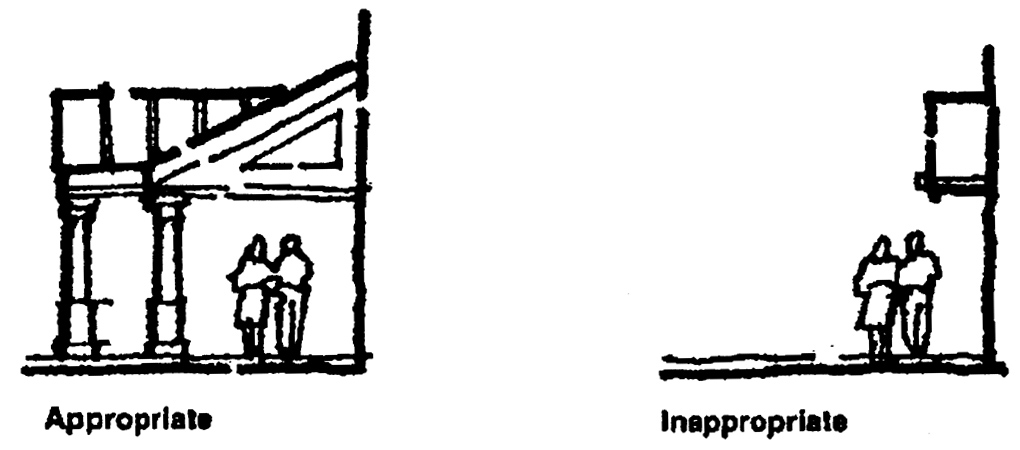
Pedestrian walkways. Pedestrian walkways with arcades, awnings or colonnades shall be provided along the front and sides of buildings and be integrated with adjacent properties. Arcades or colonnades shall have a minimum clearance width of six feet and minimum clearance height of 12 feet. Awnings shall have a minimum clearance width of six feet and minimum clearance height of eight feet. In addition, a safe and landscaped pedestrian circulation system shall be provided on-site which connects to public streets and neighborhoods. Sidewalks, where possible, at least eight feet in width shall be provided along all sides of the lot that abut a public street. Sidewalks, no less than eight feet in width, where possible, shall be provided along the full length of the building along any facade featuring a customer service entrance, and along any area abutting public parking areas. Such sidewalks shall be located at least six feet from the facade of the building to provide planting beds for foundation landscaping, except where features such as arcades or entryways are part of the facade. All internal pedestrian walkways shall be distinguished from driving surfaces through the use of durable, low maintenance surface materials, such as pavers, bricks or scored concrete, to enhance pedestrian safety and comfort as well as the attractiveness of the walkways.
Pedestrian Walkways
(2)
Building height. Building height shall be determined by the applicable zoning district regulations.
(3)
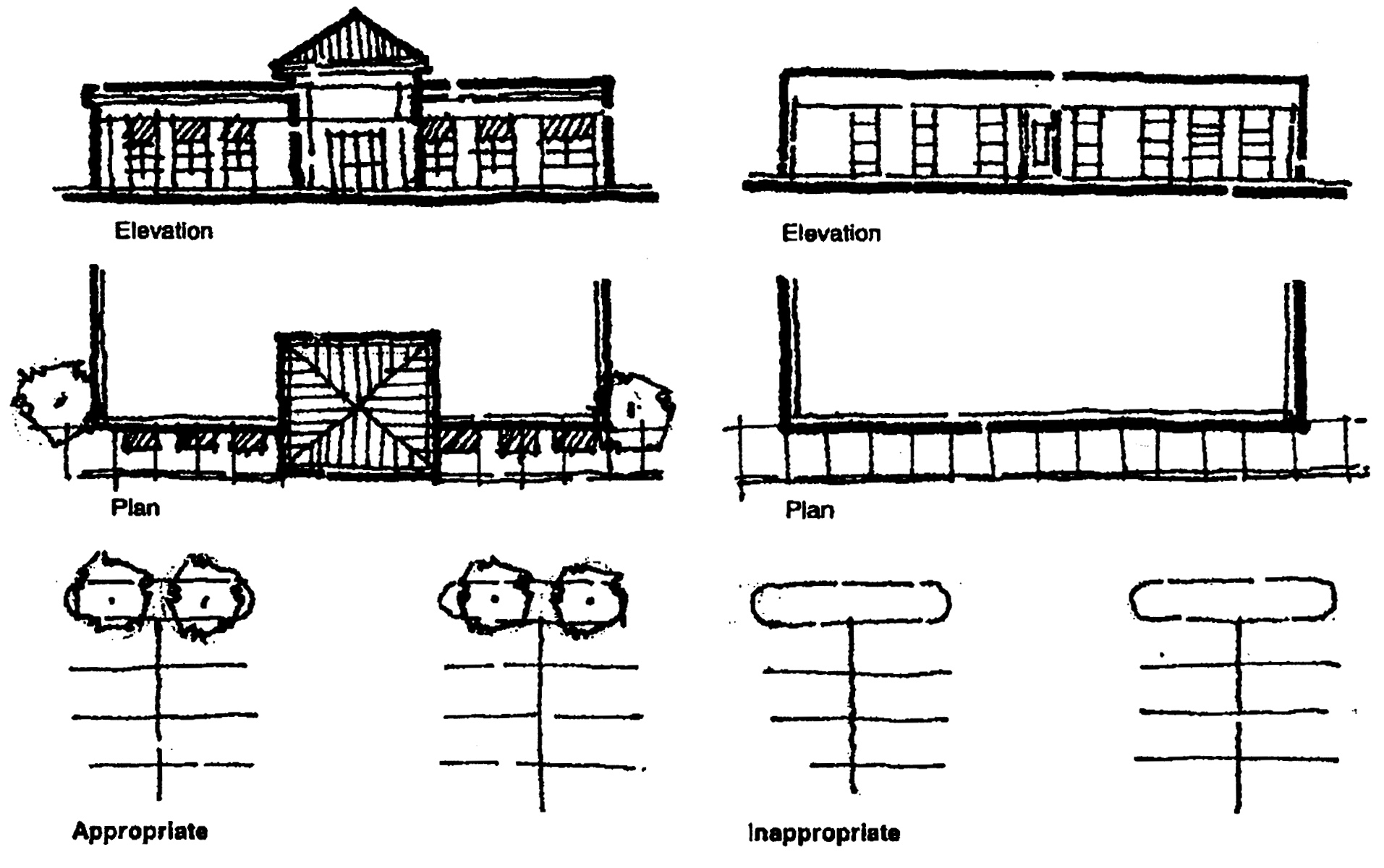
Entrances. Entrance design elements that are intended to give protection from the sun and adverse weather conditions shall be integrated into a design style for the building. Each freestanding principal structure shall have a minimum of one clearly defined primary public entrance feature. The primary entrance shall incorporate a minimum of one design element each from tables 378-335-A and 78-335-B below;
(4)
Bike racks. All nonresidential retail and/or service-oriented developments shall provide bike racks. The design of such racks shall be of durable, long-lasting materials.
Table 78-335-A. Primary Entrance Feature Design Element
1.
Canopies, porte-cocheres, or porticos.
2.
Wall recess or projection of a minimum of 12 inches in depth.
3.
Covered arcades, a minimum of eight feet clearance in width.
4.
Peaked roof forms.
5.
Arches, columns, or pilasters.
Table 78-335-B. Secondary Decorative Treatment
1.
Overhangs, cornices and eaves;
2.
Decorative moldings or trims around windows and doors;
3.
Covered public outdoor patio or plaza incorporated with entrance area which are not part of a tenant space;
4.
Special pavers, bricks, decorative concrete, or other similar pavement treatment;
5.
Architectural details such as tile work or moldings;
6.
Benches or other seating components;
7.
Decorative landscape planters or wing walls that incorporate landscaped areas;
8.
Structural or vegetative shading.
Entrances
(4)
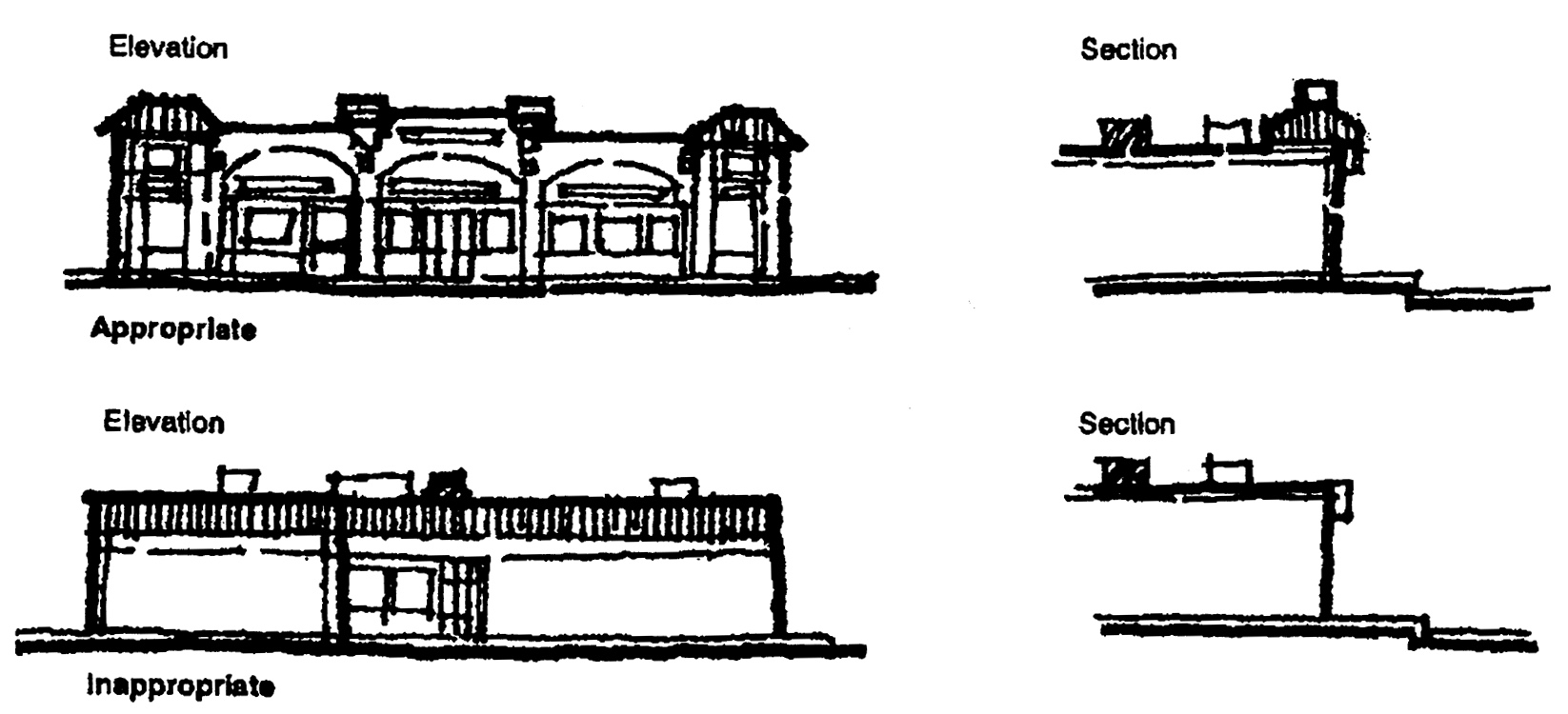
Mechanical equipment screening. All rooftop mechanical equipment shall be located at a distance from the edge of the building and properly screened so as not to be visible from any street or adjoining property. Materials used for screening purposes shall be compatible with the architectural style, color, and materials of the principal building.
Mechanical Equipment Screening
(5)
Cornices. Existing cornices should be retained and preserved.
(Ord. No. 16-2007, § 2, 8-1-2007)
Sec. 78-336. - Window/and door treatments.
(1)
Windows. The following major design characteristics are encouraged:
(a)
Arches integrated into window designs;
(b)
Trim color in contrast with principal color of structure;
(c)
Large ground level storefront windows, consisting of at least 50 percent of the wall area of the storefront;
1.
The windows of all ground floor businesses open to the public shall remain clear of curtains, shutters, or similar visual barriers, which would obscure interior displays or activities.
2.
Reflective or darkly tinted glass, which prevents seeing into the building is not permitted on the ground level.
(d)
Recessed openings;
(e)
Hurricane/security panels or shutters which are removable, recessed, or architecturally compatible with overall design, and consistent with wind load resistance standards; and
(f)
Replacement windows should fill the entire opening and duplicate the original pattern. Surrounding trim should be retained in the proper style and proportion.
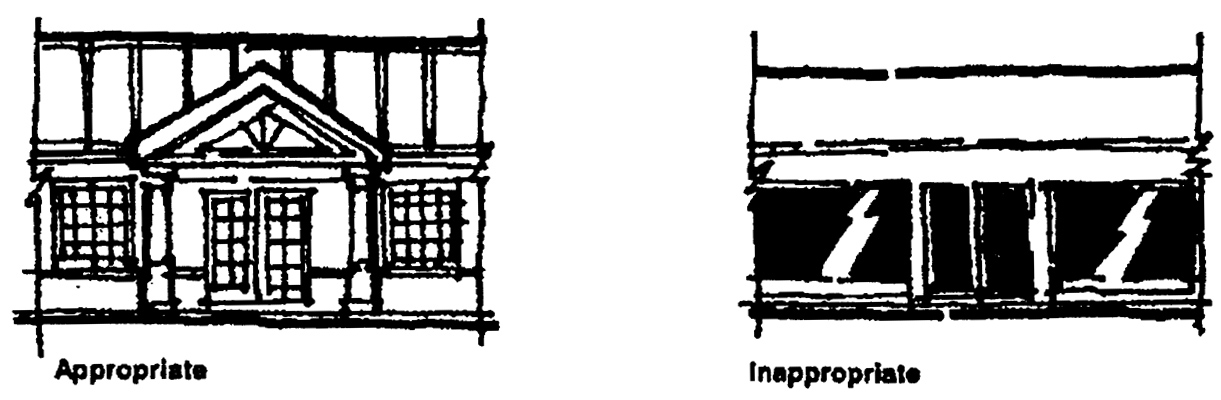
Windows
(2)
Doors. The following major design characteristics are encouraged:
(a)
Recessed openings;
(b)
Scaled and proportionate to balance of structure;
(c)
Articulated and ornamental door design; and
(d)
Use of materials to convey mass and strength.
(3)
Awnings. Awnings shall reflect colors that compliment the existing architecture and not detract from the storefront or from adjacent storefronts.
(a)
All awning supports must be attached to the building, not placed in the sidewalk or extending into the parking lot. Additionally, awning frames shall be simple pipe frames, well concealed by canvas covers or attachments.
(b)
Plastic backlit awnings or awnings constructed of shiny materials are not permitted.
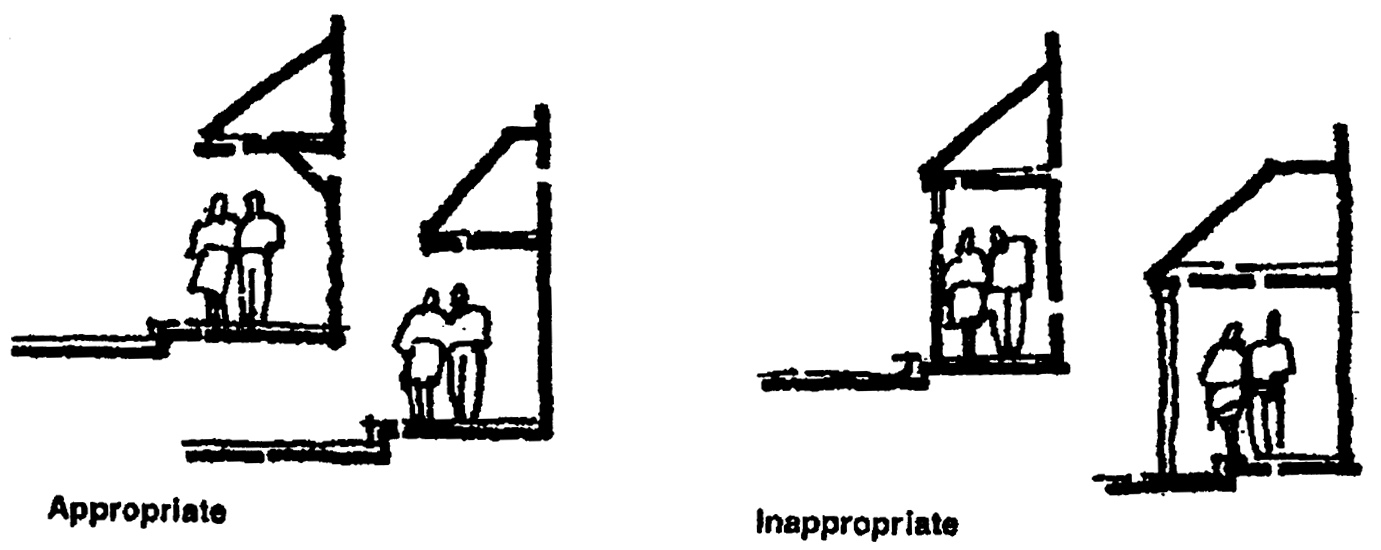
Awnings
(4)
Fenestration and details. Architectural features or details such as windows, awnings, covered arcades, sills, shutters, reliefs, trims, columns, pilasters, quoins, reveals, cornices, horizontal banding, arches, decorative vents, and/or accent tile, shall be integrated into the facade to avoid the appearance of a blank wall and shall be provided along a minimum of 60 percent of the facade length of the front and side facades, and rear facades if the building or structure abuts or is contiguous to a public street, right-of-way or a residential zoning district.
(5)
Materials. Doors and windows must be glass and aluminum (painted) storefront, high quality steel and glass systems, high quality woods such as plantation grown teak or mahogany, and brass, bronze or stainless steel.
(6)
Exterior treatment. The exterior treatment of the front elevation shall consist of a minimum of two different building materials, textures, or finishes at a ratio of a maximum of 80 percent for the primary treatment and a minimum of 20 percent total for the secondary treatment. Exterior finishes such as stucco, brick, wood, coquina or cut stone are encouraged. The surfaces of multiple exterior storefronts within a building, except regional commercial facilities, shall compliment contiguous storefronts.
(7)
Kick plates. Kick plates protect windows by raising the glass area to a safer and more easily viewed height. New storefronts may have simplified kick plates, or an all-glass front that creates a kick plate line and proportion by use of a framing bar or painted line.
(Ord. No. 16-2007, § 2, 8-1-2007)
Sec. 78-337. - Preferred roof materials and styles.
(1)
Design types. The following major design characteristics are encouraged:
(a)
Flat roofs with an articulated parapet of four feet in height necessary to screen mechanical equipment.
(b)
Hip or gable roofs, minimum of 1:3 pitch, positioned so that the hip-roof end is facing the street.
(c)
Exposed rafter tails.
(d)
Pitched roofs or shed-style arcades of flat, S-shape, or barrel vaulted cement or clay tiles are encouraged.
(e)
Standing seam metal roofs made of copper, stainless steel or galvanized steel are acceptable. Other metal roof types including industrial rib roofs are prohibited.
(f)
Mansard roof, which shall wrap around the building so that there is visual continuity around the entire building. Vertical roofs and mansard roofs used on a portion of the building perimeter only are prohibited.
(g)
Overhangs over pedestrian walkways are encouraged to provide shade and rain protection. All overhangs shall wrap around the building so that there is visual continuity around the entire building.
(2)
Treatments. Roof features shall be in scale with the building's mass and complement the character of adjoining and/or adjacent buildings or properties.
(3)
Edge and parapet treatment. A minimum of two locations, the roof edge and/or parapet shall have a vertical change from the dominant roof condition a minimum of four feet. At least one such change shall be located on a primary facade adjacent to the street or right-of-way. Architects and building designers are encouraged to articulate the parapet wall as a means of adding interest to the building facade and to screen any mechanical equipment. Properties which abut 10 th Court, 12 th Street, 13 th Street, 14 th Street, 15 th Street, Brant Road, Miller Way, Gateway Road, Newman Road, Joule Road, Kinetic Road, South Killian Drive, and North Killian Drive, shall provide a minimum of one vertical change on the primary façade adjacent to the street or right-of-way is required. For corner lots, a minimum of two vertical changes will still be required if the side street façade is greater than 100 feet in length.
(4)
Preferred materials for pitched roofs. Roofing material shall be constructed to enhance the appearance of the town. Materials shall include glazed or unglazed ceramic tiles, metal shingle, concrete tile, or slate barrel, "s" shape, or similar style clay or cement tiles.
(5)
Large, unarticulated roofs. The roofline at the top of the structure shall not run continuously for more than 100 feet without offsetting or jogging the roof plane.
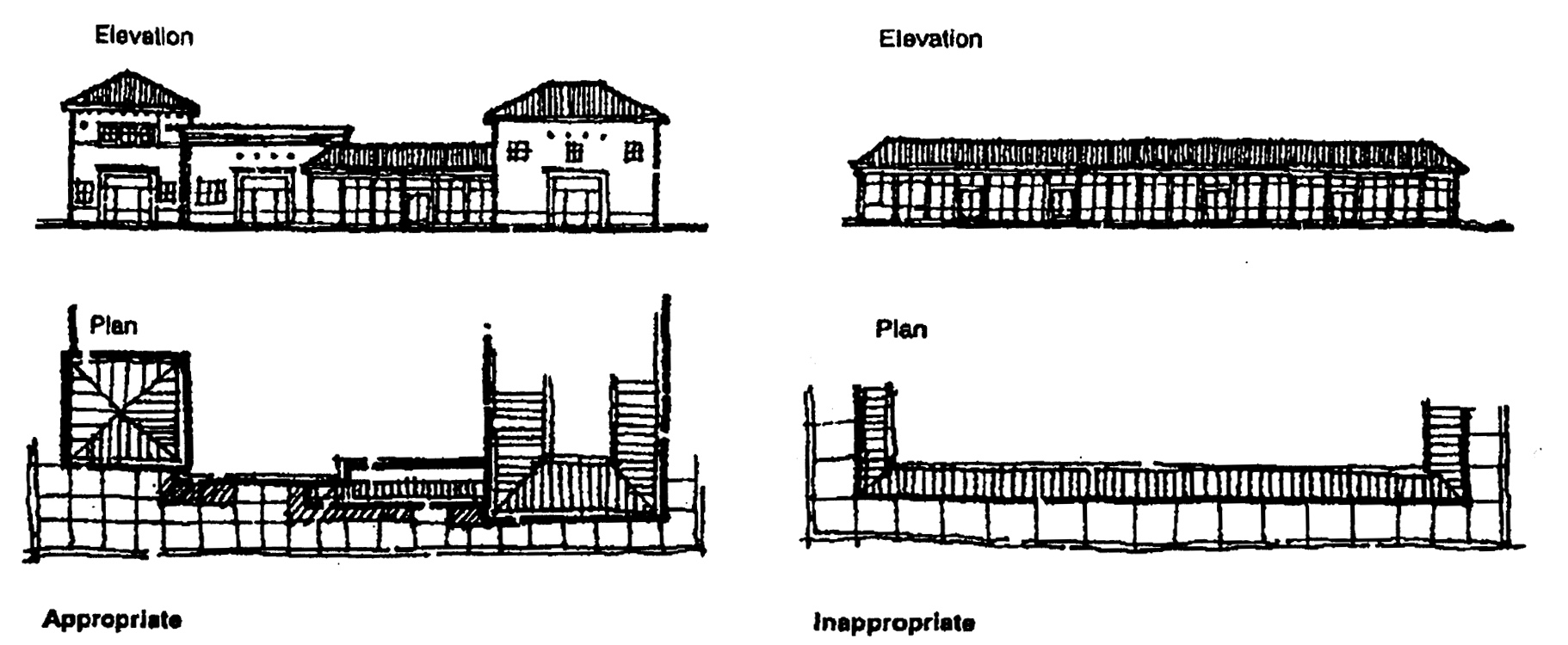
Large, Unarticulated Roofs
(Ord. No. 16-2007, § 2, 8-1-2007; Ord. No. 17-2014, § 2, 1-7-2015)

