
Lake Park City Zoning Code
ARTICLE V
- SUPPLEMENTARY REGULATIONS
Sec. 78-141.- Accessory and temporary buildings.
(a)
No garage or other use appurtenant to a main building shall be erected or constructed except during the progress of the construction of a main building, or until the main building is completed.
(b)
No trailer, basement, tent, shack, garage, barn or other building shall, at any time, be used as a residence temporarily or permanently, nor shall any structure of a temporary character be used as a residence.
(Code 1966, § 45-58; Code 1978, § 32-85)
Sec. 78-142. - Off-street parking and loading.
(a)
Purpose and intent. It is the intent of this section to provide for the health, safety, welfare and convenience of the public by requiring each development to provide minimum lands to accommodate the parking, loading, queuing and on-site circulation problems created by motor vehicles. All other town regulations in conflict with the minimum requirements of this section are hereby superseded to the extent that most stringent shall apply.
(b)
General standards.
(1)
Minimum standards. A minimum amount of area for off-street parking, loading and queuing shall be provided, and continuously maintained upon all developed lands in the town as provided in this section.
(2)
Access standards. Access to vehicular use areas shall conform to the standards established in this section.
(3)
Construction and design standards. Each vehicular use area shall be constructed and maintained according to the standards established in this section.
(4)
Parking design and relation to other uses. The design of vehicular use areas shall provide for logical impediment, free vehicular circulation and shall conform to this section.
(5)
Community development director. Where the responsibilities of the community development director require engineering expertise, the director shall consult with a licensed engineer. All costs associated with such consultation shall be borne by the applicant.
(c)
Off-street parking.
(1)
Generally. The off-street parking standards of this section shall apply to all lands that are developed, or on which existing development is substantially modified to the extent of requiring approval from the community development department. All off-street parking areas established by this section shall be continuously maintained according to the standards of this section.
(2)
Parking is an accessory use.
a.
Except as provided in subsection (c)(12) of this section (commercial lots), off-street parking shall be considered accessory to a principal land use.
b.
Except as provided in subsection (c)(8)a of this section (shared parking) and subsection (c)(8)d of this section (valet parking), all accessory off-street parking shall be provided upon the same lot as the principal land use.
(3)
Use of off-street parking. Off-street parking spaces shall be provided for the use of residents, customers, patrons and employees. Required parking spaces shall not be used for:
a.
Outdoor storage of goods and materials;
b.
Sale, repair or servicing of vehicles, other than on an emergency basis; or
c.
Sale or display of goods or services.
Required off-street parking spaces shall be free from encroachment of all structures. The location of required off-street parking shall not interfere with normal traffic flow, queuing and backup space. Required parking stalls and aisles shall not be used to park commercial vehicles conducting any business in the parking lot. A portion of the required parking stalls may be used on a temporary basis pursuant to a special permit issued by the community development department for the outdoor sales of goods, fairs, and other temporary events.
(4)
Parking in driveways in residential zoning districts. Driveways may be counted to satisfy minimum off-street parking standards for dwelling units provided:
a.
The dwelling unit does not share the driveway with adjacent dwelling units; and
b.
Sufficient space is available on the driveway to satisfy the residential parking space dimensional requirements of subsection (c)(9)c.1 of this section.
(5)
Calculating minimum number of required off-street parking spaces.
a.
Multiple land uses. Except as provided in subsection (c)(8)a of this section (shared parking), when more than one land use occupies the same structure or lot, the total number of required parking spaces shall be the sum of the required off-street parking spaces for each land use as if provided separately.
b.
Fractional requirements. When the calculation of the number of required off-street parking spaces results in a fractional number, a fraction of one-half space or greater shall require one full additional space.
c.
Calculations based on number of employees or occupants. When the calculation of parking spaces is based in whole or in part upon the number of employees or persons occupying or residing on a premises, the calculation of the minimum number of spaces shall be based upon the maximum number of employees or persons on duty or legally residing on the premises at any one time.
d.
Calculations based on number of seats. When the calculation of parking spaces is based in whole or in part upon the number of seats, each 22 inches of lineal length on a bench, pew, or similar seating facility shall be considered to be one seat.
e.
Calculations based on gross lot area. When the calculation of parking spaces is based upon gross lot area, the amount of lot area dedicated to off-street parking shall not be included in the calculation.
f.
Uncertainty or indefiniteness about a land use. If the standard for the number of parking spaces for a particular land use is not included in this section, the standards for most nearly comparable land use shall be applied by the community development director. In making this determination, the community development director may consult the community development department, and shall consider such factors as evidence of actual parking demand for similar land uses and such other reliable traffic engineering and planning information which may be available.
g.
Additions to existing development. Off-street parking facilities shall be provided for any new building constructed for any addition or enlargement of an existing building or use, or any change of occupancy or manner of operation that would result in additional parking spaces being required in excess of the number of existing parking spaces. The additional parking shall be required only for such addition, enlargement, or change, and not for the entire building or use.
h.
Inadequate information at the time of request for zoning action. The determination of the actual number of required off-street parking spaces may be delayed until the submission of certified building plans in the following instances:
1.
Where the formula for determining the minimum number of parking spaces is comprised of two or more different rates, and there is uncertainty about how some or all floor or lot area shall be used; or
2.
When it is unknown which portions of a structure are to be deleted from gross floor area to calculate gross leasable floor area.
If the added calculation of off-street parking spaces is delayed, an estimate of the number of required off-street parking spaces shall be accepted based on a preliminary plan using the applicable formula until the submission of certified building plans. Acceptance of preliminary plans shall not be considered to vest the number of off-street parking spaces or a site design.
(6)
Retention of off-street parking spaces. Required off-street parking space shall not be reduced in size, eliminated or made unusable in any manner, except as provided in subsections (c)(6)b of this section (motorcycle parking), subsection (c)(8)a of this section (shared parking) and subsection (c)(8)c of this section (grassed parking), and section 54-71 et seq. (the planning and zoning board).
a.
Restriction to require off-street parking by fee. Except as provided in subsection (c)(8)a of this section (shared parking), subsection (c)(8)d of this section (valet parking), and subsection (c)(12) of this section (public, private or commercial lots), access to the minimum number of public parking spaces required by this section shall not be restricted by fees or other forms of compensation. Access to parking spaces provided in excess of the minimum standards of this section may be controlled by means of fees.
b.
Motorcycle parking. For any nonresidential land use providing 50 or more spaces, a maximum of three required off-street parking spaces may be reduced in size and redesigned to accommodate parking of motorcycles. When provided, motorcycle parking shall be prominently identified by an abovegrade sign.
(7)
Minimum number of required off-street parking spaces by land use. Unless otherwise provided in this section, the minimum number of required off-street parking spaces for each land use is identified below in Schedule 78-142-1. A portion of the minimum number of required parking spaces may be used to satisfy the minimum number of required handicapped spaces required in subsection (c)(8)b of this section.
SCHEDULE 78-142-1
MINIMUM NUMBER OF OFF-STREET PARKING SPACES
RESIDENTIAL USES
1 Space within a carport or garage may be counted. No building permit may be issued to convert a carport or garage to living area without provision for adequate parking spaces in the driveway or a common parking lot. Space to park all vehicles must be provided on the lot. Except as provided in section 78-143, all required parking shall be paved.
2 Guest parking spaces may be grouped, provided that the spaces are located within 300 feet of the dwellings that they are intended to serve. Grouped guest parking may be grassed, as provided in section 78-142(c)(8)c.1—3, except that no permit is required. Each space shall be provided with wheel stops, except for grassed guest parking, which is designed as parallel parking. All guest parking shall be prominently identified with an abovegrade sign or marking on the wheel stop.
3 "B" means Standard B, which requires one space for the first 10,000 square feet of gross floor area, plus one space for each additional 15,000 square feet. See section 78-143(n)(2).
4 Vehicles shall not be stored in view. A snow fence or vegetation may be used to screen the vehicles from view.
5 If a convenience store is associated with the service station, then one-half of the additional spaces will be adjacent to the store.
6 "C" means Standard C, which requires one space for the first 10,000 square feet of gross floor area, plus one space for each additional 100,000 square feet. See section 78-143(n)(3).
7 "A" means Standard A, which requires one space for the first 5,000 square feet of gross floor area, plus one space for each additional 30,000 square feet. See section 78-143(n)(1).
8 Based on warehouse space.
9 "D" means Standard D, which requires one space for each 50 beds. See section 78-143(n)(4).
10 Such facilities shall provide clear ingress and egress and a convenient passenger drop-off area located adjacent to the building and out of the primary travel lanes.
11 If service is a direct service provider and is frequented on a daily basis by the general public, then four spaces per 1,000 square feet of customer service space shall be provided.
_____
(8)
Special regulations for off-street parking.
a.
Shared parking. Shared parking shall be allowed by special permit issued by the community development director application forms, and shall be consistent with the following standards:
1.
General. All land uses which participate in a single shared parking plan shall be located on the same lot, or on lots which share a common boundary. The parking lot shall be developed and used as though the land uses on the lots were a single unit.
2.
Unity of title. A shared parking plan shall be enforced through unity of title.
3.
Open space reserved for parking for all land uses. Enough land shall be reserved as open space to provide for the combined parking requirements of each land use, or an alternate plan may be provided such as a plan to convert an existing lot to a structure. If reserved as open space, the reserved area shall not be used for on-site retention of stormwater runoff nor be counted to fulfill requirements of article VIII of this chapter regarding landscaping. Additionally, preservation areas designated and protected by any government shall not be used to satisfy this reserve requirement. The reserved area shall be landscaped and maintained to present an orderly appearance.
4.
Shared parking study. A shared parking study acceptable to the community development director shall be submitted which clearly establishes that land uses will use the shared spaces at different times of the day, week, month or year. The study shall:
i.
Be based on the Urban Land Institute's methodology for determining shared parking or other generally accepted methodology;
ii.
Address size and type of activities, composition of tenants, rate of turnover for proposed shared spaces, and the anticipated peak parking and traffic loads to be encountered;
iii.
Provide for reduction of paved area by not more than one-half of the combined parking required for each use under subsection (c)(7) of this section;
iv.
Provide for reduction of any required handicapped spaces;
v.
Provide a plan to convert the open space reserved pursuant to subsection (c)(8)a.3 of this section to parking area. It may provide for construction of a parking structure to meet combined parking requirements; and
vi.
Be approved by the community development director based on feasibility of the land uses to shared parking due to their particular peak parking and trip generation characteristics.
5.
Use change. Should any of the uses be changed, or the zoning director find that any of the conditions described in the approved shared parking study no longer exist, the owner of record shall have the option of submitting a revised shared parking study in accordance with the requirements of this section or providing on-site the required number of spaces for each use.
b.
Handicapped parking. All handicapped parking regulations shall be governed by F.S. §§ 316.1957 and 553.511, and any rules promulgated thereunder, and such parking shall be paved.
c.
Grassed parking. Grassed parking shall be permitted by a special permit, subject to review and approval by the community development director, and subject to the following requirements:
1.
Application requirements. The applicant shall submit the following:
i.
A written statement of and a site plan showing the area proposed for grassed parking and the proposed method of traffic control to direct vehicular flow and parking;
ii.
A written statement that the parking area proposed for grassed parking shall be used for parking on an average of no more than two days or nights each week. This information shall contain the proposed hours and days of the expected use of the grassed parking and the expected average daily traffic and peak hour traffic counts, as calculated by a registered engineer;
iii.
Description of the method to ensure that the grassed parking surface will be maintained in its entirety with a viable turf cover due to infrequency of use;
iv.
A conceptual drainage plan for the entire parking area; and
v.
A description of the soil type of the area proposed for grassed parking.
2.
Permit. If at any time prior to the approved expiration date it is determined that a grassed parking site does not meet the minimum requirements established in this section, the community development director may require the restoration of the grassed surface or the paving of the grass for parking.
3.
Standard for review and approval of application. The following standards shall apply to review and approval of the application for a grassed parking permit:
i.
Only stall provided for peak demand may be approved as grassed parking. Paved parking shall be provided for average daily traffic, including weekday employees and visitors;
ii.
The community development department may determine that site-specific factors, such as but not limited to soil type exist which necessitate that substructural improvements be made to the area planned for grassed parking;
iii.
The review shall find that the area does not include any existing or proposed landscaped area, surface water management area or an easement other than a utility easement;
iv.
None of the grass parking is provided for handicapped persons;
v.
Grassed parking areas meet all minimum interior landscaping requirements normally associated with hard surfaced parking facilities as required in article VIII of this chapter regarding landscaping. No grassed parking area shall be counted toward meeting the minimum landscape or open space requirements; and
vi.
Within grassed parking areas, all access aisles shall either be paved and meet the same substructural and surface requirements as for paved asphaltic parking surfaces, or be surfaced with paver block or other semipervious coverage approved by the community development director.
d.
Valet parking. Valet parking may be used upon any lot to satisfy, in part, off-street parking standards. The design of valet parking shall not cause customers who do not use the valet service to park off-premises or in the right-of-way or cause queuing in the right-of-way. In addition:
1.
Maximum number of reserved stalls. Up to 50 percent of the required off-street parking spaces may be reserved for valet parking.
2.
Location of reserved stalls. Stalls reserved for valet parking may be located anywhere on site, except that handicapped parking spaces shall be the spaces located closest to the nearest accessible entrance of the building that the parking spaces are intended to serve.
(9)
Dimensions and geometrics of parking areas.
a.
Minimum standards. The dimensions and geometrics of off-street parking areas shall conform to the minimum standards of this subsection.
b.
Rules for calculating dimensions. If proposed parking angles are not illustrated in Table 78-142-1 and Figure 78-142-1 below, dimensions shall be interpolated from the tables and approved by the community development director.
c.
Dimensions.
1.
Residential dwelling units.
i.
Dwelling units which do not share a common parking lot. Each parking space for dwelling units which do not share a common parking lot shall be a minimum of eight feet wide and 20 feet long. Parking spaces may be provided in a manner in which the stalls are side-by-side, end-to-end or not contiguous to each other.
ii.
Dwelling units which share a common parking lot. For dwelling units which share a common parking lot, parking stalls and aisles shall be the size provided in Table 78-142-1 below, using the "general" standard.
2.
Nonresidential land uses and residential land uses with shared parking lots. All nonresidential land uses and residential land uses with shared parking lots shall provide parking spaces that comply with the dimensional requirements shown in Table 78-142-1 and Figure 78-142-1. In Column (I) of Table 78-142-1:
i.
General. The term "general" applies to parking spaces designated to serve all commercial uses, except retail uses, and also residential uses with shared parking lots. Spaces to be reserved for use by disabled persons shall be governed by the rows labeled "handicapped".
ii.
Handicapped parking. All spaces marked and reserved for use by disabled persons shall be installed in accordance with the handicapped parking requirements of F.S. §§ 316.1955, 316.1957 and 553.511.
iii.
Queuing distance. A minimum queuing distance of 20 feet is required between the property line and the first stall.
3.
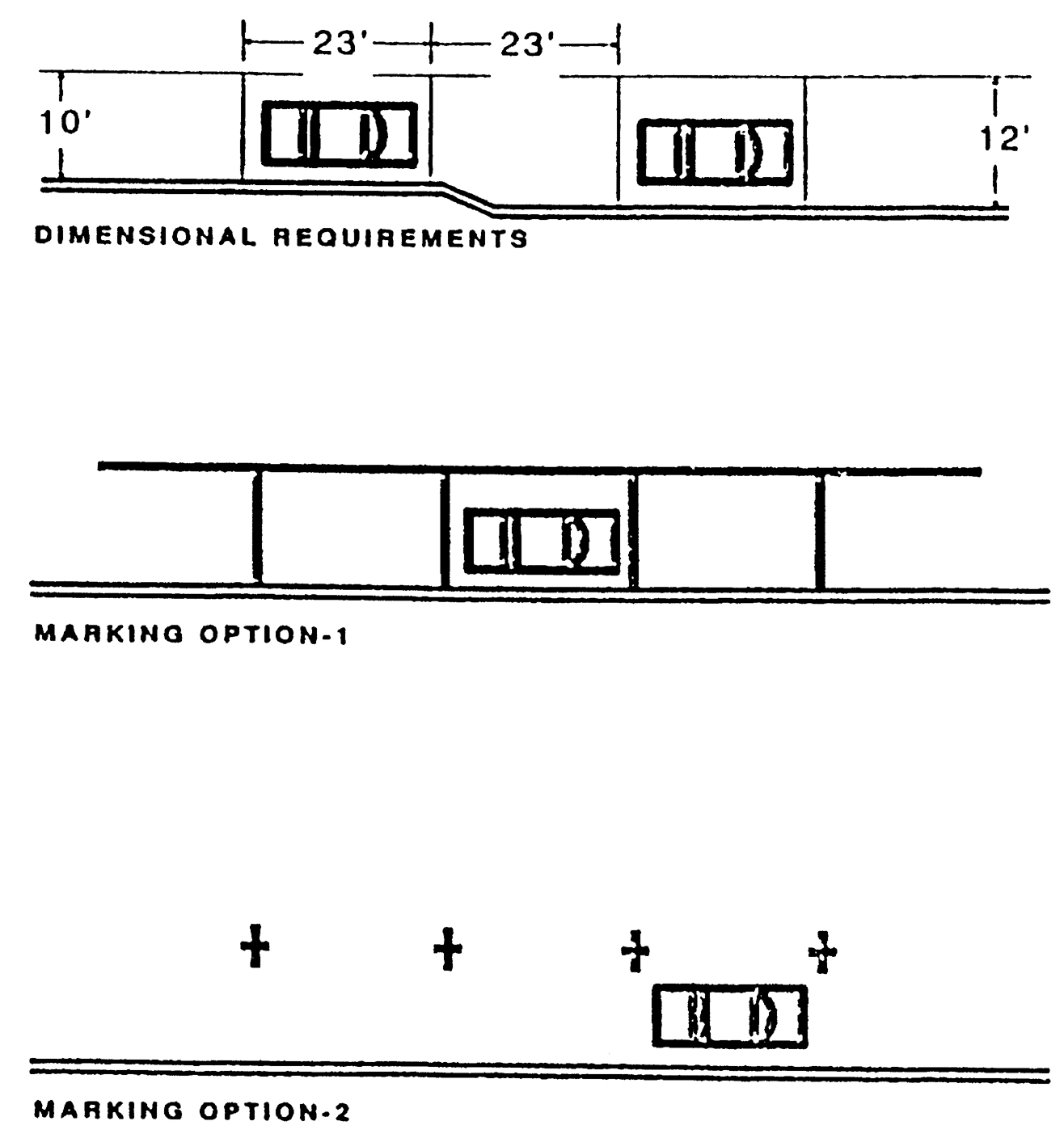
Parallel parking. Parallel parking spaces shall have minimum lengths of 23 feet and minimum widths of ten feet (see Figure 78-142-2).
4.
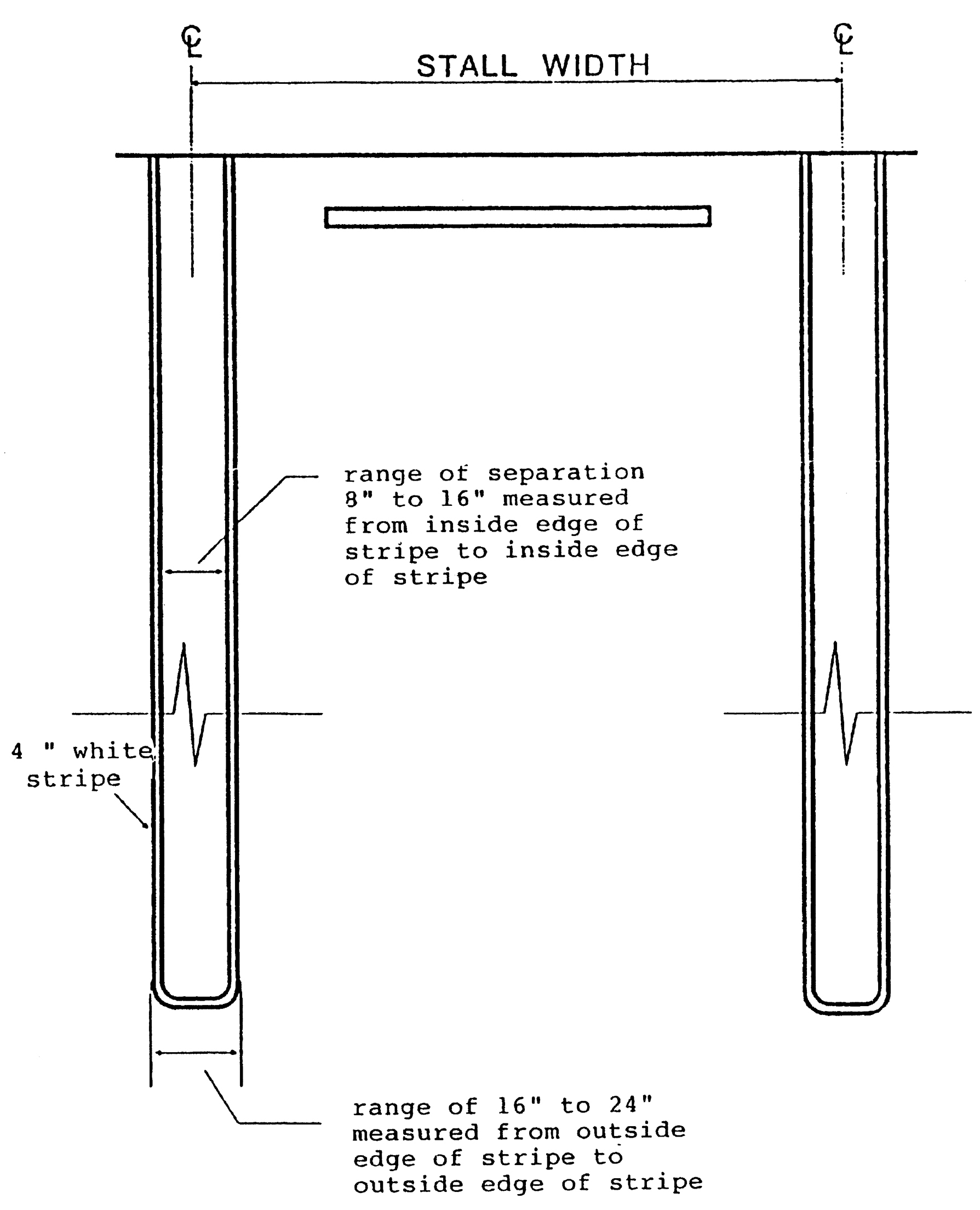
Measuring stall width. Where double striping is used to mark stalls, stall width shall be measured from the centerline of one set of stripes to the centerline of the other set of stripes. Where a single striping is used to delineate stalls, the width shall be measured from the centerline of each stripe to the centerline of each stripe.
TABLE 78-142-1
MINIMUM PARKING BAY DIMENSIONS FOR NONRESIDENTIAL USES
AND RESIDENTIAL USES WITH SHARED PARKING LOTS
1.
In Column (I) above, "general" applies to parking spaces designated to serve all commercial
uses and also residential uses with shared parking lots. Spaces to be reserved for
use by disabled persons shall be governed by the rows labeled "handicapped."
FIGURE 78-142-1
PARKING STALL SCHEMATIC
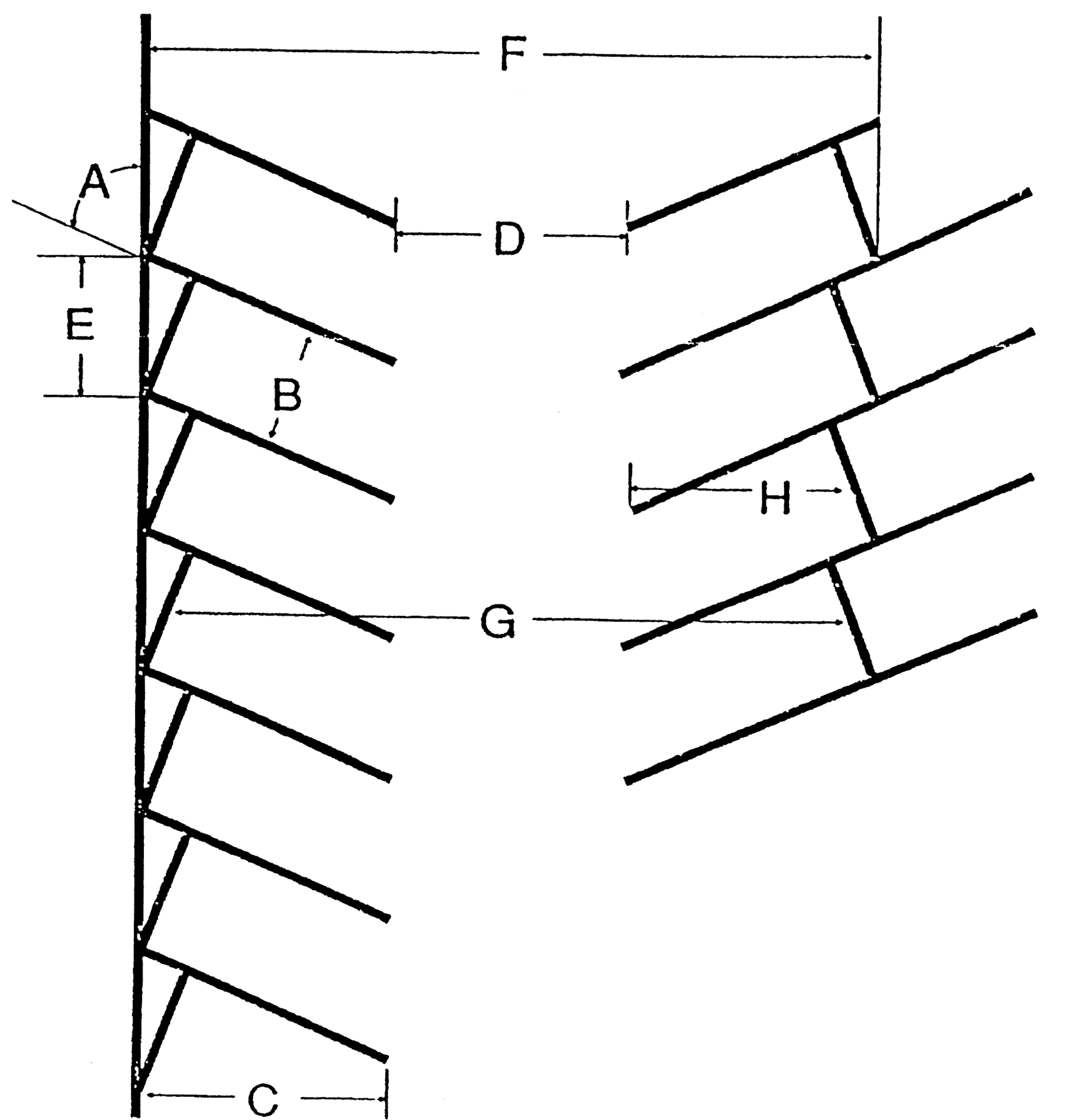
FIGURE 78-142-2
PARALLEL PARKING DIMENSIONAL REQUIREMENT AND MARKING OPTION
(10)
Construction and design of parking areas.
a.
General on-site circulation design standards.
1.
There shall be safe, adequate and convenient arrangement of pedestrian pathways, bikeways, roadways, driveways, and off-street parking and loading spaces within parking areas.
2.
Streets, pedestrian walks, parking areas and open space shall be designed as integral parts of an overall site design which shall be properly related to existing and proposed buildings, adjacent land uses and landscaped areas.
3.
The materials used in the design of paving, lighting fixtures, retaining walls, fences, curbs and benches shall be of good appearance, easily maintained and indicative of their function.
4.
Parking lots shall be maintained in a safe operating condition and manner as to not create a hazard or nuisance.
b.
Pedestrian circulation.
1.
Structures, vehicular circulation lanes, parking stalls, driveways, and open spaces shall be designed to provide logical, impediment-free pedestrian movement. The site shall be arranged so that pedestrians moving between buildings are not unnecessarily exposed to vehicular traffic.
2.
Paved, landscaped or comfortably graded pedestrian walks shall be provided along the lines of most intense use, particularly from building entrances to streets, parking areas and adjacent buildings.
3.
Where off-street parking spaces directly face a structure, and are not separated by an access aisle from the structure, a paved pedestrian walkway shall be provided between the front of the parking stall and the structure. The walkway shall be a minimum of four feet wide, exclusive of vehicle overhang, and shall be separated from the parking stall by concrete wheel stops or continuous curbing. Residential vehicular use areas are exempt from this requirement.
c.
Location of accessory parking. All accessory parking shall be located:
1.
Upon the same lot as the land use it is intended to serve; or
2.
Upon a lot which:
i.
Shares a common boundary with the principal land use;
ii.
Is properly zoned for accessory parking; and
iii.
Is subject to the same site plan and a unity of title as the land use the parking is intended to serve.
d.
Locations of on-site parking spaces.
1.
Unless otherwise provided in this section, parking spaces shall be located so that no spaces are more than 600 feet from the building or land use they are intended to serve. This requirement shall not apply to parking spaces for auditoriums, stadiums, assembly halls, gymnasiums, and other places of assembly; industrial, wholesaling and manufacturing establishments; hospitals; and large-scale retail, wholesale, and consumer service uses of over 500,000 square feet.
2.
There shall be no parking or storing of vehicles in the landscape buffer or the ultimate right-of-way.
3.
There shall be no parking of automobiles at the rear of a structure unless a public pedestrian walk connects it to the front of the building or there exists an entrance or store in the rear. Such pedestrian accessway shall be a minimum of four feet in width and shall be clearly marked. This requirement may be waived by the community development director upon demonstration by the applicant that no safety hazards will be created.
e.
Landscaping. All vehicular areas shall be landscaped as provided in article VIII of this chapter regarding landscaping.
f.
Paving standards. Gravel driveways in existence as of April 16, 2025 may be maintained as such, notwithstanding the provisions of the Town Code that prohibits them. At such time as a property owner proposes to replace the gravel driveway surface, or to substantially renovate the property as determined by the Director of Community Development pursuant to the Town Code definition for substantial renovation, whichever occurs first, a paved driveway that conforms to the paving standards of the Town Code is required.
1.
Reviewed and approved by community development department. The proposed grading and construction of the off-street parking facilities shall be approved by the community development director.
2.
Materials and methods. Unless otherwise provided in this subsection (c)(10)f, all vehicular use areas and specialized vehicular use areas shall be improved either with:
i.
A minimum of six-inch shellrock or limerock base with a one-inch hotplant mix asphaltic concrete surface; or
ii.
A base and surface material of equivalent durability.
3.
Maintenance of vehicular use areas. All vehicular use areas or specialized vehicular use areas shall be maintained in good condition to prevent any hazards such as cracked asphalt or potholes, or bare spots and uneven surfaces.
4.
Shell rock allowed. The land uses and associated features listed below may construct surface parking lots with shellrock or other similar materials.
i.
Agricultural uses with less than 20 spaces.
ii.
Radio towers in the agricultural zoning districts.
iii.
Camps in the agricultural zoning districts.
iv.
Nursery and greenhouses in the agricultural zoning districts.
v.
Driveways in rural residential zoning districts serving residential uses of unpaved roads.
vi.
Other similar land uses when approved by the community development director.
5.
Wheel stops or curbing required. Wheel stops or continuous curbing shall be placed 2.5 feet back from walls, poles, structures, pedestrian walkways or landscaped areas. The area between any wheel stop and required landscaped strip may be grassed, rendering the paved stall area 15 feet to 16 feet in length, depending on the angle of parking provided.
g.
Drainage standards. Runoff from vehicular use areas shall be controlled and treated in accordance with all applicable agency requirements in effect at the time of permit application.
h.
Lighting. If a vehicular use area, or a specialized vehicular use area is to be open for use after dark, it shall be lighted. Lighting shall be arranged and designed so that no source of light is directed toward any adjoining or nearby property used or zoned for residential purposes. Lighting shall be designed to shield public streets and all other adjacent properties from direct or distracting glare, or hazardous interference of any kind. All vehicular use areas must also meet the lighting standards contained in the Palm Beach County Security Code.
i.
Signage and marking requirements.
1.
Marking. Except for parallel parking spaces, parking lots containing stalls for three or more vehicles shall delineate each stall by double stripes on each side of the stall. All stripes shall be painted in white paint except for handicapped spaces which shall have blue stripes. The width of the painted stripe shall be four inches. The separation from inside edge of stripe to inside edge of stripe shall be no less than eight inches and no more than 16 inches. The effective width of the double stripes shall range from 16 inches to 24 inches measured from outside edge of stripe to outside edge of stripe. (See Figure 78-142-3 for an example.) Marking of parallel parking spaces shall be as shown in either of the options in Figure 78-142-2.
2.
Signage. Traffic control signs and other pavement markings shall be installed and maintained as necessary to ensure safe and efficient traffic operation of all vehicular use areas. Such signage and marking shall be subject to the approval of the community development department and conform with the Manual on Uniform Traffic Control Devices, Federal Highway Administration, U.S. Department of Transportation, as adopted by the state department of transportation, as revised.
STRIPING REQUIREMENTS FIGURE 78-142-3
j.
Ingress and egress to vehicular use areas.
1.
Ingress and egress. Each parking stall shall have appropriate access to a street or an alley. Only dwelling units with separate unshared driveways shall be allowed backward egress from a driveway onto a local street. In all other cases, maneuvering and access aisle area shall be sufficient to permit vehicles to enter and leave the vehicular use area or specialized vehicular use area in a forward motion. The location and number of driveways shall be subject to approval by the community development director.
2.
Dimensions of ingress and egress areas. The dimensions listed below shall begin at the street and run the entire length of the driveway. This section does not apply to residential land uses.
* Measured along right-of-way line at inner limit of curbed radius sweep or between radius and near edge of curbed island at least 50 square feet in area. The minimum width applies principally to one-way driveways.
** On side of driveway exposed to entry or exit by right-turning vehicles.
(11)
Queuing. In addition to meeting the requirements of subsection (c)(14) of this section, all drive-through establishments shall meet the standards listed below:
a.
Each queuing lane shall be clearly defined and designed so as not to conflict or interfere with other traffic using the site.
b.
A bypass lane a minimum of 12 feet wide shall be provided if a one-way traffic flow pattern is used in the parking lot. The bypass lane shall be clearly designated and distinct from the queuing area.
c.
The minimum number of required queuing spaces, including the vehicle being serviced, shall be as provided in Schedule 78-142-2. Each queuing space shall be a minimum of ten feet by 20 feet in size. Unless otherwise indicated below, queuing shall be measured from the point of ultimate service to the rear of the queuing lane.
SCHEDULE 78-142-2
QUEUING REQUIREMENTS
(12)
Public, private or commercial parking lots.
a.
General. Where permitted by special exception, off-street parking lots and structures shall be allowed as the principal land use. Parking spaces may be rented for parking. No other business of any kind shall be conducted on the lot, including repair, service, washing, display or storage of vehicles or other goods. Review of applications for parking lots and structures shall consider the proposed operation of the lot. Requirements of this section, including signage, maneuvering, and backup distances may be varied, based on the proposed operation. The requirements of the land development code (chapter 67) related to landscaping, lighting, surfacing and drainage may not be varied.
b.
Design. Plans for parking lots shall be drawn to an accurate scale and show the layout of the lot entrance and exits, drainage provisions, signs, surfacing, curbs or barriers, exits and entrances of properties located contiguous and directly across the street, and location and type of landscaping.
c.
Entrances and exits. The size of entrances and exits shall comply with this section and shall be located to present the least interference with traffic and the least nuisance on any adjacent street. The point of entrance control shall be located to provide three-car queuing internal to the site. The location, size and number of entrances and exits shall be subject to the approval of the community development director.
(13)
Requirements for parking structures.
a.
General. All public or private parking garages may be used to meet off-street parking requirements for any use or combination of uses, and such structures shall be considered accessory to the principal use. Garages shall be designed to meet or exceed the following minimum requirements and regulations. All public or private parking garages shall comply with the standards for surface parking lots with regard to marking, signage and minimum number of spaces to be provided.
b.
Review of plans by community development department. The community development director shall review and approve the proposed parking layout. In determining whether a proposed plan shall be approved, the community development director shall apply the standards set forth in this subsection. In addition, the community development director shall consider the following information, which is to be supplied by the applicant:
1.
The number, location and associated internal and external vehicular reservoirs;
2.
Anticipated arrival and departure rates and times of day for vehicles using the parking structure;
3.
Type of control for outward and inbound traffic with the associated service rate per land;
4.
Driveway locations on contiguous property or property on the opposite side of the street;
5.
Information regarding the current and anticipated volume of traffic at adjacent intersections and on surrounding streets serving the parking structure driveways;
6.
Lot size and lot configurations, and safe sight distance; and
7.
Proposed land usage and the traffic characteristics of the land usage.
c.
Design standards.
1.
Module width requirements. The unobstructed distance between columns or walls measured at any point between the ends of the parking aisle shall be as specified in the following table:
Module Width Requirements (Feet)
*Requests for reductions of unobstructed distances will be considered if the stall and aisle dimensions specified in surface parking dimensions are met and the columns are not located at the rear of the parking stalls or interfere with the opening of doors.
2.
Minimum parking space widths. The minimum parking stall width shall be 8.5 feet provided that the minimum clear distances specified above are met.
3.
Ramp dimensions.
i.
Width. The width of ramps between parking levels and cross aisles at the ends of parking aisles shall be 16 feet for one-way operation and 26 feet for two-way operation.
ii.
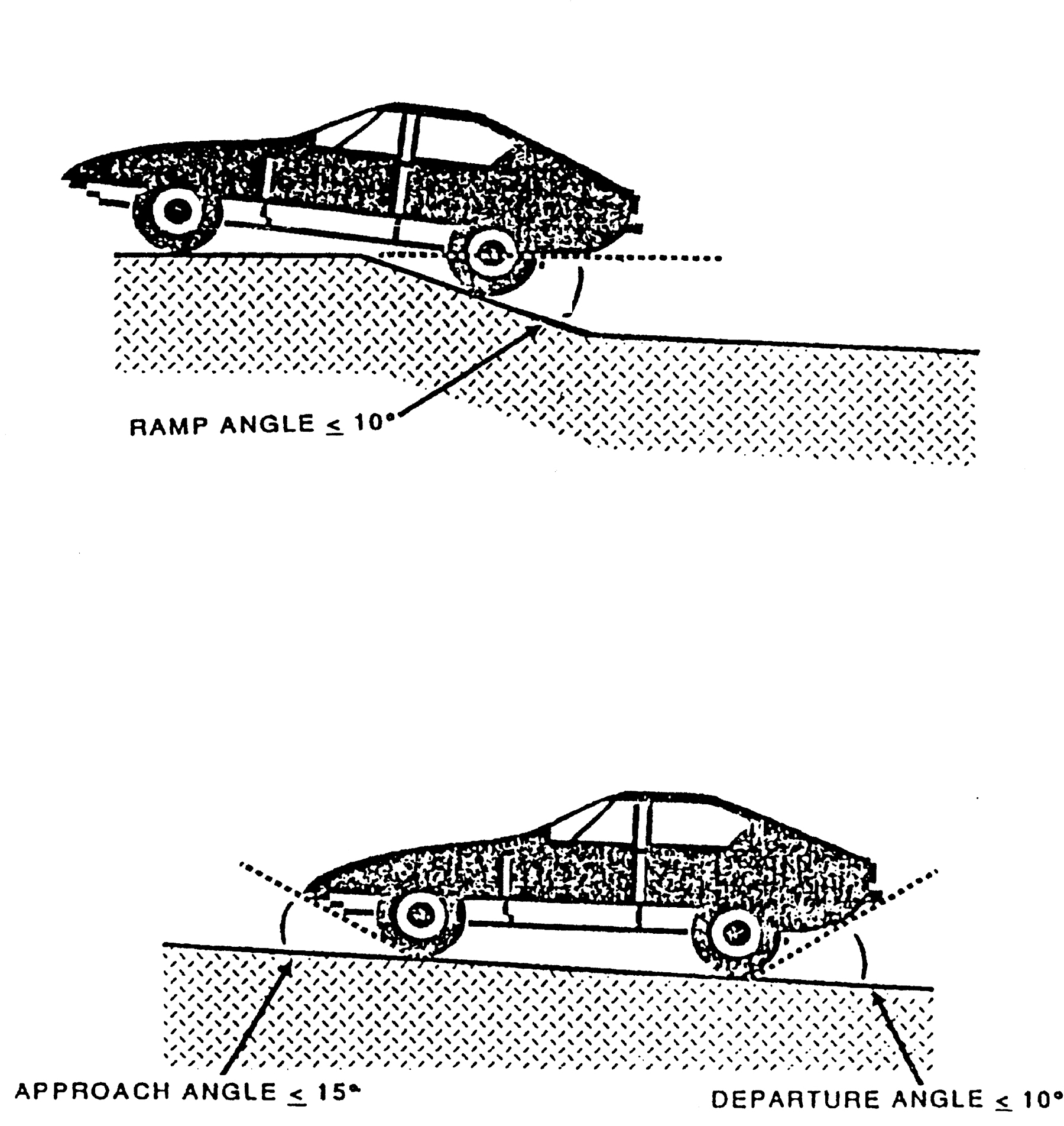
Angles. The maximum approach, departure, and ramp angles (as illustrated and defined in Figure 78-142-4) shall not exceed the values indicated below unless vertical curves (minimum = 1) are provided to connect the two grades. The design of such vertical curves shall be subject to the review and approval of the community development director.
RAMP ANGLES FIGURE 78-142-4
4.
Maximum floor grades. The maximum grade on floors with parking shall be six percent maximum grade, and on floors without parking shall be 12 percent.
5.
Stairways or elevators required. Stairways and elevators shall be made to separate vehicular and pedestrian movements between the various levels of multilevel parking structures.
6.
Minimum turning radii. The minimum vehicle turning inside radii shall be 15 feet.
7.
Lighting. Lighting of enclosed parking structures shall be provided to meet or exceed the following standards:
8.
Handicapped parking. Spaces designed and reserved for use by disabled persons shall be provided pursuant to subsection (c)(8)b of this section.
9.
Plans certified by registered engineer. All plans to construct parking structures shall be designed and certified by a registered engineer or architect. Plans shall be drawn to an accurate scale and show the structure's layout and that all of the minimum requirements for parking structures have been met.
(14)
Supplemental administrative requirements. At the time of the application for the first development order to be obtained for any use for which parking spaces are required to be constructed, a site plan for such parking facilities shall be submitted to the community development. The site plan shall show requirements specific to the land use as outlined in this section, other sections of the land development code, and the following:
a.
A generalized landscape plan showing location and dimensions of proposed perimeter strips, buffers and interior features. At the time of application for a building permit, a detailed landscape plan shall be submitted detailing the location, type and names of materials proposed for planting.
b.
When the parking facilities are housed in an underground garage or a multistoried structure or on the roofs of buildings, a site plan shall be submitted thereunder for approval of interior traffic circulation, slope of ramp, ease of access and utilization of ramps, for parking stall and aisle dimensions, proper traffic control signing and pavement marking for safe and efficient vehicular and pedestrian operation, for location of entrances and exits on public roads, for approval of sight distances at such entrances and exits and at corners of intersecting public roads, and for approval of the effective screening of the cars located in or on the parking structures from adjoining properties and from public roads.
c.
Entrances and exits to all public and private roads and easements, dimensioned.
d.
Location and dimensions of all structures.
e.
Location and dimensions of all parking spaces and aisles, queuing lanes, loading areas and any specialized vehicular use areas.
f.
Location and dimensions of all stalls designed and reserved for disabled persons, and location of associated ramps.
g.
Directional markings, fire lanes, loading zones, and typical wheel stops or curbing.
h.
Location and dimensions of walls, fences and pedestrian walkways.
i.
Location of required berms, retention areas, septic tanks, drainfields and lighting fixtures.
j.
Proposed and existing centerlines of adjacent rights-of-way and streets, right-of-way dimensions, lot dimensions and lot area.
k.
Any existing easements, including those used for drainage, utility limited access, ingress/egress and maintenance.
l.
Graphical representation of parking surface proposed to have grassed parking and enumeration in the site plan data table of the number of spaces to be grassed.
m.
Delineation of any area reserved as future parking provided for in an approved shared parking plan and enumeration in the site plan data table of the number of spaces for which open space has been reserved.
n.
Any other pertinent information that may be required to satisfy the rules and regulations of this and other applicable codes and ordinances or conditions of development approval.
(Ord. No. 26-1990, § 4, 10-31-1990; Code 1978, § 32-86; Ord. No. 03-2024, § 2, 3-6-2024; Ord. No. 02-2025, § 2, 5-7-2025)
Sec. 78-143. - Off-street loading standards.
(a)
Purpose and intent. At the time of the erection of any principal or accessory use or at the time and principal or accessory use is altered, enlarged or increased in capacity or intensity by adding floor area or volume, off-street loading space for the accommodation of trucks servicing the use shall be provided in accordance with this section and other applicable regulations of the this chapter.
(b)
Loading demand statement. All applications for new or increased use or capacity for nonresidential establishments shall include a statement outlining the land use's projected normal demands for loading and unloading, and a plan showing the location on the lot of the off-street loading space to be provided, in accordance with the provisions of this section.
(c)
Relationship to streets and off-street parking.
(1)
A street or walkway shall not be used for loading or unloading materials.
(2)
An off-street loading area shall not be used to satisfy any off-street parking requirements, and the location of the loading area shall not interfere with the free circulation of vehicles in the off-street parking area.
(3)
Where loading areas are directly adjacent to or integrated with an off-street parking lot, the community development director may require installation of physical barriers, such as curbing, fences, solid hedges, or other means for separation of loading areas from parking areas and pedestrian traffic.
(d)
No repair activities. No motor vehicle repair work, except emergency repair service, shall be permitted in any required off-street loading facility.
(e)
Mixed uses in one building. Where a building is used for more than one use and where the floor area used for each use is below the minimum for required loading spaces but the aggregate total floor area is greater than the minimum, then off-street loading space shall be provided as if the entire building were used for that use in the building for which the most spaces are required. In such cases, the community development department may make reasonable requirements for the location of required loading space.
(f)
Maximum requirements apply in cases of uncertainty. If there is uncertainty about the amount of loading space required by the provisions of this section as a result of indefiniteness about the proposed use of a building or land, the maximum requirement for the general type or use that is involved shall govern. Where the required number of loading spaces is not set forth for a particular use, and where there is no similar general type of use listed in this section, the community development director shall determine the basis for the number of spaces to be provided by determining the off-street loading demand for the most comparable land use.
(g)
Lighting. Lighting of off-street loading areas shall comply with section 78-142(c)(13)c.7 (off-street parking).
(h)
Landscaping. All off-street loading areas used for all uses shall be landscaped in accordance with section 78-251 (landscaping generally).
(i)
Minimum size, dimensions, and location of loading space. Loading space shall have the following minimum dimensions:
(1)
Berth width. A single loading berth shall have a minimum width of 15 feet. Additional loading berths that lie alongside, contiguous to, and not separated from a first loading berth may be a minimum of 12 feet in width.
(2)
Berth length. All loading berths shall be a minimum of 35 feet in length.
(3)
Maneuvering apron. An area equal to the width and length of the berth shall be provided for vehicle maneuvering directly behind the loading berth it is intended to serve.
(4)
Vertical clearance. A vertical clearance of a minimum of 15 feet shall be provided throughout the berth and maneuvering apron.
(5)
Location of loading space. Berths and related space shall be located directly adjacent to the building which requires designated loading space. Loading areas shall be proportionately distributed throughout the site.
(j)
Entrance and exits. Location and design of entrances and exits shall be in accordance with sections 78-142 and 78-144.
(k)
Distance from intersections.
(1)
Distance. No loading space or berth shall be located within 40 feet from the nearest point of the edge of pavement or curb of any two intersecting streets.
(2)
Setback. The surfaced portions of all loading areas, excluding driveways, shall observe a 20-foot setback from all front or side corner lines. When located at the rear of a building, a minimum of five-foot setback from all property under separate ownership or control shall be observed.
(l)
Drainage and maintenance. All loading areas shall be paved in accordance with the provisions of section 78-142(c)(10)f.
(m)
Access marking. Each off-street loading space shall be provided with safe and convenient access to a street, without it being necessary to cross or enter any other required loading space. If any loading space is located contiguous to a street, ingress and egress to the street side shall be provided only through driveway openings. The dimension, location and construction of these driveways shall be designed in accordance with the provisions of section 78-144 (access driveways) and approved by the community development director. In addition, off-street loading spaces which have three or more berths shall have individual spaces marked, and spaces shall be so arranged that maneuvering to and from a loading space shall be on the same lot unless approved by the community development director. Maneuvering shall be permitted in an alley upon the approval of the community development director if surrounding land uses are within a compatible zoning district.
(n)
Minimum required spaces; ratios. Minimum off-street loading spaces shall be in accordance with Schedule 78-142-1 above. When the calculation of loading spaces results in a fractional number, a fraction of one-half spaces or greater shall require one full additional loading space.
(1)
Standard A: One space for the first 5,000 square feet of gross floor area, plus one space for each additional 30,000 square feet.
(2)
Standard B: One space for the first 10,000 square feet of gross floor area, plus one space for each additional 15,000 square feet.
(3)
Standard C: One space for the first 10,000 square feet of gross floor area, plus one space for each additional 100,000 square feet.
(4)
Standard D: For each congregate living facility or nursing home development containing 20 or more beds, one space for each 50 beds.
(o)
Reduction in required loading space. All required off-street loading spaces and their appurtenant aisles and driveways shall be deemed to be required space and shall not be encroached upon or reduced in any manner except upon approval by the community development director, and in the following circumstances:
(1)
Reduction in number of berths.
a.
Change in use. The number of loading spaces may be proportionately reduced if the space is not needed is a result of a reduction in size or change in the nature of the land use to which loading spaces are served.
b.
Administrative reduction. For uses which contain less than 10,000 square feet of total floor area, the community development director may waive or reduce the loading requirements whenever the character of the use is such as to make unnecessary the full provision of loading facilities and where such provision would impose an unreasonable hardship upon the use of the lot.
(2)
Reduction on size of berth. Reduced stall dimensions shall be permitted upon a finding that all of the following standards have been met:
a.
The manner of operation proposed is such that stalls of the required dimensions are unnecessary because, the size, character and operation of the use will not regularly involve service by motor vehicles which require the dimensions of an off-street loading berth, such as, but not limited to the following uses: Bowling alleys and other recreational establishment, financial institutions, funeral chapel and funeral homes, nursing homes, offices, and personal service establishments;
b.
The land uses are likely to continue or to be succeeded by others for which the same stall dimensions will be adequate, or that any additional loading space necessary could be provided in a logical location without creating violations of other requirements of these regulations; and
c.
Any reduction provides for a minimum stall length of 15 feet, a stall width of at least 12 feet, and a vertical clearance of ten feet.
(Ord. No. 26-1990, § 5, 10-31-1990; Code 1978, § 32-87)
Cross reference— Traffic and motor vehicles, ch. 30.
Sec. 78-144. - Access to rights-of-way.
(a)
Intent. It is the intent of this section to provide control of access to streets in order to facilitate safe and efficient movements of traffic while affording reasonable access to abutting properties.
(b)
Driveways. Driveways shall be permitted by the community development director in accordance with the town standards and this section.
(1)
Distance between driveways.
a.
Except in townhouse clusters and planned unit developments, driveways along local or residential access streets at interior locations shall be permitted not closer than four feet from a side or rear property line to edge of driveway. There shall be no more than two driveways per lot.
b.
Along arterial and collector streets, driveways shall be spaced a minimum of 200 feet apart.
(2)
Construction. Driveways within or which abut streets under the control or jurisdiction of the town shall be constructed in accordance with the construction standards of this Code.
(c)
Street connections. Street connections shall be permitted by the community development department in accordance with the town's general development regulations and town standards.
(d)
Double frontage lots. Where a double frontage residential lot is located adjacent to a collector or an arterial street, it shall front on a local or residential access street. A limited access easement shall be placed along the property line which abuts either the collector street or the arterial street.
(e)
Exceptions. The community development director shall have the authority to grant a permit for lesser or greater distances than designated herein, giving consideration to the following factors:
(1)
Lot size;
(2)
Lot configurations;
(3)
Proposed land usage;
(4)
Traffic generation or anticipated traffic volume along adjoining rights-of-way;
(5)
Traffic characteristics of the land usage;
(6)
Driveway locations on contiguous property or property on the opposite side of the street;
(7)
Median opening locations;
(8)
Safe sight distance; and
(9)
Such other factors as may be deemed pertinent by the community development director.
(f)
Cross access/joint access easements.
(1)
In order to provide for an alternative method to ensure the safe and efficient movement of traffic along public roadways and to comply with the minimum parking standards for those properties which front public streets in the town's commercial zoning districts, property owners shall, whenever feasible, execute cross access and joint access easements to share common driveways, drive aisles, service drives, and parking areas, to facilitate access between their properties and the businesses located thereon. Property owners who agree to execute cross access and/or joint easements may be entitled to a reduction of the number of required parking spaces upon their respective properties by up to 50 percent provided a shared parking study is submitted to the director of community development which demonstrates that the parking demand for the properties subject to the cross access and/or joint access easement can be met. The parking demand study shall be subject to the review and approval of the community development director. The study shall:
a.
List the legal names of the property owners, the size and type of uses located and being operated upon that owners property;
b.
Include the amount of average and peak daily trips to the uses on their properties;
c.
Include the rate of turnover of parking spaces during business hours;
d.
Include the anticipated peak parking and traffic loads to be encountered; and
e.
Include the executed cross access/joint access easement between the property owners.
(2)
Any property owner who proposes the expansion of an existing business, the development of a new or different use, or the redevelopment of a property, shall design the site to accommodate vehicular circulation through its site to adjacent owners' sites by the use of a cross access and/or joint access easement which defines the shared access points or driveway, drive aisles, service drives, and parking spaces that can be connected to an adjacent property owners' property. Provided, however, a property owner within a commercially zoned district whose property fronts a public street, who can connect to the public roadway, and whose uses meet the town's parking standards, may elect to not participate in cross access/joint access easements with adjacent property owners.
(3)
All properties with frontage on public streets which are within commercial zoning districts shall be subject to the access to rights-of-way regulations in section 78-144 of the Code which can be supplemented by the execution of cross and joint access easements between owners of properties whose properties front public streets as shown in Figure 78-144-1. Cross and joint access circulation is encouraged whenever feasible and shall include the following:
a.
A cross access drive extending the entire length of each block served to provide for driveway separation consistent with the access to rights-of-way system in section 78-144 and standards;
b.
A design speed respective of the individual vehicular drive aisles and which maintains a sufficient width to accommodate two-way travel aisles shall be designed to accommodate personal vehicles and service vehicles; and
c.
Stub-outs and other design features to make it visually obvious that adjacent properties may be legally bound to provide cross access points, consistent with the visibility triangle requirements and the landscape requirements of the Code;
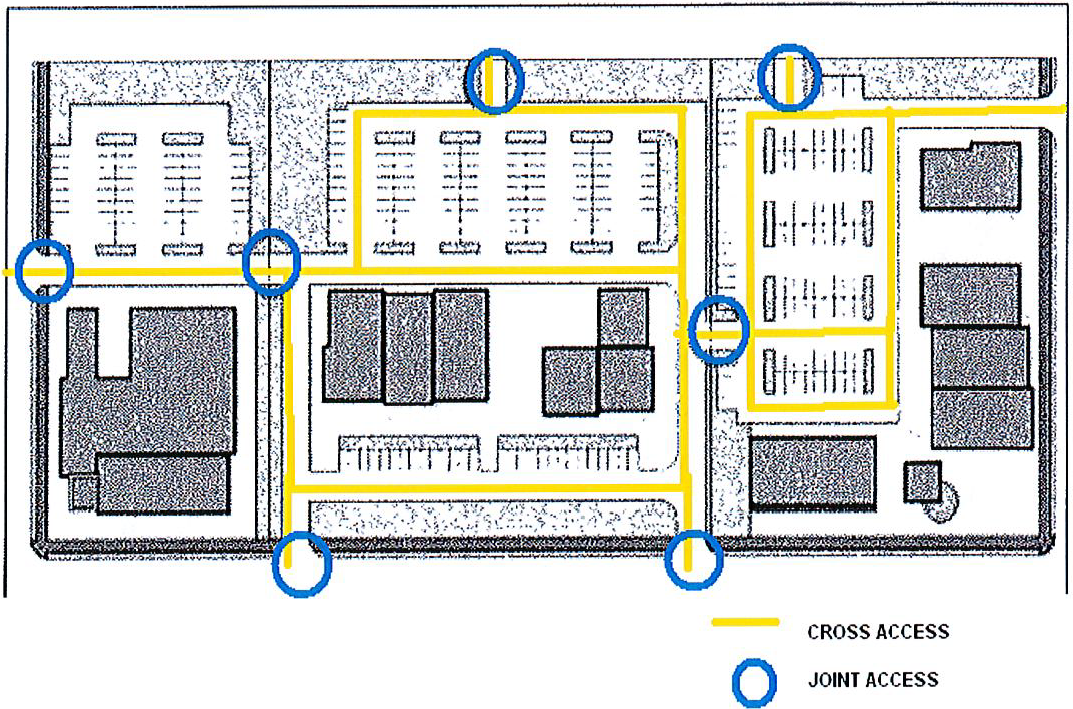
Figure 78-144-1: Cross access between parking areas and adjacent properties. Joint access through the use of common driveways entrances and between properties.
(4)
Pursuant to this section, where cross access or joint access easements between property owners has been agreed to, the parties to the cross access and/or joint access easements shall record the easement allowing cross and/or joint access between properties.
(5)
Pursuant to this section, where cross and/or joint access easements between property owners has been agreed to, those properties proposing reconstruction or redevelopment shall provide that remaining access rights along the public roadway shall be dedicated to the town and any pre-existing driveways shall be closed following the reconstruction or redevelopment of the properties.
(Ord. No. 26-1990, § 6, 10-31-1990; Code 1978, § 32-88; Ord. No. 13-2013, § 2, 9-10-2013)
Cross reference— Traffic and motor vehicles, ch. 30.
Sec. 78-145. - Supplemental parking requirements.
(a)
Congregate living facilities.
(1)
General requirements.
a.
Every congregate living facility shall provide adequate parking and circulation for residents, visitors and staff. The standards established in this subsection shall be considered the minimum necessary to achieve this goal.
b.
Unless otherwise provided in this chapter, all parking and vehicular use areas shall be paved.
c.
The bases for parking calculations shall be clearly stated on proposed site plans, including the maximum number of employees.
d.
Additional parking requirements may be imposed as a condition of approval of the special exception.
(2)
Specific requirements. Every congregate living facility shall comply with the following requirements:
a.
A minimum of one parking space shall be provided for each four residents, plus one space for each employee on the shift of greatest employment.
b.
Adequate provision shall be made to reserve sufficient lot area to meet future parking requirements if the facility is converted to other uses. Protected vegetation in this reserve parking area shall be maintained as provided in the land development regulations governing the protection of natural resources. The boundaries of the reserve parking area shall be indicated on the project's site plan.
c.
Congregate living facilities shall establish a safe drop-off area for group transportation, such as vans or similar vehicles.
(b)
Mobile home condominium park. Every mobile home condominium park (MHCP) shall comply with the following requirements:
(1)
A minimum of two parking spaces for each dwelling unit shall be provided. If any mobile home condominium park unit is clustered with other dwelling units on a parking lot, then parking shall be calculated to include guest parking at the rate of one-quarter space for each dwelling unit.
(2)
Parking for recreational uses within PUDs shall be determined based on the standards outlined in subsection (i) of this section regarding recreation facilities. Parking of vehicles on arterials or collectors is prohibited. Parked vehicles may not be backed out into any arterial or collector streets. Turning movements for vehicle orientation purposes must be accomplished prior to entering any collector, arterial or other street of high traffic volumes. Parking space dimensions shall be governed by section 78-142.
(c)
Mobile home rental park. Every mobile home rental park (MHRP) shall comply with the following requirements:
(1)
A minimum of two parking spaces for each dwelling unit shall be provided. If any mobile home rental park unit is clustered with other dwelling units on a parking lot, then parking shall be calculated to include guest parking at the rate of one-quarter space for each dwelling unit. Parking for recreational uses within mobile home rental parks shall be determined based on the standards outlined in subsection (i) of this section regarding recreation facilities.
(2)
Parking of vehicles on arterials or collectors is prohibited. Parking areas shall be screened as required by article VIII of this chapter regarding landscaping. Parked vehicles may not be backed out into any arterial or collector streets. Turning movements for vehicle orientation purpose must be accomplished prior to entering any collector, arterial or other street of high traffic volumes. Parking space dimensions shall be governed by section 78-142.
(d)
Planned unit development. Every planned unit development shall comply with the following requirements:
(1)
Parking of vehicles on arterials or collectors is prohibited.
(2)
Parked vehicles may not back out into any arterial or collector streets. Turning movements for vehicle orientation purpose must be accomplished prior to entering any street of high traffic volumes.
(3)
Parking bay design shall be governed by section 78-142.
(e)
Recreational vehicle park. Every recreational vehicle park shall comply with the following requirements:
(1)
A minimum of one parking space per recreational vehicle unit shall be required. Parking of vehicles on arterials or collectors is prohibited.
(2)
Parked recreation vehicles may not be backed out into any arterial or collector streets. Turning movements for vehicle orientation purpose must be accomplished prior to entering any collector, arterial or other street of high traffic volumes. Parking space dimensions shall be governed by section 78-142.
(f)
Townhouse cluster. Every townhouse cluster shall comply with the following requirements:
(1)
Prohibited parking. Parking of vehicles on arterials or collectors is prohibited.
(2)
Off-street parking. Parking for townhouse clusters shall be based on the number of bedrooms per townhouse:
(3)
Guest parking. For all dwelling units with shared driveways, guest parking shall be provided consistent with the following requirements and options:
a.
Guest parking shall be provided at the rate of one-quarter space for each dwelling unit.
b.
Guest parking spaces may be grouped, provided that the spaces are located within 300 feet of the dwellings that they are intended to serve.
c.
Grouped guest parking may be grassed, as provided for in section 78-142(c)(8)c. Each space shall be provided with wheel stops, except for grassed guest parking which is designed as parallel parking. Parking for recreational uses within townhouse clusters shall be determined based on the standards outlined in subsection (i) of this section relative to recreation facilities.
d.
Parking spaces and driving aisles shall be designed to provide forward egress from a lot onto a street. Only two-unit townhouse clusters with unshared driveways shall be allowed backward egress from a lot onto a street. Parking stall dimensions shall be governed by section 78-142.
(g)
Commercial new and used motorcycle, automobile, truck, boat, mobile home, recreation vehicle sale and rental and repair facilities and lots. Every commercial new and used motorcycle, automobile, truck, boat, mobile home, recreation vehicle sale and rental and repair facilities and lots shall comply with the following requirements:
(1)
Parking generally. Unless otherwise provided for in this section, all vehicular use areas and specialized vehicular use areas for display, sale, rent, or storage purposes shall comply with the requirements set forth in sections 78-142 and 78-144. In addition, none of the above may be parked for any purpose in the area located between the base building line and the pavement edge of the public street.
(2)
Motor vehicle display, sales, rental and storage. Motor vehicle dealerships may store vehicles outdoors on an improved parking surface without reference to parking stalls, backup distances, parking stall striping or wheel stops. For outdoor motor vehicle sales and display parking, signs and stall striping are not required, but in all other respects, outdoor sales and display parking shall conform to the provisions of section 78-142 regarding parking. Motor vehicles on display shall not be elevated. Parking for vehicle storage, sales or display may not be counted toward meeting the number of required off-street parking spaces to be provided for customers and employees. In addition, no motor vehicles may be parked for any purpose in the area located between the base building line and the paved edge of the public street.
(3)
Customer and employee parking. Customer and employee parking shall be shown on a site plan and provided as follows: One space for each 500 square feet of enclosed gross floor area, plus one space per each 4,500 square feet of outdoor sales display and rental area, plus one space per service bay, plus one space per employee of the shift of largest employment. Customer parking shall be marked with an abovegrade sign and shall be physically separated from the motor vehicle sales, storage and display space. Customer parking shall be designated on the site plan. All vehicular use areas shall conform to the requirements of article VIII of this chapter regarding landscaping.
(h)
Office warehouse. Every office warehouse shall comply with the following requirements. A minimum number of parking spaces shall be provided as follows:
(1)
Customer parking. Four spaces for each 1,000 square feet of gross floor area of office, plus one space for each 2,000 square feet of gross floor area of warehouse, or fraction thereof.
(2)
Employee parking. One space for each employee on the shift of greatest employment.
(i)
Recreation facilities, amusements and attractions and exhibits, public and private. All recreation facilities, amusements and attractions and exhibits, public and private, shall comply with the following requirements. For parking and loading, all uses authorized herein shall be subject to the procedural requirements of section 78-142 (parking) and section 78-144 (loading).
(1)
Athletic fields. One space for every four bleacher seats or 30 spaces per athletic field, whichever is greater.
(2)
Camps. One space per campsite or one space per camp counselor and employee.
(3)
Motorcycle and motor cross track. Twenty spaces per acre of property.
(4)
Outdoor attraction and recreation area. Ten spaces for each acre of outdoor attraction area, except for pool areas, golf courses and tennis courts, which shall be calculated as follows: One space per 50 square feet of pool area; four per hole of golf course; and one for each tennis or racquetball court.
(5)
Privately operated recreation areas or structures for public and private use. For each 1,000 square feet of gross floor area, there shall be provided four parking spaces plus five spaces for each acre of outdoor attraction area.
(6)
Recreational facility or racetracks (horse, dog, auto). One parking space for each four seats.
(j)
Self-service storage facility. Every self-service storage facility shall comply with the following requirements. A minimum number of parking spaces shall be provided upon the site as follows:
(1)
Employee and customer parking.
a.
One parking space for each employee on the shift of greatest employment; and
b.
Two customer parking spaces conveniently located adjacent to the facility's leasing office, plus one additional customer parking space for every 200 storage bays.
(2)
Interior parking. Interior parking shall be provided in the form of aisleways adjacent to the storage bays. These aisleways may be used both for circulation and temporary customer parking while using storage bays. The minimum width of these aisleways shall be as follows:
a.
If aisleways permit two-way traffic, 30 feet;
b.
If aisleways permit only one-way traffic, 21 feet.
(3)
Marking of traffic flow. Prior to issuance of a certificate of occupancy, the one-way or two-way traffic flow patterns in aisleways shall be clearly marked. Marking shall consist at a minimum of use of standard directional signage and painted lane markings with arrows.
(4)
Approval of internal turning radii. In order to ensure appropriate access and circulation by vehicles and emergency equipment, the internal turning radii of aisleways shall be approved by the community development department and the county fire department at the time of development permit review.
(k)
Marine facilities. Every marine facility shall comply with the following minimum parking requirements:
(1)
Boatyard. One space for each wet slip, plus one space for each three dry storage compartments shall be provided, plus one space for the shift of greatest employment.
(2)
Marina. One space per two wet slips, plus one space for each three dry storage compartments shall be provided. If a boat launching ramp or service is provided, ten percent of all parking spaces must be large enough to accommodate motor vehicles with boat trailers.
(3)
Yacht club. In addition to the requirements based on number of marina slips, parking for restaurant, lounge or other area of public assembly use shall be calculated separately.
(Ord. No. 26-1990, § 7, 10-31-1990; Code 1978, § 32-89; Ord. No. 28-2004, § 2, 1-5-2004)
Cross reference— Traffic and motor vehicles, ch. 30.
Sec. 78-146. - Roadway improvements on private property.
(a)
All proposed roads, streets, avenues, lanes, alleys, curbs, gutters and sidewalks, parkways, and paving on private property in the town to be improved by industrial, commercial or multifamily residence buildings shall be approved by an engineer employed by the town for correct grading and conformity with existing ordinances of the town and with neighboring properties of the town and with neighboring properties before a building permit may be granted for such improvement.
(b)
Construction for all such paved parking areas shall comply with section 72-1, and shall be subject to inspection by the community development director at such times during construction as he deems necessary to determine that such construction conforms with the applicable Code provisions.
(c)
The community development director shall be furnished such test information by the contractor as he requests concerning the parking lot subgrade compacted shell base, and asphalt in order that he may be in a position to determine whether the construction complies with the applicable Code provisions.
(Code 1966, § 45-60; Ord. No. 25-1967, § I, 4-3-1967; Ord. No. 26-1990, § 8, 10-31-1990; Code 1978, § 32-90)
Sec. 78-147. - Approval of drainage.
(a)
Before construction is commenced on any building or structure in a commercial, industrial or multiple-residence zone, detailed plans for carrying water from the roof of any building or structure, from the air-conditioner, or from any other mechanical unit, and from any paved or solidified areas on such property, shall be submitted to the community development director.
(b)
Any water which would flow by gravity or pressure over a public sidewalk or street shall be carried by means of conductors under the sidewalk or street to a storm sewer or other adequate disposal facilities and shall be approved by an engineer employed on behalf of the town.
(c)
The community development director may require additional information to be placed on plans concerned with drainage before approving same if the director determines it necessary to clarify an unusual or complex situation, which information shall include but not be limited to the following:
(1)
Detailed topographic information of the existing property including elevations of property, sidewalks and street grades adjacent to said property.
(2)
Proposed and existing construction grades including finished first floor of buildings and proposed grading of parking lots, driveways, etc. See detailed information regarding the proposed disposal of all rainwater runoff including details of storm sewers, soakage areas or other facilities contemplated to handle rainwater.
(Code 1966, § 45-61; Ord. No. 25-1967, § II, 4-3-1967; Ord. No. 26-1990, § 8, 10-31-1990; Code 1978, § 32-91)
Sec. 78-148. - Gasoline and filling stations—Prohibited near certain uses.
(a)
Prohibition. No gasoline and oil filling station and no service station shall be erected within 1,200 feet of any church, hospital, school or other similar institution, or within 500 feet of another gasoline and oil filling station or service station located within the town.
(b)
Method of measurement. The method of measurement that shall apply in such cases shall be by measurement of the air-line distance made or taken from the nearest boundary of the lot or premises where such existing station is located to such building or structure used as a church, hospital, school or other similar institution or to the boundary of the lot or premises where another station is to be erected. Nothing in this section shall prohibit the operation of existing gasoline or reconstruction of any presently existing gasoline and oil filling stations or service stations.
(c)
Exception. This section shall not apply to any automobile service station and permitted ancillary uses located in the C-3 zoning district.
(Code 1966, § 45-62; Ord. No. 4-1966, § I, 4-4-1966; Ord. No. 26-1990, § 8, 10-31-1990; Ord. No. 3-1997, § I, 1-22-1997; Code 1978, § 32-92; Ord. No. 12-2012, § 2, 1-16-2013)
Editor's note— Ordinance No. 10-1961, from which the above section was derived, was enacted on September 5, 1961.
Sec. 78-149. - Same—Prohibited on Park Avenue.
No gasoline and oil filling station and no service station shall be erected on any lot which fronts on Park Avenue.
(Code 1966, § 45-63; Ord. No. 26-1990, § 8, 10-31-1990; Code 1978, § 32-93)
Sec. 78-150. - Same—Conformity with Code provisions; floor area, elevation.
All gasoline and oil filling stations or service stations shall be erected to conform with the provisions of this Code, and shall have a minimum floor space area of 1,400 square feet and an elevation of at least 16 feet.
(Code 1966, § 45-64; Ord. No. 26-1990, § 8, 10-31-1990; Code 1978, § 32-94)
Sec. 78-151. - Home-based business.
(a)
Definition/intent. Home-based businesses are businesses that operate in whole or in part from an improved residential property. It is the intent of this section to provide minimum standards for home-based businesses in order to ensure compatibility with surrounding land uses and consistency with F.S. § 559.955.
(b)
Applicability. Home-based businesses shall be conducted in accordance with these standards. Community residential homes and family day care homes as defined by Florida Statutes shall be permitted in residential zoning districts in accordance with applicable statutes and are not subject to the requirements of this section.
(c)
Standards for home-based businesses.
(1)
Employees of the business who work at the residential dwelling must also reside in the residential dwelling, except that up to a total of two employees or independent contractors who do not reside at the residential dwelling may work at the business. The business may have additional remote employees that do not work at the residential dwelling.
(2)
The activities of the home-based business shall be secondary to the property's use as a residential dwelling, and as such may not occupy more than 30 percent of the dwelling, including any garage or carport. The home-based business may not conduct retail or service transactions at a structure other than the residential dwelling; however, incidental business uses and activities may be conducted at the residential property in accordance with this section.
(3)
As viewed from the street, the use of the residential property shall be consistent with the uses of the residential areas that surround the property and there shall be no external evidence of activities of a home based business.
External modifications made to a residential dwelling to accommodate a home-based business shall conform with the residential character and architectural aesthetics of the neighborhood.
There shall be no external advertising, external display of goods, or any other external evidence of any home-based business, except for non-illuminated signage not to exceed 24 inches of total area affixed to the front of the resident's building if required by law.
(4)
No substances or materials shall be stored or used except as they would, in such quantity, be normal and acceptable in a residential setting. All business activities shall comply with any relevant local, state, and federal regulations with respect to the use, storage, and disposal of any corrosive, combustible, or other hazardous or flammable materials or liquids.
(5)
Such occupation shall not result in any continuous, intermittent, pulsating or other noise or vibration that can be detected by a normal person off the premises. The business activities shall comply with the Town's Land Development Code and Code of Ordinances with respect to equipment or processes that create noise, vibration, heat, smoke, dust, glare, fumes, or noxious odors.
(6)
Parking related to the business activities of the home-based business shall comply with the general parking requirements within the Land Development Code and the need for parking generated by the business may not be greater in volume than would normally be expected at a similar residence where no business is conducted.
(7)
Vehicles and trailers used in connection with the business must be parked in legal parking spaces that are not located within the right-of-way, on or over a sidewalk, or on any unimproved surfaces at the residence. Commercial vehicles associated with a home based business shall only be permitted in conformance with requirements of "Section 30-35, Parking of commercial vehicles in residential districts".
(8)
Prior to opening any home-based business, a town business tax receipt must be applied for and approved by the community development department.
(Ord. No. 14-2022, § 2, 1-4-2023)
Editor's note— Ord. No. 14-2022, § 2, adopted Jan. 4, 2023, repealed the former § 78-151 and enacted a new § 78-151 as set out herein. The former § 78-151 pertained to home occupations and derived from the Code of 1978, § 32-96, Ord. No. 14-1987, § 1, adopted Sept. 16, 1987; and Ord. No. 26-1990, § 8, adopted Oct. 31, 1990.
Sec. 78-152. - Motor vehicle/boat repairs prohibited.
(a)
Generally. Major and minor motor vehicle or boat repairs, including oil changes, adding of oil or lubricants, and installation of new tires, is prohibited in public parking lots or spaces and commercial parking or loading areas, and is declared to be a public nuisance.
(b)
Posting of notices. Commercial property owners engaged in the sale of motor vehicle or boat parts, oils or lubricants shall post notices within such property owner's premises in close proximity to checkout counters and exit doors notifying customers of this prohibition and shall post at least two such notices in the premises parking lot. However, by posting a notice the property owner is not relieved of liability under this section if the prohibited repairs occur.
(c)
Enforcement. Violations of this section are subject to enforcement through code enforcement action, nuisance abatement action or action for injunctive relief. The property owner, the tenant or the individual performing the repairs may be found to be in violation of this section.
(Ord. No. 4-1999, § I, 2-3-1999; Code 1978, § 32-97)
Sec. 78-153. - Freestanding canopies.
Freestanding canopies, as defined herein, are prohibited within the town.
(Ord. No. 30-2004, § 3(32-95), 2-2-2005)
Cross reference— Outdoor storage, ch. 68.
Sec. 78-154 - Medical marijuana treatment center dispensing facilities.
(a)
Definitions.
Marijuana means all parts of any plant of the genus Cannabis, whether growing or not; the seeds thereof; the resin extracted from any part of the plant; and every compound, manufacture, salt, derivative, mixture, or preparation of the plant or its seeds or resin, including low-THC cannabis as defined in F.S. § 381.986(1)(f) which are dispensed from a medical marijuana treatment center for medical use by a qualified patient pursuant to F.S. § 381.986.
Medical marijuana treatment center (MMTC) means an entity that acquires, cultivates, possesses, processes (including development of related products such as food, tinctures, aerosols, oils, ointments), transfers, transports, sells, distributes, dispenses, or administers marijuana, products containing marijuana, related supplies, or educational materials to qualifying patients or their caregivers and is registered by the Department of Health pursuant to Article X, § 29 of the State Constitution.
(b)
Prohibition. In accordance with the authority conferred upon it by F.S. § 381.986(11)(b)1., MMTC Dispensing Facilities are hereby banned and prohibited from locating within any zoning district within the boundaries of the Town of Lake Park, Florida.
(Ord. No. 01-2018, § 2, 1-17-2018)
Sec. 78-155. - Business security.
(a)
Purpose and intent. It is the purpose and intent of this section to protect the public's health, safety, and welfare of residents and visitors to the town by requiring that certain businesses in the town which are open to the public and have a point-of-sale terminal or cash registers, and which are exempt from the standards in F.S. § 812.173, to use security cameras for the protection of employees and the invitees to those businesses from robbery, burglary, injury, other violent crimes, and credit card theft.
(b)
Definitions. For the purpose of this section the following definitions shall apply unless the context clearly indicates or requires a different meaning:
Convenience business shall mean a place of business that is primarily engaged in the retail sale of limited groceries and/or gasoline, and that is open for business at any time between the hours of 11:00 p.m. and 5:00 a.m. A convenience business shall not include:
(1)
A business that is solely or primarily a restaurant.
(2)
A business that always has at least five employees on the premises after 11:00 p.m. and before 5:00 a.m.
(3)
A business that has at least 10,000 square feet of retail floor space.
Late night business shall mean a place of retail or commercial business that is open for business to the public at any time between the hours of 11:00 p.m. and 5:00 a.m. and which does not meet the definition for a convenience business.
Point of sale shall mean the "point" where a transaction is finalized or the moment where a customer tenders payment in exchange for a good or service.
Secured building shall mean a building operated with 24-hour on-site security or 24-hour camera monitoring of the building, including parking areas.
(c)
Required security measures for businesses with a point-of-sale terminal or cash registers. The following security measures are required for all point-of-sale terminals equipped businesses and late-night businesses, except for late-night businesses located within secured buildings.
(1)
Every business that is open to the public with a point-of-sale terminal or cash registers shall maintain a video or security camera system that is capable of monitoring, recording and retrieving clear and identifiable images and videos to assist law enforcement personnel in offender identification and apprehension. Said system shall comply with all of the following standards:
a.
Be operable at all times;
b.
Be readily available for viewing by employees;
c.
At least one camera shall be maintained on site which is capable of surveilling the interior of the business;
d.
At least one camera shall be maintained on site which is capable of surveilling the business' parking areas; and
e.
Retain and produce upon the request of law enforcement any recording for a period of 72 hours from the date of recording;
(2)
All late-night businesses shall maintain a clear and unobstructed view from outside of the building of the cash register and sales transaction area.
(3)
Establishments that meet the requirements of a convenience business as set forth in F.S. § 812.171, are hereby exempt from the requirements of this section.
(d)
Compliance. All new businesses applying for a town business tax receipt (BTR), which are required by this section to have a security camera system, shall comply with the regulations set forth in this section prior to the issuance of their BTR.
(e)
Failure to comply. Failure to comply with the provisions of this section by a property owner whose property is subject to this section shall constitute a violation of the town Code. The town magistrate is authorized to enforce the terms of this section.
(Ord. No. 01-2020, § 2, 2-5-2020)
Editor's note— Ord. No. 01-2020, § 2, adopted Feb. 5, 2020, enacted provisions designated as § 78-154. Inasmuch as said section so numbered already exists, said provisions have been redesignated as § 78-155, at the discretion of the editor.
Sec. 78-156. - Little free libraries.
(a)
Purpose and intent. The purpose of this section is to regulate the locations of little free library book dispensaries on private and public properties within the town.
(b)
Definition: Little free library book dispensary shall mean a publicly-accessible structure which is designed, constructed and placed on private or public property for collecting and distributing reading materials in accordance with the town library's little free library program.
(c)
Enrollment of participants in the little free library program. all those who are enrolled in the little free library book dispensary program shall operate and maintain their book dispensaries in accordance with this section and the terms and conditions established by the Town of Lake Park Public Library (Library). Book dispensaries established prior to the adoption of this ordinance shall be eligible to participate in the program, subject to meeting the requirements of this section and the terms and conditions established by the Library.
(d)
Design. All book dispensaries shall conform to one of the designs approved by the library. Little free library book dispensaries are "temporary structures" and shall be subject to removal upon the declaration of a severe weather event or other emergencies declared by the town.
(e)
Permitting. All participants in the Lake Park little free library program shall submit an application for review by the community development department prior to placing a book dispensary on the participants' property. A zoning review fee shall not be charged for reviews of little free library placements.
(f)
Location. Lake Park little free libraries shall only be located on properties within a single-family residential zoning district or on a public property and shall be placed no more than two feet from the front or side yard property line.
(g)
Lake Park little free libraries shall not be placed within visibility triangles as defined under section 78-253 or in such a way as to obstruct the sightlines of motor vehicles.
(h)
Maintenance. All participants in the little free library book dispensary program shall maintain the structure in accordance with this section and in good condition. Where a little free library book dispensary becomes discolored, faded, or shows other visible signs of deterioration, it shall be repaired or replaced. Prior to its replacement, the participant shall submit a new application to the community development department.
(Ord. No. 03-2023, § 2, 2-1-2023)

