
Lake Park City Zoning Code
ARTICLE III
DISTRICT REGULATIONS
Sec. 78-61.- R-1AA residence districts.
Within R-1AA residence districts, the following regulations shall apply:
(1)
Area contained in district. Residence district R-1AA shall include all lands above or under water lying east of Lake Shore Drive within the town.
(2)
Uses permitted. Residence district R-1AA shall include single-family residences and multiple-family structures as specified below:
a.
Single-family residences. Single-family residences shall conform with R-1A residence districts, except as follows:
1.
Building site area required. Every parcel of land on which a dwelling is erected shall have an area of not less than 10,000 square feet and a street frontage of at least 100 feet, except that where a street terminates in a circle, lots fronting on the circle may have a street frontage of less than 100 feet. The area of any such circle lot shall be not less than 10,000 square feet, nor shall the street frontage be less than 50 feet.
2.
Building height limit. No single-family building or structure shall exceed two stories or 30 feet in height.
3.
Minimum floor area required. The minimum required first floor area of actual living quarters shall be 1,500 square feet, exclusive of carport, garage, utility rooms, porches or enclosed areas.
4.
Parking area. There shall be a parking area of two spaces for each residence.
b.
Multiple-family structures.
1.
Building height limit. No multiple-family structure shall exceed eight stories or 100 feet in height.
2.
Building site area required. Every parcel of land on which a multiple-family structure is erected shall have an area of not less than 2,000 square feet of land for each dwelling unit; provided, however, every parcel of land on which a multifamily structure is erected shall have an area of not less than 1,000 square feet for each dwelling unit built above three stories or 40 feet in addition to the required 2,000 square feet for each dwelling unit which does not exceed three stories or 40 feet. It is the intent of this section to require 2,000 square feet of land area for each dwelling unit of a multifamily structure which does not exceed three stories in height or 40 feet plus an additional 1,000 square feet of land area for each dwelling unit which is built above three stories in height or 40 feet in height.
3.
Minimum size building and number of units. No multiple-family structure shall have less than 7,000 square feet total floor area nor less than ten dwelling units.
d.
Group home is a permitted use provided that any group home is not located within a radius of 1,000 feet of another existing group home.
e.
Community residential home is a permitted use provided that any community residential home is not located within a radius of 1,200 feet of another existing community residential home.
f.
Transient residential uses are permitted.
(3)
Yard regulations.
a.
Front yard. There shall be a front yard of not less than 35 feet measured from the street or highway or highway right-of-way line to the front wall of the building, or to a permanent part of the building which projects from or over the front wall of the building, if such projection occurs, for every building up to two stories in height. For every building of more than two stories, there shall be an additional front yard setback of five feet added to the base of 35 feet for each and every story over and above two stories.
b.
Side yard. There shall be a side yard on each side of the building having a width of not less than ten feet, measured from the side lot line to the side wall of the building, or to a permanent part of the building which projects from or over the side wall of the building, if such projection occurs, for every structure up to two stories in height. For every building having more than two stories in height, there shall be an additional five feet side setback on each side of the building for each story above two stories added to the base of ten feet. On a corner lot, there shall be a side yard of not less than 20 feet, measured from the property line of the intersecting street to the side wall of the building, or to a permanent part of the building which projects from or over the side wall of the building, if such projection occurs, for each building not exceeding two stories in height. For each building on a corner lot having more than two stories, there shall be an additional side yard setback of five feet added to the base of 20 feet for the side of the building facing the intersecting street.
c.
Rear yard. There shall be a rear yard of not less than 35 feet, measured from the rear lot line to the rear wall of the building, or to a permanent part of the building which projects from or over the rear wall of the building, if such projection occurs, for every building up to two stories in height. For every building of more than two stories, there shall be an additional rear yard setback of five feet added to the base of 35 feet for each and every story over and above two stories.
d.
Frontage required. Each lot or parcel of land on which a multiple-family structure is erected shall have a frontage at the building lot line of not less than 125 feet.
(4)
Off-street parking. See section 78-142 for off-street parking regulations.
(Code 1966, § 45-26; Ord. No. 15-1966, §§ 19, 20, 6-6-1966; Ord. No. 4-1968, §§ I, II, 8-19-1968; Code 1978, § 32-41; Ord. No. 7-1992, § I, 8-5-1992; Ord. No. 12-2009, § 3, 9-16-2009; Ord. No. 05-2017, § 3, 6-7-2017)
Sec. 78-62. - R-1A residence districts.
Within R-1A residence districts, the following regulations shall apply:
(1)
Uses permitted. Within any R-1A residence district, no building, structure or land shall be used and no building shall be erected, structurally altered or enlarged, unless otherwise permitted by these regulations, except for the following uses:
a.
Single-family dwellings. A private garage, swimming pools, spas and hot tubs, saunas, tiki huts, greenhouses, tennis courts, gazebos, cabanas, sheds, and other similar uses deemed appropriate by the community development director which are intended for use by occupants of the dwelling shall be considered an accessory use to a single-family dwelling. Odd shaped structures such as domed or igloo shaped buildings, Quonset huts, hanger shaped structures, and other buildings and structures which are irregular and/or are not architecturally consistent, compatible or harmonious with the principal residential structure and the general character of the neighborhood are not permitted. A cabana may be used for the purpose of private recreational activity, which is an accessory use to a residential use, and which shall not exceed 650 square feet. Neither a cabana nor a shed shall be used for habitation or as a dwelling unit, and shall not be equipped with cooking facilities. A cabana, shall specifically include, but not be limited to, detached structures which are used as a craft or hobby room, a pool or game room, a home office (but not open to the general public for any business), a play-room room (but not used for home day care purposes), or a tool-room or workshop.
b.
Churches/houses of worship and related buildings used for customary accessory uses such as a private school, day care and after care facilities, religious study or education, day camp, Sunday school, ministries, and other church related activities.
c.
Accessory buildings must comply with the requirements of this Code and the Florida Building Code as amended. Accessory uses must be located on the same lot or parcel of land as the principal structure and the accessory use must be customarily incidental to the principal use. Permissible accessory uses for multifamily residences, planned unit developments, commercial and other permitted uses shall be determined in the site planning process or administratively on a case-by-case basis and subject to these standards.
1.
A private garage for use by occupants of the principal building shall be considered an accessory use.
d.
Group home is a permitted use provided that any group home is not located within a radius of 1,000 feet of another existing group home.
(2)
Building height limits. No building or structure used as a dwelling or a building or structure which is accessory to a dwelling, shall exceed two stories or 30 feet in height. The building height limit for churches is 45 feet in height. Nonhabitable architectural features on a church such as steeples, sanctuaries, bell towers, cupolas, and other similar features shall not be calculated in this height requirement and such architectural features shall be approved on a case-by-case basis as part of the site plan approval process.
(3)
Building site area. Every parcel of land on which a dwelling is erected shall have an area of not less than 7,500 square feet and a frontage at the building line of at least 75 feet. Corner lots shall have an area of not less than 10,000 square feet and a frontage at the building line of at least 100 feet. No building or structure with its accessory buildings shall occupy more than 50 percent of the lot or parcel area, exclusive of front and side yards.
(4)
Yard regulations.
a.
Front yard. There shall be a front yard of not less than 35 feet measured from the street or highway or highway right-of-way line to the front wall of the building or structure except in those blocks in which a 25-foot front yard has already been established. On "thru" lots having frontages on two streets, the required front yard shall be provided on both streets.
b.
Side yard. There shall be a side yard on each side of the principal building having a width of not less than ten feet. On a corner lot, there shall be a side yard of not less than 15 feet from the property line of the intersecting street.
c.
Rear yard. There shall be a rear yard of not less than seven feet measured from the rear lot line to the rear wall of the building, or to a permanent part of the building which projects from or over the rear wall of the building, if such projection occurs.
(5)
Minimum floor area. The minimum required first floor area of a dwelling structure shall be 1,200 square feet living quarters, exclusive of carport, garage, utility or storage rooms, unenclosed terraces and porches. Where a carport or garage is attached to the structure, the required first floor area may be reduced to 1,100 square feet. Where a utility or storage room is constructed and finished in a like manner and type of construction as the balance of the living quarters and has direct entrance and access to the living quarters, such utility room may be considered a part of the living quarters.
(6)
Off-street parking. See section 78-142 for off-street parking regulations.
(7)
[Transient residential use; prohibited.] Transient residential use is a prohibited use in the R-1A residence zoning district. Provided, however, that existing transient residential uses in the R-1A residence zoning district may continue until the expiration of the current lease agreement between an existing occupant and the real property owner, or 12 months after the effective date of this ordinance, whichever occurs first.
(Code 1966, § 45-27; Ord. No. 16-1977, § 1, 12-21-1977; Code 1978, § 32-42; Ord. No. 7-1992, § II, 8-5-1992; Ord. No. 05-2007, § 3, 3-7-2007; Ord. No. 12-2009, § 3, 9-16-2009; Ord. No. 05-2017, § 4, 6-7-2017)
Sec. 78-63. - R-1B residence districts.
Within R-1B residence districts, the following regulations shall apply:
(1)
Uses permitted. Within any R-1B residence district, no building, structure or land shall be used and no building shall be erected, structurally altered or enlarged, unless otherwise permitted by these regulations, except for the following uses:
a.
Single-family dwellings. A private garage, swimming pools, spas and hot tubs, saunas, tiki huts, greenhouses, tennis courts, gazebos, sheds, cabanas and other similar uses deemed appropriate by the community development director which are intended for use by occupants of the dwelling shall be considered an accessory use to a single-family dwelling. Odd shaped structures such as domed or igloo shaped buildings, Quonset huts, hanger shaped structures, and other buildings and structures which are irregular or not architecturally consistent, compatible, or harmonious with the principal residential structure and the general character of the neighborhood are not permitted. A cabana may be used for the purpose of private recreational activity, which is an accessory use to a residential use, and which shall not exceed 650 square feet. Neither a cabana nor a shed shall be used for habitation or as a dwelling unit, and shall not be equipped with cooking facilities. A cabana, shall specifically include, but not be limited to, detached structures which are used as a craft or hobby room, a pool or game room, a home office (but not open to the general public for any business), a play-room room (but not used for home day care purposes), or a tool-room or workshop.
b.
Churches/houses of worship and related buildings used for customary accessory uses such as a private school, day care and after care facilities, religious study or education, day camp, Sunday school, ministries, and other church related activities.
c.
Accessory buildings must comply with the requirements of this Code and the Florida Building Code as amended. Accessory uses must be located on the same lot or parcel of land as the principal structure and the accessory use must be customarily incidental to the principal use. Permissible accessory uses for multifamily residences, planned unit developments, commercial and other permitted uses shall be determined in the site planning process or administratively on a case-by-case basis and subject to these standards.
1.
A private garage for use by occupants of the principal building shall be considered an accessory use.
d.
Schools, except correctional institutions.
e.
Playgrounds operated in conjunction with schools or owned and operated by the town.
f.
Two-family dwellings. No garage apartment will be permitted as an accessory use on a lot or parcel of land with a two-family dwelling.
g.
Electric substations.
h.
Group home is a permitted use provided that any group home is not located within a radius of 1,000 feet of another existing group home.
i.
Transient residential use is a prohibited use in the R-1B residence zoning district. Provided, however, that existing transient residential uses in the R-1B residence zoning district may continue until the expiration of the current lease agreement between an existing occupant and the real property owner, or 12 months after the effective date of this section, whichever occurs first.
(2)
Building height limit. No building or structure used as a dwelling or a building or structure which is accessory to a dwelling, shall exceed two stories or 30 feet in height. The building height limit for churches is 45 feet in height. Nonhabitable architectural features on a church such as steeples, sanctuaries, bell towers, cupolas, and other similar features shall not be calculated in this height requirement and such architectural features shall be approved on a case-by-case basis as part of the site plan approval process.
(3)
Building site area:
a.
Every parcel of land on which a dwelling structure is erected shall have an area of not less than the following:
1.
For a single-family dwelling, 7,500 square feet.
2.
For a two-family (duplex) dwelling, 10,000 square feet.
b.
The minimum width of lot at the building line for one and two-family dwelling structures shall be 75 feet for interior lots and 100 feet for corner lots.
c.
No building or structures, with its accessory buildings, shall occupy more than 60 percent of the lot or parcel area, exclusive of front and side yards.
(4)
Yard regulations.
a.
Front yard. There shall be a front yard of not less than 30 feet measured from the street or highway or highway right-of-way line to the front wall of the building or structure except in those blocks in which a 25-foot front yard has already been established. On "thru" lots having frontages on two streets, the required front yard shall be provided on both streets.
b.
Side yard. There shall be a side yard on each side of the principal building having a width of not less than ten feet. On a corner lot, there shall be a side yard of not less than 15 feet from the property line of the intersecting street.
c.
Rear yard. There shall be a rear yard of not less than seven feet measured from the rear lot line to the rear wall of the building, or to a permanent part of the building which projects from or over the rear wall of the building, if such projection occurs.
(5)
Minimum floor area.
a.
The minimum required first floor area of a single-family dwelling structure shall be 1,000 square feet, exclusive of carport, garage, utility or storage rooms, unenclosed terraces and porches. Where a carport or garage is attached to the structure, the required first floor area may be reduced to 900 square feet. The minimum required first floor area of a two-family dwelling structure (duplex) shall be 1,400 square feet, exclusive of carport, garage, unenclosed terraces or porches.
b.
Where a utility or storage room is constructed and finished in a like manner and type of construction as the balance of the living quarters and has direct entrance and access to the living quarters, such utility room may be considered a part of the living quarters.
(6)
Off-street parking. See section 78-142 for off-street parking regulations.
(Code 1966, § 45-28; Ord. No. 7-1966, § I, 5-16-1966; Code 1978, § 32-43; Ord. No. 7-1992, § III, 8-5-1992; Ord. No. 05-2007, § 3, 3-7-2007; Ord. No. 12-2009, § 3, 9-16-2009; Ord. No. 05-2017, § 5, 6-7-2017)
Sec. 78-64. - R-1 residence districts.
Within R-1 residence districts, the following regulations shall apply:
(1)
Uses permitted. Within any R-1 residence district, no building, structure or land shall be used and no building shall be erected, structurally altered or enlarged, unless otherwise permitted by these regulations, except for the following uses:
a.
Single-family dwellings. A private garage, swimming pools, spas and hot tubs, saunas, tiki huts, greenhouses, tennis courts, gazebos, cabanas, sheds, and other similar uses deemed appropriate by the community development director which are intended for use by occupants of the dwelling shall be considered an accessory use to a single-family dwelling. Odd shaped structures such as domed or igloo shaped buildings, Quonset huts, hanger shaped structures, and other buildings and structures which are irregular and/or are not architecturally consistent, compatible or harmonious with the principal residential structure and the general character of the neighborhood are not permitted. A cabana may be used for the purpose of private recreational activity, which is an accessory use to a residential use, and which shall not exceed 650 square feet. Neither a cabana nor shed shall be used for habitation or as a dwelling unit, and shall not be equipped with cooking facilities. A cabana, shall specifically include, but not be limited to, detached structures which are used as a craft or hobby room, a pool or game room, a home office (but not open to the general public for any business), a play-room room (but not used for home day care purposes), or a tool-room or workshop.
b.
Churches/houses of worship and related buildings used for customary accessory uses such as a private school, day care and after care facilities, religious study or education, day camp, Sunday school, ministries, and other church related activities.
c.
Accessory buildings must comply with the requirements of this Code and the Florida Building Code as amended. Accessory uses must be located on the same lot or parcel of land as the principal structure and the accessory use must be customarily incidental to the principal use. Permissible accessory uses for multifamily residences, planned unit developments, commercial and other permitted uses shall be determined in the site planning process or administratively on a case-by-case basis and subject to these standards.
1.
A private garage for use by occupants of the principal building shall be considered an accessory use.
d.
Schools, except correctional institutions.
e.
Playgrounds operated in conjunction with schools or owned and operated by the town.
f.
Group home is a permitted use provided that any group home is not located within a radius of 1,000 feet of another existing group home.
(2)
Building height limit. No building or structure used as a dwelling or a building or structure which is accessory to a dwelling, shall exceed two stories or 30 feet in height. The building height limit for churches is 45 feet in height. Nonhabitable architectural features on a church such as steeples, sanctuaries, bell towers, cupolas, and other similar features shall not be calculated in this height requirement and such architectural features shall be approved on a case-by-case basis as part of the site plan approval process.
(3)
Building site area.
a.
Every parcel of land on which a dwelling structure is erected shall have an area of not less than 7,500 square feet and a frontage at the building line of at least 75 feet. Corner lots shall have an area of not less than 10,000 square feet and a frontage at the building line of at least 100 feet.
b.
No building or structure, with its accessory buildings, shall occupy more than 60 percent of the lot or parcel of land on interior or corner lots, exclusive of front and side yards.
(4)
Yard regulations.
a.
Front yard. There shall be a front yard of not less than 30 feet measured from the street or highway or highway right-of-way line to the front wall of the building or structure except in those blocks in which a 25-foot front yard has already been established. On "thru" lots having frontages on two streets, the required front yard shall be provided on both streets.
b.
Side yard. There shall be a side yard on each side of the principal building having a width of not less than ten feet. On a corner lot, there shall be a side yard of not less than 15 feet from the property line of the intersecting street.
c.
Rear yard. There shall be a rear yard of not less than seven feet measured from the rear lot line to the rear wall of the building, or to a permanent part of the building which projects from or over the rear wall of the building, if such projection occurs.
(5)
Minimum floor area. The minimum required first floor area of a dwelling structure shall be 1,000 square feet living quarters, exclusive of carport, garage, utility or storage rooms, unenclosed terraces and porches. Where a carport or garage is attached to the structure, the required first floor area may be reduced to 900 square feet. Where a utility or storage room is constructed and finished in a like manner and type of construction as the balance of the living quarters and has direct entrance and access to the living quarters, such utility room may be considered a part of the living quarters.
(6)
Off-street parking. See section 78-142 for off-street parking regulations.
(7)
[Transient residential use; prohibited.] Transient residential use is a prohibited use in the R-1 residence zoning district. Provided, however, that existing transient residential uses in the R-1 residence zoning district may continue until the expiration of the current lease agreement between an existing occupant and the real property owner, or 12 months after the effective date of this section, whichever occurs first.
(Code 1966, § 45-29; Ord. No. 10-1971, § II, 6-16-1971; Code 1978, § 32-44; Ord. No. 7-1992, § IV, 8-5-1992; Ord. No. 05-2007, § 3, 3-7-2007; Ord. No. 12-2009, § 3, 9-16-2009; Ord. No. 05-2017, § 6, 6-7-2017)
Sec. 78-65. - R-2A residence districts.
Within R-2A residence districts, the following regulations shall apply:
(1)
Uses permitted. Within any R-2A residence district, no building, structure or land shall be used and no building shall be erected, structurally altered or enlarged, unless otherwise permitted by these regulations, except for the following uses:
a.
Single-family dwellings. A private garage, swimming pools, spas and hot tubs, saunas, tiki huts, greenhouses, tennis courts, gazebos, cabanas, sheds, and other similar uses deemed appropriate by the community development director which are intended for use by occupants of the dwelling shall be considered an accessory use to a single-family dwelling. Odd shaped structures such as domed or igloo shaped buildings, Quonset huts, hanger shaped structures, and other buildings and structures which are irregular and/or are not architecturally consistent, compatible or harmonious with the principal residential structure and the general character of the neighborhood are not permitted. A cabana may be used for the purpose of private recreational activity, which is an accessory use to a residential use, and which shall not exceed 650 square feet. Neither a cabana nor a shed shall be used for habitation or as a dwelling unit, and shall not be equipped with cooking facilities. A cabana, shall specifically include, but not be limited to, detached structures which are used as a craft or hobby room, a pool or game room, a home office (but not open to the general public for any business), a play-room room (but not used for home day care purposes), or a tool-room or workshop.
b.
Churches/houses of worship and related buildings used for customary accessory uses such as a private school, day care and after care facilities, religious study or education, day camp, Sunday school, ministries, and other church related activities.
c.
Accessory buildings must comply with the requirements of this Code and the Florida Building Code as amended. Accessory uses must be located on the same lot or parcel of land as the principal structure and the accessory use must be customarily incidental to the principal use. Permissible accessory uses for multifamily residences, planned unit developments, commercial and other permitted uses shall be determined in the site planning process or administratively on a case-by-case basis and subject to these standards.
1.
A private garage for use by occupants of the principal building shall be considered an accessory use.
d.
Hotels without shop fronts or stores facing the street.
e.
Multiple-family structures (apartments).
f.
Motels without shop fronts or stores facing the street.
g.
Group home is a permitted use provided that any group home is not located within a radius of 1,000 feet of another existing group home.
h.
Community residential home is a permitted use provided that any community residential home is not located within a radius of 1,200 feet of another existing community residential home.
i.
Transient residential use.
(2)
Building height limit. No building or structure used as a dwelling or a building or structure which is accessory to a dwelling, shall exceed two stories or 30 feet in height. The building height limit for churches is 45 feet in height. Nonhabitable architectural features on a church such as steeples, sanctuaries, bell towers, cupolas, and other similar features shall not be calculated in this height requirement and such architectural features shall be approved on a case-by-case basis as part of the site plan approval process.
(3)
Building site area.
a.
Every parcel of land on which a dwelling structure is erected shall have an area of not less than 7,500 square feet and a frontage at the building line of at least 75 feet. Corner lots shall have an area of not less than 10,000 square feet and a frontage at the building line of at least 100 feet. No building or structure, with its accessory buildings, shall occupy more than 50 percent of the lot or parcel area, exclusive of front and side yards.
b.
Three-family dwellings, 12,000 square feet.
c.
Structures having more than three dwelling units, 2,000 square feet for each additional unit added to the base of 12,000 square feet.
d.
The minimum width of lot at the building line for one-family, two-family, three-family and four-family dwelling structures shall be 75 feet for interior lots and 100 feet for corner lots.
e.
No building or structure, with its accessory buildings, shall occupy more than 60 percent of the lot or parcel area, exclusive of front and side yards.
(4)
Yard regulations.
a.
Single-family structures. For single-family structures, the following regulations shall apply:
1.
Front yard. There shall be a front yard of not less than 35 feet measured from the street or highway or highway right-of-way line to the front wall of the building or structure except in those blocks in which a 25-foot front yard has already been established. On "thru" lots having frontages on two streets, the required front yard shall be provided on both streets.
2.
Side yard. There shall be a side yard on each side of the principal building having a width of not less than ten feet. On a corner lot, there shall be a side yard of not less than 15 feet from the property line of the intersecting street.
3.
Rear yard. There shall be a rear yard of not less than seven feet measured from the rear lot line to the rear wall of the building, or to a permanent part of the building which projects from or over the rear wall of the building, if such projection occurs.
b.
Multiple-family structures. For multiple-family structures, the following regulations shall apply:
1.
Front yard. There shall be a front yard of not less than 30 feet measured from the street or highway or highway right-of-way line to the front wall of the building or structure except in those blocks in which a 25-foot front yard has already been established. On "thru" lots having frontages on two streets, the required front yard shall be provided on both streets.
2.
Side yard. There shall be a side yard on each side of the principal building having a width of not less than ten feet. On a corner lot, there shall be a side yard of not less than 15 feet from the property line of the intersecting street.
3.
Rear yard. There shall be a rear yard of not less than seven feet measured from the rear lot line to the rear wall of the building, or to a permanent part of the building which projects from or over the rear wall of the building, if such projection occurs.
(5)
Minimum floor area.
a.
For single-family dwellings, the minimum required first floor area of a dwelling structure shall be 1,200 square feet living quarters, exclusive of carport, garage, utility or storage rooms, unenclosed terraces and porches. Where a carport or garage is attached to the structure, the required first floor area may be reduced to 1,100 square feet. Where a utility or storage room is constructed and finished in a like manner and type of construction as the balance of the living quarters and has direct entrance and access to the living quarters, such utility room may be considered a part of the living quarters.
b.
The minimum required first floor area of a two-family dwelling structure (duplex) shall be 1,400 square feet, exclusive of carports, garages, unenclosed terraces and porches, with each unit comprising 700 square feet. A one-bedroom unit of not less than 580 square feet may be built together with a second unit of not less than 820 square feet.
c.
For multiple-family structures of more than two dwelling units, the minimum required floor area shall have an additional 580 square feet for each dwelling unit in excess of two, added to the base of 1,400 square feet.
(6)
Off-street parking. See section 78-142 for off-street parking regulations.
(Code 1966, § 45-30; Ord. No. 26-1967, § I, 5-15-1967; Ord. No. 14-1975, § I, 7-16-1975; Code 1978, § 32-45; Ord. No. 7-1992, § V, 8-5-1992; Ord. No. 05-2007, § 3, 3-7-2007; Ord. No. 12-2009, § 3, 9-16-2009; Ord. No. 05-2017, § 7, 6-7-2017)
Sec. 78-66. - R-2 residence districts.
Within R-2 residence districts, the following regulations shall apply:
(1)
Uses permitted. Within any R-2 residence district, no building, structure or land shall be used and no building shall be erected, structurally altered or enlarged, unless otherwise permitted by these regulations, except for the following uses:
a.
Single-family dwellings. A private garage, swimming pools, spas and hot tubs, saunas, tiki huts, greenhouses, tennis courts, gazebos, cabanas, sheds, and other similar uses deemed appropriate by the community development director which are intended for use by occupants of the dwelling shall be considered an accessory use to a single-family dwelling. Odd shaped structures such as domed or igloo shaped buildings, Quonset huts, hanger shaped structures, and other buildings and structures which are irregular and/or are not architecturally consistent, compatible or harmonious with the principal residential structure and the general character of the neighborhood are not permitted. A cabana may be used for the purpose of private recreational activity, which is an accessory use to a residential use, and which shall not exceed 650 square feet. Neither a cabana nor a shed shall be used for habitation or as a dwelling unit, and shall not be equipped with cooking facilities. A cabana, shall specifically include, but not be limited to, detached structures which are used as a craft or hobby room, a pool or game room, a home office (but not open to the general public for any business), a play-room room (but not used for home day care purposes), or a tool-room or workshop.
b.
Churches/houses of worship and related buildings used for customary accessory uses such as a private school, day care and after care facilities, religious study or education, day camp, Sunday school, ministries, and other church related activities.
c.
Accessory buildings must comply with the requirements of this Code and the Florida Building Code as amended. Accessory uses must be located on the same lot or parcel of land as the principal structure and the accessory use must be customarily incidental to the principal use. Permissible accessory uses for multifamily residences, planned unit developments, commercial and other permitted uses shall be determined in the site planning process or administratively on a case-by-case basis and subject to these standards.
1.
A private garage for use by occupants of the principal building shall be considered an accessory use.
d.
Schools, except correctional institutions.
e.
Playgrounds operated in conjunction with schools or owned and operated by the town.
f.
Two-family dwellings.
g.
Multifamily dwellings or apartment houses and community residential homes, provided that any such community residential home is not located within a radius of 1,200 feet of another such home. No garage apartment shall be permitted as an accessory use on a lot or parcel of land with a two-story dwelling (duplex) or a multiple-family structure.
h.
Civic buildings, libraries.
i.
Nursing or convalescent homes.
j.
Nursery schools or kindergartens.
k.
Physicians or dentists, subject to the following provisions:
1.
Physicians or dentists may operate an office in conjunction with a home so long as the front of such office shall be kept as a home.
2.
No more than 35 percent of the ground floor area shall be used as an office.
3.
Not more than one physician or dentist may practice, and there shall not be more than three persons employed.
4.
Office hours shall be limited to daylight hours.
l.
Group home is a permitted use provided that any group home is not located within a radius of 1,000 feet of another existing group home.
m.
Transient residential use.
(2)
Building height limit. No multifamily structure shall exceed two stories or 30 feet in height. The building height limit for churches is 45 feet in height. Nonhabitable architectural features on a church such as steeples, sanctuaries, bell towers, cupolas, and other similar features shall not be calculated in this height requirement and such architectural features shall be approved on a case-by-case basis as part of the site plan approval process.
(3)
Building site area. Every parcel of land on which a dwelling structure is erected shall have an area of not less than the following:
a.
Single-family dwellings, 7,500 square feet.
b.
Two-family duplex dwellings, 10,000 square feet.
c.
Three-family dwelling, 12,000 square feet.
d.
Structures have more than three dwelling units, 2,000 square feet for each additional unit added to the base of 12,000 square feet.
(4)
Minimum floor area.
a.
The minimum required first floor area of a single-family dwelling structure shall be 1,000 square feet, exclusive of carport, garage, unenclosed terraces and porches. Where a carport or garage is attached to the structure, the required first floor area may be reduced to 900 square feet. The minimum required first floor area of a two-family dwelling structure (duplex) shall be 1,400 square feet, exclusive of carports, garages, unenclosed terraces and porches, with each unit comprising 700 square feet. A one-bedroom unit of not less than 580 square feet may be built together with a second unit of not less than 820 square feet.
b.
Where a utility or storage room is constructed and finished in a like manner and type of construction as the balance of the living quarters and has direct entrance and access to the living quarters, such utility room may be considered a part of the living quarters.
c.
For structures of more than two dwelling units, the minimum required floor area shall have an additional 580 square feet for each dwelling unit in excess of two, added to the base of 1,400 square feet.
(5)
Yard regulations.
a.
Front yard. There shall be a front yard of not less than 30 feet measured from the street or highway or highway right-of-way line to the front wall of the building or structure except in those blocks in which a 25-foot front yard has already been established. On "thru" lots having frontages on two streets, the required front yard shall be provided on both streets.
b.
Side yard. There shall be a side yard on each side of the principal building having a width of not less than ten feet. On a corner lot, there shall be a side yard of not less than 15 feet from the property line of the intersecting street. For townhouses, the interior lot lines resulting from the interior townhouse lot lines shall not have a required setback.
c.
Rear yard. There shall be a rear yard of not less than seven feet measured from the rear lot line to the rear wall of the building, or to a permanent part of the building which projects from or over the rear wall of the building, if such projection occurs.
d.
Lot size. The minimum width of the lot at the building line shall be 75 feet for interior lots and 100 feet for corner lots, except in townhouse developments whereby these standards shall apply to the overall townhouse development site (or building site area). Individual townhouse lots shall not be limited.
e.
Coverage. No building or structure with its accessory buildings shall occupy more than 50 percent of the lot or parcel area.
(6)
Off-street parking. See section 78-142 for off-street parking regulations.
(Code 1966, § 45-31; Ord. No. 15-1966, §§ 21, 22, 6-6-1966; Ord. No. 2-1973, § I, 2-7-1973; Ord. No. 14-1975, § I, 7-16-1975; Code 1978, § 32-46; Ord. No. 7-1992, § VI, 8-5-1992; Ord. No. 10-2004, § 4(32-46), 4-21-2004; Ord. No. 05-2007, § 3, 3-7-2007; Ord. No. 12-2009, § 3, 9-16-2009; Ord. No. 05-2017, § 8, 6-7-2017; Ord. No. 01-2022, § 2, 4-20-2022)
Sec. 78-67. - R-3 residence districts.
Within R-3 residence districts, the following regulations shall apply:
(1)
Uses permitted. Within any R-3 residence district, no building, structure or land shall be used and no building shall be erected, structurally altered or enlarged unless otherwise permitted by these regulations, except for the following uses:
a.
Accessory buildings must comply with the requirements of this Code and the Florida Building Code as amended. Accessory uses must be located on the same lot or parcel of land as the principal structure and the accessory use must be customarily incidental to the principal use. Permissible accessory uses for commercial and other permitted uses shall be determined in the site planning process or administratively on a case-by-case basis and subject to these standards.
1.
A private garage for use by occupants of the principal building shall be considered an accessory use.
b.
Schools, except correctional institutions.
c.
Playgrounds operated in conjunction with schools or owned and operated by the town.
d.
Civic buildings, libraries.
e.
Nursing or convalescent homes.
f.
Nursery schools or kindergartens.
g.
Physicians or dentists, subject to the following provisions:
1.
Physicians or dentists may operate an office in conjunction with a home so long as the front of such office shall be kept as a home.
2.
No more than 35 percent of the ground floor area shall be used as an office.
3.
Not more than one physician or dentist may practice, and there shall not be more than three persons employed.
4.
Office hours shall be limited to daylight hours.
h.
Banks, office buildings, medical clinics, dental offices.
i.
No living quarters shall be permitted in any professional or commercial structure or upon a lot or parcel upon which a professional or commercial structure is situated.
j.
Group home is a permitted use provided that any group home is not located within a radius of 1,000 feet of another existing group home.
(2)
Building height limit. For residences, no building or structure shall exceed two stories or 30 feet in height. For all other uses permitted in R-3 residence districts, no building or structure shall exceed two stories or 30 feet in height and the minimum height shall not be less than 13 feet.
(3)
Building site area. The minimum width and depth of any professional or commercial building shall be 25 feet.
(4)
Minimum floor area.
a.
The minimum required first floor area of a single-family dwelling structure shall be 1,000 square feet, exclusive of carport, garage, unenclosed terraces and porches. Where a carport or garage is attached to the structure, the required first floor area may be reduced to 900 square feet. The minimum required first floor area of a two-family dwelling structure (duplex) shall be 1,400 square feet, exclusive of carports, garages, unenclosed terraces and porches, with each unit comprising 700 square feet. A one-bedroom unit of not less than 580 square feet may be built together with a second unit of not less than 820 square feet.
b.
Where a utility or storage room is constructed and finished in a like manner and type of construction as the balance of the living quarters and has direct entrance and access to the living quarters, such utility room may be considered a part of the living quarters.
c.
For structures of more than two dwelling units, the minimum required floor area shall have an additional 580 square feet for each dwelling unit in excess of two, added to the base of 1,400 square feet.
(5)
Yard regulations.
a.
Front yard. There shall be a front yard of not less than 25 feet measured from the street or highway or highway right-of-way line to the front wall of the building or structure.
b.
Side yard. There shall be a side yard on each side of the principal building having a width of not less than ten feet. On a corner lot, there shall be a side yard of not less than 15 feet from the property line of the intersecting street.
c.
Rear yard. There shall be a rear yard of not less than seven feet measured from the rear lot line to the rear wall of the building, or to a permanent part of the building which projects from or over the rear wall of the building, if such projection occurs.
(6)
Off-street parking. See section 78-142 for off-street parking regulations.
(Code 1966, § 45-32; Ord. No. 7-1992, § VII, 8-5-1992; Code 1978, § 32-47; Ord. No. 10-2004, § 4(32-47), 4-21-2004; Ord. No. 05-2007, § 3, 3-7-2007; Ord. No. 12-2009, § 3, 9-16-2009; Ord. No. 05-2017, § 9, 6-7-2017)
Sec. 78-68. - Reserved.
Editor's note— Section 3 of Ord. No. 05-2007, adopted Mar. 7, 2007, repealed § 78-68, which pertained to the C-1A business districts, and which derived from § 45-33 of the 1966 Code; Ord. No. 6-1972, adopted Feb. 16, 1972; Ord. No. 7-1992, adopted Aug. 5, 1992; § 32-48 of the 1978 Code; and Ord. No. 10-2004, adopted Apr. 21, 2004.
Sec. 78-69. - C-1B neighborhood commercial district.
Purpose. To allow small scale commercial uses that serve the immediate residential districts and which have minimal adverse impacts on adjacent residential districts. It is intended that the uses shall be primarily pedestrian oriented and scaled accordingly.
(1)
Permitted uses:
a.
Animal grooming establishments;
b.
Bakeries, the products of which are sold but are not produced on site;
c.
Personal services such as barbershops, beauty shops, nail salons, estheticians, and beauty spas. Massage and tattoo parlors or studios shall not be permitted as primary uses.
d.
Offices—Business and professional;
e.
Retail shops;
f.
Instructional studios, including but not limited to tutoring, yoga, exercise, painting, photography, voice, martial arts and other similar instructional studio uses which are deemed appropriate by the community development director.
g.
Banks;
h.
Medical or dental clinics or offices, or lab;
i.
Repair of small appliances, electronic or business equipment;
j.
Ice cream store, neighborhood café, or deli.
(2)
Uses permitted as special exceptions:
a.
Uses similar to the special exception and permitted uses herein, but not explicitly listed, provided that the community development department makes a recommendation to the planning and zoning board and the town commission. The town commission will make a final determination on whether the use is compatible in character and scale with the uses listed in this district and the surrounding residential areas.
(3)
Building height limit. No building or structure shall exceed two stories or 30 feet in height. The minimum height of any building or structure shall not be less than 13 feet.
(4)
Maximum lot size shall not exceed one-half acre.
(5)
Setback regulations:
a.
Front yard. There shall be a front yard setback of not less than 25 feet, measured from the street right-of-way line adjacent to the property, to the front wall of a building or structure.
b.
Side yard. There shall be a side yard setback of not less than ten feet, unless the property to be developed abuts a residential district, in which case the setback shall be 15 feet. Provided however, that on a corner lot, there shall be a side yard setback of not less than 15 feet from the property line of the intersecting street.
c.
Rear yard. There shall be a rear yard setback of not less than 15 feet measured from the rear lot line to the rear wall of the building. This setback shall also apply to any active outdoor uses such as playgrounds or play areas associated with the primary business.
(6)
Special regulations:
a.
All primary uses shall be operated entirely within enclosed buildings;
b.
Accessory uses are limited to 30 percent of the gross floor area of the principal structure;
c.
No outdoor storage of items, products, or materials of any kind is permitted;
d.
Hours of operation are limited to 6:00 a.m. to 11:00 p.m.
(7)
Off-street parking. See section 78-142 for the off-street parking requirements.
(Ord. No. 12-2019, § 2, 11-20-2019)
Editor's note— Ord. No. 12-2019, § 2, adopted Nov. 20, 2019, repealed the former § 78-69, and enacted a new § 78-69 as set out herein. The former § 78-69 pertained to C-1B business districts and derived from Code 1966, § 45-34; Ord. No. 5-1966, § II, adopted April 4, 1966; Ord. No. 15-1966, § 23, adopted June 6, 1966; Code 1978, § 32-49; Ord. No. 12-1978, § 1, adopted July 19, 1978; Ord. No. 2-1979, § 1, adopted Feb. 7, 1979; Ord. No. 7-1992, § IX, adopted Aug. 5, 1992; Ord. No. 10-2004, § 4(32-49), adopted April 21, 2004; Ord. No. 05-2007, § 3, adopted March 7, 2007; Ord. No. 12-2009, § 3, adopted Sept. 16, 2009; Ord. No. 05-2017, § 10, adopted June 7, 2017.
Sec. 78-70. - Park Avenue Downtown District (PADD).
(a)
Purpose and intent. It is the purpose and intent of the Park Avenue Downtown District to provide for the following:
(1)
Urban development which is reflective of early master plans for a small scale traditional downtown commercial area;
(2)
Buildings and structures that relate to the pedestrian environment at a human scale which, in conjunction with public investments, help to create a sense of place;
(3)
The reestablishment and redevelopment of an urban center offering a mixture of retail, personal service, commercial, office, and residential uses;
(4)
A pedestrian-oriented development pattern;
(5)
The concentration of a variety of uses, including live performance theaters, restaurants, brewpubs and breweries, offices, arts and crafts, and other retail uses to attract both residents and visitors to the Town's traditional downtown for specialty shopping and entertainment;
(6)
The prohibition of certain uses which do not support or enhance the specialty shopping, entertainment, arts district, or uses otherwise inconsistent with a pedestrian-oriented traditional downtown development pattern;
(b)
Permitted and special exception uses. All principal permitted and special exception uses shall occur within enclosed buildings or structures. This requirement shall not apply to permitted accessory uses such as outdoor seating, the permitted outdoor display of merchandise, mechanical equipment, dumpsters and related refuse disposal equipment, or other uses incidental and subordinate to a principal permitted or special exception use. Permitted and special exception uses within the PADD are established by Table 78-70-1.
(1)
Conformance with Table 78-70-1. Following the effective date of this ordinance, all new or existing buildings, structures, and properties shall conform with the uses of Table 78-70-1.
(2)
Prohibited uses. Any use not listed in Table 78-70-1 or not recognized as a similar use pursuant to subsection (3), below is prohibited.
(3)
Similar uses. A use not currently listed in Table 78-70-1, but determined by the community development department to possess similar characteristics to a permitted or special exception use in terms of its size, intensity, density, operating hours, business practices, or other characteristics, may be established in the PADD subject to development regulations herein.
(4)
Accessory uses. Uses customarily incidental and subordinate to the principal uses in Table 78-70-1 and located within the same building or lot is permitted provided it complies with all of the requirements of the principal use. Any accessory structure which is a permitted accessory use, shall be developed or re-developed consistent with the architectural style, color, materials, etc., of the principal structure.
(5)
Applicability of additional standards. The additional standards noted in the right-hand column of Table 78-70-1 shall apply to each use as indicated, in addition to any other requirements of this Code. Unless otherwise noted herein, section 78-70 shall supersede any section in conflict.
(6)
New construction, substantial renovation, or redevelopment. A site plan is required for any new construction or the substantial renovation or redevelopment of any existing residential or nonresidential structure of more than 2,500 square feet or the expansion of an existing structure in excess of 25 feet in height. Substantial renovation constitutes the following:
a.
Repair, rehabilitation, restoration, reconstruction, alteration, expansion, or other improvements in excess of 50 percent of the value of the improvements of the property, as determined by the assessed value of the improvements on the property as shown in the then-current certified tax assessment; or
b.
An increase of greater than 20 percent of the square footage of an existing structure.
(7)
Waivers. The intent of this section is to provide for waivers for certain development standards for site plans within this district, provided an applicant meets or exceeds the waiver criteria set forth under subsection b. below, as determined by the town commission.
a.
Application and review process. Applications for a waiver shall be submitted together with a site plan to the community development department. Upon the determination of the community development department that the site plan and waiver application are complete, community development shall schedule the site plan and waiver applications for consideration by the planning and zoning board.
b.
Review criteria. In order for a waiver to be approved, the town commission shall find that the application furthers the purpose and intent of the PADD, meets the architectural and site design elements of the PADD, is compatible with the style and characteristics of surrounding structures, provides a public benefit in exchange for each waiver requested and complies with the standards below.
1.
Off-street parking waiver. Up to ten percent of the number of parking spaces for a specific property and use or uses, as required by Table 78-70-4 may be waived upon the town commission's determination that:
(a)
The subject property complies with ADA requirements, respective loading requirements for certain uses, and no property shall have less than five parking spaces; and
(b)
There is a sufficient number of off-street parking spaces in the town's adopted Downtown Parking Master Plan to accommodate the waiver request; and
(c)
A parking needs analysis for the proposed property and its use or uses demonstrates that up to ten percent less of the parking spaces required pursuant to Table 78-70-4 would be sufficient. The parking needs analysis shall be prepared by a Florida registered engineer or architect, certified (AICP) planner who has the demonstrated qualifications and expertise to perform such an analysis; or
(d)
The proposed use is an adaptive re-use within an existing structure and there is insufficient space on site to accommodate all of the required parking, provided that a parking needs analysis pursuant to subsection 1.(c) above is submitted and parking is available pursuant to subsection 1.(b) above.
2.
Height waiver. The town commission may waive up to a 20 percent increase in the height of a building for architectural features, provided:
(a)
The increased height enhances the structure's architectural features and the commission finds that doing so would improve building aesthetics and massing. Examples of these architectural features include parapets, shielding mechanical equipment, cooling towers, elevator shafts, and other elements; and
(b)
The increased height would not negatively impact the light, air flow, and aesthetics of abutting single-family dwellings or single-family dwellings across a street or alleyway.
3.
Structured parking waiver. For structures in the Core Sub-District, up to four levels (maximum of 40 feet) of structured parking may be excluded from the maximum height of a structure, even if active liner uses are proposed, upon the town commission's determination that all of the following conditions exists:
(a)
The applicant is proposing structured parking to meet the code required parking. In addition to meeting the required parking, an applicant seeking a structured parking waiver shall provision public parking equivalent to a minimum of ten percent of the required parking. This public parking shall be located on the ground floor of the structured parking area, be free of charge, and marked and reserved for public use in perpetuity.
(b)
Pursuant to a review of shadow studies, the additional height would not significantly impact the light, air flow, and aesthetics of any abutting single-family dwellings or multifamily dwellings or those that are located across a street or alleyway in a manner that creates substantial negative or detrimental impacts, as determined by staff, or as determined by the town commission. This waiver shall not be combined with an off-street parking waiver under subsection 1. above.
4.
Landscaping species waiver. The commission may grant a waiver of a particular species of vegetation, hedges, or trees, or the quantity, quality, or height requirements of the species required herein where there is a conflict with the requirements of another public agency, or public or private utility, provided the commission finds that public's interest is better served by accepting the public agency, or utility's landscaping species.
c.
Conditions and mitigation. The commission may impose conditions or limitations upon the waivers it grants to ensure that the spirit and intent of the PADD. Additionally, the commission may require mitigation on or off site in exchange for the granting of waivers, or as a public benefit.
(c)
Property development regulations. The property development regulations listed in Table 78-70-2, Table 78-70-3, and Table 78-70-4 shall be applied to the properties and structures herein depending on their location in the district as identified on Figure 1. When the provisions of the PADD conflict with other applicable regulations, the provisions of the PADD shall prevail.
(d)
Supplemental development regulations. These supplemental regulations shall apply to all uses and structures within the PADD:
(1)
Security bars, shutters, gates, and related equipment. The use of security bars, shutters, gates, and related equipment visible from a public right-of-way is prohibited.
(2)
Storage. Outdoor storage of goods, materials, and equipment, or the indoor storage of goods, materials, and equipment which are visible from internal sidewalks or public rights-of-way is prohibited.
(3)
Underground utilities. Whenever a property owner initiates new construction or the substantial renovation of property, any existing overhead utility lines, conduits, or cables shall be placed underground as part of any new development or the substantial renovation of existing development.
(4)
Ground floor window displays/cover. Window displays and covers are defined and permitted as follows:
Window display means an aesthetically-logical arrangement of merchandise, goods, commodities or wares, with or without ornamentation or decoration, behind a storefront façade window enclosure for the purposes of attracting customers' attention and advertising products or services through the intrinsic appeal of the items displayed. Window displays shall not contain signs, as defined herein, nor shall window displays be used to store unarranged commodities suited for interior storage. Window displays shall not conceal more than 75 percent of the windows of any individual unit façade and shall be approved pursuant to the zoning review and approval of a certified Crime Prevention through Environmental Design (CPTED) practitioner.
Window cover means a curtain, blind, shutter, veil, or other concealment device for the purposes of mitigating solar heat or providing privacy. Window covers shall not conceal more than 75 percent of the windows of any individual unit façade and shall be approved pursuant to the zoning review and approval of a certified CPTED practitioner.
(5)
Alley deliveries. Deliveries of merchandise and goods in alleys abutting residential zoning districts shall be conducted in the alleyways, when one is available, and limited to the hours of 7:00 a.m. to 7:00 p.m.
(6)
Drive-in/drive-through facilities. Drive-in or drive-through facilities are prohibited on parcels that have frontage on Park Avenue. Drive-through facilities are permitted elsewhere in the PADD as long as they are accessory to the primary use.
(7)
Outdoor lighting. Freestanding outdoor lighting shall be installed in a manner consistent with requirements and specifications of the Florida Building Code. Wall-mounted outdoor lighting fixtures shall be consistent with the architectural style of the principal structure.
(8)
Vending machines. Vending machines or containers of any type dispensing beverages, food, ice, and related consumer products shall not be visible from a public right-of-way. Vending machines may be located in outdoor enclosures, provided such enclosures are constructed utilizing the same architectural style, materials, colors, etc., as the principal structure.
(9)
Access. Properties located in this district which are within the 900 block on the south side and which were developed prior to the effective date of this ordinance may, upon redevelopment, use the adjacent public alleyway as the primary legal access, provided the property has no legal access to Park Avenue.
(e)
Off-street parking and loading. Parking and loading requirements for the district are as follows:
(1)
Loading requirements. Loading requirements for all uses are established by Table 78-70-4.
(2)
Loading spaces. Loading spaces shall not be located along Park Avenue or other public rights-of-way, excluding alleys. The community development department may approve a loading space located completely or partially in the public portion of an alley, provided it is determined that it does not adversely affect vehicular circulation.
(3)
Valet parking. The commission may authorize the use of valet parking on private property for any use within the district. However such use shall not result in a reduction of more than 50 percent of the on-site parking requirements of the use. A request to establish valet parking associated with a use shall provide the following information:
a.
The proposed location of the valet parking intake booth or area;
b.
The location and number of the property's private parking spaces to be used for valet parking;
c.
If the valet parking spaces are to be located off-site, the applicant shall submit evidence that the proposed off-site valet parking spaces are the subject of an agreement, license, or lease which provides the business which is the subject of the application with the right to use the spaces owned by another property owner for valet parking;
d.
The impact of the valet parking service on the traffic flow, pedestrians, and users entering and leaving the property;
e.
The hours of operation of the valet parking service;
f.
The location and text of any signage demarcating the valet parking spaces or otherwise associated with the valet parking spaces;
g.
The details on what buffering or screening improvements will be utilized to mitigate the visual and/or noise-related impacts of the valet parking operation on any adjacent residential properties, if any.
h.
Written acknowledgement identifying an alternative parking solution must be provided to meet parking requirements if the valet spaces become unavailable. Alternatively, an adjustment to site conditions may be required to meet minimum parking requirements.
(4)
Parking dimensions. The dimensions for parking spaces, travel aisles, etc., shall meet the requirements in chapter 78, section 78-142-1.
(5)
Off-street parking spaces. The number of parking spaces required for a use shall be accommodated on the property owner's property, except as provided herein. Per the waiver process described under subsection (b)(7)b.1. herein, public on-street parking spaces identified in the Downtown Public Parking Master Plan (Table 78-70-5) may be utilized pursuant to subsection (b)(7)b.1. Requests to utilize public on-street parking spaces are subject to the availability of these spaces as documented in the adopted Downtown Parking Master Plan.
(6)
Shared parking agreements. Subject to the approval of the commission, a Joint and Cross Access Easement Agreement per section 78-144, or shared parking per section 78-142, may also be utilized to meet the required parking, provided that the agreement is approved by the commission as part of a development order.
(f)
Signs. Signs for properties in the PADD shall be subject to the requirements of chapter 70. In addition, properties shall meet Table 78-70-1, which enumerates supplemental signage requirements for select permitted and special exception uses. A master sign plan shall be submitted for all properties to be developed or redeveloped in the PADD and shall demonstrate consistency in the number, size, location, color, copy, etc., or any combination thereof, of signs proposed for a specific use or structure. Any application for substantial renovation of an existing structure containing more than one use shall include a master sign plan. The community development department shall consider the quality and overall design elements of the proposed signs in its review of signage. Signs with dimension or depth are strongly encouraged and preferred.
(g)
Landscaping requirements. The provisions of this section are established to provide the PADD with landscaping that reinforces and compliments the visual features of the district, recognizes and provides shelter from the area's climatic characteristics, reinforces and is consistent with the architectural style of the PADD, and encourages pedestrian movement.
(1)
Street trees and foundation plantings. Five by five foot street tree planting areas shall be provisioned every 20 feet along the entirety of any façade fronting a public right-of-way. Street tree planting areas shall be landscaped with shade trees from the permitted species list or other species otherwise deemed appropriate by the Town's reviewing landscaping architect. Street tree planting areas shall be buffered from utilities by silva cell systems or structural soils or other similar technology, in coordination with municipal staff and utility company reviews. Alternatively, three palms may be substituted for a shade tree within a street tree planting area but such planting areas shall then be placed every 15 feet along the entirety of any façade fronting a public right-of-way. Developers of ground-floor residential projects may choose to reallocate no more than 15% of the total area required for street tree planting areas for foundation planting areas in the form of hedges or bushes directly abutting the building, as long as at no point the proposed sidewalk width is less than 10 feet.
(2)
Alleys and parking lots. Alleys shall be landscaped consistent with requirements for their proposed use; dumpsters shall be enclosed pursuant to town code requirements. Parking lots, whether principal or accessory uses, shall provide landscaping consistent with the following requirements:
a.
A landscape buffer, at least five feet in width along all sides of the parking lot, excluding that side or sides which abut a building. One or more pedestrian walkways shall be provided through the landscape buffer to connect to any abutting street.
b.
The landscape buffer shall be protected from vehicular encroachment through the use of curbs or wheel stops.
c.
Canopy trees shall be installed in the landscape buffer at a maximum of 30 feet on center. The canopy trees, at maturity, shall have an average spread of at least 25 feet and a clear trunk of at least five feet.
d.
Within the landscape buffer, a group of three palm trees may be substituted for one required canopy tree. Palms must attain a minimum 12 feet in height at maturity. Palms must be resistant to lethal yellowing. Not more than 50 percent of the required canopy trees may be replaced by palm trees.
e.
Within all landscape buffers, a hedge at a minimum of two feet in height and two feet on center shall be installed. Within two years, the hedge shall attain a minimum height of three feet.
f.
At least one planter island for each ten parking spaces shall be provided. In addition, planter islands shall be located at each end of each row of parking. Planter islands shall be a minimum of 75 square feet in area. As part of a proposed site plan, the community development department may approve the use of landscape diamonds for interior parking lot tree planting, excluding islands at the end of parking rows. Each planter island shall contain at least one canopy tree for each 100 square feet of area or fraction thereof, in addition to shrubs and ground cover. Landscape diamonds shall be at least 16 square feet in size.
g.
All landscaping buffers and islands within a parking lot shall be irrigated.
h.
When accessory parking lots are installed as part of new construction or substantial renovation, the overall landscape plan for the principal structure and parking lot shall be consistent.
i.
At least 50 percent of the landscape materials within a parking lot shall conform to the materials from the list in subsection (g)(4)j. of this section.
(3)
Properties along 10th Street: New development, substantial renovation or redevelopment shall provide a minimum five foot landscape strip directly abutting 10th street, and a minimum six foot sidewalk. Should there be insufficient public right-of-way to accommodate the landscaping and/or sidewalk, the property owner shall provide an easement on its property for the installation of the landscape strip and sidewalk improvements. Materials within the 5 foot landscape strip shall be consistent with the aesthetics established along the 10th Street corridor.
(4)
New construction and substantial revision. New construction and substantial renovation or redevelopment as defined in subsection 78-70(b)(6) shall meet the following requirements:
a.
Area to be landscaped. At least ten percent of the total lot area, excluding any area utilized to meet the required parking, shall be landscaped.
b.
Waiver of required landscaping. Community development department staff may recommend a waiver of the landscaping requirements subject to the criteria of subsection (b)(7)b.4. above.
c.
Landscaping concept. It is the town commission's intent that landscaping be provided in a manner that:
1.
Is consistent with the landscaping and materials installed by the town along Park Avenue;
2.
Is consistent with the pedestrian-orientation of the PADD;
3.
Is consistent with the landscape principles for urban landscaping in this climate; and
4.
Is consistent with, and enhances, the overall architectural style of the PADD.
d.
Overall landscaping. The required area to be landscaped may include any of the following:
1.
Entry features;
2.
Massing of landscaping to produce focal points;
3.
Foundation plantings;
4.
Trellises, arbors, and similar structures;
5.
Planter and flower boxes;
6.
Freestanding planters and pottery;
7.
Sidewalk plantings in the form of a five foot landscape strip;
8.
Landscaped courtyards, loggias, patios, and similar open areas available for public use;
9.
Materials installed within publicly owned lands; and
10.
Materials installed at other locations that will benefit the public, pedestrians, and the overall appearance of the Park Avenue Downtown District.
e.
Approval of landscape plans. Unless otherwise directed, a development approval shall be granted by the town commission; minor site alterations may be approved administratively.
f.
Preparation and content of landscape plans. All landscape plans shall be prepared by a landscape architect licensed by the state. Landscape plans shall include the following elements:
1.
Location of all plant material;
2.
Quality of all plant material;
3.
Quantity of all plant material;
4.
Average size of all plant material;
5.
Spacing of all plant material;
6.
Name of all plant material, both common and botanical;
7.
Mulching to be utilized;
8.
Fertilizing to occur;
9.
Planting area preparation;
10.
Location of underground and aboveground utilities, easements, drainage proposed within landscaped area, and other similar improvements affecting the plant material;
11.
Approximate elevation of landscaped areas;
12.
Location of proposed improvements;
13.
Description of general installation techniques to be utilized;
14.
Planting details for trees, palms, shrubs, ground cover, turf, grass, etc.;
15.
Planting details for planting boxes, pottery, etc.;
16.
Location of proposed paving;
17.
Location of proposed walkways from public rights-of-way;
18.
Location of proposed building pass-throughs from the alley to front of buildings;
19.
Location of proposed parking areas, vehicular circulation, and access to public rights-of-way;
20.
Statement regarding proposed irrigation design and equipment specifications;
21.
Statement, if applicable, regarding compatibility of trees and palms with overhead power lines; and
22.
Other information as may be required by the town.
g.
Installation, maintenance, and plant material quality. Installation, maintenance, and plant material quality of all landscape materials shall be consistent with article VIII of this chapter.
h.
Materials utilized. At least 50 percent of all trees utilized shall be consistent with the species used for the Park Avenue improvements or species utilized or required by the town for alley improvements. The remaining trees shall be selected from the list provided in subsection (g)(4)j. of this section.
i.
Permitted plant material. The following landscape materials are permitted within the Park Avenue Downtown District.
j.
Permitted trees. Trees may be selected from the list presented below:
1.
Beauty Leaf (Calophyllum inophyllum);
2.
Black Calabash (Enallagma latifolia);
3.
Black Olive (Bucida buceras);
4.
Blolly (Guapira discolor);
5.
Buttonwood/Silver Buttonwood (Conocarpus erectus);
6.
Coconut Palm (Cocos nucifera "malayan");
7.
Cuban Tamarind (Lysioma sabicu);
8.
Dahoon Holly (Ilex Cassine);
9.
Flowering Dogwood (Cornus florida);
10.
Frangipani (Plumeria spp.);
11.
Geiger Tree (Cordia Sebestena);
12.
Gumbo Limbo (Bursera simaruba);
13.
Hackberry (Celtis laevigata);
14.
Lignum Vitae (Guaiacurn sacaturn);
15.
Jacaranda (Jacaranda acutifolia);
16.
Magnolia (Magnolia grandiflora);
17.
Mahogany (Swietenia mahogani);
18.
Mimusops (Manilkara roxburghiana);
19.
Oak (Quercus sp.);
20.
Orchid Tree (Bauhinia spp.);
21.
Paradise Tree (Simarouba glauca);
22.
Pigeon Plum (Coccoloba diversifolia);
23.
Pink Trumpet (Tabebuia pallida);
24.
Pitch Apple (Clusia rosea);
25.
Red Bay (Persia burbonia);
26.
Red Maple (Acer rubrum);
27.
Royal Palm (Roystonea elata);
28.
Royal Poinciana (Delonix regia);
29.
Satin Leaf (Chrysophyllum oliviforme);
30.
Sea Grape (Coccoloba uvifera);
31.
Sea Hibiscus (Hibiscus tiliaceus);
32.
Slash Pine (Pinus elliottii);
33.
Soapberry (Sapindus saponaria);
34.
Strong Bark (Bareiro suculenta var. revoluta);
35.
Stoppers (Eugenia spp.);
36.
Tamarind (Lysiloma tatisilique);
37.
Tamarind (Tamarindus indica);
38.
Tree of Gold (Tabebuia argentea);
39.
Twinberry (Myricanthes fragrans);
40.
Washington Palm (Washingtonia robusta); and
41.
Wax Myrtle (Myrica cerifera).
k.
Bushes and shrubs. Bushes and shrubs shall be consistent with the species used for the Park Avenue improvements or alley improvements landscape plan adopted by the town.
l.
Ground cover. Ground cover shall be consistent with the species used for the Park Avenue improvements or alley improvements landscape plan adopted by the town.
(h)
Architectural requirements. All nonresidential and mixed use structures shall meet the design regulations of chapter 78, article XII and this section. Supplemental regulations associated with the PADD's architecture shall be applicable to residential, mixed use and nonresidential and include the following elements:
(1)
An overall, unified design and character and compatibility with surrounding structures aesthetics;
(2)
Preferred architectural styles shall include Mediterranean Revival along Park Avenue, modern designs or Miami Modern along 10th Street, or any architectural style complimentary of those listed herein that has been approved by the town commission's approval of a site plan;
(3)
Building massing that addresses the street, creating a pedestrian-oriented environment;
(4)
Ground level retail space or other ground level amenities which are of interest to pedestrians;
(5)
No blank walls, dead spaces, or features that hinder the pedestrian experience;
(6)
The use of common features such as parapet or clay tile roofs, the particular shape of windows and doors, and ornamentation;
(7)
A variety of protective features, attentive to the South Florida climate, such as arcades and awnings, building overhangs, landscaping, and the size, location, and shape of windows and doors, including architectural detailing of the same;
(8)
The use of textured or smooth stucco, roof tiles, painted window frames, and stucco moldings.
(9)
Tones of white, creams, and pastels should be considered for colors.
(10)
For proposed structures in the Core sub-district adjacent to existing buildings requiring the minimum 15 foot interior side yard building setback, the space on the ground floor shall be utilized to create a public or private plaza, or midblock connection.
(11)
Buildings over four stories shall be designed to provide at least one building step-back beginning on the fifth floor when adjacent to a public right-of-way. Step-backs shall serve to soften the facades and better integrate them into the surrounding area and shall be deemed acceptable by staff and by the town commission. Minimum step-back depth shall be 20 feet and may incorporate outdoor living or other features.
(12)
Buildings over four stories shall incorporate a horizontal break in the facade after 200 feet of continuous facade length. The facade separation shall be a minimum break of 40 feet or other dimension that serves to adequately soften the facade and provide architectural air flow.
(13)
Maximum allowable projections and encroachments of architectural elements.
(j)
Sidewalk café courtyard/outdoor seating located on public property. Sidewalk cafes/outdoor seating, as defined in section 78-2, may be approved by the commission pursuant to the following:
(1)
Site plan required. All tables chairs and other elements associated with a sidewalk café or courtyard shall be shown on a site plan submitted to the community development department, including the following.
a.
The site plan of the area between the store front and vehicular travel surface or public space, drawn to a minimum scale of 1"= 10,' shall contain the following:
b.
The sidewalk café or courtyard area occupying the public property, including square footage and dimensions;
c.
The location of curb, sidewalk, and any utility poles, fire hydrants, landscaping, or other items within the right-of-way and private property, between the curb and the store front including dimensions;
d.
The location of any of the above items which are within six feet of the proposed use area; and the location of parking spaces (or use of the street or public space) adjacent to the proposed use area;
e.
A clear delineation of pedestrian pathways and the boundary between private property and the right-of-way including dimensions;
f.
The proposed location of chairs with tables, and other private features such as but not limited to hostess stands, umbrellas, etc.;
g.
The proposed location of sidewalk café or courtyard barriers;
(2)
Required information: In addition to the site plan, the following information, shall be provided as part of an application for a sidewalk café or outdoor seating on public property:
a.
A copy of a valid Lake Park business tax receipt;
b.
The store front and all openings (doors, windows) and identification on how public sidewalk circulation is being maintained;
c.
Photographs and/or manufacturer brochures depicting the types of chairs, tables, umbrellas, menu boards and logos, and other temporary private features including, but not limited to, lighting, planters, ropes, stanchions and other equipment to be used in the proposed sidewalk café or courtyard area;
d.
If the property owner intends to use property in front of its adjacent business, the property owner shall submit a notarized statement from the adjacent property owner(s) indicating the adjacent owner has no objection to the use of the sidewalk in the front of its property; and
e.
A certificate of liability and property insurance, naming the town and CRA as additional insureds.
(3)
Permits: In addition to the approval of a site plan, the property owner shall obtain a permit from the town to operate outdoors. Permits may be transferred.
a.
Each permit shall be effective for one year from October 1 until September 30. Any new permit application received after October 1 until April 1 shall pay the full cost of the permit fee and the permit shall expire September 30 of the following year. Any new permit application received after April 1 shall pay one-half of the cost of the permit fee and the permit shall expire September 30 of the same year.
b.
The sidewalk café or courtyard application fee is $150.00. The permit fee is $4.75 per square foot of approved sidewalk café or courtyard space.
c.
Applications to renew permits shall be submitted annually to the town no later than September 1.
d.
If the town does not receive the required fee for the renewal of a permit by September 1, it shall be considered late and subject to a late fee of ten percent, plus an additional five percent late fee if payment is not received by the first of each month thereafter until paid, provided that the total late fee shall not exceed 20 percent. If a renewal payment is not submitted by October 1st, the town has the right to immediately cancel the sidewalk café or courtyard permit upon written notice to the permit holder.
(4)
Sidewalk café or courtyard only permitted as an accessory use to a principal use.
a.
A sidewalk café shall only be established on a property where a legally established business exists and that business is involved in the preparation, processing, or assembly of food and/or beverages on the premises. A sidewalk café may only be established in front of the business or along a side street adjacent to the business, or in front of a public open space plaza adjacent to the business, and such businesses immediately adjacent to the business with which the sidewalk cafe and courtyard is associated. The sidewalk café or courtyard is prohibited unless there is a five-foot clear pedestrian path and the tables and associated chairs are set back from the pedestrian path a minimum of two feet from the vehicular travel lane and associated curbing. This two-foot setback does not apply when the tables are immediately adjacent to on-street parking.
b.
Alcoholic beverages are permitted at a sidewalk café or courtyard provided the principal use has a liquor license which encompasses the area where alcoholic beverages are served.
c.
The use of tables and chairs at a sidewalk café or courtyard shall only be for the customers of the principal use and its adjacent sidewalk. Tables, chairs, umbrellas, barriers and other objects associated with a sidewalk café or courtyard shall be of quality design, materials and workmanship and shall be such that they enhance the visual and aesthetic quality of the urban environment.
d.
The operators of a sidewalk café or courtyard area shall maintain a clear pedestrian path of a minimum of five feet within the sidewalk or courtyard area. The five-foot clear pedestrian path shall be parallel to the street and/or alley. The five-foot clear pedestrian path shall be situated so as to be adjacent to the curb or commencing from the edge of the building façade for a distance of five feet away from the building. In areas of higher pedestrian traffic or activity or if conditions are such that additional clearance is required to assure safe pedestrian travel, additional clear space may be required to ensure that an adequate clear pedestrian path exists.
e.
No sidewalk café or courtyard area with tables or chairs shall be located within a "No Table Zone". The "No Table Zone" is that area located at the intersections of Park Avenue with any side street, within 20 feet of the extended curb line of the intersection. The 20 feet will be measured perpendicular to the side street from the extended curb.
f.
The sidewalk café or courtyard area shall be segregated from the pedestrian pathway by means of barriers such as planters, railings, bollards or other similar moveable fixtures or other clearly visible demarcation. No part of the barrier shall be located within a five foot clear pedestrian pathway.
g.
In addition to approved business signs, the sidewalk café or courtyard area may have either:
i.
A wall mounted menu board sign that does not exceed three square feet.
ii.
A free-standing easel or art object that does not exceed five feet in height that holds a menu board with a sign face not exceeding six square feet. The free-standing easel or art object shall be placed immediately in front of the business in the permitted sidewalk café or courtyard area. These signs shall not require further site plan review and approval and are an exemption to requirements within the town's sign Code. Portable signs shall be prohibited except as allowed in the town Code.
h.
Food may be carried to tables by patrons or served by a table waiter/waitress. The use of food preparation stations, trash receptacles and cash registers are prohibited within the sidewalk café or courtyard area.
i.
The use of carpeting, artificial turf, or other services of any kind must be approved as a part of the sidewalk café or courtyard application.
j.
All services provided to patrons of a sidewalk café or a courtyard area and all seating areas shall occur within the designated sidewalk café or courtyard area, and shall not encroach on the required five foot clear distance for pedestrian passage at any time.
k.
Hours of operation for food sales shall be the same as the associated principal business hours of operation.
l.
The area covered by the sidewalk café or courtyard area, including the curb and gutter immediately adjacent to it, shall be maintained in a clean, neat, attractive and orderly manner at all times and the area shall be cleared of all debris and stains on a periodic basis during the day and again at the close of each business day, ensuring a tidy appearance. All items shall be properly secured when the business is not in operation. The property owner shall be responsible for maintaining the area of a sidewalk café or courtyard by pressure cleaning the sidewalk surface on which the sidewalk café or courtyard is located at least once a month or more frequently, if determined by the town, and removing all litter and debris in the sidewalk café or courtyard areas and the landscaped areas adjacent to the sidewalk café or courtyard area.
m.
No tables, chairs, or any other part of sidewalk café or courtyard shall be attached, chained, or in any manner affixed to any tree, post, sign or other fixtures, curb or sidewalk within or near the permitted area.
(5)
Sidewalk café/courtyard area/outdoor seating located on private property. A sidewalk café, courtyard area, or outdoor seating area may be established as an accessory use on a property operating a legally established business that prepares, processes or assembles food or beverages on the premises. For a pre-existing business, site plan amendment is required which be approved administratively by community development staff pursuant to the following:
a.
The property owner shall submit a site plan of the area showing the store front and location of the proposed sidewalk café or courtyard, drawn to a minimum scale of 1"= 10'.
b.
The site plan shall show the location of the sidewalk café, outdoor seating, or courtyard area including its square footage and dimensions; all proposed tables, chairs and other elements.
c.
The site plan shall identify the store front and all openings (doors, windows) and identification which shows the circulation route for pedestrians on the sidewalk in front of the building.
d.
The site plan shall note the location of curb, sidewalk, parking lot, and any utility poles, fire hydrants, landscaping, or other items.
e.
A pedestrian circulation plan demonstrating that pedestrians can safely navigate through the sidewalk café, courtyard or outdoor seating area on any sidewalk is required.
(6)
Required information: In addition to a site plan, the following information shall be provided as part of an application:
a.
A copy of a valid Lake Park business tax receipt;
b.
A notarized statement from property owner which confirms its approval of the use of the property for a sidewalk café, courtyard, or outdoor seating.
c.
Photographs and/or manufacturer brochures depicting the chairs, tables, umbrellas, menu boards and logos, and other temporary private features including, but not limited to, lighting, planters, ropes, stanchions and other equipment to be used in the proposed sidewalk café or courtyard area;
(7)
Operations.
a.
Alcoholic beverages are permitted at a sidewalk café or courtyard provided the principal use has a liquor license which encompasses the area where alcoholic beverages are being served.
b.
The use of tables and chairs at a sidewalk café or courtyard shall be only for patrons of the principal use and its adjacent sidewalk. Tables, chairs, umbrellas, barriers and other objects associated with a sidewalk café, outdoor seating, or courtyard area shall be of quality design, materials and workmanship and shall be such that they enhance the visual and aesthetic quality of the urban environment.
c.
In addition to approved business signs, the sidewalk café, outdoor seating or courtyard area may have either:
i.
A wall mounted menu board sign that does not exceed three square feet.
ii.
A free-standing easel or art object that does not exceed five feet in height that holds a menu board with a sign face not exceeding six square feet. The free-standing easel or art object shall be placed immediately in front of the business with an approved sidewalk café, outdoor seating, or courtyard area. These signs are not required to be subject to any further site plan review and shall be exempt from the requirements of the town's sign code. Portable signs may be approved only in accordance with the town Code. Food may be carried to tables by patrons or served by a table waiter/waitress. The use of food preparation stations, trash receptacles and cash registers are prohibited within the sidewalk café or courtyard area.
d.
Hours of operation for food sales shall be the same as the associated principal business hours of operation.
e.
The area covered by the sidewalk café, outdoor seating, or courtyard area, including the curb and gutter immediately adjacent thereto, shall be maintained in a clean, neat, attractive and orderly manner at all times and the area shall be cleared of all debris and stains on a periodic basis during the day and again at the close of each business day, ensuring a tidy appearance. All items shall be properly secured when the business is not in operation.
Additional standards for Table 78-70-1:
(1)
Residential developments proposed for Park Avenue or 10th Street shall have direct frontage on said street. Additionally, all buildings above two stories intended for primarily residential use shall have a minimum of 50 percent of the first-floor street frontage devoted to nonresidential uses available to the public. Existing single-family homes within the district may continue to exist as a legal nonconforming use and may be improved or renovated until they are redeveloped into a use other than a single-family home.
(2)
Airbnb's or bed and breakfast inns shall be located within existing single-family residential units within the district. Airbnb's and bed and breakfast inns shall meet all of the following review criteria:
a.
The operator shall reside within the establishment.
b.
Palm Beach County Fire Prevention Code and Florida Building Code occupancy limitations shall be met. A detailed floor plan shall be submitted for review and inspection. Occupancy will need to be reduced if all requirements cannot be met.
c.
Parking requirements must be met or occupancy must be reduced.
d.
Only one professionally produced sign, with a maximum of six square feet in sign face area, and three feet in height (or wall mounted no higher than the location of the main entrance door, indicating the residence name and contact information is permitted. Illumination is permissible only by indirect lighting, such as decorative gooseneck lighting, or other similar decorative lighting fixture. Pastels and bright colors are prohibited.
e.
An airbnb or bed and breakfast is only permitted to make exterior alterations that are necessary to assure safety of the structure or to enhance compatibility with the surrounding neighborhood.
f.
Activities such as weddings, receptions, or social events that attract more individuals than the occupancy of the residential unit allows, are prohibited, unless the owner obtains a special event permit from the town.
(3)
Live-work units—Studio and apartment:
a.
Live-work studio units shall have two components: a nonresidential use space and a residential use space, under the same lessee or owner, and shall comply with the following standards:
1.
The unit shall be located on the ground floor and shall be directly accessible from the street frontage or courtyard that opens onto street.
2.
The nonresidential use's facade shall have a transparent clear glazed area of not less than 70 percent.
3.
The conversion of the unit into a residential use is prohibited. Conversion to all nonresidential shall be permitted.
4.
The nonresidential component shall be at least 25 percent of the unit's gross square footage.
5.
The residential component shall have a minimum gross square footage of 350 square feet and shall include one open space that is a minimum of 180 square feet, exclusive of bathroom, kitchen, or closets.
6.
The residential component shall have accessible daylight including at least one window and shall have an exterior exit.
7.
A unit shall be constructed so that living portion of the residential unit is securely separated from nonresidential area at times for security purposes.
8.
Uses: The nonresidential component of a unit shall be restricted to those nonresidential uses permitted in the PADD which generate pedestrian traffic and conduct business with the general public directly and in person. Such uses include retail, studios, personal services and offices. The lessee or owner shall maintain a permanent commercial storefront and valid business tax receipt for the duration of their lease or ownership.
9.
The nonresidential space may be expanded to include the nonresidential space of an abutting live-work unit if the applicant meets all applicable building codes and receives approval from the community development department.
10.
Parking: One on-site space shall be required for the residential component. Units with less than 600 gross floor area of commercial shall not be required to provide on-site parking if on-street parking or other public parking exists within 200 feet of the commercial entrance.
11.
Deliveries for nonresidential uses are limited to the hours of 9:00 a.m. to 6:00 p.m. Units shall not be used for storage of any kind of flammable liquids, or toxic hazardous materials, including but not limited to any and all materials, substances, waste or chemicals classified under applicable governmental laws, rules or regulations as hazardous or toxic substances, materials, waste or chemicals.
b.
Live-work apartment units are permitted within the upper floors of a structure. The primary use shall remain residential and home-based businesses are permitted in conjunction with the residential use and pursuant to the town code provisions regulating home-based businesses.
(4)
Bakery. A bakery shall be limited to retail sales only, and shall primarily sell only products baked on the premises. The sale of sandwiches, salads, soups, and beverages are permitted as an accessory use.
(5)
Studios. Studios may provide instruction and host events for the students thereof.
(6)
Dry cleaning. Permitted as defined under section 78-2.
(7)
Financial institutions. Financial institutions are permitted; however, accessory drive-in or drive-through facilities are prohibited.
(8)
Parking lot or structure, public or private. Parking lots shall comply with code section 78-142(c)(10) and parking structures shall comply code section 78-142(c)(13). Where conflicts arise with the requirements of this PADD, code section 78-70 shall govern. Additionally, both parking lots and structures shall comply with the standards listed below:
a.
Vehicular access to parking lots or structures shall be approved by the town engineer.
b.
Landscaping shall be provided pursuant to the town code section 78-251.
c.
The security lighting for commercial parking lots or structures shall be directed downward and away from adjacent residential zoning districts.
d.
A parking lot or structure of less than 50 spaces is subject only to administrative review and approval.
e.
Parking lots or structures with more than 50 spaces are special exception uses pursuant to section 78-184 of the Code, and shall be subject to the approval of the town commission.
f.
Parking structures shall incorporate an architectural design compatible with surrounding properties. The first and second levels of parking structures shall be screened with active liner uses where proposed to be fronting public rights-of-way.
(9)
Bicycle sales and rental. Bicycle sales and rental shops may display merchandise outdoors, subject to the following:
a.
The outdoor display shall not exceed more than 50 percent of the width of the storefront;
b.
The outdoor display shall not impede pedestrian traffic; and
c.
There shall be at least five feet of clear area between the outdoor display of bicycles and the edge of pavement or sidewalk.
(10)
Fruit and vegetable markets. Fruit and vegetable markets may display merchandise outdoors, subject to the following:
a.
The outdoor display shall be limited to not more than 50 percent of the width of the storefront;
b.
The outdoor display shall not impede pedestrian traffic; and
c.
There shall be at least five feet of clear area between the outdoor display of merchandise and the edge of pavement or sidewalk.
(11)
Grocery stores, specialty. Specialty grocery stores shall comply with the standards listed below:
a.
Be at least 2,000 square feet and shall not exceed 10,000 square feet.
b.
At least 50 percent of the sales area, including shelves, shall include foods of a specialty or ethnic nature.
c.
Specialty grocery stores shall stock a wide variety of specialty fresh merchandise, including poultry, beef, vegetables, fruits, breads, dairy products, and similar items of a specialty or ethnic nature. May offer a limited variety of convenience and household goods. May offer florist, bakery, pharmaceutical, and delicatessen goods and services.
d.
Specialty items that can be offered include baked goods prepared on the premise, candies, cheeses, confections, gourmet foods, fruits and vegetables, ice creams and frozen desserts, and delicatessen items.
e.
Specialty grocery stores must sell all goods on the premises.
f.
Accessory sale of food and prepared goods for take-out is permitted.
g.
On premises consumption is permitted
(12)
Hotel. Permitted as defined under section 78-2.
(13)
Microbrewery, brewery and brewpub. Standards for development.
a.
Applicability. Breweries are generally divided into four distinct market segments: brewpub, microbrewery, regional (small) brewery and large brewery.
b.
Brewpub. In addition to the development standards for restaurants set forth in Table 78-70-1, a brewpub shall comply with the following:
1.
Revenue from food sales shall constitute more than 50 percent of the total business revenues;
2.
No more than 50 percent of the total gross floor area of the establishment shall be used for the brewery function, which includes, but is not limited to, the brewing house, boiling and water treatment areas, bottling and kegging lines, malt milling and storage, fermentation tanks, conditioning tanks and serving tanks;
3.
Where legally permitted, the retail carryout sale of beer produced on the premises is permitted in specialty containers, i.e. growlers or crowlers, holding no more than a U.S. gallon (3,785 ml/128 US fluid ounces).
4.
Brewpubs are limited to the production of no more than 15,000 barrels (465,000 US gallons/17,602.16 hectoliters) of beer per year. A brewpub may sell beer in keg containers larger than a U.S. gallon (3,785 ml/128 US fluid ounces) for the following purposes:
(a)
Special events, which include the participation of at least three brewers for the primary purpose of the exposition of beers brewed by the brewpub;
(b)
Town co-sponsored events where the purpose of the event is not for commercial profit and where the beer is not wholesaled to the event co-sponsors but is instead, dispensed by employees of the brewpub.
5.
All mechanical equipment which is visible from the street (excluding alleys), or any adjacent residential uses shall be screened using architectural features which are consistent with the principal structure;
6.
Access and loading bays shall not face toward any street, excluding alleys;
7.
Access and loading bays facing any adjacent residential uses, shall have the doors closed at all times, except during the movement of raw materials, other supplies and finished products into and out of the building;
8.
Service trucks for the purpose of loading and unloading materials and equipment shall be restricted to between the hours of 8:00 a.m. and 8:00 p.m. Monday through Saturday and between 11:00 a.m. and 7:00 p.m. on Sundays and national holidays;
c.
Microbrewery. In addition to the development standards relevant to restaurant or retail uses shown in Table 78-70-1, a microbrewery shall comply with the following:
1.
The microbrewery shall produce no more than 15,000 barrels (465,000 US gallons/17,602.16 hectoliters) of beer per year;
2.
Microbreweries are permitted only in conjunction with a restaurant, tasting room or retail sales and service:
(a)
No more than 75 percent of the total gross floor space of the establishment shall be used for the brewery function, which includes, the brewing house, boiling and water treatment areas, bottling and kegging lines, malt milling and storage, fermentation tanks, conditioning tanks and serving tanks;
(b)
The facade of an interior accessory use(s) shall be oriented toward the street, excluding alleys, and, if located in a shopping center, to the common space where the public can access the use;
(c)
Pedestrian connections shall be provided between public sidewalks and the primary entrance(s) to any accessory use(s).
3.
All mechanical equipment visible from the street (excluding alleys), and an adjacent residential use shall be screened using architectural features which shall be consistent with the principal structure;
4.
Access and loading bays shall not face a street, excluding alleys;
5.
Access and loading bays facing a street or an adjacent residential use, shall have the doors closed at all times, except during the movement of raw materials, other supplies and finished products into and out of the building;
6.
Service trucks for the purpose of loading and unloading materials and equipment may only make deliveries between the hours of 8:00 a.m. and 8:00 p.m. Monday through Saturday and between 11:00 a.m. and 7:00 p.m. on Sundays and national holidays;
7.
Spent or used grain, which is a natural byproduct of the brewing process, may be stored outdoors for a period of time not to exceed 24 hours. The temporary storage area of spent or used grain shall be:
(a)
Designated on the approved site plan;
(b)
Permitted only within the interior side or rear yard building setbacks;
(c)
Prohibited within any yard directly abutting a residential use;
(d)
Fully enclosed within a suitable container, secured and screened behind a solid, opaque fence or wall measuring a minimum five feet in height.
d.
Brewery - Regional (small) and large brewery. Regional (small) and large breweries may occupy 100 percent of the total gross floor space of a building. A public viewing area which is open to the public during certain established hours at least five days per week shall be incorporated into the operation so as to qualify the use as an "attraction".
(14)
Restaurant, general. A general restaurant shall comply with the standards listed below:
a.
Patrons shall be seated at counters or tables.
b.
Patrons shall be served by waiters/waitresses.
c.
A wide variety of cooked to order food shall be available from the menu.
d.
Food generally is not precooked or prepackaged.
e.
Alcoholic beverages may be served, in accordance with a "4COP/SRX" or equivalent license.
f.
Takeout or catering service may be available from the restaurant.
g.
Drive-in/drive-through service is prohibited.
h.
The outdoor seating of patrons is allowed, subject to the following:
1.
The outdoor seating area shall be limited to not more than 100 percent of the frontage of the restaurant;
2.
The outdoor seating shall not impede the use of the sidewalk by pedestrians; and
3.
At least five feet of clear area shall exist between the outdoor seating area and the edge of the right-of-way.
(15)
Restaurant, specialty. A specialty restaurant shall comply with the standards listed below:
a.
Patron seating shall be limited to counters or tables.
b.
Patrons shall be served by waiters/waitresses.
c.
The menu is generally limited to specialty or ethnic foods, and is cooked to order.
d.
Alcoholic beverages may be served, in accordance with a "4COP/SRX" or equivalent license.
e.
Takeout or catering service may be available from the restaurant.
f.
Drive-in/drive-through service is prohibited.
g.
The service of patrons in an outdoor seating area is permitted, subject to the following:
1.
The outdoor seating area shall be limited to not more than 100 percent of the frontage of the restaurant;
2.
The outdoor seating shall not impede the use of the sidewalk by pedestrians; and
3.
At least five feet of clear area shall exist between the outdoor seating area and the edge of the right-of-way.
(16)
Small scale food and beverage production. Small scale food and beverage production shall comply with the following:
a.
Scale of use. The floor area of the use shall not exceed 30,000 square feet.
b.
Hours of operation near residential. When abutting or within 200 feet of a residential zoning district boundary, measured from property line to property line, the use shall not operate or have any loading or delivery activities between the hours of 9:00 p.m. and 7:00 a.m.
c.
No nuisance created. The use shall not create or cause any perceptible noise, odor, smoke, electrical interference, or vibrations that constitute a public or private nuisance to neighboring properties. Documentation evidencing these elements shall be required at the time of application for special exception approval.
(17)
Government offices. Administrative government offices, including town offices, law enforcement or fire-rescue facilities, or a post office are permitted on the ground floor of any building or structure.
(18)
Schools, post-secondary. Post-secondary, academic and technical schools shall comply with the standards listed below:
a.
All classes and training shall be conducted indoors.
b.
Schools which involve training in the use of vehicles, heavy equipment, etc., are prohibited.
c.
All school activities and uses, including classrooms, offices, labs, etc., shall not be located on the ground floor.
(19)
Craft distillery. A craft distillery is differentiated from a distillery by production limitations and an on-site sales component. A craft distillery may only sell to customers branded products distilled on its premises in factory-sealed containers for off-premises consumption. Such sales are authorized only on private property contiguous to the licensed distillery premises as identified on the distillery site plan. In addition to meeting the land development regulations for retail use, a distillery shall comply with the following:
a.
Distilleries shall be permitted as defined under section 78-2.
b.
Distilleries shall only be located within the boundaries of the town's community redevelopment area.
c.
All mechanical equipment visible from a street (excluding alleys), or any adjacent residential use or zoning district shall be screened using architectural features which are consistent with the principal structure;
d.
Access and loading bays shall not face toward streets, excluding alleys;
e.
Access and loading bays facing any adjacent residential use or zoning district, shall have the doors closed at all times, except during the movement of raw materials, other supplies and finished products into and out of the building;
f.
Service trucks for the purpose of loading and unloading materials and equipment shall be restricted to between the hours of 8:00 a.m. and 8:00 p.m. Monday through Saturday and between 11:00 a.m. and 7:00 p.m. on Sundays and national holidays;
g.
A craft distillery shall not sell any factory-sealed individual containers of spirits except in face-to-face sales transactions with consumers. Customers are limited to purchasing no more than six individual containers of each branded product in any single transaction.
h.
[Any] containers sold in face-to-face transactions with consumers must comply shall not exceed 1.75 liters or 59.18 ounces.
(20)
Distillery. A public viewing area opened certain hours at least five days per week shall be incorporated in the operation in order to render the use as an "attraction." In addition to meeting the land development regulations for retail use, a distillery shall comply with the following:
a.
All mechanical equipment visible from the street (excluding alleys), an adjacent residential use or residential zoning district shall be screened using architectural features consistent with the principal structure;
b.
Access and loading bays shall not face toward any street, excluding alleys;
c.
Access and loading bays facing an adjacent residential use or residential zoning district, shall have the doors closed at all times, except during the movement of raw materials, other supplies and finished products into and out of the building;
d.
Service trucks for the purpose of loading and unloading materials and equipment shall be restricted to between the hours of 8:00 a.m. and 8:00 p.m. Monday through Saturday and between 11:00 a.m. and 7:00 p.m. on Sundays and national holidays;
(21)
Winery. In addition to meeting the land development regulations for the use of restaurant, tasting room, or retail use types in the appropriate zoning district, a winery shall comply with the following:
a.
Production shall not exceed 100,000 U.S. gallons of wine per year.
b.
This use shall only be permitted in conjunction with the principal use of a restaurant, and the restaurant shall have a tasting room which may also include retail sales. The use shall comply with the following:
1.
No more than 75 percent of the total gross floor space of the restaurant shall be used to produce wines and other spirits including, but not limited to, the production house, boiling and water treatment areas, bottling lines, milling and storage, tank areas;
2.
The facade of an interior accessory use(s) (examples listed hereinabove) shall be oriented toward the street, and, if located in a shopping center, to spaces of public access;
3.
Pedestrian connections shall be provided between public sidewalks and the primary entrance(s) to any accessory use(s).
4.
The tasting room or restaurant use shall be contiguous to the winery use.
c.
All mechanical equipment visible from the street, or public right-of-way, any adjacent residential use or zoning district shall be screened using architectural features which are consistent with the principal structure;
d.
Access and loading bays shall not be located along primary facades.
e.
Access and loading bays facing any street, or an adjacent residential use or zoning district, shall have the doors closed at all times, except during the movement of raw materials used for production, and finished products into and out of the building;
f.
Service trucks loading and unloading materials and equipment are prohibited between the hours of 8:00 a.m. and 8:00 p.m. Monday through Saturday and between 11:00 a.m. and 7:00 p.m. on Sundays and national holidays;
g.
Spent or used grain may be stored outdoors for more than 24 hours consecutively. The temporary storage shall be:
1.
Shown on the approved site plan that identifies the outdoor areas;
2.
Within the interior side or rear yard or within the minimum building setbacks;
3.
Within any yard directly abutting a residential use or a residential zoning district;
4.
Fully enclosed within a suitable container, secured and screened.
(22)
Train station. A train station, as defined in section 78-2, is permitted by special exception on parcels owned by the town. Uses that are customary and incidental to the operation of the facility may be permitted as accessory uses to the train station as part of the special exception request.
Figure 1
PADD Sub-District Regulating Plan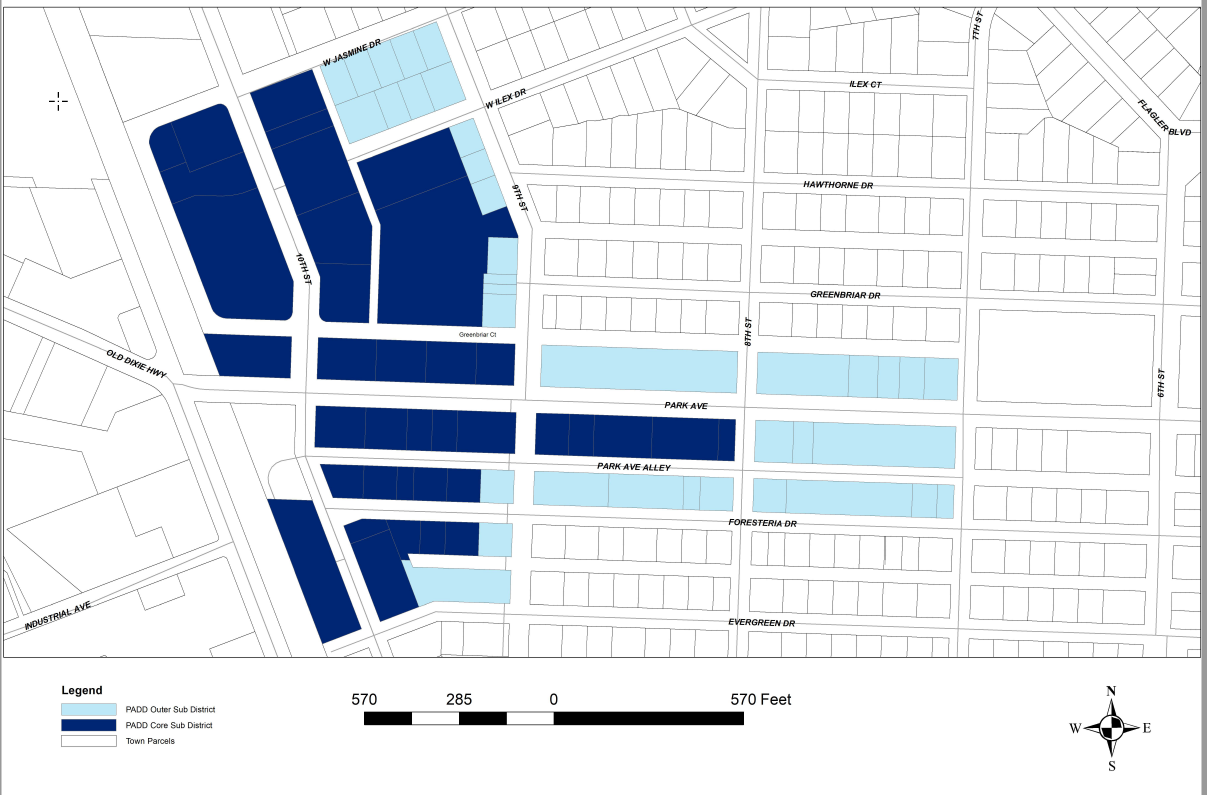
As illustrated in Figure 1, the PADD is divided into two sub-districts: the Core Sub-District and the Outer Sub-District.
Within the Core Sub-District, see the property development regulations within Table 78-70-2.
Within the Outer Sub-District, see the property development regulations within Table 78-70-3.
NOTE
At least 50 percent of the building line of all new construction and any substantial
repair, renovation, rehabilitation, or restoration of an existing building shall have
a front setback of zero feet. Recesses in the required zero setback building line
for architectural features such as doors, courtyards, store front entrances etc.,
are permitted as part of the overall design of the building.
(*) For those yards adjacent to single-family districts, even when separated by a right-of-way, a minimum 15 foot setback is required.
A reduction of the parking requirements may be sought, provided the property owner or developer provides additional onsite sheltered bike racks and car share/carpooling spaces as part of a Traffic Management Plan (TMP) which demonstrates that there will be adequate parking, A TMP is required if a property owner or developer proposes parking which is less than that which is required by the town code. The TMP shall identify the strategies for reducing single-occupancy vehicle trips and demonstrate the effectiveness of these strategies based upon professionally accepted data and analysis.
FIGURE 2: DOWNTOWN PUBLIC PARKING MASTER PLAN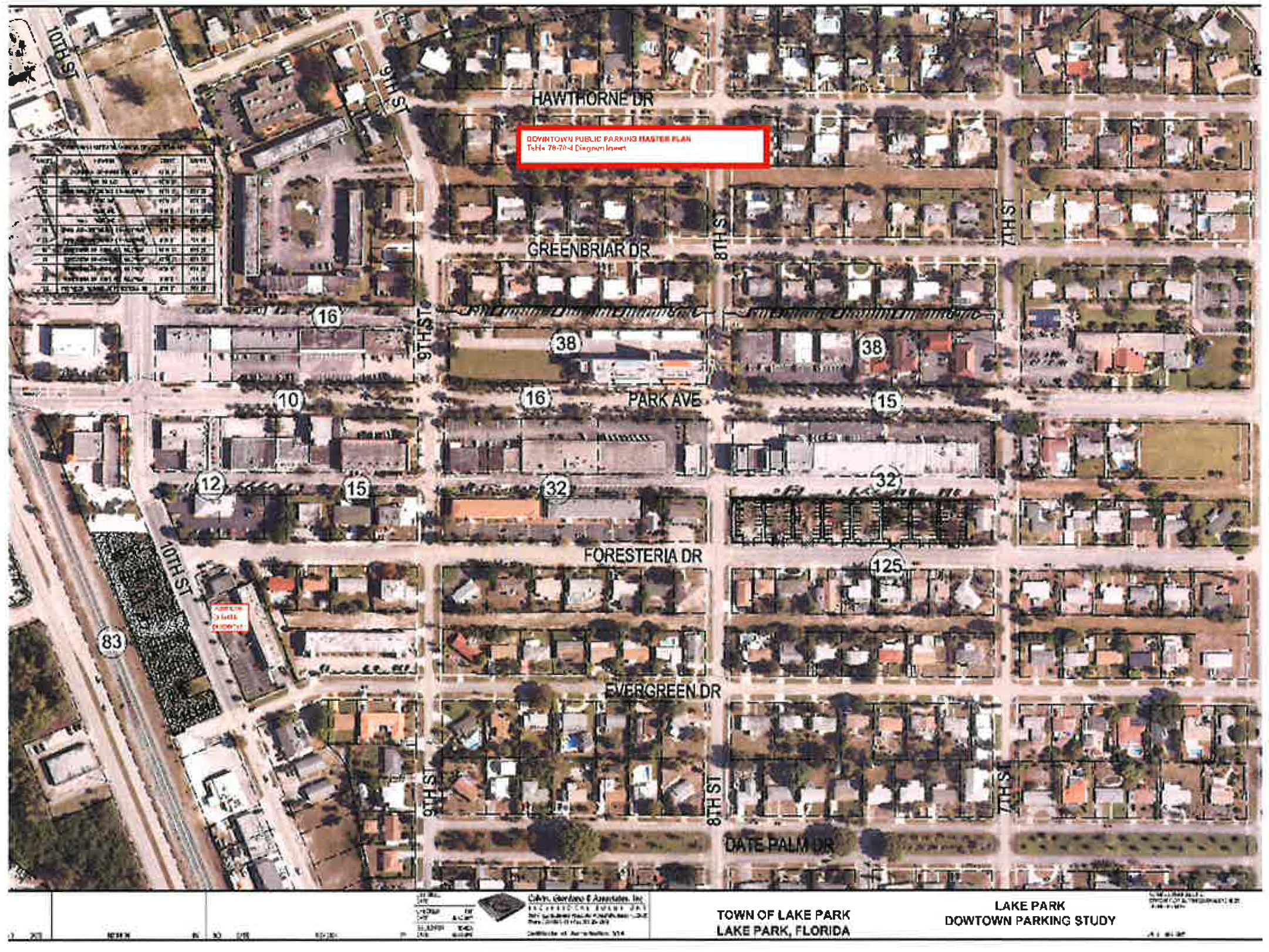
(Code 1978, § 32-50; Ord. No. 12-1999, § I, 6-16-1999; Ord. No. 19-2001, § 1, 10-17-2001; Ord. No. 27-2001, § 1, 1-2-2002; Ord. No. 11-2006, § 9, 12-6-2006; Ord. No. 06-2008, § 2, 5-7-2008; Ord. No. 14-2008, § 2, 8-20-2008; Ord. No. 19-2009, § 2, 1-6-2010; Ord. No. 13-2012, § 2, 1-6-2013; Ord. No. 04-2017, § 2, 3-15-2017; Ord. No. 12-2017, §§ 2—4, 10-18-2017; Ord. No. 09-2018, § 2, 8-1-2018; Ord. No. 04-2019, § 2, 8-7-2019; Ord. No. 06-2022, § 2, 7-20-2022; Ord. No. 14-2022, § 3, 1-4-2023)
Sec. 78-71. - C-1 business district.
Within the C-1 business district, the following regulations shall apply:
(1)
Uses permitted. Within the C-1 business districts, no building, structure or land shall be used and no building shall be erected, structurally altered or enlarged, unless otherwise permitted by these regulations, except for the following uses:
a.
Animal day care establishment;
b.
Animal grooming establishment;
c.
Animal indoor training center;
d.
Appliance stores, including radio and television services;
e.
Bakeries the products of which are sold at retail but not produced on the premises;
f.
Banks;
g.
Barbershops, beauty shops, chiropodists, masseurs;
h.
Fertilizer, stored and sold at retail only;
i.
Laundry pickup stations;
j.
Offices, business and professional;
k.
Outdoor miniature golf courses, all objects limited to eight feet in height and such building or premises is located not less than 500 feet from the premises of an existing nursery school, elementary school or high school;
l.
Pet shop;
m.
Restaurants;
n.
Shops, including shops for making articles without use of machinery, to be sold, at retail on the premises;
o.
Indoor theatres;
p.
Instructional studios; including but not limited to, studios for the instruction of the martial arts, dance, voice, drama, speech, gymnastics, yoga, exercise, painting, photography, music, and other similar instructional studio uses which are deemed appropriate by the town's community development director; or
q.
Transient residential use.
(2)
Building height limit. No building or structure shall exceed two stories or 30 feet in height and the minimum external height shall not be less than 13 feet. The minimum internal height from floor to ceiling shall be eight feet.
Special exception uses permitted pursuant to section 78-184:
a.
Animal service establishment;
b.
Automotive service station;
c.
Funeral home;
d.
Hospital, sanitarium or medical clinic;
e.
Motel/hotel;
f.
Vehicle sales and rentals, including accessory sales of parts and components and accessory repair shops on property on which a permanent building is erected and which building is used solely in connection with the use provided that:
1.
No vehicles, boats or wave runners are tested or repaired outside of a building designed for such purposes; and
2.
The parking requirements for the use are met over and above any areas provided for vehicles, boats or wave-runners, which are part of the specific business.
3.
Motor vehicle sales on property on which a permanent building is erected, shall mean the area where buildings are used in connection with the sale or lease of motor vehicles and the areas where motor vehicles are displayed for lease or sale.
g.
Small scale food and beverage production as a special exception use provided the criteria of section 78-184 and the following are met:
1.
Scale of use. The floor area of the use shall not exceed 30,000 square feet.
2.
Hours of operation near residential. When abutting or within 200 feet of a residential zoning district boundary, measured from property line to property line, the use shall not operate or have any loading or delivery activities between the hours of 9:00 PM and 7:00 AM.
3.
No nuisance created. The use shall not create or cause any perceptible noise, odor, smoke, electrical interference, or vibrations that constitute a public or private nuisance to neighboring properties. Documentation evidencing these elements shall be required at the time of application for special exception approval.
(3)
Building site area. The minimum width and length of any store building shall be 25 feet.
(4)
Minimum floor area. The minimum required first floor area of a business or commercial structure shall be 1,200 square feet and in no event less than 25 feet in depth.
(5)
Yard regulations.
a.
Front yard. There should be a front yard of not less than 25 feet measured from the street or highway or highway right-of-way line to the front wall of the building or structure. On through lots having frontages on two streets, the required front yard setbacks shall be provided on both streets.
b.
Side yard. On a corner lot, there shall be a side yard of not less than 15 feet from the property line of the intersecting streets.
c.
Rear yard. There shall be a rear yard of not less than 15 feet, except where there is an existing dedicated alleyway adjacent to the rear lot line, the rear yard shall be not less than five feet. However, there shall be a rear yard of not less than five feet on all property lying east of the Florida East Coast Railroad right-of-way and west of 10th Court between North Lake Boulevard and Northern Drive.
(6)
Off-street parking. See section 78-142 for off-street parking regulations.
(Code 1966, § 45-36; Ord. No. 5-1966, § I, 4-4-1966; Ord. No. 28-1967, § I, 6-19-1967; Ord. No. 32-1967, § I, 6-19-1967; Ord. No. 23-1970, § I, 1-6-1971; Ord. No. 16-1975, § I, 7-16-1975; Ord. No. 2-1979, § 3, 2-7-1979; Ord. No. 1-1983, § 1, 3-2-1983; Ord. No. 26-1993, § I, 12-15-1993; Ord. No. 25-2001, § 1, 1-2-2002; Code 1978, § 32-51; Ord. No. 10-2004, § 4(32-51), 4-21-2004; Ord. No. 32-2007, § 3, 1-16-2008; Ord. No. 12-2009, § 3, 9-16-2009; Ord. No. 08-2013, § 3, 7-17-2013; Ord. No. 10-2014, § 2, 8-6-2014; Ord. No. 05-2017, § 11, 6-7-2017; Ord. No. 02-2018, § 2, 1-17-2018; Ord. No. 08-2020, § 2, 8-19-2020)
Sec. 78-72. - C-2 business districts.
Within C-2 business districts, the following regulations shall apply:
(1)
Uses permitted. Within C-2 business districts, no building, structure or land shall be used and no building shall be erected, structurally altered or enlarged, unless otherwise permitted by these regulations, except for the following uses:
a.
Appliance stores, including radio and television services.
b.
Bakeries having not more than five employees.
c.
Bakeries the products of which are sold at retail but not produced on the premises.
d.
Banks.
e.
Barbershops, beauty shops, chiropodists and masseurs.
f.
Grocery stores, specialty, at least 2,000 square feet and not more than 10,000 square feet with at least 50 percent of the sales area, including shelving, containing foods of a specialty or ethnic nature and otherwise subject to the requirements of section 78-70(r).
g.
Clubs for social, recreational, fraternal or benevolent purposes.
h.
Fertilizer, stored and sold at retail only.
i.
Ice delivery stations.
j.
Laundry pickup stations.
k.
Offices, business and professional.
l.
Outdoor miniature golf courses, all objects limited to eight feet in height and the building or premises is located not less than 500 feet from the premises of an existing nursery school, elementary school or high school.
m.
Restaurants.
n.
Shops, including shops for making articles without use of machinery, to be sold, at retail on the premises.
o.
Theatres.
p.
No residences, dwellings or living quarters shall be permitted in C-2 business districts.
q.
Transient residential use.
(2)
Special exception uses permitted. Within the C-2 business district, no building, structure or land shall be used, and no building shall be erected, structurally altered or enlarged for the following uses unless a special exception has been approved by the town commission, pursuant to section 78-184 and the standards set forth herein:
a.
Boats and marine engines. Sales, service and installation thereof in an enclosed building.
b.
Building supplies/garden center, retail and wholesale outlets.
c.
Bus stations.
d.
Electric substations.
e.
Garages.
f.
Gasoline and other motor-fuel stations.
g.
Hospitals, sanitariums and medical clinics.
h.
Laundries, dry cleaning and dyeing establishments.
i.
Mortuaries.
j.
Motor vehicle sales on property on which a permanent building is erected, shall mean the area where buildings are used in connection with the sale or lease of motor vehicles and the areas where motor vehicles are displayed for lease or sale.
k.
Printing and publishing plants.
l.
Planned unit developments.
m.
Railroad passenger station.
n.
Storage warehouses.
The town commission may permit special exception uses in the C-2 zoning district provided the town commission determines that the proposed use meets the special exception zoning criteria established in this chapter and is consistent with the goals, objectives and policies of the town's comprehensive plan. In order to ensure that the special exception use is consistent with and implements good zoning practices and the goals, objectives and policies of the town's comprehensive plan. The town commission may impose conditions upon the approval of a special exception use, including, but not limited to, conditions which require an applicant to exceed standards which have been adopted pursuant to the town's land development regulations.
o.
Brewpub. Is an establishment that manufactures and sells beer products in conjunction with a restaurant that acts as the primary use. A brewpub may only be located within the boundaries of the town's community redevelopment area. In addition to meeting the land development regulations established for the use of restaurant in the appropriate zoning district, a brewpub shall comply with the following:
1.
Revenue from food sales shall constitute more than 50 percent of the total business revenues;
2.
No more than 50 percent of the total gross floor area of the establishment shall be used to brew beer including, but not limited to, the brewing house, boiling and water treatment areas, bottling and kegging lines, malt milling and storage, fermentation tanks, conditioning tanks and serving tanks;
3.
Where permitted by local ordinance, state and federal law, retail carryout sale of beer produced on the premises is permitted provided the product is sealed in a growler or crowler holding no more than a U.S. gallon (3,785 ml/128 US fluid ounces);
4.
Brewpubs shall produce no more than 15,000 barrels (465,000 US gallons/17,602.16 hectoliters) of beer per year and may sell beer in keg containers larger than a U.S. gallon (3,785 ml/128 US fluid ounces) for the following purposes and in the following amounts:
(a)
An unlimited number of kegs for special events, the primary purpose of which is the exposition of beers brewed by brewpubs, which may include the participation several brewers;
(b)
An unlimited number of kegs for town co-sponsored events where the purpose of the event is not for commercial profit and where the beer is not wholesaled to the event co-sponsors but is instead, dispensed by employees of the brewpub.
5.
All mechanical equipment visible from public streets, or rights-of-way, an adjacent residential use or residential zoning district shall be screened such that they are not visible using architectural features which are consistent with the principal structure;
6.
Access and loading bays shall not face toward any street, excluding alleys;
7.
Access and loading bays facing an adjacent residential use or residential zoning district, shall have the doors closed at all times, except during the movement of raw materials used for brewing, and finished products into and out of the building;
8.
Service trucks for the purpose of loading and unloading materials and equipment are prohibited between the hours of 8:00 a.m. and 8:00 p.m. Monday through Saturday and between 11:00 a.m. and 7:00 p.m. on Sundays and national holidays;
9.
No outdoor storage of materials, supplies, portable storage units, cargo containers and/or permanent parking of tractor trailers is permitted.
p.
Microbrewery. Is an establishment that manufactures and sells beer products in conjunction with an accessory use such as a restaurant, tasting room, or other retail sales. A microbrewery may only be located within the boundaries of the town's community redevelopment area. In addition to meeting the land development regulations for the use of restaurant, tasting room, or retail use types in the appropriate zoning district, a microbrewery shall comply with the following:
1.
The microbrewery shall produce no more than 15,000 barrels (465,000 US gallons/17,602.16 hectoliters) of beer per year;
2.
This use shall be permitted only in conjunction with the use of restaurant, tasting room or other retail sales and service:
(a)
No more than 75 percent of the total gross floor space of the establishment shall be used to brew beer including, but not limited to, the brewing house, boiling and water treatment areas, bottling and kegging lines, malt milling and storage, fermentation tanks, conditioning tanks and serving tanks;
(b)
The façade of an interior accessory use(s) (examples listed hereinabove) shall be oriented toward the street, and, if located in a shopping center, to spaces of public access;
(c)
Pedestrian connections shall be provided between public sidewalks and the primary entrance(s) to any accessory use(s).
3.
All mechanical equipment visible from the street, or public right-of-way, an adjacent residential use or residential zoning district shall be screened using architectural features consistent with the principal structure;
4.
Access and loading bays shall not be located along primary facades.
5.
Access and loading bays facing any street, adjacent residential use or residential zoning district, shall have the doors closed at all times, except during the movement of raw materials used for brewing, and finished products into and out of the building;
6.
Service trucks for the purpose of loading and unloading materials and equipment are prohibited between the hours of 8:00 a.m. and 8:00 p.m. Monday through Saturday and between 11:00 a.m. and 7:00 p.m. on Sundays and national holidays;
7.
No outdoor storage of portable storage units, cargo containers, or permanent parking of tractor trailers, is permitted except spent or used grain may be stored outdoors for more than 24 hours consecutively. The temporary storage area of spent or used grain shall be:
(a)
Designated on the approved plan that identifies the outdoor areas;
(b)
Permitted within the interior side or rear yard or within the minimum building setbacks;
(c)
Prohibited within any yard directly abutting a residential use or a residential zoning district;
(d)
Fully enclosed within a suitable container, secured and screened behind a solid, opaque fence or wall measuring a minimum five feet in height.
q.
Brewery—Regional (small) and large brewery. Is an establishment that manufactures beer products. A brewery may only be located within the boundaries of the town's community redevelopment area. Regional (small) and large breweries shall comply with the microbrewery standards herein, but shall be permitted to occupy 100 percent of the total gross floor space of the establishment. A public viewing area shall be made available and opened during certain hours.
(3)
Building height limit. No building or structure shall exceed two stories or 30 feet in height and the minimum external height shall not be less than 13 feet. The minimum internal height from floor to ceiling shall be eight feet. No dwelling structure shall exceed two stories or 30 feet in height.
(4)
Building site area. The minimum width and length of any store building shall be 25 feet.
(5)
Minimum floor area. For dwelling structures, the following restrictions shall apply:
a.
The minimum required first floor area of a single-family dwelling structure shall be 1,000 square feet, exclusive of carport, garage, unenclosed terraces and porches. Where a carport or garage is attached to the structure, the required first floor area may be reduced to 900 square feet. The minimum required first floor area of a two-family dwelling structure (duplex) shall be 1,400 square feet, exclusive of carports, garages, unenclosed terraces and porches, with each unit 700 square feet. A one-bedroom unit of not less than 580 square feet may be built together with a second unit of not less than 820 square feet.
b.
Where a utility or storage room is constructed and finished in a like manner and type of construction as the balance of the living quarters and has direct entrance and access to the living quarters, such utility room may be considered a part of the living quarters.
c.
For structures of more than two dwelling units, the minimum required floor area shall have an additional 580 square feet for each dwelling unit in excess of two, added to the base of 1,400 square feet.
d.
The minimum required first floor area of a business or commercial structure shall be 1,200 square feet and in no event less than 25 feet in depth.
(6)
Yard regulations.
a.
Front yard. There shall be a front yard of not less than 25 feet measured from the street or highway or highway right-of-way line to the front wall of the building or structure. On "thru" lots having frontages on two streets, the required front yard shall be provided on both streets.
b.
Side yard. On a corner lot, there shall be a side yard of not less than 15 feet from the property line of the intersecting streets.
However, there shall be a rear yard of not less than five feet on all property lying east of the Florida East Coast Railroad right-of-way and west of 10th Court between North Lake Boulevard and Northern Drive.
c.
Rear yard. There shall be a rear yard of not less than 15 feet, except where there is an existing dedicated alleyway adjacent to the rear lot line, the rear yard shall be not less than five feet.
(7)
Off-street parking. See section 78-142 for off-street parking regulations.
(8)
Special exception subject to commission approval. The commission may permit the use of a premises in the C-2 zoning district as an educational facility, by approval of a special exception therefor, provided the town commission determines as a fact, after review of the application and plans submitted therewith, that the proposed use or uses are consistent with good zoning practice and are not contrary to the policies of the town comprehensive plan, and that the conditions and requirements enumerated below have been met:
a.
The site must comply with all applicable regulations of this Code, including, but not limited to, this chapter, including parking regulations and landscaping requirements and this subpart B, land development regulations.
b.
No outdoor instruction or recreational activities will be permitted on the site.
c.
Enrollment shall not exceed a limit which is mutually agreed upon by the owner of the premises and the community development director; such limit to be established so as to avoid congestion and adverse impact on adjacent and nearby properties, with special consideration to properties located within 300 feet of the site.
d.
The facility is in compliance with all laws and regulations governing educational facilities.
e.
The owners of all properties within 300 feet have had an opportunity to provide comment regarding the appropriateness of the intended use in light of the general business/office character of the district.
f.
The application for special exception hereunder has fulfilled the requirements of the community development director and has been reviewed by the planning and zoning board.
(Code 1966, § 45-37; Ord. No. 32-1967, § II, 6-19-1967; Ord. No. 10-1984, § 1, 8-1-1984; Ord. No. 7-1992, § XI, 8-5-1992; Ord. No. 14-1995, § I, 8-15-1995; Ord. No. 25-2001, § 1, 1-2-2002; Ord. No. 23-2002, § 1, 9-18-2002; Code 1978, § 32-52; Ord. No. 1-2005, § 2, 4-20-2005; Ord. No. 12-2009, § 3, 9-16-2009; Ord. No. 05-2017, § 12, 6-7-2017; Ord. No. 02-2018, § 3, 1-17-2018; Ord. No. 02-2019, § 2, 4-17-2019)
Sec. 78-73. - C-3 Twin Cities Mixed Use District.
(a)
General description and intent.
(1)
The C-3 Twin Cities Mixed Use District (C-3 district) is being enacted to encourage the redevelopment of the site of a former Planned Unit Development (PUD) known as the Twin City Mall and Northlake Promenade Shoppes into a vibrant mixed-use place for businesses, visitors, and residents of the municipalities of Lake Park, North Palm Beach, and surrounding areas.
(2)
The intent of this district is to provide for a destination with complementary uses consisting of a mixture of retail and other commercial uses such as offices and lodging; civic and educational uses; and residential multifamily uses.
(3)
The area comprising the C-3 district is separated by the Town's municipal boundary with the Village of North Palm Beach. The two municipalities entered into an interlocal agreement in 1993 to provide for consistent planning and to provide for the coordinated redevelopment of the area. These regulations carry forward the spirit and intent of the interlocal agreement by requiring that both municipalities cooperate on site plan applications through joint staff reviews and joint planning board meetings, and insures that each municipality has a meaningful opportunity to review the zoning applications proposed within the C-3 district. The provisions of this district shall supersede all other conflicting provisions found elsewhere in the Town Code.
a.
Redevelopment proposals within the North Palm Beach portion of the C-3 district will be reviewed in a timely manner by the town, with the results of that review being forwarded to the Village of North Palm Beach within ten days of the completion of the town's review.
b.
Redevelopment proposals within the Town of Lake Park's portion of the C-3 district will be reviewed by the town in accordance with the town's process, and forwarded to the Village of North Palm Beach for its comments following the same review time frame.
c.
Once both the North Palm Beach and Lake Park staffs deem an application to be sufficient, a joint meeting of the North Palm Beach and Lake Park planning and zoning boards shall be scheduled for joint review and approval.
d.
Following the joint meeting of the North Palm Beach and Lake Park planning and zoning boards, the Town of Lake Park will forward the application to the Lake Park Town Commission for their final approval for development proposed within Lake Park.
e.
For projects proposed within the jurisdictional boundaries of Lake Park and North Palm Beach, the project shall be reviewed and approved in accordance with the governing standards of whichever jurisdiction contains 80 percent or more of the total project area and shall be approved by the governing body of the same jurisdiction, instead of both governing bodies. In these instances, regardless of the final governing body approving the project, joint municipal staff review and a joint meeting of the North Palm Beach and Lake Park Planning Boards shall be required.
(4)
Walls and fences in the C-3 district shall comply with the following standards:
a.
Lots having only residential buildings on them shall be subject to the development standards for buildings in residential areas as provided for in section 78-111, except that on corner lots, side-yard walls and fences that abut a street shall comply with the standards for front-yard walls and fences.
b.
Lots that have nonresidential buildings or mixed-use buildings shall comply with the wall and fence standards for the MU zoning district, as provided for in section 78-83(k).
(b)
Permitted, special exception and accessory uses. Table 1 indicates the uses in the C-3 district.
(1)
The permitted and special exception uses listed in Table 1 are grouped into four use groups: Residential, Lodging, Business and Commercial, and Civic. Terms in Table 1 are defined in Town Code Chapter 78, Section 78-2.
(2)
Accessory uses associated with any primary use listed in Table 1 shall be permitted as long as the accessory use does not occupy more than 30 percent of the gross floor area of the primary use and does not operate as the primary, income generating use.
(3)
Table 1 indicates the type of use and approval category within the district:
(c)
District regulating plan.
(1)
The C-3 district includes a district plan as shown in Figure 1 that shows existing parcel boundaries, retention pond locations, the Lake Park/North Palm Beach jurisdictional boundary, and street and alley alignments.
(2)
The district plan identifies the approximate alignment of existing and future local streets and alleys. Applicants seeking to modify the Figure 1 street alignments must provide an alternative design providing equivalent access and functionality or must provide mitigation of an equivalent length to whatever street extent that is proposed to be eliminated through the process established under subsection (h), herein.
a.
The east-west streetscape connections between the Village of North Palm Beach and the Town of Lake Park as depicted in the district plan may be relocated per the process described under subsection (h)(1), but connectivity must be maintained between the town and the village.
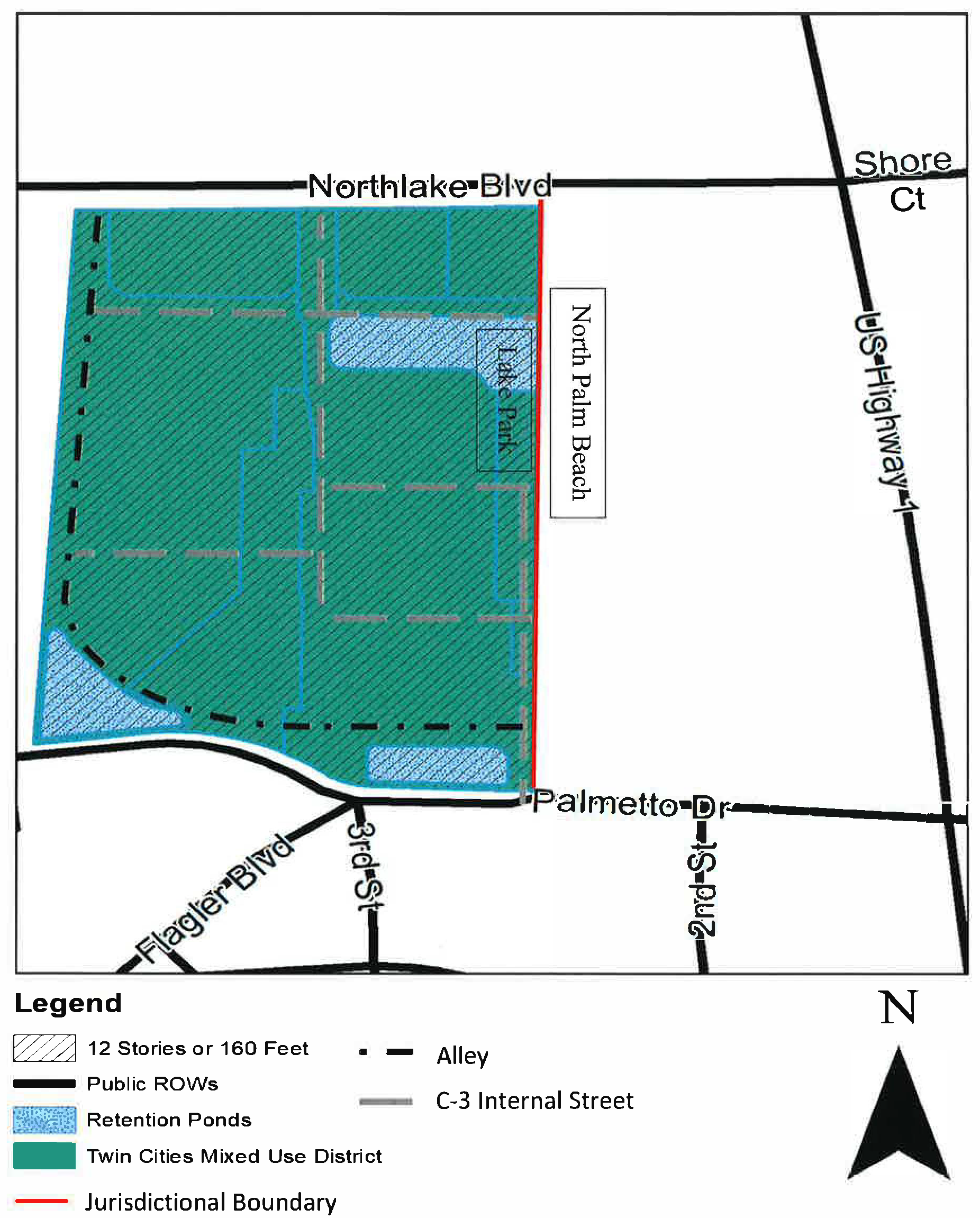
(d)
Building typologies. All new developments in the C-3 district shall conform to one of the following building typologies, which are further described below. The typologies generally provide a form and associated performance standards and shall be adhered to for all new developments. Building typologies may be combined as long as their individual standards are observed.
| Table 2: TOWER BUILDING TYPE | |||
|---|---|---|---|
| Permitted Heights Range: 6-12 Stories or 160 feet | BUILDING MASSING | ||
DEFINITION: a multi-level building organized around a central core where a part of
the building is higher in proportion.
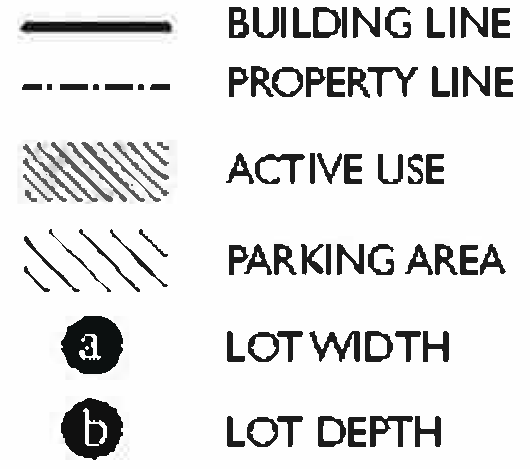 | 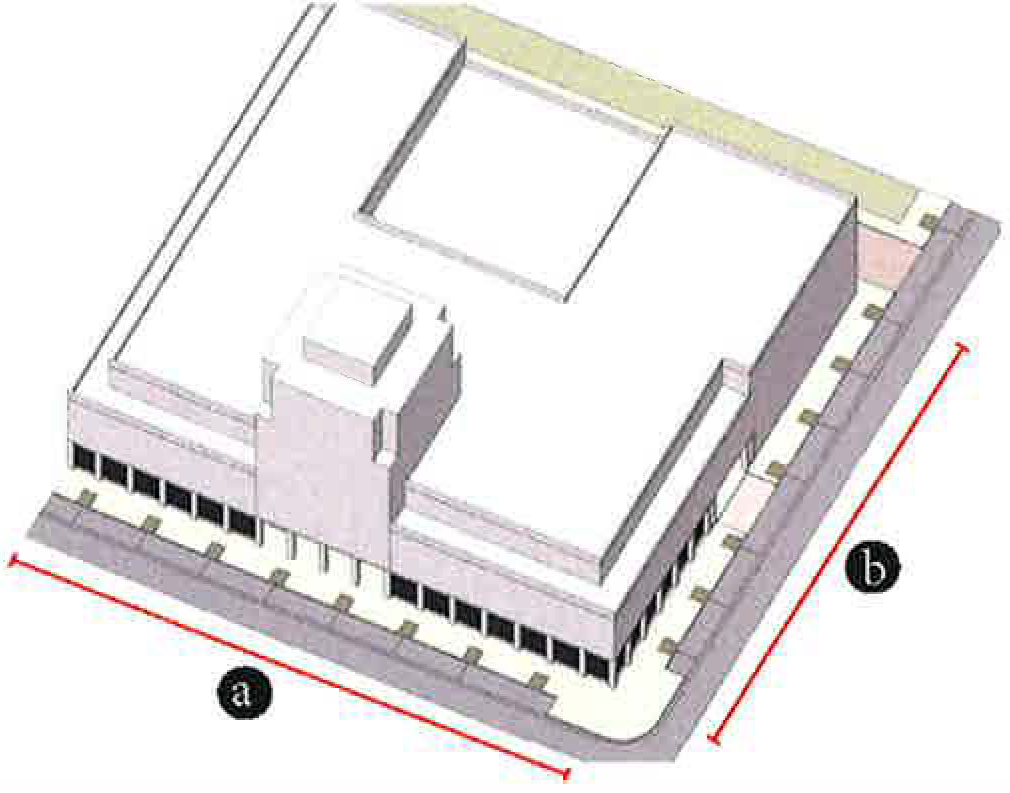 | ||
| PERFORMANCE STANDARDS | MIN. | MAX. | BUILDING CONFIGURATION |
| a. Lot Width | N/A | N/A | 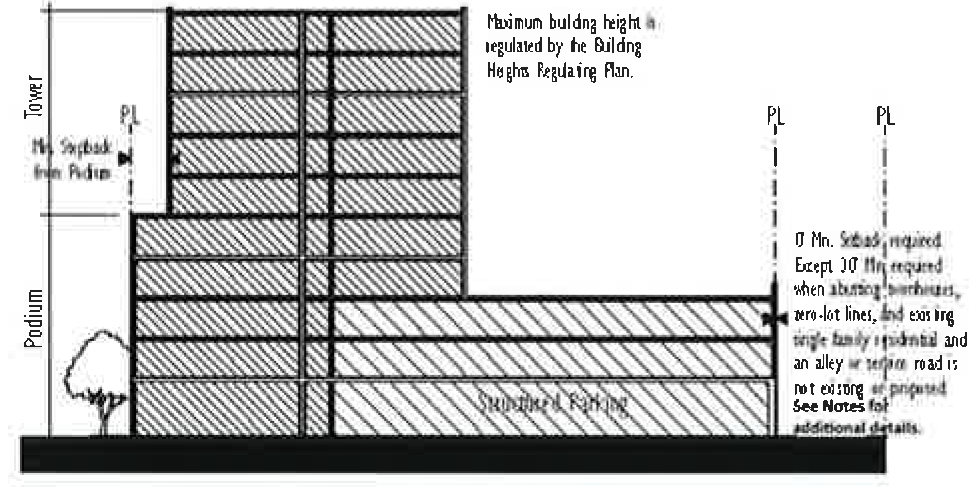 |
| b. Lot Depth | N/A | N/A | |
| c. Lot Area | 30,000 SF | N/A | |
| d. Impervious Area | N/A | 90% | |
| e. Pervious Area | 10% | N/A | |
| f. Street Setbacks (front and side) | 10' | 15' | |
| g. Interior Setbacks (side and rear) | 0' (1) | N/A | |
|
NOTES:
(1) Except 30' minimum when abutting an existing residential district. | 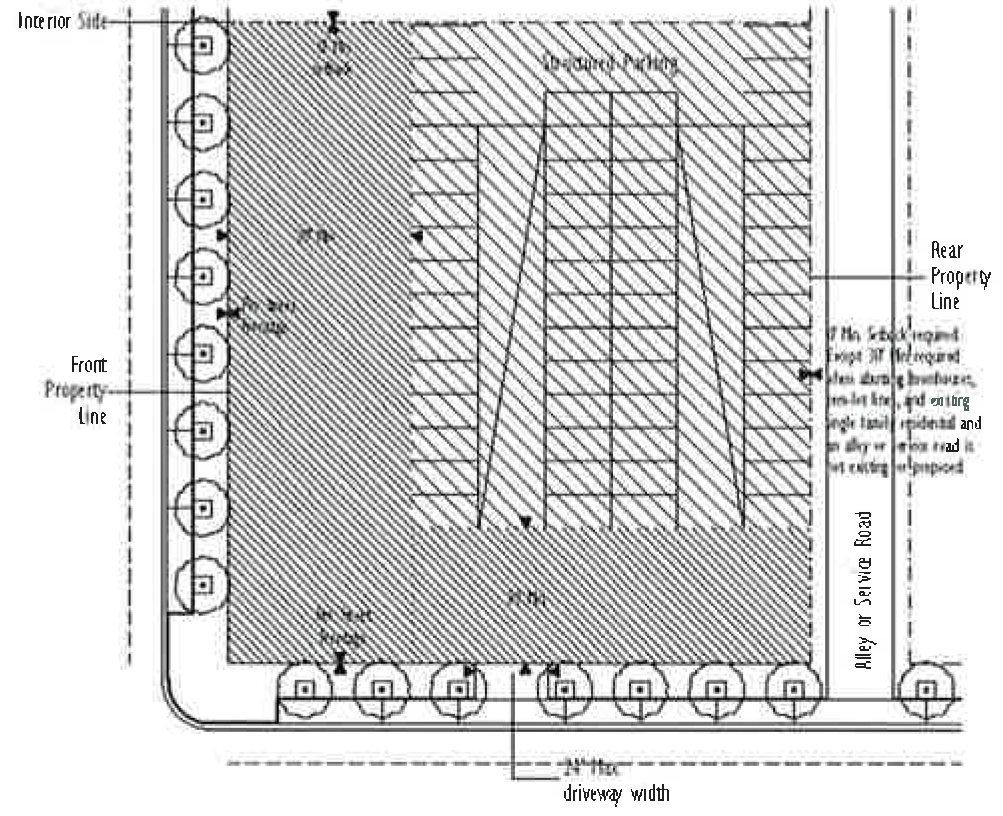 | ||
EXAMPLES OF TOWER CONFIGURATION
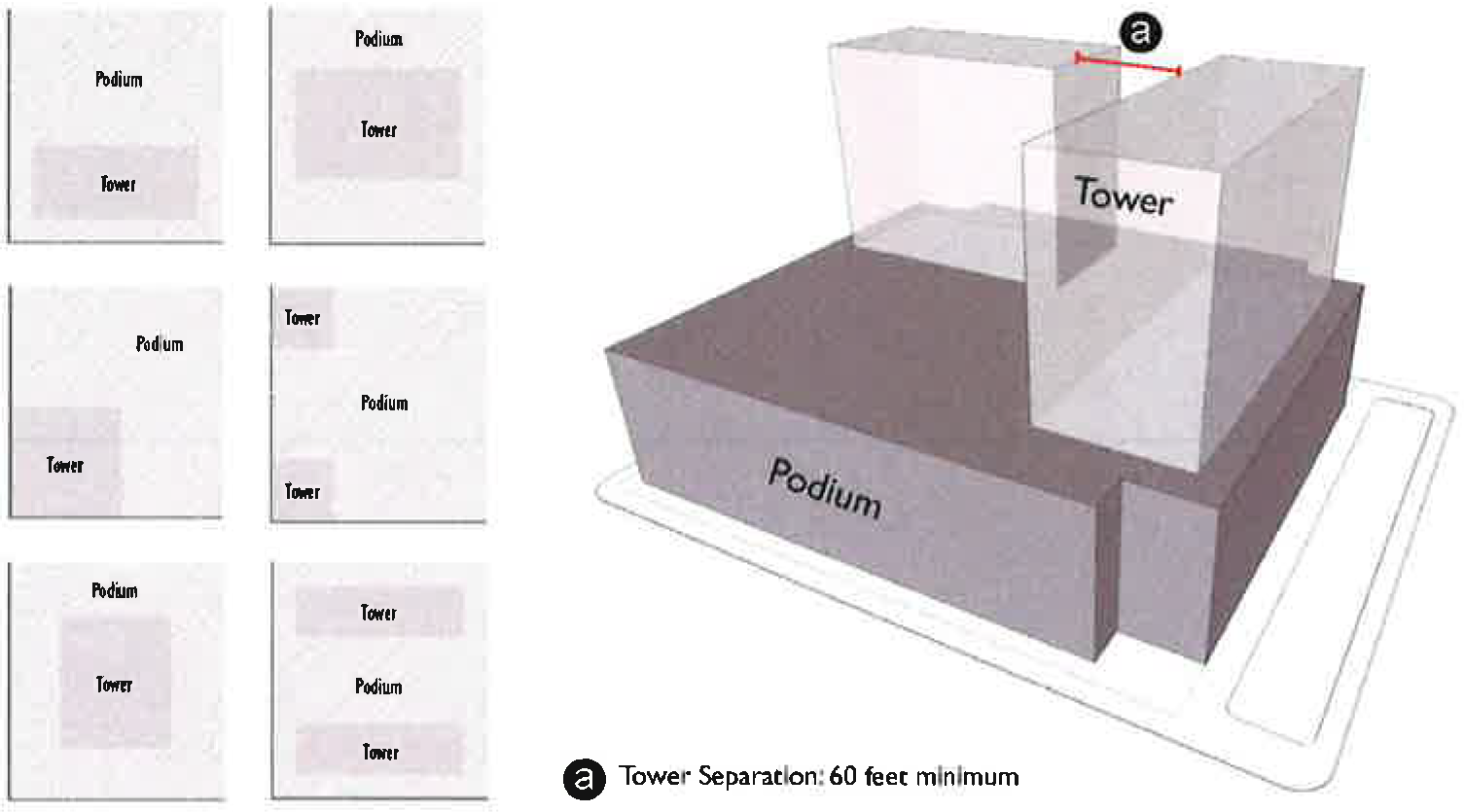
TOWER FLOORPLATE STANDARD:
Above the 5th floor, towers shall be limited to a maximum floorplate size as described below. The floorplate size for multiple towers shall be calculated as an average of the total cumulative tower floorplate area divided by the number of tower stories above the 5th floor. The maximum floorplate size is dependent upon the tower's primary use as follows:
(1)
Office or nonresidential - average of 35,000 square feet for multiple towers and a 45,000 square feet maximum permitted floorplate size for any individual tower floorplate;
(2)
Residential, Mixed-Use or Hotel -an average of 20,000 square feet for multiple towers and a maximum of 32,500 square feet of a floorplate for any individual tower floorplate.
TOWER SEPARATION:
The minimum horizontal distance between two or more towers shall be 60 feet.
TOWER STEPBACK:
The minimum stepback of a tower from the podium shall be ten feet along interior side and rear property lines only. Along the front and street side property lines the minimum stepback for the tower from the podium shall be 20 feet from the street or 40 feet if the tower is to be constructed adjacent to a residential zoning district. A tower's orientation shall be specified toward a terminating street vista where applicable. The placement of the tower shall be such that it is near, fronting, or adjacent to open space.
ILLUSTRATIVE EXAMPLES
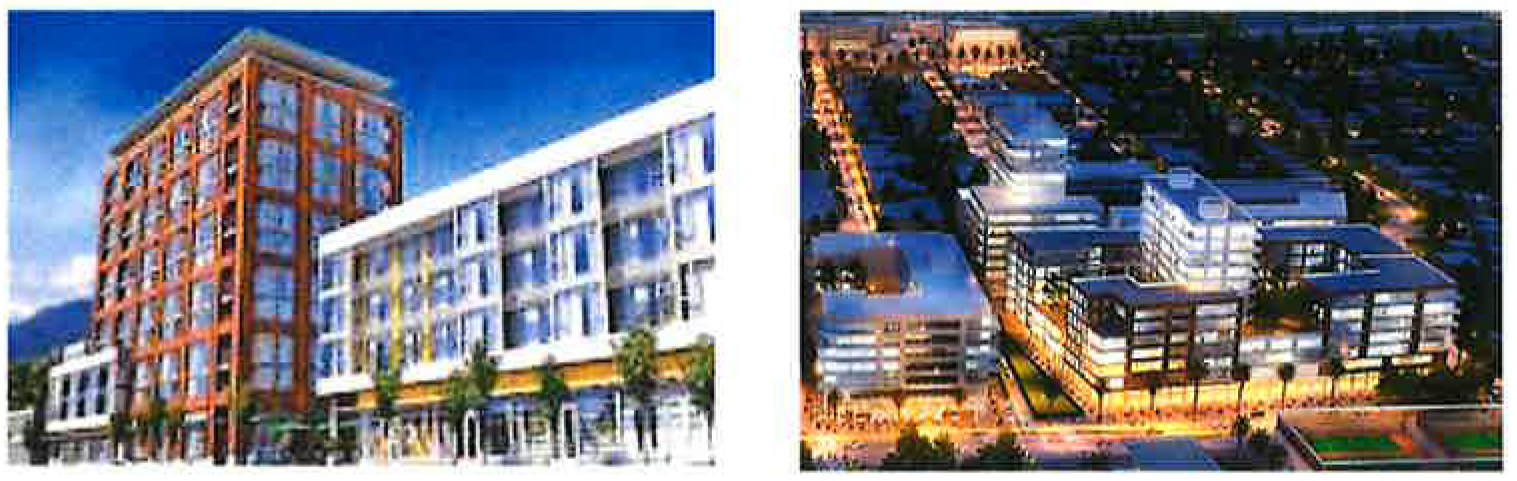
| Table 3: LINER BUILDING TYPE | |||
|---|---|---|---|
| Permitted Heights Range: 6-8 stories or 112 feet | BUILDING MASSING | ||
DEFINITION: A building that conceals a garage, or other faceless building, that is
designed for occupancy.
 | 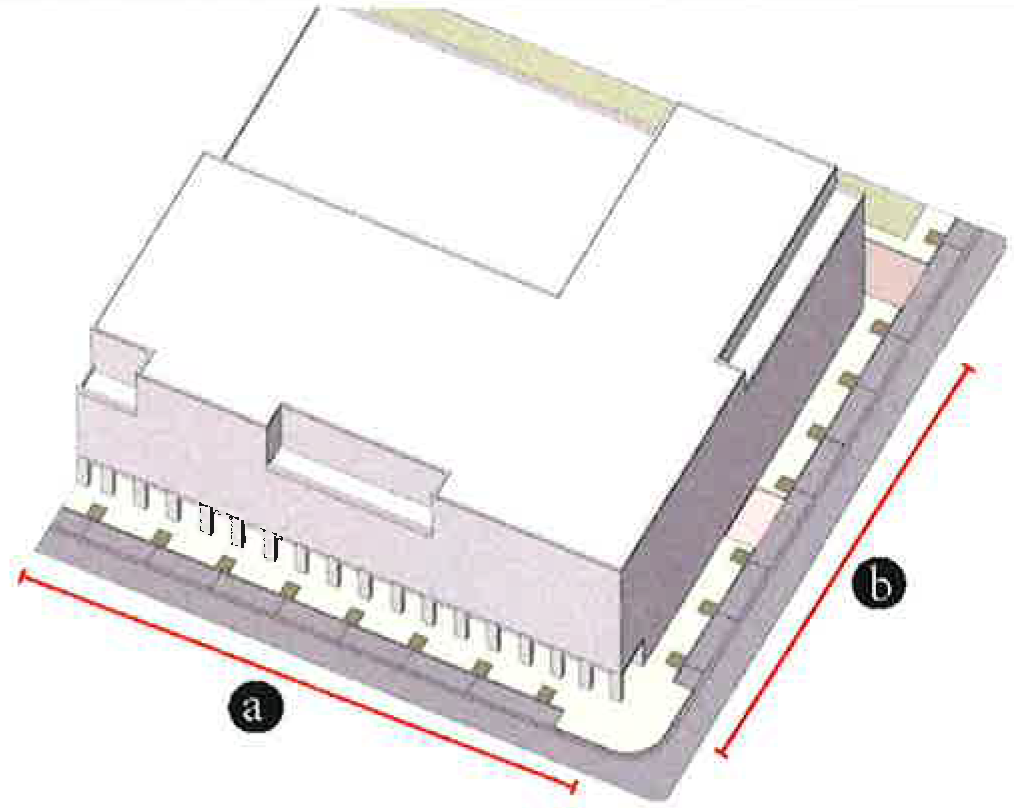 | ||
| LOT STANDARDS | MIN. | MAX. | BUILDING CONFIGURATION |
| a. Lot Width | N/A | N/A | 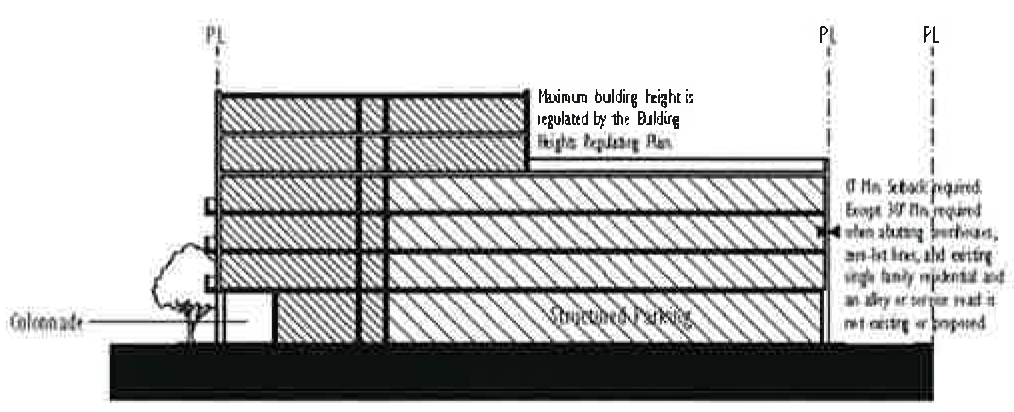 |
| b. Lot Depth | N/A | N/A | |
| c. Lot Area | 22,000 SF | N/A | |
| d. Impervious Area | N/A | 90% | |
| e. Pervious Area | 10% | N/A | |
| f. Street Setbacks (front and side) | 10' | N/A | |
| g. Other Setbacks (Interior side and rear) | 0'(1) | N/A | |
|
NOTES:
(1) Except 30' minimum when abutting an existing residential district. (2) The minimum depth of the active use lining the garage or other faceless building shall be 20 feet. | 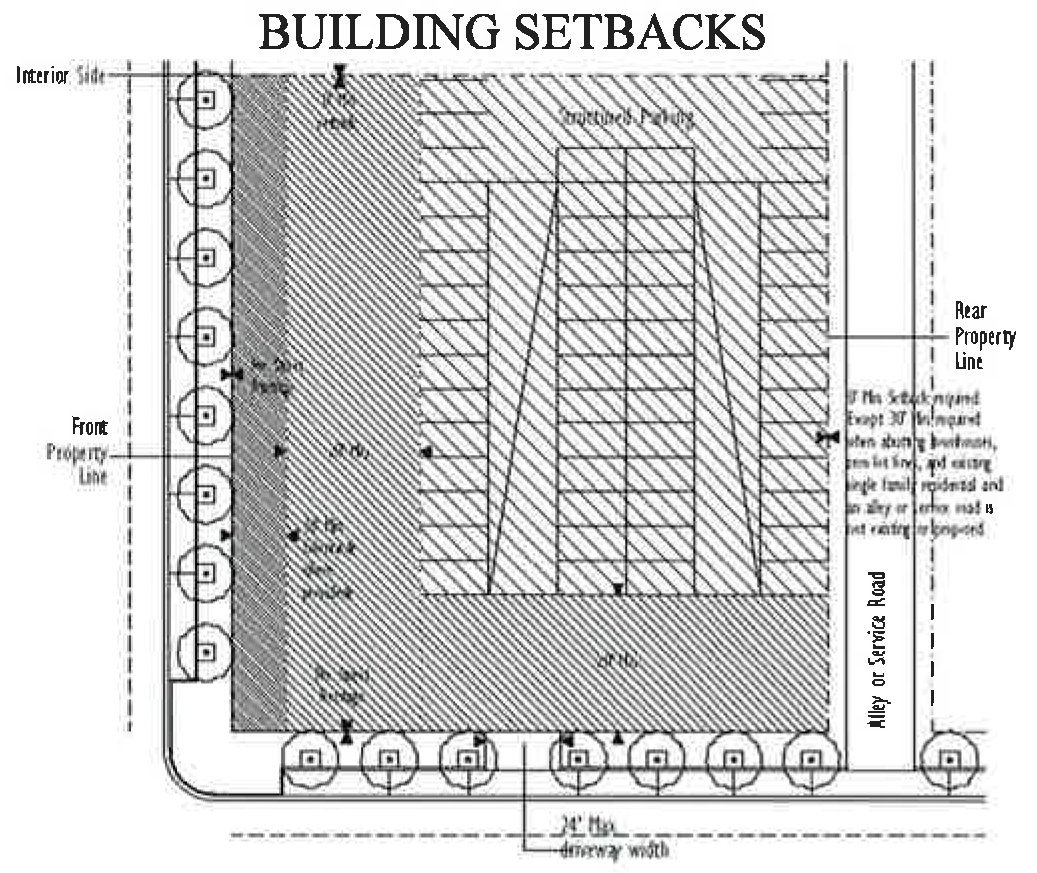 | ||
EXAMPLES OF LINER CONFIGURATION
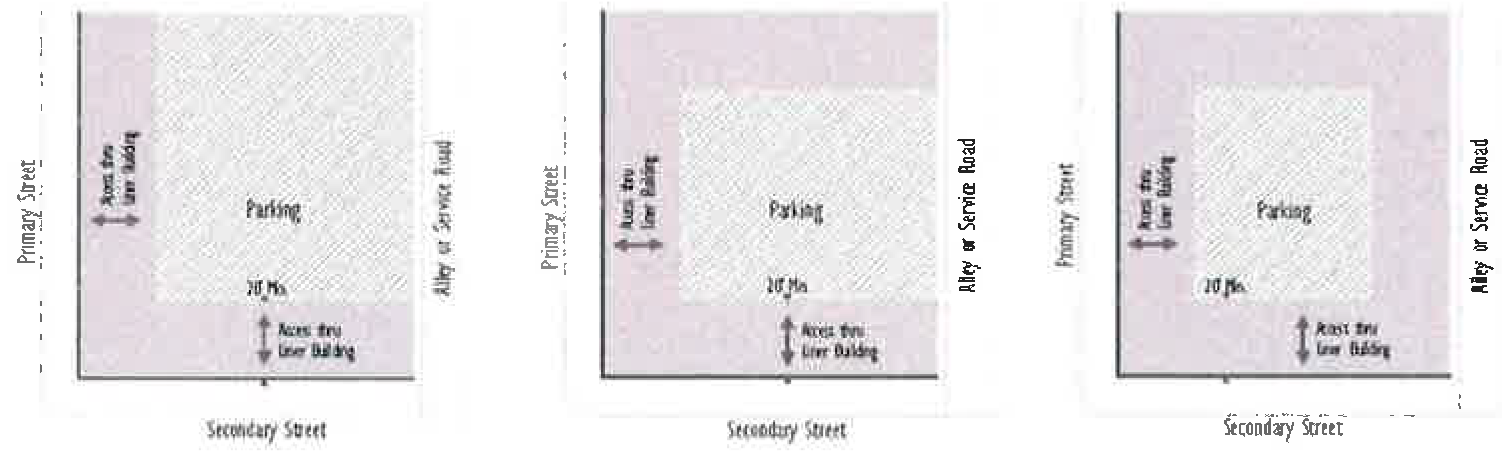
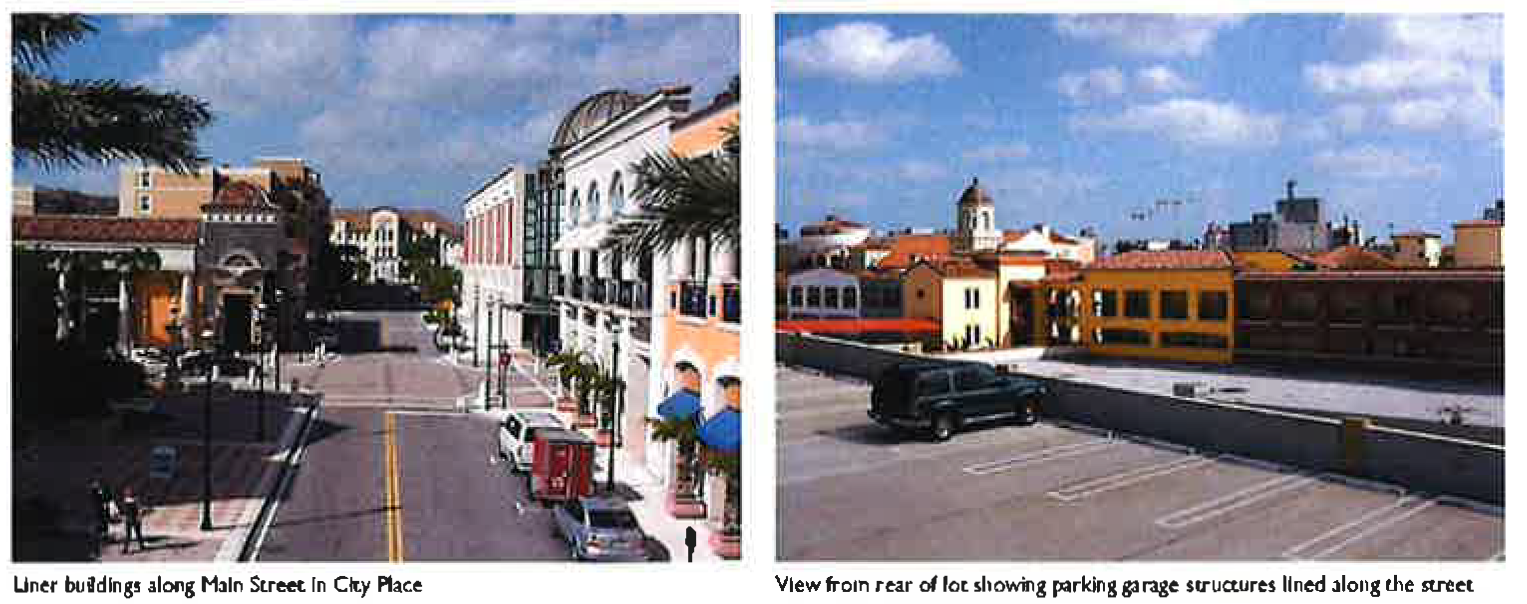
| Table 4: COURTYARD BUILDING TYPE A | |||
|---|---|---|---|
| Permitted Heights Range: 4-6 Stories or 88 feet | BUILDING MASSING | ||
DEFINITION a building characterized as having a central open space that is open to
the sky and enclosed by habitable space on at least three sides with detached surface
or garage parking.
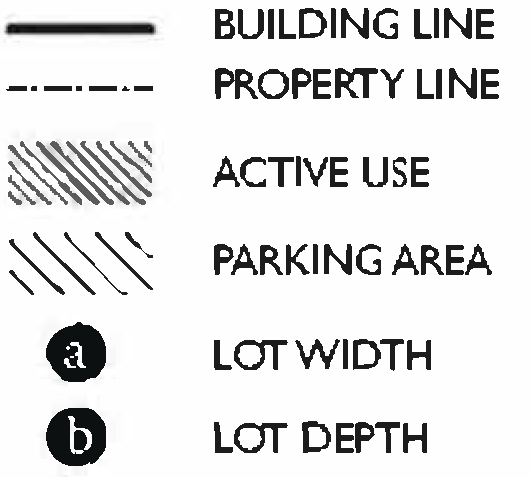 | 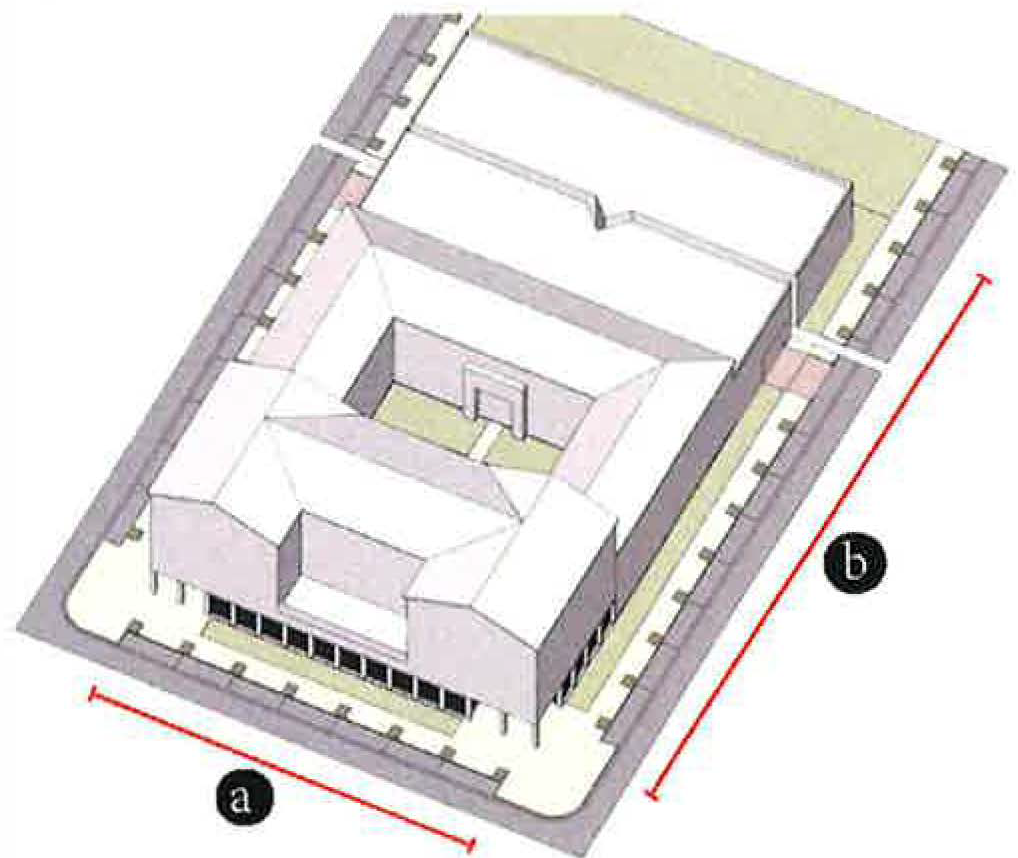 | ||
| LOT STANDARDS | MIN. | MAX. | BUILDING CONFIGURATION |
| a. Lot Width | N/A | N/A | 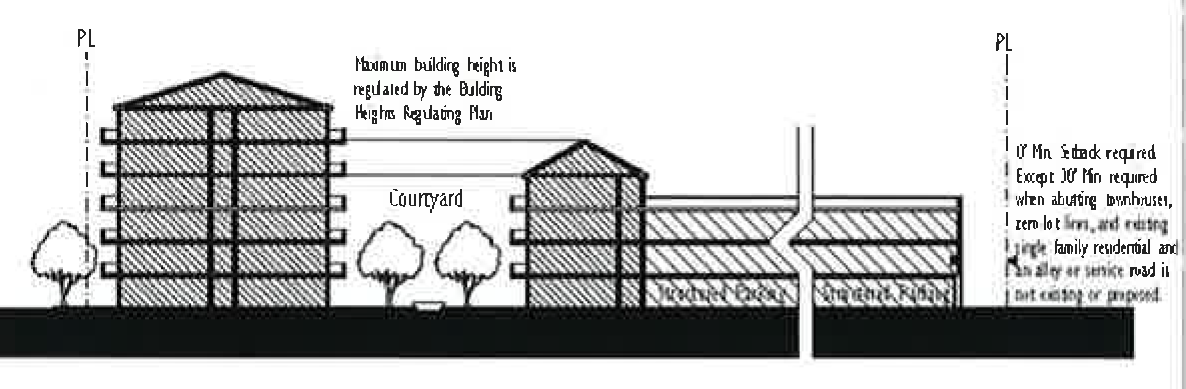 |
| b. Lot Depth | N/A | N/A | |
| c. Lot Area | 24,00 0 SF | N/A | |
| d. Impervious Area | N/A | 90% | |
| e. Pervious Area | 10% | N/A | |
| f. Street Setbacks (front and side) | 10' | N/A | |
| g. Other Setbacks (Interior side and rear) | 0'(1) | N/A | |
|
NOTES:
(1) Except 30' minimum when abutting an existing residential district. | 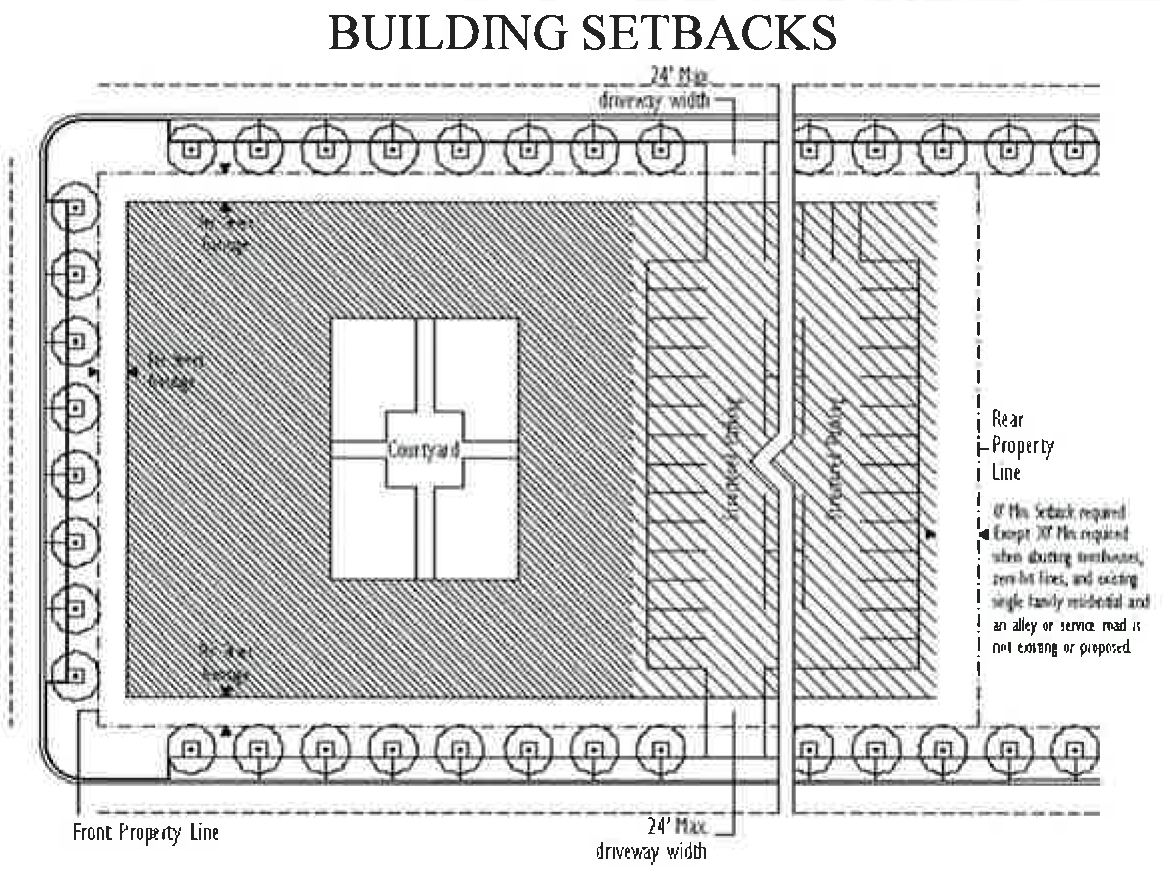 | ||
EXAMPLES OF BUILDING CONFIGURATION
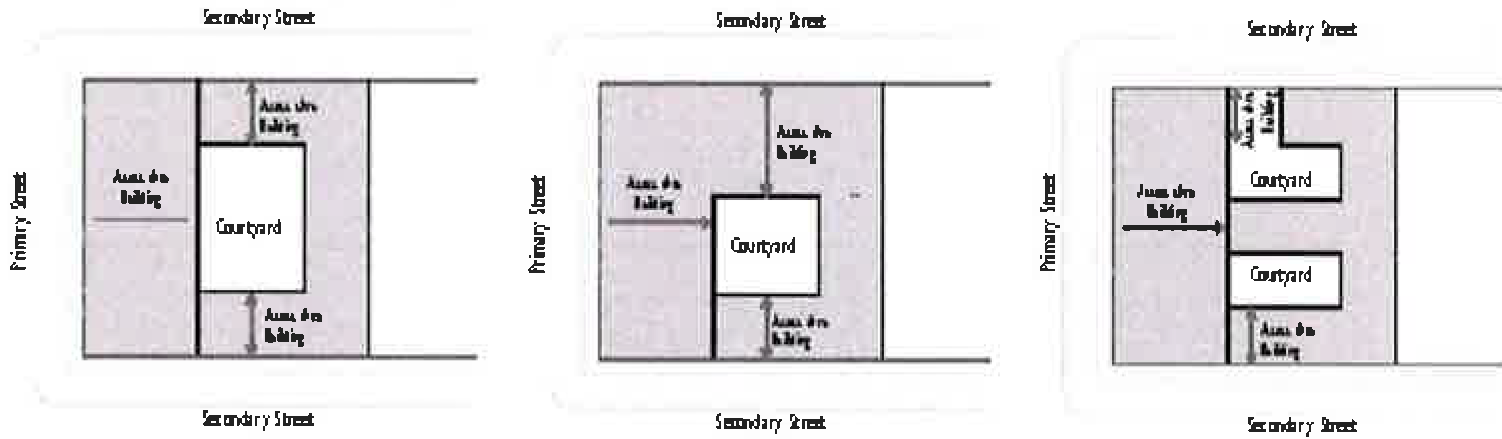
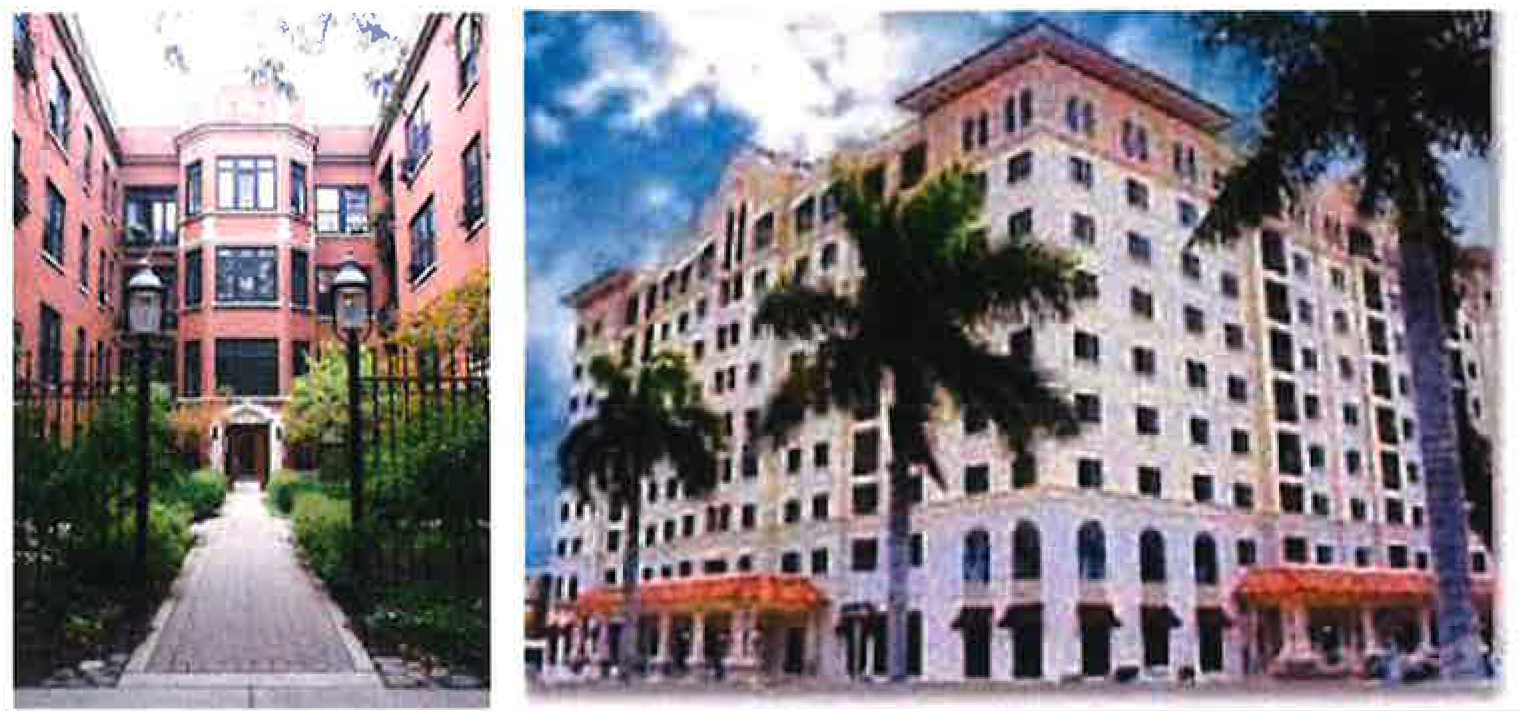
| Table 5: COURTYARD BUILDING TYPE B | |||
|---|---|---|---|
| Permitted Heights Range: 4-6 Stories or 88 feet | BUILDING MASSING | ||
DEFINITION: a building characterized as having a central open space that is open to
the sky and enclosed by habitable space on at least three sides with attached parking.
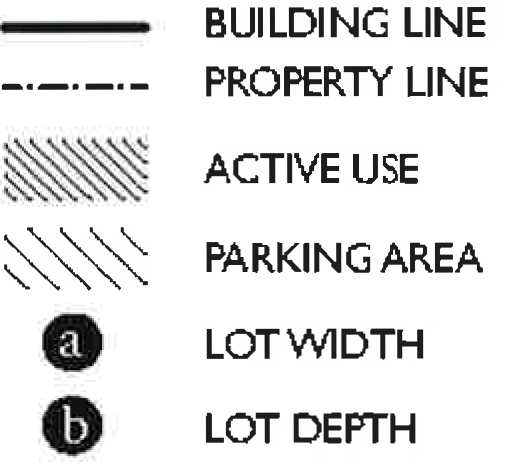 | 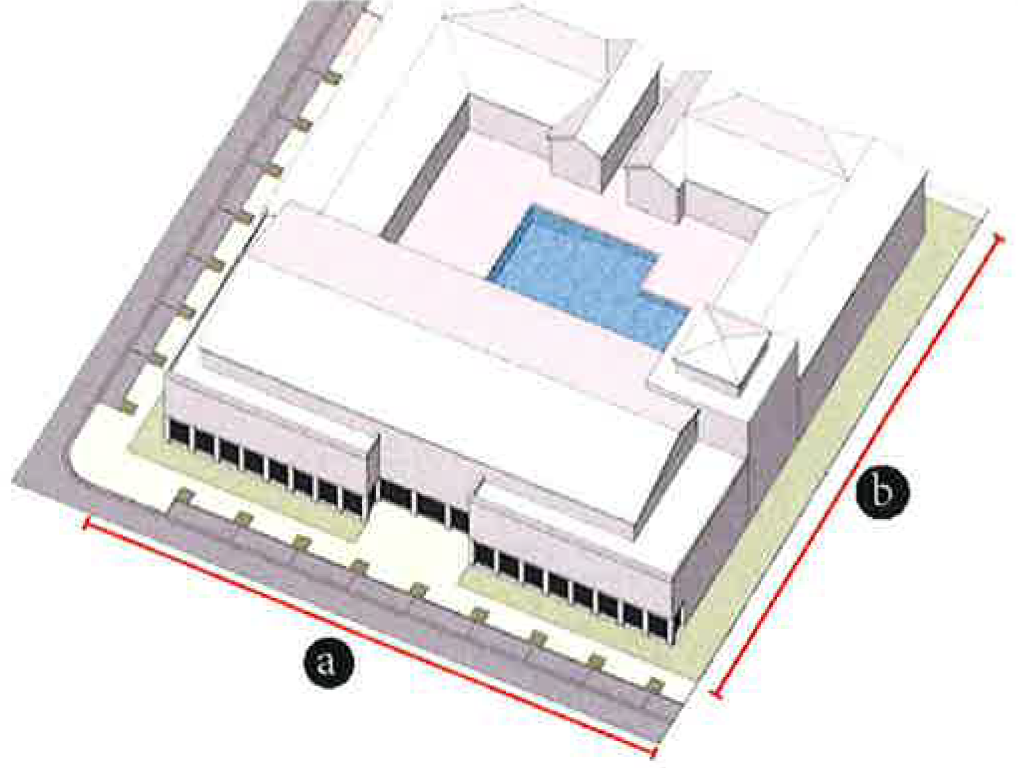 | ||
| LOT STANDARDS | MIN. | MAX. | BUILDING CONFIGURATION |
| a. Lot Width | N/A | N/A | 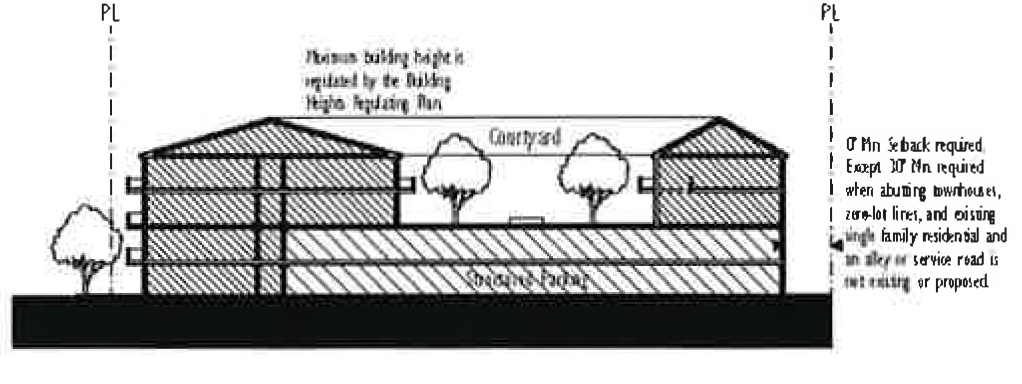 |
| b. Lot Depth | N/A | N/A | |
| c. Lot Area | 24,000 SF | N/A | |
| d. Impervious Area | N/A | 90% | |
| e. Pervious Area | 10% | N/A | |
| f. Street Setbacks (front and side) | 10' | N/A | |
| g. Other Setbacks (Interior side and rear) | 0'(1) | N/A | |
|
NOTES:
(1) Except 30' minimum when abutting an existing residential district. | 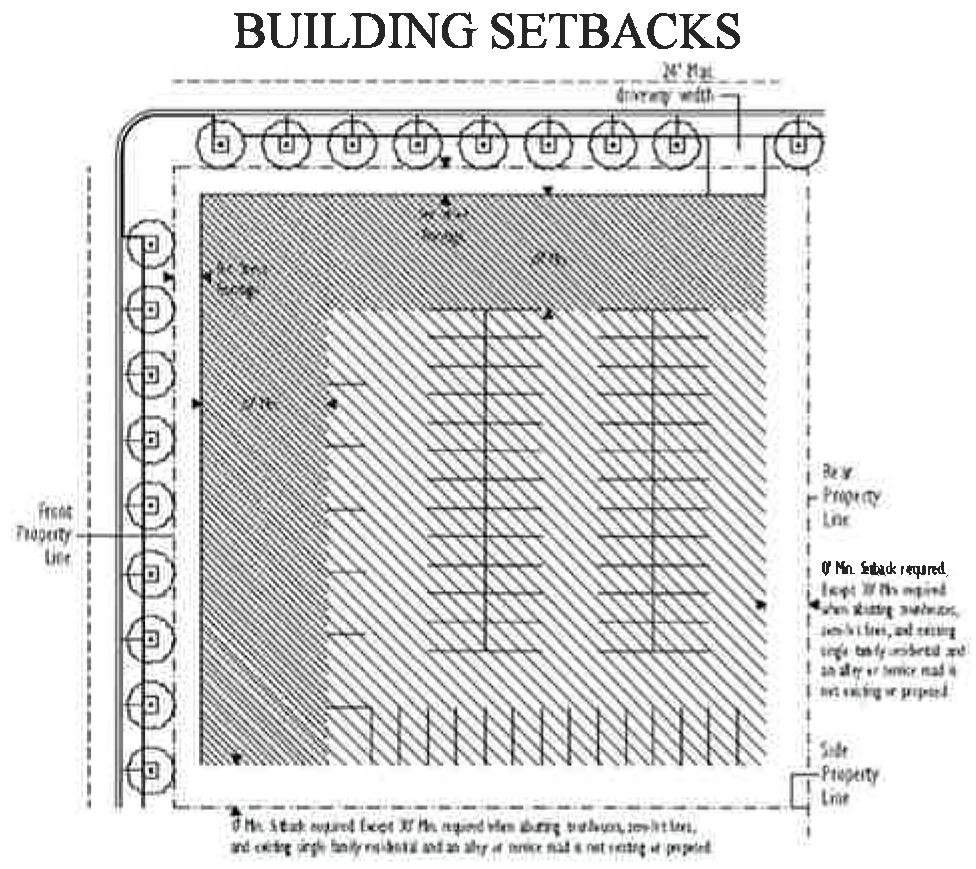 | ||
EXAMPLES OF BUILDING CONFIGURATION
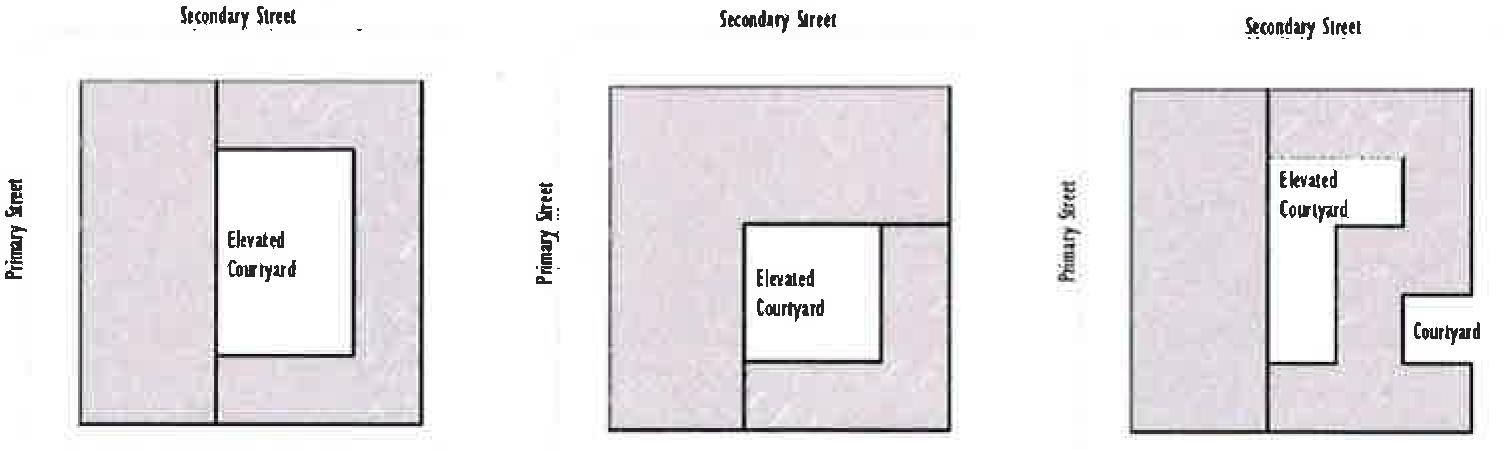
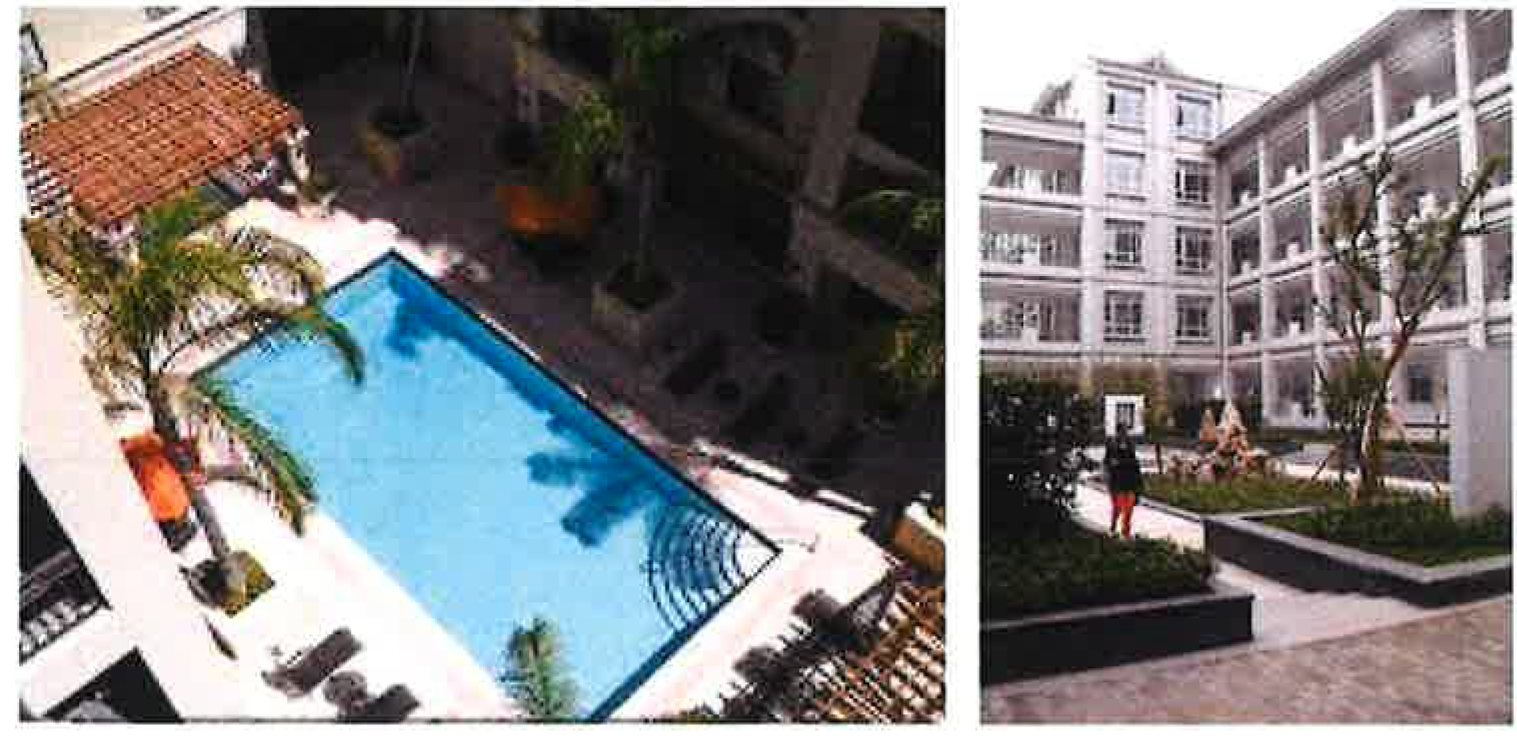 EXAMPLES OF BUILDING CONFIGURATION
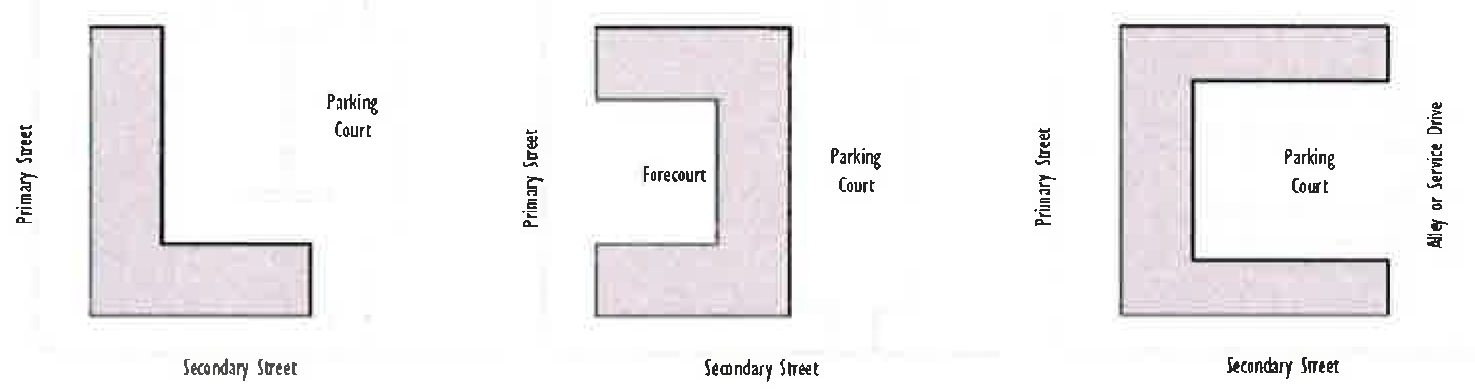
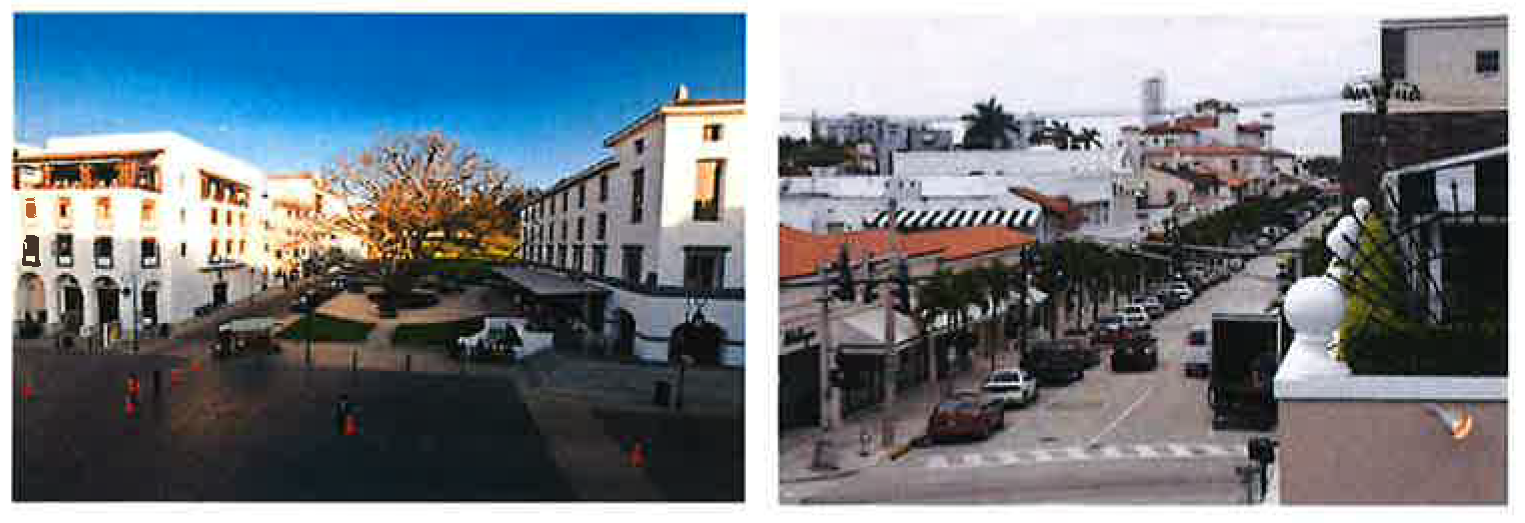
| Table 6: TOWNHOUSE BUILDING TYPE A | |||
|---|---|---|---|
| Permitted Heights Range: 3 Stories or 44 feet | BUILDING MASSING | ||
DEFINITION: A single dwelling unit in a group of units that are attached horizontally
in a linear arrangement to form a single building, with each single unit occupying
space from the ground to the roof of the building, and located or capable of being
located on a separate townhouse lot. Townhouse Building Type A dwelling units are
considered a type of multifamily dwelling. A Townhouse Building Type A is distinguished
by a detached garage/parking area thereby providing a private rear yard in the center
of the lot.
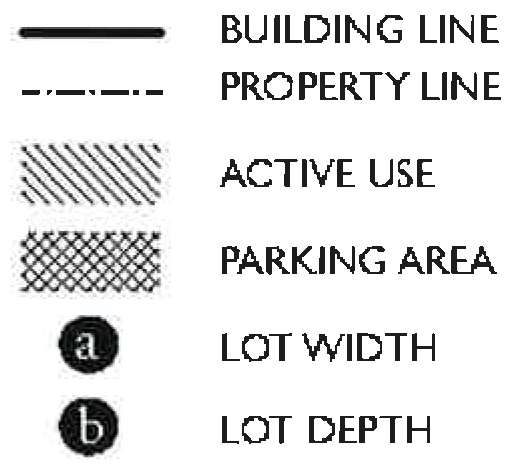 | 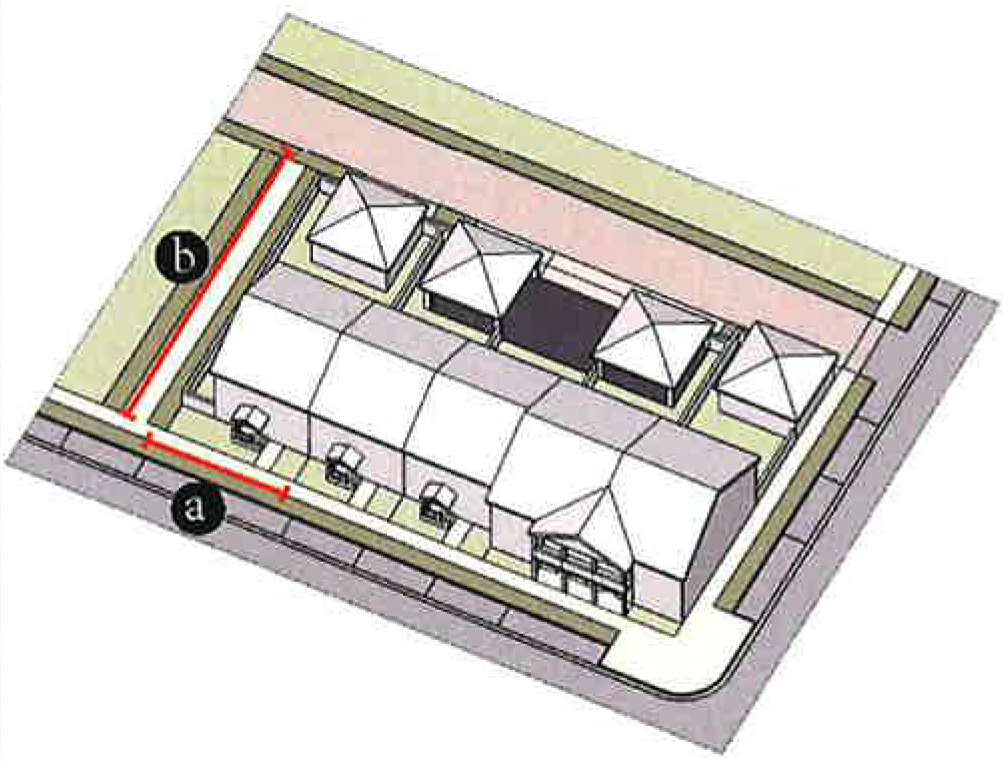 | ||
| LOT STANDARDS: | MIN. | MAX. | BUILDING CONFIGURATION |
| a. Lot Width | 25' | 30' | 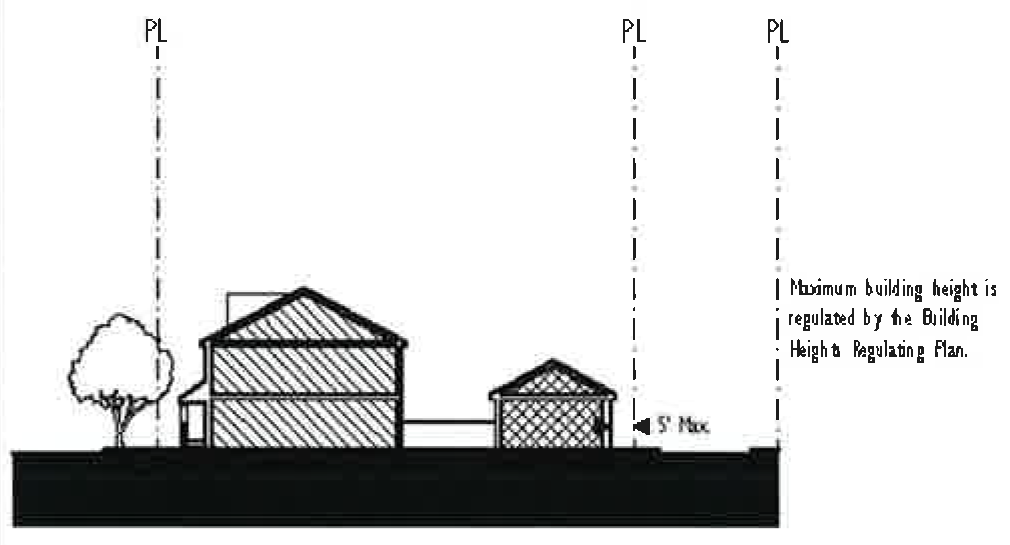 |
| b. Lot Depth | 80' | N/A | |
| c. Lot Area | 1800 sf | N/A | |
| d. Impervious Area | N/A | 90% | |
| e. Pervious Area | 10% | N/A | |
| f. Street Setbacks (front and side) | 10' | N/A | |
| g. Other Setbacks (Interior side and rear) | 0' | N/A | |
|
NOTES:
1. Townhouse buildings shall provide a minimum of 15 feet between building groups. Building groups shall not be greater than 7 attached units in length. PARKING STANDARDS: The parking for Townhouse buildings shall be accessed from the rear of an alley or service road. Parking may be unenclosed, fully enclosed in a garage, or in a parking enclosure with a carport. | 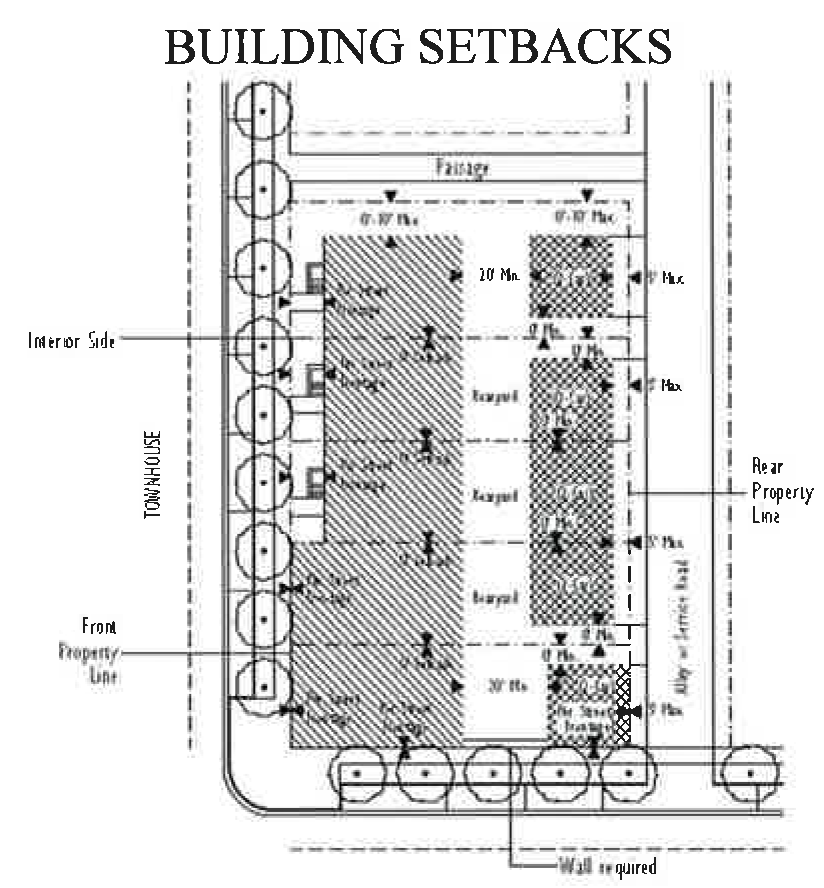 | ||
| Table 7: TOWNHOUSE BUILDING TYPE B | |||
|---|---|---|---|
| SUB-AREA: 3 Stories or 44 feet | BUILDING MASSING | ||
DEFINITION: A single dwelling unit in a group of units that are attached horizontally
in a linear arrangement to form a single building, with each single unit occupying
space from the ground to the roof of the building, and located or capable of being
located on a separate townhouse lot. A Townhouse Building Type B units is considered
a type of multifamily dwelling. Townhouse Type B Building Types are distinguished
by an attached garage thereby not providing a private rear yard.
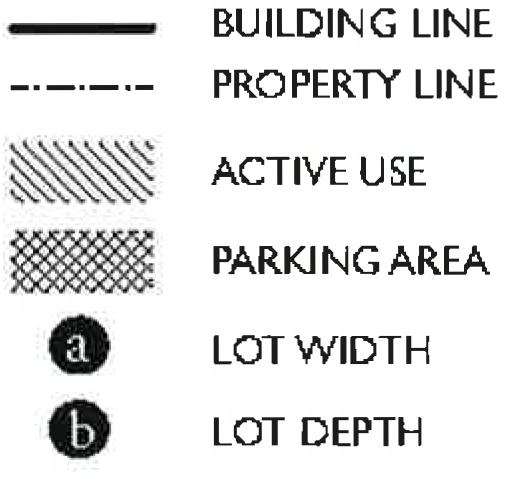 | 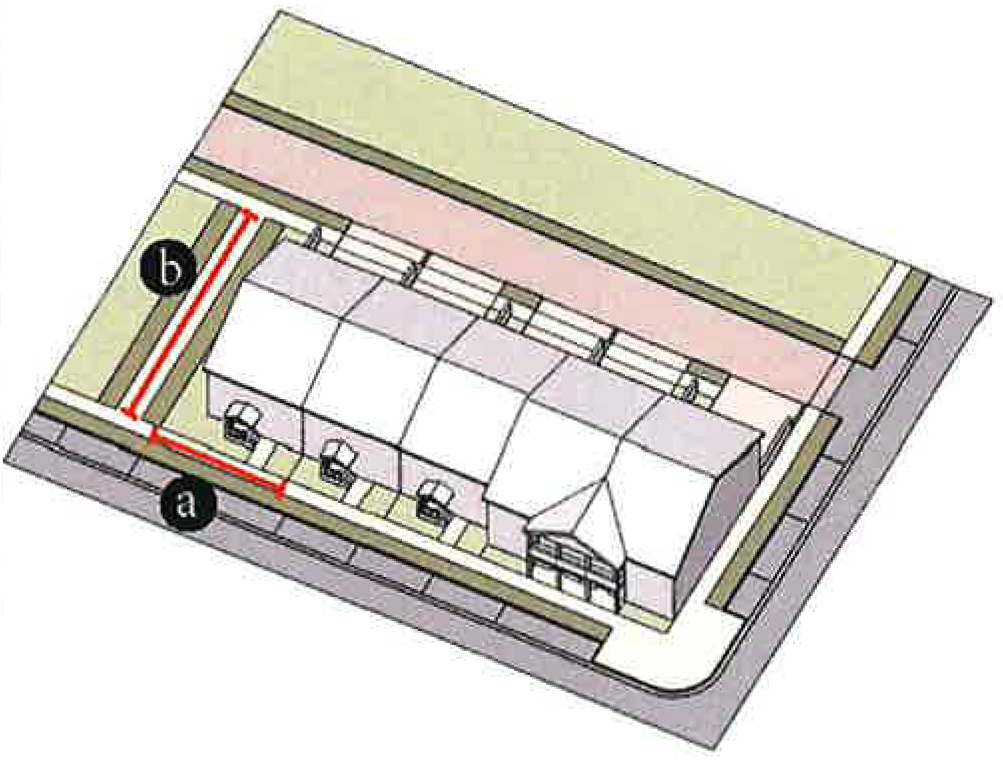 | ||
| LOT STANDARDS: | MIN. | MAX. | BUILDING CONFIGURATION |
| a. Lot Width | 25' | 30' | 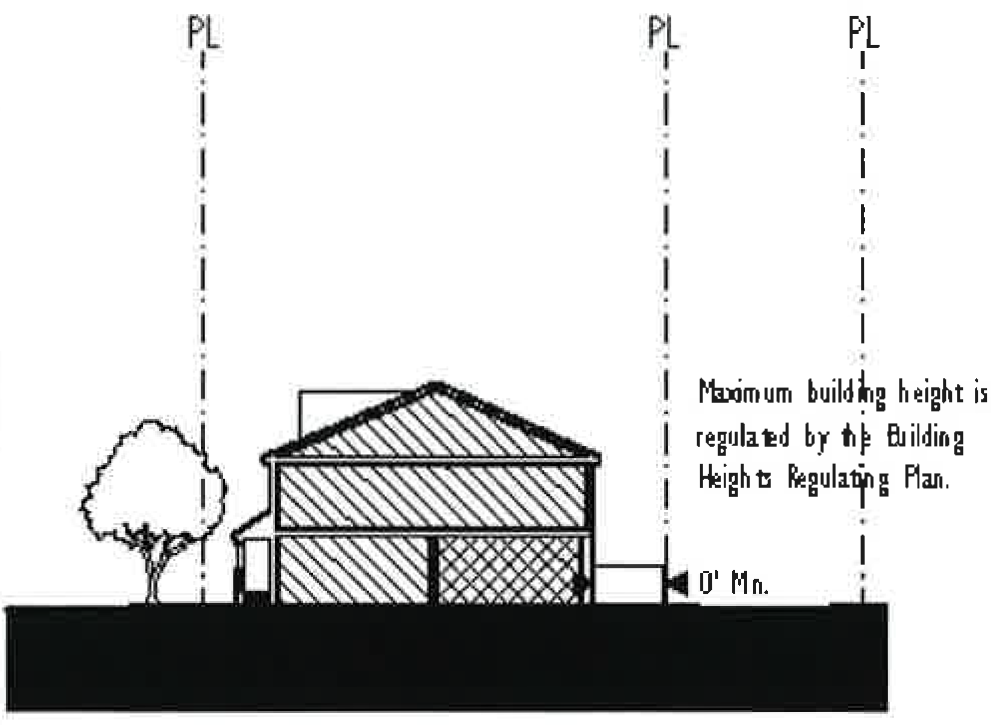 |
| b. Lot Depth | 70' | N/A | |
| c. Lot Area | 1800 sf | N/A | |
| d. Impervious Area | N/A | 90% | |
| e. Pervious Area | 10% | N/A | |
| f. Street Setbacks (front and side) | 10' | N/A | |
| g. Other Setbacks (Interior side and rear) | 0' | N/A | |
|
NOTES:
1. Townhouses shall provide a minimum of 15 feet between building groups. Building groups shall not be greater than 7 attached units in length. PARKING STANDARDS: The parking shall be accessed from the rear off an alley or service road. Parking may be fully or partially enclosed in a garage under the principal building. | 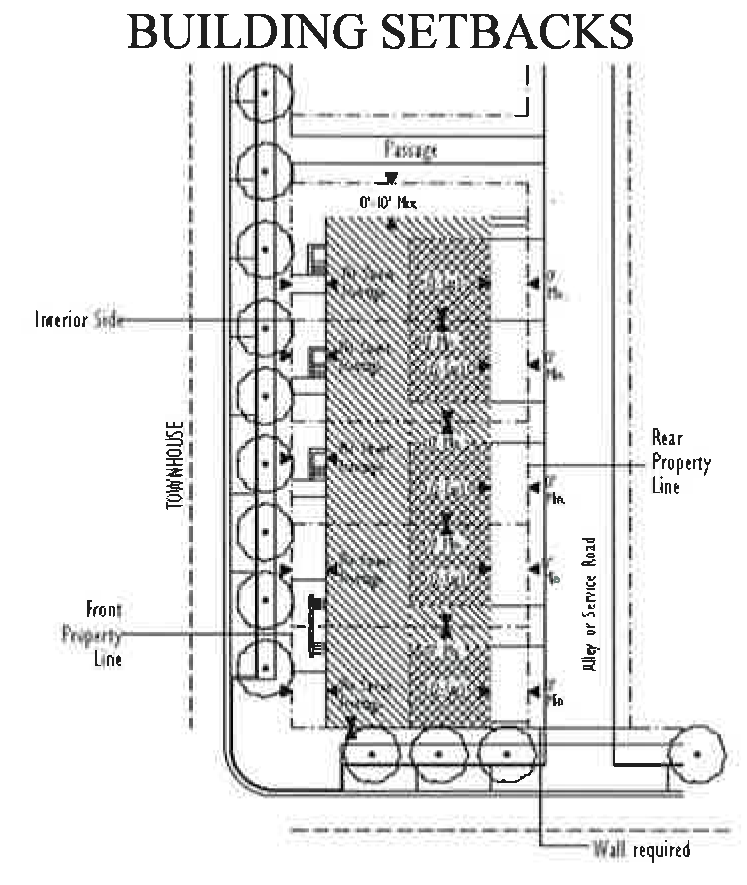 | ||
ILLUSTRATIVE EXAMPLES
TOWNHOUSE BUILDING TYPE
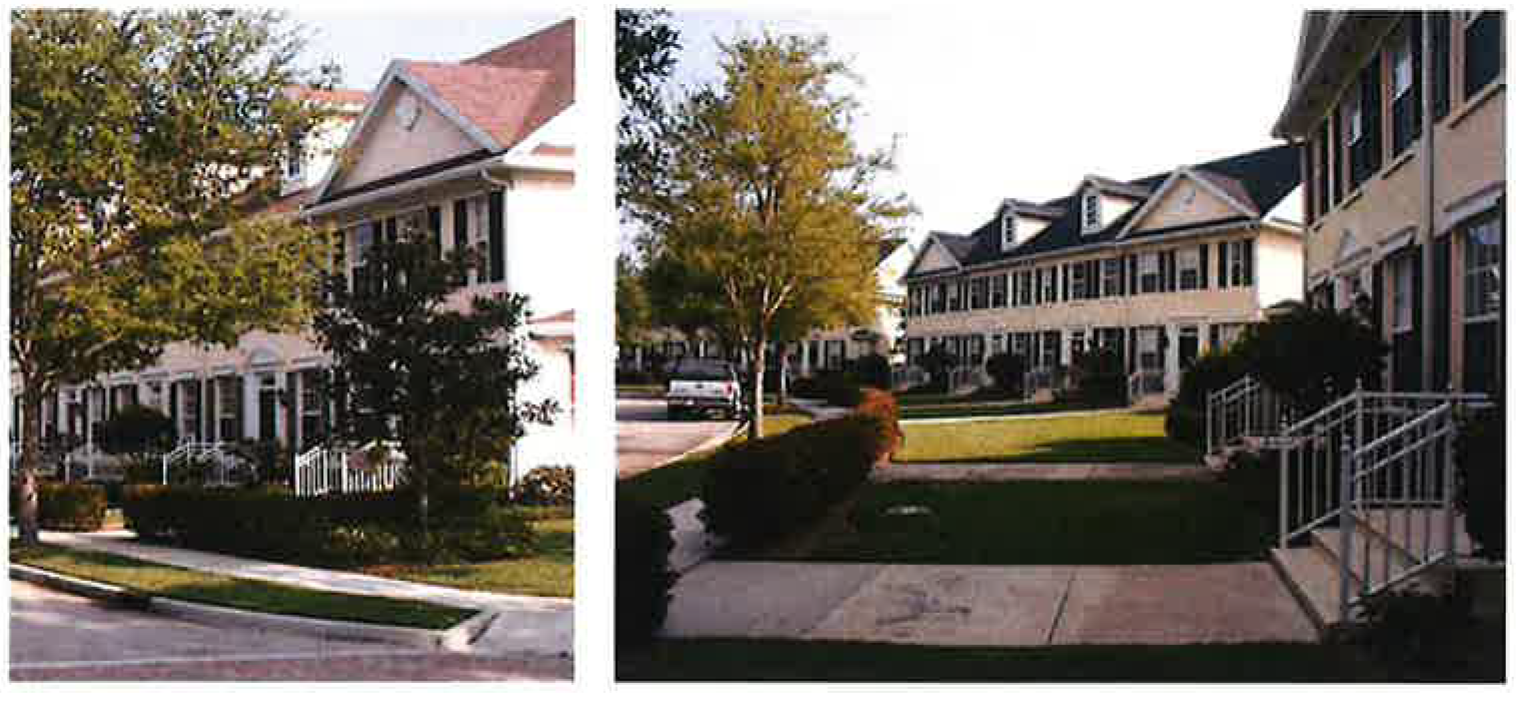
| Table 8: FLEX BUILDING TYPE | |||
|---|---|---|---|
| SUB-AREA: 1-6 Stories or 88 feet | BUILDING MASSING | ||
DEFINITION: Buildings designed to respond to changes of function in a flexible way.
The flex building is able to accept different internal configurations and easily adapt
to its surroundings.
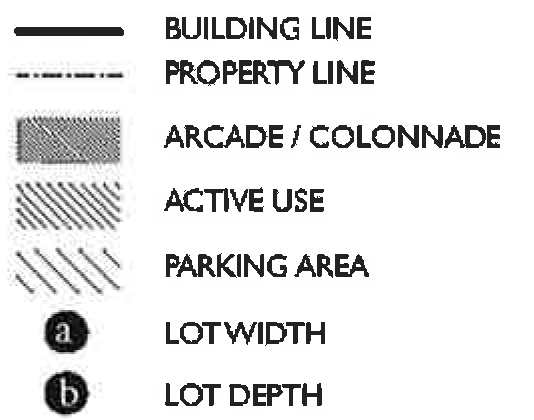 | 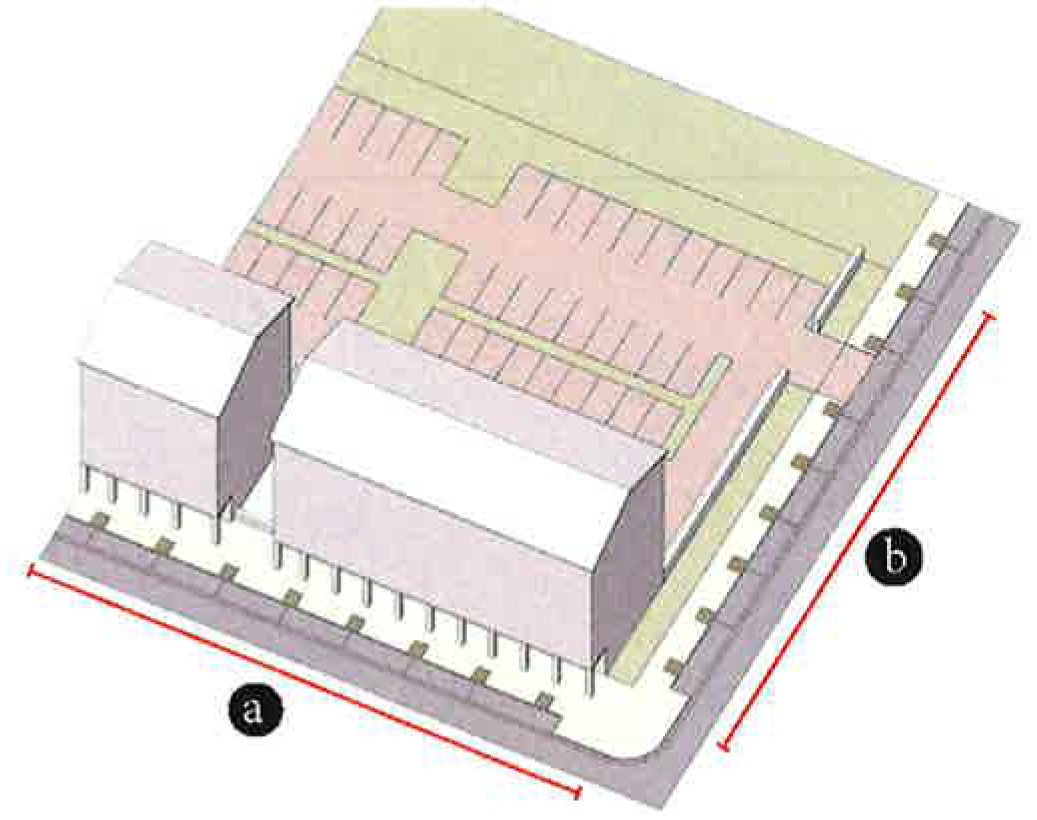 | ||
| LOT STANDARDS | MIN. | MAX. | BUILDING CONFIGURATION |
| a. Lot Width | 25' | N/A | 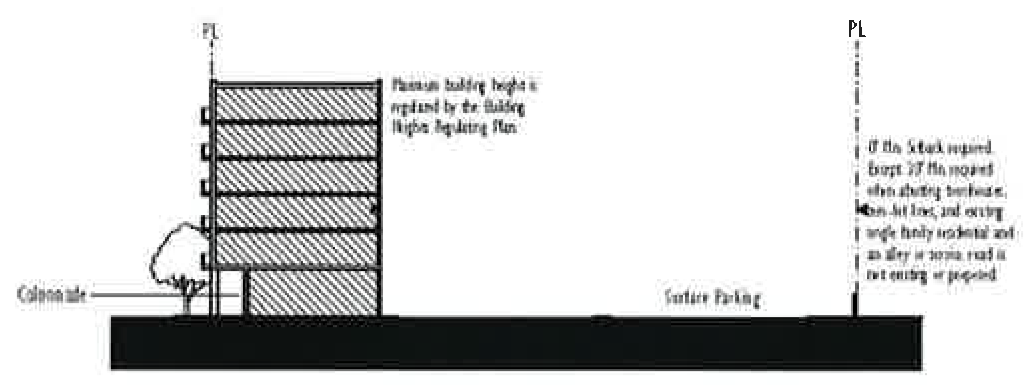 |
| b. Lot Depth | 70' | N/A | |
| c. Lot Area | N/A | N/A | |
| d. Impervious Area | N/A | 90% | |
| e. Pervious Area | 10% | N/A | |
| f. Street Setbacks (front and side) | 10' | N/A | |
| g. Other Setbacks (Interior side and rear) | 0'(1) | N/A | |
|
NOTES:
(1) Except 30' minimum when abutting existing residential and an alley, parking lot, or service road is not existing or proposed. | 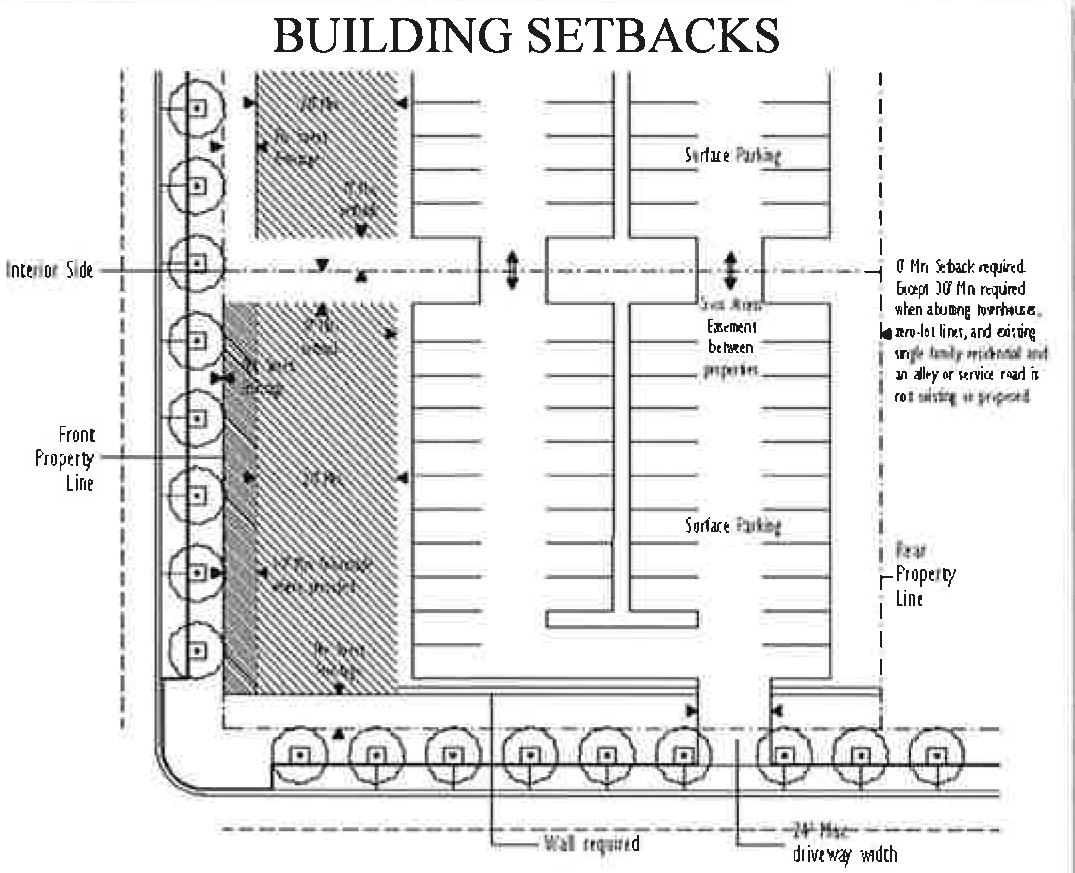 | ||
(e)
Performance standards.
(1)
Building frontage standards. Buildings may build to the setback line but are not required to do so. New buildings shall be designed to address the street and facilitate easy pedestrian access appropriate for an urban, mixed-use setting.
a.
A minimum of 80 percent of a building frontage shall abut the front street setback.
b.
A minimum of 60 percent of a building frontage shall abut any other street setback
(2)
Density. The land development regulations for the district shall provide for a density of up to 48 dwelling units per gross acre, which includes any density bonus, as calculated for the entire site. The commission may grant bonus units that result in a density greater than 48 du/acre on an individual site so long as the average density for the entire district area does not exceed 48 du/acre. The regulations shall provide for a maximum FAR of 2.0 for nonresidential uses. Development of sites within the district may exceed the maximum stated land use and density and FAR if appropriate and consistent with the policies contained herein and as provided in comprehensive plan.
(3)
Floor and ceiling height.
a.
Building heights in stories and feet are established for each building typology specified under subsection (d) herein.
b.
Building height shall be calculated from the average elevation of the adjacent public sidewalk or the crown of the road if no sidewalk exists to the top of the highest story or, in the case of pitched roofs, to the average height between the bottom of the eave and the peak of the roof.
c.
No story shall exceed 12 feet except for a ground floor story or a top floor story, either are permitted to be no more than 20 feet.
d.
No building shall exceed the base height of 12 stories or 160 feet, unless adjusted per (4)a. below.
(4)
Building height additional provisions.
a.
For the purpose of calculating the number of stories in a building, stories shall be defined as the space between finished floor and finished ceiling, adjusted as follows:
b.
Up to three levels of structured parking shall be exempted from the maximum height calculation provided that the parking levels are completely screened by a liner building at least 20 feet in depth.
c.
When parking levels are constructed on a slope or are connected by sloping or circular ramps, the number of stories shall be based on the non-sloped area. If there are no non-sloped areas, the number of stories shall be counted as the highest parking level plus each parking level below
d.
A mezzanine shall not count towards the number of stories provided that the total area of mezzanine level is less than 40 percent of the floor area of the main story below.
(f)
Entrance, facade and encroachment standards. Requirements are provided below for the location of a building's main entrance and the transparency of its facade.
(1)
Main entrance.
a.
A building's main entrance is its principal point of access for pedestrians. All buildings shall locate their main entrance facing a street frontage, or a courtyard or forecourt that is entered from a street frontage. Additional building entrances are encouraged.
b.
Buildings fronting on two streets shall have a pedestrian entrance on both streets.
(2)
Facade transparency.
a.
Transparency means the amount of transparent window glass or other openings in a building's facade along a street frontage, relative to the overall surface area of the facade. There shall be sufficient transparency provided such that natural surveillance of sidewalks and streets is possible and there is interior daylight, and to allow for clear views into a building.
(3)
Maximum allowable projections and encroachments of architectural elements.
(g)
Architectural consistency. All new buildings shall utilize an architectural vernacular that is consistent and harmonious with existing adjacent structures as well as those in the immediate vicinity per 78-330(3) or section 3-1(c), as applicable. To satisfy this provision, an applicant for new development or redevelopment may also enter into an agreement with adjacent property owners to upgrade the existing adjacent structures with new architectural features for the purposes of creating consistency with a new development. This agreement shall be presented to town staff prior to scheduling for public hearing and include the following:
a.
Signed and sealed conceptual architectural elevation plans depicting the scope and extent of the proposed improvements.
b.
A signed letter from the adjacent property owners acknowledging their intent to either undertake or designate the project applicant to complete the proposed improvements pursuant to the development order timeline.
c.
A surety or bond, based on a certified cost estimate, for 110 percent of the improvement value in a form acceptable to the town attorney guaranteeing the proposed improvements will be initiated and completed by the dates specified per b. above.
(h)
Street, alley, and sidewalk easement standards.
(1)
Streets, blocks and connectivity. The district plan depicted in Figure 1 indicates the block structure to be created by existing and new streets within the C-3 district. Developers seeking site plan approvals shall develop structures on their properties that conform to the alignments depicted in Figure 1 and provide for streets and alleys that are accessible to the public. Developers may propose modifications to the Figure 1 alignments if the applicant can demonstrate to the satisfaction of the community development department that the modifications would provide equivalent access and functionality. The east/west connections that provide connectivity between Lake Park and North Palm Beach shall not be altered and remain part of the publicly accessible connectivity grid, whether vehicular or pedestrian, of a development plan.
a.
If a developer proposes a modification that is determined not to provide equivalent access and functionality, it may be presented to the town commission for their consideration if the developer:
i.
Provides mitigation in the form of streetscape improvements on parcels under the developer's ownership, which shall be equivalent in length to the extent of whatever street or alley is being eliminated from the district plan or;
ii.
Enters into an agreement with adjacent property owners to construct streetscape improvements of a length equivalent to the extent of whatever street or alley is being eliminated from the district plan as further described under b. below.
b.
If a developer proposes off-site mitigation on parcels not under their ownership, they shall enter into an agreement with the relevant property owners for the purposes of ensuring the completion of the work. This agreement shall be presented to town staff prior to scheduling for public hearing and include the following:
i.
Signed and sealed conceptual paving, grading, and drainage plans depicting the scope and extent of the proposed improvements.
ii.
A signed letter from the adjacent property owners acknowledging their intent to either undertake or designate the project applicant to complete the proposed improvements pursuant to the development order timeline.
iii.
A surety or bond, based on a certified cost estimate, for 110 percent of the improvement value in a form acceptable to the town attorney guaranteeing the proposed improvements will be initiated and completed by the dates specified per b.ii. above.
(2)
Design standards for internal streets. Streets shall be designed in accordance with Figure 2. Deviations may be permitted to address site specific conditions, existing infrastructure conflicts, and property ownership limitations, where it can be demonstrated that the design standards cannot be met. A deviation from the design standards shall be subject to the review of the community development department, a recommendation from the planning and zoning board, and the approval of the town commission.
(3)
Other design standards. On subjects where Figure 2 does not provide design guidance, for instance driveway widths and curb radii at intersections, design shall be in accordance with NACTO's Urban Street Design Guide. Pavement, subgrade, drainage, and utilities shall meet construction specifications of the Town.
(4)
Ownership and maintenance. Property owners shall be responsible for the regular upkeep and maintenance of all streets and alleys immediately adjacent to their properties, unless otherwise provided for in a development order or other governing document.
(5)
Alleys. The alleys shown on the district plan in Figure 1 shall be provided for access to adjoining parcels. The town may require property owners to provide additional alleys to accomplish the intent of the C-3 district.
(6)
Sidewalk easements. Property owners abutting any street depicted on the district plan, including Northlake Boulevard and US1 shall dedicate to the town, by deed or plat a ten-foot perpetual sidewalk easement along those street frontages in furtherance of the intent of the C-3 district. The property owner shall be responsible for paving the easement area to the same standards and elevation as the adjoining sidewalks at, or before the time of development.
(7)
Utilities. Utilities may be placed in the streets, easement corridors, and alleys in locations acceptable to the Seacoast Utility Authority and the town.
Figure 2
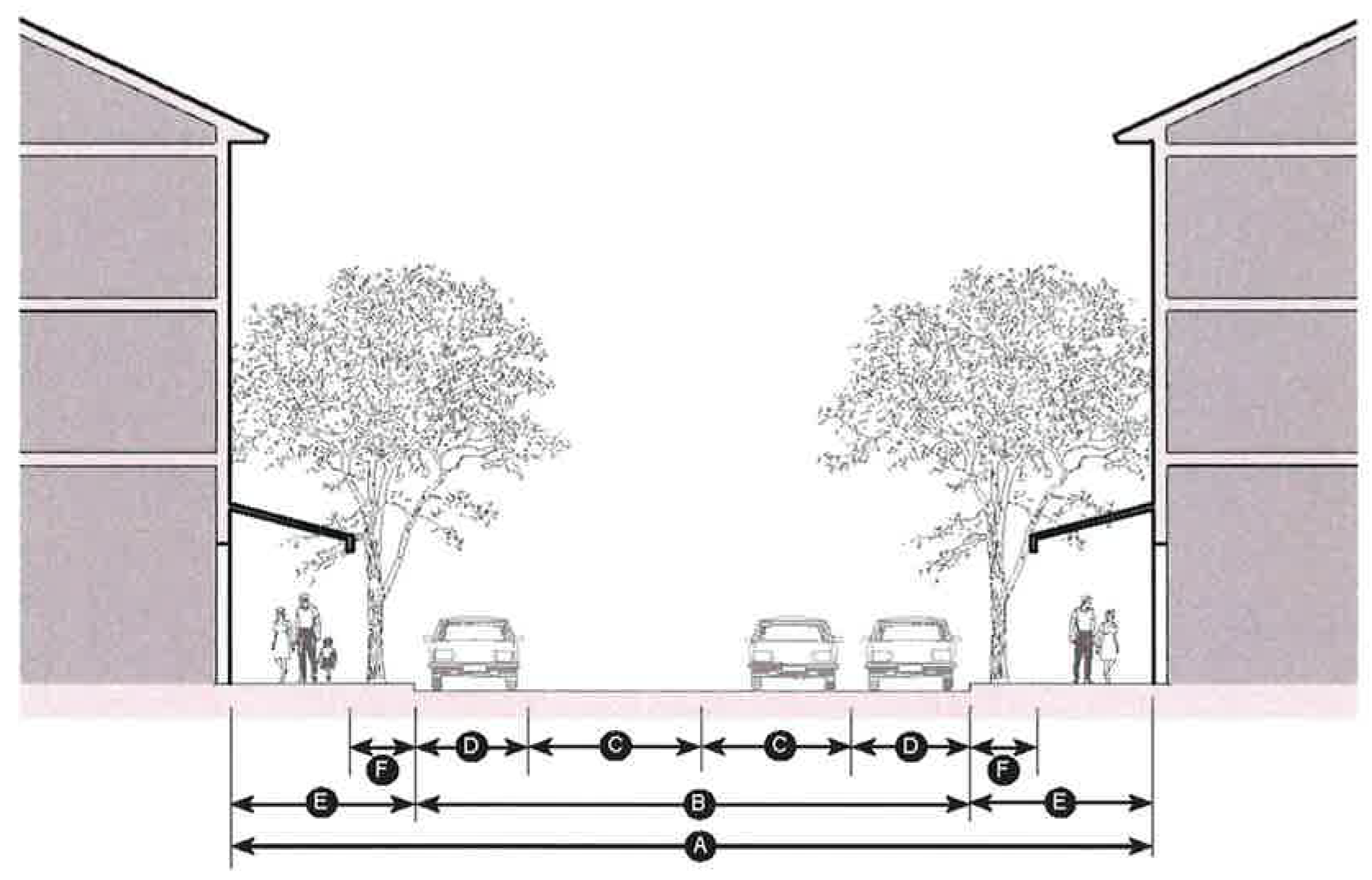 | ||
| Description: | Details: | Key: |
| Width of Street | 60' | A |
| Movement type | Slow | |
| Target speed | 25 mph | |
| Width of pavement | 36' | B |
| Travel lanes | 10' travel lanes | C |
| Bicycle facilities | shared travel lanes | C |
| On-street parking | 8' parallel parking | D |
| Pedestrian facilities | 10' sidewalks | E |
|
Furnishing strip:
Planter type Tree spacing |
5' by 5' tree grates
30' average | F |
(i)
Landscaping standards. Landscaping shall be required as provided in article VIII of chapter 78, except as modified by the following requirements that are specific to properties in the C-3 district:
(1)
Buffers:
a.
Hedges are required around the perimeter of parking areas and other vehicular use areas in accordance with the details in sections 78-253 and 78-254.
b.
Screening is required around storage and service areas in accordance with the details in section 78-253.
c.
Landscaped buffers are not required around the perimeter of properties, except where hedges are required around parking areas or other vehicular use areas or where screening is required.
d.
Along Northlake Boulevard, hedges and screening shall not be placed on or within a sidewalk easement.
(2)
Parking area interior landscaping for unroofed parking areas: At least ten percent of the total parking lot surface area shall be devoted to landscaped areas. At least one tree shall be planted for every 250 square feet of required internal planting area. Interior landscaping areas shall not count toward satisfying a property's pervious space requirement.
(3)
Clear visibility triangles: Clear visibility triangles are required in accordance with section 78-253. A clear visibility triangle shall be provided whenever driveways and streets meet Northlake Boulevard.
(4)
Foundation landscaping: Foundation landscaping is required within 15 feet of all buildings in accordance with section 78-253.
(5)
Indigenous native vegetation: To reduce maintenance and water consumption, landscaping shall include at least 75 percent indigenous native trees and 75 percent indigenous native shrubs. Trees and shrub species that qualify as indigenous native vegetation are those designated as "native" in "Low-Maintenance Landscape Plants for South Florida" (latest edition published by the University of Florida IFAS Extension office).
(6)
Installation: All landscaping shall be installed using xeriscape principles, including water conservation through the appropriate use of drought-tolerant plants, mulching and the reduction of turf areas. Irrigation systems shall be designed to operate only when needed and only in those areas that require irrigation.
(j)
Open space standards.
(1)
Open space type configuration and design. In order to improve the C-3 district's aesthetics, all property owners developing their properties shall provide high quality, pedestrian-oriented open space on their properties. This open space may be utilized to satisfy the minimum pervious area requirements outlined under subsection (d) for each building typology, in addition to other open spaces on the property. Only those pervious areas within the open spaces on the property shall be counted toward satisfying the pervious area requirements of subsection (d). The standards for each open space type are outlined below.
a.
Greens. Exclusive of dedicated rights-of-way, the maximum impervious area of a green is 20 percent. The pervious surface areas shall consist primarily of drought tolerant ground covering, trees, and garden structures, such as benches and tables without concrete pads for support, and permeable walkways. Any impervious surfaces shall consist of hard-surfaced areas such as concrete walkways, garden structures with concrete pads for support, shade structures, or other features deemed appropriate by the community development department.
b.
Plazas. Exclusive of dedicated rights-of-way, the maximum impervious surface area of a plaza is 85 percent. The pervious surface areas shall consist primarily of drought tolerant ground covering, trees that are regularly spaced, permeable walkways, shade structures, and garden structures such as benches and tables. The impervious surfaces shall consist of paved areas, permanent architecture such as archways, statues, gazebos, fountains, pools, or other features deemed appropriate by the community development department.
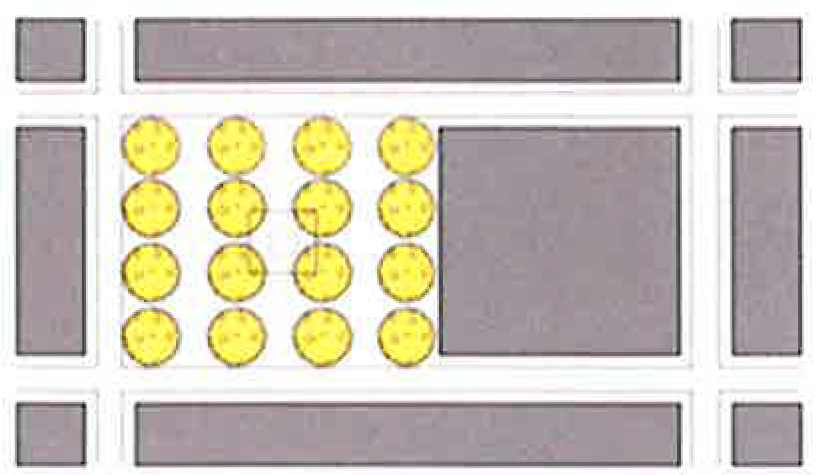
c.
Squares. Exclusive of dedicated rights-of-way, the maximum impervious area of a square is 50 percent. The pervious surface areas shall consist primarily of drought tolerant ground covering, trees that are regularly spaced, shade structures, and permeable walkways. Any impervious surfaces shall consist of hard-surfaced public gathering spaces, gazebos, fountains, statues, and other features approved by the community development department.
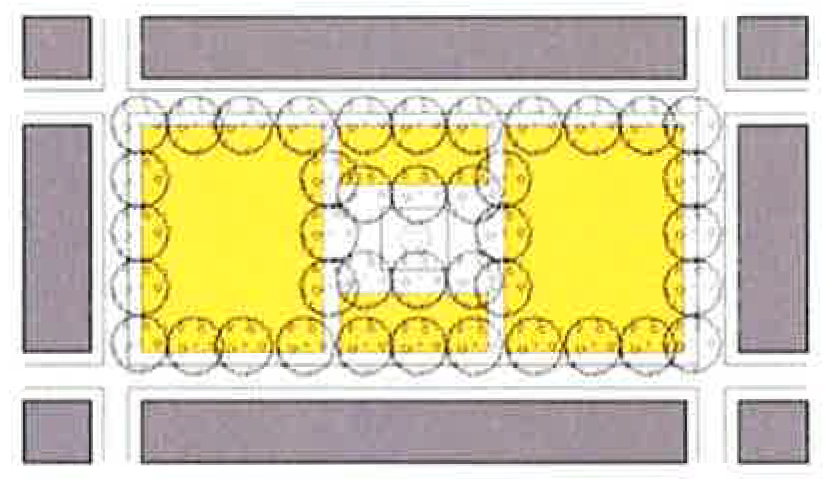
(k)
Parking standards.
(1)
Location of parking lots. Surface parking lots and other vehicular use areas shall be screened from streets as required by section 78-253, except where the building provides the screening.
(2)
Parking space ratios. Table 9 provides parking space ratios for various uses on a site. These ratios establish the minimum number of on-site parking spaces subject to any adjustment granted by the commission as provided in subsection (3). The resulting number of parking spaces replaces conflicting standards in section 78-142.
(3)
Parking space adjustments. A reduction in the requirement can be applied if a Traffic Management Plan (TMP), which demonstrates that there will be adequate parking for the proposed uses. A TMP is required whenever a property owner or developer proposes parking which is less than that which is required by the town code. The TMP shall identify the strategies for reducing single-occupancy vehicle trips and present relevant data and analysis which is professionally reliable demonstrating that less parking than that which is required by the town's code is justified.
Alternatively a reduction in the requirement can be applied if a shared parking study, prepared by a professional engineer, based on the latest recommendations of the Urban Land Institute is submitted and demonstrates that there will be adequate parking.
(4)
Loading standards. Refer to section 78-143.
(l)
Signs. Refer to chapter 70.
(Code 1978, § 32-52.1;Ord. No. 7-1995, § III, 3-15-1995; Ord. No. 1-1997, § I, 1-8-1997; Ord. No. 12-2009, § 3, 9-16-2009; Ord. No. 05-2017, § 13, 6-7-2017; Ord. No. 04-2022, § 2, 7-20-2022)
Sec. 78-74. - C-4 business district.
Within the C-4 business district, the following regulations shall apply:
(1)
Purpose and intent. This (business) district is identified on the Town of Lake Park Official Zoning Map. The purpose of the regulations in this district is to encourage the development or redevelopment of uses which are compatible with the uses of the surrounding or abutting districts, and to provide for appropriate landscaping and parking for the uses in this district. The intent of this district is to limit uses to business offices, wholesaling, retailing and light manufacturing activities.
(2)
Uses permitted. Within the C-4 business district, no building, structure or land shall be used, and no building shall be erected, structurally altered or enlarged, unless otherwise permitted by those regulations, except for the following uses:
a.
Appliance stores, including sales and service.
b.
Auctions, enclosed.
c.
Vehicle sales and repair.
Motor vehicle sales on property on which a permanent building is erected, shall mean the area where buildings are used in connection with the sale or lease of motor vehicles and the areas where motor vehicles are displayed for lease or sale.
d.
Bakeries and confectioneries.
e.
Boat, sales, service and storage.
f.
Building and remodeling suppliers — wholesale and retail.
g.
Business offices.
h.
General retail (must have frontage on Old Dixie).
i.
Studios (e.g., dance, art, photography, martial arts).
j.
Electronic equipment, sales.
k.
Furniture, sales.
l.
Hardware, paint and garden supplies.
m.
Laboratories, medical and dental.
n.
Laundry plants.
o.
Mobile homes and recreational vehicles, including motorcycles, sales, service maintenance and storage.
p.
Monuments, sales.
q.
Nurseries and greenhouses.
r.
Office/warehouse.
s.
Personal services, including, but not limited to, barbershops, beauty shops, masseurs and health studios.
t.
Precision instruments and optics.
u.
Printing and publishing plants.
v.
Public and private utility services.
w.
Research and development including bioscience uses.
x.
Restaurants (including deli's and takeout) that mainly service the tenants in the C-4 and CLIC districts. Drive through prohibited.
y.
Self-storage facilities.
z.
Taxidermists.
aa.
Upholstery shops.
bb.
Buildings, structures and uses accessory and customary incidental to any of the above uses.
(3)
Special exception uses permitted. Within the C-4 business district, no building, structure or land shall be used, and no building shall be erected, structurally altered or enlarged for the following uses unless a special exception has been approved by the town commission, pursuant to section 78-184 and the criteria set forth herein:
a.
Auto paint and body shops.
b.
Chemicals, storage and sales.
c.
Dry cleaning plants.
d.
Lumberyards.
e.
Machinery, sales and manufacturing.
f.
Millwork and woodwork, sales and manufacturing.
g.
Machinery, equipment, vehicle storage and other similar materials as a primary use or as an accessory use to another primary use.
The town commission may permit special exception uses in the C-4 zoning district provided the town commission determines that the proposed use meets the special exception zoning criteria established in this chapter and is consistent with the goals, objectives and policies of the town's comprehensive plan. In order to ensure that the special exception use is consistent with and implements good zoning practices and the goals, objectives and policies of the town's comprehensive plan. The town commission may impose conditions upon the approval of a special exception use, including, but not limited to, conditions which require an applicant to exceed standards which have been adopted pursuant to the town's land development regulations.
(4)
Other uses. Other uses of the same general character as those listed above deemed appropriate by the town commission on an individual basis, after having received a recommendation from the planning and zoning board and appropriate town staff, and as per subsection (3) of this section shall be so determined after a public hearing is held pursuant to the following conditions:
a.
Publication of notice of the time, place and purpose of such hearing shall be made in a newspaper of general circulation in the town at least ten days prior to the public hearing.
b.
A courtesy notice containing substantially the same information set forth in the published notice aforesaid shall be mailed by the town to the property owners of record within a radius of 300 feet of the described property; provided, however, that failure of any owner to receive such notice shall not affect any action taken hereunder. The property owner's list shall be prepared, certified and submitted by the person requesting such use, at person's expense. The notice shall be mailed at least ten days prior to the hearing.
(5)
Area regulations. The following requirements shall apply to all uses permitted in this district:
a.
Front yard. All buildings shall set back from all ultimate street right-of-way lines not less than 25 feet.
b.
Side yard. No building or structure shall be located closer than 12 feet from one side yard line.
c.
Rear yard. No building or structure shall be located closer than ten feet or a distance equal to one-half the building height from a rear yard line, whichever is greater. No rear yard is required where the lot abuts on an existing or proposed railroad right-of-way or spur that is utilized by the facility.
d.
Maximum lot coverage. Main and accessory buildings, loading facilities and uses shall not cover more than 50 percent of the lot area.
e.
Impervious surface ratio of lot area. With respect to drainage and stormwater runoff, the relationship of surfaces covered by buildings, paved parking areas and all other impervious surfaces such as vegetated open space and stabilized, unpaved parking areas shall be that deemed suitable for the proposed type of land use and buildings and in accordance with the South Florida Water Management District's permit information manual, volume IV, Management and Storage of Surface Waters.
f.
Impervious ratio calculation. The impervious surface ratio is calculated for the gross site, and is calculated by dividing the total impervious surface by the gross site area. Water bodies are to be considered impervious and shall be included as such in the impervious surface ratio calculation.
g.
Treatment of cluster development. Cluster development or other site design alternatives may result in individual lots within a development project exceeding the impervious surface ratio, while other lots may be devoted entirely to open space. The town commission shall require, as a condition of approval, deed restrictions or covenants that guarantee the maintenance of such open space in perpetuity.
h.
Outdoor storage. Outdoor storage of goods, materials and vehicles and other suitable materials shall be allowed as an accessory use to the primary land use, provided it is on an improved, properly drained surface and is screened by fencing, landscaping, fence fabric, and/or suitable screening materials at a location on site deemed appropriate by the community development director.
(6)
Height regulations. No building or structure shall exceed four stories or 45 feet in height. No building or structure shall exceed three habitable stories. If a building contains four stories, then the first level must be dedicated entirely to parking facilities.
(7)
Minimum off-street parking and loading requirements. See section 78-142 for off-street parking and loading requirements.
(8)
Screening and landscaping. As regulated in the Town Code.
(9)
Requirement for platting. All development or redevelopment in this zoning district shall be duly platted and recorded according to standards and procedures set out in chapter 67 of this Code regarding the land development code of the town. At the time of platting, a declaration of the covenants and restrictions to run with the land shall be filed of record whereby the individual lots, plots and building sites thereby created and the common areas, open spaces, easements, and right-of-way appurtenant thereto, shall be made subject to the development criteria of this Code and of the conditions of approval of the applicant's petition for development.
(Code 1978, § 32-56; Ord. No. 1-1981, § 1, 1-7-1981; Ord. No. 20-1991, § 4, 12-4-1991; Ord. No. 7-1992, § XIII, 8-5-1992; Ord. No. 23-2002, § 1, 9-18-2002; Ord. No. 28-2007, § 2, 10-17-2007; Ord. No. 12-2009, § 3, 9-16-2009; Ord. No. 18-2009, § 2, 1-6-2010; Ord. No. 04-2014, § 2, 6-4-2014; Ord. No. 02-2018, § 4, 1-17-2018)
Sec. 78-75. - CLIC-1 campus light industrial/commercial district.
Within the CLIC campus light industrial/commercial district, the following regulations shall apply:
(1)
Purpose and intent. It is the purpose of the CLIC district to allow the development of a mixed-use, campus light industrial/commercial employment center. The location of this district abutting the MU mixed-use residential/commercial/light industrial district provides opportunities for employment in close proximity to higher population densities, thereby promoting walk-to-work activity and reduced traffic congestion. The regulations for this district are intended to encourage development compatible with surrounding or abutting zoning districts, with suitable open spaces, on-site landscaping and parking areas. A landscape buffer along Silver Beach Road is required so that this district will not be incompatible with residential land uses on the south side of Silver Beach Road.
(2)
Uses permitted. Within the CLIC zoning district, no building, structure, land or water use shall be permitted and no building shall be erected, structurally altered or enlarged, except for the following uses:
a.
Any of the following uses shall be permitted:
1.
Freighting or trucking yard or terminal.
2.
Utility substations, easements, rights-of-way and alleys, transportation easements, alleys and rights-of-way.
3.
Building suppliers, including lumberyards and milling of wood products, but excluding sawmills and planning mills.
4.
Business offices and studios.
5.
Dance instruction.
6.
Electronic equipment, sales and manufacturing.
7.
Hardware, paint and garden supplies.
8.
Laboratories, medical and dental.
9.
Monuments, sales.
10.
Nurseries and greenhouses.
11.
Personal services, including but not limited to barbershops, beauty shops, masseurs and health studios.
12.
Precision instruments and optics.
13.
Printing and publishing plants.
14.
Public and private utility services.
15.
Retail sale, leasing or renting of vehicles, trailers or boats.
Motor vehicle sales on property on which a permanent building is erected, shall mean the area where buildings are used in connection with the sale or lease of motor vehicles and the areas where motor vehicles are displayed for lease or sale.
16.
Transient residential use.
17.
Community residential homes, provided that any such community residential home is not located within a radius of 1,200 feet of another such home.
18.
Group home is a permitted use provided that any group home is not located within a radius of 1,000 feet of another existing group home.
b.
The following uses are permitted uses when conducted within a completely enclosed building and when they conform to this Code:
1.
The manufacture, compounding, processing, packaging or treatment of such products as bakery goods, candy, cosmetics, dairy products, drugs, perfumes, pharmaceuticals, perfumed toilet soap, toiletries, and food products.
2.
The manufacture, compounding, assembly or treatment of articles of merchandise from the following previously prepared materials: Aluminum, bone, cellophane, canvas, cloth, cork, feathers, felt, fiber, fur, glass, hair, horn, leather, paper, plastics, precious or semiprecious metals or stones, shell, rubber, textiles, tin, iron, steel, tobacco, wood (excluding sawmill or planning mill), yarns, and paint not involving a boiling process.
3.
The manufacture of pottery and figurines or other similar ceramic products, using only previously pulverized clay, and kilns fired only by electricity or gas.
4.
The manufacture and maintenance of signs.
5.
Light sheet metal products, including heating and ventilating ducts and equipment, cornices, eaves and the like.
6.
The manufacture of musical instruments, toys, novelties, and rubber or metal stamps.
7.
Automobile assembling, painting, and upholstering, rebuilding, reconditioning, body and fender works, truck repairing and overhauling.
8.
Automobile recycling center, with the following conditions:
i.
The facility must comply with all rules or be licensed and/or permitted (if required) and in compliance with all governmental agencies having jurisdiction over this type of business, including but not limited to the South Florida Water Management District, the state department of environmental protection and the state department of environmental resources management.
ii.
As consistent with this section regarding the permitted uses being conducted within a completely enclosed building, any operations involving mechanisms which contain fluids, including but not limited to the working on or removal of the drive train, including engine removal, transmission removal; removal of the gas tank, radiator, the removal of the brake master cylinder or wheel cylinders or calipers, or power steering mechanism, must be done in a completely enclosed space. Any salvage operations other than those listed above may be done out of doors.
iii.
All Freon removal from air conditioning systems must be done pursuant to MACS standards. No Freon shall be released into the atmosphere.
iv.
Storage of cars used for stock may be out of doors.
v.
No use of this kind may be within one mile of like use.
9.
Machine shop.
10.
Foundry casting lightweight nonferrous metals.
11.
Wholesale or warehousing enterprises.
12.
Research, experimental or testing laboratories.
13.
Auctions.
14.
Appliance stores, including sales and service.
15.
Boats, sales, service, manufacturing, storage.
16.
Chemicals, sales and manufacturing.
17.
Furniture, sales.
18.
Machinery, sales and manufacturing.
19.
Mobile homes and recreational vehicles sales, service, maintenance and storage.
20.
Storage warehouses.
21.
Taxidermists.
22.
Upholstery shops.
c.
The following uses are permitted on parcels which front on the ultimate right-of-way of Park Avenue as extended:
1.
Retail and commercial stores and shops.
2.
Mixed-use projects which include a residential component and at least two other types of land use, such as retail stores and studios.
3.
Residential multifamily to a density of 15.78 units per acre.
4.
Educational facilities and schools. Shall also be permitted along parcels which front the ultimate right-of-way of Watertower Road. Conditional use approval is required by the town commission.
d.
Accessory uses. Accessory uses customarily incidental and subordinate to the main use or building shall be permitted in the CLIC zoning district. Accessory uses shall not be located within any required setbacks.
e.
Additional regulations for permitted and accessory uses. The uses permitted in this section shall be conducted in such a manner that no noxious odor, fumes, glare or dust will be emitted beyond the property line of the lot on which the use is located. Any article or material stored temporarily outside of an enclosed building as an incidental part of the primary operation shall be screened by ornamental walls and fences and in no case shall materials be stacked or stored so as to exceed the height of the screen.
(3)
Prohibited uses and structures. The following are strictly prohibited: churches; cement, lime or gypsum manufacture; disposal plants of all types including trash and garbage, and sewage treatment plants, brewing or distillation of malt beverages or liquors, with the exception of minibreweries or microbreweries that are part of a restaurant and cover no more than 30 percent of the total floor area; acid manufacture of any kind; garbage, offal, or animal reduction, incineration or processing; metal or ore reduction, refining, smelting, or alloying; outdoor salvage operations or for processing of any scrap, salvage, or secondhand automobile parts; aboveground bulk fuel storage facility; all uses and/or structures not specifically permitted herein.
(4)
Area regulations. The following requirements shall apply to all uses permitted in this district:
a.
Front yard. All buildings shall set back from all ultimate street right-of-way lines not less than 25 feet, with the exception of buildings on parcels which front on the ultimate right-of-way of Park Avenue extended which shall be set back a minimum of five feet and a maximum of 20 feet.
b.
Side yard. No building or structure shall be located closer than ten feet or a distance equal to one-half the building height, whichever is the greater, to a side yard line, with one of said side setback being paved for its entire length; provided, however, that for buildings 24 feet high or less of type one or type two construction, no building or structure shall be located closer than two feet from one of the side yard lines and no closer than 12 feet from the other side yard line. An exception shall apply to buildings on parcels which front on the ultimate right-of-way of Park Avenue extended which shall have no minimum side yard.
c.
Rear yard. No building or structure shall be located closer than 20 feet from a rear yard line. No rear yard is required where the lot abuts on an existing or proposed railroad right-of-way or spur that is utilized by the facility, provided suitable fire apparatus access is provided.
d.
Maximum lot coverage. Main and accessory buildings and loading facilities shall not cover more than 50 percent of the lot area. An exception shall apply to buildings on parcels which front on the ultimate right-of-way of Park Avenue extended which shall have no maximum lot coverage.
(5)
Height regulations. No building or structure shall exceed four stories.
(6)
Minimum off-street parking and loading requirements. See section 78-142 for all development on parcels which do not front on the ultimate right-of-way of Park Avenue extended. For all development on parcels which front on the ultimate right-of-way of Park Avenue extended, all off-street parking shall be located behind the buildings.
(7)
Screening and landscaping. As regulated in the Lake Park Code. Furthermore, with specific reference to that portion of this zoning district which fronts along Silver Beach Road, there shall be constructed and maintained along Silver Beach Road a landscape berm or combined berm and wall which shall serve as a buffer and screen between the CLIC-1 zoning district and the residential zoning district on the south side of Silver Beach Road. The berm or berm and wall shall be constructed to meet the following standards:
a.
The berm shall be located within a strip having a minimum width of 20 feet, located adjacent to and paralleling the ultimate right-of-way of Silver Beach Road.
b.
The berm alignment can vary within the 20-foot strip.
c.
The height of the berm shall be a minimum of five feet but it can vary to greater heights.
d.
The landscaping scheme shall consist of xeriscape plant materials, shade trees and shall utilize low-volume irrigation techniques and equipment.
e.
Any vehicular access from Silver Beach Road through the berm or berm and wall shall meet the requirements of section 78-254, sight distance for landscaping adjacent to public rights-of-way and points of access.
(8)
Requirement for platting. All development or redevelopment in this zoning district shall be duly platted and recorded according to standards and procedures set out in this subpart B of the Code. At the time of platting, a declaration of the covenants and restrictions to run with the land shall be filed of record whereby the individual lots, plots and building sites thereby created and the common areas, open spaces, easements, and rights-of-way appurtenant thereto shall be made subject to the development criteria of the Code and of the conditions of approval of the applicant's petition for development.
(Code 1966, § 45-38; Ord. No. 28-1973, § II, 11-7-1973; Ord. No. 31-1974, § I, 11-6-1974; Ord. No. 32-1974, § I, 11-6-1974; Ord. No. 13-1976, § 1, 9-1-1976; Ord. No. 4-1987, § 1, 4-15-1987; Ord. No. 10-1988, §§ I, II, 4-20-1988; Ord. No. 20-1991, § 3, 12-4-1991; Ord. No. 7-1992, § XII, 8-5-1992; Ord. No. 7-1999, § 1, 5-19-1999; Ord. No. 21-2001, § 1, 11-7-2001; Code 1978, § 32-53; Ord. No. 28-2007, § 2, 10-17-2007; Ord. No. 12-2009, § 3, 9-16-2009; Ord. No. 09-2012, § 2, 8-1-2012; Ord. No. 05-2017, § 14, 6-7-2017; Ord. No. 02-2018, § 5, 1-17-2018)
Sec. 78-76. - P public districts.
Within P public districts, the following regulations shall apply:
(1)
Within P public districts, uses shall be restricted to those necessary or essential to the administration and operation of the town, including but not limited to town hall, recreation facilities, parks and playgrounds, swimming pool areas, libraries, municipal offices, fire and police stations, aquariums, museums, public works facilities, water and sewerage plants, etc.
(2)
In the event any land within P public districts is sold or otherwise disposed of by the town, the zoning of such land shall immediately be changed to coincide with the highest zoning use of land adjacent to or abutting such property.
(3)
All property owned by or acquired by the town shall be included in P public districts.
(Code 1966, § 45-39; Code 1978, § 32-54)
Sec. 78-76.1. - C conservation district.
(a)
General description. The conservation district is assigned to properties which have environmentally sensitive habitats or systems which require protection or preservation so as to prohibit development to protect native plants and animals. Only those passive recreational uses described below are permitted in the conservation district:
(b)
Permitted uses. Natural area, passive public park or recreation center which may include wildlife sanctuaries and feeding stations, nature centers, nature trails, hiking trails, wildlife observation platforms, environmental restoration/environmental education, environmental research stations, and greenways.
(c)
Property development regulations.
Minimum site area: 20 acres.
Minimum lot width: 300 feet.
Maximum density: One unit per 20 acres.
Maximum lot coverage: One percent.
Maximum building height: Two stories per 36 feet.
Minimum building setbacks:
Front: 100 feet.
Side: 50 feet.
Side (facing street): 90 feet.
Rear: 100 feet.
Parking requirements: See Table 78-142-1.
(Ord. No. 03-2013, § 2, 3-6-2013)
Sec. 78-77. - Planned unit development (PUD).
1.
[General provisions.]
(a)
Purpose and intent. The achievement of innovative use and site design in the development of land is often difficult or impossible within the context of conventional zoning regulations. In order to permit design flexibility and to facilitate the use of contemporary land development techniques, it is often advantageous to establish planned unit developments in which development is in harmony with the general purpose and intent of the town's land use regulations, general planning program and comprehensive plans, but which may differ in one or more respects from the provisions of specific zoning regulations.
(b)
[Additional intentions.] The planned unit development regulations are intended to:
(1)
Provide the method by which property may be developed or redeveloped as a unit rather than on a lot-by-lot basis as provided for in the town's other zoning regulations.
(2)
Provide a maximum of design freedom by permitting the planned unit development applicant an opportunity to more fully utilize the physical characteristics of the site through the reduction or waiver of certain development regulations and the planned mixing of uses.
(3)
Require that property approved by the town commission for a planned unit development will be developed through a unified design providing continuity among the various elements causing a better environment.
(4)
Allow requests for planned unit developments, including those proposed to provide mixed uses, in all of the town's multifamily residential, commercial, industrial, and mixed use zoning districts.
(5)
Allow for increased residential densities in a planned unit development if such increases do not violate the town's comprehensive plan or other ordinances.
(c)
[Applicability.] A planned unit development, by definition, may depart from the strict application of use and property development regulations for the zoning district in which the planned unit development is proposed to be located. However, these regulations should not be used as a means of evading the ordinances of the town and should be employed only when there are mutual benefits to both the planned unit development applicant and the community. It is intended that a planned unit development provide substantial public benefit.
(d)
[Benefits.] The benefits of a planned unit development are intended to include the ability of the planned unit development applicant and the town to: utilize a variety of architectural solutions; provide for the preservation of natural features and scenic areas; reduce land utilization for roads, separate vehicular and pedestrian circulations systems; allow for the meaningful integration of open space and recreation areas; and establish neighborhood identity and focus.
(e)
Conflict with other regulations. Where conflicts exist between these special planned unit development regulations and general zoning, subdivision, and other applicable ordinance provisions, these special regulations shall apply only in the land area of the planned unit development and subject to review and approval or disapproval by the town commission.
(1)
In all cases the PUD shall conform to the comprehensive plan.
(f)
Special definitions. All definitions appearing in section 78-2 shall be applicable to this section except to the extent of inconsistency with any special definitions contained herein.
(1)
Commercial PUD. A land area consisting of commercial and/or industrial uses only.
(2)
Common area. Any portion of a development designed for the common usage of the development. These areas include green open and/or common landscaped spaces and may include such other uses as parking lots, pedestrian walkways, complimentary structures, utilities, parts of buildings and other facilities intended for use by all owners, guests and tenants of the development.
(3)
Contiguous. Lands are contiguous if they abut each other or if separated by streets (excluding arterial streets), ways, easements, pipelines, power lines, conduits, or rights-of-way under ownership of the petitioner or a governmental agency or subdivision or public or private utility.
(4)
Mixed use PUD. A land area consisting of a mix of commercial and residential uses.
(5)
Planned unit development (PUD). A land area under unified control designed and planned to be developed in a single operation or by a series of prescheduled development phases according to an officially approved final master site plan which does not necessarily correspond to the development and use regulations of the zoning district in which the property is located.
(6)
Residential PUD. A land area consisting of only residential uses.
(g)
General and special regulations. The following general and special regulations shall apply to all planned unit developments:
(1)
Minimum site area and building height limit. No site shall qualify for a planned unit development unless it consists of a contiguous area of at least 150,000 square feet for a residential PUD and 80,000 square feet for a commercial PUD. Maximum allowable height of structures in the PUD without a waiver shall be four stories or 50 feet in business district.
(2)
Unified control. All land included for the purpose of development with a planned unit development shall be owned or under the control of the applicant for such zoning designation, whether that applicant be an individual, partnership or corporation, or a group of individuals, partnerships or corporations. The applicant shall present firm evidence of the unified control of the entire area within the proposed planned unit development. If the land area is subdivided or if two or more multiple lots under separate ownership comprise the PUD, a unity of title or unity of control instrument subject to the approval of the town attorney shall be required of the applicant, and the instrument shall be recorded in the public records of Palm Beach County to ensure that the PUD is operated as a single entity.
(3)
Permissible uses. The uses allowed in a planned unit development may include any of the uses which are allowed in the underlying zoning district for the property where the planned unit development is to be located, subject to any applicable provisions for each specific use in other sections of this chapter. Additional uses may be permitted by the town commission following review and approval of a separate special exception application.
(h)
Authority of town commission in creation of a planned unit development. The town commission, upon the recommendation of the planning and zoning board, may, by resolution authorize the location and development of a planned unit development which may differ in one or more respects from the provisions of specific requirements of the zoning code of the town, but which must be in keeping with the general purpose and intent of the town's land development regulations, comprehensive plan, and this Code.
(i)
Waiver of standard land development regulations allowed. In conjunction with the review process for a planned unit development application and in accordance with the waiver criteria in other sections of these planned unit development regulations, the town commission may waive the standard land development regulations in the following areas:
(1)
Minimum land area:
a.
Site configuration;
b.
Setbacks;
c.
Minimum lot size;
d.
Type of dwelling unit;
e.
Maximum building height;
f.
Parking;
g.
Open space; and
h.
Landscape buffers and setbacks.
(2)
Waivers may be approved provided the spirit and intent of the zoning regulations are complied with in the total development of the planned unit development and mitigation is provided where required by this chapter.
(3)
The applicant shall submit a waiver request in writing for each land development regulation from which it seeks relief as part of the planned unit development application, fully explaining the nature of the request, the extent to which it departs from a standard zoning regulation, and the basis for which a waiver is sought. The department of community development may request that an applicant to provide additional information to substantiate or justify a waiver request. The standards for a waiver review shall be, where appropriate, the same as those for a special exception as detailed in section 78-184.
(4)
The department of community development may recommend requiring or increased requirements for one or more of the following, or others that may be appropriate, to help mitigate the potential impact of waiving any standard zoning regulation:
a.
Landscaping;
b.
Building setbacks;
c.
Open space;
d.
Recreation or other public land; and
f.
Architectural design standards.
(5)
The granting of waivers for a planned unit development shall be subject to review by the planning and zoning board and to a finding by the town commission that the spirit of these planned unit development regulations has been met; and that there is no detrimental effect on the general health, safety, convenience, comfort and welfare of the town residents.
(6)
The town commission may, at its discretion, require adherence to the minimum requirements for the underlying zoning district within certain portions of a planned unit development, if deemed necessary in order to maintain the spirit and intent of the town's land development regulations.
(7)
The town commission shall not consider any waiver requests until it has received an advisory recommendation from the town's planning and zoning board.
2.
Administration.
(a)
Planning and zoning board, and town commission review.
(1)
Following the approval/disapproval by the planning and zoning board of the proposed master development plan and site plan, a recommendation shall be forwarded to the town commission for its review at a regularly scheduled meeting.
(2)
The town commission shall approve, disapprove or approve with conditions the final master development plan by resolution after a duly advertised public hearing.
(b)
Professional services required. Any master development plan submitted as part of an application for a planned unit development shall certify that the services of the following professionals were utilized in the design or planning process:
(1)
A planner who has been certified by the American Institute of Certified Planners; and/or
(2)
A certified landscape architect licensed by the state; and/or
(3)
A certified architect licensed by the state; together with
(4)
A professional civil engineer registered by the state; and
(5)
A land surveyor registered by the state.
(c)
Phasing controls.
(1)
Phasing requirements may be established for the master site plan for all planned unit developments.
(2)
Each planned unit development that is to be constructed in phases shall adhere to the following sequence, as applicable:
a.
In a residential PUD or a mixed use PUD one or more major recreation facilities, that are planned to serve the entire development, shall be constructed prior to the issuance of building permits for more than 25 percent of the total dwelling units approved for the planned unit development.
b.
No commercial building permits for a planned unit development in a residential PUD or a mixed use PUD shall be issued prior to the issuance of building permits for at least 40 percent of the total dwelling units approved for the planned unit development.
(3)
If the final master site plan for the planned unit development is to be developed in phases requiring more than one plat, successive plats must be filed so that construction and development activity shall be of a reasonably continuous nature; but in no event shall more than two years plus one additional two-year extension period lapse between the filing of successive plats.
(4)
In a phased project each phase shall be designed as a stand alone phase with the assumption that future phases may not be built. The design for each phase shall be comprehensive in nature and shall incorporate the entire site. Landscaping and architectural design along with all other required performance standards shall be phase specific and provided for each phase as though future phases may not be built.
(5)
The town commission may at its discretion require the developer to furnish a surety bond or letter of credit to cover the cost of completing any required landscaping and construction, and improvements necessary to meet the comprehensive design standards for each stand alone phase.
(d)
Final plat submittal. The final plat of the final master development plan shall be filed with the community development director in accordance with the procedure as set forth in and F.S. Ch. 177 as both may be amended from time to time.
(e)
Expiration of approvals. All PUD approvals, including but not limited to any special exceptions, waivers, zoning changes, or master site plan approvals shall be subject to section 67-42 of the Town of Lake Park Code of Ordinances entitled Expiration of development approvals.
The official zoning for a property with an expired planned unit development approval shall revert to the underlying zoning district and the PUD shall be null and void.
(f)
Amendments to approved master plans. Minor amendments to an approved planned unit development master plan may be approved by the director of community development in consultation with other town staff, as appropriate. The following types of amendments shall not be considered minor, and shall require formal review by the town's planning and zoning board and the town commission, after public notice:
(1)
Any proposed increases in:
a.
The addition of square footage of any building by more than ten percent, excluding accessory structures or maintenance/storage buildings that are 1,000 square feet or less;
b.
The number of structures excluding accessory structures of 1,000 square feet or less;
c.
The number of residential dwelling units; or
d.
An increase in building height of any building by more than five feet as specified by the adopted master plan.
e.
However, any proposed reductions in the total square footage of any building, or in the number of structures, stories or units, as specified by the master plan, may be approved as minor amendments, subject to the provisions of subsection (6) of this section.
(2)
Any boundary change for a planned unit development.
(3)
Any change, except as provided herein, in the adopted master plan that increases the density by more than five percent or ten dwelling units whichever is less. Rearrangement of uses or locations on a property may be approved by the director of community development unless the proposed amendments conflict with a specified provision of the adopted planned unit development ordinance for the property.
(4)
The relocation of more than five percent of the total square footage indicated as being covered by structures.
(5)
Any increase in the traffic impact above that established for the planned unit development master plan approved by the town commission that exceeds five percent or 100 trips whichever is less.
(6)
Any amendments which would alter the character, significantly alter the appearance, or decrease the approved amenities for a planned unit development after a master site plan is approved by the town for the planned unit development, or a portion of it, and any residential or nonresidential units in the planned unit development are sold. Such amenities shall include, but not be limited to, pools, clubhouses, common parking areas for large vehicles and boats, exercise trails, public access to waters or beaches, marinas, boat docks, tennis courts and racquetball courts.
(7)
Changes of more than five percent of the unit types.
(8)
Changes in architectural styles, colors, or building materials that are inconsistent with the approved master plans.
(9)
Changes to such items as a planned unit development phasing plan or developer control that substantially impact the planned unit development.
(10)
Any aspect or portion of the adopted master plan for which a specific condition was included within the approval by the town commission.
(11)
Any modifications to approved landscape and hardscape plans which alter the character and definition of the approved project by material substitutions, size, or spacing reductions.
3.
Application.
(a)
Application fees.
(1)
All applicable fees as established by the town commission and set forth in the schedule of fees for development must be paid prior to the acceptance of any application for a PUD.
(2)
The petitioner, in addition thereto, shall pay any additional costs and fees incurred by the town as set forth in section 51-6 of the Lake Park Code of Ordinances.
(b)
Planned unit development procedures and submittals.
(1)
As a minimum the following information shall be presented unless otherwise determined by the community development director that the information is not required:
a.
Plat and/or metes and bounds description of the area within the PUD.
b.
Proof of ownership and, if applicable, evidence of assignment of an agent who represents the owner.
c.
Evidence of unified control of the entire area within the PUD with all owners within the area of same identified.
d.
An agreement of all owners within the PUD which includes their commitment to:
1.
Proceed with the proposed development in accordance with the PUD ordinance and such conditions and safeguards as may be set by the town commission in such ordinance; and
2.
Provide a written statement of a proposal for completion of such development according to plans approved by such ordinance, and for continuing operation and maintenance of such areas, functions and facilities as are not to be provided, operated or maintained by the town pursuant to written agreement; and
3.
To bind their successors in title to any commitments made in their application.
e.
Aerial photographs of the subject parcel and immediate area thereof, plans, maps, studies, reports, traffic, utilities, and public services and other information as may reasonably be required by the town commission and the planning and zoning board in order to make the findings and determinations called for in the particular case.
f.
Written description of the intended plan of development, clearly indicating where approval of the PUD will benefit the future occupants of the proposed development and the town in general. Such justification shall be based on the intent of the planned unit development.
g.
Statements indicating how the problems of maintenance and ownership of common facilities will be resolved.
h.
Where appropriate schedules of development, including the staging and phasing of:
1.
Areas to be developed in order of priority;
2.
The construction of streets, utilities, and other improvements necessary to serve the proposed development;
3.
The dedication of land to public use; and
4.
Physical recreation facilities.
i.
Narrative statement and exhibition of major elevations of buildings/structures for style of architecture, height in stories, type of materials, unusual features, and other pertinent information.
j.
A site plan at an appropriate scale illustrating but not limited to:
1.
The location, grouping, distance, dimensions, and height of all uses and facilities;
2.
In the case of residential development, the number of dwelling units proposed, their general location, number of stories, indicating those areas to be owner occupied and those to be renter occupied;
3.
A vehicular and pedestrian circulation system including, but not limited to, driveways, walkways, parking areas, and streets to be dedicated;
4.
Where appropriate a system of open space and recreational uses, with estimates of acreage and improvements to be dedicated and that to be retained in common ownership;
5.
Location of wooded areas and existing and proposed water bodies;
6.
The approximate location of all existing structures on the site, as well as those adjacent properties within 100 feet of the boundaries of the site.
7.
A landscape and irrigation plan at a scale no smaller than 1/30" indicating plant type with botanical and common names, sizes, spacing and quantities with a tabular outline indicating adherence to the requirements of the landscape ordinance and sealed by a Florida registered landscape architect.
8.
Stormwater management plan.
k.
Certified list of all property owners, mailing addresses, and legal description of all property within 300 feet of the subject parcel, as recorded in the latest official tax roll in the county courthouse, accompanied by a notarized affidavit that to the best of the applicant's knowledge, said list is complete and accurate.
l.
Stake or flag the property requested for a planned unit development revealing its exact location and boundaries.
m.
Place a three-foot by three-foot sign on the property to be readily visible to vehicular and pedestrian traffic stating "THIS SITE IS BEING CONSIDERED FOR PLANNED UNIT DEVELOPMENT—TOWN OF LAKE PARK."
n.
Open space computation.
o.
Boundary survey. A certified boundary survey, prepared by a Florida registered surveyor.
p.
A legal description of the property pertaining to the application.
q.
A traffic impact study.
r.
A signage plan for the entire property.
s.
Other information as required by the community development director.
t.
A tree survey locating all trees with a minimum caliper of three inches together with a preservation plan, relocation plan and/or mitigation plan.
(2)
Final approval phase.
a.
Board review and public hearing.
1.
Upon completion of the planning and zoning board review of the proposed planned unit development and the inclusion of any amendments and/or additional supporting data as requested by the planning and zoning board, the petitioner may submit an application for final approval of the proposed master development plan to the town commission at a duly advertised public hearing.
(3)
Permits required. All construction in the development of a PUD shall proceed only under applicable permits, issued by the community development director; and no building permit, certificate, or other document authorizing construction or occupancy within a PUD shall be issued, except in accordance with the approved development plan and the building codes of the town.
4.
Requirements, standards, and regulations.
(a)
A pre-existing commercial development may convert its site to a PUD in order to provide for the subdivision of individual lots within the boundaries of the newly created PUD. Such a request shall not be required to conform to the regulations of this subsection 4. as part of such a request as long as no development is proposed. Any development or future development within the PUD site shall conform to the regulations in this subsection 4. and all other applicable provisions of the PUD regulations as set forth here.
(b)
Development standards and criteria.
(1)
Site configuration. Any tract of land for which a planned unit development application is made shall contain sufficient width, depth, and frontage on a publicly dedicated arterial or major street or appropriate access thereto as shown on the Palm Beach County Thoroughfare Plan to adequately accommodate its proposed use and design.
(2)
Density. The total ground area occupied by all buildings and structures for residential use shall not exceed 35 percent of the total ground area of that portion of the PUD devoted to residential use. If the town commission determines that the purpose and intent of this section have been met or exceeded by the applicant it may increase the maximum number of dwelling units per acre permitted in the designated zoning districts as follows:
a.
Low density: The number of dwelling units permitted may be increased by no more than one dwelling unit per acre.
b.
Medium density: The number of dwelling units may be increased by no more than two dwelling units per acre.
c.
High density: The number of dwelling units permitted may be increased by no more than three dwelling units per acre. The town commission shall make such determination only after the planning and zoning board has considered such request by an applicant for an increase in dwelling units and a recommendation has been made thereon by the planning and zoning board to the town commission as in all other zoning matters. In the event the planning and zoning board has failed for any reason to make a recommendation to the town commission within 60 days from the date an application has been filed pursuant hereto for an increase in dwelling units, the town commission may proceed to consider and act on such petition.
(3)
Architectural standards. The architectural style, materials, other treatments, etc., to be utilized within a planned unit development shall be considered by the town commission as part of the overall review process. Architectural style to be included within a planned unit development shall be determined by the following:
a.
Architectural renderings or elevations submitted as part of an application for planned unit development approval.
b.
Architectural renderings or elevations of a different or more detailed nature than those submitted as part of an application for development approval when such renderings or elevations are utilized as an element of justification for approval of a project by the town commission.
c.
Oral representations made to town commission by or on behalf of an applicant regarding use of an architectural style or theme within a project.
d.
If included as part of a planned unit development approval granted by the town commission, the architectural style or styles must be utilized within the planned unit development. The architectural style requirement shall include colors, materials and other treatments associated with the overall project.
e.
Architectural guidelines, as set forth in chapter 78, article XI, shall be used as the basis for the overall design theme or style proposed for the PUD.
(4)
Mixed use standards. More than one land use is permissible in a planned unit development only when the following standards are met:
a.
Whenever mixed uses are proposed to be incorporated as part of a planned unit development, the mixed uses shall be compatible with the surrounding area and the remaining portion of the planned unit development, if applicable.
b.
For purposes of planned unit developments with mixed uses, the standard residential density in all commercial and industrial zoning districts shall be eight dwelling units per gross acre. Applicants for residential uses in planned unit developments in such districts shall be entitled to apply for the residential density bonuses provided for in these planned unit development regulations and other town ordinances.
c.
The mix of uses allowed in a planned unit development shall be limited as follows:
1.
In residential zoning districts. Planned unit development uses allowed in a residential zoning district are those allowed by right or with special exception approval in the underlying residential zoning district, and commercial uses allowed by right or with special exception approval in the C-1 zoning classification. The commercial uses shall not exceed five percent of the total gross acres in the planned unit development.
2.
In commercial zoning districts. Planned unit development uses allowed in a commercial zoning district are those allowed by right or special exception approval in the underlying commercial zoning district, and all uses allowed by right or with special exception approval in the town's residential zoning districts.
3.
In industrial zoning districts. Planned unit development uses allowed in an industrial zoning district are those allowed by right or with special exception approval in the underlying industrial zoning district, and all uses allowed by right or with special exception approval in the town's residential and commercial zoning districts.
d.
The provisions of this section shall not remove the necessity for town commission approval, as required by the underlying zoning district, of any special exception use that may be proposed to be established within a planned unit development.
e.
A market study for all commercial uses in a proposed planned unit development in a residential zoning district and for all commercial uses over 100,000 square feet of floor space shall be submitted with the planned unit development application.
f.
Commercial uses in a planned unit development in a residential zoning district are limited to convenience goods and services, and further, shall be limited to those commercial activities whose market is derived from no less than 70 percent of the proposed residential planned unit development of which the commercial uses are a part.
g.
In order to encourage vehicular and pedestrian safety and discourage strip commercialization, all commercial sites in a planned unit development in a residential zoning district shall be centrally located within the planned unit development and shall not have direct frontage on an arterial roadway, as defined by the town's comprehensive plan, that is external to the planned unit development.
h.
Adequate buffering between all nonresidential uses and surrounding residential properties is required, as determined by the town commission.
i.
The architectural style of the nonresidential structures in a planned unit development shall be similar to that of the residential portion of the planned unit development.
j.
Residential development in a commercial district shall be generally restricted to the second floor and above.
k.
Mixed use PUDs shall not be allowed in the R1 and R1A zoning districts.
(5)
Open space or common area requirements. In accordance with the definition of open space in this chapter and as deemed appropriate by the town commission, common open space improvements shall include but need not necessarily be limited to grading, drainage, landscaping, ponds, lakes, vegetation preserve areas, driveways, parking lots, walkways, fencing, recreation facilities, lighting and any other areas reserved for public use.
a.
All planned unit developments shall contain the following minimum area dedicated as open space for common recreational and preservation use:
1.
Planned unit developments in residential zoning districts: 35 percent.
2.
Planned unit developments in commercial zoning districts: 15 percent.
3.
Planned unit developments in industrial zoning districts: 15 percent.
4.
Pro rata shares of the above percentages shall apply to mixed-use developments.
b.
The developer shall be required to provide lands for public parks and/or recreation in a proposed residential or mixed use PUD equal to 400 square feet per dwelling unit located therein or ten percent of the proposed gross PUD residential area, depending which is greater. In the event the use in the proposed PUD shall be commercial, office or industrial, then the developer shall be required to provide lands for public parks, and/or recreation, in an amount equal to five percent of proposed gross PUD area.
c.
Where redevelopment projects are unable to meet the landscape requirements, required landscaping may be transferred to other lands (i.e., public lands, parks, road rights-of-way) or an assessment can be levied by the town commission. The assessment shall be based on the share of the landscape budget that cannot be installed on the site. The assessment shall be calculated at a rate equal to two times the cost of all required plantings unable to be installed. Monies collected shall be used for landscaping public lands.
(6)
Support legal documents for open space or common area. Legal documents which ensure adequate management and maintenance of the open space or common area must be provided by the developer for all areas proposed for common ownership by the residents of the PUD. Legal instruments provided for dedications, covenants, community associations and subdivision controls shall:
a.
Place title of common property in a form of common ownership by the residents or property owners of the PUD; e.g., a duly constituted and legally responsible community association, cooperative, etc.
b.
Appropriately regulate the use of common property.
c.
Place responsibility for management and maintenance of common property. The town commission, at its discretion, may require the applicant to enter into a contract with the town for maintenance of commonly held properties.
d.
Place responsibility for enforcement of covenants.
e.
Permit the subjection of each lot to assessment by the association for its proportionate share of maintenance costs.
(7)
Required public facilities and services. No building permits or development orders shall be issued unless public facilities and services which meet or exceed the adopted level of service standards are available concurrent with the development impacts. Compliance with this requirement shall be accomplished in accordance with the provisions set forth in article IV of this chapter.
(8)
Private streets and related facilities. Where private streets and related facilities are permitted within the PUD, ownership and maintenance association documents shall be submitted with the final plat and the dedication contained on the plat shall clearly dedicate the roads and maintenance responsibility to the association without recourse to the town or any other public agency. The rights-of-way and related facilities shall be identified as tracts for road purposes under specific ownership.
(9)
Community facilities.
a.
All proposed utility facilities must be acceptable by the town as to the size, shape, location, and shown by the applicant to be of benefit to the general public.
b.
All requirements for off-street parking and loading as set forth in section 78-142 shall apply to the PUD unless specifically waived or modified.
c.
Access and circulation shall adequately provide for firefighting equipment, moving vans, fuel trucks, refuse collection, deliveries and debris removal.
d.
All PUDs shall provide for underground installation of utilities, including telephone, power and cable television in both public and private rights-of-way unless contrary to required utility company standards. Provisions shall be made for acceptable design and construction of storm sewer facilities including grading, gutters, piping, and treatment of turf to handle stormwater, prevent erosion and formation of dust.
e.
Specifications for street design shall conform to the rules and regulations adopted by the town.
f.
Drainage canals shall meet the requirements of the town's drainage plan and of appropriate county and state authorities.
(10)
In lieu payments for land dedication. In lieu of the required dedication of land and open space herein, the town commission, after review, may require the following, in full or part, or such other consideration as may be determined to be in the public's best interest as substitution therefor.
a.
In the event the proposed PUD, due to size or location, shall not lend itself to a publicly dedicated park, recreation area, or open space, the developer shall then be required to provide a sum of money to the general fund of the town to be used for public parks, landscaping on town-owned land, recreation or open space, maintaining or improving existing recreational facilities on town-owned properties; said monies received shall be expended by the town whenever possible so as to provide the greatest and direct benefits to the residents of the town.
b.
The total of such sum of money required in lieu of said dedicated land shall be determined by the amount of land normally required for dedication and the location thereof, and the value thereof shall be determined by two MIA appraisers, one to be appointed by the town and one by the developer. The amount of money determined by averaging the two appraisals shall be paid by the developer to the town at time of final approval of the PUD by the town commission or as the town commission may authorize. Each party shall bear the expense of the respective appraiser appointed.
c.
In lieu of the appraisal method, the value of the land, at the option of the town commission, may be determined by the total purchase price paid by developer or to be paid by developer as a contract vendee for the land as a bona fide purchaser. The sale of the land shall be within one year of date of determination. The amount of money due from the developer shall be paid as provided above.
d.
The town commission, at its discretion, shall determine whether the dedication shall be public or private.
(Code 1978, § 32-57; Ord. No. 6-1984, § 2, 4-18-1984; Ord. No. 29-1984, § 1, 11-7-1984; Ord. No. 26-1990, § 3, 10-31-1990; Ord. No. 13-2008, § 2, 8-6-2008; Ord. No. 09-2010, § 1, 9-8-2010)
Sec. 78-78. - Mixed use, traditional neighborhood district.
(a)
Intent.
(1)
The town seeks to promote and control revitalization and new development in the western extension of the town. In April 1998, the town created a plan for the western extension through a design session involving the community and Treasure Coast Regional Planning Council. This section is based on the refinement of the original master plan. Traditional urban design conventions have been applied to create a palette of greens, parks, and street types. This section will generate building types and neighborhood forms which allow profitable, positive growth to strengthen property values and appearance, and which offer a high quality of life.
(2)
These conventions are derived from a number of sources in planning literature. Where approvals, interpretations and judgments are left to the discretion of town officials, these officials shall use the following texts for guidance including:
Civic Art by Hegemann and Peets;
Great Streets by Allan B. Jacobs;
The New Urbanism by Peter Katz;
AIA Graphic Standards, 9 th Edition;
The Operating System of the New Urbanism; by Duany et al, Congress for the New Urbanism;
Shared Parking, by Barton-Aschman Associates, and the Urban Land Institute.
City Comforts by David Sucher
Changing Places: Rebuilding Community in the Age of Sprawl by Richard Moe and Carter Wilkie
Building Plans and Urban Design Principles for Towns, Cities and Villages in South Florida by Treasure Coast Regional Planning Council and Florida Department of Community Affairs
(3)
This section establishes standards for land development in order to:
a.
Preserve and extend the historic town's character through the design and placement of building types and public spaces.
b.
Create high-quality street spaces by using buildings to form a pleasant, convenient and safe environment designed for pedestrians, bicyclists, public transit and motorists.
c.
Enhance the viability of local businesses and reduce car travel demand by focusing growth in appropriate locations.
d.
Provide a measure of predictability to property owners and occupants about what may be built on their land or that of their neighbors' property, yet allow for a market-driven mixture of land uses.
e.
Encourage a wide range of building types and sizes that will offer a measure of self-sufficiency and sustainability, and which will adapt gracefully to change over time.
Should any conflict arise between the provisions of this Code and other local land development regulations for the town, the provisions of this section shall apply. The Western District Code shall supersede any floor area ratio requirements set by other local land development regulations.
(b)
How to use this section. The primary controlling factors for new construction are identified through a street type regulating plan, street sections (for new streets), and building type requirements. The outline below describes how to use this section to determine its regulations:
(1)
To find the application requirements, review process and procedures, see subsection (c) of this section regarding administration.
(2)
For clarification of the terms used in this section, see subsection (d) of this section regarding definitions.
(3)
First determine whether your land use is permitted in the Western District by reviewing subsection (e) of this section regarding permitted uses, and subsection (f) of this section regarding prohibited uses.
(4)
Future development in the Western District is organized by the street type regulating plan, see subsection (h) of this section regarding street types. Since much of the Western District will require additional streets as part of development, the location of new streets shall conform to the regulating plan and the design shall be guided by the street sections. When an existing street is reconstructed, the design shall also conform to the appropriate street section.
(5)
Buildings are regulated by subsection (i) of this section regarding building types, subsection (j) of this section regarding building elements and are restricted by the street type they enfront. All buildings shall be designated as one of the types described in subsection (i) of this section regarding building types. To determine which building types are permitted on what types of streets, see subsection (h) of this section regarding street type regulating plan. If the building site is on a corner, the street of greater hierarchy controls.
(6)
For regulations that apply to all buildings and their sites, see subsection (g) of this section regarding general provisions.
(7)
Additional architectural requirements for all buildings are described in subsection (k) of this section regarding architectural standards.
(c)
Administration.
(1)
Review process. Applications are subject to review by the community development department and the planning and zoning board and to approval by the town commission. The town commission shall have authority for approving all aspects of site planning and exterior architecture, including aesthetic appropriateness, environmental implications, traffic impacts, and any other site-specific matters not delineated herein. Applicants may, at their option, submit designs in schematic or sketch form to the community development department for preliminary review. Applicants shall submit five copies of the following items to the department of community development for review. The application and information shall be accompanied by payment of $1,000.00 application fee:
a.
Completed town site plan review application form.
b.
Current site survey, no more than one year old.
c.
Current tree survey, no more than one year old.
d.
Site plan, drawn to scale, which shall indicate:
1.
Street and block layout;
2.
Use designations for each block;
3.
Building locations and orientations;
4.
Parking locations and number of spaces;
5.
Paved surfaces, materials and location;
6.
Engineering analysis and plan, including drainage analysis and plan;
7.
Site location diagram and legal description; and
8.
Signage plan.
e.
Landscape plan.
f.
Building elevations illustrating all sides of structures, including rooftop mechanical equipment and appurtenances and methods to screen same from public view.
g.
A parking analysis justifying the proposed parking solution (such as Shared Parking, by Barton Aschman Associates, The Urban Land Institute).
h.
Analysis of proposed project's traffic impacts on all roadways within a three-mile radius, including proposals to meet county traffic concurrency requirements.
i.
Other reasonable supporting documents to indicate intentions and/or any other items required by the community development director.
(2)
Optional two-phase review process. An applicant may choose to apply for a two-phase project review process in which proposed site and related plans are reviewed and approved, followed by subsequent approval of individual buildings. Applications are subject to review by the community development department and the planning and zoning board and to approval by the town commission. The town commission shall have authority for approving all aspects of site planning and exterior architecture, including aesthetic appropriateness, environmental implications, traffic impacts, and any other site-specific matters not delineated herein. Modifications to a Phase 1 site plan that has been approved by the town commission will require the submittal of those items from the above list that are determined by the community development director to be necessary based upon the type and degree of modification requested.
a.
Phase 1 site plan review the applicant shall submit five copies of the following items, accompanied by payment of $1,000.00 application fee:
1.
Completed town site plan review application form;
2.
Current site survey, no more than one year old;
3.
Current tree survey, no more than one year old;
4.
Site plan, drawn to scale, which shall indicate:
i.
Street and block layout;
ii.
Preliminary use designations for each block; and
iii.
Proposed development phases;
5.
Proposed maximum number of residential units by type (single-family and multifamily) and phase;
6.
Proposed maximum square footage of commercial space and phase;
7.
Calculation of maximum parking demand (based on quantities proposed in subsections (c)(2)a.5 and 6 of this section) and statement of how parking demand will be met;
8.
Analysis of proposed project's traffic impacts on all roadways within a three-mile radius, including proposals to meet county traffic concurrency requirements;
9.
Engineering analysis and plan, including drainage analysis and plan;
10.
Site location diagram and legal description;
11.
Site signage plan;
12.
Landscape plan for public and common spaces;
13.
Other reasonable supporting documents to indicate intentions and/or any other items required by the town staff or community development director.
b.
For a Phase 2 building review, the applicant shall submit items accompanied by $500.00 application fee:
1.
Number of residential units by type and/or commercial square footage for each building;
2.
Building elevations illustrating all sides of structures and including rooftop mechanical equipment and methods to screen such equipment from view;
3.
A parking analysis justifying the proposed parking solution (such as Shared Parking, by Barton Aschman Associates, The Urban Land Institute);
4.
Parking locations and number of spaces;
5.
Paved surfaces, materials and location;
6.
Building site landscaping plan; and
7.
Building signage plan.
(3)
Special waiver. The town commission may waive strict compliance with provisions of this section. In granting a special waiver, the town commission must find by substantial competent evidence that:
a.
The proposed development contributes to, promotes and encourages the improvement of the town and catalyzes other development as envisioned in the Western District Code.
b.
The proposed development will not have an unfavorable effect on the economy of the town.
c.
The proposed development abides by all rules in this section other than those specially excepted. Special limitations apply to large footprint buildings (greater than 20,000 square feet).
d.
The proposed development meets any reasonable additional conditions, restrictions or limitations deemed necessary by the town commission in order to preserve and promote the intent of the Western District master plan.
(4)
Procedure for special waivers.
a.
Approval may be granted only after a minimum of three discretionary reviews, which may be part of the review process in subsection (c)(1) of this section or the optional two-phase review process in subsection (c)(2) of this section. The first review shall be before the community development director, at which time the department of community development shall review the project and provide recommendations to the planning and zoning board. The second review shall be before the planning and zoning board, which shall provide an advisory recommendation regarding approval, approval with conditions, or disapproval to the town commission. The third review shall be a public hearing held before the town commission.
b.
Requests for special waivers under this section shall include each exhibit required in the administration review process per subsection (c)(1) of this section. In addition, the town commission may within reason require additional exhibits and may defer approval of the special waiver application or schedule an additional public hearing or hearings to review those exhibits.
c.
The town commission shall have authority to require that the applicant satisfy any additional conditions it deems necessary to fulfill goals of the master plan, including reasonable offsite improvements, or further review and approval by the community development director and/or planning and zoning board.
d.
The town commission may grant the approval of an application for special waiver from the code in whole or in part upon a majority vote of its members.
(d)
Definitions. The following words, terms and phrases, when used in this section, shall have the meanings ascribed to them in this subsection, except where the context clearly indicates a different meaning:
Alley means a secondary access which affords access to the side or rear of abutting properties or lots.
Appurtenances mean architectural features not used for human occupancy consisting of spires, belfries, cupolas or dormers; silos; parapet walls, and cornices without windows; chimneys, ventilators, skylights, antennas and screened mechanical equipment.
Arcade building means a building with a ground level passageway through a portion of the building. The passage is covered and lined with shops or booths. The passage may be more than one story in height with projecting balconies and walkways.
Awning means an architectural projection roofed with flexible material supported entirely from the exterior wall of a building.
Balcony means a porch connected to a building on upper stories supported by either a cantilever or brackets.
Block means an increment of land composed of an aggregate of lots, tracts and alleys circumscribed by thoroughfares.
Breezeway means a freestanding colonnade connecting two or more buildings.
Build-to-line means a line parallel to the property line, along which the principal plane of the building shall be built. The build-to-line is determined in relation to the property line.
Building coverage means the footprint of the principal building.
Building frontage means the vertical side of a building that faces the primary street or space and is built to the build-to-line.
Catwalk means a balcony like walkway which is cantilevered or supported by columns along the side of a building. A catwalk provides access to interior spaces inside the building.
Colonnade or arcade means a covered, open-air walkway at standard sidewalk level attached to or integral with the building frontage; structure overhead is supported architecturally by columns or arches along the sidewalk.
Convenience store means a small to medium size retail store generally opened for extended hours of business, selling prepackaged food, ready to eat food, beverages, dairy products and sundries, offering a limited selection of items and brands, operated usually by one clerk acting as a cashier at a central check out counter, catering to shoppers who desire to hand pick their items and complete their purchase in a minimum shopping time interval (for example: 7-11, Lil General, Stop and Go and Cumberland Farms Stores). Convenience stores, as defined herein, are typically designed as a freestanding structure with a parking lot located to the front and/or side of the building and generally sell motor fuels or are part of a motor fuel sales station.
Corner store means a small retail store, having not more than 2,000 square feet of total floor area, selling a wide selection of grocery products and brands, including meats, gourmet items, dairy products, beverages, sundries and a limited selection of ready-to-eat and prepackaged foods. A corner store is typically differentiated from a convenience store by the wider range of brands and items offered for sale and by the lack of a parking lot located to the front and/or side of the building. A corner store is more commonly part of a mixed-use building than a convenience store.
Cornice means a horizontal molded projection crowning a building or structure.
Dwelling area means the total internal useable space on all floors of a structure, not including porches, balconies, terraces, stoops, patios, or garages.
Expression line means a molding or cornice extending or offset a minimum of three inches, from the surface plane of the building wall. Expression lines delineate the transition between the floor levels.
Frontage street means the street in front of a property to which the front facade and main entrance is oriented.
Front porch means a roofed area, attached at the ground floor level or first floor level, and to the front of a building, open except for railings, and support columns.
Front property line means the line that delineates private ownership facing the street.
Garden wall means a freestanding wall along the property line dividing private areas from streets, alleys, and or adjacent lots.
Height means the vertical distance from the lowest point on the tallest side of the structure to the ridge of the roof.
Liner building means a building containing habitable space, the building located in front of a parking garage, cinema, supermarket etc., to conceal large expanses of blank wall area and to face the street space with a facade that has doors and windows opening onto the sidewalk.
Lot means a single building plot; the smallest legal increment of land which may be bought and sold.
Lot frontage the property line adjacent to the frontage street.
Marquee means a permanently roofed architectural projection the sides of which are vertical and are intended for the display of signs; which provides protection against the weather for the pedestrian; and which is supported entirely from an exterior wall of a building.
Opacity means the degree to which a structure is impenetrable to sight.
Outbuilding means a building or structure subordinate to the principal building and used for purposes customarily incidental to the main or principal building and located on the same lot or set of attached lots therewith. Outbuildings can be used as residential dwellings.
Parapet means a low wall or barrier built above the cornice of a building, whether built with a sloped or flat roof. A parapet is typically of solid construction and may be broken with crenulations. When corbeled out from the surface of the wall it crowns, parapets may take the place of a cornice.
Primary street or space means the street that a lot fronts. At squares and street intersections, the larger, more important is the primary street.
Principal plane means vertical plane which corresponds to the largest front facade of the building.
Private outdoor space means the square footage of a lot that is not occupied by buildings, swimming pools, or parking lots. Impervious areas such as decks, patios, terraces, walkways and pavement surrounding a pool shall be considered as private outdoor space.
Property line means the line which delineates private ownership.
Rowhouse means one of a group of three or more attached dwelling units divided from each other by a common wall and each having a separated front entrance from the outside.
Stoop means a small platform and/or entrance stairway at a house door, commonly covered by a secondary roof or awning. The stoop shall project from the primary front building plane. Catwalks or breezeways are not considered stoops.
Storefront means building frontage for the ground floor usually associated with retail uses.
Story means a floor within a building between eight feet and 16 feet floor to ceiling.
Structured parking means layers of parking stacked vertically.
(e)
Permitted uses. Permitted uses in the mixed use, traditional neighborhood district shall be as follows:
(1)
Administrative public buildings.
(2)
Advertising agencies.
(3)
Alcoholic beverage on-premises consumption, as part of a restaurant.
(4)
Alterations and tailoring.
(5)
Antique and gift shop.
(6)
Appliances, sales with the service of items sold as an accessory use.
(7)
Artists' studios.
(8)
Bakery retail, production on premises.
(9)
Bathroom accessories.
(10)
Bed and breakfast inn.
(11)
Bicycles, sales and service.
(12)
Bookstores, stationery, newsstands.
(13)
Bookkeepers.
(14)
Bridal shops.
(15)
Butcher shop, retail only.
(16)
Carpets, rugs and linoleum.
(17)
Churches (with or without educational and recreational buildings and facilities).
(18)
Coffee shops.
(19)
Coin and stamp dealer.
(20)
Computers, hardware, and software sales and service.
(21)
Confectionery and ice cream stores.
(22)
Copying services, including quick printing services.
(23)
Corner store.
(24)
Dance and music studios.
(25)
Day nurseries, kindergartens and day care.
(26)
Drugstores and sundry stores.
(27)
Dry cleaner pickup, no on-premises cleaning.
(28)
Employment agencies, not day labor.
(29)
Financial institutions, banks, savings and loan.
(30)
Florist and gift shops.
(31)
Furniture, retail, new and used.
(32)
Government service facilities.
(33)
Grocers, retail and wholesale, corner store, not exceeding 20,000 square feet; (convenience stores are prohibited).
(34)
Hardware stores.
(35)
Health food.
(36)
Hobby and craft shops.
(37)
Home-based businesses.
(38)
Hotel.
(39)
Inn.
(40)
Insurance.
(41)
Interior decorating and draperies.
(42)
Jewelry stores.
(43)
Libraries.
(44)
Locksmiths.
(45)
Luggage shops.
(46)
Medical clinics and laboratories.
(47)
Municipal buildings.
(48)
Music instruments and records store.
(49)
Nurseries, small plants, small trees, etc., retail.
(50)
Offices.
(51)
Paint store.
(52)
Parking garages, must have liner building (see definitions) per the requirements of subsection (g)(10)d. of this section
(53)
Parks and public recreation areas and facilities.
(54)
Pet shops and grooming.
(55)
Photographic studios.
(56)
Physical fitness and health clubs.
(57)
Post office.
(58)
Private clubs and lodges.
(59)
Public restrooms.
(60)
Public utilities and service structures.
(61)
Radio and television broadcasting studios, excluding towers.
(62)
Radio and television sales, with the service of items sold as an accessory use.
(63)
Residential, single-family (attached and detached).
(64)
Residential, multifamily.
(65)
Restaurants.
(66)
Schools (public, private, service and vocational schools, such as cosmetology, medical and dental assistant's training).
(67)
Shoe repair shops.
(68)
Sidewalk cafes.
(69)
Snack shops, including delicatessens.
(70)
Sporting goods, retail.
(71)
Tailoring shops.
(72)
Theaters, not drive-ins.
(73)
Title companies.
(74)
Tobacco shops.
(75)
Town center marketing and sales center.
(76)
Toy stores.
(77)
Trail heads.
(78)
Travel agencies.
(79)
Wearing apparel stores.
(80)
Any other retail store or business enterprise not listed that in the judgment of the community development director is consistent with those included above, and further, that will be in harmony with the town master plan.
(f)
Prohibited uses.
(1)
Automobile service and/or motor fuel sales stations.
(2)
Convenience stores, without or without motor fuel sales.
(3)
Industrial uses.
(4)
Junk, discount or used merchandise stores.
(5)
Warehouses, including self-storage units.
(g)
General provisions. The following general provisions shall apply to all street types:
(1)
Limit on building type repetition. To promote a mixture of building types and architectural diversity in the district, the same building type shall be constructed on no more than 60 percent of any block face, with the exception that main street shopfront and office buildings may be constructed on 100 percent of block faces which front Congress Avenue and Mixed Use Streets.
(2)
Corner radii and clear zones.
a.
Corner curb radii should be between nine feet for residential streets and 15 feet for commercial streets such as Congress Avenue. Fairly tight turning radii such as these shorten pedestrian crossings and inhibit reckless drivers from turning corners at high speeds.
b.
A clear zone shall be established to allow for emergency vehicles such as fire trucks to turn corners. A clear zone is an area free of all vertical obstructions including but not limited to telephone poles, sign poles, fire hydrants, electrical boxes, or newspaper boxes. A clear zone with a radius of 20 feet is sufficient for emergency vehicles.
(3)
Alleys.
a.
Alleys are required in the district to minimize curb cuts and to provide access to parking and service areas behind buildings.
b.
Alleys that back up to residential lots may have a minimum of 12 feet of pavement with a maximum of 24 feet of right-of-way. Alleys that back up to residential lots need not be entirely paved. Grass and/or gravel can be used in unpaved sides of alleys.
c.
Landscaping, trash receptacles, and other objects must remain outside the alley right-of-way.
d.
Alleys may be incorporated into parking lots as drive aisles.
(4)
Exceptions from build-to lines. Exceptions from build-to-lines may be granted by the community development director for avoiding trees with calipers greater than eight inches. On corner sites (within 50 feet of the corner) with build-to-lines set back from the property line, building frontage may be positioned forward of the build-to-line up to the property line, provided it does not encroach upon the clear zone (see subsection (g)(2) of this section).
(5)
First floor height for residential.
a.
Residential uses on the first story shall have a finished floor height raised a minimum of two feet above the sidewalk grade. This requirement increases the privacy of the residential unit by putting windows above the sightline of persons using the sidewalk. State and federal flood prevention requirements shall govern the finished floor's minimum elevation above sea level.
b.
To meet the Federal Fair Housing Act (42 USC 3601 et seq.), multifamily buildings (those with four or more dwelling units) are required to provide one or more accessible entrances, as determined by the Fair Housing Act. The Federal Fair Housing Act defines "accessible entrance." It is the intention of this section that the primary accessible entrance can be located either in the front or the back of the building. The side of the building closest to the occupants' parking should determine the most appropriate side for the primary entrance. For example, if a building has rear parking that is served by an alley or lane, the primary entrance should be in the rear. An accessible route, as defined by the Fair Housing Act, to the public streets and public common areas is also required irrespective of the primary entrance's location.
c.
If the applicant demonstrates that the applicant cannot provide enough outdoor space for accessible entrances or to meet other accessibility requirements of the Fair Housing Act (42 USC 3601 et seq.), then only the buildings that have a conflict shall be excluded from the two feet above the sidewalk minimum first floor height requirement.
(6)
Facade requirements.
a.
All building facades shall have windows, sills, lintels, expression lines and a cornice. A building is also required to have its primary entrance face the street.
b.
Architectural characteristics shall change every 30 feet for rowhouses and every 60 feet for large apartment buildings. Architectural characteristics may include, but not be limited to, entrances, window treatments, color, building materials, reveals, height of facade, and appurtenances.
(7)
Accessory structures. Accessory structures are permitted and may contain parking, accessory dwelling units, home occupation uses, storage space, and trash receptacles. Accessory structures shall not be greater than 625 square feet in footprint and shall not exceed two stories in height.
(8)
Drive-throughs. Drive-through service windows are permitted in the rear of midblock and alley accessed locations provided they do not substantially disrupt pedestrian activity or surrounding uses.
(9)
Civic sites. Civic buildings contain uses of special public importance. Civic buildings include, but are not limited to, municipal buildings, churches, libraries, schools, day care centers, recreation facilities, and places of assembly. Civic buildings do not include retail buildings, residential buildings, or privately owned office buildings. In order to provide greater flexibility to create a special architectural statement, civic buildings are not subject to build-to-line requirements or building frontage requirements. The design of civic buildings shall be subject to review and approval by the town commission.
(10)
Parking.
a.
Parking requirements.
1.
The intent of these parking regulations is to encourage a balance between compact pedestrian oriented development and necessary car storage. The goal is to construct neither more nor less parking than is needed.
2.
There shall be two parking spaces provided for each residential unit. There shall be no minimum parking requirement for commercial space. The maximum surface parking allowed shall be one space per 300 square feet of occupied commercial building. Parking shall be provided as necessary to meet the requirements of the Americans with Disabilities Act (42 USC 12101 et seq.) and Florida Accessibility Code.
3.
Minimum parking space dimensions for head-in parking shall be 8.5 feet by 18 feet with 11-foot drive lanes (22 feet for two-way traffic) and parallel parking spaces shall be eight feet by 22 feet minimum.
b.
Off-street surface parking lots. Off-street surface parking lots as a principal use are prohibited.
c.
On-street parking. On-street parking spaces may be used to meet the parking requirements for the buildings on the lots abutting the on-street parking spaces.
d.
Placement of parking structures and liner buildings. Parking structures shall be set back from all adjacent streets. Liner buildings shall be located in front of all parking structures. The liner building shall be no less than two stories in height, and shall have a height greater than or equal to the parking structure. A point of entry to the parking structure is allowed on side streets. Liner buildings may be detached from or attached to parking structures.
e.
Access to off-street parking.
1.
Alleys shall be the primary source of access to off-street parking.
2.
Alleys may be incorporated into parking lots as a standard drive aisle. Access to all properties adjacent to the alley shall be maintained access between parking lots across property lines is also encouraged.
SHARED PARKING
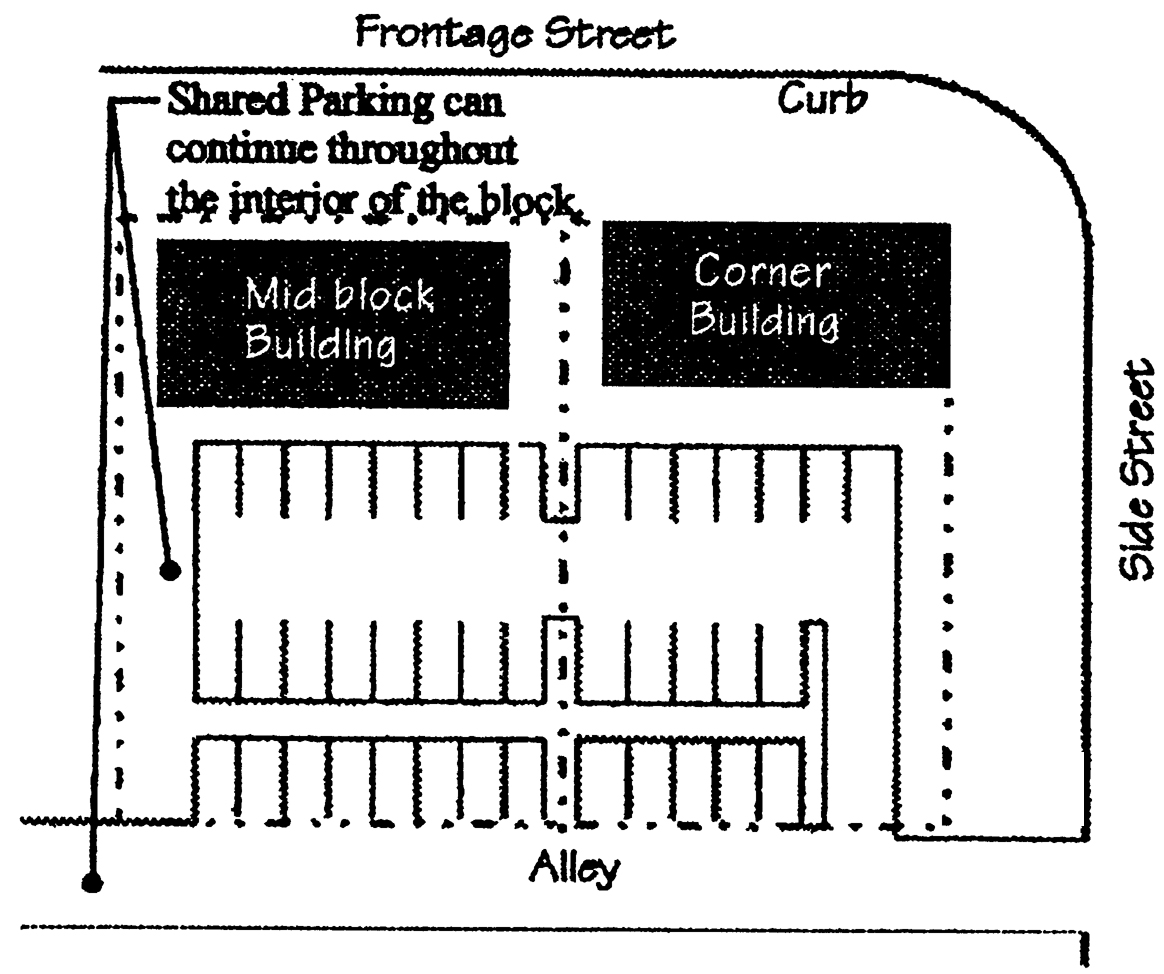
3.
Corner lots that have both rear and side access shall access parking through the rear (see diagram above).
4.
Garages shall always be accessed from the alley and located in the rear of the lot.
(11)
Large footprint buildings. Commercial buildings with a footprint greater than 20,000 square feet may be built within the Western District, by special exception. Such buildings must abide by all rules in this Code with the following special limitations:
a.
Buildings may be one story or more in height, but shall be at least 24 feet in height. This may be accomplished with liner buildings or higher ceiling heights or parapets, or a combination of features.
b.
Buildings that are two stories in height must be a minimum of 27 feet to a maximum of 36 feet in height. This may be accomplished with liner buildings that provide office space in the second story.
c.
Building footprints may not be larger than half of the block.
d.
Requirements for opacity and facades shall be met.
(12)
Landscape standards. Development in this zoning district shall meet the landscaping requirements of article VIII of this chapter regarding landscaping and vegetation protection, and the requirements listed below. In the event of conflicting requirements, the requirements in this section shall apply:
a.
Total number of trees required.
1.
Properties are required to provide shade trees based on the lot's private outdoor space. The property owner is also required to provide street trees in the adjacent public right-of-way to the standard set by this Code and further staff input.
2.
One shade tree is required for every 1,200 square feet of private outdoor space on the lot. Corner lots may only count trees on the primary frontage street toward the required total.
3.
Parking lots in the rear of commercial buildings, such as the Main Street shopfront building and the office building, shall follow the landscape requirements specified in article VIII of this chapter for off-street parking lots.
4.
Trees required by off-street parking lots may be included to meet the required total count. Existing trees on the lot and on the adjacent swales or planting strip may count toward the total number of trees required. The town shall approve which existing trees may count towards the total required trees.
b.
Quality of trees.
1.
Street trees intended to provide pedestrian shade shall be located in the right-of-way swale or near the sidewalk on the private property. Shade trees shall be a minimum of 16 feet in height with seven feet of clear trunk, with a trunk caliper of at least four inches (measured at a point 4½ feet above the grade) in at least a 50-gallon container, Florida Grade A #1 or better.
2.
Trees located on private property may be ornamental or shade trees. These trees shall be a minimum of 12 feet in height with a trunk caliper of at least three inches (measured at a point 4½ feet above the grade) in at least a 25-gallon container, Florida Grade A #1 or better.
c.
Right-of-way planting.
1.
Commercial and mixed-use streets (such as Congress Avenue) shall have shade trees planted with an average spacing of 50 feet on center. Trees are not required when arcades and colonnades are present.
2.
Residential streets shall have shade trees planted an average spacing of 35 feet on center in the swale or planting strip.
(13)
Utilities. Utilities shall be installed underground, with the exception of necessary related equipment that can only be located at ground level, such as controller cabinets, transformers, etc. All ground level equipment shall be screened from public view to the extent possible with town-approved landscaping, fences or walls, or combination thereof.
(h)
Street types.
(1)
Street type regulating plan.
(2)
Hierarchy of greens, parks, and streets. Development under this Code is regulated by street type. The street type regulating plan controls the location for each street in the Western District. The design for new streets and the renovation of existing streets shall follow the street sections illustrated for each type. New construction is regulated by building type and is restricted by the street types they enfront.
(3)
Appropriate building types for each street type. The chart below dictates the appropriate building types for each street type:
(4)
Changes to the regulating plan. The following features of the regulating plan may be changed with the approval of the town commission and any other appropriate agencies:
a.
Streets, roads and alleys.
b.
Greens, parks, and public spaces. It is the intent that greens, parks and open spaces should remain open and unbuilt (except for civic buildings).
c.
Buildings and structures, whether residential or commercial or civic, including parking lots and structures.
d.
Stormwater retention areas and any wetlands jurisdictional lines.
(5)
The design of new streets and renovation of existing streets. The sections that follow illustrate the dimensional requirements for each type of street. The accompanying numbers and text are rules; the graphics are illustrative only. Alleys are described in subsection (g) of this section regarding general provisions.
(i)
Building types. New buildings are regulated by building type. On the following pages, diagrammatic examples are used to illustrate example building locations on the lot, configurations and dimensions. The accompanying numbers and text are rules that govern permitted development. The images contained in this section are meant to demonstrate the character intended for the Western District, but are for illustrative purposes only. Architectural style is not regulated, but new buildings must meet the requirements of subsection (j) of this section regarding building elements and subsection (k) of this section regarding architectural standards.
(1)
Main Street shopfront building. A shopfront building is a basic unit of a traditional mixed-use street. It is sited at the front property line and features a ground floor that is roughly level with the sidewalk. The ground floor facade of the street has a substantial amount of transparent window and door openings. A main street shopfront building may include single-family and/or multifamily residential uses, except on the ground floor.
Notes:
1.
Appurtenances may extend beyond the height limit.
2.
Building fronts are required to have at least one of the following: arcade, colonnade, 2nd floor balcony marquee or awning, extending at least 80 percent of the building facade.
3.
A cornice line is required at the top of the front and side facades facing streets. The cornice shall be at least 18 inches in height.
4.
A parapet with cornice is required on flat or shed roofs, at the top of the front and side facades facing streets. Parapets shall be a minimum of two feet in height.
5.
An expression line is required between the first and second floors on the front facade and along the sides visible from the street.
6.
Courtyard buildings are permitted.
(2)
Office building. The office building is placed towards the front of its lot and may to have an elevated ground floor. The entrance is usually at the level of the sidewalk.
Notes:
1.
Appurtenances may extend beyond the height limit.
2.
Building fronts are required to have at least one of the following: arcade, colonnade, second floor balcony, marquee or awning, extending at least 80 percent of the building facade.
3.
A cornice line is required at the top of the front and side facades facing streets. The cornice shall be at least 18 inches in height.
4.
A parapet with cornice is required on flat or shed roofs, at the top of the front and side facades facing streets. Parapets shall be a minimum of three feet in height.
5.
An expression line is required between the first and second floors on the front facade and along the sides visible from the street.
6.
Courtyard buildings are permitted.
(3)
Large apartment building. A large apartment building is positioned at the front of the lot and can have a courtyard configuration or rear yard.
Notes:
1.
Appurtenances (except for signs) may extend beyond the height limit.
2.
Building fronts are required to have at least one of the following: stoop, front porch, balcony, or bay windows extending at least 25 percent of the building facade.
3.
Flat roofs with a parapet or gabled roofs are permitted.
4.
Expression lines are required between the first and second floors along the front facade and the sides if visible from the street.
5.
Cornice lines are required for apartment buildings.
6.
A vertically oriented change in the facade is required at least every 60 feet of frontage. Vertical changes may include a reveal, brought forward or receding, changes in the fenestration pattern, height of facade, or appurtenances.
7.
Courtyard buildings are permitted. Accessibility ramps may occur in the courtyard.
(4)
Rowhouse. A rowhouse is positioned at the front of its narrow lot and usually shares one or more common walls with its neighbors. A rowhouse unit has an entrance through a covered stoop and is architecturally differentiated from adjacent rowhouses. A rowhouse may be used for single-family or multifamily residential or other use per the street regulating plan. A rowhouse may have an accessory building.
Notes:
1.
A minimum of three rowhouses are required to be attached at the time of construction.
2.
Appurtenances may extend beyond the height limit.
3.
Building fronts are required to have either a stoop or front porch.
4.
Flat roofs with a parapet or gabled roofs are permitted.
5.
Expression lines are required between the first and second floors along the front facade and the sides if visible from the street.
6.
Cornice lines are required for rowhouses.
7.
A vertically oriented change in the facade is required at least every 50 feet of frontage. Vertical changes may include a reveal, brought forward or receding, changes in the fenestration pattern, height of facade, or appurtenances.
(5)
Sideyard house. A sideyard house is usually one room wide on the street-facing facade. It is positioned toward the front and one side of its lot, with a side porch facing the sideyard usually located close to the street space. A sideyard house may be used for single-family or multifamily residential or other use per the street regulating plan. It may have an accessory building.
Notes:
1.
Appurtenances may extend beyond the height limit.
2.
Building fronts are required to have a stoop.
3.
Buildings are required to have a side porch.
(6)
Narrow lot house building. A narrow lot house is suited for lots at the center of town. A narrow lot house may be used for single-family or multifamily residential or other use per the street regulating plan. Narrow lot house is detached and may a have a yard in the front and back. House may have an accessory building.
Notes:
1.
Appurtenances may extend beyond the height limit.
2.
Buildings are required to have either a front or side porch or stoop.
(7)
Wide lot house building. A wide lot house is suited for lots at the edge of town. A wide lot house may be used for single-family or multifamily residential or other use per the street regulating plan. Large houses are detached and have yard on all four sides. These buildings may have an accessory structure.
Notes:
1.
Appurtenances may extend beyond the height limit.
2.
Building fronts are required to have a front porch.
(8)
Civic buildings. Civic buildings include, but are not limited to, municipal buildings, churches, libraries, schools, daycare center, recreation facilities and places of assembly.
Note:
1.
Building placement requirements for civic buildings shall be established by the town commission at the time of application review and approval. Civic buildings should be sited when feasible in locations of particular geometric importance, such as anchoring a major public space or green, or terminating a street vista.
(j)
Building elements.
(1)
Awnings and marquees.
Depth = 5 ft. minimum
Height = 10 ft. minimum clear
Length = 25% to 100% of building front
The above requirements apply to first floor awnings above the first floor. There are no minimum requirements for awnings above the first floor.
Marquees and awnings shall occur forward of the build-to-line and may encroach over the right-of-way, but shall not extend above the curbline.
Awnings shall be made of fabric. Awnings that are illuminated from the back are prohibited. High gloss or plasticized fabrics are prohibited.
(2)
Balconies.
Depth = 6 ft. minimum for second floor balconies
Height = 10 ft. minimum clear
Length = up to 100% of building front
Balconies shall occur forward of the build-to-line and may encroach within the right-of-way, but shall not extend past the curbline.
Balconies may have roofs, but are required to be open, non-air conditioned parts of the buildings.
On corners, balconies may wrap around the side of the building facing the side street.
(3)
Colonnades/arcades.
Depth = 10 ft. minimum from the build-to-line to the inside face of the column
Height = 10 ft. minimum clear
Length = 75% to 100% of building front
Open multistory verandas, awnings, balconies, and enclosed useable space shall be permitted above the colonnade.
Colonnades shall only be constructed where the minimum depth can be obtained. Colonnades shall occur forward of the build-to-line and may encroach within the right-of-way, but shall not extend past the curbline.
On corners, colonnade may wrap around the side of the building facing the side street.
On sidewalks with on-street parking or bicycle lanes next to the curb, colonnades shall be 18 inches from the face of curb.
(4)
Front porches.
Depth = 8 ft. minimum
Length = 25% to 100% of building front
Front porches may have multistory verandas and/or balconies above.
A minimum of 75 percent of a front porch shall occur forward of the build-to-line. Porches shall not extend into the right-of-way.
Front porches are required to be open, non-air conditioned parts of the buildings. More than 25 percent of the floor area of a porch shall not be screened of the porch extends forward of the build-to-line.
(5)
Stoops.
Depth = 8 ft. minimum
Length = 5 ft. minimum
Stoops are permitted and shall occur forward of the primary front building plane. Stoops may encroach within the right-of-way with approval by the town commission. Stoops may be covered or uncovered.
A five-foot sidewalk shall be maintained for access.
(6)
Bay windows.
Depth = 3 ft. minimum
Length = 6 ft. minimum
Bay windows are permitted and may occur forward of the build-to-line. Bay windows may not encroach within the right-of-way. Bay windows shall have required facade details such as lintels, sills, cornices and expression lines.
(k)
Architectural standards. The lists of permitted materials and configurations come from study of traditional buildings found in South Florida and have been selected for their appropriateness to the visual environment and climate. A primary goal of the architectural standards is authenticity. The standards encourage construction which is straightforward and functional, and which draws its ornament and variety from the traditional assembly of genuine materials.
(1)
General requirements.
a.
The following shall be located in rear yards or sideyards not facing the streets:
1.
Window and wall air conditioners;
2.
Air conditioning compressors;
3.
Heating and ventilation;
4.
Irrigation and pool pumps; and
5.
Electrical utility meters.
b.
The following shall be located in the rear yards only and screened from view from public rights-of-way:
1.
Clotheslines;
2.
Clothes drying yards;
3.
Antennas (excepting satellite dishes, which are regulated by chapter 74, article II of this Code);
4.
Permanent barbecues.
c.
The following are prohibited:
1.
Undersized shutters (the shutter or shutters must be sized so as to equal the width that would be required to cover the window opening);
2.
Plastic or inoperable shutters;
3.
Reflective and/or bronze-tint glass;
4.
Plastic or PVC roof tiles;
5.
Backlit awnings;
6.
Glossy-finish awnings;
7.
Fences made of barbed wire;
8.
Front yard fences made of chainlink or plain wire mesh; and
9.
Fences extending in front of the front plane of the building made of chainlink, barbed wire, or plain wire mesh.
(2)
Building walls.
a.
General requirements. For "Main Street" shopfront and office buildings, if finished with masonry or stucco, an expression line shall delineate the division between the first story and the second story. An expression line shall either be a cornice or molding extending a minimum of two inches, or a jog in the surface plane of the building wall greater than two inches.
b.
Permitted finish materials.
1.
Concrete masonry units with stucco (C.B.S.);
2.
Reinforced concrete with stucco;
3.
"Hardic-Plank" siding;
4.
Wood siding, painted or natural (cypress and cedar preferred); and
5.
Brick.
(3)
Garden walls, fences and hedges.
a.
General requirements. Fences, garden walls, or hedges are strongly encouraged and shall be constructed along all un-built rights-of-way which abut streets and alleys. Fences, garden walls and hedges shall be minimum 25 opaque. Fences made of chainlink (wholly or partly) are prohibited along all rights-of-way.
b.
Height. Maximum height of fences shall be 40 inches for front yards, along the side of the building to the rear building line and along side streets and 72 inches in the rear yards. Pillars and posts may extend up to six inches more, to a height of 78 inches.
c.
Permitted finish materials.
1.
Wood: left natural, painted or stained;
2.
Concrete masonry units with stucco (C.B.S.);
3.
Reinforced concrete with stucco;
4.
Painted or wrought iron;
5.
Painted aluminum; and
6.
Brick.
d.
Permitted configurations.
1.
Wood: picket fences: minimum 30 percent opaque, w/ corner posts.
2.
Other: to match building walls;
3.
Stucco: with texture and color to match building walls; and
4.
Painted or wrought iron and painted aluminum: vertical, five-eights-inch minimum
(4)
Columns, arches, piers, railings and balustrades.
a.
General requirements. Columns and piers shall be spaced no farther apart than they are tall.
b.
Permitted finish materials.
1.
Columns: wood, painted or natural; cast iron; concrete with smooth finish;
2.
Arches: concrete masonry units with stucco (C.B.S.); reinforced concrete with stucco.
3.
Piers: concrete masonry units with stucco (C.B.S.); reinforced concrete with stucco; brick.
4.
Railings and balustrades: wood, painted or natural; painted or wrought iron; painted aluminum.
c.
Permitted configurations.
1.
Columns:
Square, 6" minimum, with or without capitals and bases.
Round, 6" minimum: outer diameter, with or without capitals and bases.
Classical orders.
2.
Arches: semicircular and segmental.
3.
Piers: 8" minimum dimension.
4.
Porches:
Railings 2¾" minimum diameter.
Balustrades 4" minimum spacing, 6" maximum spacing.
(5)
Roofs and gutters.
a.
General requirements.
1.
Permitted roof types:
Gabled, hipped, shed, barrel vaulted, domed and flat. Applied mansard roofs are not permitted.
2.
Any building systems placed on a roof shall be concealed from view.
3.
Flat roofs are permitted. Flat roofs shall be concealed by parapets along any street frontage or any side of the building that is visible from the street. Parapets shall be no less than 36" high.
4.
Exposed rafter ends (or tabs) at overhangs are strongly recommended.
5.
Downspouts are to match gutters in material and finish.
b.
Permitted finish materials.
1.
Metal roof: galvanized; copper; aluminum; zine-alum.
2.
Roof shingles: asphalt or metal, "dimensional" type; tile-concrete, clay.
3.
Gutters: copper; painted aluminum; painted galvanized steel.
c.
Permitted configurations.
1.
Metal roof: standing seam or "five-vee," 24" maximum spacing, panel ends exposed at overhang.
2.
Roof shingles: square, rectangular, fish scale, shield.
3.
Gutters: rectangular section; square section; half-round section.
(6)
Signs.
a.
General requirements.
1.
Signs shall be flat against the facade, mounted projecting for the facade, or mounted above the top of the facade.
2.
Signs shall be externally lit. Individual letter and symbols may be internally lit or backlit. Flashing or moving signs are prohibited.
b.
Finish materials.
1.
Wood: painted or natural.
2.
Metal: copper, brass, galvanized steel.
3.
Painted canvas.
4.
Neon.
5.
Paint/engraved directly on facade surface.
6.
Woodlike materials.
c.
Configurations.
1.
Maximum gross area of signs on a given facade shall not exceed ten percent of the applicant's facade area along Congress Avenue and five percent of a given facade along all other streets.
2.
Maximum area of any single sign mounted perpendicular to given facade shall not exceed ten square feet.
3.
Maximum area of awning signs shall not exceed five square feet.
4.
Maximum area of a business logos shall not exceed two square feet.
5.
Signs shall maintain a minimum clear height above sidewalks of nine feet.
6.
Signs shall not project above the building roofline at the facade.
7.
Signs shall not extend beyond the curbline.
8.
Flashing or moving signs are prohibited.
(7)
Windows, skylights, and doors.
a.
General requirements.
1.
Windows shall be rectangular, square, circular, semicircular, or octagonal. Rectangular window openings facing streets shall be oriented vertically.
2.
The following accessories are permitted:
Shutters.
Wooden window boxes.
Real muntins and mullions.
Fabric awnings (no backlighting, no glossy-finish fabrics).
b.
Finish materials.
1.
Windows, skylights, and storefronts: Wood; aluminum; copper; steel; vinyl clad wood.
2.
Doors: wood or metal.
c.
Permitted configurations.
1.
Windows: Rectangular (vertical orientation); round (18" maximum outer diameter); semicircular.
2.
Window operations: casement; single-and double-hung; industrial; fixed frame (36 square feet maximum).
3.
Skylights: flat to the pitch of the roof.
4.
Door operations: casement; French; sliding (rear only).
(8)
Opacity and facades.
a.
Each facade facing streets shall contain 15 percent to 70 percent of transparent materials on each story below the roof line.
b.
Storefront areas only: The ground-floor building frontage shall have storefront windows covering no less than 50 percent of the ground-floor building frontage wall area. Storefronts shall remain unshuttered at night and shall utilize transparent glazing material, and shall provide view of interior spaces lit from within. Flashing or "strobe" interior lights are prohibited. Where building frontages exceed 50 feet, doors or entrances with public access shall be provided at intervals averaging no less than 50 feet.
(Ord. No. 9-1993, § I, 5-5-1993; Ord. No. 7-1999, § I, 5-19-1999; Ord. No. 2-2000, § 1, 8-2-2000; Code 1978, § 32-58; Ord. No. 14-2022, § 4, 1-4-2023)
Sec. 78-79. - General provisions and exceptions.
The provisions of this article shall be subject to the following provisions and exceptions:
(1)
Chimneys, water, fire, radio or television towers, church spires, domes, cupolas, state towers and scenery lofts, cooling towers, elevator bulkheads, smokestacks, flag poles, parapet walls and similar structures and their necessary mechanical appurtenances may be erected above the height limits prescribed. Every part of every required yard shall be open and unobstructed from the ground to the sky except as hereinafter provided or as otherwise permitted in this chapter:
a.
Sills or belt courses may project not over 18 inches into a required yard.
b.
Movable awnings may project not over three feet into a required yard, provided that where the yard is less than five feet in width the projection shall not exceed one-half the width of the yard.
c.
Chimneys, fireplaces or pilaster may project not over two feet into a required yard.
d.
Hoods, canopies, or marquees may project not over three feet into a required yard.
e.
Fences, walls and hedges shall be permitted in required yards subject to the provisions established herein.
f.
Accessory parking may be located in a required front, rear or side yard for single-family and two-family dwellings.
g.
In the CLIC-1 and C districts, required off-street parking space may be located in the front yard except that no parking shall be permitted within five feet of the front lot line.
h.
Open, unenclosed porches, platforms, or paved terraces not covered by a roof or canopy, and which do not extend above the level of the first floor of the building, may extend or project into the required yard area.
(2)
Each residential building shall be located on a lot or parcel of land which provides frontage on a public street.
(3)
Temporary buildings used in conjunction with construction work only may be permitted in any district.
(4)
Where a district boundary line divides a lot, parcel or tract of land, the use classification of the larger portion may be extended to the remainder.
(5)
In any residence district, no fence, structure or planting shall be maintained within 20 feet of any corner street intersection.
(6)
Where a lot or parcel of land has an area or width less than the minimum requirements set forth in this chapter and was a lot of record at the time of the effective date of this chapter [2], such lot or parcel of land may be used for a single-family dwelling provided the minimum front, rear, and side yard requirements as set forth herein are conformed with.
(7)
Where lots comprising 40 percent or more of the frontage on one side of the street between two intersecting streets are developed with buildings that have front yards greater or less than required by these regulations, no building shall project beyond the average front line for the block so established.
(8)
In the case of reversed frontage where the corner lot faces an intersecting street, no building on the corner lot shall project beyond the front yard line of the lots in the rear.
(9)
Where a lot or parcel of land lies adjacent to a county road and where the town commission is in receipt of a written statement from the county engineer's office that the right-of-way of the existing county road is to be widened, then the setbacks provided for buildings under this chapter and all amendments thereto shall be determined from the proposed county right-of-way line, which has been established by the county engineer's office and the county commission, and not from the property line of the lot facing the county highway if such property lot line lies within the proposed right-of-way.
(10)
No building or structure erected on a lot which fronts on Park Avenue in the town shall exceed one story or 20 feet in height in any zoning district in which such lot may be located, except zoning district R-1A.
(11)
On any commercially zoned property, all activities, sales, rentals and leasing of goods, wares, products or merchandise shall be conducted entirely within completely enclosed buildings with permanent nonmovable exterior walls. The following activities shall be excluded from this subsection:
a.
Sales, rental and/or leasing of automobiles, trucks and boats by any properly licensed business.
b.
Sale of oil, tires, gasoline or any related accessory items by any properly licensed gasoline service station.
(12)
In any residential zoning district, an additional lot coverage allowance as outlined below shall be permitted for the purpose of allowing the construction of a swimming pool, in conformance with chapter 26 of this Code. These additional lot coverage allowances shall be in addition to the applicable zoning district building site restrictions regarding lot coverage, exclusive of front, side and rear yard setbacks.
(13)
Paved driveways in conformance with the provisions of this Code shall be required on all lots contained in residential zoning districts where a primary dwelling exists.
(14)
All proposed buildings or structures proposed in residential districts shall be appropriate in relation to the established character of other structures in the immediate area or neighboring areas in respect to significant design features such as material or quality or architectural design as viewed from any public or private right-of-way, except alleys.
(15)
Homes of six or fewer residents which otherwise meet the definition of a community residential home shall be deemed a single-family unit, and shall be allowed in single-family or multifamily zoning districts, provided that any such home is not located within a radius of 1,000 feet of another existing such home with six or fewer residents.
(Code 1966, § 45-40; Ord. No. 6-1966, § I, 3-21-1966; Ord. No. 22-1970, § I, 12-16-1970; Ord. No. 4-1973, § I, 3-7-1973; Ord. No. 16-1973, § I, 8-1-1973; Ord. No. 29-1979, § 1, 11-21-1979; Ord. No. 2-1980, § 1, 4-2-1980; Ord. No. 5-1980, § 1, 5-21-1980; Ord. No. 6-1981, § 1, 3-4-1981; Ord. No. 26-1990, § 2, 10-31-1990; Ord. No. 27-1990, § 2, 11-20-1990; Ord. No. 6-1992, § I, 7-15-1992; Ord. No. 22-1995, § I, 12-6-1995; Ord. No. 11-1998, § I, 8-5-1998; Ord. No. 6-1999, § I, 3-3-1999; Ord. No. 22-2001, § 1, 11-7-2001; Code 1978, § 32-55; Ord. No. 10-2004, § 4(32-55), 4-21-2004)
Editor's note— Ordinance No. 1-1958, from which the above section was derived, was enacted on January 20, 1958.
Sec. 78-80. - Reserved.
Editor's note— Sec. 4 of Ord. No. 12-2009, adopted Sept. 16, 2009, repealed § 78-80 which pertained to status of substance abuse treatment facilities and community residential homes and derived from Ord. No. 10-2004, adopted Apr. 21, 2004.
Sec. 78-81. - Northlake Boulevard overlay zoning district regulations.
(1)
Purpose and intent. The purpose of the NBOZ is to provide a consistent, comprehensive an coordinated approach for development and redevelopment for the Northlake Corridor through site improvement, landscape enhancement, streetscape design and building renovation. In addition, the Northlake Boulevard Overlay Zoning District (NBOZ) is intended to implement the site development regulations of uses within the established Northlake Boulevard Corridor, pursuant to the "Design Guidelines: Northlake Boulevard Overlay Zoning District (NBOZ)" prepared by Michael Redd & Associates, dated March 11, 2002, which are attached hereto as exhibit "A" and incorporated herein by reference. These guidelines were developed by the Northlake Boulevard Corridor Task Force, a task force which was created through an interlocal agreement between the Town of Lake Park, the Village of North Palm Beach, City of Palm Beach Gardens, and Palm Beach County, to facilitate improvements along the corridor. The criteria outlined in the design guidelines, Northlake Boulevard Overlay Zoning District, will serve to unify commercial development along the corridor and provide a positive collective identification of the corridor.
(2)
Applicability. The provisions of the NBOZ, as outlined in "Design Guidelines Northlake Boulevard Overlay Zoning District" (NBOZ) prepared by Michael Redd & Associates, dated March 11, 2002, which are attached hereto as exhibit "A" and incorporated herein by reference shall apply to all proposed development order applications within the NBOZ.
(3)
Boundaries. The Northlake Boulevard Overlay Zoning District (NBOZ) includes the public right-of-way for Northlake Boulevard and all properties along Northlake Boulevard from Military Trail to U.S. Highway 1 for one property depth north and south of Northlake Boulevard, including the street intersection properties at U.S. Highway 1 and at Military Trail. This boundary shall apply to properties as they existed upon January 15, 2003.
(Ord. No. 02-2006, § 3, 7-5-2006)
Editor's note— Exhibit A, hereinabove referenced, can be located in Appendix A to this chapter.
Sec. 78-82. - Distribution electric substation.
Purpose and intent. It is the intent of this section to ensure that the new construction or expansion of electric substations is regulated as to setbacks, landscaping, buffering, screening, lighting and other aesthetic compatibility issues.
(a)
Definitions.
(1)
Distribution electric substation means an electric substation which takes electricity from the transmission grid and converts it to a lower voltage so it can be distributed to customers in the local area on the local distribution grid through one or more distribution lines less than 69 kilovolts in size.
(b)
Applicability.
(1)
New distribution electric substations shall be a permitted use in all zoning districts except those designated as preservation, conservation, or historic preservation on the future land use map or duly adopted ordinance.
(c)
Review.
(1)
Electric substations may be reviewed only for setback, landscaping, buffering, screening, lighting, and other aesthetic compatibility-based standards.
(2)
Submission procedures.
a.
The utility ("applicant") shall submit a development plan, together with an application fee as required by Chapter 67, Article II, Sections 67-37 through 67-41, inclusive to the community development department.
b.
Within 30 calendar days of receipt of the proposed development plan, the director of the community development department shall either:
1.
Determine that the development plan is complete and proceed with the procedures below. A determination that an application is complete shall not be deemed an approval of the application; or
2.
Determine that the development plan is incomplete and provide the applicant with written notice of the deficiencies. The applicant may submit an amended development plan within 15 calendar days of the issuance of town's notice of deficiency, without payment of a reapplication fee. If more than 30 calendar days have elapsed since the issuance of town's notice of deficiency, the applicant must reinitiate the application and review process and pay an additional application fee.
c.
The town commission shall grant or deny a properly completed electric substation development plan application within 90 days after the date the application is declared complete by the community development department director. In determining whether to grant or deny the permit, the town commission shall review the plan and the comments of the community development department and determine whether the proposed development plan is complete and complies with the requirements of these regulations. The issuance of a permit to locate a new distribution electric substation does not relieve the applicant from complying with applicable federal or state laws or regulations and other applicable local land development or building regulations.
d.
The time schedule set forth in this section may be modified as agreed to in writing between the applicant and the town manager.
(d)
Minimum setbacks.
(1)
In residential zoning districts, any building or structure must be setback 100 feet from all property lines.
(2)
In commercial zoning districts, the setback must comply with the applicable criteria for similar uses in that district.
(e)
Landscape and buffering standards.
(1)
As regulated in the Town of Lake Park Code sections 78-251, 78-252, 78-253, 78-254.
(2)
In addition to the above standards:
a.
No more than 30 percent of the open space (including driveways) may consist of sod.
b.
A buffer wall that is a minimum of eight feet high to a maximum of 14 feet and within 15 feet of the substation equipment, with native landscaping as required by the town, shall be maintained around the perimeter of the substation equipment.
c.
The buffer wall facade (exterior) shall be designed with proper use of scale, proportions, form, materials, texture and color to blend into the neighborhood or surrounding area in which it is located.
d.
Additional landscaping along the facade wall with a mixture of shade trees, palm trees and bushes is also required as a buffer. The purpose of this landscaping is to provide screening for the facade wall.
(f)
Proposed placement or construction of a new distribution electric substation within a residential area.
(1)
Prior to submitting an application for the location of a new distribution electric substation in a residential area, the applicant shall consult with the town community development department regarding the selection of a site. The applicant shall provide information regarding the applicant's preferred site and as many as three alternative available sites, including sites within nonresidential areas, that are technically and electrically reasonable for the load to be served, if the town's community development director deems that the siting of a new distribution electric substation warrants this additional review and consideration. The final determination on the site application as to the preferred and alternative sites shall be made solely by the town's community development director within 90 days of the applicant's presentation of all the necessary and required information on the preferred site and on the alternative sites. In the event the applicant and the town are unable to reach agreement on an appropriate location, the substation site selection shall be submitted to mediation to be conducted pursuant to F.S. §§ 44.401—44.406, unless otherwise agreed to in writing by the parties, and the mediation shall be concluded within 30 days unless extended by written agreement of the parties. The 90-day time period for the town to render a final decision on the site application is tolled from the date a notice of intent to mediate the site selection issue is served on the applicant or the town, until the mediation is concluded, terminated, or an impasse is declared. The town and the applicant may agree to waive or extend this 90-day time period. Upon rendition of a final decision by the town, the utility may pursue available legal remedies in accordance with law, and the matter shall be considered on an expedited basis.
(Ord. No. 16-2006, § 2, 12-20-2006)
Editor's note— Ord. No. 16-2006, adopted Dec. 20, 2006, enacted provisions to be designated as § 78-81. Inasmuch as there already exists a § 78-81, said provisions have been redesignated as § 78-82.
Sec. 78-83. - Mixed Use (MU) district.
(a)
Purpose. The mixed use (MU) district is established and intended to:
(1)
Encourage transit use as an alternative to auto dependency by accommodating moderate- to high-intensity, compact, mixed use, and pedestrian-oriented development within convenient walking distance of existing and planned rail stations, major transit corridors, major transit hubs, regional and neighborhood transit hubs, and high-priority corridors for bus rapid transit or high-performance transit.
(2)
Bring together people, jobs, services, and public spaces and amenities in a way that allows people to safely and conveniently walk, bike, and/or take transit to meet their day-to-day housing, employment, shopping, service, and recreational needs.
(3)
Improve walkability within the district, as well as to adjacent areas, by providing a critical mass of housing and nonresidential within walking distance of the commercial core and transit routes and facilities.
(4)
Enable the appropriate natural surveillance of the public realm to ensure safety and activity along district streets and create the sense of a vibrant and active urban center.
(5)
Ensure a compatible transition between the district's commercial/mixed use areas and lower-intensity residential neighborhoods and between the district and adjacent residential neighborhoods, where applicable.
(b)
Application of mixed use (MU) base zoning district.
(1)
An MU base zoning district may only be applied to land designated as a mixed use district (MUD) in the town's land use plan within one-quarter mile (1,320 feet) of the right-of-way of an existing or planned high-priority corridor for bus rapid transit or high performance transit, or one-half mile (2,640 feet) of an existing or a future rail station, major transit hub, regional transit center, or neighborhood transit center, as designated in Palm Beach County's Transit Master Plan, or Transit Development Plan, the Palm Beach County Metropolitan Planning Organization's Long Range Transportation Plan, or a town-adopted transportation or transit plan. The district may extend to up to one-half mile (2,640 feet) around major intersections and activity nodes along a designated transit corridor, or to locations served by an existing or funded community shuttle service.
(2)
In conjunction with the establishment of an MU base zoning district, an overlay district shall be established which, at a minimum, creates the lot and dimensional standards relevant to the characteristics of the newly established MU base zoning district. The MU base zoning district contains general standards that apply to all MU districts. Overlay districts are established to provide additional standards that are tailored to the unique characteristics of each geographical area.
(3)
In order to provide a comprehensive approach for future development in MU districts that addresses development pressures related to population growth and stimulated economic conditions, while enhancing the quality of life for residents, new planned unit developments (PUDs) shall not be permitted. Incentives such as, but not limited to, increased entitlements, building heights, or density are provided in an MU district in order to encourage redevelopment in a desired development pattern and accomplish the stated goals and objectives of the town's comprehensive plan, strategic plan and the community redevelopment area plan, where applicable.
(4)
The town commission shall review all residential, nonresidential, and mixed use development plans for property within a mixed use district. The town commission shall receive the comments of the community development department, including justifications for any applicable waivers, administrative adjustments, or bonuses, in addition to the development plan review general procedures of section 67-37.
(c)
Process for establishment of a mixed use base zoning district.
(1)
A conceptual neighborhood master plan shall be required for the enacting of an MU district and shall only be initiated by the Town.
(2)
After preparation of the conceptual neighborhood master plan, a comprehensive plan map and text amendment shall be required to establish the MU based on the conceptual neighborhood master plan. Each MU shall establish its own policies and an entitlements pool, where applicable.
(3)
The entire area shall be rezoned to MU base zoning district.
(4)
Specific overlay district zoning regulations shall be established for the MU and be approved by the town commission, through the public hearing process, and shall reflect the goals set forth in the corresponding neighborhood master plan, the town's comprehensive plan, strategic plan and the community redevelopment area plan, where applicable.
(d)
Mixed use overlay district required elements. In order to fulfill the purpose of a MU district, encourage redevelopment, establish neighborhood compatibility and the protection of single family neighborhoods, the following elements shall be required within each MU overlay district:
(1)
District boundaries: To define an area that can provide a critical mass of people and development to support transit ridership and to promote a sense of place;
(2)
Use standards: To address existing permitted uses that may not be appropriate in a mixed use district and to encourage uses that are compatible;
(3)
Streetscape standards and street network connectivity: To enhance the public realm and promote walking, biking, and accessibility;
(4)
Publicly accessible open space: To enhance existing public open spaces, promote new public open spaces and access to the waterfront, where applicable, and establish a connected public realm;
(5)
Building height standards: To ensure compatibility of height and transition of development intensities between mixed use areas and adjacent low intensity residential neighborhoods;
(6)
Density standards: To encourage a critical mass of residents to support businesses and transit ridership;
(7)
Design standards: To promote high quality urban design and architecture that establishes a sense of place. Building placement and lot standards may be modified for the overlay district to address any unique characteristics of each geographical area; and
(8)
Regulating plans and diagrams: To demonstrate development standards in both words and images, that include maps designating the locations where the various standards apply.
(e)
Regulating plans and diagrams. MU districts are governed by a series or combination of regulating plans and diagrams. The regulating plans and diagrams demonstrate development standards in both words and images, and include maps designating the locations where the various standards apply. Unless otherwise noted, all development shall follow the regulating plans and diagrams specified for each MU district. The regulating plans and diagrams for the MU districts include the following, where applicable:
(1)
The sub-areas regulating plan, which divides the MU district into three sub-areas: Core, Center and Edge. The highest height and number of stories within the MU district shall be allocated to the Core Sub-Area, a mixed use area within the ¼-mile (1,320 feet) radius of a transit station(s), major transit stop(s) or major transit corridor. The height and number of stories shall then gradually decrease from the core to the center sub-area where mixed uses are still permitted and then further decrease to the edge sub-area which is characterized by single uses, including low density residential adjacent to existing low density residential, where applicable.
(2)
The street network connectivity regulating plan, which shows the location of existing and the required new streets needed to create the prescribed network of streets within the MU district. This plan also establishes the hierarchy of the streets.
(3)
The designated publicly accessible open space and greenway system regulating plan, which designates the approximate location of the required publicly accessible open spaces and greenway system in the MU district, shall be shown in all development plans.
(4)
The building heights regulating plan, which establishes the maximum building height permitted in each sub-area of the MU district.
(5)
The building placement regulating diagrams, which provide a schematic representation of the various building typologies, based on their sub-area. The diagrams demonstrate the required setbacks, lot standards, and profiles of structures. Not all building typologies are permitted in each sub-area. The building placement regulating diagrams are shown in Appendix A of this code section.
(f)
MU district use standards. A list of permitted and/or prohibited uses may be established for each overlay district. The following use standards shall apply to development in MU districts:
(1)
Mixed use development: The vertical mixing of residential uses with nonresidential uses within a single project or building, with residential development on upper floors, is encouraged. The horizontal mixing of stand-alone residential developments and adjacent stand-alone nonresidential in the district is allowed, provided the developments are well integrated in terms of complementary uses, access and circulation, and compatible design.
(2)
The incorporation of high-activity nonresidential uses such as retail shops and restaurants at street level is encouraged, especially along those building facades abutting or most visible from the transit corridor, other major arterial or primary streets, major pedestrian walkways, or public spaces.
(3)
Additional or stand-alone auto-oriented uses are prohibited.
(g)
MU district street standards. The following street standards shall apply to development in the MU districts:
(1)
The periphery of any site fronting on a public right-of-way shall be improved by the provision of sidewalks, streetlights, street furniture, street trees and other elements, covering the entire area from face of curb to face of building.
(2)
Where the distance between the front property line and the edge of pavement or curb line is not deep enough to accommodate the required sidewalk and/or landscape strip, all developments shall be required to provide a dedicated widening of the right-of-way or dedicated public easement running parallel and adjacent to the public street, as well as the improvement specified within that dedicated space, to accommodate the sidewalk and/or landscape feature as specified within the specific street design standards established for each MU district. Additionally, the development and ongoing maintenance of the required streetscape improvements along the entire property shall be the responsibility of the developer/property owner.
(3)
The street network connectivity regulating plan established for each MU district shows the approximate location of existing and required new streets needed to create the prescribed network of streets within each MU district. This plan also establishes the hierarchy of the streets.
(4)
The specific street design standards provide a schematic representation of the desired streetscape improvements for specific streets in each MU district. These diagrams establish minimum standards for the width of sidewalks, landscape strips, etc.
(5)
Street development applicability. The specific street design standards are applicable to town-initiated streetscape improvements and privately initiated streetscape improvements as specified in each MU district. Full block developments, and developments that provide improvements along an entire street frontage shall be required to provide streetscape improvements for the entire street frontage(s) abutting the development. Partial or mid-block development shall only be required to provide streetscape improvements for the entire street frontage abutting the development to the extent feasible, in coordination with the town engineer, however, the dedicated widening of the right-of-way or dedicated public easement shall be provided, where applicable.
(6)
In addition, the following shall apply:
a.
All streets shall be located according to the street network connectivity regulating plan of the MU district.
i.
All primary and secondary streets shall be required in the same location as shown on the street network connectivity regulating plan and may be modified with respect to alignment, provided that the final alignment is in keeping with sound urban design principles. The full width of all primary streets shall be open to the sky for a minimum of 95 percent of the entire length of the street within the MU district. Structures, such as but not limited to, pedestrian bridges and canopies shall be permitted to span over a portion of the street. The full width of all secondary streets shall be open to the sky for a minimum of 100 percent of the entire length of the street within the MU district. No primary and secondary streets shall be deleted or otherwise vacated or removed.
ii.
Tertiary streets as shown on the street network connectivity regulating plan are encouraged to promote connectivity and to conform to block length requirements. The full width of all tertiary streets shall be open to the sky for a minimum of 100 percent of the entire length of the street within the MU district.
(A)
Existing tertiary streets shall be required in the same location as shown on the street network connectivity regulating plan and may be modified with respect to alignment, provided that the final alignment is in keeping with the principles of sound urban design. No existing tertiary streets shall be deleted or otherwise vacated or removed.
(B)
New tertiary streets shall not be required in the same location as shown on the street network connectivity regulating plan, provided that the final placement of the street is in keeping with sound urban design principles. No new tertiary streets shall be deleted or otherwise vacated or removed.
b.
The modification of new tertiary streets as shown on the street network connectivity regulating plan requires the following conditions are met:
i.
The community development director shall approve the modification of tertiary streets provided the following conditions are satisfied:
(A)
The modification is reviewed and recommended by the town's urban design professional who shall review the proposed modification for compliance with sound urban design principles.
(1)
The modification maintains connectivity to the surrounding area;
(2)
The modification enhances pedestrian safety;
(3)
The modification is compatible with the surrounding area;
(4)
The modification is for the assemblage of parcels for development and allows for the appropriate use of private property; and
(5)
The modification does not create block lengths that exceed the maximum allowed herein, thereby limiting walkability.
ii.
The modification is reviewed and recommended by the town engineer who shall review the proposed modification for traffic and safety issues.
c.
The design of new streets and modifications of existing streets shall comply with the following requirements:
i.
All streets and alleys shall connect to other streets or alleys. Cul-de-sacs, T-turnarounds, and dead-end streets shall be prohibited.
ii.
All streets shall allow public access. Privately built streets shall provide an approved plat restriction to allow public access. No gates that impede through traffic are permitted along streets.
iii.
The maximum distance between an alley and another intersecting alley or street shall be 300 feet, when the alley is the primary means of access for emergency vehicles.
iv.
Where a sidewalk or other pedestrian walkway crosses a parking lot, street, or driveway the following standards shall apply:
(A)
The intersection shall be clearly marked and lighted for safety;
(B)
The sidewalk shall be continuous and remain at a constant level in all circumstances; and
(C)
A change of tactile surface texture shall be installed at all street crossings.
v.
Street intersections shall be improved with curb extensions sufficient to provide fully accessible landings and a pedestrian rest area. Rest areas shall occur at intersections and mid-block. Rest areas shall be furnished with way finding/directional signage, sufficient clearance for a wheelchair, and other pedestrian amenities such as benches, or bicycle racks.
vi.
Except as modified through the street development regulating diagrams for each MU district, all streets and alleys/service roads shall adhere to the following standards:
(A)
For streets only, a minimum landscaped strip of five feet shall be provided along the street edge between the sidewalk and the curb.
(B)
For streets only, tree surrounds consisting of an ADA compliant permeable surface, a minimum of five feet by five feet, may be utilized in place of the required landscape strip. The use of tree surrounds shall require the use of a suspended pavement system that is equivalent to a soil volume that is appropriate for the specified tree species at maturity. Root barriers shall also be utilized to ensure that a sustainable planting solution is provided. The use of tree surrounds is appropriate when on-street parking is provided. When no on-street parking is provided, landscape strips are preferred.
(C)
For streets only, a minimum sidewalk width of five feet shall be provided adjacent to the landscaped area.
(D)
For streets only, a minimum unobstructed area of 60 inches shall be provided in the sidewalk.
(E)
For streets only, where a colonnade is provided, free and clear use of a continuous unobstructed area of at least ten feet shall be provided within the colonnade. Softening of the colonnade with landscape elements is required.
(F)
For streets only, no utility poles, fire hydrants or any other temporary or permanent structures shall be permitted within the unobstructed area.
(G)
For streets only, overhead utilities are not permitted. Existing overhead utilities shall be relocated underground where feasible.
(H)
For streets only, where on-street parking is provided on both sides of the street, the minimum right-of way width shall be 60 feet.
(I)
For alleys only, the minimum right-of-way width shall be 30 feet.
(J)
For service roads only, the minimum width shall be 30 feet.
(K)
Street furniture shall be provided including but not limited to outdoor benches, waste containers, planters, bus shelters, bicycle racks, ADA compliant permeable tree surrounds with the use of a suspended pavement system, decorative paving, stamped concrete or stamped asphalt crosswalks, banners, water fountains, newspaper dispensers and bollards whether within or outside the public right-of-way. Street furniture provided on site shall be compatible with the architecture of the surrounding buildings, the character of the area and other elements of the streetscape. All street furniture shall be subject to the approval of the town.
(L)
Curb and gutter shall be provided at all intersections and roadway edges in the core and center sub-areas.
(M)
Any existing trees or palms shall be subject to section 34-9 (Tree Removal Standards).
(h)
MU district access, circulation, parking and loading standards. The following standards shall apply to development in MU districts. In addition, applicable standards in section 78-142 (Off-street Parking and Loading), section 78-143 (Off-street Loading), Section 78-144 (Access to Rights-of-way) and section 78-145 (Supplemental Parking Requirements) shall apply except as modified herein:
(1)
Vehicular access and circulation. Access to rights-of-ways shall be developed per section 78-144, (Access to Rights-of-Way) except as modified herein:
a.
Driveway access shared between adjoining lots shall be required, where feasible, for nonresidential and mixed use development in order to limit direct vehicular access along streets or comply with driveway intersection spacing requirements.
b.
Driveway, alley and service road access from the front property line shall be limited to one point of access for every 250 feet of frontage. No more than two driveways per block frontage shall be permitted.
i.
The community development director or his/her designee shall have the authority to adjust administratively the requirements for front property line access to one point of access for every 250 feet of frontage, for up to ten percent of the maximum measurement of frontage.
(2)
Parking.
a.
Surface parking lots. Surface parking lots are discouraged, whether stand-alone or part of a larger development; however, where provided, surface parking shall utilize low-impact development techniques and shall comply with the following standards:
i.
Surface parking is prohibited along building frontages and shall be located to the side or rear of the property;
ii.
Surface parking shall be accessed off an alley, service road, or tertiary street, where feasible. If the surface parking lot is accessed from a primary or secondary street, there shall be only one point of access to the parking lot area;
iii.
Openings off any street shall not exceed two lanes in width or 30 feet maximum per entrance/exit. Entrances/exits on alleys/service roads are exempt from this requirement;
iv.
Pedestrian entrances to the parking lot shall be directly from a frontage line through an exterior or interior pedestrian passage or a combination thereof running from the rear to the front of the lot. Parking spaces serving residential units are exempt from these requirements;
v.
All parking areas shall have direct pedestrian access to a public walkway;
vi.
Except along an alley/service road, parking lots may either be screened by a liner building or in compliance with the following standards;
(A)
Except as provided below, perimeter landscaping strips shall be located on the same property as the parking area and placed to assure visibility and safety of bicyclists and pedestrians within the parking area and on adjacent accessways.
(B)
Where abutting properties are subject to the same perimeter landscaping strip requirement along a common property line, a single perimeter landscaping strip meeting these standards may be provided along either or both sides of the common property line through joint written agreement by the owners of the abutting properties.
(C)
Perimeter landscaping strips shall be comprised of:
(1)
Canopy trees spaced a maximum average of 20 feet on center, except that:
(a)
Canopy trees may be spaced a maximum average of 40 feet on center within perimeter landscaping strips screening a vehicular use area from an abutting property or waterway;
(b)
Where more than ten canopy trees are required, palm trees may be substituted for 50 percent of required canopy trees, and shall be spaced a maximum average of 20 feet on center where used along an entire side of the vehicular use area; and
(c)
Understory trees spaced a maximum average of 15 feet on center may be substituted for canopy trees in areas beneath overhead utility lines; and
(2)
Shrubs planted to form a continuous, opaque hedge along the perimeter of the parking area, provided that:
(a)
To allow security surveillance of parking areas, the shrubs shall be maintained at a maximum height of three feet above the elevation of the adjacent parking area; and
(b)
A solid masonry wall up to three feet high may be substituted for part of the required shrub hedge provided that shrubs be planted two feet on center or vines spaced a maximum average of five feet on center shall be planted between the wall and any adjacent parking area; and
(3)
Ground cover or grass planted in all areas not occupied by trees, shrubs, or walls.
(4)
All planting areas shall be 100 percent irrigated.
vii.
Wheel stops shall be prohibited, and continuous curbing shall be placed two feet from the front of all parking spaces, except those in a parallel configuration.
viii.
Use of on-street parking is encouraged on all streets, where feasible.
(A)
Curbed planter bulb-outs shall be provided at the terminus of on-street parking.
b.
Parking garages. Multi-level parking garage structures, whether stand-alone or part of a larger development, shall comply with the following standards:
i.
Along a primary or secondary street, the ground floor of the garage shall be screened by a liner building containing active use. Above the ground floor, a liner building shall not be required. All levels of the building shall comply with the standards below:
(A)
All building facades that are visible from a street or an open space shall compliment and contain architectural treatments consistent and harmonious with that of the principal structure and habitable space;
(B)
Architectural treatment shall be provided through a combination of, but not limited to, the use of materials and construction assemblies; the continuation of fenestration patterns, architectural features, articulation and rhythm; the application of architectural screens, meshes, louvers, and glass; the incorporation of vegetated surfaces and planters; and architectural lighting.
(C)
No vehicles parked within the garage shall be visible from the street; and
(D)
Sloped garage ramps facing and within 100 feet of any street or open space shall have architectural treatments which screen the sloped ramp from view from the street or open space.
ii.
Openings off any street shall not exceed two lanes in width or 30' maximum per entrance/exit. Entrances/exits on alleys/service roads are exempt from this requirement.
iii.
The garage shall be accessed from an alley/service road or tertiary street, where feasible.
iv.
If the garage is accessed from a primary or secondary street, there shall be only one point of access to the garage area.
v.
Pedestrian entrances to the garage shall be directly from a frontage line through an exterior or interior pedestrian passage or a combination thereof running from the rear to the front of the lot. Parking spaces serving residential units are exempt from these requirements.
c.
Dimensions and markings of parking spaces: Off-street parking spaces shall be constructed and marked in accordance with section 78-142.c.9 (Dimensions and Geometrics of Parking Areas) with the following modifications:
i.
Parallel parking spaces shall have minimum lengths of 23 feet and minimum widths of eight feet where a curb and gutter are provided. Where a curb and gutter are not provided, the minimum width shall be nine feet.
ii.
The minimum stall width for 90-degree, general surface parking, shall be ten feet if double striped and a minimum of nine feet if single striped.
iii.
The minimum parking stall width for parking spaces in garages shall be eight and one-half feet provided that the minimum clear distances are met.
d.
Modified off-street parking requirements:
i.
Minimum number of required off-street parking spaces: All developments shall provide the minimum number of required off-street parking spaces in accordance with Schedule 78-142-1, except as modified below.
ii.
Modified parking standards: All developments shall comply with the standards in Schedule 78-142-1, except as modified below.
(A)
Townhouse and congregate living facilities with a common parking lot shall provide .25 spaces per dwelling for guest parking.
(1)
Guest parking spaces may be grouped, provided that the spaces are located within 600 feet of the dwellings that they are intended to serve. Grouped guest parking may not be grassed. All guest parking shall be prominently identified with an above grade sign or marking on the wheel stop.
(B)
Congregate living facilities:
(1)
General requirements.
(a)
Every congregate living facility shall provide adequate parking and circulation for residents, visitors and staff. The standards established in this subsection shall be considered the minimum necessary to achieve this goal.
(b)
Unless otherwise provided in this chapter, all parking and vehicular use areas shall be paved.
(c)
The bases for parking calculations shall be clearly stated on proposed site plans, including the maximum number of employees.
(d)
Additional parking requirements may be imposed as a condition of approval of the special exception.
(e)
Specific requirements. Every congregate living facility shall comply with the following requirements:
(f)
A minimum of one parking space shall be provided for each four residents, plus one space for each employee on the shift of greatest employment.
(g)
Congregate living facilities shall establish a safe drop-off area for group transportation, such as vans or similar vehicles.
(C)
Valet and tandem parking: The use of valet and tandem parking (See section 78-142(c)(8)d., Valet Parking) is encouraged with the following modifications:
(1)
All uses, except eating establishments and hotels, may designate a maximum of 75 percent of the total number of required off-street parking spaces as valet parking. The valet spaces may be tandem.
(2)
Eating establishments and hotels may designate a maximum of 100 percent of the total number of required off-street parking spaces as valet parking. The valet spaces may be tandem.
(D)
Shared parking. The use of shared parking (See section 78-142(c)(8)a., Shared Parking) is encouraged with the following modifications for nonresidential uses only:
(1)
The maximum distance between the primary pedestrian entrance of the shared use parking lot or parking garage and the primary pedestrian entrance of the use served by the parking shall be 1,320 feet.
(E)
Location of required on-site parking spaces.
(1)
Residential uses shall provide 100 percent of the required on-site parking, a maximum of 600 feet from the building or land use they are intended to serve.
(2)
Only nonresidential uses may provide the required on-site parking spaces off-site and the following shall apply;
(a)
A maximum of 100 percent of the required off-street parking spaces may be located off-site; and
(b)
The off-site parking spaces may be located in a parking lot or parking garage up to 1,320 feet away from the primary pedestrian entrance to the use served by the parking.
(c)
The off-site parking spaces shall be located within the MU district.
(F)
On-street parking. On-street parking, along the corresponding frontage lines touching the adjacent sidewalk to the property, may be used to satisfy a portion of the off-street parking requirements for all uses, except single family.
(G)
Bicycle racks and bicycle storage. Bicycle racks and storage shall be required as follows:
(1)
Bicycle racks and bicycle storage for commercial uses. Commercial developments, shall provide:
(a)
Secure bike racks and/or storage at a ratio of one bicycle parking space per every ten required parking spaces; and
(b)
A minimum of one shower and changing facility shall be provided to be available for all tenants and shall be located within the building, or within 200 feet of the building entrance, for developments greater than 50,000 square feet in gross building area.
(2)
Bicycle racks and bicycle storage for residential uses. One bicycle parking space shall be provided per every ten required parking spaces. Required residential bicycle parking spaces shall be provided in a secured area, covered from the elements.
(3)
Mixed use developments. Mixed-use developments shall provide secure bicycle parking spaces for both the commercial and residential components of the development as calculated separately pursuant to the requirements of this section.
(3)
Loading. Loading for properties within the MU district shall comply with the standards for off-street loading in section 78-143, Off-street Loading Standards, except as modified herein.
a.
Properties within the MU shall provide loading off-street. Where it is unfeasible to provide loading off-street, loading shall be permitted off an alley/service road. Where an alley/service road is not existing, proposed or feasible, loading shall also be permitted on-street subject to the following conditions:
i.
An on-street loading plan, subject to minor site plan approval, is approved. The on-street loading plan shall demonstrate the location of the loading berth(s), the hours for loading and unloading, and a list of the uses in abutting properties and their respective hours of operation; and
ii.
The on-street loading area shall not be located along building frontages; and
iii.
The on-street loading area shall be located along a tertiary street in the area designated for on-street parking in the public right-of-way; and
iv.
The hours of loading and unloading, as demonstrated in the on-street loading plan, do not create a conflict with the current or proposed uses on abutting properties. Should the hours of loading and unloading create a conflict with current or future uses on abutting properties, the on-street loading plan shall be revised and/or revoked accordingly.
(i)
MU district landscape standards. The following standards shall apply to development in MU districts. In addition, applicable standards in article VIII (Landscaping and Vegetation Protection) shall apply except as modified herein.
(1)
Modified landscaping requirements. The following standards from article VIII (Landscaping and Vegetation Protection), are modified for properties within the MU district:
a.
Section 78-253(c)(4) - Vehicular use areas, including driveways, public rights-of-way and parking lots, shall have a minimum two-foot-high hedge at planting and a maximum three-foot-high hedge at maturity, planted two feet on center, for visibility and security.
b.
Section 78-253(h)(1) - Landscape Buffers:
i.
A landscape buffer shall be a minimum of eight feet in depth along the interior side or rear property lines.
ii.
Landscape buffers along a public street right-of-way shall only be permitted to screen parking, vehicular use areas, outside storage and/or trash collection sites and shall be a minimum of eight feet in depth.
c.
Section 78-253(h)(2) - Street Trees:
i.
In order to encourage shade, street trees should be clustered. Street trees shall be placed no closer than 15 feet apart and no farther than 20 feet apart. A maximum of 50 percent of the length of the lot frontage can be without trees. (For example, a lot with 120 feet of street frontage is required to plant four street trees, based on one tree per 30 feet of street frontage. Sixty feet of street frontage may have no trees. Within the remaining 60 feet of street frontage, the four required trees should be placed at least 15 feet and not more than 20 feet apart.)
d.
Section 78-253(h)(4) - Berms shall not be permitted to screen outside storage and/or trash collection sites.
e.
Section 78-253(h)(5) - Foundation Landscaping:
i.
Buildings with commercial uses on the ground floor, and whose building line is setback no more than ten feet from the front and street side property lines shall not be required to provide plantings along the base of the building where the frontage is occupied by a commercial use or a residential lobby area.
(2)
Additional landscaping requirements. In addition to the landscape standards in article VIII (Landscaping and Vegetation Protection), properties within the MU district shall comply with the following additional landscaping standards:
a.
Utilization of berms to screen parking, vehicular use areas, outside storage and/or trash collection sites from public thoroughfares and adjacent residential uses shall be prohibited.
b.
Landscaping elements shall align with adjacent building elements.
c.
Native trees shall be preserved where feasible. Building setback should be adjusted to preserve tree canopy. A native tree as a focal point in a courtyard or expanded sidewalk area is encouraged with the addition of a suspended pavement system that will preserve a soil volume that is appropriate for the specified tree species at maturity. Root barriers shall also be utilized to ensure that a sustainable planting solution is provided.
d.
Shrubs and ground cover shall only be placed between the sidewalk and the curb. Exception shall be made only for residential uses on the ground floor. This exception shall not apply at entrances to residential uses located on the second floor or above.
e.
Street trees:
i.
Street trees are required and shall be provided at a maximum of one tree per 30 feet of street frontage.
ii.
Street trees may not be required when colonnades are being provided along the street and the colonnade is placed at a maximum of five feet from the back of curb.
iii.
When a landscape strip is not provided, street trees shall be placed in tree pits covered with ADA compliant pervious material with the use of a suspended pavement system that is equivalent to a soil volume appropriate for the specified tree species at maturity. Root barriers shall also be utilized to ensure that a sustainable planting solution is provided.
iv.
Adequate clearance to the building facade for uniform development of the street tree canopy shall be demonstrated for the type and species selected.
f.
All landscape areas shall be 100 percent fully irrigated.
(j)
MU district open space and greenway system standards. Open space may be one of three types: Designated publicly accessible, semi-public or private. All developments are required to provide a minimum of private open space as determined by the building type. The designated publicly accessible open spaces and greenway systems regulating plan for each MU district shows the approximate location of existing public and required new designated publicly accessible open spaces and a greenway system throughout the MU district, where the intent is to establish a network of open spaces.
(1)
Designated publicly accessible open spaces: Designated publicly accessible open spaces are open spaces on private property that are required in the designated publicly accessible open spaces and greenway systems regulating plan and/or for a density bonus provision where applicable and shall provide public access in order to enhance the connectivity of the public realm. New designated publicly accessible open spaces are small in scale, largely devoted to natural landscaping and outdoor recreation, and tend to have few structures. Golf courses, golf driving ranges, cemeteries and mausoleums shall not be included in this category. Accessory structures may include clubhouses, statuary, fountains, maintenance facilities and concessions. Open space types include greens, squares, and plazas. Designated publicly accessible open spaces shall be subject to the following requirements:
a.
The minimum size of a new designated publicly accessible open space shall be 4,800 square feet unless otherwise specified in the overlay district.
b.
The general location shall conform with the designated publicly accessible open space and greenways system regulating plan.
c.
New designated publicly accessible open spaces shall be provided at grade level.
d.
Provided that all other parameters on the regulating plans are met and that an individual/developer owns the entire designated publicly accessible open space area and an adjacent area, the final location of the publicly accessible open space may be proposed onto such adjacent area.
e.
New designated publicly accessible open spaces shall provide shaded areas, and their ground surface shall be a combination of paving materials, sod, or ground cover.
f.
No replatting or other land subdivision shall divide property in such a way that the required designated publicly accessible open space is avoided, or its location changed.
g.
Off-street parking shall not be required for new designated publicly accessible open spaces.
h.
The development and ongoing maintenance of a new designated publicly accessible open space area shall be the responsibility of the developer/property owner.
i.
Properties that provide new designated publicly accessible open space shall be permitted relief from the maximum building setback requirements along the portion of the building fronting the open space specifically for the purpose of accommodating the open space.
j.
Fences, walls and hedges are permitted around the perimeter of a designated publicly accessible open space in accordance with Table 78-83.K-2: Fence, Walls, and Hedges Around Open Spaces.
k.
Shall not count toward the minimum private open space requirement.
(2)
Semi-public open spaces. Semi-public open spaces are open spaces on private property, located along a street frontage, that are not required to provide public access, however, shall have visibility from the street. Open space types include greens, squares, and plazas.
a.
Semi-public open space may count towards the minimum private open space requirement.
b.
Semi-public open space shall only be permitted where residential dwelling units are on the ground floor.
c.
Semi-public open space shall abut a public sidewalk and be visible from the street.
d.
Off-street parking shall not be required for semi-public open spaces.
e.
The development and ongoing maintenance of a new semi-public open space area shall be the responsibility of the developer/property owner.
f.
Properties that provide semi-public open space shall be permitted relief from the maximum building setback requirements along the portion of the building fronting the open space specifically for the purpose of accommodating the open space.
g.
Fences, walls and hedges are permitted around the perimeter of a semi-public open space in accordance with Table 78-83.K-2: Fence, Walls, and Hedges Around Open Spaces.
(3)
Private open spaces. Private open spaces are open spaces on private property that are required for private use only.
a.
Private open spaces may be provided on the ground level or in roof terraces or upper level decks.
b.
The minimum area required for private open space shall be as specified for each building type or as modified in each MU overlay district.
c.
Private open spaces shall be provided in the form of colonnades, courtyards, terraces, and sodded lawns. Corridors, walkways, pedestrian passages, lobbies, balconies, parking courts, lakes, golf courses, and parking lot buffers shall not count towards the open space requirement.
d.
Private open spaces shall provide shaded areas that may consist or palms or shade trees, and their surface shall be a combination of paving materials, sodded lawn, or ground cover.
(4)
Open space type configuration and design. New designated publicly accessible open spaces and new semi-public open spaces shall be developed in the form of greens, plazas or squares.
a.
Greens.
i.
Greens shall have more than 50 percent of their property lines abutting or across the street from residential uses areas.
ii.
Exclusive of dedicated rights-of-way, the maximum impervious area is 20 percent. The pervious surface areas shall consist primarily of drought tolerant ground covering, trees, and garden structures, such as benches and tables without concrete pads for support, and permeable hard-surfaced walkways. Any impervious surfaces shall consist of hard-surfaced areas such as concrete walkways and garden structures with concrete pads for support.
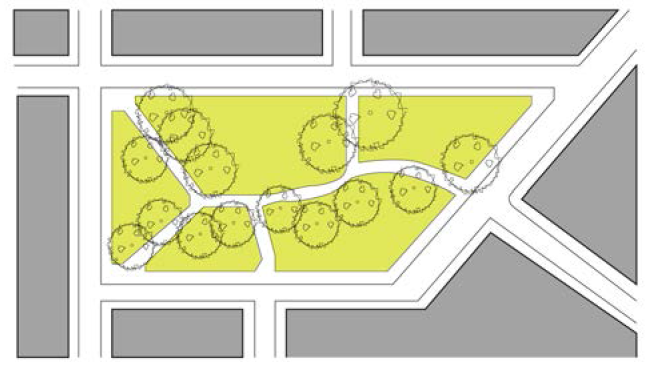
Figure 78-83.J-1: Green
b.
Plazas.
i.
Plazas shall have a minimum of 50 percent of their property lines abutting or across the street from mixed use and nonresidential uses areas.
ii.
Exclusive of dedicated rights-of-way, the minimum hard surfaced area is 50 percent and the maximum impervious surface area is 75 percent. The pervious surface areas shall consist primarily of drought tolerant ground covering, trees that are regularly spaced, and garden structures such as benches, tables, and fountains. The impervious surfaces shall consist of paved areas, permanent architecture such as archways, statues and gazebos or water-oriented features.
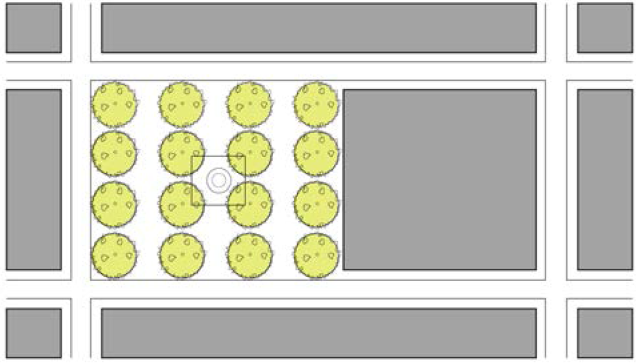
Figure 78-83.J-2: Plaza
c.
Squares.
i.
Squares shall be flanked by streets at a minimum on three sides.
ii.
Exclusive of dedicated rights-of-way, the maximum hard surfaced area is 50 percent. The pervious surface areas shall consist primarily of drought tolerant ground covering and trees that are regularly spaced, and permeable hard-surfaced walkways. Any impervious surfaces shall consist of hard-surfaced walks.
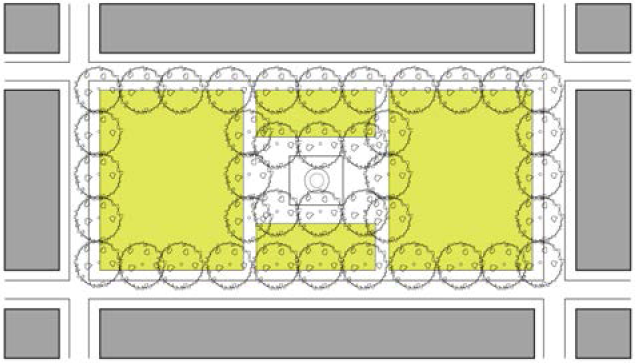
Figure 78-83.J-3: Square
(5)
Designated publicly accessible greenway systems. The designated publicly accessible greenway system is meant to provide a visual and physical connection between the designated open spaces, as illustrated in the designated publicly accessible open space and greenway systems regulating plan for each MU district. The greenways system is established through the enhancement of specific streets and/or the use of pedestrian passages. The property owner shall dedicate the land for the publicly accessible greenway or provide an easement, at the town's discretion, for public access along the entire length of the greenway abutting the property. Additionally, the development and ongoing maintenance of the required designated publicly accessible greenways shall be the responsibility of the developer/property owner along the greenway. The design and dimensional requirements for the required greenways are specified in each overlay district.
The designated public greenway system shall ensure pedestrian connectivity along specific streets and pedestrian passages by:
a.
Providing a tree species that provides substantial shade along the street. Palm trees may compose no more than 25 percent of the required number of street trees.
i.
A minimum of 75 percent of the required street trees shall be shade trees, and the remaining street trees may be provided as medium or large flowering trees. Palm trees may be used over and above the minimum number of required street trees. Street trees shall be provided at a ratio of one street tree per 20 feet of street frontage, or a greater ratio thereof, not subtracting ingress and egress dimensions. Where overhead utilities exist, required street trees may be modified as needed to address documented conflicts with utility infrastructure.
b.
Providing adequate street furnishings such as benches, bus shelters, decorative water fountains etc.
c.
Providing a landscape plan illustrating a significant tree special along the greenway that is distinguishably different from the other streets in terms of color, type and shape.
d.
At the time of planting, the trunk of shade trees shall be a minimum of seven feet clear height to the bottom of the canopy, flowering trees shall be a minimum of six feet clear height to bottom of the canopy, and palm trees shall have a minimum of 12 feet of clear trunk.
e.
Pedestrian passages.
i.
Pedestrian passages shall be a minimum clear width of 15 feet between buildings.
ii.
A minimum of 50 percent of the pedestrian passages shall be shaded and may include a combination of landscaping and architectural elements.
iii.
If provided, tree placement shall be in planters or tree pits covered with an ADA compliant permeable material a minimum of five feet by five feet, with a suspended pavement system soil that is equivalent to a soil volume that is appropriate for the specified tree species, at maturity.
iv.
Pedestrian scaled lighting shall be provided.
(k)
MU district walls, fences and hedges standards. The following standards shall apply to development in MU districts. In addition, applicable standards in article IV (Walls, Fences and Hedges) shall apply except as modified herein.
(1)
Mechanical equipment and service utilities. In addition to the standards found within section 78-253 (Landscaping), the following standards shall apply:
a.
Mechanical equipment, television antennas, satellite dishes, communication devices, air conditioning units, and similar systems and service areas shall not be visible from the public sidewalk; and shall be located to the rear of a building or on an alley/service road, or on the roof, where feasible.
b.
Exhaust air fans and associated louvers may be allowed on secondary or tertiary building frontages above the first floor only.
c.
All mechanical equipment shall be screened from public view.
d.
Window air conditioning units shall not be visible from any street and shall not be located on the primary building facade.
e.
Utility connections and service boxes shall not be visible from any street and shall be placed on secondary walls and away from corners.
f.
Backflow preventers, double detector check valves, Siamese connections, and the like (or any other utility connections and service boxes) shall be located to the rear of the building or on an alley/service road or behind the building line on secondary frontages and away from corners.
(2)
Fences, walls, and hedges.
a.
Fences, walls, and hedges for nonresidential and mixed use buildings shall not be permitted in the front yard (or in front of the building line) and shall only be permitted along the building line and behind the building line (or along side and rear lot lines) and/or when used in conjunction with the following:
i.
Screening of mechanical equipment;
ii.
Screening of off-street loading and service areas;
iii.
Screening of commercial containers;
iv.
Required perimeter buffer when abutting residential lot lines; and
v.
Screening of off-street parking lots:
(A)
Fences, walls and hedges for screening off-street parking lots shall be placed along the building line, interior side and rear property lines only. Fences, walls and hedges shall not be permitted in the front and street side setbacks.
(B)
The maximum height of fences shall be 72 inches and the maximum height of walls shall be 36 inches.
(C)
Hedges shall be a minimum of 24 inches at time of planting, with a spread of at least 24 inches wide planted two feet on center and a maximum of 36 inches in height.
(D)
Fences shall have a minimum transparency of 75 percent.
(E)
Fences and walls shall be made of masonry, electrostatic aluminum or wrought iron.
b.
Fences, walls and hedges for residential uses: residential developments or ground floor residential spaces in mixed use buildings located within the MU district may install fences, walls, and hedges in accordance with the standards in Table 78-83.K-1.
i.
Figure 78-83.K-1 demonstrates the allowable fences, walls, and hedges for residential buildings including zero lot line, townhouse, flex and liner.
ii.
Notwithstanding the location of the building line, new fences, walls, and hedges shall align with existing adjacent fences, walls, and hedges where feasible.
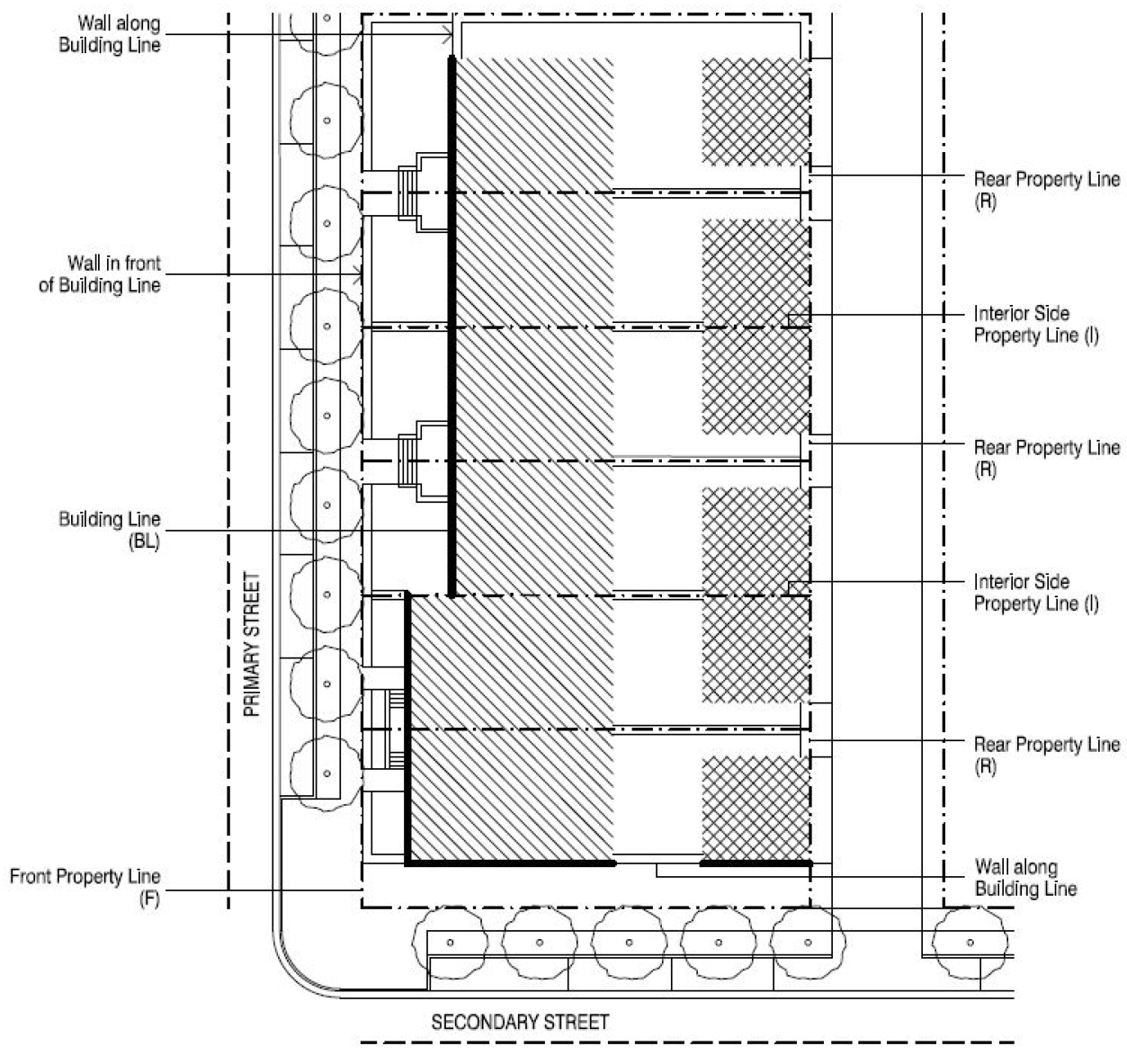
Figure 78-83.K-1: Fences, Walls, and Hedges for Residential Buildings
c.
No fence or wall may be constructed, installed or maintained which includes barbed wire, chicken wire, razor wire, broken glass, electrical elements, or other hazardous materials in the MU districts.
d.
Fences, walls and hedges around open spaces. Fences, walls and hedges around open spaces may be installed in accordance with the standards in TABLE 78-83.K-2.
(l)
MU district exterior lighting standards. Exterior lighting shall comply with the following standards:
(1)
Light poles shall not exceed a height of 17.5 feet above the adjacent finished grade;
(2)
No cobra head lights are permitted;
(3)
All lighting shall be weather and vandal resistant (i.e. resistant to graffiti, shattering etc.);
(4)
All exterior lighting is encouraged to be solar powered; and
(5)
On-site lighting poles shall be of a consistent architectural style and shall complement the predominant architectural theme of the project.
(m)
MU district height standards. The height of buildings shall be measured in both stories and feet. The maximum overall building height shall not exceed the maximum building height allowed for the district. Additionally, the following shall apply:
(1)
Building height is calculated from the average elevation of the adjacent public sidewalk or the crown of the road if no sidewalk exists to the top of the highest story or, in the case of pitched roofs, to the average height between the bottom of the eave and the peak of the roof.
(2)
The community development director or his/her designee shall have the authority to adjust administratively the requirements for building height maximum, for up to ten percent of the required measurement of height only. The maximum number of floors shall not be adjusted.
(3)
Each story shall be permitted a maximum height of 12 feet except for the ground floor and top floor which shall be permitted a maximum height of 20 feet.
(4)
When the mezzanine area is greater than 50 percent of the floor area in which it is in, it shall count as a full story when calculating building height.
(5)
Parking garages shall be measured in levels.
(6)
Each parking garage level at the frontage line(s) shall equal one story for the purposes of measuring building height.
(7)
Any parking garage levels that are fully concealed by a habitable story and use for a minimum depth of 20 feet from the frontage line(s) are not restricted in the number of levels, provided that the overall height of the garage does not exceed the overall height of the habitable stories at the frontage line.
(8)
Only building elements permitted to extend beyond the height of the building are exempt from the maximum allowable building height requirements as specified below in Table 78-83.M-1.
(n)
MU district design standards. The following standards shall apply to development in MU districts in addition to any applicable standards in article XII (Architectural Design Guidelines for Non-Residential Buildings):
(1)
Exceptions: Properties within the MU district shall be exempted from the following standards:
a.
Section 78-330.5 (Facade/wall height transition);
b.
Section 78-332.5 (Scale);
c.
Section 78-333.3 (Recesses/projections);
(2)
Modifications:
a.
Section 78-332.3 (Style): Appropriate historical themes as defined by article XII shall only be required for buildings along the west side of US1 and west of US1 in the Federal Highway mixed use district overlay.
b.
Section 78-333.2 (Preferred exterior materials): glass window systems shall be permitted for buildings along the east side of US1 and east of US1 in the Federal Highway mixed use district overlay only.
c.
Section 78-335.1 (Pedestrian Walkways): The minimum width of sidewalks shall be as specified in the MU District and/or as modified in the overlay district. The requirement to locate the sidewalk at least six feet from the facade of the building to provide planting beds for foundation landscaping shall only be required for buildings with residential uses on the ground floor.
(3)
Building configuration and design:
a.
Building length.
i.
The maximum horizontal dimension of a building shall be 350 feet at any level.
ii.
The community development director or his/her designee shall have the authority to adjust administratively the requirements for maximum building length, for up to ten percent of the required measurement.
b.
Building separation.
i.
Tower building types, or buildings greater than six stories, built to the maximum building length shall provide a minimum 30-foot separation from the subject building and any adjacent building within the same lot or the adjacent lot. The separation shall be open to the sky and improved as a pedestrian passage or open space running the entire depth of the block and shall provide building access and connect with the existing street grid. If the separation is publicly accessible, a minimum of 50 percent of active use shall be provided for the portion of the ground floor fronting the pedestrian passage or open space.
ii.
Townhouses shall provide a minimum of 15 feet between building groups. Liner, flex, and courtyard building types, built to the maximum building length, shall provide a minimum 15-foot separation from the subject building and any adjacent building within the same lot or the adjacent lot. The separation shall be open to the sky and improved as a pedestrian passage or open space running the entire depth of the block and shall provide building access and connect with the existing street grid. If the separation is publicly accessible, a minimum of 50 percent of active use shall be provided for the portion of the ground floor fronting the pedestrian passage or open space.
c.
Building break. Any building frontage along a primary or secondary or tertiary street that exceeds 160 feet shall incorporate a building break of at least 30 feet in width and 10 feet in depth, every 160 feet, at the ground level. The break shall be improved as a forecourt or open space and/or provide building access and occur on axis with the existing street grid.
d.
Projects with three or more distinctly separate buildings/building groups shall have substantially different front elevations. Substantially different front elevations shall include but not be limited to variations in fenestration, material, massing and color.
e.
The primary entrance of a building shall provide access to a public right-of-way, greenway or an open space.
f.
The primary entrance to the upper levels of mixed use building shall be from a public right-of-way.
g.
Porticoes, canopies, colonnades and roofs shall be guttered, and drainage shall be deposited onsite.
h.
Active use standards. Active uses shall be required along all building frontages as required per street type, hierarchy, or building type as provided in the overlay district and the following shall apply:
i.
Ground floor active use, storefronts. Storefronts are active uses located along the ground floor of a building. They typically contain retail uses but can contain any use that generates pedestrian activity. Storefronts shall be provided in compliance with the following standards:
(A)
They shall be provided on the first floor of all mixed use and nonresidential buildings;
(B)
They shall be directly accessible from a street frontage, greenway or an open space;
(C)
For properties with two or more frontages, they shall be located on a minimum of two frontages, with priority given to frontages on a greenway, an open space and the highest-ranking street;
(D)
They shall have a glazed area of not less than 70 percent of the façade area;
(E)
Ground floor window sills shall be placed at a maximum height of 24 inches above grade; and
(F)
Security enclosures, if any, shall be of the mesh type that pedestrians can see through, and shall be located behind storefront displays.
(G)
The glazed area shall have a minimum visible light transmittance of 75 percent and a maximum reflectance of 15 percent.
(H)
The glazed area shall be designed to allow view of an interior space at least five feet deep (e.g. transparent openings may include traditional storefront display windows, but not merely glass display cases). The view into a commercial use shall not be permanently obstructed by screens, shades, shutter or opaque films applied to the glazing.
(I)
At least 50 percent of the area of security screens and gates shall be transparent.
ii.
Ground floor active use, all other uses. All building types, except single-family, shall comply with the following standards:
(A)
A minimum of 30 percent of all ground floor street walls shall be fenestrated with windows;
(B)
Mirror type glass shall be prohibited;
(C)
All glazing shall be of a type that permits view of human activities and spaces within the structure;
(D)
Windows and doors shall be proportioned such that the height of each opening is greater than its width; and
iii.
Ground floor active use, liner. The minimum depth of an active use liner is measured generally perpendicular to the building frontage.
(A)
The minimum depth of the active use liner shall be 20 feet.
(B)
Those portions of active use liners which exceed the minimum frontage requirements may have a minimum depth of 15 feet.
(C)
When a parking structure is the primary use, the active use liner may be reduced to a minimum of 15 feet.
(D)
The community development director or his/her designee shall have the authority to adjust administratively the requirements for minimum depth of the active use liner, for up to 20 percent of the required depth.
i.
Colonnade Standards:
i.
Colonnades built to satisfy building frontage requirements shall be attached to the principal structure.
ii.
In no case shall the width of the colonnade exceed the colonnade's height.
iii.
The finished floor elevation of the colonnade shall match the adjoining sidewalk, where feasible.
j.
Awnings: The type of awning used, and its form, materials and color shall be consistent with the design character of the building to which it is attached and shall be subject to the following requirements:
i.
Awnings shall be located between, rather than across, significant vertical architectural features that make up the composition of the facade, such as pilasters or protruding columns. Awning framing shall align with storefront framing.
ii.
Awning framing shall be rectangular with straight edges except when located above an archway or arched fenestration.
iii.
Vinyl and plastic awnings are prohibited unless treated in a manner so as to appear similar to canvas or other natural materials in texture and color.
iv.
Valances shall not exceed eight inches in height.
v.
When used, lighting for awnings shall be from fixtures located above the awning and shall be designed and placed to enhance the appearance of the building. Internally illuminated awnings are prohibited.
vi.
A waiver may be granted administratively by the community development director or his/her designee in order to maintain the architectural character of a structure, or in the event that site features, such as, but not limited to, utility line poles or street trees, restrict the applicant from full compliance.
k.
Automatic food and drink machines and telephones shall be located inside buildings.
l.
Live-work units: A live-work unit shall have two components: a nonresidential use space and a residential unit and shall comply with the following standards:
i.
The nonresidential use's space shall be located on the ground floor and shall be directly accessible from the street frontage, greenway or an open space;
ii.
The nonresidential use's facade shall have a transparent clear glazed area of not less than 70 percent; and
iii.
If the entrance of the residential component of a live-work unit is separate from the nonresidential use's portion of the unit then the primary entrance of the residential component shall directly lead to a street frontage, greenway or an open space.
iv.
The ground floor shall be restricted to those nonresidential uses permitted within the MU districts. The full conversion of the unit or lease space into all residential use or all nonresidential uses shall be prohibited;
m.
Rooftops: These regulations are intended to guide the non-habitable use of rooftops for buildings built to the maximum story height limit to allow rooftop terraces. Rooftop terraces and rooftop amenities, such as roof gardens, observation decks, swimming pools, running tracks and covered structures, are encouraged to create unique gathering spaces or to aid in the reduction of the urban heat index in the MU district, and to add aesthetic value to the buildings. Rooftop terraces are not intended to add additional story height for uses that could otherwise occupy space within the building, such as, but not limited to, fitness centers, restaurants, locker rooms, and other similar amenities.
i.
Rooftop terraces.
(A)
Rooftop terraces shall be architecturally compatible with the design of the overall building.
(B)
Rooftop terraces that are entirely open to the sky may occupy 100 percent of the total gross roof area.
(C)
Rooftop terraces shall be hardscaped with materials such as, but not limited to, patterned concrete, pavers, or wood decking.
(D)
Rooftop terraces shall provide shaded seating areas.
(E)
Rooftop terraces shall be landscaped over a minimum of 25 percent of the rooftop terrace area. Landscaping shall consist of trees, shrubs, ground cover, and vines.
(F)
All landscape and planting areas shall be 100 percent fully irrigated.
ii.
Rooftop covered structures.
(A)
Covered structures above the maximum allowable building height are permitted to cover a maximum area of 30 percent of the gross rooftop area. For the purposes of calculating the maximum area, the term "covered structures" shall not include enclosures for screening mechanical systems.
(B)
Covered structures above the maximum allowable building height shall not be designed in any manner that would permit the conversion of such structure from non-habitable to habitable space and shall not include commercial uses. Covered structures shall be compatible with and in proportion to the architecture of the overall building. The following restrictions apply:
(1)
Climate-controlled structures are limited to the minimum area necessary to accommodate uses which are secondary and incidental to the primary rooftop amenity. These structures may include saunas and steam rooms and code-required restrooms.
(2)
The supporting restroom facilities shall not exceed 110 percent of the size required by the health department.
(3)
Refreshment service areas are permitted provided such areas do not include cooking facilities and are not climate-controlled.
iii.
Rooftop swimming pools. Swimming pools and/or whirlpools are permitted in rooftop terraces subject to the following criteria:
(A)
Swimming pools and/or whirlpools are permitted provided the top of the surrounding deck does not exceed eight feet above the top of the main rooftop.
(B)
Swimming pools and/or whirlpools shall be surrounded by a minimum five-foot wide walkway.
(C)
Facilities associated with swimming pools shall comply with the standards for rooftop covered structures.
(4)
Building typology and placement regulating diagrams and dimensional standards:
a.
Building typology: Unlike other zoning districts, the MU district is a form-based district that includes a list of permitted building typologies. All new buildings shall conform to one of the permitted building typologies. The building typologies are demonstrated in the building typology and placement regulating diagrams found in Appendix A of this code section. The diagrams provide a schematic representation of the various building typologies and demonstrate the required setbacks, lot standards, and profiles of structures. Not all building typologies are permitted in each overlay district. Each overlay district specifies the allowable building types permitted in each district per sub-area. Existing buildings which do not fit a prescribed typology shall follow the standards required for the flex building typology.
b.
Setbacks and building frontage.
i.
Front and street side setbacks and building frontage. Front and street side setbacks are determined based on the street the building fronts and is specified in each overlay district. In addition, the following shall apply:
(A)
For purposes of the building frontage, a forecourt shall be considered as a principal building. Where a forecourt is provided, the following shall apply:
(1)
The portion of the building fronting the forecourt may be set back up to 25 feet from the property line to accommodate a forecourt.
(2)
To accommodate an outdoor eating area along the street frontage only, the building frontage may be altered by providing a forecourt. The forecourt shall not exceed 60 percent of the building frontage.
ii.
Interior side and rear setbacks. Interior side and rear setbacks are determined based on the selected building typology. Refer to the building typology and placement regulating diagrams found in Appendix A of this code section for interior side and rear setbacks per building typology.
c.
Lot standards: Lot standards, including but not limited to lot dimensions and impervious surface area, are determined based on the selected building typology. Refer to the building typology and placement regulating diagrams found in Appendix A of this code section for the lot standards per building typology.
i.
For full block developments in the core and center subareas only, the minimum and maximum lot width and lot depth shall not apply.
ii.
The community development director or his/her designee shall have the authority to adjust administratively the requirements for minimum lot depth and lot width, for up to ten percent of the required measurement, for existing lots established prior to the date of the adoption of this ordinance.
d.
Maximum allowable projections and encroachments of architectural elements: Projections and encroachments including, but not limited to the following architectural elements, awnings, balconies, stoops, stairs, open porches, and bay windows may be permitted to extend into the minimum required setbacks. All features shall be fully located within the boundaries of the applicant's property, except for the elements permitted to extend past a property line. The maximum allowable projections and encroachments are listed below in Table 78-83.N-1.
MIXED USE DISTRICT (Sec. 78-83) APPENDIX A
BUILDING TYPOLOGY AND PLACEMENT REGULATING DIAGRAMS
| MIXED USE DISTRICT: BUILDING TYPOLOGY AND PLACEMENT REGULATING DIAGRAMS
FIGURE 1: TOWER BUILDING TYPE | |||
|---|---|---|---|
| SUB-AREA: Core | BUILDING MASSING | ||
DEFINITION: a multi level building organized around a central core where a part of
the building is higher in proportion.
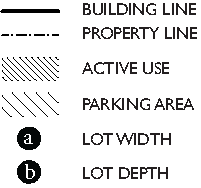 | 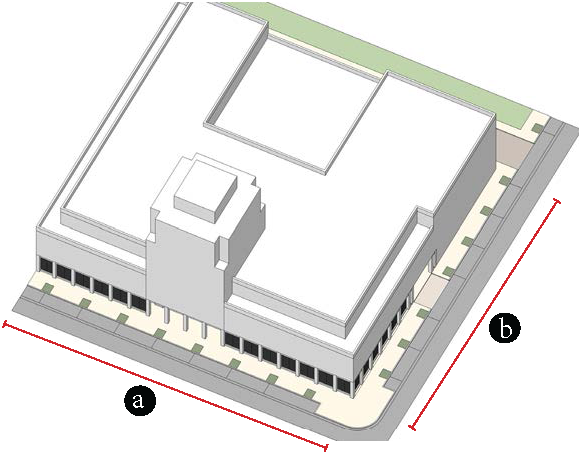 | ||
| LOT STANDARDS | MIN. | MAX. | BUILDING CONFIGURATION |
| a. Lot Width | 200' | 375' | 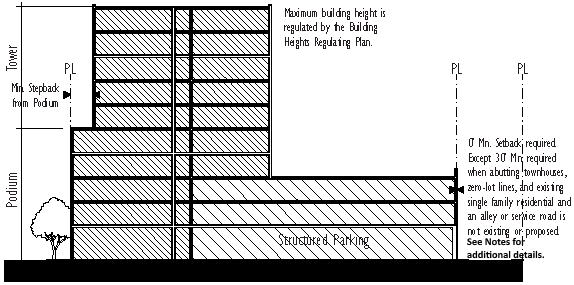 |
| b. Lot Depth | 150' | N/A | |
| c. Lot Area | N/A | N/A | |
| d. Impervious Area | N/A | 90% (1) | |
| e. Pervious Area | 10% | N/A (1) | |
| f. Interior Side Setback | 0' (2) | N/A | |
| g. Rear Setback | 0' (2) | N/A | |
|
NOTES:
1. At grade 2. Except 30' minimum when abutting townhouse, zero lot lines and existing single family residential and an alley or service road is not existing or proposed, unless full block consolidation or at least 80% block consolidation is attained. OPEN SPACE STANDARDS: All multi-family residential, live-work units and mixed use developments with residential dwellings shall reserve a minimum of 10% of the site for common, private open space. |
BUILDING SETBACKS
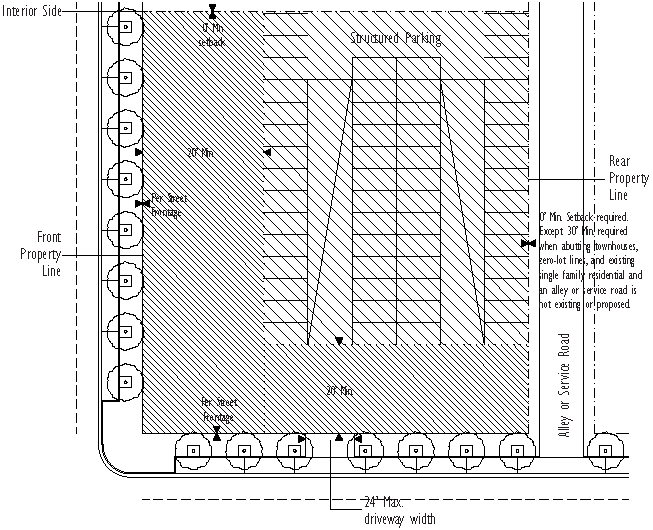 | ||
EXAMPLES OF TOWER CONFIGURATION
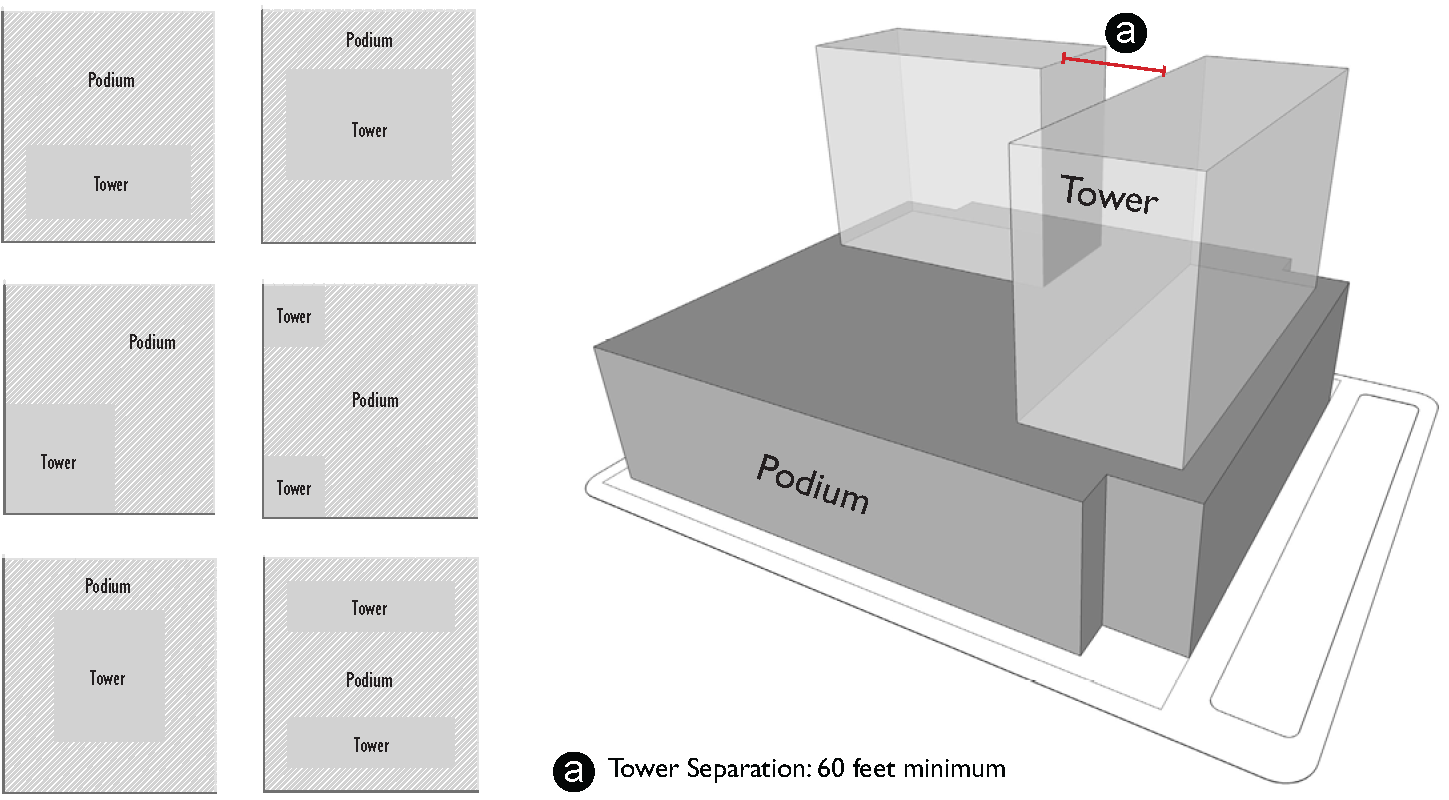
TOWER FLOORPLATE STANDARD:
Above the fifth floor there shall be a maximum tower floorplate size. The floorplate
size for multiple towers shall be calculated as an average of the total cumulative
tower floorplate area divided by the number of tower stories above the 5th floor.
Except if otherwise modified in the overlay district regulations, the maximum floorplate
size is dependent upon the tower's primary use as follows:
1.
Office or nonresidential - average of 35,000 square feet for multiple towers and a 45,000 square feet maximum permitted floorplate size for any individual tower floorplate;
2.
Residential, Mixed-Use or Hotel - average of 20,000 square feet for multiple towers and a 32,500 square feet maximum permitted floorplate size for any individual tower floorplate.
3.
The Community Development Director or his/her designee shall have the authority to adjust administratively the requirements for tower floorplate size above the 5th floor, for up to 10 percent of the maximum measurement.
TOWER SEPARATION:
The minimum allowable horizontal distance between two or more towers shall be 60 feet.
TOWER STEPBACK:
The minimum stepback for the tower from the podium shall be ten feet from the podium
along interior side and rear property lines only. Along the front and street side
property lines the minimum stepback for the tower from the podium shall be as specified
in each MU overlay district. Tower orientation shall be specified toward terminating
street vistas where applicable. The placement of the tower shall be such that it is
near, fronting, or adjacent to a specified Designated Greenway and/or Open Space.
ILLUSTRATIVE EXAMPLES
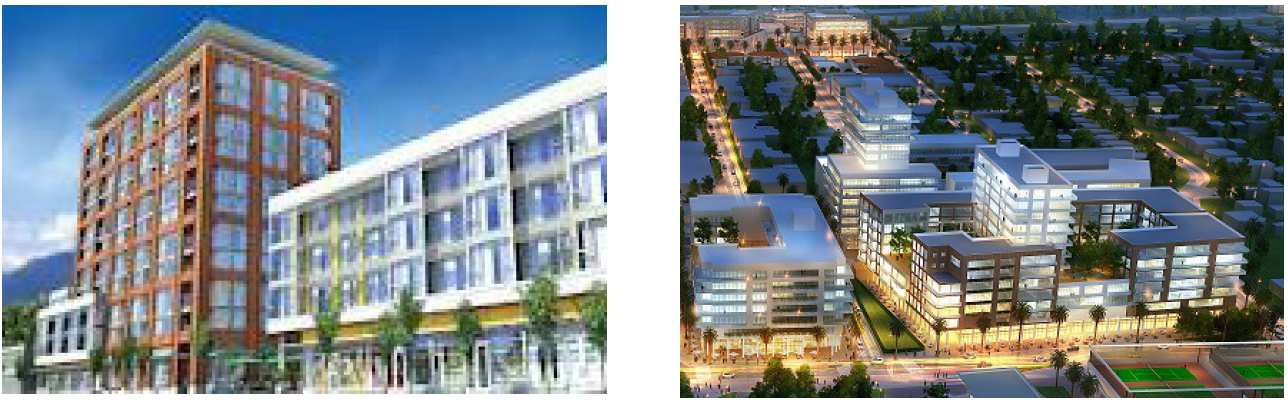
| MIXED USE DISTRICT: BUILDING TYPOLOGY AND PLACEMENT REGULATING DIAGRAMS
FIGURE 2: LINER BUILDING TYPE | |||
|---|---|---|---|
| SUB-AREA: Core/Center | BUILDING MASSING | ||
DEFINITION: A building that conceals a garage, or other faceless building, that is
designed for occupancy.
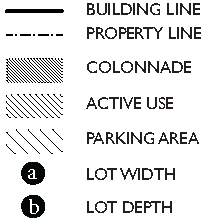 | 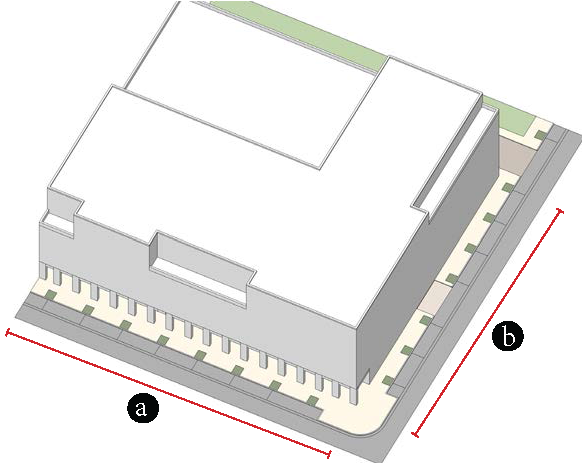 | ||
| LOT STANDARDS | MIN. | MAX. | BUILDING CONFIGURATION |
| a. Lot Width | 125' | 350' | 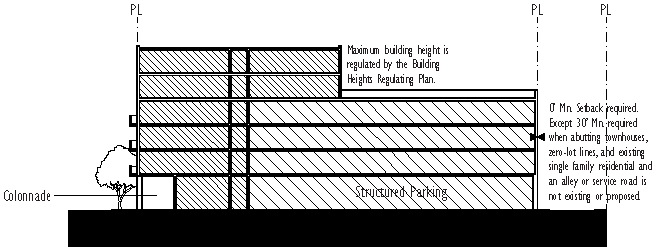 |
| b. Lot Depth | 170' | N/A | |
| c. Lot Area | N/A | N/A | |
| d. Impervious Area | N/A | 90% | |
| e. Pervious Area | 10% | N/A | |
| f. Interior Side Setback | 0'(1) | N/A | |
| g. Rear Setback | 0'(1) | N/A | |
|
NOTES:
1. Except 30' minimum when abutting townhouse, zero-lot lines and existing single family residential and an alley or service road is not existing or proposed. 2. The minimum depth of the active use lining the garage or other faceless building shall be 20 feet. OPEN SPACE STANDARDS: All multi-family residential, live-work units and mixed use developments with residential dwellings shall reserve a minimum of 10% of the site for common, private open space. |
BUILDING SETBACKS
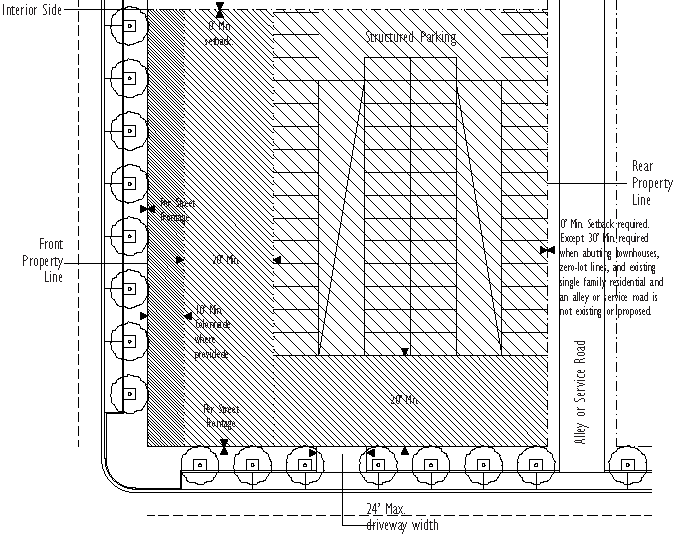 | ||
EXAMPLES OF LINER CONFIGURATION
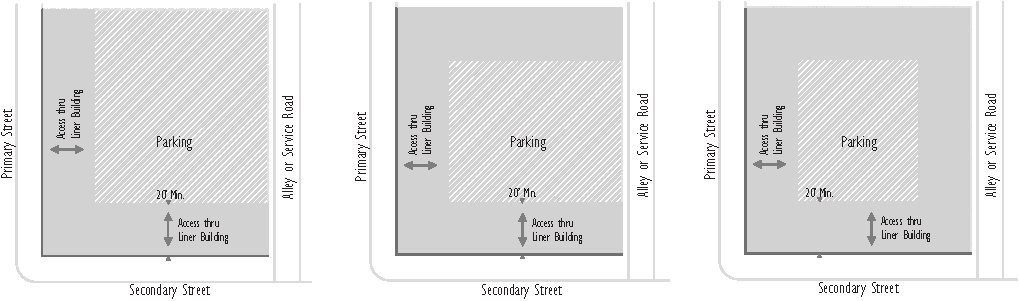
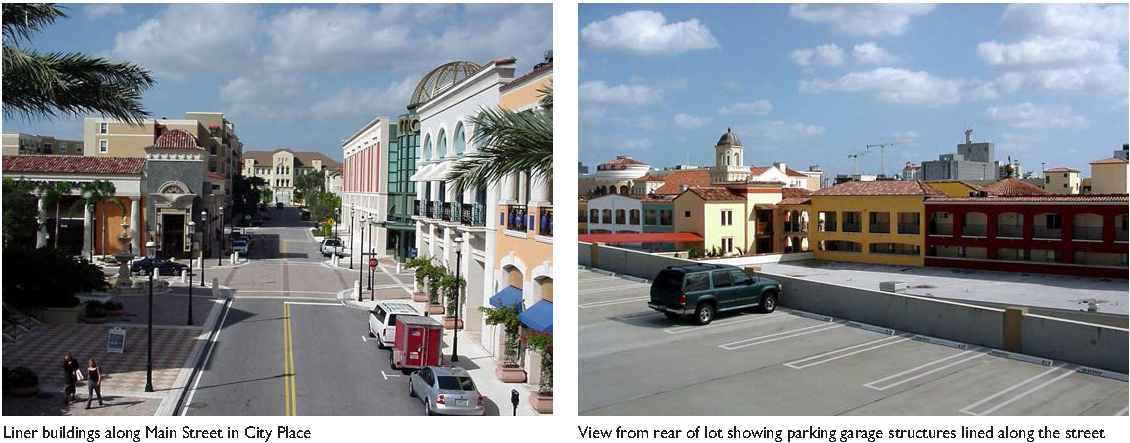
| MIXED USE DISTRICT: BUILDING TYPOLOGY AND PLACEMENT REGULATING DIAGRAMS
FIGURE 3: COURTYARD BUILDING TYPE A | |||
|---|---|---|---|
| SUB-AREA: Core/Center | BUILDING MASSING | ||
DEFINITION: a building characterized as having a central open space that is open
to the sky and enclosed by habitable space on at least three sides with detached parking.
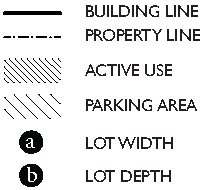 | 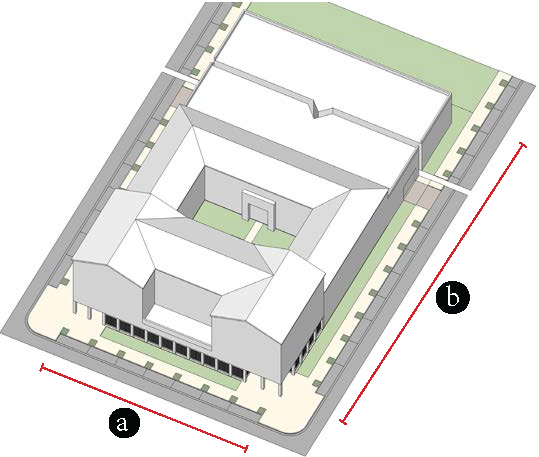 | ||
| LOT STANDARDS | MIN. | MAX. | BUILDING CONFIGURATION |
| a. Lot Width | 150' | 350' | 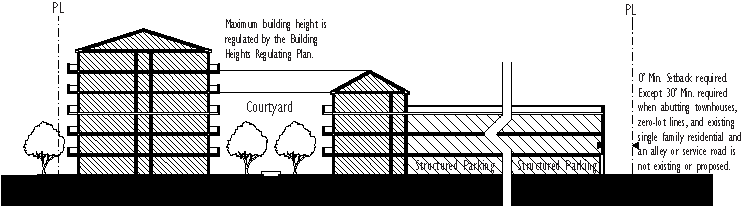 |
| b. Lot Depth | 160' | N/A | |
| c. Lot Area | N/A | N/A | |
| d. Impervious Area | N/A | 90% | |
| e. Pervious Area | 10% | N/A | |
| f. Interior Side Setback | 0'(1) | N/A | |
| g. Rear Setback | 0'(1) | N/A | |
|
NOTES:
1. Except 30' minimum when abutting townhouse, zero-lot lines and existing single family residential and an alley or service road is not existing or proposed. OPEN SPACE STANDARDS: All multi-family residential, live-work units and mixed used developments with residential dwellings shall reserve a minimum of 10% of the site for common, private open space. |
BUILDING SETBACKS
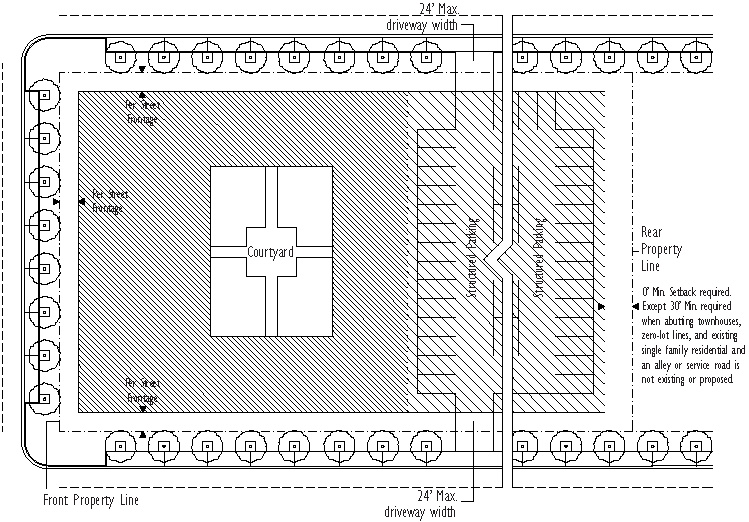 | ||
EXAMPLES OF BUILDING CONFIGURATION
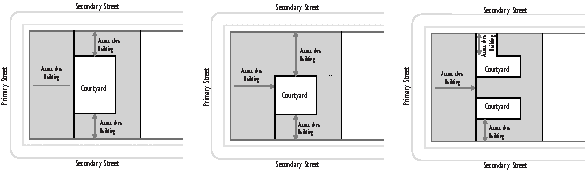
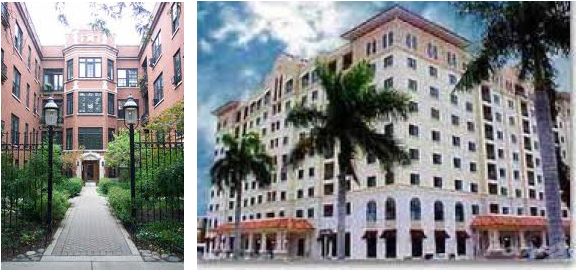
| MIXED USE DISTRICT: BUILDING TYPOLOGY AND PLACEMENT REGULATING DIAGRAMS
FIGURE 4: COURTYARD BUILDING TYPE B | |||
|---|---|---|---|
| SUB-AREA: Core/Center | BUILDING MASSING | ||
DEFINITION: a building characterized as having a central open space that is open
to the sky and enclosed by habitable space on at least three sides with attached parking.
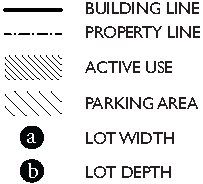 | 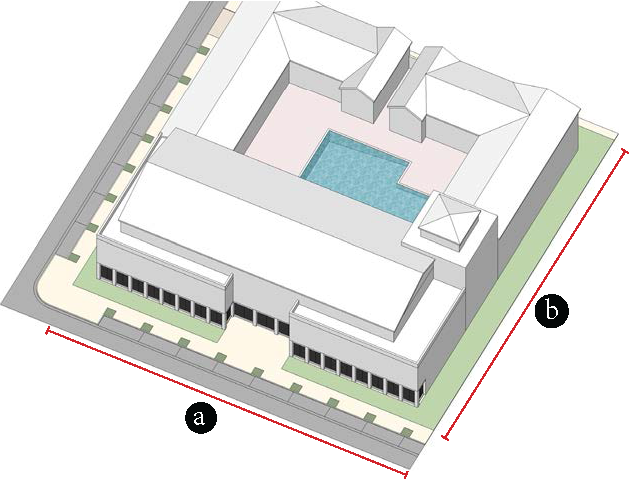 | ||
| LOT STANDARDS | MIN. | MAX. | BUILDING CONFIGURATION |
| a. Lot Width | 150' | 350' | 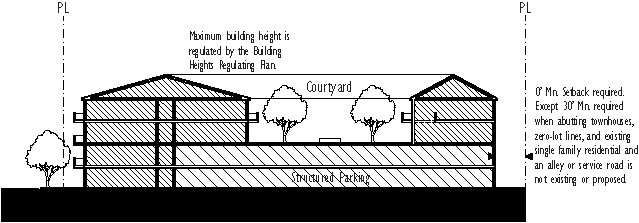 |
| b. Lot Depth | 160' | N/A | |
| c. Lot Area | N/A | N/A | |
| d. Impervious Area | N/A | 90% | |
| e. Pervious Area | 10% | N/A | |
| f. Interior Side Setback | 0'(1) | N/A | |
| g. Rear Setback | 0'(1) | N/A | |
|
NOTES:
1. Except 30' minimum when abutting townhouse, zero-lot lines and existing single family residential and an alley or service road is not existing or proposed. OPEN SPACE STANDARDS: All multi-family residential, live-work units and mixed use developments with residential dwellings shall reserve a minimum of 10% of the site for common, private open space. |
BUILDING SETBACKS
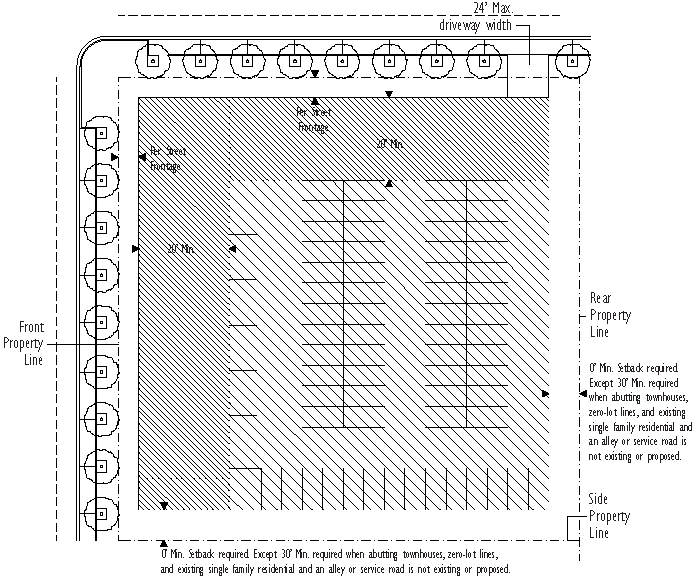 | ||
EXAMPLES OF BUILDING CONFIGURATION
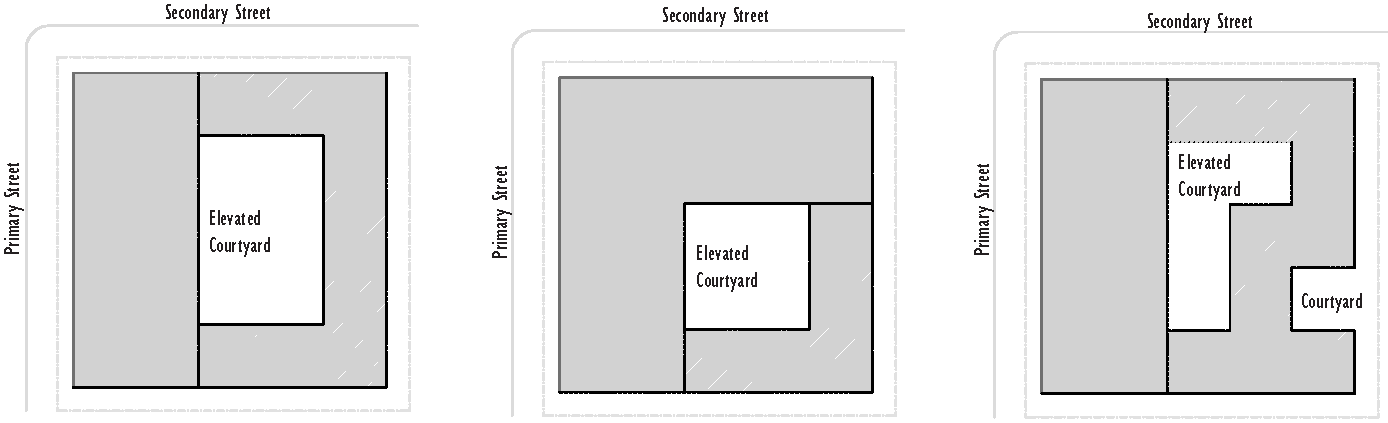
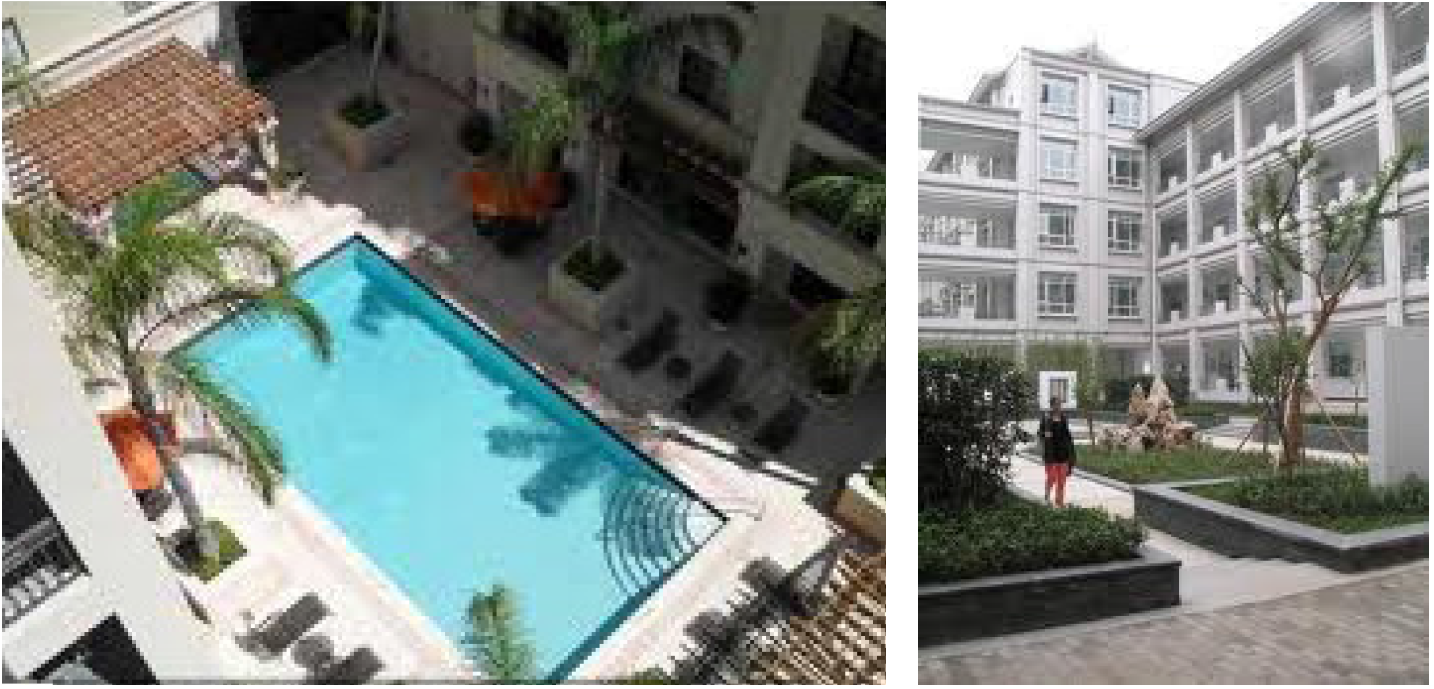
| MIXED USE DISTRICT: BUILDING TYPOLOGY AND PLACEMENT REGULATING DIAGRAMS
FIGURE 5: FLEX BUILDING TYPE | |||
|---|---|---|---|
| SUB-AREA: Core/Center | BUILDING MASSING | ||
DEFINITION: Buildings designed to respond to changes of function in a flexible way.
The flex building is able to accept different internal configurations and easily adapt
to its surroundings.
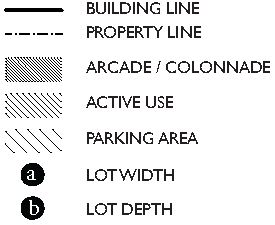 | 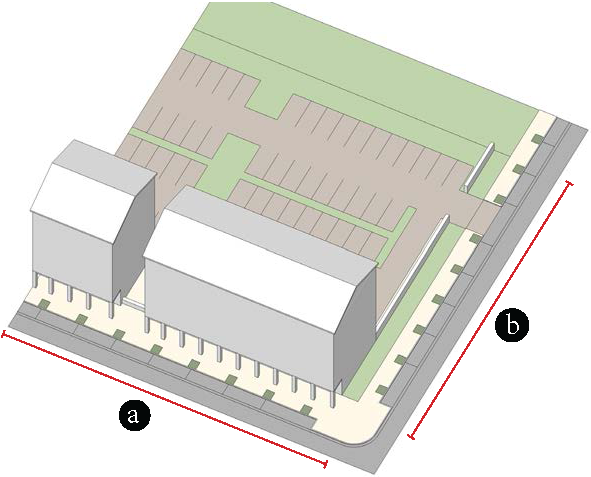 | ||
| LOT STANDARDS | MIN. | MAX. | BUILDING CONFIGURATION |
| a. Lot Width | 25' | 375' | 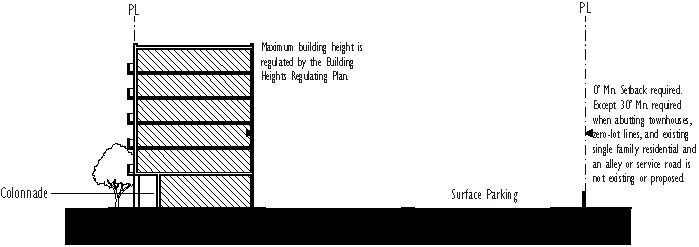 |
| b. Lot Depth | 70' | N/A | |
| c. Lot Area | N/A | N/A | |
| d. Impervious Area | N/A | 90% | |
| e. Pervious Area | 10% | N/A | |
| f. Interior Side Setback | 0'(1) | N/A | |
| g. Rear Setback | 0'(1) | N/A | |
|
NOTES:
1. Except 30' minimum when abutting townhouse, zero-lot lines and existing single family residential and an alley or service road is not existing or proposed. OPEN SPACE STANDARDS: All multi-family residential, live-work units and mixed use developments with residential dwellings shall reserve a minimum of 10% of the site for common, private open space. |
BUILDING SETBACKS
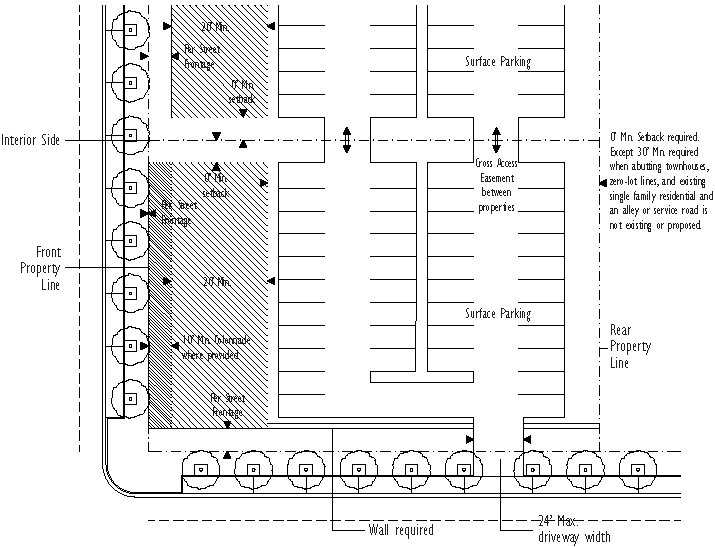 | ||
EXAMPLES OF BUILDING CONFIGURATION
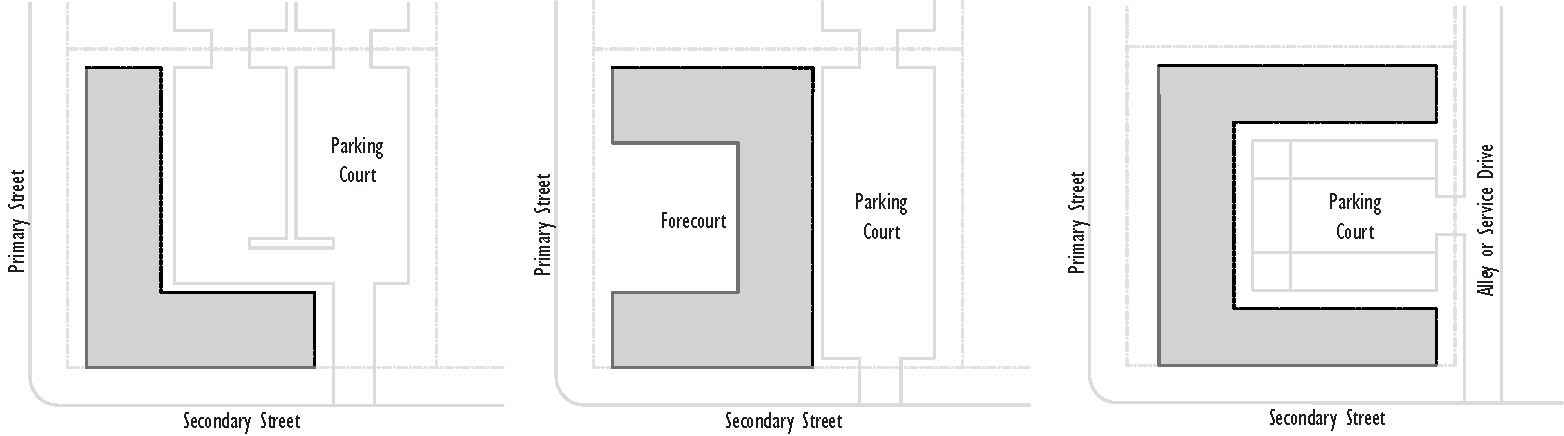
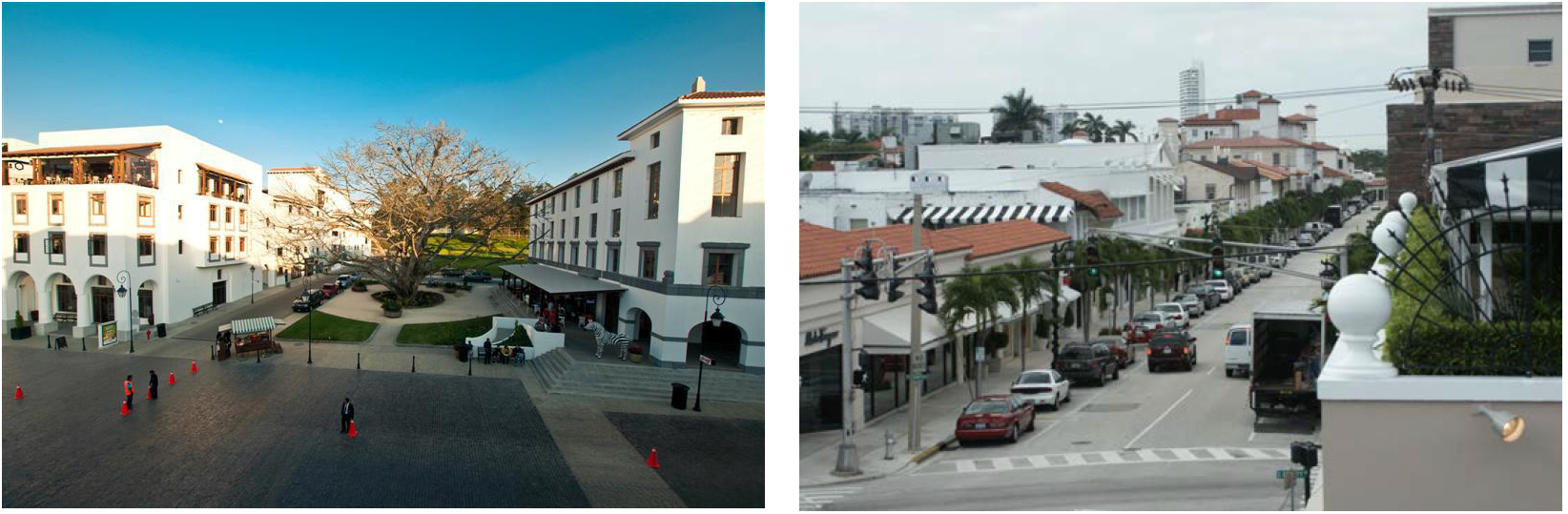
| MIXED USE DISTRICT: BUILDING TYPOLOGY AND PLACEMENT REGULATING DIAGRAMS
FIGURE 6: TOWNHOUSE BUILDING TYPE A | |||
|---|---|---|---|
| SUB-AREA: Center/Edge | BUILDING MASSING | ||
DEFINITION: A single dwelling unit in a group of such units that are attached horizontally
in a linear arrangement to form a single building, with each unit occupying space
from the ground to the roof of the building, and located or capable of being located
on a separate townhouse lot. A townhouse development is considered a type of multifamily
dwelling. Townhouse Type A is distinguished by a detached garage/parking area thereby
providing a private rear yard in the center of the lot.
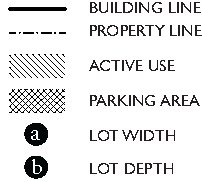 | 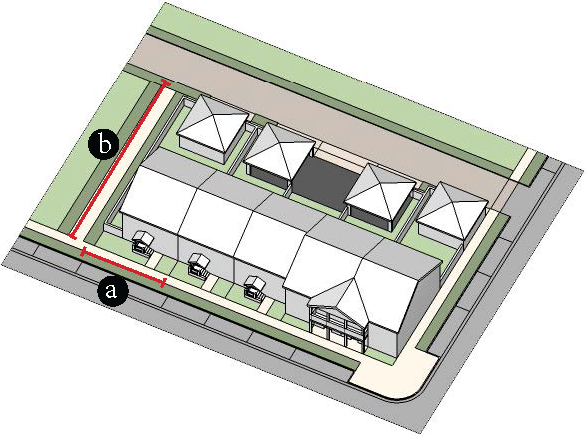 | ||
| LOT STANDARDS: | MIN. | MAX. | BUILDING CONFIGURATION |
| a. Lot Width | 25' | 30' | 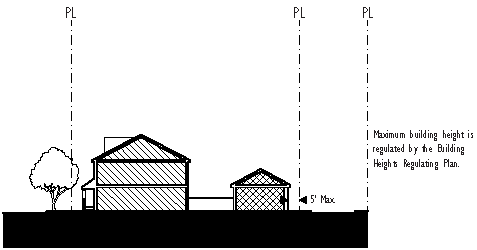 |
| b. Lot Depth | 80' | N/A | |
| c. Lot Area | 1800 sf | N/A | |
| d. Impervious Area | N/A | 90% | |
| e. Pervious Area | 10% | N/A | |
| f. Interior Side Setback | 0'(2) | N/A | |
| g. Rear Setback | 0' | 5' | |
|
NOTES:
1. Townhouses shall provide a minimum of 15 feet between building groups. Building groups shall not be greater than 7 attached units in length. 2. Except 10 feet when abutting a passageway. PARKING STANDARDS: The parking shall be accessed from the rear off an alley or service road. Parking may be unenclosed, fully enclosed in a garage, or in a parking enclosure with a carport. OPEN SPACE STANDARDS: A minimum of 400 square feet of private open space shall be required in the form of a rear yard. TOWNHOUSE STANDARDS: Townhouses are an appropriate transitional building type between nonresidential/mixed-use and single family residential uses. The primary structure shall always be located along the street edge while the parking area is always located along the rear of the lot. This ensures better compatibility with the existing single family residential uses by having the building mass away from the single family residential. |
BUILDING SETBACKS
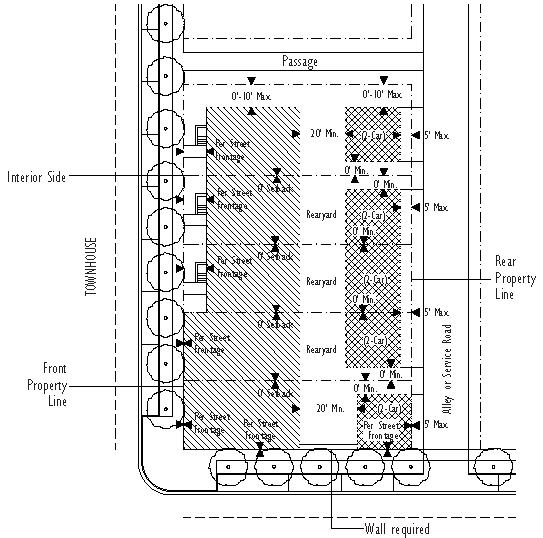 | ||
| MIXED USE DISTRICT: BUILDING TYPOLOGY AND PLACEMENT REGULATING DIAGRAMS
FIGURE 7:TOWNHOUSE BUILDING TYPE B | |||
|---|---|---|---|
| SUB-AREA: Core/Center/Edge | BUILDING MASSING | ||
DEFINITION: A single dwelling unit in a group of such units that are attached horizontally
in a linear arrangement to form a single building, with each unit occupying space
from the ground to the roof of the building, and located or capable of being located
on a separate townhouse lot. A townhouse development is considered a type of multifamily
dwelling. Townhouse Type B is distinguished by an attached garage thereby not providing
a private rear yard.
 | 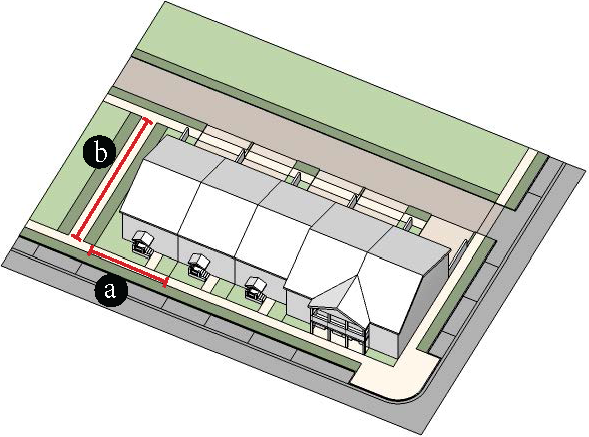 | ||
| LOT STANDARDS: | MIN. | MAX. | BUILDING CONFIGURATION |
| a. Lot Width | 25' | 30' | 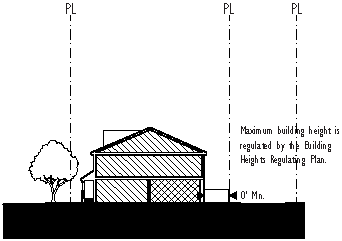 |
| b. Lot Depth | 70' | N/A | |
| c. Lot Area | 1800 sf | N/A | |
| d. Impervious Area | N/A | 90% | |
| e. Pervious Area | 10% | N/A | |
| f. Interior Side Setback | 0'(2) | N/A | |
| g. Rear Setback | 0' | N/A | |
|
NOTES:
1. Townhouses shall provide a minimum of 15 feet between building groups. Building groups shall not be greater than 7 attached units in length. 2. Except 10 feet when abutting a passageway. PARKING STANDARDS: The parking shall be accessed from the rear off an alley or service road. Parking may be fully or partially enclosed in a garage under the principal building. OPEN SPACE STANDARDS: A minimum of 200 square feet of private open space shall be required and a rear yard shall not be required. TOWNHOUSE STANDARDS: Townhouses are an appropriate transitional building type between nonresidential/mixed-use and single family residential uses. The primary structure shall always be located along the street edge while the parking are is always located along the rear of the lot. This ensure better compatibility with the existing single family residential uses by having the building mass away from the single family residential. |
BUILDING SETBACKS
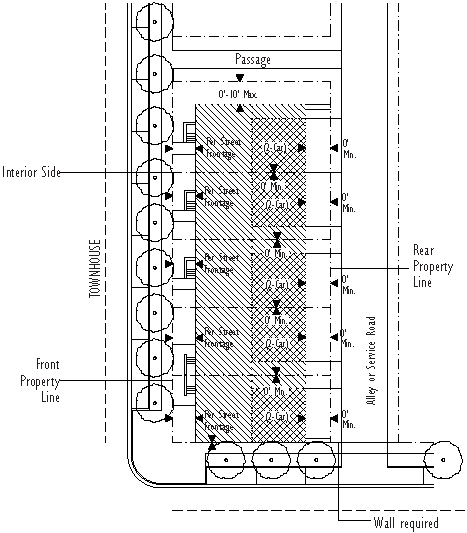 | ||
| MIXED USE DISTRICT: BUILDING TYPOLOGY AND PLACEMENT REGULATING DIAGRAMS
FIGURE 8: ZERO-LOT LINE WITH ALLEY/SERVICE ROAD (SIDEYARD AND COURTYARD HOUSE TYPE) | |||||
|---|---|---|---|---|---|
| SUB-AREA: Center/Edge | BUILDING MASSING | ||||
DEFINITION: Sideyard House: A detached dwelling distinguished by the provision of
an unenclosed porch on the side of the house. The side porch is screened from the
view of the street by a wall or fence. Courtyard House: A dwelling unit distinguished
by the provision of an open-air courtyard or atrium. The courtyard is enclosed on
at least three sides by habitable space and shall provide penetrable openings such
as windows and doors between the interior of the dwelling and the courtyard.
 | 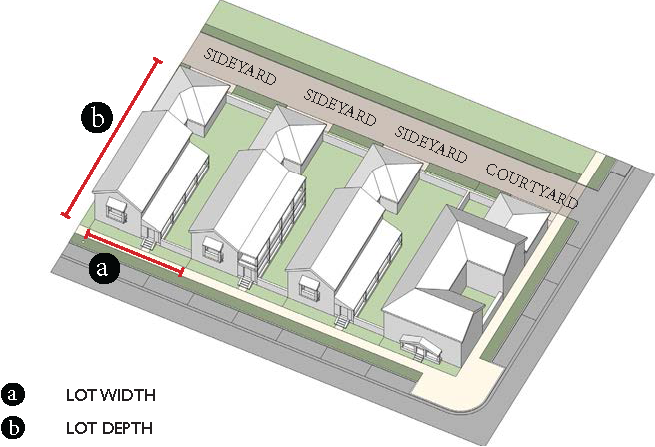 | ||||
| LOT STANDARDS | Sideyard | Courtyard |
BUILDING CONFIGURATION
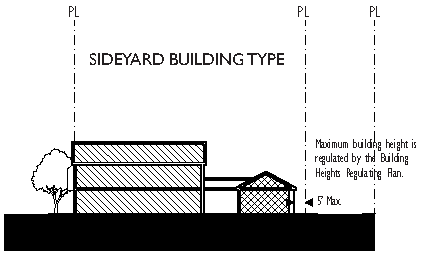 | ||
| Min. | Max. | Min. | Max. | ||
| a. Lot Width | 50' | 60' | 40' | 50' | |
| b. Lot Depth | 80' | N/A | 80' | N/A | |
| c. Lot Area | 5000 sf | N/A | 4000 sf | N/A | |
| d. Impervious Area | N/A | 60% | N/A | 70% | |
| e. Pervious Area | 30% | N/A | 30% | N/A | |
| f. Interior Side Setback | 0'/15'(1) | 0'/N/A | 0' | N/A | |
| g. Rear Setback | 0' | 5' | 0' | 5' | |
|
NOTES:
1. One side shall be 0 feet and the other a minimum of 15 feet. 2. Sideyards shall be required to provide a porch on the side a minimum 10 feet deep. PARKING STANDARDS: OPEN SPACE STANDARDS: A minimum of 400 square feet of private open space shall be required in the form of a courtyard, sideyard or rear yard. A sideyard, when required, shall be a minimum of 15 feet wide. |
BUILDING SETBACKS
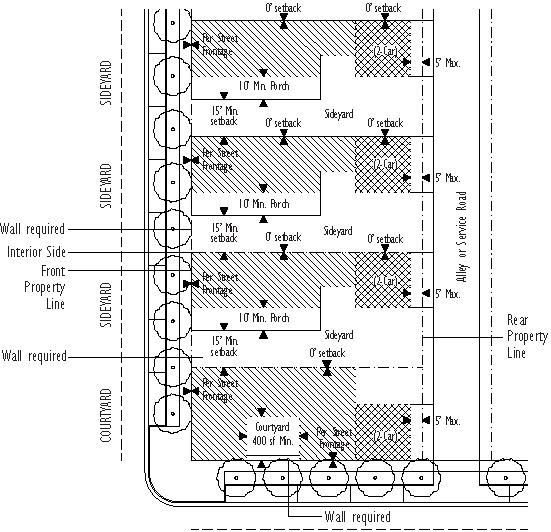 | ||||
FIGURE 9: ILLUSTRATIVE EXAMPLES
TOWNHOUSE BUILDING TYPE
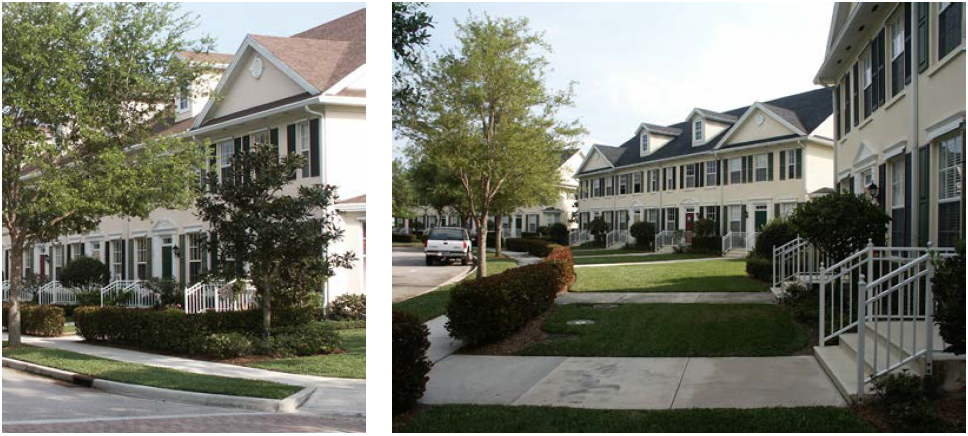
ZERO-LOT LINE (SIDEYARD HOUSE TYPE)
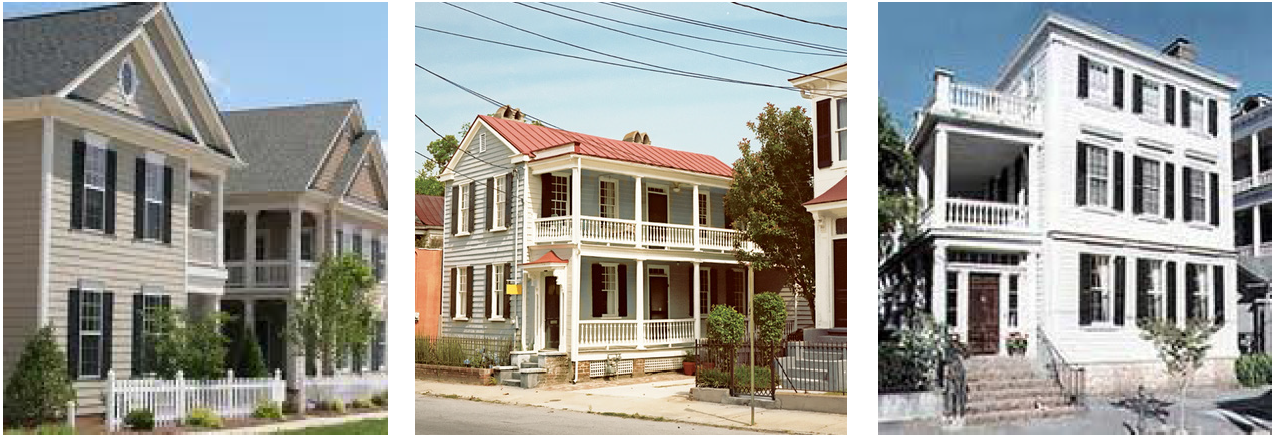
ZERO-LOT LINE (COURTYARD HOUSE TYPE)
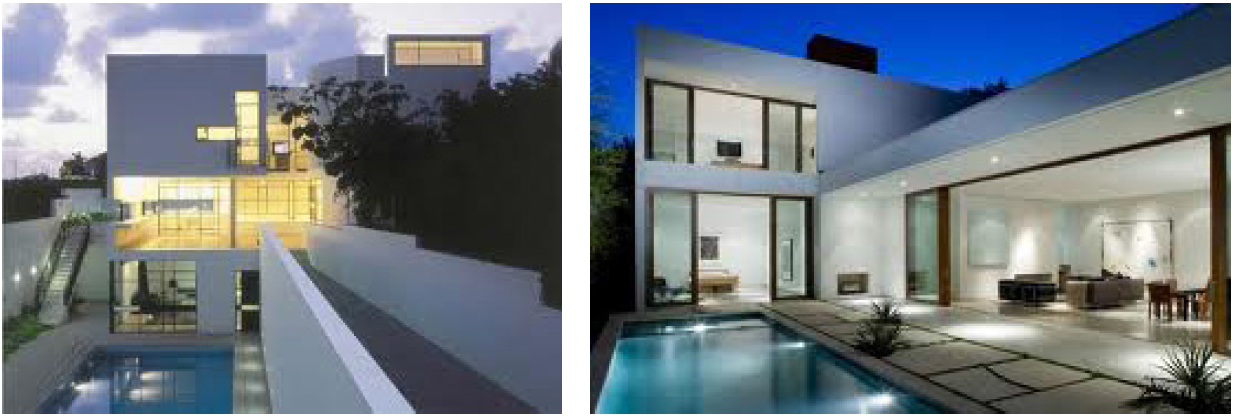
ZERO-LOT LINE (COURTYARD HOUSE TYPE)
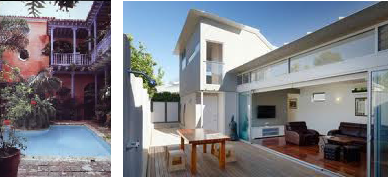
(Ord. No. 04-2018, § 4(Exh. B), 4-18-2018; Ord. No. 13-2019, § 2, 11-20-2019; Ord. No. 08-2023, § 2, 10-18-2023)
Sec. 78-84. - Federal Highway mixed use district overlay (FHMUDO).
(a)
Purpose. The Federal Highway mixed use district overlay (FHMUDO) is established and intended to encourage an urban form that promotes transit usage and pedestrian oriented development along the Federal Highway corridor which is connected to the Park Avenue Downtown District in the Town of Lake Park. The purpose of the district standards is to stimulate economic revitalization, create a pedestrian-friendly environment and promote mixed-use development.
(b)
Applicability.
(1)
General.
a.
These standards apply to all land within the Federal Highway mixed use district overlay (FHMUDO), as delineated on the official zoning map.
b.
These standards replace or supplement the use, intensity, dimensional, and development standards applicable to the underlying base zoning district and town's land development regulations. If FHMUDO standards directly conflict with those governing an underlying base district, or those provided within another section of the town's land development regulations, the FHMUDO standards shall govern. If land within the district is classified as one or more overlay zoning districts, and FHMUDO standards directly conflict with those of the other overlay district(s), the more restrictive standard shall govern. If land within the district is classified as a planned unit development (PUD) district, the planned development district's regulations shall govern.
(2)
Existing uses.
a.
Permitted auto-oriented uses.
i.
Notwithstanding the standards applicable in mixed use (MU) district or in the FHMUDO, the following auto-oriented uses and auto-oriented use categories per sections 78-62, 78-64, 78-65, and 78-66 shall be permitted in the FHMUDO, provided they shall only be permitted at locations that had a site plan approved for such use prior to the date of the adoption of this ordinance:
(A)
Dwelling, Single Family.
(B)
Dwelling, Two-Family,
ii.
Until such time that the permitted auto-oriented use converts to a new principal use type, the permitted auto-oriented uses shall be exempt from compliance with all mixed use (MU) and FHMUDO standards.
iii.
Until such time that the permitted auto-oriented use converts to a new principal use type, the permitted auto-oriented uses, including the structures and lots, shall be governed by the development standards for the previous zoning district, including but not limited to Article 2: Districts Generally, Article 3: District Regulations, Article 4: Walls, Fences, and Hedges, Article 5: Supplementary Regulations, Article 7: Nonconformities, Article 8: Landscaping Standards, Article 9: Performance Standards, and Article 12: Architectural Design Guidelines.
b.
Existing structures and lots used for places of worship.
i.
Structures and lots approved for use as a place of worship, including lots approved for off-street parking for a place of worship, prior to the date of the adoption of this ordinance, shall be exempt from compliance with all mixed use (MU) and FHMUDO standards until such time that the place of worship converts to a new principal use type.
ii.
Until such time that the place of worship converts to a new principal use type, the structures and lots approved for a place of worship shall be governed by the development standards for the previous zoning district, including but not limited to Article 2: Districts Generally, Article 3: District Regulations, Article 4: Walls, Fences, and Hedges, Article 5: Supplementary Regulations, Article 7: Nonconformities, Article 8: Landscaping Standards, Article 9: Performance Standards, and Article 12: Architectural Design Guidelines.
(c)
Regulating plans. The regulating plans applied to the FHMUDO are intended to govern development standards, designating the locations where the various standards apply. Unless otherwise noted, all development shall follow the regulating plans. The regulating plans for the FHMUDO include the following:
(1)
The sub-areas regulating plan (Specified in Part D, shown in Appendix A, Figure 1).
(2)
The street network connectivity regulating plan (Specified in Part F, shown in Appendix A, Figure 2).
(3)
The designated publicly accessible open space and greenway system regulating plan (Specified in Part H, shown in Appendix A, Figure 3).
(4)
The building heights regulating plan (Specified in Part I, shown in Appendix A, Figure 4).
(d)
The sub-areas regulating plan. The sub-areas regulating plan is intended to divide the FHMUDO into three sub-areas: Core, Center, and Edge. The highest height and number of stories within the FHMUDO shall be allocated to the Core Sub-Area. The height and number of stories shall then gradually decrease from the Core to the Center Sub-Area and then further decrease to the Edge Sub-Area which is characterized by single uses adjacent to existing low density residential. The sub-areas regulating plan is found in Appendix A of this code section as Figure 1.
(e)
Use standards.
(1)
Principal uses regulating table. Appendix B of this code section, Table 1 includes the principal uses permitted in the FHMUDO along with any required restrictions on such uses, for each sub-area. Principal uses not included in Table 78-84.Appendix-B.1 are not permitted in the FHMUDO. Principal uses in the FHMUDO shall be subject to the use-specific standards provided in section 78-84(e)(3) (Additional Use Specific Standards).
(2)
Permitted accessory uses and structures. The following accessory uses shall be allowed by right in the FHMUDO:
a.
Walk-up window service as accessory to an eating or drinking establishment.
b.
Outdoor display of merchandise for sale or rental as accessory to a retail sales and service use on private property and private sidewalks only.
c.
Outdoor seating as accessory to an eating or drinking establishment (including sidewalk cafes).
d.
Accessory buildings, where permitted, must comply with the requirements of this Code and the Florida Building Code as amended. Accessory uses must be located on the same lot or parcel of land as the principal structure and the accessory use must be customarily incidental to the principal use. Permissible accessory uses for various building types and permitted uses shall be determined in the site planning process or administratively on a case-by-case basis and subject to these standards:
i.
A private garage for use by occupants of the principal building shall be considered an accessory use.
e.
Home occupations or professions, where incidental to the residential use, shall be permitted for single family, townhouse, and multifamily uses. A home occupation shall be interpreted as any vocation, trade or profession carried on within a dwelling by the occupants thereof, where no power other than electric is used, no signs other than one unlighted sign not in excess of two square feet is displayed, no merchandise or other articles are displayed for advertising purposes, no assistants are employed, and not more than 35 percent of the ground floor area is so used. Such home occupations shall not include experimentation that involves the use of chemicals or matter or energy that may create or cause to be created noises, noxious odors or hazards that will endanger the health, safety or welfare of the community.
f.
Physicians or dentists, in the center sub-area only, shall be subject to the following provisions:
i.
Physicians or dentists may operate an office in conjunction with a home so long as the front of such office shall be kept as a home.
ii.
No more than 35 percent of the ground floor area shall be used as an office.
iii.
Not more than one physician or dentist may practice, and there shall not be more than three persons employed.
iv.
Only one sign shall be permitted, not to exceed two square feet in size.
v.
Office hours shall be limited to daylight hours.
(3)
Additional use specific standards. The following use-specific standards apply to properties where permitted in the FHMUDO.
a.
Churches/houses of worship includes related buildings used for customary accessory uses such as a private school, day care and after care facilities, religious study or education, day camp, Sunday school, ministries, and other church related activities.
b.
Group home is a permitted use provided that any group home is not located within a radius of 1,000 feet of another existing group home.
c.
Community residential home is a permitted use provided that any community residential home is not located within a radius of 1,200 feet of another existing community residential home.
d.
Reserved.
e.
The following uses shall be limited to a maximum square footage:
i.
Bakeries with commercial preparation shall be limited to a maximum size of 10,000 square feet.
ii.
Appliance stores, including radio and television, shall be limited to a maximum size of 10,000 square feet.
iii.
Hardware, paint and garden supplies retail stores shall be limited to a maximum size of 5,000 square feet.
iv.
Bowling alleys shall be limited to a maximum size of 10,000 square feet.
(f)
Street network connectivity regulating plan and street design standards.
(1)
The street network connectivity regulating plan is intended to show the location of existing and required new streets needed to create the prescribed network of streets within the FHMUDO. This plan also establishes the hierarchy of the streets within the FHMUDO. All streets shall be located according to the street network connectivity regulating plan for the FHMUDO. The street network connectivity regulating plan is found in Appendix A of this code section as Figure 2. The intent of the street design standards is to ensure that streets are improved based on street design parameters that enhance the streetscape and encourage walking and biking.
(2)
Specific street design standards. All streets shall be designed according to the street sections and standards specified in the street development regulating diagrams as shown in Figure 78-84(f)(1) through Figure 78-84(f)(10), to the extent possible in coordination with the town engineer.
a.
Federal Highway street design. As demonstrated in Figure 78-84(f)(1) below:
i.
The roadway shall be a designated greenway.
ii.
A landscaped median, a minimum of ten feet wide, shall be provided.
iii.
Travel lanes shall be narrowed to a maximum of ten feet wide on the inner lanes and 11 feet wide on the outer lanes.
iv.
A bike lane, a minimum of five feet, shall be established on both sides of the street at the sidewalk level.
v.
As redevelopment occurs, on both sides of the street:
(A)
There shall be a minimum setback and easement of ten feet, for the expansion of the sidewalk;
(B)
One hundred percent of the area within the setback (easement) shall be hard surfaced;
(C)
Between the bike lane and the sidewalk, tree surrounds a minimum dimension of five feet by five feet shall be provided to accommodate the required street trees.
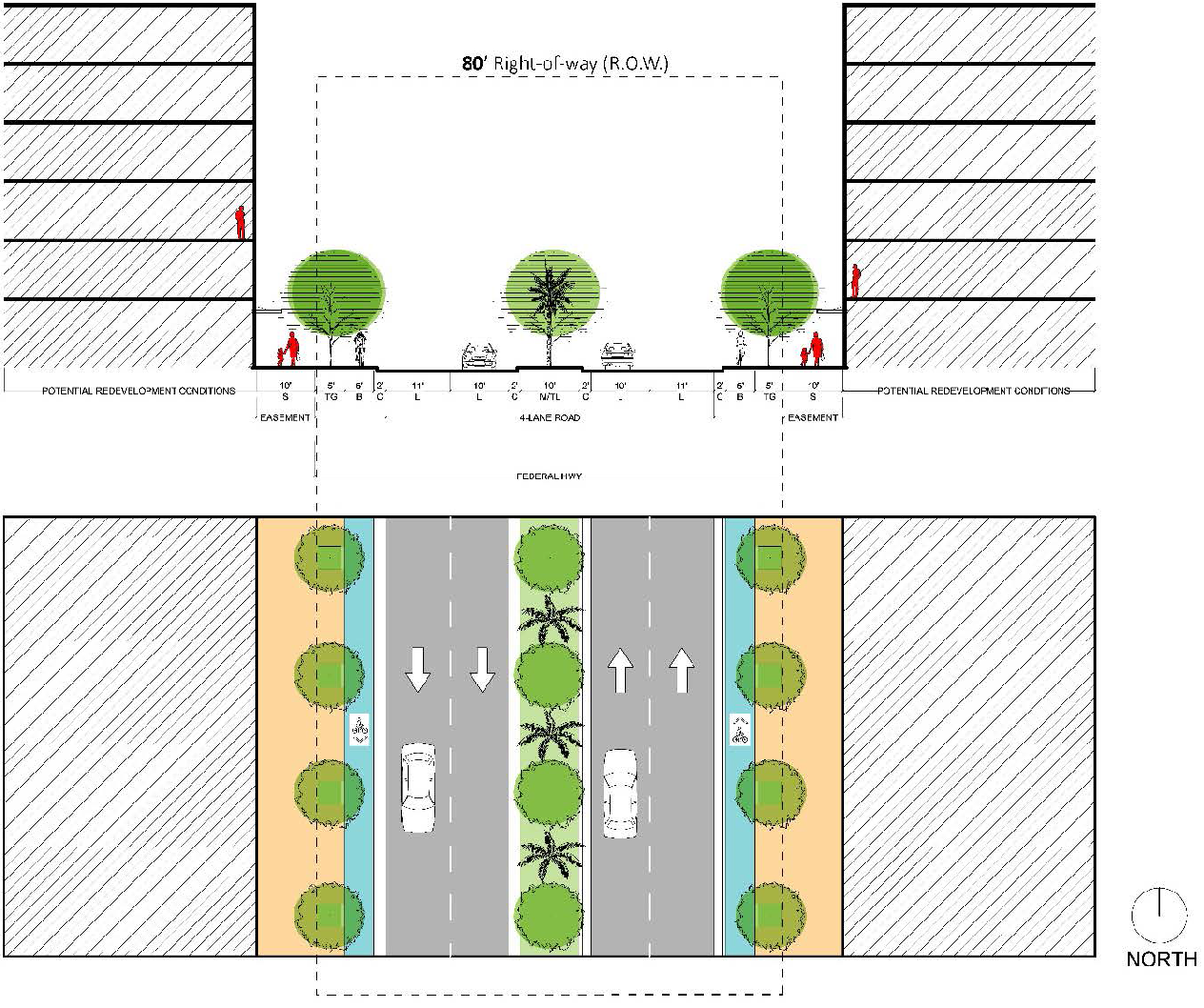
Figure 78-84(f)(1): Federal Highway Street Design
b.
Park Avenue street design. As demonstrated in Figure 78-84(f)(2) below:
i.
The roadway shall be a designated greenway.
ii.
A landscaped median, a minimum of ten feet wide, shall be provided.
iii.
Travel lanes shall be narrowed to a maximum of ten feet wide.
iv.
The number of travel lanes shall be reduced to one in each direction.
v.
A shared path, a minimum of 11 feet wide shall be provided on both sides to accommodate a sidewalk and bicycle path.
vi.
A landscape strip a minimum of ten feet wide shall be provided on both sides between the sidewalk and the street edge to accommodate the required street trees.
vii.
As redevelopment occurs:
(A)
On both sides of the street there shall be a minimum setback of ten feet.
(B)
A minimum of 80 percent of the area within the setback shall be landscaped.
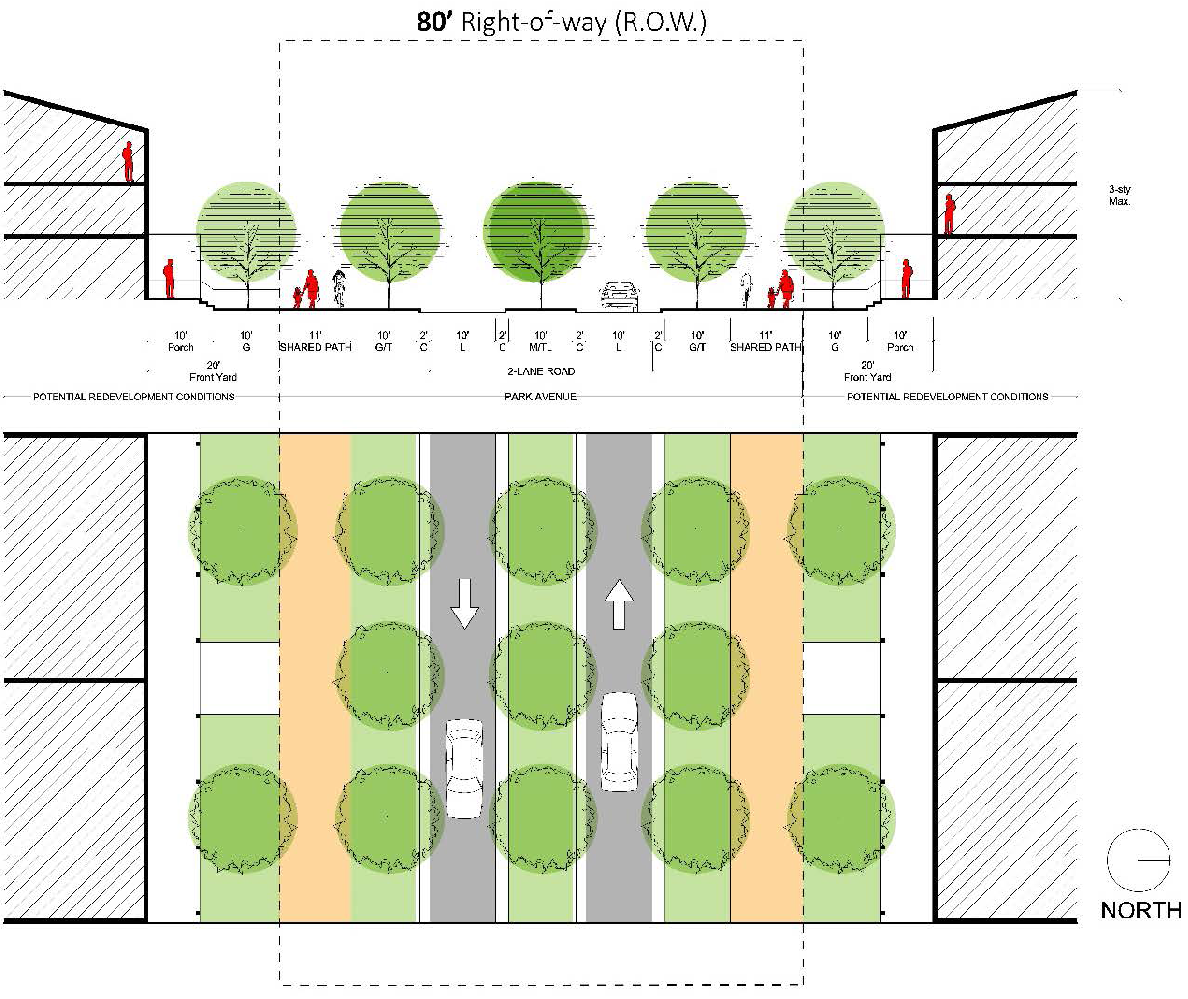
Figure 78-84(f)(2): Park Avenue Street Design
c.
2ndStreet street design. As demonstrated in Figure 78-84(f)(3) below:
i.
New curb and gutter (both sides), may be provided.
ii.
Travel lanes shall be narrowed to a maximum of ten feet wide.
iii.
A shared path a minimum of ten feet wide shall be provided on both sides to accommodate a sidewalk and bike path.
iv.
A landscape strip a minimum of eight feet wide shall be provided on both sides between the sidewalk and the street edge to accommodate the required street trees.
v.
As redevelopment occurs on the east side:
(A)
There shall be a minimum set back of ten feet for a front yard.
(B)
Buildings shall front 2 nd Street.
(C)
A minimum of 80 percent of the area within the setback shall be landscaped.
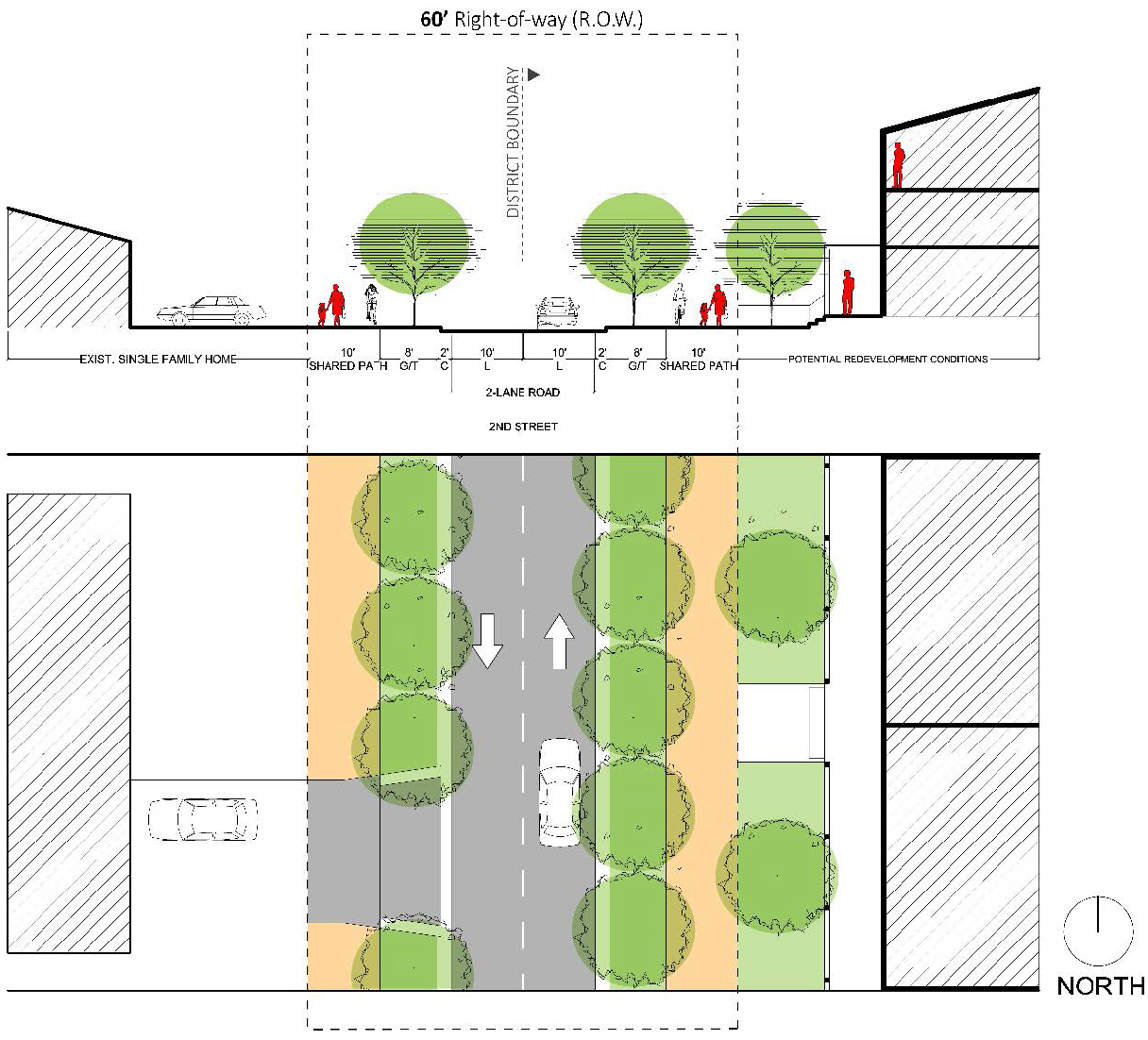
Figure 78-84(f)(3): 2ndStreet Street Design
d.
Lake Shore Drive (South of Date Palm Drive) street design. As demonstrated in Figure 78-84(f)(4) below:
i.
The landscape median shall be removed.
ii.
Travel lanes shall be narrowed to a maximum of ten feet wide.
iii.
Parallel parking shall be provided on both sides.
iv.
Tree surrounds a minimum dimension of five feet by five feet shall be provided on both sides along the street edge to accommodate the required street trees.
v.
A bike lane a minimum of five feet wide shall be established on both sides of the street between the tree surrounds and the sidewalk at sidewalk level.
vi.
As redevelopment occurs:
(A)
On the west side, there shall be a minimum setback and easement of ten feet for the expansion of the sidewalk. A minimum of 80 percent of the area within the setback shall be hardscaped.
(B)
On the east side, there shall be a waterfront promenade a minimum of 11 feet wide.
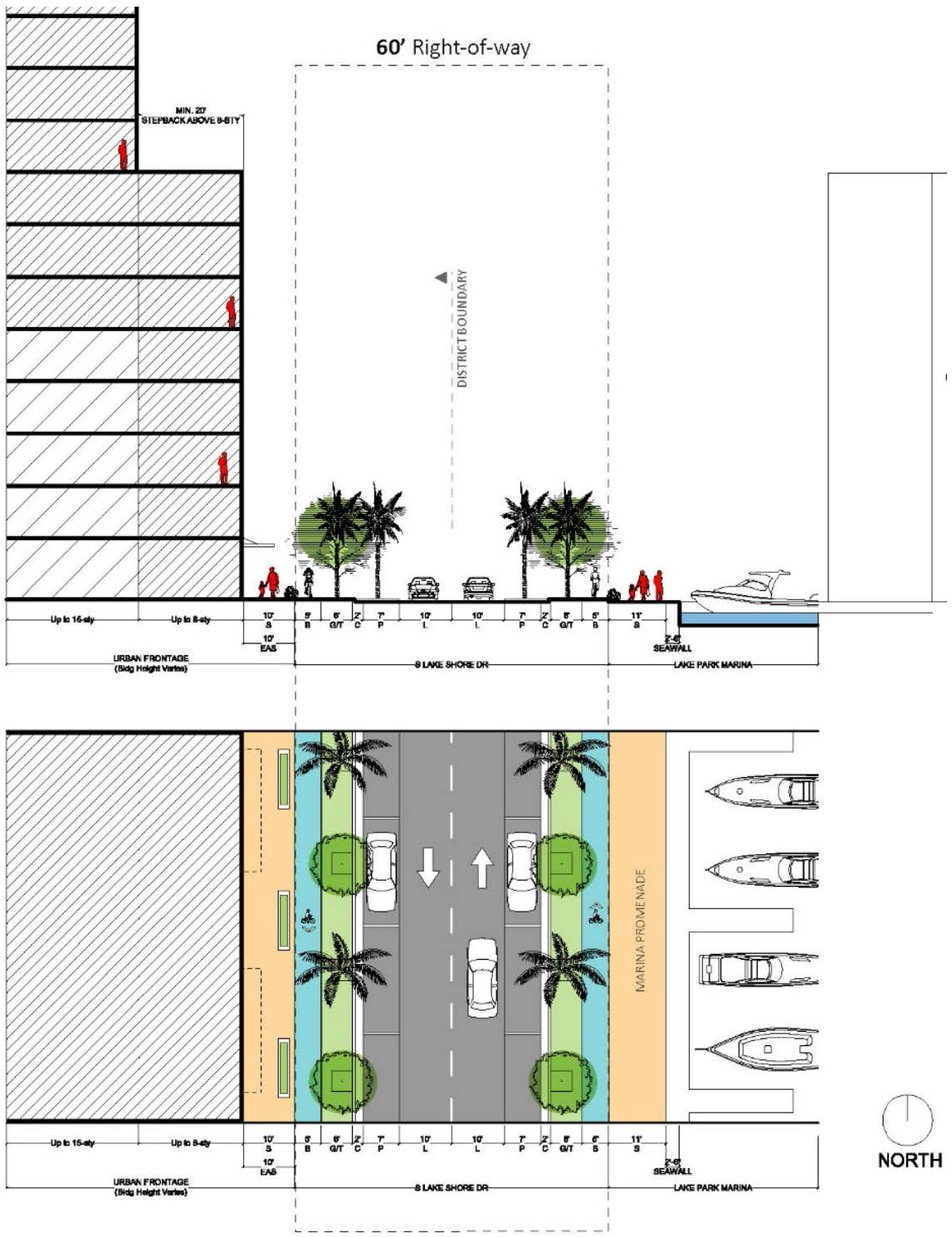
Figure 78-84(f)(4): Lake Shore Drive (South of Date Palm Drive) Street Design
e.
Lake Shore Drive (North of the Lake Park Harbor Marina) street design. As demonstrated in Figure 78-84(f)(5) below:
i.
Travel lanes shall be narrowed to a maximum of ten feet wide.
ii.
Parallel parking shall be provided on the west side.
iii.
A landscape strip a minimum of five feet wide shall be provided on the west side and a minimum of six feet six inches on the east side to accommodate the required street trees.
iv.
A bike lane a minimum of five feet shall be established on the west side of the street between the tree surrounds and the sidewalk at sidewalk level.
v.
A shared path a minimum of ten feet wide shall be provided on the east side to accommodate a sidewalk and a bicycle path.
vi.
As redevelopment occurs:
(A)
On the west side, there shall be a minimum setback and easement of ten feet for the expansion of the sidewalk.
(B)
On the west side, between the sidewalk and the bike lane, there shall be a landscape buffer a minimum of four feet six inches wide.
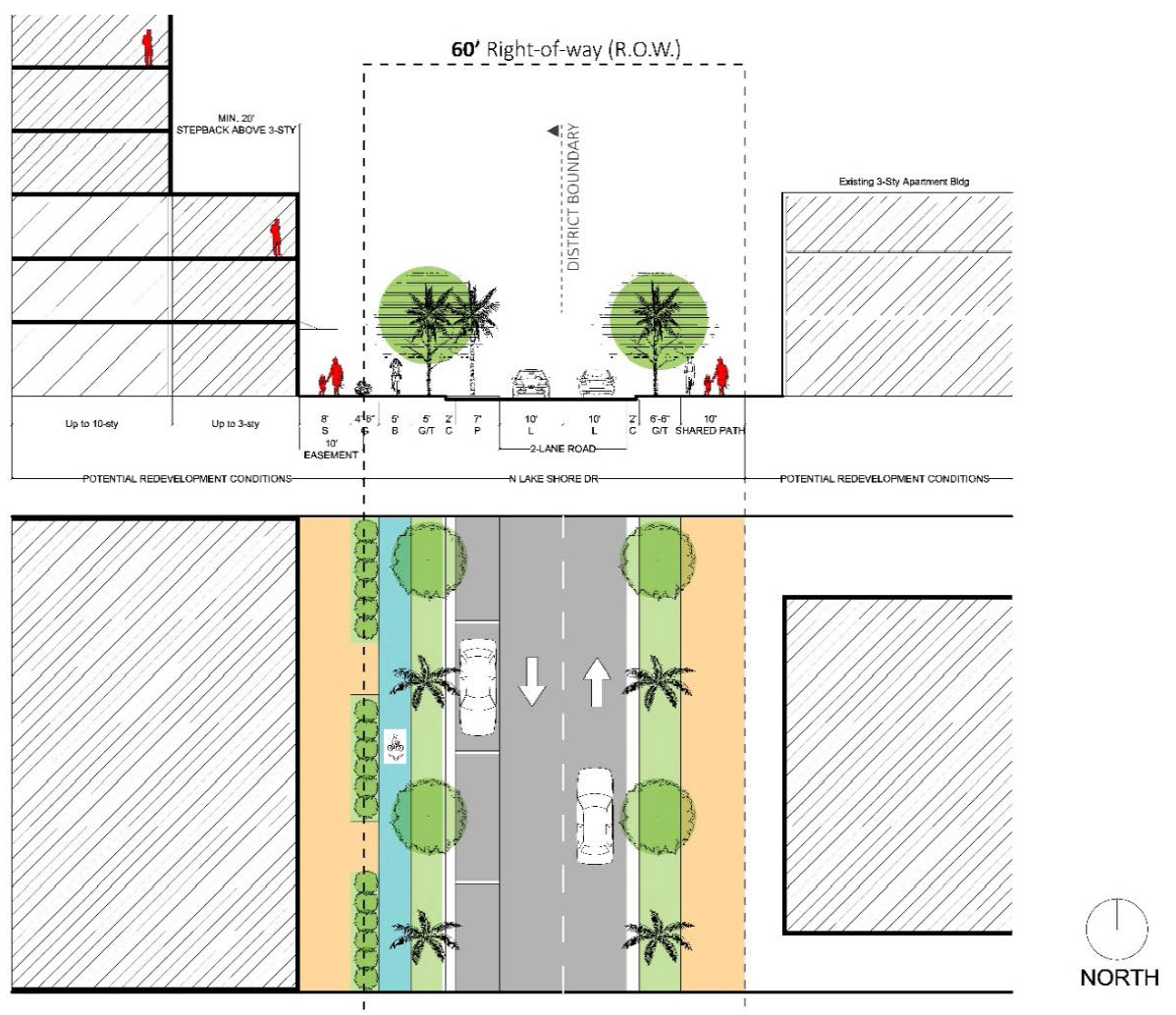
Figure 78-84(f)(5): Lake Shore Drive (North of the Lake Park Harbor Marina) Street
Design
f.
Secondary/greenway streets with no parking street design. As demonstrated in Figure 78-84(f)(6) below:
i.
The roadway shall be a designated greenway.
ii.
Travel lanes shall be narrowed to a maximum of ten feet wide.
iii.
A landscape strip a minimum of five feet wide or tree surrounds a minimum dimension of five feet by five feet shall be provided on both sides along the street edge to accommodate the required street trees.
iv.
A bike lane a minimum of five feet shall be established on both sides of the street between the landscape strip or tree surrounds and the sidewalk at sidewalk level.
v.
As redevelopment occurs:
(A)
There shall be a minimum setback of ten feet on both sides for the expansion of the sidewalk to an overall width of 18 feet.
(B)
East of Federal Highway, 100 percent of the area within the setback (easement) shall be hard surfaced.
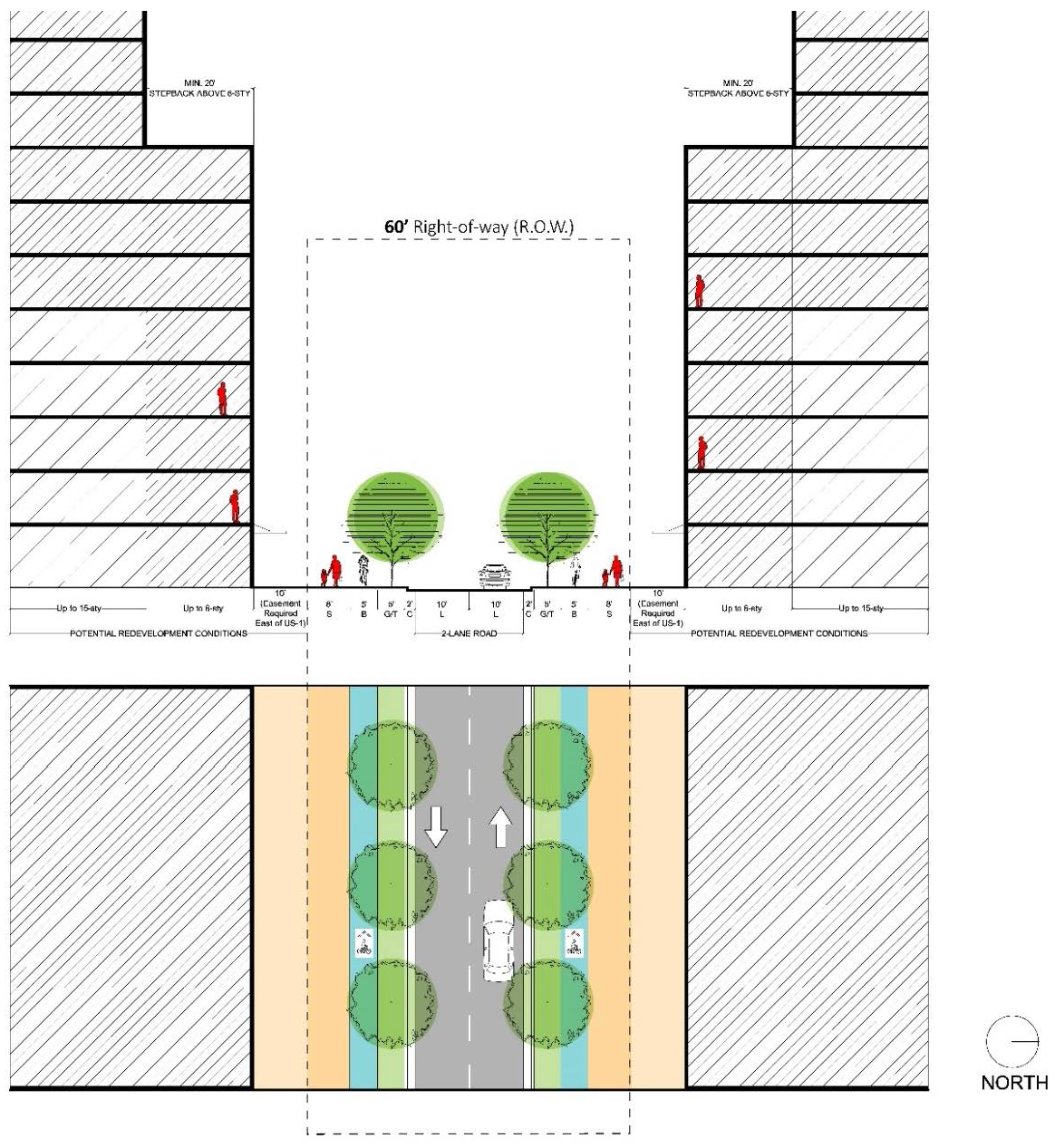
Figure 78-84(f)(6): Secondary/Greenway Streets with No Parking Street Design
g.
Secondary/greenway streets with parking street design. As demonstrated in 78-84(f)(7) below:
i.
The roadway shall be a designated greenway.
ii.
Travel lanes shall be narrowed to a maximum of ten feet wide.
iii.
A landscape strip a minimum of six feet wide or tree surrounds a minimum dimension of six feet by six feet shall be provided on both sides along the street edge to accommodate the required street trees.
iv.
A bike lane a minimum of five feet shall be established on both sides of the street between the landscape strip or tree surrounds and the sidewalk at sidewalk level.
v.
As redevelopment occurs:
(A)
There shall be a minimum setback and easement of ten feet on both sides for the expansion of the sidewalk.
(B)
One hundred percent of the area within the setback (easement) shall be hard surfaced.
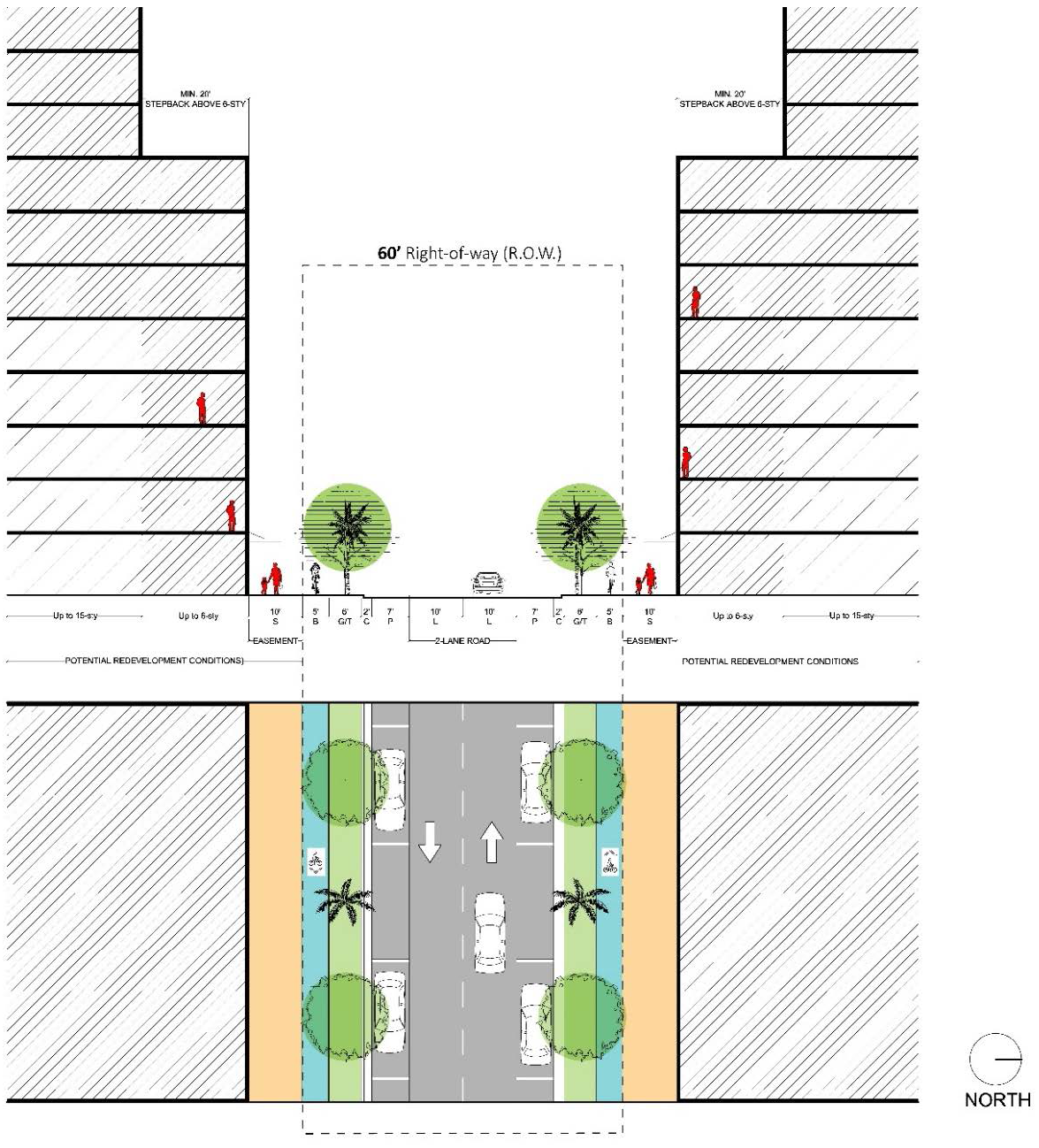
Figure 78-84(f)(7): Secondary/Greenway Streets with Parking Street Design
h.
Tertiary streets with no parking street design. As demonstrated in Figure 78-84(f)(8) below:
i.
Travel lanes shall be narrowed to a maximum of ten feet wide.
ii.
A landscape strip a minimum of 13 feet wide on both sides shall be required along the street edge.
iii.
A sidewalk a minimum of five feet shall be required on both sides.
iv.
As redevelopment occurs:
(A)
There shall be a minimum setback of ten feet on both sides for the expansion of the sidewalk.
(B)
East of Federal Highway, 100 percent of the area within the setback (easement) shall be hard surfaced.
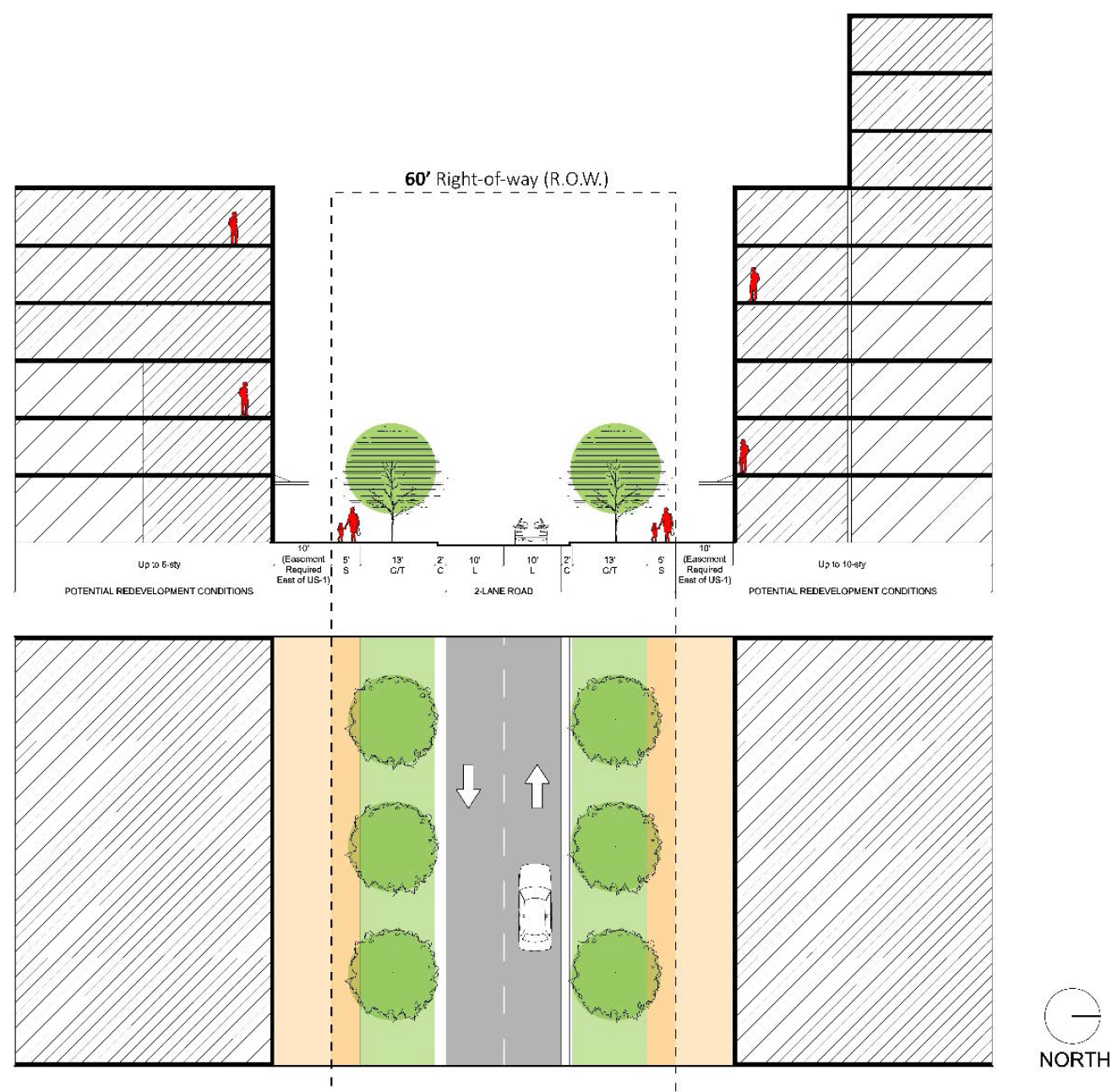
Figure 78-84(f)(8): Tertiary Streets with No Parking Street Design
i.
Tertiary streets with parking, both sides street design. As demonstrated in Figure 78-84(f)(9) below:
i.
Travel lanes shall be narrowed to a maximum of ten feet wide.
ii.
Parking shall be provided on both sides.
iii.
A landscape strip a minimum of six feet wide on both sides shall be required along the street edge.
iv.
A sidewalk a minimum of five feet shall be required on both sides.
v.
As redevelopment occurs:
(A)
There shall be a minimum setback of ten feet on both sides for the expansion of the sidewalk.
(B)
East of Federal Highway, 100 percent of the area within the setback (easement) shall be hard surfaced.
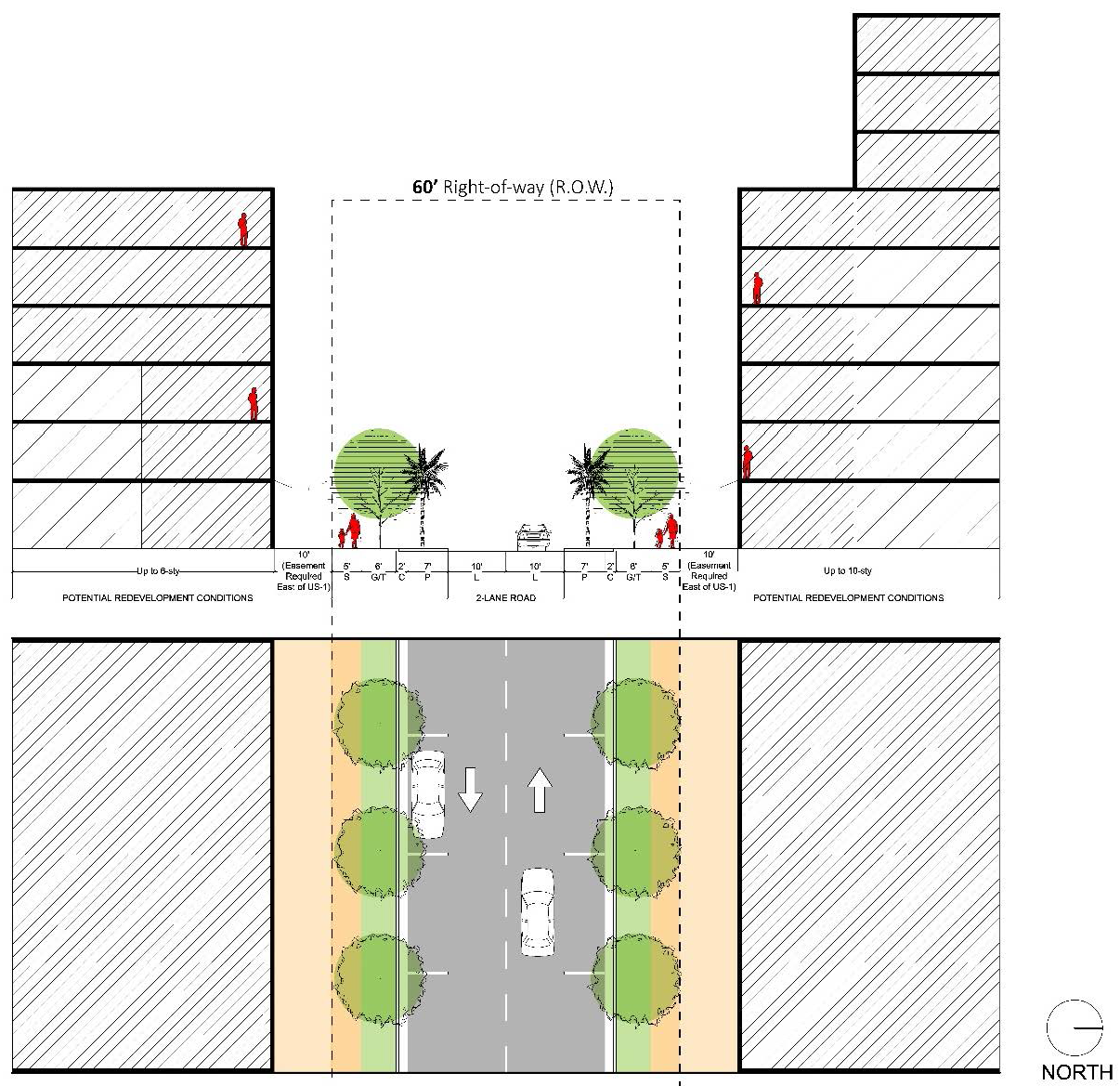
Figure 78-84(f)(9): Tertiary Streets with Parking, Both Sides Street Design
j.
Tertiary streets with parking, one side street design. As demonstrated in Figure 78-84(f)(10) below:
i.
Travel lanes shall be narrowed to a maximum of ten feet wide.
ii.
Parking shall be provided on one sides.
iii.
A landscape strip a minimum of 13 feet wide on one side and six feet on the other side shall be required along the street edge.
iv.
A sidewalk a minimum of five feet shall be required on both sides.
v.
As redevelopment occurs:
(A)
There shall be a minimum setback of ten feet on both sides for the expansion of the sidewalk.
(B)
East of Federal Highway, 100 percent of the area within the setback (easement) shall be hard surfaced.
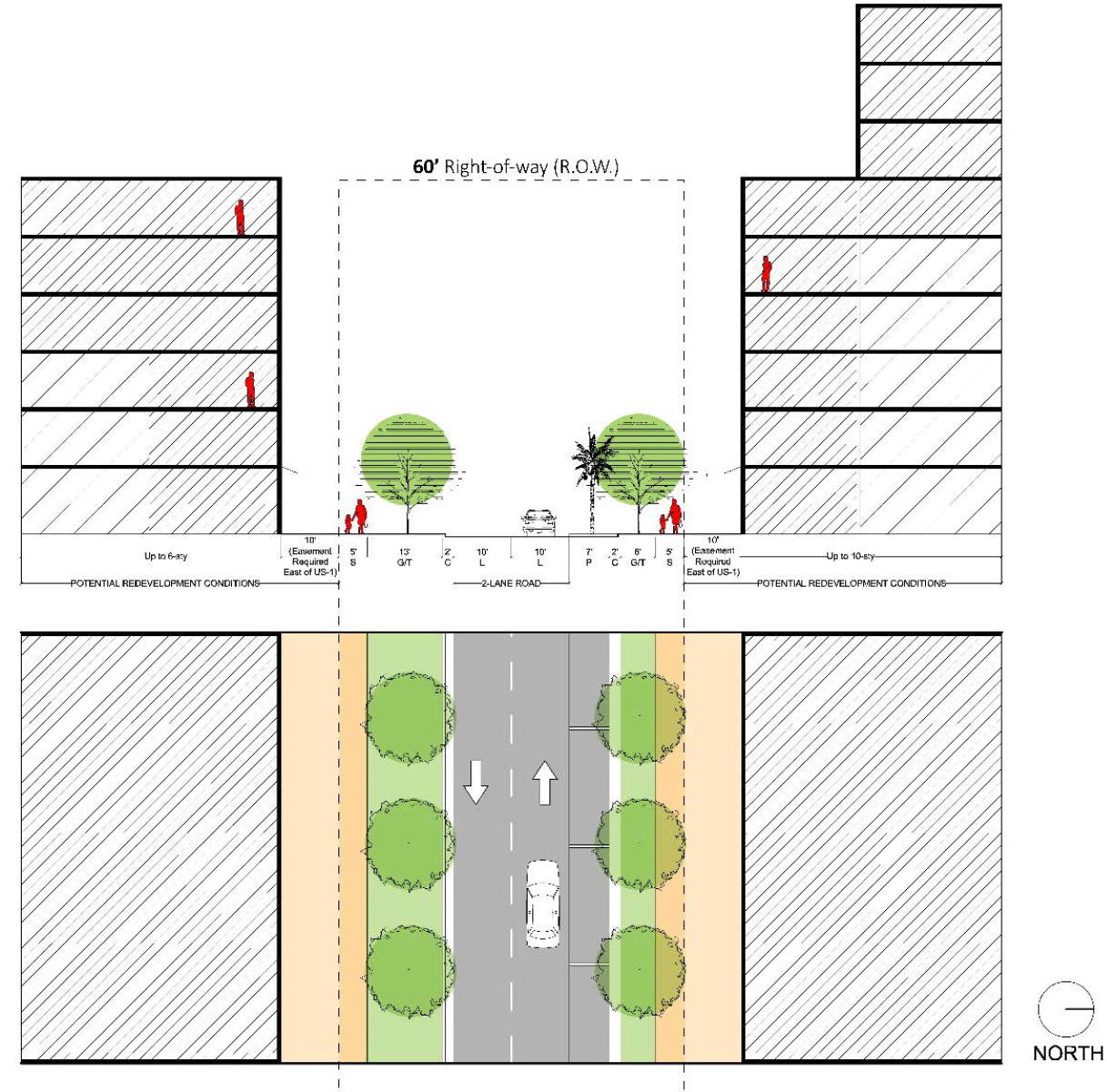
Figure 78-84(f)(10): Tertiary Streets with Parking, One Side Street Design
(g)
Block requirements. The following standards for blocks shall apply to property with a minimum area of 3.3 acres (140,625 sq. ft.):
(1)
On the east side of Federal Highway (north of Jasmine Drive and south of Cypress Drive), the maximum length of a block shall be 375 feet. The maximum perimeter shall be 1,500 feet.
(2)
On the west side of Federal Highway and the east side of Federal Highway (between Jasmine Drive and Cypress Drive), the maximum length and perimeter of a block shall be as established prior to the adoption of this ordinance.
(3)
The community development director or his/her designee shall have the authority to adjust administratively the requirements for maximum block length and/or perimeter for up to ten percent of the required measurement.
(h)
The designated publicly accessible open space and greenway system regulating plan. The designated publicly accessible open space and greenway system regulating plan is intended to designate the approximate location of the existing public open spaces around the district and the new designated publicly accessible open spaces and greenway system which shall be shown in all development plans. The designated publicly accessible open space and greenway system regulating plan is found in Appendix A of this code section as Figure 3. Standards for open spaces and greenway systems are found in subsection (j) of the MU district (section 78-83).
(i)
The building heights regulating plan. The building heights regulating plan is intended to delineate the areas where different types of development intensities are permitted in order to establish compatibility with the single-family neighborhoods. The building heights regulating plan is found in Appendix A of this code section as Figure 4.
(1)
Building height designations. All new and existing development shall comply with the building height standards found within the building heights regulating plan. When one property or parcel is regulated by two different height standards, the building heights regulating plan shall be referred to for the depth of each building height zone. In addition, the following shall apply:
a.
Space for commercial uses on the ground floor of all nonresidential and mixed-use buildings shall be a minimum of 12 feet in height; and
b.
Buildings higher than six stories shall be developed according to the tower building type standards.
c.
The community development director or his/her designee shall have the authority to adjust administratively the requirements for maximum building height for up to ten percent of the required total height, for properties seeking taller ground floor and top floor building levels.
(2)
Height bonuses. Properties south of Hawthorne Drive within the Core Sub-Area only are eligible for a height bonus. Height bonuses shall be granted in accordance with Figure 78-84.Appendix-A.4, Building Heights Regulating Plan and the Height Bonus in the Core Sub-Area Table found on the regulating plan. In no case shall a development be permitted to utilize a height bonus option more than once, however, any combination of options shall be permitted. In no case shall a property be permitted to exceed the maximum height permitted according the building heights regulating plan, except in accordance with section 78-84(i)(1)c. above.
(j)
Building placement regulating diagrams and modified dimensional standards.
(1)
Building typology. All new buildings shall conform to one of the permitted building typologies. The building typologies are demonstrated in the building placement regulating diagrams of the MU district, found in Appendix A of that code section. Building placement regulating diagrams provide a schematic representation of the various building typologies, permitted per the sub-area regulating plan. The diagrams demonstrate the required setbacks, lot standards, and profiles of structures. Not all building typologies are permitted in every sub-area of the FHMUDO. (For instance, the tower and liner building typologies are considered the most intense and are not permitted in the edge sub-area.) Existing buildings that do not fit a prescribed typology shall follow the standards required for the flex building typology. The building typologies permitted in the FHMUDO and their allowable sub-area locations are provided on the sub-areas regulating plan found in Appendix A, Figure 1 of this code section.
(2)
Setbacks and building frontage. The interior side and rear side setback standards specified on the building typology and placement regulating diagrams found in Appendix A of the MU (section 78-83.Appendix-A) shall apply. In addition, the following shall also apply in the FHMUDO:
a.
The minimum and maximum front and street side setbacks and the minimum percentage of building frontage required is based on the street type designation as shown on the street network connectivity regulating plan found in Appendix A, Figure 2 of this code section.
i.
All buildings shall provide building frontage within the minimum and maximum setback dimension per street frontage.
ii.
All buildings shall provide a minimum percentage of active use within front and street side building frontages.
(A)
Building facades along alley/service drives shall not be required to provide a minimum percentage of building frontage or active use.
iii.
The community development director or his/her designee shall have the authority to adjust administratively the requirements for building frontage minimum and minimum front and street side setback for up to 20 percent of the required measurement.
iv.
Developments with frontages along Silver Beach Road east of Federal Highway, the south side of proposed Bayberry Road new tertiary street, and Lake Shore Drive south of proposed Bayberry Road new tertiary street may not be required to provide building frontage and active use along those frontages in order to accommodate structured parking for the Marina and the development, at the discretion of the community development director.
(3)
Lot standards. Lot standards, including but not limited to lot width and lot coverage, are determined based on the selected building typology. The lot standards specified on the building typology and placement regulating diagrams found in Appendix A of the MU (section 78-83.Appendix-A) shall apply.
(4)
Minimum unit sizes for residential development.
(k)
Reduced and/or modified off-street parking standards.
(1)
All developments shall follow the section 78-83(h)(2)d.: Modified Off-Street Parking Requirements unless specified below.
(2)
Select uses are eligible for reduced parking.
a.
Selected off-street parking reductions for restaurants.
i.
Properties with an existing building that adaptively reuse the structures interior, while maintaining the facade and scale of the exterior, shall not be required to provide additional off-street parking spaces.
(3)
Structures with parking garages within identified development parcels in the Core Sub-Area of the Federal Highway Mixed Use District Overlay, east of Federal Highway, are entitled to an exception to the maximum height established for the Core Sub-Area to accommodate the parking of vehicles within the structure. The parking garage shall not be considered as part of the measurement of the total height of a building, provided that: (a) the developer contributes funds to the Federal Highway Mixed-Use District Public Improvement Fund in accordance with section 78-84(l) proportionate to the overall construction value; and (b) at least ten percent of the total number of required parking spaces in the parking garage are designated as free public parking. The free public parking spaces shall be identified as free public parking by signage. The parking garage shall be equipped with camera surveillance of the public parking areas; (c) the parking garage shall be developed with an active use liner on the Federal Highway and Lake Shore Drive frontages of the building.
(4)
Structures within identified development parcels in the Core Sub-Area of the Federal Highway Mixed Use District Overlay, south of Cypress Drive, are entitled to an exemption of up to five stories, or 55 feet.
(5)
Structures within the development parcels in the other Core Sub-Areas of the Federal Highway Mixed Use District Overlay, north of Cypress Drive are entitled to an exemption cap of three stories, or 33 feet.
(l)
Federal Highway mixed use district public improvement fund.
(1)
Public improvement bonus assessment.
a.
Developments utilizing the public improvement height bonus in accordance with section 78-84(i)(2) must contribute a public improvement assessment based on a fee, or provide a public improvement, equal to one percent of the project's construction cost.
b.
The amount of the public improvement bonus assessment may be modified by resolution of the town commission.
(2)
Public improvement fund.
a.
A separate public improvement fund shall be identified or established by the town. All public improvement height bonus assessment payments from new development within the Federal Highway mixed use district shall be deposited into this fund and the funds shall be kept separate from any other town funds. The fund shall be used by the town for the improvement of any public amenity or use within the FHMUDO or as identified on any of the FHMUDO regulating plans found in Appendix A of this code section. Use of such funds shall be determined by the town commission and be for, but not limited to, the following:
i.
Historic preservation and adaptive reuse.
ii.
Park improvements and activation.
iii.
Streetscape improvements.
iv.
Transit and commuter programs.
v.
Landscape improvements.
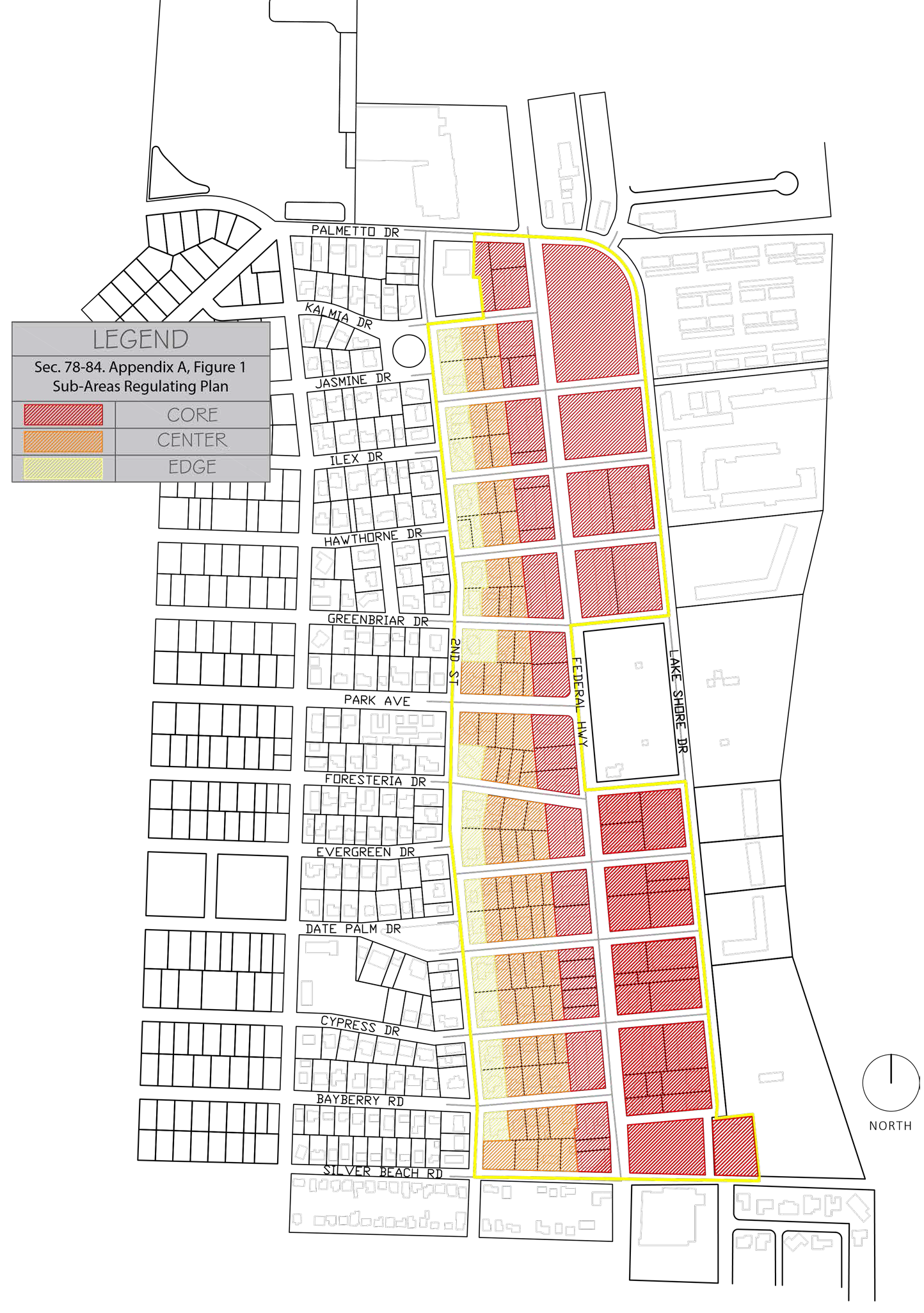
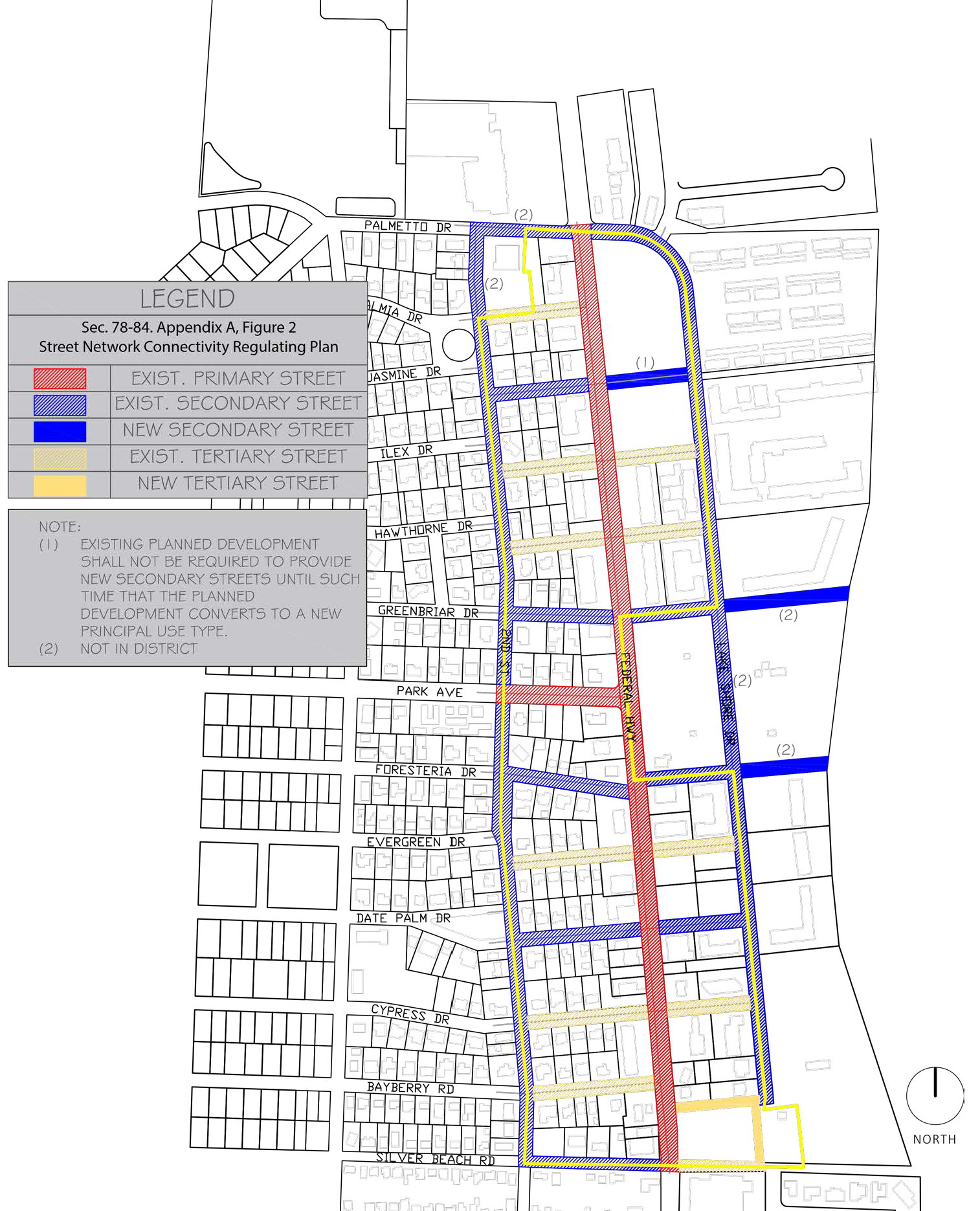
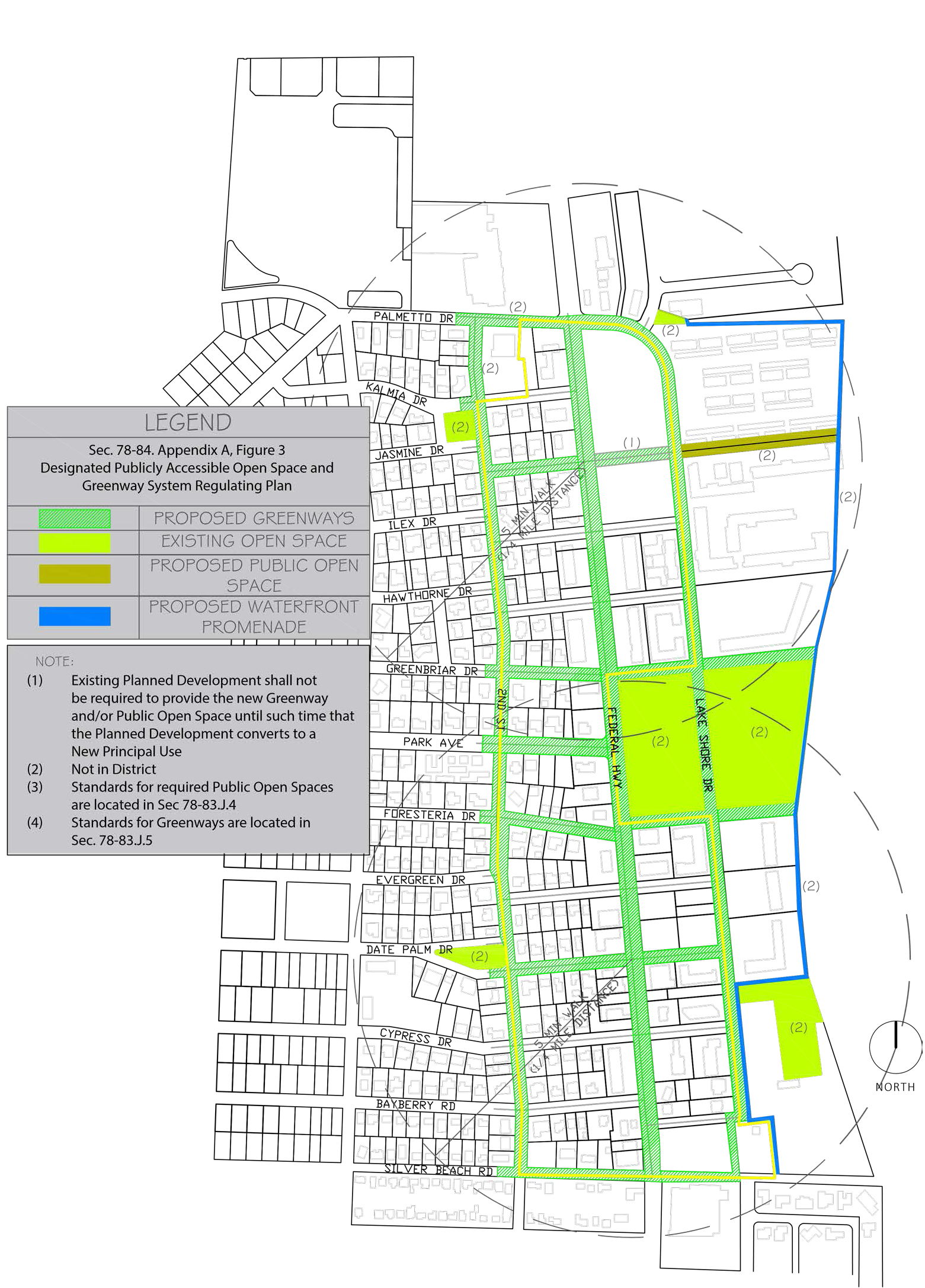
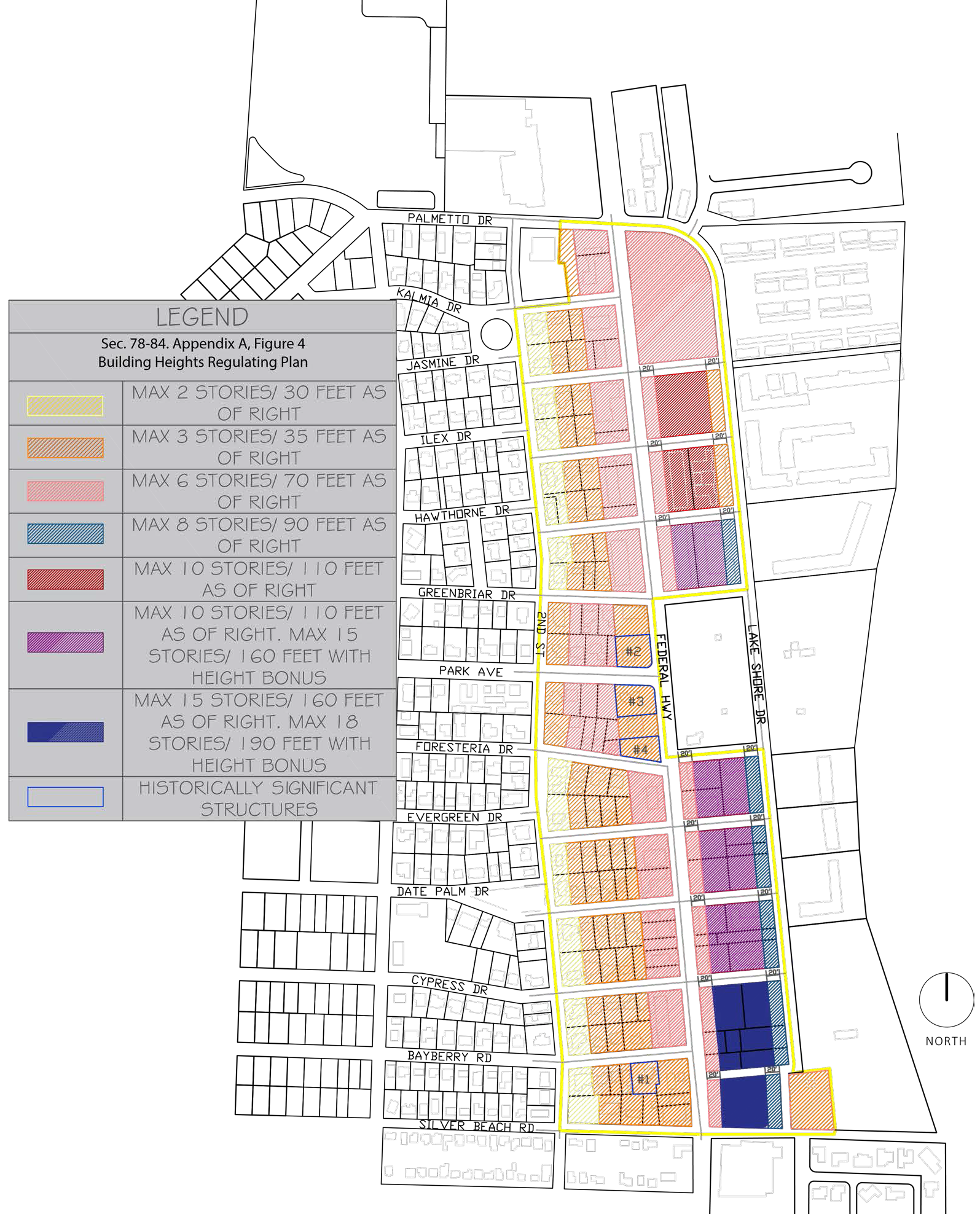
(Ord. No. 04-2018, § 4(Exh. B), 4-18-2018; Ord. No. 13-2019, § 3, 11-20-2019)

