
Lake Park City Zoning Code
APPENDIX A
DESIGN GUIDELINES
ARTICLE I. - NORTHLAKE BOULEVARD OVERLAY ZONING DISTRICT (NBOZ)[9]
Editor's note— At the direction of the city, Exhibit A of Ord. No. 02-2006, adopted July 5, 2006, and as referenced in § 78-81, has been included as Article I of this appendix.
Sec. 1-1. - Purpose and intent.
A.
Purpose and intent. The purpose and intent of the Northlake Boulevard Overlay Zoning District (NBOZ) is to implement the objectives of the Northlake Boulevard Corridor Conceptual Streetscape Plan adopted by the Northlake Boulevard Corridor Task Force. These objectives include:
1.
Redevelopment of the corridor in order to build community pride, retain and attract commercial activity, and improve the area's economic condition.
2.
Reinforcement of the unique opportunities and long-term stability of the corridor by the implementation of urban design guidelines for future development.
3.
Improvement of signage along the corridor.
4.
Initiation of design improvements for the community through the implementation of the proposed design guidelines.
5.
Development of a unifying community design and development theme to work in conjunction with the proposed corridor streetscaping.
6.
Preparation of development regulations to enable refurbishment of properties within the corridor.
7.
Creation of the opportunity for new development to respect existing scale, style, and character, while preserving the positive aspects of the corridor.
(Ord. No. 02-2006, Exh. A, 7-5-2006)
Sec. 1-2. - Scope.
A.
Boundaries. The NBOZ includes the public right-of-way for Northlake Boulevard and all properties along Northlake Boulevard from Military Trail to U.S. Highway 1 for one property depth north and south of Northlake Boulevard, including the street intersection properties at U.S. Highway One and at Military Trail. The NBOZ encompasses approximately three and one-third (3.3) miles.
1.
Lake Park. Incorporated portions of the Northlake Boulevard corridor include portions of Section 20, Township 42, Range 43; Section 21, Township 42, Range 43; Section 17, Township 42, Range 42; and Section 19, Township 42, Range 43 as indicated on the Official Zoning Map.
2.
North Palm Beach. Incorporated portions of the Northlake Boulevard corridor include portions of Section 16, Township 42, Range 43; Section 21, Township 42, Range 43; and Section 17, Township 42, Range 43 as indicated on the Official Zoning Map.
3.
Palm Beach County. Unincorporated portions of the Northlake Boulevard corridor include portions of Section 18, Township 42, Range 43; Section 17, Township 42, Range 43; Section 24, Township 42, Range 42; and Section 19, Township 42, Range 43 as indicated on the Official Zoning Map
4.
Palm Beach Gardens. Incorporated portions of the Northlake Boulevard corridor include portions of Section 18, Township 42, Range 43; Section 13, Township 42, Range 42; Section 24, Township 42, Range 42; and Section 19, Township 42, Range 43 as indicated on the Official Zoning Map.
B.
Districts. Because Northlake Boulevard was developed at different times and under varying jurisdictions, the commercial intensity, layout and physical characteristics of the structures differ from one area to the next. Therefore, the overlay has been divided into three districts, which reflect these differences. The east, west and central districts were created to regulate the type of uses permitted in each district. The east and west districts are neighborhood serving, while the central district services the region. The physical boundaries of these districts are as follows:
1.
West: From Military Trail to Interstate 95.
2.
Central: From Interstate 95 to Alternate A1A (north side) and Prosperity Farms Road (south side).
3.
East: From Alternate A1A (north side) and Prosperity Farms Road (south side) to U.S. Highway 1.
C.
Minimum requirements. The following provisions of the NBOZ district are the minimum requirements necessary to accomplish the purposes of the NBOZ and implement and ensure consistency with the comprehensive plan. Development shall not be undertaken without prior authorization pursuant to the NBOZ.
(Ord. No. 02-2006, Exh. A, 7-5-2006)
Sec. 1-3. - Applicability.
A.
Applicability. The provisions of the NBOZ district shall apply to all existing and future development within the boundaries of the NBOZ district as follows:
1.
All new development.
2.
All renovations, additions, or redevelopment to existing structures where the cost of such is greater than 50 percent of the assessed improvement value of the parcel, indicated on the most recent tax roll of Palm Beach County Property Appraiser, or an increase of greater than 20 percent of the square footage of the existing structure shall conform to 100 percent of the NBOZ Regulations.
3.
When the use of an existing structure ceases for 180 consecutive days, or as otherwise determined to be a discontinued or abandoned use by the local zoning code.
B.
Invalid approvals. Invalid development orders or permits of projects, which have been revoked or have expired shall be subject to all applicable provisions of the NBOZ.
C.
Conflict with other applicable regulations.
1.
When the provisions of the NBOZ district conflict with other jurisdictional regulations applicable to the site, the most restrictive provisions shall prevail.
2.
Provisions addressed within the individual jurisdiction regulations that are not addressed within the NBOZ district remain applicable in the development or redevelopment of a site in the NBOZ.
(Ord. No. 02-2006, Exh. A, 7-5-2006)
Sec. 1-4. - Procedure and regulations.
A.
Submittal procedure. Development or redevelopment within the corridor shall adhere to the regulations imposed by the NBOZ district. Compliance with the standards of the NBOZ shall be demonstrated by submittal of architectural drawings and a site development plan or site improvement plan in accordance with the governing jurisdiction. The development order shall reflect the restrictions imposed by the NBOZ.
B.
Use regulations. Restrictions which may be imposed in the NBOZ district shall be limited to the following:
1.
Reducing the number of land uses permitted by right and permitted by conditional use within the NBOZ;
2.
Eliminating inappropriate land use within the NBOZ ;
3.
Limiting maximum building or impervious coverage permitted;
4.
Management of access to abutting and nearby roadways, including specific design features intended to reduce adverse traffic impacts; or
5.
Any other specific site development regulations required or authorized by these provisions.
C.
Review procedures. Unless otherwise stated within these provisions, the review procedures for development and redevelopment of applicable sites within the NBOZ district shall be pursuant to the governing jurisdiction's review procedures and approval process.
D.
Waivers and variances. Waivers and variances from the NBOZ regulations may be granted by the individual jurisdiction reviewing projects which are subject to the NBOZ regulations.
1.
Waivers from the NBOZ regulations may be granted by the applicable reviewing jurisdiction in accordance with the applicable jurisdiction's procedures for granting waivers from its own code.
2.
Variances may be granted by the applicable reviewing jurisdiction using the same procedures, which the applicable jurisdiction uses in granting variances from its own code.
(Ord. No. 02-2006, Exh. A, 7-5-2006)
Sec. 2-1. - Development review regulations.
A.
Conditional use and special permit use. Conditional use and special permit use are generally compatible with the other uses permitted in the district, but which require individual review as to their location, design, configuration, intensity and/or density of use, buildings and structures, and may require the imposition of conditions in order to ensure the appropriateness of the use at a particular location. The supplemental regulations outlined in section 2-3 of this article are to be considered in addition to the existing jurisdiction standards, however the most restrictive regulations apply. These uses may be approved, approved with conditions, or denied after review by the appropriate reviewing agency or board, in accord with the procedures, standards, and limitations of the applicable codes. Special permit uses are generally temporary for a specified fixed period of time.
B.
Prohibited uses. Uses not listed in the use chart are prohibited unless it is determined by the jurisdiction in accordance with the customary procedures utilized by the jurisdiction that the requested use is similar in nature to a listed use and not contrary to the intent of the NBOZ.
C.
Existing planned development districts. Properties within the jurisdiction of the municipalities, which have a PUD or PCD designation at the time of adoption of the NBOZ, shall be permitted to have uses and design guidelines in accordance with the development order for that planned development district so long as the development order is in affect. Any amendment to the PUD will have to comply with the design guidelines of the NBOZ.
D.
Variances. A variance from the supplementary use standards established in this article shall not be granted by the affected jurisdiction.
E.
Accessory use. An accessory use is customarily associated with the principal use, incidental to the principal use, and subordinate in area, extent or purpose, and serves only the principal use. Accessory uses shall be subject to the following:
1.
All accessory uses shall be located on the same lot as the principal use.
2.
A use that is an accessory to a nonresidential principal use shall not exceed 30 percent of the floor area or business receipts of the principal use.
F.
Parking and loading. All parking and loading standards are governed by the appropriate jurisdiction.
G.
Measuring distances. All required distances between structures and/or uses within this article shall be measured and determined irrespective of existing municipal boundaries.
(Ord. No. 02-2006, Exh. A, 7-5-2006)
Sec. 2-2. - Land use chart.
(Reserved for future use.)
(Ord. No. 02-2006, Exh. A, 7-5-2006)
Sec. 2-3. - Use definitions and supplemental regulations.
(1)
Adult entertainment shall have the definition ascribed to it by the jurisdiction in which it is located and shall be regulated by the jurisdiction.
(2)
Automotive service station means an establishment engaged in the retail sale of gasoline or other motor fuels, which may include accessory activities such as the sale of automotive accessories or supplies, the lubrication of motor vehicles, the minor adjustment or minor repair of motor vehicles. An automotive service station shall be subject to the following supplementary use standards:
a.
Bay doors shall not be oriented toward residential zoning districts. If oriented to a public right-of-way, bay doors must be completely and permanently screened from the right-of-way by a building, opaque masonry wall or similar fixed structures.
b.
All repair work shall occur within an enclosed structure.
c.
There shall be a minimum separation distance of 500 feet from the nearest points of property lines for a parcel developed for use as an automobile service station and a parcel occupied by a church, school or hospital.
d.
There shall be no outdoor storage or display of merchandise, use of outdoor speakers, nor vehicular testing on residential streets.
e.
The following accessory uses shall be permitted at an automotive service station:
1.
Convenience store subject to the convenience store regulations.
2.
Automatic car wash subject to the car wash regulations.
(3)
Broadcast studio means an establishment engaged in the provision of commercial broadcasting services accomplished through the use of electronic mechanisms.
(4)
Car wash, automatic, full-service or self-service means a building or area, which provides facilities for washing and cleaning motor vehicles. An automatic, full-service or self-service car wash shall comply with the following supplementary use standards:
a.
In approving a car wash, the reviewing board shall make a finding that the use is appropriately located, considering the following guidelines:
1.
Proper functioning of the site as related to vehicular stacking, circulation, and turning movements.
2.
Adequate buffering from residential areas.
3.
Adequate access, ingress and egress.
b.
The use of outdoor speakers shall be prohibited.
c.
Car washes/detailing shall be located at least 100 feet from any residential district, use, or structure.
d.
Car wash openings must be oriented away from residential zoning districts or public rights-of-way. If oriented to a public right-of-way, bay doors must be completely and permanently screened from the right-of-way by a building, opaque masonry wall or similar fixed structures.
(5)
Church or place of worship means a premises or structure used primarily or exclusively for religious worship and related religious services on a permanent basis by a tax-exempt religious group, sect, or denomination registered as a not-for-profit organization pursuant to Section 501(c)(3) of the United States Internal Revenue Code, as amended. A church or place of worship may include retreat site camp, convent, seminary or similar facilities operated for religious activities. A church or place of worship shall comply with the following supplementary use standards:
a.
Churches or places of worship, which include accessory uses such as a rectory, day care center, school, academy, congregate living facility, community center, or similar accessory facilities shall be subject to approval as a conditional use.
(6)
College/university means an institution of higher learning offering undergraduate or graduate degrees and including the buildings required for educational or support services such as classrooms, laboratories, dormitories, and the like. In approving a university or college, the reviewing board shall make a finding that the use is appropriately located, based on the following guidelines:
a.
Proper functioning of the site as related to parking;
b.
Adequate buffering from residential areas; and
c.
Adequate access, ingress and egress.
(7)
Commercial recreation, indoor means an establishment offering entertainment or games of skill to the general public for a fee or charge and wholly enclosed in the building. Typical uses include bingo parlors, pool halls, indoor swimming pools, billiard parlors and video game arcades, but excluding gun clubs.
(8)
Commercial recreation, outdoor means an establishment providing entertainment or games of skill to the general public for a fee or charge where any portion of the activity takes place in the open, excluding golf courses and public parks. Typical uses include: archery ranges, athletic fields, batting cages, golf driving ranges, miniature golf, swimming pools, and tennis courts. An outdoor commercial recreation use shall be subject to the following supplementary use standards:
a.
An outdoor commercial recreation facility shall not be located within 500 feet of an existing residential district, use or structure.
b.
Access to such facilities shall be from an arterial or major collector road.
c.
The reviewing board may require additional buffers, safety fences or walls, or limitation on hours of operation in order to protect neighboring property and residential activity. In approving a conditional use for an outdoor commercial recreation use, the reviewing board shall make a finding that the use is appropriately located such that neighboring property is protected from potential loss of use, noise or other diminution of land value.
(9)
Convenience store means an establishment not exceeding 3,000 square feet of gross floor area serving a limited marketed area and primarily engaged in the retail sale of food, beverages and other frequently or recurrently needed items for household use. The following accessory uses shall be permitted:
a.
Gasoline sales subject to the use regulations governing automotive service stations; however, automobile repairs, including oil change are prohibited where the convenience store is the principal use.
b.
Automatic car washes subject to the use regulations governing car washes.
(10)
Day care, adult and child means an establishment licensed by the Florida Department of Children and Family Services. An adult or child day care center shall comply with the following supplementary use standards:
a.
A pickup and drop off area shall be provided, as well as a sufficient number of parking spaces for dropoff located outside of the main travel way. Dropoff parking stalls shall be a minimum of 12 feet wide by 20 feet in length. A minimum four-foot wide sidewalk running from the dropoff parking spaces to the daycare entrance shall be provided. The number of parking dropoff spaces shall be determined by the review board, but shall, in no case, be less than two spaces.
b.
In making an approval for an adult or child day care center the jurisdiction shall make a finding that the use is appropriately located, based on the following guidelines:
1.
Proper functioning of the site as related to vehicular stacking, circulation and turning, including pickup and dropoff areas;
2.
Adequate screening and buffering from residential districts, uses and structures; and
3.
Adequate access, ingress and egress.
(11)
Drug store with drive-through means a retail store with a drive-through window, which sells or dispenses drugs, pharmaceuticals, medical supplies, items for personal hygiene, and a wide variety of convenience or consumer goods such as beverages, prepackaged foods, books and magazines, beauty products, tobacco products, and alcoholic beverages. A drug store with drive-through facilities shall comply with the following supplementary use standards:
a.
A drug store with drive-through shall be permitted with conditional use approval subject to a finding by the reviewing board that the use is appropriately located, based on the following guidelines:
1.
Proper functioning of the site as related to vehicular stacking, circulation and turning movements;
2.
Adequate buffering from residential areas; and
3.
Provision of adequate access, ingress and egress.
(12)
Dry cleaning means an establishment that provides for cleaning of fabrics with solvents.
(13)
Dwelling unit.
a.
In the east district a dwelling unit shall not be located on the ground floor of any building or structure.
b.
In the east district, parking shall be provided at a minimum of 1½ spaces per dwelling unit, exclusive of parking required for nonresidential uses.
c.
In the central district, dwelling units shall be approved as part of an approved mixed-use development.
(14)
Emergency health care facility means an establishment not affiliated with a hospital or hospital emergency room, providing walk-up emergency medical care.
(15)
Financial institution means an establishment open to the general public and engaged in deposit banking. Typical uses include commercial banks, savings institutions and credit unions, and may include outdoor automated teller machine and drive-through facilities. A financial institution shall comply with the following supplementary use standards:
a.
A financial institution with more than three drive-up units or two drive-up units and a drive-up automated teller machine shall be approved only as a conditional use. In approving a conditional use, the reviewing board shall make a finding that the use is appropriately located, considering the following guidelines:
1.
Proper functioning of the site as related to vehicular stacking, circulation and turning movements;
2.
Adequate buffering from residential areas; and
3.
Provision of adequate ingress, egress, and access.
(16)
Funeral home means an establishment engaged in preparing deceased human beings for burial, and managing and arranging funerals. A funeral home shall comply with the following supplementary use standards:
a.
In the east and west districts, a funeral home use shall not include a crematory.
b.
In the central district, a funeral home use may include a crematory if located within the principal building.
c.
In approving a conditional use for a funeral home, the jurisdiction shall make a determination the use is appropriately located, considering the following guidelines;
1.
Proper functioning of the site as related to vehicular stacking, circulation and turning movements;
2.
Adequate buffering from residential areas; and
3.
Provision of adequate ingress, egress, and access.
(17)
Hospital or medical center means a facility which provides primary, secondary or tertiary medical care, emergency medical services, including preventive medicine, diagnostic medicine, treatment and rehabilitative service, medical training programs, medical research, and may include association with medical schools or medical institutions. A hospital or medical center shall be subject to the following supplementary use standards:
a.
The minimum lot area shall be three acres;
b.
The number of patient rooms for the hospital or medical center shall not exceed one patient room for each 1,000 feet of lot area; and
c.
If ambulance service is required, access shall be from an arterial or major collector road.
(18)
Hotel/motel means a commercial establishment used, maintained or advertised as a place where sleeping accommodations are supplied for short term rent to tenants. The establishment may be constructed in a building or a group of buildings and may include one or more accessory uses such as dining rooms or convenience stores. A hotel/motel use shall comply with the following supplementary use standards:
a.
In the east district, the number of sleeping units shall not exceed one per 1,000 square feet of lot area.
b.
Accessory uses, including lounges, dining and retail sales shall not exceed 30 percent of the entire gross floor area of the principal structures.
(19)
Laboratory, general means a facility used for testing, research, experimentation, quality control or prototype construction, excluding routine manufacturing, repair, maintenance, or similar activities.
(20)
Laboratory, medical or dental means an establishment which performs medical tests, or the construction or repair of prosthetic devices, provided such testing or work is performed at the written order of a licensed physician or dentist.
(21)
Laundry service means an establishment that provides home type washing, drying, dry-cleaning, or ironing machines for hire to be used by customers on the premises, or that is engaged in providing laundry and dry-cleaning service with customer dropoff and pick up.
(22)
Marina/private mooring means a dock or basin supplying secure moorings for boats. Marinas shall comply with the following supplementary use standards:
a.
A marina shall provide at each boat slip an individual sewer and water hook-up that shall be connected to a sewage and potable water supply system approved by the Palm Beach County Health Department.
b.
All docks shall extend beyond the shallow water depth.
c.
An accessory marine store shall be permitted.
(23)
Medical or dental office or clinic means an establishment offering patients medical services, examinations, and treatments by licensed professional, trained in healing or health related practices including medical doctors, dentists, chiropractors, naturopaths, optometrists, or any other similar profession as is legal in the State of Florida. These uses shall not include establishments where patients are lodged overnight.
(24)
Motion picture production studio means the use of a lot or building for the production of films or videotapes for exhibition, sale or distribution. Outdoor motion picture production activities including filming shall be located at least 350 feet from a residential district or residential use.
(25)
Nightclub, bar or lounge means an establishment engaged in the preparation and retail sale of alcoholic beverages for consumption on the premises, including taverns, bars, cocktail lounges and similar other uses. A nightclub, bar or lounge may include live entertainment. The establishment shall not sell liquor or alcoholic beverages for off-premises consumption. The restrictions of this section shall not apply to any bona fide restaurant as defined and licensed under Florida Statutes as a restaurant with full kitchen facilities. A nightclub, bar or lounge shall be subject to the following supplementary use standards:
a.
A nightclub, bar or lounge shall not be located within 250 feet of a residential district, use or structure, nor within 750 feet of another nightclub, bar or lounge use as measured by the nearest points of property lines on any two parcels of land occupied or to be occupied for a nightclub, bar or lounge.
1.
In the east district, the distance to residential may be reduced for those properties adjacent to the Earman River upon application to the jurisdiction as part of the conditional use application.
2.
Conditional use approval may be subject to additional site design requirements to reduce impacts on neighboring residential districts or uses.
b.
Outdoor or open areas shall be permitted subject to a finding by the reviewing board that the location or design of the outdoor or open area shall not have a negative impact on neighboring residential districts, uses or structures.
c.
In the east and west district, a nightclub, bar or lounge contained within an office, hotel or motel structure shall be considered as an accessory use and shall not exceed 30 percent of the gross floor area of the entire structure.
(26)
Nursery, retail and garden supplies means an establishment which sells trees, shrubs, groundcover, sod, and other types of plants, tools, lawnmowers and related power equipment, fertilizer and pesticides, garden furniture, mulch and other types of groundcover and similar items used for landscape lawn maintenance and landscape purposes. Retail landscape nursery and garden supplies shall comply with the following supplementary use standards:
a.
Aerial application of any pesticides, fungicides, fertilizer or any other chemical shall be prohibited.
b.
Operation of heavy equipment shall be prohibited.
c.
Outdoor storage and display of landscape plant materials (excluding elements such as mulch, pebbles, gravel, stone, fertilizer, wood, sculptures, furniture, etc.) is permitted, but shall not be located in the required setbacks. Chainlink fences, with black or green vinyl covering, are permitted for security purposes.
d.
Stored materials other than landscape plant materials shall be completely screened by walls or buildings and shall not protrude above the height of the enclosing walls or buildings or be visible from a public right-of-way or adjacent residential districts or use and shall not be located in any of the required setbacks.
(27)
Nursing or convalescent facility means a facility licensed and regulated by the State of Florida that provides lodging and long term skilled nursing care for aged, chronically ill or convalescent patients, but excluding hospitals, clinics, or similar institutions devoted primarily to the diagnosis and treatment of the sick or injured. A nursing or convalescent facility shall be subject to the following supplementary use standards:
a.
The minimum lot area for a nursing and convalescent center shall be two acres.
b.
The number of patient rooms shall not exceed one for each 1,000 square feet of lot area.
c.
Access required for ambulance service shall be from an arterial or major collector so as to minimize the adverse effects on adjacent or nearby residential property.
(28)
Office, business and professional means an establishment providing executive management, administrative, business or professional services, but not involving medical or dental services or the sale of merchandise except as incidental to a permitted use. A business or professional office may have a convenience store not exceeding 500 square feet or 25 percent of the gross floor area, whichever is less. All such uses shall be completely internal to the office and shall not have a separate entrance or any exterior signage.
(29)
Personal services means an establishment engaged in the provision of frequently or recurrently needed services of a personal nature, but excluding those services specifically classified and regulated in the use chart as a separate use. Personal services as may include, but are not limited to, barber shops, beauty salons, nail salons, and tanning salons, and art and music schools. Such services may include the accessory retail sales of items related to the services rendered.
(30)
Restaurant means an establishment where food and beverages are prepared, served and consumed primarily on the premises. The restaurant may include cafeteria or buffet style service. A restaurant shall be subject to the following supplementary use standards:
a.
Outdoor dining areas under a solid roof shall be considered a part of the gross floor area and shall comply with district setback requirements for structures.
b.
Catering may be permitted as an accessory use to a restaurant.
(31)
Restaurant, fast food means an establishment where food and beverages are primarily precooked, prepackaged, served in disposable wrapping and containers and where orders are taken at a counter or drive-through. A fast food restaurant shall be subject to the following supplementary use standards:
a.
Outdoor dining areas under a solid roof shall be considered a part of the gross floor area and shall comply with district setback requirements for structures.
b.
A fast food restaurant with a drive-through shall be approved as a conditional use. In approving a conditional use for fast food restaurant, the reviewing board shall make a finding that the use is appropriately located, based on the following guidelines:
1.
Proper functioning of the site as related to vehicular stacking, circulation and turning movements;
2.
Adequate buffering from residential areas; and
3.
Provision of adequate ingress, egress and access.
(32)
Retail sales means the sale, incidental repair and rental of goods on a retail basis excluding those uses specifically classified and regulated as a separate use in the use chart. Uses shall include the sale of bulky goods such as household appliances. Outdoor storage or display of merchandise shall be prohibited.
(33)
School, public or private means an institution of learning which conducts regular classes and courses of study required for accreditation as an elementary or secondary school by the State Department of Education of Florida. In approving a conditional use for a school, the reviewing board shall make a finding that the use is appropriately located, based on the following guidelines:
a.
Proper functioning of the site as related to vehicular stacking, circulation and turning movements;
b.
Adequate buffering from residential areas; and
c.
Provision of adequate ingress, egress and access.
(34)
Temporary sales, amusements, and special events means an activity, which includes amusements, food, games, crafts, performances or retail sales outside of permanent structures. Typical uses include: carnivals, circuses, temporary auctions and tent revivals. A temporary sales and amusement use shall comply with the following supplementary use standards:
a.
The temporary amusement or special event use shall not be permitted for a period exceeding seven consecutive calendar days. A site shall be issued no more than three permits per year;
b.
All mobile homes, trailers, vehicles, tents, mechanical devices, carnival rides or animals related to the use shall comply with the following minimum setbacks:
1.
Fifty feet from a public right-of-way;
2.
Two hundred feet from any property line adjacent to a residential district, use or structure; and
3.
One hundred feet from any right-of-way for carnival rides.
c.
Access for a temporary sales, amusement or special event use shall be from an arterial or major collector road.
(35)
Theater, indoor means an establishment for showing motion pictures or live performances in an enclosed structure.
(36)
Tire sales and installation means an establishment engaged primarily in the sale and installation of tires for automobiles, trucks, sport utility vehicles and similar vehicles and may include minor adjustments and repairs. Tire sales and installation uses shall be subject to the following supplementary use standards:
a.
All activities related to tire sales and installation shall be conducted within an enclosed structure.
b.
Outside storage or display of tires or other products or merchandise shall be prohibited.
c.
Overhead bay doors shall not be oriented toward any adjacent property in a residential district or adjacent public street.
d.
Repair activities and tire installation shall be located at least 100 feet from any residential district, use, or structure.
e.
Outdoor speakers are prohibited.
(37)
Utility, public and private (minor) means one or more elements of utility distribution, collection or transmission, networks or facilities, which provide utility service to a relatively limited geographical area. Typical uses include: electrical distribution substations, sewage lift stations, manned or unmanned telephone exchange buildings and substations. A utility, public, and private (minor) use shall comply with the following supplementary use standards:
a.
The use shall be located within a reasonable proximity of the area to be served by the facility;
b.
Structures, buildings and appurtenances shall not exceed 2,500 square feet of gross enclosed floor area.
(38)
Vehicle sales and rental means an establishment engaged in the sale or rental from the premises of motor vehicles or equipment, watercraft, recreational vehicles or mobile homes, with or without incidental service, maintenance or repair. Typical uses include new and used automobile sales, automobile rental, boat sales, boat rental, mobile home. The sale or rental of industrial or agricultural vehicles is prohibited. Vehicle sales and rental uses shall be subject to the following supplementary use standards:
a.
The minimum lot area for vehicle sales and rental is three acres.
b.
Repair facilities, paint and body, and sales of parts may be provided as accessory uses.
1.
Repair facilities shall be located at least 100 feet from any residential district, use or structure.
2.
Service bay doors shall not be oriented towards any adjacent property in a residential district or adjacent public street.
3.
All repair and maintenance shall be conducted in a completely enclosed structure. Outside storage or display of disassembled vehicles or parts shall be prohibited.
c.
A mobile home, recreational vehicle or other vehicle shall not be used as a sales office, storage space, or for sleeping purposes. Sales offices and storage shall be contained in buildings in conformance with applicable building codes.
d.
If an accessory car wash facility is installed, it shall adhere to the regulations governing car washes.
e.
Outdoor speakers or public address systems that are audible from the exterior of the site shall be prohibited.
f.
Outdoor display and storage of motor vehicles is permitted provided that the vehicles are not elevated or mechanically rotated nor parked with their hoods or trunks open.
(39)
Veterinary clinic means an establishment engaged in providing medical care and treatment for animals, and which may provide overnight facilities. Outdoor runs or facilities are prohibited.
(Ord. No. 02-2006, Exh. A, 7-5-2006)
Sec. 3-1. - General provisions.
A.
Intent. The provisions of this article are established to provide the NBOZ with an overall architectural style that is consistent with the area and will assist in revitalization and redevelopment of the entire area.
B.
Applicability.
1.
New buildings or structures constructed within the NBOZ shall conform to 100 percent of the overlay design guidelines.
2.
All renovations, additions, or redevelopment to existing structures where the cost of such is greater than 50 percent of the assessed improvement value of the parcel, indicated on the most recent tax roll of Palm Beach County Property Appraiser, or an increase of greater than 20 percent of the square footage of the existing structure shall conform to 100 percent of the NBOZ regulations.
3.
All renovations, additions, or redevelopment of existing structures where the cost of such is less than 50 percent of the assessed improvement value of the parcel, indicated on the most recent tax roll of Palm Beach County Property Appraiser, or an increase of less than 20 percent of the square footage of the existing structure shall conform with Division 3, architectural elements, to the greatest extent possible.
4.
Minor repairs, maintenance, or similar improvements are exempt from the NBOZ regulations.
C.
Compatibility with setting. Buildings shall be designed to be compatible with the surrounding manmade and natural environment to achieve an overall, unified design and character for the NBOZ. Design shall consider:
1.
The massing of buildings to encourage and allow pedestrian access between sites and structures;
2.
The avoidance of blank walls or similar features without architectural interest;
3.
The variety of protective features, such as arcades and awnings, building overhangs, landscaping;
4.
And the size, location, and shape of windows and doors.
D.
Alternative architectural styles. The governing jurisdiction may authorize the use of an alternative architectural style if determined to be consistent with the surrounding architectural character and design intent of the NBOZ.
E.
Facade/wall height transition. New developments that are located within 150 feet of an existing building, and are more than twice the height of any existing building within 150 feet shall provide massing elements to provide an appropriate structure transition.
1.
The transitional massing element can be no more than 100 percent taller than the average height of the adjacent buildings
2.
Facades shall have architectural articulation at the pedestrian level and at the roofline.
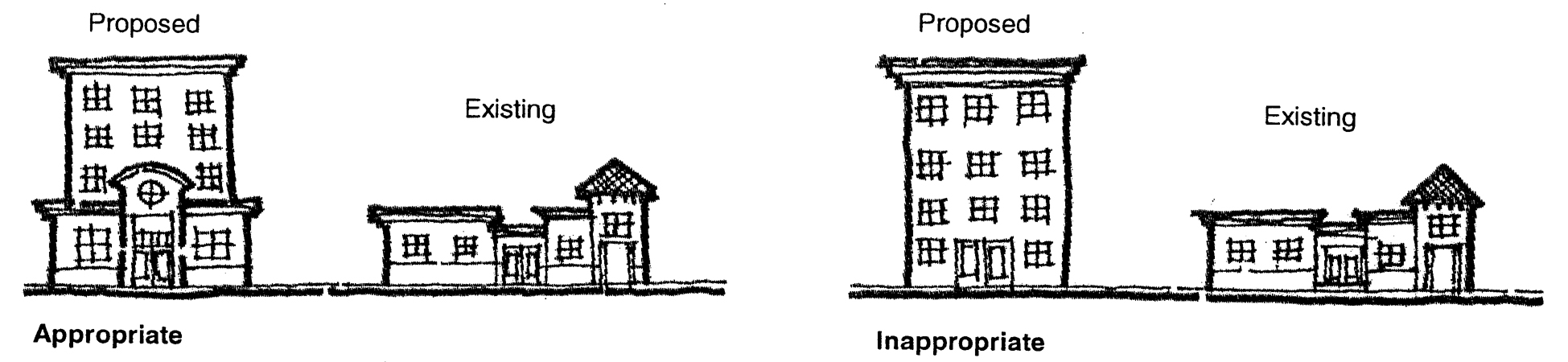
Facades
F.
Illustrative architectural elements. Drawings found in Attachment A [herein] represent architectural elements that are appropriate and/or inappropriate for the NBOZ as per this article. They are intended for illustrative purposes only, to guide the property owner and jurisdiction through the design intent of the overlay and are not to regulate or suggest specific architectural design.
(Ord. No. 02-2006, Exh. A, 7-5-2006)
Sec. 3-2. - Design treatments.
A.
Building design. Structures shall be required to provide three of the following minimum design treatments:
1.
The main facades shall incorporate architectural elements, which create a better human scale, such as
a.
Canopies or porticos integrated with the building's massing and style;
b.
Overhangs proportional in size to the mass of the building; and
c.
Arcades.
2.
Pedestrian amenities such as benches, sculptures, tables with umbrellas, and trash receptacles;
3.
Peaked roofs with minimum 12-inch overhangs;
4.
Ornamental and structural architectural details, which are integrated into the building structure and overall design; and
5.
Architectural treatment on all four facades/elevations.
a.
Articulation of individual storefronts or facades greater than 50 feet wide;
b.
Window and door openings expressed as individual units as opposed to window wall strips;
c.
Uniform design; and
d.
Any other treatment determined by the jurisdiction to meet the intent of this section.

Architectural treatment
B.
Unity of character. Buildings or structures, which are part of an existing or future complex shall have a unity of character and design.

Unity of character
C.
Style. Appropriate historical "themes" as defined by this article are permitted.
D.
Identical buildings. Buildings and structures that are identical or similar in design shall not be permitted throughout the corridor unless each building is part of an overall development with uniform architectural themes.
E.
Scale. New structures shall relate to the form and scale of surrounding architecture. Buildings taller than two stories shall be evaluated as to their visual impacts upon adjacent structures.
F.
Compatible exterior materials and architectural elements.
1.
Lattice work, decorative moldings.
2.
Covered porches with columns and railings.
3.
Arbors, trellises, gazebos, picket fences.
G.
Incompatible architectural elements. Unarticulated, flat, or blank facades are not permitted within the NBOZ.

Incompatible elements
H.
Proportion. The proportion of the major elements of a development such as windows, doors and storefront design shall be consistent throughout the development.
(Ord. No. 02-2006, Exh. A, 7-5-2006)
Sec. 3-3. - Building facade/elevation.
A.
Building features and ornamentation. The following building features and ornamentation are encouraged:
1.
Cornices and parapets, moldings, pilasters, window surrounds, asymmetrical facades, multi-level roofs, and similar elements;
2.
Tile, plaster, poured concrete, or brick materials, consistent with design and style;
3.
Functional and ornamental balconies and balustrades located on the walls or facades facing public rights-of-way, excluding alleys;
4.
Arcades designed with arches; and
5.
Exterior detail elements such as banding and other applied stucco detailing.
B.
Preferred exterior materials. Preferred building exterior siding materials shall include stucco and brick, however cast stone, split blocks, ceramic tiles, high quality coated metal panel systems, and stone are acceptable. Materials including woods, metal siding, fluted block and glass window systems are discouraged within the NBOZ.
C.
Recesses/projections. Facades greater than 50 feet in length shall incorporate recesses and projections a minimum of 12 inches in depth along a minimum of 20 percent of the total length of the facade. The recesses or projections shall be distributed along the facade with a maximum spacing of 100 feet between each recess or projection.
D.
Visible facades. All building facades visible from public rights-of-way and adjacent properties shall be designed with regard to their surroundings and should not be construed as creating look-alike buildings. Harmony shall be achieved through the proper use of scale, proportions, form, materials, texture, and color.
E.
Trademark forms and colors. Buildings and structures which use trademark or symbolic forms and colors and which have a negative impact on the visual environment of the area, as determined by the jurisdiction, are prohibited.
F.
Blank walls. Blank walls shall not exceed ten feet in height or 20 feet in length. Control and expansion joints shall constitute a blank wall, unless used in a decorative pattern with varied materials or textures and spaced a maximum of ten feet on center. Relief and reveal depth shall be a minimum of three-quarter inch. Building wall offsets, including projections, recesses and changes in floor level, shall be used to add architectural interest and variety.

Blank walls
G.
Other features. Other features, such as gutters, down spouts, vent stacks, vent pipes, and flashing shall be painted in such a way so the color is consistent with the color scheme of the building.
H.
Storefronts. Individual storefront elements of 50 to 100 foot widths shall be incorporated into the front facade to create a smaller scale for the building. Individual ground-level retail uses with exterior public access that are part of a larger freestanding building shall have display windows along a minimum of 20 percent of the facade length. Windows shall be defined with details such as frames, sills, shutters, planters, relief trims, or lintels.
(Ord. No. 02-2006, Exh. A, 7-5-2006)
Sec 3-4. - Building color and finish.
A.
General. Building materials and color selection shall achieve visual order through the consistent use of compatible color palettes.
1.
All storefronts within a development shall utilize a consistent palette of materials and textures.
a.
Variation of individual storefronts within a given palette of materials may be permitted, however principal walls and facades must maintain a uniform color.
b.
Different colors for individual storefronts within a complex are permitted as long as overall design integrity is not compromised.
2.
Color should be chosen to add to the retail environment of these buildings.
3.
The use of color to attract attention to a business from a distance is discouraged.
B.
Color palette. Colors of the structures within the NBOZ are to reflect the following characteristics:
1.
Primary colors for structures must be white, light gray, eggshell, pale blue, pale green, coral, peach, pale yellow, buff, beige, and sand.
2.
Secondary building colors should be limited to 25 percent of the wall area. These colors may consist of a medium intensity of the base building color or a complimentary color.
3.
Trim colors shall be limited to ten percent of any single wall area. Trim colors are used for accent and identifying purposes and are the brightest group of colors allowed. These colors include greens, blues, yellows, and others that are found in our lush landscape and natural features.
4.
Ornamentation, trim, courses, window frames, and door frames may be painted white or a contrasting color such as dark brown, dark gray, blue, light green, brown, plum, black.
5.
Roof materials may be brown, gray, white or other color consistent with the overall color scheme of the structure.
(Ord. No. 02-2006, Exh. A, 7-5-2006)
Sec. 3-5. - Architectural elements.
A.
Pedestrian walkways. Pedestrian walkways with arcades, awnings or colonnades shall be provided along the front and sides of buildings and be integrated with adjacent properties. Arcades or colonnades shall have a minimum clearance width of six feet and minimum clearance height of 12 feet. Awnings shall have a minimum clearance width of six feet and minimum clearance height of eight feet.
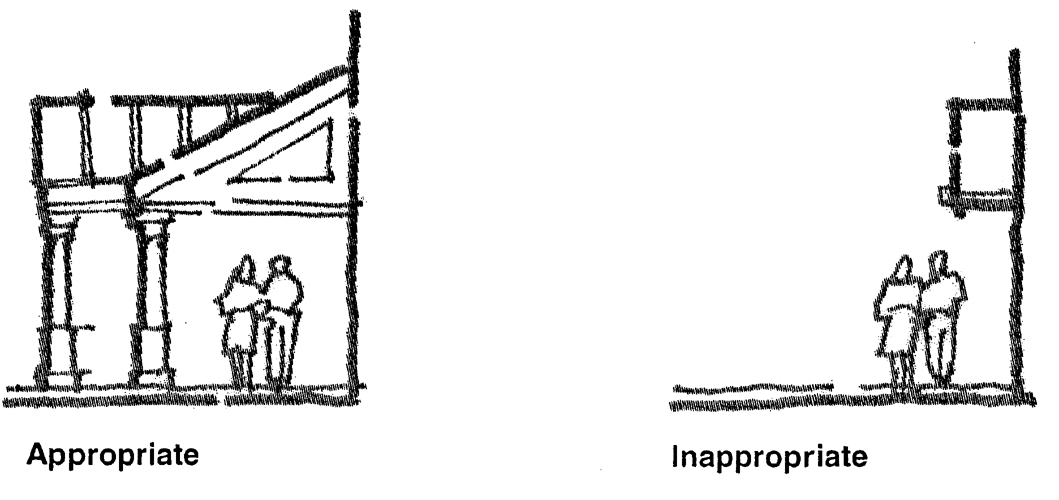
Pedestrian walkways
B.
Building height. Building height is defined by the applicable building code. Maximum building heights for each district is subject to a finding of compatibility of adjacent structures as follows:
1.
East district: A maximum height of 40 feet.
2.
Central district: The maximum height of 55 feet.
3.
West district: A maximum height of 40 feet.
C.
Entrances. Entrance design elements that are intended to give protection from the sun and adverse weather conditions shall be integrated into a design style for the building. Each freestanding principal structure shall have a minimum of one clearly defined primary public entrance feature. The primary entrance shall incorporate a minimum of one design element each from Tables 3-5A and 3-5B below:
Table 3-5A. Primary Entrance Feature Design Element
1.
Canopies, portecochere, or porticos.
2.
Wall recess or projection of a minimum of 12 inches in depth.
3.
Covered arcades, a minimum of eight feet clearance in width.
4.
Peaked roof forms.
5.
Arches, columns, or pilasters.
Table 3-5B. Secondary Decorative Treatment
1.
Overhangs, cornices and eaves;
2.
Decorative moldings or trims around windows and doors;
3.
Covered public outdoor patio or plaza incorporated with entrance area which are not part of a tenant space;
4.
Special pavers, bricks, decorative concrete, or other similar pavement treatment;
5.
Architectural details such as tile work or moldings;
6.
Benches or other seating components;
7.
Decorative landscape planters or wing walls that incorporate landscaped areas; and
8.
Structural or vegetative shading.
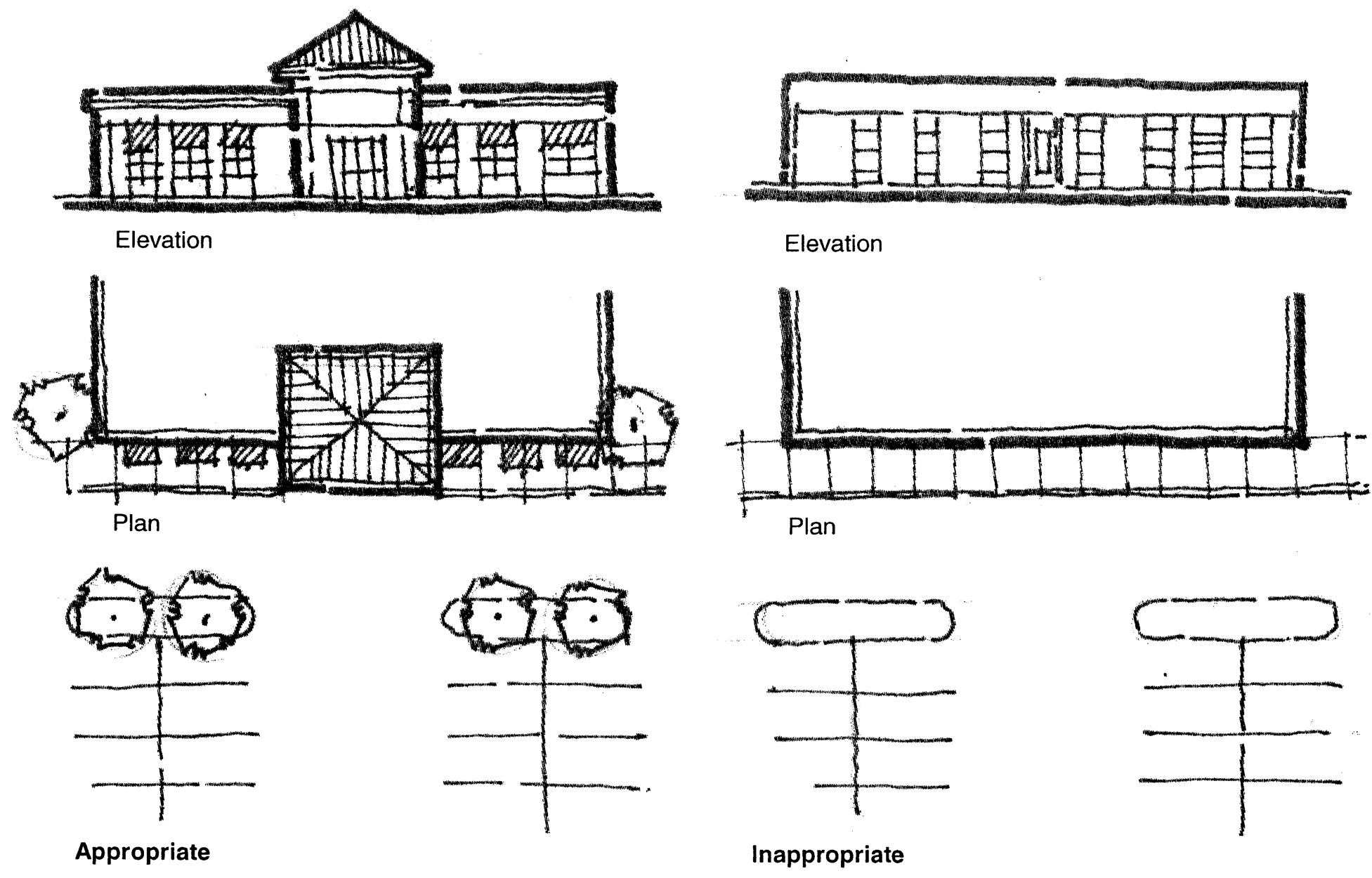
Entrances
D.
Mechanical equipment screening. All rooftop mechanical equipment shall be located at a distance from the edge of the building and properly screened so as not to be visible from any street or adjoining property. Materials used for screening purposes shall be compatible with the architectural style, color, and materials of the principal building.
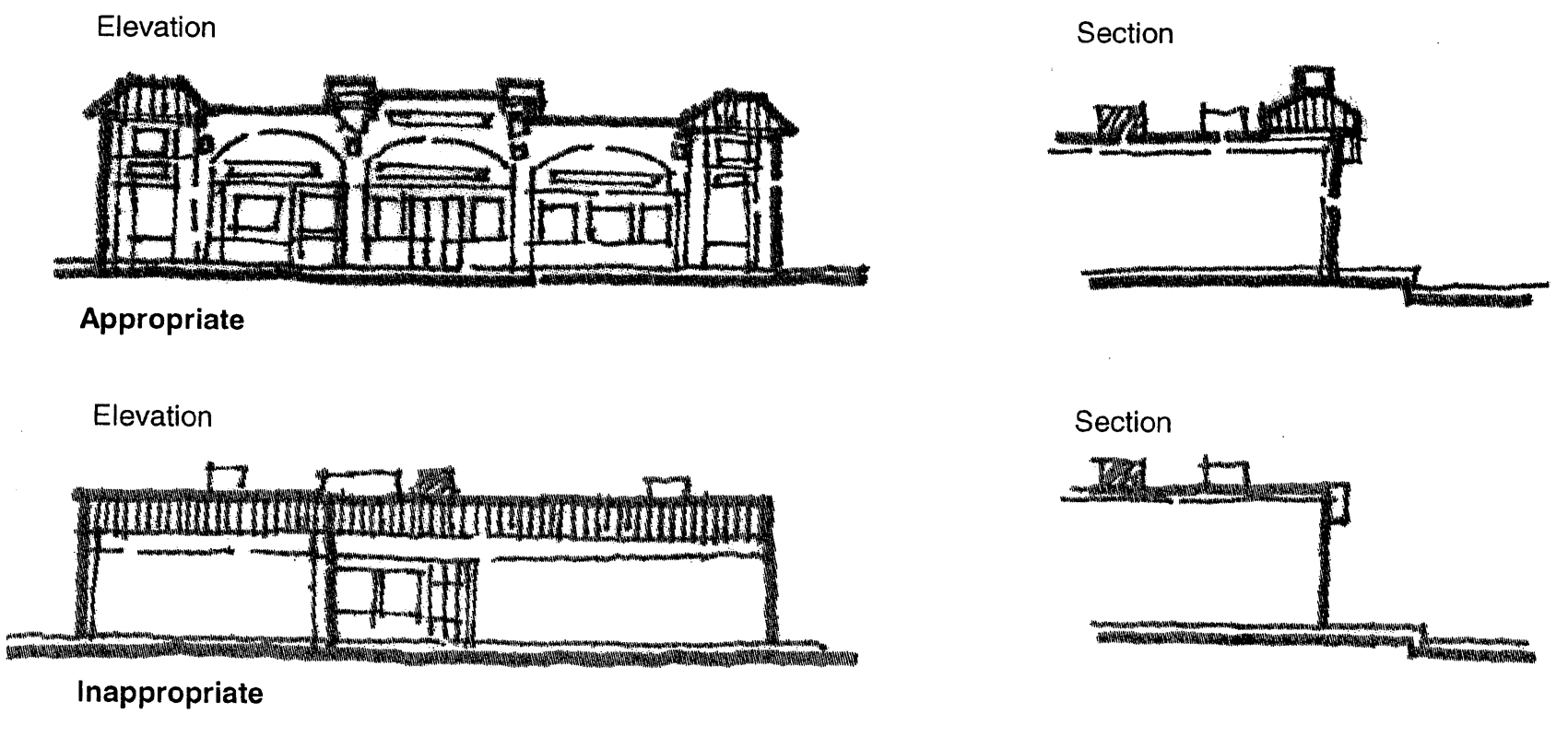
Mechanical equipment screening
E.
Cornices. Existing cornices should be retained and preserved.
(Ord. No. 02-2006, Exh. A, 7-5-2006)
Sec. 3-6. - Window/door treatments.
A.
Windows. The following major design characteristics are encouraged:
1.
Arches integrated into window designs;
2.
Trim color in contrast with principal color of structure;
3.
Large ground level store front windows, consisting of at least 50 percent of the wall area of the storefront;
a.
The windows of all ground floor businesses open to the public shall remain clear of curtains, shutters, or similar visual barriers, which would obscure interior displays or activities.
b.
Reflective or darkly tinted glass, which prevents seeing into the building is not permitted on the ground level.
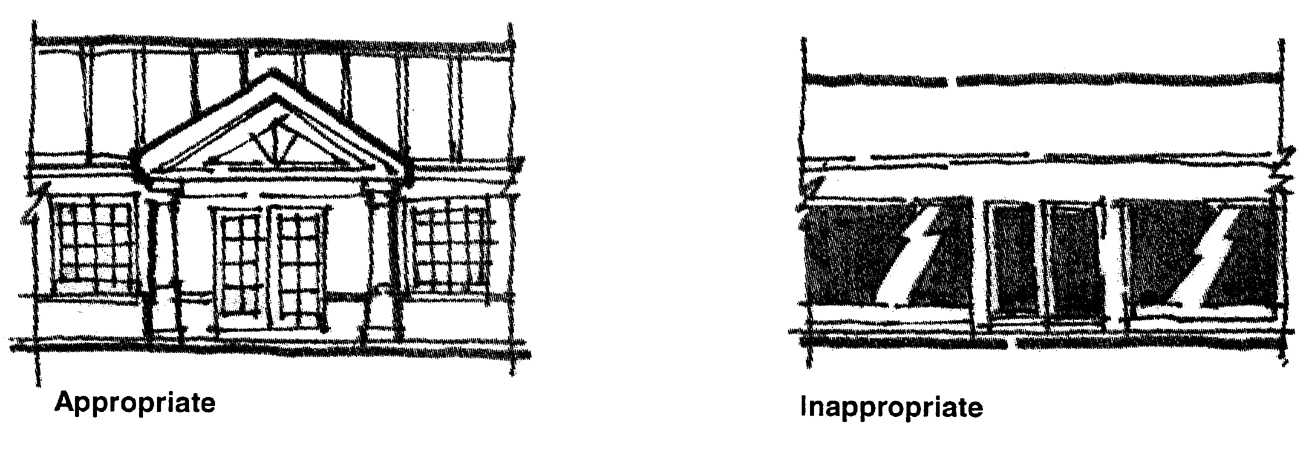
Windows
4.
Recessed openings;
5.
Hurricane/security panels or shutters which are removable, recessed, or architecturally compatible with overall design, and consistent with wind load resistance standards; and
6.
Replacement windows should fill the entire opening and duplicate the original pattern. Surrounding trim should be retained in the proper style and proportion.
B.
Doors. The following major design characteristics are encouraged:
1.
Recessed openings;
2.
Scaled and proportionate to balance of structure;
3.
Articulated and ornamental door design; and
4.
Use of materials to convey mass and strength.
C.
Awnings. Awnings shall reflect colors that compliment the existing architecture and not detract from the storefront or from adjacent storefronts.
1.
All awning supports should be attached to the building, not placed in the sidewalk or extending into the parking lot. Additionally, awning frames should be simple pipe frames, well concealed by canvas covers or attachments.
2.
Plastic backlit awnings or awnings constructed of shiny materials are not permitted.
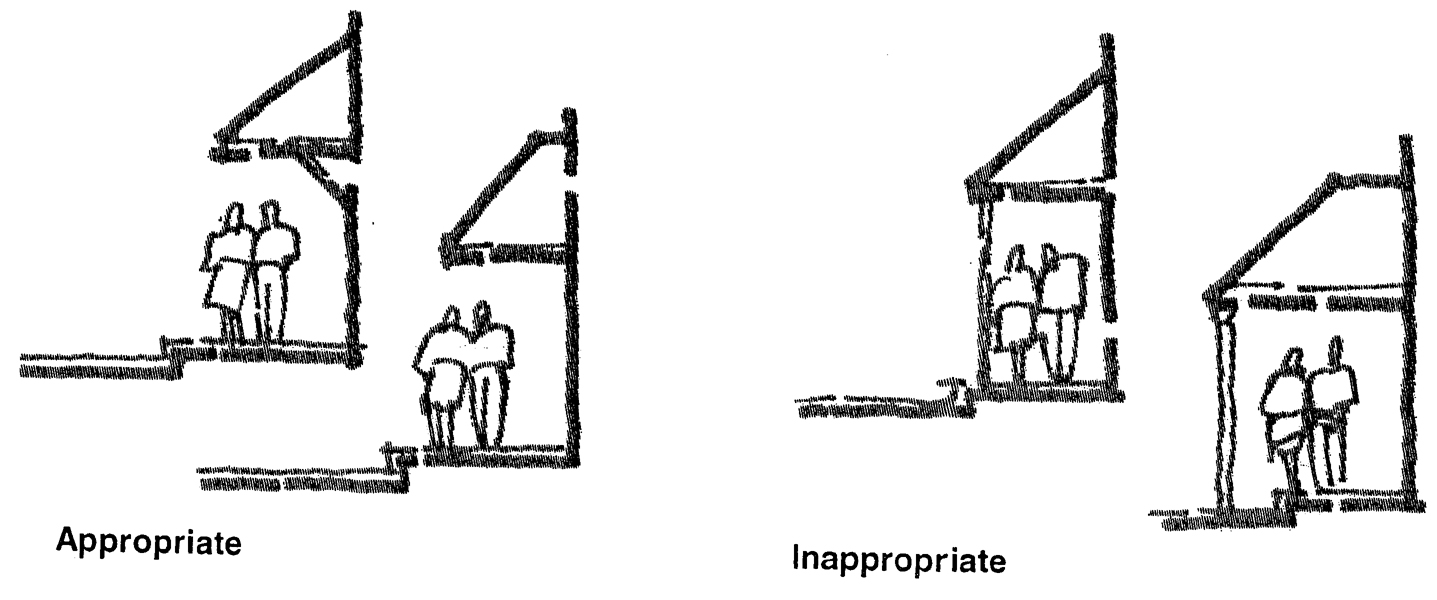
Awnings
D.
Fenestration and details. Architectural features or details such as windows, awnings, covered arcades, sills, shutters, reliefs, trims, columns, pilasters, quoins, reveals, cornices, horizontal banding, arches, decorative vents, and/or accent tile, shall be integrated into the facade to avoid the appearance of a blank wall and shall be provided along a minimum of 60 percent of the facade length of the front and side facades, and rear facades if continuous to a public street or residential zoning district.
E.
Materials. Doors and windows should be glass and aluminum (painted) storefront, high quality steel and glass systems, high quality woods such as plantation grown teak or mahogany, and brass, bronze or stainless steel.
F.
Exterior treatment. The exterior treatment of the front elevation shall consist of a minimum of two different building materials, textures, or finishes at a ratio of a maximum of 80 percent for the primary treatment and a minimum of 20 percent total for the secondary treatment. Exterior finishes such as stucco, brick, wood, coquina or cut stone are encouraged. The surfaces of multiple exterior storefronts within a building, except regional commercial facilities, shall compliment contiguous storefronts.
G.
Kick plates. Kick plates protect windows by raising the glass area to a safer and more easily viewed height. New storefront can have simplified kick plates, or have an all-glass front that creates a kick plate line and proportion by use of a framing bar or painted line.
(Ord. No. 02-2006, Exh. A, 7-5-2006)
Sec. 3-7. - Preferred roof materials/styles.
A.
Design types. The following major design characteristics are encouraged:
1.
Flat roofs with an articulated parapet of four feet in height necessary to screen mechanical equipment.
2.
Hip or gable roofs, minimum of 1:3 pitch, positioned so that the hip-roof end is facing the street.
3.
Exposed rafter tails.
4.
Pitched roofs or shed-style arcades of flat, S-shape, or barrel vaulted cement or clay tiles are encouraged.
5.
Standing seam metal roofs made of copper, stainless steel or galvanized steel are acceptable. Other metal roof types including industrial rib roofs are prohibited.
6.
Mansard roof, which shall wrap around the building so that there is visual continuity around the entire building. Vertical roofs and mansard roofs used on a portion of the building perimeter only are prohibited.
7.
Overhangs over pedestrian walkways are encouraged to provide shade and rain protection. All overhangs shall wrap around the building so that there is visual continuity around the entire building.
B.
Treatments. Roof features shall be in scale with the building's mass and complement the character of adjoining and/or adjacent buildings.
C.
Edge and parapet treatment. A minimum of two locations, the roof edge and/or parapet shall have a vertical change from the dominant roof condition a minimum of four feet. At least one such change shall be located on a primary facade adjacent to Northlake Boulevard. Designers are encouraged to articulate the parapet wall as a means of adding interest to the building facade and to screen any mechanical equipment.
D.
Preferred materials for pitched roofs. Roofing material should be constructed to enhance the appearance of the community. Materials shall include glazed or unglazed ceramic tiles, metal shingle, concrete tile, or slate barrel, "s" shape, or similar style clay or cement tiles.
E.
Large, unarticulated roofs. The roofline at the top of the structure shall not run continuously for more than 100 feet without offsetting or jogging the roof plane.
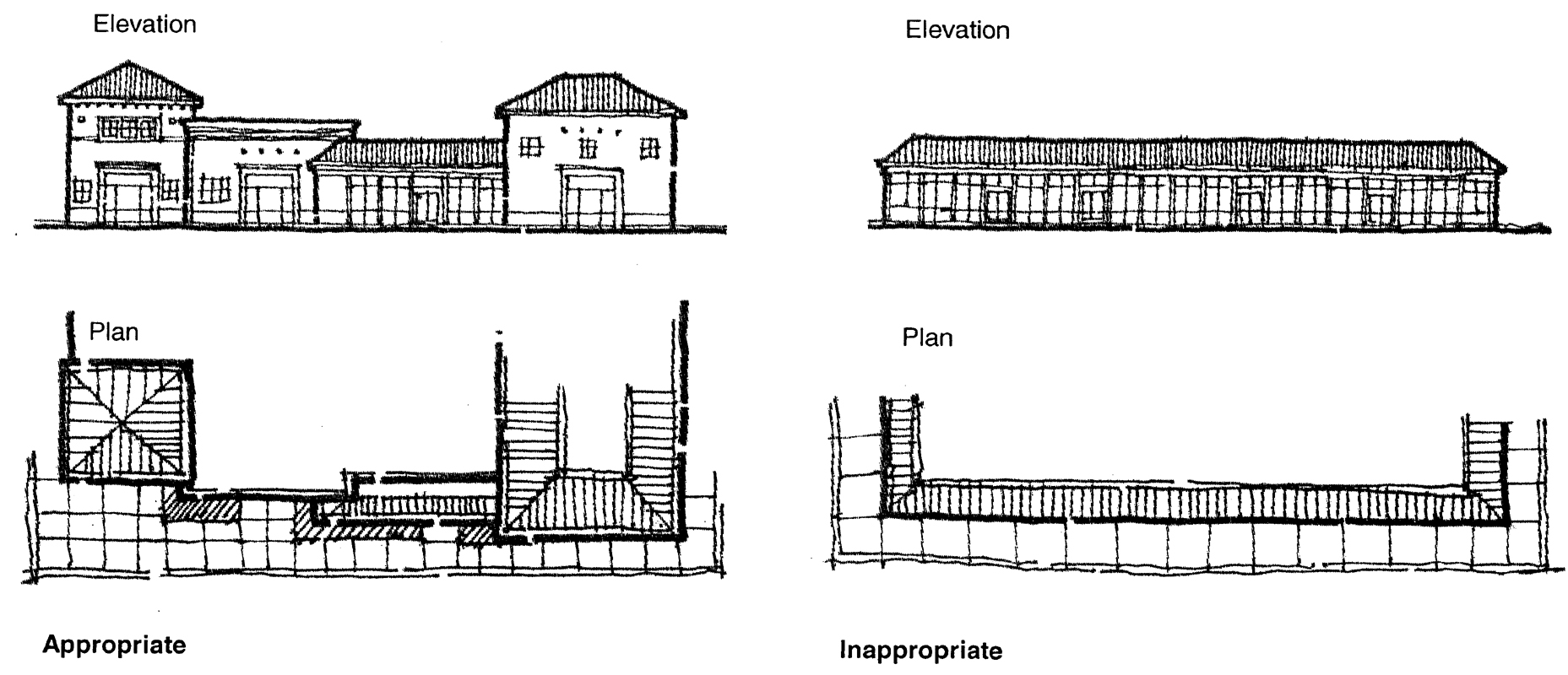
Large, unarticulated roofs
(Ord. No. 02-2006, Exh. A, 7-5-2006)
Sec. 3-8. - Definitions.
A.
The definitions set forth in this section shall be construed to be the same as if incorporated in the jurisdictions' development regulations.
1.
Architectural composition. The scale, height, mass, proportion, color, form, style, detail, treatment, texture, construction material, and roof design of a project or building.
2.
Articulated parapet. A parapet with a height variation proportional to the building height.
3.
Balustrade. A series of balusters with a top and bottom rail.
4.
Bracket. A decorative support feature located under eaves or overhangs
5.
Canopy. An ornamental roof-like structure used on commercial buildings, which provides advertisement space, shade, and protection for the storefront and pedestrian traffic.
6.
Compatible/compatibility. Design that utilizes accepted site planning (e.g. building placement, orientation and siting) and the elements of architectural composition within the context of the surrounding area. Similar adjacent land uses or square footage shall not necessarily constitute architectural compatibility.
7.
Complement/complementary. Having similar architectural composition.
8.
Dormer. A secondary feature of a building housing a window or vent, which is set upon the slope of a roof surface. Dormers may provide ventilation, lighting, or auxiliary living space.
9.
Eave. The projecting overhang at the bottom edge of a roof surface.
10.
Exposed beam. A decorative wooden beam that appears to support eaves, prevalent on bungalow-style residences.
11.
Frieze. A wide facing board located at the junction of the exterior wall and roof eaves.
12.
Gable roof. A triangular section at the end of a pitched roof.
13.
Historical "themes". Any building, structure, or other architecture which is historically or architecturally significant. Recognized architectural styles such as Spanish Eclectic, Mediterranean Revival, Florida Vernacular, Bermuda/Island is appropriate for the NBOZ.
14.
Hip roof. A roof with sloping sides and ends.
15.
Lattice. A panel of criss-crossed diagonal or perpendicular slats often utilized as decorative infill between masonry foundation piers.
16.
Lintel. A horizontal beam located above a window or door.
17.
Louver. A door or window comprised of overlapping downward sloping slats, which shed rain while admitting light and air.
18.
Masonry. Brick, block, or stone, which is secured with mortar.
19.
Massing. A term used to define the overall volume or size of a building.
20.
Molding. A continuous decorative strip of material applied to a surface.
21.
Parapet. A solid protective or decorative wall located along the outside edge of a roof.
22.
Rafter. A wooden member of a roof frame, which slopes downward from the ridgeline.
23.
Scale. A term used to define the proportions of a building in relation to its surroundings.
24.
Shed roof. A roof with a single sloping pitch.
25.
Stucco. A masonry material applied as exterior wall fabric.
26.
Substantial renovation. Any expansion, alteration, renovation, addition, or redevelopment to existing structures where the cost of such is greater than 50 percent of the assessed improvement value of the parcel, indicated on the most recent tax roll of Palm Beach County Property Appraiser, or an increase of greater than 20 percent of the square footage of the existing structure.
(Ord. No. 02-2006, Exh. A, 7-5-2006)
Sec. 4-1. - Intent.
A.
Purpose and intent. The provisions of this section are intended to ensure that properties within the NBOZ meet minimum landscaping standards in order to:
1.
Improve and sustain the aesthetic appearance of the jurisdiction through creative landscaping which helps to harmonize and enhance the natural and built environment;
2.
Promote water conservation by encouraging xeriscaping and utilization of native and drought tolerant landscape material and utilization of water conserving irrigation practices;
3.
Provide a visual buffer between otherwise incompatible types of land uses and adjacent rights-of-way;
4.
Encourage innovative and cost-effective approaches to the design, installation, and maintenance of landscaping.
(Ord. No. 02-2006, Exh. A, 7-5-2006)
Sec. 4-2. - Administration.
A.
Applicability. The provisions of this article shall apply to all existing and future development within the boundaries of the NBOZ as follows:
1.
New development. All new development.
2.
Existing development. All existing development shall conform with the provisions of the division eight years from the effective date of these regulations.
B.
Exemptions. All licensed plant or tree nurseries or tree farms shall be exempt from the terms and provisions of this division, but only with respect to those trees planted and growing which are for sale to the general public in the ordinary course of the business. The landscaping required for buildings and parking lots shall be provided.
C.
Waiver. The landscape regulations may be waived in whole or part by the jurisdiction when a property owner has demonstrated that the requirements contained in this division will reduce required parking, or substantially restrict the operation of the existing business or property's use.
D.
Compliance. Failure to install, maintain, or preserve landscaping or native vegetation required in accordance with the terms of this division shall constitute a violation of this division.
1.
Failure to comply. If the property fails to meet the requirements of this division, or if the existing trees, shrubbery, grass, or groundcover are permitted to die, and such materials are not replaced within 30 days of the event, the code enforcement officer shall notify, in writing, the person responsible for the maintenance or replacement of such property of the need to comply with the requirements of this section within 30 days from the date of delivery of the notice.
2.
Extensions. The 30-day rule for compliance may be extended when necessary by the jurisdiction to recover from acts of nature such as a hurricane or a drought.
3.
Temporary exemptions. Temporary exemptions from compliance of this section may be granted as per the jurisdiction, if the violation is a direct result of a natural disaster occurrence or drought.
4.
Relocation or replacement for redevelopment. The site plan approved to remedy any violation of this division shall include landscaping replacement or relocation to comply with all requirements herein. Relocation or replacement shall comply with the standards listed below.
a.
Trees having a three-inch or greater caliper at diameter at breast height (DBH) which are to be replaced shall be replaced by the sum of three caliper inches to every one inch lost and are of like or similar species. Replacement trees shall be a minimum of three inches in caliper. For example, if an existing five-inch caliper tree is removed from the subject property, 15 inches in caliper are required for replacement. A combination of tree sizes may be utilized as long as no tree is less than three inches in caliper.
b.
If the site cannot support the total number of required replacement trees as determined herein, the jurisdiction may permit the owner to donate excess trees to the jurisdiction for planting on public lands at the owner's expense; contribute to the jurisdiction the monies equivalent to such required replacement trees; or permit the required replacement trees to be placed upon other lands owned by the same property owners.
c.
The jurisdiction may require alternative landscape solutions such as additional aesthetic hardscaping, site amenities, or specimen landscaping as per the intent of this division.
(Ord. No. 02-2006, Exh. A, 7-5-2006)
Sec. 4-3. - Nonconforming landscape areas.
A.
Nonconformities established. All development constructed prior to the effective date of these regulations that do not conform with the provisions of this division shall be considered nonconforming.
1.
If nonconforming landscaping is damaged or destroyed by any means to the extent of 50 percent or more of its replacement value at the time of the damage, the replacement landscaping and elements must conform to all of the provisions of this division.
B.
Maintenance. Nonconforming landscape areas are not exempt from minimum maintenance standards.
C.
Amendments to the approved plan. The following types of amendments to a previously approved development plan shall require the review of the landscape plan for the entire site using the minimum landscape standards in this division:
1.
Increase in the total square footage of any building by more than 20 percent;
2.
Increase in the number of structures; or
3.
Increase in the building height of any building.
(Ord. No. 02-2006, Exh. A, 7-5-2006; Ord. No. 09-2014, § 2, 7-16-2014)
Sec. 4-4. - Tree and plant installation.
A.
Minimum plant quality. Plant quality for all required landscaping shall be Florida No. 1 or better, as provided in Grades and Standards for Nursery Plants, Part 1 and Part 2, as amended, as published by the Florida Department of Agriculture and Consumer Services. All vegetation shall be clean and free of noxious pests or disease.
B.
Preferred species list. The preferred species list contained in section 4-7 periodically revised, as needed. To the greatest extent possible, the species list shall represent plants that are drought tolerant plants; noninvasive; not destructive to native plants; and strong wooded, nonbrittle plants.
C.
Installation.
1.
All landscaping shall be installed with sound workmanship and sound nursery practices in a manner that will encourage vigorous growth.
2.
A plant or tree's growth characteristics shall be considered before planning to prevent conflicts with views, lighting, or signage.
D.
Root barriers. The jurisdiction shall require root barriers for trees planted within 15 feet of any road right-of-way, sidewalk, or utility. In determining the appropriateness of particular protection techniques, the jurisdiction shall use the current edition of the Tree Protection Manual for Builders and Developers, published by the State Division of Forestry, Florida Department of Agriculture and Consumer Services.
(Ord. No. 02-2006, Exh. A, 7-5-2006)
Sec. 4-5. - New construction and substantial revision.
A.
Landscape area. At least 15 percent of the total parcel area shall be landscaped, excluding any area utilized for required parking.
B.
Overall landscaping. The required area to be landscaped may include any of the following:
1.
Entry features;
2.
Massing of landscaping to produce focal points;
3.
Foundation plantings;
4.
Trellises, arbors, and similar structures;
5.
Planter and flower boxes;
6.
Freestanding planters and pottery;
7.
Sidewalk plantings;
8.
Landscaped courtyards, loggias, patios, and similar open areas available for public use; and
9.
Materials installed within publicly owned lands.
(Ord. No. 02-2006, Exh. A, 7-5-2006)
Sec. 4-6. - Prohibited and standard invasive plants.
A.
Prohibited plantings.
1.
Artificial plants or vegetation shall be prohibited.
2.
Prohibited plants shall not be planted within the NBOZ, and existing prohibited plants shall be removed if determined to be invading adjacent native plant communities. The list of prohibited plant species, include, but are not limited to Casuarina spp. (Australian Pine), Ficus bengalensis (Banyan), Supaniopsis anacardioides (Carrotwood), Acacia auriculiformis (Earleaf Acacia), Pueraria montana (Kudzu), and Melaleuca quinquenervia (Melaleuca/Punk Tree/Pepper Tree).
B.
Controlled plant species. The following species may be planted or maintained under controlled conditions and shall not exceed a maximum of ten percent of the total number of required trees.
1.
Black olives. Black olives shall not be installed within 15 feet of any parking area.
2.
Ficus species. Ficus species may be planted as individual trees or hedge material provided that individual trees are no closer than 30 feet from any public road right-of-way, utility, or structure. Hedges shall not exceed eight feet in height and be regularly maintained.
(Ord. No. 02-2006, Exh. A, 7-5-2006)
Sec. 4-7. - Preferred landscape palette.
A.
Preferred trees. Fifty percent of the required trees shall be selected from the list presented below:
Table 4-7A. Preferred Tree Species
B.
Preferred shrubs and groundcovers. Fifty percent of the required shrubs and groundcovers shall be selected from the list presented below:
Table 4-7B. Preferred Shrub/Groundcover Species
(Ord. No. 02-2006, Exh. A, 7-5-2006)
Sec. 4-8. - Minimum landscape requirements.
A.
Required. The following uses within nonresidential developments shall be required to provide landscaping, as required herein.
1.
Vehicular use areas as required in section 4-8;
2.
Building foundation as required by section 4-12; and
3.
Signs as required by division 5.
B.
Natural form. New trees and shrubs should duplicate natural patterns with multiple plant sizes, spacing, plant clusters, and single plantings.
C.
Minimum landscape standards. All landscape installed shall meet the requirements of Table 4-8A and as otherwise provided herein.
Table 4-8A. Minimum Landscape Requirements
Notes:
1 Measured from grade to average end of branches, not the tallest of one or two branches and a minimum crown of five feet.
2 Measured as gray trunk height.
3 Palms not classified as specimen palms and planted in perimeter buffer areas shall be installed in groups of not less than three.
4 Support shall be provided consistent with sound horticultural practices to encourage future growth.
D.
Minimum landscape points. Tables 4-8B and 4-8C shall be used to determine the minimum landscape points per open space a project shall be required to provide. Achieving the minimum open space landscape point requirement does not exempt a project from compliance with other requirements of this division.
Table 4-8B. Minimum Landscape Requirements for Point System Delineation
Notes:
* Example: 15% project open space requires 22 points/100 square feet
< = Equal to or less than
> = Equal to or greater than
Table 4-8C. Required Landscape Installation Points
Notes:
(1) Abused trees, as determined by the jurisdiction, shall not count toward required points.
* = Justification to be provided consistent with definition.
DBH = Diameter at Breast Height (4½ feet above grade).
< = Less than.
> = Greater than.
E.
Total landscaping points. Achieving the total points per open space for an entire project within one or more areas does not exempt one from complying with all other requirements, even if that means exceeding the minimum required.
F.
Water conservation.
1.
Landscape plans shall be required to use minimum water conservation techniques such as the following:
a.
Moisture-sensing controller (other than rainswitch).
b.
Drip/trickle/micro irrigation system.
c.
Quality effluent irrigation.
2.
Water conservation may also be obtained through the use of the following:
a.
Florida native landscaping.
b.
Very drought-tolerant trees, shrubs and groundcovers.
c.
Native wildflowers, meadow grasses or groundcover in lieu of allowable sodded area.
G.
Specimen trees. Specimen trees shall be considered as existing native trees if in good health and over 13 inches at diameter at breast height (DBH) or larger.
H.
Canopy trees.
1.
Canopy trees shall be installed in the landscape buffer at a maximum of 30 feet on center.
2.
The canopy trees, at maturity, shall be of a species, which possess an average spread of at least 25 feet and a clear trunk of at least six feet.
3.
Approval of the use of trees with a lesser mature canopy, provided that groupings of such species are utilized to achieve the average spread.
I.
Palm trees.
1.
Palms must attain a minimum 12 feet in height at maturity.
2.
Palms must be resistant to lethal yellowing.
J.
Tree species mix. When more than 15 trees are required to be planted to meet the standards of this section, a mix of species shall be provided according to the overall number of trees required to be planted. Species shall be planted in proportion to the required mix. The minimum number of species to be planted is indicated in Table 4-8D.
Table 4-8D. Required Species Mix
K.
Native and drought-tolerant trees.
1.
A minimum of 50 percent of all trees used to satisfy the standards of this division shall be classified as native.
2.
In addition, 50 percent shall be classified as drought-tolerant by the most recent edition of the South Florida Water Management District's "Xeriscape Plant Guide."
L.
Shrubs and groundcovers.
1.
At least 50 percent of all required hedges and shrubs shall be classified as native or drought tolerant by the most recent edition of the South Florida Water Management District's "Xeriscape Plant Guide."
2.
At the time of installation, required hedges and shrubs shall be a minimum of 24 inches in height, or 18 inches in height for native species, spaced at a maximum of 24 inches on center.
3.
Required hedges shall form a solid, continuous visual screen of at least three feet in height within two years of planting.
4.
Hedges used in combination with nonliving landscape barriers to meet the six-foot screen requirements shall be installed the height necessary to provide the total six-foot screen within two years of planting.
M.
Sod or grass. Not more than 40 percent of the total landscape area shall be covered with sod or grass.
N.
Ground treatment.
1.
The ground area within required landscaped areas which is not dedicated to trees, or the preservation of existing or new vegetation, shall receive appropriate landscape treatment such as grass, groundcover, mulch or shrubs and present a finished appearance upon planting.
2.
Sand, gravel, shellrock, or pavement shall not be considered appropriate landscape treatment.
3.
The following standards shall apply to the design of ground treatment.
a.
Ground cover. Live material used as ground cover shall provide a minimum of 50 percent coverage immediately upon planting and 100 percent coverage within one year.
b.
Mulch. Mulch shall be installed and maintained at a minimum depth of three inches at all times, in all planted areas not containing ground cover. All mulch material shall be seed and weed-free to prevent tree sprouting and regrowth.
c.
Pebble and egg rock. Pebble or egg rock may be used in a limited amount as a ground treatment in areas where drainage is a problem.
d.
Lawn and turf grass. Grass areas shall be planted with species suitable as permanent lawns. Use of drought-tolerant groundcover instead of lawn and turf grass is encouraged.
O.
Flowers. Flower boxes and hanging pots should complement the overall architecture of the facade and not obscure architectural details. The boxes should be well constructed, and accommodate watering needs without allowing water to drip or leak onto the building or sidewalk.
P.
Redevelopment and nonconforming projects. If a redevelopment and nonconforming project is unable to meet the point system or open space requirements of this division, required landscape points may be transferred to other public lands, parks, road, road rights-of-way or other similar public space, up to a maximum of 25 percent reduction of points per 100 square feet.
Q.
Landscape in easements.
1.
Landscaping may be permitted in easements with the written permission of the easement holder. Trees planted within any easement with overhead utilities shall be consistent with FP&L's suggested tree list "Plant the Right Tree in the Right Place," taking into consideration the mature height and spread of the species beneath or adjacent to existing overhead utilities.
2.
Easements may overlap a landscape buffer a maximum of five feet provided that there remains a minimum of five clear feet for planting, or if a wall with a continuous footer is used, a minimum of ten clear feet for planting.
3.
The landscape buffer may be traversed by easements or access ways as necessary to comply with the standards of this section.
R.
Perimeter landscaping. Only access ways and easements shall be permitted as interruptions in perimeter landscaping and shall be included in the calculation of linear dimension. No structures or parking are to be located in this landscape area.
S.
Landscaping in public road right-of-way. Maintenance of landscaped rights-of-way shall be the responsibility of the project's property owner or, as agreed upon in the development order approving the project, by special districts created for unified maintenance.
(Ord. No. 02-2006, Exh. A, 7-5-2006)
Sec. 4-9. - Miscellaneous landscape elements.
A.
Alternative landscape materials. A landscape plan may utilize one or more materials not specifically authorized in this division and must be demonstrated to be consistent with the purposes and intent of this division.
B.
Screening required. Uses within the overlay zone that shall be required to be screened from public view include mechanical equipment areas, parking areas, satellite dishes mounted on the ground, chainlink or other nonopaque fence or wall type, accessory use structures, and other elements as defined by this division.
C.
Perimeter walls and fences.
1.
Perimeter walls, metal or wood fences, or other nonliving landscape materials may be used in conjunction with vegetation to meet required landscaping.
2.
Approved walls or fences shall be set back from property lines sufficiently to include landscape on the outside of the wall or fence. Chainlink fences shall have a green or black vinyl covering.
3.
Maintenance of the wall or fence and associated landscaping by the property owner is required.
D.
Storage and garbage collection sites. All outside storage and trash or garbage collection sites shall be completely screened from view, utilizing any approved combination of hedge (a minimum of three feet in height) structural barriers, berms or any combination thereof to 100 percent screen the area from view.
E.
Service areas.
1.
Service areas of nonresidential buildings, when visible from the street right-of-way or adjacent residential land use, shall have barriers and a hedge at a minimum of six feet in height to screen the service area from this use.
2.
Service areas may include interior or exterior work bays associated with full service gas stations, tire repair, auto repair business, as well as any business proposing loading or unloading docks.
F.
Backflow preventers. Backflow preventer systems shall be screened from public view, utilizing any combination of trees, palms, hedges, or other barriers.
G.
Mulch.
1.
All tree and shrub beds shall receive at least three inches of mulch. Where mulch is to be installed permanently, it shall be renewed and maintained at three inches of depth.
2.
Mulch shall be temporarily applied to areas not immediately covered by groundcover.
3.
Mulch will be thoroughly wet at the time of application to prevent wind displacement.
H.
Pavers. The use of pavers or similar impervious material, excluding sidewalks, shall not exceed 30 percent coverage of an open space area, and shall not be wider than 12 feet if used in a required landscape buffer area.
I.
Signs. Landscaping around ground/monument signs is required and shall be provided pursuant to division 5.
J.
Advertising. At no time shall a landscaped area be used for advertising display or sales. Temporary signs may not be placed in landscaped areas.
K.
Earth berms. Earth berms shall use long and gentle slopes and as non-living landscape barriers only when installed in conjunction with plant materials.
1.
Berms five feet or less in height shall have a maximum slope of 2:1. Berms greater than five feet in height shall not exceed a ratio of 3:1 in slope.
2.
Hedges used in combination with earth berms to meet the six-foot screen requirements shall be installed at the height necessary to provide the total six-foot screen at time of planting.
(Ord. No. 02-2006, Exh. A, 7-5-2006)
Sec. 4-10. - Landscape requirements for off-street parking areas.
A.
Minimum spacing.
1.
The minimum shade tree spacing for interior parking areas shall be such that the center of any parking space is not more than 40 feet from the center of the shade tree.
2.
A shade tree may be replaced by a minimum of three palms clustered together, as long as the affected parking bays are more than 50 feet from a public street.
B.
Landscape islands.
1.
[Required.] A landscape island shall be required for every nine parking spaces located in a row.
2.
[Landscape diamonds.] The use of landscape diamonds for interior parking lot tree planting is permitted as per this section, excluding islands at the end of parking rows.
3.
[Planter islands.] Each planter island shall contain at least one canopy tree for each 100 square feet of area or fraction thereof, in addition to shrubs and ground cover.
4.
Terminal and landscape islands. Each row of parking spaces shall be terminated by landscape islands, which measure a minimum of eight feet in width, excluding required curbing, and 15 feet in length. A minimum of 120 square feet of pervious surface areas shall be provided. A minimum of one tree shall be planted in each terminal island.
5.
Interior landscape islands. A minimum of one interior landscape island shall be provided for every nine parking spaces or fraction thereof and shall be spaced a maximum of 90 feet apart. Interior islands shall measure not less than eight feet in width, excluding required curbing, and 15 feet in length. A minimum of 120 square feet of pervious surface areas shall be provided. A minimum of one tree shall be planted in each interior island.
6.
Lots equal to or less than one acre. For lots equal to or less than one acre, terminal and interior landscape islands shall be a minimum of five feet in width, excluding required curbing, and 15 feet in length.
C.
Divider median.
1.
Divider medians shall be installed between rows of parking and between all parking/vehicular use areas.
2.
One tree shall be planted for each 30 linear feet of a divider median, or fraction thereof.
3.
The minimum width shall be five feet of unencroached landscape area.
D.
Minimum size for landscape areas.
1.
The minimum landscape area shall contain no dimension less than five feet in width, measured from the inside of the curb.
2.
There shall be no landscape area smaller than 25 square feet.
3.
Landscape areas within interior parking areas may be reduced if the areas shall constitute an obstruction in use of a building structure, providing the reduced square footage is relocated so as to emphasize entrance corridors or special landscaped areas within the general parking area.
E.
Protection of landscape areas. All landscape areas shall be protected by curbs or wheel stops from vehicular encroachment and from the damages caused by vehicles overhanging into landscape areas.
1.
Landscaping. In addition to grass, landscaping shall be required to be at least 30 inches from the edge of the wheel stop or curbing.
2.
Overhang areas. Vehicle parking areas designed to permit vehicles overhanging into landscaped areas shall not be permitted to count the first 30 inches of landscape area as open space.
3.
Curbing. All landscape areas subject to vehicular encroachment shall be separated from vehicular use areas by six-inch, nonmountable, FDOT-type "D" or FDOT-type "F", concrete or asphalt curbing. The curbing shall be machine-laid, formed-in-place or integral with the pavement.
4.
Wheel stops.
a.
Wheel stops shall have a minimum height of six inches above finished grade of the parking area, shall be properly anchored, and continuously maintained in good condition.
b.
The space between the wheel stop and the end of the parking space may be paved as required by the building division for anchoring and maintenance purposes.
c.
Wheel stop anchor rods shall be set through the pavement and the bottom of the wheel stop must rest fully on the pavement to prevent rocking.
F.
Hedges.
1.
All parking, loading, or storage areas adjacent to the right-of-way, including driveways to parking lots, shall include a continuous hedge that is maintained at a minimum of three feet at maturity.
2.
"Dwarf" hedges may be installed and maintained at a minimum height of 18 inches when adjacent to an automobile sales display area.
G.
Maintenance. Regular maintenance of vehicular use areas adjacent to all landscape areas shall include replacement of broken curbs or curb stops as needed to keep the general appearance in good condition and safe.
H.
Safe sight distance triangles. Safe sight distance triangles shall be provided in accordance with the county design manual, published by the Palm Beach County Department of Engineering and Public Works, to restrict placement of visual obstructions.
1.
Landscape limitations.
a.
Safe sight distance triangle areas shall be maintained to provide unobstructed visibility at a level between 30 inches and eight feet above the crown of the adjacent roadway and in a way that does not create a traffic hazard.
b.
Landscaping on state roads shall be installed in accordance with the roadside clear zone provisions of the State of Florida Department of Transportation's Manual of Uniform Minimum Standards for Design, Construction, and Maintenance of Streets and Highways, as amended.
c.
All landscaping within the safe sight distance triangle area shall be planted and perpetually maintained by the property owner, in accordance with this section.
2.
Landscape area around signs.
a.
A three-foot wide planting area shall be required around the base of all signs.
b.
One shrub for each ten square feet of sign surface area shall be installed within the three-foot planting area at the base of the sign.
c.
Ground/monument signs may be surrounded by ground cover instead of shrubs.
d.
Landscaping and trees which interfere with signage may be relocated to the rear of the sign planting area.
I.
Landscape diamonds.
1.
Landscape diamonds may be distributed throughout the interior of an off-street parking area to provide shading of parked motor vehicles as an alternative to interior landscape islands.
2.
Tree planting areas shall be located only at the common intersection of four parking spaces and spaced no greater than four spaces apart.
3.
The ground within the tree planting area shall receive appropriate landscape treatment, including mulch or groundcover.
4.
The minimum tree planting area shall be 25 square feet and the minimum dimension shall be five feet by five feet, not including curb treatment.
(Ord. No. 02-2006, Exh. A, 7-5-2006)
Sec. 4-11. - Minimum landscape buffer and planting requirements.
A.
Minimum buffer required. A landscape buffer shall be a minimum of eight feet in width around the perimeter of a parcel. However, additional buffer width shall be provided as indicated below:
1.
A minimum landscape buffer of ten feet in width shall be required on lands located adjacent to public rights-of-way that are 110 feet wide or less;
2.
A minimum landscape buffer of at least 15 feet in width shall be required on lands located adjacent to public rights-of-way that are 111 to 150 feet wide;
3.
A minimum landscape buffer of at least 20 feet in width shall be required on lands located adjacent to public rights-of-way that are greater than 150 feet wide; and
4.
A landscape buffer, at least five feet in width, shall be provided along all sides of the parking lot, excluding that side or sides, which abut a building.
B.
Mature height. Vegetation should be planted taking into consideration the mature height and spread of the species.
C.
Spacing. The maximum spacing of planting trees shall be 30 feet on center along any perimeter buffer.
D.
Perimeter landscape requirements. Perimeter landscape buffers shall be installed and maintained in accordance with the following standards. Easements and access ways, which traverse required perimeter landscape buffers, shall be included in the calculation of linear dimension.
1.
Palm trees.
a.
Within the landscape buffer, a group of three palm trees may be substituted for one required canopy tree; however, not more than 50 percent of the required canopy trees may be replaced by palm trees.
b.
In right-of-way buffers only, Royal or Phoenix palms, excluding Phoenix roebellini, may be counted as one required canopy tree. These palms shall:
(1)
Not exceed a maximum of 30 percent of all trees required in the buffer;
(2)
Be spaced a maximum of 20 feet on center; and
(3)
Be a minimum of either six feet of gray wood for Royal palms or eight feet clear trunk for Phoenix palms.
2.
Slash pines.
a.
Slash pines planted in perimeter buffers shall be installed in groups of no less than three.
b.
Each group of slash pines shall average a minimum of ten feet in height and may be counted as one required canopy tree.
3.
Hedges and shrubs.
a.
At the time of installation, required hedges and shrubs shall be a minimum of 24 inches in height, and spaced at a maximum of 24 inches on center.
b.
Required hedges shall form a continuous solid opaque visual screen of at least 36 inches in height within two years of planting.
4.
Canopy tree and palm clustering.
a.
Canopy trees and palms may be clustered in right-of-way buffers if the clusters are spaced a maximum of 30 feet apart, and/or consist of trees of varied height, which when averaged, equal the minimum tree height requirements and are located on property containing a minimum of 300 linear feet along the right-of-way.
5.
Walls and fences within right-of-way buffer.
a.
If a wall or fence is used, the required landscaping shall be located between the wall or fence and the right-of-way.
b.
Walls and fences shall not encroach upon easements, unless approved in writing by the easement holder.
c.
Wall or fences shall be setback a minimum of ten feet from the edge of the ultimate right-of-way unless a wall with a continuous footer is used, then the wall shall be setback to provide a minimum of ten clear feet for planting.
(Ord. No. 02-2006, Exh. A, 7-5-2006)
Sec. 4-12. - Foundation landscaping and plantings.
A.
Location.
1.
There shall be foundation landscaping within five feet of all buildings and structures and shall be provided along all four facades of all commercial structures, excluding rear service areas not visible by a public road right-of-way or not generally traveled by the public or visible from adjacent structures.
2.
The combined length of the required foundation planting shall be no less than 40 percent of the total length of the applicable side of the structure.
B.
Irrigation. All foundation areas shall be irrigated and of the appropriate size to accommodate the mature size of the vegetation to be planted.
C.
Minimum standards. The minimum standards for foundation landscaping shall be determined by the building height and function; and extend along the portions of a facade that directly abut a parking area or vehicular use area, excluding entryways, doorways or other building improvements.
1.
The foundation planting area for a one-story building shall be at least five feet wide, unless foundation landscaping would interfere with the intended use and function of a building.
2.
The foundation planting area for a building of two or more stories shall be not less than 30 percent of the height of the adjacent wall.
3.
At least one shade tree or palm cluster shall be installed for each 30 linear feet, or fraction thereof, of facade width.
a.
A minimum of one tree per facade shall be planted, and the remainder of the landscape area shall be treated appropriately with plantings and pedestrian accessways.
b.
Trees and palms shall be of an installed size relating to the height of the adjacent wall or facade, as indicated in Table 4-12.
Table 4-12. Minimum Foundation Planting Dimensions
(Ord. No. 02-2006, Exh. A, 7-5-2006)
Sec. 4-13. - Maintenance.
A.
Minimum requirements. The land owner shall be responsible for the following:
1.
The maintenance of required landscape structures (e.g., walls, fences) in a structurally-sound condition.
2.
Tree maintenance, which shall be limited to periodic trimming to maintain healthy trees, removal of diseased limbs, or removal of limbs or foliage that present a hazard.
a.
All trees shall be allowed to grow to their natural mature height and a full canopy.
b.
Large and medium canopy trees shall be required to attain a minimum 20-foot canopy spread prior to pruning. In no case shall the canopy spread be reduced to less than 20 feet in width.
3.
Landscape buffers shall be maintained and preserved along the entire length of the property.
4.
All landscape areas which shall be maintained on a regular basis, to include weeding, watering, fertilizing, pruning, mowing, edging, mulching, replacement of dead or missing landscaping, removal of prohibited plants, and other horticultural practices that are needed to keep landscaping in good condition, free from disease, insect pests, weeds, refuse, and debris.
5.
Landscape maintenance shall be carried out in a manner that will not disrupt, inconvenience or endanger any member of the public, or pedestrian, or motor vehicles.
(Ord. No. 02-2006, Exh. A, 7-5-2006)
Sec. 4-14. - Irrigation.
A.
General. All landscape areas, except those areas composed of existing native plant communities, shall provide an irrigation system plan. The irrigation system shall be designed and installed in accordance with the Florida Irrigation Society Standards and Specifications for Turf and Landscape Irrigation Systems, as amended from time to time. Irrigation systems shall be designed and maintained to obtain the following results:
1.
Eliminate the wasteful use of water;
2.
Eliminate staining of buildings, walks, walls and other site improvements including landscaping;
3.
Provide a minimum of 100 percent coverage, including the capability of applying water onto turf areas on a different saturation level than that used to irrigate shrub-planting beds; and
4.
Eliminate water overthrow onto nonpervious areas.
B.
Standards. Irrigation systems shall comply with the following standards.
1.
Irrigation systems shall be continuously maintained in working order and shall be designed so as not to overlap water zones or to water impervious areas.
2.
Irrigation systems shall not be installed or maintained abutting any public street which causes water from the system to spray onto the roadway or to strike passing pedestrian or vehicular traffic, where feasible.
C.
Rain sensors. A rain sensor, to switch off irrigation during wet periods, shall be required on all new irrigation systems.
(Ord. No. 02-2006, Exh. A, 7-5-2006)
Sec. 4-15. - Pruning.
A.
Crown reduction.
1.
Crown reduction of shade trees shall be prohibited until the tree canopy has reached at least 20 feet in diameter. Exceptions include:
a.
The removal of limbs or foliage presenting a hazard or in conflict with a crime prevention program;
b.
Removal of dead or diseased limbs;
c.
The reinforcement strength of form, or
d.
In association with tree or palm relocation work.
2.
After a tree canopy reaches 15 feet in diameter, crown reduction shall only be permitted as incidental when correct pruning standards are used and when there are constraints such as, but not limited to, views, power lines, structures, lighting, or signage.
3.
A maximum of one-fourth of tree canopy may be removed from a tree within a one-year period, provided that the removal conforms to the standards of crown reduction, crown cleaning, crown thinning, crown raising, vista pruning, and crown restoration pruning techniques.
a.
The crown of a tree required by this code or condition of approval shall not be reduced below the minimum spread or height requirements of this section or specific jurisdictional conditions of approval.
b.
A tree that is pruned in excess of these requirements shall be replaced with a tree that meets the minimum requirements of this section or equal specifications of the tree that has been pruned, whichever is greater.
B.
Plant characteristics. Unless otherwise approved by the jurisdiction during the approval process, trees shall be allowed to grow to a shape and size typical of their species throughout their life cycle.
C.
Pruning standards. The following are general pruning standards and requirements established for the overlay zone.
1.
Hat-racking. Hat-racking is prohibited. For the purposes of this division, hat-racking is defined as flat-cutting the top or sides of a tree, severing the leader or leaders; making internodal cuts (cutting back of limbs to a point between branch collars/buds) prune a tree by stubbing off mature wood larger than one inch in diameter within the tree's crown; or reducing a mature tree's total circumference or canopy spread by one-third or more.
2.
Palm trees. Pruning palm trees shall be limited to dead fronds and up to one-third of the green fronds and seed pods.
3.
Maximum limb pruning. Severely cutting back lower branches to increase sight visibility from underneath a tree's canopy, shall not exceed 13 feet, six inches from the ground level to the collar of the first limb.
D.
Alternative canopy shapes. If other than the normal expected tree canopy shade and size is desired by the owner of the trees, the desired shape and size shall be indicated on the approved landscape plan. If a desired shape and size is not noted on the approved landscape plan, trees shall be allowed to grow to their natural shape and size.
E.
Performance. Pruning shall be performed by a person or tree service that is knowledgeable with the latest standards of the National Arborist Association.
F.
Exemptions. The following shall be exempt from this section:
1.
Trees which interfere with safe site triangles, utility lines, or utility structures.
2.
Trees having crown die-back or decay greater than one-third the tree canopy.
3.
Trees having suffered damage due to natural or accidental causes.
4.
Trees having insect or disease damage greater than one-third of the tree crown.
(Ord. No. 02-2006, Exh. A, 7-5-2006)
Sec. 5-1. - General provisions.
A.
Intent. It is the intent of this division to:
1.
Regulate and limit the existing and proposed posting, display, erection, use and maintenance of signs and other advertising structures within the NBOZ.
2.
Protect property values, create a more attractive economic and business climate, enhance and protect the physical appearance of the community and preserve the scenic and natural beauty of the NBOZ.
3.
Secure and preserve the right of free expression guaranteed by the First Amendment of the Constitution of the United States.
B.
Nonconforming signs. A nonconforming sign is any sign which was established pursuant to the issuance of a sign permit on or before the effective date of these regulations, and which is rendered nonconforming by the provisions of this division.
1.
All accessory signs, wall signs, freestanding signs, awning signs, pole signs, and ground signs erected within the corridor that do not conform to the terms of this division shall conform ten years from the adoption of this overlay or be removed from the premises.
2.
A face change on a wall sign, awning sign, pole sign or ground sign will not require the sign to conform. However, all other signs and outdoor displays including, but not limited to flags, balloons, banners and temporary signs shall be removed within 30 days of the effective date of this division.
3.
A nonconforming sign may not be enlarged or altered.
4.
If a nonconforming sign is damaged or destroyed by any means to the extent of 50 percent or more of its replacement value at the time of the damage, the sign may not be rebuilt or used thereafter unless it conforms to all of the provisions of this division.
5.
Legal billboards that are subject to existing settlement agreements with Palm Beach County are not to be considered nonconforming, and therefore are not subject to the amortization schedule set forth in the NBOZ.
C.
Amortized signage. Signs subject to an amortization schedule by a jurisdiction, prior to the adoption of the NBOZ, shall be required to adhere to the previous amortization schedule.
D.
Removal of nonconforming signs. Any sign which may become nonconforming as a result of these regulations may be continued in operation and maintained for ten years as a legal nonconforming sign, provided that:
1.
Damaged nonconforming signs, which may not be reconstructed or repaired under the terms of this section, shall be removed within 20 days after the damage or destruction occurs.
2.
In the event the damage or destruction is less than 50 percent of its replacement value at the time, the sign may be restored to its original condition and may continue to be displayed.
3.
Normal maintenance of nonconforming signs shall be permitted, including necessary nonstructural repairs and incidental work, which does not extend or intensify the nonconforming features of the sign.
E.
Prohibited signs. It shall be unlawful to erect or keep any sign not expressly authorized by, or exempted from, this division.
F.
Noncommercial messages. Any sign erected pursuant to the provisions of this division may, at the option of the applicant, contain either a noncommercial message unrelated to the business located on the premises where the sign is erected or a commercial message related to the business and located on the business premises pursuant to the following regulations:
1.
The noncommercial message may occupy the entire sign face or portion thereof.
2.
The sign face may be changed from commercial to noncommercial messages as frequently as desired by the owner of the sign, provided that the following is true:
a.
The size and design criteria conform to the applicable portions of this division;
b.
The sign is allowed by this division;
c.
The sign conforms to the requirements of the applicable zoning designation; and
d.
The appropriate permits are obtained.
3.
For the purposes of this sign code, noncommercial messages shall never be deemed off-premises.
(Ord. No. 02-2006, Exh. A, 7-5-2006)
Sec. 5-2. - Appearance.
A.
General. All permanent signs shall comply with the requirements and procedures of the NBOZ and individual jurisdiction regulations and shall be part of the architectural concept and character of the site. Lighting, materials, size, color, lettering, location and arrangement shall be harmonious with the building design.
1.
If external spot or flood lighting is used, the light fixtures and light source shall be arranged so that the light source is shielded from view.
2.
Excessive brightness and brilliant colors shall be avoided.
B.
Maintenance. All signs, including their supports, braces, guys and anchors, electrical parts and lighting fixtures, and all painted and display areas, shall present a neat and clean appearance. The vegetation around the base of ground signs shall be neatly trimmed and free of unsightly weeds, and no rubbish or debris that would constitute a fire or health hazard shall be permitted under or near the sign. Examples of unacceptable maintenance and repair include the following:
1.
Cracked, ripped, or peeling paint present on more than ten percent of the surface area of a sign;
2.
Bent, broken, loose, or otherwise insufficiently attached supports, struts, or other appendages;
3.
Partial illumination for more than 14 days;
4.
Obstruction of sign face by weeds, vines, or other vegetative matter; and
5.
Maintaining a position that is more than 15 degrees from vertical for more than ten successive days.
(Ord. No. 02-2006, Exh. A, 7-5-2006)
Sec. 5-3. - Exempt signs.
A.
General. The following signs are exempt from these sign regulations and applicable permit fees, provided they are not placed or constructed so as to create a hazard of any kind:
1.
Political signs. Political signs shall comply with the regulations of the respective jurisdictions.
2.
Holiday lights and decorations. The display of holiday lights and decorations shall comply with the regulations of the respective jurisdictions.
3.
Manufacturer signs. Signs incorporated into machinery or equipment by a manufacturer or distributor, which identify or advertise only the product or service dispensed by the machine or equipment, such as signs customarily affixed to newspaper racks, telephone booths, and gasoline pumps.
4.
Merchandise displays. Merchandise displays behind storefront windows so long as no part of the display moves or contains flashing lights.
5.
Religious displays. Religious displays as permitted by law.
6.
Works of art. Works of art, ornamental figurines and the like, both two-dimensional and three-dimensional, used for decorative purposes and not related to the operation of a commercial enterprise.
(Ord. No. 02-2006, Exh. A, 7-5-2006)
Sec. 5-4. - Temporary signs.
A.
Generally. Temporary signs do not require a building permit and are allowed throughout the corridor, subject to the restrictions imposed by the NBOZ and individual jurisdiction's regulations. The sign shall not be an electric/illuminated sign.
B.
Removal of illegal temporary signs. Any temporary sign not complying with the requirements of this section is illegal and subject to immediate removal by the jurisdiction at the expense of the owner and/or individual responsible for the illegal placement.
C.
Restrictions. Advertising for the following purposes may be displayed:
1.
Construction signs. To identify development construction in progress.
a.
Such message shall not be displayed more than 60 days prior to the beginning of actual construction of the project, and shall be removed when construction is completed.
b.
If a message is displayed pursuant to this section, but construction is not initiated within 60 days after the message is displayed, or if construction is discontinued for a period of more than 60 days, the message shall be removed, pending initiation or continuation of construction activities.
c.
Upon final certificate of occupancy of a completed residential or nonresidential structure, such sign shall be removed.
2.
For-sale signs. Such signs shall comply with the regulations of the respective jurisdictions.
3.
Grand opening signs. To announce the opening of a new business or the change of ownership of an established business shall be permitted in addition to other signs, which may be permitted by this regulation.
a.
Signs shall not remain in place for more than seven days commencing immediately upon the opening of a new business or the change of ownership of an established business.
4.
Special event signs. Such signs shall be placed no more than 15 days prior to the beginning of the event and provided further that all such signs shall be removed within 48 hours after the event. Approval of the size and locations of the signs by the jurisdiction is required.
D.
Permissible size, height, location and number of temporary signs.
Table 5-4. Permitted Temporary Signs
(Ord. No. 02-2006, Exh. A, 7-5-2006)
Sec. 5-5. - Accessory signs.
A.
Permitted. A permanent accessory sign may be a ground or monument sign with one or two faces or wall signs with one face.
B.
Content. Signs permitted pursuant to this section may contain any noncommercial message, which has not been declared by a court of competent jurisdiction to be obscene, defamatory or otherwise contrary to law. A permanent accessory sign may only display any combination of the following:
1.
Street address number and/or name.
2.
A logo symbol for the building or the building occupant, which does not exceed 50 percent of the allowable sign area.
3.
Letters depicting the nature of the business and that are a maximum of 50 percent of the height of the letters depicting the name of the building or building occupant.
C.
Sign type and criteria.
1.
Gasoline signs.
a.
One gasoline price sign shall be permitted per gasoline station to provide the price of gasoline only and shall be attached to permanent sign structure or to a building. The price sign shall not be included in the total area of signage otherwise permitted.
b.
Signs providing information needed for motorists to locate the proper service station pump site shall be permitted. Such signs shall include those identifying the type of fuel sold at individual service station pumps, the location of full service and self-service pump islands and other similar information. Such signs shall be of a size, which can be seen by motorists once on the site, but shall not be sized to attract attention of motorists on public rights-of-way.
2.
Flags. A maximum of three flags or insignias of governmental, religious, charitable, fraternal, corporate, or other organizations may be displayed on any one parcel of land. However, flags bearing commercial messages including corporate insignias, trademarks, and logos are considered a sign and therefore counted as part of the permitted business sign square footage as defined by this division.
3.
Parking area directional signs. Parking area directional signs may be erected at each point of ingress and egress to a parking lot or parking area and shall not be counted as part of an occupant's allowable sign area. Directional signs shall be subject to the following:
a.
Such signs shall not exceed two square feet in background area nor extend to a height greater than three feet above ground.
b.
Only one such sign shall be allowed at each point of ingress and egress, and such signs shall not create a traffic or pedestrian hazard.
c.
No names or logos are permitted on the sign.
4.
Parking area instructional and related signs. The direction of traffic flow within a parking or loading area, ingress and egress points, areas where no parking is permitted, identification of parking spaces reserved for other specific groups or for individuals, and other similar information.
5.
Vehicle signs. The following vehicle signs are not permitted within the NBOZ:
a.
Signs in excess of ten square feet. Vehicle signs with a total sign area on any vehicle in excess of ten square feet, when the vehicle is parked on the same property as the business being advertised and:
(1)
Is parked for more than 60 consecutive minutes within 100 feet of any street right-of-way; and
(2)
Is visible from the street right-of-way that the vehicle is within 100 feet of; and is parked on commercially zoned property.
b.
Vehicle signs less than or equal to ten square feet. Vehicle signs visible from any street right-of-way with a total sign area less than or equal to ten square feet, when the vehicle is parked for more than 60 consecutive minutes on a commercially zoned property and on which the business being advertised is located and:
(1)
Is parked within the front two-thirds of the area between the front building line and the front lot line; or
(2)
In the case of corner lots, is parked within the front two-thirds of the area between the side building line and the side lot line; or
(3)
Is parked within 30 feet of any street right-of-way.
D.
Permissible size, height, location and number of permitted accessory signs.
Table 5-5. Permitted Accessory Signs
(Ord. No. 02-2006, Exh. A, 7-5-2006)
Sec. 5-6. - Business signs.
A.
Permitted. A permanent sign advertising a business or establishment shall consist of the following:
1.
A canopy or awning sign;
2.
A ground or monument sign with one or two faces;
3.
A wall sign with one face; and/or
4.
A window sign not to exceed 20 percent of the total window area covered.
B.
Content. A permanent sign may only display any combination of the following:
1.
Street address number and/or name of the business or occupant.
2.
A logo symbol for the building or the building occupant which does not exceed 50 percent of the allowable sign area.
3.
Letters depicting the nature of the business and that are a maximum of 50 percent of the height of the letters depicting the name of the building or building occupant.
4.
These restrictions 1., 2. and 3. above shall not apply to permitted noncommercial messages.
C.
Sign type and criteria.
1.
Canopy or awning signs. Notwithstanding limitations of this division on the projection of signs from the wall of a building, signs shall be permitted on canopies and awnings.
a.
The sign shall indicate only the name of the building or the name of the principal occupant of the building;
b.
The sign shall be painted or printed directly on the canopy or awning; and
c.
The sign shall be counted in determining the area of wall-mounted signs permitted on the wall from which the canopy or awning projects.
2.
Ground signs. The name, logo and address of parcel of land as per the following standards:
a.
East district. A minimum of one sign for parcel of land.
b.
Central and west districts. One sign per parcels with a minimum of 300 linear feet of street frontage to include intersecting roadways.
c.
Overall. For parcels with greater than 300 linear feet of street frontage, one additional sign for each additional 700 linear feet of street frontage to include intersecting roadways.
d.
Outparcels. Outparcels of a commercial center are permitted to have one ground sign as per the following:
(1)
East district. If the outparcel has direct access to Northlake Boulevard.
(2)
Central and west district. If the outparcel has direct access to Northlake Boulevard and has a minimum of 300 linear feet of street frontage to include intersecting roadways.
(3)
Overall.
(a)
If the outparcel is entitled to a ground sign, street frontage calculations for the outparcel should not be included in the street frontage calculations for the adjacent commercial center.
(b)
Outparcel information may be provided in the permitted commercial center ground signs if internally accessed pursuant to regulations of this division.
e.
[Maximum areas.] The maximum area of a ground sign is 60 square feet.
f.
[Maximum height.] The maximum height of a ground sign is ten feet.
g.
Minimum setbacks. The minimum setbacks for ground signs are as follows:
(1)
Two hundred feet between signs located within the same parcel of land.
(2)
Fifty feet from sign to a non-right-of-way property line.
(3)
Five feet from the public right-of-way.
(4)
Eight feet from utility transmission lines.
(5)
Four feet from the edge of pavement or curb when placed in an ingress/egress median.
h.
Street frontage. Street frontage is measured as the linear length of a property line adjacent to a public right-of-way.
3.
Wall signs. The name, logo and address of the business to which the sign is accessory and other related information. No wall sign shall be painted directly onto the building.
4.
Window signs.
a.
A maximum of 20 percent of the total window area of each business may be covered with signage or other opaque material such as display racks, merchandise or other items.
b.
Window signs shall be permanent, identifying or informative in nature and such signage shall be included when calculating the allowable square footage for the business.
D.
Permissible size, height, location and number of permitted business signs.
Table 5-6. Permitted Business Signs
(Ord. No. 02-2006, Exh. A, 7-5-2006)
Sec. 5-7. - Street numbers.
A.
General. The regulations of this section are as per Palm Beach County's Bureau of Safety Services Regulations:
1.
Approved numerical and/or alphabetical addresses shall be posted for all new and existing buildings in such a fashion that it is plainly visible and legible from the street or roadway.
2.
All address related numbers/letters shall be posted on contrasting backgrounds and clearly visible from the street.
3.
All building numbers and/or letters shall be a minimum of six inches in height.
4.
Numerals shall be affixed at center or on either end of the building and clearly visible from the street. Multi-unit buildings, in addition, shall have numerical or letter unit designations clearly visible from the street.
5.
All street numbers shall be a contrasting color with the building or background field.
B.
Multi-unit buildings, two stories and up. In multi-unit buildings, two stories and up, directional unit identification signs shall be posted outside of each elevator and stairwell. This will apply only when there is an option for direction of travel.
C.
Additional posting. All multi-unit buildings that can be accessed from the rear, shall have the address and unit numbers posted at the rear of the building. When property layout, landscaping, or driveway design limits the visibility of the address, additional signs shall be posted to identify buildings or direction of travel to reach buildings.
(Ord. No. 02-2006, Exh. A, 7-5-2006)
Sec. 5-8. - Measurement determinations.
A.
Facade area. The facade area shall be measured by determining the area within a two-dimensional geometric figure coinciding with the edges of the walls, windows, doors, parapets, marquees, and roof slopes of greater than 45 degrees that form a side of a building or unit.
B.
Sign area. The area of a sign shall be the area within the smallest square, rectangle, parallelogram, triangle, circle or semicircle, the sides of which touch the extreme points or edges of the sign face.
1.
Computation of sign area.
a.
The area of a sign permissible for each classification of sign, as herein set forth, shall include all areas of the sign containing informational and/or directional wording or symbols, and shall include background area of the wording or symbols, as measured by inscribing a continuous line around all the letters or symbols contained thereon.
b.
Sign area for signs not covered by sections herein and except as provided below shall be the area of each face of a sign including the area of the smallest circle, triangle or parallelogram which contains all content, background and structural elements of the sign.
c.
Where a sign is composed of letters attached directly to a facade, window, door, or marquee, and the letters are not enclosed by a border or trimming, the sign area shall be the area within the smallest rectangle, parallelogram, triangle, circle or semicircle, the sides of which touch the extreme points of the letters or pictures.
2.
Exempted from computation of area of freestanding signs. The area of each face of a freestanding sign shall be computed as described herein except that individual support structures shall not be considered to be part of the sign if they:
a.
Support structures which are part of a decorative landscape wall or screen wall shall not be considered to be part of the sign; and
b.
Do not contain letters, symbols or other sign content.
C.
Number of signs. In general, the number of signs shall be the number of noncontiguous sign faces. Multiple noncontiguous sign faces may be counted as a single sign if all the sign faces are included in the geometric figure used for determining the sign area.
1.
Where two sign faces are placed back to back in a single sign structure and are at no point more than three feet apart, it shall be counted as one sign.
2.
If a sign has four faces arranged in a square, rectangle or diamond, it shall be counted as two signs, and shall be the areas of the two largest faces.
D.
Sign height. The height of a sign shall be measured as the vertical distance from the finished grade, excluding berms, at the base of the supporting structure to the top of the sign, or its frame or supporting structure, whichever is higher.
(Ord. No. 02-2006, Exh. A, 7-5-2006)
Sec. 5-9. - Design, construction, and location standards.
A.
Illumination standards.
1.
All signage less than ten feet in height shall provide lighting that in no manner blinds or shines on adjacent vehicular or pedestrian circulation.
2.
All wall-mounted signs over ten feet in height shall be internally lit (if lighting is utilized).
3.
Appropriate light shields shall be utilized to insure protection.
4.
All illuminated signs shall be internally lighted and only by lights placed inside a cabinet sign with an opaque background and translucent copy; lights placed inside individual channel letters with a translucent face; or by "halo" lights placed behind individual reverse pan-channel letters.
B.
Placement standards.
1.
Supports for signs or sign structures shall not be placed in, upon, or project over a public right-of-way or public easement.
2.
Sign or sign structures shall not be erected that impedes use of any fire escape, emergency exit, or standpipe.
3.
All ground or freestanding signs shall be erected within landscaped areas.
a.
Minimum distance from the edge of the landscaped area to the sign base shall be three feet.
b.
The landscaping shall consist of shrubbery a minimum of 30 inches high creating a hedge or individual shrubs of the same or varying species 30 inches high spaced not more than 18 inches apart at their base.
C.
Clearance standards. All signs shall provide a minimum of nine feet of vertical clearance over pedestrian ways and 14 feet over vehicular ways. Florida Department of Transportation (FDOT) standards shall control on all roadways.
D.
Relationship to building features. A wall sign shall not extend beyond any edge of the surface to which it is attached; disrupt a major architectural feature of the building; or project no more than 18 inches perpendicularly from the surface to which it is attached.
E.
Format for multiple occupancy complexes. A sign format or master signage program for wall signs to be placed on multiple occupancy complexes shall be approved by the jurisdiction prior to a wall sign being permitted to be constructed, altered or remodeled after the effective date of the NBOZ. As a minimum, the sign format shall specify the types, dimensions, placement, colors, and shape of the signs and the style of lettering which shall lend a unified appearance to the signs of the occupants in the complex.
F.
Signs required to be designed. The following signs shall be designed by a Florida-registered architect, landscape architect, or engineer:
1.
Wall signs that project perpendicularly from the surface to which it is attached and that are more than 12 square feet in area; and
2.
Ground signs of more than 40 square feet in area.
(Ord. No. 02-2006, Exh. A, 7-5-2006)
Sec. 5-10. - Exterior architectural lighting.
A.
General. The term "exterior lighting," as used in this section, shall mean any variety of lighting forming an integral part of a building. Such lighting shall meet the following requirements and shall be subject to final approval by the jurisdiction.
B.
Limitations. Exterior lighting shall not:
1.
Flash, revolve, flutter or be animated;
2.
Obstruct the vision of pedestrians.
3.
Project into or over any public street right-of-way including the sidewalk;
4.
Obstruct or interfere with any door, fire exit, stairway, ladder or opening intended to provide light, air, ingress or egress;
5.
Constitute a traffic hazard or be a detriment to traffic safety.
(Ord. No. 02-2006, Exh. A, 7-5-2006)
Sec. 5-11. - Definitions.
A.
Definitions. The definitions set forth in this section shall be construed to be the same as if incorporated in the jurisdictions development regulations.
1.
Accessory sign. A permanent ground or building wall sign that is permitted under this division as incidental to an existing or proposed use of land.
2.
Advertising. Sign copy intended to directly or indirectly promote the sale or use of a product, service, commodity, entertainment, or real or personal property.
3.
Advertising structure. Any structure installed for advertising purposes, with or without any advertisement display thereon, situated upon or attached to real property upon which any poster, bill, printing, painting, device or other advertisement of any kind whatsoever may be placed, posted, painted, tacked, nailed, or otherwise fastened, affixed or displayed; provided, however, that said term shall not include buildings.
4.
Animated sign. A sign with action or motion using electrical energy, electronic or manufactured sources of supply, or wind actuated elements, including rotating, revolving or flashing signs.
5.
Awning sign. A sign painted on, printed on or attached flat against the surface of the awning. An awning is comprised of a lightweight, rigid or retractable skeleton over which an approved cover is attached that provides weather protection, identity and/or decoration and is wholly supported by the building to which it is attached.
6.
Background area of sign. The entire background area of a sign upon which copy could be placed. In computing the area of a sign background, only that face or faces which can be seen from any one direction at one time shall be counted.
7.
Billboard (off-premises sign). A sign advertising an establishment, merchandise, service or entertainment, which is not sold, produced, manufactured or furnished at the property on which said sign is located.
8.
Building facade. All windows, doors and wall areas of a building exterior in one place or elevation thereof.
9.
Construction sign. A temporary sign, which identifies those engaged in construction on any building site, including the builder, contractor, developer, or other persons or artisans concerned in such construction.
10.
Copy. The linguistic or graphic content of a sign.
11.
Copy area of a sign. The actual area of the sign copy applied to any background. The copy area is computed by straight lines drawn closest to the copy extremity.
12.
Development sign. A temporary sign advertising the sale or rental of structures under construction upon land, which has been legally assembled into one development location.
13.
Directional sign. An on premises sign designed to guide or direct pedestrians or vehicular traffic.
14.
Frontage. The length of the property line of any one parcel along the main street on which it borders.
15.
Frontage street facade. That portion of an exterior elevation of a building extending from grade to the top of the parapet wall or eaves and the entire width of the building wall elevation which fronts on a street, unless such parapet wall or eaves shall be over 30 feet high, in which case only the first 30 feet shall be considered the frontage street facade for purposes of this division. Only one street facade shall be designated as frontage street facade.
16.
Ground sign. A sign that is supported by a three-foot high maximum base, independent of support by a building; sign and base shall be solid and uniform; shall generally have a columnar line; shall essentially have the same contour (parallel) from grade to top of the sign; and shall be independent of any building for support.
17.
Height of a sign. The height of a sign shall be measured as the vertical distance from the finished grade, excluding required berms, at the base of the supporting structure to the top of the sign, or its frame or supporting structure, whichever is higher. A berm exceeding three feet in height shall be included in the overall measurement of the height of the sign.
18.
Identification sign. A sign at a business location used to identify the name of the business located thereon and/or its principals and address.
19.
Logo. Any symbol, trademark, picture or other graphic representation which is used to signify or identify the particular business or organization.
20.
Monument sign. See "Ground sign."
21.
Multiple occupancy complex. Any use consisting of a parcel of property, or parcel of contiguous properties, existing as a unified or coordinated project, with a building or buildings housing more than one occupant.
22.
Neon tube sign. A sign electrically lighted by exposed tubes containing inert gas.
23.
Nonconforming sign. A sign existing at the effective date of the adoption of this division, which could not be built under the terms of this division.
24.
Occupant (occupancy). The use of a building or structure for commercial transactions.
25.
Off-premises sign. A sign advertising an establishment, merchandise, service or entertainment, which is not sold, produced, manufactured or furnished at the property on which said sign is located.
26.
Painted wall sign. A sign painted on a wall or on any other surface or part of a building or structure.
27.
Parapet. That portion of the facade, which extends above the roofline.
28.
Pole sign. A sign that is supported by one column, upright, or brace in or upon the ground and which is not attached nor a part of the building.
29.
Political sign. Any advertising sign used in connection with a local, state, or national election campaign.
30.
Roof sign. Any outdoor advertising display sign, installed, constructed or maintained on or above the roof of any building.
31.
Sign. An object or device which is designed, intended, used or located so as to be visible by the public from outdoors for the purpose of advertising the property, establishment or enterprise, including goods and services; upon which the sign is located. This definition shall include all parts, portions, frame, background, structure, support and anchorage thereof.
32.
Snipe sign. Any sign of any size, made of any material, including paper, cardboard, wood and metal, when such sign is tacked, nailed, posted, pasted, glued, or otherwise attached to trees, poles, fences or other objects, and the advertising matter appearing thereon is not applicable to the premises upon which said sign is located.
33.
Temporary sign. A sign which is constructed of cloth, canvas, light, fabric, cardboard, wallboard, plywood, metal or plastic which is intended to be displayed for a limited period of time.
34.
Vehicular sign. A sign affixed to or painted on a transportation vehicle or trailer, for the purpose of business advertising; however, not to include signs affixed to vehicles or trailers for identification purposes as required by town regulations.
35.
Wall sign. A sign displayed upon or attached to any part of the exterior of a building, including walls, windows, doors, parapets, awnings and roof slopes of 45 degrees or steeper.
36.
Window sign. Any sign installed or maintained in the window of any building, visible from any public right-of-way.
Sec. 6-1. - General design.
A.
Screening of residential. Commercial and mixed-use sites abutting a residential zoning district shall provide screening consisting of the following:
1.
An opaque concrete or masonry wall a minimum of six feet in height,
2.
A buffer area of at least ten feet, including the required opaque wall; and
3.
Landscaping, as per the NBOZ.
B.
Screening of mechanical equipment.
1.
All mechanical equipment shall be screened from public view.
2.
Such screening may include any combination of landscaping and non-living opaque materials.
3.
If building materials are to be utilized for screening purposes, such materials shall be consistent with the architectural design of the principal structure.
4.
Screening shall extend at least one foot above the object to be screened.
C.
Illustrative site plan elements. Drawings found in this division represent site plan elements that are appropriate and/or inappropriate for the NBOZ as per this division. They are intended for illustrative purposes only, to guide the property owner and jurisdiction through the design intent of the overlay and are not to regulate or suggest specific architectural design.
(Ord. No. 02-2006, Exh. A, 7-5-2006)
Sec. 6-2. - Building orientation and placement.
A.
Continuity of design. Buildings shall reflect a continuity of design within the NBOZ obtained by:
1.
Maintaining the building scale or by gradual changes in form;
2.
Maintaining designated building setbacks;
3.
Extending horizontal line of fenestration; and
4.
The reflection of architectural styles and details, design themes, building materials and colors found in surrounding buildings.
B.
Building mass impacts. Design techniques that lessen development impacts along the corridor are encouraged. Such design techniques include the following:
1.
Placing the structure perpendicular to the public right-of-way;
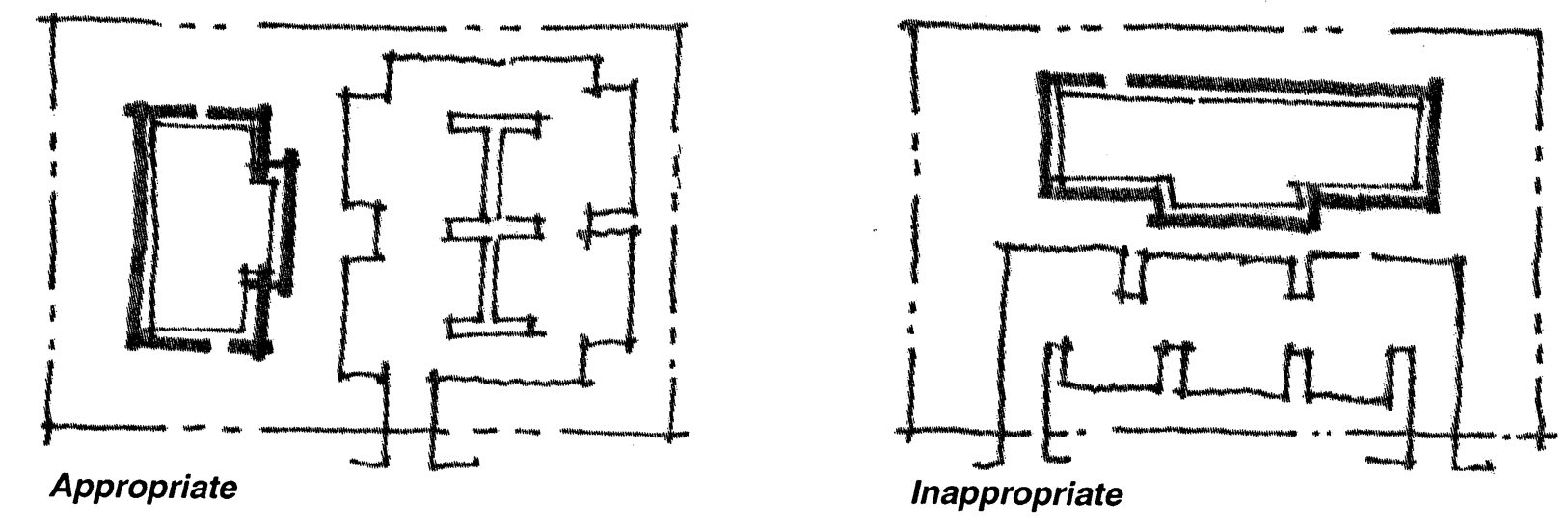
Perpendicular structures
2.
Creating a courtyard/plaza effect between structures;
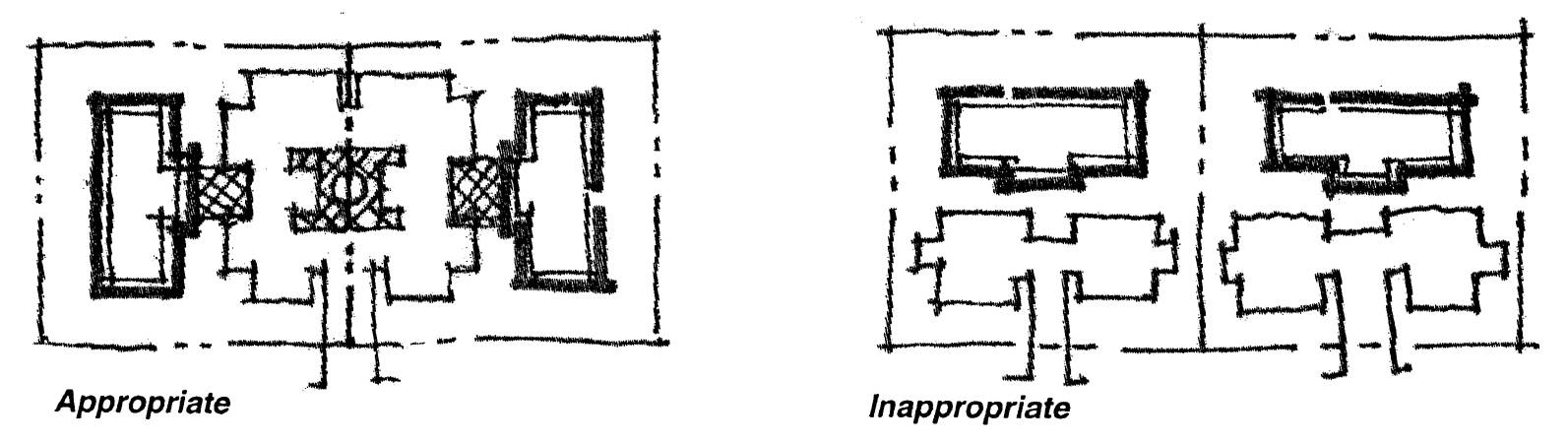
Courtyard/plaza
3.
Opening up views between structures with greater setbacks; and
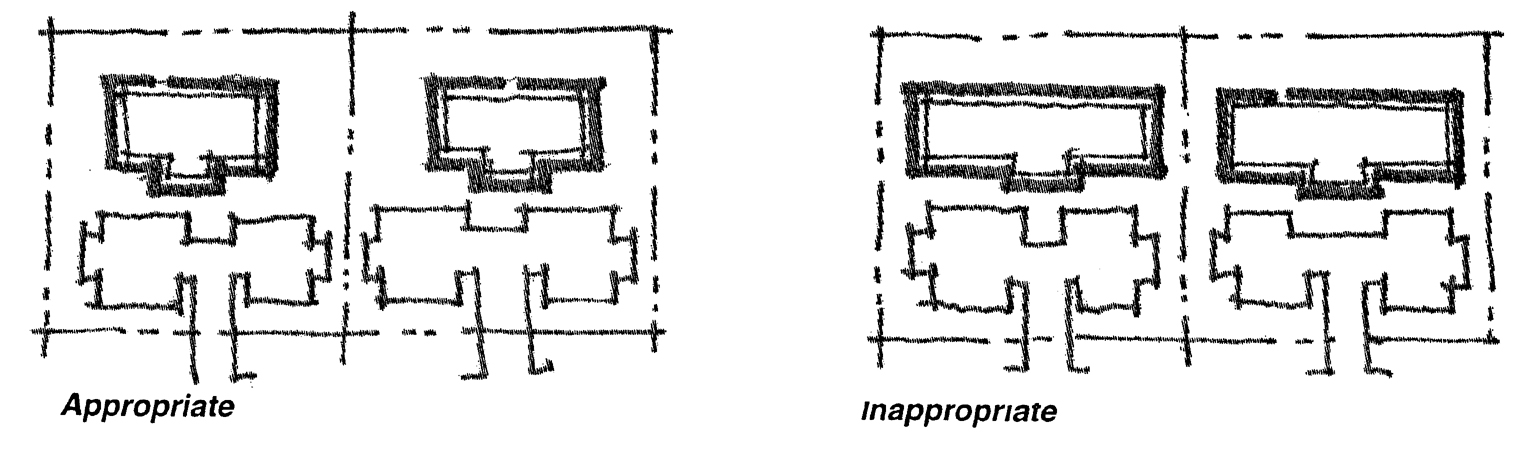
Opening views with greater setbacks
4.
Provision of wider landscape buffers along Northlake Boulevard.
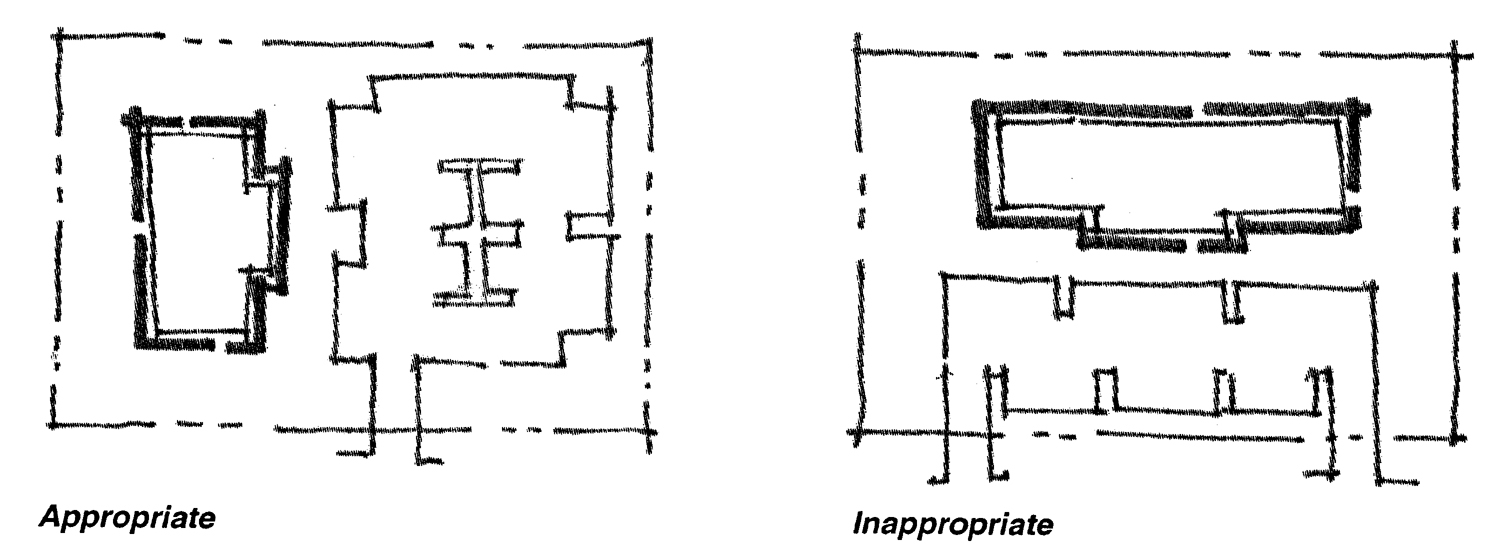
Wider landscape buffers
C.
Corner lots. On corner lots at an intersection of two or more arterial or major collector roads, buildings and structures shall be designed with additional architectural embellishments such as towers, or other design features, to emphasize their locations as gateways and transition points within the community.
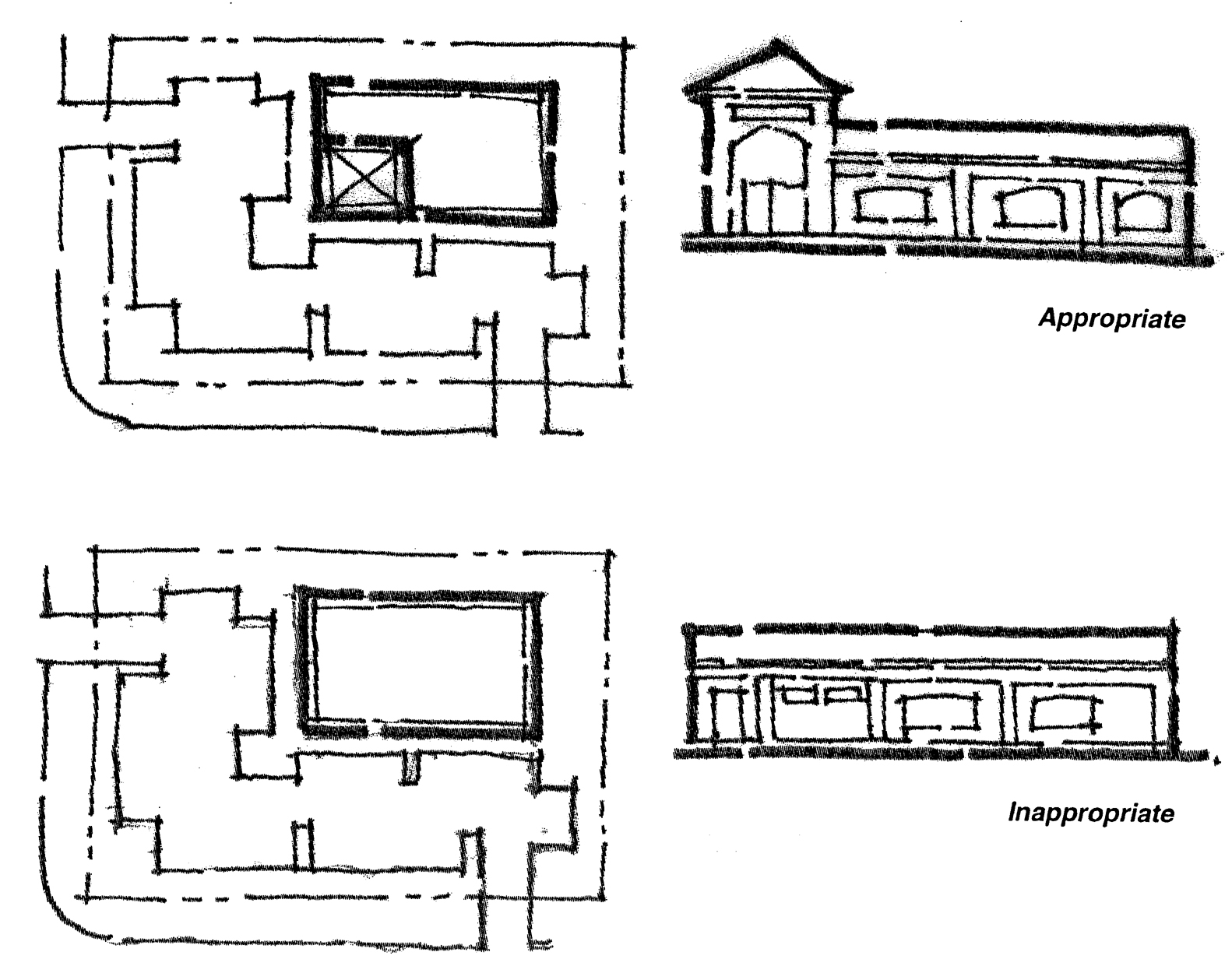
Corner lots
D.
Building envelope, bulk and setback requirement. In order to establish overall building envelope, bulk, and setback provisions within the NBOZ, the following regulations are established for the purposes of this section.
Table 6-2. Proposed Setbacks
Notes:
1 Building height is defined by the applicable building code.
2 If one-half the height of the proposed structure is greater than the minimum setback shown, the greater number shall prevail.
3 If the minimum landscape buffer required (subsection 4-11.A) is greater than the parking setback outlined above, the more restrictive shall apply.
A—H
Indicate dimension locations on the diagrams found in division 6.
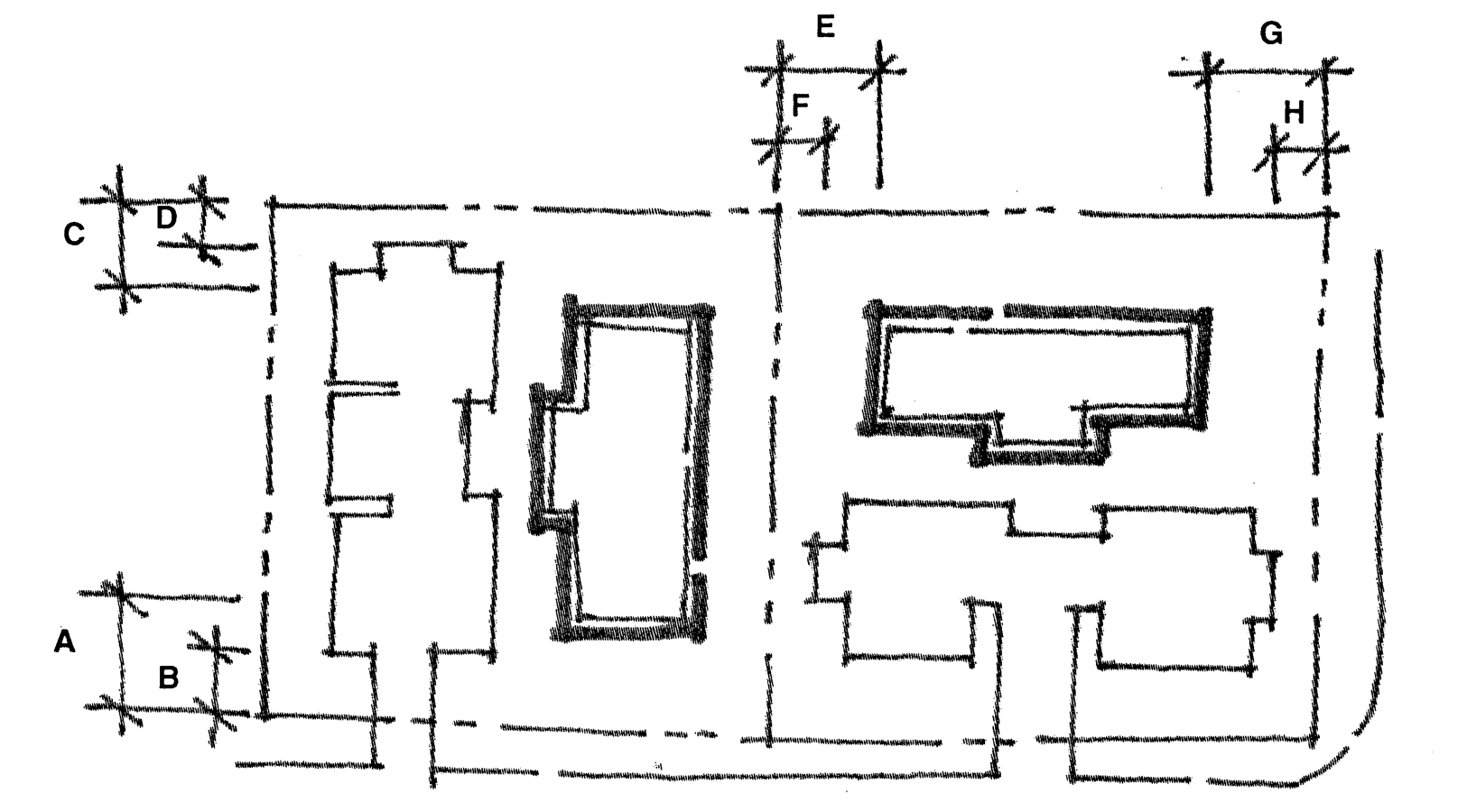
Proposed setbacks
E.
Commercial strip development discouraged. Minimum lot sizes and limited access drives shall be used to reduce the potential for commercial strip development. Neighboring properties are encouraged to link their parking lots together and to share common driveways.
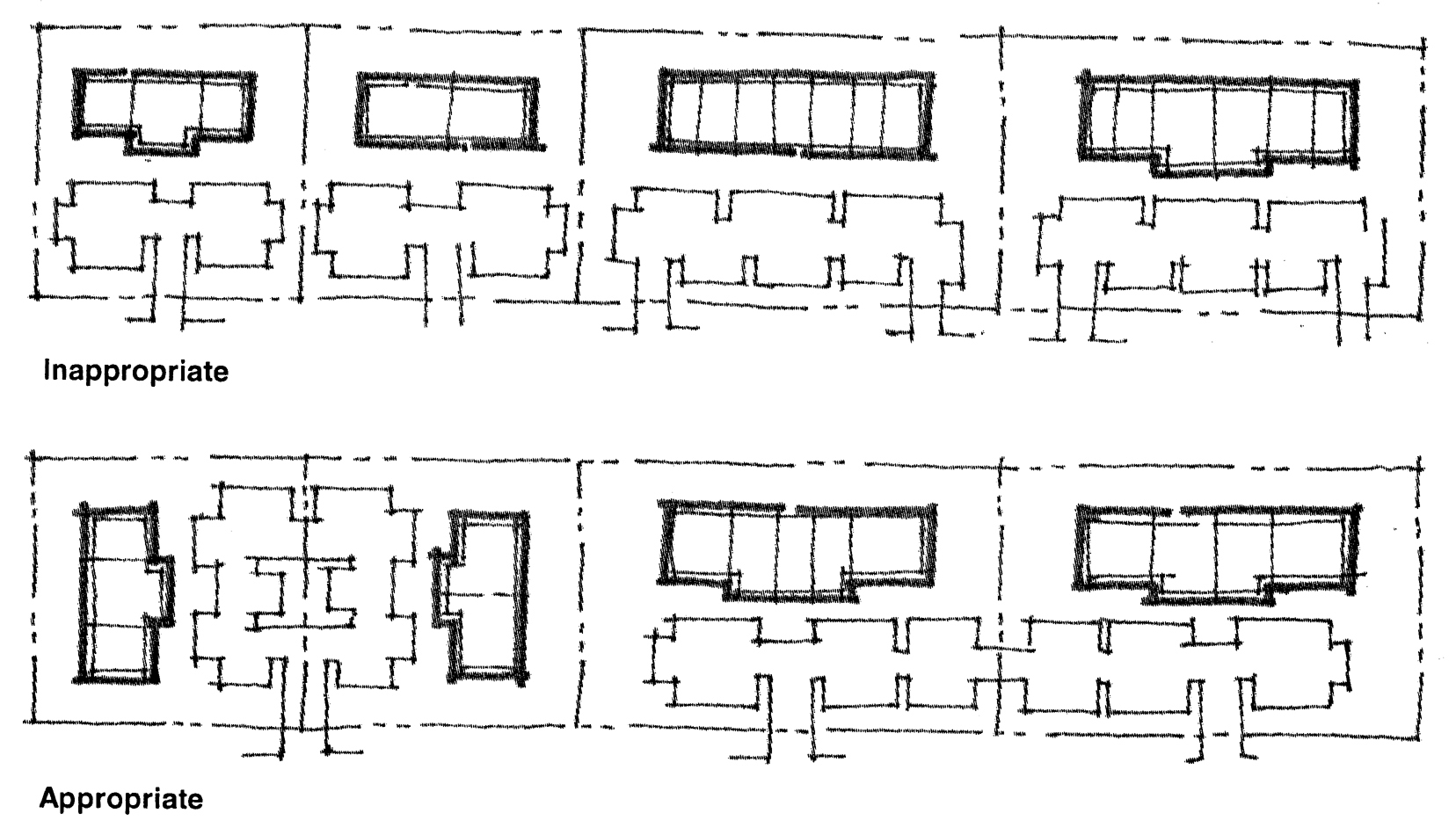
Commercial strip development
F.
Prohibited elements. The following elements are prohibited:
1.
Chainlink fences in public view;
2.
Unfinished concrete or concrete masonry walls excluding architectural concrete;
3.
Artificial plants or turf;
4.
Decorative or commercial display objects;
5.
Visible neon;
6.
Elements with highly reflective or bright colored surfaces; and
7.
Other objects that are not consistent with the NBOZ design goals as per the jurisdiction.
(Ord. No. 02-2006, Exh. A, 7-5-2006)
Sec. 6-3. - Off-street parking areas.
A.
Shared parking. As part of an approval of a new or expanded use, new construction, substantial renovation, or alteration or expansion of an existing structure, the use of shared parking to reduce overall parking requirements is permitted. The criteria for approval of an application to establish shared parking includes the following factors:
1.
Use of a building or structure for two or more uses, which possess complementary, rather than competing, peak hours of usage.
2.
Preparation of a shared parking study by a qualified professional engineer, architect, or planner.
3.
Execution of an agreement, in a form acceptable to the jurisdiction, between the owners and tenants of buildings or structures affected by the shared parking. This agreement shall provide:
a.
A means to re-address the shared parking in the event future parking problems or changes in use occur;
b.
A legal description of the land and structures affected;
c.
For a term of at least five years;
d.
A site plan to indicate uses, hours of operation, parking, etc.;
e.
Assurance of the availability of all parking spaces affected by the agreement.
B.
Off-site parking. Off-site parking not included in a shared parking agreement is not permitted within the NBOZ.
C.
Valet parking. The jurisdiction may authorize the use of valet parking for any use within the NBOZ subject to the following criteria.
1.
Valet parking shall not utilize more than 30 percent of the onsite parking of a use providing such service.
2.
A request to establish valet parking shall contain the following information:
a.
The location of the valet parking booth or area;
b.
The location and number of parking spaces to be utilized for valet parking;
c.
Evidence that the business owns the parking spaces proposed for valet use or a copy of any agreement, lease, etc. which provides the business with the right to use spaces owned by another individual or entity for valet parking;
d.
The impact of the valet parking service on users who do not patronize the service;
e.
The hours of operation;
f.
Location and text of any signage associated with the valet parking, spaces; and
g.
Buffering or screening that is necessary to mitigate any visual or noise-related impacts on any adjacent residential properties.
D.
Pedestrian circulation in parking facilities. Parking facilities and driveways shall be designed to maximize the safety and convenience of pedestrians walking between parked cars and business entrances as well as between external points and locations on site delineated with special pavement. Pedestrian walkways shall be integrated as follows:
1.
Into the interior and/or perimeter landscaping of parking lots;
2.
Constructed with a specialty paving or similarly firm and decorative surface; and
3.
At least five feet in width; and separated from vehicular and parking areas by grade, curbing and/or vegetation, except for necessary ramps.
E.
Loading facilities. Loading spaces shall not be located within 100 feet of Northlake Boulevard or other public rights-of-way, excluding alleys.
1.
Loading docks, solid waste facilities, recycling facilities and other service areas shall be placed to the rear or side of buildings and screened from adjacent residential uses.
2.
Screening and landscaping shall prevent direct views of the loading areas and their approaches from adjacent properties or from the public right-of-way.
a.
Screening and landscaping shall also prevent spillover glare, noise, or exhaust fumes.
b.
Screening and buffering shall be achieved through walls, fences and landscaping and shall be opaque and completely obscure the contents and facilities.
c.
Recesses in the building, or depressed access ramps may be used.
3.
Service access shall be behind the building or from secondary streets wherever possible, and screened from general view.
F.
Drive-throughs. In the event that drive-throughs are permitted by use or as a conditional use, the jurisdiction shall review the site plan for the following minimum standards:
1.
Adequate stacking for six vehicles per lane at 20 feet per vehicle;
2.
Proper ingress/egress to the facilities so as to preclude entering and exiting directly from a public right-of-way;
3.
Adequate space for a by-pass lane; and
4.
Any other design deemed appropriate by the jurisdiction.
(Ord. No. 02-2006, Exh. A, 7-5-2006)
Sec. 6-4. - Pedestrian amenities.
A.
General design. Uses shall contribute to pedestrian-friendly focal spaces through the provision of aesthetic walking paths, pedestrian spaces with furnishings, public art, generous plantings, marked crosswalks, and vehicular parking and circulation areas clearly separated from such pedestrian amenities.
1.
Sidewalks shall be of barrier-free design to the greatest extent possible.
2.
Pedestrian circulation systems shall include gathering/sitting areas.
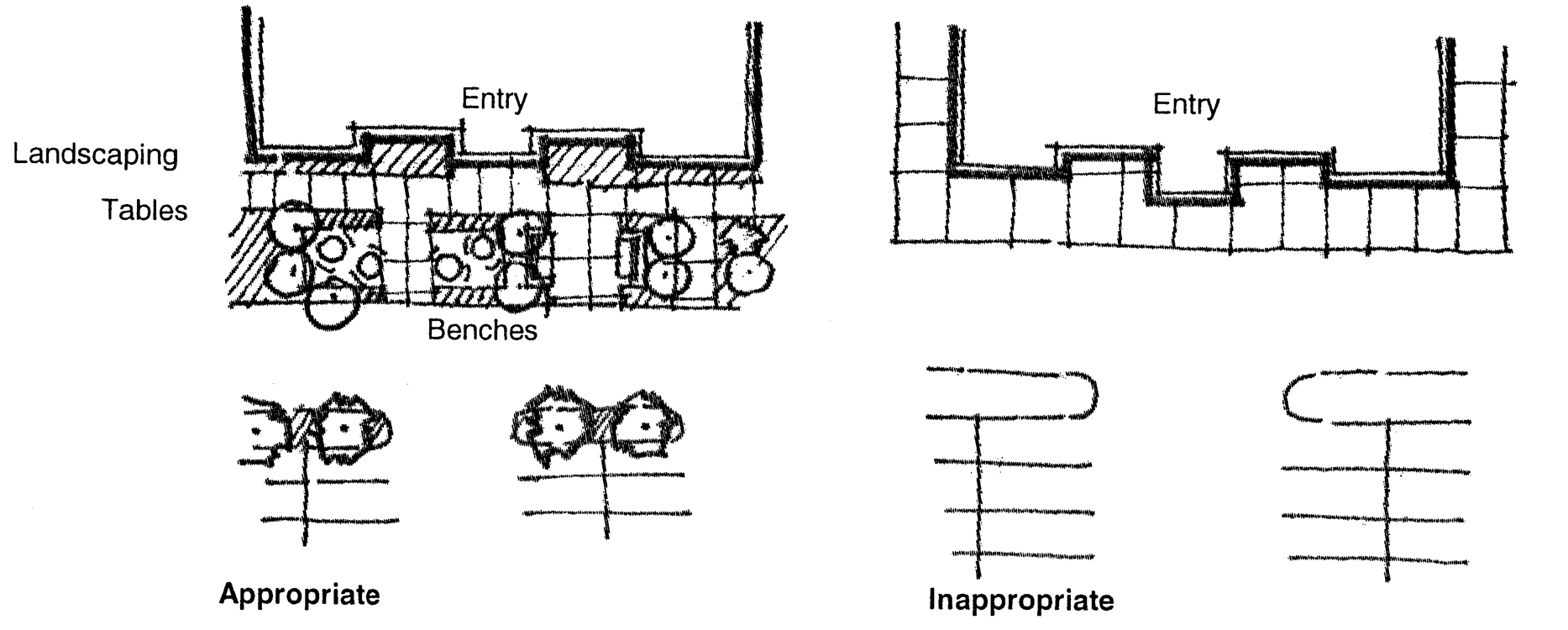
Pedestrian amenities
B.
Width and materials. Sidewalks shall be a minimum of five feet in width and shall be constructed of stone, textured cement, concrete pavers, or brick.
C.
Pedestrian entrances.
1.
Major public entrances shall be located along Northlake Boulevard.
2.
A clearly designated pedestrian walkway and similar pedestrian-oriented facilities shall be provided from public sidewalks to public entrance or walkways within a commercial site, as well as between abutting commercial properties.
(Ord. No. 02-2006, Exh. A, 7-5-2006)
Sec. 6-5. - Site and street furniture.
A.
Exterior lighting. All fixtures used for exterior lighting (building and site) are to be selected for functional and aesthetic value. Decorative pedestrian-scale lighting shall be provided at a height of no more than ten feet with standards constructed from steel, cast iron, aluminum or spun concrete. Lighting standards shall be of a consistent architectural style and shall complement the predominant architectural theme.
B.
Street furniture. Additional amenities such as drinking fountains, benches and shelters or kiosks shall be provided and supplemented with open spaces.
C.
Dumpsters and similar containers. Dumpsters and similar containers, including recycling bins, compactors, etc., shall be screened in a manner consistent with the following:
1.
Similar containers shall be located only at the rear of a building or structure.
2.
Enclosures shall be constructed in a manner consistent with the architectural style, color, materials, etc., of the principal building, and shall screen the dumpsters on all four sides of the enclosure from public view.
a.
An opaque concrete wall or similar material shall screen both sides and the rear of such facilities.
b.
The front of a screen enclosure shall be gated and shall consist of durable opaque materials consistent with the overall design of the project.
c.
Dependent upon the location of an enclosure on the site, landscaping may be required in addition to the opaque screening material.
3.
Alternative dumpster location. When it is not possible to locate the enclosure in the rear of the site, the dumpster shall be enclosed by landscaping to the greatest extent possible.
4.
Access to the dumpster should be provided from a secondary street.
5.
Enclosures are to be designed to provide space to accommodate recycling bins.
D.
Sidewalks. Sidewalks shall be provided along all roadways on both sides of the street. At corners handicapped ramps shall be provided and sidewalks shall continue across driveway and parking lot surfaces using decorative paving materials to delineate crosswalks. All new construction or substantial renovation of existing buildings and structures shall include one or more clearly delineated walkways from the public sidewalk to the private sidewalk, arcade, pedestrian way, etc. Examples of other complementary materials include the following:
1.
Paver blocks or alternative style or color:
2.
New and used brick; and
3.
Concrete stamped with a pattern.
E.
Retaining walls. Retaining walls shall be constructed as necessary, provided such walls are constructed utilizing the same architectural style, materials, and color of the principle structure.
F.
Alley screening walls. All new construction or substantial renovation of existing buildings and structures shall construct or reconstruct a solid masonry or concrete wall a minimum of six feet in height.
1.
The wall shall be located along the rear property line of the parcel being improved.
2.
Chainlink and wooden fences are prohibited.
3.
Properties within the marine district of the NBOZ are exempt from this requirement.
G.
Underground utilities. The jurisdiction may require existing overhead utilities to be placed underground when located on properties subject to new construction or substantial renovation.
H.
Shopping carts. If a use requires shopping carts, they shall not be allowed to accumulate in any outside area including parking lots and loading areas, and shall be removed from cart corrals in a timely manner and relocated to designated storage areas near the principle structure.
I.
Mailboxes. Mailboxes, including special drop boxes, may be clustered within buildings, grouped under a kiosk, or individually freestanding. In all cases the design and installation of mailboxes shall comply with the following standards:
1.
The jurisdiction and the U.S. Postal Service shall approve the size, type, and location of mailboxes.
2.
Mailboxes shall be landscaped consistent with and architecturally compatible to the development.
J.
Satellite dishes. Satellite dishes may be installed provided the dishes are not visible from any street, and the color is compatible with the surrounding environment. Plans for the installation of communication equipment, such as dishes and antennas, shall be submitted for review during the planning phase of a project.
K.
Telephones, vending machines, and newspaper racks. All public telephones, vending machines, newspaper racks, and facilities dispensing merchandise or services on private property shall be enclosed within a building, enclosed within a structure, attached to a building, or enclosed in a separate area.
1.
Attached and freestanding structures shall be landscaped consistent with and architecturally compatible with the principal structure.
2.
Public telephones. Wall-mounted and freestanding public telephones visible from a public right-of-way shall be fully or partially enclosed.
3.
Vending machines.
a.
Vending machines dispensing beverages, food, ice, and related consumer products shall not be visible from a public right-of-way.
b.
Vending machines may be located in outdoor enclosures, provided such enclosures are constructed utilizing the same architectural style, materials, and colors as the principal structure.
(Ord. No. 02-2006, Exh. A, 7-5-2006)

