
Laramie City Zoning Code
CHAPTER 15
28 - DEFINITIONS
15.28.010 - General rules of construction.
The following words, terms and phrases, when used in this Code, shall have the meanings ascribed to them in this chapter, except where the context clearly indicates a different meaning. The term "building" shall include the term "structure." The term "lot" shall indicate an area that has been platted, and may include the term "plot." The term "zone" shall mean "district." In addition, the following general rules of construction shall apply:
A.
Meanings and Intent. All provisions, terms, phrases and expressions contained in this code shall be construed according to this code's stated purpose and intent. All provisions, terms, phrases and expressions contained in this code shall be construed according to the general purposes set forth in Section 15.02.020 and the specific purpose statements set forth throughout this code. When, in a specific section of this code, a different meaning is given for a term defined for general purposes in this Chapter 15.28, the specific section's meaning and application of the term shall control.
B.
Headings, Illustrations and Text. In the event of a conflict or inconsistency between the text of this code and any heading, caption, figure, illustration, table or map, the text shall control.
C.
Lists and Examples. Unless otherwise specifically indicated, lists of items or examples that use terms such as "for example," "including," and "such as," or similar language are intended to provide examples and shall not be interpreted as exhaustive lists of all possibilities.
D.
Computation of Time. The time in which an act is to be done shall be computed by excluding the first day and including the last day. If a deadline or required date of action falls on a Saturday, Sunday or holiday observed by the city, the deadline or required date of action shall be the next day that is not a Saturday, Sunday or holiday observed by the city. References to days are calendar days unless otherwise stated.
E.
References to Other Regulations/Publications. Whenever reference is made to a resolution, ordinance, statute, regulation or document, it shall be construed as a reference to the most recent edition of such regulation, resolution, ordinance, statute, regulation or document, unless otherwise specifically stated.
F.
Delegation of Authority. Any act authorized by this code to be carried out by a specific official of the city may be carried out by a designee of such official.
G.
Technical and Nontechnical Terms. Words and phrases not otherwise defined in this code shall be construed according to the common and approved usage of the language, but technical words and phrases not otherwise defined in this code that may have acquired a particular and appropriate meaning in law shall be construed and understood according to such meaning.
H.
Public Officials and Agencies. All public officials, bodies and agencies to which references are made are those of the city of Laramie, unless otherwise indicated.
(Ord. No. 1578, § 2(att. A), 3-2-2010)
15.28.020 - Interpretations.
A.
Mandatory and Discretionary Terms. The words "shall," "must," or "will" are always mandatory and the words "may" or "should" are always discretionary.
B.
Conjunctions. Unless the context clearly suggests the contrary, conjunctions shall be interpreted as follows:
1.
"And" indicates that all connected items, conditions, provisions or events shall apply; and
2.
"Or" indicates that one or more of the connected items, conditions, provisions or events shall apply.
C.
Tenses and Plurals. Words used in one tense (past, present or future) include all other tenses, unless the context clearly indicates the contrary. The singular shall include the plural and the plural shall include the singular.
D.
Interpretation. The city manager's office has authority to determine the interpretation or usage of terms used in this code. Appeal of an interpretation made by the city manager's office shall be to the planning commission.
E.
Undefined Terms. The city manager's office has the authority to provide the definition for a term where it is not defined in this Code. Appeal of a definition provided by the city manager's office shall be to the planning commission.
(Ord. No. 1578, § 2(att. A), 3-2-2010; Ord. No. 1728, § 16, 4-18-2017)
15.28.030 - Definitions.
A.
Terms. The following terms have the meanings defined as follows:
1.
"Abutting" means having a common border with or being separated from such common border by an alley or easement, other than publicly dedicated and approved rights-of-way. (Ord. 1322 § 2 (part), 2000).
2.
"Accent material" means material covering twenty-five percent or less of a wall elevation.
3.
"Access" means the place, means or way by which pedestrians or vehicles shall have safe, adequate and usable ingress and egress to a property, use or parking space. (Ord. 1322 § 2 (part), 2000).
4.
An "accessory building or structure" is one which:
a.
Is subordinate to and serves a principal building or principal use;
b.
Is subordinate in building area, intensity of use or purpose to the principal building or principal use served;
c.
Contributes to the comfort, convenience and necessity of the occupants of the principal building or principal use served;
d.
Is located on the same zoning lot as the principal building or principal use served, with the single exception of accessory off-street parking facilities that are permitted to locate elsewhere; and
e.
Is prohibited prior to the establishment of the primary use except where authorized by the city manager. (Ord. 1322 § 2 (part), 2000: Ord. 194 § 12.2(1), 1964).
5.
"Accessory use" means a use incidental and subordinate to the principal use of the premises which does not alter the essential characteristic of the principal use considered as a whole and as related to other uses permitted on the same zoning lot. (Ord. 1322 § 2 (part), 2000).
6.
"Accessway" means an unobstructed way of specified width containing a drive or roadway which provides vehicular access within a development and connects to a public street. (Ord. 1322 § 2 (part), 2000).
7.
"Adjacent" means nearby, but not necessarily touching or abutting. (Ord. 1322 § 2 (part), 2000).
8.
Administrative and professional office. See "Office."
9.
"Affordable and workforce housing" means those dwelling units affordable to households earning between thirty percent and ninety percent of the median income. For for-sale units, those units affordable to households earning between fifty percent and one hundred fifteen percent of the median income.
10.
"Aggregate sign area" means the sum of the measurement of the area of the faces of all signs. (Ord. 1322 § 2 (part), 2000).
11.
"Agriculture (or farm or ranch)" means the use of land for agricultural purposes, including farming, ranching, dairying, floriculture, horticulture, pasturage, viticulture, grazing, animal and poultry husbandry and the necessary accessory uses for packing, treating, storing and shipping of farm products. (Ord. 1344 § 2 (part), 2001).
12.
"Agricultural uses" means those uses, support businesses and services related to the cultivating of land, rearing of livestock and/or production of crops.
13.
"Aircraft activity covenant with disclosure" means a covenant signed by landowner(s) and recorded at the office of the county clerk and recorder that notifies present and future landowners of the aircraft flight activity that will occur in the airspace above the property. (Ord. 1344 § 2 (part), 2001).
14.
"Airport" means a facility that provides space for aircraft to take off and land usually equipped with a control tower, hangars and accommodations for passengers and cargo. (Ord. 1344 § 2 (part), 2001).
15.
"Airport, landing strip and helicopter uses" includes all airports, as well as landing strips, heliports and helipads, including those for private use including those used by ultra-light aircraft. (Ord. 1344 § 2 (part), 2001).
16.
"Alley" is a minor way which is used primarily for vehicular service access to the back or the side of properties otherwise abutting on a street. (Prior code § 35-1 (part)).
17.
"Animal hospital." See "Veterinary clinic."
18.
"Animal research facility" means a facility for investigation into the natural, physical or social sciences that involves the use of animals under controlled conditions and which may include engineering and product development.
19.
"Animal slaughter house" means a closed facility for the killing and butchering of animals for their meat and various by-products. This use is entirely enclosed and does not have outdoor holding pens or outdoor activity with the exception of loading docks and associated processes. (Ord. 1344 § 2 (part), 2001)
20.
"Antenna" means any exterior transmitting or receiving communication device mounted on a tower, building or structure and used in communications which radiate or capture electromagnetic waves, digital signals, analog signals, radio frequencies (excluding radar signals), wireless telecommunications signals or other communication signals.
21.
"Appeal" means a means for obtaining review of a decision, determination, order or failure to act pursuant to the terms of this title. (Ord. 1322 § 2 (part), 2000).
22.
"Arboretum or botanical garden" means a public or private facility for the demonstration and observation of the cultivation of flowers, fruits, vegetables or ornamental plants. Permitted accessory uses include gift shops, cafes, snack bars and parking.
23.
"Architectural feature" means a balcony, canopy, column, door, eave, roof, soffit, window, wing wall or similar three-dimensional exterior element of a building or structure that lends to the overall exterior form, context and appearance of the building or structure. (Ord. 1322 § 2 (part), 2000).
24.
"Art gallery" means a room, group of rooms or other space where works of art are placed on display, possibly for sale.
25.
"Arterial street (including major and minor)" means a street that is access controlled and designed to provide continuous traffic movement throughout the urban area.
26.
"Assisted living facility" means a residence for the frail elderly that provides rooms, meals, personal care and supervision of self-administered medication. They may provide other services such as recreational activities, financial services and transportation.
27.
"Auction house" means a completely enclosed commercial establishment at which an auction takes place, excluding the sale of livestock. (Ord. 1344 § 2 (part), 2001).
28.
"Auction yard" means a commercial establishment or area at which an auction takes place at which livestock sale rings are permitted. (Ord. 1344 § 2 (part), 2001).
29.
"Automobile Paint and body shop" means an establishment or area for the purpose of the replacement, painting, restoration, welding, rebuilding or refinishing of vehicle parts or body components of automobiles, trucks and other motor vehicles.
30.
"Automobile rental or leasing" means a commercial establishment offering the temporary use of automobiles or trucks in exchange for payment. Such establishments may include office space, parking areas for rental vehicles, parking areas for customers and employees and servicing and repair facilities, but shall not include facilities for bodywork, painting or restoration. (Ord. 1344 § 2 (part), 2001).
31.
"Automobile repair" means all activities involving automobile repair, except automotive painting and body repair.
32.
"Automobile sales" means the use of any structure or land for a business involving the sale of new or used motor vehicles and recreational vehicles. Such establishments may include office space, parking lots for the display and storage of vehicles available for sale, parking areas for customers and employees, vehicle repair facilities, facilities for bodywork, painting or restoration and sale of parts. (Ord. 1344 § 2 (part), 2001).
33.
"Automobile service station" means an establishment providing sales of vehicle fuel and such services as lubrication, oil and tire changes and minor repairs. This use does not include paint spraying or body repair, automobile top or upholstery repair or tire retreading and repair. (Ord. 1322 § 2 (part), 2000).
34.
"Aviation easement" means a right generally established by deed or recorded plat to permit the unobstructed passage of all aircraft to an infinite height, together with the right to cause in all airspace above the surface of the grantor's property such noise, frequent overflights, vibrations, fumes, dust, fuel particles, radio energy emissions and all other effects that may be caused by the operation of aircraft landing or taking off, or operating at an aviation facility. (Ord. 1344 § 2 (part), 2001).
35.
"Awning" means a projecting cover extending over a door, window or wall section with supports attached to the building and used as cover, protection or as decoration. (Ord. 1322 § 2 (part), 2000).
36.
"Bakery, retail" means a structure, room or place used for making, preparing or baking, bread, biscuits, pastry, cakes, doughnuts, crullers, noodles, macaroni or spaghetti to be sold on-premises at retail and consumed on or off premises. (Ord. 1344 § 2 (part), 2001).
37.
"Bakery, wholesale" means a structure, room or place used for making, preparing or baking, bread, biscuits, pastry, cakes, doughnuts, crullers, noodles, macaroni or spaghetti to be sold on or off premises at wholesale and consumed off premises. (Ord. 1344 § 2 (part), 2001).
38.
"Balcony" means a platform enclosed by a parapet or a railing, projecting from an exterior wall of a building.
39.
"Bank." See "Financial institution" (Ord. 1344 § 2 (part), 2001).
40.
"Bar/tavern." See "Tavern."
41.
"Barber shop" means a business that offers haircuts, shaves and beard trims as its primary business. See also "Beauty parlor."
42.
A "bazaar" is a market or a commercial area where various vendors, artisans, and merchants gather to sell a wide array of goods, products, and services.
43.
"Beauty parlor" means an establishment wherein cosmetology is offered or practiced on a regular basis for compensation and may include barber shops, salons and spas.
44.
"Bed and breakfast inn" means the use of a single residential structure for commercial lodging purposes, in which the structure is occupied by the owner.
45.
"Berm" means an earthen mound designed to provide visual interest, screen undesirable views and/or decrease noise levels.
46.
"Boarding and rooming house" means a structure where lodging and/or meals are offered for a fee and where the length of residence may continue for an extended period of time, as distinguished from a motel or hotel. (Ord. 1344 § 2 (part), 2001: Ord. 194 § 12.2(5), 1964).
47.
"Book store" means a retail establishment where books, reading supplies, writing supplies, stationery and other related items are sold. Book store services may also include the purchase of books for resale or other use.
48.
"Botanical garden." See "Arboretum."
49.
"Buffering" means the installation of plant materials or fencing or landforms (or a combination of these measures), between two or more properties which inhibits visibility and/or mitigates the transmission of noise, dust, lights and other nuisances from one property to another. (Ord. 1344 § 2 (part), 2001).
50.
"Bufferyard" means a combination of physical space and vertical elements, such as plants, berms, fences or walls, the purpose of which is to separate and screen uses from one another.
51.
"Builders supply yard" shall mean a facility for general contractors to store supplies and operating equipment; it may include buildings and open storage yards, but may not constitute a junk or salvage yard. Builders supply yard does not include retail home improvement stores.
52.
"Building" means any permanent structure built for the shelter or enclosure of persons, animals, chattels or property of any kind and not including advertising signboards or fences. A building is considered a single building if the building includes one and/or a combination of the following elements as determined by staff; communication with each other through structural connections such as foundations or walls, major architectural elements, protected hallways or common areas that provide circulation and square footage within the building or other significant elements as determined by staff. (Ord. 194 § 12.2(6), 1964).
53.
"Building material sales and storage" means a commercial establishment or area for the purpose of providing building material at retail or wholesale. (Ord. 1344 § 2 (part), 2001).
54.
"Building, Principal." Principal building means any permanent structure built for the shelter or enclosure of persons, animals, chattels or property of any kind in which is conducted the main or principal use of the lot or zoning lot on which the building is situated, not including signs or fences. (Ord. 1322 § 2 (part), 2000).
55.
"Bus repair and storage" means an establishment or area for the purpose of bus repair, service and storage. (Ord. 1344 § 2 (part), 2001).
56.
"Bus terminal" means an establishment that provides space for arrival and departure of busses offering transportation to the public, usually equipped with accommodations for passengers and for fueling and servicing of busses. (Ord. 1344 § 2 (part), 2001).
57.
"Business incubation" means a business support process that accelerates the successful development of start-up and fledgling companies by providing entrepreneurs with an array of targeted resources and services. A business incubator's main goal is to produce successful firms that will leave the program financially viable and freestanding. These incubator graduates have the potential to create jobs, revitalize neighborhoods, commercialize new technologies, and strengthen local and national economies.
58.
"Business Park" means a single site, lot, tract or subdivision containing two or more separate professional and/or commercial uses in separate buildings.
59.
"Butcher" means an enclosed commercial facility for the purpose of dressing and preparing animal carcasses for sale as smaller unit purchases.
60.
"Cabinet shop" means a commercial establishment for the purpose of sales, refinishing or repair of cabinets. (Ord. 1344 § 2 (part), 2001).
61.
"Caliper" means a measurement of the size of a tree taken six inches from above ground level for trees up to and including four-inch caliper sizes and twelve inches above ground level for larger trees. (Ord. 1322 § 2 (part), 2000).
62.
"Campgrounds" means commercial campgrounds, for-profit campgrounds, recreational vehicle parks or a mix of these uses. (Ord. 1322 § 2 (part), 2000).
63.
"Campsite" means a piece of land within a campground for overnight camping. Campsites may be occupied by tents, travel trailers, recreational vehicles or cabins.
64.
"Candy shop" means a retail establishment that sells confectionary goods and candy; candy shops may include very limited on-site production.
65.
"Canopy" means a permanent roof-like shelter extending from part or all of a building face and constructed of some durable material such as metal, glass, fabric or plastic. (Ord. 1322 § 2 (part), 2000).
66.
"Car wash" means a facility for washing or steam cleaning passenger automobiles (including a self-service operation), operating either as a separate facility or when installed and operated in conjunction with another use, and which installation includes equipment customarily associated with a car wash and which is installed solely for the purpose of washing and cleaning automobiles.
67.
"Carnival" means a traveling amusement show typically having various devices for entertainment, including rides and booths for the conduct of games or sale of items. (Ord. 1344 § 2 (part), 2001).
68.
"Catering" or "commissary facility" means an approved cooking and food preparation establishment or other place in which food, containers or supplies are kept, handled, prepared, packaged or stored for off-site consumption.
69.
"Cemetery" means a pace for burying or housing the dead; includes mausoleum. (Ord. 1344 § 2 (part), 2001).
70.
"Chemical plant" means an industrial process plant that manufactures (or otherwise processes) chemicals, usually on a large scale.
71.
"Child care facilities," including preschools and nursery schools, are defined as follows:
a.
"Child care center" means any business operated by a private person, partnership, association or corporation that is operating a business for profit or otherwise, in a building used solely for commercial purposes, where sixteen or more children receive care for less than twenty-four hours per day. Child care centers include preschools and nursery schools.
b.
"Child care center, family" means a child care facility in which care is provided for a maximum of fifteen children for less than twenty-four hours per day, which may be in a residential or commercial type structure. Child care center, family includes preschools and nursery schools.
c.
"Child care home, type 1" means a private residence used for the care of children other than the occupant's own children for a period of less than twenty-four hours per day and is exempt from licensing by the Wyoming Department of Family Services or applicable state agency. The typical size of this child care facility is two children, other than the occupant's own children. Child care home, type 1 includes preschools and nursery schools.
d.
"Child care home, type 2" means a private residence used for the care of ten or fewer children other than the occupant's own children for a period of less than twenty-four hours per day and requiring a license issued by the Wyoming Department of Family Services or applicable state agency. Child care home, type 2 includes preschools and nursery schools.
72.
"Church" means a building or structure or groups of buildings or structures, which by design and construction are primarily intended for the conducting of organized religious services and accessory uses associated therewith. (Ord. 1322 § 2 (part), 2000).
73.
"Circus" means a traveling amusement show typically performed in large tents featuring daring acts, performing animals and clowns. (Ord. 1344 § 2 (part), 2001).
74.
"City manager" means the manager for the city of Laramie, Wyoming or the manager's designated representative. The city manager may designate the director as a representative. (Ord. 1322 § 2 (part), 2000).
75.
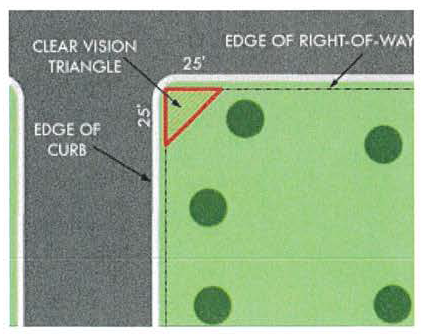
"Clear vision area" means a triangular area on the corner of lots measured at a distance of twenty-five (25 feet measured along adjoining street right-of-way lines (property lines), and connecting those points. (See figure 15.28.030- 1) (Ord. 1625 § 16, 2012).
76.
"Clinic" means a building, other than a hospital as herein defined, used by two or more licensed physicians, therapists, psychologists or other medical and psychological professionals for the purpose of receiving and treating patients. (Ord. 1322 § 2 (part), 2000).
77.
"Clothing store" means a retail facility for selling male and/or female apparel.
78.
"Code" means the Unified Development Code of the city of Laramie, Wyoming.
79.
"Coffee shop" means a small restaurant where drinks, snacks and/or light meals are sold.
80.
"Cold storage plant" means a refrigerated storage space usually with temperatures under forty-five degrees Fahrenheit (7ºC).
81.
"Collector street" is a street which carries traffic from minor streets to major arterial streets, including the principal entrance streets of a residential development and streets for circulation within such a development. (Prior code § 35-1 (part)).
82.
"College or university" means an academic institution of higher learning beyond the level of public, parochial, elementary or secondary schools.
83.
"Co-location" means the location of antennas owned or operated by different carriers upon the same tower or other structure.
84.
"Commercial and/or industrial complex" means a commercial and/or industrial multi-structure development or an establishment where multiple principle uses exist within a single commercial or industrial structure all on one lot. (Ord. 1344 § 2 (part), 2001).
85.
"Commercial retail" means a commercial enterprise that provides goods directly to the consumer, where such goods are available for immediate purchase and removal from the premises by the consumer. Examples include, but are not limited to: Apparel shops, appliance sales, auto parts store, bait shop, bakeries, bookstores, convenience stores without gas pumps, department stores, factory outlet stores and florists.
86.
"Commission" means the planning commission of the city of Laramie, Wyoming. (Prior code § 35-1 (part)).
87.
"Communications towers, commercial" includes radio or 1V broadcasting towers; telecommunications towers and antenna arrays (satellite dishes). (Ord. 1344 § 2 (part), 2001).
88.
"Community building/center" means a facility providing recreation/pool facilities and/or meeting rooms and typically oriented to the recreational needs of the residents of the surrounding area.
89.
"Community garden" means a piece of land gardened by a group of people.
90.
"Community playfield or park" means a tract of land owned by a public entity and available to the general public for recreational purposes. This definition includes indoor recreational facilities, swimming pools, playgrounds and lighted and unlighted athletic fields.
91.
"Community services" means an establishment that provides assistance and aid to those persons requiring counseling for psychological problems, employment, learning, disabilities, physical disabilities or socio-economic challenges.
92.
"Comprehensive plan" means an overall plan prepared by the planning commission and adopted by the city council which indicates the general locations recommended for the various functional classes of public works, places and structures and for the general physical development of the city and includes any unit or part of such plan separately adopted and any amendment to such plan or parts thereof. (Prior code § 35-1 (part)).
93.
"Concrete mixing plant" means an industrial establishment or plant where a material made from sand, pebbles and crushed stone held together by cement.
94.
"Conditional use" means a use that may be appropriate in a given zoning district, provided that it is compatible with the surrounding neighborhood, that potential adverse impacts on adjacent properties are mitigated and that applicable conditional use criteria have been satisfied, as determined through the conditional use review process as determined in this code.
95.
"Condominium" means real estate, portions of which are designated for separate ownership and the remainder of which is designated for common ownership solely by the owners of those portions. Real estate is not a condominium unless the undivided interests in the common elements are vested in the unit owners. (Ord. 1322 § 2 (part), 2000).
96.
"Conference center" means a facility used for conferences and seminars and may include accommodations for food preparation an eating, recreation, entertainment, resource facilities and meeting rooms.
97.
"Coniferous" means a plant with foliage that persists and remains green year-round.
98.
"Connectivity" means the relative degree of connection between streets, sidewalks or other means of travel.
99.
"Convalescent home." See "Nursing homes."
100.
"Convenience store" means a small commercial establishment selling packaged food and other convenience items which may include gasoline. This use category includes any retail establishment selling consumer products and having a gross floor area of less than two thousand square feet. (Ord. 1344 § 2 (part), 2001)
101.
"Council/city council" means the city council of Laramie, Wyoming. (Prior code § 35-1 (part)).
102.
"Craft shop" means a retail establishment that sells craft supplies and may host informational workshops or lessons related to specific crafts.
103.
"Crematory" means an establishment at which cremation is done. (Ord. 1344 § 2 (part), 2001).
104.
"Cul-de-sac" or "dead-end street" is a minor street with only one outlet. (Prior code § 35-1 (part)).
105.
"Dairy products processing" means an establishment that converts raw dairy into a finished packaged form and distributes the product to be sold for consumption offsite. (Ord. 1344 § 2 (part), 2001).
106.
"Data center" means a business specifically designed and equipped to meet the needs of high density computing equipment such as server racks used for data storage and processing. Typically these facilities require dedicated uninterruptible power supplies and cooling systems. Data center functions may include traditional enterprise services, on-demand enterprise services, high performance computing, internet facilities, and/or hosting facilities. Often data centers are free-standing, mission-critical computing centers. When a data center is located within a larger building, it usually has its own power and cooling systems. It is also common to have raised floor space to facilitate equipment cooling. The data center space is intended for sophisticated computing and server functions; it should not be used to represent a server closet or computer training area. Data center can include computer center, research center, datacenter, data storage and hosting facility, server farm, data farm, data warehouse, co-location facility, co-located server hosting facility (CoLo), corporate data center, managed data centers and internet hotel.
107.
"Day care center." See "Child care facilities."
108.
"Day care home." See "Child care facilities."
109.
"Deciduous" means a plant with foliage that is shed annually.
110.
"Dental clinic." See "Clinic."
111.
"Department store" means a retail store organized into a variety of customer-based departments, such as clothing, household items, furniture and/or appliances.
112.
"Development" means the construction, reconstruction, remodeling, conversion, structural alteration, relocation, enlargement or demolition of any structure, portion of a structure or sign; any change in use in land, building or structure, or material change in the appearance of any structure; any increase in the number of dwelling units, businesses, manufacturing establishments, offices; any mining, excavation, filling, grading, paving, or land disturbance; and any act of subdivision of land.
113.
"Development footprint" means the outline of the built area at ground level. This shall include all areas associated with the use on the property. For example, an automobile sales lot's outdoor display area or a contractor's outdoor storage yard shall be considered part of the development footprint.
114.
"Development pad" means the portion of a lot subject to site disruption from construction activities including construction of principal and accessory buildings, driveways, walkways, loading areas and storage yards; or a development area internal to a development site platted as a lot for development of townhomes, condominiums or commercial buildings. (Ord. 1322 § 2 (part), 2000).
115.
"Diameter at breast height" means the diameter of a tree at 4.5 feet above ground on the uphill side of the tree.
116.
"Display, outdoor." See "Outdoor display."
117.
"Drive-in establishment" means an establishment which by design, physical facilities, service or by packaging procedures encourages or permits customers to receive services, obtain goods or be entertained while remaining in their motor vehicle. (Ord. 1344 § 2 (part), 2001).
118.
"Drive-thru" means an establishment, whether it be the primary or an accessory use, other than automobile service station or parking lot, which is designed to accommodate the motor vehicles of patrons in such manner as to permit the occupants of such vehicles while remaining therein, to make purchases or receive services at a window or service area. (Ord. 1322 § 2 (part), 2000).
119.
"Driveway" means a private access connecting a building such as a house, garage or store, with a street. (Ord. 1322 § 2 (part), 2000).
120.
"Drug store" means a facility for dispensing drugs and medicine, and may include the sale and display of other merchandise such as cosmetics, lotions, fountain service and similar items.
121.
"Dry cleaners, retail" means a commercial establishment or area where customers drop off, pick up and pay for garments to be dry-cleaned. (Ord. 1344 § 2 (part), 2001).
122.
"Dry cleaning plant" means an industrial establishment or area for the purpose of cleaning garments and fabrics with any of various nonaqueous agents. (Ord. 1344 § 2 (part), 2001).
123.
" A two-family dwelling consisting of two attached single-family dwelling units arranged side by side and separated by a common wall.
124.
"Dwelling" means any building or portion thereof which is used as the private residence or sleeping place of one or more people, but not including hotels, motels, tourist courts, resort cabins, clubs, hospitals or similar uses. (Ord. 1322 § 2 (part), 2000).
125.
"Dwelling, accessory" means living quarters within a single family zoned property (Rl, LR, RR) that can be attached or detached from the principal structure. The term "accessory dwelling" is only applicable in single-family zoning (Rl, LR, RR) districts since there is no distinction between principal and accessory dwellings within multi-family residential zoning (R2, R2M, and R3) districts.
126.
"Dwelling, commercial" means an dwelling located above, behind, attached or below the first floor of a commercial or industrial building. (Ord. 1322 § 2 (part), 2000).
127.
"Dwelling, condominium" means a building or group of buildings, in which units are owned individually, and the structure, common areas and facilities are owned by all the owners. (Ord. 1344 § 2 (part), 2001).
128.
"Dwelling, live/work" means a one-family detached, one-family attached dwelling and Townhouse unit that contains a commercial component of not more than fifty percent of the unit's gross floor area.
129.
"Dwelling, manufactured home" means a single-family dwelling unit constructed after June 15, 1976, built in accordance with National Manufactured Home Construction and Safety Standards Act, 42 U.S.C. Section 5400 et seq.
130.
"Dwelling, mobile home" means a factory-built dwelling built before June 15, 1976, to standards other than the National Manufactured Home Construction and Safety Standards Act, 42 U.S.C. Section 5400 et seq., and acceptable under applicable state codes in effect at the time of construction of introduction of the home into the state. Mobile homes have not been built since introduction of the National Manufactured Home Construction and Safety Standards Act, 42 U.S.C. Section 5400 et seq.
131.
"Dwelling, IBC/IRC modular home" means a factory assembled residence built in units or sections, transported to a permanent site and erected on a foundation.
132.
"Dwelling, multifamily" means a dwelling containing more than two dwelling units. (Ord. 1344 § 2 (part), 2001).
133.
"Dwelling, single-family" means a designed exclusively for and occupied by one family.
134.
"Dwelling, single-family (attached)" means a single-family residence attached in any way to another residence. (Ord. 1344, § 2 (part), 2001: Ord. 194 § 12.2(9), 1964).
135.
"Dwelling, single-family (detached)" means a single-family residence located on a single lot, being the principal use of the lot and not connected to any other residence. (Ord. 1344 § 2 (part), 2001).
136.
"Dwelling, townhouse" means an attached single-family dwelling in a row of at least three such units in which each unit has its own front and rear access to the outside, no unit is located over another unit and each unit is separated from any other unit by one or more common walls. (Ord. 1344 § 2 (part), 2001).
137.
"Dwelling, two-family" means a residence designed, arranged or used exclusively by two families living independently of each other. (Ord. 1344 § 2 (part), 2001).
138.
"Dwelling unit" means one or more rooms used by one family for living or sleeping purposes, which contains kitchen and bathroom facilities for the sole use of the resident family. (Ord. 1344 § 2 (part), 2001).
139.
"Equipment and supply store" means an establishment displaying and offering for rent equipment for domestic maintenance and improvement including cleaners, mowers, ladders, tillers, cement mixers, wheelbarrows, paint spraying equipment and similar items.
140.
"Establishment" means a place of business together with its employees, merchandise and equipment. (Ord. 1344 § 2 (part), 2001).
141.
"FAA aeronautical study on obstructions" means a study conducted by the Federal Aviation Administration to examine the effects of buildings and structures on such factors as aircraft operational Capabilities; electronic and procedural requirements; and airport hazard standards. (Ord. 1344 § 2 (part), 2001).
142.
"Façade" means any exterior side of a building.
143.
"Family." See "Household."
144.
"Farming" includes farming and other supporting agricultural uses. Farming includes traditional farming, sod farms, tree farms and animal farming in unconfined operations. (Ord. 1344 § 2 (part), 2001).
145.
"Farm machinery sales" means a commercial establishment or area for the purpose of farm machinery sales, service or repair. (Ord. 1344 § 2 (part), 2001).
146.
"Feedlots" means a commercial establishment where livestock are kept confined in a compound or fenced area in order to be fattened for sale or slaughter. (Ord. 1344 § 2 (part), 2001).
147.
"Fence." See "Wall or fence."
148.
"Final plat" means the final map, drawing or chart on which the subdivider's plan of subdivision is presented to the council through the commission for approval, and which, if approved, shall be submitted to the county clerk for recording. (Prior code § 35-1 (part)).
149.
"Financial institution" means a business engaged in monetary transactions including banks and savings and loans, thrifts and lending institutions. (Ord. 1344 § 2 (part), 2001).
150.
"Fire station" means an establishment used for the storage of fire trucks and emergency medical vehicles, which may also contain office space and living quarters for fire fighting personnel. (Ord. 1344 § 2 (part), 2001).
151.
"Fireworks stand" means a temporary structure permitted by these standards and regulations for the sale of or dispensing of fireworks. (Ord. 1344 § 2 (part), 2001).
152.
"Flag" means a fabric sheet of square, rectangular or triangular shape that is mounted on a pole. This category includes the state, United States and/or flags of foreign nations. (Ord. 1322 § 2 (part), 2000).
153.
"Floodlight" means a broad beam, strong artificial light typically used to light playing fields, yards, buildings, driveways and theater stages and sometimes used for security purposes with motion detection sensors.
154.
"Floor area, gross (gross floor area)" means the sum of the gross horizontal areas of the several stories of the building measured from the exterior faces of the exterior walls or from the center line of party walls. Included shall be any basement floor, interior balconies and mezzanines, elevator shafts and stair wells and enclosed porches. (Ord. 1078 § 1, 1992).
155.
"Floor area, net (net floor area)" means the sum of all floor areas of a building, excluding stairwells, interior vehicular parking or loading and all floors below the ground or first floor, unless intended to be used for human habitation.
156.
"Floor area ratio" means the sum of the horizontal areas of the several floors inside the exterior walls of a building or portion thereof divided by the lot area. (Ord. 1322 § 2 (part), 2000).
157.
"Florist" means a facility for the retail sales of cut or uncut flowers and ornamental plants and accessory items.
158.
"Food processing and storage" means a heavy industrial establishment used to process, package and store food product, excluding the killing and dressing of any flesh or fowl.
159.
"Fraternity/sorority" means a social organization, typically for college students, that may include shared living arrangements.
160.
"Fueling station" means any building or land used for the dispensing, retail sale or retailing for sale, at retail, of any automobile fuels, oils or accessories and in connection with which there is no automobile repair.
161.
"Fully shielded fixture" means an outdoor light fixture shielded in such a manner that all light emitted by the fixture, either directly from the lamp or indirectly from the fixture, is projected below the horizontal as determined by photometric test or certified by the manufacturer. (Ord. 1322 § 2 (part), 2000).
162.
"Funeral home" means a building used for the preparation of the deceased for burial and the display of the deceased and rituals connected therewith before burial or cremation.
163.
"Furniture store" means a retail facility for displaying and selling new furniture that may also include appliances such as radios, televisions, stereos, refrigerators, stoves and lawn furniture.
164.
"Garage, private" means a structure that is accessory to a dwelling and which is used for the parking and storage of vehicles owned and operated by the residents of the dwelling and which is not a separate commercial enterprise available to the public. (Ord. 1344 § 2 (part), 2001).
165.
"Garage sale" means a sale of old or used belongings held at a private residence. (Ord. 1344 § 2 (part), 2001).
166.
"Gas station." See "Fueling station."
167.
"General merchandise store" is a retail store that sells, leases, or rents consumer, home, and business goods, but excluding merchandise/retail uses classified or defined more specifically in this code (e.g., food/beverage sales, grocery stores, restaurants). Typical uses include department stores, furniture stores, clothing stores, and establishments providing the following products or services: antiques, art, art supplies, bicycles, clothing, dry goods, electronic equipment, fabric, furniture, garden supplies, gifts, hardware, home improvements, household products, jewelry, pet food, pharmaceuticals, printed material, sporting goods, stationary, and videos; and new automotive parts and accessories (excluding service and installation).
168.
"Gift shop" means a shop connected to a monument, site, museum or other place of interest, which sells products related to the nature of the place.
169.
"Government services, offices and facilities" means an office or building of a governmental agency that provides administrative and/or direct services to the public, such as, but not limited to: Post offices, employment offices or public assistance offices.
170.
"Grade" (ground level) is the average of the finished ground level at the center of all walls of a building. (Ord. 194 § 12.2(12), 1964).
171.
"Grocery store" means a food store that sells a general line of food products, such as canned and frozen foods; fresh fruits and vegetables; and fresh and prepared meats.
172.
"Gross floor area." See "Floor area, gross."
173.
"Group home" means a residence operated as a single dwelling, licensed by or operated by a government agency, for the purpose of providing special care or rehabilitation due to homelessness, physical condition or illness, mental condition, or social, behavioral or disciplinary problems, with authorized supervisory personnel present on the premises. (Ord. 1344 § 2 (part), 2001).
174.
"Hardware store" means a retail facility for selling cutlery, tools, utensils, screws, nails and similar hardware items.
175.
"Heavy industrial" includes: Construction, manufacturing, processing, transportation and public utilities, and those uses with severe potential for negative impact on any uses located relatively close to them. It includes uses that require unenclosed structures that are large, tall and unsightly, such as concrete batch plants. Heavy industrial uses have potential for generation of dust, noise and odor and may require areas of exterior storage. Examples include, but are not limited to: heavy construction contractors, sawmills, concrete plants, electrical distribution equipment and dairy and food processing.
176.
"Heavy manufacturing of processing" means manufacturing and processing in which operations are carried on which will be likely to create smoke, fumes, noise, odor, vibration or dust, or which may be detrimental to the health, safety or general welfare of the community. Examples include, but are not limited to: automobile salvage, animal slaughter, fertilizer manufacturing, petroleum product bulk storage, hazardous waste treatment facility and lumber mills.
177.
"Heavy retail and heavy services" means all activities involving the production, processing, cleaning, servicing, testing or repair of materials, goods or products that would be considered as light or heavy industrial shall be prohibited in this use. For example, while auto or engine repair is permitted, the storage and disassembly of vehicles and the re-assembly of various parts are considered heavy industry. Junkyards as well are considered heavy industry. Heavy retail and heavy service uses include retail and/or service activities that have large amounts of exterior service or storage areas or partially enclosed structures such as: automobile dealers; automotive repair except top, body, upholstery repair, paint and tire retreading shops; automotive services except wrecking or towing storage yards; mobile home and manufactured housing dealers with mobile home sales office; auto/truck rental/leasing; cold storage; welding shops; cabinet manufacturing with sales; radio and TV broadcasting station; flea market; firewood splitting and sales and pawn shop. (Ord. 1344 § 2 (part), 2001).
178.
"Height, building" means the vertical distance from the grade to the highest point of the roof surface. (Ord. 194 § 12.2(13), 1964).
179.
"Height, tower" when referring to a tower or other structure, means the distance measured from the finished grade of the parcel to the highest point on the tower or other structure, including the antenna.
180.
"Heliport" means an area, either at ground level or elevated on a structure, licensed and approved for the landing and takeoff of helicopters and any appurtenant structures or facilities which may include parking, waiting room, refueling, maintenance, repair or storage facilities. (Ord. 1344 § 2 (part), 2001).
181.
"High tech manufacturing" means manufacturing and processing in which operations are carried on with an enclosed structure that will not create smoke, fumes, noise, odor, vibration or dust, of which will be detrimental to the health, safety or general welfare of the community and uses technology within the manufacturing process.
182.
"Hobby shop" means a facility for the retail sale of hobby supplies such as model kits, art equipment and materials.
183.
"Home improvement store" means a facility which retails appliances, fixtures, building materials and other similar items for the maintenance and improvement of residential structures.
184.
"Home occupation" means a business, profession, occupation or trade conducted for personal gain or support of the residential occupation and conducted within a residential building or accessory structure to a residential use. (Ord. 1344 § 2 (part), 2001)
185.
"Homeless shelter" means a facility which provides temporary lodging, meals and sanitary facilities for no more than ten persons without permanent housing.
186.
"Horse trailer sales and rental" means a commercial establishment or area for the purpose of horse trailer sales and rental. (Ord. 1344 § 2 (part), 2001).
187.
"Hospital" means an establishment that provides medical or surgical care and treatment for the sick and the injured, where overnight stays are routine and may include necessary accessory facilities such as helipads laboratories, outpatient or training facilities. (Ord. 1344 § 2 (part), 2001: Ord. 194 § 12.2(14), 1964).
188.
"Hotel or motel" means a commercial establishment that offers transient lodging accommodations to the general public and provides additional services such as restaurants, meeting rooms and recreation facilities. A hotel or motel shall provide a minimum of six guestrooms. (Ord. 1344 § 2 (part), 2001: Ord. 194 § 12.2(15), 1964).
189.
"Household" means an individual or two or more persons related by blood, marriage or legal adoption, or duly authorized custodial relationship, living together in a dwelling unit as a single housekeeping unit. Persons not related by blood, marriage, legal adoption, or duly authorized custodial relationship shall be deemed to constitute a household where they are living and cooking together as a single housekeeping unit, but the number of unrelated adults living in a dwelling unit shall not exceed three in the LR, R1 and R2 zoning districts or four in the R3 and other zoning districts where residences are permitted. (Ord. 1412 § 1, 2003: Ord. 1344 § 2 (part), 2001: Ord. 194 § 12.2(11), 1964).
Editor's note— Per enrolled Ordinance No. 1412 § 2, 2003, wherever in the zoning code the term "family" is used, the term "household" as defined in this section shall be substituted when the context permits.
190.
"Improvements" means all types of roadway construction, street lights, street and traffic signs, sidewalks, pedestrian ways, bicycle ways, water lines, sanitary sewers, storm drainage structures, grading and other community facilities of like nature. (Ord. 1322 § 2 (part), 2000).
191.
"Indoor commercial recreation/entertainment" includes: All indoor commercial amusement facilities (except "sexually oriented businesses") including, but not limited to: Bowling alleys; indoor sports arenas; physical fitness facilities; movie theaters; assembly hails; auditoriums; video arcades and pool arcades. (Ord. 1344 § 2 (part), 2001).
192.
"Industrial uses" include: business park uses; extraction and disposal uses; heavy industrial; light industrial and major energy facilities. (Ord. 1344 § 2 (part), 2001).
193.
"Indoor Flea Market." An indoor flea market is a designated indoor public space or area in the city where vendors can sell second-hand goods, crafts, and miscellaneous items, typically on weekends or specific days, to the general public.
194.
"Infill development" means new development or redevelopment of buildings and structures on vacant or underused lots within areas containing existing structures.
195.
"Institutional uses" include: Institutional care; jails and prisons; neighborhood indoor uses; outdoor public uses; public service; and colleges and universities. (Ord. 1344 § 2 (part), 2001).
196.
"Jewelry store" mean a facility which retails watches, rings, bracelets, necklaces and similar items.
197.
"Junk" means any manufactured goods, appliances, fixtures, furniture, machinery, motor vehicle or trailer which is abandoned, demolished or dismantled, and such discarded or generally unusable material as scrap metal, scrap material, waste, bottles, tin cans, paper, garbage, boxes, crates, rags, used lumber, building materials, motor vehicles, machinery parts and used tires (these are by way of example and not by way of limitation). (Ord. 1344 § 2 (part), 2001).
198.
"Junkyard" means any land or structure used for a salvaging operation including, but not limited to, the storage and sale of waste paper, rags, scrap metal and discarded materials, and the collection, dismantlement, storage and salvage of two or more inoperative vehicles. (Ord. 1322 § 2 (part), 2000).
199.
"Kennel" means facilities where five or more animals of the canine or feline family are kept, maintained, sheltered or boarded. (Ord. 1344 § 2 (part), 2001).
200.
"Landfill" means a planned and approved method or system of waste disposal in which the waste is disposed or buried in layers, compacted by earth or other approved methods, also known as sanitary landfill.
201.
"Landscaping" means the finishing and adornment of unpaved yard areas with materials and treatment generally including naturally growing elements such as grasses, trees, shrubs and flowers. This treatment may also include the use of logs, rocks, fountains, water features and contouring of the earth. (Ord. 1322 § 2 (part), 2000).
202.
"Landscaping material, inorganic." Inorganic landscaping material means nonliving material such as river rock, stone, bark chips, mulch, flower tubs, fountains, outdoor plazas or other environmental amenities as approved by the city manager.
203.
"Landscaping material, organic." Organic landscaping material means living vegetative material such as trees, shrubs, vines, turf and flower beds.
204.
"Level of service" means a qualitative measure describing operational conditions within a traffic stream; generally described in terms of such factors as speed, delay, travel time, freedom to maneuver, traffic interruptions, comfort, convenience and safety.
205.
"Landscaping supply store" means a facility for the sale or rental of plants and other landscaping or gardening supplies and the equipment used in the installation or maintenance thereof.
206.
"Library" means an establishment for the loan or display of books which is sponsored by a public or quasi-public agency in which the institution is open and available to the general public.
207.
"Light industrial" includes: Manufacturing, processing, storage transportation, construction, repair and wholesale uses including, but not limited to: General building contractors; special trade contractor; food products including liquor distributors except meat products; textiles and apparel; lumber and weed products; furniture and fixtures; paper products except mills; printing and publishing; drugs; leather and leather products except tanning and finishing; fabricated metal; and office and computing machines.
208.
"Light manufacturing or processing" means manufacturing and processing in which no operations are carried which will be likely to create smoke, fumes, noise, odor, vibration or dust, or which will be detrimental to the health, safety or general welfare of the community. The following are examples of light manufacturing or processing: beverage manufacturing; book binding; canvas products manufacturing; clothing or cloth manufacturing; computer manufacturing; dry cleaning plant; electronics manufacturing; fish hatchery; furnace installation, repair and cleaning; hosiery manufacturing; machine shops; machine tool manufacturing; machinery sales; public utility storage, yards and service installments; sheet metal shops; shoe manufacturing and sign manufacturing, repair and maintenance. (Ord. 1344 § 2 (part), 2001).
209.
"Liquor store" means a facility for the retail sale of beer, wine or liquor not for on-premises consumption, also referred to as a retail liquor store.
210.
"Livestock boarding" means an operation for the care, shelter and grazing or feeding of livestock.
211.
"Livestock confinement and feed operations" means an operation for the growing, feeding and fattening of livestock and/or poultry for commercial purposes, where the animals are confined within a closed structure; or the animals are kept within permanent corrals, pens or yards; and animals have been, are or will be stabled or confined and fed or maintained a total of 45 consecutive days or more in any 12 month period. (Ord. 1344 § 2 (part), 2001).
212.
"Loading space, off-street." Off-street loading space means an open off-street hard-surfaced area of land other than a street or public way, the principal use of which is for the standing, loading and unloading of motor vehicles, tractors and trailers, to avoid undue interference with public streets and alleys. (Ord. 1322 § 2 (part), 2000).
213.
"Local residential street" means a street used primarily for access to the abutting properties. (Prior code § 35-1 (part)). Local streets are considered nonresidential streets if they abut nonresidential zoning districts or R3 zoned property.
214.
"Lot" means the area enclosed within the boundary of a lot.
215.
"Lot Consolidation" means the creation of a single lot from two or more previously platted lots.
216.
"Lot area" means the area enclosed within the boundary of a lot. The flagpole or stem portion of a flag lot shall not be considered part of the lot area. Lot area shall be determined exclusive of land that is used for public or private streets, highways, alleys, roads and rights-of-way. (Ord. 1322 § 2 (part), 2000: Ord. 194 § 12.2(18), 1964).
217.
"Lot frontage" means the distance along the front or exterior side of a lot that abuts a public or private street. (Ord. 1322 § 2 (part), 2000).
218.
"Lot line adjustment" means the relocation of a lot line to alter the boundary between the parcels or reconfigure the shapes of the parcels.
219.
"Front lot line" means the property dividing a lot from a street. On a corner lot only one street line shall be considered as a front line. The front lot line shall be the shorter street frontage or alternatively designated pursuant to subsection 15.12.010.B.1.
220.
"Lot line, rear." Rear lot line means the line opposite the front lot line. (Ord. 194 § 12.2 (21), 1964).
221.
"Lot line, side." Side lot line means any lot lines other than front lot lines or rear lot lines. (Ord. 194 § 12.2 (22), 1964).
222.
"Lot width" means the distance of a straight line between side lot lines parallel to the lot frontage, measured at the front setback line. For lots that have a curved lot frontage or that otherwise do not have side lot lines parallel to each other (e.g., cul-de-sac lots), lot width is calculated by averaging the straight-line distances between the side lot lines, measured at: the front setback line, and the rear setback line.
223.
"Lot, Zoning" means a single tract of land which, at the time of a building permit, is designated by its owner or developer as a tract to be used, developed, or built upon as a unit, under single ownership or control. Zoning lot lines shall not cross zone district boundary lines unless otherwise permitted in these regulations. Therefore, a zoning lot or lots may or may not coincide with a lot of record. (Ord. 1322 § 2 (part), 2000).
224.
"Lumber yard" means a facility which stores and sells cut lumber and associated accessory building materials.
225.
"Machine and welding shop" means a facility in which metallic materials are processed by machining, cutting, grinding or welding.
226.
"Major arterial street" is a fast or heavy traffic street of considerable continuity and used primarily as a traffic artery for intercommunication among large areas. (Prior code § 35-1 (part)).
227.
"Major energy facilities" means transmission lines, power plants and substations; gas processing plants and related storage areas providing fossil fuels, manufactured gas or other petroleum derivatives; microwave installations; and pipelines above ground in excess of one mile in length. (Ord. 1344 § 2 (part), 2001).
228.
"Makerspace (or hackerspace)" means the sharing of a public or private space, tools and ideas with the intended purpose of facilitating the collaborative exploration of science, technology, engineering and math fields, in order to bolster a symbiotic, educational environment without the purpose for personal monetary gain for establishment users.
Users refers to non-owner patrons or members of a makerspace.
The use levels for each of these uses should be seven for light makerspace and ten or above for heavy makerspace.
The use level is lowered for areas without sales and services of products because it is considered a location focused on education.
a.
"Light makerspace (or hackerspace)" means the sharing of public or private space, tools and ideas designed to facilitate the collaborative exploration of science, technology, engineering and math (STEM) fields in order to bolster a symbiotic, educational environment without the purpose of purpose monetary gain and within which does not permit the use of any hazardous material or machinery.
b.
"Heavy makerspace (or hackerspace)" means the sharing of public or private space, tools and ideas designed to facilitate the collaborative exploration of science, technology, engineering and math (STEM) fields in order to bolster a symbiotic, educational environment without the purpose of purpose monetary gain and includes, but is not limited to, CNC machines, welding, kilns, woodworking machinery, brewing systems and any other possibly hazardous machinery and materials.
229.
"Manufactured home." See "Dwelling, manufactured home."
230.
"Manufactured home community" means a site containing spaces, improvements and utilities that are leased for the long-term placement of manufactured homes, mobile homes or recreational vehicles.
231.
"Marginal access street" is a minor street which is parallel and adjacent to arterial streets and which provides access to abutting properties and protection from through traffic. (Prior code § 35-1 (part)).
232.
"Maximum extent feasible" means no feasible and prudent alternative exists, and all possible efforts to comply with the regulation or to minimize potential harm or adverse impacts have been undertaken. Economic considerations may be taken into account but are not necessarily the overriding factor in determining maximum extent feasible.
233.
"Medical clinic." See "Clinic."
234.
"Medical research company" means a company specializing in biomedical research (or experimental medicine) to aid and support the body of knowledge in the field of medicine.
235.
"Membership club" means a group of persons in association with a national organization whether incorporated or unincorporated for some common purpose, but not including groups organized primarily to render a service carried on as a business. (Ord. 194 § 12.2 (24), 1964).
236.
"Maximum extent practicable" means under the circumstances, reasonable efforts have been made to comply with the regulation or requirement; costs of compliance clearly outweigh the potential benefits to the public or would unreasonably burden the proposed project and reasonable steps have been undertaken to minimize any potential harm or adverse impacts resulting from noncompliance.
237.
"Mini-storage" means a building or group of buildings in a controlled-access and fenced compound that contains varying sizes of individual, compartmentalized and controlled-access stalls or lockers for the dead storage of a customer's goods or wares. Mini storage areas may include parking areas for the storage of vehicles, trailers, recreational vehicles, boats, snow mobiles and other similar items. Outdoor storage, or the storage of junk, explosives, or flammable materials and other noxious or dangerous materials are specifically prohibited.
238.
"Mining/mineral extraction" means the on-site extraction of surface or subsurface mineral products or other natural resources, including, but not limited to, quarries, burrow pits, sand and gravel operations, oil and gas extraction and mining operations.
239.
"Minor land division" means a division of land that creates two lots, tracts or parcels.
240.
"Mixed use" means a building or structure that contains two or more of the following basic land use types, commercial, office or residential, which are vertically integrated and that are located over each other in whole or in part. Mixed uses may be integrated horizontally provided that they are physically interrelated by pedestrian areas that are uninterrupted by vehicular traffic. In horizontal integration of mixed uses, roads or parking areas may not separate the uses. (Ord. 1322 § 2 (part), 2000).
241.
"Mobile home." See "Dwelling, mobile home."
242.
"Mobile home." See "Manufactured home community."
243.
"Mobile vending court (park)" means a lot accessible by a mobile vending unit that includes designated paved vending spaces for three or more mobile vending units that includes connection to gas, water and electricity for each mobile vending unit, as well as a dining and seating area(s) for consumers and site improvements such as landscaping, fencing and sidewalk pedestrian access.
244.
"Modular home community" means a development where modular homes are placed on individually owned lots approved pursuant to the city's subdivision regulations.
245.
"Municipal building/uses" means a structure built or used primarily for municipal purposes, such as the housing government offices, including city departments or employees, or the storage of municipal property such as police or public works vehicles.
246.
"Museum" means an establishment for the display of or objects of art or science.
247.
"Net floor area." See "Floor area, net."
248.
"Nonconforming buildings or structure" means a building or structure or portion thereof built in conformance with applicable city ordinances prior to the effective date of the ordinance codified in this division, or any amendment thereto, and conflicting with the provisions of the ordinance codified in this division applicable to the zone in which it is situated.
249.
"Nonconforming off-premises sign" means an off-premises sign which was lawfully constructed before the effective date of the ordinance codified in this section, which could not be constructed under subsection 15.14.090.H. after the effective date. (Ord. 1251 § 1 (part), 1999).
250.
"Nonconforming use" means the use of a structure or premises which began in conformance with applicable city ordinances prior to the effective date of the ordinance codified in this division, or any amendment thereto, and conflicting with the provisions of the ordinance codified in this division applicable to the zone in which it is situated. (Ord. 194 § 12.2 (26), 1964).
251.
"Nursery" includes plant nurseries with or without retail sales or greenhouses. (Ord. 1344 § 2 (part), 2001).
252.
"Nursery school." See "Preschool."
253.
"Nursing home" means a health establishment which provides nursing care under the direction of a Wyoming licensed physician to patients who, for reason of illness of physical infirmities, are unable to care for themselves. (Ord. 1344 § 2 (part), 2001).
254.
"Occupied" includes arranged, designed, built, altered, converted, rented or leased or intended to be occupied. (Ord. 194 § 12.2 (27), 1964).
255.
"Office" means an office for professionals such as physicians, dentists, lawyers, architects, engineers, artists, musicians, designers, teachers, accountants or others who through training are qualified to perform services of a professional nature and where only incidental storage or sale of merchandise exists.
256.
"Office supply store" means a retail establishment that sells office supplies such as paper goods, writing utensils, furniture, computers and electronics.
257.
"Office with Showroom" means a building configured to provide its occupants the flexibility of using the space that may include some configuration of offices, warehouse/storage and/or display space. Also called flexspace.
258.
"Opaque" means that material must not transmit light from an internal illumination source. (Ord. 1322 § 2 (part), 2000).
259.
"Open space" means a land which is dedicated as a public park, or on which the development rights have been removed by a valid recorded instrument (easement or conveyance) to a bona fide property owners' association, trust, nonprofit corporation or public body, approved in advance by the city council and which effectively prohibits the land from being developed. Provisions for nonmotorized transportation pathways may be made in open space. Open space does not include private lots, required setbacks, public or private street rights-of-way, required landscaping areas, or parking areas and driveways.
260.
"Other land adjustments and lot consolidations" means modifications to a previously platted lot. See "Lot line adjustment" and "Lot consolidation."
261.
"Outdoor commercial recreation" means recreational events and activities that take place primarily outside but may include limited structures and indoor activities. Example uses include: Outdoor commercial amusement facilities; rodeos; music arenas; theme parks; amusement parks; go-cart establishments; miniature golf establishments; ice and roller skating rinks; water slides; batting cages; archery ranges; pistol and shooting ranges and drive-in theaters. (Ord. 1344 § 2 (part), 2001).
262.
"Outdoor concerts and events" means an outdoor establishment or facility used to accommodate an audience at public meetings or artistic performances, which usually includes a stage and seating. (Ord. 1344 § 2 (part), 2001).
263.
"Outdoor display" means placement of items out of doors (i.e., not within a building) for show and sale to the general public either temporarily or permanently. Examples of this use include garden supplies placed in commercial parking lots by home and garden or other stores during spring and summer time. This use is distinct from "accessory outdoor storage" of items defined above.
264.
"Outdoor public uses" includes: Public areas for active recreational activities including, but not limited to, jogging, cycling, tot lots, playing fields, playgrounds, outdoor swimming pools, tennis courts, public campgrounds and publicly-operated golf courses. Also included are recreational uses such as: arboretums; areas for hiking; nature areas; wildlife sanctuaries; picnic areas; garden plots; recreation-oriented parks and other public open spaces. Cemeteries, with or without caretaker residences are also considered outdoor public uses. (Ord. 1344 § 2 (part), 2001).
265.
"Outdoor storage" means the storage of materials or inventory naturally and normally incidental to the primary use of a property limited to the primary user of the property and located on the same lot with the primary use. Outdoor storage is not an outdoor display. All outdoor storage shall be approved in accordance with subsection 15.10.020.D.3.
266.
"Paint store" means a retail establishment that sells paint, painting supplies and equipment and wallpaper.
267.
" See "Lot."
268.
"Park" means an open recreational facility or park owned and operated by a public agency that is available to the general public.
269.
"Parking area." See "Parking lot."
270.
"Parking lot" means an off-street, ground level open area the portion of a site or development dedicated to vehicular ingress and egress, off-street parking, parking aisles, internal travel ways, fire lanes and other areas dedicated to vehicular use, but not including vehicular storage or display areas. A parking lot may be either an accessory parking lot or a commercial parking lot, as defined herein.
271.
Accessory. A parking lot associated with a residential or nonresidential building or use which is primarily for the use of residents living in the development or their guests or for the use of customers or employees of a nonresidential building.
272.
Commercial. A parking lot which is not associated with either a particular residential or nonresidential development but is made available for parking by the general public for a fee.
273.
"Parking lot reconstruction" means any change to a parking lot that involves removal of asphalt and/or base, or replacement of drainage facilities that necessitate removal of asphalt and/or base; provided, however, that minor repairs or maintenance as specified in subsection 15.22.000.F. are not defined as parking lot reconstruction.
274.
"Parking lot refurbishment" includes any of the following: Resurfacing over existing pavement, i.e., resurfacing that does not involve removal of pavement to the base layer; sealing or resealing existing pavement; or restriping that does not change the number of parking spaces, ingress/egress locations or geometry or interior vehicular circulation pattern.
275.
"Parking space" means a space in which to park a car or other vehicle.
276.
"Pawnshops" means a retail sales establishment where a pawnbroker regularly engages in or solicits business. (Ord. 1344 § 2 (part), 2001).
277.
"Performance hall" means a building or group of buildings arranged, intended, designed or used for indoor public assembly for social, recreational, entertainment, educational or religious purposes; may include ancillary facilities and activities such as food and beverage preparation and sales, retail and service commercial uses.
278.
"Perimeter landscaping" means the landscaping located appurtenant to the outer property lines, exclusive of the property line(s) that abut a public street right-of-way.
279.
"Person" also includes association, firm, co-partnership or corporation. (Ord. 194 § 12.2 (29), 1964).
280.
"Personal services" means establishments that provide individual services related to personal needs directly to customers at the site of the business, or that receives goods from or returns goods to the customer, which have been treated or processed at that location or another location.
281.
"Pet shop" means a retail establishment for the display and sale of small animals, fish and birds as pets, such as dogs, cats, parakeets, goldfish, tropical fish or canaries without involving commercial boarding or treating of any animal, fish or bird.
282.
"Petroleum refining" means a facility for the refining and bulk storage of crude petroleum products.
283.
"Pharmaceutical company" means a company that makes and/or sells drugs/pharmaceuticals.
284.
"Photography studio" means a facility for taking and processing pictures, not a bulk processing plant.
285.
"Place of worship" means a structure or group of structures, which is intended for the conducting of organized religious services and associated activities such as religious classes, child care during services and committee and office work. For purposes of these standards and regulations, references to churches include all of these facilities. (Ord. 1344 § 2 (part), 2001).
286.
"Potentially affected owner" means the applicant or the owner of the fee simple title or the contract purchaser of any real property which lies within three hundred feet of the solar collector.
287.
"Porch" means a covered area adjoining an entrance to a building and usually having a separate roof.
288.
"Pre-existing towers and pre-existing antennas" mean any tower or antenna for which a building permit was issued before the effective date of the ordinance codified in this chapter.
289.
"Preliminary plat" means the preliminary map, drawing or chart indicating the proposed layout of the subdivision to be submitted to the planning commission and the city council for consideration. (Prior code § 35-1 (part)).
290.
"Preserve" means an area that preserves or protects desert lands, associated endangered species, washes, critical environmental features, viewsheds or other natural elements. Such areas may include pedestrian, bicycling or equestrian easements.
291.
"Preschool" means a school for children usually younger than those attending elementary school or kindergarten.
292.
"Primary Building Facade" means the exterior side of a building that contains the most prominent entrance, usually facing a street or other public way.
293.
"Primary material" means material covering seventy-five percent or more of a wall elevation.
294.
"Professional office complex" means a place where business, clerical or professional activities are conducted in a single building or group of buildings that are generally located in a park-like atmosphere. Examples include major professional service firms or large corporate offices.
295.
"Public service" includes: emergency service buildings or garages (e.g., ambulance, fire, police, rescue).
296.
"Public utility storage and yard" means an area used for storage for establishments engaged in public services or utilities. (Ord. 1344 § 2 (part), 2001).
297.
"Public Way" means all streets, avenues, roads, highways, public thoroughfares, lanes, alleys, rights-of-way, sidewalks, easements dedicated to public use and all areas dedicated in connection therewith.
298.
"Racing facilities" means an establishment that operates racetracks for events such as auto, dog or horse racing.
299.
"Rail terminal" means a facility on a railroad for loading and discharging of passengers.
300.
"Ranching" means the raising of livestock which may include supporting agricultural uses. (Ord. 1344 § 2 (part), 2001)
301.
"Recreational vehicle." See "Travel trailer."
302.
"Recreational vehicle park." See "Travel trailer park."
303.
"Recycling center" means a facility in which recoverable resources such as newspapers, glassware, plastics and metal cans are recycled, reprocessed and treated to return such products to a condition in which they can again be used for production, and in which the primary operations or storage may take place outside of an enclosed building. This facility is not a junkyard or salvage yard.
304.
"Repair shop" means a facility for the fixing, repairing or cleaning of specific items. The use of specialized equipment is included.
305.
"Replat" means the platting of a parcel of land within the corporate limits of the city in a manner different from the original, recorded final plat on file in the office of the county clerk. (Ord. 771 § 2, 1984).
306.
"Research facility" means a building or group of buildings in which are located facilities for scientific research, investigation, testing or experimentation, but not facilities for the manufacture or sale of products except as incidental to the main purpose of the laboratory.
307.
"Residential street" means a street that's primary function is to provide access to residential properties for motorized vehicles, bicycles and pedestrians; carries traffic that has its destination or origin on that street from within the local neighborhood; or contributes to the character of a residential neighborhood. A collector or arterial street shall not be considered a residential street.
308.
"Restaurant" means an establishment whose principal business is the sale of food and/or beverages to customers in a ready-to-consume state, and whose principal method of operation includes one or both of the following characteristics: (1) customers, normally provided with an individual menu, are served their foods and beverages by a restaurant employee at the same table or counter at which food and beverages are consumed; (2) a cafeteria-type operation where food and beverages generally are consumed within the restaurant building. (Ord. 1322 § 2 (part), 2000).
309.
"Restaurant, fast food." Fast-food restaurant means an establishment whose principal business is the sale of food and/or beverages in a ready-to-consume state for consumption: (1) within the restaurant building, (2) within a motor vehicle parked on the premises or (3) off the premises as carry-out orders, and whose principal method of operation includes the following characteristics: food and/or beverages are usually served in edible containers or in paper, plastic or other disposable containers. (Ord. 1322 § 2 (part), 2000).
310.
"Retail sale" means the sale of goods or merchandise to the general public for personal or household consumption and rendering services incidental to the sale of such goods. A retail sale establishment is usually a place of business and is engaged in activity to attract the general public to make purchases.
311.
"Retirement home" means an establishment used as a multiple dwelling residence for retired persons in separate dwelling units with limited accessory services such as recreation and other common facilities, and may include nursing or hospital care. (Ord. 1344 § 2 (part), 2001).
312.
"Riding stable or academy" means any establishment where horses are kept for riding, driving or stabling for compensation, or as an accessory use in the operation of a club, association, ranch or similar establishment. (Ord. 1344 § 2 (part), 2001).
313.
"Roadside stand" means a temporary structure used primarily to sell products produced on the property. (Ord. 1344 § 2 (part), 2001).
314.
"Roof line" means the top edge of the roof or top of the parapet, whichever forms the top line of the building silhouette, but not including spires, chimneys or heating or cooling mechanical devices. (Ord. 1322 § 2 (part), 2000).
315.
"School, commercial" means a structure or group of structures where instruction is given to pupils in arts, religion, crafts, philosophy or trades and is operated as a commercial enterprise. (Ord. 1344 § 2 (part), 2001).
316.
"School; public, private and parochial" means a school for any grades between kindergarten and twelfth grade teaching accredited courses of instruction as approved by an agency of the state of Wyoming.
317.
"School resource center" means a building or part thereof used by public, private and parochial schools to provide educational services or programs to children, parents or teachers, including continuing education and instructional training of teachers and educational resource libraries. (Ord. 1440 § 2, 2004).
318.
"School—Vocational/technical/trade" means a business organized to operate for a profit and offering instruction and training in a trade such as welding, bricklaying, machinery operation and similar trades.
319.
"Services" includes a wide variety of personal and commercial services. This category does not include those services serving customers in vehicles, such as: drive-up banking facilities; but shall include uses such as commercial services and personal services. (Ord. 1344 § 2 (part), 2001).
320.
"Setback" means the minimum distance required from the property line to the building line.
321.
"Sexually oriented business" means an adult arcade, adult bookstore, adult novelty shop, adult video store, adult cabaret, adult motel, adult motion picture theater, adult theater, sexual encounter establishment or nude model studio. The definition of sexually oriented businesses shall not include an establishment where a medical practitioner, psychologist, psychiatrist or similar professional person licensed by the state engages in medically approved and recognized sexual therapy. (Ord. 1344 § 2 (part), 2001).
322.
"Shipping Container" shall mean a unit originally used or designed to store goods or other merchandise during shipping or hauling by a vehicle, including, but not limited to, rail cars of any kind, truck trailers, or multi-modal shipping containers or similar structures such as look-alike shipping container buildings or metal buildings marketed as "containers" or "portable storage units."
323.
"Shoe store" means a retail establishment that sells shoes, boots and shoe-related supplies such as laces and polish.
324.
"Shrub" means a woody plant that usually remains low and produces shoots or stems from the base and is not usually tree-like or single stemmed.
325.
"Sign." See subsection 15.14.120.B.48, "Sign, signage."
326.
"Sign shop" means an establishment that creates and sells signs. Such establishments may include retail space, sign printing, sign print application, vinyl or similar adhesion applications, and sign production, including the occasional cutting of wood and plastics for sign backing materials. Typical establishments of a sign shop include the use of digital technology to create images and printers, plotters, and vinyl cutting machines that produce the digital technology into custom graphics to be applied to sign structures manufactured offsite.
327.
"Site plan" means a plan depicting the existing or proposed development of a property, in terms of the location, scale, configuration and design of lot(s), building(s), use(s) and other features containing all the information required by this code.
328.
"Slaughterhouse" means a facility in which the killing and butchering of animals for meat and various by-products is conducted.
329.
"Slope Classification Map" means a map prepared as a colored exhibit by a registered professional engineer or land surveyor based upon a contour map of the specified scale and contour interval, upon which the measured and calculated percent of slope (measured between every contour interval on the map) is classified in slope-percentage categories according to the following table:
330.
"Small wind energy system (SWES)" is a wind energy system consisting of a wind turbine, a tower and associated control or conversion electronics, which has a rated capacity of not more than one hundred kilowatts (kW) and which is intended to primarily reduce on-site consumption of utility power by converting wind energy to electricity. For purposes of this title, a vertical axis wind turbine (VAWT) is not defined as a small wind energy system (SWES).
331.
"Solar collector" means one of the following which is capable of collecting, storing or transmitting at least twenty-five thousand BTUs on a clear winter solstice day:
a.
A wall, celestory window or skylight designed to transmit solar energy into a structure for heating purposes;
b.
A greenhouse attached to another structure and designed to provide part or all of the heating load for the structure to which it is attached;
c.
A trombe wall, drum wall or other wall or roof structural element designed to collect and transmit solar energy into a structure;
d.
A photovoltaic collector designed to convert solar energy into electric energy;
e.
A plate-type collector designed to use solar energy to heat air, water or other fluids for use in hot water or space heating or for other applications;
f.
A massive structural element designed to collect solar energy and transmit it to internal spaces for heating; or
g.
Other devices or combination of devices that rely upon sunshine as an energy source.
332.
"Solar-oriented lot" means: (1) a lot with a front lot line oriented to within thirty degrees of a true east-west line. When the lot line abutting a street is curved, the "front lot line" shall mean the chord or straight line connecting the ends of the curve. For a flag lot, the "front lot line" shall mean the lot line that is most parallel to the closest street, excluding the "pole portion of the flag lot"; or (2) a lot which, when a straight line is drawn from a point midway between the side lot lines at the required front yard setback to a point midway between the side lot lines at the required rear yard setback, is oriented to within thirty degrees of true north along said line; or (3) a corner lot with a south lot line oriented to within thirty degrees of a true east-west line, which south lot line adjoins a public street or permanently reserved open space; provided, however, that the abutting street right-of-way or open space has a minimum north-south dimension of at least fifty feet. For the purposes of this definition, "permanently reserved open space" shall include, without limitation, parks, cemeteries, golf courses and other similar outdoor recreation areas, drainage ditches and ponds, irrigation ditches and reservoirs, lakes, ponds, wetlands, open spaces reserved on plats for neighborhood use and other like and similar permanent open space.
333.
"Solar right" means a property right to an unobstructed line-of-sight path from a solar collector to the sun which permits radiation from the sun to impinge directly on the solar collector. The extent of the solar right shall be described by that illumination provided by the path of the sun on the winter solstice day which is put to a beneficial use or otherwise limited by city ordinance or state law.
334.
"Sorority." See "Fraternity."
335.
"Special event" means and assembly of a group of people with a common purpose for a period of five hours or longer. Special events include, but are not limited to, concerts, fairs, carnivals, circuses, parades, flea markets, marathons, walkathons, festivals, races, bicycle events, celebrations, outdoor meetings, auctions, outdoor entertainment, tent revivals, art shows, craft shows, rodeos, or any other gathering or events of similar nature. Special events do not include noncommercial events held on private property, such as graduation parties or social parties.
336.
"Sporting and athletic goods store" means a retail establishment that sells athletic clothing, shoes, supplies and equipment.
337.
"Stationery store" means a facility for the retail sale of stationery, paper, pens, ink and associated items; not involving wholesale distribution.
338.
"Stealth tower" means an antenna support structure which is a part of or is disguised to resemble a tree or other object such that the structure does not immediately appear to be an antenna support structure. Stealth includes, but is not limited to, light poles, flagpoles, church steeples and crosses.
339.
"Stockyard" means an enclosed yard, with pens, sheds or stables where livestock is kept temporarily before being slaughtered, treated, sold or shipped.
340.
"Storage yard" means an outdoor area used for the keeping of possessions, belongings, goods, materials or other items in which the items are screened from view in accordance with these standards and regulations. (Ord. 1344 § 2 (part), 2001).
341.
"Storage warehouse." See "Warehouse."
342.
"Story" means that portion of a building included between the upper surface of any floor and the upper surface of the floor next above, except that the topmost story shall be that portion of a building included between the upper surface of the topmost floor and the ceiling or roof above. If the finished floor level directly above a basement or cellar is more than six feet above grade, such basement or cellar shall be considered a story. (Ord. 1322 § 2 (part), 2000).
343.
"Street" is a way for vehicular traffic, whether designated as a street, highway, thoroughfare, parkway, throughway, road, avenue, boulevard, lane, place or however otherwise designated. (Prior code § 35-1 (part)).
344.
"Street, arterial." Arterial street means a street designed to carry through traffic with limited access to abutting property. Direct lot access is restricted. (Ord. 1322 § 2 (part), 2000).
345.
"Street, collector." Collector street means a street designed to intercept traffic from the local street system and carry it to the nearest arterial street, while provided limited access to abutting property. Direct lot access is restricted. (Ord. 1322 § 2 (part), 2000).
346.
"Street, local." Local street means a street designed to provide service to abutting property usually with unrestricted access. (Ord. 1322 § 2 (part), 2000).
347.
"Street width" is the shortest distance between the lines delineating the right-of-way of a street. (Prior code § 35-1 (part)).
348.
"Structure" means anything constructed or erected, except fences or decks less than twelve inches in height, which requires permanent location on the ground or is attached to something having location on the ground. (Ord. 1322 § 2 (part), 2000: Ord. 194 § 12.2(32), 1964).
349.
"Student Center" means a center for student activities which is either privately or publicly-owned and caters to a student population.
350.
"Subdivide" means the act of creating a subdivision. (Prior code § 35-1 (part)).
351.
"Subdivider" means any person commencing proceedings under this title to effect a subdivision of land for himself or for another. (Prior code § 35-1 (part)).
352.
"Subdivision, major (major subdivision)." Subdivision means improved or unimproved land or lands divided for the purpose of financing or sale, whether immediate or future, into three or more lots, tracts, or parcels of land. "Subdivision" also includes any condominium, cooperative, community apartment, townhouse or similar project containing three or more parcels, in which an undivided interest in the land is coupled with the right of exclusive occupancy of any unit located thereon, but plats of such projects need not show the buildings or the manner in which the buildings or airspace above the property shown on the plat are to be divided.
353.
"Subdivision, other." See "Other land adjustments and lot consolidations."
354.
"Tavern (or bar)" means a building where alcoholic beverages are sold for consumption on the premises, not including restaurants where the principal business is serving food. (Ord. 1322 § 2 (part), 2000).
355.
"Tannery" means a facility for the processing of raw animal hides into leathers or other hide products through the use of various chemical processes.
356.
"Temporary meteorological towers" means towers constructed for the purpose of gathering data by measuring wind speed and direction, temperature, humidity and barometric pressure.
357.
"Temporary use" means a purpose to which land, structures or buildings are committed for a limited period of time.
358.
"Theater" means a structure, room or outdoor area for the presentation of plays, motion pictures or other dramatic performances.
a.
Indoor. A theater entirely contained within a structure.
b.
Outdoor/drive-in. A theater located partially or entirely outdoors, within a roofed structure having sides open to the outdoors or within a tent. (Ord. 1344 § 2 (part), 2001: Ord. 1322 § 2 (part), 2000).
359.
"Total height" is a measurement for wind structures that means the vertical distance from ground level to the tip of the wind generator blade when it is at its highest point.
360.
"Tower" means any structure which is designed and constructed primarily to support one or more antennas for telephone, radio and similar communication purposes, including self-supporting lattice towers, guyed towers and monopole towers. The term includes, but is not limited to, radio and television transmission towers, microwave towers, common carrier towers, cellular telephone towers, alternative tower structures and any tower support. (Ord. 1311 § 2, 2000).
361.
"Townhouse." See "Dwelling, townhouse."
362.
"Townhouse structure" means a building or structure containing three or more townhouse dwellings.
363.
"Toy store" means a retail establishment that sells toys, games, puzzles, crafts and art supplies.
364.
"Trailer, truck sales and service" means an establishment or area for the purpose of trailer and truck sales, service and repair. (Ord. 1344 § 2 (part), 2001).
365.
"Travel bureau" means an agency engaged in selling or arranging transportation, trips or tours for individuals or groups.
366.
"Travel trailer" means any of the following:
a.
"Travel trailer" means a vehicular, portable structure built on a chassis designed to be used as a temporary dwelling for travel, recreational and vacation uses, permanently identified as such by the manufacturer of the vehicle.
b.
"Pick-up coach" means a structure designed to be mounted on a truck for use as a temporary dwelling for travel, recreation and vacation.
c.
"Motor home" means a portable, temporary dwelling to be used for travel, recreation and vacation, constructed as an integral part of a self-propelled vehicle.
d.
"Camping trailer" means a portable, folding or collapsible structure, mounted on wheels and designed for travel, recreation and vacation use. (Ord. 1067 § 1, 1992).
367.
"Travel trailer park" means a parcel of land in which one or more spaces are occupied or intended for occupancy by travel trailers or recreational vehicles for transient dwelling purposes.
368.
"Truck stop" means an establishment or area in which or upon which a business, service or industry involving the maintenance, servicing, storage or repair of commercial vehicles is conducted or rendered including the dispensing of motor vehicle fuel or other petroleum products directly into motor vehicles, the sale of accessories or equipment for trucks and similar commercial vehicles. A truck stop may also include overnight accommodations and restaurant facilities. (Ord. 1344 § 2 (part), 2001).
369.
"Transportation or trucking yards or terminals" means building(s) or yard(s) for the short-term parking or storage of trucks and freight pending transfers between locations.
370.
"Truck wash" means a facility for washing or steam cleaning commercial vehicles and their associated trailers (including a self-service operation), operating either as a separate facility or when installed and operated in conjunction with another use, and which installation includes equipment customarily associated with a car wash and which is installed solely for the purpose of washing and cleaning commercial vehicles.
371.
"University." See "College."
372.
"Urgent care facility" means a public or private, hospital-based or free-standing facility where physicians, dentists, nurses and/or other health personnel provide personal health services including prevention, diagnosis, treatment, medical testing and analysis services typically on a walk-in or short-notice appointment basis.
373.
"Use" means the purpose for which land or building is designed, arranged or intended, or for which either is or may be occupied or maintained. (Ord. 194 § 12.2(33), 1964).
374.
"Vehicular use area" means the area of a site devoted to vehicular parking and driving isles.
375.
"Vertical axis wind turbine (VAWT)" means a compact type of wind energy system that produces energy using vertical wind turbine technology in low wind speeds, is capable of working in heavy storms, and operates at low noise levels. VAWTs typically may be mounted on buildings, telecommunication towers and poles
376.
"Veterinary clinic" means a facility where animals or pets are given medical or surgical treatment and are cared for during the time of such treatment. Small veterinary clinics are focused on the treatment of domestic animals while large clinics are focused on the treatment of livestock. Use as a kennel shall be limited to short-term boarding and shall be only incidental to the clinic/hospital use.
377.
"Wall or fence" means an artificially constructed barrier of posts connected by boards, rails or panels, erected for the purpose of enclosing space to separate parcels of land or to screen or enclose areas of land. This term also includes a masonry wall.
378.
"Warehouse" means service within a building for individuals to store personal effects and for businesses to store materials for operation of an industrial or commercial enterprise elsewhere.
379.
"Warehousing" means terminal facilities for handling freight with or without maintenance facilities. (Ord. 1344 § 2 (part), 2001).
380.
"Water and sewer treatment plant" means a facility for the treatment of water to ensure health standards are met prior to its distribution for human use which complies with state and federal standards. (Ord. 1344 § 2 (part), 2001).
381.
"Wholesale" means the sale of goods or commodities in quantity for resale to one who intends to resell. (Ord. 1168 § 2, 1995).
382.
"Wind energy system" means a wind energy conversion system that transforms the kinetic energy of the wind into mechanical or electrical energy that can be harnessed for practical use. For purposes of this title, a wind energy system may be defined and classified as either a small wind energy system (SWES) or a vertical axis wind turbine (VAWT). See "Small wind energy system" and "Vertical axis wind turbine."
383.
"Winter solstice day" means the solstice on or about December 21 which marks the beginning of winter in the northern hemisphere and is the time when the sun reaches its southernmost point. (Ord. 859 § 1, 1986; Ord. 762 § 2, 1983).
384.
"Yard" means an open space other than a court, on a lot unoccupied and unobstructed from the ground upward, except as otherwise provided in this division. (Ord. 194 § 12.2(34), 1964).
385.
"Yard, front." Front yard means a yard extending across the full width of the lot between the front lot line and the nearest line or point of the building. (Ord. 194 § 12.2(35), 1964).
386.
"Yard, rear." Rear yard means a yard extending across the full width of the lot between the rear lot line and the nearest line or point of the building. (Ord. 194 § 12.2(36), 1964).
387.
"Yard, side. Side yard means a yard extending from the front yard to the rear yard between the side lot line and the nearest line or point of the building or accessory building attached thereto. (Ord. 194 § 12.2(37), 1964).
388.
"Zoning lot." See "Lot, zoning."
(Ord. No. 1578, § 2(att. A), 3-2-2010; Ord. No. 1596, §§ 53, 54, 58, 5-3-2011; Ord. No. 1622, §§ 12—21, 7-31-2012; Ord. No. 1625, §§ 16, 24, 25, 37, 9-4-2012; Ord. No. 1637, §§ 8—14, 2-5-2013; Ord. No. 1659, § 5, 5-20-2014; Ord. No. 1671, § 21, 11-18-2014; Ord. No. 1711, §§ 6, 7, 7-19-2016; Ord. No. 1728, §§ 18—21, 4-18-2017; Ord. No. 1744, §§ 46—56, 3-6-2018; Ord. 1764, § 1, 6-18-2019; Ord. No. 1777, §§ 1, 3, 5, 7, 9, 11, 14, 15, 17, 21, 30, 7-7-2020; Ord. No. 1807, § 3, 4-19-2022; Ord. No. 1814, §§ 9, 15, 11-1-2022; Ord. No. 1830, § 27—30, 10-17-2023; Ord. No. 1856, § 1, 11-6-2024; Ord. No. 1861, §§ 11—13, 3-4-2025; Ord. No. 1872, § 13, 14, 10-7-2025)

