
Laramie City Zoning Code
CHAPTER 15
12 - DIMENSIONAL STANDARDS
15.12.000 - Table of dimensional standards.
This section contains tables that list the requirements for lot dimensions and building bulk, density, location, and height for all types of development. All primary and accessory structures are subject to the dimensional standards set forth in the following tables. These general standards may be further limited or modified by other applicable sections of this Code. General rules for measurement and exceptions are in Section 15.12.010.
A.
Agricultural District Standards.
B.
Residential District Standards.
C.
Nonresidential District Standards.
D.
Overlay and Other District Standards. The following table sets forth only the dimensional standards where they are specified for the city's overlay and other districts. All other district-specific standards are set forth in Chapter 15.08, Zone Districts.
(Ord. No. 1578, § 2(att. A), 3-2-2010; Ord. No. 1596, § 62(att. C), 5-3-2011; Ord. No. 1637, § 3(Att. C), 2-5-2013; Ord. No. 1800, § 1, 1-4-2022; Ord. No. 1807, § 1, 4-19-2022; Ord. No. 1814, § 6, 11-1-2022; Ord. No. 1861, § 5, 3-4-2025)
15.12.010 - Measurements and exceptions.
This chapter contains tables that list the requirements for lot dimensions and building bulk, density, location, and height for all types of development. All primary and accessory structures are subject to the dimensional standards set forth in the following tables. These general standards may be further limited or modified by other applicable sections of this Code.
A.
Lot Dimensions.
1.
Established Lots.
a.
Where an individual lot was held in separate ownership from adjoining properties, or was platted and recorded as of the effective date of this code, and has less area and/or less width than required in other sections of this chapter, such a lot may be occupied according to the permitted uses provided for the district in which such lot is located, provided that development shall be in conformity with all remaining applicable dimensional standards in this chapter. For purposes of this exception, two adjacent platted lots each twenty-four feet in width may be considered one, forty-eight-foot lot.
b.
Notwithstanding subsection (a) of this section, townhouse development shall meet existing lot dimension requirements except that on established lots as described in subsection (a), the minimum land area per townhouse structure shall be four thousand square feet and the minimum street frontage per townhouse structure shall be forty feet, and there shall be no minimum lot area per townhouse lot.
2.
Allotments Must Serve Single Purposes. No part of an area or width required for a lot for the purpose of complying with the provisions of this section shall be included as an area or width required for another building.
(Ord. No. 1800, § 2, 1-4-2022)
B.
Setbacks.
1.
General Setback Requirements.
a.
Setbacks Must Serve Single Purposes. No part of a setback required for any building for the purpose of complying with the provisions of this division shall be included as a setback for another building.
b.
Measurement of Setbacks. All setbacks shall be measured from property boundaries or adjacent rights-of-way.
c.
Required Setbacks.
(i)
Setbacks shall be unoccupied and unobstructed by any structure or portion of a structure from thirty inches above grade upward; provided, however, that fences, walls, trellises, poles, posts, ornaments, furniture, and other customary yard accessories may be permitted in any setback subject to height limitations and requirements limiting obstruction of visibility.
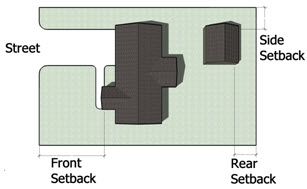
Figure 15.2-1: Front, side and rear setbacks.
(ii)
A building, structure, or lot shall not be developed, used, or occupied unless it meets the minimum setback requirements set forth in this chapter for the zoning district in which it is located, except as otherwise established in this Code or unless a variance has been granted.
d.
Projections into Required Setbacks, General.
(i)
Incidental Architectural Features. Cornices, eaves, canopies, sunshades, gutters, chimneys, flues, belt courses, headers, sills, pilasters, lintels, ornamental features, and other similar architectural features may project not more than two feet into any required setback provided these projections are at least three feet from the lot line.
(ii)
Fire escapes and IBC/IRC egress window wells. Fire escapes and IBC/IRC egress window wells may extend into a required setback not more than six feet.
(iii)
Paved Terraces. Paved terraces may project into any required setback, provided that no structures placed there shall violate other requirements of this Code and are at least five feet from the lot line.
(iv)
Unroofed Landings, Decks, Stairs, and Balconies. Unroofed landing, decks, and stairs shall not project into more than fifty percent of a required setback, provided that no portion other than a handrail shall extend higher than thirty inches above the finished grade level. Unroofed balconies may project into a required side or rear setback provided these projections are at least five feet from the lot line.
(v)
Roofs Over Porches and Other Exterior Approaches. Roofs over porches, stairways, landings, terraces, or other exterior approaches to pedestrian doorways may encroach up to five feet into a front setback, provided that, where such roof projections encroach within the setback, the roof projections shall comprise no more than fifty percent of the total length of the building's façade. The covered porch or entrance area encroaching into the setback shall remain exterior to the building and enclosed by no more than a railing.
(vi)
Projections Into Easements and Rights-of-Way Prohibited. Projections shall not extend or encroach into any easement(s) or right(s)-of-way.
(vii)
Handicap Ramps. The city manager's office may allow the installation of handicap access ramps in required front, side, and rear setbacks.
(viii)
[Bay Windows.] Bay windows that are not more than eight feet in width (where the projection breaks the plane of the wall) may project no more than two feet into any required setback, so long as there is a five-foot radius offset to any opposing bay window on the adjacent lot. Notwithstanding any other provisions of this Code, bay windows shall not be included in determining lot coverage.
(ix)
Private Garages and Carports. A private garage or carport may project into a required setback abutting a public alley not to exceed one-third the distance of the required setback, in accordance with other requirements of this code.
e.
Double-Frontage Lots, Excluding Corner Lots.
(i)
Existing Lots. Where lots comprising seventy-five percent or more of the frontage on one side of a street between intersecting streets have been improved with buildings at the effective date of this ordinance, the front setback shall be on the dominant side of the street. Dominant, in this subsection, shall mean the street frontage on which seventy-five percent of the existing structures are addressed.
(ii)
New Lots. The front lot line shall be designated on the final plat. A double frontage lot shall be required to have only one front setback.
f.
Corner Lots with Two Frontages.
(i)
Corner Lots. The side setback along the street side of a corner lot shall be one-half the front setback requirement for the zone in which the lot is located except for all R2, R2M and R3 zones, which shall comply with Table 15.1-2. (Ord. No. 1800, § 3, 1-4-2022)
(ii)
Corner Sight Distance. On any corner lot on which a front and side setback are required, no wall, fence, hedge, structure, sign, or any plant growth that obstructs the clear vision area shall be permitted.
(iii)
Alternative Front Lot Line. The procedure for alternative front lot line designation shall follow the procedures set forth for conditional use Minor Administrative Modification in subsection 15.06.060.EJ.3. The provisions of 15.06.060.EJ.3.d shall apply as they pertain to written public-notice requirements.
2.
Minimum Front Setbacks on Established Residential Blocks. In any LR, R1, R2 or R3 district where lots comprising fifty percent or more of the frontage on one side of a street between intersecting streets have been improved with buildings at the effective date of this code per Section 15.02.030, the minimum front setback of new construction shall be the same as the minimum front setback of any existing buildings in the block, or the minimum front setback for the district specified in subsection 15.12.000.B., whichever is less.
C.
Height.
1.
Height Requirements Generally. No building shall be erected or altered that will exceed the height limit for the respective zoning district, unless otherwise provided in subsection b. Below or elsewhere in this code.
2.
Height Measurement. Per Chapter 15.28, Definitions, the height of a building shall be the vertical distance from the grade to the highest point of the roof surface.
3.
Height Exceptions.
a.
Maximum. The height limitations of this section shall not apply to church spires, belfries, cupolas, penthouses, nor to chimneys, ventilators, skylights, water tanks, parapet walls, cornices without windows, antennas, or necessary mechanical appurtenances usually carried above the roof level; nor to buildings located more than one foot from the nearest lot line for each two feet of building height.
b.
Minimum. No person shall build within the city any basement, placing thereon a roof or any covering to serve as a roof and use such basement for either dwelling or business purposes, whether temporary or permanent.
D.
Dimensional Standards for Townhouse Structures.
1.
The minimum dimension for one unit within townhouse structure shall be twelve feet as measured perpendicular to the common walls.
2.
Platted lots abutting dedicated streets in which water and sanitary sewer service lines have, as of the date of adoption of the ordinance codified in this section, been installed to fit a plan for townhouse construction are exempt from the requirements of subsection 1 above.
(Ord. No. 1578, § 2(att. A), 3-2-2010; Ord. No. 1596, §§ 41-43, 59, 60, 5-3-2011; Ord. No. 1625, § 12, 9-4-2012; Ord. No. 1800, § 4, 1-4-2022; Ord. No. 1814, § 7, 11-1-2022; Ord. No. 1830, § 9, 10-17-2023; Ord. No. 1861, § 6, 3-4-2025; Ord. No. 1872, § 6, 10-7-2025)

