
Laramie City Zoning Code
CHAPTER 15
06 - REVIEW PROCEDURES
15.06.000 - Purpose and intent.
This chapter establishes the rules, procedures, and criteria by which the city of Laramie will review proposed land development activities for compliance with the provisions of this title.
(Ord. No. 1578, § 2(att. A), 3-2-2010)
15.06.010 - Summary and organization.
A.
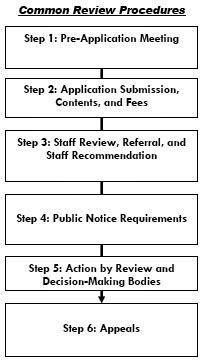
This chapter describes the procedures for review and approval of all applications for development activity in the city. Common procedures that are applicable to all or most types of development applications are set forth in Section 15.06.030. Section 15.06.060 sets forth additional provisions that are unique to each type of application such as review standards.
B.
Table 15.06-1 summarizes the review and decision-making responsibilities for the administration of the procedures described in this chapter. The table is a summary tool and does not describe all possible types of decisions made under this code. Other duties and responsibilities are described in this chapter.
C.
The city manager's office may also refer applications to other boards, commissions, government agencies, and non-governmental agencies not referenced in this chapter.
(Ord. No. 1578, § 2(att. A), 3-2-2010; Ord. No. 1728, § 16, 4-18-2017)
15.06.020 - Table of procedures.
Table 15.06-1, Summary Table of Review Procedures, summarizes which common procedural steps (described in section 15.06.030, Common Review Procedures, of this chapter) that apply to a specific type of land development application as well as the role of relevant review bodies. Provisions specific to each type of land development application are found in section 15.06.060, Specific Review Procedures of this chapter.
(Ord. No. 1578, § 2(att. A), 3-2-2010; Ord. No. 1625, § 2, 9-4-2012; Ord. No. 1657, § 3(Att. C), 4-1-2014; Ord. No. 1671, § 21, 11-18-2014; Ord. No. 1728, §§ 7—9, 17, 4-18-2017; Ord. No. 1744, §§ 5, 6, 3-6-2018; Ord. No. 1814, § 14, 11-1-2022)
15.06.030 - Common review procedures.
This section describes the procedural steps, requirements, and review criteria that are common to all or most land development applications submitted according to this section. This section's common procedural requirements shall apply to all applications for land development submitted pursuant to this section, unless otherwise expressly exempted or when alternative procedures are specified in this section.
A.
Step 1: Pre-Application Meeting.
1.
Purpose. The purpose of the pre-application meeting is to provide an opportunity for the applicant and the city to discuss the development proposal in order to:
a.
Determine the required application(s) and the timing of multiple application submittals (i.e., whether they may be processed concurrently or must be processed sequentially);
b.
Provide the applicant with application materials and inform the applicant of submittal requirements, including any requirements supplemental to those listed in the administrative manual for the type of application;
c.
Provide the applicant with an estimated time frame for the review process;
d.
Based on a conceptual plan of the proposal (if required), discuss generally compliance with the code's zoning, use, density, development, and design standards, and attempt to identify potentially significant issues regarding compliance;
e.
Discuss the need for any neighborhood meetings and public notice requirements; and
f.
Refer the applicant to other departments or agencies to discuss potential significant issues prior to application submittal.
2.
Applicability.
a.
Pre-Application Meeting Required. A pre-application meeting is required prior to certain types of applications, as listed below. Applications for these types of approvals shall not be accepted until after the pre-application meeting is completed. The meeting should take place prior to any substantial investment, such as a land acquisition for a proposed development, site and engineering design, or the preparation of other data.
(i)
Rezonings;
(ii)
Planned unit developments (preliminary PUD);
(iii)
Additions by plat;
(iv)
Annexations; and
(v)
Preliminary plats proposing more than ten lots.
b.
Optional for All Other Applications. A pre-application meeting shall be optional prior to submittal of any other application under this code not listed as requiring a pre-application meeting above.
3.
Record of Pre-Application Conference. The applicant shall be responsible for recording a summary of topics discussed at the pre-application conference. The summary shall be submitted as part of the formal application.
B.
Step 2: Application Submission, Contents, and Fees.
1.
Form of Application. Application submittal requirements and contents shall be established by the "City of Laramie Land Development Administrative Manual," herein referred to as the "Administrative Manual," adopted as a supplement to this code and made available in the city manager's office, unless otherwise specified.
2.
City of Laramie Land Development Administrative Manual. the city manager's office shall compile the requirements for application contents forms, fees, submission materials, and review schedule in an administrative manual, which shall be made available to the public. The city manager's office may amend and update the administrative manual from time-to-time.
3.
Authority To File Applications. The person having legal authority to take action according to the approval sought shall file an application for development review or approval under this code. The person is presumed to be the record owner, purchaser under a sale or option to purchase, or the duly authorized agent of the record owner.
4.
Applications. Applications required by this section shall be submitted only after a pre-application meeting, if required. All applications required by this section shall be submitted to the city manager's office, unless otherwise specified.
5.
Contact Person Designation.
a.
The applicant shall designate one person on the application as the primary contact person who will be responsible for all notification, including meeting dates, deadlines, and requirements. Regarding the application and review procedures, the city will communicate with the contact person. It is the contact person's responsibility to inform the owners or applicant of such information.
b.
The applicant shall notify the city manager's office in writing if there is to be a change in the contact person. The city manager's office will continue to communicate with the designated contact person until the notice of change has been received.
6.
Application Contents and Fees.
a.
Application Contents—General. The city manager's office is authorized to establish submittal requirements for all land use development applications required by this section and to update and amend such requirements as necessary to ensure effective and efficient city review. Applicants shall refer to the administrative manual for submittal requirements for each type of land use development application. The applicant shall provide any additional information, documents, or other material relevant to the application that the city manager's office reasonably believes are necessary in order for the city to evaluate, analyze, and understand the subject matter of the application.
b.
Submittal Waivers Pursuant to Pre-Application Meetings. At or following a pre-application meeting, the city manager's office may waive certain submittal requirements set forth in the administrative manual, except for fees, in order to reduce the burden on the applicant and to tailor the requirements to the information necessary to review a particular application. The city manager's office may waive such requirements where the projected size, complexity, anticipated impacts, or other factors associated with the proposed development or subdivision clearly justify such waiver. This discretion may only be exercised if a pre-application meeting is held.
c.
Fees. Fees shall be required at the time of the filing of any development application and are payable to the city in accordance with the fee schedules adopted by the city. The city may require, in addition to the fees above, that the applicant pay all or a portion of the reasonable fees charged by private consultants retained by the city for the purposes of reviewing the application and advising city officials and agencies with respect thereto.
(i)
Authorization and Payment Required. The city shall adopt and ay amend from time-to-time a fee schedule setting forth an assessment of fees to defray some or all of the cost of processing land development applications under this section. The fee schedule, as amended, can be found in the administrative manual. At the time of submittal, all applications shall include payment of the processing fee, as well as any review fees charged by agencies for which the city has agreed to collect.
(ii)
No Required Fees for City-Initiated Applications. No fee shall be required for land development applications initiated by the city.
C.
Step 3: Staff Review, Referral, and Staff Recommendation.
1.
Complete Application Required for Processing. The city shall accept an application for further processing only if the application is submitted in the required form, including all submittal information and all items or exhibits specified by the city manager's office during a pre-application meeting, and is accompanied by the applicable processing fee. If an application satisfies these prerequisites for formal submittal, the city will deem the application "provisionally complete" and subject to further completeness review as described in this section, and shall accept the application and fee for staff review, referral, and recommendation according to this subsection.
2.
Staff Review of Application. Upon submission of an application, the city manager's office, along with any consultants the city retains to review the proposed application and advise city officials and agencies, shall review the application and accompanying documentation for legal sufficiency, consistency with related prior approvals, completeness (in terms of quality of submittals to enable detailed city review), compliance with technical plan and report requirements, conformance with the provisions contained in applicable sections of this code, consistency with the adopted comprehensive plan for the city, and conformance with applicable specific plans and relevant city policies. Staff shall complete its review within twenty-one calendar days from the date the city accepts the application and application fee. However, failure to complete such review within the specified time shall not be deemed to constitute approval and shall not give rise to any cause of action against the city.
3.
Staff Determination of Complete or Incomplete Application.
a.
During review of the application, if the city manager's office determines that the application is complete, the application shall then be processed according to the remainder of this section, including referrals to outside agencies and scheduling for public hearing, as applicable.
b.
An application found by the city manager's office to be incomplete during this review shall be returned to the applicant along with all supporting materials and a written description of the application's specific deficiencies. All paid fees will be refunded to the applicant, less the actual cost of staff administrative review time to conduct review of the application up until this point.
c.
Failure of the city manager's office to make a completeness determination within the required twenty-one-day time frame shall be deemed a finding that the application is "complete." However, such finding shall not be construed as a bar to subsequent city or referral agency requests for plan revisions or additional or supplemental submittal materials and shall not be prejudicial to the city's subsequent review of and final action upon the application.
d.
No further city action is required on an application returned to the applicant as "incomplete." The applicant may reinitiate review of the proposed development only upon submittal of a new application and the payment of all fees in place and applicable at the time of re-submittal.
4.
Referral of Complete Application to Outside Agencies and Departments.
a.
Staff may distribute the complete application to other city departments and divisions and to any other appropriate governmental or quasi-governmental agencies and bodies to solicit comments and ensure that the proposal complies with all applicable standards, requirements, and review criteria. The applicant shall be responsible for submitting any additional information or revised plans required by staff or the referral agencies, sufficient copies of the application to enable department and agency review, and for covering reasonable costs, such as postage and scheduled review fees, associated with distribution of the application to reviewing bodies.
b.
As applicable, the review and decision-making bodies shall consider the services and facilities provided by the referral agencies as a factor in approval of the complete application. The criteria for evaluating sufficiency of the services that must be satisfied for the approval of the application shall be provided to the review and decision-making bodies as a part of any referral response.
c.
Referral agencies shall comment in writing after receiving a complete application. The failure of any agency to respond shall be considered "no comment" on the application by that agency. As applicable, referring agencies shall provide the review and decision-making bodies with a summary of any capacity evaluation study. The summary shall include an explanation of the agency's assumptions regarding available capacity.
5.
Subsequent Requests for Information. Staff and referral agencies shall use best efforts to identify all major issues and to request additional information, data, or reports from the applicant, during the first referral and review period described in subsection 4. above. This provision shall not be interpreted to preclude staff or referral agencies from requesting revisions or corrections to previously submitted materials if such materials are subsequently found to be inaccurate, incomplete, or if subsequent plan revisions do not comply with this section.
6.
Preliminary Report. Staff shall use best efforts to reconcile and compile all referral comments into a single, written report within seven calendar days after the close of the referral period. The preliminary report shall incorporate the responses and comments from reviewing agencies, shall report whether the development application complies with all applicable standards, and shall specify any areas of possible noncompliance. The preliminary report shall also identify any need for plan modifications, additional information, or technical reports to supplement the mandatory submittal requirements. The staff may recommend conditions for approvals or any changes necessary to bring the application into compliance with the provisions of this code to eliminate any areas of noncompliance or to mitigate any adverse impacts from the development proposal. Staff shall make the preliminary report available to the applicant no later than the date of the scheduled response meeting.
7.
Response Meeting with Applicant.
a.
As soon after preparation of the preliminary report as possible, staff shall schedule a response meeting with the applicant to discuss the preliminary report and specific referral comments with the applicant. Applicant attendance at the response meeting shall be mandatory. In addition to planning staff, the city manager's office or project planner may request the attendance at the response meeting of other city staff, key referral agencies, and other interested parties to address any concerns directly with the applicant.
b.
The city manager's office may waive the requirement for a response meeting based on consideration of the complexity of the proposed development and the nature and extent of referral comments.
8.
Submission of Revised Application, Scheduling, and Final Staff Report/Recommendation.
a.
Applicant Revisions to Application and Plans.
(i)
After the response meeting, the applicant may be required to revise the application as necessary to address each issue identified by the referral agencies. The applicant is encouraged to work with the various departments and agencies to resolve any concerns raised at the response meeting, to revise plans to reflect the resolution, and to assemble the appropriate documentation for issues that the applicant cannot or will not resolve. The revised application shall address, either through plan revision and by written explanation, each comment contained in the preliminary report.
(ii)
Unless the city manager's office agrees to an extension of time, the applicant shall submit the revised application and related materials to the city manager's office no later than ninety calendar days after the date of the response meeting. If the applicant does not submit a revised application within this time frame, the application shall be considered automatically withdrawn, and the city shall treat submittals after expiration of the time period as a new application for purposes of review, scheduling, and payment of application fees.
9.
Scheduling for Review and/or Decision-Making Authority Action. At the close of the time frame for receipt of referral comments on the applicant's revised application and plans, the city manager's office shall schedule the application for consideration on the next regular meeting agenda, or as soon thereafter as meeting agendas allow, before the applicable review or decision-making authority. The city manager's office shall notify the applicant of the scheduled dates. As applicable, public notice of a required public hearing shall be given according to the requirements stated in subsection E. and any specific additional notice as contained in Section 15.06.060.
10.
Applicant Request for Additional Revisions and Staff Review. At the applicant's option, in lieu of proceeding to review by the appropriate review or decision-making authority at the scheduled meeting or hearing, the applicant may submit additional application and plan revisions to further respond to referral and department comments. Each additional round of revision and department review requested by the applicant shall follow the process of review, referral, and department written response described in this chapter.
11.
Preparation of Staff Report and Recommendation. After scheduling the application for review and decision-making authority action, the city manager's office shall prepare a written staff report. The report shall include discussion of the relevant issues pertaining to the compliance of the application with the standards of this code. The staff report shall incorporate the relevant responses and comments from reviewing departments and agencies. The staff report shall conclude with a recommendation for application approval, approval with conditions, or denial. Conditions for approval may be recommended to eliminate any areas of noncompliance or to mitigate any adverse impacts from the development proposal.
12.
Applicant Written Response to the Staff Report. The applicant may submit a written response to the city manager's office to the conditions of approval, if any, and to the preliminary recommendation proposed in the staff report. The applicant may also request a conference with the city manager's office to discuss the staff report prior to submitting a written response. Applicants shall submit any written response in time to permit staff to include the response with the staff report sent to the review or decision-making authority prior to the first scheduled meeting or hearing.
13.
Distribution of Staff Report. Staff shall send copies of the staff report and the applicant's written responses, if any, to the applicant, the relevant review or decision-making authority, or the city attorney as appropriate. The staff report shall also be made available, upon request, to adjacent property owners or any member of the public. Staff shall distribute the same documents prior to any necessary city council hearing, except that the city council shall also be sent copies of the recommendation of the planning commission or other authority as appropriate.
D.
Step 4: Public Notice Requirements. Applications for development approval shall comply with the Wyoming Statutes and the provisions of this chapter with regard to public notification.
1.
General Notice Requirements Timing of the Notice. Unless otherwise stated in this code, notice for all public hearings shall be held pursuant to subsection D. Notice of the time and place of the hearing, including a general description of the area affected, shall be given at least fifteen calendar days before the hearing by publication at least once in a newspaper of general circulation that is published or circulated in the city of Laramie.
2.
Specific Notice Requirements. Table 15.06-1 sets forth the specific notice requirements for applications requiring any type of notification.
3.
Content. Notices, whether by publication or mail (written notice), shall, at a minimum:
a.
Identify the application.
b.
Identify the address or location of the property subject to the application and the name of the applicant or the applicant's agent.
c.
Specify the date, time, and place of the public hearing.
d.
Describe the land involved by street address, or by legal description and the nearest cross street, and project area (size).
e.
Describe the nature, scope, and purpose of the application or proposal.
f.
Identify the location where the public may view the application and related documents.
g.
Include a statement that the public may appear at the public hearing or be heard and submit evidence and written comments with respect to the application.
h.
Include a statement indicating the city will accept public comments prior to the public hearing describing where written comments will be received prior to the public hearing and stating that comments received prior to the public hearing will be entered into the record.
4.
Published Notice. When the provisions of this code require that notice be published, the city manager's office shall be responsible for preparing the content of the notice and publishing the notice in a newspaper of general circulation that has been selected by the city. The content and form of the published notice shall be consistent with this subsection D.3. above, and the requirements of Wyoming Statutes.
5.
[Written (Mailed) Notice.] When the provisions of this code require that written or mailed notice be provided, the city manager's office shall be responsible for preparing and mailing the written notice.
a.
Written notice shall be provided to the property owners as specified in Table 15.06-1.
b.
The owner of the property for which the approval is sought, and all property owners within 300 feet of the subject property, including streets, alleys, and other rights-of-way., shall be notified of the public hearing by mail.
c.
The notification of property owners shall apply only to the initial presentation of the proposed development to the public hearing unless otherwise directed by the city.
d.
The applicant shall be responsible for additional postage fees for the purposes of renotifying adjacent property owners pursuant to this subsection D.5.e. if the hearing is postponed, continued or tabled at the applicant's request. The city manager's office shall be responsible for preparing and mailing additional notices.
e.
If, for any reason, an item scheduled for initial presentation at a public hearing is postponed or tabled without having been presented, then the applicant shall be responsible for the required postage fees for the purposes of renotifying adjacent property owners of the future meeting at which the item will be considered in accordance with this section.
f.
The letters to the adjacent property owners shall be postmarked no later than fifteen calendar days prior to the hearing at which the item will be considered. In the case of an Annexation, the written notice as outlined in Section 15.06.030.5 will be twenty calendar days prior to the public hearing in accordance with W.S. l5-1-402.
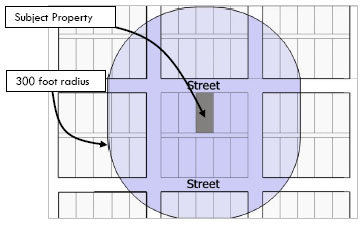
Figure 15.06-1: When written (mailed) notice is required for an application, all property owners
within 300 feet shall be notified.
6.
Posted Notice. Any posted notice shall be installed at least fifteen days prior to the item's scheduled appearance before [the] planning commission and city council and shall remain visible until a final decision has been made. The sign must be visible from a distance of one hundred feet from a public street or right-of-way. Additional posted notice requirements shall be determined by the city manager's office as necessary. Projects abutting more than one right-of-way may be required to post additional notices.
7.
Other Notices. Applicants shall be responsible for compliance with any additional notice requirements in this code, other city ordinances, or state law.
8.
Constructive Notice.
a.
Minor defects in any notice shall not impair the notice or invalidate proceedings pursuant to the notice if a bona fide attempt has been made to comply with applicable notice requirements. Minor defects in notice shall be limited to errors in a legal description, typographical or grammatical errors, or errors of actual acreage that do not impede communication of the notice to affected parties. Failure of a party to receive written notice shall not invalidate subsequent action. In all cases, however, the requirements for the timing of the notice and for specifying the time, date, and place of a hearing shall be strictly construed. If questions arise at a review hearing regarding the adequacy of notice, the decision-making authority may direct the city manager's office to make a formal finding as to whether there was substantial compliance with the notice requirements of this code, and such finding shall be made available to the decision-making authority prior to final action on the request.
b.
When the records of the city document the publication, mailing, and posting of notices as required by this section, it shall be presumed that notice of a public hearing was given as required by this section.
E.
Step 5: Action by Review and Decision-Making Authorities.
1.
Permitted Actions.
a.
Recommendations by Review Authority.
(i)
A review authority as set forth in Section 15.06.060, specific review procedures, shall evaluate the application, referral comments, staff report, and public testimony, if any, and make a recommendation to the decision-making authority to approve, approve with conditions, continue for additional information or for further study, or deny the application.
(ii)
The review authority's actions shall be based on the evidence presented and compliance with the review criteria for the subject application, as set forth in this subsection E., and the relevant specific review procedures set forth in Section 15.06.060.
b.
Review and Action by Decision-Making Authority.
(i)
A decision-making authority shall take action on an application or appeal by approving, approving with conditions, continuing, remanding for additional information or for further study, or denying the application or appeal.
(ii)
In taking action, the decision-making authority shall evaluate the application, referral comments, staff report, public testimony, if any, and the review authority's recommendation. All final decision actions shall be based on the application or appeal's compliance with the review criteria for the subject application, as set forth in subsection E.7. and in the relevant specific sections of this chapter.
2.
Withdrawal of Application by Applicant. An applicant shall have the right to withdraw an application, without prejudice, at any time prior to placing the application on the official agenda. The applicant shall submit in writing the withdrawal request to the city manager's office, and after such withdrawal, the city shall not take further action on the application. To re-initiate review, the applicant shall resubmit the application that in all respects shall be treated as a new application for purposes of review, scheduling, and payment of application fees. Withdrawal of an application from a public hearing or meeting agenda is at the review or decision-making authority's discretion.
3.
Continuation of Public Hearings. The review or decision-making authority may continue the public hearing for its consideration of the application for a definite time not to exceed sixty calendar days, unless a longer period is agreed to by the applicant in writing or at a public hearing. The continuance may be granted by the review or decision-making authority on its own initiative or at the request of the applicant or affected property owners.
4.
Site Visits by Review or Decision-Making Authority. As part of its consideration of the application, the review or decision-making authority may, as a group or through a committee appointed for that purpose, inspect the site of the proposed land use or development activity. The site visit may occur at any time prior to the review or decision-making authority's final recommendation or action on the application. Upon reasonable request by the city manager's office, the applicant shall mark the development site prior to the site visit to generally locate property boundaries, building envelopes, and other key site planning features. Attendance at a site visit by a quorum of the subject review or decision-making authority membership shall be properly noticed according to law.
5.
Written Findings of Fact. Recommendations or decisions at the conclusion of any required public hearing shall be accompanied by written findings of fact addressing how the application does or does not comply with the general review criteria or specific review criteria stated in this code for that type of application. All findings of fact shall be based on information contained in the application, or submitted or arising during the public hearing.
6.
Conditions of Approval.
a.
The review or decision-making authority may recommend or impose such conditions upon the subject development as are necessary to carry out the general purpose and intent of this code. Conditions and additional information requirements shall be in written form and attached to the approved plan, plat, or permit.
b.
Conditions of approval shall be reasonably related to the anticipated impacts of the proposed use or development and shall be based upon adopted standards.
c.
The decision-making authority may place specific time limits on the satisfaction of any condition of approval.
d.
The decision-making authority may require financial guarantees from the applicant where it finds such guarantees are necessary to ensure compliance with conditions of approval and protect the public health, safety, or welfare. The city shall release such guarantees when the city manager's office has determined that all conditions attached to the approval have been or will be satisfied.
7.
Generally Applicable Review Criteria. Unless otherwise specified in this chapter, city review and decision-making bodies shall review all development applications submitted pursuant to this chapter for compliance with the general review criteria stated in this subsection E.7. The application may also be subject to additional review criteria specific to the type of application, as stated below. In case of conflict between the general review criteria set forth in this section and the specific review criteria in Section 15.06.060, the specific review criteria shall apply.
a.
Consistent with Prior Approvals. The proposal shall be determined consistent with the terms and conditions of any prior plan or plat approval, as applicable, including without limitation an approved phasing plan for development and installation of public improvements and amenities.
b.
Consistent with Comprehensive Plan and Other Applicable Plans. The proposal shall be determined consistent with the comprehensive plan and any applicable sub-area, neighborhood, sector, or district plan. The decision-making authority shall weigh competing plan goals, policies, and strategies and may approve an application that provides a public benefit even if the development is contrary to some of the goals, policies, or strategies in the comprehensive plan or other applicable plans.
c.
Compliance With Use and Development Standards. The proposal shall comply with all applicable use standards, site development standards, design standards, subdivision standards, public improvement standards, floodplain management standards, and all other applicable substantive standards stated in this code. Such compliance shall be applied at the level of detail required for the subject submittal, and those standards which are not otherwise modified, varied, or waived as allowed by this code.
d.
Compliance with Other Applicable Regulations. As applicable, prior to final approval of the proposed development pursuant to this code, the proposed development shall comply with all other city regulations and with all applicable regulations, standards, requirements, or plans of the federal or state governments and other relevant jurisdictions, including but not limited to wetlands, water quality, erosion control, and wastewater regulations.
e.
Consistent with Intergovernmental Agreements. As applicable, the proposed development shall be consistent with any adopted intergovernmental agreements ("IGAs") and complies with the terms and conditions of any such IGA incorporated by reference into this code.
f.
Minimizes Adverse Environmental Impacts. The proposed development shall meet or exceed all environmental protection standards of Chapter 15.14, shall be designed to minimize negative impacts, and shall not cause significant adverse impacts on the natural environment, including but not limited to water, air, noise, stormwater management, scenic resources, wildlife habitat, soils, native vegetation, and the natural functioning of the environment.
g.
Minimizes Adverse Impacts on Surrounding Property. The proposed development shall meet or exceed all neighborhood protection standards in Chapter 15.14 and all other site development standards intended at least in part to protect the existing character of neighboring properties and uses, and does not cause significant adverse impacts on surrounding properties.
h.
Minimizes Adverse Fiscal Impacts. The proposed use shall not result in significant adverse fiscal impacts on the city.
i.
Compliance with Utility, Service, and Improvement Standards. As applicable, the proposed development shall comply with federal, state, county, and/or service district standards and design/construction specifications for roads, access, drainage, water, sewer, schools, and emergency/fire protection.
j.
Provides Adequate Road Systems. Adequate road capacity shall be available to serve the proposed use, and the proposed use shall be designed to ensure safe ingress and egress onto the site and safe road conditions around the site, including adequate access onto the site for fire, public safety, and EMS services.
k.
Provides Adequate Public Services and Facilities. There shall be capacity to provide adequate public services and facilities to accommodate uses permitted under the proposed development at the time such needs or demands arise, while maintaining adequate levels of service to existing development. Public services and facilities include, but are not limited to, roads, domestic water, sewer, schools, public safety, fire protection, libraries, and vehicle/pedestrian connections and access within the site and to adjacent properties.
l.
Rational Phasing Plan. As applicable, the proposed phasing plan for development of the project shall be determined rational in terms of available infrastructure capacity. In addition, each phase of the development shall contain all of the required streets, utilities, landscaping, open space, and other improvements that are necessary and desirable for the residents and users of the project's cumulative development to date and shall not be dependent upon subsequent phases for those improvements.
F.
Step 6: Appeals. Appeal procedures depend on the type of application and the appropriate review and decision-making authority. The applicant should consult the applicable section of this code and the administrative manual for specific requirements. This section refers only to appeals to be heard by a city decision-making authority. Certain decisions that may be appealed under state law to a court are not covered by this section.
1.
Standing to Appeal. Application for appeal may be made by the applicant or any person with direct involvement with the application process. Direct involvement may be evidenced through attendance at public meetings related to the application or submission or written comments regarding the application, both prior to the final decision of the decision-making body.
2.
Generally Applicable Administrative Decision Appeal Procedure. Any administrative decision of the city manager's office or city engineer made with respect to this title (except for minor administrative modifications in subsection 15.06.060.J. may be appealed to the board of adjustment by filing written notice of such appeal with the city manager's office no more than seven calendar days after the rendering of any such decision by the city manager's office or city engineer. Upon filing of a written notice of appeal, the matter shall be placed on the agenda of the next regularly scheduled meeting of the board of adjustment no later than thirty calendar days after the notice of appeal has been filed. The board of adjustment may hear the appeal at its regular meeting or set a special hearing date, at its discretion.
3.
Generally Applicable Planning Commission Appeal Procedure. A decision of the planning commission may be appealed to the city council by filing a written notice of appeal with the city manager's office within seven calendar days after the rendering of the decision by the planning commission. Upon filing of a written notice of appeal, the matter shall be placed on the agenda of the next regularly scheduled meeting of the city council no later than thirty calendar days after the notice of appeal has been filed. The city council may hear the appeal at its regular meeting or set a special hearing date at its discretion.
4.
Board of Adjustment Decisions. A decision by the board of adjustment may be appealed to the district court in accordance with Wyoming Statutes.
5.
City Council Decisions. A decision by the city council may be appealed to the district court in accordance with Wyoming Statutes.
(Ord. No. 1578, § 2(att. A), 3-2-2010; Ord. No. 1596, §§ 2—4, 5-3-2011; Ord. No. 1728, § 16, 4-18-2017; Ord. No. 1744, §§ 7—10, 3-6-2018; Ord. No. 1814, § 2, 11-1-2022; Ord. No. 1827, § 1, 7-5-2023
15.06.040 - Inactive applications.
The city manager's office may notify the applicant in writing that an application will be considered inactive unless corrective action is taken within thirty calendar days, if at any point in a development review process either any of the following circumstances pertain:
A.
The city manager's office or a referral body/agency has notified the applicant that additional or corrected materials are required, and the applicant has not submitted such materials within forty-five calendar days after the date of such notification; or
B.
The applicant fails to attend any scheduled meeting with the city manager's office, or meeting or hearing before the planning commission, board of adjustment, or city council; or
C.
The applicant has not responded to a staff report, has not agreed to a date for a meeting or hearing before the planning commission or board of adjustment, has not given proper public notice as required by this chapter, or has not taken some other affirmative step within a reasonable time frame that is within the applicant's control and is necessary to advance the application for a final determination. A "reasonable time frame" shall be determined by the city manager's office taking into account average response times from similar applicants on similar applications; or
D.
The applicant fails to submit a building permit for the approved application, if applicable, within six months, or any such time that the decision-making authority may prescribe.
No further processing of such application shall occur until the deficiencies are corrected. If the applicant does not correct the deficiencies within the thirty calendar day correction period, the application shall be considered automatically withdrawn. Any re-submittal of the application thereafter by the applicant shall be treated as a new application for purposes of review, scheduling, and payment of application fees.
(Ord. No. 1578, § 2(att. A), 3-2-2010; Ord. No. 1728, § 16, 4-18-2017)
15.06.050 - Actions and limitations following development approval or denial.
A.
Standard Notes and Certifications. Each approved development plan or plat shall contain standard notes, specific notes, dedication, and certifications that the city finds to be applicable and appropriate per the administrative manual or other duly applicable regulations of the city, as determined by the city manager's office. The city manager's office's determination regarding appropriate notes and certifications shall be made on a case-by-case basis. The form of standard notes and certifications may be found in the administrative manual. The text of each item in the administrative manual shall be replicated as written therein. No modification to such notes or certifications shall be applied unless approved by the city attorney. Any notes on a plan or plat not included in the administrative manual or other duly applicable regulations of the city shall be removed unless approved by the city attorney.
B.
General Recordation Requirements. After approval of the development plan or plat by the city, the applicant shall record, as applicable, with the Albany County recorder within sixty calendar days after approval. The applicant shall provide the city manager's office with three copies of the recorded plan or plat.
C.
Lapse of Approval Provisions/Extension of Approval Period.
1.
All permits and approvals under this code, except for written code interpretations and approvals by ordinance, shall lapse if certain actions related to the approved application are not taken within a specified time period. Specific actions that must be taken with regard to each form of permit or approval to avoid lapsing of the approval are set forth in Section 15.06.060 of this chapter. Approvals by ordinance shall be subject to any lapse requirements within said ordinance.
2.
The city manager's office may grant one extension of an approval period of up to twelve months for good cause. All requests for extensions shall be submitted to the city manager's office in writing at least thirty calendar days prior to the expiration of approval. An extension request shall include payment of required fees and a narrative stating the reasons for the applicant's inability to comply with the specified deadlines, listing any changes in the character of the neighborhood, any changes to the comprehensive plan or this code that have occurred since approval of the permit/plan as these changes affect the permit/plan, and the anticipated time schedule for completing the review project and/or the specific project. Additional review of the permit/plan may result in additional conditions, as applicable.
3.
Any denial of the extension may be appealed to the planning commission. If the extension is denied, the applicant may submit a new application, subject to the fees and regulations in effect at the time of submittal, for the same project.
D.
Limitations on Successive Applications.
1.
Limitations on Resubmittals. Unless otherwise specified in Section 15.06.060 for a specific type of application, upon denial of an application submitted pursuant to this code, no new application for the same or substantially the same request, as determined by the city manager's office, shall be submitted or accepted within one year of the date of such denial. However, if the city manager's office determines that the resubmitted application has been modified to correct the stated objections and resubmittal of a particular application is in accordance with applicable Wyoming Statutes, then the resubmittal shall be accepted prior to expiration of the one year period. Resubmittals shall be subject to all processing fees, submittal requirements, and review standards in effect at the time the resubmittal is accepted by the city manager's office.
E.
Modifications of and Amendments to Approved Plans.
1.
Minor Administrative Modifications. The city manager's office may approve minor adjustments or changes to an approved permit or plan according to the Minor Administrative Modification procedures and criteria in subsection 15.06.060.J.
2.
Amendments or Modifications.
a.
All substantial changes, modifications, removal, or release of the provisions of an approved plan or plat that do not qualify as minor administrative modifications under subsection 15.06.060.J. shall be considered amendments. Amendments shall include, but are not limited to, changes in use, access, layout, any condition of approval, any change resulting in significant increased off-site impacts, and similar changes as determined by the city manager's office.
b.
For purposes of review and scheduling, proposed amendments are treated as new applications subject to the applicable procedures and review criteria set forth in this chapter unless otherwise noted in the specific review procedures.
c.
All approved amendments to a recorded plan or plat shall be recorded within thirty calendar days of the amendment's approval. Three copies of the recorded documents shall be provided within thirty calendar days of recording of such approved amendment.
3.
Planned Unit Development Amendments. Amendments to any approved planned unit development (PUD) shall be processed in accordance with subsection 15.06.060.C.
(Ord. No. 1578, § 2(att. A), 3-2-2010; Ord. No. 1728, § 16, 4-18-2017)
15.06.060 - Specific review procedures.
A.
Text Amendments.
1.
Purpose. The purpose of this section is to provide standards and requirements for amending the text of this code. The purpose of text amendments is not to relieve particular hardships, nor to confer special privileges or rights on any person, but rather to make adjustments to the text of this code that are necessary in light of changed conditions, changes in the comprehensive plan, public policy, or that are necessary to advance the general welfare of the city.
2.
Applicability. An application for a text amendment may be initiated by the city council, planning commission, department or requested by an owner of land in the city. Only the city council may, after recommendation of the planning commission, adopt an ordinance amending the text of this code in accordance with the requirements of this title.
3.
Procedures.
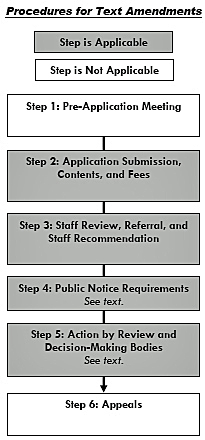
a.
Step 1: Pre-Application Meeting. Not applicable.
b.
Step 2: Application Submission, Contents, and Fees. Applicable pursuant to subsection 15.06.030.B.
c.
Step 3: Staff Review, Referral, and Staff Recommendation. Applicable pursuant to subsection 15.06.030.C.
d.
Step 4: Public Notice Requirements. Applicable. Published notice required pursuant to subsection 15.06.030.D.
e.
Step 5: Action by Review and Decision-Making Bodies. Applicable pursuant to subsection 15.06.030.E. The following additional procedures shall apply.
(i)
Planning Commission Public Hearing. The planning commission shall hold a public hearing and make a recommendation to approve, approve with revisions, postpone, or deny the application.
(ii)
City Council Public Hearing. The city council shall hold a public hearing and shall approve, approve with conditions, postpone, or deny the proposed text amendment.
f.
Step 6: Appeals. Not applicable.
B.
Rezonings.
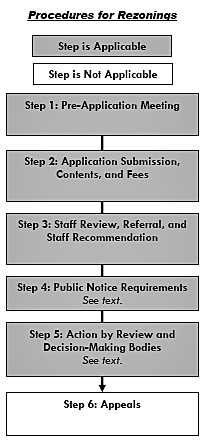
1.
Purpose. The boundaries of any zone district may be changed, or the zone classification of any parcel of land may be changed, by ordinance amending the official zoning map of the city pursuant to this section. The purpose is not to relieve particular hardships, nor to confer special privileges or rights on any person, but only to make adjustments to the official zoning map that are necessary in light of changed conditions, changes in public policy, to conform to the city's comprehensive plan, or that are necessary to advance the general welfare of the city. Rezonings should not be used as a way to legitimize isolated nonconforming uses or structures or when a conditional use, variance, or minor administrative modification could be used to achieve the same result.
2.
Applicability. An application for a rezoning may be initiated by city council, planning commission, the city manager's office, or requested by an owner of land in the city.
3.
Procedures.
a.
Step 1: Pre-Application Meeting. Applicable pursuant to subsection 15.06.030.A.
b.
Step 2: Application Submission, Contents, and Fees. Applicable pursuant to subsection 15.06.030.B.
c.
Step 3: Staff Review, Referral, and Staff Recommendation. Applicable pursuant to subsection 15.06.030.C.
d.
Step 4: Public Notice Requirements. Applicable. Published, written, and posted notice required pursuant to subsection 15.06.030.D.
e.
Step 5: Action by Review and Decision-Making Bodies. Applicable pursuant to subsection 15.06.030.E. The following additional procedures shall apply:
(i)
Planning Commission Public Hearing. The planning commission shall hold a public hearing and make a recommendation to approve, approve with conditions, postpone, or deny the application.
(ii)
City Council Consideration. The city council shall hold a public hearing and shall approve, postpone, or deny the application for rezoning.
f.
Step 6: Appeals. Not applicable.
4.
Protest. If there is a protest against the change signed by the owners of twenty percent or more of the area of the lots or portions thereof included in the proposed change, or by the owners of twenty percent or more of the area of the lots or portions thereof adjacent within a distance of one hundred forty feet, an amendment will not become effective except upon the affirmative vote of three-fourths of all qualified members of the governing body shall be required on third and final reading of the rezoning ordinance. In determining the one hundred forty feet, the width of any intervening street or alley shall not be included.
C.
Planned Unit Development (PUD).
1.
Purpose. This section is intended to provide for the growing demand for housing of all types and designs and for necessary supportive commercial facilities conveniently located to such housing, to create functional and attractive development, to minimize adverse impacts, and to ensure that projects will be assets to the community. It is the purpose of this section:
a.
To promote and permit flexibility that will encourage innovative and imaginative approaches in land development and renewal that will result in a more efficient, aesthetic, desirable, and economic use of land while maintaining density and intensity of use consistent with the applicable adopted plans, regulations, and policies of the city;
b.
To promote development within the city that can be conveniently, efficiently, and economically served by existing municipal utilities and services or by their logical extension;
c.
To promote design flexibility including placement of buildings, use of open space, pedestrian and vehicular circulation systems to and through the site, and off-street parking areas in a manner that will best utilize potential on-site characteristics, such as topography, geology, geography, size, and proximity;
d.
To provide for the preservation of historic or natural features where they are shown to be in the public interest, including but not limited to such features as: drainage ways, floodplains, existing topography or rock outcroppings, sensitive environmental areas or features, unique areas of vegetation, historic landmarks, or structures;
e.
To provide for compatibility with the area surrounding the project site;
f.
To provide for usable and suitably located open space such as, but not limited to, bicycle paths, playground areas, courtyards, tennis courts, swimming pools, planned gardens, outdoor seating areas, outdoor picnic areas, and similar open space;
g.
To minimize adverse environmental impacts of development;
h.
To improve the design, quality and character of new development; and
i.
To provide compensating community benefits to offset any impacts of the development and in recognition of design flexibility.
2.
Applicability. The PUD procedure shall be followed for any proposed residential or commercial PUD.
3.
General Procedures. All PUDs are processed in two stages: (1) the preliminary PUD and (2) the final PUD. The preliminary PUD shall be approved by ordinance and the final PUD shall be approved by the city manager's office to ensure compliance with the conditions and stipulations of approved preliminary PUD ordinance. The final PUD shall not be filed with the city for review and processing until after the preliminary PUD has been approved or conditionally approved by the city council. A preliminary PUD serves as a site plan for the purposes of required reviews. The approval of a preliminary or final PUD plan shall not constitute the effective dedication of easements, rights-of-way, or access control, nor shall the approved PUD be either the equivalent of or substitute for the final platting of land. Specific procedures for preliminary PUD and final PUD are outlined below.
4.
Relationship to Subdivisions. Preliminary PUDs may be filed, processed and acted upon by the planning commission and city council concurrently with preliminary plat applications for a major subdivision or minor land division for all or part of the property. Final PUDs may be filed, processed, and acted upon by the planning commission and city council concurrently with final plat applications for a major subdivision or minor land division application. Preliminary and final PUDs shall not be processed concurrently.
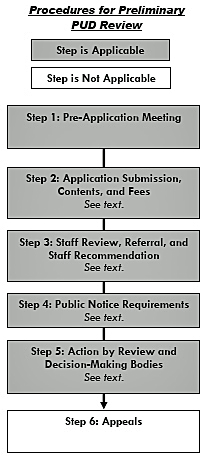
5.
Procedures for Preliminary Planned Unit Development.
a.
Step 1: Pre-Application Meeting. Applicable pursuant to subsection 15.06.030.A.
b.
Step 2: Application Submission, Contents, and Fees. Applicable pursuant to subsection
15.06.030.B.
The following additional information shall be included with the application:
(i)
Preliminary site plan;
(ii)
Preliminary landscaping plan;
(iii)
Preliminary parks and open space plan;
(iv)
Preliminary project phasing plan; and
(v)
Development plan handbook.
c.
Step 3: Staff Review, Referral, and Staff Recommendation. Applicable pursuant to subsection 15.06.030.C.
d.
Step 4: Public Notice Requirements.
Applicable. Published, written, and posted notice required prior to the planning commission hearing and the city council hearing pursuant to subsection 15.06.030.D.
e.
Step 5: Action by Review and Decision-Making Bodies.
(i)
Planning Commission Public Hearing. The planning commission shall hold a public hearing and make a recommendation to approve, approve with revisions, postpone, or deny the application.
(ii)
City Council Public Hearing. Within sixty calendar days of planning commission action, the city council shall hold a public hearing and shall approve, approve with conditions, postpone, or deny the proposed preliminary PUD.
f.
Step 6: Appeals. Applicable pursuant to subsection 15.06.030.F.
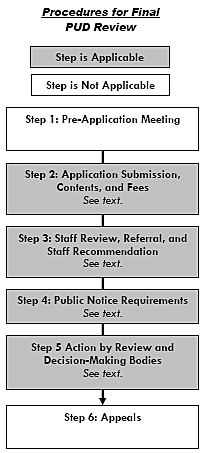
6.
Procedures for Final Planned Unit Development.
a.
Step 1: Pre-Application Meeting. Not applicable.
b.
Step 2: Application Submission, Contents, and Fees. Applicable pursuant to subsection
15.06.030.B.
The following additional information shall be included with the application:
(i)
Final design review plan;
(ii)
Final landscaping plan;
(iii)
Final parks and open space plan;
(iv)
Final phasing plan; and
(v)
Final development handbook.
c.
Step 3: Staff Review, Referral, and Staff Recommendation. Applicable pursuant to subsection 15.06.030.C.
d.
Step 4: Public Notice Requirements. Not Applicable.
e.
Step 5: Action by Review and Decision-Making Bodies. Applicable pursuant to subsection 15.06.030.E. At the applicant's request, a final PUD application may be run concurrently with a building permit or other applicable development application. The following other procedures shall apply.
(i)
Action by Department. The city manager's office shall review each final PUD application and, as deemed necessary, distribute the application to other reviewers. Taking into account results of those reviews, the city manager's office shall take final action on the application and approve, or deny, on the application based on the applicable approval criteria below.
(ii)
Required Findings for Approval. The city manager's office shall not approve any final development plan unless the final development plan meets all of the following criteria:
(1)
The proposed final PUD complies with the approved preliminary PUD overlay district.
(2)
The layout and design of the proposed final PUD is in compliance with the approved preliminary PUD overlay district including but not limited to number of lots or parcels, street and block layout, and access. Minor modifications shall be permitted pursuant to subsection 15.06.060.J., Minor Administrative Modifications. Modifications to use within the overlay district shall not be permitted.
(3)
All required improvement plans for parks, open space, or other public or private facilities as shown on the final landscaping plan, parks and open space plan and development handbook have been reviewed and approved by the city for construction.
f.
Step 6: Appeals. Not applicable.
7.
Lapse.
a.
Recordation of the Final Development Plan After Approval. The applicant shall record the approved final PUD and related PUD documents, as approved by the city manager's office, in the office of the county clerk no later than sixty days after the date of approval by the city council. Four copies of the recorded document shall be provided to the city manager's office within seven calendar days of recording. If the final PUD is not recorded, the approval of the city council shall be deemed to have been withdrawn; and the approval shall be null and void.
b.
Duration of Preliminary PUD After Approval. The applicant shall record a final PUD, obtain approval of any required final plat for the whole or part of the PUD, or obtain a building permit, no later than five years after approval of the preliminary PUD or subsequent final PUD approvals by the city council. Extensions may be granted pursuant to subsection 15.06.050.C.
8.
Procedures for Amendments to a Planned Unit Development.
a.
Preliminary Planned Unit Development Overlay District. Amendments to an approved PUD Overlay District shall be treated as a new application and shall require rezoning to a new PUD Overlay District.
b.
Final Planned Unit Development.
(i)
Major.
(1)
Definition. A major amendment to a final PUD shall include all alterations in use, intent, rearrangement of lots, realignment of major circulation patterns, increase in density levels, provisions governing common or open space, or the ratio thereof, or any other alterations that in the judgment of the city manager's office substantially change the PUD or its impacts. Major amendments shall require an amendment to the PUD Overlay District. Amendments to the PUD Overlay District shall be treated as a new application and shall require rezoning to a new PUD Overlay District.
(ii)
Procedure. Applications for major PUD amendments shall follow the same procedure set forth above for a new PUD, and at the discretion of the city manager's office, may exclude pre-application meetings.
(iii)
Minor.
(1)
Definition. Minor amendments to a final PUD shall include all amendments not defined as major, including but not limited to minor alterations in location of uses and buildings, alignments, bulk of structures, placement or types of plant material, changes in grades, heights, character of structures, rearrangement of lots that in the judgment of the city manager's office do not have a significant adverse impact on surrounding properties, other similar alterations, or modifications that qualify as a Minor Administrative Modification pursuant to subsection 15.060.060.J.
(2)
Procedure. Minor PUD amendments may be approved pursuant to subsection 15.06.060.J., Minor Administrative Modifications. Upon approval, the director shall affix his signature on the approved document and the final development plan or development handbook shall be recorded with the county clerk.
D.
Variances.
1.
Purpose. The variance process is intended to provide limited relief from the requirements of this code in those cases where strict application of a particular requirement will create a practical difficulty or unnecessary hardship prohibiting the use of land in a manner otherwise allowed under this code. It is not intended that variances be granted merely to remove inconveniences or financial burdens that the requirements of this code may impose on property owners in general. Rather, it is intended to provide relief where the requirements of this code render the land difficult or impossible to use because of some unique physical attribute of the property itself or some other factor unique to the property for which the variance is requested. State and/or federal laws or requirements may not be varied by the city.
2.
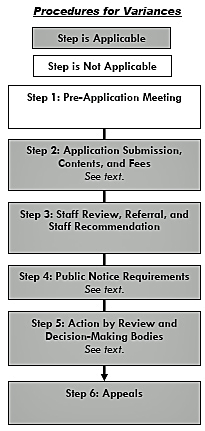
Procedures.
a.
Step 1: Pre-Application Meeting. Not applicable.
b.
Step 2: Application Submission, Contents, and Fees. Applicable pursuant to subsection 15.06.030.B. The following additional procedures shall apply.
(i)
The application shall state with particularity the relief sought and shall specify the facts or circumstances that are alleged to show that the application meets the approval criteria in Step 6, below.
c.
Step 3: Staff Review, Referral, and Staff Recommendation. Applicable pursuant to subsection 15.06.030.C.
d.
Step 4: Public Notice Requirements. Applicable. Published, written, and posted notice required pursuant to subsection 15.06.030.D.
e.
Step 5: Action by Review and Decision-Making Bodies. Applicable pursuant to subsection 15.06.030.E. The following additional procedures shall apply.
(i)
Board of Adjustment Action. The board of adjustment shall hear and decide on variance applications.
(ii)
Review Criteria.
(1)
The board of adjustment shall not approve a variance unless it finds in writing that all of the criteria below have been met:
(a)
There are special circumstances or conditions, fully described in the board's findings, that are peculiar to the land or building for which the adjustment is sought and do not apply generally to land or buildings in the neighborhood, and have not resulted from any act of the applicant subsequent to the adoption of the code, such as irregularity, narrowness, or shallowness of lot, or exceptional topographical conditions;
(b)
The circumstances or conditions are such that the strict application of the provisions of the code would deprive the applicant of the reasonable use of the land or building;
(c)
If applicable, the circumstances or conditions are such that the strict application of the provisions of the code would deprive the applicant of access to alternative forms of energy such as solar and wind power;
(d)
The granting of the adjustment is necessary for the reasonable use thereof and the adjustment as granted is the minimum adjustment that will accomplish this purpose;
(e)
The granting of the variance is in harmony with the general purposes and intent of the code and will not be injurious to the neighborhood or otherwise detrimental to the public welfare; and
(f)
The variance, if granted, will not alter the essential character of the neighborhood or district in which the property is located, nor substantially or permanently impair the appropriate use or development of adjacent property.
(2)
A variance shall not be granted that violates the intent of this code or its amendments.
(3)
A variance shall not authorize a use other than those permitted in the district for which the variance is sought; also, an application or request for a variance shall not be granted with regard to any parcel of property or portion thereof upon which an active zoning request, including Planned Unit Developments, for any parcel of property or portion thereof has not been finally acted upon by the city council.
f.
Step 6: Appeals. Applicable pursuant to subsection 15.06.030.F.
3.
Lapse of Approval. Unless otherwise stated in the board of adjustment conditions of approval, no building permit for a variance granted by the board of adjustment shall be issued after six months from the date such variance was approved.
E.
Conditional Use Permits.
1.
Purpose. The city of Laramie recognizes that certain uses may be appropriate in a specific zoning district, but which may have characteristics that, depending upon the location, design, and standards of operation, may have a greater impact than permitted uses on adjoining properties, businesses, or residences. Such uses require more comprehensive review, including the ability of the city to establish specific conditions for the project in order to mitigate any potential adverse impacts.
2.
Applicability. All uses listed as "conditional" in Section 15.10.000, table of uses, shall be required to follow the procedures set forth below. The planning commission shall evaluate only those conditional uses listed in Chapter 15.10 or uses determined similar pursuant to subsection 15.28.020.E., and shall be empowered to grant, grant with conditions, or deny any application for a conditional use permit in accordance with this code. Such review by the planning commission shall be subject to required findings and the application meeting requirements of this section. The burden of proof shall be on the applicant.
3.
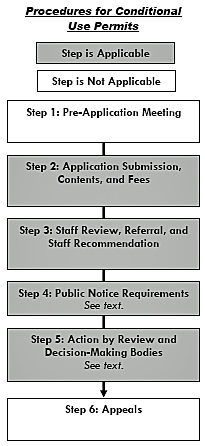
Procedures.
a.
Step 1: Pre-Application Meeting. Not applicable.
b.
Step 2: Application Submission, Contents, and Fees. Applicable pursuant to subsection 15.06.030.B.
c.
Step 3: Staff Review, Referral, and Staff Recommendation. Applicable pursuant to subsection 15.06.030.C.
d.
Step 4: Public Notice Requirements. Applicable. Published, written, and posted notice required pursuant to subsection 15.06.030.D.
e.
Step 5: Action by Review and Decision-Making Bodies. Applicable pursuant to subsection 15.06.030.E. The following additional procedures shall apply.
(i)
Planning Commission Public Hearing. The planning commission shall hold a public hearing and shall approve, approve with conditions, postpone, or deny the application.
(ii)
Approval Criteria. The planning commission shall not approve or conditionally approve a conditional use permit unless the following findings are made:
(1)
The conditional use proposal provides adequate:
(a)
Ingress and egress to property and proposed structures;
(b)
Off-street parking and loading areas;
(c)
Control over the off-site impacts of economic, noise, glare, or odor effects of the conditional use;
(d)
Refuse and service areas;
(e)
Utilities, with reference to locations, availability, and compatibility;
(f)
Screening and buffering, with reference to type, dimensions, and character; and
(g)
Signs, if any, and proposed exterior lighting, with reference to glare, traffic safety, economic effect, and compatibility and harmony with properties in the district (Ord. 734 § 1 (part), 1983: Ord. 661 § 1 (part), 1981: Ord. 194 § 6.1(8)(c), 1964)
(2)
The proposed use is appropriate to the specific location relative to intensity and bulk;
(3)
The proposed use is appropriate to the specific location relative to public health, safety and convenience; and
(4)
The proposed site is adequate in size and shape to accommodate the intended use and that the use will comply with all requirements for the zone district, including but not limited to the following:
(a)
Setbacks;
(b)
Walls;
(c)
Landscaping;
(d)
Bufferyards; and
(e)
Any standards specific to the use as set forth in Chapter 15.10, Use Regulations.
f.
Step 6: Appeals. Not applicable.
4.
Modification of Conditional Use Permits.
a.
A request to modify, expand, or otherwise change an approved conditional use permit not in substantial conformance with the approved permit shall be processed as a new application according to this section.
5.
Lapse of Approval. Whenever a conditional use permit has been discontinued for a period of six consecutive months, the conditional use permit shall automatically terminate, and any use after termination shall fully conform to the underlying zoning requirements.
F.
Major Temporary Use Permits.
1.
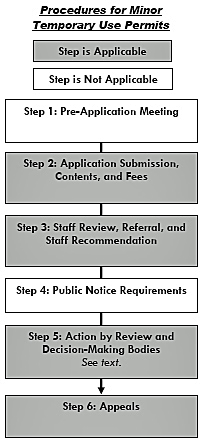
Purpose. The city of Laramie recognizes that some uses are temporary in nature and may provide a benefit to property owners and the community without adverse impacts. The purpose of this section is to provide a process that ensures proposed temporary uses can be accommodated with adequate review by the city to mitigate any potential adverse impacts. Further, this section differentiates between major and minor temporary use permits to ensure adequate procedures for each.
2.
Applicability. No use that is classified as a major temporary use in Section 15.10.030 shall be placed or established on private property without first receiving a temporary use permit pursuant to the procedures set forth in this subsection.
3.
Procedures.
a.
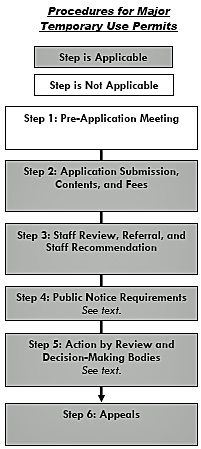
Step 1: Pre-Application Meeting. Not Applicable.
b.
Step 2: Application Submission, Contents, and Fees. Applicable pursuant to subsection 15.06.030.B.
c.
Step 3: Staff Review, Referral, and Staff Recommendation. Applicable pursuant to subsection 15.06.030.C.
d.
Step 4: Public Notice Requirements. Applicable. Written notice is required for major temporary use permits pursuant to subsection 15.06.030.D., however, the provisions of [subsection] 15.06.030.D.5.b. shall not apply. Written notice shall be mailed to adjacent property owners not including consideration of right-of-way.
e.
Step 5: Action by Review and Decision-Making Bodies. Applicable pursuant to subsection 15.06.030.E. The city council shall hold a hearing on the proposed application and approve, approve with conditions, or deny the proposed temporary use, based on the applicable approval criteria below. The city council may postpone action and continue the public hearing pursuant to subsection 15.06.030.E. The following review standards shall apply in addition to the specific use standards in Section 15.10.030, temporary uses and structures.
(i)
The city council may approve temporary uses or structures not otherwise permitted by this code provided:
(1)
That the need for the temporary use or structure has arisen from circumstances constituting a substantial hardship, including but not limited to a natural disaster, fire, governmental action, or construction or development of a permanent structure.
(2)
That the structure will not violate any applicable setbacks.
(3)
That any temporary use permitted must be capable of being removed within fifteen calendar days notice if the temporary permit is revoked.
(4)
The temporary use shall not be granted for more than three months except that up to an additional three-month period may be granted for good cause shown.
f.
Step 6: Appeals. Applicable pursuant to subsection 15.06.030.F.
g.
Multiple Permits for Recurring Events. The city council may grant up to six permits for recurring major temporary uses provided the exact dates and location of the event can be specified at the time of permit application.
G.
[Floodplain Variances.] Refer to Chapter 15.20, Floodplain Management for floodplain variance procedures and standards.
H.
[Floodplain Development Permits.] Refer to Chapter 15.20, Floodplain Management for floodplain development permit procedures and standards.
I.
Sign Permits.
1.
Purpose. The purpose of this section is to provide procedures for sign permits, including subdivision identification signs.
2.
Permits shall be required for all signs, unless exempt pursuant to subsection 15.14.120.C.
3.
Procedures.
a.
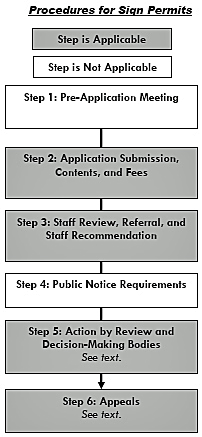
Step 1: Pre-Application Meeting. Not applicable.
b.
Step 2: Application Submission, Contents, and Fees. Applicable pursuant to subsection 15.06.030.B.
c.
Step 3: Staff Review, Referral, and Staff Recommendation. Applicable pursuant to subsection 15.06.030.C.
d.
Step 4: Public Notice Requirements. Not applicable.
e.
Step 5: Action by Review and Decision-Making Bodies. Applicable pursuant to subsection 15.06.030.E.
(i)
Department Action. The city manager's office shall review and decide on all sign permits.
f.
Step 6: Appeals. Applicable pursuant to subsection 15.06.030.F. A decision of the city manager's office on a sign permit application may be appealed to the board of adjustment.
J.
Minor Administrative Modifications.
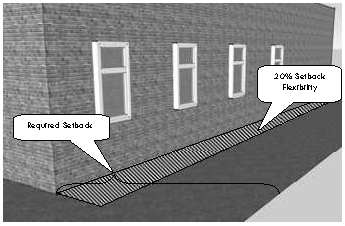
Figure 15.06-2: Minor administrative modifications of up to ten percent may be approved administratively. A maximum of ten percent of any quantitative development standard or setback, as shown above, may be granted if the criteria of subsection 15.06.060.J.3.e are met.
1.
Purpose. This section sets forth the required review and approval procedures for "minor administrative modifications." Minor modifications may include either or both of the following: (a) Minor deviations from otherwise applicable standards that may be approved by the city manager's office, board of adjustment, planning commission, or city council; or (b) streamlined review processes in cases involving changes to structures and/or sites that are not significant enough to require the full formal design review process per subsection 15.06.060.O. Minor modifications are to be used when the minor degree of the modification requested, and the unlikelihood of any significant adverse effects on nearby properties, the neighborhood and the city make it unnecessary to complete a formal design review or variance process.
2.
Applicability.
a.
Minor Modifications to General Development and Zoning District Standards. As part of the review and approval of any application set forth in this chapter, the department may approve minor modifications of up to a maximum of twenty-five percent from the following general development and zoning district standards, provided that the applicable approval criteria below are met. The city council and planning commission may also grant minor modifications in the course of any discretionary review pursuant to the requirements of this section.
(i)
Setback requirements (Section 15.12.000); or
(ii)
Quantitative development standards set forth in Chapter 15.14, Development standards (e.g., number of parking spaces).
b.
Minor Modifications to Existing Building and/or Site Design(s). The city manager's office may administratively approve minor changes to existing buildings and/or sites that would otherwise require a complete design review process as specified in subsection 15.06.060.O of this title. Such administrative approval shall follow the steps in this subsection. Minor changes eligible for this streamlined review process are as follows:
(i)
Parking lot repairs or improvements that do not involve reconstruction of the travel surface. For purposes of this subsection, the term "reconstruction" shall include removal of asphalt and/or base or replacement of drainage facilities that necessitate removal of asphalt and/or base; provided, however, that minor repairs or maintenance as specified in subsection 15.22.000.F shall not in and of themselves be deemed reconstruction;
(ii)
Changes to existing buildings that meet all of the following criteria:
Additions that do not exceed eight hundred square feet floor area or ten percent of
the building's existing floor area, whichever is less; and
Additions or modifications that do not include any increase in parking area (whether
required or voluntary).
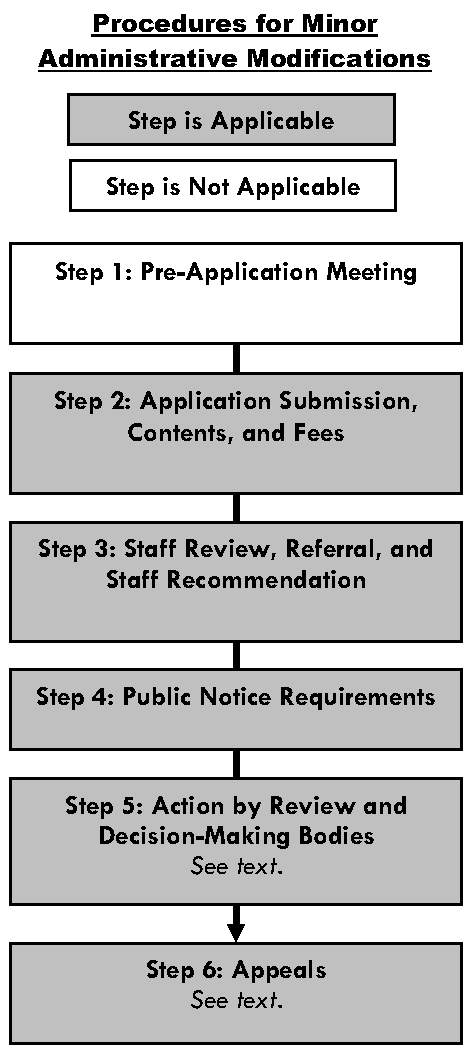
c.
Exceptions to Authority to Grant Minor Modifications. Notwithstanding subsections a. and b. above, except as permitted in other provisions of this code (e.g., PUD, subsection 15.06.070.C) no decision-making authority shall approve a minor modification that results in:
(i)
An increase in overall project density, except for projects meeting the criteria in subsection 15.06.060.J.2.b.ii;
(ii)
A change in permitted uses or mix of uses;
(iii)
A deviation from the use-specific standards, set forth in Section 15.10.010; or
(iv)
A change in conditions attached to the decision making body's approval of any subdivision plan, design review plan, or special review use.
3.
Procedures.
a.
Step 1: Pre-Application Meeting. Not applicable.
4.
Procedures.
a.
Step 1: Pre-Application Meeting. Not applicable.
b.
Step 2: Application Submission, Contents, and Fees. Applicable pursuant to subsection 15.06.030.B.
c.
Step 3: Staff Review, Referral, and Staff Recommendation. Applicable pursuant to subsection 15.06.030.C.
d.
Step 4: Public Notice Requirements. Applicable. The following procedures shall apply and take precedence over those in subsection 15.06.030.D :
(i)
The city manager's office shall notify adjacent property owners by mailed notice at least ten days prior to rendering the decision;
(ii)
Objections shall be deemed untimely unless received in writing during such ten day period and shall be directly related to concerns regarding the request as determined by the director. General objections regarding existing land use conditions or issues not related to the request will not be considered grounds for denial.
e.
Step 5: Action by Review and Decision-Making Bodies.
(i)
Department Action. The city manager's office shall render a decision no later than
30 calendar days after a complete application for minor administrative modification
has been filed with the city. The city manager's office may approve the minor modification
only after consideration of all objections and a finding that the modification meets
all of the criteria below:
The requested modification is consistent with the comprehensive plan and the stated
purpose of this code;
The requested modification meets all other applicable building and safety codes;
The requested modification does not encroach into a recorded easement;
The requested modification will have no significant adverse impact on the health,
safety, or general welfare of surrounding property owners or the general public, or
such impacts will be substantially mitigated; and
The requested modification is necessary to either: (a) address some practical difficulty
or some unusual aspect of the site of the proposed development not shared by landowners
in general; or (b) accommodate an alternative or innovative design practice that achieves
to the same or better degree the objective of the existing standard to be modified.
In determining if "practical difficulty" exists, the approval criteria for variances
in subsection 15.06.060.D.2.f.ii shall be considered.
Failure of the city manager's office to act on the application within 30 calendar
days shall be considered a denial of the application.
(ii)
Objection Received During Ten-Day Notice Period. The city manager's office shall consider such objection and give the person filing such objection an opportunity to be heard in an informal meeting open to the applicant prior to rendering his decision.
f.
Step 6: Appeals. Applicable pursuant to subsection 15.06.030.F. Appeals from decisions by the city manager's office for minor administrative modifications shall be heard by the planning commission, pursuant to subsection 15.06.030.F.1.
K.
Alternative Equivalent Compliance.
1.
Purpose. Alternative equivalent compliance is a procedure that allows development to meet the intent of the design-related provisions of this chapter through an alternative design. It is not a general waiver or weakening of regulations. Rather, the procedure permits a site-specific plan that is qualitatively equal to or better than the strict application of a design standard specified in this code. This procedure is not intended as a substitute for a variance or administrative modification or a vehicle for relief from standards in this chapter.
2.
Applicability.
a.
The alternative equivalent compliance procedure shall be available only for the following sections of this title:
(i)
Section 15.14.040, parking and off-street loading;
(ii)
Section 15.14.050, landscaping and screening standards;
(iii)
Section 15.14.060, transportation, mobility, and connectivity;
(iv)
Section 15.14.080, residential design standards;
(v)
Section 15.14.090, commercial design standards;
(vi)
Section 15.14.100, fences and walls; and
(vii)
Section 15.14.110, lighting.
3.
Pre-Application Conference Required. An applicant proposing to use alternative equivalent compliance under this section shall request and attend a pre-application conference prior to submitting the site plan for the development, to determine the preliminary response from the city manager's office. Based on that response, the design review plan application shall include sufficient explanation and justification, in both written and graphic form, for the alternative compliance requested.
4.
Procedures. A request for alternative equivalent compliance is made as part of a standard application process pursuant to the appropriate specific review procedure identified in this chapter.
5.
Decision-Making Responsibility. Final approval of alternative equivalent compliance under this section shall be the responsibility of the decision-making body responsible for deciding upon the application. By-right projects that would not ordinarily require review under this code, yet which are proposing alternative equivalent compliance, shall require written approval of the alternative equivalent compliance from the city manager's office prior to or concurrently with project approval. All applications for alternative equivalent compliance shall be processed and reviewed in a timely fashion.
6.
Criteria. To grant a request for alternative equivalent compliance, the decision-making body shall find that the following criteria are met:
a.
The proposed alternative design achieves the intent of the subject design standard to the same or better degree than the subject standard.
b.
The proposed alternative design achieves the goals and policies of the Laramie comprehensive plan to the same or better degree than the subject standard.
c.
The proposed alternative design results in benefits to the community that are equivalent to or better than compliance with the subject design standard.
d.
The proposed alternative is in the same development standard category as the standard for which the alternative is proposed, i.e., alternative screening substituted for required screening, or alternative parking lot design substituted for required parking lot design.
e.
The required improvement would be ineffective because of locational, topographic, or site constraints while the alternative design can accommodate site-specific issues.
7.
Effect of Approval. Alternative compliance shall apply only to the specific site for which it is requested and does not establish a precedent for assured approval of other requests.
L.
Solar Access Permits.
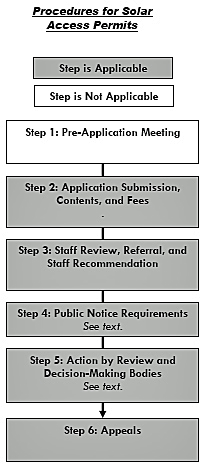
1.
Purpose. The purpose of this section is to encourage the use of solar energy, provide means of protection for the use of solar collectors without causing undue hardship and to provide procedures for solar access permits.
2.
Applicability.
a.
A solar access permit shall be required prior to establishing a solar right under this chapter.
b.
A solar access permit shall be granted for any proposed or existing solar collector that complies with the requirements of this section and other city ordinances and W.S. 34-22-101—106.
c.
Solar rights under applications filed subsequent to the effective date of this code shall vest on the date the solar access permit is issued, which date shall also be the priority date of the solar right.
d.
Users of solar collectors that existed prior to the effective date of this code shall be required to apply for permits within five years after the effective date. The priority date for these solar rights shall be the first date the solar collector was beneficially used, which shall be determined by the city manager's office. (Ord. 762 § 3, 1983).
3.
Procedures.
a.
Step 1: Pre-Application Meeting. Not applicable.
b.
Step 2: Application Submission, Contents, and Fees. Applicable pursuant to subsection 15.06.030.B.
c.
Step 3: Staff Review, Referral, and Staff Recommendation. Applicable pursuant to subsection 15.06.030.C.
d.
Step 4: Public Notice Requirements; Applicable. Published, written, and posted notice
shall be required pursuant to subsection 15.06.030.D. The following additional procedures
shall apply.
Upon accepting a complete application for a solar access permit, the city manager's
office shall notify owners of lots or parcels within one hundred fifty feet of the
property on which the solar access permit is being requested. The notice shall include
the information listed in subsection 15.06.030.D.
e.
Step 5: Action by Review and Decision-Making Bodies. Applicable pursuant to subsection
15.06.030.E. The following additional procedures shall apply.
The planning commission shall hold a public hearing on the proposed application no
later than sixty calendar days after the city manager's office accepts a complete
application for the solar access permit. After holding the public hearing, the planning
commission shall approve, approve with conditions, or deny the proposed solar access
permit. The planning commission shall consider whether the proposed solar access permit
can protect the use of a solar collector without causing undue hardships on the rights
of adjacent property owners. The planning commission may postpone action and continue
the public hearing pursuant to subsection 15.06.030.E. In approving or conditionally
approving the solar access permit, the planning commission shall include the following:
(i)
A description of the collector surface, or that portion of the collector surface to which the solar access permit is granted;
(ii)
The dimensions of the collector surface;
(iii)
The direction of orientation;
(iv)
The height above ground level and the location of the collector on the solar user's property.
f.
Step 6: Appeals. Applicable pursuant to subsection 15.06.030.F.
4.
Recording Procedure. After approval of the solar access permit by the planning commission and after the expiration of the appeal period as set forth in subsection 15.06.030.F., the applicant shall record the approved solar access permit and a site plan with the county clerk. The solar access permit shall include a description of the collector surface or that portion of the collector surface to which the solar access permit is granted. The description shall include the dimensions of the collector surface, the direction of orientation, the height above ground level and the location of the collector on the solar user's property. Upon recordation, the applicant shall provide a copy of the recorded solar access permit and site plan to the city manager's office. (Ord. 762 § 5(f), 1983).
5.
Lapse, Beneficial Use, Restrictions.
a.
The solar collector shall be put to beneficial use within two years of approval or conditional approval of the solar access permit by the planning commission. If an appeal was filed with the city council, the solar collector shall be put to beneficial use within two years of final action on the appeal by the city council. If the solar collector is not put to beneficial use, the approval or conditional approval of the solar access permit shall be null and void.
b.
Upon installation of the solar collector by the applicant, the city manager's office shall certify the beneficial use of the solar collector and record a certificate of beneficial use with the county clerk.
c.
The solar right to radiation of the sun before nine a.m. or after three p.m. Mountain Standard Time is de minimus and may be infringed without compensation to the owner of the solar collector.
d.
Solar collectors shall be located on the solar user's property so as not to unreasonably or unnecessarily restrict the uses of neighboring property. Unless otherwise permitted by the local government, no solar right attaches to a solar collector, or a portion of a solar collector, that would be shaded by a ten-foot wall located on the property line at solar noon on a winter solstice day.
e.
Whenever a solar collector is not in continued beneficial use for a period of twelve consecutive months, the solar access permit shall automatically terminate.
M.
Annexation.
1.
Applicability. All annexations of land into the city of Laramie shall follow applicable Wyoming Statutes (W.S. 15-1-401 et seq.), as may be amended from time-to-time.
2.
Procedures.
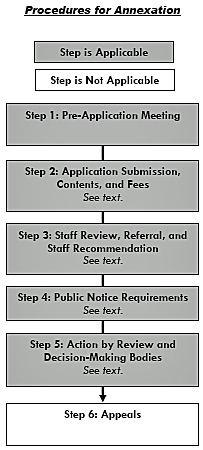
a.
Step 1: Pre-Application Meeting. Applicable pursuant to subsection 15.06.030.A.
b.
Step 2: Application Submission, Contents, and Fees. Applicable pursuant to subsection 15.06.030.B. Applications and contents shall be in accordance with applicable Wyoming Statutes, as may be amended from time-to-time. Submittals shall be made on applications provided by the city.
c.
Step 3: Staff Review, Referral, and Staff Recommendation. Applicable pursuant to subsection 15.06.030.C. Review by the city shall be in accordance with applicable Wyoming Statutes, as may be amended from time-to-time.
d.
Step 4: Public Notice Requirements. Published, written, and posted notice shall be required pursuant to subsection 15.06.030.D. Public notice shall also be in accordance with applicable Wyoming Statutes, as may be amended from time-to-time.
e.
Step 5: Action by Review and Decision-Making Bodies. Applicable pursuant to subsection 15.06.030.E. Action by city review and decision-making bodies shall be in accordance with applicable Wyoming Statutes, as may be amended from time-to-time.
f.
Step 6: Appeals. Not applicable.
N.
Additions by Plat.
1.
Purpose. The purpose of this section is to provide additional procedures for additions by plat as permitted by W.S. 15-1-415. Additions by plat are annexations of land into the city where major subdivision preliminary plat s are approved for land contiguous to the existing corporate boundaries of the city. Approval of the preliminary plat per the procedure in this section and subsection 15.06.060.P. authorizes future addition by plat in the preliminary plat area. Subsequent approval and recordation of final plat(s) is necessary to effectuate any addition by plat.
2.
Applicability. This section shall apply to annexation of land into the city of Laramie that is contiguous to the existing corporate boundaries of the city through the major subdivision process.
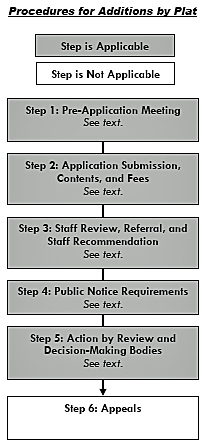
3.
Procedures. Additions by plat shall only processed concurrently with preliminary plats. Authorization of the addition by plat shall only be granted by approval or conditional approval of the corresponding preliminary plat by the city council. Additions by plat are in full effect only if the final plat that includes the land to be added is approved by the city council and recorded with Albany County.
a.
Step 1: Pre-Application Meeting. Applicable concurrent with the preliminary and final plat procedures.
b.
Step 2: Application Submission, Contents, and Fees. A request for an addition by plat must be submitted concurrently with a preliminary plat application. In addition to the preliminary plat application submittal requirements, the following additional information must be included:
(i)
A map of the entire area proposed to be added by plat showing identifiable landmarks and boundaries and the area that will, as a result of the addition, be brought within one-half-mile of the new corporate limits of the city, if it has exercised the authority granted under W.S. 15-3-202(b)(ii);
(ii)
The total estimated cost of infrastructure improvements required for the subdivision being proposed;
(iii)
A list of basic and other services customarily available to residents of the city and a timetable when those services will reasonably be available to the area proposed to be added by plat;
(iv)
A projected annual fee or service cost for services described in paragraph (iii), above;
(v)
The current and projected property tax mill levies imposed by the city; and
(vi)
The cost of infrastructure improvements required within the existing boundaries of the municipality to accommodate the proposed addition by plat.
(vii)
Authorization to release of financial security to the city for construction and dedication of proposed public improvements within the annexation area in the event the project is not complete prior to the lapse period.
c.
Step 3: Staff Review, Referral, and Staff Recommendation. Applicable pursuant to subsection 15.06.030.C and concurrent with preliminary and final plat review.
d.
Step 4: Public Notice Requirements. Notice of additions by plat shall be included in the public notices required for preliminary plats and final plats.
e.
Step 5: Action by Review and Decision-Making Bodies.
(i)
Planning Commission Action. Additions by plat shall be reviewed and considered by the planning commission concurrently with the preliminary plat. The planning commission shall recommend authorization of the future addition by plat only if the planning commission recommends approval or conditional approval of the preliminary plat to the city council. The planning commission shall not recommend approval of the final plat unless the planning commission determines that the final plat meets all the criteria in paragraph (iii) below.
(ii)
City Council Action. Additions by plat shall be reviewed and considered by the city council concurrently with the preliminary plat. The city council shall authorize future addition by plat only if the city council approves or conditionally approves the preliminary plat. The city council shall not approve the final plat unless the city council determines that the final plat meets all the criteria in paragraph (iii) below.
(iii)
Approval Criteria. The planning commission shall not recommend approval, and the city council shall not approve any final plat unless the final plat meets all of the following criteria:
(1)
The addition by plat is in compliance with the comprehensive plan;
(2)
An addition by plat is for the protection of the health, safety and welfare of the persons residing in the area and in the city or town;
(3)
The urban development of the addition by plat area would constitute a natural, geographical, economical and social part of the annexing city or town;
(4)
The addition by plat area is a logical and feasible addition to the city and the extension of basic and other services customarily available to residents of the city shall, within reason, be available to the area;
(5)
The addition by plat area is contiguous with or adjacent to the annexing city or town;
(6)
The city governing body is prepared to issue one or more franchises as necessary to serve the addition by plat area;
(7)
The urban development of the addition by plat area would constitute a natural, geographical, economical and social part of the annexing city or town;
(8)
The applicant has constructed all the requirement public or private improvements that have been inspected and accepted by the city or that the applicant has filed with the city sufficient financial security for those improvements identified in subsection 15.06.060.N.3.b.(ii) pursuant to Chapter 15.18, Subdivision Improvements.
(9)
The applicant has provided the required authorizations required pursuant to subsection 15.06.060.N.3.b.(vii).
f.
Step 6: Appeals. Not applicable.
4.
Lapse. The applicant shall record final plats pursuant to subsection 15.08.060.P. within the approved addition by plat area within five years of addition by plat ordinance approval or prior to expiration of the preliminary plat, whichever is less.
5.
Failure to Record Final Plat.
a.
Expiration of Addition By Plat Authorization. If the applicant fails to record final plat(s) for the entire area covered by the addition by plat as required, the addition by plat authorization shall be deemed null and void for all such authorized area not already included in an authorized an recorded final plat, and a new application for the purposes of review, scheduling, and payment of fees shall be required.
b.
Infrastructure Improvements Required. If the applicant fails to record final plats for the entire area covered by the addition by plat as required, the city shall be authorized to collect the financial security required pursuant to subsection 15.06.N.3.f(iii).10. and the city may construct all public improvements within the addition by plat area.
O.
Site Plan Review.
1.
Purpose. The purpose of the Site Plan Review process is to ensure compliance with the development and design standards and provisions of this code. It is designed to encourage quality development reflective of the goals, policies, and objectives of the comprehensive plan.
2.
Applicability.
a.
Site Plan Review shall be required for all new uses and structures, except in the case of single-family detached / attached, IBC / IRC modular homes, manufactured homes, and two-family/ duplex, multifamily developments with less than four units, or accessory structures associated with the preceding residential uses.
b.
Site Plan Review shall not be required for any changes that are wholly interior and there is no Change of Use as defined in LMC 15.14.010.B.5 such as electrical, plumbing or mechanical permit.
c.
Site Plan Review shall not apply to projects that are defined as permissible under the Minor Administrative Modifications process, per Subsection 15.06.060.J.
d.
Site Plan Review shall not be required for single-family detached/attached, IBC/IRC modular home, manufactured homes, and two-family/duplex, multifamily developments with less than four units, or accessory structures associated with the preceding residential uses.
3.
Procedure for Site Plan Review.
a.
Step 1: Pre-Application Meeting. Not applicable.
b.
Step 2: Application Submission, Contents, and Fees. Applicable pursuant to subsection 15.06.030.B.
c.
Step 3: Staff Review, Referral, and Staff Recommendation. Applicable pursuant to subsection 15.06.030.C.
d.
Step 4: Public Notice Requirements. Not applicable.
e.
Step 5: Action by Review and Decision-Making Bodies. Applicable pursuant to subsection 15.06.030.E. At the applicant's request, a Site Plan Review application may be run concurrently with a building permit or other applicable development application. The following other procedures shall apply (Ord. 1596 § 10, 2011):
(i)
Action by Department. The city manager's office shall review each site plan review application and, as deemed necessary, distribute the application to other reviewers. Taking into account results of those reviews, the city manager's office shall take final action on the application and approve, approve with conditions or deny, on the application based on the applicable approval criteria below. The city manager's office's review and decision, including referral to other agencies and bodies, shall be completed within 30 calendar days of receipt of a complete application. Failure to complete such review in 30 calendar days shall not constitute deemed approval of the site plan; however if the city manager's office does not act on the application within 30 calendar days, the applicant may request the city manager's office to move the application to the planning commission agenda for review, which the city manager's office shall do upon such request.
(ii)
Referral to Planning Commission. The city manager's office may refer to the planning commission any application involving any requested deviation, modification, or exemption from the requirements of this code, and/or any application that in the city manager's office's opinion presents issues that require planning commission attention. Such applications shall state all reasons for requesting any deviation, modification, or exemption from the rules, requirements, and regulations of this code.
(iii)
Approval Criteria. The city manager's office shall approve a site plan upon a finding that the application meets all of the following criteria:
(1)
The site plan is consistent with the comprehensive plan;
(2)
The site plan is consistent with any active subdivision plat, planned development, or any other plan or land use approval as applicable;
(3)
The site plan complies with all applicable development and site plan standards set forth in this code, including but not limited to the provisions in Chapter 15.08, Zoning districts, Chapter 15.10, Use regulations, Chapter 15.12, Dimensional standards, and Chapter 15.14, Development standards;
(4)
Any significant adverse impacts reasonably anticipated to result from the use will be mitigated or offset to the maximum extent practicable;
(5)
The development proposed in the plan and its general location is or will be compatible with the character of surrounding land uses; and
(6)
The development can be adequately served by city services, including but not limited to roads, water, and wastewater.
f.
Step 6: Appeals. Applicable pursuant to subsection 15.06.030.F.
4.
Lapse. Approved site plan review documents shall be binding upon the applicants and their successors and assigns. No permit shall be issued for any building or structure or use that is not in accord with the approved documents or any approved modifications thereto. The construction, location, use, or operation of all land and structures within the site shall conform to all conditions and limitations set forth in the documents. No structure, use, or other element of approved site plan review documents shall be eliminated, altered, or provided in another manner unless an amended site plan is approved.
5.
Expiration. Approved site plan review documents shall expire if a building permit has not been obtained or the approved use established within two years of the date of approval. In the event that the documents expire due to the passage of this time period, new site plan review documents shall be submitted for approval in the same manner as an original application for development review.
6.
Modifications to Site Plan Review Plans. The holder of an approved site plan may request a modification to the document or the conditions of approval by submitting amended documents to the city manager's office. The amended documents shall be filed and processed in accordance with the procedures for an initial site plan review submittal.
P.
Subdivisions, Major.
1.
Purpose. The purpose of the major subdivision review process is to ensure compliance with the subdivision standards and requirements set forth in Chapter 15.16 Subdivision Design, and Chapter 15.18, Improvements, while encouraging quality development consistent with the goals, policies, and objectives found in the comprehensive plan.
2.
Applicability. The major subdivision procedure shall be followed for a proposed division of land when any one or more of the following conditions exist:
a.
The resultant subdivision will produce three or more lots;
b.
The subdivision involves dedication of public right-of-way, other public tracts, or public improvements; or
c.
The subdivision is not otherwise eligible for the minor land division process.
3.
General Procedures. All major subdivisions shall be processed in two stages: (1) the preliminary plat, and (2) the final plat. An approved preliminary plat shall serve as an approved site plan. The final plat shall only be filed with the city for review and processing after the preliminary plat has been approved or conditionally approved by the city council. Specific procedures for preliminary and final plats are outlined below.
4.
Procedures for Preliminary Plats.
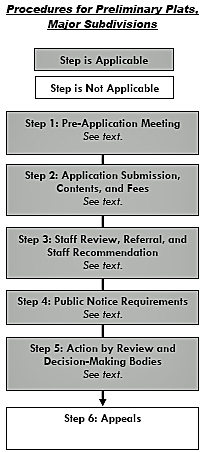
a.
Step 1: Pre-Application Meeting. Applicable to subdivisions creating ten or more lots, parcels, or units, pursuant to subsection 15.06.030.A. Applicants with subdivisions creating nine or fewer lots, parcels, or units are not required to attend a pre-application meeting.
b.
Step 2: Application Submission, Contents, and Fees. Applicable pursuant to subsection 15.06.030.B.
c.
Step 3: Staff Review, Referral, and Staff Recommendation. Applicable pursuant to subsection 15.06.030.C.
(i)
Referral. The staff shall solicit outside agency referrals for the application.
d.
Step 4: Public Notice Requirements. Applicable. Published, written, and posted notice required pursuant to subsection 15.06.030.D. prior to the planning commission hearing and the city council hearing.
e.
Step 5: Action by Review and Decision-Making Bodies.
(i)
Planning Commission Action. After holding a public hearing on the preliminary plat the planning commission shall recommend approval, approval with conditions, or denial of the preliminary plat to the city council based on the general review criteria in subsection 15.06.030.E. The planning commission may postpone action and continue the public hearing pursuant to subsection 15.06.030.E. (Prior code § 35-11).
(ii)
City Council Action. The preliminary plat shall be scheduled for a city council meeting no later than sixty calendar days after the planning commission action on the preliminary plat. The city council shall approve, conditionally approve, or deny the preliminary plat based on the general review criteria in subsection 15.06.030.E. The city council may postpone action pursuant to subsection 15.06.030.E.
5.
Procedures for Final Plat.
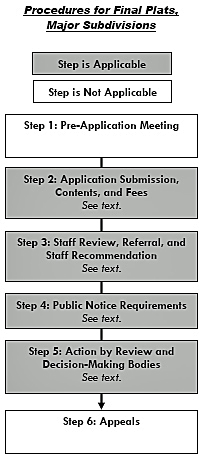
a.
Step 1: Pre-Application Meeting. Not applicable.
b.
Step 2: Application Submission, Contents, and Fees. Applicable pursuant to subsection 15.06.030.B. Each final plat shall contain, at a minimum, the following certificates and data:
(i)
A certificate for signature by the city engineer certifying that the final plat is technically correct and meets all applicable surveying standards.
(ii)
A certificate for signature by the city manager's office certifying that the final plat complies with the conditions of approval for the subdivision.
(iii)
Any and all public or private easements or rights-of-way being dedicated by the subdivider with the final plat to the city or any other agencies.
(iv)
Any and all existing public or private easements or rights-of-way that exist within the boundaries of the final plat.
(v)
A signed and notarized acknowledgment by land owner(s) of the land being subdivided by the final plat.
c.
Step 3: Staff Review, Referral, and Staff Recommendation. Applicable pursuant to subsection 15.06.030.C.
d.
Step 4: Public Notice Requirements. Applicable. Published, written, and posted notice required prior to the planning commission hearing and the city council hearing pursuant to subsection 15.06.030.D.
e.
Step 5: Action by Review and Decision-Making Bodies.
(i)
Planning Commission Action. After holding a public hearing on the final plat the planning commission shall recommend approval or denial of the final plat to the city council. The planning commission may postpone action and continue the public hearing pursuant to subsection 15.06.030.E. The planning commission shall not recommend approval of the final plat to the city council unless the planning commission determines that the final plat meets all the criteria in subsection 15.06.060.5.P.e.(iv). Upon favorable recommendation of the final plat by the planning commission, the city manager or his or her designee shall attest on the final plat that the planning commission has recommended approval of the final plat to the city council.
(ii)
City Council Action. The final plat shall be scheduled for a city council meeting no later than sixty calendar days after the planning commission action on the final plat. The city council shall approve or deny the final plat. The city council may postpone action pursuant to subsection 15.06.030.E. The city council shall not approve the final plat unless the city council determines that the final plat meets all the criteria in subsection 15.06.060.5.P.e.(iii).
(iii)
Attest. Upon the approval of the final plat by the review and decision making bodies, the director and city engineer shall attest on the final plat that the city council approved the final plat and the final plat is technically correct and approved for filing with the county clerk.
(iv)
Approval Criteria. The planning commission shall not recommend approval, and the city council shall not approve any final plat unless the final plat meets all of the following criteria:
(1)
The proposed final plat complies with the conditions of approval of the preliminary plat;
(2)
The layout and design of the proposed final plat is in substantial compliance with the approved preliminary plat, including but not limited to number of lots or parcels, street and block layout, and access (for the purposes of this subsection, a final plat may be considered within substantial compliance if the number of lots increases or decreases by no more than ten percent);
(3)
The improvement plans for any required on-site or off-site public or private improvements have been reviewed and approved by the city for construction;
(4)
The applicant has constructed all the required public or private improvements and they have been inspected and accepted by the city, or that the applicant has filed with the city sufficient financial security for those improvements pursuant to Chapter 15.18, Subdivision Improvements; and
(5)
The subdivision complies with all applicable use, development, and design standards set forth in this code.
f.
Step 6: Appeals. Not applicable.
6.
Recordation After Final Plat Approval. The applicant shall record the approved final plat as shown by the signature of the Mayor and attested by the city clerk with the county clerk no later than sixty days after the date of approval of the final plat by the city council in accordance with subsection 15.06.050.B. If the applicant fails to record the final plat as required, the final plat approval shall be deemed null and void, and any subsequent refiled final plat shall be treated as a new application for the purposes of review, scheduling, and payment of fees.
7.
Applicant to Furnish the City with Recorded Prints. The applicant shall, immediately upon recording the approved and signed final plat, furnish the city manager's office with copies of the final plat as officially recorded. (Prior code § 35-20).
a.
Final Acceptance—Issuance Prerequisite—Exception. The building inspector shall not issue building permits for any structure on a lot in a subdivision for which a final plat has not been approved and recorded in the manner prescribed in this code, unless such lot faces a street otherwise accepted by the city for public improvements and services. (Prior code § 35-21).
b.
Final Acceptance—Street Improvement Prerequisite. The city shall withhold all public street improvements and services of whatsoever nature, including maintenance, from all areas which have not been accepted by the city council, in the manner prescribed in this code or by other official actions of the city council. (Prior code § 35-22).
8.
Part or Whole Approval. Final plats submitted for approval pursuant to this chapter may include the entire area covered by the preliminary plat, or any portion of such area. All final plat improvements shall be designed and constructed so that each final plat can operate independently and as part of the whole design of the subdivision. (Ord. 493 § 1, 1976).
9.
Lapse.
a.
Duration of Preliminary Plat After Effective Date. A final plat for the subdivision approved after the effective date of this code shall be approved by the city council and recorded no later than five years after approval or conditional approval of the preliminary plat by the city council. If the subdivision is to be recorded as multiple final plats, each subsequent final plat shall be approved by the city council and recorded no later than five years after the recordation date of the preceding phase. If a final plat for the entire subdivision or any phase thereof is not approved by the city council and recorded as specified above, the approval or conditional approval of the preliminary plat shall be null and void.
Q.
Minor Land Division.
1.
Purpose. The purpose of this section is to provide uniform procedures for review of minor land divisions as defined by this code. The intent of this section is to provide streamlined review procedures for minor land divisions, which generally do not have significant impacts on adjacent property or city facilities and services.
2.
Applicability. The minor land division procedure is permitted for a proposed division of land under the following circumstances:
a.
The property has previously been platted;
b.
The property is being subdivided to split the parcel and a deed is or will be executed for a portion of it as a separate tract;
c.
No public right-of-way dedication or public improvements are required;
d.
The resulting subdivision will produce two lots and is not part of a larger subdivision submitted previously or submitted subsequently by:
(i)
The same or related property owners;
(ii)
The same or related applicants; or
(iii)
The same or related developer or developer-entities.
e.
The subdivision will create only minimal negative impacts on existing facilities, adjacent properties, or local public service providers; and
f.
There will be no modifications to the subdivision design standards in Chapters 15.16, Subdivision, and 15.18, Improvements.
3.
Procedures.
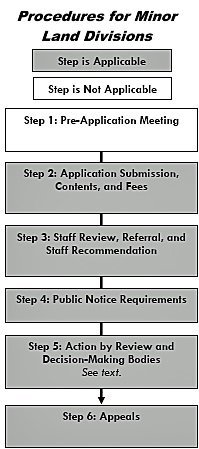
a.
Step 1: Pre-Application Meeting. Not applicable.
b.
Step 2: Application Submission, Contents, and Fees. Applicable pursuant to subsection 15.06.030.B. Applicants shall only be required to submit a final plat.
c.
Step 3: Staff Review, Referral, and Staff Recommendation. Applicable pursuant to subsection 15.06.030.C.
d.
Step 4: Public Notice Requirements. Posted notice required pursuant to subsection 15.06.030.D.
e.
Step 5: Action by Review and Decision-Making Bodies.
(i)
Department Action. The city manager's office shall review each proposed minor land division application relative to the applicable approval criteria listed below and shall act to approve, approve with conditions, or deny the proposed minor land division. The city manager's office shall act within thirty calendar days from submission of a complete application; however, if the city manager's office does not act on the application within thirty calendar days, the applicant may request the city manager's office to move the application to the planning commission agenda for review, which the city manager's office shall do upon such request.
(ii)
Approval Criteria. The city manager's office shall approve a minor land division application if it meets the following criteria:
(1)
The minor land division is consistent with the comprehensive plan;
(2)
The minor land division is consistent with and implements the intent of the specific zoning district in which it is located;
(3)
As applicable, the minor land division is consistent with the terms and conditions of any previously approved development plan;
(4)
The minor land division complies with all applicable use, development, and design standards set forth in this code; and
(5)
Adequate and sufficient public safety, transportation, utility facilities and services, recreation facilities, parks, and schools are available to serve the subject property, while maintaining sufficient levels of service to existing development.
f.
Step 6: Appeals. Applicable pursuant to subsection 15.06.030.F.
4.
Recording.
a.
Following the approval or conditional approval of a minor land division, which shall have all permitted modifications or variances expressly noted thereon, the minor land division shall be signed by the director and the city engineer. The applicant shall then record the minor land division and other required documents in the office of the county clerk and pay all required recording fees.
b.
A final minor land division shall be presented to the city manager's office no later than sixty calendar days after the city manager's office has approved or conditionally approved the minor land division. The final minor land division plat shall be recorded no later than ten business days after the director and city engineer have signed the final minor land division plat or the final plat shall be considered void and a new final plat application shall be required. A copy of the recorded plat and any documents recorded with the plat shall be provided by the applicant to the city manager's office.
R.
Other Land Adjustments and Lot Consolidations.
1.
Purpose. The purpose of this section is to provide streamlined procedures for review of other forms of land adjustments and lot consolidations.
2.
Applicability. The procedures of this section shall be followed for a proposed adjustment or consolidation of land under the following circumstances:
a.
Lot line adjustments;
b.
Lot consolidations involving two lots, and including the below circumstances:
(i)
The property has previously been platted;
(ii)
There is no public right-of-way dedication required;
(iii)
There are no public improvements required or public improvements have been financially secured in accordance with applicable provisions of LMC 15.18;
(iv)
The adjustment or consolidation will create only de minimis negative impacts on existing facilities, adjacent properties, or local public service providers; and
(v)
There will be no modifications to the design standards in chapter 15.16, Subdivision or 15.18 Improvements. (Ord. 1671 § 5,2014; Ord. 1596 § 22-23,2011)
3.
Procedures.
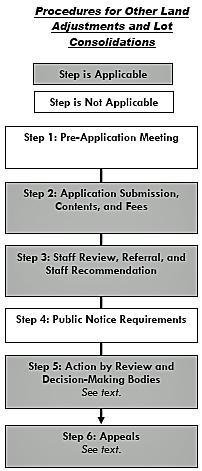
a.
Step 1: Pre-Application Meeting. Not applicable.
b.
Step 2: Application Submission, Contents, and Fees. Applicable pursuant to subsection 15.06.030.B.
c.
Step 3: Staff Review, Referral, and Staff Recommendation. Applicable pursuant to subsection 15.06.030.C.
d.
Step 4: Public Notice Requirements. Not applicable.
e.
Step 5: Action by Review and Decision-Making Bodies.
(i)
Department Action. The city manager's office shall review each proposed adjustment or consolidation application relative to the applicable approval criteria listed below and shall act to approve, approve with conditions, or deny the proposed adjustment or consolidation. The city manager's office shall act within thirty calendar days from submission of the application; however, if the city manager's office does not act on the application within thirty calendar days, the applicant may request the city manager's office to move the application to the planning commission agenda for review, which the city manager's office shall do upon such request.
(ii)
Approval Criteria. The city manager's office shall approve an adjustment or consolidation application if it meets the following criteria:
(1)
The adjustment or consolidation is consistent with the comprehensive plan;
(2)
The adjustment or consolidation is consistent with and implements the intent of the specific zoning district in which it is located;
(3)
As applicable, the adjustment or consolidation is consistent with the terms and conditions of any previously approved development plan;
(4)
The adjustment or consolidation complies with all applicable use, development, and design standards set forth in this code;
(5)
Adequate and sufficient public safety, transportation, utility facilities and services, recreation facilities, parks, and schools are available to serve the subject property, while maintaining sufficient levels of service to existing development; and
(6)
The adjustment or consolidation complies with any development master plan for the subject property.
f.
Step 6: Appeals. Applicable pursuant to subsection 15.06.030.F.
4.
Recording.
a.
Following the approval of an adjustment or consolidation, which shall have all permitted modifications or variances expressly noted thereon, the adjustment or consolidation shall be signed by the director and the city engineer. The applicant shall then record the adjustment or consolidation and other required documents in the office of the county clerk and pay all required recording fees.
b.
A final adjustment or consolidation shall be presented to the city manager's office no later than sixty calendar days after the city manager's office has approved the adjustment or consolidation. The adjustment or consolidation shall be recorded no later than ten business days after the director and city engineer have signed adjustment or consolidation, or the adjustment or consolidation shall be considered void and a new application shall be required. A copy of the recorded adjustment or consolidation and any documents recorded with the adjustment or consolidation shall be provided by the applicant to the city manager's office.
S.
Replats.
a.
Administrative Replats. Administrative replats involve only minor changes to lot line configurations on recorded plats as determined by the city manager's office. Upon receipt of the application, the city manager's office shall notify the applicant in writing within ten calendar days if the request shall be processed as an administrative replat or a major replat as set forth in subsection 15.06.060.S.b. No preliminary plat shall be required for administrative replats. The procedure for such replats shall follow the procedures set forth for minor land divisions in subsection 15.06.060.Q (Ord. 1596 § 26,2011).
b.
Major Replats. Major replats involve any changes, erasures, modifications, or revisions to any recorded plat of a subdivision as determined by the city manager's office. Upon receipt of the application, the city manager's office shall notify the applicant within ten calendar days if the request shall be processed as an administrative replat as set forth above or a major replat. Major replats shall follow the same procedures set forth for major subdivisions in subsection 15.06.060.P.
T.
Condominium.
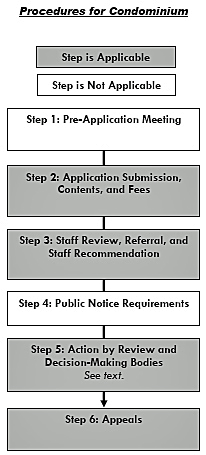
1.
Purpose. The purpose of this section is to provide uniform procedures for review of condominium applications as defined by this code. The intent of this section is to provide streamlined review procedures as authorized by W.S. 34-20-101.
2.
Applicability. The condominium procedure shall be applicable for a proposed division of real property under the following circumstances:
a.
The existing use of the property shall be in conformance with provisions contained in applicable sections of this code, including but not limited to, density, and setbacks.
b.
The division of real property will create a separate fee simple estate in an individual air space unit of a multi-unit property together with an undivided fee simple interest in common elements.
3.
Procedures.
a.
Step 1: Pre-Application Meeting. Not applicable.
b.
Step 2: Application Submission, Contents, and Fees. Applicable pursuant to subsection
15.06.030.B.
The following additional information shall be required:
(i)
A map properly locating condominium units. Any instrument affecting the condominium unit may legally describe it by the identifying condominium unit number or symbol as shown on such map; and
(ii)
An instrument defining the character, duration, rights, obligations and limitations of condominium ownership.
c.
Step 3: Staff Review, Referral, and Staff Recommendation. Applicable pursuant to subsection 15.06.030.C.
d.
Step 4: Public Notice Requirements. Not applicable.
e.
Step 5: Action by Review and Decision-Making Bodies.
(i)
Department Action. The city manager's office shall review each condominium application relative to the applicable approval criteria listed below and shall act to approve, approve with conditions, or deny the proposed condominium.
(ii)
Approval Criteria. The city manager's office shall approve or approve with conditions a condominium application if it meets the following criteria:
(1)
As applicable, the condominium is consistent with the terms and conditions of any previously approved development plan;
(2)
The legal description of all condominium units and common areas has been prepared by a Wyoming licensed surveyor or engineer;
(3)
An instrument has been prepared adequately identifying the duration and declaring all rights, obligations and limitations of condominium ownership, such instrument having been provided to the satisfaction of the city manager's office;
(4)
The property has previously been platted within the city; and
(5)
The existing dimensional standards of the property are in conformance with provisions contained in applicable sections of this code, including but not limited to, density and setbacks.
f.
Step 6: Appeals. Applicable pursuant to subsection 15.06.030.F.
4.
Recording.
a.
Following the approval of a condominium application, the condominium map shall be signed by the city manager's office. The applicant shall then record the condominium map and all other required documents in the office of the county clerk and pay all required recording fees in the office of the county clerk no later than ten calendar days after the director has signed the condominium map.
b.
An instrument defining the character, duration, rights, obligations and limitations of condominium ownership shall be recorded in the office of the county clerk no later than ten calendar days after the director has signed the condominium map. A copy of the recorded instrument shall be provided by the applicant to the city manager's office.
U.
Grading Permits.
1.
Purpose. The purpose of this section is to provide procedures for grading permits. The intent of the requirement for such permits is to minimize and mitigate the disturbance of land, vegetation, drainage patterns, and any hazards arising from site disturbance prior to city review.
2.
Applicability.
a.
It shall be unlawful for any person to conduct any activity resulting in any of the following total disturbed areas without first obtaining a grading permit pursuant to this section. Except as exempted in subsection 15.06.060.U.3. below, a grading permit shall be required for disturbed areas of:
(i)
One-half acre or more; or
(ii)
Less than one-half acre, if such activities are part of a larger common plan of development, even though multiple, separate, and distinct land development activities may take place at different times on different schedules; or
(iii)
Any development on a slope of greater than fifteen percent.
b.
The city may also require a grading permit regardless of the size of the total disturbed area in conjunction with approval of a final subdivision plat, conditional use permit, or site development plan, or if the construction activities are adjacent to a floodplain boundary, wetlands, or within the boundaries of the aquifer protection overlay district.
c.
Grading not relating to a development application shall be prohibited, except as exempted below.
3.
Exemptions. The following activities are exempt from this subsection:
a.
Agricultural cropping and environmental land management activities, not including pre-construction or construction activities;
b.
Maintenance and repair of any stormwater facility, utilities, irrigation ditch, watercourse, or related practice deemed necessary by the city engineer;
c.
Emergency repairs to streets, utilities, and other similar facilities deemed necessary by the city engineer; and
d.
Activities on areas less than ½ acre, unless otherwise required by subsection 15.06.060.U.2.a.
4.
Procedures.
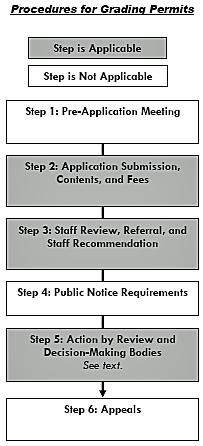
a.
Step 1: Pre-Application Meeting. Not applicable.
b.
Step 2: Application Submission, Contents, and Fees. Applicable pursuant to subsection 15.06.030.B.
c.
Step 3: Staff Review, Referral, and Staff Recommendation. Applicable pursuant to subsection 15.06.030.C.
d.
Step 4: Public Notice Requirements. Not applicable.
e.
Step 5: Action by Review and Decision-Making Bodies. Applicable pursuant to subsection 15.06.030.E. The following additional procedures shall apply.
(i)
City Engineer Action.
(1)
The grading plan and statement shall be reviewed for consistency with applicable regulations and standards, and if approved by the city engineer, a permit shall be issued within ten calendar days of application.
(2)
If determined inadequate by the city engineer, the application shall be returned within ten calendar days after application and the owner may resubmit, without additional fees, an amended grading plan or statement.
(ii)
Approval Criteria. The city engineer shall approve a grading permit application if it meets the following criteria:
(1)
The grading proposed will have adequate on- and off-site sedimentation and erosion control measures;
(2)
The grading proposed is the minimum amount necessary to carry out development plans;
(3)
The grading proposed avoids any adverse impact on natural drainage patterns on- and off-site; and
(4)
To the maximum extent practicable, the grading proposed avoids any disturbance of ridgelines, streams, or existing trees and vegetation.
f.
Step 6: Appeals. Applicable pursuant to subsection 15.06.030.F.
V.
Vacations, Subdivision.
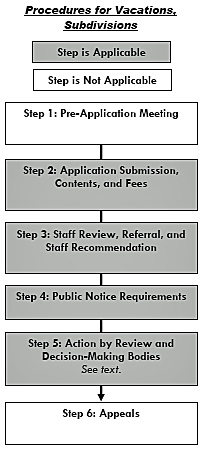
1.
Purpose. The purpose of this section is to provide vacation standards and requirements for vacation of all or any portion of a final plat as permitted by W.S. 34-12-106.
2.
Applicability.
a.
The vacation procedure shall be followed for any proposed vacation of a final plat. The consent of all the property owners is required. This procedure may be reviewed concurrently with a major subdivision application. All final plat vacations, upon approval by the city, shall be filed with the county clerk's office and signed by the Mayor.
b.
Vacations of final plats including rights-of-way shall be vacated by resolution and recorded with a written instrument.
3.
Procedures.
a.
Step 1: Pre-Application Meeting. Not applicable.
b.
Step 2: Application Submission, Contents, and Fees. Applicable pursuant to subsection 15.06.030.B.
c.
Step 3: Staff Review, Referral, and Staff Recommendation. Applicable pursuant to subsection 15.06.030.C.
d.
Step 4: Public Notice Requirements. Applicable. Published, written, and posted notice shall be required pursuant to subsection 15.06.030.D.
e.
Step 5: Action by Review and Decision-Making Bodies. Applicable. The following additional procedures shall apply.
(i)
Planning Commission Public Hearing. The planning commission shall hold a public hearing and make a recommendation to approve, approve with revisions, postpone, or deny the application.
(ii)
City Council Public Hearing. The city council shall hold a public hearing and shall approve, approve with conditions, postpone, or deny the proposed subdivision vacation.
f.
Step 6: Appeals. Not applicable.
4.
Recording. Upon approval of the vacation of final plat, the mayor is authorized to sign the written instrument to be recorded by the applicant in the office of the county clerk along with any applicable resolution later than ten calendar days after the mayor has signed the instrument and any applicable resolution. The written instrument may be affixed to a new final plat for such property vacated and shall operate to nullify and revoke the plat so vacated and to divest all public rights in the streets, alleys, commons, and public grounds laid out or described in such plat.
W.
Vacations, Public Ways.
1.
Purpose. The purpose of this section is to provide vacation standards and requirements for any person who owns land which either abuts or adjoins a highway, street, lane, or alley (public way), as permitted by W.S. 15-4-305.
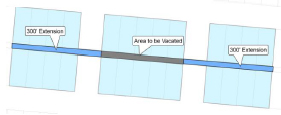
Figure 15.06-3: A majority of property owners abutting the subject public way and 300′ extensions
in either direction shall consent to the proposed public way vacation for an application
to be considered (shaded area).
2.
Applicability. The vacation procedure shall be followed for any proposed vacation of a public way. An application for vacation may only be initiated by a landowner abutting or adjacent to such public way. The consent of the majority of the property owners abutting on the area proposed to be vacated and extending 300 feet in either direction from the area to be vacated shall be required. All vacations of public ways shall be approved by ordinance (See Figure 15.06-3).
3.
Procedures.
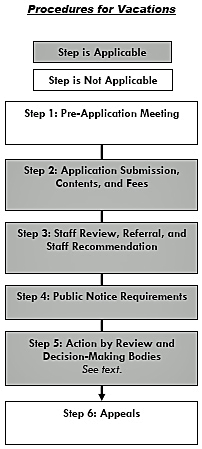
a.
Step 1: Pre-Application Meeting. Not applicable.
b.
Step 2: Application Submission, Contents, and Fees. Applicable pursuant to subsection 15.06.030.B. The following additional information shall be included:
(i)
Written comments from the appropriate utilities and other public entities affected by the proposed vacation; and
(ii)
For proposed vacations that do not meet criteria for valuation at zero in subsection 15.06.060.W.4: A current appraisal of the fair market value of the land to be vacated, by a state certified and licensed appraiser, to be used in arriving at the determination of the value to be paid by the petitioner in compensation for the vacation of the properties.
c.
Step 3: Staff Review, Referral, and Staff Recommendation. Applicable pursuant to subsection 15.06.030.C.
d.
Step 4: Public Notice Requirements. Applicable pursuant to subsection 15.06.030.D.
e.
Step 5: Action by Review and Decision-Making Bodies Applicable. The following additional procedures shall apply.
(i)
Planning Commission Public Hearing. The planning commission shall hold a public hearing and make a recommendation to approve, approve with revisions, postpone, or deny the application.
(ii)
City Council Public Hearing. The city council shall hold a public hearing and shall approve, approve with conditions, postpone, or deny the proposed public way vacation. Approval or approval with conditions shall be by adoption of an ordinance. The city council may require compensation for the land requested for vacation, provided that a valuation of greater than zero has been determined by an appraisal that is required under subsections 15.06.060.W.3. and 15.06.060.W.4. Upon approval of the ordinance, the mayor is authorized to convey the properties so vacated to the abutting property owners accordingly by quitclaim deed.
f.
Step 6: Appeals. Not applicable.
4.
Valuation of Existing Rights-of-Way and Public Access Easements.
a.
For purposes of vacation of rights-of-way and public access easements that meet all of criteria (i) through (iii), the valuation of the property is herein determined and declared to be zero (0), and no appraisal of value shall be required in connection with vacating said rights-of-way and public access easements:
(i)
The right-of-way or public access easement is not, and has not been during the thirty-year period preceding the vacation application, built or maintained as a public-access thoroughfare by the city or other public street-maintenance authority; and
(ii)
The right-of-way or public access easement is not shown on any currently effective plan adopted or approved by the city or the state of Wyoming, and is not shown on any city-approved and active preliminary subdivision plat.
(iii)
The vacation of such right-of-way or easement shall not result in lots with no frontage on a public street, highway or a marginal access street.
b.
Existing right-of-way and public access easements that do not meet all of criteria (i) through (iii) shall be required to provide an appraisal meeting the requirements of subsection 15.06.060.W.3.b(ii) prior to city council consideration of a vacation request for same.
c.
Nothing in this section shall preclude the ability of the city to retain, at no additional compensation cost to any party, a public utility easement within the right-of-way or public access easement vacated according to the procedures herein.
X.
Comprehensive Plan Amendments.
1.
Purpose. The purpose of this section is to provide standards and requirements for amending the text and/or maps of the Laramie Comprehensive Plan. The amendment process is established in order to provide flexibility in response to changing circumstances, to accommodate potential change where such change meets the intent of the plan, to reflect changes in public policy, and to advance the general welfare of the city as permitted by W.S. § 15-1-503.
2.
Applicability. An application for a comprehensive plan amendment may be initiated by the city council, planning commission, department or requested by an owner of land in the city or within the city's extraterritorial planning area. The planning commission shall adopt and certify to the city council an amendment to the comprehensive plan only in accordance with the requirements of this section.
3.
Procedures. Procedures for Comprehensive Plan Amendments.
Procedures for Comprehensive Plan Amendments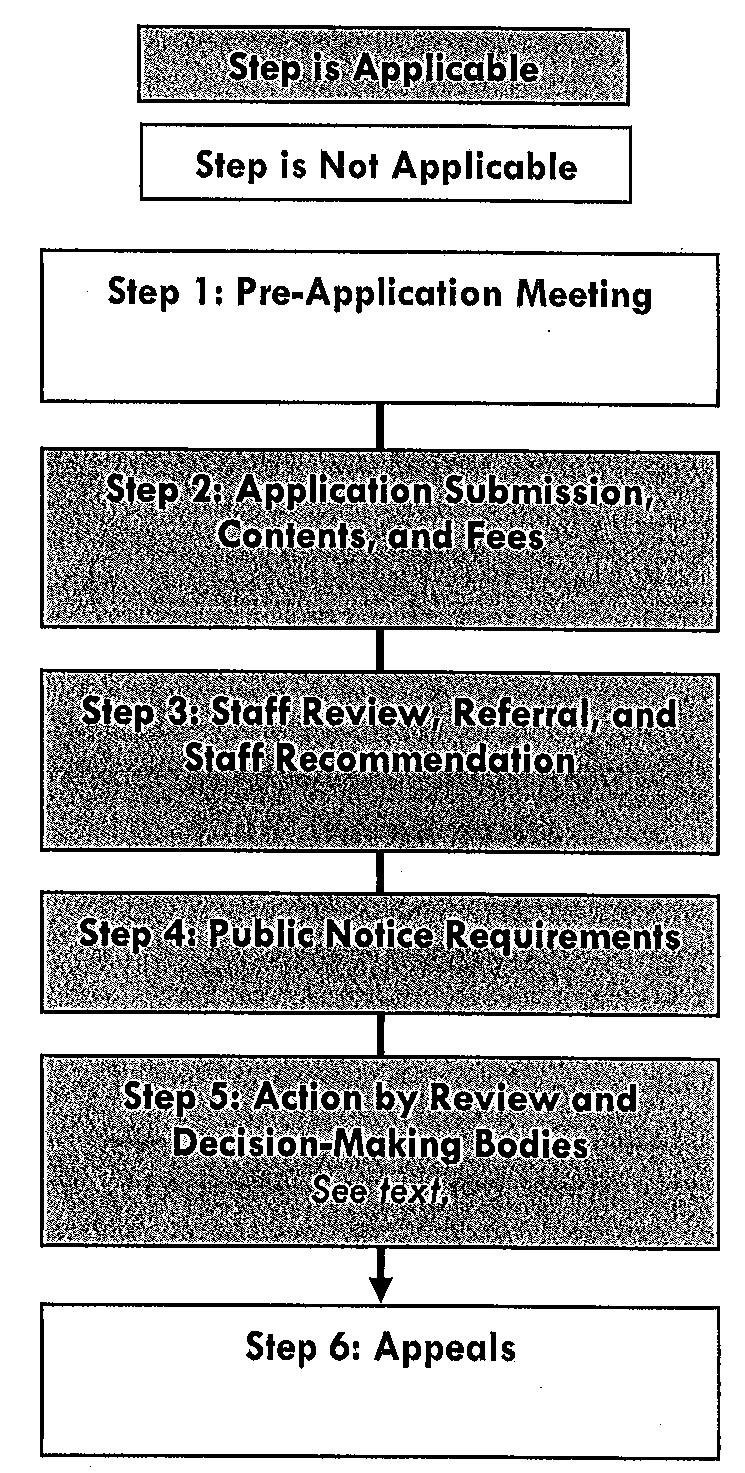
a.
Step 1: Pre-Application Meeting. Not applicable.
b.
Step 2: Application Submission, Contents, and Fees. Applicable pursuant to Subsection 15.06.030.B.
c.
Step 3: Staff Review, Referral, and Staff Recommendation. Applicable pursuant to Subsection 15.06.030.C.
d.
Step 4: Public Notice Requirements. Applicable. Published notice required pursuant to Subsection 15.06.030.D. Written notice shall be required for future land use plan map amendments.
e.
Step 5: Action by Review and Decision-Making Bodies. Applicable. The following review procedures shall apply:
(i)
Review of Amendments Involving Property Entirely Within City Limits. In addition to the procedures set forth below, the process is outlined in Figure 15.06-4.
(1)
Planning Commission Public Hearing. The planning commission shall hold a public hearing and shall approve, approve with revisions, postpone, or deny the application. Approval or approval with modifications of the request shall be by adoption of a resolution.
(2)
City Council Certification. The city council shall certify the action of the planning commission by resolution within sixty calendar days of planning commission action. The city council may remand the resolution to the planning commission for additional review and study. If remanded to the planning commission, the planning commission shall prepare a new resolution within thirty calendar days of city council action to remand. Failure of the planning commission to act on an item remanded to the planning commission shall deem the original resolution reaffirmed. The city council may postpone action pursuant to Subsection 15.06.030.E.
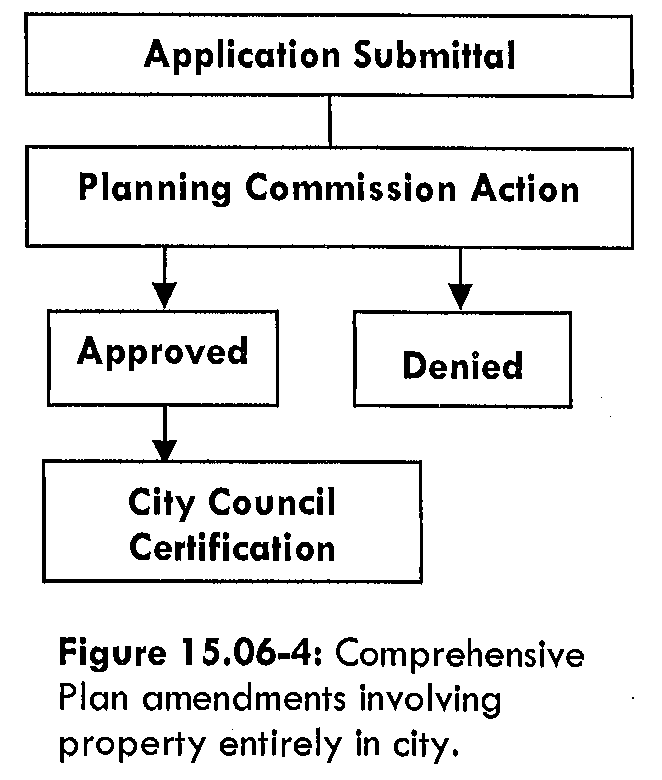
(3)
Approval Criteria. The planning commission shall not approve and the city council shall not certify such approval for any comprehensive plan amendment unless the application meets one or more the following criteria:
(a)
The proposed amendment is based on a change in projections or assumptions from those on which the comprehensive plan is based;
(b)
The proposed amendment is based on identification of new issues, needs, or opportunities that are not adequately addressed in the comprehensive plan;
(c)
The proposed amendment is based on a change in the policies, objectives, principles, or standards governing the physical development of the city;
(d)
The proposed amendment may result in unique development opportunities that will offer substantial benefits to the city; or
(e)
The proposed amendment is based on an identification of errors or omissions in the comprehensive plan.
(ii)
Review of Amendments Involving Property Not Entirely Within City Limits. In addition to the procedures set forth below, the process is outlined in Figure 15.06-5.
(1)
Planning Commission Public Hearing. The planning commission shall hold a public hearing and make shall approve, approve with revisions, postpone, or deny the application. Approval or approval with modifications of the request shall be by adoption of a resolution.
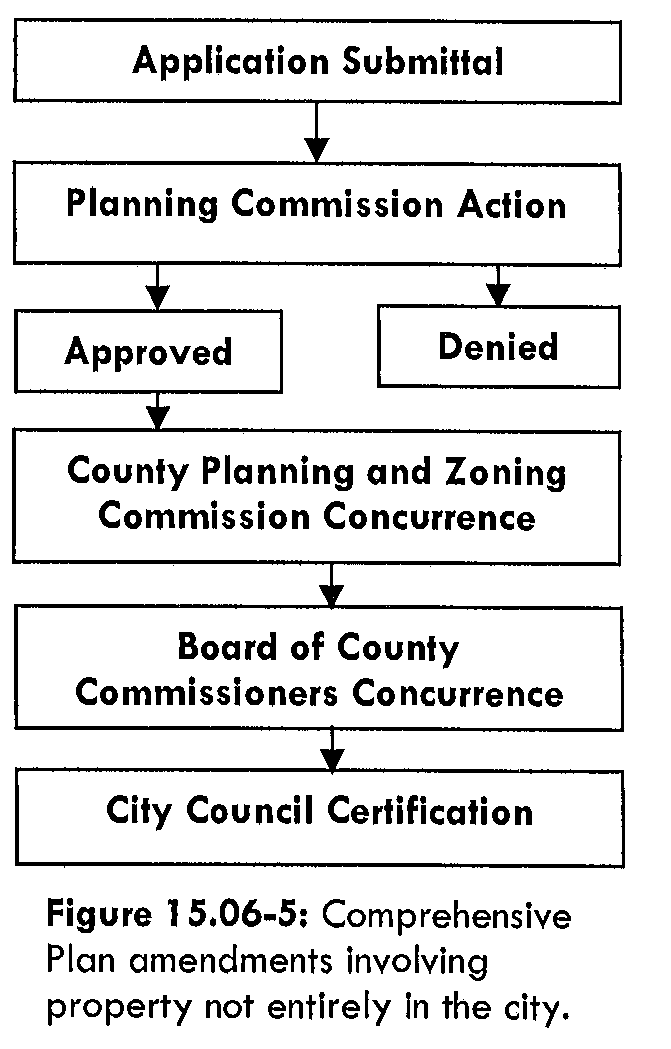
(2)
City Council Certification. The city council, with concurrence of the county and within sixty calendar days of county concurrence, shall either certify the action of the city planning commission by resolution, or shall remand the resolution to the Planning commission. The city council may remand the resolution to the planning commission for additional review and study. If remanded to the planning commission, the planning commission shall prepare a new resolution within thirty calendar days of city council action to remand. If the new planning commission resolution differs from the first, the county shall review the amendment for concurrence subject to the review procedures outlined in this subsection. Failure of the planning commission to act on an item remanded to the planning commission shall deem the original resolution reaffirmed. The city council may postpone action pursuant to Subsection 15.06.030.E.
(3)
County Action. The county shall issue statement of concurrence for the proposed amendment within sixty calendar days of city planning commission action. The board of county commissioners may issue a statement of concurrence, a statement of concurrence with modifications to the resolution, or a statement of no concurrence. Modifications to the resolution shall be reconsidered by the city planning commission, affirmed or modified, and incorporated within the resolution. Should the city planning commission fail to adopt the county's resolution modifications, the proposed amendment fails. The planning commission shall not ask for the county's concurrence more than two times on a specific request.
(4)
Approval Criteria. The planning commission shall not approve and the city council shall not certify any comprehensive plan amendment unless the application meets one or more of the following criteria:
(a)
The proposed amendment is based on a change in projections or assumptions from those on which the comprehensive plan is based;
(b)
The proposed amendment is based on identification of new issues, needs, or opportunities that are not adequately addressed in the comprehensive plan;
(c)
The proposed amendment is based on a change in the policies, objectives, principles, or standards governing the physical development of the city;
(d)
The proposed amendment may result in unique development opportunities that will offer substantial benefits to the city; or
(e)
The proposed amendment is based on an identification of errors or omissions in the comprehensive plan.
f.
Step 6: Appeals. Not Applicable.
(Ord. No. 1578, § 2(att. A), 3-2-2010; Ord. No. 1596, §§ 5—7, 9—27, 5-3-2011; Ord. No. 1622, § 1, 7-31-2012; Ord. No. 1625, §§ 3—8, 9-4-2012; Ord. No. 1644, §§ 1—4(Att. A), 6-18-2013; Ord. No. 1657, § 4(Att. D), 4-1-2014; Ord. No. 1671, §§ 1, 4, 5, 19(Att. D), 20(Att. E), 21, 11-18-2014; Ord. No. 1689, § 1, 10-6-2015; Ord. No. 1705, §§ 1—3, 5-3-2016;; Ord. No. 1728, § 16, 4-18-2017; Ord. No. 1744, §§ 11—17, 3-6-2018; Ord. No. 1814, § 3, 11-1-2022; Ord. No. 1823, § 1, 5-16-2023; Ord. No. 1872, § 1, 10-7-2025)

