
Larimer County Unincorporated
City Zoning Code
City Zoning Code
ARTICLE 13
0 - SUPPLEMENTAL REGULATIONS FOR THE ESTES VALLEY
13.2. - Estes Valley Zoning Districts
The following zoning districts are hereby incorporated into the Larimer County Land Use Code. They may be referred to by their name or their district letter abbreviations.
(Res. No. 07282025, 7-28-2025)
13.9. - Reference Maps
A.
Estes Valley Boundary
B.
Estes Valley Ridgeline Protection Map
C.
Wildfire Hazards Resource Map
D.
Geological Hazard Areas Map
E.
Wildlife Habitat Map
13.1.1. - Purpose.
The regulations in this Article are intended to provide for coordinated and harmonious development of the Estes Valley which will, in accordance with present and future needs, best promote health, safety, order, convenience, prosperity and general welfare, as well as efficiency and economy in the process of development.
(Res. No. 07282025, 7-28-2025)
13.1.2. - Applicability.
The provisions of this Article 13.0 are supplemental to all the other Articles of this Code and shall apply to all land and development and use of all structures and land located within the unincorporated areas of Larimer County within the Estes Valley, as depicted on the Larimer County Zoning Districts—Estes Valley Planning Area Map, as may be amended from time to time. This map is set forth in this section of the Code and hereby incorporated by reference.
(Res. No. 07282025, 7-28-2025)
13.1.3. - Official Zoning Map.
The location and boundaries of the zoning districts shall remain as historically designated and are hereby described in this chapter, and shown on the map entitled "Larimer County Zoning Districts Map—Estes Valley Planning Area," hereafter referred to as the Official Zoning Map, as may be amended.
(Res. of 6-6-2023, Exh. A, 3; Res. No. 07282025, 7-28-2025)
13.2.1. - Zoning Districts.
A.
Residential Zoning Districts include:
1.
EV RE-1 Estes Valley Rural Estate
2.
EV RE Estes Valley Rural Estate
3.
EV E-1 Estes Valley Estate
4.
EV E-1S Estes Valley Estates Short-term Rental
5.
EV E Estes Valley Estate
6.
EV R Estes Valley Residential
7.
EV RM Estes Valley Multi-Unit Residential
B.
Nonresidential Zoning Districts include:
1.
EV A Estes Valley Accommodations/Highway Corridor
2.
EV A-1 Estes Valley Accommodations/Low Intensity
3.
EV CO Estes Valley Outlying Commercial
4.
EV O Estes Valley Office
5.
EV I-1 Estes Valley Restricted Industrial
(Res. of 6-6-2023, Exh. A, 5; Res. of 11-6-2023, Exh. A; Res. of 4-22-2024, Exh. A)
13.2.2. - Residential Zoning Districts/Specific Purposes.
A.
EV RE-1 Estes Valley Rural Estate Zoning District.
This district protects and preserves some of the most rural areas of the Estes Valley in which significant view sheds, woodlands, rock outcroppings, ridgelines, other sensitive environmental areas, and low-density residential development comprise the predominant land use pattern. The district regulations allow for the development of low-density single-unit residential uses, generally at densities no greater than one dwelling unit per 10 acres.
B.
EV RE Estes Valley Rural Estate Zoning District.
This district permits relatively low-density single-unit residential development in areas of the Estes Valley where this is the established and predominant land use pattern. New residential development is encouraged to incorporate rural residential conservation designs, such as clustering and other open space preservation techniques, in order to preserve the existing rural character and limit development in sensitive environmental areas such as steep sloped areas. The regulations contained in this district will permit continued, low-density residential development, generally at densities no greater than one dwelling unit per two and one-half acres.
C.
EV E-1 Estes Valley Estate Zoning District.
This district preserves the predominantly lower density residential uses that have been established in the Estes Valley. The district regulations permit single-unit residential uses at densities of one dwelling unit per acre.
D.
EV E-1S Estes Valley Estates Short-term Rental Zoning District.
This district preserves the predominantly lower density residential uses that have been established in the Estes Valley. The district regulations permit single-unit residential uses at densities of one dwelling unit per acre, and it allows short-term rentals to be exempt from the "cap" in effect at any given time and from separation requirements.
E.
EV E Estes Valley Estate Zoning District.
This district encourages moderate density single-unit residential uses in areas of the Estes Valley convenient to services and the key highway corridors. District regulations are intended to continue the predominant single-unit detached use, while providing for additional parks, open space and trail/bikeway linkages to Downtown Estes Park and existing systems whenever possible. District regulations permit single-unit residential uses at densities of two dwelling units per acre, with a minimum lot area of one-half acre.
F.
EV R Estes Valley Single-Unit Residential Zoning District.
This district preserves and encourages relatively high-density single-unit residential uses primarily within the Town of Estes Park. District regulations are intended to continue the predominant single-unit detached use, while providing for additional open space and trail/bikeway linkages to Downtown Estes Park and existing systems whenever possible. District regulations permit single-unit residential uses at densities of four dwelling units per acre, with a minimum lot area of one-quarter acre.
G.
EV RM Estes Valley Multi-Unit Residential.
This district provides opportunities for multi-unit residential development.
(Res. of 6-6-2023, Exh. A, 5; Res. of 11-6-2023, Exh. A; Res. of 4-22-2024, Exh. A)
13.2.3. - Non-Residential Zoning Districts/Specific Purposes.
A.
EV A Estes Valley Accommodations/Highway Corridor Zoning District.
This district applies primarily in highway-oriented commercial areas of the Estes Valley, and allows a wide variety of accommodation uses, including relatively higher-intensity accommodations such as multi-story hotels and motels. A variety of related tourist-serving retail and commercial uses, such as restaurants, bars, and gift shops, will be permitted, but only as accessory uses to a principal accommodations use and only if such supporting uses are located inside the same structure as the principal use. Stand-alone commercial or retail uses will not be permitted in this accommodations district; instead, such uses may be developed in the other commercial zones.
B.
EV A-1 Estes Valley Accommodations/Low-Intensity Zoning District.
This district provides for low-intensity and small-scale residential uses, low-intensity accommodations and very limited accessory uses located along highway and roadway corridors characterized by low-intensity residential and lodging uses, including resort lodges, cabins, and condominium developments. Aside from these limited residential and accommodation uses, no new commercial development shall be permitted in this district. New uses, including new accommodations, shall be developed consistent in intensity, bulk and design with the low-scale, residential character of this district.
C.
EV CO Estes Valley Outlying Commercial Zoning District.
This district encourages the development of a wide variety of commercial and retail uses along the major corridor entryways into the Valley and the Town of Estes Park. This district should accommodate the majority of the larger, freestanding commercial and retail buildings to meet future demand in the community.
D.
EV O Estes Valley Office Zoning District.
This district implements office future land uses. The intensity of future office development will be controlled through district standards.
E.
EV I-1 Estes Valley Restricted Industrial Zoning District.
Permitted uses in this district shall include a relatively wide variety of industrial uses, as reflected in the existing mix of industrial land uses, including several concrete/asphalt plants, propane distributors, construction trade yards and gravel mining and crushing facilities. However, to discourage future conflicts, residential uses shall not be permitted in this zoning district. An important element of development in this industrial zoning district shall be compliance with performance standards to protect adjacent uses from adverse impacts of industrial development.
13.3.1. - Compliance Required.
No building or structure shall be erected, converted, enlarged, reconstructed, or altered for use, nor shall any land, building, or structure be used or changed in use except in accordance with all of the regulations established by this Code for the zoning district in which the land, building, or structure is located.
13.3.2. - Permitted Uses and Review Procedures.
Use Tables Table 13-1 and Table 13-4 set forth the use classifications and specific uses permitted within the relevant zoning districts according to the following procedures.
A.
Permitted Uses.
1.
Uses followed by an (R) are allowed by right but they may be subject to all other requirements of this Code.
2.
Uses followed by an (SP) require approval through the Site Plan Review process described in §6.4.1, Site Plan Review.
3.
Uses followed by an (AS) require approval through the Administrative Special Review process described in §6.4.3, Administrative Special Review.
4.
Uses followed by an (S) require approval through the Special Review Process described in §6.4.2, Special Review.
5.
Uses followed by an (L&E) require approval through the location and extent process described in §6.4.4, Location and Extent.
6.
Uses followed by a combination of (R/SP/AS/S) may be allowed by right or require additional approvals based on thresholds set forth in Article 3.0, Use Regulations.
B.
Uses Not Allowed.
A "—" in a cell indicates that a use type is not allowed in the respective zoning district, unless it is otherwise expressly allowed by other regulations of this Code.
C.
Additional Regulations.
Many uses are subject to additional use-specific regulations (in addition to those standards in Article 4.0, Development Standards that apply to all development in general). The final column of the use table contains references to applicable use-specific standards, which are set forth in §13.6, Use Regulations for the Estes Valley and §3.3, Use-Specific Standards. Standards referenced in the Additional Regulations column apply in all zoning districts unless otherwise expressly stated.
D.
Use Classifications/Specific Use Types.
The use classifications listed in Tables Table 13-1 and Table 13-4 are described and defined in §13.8 or in Article 20.0 if not in §13.8, of this Code. In some cases, specific uses are listed in the second column of the table. The use classifications are intended to be mutually exclusive. If a use type is specifically listed in the table, that use type is allowed only in the districts indicated, not within the districts that may allow the broader classification.
E.
Uses Not Listed as Permitted.
Uses not specifically listed as permitted by right, site plan review, administrative special review, special review, or by location and extent in a specific zoning district, as depicted in Tables Table 13-1 and Table 13-4, are prohibited unless:
1.
Such use is subsequently permitted pursuant to the rezoning/amendment procedure set forth in §6.6, Code Amendment Procedures; or
2.
Such use has been determined to be a matter of state interest as defined in Article 10.0, Areas and Activities of State Interest.
(Res. No. 07282025, 7-28-2025)
13.4.1. - Table of Permitted Uses in Residential Zoning Districts.
(Amd. by F&R, 6-15-2021; Res. of 6-6-2023, Exh. A, 3, 5; Res. of 4-22-2024, Exh. A; Res. No. 07282025, 7-28-2025)
13.4.2. - Density/Dimensional Standards.
The density and dimensional standards contained herein shall only apply to residential land division applications of property within the Estes Valley Planning Area that are less than 30 acres in gross land area. Any residential land division applications of property within the Estes Valley Planning Area that are 30 acres or greater in gross land area shall be subject to the requirements set forth in Article 5.0, Land Division Standards.
A.
Density Calculation.
1.
Net land area.
Net land area shall be determined by subtracting from the gross land area the following:
a.
Eighty percent of lands located in the 100-year floodplain;
b.
Eighty percent of lands located above the elevation serviceable by the Town of Estes Park water system;
c.
All lands within private streets or dedicated public rights-of-way; and
d.
All lands subject to a ground lease that, because of the lease terms, would not be available for development of the proposed land use(s) on the subject property.
2.
Net density.
a.
Net density shall be calculated by dividing the net land area by the minimum lot area or land area required for each unit.
b.
When applying a density standard to a parcel's net land area, all resulting fractions shall be rounded down to the next lower whole number.
c.
The number of dwelling or accommodations units allowed on a site is based on the presumption that all other applicable standards shall be met. The maximum density established for a zoning district (See Table 13-2, below) is not a guarantee that such densities may be obtained, nor a valid justification for varying other dimensional or development standards.
B.
Table of Density and Dimensional Standards by Zoning District.
Table 13-2 below lists the density and dimensional standards that apply within the residential zoning districts. These are "base" standards and are not guarantees that stated minimums or maximums can be achieved on every site. Other regulations of this Code or site-specific conditions may further limit development on a specific site.
C.
Maximum Number of Principal Structures Permitted Per Lot or Development Parcel.
Except in the EV RM zoning district, only one principal structure shall be permitted per lot or development parcel.
D.
Table 13-2: Base Density and Dimensional Standards Residential Zoning Districts.
(Res. of 6-6-2023, Exh. A, 5; Res. of 4-22-2024, Exh. A; Res. No. 07282025, 7-28-2025)
13.4.3. - Additional Zoning District Standards.
The additional zoning district standards contained in §13.4.3.A and §13.4.3.B shall only apply to residential land division applications of property within the Estes Valley Planning Area that are less than 30 acres in gross land area. Any residential land division applications of property within the Estes Valley Planning Area that are 30 acres or greater in gross land area shall be subject to the requirements set forth in Article 5.0, Land Division Standards.
A.
Private Open Areas; Applicability and Minimum Set-Aside Required.
All residential developments and subdivisions containing five or more units shall set aside a minimum percentage of total gross land area for the purpose of private open areas in the amount shown in Table 13-3, below.
B.
Lot Size.
1.
General Rule.
Subject to the exceptions listed below, the minimum lot sizes for lots within single-unit residential subdivisions that are required to set aside private open areas shall be as shown in Table 13-3 above.
C.
Exception for Lots with Private Water/Sewer.
The minimum lot size for lots serviced by private wells or private septic systems shall be two acres in all districts, except the EV RE-1 zoning district.
D.
Exception for Development on Steep Slopes.
Lots with an average slope of greater than 12 percent shall be subject to the lot area adjustment set forth in §13.7.2 (Table 13-9) of this Code. The minimum lot areas set forth in this subsection shall be used as the base for any required increase in lot area due to steep slopes.
E.
Pedestrian Amenities and Linkage Requirements.
See Article 4.0, Development Standards.
(Res. of 6-6-2023, Exh. A, 5; Res. of 4-22-2024, Exh. A; Res. No. 07282025, 7-28-2025)
13.5.1. - Table of Permitted Uses in the Nonresidential Zoning Districts.
(Res. of 6-6-2023, Exh. A, 3; Res. of 4-22-2024, Exh. A)
13.5.2. - Density and Dimensional Standards.
A.
Table of Density and Dimensional Standards by Zoning District.
Table 13-5 below lists the density and dimensional standards that apply within the nonresidential zoning districts. These are "base" standards, not guarantees that stated minimums or maximums can be achieved on every site. Other regulations of this Code or site-specific conditions may further limit development on a site.
B.
Minimum Land Area Requirements for Accommodation and Residential Uses in the Nonresidential Zoning Districts.
Table 13-5 below includes a standard for "minimum land area per accommodations (guest) or residential unit," which applies only in the A, and A-1 zoning districts. The "minimum land area" necessary to meet this standard shall be measured using the net land area definition set forth in §13.4.2, Density/Dimensional Standards When applying the minimum land area standard to a parcel's net land area, all resulting fractions shall be rounded down to the next lower whole number.
C.
Maximum Units/Density Not Guaranteed.
The number of dwelling or guest units allowed on a site is based on the presumption that all other applicable standards shall be met. The maximum residential or accommodations density established for a zoning district is not a guarantee that such densities may be obtained, nor a valid justification for varying other dimensional or development standards.
D.
Table 13-5: Density and Dimensional Standards for the Nonresidential Zoning Districts.
E.
Number of Principal Uses Permitted Per Lot or Development Parcel.
1.
Maximum Number of Principal Uses Permitted.
One or more principal uses shall be permitted per lot or development parcel, except that in the EV A zoning district, only one principal residential use shall be permitted per lot or development parcel.
2.
Permitted Mix of Uses.
Where more than one principal use is permitted per lot or development parcel, mixed-use development is encouraged, subject to the following standards:
a.
More than one principal commercial/retail or industrial use permitted by right or by special review in the zoning district may be developed or established together on a single lot or site, or within a single structure, provided that all applicable requirements set forth in this section and Code and all other applicable ordinances are met.
b.
Any combination of residential and commercial/retail uses that are permitted by right or by special review in the zoning district may be developed or established together on a single lot or site or within a single structure, provided that all applicable requirements set forth in this section and Code, and all other applicable ordinances, are met. For example, a two-story structure on a single lot may have a restaurant or retail store on the ground floor, and residential apartments or condominiums on the second floor.
(Res. of 4-22-2024, Exh. A)
13.5.3. - Additional Zoning District Standards.
A.
Operational Requirements.
1.
Performance Standards.
All new development in the nonresidential zoning districts shall comply with the performance standards set forth in §13.7.7, Operational Performance Standards.
B.
EV CO and EV O Zoning Districts: Building Siting, Orientation and Materials Requirements.
1.
The main entrance of all buildings in the EV CO and EV O zoning districts shall be oriented to the front property line. If a lot fronts an arterial road or state highway, the main entrance of all buildings shall face the road or highway.
2.
To the maximum extent feasible, each principal structure on a site shall avoid long flat or blank walls that face a public street. All sides of a building that face a public street shall be finished with the same materials as the primary facade.
C.
Vehicular Access and Circulation Requirements.
See Larimer County Urban Area Street Standards Chapters 9 and 19, Larimer County Rural Area Road Standards Chapter 10, Article 4.0, Development Standards and §13.7.8, Street Design and Construction Standards.
D.
Pedestrian Amenities and Linkage Requirements.
See Article 4.0, Development Standards and §13.7.8, Street Design and Construction Standards.
(Res. No. 07282025, 7-28-2025)
13.6.1. - Specific Use Standards.
This Section contains regulations that apply to specific uses or classes of uses.
A.
Townhome Project.
1.
Interior property lines within a townhome project use are not required to meet the minimum required setbacks as set forth in the dimensional standards in §§13.4.2 and 13.5.2.
2.
The overall townhome project site shall comply with the required minimum lot size of the underlying zoning district. Individual lots are not required to comply with the minimum lot size of the underlying zoning district, but shall be a minimum of 2,000 square feet.
3.
Townhome projects shall provide one off-street parking space for each one- or two-bedroom unit and two off-street parking spaces for each unit with more than two bedrooms.
4.
Developments shall comply with all county, state, and federal water quality standards, including but not limited to, those regulating erosion and sedimentation, storm drainage and runoff control, nutrients, solid wastes, and hazardous substances and shall reduce or prevent potential pollution sources where feasible.
5.
Developments shall comply with the Larimer County Stormwater Quality Ordinance and the Larimer County Stormwater Design Standards through the construction and post construction phases of development.
6.
Stormwater drainage shall be achieved through concrete curb and gutter systems throughout the development.
7.
An acceptable legal and physical path-of-flow for runoff through and from the development to an identified outfall facility that drains into an established channel shall be available or funded at the time of vesting of development rights. The path of flow shall be consistent with the applicable master plan.
8.
Flexibility and creativity are encouraged in designing development around existing environmental features. Natural vegetation, rock outcroppings, and significant landforms shall be retained during development of a site to the maximum extent practicable.
9.
Townhome projects shall contribute to the unique character of an area through compatible building massing and scale, building materials, and architectural elements. Where there is no established or consistent neighborhood or area character, or where it is not desirable to reinforce the existing character, the proposed development shall be designed to establish a high-quality standard for future development.
B.
Adult Business.
All adult business uses shall be subject to special review and shall also comply with the following standards:
1.
No adult business use shall be located within 500 feet of any residentially zoned or used property.
2.
No adult business use shall be permitted within 500 feet of any school, place for religious assembly, public park, playground, other adult business use or liquor store.
3.
Adult business use buildings, entries, windows, and other openings shall be located, covered, or screened to prevent a view into the interior from any public area, including sidewalks, bike/pedestrian paths, and streets.
C.
Short-Term Rental.
1.
See §3.3.5.B, Short-Term Rental.
2.
Estes Valley short-term rentals shall be subject to the requirements and approval processes outlines in §3.3.5.B.
3.
A vacation home with a valid operating registration approved under the previous Estes Valley Development Code prior to April 1, 2020, may continue to operate as defined under the previous code. Such nonconforming vacation homes must comply with the requirements of the short-term rental specific use standards and the Enforcement Ordinance with the requirement to renew the license every other year. Nonconforming vacation homes are required to comply with the life-safety provisions of the Enforcement Ordinance, building codes, and Land Use Code.
4.
Operating licenses for short-term rentals in residential zoning districts (designated herein as EV E, EV E-1, EV R, EV RE, EV RE-1, and EV RM) shall be held at a maximum total ("cap") of 208 registrations in effect at any given time. The County will maintain a waiting list for interested applicants whose application would cause the cap to be exceeded. The waiting list will rank prospective applicants in the order they were received and as operating registrations become available may be eligible to apply for approval as a short-term rental.
5.
The short-term rental shall have a property manager consisting of the owner or a responsible party representing the owner to manage the use at any time it is occupied. The property manager shall affirmatively respond to complaints within one hour. Their contact information shall be posted in the operations manual located in the short-term rental. Changes to the contact information form the property manager shall be provided to the Larimer County Community Development Department within five business days of the change in contact information.
D.
Preexisting Lodging Facility.
1.
A legally constructed dwelling, including condominium units, cabins, or hotels, constructed prior to April 1, 2020, for transient lodging uses and located in the EV A or EV A-1 districts, that cannot be approved by other Low-Intensity Accommodation Uses listed in Table 13-4 may be approved by the Community Development Director as a preexisting lodging facility subject to the requirements listed herein.
2.
Preexisting lodging facilities shall receive a basic life-safety inspection as defined by the Building Division.
3.
Approved preexisting lodging facilities license shall be renewed every other year.
E.
Commercial Recreation or Entertainment Establishments.
1.
All commercial recreation or entertainment establishments shall be subject to the following standards:
a.
The use of firearms shall not be permitted as a part of user activities.
b.
A traffic impact study shall be submitted that assesses the impacts of the proposed use on existing roads, intersections, and circulation patterns, and that demonstrates compliance with the traffic facility standard set forth Article 4.0 of this Code, Adequate Public Facilities, and/or sets forth mitigation measures to eliminate or substantially reduce such impacts.
2.
In addition to the standards set forth in paragraph E.1 above, riding academies, livery stables and roping or equestrian areas shall be subject to the following standards:
a.
The minimum lot or parcel size for such uses shall be five acres.
b.
The Applicant shall submit a plan for the management of odor, dust, and waste as part of the application for special review or development plan approval.
F.
Construction Storage Yards, Salvage Yards, Industrial Services (Repair or Storage).
The following standards shall apply to all salvage yards and heavy equipment and industrial storage yards that abut an arterial street, a residential use, or a residential zoning district boundary, unless the subject use and related activities are entirely enclosed within a building:
1.
Such uses shall be screened with a solid (100 percent opaque) wall or fence with a minimum height of eight feet.
2.
No outdoor storage area shall be placed or maintained within a required building or yard setback.
3.
Stored items shall not project above the fence or wall used to screen the material.
4.
It shall be unlawful to store or otherwise have, maintain, or allow on a single parcel of land or on contiguous parcels under common ownership more than one nonfarm vehicle not having current Colorado license plates or registration unless the vehicle is in an approved auto repair garage, body shop, gas station or other similar use where vehicle storage is permitted. There shall be no limit on the number of active or serviceable agricultural vehicles on a parcel of land, regardless of whether such vehicles have current registration or license plates; however, the restrictions of one vehicle per parcel of land shall apply to agricultural vehicles that are clearly abandoned or that are not, in their present condition, suitable for active agricultural use.
G.
Convenience Stores.
1.
If fuel is sold as part of the convenience store operation, the conditions for service stations listed in §13.6.1.S below shall also apply. In addition, parking areas for retail sales and fuel service shall be separated from each other, and circulation within the property to each parking area shall be separate and clearly marked or evident.
2.
No drive-through service shall be permitted as part of the operation of a convenience store.
3.
Outdoor seating areas may be permitted; see §13.6.1.O below.
H.
Day Care Centers and Large Family Home Day Care.
Day care centers and large home day care shall be subject to the following standards:
1.
The minimum lot area for a day care center in residential zoning districts shall be 12,000 square feet.
2.
In approving day care centers and large day care homes, the Decision-Making Body may impose conditions related to location, configuration and operational aspects of the center or home to ensure that the use is compatible with surrounding uses. This includes, but is not limited to, hours of operation, noise, lighting, and parking.
3.
In approving day care centers and large day care homes, the Decision-Making Body may impose conditions on the site design and structures to ensure compatibility with the character of the surrounding neighborhood in terms of building mass, scale, and design.
4.
Large day care homes shall have direct access to a paved public street.
5.
Day care centers in the EV E, EV E-1, EV RE, and EV RE-1 residential zoning districts shall be adjacent to an arterial street.
I.
Eating/Drinking Establishments.
1.
In the EV A, EV O and EV I-1 zoning districts, eating/drinking establishments may be permitted in buildings as an accessory use not occupying more than 25 percent of the gross floor area. See also the specific use regulations applicable to hotels in §13.6.1.L below.
2.
For restaurants and other eating/drinking establishments with outdoor seating areas or outdoor food service, see §13.6.1.O below.
J.
Emergency Health Care.
The provider must furnish sufficient proof that emergency response vehicles and other visitors and activities associated with the proposed use will not interfere with existing or anticipated surrounding uses.
K.
Group Living Facilities, Small; Group Living Facilities, Large; Senior Institutional Living Uses.
1.
Generally Applicable Standards.
All the above-listed uses shall be subject to the following standards:
a.
The number of residents occupying a facility at any one time, including staff, shall not exceed one person per 200 square feet of living space.
b.
All structures shall be compatible in terms of building mass, scale, and design with the character of the surrounding neighborhood.
c.
Such use proposed to be sited in an existing structure and proposed to house more than five clients or persons shall, to the maximum extent feasible, meet the requirements set forth in the current applicable Building and Fire Codes.
2.
Standards for All Senior Institutional Living Uses and Large Group Living Facilities.
If active and continuous operations are not carried on for a period of 12 consecutive months in a facility that was approved pursuant to this Code, the use shall be considered to be abandoned. As applicable, the use may be reinstated only after obtaining a new special review approval.
L.
Hotels.
All hotel uses shall be subject to the following standards:
1.
Up to 15 percent of the gross floor area of a hotel may be in nonliving-quarter accessory uses, including management/employee offices, meeting rooms, banquet halls, retail services such as newsstands and gift shops, and similar accessory uses, provided that any incidental business is conducted primarily as a service to guests, and there is no entrance to such places of business except from inside the building.
2.
In addition to the accessory uses allowed in paragraph J.1 above, up to an additional 25 percent of the gross floor area of a hotel may be devoted to eating/drinking establishments as an accessory use.
M.
Mobile Home Park.
All mobile home parks shall be subject to compliance with the regulations governing mobile home parks in §3.3.3.F, Manufactured Housing Parks.
N.
Outdoor Display/Sales and Storage.
All uses with outdoor displays, sales or storage shall be subject to compliance with the outdoor display/sales regulations in Article 4.0, Development Standards.
O.
Outdoor Seating Areas or Food Service (Convenience Stores or Eating/Drinking Establishments).
1.
Outdoor Seating Areas.
a.
Eating and drinking establishments or convenience stores may provide outdoor seating areas, including tables and chairs, for the use of their customers.
b.
The outdoor seating area shall not obstruct the movement of pedestrians through plazas, along adjoining sidewalks or through other areas intended for public usage.
c.
In approving outdoor seating areas, the Decision-Making Body may impose conditions relating to the location, configuration, and operational aspects (such as lighting) of such outdoor seating areas to ensure that such outdoor seating areas will be compatible with surrounding uses, will be maintained in an attractive manner and will comply with applicable Building and Fire Codes.
2.
Outdoor Food Service.
a.
Eating and drinking establishments may provide outdoor food service on the site of the principal use at tables provided by the establishment.
b.
Food service shall be provided by employees of the establishment.
c.
In approving outdoor food service, the Decision-Making Body may impose conditions relating to the location, configuration, and operational aspects (such as lighting and litter control) of such outdoor food service areas to ensure that such area is compatible with surrounding uses, is maintained in an attractive manner and will comply with applicable Building and Fire Codes.
P.
Prohibited Uses.
The following uses are specifically prohibited in all Estes Valley unincorporated area zoning districts:
1.
Feedlots.
2.
Junkyards. Any area, lot, land, parcel, building or structure, or part thereof, used for the storage, collection, processing, purchase, sale, salvage, or disposal of junk.
3.
NAICS Subsector 324. All establishments falling within the North American Industry Classification System (NAICS) Subsector 324, Petroleum and Coal Products Manufacturing, as identified in the North American Industry Classification System United States Manual (OMB 1997).
4.
NAICS Subsector 331. All establishments falling within the North American Industry Classification System (NAICS) Subsector 331, Primary Metal Manufacturing, as identified in the North American Industry Classification System United States Manual (OMB 1997).
5.
NAICS Industry 22111. All electric power generation facilities falling within the North American Industry Classification System (NAICS) Industry 22111, Electric Power Generation, as identified in the North American Industry Classification System United States Manual (OMB 1997).
6.
NAICS Industry Group 3116. All establishments falling within the North American Industry Classification System (NAICS) Industry Group 3116, Animal Slaughtering and Processing, as identified in the North American Industry Classification System United States Manual (OMB 1997).
Q.
Religious Assembly.
1.
Caretaker Quarters.
A single-unit dwelling, located on the same lot as the religious assembly use, and occupied by the facility's leader, may be permitted as an accessory use to the facility. See §3.4.5.B, Business Accessory Dwelling Units for additional regulations applicable to accessory caretaker quarters use.
2.
Schools and Day Care Centers as Accessory Uses.
Accessory schools and day care centers must comply with the specific use standards in §13.6.1.H.
R.
Resort Lodge/Cottages.
A guest room or unit contained in a resort lodge/cottage accommodations use may contain full kitchen facilities instead of the otherwise required "limited kitchen facilities", provided that the following conditions are satisfied:
1.
The guest room/unit is contained in a freestanding, detached "cottage" structure, and such structure contains no more than four such guest rooms/units.
2.
For purposes of permitted density/intensity calculations, all guest rooms/units with full kitchen facilities shall comply with a minimum 5,400 square foot land area per unit requirement, in lieu of the 1,800 square foot requirement for accommodations units set forth in Table 13-9 of this Code.
S.
Vehicle Services, Limited.
All service stations, car washes and quick lubrication service uses shall be subject to the following standards:
1.
Minimum Separation.
Such uses shall be located at least 500 feet from schools and day care uses, as measured from the outer boundaries of the sites.
2.
Site Layout.
Conditions of development plan approval may require buffering, screening, or planting areas necessary to avoid adverse impacts on properties in the surrounding areas.
3.
Storage and Accessory Sales of Materials and Equipment.
a.
No outdoor displays of materials or equipment shall be allowed, except that a display rack for automobile products no more than four feet wide may be maintained within three feet of the principal building, subject to a limit of one such display rack per street frontage.
b.
Storage of unlicensed or inoperable vehicles shall be prohibited.
4.
Specific Standards for Service Stations and Quick Lubrication Services.
a.
The use shall be located at least 100 feet from the property boundary of any residential zoning district.
b.
All minor repair work, vehicle washing, lubrication and installation of parts and accessories shall be wholly performed within an enclosed structure.
c.
All automobile parts, dismantled vehicles and similar materials shall be stored within an enclosed building or totally screened from view by a solid or privacy fence. A chain link fence with slats shall not constitute acceptable screening or fencing for the purposes of this provision.
d.
All vehicles awaiting repair or service shall be stored on site in approved parking spaces and under no circumstances shall such vehicles be stored on or obstruct access to a public right-of-way.
e.
Fuel pump location shall comply with the following requirements:
i.
Fuel pumps shall be located at least 30 feet from the edge of the right-of-way of a public street.
ii.
Subject to the setback in paragraph 4.a. above, except on corner lots, fuel pumps shall be located in no more than one yard. For example, if fuel pumps are located in the front yard of a lot, they may not also be located in a side or rear yard.
iii.
On corner lots, again subject to the setback in paragraph 4.a. above, fuel pumps may be located in either or both of the yards adjacent to a street lot line, provided that safe vehicular access to the fuel pumps is available from both intersecting streets.
f.
All tanks containing fuel, oil, waste oils and greases or similar substance shall be placed underground at least 25 feet from any property line, and vented, in accordance with Colorado state health and safety requirements.
g.
All discarded materials such as tires, cans, drums, and the like shall be stored in an enclosed area and under cover.
h.
A canopy over the fuel pumps may be erected, provided that the following conditions are met:
i.
The canopy may be either attached or detached from the principal building;
ii.
The canopy structure shall comply with all minimum building setback standards applicable to the principal structure; and
iii.
The canopy structure shall not be enclosed.
T.
Vehicle/Equipment Sales and Rentals.
Vehicle and equipment sales uses (including automobiles, recreational vehicles, boats, trucks, and motorcycles) shall be subject to the following standards:
1.
Vehicle or equipment displays shall not be located within a required setback area.
2.
Front yard setback areas shall be landscaped to provide a buffer between the right-of-way and vehicle or equipment sales/storage areas. Side yard setback areas shall also be landscaped if the side yard abuts a public right-of-way. See §4.7, Landscaping.
3.
No vehicle or equipment shall be stored in a required landscape area.
4.
Not more than one vehicle display pad, which may be elevated up to three feet in height, shall be permitted per one 100 feet of street frontage.
5.
No other materials for sale shall be displayed between the principal structure and the street.
U.
Warehousing and Storage; Wholesale Sales and Distribution.
All warehousing and storage uses and wholesale sales and distribution uses shall be permitted subject to the following standards:
1.
All wholesaling, distribution and storage of materials and equipment, except vehicles used for transporting the warehoused products, shall be conducted within a totally enclosed building.
2.
Vehicles used for transporting the warehoused products shall be screened from view from all neighboring properties and from internal and external streets with a minimum six-foot solid masonry or wood fencing and landscaping, berms and landscaping or other approved comparable screening.
V.
Wireless Communications Facilities regulations.
See Article 9.0, Wireless Communication Facilities.
W.
Cultural Institutions.
Cultural Institutions in residential districts shall be restricted to museum use as defined herein. Museums shall be permitted with special review approval on sites that meet one or more of the following requirements:
1.
The site and/or structure is identified with a person or entity who significantly contributed to the development, cultural, artistic, social, ethnic, economic, political, technological, or institutional heritage of Estes Park.
2.
The site and/or structure portrays one or more historic eras characterized by a distinctive design style.
3.
The site and/or structure embodies elements of design, detail, materials, or craftsmanship that represent a significant quality of design and/or development.
X.
Park and Recreation Facilities.
Park and recreation facilities shall be divided into two classifications: public, and private, as defined in §13.8, Definitions.
1.
Public park and recreation facilities include traditional public parks, cemeteries, public squares, plazas, playgrounds, ballfields, nature preserves, botanical gardens, and other indoor and outdoor recreation facilities owned by public entities such as federal, state, county and municipal government or a recreation district. Temporary commercial and non-commercial uses are allowed as specified in §13.6.3. Public park and recreation facilities are permitted in most zoning districts as listed in Table 13-4. Public park and recreation facilities in non-residential zoning districts may have private concessions and rental arrangements for use of facilities therein. A location and extent review is required to establish or modify a public park and recreation facility.
2.
Private park and recreation facilities in residential districts, as standalone activities with permission of the property owner(s), shall be restricted to the following uses:
a.
Horseback Riding with ten or fewer participants per riding group;
b.
Fishing (including fishing lessons on private ponds), with appropriate licensing or permitting;
c.
Photography;
d.
Hiking and climbing activities;
e.
Swimming;
f.
Non-motorized boating, canoeing, kayaking (electric-assist boating shall be allowed);
g.
Non-motorized cycling (electric-assist bicycling shall be allowed);
h.
Passive open space.
(Res. of 6-6-2023, Exh. A, 3, 5; Res. of 4-22-2024, Exh. A; Res. No. 07282025, 7-28-2025)
13.6.2. - Accessory Uses (Including Home Occupations) and Accessory Structures.
A.
General Standards.
1.
Permitted principal uses and approved special review principal uses shall be deemed to include the accessory uses, structures and activities as set forth in this section, unless specifically prohibited.
2.
See also §13.8.2, Use Classifications/Specific Use Definitions and Examples wherein incidental or accessory uses are sometimes included in the description of a specific principal use. When a use classification or specific use type definition in §13.8.2 does include permitted accessory or incidental uses, such accessory or incidental uses shall be subject to the general standards set forth in this section, as well as any use-specific standards set forth in §13.6.1.
3.
All accessory uses, structures and activities shall be subject to the general, dimensional, operational, and use-specific regulations set forth in this section, in addition to the same regulations that apply to principal uses in each district. In the case of any conflict between the accessory use/structure standards of this section and any other requirement of this Code, the standards of this section shall control.
4.
All accessory uses and structures shall comply with the following conditions:
a.
The accessory use or structure shall be clearly incidental and customarily found in connection with the principal use; and
b.
The accessory use or structure shall be conducted and/or located on the same zoning lot as the principal use; and
c.
There shall be unity of ownership between the principal use and the accessory use.
B.
Accessory Uses/Structures Permitted in the Residential Zoning Districts.
1.
Table of Permitted Accessory Uses and Structures.
a.
Listed Accessory Uses/Structures.
Table 13-6 below sets forth what types of accessory uses and structures are permitted in which residential zones. If a specific accessory use or structure is permitted in a residential zoning district, the column underneath the zoning district will be marked with a "Yes." If the accessory use or structure is not permitted in a particular zoning district, the column will be marked with a "No." If there is a reference contained in the column entitled "additional requirements," please refer to the cited section(s) for additional standards that shall apply to the specific accessory use.
b.
Unlisted Accessory Uses or Structures.
If an accessory use or structure is not listed in Table 13-6 but satisfies all the conditions set forth in §13.6.2.A.4 above, it may be permitted subject to compliance with the general, dimensional, and operational standards set forth in this section.
2.
Additional Requirements for Specific Accessory Uses/Structures Permitted in the Residential Zoning Districts.
a.
Accessory Living Area.
i.
Where Permitted.
See §3.4.5.A, Accessory Living Area.
b.
Garages and Off-Street Parking Areas.
i.
Such accessory use shall serve only the residents of the property and shall not be used for commercial purposes.
ii.
For garages attached to or detached from a single-unit dwelling:
1)
No more than 32 linear feet of garage door(s) shall be oriented towards a front lot line; and
2)
No more than 22 linear feet of garage wall, without architectural openings such as windows and doors, shall be oriented towards a front lot line.
c.
Home Occupations.
i.
Size/Area.
A home occupation shall not exceed 20 percent of the principal building floor area, excluding garage space. This size/area requirement does not apply to home day care.
ii.
Location.
Home occupations shall be integrated within the principal building in all zoning districts that allow home occupations. Except that on lots equal to or greater than one-and-one-half acres in size, home occupations may be detached from the principal building.
iii.
Employees.
No one other than a resident of the dwelling shall be employed on site, report to work at the site or pick up supplies or products on site in the conduct of a home occupation. This prohibition also applies to independent contractors. Home day care home occupations are exempt from this requirement.
iv.
Operational.
1)
There shall be no stock-in-trade other than products fabricated by artists and artisans.
2)
A home occupation shall be conducted entirely within a portion of a building not within a required parking area. Outdoor play areas are permitted in conjunction with home day care. All loose play items, such as toys and games, shall be stored inside at the close of business each day.
3)
Vehicle or equipment sales, rentals or repairs shall not be conducted as a home occupation.
4)
Personal and professional services shall be provided on an appointment-only basis.
5)
No home occupation shall include a sales room open to the general public, and no articles shall be exhibited, offered for sale, or sold on the premises except by prior appointment.
6)
There shall be no advertising of the address of the home occupation that results in attracting persons to the premises.
7)
No kilns exceeding ten cubic feet in size shall be permitted.
8)
All home occupations shall comply with the performance standards prescribed by §13.7.7 of this Code. There shall be no electrical or mechanical equipment not normally found in a residential structure.
9)
No home occupation shall be allowed that will create noise, dust, fumes, odors, smoke, glare, vibration, electrical hazards, fire hazards or the storage of hazardous materials or any other nuisance to a greater degree than normally experienced in the residential district in which the permit is granted.
10)
For home occupations on lots with shared private water systems, written approval of the water association shall be required for home occupations that will increase the demand on the water system.
11)
Home occupations shall be prohibited on the site of a vacation home and/or accessory dwelling unit.
v.
Exterior Appearance and Outdoor Storage.
1)
No changes in the exterior appearance of the dwelling to accommodate the home occupation shall be allowed, except that one wall-mounted identification sign no larger than four square feet in area shall be permitted.
2)
No outdoor storage of materials or equipment in conjunction with the home occupation shall be permitted.
vi.
Parking/Vehicles/Traffic.
1)
Not more than one truck with a maximum capacity of one-ton incidental to a home occupation shall be kept on the site.
2)
The number of parking spaces available to a dwelling unit housing a home occupation shall not be reduced to less than two.
3)
A home occupation shall not create pedestrian, automobile, or truck traffic significantly in excess of the normal amount associated with residential uses in the district, i.e., ten vehicle trips per day.
4)
The Decision-Making Body shall review the proposed home occupation to ensure that safe and adequate access is provided for customers. At a minimum, the street or shared driveway providing access to a home occupation shall have a minimum width of 18 feet if serving more than ten customer trips per day.
5)
For home occupations accessed via roads that are managed by a private road maintenance association, written approval of the association shall be obtained to permit customer trips generated by the home occupation.
d.
Storage or Parking of Vehicles, Recreational Equipment and Recreational Vehicles.
i.
Only vehicles, recreational equipment and recreational vehicles owned by an occupant of a principal residential building may be parked or stored.
ii.
Parking or storage shall occur on the same lot as the principal residential use. Vehicles, recreational equipment, and recreational vehicles that are on a lot are considered parked or stored.
iii.
Recreational equipment and recreational vehicles shall have no fixed connections to electricity, water, gas, or sanitary sewer facilities, nor shall they be used for dwelling, business, or commercial purposes or for any accessory uses in any zoning district.
iv.
Recreational equipment and recreational vehicles may be parked or stored outside if all of the following requirements are satisfied:
1)
Recreational equipment and recreational vehicles may be parked no closer to the street than behind the front setback in a side yard.
2)
Recreational equipment and recreational vehicles may be parked no closer than three feet to a side or rear yard lot line.
v.
Limit on Parked or Stored Recreational Equipment and/or Recreational Vehicles on a Lot.
1)
Applicability.
This section applies to all recreational equipment and recreational vehicles that are not parked or stored in a fully enclosed garage.
2)
As Accessory to Single-Unit and Two-Unit Principal Uses.
No more than a total of two pieces of recreational equipment and/or recreational vehicles shall be parked or stored on a lot of two acres or less. No more than a total of three pieces of recreational equipment and/or recreational vehicles shall be parked or stored on a lot greater than two acres in size, but less than five acres. No more than a total of four pieces of recreational equipment and/or recreational vehicles shall be parked or stored on a lot greater than five acres in size.
3)
As Accessory to Town Home or Multi-Unit Principal Uses.
No more than one piece of recreational equipment or one recreational vehicle shall be parked or stored for every ten dwelling units.
vi.
Limit on Number of Parked or Stored Vehicles, Not Including Recreational Equipment and Recreational Vehicles, on a Lot.
1)
Applicability.
This section applies to all vehicles that are not parked or stored in a fully enclosed garage.
2)
As Accessory to Single-Unit and Two-Unit Principal Uses.
No more than a total of four vehicles shall be parked or stored on a lot of two acres or less. No more than a total of five vehicles shall be parked or stored on a lot greater than two acres in size, but less than five acres. No more than a total of six vehicles shall be parked or stored on a lot equal to, or greater than five acres, but less than ten acres. No more than a total of eight vehicles shall be parked or stored on a lot equal to, or greater than ten acres.
vii.
Hosted Short-term Rentals, Short-term Rentals, and Bed and Breakfast Inns—Maximum Off-Street Parking—Residential Zoning Districts.
This section applies to all vehicles that are not parked or stored in a fully enclosed garage. No more than a total of four vehicles shall be parked or stored on a lot of two acres or less. No more than a total of five vehicles shall be parked or stored on a lot greater than two acres in size, but less than five acres. No more than a total of six vehicles shall be parked or stored on a lot equal to, or greater than five acres, but les than ten acres. No more than a total of eight vehicles shall be parked or stored on a lot equal to, or greater than ten acres.
e.
Accessory Kitchen.
i.
Approval of a kitchen accessory to a single-unit dwelling shall not constitute approval of a second dwelling unit or accessory dwelling unit.
ii.
The dwelling shall not be occupied by more than one household unit, as defined in §13.8, Definitions.
iii.
The dwelling shall have only one address.
iv.
Interior access shall be maintained to all parts of the dwelling to ensure that an accessory dwelling unit or apartment is not created.
v.
Land Use Affidavit.
1)
Accessory kitchens located in a portion of the dwelling that also includes sanitary facilities shall require a Land Use Affidavit prepared by the Community Development Department.
2)
The Community Development Department shall record this Land Use Affidavit at the time of issuance of a building permit.
f.
Outdoor Kitchen.
A single-unit dwelling may have one outdoor kitchen, either attached to the principal structure or detached, in addition to one or more kitchens inside the principal structure, provided that:
i.
An outdoor kitchen shall be a minimum of ten feet from the rear lot line and not closer to the side lot line than the required side yard setback of the applicable district.
ii.
Cooking appliances in an outdoor kitchen shall maintain a minimum distance from combustible materials as recommended by the appliance manufacturer and as may be required under the applicable International Fire Code (IFC).
g.
Micro Wind Energy Conversion Systems.
i.
Size.
The swept area of any individual micro wind energy conversion system shall not exceed 15 square feet.
ii.
Height.
Height shall be measured from original natural grade to the highest point of the structure moving or fixed, whichever is greatest, and shall not exceed 30 feet.
iii.
Setbacks.
Micro wind energy conversion systems shall be subject to setback requirements set forth §2.9.4, Setbacks.
iv.
Ridgeline Protection Areas.
Micro wind energy conversion systems shall be subject to Ridgeline Protection Standards set forth in §13.7.2.C.
v.
Noise.
All systems shall comply with the noise standards found in Larimer County Ordinance 97-03 (as amended).
vi.
Lighting Prohibited.
Lighting, graphics, signs, and other decoration are prohibited on the system, nor shall lighting be located in such a manner to illuminate the structure.
vii.
Operating Condition.
All systems shall be kept in safe operating condition.
viii.
Safety Regulations.
All micro-wind energy conversion systems shall provide means of protection from any blades or moving parts by either:
1)
Ground Clearance.
The minimum distance between the ground and any blades or moving parts utilized on a system shall be ten feet as measured at the lowest point of the swept area; or
2)
Enclosures.
Blades and moving parts shall be enclosed with either fencing, grilles, guards, screening, shrouds, or any combination thereof.
ix.
Permit Required.
A building permit shall be required for the installation or modification of any micro wind energy conversion system that:
1)
Is connected to the Town of Estes Park Light and Power Distribution System; or
2)
Has a height of 15 feet or more.
x.
Limit on Number.
Multiple systems may be installed on a lot, but shall not exceed a cumulative aggregate swept area of 45 square feet. Swept Area shall mean the largest vertical cross-sectional area of the wind-driven parts as measured by the outermost perimeter of blades.
xi.
Electrical Connections.
Electrical connections and lines shall be placed below ground.
h.
Small Wind Energy Conversion Systems (SWECS or "system").
i.
Administrative Special Review.
1)
An Administrative Special Review approval shall be required for all systems.
2)
The purposes of the administrative special review is to ensure the system mitigates, to the maximum extent feasible, potential adverse impacts on nearby land uses, public facilities and services and the environment.
3)
This shall require the system to be located and sized to lessen the impacts (such as to principal view corridors) on nearby land uses and properties regardless of any associated negative impacts on system performance.
ii.
Submittal Requirements.
1)
Site plan, including: property lines with distances and bearings; location and dimensions of existing structures on the site; location of the proposed wind turbine and appurtenant equipment; setback from property lines; rights-of-way or easements for any adjoining roads or drives; edge of any adjoining roads or drives; existing utilities and utility easements; extent of shadow during winter solstice.
2)
Small wind energy conversion system specifications, including manufacturer; model; rotor diameter and/or swept area; structure height to highest point; and tower design.
3)
Tower and foundation blueprints and drawings.
4)
Electrical components in sufficient detail to allow for a determination that the manner of installation conforms to the National Electric Code.
5)
The site plan and foundation plan shall be stamped by a professional engineer.
iii.
Review Criteria.
Through the Administrative Special Review process, the small wind energy conversion system shall be evaluated for compliance to the following additional review criteria:
1)
Visual Impact.
SWECS shall be sited and sized in a manner to minimize visual impact to principal view corridors of adjoining properties. The structure may be required to be located outside of said principal view corridors. Principal view corridors shall be those views from primary living areas of the principal structure on a lot.
2)
Noise.
SWECS shall be sited to ensure compliance with maximum noise levels set forth in the found in Larimer County Ordinance 97-03 (as amended).
3)
Shadow-flicker.
SWECS shall be sited in a manner that does not result in shadowing or flicker impacts on structures located on adjoining properties.
4)
Color.
The color of the SWECS shall either be the stock color from the manufacturer or painted with a non-reflective grey or white color.
5)
Design.
All towers shall be freestanding.
6)
Wildlife.
SWECS shall be subject to Wildlife Habitat Protection standards set forth in §13.7.5.
iv.
Building Permit Required.
A building permit shall be required for the installation of all small wind energy conversion systems.
v.
Limit on Number.
There shall not be more than one system on a lot.
vi.
Size.
The swept area of any individual system shall not exceed 125 square feet. Swept area shall mean the largest vertical cross-sectional area of the wind-driven parts as measured by the outermost perimeter of blades of the largest cross-sectional area of any shroud or cowling enclosing the wind-driven parts.
vii.
Height.
Height shall be measured from original natural grade to the highest point of the structure moving or fixed, whichever is greatest, and shall not exceed 30 feet.
viii.
Setbacks.
1)
Setbacks from all property lines shall be at least two times the structure height. For example: a 30-foot tall system shall have a minimum setback of 60 feet from the nearest property line.
2)
This setback requirement shall also apply to public or private roads that serve more than four adjacent or off-site lots, and shall be measured from the edge of public or private roads, the edge of the dedicated right-of-way or recorded easement or the property line, whichever produces a greater setback.
ix.
Ridgeline Protection Areas.
Small wind energy conversion systems shall be subject to Ridgeline Protection Standards set forth in §13.7.2.C.
x.
Noise.
All systems outside the Town limits of the Town of Estes Park shall comply with the noise standards found in Larimer County Ordinance 97-03 (as amended).
xi.
Lighting Prohibited.
Lighting, graphics, signs, and other decoration are prohibited on the system, nor shall lighting be located in such a manner to illuminate the structure.
xii.
Operating Condition.
All systems shall be kept in safe operating condition.
xiii.
Safety Regulations.
All small wind energy conversion systems shall provide means of protection from any blades or moving parts by either:
1)
Ground Clearance.
The minimum distance between the ground and any blades or moving parts utilized on a system shall be ten feet as measured at the lowest point of the swept area; or
2)
Enclosures.
Blades and moving parts shall be enclosed with either fencing, grilles, guards, screening, shrouds, or any combination thereof.
xiv.
Electrical Connections.
Electrical connections and lines shall be placed below ground.
i.
Office.
Office permitted as an accessory use in EV RM Multi-Unit Residential zoning districts upon special review use approval, subject to the following requirements.
i.
No accessory offices shall cumulatively exceed 25 percent of the gross floor area of the principal structure.
ii.
The accessory office use must be incorporated within the primary structure that exists at the time of special review approval.
iii.
Off-street parking for an accessory office use must comply one space per 200 square feet of gross floor area.
iv.
Should existing parking be insufficient, a development plan shall be required to accompany the special review application, prior to installation of additional parking spaces.
3.
Accessory Uses and Structures Permitted in the Nonresidential Zoning Districts.
a.
Table of Accessory Uses and Structures Permitted in the Nonresidential Zoning Districts.
i.
Listed Accessory Uses and Structures.
Table 13-7 below sets forth what types of accessory uses and structures are permitted in which nonresidential zoning districts. If a specific accessory use or structure is permitted in a zoning district, the column underneath the zoning district will be marked with a "Yes." If the accessory use or structure is not permitted in a particular zoning district, the column will be marked with a "No." If there is a reference contained in the column entitled "additional conditions," please refer to the cited section for additional conditions that shall apply to the specific accessory use.
ii.
Unlisted Accessory Uses and Structures.
If an accessory use or structure is not listed in Table 13-7, but satisfies all the conditions set forth in §13.6.2.A.4 above, it may be permitted subject to compliance with the general dimensional and operational standards set forth in this section.
b.
Additional Requirements for Specific Accessory Uses in the Nonresidential Zoning Districts.
i.
Employee Housing.
1)
Standards.
Employee housing shall be subject to the following development and operational standards:
(a)
Dwelling units used for employee housing shall comply with all applicable provisions of this Code.
(b)
Individual dwelling units used for employee housing shall not exceed 800 square feet of gross floor area.
(c)
Employee housing shall not be occupied or rented for a term of tenancy less than 30 days.
2)
Formula for the Provision of Employee Housing.
The amount of employee housing shall be allowed as follows:
(a)
Accommodation Uses: One unit of employee housing per seven guest rooms or units.
(b)
In no case, however, may the total cumulative square footage of the employee housing units and their accessory use areas (garages, carports, decks, etc.), exceed that of the principal use. Also, parking requirements for the employee housing units may not exceed the total required parking for the principal use.
4.
General Dimensional and Operational Requirements.
The following standards shall apply to all accessory uses and structures in all zoning districts, except for: (1) Satellite antenna dishes accessory to residential uses that are one meter or less in diameter; and (2) Satellite antenna dishes accessory to nonresidential uses that are two meters or less in diameter.
a.
Time of Establishment.
No accessory use shall be established, and no accessory structures shall be allowed on the subject parcel until after all required permits and approvals for the principal use or activity have been obtained.
b.
Setbacks.
No accessory use, structure, or activity, except for permitted fences or walls, shall be located or take place within a required setback. On residential lots of less than one acre, all accessory buildings, excluding detached garages, shall be located no closer to the front property line than the residential dwelling. Small wind energy conversion systems shall be subject to setback requirements set forth in §13.6.2.B.2.h.viii.
c.
Setbacks from Easements.
No accessory structure shall be located within any platted or recorded easement or over any known utility.
d.
Maximum Cumulative Lot Coverage Allowed for all Accessory Buildings or Accessory Structures.
i.
The cumulative gross lot coverage for all accessory buildings or structures on a residential lot shall not exceed ten percent of the gross lot area.
e.
Building or Structure Height.
The height limitations set forth in the underlying zoning districts shall apply to all accessory buildings and structures located therein.
f.
Dwelling Unit Prohibited.
Except as otherwise expressly allowed, no dwelling unit shall be located in any accessory structure or building.
g.
Operations.
Accessory structures, buildings and uses shall be constructed, maintained, and conducted to avoid production of noise, vibration, concussion, dust, dirt, smoke, odors, noxious gases, fly ash, heat, or glare from artificial illumination or from reflection of natural light.
h.
Limits on Mobile Homes/RVs.
No mobile home or recreational vehicle (RV) shall be used for accessory uses.
(Res. of 6-6-2023, Exh. A, 3; Res. of 4-22-2024, Exh. A; Res. No. 07282025, 7-28-2025)
13.6.3. - Temporary Uses and Structures.
A.
General Standards.
All temporary uses or structures shall meet the following requirements:
1.
The proposed temporary use will be located, operated, and maintained in a manner consistent with the provisions of this Code.
2.
The proposed temporary use will not be detrimental to property or improvements in the surrounding area or to the public health, safety, or general welfare.
3.
The proposed temporary use complies with all applicable general and specific regulations of this section, unless otherwise expressly stated.
4.
Permanent alterations to the site are prohibited.
5.
Permanent signs are prohibited. All approved temporary signs associated with the temporary use shall be removed when the activity ends.
6.
Temporary uses shall not violate any applicable conditions of approval that apply to the principal use on the site.
7.
Temporary uses shall comply with building/structure setbacks established for the zoning district in which the temporary use is located. Staff may waive or adjust this provision.
8.
The temporary use regulations of this section do not exempt the operator from any other required permits, such as Health Department permits.
B.
Temporary Uses Allowed.
1.
Temporary Seasonal and Holiday Sales.
a.
Holiday or seasonal sales activities, such as sales of Christmas trees or farm produce, shall be permitted temporary uses in the following zoning districts:
i.
EV CO Outlying Commercial Zoning District.
ii.
EV I-1 Restricted Industrial Zoning District.
b.
The term of the temporary use permit shall not exceed 60 days.
c.
Permitted sales activities may occur within required zoning district setbacks, provided that the following conditions are satisfied:
i.
No activity or display shall encroach into a required setback by more than 50 percent of the required setback.
ii.
No activity or display shall be located within 25 feet of an abutting residential lot; and
iii.
No activity, display, or related equipment shall be located within a required intersection or driveway sight triangle.
d.
Temporary seasonal and holiday sales shall not include retail sales of bulk household goods, such as furniture, carpets, artwork/paintings or similar items, and shall not include retail sales of prepared or processed food products.
e.
The outdoor sales and storage area shall be limited to ten percent of the gross area of the lot.
2.
Temporary Real Estate Sales Office.
a.
Temporary real estate sales offices shall be permitted in all zoning districts when incidental to a new residential development.
b.
Permitted temporary real estate sales offices shall be used only as temporary field offices and for storage of incidental supplies, and shall not be used as any type of dwelling.
c.
A real estate sales office shall not be moved, erected, or established on a residential development site until the date on or after which construction actually commences.
d.
Use of the temporary real estate sales office for sales of residential sites or projects located off-site is prohibited.
e.
All temporary real estate sales offices shall be removed within 30 days after the sale of the last dwelling unit in the development, even if the temporary use permit is still valid.
3.
Contractor's Office/Temporary Construction Uses.
a.
Permitted in all Zoning Districts.
The use of construction sheds or construction trailers in connection with site construction, or an area used for the temporary storage of building materials and equipment necessary for construction of a permanent use, are permitted temporary uses in all zoning districts, subject to the following regulations and restrictions.
b.
Site Requirements.
i.
A temporary construction trailer, construction shed, or construction yard shall be located on the lot on which construction is progressing and shall not be located within 25 feet of any abutting residential lot.
ii.
Siting of a temporary construction yard shall provide adequate buffering for adjacent structures and uses.
iii.
A temporary construction yard shall be maintained in good condition during the time of its use. Construction yards and sites shall be regularly mowed and weed growth shall be controlled. Trash and rubbish barrels/receptacles shall be provided on-site and trash pick-up and removal shall occur on at least a weekly basis.
c.
Dwelling Prohibited.
A temporary construction trailer or construction shed shall be used only as temporary field offices and for storage of incidental equipment and supplies and shall not be used as any type of dwelling.
d.
Commencement of Use.
A temporary construction trailer or construction shed, or a temporary construction yard shall be moved, erected, or established on a construction site no earlier than two weeks prior to the date on which construction actually commences. If construction is interrupted and ceases for more than 60 days, a construction trailer or construction shed shall be removed until actual construction commences again.
e.
Fire Hazards.
No flammable materials shall be stored in a temporary construction trailer or construction shed.
f.
Trailer/Shed Requirements.
i.
All temporary construction trailers and construction sheds shall have at least ten feet on all sides for clearance.
ii.
Every temporary construction trailer and construction shed shall be maintained in clean and orderly condition.
g.
Completion of Temporary Use.
Upon completion of the temporary use, the site shall be cleaned, all evidence of the use(s) removed, and left in a condition that minimizes adverse impacts to the site itself and to surrounding properties.
4.
Natural Disasters and Emergencies.
Temporary uses and structures needed as the result of a natural disaster are allowed for as provided for in Article 14.0, Disaster Re-Build Program.
5.
Temporary Fireworks Sales.
a.
Temporary fireworks sales are permitted in the following zoning districts:
i.
EV CO Outlying Commercial Zoning District.
ii.
EV I-1 Restricted Industrial Zoning District.
b.
Temporary fireworks sales shall be permitted only from June 16 to July 5 of the calendar year.
c.
Permitted fireworks sales activities shall not be permitted within the required zoning district setbacks.
d.
No activity or display shall be located within 25 feet of an abutting residential lot.
6.
Other Uses.
Subject to this section, the County may approve other temporary uses and activities or special events if it is determined that such uses would not jeopardize the health, safety, or general welfare, or be injurious or detrimental to properties adjacent to, or in the vicinity of, the proposed location of the activity.
13.6.4. - Outdoor Mobile Food Vending Uses.
A.
Operational Standards.
All outdoor mobile food vendors shall meet the following requirements:
1.
Outdoor mobile food vending uses shall not violate any applicable conditions of approval that apply to the principal use on the site.
2.
Outdoor mobile food vendors shall be classified as accessory uses in the zoning districts in which they are permitted provided they are on lots that contain a principal building where active operations are being conducted.
3.
Outdoor mobile food vendors shall be prohibited on undeveloped lots.
4.
Permanent signage shall be allowed only on the outdoor mobile food vendor vehicle. One temporary sign may be placed by the outdoor mobile food vendor on the site. The temporary sign shall meet the applicable regulations of Article 8.0, Signs.
5.
The outdoor mobile food vendor vehicles shall not be located in any of the following places:
a.
Within the extended boundaries of a crosswalk;
b.
Within ten feet of the extension of any building entranceway, and or doorway;
c.
In a location in which the vehicle, may impede or interfere with or visually obstruct;
i.
The safe movement of vehicular and pedestrian traffic;
ii.
Parking lot circulation; or
iii.
Access to any public street, alley, or sidewalk;
6.
The outdoor mobile food vendor shall have available a suitable container for the placement of litter by customers and shall pick up and dispose of any paper, cardboard, wood, or plastic containers, wrappers, or any litter on site.
7.
Each outdoor mobile food vendor shall not leave the outdoor mobile food vehicle unattended for more than 15 minutes at any one time while engaged in business operations.
8.
Each outdoor mobile food vendor shall comply with the provisions of all applicable rules, regulations, and ordinances of the County as well as requirements of all state and federal laws, including, but not limited to noise restrictions, sign regulations, limitations on discharge of liquid waste, sales tax requirements, food safety, wildlife protection and other related requirements.
(Res. No. 07282025, 7-28-2025)
13.7.1. - General Development Standards.
The standards in Article 4.0, Development Standards apply to all development in the Estes Valley area. In the event of a conflict or absence of relevant regulation, the specific standards presented in this section apply.
13.7.2. - Slope Protection Standards.
A.
Density Calculation for Residential and Accommodation Development on Steep Slopes in Excess of 12 Percent.
1.
Applicability.
These density calculation provisions shall apply to all new residential and accommodation development in the Estes Valley, except for the following:
a.
Single-unit residential development on a lot created and approved for such use prior to the effective date of this Code.
b.
Development within the EV RE-1 Zoning District.
2.
General Rule.
Notwithstanding the maximum densities permitted by the underlying zoning district, the minimum lot area for new residential and accommodation development on parcels containing slopes 12 percent or greater shall be determined by the following formulas:
a.
All Residential Zoning Districts.
For each percentage point by which average slope exceeds 12 percent, the base zone minimum lot area requirement shall be increased by 1,000 square feet, as shown in Table 13-9 below.
b.
EV A Zone.
i.
Accommodation development shall comply with the base zoning minimum lot area of 40,000 square feet.
ii.
In addition, for each percentage point by which average slope exceeds 12 percent, the base zoning minimum land area per unit requirement (1,800 or 5,400 square feet per unit) shall be increased by 100 or 300 square feet per unit, respectively.
iii.
Single-unit or two-unit uses in the EV A Zone shall comply with the base zoning minimum lot area of 40,000 square feet. In addition, for each percentage point by which average slope exceeds 12 percent, the base zone minimum land area per unit requirement (9,000 square feet for SF uses and 6,750 square feet for 2-F uses) shall be increased by 300 square feet per dwelling unit.
c.
EV A-1 Zone.
Development shall comply with the base zoning minimum lot area of 15,000 square feet. In addition, for each percentage point by which average slope exceeds 12 percent, the base zone minimum land area requirement per dwelling unit or accommodation unit (10,890 square feet per unit) shall be increased by 605 square feet per unit.
3.
Definition.
For purposes of this section, "average slope" shall be measured as set forth in §13.8.3.
Figure 13 1: Average Slope Calculation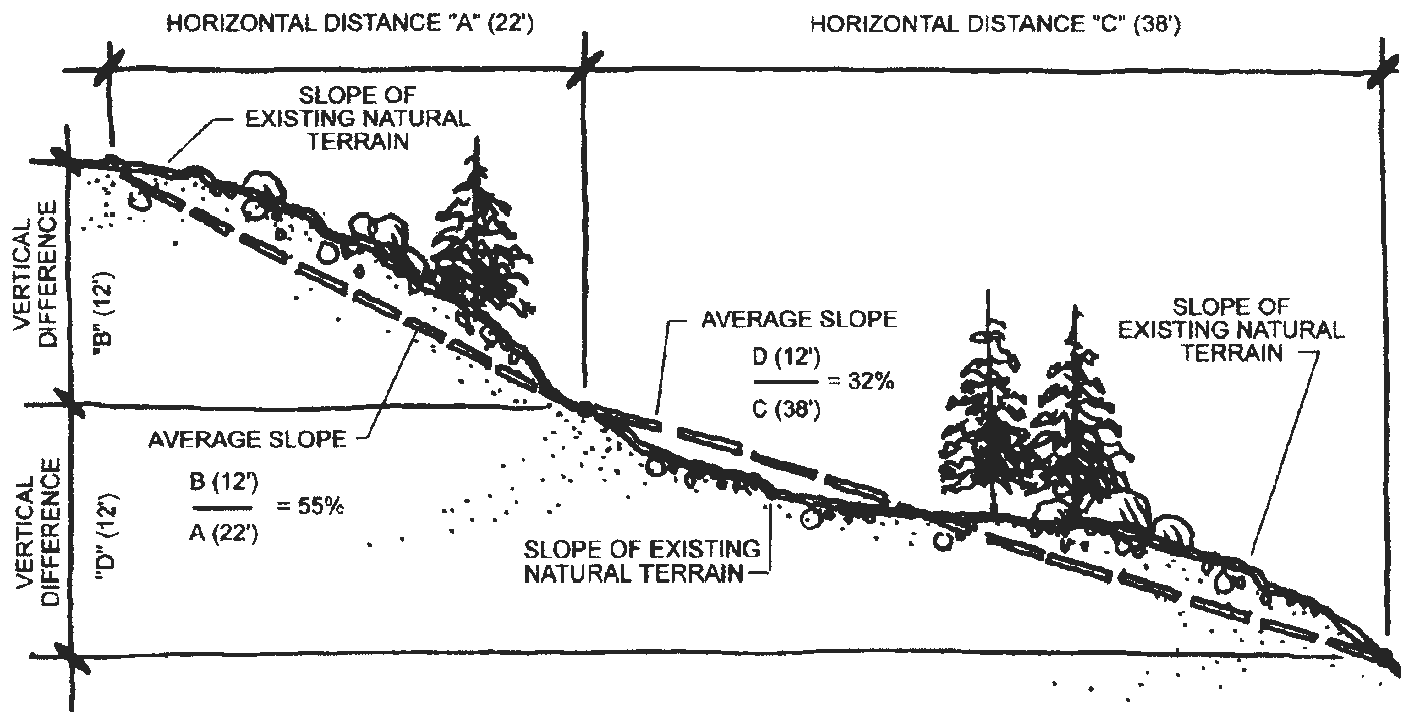
B.
Development Restrictions on Steep Slopes.
1.
Applicability.
These development restrictions shall apply to all new development in the Estes Valley, except for development on lots that were approved for individually permitted buildings prior to the effective date of this Code.
2.
New Structures-Existing Slopes in Excess of 30 Percent.
a.
New development proposed to be built on any portion of a site containing a slope of 30 percent or greater shall be subject to Staff review and approval of a site plan. This provision applies to development that would otherwise be exempt from the site plan review process.
b.
Staff shall review all such development plans and evaluate them according to the following standards:
i.
Site disturbance shall be minimized to the maximum extent practicable;
ii.
Cuts for utilities and access driveways shall be shared to the maximum extent feasible;
iii.
To the maximum extent feasible, new construction shall not take place on any portion of a parcel that shows evidence of slope instability, landslides, avalanche, flooding or other natural or manmade hazards (see §13.7.4, Geologic and Wildfire Hazard Areas).
iv.
The Applicant shall demonstrate that the slope's ground surface and subsurface are not unstable, that the proposed development will not cause instability or increase the potential for slope failure, and that the development of the slope will not increase the degree of hazard both on-site and on adjacent properties.
c.
For purposes of this subsection, steepness of slope shall be measured from the points with highest and lowest elevation within five feet of any portion of the proposed structure.
3.
Structure Clearance from Steep Slopes.
Structure clearance from ascending or descending slopes greater than 30 percent shall comply with the requirements set forth in the applicable Building Code provisions.
4.
Grading, Clearing and Excavation-Slopes in Excess of 30 Percent.
Clearing, excavation and grading on slopes greater than 30 percent would not be allowed, unless expressly approved through a development plan.
5.
Roads/Driveways-Slopes in Excess of 30 Percent.
Shared driveways and access to sites or lots containing slopes in excess of 30 percent shall be utilized to the maximum extent feasible.
C.
Ridgeline Protection Standards.
1.
Applicability.
This Section shall apply to all new development in the Estes Valley on land identified on the Estes Valley Ridgeline Protection Map as designated ridgeline protection areas. If the site contains an identified ridgeline, the Applicant may, by site specific analysis, demonstrate that the location of the proposed development is not on an identified ridgeline. Staff may then waive these standards.
2.
Building/Roof Design for Ridgeline Protection.
Development subject to this subsection shall be designed and sited to minimize the visible intrusion of buildings and structures above the designated ridgelines or above existing ridge-top trees or vegetation, and thus preserve identified scenic views across or through the site. Techniques to meet this standard shall include, but are not limited to, careful consideration of architectural design, building massing, siting, building colors and roofing materials, and the use of native landscaping or other permitted screening materials. For example, compliance with this standard may require siting a building below a ridgeline so there is a solid, mountain backdrop behind the building.
Figure 13-2: Ridgeline Protection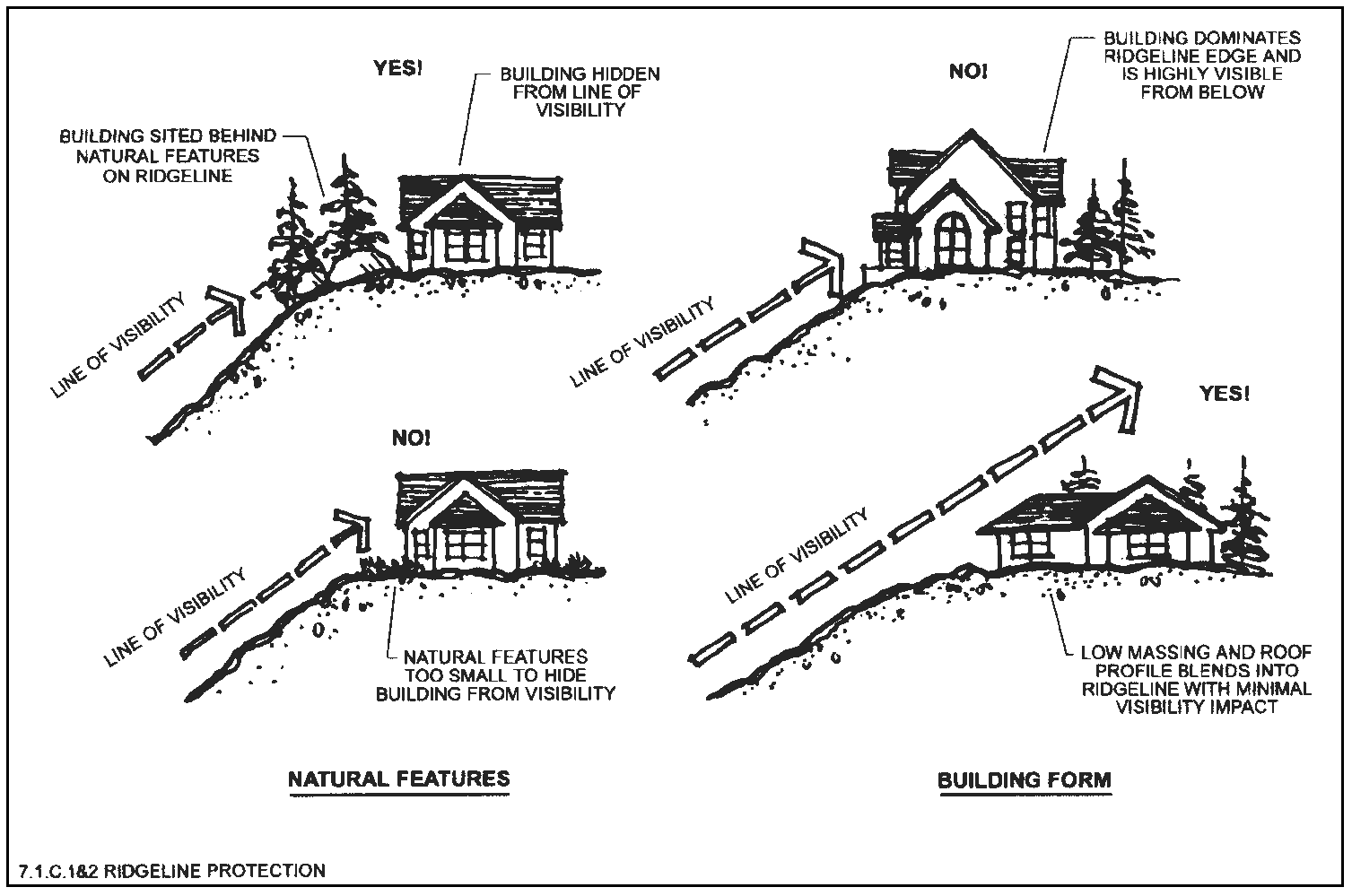
D.
Staff Waiver of Ridgeline Protection Standards.
1.
The Director may grant such waivers or modifications to the ridgeline protection standards only if finding, based on substantial evidence presented by the Applicant, that the following conditions are satisfied:
a.
Application of the ridgeline standards renders the site undevelopable; or
b.
Application of the ridgeline standards will result in a substantial economic hardship (as defined in this chapter), and the economic hardship is not created by the Applicant or otherwise self-imposed; and
c.
The development conforms with all other development, site design and environmental standards set forth in this chapter and in all other applicable ordinances and codes.
2.
In granting a waiver from or modification of the ridgeline protection standards set forth in this section, the Director may impose conditions if the effect of the conditions is to reduce the adverse impacts of the development, including but not limited to a reduction in maximum building height below what would otherwise be permitted in the applicable zoning district.
(Res. of 4-22-2024, Exh. A)
13.7.3. - Tree and Vegetation Protection.
A.
Applicability.
These tree and vegetation protection standards shall apply to all new development in the Estes Valley, except for single-unit residential development on a lot created and approved for such use prior to the effective date of this Code.
B.
Purposes.
Protection of existing tree and vegetation cover is intended to preserve the visual and aesthetic qualities of the Estes Valley; to encourage site design techniques that preserve the natural environment and enhance the developed environment; to control erosion, slippage and sediment run-off into streams and waterways; to increase slope stability; and to protect wildlife habitat and migration corridors.
C.
Exemptions for Specific Activities.
The following activities shall be exempt from this section:
1.
The removal of dead or naturally fallen trees or vegetation, or trees or vegetation that are found by the County to be a threat to the public health, safety, or welfare;
2.
The selective and limited removal of trees or vegetation necessary to obtain clear visibility at driveways or intersections, or for the purpose of performing authorized field survey work;
3.
The removal of trees or vegetation on land zoned or lawfully used for:
a.
Agricultural and forestry activities, including tree farms and approved forestry management practices, except that if a site is substantially cleared of trees pursuant to legitimate forestry activities, no subdivision or development plan applications shall be accepted for 36 months from the date the clearing is completed; or
b.
Commercial garden centers, greenhouses, or nurseries.
D.
Tree/Vegetation Removal.
1.
Outside Approved Limits of Disturbance.
No trees or vegetation shall be removed outside the approved limits of disturbance except as specifically exempted in this section or Chapter.
2.
Within Approved Limits of Disturbance.
a.
To the maximum extent feasible, significant trees (deciduous trees four-inch DBH or larger, conifers eight-inch DBH or larger) and vegetation within the limits of disturbance shall be preserved. Significant trees removed from within the limits of disturbance shall be replaced as set forth in paragraph 5 below. This standard shall not apply to tree/vegetation removal adjacent to structures in order to comply with wildfire hazard mitigation requirements. (See §13.7.4, Geologic and Wildfire Hazard Areas).
b.
Any existing trees or vegetation that are in appropriate locations, in sufficient quantities and of acceptable quality to be utilized to fulfill landscaping or buffering requirements of this Code shall be preserved to the maximum extent feasible.
3.
Wildfire Hazards and Tree/Vegetation Removal.
See §13.7.4, Geologic and Wildfire Hazard Areas below.
4.
Tree/Vegetation Removal for Views Prohibited.
No trees or vegetation shall be removed for the sole purpose of providing open views to or from structures on a site.
5.
Replacement of Significant Trees.
Except for significant trees removed for purposes of wildfire hazard mitigation (see paragraph 3 above), and except for trees removed through an expressly approved construction activity, when a significant tree or trees are removed from a site, the Applicant or developer shall replace such tree(s) on the lot, according to the following schedule and requirements:
a.
A significant deciduous tree that is removed shall be replaced by three trees each with a minimum size of two-and-one-half-inch caliper.
b.
A significant coniferous tree that is removed shall be replaced by two trees each with a minimum height of six feet.
c.
Alternatively with Director approval, acceptable replacement trees shall be determined by a person or firm qualified by training or experience to have expert knowledge of the subject. Alternatively, the valuation of trees removed may be established in accordance with the Valuation of Trees, Shrubs and Other Plants, prepared by the International Society of Arboriculture, and with Staff approval replaced with landscaping of equal dollar value.
d.
Replacement trees shall be maintained through an establishment period of at least three years, except that single-unit developments on a single lot shall have an applicable establishment period of only one year. The Applicant shall post a bond or other surety acceptable to the Decision-Making Body guaranteeing the survival and health of all replacement trees during the establishment period and guaranteeing any associated replacement costs. If the replacement trees do not satisfactorily survive the establishment period, the bond or surety will be used to purchase and install new replacement trees.
E.
Tree/Vegetation Protection During Construction/Grading Activities.
See Appendix D for tree/vegetation protection standards during construction or grading activities.
(Res. of 4-22-2024, Exh. A)
13.7.4. - Geologic and Wildfire Hazard Areas.
A.
Applicability.
All new subdivisions and development, including residential development on lots of record approved prior to the effective date of this Code, shall comply with the procedures and standards set forth in this section.
B.
Interpretation.
The provisions of this section shall be interpreted to apply in conjunction with all other applicable local, county and state land use requirements. Whenever a provision of any other land use regulation conflicts with the intent of this section, the provisions of this section shall apply.
C.
Description of Regulated Hazard Areas.
Hazard areas regulated by this section shall include all areas that are or that may become hazardous due to environmental conditions. The hazards include, but are not limited to, the following: wildfire, avalanche, landslide, rock fall, mud flow and debris fan, unstable or potentially unstable slopes, seismic effects, radioactivity, ground subsidence and expansive soil and rock.
D.
Professional Qualifications.
All maps and reports required by this section must be prepared by or under the responsible direction of a duly qualified professional.
1.
Wildfire hazard analysis required by this section must be prepared by or under the direct supervision of a professional forester with at least two years' experience with wildfire hazards in the Rocky Mountain region.
2.
Geologic hazard analyses required by this section must be prepared by or under the direct supervision of a professional geologist with experience in engineering geology or geotechnical engineering.
3.
Engineering work required by this section must be prepared by or under the direct supervision of a licensed professional engineer who is experienced in the engineering specialty (e.g., soils, slope stability) required to meet the objectives of this section.
E.
Wildfire Hazards.
1.
Wildfire Hazard Areas.
a.
Mapped Wildfire Hazards.
Wildfire hazard areas shall include all those areas shown as "high-tree" fire hazard areas on the Wildfire Hazards Resource Map.
b.
Unmapped Wildfire Hazards.
Wildfire hazard areas shall also include areas located outside of the mapped wildfire hazard areas that are identified by the Colorado State Forest Service or the Larimer County Wildfire Safety Specialist, or designee, as hazardous areas.
c.
In the event an Applicant questions the existence of a wildfire hazard within the proposed development or subdivision, the Applicant may submit evidence with respect thereto from a professional forester. This evidence may be considered by the decision maker, together with all other applicable evidence, in determining whether or not said development or subdivision is within a wildfire hazard area.
2.
Wildfire Hazard Mitigation Plans.
a.
Mitigation Plan Required.
When new development or subdivision is proposed within a wildfire hazard area, the Applicant shall be required to submit a mitigation plan prepared by a professional forester, addressing how the development or subdivision will either avoid or mitigate the hazard, as more fully set forth below.
b.
Wildfire Mitigation Plan Requirements.
Mitigation plans shall be prepared according to the "Colorado Landowner Forest Stewardship Plan Guidelines."
3.
Review Criteria.
a.
In reviewing new development or subdivisions subject to this section, the decision maker may deny development within a hazard area or may approve it on the condition that the development is designed and built in such a manner to adequately mitigate the hazard.
b.
In reviewing new development and subdivisions, the decision maker shall take into consideration the following:
i.
The Applicant's mitigation plan;
ii.
Vegetative, topographic, access and other technical information presented by the Applicant or other interested party, including the County or other public agency;
iii.
Recommendations of a reviewing state agency having expertise with respect to the hazard in question and recommendations of others with similar expertise; and
iv.
Site specific vegetation and topographical characteristics.
c.
Mitigation methods required may include, but are not limited to:
i.
Compliance with "Guidelines and Criteria for Wildfire Hazard Areas," written by the Colorado State Forest Service, September 1974; "Wildfire Mitigation Plan Standards and Guidelines (Appendix D)," written by the Colorado State Forest Service, April 1997;
ii.
Specific requirements for construction, location, and density of structures and/or lots;
iii.
Provision of defensible space in compliance with current Colorado State Forest Service guidelines shall be required on all new construction in wildfire hazard areas. For additions to or changes in the type of the occupancy or use in existing structures, a defensible space shall be provided around the entire structure; and
iv.
Specific requirements for alteration to the vegetative features of the land.
F.
Geologic Hazard Areas.
1.
Geologic Hazard Areas.
a.
Mapped Geologic Hazards.
Geologic hazard areas shall include all areas shown on the Geologic Hazard Areas Resource map and all areas classified as 4, 5, 6 or 7 on the Official Geologic Hazard Maps, which have been reviewed by the Colorado Geological Survey and are incorporated by reference in this Code. The Official Geologic Hazard Maps shall be available for public review at the Community Development Department.
b.
Unmapped Geologic Hazards.
Hazard areas shall further include any areas which have not been so classified, but where a hazard has been identified and confirmed by the Colorado Geological Survey. The Community Development Director, or designee, shall have the authority to identify geologic hazard areas during field inspections. Such field identifications shall be based on identification procedures set forth in "Guidelines and Criteria for Identification and Land Use Controls of Geologic Hazard and Mineral Resource Areas," written by the Colorado Geological Survey, 1974.
c.
In the event an Applicant questions the existence of a geologic hazard area within the area proposed for development or subdivision, the Applicant may submit evidence with respect thereto from a professional geologist having requisite technical expertise. Such evidence may be considered by the Decision-Making Body, together will all other available evidence, in determining whether or not said development or subdivision is within a geologic hazard area.
2.
Geologic Hazard Mitigation Plans.
a.
Mitigation Plan Required.
When new development or subdivision is proposed within a geologic hazard area, the Applicant shall be required to submit a mitigation plan prepared by a professional geologist addressing how the development or subdivision will either avoid or mitigate the hazard, as more fully set forth below. Licensed professional engineers who are experienced in the engineering specialty (e.g., soils, slope stability) may submit mitigation plans for steep slope and alluvial soils hazards. Lots approved for single-unit residential development prior to the adoption of this Code do not need to submit a mitigation plan for rock fall hazards.
b.
Colorado Geologic Survey Review.
Except for single-unit residential development on lots of record, new development and subdivisions within a geologic hazard area shall be referred to the Colorado Geological Survey for review and comment. At the time of application submittal, the Applicant shall submit the required fees for the Colorado Geological Survey review. Applicants seeking approval of single-unit development on lots of record within an identified Geologic Hazard Area shall be exempt from Colorado Geological Survey review, but shall be subject to all other requirements in this section.
c.
Geologic Mitigation Plan Requirements.
Mitigation plans shall be prepared according to "Guidelines and Criteria for Identification and Land Use Controls of Geologic Hazard and Mineral Resource Areas," written by the Colorado Geological Survey, 1974 and include, at a minimum, the following:
i.
An evaluation and predication of the impact of the hazard or hazards affecting the proposed development or subdivision and recommended mitigation methods;
ii.
Maps describing the extent and severity of the hazard at the particular site, and including a true north arrow, scale, ties to quarter-section corners and accurate dimensions for all lines, angles and curves used to describe property boundaries scale;
iii.
Topography;
iv.
A location map showing the general location of the development or subdivision and its relationship to surrounding topographic features;
v.
A map showing the location, type and density of the proposed development or subdivision;
vi.
In the case of an alluvial soils hazard, an on-site subsurface soils investigation and report.
vii.
In the case of rock fall geologic hazards, the mitigation plan shall:
1)
Specifically address each possible method of mitigation, including:
(a)
Building outside of the run-out zone,
(b)
Stabilization of rocks,
(c)
Slowing or diverting moving rocks, and
(d)
Physical barriers.
2)
Include maps of the fallout zone, including the rock fall source area, the acceleration zone, and the run-out zone. Computer modeling is the preferred method of determining hazard zones.
3)
Include maps portraying the geologic conditions of a development area with particular attention given to the designated hazard condition or conditions and those geologic, hydrologic, soil and topographic features constituting the hazard.
4)
If needed, geologic cross-sections can be utilized to portray the hazard conditions. These maps must show the topography with a contour interval of ten feet or smaller if necessary. These maps must be on a scale sufficiently detailed to meet the purposes of this section, but in no case can the scale be less than one inch equals 200 feet.
3.
Review Criteria.
a.
In reviewing a development subject to this section, the Decision-Making Body may deny development within a hazard area or may approve it on the condition that the development is designed and built in such a manner as to adequately mitigate the hazard.
b.
In reviewing new development and subdivisions, the Decision-Making Body shall take into consideration the following:
i.
The Applicant's mitigation plan;
ii.
Geologic, topographic, and other technical information presented by the Applicant or other interested party, including the County or other public agency;
iii.
Recommendations of a reviewing state agency having expertise with respect to the hazard in question and recommendations of others with similar expertise; and
iv.
The relationship between the development and the hazard area and the potential impact of the development within the area on lands outside the development.
c.
Mitigation methods required by the Decision-Making Body may include, but are not limited to:
i.
Compliance with "Guidelines and Criteria for Identification and Land Use Controls of Geologic Hazard and Mineral Resource Areas," written by the Colorado Geological Survey, 1974;
ii.
To the maximum extent feasible, in rock fall hazard areas avoidance of the run-out zone shall be the method of mitigation;
iii.
Location of building envelopes outside areas identified as Class II geologic hazard areas;
iv.
Specific requirements for construction, location, density of structures and/or lots;
v.
Specific requirements for construction of roads upon the land;
vi.
Specific requirements for alteration to the physical characteristics of the land.
(Res. of 4-22-2024, Exh. A)
13.7.5. - Wildlife Habitat Protection.
A.
Purpose.
To maintain the diversity of wildlife species and habitat that occur in the Estes Valley, and to plan and design land uses to be harmonious with wildlife habitat and the species that depend on this habitat for the economic, recreational, and environmental benefit of the residents of and visitors to the Estes Valley.
B.
Applicability.
This Section shall apply to all applications for review of development plans, subdivision plats, planned unit developments, special review uses and rezonings. This Section shall not apply to development on lots that were approved for single-unit residential use prior to the effective date of this Code.
C.
Exemptions.
The procedures and regulations contained in this section shall not apply to:
1.
Agricultural activities such as soil preparation, irrigation, planting, harvesting, grazing and farm ponds;
2.
Maintenance and repair of existing public roads, utilities and other public facilities within an existing right-of-way or easement;
3.
Maintenance and repair of flood control structures and activities in response to a flood emergency;
4.
Maintenance and repair of existing residential or nonresidential structures; or
5.
Activities undertaken pursuant to a wildlife conservation plan approved under this section.
D.
Other Regulations.
This Section of the Code does not repeal or supersede any existing federal, state, or local laws, easements, covenants, or deed restrictions pertaining to wildlife. When this section imposes a higher or more restrictive standard, this section shall apply.
E.
Wildlife Habitat Data Base.
The following sources shall be used to identify important wildlife habitat areas for purposes of review under this section:
1.
Wildlife Habitat map.
2.
Colorado Division of Wildlife habitat maps for Larimer County, as amended from time to time.
3.
Colorado Natural Heritage Program Maps dated December 1996, or as amended from time to time.
4.
Other information and maps as staff may from time to time identify in cooperation with the Colorado Division of Wildlife, such as wildlife maps produced specifically for the Estes Valley. Said maps shall be applicable only following adoption of an amendment to this Code.
5.
Wildlife habitat information required by this section is intended for general planning purposes. Obvious errors or omissions may be corrected by the Staff.
F.
Review Procedures.
The following procedures shall apply to all applications for development:
1.
Application.
The Applicant shall submit a plat, sketch plan or site plan, as applicable, depicting the general location of the property, location of structures on the site, prominent natural areas such as streams and wetlands, and other features that Staff may require for review pursuant to this section. A Wildlife Conservation Plan shall be submitted for sites containing:
a.
An endangered or threatened species,
b.
Big Horn sheep or Big Horn sheep habitat, or
c.
Riparian areas adjacent to rivers and streams and wetlands.
2.
Preliminary Review.
Staff shall refer the submitted plan or plat to the Colorado Division of Wildlife for review. Applicants are also advised to consult with the Colorado Division of Wildlife and other agencies responsible for regulation of wildlife and habitat, such as the U.S. Fish and Wildlife Service, U.S. Department of the Interior-Rocky Mountain National Park, U.S. Forest Service and Colorado Natural Heritage Program. These agencies may maintain maps and databases that can aid in the site-specific confirmation of the presence or absence of wildlife and habitat on a specific site.
3.
Review Determination.
a.
The Review and Decision-Making Bodies shall issue a finding as to whether the application, including the wildlife conservation plan, complies with the requirements of this section.
b.
Wildlife studies and mitigation plans found to be adequate by the Decision-Making Body shall become binding upon the Applicant.
c.
Applications that do not comply with this §13.7.5 of this Code shall be denied.
4.
Waivers.
Staff may waive or approve minor modifications of any development standard or review criteria contained in this section upon a finding that such waiver or modification:
a.
Is consistent with the stated purposes of this section;
b.
Will have no significant adverse impacts on wildlife species or habitat;
c.
Any potential adverse impacts will be mitigated or offset to the maximum extent practicable; and
d.
Application of the standard or criteria is not warranted based on the location of the development, the absence of a particular species on the site or other relevant factors.
G.
Review Standards.
The following review standards shall apply to all development applications as specified, unless staff determines that a specific standard may be waived pursuant to subsection F.4 above. It is the intent of this section that these standards be applied in a flexible fashion to protect wildlife habitat and wildlife species in a cost-effective fashion.
1.
Review Standards.
a.
Buffers.
All development subject to a wildlife conservation plan shall provide a setback from any identified important wildlife habitat area, in accordance with any recommendations in the wildlife conservation plan.
b.
Important Wildlife Habitat.
Restricted to native species on Recommended Plant List. There shall be no introduction of plant species that are not on the approved landscaping list in the "ComDev Recommended Plant List" on any site containing any important wildlife habitat area. Plans approved under provisions of this Code shall show existing herbaceous and woody cover on the site maintained and removal of native vegetation minimized in connection with development.
c.
Fencing.
i.
No fencing on a site containing important wildlife habitat shall exceed 40 inches in height, except to the extent that such fencing is approved by Staff to confine permitted domestic animals or to protect permitted ornamental landscaping or gardens.
ii.
Fences higher than 40 inches may be allowed if adequate openings are provided for the passage of deer, elk, or other identified wildlife. These openings shall be at least six feet wide and spaced a maximum of 50 feet apart along continuous fence lines exceeding this length.
iii.
No fencing using barbed wire shall be allowed.
iv.
The type of fencing (materials, opacity, etc.) shall be determined by Staff or the Decision-Making Body as appropriate for the wildlife species on the site.
d.
Exterior Lighting.
Use of exterior lighting shall be minimized in areas of important wildlife habitat, and lighting shall be designed so that it does not spill over or onto such critical habitat. See also §13.7.6 below.
e.
Refuse Disposal.
Developments on sites containing important wildlife habitat, such as black bear, must use approved animal-proof refuse disposal containers. With Division of Wildlife approval, refuse disposal containers and enclosures may be electrified.
f.
Domestic Animals.
Development applications for property that includes important wildlife habitat must include a plan with specified enforcement measures for the control of domestic animals and household pets. The plan must include provisions to prevent the harassment, disturbance and killing of wildlife and to prevent the destruction of important wildlife habitat.
H.
Wildlife Conservation Plans.
1.
Plan Preparation.
A wildlife conservation plan required by this section shall be prepared for the Applicant, at the Applicant's expense, under the responsible direction of a qualified person who has demonstrated expertise in the field.
2.
Plan Content.
Any wildlife conservation plan required to be prepared pursuant to this section shall include the following information at a minimum. Specific requirements may be waived by Staff due to the location of the development, the previous use of the site, the size and potential impact of the development, the absence of particular species on a site, the prohibition of a reasonable use of the site and other relevant factors.
a.
A description of the ownership, location, type, size, and other attributes of the wildlife habitat on the site.
b.
A description of the populations of wildlife species that inhabit or use the site, including a qualitative description of their spatial distribution and abundance.
c.
An analysis of the potential adverse impacts of the proposed development on wildlife and wildlife habitat on or off site.
d.
A list of proposed mitigation measures and an analysis of the probability of success of such measures.
e.
A plan for implementation, maintenance, and monitoring of mitigation measures.
f.
A plan for any relevant enhancement or restoration measures.
g.
A demonstration of fiscal, administrative, and technical competence of the Applicant or other relevant entity to successfully execute the plan.
(Res. of 4-22-2024, Exh. A)
13.7.6. - Exterior Lighting.
See Article 4.0, Development Standards, §4.10, Exterior Lighting.
(Res. of 6-6-2023, Exh. A, 3; Res. No. 07282025, 7-28-2025)
13.7.7. - Operational Performance Standards.
In addition to any standards required in the underlying zoning districts, all development shall meet the following performance standards:
A.
Noise.
All land uses and new development subject to this Chapter of the Code shall comply with the noise standards found in Larimer County Ordinance 97-03 (adopted September 22, 1997, and as amended from time to time).
B.
Operational/Physical Compatibility.
The following conditions may be imposed upon the approval of any development to ensure that it is compatible with existing uses, including but not limited to, restrictions on:
1.
Placement of trash receptacles;
2.
Location of loading and delivery areas;
3.
Location, intensity, and hours of illumination; and
4.
Additional landscaping and buffering.
C.
Evidence of Compliance.
The Decision-Making Body shall require such evidence of ability to comply with appropriate performance standards and mitigation measures as it deems necessary prior to issuance of project development plan approval or a building permit or a certificate of occupancy.
13.7.8. - Street Design and Construction Standards.[1]
A.
Applicability.
1.
All new development within the Estes Valley, except for single-unit residential development on a lot created and approved for such use prior to February 1, 2000, shall comply with the Larimer County Rural Area Road Standards (LCRARS) and applicable Chapters and Sections of the Larimer County Urban Area Street Standards (LCUASS) as defined below.
a.
Applicable Chapters of the LCUASS are Chapter 1 (General Provisions), Chapter 4 (Transportation Impact Studies), Chapter 7 (Street Design and Technical Criteria), Chapter 9 (Access requirement and Design Criteria), Chapter 16 ( Pedestrian Facilities), Chapter 17 (Bicycle Facilities), Chapter 22 (Construction Specifications), Chapter 23 (Inspection and Testing Procedures), Appendix A (Standard Drawings), and Appendix E (Standard Notes Approval Blocks and check lists). Applicable sections of the applicable chapters include all general sections and sections listed as "Loveland (GMA and City limits)." Remaining Chapters of the LCUASS are not included as the contents, processes, and standards contained within these chapters are either not applicable or incorporated in other parts of the Larimer County Land Use Code (LCLUC) and LCRARS.
b.
The applicable chapters of the LCUASS applies for all new non-residential and multi-unit development within the Estes Valley. The applicable chapters of the LCUASS also applies for new residential land divisions that are proposed on parcels that intersect with the 1,500-foot buffer limit of the Town boundary, which is shown as reference in Figure 13-4.
c.
The LCRARS applies for new residential land divisions not within the 1,500-foot buffer of the Town boundary, which is shown as reference in Figure 13-4.
B.
Administrative Modification Process.
1.
Modifications or variances from these standards will be considered on a case-by case basis.
2.
If a person desires to design and construct improvements in modification or variation to these to these standards, such modification shall be requested in writing and sealed by a licensed Colorado professional civil engineer and shall consist of:
a.
Identification of the standard provision to be modified, waived, or varied.
b.
Identification of the alternative design or construction standards to be adhered to that results in equivalent engineering standards.
c.
A thorough justification of the modification request, including impact of capital and maintenance requirements and cost.
d.
The modification request results in less visual impact; more effective environmental or open space preservation; or, relieves practical difficulties in developing a site due to mountainous terrain or other factors.
3.
Modification requests shall first be reviewed by the County Engineer. If the request is denied by the County Engineer, the person requesting the modification may make their first appeal of the decision to the Community Development Director. If the denial of the variance is upheld by the Director, it may be appealed to the Board of County Commissioners.
C.
Additional Design and Construction Standards.
All new applicable development shall comply with the following standards, in addition to the street design, cross-section, and construction specifications and details set forth in the LCRARS and applicable sections of the LCUASS.
1.
Typical Street Sections.
a.
Arterial Street Sections.
Arterial Street sections in Estes Valley that are classified as State Highways and under the jurisdiction of the Colorado Department of Transportation shall meet State standards and typical sections.
b.
Collector Street Sections.
i.
The Minor Collector Street section shown in Figure 7-5L of the LCUASS (Loveland Only) applies for internal streets with traffic volumes in the range of 1,000 to 3,000 vehicles per day and for adjacent roads shown as Collector Streets on the Larimer County Functional Classification Map that are proposed on parcels that intersect with the 1,500-foot buffer limit of the Town boundary. The section noted as "WITHOUT PARKING" shall be used, excluding the parkway requirement. The minimum right-of-way width requirement for this collector section with curb and gutter, bike lane and sidewalk is 50 feet.
ii.
The Minor and Major Collector Street sections shown in the LCRARS applies for adjacent roads shown as Collector Streets on the Larimer County Functional Classification Map outside of the 1,500-foot buffer limit of the Town boundary. The right-of-way width requirements apply as shown in Drawings 2 and 3 of the LCRARS.
c.
Local Street Sections.
i.
The Residential Local Street section (Loveland Only) shown in Figure 7-7L of the LCUASS applies for internal streets with traffic volumes in the range of 100 to 999 vehicles per day and for adjacent roads shown as Local Streets on the Larimer County Functional Classification Map that are proposed on parcels that intersect with the 1,500-foot buffer limit of the Town boundary. The minimum right-of-way width requirement for the local section is 45 feet to accommodate curb, gutter, sidewalk, and optional parking if needed. Parkways are not required.
ii.
The Local Street sections shown in the LCRARS applies for streets shown as Local Streets on the Larimer County Functional Classification Map that are outside of the 1,500-foot buffer limit of the Town boundary. The right-of-way width requirements apply as shown in Drawing 4 of the LCRARS.
d.
Local Low Volume Street Sections.
The Local Low Volume Street section shown in the LCRARS applies for streets within the Estes Valley where the average daily trip generation is expected to be less than 100 trips. The right-of-way width requirements apply as shown in Drawing 5 of the LCRARS.
2.
Shared Driveways.
The following standards apply to shared driveways:
a.
Shared Driveways are allowed for up to four single-unit residential dwellings and up to ten multi-unit dwellings. Accesses that serve more than these thresholds are considered streets.
b.
Shared drives serving up to three single-unit residential or up to three multi-unit dwellings may have a ten-foot wide minimum driving surface. Shared drives serving four single-unit residential or four to ten multi-unit dwellings shall have a 20-foot minimum driving surface.
c.
Shared driveways serving four single-unit residential dwellings and four to ten multi-unit dwellings must be paved when proposed on parcels that intersect with the 1,500-foot buffer limit of the Town boundary.
d.
The primary entrance of shared driveways serving two or more dwelling units shall be maintained with unobstructed vehicular access between the dwelling entrance(s) and the public street access and shall not have gated access or other security barriers installed.
e.
Shared driveways must provide a turnaround to meet local fire department standards.
f.
Shared driveways require a recorded shared access easement and maintenance agreement.
3.
Road Surfacing.
a.
For any non-residential and multi-unit development and for residential land divisions proposed on parcels that intersect with the 1,500-foot buffer limit of the Town boundary, paved access roads and shared drives must be available to provide access to the nearest paved road.
b.
Outside of the 1,500-foot buffer limit of the Town boundary, pavement is required based on the paving threshold standards in LCLUC Section 8.1.5 (Road Capacity and Level of Service Standards).
4.
Curb and Gutter.
a.
For any non-residential and multi-unit development and for residential land divisions proposed on parcels that intersect with the 1,500-foot buffer limit of the Town boundary, concrete curb and gutter shall be required along the project frontage and on both sides of internal streets.
b.
Outside of the 1,500-foot buffer limit of the Town boundary, curb and gutter is not required.
5.
Sidewalks and Bike Lanes.
a.
For any non-residential and multi-unit development and for residential land divisions proposed on parcels that intersect with the 1,500-foot buffer limit of the Town boundary, sidewalks on both sides of an internal roads shall be required where staff determines there will be significant pedestrian usage.
b.
When development abuts an Arterial or Collector Street, sidewalks and bike lanes along the project frontage shall be installed to provide public access and connection to adjacent properties.
c.
Sidewalks and bike lanes may not be required if staff determines:
i.
There will not be significant pedestrian and/or bicycle usage;
ii.
There will not be a feasible connection to other sidewalks and bike lanes in the area; or
iii.
Unusual topographic or environmental conditions exist that would make installation infeasible or would result in a significant adverse impact.
6.
Property Line Buffer.
Roads, shared drives, and sidewalks shall be set back at least three feet from an adjacent property line unless owners of abutting properties agree in writing that the edge may be closer to or abut their common property line.
7.
Dead End Length.
The maximum length of a cul-de-sac or dead-end street shall be 1,000 feet, measured from the center of the nearest intersection to the center of the cul-de-sac turnaround.
8.
Terrain Classification.
Terrain shall be classified "mountainous" when the average cross-slope at streets being developed exceeds 15 percent. LCRARS and LCUASS allow the proposal of deviations to the standards if another alternate design and construction standard can be met such as using American Association of State Highway and Transportation Officials (AASHTO) Policy on the Geometrics Design of Highways and Streets.
Figure 13-4: Estes Valley Street Standard Buffer Area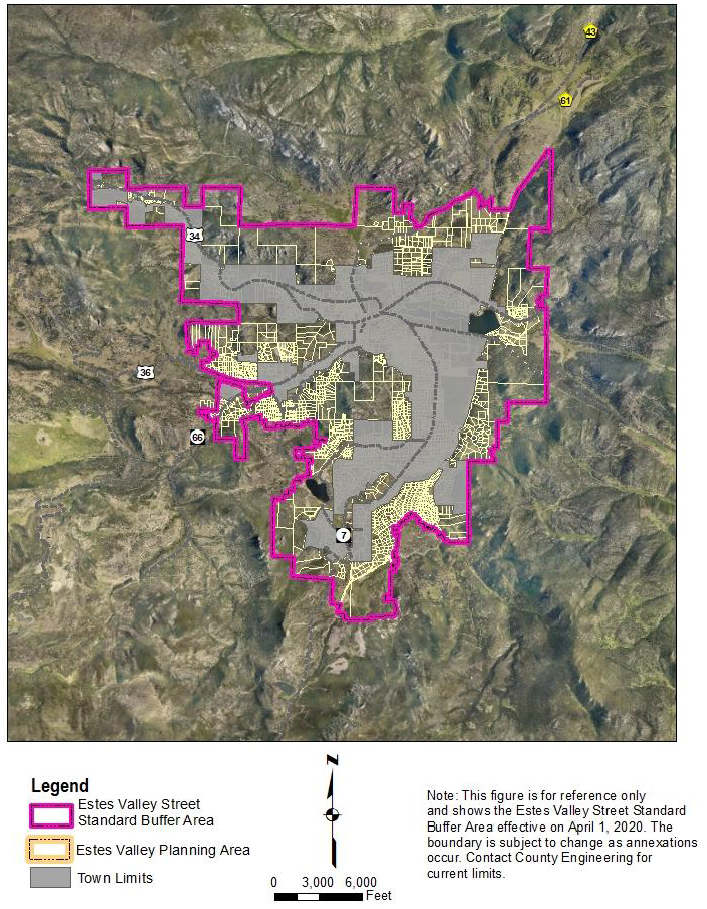
(Res. of 4-22-2024, Exh. A)
Cross reference— Roads and bridges, ch. 50.
13.8.1. - General provisions.
Definitions listed in this section shall supersede other definitions in the Code with respect to the Estes Valley only. Terms used but not specifically defined herein shall have commonly accepted meaning of the word, generally a dictionary definition.
13.8.2. - Use Classifications/Specific Use Definitions and Examples.
A.
Purpose and Applicability.
Use classifications classify land uses and activities based on common functional, product or physical characteristics. Characteristics include the type and amount of activity, the type of customers or residents, how goods or services are sold or delivered and site conditions. The use classifications provide a systematic basis for assigning present and future land uses into appropriate zoning districts.
B.
Uses Not Classified.
Any new use, or any use that cannot be clearly determined to be in an existing use classification pursuant to the use classification procedure set forth in §13.3.2.D, shall be prohibited until and if such use is incorporated into the zoning regulations by a code text amendment, as provided by §6.6, Code Amendment Procedures.
C.
Use Classification/Specific Use Definitions and Examples.
This Section sets forth specific use classifications in alphabetical order. A general definition is typically provided for each use classification, and in many instances, examples are provided of specific uses that fall within the broader use classification. When a specific use example is provided, the example should satisfy both the broader classification's general definition as well as the definition of the specific use, if provided. Finally, the text may provide specific examples of uses that are not included in a particular use classification (referred to in the text as "exceptions").
1.
Accommodations, High-Intensity.
a.
General Definition: Visitor-serving facilities that provide temporary lodging in guest rooms or guest units for compensation, and with an average length of 30 days or less. High-intensity accommodations generally serve a larger number of guests than low-intensity accommodations.
b.
Examples: This classification includes the following types of specific uses:
i.
Hostel: An establishment operated, managed, or maintained under sponsorship of a nonprofit organization that holds a valid exemption from federal income taxes under the Internal Revenue Code of 1954, as amended, or which is licensed by and operated under the rules of Hosteling International-American Youth Hostels, or a comparable hosteling umbrella organization approved by the appropriate governing entity.
ii.
Hotel/Motel: A facility offering transient lodging accommodations to the general public.
iii.
Recreational Vehicle (RV) Park/Campground: A parcel of land where two or more recreational vehicle sites and/or camping sites are located, established, or maintained for occupancy by recreational vehicles or camping units of the general public as temporary living quarters for travel, vacation, or recreation purposes.
iv.
Resort Lodge/Cottages: A building or group of buildings, under single management and ownership with an on-site manager or staff, containing rooms and/or units available for temporary rental to transient guests, and where the primary attraction is generally recreational features or activities.
2.
Accommodations, Low-Intensity.
a.
General Definition: Visitor-serving facilities that provide temporary lodging for compensation, and with an average length of stay of 30 days or less. Such facility shall be designed to be compatible, in terms of building scale, mass and character, with a predominantly low-intensity and low-scale residential and/or rural setting.
b.
Examples: This classification includes the following types of specific uses:
i.
Hosted Short-Term Rental: A principal dwelling occupied by a full-time resident (owner or operator) living on-site where short-term lodging is provided to transient guests.
ii.
Bed and Breakfast Inn: As defined in section 20.3.
iii.
Hotel, Small: As defined above, containing no more than eight guest rooms.
iv.
Resort Lodges/Cottages, Low-Intensity: As defined above, with no more than a total of 20 guest rooms or guest units.
v.
Short-Term Rental: A principal dwelling rented to transient guests for short-term lodging when not occupied by the owner/operator.
vi.
Preexisting Lodging Facility: A legally constructed dwelling, including condominium units, cabins, or hotels, constructed prior to April 1, 2020, for transient lodging uses and located in the EV A or EV A-1 districts.
3.
Adult Businesses.
Any facility used for an adult amusement or entertainment business. This includes an adult book store, adult photography studio, adult theater, adult drive-in theater, adult movie arcade, adult restaurant, bar or nightclub, adult tanning salon and other adult businesses characterized by offering patrons activities or material depicting, exhibiting, describing, or relating to specified sexual activities or specified anatomical areas for observation, amusement, enjoyment, satisfaction or gratification, whether for a fee or not. The uses contemplated by this definition customarily, although not always, offer adult amusement or entertainment activities or materials as a principal, significant or emphasized part of their enterprise and such uses, customarily, although not always, exclude minors under 18.
4.
Animal Sales/Services.
a.
General Definition: Any commercial facility or establishment that conducts as a principal use of the premises the sale or boarding of animals, or the provision of care, treatment, or services for animals.
b.
Examples: This classification includes the following types of specific uses:
i.
Animal Boarding: Provision of shelter and care for small or large animals on a commercial basis. This use includes activities such as feeding, exercising, grooming and incidental medical care.
ii.
Animal Grooming: Provision of bathing and trimming services for small or domestic animals only on a commercial basis. This use includes boarding of domestic animals for a maximum period of 48 hours.
iii.
Animal Hospital: Establishments where small or domestic animals receive medical and surgical diagnosis and treatment. This use includes only facilities that are entirely enclosed, soundproofed, and air-conditioned. Grooming and temporary (no more than 30 days) boarding of animals is included if incidental to the hospital use.
iv.
Animal Retail Sales: Retail sales and boarding of small or domestic animals only, provided that such activities take place within an entirely enclosed building. This use includes grooming if incidental to the retail use, and boarding of animals not offered for sale for a maximum period of 48 hours.
v.
Animal Shows/Sales: Exhibitions of small/domestic or large animals for a maximum of seven days. This use includes animal sales.
vi.
Veterinary Office: Any facility maintained by or for the use of a licensed veterinarian in the diagnosis, treatment, and prevention of animal diseases. Overnight care and boarding of small or domestic animals is permitted for up to 30 consecutive days within the interior of such facility.
5.
Artist Studio.
Work space for artists and artisans, including individuals practicing one of the fine arts or performing arts, or skilled in an applied art or craft.
6.
Bank or Other Financial Institution.
Establishments that provide retail banking services, mortgage lending and similar financial services to individuals and businesses. This classification includes those institutions engaged in the on-site circulation of cash money and check-cashing facilities, but shall not include bail bond brokers. This classification also includes automated teller machines (ATM) located within a fully enclosed space or building, or along an exterior building wall intended to serve walk-up customers only.
7.
Building Materials/Services.
Retailing, wholesaling or rental of building supplies or equipment. This classification includes lumber yards, building tool and equipment sales or rental establishments, and building contractors' yards, but excludes establishments exclusively devoted to retail sales of paint and hardware and activities classified under vehicle/equipment sales and service.
8.
Business Services/Professional Office.
A place used primarily to conduct the affairs of a business, profession, service, industry, government, or other similar activity and where the indoor storage and sale of merchandise is secondary to the conduct of the business or profession.
9.
Catering Service.
Preparation and delivery of food and beverages for off-site consumption without provision for on-site pickup or consumption. (See also Eating/Drinking Establishments.)
10.
Civic, Social or Fraternal Membership Clubs, Lodges or Associations.
A facility to accommodate a group of people organized for a common purpose to pursue common goals, interests or activities and characterized by certain attributes, including membership qualifications, payment of fees and dues, regular meetings and/or a constitution and by-laws.
11.
Commercial Laundry.
A business which launders and dry cleans clothing and other fabric articles in bulk. Dry cleaning agencies are distinguished from commercial laundries, the latter which perform dry cleaning of materials delivered to the premises by persons or services other than the owner of the materials. See also Personal Services.
12.
Commercial Recreation or Entertainment Establishments, Outdoor.
A facility offering games, sports, exhibitions and/or rides. This does not include golf courses, country clubs, shooting ranges or livery stables.
13.
Construction Storage Yard.
A facility utilized for the storage of vehicles, equipment and materials utilized in the construction industry.
14.
Cultural Institutions.
A public or non-profit institution displaying or preserving objects of interest in one or more of the arts or sciences, including libraries and museums.
15.
Day Care Center.
A nonresidential facility for the purpose of providing less than 24-hour care for children or adults, none of whom are receiving on-site medical or psychological treatment, therapy, or counseling but some or all of whom may be receiving on-site physical assistance with day-to-day living activities. A day care center for children is a facility that is required to be licensed as such by the State of Colorado, Department of Human Services.
16.
Eating/Drinking Establishments.
a.
General Definition: Retail businesses serving prepared food or beverages for consumption on or off the premises.
b.
Examples: This classification includes the following types of specific uses:
i.
Bar/Tavern: An establishment where the primary business is providing or dispensing by the drink for on-site consumption of fermented malt beverages and/or malt, special malt, vinous or spirituous liquors, in which the sale of food products such as sandwiches and light snacks is secondary, and where music, live entertainment and/or dancing may be provided.
ii.
Brewpub: An establishment where the brewing, fermenting, or distilling of malt, vinous or spirituous liquors or other alcoholic beverages for consumption on or off the premises, which requires food sales. Food sales shall account for a minimum of 15 percent of a brewpub's gross on-premises food and drink income.
iii.
Microbrewery/micro-distillery/microwinery: An establishment with no more than 15,000 square feet of gross floor area in which malt, vinous, spirituous liquors are brewed, distilled, or fermented for sale and distribution. An on-premises tasting/tap room is required. The sale of food products, such as sandwiches and light snacks, is permitted as an accessory use, but not required.
iv.
Restaurant: An establishment where the principal business is the sale of food and beverages in a ready-to-consume state. Fermented malt beverages, malt, special malt, and vinous and spirituous liquors may be produced on the premises as an accessory use.
v.
Tasting/tap room: A principal or accessory use associated with a micro/brewery/micro-distillery/microwinery or brewery/distillery/winery at which customers may purchase the manufacturer's products and other beverages for on- or off-premises consumption.
17.
Emergency Health Care.
Facilities providing emergency medical service with no provision for continuing care on an inpatient basis.
18.
Entertainment Event, Major.
a.
General Definition: Major entertainment event uses are characterized by activities and structures that attract people to specific (often large-scale) events or shows. Activities are generally of a spectator nature. Accessory uses may include restaurants, bars, concessions, parking, and maintenance facilities.
b.
Examples: Examples include fairgrounds, stadiums, sports arenas, coliseums, auditoriums and exhibition and meeting halls/areas.
c.
Exceptions: This use classification does not include the following:
i.
Exhibition and meeting areas with less than 20,000 square feet of total event area, which are classified as "retail establishments" below.
ii.
Meeting areas, banquet halls and similar uses that are part of hotels or restaurants and are accessory to those uses, which are included in the accommodations or retail establishment classification.
iii.
Movie theaters, which are classified under indoor commercial recreation or entertainment establishments.
iv.
Recreation or entertainment uses conducted on a continuous basis that are classified as indoor or outdoor commercial recreation or entertainment establishments.
19.
Event Facility.
A building or portion of a building, outdoor area(s), and related parking which is rented, leased, or otherwise made available for individuals or groups to accommodate episodic or discrete functions involving participation by multiple individuals, including but not limited to weddings, banquets, anniversaries, and other similar events. Such use may include kitchen facilities for the preparation or catering of food, or the sale and/or serving of appropriately permitted alcoholic beverages for on-premises consumption. Food service shall occur only during scheduled events and shall not be open to the general public. An event facility may be operated in conjunction with other uses, subject to all applicable provisions of the EVDC.
20.
Home Day Care.
A facility in the permanent residence of the provider, for the purpose of providing less than 24-hour care for two or more adults or children who are not related to the caregiver and none of whom are receiving on-site medical or psychological treatment, therapy, or counseling but some or all of whom may be receiving on-site physical assistance with day-to-day living activities. A home day care for children is a facility that is required to be licensed as such by the State of Colorado, Department of Human Services.
a.
Home Day Care, Small: A facility licensed by the State of Colorado to serve eight or fewer adults or children with no more than one nonresident caregiver on site at any time.
b.
Home Day Care, Large: A facility licensed by the State of Colorado to serve more than eight adults or children and may include nonresident caregivers. The maximum number of children permitted in a day care home shall be the maximum allowed by the State of Colorado, Department of Human Services. The maximum number of adults permitted in a day care home shall be 12.
21.
Food/Beverage Sales.
a.
General Definition: Retail sales of food and beverages for off-site preparation and consumption. Establishments at which 20 percent or more of the transactions are sales of prepared food for on-site consumption shall be classified as eating/drinking establishments.
b.
Examples: This classification includes, but is not limited to, the following types of specific uses:
i.
Convenience Store: Retail sales of food and beverage for off-site consumption, household items, newspapers and magazines, and other small convenience items typically found in establishments with long or late hours of operation. A convenience store shall have a gross floor area no larger than 5,000 square feet. This definition excludes delicatessens or other specialty food stores having a sizable amount of fresh fruits, vegetables, and fresh-cut meats.
ii.
Grocery Store.
iii.
Liquor Store: An establishment licensed by the State of Colorado to sell alcoholic beverages in containers, including wine, beer, and hard liquor, for consumption off-premises.
22.
Funeral/Interment Service.
A building used for the preparation of the deceased for burial or cremation, for the display of the deceased and/or for ceremonies or services related thereto, excluding a crematorium.
23.
Golf Course.
A parcel of land laid out for at least nine holes for playing golf and improved with tees, greens, fairways, and hazards. It may also include a clubhouse and other accessory structures.
24.
Government Facilities.
a.
General Definition: Facilities owned and operated by a political subdivision of the State of Colorado, including special districts (e.g., hospital, recreation, sanitation, or library districts), or facilities owned and operated by the United States government (e.g., the National Park Service or Federal Bureau of Reclamation). This classification does not include "Government Offices," defined below.
b.
Examples: This classification includes the following types of specific uses:
i.
Public Safety Facilities: Facilities for public safety and emergency services, including police, fire protection and emergency medical and ambulance stations. Such facilities often need to be located in or near the area where the service is provided, and employees are regularly present on site.
ii.
Trail/Trail Head: A tract of land designated and used by the public for walking, hiking, biking and/or horseback riding, including a facility for the parking of motor vehicles that provides safe access to the trail.
iii.
Utility, Major: Generating plants, electrical substations, switching buildings, refuse collection, disposal facilities, water reservoirs, water, or wastewater treatment plants.
iv.
Utility, Minor: Above- and below-ground electrical transmission lines or natural gas pipelines; flood control or drainage facilities; transportation or communications utilities, and similar facilities of public agencies or public utilities; utility facilities that are necessary to support legally established uses and involve only minor structures such as electrical distribution lines, poles, or cables; switch boxes; transformer boxes; cap banks; and underground water and sewer lines. Such facilities generally do not have employees on site, and the services may be public or privately provided.
c.
Exceptions: This use classification does not include wireless communications facilities, which are classified as "Wireless Telecommunications Facilities" below.
25.
Government Offices.
Administrative, clerical, or public contact offices of a government agency, including postal facilities, together with incidental storage and maintenance of vehicles.
26.
Group Living Facility, Large.
a.
General Definition: Shared living quarters for nine or more individuals, without separate kitchen or bathroom facilities for each room or unit.
b.
Examples: This classification includes the following types of specific uses:
i.
Large Group Living Facilities: Group living for nine or more unrelated individuals, none of whom are receiving on-site medical or psychological treatment, therapy, or counseling, but some or all of whom may be receiving on-site physical assistance with day-to-day living activities. The restriction to nine or more individuals shall include both residents and caretakers, if any. Provided that the use otherwise complies with this definition and size restriction, a large group living facility includes only the following:
1)
A nonprofit group home for the aged or an owner-occupied group home for the aged, as defined in C.R.S. §§ 30-28-115(2)(b) and 31-23-303(2)(b); or
2)
A state-licensed group home for the developmentally disabled or mentally ill, as defined in C.R.S. §§ 30-28-115(2)(a), 30-28-115(2)(b.5), 31-23-301(4), 31-23-303(2)(a) and 31-23-303(2)(b.5).
ii.
Senior Care Facility: A residential care facility designed primarily for senior citizens with no serious health problems, but who may have chronic or debilitating conditions requiring assistance with daily activities. Permitted services include but are not limited to: staff-supervised meals; housekeeping and personal care; protective oversight such as supervision of self-administered medication; and social activities. Both private and shared sleeping rooms may be provided.
iii.
Treatment Facility: Group living for nine or more unrelated individuals, some or all of whom are receiving on-site medical or psychological treatment, therapy, or counseling. The limit of nine individuals or more shall include both those individuals receiving treatment and those providing treatment. Provided that the use otherwise complies with this definition and size restriction, a treatment facility may include any of the following:
1)
A state-licensed group home for the developmentally disabled, as defined in C.R.S. §§ 30-28-115(2)(a) and 31-23-303(2)(b);
2)
A state-licensed group home for persons with mental illness, as defined in C.R.S. §§ 30-28-115(2)(a), 30-28-115(b.5), 31-23-301(4), 31-23-303(2)(a) and 31-23-303(b.5);
3)
An adult day treatment facility; or
4)
A physical/mental rehabilitation home.
c.
Exceptions: This use classification does not include:
i.
Accommodations uses where the length of tenancy is typically shorter than 30 days;
ii.
Small (eight or fewer) group homes that fall within the "Group Living Facilities, Small" classification below;
iii.
Nursing homes, assisted living facilities or other uses falling within the "Senior Institutional Living" use classification; or
iv.
Facilities for people who are under judicial detainment and under the supervision of sworn officers.
27.
Group Living Facility, Small.
Shared living quarters for up to eight unrelated individuals (including resident and nonresident care givers) living together in a single dwelling unit, with common access to and common use of all living and eating areas and all facilities for the preparation and serving of food within the dwelling unit. None of the residents receive on-site medical or psychological treatment, therapy, or counseling, but some or all of the residents may be receiving physical assistance with day-to-day living activities. Provided that the use otherwise complies with this definition and size restriction, a small group living facility includes only the following:
a.
A nonprofit group home for the aged or an owner-occupied group home for the aged, as defined in C.R.S. §§ 30-28-115(2)(b) and 31-23-303(2)(b); or
b.
A state-licensed group home for the developmentally disabled or mentally ill, as defined in C.R.S. §§ 30-28-115(2)(a), 30-28-115(b.5), 31-23-301(4), 31-23-303(2)(a) and 31-23-303(b.5).
28.
Hospital.
a.
General Definition: Facilities providing medical, surgical, psychiatric, or emergency medical services to sick or injured persons, primarily on an inpatient basis. This classification includes incidental facilities for outpatient treatment, offices, and laboratories, as well as training, research and administrative services for patients and employees.
b.
Examples: Examples include medical centers and hospitals.
c.
Exceptions: This use classification does not include the following:
i.
Medical clinics that provide care where patients are generally not kept overnight are classified as "Office."
ii.
Emergency medical clinics are classified as "Emergency Health Care."
iii.
Uses that provide exclusive care and planned treatment or training for psychiatric, alcohol or drug problems, where patients are residents of the program, are classified in "Group Living."
29.
Household Living.
a.
General Definition: A group of eight or fewer individuals (including resident and nonresident caregivers) living together in a single-unit dwelling, with common access to and common use of all living and eating areas and all facilities for the preparation and serving of food within the dwelling unit. Household living shall include occupancy by a renter household for terms of 30 days or more. Refer to the definition of accommodations use for renter occupancy for terms of less than 30 days.
b.
Examples: This classification includes households living in single-unit houses, duplexes, townhome projects, other multi-unit dwelling structures, manufactured housing, and other structures with self-contained dwelling units.
30.
Industry.
Any manufacturing or industrial facility, including but not limited to heavy equipment storage and maintenance; junk yards; hazardous materials handling and storage; asphalt and concrete batch plants; fuel alcohol plants; fuel bulk plants; slaughter houses; recycling facilities; and ice and cold storage plants.
a.
Industry, brewery/distillery/winery: An establishment in which malt, spirituous and vinous liquors are brewed, distilled, or fermented for sale, distribution, or consumption. Tasting/tap rooms are permitted on the premises. Tasting/tap rooms shall not exceed 30 percent of the total floor area of the facility or 1,000 square feet, whichever is greater.
b.
Industrial Services: Firms engaged in the repair or servicing of industrial, business or consumer machinery, equipment, products, or by-products. Operations often include outdoor activities and storage of products, materials, equipment, or bulk fuel. Firms that service consumer goods do so by mainly providing centralized services for separate retail outlets. Few customers, especially the general public, come to the site. Accessory activities may include offices, parking, and storage.
i.
Examples: Examples include welding shops; machine shops; tool repair; electric motor repair; repair of scientific or professional instruments; repair, storage, salvage or wrecking of heavy machinery, metal and building materials; vehicle towing; auto and truck salvage and wrecking; heavy truck servicing and repair; tire retreading or recapping; building, heating, plumbing or electrical contractors; printing, publishing and lithography; exterminators; fuel oil distributors; solid fuel yards; uses that involve the transfer or storage of solid or liquid waste; and photofinishing laboratories.
c.
Industry, Limited: A facility that houses the secondary manufacture, assembly, or packaging of products from previously-prepared materials, including but not limited to electronic instruments or devices; food and beverage processing; scientific research and testing; and commercial bakeries.
d.
Research and Development: Establishments primarily engaged in the research, development, and controlled production of high technology electronic, industrial, or scientific products or commodities for sale. Uses include biotechnology, films, and nontoxic computer component manufacturers.
31.
Laboratory.
Establishments providing medical or dental laboratory services; or establishments with less than 2,000 square feet providing photographic, analytical, or testing services. Other laboratories are classified under Industry.
32.
Maintenance and Service Facilities.
Facilities providing maintenance and repair services for vehicles and equipment, and materials storage areas. This classification includes corporation yards, equipment service centers and similar facilities owned by the city, public or private utilities, or other public entities.
33.
Maintenance/Repair Service.
Establishments providing appliance repair, office machine repair or building maintenance services. This classification excludes maintenance and repair of vehicles (see vehicle/equipment repair) and excludes maintenance and repair of industrial equipment and machinery (see limited industry).
34.
Mobile Home Park.
A parcel of land, under single ownership, that has been planned and improved for the placement of manufactured homes for single-unit dwelling purposes.
35.
Museum.
See definition for Cultural Institution above.
36.
Office.
See definition for Professional Office above.
37.
Outdoor Sales.
A principal commercial use that requires the outdoor display of materials, parts, inventory, or goods including, but not limited to, lumber and builder supply yards, landscape materials, automobile and truck sales, recreational vehicle sales, boat sales, farm implement sales and manufactured housing sales, excluding flea markets.
38.
Park and Recreation Facilities.
a.
Park and Recreation Facilities—Public. Publicly owned parks, playgrounds, recreation facilities and open spaces. Ownership is through public entities such as federal, state, county and municipal government or a public recreation district. Golf courses are classified separately as a recreational use.
b.
Park and Recreation Facilities—Private. Privately owned and operated parks, playgrounds, recreation facilities and open spaces. Golf courses are classified separately as a recreational use.
39.
Personal Services.
A facility primarily engaged in providing services involving the care of a person and his/her apparel, appearance, or personal goods.
40.
Plant Nurseries.
Any land parcel containing at least three acres used to raise lawn grasses, trees, flowers, shrubs, and other plants for sale or transplanting where there is no retail sale of plants on the site.
41.
Private-Membership Recreational Facility or Club.
A facility to accommodate a group of people organized for a common purpose to pursue common goals, interests or activities and characterized by certain attributes, including membership qualifications, payment of fees and dues, regular meetings and/or a constitution and by-laws.
42.
Recycling Facility.
A facility where used material is separated, processed, and stored prior to shipment to others who use the materials to make new products.
43.
Religious Assembly.
A place of assembly for religious worship. Typical accessory uses include, but are not limited to, day care centers and private schools.
44.
Retail Establishments.
a.
General Definition: Establishments that sell, lease, or rent consumer, home, and business goods, but excluding merchandise/retail uses classified more specifically in this section (e.g., food/beverage sales, restaurants). Typical uses include department stores, furniture stores, clothing stores and establishments providing the following products or services: antiques, art, art supplies, bicycles, clothing, dry goods, electronic equipment, fabric, furniture, garden supplies, gifts, hardware, home improvements, household products, jewelry, pet food, pharmaceuticals, printed material, sporting goods, stationary and videos; and new automotive parts and accessories (excluding service and installation).
b.
Retail Establishments, Large: Retail establishments that contain 15,000 square feet or more of gross floor area.
45.
Schools.
a.
Definitions:
i.
School: Any building or part thereof used for instructional purposes to provide elementary, secondary, post-secondary or vocational education.
ii.
Public school: Any elementary or secondary school under the jurisdiction of a public school district or local board of education, organized under the laws of the State of Colorado. Public schools may include charter schools and institute charter schools, as defined by the Colorado Department of Education.
iii.
Non-public school: Any elementary or secondary school not under the jurisdiction of a public school district or local board of education. Parochial schools are non-public schools.
b.
Examples: This use classification includes:
i.
Educational institutions at the primary, elementary, middle, junior, or high school level. Examples include daytime schools, boarding schools, and military academies.
ii.
Business, vocation, and trade schools (at the secondary or higher education levels).
c.
Exceptions: This use classification does not include preschools, which are classified as "Day Care Centers."
46.
Self-Service Mini-Storage.
Provision of storage space for household or commercial goods within an enclosed building with direct public access to individual storage spaces. This use classification includes quarters for one or more persons employed by and residing at the mini-storage facility for the purpose of on-site management and security. This classification also may include vehicle storage to a maximum of 20 percent of the site. (Where greater than 20 percent of the site is allocated to vehicle storage, the vehicle storage must be treated as a separate use.)
47.
Senior Institutional Living.
This classification includes the following types of uses:
a.
Continuing Care Retirement Facility (also called Independent Living Facility): An age-restricted development that is planned, designed, and operated to provide a full range of accommodations and services for older adults, including independent living, congregate care housing and medical care. Dwellings include, but are not limited to, attached or detached houses, apartments, condominiums, or town homes, offering private or semi-private rooms, and may be either rental or owner-occupied units. Such facilities may offer health care and a variety of other personal services. For a facility to qualify under this definition:
i.
The ages of all occupants shall be restricted to 60 years of age or older for all units, or in the alternative, at least one resident in 80 percent of the units shall be 55 years or older.
b.
Congregate Housing (also called Assisted Living): Specially planned, designed, and managed multi-unit rental housing with self-contained apartments. Congregate housing is designed to provide supportive environments, but also to accommodate a relatively independent lifestyle. A limited number of services such as meals, laundry, housekeeping, transportation, and social and recreational activities may be provided.
c.
Skilled Nursing Facility: A facility licensed by the State of Colorado as a nursing home and which is maintained primarily for the care and treatment of inpatients under the direction of a physician. Patients in such a facility require supportive, therapeutic, or compensating services and the availability of a licensed nurse for observation or treatment on a 24-hour basis. Nursing care may include but is not limited to terminal care; extensive assistance or therapy in the activities of daily living; continual nursing assessment and services which involve assessment of the total needs of the patient, planning of patient care, and observing, monitoring, and recording the patient's response to treatment; and monitoring, observing, and evaluating the drug regimen. "Skilled nursing facility" includes private, nonprofit, or proprietary "intermediate nursing facilities for the mentally retarded or developmentally disabled" as that term is defined in C.R.S. § 26-4-103(8), as amended.
48.
Sightseeing/Tour Vehicle Facility.
A facility for the location of any motor-propelled passenger-carrying vehicle, which has six or more seats, used in the conveyance, for hire, of tourists and sightseers, for the purpose of a sightseeing trip or tour in the visiting and viewing of places of interest. The facility shall include on-site ticket sales and customer parking. The facility may or may not involve on-site storage of the sightseeing/tour vehicles.
49.
Single-Unit Use.
A single-unit dwelling that is not attached to any other dwelling by any means, containing a primary heat source and living facilities for sleeping, cooking, eating and sanitation.
50.
Transportation Facility Without Repairs.
A facility for the parking and storage of busses and the loading and unloading of passengers.
51.
Vehicle Service, Limited.
a.
General Definition: Uses that provide direct services to motor vehicles where the driver or passengers generally wait in the car or nearby while the service is performed. Incidental, accessory uses may include auto repair and tire sales.
b.
Examples: This classification includes the following types of specific uses:
i.
Car Wash: A facility for full service, self-service or automatic car and light truck washing.
ii.
Quick Lubrication Services: Any building used for minor servicing and repair of automobiles and light trucks, with an emphasis on the sale and installation of lubricants. Body and fender work or repair of heavy trucks or vehicles and retail dispensing or sales of vehicular fuels are excluded from this use classification.
iii.
Service Station: Any building, land area or other premises used for the retail dispensing or sales of vehicular fuels; minor towing, servicing and repair of automobiles and light trucks; and including as an accessory use the sale and installation of lubricants, tires, batteries, and similar vehicle accessories. A single-bay car wash is also permitted as an accessory use. Body and fender work or repair of heavy trucks or vehicles are excluded from this use classification.
c.
Exceptions: This use classification does not include refueling facilities for vehicles that belong to a specific use (fleet vehicles), which are considered accessory uses if they are located on the site of the principal use.
52.
Vehicle/Equipment Sales and Services.
a.
Examples: This classification includes the following types of specific uses:
i.
Automobile Rentals: Rental of automobiles and light trucks only, including storage and incidental maintenance, but excluding maintenance requiring pneumatic lifts.
ii.
Commercial Parking Facility: Lots or structures, as the principal use of a parcel, offering short-term or long-term parking to the public for a fee. See also definitions of the terms "parking area," "parking lot" and "parking structure" in §13.3 below.
iii.
Limited Equipment Rentals: The rental of supplies and equipment primarily intended for homeowner use and minor residential gardening and construction projects. All maintenance and storage of equipment shall be conducted within an enclosed building. This use classification does not include the rental, storage, or maintenance of large construction equipment, which is included in either the broader use classifications of "Vehicle/Equipment Sales and Rentals" or "Construction Storage Yard."
iv.
Vehicle/Equipment Repair: Repair of automobiles, trucks, motorcycles, mobile homes, recreational vehicles, or boats, including the sale, installation and servicing of related equipment and parts. This classification includes auto repair shops, body and fender shops, wheel and brake shops and tire sales and installation. This classification excludes vehicle dismantling or salvage and tire retreading or recapping.
v.
Vehicle/Equipment Sales and Rentals: Sale or rental of automobiles, motorcycles, trucks, tractors, construction or agricultural equipment, mobile homes, boats, and similar equipment, including incidental storage and incidental maintenance.
vi.
Vehicle Storage: Storage of parking tow-aways, impound yards and storage lots for automobiles, trucks, buses, and recreational vehicles.
b.
Exceptions: This use classification does not include repair and service of industrial vehicles, equipment, or heavy trucks; and does not include vehicle wrecking and salvage, all of which are classified as "Industrial Services."
53.
Warehousing and Storage.
This classification includes the following specific types of uses:
a.
Bulk Storage: The storage of chemicals, petroleum products, grains, and other materials in above-ground structures for subsequent resale to distributors or retail dealers or outlets. "Bulk storage" shall not include bulk storage of materials or hazardous substances that are flammable or explosive or that create hazardous or commonly recognized offensive conditions.
b.
General Warehousing and Storage: A building or tract of land used primarily for the storage of goods and materials, including tank storage, commodity warehouses, refrigerated warehouses and general merchandise warehouses.
c.
Limited Warehousing and Storage: Provision of storage space for household or commercial goods within an enclosed building without direct public access to individual storage spaces. This classification includes facilities with a maximum of 5,000 square feet of gross floor area, but excludes wholesaling and distribution, self-service mini-storage, and vehicle storage.
d.
Exceptions: This classification does not include uses that involve the transfer or storage of solid or liquid wastes (see Industrial Services above). Mini-warehouses are classified as Self-Service Mini-Storage uses. Vehicle storage is classified as "Vehicle Storage" uses.
54.
Wireless Telecommunication Facilities.
See Article 9.0, Wireless Communication Facilities.
55.
Wholesale Sales and Distribution.
a.
General Definition: A use engaged in enclosed storage, wholesale and/or distribution of manufactured products, supplies and equipment, including accessory offices and showrooms, and including incidental retail sales, but excluding bulk storage of materials or hazardous substances that are flammable or explosive or that create hazardous or commonly recognized offensive conditions. Products may be picked up on-site or delivered to the customer. Other accessory uses may include product repair, parking, minor fabrication services and repackaging of goods.
b.
Examples: This classification includes the following types of specific uses:
i.
Small-scale Wholesale Sales and Distribution: Distribution and storage having a maximum gross floor area of 5,000 square feet and having no more than two docks or service bays.
ii.
Other Wholesale Sales and Distribution: Wholesale or rental of machinery, equipment, heavy trucks, special trade tools, welding supplies, machine parts, electrical supplies, janitorial supplies, restaurant equipment and store fixtures; mail order houses; and wholesalers of food, clothing, auto parts and building hardware.
c.
Exceptions: This use classification does not include the following:
i.
Uses that involve the transfer or storage of solid or liquid wastes.
ii.
Trucking terminals, which are defined as storage and distribution facilities having more than six heavy trucks on the premises at one time, but excluding trucking accessory to a limited industry or general industry classification.
iii.
Mini-warehouses, which are classified as "Self-Service Mini-Storage" uses.
iv.
Vehicle storage, which is classified as "Vehicle Storage."
v.
Firms that engage primarily in sales to the general public or on a membership basis, which are classified as "Retail Sales and Service."
vi.
Firms that are primarily storing goods with little on-site business activity, which are classified as "Warehousing and Storage."
vii.
Wholesale sales of building materials, which are classified as "Building Materials/Services."
(Res. of 6-6-2023, Exh. A, 1; Res. of 4-22-2024, Exh. A; Res. of 8-12-2024, Exh. A)
13.8.3. - Definitions of Words, Terms and Phrases.
The following words, terms, and phrases, when used in this [Article 13], shall have the meanings ascribed to them in this section:
Abutting or Adjoining. To physically touch or border upon; or to share a common property line or border.
Accessory Building. A building detached from a principal building and customarily used with, and clearly incidental and subordinate to, the principal building or use, and ordinarily located on the same lot with such principal building.
Accessory Dwelling Unit. A second dwelling unit integrated with a single-unit detached dwelling that is located on the same lot as the single-unit detached dwelling. "Accessory Dwelling Unit" does not include mobile homes, recreational vehicles, or travel trailers.
Accommodations Use. The rental, leasing or occupancy of any room, mobile home, recreational vehicle, camp site or other area in a visitor-serving facility that provides temporary lodging, such as any hotel, motel, guest house, apartment, dormitory, mobile home park, recreational vehicle park or campground, any single-unit dwelling, duplex, multi-unit dwelling, condominium unit, or any such similar place, to any person whom, for a consideration, uses, possesses or has the right to use or possess such room, mobile home site, recreational vehicle site, camp site or other area for a total continuous duration of less than 30 days.
Adjacent. The same as "abutting" or "adjoining."
Adult Material. Any material including but not limited to books, magazines, newspapers, movie films, slides or other photographic or written materials, video tapes or devices that are distinguished by their emphasis on depicting, describing, or relating to "specified anatomical areas" or "specified sexual activities."
Adverse Impact. A condition that creates, imposes, aggravates, or leads to inadequate, impractical, unsafe, or unhealthy conditions on a site proposed for development or on off-site property or facilities.
Alter or Alteration. Any change or rearrangement in the supporting members of an existing building, such as bearing walls, columns, beams, girders, or interior partitions, as well as any change in doors, windows, means of ingress or egress or any enlargement to or diminution of a building or structure, whether horizontally or vertically, or the moving of a building or structure from one location to another.
Animal, Domestic. Small animals of the type generally accepted as pets, including but not limited to dogs, cats, and fish, but not including roosters, ducks, geese, pea fowl, goats, sheep, hogs, or similar animals.
Barn/Stable. A building, used exclusively to store farm implements, grain, hay, and other farm products and/or to shelter and feed livestock; or, a building having stalls or compartments used exclusively to shelter and feed livestock.
Basement. In Estes Valley shall mean that portion of a building that is partly or completely below natural or existing grade.
Bikeway. A pathway, often paved and separated from streets and sidewalks, designed to be used by bikers.
Building Mass. The three-dimensional bulk of a building: height, width, and depth.
Building Scale. The relationship of a particular building, in terms of building mass, to other nearby and adjacent buildings.
Bylaws. The governing covenants, controls and restrictions for a condominium owner association or corporation, containing all the information required by the Colorado Condominium Ownership Act, C.R.S. § 38-33-101 et seq.
Camping Unit. Any tent, trailer, recreation vehicle or similar structure established or maintained and operated in a campground as temporary living quarters for travel, recreation, or vacation purposes.
Campsite. Any plot of ground within a campground intended for exclusive occupancy by a camping unit or units under the control of a camper.
Carport. A garage that is open on at least two sides.
Character. Those attributes, qualities and features that make up and distinguish a development project and give such project a sense of purpose, function, definition, and uniqueness.
Clearing. The indiscriminate removal of trees, shrubs, and undergrowth with the intention of preparing real property for nonagricultural development purposes.
Commercial Use. Activity involving the sale of goods or services carried out for profit.
Common Open Space. Land within or related to a development, not individually owned or dedicated for public use but generally owned and/or maintained by a homeowner's association, that is designed and intended for the common use or enjoyment of the residents of the development and their guests, and may include such complementary structures and improvements as are necessary and appropriate.
Compatible or Compatibility. The characteristics of different uses or activities or design which allow them to be located near or adjacent to each other in harmony. Some elements affecting compatibility include height, scale, mass, and bulk of structures. Other characteristics include pedestrian or vehicular traffic, circulation, access, and parking impacts. Other important characteristics that affect compatibility are landscaping, lighting, noise, odor, and architecture. Compatibility does not mean "the same as." Rather, compatibility refers to the sensitivity of development proposals in maintaining the character of existing development.
Estes Valley Comprehensive Plan. The Estes Valley Comprehensive Plan, dated December 1996, as amended.
Condominium Unit. An individual air space unit in a condominium, together with the proportional, undivided interest in the common elements appurtenant to such unit.
Cut. The excavating of earth from the ground surface during the process of land development.
Cutoff. The point at which all light rays emitted by a lamp, light source or luminaire are completely eliminated (cut off) at a specific angle above the ground.
Cutoff Angle. The angle formed by a line drawn from the direction of light rays at the light source and a line perpendicular to the ground from the light source above which no light is emitted.
Declaration. An instrument recorded pursuant to the statutes of the State of Colorado and that defines the character, duration, rights, obligations, and limitations of condominium ownership, including but not limited to plats and maps.
Dedication. The grant of an interest in property to the public for public use and benefit.
Drive-Through. An establishment which by design, physical facilities, service, or packaging procedures encourages or permits customers to receive services, obtain goods or be entertained while remaining in their motor vehicles.
Easement, Conservation. An easement stipulating that the described property will remain in its natural state and precluding future or additional development or subdivision.
Employee Housing. A dwelling unit(s) occupied by a person employed within the Estes Valley and that employee's household members.
Estes Valley Ridgeline Protection Map. The official map showing the location of specific ridgeline protection areas in the Estes Valley, together with associated view and vantage points, dated November 3, 1999, as amended from time to time.
Excavation or Excavating. The removal or recovery by any means whatsoever of soil, rock, minerals, mineral substances, or organic substances, other than vegetation, from water or land, on or beneath the surface thereof, whether exposed or submerged.
Fill. A deposit of materials of any kind placed by artificial means.
Floor Area, Gross. The combined sum of the gross building floor area of all principal and accessory buildings on a lot, including basement gross floor area except as specifically excluded herein, as measured along the outside enclosing walls, but not including:
1.
Parking structures accessory to a nonresidential use;
2.
Any area where the floor-to-ceiling height is less than five feet;
3.
Floor area placed below grade.
Garage. An accessory building or a portion of the principal building, including carports, for the private accessory use of the owner or occupant of a principal building intended for storage of motor vehicles and equipment with no facilities for mechanical service or repair of a commercial or public nature. All area within the walls enclosing the garage shall be considered garage space. For carports, all area under the roof shall be considered garage space.
Garage, Public. A garage other than a private or storage garage, where motor vehicles are housed, equipped for operation, repaired, or kept for remuneration, hire or sale.
Garage Sale. The sale or offering for sale to the general public of more than five items of personal property on any portion of a lot in a residential zoning district, whether within or outside any building. Sales of programs and food and beverage items at school athletic events shall not be deemed to constitute garage sales. Garage sales shall be limited to no more than four consecutive calendar days and shall occur not more than twice within a 12-month period.
Grade. Grade shall mean:
1.
The average elevation of the land around a building; or
2.
The percent of rise or descent of a sloping surface as it exists or as rendered by cut and/or fill activities.
Grade, Existing or Natural. The surface of the ground or pavement at a stated location as it exists prior to development or disturbance.
Grade, Finished. The final elevation and contour of the ground after cutting or filling/compacting and conforming to the proposed design.
Grading. Rearrangement of the earth's surface by stripping, cutting, filling, or stockpiling of earth or land, including the land in its cut or filled condition, to create new contours or grades.
Hazard Areas. All areas that are or that may become hazardous due to environmental conditions. The hazards include, but are not limited to, the following: wildfire, avalanche, landslide, rock fall, mud flow and debris fan, unstable or potentially unstable slopes, seismic effects, radioactivity, ground subsidence and expansive soil and rock.
Hazardous Substance. Any material that, by reason of its toxic, corrosive, caustic, abrasive, or otherwise injurious properties, may be detrimental or deleterious to the health of any person handling or otherwise coming into contact with such material or substance.
Home Occupation. A business, profession, occupation, or trade that is conducted for gain as an accessory use within a dwelling unit, or an accessory building by a resident of the dwelling unit.
Homeowners' Association. A private, nonprofit corporation of property owners for the purpose of owning, operating, and maintaining various common properties and facilities (except that as this definition relates to a condominium project, the homeowners' association does not own the common property/facilities; it operates and maintains them on behalf of the condominium owners).
Household. A group of eight or fewer individuals (including resident and nonresident caregivers) living together in a single dwelling unit, with common access to and common use of all living and eating areas and all facilities for the preparation and serving of food within the dwelling unit.
Impervious Surfaces. Impervious surfaces shall mean those portions of a lot which are covered by development that prevents or impedes the passage or absorption of stormwater. This includes but is not limited to principal and accessory buildings or structures, sidewalks, streets, driveways, and parking areas. Porous pavement and graveled areas are included in this definition.
Improvements. Any manmade, immovable item which becomes part of, is placed upon or is affixed to real estate, including but not limited to any utility, paving, grading, drainage, or structure.
Individual Air Space Unit. In the context of a condominium project, any enclosed room or rooms occupying all or part of a floor or floors of a building to be used for residential, professional, commercial, or industrial purposes.
Interactive Kiosk. A device that allows the public to access the internet, send and retrieve e-mail or provide wayfinding or other information. These may be incorporated within an existing structure or be freestanding. These shall not be used to provide off-premises signage for other businesses. The display shall comply with the adopted sign code. Display of off-site content shall be user-activated.
Kennel. A commercial or noncommercial use with indoor and/or outdoor facilities for the keeping, breeding, boarding, or training of four or more adult canine or feline animals (i.e., animals over the age of three months).
Kitchen. A room or space within a room equipped with such electrical or gas hook-up that would enable the installation of a range, oven or like appliance using 220/40 volts or natural gas (or similar fuels) for the preparation of food, and also containing either or both a refrigerator and sink.
Kitchen, Accessory. A kitchen other than the principal kitchen associated with a single-unit dwelling.
Kitchen, Outdoor. A kitchen as defined herein, except that an outdoor kitchen shall be located in an unenclosed area that may be roofed, but is open on at least two sides and exposed to weather.
Land Disturbance. Any activity involving the clearing, cutting, excavating, filling, or grading of land or any other activity that alters land topography or vegetative cover.
Limits of Disturbance. The area(s) of a site that may be disturbed by earth movement (grading), or cleared of vegetation, including disturbance or clearance to provide space for construction of principal and accessory uses and structures, driveways, parking areas, roads, drainage, and stormwater management facilities, and/or utilities.
Lodging Facilities. Uses in this category provide lodging services for a defined period with the incidental food, drink, and other sales and services intended for the convenience of guests. Specific use types include:
Bed and Breakfast Inn. An establishment operated in a principal dwelling or portion thereof, which provides transient accommodations for a fee to overnight guests, a meal limited to guests only, and that is occupied by the owner or operator of such establishment. A bed and breakfast inn may provide accommodations to individuals or multiple separate parties concurrently on both a reservation or a walk-in basis. The term "party" as used in this definition shall mean one or more persons who stay at a bed and breakfast inn as a single group pursuant to a single reservation and payment.
a.
Maximum Number of Guests. A Bed and Breakfast Inn shall be limited to 20 or fewer guests.
Resort Lodge or Resort Cottages. A building or group of buildings, under single management and ownership with an on-site manager or staff, containing rooms and/or units available for temporary rental to transient guests, which serves as a destination point for visitors, and where the primary attraction is major recreational features or activities for persons on a vacation.
Short-term Rental. A principal dwelling rented to transient guests who are part of one party for short-term lodging (30 days or less) when not occupied by the owner/operator. The term "party" as used in this definition shall mean one or more persons who stay at a short-term rental as a single group pursuant to a single reservation and payment.
a.
Maximum Number of Occupants or Guests. A short-term rental shall be limited to ten or fewer guests who are part of one party or single group of renters.
Short-term Rental, Hosted. A principal dwelling occupied by a full-time resident or owner living on-site where short-term lodging (30 days or less) is provided to transient guests.
a.
1—10 Guests (Small Hosted STR). A hosted short-term rental that serves ten or fewer guests.
b.
11—16 Guests (Large Hosted STR). A hosted short-term rental that serves more than ten guests, with a maximum of 16 guests.
Management Plan. A detailed analysis of the objectives of the landowner and a description of the resources available on a particular site which includes a plan to use "best management practices" to achieve the objectives while maintaining the needs of the total ecosystem including soil, water, air, plants, animals, and humans.
Micro Wind Energy Conversion System (MWECS). A wind energy conversion system consisting of a wind turbine with a swept area not to exceed 15 square feet, including appurtenant equipment, and which is intended to primarily reduce on-site consumption of utility power. Such systems are accessory to the principal use or structure on a lot.
Mixed Use. The development of a lot, tract, parcel of land, building or structure with two or more different principal uses including, but not limited to, residential, office, retail, personal service, or entertainment uses, designed, planned, and constructed as a unit.
Off-Site Improvement. Any utility, paving, grading, drainage, structure, or modification of topography that is, or will be located on property that is: (a) not within the boundary of the property to be developed, or (b) on or under any perimeter roadway surrounding the property to be developed.
Open Areas. Any parcel or area of land or water essentially unimproved with any residential, commercial, or industrial uses and set aside, dedicated, or reserved for public or private use and enjoyment including recreational, scenic, or environmental purposes. Open areas may include agricultural uses and natural features located on a site, including but not limited to meadows, forested areas, steep slopes, flood plains, hazard areas, unique geologic features, ridgelines, unique vegetation and critical plant communities, stream corridors, wetlands and riparian areas, wildlife habitat and migration corridors, areas containing threatened or endangered species and archeological, historical, and cultural resources.
Outdoor Activity. Any enterprise, operation or activity that occurs in an unroofed area as part of a permitted use on a lot and any outdoor display of materials, machinery, vehicles, or things that may or may not be for sale or rent.
Outdoor Mobile Food Vendor. Any person, whether as owner, agent, consignee, or employee, who sells or attempts to sell, or who offers to the public free of charge, any services, goods, wares, or merchandise, including, but not limited to, food or beverage, from any license vehicle.
Outdoor Storage. The keeping, in an unroofed area, of any equipment, goods, junk, material, merchandise or vehicles in the same place for more than 24 hours.
Porch. A covered platform, usually having a separate roof, at an entrance to a dwelling, or an open or enclosed gallery or room, which is not heated or cooled, that is attached to the outside of a building.
Principal or Primary Entrance. The place of ingress and egress used most frequently by the public.
Qualified Designer. A land surveyor or engineer who has been duly licensed by the State of Colorado to perform the type of work involved.
Recreation, Active. Leisure-time activities, usually of a formal nature and often performed with others, requiring equipment, nonmotorized or otherwise, and taking place at prescribed places, sites, or fields. Included activities are swimming, tennis and other court games, baseball, and other field sports, track, and playground activities.
Recreation, Passive. Leisure-time activities that involve relatively inactive or less energetic activities, such as walking, sitting, picnicking, card games, chess, checkers, and similar table games, and not typically requiring prescribed places, sites, courts, or fields.
Recreational Equipment. Recreation equipment shall include, but is not limited to, the following: boats, golf carts, all-terrain vehicles, snowmobiles, horse trailers and jet skis.
Recreational Facility. A place designed and equipped for the conduct of sports or passive and/or active recreational activities.
Retail Uses. See definition of "Retail Establishment" use classification above.
Retaining Wall. A structure designed to resist the lateral displacement of soil or other materials in order to protect property and/or prevent erosion.
Review Body. The entity that is authorized to recommend approval or denial of an application or permit required under this Code.
Ridge. An elongated crest or series of crests of a hill.
Ridgeline. A ground line located at the highest elevation of and running parallel to the long axis of the ridge.
Ridgeline Protection Area. Those areas designated as protected ridgelines on the Estes Valley Ridgeline Protection Map, plus the land located within 100 horizontal feet (plan view) on either side of ridgeline. See definition of "Estes Valley Ridgeline Protection Map" above.
Sensitive Environmental Areas. Areas with one or more of the following characteristics: (a) river and stream corridors; (b) wetlands; (c) steep slopes of 12 percent or greater; (d) soils classified as highly erodible, subject to erosion or highly acidic; (e) fault areas; (f) rock outcroppings; (g) critical wildlife habitats; or (h) view corridors that present vistas to mountains and foothills, water bodies, open areas, or other regions of principal environmental importance.
Slope. The deviation of a surface from the horizontal, usually expressed in percent or degree.
Slope, Average. The difference in elevation divided by horizontal distance, and shall be measured over the entire parcel based on two-foot contour intervals, as shown in the following formula:
Average Slope = 0.0046 × length of contour lines (in feet)
Site or parcel area (in acres)
Slope, Steep. Slopes that are 12 percent or greater.
Small Wind Energy Conversion System (SWECS). A wind energy conversion system consisting of a wind turbine with a swept area greater than 15 square feet and less than 125 square feet, including appurtenant equipment, which is intended to primarily reduce on-site consumption of utility power. Such systems are accessory to the principal use or structure on a lot.
Solar Collector. A device or combination of devices, structure or part of a device or structure that transforms direct solar energy into thermal or electrical energy which is intended to primarily reduce on-site consumption of utility power. Such systems are accessory to the principal use or structure on a lot.
Substantial Economic Hardship. A denial of all reasonable economic use of a subject property.
Townhome Project. A subdivision that subdivides land into individual lots and platted outlots. Each lot shall contain no more than one unit. Units may or may not be attached.
Vested Right. The right to undertake and complete development and use of real property under the terms and conditions of an approved site specific development plan, as provided in the provisions of C.R.S. Article 68 of Title 24, as amended.
(Res. of 6-6-2023, Exh. A, 1; Res. of 4-22-2024, Exh. A; Res. of 8-12-2024, Exh. A)

