
Larimer County Unincorporated
City Zoning Code
City Zoning Code
ARTICLE 15
0 - FEES AND LAND DEDICATIONS
15.2. - Public Improvements
Reserved.
15.1.1. - Generally Applicable Standards.
The following standards are applicable to all dedication and fee in-lieu calculations and application.
A.
Independent Fee Calculation Study.
1.
General.
The amount of land to be dedicated or fee to be paid in-lieu of dedication may be computed by the use of an independent fee calculation study if the applicant/fee payer chooses.
2.
Responsibility for Preparation.
The applicant/fee payer is responsible for preparation of the independent fee calculation study. The person who prepares the independent fee calculation study shall be a qualified professional in the preparation of the specific category of impact analysis undertaken in the independent fee calculation (e.g., park land or transportation), and shall be approved by the Fee Administrator on the basis of professional training and experience.
3.
Procedure.
a.
An independent fee calculation study will be undertaken after the submission of an application for an independent fee calculation study.
b.
Within ten working days of receipt of an application for independent fee calculation study, the Fee Administrator will determine if the application is complete. If the Fee Administrator determines the application is not complete, a written statement specifying the deficiencies will be sent by mail to the person submitting the application. The application will be deemed complete if no deficiencies are specified. The Fee Administrator will take no further action on the application until it is deemed complete.
c.
When the Fee Administrator determines the application is complete, the application will be reviewed and the Fee Administrator will render a written decision in 20 working days on whether the in-lieu fee should be modified and, if so, what the amount should be.
4.
Standards.
If, on the basis of generally recognized principles of impact analysis, it is demonstrated that the proposed residential land uses are designed or located so that the occupants of the development will demand less of the public use or service for which the dedication or fee is imposed than shown in the relevant schedule, the Fee Administrator will appropriately adjust the dedication requirement or in-lieu fee. If the independent fee calculation study fails to satisfy the requirements of this section, the dedication or in-lieu fee applied will be that established in the relevant subsection.
5.
Appeal.
a.
A fee payer affected by the administrative decision of the Fee Administrator on an independent fee calculation study may appeal the decision to the County Commissioners by filing with the Fee Administrator, within ten working days of the date of the written decision, a written notice stating and specifying briefly the grounds of the appeal. The Fee Administrator will place the appeal on the County Commissioners' agenda for the next regularly scheduled meeting.
b.
The Board of County Commissioners, after a hearing, have the power to affirm or reverse the decision of the Fee Administrator. In making their decision, the County Commissioners shall make written findings of fact and conclusions of law, and apply the standards in the relevant subsection. If the County Commissioners reverse the decision of the Fee Administrator, they will direct the administrator to recalculate the fee in accordance with their findings. In no case shall the County Commissioners have the authority to negotiate the amount of the fee.
B.
Credits.
1.
Credit Applicability and Calculation.
a.
Standards.
Any applicant/fee payer required to dedicate land or pay in-lieu fees under this regulation may apply for a credit against any in-lieu fees otherwise due, up to but not exceeding the full obligation for the in-lieu fees proposed to be paid under this regulation, for any contribution, payment, or dedication of land accepted and received by Larimer County for the development for any community park land.
b.
Credit Amounts.
Credit shall be in an amount equal to fair market value of the land dedicated at the time of its dedication, or the value of the contribution or payment at the time it was made to Larimer County.
c.
Credits Not Transferable.
Credits for contributions, payments, or dedication of land for any community park land shall run with the land and shall be transferable within the same development. They shall not be transferable to other development for credit against the payment of community park land in-lieu fees, or for credit against fees required to be paid for other public facilities. The credit shall not exceed the amount of the in-lieu fees otherwise due and payable for the proposed land division.
2.
Procedures.
a.
General/Application Requirements.
i.
The determination of any credit shall be undertaken upon the submittal of an application for credit agreement, which shall be submitted to the Fee Administrator. The application for credit agreement shall include the following information:
1)
If the proposed application for credit agreement involves credit for the dedication of land:
(a)
A drawing and legal description of the land;
(b)
The appraised fair market value of the land at the date of the dedication prepared by a professional real estate appraiser who is a member of the Member Appraisal Institute (MAI) or who is a member of Senior Residential Appraisers (SRA) and, if applicable, a certified copy of the development permit in which the land was agreed to be dedicated.
2)
If the proposed application for credit agreement involves a credit for any other contribution or payment:
(a)
A certified copy of the development permit in which the contribution or payment was agreed;
(b)
If payment has been made, proof of payment; or
(c)
If payment has not been made, the proposed method of payment.
b.
Sufficiency Review of Application.
Within ten working days of receipt of the proposed application for credit agreement, the Fee Administrator will determine if the application is complete. If it is determined that the proposed agreement is not complete, the Fee Administrator will send a written statement to the applicant outlining the deficiencies. The Fee Administrator will take no further action on the proposed application for credit agreement until all deficiencies have been corrected or otherwise settled.
c.
Review by Fee Administrator.
Once the Fee Administrator determines the proposed application for credit agreement is complete, it will be reviewed within 20 working days. The application for credit agreement shall be approved if it complies with the standards in §15.1.1.B.1, Credit Applicability and Calculation.
d.
Credit Agreement.
If the application for credit agreement is approved by the Fee Administrator, a credit agreement will be prepared and signed by the applicant and the County. It will specifically outline the contribution, payment, or land dedication; the time by which it shall be completed, dedicated, or paid (and any extensions thereof): and the dollar credit the applicant will receive for the contribution, payment, or construction.
3.
Appeal of Application or Credit Agreement.
Any person affected by the decision of the Fee Administrator regarding credits may appeal the decision to the County Commissioners by filing with the Fee Administrator, within ten working days of the date of the written decision, a written notice stating and specifying briefly the grounds of the appeal. The Fee Administrator will place the appeal on the County Commissioner's agenda for the next regularly scheduled meeting. The County Commissioners, after a hearing, will affirm or reverse the decision of the Fee Administrator based on the standards in §15.1.1.B.1. If the County Commissioners reverse the decision, they will direct the Fee Administrator to readjust the credit in accordance with their findings.
C.
Refund of Fees Not Spent.
1.
General/Standards.
Any in-lieu fees collected will be returned to the fee payer or the fee payer's successor in interest (if the development subject to the in-lieu fee is sold by the fee payer) if:
a.
The fees have not been spent within seven years from the date the building permit for the development was issued, along with interest earned; or
b.
If an intergovernmental agreement has not been signed between Larimer County and an individual participating local government consistent with this regulation, within one calendar year of the effective date of this regulation. In-lieu fees will be spent on the basis of the first fee collected being the first fee spent.
2.
Refund Procedure.
The refund will be administered by the Fee Administrator if the fees have not been transferred by the County, or by the capital expansion Fee Administrator of the appropriate participating local government to which the in-lieu fees have been transferred. Refunds will be made through the following process:
a.
A refund application shall be submitted within one year after the end of the year the fee payer or a successor-in-interest is eligible for the refund. The refund application shall include the following information:
i.
A copy of the dated receipt issued for payment of the fee;
ii.
A copy of the building permit; and
iii.
Evidence that the applicant is the successor in interest to the in-lieu fee payer, if relevant.
b.
Within ten working days of receipt of the refund application, the Fee Administrator or the appropriate capital expansion Fee Administrator will determine if it is complete. If it is determined the application is not complete, a written statement specifying the deficiencies will be forwarded by mail to the person submitting the application. Unless the deficiencies are corrected, the reviewer will take no further action on the refund application.
c.
When it is determined the refund application is complete, the application will be reviewed within 20 working days and will be approved if it is determined the fee payer has paid an in-lieu fee that has not been spent within the period of time permitted under this section. The refund will include the in-lieu fee paid plus interest earned on the in-lieu fee.
3.
Appeal.
a.
Any in-lieu fee payer or a successor in interest can appeal the decision of a refund application to the governing body of the local government administering the refund by filing a petition with that local government's capital expansion Fee Administrator within 30 days of the decision.
b.
In reviewing and making a decision on the appeal, the governing body will use the standards in §15.1.1.C.1.
c.
In no case will the governing body have the authority to negotiate the amount of the refund.
15.1.2. - Affordable Housing.
The County Commissioners may, depending on funds budgeted for this purpose, authorize such funds to pay some or all of the fees in this section as they would pertain to dwelling units that meet the definition of "affordable housing" as defined in the County's adopted affordable housing policy or as detailed in intergovernmental agreements with municipalities and school districts.
15.1.3. - School Sites.
A.
Purpose.
The purpose of this section is to ensure adequate land areas and/or funds for the acquisition and development of school sites are made available through the development process to meet the needs of future county residents. Because the need for school sites is directly proportional to population, and because Larimer County has adopted a policy that development should pay its own way, it is reasonable that those who accommodate population increases through the development of land should provide for the additional need for school sites that the development creates.
B.
Applicability.
This section applies to all plats and plans approved by the County Commissioners under any application to develop property as a subdivision or conservation development for residential use.
C.
Requirements for Land Dedication.
At the time of filing a preliminary plat for approval, the applicant shall indicate, as part of the preliminary plat, any land he/she desires to dedicate for a school site. The Planning Commission shall consider the proposed dedication by the applicant, school site considerations submitted by the school district(s) involved, and other relevant information. It shall then recommend to County Commissioners whether to require a dedication of land within the development; a payment of a fee-in-lieu of dedication based on the fair market value of the land; or a combination of both. County Commissioners shall make a determination of requirements for land dedication at the time of preliminary plat approval.
1.
School Site Requirements.
Minimum school site dedications are those currently adopted by the school district involved.
2.
Reservations in Excess of Amounts to be Dedicated.
If the Planning Commission and County Commissioners determine that school sites shall be provided in excess of the amount to be dedicated as allowed by this section, that excess shall be reserved by the applicant for purchase at the fair market value by the appropriate public authority at a later date. Fair market value is determined at the time of filing the final plat based on raw land value in accordance with the following:
a.
Fair market value is determined by County Commissioners based on the assessed value, modified to equal market value in accordance with the current practice of the County Assessor; or
b.
If the applicant objects to such valuation, he/she may, at his/her expense, obtain an appraisal of the property by a qualified real estate appraiser approved by the County and that appraisal may be accepted by County Commissioners if found reasonable; or
c.
The County and applicant may agree to the fair market value based on the purchase price of the property if the purchase occurred within 18 months prior to filing the final plat.
3.
Evaluation Criteria.
The following criteria shall be considered by the Planning Commission in making its recommendation and by County Commissioners in making a determination of dedication requirements:
a.
School sites as designated by the school district involved;
b.
Determination of population densities that will result from the proposed development and their relationship to public sites and open space needs.
4.
School Site Fees.
Where a school site fee is required to be paid in lieu of dedicating land, the fee will be collected for each dwelling unit at the time the building permit is issued for the original dwelling.
D.
Limitation on Use of Land and Fees.
The land and fees received under this section shall be used only for providing school sites.
15.1.4. - Drainage/Stormwater Facility Fees.
A.
Purpose.
To provide for the imposition and collection of fees that represent an equitable contribution to the total costs of drainage facilities in drainage basins under plans for development of drainage basins adopted as part of the Comprehensive Plan under C.R.S. § 30-28-106.
B.
Applicability.
This section applies to all plats and plans approved by the County Commissioners under any application as a subdivision, conservation development, or rural land plan.
C.
Adoption of Drainage Basin Master Plans Required.
1.
To impose or collect drainage/stormwater facility fees, the property that is the subject of the subdivision or conservation development shall be located in a drainage basin for which a drainage basin master plan has been approved and adopted as part of the Comprehensive Plan under C.R.S. § 30-28-106.
2.
Each drainage basin master plan, following its adoption, shall be kept on file with the County Engineer. A map of each drainage basin shall be kept on file with the County Clerk and Recorder and with the County Engineer.
3.
When a drainage basin lies wholly or partly within the growth management area of one or more municipalities, the drainage basin master plan shall be consistent with the plan adopted by the municipality within whose GMA district the basin lies.
4.
Drainage basin master plans shall identify major drainage system facilities that are or will be needed to provide proper disposition of stormwater throughout the basin and downstream to an acceptable point of discharge.
5.
Drainage basin master plans shall contain an estimate of the cost of all such major drainage system facilities within the basin. Drainage/stormwater facility fees shall be a dollar amount per acre of developable land calculated by dividing the total cost of major drainage facilities by the number of acres within the basin. Fees for individual building sites will be based on the developed area within the project.
D.
Imposition of Drainage/Stormwater Facility Fees.
Applicants who want to develop properties located in drainage basins with an approved drainage basin master plan are required to construct drainage/stormwater facilities according to the master plan or pay drainage/stormwater facility fees in lieu of construction to represent an equitable contribution to the total costs of the drainage facilities in the drainage basin. As an alternative, they may provide a combination of construction and fees if approved by the County Engineer.
E.
Drainage Report Required.
1.
Prior to final approval of a subdivision or conservation development and prior to commencement of construction on any lot or parcel of land, the owners of the lot or parcel of land shall (at the owners' expense) prepare and submit to the County Engineer a detailed drainage report and construction plans for the installation of all stormwater facilities required for the lot or parcel, including any off-site facilities required to convey stormwater to existing drains, streams, channels, detention ponds or other points. All of these facilities shall conform to the drainage plan for the respective drainage basin as adopted under §15.1.4 of this Code and comply with the Larimer County Stormwater Design Standards included in the technical supplement to this Code.
2.
The report shall contain an estimate of the cost of all major drainage system facilities required for construction of the land division improvements in conformity with the applicable drainage basin master plan.
3.
To be considered for reimbursement, the report shall contain:
a.
An itemization of all elements of the drainage system considered eligible for reimbursement under §15.1.4.F;
b.
A project bid form with estimated quantities, unit prices, engineering design costs and project management costs; and
c.
An accurate quantity and cost delineation between the proposed basin improvements and stormwater improvements that would otherwise be necessary to meet standard development requirements.
F.
Procedure and Requirements for Reimbursement.
1.
If the proposed detailed drainage report submitted to the County Engineer under §15.1.4.E requires construction of major drainage system facilities as identified in the drainage plan that serve more than that development, a portion of the actual costs incurred may be eligible for reimbursement from the basin fund.
2.
To the extent the cost of those facilities exceeds the sum of the drainage fees assessed against the property (less the cost of facilities otherwise required to be constructed to meet standard development requirements), the developer is eligible for reimbursement from any surplus basin fee that may be collected.
3.
A five percent administrative charge from fees collected from other properties in the basin will be collected prior to reimbursement.
4.
The amount of the reimbursement shall take into account the original cost for design and construction of the stormwater facility, plus any reasonable amount agreed to by the developer and the County Engineer to reflect the effects of inflation.
5.
If the facility is identified in a drainage basin master plan but only a portion of the cost is eligible for reimbursement, the remainder of the cost is the developer's obligation.
6.
Reimbursement shall be evidenced by a repayment agreement between the developer and County Commissioners within 90 days after completion and acceptance by the County of the improvements.
15.1.5. - Community Park Land Dedication/In-Lieu Fee Standards.
A.
Findings.
1.
Coordinated Provision of Services.
The County Commissioners intend to provide land for neighborhood and community parks (hereafter called community park land) to serve new residential development within the unincorporated area of the GMA districts of Fort Collins, Loveland, Berthoud, and Estes Park.
2.
Urban Character of GMAs.
It is anticipated that the unincorporated area within the GMAs will eventually be annexed and become part of the municipality to which it is contiguous.
3.
New Growth in County.
The Comprehensive Plan projects there will be a significant amount of new growth and development in the GMAs over the next 20 years.
4.
New Growth Requires New Community Park Land.
The future growth and new development in the GMAs will require a substantial expansion in community park land if the levels of service for community parks adopted for each GMA are to be maintained.
5.
Proportionate Share Policy.
The County Commissioners have determined that future growth and new development should contribute its proportionate share of the costs of providing community park land in the GMAs.
6.
Dedication Preferred.
The County Commissioners have also determined that the imposition of a dedication/in-lieu fee requirement is one of the preferred methods of regulating new growth and development in the GMAs in order to ensure new growth and development bears a proportionate share of the costs of the community park land necessary to accommodate that new development, and provide for the public health, safety, and welfare.
7.
Consistent with Comprehensive Plan.
A community park land dedication/in-lieu fee requirement that contributes a proportionate share of the impact would assist in the implementation and be consistent with the Comprehensive Plan.
B.
Applicability.
The community park land dedication/in-lieu fee standards ("community park land regulations") shall apply to all applications for subdivision or conservation development in the unincorporated County within the Fort Collins and Loveland GMA districts, within the Berthoud GMA as shown in the intergovernmental agreement dated August 22, 2000, or as amended and within the Estes Valley Planning Area.
C.
Intent and Purpose.
1.
This regulation is intended to implement and be consistent with the Comprehensive Plan.
2.
This objective is accomplished by requiring all new residential land divisions to contribute a proportionate share of the community park land necessary to accommodate any impacts or needs for community park land through land dedication or in-lieu fees.
3.
This regulation is based on the technical data and conclusions contained in the Larimer County Transportation Capital Expansion Fee and Park In-Lieu Fee Study, which is incorporated herein by reference.
D.
Intergovernmental Agreements.
In order to administer this regulation, Larimer County will enter into intergovernmental agreements with the participating local governments.
1.
The intergovernmental agreements will provide for coordination in the implementation of this regulation.
2.
The intergovernmental agreements shall provide the County Commissioners the authority to coordinate the joint efforts of the participating local governments and to coordinate the administration of the community park land/in lieu fee dedication standards.
3.
The community parks Fee Administrator (hereinafter called the Fee Administrator) shall be responsible for the administration of the community park land dedication/in-lieu fee program, with assistance from the capital expansion Fee Administrators from each of the participating local governments.
4.
The duration of the intergovernmental agreement shall be for ten years. It may be renewed pursuant to state law.
E.
Level of Service Standards.
The County Commissioners have determined that the County will provide the same community park land levels of service (LOS) within the GMAs as the adjacent municipality provides within its corporate boundaries. Based on the analysis in the Transportation Capital Expansion Fee and Park In-Lieu Fee Study, the existing community park land LOS for the municipalities, expressed in acres per single-unit equivalent (SUE), are as follows:
1.
In the Fort Collins GMA district, the LOS is 0.0223 acres per SUE;
2.
In the Loveland GMA district, the LOS is 0.0236 acres per SUE;
3.
In the Berthoud Growth Management Area, the LOS is 0.0267 acres per SUE; and
4.
In the Estes Park GMA, the LOS is 0.0121 acres per SUE.
F.
Imposition of Dedication or In-Lieu Fee.
1.
Option by Subdivider.
At the time of filing a preliminary plat for a residential land division, the applicant may: (1) identify as part of the preliminary plat subdivision lands proposed to be dedicated for community parks; (2) propose to pay the in-lieu fees for community parks; or (3) propose a combination of land dedication and in-lieu fee payment. Any such proposal shall provide sufficient lands or in-lieu fees to accommodate the growth and development proposed in the land division based on the LOS established in this regulation.
a.
If the applicant proposes to pay the in-lieu fee for community park land and it is accepted by the County, the in-lieu fee shall be paid prior to the issuance of a building permit. The obligation to pay the in-lieu fee will run with the land. The amount of the in-lieu fee will be determined based on the in-lieu fee schedule in effect at the time of the building permit application.
b.
If the applicant proposes to dedicate community park land, the proposal will be considered by the Planning Commission and considered and decided by the County Commissioners. If the lands offered for dedication are accepted, the applicant shall convey the title to the property to the County in fee simple. If the lands offered for dedication are not accepted, then the applicant shall pay the in-lieu fees for community park land consistent with the procedures in §15.1.5.F.1.a.
2.
Review of Dedication Offer.
a.
The Planning Commission will consider the offer of dedication concurrent with its consideration of the preliminary plat and make a recommendation to the County Commissioners on whether or not the offer of dedication should be accepted by the County. In hearing the matter, the Planning Commission will consider the Comprehensive Plan, comments from the Larimer County Recreation Board, public testimony, and all other relevant information. The Planning Commission may recommend that the lands offered for dedication be accepted if they are of sufficient acreage to be used for community park land purposes, are located so they provide reasonable community park land opportunities to the public, further the County's and participating local governments' general plan for neighborhood and community parks, and are approved by the participating local government.
b.
The County Commissioners will consider the offer of dedication concurrent with consideration of the preliminary plat. In reviewing the offer, the Commissioners will consider the recommendation of the Planning Commission, comments from the Larimer County Recreation Board, the Comprehensive Plan, public testimony, and all other relevant information. The Commissioners will accept an offer of park dedication only if it is of sufficient acreage to be used for community park land purposes; is located so it provides reasonable community park land opportunities to the public; furthers the County's and participating local governments' general plan for neighborhood and community parks; and is approved by the participating local government.
3.
Payment of In-Lieu Fees.
a.
Payment at Building Permit.
The in-lieu fees shall be paid prior to issuance of a building permit for development for any portion of the land division. The amount of the in-lieu fee will be based on the in-lieu fee schedule in effect at the time of building permit application. If any credits are due under §15.1.1.B, Credits, they will be determined at that time. The in-lieu fee will be computed separately for the amount of development covered by the permit, if the building permit is for less than the entire land development. If the in-lieu fee is exacted for development that increases impact because of a change in use (on land that is divided and subject to this provision), the in-lieu fee will be determined by computing the difference in the in-lieu fee schedule between the new development and the existing development. The obligation to pay the in-lieu fee will run with the land.
4.
Prior Agreement.
Any applicant who, prior to the effective date of this regulation, agreed as a condition of development approval to pay community park land in-lieu fees, will be responsible for the payment of the fees under the terms of such agreement.
5.
Exemptions.
The following development is exempt from the terms of the community park land regulations:
a.
Nonresidential development. Any development that does not involve the creation of additional dwelling units.
b.
Alterations/expansions/no change in use. Alterations or expansion of an existing residential building where no additional dwelling units are created and the use is not changed.
c.
Accessory buildings/structures. The construction of accessory buildings or structures added onto the principal residential building or land use that will not create additional dwellings units.
d.
Replacement of destroyed building. The replacement of a destroyed or partially destroyed residential building of the same size and use, provided that no additional residential units are created.
G.
Establishment of Schedules.
1.
Dedication Requirement.
The minimum amount of land to be dedicated per dwelling unit for community park land will be determined from the following schedule:
2.
In-Lieu Fee Schedule.
The fee in-lieu of dedication per dwelling unit will be determined from the following schedule: This is based on the formula and analysis in the Larimer County Transportation Capital Expansion Fee and Park In-Lieu Fee Study, which is incorporated herein by reference.
3.
Residential Dwelling Type Not in Schedule.
If the residential dwelling unit type for which land is to be dedicated or an in-lieu fee is to be paid is not specified on the fee schedule, the Fee Administrator will use the most comparable type of land use on the applicable schedule.
H.
Benefit Districts.
1.
Establishment of Benefit Districts.
For the purpose of ensuring subdividers/fee payers receive sufficient benefit for fees paid, the areas within the corporate limits and GMA district or GMA of each participating local government are hereby designated as a community park benefit district. Subdistricts of these community park benefit districts will be established in the intergovernmental agreements to ensure applicants/fee payers receive sufficient benefit for in-lieu fees paid.
2.
Expenditure.
In-lieu fee funds will be spent within the community park benefit district and subdistricts in which the development is located. In-lieu fees will be spent only for community parks. Eligible expenditure items include the raw land for community and neighborhood parks and the engineering and construction of capital improvements necessary to make the land usable for community and neighborhood parks, including clearing and grading, drainage improvements, fences, parking, road access and utilities to the perimeter of the property and other similar infrastructure improvements.
3.
Establishment of Trust Funds.
There are hereby established community park trust funds (one for each benefit district) into which in-lieu fees collected from development within the benefit district will be deposited. Any proceeds in the community park trust fund not immediately necessary for expenditure will be invested in interest-bearing assets. All interest on the proceeds and any income derived from investments will be retained in the trust fund. Records of the trust fund accounts will be available for public inspection in the Office of the Fee Administrator during normal business hours.
4.
Intergovernmental Agreements.
The transfer of in-lieu fees to the participating local governments and provisions to ensure that in-lieu fees are spent according to the requirements of this Code will be addressed in the intergovernmental agreements. Larimer County will not transfer any funds to any participating local government until an intergovernmental agreement has been signed by the County Commissioners and the governing body of that participating local government. The agreement shall ensure that in-lieu fees are spent in such a way that fee payers receive sufficient benefit from in-lieu fees paid.
I.
Review Every Two Years.
At least once every two years, the Fee Administrator will recommend to the County Commissioners whether any changes should be made to the land dedication or in-lieu fee schedules to reflect changes in the factors that affect the schedules. The Fee Administrator will be assisted by the capital expansion Fee Administrators of the participating local governments. The purpose of this review is to analyze the effects of inflation on actual costs; to assess potential changes in needs; to assess any changes in the characteristics of land uses; and to ensure that the dedications and in-lieu fees exacted will not exceed a pro rata share.
(Res. of 4-22-2024, Exh. A)
15.1.6. - Regional Park Land Dedication/In-Lieu Fee Standards.
A.
Findings.
1.
New Growth in County.
The Comprehensive Plan projects there will be a significant amount of new growth and development in the County over the next 20 years.
2.
New Growth Requires New Regional Park Land.
The future growth and new development in Larimer County will require a substantial expansion in regional park land if the region-wide level of service for regional park land is to be maintained.
3.
Proportionate Share Policy.
The County Commissioners have determined that future growth and new development should contribute its proportionate share of the costs of providing regional park land.
4.
Dedication Preferred.
The County Commissioners have also determined that the imposition of a regional park land dedication/in-lieu fee requirement is one of the preferred methods of regulating new growth and development in the unincorporated County and region in order to ensure new growth and development bears a proportionate share of the costs of the regional park land necessary to accommodate that new development, and provide for the public health, safety, and welfare.
5.
Consistent with Comprehensive Plan.
A regional park land dedication/in-lieu fee that requires new growth and development contribute a proportionate share of their impact would assist in the implementation and be consistent with the Comprehensive Plan.
6.
Coordinated Provision of Services.
In order to implement a region-wide regional park land exaction standard dedication/in-lieu fee or capital expansion fee, the County Commissioners adopt these regulations and will pursue the establishment of intergovernmental agreements with the other local governments in the County.
B.
Intent and Purpose.
1.
Intent.
The regional park land dedication/in-lieu fee regulations (regional park land regulations) are intended to implement and be consistent with the Comprehensive Plan.
2.
Purpose.
This objective is accomplished by requiring all new residential land divisions to contribute a proportionate share of the regional park land necessary to accommodate any impacts or needs for regional park land through land dedication or in-lieu fees.
3.
Technical Support.
The regional park land regulations are based on technical data and conclusions in the Larimer County Capital Expansion Fee and Park-In-Lieu Fee Study, which is incorporated herein by reference.
C.
Applicability.
The regional park land regulations apply to all applications for subdivision or conservation development in the unincorporated County and, under intergovernmental agreements, all other lands within the boundaries of participating local governments.
D.
Intergovernmental Agreement.
In order to implement a region-wide regional park land exaction standard, Larimer County has and intends to enter into intergovernmental agreements with the other local governments in Larimer County as needed to maintain the existing regional park land level of service.
1.
The intergovernmental agreements shall provide for adoption and implementation of a regional park land exaction requirement by the other local governments in the region and procedures for regional cooperation in the effort to plan for, acquire and develop regional park lands.
2.
The intergovernmental agreements shall provide the County Commissioners the authority to coordinate the joint efforts of the participating local governments in this effort and to coordinate the administration of the regional park land exaction standards.
3.
The intergovernmental agreements shall provide that the County Commissioners appoint a Fee Administrator who will be responsible for administration of the regional park land exaction program, with assistance from the capital expansion Fee Administrators from each of the participating local governments.
E.
Level of Service Standards.
The County Commissioners have determined that the amount of land required to be dedicated under this regulation shall not exceed the existing level of service (LOS) of regional park land provided by Larimer County and participating local governments to the residential development within the jurisdictions of Larimer County and participating local governments. The analysis in the Transportation Capital Expansion Fee and Park In-Lieu Fee Study indicates that the existing county-wide regional park land LOS is 0.167 acres per single-unit equivalent (SUE).
F.
Imposition of Dedication or In-Lieu Fee.
1.
Option by Applicant.
At the time of filing a preliminary plat for a residential land division, the applicant may:
a.
Identify as part of the preliminary plat subdivision lands proposed to be dedicated for regional park land;
b.
Propose to pay the in-lieu fees for regional park land; or
c.
Propose a combination of land dedication and in-lieu fee payment. Any such proposal shall provide sufficient lands or in-lieu fees to accommodate the growth and development proposed in the land division based on the LOS established in this regulation.
d.
If the applicant proposes to pay the in-lieu fee for regional park land and it is accepted by the County, the in-lieu fee shall be paid prior to the issuance of a building permit. The obligation to pay the in-lieu fee will run with the land. The amount of the in-lieu fee will be determined based on the fee schedule in effect at the time of building permit application.
e.
If the applicant proposes to dedicate regional park land, the proposal may be considered by the Planning Commission and considered and decided by the County Commissioners. If the lands offered for dedication are accepted, the applicant shall convey the title to the property to Larimer County in fee simple. If the lands offered for dedication are not accepted, then the applicant shall pay the in-lieu fees for regional park land consistent with the provisions in §15.1.5.G, Establishment of Schedules.
2.
Review of Dedication Offer.
a.
The Planning Commission will consider the offer of dedication concurrent with its consideration of the preliminary plat for the land division and make a recommendation to the County Commissioners on whether or not the offer of dedication should be accepted by Larimer County. In hearing the matter, the Planning Commission will consider the Comprehensive Plan, comments from the Larimer County Opens Land Advisory Board, public testimony, and all other relevant information. The Planning Commission may recommend that the lands offered for dedication be accepted if they are of sufficient acreage to be used for regional park land purposes; are located so they provide reasonable regional park land opportunities to the public; or further Larimer County's and participating local governments' general plan for regional parks.
b.
The County Commissioners will consider the offer of dedication concurrent with consideration of the preliminary plat for the land division. In reviewing the offer, the Commissioners will consider the recommendation of the Planning Commission, comments from the Larimer County Opens Land Advisory Board, the Comprehensive Plan, public testimony, and all other relevant information. The Commissioners will accept an offer of park land dedication only if the lands are of sufficient acreage to be used for regional park land purposes; are located so they provide reasonable regional park land opportunities to the public; and further Larimer County's and participating local governments' general plan for regional parks.
3.
Payment of In-Lieu Fees.
a.
Payment at Building Permit.
The in-lieu fees shall be paid prior to issuance of a building permit for development for any portion of the land division. The amount of the in-lieu fee will be based on the in-lieu fee schedule in effect at the time of building permit application. If any credits are due under §15.1.1.B, they will be determined at that time. The in-lieu fee will be computed separately for the amount of development covered by the permit, if the building permit is for less than the entire land division. If the in-lieu fee is exacted for development that increases impact because of a change in use (on land that is subdivided and subject to this provision), the in-lieu fee will be determined by computing the difference in the in-lieu fee schedule between the new development and the existing development. The obligation to pay the in-lieu fee will run with the land.
b.
Prior Agreement.
Any applicant who has agreed, as a condition of development approval, to pay regional park land in-lieu fees will be responsible for the payment of the fees under the terms of such agreement.
G.
Exemptions.
The following development is exempt from the terms of these regional park land regulations:
1.
Nonresidential Development.
Any development that does not involve the creation of additional dwelling units.
2.
Alterations/Expansions/No Change in Use.
Alterations or expansion of an existing residential building where no additional dwelling units are created and the use is not changed.
3.
Accessory Buildings/Structures.
The construction of accessory buildings or structures added onto the principal residential building or land use that will not create additional dwellings units.
4.
Replacement of Destroyed Building.
The replacement of a destroyed or partially-destroyed residential building of the same size and use, provided that no additional residential units are created.
H.
Establishment of Schedules.
1.
Dedication Requirement.
The minimum amount of land to be dedicated per dwelling unit for regional park land will be determined from the schedule in Table 2-1: Zoning Districts.
2.
In-lieu Fee Schedule.
The fee in-lieu of dedication per dwelling unit will be determined from the schedule in Table 15-3, which is based on the dedication requirement and the average cost per acre identified in the Larimer County Transportation Capital Expansion Fee and Park In-Lieu Fee Study.
3.
Residential Dwelling Type Not in Schedule.
If the residential dwelling unit type for which land is to be dedicated or an in-lieu fee is to be paid is not specified on the fee schedule in Table 15-3, the Fee Administrator will use the most comparable type of land use on the applicable schedule.
I.
Benefit Districts.
1.
Establishment of Benefit Districts.
For the purpose of ensuring applicants/fee payers receive sufficient benefit for fees paid, all of the area within Larimer County is hereby designated as the regional park benefit district.
2.
Expenditure.
In-lieu fee funds will be spent within the regional park benefit district in which the development is located. In-lieu fees will only be spent for regional park land. Eligible expenditure items include the raw land for regional parks and the engineering and construction of capital improvements necessary to make the land usable for such purposes, including clearing and grading, drainage improvements, fences, parking, road access and utilities to the perimeter of the property, and other similar infrastructure improvements.
3.
Establishment of Trust Funds.
There is hereby established a regional park trust fund, into which in-lieu fees collected from development within the benefit district will be deposited by the County. Any proceeds in the regional park trust fund not immediately necessary for expenditure will be invested in interest-bearing assets. All interest on the proceeds and any income derived from investments will be retained in the trust fund. Records of the trust fund account will be available for public inspection in the Office of the Fee Administrator during normal business hours.
4.
Intergovernmental Agreements.
Each participating local government shall also establish a trust fund into which in-lieu fees collected will be deposited. The procedures for control and expenditure of these funds will be established in the intergovernmental agreements.
J.
Review Every Two Years.
At least once every two years, the Fee Administrator will recommend to the County Commissioners and to the governing bodies of the participating local governments whether any changes should be made to the land dedication or in-lieu fee schedules or capital expansion fee schedules to reflect changes in the factors that affect the schedules. The Fee Administrator will be assisted by the capital expansion Fee Administrators of the participating local governments. The purpose of this review is to analyze the effects of inflation on actual costs, to assess potential changes in needs, to assess any changes in the characteristics of land uses and to ensure that the exactions will not exceed a pro rata share.
(Res. of 4-22-2024, Exh. A)
15.1.7. - Non-Regional Road Capital Expansion Fee.
A.
Findings.
1.
Successor Regulation.
This non-regional road capital expansion fee ("non-regional road fee regulations") is a successor to that Larimer County Road Capital Expansion Fee Regulation adopted by Larimer County in 2006.
2.
New Growth in County.
The Larimer County Transportation Master Plan 2017 (TMP) projects there will be a significant amount of new growth and development in Larimer County in the next 23 years.
3.
Need for Capacity Expansion.
The 2017 Transportation Capital Expansion Fee Study (TCEF) has determined that this new growth and development will require a substantial expansion in road capital facilities if adequate levels of service (LOS) are to be maintained on county roads.
4.
Improvements Needed.
The TMP has identified the cost of growth-related transportation improvements required to maintain adequate levels of service on county roads. In addition, the TCEF has divided Larimer County's road system into "regional" and "non-regional" roads based on the use of the roads.
5.
Proportionate Share Policy.
In order to address this need, the County Commissioners have established a policy that future growth and new development will contribute its proportionate share of the costs of providing capital facilities for non-regional roads.
6.
Non-Regional Transportation Capital Expansion Fee Preferred.
The County Commissioners have also determined that the imposition of a non-regional road capital expansion fee is one of the preferred methods of regulating new growth and development in Larimer County in order to ensure new growth and development bears a proportionate share of the costs of capital facilities for non-regional roads necessary to accommodate that new growth and development while at the same time maintaining the adopted LOS on the non-regional road system and promoting and protecting the public health, safety and welfare.
7.
Consistent with Comprehensive Plan.
A non-regional road capital expansion fee that contributes this proportionate share assists in the implementation of and is consistent with the Comprehensive Plan.
8.
Compliance with Applicable Law.
The County Commissioners have determined that the TMP, the TCEF, and this regulation comply with the requirements of C.R.S. § 29-20-104.5 and other applicable law.
Figure 15 1: Non-Regional Major Roads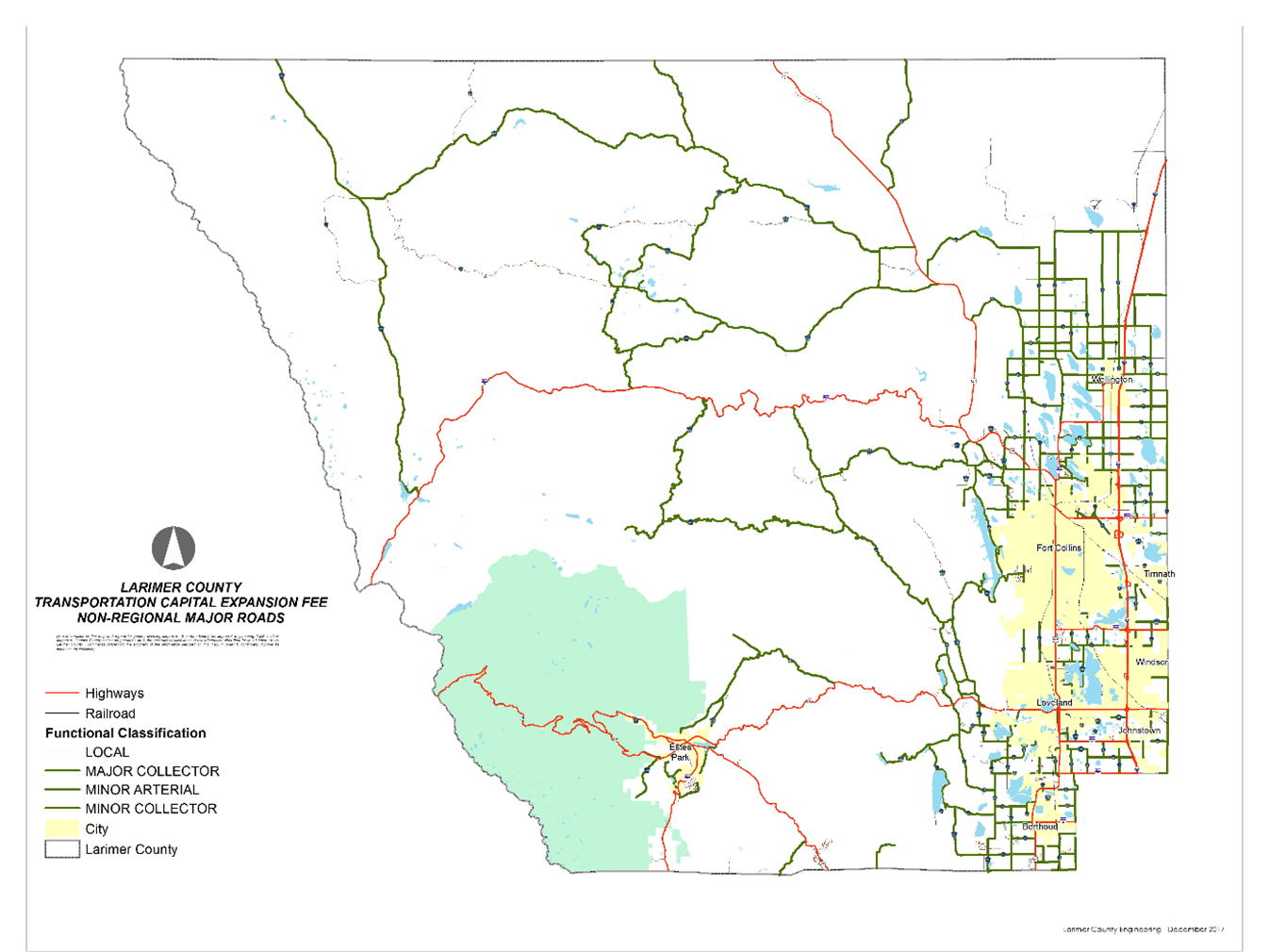
B.
Applicability.
The non-regional road fee regulations apply to all lands in unincorporated Larimer County.
C.
Intent and Purpose.
1.
Intent.
These regulations are intended to implement and be consistent with the Comprehensive Plan and the TMP.
2.
Purpose.
The non-regional road fee regulations establish a system for the imposition of non-regional road capital expansion fees to assure that new development contributes its proportionate share of the cost of providing, and benefits from the provision of, non-regional road capital improvements.
3.
Proportionate Allocation of Costs.
These regulations are intended to be consistent with the principle of allocating a proportionate share of the costs of new public facilities to new growth and development. This fee approaches the problem of determining the proportionate share non-regional road capital expansion fee in a conservative and reasonable manner. This fee will only partially capture the governmental expenditures associated with improving the roads on the non-regional road system.
4.
Technical Support.
These regulations are based primarily upon the TMP, the TCEF, the Comprehensive Plan, and other technical data collected in connection with those documents, all of which are incorporated herein by reference.
5.
Compliance with Law.
These regulations are intended to comply with the provisions of C.R.S. § 29-20-104.5 including without limitation the requirements: (i) that the non-regional road capital expansion fee not be calculated or used to fund existing deficiencies in the non-regional road system, and (ii) that no property owner be required to provide a dedication or improvement for the same improvements funded by the non-regional road capital expansion fee.
D.
Level of Service Standard.
The County Commissioners have determined that Larimer County's non-regional road system will operate at LOS D or better in urban areas and LOS C or better in rural areas.
E.
Imposition of County Fee.
1.
Time of Fee Obligation and Payment.
a.
Any person or governmental body (unless exempted by intergovernmental agreement) who causes the commencement of traffic-generating development will be obligated to pay a non-regional road capital expansion fee consistent with the terms of this regulation.
b.
Except as described in subsection c. below, the fee will be determined and paid to the Fee Administrator at the time of issuance of a building permit, provided, however that the Fee Administrator may delay the duty to pay the fee until the issuance of a certificate of occupancy if the Fee Administrator determines that such delay will not result in a delay in construction of any non-regional road improvement in the benefit area where the property is located.
c.
For traffic-generating development that occurs as a result of a County approval, the fee will be determined and paid to the Fee Administrator at the time agreed upon by the County Commissioners and the applicant as a condition of Larimer County approval, but no earlier than the issuance of a development construction permit for the development containing Larimer County approved activity, if any.
d.
If any credits are due under §15.1.1.B, they will be determined at that time.
e.
If the building permit or approval is for less than the entire development or activity, the fee will be computed separately for the amount of development covered by the permit, or approval.
f.
If the fee is exacted for traffic-generating development that increases traffic impact because of a change in use, the fee will be determined by computing the difference between the fee applicable to the new traffic-generating development and fee applicable to the existing traffic-generating development.
g.
The obligation to pay the transportation capital expansion fee will run with the land.
h.
Any person who has agreed to pay a transportation capital expansion fee pursuant to a previous regulation, or as a condition of development approval, will be responsible for the payment of the fee under the terms of any such previous regulation or agreement, rather than the terms of this non-regional road fee.
2.
Exemptions.
The following types of development and activity are exempt from the terms of the non-regional road fee regulations. An exemption shall be claimed by the fee payer at the time of application for a building permit or development construction permit.
a.
Alteration of an existing building where no additional vehicular trips will be produced over and above that produced by the existing use.
b.
The construction of residential accessory buildings or structures that will not produce additional vehicular trips.
c.
The replacement of a destroyed or partially-destroyed building or structure of the same size and use, provided that no additional trips will be produced above those produced by the original use of the land.
d.
Any affordable housing development specifically exempted by the Board of County Commissioners pursuant to C.R.S. § 29-20-104.5(5).
e.
Home occupation with ten or fewer average daily trip ends, accessory rural occupation with ten or fewer average daily trip ends, and bed and breakfast with six or fewer guests.
3.
Establishment of Fee Schedule.
a.
Any person who causes the commencement of traffic-generating development, except those persons exempted under §15.1.7.E.2 or preparing an independent fee calculation study under §15.1.1.A, shall pay a non-regional road expansion fee in accordance with the road fee schedule.
b.
The fees in the road fee schedule shall be updated annually by the Fee Administrator to reflect changes in road construction costs during the previous year. The updated fees shall become effective on the first day of July. To calculate an updated fee, each fee in the road fee schedule shall be multiplied by a ratio, the numerator of which is the annual eight-quarter moving average in the Colorado Construction Cost Index Report prepared by the Colorado Department of Transportation and the denominator of which is the same index for a period one year earlier than the numerator. If the ratio is less than, or equal to 1.05, the fees in the road fee schedule shall be updated by the Fee Administrator without further action by the County Commissioners. If the ratio is greater than 1.05, the Fee Administrator shall report the ratio to the County Commissioners, and the County Commissioners shall determine the ratio that shall be used to update the fees. All obligations to pay the non-regional road capital expansion fee shall apply to the most recent update of the fees in the road fee schedule.
c.
If a fee is to be paid for mixed uses, then the fee will be determined according to the above schedule by apportioning the space committed to uses specified on the schedule.
d.
If the type of traffic-generating development for which a building permit or other approval is requested is not specified on the fee schedule, the Fee Administrator will determine the fee on the basis of the fee applicable to the most nearly comparable development category on the non-regional road fee schedule. The Fee Administrator will be guided in the selection of a comparable land use by:
i.
Using trip generation rates contained in the most current edition of the report titled "Trip Generation," prepared by the Institute of Transportation Engineers (ITE), articles or reports appearing in the ITE Journal, or studies or reports prepared by the U.S. Department of Transportation or Colorado Department of Transportation, and applying the formula in §15.1.7.F; or
ii.
Computing the fee by use of an independent fee calculation study as provided in §15.1.1.A.
F.
Independent Fee Calculation Study.
1.
General.
a.
The non-regional road capital expansion fee may be computed by the use of an independent fee calculation study per §15.1.1.A based on the standards and calculations provided in this section.
b.
An independent fee calculation may be undertaken at the election of the fee payer, or upon the request of the Fee Administrator for any proposed land development activity that the Fee Administrator determines:
i.
Is not listed on the fee schedule and is not comparable to any land use on the fee schedule, or
ii.
Is likely to generate impacts costing substantially more to mitigate than the amount of the fee that would be generated by the use of the fee schedule, due to its nature, timing, or location.
c.
The preparation of the independent fee calculation study will be the responsibility of, and at the expense of, the electing party.
d.
Any person electing to perform an independent fee calculation study shall pay an application fee for administrative costs associated with the review and decision on such independent fee calculation study.
2.
Formula.
a.
The independent fee calculation study for the non-regional road capital expansion fee will be calculated using the following formula:
Total weekday vehicle trip ends × Trip rate adjustment factor for inbound trips, including pass-by × Average miles per trip × Trip length adjustment factor × Capital (Growth) cost per VMT.
b.
The independent fee calculations will be based on data, information or assumptions in this Code or independent sources. Independent sources may be used, provided that:
i.
The independent source is an accepted standard source of transportation engineering or planning data or information;
ii.
The independent source is a local study on trip characteristics carried out by a qualified traffic planner or engineer under an accepted methodology of transportation planning or engineering; and
iii.
The trip rate adjustment factor used in the independent fee calculation study shall be based on actual surveys conducted in Larimer County.
G.
Use of Fees Collected.
1.
Establishment of Benefit Districts.
a.
For the purpose of ensuring fee payers receive sufficient benefit for fees paid, one road benefit district is established that is the geographic entirety of Larimer County. The benefit districts have been revised from the 2006 Fee Study from four to one district.
b.
Transportation capital expansion fee funds will be spent within the single road benefit district.
2.
Establishment of Trust Fund.
There is hereby established the Larimer County Non-Regional Road Capital Expansion Fee Trust Fund for the purpose of ensuring that fees collected under this Code are designated for the accommodation of impacts reasonably attributable to the proposed traffic-generating development.
3.
Requirements for Trust Fund.
a.
All non-regional road capital expansion fees collected by the Fee Administrator under this Code shall be immediately deposited in the non-regional road capital expansion fee trust fund.
b.
All unspent funds in Larimer County's existing county transportation capital expansion fee trust fund shall remain in those accounts until expended. Such funds shall be expended for purposes that comply with both the requirements of this Code and Larimer County transportation capital expansion fee regulation of under which those funds were collected.
c.
No monies from the trust fund shall be spent for periodic or routine maintenance, rehabilitation, or replacement of any facility of any type, or to address deficiencies in the non-regional road system existing on the effective date of this regulation.
d.
Any proceeds in the trust fund not immediately necessary for expenditure will be invested in an interest-bearing account. All income derived from these investments shall be retained in the trust fund until spent for the same purposes permitted for the remainder of the trust fund deposits.
e.
Proceeds collected and all interest accrued on such funds will be used solely for non-regional road capital facilities on the non-regional road system.
f.
Records of the trust fund accounts will be available for public inspection in the Fee Administrator's office during normal business hours.
H.
Refund of Fees Not Spent.
1.
General.
Pursuant to the process established in §15.1.1.C, any non-regional road capital expansion fees collected, together with interest earned on such fees, will be returned to the fee payer or the fee payer's successor in interest (if the development subject to the fee is sold by the fee payer), if the fees have not been spent within ten years from the date the first building permit for the traffic-generating development was issued (or, if the Fee Administrator agreed to delay collection of the fee until the issuance of a certificate of occupancy, then within ten years from the date of the certificate of occupancy). Fees will be spent on the basis of the first fee collected being the first fee spent.
2.
Prior Rights Continue.
Any person entitled to a refund pursuant to the terms of the non-regional transportation capital expansion fee regulation of 2006 shall retain any such rights notwithstanding the replacement of that earlier regulation with this regulation, and the adoption of this regulation shall not affect the dates upon which any such refund may become due or the procedures that the claimant shall follow in order to obtain a refund.
I.
Mistake or Misrepresentation.
1.
If the non-regional road impact fee is calculated and paid based on a mistake or misrepresentation, it shall be recalculated.
2.
Any amounts overpaid by a fee payer shall be refunded by Larimer County within 30 days after the Fee Administrator's acceptance of the recalculated amount, with interest since the date of such overpayment at the same rate applicable to trust fund deposits since the initial payment was made.
3.
Any amounts underpaid by the fee payer shall be paid to Larimer County within 30 days after the Fee Administrator's notification of the calculated amount, with interest since the date of such underpayment at the same rate applicable to trust fund deposits since the initial payment was made.
4.
In the case of an underpayment to Larimer County, Larimer County shall not issue any additional permits or approvals for the project for which the fees were previously paid until such underpayment is corrected, and if amounts owed to Larimer County are not paid within 60 days after the Fee Administrators notification of the recalculated amount, Larimer County may also repeal any permits issued in reliance on the previous payment of such fees and refund fees received, with interest since the date of the payment, to the then current owner of the land.
J.
Review Every Five Years.
At least once every five years, the Fee Administrator will recommend to the County Commissioners whether any changes should be made to the non-regional road component of the TCEF or this regulation. The Fee Administrator will be assisted by their counterparts in participating local governments. The purpose of this review is to analyze the effects of inflation on actual costs; to assess potential changes in needs; to assess any changes in the characteristics of land uses; and to ensure that the non-regional road capital expansion fees will not exceed a proportionate share of the costs of addressing the impacts of growth and development on non-regional roads as required by applicable law. Any recommended modifications of this regulation as a result of the review shall only be effective following approval by the County Commissioners.
K.
Automatic Annual Adjustments.
The provisions of §15.1.7.I shall not affect the provisions of §15.1.7.E.3.b, which provide for annual adjustments to the fee schedule to reflect changes in construction costs without further action by the County Commissioners.
L.
Severability.
If one or more provisions of this regulation are invalidated by any court of law, those provisions shall be severed from the remainder of this regulation, the validity of the remainder of this regulation shall not be affected, and the invalidated provisions shall be deemed to have been replaced with provisions as close as possible to the intent of the original provisions while correcting for the cause of the invalidation.
15.1.8. - Regional Road Capital Expansion Fee.
A.
Findings.
1.
Successor Regulation.
This regional road capital expansion fee ("regional road fee regulations") is a successor to that Larimer County Road Capital Expansion Fee Regulation adopted by Larimer County in 2006.
2.
New Growth in County.
The Larimer County Transportation Master Plan 2017 (TMP) projects there will be a significant amount of new growth and development in Larimer County in the next 23 years.
3.
Need for Capacity Expansion.
The 2017 Transportation Capital Expansion Fee Study (TCEF) has determined that this new growth and development will require a substantial expansion in road capital facilities if adequate levels of service (LOS) are to be maintained on county roads.
4.
Improvements Needed.
The TMP has identified the cost of growth-related transportation improvements required to maintain adequate levels of service on county roads. In addition, the TCEF has divided Larimer County's road system into "regional" and "non-regional" roads based on the use of the roads.
5.
Proportionate Share Policy.
In order to address this need, the County Commissioners have established a policy that future growth and new development will contribute its proportionate share of the costs of providing capital facilities for regional roads.
6.
Regional Transportation Capital Expansion Fee Preferred.
The County Commissioners have determined that the imposition of a regional road capital expansion fee is one of the preferred methods of regulating new growth and development in Larimer County in order to ensure that new growth and development bears a proportionate share of the costs of capital improvements for regional roads necessary to accommodate new growth and development while at the same time maintaining the adopted LOS on the regional road system and promoting and protecting the public health, safety and welfare.
7.
Consistent with Comprehensive Plan.
A regional road capital expansion fee that contributes to this proportionate share assists in the implementation of and is consistent with the Comprehensive Plan.
8.
Coordinated Provision of Services.
In order to implement a region-wide regional road capital expansion fee system, the County Commissioners have and will pursue the establishment of intergovernmental agreements with the other local governments in the region that results in those municipalities' participation and cooperation by adoption of a regional road capital expansion fee to accommodate new development within their jurisdictions, of by the adoption of other methods to contribute their proportionate share of funds.
9.
Compliance with Applicable Law.
The County Commissioners have determined that the TMP, the TCEF, and this regulation comply with the requirements of C.R.S. § 29-20-104.5 and other applicable law.
Figure 15-2: Regional Road System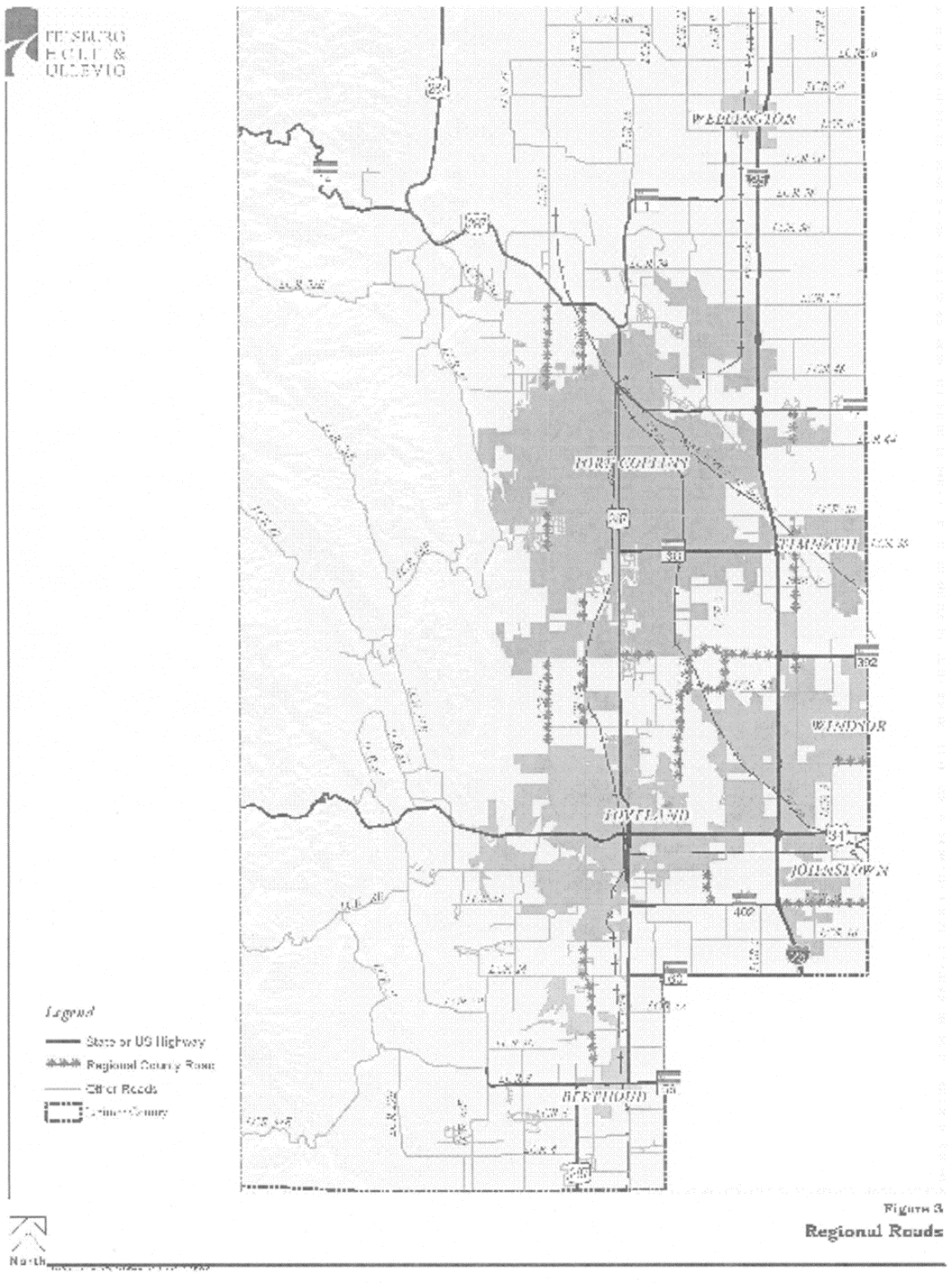
B.
Applicability.
This regional road capital expansion fee applies to all lands within unincorporated Larimer County and, under intergovernmental agreements, all other lands within the boundaries of the participating local governments.
C.
Intent and Purpose.
1.
Intent.
These regional road fee regulations are intended to implement and be consistent with the Comprehensive Plan and the TMP.
2.
Purpose.
This section establishes of a system for the imposition of regional road capital expansion fees to assure that new development contributes its proportionate share of the cost of providing, and benefits from the provision of, regional road capital improvements.
3.
Proportionate Allocation of Costs.
These regulations are intended to be consistent with the principle of allocating a proportionate share of the costs of new public facilities to new growth and development. It approaches the problem of determining the proportionate share regional road capital expansion fee in a conservative and reasonable manner. This fee will only partially capture the governmental expenditures associated with improving the roads on the regional road system.
4.
Technical Support.
The regional road fee is based primarily upon the TMP, the TCEF, the master plan, and other technical data collected in connection with those documents, all of which are incorporated herein by reference.
5.
Compliance with Law.
Regional road fee is intended to comply with the provisions of C.R.S. § 29-20-104.5 including without limitation the requirements (i) that the regional road capital expansion fee not be calculated or used to fund existing deficiencies in the regional road system, (ii) that no property owner be required to provide a dedication or improvement for the same improvements funded by the regional road capital expansion fee.
D.
Intergovernmental Agreement.
1.
In order to implement a region-wide regional road capital expansion fee program, Larimer County has and intends to enter into intergovernmental agreements with the other local governments in the region that result in those municipalities' participation and cooperation by adoption of a regional road capital expansion fee to accommodate new development within their jurisdictions to maintain the adopted LOS on the regional road system.
2.
The intergovernmental agreements shall provide for adoption and implementation of a regional road capital expansion fee regulation similar to this regulation by the other local governments in Larimer County, or for the collection of funds equivalent to those fees from other sources consistent with applicable law, and procedures for regional cooperation in the effort to plan for, fund, and construct regional road capital improvements.
3.
The intergovernmental agreements shall provide the County Commissioners the authority to coordinate the joint efforts of the participating local governments in this effort and to coordinate the administration of the regional road capital expansion fee program.
4.
The intergovernmental agreements shall provide that the County Commissioners appoint a Regional Road Capital Expansion Fee Administrator (the "Fee Administrator") who will be responsible for the administration of the regional road capital expansion fee program, with assistance from each of the participating local governments.
E.
Level of Service Standard (LOS).
The County Commissioners have determined that the regional road system will operate at LOS-D or better.
F.
Imposition of Regional Fee.
1.
Time of Fee Obligation and Payment.
a.
Any person or governmental body (unless exempted by intergovernmental agreement) who causes the commencement of traffic-generating development will be obligated to pay a regional road capital expansion fee consistent with the terms of this section.
b.
Except as described in §15.1.8.F.1 below, the fee will be determined and paid to the Fee Administrator at the time of issuance of a building permit, provided, however that the Fee Administrator may delay the duty to pay the fee until the issuance of a certificate of occupancy if the Fee Administrator determines that such delay will not result in a delay in construction of any regional road improvement in the benefit area where the property is located.
c.
For traffic-generating development that occurs as a result of a County approval, the fee will be determined and paid to the Fee Administrator at the time agreed upon by the County Commissioners and the applicant as a condition of Larimer County approval, but no earlier than the issuance of a development construction permit for the development containing Larimer County approved activity, if any.
d.
If any credits are due under §15.1.1.B, they will also be determined at that time.
e.
If the building permit or approval is for less than the entire development or activity, the fee will be computed separately for the amount of development covered by the permit, or approval.
f.
If the fee is exacted for traffic-generating development that increases traffic impact because of a change in use, the fee will be determined by computing the difference between the fee applicable to the new traffic-generating development and fee applicable to the existing traffic-generating development.
g.
The obligation to pay the transportation capital expansion fee will run with the land.
h.
Any person who, prior to the effective date of this regulation, agreed to pay a transportation capital expansion fee pursuant to a previous regulation, or as a condition of development approval, will be responsible for the payment of the fee under the terms of any such previous regulation or agreement, rather than the terms of this regulation.
2.
Exemptions.
The following types of development and activity are exempt from the terms of the regional road fee regulations. An exemption shall be claimed by the fee payer at the time of application for a building permit or development construction permit.
a.
Alteration of an existing building where no additional vehicular trips will be produced over and above that produced by the existing use.
b.
The construction of residential accessory buildings or structures that will not produce additional vehicular trips.
c.
The replacement of a destroyed or partially-destroyed building or structure of the same size and use, provided that no additional trips will be produced above those produced by the original use of the land.
d.
Any affordable housing development specifically exempted by the Board of County Commissioners pursuant to C.R.S. § 29-20-104.5(5).
e.
Home occupation with ten or fewer average daily trip ends, accessory rural occupation with ten or fewer average daily trip ends, and bed and breakfast with six or fewer guests.
3.
Establishment of Fee Schedule.
a.
Any person who causes the commencement of traffic-generating development, except those persons exempted under §15.1.8.F.2 or preparing an independent fee calculation study under §15.1.8.G, shall pay a regional road capital expansion fee in accordance with the road fee schedule.
b.
The fees in the road fee schedule shall be updated annually by the Fee Administrator to reflect changes in road construction costs during the previous year. The updated fees shall become effective on the first day of July. To calculate an updated fee, each fee in the road fee schedule shall be multiplied by a ratio, the numerator of which is the annual eight-quarter moving average in the Colorado Construction Cost Index Report prepared by the Colorado Department of Transportation and the denominator of which is the same index for a period one year earlier than the numerator. If the ratio is less than, or equal to 1.05, the fees in the road fee schedule shall be updated by the Fee Administrator without further action by the County Commissioners. If the ratio is greater than 1.05, the Fee Administrator shall report the ratio to the County Commissioners, and the County Commissioners shall determine the ratio that shall be used to update the fees. All obligations to pay the regional road capital expansion fee shall apply to the most recent update of the fees in the road fee schedule.
c.
If a fee is to be paid for mixed uses, the fee will be determined according to the above schedule by apportioning the space committed to uses specified on the schedule.
d.
If the type of traffic-generating development for which a building permit or other approval is requested is not specified on the fee schedule, the Fee Administrator will determine the fee on the basis of the fee applicable to the most nearly comparable development category on the regional road fee schedule. The Fee Administrator will be guided in the selection of a comparable land use by:
i.
Using trip generation rates contained in the most current edition of the report titled "Trip Generation," prepared by the Institute of Transportation Engineers (ITE), articles or reports appearing in the ITE Journal, or studies or reports prepared by the U.S. Department of Transportation or Colorado Department of Transportation, and applying the formula in §15.1.8.G.2; or
ii.
Computing the fee by use of an independent fee calculation study as provided in §15.1.8.G.
G.
Independent Fee Calculation Study.
1.
General.
a.
The regional road capital expansion fee may be computed by the use of an independent fee calculation study per §15.1.1.A based on the standards and calculations provided in this section.
b.
The independent fee calculation study shall be created either at the election of the fee payer or upon the request of the Fee Administrator for any proposed land development activity that the Fee Administrator determines:
i.
Is not listed on the fee schedule and is not comparable to any land use on the fee schedule, or
ii.
Is likely to generate impacts costing substantially more to mitigate than the amount of the fee that would be generated by the use of the fee schedule, due to its nature, timing, or location.
c.
The preparation of the independent fee calculation study will be the responsibility of, and at the expense of, the electing party.
d.
Any person electing to perform an independent fee calculation study shall pay an application fee for administrative costs associated with the review and decision on such independent fee calculation study.
2.
Formula.
a.
The independent fee calculation study for the regional road capital expansion fee will be calculated using the following formula:
Total weekday vehicle trip ends × Trip rate adjustment factor for inbound trips, including pass-by × Average miles per trip × Trip length adjustment factor × Capital (Growth) cost per VMT.
b.
The independent fee calculations will be based on data, information or assumptions in this regulation or independent sources. Independent sources may be used, provided that:
i.
The independent source is an accepted standard source of transportation engineering or planning data or information; and
ii.
The independent source is a local study on trip characteristics carried out by a qualified traffic planner or engineer under an accepted methodology of transportation planning or engineering; and
iii.
The trip rate adjustment factor used in the independent fee calculation study shall be based on actual surveys conducted in Larimer County.
H.
Use of Fees Collected.
1.
Single Benefit District.
a.
Because the TMP and TCEF show widespread use of the regional road system by all portions of Larimer County, all of the unincorporated area within Larimer County is hereby designated as the regional road capital expansion fee benefit district. This single benefit district is the same as the single benefit district established by the regional transportation capital expansion fee regulation of 2006 that this regulation replaces.
b.
Regional road capital expansion fee funds shall be spent within the single regional road benefit district.
2.
Establishment of Trust Fund.
There is hereby established the Larimer County Regional Road Capital Expansion Fee Trust Fund for the purpose of ensuring that fees collected under this regulation are designated for the accommodation of impacts reasonably attributable to the proposed traffic-generating development.
3.
Requirements for Trust Fund.
a.
All regional road capital expansion fees collected by the Fee Administrator under this regulation shall be immediately deposited in the regional road capital expansion fee trust fund.
b.
No monies from the trust fund shall be spent for periodic or routine maintenance, rehabilitation, or replacement of any facility of any type, or to address deficiencies in the regional road system existing on the effective date of this regulation.
c.
Any proceeds in the trust fund not immediately necessary for expenditure will be invested in an interest-bearing account. All income derived from these investments shall be retained in the trust fund until spent for the same purposes permitted for the remainder of the trust fund deposits.
d.
Proceeds collected and all interest accrued on such funds will be used solely for regional road capital facilities on the regional road.
e.
Records of the trust fund accounts will be available for public inspection in the Fee Administrator's office during normal business hours.
4.
Intergovernmental Agreement.
Each participating local government will also establish a trust fund into which regional road capital expansion fees collected by that government will be deposited. The procedures for control and expenditure of these funds will be established in the intergovernmental agreements.
I.
Refund of Fees Not Spent.
1.
General.
Any regional road capital expansion fees collected, together with interest earned on such fees, will be returned to the fee payer or the fee payer's successor in interest (if the development subject to the fee is sold by the fee payer), if the fees have not been spent within ten years from the date the first building permit for the traffic-generating development was issued (or, if the Fee Administrator agreed to delay collection of the fee until the issuance of a certificate of occupancy, then within ten years from the date of the certificate of occupancy). Fees will be spent on the basis of the first fee collected being the first fee spent.
2.
Prior Rights Continue.
Any person entitled to a refund pursuant to the terms of the regional transportation capital expansion fee regulation of 2006 shall retain any such rights notwithstanding the replacement of that earlier regulation with this regulation, and the adoption of this regulation shall not affect the dates upon which any such refund may become due or the procedures that the claimant must follow in order to obtain a refund.
J.
Mistake or Misrepresentation.
1.
If the regional road impact fee is calculated and paid based on a mistake or misrepresentation, it shall be recalculated.
2.
Any amounts overpaid by a fee payer shall be refunded by Larimer County within 30 days after the Fee Administrator's acceptance of the recalculated amount, with interest since the date of such overpayment at the same rate applicable to trust fund deposits since the initial payment was made.
3.
Any amounts underpaid by the fee payer shall be paid to Larimer County within 30 days after the Fee Administrator's notification of the calculated amount, with interest since the date of such underpayment at the same rate applicable to trust fund deposits since the initial payment was made.
4.
In the case of an underpayment to Larimer County, Larimer County shall not issue any additional permits or approvals for the project for which the fees were previously paid until such underpayment is corrected, and if amounts owed to Larimer County are not paid within 60 days after the Fee Administrator's notification of the recalculated amount, Larimer County may also repeal any permits issued in reliance on the previous payment of such fees and refund fees received, with interest since the date of the payment, to the then current owner of the land.
K.
Review Every Five Years.
At least once every five years, the Fee Administrator will recommend to the County Commissioners whether any changes should be made to the regional road component of the TCEF or this regulation. The Fee Administrator will be assisted by their counterparts in participating local governments. The purpose of this review is to analyze the effects of inflation on actual costs; to assess potential changes in needs; to assess any changes in the characteristics of land uses; and to ensure that the regional road capital expansion fees will not exceed a fair share of the costs of addressing the impacts of growth and development on regional roads as required by applicable law. Any recommended modifications of this regulation as a result of the review shall only be effective following approval by the County Commissioners.
L.
Automatic Annual Adjustments.
The provisions of §15.1.8.J above shall not affect the provisions of §15.1.8.F.3.b, which provide for annual adjustments to the fee schedule to reflect changes in construction costs without further action by the County Commissioners.
M.
Severability.
If one or more provisions of this regulation are invalidated by any court of law, those provisions shall be severed from the remainder of this regulation, the validity of the remainder of this regulation shall not be affected, and the invalidated provisions shall be deemed to have been replaced with provisions as close as possible to the intent of the original provisions while correcting for the cause of the invalidation.
15.1.9. - Right-of-Way Dedications.
A.
Purpose.
The purpose of right-of-way dedications is to provide adequate roadways for safe and convenient access to all development.
B.
Applicability.
Right-of-way dedications apply to all applications for conservation development, subdivision, minor land division, rural land plan, administrative special review, special review, and site plan review submitted under this Code.
C.
Dedications Required.
Sufficient right-of-way for all county roads shall be dedicated to Larimer County by the property owner(s) for each development proposal to meet the minimum right-of-way standards cited in the Rural Area Road Standards or the Urban Area Street Standards, as appropriate. Sufficient right-of-way for all state and federal highways shall be dedicated to the Colorado Department of Transportation by the property owner(s) for each development proposal consistent with the recommendations of the Colorado Department of Transportation.
D.
Dedication Process.
Right-of-way dedications for all conservation developments, subdivisions, rural land plans, and minor land divisions shall appear on the final plat prior to recording. Right-of-way dedications for administrative special reviews, special reviews, and site plan reviews shall be accomplished by a properly executed deed of dedication at the time of final approval. The wording for dedication statements is included in the technical supplement to the code.
E.
Dedication for a Land Division.
All road rights-of-way in conservation developments, subdivisions, minor land divisions, and rural land use plans shall be dedicated for public use. Internal land division roads may be private if specifically approved by the County Commissioners and noted in the project development agreement per §6.3.9.H.

