
League City City Zoning Code
ARTICLE II
ADMINISTRATION, APPLICATIONS, AND PROCEDURES
Sec. 125-2.1.- City planner.
125-2.1.1.
Designation. The city administrator shall designate the city planner to whom reference is made throughout this chapter.
125-2.1.2.
Delegation. Where this chapter assigns a responsibility, power, or duty to the city planner, the city planner may delegate that responsibility, power, or duty to any other agent or employee of the city.
125-2.1.3.
Appointment of interim. In the event the position of city planner is unfilled for a period of more than 15 days, the city administrator shall appoint an interim city planner, who shall temporarily assume the responsibilities specified in this chapter until a new city planner is appointed.
125-2.1.4.
Powers and Responsibilities. The city planner or designee shall perform the duties and possess the powers as follows:
(a)
Make written administrative interpretations of this chapter; and
(b)
Review and make recommendations on site development plans, rezoning, text amendments, planned unit developments, special use permits and variances.
(c)
Performs the duties as necessary and appropriate to uphold the provisions of the chapter.
125-2.1.5.
Limited nonconformance approval. The city planner is authorized to approve building permit applications, including a site plans associated therewith, that while do not exactly conform with all applicable provisions of this chapter do substantially comply to the regulations, provided that all of the following criteria are met:
(a)
The nonconformance is minor and is not contrary to the public interest nor the spirit of chapter 125;
(b)
The nonconformance results from an inability to strictly comply which could not have been reasonably foreseen prior to the design of the project and submittal to the city of a building permit application;
(c)
Allowing the nonconformance would facilitate the meeting of an enhanced standard found in another provision of the development regulations, resulting in an otherwise superior project;
(d)
The nonconformance is not related to:
(1)
A required building setback of five feet or less; or
(2)
Modifying or encroaching upon an easement unless written consent is obtained from all holders of interest therein;
(e)
The nonconformance is not of a magnitude that would require a variance to allow under this chapter; and
(f)
The city planner consults with the executive director of development services and the city engineer before approving any applications authorized by this subsection.
(g)
Any nonconformance in a building permit that is approved pursuant to this section shall be considered site specific and such approval shall have no precedential value in the consideration of other building permit applications.
125-2.1.6.
Appeal of administrative. Appeal from any administrative decision of the city planner or designee shall follow the procedures established in section 125-2.3.5.
(Ord. No. 2020-25, § 1(Exh. A), 9-29-2020)
Sec. 125-2.2. - Building official.
125-2.2.1.
Designation. The city administrator shall designate the building official for the city who shall be the building official to whom reference is made throughout this chapter.
125-2.2.2.
Delegation. Where this chapter assigns a responsibility, power, or duty to the building official, the building official may delegate that responsibility, power or duty to any other agent or employee of the city.
125-2.2.3.
Powers and duties. The building official shall perform the duties and possess the powers set forth in this chapter, including the authority to issue building permits, certificates of occupancy, and sign permits.
125-2.2.4.
Appeal. Appeal from any administrative decision of the building official shall follow the procedures established in section 125-2.3.
(Ord. No. 2020-25, § 1(Exh. A), 9-29-2020)
Sec. 125-2.3. - Board of adjustment.
125-2.3.1.
The board of adjustment is authorized in appropriate cases and subject to appropriate conditions and safeguards, to make variances to the terms of the zoning regulations that are consistent with the general purpose and intent of this chapter and in accordance with any applicable rules contained in this chapter.
125-2.3.2.
Membership. The board of adjustment must consist of at least five members to be appointed for terms of two years. In addition, two alternate members of the board shall be appointed for two-year terms. Such alternate board member(s) shall have authority to participate in any meeting when the attendance of such alternates(s) is required to obtain a quorum for the conduct of business of the board.
125-2.3.3.
Appointment. The city council must provide the procedure for appointment. The city council may authorize each member of the council, including the mayor, to appoint one member to the board.
(a)
The city council may remove a board member for cause, as found by the council, on a written charge after a public hearing. A vacancy on the board shall be filled for the unexpired term.
(b)
The city council may provide for the appointment of alternate board members to serve in the absence of one or more regular members when requested to do so by the mayor or city administrator. An alternate member serves for the same period as a regular member and is subject to removal in the same manner as a regular member. A vacancy among the alternate members is filled in the same manner as a vacancy among the regular members.
125-2.3.4.
Quorum. Each case before the board of adjustment must be heard by at least 75 percent of the members.
125-2.3.5.
Meetings. The board shall comply with the following:
(a)
The board by majority vote shall adopt its own rules or procedure in accordance with V.T.C.A., Local Government Code Ch.211.
(b)
Meetings of the board shall comply with the provisions of V.T.C.A., Local Government Code Ch. 551 (The Open Meetings Act) and V.T.C.A., Local Government Code Ch. 552 (The Public Information Act).
(c)
V.T.C.A., Local Government Code Ch. 171 shall govern the regulation of conflicts of interest of any member of the board.
(d)
Except for public hearings, no member of the public shall speak at a board meeting unless invited to do so by the board.
(e)
The board shall keep minutes of its proceedings that indicate the vote of each member on each question or the fact that a member is absent or fails to vote. The board shall keep records of its examinations and other official actions. The minutes and records shall be filed immediately in the board's office and are public records.
125-2.3.6.
Authority of the board. The board of adjustment may:
(a)
Hear and decide an appeal that alleges error in an order, requirement, decision, or determination made by an administrative official in the enforcement of the zoning regulations;
(b)
Hear and decide variances to the terms of the zoning regulations when the ordinance requires the board to do so;
(c)
Authorize in specific cases a variance from the terms of the zoning regulations if the variance is not contrary to the public interest and, due to special conditions, a literal enforcement of the ordinance would result in unnecessary hardship, and so that the spirit this chapter is observed and substantial justice is done; and
(d)
Hear and decide other matters authorized by city council.
125-2.3.7.
Decisions by the board.
(a)
In exercising its authority, the board may reverse or affirm, in whole or in part, or modify the administrative official's order, requirement, decision, or determination from which an appeal is taken and make the correct order, requirement, decision, or determination, and for that purpose the board has the same authority as the administrative official.
(b)
The concurring vote of 75 percent of the members of the board is necessary to:
(1)
Reverse an order, requirement, decision, or determination of an administrative official;
(2)
Decide in favor of an applicant on a matter on which the board is required to pass under the zoning regulations; or
(3)
Authorize a variation from the terms of the zoning regulations.
125-2.3.8.
Appeal to board of adjustment.
(a)
Any of the following persons may appeal to the board of adjustment a decision made by an administrative official:
(1)
Person aggrieved by the decision which is defined to mean a person who provides some showing that he or she has suffered some unique harm or damage that is different from the harm or damage, if any, suffered by other members of the general public; or
(2)
Any officer, department, board, or commission of the city affected by the decision.
(b)
The appellant must file with the board and the official from whom the appeal is taken a notice of appeal specifying the grounds for the appeal. In order to appeal a decision by an administrative official, the appellant must submit the application, fee and all relevant documents to the planning department within ten days of the administrative official's action. On receiving the notice, the official from whom the appeal is taken shall immediately transmit to the board all the papers constituting the record of the action that is appealed.
(c)
An appeal stays all proceedings in furtherance of the action that is appealed unless the official from whom the appeal is taken certifies in writing to the board facts supporting the official's opinion that a stay would cause imminent peril to life or property. In that case, the proceedings may be stayed only by a restraining order granted by the board or a court of record on application, after notice to the official, if due cause is shown.
(d)
The board shall set a reasonable time for the appeal hearing and shall give public notice of the hearing and due notice to the parties in interest. A party may appear at the appeal hearing in person or by agent or attorney. The board shall decide the appeal within a reasonable time.
(e)
Rulings on appeals to the board of adjustment are not intended to serve as precedent for any subsequent interpretations which shall be made on a case-by-case basis.
125-2.3.9.
Limitation on reconsideration. When the board of adjustment issues a decision on an appeal, a variance application or on any other matter the board is authorized to hear, the board may not reconsider such matter for a period of 12 months of the date of the board's action unless the board has denied the requested action without prejudice; provided, however, on receipt of written request by the original appellant describing substantially changed conditions in the community since prior consideration of the proposal so as to justify an earlier review of the matter, the board may waive the 12-month delay period and authorize the reconsideration of the matter.
125-2.3.10.
Appeal from the decisions by the board of adjustment. An appeal of a decision by the board of adjustment must be filed with a court of competent jurisdiction within ten days after the decision is filed in the board office.
(Ord. No. 2020-25, § 1(Exh. A), 9-29-2020)
Sec. 125-2.4. - Historic commission.
125-2.4.1.
The historic commission, originally created by ordinance 97-38, is continued and confirmed, subject to this chapter.
125-2.4.2.
Membership. The historic commission has seven regular members and one architectural advisory member. Appointments, terms of office, administrative provisions, etc. are prescribed by chapter 2, article VIII of the City Code of Ordinances. To be considered for appointment, a person must demonstrate an established interest in historical preservation, by residence, investment, education, training, study or vocation. In addition, the following criteria shall be taken into account for appointments:
(a)
Membership in the League City Historical Society;
(b)
Residence in an Historic Conservation Overlay District;
(c)
Ownership of property in an Historic Conservation Historic District;
(d)
Knowledge and experience of architectural, cultural, social, economic, ethnic, and political history of the city; and
(e)
For the architectural advisory member, relevant professional credentials and experience in historic preservation.
125-2.4.3.
Quorum. A quorum is a majority of the regular members appointed and qualified (excluding vacant positions), but never fewer than three. When a quorum is present, a simple majority of the regular members present may act on behalf of the commission.
125-2.4.4.
Designation of officers. The commission shall designate a presiding officer and a vice presiding officer from among its regular members.
(a)
The commission may:
(1)
Designate other officers, including acting officers;
(2)
Designate special advisors to the commission; and
(3)
Remove or replace any of its designees at any time.
(b)
Unless sooner removed or replaced, a designee serves until the end of the designee's term of office as a member of the commission (and thereafter until a successor is designated).
125-2.4.5.
Meetings. The commission shall schedule one regular meeting per month. The presiding officer, or a majority of the regular members appointed and qualified (excluding vacant positions), may call special meetings or cancel or re-schedule any meeting. The commission shall:
(a)
Adopt rules for the conduct of its meetings and other business;
(b)
Keep minutes of its meetings; and
(c)
File copies of its minutes with the city secretary and the Texas Historical Commission (for the commission's certified local government file).
125-2.4.6.
Powers and duties. The historic commission shall perform the duties and possess the powers as set forth in this chapter, including issuance of certificates of appropriateness (refer to section 3.12 Historic Overlay District). The commission shall also:
(a)
Familiarize itself with buildings, structures, sites, districts, areas and lands within the city;
(b)
Make recommendations regarding Historic Conservation Overlay Districts, including designation, changes and regulations;
(c)
Recommend private and public action for historic preservation and restoration, including not only expenditures but also incentives such as waiving or abating fees, charges or taxes or freezing tax values;
(d)
Submit preservation plans and other material for inclusion in the city comprehensive plans;
(e)
Annually review preservation plans and the state of development and preservation in Historic Conservation Overlay District and report the results to the city council and the Texas Historical Commission;
(f)
Appropriate cases, including cases of undue hardship, recommend variances and changes in preservation regulations to city officers and agencies.
125-2.4.7.
Historic preservation officer. The city administrator shall appoint a qualified city official or staff person to serve as historic preservation officer for the city. The historic preservation officer shall:
(a)
Administer the city's historic preservation ordinances;
(b)
Advise the historic commission;
(c)
Coordinate the city's preservation historic activities with those of state and federal agencies (including the Texas Historical Commission and the National Park Service) and with local, state and national non-profit historic preservation organizations; and
(d)
Make historic preservation regulations available to owners and other affected persons.
(Ord. No. 2020-25, § 1(Exh. A), 9-29-2020)
Sec. 125-2.5. - Planning and zoning commission.
125-2.5.1.
Creation. A League City Planning and Zoning Commission (the commission) is hereby created with authority as established in V.T.C.A., Local Government Code § 211.007.
125-2.5.2.
Members and quorum. Members of the League City Planning and Zoning Commission as of the effective date of this chapter shall be reappointed and reaffirmed as members of the commission. The commission shall operate using the bylaws adopted by the commission and approved by city council, and shall for parliamentary procedures purposes, be governed by Robert's Rules of Order.
125-2.5.3.
Powers and Duties. The Commission shall perform the duties and possess the powers as set forth in this chapter, including recommendations to city council for final action on rezoning, text amendments, and major development applications. At the discretion of the city council, the commission shall also have the duty and responsibility to:
(a)
Perform and carry out the duties as prescribed in this section relative to the commission.
(b)
Hear testimony on behalf of the applicants and consider the facts, findings, and recommendation of the city planner or designee.
(c)
Identify the appropriateness of requested rezoning issues and text amendments considering conformance with adopted zoning regulations, official zoning map, and comprehensive plan.
(d)
Interpret zoning district boundaries in cases of conflict or question.
(e)
Make determinations as to the appropriate zoning district for new and unlisted uses.
(f)
Make recommendations to the city council, in the form of a "Final Report," related to approval or denial of an application in addition to stating the reasons for such approval or denial.
(g)
Maintain compliance with V.T.C.A., Local Government Code Ch. 551, Open Meetings Act, as may be amended from time to time.
(h)
Make, amend, extend, and add to the master plan for the physical development of the city.
(i)
Perform other such duties and be vested with such powers as the city council shall from time to time prescribe.
125-2.5.4.
Appeals. Any party aggrieved by the actions of the commission may appeal such action to the city council as per city policy.
(Ord. No. 2020-25, § 1(Exh. A), 9-29-2020)
Sec. 125-2.6. - City council.
125-2.6.1.
Powers and duties. City council shall perform the duties and possess the powers as set forth in this chapter and in accordance with the Texas Local Government Code, including final action on rezoning, text amendments, and major development applications.
125-2.6.2.
Appeal. Any party aggrieved by city council's actions may appeal such action to the court of record.
(Ord. No. 2020-25, § 1(Exh. A), 9-29-2020)
Sec. 125-2.7. - Remedies and enforcement powers.
125-2.7.1.
Violations. Any person violating any provision of this chapter or failing to comply with any requirement of this chapter will be guilty of a misdemeanor and subject to a fine not to exceed the maximum allowed by law. Each day during or upon which such person shall violate or continue to violate any provision of this chapter or shall fail to comply with any requirement of this chapter shall constitute a distinct and separate offence. The violation of any provision of this chapter or failure to comply with any requirements of this chapter shall each constitute a distinct and separate offense. In particular, it is unlawful for any person:
(a)
To make use of any premises for a purpose other than what is permitted in the zoning district in which the premises is located.
(b)
To erect, construct, convert, enlarge, reconstruct, repair, structurally alter, maintain or any use any building or structure for a purpose other than what is permitted in the zoning district where the building or structure is located, subject to the provisions of nonconformities.
(c)
To construct or locate more than one single-family detached dwelling or more than one two-family dwelling on one platted lot.
(d)
That owns, occupies, or controls any premises containing a dwelling unit to knowingly cause or allow the dwelling unit to be permanently occupied by more than one family at any one time. For purposes of this provision a family is permanently occupying the premises if it continuously occupies the dwelling unit for more than 30 days.
125-2.7.2.
Enforcement. If a building or other structure is erected, constructed, reconstructed, altered, repaired, converted, or maintained or if a building, other structure or land is used in violation of this chapter, the city may institute appropriate action to:
(a)
Prevent unlawful erection, construction, reconstruction, alteration, repair, conversion, maintenance or use;
(b)
Restrain, correct, or abate the violation;
(c)
Prevent the occupancy of the building, structure, or land; or
(d)
Prevent any illegal act, conduct business, or use on or about the premises.
(Ord. No. 2020-25, § 1(Exh. A), 9-29-2020)
Sec. 125-2.8. - Applications and procedures.
125-2.8.1.
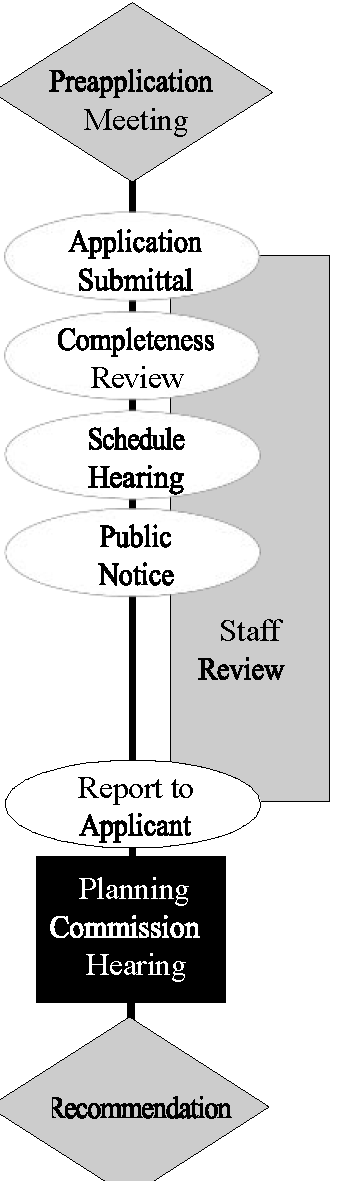
Pre-application meeting. Prior to the submission of an application required by this chapter a prospective applicant may request a review by the city planner or designee and representatives from other city departments, as appropriate, to discuss procedures, standards, or regulations required by this chapter. A pre-application meeting is required for major development applications including subdivisions and planned unit developments. Upon receipt of such request, the city planner or designee, or building official, as appropriate, shall afford the potential applicant an opportunity for such a pre-application meeting at the earliest reasonable time.
There is no fee associated with a request for a pre-application meeting; however, additional requests for a pre-application meeting for the same site within a period of one year from the date of the initial meeting may incur a fee associated with any city costs to do so.
125-2.8.2.
Application forms and fees. The following regulations shall apply to all applications.
(a)
Forms. Applications shall be submitted on forms and in such numbers as required by the city.
(b)
Primary contact. For all applications, a single agent shall be identified for all official communications with the city. The agent may be either the applicant / property owner or a representative of the applicant/property owner. If a contact is not specified, the applicant shall be considered the primary contact.
(c)
Fees. Filing fees shall be established from time to time by the city administrator to defray the actual cost of processing the application.
125-2.8.3.
Review of plans. All development is subject to development review in accordance with this section.
(Ord. No. 2020-25, § 1(Exh. A), 9-29-2020)
Sec. 125-2.9. - Written interpretations.
125-2.9.1.
Authority. The city planner or designee shall have authority to make written interpretations of this chapter.
125-2.9.2.
Request for interpretation. A written request for interpretation shall be submitted to the city planner or designee.
125-2.9.3.
Interpretation by the city planner. The city planner or designee shall take the following steps:
(a)
Review and evaluate the request in light of the text of this chapter, the official zoning map and any other relevant information;
(b)
Consult with other staff, as necessary; and
(c)
Render an opinion.
(d)
The interpretation shall be provided to the applicant in writing.
125-2.9.4.
Official record. The city planner or designee shall maintain an official record of interpretations which shall be available for public inspection during normal business hours.
125-2.9.5.
Appeals. Appeal from any administrative decision of the city planner or designee shall follow the procedures established in section 125-2.3.
(Ord. No. 2020-25, § 1(Exh. A), 9-29-2020)
Sec. 125-2.10. - Building permit.
125-2.10.1.
Creation of building site. No permit for the construction of a building upon any tract or plot shall be issued until a building site or lot has been created by compliance with the following conditions:
(a)
The lot or tract is part of a plat of record, properly approved and recorded in accordance with state law, city ordinances and other applicable laws and regulations.
(b)
All utility and drainage easements, alleys, streets and other public improvements necessary to meet the normal requirements for platting shall be provided, including the designation of building areas and easements, alleys and streets that have been properly dedicated, and the necessary public improvements.
125-2.10.2.
Permit for construction.
(a)
No permit for the erection, alteration, reconstruction, conversion or use of any building shall be issued by the building official without the applicant submitting a plan, drawn to scale, correctly showing the location and actual dimensions of such building and accessory buildings, with measurements from all lot lines to all foundation lines of buildings.
(b)
In addition, the applicant shall provide a true statement, signed by the applicant, showing the use and occupancy for which such buildings are intended.
(c)
No permit shall be issued by the building official unless such plan shall show in every detail that such building is to be erected and used in conformity with all the provisions of this article.
(d)
A record of such application and plans shall be kept in the office of the building official. An approved set of building plans, including a site plan, shall remain on the job site at all times and shall be available to the inspector upon his or her request. Failure of any applicant or of his agents or employees to erect, alter, move or maintain any buildings in conformance with such plans on which such permit is issued, shall render such permit void. The building official is hereby authorized and directed to revoke any such permit by giving written notice to the applicant or his agents or employees, and all work upon such building shall be immediately discontinued on the serving of such notice until such buildings shall be changed so as to comply with such plans and permits.
125-2.10.3.
Referral to other city planner. If any of the following conditions apply the building department shall refer the applicant to the city planner or designee for review of the project by the city staff:
(a)
The value of the building is increased more than 50 percent;
(b)
The footprint of the building is changed;
(c)
The usable square footage increases by ten percent or more;
(d)
The use changes from a commercial, industrial, residential or public service category to another category;
(e)
The alteration, reconstruction, or conversion impacts traffic, drainage, utilities, or parking as determined by city staff.
(Ord. No. 2020-25, § 1(Exh. A), 9-29-2020)
Sec. 125-2.11. - Commercial and industrial operations permit.
All commercial and industrial development shall be required to obtain an operations permit in accordance with chapter 26, article V.
(Ord. No. 2020-25, § 1(Exh. A), 9-29-2020)
Sec. 125-2.12. - Flood damage prevention permit.
All development in areas of special flood hazard shall be required to obtain a development permit in accordance with chapter 50, article II, division 2.
(Ord. No. 2020-25, § 1(Exh. A), 9-29-2020)
Sec. 125-2.13. - Site development plan review.
125-2.13.1.
Master development plan. A master development plan must be provided for all business and commercial projects to be developed in phases or sections.
(a)
Filing procedures.
(1)
The master plan shall be approved by the planning and zoning commission in concept only. This master plan shall be submitted and approved prior to or with the first section of development of the site and shall accompany submission of all sections thereafter. All properties within a single site must be contiguous and immediately adjacent to one another or be the subject of additional development plans and filing fees.
(2)
One reproducible polyester film of the signed master development plan will be filed with the city planner or designee and shall remain on file for the use of any person who may be interested in the plan.
(b)
Graphic requirements. The master plan shall include the following graphic requirements:
(1)
Plans shall be standard sheet size, 24 inches by 36 inches in overall dimensions.
(2)
An overall map of the total property showing blocks, reserves, street layout, etc., shall be included.
(3)
A storm water drainage overlay or plan view with existing topographic contours, areas to be filled, if any, and drainage areas, including major drainage ways, outlined shall be included.
(4)
A wastewater overlay or plan view shall be included.
(5)
A water main overlay or plan view shall be included.
(6)
Locations of any known geological fault lines shall be indicated in plan view or in a geological report from a professional engineer.
(7)
Original boundary and topographic data must be certified by a registered public surveyor. Also, any area to be filled must be shown, with appropriate proposed elevations.
(8)
A description of all proposed land uses with approximate acreage devoted to each type of use.
(9)
A general development plan showing the approximate location of buildings, parking lots, building heights and setbacks from all property boundaries.
(10)
A description of the maximum densities for residential uses and the maximum floor area for nonresidential uses.
(11)
A description of significant environmental features including watercourses and flood plains.
(12)
Show all areas devoted to open space on a general landscape plan.
(13)
Lighting plan.
(c)
Changes to master development plans. The city planner or designee may approve changes to the master development plans that are not substantial or significant. Changes that are found to be substantial and significant would require approval of the planning and zoning commission. Substantial or significant changes would include:
(1)
Increases the density and/or intensity of residential uses of more than five percent;
(2)
Increases in total floor area of all nonresidential buildings covered by the plan of more than five percent;
(3)
Increases of floor area for any one nonresidential building covered by the plan of more than five percent;
(4)
Increases of lot coverage of more than five percent;
(5)
Increases in the height of any building of more than ten percent;
(6)
Changes in ownership patterns or stages of construction that will lead to a different development concept;
(7)
Decreases of any peripheral setback of more than ten percent;
(8)
Decreases of area devoted to open space of more than five percent or the substantial location of such areas; or
(9)
Changes to traffic circulation patterns that will affect traffic outside of the project boundaries.
125-2.13.2.
Site development plan. A site development plan must be provided for all new business and commercial development and all existing commercial development where significant alterations are planned. The site development plan shall consist of a graphic and informative description of a specific design for a development meeting the requirements as listed in the development handbook. The site development plan shall be prepared with careful regard to the location of the parking facilities in relation to adjoining and neighborhood commercial, industrial, multifamily and other residential improvements, and all shall be devised to have the least adverse effects on such adjoining or neighboring properties. The development plan shall be submitted as part of the building permit application.
(a)
Procedures.
(1)
At the discretion of the city planner or designee, the applicant shall provide an introductory presentation of the proposed project to the planning and zoning commission. No formal action to finally approve or disapprove the proposed project will take place at the introductory meeting.
(2)
To the extent practical, the building official or designee will provide written comments to the applicant within 15 working days of official receipt of the site development plan.
(3)
When the work provided for in the approved plans and specifications has been satisfactorily completed, reproducible as-built plans shall be submitted by the applicant prior to occupancy approval to replace the approved plans that are on file at the engineering office. These plans shall be labeled "as built" and certified and dated by a registered professional land surveyor or registered professional engineer.
(4)
Submitted prints and drawings are not returnable to the applicant.
(b)
Graphic requirements.
(1)
Plans shall be standard sheet size, 24 inches by 36 inches in overall dimensions.
(2)
Location and length of boundary lines shall be shown. A heavy-lined plan perimeter shall be shown, which will be the result of an accurate boundary survey of the property by a registered professional land surveyor, with bearings and distances referenced to section/original survey comers, and showing the lines of adjacent lands and lines of adjacent streets and their names and widths (dashed lines). The correct geographic legal description of the property, including metes and bounds description, if necessary, shall be included on the face of the plan.
(3)
An inset map showing orientation of the area being developed in relation to adjacent areas and principal streets shall be included.
(4)
The proposed name of the commercial establishment shall be indicated.
(5)
The location, right-of-way width, driving surface width and names of existing and proposed streets within the development and immediately adjacent to it, and the proposed method of street surfacing, shall be indicated. The width of street paving, measured at right angles, or radially when curved, shall be indicated. Street design dimensions or references to the minimum standards for tangents, arcs, radii, etc., shall be indicated.
(6)
The alignment of proposed streets with existing city streets shall be shown. Depending upon the location and design of the development, the planning and zoning commission may require that one or more streets be designated arterials, and that stub-outs for arterial streets be platted to provide for ingress and egress to present or future developments.
(7)
The appropriate width, depth and location of all existing or proposed building sites or facilities shall be indicated.
(8)
The location of building setback lines shall be indicated.
(9)
The name, location, width and purpose of all existing and proposed easements shall be indicated.
(10)
Existing and proposed utilities on and adjacent to the site shall be indicated. Sizes of existing utilities, and the location of proposed junctions with the existing system, shall be shown.
(11)
The north point, scale and date (month and year) shall be indicated.
(12)
The scale shall be a maximum of 100 feet to the inch.
(13)
Names of owners of adjacent property, names of streets, watercourses, pipelines and easements up to a distance of 200 feet shall be indicated.
(14)
One-foot elevation contours extending to 25 feet beyond the development boundary, based upon the latest United States Coast and Geodetic Survey shall be shown. A topographic map not more than 18 months old, prepared by a registered professional land surveyor, shall be included. Additionally, the location and elevation of the highest and lowest points within the development will be shown. A statement shall be included on the face of the plat that the property does or does not lie within the defined 100-year floodplain. Location of the 100-year floodplain boundary contour, floodway contour and Federal Emergency Management Agency flood zone shall be indicated on the face of the plat when such contour or zone divides the development area.
(15)
Land adjacent to the development in which any party to the development has a legal or financial interest shall be shown.
(16)
Location of fire hydrants, proposed and existing storm drainage system, security lighting and streetlights, and type of poles, shall be shown.
(17)
The location and identification of lots, streets, public highways, sidewalks, alleys, parks and other features, with accurate dimensions, in feet and decimals of feet, with the length of radii, tangents and arcs to all curves, and with all other information necessary to reproduce the development on the ground, will be set out within the perimeter lines.
(18)
City-approved numbering is to be added to all lots or units, preferably by an overlay document.
(19)
Traverse lines along streams and easements shall be shown adjacent to the high bank of streams and waterways.
(20)
A parking and housing unit table shall be included if applicable.
(21)
Itemized landscaping and screening plans shall be included.
125-2.13.3.
Delegation of approval responsibility. Following city staff review and resolution of their written comments, properly filed site development plans may be approved by the city engineer or designee. The planning manager or designee may, for any reason, elect to present the site development plans to the planning and zoning commission for their action.
125-2.13.4.
Processing fees.
(a)
Plan review fees. Fees shall be established by resolution as approved by the city council. The fees shall be payable to the city and shall be presented at the time the building permit application is submitted to the building department for staff review. Fees are not refundable.
(b)
Fees based on actual costs. The city reserves the right to assess fees based upon actual cost incurred by the city for multiple iteration of reviews of construction plans and specifications, and for the review of offsite plans of infrastructure improvements needed to service the development. Fees charged shall be based on rates posted and made available by the planning department for inspection by the applicant.
(c)
Capital recovery fees. Capital recovery fees (CRF) established by the city council must be paid before the issuance of any building permit.
(Ord. No. 2020-25, § 1(Exh. A), 9-29-2020)
Sec. 125-2.14. - Variance.
125-2.14.1.
General. The zoning board of adjustment (the board) is authorized to permit variances from the regulations of the zoning regulations in accordance with section 125-2.3. The board shall have the authority to grant upon such terms and conditions as it deems necessary.
125-2.14.2.
Applicant responsibility. Variance requests for all sections of the zoning regulations are the responsibility of the applicant. Approval of a site development plan that deviates from the requirements of the zoning regulations shall be void unless a variance has been specifically requested and approved in accordance with this chapter.
125-2.14.3.
Difficulties or hardships. When an applicant shows that a provision of the regulations would cause practical difficulties, unnecessary hardship, or results are inconsistent with the general purpose of this chapter if strictly adhered to, and a departure may be made without destroying the intent of the regulations, the board may, at its sole discretion, authorize a variance that would be in harmony with the general purpose and intent of this chapter. Such departure shall not be construed to be a change in this chapter. However, the spirit of this chapter shall be observed, public safety and welfare secured, and substantial justice done as follows:
(a)
Permit such modification of the height area and yard requirements as may be necessary to secure an appropriate improvement on a lot;
(b)
Permit the addition or enlargement of a non-conforming building, provided that such work complies with all height and area regulations of the zone in which it is located, and that the total aggregate floor area of such work does not exceed 50 percent of the floor area of the non-conforming building;
(c)
Permit the extension of an existing or proposed conforming use into an adjoining more restricted zone;
(d)
Permit the modification of the conditions under which specific uses are allowed in certain zones;
(e)
Permit the modification of the automobile parking or loading requirements where, in the particular instance, such modification will not be inconsistent with the purpose and intent of this chapter; and
(f)
Permit the repair of an existing non-conforming building as long as the value of the repairs do not exceed 50 percent of the appraised tax value.
125-2.14.4.
Criteria for approval. The following adjustments must be present for the board to grant a variance:
(a)
Such variance will not be contrary to public interest.
(b)
Such variance will not authorize the operation of a use other than those uses specifically authorized for the district in which the property for which the variance is sought is located.
(c)
Such variance will not substantially or permanently injure the appropriate use of adjacent conforming property in the same district.
(d)
Such variance will not alter the essential character of the district in which it is located or the property for which the variance is sought.
(e)
Such variance will be in harmony with the spirit and purposes of this chapter.
(f)
The plight of the owner of the property for which the variance is sought is due to unique circumstances existing on the property, and the unique circumstances were not created by the owner of the property and are not merely financial, and are not due to, or the result of, general conditions in the district in which the property is located.
(g)
The variance will not substantially weaken the general purposes of this chapter or the regulations herein established for the specific district.
(h)
The variance will not adversely affect the health, safety, and welfare of the public.
125-2.14.5.
Application required. An application for a variance from the regulations of this chapter shall be filed with the planning department's established rules of procedure. An application may be filed by owner of the property or an authorized agent, or by the city planner or designee.
125-2.14.6.
Fee required. The appropriate filing fee shall accompany every application. No fee shall be charged for requests filed by the city planner or designee.
125-2.14.7.
Notice. After receiving a proper application, the city planner or designee will schedule a public hearing on the variance before the board. Such notices shall be given in the same manner notice is given for a rezoning application.
(Ord. No. 2020-25, § 1(Exh. A), 9-29-2020)
Sec. 125-2.15. - Text or map amendment (rezoning).
125-2.15.1.
Application required. Any proposal to amend, supplement or change the regulations or restrictions of this chapter, or the boundaries of the zoning districts, shall be filed with the city. An application as provided and instructed by the city shall be filed by the owner of property or his authorized agent, or by the city planner or designee. All applications shall include such submittal requirements as a statement of the reason(s) why the amendment (rezoning) is being requested, the legal description of the property including a copy of a plat or a survey, and other information or documentation necessary to process the application as required by the city planner or designee, planning and zoning commission, or the city council.
125-2.15.2.
Fee required. Applications shall be accompanied by the appropriate filing fee. No fee shall be charged for proposals filed by the city planner or designee.
125-2.15.3.
Notice. The city council may from time to time amend, supplement or change, by ordinance, the regulations, restrictions or boundaries of such districts herein or subsequently established. A public hearing shall be held by the city council before adopting any proposed amendment, supplement or change.
(a)
Property owner or designated representative. The property owner or designated representative shall meet with the property owners of real property lying within 200 feet of the boundaries of the property upon which the use is proposed prior to submittal of the application. The meeting announcement shall be delivered via U.S. mail. The city may provide the list of property owners as identified on the most recently approved municipal tax roll upon request. Documentation of the meeting in the form of a copy of the meeting announcement, the list of notified property owners and a list of the signatures from meeting attendants shall accompany the application. The meeting shall be held within five miles of the boundaries of the City of League City limits.
(b)
City. Written notice of all public hearings before the planning and zoning commission and city council on proposed changes in zoning classification shall be sent to owners of real property lying within 200 feet of the property upon which the change in classification is proposed. Notice to be given 15 days before the date set for hearing to all such owners who appear on the last approved city tax roll. Such notice may be served by depositing the notice, properly addressed and postage paid, in the United States Mail. When property lying within 200 feet of the property proposed to be changed is located in territory which was annexed to the city after the final date for making the renditions which are not less than included on the last approved city tax roll, at least 15 days notice of the time and place of the public hearing shall be published in an official newspaper or a paper of general circulation in the city.
125-2.15.4.
Posted notice (signs). The city planner or designee shall direct the erection of at least one sign upon each property proposed to be rezoned. Where possible, such sign or signs shall be located in a conspicuous place or places upon such property at a point or points nearest any right-of-way, street, roadway or public thoroughfare adjacent to such property. The city shall be responsible for making, installing and removing such signs, the costs for which shall be included as part of the fees the city assesses to applicants for rezoning requests.
(a)
Such sign or signs shall be so erected not less than 15 days before the date set for public hearing before the planning and zoning commission. Any such sign or signs shall be removed subsequent to the occurrence of either final action by the city council or withdrawal of the application for amendment.
(b)
Such sign or signs shall substantially indicate that a zoning amendment is proposed and shall further set forth that additional information can be acquired by telephoning the number indicated thereon.
(c)
Such erection and/or the continued maintenance of any such sign or signs shall not be deemed a condition precedent to the holding of any public hearing, to the recommendation concerning or adoption of any proposed zoning amendment or to any other official action concerning any such amendment.
125-2.15.5.
Published notice. Notice of a public hearing before the city council shall be given by publication one time in the official newspaper or a paper of general circulation in the municipality at least 15 days before the time of the hearing.
125-2.15.6.
Criteria for considering text or map amendments (rezoning). The planning and zoning commission shall use, but not be limited to, the following criteria as reference in support of their recommendation for approval or denial:
(a)
Conformance of the proposed zoning and use with the city's comprehensive plan and other city policies;
(b)
The character of the surrounding area;
(c)
The zoning and use of nearby properties, and the extent to which the proposed zoning and use would be compatible;
(d)
The suitability of the property for the uses permitted by right in the proposed zoning district;
(e)
The extent to which approval of the application would detrimentally affect nearby properties;
(f)
The extent to which the proposed use would adversely affect the capacity or safety of that portion of the street network or present parking problems in the vicinity of the property;
(g)
The extent to which approval of the application would harm the value of nearby properties;
(h)
The gain to public health, safety, and welfare due to denial of the application as compared to the hardship imposed upon the owner as a result of denial of the application; and
(i)
That there are exceptional circumstances or conditions applicable to the property involved or to the intended use or development of the property that do not apply generally to other property in the same zone or neighborhood.
125-2.15.7.
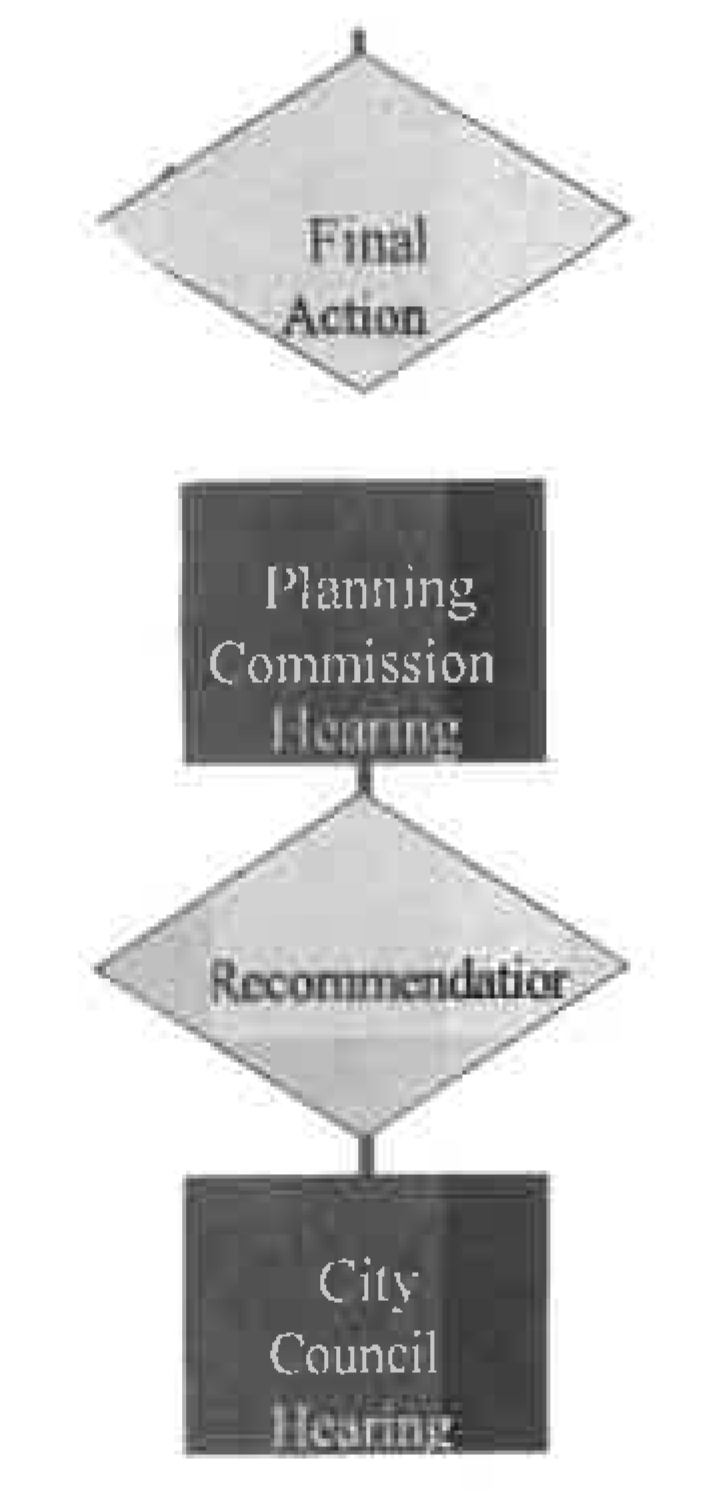
Planning and zoning commission hearing and recommendation. The planning and zoning commission shall hold public hearings on all properly filed proposals. After closing of the public hearing on a proposal, the planning and zoning commission shall transmit to the city council its recommendation on said proposal.
125-2.15.8.
City council hearing and action.
(a)
Proposal recommended for approval. Every proposal to amend a zoning boundary which is recommended favorably by the planning and zoning commission and every proposed amendment to the regulations of this chapter shall be forwarded to the city council for setting and holding of a public hearing thereon. No change, however, shall become effective until after the adoption of an ordinance for same and its publication as required by law.
(b)
Proposal recommended for denial. When the planning and zoning commission determines that a proposal to amend a zoning boundary should be denied, it shall so report to the city council. After receiving the final report from the planning and zoning commission, the city council may approve the proposal or deny the proposal, with or without prejudice as to re-filing, and that decision shall be final unless an appeal is filed with the city secretary's office within 12 days following city council action.
125-2.15.9.
Appeal.
(a)
Written allegation required. An appeal from the decision of the planning and zoning commission may be taken by any person who is aggrieved by the action of the planning and zoning commission on a specific proposal. The appeal shall be reduced to writing, showing that:
(1)
The planning and zoning commission was prejudiced in its deliberation;
(2)
New information is available which was not considered by the planning and zoning commission;
(3)
The planning and zoning commission committed some error in its deliberation; or
(4)
For other reasons, the requested change should be granted.
The secretary shall forward the appeal to the city council with the regular report of planning and zoning commission action on the subject proposal.
(b)
City council action. Upon receipt of written appeal, the city council may:
(1)
Refer the original proposal and appeal to the planning and zoning commission for a new hearing and a report and recommendation;
(2)
Schedule its own hearing on the proposal;
(3)
Deny the appeal in its entirety; or
(4)
Deny the application without prejudice as to re-filing upon showing that unnecessary hardship will otherwise result and that the intent and spirit of the ordinance will be observed.
125-2.15.10.
Limitation on reapplication. When a proposal is denied by the city council or when the applicant has withdrawn the proposal after the giving of public notice, no new applications of like nature shall be accepted by the city or scheduled for a hearing by the planning and zoning commission within a period of 12 months of the date of denial or withdrawal unless the proposal is denied without prejudice; provided, however, on receipt of written request by the original applicant describing substantially changed conditions in the community since prior consideration of his proposal so as to justify an earlier review of this matter, the city council may waive the mandatory delay period and authorize the acceptance of a new application.
125-2.15.11.
Joint hearings. In conformance with the Local Government Code, the city council may hold a joint public hearing with the planning and zoning commission on a request for a change in zoning classification. In case of a joint hearing, the city council must not act on the request until it receives the report from the planning and zoning commission.
(Ord. No. 2020-25, § 1(Exh. A), 9-29-2020)
Sec. 125-2.16. - Special use permits.
125-2.16.1.
General. A special use permit may allow certain uses of land, buildings, or structures that may not be appropriate under all circumstances in any given zoning district but may be appropriate where adequate measures can be taken to assure compatibility with surrounding uses, public need, and the city as a whole. It is the intent of this section to allow for such uses by the granting of a special use permit, subject to the procedures, which are applicable to rezoning, as stated herein. The city council, upon recommendation of the planning and zoning commission, may by ordinance, grant a special use permit for special uses that are otherwise prohibited by this chapter, and may impose appropriate conditions and safeguards to conserve and protect property and property values in the neighborhood.
125-2.16.2.
Application required. Any proposal for special use permit review shall be filed with the city. A completed application form as provided and instructed by the city shall be filed by the owner of the property or his authorized agent, or by the city planner or designee.
125-2.16.3.
Fee required. Applications shall be accompanied by the appropriate filing fee. No fee shall be charged for special use permit applications filed by the city planner or designee.
125-2.16.4.
Notice. Notices shall be given in the same manner notice is given for a rezoning application.
125-2.16.5.
Planning and zoning commission hearing and recommendation. The planning and zoning commission shall hold public hearings on all properly filed special use permit applications. After closing of the public hearing on an application, the planning and zoning commission shall transmit to the city council its recommendation on said application.
125-2.16.6.
City council hearing and action.
(a)
Application recommended for approval. Every special use permit application that is recommended favorably by the planning and zoning commission shall be forwarded to the city council for setting and holding of a public hearing thereon.
(b)
Application recommended for denial. When the planning and zoning commission determines that a special use permit should be denied, it shall so report to city council. After receiving the final report from the planning and zoning commission, the city council may approve the proposal or deny the proposal, with or without prejudice as to refilling. and that decision shall be final unless an appeal is filed with the city secretary's office within 12 days following city council action.
125-2.16.7.
Amendment to the special use permit.
(a)
Upon review and recommendation by the development review committee, the city manager or designee may administratively authorize minor changes in the approved SUP if the activities proposed by the amendment are not materially different from the activities covered by the existing SUP.
(b)
City manager or designee may administratively authorize minor changes in the approved SUP if the activities proposed by the amendment are not materially different from the activities covered by the existing SUP.
(c)
Upon review and recommendation by the development review committee, if the city manager or designee determines that the amendment cannot be administratively authorized, then the same application and approval process described in this section shall apply as when the SUP was initially approved.
125-2.16.8.
Suspension or revocation of special use permit. Any operator or owner having a special use permit under the authority of this section is subject to immediate citation, injunction, abatement or any other remedy permitted by law. The special use permit is subject to suspension or revocation for any of the following reasons:
(a)
Noncompliance with any applicable federal, state or city code;
(b)
Noncompliance with any special condition imposed at the time of approval of the special use permit;
(c)
Violation of any provisions of the Code of Ordinances pertaining to the use of land, construction or uses of buildings structures or activities conducted on the premises; or
(d)
Where conditions in the neighborhood or surrounding property have changed to the extent that approval of the permit would be clearly unwarranted if being applied for at the time of revocation.
125-2.16.9.
Procedure for suspension or revocation.
(a)
When possible under the circumstance, the city shall give written notice to the owner or operator specifying the nature of the failure and giving the owner or operator a reasonable time to cure, taking into consideration the nature and extent of the failure, the extent of the efforts required to cure, and the potential impact on the health, safety, and welfare of the community.
(b)
If the owner or operator fails to comply within ten days after notice, or fails to comply immediately if there is an imminent health and safety issue, the city may suspend the special use permit pursuant to the provisions of this chapter and recommend revocation to city council.
(c)
Revocation proceedings may be initiated by a majority vote of the city council or the planning and zoning commission.
(d)
An appeal of any decision of the city council to revoke a special use permit may be filed in the district court of the appropriate county. Any appeal taken shall not suspend the order of revocation during the process of the appeals unless so ordered by the district court.
125-2.16.10.
Expiration and extension of special use permit.
(a)
Special use permits for oil and gas wells, pipelines and pump stations shall expire upon one year after the date of city council approval unless a permit has been issued pursuant to chapter 42 of the Code of Ordinances or the expiration of a permit issued pursuant to chapter 42 of the Code of Ordinances.
(b)
If a permit has not been issued pursuant to chapter 42 of the Code of Ordinances, then one extension of a special use permit for oil and gas wells, pipelines and pump stations may be granted for not more than one year from the date of expiration. Upon review and recommendation by the development review committee, the city manager or his designee may approve the request upon receipt of a written request showing good cause for the extension.
125-2.16.11.
Limitation on reapplication. When a proposal is denied by the city council or when the applicant has withdrawn his proposal after the giving of public notice, no new applications of like nature shall be accepted by the city or scheduled for a hearing by the planning and zoning commission within a period of 12 months of the date of denial or withdrawal. The planning and zoning commission may waive the 12 month requirement after the applicant provides a written justification for their reason of withdrawal or there is a substantial change to the site that warrants new consideration of the application.
(Ord. No. 2020-25, § 1(Exh. A), 9-29-2020)

