
League City City Zoning Code
ARTICLE IV
SITE DEVELOPMENT STANDARDS
Sec. 125-4.1.- Accessibility for persons with disabilities.
All accessibility provisions for the persons with disabilities shall be subject to approval by the building official.
(Ord. No. 2020-25, § 1(Exh. A), 9-29-2020)
Sec. 125-4.2. - Building projections into yards.
Except where permitted by this section, required yards in all districts shall remain unobstructed. The following building elements may project into required yards.
(1)
In RSF districts, balconies, stairs, chimneys, canopies, decks, covered patios, and awnings may encroach no more than 18 inches into any required setback area. Bay windows may encroach no more than three feet into any required setback area. A bay window encroachment shall not exceed one-third the length of the wall plane upon which it is located. Covered porches may project up to six feet into the required front yard setback. In no case shall the front building setback be less than ten feet.
(2)
In RMF and in nonresidential districts, canopies and awnings may encroach no more than three feet into any required setback area.
(3)
Belt courses, cornices, windowsills, pop-outs, quoins, and similar decorative architectural features may encroach no more than 18 inches into any required setback area.
(4)
Roof overhangs may encroach no more than 18 inches into a required setback.
(5)
Fences located on a side or rear property line may encroach into any required side and rear yard setback.
(6)
Freestanding signs may encroach into required building setback areas.
(7)
Outdoor lighting fixtures may encroach into required building setback areas.
(Ord. No. 2020-25, § 1(Exh. A), 9-29-2020)
Sec. 125-4.3. - Drainage systems.
Refer to article V, Subdivision Regulations, of this chapter and the general design and construction standards.
(Ord. No. 2020-25, § 1(Exh. A), 9-29-2020)
Sec. 125-4.4. - Fences, walls, and plantings.
125-4.4.1.
Clear vision triangle at intersections. Within the triangular area formed by the right-of-way lines of intersecting streets and a line connecting points 25 feet on either side of the intersecting rights-of-way, including triangles formed from the centerline of driveways, there shall be clear space and no obstruction to vision. Fences, walls, plantings and other obstructions shall be restricted to a height of 30 inches or less above the grade of the lowest street as measured at the right-of-way line thereof in the above clear space.
125-4.4.2.
Walls or fences containing injurious materials. Walls, fences or similar structures less than six feet in height shall not contain any substances, such as broken glass, barbed wire, spikes, nails or similar materials, designed to inflict pain or injury to any person or animal. Agricultural uses are exempt from this requirement.
125-4.4.3.
Required fences or walls. For the open storage of recreational vehicles, boats, rental trucks or equipment, an approved opaque six-foot high wall, suitably constructed of masonry, or wood fence, or suitable landscaping, shall be required around the perimeter of the site, and shall be maintained by the owner. This subsection shall not be interpreted to preclude the city from requiring an eight-foot fence for needs of public health or safety, or to prevent nuisance impacts to adjacent properties or streets.
125-4.4.4.
Decorative fences. Decorative fences metal/wrought iron fences are allowed in front and side yards all zoning districts subject to the following regulations:
(a)
In all zoning districts except single family residential, the fence height shall not exceed six feet.
(b)
On residential single family lots with a minimum size of 20,000 square feet, the fence height shall not exceed six feet.
(c)
On residential single family lots less than 20,000 square feet in size, the fence height shall not exceed four feet.
(d)
Fences shall be 70 percent transparent.
(e)
Masonry columns may be used. If masonry columns are used, masonry columns shall also be required at all fence corners and turning points and at all fence termination points.
125-4.4.5.
Prohibited fences. No barbed wire, chicken wire, razor wire, chain link (only prohibited in front yards), lattice, or electrically charged fences shall be allowed.
(Ord. No. 2020-25, § 1(Exh. A), 9-29-2020; Ord. No. 2022-25, § 11, 8-9-2022; Ord. No. 2024-34, § 1, 9-24-2024)
Sec. 125-4.5. - Fire protection.
125-4.5.1.
Fire hydrants. Prior to issuance of a building permit for the erection of any building or significant alteration of an existing building, the lot owner shall at his/her own expense cause an approved fire hydrant to be installed within 300 feet of the furthermost extremity of the proposed building. If none exists within that distance, or at city fire marshal's discretion, an alternate fire protection system may be provided. The fire hydrant must have an approved blue reflector pavement mark in the street for night-time identification. This marker and its location must be approved by the city engineer. The fire hydrant must be placed on a six-inch water line or larger and be placed in the utility easement. Fire protection water lines constructed within a project may be required to be metered with a UL approved meter.
125-4.5.2.
Storage tanks. Aboveground atmospheric pressure storage tanks with more than 500 gallons capacity must comply with section 46-10.
125-4.5.3.
Sprinklers systems. Sprinkler systems shall meet the requirements and specifications of the fire marshal's office as adopted in section 46-7. Applicants for staff review under this article shall acknowledge willingness to comply with the city fire code and the city fire marshal's sprinkler requirements.
(Ord. No. 2020-25, § 1(Exh. A), 9-29-2020)
Sec. 125-4.6. - Flood damage prevention standards.
Refer to chapter 50, article II, Flood Damage Prevention and Protection.
(Ord. No. 2020-25, § 1(Exh. A), 9-29-2020)
Sec. 125-4.7. - Interior streets.
125-4.7.1.
Standards. All interior streets, defined as all public and private streets within a building site, shall be a minimum 28 feet in width and constructed of concrete or flexible base paved section in accordance with city standards and at the owner's expense. Interior streets paved in accordance with the city specifications, and not a part of the required parking area, shall be provided at the owner's expense for the access of fire and police protection and for garbage pickup.
125-4.7.2.
Building location. Each building shall abut an interior street or parking lot and may additionally be served by a concrete or flexible base alley without curbs, not less than 12.5 feet per traffic lane in width, adequately drained with catch basins and storm sewers constructed in accordance with city standards and at the owner's expense.
(Ord. No. 2020-25, § 1(Exh. A), 9-29-2020)
Sec. 125-4.8. - Lighting.
125-4.8.1.
Applicability. All outdoor lighting installed after the effective date of this amendment shall follow the provisions in this section. Lighting fixtures and luminaires installed and operated prior to the date of the ordinance from which this chapter is derived are exempt from these requirements and shall be considered legally non-conforming and regulated as such.
125-4.8.2.
Exceptions. These regulations do not apply to the following:
(a)
Lighting within the public right-of-way that is principally used to illuminate streets and sidewalks.
(b)
Lighting of signs regulated by the sign section.
(c)
Navigational lighting systems necessary for safety at airports or marinas.
(d)
Lighting of national, state or local government flags.
(e)
Temporary lighting of construction sites.
(f)
Temporary decorative seasonal lights.
(g)
Lighting deviation specified in a special use permit or planned unit development.
(h)
Lighting required by federal, state or local laws or regulations.
(i)
Lighting that is only used under emergency conditions such as search lights.
125-4.8.3.
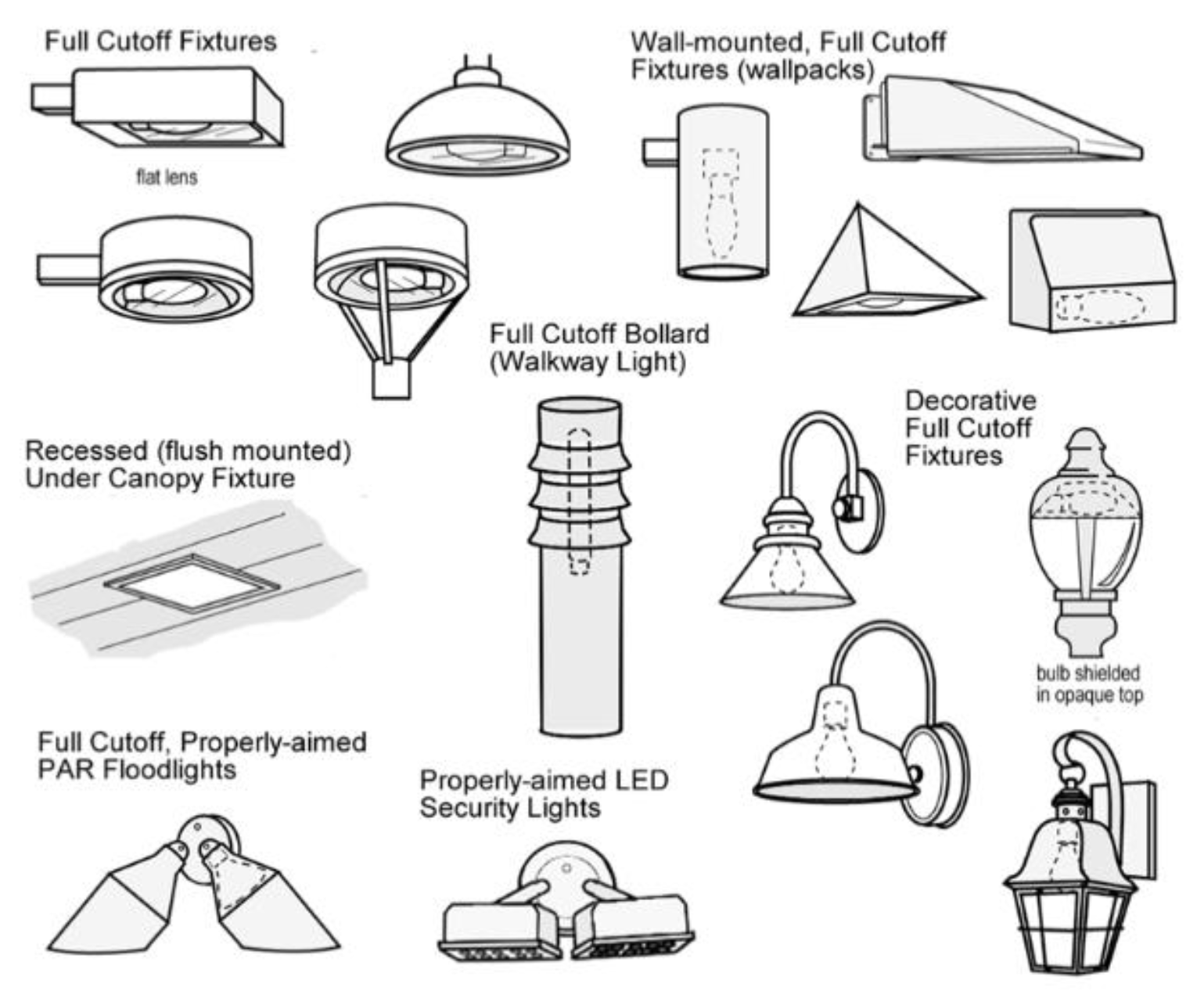
Cutoff light fixture required. Outdoor lights shall be full cutoff light fixtures so that their rays are directed toward the ground and away from adjacent residential property or streets and no light trespass falls on any residential property. A full cut-off light fixture has a solid barrier (cap) at the top of the fixture in which the lamp (bulb) is located. The fixture is angled so the lamp is not visible below the barrier (no light visible below the horizontal angle).
125-4.8.4.
Canopy lights. Light fixtures mounted on canopies or vehicle fueling station islands shall be recessed so that the lens cover is recessed or flush with the bottom surface (ceiling) of the canopy.
125-4.8.5.
Light poles. Parking lot light poles shall be located in a landscape planter or incorporated into a walkway or other pedestrian area. Concrete bases for light poles shall not exceed a height of 30 inches from finished grade.
125-4.8.6.
Prohibited lights. Laser source light, strobe lights, and similar high intensity light sources for advertising or entertainment shall not be projected above the horizontal plane, unless a permit is obtained for specific events and time frames.
125-4.8.7.
Photometric survey. A photometric survey of the entire property shall be submitted with a building permit or if changes and/or additions are being made to the existing exterior article.
125-4.8.8.
Examples of full cutoff light fixtures.
(Ord. No. 2020-25, § 1(Exh. A), 9-29-2020)
Sec. 125-4.9. - Performance standards.
125-4.9.1.
Purpose. The following performance standards are intended to control dangerous or objectionable environmental effects—including noise, vibration, smoke, dust or other particulate matter, toxic or noxious materials, odors, fire, explosive hazard or glare and ensure compatible land use relationships.
125-4.9.2.
Noise. At no point on a property line shall the sound intensity level of any individual operation or plant exceed the decibel levels as stipulated in chapter 42, article II.
125-4.9.3.
Vibration. No use shall be permitted which produces ground vibrations noticeable without instruments at the lot line of the premises on which the use is located.
125-4.9.4.
Smoke emissions. Smoke emissions shall be in compliance with federal, state, and county regulations.
125-4.9.5.
Odors. No use shall be permitted so as to produce the emission of objectionable or offensive odors in such concentration as to be readily perceptible at any point at or beyond the lot line of the property on which the use is located. Table III, Chapter 5, "Air Pollution Abatement Manual," of the Manufacturing Chemist's Association, Inc., is hereby adopted as the guide in determining the quantities of offensive odors, as are the guides and standards contained in the prohibitions against air pollution of the state air control board.
125-4.9.6.
Discharge of toxic or noxious matter. No use shall, for any period of time, discharge across boundaries of a lot line on which it is located toxic or noxious matter in such concentrations as to be detrimental to or endanger the public health, safety, comfort or general welfare, or cause injury or damage to persons, property, or the use of property or land, or render unclean the waters of the state to the extent of being harmful or inimical to public health, animal or aquatic life, or the use of such waters for domestic water supply, recreation or other legitimate and necessary uses. Disposal of toxic or hazardous waste within the city is specifically prohibited.
125-4.9.7.
Nuclear radiation. Any operation involving radiation, i.e., the use of gamma rays, X-rays, alpha and beta particles, high-speed electrons, neutrons, protons, and other atomic or nuclear particles, shall be permitted only in accordance with the codes, rules and regulations of the state board of health and the state air control board.
125-4.9.8.
Electromagnetic radiation and interference. No person shall operate or cause to be operated for any purpose a planned or unplanned source of electromagnetic radiation which does not comply with the current regulations of the Federal Communications Commission regarding such sources of electromagnetic radiation. Any operation in compliance with the Federal Communications Commission regulations will be deemed unlawful if such radiation causes an abnormal degradation of performance of any electromagnetic receptor of quality and proper design. The determination of abnormal degradation in performance and of quality and proper design shall be made in accordance with good engineering principles and standards of the American Institute of Electrical Engineers, the Institute of Radio Engineers and the Electrical Industries Association.
125-4.9.9.
Interference. No use, activity or process shall be conducted which produces electromagnetic interference with normal radio, television or non-mobile telephone reception.
125-4.9.10.
Heat or glare. Any activity producing heat or glare shall be carried on in such a manner that such heat or glare is not perceptible at any lot line. Exposed sources of light, including bare bulbs and tubes and immediately adjacent reflecting surfaces, shall be shielded to avoid creating a nuisance across lot lines.
(Ord. No. 2020-25, § 1(Exh. A), 9-29-2020)
Sec. 125-4.10. - Projections above height limits.
125-4.10.1.
Permitted projections. The following projections above base district height limits are permitted:
(a)
Belfries, domes, chimneys, cupolas, skylights, clock towers and other similar structural elements not used for human occupancy, may project above the base district height limit, provided that they do not cover more than 20 percent of the roof area;
(b)
Mechanical equipment and enclosures, elevator penthouses, ventilators, and other similar equipment, may project up to five feet above the base district height limit, but may not exceed the height of parapet walls;
(c)
Parapet walls or cornices may project up to five feet above the base district height limit;
(d)
Church steeples, religious symbols, or similar elements on religious assembly buildings;
(e)
Signs, pursuant to article VIII, Signs;
(f)
Flagpoles;
(g)
Wireless communications facilities, pursuant to Communications Towers and Structures Ordinance;
(h)
Radio and television towers, aerials and parabolic satellite receivers, microwave transmitters and receivers used in connection with radio and television broadcasting, but not including parabolic satellite TV reception antennas, unless otherwise regulated;
(i)
Barns, silos or other farm buildings and/or structures;
(j)
Water towers, fire and hose towers, and windmills;
(k)
Chimneys and smoke stacks; and
(l)
Monuments, spires, and false mansards.
(Ord. No. 2020-25, § 1(Exh. A), 9-29-2020)
Sec. 125-4.11. - Refuse storage areas.
125-4.11.1.
Purpose. The purpose of these regulations is to ensure the provision of adequate, accessible, and convenient locations for the collection and storage of refuse and recyclable materials within containers and enclosures that are compatible with surrounding land uses and structures.
125-4.11.2.
Applicability. Refuse collection and recycling containers are required for all multi-family residential development and all nonresidential developments. Any alteration adding 30 percent or more to the existing gross floor area of any nonresidential use shall meet the requirements of this section.
125-4.11.3.
Access. Driveways and aisles shall be unobstructed.
125-4.11.4.
Location. Enclosures for refuse collection and recycling containers shall be located within the principal structure or within a permanently enclosed structure, if one exists, and shall be approved by the fire marshal. Enclosures may be functionally combined into a single unit or may be established at separate locations on a lot. Enclosures shall not be located in any required parking, buffer or landscape areas.
125-4.11.5.
Drains. Drains in the refuse storage area must be equipped with a building department approved "P" trap when using city sanitary sewers.
125-4.11.6.
Enclosures or screening required. All refuse collection and recycling containers shall be within enclosed facilities or screened so as not to be visible from a public street.
125-4.11.7.
Enclosure materials. The structure shall be enclosed on all sides, one of which includes a gate or door. The enclosure shall be made of screen fencing of wood fencing or finished masonry walls. The enclosure shall be architecturally compatible with the principal structure. Electrical, barbed, and razor wire fences are prohibited.
125-4.11.8.
Height. Minimum height is six feet. Maximum height is eight feet.
125-4.11.9.
Landscaping. The perimeter of the enclosure shall be landscaped with native species landscaping where practical.
125-4.11.10.
Security. All refuse collection enclosures shall have a gate or door that can be secured.
125-4.11.11.
Maintenance. Enclosures shall be maintained in a manner that protects adjacent properties as well as tenants located on the subject property from adverse environmental, health and safety impacts such as noise, odors and attraction of rodents or other pests. The receptacle shall be covered by either a roof on the enclosure or covered receptacles.
(Ord. No. 2020-25, § 1(Exh. A), 9-29-2020)
Sec. 125-4.12. - Screening of mechanical areas.
125-4.12.1.
Purpose. The purpose of these regulations is to protect public views from unsightly equipment that is typically required of new development.
125-4.12.2.
Applicability. These regulations shall apply in all zoning districts, with the exception of I—Industrial districts unless such mechanical equipment is visible from a R—Residential district.
125-4.12.3.
General requirements. All exterior ground, building, and rooftop mechanical equipment shall be screened from public view on all sides. Equipment to be screened includes, but is not limited to: heating, air conditioning, and refrigeration equipment; plumbing lines; ductwork; transformers; and meter banks.
125-4.12.4.
Screening specifications. Screening materials may be solid concrete, wood, landscaping, or other opaque material that is compatible with the building architecture and effectively screens mechanical equipment so that it is not visible from a public street or adjoining lot. Rooftop equipment may be screened using enclosure, partial screens, or parapet walls.
(Ord. No. 2020-25, § 1(Exh. A), 9-29-2020; Ord. No. 2022-25, § 12, 8-9-2022)
Sec. 125-4.13. - Sidewalks.
Refer to article V, Subdivision, article IV, Site Development Standards, and the General Design and Construction Standards.
(Ord. No. 2020-25, § 1(Exh. A), 9-29-2020)
Sec. 125-4.14. - Signs.
Refer to article VIII, Signs.
(Ord. No. 2020-25, § 1(Exh. A), 9-29-2020)
Sec. 125-4.15. - Utility easements.
Refer to article V, Subdivisions, article IV, Site Development Standards, and the General Design and Construction Standards.
(Ord. No. 2020-25, § 1(Exh. A), 9-29-2020)
Sec. 125-4.16. - Water and sanitary sewer system.
Refer to article V, Subdivisions, article IV, Site Development Standards, and the General Design and Construction Standards.
(Ord. No. 2020-25, § 1(Exh. A), 9-29-2020)
Sec. 125-4.17. - Reserved.
Editor's note— Ord. No. 2022-25, § 13, adopted Aug. 9, 2022, repealed § 125-4.17, which pertained to exterior construction requirements and derived from Ord. No. 2020-25, § 1(Exh. A), adopted Sept. 29, 2020.
Sec. 125-4.18. - Concrete surface requirement.
All business-related operations must occur on concrete surfaces; however, no more than six golf carts or UTVs associated with a business that primarily sells or repairs golf carts or UTVs may be parked on grass.
(Ord. No. 2020-25, § 1(Exh. A), 9-29-2020; Ord. No. 2025-55, § 1, 1-13-2026)
Sec. 125-4.19. - Off-street parking and loading.
125-4.19.1.
Purposes. The purposes of the off-street parking and loading regulations are to:
(a)
Ensure that adequate but not excessive parking is provided for new land uses and major alterations to existing uses to meet the parking needs created by such uses.
(b)
Establish regulations for new uses, new or relocated buildings and buildings that have been altered or expanded.
(c)
Ensure that off-street parking and loading areas are designed and located to protect the public safety, minimize congestion, reduce solar heat gain, minimize traffic conflicts and congestion on parking aisles and public streets, and buffer surrounding land uses and public areas from visual and noise impacts.
(d)
Ensure pedestrian-friendly parking areas by providing for safe pedestrian routes, parking lot lighting, parking spaces sized for contemporary vehicles, and trees for shade.
(e)
Provide for the accessibility needs and requirements of disabled and elderly persons.
125-4.19.2.
Applicability. These regulations shall apply to new uses and to alterations and additions to nonconforming structures. No building permit shall be issued for a use unless the use complies with this section.
125-4.19.3.
General provisions.
(a)
Required parking. All required parking shall be provided on site, except as provided in subsection (g) below. The number of parking spaces required for individual uses is set forth in section 125-4.19.4 below.
(b)
Required parking and parking lot landscaping for structures that are altered. The parking and parking lot landscaping requirements of this section shall apply to the new portion of the parking lot when an existing structure is altered.
(c)
Uses not mentioned. Parking requirements for a use not identified in this section shall be determined by the city planner or designee based on parking requirements for the most similar use listed in this chapter. The city planner or designee may require submission of a parking study prepared by a person licensed to prepare such study.
(d)
Fractional spaces. If the number of parking spaces required in this section results in a fraction, then the required number shall be rounded to the nearest whole number. For example, if the computed requirement equals nine and one-half spaces, then ten spaces are required. If the computed requirement equals nine and four-tenths spaces, then nine spaces are required.
(e)
Computation of required parking for residential multi-family use. Residential parking for multi-family uses shall be based on the number of bedrooms. Any rooms defined as bedrooms by the City of League City Building Code shall be counted as a bedroom for the purpose of determining off-street parking requirements.
(f)
Visitor parking. On-street parking may be counted toward the visitor-parking requirement for developments in all residential districts, provided that the street has a minimum eight-foot wide legal parking area exclusive of travel lanes. To qualify as one visitor parking space, there shall be an uninterrupted 20-foot long space and a sidewalk adjacent to the parking side of the street. The city may require on-street visitor parking spaces to be striped.
(g)
Shared parking. Where a use generates parking demand primarily during hours when an adjacent use or uses are not in operation or generate shared trips, a reduction of up to 50 percent of the required parking may be administratively approved. Shared parking ratios shall be based on the Institute of Transportation Engineer (ITE) Parking Generation. The application requirements shall include:
(1)
Submission of a parking study prepared by a person licensed to prepare such study;
(2)
The proposed agreement providing for the shared use of parking areas, executed by the parties involved, must be filed with the planning department, in a form satisfactory to the city attorney.
(3)
After approval by the city attorney, the agreement shall be recorded at the Galveston or Harris County Land Records office by the applicant.
(4)
Shared parking privileges will continue in effect only as long as the agreement, binding on all parties, remains in force. Agreements must guarantee long-term availability of the parking, commensurate with the use served by the parking.
(h)
Temporary use of parking area. temporary use of parking areas for uses other than parking is permitted provided that:
(1)
The non-parking use complies with all temporary use and license requirements;
(2)
The use does not interfere with fire or emergency vehicle access;
(3)
The use does not create a traffic hazard or interfere with vehicular or pedestrian circulation on the site;
(4)
The use provides accessible parking in accordance with applicable laws; and
(5)
The non-parking use is conducted with written property owner authorization.
(i)
Parking for age restricted uses or to comply with the Americans with Disabilities Act. A reduction in parking requirements for a multi-family age-restricted use may be approved by a special use permit where the project is restricted by covenant or deed restriction to an age-restricted use. Any such approval shall be based on a parking study or other acceptable evidence that supports the requested parking reduction. In no event shall the required parking be reduced below one-half parking spaces per dwelling unit. Parking requirements for the multi-family use shall revert to those specified in this section if age restrictions are no longer in effect.
(j)
Restrictions on parking in commercial and office districts. Recreational vehicles, trailers, commercial vehicles, or combinations of vehicles exceeding 21 feet in length shall not be parked within any commercial zoned property, except for the purpose of loading, unloading, service, or patronizing a commercial use on the site. In commercial districts, no vehicle shall be parked overnight and used for permanent or temporary habitation.
(k)
Prohibited parking. Parking shall be prohibited in the following locations:
(1)
Fire lanes;
(2)
Required landscape areas;
(3)
Unimproved properties or portions of properties in nonresidential and multifamily districts; and
(4)
Outside areas not designated for parking on an approved site plan.
(5)
The storage of up to six golf carts or UTVs associated with a business that primarily sells or repairs golf carts or UTVs is exempt from subsections (2) through (4).
(l)
Separation from buildings. Parking spaces shall be separated from a multi-family residential building or nonresidential building by:
(1)
A raised walkway of at least four feet in width exclusive of any overhang permitted in subsection (m) below and in compliance with minimum ADA requirements; or
(2)
A raised landscape planter of at least five feet in width exclusive of any overhang permitted in subsection (m) below.
(m)
Parking overhang. Vehicles may overhang landscape areas or sidewalks by 24 inches provided that:
(1)
The overhang does not interfere with the base of any structure, raised planter, seating bench, fence, utility equipment, light pole or base, or trunk of any tree;
(2)
The unobstructed width of the sidewalk, exclusive of the 24-inch overhang, is not less than four feet;
(3)
The allowable overhang does not reduce any landscape planter width below five feet; and
(4)
No part of any parked vehicle extends into any required landscape area or beyond any property line.
(n)
Opposing overhangs. Where parking spaces are on opposite sides of the landscaping or sidewalk or combination thereof, the landscape area or sidewalk shall be at least nine feet in width.
(o)
Side clearance. Each parking space located at the end of a row of spaces shall provide a three-foot wide area clear of vertical obstructions more than six inches in height, exclusive of landscaping, next to the side of the space.
(p)
Tandem parking.
(1)
Nonresidential. Tandem parking spaces shall only be approved for full-time valet or attended parking. Tandem parking spaces may be used to satisfy a portion of the parking requirement for nonresidential uses, subject to the approval of a special use permit. The special use permit may be revoked by the city council if the use changes.
(2)
Residential. Single family residential enclosed garages intended to accommodate two vehicles parked end-to-end shall have a minimum unobstructed interior width of 12 feet and a minimum interior unobstructed length of 38 feet.
(q)
Pavement edge protection. All permanent uses other than single family residential lots shall provide a six-inch, poured-in-place concrete curb or other approved material for all parking areas and drive aisles abutting landscaped areas.
(r)
Parking on single family residential lots. In the RSF districts, the side yard may be used for vehicle parking or access to the rear of the lot. Uncovered parking may be constructed next to the driveway or adjacent to a garage or carport. On corner lots, the parking area shall not be constructed in the street side setback area. Vehicles or trailers shall be parked on a driveway or additional parking area permitted in this subsection. Refer to chapter 66 for parking of manufactured homes and/or recreational vehicles. The additional parking areas permitted by this subsection shall comply with the following standards:
(1)
The parking space shall have a concrete surface;
(2)
The surface may consist of two parallel concrete or cement strips. The area between such parallel strips shall be landscaped with vegetative or non-vegetative ground cover;
(3)
No parked vehicle may obstruct or encroach on a sidewalk; and
(4)
Access to the parking space shall be via a curb cut, rolled curb, or driveway. (Note: Driveway access to an RSF Residential Single Family lot from a major or minor arterial is prohibited.)
(s)
Limitations on parking and storage on non-paved areas. Parking and/or storage of vehicles on grass or other nonpaved area in any zoning district is prohibited except for agricultural machinery or equipment in the OS zoning district or the storage of up to six golf carts or UTVs associated with a business that primarily sells or repairs golf carts or UTVs. Material for the paved area shall be concrete.
(t)
Concrete surfaces. All references to concrete surfaces shall include solid concrete or other approved city-staff approved pervious surfaces. However, all driveways, drive aisles, fire lanes, loading docks and drive approaches must be constructed with solid concrete. Residential driveways in excess of 50 feet in length may be constructed with city-staff approved pervious surfaces.
125-4.19.4.
Off-street parking requirements.
Off-street parking requirements for all uses are prescribed in Table 125-4.19.4 below.
Table 125-4.19.4: Off-Street Parking Requirements
125-4.19.5.
Parking space and aisle dimensions. This section sets forth dimensional requirements for open parking spaces, covered parking spaces, spaces in parking structures, and residential garage parking.
(a)
Location of off-street parking spaces. Off-street parking spaces shall be located so that any parcel on which such parking spaces are located shall be adjacent to and bordering the property on which the building or use to which such parking spaces are assigned is located. In the event that two or more separate parcels on which off-street parking is located are assigned to a single building or use, at least one such parcel of real property (an "adjoining parking property") must be adjacent to and bordering the property on which the building or use is located and the remaining such parcels must be adjacent to and bordering either an adjoining parking property or the property on which the building or use is located.
(b)
Open parking spaces. The minimum dimensions of open parking spaces and parking aisles are set forth in Table 125-4.19.5(h). For high turnover uses and uses utilizing shopping carts, space width shall be increased by six inches for 50 percent of the required parking spaces closest to the building entrances.
(c)
Unenclosed covered parking spaces. Each unenclosed covered parking space shall measure at least nine feet in width and 19 feet in depth of unobstructed area. These measurements shall not include the exterior walls or supports of the structure. An unenclosed covered parking space shall have an unobstructed backup area of not less than 25 feet.
(d)
Spaces in parking structures. Each parking space in a parking structure shall measure at least nine feet in width and 19 feet in depth and have an unobstructed back-up area of not less than 25 feet.
(e)
Vertical clearance for unenclosed covered spaces and parking structures. Covered parking and parking structures shall have a minimum vertical clearance of eight feet.
(f)
Residential garages. Single- and multi-family residential enclosed garage structures intended to accommodate one vehicle shall have a minimum interior unobstructed width of 12 feet and a minimum interior unobstructed length of 20 feet. For two vehicles, the minimum unobstructed interior width shall be 20 feet.
(g)
Parking space and aisle dimensions. Table 125-4.19.5(h) below shall apply to all uses other than high turnover uses and those uses utilizing shopping carts.
Table 125-4.19.5(h): Parking Space and Aisle Dimensions for Parking Angles
(i)
Stacking and queuing requirements.
(1)
Stacking spaces provide the ability for vehicles to queue on-site prior to receiving a service. In all districts, at the time any building or structure is erected or altered, stacking spaces shall be provided for uses that include, but are not limited to, service stations, drive-through restaurants, drive-in or drive-through banks, and similar uses that allow customers or clients to receive services and/or conduct activities on the property without leaving their vehicle. City staff may require a traffic study to determine the stacking and queuing requirements to properly identify the number of stacking spaces required. In no instance shall the queue accommodate fewer than six vehicles.
(2)
A stacking space shall be a minimum of nine feet in width and 20 feet in length. The queuing lane shall be a separate lane and shall not be located within or interfere with a public street or any other circulation driveway, parking space, fire lane or maneuvering area. Stacking spaces shall be provided behind the vehicle bay door, middle of the service window (e.g. quick service restaurant, dry cleaner), or middle of the service island (e.g. banks), whichever is applicable.
(3)
A single stacking space shall be provided after the final window, order board, or stopping point to allow vehicles to pull clear of the transaction area prior to entering an intersecting drive aisle. Buildings and other structures shall be set back a minimum often feet from the back of the curb of the intersecting drive aisle to provide adequate visibility and to allow vehicles to safely exit drive-thru lanes and escape lanes prior to merging into intersecting drive aisles.
(4)
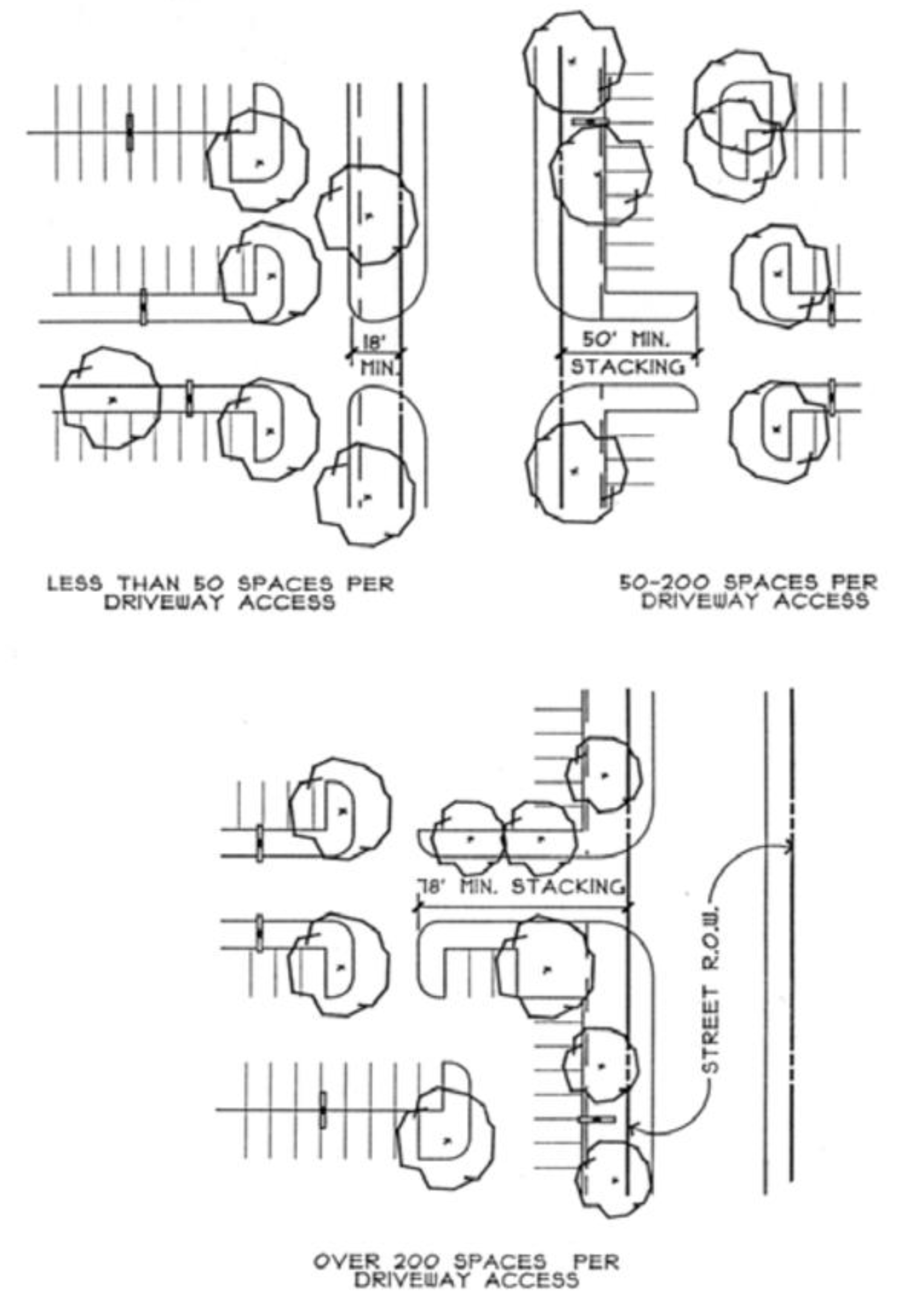
Driveway stacking length is the distance between the street right-of-way line and the near side of the first intersecting interior aisle or parking stall. The minimum length of driveway stacking shall be as follows in Table 125-4.19.5(i)(4) and subsection (5), illustration of driveway stacking, below.
Table 125-4.19.5(i)(4): Driveway Stacking
(5)
Illustration of driveway stacking.
(h)
Dead end parking aisles. Dead-end aisles are not permitted unless a permanent turnaround is provided and approved by the executive director of development services.
125-4.19.6.
Striping and marking.
(a)
All parking shall be delineated by painted lines, curbs or other means to indicate individual spaces. One or more four-inch wide lines of white or other contrasting color paint shall delineate all multi-family residential and nonresidential parking spaces. Such lines shall be maintained to clearly identify each space.
(b)
Traffic control signs and other pavement markings shall be used as necessary to ensure safe and efficient traffic operation on the lots. Such signing and markings shall be subject to the approval of the city engineer.
(c)
Placement, signing, and markings for fire zones shall be approved by the fire marshal.
(d)
Placement, signing and markings for handicap facilities shall be subject to approval by the building official.
(e)
All parking lot surfaces and curb striping shall be maintained in good condition at all times.
(f)
One or more four-inch wide lines of white or other contrasting color paint shall delineate all multi-family residential and nonresidential parking spaces. Such lines shall be maintained to clearly identify each space.
125-4.19.7.
Parking access and driveways.
(a)
Each parking stall shall have appropriate access to a street or alley, and the maneuvering and access aisle shall be sufficient to permit vehicles to enter and leave the parking area in a forward motion.
(b)
All driveways constructed to serve development addressed in this subsection shall be constructed in a manner and with materials similar to the frontage roadway. At a minimum, all driveways shall be concrete or asphalt. Paved driveways shall extend at a minimum to the property line or the end of the curb return, whichever is greater.
(c)
All two-way driveways from arterials and collectors shall have ingress and egress lanes delineated by yellow traffic buttons placed in accordance with Texas Department of Transportation (TxDOT) specifications.
(d)
New driveways shall conform to the requirements of the General Design and Construction Standards or to TxDOT approved criteria, unless special circumstances warrant variations approved by the planning and zoning commission.
(e)
The maximum number of driveways shall conform to the requirements outlined in Table 125-4.19.7(e) below or to TxDOT approved criteria, unless special circumstances warrant variations approved by the planning and zoning commission.
(f)
Cross access. Adjacent commercial or office properties and major traffic generators (i.e. shopping plazas, office parks) shall provide a cross access drive and pedestrian access way to allow circulation between two or more abutting nonresidential properties. Cross access easements shall be established on the final plat and not by separate instrument. Each cross access easement shall be labeled for the specific purpose and to the specific parcel for which they are being provided.
125-4.19.8.
Passenger loading areas.
(a)
General. For the purposes of this section, a passenger loading space is the area a vehicle occupies while loading or unloading passengers. A passenger loading space shall be a minimum of 12 feet in width and 20 feet in length. Passenger loading areas shall be provided adjacent to the principal facility entrance or entrances and shall consist of vehicle turnout lanes located outside access aisles. Passenger loading areas shall be identified exclusively for this use.
(b)
Loading area requirements. Passenger loading shall be provided in accordance with Table 125-4.19.8(b) below.
125-4.19.9.
Parking of oversize and commercial vehicles in residential districts.
(a)
It shall be unlawful for any person to park, or stand a commercial and/or oversize vehicle, or to permit any commercial and/or oversize vehicle to park or stand upon any public street or public right-of-way in any residential zoning district in the city.
(b)
This shall not apply to the parking or standing of vehicles for the following purposes:
(1)
Vehicles transporting passengers, freight, or merchandise for compensation to or from the residential area;
(2)
Publicly owned or franchised emergency or utility vehicles carrying out official duties;
(3)
Equipment being used for street construction, maintenance, or repair;
(4)
A vehicle with a mechanical defect, making it unsafe to proceed further shall be lawful to stand or park the vehicle during the time necessary to make emergency repairs or if unable to repair until a tow truck comes;
(5)
Any motor home, boat, boat trailer, trailer, or house trailer being loaded, unloaded, or otherwise prepared for use or storage; or
(6)
Owned or operated by a contractor who has parked the vehicle in front of a residence or residential lot for which the person is contracted to do work, provided that the vehicle is parked only between the hours of 7:00 a.m. and 7:00 p.m. and only while the work is being performed. An exception to the time limit is made for emergency situations where immediate repairs need to be performed to lessen property damage or for safety reasons.
125-4.19.10.
Off-street loading. This section applies to any nonresidential use having a gross floor area of 10,000 square feet or more requiring the delivery or distribution of material or merchandise by trucks measuring 36 feet or more, including cab and trailer.
(a)
Requirement. At least one off-street loading space shall be provided. One additional loading space shall be provided for each additional 40,000 square feet of gross floor area over 10,000 square feet. Required loading spaces shall be maintained during the existence of the use.
(b)
Standards.
(1)
Location. Loading spaces shall not be closer than 100 feet to any land designated for residential use, or within 100 feet of land zoned for residential use, unless such loading spaces are within an enclosed building.
(2)
Dimensions. Each required off-street loading space shall be not less than 12 feet wide and 45 feet long.
(3)
Clear height. Each required off-street loading space shall have a minimum clear height of 14 feet.
(4)
Screening. Each off-street loading space visible from a public street, within 200 feet of land designated for residential use on the General Plan, or within 200 feet of land zoned for residential use shall be enclosed on three sides by a solid fence not less than 14 feet in height.
(5)
Maneuvering. Truck-maneuvering areas shall not encroach into required parking spaces or rights-of-way.
(c)
Customer loading zones. This section applies to retail uses where customers take delivery of goods in non-commercial vehicles other than in designated parking spaces. Such uses are characterized by the sale of large or bulky items and include home improvement stores, appliance, and electronics stores.
(1)
Requirement. A customer-loading zone shall be provided for any use having a gross floor area of 20,000 square feet.
(2)
Location. The loading zone shall be located within 50 feet of the primary exit. Customer loading is prohibited in designated fire lanes.
(3)
Dimensions. A loading zone shall be a minimum width of ten feet and a minimum length of 30 feet.
(4)
Clear Height. The loading zone shall have a minimum clear height of 14 feet.
125-4.19.11.
Bicycle parking. Bicycle parking stalls shall measure two feet by six feet per stall. Stall area shall not encroach into any required landscaping or pedestrian access areas.
125-4.19.12.
Electric vehicle charging stations.
(a)
Purpose. The purpose of this section is to provide design criteria and placement standards to encourage and promote safe and efficient electric vehicle charging opportunities in a full range of zones and settings for convenience of service to those that use electric vehicles.
(b)
Zoning districts. Vehicle charging stations are allowed in all zoning districts. Electric vehicle charging station(s) shall be permitted in association with a single-family use designed to serve the occupants of the home. These regulations are applicable only to electric vehicle charging stations that are:
(1)
Publicly owned and publicly available such as a public parking lot or public buildings; and
(2)
Privately owned and publicly available commercial facilities such as a store or shopping center parking and public accommodation.
(c)
Location and layout. The location and layout of charging stations for use by the public is expected to vary based on the design of the parking area. It is expected flexibility will be required to provide the most convenient and functional service to users. Standards and criteria should be considered guidelines and flexibility should be allowed when alternatives can achieve objectives for the provision of this service.
(d)
Incentive program.
(1)
When the number of required parking spaces is ten or greater, the minimum parking requirement may be reduced by one space for each charging station, but the reduction of parking spaces may not exceed ten percent of the required number of regular parking spaces. (The EV space will count as a parking space.) No reduction shall be made in the number of required accessible parking spaces. The incentive program does not apply to accessible parking spaces.
(2)
Electric vehicle charging stations spaces for which any parking incentive was granted shall be operational at all times. When an electrical vehicle parking station is not operational for 14 consecutive days, it shall be considered to have been removed from service. The failure to maintain electric vehicle charging station spaces shall be cause to require the installation of the number of parking spaces required by the zoning district regulations.
(e)
Size. The minimum size of an electric vehicle charging station space is the same as a regular parking space (nine feet by 19 feet). Charging devices may be located adjacent to designated parking spaces but shall not be placed within the dimensions of a parking space (length, width, and height clearance).
(f)
Design criteria and guidelines.
(1)
Charging station outlets and connector shall be no less than 36 inches or no higher than 48 inches from the top of the surface where mounted and shall contain a retraction device or a place to hang cords and connectors above the paved surface. Equipment mounted on pedestals, lighting posts, and other devices shall be designated and located so as not to impede pedestrian travel or create trip hazards. Adequate charging station equipment protection such as concrete-filled steel bollards, shall be used.
(2)
When the electric vehicle charging station space is perpendicular or at an angle to the curb face and charging equipment, adequate equipment protection, such as wheel stops or concrete-filled bollards, shall be used.
(3)
Maintenance of the electric vehicle charging station, including functionality of the station, shall be the responsibility of the property owner.
(g)
Lighting. Where charging station equipment is installed, adequate site lighting shall exist or be installed.
(h)
Notification. The following information shall be posted at all charging stations:
(1)
Voltage and amperage levels.
(2)
Days and Hours of operations if time limits or tow-away provisions are to be enforced by the property owner.
(3)
Usage fees.
(4)
Safety information.
(5)
A phone number or other contact information for reporting when the equipment is not operating or other problems.
(i)
Signage.
(1)
Each charging station space shall be posted with signage to identify that it is an electric vehicle charging stations and indicating the space is only for electric vehicle charging purposes.
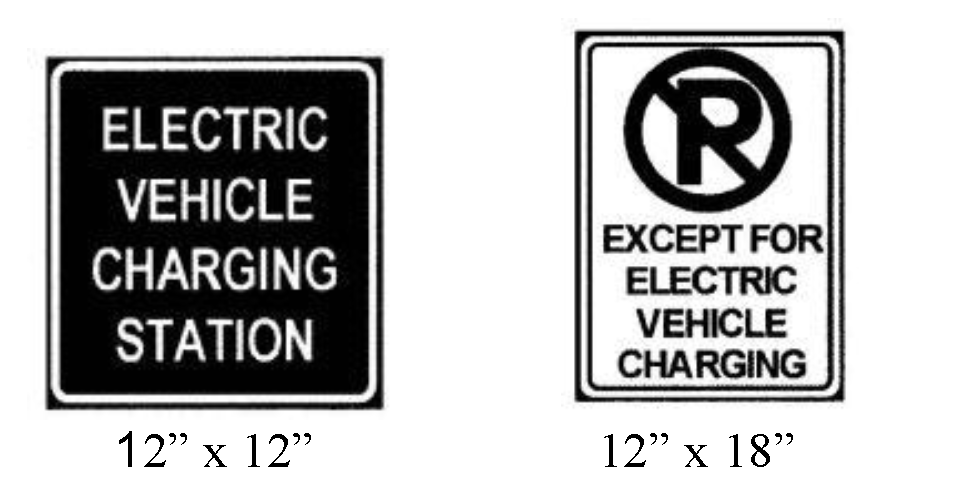
(2)
Installation of directional signage at the parking lot entrance and at appropriate decisions points be provided to guide motorist to the charging stations space(s). Directional arrow signs shall be no larger than 24 inches by nine inches.

24" x 24"
(3)
An EV sign may be displayed without an associated direction arrow but no direction arrow sign may be displayed without an EV sign. No permits are required for EV signs.
(j)
Battery exchange stations. Battery exchange stations are permitted in commercial and industrial zoning districts, provided all other requirements for the building or space the use occupies can be satisfied, such as fire, zoning, and building code requirements. This use is specifically prohibited in residential zoning districts or areas.
(Ord. No. 2020-25, § 1(Exh. A), 9-29-2020; Ord. No. 2022-25, §§ 14, 15, 8-9-2022; Ord. No. 2024-07, § 2, 2-27-2024; Ord. No. 2025-55, §§ 2, 3, 1-13-2026)
Sec. 125-4.20. - Landscaping and buffer yards.
125-4.20.1.
Purpose. The purpose of the landscaping and buffer yard regulations is to:
(a)
Promote attractive development and preserve the appearance and character of the surrounding area through the use of landscaping.
(b)
Eliminate or minimize conflicts between potentially incompatible, but otherwise permitted land uses, on adjoining lots through buffering, which may include a combination of setbacks and visual buffers or barriers.
(c)
Prescribe standards for the development and maintenance of planting, fences, and walls.
125-4.20.2.
Landscaping. These provisions are intended to promote attractive development and preserve the appearance and character of area surrounding new development. These provisions apply to all development for which landscaping is required under this chapter and to planned developments.
(a)
Applicability. These regulations shall apply to:
(1)
All new residential and non-residential subdivisions;
(2)
All new construction other than individual single family residences;
(3)
Additions of 50 percent or more to existing buildings and uses in all multi-family residential and non-residential districts.
(4)
New construction and expansion by 50 percent or more of all existing permanent non-residential uses in residential districts.
(5)
Addition or expansion of an existing site or building by more than 5,000 square feet;
(b)
Landscaping plan. When landscaping is required, a landscaping plan shall be submitted in conjunction with other application materials, as provided for in this chapter. Landscaping may include trees, shrubs, ground cover, vines, walkways, ponds, fountains, benches, sculpture, shade structures and other materials used for enhancing the exterior appearance of a development or parking area.
(c)
Preparation and completion of landscaping plan. A landscaping plan must be prepared by a landscape designer, a state-licensed landscape architect, or other qualified person and no significant or substantive changes to approved landscaping plans may be made without prior written approval by the building official. Evidence of completion of required landscaping must be supplied to the city planner or designee and submitted prior to issuance of an occupancy permit for new construction.
(d)
Components of landscaping plan. A landscaping plan shall include a site plan, drawn to scale with a north arrow, that is equal to standard architectural or engineering quality and indicates the following:
(1)
The species and size of all existing trees greater than one and one-half-inch caliper, showing those that are proposed for removal and those proposed for retention;
(2)
All proposed plant materials clearly labeled and drawn to size at maturity;
(3)
Adjacent land uses;
(4)
Plant list, indicating common names, scientific names and varieties, quantities, planting sizes, and types, and plant spacing for hedges and screens for all plant materials proposed;
(5)
Description of the proposed method of protecting existing trees during construction; and
(6)
Irrigation system.
(e)
Required materials. Native and wildlife beneficial species preferred. All plant materials shall be suitable for League City soils and climatic conditions, the plant's slope exposure, shall meet the following requirements:
(1)
Uniform distribution. Plant material should be distributed so as to provide a relatively uniform planting. Where the planting is along a street and some visibility into the development is desired, the plant material may be arranged to provide view corridors.
(2)
Ground cover. Ground cover must be appropriate to the surface conditions of the area. Grass is the default landscaping material, although in parking lots and on steep slopes, other ground covers able to withstand the physical conditions are appropriate.
(3)
Combination of materials. The landscaped planting areas should be entirely pervious except for fence or wall structures and walks that provide pedestrian access. No more than 25 percent of a landscaped area should have gravel, stones, wood chips, or paving.
(f)
Parking area landscaping. Landscaping requirements for parking areas are set forth [in] section 125-4.19 [of] this article.
(g)
Maintenance. All required planting must be permanently maintained as approved in good growing condition and replaced with new plant materials when necessary to ensure continued compliance with applicable landscaping requirements.
(h)
Irrigation. A programmable automatic irrigation system shall be provided to all landscaped areas. Water conservation fixtures shall be used in accordance with applicable city requirements.
(i)
Surety for delayed installations. There may be cases where landscaping cannot be completed prior to building occupancy due to weather or other conditions. In these instances, the city may require surety to be provided in the amount of 120 percent of the estimated cost of the landscaping to be provided. The form of the surety must be approved by the city attorney.
(j)
Special landscape setback requirements.
(1)
Applicability. The landscape setback requirements in this subsection shall apply to the following districts: Commercial and Mixed Use, Industrial, Public and Semi-Public, and Open Space Districts and the Commercial Revitalization Overlay District. A minimum ten-foot-wide landscaped setback is required along all street frontages. The landscape setback shall consist of the following:
a.
One non-invasive tree or palm variety plant for every 30 feet of linear street frontage, excluding driveways. Trees may be planted in clusters or spaced linearly rather than being on 30-foot centers. The minimum size of the tree should be one and one-half-inch caliper (15 gallons) upon installation and shall have a minimum trunk height of six feet upon installation; and
b.
A continuous hedge consisting of shrubs that are not less than three feet or more than four feet in height and planted in three- or five-gallon container stocks upon installation. The landscape hedge shall be set back a minimum of three feet and a maximum of six feet from the perimeter of any parking space, driveway, or any access aisle.
c.
In lieu of a landscape hedge noted above, a berm measuring not less than three feet or more than four feet in height from finish grade of the parking lot may be utilized. The berm shall be set back a minimum of three feet and a maximum of six feet from the perimeter of any parking space, driveway, or any access aisle. The maximum slope shall not exceed 4:1.
(2)
In lieu of providing a landscape setback as described in (j)(1) above, the following may be utilized:
a.
Fifty percent of the ground floor of the building shall be built to the property line;
b.
Parking shall be located behind or at the side of buildings, except for passenger drop-off areas which may be located at the building entry;
c.
Loading areas shall be screened so as not to be visible from public streets; and
d.
Where the building abuts a residential district, the preferred location of loading facilities shall be the side away from the residential district boundary.
(k)
Percent of landscaped area. The zoning districts listed in the table below require a percent of the area to be landscaped. The minimum percent of landscaped area is provided in the table.
(l)
Screening of parking areas. Parking areas and parking access aisles parallel to and within 75 feet of rights-of-way shall be screened from view from those rights-of-way, public parks and public buildings with one of the following:
(1)
Landscape screening. Where landscaping is used as a substitute screening method, hedges shall be installed as described in (j)(1) of this section. Additionally, the hedges shall not be located in public rights-of-way. Plant materials shall be an evergreen species. Ground cover and shrubs planted within sight distance triangles shall not exceed a height of 24 inches at maturity.
(2)
Berms. Where a berm is used as a substitute screening method, berms shall meet the requirements described in (j)(1)b above. Berms shall not be located in public rights-of-way.
(3)
Parking screen fences. Fences shall be not less than three feet nor more than four feet measured from finish grade of the parking lot. Fences shall be set back a minimum of three feet and a maximum of six feet from the perimeter of any parking space, driveway, or any access aisle, as measured from the back of the curb. Fences shall not be placed in public rights-of-way or on top of any retaining walls. Fences shall be constructed of decorative block, brick, stone, or similar materials and finished on both the interior and exterior elevations.
(4)
Parking lot trees. Non-invasive trees or palm varieties shall be planted in the parking lot at a ratio of one tree for every eight spaces. Trees shall be dispersed throughout the parking lot to maximize the shading effect on the parking spaces. These trees are exclusive of trees planted around the perimeter of the parking lot. Parking lot trees, when planted, shall have a minimum trunk height of six feet and a minimum two-inch single trunk caliper measurement or one and one-half-inch average trunk caliper for multiple trunk trees, measured four feet above grade. This size of tree is generally referred to as a 24-inch box. The minimum trunk height of parking lot trees shall be six feet. The end spaces in a row of parking spaces shall be separated from drive aisles by landscape islands or peninsulas that are a minimum width of six feet. The landscape planter for any parking lot tree shall have a minimum area of 50 square feet and a minimum interior width of five feet.
125-4.20.3.
Buffer yards. Buffer yards are intended to eliminate or minimize conflicts between potentially incompatible, but otherwise permitted land uses on adjoining lots. Buffering may include a combination of setbacks and visual buffers or barriers. Table 125-4.20.3(d) prescribes the minimum buffer yard standards for three buffer yard types. Table 125-4.20.3(e) defines the types of buffer yards required for specific situations.
(a)
Applicability. The buffer yard standards of this section apply to:
(1)
All new development on vacant land;
(2)
Redevelopment or expansion of existing site development by more than 50 percent, not including single family dwellings or the addition of accessory uses or structures.
(3)
Addition or expansion of an existing building by more than 5,000 square feet;
(4)
Any change in use that increases development intensity and results in increased traffic, processes, noise, water or air pollution, etc. For the purposes of this section, a change in use includes: a change from a residential use to a commercial use; from a commercial use to an industrial use; and in some cases from a manufacturing use to a commercial use.
(b)
Location and measurement. Required buffer yards shall be developed along the perimeter of the lot and shall be measured from the property line of the development site and extending inward. Buffer yard planting may be located in a required setback area. Buffer yards shall not be located within any dedicated public or private street right-of-way.
(c)
Buffer yard plan. A buffer yard plan must be submitted in conjunction with the landscaping plan and other application materials. The plan must be prepared by a landscape designer, a state-licensed landscape architect, or other qualified person. Where a landscaping plan is also required pursuant to section 125-4.20.2 above, the landscaping plan must incorporate the buffer yard plan. Where a landscaping plan is not required, the buffer yard plan must show the location of all buffer yards on the project site, proposed plant locations, a plant list and key, location of utility easements, roads, emergency access, walkways, and existing and proposed structures on the site.
(d)
Buffer yard standards. Table 125-4.20.3(d) describes the minimum requirements for each buffer yard type. Native and wildlife beneficial species are preferred.
Table 125-4.20.3(d): Buffer Yard Standards
(1)
On any portion of the development site where this section would require two buffer yard types, the greater buffer yard type shall be required.
(2)
Canopy trees shall mean deciduous and broadleaf evergreens capable of growing at least 25 feet in height or spread at maturity and not less than ten feet high and one and one-half-inch caliper at time of planting. Trees shall be placed at least eight feet from the fence.
(3)
Ornamental trees shall mean deciduous or evergreen trees capable of growing between ten and 15 feet in height at maturity and not less than eight feet high and one and one-half-include caliper at time of planting. Trees shall be placed at least eight feet from the fence.
(4)
The fence/masonry wall shall provide a solid visual barrier.
(e)
Required buffer yards. Buffer yards are required between certain land uses, with the type of yard depending on the adjoining zoning district. Table 125-4.20.3(e) below prescribes the required buffer yards between proposed development and adjoining development by zoning district. For each zoning district, the required buffer yard type is specified. In some cases, a buffer yard is not required.
(f)
Maximum achievable buffer yards. In cases where shape, topography, easements, or existing buildings on a lot make it impractical to provide a required buffer yard, the city planner or designee may recommend and the planning and zoning commission may approve a maximum achievable buffer yard that provides planting and design that is consistent with the use being buffered.
(g)
Surety for delayed installations. There may be cases where buffer yards cannot be completed prior to building occupancy due to weather or other conditions. In these instances, the city may require surety to be provided in the amount of 120 percent of the estimated cost of the landscaping to be provided. The form of the surety must be approved by the city attorney.
Table 125-4.20.3(e): Required Buffer Yards
Adjoining Development or District
— No buffer yard required; A, B, C Buffer yard standard
* Exception: The proposed development is not required to provide a buffer adjacent to property zoned Open Space that meets the following criteria: 1) Shall be a separately owned parcel; 2) Shall be solely utilized as a drainage easement or other utility; and 3) The width shall equal or exceed the width of the required buffer. The proposed development shall provide an eight-foot tall fence along the property line adjoining the Open Space parcel if the Open Space parcel is adjacent to a zoning district that would require a buffer by the proposed development.
(Ord. No. 2020-25, § 1(Exh. A), 9-29-2020; Ord. No. 2022-25, §§ 16—18, 8-9-2022; Ord. No. 2024-01, §§ 1, 2, 1-9-2024; Ord. No. 2024-41, § 1, 10-22-2024)

