
League City City Zoning Code
ARTICLE VII
TREE PRESERVATION, MITIGATION, AND MAINTENANCE
Sec. 125-7.1.- Permit required.
125-7.1.1.
Permit. Except as otherwise provided in this article, a tree disposition permit shall be obtained by a responsible person prior to authorizing or subjecting a protected tree to any tree impact activity or tree removal.
125-7.1.2.
Permit valid. A tree disposition permit is valid for a period of six months from the date of issuance.
125-7.1.3.
Significant trees. No tree disposition permit may be issued to allow the removal, cutting down, or other activity intended to kill or destroy a healthy significant tree (Oak or Pecan ≥ 38″ caliper), unless the planning director determines that the failure to grant such a permit would result in violation of state or federal law. After submission of a written appeal is made to the planning department that conforms to section 125-7.6.3:
(a)
The planning director may grant an administrative authorization to permit removal of one significant tree or up to ten percent of the total caliper inches of significant trees on the property, or;
(b)
City council may grant authorization to permit removal exceeding ten percent up to 25 percent of total caliper inches of significant trees on the property.
(Ord. No. 2020-25, § 1(Exh. A), 9-29-2020; Ord. No. 2025-49, § 1, 12-16-2025)
Sec. 125-7.2. - Permit application requirements.
125-7.2.1.
A tree disposition permit may be issued by the city arborist only upon the submission and approval of the following:
125-7.2.2.
An application that includes the following:
(a)
The applicant's name, address, and phone number;
(b)
The address of the property at which a tree impact activity or tree removal is sought;
(c)
The name, address, and phone number of the person or entity that will actually perform the tree impact activity or tree removal, if not the applicant; and
(d)
The name, address, and phone number of the owner of record of the property at which a tree impact activity or tree removal is sought, if not the applicant.
(e)
A tree disposition plan certified by a licensed surveyor, a certified arborist or registered landscape architect, that:
(1)
Identifies:
a.
The protected trees sought to be subjected to a tree impact activity or tree removal at the site, according to location, type and size;
b.
Location and total caliper inches of invasive species to be removed, if seeking credit for elimination of invasive species;
c.
Areas of construction or other activities to be performed within the critical root zone of a protected tree, including site plans documenting measures to be taken for protection of each impacted critical root zone;
(2)
Includes tables summarizing the total caliper inches of protected trees to be removed in size categories as follows:
a.
For small trees (see section 125-7.11.4 for tree list):
1.
Six-inch to nine-inch caliper;
2.
Greater than nine-inch to 12-inch caliper; and
3.
Greater than 12-inch caliper.
b.
For large trees (see section 125-7.11.4 for tree list):
1.
Twelve-inch to 15-inch caliper;
2.
Greater than 15-inch to 18-inch caliper; and
3.
Greater than 18-inch caliper; and
(3)
States the total number of caliper inches to be replaced, calculated using the tree replacement calculation set forth below, and how replacement will be achieved, whether by on-site replacement or off-site replacement, or payment in lieu of replacement; and
(4)
Includes the proposed plan for tree replacement by location, type and size, if applicable;
(f)
An application fee in an amount as set by the city council; and
(g)
One of the following:
(1)
A cashier's check or money order for the full amount of the payment in lieu of replacement; or
(2)
A cash escrow, bond, letter of credit, or other acceptable security instrument securing an amount equal to a full payment in lieu of replacement, which by its terms:
a.
Can be redeemed or called by the city one year from the date the tree disposition permit is issued, if not earlier released; and
b.
Can only be released upon the city's approval, which approval the applicant may request only after completion of all replacement planting.
(Ord. No. 2020-25, § 1(Exh. A), 9-29-2020; Ord. No. 2025-49, § 2, 12-16-2025)
Sec. 125-7.3. - Tree replacement calculation.
125-7.3.1.
Tree replacement calculations are based upon the following guiding principles:
(a)
Greater value is placed on protected trees of greater size, therefore caliper inch replacement is increased as the size of each tree increases;
(b)
Greater value is placed on maintaining trees on-site, therefore caliper inch replacement is increased if replacement occurs off-site or through payment in lieu of replacement;
(c)
Greater value is placed on maintaining large or interconnected conservation areas, therefore exceptions and incentives are available to maintain these areas;
(d)
Invasive tree species harm the native tree canopy, therefore incentives are available for elimination of species shown in the invasive tree list in this article; and
(e)
Protection and maintenance of the community's tree canopy is more critical than equal replacement of individual trees, therefore replacement calculations result in a total number of caliper inches to be replaced as measured following application of the above principles.
125-7.3.2.
The diameter at breast height of each protected tree to be removed from the site shall be measured to determine size in caliper inches.
125-7.3.3.
Replacement of removed trees shall be achieved utilizing one of the following three methods, in accordance with the applicant's written election:
(a)
On-site replacement in accordance with all the standards and requirements of the City of League City;
(b)
Off-site replacement in parks, dedicated conservation areas or selected rights-of-way at the direction of the city planner or city arborist; or
(c)
Payment in lieu of replacement to the city reforestation and tree management fund to be used for public reforestation and maintenance of protected trees on public property or significant trees on public or private property.
Base removal allowance of up to ten percent of the total protected caliper inches on a site may be removed without replacement.
125-7.3.4.
Caliper inch replacement of each protected tree (see section 125-7.11.4 for tree list) shall be calculated in accordance with the following table:
125-7.3.5.
Payment in lieu shall be calculated at a tiered rate per caliper inch of required replacement tree(s):
• Six inches—12 inches: $100.00/inch x replacement percentage from section 125-7.3.4
• Twelve inches—18 inches: $150.00/inch x replacement percentage from section 125-7.3.4
• Eighteen inches—37.9 inches: $200.00/inch x replacement percentage from section 125-7.3.4
• Significant trees (>38 inches): $250.00/inch x replacement percentage from section 125.7.3.4
125-7.3.6.
The city planner or city arborist shall have the discretion to reduce tree replacement requirements by the removal of invasive trees on-site or off-site in accordance with standards established by the city arborist. Reduction of caliper inch replacement if granted shall be calculated in accordance with the following table:
(Ord. No. 2020-25, § 1(Exh. A), 9-29-2020; Ord. No. 2025-49, § 3, 12-16-2025)
Sec. 125-7.4. - Tree replacement standards.
125-7.4.1.
Replacement trees shall be selected from the protected tree list according to available planting space and specific environmental requirements of the tree and shall be a minimum of (i) three caliper inches measured one foot above grade, and (ii) seven feet in height.
125-7.4.2.
Replacement trees shall be planted according to tree planting standards established by the International Society of Arboriculture, with a minimum of 15 feet spacing for small trees and a minimum of 30 feet spacing for large trees, unless otherwise approved by the city arborist.
125-7.4.3.
Replacement trees must be planted within one year from the date the tree disposition permit is issued. The applicant shall notify the city arborist after the replacement trees have been planted so that they may be inspected. If the replacement trees are not planted within this time, the city attorney is authorized to take all legal steps to recover payment in lieu of the applicant to satisfy the mitigation requirements.
(Ord. No. 2020-25, § 1(Exh. A), 9-29-2020)
Sec. 125-7.5. - Exceptions.
125-7.5.1.
The owner of record of a legally conforming single-family residence may remove or subject any tree on that property to a tree impact activity, without a tree disposition permit and without mitigation.
125-7.5.2.
A tree disposition permit may be issued, without requiring mitigation, to remove a protected tree if the tree is:
(a)
Injured, dying, diseased or infested with harmful insects to the extent that it is not likely to survive as determined and documented by the city arborist; or
(b)
In danger of falling, interfering with utility service or other creating a hazardous or dangerous condition as determined and documented by the city arborist.
125-7.5.3.
If the owner of a protected tree believes that an emergency situation exists that requires the immediate removal of said tree to protect the safety of persons or property, the owner may subject the tree to a tree impact activity or remove the tree without a tree disposition permit, but only to the extent necessary to eliminate the dangerous situation. A person that claims this exception shall:
(a)
Apply for a tree disposition permit on the next working day; and
(b)
Be able to substantiate the claim of an emergency situation to the reasonable satisfaction of the city arborist by providing evidence of the dangerous condition such as, but not limited to, a letter from a certified arborist and/or digital images.
(Ord. No. 2020-25, § 1(Exh. A), 9-29-2020)
Sec. 125-7.6. - Appeals.
125-7.6.1.
An applicant may appeal the planning director's decision to deny a tree disposition permit for the removal of a significant tree to the city council by filing the following with the city planning department:
(a)
Notice of appeal. A written notice of appeal within ten business days from notification of the planning director's decision.
(b)
Supporting materials (due within 30 days of notice). The applicant must submit either:
(1)
A written legal opinion from an attorney licensed in Texas that details how the failure to grant the permit would violate state or federal law, within 30 days of the filing of the notice of appeal; or
(2)
A site plan for the subject property showing the location of the significant tree and explaining why retaining it makes the proposed improvement unfeasible.
(c)
Council agenda placement. Once the notice of appeal and one of the supporting materials are filed, the planning director shall place the appeal on a city council agenda within 30 days of receiving those documents.
125-7.6.2.
An applicant may appeal to the city manager the calculation of the total caliper inches of replacement trees required by filing with the city secretary's office a written notice of appeal within ten business days from notification by the city arborist of the tree replacement calculation, setting forth the reason(s) and including the documentation for any contention that the calculation of caliper inches of replacement trees is too high. The city manager shall issue a decision within 45 days of a formal appeal filing.
125-7.6.3
For appeals under section 125-7.1.3 requesting authorization to remove significant trees, the planning director may authorize removal of one significant tree or up to ten percent of total significant?tree caliper inches if any one of the following applies:
(a)
Site constraint hardship.
(1)
Trees lie within the only feasible buildable envelope, with no practical alternative layout.
(2)
Removal does not reduce overall canopy (existing + proposed) below 75 percent of predevelopment levels.
(3)
A mitigation plan provides at least one and one-half inches new caliper planting for each one inch removed the minimum size tree that can be planted is three inches in diameter.
(b)
Public safety and infrastructure.
(1)
Trees pose a documented hazard to public health, safety, or utilities.
(2)
Trees conflict with mandated infrastructure improvements (e.g., roadway widening) where rerouting is impracticable.
(3)
Trees are certified dying, diseased, or structurally unsound by a qualified, certified arborist.
(c)
Public benefit/community amenities.
(1)
Dedication of at least ten percent of the site as public green space (minimum size of 15 acres).
(2)
Installation of enhanced landscaping, such as tree-lined promenades or pocket parks.
(d)
Administrative exception with council oversight.
(1)
Director may administratively approve up to ten percent removal of total significant-tree caliper inches for a given site.
(2)
Requests beyond ten percent (up to 25 percent) require city council approval.
(Ord. No. 2020-25, § 1(Exh. A), 9-29-2020; Ord. No. 2025-49, § 4, 12-16-2025)
Sec. 125-7.7. - Offense; restitution.
125-7.7.1.
Any person who recklessly removes or subjects a protected tree to a tree impact activity without a valid tree disposition permit authorizing such action shall be guilty of a misdemeanor, which shall be punishable by a fine not to exceed $500.00. Each subsequent day that elapses without the person obtaining a tree disposition permit shall constitute a separate offense.
125-7.7.2.
In any prosecution under this section, the prosecuting attorney shall seek and the judge is authorized to award restitution to be paid into the city reforestation and tree management fund, in an amount calculated by the city arborist pursuant to the provisions below:
(a)
Restitution for removal of trees without an approved tree permit:
(1)
Assume that each tree on site is a large protected tree measured at 18 caliper inches with an individual tree canopy of 2,200 square feet;
(2)
Determine total caliper inches to be replaced by measuring the total tree canopy covering the site prior to removal of trees using aerial imagery acceptable to the City of League City; and
(3)
Calculate base in-lieu payment under section 125-7.3.5.
(4)
Apply additional penalty of 100 percent of base (max restitution = 2 x base).
(5)
If the site has been cleared in whole or in substantial part without obtaining a tree disposition permit or prior authorization under this article, the total in-lieu fees and restitution applicable to that site may not exceed 100 percent of the unimproved land value (per appraisal). In all other cases, the general cost-cap safeguard in section 125-7.7.3 shall apply.
(b)
Restitution for removal of a significant tree:
(1)
Calculate base in-lieu payment under section 125-7.3.5.
(2)
Apply additional penalty of 100 percent of base (max restitution = 2 x base)
(c)
For subjecting a protected tree to a tree impact activity, the city arborist shall:
(1)
Same method as (a) and (b) depending on size classification
(2)
Total restitution capped at 2 x base in-lieu amount.
125-7.7.3.
Cost-cap safeguard. Total in-lieu fees plus restitution for any site may not exceed 50 percent of the unimproved land value (per appraisal).
(Ord. No. 2020-25, § 1(Exh. A), 9-29-2020; Ord. No. 2025-49, § 5, 12-16-2025)
Sec. 125-7.8. - Tree preservation standards.
125-7.8.1.
Maintenance practices. Maintenance practices, including, but not limited to, large limb pruning and canopy thinning, of a protected tree shall be in accordance with best practices as approved by a certified arborist or the city arborist.
125-7.8.2.
Critical root zone. The critical root zone of a protected tree shall be protected as follows:
(a)
No materials intended for construction or waste materials from grading, excavation or demolition shall be allowed to accumulate.
(b)
No equipment shall be cleaned in such close proximity to allow harmful liquids to be deposited or flow overland and/or runoff into the critical root zone.
(c)
No vehicular or construction equipment may be parked in or on a critical root zone.
(d)
No grade changes shall be allowed in a critical root zone.
(e)
A protective barrier, such as a temporary fence, shall be installed to protect the critical root zone prior to and throughout the duration of any work and/or improvements that occur on a property containing a protected tree.
125-7.8.3.
Utilities below tree canopy. Any utilities to be installed below the canopy of a protected tree, shall be bored, not trenched, and shall be so shown on the tree disposition plan.
125-7.8.4.
Tree support systems. Trees requiring support systems shall be secured according to type and size. Tree staking, cabling, and other materials shall remain in place only until the tree has been established, which time period shall not to exceed one year.
(Ord. No. 2020-25, § 1(Exh. A), 9-29-2020)
Sec. 125-7.9. - Tree maintenance standards.
125-7.9.1.
Maintenance of trees within the rights-of-way. The owner(s) of any lot with frontage along a public street, including a property owners association, shall maintain the street trees and other landscaping growing along the frontage or in the street right-of-way adjacent to the lot, including in any park or parking strip between the property line and the street line.
125-7.9.2.
Tree topping. Topping (also referred to as heading, stubbing, rounding or dehorning) of any street tree, park tree, or other tree on public property is prohibited. Topping involves the severe cutting back of limbs to stubs larger than three inches in diameter within the tree's crown to such a degree so as to remove the normal canopy and disfigure the tree. the city manager, upon the recommendation of the city arborist, may specifically authorize in writing topping of a specific tree, based on clear evidence of extraordinary circumstances that justify topping. Extraordinary circumstances may include but not be limited to, trees severely damaged by storms or other causes, or trees under utility wires or other obstructions where other pruning practices are impractical.
125-7.9.3.
Pruning, corner clearance. The owner(s) of any tree overhanging any street or right-of-way within the city shall prune the branches so that such branches shall not obstruct the light from any street light or obstruct the view of any street sign or intersection, and so that there shall be a clear space of 15 feet above the surface of the street and eight feet above the surface of the sidewalk. Pruning includes crown cleaning, thinning, raising, reduction, and restoration. The pruning of trees must comply with tree trimming guidelines in the American National Standard for Tree Care Operations: Tree Shrub and Other Woody Plant Maintenance Standard Practices, or National Arborist Association's "Standards for Pruning of Shade Trees." Said owners shall also remove all dead, diseased or dangerous trees, or broken or decayed limbs which constitute a menace to the safety of the public.
125-7.9.4.
Owner responsibility. If the property owner fails to prune trees to provide clearances stated, the city arborist is authorized to notify the owners of such trees in writing of their responsibility. Pruning shall be done by said owners at their own expense within ten days after the date of service of notice. In the event of failure of owners to comply with such provisions, the city shall have the authority to prune such trees and charge the cost of removal to the owners.
125-7.9.5.
Removal of dead or diseased trees on private property. A tree disposition permit is required to remove a protected tree. The city shall have the right to cause the removal of any dead or diseased trees on private property within the city, when such trees constitute a hazard to life and property, or harbor insects or disease which constitute a potential threat to other trees within the city. The city shall notify in writing the owners of such trees. Removal shall be done by said owners at their own expense within 30 days after the date of service of notice. In the event of failure of owners to comply with such provisions, the city shall have the authority to remove such trees and charge the cost of removal to the owners.
125-7.9.6.
Emergency removal provision. If the city arborist determines that a tree poses an imminent threat, the city may secure the surrounding area and/or remove the hazardous tree.
125-7.9.7.
Removal of stumps. Street and park trees that are removed shall have their stumps ground to grade level or removed.
(Ord. No. 2020-25, § 1(Exh. A), 9-29-2020; Ord. No. 2024-35, § 1, 10-8-2024)
Sec. 125-7.10. - Street trees.
125-7.10.1.
Minimum distance from sidewalks and curbs.Trees shall be centered in the planting strip between the sidewalk and the street curb. If centering within the planting strip is not possible or desirable due to design considerations, the tree must be located at least two feet from the sidewalk edge or the curb edge. Trees within the city rights-of-way shall not be planted where the rooting space is less than four feet in width without prior approval of the city arborist. The minimum width of a planting site for each tree will be governed by the approved street tree list. Trees that commonly produce a large-buttress root system shall be planted in a site greater than ten feet wide (i.e., Quercus species). On public streets without sidewalks, trees shall be located to accommodate future sidewalk placement and current and future utility line corridors.
125-7.10.2.
Tree root barriers. Tree root barriers shall be installed when new trees are planted to prevent uncontrollable spread of tree roots that may cause damage to hardscape/infrastructure (sidewalks, driveways, storm sewers, streets). Root barriers may be either linear or surround in form, depending on the hardscape/infrastructure to be protected, and must be installed at a minimum depth of 30 inches.
125-7.10.3.
Minimum street tree planting clearances.
125-7.10.4.
Minimum distance from buried utility lines. If buried utility lines traverse the planting strip, the following minimum distances apply:
Eight-inch to ten-inch water and sewer line: Ten feet
12-inch to 16-inch water and sewer line: 15 feet
18-inch + water and sewer line: 20 feet
All other services: Ten feet
125-7.10.5.
Linear spacing. Trees shall be placed an average of every 30 feet. Depending on the size, species, and variety, the city arborist may approve planting distances which may be as close as ten feet and as far as 40 feet to 50 feet based on the size and growth habit of the tree.
125-7.10.6.
Medians. No tree shall be planted in any median that is less than ten feet in width.
125-7.10.7.
Overhead utility lines. No tree with the potential of reaching a mature height of more than 15 feet shall be planted in the right-of-way under overhead wires.
125-7.10.8.
Street tree list. The street tree list includes suggested species for street trees. The city arborist may approve trees that do not appear on this list.
(Ord. No. 2020-25, § 1(Exh. A), 9-29-2020)
Sec. 125-7.11. - City-maintained trees.
125-7.11.1.
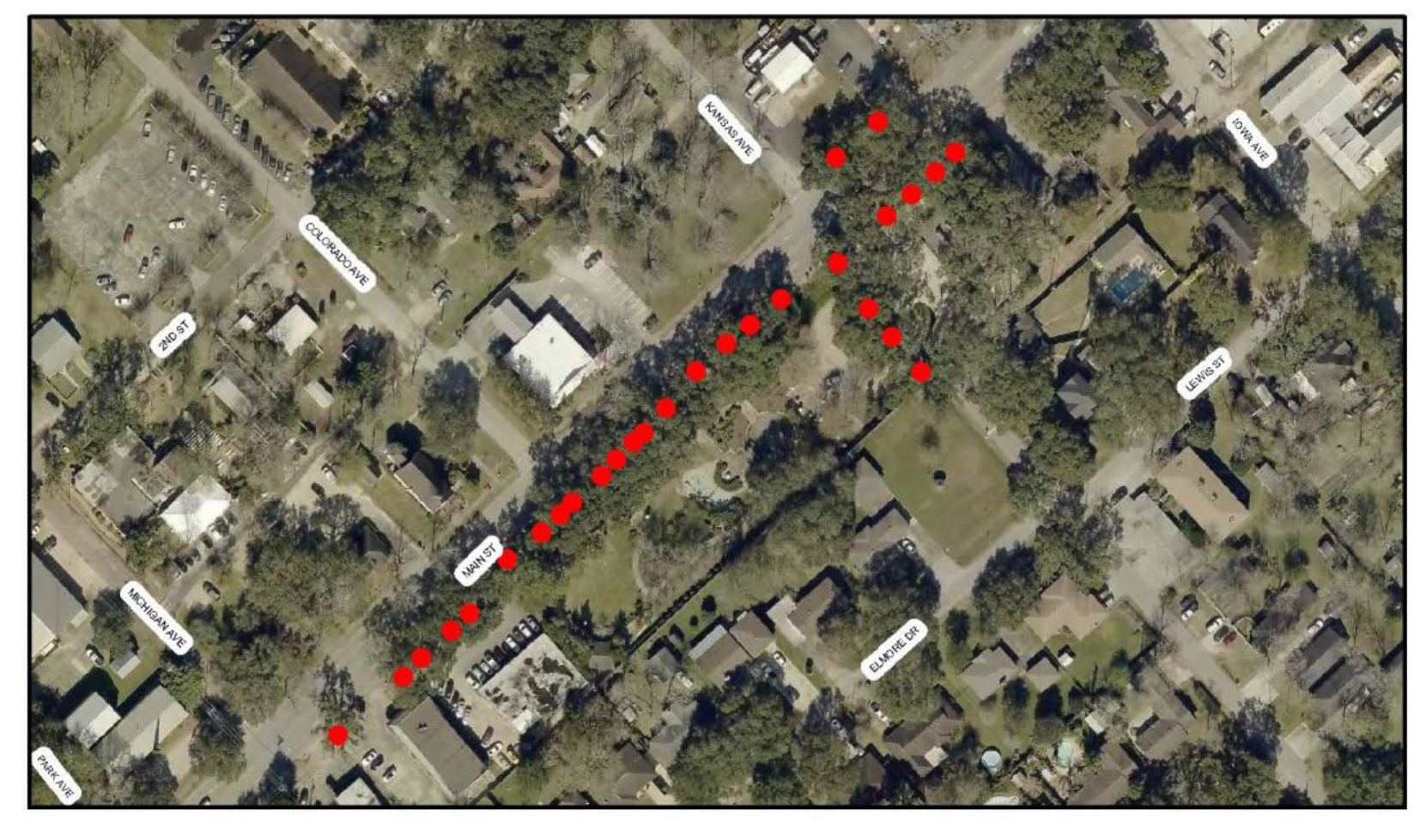
Public tree care. The city currently maintains live oak trees in the right-of way on Main Street. The locations are as follows; 22 live oaks on the south side of Main Street between Michigan and Kansas, extending down Kansas to the southern-most boundary/fence line of Helen's Garden; four live oaks on the southside of Main street between Kansas and Iowa and two live oaks on the north side of Main street between Kansas and Iowa. See the map below.
125-7.11.2.
City rights. The city shall have the right to plant, prune, maintain and remove trees, plants and shrubs within the lines of all streets, alleys, avenues, lanes, squares, rights-of-way and on property owned by the city, as necessary to ensure public safety or to preserve or enhance the symmetry and beauty of such public property. The city reserves the right to allow the city arborist to authorize the pruning or removal of a street tree or park tree when immediate pruning or removal is necessary to protect against an imminent threat of substantial injury to persons or damage of property.
125-7.11.3.
Non-liability of city.Nothing in this chapter shall be deemed to impose any liability for damages or a duty of care and maintenance upon the city or upon any of its officers or employees.
125-7.11.4.
Protected tree list.
125-7.11.5.
Invasive tree list.
(Ord. No. 2020-25, § 1(Exh. A), 9-29-2020; Ord. No. 2025-49, § 6, 12-16-2025)

