
Leander City Zoning Code
ARTICLE VI
SITE STANDARDS
Sec. 1. - Landscaping, tree preservation and protection, and screening requirements.
(a)
Purpose.
(1)
To establish requirements for the preservation and protection of native trees and provisions for landscaping, buffering, and screening to provide for the orderly, safe, attractive and healthful development of land and promoting the health, safety and general welfare of the community, it is deemed necessary to establish requirements for the installation and maintenance of landscaping elements and other means of site improvements in developed properties.
(2)
To enhance the community's ecological, environmental and aesthetic qualities; to encourage the preservation of trees for the enjoyment of future generations; to provide environmental elements by adding value to property, and reduction of energy costs through passive solar design utilizing trees; and to promote and protect the health, safety and welfare of the public by creating an urban environment that is aesthetically pleasing and that promotes economic development through an enhanced quality of life.
(3)
Paved surfaces, automobiles, buildings and other improvements produce increases in air temperatures, a problem especially noticeable in this southern region, whereas plants have the opposite effect through transpiration and the creation of shade. Likewise, impervious surfaces created by development generate greater water runoff causing problems from contamination, erosion and flooding. Preserving and improving the natural environment and maintaining a working ecological balance are of increasing concern. The fact that the use of landscape elements can contribute to the processes of air purification, oxygen regeneration, water absorption, water purification, and noise, glare and heat abatement as well as the preservation of the community's aesthetic qualities indicates that the use of landscape elements is of benefit to the health, welfare and general well being of the community and, therefore, it is proper that the use of such elements be required.
(4)
The City experiences frequent droughts; therefore, it is the purpose of this Section to encourage the use of drought resistant vegetation.
(b)
Landscape Requirements.
(1)
Installation. All landscape materials shall be installed and maintained according to generally accepted landscape practices for the region. Low water demanding landscapes, are encouraged and should include plants from the preferred plant list and included in the Grow Green Guide.
(2)
Maintenance. The owner of landscaped property shall be responsible for the maintenance of all landscape areas. Said areas shall be maintained so as to present a healthy, neat and orderly appearance at all times and shall be kept free of refuse and debris. All planted areas shall be provided with a readily available water supply and watered as necessary to ensure continuous healthy growth and development. Landscape irrigation systems shall not be mandatory with low water demanding landscapes, which are encouraged. Maintenance shall include the removal of dead plant material and its replacement if that material was used to meet the requirements of this section.
(3)
Shrubs, vines and ground cover planted pursuant to this section shall be healthy nursery stock.
(4)
Turfgrass.
(i)
All turfgrass installed shall have summer dormancy capabilities and shall be one of the varieties set forth in the preferred plant list maintained by the Planning Department or the Grow Green Guide. Buffalo grass, zoysia grass or non-seeding varieties of Bermuda grass are recommended for sunny sections of the landscape.
(ii)
Turfgrass shall be limited to one-half (1/2) of the lot after subtracting the impervious cover for single-family and two-family lots. Alternative options to turfgrass can include native and adaptive landscape plants as specified in the Grow Green Guide, mulch, crushed granite, Decorative Groundcover, or similar material. No more than fifty (50%) percent of the lot may consist of non-plant material.
(iii)
The maximum landscape that may be planted in turfgrass for the types of development listed in Article VI, Section 1(b)(9)(i) through (iv) and (vi) below shall be limited to fifty (50%) percent of any landscape area.
(iv)
Turf grass shall be prohibited in strips of land less than six (6') feet wide in parking areas or between sidewalks and pavement.
(v)
Turf grass shall be limited to fifty (50%) percent landscape lots, open space lots, greenspace, and Home Owners Association (HOA) lots.
(5)
Synthetic or artificial lawns or plants shall not be used in lieu of plant requirements.
(6)
The use of architectural planters may be permitted in fulfillment of landscape requirements.
(7)
Any approved Decorative Groundcover or pervious brick pavers shall qualify for up to ten percent (10%) of the required landscaping if contained in planting areas, but no credit shall be given for concrete or other impervious surfaces.
(8)
Other than single-family and two-family development, setback areas shall be landscaped per the standards of this section.
(9)
A minimum percentage of the total lot area of property on which development occurs shall be devoted to landscape development in accordance with the following schedule. Such percentages may include setback areas. However, all nonsingle-family and nontwo-family setback areas are required to be landscaped in accordance with Article VI, Section 1(b)(11) [below] even if they exceed the following percentages:
(i)
Multifamily Dwellings, 20%.
(ii)
Office and Professional Uses, 15%.
(iii)
Commercial Uses, 15%.
(iv)
Industrial or manufacturing, 10%.
(v)
Single-family-Dwellings, Two-Family dwellings, Tiny House, Neighborhood Residential, or Cottage Housing see Item (4) [subsection (12)] below.
(vi)
Schools, churches, community centers and parks, 15%.
(10)
The following may not be counted toward the above landscape area requirements:
(i)
Detention and water quality ponds unless such ponds are designed as follows:
a.
The ponds shall utilize earthen berms.
b.
Any structural stabilization shall be limited to the use of native stone (except for outlet structures) and shall be limited to not more than thirty percent (30%) of the perimeter of the pond.
c.
Such ponds shall be seamlessly integrated with the landscaping.
d.
Such ponds shall be not greater than eighteen inches deep.
e.
Such ponds shall not comprise more than 25% of the required landscaped area.
(ii)
Utility, mechanical and electrical facilities.
(iii)
Sidewalks or other paved surfaces except for any decorative aggregate or pervious brick pavers if contained in planting areas and comprising less than ten percent (10%) of the required landscape area.
(iv)
Landscaped areas less than four feet in width. In calculating the width of landscaped areas, such areas shall not be divided by any form of pavement (e.g. sidewalks, detention or water quality ponds, paving, etc.).
(11)
Landscape material requirements.
(i)
Trees and shrubs identified on the preferred plant list and included in the Grow Green Guide, shall be utilized within the required landscaping as described below.
(ii)
At least seventy-five percent (75%) of the planted trees are required to be large trees/shade trees (as defined in the Grow Green Guide), the remaining trees may be small trees or ornamental trees all of which shall be selected from the preferred plant list or Grow Green Guide.
(iii)
Two (2) - ten (10) gallon ornamental trees may be substituted for every one (1) required shade tree as long as at least half of the required number of shade trees is installed.
(iv)
Existing significant trees and shrubs that are retained in healthy condition may count toward fulfillment of these requirements. In calculating the credit from existing significant trees and shrubs that are retained, shrubs shall be credited on a one (1) for one (1) basis if such shrub is equivalent or greater in size to a comparable five (5) gallon container grown shrub. Trees shall be credited on a caliper inch basis (for every one (1) caliper inch of a tree that is saved, credit shall be given for one (1) caliper inch of a tree required to be planted), with saved significant trees over eighteen (18) caliper counting on a one for two basis (for every one caliper inch of a significant tree over eighteen (18) caliper that is saved, credit shall be given for two (2) caliper inches of a tree required to be planted).
(12)
The following is for other than single-family or two-family development:
(i)
For every six hundred (600) square feet of landscape area and setback area required by this ordinance, two (2) shade trees (two (2) inch caliper or larger) and four (4) shrubs (five (5) gallon container size or larger) shall be planted.
(13)
If the exterior surface area of all walls for non-residential or multifamily buildings/structures are comprised of one hundred (100%) percent Masonry, then the ratio may be reduced to one (1) shade tree per six hundred (600) square feet in the front setback.
(14)
Side setbacks within a commercial development that are not adjacent to residential properties are not required to include landscaping at the above ratio within the side setback. This provision applies to commercial center developments made up of commercial lots with shared parking lots.
a.
To allow for larger landscaped activity areas at school facilities, for every 600 sq. ft. of landscaping required by this section, 1 tree and 3 shrubs (five gallon container size or larger) shall be planted.
b.
To reduce the thermal impact of unshaded parking lots, additional trees shall be planted as necessary so that the center point of each parking space is no more than 50 feet away from the trunk of a tree.
c.
If street trees are proposed, the street trees may be planted between the sidewalk and back of curb (or edge of pavement) in accordance with the City's street tree detail. Street trees are not required, but if they are proposed the street tree species shall be consistent on both sides of the street within a block, shall be a street tree species listed in the preferred plant list, and shall be specified in the Construction Plans for the subdivision (if applicable). Street tree spacing shall not exceed thirty (30) feet on center between trees on the same side of the street. Street trees may be counted toward the required tree plantings within the front or street side setback area.
(15)
Compatibility buffer for uses other than single-family or two-family development.
a.
Purpose and intent. The purpose of this section is to set forth requirements regarding the design, installation, construction and maintenance of compatibility buffers for uses other than single-family or two-family development. A compatibility buffer shall be composed of a landscape buffer and a compatibility fence as provided Article VI, Section 14(d) of this ordinance. Compatibility buffering is intended to minimize the effects of non-residential and multifamily uses which share a common lot line with existing or planned single-family or two-family uses.
b.
Applicability. This section shall apply to:
(i)
Any new development or construction requiring a permit;
(ii)
Any change of land use from a residential use to a nonresidential use; or
(iii)
Any change, conversion, or addition of a non-residential or multifamily use that increases the parking area.
c.
Landscape buffer. A landscape area of at least eight (8') feet wide shall be provided that includes the following plantings per every six hundred (600) square feet:
(i)
Two (2) shade trees (two (2) inch caliper or larger); or
(ii)
Four (4) shrubs (five (5) gallon container size or larger).
1.
Shrubs are not required if when a masonry screening wall is provided as provided in Article VI, Section 14(d) of this ordinance.
(16)
Minimum landscape requirements for residential districts other than multifamily shall be three (3) one-gallon shrubs, three (3) five-gallon shrubs and turf grass or an alternative material as defined in this section from the front property line to the front two (2) corners of the structure and a minimum coverage area extending 3' from the slab/foundation to protect water runoff from the roof drip line. If lawn grass is not used in this area, then rain gutter systems shall be in place. Each residential lot or building envelope shall be required to plant at least two (2) trees measuring at least two (2) caliper inches or one (1) tree measuring three and a half (3.5") caliper inches selected from the City's preferred plant list or the Grow Green Guide. For lots zoned with the SFT, SFL, or SFC use component, one of the required trees may be placed in the backyard. Existing trees and shrubs that are retained in healthy condition may count toward fulfillment of these requirements.
(17)
Invasive Species. Multifamily and nonresidential projects are required to remove all invasive species for the portion of the project indentified within the limits of construction. Single-family and two-family developments that remove all invasive species as listed in the Grow Green Guide, are eligible for a twenty-five percent (25%) credit towards the tree mitigation requirements.
(18)
The landscaping shall be placed upon that portion of a tract or lot that is being developed. Fifty percent (50%) of the required landscaped area and required plantings contained in the landscape requirements listed in this section shall be installed between the front property lines and the building being constructed. Undeveloped portions of a tract or lot shall not be considered landscaped, except as specifically approved by the City.
(19)
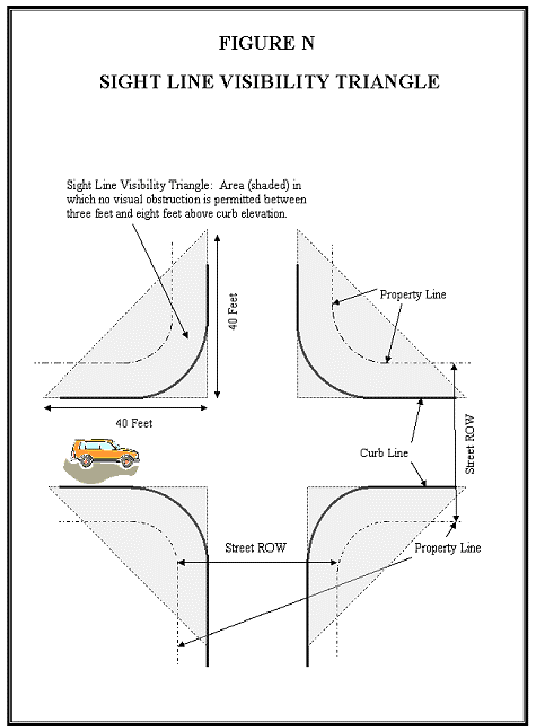
No landscaping over three feet in height shall be planted within forty (40) feet of the intersection of any street pavement (see Figure N). Any planted or existing vegetation within this area shall be kept pruned so that foliage shall not grow or exist within three and eight feet above the elevation of the curb closest to the vegetation.
(20)
The Director of Planning may grant exceptions to these provisions to require a lesser amount of landscaping if the intent of this ordinance is met, and the reduction of the landscape area results in the preservation of natural features having comparable value.
(21)
In cases of death or removal of a tree planted pursuant to the terms of this section, a replacement tree of equal size and type shall be required to be planted. A smaller tree that will have a mature crown similar to the tree removed may be substituted if the planting area or pervious cover provided for the larger tree in this section is retained.
(22)
The location, calculations, size and description of all landscaping and screening materials proposed to satisfy the requirements of this section shall be shown on a Landscape Plan, and included with the construction plans.
(23)
Landscape plans are required with all new multifamily and nonresidential permits showing:
(i)
New and existing trees, shrubs, groundcover, turf areas and native areas.
(ii)
Proposed plantings by botanical name, common name, spacing, quantity, container size.
(iii)
Property lines, streets and street names.
(iv)
Driveway(s), sidewalk(s) and other hardscape features.
(v)
Existing and/or proposed buildings.
(vi)
Point of irrigation connection (POC) and water meter for the irrigation system.
(24)
Soil Depth (New residential and nonresidential). All new landscapes (nonresidential and residential) are required to have a minimum of six inches (6") of soil depth in areas planted with turfgrass. This six-inch (6") minimum soil depth will consist of 75 percent soil blended with 25 percent compost. The soil/compost blend shall be incorporated into the top two inches of the native soil. The six-inch (6") depth requirement does not apply to the area between the drip line and trunk of existing trees, shrub beds or wildscape areas. Areas with existing native vegetation that remain undisturbed shall be exempt from the soil depth provision of this section; provided that native soil and vegetation in such area is fenced during construction and protected from disturbance and compaction during the construction process.
(25)
Mulch (all nonresidential properties). All exposed soil surfaces of non-turf areas within the developed landscape area must be mulched with a minimum two-inch layer of organic material. Examples of organic material include pine bark, shredded cedar, composted leaves, and shredded landscape clippings. Native/wildscape areas are exempt.
(26)
WaterWise Landscape Principles. These principles shall be an integral component of the landscape design and plan. Homebuilders shall be required to offer a WaterWise landscape option in any series of landscape options offered to home buyers. The seven basic principles of WaterWise landscaping include:
(i)
Proper planning and design.
(ii)
Proper soil preparation (compost-improved topsoil).
(iii)
Practical turfgrass selection of drought-resistant species.
(iv)
Appropriate plant selection. The plants listed as invasive plants to avoid in the Grow Green Guide, shall not be offered as part of a WaterWise landscape option.
(v)
Efficient irrigation systems.
(vi)
Use of mulches.
(vii)
Appropriate maintenance.
(27)
Irrigation Requirements (New residential and nonresidential installations).
(i)
All irrigation systems, both residential and nonresidential, shall be installed in accordance with state law, V.T.C.A., Water Code, tit. 2, ch. 34 and 30 Tex. Admin. Code ch. 344, as amended, as regulated and enforced by the Texas Commission on Environmental Quality (TCEQ). Irrigation contractors who install the irrigation system must be a TCEQ Licensed Irrigator.
(ii)
A permit shall be required for the installation of all automatic irrigation systems.
(iii)
All automatic irrigation systems are required to have a rain sensor connected to an irrigation controller in order to stop the irrigation cycle during and after a rainfall event. Rain sensors are to be installed in a location where rainfall is unobstructed, such as a rooftop or fence line. Rain sensors are to be adjusted at the one-fourth-inch setting.
(iv)
All new residential and nonresidential irrigation systems are required to have pressure regulators if static pressure at the site exceeds the sprinkler manufacturer's recommended operating range. Extensive misting due to high pressure wastewater.
(v)
Irrigation systems are to have a controller with multiple cycle, rain sensor capability and irrigation water budget feature.
(vi)
Sprinkler systems shall be designed as to minimize overspray onto the hardscape.
(vii)
Sprinkler heads shall be installed at least eight (8) inches from the curb.
(viii)
For strips of land less than six (6) feet in width, spray irrigation shall be prohibited and low-flow irrigation systems (such as drip, bubblers or micro-irrigation) are required. For strips of land between six (6) feet and fifteen (15) feet in width, only low-flow irrigation (such as drip, bubblers or micro-irrigation), or spray irrigation using low-angle spray nozzles designed for the specific width to be irrigated shall be permitted. For strips of land more than fifteen (15) feet in width, only low precipitation rotors with low angle nozzles may be used to irrigate turf areas. Planting beds may be irrigated with low-flow or spray irrigation. All spray heads must be designed to prevent low head drainage.
(ix)
The incorporation of treated effluent, rainwater, or water from rainstorm water systems in an irrigation system is encouraged.
(28)
A property owner's association may not include or enforce a provision in a dedicatory instrument that prohibits or restricts a property owner from:
(i)
Implementing measures promoting solid waste composting of vegetation, including grass clippings, leaves or brush, or leaving grass clippings uncollected on grass;
(ii)
Installing rain barrels or a rainwater harvesting system; or
(iii)
Implementing efficient irrigation systems, including underground drip or other drip irrigation systems.
(29)
A property owner's association may not include or enforce a provision that requires:
(i)
A defined irrigation schedule specified by the association unless a defined irrigation schedule is mandated by the association's water supplier in order to curtail outdoor water use;
(ii)
Maintenance of the landscape to a specified level that requires the property owner to irrigate his or her landscape;
(iii)
Installation or maintenance of any specific variety or limited choice of varieties of turfgrass; or
(iv)
The homeowner to install a minimum percentage of turf in the landscape.
(30)
Alternative Landscape Plan.
(i)
An application for an alternative landscape plan may be submitted for consideration by the Director of Planning when site conditions make strict compliance with the landscape requirements undesirable or impractical. Examples of such site conditions include, but are not limited to, the following:
a.
Existing buildings, utilities or other improvements
b.
Unusual shape of lot, tract or building site
c.
Topography, soil, geologic, vegetation or other natural feature
d.
Safety (e.g. vehicle sight distance, impediments to vehicle maneuvering, visibility of traffic or safety related signage)
(ii)
The alternative landscape plan shall, as a whole, meet or exceed the standards of this ordinance. When a provision is reduced, the plan shall increase other provisions to off-set any noncompliance. For instance, if landscaping plantings are reduced in one area, plantings in other areas that will have a similar beneficial impact shall be increased by an equal or greater amount. If the area of landscaping is decreased, the number of plantings shall be increased.
(iii)
The Director of Planning shall consider approval or disapproval of an alternative landscape plan. If the decision is to disapprove, the Director shall state reasons. An applicant may appeal the decision of the Director to the Commission. The applicant may appeal a decision of the Commission to the City Council. Such appeal shall be processed as a variance.
(c)
Tree Preservation and Protection.
(1)
Unless otherwise allowed by this Ordinance, no property shall be clear-cut or selectively cleared, nor shall a Significant Tree or Heritage Tree be removed from a property for which subdivision construction plans, a site development permit, or a building permit is required by the code of ordinances, without first securing the necessary approval from the City.
(2)
Exceptions.
(i)
Dead or Diseased Trees.
a.
If the Planning Director determines after a site inspection that a Significant Tree or Heritage Tree is dead, dying, or fatally diseased prior to starting a project, the mitigation requirements shall not be required.
b.
A letter from an arborist shall be required to confirm the condition of the tree if the condition is not obvious.
(ii)
Dangerous Trees.
a.
If the Planning Director determines that a Significant Tree or Heritage Tree is causing a danger or is in a hazardous condition due to natural disaster, such as a tornado, fire, storm, flood, or other act of God that endangers public health, welfare, or safety, the mitigation requirements shall not be required for the removal of the tree.
(iii)
Sight Triangles.
a.
If the Planning Director determines that a Significant Tree or Heritage Tree is interfering with the safe visibility at a sight triangle of an existing public street, the tree may be removed and the mitigation requirements shall not be required.
(3)
Heritage Tree Preservation Requirements.
(i)
Heritage Trees shall be preserved on site unless otherwise approved for removal as outlined in this Ordinance.
(ii)
Heritage Trees shall be graphically shown on Tree Preservation Plans associated with plats and site development permit plans and shall contain a note stating that the Heritage Trees cannot be removed without a permit.
(iii)
Preserved Heritage Trees may be credited towards the Landscape requirements of this Ordinance.
(4)
Significant Tree Preservation Requirements.
(i)
Up to fifty (50%) percent of Significant Trees between eight (8) and eighteen (18) caliper inches may be removed during construction without mitigation.
(ii)
Significant Trees shall be graphically shown on Tree Preservation Plans associated with plats and site development permit plans.
(iii)
Preserved Significant Trees may be credited towards the Landscape requirements of this ordinance.
(iv)
Significant Trees greater than eight (8) inches in caliper shall be preserved to the greatest extent reasonably possible. Significant Trees removed during construction shall be supplanted with Replacement Trees if required by the tree mitigation requirements of this section. No Significant Tree shall be removed until a tree preservation plan has been approved by the Director of Planning in accordance with this Chapter. Significant Trees may be removed only in accordance with the approved tree preservation plan, and trees must be protected during construction activities on the property in accordance with the approved tree preservation plan. This provision only applies to projects before the certificate of occupancy has been issued for single-family and two-family developments. For single-family and two-family projects, this provision only applies prior to the initial certificate of occupancy for each lot.
(5)
Removal of Heritage or Significant Trees.
(i)
Heritage Tree Removal Permit.
a.
Heritage Trees may be removed only with the approval of a Heritage Tree Permit and after the required mitigation has been provided.
b.
The Planning & Zoning Commission shall review all applications for Heritage Tree removal permits and make a recommendation for approval or denial to the City Council which shall have final authority to issue the permit.
c.
Approval of removal permits shall be based on the following:
1)
Tree size/number of trunks;
2)
Tree health and viability;
3)
Tree location;
4)
Other Significant and Heritage Trees to be preserved on site; and
5)
Whether all reasonable efforts have been made to design the project in a way to preserve Significant and Heritage Trees on site.
(ii)
Significant Tree Removal Permit.
a.
The Director of Planning may issue a tree removal permit for the removal of Significant Trees to the owner of a property that is zoned or otherwise authorized and actively used for agricultural purposes if it is demonstrated that the tree removal is for a legitimate agricultural purpose. The tree mitigation requirements of this ordinance shall not apply to such permits. If the property is rezoned or otherwise converted to a non-agricultural use within three years of the issuance of the tree removal permit the owner of the property shall be required to meet the tree mitigation requirements of this ordinance.
b.
Removal of Significant Trees greater than eighteen (18) caliper inches requires the approval of the Planning & Zoning Commission or the approval of an alternative tree preservation plan as described in this ordinance for projects other than single-family or two-family.
(iii)
Mitigation for removal of a Heritage or Significant Tree.
a.
The removal of Heritage and Significant Trees shall require mitigation using the calculations and procedures defined below. Mitigation may be achieved through credit of existing trees on site, replacement trees planted on site, or payment-in-lieu of replacement trees if approved by the Planning Director only when on-site replacement is not possible or practical.
1)
Mitigation shall be required at a 1:1 caliper inch basis for significant trees between eight (8) and eighteen (18) caliper inches.
2)
Mitigation shall be required at a 2:1 caliper inch basis for significant trees greater than eighteen (18) caliper inches and less than twenty-six (26) caliper inches.
3)
Mitigation shall be required at a 3:1 caliper inch basis for Heritage Trees and a mitigation fee in the amount of $300.00 per caliper inch removed.
4)
If payment in lieu of replacement trees is approved by the Planning Director, the fee shall be equal to one hundred fifty dollars ($150.00) per caliper inch of replacement tree.
b.
Replacement Trees.
1)
Replacement Trees shall be a minimum of two (2) inches in caliper measured four (4) feet above finished grade immediately after planting. A list of recommended replacement trees shall be maintained by the Department of Planning and shall include those trees listed in the Grow Green Guide.
2)
If the developer chooses to substitute trees not included on the recommended list, those trees shall have an average mature crown greater than fifteen (15) feet in diameter to meet the requirements of this section. Trees having an average mature crown less than fifteen (15) feet in diameter may be substituted by grouping trees so as to create at maturity the equivalent of a fifteen-foot (15') diameter crown if the drip line area is maintained.
3)
A minimum pervious area three (3) feet in radius, and not less than fifty percent (50%) of the calculated drip line area is required around the trunks of all existing and proposed trees. The radius of a drip line area is calculated as the trunk caliper times twelve. (Example: An eight-inch caliper tree has a drip line of eight feet in radius.)
4)
Existing hardwood trees less than the size required for replacement and greater than or equal to two inches in caliper, and existing hardwood trees between 8" and 18" to an extent greater than 50% of the total caliper inches that are retained during construction in healthy condition may be counted toward replacement requirements as well as toward planting requirements.
(6)
An alternative tree preservation plan may be approved by the Director of Planning for properties where existing tree cover is especially dense and the following are found:
(i)
Removal of a significant number of trees is unavoidable,
(ii)
The applicant has planned the development so as to save the highest quality and greatest number of trees that could be reasonably expected,
(iii)
All areas of the site that can be reasonably utilized for tree replacement have been utilized, and
(iv)
The proposed total landscaping exceeds the requirements of the ordinance.
(7)
Tree Diversification. No more than fifty percent (50%) of the same species may be planted to meet the tree planting requirements.
(8)
A non-disturbance zone shall be maintained on single-family and two-family lots during the subdivision construction and building permit phases of development. A disturbance area no more than five (5') feet from the foundation necessary for construction and grade transitions shall be permitted. This disturbance area shall be no more than ten (10') feet from the foundation for properties zoned with the SFR (Single-Family Rural) use component. The trees located on the remainder of the lot shall not be removed unless a unique situation is approved by the Director of Planning. During the subdivision construction phase, the developer may plan for removal of the pad trees. If trees are proposed for removal at this stage, mitigation requirements shall apply.
(9)
Tree Protection Plan Requirements.
(i)
An applicant for a single-family or two-family preliminary plat or final plat, or a site development permit shall provide a tree survey prepared within five years preceding the application date. This tree survey shall include the street and lot layout, or site plan superimposed at a scale of 1"=100' (or as appropriate) identifying significant trees located on the property that meet the requirements indicated in this section. Applicants for a single-family or two-family preliminary or final plat are only required to submit a tree survey for the portion of the property that the applicant is proposing to disturb with the subdivision construction. The applicant shall provide a tree preservation plan that identifies the surveyed trees and the mitigation of the protected trees that are proposed for removal. The applicant shall be required to demonstrate that lot lines, street layouts and site improvements have been designed and located and that lot width, depth and size flexibility as permitted by the applicable zoning district has been utilized to the maximum extent necessary to retain the maximum number of significant trees reasonably practicable. Applicants for a single-family or two-family preliminary or final plat may plant replacement trees within lots owned by the Homeowners Association including but not limited to landscape lots, park lots, or amenity center lots.
(ii)
The Director of Planning shall determine if adequate performance is achieved based on the standards of this section. Approval of the tree preservation plan by the Director of Planning is required prior to preparation and submission of a subdivision or site development permit application. The applicant may appeal any decision of the Director to the Commission. A decision of the Commission may be appealed to the City Council. Any preserved or replacement trees may be counted toward the landscape requirements of this section. See the Construction Plan requirements for details.
(iii)
All trees to be preserved as shown in an approved preservation plan shall be clearly marked prior to the commencement of construction activities.
(iv)
Critical Root Zone.
a.
No construction or disturbance shall occur within an area that constitutes more than fifty [percent] (50%) of the total critical root zone and one half the radial distance of the critical root zone for each tree being preserved including Significant Trees, Heritage Trees, and any other trees for which preservation is to be credited. The remaining critical root zone shall consist of at least one hundred (100) square feet.
b.
This defined area shall be flagged and encircled with protective fencing during construction. The Planning Director may approve construction closer to the trunk than one half (1/2) the radial distance, depending on the size, spacing, or species of the tree, the type of disturbance proposed, and uniqueness of the situation.
c.
Cut or fill that is greater than four (4) inches in depth and the severing of major roots shall be considered disturbance for the purposes of this Ordinance.
d.
Within the protected critical root zone, only flatwork, decking, or similar construction, may be approved and shall not affect the branching of the tree.
e.
If proposed or actual protection of the critical root zone of a tree does not meet the requirements of this Section, then the tree shall be considered removed and shall require mitigation in accordance with this Ordinance.
(d)
Screening Requirements.
(1)
In addition to the landscaping requirements of this section, all development shall comply with the following screening requirements:
(i)
The following shall be screened from the view of at least sixty percent (60%) of adjacent single-family or two-family residences and any street or public right-of-way:
a.
Off-street parking areas;
b.
Loading spaces and docks;
c.
Trash and storage containers;
d.
Outside storage areas;
e.
Satellite dishes larger than eighteen (18) inches in diameter;
f.
Antennas;
g.
Mechanical equipment; or
h.
Metal siding.
(ii)
Above ground utility facilities up to six (6) feet above grade for multifamily and non-residential development are required to be screened from view except for poles, fire hydrants and existing lines.
(iii)
Detention Facilities including detention ponds and/or water quality ponds shall be screened from view.
(iv)
Screening by vegetation that could be removed from adjacent undeveloped or partially developed properties when such property is developed is not considered as screening from view.
(v)
Outside storage areas shall be screened by the use of a privacy fence or wall at least the height of the items to be screened and in conformance with the requirements of this ordinance. If the outdoor storage area is adjacent to an arterial or collector roadway, then the wall is required to be constructed of one or more of the following materials: brick, stone, cast stone, stucco (limited to thirty-five (35%) of the exterior surface area of walls), factory tinted (not painted) split face concrete masonry unit, or other similar material approved by the Director of Planning. In addition to the materials listed above, textured pre-cast concrete (e.g. Woodcrete) is also permitted when the wall is adjacent to collectors.
(vi)
A minimum five-foot (5') landscaped area located on the exterior of the fence shall be provided and landscaped in accordance with paragraph (2)(i) above unless the fence is on a rear boundary line or adjoining a permanent structure on the site.
(vii)
Lift stations are required to be screened from view of adjacent single-family or two-family residences, or any street or public right-of-way by the use of a wall. The wall is required to be constructed of one or more of the following materials: brick, stone, cast stone, stucco (limited to thirty-five (35%) of the exterior surface area of walls), factory tinted (not painted) split face concrete masonry unit, textured pre-cast concrete (e.g. Woodcrete) or other similar material approved by the Director of Planning.
(2)
Public School Districts shall not be required to screen bus storage facilities with solid walls. These facilities may be secured with black or green vinyl coated fencing.
(3)
Approved screening techniques include privacy fences, evergreen vegetative screens, landscape berms, existing vegetation or any combination thereof unless otherwise noted in this section.
(4)
Privacy Fences (See section 14 and 16 of this Article).
(5)
Evergreen Vegetative Screens. Evergreen plant materials shall be shrubs, at least thirty (30) inches in height and at a minimum spacing of 48 inches at the time of installation, in combination with shade trees not more than fifty feet apart.
(6)
Landscape Berms, in combination with trees, shall fulfill the screening requirements of this section if the berms are at least three (3) feet in height and have maximum side slopes of four (4) feet of horizontal run for every one (1) foot in vertical rise.
(7)
Existing on-site vegetation, demonstrating significant visual screening capabilities and as approved by the Director of Planning, shall fulfill the requirements of this section.
(e)
Major Corridor Streetscape Standards.
(1)
Major corridors include all arterials identified on the City's Transportation Plan.
(2)
All development adjacent to a corridor shall install street trees between the back of curb or edge of pavement and the required sidewalk in accordance with the city's street tree detail. The trunk of the street tree shall be no closer than 3 feet from the back of curb or edge of pavement and no further than eight (8) feet; the director of planning may approve alternative locations if specific conditions warrant. Street tree species shall be consistent on both sides of the corridor, species may change at a street intersection, however major intersections shall comply with the major intersection standards in this section. Street trees shall be spaced no more than thirty (30) feet on center and shall be in a straight line along the corridor.
(3)
If a parking lot is located between the right-of-way and a building along a corridor, the parking lot must be fully screened from view of the corridor to a height of four (4) feet with one or more of the following elements:
(i)
A four (4) foot tall masonry screening wall located at or behind the required parking setback; or
(ii)
A berm with landscaping that measures at least four (4) feet tall at the top of the landscaping located within the required front setback area.
(4)
In addition to other restrictions in this ordinance, the following items shall not be located between a primary building and the right-of-way along a major corridor:
(i)
Mechanical equipment other than that of a public utility;
(ii)
Drive-through service lanes or queuing spaces; or
(ii)
Accessory structures.
(5)
The following standards apply to the screening of the rear or service side of buildings along a Major Corridor:
(i)
The rear or service side of a building may not face a Major Corridor within four hundred (400) feet of the corridor's right-of-way.
(ii)
Loading areas and service drives must be screened from view of the Major Corridor with landscaping that is six (6) feet tall at installation or a wing wall that extends from the building that is a minimum of six (6) feet tall and constructed of the same or significantly similar materials as the primary building.
(6)
The following standards shall apply to all major intersections along the corridor:
(i)
Major intersections are those intersections with other major corridors or collector roads.
(ii)
All four corners of a major intersection shall have a coordinated landscape design.
(iii)
All four corners of a major intersection shall include identity monument signs which shall be coordinated and consistent in design and materials.
(iv)
Identity monument signs may include the name and/or logo of the adjacent development and shall include the City of Leander logo.
(7)
Major Corridors shall comply with the following landscape and hardscape materials requirements:
(i)
Each major corridor shall have a primary landscape and hardscape materials palette.
(ii)
Landscaping and hardscaping (including walls and planters) within the right-of-way and front setback of all properties along a major corridor shall comply with the corridor materials palette.
(iii)
The corridor materials palette shall be maintained by the Planning Department.
(8)
Walls constructed along Major Corridors shall meet the following requirements in addition to any other requirements of this ordinance:
(i)
All walls constructed parallel to a major corridor shall comply with the corridor materials palette.
(ii)
Walls that continue from one development or property to another within the same block shall continue the same material and design.
(iii)
Wall material or design may change in a new block as long as the materials are consistent with the materials palette for the corridor.
(9)
Exceptions.
(i)
Drive-through service lanes or queuing spaces may be permitted between the building and arterial as long as the building is comprised of one hundred (100%) percent Masonry and the drive-through lane is screened from view with landscaping.
(Ordinance 14-075-00, sec. 6, adopted 12/4/14; Ordinance 16-065-00, secs. 8, 9, adopted 7/21/16; Ordinance 17-012-00, secs. 30, 32, 33, adopted 3/2/17; Ordinance 19-044-00, sec. 11, adopted 8/15/19; Ordinance 19-045-00, sec. 6, adopted 8/15/19; Ordinance 20-011-00, secs. 2—4, adopted 3/5/20; Ordinance 20-077-00 adopted 11/5/20; Ordinance 22-067-00 adopted 8/4/22)
Sec. 2. - Transportation criteria manual.
(a)
The City of Austin Transportation Criteria Manual, dated August 7, 2020 except such portions as are hereinafter amended, deleted or modified by the City and except for Exhibit B, is hereby adopted to provide design criteria for site development within the city limits and extraterritorial jurisdiction of the City. All references in the Transportation Criteria Manual to the "City of Austin" shall mean the "City of Leander" and all references to the City of Austin Code Chapter 14-11 shall mean Article 4.02 Franchise or Permit for Use of Public Property of this code. The criteria shall be implemented with reliance on sound engineering and planning judgment and nothing in this manual shall override such sound judgment as determined by the City Engineer and Director of Planning. (For roadway adequacy standards and requirements to prepare a Traffic Impact Analysis, refer to Ordinance No. 02-033-00 [Article 10.03 of the Code of Ordinances]).
(b)
Access Management. The purpose of this section is to protect the public health, safety, and welfare through providing the highest level of mobility in order to carry substantial amounts of traffic over relatively long distances. According to the Texas Department of Transportation Access Management Manual (effective date of July 2011), more than four (4) decades of research conducted throughout the United States has shown that access management improves roadway safety. Studies cited by the manual show that the number of accidents increase by approximately fifty (50%) percent when access points are increased from one (1) per every five hundred twenty-eight (528') feet to one (1) per every two hundred (200') feet. Based on these findings, all properties that have frontage onto an arterial street shall comply with the TxDOT standards with regards to access point spacing.
(1)
Where existing conditions such as existing platted lots, established tracts of land, or topography make it not feasible or inappropriate to comply with the access standards above, the location of reasonable access shall be determined by the Director of Planning and City Engineer.
(2)
A person aggrieved by a decision made by the Planning Director and City Engineer under this Section 1(b)(3)(xiii) may appeal the decisions to the Commission by submitting a written request for appeal and setting forth the basis for appeal within fourteen (14) calendar days of the date of the decision. The Commission's decision may be appealed to the City Council by submitting a written appeal within fourteen (14) calendar days of the date of the Commission's decision.
(Ordinance 20-022-00, sec. 18, adopted 4/21/20; Ord. No. 23-035-00, § 3, 6-15-2023)
Sec. 3. - Off-street parking requirements.
(a)
The following off-street parking requirements are considered minimum requirements and may not adequately reflect the specific needs of a proposed business. A commercial building permit applicant shall analyze the parking needs of the specific users being proposed and provide the amount of parking required for such uses. When any building or structure is erected, or an existing building is enlarged by fifty (50) percent or more in floor area, off-street parking shall be provided in accordance with the following requirements (Note: Any building enlargement is required to add at least the amount of additional parking required by the enlargement):
In a development with mixed-use buildings designed and built in a walkable and pedestrian friendly configuration, the Director of Planning may consider the following shared parking factors in reviewing a proposal for a reduction in the minimum parking requirements (the shared parking factor is applied to the sum of the individual uses minimum parking requirements):
For uses not listed, the Director of Planning may request additional parking demand analysis from the applicant to justify a reduction in the minimum parking requirements.
Where shared parking is provided, a shared parking and cross access agreement between the cooperating property owners shall be approved by the Director of Planning and recorded prior to issuance of a building permit. This agreement must be recorded in the real property records of the county in which the property sits and the agreement may not be modified or revoked without the approval of the Director of Planning. If any requirements for shared parking are violated, the affected property owners must provide a remedy satisfactory to the Director of Planning or provide the full amount of required parking for each individual use.
(b)
Required Handicap Accessible Parking.
(i)
Not less than one out of every eight handicap accessible spaces, and not less than one, are required to be van accessible spaces (with a 96 inch wide access aisle) and is required to be designated with a sign as van accessible.
(ii)
Two handicap accessible parking spaces may share a common access aisle.
(iii)
Handicap accessible parking spaces are to be located on the shortest possible accessible circulation route to an accessible entrance of the building.
(iv)
Handicap accessible parking spaces shall be designated as reserved for physically handicapped people by a sign showing the symbol of accessibility. Such signs shall not be obscured by a vehicle parked in the space.
(c)
To provide more flexibility for leasing or use of existing buildings, the Building Official may approve building permits for sites that provide parking for 85% or more of the required parking with the following conditions:
(1)
The owner of the property is required to submit a letter to the Building Official with an analysis of parking requirements for the specific users [uses] proposed and include a statement that the parking provided is, in the owner's opinion, adequate for the intended uses.
(2)
The parking facilities are paved with a hard surface such as asphalt or concrete or other material as approved by the Building Official and are in general conformance with the standards of the Transportation Criteria Manual.
(d)
Bicycle parking slots shall be provided at retail centers at a rate of not less than one slot per thirty parking spaces.
(e)
Refer to Transportation Criteria Manual for parking design criteria.
(Ordinance 16-065-00, sec. 14, adopted 7/21/16; Ordinance 18-075-00, sec. 3, adopted 12/6/18; Ordinance 22-042-00 adopted 5/5/22; Ord. No. 24-065-00, § 8, 7-18-2024)
Sec. 4. - Off-street parking guidelines.
The following guidelines shall be applied to off-street parking spaces required for each of the above uses:
(a)
Floor area shall mean the gross floor area of the specific use;
(b)
Fractional spaces shall be rounded to the next higher whole space;
(c)
Buildings or structures containing mixed uses shall provide off-street parking space equal to the sum of the various uses computed separately. The shared parking factors in the Smart Code or shared parking guidelines from the Urban Land Institute or other reputable source may be utilized to support a collective (shared) parking proposal.
(d)
The off-street parking requirements for a use not specifically listed herein shall be the same as required for a use of a similar nature as determined by the City Building Official.
(e)
All required off-street parking spaces shall be located on the same lot as the building or use served unless the required off-street parking spaces are provided collectively or used jointly by two (2) or more establishments, then a written agreement which assures the retention of such spaces for this purpose shall be drawn and executed by the parties concerned, approved as to form by the City Attorney, and filed with the application for a Building Permit.
(f)
Parking spaces, maneuvering aisles, driveways and driveway approaches shall be designed in accordance with the City of Austin's Transportation Criteria Manual, as currently amended. Parking spaces dependent on public right-of-way or other private properties for maneuvering aisles will not be permitted unless approved by the Director of Planning.
(g)
Compact parking spaces are not permitted to exceed ten percent (10%) of the total number of spaces provided. Compact parking spaces are required to be separated from standard parking spaces by a landscaped peninsula.
(h)
Nonresidential building square footage above the first floor is eligible for a five percent (5%) reduction in the parking requirement in addition to any other type of parking reduction.
(i)
Development utilizing Type 1 development standards is eligible for a five percent (5%) reduction in the parking requirement in addition to any other type of parking reduction.
(j)
Alternate parking standards may be approved by the Director of Planning for specific uses which are deemed to require less parking than the standards outlined in this ordinance based on the following criteria:
(1)
The user provides a detailed breakdown of his/her parking requirements indicating employee counts, shift distribution and visitor or customer needs.
(2)
The user provides a site plan showing how additional parking to meet these ordinance requirements would be provided if the use changed or parking needs increase, or what land uses would need to be prohibited in order to keep parking demands consistent with parking provided.
(3)
The Director shall establish conditions necessary to assure the adequacy of future on-site parking when approving an alternate parking standard.
(k)
Projects within three hundred (300) feet of a public transit stop are eligible for a five percent (5%) reduction in the parking requirement in addition to any other type of parking reduction.
(l)
A minimum of six queue spaces shall be provided for commercial service lanes, or as determined appropriate by the Director of Planning.
(Ordinance 05-018-00 adopted 9/1/05)
Sec. 5. - Off-street loading space requirements.
(a)
Commercial development shall provide one (1) loading space for each 10,000 square feet of floor area for the first 20,000 square feet of floor area, and industrial development shall provide one (1) loading space for each 20,000 square feet of floor area, unless, because of the proposed layout, the Director of Planning and the Fire Chief determine that adequate maneuvering space is provided without negatively impacting emergency or other vehicular access.
(b)
The following guidelines shall be applied to off-street loading spaces:
(1)
Floor area shall mean the gross floor area of the use.
(2)
Fractional spaces shall be rounded to the next higher whole space.
(3)
Whenever a building or use, existing on the effective date of this section, is enlarged by more than fifty (50) percent in floor area or area used, the entire building or use shall then and thereafter comply with the off-street loading requirements.
(4)
The required off-street loading spaces shall be located on the same lot as the building or use served.
(5)
Loading spaces shall be in accordance with the City of Austin's Transportation Criteria Manual.
(Ordinance 05-018-00 adopted 9/1/05)
Sec. 6. - Setbacks.
(a)
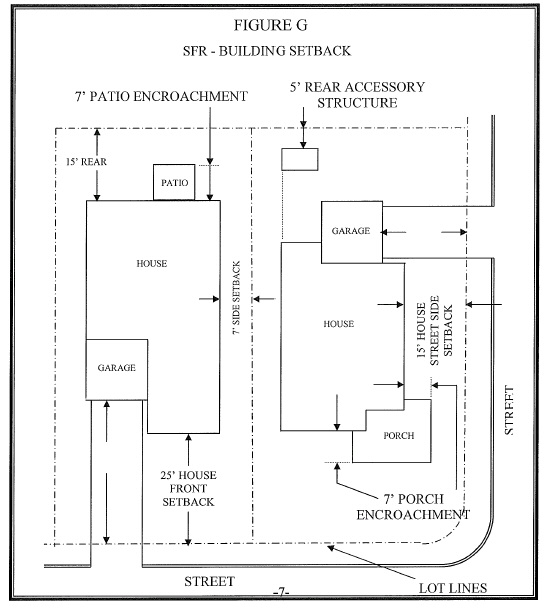
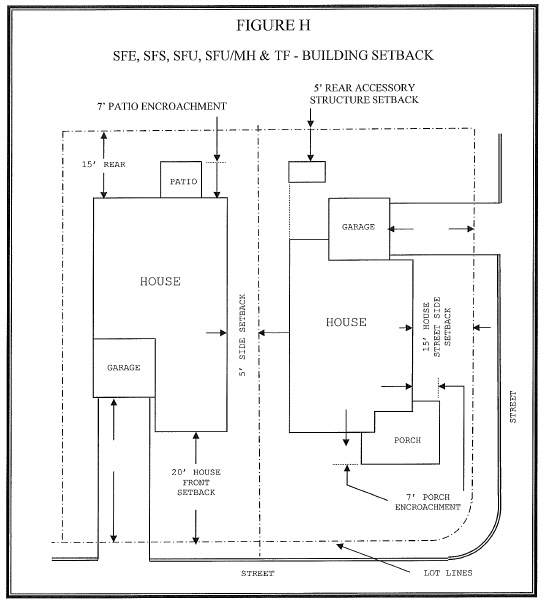
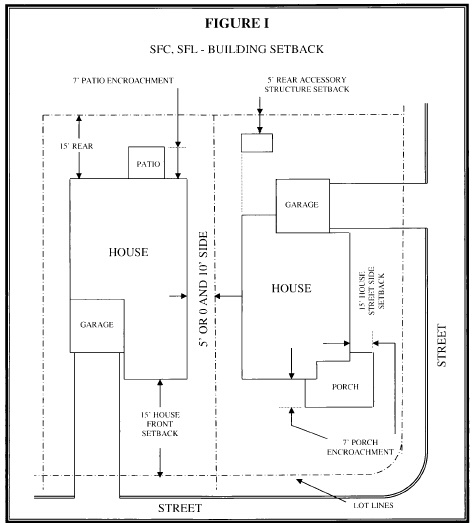
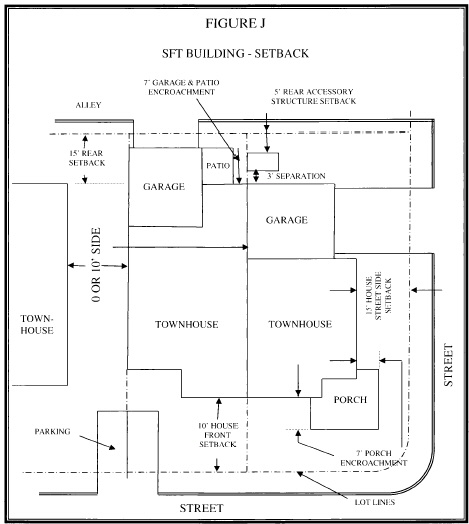
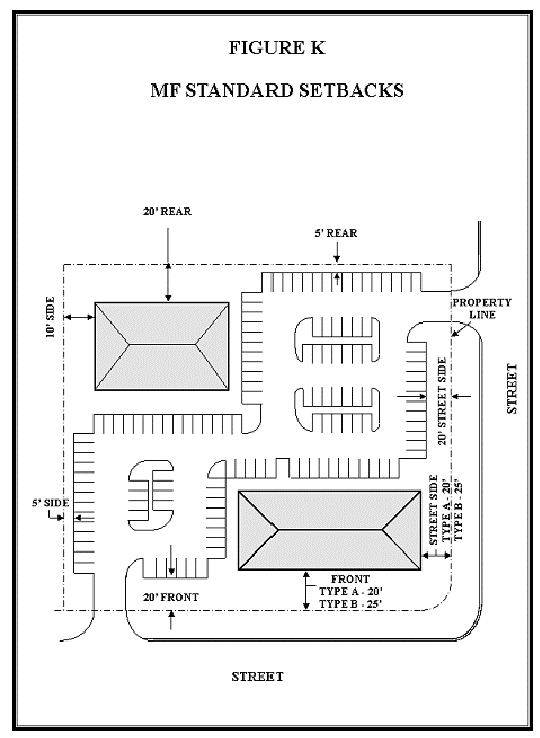
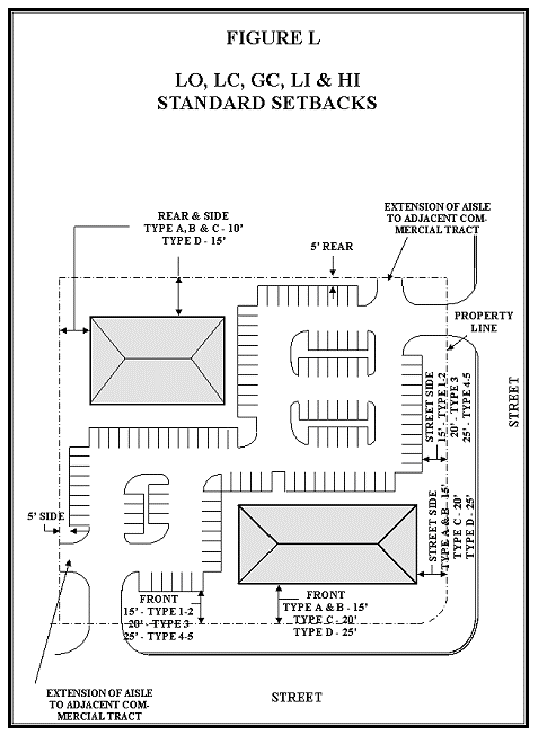
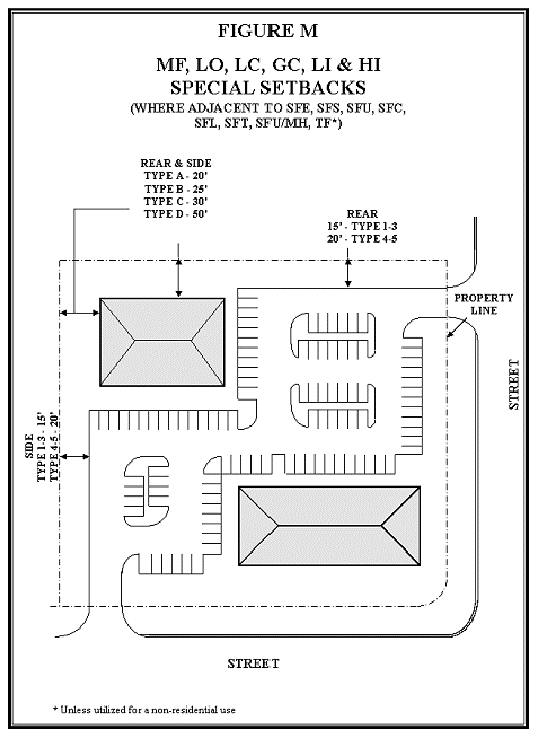
The purpose of this section is to provide for building, paving, and outdoor storage setbacks. The setback table incorporates setback requirements by street types in order to identify parking lot locations. The street types range from A Street which is the most pedestrian oriented to C Streets which is the least pedestrian oriented. Building/Structure and Site Improvements:
BUILDING/STRUCTURE
* In no case shall the garage be closer to the ROW than 18'[.]
** Unless such district is utilized for a nonresidential use[.]
*** No closer than the street-facing wall of the primary structure that utilizes such storage.
**** Setback does not apply for parking, drive aisles, storage etc. that are intended to cross lot line.
***** Setbacks are for the perimeter of the project, not the individual units if multiple units are proposed per lot. If one (1) unit per lot is proposed, then these setbacks apply to each lot.
(b)
All setback areas are required to be landscaped in accordance with the landscape and screening requirements even if the area of the setbacks exceeds the minimum landscaped area requirements.
(c)
For separation between buildings, standards of the current Building Code and Fire Code shall be applied unless additional setback is required by this ordinance.
(d)
Sight line visibility triangles shall be maintained at all street intersections so that no fence, wall, architectural screen, landscape plantings, earth mounding or parking space shall potentially cause an obstruction of visibility above three feet and below eight feet from the top of the curb closest to the corner. Such triangle shall extend forty (40) feet each direction from the intersection [of] curb lines. If the intersection of curb lines is curved at the corner, the triangle will be determined as if the curved curb was absent and the curb lines were extended to their intersection. At the intersection of an alley, the clearance shall be maintained for a distance of thirty feet each direction from the intersection of edge of the alley with the curb line. (See Figure N)
(e)
Air conditioning units are not permitted forward of the front wall of the building.
(f)
Exceptions.
(1)
An applicant may obtain a reduced building or site improvements setback upon approval of the Director of Planning, when a variable setback that contains the same total area as the required setback would create a more esthetically pleasing development; when site conditions make strict compliance with the setback undesirable or impractical; or when the character of the development (or surrounding development) makes the standard setback undesirable or inconsistent. Examples of such site conditions include, but are not limited to, the following:
(i)
Existing buildings, existing adjacent development built to other standards, utilities or other improvements
(ii)
Unusual shape of lot, tract or building site
(iii)
Topography, soil, geologic, vegetation (including existing trees or other vegetation) or other natural feature
(iv)
Safety (e.g. vehicle sight distance, impediments to emergency or other vehicle maneuvering, visibility of traffic or safety related signage)
The request shall, as a whole, meet or exceed the standards of this ordinance. If a setback is reduced, landscape plantings shall be increased to off-set any undesirable impacts from the reduced setback and the Masonry shall be increased to eighty-five (85%) percent of the exterior surface area for first story walls and fifty (50%) percent of the exterior surface area for each additional story. The Director of Planning shall consider approval or disapproval of a reduced setback with the following conditions:
(i)
The minimum setback area shall not be reduced by more than 5%.
(ii)
Additional landscaping required to off-set any undesirable impact shall be established to provide effective screening in the area of the reduced setback.
(iii)
The setback shall not result in a negative impact to adjoining property.
(iv)
A front or rear yard setback in a single-family or two-family district may be reduced by no more than five feet from the minimum standard requirement.
(v)
A side yard setback may not be reduced to less than five feet without the Fire Chief's approval, and in no case shall principal buildings be located closer than ten feet to one another.
(2)
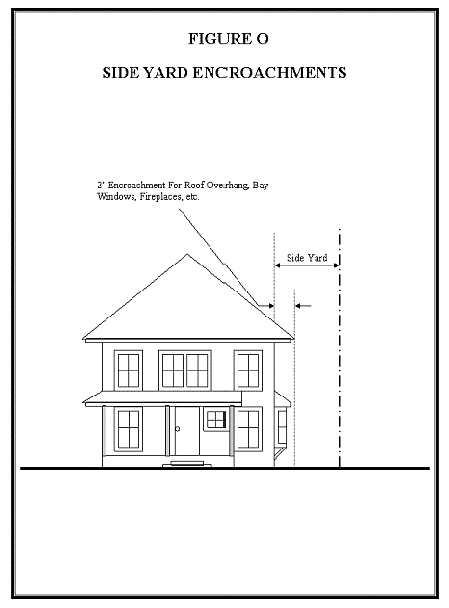
Roof overhangs, fireplaces, bay windows and similar projections may extend into any building line a maximum of two feet on any side (see Figure O). Porches, patios, balconies and similar projections may extend into the front or rear setback a maximum distance of seven feet if there are no walls within such extension. Supporting columns, handrails and roofs are permitted within such extension.
(3)
A detached or non-street facing garage may encroach into the rear or side setback a maximum distance of seven feet, but in no case closer than five feet from the rear or side lot line.
(4)
The side setbacks associated with the TH or SFL use components may be reduced to three (3') feet as long as the building separation is in compliance with the Fire Code.
(5)
Nothing in these standards shall restrict zero lot line construction for an SFC or SFL district as long as permission from the lot owner adjacent to the zero setback line concurs.
(6)
Nothing in these standards shall restrict common wall construction in an SFT, MF, LO, LC, GC, HC or HI district with the condition that permits for common wall buildings are obtained and such buildings are constructed simultaneously.
(7)
Where additional ROW is required to be dedicated and the ROW plus the front setback area equal more than 20% of the lot or tract area, the front setback may be reduced such that the additional ROW plus the front setback area does not exceed 20% of the total lot area.
(8)
For non-single-family or two-family legal lots or legal tracts existing as of January 1, 2004 that are 0.75 acre or less in area or have an average lot depth of 170 feet or less are permitted to have a front building, parking, drive aisle, loading area and storage setback of fifteen feet.
(9)
Outdoor gathering areas, outdoor seating areas for restaurants, and other such similar places, even if covered with an open air structure, may be located within the front and side street setback areas as long as they do not restrict access to a public sidewalk or restrict visibility at an intersection.
(10)
The following uses are required to be set back at least four hundred (400) feet from a tollway, highway or major arterial roadway: Mini-warehouse or self-storage facilities; boat, trailer, commercial vehicle and RV storage facilities; material salvage unless enclosed within a building; wrecker impoundment and sexually oriented businesses.
(11)
Enclosed accessory buildings shall be prohibited in front of and to the side of the main building. Enclosed accessory buildings may be located to the side of the main building as long as the building is either screened from view of the right-of-way or the exterior surface area of the street facing walls is comprised of Masonry. Otherwise, accessory buildings/structures shall have the same setbacks as primary buildings except as follows:
(i)
Unenclosed canopies (including carports) in nonresidential districts covering a paved surface and suitable for vehicular parking shall be in accordance with the setback rules for parking areas,
(ii)
Unenclosed canopies (including carports) in residential districts covering a paved surface and suitable for vehicular parking shall be located to the side or to the rear of the main building and shall be subject to the same setback rules as a garage.
(iii)
The rear setback line for an accessory building/structure in a single-family or two-family district may be reduced to five (5) feet except barns and stables in the SFR zoning district shall not be located within 25 feet of any property line.
(iv)
Accessory buildings/structures shall be located at least three feet from any other non-accessory building or structure on the property.
(12)
Site and structure improvements in accordance with a component more restrictive than the district in which the site is located may utilize the applicable setbacks for the more restrictive component.
(13)
Permitted nonresidential development in residential districts shall utilize the LO setback standards for parking and related facilities.
(g)
Setback Incentives.
(1)
If the exterior surface area of buildings/structures are comprised of at least eighty-five (85%) percent of first story walls and fifty (50%) percent of the exterior surface area of each additional story, then the following setbacks may be applied:
(2)
If the exterior surface area of building/structure is comprised of one hundred percent (100%) Masonry, then the following setbacks may be applied.
(Ordinance 05-018-00 adopted 9/1/05; Ordinance 05-018-60 adopted 4/17/08; Ordinance 15-018-00, sec. 7, adopted 3/19/15; Ordinance 16-065-00, sec. 16, adopted 7/21/16; Ordinance 17-012-00, sec. 35, adopted 3/2/17; Ordinance 19-044-00, secs. 13—15, adopted 8/15/19; Ordinance 20-022-00, sec. 20, adopted 4/21/20)
Sec. 7. - Drainage and detention facilities.
(a)
Purpose. The purpose of this section is to provide for the design of drainage and detention facilities that contribute to visual aesthetics of projects and limit the amounts of visible concrete that do not meet the requirements listed below. For the purposes of this section, visible shall be defined as noticeable by a person of average height walking on a street, sidewalk, or trail, or able to be seen by a neighboring property that is two stories in height. In addition, stamped and tinted concrete shall be defined as concrete that is patterned and/or textured to resemble brick or stone. Tinting shall be defined as adding color to the concrete mix prior to pouring that is an earth tone.
(b)
Non-Residential and Multi-Family Drainage and Detention Facilities.
(1)
Non-residential and multi-family drainage facilities include all detention ponds, water quality ponds, pond outlet structures, berms, improved channels or other improvements associated with the drainage improvements. Roadside swales, storm sewer outfalls unless visible from a ROW, inlets, and areas of concrete that are no more than one hundred (100) square feet in size are not included.
(2)
Non-residential and multi-family drainage facilities are not allowed within ten feet (10') of street ROW except those which are necessary to convey drainage in the shortest possible route to or from street ROW.
(3)
Non-residential and multi-family drainage facilities located within the front setback shall not exceed 25% of the area of the front setback.
(4)
Any fencing around non-residential and multi-family detention ponds shall be constructed of wrought iron or decorative tubular metal or other similar product.
(5)
Structural stabilization including vertical walls and riprap for non-residential and multi-family drainage facilities shall be limited to not more than thirty (30%) percent of the perimeter of the pond excluding outlet structures. The remainder of the perimeter shall be earthern embankment no steeper than 3:1 slope. All exposed concrete that is visible is required to be made of stone or clad in stone including but not limited to ledgestone, fieldstone, cast stone, or other decorative materials such as stamped and tinted concrete that resembles stone or brick as approved by the Director of Planning. All other exposed concrete is required to be made of stone clad in stone as listed above or textured and tinted in earthern colors. In the event that the drainage facility is below grade, structural stabilization is permitted for the full perimeter and screening requirements listed in Article VI, Section 1(d) of this Ordinance shall apply.
(c)
Residential Drainage and Detention Facilities.
(1)
Residential drainage facilities include all detention ponds, water quality ponds, pond outlet structures, berms, improved channels or other improvements associated with the drainage improvements. Roadside swales, storm sewer outfalls unless visible from a ROW, inlets, and areas of concrete that are no more than one hundred (100) square feet in size are not included.
(2)
Residential drainage facilities shall utilize earthern berms and be designed with a curvi-linear shape. Any structural stabilization with slopes steeper than 3:1 shall be limited to the use of native stone (except for outlet structures which can be concrete) and shall be limited to not more than thirty (30%) percent of the perimeter of the pond. Such ponds shall be seamlessly integrated with the landscaping. All exposed concrete that is visible is required to be made of stone or clad in stone including but not limited to ledgestone, fieldstone, cast stone, or other decorative materials such as stamped and tinted concrete that resembles stone or brick as approved by the Director of Planning. All other exposed concrete is required to be made of stone or clad in stone as listed above or textured and tinted in earthern colors. In the event that the drainage facility is below grade, concrete is permitted instead of native stone and screening requirements Article VI, Sec. 1(d) of this Ordinance shall apply.
(3)
Any fencing around residential detention ponds shall be constructed of wrought iron or decorative tubular metal or other similar product.
(Ordinance 16-065-00, sec. 17, adopted 7/21/16)
Sec. 8. - Single-family and two-family lots abutting or adjacent to tollway, highway, arterial, or collector roadway.
For single-family, cottage housing, and two-family lots contained within a subdivision receiving approval for a preliminary plat and final plat or a short form plat after the effective date of this ordinance and abutting or adjacent to a tollway, highway, arterial, or collector roadways as identified on the Leander Transportation Plan or based on roadway design, direct driveway access to any single-family, cottage housing, or two-family lot from such roadway shall be prohibited. The following are also applicable: (Ordinance 17-012-00, sec. 36, adopted 3/2/17)
(a)
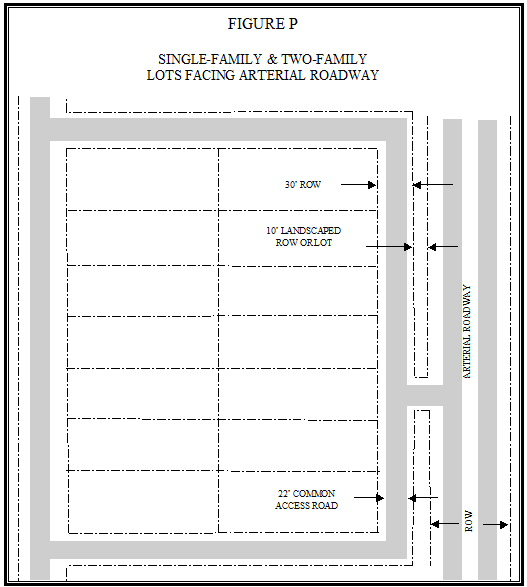
For lots abutting tollway, highway, or arterial roadways and facing (having frontage exclusively on) such roadway, the following shall be provided (see Figure P - [at the end of this section]):
(1)
A front parallel common access road at least twenty-two (22) feet in width (face of curb to face of curb) located on a thirty (30) foot wide public ROW (or private lot maintained by an association or other private authority and dedicated as a public access easement) shall be provided adjacent to the specified roadway. Such street shall be designed in accordance with the Transportation Criteria Manual; however, no sidewalk is required on this street if there is a sidewalk on the specified roadway. The access drive is required to have access to a street other than the specified roadway and such intersection is required to be located at least one hundred feet from the intersection of another street. Limited access points to the specified roadway may be approved by the Director of Planning provided such access points are no closer than three-hundred feet to the intersection of another street or common access drive. The Director of Planning and the Fire Chief may approve sole access to a specified roadway if other access is not reasonably feasible, necessary turnarounds are provided and such plan creates the most desirable residential layout.
(2)
The required front building setback shall be measured from the access road ROW or private lot/access drive and may be reduced by five feet from the standard front setback requirements. If the access road is privately maintained on a private lot, the single-family or two-family lot(s) shall front on the private lot/access drive and such frontage shall be considered as public road frontage for purposes of the subdivision ordinance.
(3)
A landscape lot at least ten feet in width is required to be dedicated between the common access road and the specified roadway ROW and is required to be planted as follows: for every six hundred (600) square feet of landscape area, two (2) shade trees (two-inch caliper or larger) and four (4) shrubs (five gallon container size or larger) shall be planted and maintained. Two ornamental trees per shade tree may be substituted for up to fifty percent (50%) of the shade trees if desired. No fence is permitted within this landscape lot or parallel common access road unless it is a wrought iron, tubular metal or similar decorative fence and does not create a visibility obstruction. This landscape lot may be dedicated as public ROW if the applicant provides for ongoing maintenance of the landscaping and the common access road is dedicated as public ROW.
(b)
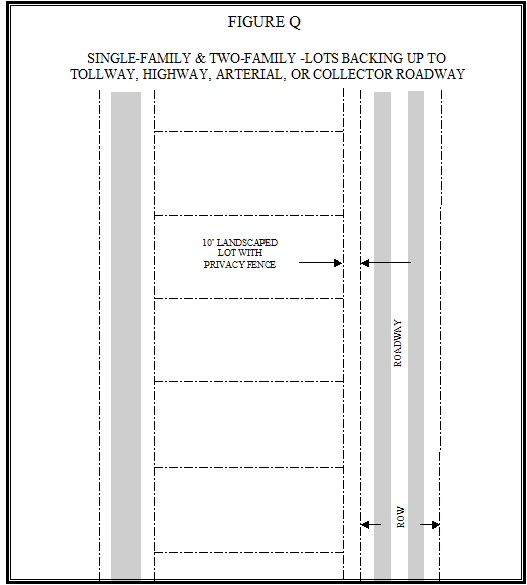
For lots adjacent to tollway, highway, arterial, or collector roadways and backing up to such roadway (having frontage on another roadway of a lesser classification), the following shall be provided (see Figure Q - [at the end of this section]):
(1)
A landscape lot is required between the lot and the specified roadway. Such landscape lot is required to be at least ten (10) feet wide and is required to be planted as follows: for every six hundred (600) square feet of landscape area, two (2) shade trees (two-inch caliper or larger) and four (4) shrubs (five gallon container size or larger) shall be planted and maintained. Two ornamental trees per shade tree may be substituted for up to fifty percent of the shade trees if desired.
(2)
A six-foot privacy fence is required to be constructed at the common lot line between the landscape lot and the single-family or two-family lots. The fence is required to be constructed of one or more of the following materials: brick, stone, cast stone, factory tinted (not painted) split-faced concrete masonry unit, or other similar material approved by the Director of Planning. In addition to the materials listed above, textured pre-cast concrete (e.g. WoodCrete) is also permitted when the privacy fence is adjacent to collectors. All columns are required to have concrete footings. The landscape lot is required to be maintained by a private association.
(c)
For lots adjacent to tollway, highway, arterial, or collector roadways and having a side of the lot adjacent to such roadway (having frontage on another roadway of a lesser classification), the following shall be provided (see Figure Q - [at the end of this section]):
(1)
A landscape lot is required between the lot and the specified roadway. Such landscape lot is required to be at least ten (10) feet wide and is required to be planted as follows: for every six hundred (600) square feet of landscape area, two (2) shade trees (two-inch caliper or larger) and four (4) shrubs (five gallon container size or larger) shall be planted and maintained. Two ornamental trees per shade tree may be substituted for up to fifty percent (50%) of the shade trees if desired.
(2)
A six-foot privacy fence is required to be constructed at the common lot line between the landscape lot and the single-family or two-family lots from the rear lot line to a point even with the rear wall of the house at a minimum, but no further than to a point even with the front wall of the house. Any fence closer to the front lot line than the front wall of the house shall not exceed three feet in height; however, such fence is not required. Such fence is required to be constructed of one or more of the following materials: brick, stone, cast stone, factory tinted (not painted) split-faced concrete masonry unit, or other similar material approved by the Director of Planning. In addition to the materials listed above, textured pre-cast concrete (e.g. WoodCrete) is also permitted when the privacy fence is adjacent to collectors. All columns are required to have concrete footings. The landscape lot is required to be maintained by a private association.
(Ordinance 14-032-00, secs. 2, 3, adopted 6/5/14; Ordinance 16-065-00, secs. 19, 20, adopted 7/21/16; Ordinance 17-012-00, sec. 36, adopted 3/2/17)
Sec. 9. - Special vehicle storage, loading.
(a)
A special vehicle is any trailer (including boats or any other item stored thereon) designed to be towed on public streets or any self-propelled vehicle which exceeds 22 feet in length.
(b)
Vehicle length shall be measured to include trailer connections and any overhang of the vehicle or trailer, including any items on the trailer.
(c)
Storage is defined as any parking of the vehicle for 48 hours or longer.
(d)
All special vehicles must meet the following requirements:
(1)
No special vehicle shall be stored on any required off-street parking.
(2)
No part of the vehicle shall extend over a public right-of-way or easement.
(3)
No special vehicle or any other vehicle shall be used for housekeeping, living or sleeping quarters for more than a total of three weeks in any one calendar year unless permitted in a park designed for such purpose and approved as a PUD.
(4)
If required, federal and state licensing and registration must be current.
(5)
All special or stored vehicles must be maintained in an operable condition unless kept within an approved building.
(6)
Stored vehicles must be secured with wheel stops.
(7)
Reserved.
(8)
A maximum of one special vehicle may be stored in the front yard. In addition, a maximum of two special vehicles may be stored on a residential lot except for an SFR district.
(9)
A special vehicle stored in the front yard must be perpendicular to the front property line.
(10)
No boat, RV, trailer, special vehicle or commercial vehicle may be stored in any district other than an industrial district for more than a total of three weeks in any one calendar year unless the property, including any building(s) on the property, is owned or leased by the owner of the vehicle, or the owner or lessee of the property utilizes the vehicle in conjunction with their employment or business.
(11)
Reserved.
(12)
The storage of a vehicle in excess of 22 feet in length requires a permit issued by the Permits Division certifying that the vehicle will be stored in compliance with this ordinance. To obtain a permit, the applicant must submit a plan of the lot illustrating how the vehicle will be stored. The permit shall specify the vehicle to be stored and the name of the owner of the lot. The permit is valid only for the vehicle and the owner specified. Permits may be revoked if the vehicle is not stored in accordance with this ordinance.
(e)
Outdoor storage or overnight outdoor parking of tractor-trailers, semi-trucks, semi-trailers, or other vehicles having a gross vehicle weight rating of 17,000 pounds or more, or that are designed to transport 16 or more passengers, including the driver, or that are transporting hazardous materials and are required to be placarded under 49 C.F.R. Part 172, Subpart F, shall not be permitted in any residential district or on any public ROW. In addition, outdoor storage or overnight outdoor parking of such vehicles shall not be permitted in any commercial district unless the vehicle is utilized by a commercial enterprise located on the property.
(f)
No part of any vehicle shall be allowed to extend into the right-of-way of an arterial street while being loaded or unloaded.
(Ordinance 05-018-00 adopted 9/1/05; Ordinance 05-018-81 adopted 1/21/10)
Sec. 10. - Signs.
Signs shall be constructed in accordance with the City sign ordinance in effect at the time of sign permit application.
(Ordinance 12-006-00, sec. 15, adopted 2/2/12)
Sec. 12. - Outdoor lighting.
(a)
The purpose of this section is to provide design standards for site and building lighting that are Dark Sky compliant and compatible with adjacent uses.
(b)
Non-residential outdoor lighting will be in accordance with other provisions of this ordinance and City building codes. A detailed lighting plan and photometric plan shall be included with the Building Permit application and shall meet the following requirements:
(1)
Outdoor Lighting.
a.
Fixture.
i.
All permanent exterior lighting shall be non-flashing and shielded such that the light source (cone of direct light) is not visible from the public ROW or adjacent residential uses at the property line (see Figure R - following page).
ii.
Wall pack lighting or other lighting that directs the light in a horizontal direction without an adequate shield is not permitted (since it directs the light glare directly outward) if there are streets or residential uses in the direction of the light.
b.
Illumination Levels.
i.
All site lighting shall be designed and installed so that the level of illumination as measured in foot candles at a height of three (3') feet at the property line does not exceed two (2') footcandles.
(c)
Residential outdoor lighting on residential property will be installed in accordance with applicable City Code Standards. It will be located so as not to create a nuisance for adjoining property owners.
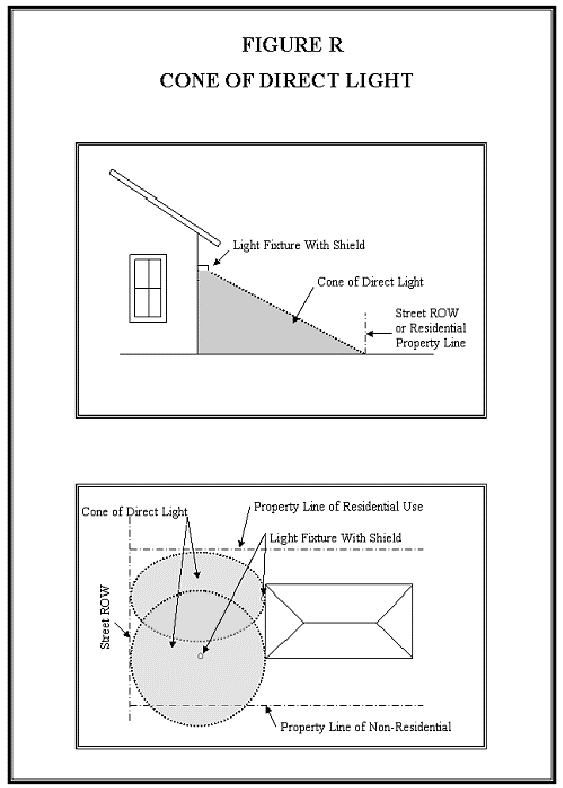
(Ordinance 05-18-00 adopted 9/1/05; Ordinance 16-065-00, sec. 21, adopted 7/21/16)
Sec. 13. - Nonresidential or multifamily parking lot connections.
A nonresidential or multifamily site contiguous with another nonresidential or multifamily site shall provide parking aisle connections to the boundary of the site for connection to such contiguous nonresidential or multifamily site unless such connection is determined to be inappropriate by the Department of Planning. The Department of Planning shall make its determination after considering all relevant factors, including, but not limited to, the following: when there exists topographic constraints, environmental constraints, existing development that has not provided for such connections, or adjacent uses that are incompatible for the purposes of mixing traffic.
(Ordinance 14-040-00, sec. 5, adopted 7/17/14)
Sec. 14. - Additional multifamily and nonresidential standards.
(a)
Nonresidential and multifamily outdoor trash containers and loading areas shall be located no closer to an adjacent street than the nearest wall of the building on the site utilizing such facility. The director of planning may consider an alternate location if such location is not reasonably feasible or is considered to be contrary to the public interest. Garbage dumpsters are required to be screened by a wall constructed of one or more of the following materials: un-painted clay brick, ledge stone, fieldstone, cast stone, marble, granite, or tile, painted or tinted stucco, factory tinted (not painted) split faced concrete masonry unit, textured pre-cast concrete (e.g. WoodCrete), or similar material approved by the director of planning. The wall shall be of the same material as, or visually compatible with, the primary structure and shall be at least as high as the dumpster it is enclosing. The open side to the dumpster or other trash receptacle shall be a solid wood or solid metal gate. A ninety (90) gallon or less roll out container may be stored outside if screened by any type of evergreen landscaping or privacy fence with a gate at least as tall as the container(s) and that will effectively screen the container(s) from view from all sides. These provisions do not apply to paper recycling dumpsters located on school campuses.
(b)
A drive-through commercial service lane within fifty (50) of a residential district is prohibited from operating from 10 p.m. until 6 a.m. unless such residential district is utilized for a nonresidential use or does not have a preliminary plat or final plat approved for residential use. All existing commercial service lanes in operation as of the effective date of this ordinance are exempt from this requirement. In addition, any commercial service lane located in front of a building is exempt from this requirement. For purposes of this ordinance, a drive-through commercial service lane shall be considered to be the portion of the lane including the pickup or service window, the ordering station, at least six vehicle stacking spaces and all areas between such locations.
(c)
All utility lines and other lines required to provide services to property in the City (including but not limited to water, wastewater, gas, electric, cable, internet, and propane) are required to be underground. In unique or unusual circumstances, an applicant may request an exception to the requirements of this section by submitting a written request for an exception with the site development permit or building permit application, as appropriate. The City Engineer may grant an exception if an exception is required by applicable building codes or for public safety reasons. The City Engineer's decision may be appealed in writing to the Commission within ten days of the City Engineer's decision. The Commission's decision may be appealed to the City Council within ten days of the Commission's decision. The City Council's decision will be final.
(d)
Masonry privacy wall.
(1)
A six-foot masonry privacy wall is required to be constructed by any non-residential use that abuts property utilized for a single-family or two-family residence on land zoned single-family or two-family, or land planned or platted for such with an approved concept plan, preliminary plat or final plat, unless an existing structure is proposed to be expanded by less than 50%, or 1,000 sq. ft., whichever is less.
(i)
Such wall shall be constructed at the common property line between the uses, or if such location is not feasible because of floodplain, trees or other natural feature, at a location that will effectively screen the non-residential use from view from the single-family or two-family residence.
(ii)
Such wall is required to be constructed of one or more of the following materials: textured pre-cast concrete that is constructed to appear as brick, stone, or cast stone as approved by the Director of Planning, brick, stone, cast stone, factory tinted or painted split-faced concrete masonry unit, granite, tile or other similar material approved by the Director of Planning.
(iii)
An eight-foot wall may be utilized for security purposes.
(iv)
Gates shall be provided in the wall as appropriate to connect to public sidewalks or other pedestrian connections unless such wall is also used as described above for security.
(2)
The masonry privacy wall is not required for non-residential uses that are permitted by right in any Single-Family Districts.
(Ordinance 05-018-00 adopted 9/1/05; Ordinance 14-075-00, sec. 8, adopted 12/4/14; Ordinance 16-065-00, sec. 22, adopted 7/21/16; Ordinance 18-036-00 adopted 6/7/18)
Sec. 15. - Sidewalks.
(a)
Multifamily and nonresidential. Where new multifamily and nonresidential primary structures are proposed (including a change in use for existing residential structures to multifamily or nonresidential uses), six (6) foot concrete sidewalks shall be installed parallel to both sides of roadways (unless such sidewalks are already existing) abutting the development and shall be set back at least five (5) feet from the edge of street pavement and at least five feet (5') from the edge of a parking area or building. The Director of Planning shall consider flexibility to this setback requirement if necessary to save existing trees or if an alternative alignment is considered to be in the public interest. Sidewalks shall, if enough area is available outside the public ROW, be coordinated with landscape design so that substantial landscaping is provided on both sides of the sidewalk. The sidewalk may slightly meander within the remaining ROW and the first 15 feet of the front setback on the lot (or in an alternate location as otherwise approved by the Director of Planning) in a manner that will create a desirable pedestrian environment and protect any existing trees. A pedestrian access easement shall be recorded for the public use of the sidewalk. Pedestrian connections shall also be provided at street crossings as well as to buildings within the development. The Director of Planning may consider a reduction in width or deletion of the sidewalk requirement for residential streets that are otherwise exempt from the sidewalk requirement if the proposed use is not expected to generate significant pedestrian traffic on such street and if such sidewalk is not required for pedestrian connectivity. However, the sidewalk shall not be deleted if it will connect with another sidewalk currently existing, planned or required to be installed in the future.
(b)
Single-family and two-family residential. For single-family and two-family residential development, six foot concrete sidewalks shall be installed on major arterial roadways, and four (4) foot concrete sidewalks shall be installed on all other roads, parallel to both sides of roadways in accordance with the Transportation Criteria Manual, unless sidewalks already exist or if such lot was platted with a subdivision approved prior to November 6, 1997. An additional foot is required to be added to the width of a sidewalk for sidewalks or portions of a sidewalk abutting a curb.
(Ordinance 05-018-30, sec. 15, adopted 2/15/07)
Sec. 16. - Fences.
(a)
Except in an SFR district and for agricultural uses in any district and to repair existing barbed wire fencing, barbed wire fencing is prohibited for residential districts.
(b)
Any fencing installed adjacent to a public ROW shall be installed with the finished (smooth) side facing the ROW.
(c)
All fences along a common property boundary shall be less than or equal to eight (8) feet in height except as provided below.
(d)
Fences greater than eight (8) feet in height shall be allowed for impeding access to hazardous or secured facilities including, but not limited to, electrical substations and chemical or equipment storage yards. For high security applications, barbed wire or razor wire (or equivalent) may be installed above the eight (8) foot height limit but not to exceed a total of ten (10) feet in height.
(e)
Fences less than or equal to three (3) feet in height shall be allowed in front yards of single-family and two-family districts. No fencing is permitted in the front or side street setback of all other districts.
(f)
No fence or other structure more than twenty percent (20%) solid or more than three (3) feet high shall be located within twenty-five (25) feet of the intersection of any rights-of-way.
(g)
All fences shall be constructed to maintain structural integrity against natural forces such as wind, rain and temperature variations.
(h)
The finished side of all fences built to comply with screening regulations shall face away from the screened object.
(i)
All fencing shall be maintained in an attractive state and shall not be allowed to lean, sag, warp or otherwise fall into disrepair. Any missing, rotted, loose or broken pieces shall be replaced.
(j)
All posts shall have concrete footings.
(k)
There is no height limit to fences for exotic hoof stock.
(l)
Any chain-link fencing (including posts) utilized for uses other than single-family or duplex uses shall be black or green vinyl coated.
(m)
Fences associated with single-family homes are encouraged to provide a masonry column separating the wooden fence from the home as a means to disconnect the structure from a potential flammable material.
(Ordinance 05-018-00 adopted 9/1/05; Ordinance 12-006-00, sec. 16, adopted 2/2/12; Ordinance 19-045-00, sec. 7, adopted 8/15/19)
Sec. 17. - Exceptions.
(a)
Agricultural and recreational buildings/structures are exempt from the maximum floor area standards for accessory buildings/structures.
(Ordinance 05-018-00 adopted 9/1/05; Ordinance 19-044-00, secs. 16, 20, adopted 8/15/19)

