
Leander City Zoning Code
ARTICLE VIII
ARCHITECTURAL STANDARDS
Sec. 1. - Wall area calculations.
(a)
In calculating percentage of exterior wall area, the area of windows and window frames, doors and door frames, eaves, soffits, dormers, columns, recessed entryways, foundation and similar areas are excluded from the calculations and may utilize any of the materials listed in the applicable component exterior wall standards, when, in the opinion of the Building Official, construction with the required masonry materials is not reasonably feasible.
(b)
A street facing wall is the exterior wall of a building, including any offsets, projections or recesses, facing a street or within forty-five (45) degrees of such orientation and within four hundred (400) feet of the street. A wall is considered facing a street even if there is another public ROW between the wall and the street. A wall is not considered facing a street if another building or other permanent screening material on-site is between the wall and the street and blocks the view of the wall from the street by at least seventy-five percent (75%) from all view angles. Five-year projected maturity of any on-site evergreen planted materials may be considered in the screening assessment.
(Ordinance 05-018-00 adopted 9/1/05; Ordinance 19-044-00, sec. 20, adopted 8/15/19)
Sec. 2. - Warehouse, mini-warehouse and overhead doors.
Warehouse, mini-warehouse and overhead (commercial service) doors shall not be oriented so as to face a street(s) or residential property or shall be screened from view from the street(s) or residential property unless the director of planning determines that there is no other feasible alternative. the director of planning may also approve decorative overhead doors in lieu of screening when the doors are oriented towards the street on a case-by-case basis.
(Ordinance 05-018-00 adopted 9/1/05; Ordinance 22-067-00 adopted 8/4/22)
Sec. 3. - Rooftop equipment.
Parapets or other similar screening enclosures shall be utilized to conceal rooftop equipment from view from the street or surrounding properties. Such enclosures shall be constructed at least 42" high or as high as the equipment it is designed to conceal from view, whichever is greater. Such equipment includes, but is not limited to, equipment such as A/C compressors and satellite dishes (see Figure X). The enclosures shall be constructed out of materials consistent with the wall siding material. Rooftop mechanical equipment such as A/C compressors is not permitted in residential districts. Nothing in these regulations shall be construed so as to limit the use of solar power panels.
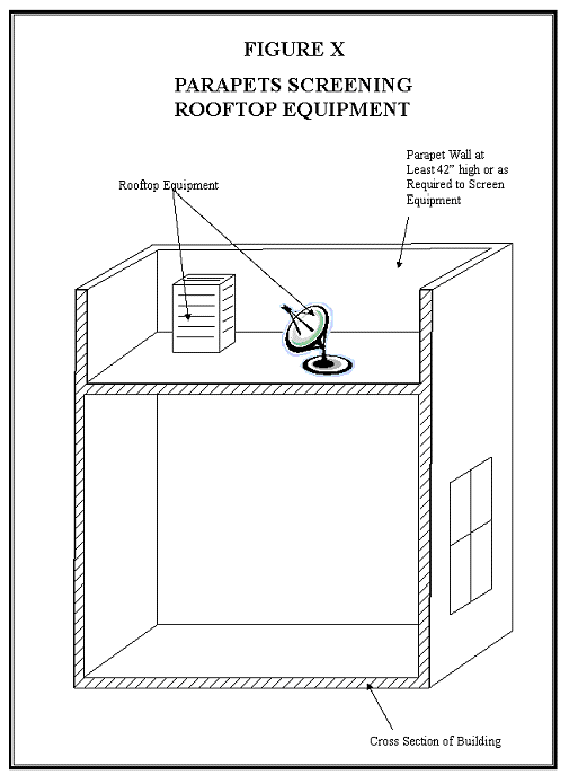
(Ordinance 05-018-00 adopted 9/1/05)
Sec. 4. - Building over lot lines.
A building or structure may be constructed over lot lines with the following conditions:
(a)
Any easements in the area of the building shall be released, and
(b)
The lots are owned by the same owner.
The construction of buildings with a common wall at the property line is permitted without condition (b) if otherwise permitted by this ordinance.
(Ordinance 05-018-00 adopted 9/1/05)
Sec. 5. - Masonry and other architectural standards.
(a)
Brick, stone, cast stone or other similar masonry products, when used, shall not be painted.
(b)
The number of combinations of single-family or two-family residential floor plans and elevations in any final plat section shall, at a minimum, equal at least twenty-five percent (25%) of the total lots in the final plat, but is not required to exceed fifteen. (For example, five floor plans with three different elevation options for each floor plan results in fifteen different floor plan/elevation combinations.)
(c)
No two homes side by side or across the street within one house (directly across the street or "caddy corner" across the street) shall have the same elevation plan or the same floor plan except for the SFT district.
(d)
In the event of a natural disaster (tornado, fire, etc.) the resident may replace the current structure with a new structure built of the same masonry percentages as the pre-existing residence.
(e)
All exterior walls on remodels and additions must be consistent with the exterior of the existing dwelling.
(f)
Recreational vehicles, travel trailers and manufactured/mobile homes shall not be used for on-site dwelling or for any nonresidential or other purpose except as authorized in an SFU/MH district, as provided in Article IV, Section 2, Special Use Permit or as otherwise permitted in this ordinance.
(g)
Residential dwelling street-facing garage standards. To prevent residential streetscapes from being dominated by garage doors, and to allow the visually interesting features of the house to dominate the streetscape, the following standards shall apply:
(1)
All residential dwellings in the CH, SFL and SFT districts and on any lot or building envelope less than fifty (50) feet wide may provide access to garages from a rear alley.
(2)
All garages and parking areas in NR districts shall be accessed from a rear alley or located behind the primary structure.
(3)
Three car garages in the SFC district may only have two (2) street facing garage bay openings unless the lot is wider than fifty (50') feet.
(4)
No residential dwellings within the SFR districts shall have front entry, street facing garages forward of the front wall of the primary structure.
(5)
No more than two (2) street facing garage bays may be adjacent to each other on attached dwellings such as duplexes and townhouses.
(6)
Except as provided for in this subsection, street-facing garages must be recessed at least five (5) feet behind the ground floor living area of the dwelling or a roof-covered porch that is at least seven (7) feet wide by six (6) feet deep.
(7)
For properties with the CH, SFT, SFL, or SFC use components, street-facing garages that incorporate enhanced architectural features as described in this section, may be flush or protrude up to five (5) feet in front of the ground floor living area of the dwelling or roof-covered porch that is at least seven (7) feet wide by six (6) feet deep, but in no case shall the garage be setback from the street less than the minimum setback for the zoning district.
(8)
For properties with the SFU, SFS, SFE, or SFR use components, street-facing garages may be flush or protrude up to five (5) feet in front of the ground floor living area of the dwelling or roof-covered porch that is at least seven (7) feet wide by six (6) feet deep, but in no case shall the garage be setback from the street less than the minimum setback for the zoning district.
(9)
For garages that meet the standards of subsection (7) and where the site topography (typically slopes greater than 10% or for other similar topography as allowed by the Planning Director) requires stairs from the garage into the living space, the garage may protrude up to eight (8) feet in front of the ground floor living area of the dwelling or roof-covered porch that is at least seven (7) feet wide by six (6) feet deep, but in no case shall the garage be setback from the street less than the minimum building setback for the zoning district.
(10)
The Planning Director may approve garage placement that does not meet the standards of this section in the case of unique site conditions including the existence of significant trees, extreme topography and similar natural features.
(11)
For the purposes of this subsection, enhanced architectural features shall include:
a.
Architectural garage doors that are painted to match the color scheme of the house and include decorative hardware; or
b.
Doors that have a natural wood appearance; and
c.
Both subsection a. and b. above must also be combined with at least one of the following features:
(i.)
a garage door recess of at least two (2) feet;
(ii.)
a roof overhang over the garage doors with supporting architectural columns that extends at least two (2) feet in front of the garage doors; or
(iii.)
any similar architectural feature, approved by the Planning Director, that diminishes the prominence of the garage doors on the street-facing building facade.
(12)
Garages accessed from rear alleys are exempt from the standards of this section.
(13)
Second or higher floor living areas do not count toward the measurement of ground floor street-facing linear building frontage.
(14)
The following residential lot mix requirements shall apply to all new residential subdivisions except those served by on-site sewage treatment systems. For the purposes of this section, net acres shall mean the total acres of the subdivision minus the required parkland. In addition, three (3) car garages with only one (1) street-facing garage bay do not count as street-facing garages for the purposes of this section.
a.
Subdivisions between zero (0) and thirty (30) net acres shall not have a specific residential lot mix requirement.
b.
Subdivisions greater than thirty (30) and less than ninety (90) net acres shall include at least two (2) different residential use components each of which shall include at least twenty (20%) of the lots within the subdivision.
c.
Subdivisions greater than ninety (90) net acres shall include at least three (3) different residential use components each of which shall include at least twenty [percent] (20%) of the lots within the subdivision.
(h)
Master Architectural Plan.
(1)
The intent of the Master Architectural Plan is to provide for a cohesive development on all four corners at the intersections of arterials and collectors. This plan should incorporate common elements that evoke a sense of place and have elements that contribute to cohesive identity.
(2)
Development on all four corners of intersections of arterials and collectors shall provide and comply with a Master Architectural Plan that incorporates the following:
(i)
Exterior building materials used on the exterior of each structure.
(ii)
Exterior building color palettes.
(iii)
Exterior elements of building facades such as wall accents, covered entries, columns, or other features.
(iv)
Other elements as approved by the Director of Planning.
(3)
Development at these intersections shall comply with the plan after the date of the initial submittal of a Master Architectural Plan.
(4)
This plan shall be submitted with the site development permit for the project. The plan may be amended as the intersection develops to incorporate additional standards.
(Ordinance 19-044-00, sec. 21, adopted 8/15/19)
Sec. 6. - Soffits and facia; mansard roofs.
(a)
All nonresidential roof fascia and soffits shall be constructed of a noncombustible material.
(b)
Fascia shall not be increased (e.g. sign bands) nor shall mansard roofs, Quonset roofs, "A" frame designs or other similar roofs be utilized when having the effect of reducing the normal amount of exterior wall surface area. Sign bands may not exceed three feet in height and may not extend across more than forty percent (40%) of a structure frontage.
(Ordinance 19-044-00, sec. 22, adopted 8/15/19)
Sec. 7. - Roofs.
(a)
Unless constructed as a roof deck, all residential roofs shall be peaked and have at least a 5:12 pitch except for porches and shed roofs which may be constructed to a minimum pitch of 2:12.
(b)
Flat roofs shall be enclosed by parapets a minimum of 42 inches high, or as required to conceal mechanical or other rooftop equipment.
(Ordinance 19-044-00, sec. 22, adopted 8/15/19)
Sec. 8. - Height.
(a)
No building/structure height shall exceed thirty-five (35) feet except as provided in Article VIII, Section 9.
(Ordinance 19-044-00, sec. 22, adopted 8/15/19)
Sec. 9. - Exceptions.
(a)
The height limits prescribed herein shall not apply to television and radio towers, church spires, belfries, monuments, tanks, water and fire towers, stage towers, scenery lofts, cooling towers, ornamental towers and spires, chimneys, elevator bulkheads, smokestacks, necessary public or private utilities, conveyors, flagpoles, agricultural buildings or related structures and necessary mechanical appurtenances unless they extend twenty (20) feet above the maximum height established for the district.
(b)
Public or semi-public service buildings, hospitals, institutions or schools, where permitted, may be erected to a height not exceeding sixty (60) feet and churches and other places of worship may be erected to a height not exceeding seventy-five (75) feet when each of the required yards is increased by one (1) foot for each two (2) feet of additional building height above the height limits for the district in which the building is located.
(c)
No structure shall be erected to a height in excess of that permitted by regulations of the Federal Aviation Agency that apply to the area in which the structure is located.
(d)
The Building Official and the Director of Planning may approve variations of up to 5% in architectural standards including, but not limited to, the amount of masonry required, building height and roof pitch.
(e)
Agricultural buildings and recreational storage buildings are exempt from exterior wall standards.
(f)
Maintenance and additions to existing structures are permitted in conformance with the existing standards of the structure including standards that relate to masonry, setback, architectural, landscaping or other zoning standards, as long as an addition does not exceed 50% [fifty] percent of the existing gross floor area or 900 square feet, whichever is greater, but never more than 100% of the existing structure. However, metal siding and manufactured homes are not permitted to be added to a structure unless permitted under current zoning regulations.
(g)
Solar energy systems and small wind energy systems meeting the standards of Article IV, Sec. 5 of this code are exempt from this Article.
(h)
Development incentives.
(1)
Building/structure height.
a.
Nonresidential or multifamily structures may exceed the permitted building height if they meet the following conditions:
(i)
If the exterior surface areas of street facing walls of buildings/structures are comprised of sixty (60%) percent Masonry, then the height shall be limited to forty (40') feet at a distance of thirty (30') feet from single-family or two-family districts unless such district is utilized for nonresidential uses.
(ii)
If the exterior surface areas of buildings/structures are comprised of at least eighty-five (85%) percent of first story walls and fifty (50%) percent of each additional story, then the height shall be limited to a height of thirty-five (35) feet at a distance of twenty-five (25) feet plus one foot for each one foot of setback beyond twenty-five (25) feet from a permanent single-family or two-family district unless such district is utilized for non residential use. Otherwise, the maximum primary building/structure height for any nonresidential or multifamily district shall not exceed forty five (45) feet.
(iii)
If the exterior surface areas of all walls of buildings/structures are comprised of at least one hundred (100%) percent of the combined exterior surface area of all walls, including all stories then no primary structure/building shall exceed a height of thirty (30) feet at a distance of twenty (20) feet plus one foot for each one foot of setback beyond twenty (20) feet from a single-family or two-family use district unless such district is utilized for nonresidential use (see Figure T - following page [Article VIII, section 1]). Otherwise, the maximum primary building/structure height for any nonresidential or multifamily district shall not exceed forty-five (45) feet except that a building may be erected to a height of ninety (90) feet if building setbacks for the building or portions of a building exceeding forty five (45) feet are increased one foot in distance for each two feet of additional building height in excess of forty five (45) feet (except as provided in Article VIII, Section 8).
(Ordinance 19-044-00, sec. 22, adopted 8/15/19)

