
Longboat Key City Zoning Code
ARTICLE X
- Definitions
158.144 - Definitions.
For the purpose of this Chapter, the following definitions shall apply unless the context clearly indicates or requires a different meaning:
"Access drive." Same as "driveway".
"Accessory use or structure."
(1)
Accessory use. A use customarily incidental and subordinate to the principal use of the land or building and located on the same lot with the principal use or building.
(2)
Accessory structure. A structure detached from a principal building located on the same lot and customarily incidental and subordinate to the principal building or use.
"ADA." The Americans With Disabilities Act of 1990 and the Florida Accessibility Code for Building Construction.
"Additional use." The use of land, water, or buildings and structures or a portion thereof, independent of but directly related to another permitted use. An additional use is not an accessory use.
"Adjoining." Having a common border, line, or wall.
"Aisle." The traveled way by which vehicles enter and depart parking spaces.
"Alley." A facility which affords only a secondary means of access to abutting property and not intended for general traffic circulation.
"Alteration." Any change, addition, or modification in construction or type of occupancy, any change in the structural members of a building, such as walls or partitions, columns, beams or girders, the consummated act of which may be referred to herein as "altered" or "reconstructed".
"Ancillary equipment." Components subordinate to, but necessary for the operation of, personal wireless service facility. Such components include, but are not limited to, cabinets and electrical. This term shall not be interpreted to include structures designed and constructed to support antennas.
"Annual Site Development Plan Season." The months during which the Planning and Zoning Board and Town Commission receives, reviews, makes recommendations, or acts on applications for development, which include the months of January, February, March, April, May, June, September, October, November, and December.
"Antenna." Any device used to transmit or receive electromagnetic waves or frequency signals. The term "antenna" includes frequency signals for radio, television, paging, personal communications services, cellular communications services, analog communications services, digital communications services, and microwave communications. The term "antenna" does not include a television antenna, satellite dish, or other type of satellite or video receiving device that is mounted on a single-family residence for use exclusively of the occupants of that single-family home, or that is in compliance with Section 158.095 and Section 158.098 of this Zoning Code.
"Applicant." A person or an entity with a fee simple ownership interest in property located in the Town or any person or entity acting as an agent for a fee simple owner, requesting approval of any land-use, development, improvement or similar application, regulated by the Zoning Code. Where a property has been submitted to condominium ownership pursuant to Chapter 718, Florida Statutes, the owners association may be the Applicant provided the application includes a copy of the association board minutes and authorization verifying that an agent has the authority to act as Applicant on behalf of the association; provided, however, a fee simple owner of a condominium unit shall not be an Applicant unless the owners association is also a co-Applicant. Where the Applicant or agent is an entity other than a condominium association, the application shall include a resolution or document signed by an authorized officer or member of the entity evidencing the entity's consent to the filing of the application and designation of the agent.
"Arts and crafts." The making of artifacts in a single-family dwelling as a home occupation and in compliance with Section 158.109.
"Auto rental lot." A lot or parcel of land on which passenger automobiles for active rental purposes only are stored or parked.
"Awning." An accessory structure, typically projecting from the exterior wall of a building, either retractable or portable in nature, which is supported by an open framework and is covered by fabric or other nonrigid material except for the supporting framework.
"Backhaul network." The technology and infrastructure responsible for transporting voice and data communications from end users or nodes to the central network or infrastructure.
"Banks and other financial institutions." An institution that is engaged in retail banking, and other similarly related functions such as making loans, investments and fiduciary activities.
"Bar." A building or portion of a building wherein alcoholic beverage is sold by the drink or bottle and consumed on the premises.
"Barber-beauty salon." An establishment where cosmetology services including hair care, nail care and skin care are provided on a regular basis.
"Beach shelter." An accessory structure, temporary or permanent, consisting of one or more columns and a roof and not including walls or a floor or facilities of any type.
"Best management practices." Professionally accepted methods or combination of methods to be incorporated into design, construction activities and maintenance which have been determined to be the most effective.
"Binding concept plan." A general graphic delineation and informational description of a proposed conceptual program of development or a development phase that is submitted with an Outline Development Plan. The binding concept plan shall in its entirety indicate the existing and proposed uses and structures, lots, streets, and other physical aspects of the proposed development and as enumerated in Sections 158.036 and 158.030. Binding concept plans are required as part of Outline Development Plans (ODP) that are submitted for Planned Unit Development (PUD) approval, except where this Code explicitly allows a Final Site Development Plan to replace a binding concept plan (see, for instance, Subsections 158.036(B)(1) and 158.106(F)). Binding concept plans become an integral part of ODP/PUD approvals.
"Bird and wildlife sanctuaries and nature areas." Areas that contain significant food, water or cover for native terrestrial and aquatic species of animals, birds and plants.
"Board of adjustment." The Zoning Board of Adjustment of the Town as provided for in this Chapter.
"Boat facility" means a public or private structure or operation where boats are moored or launched, including commercial, recreational and residential marinas, and public boat ramps. A dry storage facility is considered part of a boat facility if the dry storage facility has the capability of launching vessels into adjacent waters. For the purpose of this Code, single-family docks with less than five wet slips are not considered boat facilities.
"Boat lift." A structure over water designed to lift a boat out of the water.
"Building." See "structure." Any structure having a roof including a screened pool cage, supported by columns or walls and intended for the shelter, housing, or enclosure of any individual, animal, process, equipment, goods, or materials of any kind or nature. Any other structural appendage to a building, including a deck which protrudes more than six inches above finished grade, shall be considered a building, except that permeable planters shall not be considered a building.
"Building coverage." Building coverage has the same meaning as lot coverage and land coverage.
"Building, height of."
(1)
For the purpose of Article IV, bulk, maximum height, for structures other than single-family residences, the vertical distance shall be measured from the minimum habitable floor elevation, as established by the Town. For structures that have a one-level parking garage, occupying at least 75 percent of the area under the building, the building height shall be measured from the floor of the first habitable level. The vertical clearance of the parking garage shall not exceed ten feet, unless the clearance is a result of additional height required by the state. Additional vertical clearance otherwise proposed shall result in a reduction in the height of the structure. Building height shall be measured to the highest point of any portion of the building.
(2)
For the purpose of Article IV, bulk, maximum height, for single-family residences, the vertical distance shall be measured from the minimum habitable floor elevation as established by law to the highest point of any portion of the building.
(3)
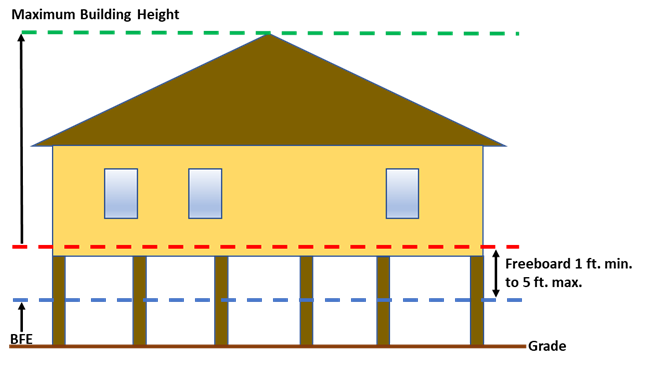
For the purposes of Article IV, Bulk, Maximum height, for all structures in flood hazard areas other than Coastal A Zones, Coastal High Hazard Areas, and seaward of the CCCL, the vertical distance shall be measured from the Base Flood Elevation (BFE) plus Freeboard, except that in no case shall the vertical distance of the Freeboard exceed a maximum of three (3) feet. The building height shall be measured from the selected Freeboard to the highest point of any portion of the building (see illustration below).
(4)
For the purposes of Article IV, Bulk, Maximum height, for all structures and properties in flood hazard areas other than Coastal A Zones, Coastal High Hazard Areas, and seaward of the CCCL, when the average ground elevation is at or below 3.5 feet North American Vertical Datum (NAVD), as determined by the Planning and Zoning Official based on a topographic survey, the vertical distance shall be measured from the Base Flood Elevation (BFE) plus Freeboard, except that in no case shall the vertical distance of the Freeboard exceed a maximum of five (5) feet. The building height shall be measured from the selected Freeboard to the highest point of any portion of the building (see illustration below).
"Building line." The line, established by law, beyond which any part of a building shall not extend, except as specifically provided by law.
"Bulk." Height and percentage of land or lot coverage of a building.
"Business and professional offices." Any room, studio, suite or building in which a person transacts business or carries on an occupation. An office shall not involve manufacturing, fabrication, production, processing, assembling, cleaning, testing, repair or storage of materials, goods and products, or the sale or delivery of any materials, goods or products that are physically located on the property. This definition does not include medical or dental clinics, but does include business offices that are accessory to a principal business.
"Canopy." An accessory structure either collapsible or portable in nature, other than an awning, covered by fabric or other nonrigid material carried by an open framework supported by the ground or building (see awning).
"Capital Improvements Element" or "CIE." The current adopted Capital Improvements Element of the Town of Longboat Key Comprehensive Plan.
"Capital Improvements Program" or "CIP." The five-year schedule of capital improvements, including roads, adopted annually by the Town as part of the Town budget process and Comprehensive Plan.
"Cemetery." Land used for the burial of the dead, and dedicated for cemetery purposes, including columbariums, mausoleums and mortuaries.
"Charter fishing." To hire, rent or lease for a fee, a vessel from which a person may fish for food or recreation.
"Child care services." A child care center or child care arrangement that provides child care for more than five children unrelated to the operator and that receives a payment, fee, or grant for any of the children receiving care, wherever operated, and whether or not operated for profit, as defined by state law.
"Civic center." An area developed or to be developed, including, but not limited to, public buildings or uses, public offices, libraries, playgrounds, parks, assembly halls and police and fire stations.
"Club, private." Buildings or facilities, not open to the general public, owned and operated by an individual, corporation, or association of persons for social or recreational purposes for members and their bona fide guests, not operated or maintained primarily for the purpose of gaining a profit and not including casinos, nightclubs, bottle clubs or other establishments operated or maintained primarily for the purpose of gaining a profit.
"Collapse zone." The area surrounding a freestanding facility, which, in the event of a structural failure of all, or part, of the freestanding facility, would result in the freestanding facility falling or collapsing within the boundaries of the property on which the freestanding facility is placed. The collapse zone must equal at least 100 percent of the freestanding facility height.
"Co-location." The situation when a second or subsequent wireless provider uses an existing structure to locate a second or subsequent antennas. The term includes the ground, platform, or roof installation of equipment enclosures, cabinets, or buildings, and cables, brackets, and other equipment associated with the location and operation of the antennas.
"Columbarium." A final resting place for containers of cremated remains.
"Commercial use." An activity involving the purchase and sale or exchange of goods, commodities or services carried out primarily for the purpose of gaining a profit.
"Community residential home." A dwelling unit licensed to serve clients of the department of health and rehabilitative services, which provides a living environment for seven to 14 unrelated residents who operate as the functional equivalent of a family, including such supervision and care by supportive Staff as may be necessary to meet the physical, emotional and social needs of the residents.
"Completed" (application). Determination by the Planning and Zoning Official or designee that an Applicant has submitted all requirements necessary for Staff to adequately review a request for a specific development review procedure, including (1) all applicable application forms; (2) all required supporting documentation; and (3) all required fees.
"Comprehensive plan." A Comprehensive Plan, which may consist of several maps, data and other descriptive matter, for the physical development of the Town or any portion thereof, including any amendments, extensions or additions thereto indicating the general location for major streets, parks, or other public utilities, zoning districts, or other similar information. The Comprehensive Plan shall be based on and include appropriate studies of the location and extent of present and anticipated population, social and economic resources and problems, and other useful data regarding the future development of the Town.
"Concurrency." A determination of adequate level of service based on adopted standards that measure whether the infrastructure and service needs of a new development exceed existing capacity or new capacity created by any scheduled improvements in the capital improvements element of the local government Comprehensive Plan. Concurrency is also defined through F.S. § 163.3180, as may be amended.
"Contiguous." To physically touch or border upon; or to share a common property line.
"Continuing education centers." A public or private institution that provides educational instruction, in addition to standard primary, secondary or higher education.
"Cubic content." The gross internal volume of a building.
"Cultural centers, nonprofit." A not-for-profit use providing for the display, performance, or enjoyment of heritage, history or the arts. The use of the center can include, but is not limited to, museums, art performance, or interpretive sites, but does not include commercially operated theatres.
"Davit." A structure designated to hoist watercraft from a dock, seawall, or from the water.
"Daylight plane." The angle in degrees for single-family homes measured from side lot line boundaries projecting upward toward the center of the parcel beginning at minimum habitable floor elevation as established by law.
"De Minimis Impact." As it relates to the transportation proportionate fair-share program, an impact that would not generate more than 100 trips per day.
"Density, maximum gross." The maximum allowable number of dwelling or tourism units per acre of gross land area, as determined by this Zoning Code. (See "Gross land area.")
"Density, overall." The maximum allowable number of tourism and dwelling units divided by the acreage of all property included respectively in the MUC-1, MUC-2, or MUC-3 zoning districts, including associated recreational areas, open space areas, road rights-of-way, wetland areas, and other nonresidential lands in each respective district. (See Article IV, Division 4.)
"Departure." A Departure is a type of formal modification of a standard or constraint of this Code that may be approved by the Town Commission when considering an application for a Planned Unit Development. A Departure is not a Variance and thus need not be predicated on conditions peculiar to the property or require a showing of unnecessary and undue hardship. See Section 158.036.
"Developer." Any person undertaking any development as defined in this section.
"Development." The carrying out of any building activities or mining operation or the making of any material change in the use or appearance of any structure or land or the dividing of land into two or more lots. Development shall include redevelopment of land or structures. For purposes of the parks and open space acquisition requirements of this Chapter, "development" shall include any subdivision, whether or not the recording of a plat is required; any land on which a multiple-family dwelling unit, residential building, or grouping of the buildings or villas is to be built, including, but not limited to, rental cooperative or condominium units and including land to be used for commercial condominiums, tourism uses, or individual dwellings, the latter including the construction of a single-family lot or lots.
"Development, major." Any development requiring Outline Development Plan, Site Development Plan or Special Exception review by the Planning and Zoning Board or Town Commission.
"Development, minor." Any development not requiring Site Development Plan review by the Planning and Zoning Board or Town Commission including developments processed pursuant to Section 158.026.
"Development order." Any order granting, denying, or granting with conditions an application for a development permit (see Section 163.3164(15), Florida Statutes).
"Development permit." Any Building Permit, zoning permit, subdivision approval, rezoning, certification, Special Exception, Variance, or any other official action of local government having the effect of permitting the development of land.
"Development proposal." Includes, but is not limited to, Site Development Plans, rezone and Special Exception petitions, Building Permit applications, applications for Outline Development Plans proposals reviewed under the Town's codes.
"Direct-to-home satellite services." The only programming transmitted or broadcasted by satellite directly to the subscribers' premises without the use of ground receiving equipment, except at the subscribers' premises or in the uplink process to the satellite.
"Dish antenna (earth station)." A dish antenna intended for the purpose of receiving communication from, orbiting satellites and other extraterrestrial sources, a low-noise amplifier (L.N.A.) which is situated at the focal point of the receiving component for the purpose of magnifying and transferring signals, a coaxial cable for the purpose of carrying signals to the interior of a building, or a combination of any of these elements. It does not include a coaxial cable connected to any cable television system franchised by the Town.
"Dish antenna height." The distance measured vertically from the bottom of the base which supports the dish antenna to its highest point when positioned for operation.
"Distributed antenna system (DAS)." A network of spatially separated antenna nodes connected to a common source via a transport medium that provides personal wireless service within a geographic area or structure.
"Dock." A structure located beyond the mean high-water line built on piling, flotation devices, or projected over the water which is designed or used to provide mooring for and access to one or more boats. Necessary service such as water and other utilities are considered a part of a dock; however, no cooking, sleeping, or unrelated business activity shall be permitted or conducted on a dock.
"Dock access ramp or stairs." A ramp or stairs located landward of the mean high-water line which provides access to a boat dock which is no greater than five feet in width which extends a minimum length into the upland area to provide either access to grade that does not exceed a slope of 1:4 or reasonable clearance over shoreline wetland.
"Driveway." A private drive connecting a dwelling unit or other building and its adjacent parking area with the street.
"Dwelling." A building or portion thereof designed or used exclusively for residential occupancy.
(1)
"Mobile home dwelling." A vehicle or movable dwelling structure which is designed to be used as a dwelling unit for one family and which stands on wheels, on rigid supports, or on a foundation, but excluding prefabricated homes or sections thereof and travel trailers as defined herein.
(2)
"Multiple or multifamily dwelling(s)." A dwelling or group of dwellings on one lot, designed for residential occupancy for periods of not less than one month, containing separate living units for three or more families living independently of each other. Multifamily dwellings may include apartments, cooperatives, and condominiums.
(3)
"Single-family dwelling." A detached dwelling designed for residential occupancy by one family on a single lot.
(4)
"Two-family dwelling." A dwelling designed for residential occupancy by two families living independently of each other within individual dwelling units on a single lot.
(5)
"Townhouse dwelling." A dwelling designed for residential occupancy by one family for periods of not less than one month that is attached to two or more single-family dwellings by a common wall or walls, with each dwelling unit located on its own parcel of land. The attached dwellings, as defined, constitute a building group.
"Dwelling units (DU)." A dwelling, room, or group of rooms including a kitchen and sanitary facilities designed and used exclusively for residential use as separate living quarters by not more than one family.
"Erodible slope". All slopes with inclines in excess of four percent unless modified by the public works director based on consideration of specific soil conditions.
"Essential services." Public utility facilities related to the water, wastewater, sewer, storm drainage, solid waste, telephone, personal wireless services, cable/fiber service provider systems, gas and electric collection, or distribution systems serving the Town; but not including, building housing employees or public safety facilities such as fire or police stations.
"Family." An individual, or two or more persons related by legal adoption, blood, or a licit marriage, or a group of not more than four persons who need not be related by blood or marriage, any of whom are living together as a single housekeeping unit in a dwelling, or a group of not more than 14 unrelated residents plus Staff who operate as the functional equivalent of a family in a community residential home.
"FDOT". The Florida Department of Transportation.
"FDOT TRIP". The transportation regional incentive plan, as developed by the Florida Department of Transportation in order to provide matching funds for regionally significant projects to serve travel that transcends county or MPO boundaries.
"Fence." A vertical structure, solid or otherwise, including walls, of any material or combination of materials, placed on a property to serve as an enclosure, barrier, boundary, screen, or ornamental feature. The fence structure includes gates, ornamental features and lighting.
"Financial Feasibility/" As it relates to the transportation proportionate fair-share program, sufficient revenues are currently available or will be available from committed funding sources for the first three years, or will be available from committed or planned funding sources for years four and five, of a five-year capital improvement schedule for financing capital improvements, such as ad valorem taxes, bonds, state and federal funds, tax revenues, impact fees, and developer contributions, which are adequate to fund the projected costs of the capital improvements identified in the Town of Longboat Key Comprehensive Plan necessary to ensure that adopted level of service standards are achieved and maintained within the period covered by the five-year schedule of capital improvements. The requirement that level of service standards be achieved and maintained shall not apply if the proportionate fair-share process set forth in F.S. §§ 163.3180(12) and (16) is used.
"Floor area."
(1)
"Minimum floor area." Minimum floor area relative to residential use means minimum living area of the habitable floors, not including garage.
(2)
"Total floor area." The sum of the gross enclosed horizontal area of all of the floors of a building except a basement as defined, measured from the exterior faces of exterior walls or supporting columns.
"Florist shop." A small retail shop which sells cut flowers and other small decorative plants.
"Freestanding facility." A structure designed and constructed to support or house small cell technology or one or more antennae.
"Frontage." All the property on one side of a street between intersecting streets measured along the line of a street, or if the street is dead-ended, then all of the property abutting on one side between an intersecting street and the dead end of the street.
"Garage."
(1)
"Private garage." A building or space used as an accessory to or part of a principal Building Permitted in any residence district and providing for the storage of motor vehicles and in which no business, occupation, or service for profit is in any way conducted.
(2)
"Garage, public." Any building or premises, other than a private garage, used exclusively for the temporary parking or storage of motor vehicles.
"Golf course." A tract of land improved with tees, greens, fairways, and hazards and maintained for playing the game of golf. Golf courses with at least eighteen holes may contain accessory uses such as clubhouses, restaurants, shelters, and spas.
"Government buildings and services." A municipal office, fire and police stations, public works buildings, post office, or other government uses for purpose of local or other government administration.
"Grade."
(1)
"Finished grade." The final elevation of the ground surface after development.
(2)
"Natural grade." The elevation of the ground surface prior to its preparation for development.
"Grocery stores." A retail establishment that primarily sells food and beverages, but also may sell other household goods, and which occupies at least 5,000 square feet.
"Gross land area." Those contiguous land areas under common ownership with the following provisions and exceptions:
(1)
In cases where land abuts the tidal waters of the Gulf of Mexico, Sarasota Bay, and all bayous, estuaries, tributaries and manmade canals thereof, the boundary of the land shall be delineated as established by F.S. ch. 177, pt. II, Coastal Mapping, or as may be amended.
(2)
No submerged land or aquatic areas waterward of the boundary above-described, shall be included as land under this definition. Submerged land or aquatic areas shall include both tidal waters as well as nontidal rivers, streams, lakes, and lands beneath the same. The upper limit of these waterbodies is the mean high tide line in tidal areas and the ordinary high-water line in nontidal areas.
(3)
No land areas proposed to be allocated to nonresidential uses shall be included as residential land area under this definition. Such nonresidential land shall not be calculated in density calculations, excepting contiguous areas under unity of title which are stipulated for use as:
(a)
Infrastructure required to support the proposed residential development; or
(b)
Recreational lands for the primary use of on-site residents.
"Hedge." A fence, boundary or barrier formed by a dense line of shrubs, bushes and trees or any combination of vegetation.
"Height." In relation to a personal wireless service facility, shall be measured from the ground or base level of the personal wireless facility to the highest point of the personal wireless service facility, including, but not limited, the highest point of the antenna or other telecommunications attachment.
"Home occupation." Any activity carried out for gain by a resident conducted as an accessory use in the resident's dwelling unit, and complying with the provisions of Section 158.109.
"Hotel" or "motel." A building or structure under a common or multiple ownership interest and single management that is designed, used, or held out to the public to be a place where sleeping accommodations are supplied for pay to transient guests or tenants. A hotel or motel, with or without individual kitchen or cooking facilities, may have accessory uses including meeting rooms, conference facilities, and one or more dining rooms, restaurants, cafes, or cocktail lounges where food and drink are served.
"Impact Fee." As it relates to the transportation proportionate fair-share program, the monetary exaction imposed at the time of issuance of Certificate of Occupancy on a pro rata basis in accordance with the average demand for road facilities created by the development of a principal use to provide funds for road facilities needed to address the demand generated by new development. As it relates to school concurrency, any fee levied for new development in order to fund school facilities needed to serve such development.
"Impermeable surface." Any surface which prevents gases and liquids from penetrating into the ground, including, but not limited to, structures, pools, driveways, walks, and parking areas; and excluding trellises, permeable wood decks, walls less than 12 inches in width, fences, and Har-Tru, clay and grass tennis courts.
"Improved walking surface." A paved area consisting of wood, plastic, carpet, pavers, tile, concrete or other similar materials.
"Infrastructure." Facilities and services needed to sustain industry, residential and commercial activities.
"Landscaping." Landscaping shall consist of those plantings required by this Chapter, including beautification strips, hedges, trees, planted groundcover, sodded and grassed areas, and planted floral installations, all of which must be composed of natural plantings only, as distinguished from artificially manufactured planting reproductions. In the event of involuntary damage or destruction, not caused by the actions or inactions of the property owner or the owner's agent, to any landscape required by this Code or Development Order, the property owner shall have six months from the date of any noncompliance caused by the involuntary damage or destruction to comply with the applicable landscape requirements.
"Large flat surface area (unpaved)." An area which is flat or whose slope is less than four percent and which consists of more than 1,000 square feet of exposed soil.
"Laundry and dry cleaning pickup stations." An establishment or business maintained for the pickup and delivery of dry cleaning or laundry, without the maintenance, operation, or storage of any laundry or dry cleaning equipment, machinery, or supplies on the premises, with the exception of self-service laundromat equipment. A laundry plant, wherein the actual professional process of dry cleaning is performed, is strictly prohibited.
"Lawn and garden center." A retail center for the sale of trees, larger indoor and outdoor plants, seeds, fertilizers and other related supplies.
"Legal conforming lots of record." Shall be defined as those single-family lots, excluding lot remnants, as defined herein, which comply with the size and dimension regulations of the current Zoning Code, as may hereafter be amended.
"Legal nonconforming lots of record." Shall be defined as those lots, excluding lot remnants, as defined herein, existing at the effective date of the 1984 Comprehensive Plan Amendment, which were previously permitted pursuant to the existing Town ordinances and, because of changes in said Town ordinances, no longer conform.
"Level of Service" or "LOS." An indicator of the extent or degree of service provided by, or proposed to be provided by, a facility based on and related to the operational characteristics of the facility. Level of service shall indicate the capacity per unit of demand for each public facility.
"Licensed design professional." A design professional registered, licensed, and in good standing with the State of Florida and governing professional association board. For the purposes of verifying lot coverage and non-open space calculations, a licensed design professional shall be limited to architects, landscape architects, engineers and surveyors.
"Light fixture." Shall mean any above ground pole, bollard, ground-mounted pathway light, and other similar structure utilized primarily for lighting or signalization, but which may also include Wi-Fi node facilities. This definition does not include wiring for street lighting which is required to be underground.
"Liner building." A building or portion of a building constructed in front of a parking garage, cinema, supermarket, or similar building to conceal large expanses of blank wall area with a facade that has doors and windows.
"Lot." A parcel of land of at least sufficient size to meet minimum zoning requirements, occupied or intended for occupancy by a building together with its accessory buildings, including the open space required under this Chapter. For the purpose of this Chapter the word "lot" shall be taken to mean any number of contiguous lots or portions thereof not separated by a street, public way or waterbody upon which one or more main structures for a single use are erected or are to be erected. Includes "plot" or "tract".
(1)
"Corner lot." A lot abutting upon two or more streets at their intersection (see Section 1 of the appendix following this Chapter).
(2)
"Interior lot." A lot other than a corner lot having frontage on one street (see Section 1 of the appendix following this Chapter).
(3)
"Through lot." An interior lot having frontage on two streets, other than a corner lot (see Section 1 of the appendix following this Chapter).
"Lot coverage." That percentage of the lot area covered or occupied by principal and accessory buildings, excluding roof overhangs not to exceed two feet, as verified by a licensed design professional. Lot coverage has the same meaning as building coverage and land coverage.
"Lot depth." The depth of a lot is the distance measured by a straight line from the midpoint of the front lot line to its intersection with the midpoint of the rear lot line.
"Lot lines." For the purpose of calculating density, lot, yard and bulk requirements, the lines bounding a lot, as herein defined, as established by ownership, except that:
(1)
Where a lot line lies within a public or private street, the edge of the street or the right-of-way shall be considered the lot line.
(2)
Where a lot line lies within a public or private waterway, the mean high-water line, waterway right-of-way, erosion control line (ECL), bulkhead or bulkhead line, whichever is most landward, shall be considered the lot line.
"Lot remnants." Shall be defined as a lot or parcel which is too small to accommodate a building complying with the setback and building area requirements of the current Zoning Code, as hereafter may be amended.
"Lot width." The width of a lot is the distance between the side lot lines measured along the minimum street setback (yard) line as required for the district in which it is located. This measurement is illustrated for rectangular and non-rectangular lots in the appendix to Chapter 158.
"Lounge." See Bar.
"Manatee Protection Plan (MPP)." A state-approved summary of manatee data, strategies, and management actions aimed at protecting manatees in a specific area or county.
"Marina facilities." A commercial establishment, containing docking facilities or mooring facilities, where boats or boat accessories are berthed, stored (wet and dry storage), serviced, repaired, or kept for rent, and where facilities for the sale of marine fuels or lubricants, accessory retail sales, including bait and fishing equipment, and a taxi may be provided. Wastewater pumping facilities may also be provided.
"Mature replacement tree." A tree as defined in Subsection 98.06(B), but having as a minimum, the following dimensions:
(1)
A diameter of two inches or more measured 4½ feet above ground level.
(2)
At least ten feet in height when planted and reach a height of at least 25 feet from ground level and a canopy spread of at least 20 feet at maturity. Three palm trees grouped to create a canopy of not less than 15 feet may be used to replace a shade tree.
"Mean high-water line" means the average height of the high waters over a 19-year period. For shorter periods of observation, "mean high water" means the average height of the high waters after corrections are applied to eliminate known variations and to reduce the result to the equivalent of a mean 19-year value. (As defined in Chapter 177, Florida Statutes.)
"Mean low-water." The average height of the low-waters over a 19-year period. For shorter periods of observation, it is the average height of the low waters after corrections are applied to eliminate known variables and to reduce the results to the equivalent of a mean 19-year value. (As defined in Chapter 177, Florida Statutes.)
"Medical clinic." A building designed or used to house the offices of one or more practitioners of the healing arts where patients are treated on an outpatient basis.
"Minimum habitable floor elevation." For structures other than single-family residences, the minimum habitable floor elevation will be the minimum height necessary to comply with federal, state and Town flood regulations and to allow for the use of at least 75 percent of the understructure area for one story of parking in order to encourage open space.
"Mitigation." To lessen or eliminate the negative impact of development.
"Mobile home park." Any parcel of land which is designed for or contains two or more mobile home dwellings.
"MPO." The Sarasota/Manatee Metropolitan Planning Organization.
"Multifamily." A classification of higher density residential use. See "dwelling, multiple or multifamily dwelling".
"Neighborhood convenience store." A retail store intended for the convenience of the neighborhood, with a floor area of less than 2,500 square feet that sells food and may also sell other household goods. Does not include gasoline sale.
"Nonconforming building or structure." A building or structure which does not conform to the yard or bulk regulations of this Chapter pertaining to the district in which it is situated.
"Nonconforming lot." A lot which does not conform to the schedule of lot regulations of this Chapter pertaining to the district in which it is located.
"Nonconforming use." A use that does not conform to the regulations of the district in which it is situated.
Non-open space." The area that is not Open Space.
"Nonresidential use." The use of land, water, or buildings and structures or a portion thereof, for anything other than a residential use, including, but not limited to, tourism, commercial, office, recreational, and institutional uses, together with facilities to support the uses including parking lots, parking garages and utility, storage and maintenance buildings.
"Nursing home." As defined by state law, a facility that provides nursing services, personal care, or custodial care for three or more persons not related to the owner or manager by blood or marriage, requiring such services, but does not include any place providing care and treatment primarily for the acutely ill.
"Off-street parking and loading."
(1)
Off-street parking. An area for the purpose of parking motorized vehicles off of the street, to be utilized as an accessory use to the principal use on the property unless otherwise permitted in Section 158.100.
(2)
Loading. An unobstructed area provided and maintained off-street for the temporary parking of trucks and other motorized vehicles for the purpose of loading and unloading goods, wares, materials, and merchandise, in compliance with Section 158.101 of this Chapter.
"One dwelling unit for use by owner, employee, or lessee." A single residential unit limited in size by Section 158.072, accessory use, for the exclusive use of the connected commercial business owner, employee of the business, or lessee of the building.
"Open space." Area comprised of permeable open surfaces excluding principal structures and impermeable surfaces. For the purpose of calculating residential, nonresidential and mixed use open space requirements of this Chapter, "open space" shall not include impermeable surface as defined in Section 158.144; parking lots and driveways, whether paved or unpaved; swimming pool shells and decks; or any at-grade impermeable feature. Active recreation areas may be counted as open space. Other active recreation areas which are not defined as impermeable surface as defined in Section 158.144 and not covered by an impermeable structure shall be included as open space. Pervious and semi-pervious parking may be counted toward meeting open space standards subject to the requirements of Section 158.100(O), Incentives for Pervious and Semi-Pervious Parking.
"Open space, common." Land or water, within or related to a development, landward of the established mean high-water line, bulkhead or bulkhead line, whichever is most landward; and comprised of areas not defined as impermeable surface and which are designed and intended for the common use or enjoyment of the residents of the development.
"Open space district." A zoning district as described in Article IV of the Town Code.
"Outdoor dining area." An area abutting an enclosed space, located in either a nonrequired yard, a required street yard, or a required pass, bay or canal waterfront yard, where patrons of a restaurant can enjoy food and drink service.
"Outline development plan." The documents submitted for Planned Unit Development (PUD) approval are known as an Outline Development Plan (ODP). Outline development plans include a proposed Site Development Plan, generally a binding concept plan but under some circumstances a Final Site Development Plan. See Sections 158.036 and 158.106.
"Park." An area designated and used by the public for active or passive recreation.
"Parking agreement." An agreement for shared use of parking facilities, that includes provisions for: right of enforcement by the Town of Longboat Key; and, the agreement is valid only as long as the conditions described in the application for the shared parking exist; the agreement must be in the form of a reciprocal agreement acceptable to the Town Attorney and shall be recorded with the Clerk of the Circuit Court. A copy of the recorded easement shall be submitted to the Planning and Zoning Official within ten days of recording.
"Parking lot." An open area or plot of land used exclusively for the parking of motor vehicles including aisles, either for profit or gratis, for commercial or residential uses.
"Parks and recreation areas." Land designed, used, or intended to be used for recreational activities by residents and visitors with on-site improvements, structures, or other active, player-oriented facilities such as playgrounds, ball fields, tennis courts, and associated accessory facilities.
"Person." An individual, a group of individuals, or an association, firm, partnership, corporation or other entity, public or private, whether singular or plural.
"Personal services." An establishment that offers specialized services and accessory retail sales of specialized goods purchased frequently by the consumer. Included are garment repair, tailoring, shoe repair, jewelry sales and repairs and other similar services.
"Personal wireless service." Commercial mobile services, unlicensed wireless services, and common carrier wireless exchange access facilities and those defined by the Federal Telecommunications Act of 1996.
"Personal wireless service facility" or "Personal Wireless Service Facilities." Facilities used for the provision of personal wireless service including any freestanding facility, antennae, distributed antennae system, or small cell technology.
"Personal wireless service provider." A company licensed by the Federal Communications Commission (FCC) that provides personal wireless service. A builder or owner of a personal wireless service facility is not a personal wireless service provider unless licensed to provide personal wireless services.
"Photography, art or music studios."
(1)
Photography studio. A building or part of a building used primarily for the taking of photos, developing of film, and print processing, includes portrait and commercial photography, as well as the sale of film and other photographic equipment, and the repair of photographic equipment.
(2)
Art studio. A building or part of a building used primarily as a workspace for artists or artisans. Includes the application, teaching, or performance of fine arts such as drawing, painting, sculpture, and writing. Works of art may be exhibited or sold. Also includes the sale of art supplies.
(3)
Music studio. An acoustically engineered/designed building or part of a building used primarily as a workspace for individuals practicing or performing vocal or instrumental music.
"Petitioning party." An individual, a group of individuals, or an association, firm, partnership, corporation or other entity, public or private, whether singular or plural seeking a review of any decision or determination of a Board, Official, or Commission of the Town.
"Planned unit development (PUD)." A development review and approval process that allows approval of a conceptual Site Development Plan, known as a binding concept plan, prior to preparation and submission of a detailed site plan known as a final Site Development Plan. The PUD process also allows landowners to seek Departures from certain provisions of this Code at the conceptual design stage. The documents submitted for PUD approval are known as an Outline Development Plan. PUD approval does not change a property's zoning district, but most density limits are reduced by Section 158.039 and the terms of the Outline Development Plan become binding on the property after PUD approval.
"Planning and Zoning Board." The Longboat Key Planning and Zoning Board, the legally constituted membership of the Planning and Zoning Board of Longboat Key, Florida, as referenced in this Chapter and appointed by the Town Commission in accordance with Chapter 33 of the Town's Code of Ordinances. The Longboat Key Planning and Zoning Board is the local planning agency.
"Planning and Zoning Official." The official designated by the Town Manager as the individual responsible for the administration and enforcement of these regulations.
"Plant nursery." Any lot, structure or premises used as a commercial enterprise for the purpose of growing or keeping of plants for sale or resale.
"Pool." Same as "swimming pool".
"Pool safety fence." An artificially constructed barrier, the minimum height required to comply with the applicable building code for child safety, and is erected for the sole purpose of encircling a swimming pool, wading pool or spa.
"Porch." A roofed extension of a building that is attached or part of and has direct access to the building. A porch may be screened but not air conditioned or heated. Each wall of a porch may not be enclosed by more than 50 percent.
"Porte-cochere." A porch roof projecting over a driveway at the entrance to a building.
"Pre-existing legal use" A use of land, designated as Mixed Use Communities on the Zoning Map, that lawfully existed on January 1, 2014. A use that qualifies as a "pre-existing legal use" may also be classified as a nonconforming use, but by virtue of its listing in Article IV, it shall be afforded the privileges of a permitted use and may be reconstructed up to its pre-existing density in accordance with all applicable current regulations, but only on the specific parcel on which it is located.
"Principal use or building." A use or building in which is conducted the predominant or primary function or activity of the lot on which it is located.
"Private docks." Docks and dock facilities for the exclusive use of residents and residents' guests.
"Private noncommercial dish antennas." A dish-shaped antenna intended for private enjoyment of personal communications.
"Private recreational facilities." Recreation facilities, of an approved development, for the exclusive use of the residents, members, occupants and guests.
"Private swimming pools or cabanas and related structures." Swimming facilities, including cabanas, and related structures for the exclusive use of members and their guests. Members may in some instances include residents of a specific residential development.
"Proportionate-Share Mitigation." A method to allow a developer to resolve deficiencies in school capacity.
"Public beach." Land, either in private or public ownership, abutting the Gulf of Mexico or Sarasota Bay, designed, used, or held out as a place for one or more persons to participate, actively or passively, in sunning, swimming, camping, picnicking, or other similar activities either for a fee or at no charge; provided however, that such use by an owner or owners and their guests or tenants shall not constitute a public beach.
"Rear yard." See "Yard".
"Recreation, active." Leisure time activities, usually of a more formal nature and performed with others, often requiring equipment and taking place at prescribed places, sites or fields.
"Recreation, passive." Any leisure time activity not considered active.
"Recreational use." The use of land, water, or buildings and structures or a portion thereof, for active or passive recreational purposes either public or private. Recreational uses may also include structures and improvements designed to support recreational activities such as clubhouses, netting, screens, parking lots, parking garages, and utility, storage, and maintenance buildings. A recreational use may be an accessory or additional use to residential or nonresidential uses depending on the manner in which it is primarily used and approved.
"Redevelopment." See Development.
"Remuneration." Compensation, money, rent, reward, bonus, prize or other consideration given by a person or someone on that person's behalf in return for occupancy, possession or use of real property.
"Rendition" (of a decision or order). A written issuance of an order, requirement, decision or determination by the Planning and Zoning Official, including any Board, Department or Commission of the Town.
"Residential use" or "residential occupancy." The use of a building, or portion thereof, designed for and used for occupancy periods of not less than 30 days. "Residential use" may allow for occupancy periods of less than 30 days by one family, and only that same family, and shall not preclude visitation by guests, provided that such property is not used as a tourism use for remuneration.
"Restaurant." A business establishment whose principal business is the selling of unpackaged food to the customer in a ready-to-consume state, in individual servings, or in nondisposable containers, and where the customer consumes these foods while seated at tables or counters located within the building.
"Revitalization." The process of giving new vitality to aging commercial or housing stock.
"Riparian line." The line which defines the limits of the riparian rights of a property which abuts the mean high-water line.
"Roof overhang." The part of a roof that extends beyond the facade of a lower wall. Roof overhangs are often used for ornamental effect and to protect against weather.
"Rooftop antenna platform." A raised structure that is either horizontal or perpendicular to a rooftop and that is capable of placing one or more antennas on the structure.
"Search area." The geographic area in which a personal wireless service provider's antenna is intended to be located to provide the personal wireless service provider's designed service.
"Sedimentation." The settling out of the soil particles which are transported by water or wind. Sedimentation occurs when the velocity of water or wind in which soil particles are suspended is slowed to a sufficient degree and for a sufficient period of time to allow the particles to settle out of suspension or when the degree of slope is lessened to achieve the same result.
"Service Area." The geographic area where students who reside within such area must attend a designated public school as provided for under F.S. § 163.3180(13), as amended.
"Service station." A building or lot where gasoline, oil, and greases are supplied and dispensed to the motor vehicle trade, or where battery, tires, or other repair services except body work or painting are rendered.
"Service stations and other minor retail sales, services and repairs oriented to the motoring public, excluding body repair and finishing." An establishment where gasoline and other petroleum or alternative fuel products for motorized vehicles are sold as the principal use of the property. Light maintenance activities such as engine tune-ups, lubrication, and minor repairs may also be provided if incidental to such principal use. Shall not include body repair and finishing.
"Shared parking." The use of the same off-street parking spaces for two or more distinguishable uses where peak parking demand of the different uses occurs at different times of the day, or where various uses are visited without moving the automobile, and where the provision of parking spaces is a net decrease from the combined total of each use individual off-street parking requirements, if provided separately. Shared parking shall be approved through a parking agreement.
"Side yard." See "Yard".
"SIS." The strategic intermodal system as established by the Florida Department of Transportation. SIS is a state-wide network of high-priority transportation facilities, including the state's largest and most significant commercial service airports, spaceport, deepwater seaports, freight rail terminals, passenger rail and inter-city bus terminals, rail corridors, waterways and highways.
"Site Development Plan." A detailed plan that must be approved in accordance with the standards and procedures of Article III, Division 5 before Building Permits can be obtained for land uses listed as "Permitted uses with Site Development Plan review" in Article IV. A Site Development Plan is also referred to in this Code as a site plan.
"Small cell." Low power radio access node that operates in both the licensed and unlicensed spectrum and typically has a range of 30 feet to hundreds of yards, which can provide either indoor or outdoor wireless coverage. This term may include femtocells, microcells, picocells, and other similar technology.
"Small limited-item shop and stores restricted to retail sales of convenience items and services." A specialty shop, personal service business, neighborhood convenience store, or combination thereof, not to exceed 10,000 gross square feet.
"Small-scale drugstores." A retail store, not to exceed 10,000 gross square feet, where medicines and miscellaneous articles are sold.
"Small-scale specialty shop." A retail store, not to exceed 10,000 gross square feet, which specializes in a specific range of merchandise and related items. Excludes department stores and supermarkets, which carry a wide range of merchandise.
"Small-scale tourist-oriented facilities." A store, not to exceed 10,000 gross square feet, where the primary business is the selling of retail goods and providing of services targeted toward the tourist.
"Soil erosion." Any removal or loss of soil by the action of water, gravity or wind. Erosion includes both the detachment and transport of soil particles.
"Special exception." A use that would not be appropriate generally or without restriction throughout a particular zoning district but would, if controlled as to number, area, location or relation to the neighborhood, would not adversely affect the public health, safety, comfort, good order, appearance, convenience, morals and general welfare.
"Staff Working Group." As it relates to school concurrency, a group consisting of planning and other Staff designated by the Town, county, school board, and other cities, with the primary responsibility for implementing the interlocal agreement for public school facility planning.
"Statement of zoning compliance." A statement issued by the Planning and Zoning Official setting forth that the permitted construction has been completed in compliance with the approved plans and specifications and conforms with all provisions of this Chapter.
"Story." That portion of a building included between the surface of any floor and the surface of the next floor above it, or if there is no floor above it, then the space between the floor and the ceiling next above it.
"Street." A facility, either public or private and either deeded or by easement, which affords the primary access to abutting property and is intended for general traffic circulation. A street includes the entire area between street lines (right-of-way lines).
"Street line." The line between the street and abutting property; also referred to as right-of-way line.
"Street yard." See "Yard".
"Structural alterations." Any change, except the repair or replacement, in the supporting members of a building, such as walls, columns, beams, or girders or the rearrangement of any interior partitions affecting more than five percent of the floor area of the building.
"Structure." A combination of materials to form a construction for use, occupancy, or ornamentation whether installed on, above, or below the surface of land or water. Includes "building". See "Building".
"Structure, height of." Any structure other than buildings shall be measured from finished grade, except as provided in Subsection 158.102(F).
"Supporting facilities for public passive recreational activities." Facilities such as nature trails, nature centers, and associated accessory structures such as restrooms, boardwalks, docks, and parking areas.
"Swimming pool." A water-filled enclosure, permanently constructed or portable, having a depth of more than 18 inches below the level of the surrounding land, or an above-surface pool, having a depth of more than 30 inches, designed, used and maintained for swimming or bathing.
"Temporary personal wireless service facility." A portable personal wireless service facility that is designed for use during a declared emergency by the Town and can typically be mounted on or towed by a vehicle or trailer.
"Time-sharing." The use of any dwelling or tourism unit under which the exclusive right of use or occupancy of the unit circulates among various occupants in accordance with a fixed time schedule on a periodically recurring basis for a period of time established by the schedule. "Time-sharing" may take the form of a residential use or a tourist use, as defined in this Section, depending on the period of occupancy, and will be regulated accordingly.
"TIP." The most recently adopted Florida Department of Transportation Improvements Program.
"Tourism unit (TU)." A building, or portion thereof, including a room or rooms, designed or used for tourism use. Any room or rooms capable of being separated as a self-contained entity by permanent or movable walls or doors with individual access to a public corridor, public access area, or exterior, shall each be counted as one "tourism unit".
"Tourism use." Use, or occupancy, or the design for such use or occupancy, by any person, of any property for transient lodging purposes where the term of occupancy, possession or tenancy of the property by the person entitled to such occupancy, possession or tenancy is less than 30 consecutive calendar days or one entire calendar month, whichever is less.
"Town Commission." The Commission, as legally constituted, of the Town of Longboat Key.
"Town-owned or Town-operated marine facilities." Publicly owned marine facilities.
"Transportation Network." As it relates to the transportation proportionate fair-share program, all existing roadways serving the Town of Longboat Key for which level of service standards have been adopted, and any proposed public roadways for which standards may be adopted.
"Travel trailer" or "recreational vehicle." A vehicle used for temporary or recreational living or sleeping purposes, and standing on wheels, whether self-propelled or requiring a separate vehicle for power.
"Trellis." A frame structure with frangible latticework with a maximum opacity of 60 percent on all surfaces.
"Unlicensed wireless service." The offering of personal wireless service using authorized devices which do not require individual licenses, such as Wi-Fi, but does not mean the provision of direct-to-home satellite service.
"Used for." Includes "designed for".
"Utility pole." A structure owned or operated by a public utility, municipality, electric membership corporation, or rural electric cooperative that is designed specifically for and used to carry lines, cables, or wires for telephone, cable television, or electricity, or to provide lighting.
"Vacant land." Any lot or parcel of land which is completely open, has no use associated with or upon it and is not utilized as the required yard area for any adjoining uses.
"Variance." A Variance is a type of formal modification of the dimensional or numerical requirements of the Zoning Code not contrary to the public interest. A Variance is authorized only for height, area, and size of structure or size of yards and open spaces, due to conditions peculiar to the property and not the result of the actions of the Applicant, where a literal enforcement of the Chapter would result in unnecessary and undue hardship, to the extent that such Variance is consistent with the Comprehensive Plan.
"Waiver." A grant of permission that authorizes an Applicant to deviate from specific standards or provisions of these regulations. Under the following circumstances, Waivers may be granted in accordance with the cited code provisions:
(1)
For dredging, granted by the Town Manager or designee (Section 152.06).
(2)
For daylight plane regulations, granted by the Planning and Zoning Board pursuant to Sections 158.010 and 158.098.
(3)
For supplemental controls on multifamily residential or tourism uses, granted by the Town Commission (Subsection 158.030(K)).
(4)
For parking, granted by the Planning and Zoning Board (Subsection 158.100(P).
(5)
For landscaping and screening, granted by the Planning and Zoning Board, (Section 158.103).
(6)
For Commercial Revitalization, granted by the Planning and Zoning Board or by the Planning and Zoning Official (Section 158.046).
"Waterfront yard." See "Yard".
"Wetland areas." Generally defined as nonforested, forested, and mixed forested saltwater areas, and nonforested, forested, and mixed forested freshwater areas. For purposes of these regulations, wetland areas must have one or more of the following three attributes: 1.) at least periodically it supports predominantly hydrophytes; 2.) the substrate is predominantly undrained hydric soil; and 3.) the substrate is nonsoil and is saturated with water or covered by shallow water at some time during the growing season of each year.
"Wi-Fi." A term used to certify the interoperability of wireless computer networking devices.
"Windwall." A wall built as a minor structure, not to exceed three feet in height, with minimum penetration into the ground necessary to support the wall.
"Worship center." A building or structure, or groups of buildings or structures, which by design and construction are primarily intended for the conducting of organized religious services and accessory uses associated therewith.
"Yard." An open space on the same lot with a building unoccupied and unobstructed from the ground upward, except by trees or shrubbery, or improvements and usages as specifically provided herein.
(1)
"Required street yard." A yard across the full width of the lot, extended from the front building line, including open porches, to the front street line of the lot (see Section 1 of the appendix following this Chapter).
(2)
"Required rear yard." A yard extending across the full width of the lot and measured between the rear line of the lot and the rear building line of the main building. In the case of corner lots, the rear yard shall be the yard opposite the yard designated as the front yard (see Section 1 of the appendix following this Chapter).
(3)
"Required side yard." A yard on the same lot with a building between the building line and the side line of the lot extending through from the front building line to the rear yard or to the rear line of the lot, where no rear yard is required (see Section 1 of the appendix following this Chapter).
(4)
"Required waterfront yard." A yard on lots abutting a waterfront measured from the waterway right-of-way, mean high-water line, bulkhead, bulkhead line, erosion control line, whichever is most landward, or as otherwise provided in Section 158.094 and the closest building line.
"Youth recreation centers." Buildings and land used for youth-oriented recreational activities.
"Zoning Board of Adjustment." A board appointed by the Town Commission; see Section 158.010.
"Zoning Determination Letter." A written response to a request regarding interpretations and applicability of the provisions of the Zoning Code. It offers advisory guidance as to whether a code provision may be unclear or if a proposed project, such as a new building, an addition to an existing building or a use change conforms to the Zoning Code. A Zoning Determination Letter is typically more complex and requires further research on the part of the Planning, Zoning and Building Department.
(Ord. 2018-24, passed 4-1-19; Ord. 2019-08, passed 11-4-19; Ord. 2019-10, passed 11-4-19; Ord. 2020-18, passed 1-5-21; Ord. 2024-03, passed 4-1-24; Ord. 2024-07, passed 6-28-24; Ord. 2025-03, passed 2-18-25)

