
Longboat Key City Zoning Code
ARTICLE V
- Supplemental Development Standards
158.092 - Lot dimensions; reduction prohibited.
(A)
The minimum lot width of any lot is measured between the side lot lines along the minimum street setback (yard) line as required for the district in which it is located. This measurement is illustrated for rectangular and non-rectangular lots in the appendix to Chapter 157.
(B)
The minimum lot depth of any lot is measured by a straight line from the midpoint of the front lot line to its intersection with the midpoint of the rear lot line.
(C)
The area or dimensions of any lot, yard, parking area, or other space shall not be reduced to less than the minimum required by this Chapter except as provided in this Chapter; and, if already less than the minimum required by this Chapter, the area or dimension may be continued but shall not be further reduced.
(D)
The land beneath or within any streets, roads, roadways, rights-of-way, alleys, or alleyways, whether built or unbuilt, platted or unplatted, created by deed, dedication, plat, easement, or otherwise, shall not be used for the determination of lot area, lot width, lot depth, setback, yards, density, bulk, open space or open space ratios, size of structure, or for any other such zoning purpose or calculation for lots or parcels which abut, underlie, are adjacent to, are contiguous with, or adjoin such streets, roads, roadways, rights-of-way, alleys or alleyways. This provision shall not apply to calculations in accordance with the approval process for Outline Development Plans as set forth elsewhere in this Code.
(Ord. 2018-24, passed 4-1-19)
158.093 - Maximum coverage by building.
Land or lot coverage by principal and accessory buildings on each lot, excluding roof overhangs not to exceed two feet, shall not be greater than is permitted in the district, as set forth in Article IV, where the principal and accessory buildings are located. The calculation of land (lot) coverage shall be verified by a licensed design professional (158.149).
(Ord. 2018-24, passed 4-1-19)
158.094 - Yard regulations.
(A)
Generally. Every part of a required yard must be open to the sky and unobstructed from the ground upward. Exceptions include: unroofed open and unenclosed steps; ordinary projections of sills, belt courses, cornices, and other ornamental features projecting not more than four inches from the building line; roof overhangs no greater than two feet wide measured from the exterior building line. This restriction shall include items offered for sale, display, rental or hire, including but not limited to boats, motors, vehicles, bicycles, carts, recreational items, sundries, vending machines, and items of a similar nature.
(1)
Village Study Overlay Area, porches. Appendix 9(A) of this Chapter defines the area of the Town known as "The Village Study Overlay Area." Appendix 9(B) illustrates that portion of The Village Study Overlay Area to which Subsection (a) below, porches, may be applied. This area is zoned R-6SF and is characterized by small and narrow lots.
(a)
Porches. A single story porch accessed from the first livable floor and measured from the exterior building wall shall be permitted for each principal building to encroach up to ten feet into the street yard setback.
(B)
Required side street yards. Any corner lot shall have a required side street yard equal in width to the minimum required street yard setback of any adjoining lot fronting on the side street.
(C)
Waterfront yard requirements.
(1)
Required gulf waterfront yard. Every lot which abuts the Gulf of Mexico or an established erosion control line shall have, on the Gulfside, a required gulf waterfront yard. The required gulf waterfront yard shall be a minimum of 150 feet in depth. The seaward edge of the yard from which the depth shall be measured shall be the mean high-water line; except that, where an erosion control line has been established, the depth shall be measured from that line.
(a)
No structures, buildings, swimming pools (except as provided in Section 158.095), drives, vehicular parking, walls, and fences may be built within the required Gulfside waterfront yard except for beach shelters, beach access parking on land owned or controlled by the public, pool fences, and windwalls, as defined in Section 158.144, and dune walkover structures, sand fences, accessory decks, or marine structures as authorized in Chapter 151.
(b)
Pool fences located in required gulf waterfront yards shall only encircle the minimum area necessary to ensure child safety, and such area shall not exceed a distance of 20 feet around the perimeter of the pool, pool curb, diving boards, diving towers and slides.
(c)
No Variance shall be granted from the requirements of this Subsection (C), except that the Zoning Board of Adjustment may grant a Variance for a single-family dwelling so long as the legal requirements for a Variance are met, but the setback shall never be less than 50 feet from the mean high-water line or erosion control line, whichever is most landward. This provision shall not be construed to preclude decreases from the required gulf waterfront yard through the Planned Unit Development (PUD) process, if applicable, but the setback shall never be less than 50 feet from the mean high-water line or erosion control line, whichever is most landward.
(2)
Required pass waterfront yard. Every lot which abuts New Pass or Longboat Pass shall have, on the pass side, a required pass waterfront yard. The required pass waterfront yard shall be a minimum of 150 feet in depth. The seaward edge of the required yard from which the depth shall be measured shall be the mean high-water line, except that, where an erosion control line has been established, the depth shall be measured from that line. The landward edge of the required yard shall be determined in the same manner as the required gulf waterfront yard, in accordance with Subsection (C)(1) of this section. No structures, buildings, swimming pools (except as provided in Section 158.095), drives, vehicular parking, walls and fences may be built within the required pass waterfront yard except for beach shelters as defined in Section 158.144, beach access parking on land owned or controlled by the public, dune walkover structures, accessory decks, outdoor dining areas as defined in Section 158.144 and in compliance with Section 158.110, a dock access ramp or stairs, a ladder or other device pursuant to Subsection 158.096(F)(2), or marine structures as authorized in Chapter 151. Subject to Site Development Plan review, the required pass waterfront yard may be used for other purposes if it lies within an M-1 district. No Variance shall be granted from these requirements; however, a Variance for a single-family dwelling may be permitted by the Zoning Board of Adjustment so long as the legal requirements for a Variance are met, but the setback shall never be less than 50 feet from the mean high-water line or erosion control line, whichever is most landward.
(3)
Required bay waterfront yard. Every lot which abuts Sarasota Bay shall have, on the bay side, a bayside waterfront yard. The waterfront yard is a required yard and shall not be utilized for any purpose other than docks, open area, landscaping, a dock access ramp or stairs, a ladder or other device pursuit to Subsection 158.096(F)(2), or outdoor dining area as defined in Section 158.144 and in compliance with Section 158.110, except within an M-1 District which shall be subject to Site Development Plan review. The required bay waterfront yard shall not be less than 50 feet measured from the bulkhead, bulkhead line, or mean high-water line, whichever is most landward except that a single-family residence not located in an Island Preserve Residential District may not be located closer than 20 feet to the bulkhead or bulkhead line or mean high-water line.
(4)
Required canal yard. Every lot which abuts a canal or waterway other than the Gulf of Mexico or Sarasota Bay or the passes thereto shall have, on the waterside, a required canal waterfront yard. The waterfront yard is a required yard and shall not be utilized for any purpose other than docks, open area, landscaping, a dock access ramp or stairs, a ladder or other device pursuant to Subsection 158.096(F)(2), or outdoor dining area as defined in Section 158.144 and in compliance with Section 158.110, except within an M-1 District which shall be subject to Site Development Plan review.
The required canal waterfront yard shall not be less than 30 feet measured from the mean high-water line, bulkhead, or bulkhead line, whichever is most landward except that:
(a)
A single-family residence not located in an Island Preserve Residential District shall have a required canal waterfront yard not less than 20 feet; or
(b)
A single-family residence located entirely within the "special canal waterfront yard area" illustrated in the appendix: "land use charts and illustrations", Section 6, shall comply with the following provisions:
1.
Existing structures not elevated in compliance with the Town flood control code shall comply with the following minimum required canal waterfront yard standards:
a.
First or ground story improvements shall have a required minimum canal waterfront yard equal to ten feet measured from the mean high-water line and shall comply with the following standards:
i.
The maximum roof pitch shall be 4:12.
b.
Second story improvements shall have a required minimum canal waterfront yard of 20 feet.
2.
New structures elevated in compliance with the Town flood control code shall have required minimum canal waterfront yard of 20 feet, except that first story improvements above base flood elevation shall have a required minimum canal waterfront yard of ten feet, provided that:
a.
The height of the first story, as defined in Section 158.144, shall not exceed ten feet above the finished floor of the principal structure or 15 feet above the required base flood elevation, whichever is less; and
b.
The maximum roof pitch shall be 4:12.
(5)
Canal view preservation. Properties located entirely within the "special canal view preservation area" as illustrated in the appendix: "land use charts and illustrations", Section 7, shall comply with the following provisions:
(a)
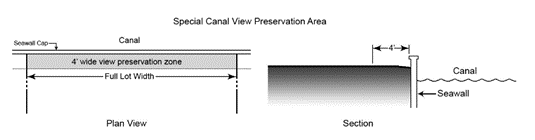
There shall exist on all properties located within the special canal view preservation area a canal view preservation zone. The canal view preservation zone shall be a four-foot wide area immediately landward of the landward edge of the seawall cap, across the entire width of canal frontage. Except as provided below, the canal view preservation zone shall be open to the sky. See graphic, provided for illustrative purposes, below.
(b)
Except for mangroves and Town-approved shoreline stabilization plant material, no landscaping material other than sod or ground cover of a mature height of no more than 18 inches above grade shall be installed or allowed to project into the canal view preservation zone.
(c)
Vegetation existing prior to the effective date of the ordinance codified in this Chapter that is located in the canal view preservation zone or capable of extending into the canal view preservation zone shall be exempt from the canal view preservation standards. Any vegetation installed after the effective date of the ordinance codified in this Chapter shall comply with the canal view preservation standards contained in this Section.
(d)
All Building Permit applications for the construction of a new principal structure or the substantial improvement of an existing principal structure as defined in Chapter 154, shall submit a landscaping plan drawn to scale which demonstrates compliance with the provisions of this Section.
(Ord. 2018-24, passed 4-1-19; Ord. 2019-08, passed 11-4-19; Ord. 2020-14, passed 1-5-21)
158.095 - Accessory use or structure.
(A)
Generally.
(1)
Accessory uses shall be clearly supplementary and incidental to the principal use of the lot and shall be located on the same lot as the principal use to which it is subordinate except as provided for in Subsections 158.096(G) (beach shelters), 158.100(F) (location of parking spaces), or Section 158.102 (walls, fences, hedges, berms, landscape logs, and firewood).
(2)
In no instance shall an accessory use within a principal building exceed 33 percent of the floor area of the principal building, except that a residential accessory use in a commercial district shall be limited to no more than 49 percent of the floor area of the principal building and the dwelling unit shall be within or attached to the principal building.
(3)
No permit shall be issued for any accessory use or building, excluding davits, docks, or boat lifts, until the principal use or building has been established or constructed. This provision shall not be applicable to seawalls or other duly authorized erosion control structures. No commercial accessory use will be permitted in a Residential District except in accordance with Section 158.109 (home occupations).
(4)
Where a principal use within a Tourism Resort is other than a tourism use, no commercial accessory use will be permitted. In addition, no permit shall be issued for any accessory use until a determination is made by the Planning and Zoning Official that such use is in accord with applicable Site Development Plan performance standards set out in Section 158.030.
(B)
Swimming pools.
(1)
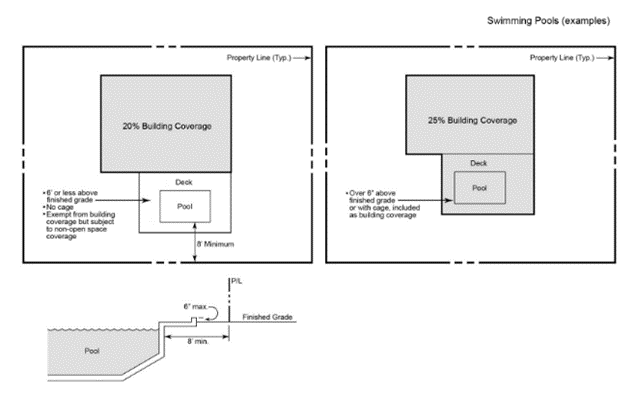
Swimming pools shall meet the required yard and bulk requirements set forth in Article IV and Section 158.094(C), but may count toward lot coverage and non-open space coverage, and may be permitted within required yard areas as prescribed by the following yard and bulk regulations, in the table and graphic (provided for illustrative purposes), below:
a As measured from the exterior pool wall to the buildable property/lot line.
b Refer to Section 158.094(C)(4)(b) for "special canal waterfront yard area" illustrated in the appendix: "land use charts and illustrations". In the event of a conflict between Section 158.095(B) and Section 158.094(C) the provisions of the later shall prevail.
c This pool type counts toward the maximum non-open space for the zone district rather than toward the lot (building) coverage.
(C)
Accessory commercial uses to tourism uses. Commercial services developed or used in connection with tourism uses, including cigar stands or newsstands, cocktail lounges where food or drink are served, and similar uses, may be permitted provided the following conditions are fulfilled:
(1)
At least 25 tourism units shall be contained within the building group; however, a tourism use with less than 25 units may provide up to 200 square feet for such accessory uses.
(2)
Not more than ten percent of the total tourism unit floor area within the buildings shall be so used.
(3)
All such commercial services shall be situated within the interior of the building so that no part thereof shall be directly accessible to the street or public way. Exceptions to this provision may be granted through Site Development Plan review.
(4)
All required parking is provided as set forth in Section 158.100.
(5)
Such accessory commercial uses are only permitted in connection with the principal use and may not be operated as an independent commercial use.
(D)
Private recreational facilities. Putting greens, shuffleboard courts, and similar uses of a recreational nature not to be covered by a structure may be constructed within required yard areas except the required street yard or required waterfront yard as prescribed by this Chapter. Any walls or fences shall conform with Section 158.102. In determining the percentage of coverage of a lot by buildings, tennis courts, putting greens, shuffleboard courts, swimming pools, and similar uses of a recreational nature may be counted in the computation, as provided for in Subsection 158.030(E). Private recreational facilities within a structure shall conform with all pertinent yard requirements as set forth in Section 158.096.
(E)
Tennis, or similar courts. Tennis, pickleball, and similar recreational activities that utilize a racquet, paddle or similar apparatus.
(1)
Courts shall not be permitted within the required yard area unless the Planning and Zoning Board grants a Special Exception, and in no event shall the courts be located as follows:
(a)
Within 20 feet of a street.
(b)
Within 20 feet of residential property.
(c)
Within ten feet of any commercial property, including hotel and motel uses.
(d)
Within any required gulf waterfront yard.
(2)
In required yards, only an open-wire-mesh fence shall be permitted not exceeding a height of 12 feet. No court lights shall be permitted in an R-4SF or R-6SF district. In other districts, upon application, court lighting may be permitted of such a type, intensity, frequency, and design as will not interfere with the public safety or with neighboring uses. In determining the maximum coverage of a lot by a building, courts shall be counted in the computation if they are not open space. (See Subsection 158.030(E).)
(F)
Dish antennas.
(1)
Location. Private noncommercial dish antennas may be permitted in the Town of Longboat Key provided: (a) they are located in the rear yard; (b) they maintain a minimum rear setback that is at least equal to their height, but not less than five feet; and (c) they do not encroach on any of the required side setbacks for the district in which they are located. In connection with multifamily buildings of 50 feet or more, rooftop installation shall be permitted as long as anchorage of same complies with the requirements of the standard building code relative to structures. Such rooftop installation shall not be considered in the calculation of the height of the building.
(2)
Dimensions. The height of private noncommercial dish antennas shall not exceed 20 feet; their diameter shall not exceed 16 feet. Dish antennas shall be considered as television antennas for purposes of applying the height regulations of Section 158.098.
(3)
Screening. As much as possible, private noncommercial dish antennas shall be properly screened by landscaping so as to obscure their visibility from ground view. No landscaping shall be required in the front or rear of the dish that would create reception interference or prevent a shift in the position of the dish.
(4)
Number allowed.
(a)
Only one private, noncommercial antenna shall be allowed per single-family home, duplex, triplex or townhouse unit;
(b)
Multifamily apartment buildings and commercial or industrial buildings shall be allowed up to three dish antennas.
(5)
Anchorage. Dish antennas shall be anchored securely to the ground or to a building's roof in conformance with requirements of the standard building code relative to structures. When roof-mounted, the installation of a dish antenna must be inspected and approved for safety by a registered engineer or architect.
(6)
Processing permitting requirements. An Applicant for a private, noncommercial dish antenna shall submit to the Planning and Zoning Official a plan showing location of the proposed dish, as well as type and amount of landscaping to be installed, where applicable. Actual installation of the dish antenna shall require application for and receipt of a Building Permit.
(7)
Advertising. No form of advertising or identification is allowed on the dish antenna or framework other than manufacturers' small identification plates.
(8)
Color. All dish antennas in all zoning districts must be neutral in color and, to the extent possible, be compatible with the surrounding neighborhood in appearance and character.
(9)
Maintenance. Once installed, dish antennas and related appurtenances must be maintained in good and operable condition. Surrounding landscaping shall also be maintained.
(G)
Single-family screened cages. Residential single-family buildings are permitted an additional five percent of allowable building coverage over the percentage otherwise permitted in the district for a screened caged area. The non-cage area of the building may not exceed the building coverage otherwise permitted in the district. In order to be afforded the additional five percent building coverage, the caged area shall meet the following criteria:
(1)
The cage structure shall not have any building materials or cover on the roof or sides that prevent air or water penetration, except for the minimum structural supports necessary for the screened caged structure.
(2)
The screened cage must meet all other structural setbacks for the district in which it is located.
(3)
A property owner may utilize this Subsection or Subsection (B)(2) regarding an additional five percent building coverage in conjunction with swimming pools, but not both.
(Ord. 2018-24, passed 4-1-19; Ord. 2019-16, passed 1-6-20; Ord. 2020-04, passed 6-1-20; Ord. 2020-14, passed 1-5-21)
158.096 - Minimum regulations for accessory structures.
(A)
All accessory structures, either attached or unattached, in all districts shall conform to the regulations of this Section unless specifically excepted by other provisions of this Chapter. In addition, necessary essential service facilities and other improvements related to the provision of basic services such as fire hydrants, outdoor lighting, mailboxes, or integral components of underground utilities are not intended to be restricted from required yard areas or defined as accessory structures.
(B)
In no instance shall an accessory structure exceed 25 percent of the floor area of the principal use or building, or contain dwelling units.
(C)
In Residential Districts, unattached accessory uses and structures shall not be located in any required street, required waterfront, or required side yards except for walls and fences as provided for in Section 158.102. On double-frontage lots, through lots or corner lots, accessory uses and structures in residential districts shall not be located in any of the required street yards, but may be located in one but not both required side yards.
(D)
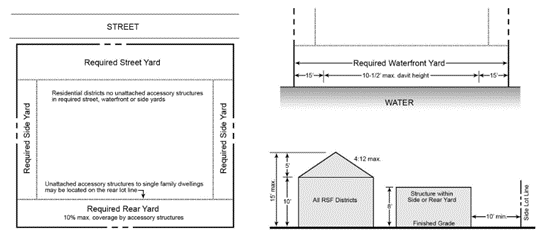
Unattached accessory structures in Residential and Tourism Resort Districts. Accessory structures without kitchen facilities which are located no closer than ten feet to a principal structure are defined as unattached and may be erected in accordance with the following requirements, except as provided for in this Section. The graphic below, provided for illustrative purposes, depicts standards found in Sections 158.096(D)(1) through (6):
(1)
For all Residential Single-Family Districts, unattached accessory structures may not exceed ten feet above the finished grade. However, up to an additional five feet in height is allowed for a pitched roof, provided the overall height of the structure does not exceed 15 feet. Roof pitch shall not exceed 4:12.
(2)
An unattached accessory building may occupy not more than ten percent of a rear yard subject to building and lot coverage requirements.
(3)
Any unattached accessory structure located within a required side or required rear yard may not exceed eight feet in height and in no case be located closer than ten feet to the side or rear lot lines, except that unattached accessory structures to single-family dwellings may be located on the rear lot line.
(4)
No unattached accessory structure shall be located closer to the street than the required street yard setback required for a principal structure in the district in which the accessory structure may be located.
(5)
For corner lots, the setback from the side street shall be the same for unattached accessory buildings as for principal buildings.
(6)
No accessory structure shall be located within a required waterfront yard except for davits as provided herein, windwalls as provided for in Subsection 158.094(C) and walls or fences as provided in Subsection 158.102(C). Davits located within a required waterfront yard shall not be located closer than 15 feet to a side lot line, nor exceed 10½; feet in height measured from finished grade. Davits located adjacent to boat basins that are landward of the prevailing seawall line along canals shall be exempt from the required minimum setback from a side lot line. Reference appendix: "land use charts and illustrations", Section 8, exhibit "A": "illustration of boat basins".
(E)
Attached accessory structures, residential or tourism uses. When an accessory structure is located within ten feet of a principal structure it is considered attached to the principal structure and shall comply in all respects with the yard requirements of this Chapter applicable to the principal building.
(F)
Accessory structures in other than Residential and Tourism Resort Districts. Accessory structures shall comply with front yard requirements for the principal structure to which they are accessory and shall not be closer to any side or rear property line than ten feet; however, no accessory structures shall be located within a waterfront yard.
(G)
Accessory structures on waterfront and noncontiguous lots.
(1)
A beach shelter may be located on a waterfront or noncontiguous lot as an accessory use. The accessory beach shelter shall not exceed 300 square feet in area, exceed 12 feet in height, and shall have at least a 50-foot setback from the mean high-water line, and shall be a minimum of 100 feet from another beach shelter on the lot. The support of a beach shelter roof and the roof itself must be of material that would present minimal damage to life or property in the event of a hurricane, tidal flood or similar disaster.
(2)
A ladder or other device which provides a reasonable means of egress from the water may be located in the required pass, bay or canal waterfront yards provided that it does not exceed a maximum height of 42 inches measured from the top of the seawall cap.
(Ord. 2018-24, passed 4-1-19; Ord. 2020-14, passed 1-5-21)
158.097 - Temporary Use and Structures: Permit required.
(A)
Temporary uses and structures are permitted in any zoning district subject to full payment of an application fee as set forth by resolution of the Town Commission and to the standards hereinafter established, provided that a permit for such use is obtained from the Town.
(B)
Permitted temporary uses and structures included:
(1)
Garage sales, provided that not more than two sales of three days each are conducted at any site during any one calendar year.
(2)
Indoor and outdoor art and craft shows, bazaars, carnivals, revivals, circuses, sports events and exhibits, in all zoning districts except R-1SF, R-2SF, R-3SF, R-4SF, R-6SF, R-3MX, R-4MX and R-6MX districts, where such events may be approved only where Special Exceptions for nonprofit cultural centers, public/private preschools or elementary schools or child care services has been approved.
(3)
Christmas tree sales in all zoning districts except R-1SF, R-2SF, R-3SF, R-4SF, R-6SF, R-3MX, R-4MX and R-6MX districts, where such events may be approved only where Special Exceptions for nonprofit cultural centers, public/private preschools or elementary schools or child care services have been approved and provided that such use shall not exceed 60 days.
(4)
Real estate development temporary uses for necessary commercial, promotional, storage and fabrication activities which occur during construction of the project and which terminate on completion of the project. The following activities may be permitted under a Temporary Use Permit on the real estate being developed for a period not in excess of six months, provided all setback requirements of the Zoning Code are met:
(a)
Model homes or apartments provided that the off-street parking standards for the appropriate residential use and the associated landscaping standards of Section 158.091 are met;
(b)
Real estate sales offices limited to the sales of dwelling units on those premises; and
(c)
Construction material and equipment storage.
Notwithstanding the forgoing, temporary real estate sales offices may be allowed prior to construction of the underlying project, for certain qualifying projects meeting all of the following criteria:
1.
The property exceeds five acres;
2.
The underlying project has a minimum of 40 multifamily units; and
3.
The underlying project has received approval, per a signed Development Order, Resolution, or Ordinance.
Temporary real estate offices that are permitted prior to construction of the underlying project shall terminate on the earlier to occur of:
(a)
The date that the certificate of occupancy of the underlying project has been issued;
(b)
The abandonment of the underlying project;
(c)
The expiration of one year from the date of issuance of the temporary use permit, unless extended by the Planning and Zoning Department (which extensions may be issued in increments not to exceed six months).
(5)
Other temporary uses and structures which are, in the opinion of the Planning and Zoning Official, consistent with the provisions of this Section.
(C)
The Applicant for a Temporary Use Permit shall present a written explanation and plans indicating the area in which the Temporary Use Permit is to apply, the nature of the activities which will occur, and the time for which the Temporary Use Permit is requested. The application shall be submitted to the Planning and Zoning Official or designee. The application shall be granted, granted with suitable conditions, stipulations and safeguards, or denied. Prior to granting a Temporary Use Permit, the Planning and Zoning Official or designee shall ensure that any nuisance or hazardous feature involved is suitably separated from adjacent uses and excessive vehicular parking problems will not be created. Each Temporary Use Permit shall be granted for a specific period of time, at the end of which, if the use permitted as a temporary use has not been discontinued, it shall be deemed a violation of this Code and subject to the penalties provided for in in the Zoning Code.
(Ord. 2018-24, passed 4-1-19)
158.098 - Height regulations.
(A)
No building or structure shall have an aggregate height of a greater number of feet than is permitted in Article IV of the Longboat Key Zoning Code for the zoning district in which the building or structure is located, except as noted in Subsection (C) below.
(B)
No single-family residential construction on properties located within the R-4SF and R-6SF zoning districts shall exceed the maximum height limitations as provided in the Longboat Key Zoning Code.
(C)
No exceptions to the height regulations shall be permitted except as authorized by Article IV, and as specifically provided for below:
(1)
One television or dish antenna per principal structure.
(2)
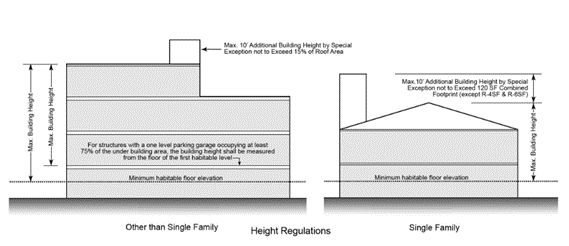
Enclosed elevator shafts and vestibules, enclosed stairwells and landings, and enclosed mechanical equipment areas may be allowed by Special Exception, as follows. The graphic below, provided for illustrative purposes, depicts standards found in Sections 158.098(C)(2)(a) through (b):
(a)
For structures other than single-family, enclosed elevator shafts and vestibules, enclosed stairwells and landings, and enclosed mechanical equipment areas may be allowed by Special Exception by the Planning and Zoning Board and shall cumulatively not exceed 15 percent of the roof area as measured from a horizontal plane and shall not exceed the height regulations by more than ten feet of the zoning district in which it is located; however, their location and visibility from adjoining streets or properties and those properties directly across a public right-of-way or public canal, shall be the subject of Special Exception review considerations. Parapet walls shall also be permitted as an exception to the height regulations where such wall is required pursuant to the Florida Building Code in conjunction with an enclosed stairwell.
(b)
For single-family structures other than those located within R-4SF or R-6SF, an enclosed elevator shaft and vestibule or enclosed stairwell and landing, and enclosed mechanical equipment area may be allowed by Special Exception by the Planning and Zoning Board and shall not exceed a combined footprint of 120 square feet and shall be the minimum height necessary to accommodate the specified features, not to exceed the height regulations by more than ten feet of the zoning district in which it is located; however, their location and visibility from adjoining streets or properties and those properties directly across a public right-of-way, private street, or canal, shall be the subject of applicable Special Exception considerations. If an elevator is utilized, the required secondary egress must comply with the maximum height for the zoning district in which it is located and shall not be allowed additional height under this section. The square footage footprint for an elevator shaft and vestibule, enclosed stairwell and landing, and enclosed mechanical area shall be the minimum area required to comply with Florida Building Code. Enclosed stairwells allowed additional height under this Section shall be located so as to utilize a single run of stairs, rather than a double run. A parapet wall required pursuant to the Florida Building Code in conjunction with an enclosed stairwell shall also be permitted as an exception to the height regulations. Otherwise, parapet walls or protective fencing around rooftop decks shall not exceed the maximum height of the zoning district in which they are located.
(3)
A worship center spire or tower may exceed the height regulations of the district within which it is located.
(4)
No sign, nameplate, display or advertising device of any kind shall be inscribed on or attached to any antenna, tower or other structure which extends above the roof of the principal structure or height regulations, except that religious symbols or identification emblems of religious orders shall be exempt from this restriction.
(5)
A Planned Unit Development shall conform to the height regulations of the district within which it is located.
(6)
Lightning protection systems that are listed and labeled by a Nationally Recognized Testing Laboratory (NRTL), under the Lightning Protection components category, subject to the following:
a.
Total lightning protection device height for single-family and two-family residential structures, including mast and lightning protection devices shall not exceed 6 feet, nor shall such devices exceed 6 feet above the maximum height of the building.
b.
Total lightning protection device height for non-residential and multifamily residential structures, including mast and lightning protection devices, shall not exceed 16 feet, nor shall such devices exceed 16 feet above the maximum height of the building.
c.
Lightning protection devices, attached to the mast, shall not be more than 9 inches in diameter and 10 inches in height.
d.
Non-residential and multi-family residential structures' mast diameter shall be a minimum of 5/8 inches and shall not exceed 5 inches in diameter.
e.
Single-family and Two-family residential structures' mast diameter shall be a minimum of 5/8 inches and shall not exceed 1-¼ inches in diameter.
f.
Existing lightning protection devices that are not in compliance with this Section as of the effective date of this Ordinance shall be considered nonconforming structures subject to the provisions of Section 158.131.
(D)
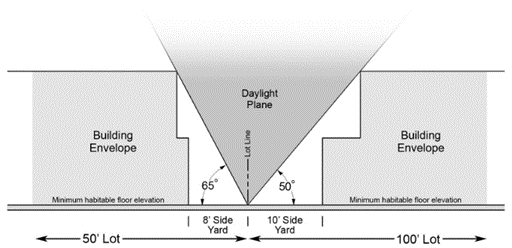
Single-family residences and any redevelopment of a nonconforming residential use in a single-family residential zoning district are also subject to daylight plane requirements as follows: (See Exhibit A and graphic (provided for illustrative purposes), below.)
Exhibit A. Buildings are subject to the Daylight Plane Angle as follows:
Note: Lot width as defined by the Zoning Code shall be rounded to the nearest whole number.
(E)
The daylight plane requirements of Subsection (D) above shall not apply to:
(1)
Chimneys;
(2)
Roof overhangs up to two feet;
(3)
Dormer(s) which do not exceed a combined 12 feet in length per side of the residence or 25 percent of the length of the side of the dwelling upon which the dormers are located, excluding roof overhang, whichever is less;
(4)
One television antenna or dish antenna measuring less than three feet in diameter, and lightning protection devices;
(5)
Side lot lines on residential property which borders property which is zoned nonresidential;
(6)
Single-family homes located within a Planned Unit Development; however, the daylight plane requirement shall apply to all remodeling, additions, renovations and alterations of the single-family home as well as to construction after voluntary demolition of all or part of the original single-family structure.
(Ord. 2018-24, passed 4-1-19; Ord. 2019-08, passed 11-4-19; Ord. 2020-05, passed 10-5-20; Ord. 2020-14, passed 1-5-21; Ord. 2020-18, passed 1-5-21)
158.099 - Structures over water.
(A)
No structures other than boat docks, accessory dock structures including benches, guard rails, fish cleaning tables, a ladder or other device which provides a reasonable means of egress from the water to a boat dock, and equipment lockers, pilings, boat lifts or pile mounted davits shall be permitted to be constructed, reconstructed, or structurally altered beyond the mean high-water line. Structures over water on properties abutting the Gulf of Mexico are prohibited. Permitted structures over water shall comply with the following standards:
(1)
The permitted structure over water shall not substantially interfere with the riparian rights of other property owners nor substantially obstruct a navigable channel or the navigation rights of other property owners.
(2)
Except as provided below, no building, equipment, facility or any other type of structure shall be erected, placed, located or maintained on a dock that extends above the walking surface of the dock:
(a)
Pilings, subject to a maximum height limit of 8½ feet above the highest walking surface of the dock when a piling is attached to a boat dock, in all other cases the maximum height limit for a piling shall be 11½ feet above the mean high-water line.
(b)
Benches, guard rails, fish cleaning tables, and equipment lockers which do not exceed a height of four feet above the walking surface of the dock upon which such structures are placed or erected.
(c)
Piling heights, associated with a boat lift structure, shall not exceed a height of eleven feet above the mean high-water line. No part of the boat lift structure shall exceed the associated piling heights, with the exception of boat guides, boat lift structure motors, and boat lift structure beams.
(d)
Pile-mounted davits which do not exceed a height of 8½ feet, measured from the highest walking surface of the dock.
(e)
Lighting which does not exceed a height of 8½ feet, measured from the highest walking surface of the dock, subject to compliance with Section 130.03.
(3)
Minimum setback.
(a)
For waterfront properties not abutting a manmade canal, a dock, boat lift, piling or pile-mounted davit shall be setback a minimum of 15 feet from the riparian line. The riparian line shall be determined in accordance with procedures established by law. A certified riparian rights survey by a professional land surveyor may be required by the Town Manager or designee.
(b)
For properties abutting a manmade canal a dock, boat lift, piling or pile-mounted davit shall be setback a minimum of 15 feet measured from a line perpendicular to a line tangent to the intersection of the side property line and the mean high-water line. Reference appendix: "Land Use Charts and Illustrations", Section 8, Exhibit "B": "Illustration of Minimum Setbacks".
(c)
For properties abutting a manmade canal that are located at the head waters (land end) of a canal and have a canal front length of 75 feet or less, a dock, boat lift, piling or pile-mounted davit shall be setback from a line established by setting a point ten feet from the property boundary extending to the intersecting apex of the two lines established by extending a line tangent to the intersection of the side property lines and the mean high-water line and located outside the minimum setback area as illustrated in the appendix: "Land Use Charts and Illustrations," Section 8, Exhibit "C": "Illustration of Minimum Setbacks".
(4)
Maximum projection into the water.
(a)
For properties abutting a canal, lagoon, bayou, or pass, a dock, boat lift, piling, or pile-mounted davit shall project into the water no more than 30 feet, measured from the mean high-water line, or 30 percent of the width of the navigable waterway, whichever is less. A new dock, boat lift, piling, or pile-mounted davit shall not be located directly across from existing structures over water in a manner that creates a navigational hazard or interference with another vessel.
(b)
For properties abutting Sarasota Bay, a dock, boat lift, piling or pile-mounted davit shall project into the water no more than 50 feet, measured from the mean high-water line.
(5)
Survey requirement. Permit applications for structures over water, within 25 percent of the maximum projection as described above, shall submit an as-built survey identifying compliance with this Section.
(B)
An accessory catwalk for a boat lift is permitted subject to compliance with the minimum setback requirements contained in Subsection (A)(3), above.
(C)
Maximum area. The maximum permitted area of a boat dock shall be 500 square feet. Any boat dock in excess of 500 square feet shall be a permitted Special Exception use, subject to compliance with Section 158.019.
(D)
Maximum elevation of walking surface of a dock. The elevation of the walking surface of a dock shall not exceed five feet above the mean high-water line.
(E)
Two or more adjacent waterfront property owners may join in an application for the construction of a dock. Said dock shall be no wider than 12 feet and shall not interfere with the navigational rights of adjoining property owners. All requirements within Section 158.099 shall be met except that the property owned by the joint Applicants shall be treated as one lot for purposes of determining setback for the dock and ancillary structures. As a condition of granting a permit, the Applicants shall prepare mutually reciprocal easements for the use of said dock and shall record the easements in the public records in the county where the property is located as a condition for the permit being granted.
When a joint or shared dock is constructed pursuant to this Subsection, no other docks shall be located on the subject properties.
(F)
Structures over water for single-family properties shall not be used for the purpose of mooring more than two vessels. A structure over water for single-family properties permitted pursuant to Subsection (E) above, shall be limited to two vessels per property. The two-vessel restriction shall not include personal watercraft, canoes, kayaks, row boats or other similar vessels.
(G)
Obtaining a permit pursuant to this Section does not exempt the upland property owner from obtaining required federal, state or county outside agency permits or other Town required permits.
(H)
Manatee Protection Plan (MPP)—Boat facility siting.
(1)
Applicability. Subsections (2) and (3) below, shall be applicable and enforceable throughout the Sarasota County portion of the Town. For boat facilities proposed for the Manatee County portion of the Town, the boat facility shall meet all other federal, state and local laws. Subsections (4), (5) and (6) shall be applicable throughout the Town.
(2)
Standards for development.
(a)
All docks and boat facilities shall comply with Sarasota County's Manatee Protection Plan (MPP), and related ordinances, as well as applicable Sections of Section 158.099, of the Town Zoning Code.
(b)
Written approval, from the jurisdictional county, prior to applying for a permit, Site Development Plan, or other development plan shall be provided at submittal of the applicable application.
(c)
All boat facility development proposals shall be consistent with the MPP and related ordinances. If a boat facility development proposal is found to be inconsistent with the MPP or related ordinances of Sarasota County, a formal consultation under Section 7 of the Endangered Species Act, shall be initiated with the state and federal wildlife agencies. Said development proposal shall not be authorized until approval is obtained from said agencies.
(d)
The applicable Town of Longboat Key permit shall be obtained for all boat facility development proposals prior to commencing construction activities.
(3)
Review authority.
(a)
Sarasota County is herein authorized to review and provide a written conditioned determination on any project or application for a boat facility development proposal for consistency with the MPP.
(b)
The Town Manager or designee is herein authorized to impose conditions for any boat facility development proposal in order to assure consistency with the MPP and the Town of Longboat Key Zoning Code and Comprehensive Plan.
(c)
Sarasota County shall have the power and the authority to identify those proposals, in all aspects of development based on the MPP, with potential impact on the West Indian manatee, its success and survival.
(4)
Unlawful to kill, molest or injure manatees. It shall be unlawful for any person to kill, molest, harass, or cause direct or indirect injury to, or to collect or possess any part of, a West Indian manatee.
(5)
Civil and administrative enforcement powers.
(a)
The Town of Longboat Key shall have the power to enforce the provisions of this section, or any permit and or approval issued hereunder, by equitable or legal judicial proceedings, including the power to enjoin violations by mandatory and prohibitory injunction, or other legal or administrative process, including code enforcement proceedings as set out in Town Code Section 33.14. Each day of any such violation shall constitute a separate and distinct offense.
(b)
The Town Manager or designee is hereby authorized to issue a stop work notice to a person where the administrator determines that work at the site:
1.
Is proceeding in violation of this Section; or
2.
Poses an imminent and significant hazard to the public health, safety or welfare, or to the environment.
(c)
No development proposal for a boat facility shall be deemed consistent with provisions of the MPP or applicable manatee protection ordinance if there is an existing boat facility on the property that is in violation of the Town of Longboat Key Code.
(6)
Criminal enforcement powers. In addition to the remedies provided herein, a violation of any of the provisions of this Section or of any regulations adopted or permit conditions approved pursuant to this Section may also be prosecuted and enforced as a misdemeanor and shall be punishable in the same manner as a misdemeanor as provided by law. Each day of any such violation shall constitute a separate and distinct offense.
(Ord. 2018-24, passed 4-1-19; Ord. 2019-16, passed 1-6-20; Ord. 2025-03, passed 2-18-25)
158.100 - Off-street parking.
(A)
Size and access.
(1)
An off-street parking space shall consist of a parking space having minimum dimensions of ten feet in width by 20 feet in length for the parking of each automobile, exclusive of access drives or aisles thereto.
(2)
The minimum width of an access drive shall be ten feet.
(3)
The minimum width of an aisle designed and intended for the maneuvering of an automobile into a parking space shall be in conformance with Subsection (B) below and the illustrative chart as set forth in Section 2 of the appendix following this Chapter, which is a part of this Chapter.
(4)
The parking plan must be so arranged that each automobile may be placed and removed from any parking space without the necessity of moving any other automobile to complete the maneuver.
(5)
Street or sidewalk areas may not be used for off-street parking purposes as herein defined.
(6)
Individual ingress and egress drives extending across the public sidewalks and curbs and connecting the off-street parking spaces to street areas shall not exceed a maximum of 12 feet for a one-way drive and 24 feet for a two-way drive. The design, number, and placement of such drives are subject to the approval of the Town before being constructed.
(B)
Minimum size. Each parking space shall be a minimum of ten feet by 20 feet in size, and the minimum aisle width shall be as follows:
(1)
Adjusted minimum size requirements for compact cars or based on vehicle size are not permitted;
(2)
Emergency vehicle access. The fire chief or designee shall review all parking plans for emergency vehicle access, circulation and maneuvering, and other safety issues to ensure compliance with all applicable life safety codes.
(C)
Automatic parking. Nothing in this Section is intended to prohibit the installation of a fully automatic parking facility in which the placement and removal of automobiles are accomplished wholly by machinery.
(D)
Number of spaces required. An increase in the minimum number of required off-street parking spaces, with adequate provisions for ingress and egress, shall be provided before completion of the structure, or an increase in units or square footage, capacity, or seating, or before an approval for a change in use, in accordance with Subsections (A) and (B) of this Section and the schedule of off-street parking requirements, as prescribed below:
SCHEDULE OF OFF-STREET PARKING REQUIREMENTS
(1)
For the purposes of compliance with this section, measurements of structures shall be based on the gross interior square footage.
(2)
When units or measurements determining the number of required off-street parking spaces, including bicycle parking, result in requirement of a fractional space, then such fraction equal to or greater than one-half shall require a full off-street parking space.
(3)
Required parking spaces for other nonresidential uses not listed. Off-street parking requirements for any permitted land use not specifically listed in subsection (D) shall be the same as the most similar use listed as determined by the planning and zoning official. The official shall determine the number of parking spaces required, taking into account the similarity of the use to those specifically identified in subsection (D) and the type and amount of parking likely to be required to serve the needs of expected employees, customers, clients, patrons, or other visitors. The official shall also consider all available evidence, qualified opinion, and documentation available relating to the number of parking spaces reasonably required for various land uses, interpreting and applying such information in light of the peculiarities of the town, its traffic intensity and patterns, and the extent and type of commercial traffic in the town.
(E)
Parking spaces for persons who have disabilities. Accessible parking spaces for disabled persons shall be provided in the following manner:
(1)
Number.
(a)
The number of accessible parking spaces for disabled persons shall be as follows:
(b)
One in every eight accessible spaces, but not less than one, shall be served by an access aisle 96 inches wide minimum and shall be designated "van accessible."
(2)
Spaces at physical rehabilitation center. A minimum of four spaces shall be provided at a physical rehabilitation center.
(3)
Size. Diagonal or perpendicular spaces for the disabled shall be a minimum of 12 feet wide. Parking access aisles must be no less than five feet wide, except as provided in subsection (1)(b) and must be part of an accessible route to the building or facility entrance. Access aisles must be placed adjacent to accessible parking spaces; however, two accessible parking spaces may share a common access aisle. The access aisle must be striped diagonally to designate it as a no-parking zone.
(4)
Access. All spaces for the disabled shall be provided with a curb cut or curb ramp to a pathway, a minimum of 44 inches wide to provide access to the building served and shall be located so that users will not be compelled to wheel behind parked vehicles. The grades will comply with F.S. ch. 553 "Building Construction Standards," Part II, accessibility by handicapped persons.
(5)
Location. Disabled parking spaces shall be located immediately adjacent to the building to be served.
(6)
Marking. Each such parking space must be prominently outlined with blue paint and must be repainted when necessary, to be clearly distinguishable as a parking space designated for persons who have disabilities and must be posted with a permanent above-grade sign of a color and design approved by the department of transportation, which is placed on and at a distance of 84 inches above the ground to the bottom of the sign and which bears the international symbol of accessibility and the caption "Parking by Disabled Permit Only." Signs erected after October 1, 1996 must indicate the penalty for illegal use of the space.
(F)
Location of parking spaces and parking garages. Parking spaces and parking garages for all uses or structures shall be located on the same lot or parcel, or on another lot or parcel within 600 feet having the same zoning classification, in accordance with subsection (G) as the principal, additional, or accessory use or structure they are intended to serve, unless otherwise allowed by the provisions of this section. The connectivity of the off-site parking area shall be determined to be reasonable and safe prior to the approval of a site development plan. Off-site parking shall not be located on the opposite side of Gulf of Mexico Drive from the facility served by the parking.
(G)
Collective provision.
(1)
Owners or operators of two or more contiguous commercial buildings or uses of the same type of zoning classification requiring off-street parking facilities may make collective provision for the facilities, provided that the total of the parking spaces when combined or used together shall not be less than the sum of the requirements computed separately and provided that the combined facility is compatible with the zoning uses being served.
For the purposes of this subsection, the districts within each set below are defined as qualifying as the same type zoning classification:
(H)
Nonconforming uses. Where major alterations are to be made in a building occupied by a nonconforming use, no such alterations shall be permitted until the off-street parking requirements for the existing use have been fully provided, and a site development plan has been approved showing any additional required parking for the alteration.
(I)
Utilization of yards.
(1)
Required parking spaces for single-family and two-family dwellings may be permitted in any setback areas or yards except a required waterfront yard. Within a required yard abutting a street yard all parking shall be located in a designated driveway or turnaround.
(2)
Required street yards within Residential and Tourism Resort Districts may not be used for off-street parking for permitted uses or approved special exception uses, except as specifically provided in subsection (I)(1). All other yards may be used for that purpose subject to the limitations herein.
(a)
A maximum of 30 percent of a required or nonrequired street yard may be used for off-street parking except in the event of an approved special exception use for worship centers as defined in section 158.144. Worship centers may use a maximum of 70 percent of a required or nonrequired street yard for off-street parking, provided that all other conditions are met.
(b)
A minimum front setback of 20 feet shall be maintained and the parking area shall be screened from the adjacent street with landscaping in accordance with section 158.103.
(c)
Any off-street parking located within any other yards shall also be screened with walls or landscaping from the adjacent street or uses in accordance with section 158.103.
(d)
Each parking space shall be located at least eight feet from any abutting side or rear property line.
(e)
Parking area surfaces shall not extend closer than six feet from any abutting side or rear property line.
(3)
For all permitted uses or approved special exception uses, within districts other than residential and tourism-resort:
(a)
A maximum of 70 percent of a required street yard may be used for off-street parking.
(b)
Each parking space shall be at least seven feet from any abutting front, side, or rear property line.
(c)
Parking area surfaces shall not extend closer than five feet from any abutting front, side, or rear property line or 20 feet from any street.
(J)
Landscaping. The atmosphere within a parking area is intended to be park-like. Towards this objective the following standards shall be observed in the design and construction of parking areas:
(1)
At least 15 percent of the total interior parking area shall be suitably landscaped. A portion of the required landscaping for the interior parking area may be relocated to emphasize entrance corridors or special landscaped areas within the general parking area. For purposes of this section, the interior parking area is that area used for the parking and maneuvering of automobiles, including that part of any aisle or drive necessary to enter a parking space.
(2)
This landscaping shall include the placement of a mature replacement tree at intervals of approximately each five parking spaces.
(3)
Interior portions of the parking area shall be broken up by the provision of landscaped islands. All landscaped islands shall be serviced by an adequate irrigation system.
(4)
A maximum of 12 parking spaces in a row will be permitted without an island. Each island shall be at a minimum the same size and dimensions as one approved parking space.
(5)
All trees, landscape islands, and other landscape areas shall be protected from vehicular encroachment.
(K)
Parking access and circulation. The plan for ingress and egress to and from the off-street parking area and landscaping shall be subject to the approval of the town. No curbs or sidewalks may be cut or altered in any manner without a permit with the town and all other applicable county and state agencies.
(L)
Utilization of parking structures. When off-street parking facilities are located within a separate parking structure or are integrated into another building, the following conditions and restrictions shall apply:
(1)
The parking structure shall conform to all lot, yard and bulk requirements of the district in which it is located;
(2)
The parking facilities shall be designed to conform to all other provisions of this chapter and all other ordinances of the town;
(3)
Parking facilities that are visible from a street or public waterway or that are enclosed by a solid wall without openings must contain architectural features such as windows, decorative grillwork, planter boxes, mosaics, vertical trellises, sculptures, or similar decorative treatments that together cover 90 percent of each visible facade. Other screening methods including berms, trees, hedges, and vines may be used to accomplish the same result.
(M)
Delineation of parking spaces. Each parking space, paved or unpaved, shall be clearly delineated meeting the following requirements:
(1)
Wheel stops. Required wheel stops shall be at least four inches high and thick and be installed to protect buildings from vehicular damage and walkways from intrusion.
(a)
The stopping edge of the wheel stop shall be placed no closer than two feet from the edges of the required sidewalks, planter or landscaped areas and from any building.
(b)
The two feet beyond the wheel stop may be paved or landscaped with groundcover.
(c)
The wheel stop shall be secured to the ground or parking area surface.
(d)
The wheel stop shall be a color distinctive from the parking surface.
(2)
Striping shall mark each paved parking space.
(N)
Bicycle parking. The following applies to bicycle parking:
(1)
The rack or other facility shall:
(a)
Be designed to allow each bicycle to be supported by its frame.
(b)
Be designed to allow the frame and wheels of each bicycle to be secured against theft.
(c)
Be designed to avoid damage to the bicycles.
(d)
Be anchored to resist removal and solidly constructed to resist damage by rust, corrosion, and vandalism.
(e)
Accommodate a range of bicycle shapes and sizes and to facilitate ease of locking without interfering with adjacent bicycles.
(f)
Be located to prevent damage to bicycles by cars.
(g)
Be compatible with the surroundings in color and design and be incorporated whenever possible into building or street furniture design.
(h)
Be located in convenient, highly-visible, active, well-lighted areas.
(i)
Be located so as not to interfere with pedestrian movements.
(j)
Be located in proximity to the principal entrance of the building as practical.
(k)
Provide safe access from the spaces to the right-of-way or bicycle lane.
(O)
Incentive for pervious and semi-pervious parking. As an incentive for providing pervious or semi-pervious parking, Applicants may count all areas of proposed pervious or semi-pervious parking toward meeting the minimum open space requirements of section 158.030(E) of this Code. Qualifying methods shall include pervious concrete and asphalt, interlocking concrete pavers, and turf reinforcement material and structures. Use of grass, gravel, and shell for parking without reinforcement to provide containment and to prevent compaction shall not be permitted. The proposed reduction in open space for the use of pervious and semi-pervious parking shall be determined in accordance with the following requirements:
(1)
Required open space may not be reduced by more than 25 percent through this incentive.
(2)
The total number of parking spaces for the site shall not exceed the total number as calculated using the schedule of off-street parking requirements of this section.
(3)
The area of pervious or semi-pervious parking and driving aisles that may be counted toward a reduction in required open space shall be reduced by the percentage of impermeability of the proposed parking and driving surface as certified by a licensed civil engineer.
(4)
All areas of pervious or semi-pervious parking spaces and parking aisles must be stabilized or constructed in a manner to ensure long-term viability based the level of anticipated vehicular usage as certified by a licensed civil engineer.
(5)
As a part of the site development plan review process, a licensed civil engineer shall establish a maintenance plan for the proposed pervious or semi-pervious parking in order for the level of permeability to be maintained over time. Examples of maintenance can include periodic sweeping, vacuuming, pressure washing, and replacement of soil media.
(Ord. 2018-24, passed 4-1-19; Ord. 2019-05, passed 7-1-19; Ord. 2020-03, passed 6-1-20)
158.101 - Off-street loading.
(A)
In any district, in connection with every building, or building group or part thereof thereafter erected and having a gross floor area of 4,000 square feet or more, which is to be occupied by commercial uses or other uses similarly requiring the receipt or distribution by vehicles of material or merchandise, there shall be provided and maintained, on the same lot with the building, off-street loading berths or unloading berths as follows:
(B)
The loading berths required in each instance shall be not less than 12 feet in width, 30 feet in length, and 14 feet in height, and shall not occupy all or any part of any required yard. The loading berths shall be screened from the street or public way. Height of walls, fences, hedges, etc., used for screening shall be determined at the time of site development plan review.
(Ord. 2018-24, passed 4-1-19)
158.102 - Walls, fences, hedge, berms, landscape logs, and firewood.
All walls, fences, or hedges within the required yard areas shall conform to the following regulations except where special requirements are set forth for specific screening purposes elsewhere in this chapter:
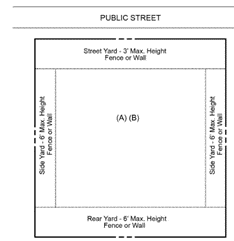
(A)
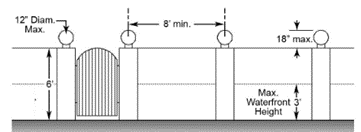
Street yard. All walls and fences within the required street yard shall not exceed three feet in height, subject to the provisions of Section 158.117, Intersection visibility. See graphic, provided for illustrative purposes, below.
(B)
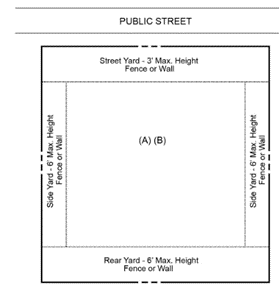
Side and rear yards. All walls or fences within the required side or required rear yards shall not exceed six feet in height. See graphic, provided for illustrative purposes, below.
(C)
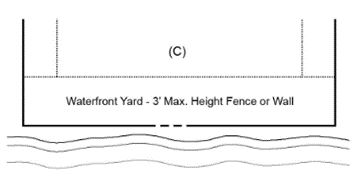
Waterfront yard. All walls, fences, or hedges within a required waterfront yard shall not exceed three feet in height [except as provided in Section 158.094 (C)(5)]. See graphic, provided for illustrative purposes, below.
(D)
Ornamental features and lighting fixtures, not exceeding 18 inches in height above the maximum allowable fence/wall height, and not exceeding 12 inches in diameter, shall be allowed atop any fence or wall. The features shall be no closer than eight feet apart, when measured along the fence from the center of each feature or fixture. See graphic, provided for illustrative purposes, below.
(E)
The heights of gates, within a required street yard, shall not exceed 72 inches in overall height, with a minimum transparency of 70 percent. Gates with less than 70 percent transparency shall not exceed the allowable height of the associated fence/wall, as stated in subsections (A) through (C) of this section, with an additional 18 inches in height permitted for ornamental features or lighting, meeting the requirements of subsection (D) of this section. The support columns for a gate shall not exceed the height of the proposed gate.
(F)
Other structural features, associated with the fence/wall, shall not exceed the allowable height of the fence/wall.
(G)
Fences erected within a required street or waterfront yard in order to comply with pool safety regulations, of the applicable building code, shall be the minimum height required to comply with the building code.
(H)
Nonrequired yards. Walls and fences within nonrequired yards shall not exceed eight feet in height.
(I)
Restrictions. The wall, fence, or hedge shall conform with section 158.117.
(J)
For properties which are nonconforming with regard to lot coverage, a trellis, as defined in section 158.144, may be attached to an existing building, subject to the following standards:
(1)
The trellis shall extend no more than six feet beyond the face of the exterior wall of the building.
(2)
Except for vertical support structures, no structure shall be constructed, nor shall construction material be installed below the overhead horizontal member of the trellis structure.
(3)
The minimum distance between vertical support structures of the trellis shall be five feet.
(K)
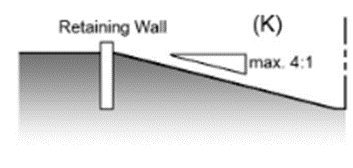
Retaining wall. A retaining wall is that wall which is required in order to maintain the required four-to-one slope. When a retaining wall is combined with a wall, fence, or other structure, the resultant height shall be the measurement producing the highest dimension. Height of retaining walls is not applicable in commercial districts. The height shall be determined during a site development plan review. See graphic, provided for illustrative purposes, below.
(L)
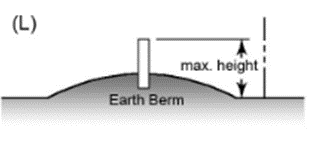
Earth berms. Earth berms may be located in yard areas. When a wall, fence, or structure is located upon an earth berm the height of the wall or fence shall include the height of the earth berm. See graphic, provided for illustrative purposes, below.
(M)
Landscaping logs. Landscaping logs may be located in yard areas.
(N)
Firewood. Firewood may be stored only on improved lots with established principal uses.
(O)
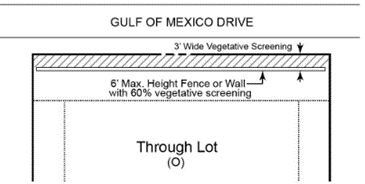
Through lots on Gulf of Mexico Drive. Notwithstanding the provisions of subsection (A) above, all through lots located on, but without direct access to, Gulf of Mexico Drive shall be allowed to erect a fence or wall not to exceed six feet in height, subject to the following standards. The graphic below, provided for illustrative purposes, depicts standards found in Sections 158.102(O)(1) through (5):
(1)
The fence or wall shall only be located in the street yard adjacent to Gulf of Mexico Drive.
(2)
The fence or wall shall be setback three feet from the property line adjacent to Gulf of Mexico Drive to allow the planting and maintenance of vegetative screening.
(3)
A screening of living vegetation shall be located on the private property between Gulf of Mexico Drive and the fence or wall such that the vegetation screens a minimum 60 percent along the entire length of the fence or wall from Gulf of Mexico Drive at the time the fence or wall is erected and with normal growth, completely screens the wall or fence within 24 months. The complete vegetation screening of the fence or wall shall be maintained thereafter by the property owner.
(4)
A zoning exception, or building permit when applicable, shall be required for erection of the wall or fence.
(5)
The fence or wall, and vegetative screening, shall conform with section 158.117 Intersection visibility.
(Ord. 2018-24, passed 4-1-19; Ord. 2020-14, passed 1-5-21; Ord. 2020-18, passed 1-5-21)
158.103 - Screening regulations.
(A)
Buffering and required landscaping. Subject to the requirements of section 158.117 "Intersection visibility," and subsection (C) for waterfront yards in section 158.102 "Walls, fences, hedges, berms, landscape logs, and firewood," where a nonresidential use abuts a residential district or where a multifamily residential use abuts a single-family residential district or use, the abutting nonresidential or multifamily use shall be visually screened from the adjoining residential property utilizing one of the following methods:
(1)
A fence or wall of at least 80 percent opacity that is the maximum height allowed under the Zoning Code. The fence or wall shall be located completely within the limits of the nonresidential or multifamily lot and shall have equal architectural treatment on both sides; or
(2)
A buffer at least ten feet in width from the property line of the adjoining property, containing required landscaping which is selected and arranged to form a visual screen of at least 80 percent between the nonresidential or multifamily use and the residential use. The required landscape buffer shall be provided by mature plants having already attained a six-foot height or by a berm combined with landscaping of at least six feet in height. A permanent fence may be required to supplement the required landscaping.
(3)
However, if a property in a commercial zoning district changes its land use and zoning to residential or a multifamily zoned property changes its use and zoning to single-family residential, or a property in a residential district contains a legally nonconforming nonresidential use and that use is changed to a conforming residential use, then the required landscaping or other screening on the adjacent nonresidential or multifamily property shall not be required.
(4)
Town commission waivers. A Waiver to one or more of the required landscape or other screening methods of this section may be granted if the town commission finds, after a public hearing, that the proposed plan meets the following criteria. Requests for a waiver shall be reviewed as a site development plan amendment and shall follow the same procedures as stipulated in the zoning code:
(a)
The proposed screening provides, at a minimum, the same level of protection to the adjacent residential property as one of the required methods of screening;
(b)
The proposed screening does not adversely impact waterfront views of the adjacent residential property; and
(c)
The proposed waiver contributes to the park-like atmosphere of the town.
(5)
Buffer exemptions. The town commission may also grant a waiver to the buffer or screening requirements of this section if it finds each of the following criteria:
(a)
The proposed waiver is in combination with additional site alterations that improve vehicular traffic, pedestrian circulation, landscaping, waterfront views from adjacent public or private property, and/or for the ability to meet state or federal mandates; and
(b)
The proposed waiver does not negatively impact adjacent properties or adjacent properties waterfront views.
(B)
All trash dumpsters, except those located on construction sites, not stored within a building in a trash room designed for such storage shall be stored within an enclosure designed to fully screen the dumpster from view. The trash dumpster enclosure:
(1)
Shall have a concrete slab floor not to exceed 15 feet by 15 feet.
(2)
Shall be enclosed by a fence, wall, or landscaping of sufficient height to fully screen the dumpster from view, but not to exceed six feet.
(3)
May be located in a required yard, notwithstanding any other setback requirements in this chapter, except that the requirements of section 158.117 must be met. In any event, the dumpster enclosure shall be located a minimum of ten feet from a front property line and a minimum of five feet from a rear or side property line.
(C)
Any fence, wall, or landscaping installed in accordance with this section shall be maintained in good order to achieve the objectives of this section. Failure to maintain fences, walls or landscaping shall constitute a violation of this chapter.
(Ord. 2018-24, passed 4-1-19)
158.104 - Tourism uses.
(A)
Purpose. The purpose of this section is to:
(1)
Preserve and enhance the residential character of the Town of Longboat Key;
(2)
Preserve and protect the character and viability of the commercial districts of the Town of Longboat Key;
(3)
Promote the public health, safety and general welfare of the Town of Longboat Key;
(4)
Expressly prohibit tourism use of property for remuneration except where the property is:
(a)
Located within the T-3 or T-6 zoning districts;
(b)
Explicitly approved by the town commission for tourism uses in the MUC-2 zoning district; or
(c)
Approved for additional tourism units pursuant to subsection 158.106(B), Distribution of 250 tourism units.
(5)
Prohibit unauthorized time-share uses in any district of the Town of Longboat Key.
(B)
Tourism uses that were legally conforming as of October 6, 1982, but were rendered legal nonconforming uses by virtue of Ordinance No. 82-10, shall maintain their legal nonconforming use status provided that the use has not been abandoned or terminated as provided in this Code.
(C)
Any use of facilities and accommodations located within the Town of Longboat Key that constitutes a time-share plan or multi-site time-share plan regulated by F.S. ch. 721, shall be qualified under and comply with all requirements of that chapter and all other requirements of this Code.
(D)
Violations.
(1)
Any person acting as agent, real estate broker, real estate sales agent, property manager, reservation service or otherwise who arranges or negotiates for the use of property in violation of the provisions of this section is guilty of an infraction for each date for which such property is used or allowed to be used in violation of this section.
(2)
Any person who uses or allows the use of property in violation of the provisions of this section is guilty of an infraction for each day for which such property is used or allowed to be used in violation of this section.
(3)
The remedies and penalties provided in this section are cumulative and not exclusive.
(Ord. 2018-24, passed 4-1-19)
158.105 - Conversion of time-share tourism use.
(A)
Any conversions of existing residential or tourism units in tourism districts to timeshare tourism units not adding bedrooms to the existing unit shall be permitted to convert existing units to timeshare tourism units on a one-for-one basis.
(B)
Any conversion of existing residential or tourism units in tourism districts to timeshare tourism units which adds additional bedrooms to existing units shall conform to the density requirements for timeshare tourism use for those units as set forth in the schedule of lot, yard, and bulk regulations as set out in article IV.
(C)
Conversion of any existing nonconforming tourism use to timeshare tourism use in any district other than a tourism district is an intensification of a nonconforming use and is prohibited.
(Ord. 2018-24, passed 4-1-19)
158.106 - Distribution of 250 tourism units.
(A)
Purpose. It is the intent of this Section to govern the eligibility for and allocation of the 250 tourism units authorized by referendum election held on March 18, 2008. Approval, approval with conditions, or disapproval shall be by vote after public hearing before the town commission, pursuant to the provisions of this section.
It is further the intention of this section that the quality and location of such units shall benefit the public interest of Longboat Key, while being compatible with and not detrimental to the character of the area. The terms "tourism unit" and "tourism use" as used in this section shall be defined by section 158.144 Definitions, as amended, in this Zoning Code.
(B)
Eligible properties. The following properties are eligible to apply for additional tourism units based upon applicable conditions as described under this section:
(1)
T-3 and T-6 zoned properties may be eligible for additional tourism units. Two or more contiguous T-3 or T-6 properties may be merged to create one larger development lot.
(2)
Residentially zoned properties with an existing legal tourism use may be eligible for additional tourism units. Two or more contiguous nonconforming tourism used properties may be merged to create one larger development lot.
(3)
OI, C-1, C-2, C-3, and M-1 zoned property with a conforming principal use may be eligible for additional tourism units.
(a)
For commercial and office zoned property, the tourism use shall not exceed that allowed for an accessory use, as defined.
(b)
For M-1 zoned property, a marina shall be its principal use, and no more than 33 percent of the buildable land area shall be allowed for total floor area of the tourism use. The total allowable floor area shall include the square footage of common use areas and open terraces, but not garages and nonhabitable basement spaces.
(c)
Additional tourism units under this Section are not permitted in OS-A, OS-P, OS-C, MUC-1, and MUC-3 zoning districts.
(d)
Additional tourism units in the MUC-2 zoning districts are governed by the provisions of the Zoning Code.
(e)
Properties with existing PUD overlays may be eligible for additional tourism units based upon the underlying zoning district. All property owners within the PUD overlay shall join in an ODP amendment application in order for the application to be processed by the town.
(C)
Alternate review processes. Distribution of additional tourism units to T-6 zoned properties may be approved through the site development plan approval process provided the proposal meets the requirements of subsection (D) below. All other eligible applications for additional tourism units shall use the outline development plan (ODP) process that includes a binding concept plan as defined by section 158.144, a site development plan as described in section 158.025, or a conformance overlay redevelopment district (CORD) as described in section 158.082; these proposals must meet the requirements of subsection (E) below.
(D)
Standards for T-6 properties. T-6-zoned properties may seek site development plan approval that includes additional tourism units without filing an ODP application provided the site development plan meets the requirements of this Code, as adjusted by the following standards:
(1)
Must comply with the maximum building height and lot coverage for properties not filing an ODP application.
(2)
In meeting the 50 percent open space requirement in section 158.038 and section 158.030, up to 20 percent of the required open space may be permeable paving.
(3)
May not fall below 75 percent of the required distances set forth in section 158.030 for side setbacks and for separation between buildings, except the latter distance may be reduced by 50 percent where at least one of the proposed buildings does not exceed 30 feet (the minimum distances required by section 158.030 can be multiplied by 0.75 or by 0.50 as applicable).
(4)
Parking:
(a)
The parking flexibility provisions and the parking waivers allowable under section 158.100 may be requested and approved as part of the site development plan approval.
(b)
The minimum front setback for parking spaces in section 158.100 may be cut in half provided the remaining setback is landscaped to visually screen parked automobiles.
(c)
Parking spaces that are limited to valet parking may be 8.5 feet wide and 18 feet long instead of the ten- by 20-foot spaces required for self-parking stalls (see subsection 158.100(A)(1)).
(d)
Landscaped parking islands may be five feet wide by 18 feet long instead of the ten- by 20-foot islands required by section 158.100.
(5)
In order to grant site development plan approval or approval with conditions, the town commission must find by competent substantial evidence that the project incorporating the additional tourism units:
(a)
Meets these and other applicable standards;
(b)
Is in the best interest of the town and its citizens; and
(c)
Does not adversely impact or affect the public interest.
(E)
Standards for all other eligible applications. All other eligible applications for additional tourism units must be part of an ODP or CORD application that follows the procedures and meets the standards in this Code. In determining whether additional tourism units will be allocated, the town commission will evaluate the quality of each application using the following criteria. An ideal application would meet all eight "best" criteria:
(1)
Building height:
(a)
Better: Taller buildings are located away from the edges of parcels to minimize adverse impacts on adjoining land.
(b)
Best: Buildings are similar in height to existing buildings that will remain on the site and to buildings on adjoining parcels.
(2)
Off-street parking:
(a)
Better: The impacts of off-street parking are minimized through the use of understructure parking or the construction of freestanding parking garages that are shielded from public view by liner buildings that contain habitable uses.
(b)
Best: The impacts of off-street parking are minimized through valet parking, shared parking lots for peak parking loads, convenient public transit, and/or high-quality bicycle and pedestrian facilities.
(3)
Open spaces:
(a)
Better: Open spaces meet current requirements with minimal departures.
(b)
Best: Open spaces are sited and designed to provide maximum visual appeal to surrounding properties; landscaping blocks undesirable views of parking and service facilities.
(4)
Recreation:
(a)
Better: The development will provide generous on-site recreational opportunities, or proximity and connection to ample off-site recreational opportunities such as boat dockage, tennis courts, golf courses, or nature trails.
(b)
Best: The development will provide guests with direct legal access to the beach or bay.
(5)
Stormwater:
(a)
Better: Stormwater runoff is appropriately detained and treated in above ground basins that serve additional active functions.
(b)
Best: Stormwater runoff is appropriately detained and treated in subsurface facilities.
(6)
Sufficiency of land area:
(a)
Better: The site accommodates the scale of the proposed project and minimizes adverse impacts to adjacent parcels and surrounding area through sensitive siting, building design, and landscaping.
(b)
Best: The site is of sufficient size to accommodate the scale of the proposed project while avoiding adverse impacts to adjacent parcels and surrounding area.
(7)
Water setbacks:
(a)
Better: The required gulf and pass waterfront yards are met without departures.
(b)
Best: The required gulf and pass waterfront yards are exceeded.
(8)
Zoning compliance:
(a)
Better: Meets current zoning constraints with minimal departures.
(b)
Best: Meets current zoning constraints without departures.
(F)
Approval process. The additional tourism units requested in the final site development plan or binding concept plan shall be committed by the town upon the plan's approval, subject to the conditions below:
(1)
When additional tourism units have been approved through approval of an ODP and binding concept plan, the applicant shall have no more than six months for the town to receive a complete application for final site development plan approval. Failure to submit a complete application within six months, or submitting a complete site development plan application within six months that is denied after all appeals are exhausted, shall result in the loss of the tourism units committed to the project, and the units shall become available for other proposed developments within the town.
(2)
Final site development plan approval for the construction of additional tourism units shall expire 24 months after the date of approval if a complete application for building permit has not been submitted to the town and a building permit issued for the construction of all buildings that include tourism units. Allocated tourism units associated with an expired final site development plan or an expired building permit shall become available for other proposed developments within the town.
(3)
Concurrent review and approval of an ODP and final site development plan is allowed; the final site development plan replaces the requirement for a binding concept plan.
(4)
Concurrent review and approval of applications for reconstruction of nonconformities, in accordance with section 158.125, and applications for up to 250 tourism units, under this section, is allowed and shall be by CORD application in conjunction with a site development plan.
(Ord. 2018-24, passed 4-1-19)
158.107 - Drive-in facilities.
Drive-in facilities, excluding restaurant drive-in facilities, may be permitted as an accessory use only when the following provisions are complied with and approved by the town. Drive-in restaurant facilities are prohibited.
(A)
No drive-in accessory use shall have an entrance or exit for vehicles which is located closer than 70 feet to any intersection. Individual ingress and egress drives extending across public sidewalks and curbs shall be subject to the same standards and approvals as for off-street parking access contained within section 158.100.
(B)
No drive-in accessory use shall project into any front yard or, if applicable, street side yard further than the principal building. A maximum of six drive-in stalls are permitted and shall be so located as to not restrict pedestrian access to any public entrance of the principal building; be it further provided that any portion of the drive-in facilities, including access drives, which are located between the principal building and the required off-street parking facilities shall have adequate pedestrian safeguards.
(Ord. 2018-24, passed 4-1-19)
158.108 - Worship centers and private clubs.
Worship centers and private clubs shall be subject to site development plan review, have a minimum lot size of 30,000 square feet and minimum lot width of 150 feet.
(Ord. 2018-24, passed 4-1-19)
158.109 - Home occupations.
(A)
The purpose of this section is to protect and maintain the character of residential neighborhoods while recognizing that particular professional and limited business activities are traditionally and inoffensively carried on in the home.
(B)
Home occupations shall be a permitted accessory use in any residential dwelling unit, provided that the home occupation complies with the requirements of the zoning district in which it is located and further provided that:
(1)
No person other than members of the family residing on the premises shall be engaged in such occupation.
(2)
The use of the dwelling unit for the home occupation shall be clearly incidental and subordinate to its use for residential purposes by its occupants and shall under no circumstances change the residential character thereof.
(3)
There shall be no change in the outside appearance of the building or premises, or other visible evidence of the conduct of such home occupation.
(4)
No home occupation shall occupy more than 25 percent of the first floor area of the residence, exclusive of the area of any open porch or attached garage or similar space not suited or intended for occupancy as living quarters. No rooms which have been constructed as an addition to the residence nor any attached porch or garage which has been converted into living quarters shall be considered as floor area for the purpose of this definition until two years after the date of completion thereof, as shown by the records of the town building department.
(5)
No traffic shall be generated by such home occupation in greater volumes than would normally be expected in a residential neighborhood, and any need for parking generated by the conduct of such home occupation shall be met off the street and other than in a required front yard. Only one commercial vehicle with a sign on it may be openly kept on the premises or parked overnight. Any additional commercial vehicles kept or parked on the premises must be stored in an enclosed garage or otherwise stored so they are not visible from any road or adjacent property.
(6)
No equipment or process shall be used in such home occupation which creates noise, vibration, glare, fumes, odors, or electrical interference detectable to the normal senses off the lot, if the occupation is conducted in a single-family residence, or outside the dwelling unit if conducted in other than a single-family residence. In the case of electrical interference, no equipment or process shall be used which creates visual or audible interference in any radio or television receivers off the premises.
(7)
The following shall not be considered permitted accessory home occupations: Beauty shops, barbershops, band instrument or dance instructor, swimming instructor, studio or group instruction, public dining facility or tearoom, antique or gift shops, massage parlors, photographic studio, fortunetelling or similar activity, outdoor repair, food processing, retail sales, nursery school, medical or dental laboratories or kindergarten.
(8)
Fabrication of articles such as are commonly classified under the terms of arts and handicrafts may be deemed a home occupation, subject to the other terms and conditions of this definition, and providing no retail sales are made at the home.
(9)
A home occupation shall be subject to all applicable local business taxes and other business taxes.
(10)
More than one home occupation shall be permitted in a single dwelling unit providing that the home occupation complies with the requirements of the zoning district in which it is located.
(11)
No sale of any commodities or merchandise shall be made on the premises.
(C)
(1)
For purposes of this section, advertising for, initiating or receiving telephone calls of a commercial nature to or from any telephone located upon the property shall not be deemed a regulated home occupation unless other activity associated with a home occupation is also conducted on the property.
(2)
It shall be presumed, subject to a clear showing to the contrary by a residential dweller, that for purposes of subsection (C)(1) above, "other activity associated with a home occupation" is also conducted on the residential property, if the residential dweller holds himself out to the public by signs, printed matter, classified section, telephone directory, over the internet, or city directory or otherwise as being engaged in business or offering services or property to the public at a residential dwelling unit, unless the residential dweller has a separate business location at a place properly zoned for such activity and for which a local business tax has been paid.
(Ord. 2018-24, passed 4-1-19)
158.110 - Outdoor dining for restaurants.
(A)
The purpose of this section is to provide standards to be specifically applied to special exception use applications for outdoor dining at a restaurant. An outdoor dining area at a restaurant shall not be permitted unless it complies with each of the following standards:
(1)
The principal use of the property shall be a restaurant that provides indoor dining, outdoor dining or both types of dining.
(2)
The outdoor dining area shall be used only for food service, drink service, as a waiting area and for casual seating.
(3)
All food and drink preparations shall take place within the confines of an enclosed restaurant building located on the same site as the outdoor dining area.
(4)
An outdoor dining area shall be considered an expansion of a restaurant. Accordingly, an outdoor dining area shall be designed in such a manner that will maintain a free, unobstructed connection between the restaurant and outdoor dining areas. All regulations that pertain to restaurant dining areas shall apply to outdoor dining areas.
(5)
An outdoor dining area may be located within the required street yard, the required canal, bay, or pass waterfront yard, and within a nonrequired yard. An outdoor dining area shall not be located in any required side or rear yard when that yard abuts residential property.
(6)
All outdoor dining areas shall meet the regulations for parking under section 158.100.
(7)
The entire ground service area of the outdoor dining area shall have an improved walking surface.
(8)
The entire perimeter of the outdoor dining area shall be physically delineated by the improved walking surface, railing, fencing, a wall, landscaping, or similar device deemed by the planning and zoning board to be consistent with the intent of this subsection.
(9)
Hours of operation.
(a)
The hours of operation for an outdoor dining area shall not be before or extend beyond the hours of operation for an associated indoor dining area, at which time, lights, other than safety and security lighting, shall be prohibited;
(b)
When an outdoor dining area is located within 250 feet of residential property, service in the outdoor dining area shall not begin before 8:00 a.m. and the outdoor dining area shall be vacated by 10:00 p.m., at which time, lights, other than safety and security lighting, shall be prohibited;
(c)
When a restaurant is not associated with an indoor dining facility and not within 250 feet of a residential property, service in the outdoor dining area shall not begin until 6:30 a.m. and the dining area shall be vacated by 11:00 p.m., at which time, lights, other than safety and security lighting, shall be prohibited.
(10)
No music or amplified voices shall be allowed in the outdoor dining area. Noise shall not be audible more than 50 feet from the commercial property and shall otherwise be in accordance with section 130.02, Loud and unnecessary noise, of the town Code, as may be amended.
(11)
All lighting used in conjunction with an outdoor dining area shall be designed and installed in a manner to avoid glare being directed toward a public or private right-of-way, adjacent property, and the Gulf of Mexico pursuant to chapter 100 of the town Code, Sea Turtles, as may be amended.
(12)
An outdoor dining area shall be screened from all adjacent properties and rights-of-way. The required landscaped screening shall comply with the standards contained in subsections 158.103(A)(1) and (2), except that the required screening in a street or waterfront yard shall have a height of three feet and the required screening in the side, rear or nonrequired yards shall have a maximum height of six feet. In addition, the required screen shall be at least 80 percent opaque.
(13)
All furniture within an outdoor dining area shall be portable, meaning that such furniture shall be easily removable from the outdoor dining area. Portable furniture may include tables, chairs, and umbrellas. The maximum diameter of an umbrella shall be eight feet and shall be fabric covered. In the event of a tropical storm, the furniture shall be physically secured or stored within the restaurant building or other on-site enclosed storage area.
(14)
Outdoor dining located in a bay or canal waterfront yard may be covered by a permanent roof structure or retractable or collapsible awning or canopy, so long as it meets all of the following criteria:
(a)
One hundred percent of the approved outdoor dining area may be covered by the roof, awning or canopy;
(b)
A minimum bay or canal waterfront yard of 20 feet, as measured from the edge of the roof, awning or canopy shall be maintained;
(c)
A permanent roof structure shall be included in the site's overall building coverage and non-open space calculations, verified by a licensed design professional, and shall not exceed that permitted for the underlying zoning district or outline development plan approval, whichever is applicable;
(d)
A retractable or collapsible awning or canopy shall not be counted as building coverage;
(e)
A permanent roof structure shall meet all other applicable Zoning Code requirements;
(f)
The highest point of the roof, awning or canopy shall not be more than 19 feet from the finished floor elevation of the approved outdoor dining area;
(g)
The approved outdoor dining area shall not be enclosed by permanent walls;
(h)
The approved outdoor dining area shall not have permanent climate control equipment;
(i)
A permanent outdoor dining roof structure shall be reviewed and may be approved by the planning and zoning board through the site development plan amendment, outline development plan amendment, or special exception process, whichever is applicable;
(j)
A retractable or collapsible awning or canopy outdoor dining shelter may be approved administratively by the planning and zoning official.
(15)
No signs, unless specifically exempted in the town sign code, shall be permitted within the outdoor dining area.
(16)
Any increase in the total number of seats at the restaurant in conjunction with the establishment of an outdoor dining area, may subject the property owner to an assessment of a sewer/water connection fee in accordance with town Code chapter 51, Charges, Rates and Billing.
(Ord. 2018-24, passed 4-1-19; Ord. 2020-18, passed 1-5-21)
158.111 - Service stations.
(A)
Entrances and exits for vehicles to and from gasoline service stations shall not be closer than 70 feet to any intersection.
(B)
Gasoline service stations shall be located on a lot not less than 15,000 square feet and have a minimum frontage of 100 feet.
(C)
All oil drainage pits and hydraulic lifts shall be located within an enclosed structure and shall be located no closer than 50 feet to any abutting residential district lot line and no closer than 25 feet to any other lot line.
(D)
All permitted mechanical repair work shall be conducted within an enclosed structure and shall be located no closer than 50 feet to any abutting residential district lot line and no closer than 25 feet to any other lot line.
(E)
Gasoline service stations shall have their gasoline pumps, including other service facilities, set back at least 30 feet from any lot line.
(F)
No storage of vehicles shall be permitted.
(G)
When adjoining a residential district of use screening shall be provided in accordance with section 158.103.
(Ord. 2018-24, passed 4-1-19)
158.112 - Fences on vacant land.
Fences may be erected on vacant land subject to review as a Special Exception and the standards for fences of Section 158.102.
(Ord. 2018-24, passed 4-1-19)
158.113 - Personal wireless service facilities.
(A)
Purpose and legislative intent. Longboat Key is a beautiful barrier island where the natural assets combine with cultural and recreational amenities, visionary planning, and proactive leadership to enhance the residents' and tourists' experience within the community. In furtherance of the Town's visionary planning, the Town has invested in the town-wide undergrounding of utilities to enhance utility reliability, safety, and improve aesthetics. In conjunction with the utility undergrounding the Town has invested in the installation of a fiber network to enhance the community's connectivity to meet evolving technological needs and advancements. The Town's goal is to enhance residents' and visitors' safety, promote utility and technological reliability, and preserve the aesthetic ambiance to ensure that the Town continues to be a premier destination for residents and visitors in the future.
The Town recognizes that Personal Wireless Service Facilities play an important and complex role in the community. Federal and State laws recognize the Town's authority to regulate the placement, construction, modification, and aesthetics associated with Personal Wireless Service Facilities. The intent of this Section is to ensure that the placement, construction, or modification of Personal Wireless Service Facilities is consistent with applicable law, balances the community needs and vision, and provide guidelines that create architecturally compatible and visually pleasing aesthetics within the Town. It is also the Town's intent to authorize the installation of Personal Wireless Service Facilities that are consistent with aesthetics design standards that preserve the quality and character of the Town. The Personal Wireless Service Facilities aesthetics design standards provided for below are adopted to ensure compatibility, consistency, and a standardized, cohesive, and consistent appearance for all such facilities installed throughout the Town. The Town adopts these standards to lawfully balance the rights of Applicants seeking to install Personal Wireless Service Facilities under Federal and State law, with the rights of the Town's residents to preserve aesthetics, safety, privacy, property, and security within their community.
This Section strives to establish a fair and efficient application process, mitigate impacts of Personal Wireless Service Facilities, provide a high quality of service that is technically viable and meets the current industry standards of service, and protect the health, safety, and welfare of the residents and visitors of the Town.
(B)
Hierarchy of personal wireless service facility preferences. The town has established the hierarchy set forth below for personal wireless service facilities, with (1) being the most preferred and (4) being the least preferred. More preferred facilities require fewer approvals and are subject to fewer restrictions.
(1)
An antenna located on or in an existing building, whether or not a co-location (see subsections 158.114(A)(2), (3) and (5)).
(2)
The co-location of an antenna on an existing freestanding facility (see subsection 158.114(A)(4)).
(3)
Facilities primarily mounted on existing utility poles and/or light fixtures, such as DAS or similar applications (see subsection 158.114(B)).
(4)
Freestanding facilities (see subsection 158.114(C)).
(C)
Prohibited personal wireless service facilities. Self-supporting lattice towers, guyed towers, and all freestanding facilities not meeting the requirements of subsection 158.114(C) are prohibited.
(D)
Priority determination. If the proposed personal wireless service facility is not one of the three highest priorities listed, a detailed explanation and technical justification shall be provided as to why each of the higher priority facilities was not selected. This must include documentation that any existing personal wireless service facility (whether owned by the applicant or not) located within a two-mile radius of the proposed location is physically or technically unable to support collocation of additional personal wireless service equipment, that the existing facility is insufficient, or that the existing facility does not meet the engineering requirements of the applicant.
(E)
Generally applicable review procedures and timeframes.
(1)
The planning and zoning official shall notify the applicant for a personal wireless service facility within 20 days after the date the application is submitted as to whether the application is, for administrative purposes only, properly completed and has been properly submitted in accordance with the requirements of this Zoning Code. An application for personal wireless service facility is deemed properly completed and properly submitted when it is verified that the information contained within the application is true, accurate, and contains all applicable information needed to make a determination as to the merits of the request. Such notification shall indicate with specificity any deficiencies which, if cured, could make the application properly completed. Upon resubmission of information to cure the stated deficiencies, the town shall again have 20 days to notify the applicant, in writing, of any remaining deficiencies that must be cured. If the applicant does not cure the deficiencies within 30 days, the application shall be considered withdrawn and closed.
(2)
An application is deemed submitted or resubmitted on the date the application is received by the town. If the town does not notify the applicant in writing that the application is not completed in compliance with this Zoning Code within 20 days after the date the application is initially submitted or resubmitted, the application is deemed, for administrative purposes only, to be properly completed and properly submitted.
(3)
Applications for a co-location shall be processed within 45 days after an application has been properly completed and properly submitted. Applications for new personal wireless service facilities, including freestanding facilities, shall be processed within 90 days after an application has been properly completed and properly submitted.
(4)
The timeframes stated in this subsection may be extended or tolled by mutual agreement of the town and applicant.
(5)
The final decision approving or denying an application shall be in writing and supported by "substantial evidence" pursuant to the Telecommunications Act, 47 U.S.C. § 332(c)(7)(B)(iii).
(F)
Variances, waivers and departures. Variances, waivers, departures or other methods of relief from the provisions of the code shall not be granted for personal wireless service facilities.
(G)
During a declared emergency within the town, the town manager is authorized to allow the placement and operation of temporary personal wireless service facilities within any zoning district for a period not to exceed 90 days. Placement and operation of temporary personal wireless service facilities beyond the 90-day limit may be granted by the town commission if deemed necessary for the health, safety, and welfare of the public due to extended disruption in services after a declared emergency.
(Ord. 2018-24, passed 4-1-19; Ord. 2019-10, passed 11-4-19)
158.114 - Personal wireless service facility development standards.
(A)
Antennas.
(1)
An application for an antenna, whether or not a co-location, shall include the following information:
(a)
The name of the applicant;
(b)
Whether the applicant is an individual, partnership, limited partnership, limited liability corporation, professional corporation, professional association, governmental entity, or some other type of legal group or association;
(c)
A complete, thorough and accurate description of the proposed antenna, including where necessary, an elevation drawing or model of the proposed antenna showing the view from north, east, west and south. The description, drawings or models will also include any proposed equipment array and any other equipment associated therewith;
(d)
The type of existing building on which the antenna is proposed to be located;
(e)
Certification that the proposed antenna will comply with applicable Federal Aviation Administration requirements under 14 C.F.R. § 77, as amended, and evidence of proper Federal Communications Commission licensure, or other evidence of Federal Communications Commission authorized spectrum use;
(f)
The proposed use of the antenna;
(g)
The proposed location of the antenna with a map in sufficient detail to indicate the location with precision;
(h)
The applicant shall provide proof that the property owner, if different from applicant, authorizes the installation of the facilities;
(i)
The zoning/land use designation of the site for the proposed antenna;
(j)
The height of the proposed antenna;
(k)
Where applicable, a lighting plan, that is consistent with all federal, state and local requirements;
(l)
Documentation that the proposed antenna and any appurtenances will withstand wind speeds as set forth in the Florida Building Code;
(m)
A plan detailing the steps to visually blend the proposed antenna with surrounding buildings, facilities and features;
(n)
The estimated completion date for constructing or locating the antenna, and any ancillary equipment.
(2)
An antenna classified as an initial (rather than co-location) antenna, located on a rooftop, a rooftop antenna platform, or the exterior of a building is permittable in all zoning districts provided the following minimum criteria are met:
(a)
It is located on or in one of the following:
1.
A rooftop of an existing building in excess of 40 feet in height;
2.
A rooftop antenna platform located on a roof of an existing building in excess of 40 feet in height; or
3.
The exterior of an existing building in excess of 40 feet in height.
(b)
The height of the antenna shall not exceed 15 feet above the highest point of the building; and
(c)
The antenna shall be camouflaged. An antenna shall be deemed to be camouflaged if the antenna and any ancillary equipment are concealed from view by way of enclosure or through a blending of the antenna and ancillary equipment with the architectural design and appearance, color and scale of the building to which it is attached. An example is provided below:
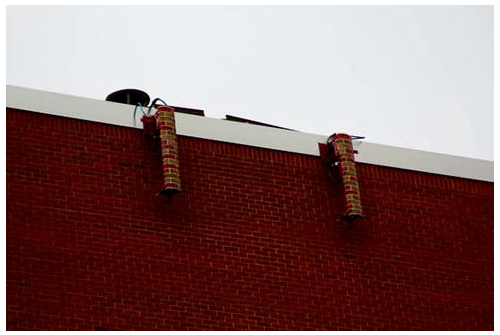
Graphic A
(3)
An antenna located inside a building is permitted provided it is not visible from any surrounding properties or roadways and no portion of the antennae is recognizable or discernible from the exterior of the building. Architectural features concealing the antennae must be consistent with the architecture of the building to which they are attached. The architectural features shall not exceed the height restrictions for the zoning district in which they are located, except as allowed by this Code. The setback for any architectural features concealing an antenna from any residentially zoned property must be at least one foot for every foot in height of the architectural features (dwellings located on the same parcel as the antenna are excluded). An example of an acceptable architectural feature concealing an antennae located inside a building is provided below:
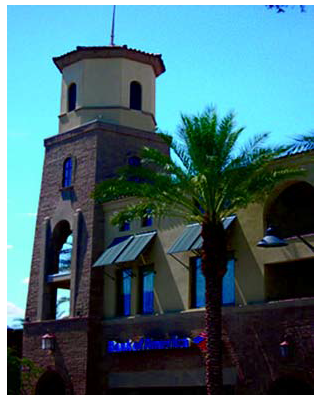
Graphic B
(4)
An antenna classified as a co-location located on an existing freestanding facility shall meet the following minimum criteria:
(a)
The antenna does not increase the height of the freestanding facility to which it is to be attached, except as allowed in subsection 158.114(C), as measured to the highest point of any part of the freestanding facility or any existing antenna attached to the freestanding facility;
(b)
The ground space area, if any, previously approved for equipment enclosures and ancillary facilities is not increased; and
(c)
The antenna and its ancillary facilities meet all requirements as established in subsection 158.114(C).
(5)
An antenna classified as a co-location located on an existing building shall meet the following minimum criteria:
(a)
The height of the antenna does not exceed 15 feet above the highest point of the building;
(b)
The ground space area, otherwise known as the compound, if any, previously approved for equipment enclosures and ancillary facilities is not increased;
(c)
The antenna and its ancillary facilities are of a design and configuration consistent with any applicable structural or aesthetic design requirements and any requirements for location on the building for initial antennas.
(6)
If only a portion of an application for a personal wireless service facility classified as a co-location does not meet the requirements of subsections (4) or (5) above, the noncompliant portion of the co-location application shall be reviewed as an initial antenna, under subsection (2) and the compliant remainder of the co-location application shall be reviewed in accordance with subsections (4) or (5), as applicable. A co-location application that complies with subsections (4) or (5), except that it is proposing to increase the equipment ground compound approved in the original site development plan for equipment enclosure and ancillary facilities by no more than a cumulative amount of 400 square feet or 50 percent of the original ground equipment enclosure size, whichever is greater, may continue to be reviewed as a co-location.
(7)
Standards applicable to all antennas.
(a)
An antenna and its ancillary facilities must meet all applicable requirements of the Florida Building Code.
(b)
The antenna equipment shelter/cabinet must have a sign in close proximity which is readable from a distance of at least five feet, in accordance with FCC regulations, which notes the owner of the equipment and the name and telephone number of the person to contact to report an emergency or situation when notification is warranted.
(c)
All additional requirements of state, federal and local law must be adhered to.
(8)
The review and approval of an application for an antenna under this section is by site development plan exemption pursuant to section 158.026 and building permit review, except as an initial installation where existing buildings are proposed to be architecturally modified to conceal an antennae. Existing buildings that are proposed to be architecturally modified to conceal antennae must follow the site development plan approval process pursuant to section 158.025.
(B)
Personal wireless service facilities primarily mounted on existing utility poles or existing light poles.
(1)
Personal wireless service facilities primarily mounted on existing utility poles or existing light poles, including but not limited to DAS or small cell applications, are permittable in all zoning districts provided the following criteria are met:
(a)
The Applicant shall provide proof that the owner of the utility pole and/or light fixture authorizes the installation of the facilities.
(b)
The Applicant shall provide proof that the property owner, if different from Applicant, authorizes the installation of the facilities.
(c)
Any ancillary equipment located in a right-of-way:
1.
Shall be painted the same color as the utility pole, or light pole, and either attached to the utility or light pole or ground-mounted adjacent to such pole; and
2.
Shall not exceed six feet in height, two feet in width, and two feet in depth, excluding electric meter and disconnect, or a substantially equivalent cubic foot volume cabinet size for ground-mounted equipment.
(d)
Any ancillary equipment not located in a right-of-way is permittable by Site Development Plan exemption and must meet the following criteria:
1.
Shall be no wider than seven feet;
2.
Shall be no longer than 13 feet;
3.
Shall not exceed the height limitations for mechanical equipment as provided by this Zoning Code;
4.
May be located within a required side or required rear yard, provided, that it shall be no closer than ten feet to any lot line;
5.
Shall be included in lot coverage and non-open space calculations for the site, including the pad;
6.
Shall be located on a concrete pad, unless required to be elevated due to FEMA requirements;
7.
Shall be screened from view by landscaping, architectural features, or a combination of both, and designed in a manner which minimizes nuisance impacts, such as noise and odor. Screening shall be at least equal to the height of the ancillary equipment on all sides and shall be maintained in good order. Failure to maintain fences, walls or landscaping shall constitute a violation of this chapter;
8.
Shall meet the requirements of section 158.117 "Intersection visibility"; and
9.
Shall be set back from any existing residential dwelling at least one foot for every foot in height of the facility (dwellings located on the same parcel as the structure are excluded).
(e)
The top of any personal wireless service facility shall not exceed the following heights: 1) 37 feet on the Gulf of Mexico Drive right-of-way; 2) 30 feet on all other rights-of-way or streets; and 3) the maximum height established for non-right-of-way locations shall be the zoning district in which the facility is located, but in no case shall the height exceed 37 feet. Heights shall be measured from finished grade.
(2)
The review and approval of an application for an antenna under this section is by site development plan exemption pursuant to section 158.026 and building permit review.
(C)
Freestanding facilities.
(1)
Freestanding facilities and their ancillary equipment shall be permittable by Site Development Plan review and Special Exception granted by the Town Commission in all zoning districts provided the following criteria are met:
(a)
The freestanding facility shall be designed so as to mimic a structure or natural feature that could reasonably be found or blend with the surrounding area, such as a light fixture or tree. Examples of acceptable and unacceptable freestanding facilities are provided in the following graphics:
1.
Examples of acceptable freestanding facilities:
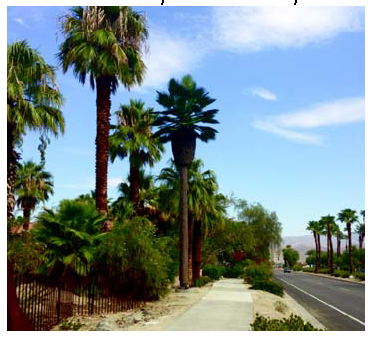
Graphic C
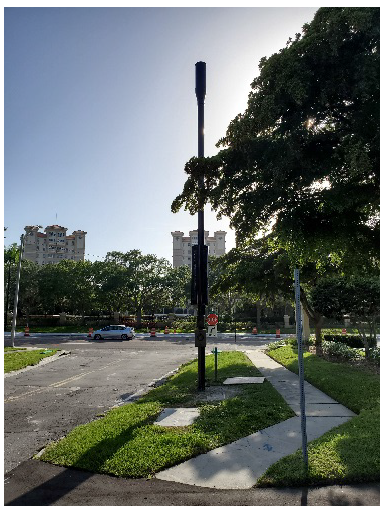
Graphic D
Graphic E-1
Graphic E-2
2.
Examples of unacceptable freestanding facilities:
Graphic F
Graphic G
(b)
Ancillary equipment must meet the following criteria:
1.
Private property:
(a)
Shall be as compact as technologically possible, but in no case shall ground mounted equipment exceed eight foot in height, four foot in width, and eight foot in depth, or shall facility mounted equipment exceed six feet in height, two feet in width, and two feet in depth, excluding electric meter and disconnect;
(b)
May be located within a required side or required rear yard, provided, that it shall be no closer than ten feet to any lot line;
(c)
Shall be included in lot coverage and non-open space calculations for the site, including the pad;
(d)
Shall be located on a concrete pad, unless required to be elevated due to FEMA regulations;
(e)
Shall be screened from view by landscaping, architectural features, or a combination of both, and designed in a manner which minimizes nuisance impacts, such as noise and odor. Screening shall be at least equal to the height of the ancillary equipment on all sides and shall be maintained in good order;
(f)
Shall meet the requirements of Section 158.117 "Intersection visibility"; and
(g)
Shall be set back from any existing residential dwelling at least one foot for every foot in height of the equipment (dwellings located on the same parcel as the structure are excluded).
2.
Public rights-of-way:
(a)
Shall utilize identical equipment or substantially similar equipment to the equipment deployed by the Town;
(b)
Shall be as compact as technologically possible, but in no case shall exceed six feet in height, two feet in width, and two feet in depth, excluding electric meter and disconnect.
Substantially similar for the purposes of this Section means that the equipment is substantially similar equipment in capacity, style, color, and exterior appearance to the equipment deployed by the Town.
(c)
The top of any freestanding facility and ancillary equipment shall not exceed the following height limitations: 1) 35 feet on the Gulf of Mexico Drive right-of-way; 2) 25 feet on all other rights-of-way or streets; and 3) the maximum height established for the zoning district in which the facility is located but in no case shall the height exceed 35 feet. Heights shall be measured from finished grade.
(d)
For any freestanding facility within the Gulf of Mexico Drive or other rights-of-way or streets within the Town that utilizes lighting, the facility shall:
1.
utilize identical equipment or substantially similar equipment to the adjacent lighting deployed by the Town;
2.
be installed with a spacing distance substantially similar to the adjacent lighting equipment deployed by the Town, or no closer than 60 feet from adjacent lighting deployed by the Town or another free standing personal wireless service pole; and
3.
meet all applicable Federal, State, and local regulations regarding shielding or illumination of lighting to protect sea turtles.
Substantially similar for the purposes of this Section means that the lighting is substantially similar equipment in illumination, capacity, style, color, and exterior appearance to the adjacent lighting deployed by the Town.
(e)
For any freestanding facility within the Gulf of Mexico Drive or other rights-of-way or streets within the Town that does not utilize lighting, the facility shall:
1.
utilize identical equipment or substantially similar equipment to the adjacent lighting deployed by the Town;
2.
be installed with a spacing distance substantially similar to the adjacent lighting equipment deployed by the Town, or no closer than 60 feet from adjacent lighting deployed by the Town or another free standing personal wireless service pole.
Substantially similar for the purposes of this Section means that the facility is substantially similar in capacity, style, color, and exterior appearance to the adjacent lighting deployed by the Town.
(2)
The special exception application must be made in conjunction with the site development plan review requirements set forth in this Zoning Code. An application shall include the following information:
(a)
The name of the applicant(s) and whether each applicant is an individual, partnership, limited partnership, limited liability corporation, professional corporation, professional association, governmental entity, or some other type of legal group or association;
(b)
A complete and accurate description of the proposed freestanding facility, including where necessary, a scale drawing or model of the proposed freestanding facility;
(c)
If applicable, documentation of any contract, license, lease, letter of understanding, agreement in principle, or other type of agreement with a personal wireless service provider for use of the freestanding facility and a summary of the agreement or arrangement;
(d)
The proposed location of the freestanding facility together with both a legal description of the location, and a map in sufficient detail to indicate the location with precision;
(e)
Proof that the property owner, if different from applicant, authorizes the installation of the facilities;
(f)
The zoning/land use designation for the proposed freestanding facility;
(g)
The height of the proposed freestanding facility;
(h)
The projected collapse zone certification that in the event of fall or collapse of the freestanding facility, said freestanding facility would not damage or negatively impact the real or personal property of the surrounding property owners;
(i)
Documentation demonstrating compliance with the provisions of subsection 158.114(C)(1);
(j)
A detailed plan for landscaping any ancillary ground equipment, in such a manner that the landscaping will shield the equipment from the view of adjoining parcels and public rights-of-way, noting that the landscaping shall be native, xeriscape plants only;
(k)
A detailed preventive maintenance program that meets minimum maintenance program standards for which the applicant is to remain solely responsible. The town will not be responsible for monitoring the maintenance program;
(l)
Certification that the proposed equipment will comply with applicable Federal Aviation Administration requirements under 14 C.F.R. § 77, as amended, and evidence of proper Federal Communications Commission licensure, or other evidence of Federal Communications Commission authorized spectrum use;
(m)
The estimated completion date for the location or construction or modification of each of the freestanding facilities and any ancillary equipment;
(n)
The identity and location of any land-line backhaul network to each freestanding facility location, if applicable;
(o)
Whether the applicant, within a two-mile radius of the proposed location, has ever had any permit (or similar or equivalent authorization) revoked, rescinded, canceled or terminated which authorized the placement, construction, or modification of personal wireless service facilities, and, if so, what were the reasons surrounding such revocation;
(p)
The proposed equipment shall not interfere with or obstruct public safety telecommunications facilities in accordance with the applicable rules of the Federal Communications Commission; and
(q)
All applicable provisions of this Zoning Code and the Florida Building Code shall be met.
(3)
In evaluating the application for a Special Exception for a freestanding facility, in addition to the findings of Subsection 158.019(A), the Town Commission, and the Planning and Zoning Board in providing its recommendation to the Town Commission, shall consider and evaluate the above application criteria and the following, with the intent of balancing the reasonable allowance of a freestanding facility to provide personal wireless service in the area with the protection of the aesthetics of the area from adverse visual impacts:
(a)
The proposed location of the freestanding facility, including the zoning/land use designation of the site and abutting properties;
(b)
The proposed height of the freestanding facility;
(c)
The number and location of freestanding facilities and structures, see 158.113(D);
(d)
The distance of the proposed freestanding facility to the nearest residence measured from the freestanding facility to the boundary of the nearest residence;
(e)
The proposed aesthetics of the freestanding facility and whether it visually blends in with surrounding buildings, structures and existing vegetation;
(f)
The potential impacts on property values of nearby or surrounding residential properties.
(4)
Upon granting site development plan approval and special exception permit for the construction of a freestanding facility, the town reserves the right to inspect placement, construction and modification of such freestanding facility and ancillary equipment for the life of the facility. Any modification, relocation, rebuilding, repairing, in any way without the issuance of all applicable approvals and permits will be deemed a violation of the permit and result in the removal of the freestanding facility and ancillary equipment.
(5)
Removal of freestanding facility and ancillary equipment. The town may require, upon notice with a reasonable opportunity to cure, the immediate removal of a freestanding facility and ancillary equipment if:
(a)
It has been abandoned for a period in excess of six months;
(b)
It falls into such a state of disrepair that it becomes an unsafe structure or becomes a public nuisance;
(c)
It is modified, relocated, or rebuilt without the issuance of all applicable approvals and permits;
(d)
The special exception has been revoked.
(D)
Insurance and security requirements.
(1)
Insurance for freestanding facilities located on town-owned property or public rights-of-way.
(a)
A freestanding facility owner or operator shall not commence construction or operation of the facility without obtaining all insurance required hereunder and approval of such insurance by the town manager, nor shall an owner or operator allow any contractor or subcontractor to commence work on its contract or subcontract until all such insurance has been obtained and approved. The required insurance must be obtained and maintained for the entire period the freestanding facility is in existence. If the owner or operator, its contractors or subcontractors do not have the required insurance, the town may order such entities to stop operations until the insurance is obtained and approved. The following coverage, at a minimum, shall be maintained:
1.
Public liability: $1,000,000.00 per occurrence;
2.
Property damage: $1,000,000.00 per claim; and
3.
Umbrella liability: $2,000,000.00.
(b)
The policies shall be written on forms acceptable to the town, placed with an insurance carrier approved and licensed by the State of Florida Office. Certificates of insurance, reflecting evidence of the required insurance, shall be filed with the town prior to issuance of a building permit.
(c)
All policies of insurance required to be maintained shall name the Town of Longboat Key as an additional insured. All policies shall contain a provision that coverage afforded under the policy will not be canceled without at least 30 days prior written notice to the town.
(2)
Security fund. A bond, cash security fund or irrevocable letter of credit in a form acceptable to the town, shall be provided to the town by the owner or operator to secure the cost of removing any personal wireless service facility permitted under this section should the owner or operator fail to remove the personal wireless service facility as required by this Zoning Code. The amount of the bond, cash security fund, or letter of credit to be provided shall be $5,000.00 for each freestanding facility.
(Ord. 2018-24, passed 4-1-19; Ord. 2019-10, passed 11-4-19; Ord. 2021-16, passed 11-15-21; Ord. 2022-02, passed 2-7-22; Ord. 2024-06, passed 5-6-24; Ord. 2025-02, passed 2-18-25)
158.115 - Parks and open space land acquisition.
(A)
This section is enacted to ensure that future land development within the town preserves or provides land in its natural state for parks and open space in accordance with the policies as set forth in the Longboat Key Comprehensive Plan. Developers and landowners, including builders of residences on single-family lots, must provide for parks and open space. The scope of this section is further to set forth certain regulations pertaining to land development and construction within the town, providing for parks and open space, which regulations shall be in addition to all other applicable building, subdivision, zoning and other regulations established by the town ordinances. This section shall apply to and be enforced in all areas of the town; and no persons shall develop land anywhere in the town except in conformity with this section and other applicable regulations of the Code of Ordinances and amendments thereto.
(B)
The town will use the following as criteria to guide open space land acquisition:
(1)
Implementation of the policies that minimize risk seaward of the coastal construction control line;
(2)
Continuing to preserve natural landscape, native vegetation and significant wildlife species and their habitats as adopted in the Zoning Code;
(3)
Consideration of the inventory of existing parks and open space property;
(4)
Located adjacent to existing publicly-owned or controlled lands;
(5)
The provisions of the reserve account in trust as established pursuant to town ordinances; and
(6)
Properties that serve the public interest.
(C)
As a condition precedent to the grant of any permits following approval of final development plans, site development plans, subdivision plats, or issuance of a building permit, the developer shall deed land to the town, pay a money fee in lieu thereof, or provide a combination of the above, at the option of the town commission, to be used for parks and open space specified in this section and according to the standards and formula set forth in this section.
(1)
General standard; formula.
(a)
It is hereby found and determined that the public interest, convenience, health, welfare and safety require that 12 acres of land or equivalent money value be deeded or paid to the town for each potential 1,000 persons residing in the town to be devoted for the park and open space purposes of this section as implemented by subsection (b) below.
(b)
In order to achieve the open space goals of the Town of Longboat Key for its projected maximum population, in recognition of the current inventory of open space lands held by the town, and to require a developer to pay an amount roughly proportional to the demand the development places upon open space within the town; five acres of land or equivalent money value will be deeded or paid to the town for each potential 1,000 persons residing in the town to be devoted for parks and open space purposes of this section.
(c)
To determine the amount of land for parks and open space to be conveyed in accordance with the general standard, the following shall be used:
Average number of persons per dwelling or tourism unit divided by 1,000 population, multiplied by acres of land required, equals acreage requirement per dwelling or tourism unit. Example: For single dwelling or tourism unit: 2.01 divided by 1,000 × 5 = 0.010 per dwelling or tourism unit.
(a)
The following basis is to be followed in determining the amount of land to be included:
(b)
For land zoned for multifamily or tourism uses, the land dedication basis shall be applied to the number of dwelling and tourism units included in the final development plan.
(c)
The land to be conveyed to the town may be located either within or outside of the boundaries of the property proposed for development.
(2)
Formula for fees in lieu of land conveyance.
(a)
If it is determined that the proposed development does not include any land that can be used as open space, to serve the immediate and future needs of the town residents, and the developer is unwilling or unable to deed to the town lands outside the proposed development that are so designated, then the developer shall, in lieu of conveying land, pay a fee to the town equal to the value of the land acreage that would otherwise have been required to be conveyed as determined by the formula herein, and in an amount determined in accordance with the provisions set out below, the fee to be used by the town for acquisition of land and parks and open space which is intended to exclusively serve the residents of the town.
(b)
The provisions of this subsection shall automatically apply to all developments of 25 dwelling or tourism units or less.
(c)
To determine the land acquisition fee, the following shall be used:
Number of new units x (current market value of the land x 435.6)
square footage of the land
(D)
In any development of over 25 dwelling or tourism units, the developer may be required to convey land and pay a fee in accordance with the following formula:
(1)
When only a portion of the land which the developer is required to convey for parks and open space is to be conveyed, that portion shall be conveyed for parks or local open space and a fee computed pursuant to the provisions set out herein shall be paid to the town for any additional land that the developer would otherwise have been required to convey hereunder.
(2)
When most of the land designated as parks and open space in the vicinity of the proposed development has already been acquired by the town and only a small remaining portion of the land in the proposed development is needed to complete the site, that remaining portion shall be conveyed by the developer and a fee shall be paid by the developer in lieu of conveying the additional land which would otherwise have been required to be conveyed. The fees shall be in an amount equal to the value of the additional land which the developer would otherwise be required to convey, and the fees shall be used for the improvement of other town parks and open space land in the area serving the development.
(E)
If the developer objects to the fair market value determination, the developer may submit an appraisal from a state certified appraiser showing the fair market value of the lands required to be donated; and final determination of the market value per acre of the land shall be made by the town commission based upon such information submitted by the developer. Should the developer's state certified appraisal not be acceptable to the town, the town shall appoint another state certified appraiser. The town's state certified appraiser and the developer's state certified appraiser shall select a third state certified appraiser; and the fair market value of the lands required to be conveyed, as determined by the three appraisers, shall be binding upon the developer and the town. The cost of an appraisal shall be a credit against any fees.
(F)
The town commission shall determine whether to accept land or require payment of the fee in lieu thereof, after consideration of the following:
(1)
Topography, geology, access and location of land in the development available for dedication.
(2)
Size and shape of the development and land available.
(3)
The feasibility of conveyance.
(4)
Availability of previously acquired parks and open space property.
(G)
Where private or public open space is provided in a proposed or existing planned unit development or district in excess of the then requirement of section 158.038, or any amendment thereof, of the Zoning Code, partial credit, not to exceed 50 percent of the amount of land required to be conveyed, may be given against the requirements of land to be conveyed or payment of fees in lieu thereof if the town commission finds it is in the required zoning and building ordinances.
(H)
In the case of a subdivision for which a plat is required to be recorded, as a condition of preliminary plat approval, the developer shall agree in writing to convey land for parks and open space, pay a fee in lieu thereof, or both, at the option of the town commission at the time and according to the standards and formula in this section after a recommendation from the town manager, or designee and approved by the town commission at the time of approval of the subdivision preliminary plat. At the time of approval of the final subdivision plat, the developer shall convey the land and pay the fees as previously determined by the town commission, but not later than issuance of a building permit.
(I)
The fees collected under this section shall be paid to the town at Town Hall, 501 Bay Isles Road, Longboat Key, Florida. All such fees, including any fees collected pursuant to Ordinances 79-7, 80-1, 80-9 and 81-27, shall be placed in a reserve account in trust within the general fund and shall be known as the reserve for lands for parks and open space. Monies in the reserve account shall be used and expended solely for the acquisition, improvement and expansion of town parks and open space land.
(Ord. 2018-24, passed 4-1-19)
158.116 - Administrative exemptions—Essential services.
(A)
Upon a determination by the Planning and Zoning Official that the proposed repair, replacement, relocation, addition, or alteration to an existing essential services facility is required by Town, State or Federal regulations, and is not contrary to the intent of the elements of the Town Comprehensive Plan or this Chapter, the official may determine that the improvement to the facility is exempt from the requirements of the Town Zoning Code.
(B)
The planning and zoning official may impose such conditions or limitations on projects reviewed pursuant to this subsection in order to ensure compliance with the intent of this chapter, the town comprehensive plan, and with all applicable standards and policies of the town.
(Ord. 2018-24, passed 4-1-19; Ord. 2019-10, passed 11-4-19)
158.117 - Intersection visibility.
At all street intersections no obstruction to vision (other than an existing building, post, column, or tree) exceeding 30 inches in height above the established grade of the street at the property line shall be erected or maintained on any lot within the triangle formed by the street lot lines of the lot and a line drawn between the points (along the street lot lines 30 feet distant from their point of intersection).
At all driveways that cross a sidewalk, no obstruction to vision (other than an existing structure, post, fixed sign, column or tree) exceeding 30 inches in height above the established grade of the street at the property line shall be erected or maintained on any lot within the triangle formed by the street lot lines of the lot and a line drawn between the points (along the street lot line and the driveway for a distance of 15 feet from their point of intersection). In the event there is an existing permitted obstruction blocking visibility within this angle, a warning sign not to exceed two square feet shall be erected not less than ten feet from the sidewalk on the right side of the driveway. See graphic, provided for illustrative purposes, below.
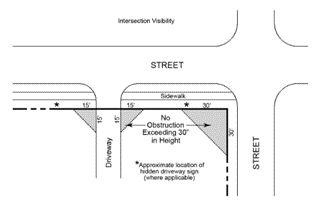
(Ord. 2018-24, passed 4-1-19; Ord. 2020-14, passed 1-5-21)
158.118 - Lot excavation, grades, and frontage.
(A)
No person shall strip, excavate, or otherwise remove soil, sand, shale, or gravel for sale or use and thereby create a borrow pit except in connection with the construction or alteration of a building permitted by the issuance of a building permit on the premises and excavation or grading incidental thereto.
(B)
No natural grades of the upland or gulf bottoms within 500 feet of the mean high-water line of the Gulf of Mexico shall be lowered. This provision is not to be considered a restriction against leveling minor irregularities in the surface of the ground.
(C)
Every lot in every district shall have a minimum frontage of 40 feet on a public or approved private street.
(D)
Lot grades between any property line and a structure shall not exceed a maximum slope of one vertical unit to four horizontal units at any point along the slope. A retaining wall may only be constructed for the purpose of achieving the required one-to-four slope over a minimum distance of four feet unless the wall meets the required setback. In any event, the retaining wall cannot exceed eight feet in height. See graphic, provided for illustrative purposes, below.
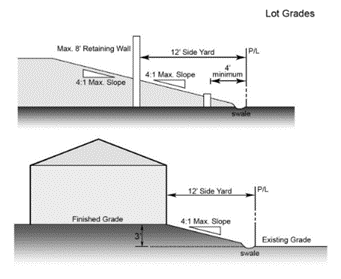
(Ord. 2018-24, passed 4-1-19; Ord. 2020-14, passed 1-5-21)
158.119 - Mechanical equipment.
(A)
General regulations. All mechanical equipment located outside of a building shall conform to the regulations of this section, unless specifically excepted by other provisions of this chapter. In addition, necessary essential service facilities are not intended to be restricted by required yard areas. Mechanical equipment that is closer than ten feet to a principal structure is attached mechanical equipment. Mechanical equipment that is ten feet or further from a principal structure is unattached mechanical equipment.
(B)
Residential districts.
(1)
Mechanical equipment shall not be located in any required street yard.
(2)
Mechanical equipment shall not be located in any required waterfront yard, except for mechanical equipment as provided for in section 158.096 "Minimum regulations for accessory structures" and as provided for in Section 158.099 "Structures over water."
(3)
Mechanical equipment may be located within a required side or required rear yard, provided that the equipment shall not be closer than ten feet to any side or rear lot line.
(4)
Mechanical equipment may be located in one, but not both required side yards on double-frontage lots, through lots, or corner lots, as defined in section 157.03.
(5)
Unattached mechanical equipment located in a required yard may not exceed six feet above finished grade.
(6)
Unattached mechanical equipment not located in a required yard may not exceed eight feet above finished grade.
(C)
Tourism districts.
(1)
Mechanical equipment shall not be located in any required street yard.
(2)
Mechanical equipment shall not be located in any required waterfront yard, except mechanical equipment as provided for in section 158.096 "Minimum regulations for accessory structures" and as provided for in section 158.099 "Structures over water".
(3)
Mechanical equipment may be located within a required side or required rear yard, provided that the equipment shall not be closer than ten feet to any side or rear lot line.
(4)
Unattached mechanical equipment located in a required yard may not exceed six feet above finished grade.
(5)
Unattached mechanical equipment not located in a required yard may not exceed eight feet above finished grade.
(D)
Districts other than residential or tourism.
(1)
Mechanical equipment may be located within a required street yard, except for Gulf of Mexico Drive, provided that the equipment shall not be closer than ten feet to the street right-of-way if the equipment is more than 50 feet from the nearest residential property. If the equipment is 50 feet or less from the nearest residential property, the equipment shall not be closer than 20 feet to the right-of-way.
(2)
Mechanical equipment shall not be located in any required waterfront yard, except for mechanical equipment, as provided for in section 158.096 "Minimum regulations for accessory structures", and as provided for in section 158.099 "Structures over water."
(3)
Mechanical equipment may be located within a required side or required rear yard, provided that the equipment shall not be closer than ten feet to any side or rear lot line.
(4)
Unattached mechanical equipment located in a required yard may not exceed six feet above finished grade.
(5)
Unattached mechanical equipment not located in a required yard may not exceed eight feet above finished grade.
(E)
Screening. Any installation, replacement or modification of external mechanical equipment, including, but not limited to, air conditioning systems and pool equipment, shall screen the equipment for both view and noise. Any fence, wall or landscaping installed in accordance with this section shall be at least equal to the height of the equipment on all sides and shall be maintained in good order to achieve the objectives of this section. Failure to maintain fences, walls or landscaping shall constitute a violation of this chapter. Mechanical equipment and screening must meet the requirements of section 158.117 "Intersection visibility."
(Ord. 2018-24, passed 4-1-19)

