
Longmont City Zoning Code
CHAPTER 15
10. - DEFINITIONS
Sec. 15.10.010. - Use definitions.
For the purposes of this development code, the following terms shall have the following definitions, except where the context clearly indicates otherwise. For words, terms and phrases used in this development code that are not defined below, or elsewhere in this Code, the planning director shall interpret or define such words, terms, and phrases (see section 15.02.100) In making such interpretations or definitions, the planning director may consult secondary sources related to the planning profession for technical words, terms and phrases, including, but not limited to: A Planners Dictionary—Planning Advisory Service Report Number 521/522, by Michael Davidson and Fay Dolnick (American Planning Association, Chicago, Ill. 2004); and The Complete Illustrated Book of Development Definitions 4th Edition, by Harvey S. Moskowitz, Carl G. Lindbloom, David Listokin, Richard Preiss, and Dwight Merriam (Routledge, Taylor & Francis Group, New York, NY, 2015). The planning director may consult, Merriam-Webster's Collegiate Dictionary, 11th Edition (2003) or other available reference source for other words, terms and phrases. The following terms correspond with the uses listed in table 15.04.020, as well as accessory and temporary uses referenced in chapter 15.04:
A.
Residential uses.
Household living uses. Uses in this category are characterized by residential occupancy of a dwelling unit by a household. Tenancy is arranged on a month-to-month or longer basis; lodging where tenancy may be arranged for a period of less than 30 days is classified under the lodging facilities category. Common accessory uses include recreational activities, gardens, personal storage buildings, hobbies, and resident parking.
Co-housing means a residential development that combines individually owned dwelling units with smaller or partial kitchens and a larger community kitchen and dining room intended for communal use on a regular basis, and in which all residents agree to share in the provision of regular communal services such as cooking meals or providing childcare.
Dwelling, live/work, means a residential dwelling unit that is combined with a commercial retail, office or other allowed nonresidential use.
Dwelling, multifamily, means a dwelling containing five or more individual dwelling units, with the units often stacked one above the other in a vertical configuration, sharing common vertical walls or horizontal floors and ceilings. The term "multifamily dwelling" includes townhomes, dwellings located within a vertically mixed-use building, and residences commonly referred to as apartments, garden apartments, apartment buildings, or condominiums.
Dwelling, single-family attached, means a building containing between two and four single-family dwelling units, each with its own outside entrance, which are joined together by a vertical common party wall.
Dwelling, single-family detached, means a detached dwelling designed exclusively for, and occupied by, one family.
Mobile home park means a parcel of land under single ownership or control on which two or more mobile homes are occupied as residences.
Mobile home subdivision means a subdivision designed and intended to provide individual lots for residential occupancy by a mobile home.
Group living uses. Uses in this category are characterized by residential occupancy of a structure by a group of people who do not meet the definition of the term "household living." Tenancy is arranged on a monthly or longer basis and the size of the group may be larger than a family. Generally, group living structures have a common eating area for residents. Residents may receive care, training, or treatment, and caregivers may or may not also reside at the site. Accessory uses may include recreational facilities and vehicle parking for occupants and staff.
Boardinghouse, roominghouse means a residential dwelling with at least two rooms that are rented or intended to be rented primarily for sleeping only, but which do not constitute separate dwelling units. Such facility is occupied by longer-term residents than hotels, motels or bed and breakfast establishments and includes sororities, fraternities and dormitories.
Group care facility means a facility of more than 12 persons, including staff, providing longer term residential and special care, supervision, and treatment exclusively for residents protected by the provisions of the federal Fair Housing Act (FHA), including, but not limited to, assisted living facilities and nursing homes. The term "group care facility" does not include halfway houses, residential rehabilitation facilities, residential childcare facilities, or penal/correctional facilities.
Group care home means a facility of 12 or fewer persons, including staff, providing residential and special care and supervision within a dwelling where persons are living together with staff, as a single housekeeping unit, providing care, supervision, and treatment exclusively for residents protected by the provisions of the Federal Fair Housing Act (FHA). The term "group care home" does not include group care facilities, halfway houses, residential rehabilitation facilities, residential childcare facilities, or penal/correctional facilities.
Independent living facility means a multifamily dwelling restricted to adults at least 55 years of age or older, that includes central dining facilities and provides residents with access to meals and other services such as housekeeping, transportation, and social and recreational activities. Independent living facilities do not provide skilled medical and residential care and assistance such as those provided at a group care facility.
Rehabilitation and treatment facility includes the following facilities:
Halfway house means a licensed home for inmates on release from more restrictive custodial confinement who were initially placed in lieu of such more restrictive custodial confinement, wherein supervision, rehabilitation and counseling are provided to mainstream residents back into society, enabling them to live independently, excluding foster homes housing not more than two juveniles.
Residential childcare facility means a facility so licensed by the state department of human services pursuant to part 1 of article 6 of title 26, Colorado Revised Statutes, to provide 24-hour group care and treatment for children operated under private, public, or nonprofit sponsorship. The term "residential childcare facility" does not include a homeless youth shelter as defined by the state.
Residential rehabilitation facility means an institutional facility for persons referred by a state department or division, or by a physician or medical institution, wherein medical treatment, counseling, rehabilitation and 24-hour on-site supervision are provided for substance abuse, emotional disorders, physical disabilities, or other medical conditions, with the goal of enabling residents to live independently when treatment is completed.
Sober living home means a residential dwelling used by persons protected by the provisions of the Federal Fair Housing Act (FHA) who are not currently, illegally using or addicted to a controlled substance but are recovering from abuse of alcohol or a controlled substance, where the residence serves as an interim environment between rehabilitation and treatment facilities and mainstream society.
B.
Public, institutional and civic uses.
Community and cultural facilities. Uses in this category include buildings, structures, or facilities owned, operated, or occupied by a governmental entity or nonprofit organization to provide a service to the public.
Assembly uses means and includes facilities owned or operated by associations, corporations, or other persons for social, educational, or recreational purposes primarily for members and their guests. The term "accessory uses" may include offices, meeting areas, food preparation areas, concessions, parking, and maintenance facilities. Examples of assembly uses may include clubs or lodges, religious assembly, or fraternal organization facilities.
Cemetery or interment facility means land used or intended for the burial of the dead and dedicated for cemetery purposes. The term "cemetery" may include a funeral home or mortuary or a mausoleum or columbarium (a structure or vault lined with recesses for cinerary urns), and pet cemetery, but does not include crematory or alkaline hydrolysis facilities.
Convention and conference center means a facility used for business or professional conferences and seminars, often with accommodations for sleeping, eating and recreation.
Day care, commercial, means a facility licensed, certified, or registered by the state that operates in other than a private residence that provides care, protection and supervision for children or adults on a regular basis away from their primary residence for less than 24 hours per day.
Day care, residential, means a facility licensed, certified, or registered by the state that operates in the permanent residence of the provider that provides care, protection and supervision for children or adults on a regular basis away from their primary residence for less than 24 hours per day.
Emergency services means a building used for police, fire, or other medical equipment and personnel.
Funeral facility means a facility that provides human funeral services, including embalming, cremation, alkaline hydrolysis, and memorial services.
Library, museum, or art center means facilities containing collections of books, manuscripts, and similar materials for study and reading, or exhibiting works of art or objects in one or more of the arts and sciences. Accessory uses may include educational facilities.
Penal/correctional institution means public facilities operated by a municipal, county, state, or federal agency for the detention or incarceration of people, where inmates and detainees are under 24-hour supervision by professionals, except when on an approved leave. If the use otherwise complies with this definition, the term "public penal/correctional institution" may include, by way of illustration, a public prison, jail or probation center.
Performing arts center or auditorium means a facility designed and intended for live presentations of performing arts, public presentations, speeches, debates, or discussions.
Reception/banquet hall means a building or portion of a building available for lease by private parties for social or dining purposes.
C.
Educational facilities.
Educational facilities. Uses in this category include public, private, and parochial institutions at the primary, elementary, middle, high school, or post-secondary level, or trade or business schools, which provide educational instruction to students. Accessory uses include play areas, cafeterias, recreational and sport facilities, auditoriums, and before- or after-school day care.
College or university means any public or private institution of higher learning meeting all applicable prescribed state standards that provides facilities for teaching and research and is authorized to grant academic degrees.
School, public or private, means any public or private facility meeting all applicable prescribed state standards that provides instruction in pre-kindergartens, kindergartens, elementary, or secondary education. The term "public or private school" includes private boarding schools and military schools but does not include day care facilities.
School, vocational or trade, means a secondary school offering instruction in a professional, vocational, or a technical field. The term "vocational or trade school" includes public or private schools providing domestic, recreational and other types of personal skill instruction, such as dance, gymnastics, cooking, music, martial arts and handicrafts.
D.
Healthcare facilities.
Healthcare facilities. Uses in this category are characterized by activities focusing on medical services, particularly licensed public or private institutions that provide primary health services and medical or surgical care to persons suffering from illness, disease, injury, or other physical or mental conditions. Accessory uses may include laboratories, outpatient, or training facilities, and parking or other amenities primarily for the use of employees in the firm or building.
Hospital means a state-licensed facility designed for the diagnosis, treatment, and care of human illness or infirmity and providing health services, primarily for inpatients, and including, as related facilities, laboratories, outpatient departments, training facilities and staff offices, but not including group care institutions or medical clinics.
Medical or dental clinic means an establishment operated by one or more duly licensed members of the human health care professions, including, but not limited to, physicians, dentists, chiropractors, psychiatrists and osteopaths, where patients are not lodged overnight but are admitted for medical examination or treatment.
Medical laboratory or research facility means a facility for conducting medical or dental research, investigation, testing, experimentation or the production of customized medical or dental instruments or tools.
Skilled nursing or rehabilitation facility means a facility that provides short-term skilled nursing, therapy, rehabilitation, and overnight lodging for individuals recovering from surgery, illness or injury. Short-term means generally less than three months, for the purposes of this definition. Practitioners of skilled nursing and rehabilitation care can include, but are not limited to, registered nurses, licensed practical and vocational nurses, physical and occupational therapists, speech-language pathologists and audiologists.
E.
Commercial uses.
Adult entertainment establishments.
Adult or sexually-oriented business means an adult arcade, adult bookstore, adult novelty store, adult video store, adult cabaret, adult motel, adult motion picture theater, adult theater, or an adult model studio, as those terms are defined in section 6.65.020.
Agricultural and animal uses. This category includes agricultural and farming activities, including nurseries and facilities for processing and selling agricultural products. Typical agricultural uses in an urban environment involve beekeeping, horticulture, and floriculture. Accessory uses may include confinement facilities for animals, parking, and storage areas. This category also includes uses involving the care and keeping of animals on a commercial basis. Accessory uses may include parking and storage areas. Standards in this development code are intended to provide for compatibility between such animals and neighboring land uses and are in addition to other applicable city and state requirements governing animals.
General agriculture means the land use of animal husbandry, farming, cultivation of crops, dairying, pasturage, floriculture, horticulture, viticulture, aquaculture, hydroponics, together with necessary accompanying accessory uses, buildings, or structures for housing, packing, treating, or storing said products. The term "general agriculture" does not include livestock confinements or feedlots, livestock marketing or auction facilities, livestock processing (except for consumption by the owners or tenants of the agricultural property), or any other activity, such as a kennel, generally not accepted as an appropriate agricultural use as determined by the city. The term "general agriculture" includes the incidental sales by the producer of products raised on the farm.
Kennel means any establishment where domestic animals (usually dogs and cats) are boarded (overnight), bred or raised for sale, groomed, or trained, exclusive of veterinary care.
Veterinary clinic or hospital means a facility for the diagnosis, treatment, or hospitalization of domestic animals, operated under the supervision of a licensed veterinarian. The incidental temporary overnight boarding of animals that are recuperating from treatment is included in the term "veterinary clinic or hospital," as well as alkaline hydrolysis, or crematory facilities.
Food and beverage services. Uses in this category include establishments that serve prepared food or beverages for consumption on or off the premises. Accessory uses may include food preparation areas, offices, and parking.
Bar or nightclub means an establishment licensed under the Colorado Beer Code (C.R.S. § 12-46-1 et seq.) or the Colorado Liquor Code (C.R.S. § 12-47-101 et seq.) that provides entertainment or alcoholic beverage service as the predominant activity, where food service is secondary as evidenced by such things as extended hours after a full-service food menu is available, or a very limited food service menu.
Brewery, cidery, distillery, or winery means an establishment where malt liquors or fermented malt beverages, spirits or other alcohol, including, but not limited to, beer, fermented cider, or wine are manufactured that has a manufacturer's or wholesaler's license under the Colorado Liquor Code.
Tasting room means a separated area of a brewery, cidery, distillery, or winery that serves beverages manufactured on-site to customers. Tasting rooms may also include incidental sales of pre-packaged food and merchandise associated with the brewery, cidery, distillery, or winery.
Commercial kitchen or catering establishment means an establishment whose principal business is to prepare food on-site, then to transport and serve the food off-site. No business consumption of food or beverages is permitted on the premises.
Restaurant means an establishment whose principal business is to serve food and beverages in a ready-to-consume state for consumption either within the building, off the premises as carry-out orders; or in an outdoor seating area on the premises.
Restaurant with drive-through means a restaurant where customers are primarily served at tables or self-served and food is consumed primarily on the premises, and that has a drive-in or drive-through facility to serve patrons food while seated in their vehicles.
Lodging facilities. Uses in this category include for-profit facilities where lodging, meals, and other services are provided to transient visitors and guests for a defined period, less than 30 days at a time.
Bed and breakfast means a detached dwelling that provides sleeping accommodations for hire, for 30 days or less, on a day-to-day basis, with one or more meals per day included and a manager or owner residing on the premises.
Hotel means a commercial establishment containing guest rooms for temporary occupancy by persons on an overnight basis, not including bed and breakfast establishments or boardinghouses and roominghouses. A hotel may include additional services such as restaurants, meeting rooms, entertainment, and recreational facilities.
Office, business, and professional services. Uses in this category provide executive, management, administrative, or professional services, but do not sell merchandise except incidentally. Typical uses include real estate, insurance, property management, investment, employment, travel, advertising, law, architecture, design, engineering, accounting, call centers, and similar offices. Accessory uses may include cafeterias, health facilities, parking, or other amenities primarily for the use of employees in the firm or building.
Artist studio means an establishment used for the display or sale of art works and typically also includes an area for the creation of art works or for instruction in art work creation. An artist studio may also be included in a live/work dwelling.
Bank or financial institution means an establishment that provides retail banking, mortgage lending, and financial services to individuals and businesses, and including check-cashing facilities, but does not include bail bond brokers. Accessory uses may include automatic teller machines, offices, and parking.
Business service establishment means an establishment whose customers are primarily other businesses, including, but not limited to, advertising; duplicating services; electronic data processing; employment service (including day labor centers); property management and maintenance; personnel services; computer services; mailing, addressing, and stenographic services; and specialty business services such as travel bureaus, news services, exporters, importers, interpreters, appraisers, and film libraries.
Commercial laundry, linen supply service, or dry cleaning plant means an establishment engaged in dry-cleaning, laundry, and linen services and not limited to a drop-off or pick-up facility. The term "commercial laundry, linen supply service, or dry cleaning plant" includes pressing, repair, and dry-cleaning primarily for pick-up from and distribution to customers located off-site. May also include incidental personal services directly to a consumer.
Data, radio, TV, or other broadcasting studio or facility means a building or portion of a building used as a place to record and broadcast music, videos, television, and other oral and visual related media.
Office means places where office business is conducted relating to the internal functions of the immediate establishment or with other off-site businesses. The term "office" means and includes business conducted with the public by certified, licensed, registered, or trained professionals such as insurance agents, lawyers, architects, real estate agents, accountants, and tax return preparation.
Personal services, general, means an establishment that provides repair, care, maintenance or customizing of apparel or other personal articles or human grooming services and includes such uses as beauty/barber shops, shoe repair, dry cleaning outlets, alterations, tanning salons, weight reduction centers, small appliance or household article repair shops.
Recreation and entertainment. Uses in this category are involved in the sale, lease, or rent of new or used products directly to the general public, but not specifically or exclusively for the purpose of resale. Any outdoor display or sale is subject to the standards in section 15.04.030.A.4. Accessory uses may include offices, parking, storage of goods, and assembly, repackaging, or repair of goods for on-site sale.
Commercial entertainment facility means a commercial establishment that provides live performances or entertainment as the predominant commercial activity, and which is not licensed under the Colorado Beer Code (C.R.S. § 12-46-101 et seq.) or the Colorado Liquor Code (C.R.S. § 12-47-101 et seq.). This use does not include any adult business use defined in this chapter.
Commercial health facility or club means any private use or development providing facilities for exercise or sport that is operated or carried on primarily for financial gain. This use type does not include indoor or outdoor commercial recreation facilities or indoor shooting ranges.
Commercial recreation facility, indoor, means any private use or development providing amusement or sport that is operated or carried on primarily for financial gain. Indoor commercial recreation means commercial recreation conducted entirely within an enclosed structure, including, but not limited to, bowling alleys, skating rinks, pool halls, and video and pinball parlors. This use type does not include outdoor commercial recreation facilities or indoor shooting ranges.
Commercial recreation facility, outdoor, means any private use or development providing amusement or sport that is operated or carried on primarily for financial gain. Outdoor commercial recreation means commercial recreation with outdoor activities, including, but not limited to, miniature golf, batting cages, waterslides, skateboard parks, driving ranges, and go-cart tracks. This use type does not include indoor commercial recreation facilities.
Golf course or swimming and tennis club means an establishment typically associated with a golf course, tennis club, or swimming pool that is intended as a place of social and recreational gatherings for members of a private club.
Indoor shooting range means an indoor facility to be used for firearm target practice, competitions, or similar uses, including, but not limited to, archery, paintball, and similar shooting activities, but not including outdoor facilities.
Public open space, park, or playground.
Public open space means any parcel or area of land or water essentially unimproved with any residential, commercial, or industrial uses and set aside, dedicated, or reserved for public or private use and enjoyment including recreational, scenic, or environmental purposes. Open space may include agricultural uses and natural features located on a site, including, but not limited to, meadows, forested areas, steep slopes, floodplains, hazard areas, unique geologic features, ridgelines, unique vegetation and critical plant communities, stream/river corridors, wetlands and riparian areas, wildlife habitat and migration corridors, areas containing threatened or endangered species and archeological, historical, and cultural resources. Areas comprising minimum building separation and setbacks for light and air shall not be considered "open space" under this definition.
Public park or playground means land area owned by the city that is developed and maintained for active or passive recreational use and is open for the general public's use and enjoyment. A park may, by way of example only, include public playfields, courts, and other recreation facilities, or may include greenways, water features, picnic areas, or natural areas.
Public recreation facility means a public place designed and equipped for the conduct of sports, leisure time activities, and other recreational activities.
Retail sales. Uses in this category are involved in the sale, lease, or rent of new or used products directly to the general public, but not specifically or exclusively for the purpose of resale. Any outdoor display or sale is subject to the standards in section 15.04.030.A.4. Accessory uses may include offices, parking, storage of goods, and assembly, repackaging, or repair of goods for on-site sale.
Pawn shop means an establishment where money is loaned on the security of personal property pledged in the keeping of the business owner or operator. Accessory uses include the retail sales of primarily used items after the property securing the loan becomes the property of the business owner or operator.
Retail sales, general, means retail sales conducted in a single structure, or series of attached structures.
Retail sales, general, with drive through means retail sales conducted in a single structure, or series of attached structures designed to provide goods or services directly to customers while they remain in a motor vehicle, typically via one or more designated drive through lanes and service windows, without requiring the customer to exit their car and enter the principal building. Drive through uses commonly include, but are not limited to, coffee and tea shops, ice cream or dessert shops, bakeries, smoothie or juice bars, drive through convenience stores, liquor stores, tobacco or vape shops, pharmacies, and similar establishments where service is provided through a drive-up window.
Retail sales, marijuana establishment or store means a facility licensed by the city and state to operate in the city as a retail marijuana store, or a co-located retail marijuana store and medical marijuana center, that distributes, dispenses, displays, sells, or otherwise provides marijuana to consumers, patients, or caregivers as authorized pursuant to section 16 of article XVIII of the state constitution and other applicable state law.
Vehicles and equipment. Uses in this category include a broad range of uses for the maintenance, sale, or rental of motor vehicles and related equipment. Accessory uses may include incidental repair, storage and offices.
Car wash means a structure designed for self-service washing and cleaning of motor vehicles.
Equipment sales, rental, and repair means the sales, rental, or repair of supplies and equipment either intended for homeowner use and minor residential gardening and construction projects, or heavy equipment. Accessory uses include outdoor display of equipment and merchandise.
Heavy equipment means large equipment primarily intended for use by construction, general, landscaping, or industrial contractors, including, but not limited to, hoists, lifts, forklifts, and commercial capacity generators and compressors, but not including car or truck rentals.
Parking lot or structure means a surface parking lot or a multi-level structure to be used for the temporary storage of operable vehicles, and available to the public, whether for compensation or for free. This use type does not include off-street parking that is provided as accessory to a principal use.
Vehicle fueling station means an establishment providing sales of vehicle fuel and charging stations that may also provide minor repair services such as lubrication, oil and tire changes, but not including vehicle bodywork or painting, or major repair of engines or drive trains.
Vehicle repair and maintenance means a facility for repair or reconditioning of any type of motorized vehicle. The term "vehicle repair and maintenance" includes storage, repair including major repairs, and servicing of motor vehicles. Accessory uses include retail sales and installation of parts and accessories such as tires, mufflers, and fluids.
Vehicle sales and rental means rental of automobiles and light trucks only, including storage and incidental maintenance, but excluding maintenance requiring pneumatic lifts. The term "light truck" means a motorized vehicle with a manufacturer-defined "curb weight" (fully-fueled vehicle weight with no passengers or cargo) of three tons (6,000 pounds) or less.
Vehicle sales, used, means an establishment operated by a nonfranchised or independent dealer, and engaged in the business of selling used motor vehicles. The term "used motor vehicle" is a vehicle that has been sold to a retail customer for purposes other than resale.
F.
Industrial uses.
Manufacturing and processing. Uses in this category include all transformative processes, regardless of whether or not the new product is finished or semi-finished. This use category includes the manufacturing, processing, fabrication, packaging, or assembly of goods. Natural, constructed, raw, secondary, or partially completed materials may be used. Products may be finished or semi-finished and are generally made for the wholesale market, for transfer to other plants, or to order for firms or consumers. Goods are generally not displayed or sold on-site, but if so, such activity is a subordinate part of sales. Relatively few customers come to the manufacturing site. Accessory activities may include retail sales, offices, cafeterias, parking, employee recreational facilities, warehouses, storage setbacks, repair facilities, truck fleets, and caretaker's quarters.
Artisanal manufacturing means the making or fabrication of products either by hand or with minimal automation, which may include direct sales to consumers. The term "artisanal manufacturing" includes uses such as small-scale fabrication, manufacturing, and other industrial uses and processes typically not permitted in residential or mixed-use zoning districts.
Collection Facility means a recycling facility that receives pre-separated recyclable materials from the public or from business/commercial generators.
Heavy Processing Facility means a processing facility which exceeds 45,000 square feet, handles mixed or contaminated materials, and/or involves shredding, grinding, or chemical treatment of materials. Heavy processing facilities may accept and process hazardous waste.
Large Collection Facility is a collection facility that occupies an area of more than 500 square feet, may include permanent structures, and limited baling, sorting, or compaction of materials.
Light industrial means research and development facilities, testing laboratories, and manufacturing, production, and fabrication of products, excluding hazardous materials and substances, where the impacts such as noise, odors, light, vibration, etc., are contained to the building space where the use is located. Light industrial uses occur indoors, expect for storage meeting accessory use standards.
Light Processing Facility means a processing facility which is under 45,000 square feet, processes only source-separated recyclable materials. Light processing facilities do not accept or handle hazardous waste.
Medium industrial means research and development facilities, testing laboratories, and manufacturing, production, and fabrication of products, excluding hazardous materials and substances, where the impacts such as noise, odors, light, vibration, etc. are contained on the property where the use is located. The majority of medium industrial uses occur indoors.
Mining operation means the development or extraction of a mineral from its natural occurrences on affected land. This use is limited to interim PUD plans and does not include mining for coal, oil shale, surface or subsurface water, geothermal resources, and oil, or natural gas.
Oil and gas well facility means equipment or improvements used or installed at an oil and gas well location for the exploration, production, withdrawal, gathering, treatment, or processing of oil or natural gas.
Oil and gas well operation means exploration for oil and gas, including the conduct of seismic operations and the drilling of test bores; the siting; drilling; deepening, recompletion, reworking, or abandonment of an oil and gas well, or gas storage well; production operations related to any such well including the installation of flowlines and gathering systems; the generation, transportation, storage, treatment; and any construction, site preparation, or reclamation activities associated with such operations.
Processing Facility means a recycling facility used for sorting, cleaning, treating, and packaging recyclable materials. These facilities may include mechanical equipment. This use does not include vehicle salvage yards or auto dismantling yards, waste transfer stations where recyclable materials are not the primary material handled, or facilities handling hazardous, biomedical, or e-waste unless specifically permitted.
Recycling facility means an outdoor or indoor facility where recyclable material is collected, separated, and processed for shipment to a recycling plant or other facility for eventual reuse into new products.
Small Collection Facility is a collection facility that occupies an area of 500 square feet or less, may consist of portable bins, kiosks, trailers, or containers, serves walk up or drive-through traffic, and does not use power-driven processing equipment.
Wholesale or research nursery or greenhouse means the growing, storage, and sale of garden plants, shrubs, trees, or vines for wholesale trade, including incidental retail sales.
Storage and warehousing. Uses in this category are engaged in the storage or movement of goods for themselves or other firms. Goods are generally delivered to other firms or the final consumer, except for some will-call pickups. There is little on-site sales activity with the customer present. Accessory uses may include offices, truck fleet parking, and maintenance areas.
Commercial short-term storage of inoperable vehicles means any lot or piece of land, including buildings, at which unregistered motor vehicles not for retail sale to the general public are stored awaiting transfers of vehicle title or at which registered motor vehicles are impounded awaiting reclamation by their owners or transfers of vehicle title resulting from failure of reclamation by the owners. The term "commercial short-term storage of inoperable vehicles" shall not include any vehicle dismantling or scrap metal processing and shall be distinguished from "parking lot" and "parking garage."
Commercial storage of boats, trailers, recreational vehicles, or other operable motor vehicles, or equipment means a location that serves as a parking or storage depot for freight moving motor vehicles and trailers, including any maintenance or repair facilities related thereto. The term "commercial storage of boats, trailers, recreational vehicles, or other operable motor vehicles" shall not pertain to accessory off-street loading berths.
Contractor's shop means an establishment that provides a trade service, including, but not limited to, plumbing, carpentry, glass/glazing, welding, sheet metal, electrical and roofing services. The term "contractor's shop" include construction contractor's offices.
Self-storage warehouse means a facility providing small, enclosed storage bays of varying sizes for the storage of a customer's goods or wares without the provision of utilities (other than lighting) or the use or operation of the items stored. All units shall be completely separated from other units and shall have separate and independent entrances. This use includes the incidental rental of moving trucks and accessories for self-storage customers but does not include rental of vehicles or equipment to other users.
Warehouse or storage facility for business and consumer goods means a facility, engaged in storage, wholesale, or distribution of manufactured products, supplies, or equipment, excluding self-storage warehouse and bulk storage of materials that are inflammable or explosive or that create hazardous or commonly recognized offensive conditions.
Wholesale trade means on-premises sale of goods to customers engaged in the regular business of reselling the goods.
Transportation. Uses in this category are primarily associated with the operation of motor vehicles, trains, and boats.
Airport and associated uses means the entire Vance Brand Airport property, including areas used for the landing or takeoff of aircraft, and any appurtenant areas, which are intended for use as airport buildings or other airport support facilities. Such facilities may include land and buildings necessary or convenient for the accommodation of the public, whether or not such members of the public are engaged in transportation by air, including, but not limited to, parking, dining and hotel facilities.
Bus, railroad, or public transit terminal means a facility where patrons wait for and board public modes of transportation or transfer from one mode to another, where tickets may be sold and related accessory vehicle maintenance is provided. Such facility does not include bus shelters, benches, or park and ride-only facilities.
Transportation depot, trucking terminal, or distribution center means a building or area used primarily for the receipt, short-term storage, and dispatching of goods and materials transported by trucks or rail, including express and other mail and packing distribution facilities.
G.
Public and semi-public utility uses.
Energy and general. This category includes all lines, buildings, easements, passageways, or structures used or intended to be used by any public or private utility related to the provision, distribution, collection, transmission, or disposal of power, oil, gas, water, sanitary sewage, communication signals, or other similar services at a local level.
Alternative energy production means equipment or activities used for the collection of solar, wind, or geothermal energy or its conversion to electrical energy for use on the same property, or for incidental sale to a public utility, when that equipment or activity is accessory to a principal use of the property.
Essential municipal and public utility uses, facilities, services and structures means the construction, alteration, or maintenance of underground or overhead gas, electrical, steam, or water transmission or distribution systems, collection, communication, supply or disposal systems, including poles, wires, mains, drains, sewers, pipes, conduits, cables, fire alarm boxes, police call boxes, traffic signals, hydrants and other similar equipment and accessories in connection therewith, reasonably necessary for providing adequate service by such utilities or municipal departments having the power of eminent domain, for the public health or general welfare. Essential municipal facilities also include law enforcement and fire and emergency training facilities owned and operated by the city. The term "essential municipal and public utility uses, facilities, services and structures" does not include buildings, outdoor storage yards, transfer stations, power transmission tower lines, and other similar uses not primarily serving the city.
Water/wastewater treatment plant means an establishment to treat water or wastewater from a defined service area, and that typically has employees at the site, including, but not limited to, water treatment plants, sewage treatment plants and sewage disposal plants.
Wireless telecommunications facilities means a facility consisting of antennas and accessory equipment used for the reception, switching, and/or transmission of wireless telecommunication services, including, but not limited to, paging systems, enhanced specialized mobile radio, personal communications services, cellular telephone, wireless internet services, and similar technologies utilizing frequencies authorized by the Federal Communications Commission.
Alternative tower structure means an innovative wireless telecommunications tower design such as an artificial tree, clock tower, grain silo, bell tower, false chimney, steeple, light pole, flagpole, windmill, and similar design mounting structures that camouflage or conceal the presence of wireless telecommunications antennas or towers. The term "alternative tower structure" may also include utilization of a traffic signal street light pole, or similar structure within a public right-of-way or freestanding structure.
Amateur radio facility means a facility that is designed to transmit and receive radio frequency for the purposes of private recreation.
Building or structure mounted wireless telecommunication facility means a wireless telecommunication facility with the antennas located on the wall of a building or on the side of a structure, and consisting of antennas, support structures and accessory equipment.
Lattice tower means a freestanding, self-supporting framework tower which may be used for the transmission of electricity or radio broadcasts and as support for wireless telecommunications. Lattice towers may or may not be guyed.
Monopole means a structure composed of a single spire used to support telecommunications equipment having no guy wires or ground anchors.
Rooftop-mounted wireless telecommunication facility means a wireless telecommunication facility with the antennas located on the roof of a building or on top of a structure and consisting of antennas, support structures and accessory equipment, but are adequately screened so as not to appear as standalone devices above the top of the roofline.
Small cell facilities means a wireless telecommunication facility that may consist of one or more radio receivers, antennas, interconnecting cables, power supply, other associated electronics, and accessory equipment, which are attached to a structure and meet the parameters in subsections (a) and (b) of this definition. For purposes of this definition, volume is a measure of the exterior displacement, not the interior volume of the enclosures. Antennas or accessory equipment concealed from public view in or behind an otherwise approved structure or concealment are not included in calculating volume.
(a)
Small cell antenna means each antenna shall be no more than three cubic feet in volume.
(b)
Small cell accessory equipment means each equipment enclosure shall be no larger than 17 cubic feet in volume. Associated conduit, mounting bracket or extension arm, electric meter, concealment, telecommunications demarcation box, ground-based enclosures, battery back-up power systems, grounding equipment, power transfer switch, and cut-off switch may be located outside the primary equipment enclosure and are not included in the calculation of equipment volume.
Wireless mesh networking facility means low-powered telecommunication devices including nodes, wireless access points (WAPs) and repeaters which are part of a decentralized internet backbone system or wireless local area network (LAN) intended to deliver telecommunications and internet services to small areas within a larger network coverage area. These facilities operate on the 802.11 family of protocols and range in frequencies from 2.4 GHz to five GHz.
H.
Accessory uses and structures.
Accessory dwelling unit means a second dwelling unit either within or added to a single-family detached dwelling, or in a separate detached accessory structure on the same lot as the single-family detached dwelling, for use as a complete, independent living facility. If three or more of the following elements are present, the structure, or portion of a structure, will be considered an accessory dwelling unit and must be permitted as such:
i.
Separate entrance. Either an entrance serving the accessory use that provides direct access from the property into the ADU or a common hallway/vestibule located within or attached to the primary structure that provides access to both dwelling units;
ii.
Cooking facilities that would include a power outlet capable of supporting an electric stove or a gas line capable of fueling a gas stove;
iii.
Sanitary facilities that would include a toilet, bathtub, or shower; or
iv.
Separate heat and ventilation.
Accessory structure means a building or structure that is detached from the principal building or structure and that is located on the same property as a principal building and is used in support of the principal building. Examples include detached garages and ADUs, storage sheds, gazebos, swimming pools, and play equipment.
Automated teller machine (ATM) means a mechanized device that provides banking and other electronic services (e.g., postage stamp sales), which is operated by a financial institution for the convenience of its customers.
Cafeteria or dining hall, accessory, means a coffee shop, snack bar, tea room, cafeteria, or similar use operated primarily for the convenience of and for service to the students, patients, residents, guests, or employees occupying the building containing a different primary use.
Day care center or private school accessory to a permitted religious assembly use means a day care center or school that is subordinate to the principal use of land as a permitted religious assembly use.
Drive through use means a land use or business operation designed to provide goods or services directly to customers while they remain in a motor vehicle, typically via one or more designated drive through lanes and service windows, without requiring the customer to exit their car and enter the principal building. Drive through uses commonly include, but are not limited to, restaurants, coffee shops, banks, pharmacies, and similar establishments where service is provided through a drive-up window or automated facility such as an ATM. Drive throughs may be considered primary, secondary, or accessory uses.
Dwelling unit for owner, caretaker, or employee means a subordinate dwelling unit intended for an employee or owner who looks after or takes charge of goods or property. The unit shall be either inside or attached to a main structure by a common wall. The unit is a complete living facility with provisions for cooking, eating, sanitation, and sleeping.
Flagpole means a permanent structure intended to hold and display a flag.
Home occupation means an accessory use of a dwelling unit (or of an accessory structure allowed on a residential lot) for gainful employment of the residents of the dwelling unit, which use does not change the essential residential character or appearance of the dwelling unit.
Livestock uses means animals commonly regarded as farm animals, including, but not limited to, cattle, horses, goats, llamas, ostriches, and sheep, but excluding pet animals such as rabbits, poultry, and domestic fowl.
Outdoor sales, display of merchandise, or other activity means the display and sale (or rental) of products and services primarily outside of a building or structure that houses an existing, licensed business, including, but not limited to, vehicles, garden supplies, gas, tires, motor oil, food and beverages, boats and aircraft, farm equipment, motor homes, burial monuments, building and landscape materials, and lumber. Such uses are part of or related to the principal use and shall not exceed ten percent of the gross floor area of the principal structure.
Recycling collection point means an accessory use that serves as a neighborhood drop-off point for temporary storage of recyclable material.
Residential garages and carports means a residential accessory building or portion of a building that is intended or used primarily for the storage of motor vehicles, and which is enclosed in such a manner that the stored or parked motor vehicle is either contained entirely within the building or under a permanent roof.
Retail sales, accessory means the display and sale (or rental) of products subordinate to a lawful principal permitted or special on-site use.
Satellite dishes and antennas means any antenna and related supporting framework that includes a parabolic dish with either an open mesh or solid surface and which is used for the capture of electromagnetic or other communication signals. The term "satellite dishes and antennas" shall not include radar devices.
Solar energy system means any device or structural design feature whose primary purpose is to provide daylight for interior lighting or provide for the collection, storage, or distribution of solar energy for space heating, space cooling, electricity generation, or water heating.
Solar energy system, roof-mounted, means a solar energy system that is structurally mounted to the roof of a building or structure.
Solar energy system, small scale ground-mounted, means a solar energy system that is structurally mounted to the ground occupying less than 1,750 square feet and is not roof-mounted.
Urban agriculture means uses that support food production, cultivation, distribution, and processing at an urban scale, excluding livestock. Examples include, but are not limited to, personal gardens, community gardens, greenhouses, hoophouses, and CSA distribution sites.
Vehicle wash bay means an area or structure equipped with facilities for washing one automobile at a time.
Wind turbines means the use of land for wind energy turbines, wind chargers, windmills, and related accessory equipment such as utility lines and battery banks, in a configuration necessary to convert the power of wind into mechanical or electrical energy.
I.
Temporary uses.
Mobile retail food establishment means a retail food establishment that reports to and operates from a commissary and is readily moveable, is a motorized wheeled vehicle, or a towed wheeled vehicle, designed and equipped to serve food.
Pushcart means a non-self-propelled vehicle limited to serving commissary prepared or prepackaged food and non-potentially hazardous food unless the equipment is commercially designed and approved to handle food preparation and service.
Retail mobile food vending means sales of commissary prepared or prepackaged food from a mobile retail food establishment or pushcart.
Seasonal and holiday sales means sales of seasonal items such as Christmas trees, farm produce and fireworks otherwise allowed by the municipal code, but not including retail sales of household goods, such as furniture, carpets, artwork/paintings, or similar items.
Temporary event means temporary commercial or festive activity or promotion at a specific location, which takes place typically no more than once per year, including, but not limited to, carnivals, circuses and festivals.
(Code 2009, § 15.10.010; Ord. No. O-2021-30, § 5, 6-29-2021; Ord. No. O-2021-36, § 4, 7-13-2021; Ord. No. O-2025-35, § 5, 6-3-2025; Ord. No. O-2025-68, § 3, 10-28-2025; Ord. No. O-2026-18, § 4, 4-28-2026)
Sec. 15.10.020. - All other terms defined.
The following words, terms and phrases, when used in this development code, shall have the meanings ascribed to them in this section, except where the context clearly indicates a different meaning:
Access road means a street, right-of-way, or easement adjacent to a highway or arterial, separated from such highway or arterial by a landscaped median or a dividing strip and providing ingress and egress to abutting properties.
Adequate public facilities means the public facilities and services necessary to maintain the adopted level of service standards.
Adverse impact or effect means any of the following:
(1)
A condition that creates, imposes, aggravates, or leads to inadequate, impractical, unsafe, or unhealthy conditions on a site proposed for development or on off-site property or facilities.
(2)
A condition that creates, imposes, or leads to a nuisance or significant detriment to others' quality of life, on a site proposed for development on- or off-site property or facilities.
(3)
A condition that creates, imposes, aggravates, or leads to a negative aesthetic condition on a site proposed for development or on off-site property or facilities. For example, a proposed building that blocks a scenic view corridor or a commercial building whose height and mass is out of scale and proportion with adjacent residential buildings.
Affordable housing means affordable owner housing and affordable rental housing, as defined below.
Affordable master lease means a lease between the owner of a rental housing project and a nonprofit entity for one or a number of affordable rental units which provides that the master lessee may sublease the unit or units as affordable rental housing.
Affordable owner housing means a dwelling unit sold for occupancy to a homeowner whose income is 80 percent or less of the area median income and sold so as to be affordable at or below 80 percent of the area median income.
Affordable rental housing means a dwelling unit for occupancy by a tenant whose income is 50 percent or less of the area median income, where monthly rental prices are affordable at or below 50 percent of the area median income.
Alley means a minor or secondary right-of-way that provides only a secondary means of access to abutting property and that is used primarily for vehicular service to the back or side of properties that otherwise front on a street.
Alter oralteration means any change or rearrangement in the supporting members of an existing building, such as bearing walls, columns, beams, girders, or interior partitions, as well as any change in doors, windows, means of ingress or egress, or any enlargement to or diminution of a building or structure, whether horizontally or vertically, or the moving of a building or structure from one location to another.
Annexation means to bring land into the territorial jurisdiction of the city and to establish zoning for the property.
Appeal means a request for review by a higher authority.
Applicant means any of the following parties with a connection to a property that is the subject of a requested procedure under this development code:
The record owner of the subject property or the owner of subsurface oil and gas or leasehold interest therein;
The city or other quasi-governmental entity;
The developer of the subject property;
A purchaser of the subject property under a sale; or
The duly authorized agent of the owner.
Area median income means the area median income by household size for the Boulder-Longmont area based on U.S. Department of Housing and Urban Development (HUD) median income updates, as updated annually by the community services director and as made available to the public by the community services department or planning and development services department. For rental units, affordability by area median income shall reference monthly rental prices, including utilities paid by the tenant, as updated annually by the Colorado Housing and Finance Authority (CHFA), as related to number of bedrooms in the unit. Formulas for prices and income limits based on area median income shall account for difference in unit type and be updated annually by the community services director.
Area underdrain means a pipe installed to intercept or drain groundwater, but not located around the footing, foundation, or basement of a building, dwelling or structure.
Bank, stream or creek means the boundary along a stream or creek at the high-water mark.
Beneficial use determination means a procedure intended to provide an applicant with relief from substantial economic hardship arising from the application of this development code to private property located in the city.
Berm means a constructed undulation in terrain within the landscape.
Bike path means a path constructed to accommodate bicyclists, and includes any of the following:
Bike lane means a portion of a street that has been designated by striping, signing and pavement markings for the preferential or exclusive use of bicycles. Most often implemented on the city's collector streets, and selected arterials.
Bike path means a path constructed to accommodate bicycles, physically separated from motorized vehicle traffic. Also called bicycle/pedestrian path or shared used path due to the multiple-use function of such facilities.
Block means a unit of land bounded by streets or by a combination of streets and public lands, railroad rights-of-way, waterways, or any barrier to continuity of development.
Block face means the properties abutting on one side of a block.
Boundary/lot line adjustment means a change in lot or parcel boundaries that does not create additional lots, parcels, or building sites for any purpose (can apply to platted or unplatted lands).
Buffer means the use of open space, architecture, or landscape materials to minimize the visual noise impacts of the development.
Building height means the vertical distance measured from the average finished grade at the center of all walls of the building to the top of the highest part of the building.
Building perimeter underdrain means a pipe installed around the footing, foundation, or basement to drain groundwater away from a building, dwelling or structure.
Building permit means a permit to allow construction, alterations, or expansions of buildings, as set forth more specifically in the building code, as adopted by the city.
Chain-link fence means a fence composed of wire mesh, typically forming woven squares approximately two inches in width.
City standards means City of Longmont Public Improvement Design Standards and Construction Specifications.
Cluster lot subdivision or development means a subdivision or development design technique that concentrates buildings in specific areas on a site to allow the remaining land to be used for recreation, common areas, or preservation of environmentally sensitive or agricultural areas.
Commission means the planning and zoning commission (P/Z) of the city.
Common areas means open areas within or related to a development that are designed and intended for the common use or enjoyment of the residents of the development and their guests and may include such complementary structures and improvements as are necessary and appropriate.
Common areas may include trail areas, gardens, pocket parks, scenic areas, buffer areas, or the like.
Common areas may also include active recreational facilities such as pools, tennis courts, playgrounds, and clubhouses.
Community services director means the community services director of the city or his or her designee.
Comprehensive plan means the adopted comprehensive plan for the city, as amended.
Complete application means an application required by this Code that is submitted in the required form, includes all submittal information, including all items or exhibits specified by the planning director during a pre-application conference, and is accompanied by the applicable fee.
Concept plan means a general development plan identifying land use, development density/intensity, major transportation/circulation systems, utility systems, relationship to adjacent properties, and special treatment areas. A concept plan is required in conjunction with all annexation and original zoning (section 15.02.050.A) and rezoning (section 15.02.050.H) requests unless otherwise specifically excepted.
Conditional use site plan means a specific development plan for a lot or parcel in sufficient detail to facilitate evaluation of the proposal for conformance to conditional use criteria and applicable development standards.
Contextual setbacks means the method of determining setbacks based on the mean average of existing front setbacks of buildings located on the same and facing block as a proposed development instead of the minimum required setbacks for the applicable underlying zoning district.
Conveyance plat means a subdivision for the sole purpose of conveyance that does not create new lots or building sites for the purpose of development.
Creek means a natural stream of water normally smaller than and often tributary to a river.
Curb means a stone, concrete, or other improved boundary usually demarcating the edge of a street, parking lot, or other paved area.
Curb cut means the opening along the curb line at which point vehicles or pedestrians may enter or leave the street, parking lot, or other paved area.
Cutoff means the point at which all light rays emitted by a lamp, light source, or luminaire are completely eliminated (cutoff) at a specific angle above the ground.
Decision-making body means the entity (typically the city council, planning/zoning commission, board of adjustment, or planning director or other administrative staff) authorized to approve or deny an application or permit required under this development code.
Dedication means conveyance of an interest in real property to the city for public use or benefit. Unless the extent of the property interest is expressly stated, as when an easement is specified, any dedication, including any dedication of right-of-way or ROW, is a transfer to the city of fee simple absolute title to such property, without reservations. Any statement of dedication on a final plat shall be construed in this way.
Desirable tree means an allowed tree that is in good health, with good form, and minimal to no disease or decay.
Developer means any person, firm, partnership, joint venture, limited liability company, association, or corporation who participates as owner, promoter, builder, or sales agent in the planning, platting, development, promotion, sale, or lease of a subdivision or development.
Development means any manmade change to improved or unimproved real estate, including, but not limited to, the alteration, construction, reconstruction, conversion, or enlargement of any structure; any change in use of a property, building, or structure; any mining, dredging, filling, grading, paving, excavation or drilling operation. The term "development" includes the act of subdivision, unless otherwise expressly excluded.
Development agreement means a contract between an applicant or developer and the city in connection with any development approval, including without limitation rezoning, subdivision, or PUD development or zoning approval. Development agreements may include provisions clarifying the phasing of construction, the provision of infrastructure, reimbursement for oversized infrastructure, vesting of property rights for periods beyond the three-year statutory term, assurances that adequate public facilities (including roads, water, sewer, fire protection and emergency medical services) will be available as they are needed to serve the development, and mitigation of anticipated impacts of the development on the general public.
Development review committee (DRC) means a committee consisting of representatives from the planning and development services, fire, public works and natural resources, and city power and communications departments, and any other applicable city department, and that is responsible for staff review of development applications.
Direct Current Fast Charger (DCFC) EVSE means equipment capable of fast charging on a 100A or higher 480V AC three-phase branch circuit. AC power is converted into a controlled DC voltage and current within the EVSE that will then directly charge the electric vehicle.
Drainage or detention facility or area means a facility for storage of excess storm runoff.
Driveway means an improved and maintained way providing vehicular access from the public street to a parking area or to dwellings or other uses.
Dwelling means any building or portion of a building used as a residence, but not including transient accommodations such as hotels, bed and breakfast establishments, short term rentals, hospitals, skilled nursing or rehabilitation facilities, or similar uses.
Dwelling unit means one or more rooms in a dwelling designed, occupied, or intended for occupancy as a separate living quarter with cooking, sleeping, and sanitary facilities provided with the unit for the exclusive use of the residents of the unit.
Electric Vehicle (EV) means an automotive-type vehicle for on-road use, including but not limited to, passenger automobiles, buses, trucks, vans, neighborhood electric vehicles, and electric motorcycles, primarily powered by an electric motor that draws current from a building electrical service, EVSE, a rechargeable storage battery, a fuel cell, a photovoltaic array, or another source of electric current. Off-road, self-propelled electric mobile equipment, including but not limited to, industrial trucks, hoists, lifts, transports, golf carts, airline ground support equipment, tractors, and boats are not considered electric vehicles.
Electric Vehicle Capable Light Space (EV Capable Light Space) means a designated vehicle parking space that has conduit and/or raceway installed to support future implementation of electric vehicle charging installation and has sufficient physical space adjacent to the existing electrical equipment for future electric upgrades.
Electric Vehicle Capable Space (EV Capable Space) means a designated vehicle parking space that has the electric panel capacity and conduit and/or raceway installed to support future implementation of electric vehicle charging.
Electric Vehicle Ready Space (EV Ready Space) means a designated vehicle parking space that has the electric panel capacity, raceway wiring, receptacle, and circuit overprotection devices installed to support future implementation of electric vehicle charging.
Electric Vehicle Supply Equipment (EVSE) means an electric vehicle charging system or device that is used to provide electricity to a plug-in electric vehicle or plug-in hybrid electric vehicle, designed to ensure that a safe connection has been made between the electrical grid and the vehicle, and is able to communicate with the vehicle's control system so that electricity flows at an appropriate voltage and current level.
Electric Vehicle Supply Equipment Installed Space (EVSE Installed Space) means a vehicle parking space that is provided with a dedicated EVSE connection.
Environmental site assessment means an evaluation of the environmental condition of property consisting of the following three phases:
Phase I assessment shall, at a minimum, consist of physical examinations and review of historical ownership of the property and adjacent property, as stated in the American Society for Testing and Materials (ASTM) Standard Practice for Environmental Site Assessments: Phase I Environmental Site Assessment Process, designation E 1527-00, and culminate in a written report of findings, including a recommendation on whether a Phase II assessment is necessary.
Phase II assessment shall, at a minimum, consist of a physical examination of the property, and adjacent property if feasible, including an examination of any facilities, processes and practices thereon; such physical examination shall include any tests and samplings of soil, water, air, vegetation, facilities or any improvements as required by the city as a result of information provided in the Phase I assessment to determine the presence or absence of hazardous substances on the property. A Phase II assessment shall comply with the American Society for Testing and Materials (ASTM) Standard Practice for Environmental Site Assessments: Phase II Environmental Site Assessment Process, designation E 1903-97. This phase shall culminate in a written report of findings on any testing and sampling results as well as a recommendation on whether any remediation is necessary, and, if so, a description thereof. The reporting shall be subject to compliance with federal, state and local regulations or requirements.
Phase III assessment shall, at a minimum, consist of remediation of hazardous substances on the property as recommended by a Phase II assessment, subject to compliance with federal, state, local, and city regulations or requirements.
Fair contribution for public school sites means land dedication or conveyance for public school sites, or payments in lieu of land dedication or conveyance for public school sites, that will provide a portion of the land for public school sites that growth in residential development and construction of residential dwellings necessitate.
Family means any one of the following:
One or more persons related by blood, marriage, adoption, or legal guardianship, including foster children, living together in a dwelling unit;
A group of not more than five persons not related by blood, marriage, adoption, or legal guardianship (including foster children) living together in a dwelling unit; or
Two unrelated persons and their minor children living together in a dwelling unit.
Feather flag means a temporary fabric sign intended to be inserted directly into the ground or into a mounting device that sits on the ground, often with a feather-like shape. Other common names for feather flags include blade flags, sail flags, quill flags, and flutter flags. (figure 10.1)
Figure 10.1: Feather Flag

Fence or wall means an artificially constructed barrier of any material or combination of materials erected to enclose, screen, or separate areas.
Final plat means a map of a land subdivision prepared according to applicable state laws and this development code, showing geometric detail for all lots, rights-of-way, easements, intersections and boundaries and other information as required by the development procedures, to establish survey monuments and permit precise lot line locations after recordation.
Fixture means a complete lighting unit consisting of a lamp or lamps and the parts designed to distribute the light, position and protect the lamp, and connect the lamp to the power supply. (Also referred to as a luminaire.)
Flag means a piece of material used as a symbol, decoration, or message that is attached on only one of its sides to a building, pole, or other outdoor structure.
Footcandle (fc) means a measure of illuminance in lumens per square foot. One footcandle equals 10.76 lux.
Full cutoff luminaire means an IESNA classification that describes a luminaire having a light distribution in which zero candela intensity occurs at or above an angle of 90 degrees above nadir. Additionally, the candela per 1,000 lamp lumens does not numerically exceed 100 (ten percent) at or above a vertical angle of 80 degrees above nadir. This applies to all lateral angles around the luminaire.
Glare means the sensation produced by luminance within the visual field that is sufficiently greater than the luminance to which the eyes are adapted, potentially causing annoyance, discomfort, or loss in visual performance and visibility.
Grade means the average of the finished ground level at the center of all walls of a building.
Grading means rearrangement of the earth's surface by stripping, cutting, filling, or stockpiling of earth or land, including the land in its cut or filled condition, to create new contours or grades.
Heat island effect means developed or urbanized areas in the city that are hotter than undeveloped or rural areas due to the sun's effect on dry exposed surfaces such as roofs and pavement and other human-related activities. Heat islands typically occur during the day and at night and are stronger during the summer months. Shaded and moist areas tend to remain closer to surrounding air temperatures.
High-water mark means the line on the bank of a stream, river, lake, or impoundment to which the high water ordinarily rises annually in seasons, as indicated by changes in the characteristics of soil, vegetation, or other appropriate means taking into consideration the characteristics of the surrounding areas. Where the ordinary high-water mark cannot be found, it shall be presumed to be the edge of vegetation growing along the channel bank. In braided channels, the ordinary high-water mark is measured to include the entire stream feature.
Illuminance means the amount of light incident on a surface area. Illuminance is measured in footcandles (lumens/square foot) or lux (lumens/square meter). One footcandle equals 10.76 lux.
Important habitat, as determined by the city, means habitat, including, but not limited to, bodies of water, landforms, plants (alive or dead), or vegetation communities (alive or dead) that provide shelter, food, water, a place to reproduce, or migration corridors between other habitat areas for wildlife.
Important plant or wildlife species means and includes the following:
Federally threatened and endangered species; state threatened and endangered species;
State species of concern as identified in the document, Colorado's Natural Heritage: Rate and Imperiled Animals, Plants and Natural Communities, April 1996, Volume 2, No. 1, as amended; and
Animals and plants of special concern or any other species identified as in need of protection in the comprehensive plan or other city plan or policy document, including, but not limited to, black-tailed prairie dogs.
Improvement means a valuable addition made to property (usually real estate) or an amelioration in its condition, amounting to more than mere repairs or replacement, costing labor or capital, and intended to enhance its value, beauty or utility or to adapt it for new or further purposes. The term "improvement" generally has reference to buildings, but may also include any permanent structure or other development, such as a street, sidewalks, sewers, utilities, etc.
Infill means the development of a parcel of land adjacent to platted lots or developed parcels along at least two-thirds of its perimeter, and where water, sewer, electric, gas, and phone utilities and street access are adjacent to the parcel and other public services and facilities are available nearby.
Invasive plant species means plants that are not native to Colorado and either: (1) are introduced into the state accidentally or intentionally; (2) have no natural competitors or predators; or (3) have harmful effects on the environment.
Irrigation ditch means that portion of a designed and constructed conveyance system that serves the purpose of transporting irrigation water from its supply source to its place of use; this may include natural watercourses or channels incorporated in the system design, but does not include the area adjacent to the water course or channel.
Land disturbing activity means any activity involving the clearing, cutting, excavating, filling, or grading of land or any other activity that alters land topography or vegetative cover.
Landscape area means an area comprising any combination of living plants, inorganic material such as rocks or stones, and architectural features, including, but not limited to, fountains, pools, art works, screen walls, fences, street furniture and ornamental concrete or stonework.
Landscape material means any combination of living plants, inorganic material such as rock and stone, and architectural features, including, but not limited to, fountains, reflecting pools, art works, screen walls, fences, street furniture, decks, and ornamental concrete or stonework but excluding principal structures and paved areas.
Landscaping means preserving the existing trees, shrubs, grass, and decorative materials such as fences or walls on a lot, tract, or parcel of land, or the rearranging or modifying thereof by planting or installing more or different trees, shrubs, grass, or decorative materials.
Landscaping, established, means both the installation of the landscaping and its maintenance for the first two or more years, following installation.
Landscaping installation means and includes all landscaping materials, grading, watering system, labor and inspection related to the landscape area.
Landscaping maintenance means the regular irrigation, weeding, fertilization, mowing, trash removal, and pruning of all landscaping; the treatment or repair of all diseased, insect-ridden, broken or vandalized landscaping; and the replacement of dead or irreparably damaged or diseased landscaping per standard industry practices.
Level of service (LOS), in general terms, means an indicator of the extent or degree of service provided by, or proposed to be provided by, a facility based on and related to the operational characteristics of the facility. Generally, "level of service" indicates the capacity per unit of demand for a public facility. More specifically, in terms of transportation, "level of service (LOS)" shall mean a qualitative measure describing operational conditions within a traffic stream; generally described in terms of such factors as speed, freedom to maneuver, traffic interruptions, comfort, convenience, and safety. LOS is usually expressed in terms of six levels, designated A through F, with A (free flow of traffic with minimum intersection delay) being the best, and F (forced flow, jammed intersections, long delays) being the worst.
Local street system means the interconnected network of local and collector streets that provides access to a residential development from an arterial street.
Lot means a parcel of land created through a subdivision plat with a separate legal description for purpose of conveyance or use.
Lot area means the total area within the property lines of the lot, excluding adjacent right-of-way.
Lot, corner, means a lot that abuts two or more streets that intersect at one or more corners of the lot.
Lot, double-frontage, means a lot abutting two non-intersecting streets, as distinguished from a corner lot.
Lot, flag or flagpole, means a lot shaped like a with narrow street frontage (the pole) used to access the portion of the lot (the flag) where structures are located.
Lot width means the distance parallel to the front lot line measured between side lot lines at the front setback line of a principal building.
Low impact development (LID), means a design approach using natural best management practices to lessen development impacts on stormwater quality and quantity.
Luminaire angle means the vertical (altitude) angle used in luminaire photometry to express the direction of the light output being measured. Light coming straight down is at zero degrees (the nadir).
Market-rate housing means housing that is not affordable housing.
Mature tree means a tree typically planted in the state with a diameter at breast height (dbh) of eight inches or more.
Maximum extent feasible means no feasible and prudent alternative exists, and all possible efforts to comply with the regulation or minimize potential harm or adverse impacts have been undertaken. Economic considerations may be taken into account but shall not be the overriding factor in determining the maximum extent feasible.
Maximum extent practicable means under the circumstances, reasonable efforts have been undertaken to comply with the regulation or requirement, the costs of compliance clearly outweigh the potential benefits to the public or would unreasonably burden the proposed project, and reasonable steps have been undertaken to minimize any potential harm or adverse impacts resulting from noncompliance.
Mixed-use development means a single building containing more than one principal permitted land use or a single development of more than one building containing more than one principal permitted land use. In a mixed-use development, the different types of land uses are in close proximity, planned as a unified complementary whole, and functionally integrated to the use of vehicular and pedestrian access and parking areas.
Multi-tenant building means a building containing more than one tenant.
Natural or nature area means any of the following:
Streams, creeks, wetlands and other bodies of water, including their associated riparian areas.
Areas characterized by significant stands of mature trees and vegetation.
Areas of topography characterized by steep slopes, erosion characteristics/geographic formations, high visibility from off-site locations, or the presence of rock outcroppings.
Any area identified as habitat, natural landmark, or natural area on the Map of Wildlife and Plant Habitats, Natural Landmarks and Natural Areas included in Boulder County's Comprehensive Plan, as amended.
Any land that qualifies as a "wetland" under the federal Clean Water Act, regardless whether shown on any city or county map or inventory.
New development means a development application for a site with no existing principal structure or use.
Nit means a unit of luminance equivalent to one candela per square meter.
Nonconforming lot means a lot that was legally established before becoming noncompliant with the dimensional standards that apply in the zoning district in which the lot is located.
Nonconforming sign means any sign that was legally established before becoming noncompliant with the provisions of this development code.
Nonconforming site feature means any landscaping, buffer, screening, driveway, off-street parking or loading area, or outdoor lighting that lawfully existed before becoming noncompliant with the development standards in this development code.
Nonconforming structure means a structure or portion thereof, not including signs, legally erected before becoming noncompliant with the dimensional standards of this development code applicable to the zoning district in which the structure is situated.
Nonconforming use means the legal use of a structure or premises before becoming noncompliant with the use standards of this development code.
Nonconformity means a nonconforming use, sign, lot, site feature, structure, or building.
Off-street loading spaces means a site or portion of a site devoted to the off-street loading or unloading of motor vehicles or trailers, including loading berths, aisles, access drives, and landscaped areas.
Off-street parking spaces means a site or portion of a site devoted to the off-street parking of motor vehicles, including parking spaces, aisles, access drives, and landscaped areas.
Ordinary high-water mark means the line on the shore/bank established by the fluctuations of water and indicated by physical characteristics such as clear, natural line impressed on the bank, shelving, changes in the character of soil, destruction of terrestrial vegetation, the presence of litter and debris, or other appropriate means that consider the characteristics of surrounding areas. Where the ordinary high-water mark cannot be found, it shall be presumed to be the edge of vegetation growing along the channel bank. In braided channels, the ordinary high-water mark is measured to include the entire stream feature.
Outlot means a remaining parcel platted in a subdivision but set aside for a specific purpose other than development, the purpose of which shall be shown on the face of the subdivision plat.
Overlay zoning district means a zoning district that encompasses one or more underlying zoning districts and that imposes additional or alternative requirements to that required by the underlying zoning district.
Parapet means an extension of the main walls of a building above the roof level, often used to shield or screen roof-top mechanical equipment and vents.
Park means land area owned by the city that is developed and maintained for active or passive recreational use and is open for the general public's use and enjoyment. The term "park" may, by way of example only, include public playfields, courts, and other recreation facilities, or may include greenways, water features, picnic areas, or nature areas.
Parking area means an off-street area, other than a street or alley, designed or used primarily for the temporary parking or storage of motor vehicles.
Parking space means a space for the parking of one motor vehicle in a public or private parking area.
Parking structure means a building or structure consisting of more than one level and used to temporarily park or store motor vehicles.
Participation in public improvements means to contribute funds for the construction of a public improvement, or to construct the public improvement, or to reimburse another for the construction of public improvements, or to reimburse another for the costs of electric service territory transfer.
Perimeter fences and walls means fences or walls that are 42 inches or more in height and are placed within 50 feet of the edge of the right-of-way of an arterial or collector street. Fences or walls that have a surface area that is 25 percent or less opaque, hedges, or screens composed of living plant material, shall not be included in the definition of the term "perimeter fences and walls."
Planned unit development (PUD) means a land area under unified control designed and planned to be developed in a single phase or a series of phases according to an approved overall development plan.
Plaza/courtyard means a common area that is developed as a gathering space for active or passive recreation, entertainment, or other common use by the residents, guests, or customers of a mixed-use development.
Plug-in Hybrid Electric Vehicle means an electric vehicle having a second source of motive power.
Pocket park means a common area that is developed and maintained for active or passive recreational use by the residents of a neighborhood or development.
Porch means and includes any of the following:
An unconditioned one-story roofed open area which may be screened, usually attached to or part of and with direct access to or from a building;
An unenclosed platform with or without a roof attached to the outside of a building; or
A structure with or without a roof projecting out from the wall or walls of a building, including a deck;
With the following exception: Once an area is enclosed with building materials, unless it meets the definition of a screened porch, it becomes a room and is subject to all requirements of an addition which is conditioned space.
Primary access street means the street abutting a development that carries the most average daily traffic volume. If a development abuts two streets that have average daily traffic volumes within 20 percent of each other, the applicant shall designate for purposes of development review which street is the primary access street.
Primary or principal entrance means the place of ingress and egress used most frequently by the public.
Primary building facade means a building facade with an entrance used frequently by the public.
Primary greenway means a public right-of-way consisting of linear strips of land adjacent to creeks, rivers, ditches or roadways used for stormwater drainage, passive and scenic open space and park purposes, and self-propelled transportation modes. Primary greenways provide connections between community and residential areas and are described and designated in the comprehensive plan.
Principal building means a building or structure on a lot or parcel in which is conducted the primary permitted use. More than one principal building may occur on a lot or parcel.
Principal use means the specific primary purpose for which a property is used. Any specific use listed in table 15.04.020 established on a lot or parcel would generally be considered a principal use of such property.
Property means any real property, including any buildings or structures or improvements located thereon.
Property interest or interest in property means a right, claim, title, estate or legal share in property.
Property line means the legally described boundary line that indicates the limits of a parcel, tract, lot, or block to delineate ownership and setback requirements.
Property line adjustment means to move the location of a property or lot line without creating any new lots or parcels, provided the remaining parcels meet all applicable development code requirements.
Public hearing means a formal meeting held under public notice, intended to inform and obtain public comment.
Public improvement means any facility that is within city right-of-way, on city property, or maintained by the city after final acceptance, including, but not limited to, streets, alleys, sidewalks, primary greenways, water and sewer lines, electric facilities, storm drainage facilities, arterial right-of-way landscaping and bikeways.
Public improvement agreement means an agreement executed by the city and an applicant guaranteeing the installation of, and participation in, specific improvements, including financial security for the improvements in conjunction with the execution of the agreement. A public improvement agreement is generally required before recording a final plat or site plan.
Redevelopment means site development where there are existing structures or site uses (other than vacant or agricultural uses), or structures existed before the development.
Registered neighborhood association means any organization representing a defined geographic portion of the city that has registered with the city.
Reserve strip means a strip of land designed to prevent or control access to a street.
Review body means the entity (typically the planning director or staff or the P/Z) that is authorized to review and recommend approval or denial of an application or permit required under this development code.
Rezoning means to change the zoning of a parcel of land, also referred to as an amendment to the official zoning map. Rezonings may require a land use amendment to the comprehensive plan.
Riparian area means plant communities, contiguous to and affected by the surface and subsurface hydrologic features of streams, wetlands, or other perennial, intermittent, or ephemeral bodies of water and does not include irrigation ditches. A riparian area will vary in width depending on the particular stream, wetlands or other body of water.
Riparian vegetation means vegetation that is classified as either obligate, facultative as listed by the U.S. Army Corps of Engineers National Wetland Plant List for the appropriate region of the state.
Screened porch means an unconditioned one-story roofed open area which is enclosed with a screen material of meshed wire or cloth fabric, usually attached to or part of and with direct access to or from a building, where the screened areas of the exterior walls surrounding the enclosed floor space exceeds 50 percent of the gross floor area of those walls.
Screening means the use of landscape materials to shield an area from view and to mitigate noise impact.
Secondary greenway means a right-of-way consisting of an eight-foot-wide pathway designed to provide open space connections between living areas and parks, schools, and primary greenways, and denoted as such in the comprehensive plan.
Secondary use means a use that is not intended to be a primary or predominant use in a zoning district.
Setback means the distance between a lot line and closest projection of a building or structure along a line at right angles to the lot line. Setback areas are commonly referred to as yards. The term "setback" also refers to the horizontal distance (plan view) between the delineated edge of wetlands, stream/river corridors, riparian areas, or wildlife habitat and the closest projection of a building or structure.
Setback, front, means the setback extending across the full width of the lot between the front lot line and the closest projection of a building or structure along a line at right angles to the lot line.
Setback, rear, means the setback extending across the full width of the lot between the rear lot line and the closest projection of a building or structure along a line at right angles to the lot line.
Setback, side, means the setback extending from the front setback area to the rear setback area between the side lot line and the closest projection of a building or structure along a line at right angles to the side lot line.
Shared parking means joint use of a parking lot or area for more than one principal use.
Sign means any writing, pictorial representation, decoration, form, emblem, trademark, or any other figure of similar character, on any medium including projection of light, that is designed to attract attention to the subject thereof or is used as a means of identification, advertisement or announcement.
Sign area means the square footage of all that area within the outside dimension of the sign or cabinet containing the sign, not including support structures. In the case where letters or symbols are attached directly to a wall or structure with no other background, the sign area shall be the square footage contained within the smallest single continuous perimeter of no more than 12 straight lines (figure 10.2).
Figure 10.2: Sign Area Measurement
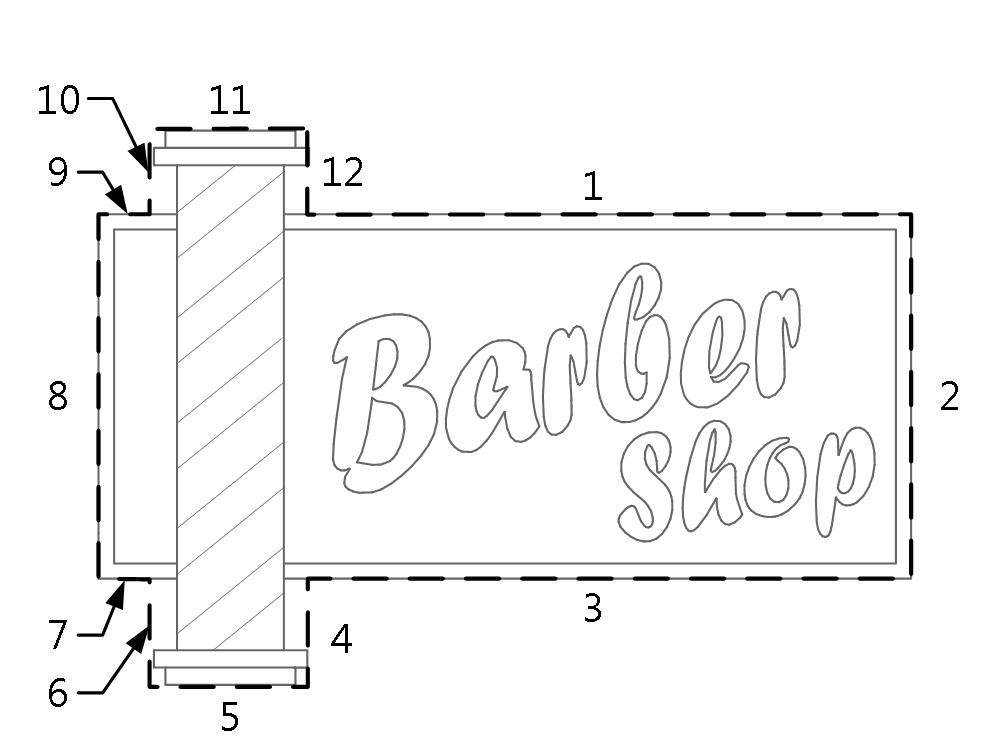
When a sign has two parallel display faces, the area of one face shall be the total sign area; however, when a sign has faces that are not parallel, the area of all faces shall be included in determining the total sign area. All riders or attachments to signs or sign structures, such as changeable sign displays, whether temporary or permanent, shall be included in determining the total sign area.
Sign structure means any supports, uprights, braces or framework of a sign.
Sign, animated, means a sign or any portion of a sign that changes position by movement or rotation or gives the illusion of such change of position.
Sign, awning, means a sign that is painted, stitched, sewn or stained onto the exterior of an awning. An awning is a shelter supported entirely from the exterior wall of a building and composed of non-rigid materials except for the supporting framework.
Sign, banner, means a sign made of fabric or other non-rigid material held in place by cables, which spans a street, alley, or other public place.
Sign, blade, means a sign hanging or attached beneath a permanent roofed shelter, awning or canopy covering a sidewalk, driveway, or other similar area.
Sign, cabinet, means a sign comprised of a metal frame and removable sign face that is typically translucent and internally illuminated.
Sign, canopy, means a sign affixed permanently to a roofed shelter attached to and supported by a building, by columns extending from the ground or by a combination of a building and columns.
Sign, changeable copy, means a sign on which message copy can be changed through the use of attachable letters or numerals, or any sign which features automatic switching of sign face.
Sign, electronic message, means an electronically changeable copy sign that displays a message or image using light-emitting diodes (LED), liquid crystal diodes (LCD), fiber optics, plasma or other illumination devices within the display area.
Sign, flashing/moving, means any sign other than an animated sign that incorporates:
Movement, either real or illusory, by mechanical, electrical or any other means; or
A change in intensity of brightness or color.
Sign, freestanding,, means a sign that is not supported by or attached to a building.
Sign, historical,means a legally approved sign designated by the city as a historical landmark.
Sign, illuminated, means a sign that is illuminated with a constant light intensity.
Sign, inflatable, means a sign that is inflated with air and sealed for display.
Sign, monument, means a freestanding sign that is supported by a base attached to the ground specifically designed for the display of the sign.
Sign, off-premises, means a sign advertising commerce not directly related to the property on which the sign is located.
Sign, portable, means a sign that is capable of being carried or moved about, except wind signs.
Sign, projecting, means a sign attached to a building and extending perpendicularly from the wall surface of the building to which the sign is attached, excluding blade signs.
Sign, public, means any sign required by the local or state government, or signs erected by government agencies, utilities, the city downtown development authority, or special districts, including, but not limited to, signs for traffic, schools, safety, railroad crossing, wayfinding, civic and special events, public notices, and other official and legal notices.
Sign, roof, means a sign which is attached to the building for support and:
Is mounted on the roof of a building;
Projects above the wall or false building front of a building with a flat roof; or
Projects above the eave line of a building with a gambrel, gable, hip, or mansard roof.
Sign, three-dimensional, means a freestanding, wall, or projecting sign that consists of one or more three-dimensional objects such as balls, cubes, clusters or objects, or sculpture (figure 10.3).
Figure 10.3: Three-Dimensional Sign
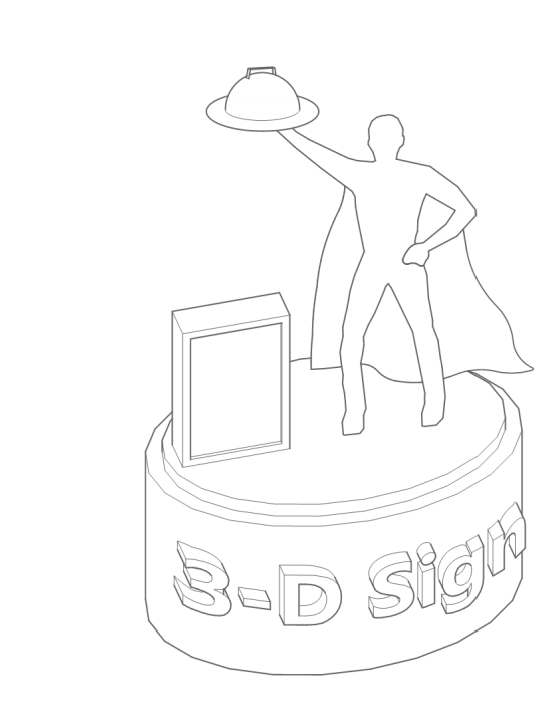
Sign, transit stop, means a sign located on a transit stop shelter or bench placed in the public right-of-way or on private property adjacent to a public right-of-way at a transit stop pursuant to a written agreement with the city containing the regulations for the size, placement, design, and materials used in the construction of such signs and shelters.
Sign, wall, means a sign displayed flat upon or against the wall of an enclosed building. Any signs not contained within a similarly styled and colored cabinet or, if separate letters, not formatted to appear to be one sign or contain one message, shall be deemed separate wall signs.
Sign, wind, means a sign consisting of one or more banners, pennants, ribbons, spinners, streamers, or other objects or material fastened in such a manner as to move upon being subjected to pressure by air or wind.
Sign, windsock, means a sign consisting of a vertical tube that moves with pressure from mechanically blown air.
Sign, window, means a sign that is painted on, applied, or attached to a window or that can be read through the window from the public right-of-way.
Sign, yard, means a nonpermanent sign constructed of paper, vinyl, plastic, wood, metal, or other material that is intended to be displayed for a short period of time.
Significant trees and native vegetation means those trees and native vegetation identified as desirable by the city tree preservation code, or are given federal, state, county or local special status listing, including, but not limited to, threatened or endangered species, species of special concern, sensitive species, state natural heritage program global, national, or state rankings of critically imperiled, imperiled, vulnerable, or apparently secure, or provide erosion control, shading of streams or creeks, or filter stormwater, or provide important habitat as defined in this Code, or as otherwise determined by the city to be significant.
Single-tenant building means a building containing one tenant.
Site distance triangle means a triangular-shaped portion of land established at street intersections and street/driveway intersections in which nothing is erected, planted, or allowed to grow in such a manner as to limit or obstruct the sight distance of persons entering or leaving the intersections. Specifications for required sight distance triangles are found in the city standards.
Site plan means a specific development plan for a lot, use, or building, specifying how the entire site will be developed, including, but not limited to, building envelopes, uses, densities, open space, parking/circulation, access, drainage, building area, landscaping, and signs. Approval of a site plan means a proposed development complies with the standards and provisions of this development code and, consequently, the city may issue a building or grading permit to an applicant, assuming all other city standards and regulations have been satisfied.
Site-specific development plan means any of the following applications as defined in this development code, if designated by the applicant as a site-specific development plan for the establishment of vested property rights according to C.R.S. title 24, art. 68:
Final subdivision plat;
Site plans, including conditional use site plans.
The site-specific development plan shall describe with reasonable certainty the type and intensity of use proposed for a specific parcel or parcels of property.
Slope means the ratio of horizontal distance (run) proportional to vertical distance (rise or drop) of a slope, such as 4:1 slope having one foot of rise for every four horizontal feet.
Slope, steep, means a slope that is 6:1 or steeper.
Store front means all or a portion of the ground floor a building facing a street occupied by nonresidential uses.
Stormwater area means a facility for storage of excess storm runoff.
Stormwater construction activity permit means a written permit issued by the city to allow grading or any other land disturbing activity, as set forth more specifically in this development code and elsewhere in this Code.
Stream means a general term for a body of flowing water; natural watercourse containing water at least part of the year. In hydrology, it is generally applied to the water flowing in a natural channel as distinct from a canal.
Stream or creek corridor means the corridor defined by a creek's or stream's ordinary high-water mark, plus associated riparian areas not including irrigation ditches. See High-water mark and Riparian area.
Street means a public way dedicated to the public for purposes of vehicular travel, including all area within the right-of-way.
Street, arterial, means a street used primarily for faster traffic speeds or higher traffic volumes.
Street, collector, means a street that collects local traffic and carries it to an arterial street.
Street, cul-de-sac, means a street open at one end only, with a radius bulb for the turning around of vehicular traffic on the other end.
Street frontage means the linear footage of a parcel abutting a public street.
Street, local, means a street used primarily for access to a limited area and that carries lower traffic volumes.
Street, no-outlet, means a street with only one outlet.
Street segment means a portion of a street which is located between two street intersections, or between a street intersection and the end of a cul-de-sac or dead-end street.
Streetscape means the visual elements of a street, including the road, sidewalks, street furniture, trees and other landscaping, open areas and other amenities that combine with adjoining buildings to form the character of the street.
Subdivider means any individual, firm, association, syndicate, partnership, corporation, trust or any other legal entity who has a proprietary interest in the land sought to be subdivided and who commences proceedings under this development code to effect a subdivision of land under this code for himself or herself or for any co-owners.
Subdivision means the act or result of dividing a lot, tract, or parcel of land into two or more lots, plats, sites or other divisions of land for the purpose of sale or building development, either immediate or future. The term "subdivision" includes re-subdivision.
Subdivision, minor, means any of the following:
A subdivision of three or fewer lots;
Property line adjustment; or
A subdivision for the sole purpose of sale or conveyance (conveyance plat).
Substantial economic hardship means a denial of all reasonable economic use of a subject property.
Sustainability evaluation system means a tool that evaluates and scores the economic, environmental and societal impacts and benefits of development in river/stream corridors, riparian areas, and wetlands.
Temporary use means a use intended for limited duration and allowed in the applicable zoning district. The term "temporary use" does not include continuing a nonconforming use as otherwise defined in this development code.
Tree lawn means a linear strip of landscape area within a public right-of-way located between a sidewalk and a curb.
Tree protection zone means an area surrounding the base of tree, generally circular in shape corresponding to the dripline (outer most branches) of a tree, within which neither construction activity nor physical development is permitted.
Turf, artificial, means synthetic materials developed or designed to resemble natural grass.
Turf, drought-tolerant, means turf species that are native to Colorado, have been hybridized for arid conditions, or are low-water grass varieties.
Turf, functional, means turf, including artificial, areas located in recreational use areas or other spaces that are regularly used for civic, community, or recreational purposes, such as playgrounds, sports fields, picnic grounds, amphitheaters, portions of parks, and the playing areas of golf courses, including driving ranges, chipping and putting greens, tee boxes, greens, fairways, and roughs.
Turf, nonfunctional, means turf, including artificial, areas not serving civic, community, or recreational purposes, including, but not limited to, grass strips between sidewalks and curbs, medians, and areas within parking lots or transportation corridors.
Underdrain collection system means a pipe collection system installed to collect the groundwater from building perimeter underdrains or area underdrains and to carry the groundwater to a point of discharge on the surface or into a storm sewer, or into a drainage channel.
Uplight (up lit) means light directed upward at greater than 90 degrees above nadir. The source of uplight can be a combination of direct uplight and reflected light.
Utilities means water and sewer infrastructure, electric equipment, storm drainage improvements, cable fiber, phone etc., and their ancillary equipment, including boxes, poles, and cables.
Utility or lighting pole means an electric transmission or distribution pole, telephone pole, street light, traffic signal, parking lot light, athletic field light, utility support structure or other similar structure approved by the city.
Vacation of easement means to abandon publicly dedicated easements. When an easement is vacated, the right to use the land for the purpose established in the easement dedication is terminated. Easements that have been dedicated to the public may only be vacated by ordinance of city council.
Vacation of right-of-way means to abandon right-of-way dedicated to the public. When right-of-way is vacated, the ownership of the property reverts to the abutting properties as contemplated by state law. Rights-of-way that have been dedicated to the public may only be vacated by ordinance of city council.
Variance means a deviation or exception from the specific terms of this code that will not be contrary to public interest.
Vertical mixed-use development means a development of one or more multiple story buildings containing two or more vertically mixed principal permitted land uses in each building.
Vested property right means the right to undertake and complete the type and intensity of development and use of property under the terms and conditions of an approved site-specific development plan for a period of three years from the date of approval. Vested property rights may include the number and type of units or the type and amount of square footage of development described on an approved site-specific development plan but shall not include any aspect of the site-specific development plan that does not directly affect the type or intensity of use, such as, but not limited to, signage, landscaping, streets, utilities, parking, or drainage.
Volume-to-capacity ratio (V/C) means a measure of the operating capacity of a roadway or intersection, in terms of the number of vehicles passing through, divided by the number of vehicles that theoretically could pass through when the intersection or roadway is operating at its designed capacity. A V/C ratio of 1.0 means the roadway or intersection is operating at capacity; if the V/C ratio is less than 1.0, the traffic facility has additional capacity.
Walkway means an off-street pedestrian path not in an arterial right-of-way or primary or secondary greenway.
Wetlands means an area that is inundated or saturated by surface or ground water at a frequency and duration sufficient to support, and that under normal circumstances do support, a prevalence of vegetation typically adapted for life in saturated soil conditions.
Xeriscape orxeriscaping means landscaping characterized by the use of vegetation and other landscaping materials that are drought-resistant or water-conserving.
Yard. See Setback.
(Code 2009, § 15.10.020; Ord. No. O-2018-51 , § 5, 12-11-2018; Ord. No. O-2019-62 , § 4, 10-22-2019; Ord. No. O-2020-37, § 4, 10-13-2020; Ord. No. O-2021-16, § 8, 3-30-2021; Ord. No. O-2021-18, § 3, 4-13-2021; Ord. No. O-2024-17, § 2, 2-27-2024; Ord. No. O-2025-78, § 2, 11-18-2025)

