
Longmont City Zoning Code
CHAPTER 15
06. - SIGNS
Sec. 15.06.010. - Purpose and applicability.
A.
Purpose. The purpose of this chapter is to promote the public safety and welfare by regulating signs in keeping with the following objectives:
1.
To improve the visual environment and promote economic development while providing adequate standards for the display of signs;
2.
To allow for maximum creativity while enhancing the quality of signs;
3.
To ensure that the design, construction, installation, repair, and maintenance of signs protects public safety from potential hazards, especially those along public rights-of-way and near intersections;
4.
To ensure that city rights-of-way are used in a manner consistent with the public interest;
5.
To minimize incompatibility between signs and their surroundings;
6.
To regulate signs in accordance with the city's policies and consistent with the United State and Colorado Constitutions; and
7.
To protect the right to free speech by the display of messages on a sign through content-neutral regulations.
B.
Applicability.
1.
All signs and sign support structures shall conform to the requirements of this chapter and all other applicable provisions of this Code.
2.
No sign shall be displayed in the city limits until the city has issued a permit for it unless it is exempt from a permit according to section 15.06.020.
3.
No permit shall be issued unless the applicant demonstrates that the proposed sign meets the requirements of this chapter.
4.
All sign face changes including repairs and/or sign face replacements, except for changing or replacing text on changeable copy signs, require a permit.
5.
Minimum submittal requirements and sign permit applications are available in the administrative manual. Fees for permits and installation shall be established and from time to time revised by resolution of the city council.
6.
When a sign permit is requested for a parcel where nonconforming, illegal, or prohibited signs exist, no sign permit shall be issued until all such signs are removed or brought into conformance with this chapter.
7.
The director of planning and development services, or designee, may exempt signs from any or all provisions of chapter 15.06, provided the signs serve a governmental (federal, state, county, city, or district) purpose, are located on property owned or controlled by a governmental entity, and the signs are designed such that they minimize impact to surrounding businesses and residents to the maximum extent possible. Such signs include, but are not limited to, street signs, traffic control devices, bus stop and information signs, and tourist information signs. This exemption will be documented in a form acceptable to the director of planning and development services.
C.
Savings and severability.
1.
Signs containing noncommercial speech are permitted anywhere that advertising or business signs are permitted, subject to the same regulations applicable to such signs.
2.
If any clause, section, or other part of the application of this chapter shall be held by any court of competent jurisdiction to be unconstitutional or invalid, it is the intent of the city that such clause, section, or other part of the application of this section shall be considered eliminated and not affecting the validity of the remaining clauses, sections, or applications which shall remain in full force and effect.
D.
Conflicts with other provisions. Nothing in this chapter shall be deemed a waiver of the provisions of any other ordinance or regulation applicable to signs. Signs located in areas governed by several ordinances or applicable regulations shall comply with all such ordinances and regulations. If there is a conflict between this chapter and any other ordinance or regulation, the more stringent shall apply. Nothing in this chapter is intended to conflict with the provisions of the Colorado Outdoor Advertising Act (C.R.S. § 43-1-401 et seq.).
(Code 2009, § 15.06.010; Ord. No. O-2025-10, § 3, 1-28-2025)
Sec. 15.06.020. - Signs exempt from permit requirement.
The following non-illuminated signs may be erected in compliance with this chapter without the issuance of a sign permit. Such signs may be allowed in addition to all other signs permitted and shall conform to setbacks, height, and other applicable requirements of this chapter.
A.
Reserved.
B.
Yard signs. Yard signs are allowed and are exempt from the sign permit requirement provided such signs:
1.
Shall not exceed two per property at any one time;
2.
Shall not exceed 12 square feet per sign in the R-RU, R-SF, R-MN, and R-MH zoning districts, and shall not exceed 32 square feet per sign in all other zoning districts; and
3.
Shall not exceed a height of four feet in the R-RU, R-SF, R-MN, and R-MH zoning districts, and shall not exceed a height of eight feet in all other zoning districts.
C.
Flags. Any flag affixed to a permanent flagpole or affixed to a building, not including feather flags, is allowed and is exempt from the sign permit requirement provided the area of the flag shall not exceed 32 square feet in the R-RU, R-SF, R-MN, and R-MH districts. In mixed-use and nonresidential zoning districts, flags and flag structures may extend up to five feet over the maximum height allowed in the underlying zoning district.
D.
Window signs. Window signs are allowed and are exempt from the sign permit requirement, provided window signage does not cover more than 25 percent of a window opening or 50 percent of any one window panel if a window opening contains multiple window panels.
E.
Signs located inside a building. Signs located inside a building are allowed and are exempt from the sign permit requirement provided any interior sign within six feet of any window shall not have any flashing or moving lights, including video monitors and electronic message signs.
F.
Integral signs. Any inscription carved into stone or similar material that is integral to a building, such as is commonly found on cornerstones or stamped into sidewalks, is allowed and is exempt from the sign permit requirement. Such integral signs shall not exceed 12 square feet in area.
(Code 2009, § 15.06.020; Ord. No. O-2025-10, § 4, 1-28-2025)
Sec. 15.06.030. - Prohibited signs.
The following signs are prohibited unless otherwise stated in this chapter:
A.
Distracting, interfering or confusing signs.
1.
Signs that cause visual obstruction or interfere with motor vehicle traffic or a traffic control device, including any sign that obstructs clear vision in any direction from any street intersection or driveway.
2.
Signs employing a lighting or control mechanism that causes radio, radar, or television interference.
3.
Signs that obstruct any fire escape, window, door, or opening used or required as a means of egress or ingress, or for emergency purposes, or that interfere with any openings required for light or ventilation.
4.
Signs in rights-of-way or on other public property unless specifically permitted or provided for in this chapter.
B.
Animated or moving signs.
1.
Animated or moving signs except for scoreboards for athletic events, time and temperature devices, electronic message signs used by the city or other public agency to address a health or safety matter or public service announcement or permitted electronic message signs.
2.
Inflatable signs such as balloons and inflatable figures, or other similar moving, fluttering, or revolving devices.
3.
Pennants and windsocks, unless approved with a temporary sign permit.
C.
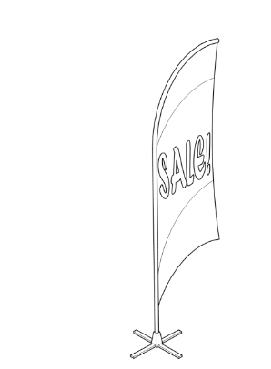
Feather flags. Feather flags and similar devices, unless approved with a temporary sign permit (figure 6.1).
Figure 6.1: Feather Flag
D.
Neon or LED lighting signs. Neon or LED lighting not within the lettering or logo of a sign shall be subject to section 15.06.040 and section 15.05.140.
E.
Portable signs.
1.
Portable signs, except as authorized in section 15.06.040.G.
2.
Signs on parked vehicles or trailers unless:
a.
Such vehicle or trailer is operational, currently registered with current tags, and parked in a functional parking space or behind a primary building;
b.
Such signs are not located on top of a vehicle, except for delivery vehicles; and
c.
Such signs are not electronic message signs.
F.
Roof-mounted signs. Roof signs or any portion of a sign or sign cabinet or frame extending above the parapet or roof eave, except for historic signs on historic landmarks.
G.
Posters, handbills and painted signs.
1.
Signs painted on or attached to fences.
2.
Signs attached to utility poles or other poles or structures, except bus stop signs, within public rights-of-way.
H.
Off-premises signs. Off-premises signs, except transit-stop signs.
I.
Abandoned or inoperable signs.
1.
Inoperable, unsafe, malfunctioning, unrepaired or dilapidated signs.
2.
Unused or abandoned signs, including any pole, post, or structure supporting such sign.
J.
Signs within the sight distance triangle. To preserve sight distance, an unobstructed view shall be maintained within sight distance triangles as follows:
1.
Sight distance requirements are addressed in chapter 15.10 under the definition of the term "sight distance triangle" and in the city standards.
2.
No signs, except traffic signs, shall exceed a height of 36 inches above the grade of the lower roadway within a sight distance triangle.
3.
Sign projection or overhang across a sight distance triangle shall be permitted only when the bottom of the sign surface is a minimum of nine feet above the grade of the higher roadway. Sign supports not complying with subsection J.2 of this section shall not be located within a sight distance triangle.
(Code 2009, § 15.06.030)
Sec. 15.06.040. - General sign regulations.
A.
Signs for single-tenant buildings.
1.
The number and size requirements for each type of sign allowed for single-tenant buildings are indicated in table 15.06.060.
2.
Wall sign length shall not exceed 70 percent of building frontage.
3.
Signs shall be appropriately scaled and compatible with buildings and other features of the site in terms of color, materials, design and illumination.
B.
Signs for multiple-tenant buildings.
1.
Sign locations. Signs for multiple-tenant buildings are allowed only within the designated sign areas as shown on an approved sign permit application.
2.
Individual tenant signs.
a.
Freestanding signs. No individual tenant in a multiple-tenant building or development is allowed a separate freestanding sign. The total sign area allowed for freestanding signs on a multiple-tenant property is indicated in table 15.06.060.
b.
Wall and projecting signs.
i.
Individual tenants in multi-tenant buildings are permitted wall and projecting signs as indicated in table 15.06.060. Approved wall area is based on the length of the exterior wall of individual tenant spaces.
ii.
In instances where a building contains tenants without an exterior wall, additional sign area for such interior tenants in the building may be included on a shared exterior sign. Such sign shall not exceed 16 square feet.
iii.
Additional sign standards are as specified in section 15.06.050.A and in table 15.06.060.
iv.
Wall sign length shall not exceed 70 percent of building frontage associated with the respective tenant.
v.
Signs shall be appropriately scaled and compatible with buildings and other features of the site in terms of color, materials, design and illumination.
C.
Signs within historic districts, mixed-use downtown (MU-D), and the city downtown development authority (DDA) boundaries. All signs within a local or national registered historic district, the MU-D district, or the DDA boundaries as defined in Ordinance No. O-82-76, and as amended in Ordinance No. O-2008-104 (DDA boundaries), shall be appropriate and compatible with buildings and other features of the site in terms of color, materials, and design. Signs shall also comply with adopted design guidelines for local historic districts and C-O districts, the MU-D district, and the DDA boundaries, as applicable. See section 15.06.110.
D.
Signs in downtown breezeways, rights-of-way and other public property. The city downtown development authority may install banners and signs attached to light and utility poles in the breezeways, rights-of-way, and other public property within the DDA boundaries.
E.
Signs located in or extending into or over public property. Signs allowed under this sign code that are located on or extend into public property require approval of a revocable use of public places permit pursuant to chapter 13.37. Temporary signs allowed on city property are exempt.
F.
Temporary sign permits. Temporary signs, unless exempt, shall require a permit pursuant to section 15.06.070 and compliance with the following standards:
1.
Term. Temporary signs may be displayed for no more than 30 days in any calendar quarter (January through March, April through June, July through September, and October through December).
2.
Limit on number. An applicant may only use one of the temporary sign categories, subsections F.4 through F.8 of this section under a temporary sign permit.
3.
Public safety. All temporary signs in this subsection shall be installed in a manner that does not create a safety hazard or impede pedestrian access.
4.
Temporary banners. Temporary banners may be allowed with a temporary sign permit provided they comply with the following:
a.
No banner shall exceed 16 square feet, unless the applicant demonstrates that a larger banner is necessary for legibility due to the proposed location of the banner;
b.
No more than one banner shall be displayed on a property at any one time;
c.
Banners shall be professionally printed on durable material; and
d.
Banners on public property shall comply with section 15.06.040.G.
5.
Feather flags. Feather flags may be allowed with a temporary sign permit, pursuant to the following:
a.
Maximum of one per 75 feet of street frontage;
b.
Maximum of three per property;
c.
Shall not exceed 12 feet in height; and
d.
Shall be set back from the property line a minimum distance equal to the height of the feather flag.
6.
Windsocks. Windsocks may be allowed with a temporary sign permit, pursuant to the following:
a.
Maximum one per property;
b.
Maximum of 15 feet in height; and
c.
Shall be set back from the property line a minimum distance equal to the height of the windsock.
7.
Pennants. Pennants may be allowed with a temporary sign permit, provided that no pennant shall exceed the height of the permanent structure to which it is attached.
8.
Portable A-frame sign. Portable A-frame signs may be allowed with a temporary sign permit, pursuant to the following:
a.
Maximum one per business;
b.
Maximum six square feet; and
c.
Maximum four feet in height.
9.
Temporary signs. Temporary signs within the DDA boundaries shall be subject to the downtown sign design standards in section 15.06.110.
G.
Portable signs and banners on public property. Where buildings have been built legally to the property line, portable signs and banners are allowed subject to the following standards:
1.
Portable signs may be allowed on public property only if there is not adequate space to display a sign on private property.
2.
Portable signs or banners on public property shall be installed to provide adequate space to accommodate pedestrian maintenance access and to minimize potential hazards for pedestrians and vehicles.
3.
Portable signs are limited to one per street frontage except that for multi-tenant buildings or developments, one additional portable sign may be allowed on any street frontage for buildings having more than 25 feet of street frontage.
4.
Banners shall be attached flat to a building wall or flat to an approved seating enclosure on public property. No freestanding temporary signs, including wind signs, are allowed on public property, except for downtown special event signs allowed under the downtown sign design standards in section 15.06.110.
H.
Sign color. High intensity colors and fluorescent pigments shall not be used on any sign, sign cabinet or frame, or support structure except as sign trim or on a sign logo not exceeding five percent of the sign area and compatible with the primary building design and color.
I.
Sign illumination.
1.
Signs may be illuminated pursuant to table 15.06.060.
2.
Illumination of signs shall comply with the outdoor lighting standards in section 15.05.140.
3.
Signs shall not exceed 100 nits (candela/square meter) between one-half hour before sunset and one-half hour after sunrise and 1,000 nits during other times. Signs shall include automatic dimmer controls to adjust brightness levels.
4.
Exposed neon and exposed LED lighting on any portion of a building or structure except within the lettering or logo on a freestanding or wall sign, is subject to the provisions of section 15.05.140. Exposed neon and exposed LED lighting is prohibited on signs within or adjacent to and facing a residential zoning district unless otherwise exempted in this chapter.
5.
Signs within or adjacent to and facing a residential zoning district shall be located, shielded, and screened to prevent direct light or glare onto adjacent uses or properties.
J.
Sign measurement and location.
1.
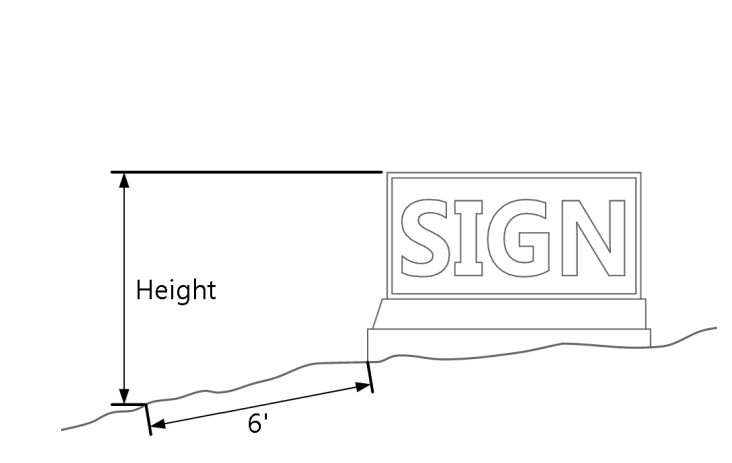
Sign height. The height of a sign shall be measured from the average grade at the base of a sign to the highest point of the sign, including all support structures. For freestanding signs located on a slope or berm, the height of the sign shall be measured from the average grade established between the base of the sign and the lot line; or where the lot line is more than six feet from the base of the sign, between the base of the sign and a point six feet down slope from the sign (figure 6.2).
Figure 6.2: Sign Height Measurement
2.
Sign area.
a.
Single-faced signs. The area of a sign shall include the entire area within a continuous single perimeter enclosing the limits of the text, symbols, photographs, logos, and display faces, including any frame or other material or color forming an integral part of the display or used to differentiate the sign from the background against which it is placed. The area shall exclude support structures on which a sign is placed. Sign area is as defined in chapter 15.10.
b.
Double-faced signs. All signs other than wall signs may be back-to-back (two sign faces), and each face may have an area not to exceed the maximum stated for each respective type of sign.
c.
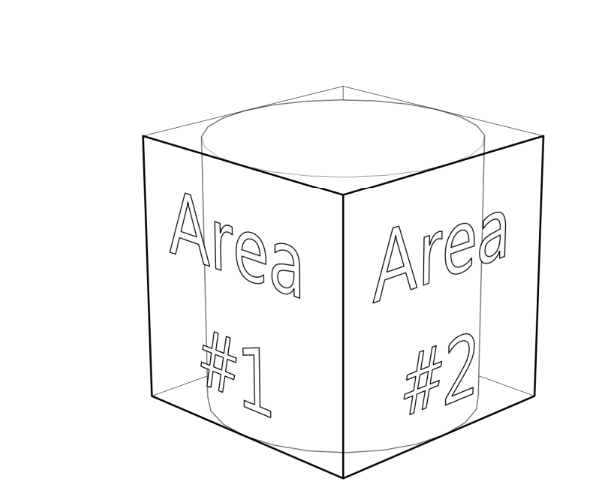
Three-dimensional signs. The sign area of a three-dimensional sign shall be calculated by adding the area of two adjacent vertical faces of the smallest cube that can encompass such sign (figure 6.3).
Area 1 + Area 2 = Total Sign Area
Figure 6.3: Three-Dimensional Sign Measurement
3.
Sign location. Signs shall be located as specified in table 15.06.060. Attached signs shall be located only in approved sign wall areas as follows:
a.
All buildings. Approved sign areas shall be located consistent with building architecture and shall not detract from key building features. Signs shall be aligned on single-tenant and multi-tenant buildings within consistent sign bands, except that signs at customer entrances or on other prominent building features shall be located consistent with architectural features.
b.
Single-tenant buildings. For a building containing one tenant, any exterior facade wall that is facing an abutting public street or alley or any exterior wall facing a customer parking lot of the use.
c.
Multi-tenant buildings.
i.
Any exterior facade wall of an individual tenant that has a public entrance and exit;
ii.
Any exterior facade wall of an individual tenant that faces an abutting public street or alley, or the customer parking lot of the building; and
iii.
Any approved location for a shared exterior wall directory sign pursuant to subsection B.2.b.ii of this section.
K.
Discontinued use or change in use.
1.
Whenever the approved use of a property or tenant space is discontinued for more than 90 days, all signs and sign support structures on that subject property and/or tenant space shall be removed. Any new use established on the subject property shall comply with this chapter.
2.
Whenever a permit is requested to change a sign or sign face, the sign and support structure shall also comply with this chapter. Individual sign faces on a multi-tenant freestanding sign are exempt.
(Code 2009, § 15.06.040)
Sec. 15.06.050. - Specific sign type standards.
A.
Wall signs. Wall signs are allowed as indicated in table 15.06.060. Additionally:
1.
Wall signs may project out from the facade on which the wall sign is attached up to a maximum of 12 inches.
2.
Wall signs shall not extend beyond the height of a building parapet or top of wall.
3.
An increase in wall sign area up to 25 percent shall be allowed for buildings that are located 300 feet or more from the street frontage that the wall sign is facing.
4.
Cabinet signs are prohibited in the MU-D and residential zoning districts.
5.
Creative wall sign designs are encouraged. Also see section 15.06.070.B for sign design incentives.
B.
Projecting signs. Projecting signs are allowed as indicated in table 15.06.060. Additionally, projecting signs:
1.
Shall provide a minimum clearance of eight feet between the sign and the sidewalk over which the sign is located.
2.
May project out from the facade on which the projecting sign is attached up to a maximum of five feet.
3.
Shall not extend beyond the height of a building parapet or top of wall.
4.
Projecting cabinet signs are prohibited in the MU-D zoning district.
5.
Creative projecting sign designs are encouraged. Also see section 15.06.070.B for sign design incentives.
C.
Awning signs. Awning signs are allowed as indicated in table 15.06.060. Additionally:
1.
Awning signs shall be stitched to or otherwise incorporated directly into the awning. No portion of such sign shall be riveted or otherwise fastened to the frame or directly to the awning.
2.
Plastic, vinyl, acrylic or similar awning signs are prohibited.
3.
Creative awning designs are encouraged. Also see section 15.06.070.B for sign design incentives.
4.
Awning frames shall comply with building code requirements.
D.
Canopy signs. Canopy signs are allowed as indicated in table 15.06.060:
1.
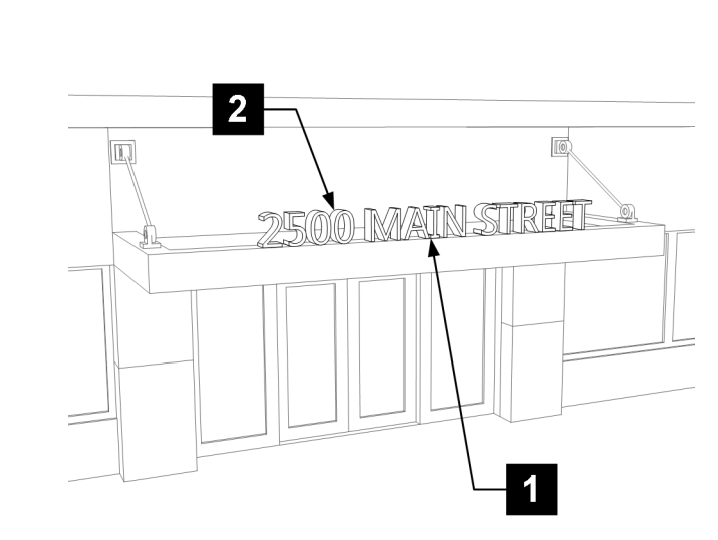
Canopy signs shall be integrated into the canopy design (figure 6.4).
2.
Individual sign lettering may be placed on top of a first story canopy attached to a building entrance provided the letters do not interfere with key architectural elements (figure 6.4).
3.
Cabinet signs attached to a canopy are prohibited.
4.
Creative canopy sign designs are encouraged. Also see section 15.06.070.B for sign design incentives.
5.
Fuel pump canopies shall also comply with section 15.04.030.D.25.d.
Figure 6.4: Canopy Sign
E.
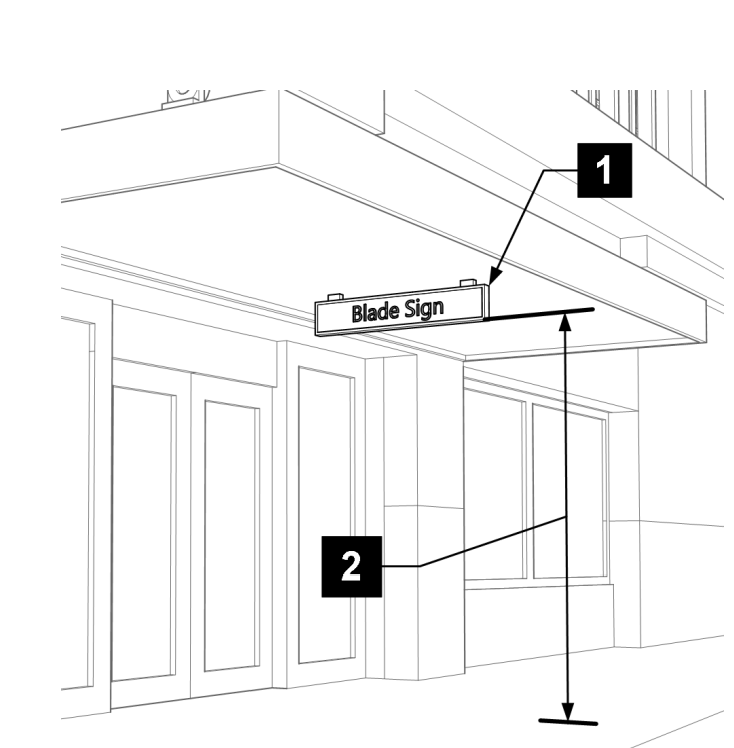
Blade signs. Blade signs are allowed as indicated in table 15.06.060. Additionally:
1.
Blade signs shall not extend beyond the edge of an awning, canopy, arcade, gallery, or other structure.
2.
Blade signs shall provide a minimum clearance of eight feet between the sign and the sidewalk over which the sign is located (figure 6.5).
3.
Blade signs shall not count against the overall maximum signage allowed.
4.
Creative blade sign designs are encouraged and cabinet signs are prohibited as blade signs.
Figure 6.5: Blade Sign Standards
F.
Changeable copy signs; wall. Changeable copy wall signs are allowed as indicated in table 15.06.060. Changeable copy wall signs may project up to a maximum of 12 inches from the facade on which they are attached. Changeable copy signs that project more than 12 inches shall be considered projecting signs and shall meet the standards in section 15.06.050.B and in table 15.06.060.
G.
Changeable copy signs; freestanding. Freestanding changeable copy signs are allowed as indicated in table 15.06.060.
H.
Standards applicable to all freestanding signs.
1.
Freestanding sign separation.
a.
Freestanding signs on adjacent lots or development parcels for different uses on the same street frontage shall be separated by the maximum distance practicable to minimize impacts on the visual environment, allow for adequate sign visibility, and to comply with the sight distance standards in section 15.06.030.J. The applicant shall submit scaled plans (and digital images and photo simulations when requested by the city) depicting the location of existing and planned freestanding signs.
b.
Freestanding signs on the same lot or parcel on intersecting street frontages shall be separated by at least 200 feet as measured by a straight line between signs.
c.
Freestanding signs shall be set back from the nearest principal building on the same lot or parcel by a minimum distance equal to the height of the sign.
2.
Side yard setback for freestanding signs. Unless otherwise permitted in this sign code, freestanding signs shall be set back from any interior side lot line a distance equal to the height of the sign, except that monument signs not exceeding six feet in height may be within one foot, subject to sight distance restrictions in section 15.06.030.J.
3.
Freestanding sign design.
a.
All freestanding signs, except for freestanding post signs pursuant to section 15.06.050.I, shall be of a monument design including a monument base attached to the ground with no space between any sign cabinet and the monument base.
b.
Monument bases shall be constructed of brick, stone, wood or metal material consistent and compatible with an exterior material and color of the primary building.
c.
For monument signs with a sign cabinet, the monument base shall be equal or greater in depth and length than the sign cabinet. Sign cabinets for freestanding signs shall not exceed 24 inches in depth.
d.
Freestanding signs, including cabinets and faces, shall be consistent and compatible with the design of the building, structures, and other features of the development.
e.
Cabinet signs are prohibited in the MU-D and residential zoning districts.
f.
Creative freestanding sign designs are encouraged. Also see section 15.06.070.B for sign design incentives.
I.
Freestanding post signs.
1.
Freestanding post signs are allowed as indicated in table 15.06.060 provided such signs are:
a.
Supported by posts on each end of the sign;
b.
Designed to be compatible with the design of buildings within the development;
c.
Constructed of durable wood or metal materials; and
d.
Externally illuminated using ground-mounted lights, if illumination is proposed.
2.
Freestanding post signs supported by a single pole or post or that include cabinet signs, are prohibited.
J.
Transit-stop signs.
1.
Signs on transit-stop shelters and benches are permitted on street rights-of-way and adjacent private property when there is not adequate space for a shelter or bench in the right-of-way.
2.
Signs on transit-stop shelters are limited to three sign faces per shelter not to exceed 24 square feet per sign face. Sign faces shall not extend above the roof eaves of a shelter or beyond the outside dimensions of the shelter. Sign faces shall be mounted flush to the shelter and shall face a public street right-of-way.
3.
Signs on transit-stop benches are limited to one sign face per bench not to exceed 12 square feet per sign face. Sign faces shall not extend more than two feet above the bench seat and shall not extend beyond the width of the bench.
4.
Lighting of signs on transit-stop shelters is allowed. Lighting of signs on transit-stop benches is not allowed. Sign lighting on transit-stop shelters shall be constant, and shall not flash, blink or change color.
5.
Electronic message signs are prohibited on transit-stop shelters and benches. Sign lighting on transit-stop shelters shall comply with the sign illumination standards of section 15.06.040.I.
K.
Drive-through facility signs. Uses with a drive-through facility may have additional freestanding signage as indicated in table 15.06.060. Such additional drive-through facility signs:
1.
Shall be limited to one face.
2.
Shall be of a consistent design and shall use similar colors and materials as other freestanding signs on the property.
L.
Electronic message signs. Electronic message signs are allowed pursuant to the following:
1.
Shall only be allowed as part of a freestanding monument sign and only in the MU-N, MU-C, MU-E, MU-R, N-PE and N-PF zoning districts;
2.
The electronic message portion shall not exceed 50 percent of the allowed monument sign area;
3.
Only static electronic messages are allowed; and
4.
Each electronic message shall remain on the screen for a minimum of 15 seconds. Messages will change only through a fade or dissolve transition and the transition shall not exceed 0.3 seconds between messages.
M.
Historical signs. Signs that are individually or as part of a building designated by the city as a historic landmark are allowed to be retained, provided that:
1.
The sign is kept in good repair;
2.
The sign does not constitute a hazard to public safety; and
3.
The original design of the sign does not change.
(Code 2009, § 15.06.050)
Sec. 15.06.060. - Table of permanent sign standards.
Types of signs permitted in the respective zoning districts of the city are indicated in Table 15.06.060. If a specific sign style or type is not included in the following table it is prohibited in the respective zoning district.
(Code 2009, § 15.06.060)
Sec. 15.06.070. - Sign permits and sign design incentives.
A.
Sign permits.
1.
Signs requiring a permit. All permanent and temporary signs not exempt from a permit pursuant to section 15.06.020 shall not be erected, displayed, altered, relocated, or replaced until the city has issued a sign permit under section 15.02.120. The applicant and sign owner are responsible for demonstrating compliance with the sign standards.
2.
Expiration of a sign permit. If a sign authorized by any permit has not been erected within 180 days from the date of the permit approval and an extension has not been granted, the sign permit shall be deemed expired.
B.
Sign design incentives.
1.
Purpose. The purpose of these sign design incentives is to encourage an applicant to develop creative signs for a property or development.
2.
Applicability. These sign design incentives are available in all mixed-use and nonresidential districts. Signs in the MU-D zoning district that are also within the DDA boundaries as defined in section 15.06.110.A are subject to downtown sign design standards approval per section 15.06.110.
3.
Eligible sign design incentives. The following sign designs are eligible for an increase in sign area beyond what is allowed, or flexible sign placement of wall signs on multi-story building:
a.
Wall, projecting, or freestanding cabinet sign with routed metal face and opaque background: 20 percent increase in sign area.
b.
Wall, projecting, canopy or freestanding signs using individual pan channel lettering: 30 percent increase in sign area and placement of one sign per sign wall above first story.
c.
Wall, projecting, canopy or freestanding signs using reverse pan channel lettering with halo illumination: a 50 percent increase in sign area and placement of one sign per sign wall above first story.
d.
Wall, projecting, canopy or freestanding signs with external illumination using gooseneck or similar fixtures (not including cabinet signs): a 50 percent increase in sign area.
4.
Review criteria. Signs eligible for design incentives shall comply with the following criteria:
a.
The design represents a creative design in which sign colors, materials, design, size, height, placement, illumination, and number of signs are appropriate and compatible with the buildings, structures, and other features on the site.
b.
Nonconforming signs and sign support structures on the building and property shall be removed.
(Code 2009, § 15.06.070)
Sec. 15.06.080. - Nonconforming signs and sign plans approved under prior code.
A.
Legal nonconforming signs. A nonconforming sign or sign structure shall be removed or shall comply with the current sign standards when any one of the following conditions occurs:
1.
Whenever the property's use is discontinued or changed as specified in section 15.06.040.K;
2.
Whenever a site plan is submitted for changes to the site improvements such as additional parking area, reconfigured landscaping, or building additions;
3.
Whenever 50 percent or more of the total area of the sign has changed. Periodic changes to changeable copy and electronic message signs are exempt;
4.
Whenever the sign is damaged more than 50 percent of its total replacement value or sign area, or the sign is destroyed or becomes obsolete or substandard under any applicable ordinance of the municipality or to the extent that the sign becomes a hazard or a danger;
5.
Whenever there is a request for a building permit to make improvements to the facade of the building on which the nonconforming sign is located; or
6.
Whenever public improvements are made, or are planned to imminently be made in the right-of-way or city property and such improvement is or will be affected by the location of the sign.
B.
Modifications to existing structural support of nonconforming signs. Modifications to existing structural supports of nonconforming signs that require a permit are not allowed, except to bring the signs into conformance with the current sign standards.
C.
Sign plans approved under prior code.
1.
Continuation of nonconforming signs. Signs approved under prior codes, including master sign plans, but not complying with current sign standards, are nonconforming. Existing signs may continue under the provisions of section 15.06.090 regarding maintenance and enforcement.
2.
Exception. Signs approved as part of a master sign plan which has not lapsed under prior codes but not yet installed may be installed up to only one year from the adoption of the ordinance from which this development code is derived.
(Code 2009, § 15.06.080)
Sec. 15.06.090. - Sign installation, maintenance and enforcement.
A.
Conformance to building code required. All signs and sign structures shall conform to title 16.
B.
Inspections and engineering design.
1.
All signs shall be subject to inspection by the appropriate agents of the city for the purpose of determining compliance with this sign code.
2.
Footing and foundation inspections are required for all permanent freestanding signs. Any permanent freestanding sign over six feet in height requires engineered plans stamped by a state-licensed structural engineer.
3.
Any sign that projects over a pedestrian area or any public right-of-way requires engineered plans stamped by a state-licensed structural engineer.
C.
Signs with electrical wiring; conformance to electrical code. All signs containing electrical wiring are subject to the provisions of the electrical code, as adopted by the city.
D.
Maintenance required. All signs shall be maintained and shall be kept in good repair.
E.
Signs believed unsafe authority to require certification of safety. When, in the opinion of the director, reasonable cause exists that a proposed or existing sign structure is unsafe, the applicant shall furnish a certificate from a registered structural engineer certifying its safety.
F.
Abandoned or inoperable signs and sign support structures. Unused or abandoned signs and sign support structures shall be removed within 90 days following the termination of the reason for the sign, except for historic signs on historic landmark properties.
(Code 2009, § 15.06.090)
Sec. 15.06.100. - Violations.
1.
It is unlawful for any person, firm, corporation or employee or agent, to erect, construct, enlarge, alter, repair, move, improve, remove, convert or demolish, equip, use or maintain any sign or cause or permit the same to be done in violation of this chapter.
2.
Signs placed in the right-of-way contrary to this chapter are a violation of this development code and the city may remove such illegal signs without notice.
3.
Any person, firm, or corporation violating or permitting a violation of this chapter commits a separate offense for each day or part of a day the violation exists subject to the provisions of chapter 15.09.
(Code 2009, § 15.06.100)
Sec. 15.06.110. - Downtown sign design standards and procedures.
A.
Downtown sign design standards adopted. The downtown sign design standards are hereby adopted and included as appendix A to this development code. Within the boundaries of the downtown development authority (DDA and DDA area) as defined in Ordinance No. O-82-76, and as amended in Ordinance No. O-2008-104, its provisions shall supplement the provisions of this chapter 15.06. In the event of a conflict between the downtown sign design standards and this section, this section shall govern. In the event of a conflict between the downtown sign design standards and other provisions of this chapter, the downtown sign design standards shall govern.
B.
Purpose and intent. The purpose and intent of the downtown sign design standards is to promote economic vitality and enhance property values and the visual environment in the downtown, protect and promote the historic character of the downtown through appropriate sign design, and encourage unique, creative, and innovative signs that are compatible and coordinated, making the downtown more unified.
C.
Downtown design board (DDB).
1.
Composition. The DDB shall be composed of those appointed by city council to serve as the voting members of the DDA board of directors (DDA board). The DDA bylaws, as amended February 23, 2005, provide that the DDA board is comprised of seven voting members appointed by the city council and two ex-officio members. The bylaws provide that one DDA board member is a member of the city council, and the remaining board members are people who reside in, or represent businesses located in, the DDA area.
2.
Executive director. The executive director (director) of the DDB shall be the person appointed by the DDA board, with approval by the city council, to be the executive director of the DDA. This officer is an employee and the chief executive officer of the DDA and has general supervision over its functions, and is not a member of the DDA board.
3.
Design advisory committee. The DDB shall appoint a design advisory committee (DAC) to advise the DDB and the director on any sign- or other design-related matters at the request of the DDB or the director.
D.
Downtown sign compliance certificate required. The city shall not issue a sign permit under chapter 15.06 for display within the DDA area unless it has received a certificate of compliance with the downtown sign design standards pursuant to this chapter. No such certificate of compliance shall be issued unless the applicant demonstrates that the proposed sign meets the requirements of the downtown sign design standards. All sign and face changes in the DDA area, except changeable copy changes on marquee signs and handbill display changes, require a new sign permit under chapter 15.06, including a new certificate of compliance. Minimum submittal requirements and applications for compliance certificates are available at the DDA offices. Fees for compliance certificates shall be established, and from time to time revised, by resolution of the DDB.
E.
Exemptions. Any permit exempt from the permit requirements of chapter 15.06 is also exempt from this section. Any permanent window sign to be displayed in the DDA area, or any change to such a window sign, requires director or DDB approval.
F.
Certificate procedure.
1.
Application submittal and review.
a.
For all signs subject to review under the downtown sign design standards, an application shall be submitted to the director at the DDA offices.
b.
The director shall review the application for completeness and conformity with the downtown sign design standards. The director may request individual written comments from DAC members at any time, without convening the full DAC.
2.
Director action. Within seven days of the DDB's receipt of a complete application, the director shall take one of the following actions:
a.
Approve a certificate of compliance for the application, with or without conditions.
b.
Deny a certificate of compliance for the application.
c.
Request an advisory opinion from the DAC. An opinion shall issue only if it is approved by majority vote and shall be supported by written findings. The DAC shall issue its opinion within seven days of the director's request, and the director shall take action within seven days thereafter. After receiving such an opinion, the director shall have options listed in subsections F.2.a, b, and d of this section.
d.
Refer the application to the DDB. In this case, the DDB shall decide, by majority vote, at the next regular monthly DDB meeting, but in no event more than 45 days after the DDB's receipt of the complete application, whether the application conforms to the downtown sign design standards, and accordingly whether to approve, approve with conditions, or deny a certificate of compliance for the application. A tie vote of the DDB results in a denial.
3.
Notice to applicant. The director shall send written notice to the applicant within seven days of any decision to approve, approve with conditions, or deny the certificate, or refer the application to the DDB.
4.
Appeal. The applicant may appeal to the DDB a director's decision to approve with conditions or deny a permit application by letter to the director within 14 days of the director's decision. In such case, the DDB shall review the director's decision de novo under the procedure provided in subsection F.2.d of this section. On appeal, the DDB shall decide whether to approve, approve with conditions, or deny the permit. No appeal is permitted from a DDB decision, except as provided by state law.
5.
Waiver of appeal. The applicant may waive appeal rights in writing to expedite the city's decision-making process on the chapter 15.06.
G.
Modifications. The applicant may request a modification, a right to deviate from the downtown sign design standards, in a letter with the application stating all reasons for the modification. For any application requesting such a modification, the director shall first obtain an advisory opinion from the DAC pursuant to subsection F.2.c of this section. Otherwise, the process shall be as stated in subsection F of this section. The director or DDB shall approve a certificate of compliance, with or without conditions, for an application requesting modifications only if each deviation from the downtown sign design standards meets either the criterion in subsection 1 or all criteria in subsections 2 through 4 of this subsection G, as follows:
1.
Special circumstances exist on the subject property such that the strict application of the downtown sign design standards would result in undue practical difficulties for the applicant.
2.
The modification is consistent with the purposes of the downtown sign design standards and will not adversely impact surrounding properties.
3.
The modification represents a creative alternative design in which sign colors, materials, design, size, height, illumination, and number of signs are appropriate and compatible with the buildings, structures, and other features on the site.
4.
The proposed signs will not negatively affect the visual character of the area, cause future modification requests, or contribute to degradation of the visual environment through sign proliferation.
(Code 2009, § 15.06.100)

