02. - DEVELOPMENT REVIEW PROCEDURES
The purpose of this chapter is to provide consistent, equitable procedures for the review of development proposals and to ensure that proposed development will be in accordance with the purposes and standards of this development code.
(Code 2009, § 15.02.010)
(Code 2009, § 15.02.020; Ord. No. O-2024-60, § 1, 9-24-2024)
The following entities comprise the review and decision-making bodies with respect to administering this development code:
A.
City council.
1.
Review actions (quasi-judicial). The city council acts in a review, or quasi-judicial, capacity when it acts as an appeal body of decisions from the planning and zoning commission (P/Z) and when it acts on small-scale rezonings and comprehensive plan land use amendments. Like a court, it reviews those decisions to determine whether they are consistent with the requirements of this development code and supported by the evidence in the record of the public hearing before the P/Z, and whether the P/Z exceeded its authority or abused its discretion.
2.
Legislative actions. The city council generally acts in a legislative capacity when it considers applications for which approval is required to be accomplished by the enactment of an ordinance. The city council shall review applications for legislative actions for compliance with specified review criteria. However, legislative actions are discretionary. The city shall never be compelled to undertake a legislative action, unless otherwise required by state or federal law, even if all review criteria have been satisfied. Specifically, the following actions are legislative in nature:
a.
Annexations;
b.
Land development code amendments and city-wide zoning map updates;
c.
Vacations;
d.
Comprehensive plan text amendments (section 15.02.060.B.1.a);
e.
City-initiated comprehensive plan land use amendments (section 15.02.060.B1.b); and rezonings (section 15.02.060.F) updating the land use or zoning designations for an area of the city encompassing more than 640 acres of land or involving more than 100 properties owned by unique owners. Such actions establish city-wide policy regarding future urban growth;
f.
Development agreements;
g.
Amendments to a concept plan accompanying an annexation or a legislative rezoning;
h.
Because of the large number of properties involved in the comprehensive plan amendments, zoning map amendments, and rezonings described above, and because of the generally applicable nature of these amendments, it is necessary to act under the city council's legislative powers and procedures and it would be impossible, in light of the city council's other duties, to alter the land development code's comprehensive plan maps and text through a series of individualized quasi-judicial proceedings. These amendments may include changes to text and maps to classify and reallocate land uses and distribution based on need and actual utilization, to protect the tax base and foster economic opportunities, to improve transportation and lessen congestion, to secure safety from floods and other dangers, and to protect the environment.
3.
Schedule of fees. The city council approves a schedule of fees necessary to effectively administer and enforce the provisions of this chapter and the development code.
B.
The planning and zoning commission (P/Z).
1.
Decision-making (quasi-judicial). The P/Z, as described in chapter 2.32, acts in a quasi-judicial capacity when it is the decision-maker on a development application. The P/Z determines whether the application meets the requirements of the development code, and, like a court, bases its decision on the evidence that is contained in the record of the public hearing.
2.
Review actions (legislative). The P/Z acts as a recommending body for those legislative actions by the city council requiring an ordinance for approval.
3.
Appeal actions (quasi-judicial). The P/Z performs in a quasi-judicial capacity when it is the appeal body for decisions of the director (see below).
C.
The planning and development services director (director).
1.
Decision-making (quasi-judicial). The director acts in a quasi-judicial capacity when acting as decision-maker on minor applications, and those decisions are subject to appeal to the P/Z.
2.
Decision-making (administrative). The director acts in an administrative capacity when acting as decision-maker on administrative applications; in this function, the director is intended ministerially to carry out the legislative policies of the city council.
D.
Development review committee (DRC).
1.
Purpose. The purpose of the development review committee (DRC) is to provide a coordinated and integrated staff and agency review of specific development applications. The DRC is an informal, advisory body whose determinations and recommendations are not binding on the director, P/Z or city council. The director has the authority to determine the interpretation and applicability of the standards and requirements of the development code to any application.
2.
Membership. The DRC consists of representatives from the city departments and divisions having responsibilities affecting development activities in the city.
E.
The public works and natural resources general manager (general manager).
1.
Decision-making (quasi-judicial). The general manager acts in a quasi-judicial capacity when acting as decision-maker on applicable minor applications, and those decisions are subject to appeal to the P/Z.
2.
Decision-making (administrative). The general manager acts in an administrative capacity when acting as decision-maker on applicable administrative applications; in this function, the general manager is intended ministerially to carry out the legislative policies of the city council.
F.
The board of adjustment (BOA).
1.
Composition and meetings.
a.
Members; appointment; qualifications; alternate. The BOA shall consist of five permanent members, who shall be appointed by the city council. Such members shall not hold any other office or position in the city administration. The city council shall also appoint two alternate members of the BOA, to serve for terms as specified in this section. The alternate members shall sit during the temporary unavailability of regular members or until the replacement for a permanent member has been designated by the city council upon the resignation, removal, or death of a permanent member.
b.
Term of office. Appointments to the BOA shall be for a period of three years. However, when vacancies occur prior to the expiration of a regular term, they shall be filled in the same manner as regular appointments but those so appointed shall serve only until the expiration of the term in which the vacancy occurred. The alternate member shall also serve a three-year term.
c.
Chair; election; term. Members of the BOA shall elect from among themselves a chair to serve for a term of one year.
d.
Approvals; four-vote concurrence required. The concurring vote of four members of the BOA shall be required to approve any matter presented to such board.
2.
Roles and responsibilities. The BOA has the following roles and responsibilities in administering this development code:
a.
Nonconforming structures. Consider and determine applications as provided in chapter 15.08.
b.
Review actions (quasi-judicial). The BOA acts in a quasi-judicial capacity when it reviews applications under this development code. The BOA determines whether the application meets the requirements of the development code, and, like a court, bases its decision on the evidence that is contained in the public hearing before it.
G.
Special rules for quasi-judicial decisions. In making quasi-judicial decisions, due process (which means a constitutionally fair procedure) generally requires that the deciding body, whether city council, P/Z, the director, or the BOA, follow certain rules, including:
1.
If a hearing is provided, the body must provide advance notice and a reasonable opportunity for interested persons to present evidence and argument at the hearing.
2.
If a formal proceeding is provided, the body must make a record of the proceeding, including all information it considers in making its decision. If there is an appeal of the decision, the reviewing body will look to see if evidence in the record supports the decision.
3.
The city council, P/Z, and BOA must not consider ex-parte communication so everyone has a fair opportunity to hear the evidence and argument. Any member of one of these bodies voting on an application shall publicly disclose their involvement in any ex-parte communications, and fully describe such communications, at the relevant public meeting prior to participating in discussion on the application. For decisions by the director and public works and natural resources director, the decision-maker shall make all public comments received part of the record of the application.
4.
Information (verbal, written, electronic or graphic) received outside of the record is ex-parte communication. When made or received by a quasi-judicial decision-maker, courts generally hold that such communication is improper and may provide legal grounds for overturning a decision. This rule against ex-parte communication promotes impartial decisions by ensuring disclosure of all evidence and argument presented to the deciding body in its deliberation and decision. The rule also gives everyone involved a fair chance to respond to all information that may affect the decision.
(Code 2009, § 15.02.030)
A.
Authority to file applications. A development application shall be filed by the applicant, as defined in section 15.10.020.
B.
Complete applications required. An application shall be considered complete if it is submitted in the required form, includes all submittal information specified by the director, and is accompanied by the applicable processing fee.
C.
Contact person designation required.
1.
The applicant shall designate one person in the application as the primary contact person who will receive all correspondence from the city.
2.
The applicant shall notify the director in writing if there is a change in the contact person.
D.
Submittal requirements.
1.
General. Applicants shall submit the information required for the development on forms provided by the city. All requested information must be submitted.
2.
Modification. The director may modify submittal requirements where the director finds that the projected size, complexity, anticipated impacts, or other factors associated with the proposed development clearly support such modification.
3.
Supplement. The director or DRC may require further submittals or information, provided that the supplement is reasonably required to evaluate compliance with this development code or with the comprehensive plan.
E.
Withdrawal of an application.
1.
The applicant may request a withdrawal of an application in writing. After withdrawal, the city will take no further action on the application.
2.
If an application is withdrawn, the applicant may resubmit the application, which shall be treated as a new application for purposes of review, scheduling, and payment of application fees.
3.
A request for withdrawal of an application from a noticed agenda is subject to the discretion of the decision-making body.
4.
An application will be considered withdrawn if the applicant fails to attend a hearing before the decision-making body. The applicant may petition that body for reinstatement of the application within seven days of the date of the missed hearing, and the decision-making body may reinstate the application for good cause shown.
F.
Inactive applications. If the applicant fails to submit requested additional or revised application materials within 120 days of the request, the director may declare the application withdrawn.
G.
Modifications and amendments to approved plats, plans or permits.
1.
Modifications. Modifications to an approved subdivision plat, PUD overall development plan, or site plan shall be subject to section 15.02.080.B.
2.
Amendments.
a.
Changes to an approved plat, plan, or permit, including all changes in use and density that do not qualify as an administrative modification or site plan waiver, are considered amendments.
b.
Proposed amendments are treated as new applications subject to the applicable procedures and review criteria set forth in this chapter.
c.
At applicant's expense, the city will record all approved amendments to a recorded plat, site plan, or PUD overall development plan within 90 days of the amendment's approval.
H.
Lapse of approval. Approvals of the following development applications shall automatically lapse, be null and void and have no further force and effect, in the following circumstances:
1.
For conditional uses, site plans (including waivers of review), administrative modifications, and exceptions to city standards: lapse shall occur if the applicant does not apply for a building permit and commence construction to act on the development approval within one year of the approval.
2.
For annexations and vacations: lapse shall occur if the applicant does not satisfy any outstanding requirements listed in the approving ordinance within one year, or a different time period if specified in the ordinance.
3.
For overall development plans and preliminary subdivision plats: lapse shall occur if the applicant does not submit a complete proposed site plan or complete proposed final subdivision plat respectively within three years of the respective approval. The submittal of a complete proposed site plan or a complete proposed final subdivision plat within that three-year period for a portion of the approved development shall automatically extend the approval period of the remaining portion three more years from the date of the respective complete proposed final plat or site plan submission.
4.
For final subdivision plats and minor subdivision plats: lapse shall occur if the applicant does not submit to the city any necessary documents or fees within 90 days of the approval. This lapse shall occur regardless of any further application for amendment of the plat.
I.
Extension of approval periods.
1.
To avoid a lapse of approval, applicants shall submit requests for extension of any approval period in writing before the applicable lapse of the approval deadline, and a minimum of 30 days before any meeting where the extension will be considered. In the case of a temporary use permit valid for 30 or fewer days, the applicant shall submit a request for an extension prior to the applicable lapse of the approval deadline, as stated in section 15.02.080.C.4.
2.
The decision-making body that originally approved the application shall consider the extension request. No public notice or hearing shall be required for such an extension request.
3.
Extension requests shall be evaluated on the basis of compliance with regulations and policies in effect at the time of the extension request and will be allowed only when the following conditions exist:
a.
The extension is not expressly prohibited by this chapter; and
b.
The extension request is filed in a form established by the director and includes all exhibits and fees.
4.
An appeal by the applicant from a determination to extend an approval timeframe shall be made to the appeal body which would have heard an appeal of the underlying approval.
J.
Notices. Notice shall be provided as identified in Table 15.02.040(1) for all applications unless exempted below.
1.
Exemptions. No notice required.
a.
Administrative permits, applications, exceptions and modifications as described in section 15.02.080;
b.
Exceptions to street design and access standards;
c.
Legislative comprehensive plan amendments and rezonings as described in section 15.02.030.A.2, provided that such amendments shall comply with the notice requirements for ordinances in the Municipal Charter;
d.
Land development code (text) amendments and city-wide updates to the zoning map;
e.
Minor subdivision plats when no new lots are created;
f.
Temporary uses for model homes, sales trailers and other temporary uses of 90 days or less; and
g.
Written code interpretations, except that the director may publish notice and accept comments prior to adopting a written code interpretation.
2.
Written notice. Written notice shall be provided to owners of any property within the distance from the subject property as specified below:
a.
Preparation. Written notice shall be prepared and mailed based on ownership information obtained from the county assessor's office.
b.
Content. All written notices required under this development code shall:
i.
If the notice is of a public hearing or meeting, include the time and place of the public hearing or meeting;
ii.
Describe the property involved by street address, if available, and nearest cross street;
iii.
Describe the application or proposal being advertised;
iv.
Indicate that interested parties may appear at a public hearing or meeting, if applicable, and speak on the matter; and
v.
Include city staff contact information, or indicate where additional information on the matter can be obtained.
c.
Types of written notice.
i.
Notice of neighborhood meeting;
ii.
Notice of application under review;
iii.
Notice of public hearing.
d.
Noticed parties. Written notice shall be mailed to:
i.
Owners of any property within the distance from the subject property specified above;
ii.
Registered neighborhood groups whose defined boundaries lie within the required notification area;
iii.
Others who have filed a timely written request with the city to receive notice on a particular matter; and
iv.
Occupants of property within the distance from the subject property specified in Table 15.02.040(2) if determined by the director that the application could have a significant impact on occupants as well as owners.
e.
Expanded/contracted written notice requirements. The director may modify the notification area in Table 15.02.040(2) as follows:
i.
Adjust the area to coincide with streets or other distinctive physical features to create a more practical boundary;
ii.
Contract the area if the potential impacts from the proposed development will likely only affect the subject parcel or the immediately adjacent properties; or
iii.
Expand the area if the proposed development may create community or regional impacts.
f.
Required time of mailing. Notice shall be mailed no later than 14 days before any meeting or action that requires written notice, except that notice shall be mailed to the mineral estate owner no later than required by state statute, see C.R.S. § 24-65.5-103. Notice of application under review shall be mailed as soon as reasonably possible after the city confirms the receipt of a complete application.
g.
Notice of mineral rights owners. Notice shall be mailed to the mineral estate owner no later than required by state statute; see C.R.S. § 24-65.5-103.
3.
Posted notice.
a.
Purpose. The purpose of posted notice is to notify the general public of an application for development of the property.
b.
General. All posted notices required in Table 15.02.040(1) shall be:
i.
On weatherproof signs that have been approved for size, durability and content by the director;
ii.
Placed on the property that is the subject of the application, or the adjacent right-of-way. For purposes of applications that include multiple lots or parcels, signs shall instead be posted at each street intersection and along each street frontage at the approximate midpoint between each intersection;
iii.
Placed along each abutting improved public street in a manner that makes them clearly visible to neighboring residents and passers-by with at least one sign posted on each street frontage;
iv.
In place during the period leading up to the decision-making or appeal body's final action;
v.
Removed after the final action; and
vi.
Shall state the type of notice and provide a statement that additional information is available by calling the city.
c.
Required timing.
i.
Notice of neighborhood meeting shall be posted 14 days before the neighborhood meeting and shall remain until the neighborhood meeting.
ii.
Notice of application under review shall be posted as soon as reasonably possible, generally no more than 14 days after the city confirms the receipt of a complete application, and shall remain until the application is finally approved, denied, or withdrawn, or a posted notice of public hearing takes its place, whichever is earliest.
iii.
Notice of public hearing shall be posted no later than 14 days before the hearing and shall remain until the public hearing.
4.
Published notice. The director shall be responsible for preparing the content of the notice and shall ensure that notice is published in a newspaper of general circulation in the city. Published notice shall appear in the newspaper no later than five days prior to the hearing or action.
5.
Notice of decision and right to appeal. Within seven days of final action on an application by the director or general manager, the city shall send written notice of the decision and right to appeal to the owners of the subject property and the applicant's contact person.
6.
Constructive notice. Minor defects in a notice shall not impair the notice or invalidate proceedings if a bona fide attempt has been made to comply with applicable notice requirements, or if the notice provided was reasonably calculated under all circumstances to apprise the intended recipients of the pendency of the action and afford them opportunity to present their objections. Where written notice was given under this section, failure of a party to receive written notice shall not invalidate any subsequent action.
7.
Actual notice. A person shall be deemed to have received sufficient notice under this development code if that person actually became aware of the item under review in time to attend the noticed public hearing or submit written comments.
8.
Adequacy of notice. If the adequacy of notice is questioned at a hearing on the application, the review or decision-making body shall make a formal finding regarding whether there was substantial compliance with the notice requirements of this development code before proceeding with the hearing.
K.
Appeals.
1.
All actions and decisions final unless appealed. All actions and decisions made by a decision-making body shall become final unless appealed under the requirements stated in this section.
2.
Definitions. The following words, terms and phrases, when used in this chapter shall have the meanings ascribed to them in this section, except where the context clearly indicates a different meaning:
Effective date of the decision means:
i.
The date of the meeting at which the P/Z or BOA issued its decision on an application; or
ii.
The date the director mailed a written decision to the affected applicant.
Final decision means:
i.
A decision or action by the BOA, P/Z, or city council disposing of the application by resolution or motion; or
ii.
A decision or action the director or other city staff decision-maker has reduced to writing and mailed to the affected applicant.
3.
Right to appeal; party-in-interest; major development applications and minor development applications for final subdivision plats for affordable housing under section 15.02.070.E. Appeals of decisions on major development applications and minor development applications for final subdivision plats for affordable housing under section 15.02.070.E may be filed only by the following:
a.
The applicant;
b.
The owner of the subject property;
c.
Any person or organization entitled under this chapter to written notice of the public hearing on the application;
d.
Any person who testified or submitted written comments on the application at a public hearing on the application, but not including persons who only signed mass petitions;
e.
Any resident of the city; or
f.
The director or city manager.
4.
Right to appeal; party-in-interest; minor, excluding final subdivision plats for affordable housing under section 15.02.070.E, and administrative applications. Appeals of decisions on minor and administrative development applications may be filed only by the following:
a.
The applicant;
b.
The owner of the subject property; or
c.
The city manager.
5.
Effects of appeals. Upon the filing of an appeal, any application process with the city pertaining to the subject matter being appealed shall be suspended while the appeal is pending. Any action taken in reliance upon any decision of a board, commission, or other city staff decision-maker that is subject to appeal under the provisions of this chapter shall be totally at the risk of the person taking such action until all appeal rights related to such decision have been exhausted, and by filing an application the applicant agrees that the city shall not be liable for any damages arising from any such action taken during said period of time.
6.
Notice of appeal requirements. In order to appeal a decision, a party-in-interest must file a notice of appeal within the time limits set out in this subsection. Failure of a party-in-interest to timely file a notice of appeal, containing all of the following information, shall result in dismissal of that appeal:
a.
A description of the final decision being appealed;
b.
The date of the final decision being appealed;
c.
The name, address, telephone number and relationship of each appellant including a statement for each appellant as to the appellant's qualification for being considered a party-in-interest under this chapter; and
d.
A description of the grounds for the appeal of the final decision, including specific allegations of error.
7.
Appeals from final actions by the director on minor development applications, excluding final decisions on final subdivision plats for affordable housing under section 15.02.070.E, and written code interpretations.
a.
A party-in-interest to any final action by the director on a minor development application or written code interpretation under this development code may appeal to the P/Z.
b.
All appeals to the P/Z shall be filed in writing with the planning and development services department within 14 days from the date of the director's action.
c.
The P/Z shall hold a de novo, noticed, public hearing on the appeal within 60 days from the close of the appeal period and may uphold, reverse or modify the final decision being appealed. The P/Z's action on the appeal shall be final and may be appealed only to a state court of competent jurisdiction.
8.
Appeals from other final actions by the director or other administrative official.
a.
A party-in-interest to any other final action, decision, refusal, or order by the director or other administrative official based on or made in the course of the administration or enforcement of this development code may appeal to the P/Z.
b.
For purpose of these appeal provisions, the term "final action, decision, refusal, or order" shall not include decisions to waive, interpret, or apply procedural steps (including submittal requirements) made by the director or other administrative official in the course of the city's substantive review of development applications.
c.
All appeals to the P/Z shall be filed in writing with the director within 30 days from the date of the director's or other administrative official's action.
d.
The P/Z shall hold a de novo, noticed, public hearing within 60 days from the close of the appeal period and may uphold, reverse or modify the final decision being appealed. The P/Z's action on the appeal shall be final, and may be appealed only to a state court of competent jurisdiction.
9.
Appeals from final actions and decisions by the P/Z.
a.
A party-in-interest to any final action of the P/Z may appeal to the city council. Appeals to the city council shall be filed in writing with the city clerk, with a copy to the planning and development services department, within seven days from the date of the P/Z's action.
b.
The permissible grounds for appeal from a decision by the P/Z shall be limited to the following allegations:
i.
The decision is not supported by any competent evidence in the record;
ii.
The decision is plainly inconsistent with the review criteria, as shown by clear and convincing evidence; or
iii.
The decision-maker exceeded its authority or jurisdiction as contained in this Code or Charter.
c.
The city council shall consider the appeal within 60 days from the close of the appeal period, except when the appeal is associated with a concurrent development application that requires city council review or approval. If associated with a concurrent application, the city council shall consider the appeal at the same time that it considers final action on the concurrent development application.
10.
Staff preparation of appeal report. If an appeal is made under this subsection, the director shall prepare an appeal report detailing the decision of the applicable decision-making body and shall include all appeal letters and minutes of all applicable public meetings or hearings. The appeal report shall be sent to the applicant, appellant, and the appeal body for consideration at least five days before the appeal is heard.
11.
Appeal proceedings to city council.
a.
The city council shall hold an appeal hearing on the appeal. Written notice of the appeal hearing shall be given to the appellant and the applicant, and the notice shall be posted on the property as required for a public hearing.
b.
The city council shall open the hearing by receiving the appeal report. The appeal body shall then give the appellant and the applicant an opportunity to present argument which shall be limited to 15 minutes per side unless the city council approves more or less time.
c.
The city council may augment the record by considering additional evidence, but only evidence that is relevant to the issues raised in the notice of appeal. The staff, and the appellant or the applicant shall be given an opportunity to rebut such evidence.
d.
The appellant shall have the burden of demonstrating that the decision of the P/Z was plainly in error, based on one or more of the permissible grounds for appeal listed in subsection K.9 of this section.
e.
The city council shall apply the applicable review criteria for the subject development application and either uphold, modify, or reverse the decision-making body's action or decision. The city council may also remand the appeal to the P/Z with directions for the P/Z's further consideration of the matter. Grounds for appeal raised for the first time at the public hearing, and therefore not raised in the notice of appeal, shall not be considered by the city council in deciding the appeal. The city council's decision shall be by resolution or ordinance.
12.
Appeal of final actions and decisions by the city council.
a.
The city council's action on the appeal shall be final and may be appealed only to a state court of competent jurisdiction.
b.
If the result of the city council's action on appeal is to deny a development application, the city may not act on the same development application, nor one substantially the same, for one year from the date of the city council's action on the appeal, unless the city council specifically provides otherwise.
13.
Withdrawal of appeal. An appellant may withdraw an appeal in writing to the planning and development services department at any time. After such withdrawal, proceedings on the appellant's appeal shall cease.
14.
Appeals concerning final decisions on minor development applications for final subdivision plats for affordable housing under section 15.02.070.E.
a.
A party-in-interest to any final action concerning minor development applications for final subdivision plats for affordable housing under section 15.02.070.E. may appeal to the city council. Appeals to the city council shall be filed in writing with the city clerk, with a copy to the planning and development services department, within 14 days from the date of the final decision.
b.
The permissible grounds for appeal from a final decision under this provision shall be limited to the following allegations:
i.
The decision is not supported by any competent evidence in the record;
ii.
The decision is plainly inconsistent with the review criteria, as shown by clear and convincing evidence; or
iii.
The decision-maker exceeded its authority or jurisdiction as contained in this Code or Charter.
c.
The city council shall consider the appeal within 60 days from the close of the appeal period.
L.
Permitted scope of action by review, decision-making, and appeal bodies.
1.
Permitted action.
a.
The review body or decision-making body may take any action on the application including approving the application, approving the application with reasonable conditions, or denying the application.
b.
The review, decision-making or appeal body may also postpone or continue the public hearing if additional time is needed. A hearing for which proper notice was given may be continued to a later date without again complying with the notice requirements of this chapter, provided that the continued hearing is set for a certain date and the date and time of the continued hearing is announced at the time of continuance.
c.
The review, decision-making or appeal body may accompany its decision with findings of fact specifying the reasons for its decision. Any of these bodies not composed of city staff may, by motion, request (or, if the city council, direct) staff to prepare the findings of fact to accompany a specified determination of the application based on evidence in the record and may continue consideration of the application until the next public meeting at which consideration will be practicable. At such future meeting, no further public hearing shall be necessary, and the body may approve a final determination and findings of fact.
2.
Prohibited action. The review, decision-making or appeal body may not recommend or approve a greater density of development, a more intensive use, or a more intensive zoning classification than what was indicated in the public notice; however, a lower density or intensity development may be recommended or approved.
M.
Burden of proof. Except for certain appeals described in subsection K of this section, the burden of demonstrating that an application complies with applicable review and approval criteria is on the applicant. The city or other parties do not have the burden to show that the criteria have not been met.
N.
Conditions of approval.
1.
The decision-making body may impose such conditions upon the subject development as are necessary to carry out the general purpose and intent of this development code.
2.
Conditions of approval shall be reasonably related to the anticipated impacts of the proposed use or development and shall be based upon adopted standards.
3.
Any condition of approval that requires an applicant to dedicate land or pay money to a public entity in an amount that is not calculated according to a formula applicable to a broad class of applicants shall be roughly proportional both in nature and extent to the anticipated impacts of the proposed development, as shown through an individualized determination of impacts.
4.
The decision-making body may place specific time limits on the satisfaction of any condition of approval; in all cases, however, all conditions of approval shall be completed by the expiration of the application's approval period, unless the decision-making body or other provisions of this development code establish another timeframe.
(Code 2009, § 15.02.040; Ord. No. O-2021-30, § 2, 6-29-2021; Ord. No. O-2024-60, § 1, 9-24-2024; Ord. No. O-2025-35, § 1, 6-3-2025)
A.
Applicability. Development applications are classified as major, minor, or administrative as indicated in Table 15.02.020. Each classification of application shall follow a core review procedure, as described in subsections B—D of this section, except where deviations for a specific type of development application are provided in this chapter.
B.
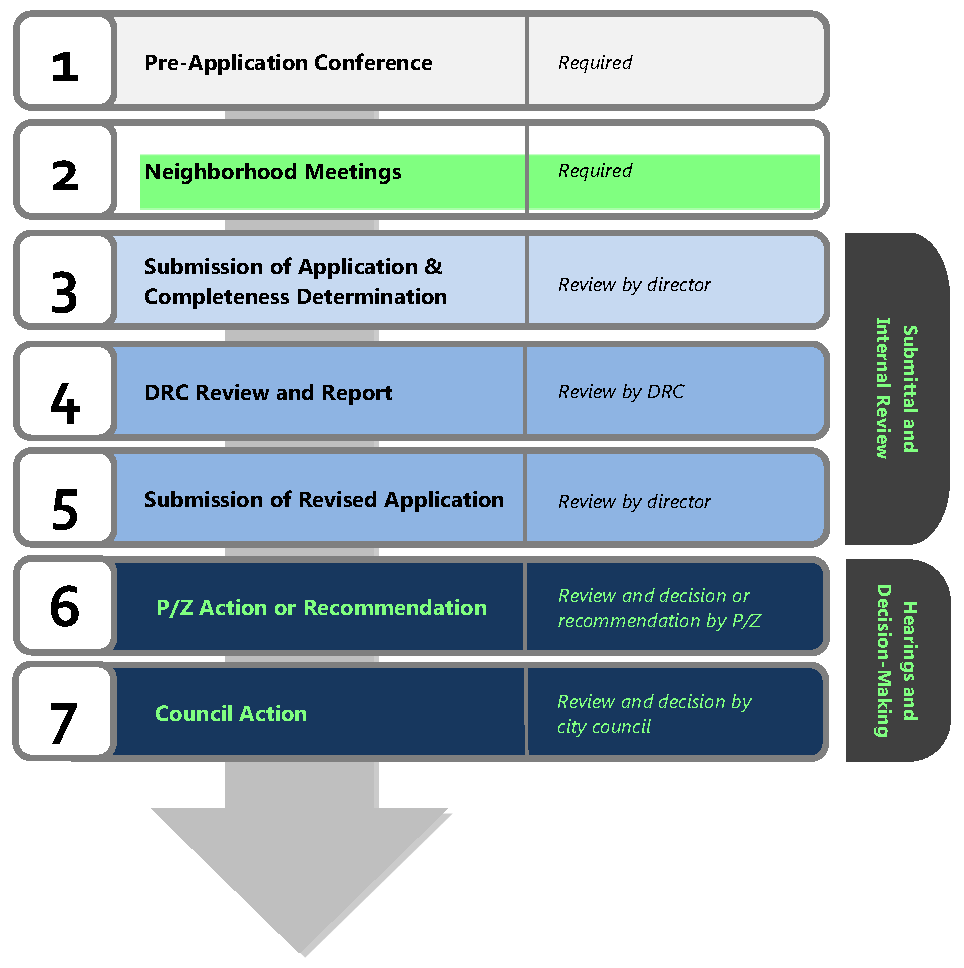
Core review procedures for major development applications. The following review procedures (summarized in figure 2.1) apply to all major development applications unless specified elsewhere in this chapter:
Figure 2.1: Major Development Applications
1.
Step 1: Pre-application conference.
a.
Purpose. To provide an opportunity for the applicant and the city to discuss the development proposal, application materials and submittal requirements, the timeframe for the review process, and the number and timing of any required neighborhood meetings.
b.
Applicability. A pre-application conference is required for all major development applications.
c.
Request for a pre-application conference. The applicant shall submit a pre-application form and other materials required by the director; the pre-application conference will be scheduled for the next available meeting date.
d.
Director review and recommendations. The director shall provide the applicant with a summary of the pre-application conference, including any necessary submittal requirements.
2.
Step 2: Neighborhood meetings.
a.
Intent and purpose. To facilitate participation early in the development review process between applicants and citizens of neighborhoods potentially affected by the development proposal.
b.
Timing and number of neighborhood meetings.
i.
At least one neighborhood meeting shall be held after the pre-application conference, before submittal of a formal application, unless the director waives the neighborhood meeting.
ii.
The director may require additional pre- or post-application neighborhood meetings, or may waive the neighborhood meeting requirement, based on the proposed development's lack of effect on surrounding properties, mix of uses, density, complexity, potential for adverse impacts, or the need for off-site public improvements created by the development.
c.
Notice of neighborhood meeting.
i.
The applicant is responsible for scheduling the neighborhood meeting. Written notice of the neighborhood meeting shall be according to section 15.02.040.J.
ii.
If available, neighborhood meetings should be held in an accessible facility in the vicinity of the proposed development.
iii.
The applicant's failure to provide proper notice or to hold and complete all required neighborhood meetings shall preclude further review of the application and may result in an inactive application under section 15.02.040.F.
iv.
The neighborhood meeting requirement shall be considered satisfied even if no one attends the meeting for which proper notice was given.
d.
Conduct of neighborhood meeting. The applicant shall present a summary of the development proposal, answer questions and receive comments from persons attending the meetings.
e.
Summary of neighborhood meeting. The applicant shall prepare a written summary of the neighborhood meeting, which shall include the following:
i.
Dates and locations and the number of people that attended and a copy of the sign-in sheet;
ii.
The substance of the comments and questions; and
iii.
How the applicant addressed or intends to address the comments and questions, including the reasons why the applicant is unwilling or unable to address specific comments or questions.
3.
Step 3: Submission of application/completeness determination.
a.
The applicant shall submit a complete application and all applicable submittal material in one package to the planning and development services department.
i.
The director shall review an application for completeness, and if determined to be complete, it shall then be processed under this chapter.
ii.
The director shall return an incomplete application to the applicant and identify how the application is deficient.
b.
Once submitted, the applicant shall not make any changes to the application or any accompanying plans or information, except those requested by the director.
4.
Step 4: DRC review and report.
a.
DRC review. The DRC shall review the application for technical accuracy, compliance with this development code and other relevant city regulations and ordinances and provide their comments and written recommendation to the project manager. The DRC shall also obtain comments from outside agencies and utility providers regarding the application as necessary.
b.
Subsequent information and reviews.
i.
At any time, the DRC may request additional information from the applicant or revisions or corrections to previously submitted materials if they are inaccurate, incomplete, or if subsequent plan revisions do not comply with this development code.
ii.
The application may be subject to additional review by the DRC if the additional information or revisions do not comply with the development code or do not mitigate the adverse impacts from the development proposal.
5.
Step 5: Submission of revised application.
a.
If necessary, the applicant shall submit a revised application addressing each comment contained in the DRC report to the project planner. No further processing of the application shall occur until a complete revised application is submitted.
b.
The revised application shall be reviewed as above, and the project manager shall send the applicant any recommendations or conditions for approval to eliminate any areas of noncompliance or to mitigate any adverse impacts from the development proposal.
c.
The applicant shall submit a written response to the conditions of approval, if any.
d.
Scheduling for review and/or decision-making body action.
i.
Once DRC has completed its reviews, the project planner shall schedule the development application for hearing on the next available regular meeting agenda before the applicable review or decision-making body. Public notice of the hearing shall be given under the requirements stated in section 15.02.040.J.
6.
Step 6: P/Z action or recommendation.
a.
Applicant's submittals.
i.
The applicant shall submit the documents required to be included in the public hearing report by the deadline specified by the project planner.
ii.
Materials submitted after the deadline may be sent to the P/Z or may be cause to remove the application from the P/Z agenda to provide more time to review and respond to these materials.
b.
Staff preparation of P/Z communication. After the applicant's submittal for the P/Z hearing, staff shall prepare a communication for the public hearing which shall:
i.
Include the written summary of any neighborhood meetings;
ii.
Report whether the development application complies with all applicable standards;
iii.
Specify any areas of noncompliance; and
iv.
Provide staff's recommendation for application approval, approval with conditions, or denial. Conditions for approval may be recommended to eliminate any areas of noncompliance or to mitigate any adverse impacts from the development proposal.
c.
Distribution of public hearing report. The city shall make the public hearing report available to the applicant, the applicable review or decision-making body, and the public at least five days prior to the public hearing on the application.
d.
Public hearing. A public hearing is required for any application on which the P/Z makes a final decision, but not those for which P/Z makes only a recommendation to the city council.
e.
Decisions (quasi-judicial). The P/Z has decision-making authority over applications for conditional uses, preliminary plats, overall development plans, and most variances with the exception of properties adjacent to any city-owned parks, greenways and open space. For these applications subject to P/Z review:
i.
The P/Z shall consider the development application and the evidence from any public hearing, and then take action.
ii.
The P/Z shall approve, approve with conditions, or deny the development application based on its compliance or noncompliance with applicable review standards.
f.
Effect of P/Z denial. The denial of a development application by the P/Z is final and that same request, or one substantially the same, may not be considered by the city for a period of one year from the date of denial, unless the P/Z's denial is overturned by the city council on appeal, or unless the P/Z's denial explicitly states that an earlier re-application will be considered.
g.
Recommendation. For all other major applications, including those adjacent to any city-owned park, greenway and open space, the P/Z has authority only to recommend action to the city council. For these applications, the P/Z shall recommend either approval, approval with conditions, or denial of the development application based on its compliance or noncompliance with the applicable review standards.
7.
Step 7: City council action.
a.
Decisions. The city council has decision-making authority over all major development applications for which decision-making authority has not been delegated to the P/Z above. These include annexations; comprehensive plan amendments; land development code amendments; rezonings; concept plan amendments; rezoning to PUD, TDRs, and vacations; SES variances; and major development applications adjacent to city-owned parks, greenways, and open space. Actions for which the city council has decision-making authority shall be considered and acted upon by ordinance in compliance with the Charter. The city council shall take final action by approving, approving with conditions, or denying the application based on its compliance with the appropriate review standards.
b.
Appeals. For procedures governing appeals to the city council from P/Z final decisions, please see section 15.02.040.K.
c.
Effect of city council denial. If the city council denies an application, that same request or one substantially the same may not be considered by the city for a period of one year from the date of denial, unless the city council's denial explicitly states that an earlier re-application will be considered.
C.
Core review procedures for minor development applications.
1.
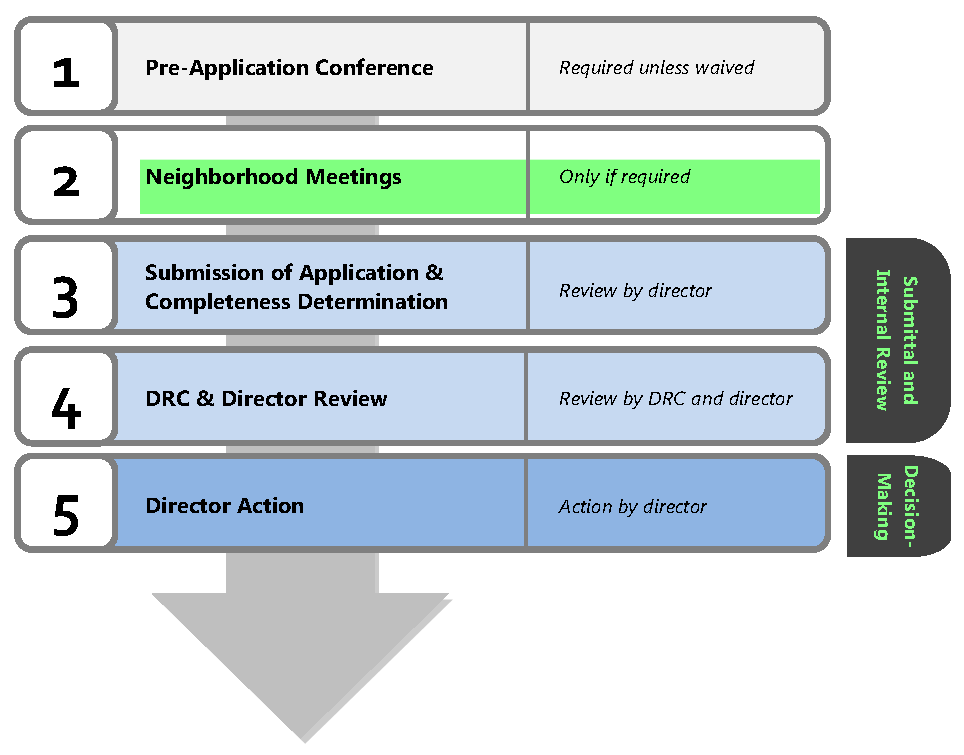
Review procedure for minor development applications. All minor development applications shall be reviewed according to subsection B.1.a of this section, and then under the steps outlined below (summarized in figure 2.2). The director may waive subsection B.1 of this section, based on a determination that the proposed development would not have adverse impacts on neighboring properties. The director may require subsection B.2 of this section, based on a determination that the proposed development may have adverse impacts on neighboring properties.
Figure 2.2: Minor Development Applications
a.
Step 4: DRC review.
i.
Applicability.
(A)
The director shall refer all minor applications to the DRC for review and recommendation.
(B)
The DRC shall review the application for technical accuracy, compliance with this development code and other relevant city regulations and ordinances and provide comments and written recommendations to the project planner.
ii.
Director review. The director shall review the recommendations of the DRC and, if necessary, require the applicant to submit a revised application. In this case, the applicant shall submit a revised application addressing each comment contained in the DRC report. No further processing of the application shall occur until the revised application is submitted.
b.
Step 5: Director final action.
i.
After the DRC completes its review, the director shall review the application for compliance with the adopted review criteria, this development code, and other relevant city regulations and take final action to approve, approve with conditions, or deny the application.
ii.
The director shall notify the applicant of the final action and timeframes and procedures for appeals, and shall advise the applicant, if no appeal is filed, that the applicant must satisfy or accept all conditions of approval prior to issuance of a building permit.
2.
Authority to refer to P/Z for public hearing. At the director's discretion, based upon a consideration of the proposed development's potential adverse impacts, mix of land uses, or need for off-site public improvements, the director may refer the application to the P/Z for public hearing and final action. In this case, the application should be scheduled for hearing at the next regular meeting before the decision-making body, or as soon thereafter as meeting agendas allow. Appeals of decisions on such referred applications shall be as if the referred-to body was the decision-making body in the first instance.
D.
Review procedures for administrative applications. The decision-maker on an administrative application shall only act upon an administrative application once all requested submittal materials have been received. The decision-maker shall approve or deny the application ministerially, based on the review criteria. Should the decision-maker determine that deciding on administrative permit application requires material use of discretion, the decision-maker shall subject such application to the procedures applicable to minor applications.
(Code 2009, § 15.02.050; Ord. No. O-2021-16, § 2, 3-30-2021)
No major, minor, or administrative development application shall be approved unless it meets the following review criteria, except that individual types of applications described in this land development code specifically may include exceptions to these criteria or impose additional criteria:
1.
The application is consistent with the comprehensive plan and the purpose of the code and zoning district; conforms to any previously approved concept plan, preliminary plat, or PUD overall development plan; and complies with all applicable statutes, codes, ordinances and regulations.
2.
The application complies with applicable city standards, including for street and utility design and layout, and adequate utilities are available or will be provided for appropriate urban-level services.
3.
The application proposes development compatible with surrounding properties in terms of land use, site and building layout and design, and access.
4.
The application will not adversely affect surrounding properties, the natural environment, existing or planned city transportation, or utility services or facilities, or the adverse impacts of the use will be mitigated to the maximum extent feasible.
5.
The application, where required, complies with the sustainability evaluation system requirements to mitigate impacts of development within the city's riparian areas, and as applicable to other projects as determined by separate agreement.
6.
The application includes an appropriate transportation plan, including multi-modal transportation access, and is integrated and connected, where appropriate, with adjacent development through-street connections, sidewalks, trails and similar features.
(Code 2009, § 15.02.055; Ord. No. O-2019-62 , § 2, 10-22-2019)
A.
Annexations.
1.
Review procedures. An application for annexation shall follow the core review procedures for major development applications, except for the following:
a.
After step 1 (pre-application conference). The annexation application shall be referred to the city council to determine whether the public interest is served by considering the annexation request further. If the answer is no, the annexation application shall only be reviewed for statutory compliance, unless the applicant withdraws the petition.
b.
City-initiated annexations. Annexations initiated by the city of enclaves, property owned by the city or under lease to the city with an option to purchase, and property predominantly containing a city-managed or -operated facility are exempt from steps 1 through 6 of the core review procedures for major development applications, as well as the referral procedure of subsection A.1.a of this section.
2.
Additional review criteria. Annexations shall also comply with the following additional criteria. However, annexation is a discretionary, legislative act. The city shall never be compelled to annex, unless otherwise required by state law, even if all these review criteria have been satisfied.
a.
The annexation complies with the Municipal Annexation Act of 1965, as amended (C.R.S. § 31-12-101 et seq.).
b.
The property is within the municipal service area (MSA) or the city planning area (LPA) as stated in the comprehensive plan. No property outside of the MSA or LPA shall be considered for annexation unless the city council finds that, consistent with the comprehensive plan, the best interests of the city would be served by annexation of such property, and a land use plan for the area proposed to be annexed is submitted together with the annexation application.
c.
The proposed zoning is appropriate, based upon consideration of the following factors:
i.
The proposed zoning is consistent with the comprehensive plan designation of the property; and
ii.
The proposed land uses are consistent with the purpose and intent of the proposed zoning district.
d.
The annexation will not limit the ability to integrate surrounding land into the city or cause variances or exceptions to be granted if the adjacent land is annexed or developed.
e.
Unless otherwise agreed to by the city, the landowner has waived in writing any preexisting vested property rights as a condition of such annexation.
f.
The property to be annexed meets the environmental requirements of section 15.02.140.
g.
City-initiated annexations shall conform to C.R.S. § 31-12-106 and the annexation ordinance shall include an annexation map meeting the requirements of C.R.S. § 31-12-107(1)(d).
3.
Concept plan required. All annexation applications, except city-initiated annexations, shall include a concept plan which shall be referenced and approved by the annexation ordinance. Development of the subject property shall be consistent with the concept plan unless city council amends it by ordinance. At a minimum, a concept plan shall include the items listed in this development code, the administrative manual and the following general information:
a.
Appropriate land use, utility, and transportation design, including multi-modal transportation access, given the existing and planned capacities of those systems;
b.
Mitigation of potential adverse impacts on surrounding properties and neighborhoods; and
c.
Mitigation of potential adverse impacts on the environment.
4.
Annexation agreement required. As a prerequisite for annexation, a city-approved annexation agreement shall be signed by all owners of the subject property, except annexations of city-owned property or property the city is leasing under a lease-purchase agreement, city-initiated annexation of enclaves, or when the requirement is waived by the city council. The annexation agreement represents the applicant's proposed performance to induce the city council to act favorably on the proposed annexation. The accompanying zoning and concept plan are part of the applicant's inducement offer and shall be an integral part of the annexation agreement. The annexation agreement shall detail the mutual understanding about the annexation, including, but not limited to, the following matters:
a.
Density or intensity of development and land use mix, including:
i.
Designation of the density distribution within the parcel to be annexed; and
ii.
A condition that residential developments comply with applicable affordable housing requirements;
b.
Phasing of the development in general terms;
c.
Drainage, detailing major improvements required, participation in the storm drainage utility, participation in existing improvements, and how drainage requirements will be satisfied;
d.
Streets and bikeways, detailing participation in existing and proposed improvements, dedication of perimeter rights-of-way and timing of such, major street improvements required and designation of responsibility for construction, treatment of local, interior street and rights-of-way, responsibility for construction or participation in traffic signals and other traffic control devices, and payment for any transportation or site access studies or any addenda;
e.
Utilities, detailing participation in existing systems, major improvements to be constructed, dedication of necessary easements and timing of such, and utilities required;
f.
Landscaping, detailing responsibility and scheduling of arterial and collector street landscaping and primary greenway development, and maintenance of such facilities;
g.
Fire protection, detailing responsibility for fire protection measures;
h.
Land dedication and/or reservation, designating land for public purposes, including, but not limited to, streets, utilities, parks, schools, greenways, or cash-in-lieu agreements. Land reserved for future park purchase will be paid at fair market value with the appraisal value determined by pre-annexation raw land value;
i.
Exclusion from special districts and acknowledgement of the property owner's responsibility in securing exclusion;
j.
Inclusion of property in the municipal subdistrict, Northern Colorado Water Conservancy District and acknowledgement of the applicant's consent and agreement to perform all acts to obtain inclusion;
k.
Special districts, all agreements concerning special districts projected to be created within the city limits, including, but not limited to, applicant's agreement to use any district for installation, construction warranty, and repair of public improvements;
l.
Vested rights and growth management:
i.
Specifying that the city's action in annexing the property and approving the concept plan and zoning do not create a vested right, as defined in the state revised statutes or other city regulation or ordinance;
ii.
Specifying that, unless otherwise agreed to by the city, the landowner requesting annexation shall waive any pre-existing vested property rights as a condition of such annexation; and
iii.
Specifying that the annexed property will be subject to any future phasing or growth management regulations that may be adopted by the city.
m.
Enforcement, specifying that the agreement is binding on heirs, successors and assigns;
n.
Noncontestability clause detailing reliance by all on the agreement and providing for disconnection of the annexation, at the option of the city, upon noncompliance or nonperformance by the applicant;
o.
Other issues as may be unique to the property, including, but not limited to, necessary off-site improvements, railroad and river crossing improvements, relocation or maintenance of irrigation ditches and laterals, and purchase of existing electric facilities and/or electric service territory; and
p.
Other issues as may be necessary to evidence compliance with this section and this development code.
5.
Annexation not final until satisfaction of all requirements.
a.
City action on the annexation application shall not become final unless all requirements of the annexation ordinance, this development code and state statutes have been satisfied, as certified by the director, within the time specified in the ordinance, or if no time is specified, then within one year of city council's adoption of the ordinance.
b.
Unless approval has lapsed, when all requirements have been satisfied, the ordinance, the annexation agreement, and the annexation map shall be recorded with the county clerk and recorder, and the annexation will then be final.
B.
Comprehensive plan amendments.
1.
An amendment to the comprehensive plan may include any of the following:
a.
Comprehensive plan text amendment. An amendment to the text of the plan. The city can initiate comprehensive plan amendments, and private parties may request the city council to initiate an amendment.
b.
Land use amendment. An amendment to the plan's land use designation for specific properties or to the plan's transportation system. A land use amendment is often necessary in conjunction with rezoning requests and occasionally with annexation requests. Both private parties and the city can initiate land use amendments.
c.
Longmont planning area (LPA) amendment. An amendment to add new land areas and land use designations to the city planning area. Both private parties and the city can initiate city planning area amendments.
d.
Municipal service area amendment. An amendment that adds land in the city planning area to the municipal service area. A municipal service area amendment is not required for annexations as annexed land is automatically transferred to the municipal service area. Only the city can initiate municipal service area amendments.
2.
Review procedure. Applications for comprehensive plan amendments shall follow the core review procedures for major development applications, except:
a.
The director may limit the timing and frequency of when comprehensive plan amendments are considered, consistent with the comprehensive plan.
b.
City planning area amendments shall be referred to the city council, before processing, to determine whether it is in the best interests of the city to devote staff and P/Z resources to a full review of the application.
c.
Applications for text amendments and municipal service area amendments may also be referred to the city council before the city begins to process the application.
d.
Legislative comprehensive plan amendments, as described in section 15.02.030.A.2, are exempt from steps 2 through 5 of the core review procedures for major developments provided in section 15.02.050.B (step 2: neighborhood meetings; step 3: submission of application/completeness determination; step 4: DRC review and report; step 5: submission of revised application).
3.
Review criteria clarification. Proposed comprehensive plan amendments need not be consistent with the existing comprehensive plan but must serve the best interests of the city.
C.
Conditional uses.
1.
Review procedure. Applications for a conditional use shall follow the core review procedures for a major development application and shall be processed in accordance with section 15.02.050.B.6.e and g concurrently with an application for site plan review, as applicable, as indicated in section 15.02.070.C.
2.
Authority to impose conditions to ensure compliance with standards. As with other types of application, the decision-making body may impose conditions on a proposed conditional use to ensure compatibility and to ensure that potential adverse impacts on surrounding uses, properties, public health or safety, the environment, or the district will be substantially mitigated. Conditions may include, but are not limited to, measures addressing the amount or location of secondary uses, outdoor activity or storage; location on a site of activities that generate noise, odor, vibration, glare, or other adverse impacts; location of buildings or structures generally; and hours of operation and deliveries.
3.
Conditions for time limits/review. The decision-making body may also impose time limits on conditional uses and require regularly scheduled reviews of approved conditional uses.
4.
Conditions of approval binding. The restrictions and conditions of approval shall be placed on the conditional use site plan, shall be binding on the applicant, the applicant's successors and assigns, and shall run with the land. The notice of approval of the site plan shall be recorded at the county clerk and recorder's office.
5.
Discontinuance. If a conditional use is extinguished, or discontinued for a period of one year, the conditional use permit shall automatically lapse and be null and void.
6.
Changes to approved conditional uses. Building additions or site changes on existing approved conditional uses that do not constitute a substantial change to the use, and that do not create or can adequately mitigate potential adverse impacts on surrounding properties or neighborhoods, as determined by the director, may be reviewed as a site plan amendment according to section 15.02.070.C. However, expansion of a conditional use onto a different lot or parcel, not previously part of the conditional use approval, shall require review under this subsection.
D.
Land development code (text) amendments.
1.
Initiation. The city council, city manager, staff, or the P/Z may initiate applications for text amendments to the development code. Private parties may request that city council initiate a text amendment.
2.
Review procedures. Applications for text amendments to the development code do not follow the core review procedures for development applications, stated in section 15.02.050. Instead:
a.
The city council or director may request P/Z review and recommendation.
b.
The city staff shall prepare an ordinance, including any P/Z recommendation, and schedule the ordinance for city council's consideration pursuant to the provisions of the Charter.
3.
Review criteria. The sole review criterion for proposed text amendments to the development code is that the proposed amendment is consistent with the purpose and intent of this development code set out in section 15.01.030.
4.
Applications for development. Development applications pending an application for an ordinance amending this development code.
a.
When a proposed ordinance that adds restrictions on or changes to permitted uses or standards in a zone district is introduced to city council, or when the city council directs staff or the P/Z to draft or consider such an ordinance, no development applications that would result in nonconforming uses, structures or affected standards if the proposed ordinance is approved shall be accepted by the city for a period of 120 days from the date of introduction of the ordinance or of city council's direction.
b.
The city council may extend the 120-day period by ordinance.
c.
If the proposed ordinance is not adopted within the 120 days, or any extensions thereof, the city shall accept applications and issue plan or plat approval regardless of the status of such proposed ordinance.
E.
Preliminary subdivision plats.
1.
Generally. Preliminary plat approval is required for any parcel of land that proposes to subdivide the existing parcel into four or more lots. Review of the preliminary plat may be done concurrently with other applications if the director determines that the concurrent review is appropriate based on the proposed development's scope and scale.
2.
Review procedure. In addition to complying with the core review procedures for major development applications in section 15.02.050.B, preliminary subdivision plats shall also comply with the following additional criteria:
a.
The subdivision will not limit the ability to integrate surrounding land into the city or cause variances or exceptions to be granted if the adjacent land is annexed or developed;
b.
The subdivision will not create lots that are undevelopable or burdened with costs that would preclude development from occurring on other property; and
c.
The proposed phasing plan for development of the subdivision is rational in terms of available infrastructure capacity and adequate public facility standards.
3.
Exceptions. Approval of a preliminary plat is not required for the following types of developments:
a.
All subdivisions that create less than three additional lots including boundary/lot line adjustments, minor subdivisions and conveyance plats.
b.
Any subdivision that enters into an affordable housing agreement with the city to provide all required affordable housing on-site in conformance with section 15.05.220.E.1, shall instead submit for a final subdivision plat per section 15.02.070.E.
F.
Rezoning (amendments to the official zoning map) and concept plan amendments.
1.
Rezoning initiation. Applications for rezoning may be initiated by:
a.
The city council; or
b.
One or more of the owners, holders of options to purchase, or lessees of the applicable property.
2.
Concept plan. A concept plan is required for a rezoning and amendments to existing rezoning concept plans. The concept plan shall be referenced in the rezoning or concept plan amendment ordinance. A concept plan shall comply with the approval criteria in section 15.02.055.
a.
Contents of concept plan. Submittal requirements for a concept plan shall be included in the administrative manual.
b.
Exceptions. A concept plan is not required for a rezoning initiated by the city or the following types of rezoning requests that are intended to correct technical mistakes in a specific zoning application:
i.
When a lot of record is classified as falling into two or more different zoning districts as of the effective date of the ordinance from which this development code is derived, an application to rezone a portion or portions of that parcel so that the zoning district classification is the same for the entire parcel.
ii.
Rezoning to correct the city's clerical error or mistake in classifying a parcel within a specific zoning district.
iii.
Rezoning to allow for minor zoning district boundary adjustments to make a zoning designation consistent with approved platted subdivisions.
3.
Development applications pending consideration of a rezoning ordinance.
a.
When a proposed ordinance that involves a change in zoning from a less restricted zoning district to a more restricted zoning district, or that changes permitted uses in any existing zone district is introduced to city council, or when the city council directs staff or the P/Z to draft or consider such an ordinance, no development applications that would result in nonconforming uses or structures if the proposed ordinance is approved will be accepted by the city for a period of 120 days from the date of introduction of the ordinance or city council direction.
b.
The city council may extend the 120-day period by resolution.
c.
If the proposed ordinance is not adopted within the 120 days, or any extensions thereof, the city shall accept applications and issue plan or plat approval regardless of the status of such proposed ordinance.
4.
Review procedure. All applications shall follow the core review procedures for major development applications, stated in section 15.02.050.B, except that legislative rezonings, as described in section 15.02.030.A.2, are exempt from steps 2 through 5 of the core review procedure for major development applications provided in section 15.02.050.B (step 2: neighborhood meetings; step 3: submission of application/completeness determination; step 4: DRC review and report; step 5: submission of revised application).
5.
Additional review criteria. Rezonings shall also meet at least one of the following justifications:
a.
The rezoning is consistent with events, trends, or facts occurring after adoption of the original zoning that have changed, or are changing, the physical, social, or economic character or condition of the area or neighborhood;
b.
The rezoning corrects an error of a technical nature; for example, in order to achieve zoning district conformance with existing lot lines; or
c.
The rezoning presents the city with a unique opportunity or an appropriate site, at an appropriate location, for the particular type of land use or development proposed and will help the city achieve a balance of land use, tax base, or housing types consistent with the city's overall planning and economic development goals.
6.
Conditions for rezoning. The city council may impose reasonable conditions on the rezoning, including, but not limited to:
a.
Reduction in the number and type of permitted uses.
b.
Reduction or other limits on permitted density or intensity of development.
c.
Required review at the end of a specified period of time to determine if the construction of the allowed uses has commenced, and if not, then whether the rezoning should remain in place.
d.
Consistency with any concept plans, architectural plans, landscape plans and site plans submitted by the applicant as part of the rezoning application.
G.
Planned unit development overall development plan.
1.
General; establishment of PUD zoning districts. A PUD zoning district may be established through one of the following procedures:
a.
Initial zoning when petitioning for annexation; or
b.
A rezoning to a PUD zoning district.
2.
Applicability.
a.
Approval of an overall development plan (ODP) is required prior to any development in a PUD zone district.
b.
An ODP shall be submitted concurrently with requests for PUD zoning when petitioning for annexation or for rezoning to a PUD zoning district.
3.
Concurrent review of subdivision. The applicant shall consolidate an application for a PUD overall development plan with an application for preliminary subdivision plat approval, unless a preliminary plat is not required.
4.
Review criteria for PUD zoning district. All requests for the establishment of a PUD zoning district shall also comply with the additional review criteria for rezoning in subsection F.5 of this section.
5.
Additional review criteria for overall development plan. Overall development plans associated with applications for rezoning to PUD shall also meet the following criteria:
a.
The PUD complies with the district purpose and development/design standards stated in this section;
b.
The PUD will not limit the ability to integrate surrounding land into the city or cause variances or exceptions to be granted if the adjacent land is developed; and
c.
The proposed phasing plan for development of the PUD is rational in terms of available infrastructure capacity and adequate public facility standards.
6.
Lapse of ODP approval. No development may occur on a lapsed ODP plan pursuant to section 15.02.040.H.3 until a new ODP plan application is submitted and approved.
H.
Vacations.
1.
Review procedure. All applications for vacation of easements or rights-of-way shall follow the core review procedures for major development applications, stated in section 15.02.050.B, except for the following modifications:
a.
Step 6: P/Z action or recommendation. The director may waive P/Z review if there are no unresolved issues regarding the vacation and the proposal has no material adverse impact on adjacent property owners. The project planner shall schedule the application for city council consideration.
2.
Additional review criteria. Vacations shall also comply with the following additional review criteria:
a.
The right-of-way or easement will not be used in the short or long term, or the city receives conveyance or dedication of substitute easements or rights-of-way appropriate to satisfy the continuing municipal need;
b.
The vacation does not create an irregular right-of-way or easement configuration which could create difficulty in the provision of services or installation of public improvements;
c.
The public benefits and utility of the vacation request outweigh any adverse impacts of the vacation; and
d.
The applicant will relocate, if necessary, the public facilities located within the right-of-way or easement.
3.
Standards for compensation. The decision-making body shall apply the following factors to determine compensation the applicant shall pay to the city for the vacation, which payment shall be a condition of the vacation:
a.
If the city purchased the easement or right-of-way, the value paid by the city plus a reasonable inflation factor related to real estate or interest rates shall be required as consideration;
b.
If the city must purchase additional rights-of-way or easements to satisfy the continuing municipal need, all costs incurred in acquiring/developing alternate easements or rights-of-way shall be required as consideration;
c.
The willingness of the applicant to re-convey such easements/rights-of-way to the public, if such need should occur;
d.
If the city incurred substantial costs in constructing/maintaining the easement or right-of-way, reimbursement for such costs may be required; and
e.
Whether the party requesting vacation dedicated the right-of-way or easement without cost to the city.
I.
Variances.
1.
Purpose and applicability. Variances are intended to alleviate practical difficulties or hardship arising from the strict application of the provisions of chapters 15.03, 15.04, 15.05, 15.06, and 15.07 to a specific property. Variances address extraordinary, exceptional, or unique situations that were not caused by the applicant's act or omission.
2.
Use variances prohibited. A decision-making body shall not grant a variance to allow a use not permitted, or a use expressly or by implication prohibited under the terms of this development code for the applicable zoning district.
3.
Authority to determine variance requests.
a.
Variances reviewed by the BOA. The BOA is the decision-making body only on requests for the following variances, but not if the request is proposed or required in conjunction with another development application to be reviewed by the P/Z or the city council:
i.
Fences.
ii.
Setbacks.
iii.
Signage.
b.
Variances reviewed by the P/Z. The P/Z shall be the decision-making body on all other requests for variances whether or not a development application is proposed or required in conjunction with the variance request, except for exceptions to city standards under section 15.02.080.A, and modifications of setback standards for river/stream corridor, riparian areas, and wetlands under section 15.05.020.E.3.b.
c.
Variances reviewed by the city council. The city council shall be the decision-making body on modifications of setback standards for river/stream corridor, riparian areas, and wetlands under section 15.05.020.E.3.b. The standards for granting the variance shall be those listed in that section and the common review criteria in section 15.02.055; the additional review criteria in subsection I.5 of this section shall not apply. The P/Z shall provide a recommendation to city council on modifications of setback standards.
4.
Review procedure. All applications for variances from the provisions of this development code shall follow the core review procedures for major development applications, stated in section 15.02.050.B, except for the following modifications:
a.
Variances determined by the BOA.
i.
Steps 1 and 2. Step 1 (pre-application conference) and step 2 (neighborhood meetings) are not required.
ii.
Step 3 (submission of application/completeness determination). Applicants shall submit variance applications to the Director of Planning and Development Services. The Director of Planning and Development Services shall review the application for the completeness according to section 15.02.050.B.3.
iii.
Steps 4 and 5 (DRC review and report and submission of revised application). The Director of Planning and Development Services may refer the variance application to the DRC for review if the Director of Planning and Development Services determines that the variance request may have a substantial impact on adjacent properties or land uses, or on public facilities. If necessary after the DRC review, the Director of Planning and Development Services may require revised drawings prior to scheduling the application for the BOA review.
iv.
Step 6 (BOA review). The variance application shall be scheduled for the next available BOA meeting for consideration.
v.
If the BOA is unable to be convened for any reason, including but not limited to insufficient membership to form a quorum, the P/Z shall be the decision-making body for any variances reviewable by BOA. In this circumstance, the P/Z will review the variance in the same manner as if it were the BOA and the decision of the P/Z will have the same effect as if it were from the BOA.
b.
Variances determined by the P/Z with other development applications—Step 6 (P/Z action or recommendation).
i.
The notice for the public hearing shall reference all requests for variances.
ii.
The P/Z shall make determinations relating to both the development application and the variance.
iii.
Approval of the development application is conditional upon compliance with the terms of any variance granted by the P/Z.
iv.
The approval period of any variance shall be the same as the approval period of the development application.
c.
Variance determined by the city council—Step 6 (P/Z action or recommendation).
i.
The notice for the public hearing shall reference all requests for variances.
ii.
The P/Z shall make determinations relating to both the development application and the variance recommendation.
iii.
Approval of the development application is conditional upon compliance with the terms of any variance granted by the council.
iv.
The approval period of any variance shall be the same as the approval period of the development application.
5.
Additional review criteria for variances. Except for standards that have specific modification standards in other areas of the code, the decision-making body may only grant a variance from the terms of this development code if the application also demonstrates compliance with the following additional criteria:
a.
Special circumstances exist that strict application of the standards adopted in this development code would result in undue hardship or practical difficulties for the owner of such property.
i.
Special circumstances include, but are not limited to, exceptional limitations to the dimensions, shape or topography of the property.
ii.
The following factors shall be considered in determining practical difficulty:
(A)
Whether the property and development can have any beneficial use without the variance;
(B)
The degree to which the variance deviates from the otherwise applicable standard;
(C)
Whether the applicant purchased the property with knowledge of the standard;
(D)
Whether the standard can be addressed through some means other than a variance; and
(E)
Whether the purpose and intent behind the regulation would be maintained by granting the variance.
b.
A variance shall not nullify or impair the purpose and intent of the Code or the comprehensive plan.
c.
A variance shall not adversely impact surrounding properties, neighborhoods, or the natural environment.
d.
A variance shall not create a building or fire code violation or other safety hazard.
e.
A variance shall not be granted for a self-imposed hardship.
f.
A variance shall allow only the least deviation from the standard that will afford relief.
6.
Conditions to approval authorized. As with other development applications, in granting a variance, the decision-making body may attach conditions to the approval that otherwise satisfy the purpose and intent of the varied standard.
7.
Effect of approval/lapse.
a.
Variances approved by the BOA. The variance approval shall automatically lapse and be of no further force and effect if the applicant fails to apply for a building permit within six months of the date of approval, or other period provided by the BOA.
b.
Variances approved by the P/Z or the city council. The approval period of a variance granted by the P/Z shall be the same as the BOA in subsection I.7.a of this section, unless it is approved as part of a development application, in which case the approval period shall be the same as that of the development application.
c.
Approved variances and substantial redevelopment of the property. The variance shall automatically lapse if there is an application for a substantial redevelopment of the property, as determined by the director. The new application may include a request for approval of the variance and shall be subject to the review criteria for a new variance.
(Code 2009, § 15.02.060; Ord. No. O-2021-16, § 3, 3-30-2021; Ord. No. O-2024-06, § 2, 1-23-2024; Ord. No. O-2024-60, § 1, 9-24-2024)
A.
Final subdivision plats.
1.
Generally. Final subdivision plat approval may be sought for all or a portion of the land area included in an approved preliminary subdivision plat. Review of a final subdivision plat may be done concurrently with an application for preliminary subdivision plat approval if the director determines the plat is simple enough to process both applications at once.
2.
Review procedure. All applications for final subdivision plats shall follow the core review procedure for minor development applications described in section 15.02.050.C, unless concurrent review is allowed with the preliminary plat.
3.
Additional review criteria. Final subdivision plats shall also comply with the following additional review criteria:
a.
As applicable, the applicant has executed a public improvement agreement under section 15.02.110 and posted required financial security.
b.
When the subdivision generates a need for public school sites, the applicant has made its fair contribution to the cost, construction, or provision of such public school sites that is acceptable to the school district.
B.
Minor subdivision plats.
1.
Generally. The minor subdivision plat process may be used in lieu of the preliminary and final plat processes for subdivisions of three or fewer new lots, boundary line adjustments, right-of-way dedications and conveyance plats if the following conditions apply:
a.
No variances or subdivision exceptions are required or requested;
b.
Significant changes in street alignment are not required or requested; and
c.
The property was not the subject of a minor subdivision plat approval during the prior one year.
2.
Review criteria; subdivision of three or fewer lots. For subdivisions of three or fewer lots, the minor subdivision plat application shall comply with the review criteria applicable to preliminary subdivision plats stated in section 15.02.060.E.
3.
Substitute review criteria—Boundary/lot line adjustments. Only the following criteria apply to boundary/lot line adjustments:
a.
The adjustment affects only two adjacent lots and does not create new lots or parcels.
b.
The adjustment does not affect a recorded easement without the prior written approval of the easement holder.
c.
The adjustment is no greater than ten feet from the platted boundary or lot line, unless the director determines that a greater distance does not adversely affect the ability to develop the property or to provide or maintain city services and facilities.
d.
Street locations will not be changed; however, new dedication of right-of-way is acceptable.
e.
The adjustment will not create any nonconformities or increase the degree of nonconformity of any existing structure or use.
f.
The adjustment is referenced to the platted lot line in the newly written deeds for both lots (submitted with the application).
g.
All owners of properties with adjusted boundaries or lot lines agree to the adjustment in writing.
4.
Substitute review criteria—Conveyance plats. The conveyance plat application shall comply with the following review criteria only:
a.
Each parcel is a minimum of ten acres, unless the director determines that existing conditions reasonably preclude compliance with the minimum area requirement, provided that any reduction in parcel area below this minimum does not adversely affect the ability to develop the property or to provide or maintain city services and facilities;
b.
The conveyance plat is consistent with any previously approved concept plans covering the subject property; and
c.
Where a conveyance plat is proposed for land that has been preliminarily but not finally platted, the conveyance plat is consistent with the preliminary plat covering the subject property.
5.
Effect of approval.
a.
Record of boundary/lot line adjustments. The director shall place copies of the written approval and deeds for boundary/lot line adjustments in the building inspection division and planning and development services department files for each affected lot or parcel.
b.
Effect of approval; conveyance plats. Approval of a conveyance plat does not include any development entitlements. Any development is subject to preliminary and final plat, overall development plan, and/or site plan approval.
C.
Site plans.
1.
Applicability.
a.
All new development, additions, site changes, or changes in use are subject to site plan review, unless eligible for a waiver under subsection C.3 of this section. For changes in use, a waiver is required when changes in occupancy require structure or site changes to conform to municipal code requirements for the new use.
b.
An approved site plan is required prior to issuance of a building or stormwater permit for any development subject to these provisions.
2.
Exception. A site plan review is not required for the development of a single-family detached dwelling unit or its accessory structures, including accessory dwelling units subject to section 15.02.080.E, on individual single-family lots.
3.
Waiver by director.
a.
Applicability. The director may waive site plan review for construction of additional building area or change in use, if the applicant demonstrates that such construction or change in use:
i.
Does not include new construction exceeding 25 percent of the existing building area on the property;
ii.
Does not adversely impact on- and off-site traffic circulation or parking areas, public utilities or services, on-site drainage, landscaping or other existing improvements;
iii.
Does not result in any safety problems or hazards;
iv.
The applicant agrees to all conditions of approval; and
v.
Complies with the approval criteria in section 15.02.055.
b.
Procedure. A request for waiver of site plan review shall be considered an administrative application, not a minor development application, and shall follow only the notice, procedure, and other requirements of this development code applicable to administrative applications.
4.
Coordination with other approvals.
a.
The director may allow review of a site plan concurrently with an overall development plan. Such review shall follow the review procedures for major development applications stated in section 15.02.050.B.
b.
Applications for a site plan may be processed concurrently with other applications including conditional use, limited use, or administrative modifications.
c.
An application for a building permit may be submitted concurrently at the applicant's risk, as site plan revisions required during the review process may require building plan revisions. The applicant must coordinate plan revisions to ensure that site plan and building plans are consistent at all stages of review.
d.
A final subdivision plat must be processed concurrently with the site plan if the proposed development involves subdivision. See subsection A of this section for procedures applicable to final subdivision plats.
5.
Variances. Applicants must obtain all necessary variances as a condition of approval of the site plan.
6.
Strict compliance. The applicant shall develop the subject property in strict compliance with the approved site plan or one for which review has been waived.
7.
Review upon inactivity. When construction activity on a partially-completed site plan has been inactive for a period of three years or more, the site plan shall be subject to review and a determination by the director of whether additional site plan review is required due to materially changed circumstances.
D.
Limited use review.
1.
Generally. Limited use review is required for specified principal uses that may adversely impact surrounding properties or the character of the district. The director may impose conditions on the specified use to mitigate any adverse impacts.
2.
Review procedure. All applications for limited uses shall follow the core review procedures for minor development applications, stated in section 15.02.050.C. Applications for a limited use shall be processed concurrently with an application for site plan review, as applicable, as indicated in subsection C.4 of this section.
3.
Commitment to conditions of approval. The terms and conditions of approval are binding on the applicant, the applicant's successors, and assigns and shall to run with the land, and the city shall record a notice of the approval in the county clerk and recorder's office.
4.
Abandonment. If a legally established limited use is abandoned, extinguished or discontinued for a period of one year or more, then the decision originally approving such limited use shall automatically lapse and be null and void.
E.
Final subdivision plats for affordable housing projects.
1.
Purpose. The purpose of this section is to streamline the approval process for affordable housing projects that provide all required affordable housing units on-site, allowing them to proceed directly to the final plat stage.
2.
Eligibility. An affordable housing project is eligible to bypass the preliminary plat stage if it meets the following criteria:
a.
The project provides 100 percent of the required affordable housing units on-site.
b.
The applicant submits all necessary documentation demonstrating compliance with the city's affordable housing requirements.
3.
Review procedure. All applications for final subdivision plats shall follow the core review procedure for minor development applications described in section 15.02.050.C, except the director shall require a neighborhood meeting as part of the review and follow any other exceptions to the core review procedure for minor development applications noted in this chapter.
4.
Additional review criteria. Final subdivision plats under this provision shall also comply with the following additional review criteria:
a.
As applicable, the applicant has executed a public improvement agreement under section 15.02.110 and posted required financial security.
b.
When the subdivision generates a need for public school sites, the applicant has made its fair contribution to the cost, construction, or provision of such public school sites that is acceptable to the school district.
5.
Application requirements. The applicant must submit the following with the final plat application:
a.
Proof of compliance with affordable housing requirements.
b.
All other documentation typically required for preliminary and final plat applications, excluding the preliminary plat itself.
(Code 2009, § 15.02.070; Ord. No. O-2021-30, § 3, 6-29-2021; Ord. No. O-2024-60, § 1, 9-24-2024; Ord. No. O-2025-35, § 1, 6-3-2025)
A.
Exceptions to city standards.
1.
Applicability. The general manager may grant exceptions to city standards adopted under section 15.07.050.B.
2.
Concurrent review. To the extent practicable, all such requests for exceptions from city standards shall be submitted concurrently with an application for a preliminary subdivision plat. The general manager shall review and take final action on an exception request prior to the decision-making body acting on the application.
3.
References to city standards. In instances where city standards, as defined by section 15.07.050.B, are referenced in this development code, any modification or variation from city standards shall be subject to review as exceptions to city standards under this section, and not as variances or administrative modifications to development code standards under sections 15.02.060.I and subsection B of this section, respectively.
B.
Administrative modifications.
1.
Applicability.
a.
The director may grant administrative modifications from specified development standards to approved site plans, site-specific development plans, and final and minor subdivision plats, or other applications, not subject to site plan review, that may be approved administratively.
b.
The director may grant administrative modifications of non-numeric standards and up to a maximum of 25 percent (unless allowed elsewhere in this development code) from any other numeric standard stated in chapters 15.03, 15.05, 15.06, or 15.07 (except for public improvements subject to exceptions to city standards in subsection A of this section), to encourage the implementation of alternative or innovative practices that provide equivalent benefits to the public.
c.
In instances of infill and redevelopment, the director may grant administrative modifications beyond 25 percent of the numerical standards in the chapters referenced in subsection B.1.b of this section, except building and structure height and sign standards are limited to a maximum change of 25 percent.
d.
Pursuant to section 15.08.020.B.2.c, the director may grant administrative modifications of any amount from dimensional standards for buildings and structures in subdivisions previously zoned PUD.
e.
Where this development code provides expressly for an administrative modification from a specified numeric standard, the 25 percent limit in subsection B.1.b of this section shall not apply.
2.
Concurrent review for administrative modifications from development standards. Administrative modifications shall be reviewed concurrently if part of any other required development application.
3.
Limitations on modifications.
a.
The director may approve a plan or plat modification if the director determines that the modification is consistent with the applicable review criteria; or
b.
The director may forward a modification request to the Planning and Zoning Commission if the modification is requested as a part of a major development application. The director may also forward a modification request to the Planning and Zoning Commission for minor development applications or administrative applications, pursuant to section 15.02.050.
c.
The director shall not approve a plan or plat modification if the modification would result in:
i.
An increase in the development area that would not be eligible for a site plan waiver under section 15.02.070.C.3;
ii.
Approval of a use that is not otherwise permitted within the project zoning; or
iii.
An increase in overall project density beyond the density allowed for the project zoning.
4.
Conditions of approval. In granting an administrative modification, the director may require conditions that will secure the objectives of the modified standard and that will substantially mitigate any potential adverse impact on the environment or on adjacent properties, including, but not limited to, additional landscaping or buffering.
5.
Administrative modifications to ensure compliance with RLUIPA.
a.
Generally. The director may grant administrative modifications to a use or development standard stated in chapter 15.04 or chapter 15.05 that creates a substantial burden on religious exercise as provided by the federal Religious Land Use and Institutionalized Persons Act of 2000, as amended (RLUIPA).
b.
Limitations. The director shall not approve a modification that allows a religious assembly use, or any uses/structures/activities accessory to it, in a zoning district where chapter 15.04 prohibits such use or accessory use/structure/activity.
6.
Justification for administrative modifications to comply with federal laws. With the approval criteria in section 15.02.055 being inapplicable to the sections below, the director may approve administrative modifications upon finding only that:
a.
The modification amounts to a reasonable accommodation for the housing of protected groups under the Federal Fair Housing Act; or
b.
The modification is necessary to eliminate a substantial burden on religious exercise as guaranteed by RLUIPA.
7.
Additional review criteria for administrative modifications not required by federal laws. Administrative modifications not required by federal laws shall also meet the following additional review criteria:
a.
The requested administrative modification is either:
i.
Of a technical nature required to compensate for a practical difficulty (as described in section 15.02.060.I.5.a.ii) or unusual aspect of the site or the proposed development; or
ii.
The result of an alternative design that:
(A)
Meets the purpose and intent of this development code;
(B)
Meets the purpose and intent of the comprehensive plan;
(C)
Meets the purpose and intent of the standard, plat, or plan; and
(D)
Represents a creative and quality design without detriment to surrounding properties or neighborhoods, the natural environment, or to the city's ability to provide services and maintain public facilities.
b.
The modification shall not create a building or fire code violation or other safety hazard; and
c.
The modification shall only allow the least deviation from the standard that will afford relief.
8.
Effect of approval. Modifications to an approved site plan, site-specific development plan, or final subdivision plat shall be noted on a revised plat or plan.
C.
Temporary use permits.
1.
Permit required. No operation or establishment of a temporary use or structure shall be permitted except as stated in this subsection and section 15.04.050. An approved temporary use shall be issued a temporary use permit that shall include the duration of the approval and all conditions of approval.
2.
Additional review criteria. Temporary uses or structures shall also comply with the applicable specific use standards in section 15.04.050 in addition to the following additional review criteria:
a.
The proposed location is adequate to accommodate the temporary use or structure.
b.
The applicant or operator has obtained any other required permits, including a sales and use tax license, if applicable.
3.
Conditions of approval.
a.
The temporary use shall comply with all conditions of approval for the principal use on the site, the provisions of this development code and the building, fire, and other codes adopted by the city.
b.
Permanent alterations to the site are prohibited.
c.
Any required certificate of occupancy or completion shall be obtained prior to starting any temporary use.
d.
The decision-making body may also impose conditions, including, but not limited to, control of nuisance factors (e.g., glare, noise, smoke, dust), provision of security and safety measures, and limitations on hours of operation, storage and parking, to prevent adverse impacts to adjacent properties and to protect the public health, safety and general welfare.
4.
Extensions beyond time limit; substitute review criteria. To receive an extension, the applicant, owner and operator must demonstrate that the temporary use is in compliance with the conditions of the original approval and permit. However, should the director determine that the temporary use might no longer comply with the applicable review criteria and standards for a temporary use permit, the director may require a new permit rather than granting an extension.
D.
Short-term rentals.
1.
Definitions. The following words, terms and phrases, when used in this subsection D, shall have the meanings ascribed to them in this subsection, except where the context clearly indicates a different meaning:
Director means the director of planning or designee.
Dwelling, primary, regarding short-term rentals, means the place that is the person's usual place of return. A person can have only one primary dwelling.
Dwelling, second or investment, regarding short-term rentals, means a city property owner's second or investment dwelling where the owner does not live for the majority of a calendar year.
Licensed premises means the premises specified in an approved application for a short-term rental license under this section, which is owned or in possession of the licensee and within which such licensee is permitted to provide short-term rental in accordance with the provisions of this section.
Natural person means a human being as distinguished from a person (as a corporation) created by operation of law.
Short-term rental means any dwelling offered, provided, or operated as lodging accommodations to guests in exchange for remuneration for a period of less than 30 consecutive days.
2.
Dwellings allowed as short-term rentals. In order to protect the character of residential and mixed-use neighborhoods, the following dwellings are allowed as short-term rentals:
a.
The property owner's primary dwelling.
i.
Individual rooms may be rented only when the property owner is also occupying the dwelling.
ii.
The entire dwelling shall only be rented to one group at a time when the property owner is not present and occupying the dwelling.
b.
An entire dwelling unit that constitutes a second or investment dwelling of a resident of the city.
i.
Rental of a second or investment dwelling unit as a short-term rental is limited to one per city resident. For purposes of this section, a city resident must be a natural person with at least 50 percent ownership in the second or investment dwelling unit used as a short-term rental.
ii.
The entire dwelling shall only be rented to one group at a time.
iii.
Individual rooms shall not be rented in a second or investment dwelling, unless the owner, an agent, or property manager resides at and is present while the rooms are rented.
c.
Accessory dwelling units shall not be used as a short-term rental.
3.
License required. It shall be unlawful to offer, provide or operate a short-term rental without first obtaining a license, as provided in this section, and in compliance with any and all applicable federal, state, and local laws and regulations.
4.
Proof of residency.
a.
Before any license under this section is issued, an application shall be submitted to the director. All applications shall be made upon forms provided by the director. The director may, at the director's discretion, require additional documentation associated with the application as may be necessary to enforce the requirements of this section.
b.
The applicant shall provide the following documentation showing the official City of Longmont address of the short-term rental:
i.
A valid Colorado driver's license or a valid Colorado state identification card.
ii.
Affidavit. A short-term rental license annual affidavit will be required to be signed and submitted by the applicant. The city will supply the form with the application materials.
iii.
Disclosure of LLC members who own a primary dwelling, or secondary or investment dwelling, will be required on the application form supplied by the director.
iv.
At least two of the additional documents indicating that either the short-term rental is the applicant's primary dwelling, or that the short-term rental is a resident of the city's second or investment property.
A.
Proof of a valid motor vehicle registration;
B.
Proof of voter registration;
C.
Federal or state tax returns or other financial documentation;
D.
A utility bill; or
E.
If primary dwelling is in the name of an LLC or trust, any other legal documentation deemed sufficient by the director which is pertinent to establishing primary residency.
5.
Occupancy limit. Occupancy in short-term rentals shall be limited to no more than two persons per legal conforming bedroom, plus two additional persons.
6.
Inspections. The applicant shall self-certify that the information provided to the city on official forms for a short-term rental license is accurate and complies with all federal, state, and local regulations under penalty of perjury under the laws of the state. The city shall reserve the right to inspect the short-term rental for compliance with the requirements of this section, the adopted building and fire codes, and any conditions of approval prior to the initial license being issued, and prior to each license renewal.
7.
Limit on number of short-term rentals. In R-RU and R-SF zoning districts, no more than one short-term rental shall generally be a permitted use per street segment of a block. Additional short-term rentals on a street segment of a block shall require conditional use approval under section 15.02.060.C.
8.
Off-street parking. Unless specified as a condition of approval on the short-term rental license, no additional parking is required for short-term rentals.
9.
Signs. A short-term rental license authorizes no additional signage at the location.
10.
Posting of short-term rental license. A copy of the short-term rental license shall be posted in a prominent location within the rental. The license shall specify the term of the license, occupancy approved for the short-term rental, relevant provisions of section 10.20.090 regarding unreasonable noise, the location of the fire extinguisher, the property manager's address, telephone number and email address, and any conditions of approval.
11.
Posting of city permit on listings. The applicant shall post the city permit number on all short-term rental advertisements and listings.
12.
Extinguisher required. It shall be unlawful to operate a short-term rental without a functioning fire extinguisher on the premises.
13.
Conditions of approval. Short-term rentals shall comply with all conditions of approval for the use on the site, the provisions of this chapter, the adopted building and fire codes and other sections of this Code, including, but not limited to, control of nuisances, occupancy limits, noise and parking restrictions, to prevent adverse impacts to surrounding properties and to protect public health, safety and general welfare.
14.
Short-term rental license term. A short-term rental license shall be valid for one year from the date of approval, subject to compliance with the conditions of approval. A short-term rental license shall be denied under this section if:
a.
The short-term rental is not the applicant's primary residence, or a second or investment dwelling of a resident of the city.
b.
The applicant fails to provide a complete application and all documentation required by this section.
c.
The applicant fails to comply with any federal, state or local laws, or any rules and regulations adopted pursuant thereto.
15.
Short-term rental license renewal. An applicant may renew a license on an annual basis subject to the procedures and standards for a short-term rental license. Short-term rentals approved as a conditional use shall not be required to obtain conditional use approval for license renewal, provided the conditional use approval has not lapsed pursuant to section 15.02.060.C.5.
a.
A short-term rental license shall not be renewed if there are causes for denial, revocation, or other licensing sanctions as provided in this section.
b.
Except where the director has received a complete renewal application along with the requisite fees, it shall be unlawful for any person to operate a short-term rental after the expiration date recorded on the face of the short-term rental license.
c.
A renewal application shall include a copy of all notices of violation, warnings, citations, or fines relating to the short-term rental address.
16.
Revocation.
a.
In addition to any other remedies provided for under chapter 15.09, the director may revoke any short-term rental license under the following conditions:
i.
The licensee fails to comply with any notice of violation, warning, citation, or fine issued related to the short-term rental property; or
ii.
The licensed property has created a pattern of nuisance behavior detrimental to the welfare of the surrounding neighborhood. A pattern of nuisance shall be demonstrated by three or more notices of violation, warnings, citations, or fines, including any combination of these, issued related to the short-term rental property.
b.
Procedures for investigation, notice of violation and appeals shall be as provided in chapter 15.09.
E.
Accessory dwelling units (ADUs).
1.
Permit required. No accessory dwelling unit shall be established prior to the issuance of a building permit.
a.
Before any building permit under this section is issued, an application shall be submitted to the chief building official (CBO). All applications shall be made upon forms provided by the CBO. The CBO may, at the CBO's discretion, require additional documentation associated with the application as may be necessary to enforce the requirements of titles 13, 15, 16 and 20 of this Code and the Design Standards and Construction Specifications Manual of the City of Longmont.
2.
Proof of residency.
a.
At the time of application, the applicant shall provide the following documentation to prove residency in the City of Longmont:
i.
A valid Colorado driver's license or a valid Colorado state identification card.
ii.
At least two of the following additional documents:
A.
Proof of a valid motor vehicle registration;
B.
Proof of voter registration;
C.
Federal or state tax returns or other financial documentation; or
D.
A utility bill.
Exception: Proof of residency is not required when the ADU is being constructed simultaneously with a new primary dwelling unit.
3.
Development standards. ADUs are allowed pursuant to Table 15.04.020 Table of Allowed Uses and subject to the following standards:
a.
Location and use.
i.
Shall only be permitted as an accessory use to a single-family detached dwelling.
ii.
An accessory dwelling unit may be integrated into the principal dwelling structure or located in a detached accessory structure, such as a garage.
iii.
The accessory dwelling unit shall be located on the same lot as the principal single-family detached dwelling.
iv.
Mobile homes, motor homes, recreational vehicles, multipurpose trailers and travel trailers shall not be used as accessory dwelling units.
b.
Number and size of accessory dwelling units.
i.
Limit per lot: Only one ADU is allowed per lot, in addition to the principal single-family detached dwelling.
ii.
Minimum and maximum size: Regardless of the principal dwelling's size, an ADU may be between 500 and 800 square feet.
iii.
Maximum size exception: An ADU may be larger than 800 square feet if the proposed ADU does not exceed 50 percent of the finished, above-ground floor area of the principal dwelling.
iv.
Basement exception: If the ADU is located in a basement of the principal dwelling structure, the size restriction does not apply.
c.
Height.
i.
Accessory dwelling units located in detached structures shall not exceed the height of the principal structure as determined by section 15.03.080.D.
d.
Setbacks.
i.
New detached ADU. New detached accessory structures containing ADUs shall comply with the following setbacks from property lines:
(A)
Front: ADUs shall not be located closer to the front property line than the principal dwelling unit.
(B)
Rear: five feet.
(C)
Side: five feet.
Exception: For detached ADUs on corner lots, the ADU may be located closer to the front property line than the principal dwelling unit as long as the ADU meets the setback requirements that are applicable to the principal dwelling structure for that zone district.
ii.
ADU located in existing detached structure. Accessory dwelling units located in existing detached structures shall not be required to meet new setback standards unless such structure is expanded. Any expansion to a non-conforming accessory structure must comply with the setbacks in section d.i., above.
iii.
Attached ADU. Accessory dwelling units that are attached to the principal structure by a common wall shall meet setbacks for the principal dwelling structure.
e.
Architectural design of ADUs. Accessory dwelling units shall comply with the following architectural standards:
i.
An ADU in a PUD approved prior to January 1, 2025, shall comply with the architectural and design standards set forth in the PUD. Where the PUD does not specify architectural or design standards specific to ADUs or single-family detached structures, the provisions in this section shall apply.
ii.
PUDs approved after January 1, 2025 shall not restrict the creation of ADUs beyond the standards in this section in accordance with HB 24-1152.
iii.
ADUs shall be designed to be architecturally compatible with the existing principal structure in terms of building siding materials and colors, roof forms, window types and architectural style.
iv.
ADUs on corner, end, or double frontage lots shall include architectural features, such as windows and doors, porches and entry features, building siding materials, and other features that match the front of the principal structure, along the sides or back of an ADU that faces a street, drive, or open space areas.
v.
All pitched roofs shall have eaves that match the principal structure in design, location and depth.
vi.
Building materials. Building materials for residential uses shall comply with section 15.05.120.C.8, except that fiber cement board shall be a primary material and clear glass shall be a secondary material for residential buildings.
vii.
Color palettes shall match the principal structure to the maximum extent practicable. Fluorescent colors and glossy finishes shall not be used on any exterior wall or roof.
f.
Parking. An accessory dwelling unit shall not provide more than two off-street parking spaces and is not required to provide any off-street parking.
g.
Limit on sale, tenancy and occupancy.
i.
Accessory dwelling units shall not be sold separately from the principal dwelling.
h.
Pedestrian access to accessory dwelling units.
i.
Entrance requirement:
(a)
Every ADU must have a separate entrance.
(b)
A three-foot sidewalk connection made of concrete or a similar all-weather material must link the ADU entrance to the adjacent public sidewalk.
(c)
If the principal dwelling does not front a public street or have an adjacent public sidewalk, the owner must construct a sidewalk connection from the public access point to the ADU entrance.
(d)
Exception: A common hallway within the building may serve as access to both units.
ii.
Wayfinding signage:
(a)
If the ADU entrance is not visible from the public right-of-way, the owner must install wayfinding signage to guide public safety personnel to the unit entrance.
iii.
Address display:
(a)
Both the principal dwelling and the ADU must have a visible, city assigned address.
(b)
Dwelling units shall display address numbers that are plainly visible and legible from the street or road fronting the property. These numbers must be positioned to be easily seen from the public right-of-way, day or night. If the dwelling is not visible from the public way, additional signage (e.g., monument, pole, or other approved means) shall be installed to identify the structure.
(c)
Address numbers must contrast with their background to ensure visibility. For instance, use light-colored numbers on a dark background and vice versa. Reflective materials are acceptable, provided they maintain contrast under various lighting conditions.
i.
Floodplain: No ADU shall be located in a City of Longmont recognized 100-year floodplain or floodway.
(Code 2009, § 15.02.080; Ord. No. O-2021-36, § 2, 7-13-2021; Ord. No. O-2023-10, § 2, 3-21-2023; Ord. No. O-2025-35, § 1, 6-3-2025)
A.
Development agreements.
1.
Purpose. Development agreements are voluntary contracts between an applicant and the city containing provisions appropriate to guide the completion of the development as proposed or that extend the duration of a vested property right beyond three years.
2.
Procedure and review criteria.
a.
Decision-making body. The city council is the decision-making body on all development agreements and shall approve a development agreement by ordinance.
b.
Additional review criteria. The review and decision-making bodies shall consider the review criteria for the development application and the following additional review criteria:
i.
Whether the benefit of the development agreement to the city outweighs its costs;
ii.
Whether the development agreement is required to mitigate impacts that would otherwise make the proposed development unacceptable; and
iii.
Whether the city has received adequate assurances that the development will go forward as planned in return for any vesting of property rights beyond the three years.
3.
Lapse of approval. A development agreement shall automatically lapse and be null and void if the underlying land use approval lapses according to the provisions of this development code.
4.
Modification and termination. A development agreement may be terminated or modified by:
a.
The mutual consent of the developer and the city council;
b.
The city council based upon evidence that the developer, or successor in interest thereto, has not complied with the terms or conditions of the agreement; or
c.
The city council to the extent necessary to comply with changes in state or federal laws or regulations enacted after execution of the development agreement that prevent or preclude compliance with one or more provisions of the development agreement.
B.
Vested property rights.
1.
Purpose. This section implements the provisions of C.R.S. title 24, art. 68, which establish a vested property right, and provides the applicable rules and regulations governing applications for a site-specific development plan.
2.
Applicability. A vested property right shall attach only to an approved site-specific development plan and is limited to the following types of applications:
a.
Final subdivision plats; and
b.
Site plans, including conditional use site plans.
3.
Application. An application for a vested property right shall be made in writing as part of the complete application for the applicable development plan, shall describe with reasonable certainty the type and intensity of proposed development, and shall comply with all other applicable submittal requirements, including any required fees.
4.
Approval by ordinance and notice and hearing required. Applications for vested property rights require approval of an ordinance by city council. The written and posted notice and the public hearing regarding the ordinance shall satisfy the requirements of C.R.S. § 24-68-103(b) and is in addition to any other public hearings required for the particular application.
5.
Additional review criteria. An application for approval of a site-specific development plan also shall comply with the following:
a.
The application meets the review criteria for the type of development application designated as the site-specific development plan;
b.
The application describes with reasonable certainty the type and intensity of development and provides adequate information regarding all factors that could affect the type and intensity of development;
c.
The city's grant of vested rights is reasonable given the proposed development's benefits to the surrounding properties, surrounding community, or to the city in general; and
d.
The applicant provides adequate assurances to the city that the development will go forward as planned in return for the vesting of property rights allowed by state law.
6.
Effective date of approval. The effective date of approval of a site-specific development plan is the date of publication in a newspaper of general circulation within the city of a notice advising the general public of the site-specific development plan approval and creation of a vested property right by this section. The publication shall occur no later than 14 days following the city council's approval of the ordinance granting a vested property right.
7.
Effect of approval/duration.
a.
Approval of a site-specific development shall create a vested right to undertake and complete development and use of real property pursuant to C.R.S. § 24-68-103, but only as to those terms and conditions contained in the approved site-specific development plan.
b.
A grant of a vested right in an approved site-specific development plan shall not prevent the city, in later actions, from applying to the subject property any new ordinances, rules, regulations and policies:
i.
That do not conflict with those rules, regulations and policies in effect as of the site-specific development plan's effective date of approval;
ii.
That are specifically anticipated and provided for in the terms or conditions of the approved site-specific development plan;
iii.
That are necessary for the immediate preservation of the public health and safety; or
iv.
When the city finds that the site-specific development plan is based on substantially inaccurate information supplied by the applicant.
c.
A vested right shall remain vested for a period of three years from the site-specific development plan's effective date of approval, unless a longer term is agreed to by the city in a development agreement (see subsection A of this section). An amendment to any site-specific development plan shall not extend the period of vested rights, unless otherwise authorized by agreement approved by the city council.
d.
A vested right for a period beyond three years requires approval by the city council of a development agreement. Unless otherwise provided in the agreement, the ordinances, rules, regulations and official policies applicable to development of the subject property and governing the following areas:
i.
Approved uses;
ii.
Density or intensity of development; and
iii.
Design, improvement and construction standards and specifications; shall be those ordinances, rules, regulations, and official policies in force at the time of execution of the development agreement notwithstanding the provisions of C.R.S. § 24-68-102.5 to the contrary.
8.
Plat or plan language required. Each site-specific development plan shall contain the following language: "Approval of this plan or plat creates a vested property right subject to all conditions of approval pursuant to C.R.S. § 24-68-103. The effective date is [insert date]."
9.
Pending applications for a site-specific development plan; applicable rules and regulations.
a.
General rule. Pursuant to C.R.S. § 24-68-102.5, the review, approval, approval with conditions, or denial of a complete application for a site-specific development plan shall be governed by the duly adopted laws and regulations in effect at the time a complete application for a site-specific development plan is submitted pursuant to this section and chapter.
b.
Exception. Notwithstanding the limitations contained in subsection B.9.a of this section, the city may apply to the pending complete application for a site-specific development plan any subsequently enacted or amended ordinances, rules, regulations or policies that are necessary for the immediate preservation of the public health and safety.
10.
Waiver. A landowner may waive a vested property right by separate agreement, which shall be recorded in the county where the property is located.
11.
Other provisions unaffected. Approval of a site-specific development plan shall not constitute an exemption from or waiver of any other provisions of this development code pertaining to annexation, development, and use of property.
(Code 2009, § 15.02.090)
A.
Purpose and applicability.
1.
Anyone may seek an interpretation of any of this development code's provisions, including an interpretation of whether a specific use is deemed to be within a use classification permitted in a particular zoning district.
2.
The provisions of this section do not permit any use that is expressly prohibited in a zoning district.
B.
Application filing. Applications for written interpretations of this development code shall be submitted to the director.
C.
Director's review and decision. The director shall review and evaluate the application in light of this development code, the comprehensive plan, and any other relevant documents and render a written interpretation. Before issuing a final interpretation, the director may publish notice of a draft interpretation, seeking written comments.
D.
Form. The interpretation shall be provided to the applicant in writing and shall be filed in the official record of interpretations.
E.
Official record of interpretations. An official record of interpretations shall be kept on file in the office of the director and shall be available for public review in the planning and development services division during normal business hours.
F.
Appeals. Appeals by a party in interest, under section 15.02.040.K.3, of the director's written interpretation shall be taken to the P/Z according to the appeal procedures of section 15.02.040.K. If the appeal results in a change of interpretation, the new interpretation shall be filed in the official record of interpretations.
(Code 2009, § 15.02.100)
A.
Applicability and conditions for approval.
1.
Public improvements required.
a.
All developments that require construction of public improvements, reimbursement for public improvements, or financial participation in existing public improvements shall comply with the requirements of this section.
b.
Conditions of approval. When a development application includes public improvements, financial reimbursement, or financial participation, development approval shall be conditioned on execution of the public improvement agreement, payment of applicable financial securities, participation costs, and all other fees as outlined in the agreement, satisfaction of water deficits under chapter 14.05, and approval of the public improvement plans.
c.
Exception. A public improvement agreement may not be required when the city manager or designee determines that the public improvements are minor, and financial reimbursements or financial participation are not required.
2.
DRC scope of authority. The DRC shall review and approve all plans and related reports for public improvements, including quantity and cost estimates for those improvements.
B.
Approval of public improvements plans as one package; phasing.
1.
Public improvement plans for the entire subdivision plat, PUD overall development plan, limited use, conditional use, or site plan shall be submitted, approved, and financially secured as required below; however, construction acceptance, financial security, fees, payments, and building permit eligibility may be approved or released according to an approved phasing plan.
2.
Any subdivision plat, PUD overall development plan, limited use, conditional use, or site plan requiring public improvements may be divided into public improvement phases provided:
a.
Such phasing is approved by the DRC and is consistent with any preliminary subdivision plat, PUD overall development plan, limited use, conditional use, or site plan approvals, and consistent with any executed agreements pertaining to the subject property;
b.
The phasing plan supports a logical sequence of development such that each phase can function independently or sequentially with a prior phase, and the phasing plan is consistent with the proposed phasing on the subdivision plat, PUD overall development plan, limited use, conditional use, or site plan; and
c.
A phase shall not consist primarily of greenway and/or arterial street right-of-way improvements, unless the city manager or designee determines that it is in the best interest of the city to create such a phase.
3.
Amendments to a public improvement agreement.
a.
Amendments to an approved public improvement agreement shall be at the discretion of the DRC. Amendments shall be limited to phasing adjustments, security adjustments, and building permit eligibility.
C.
Submittal requirements for public improvements. Final reports and plans for all public improvements shall be submitted to the DRC for review. See administrative manual and city standards for submittal requirements.
D.
Preparation of the public improvement agreement.
1.
Contents of submittal.
a.
The public improvement agreement shall include all commitments and responsibilities of the city and the applicant with respect to public improvement design, installation, acceptance, and cost participation, and applicable payments and fees.
b.
The DRC shall prepare the public improvement agreement and then present it to the applicant.
c.
The applicant shall submit the signed and acknowledged public improvement agreement, along with any applicable payment for consideration and execution by the city as outlined in subsection D.2. below.
2.
Final review and approval.
a.
The director and city manager or designee shall review the agreement for conformance to this development code and other city standards, and if in conformance, forward the agreement to the mayor for execution.
b.
If the agreement is rejected by the director or city manager or designee, it shall be returned to the DRC for further consideration and negotiation with the applicant. If no settlement is reached with the applicant within 90 days of the director or city manager or designee's original rejection, the applicant may appeal the decision to the city council; otherwise, the development application, including the final public improvement reports and plans, shall be deemed automatically withdrawn.
3.
Eligibility for recording. The mayor shall execute the public improvement agreement only after all applicable securities, costs, fees, and payments included in the agreement, and all water deficits, have been satisfied. After execution of the agreement, the review process is complete, and the appropriate documents shall be eligible for signature and recording.
E.
City fees. The city shall collect city engineering, inspection, and recording fees that are required to ensure the development is constructed in accordance with the approved plans and meets the minimum city standards prior to public improvement agreement recordation, or if tied to a particular phase, prior to start of construction of that phase. The fees shall recover the reasonable actual costs associated with the approval, construction, and inspection of the development and shall include the following amounts, as determined by the city manager or designee:
1.
The costs of engineering fees for the work to be performed;
2.
The cost of city inspection fees calculated based on the proposed improvements for water, sewer, streets, and storm drainage facilities; and
3.
The cost of obtaining, managing, and recording all record drawings and additional documents, such as off-site easements and right-of-way dedications.
F.
Applicable financial securities.
1.
General. The city requires adequate financial securities, in an approved form and manner, such that the public improvements, common areas, and on-site private improvements, including, but not limited to, landscaping, irrigation, and paved parking and amenities, shown in the public improvement plan, final development plan, subdivision plat limited use, conditional use, or site plan shall be installed and fully developed.
2.
Form; generally. Financial security shall be furnished in any of the following acceptable forms (performance bonds will not be accepted):
a.
Cash deposit with the city;
b.
Irrevocable letter of credit from a banking institution with language stipulating that a draw may occur via fax or email, that said letter of credit shall have an automatic renewal clause, and must be in a form acceptable to the city attorney; or
c.
Any other financial security determined to be acceptable by the city attorney.
3.
Financial security amounts and timing. Financial security amounts for public improvements are based on construction costs and shall be adjusted annually according to a standard engineering cost index. The financial security amounts are set administratively and are calculated as follows:
a.
Single-family detached subdivisions, single-family attached subdivisions and townhome: amount assessed per acre of land included in the subdivision plat, final development plan, limited use, conditional use, site plan, or approved development phase. The financial security shall be submitted to the city at time of construction acceptance.
b.
All Other Residential development: amount assessed per dwelling unit included in the subdivision plat, final development plan, limited use, conditional use, site plan, or approved development phase. The financial security shall be submitted to the City prior to the release of a building permit or at time of construction acceptance, whichever comes first.
c.
Mixed-use development: development containing both residential and nonresidential development in the same structure, amount assessed per acre of land included in the subdivision plat, final development plan, limited use, conditional use, site plan, or approved development phase. The financial security shall be submitted to the City prior to the release of a building permit or at time of construction acceptance, whichever comes first.
d.
Non-residential development: development without residential units (except for care takers units), amount assessed per acre of land included in the subdivision plat, final development plan, limited use, conditional use, site plan, or approved development phase. The financial security shall be submitted to the City prior to the release of a building permit or at time of construction acceptance, whichever comes first.
e.
City projects: City projects funded through the budget are exempt from providing financial securities.
f.
Public Private Partnerships: The City Council, through the approval of a public private partnership or development agreement, may waive or reduce securities according to analysis of the criteria listed in subsection 15.02.090.A.2.b. If financial securities are required, they shall be submitted at the earliest of construction acceptance or building permit based on the development type outlined above in subsections 3.b, 3.c, and 3.d.
g.
Affordable Housing Projects: A project that provides on-site affordable housing equal to or greater than 12 percent of its units for affordable housing and that qualifies for fee reductions under the affordable housing program will reduce the amount of financial securities required by an amount equal to the percentage of fee reductions. The financial securities shall be submitted at the earliest of construction acceptance or building permit issuance based on development type outlined above in 3a, 3b, and 3c.
4.
Revised Financial Securities. Whenever financial securities are renewed or when installation of the public improvements is delayed, or if external factors have caused recent price changes (i.e., inflation) the city may require that the security be updated based on a standard engineering cost index to reflect increases in construction costs over time.
5.
System wide improvements. The city at its reasonable discretion may require additional financial security beyond that required in subsection 3 above, in the amount of one hundred percent of the materials and labor for improvements that constitute an integral component of the existing system, including, but not limited to:
a.
Arterial streets;
b.
Bridges;
c.
Primary greenway landscaping, irrigation, and concrete trail;
d.
Railroad or river crossings;
e.
Storm drainage facilities that are an extension of the city system, or which provide system-wide benefits to the city;
f.
Subsurface electric and communications infrastructure;
g.
Traffic signals and devices;
h.
Water and sanitary sewer lines that provide system-wide benefits to the city;
i.
Upgrading of existing public and private improvements necessary for the development to meet city standards, as determined by the city manager or designee. Such additional financial securities will be collected prior to recording of the public improvement agreement, or if tied to a particular phase, prior to start of construction of that phase.
6.
Financial security amounts for common and private on-site improvements. Financial security amounts for common and private on-site improvements, which will not be maintained by the city, are required as follows:
a.
For single-family detached residential developments, securities will be collected at time of construction acceptance based on the following conditions:
i.
One hundred percent of the cost of materials and labor, plus inspection fees, will be due if all improvements are not installed prior to construction acceptance.
ii.
Ten percent of the cost of materials and labor for all improvements, plus inspection fees, will be due if all improvements are installed prior to construction acceptance.
b.
For all other development, the city shall collect 100 percent of the costs of materials and labor, plus inspection fees, for all improvements that are not installed, prior to the issuance of a temporary certificate of occupancy or a final certificate of occupancy.
7.
Submittal of financial security.
a.
Public improvements. All financial security, reimbursement, and participation costs required by subsections 15.02.110.E and F of this code shall be submitted to the city manager or designee and as required below.
b.
Common or private improvements. All financial security, reimbursements, and participation costs required by section 15.02.110.F.6 of this code shall be submitted to the director prior to construction acceptance for single-family detached developments, and prior to certificate of occupancy for all other developments.
G.
Improvement installations and cost participation.
1.
Intent. To the maximum extent practicable, costs of water and sewer lines, storm drainage facilities, streets, and electric installations should be allocated based on the direct benefits that accrue to the developed area.
2.
Cost allocations for oversize installations. The city shall participate in the cost of oversizing installations that benefit the newly developed area, as well as adjacent properties and the community in the circumstances described below:
a.
Water and sewer lines.
i.
Applicants shall install, at their cost, new water, and sanitary sewer lines of at least the minimum nominal inside diameter specified below and all larger lines required to serve their own developments or pay a pro rata share of the cost of any existing lines.
ii.
The minimum line requirements are:
iii.
The city shall participate in the cost of oversizing when it determines that a line larger than the minimum and larger than required for the development is needed to serve adjacent properties.
iv.
The amount of city participation is based on the certified actual, reasonable construction costs of the oversize line installed, less the city estimate based on local industry guidelines of the cost of the minimum specified line or any larger line needed to serve the development. City participation is subject to available funding and appropriations.
v.
The city may recover some or all of its costs from other benefiting developers.
b.
Storm drainage facilities.
i.
Applicants, at their sole cost, shall install storm drainage facilities at least adequate to accept historic flows onto the land and to discharge flows from the land at historic quantities, rates, and locations, or they must have binding agreements in place for discharge at other quantities, rates, or locations.
ii.
The city shall participate in the cost of additional improvements that the city determines are required to benefit adjacent territories and the community generally, and may recover some or all of its costs from other benefited developers.
iii.
The amount of city participation is based on the certified actual, reasonable construction costs, less the city estimate based on local industry guidelines of the cost of the improvements needed to serve the development. City participation is subject to available funding and appropriations.
c.
Availability of funds. If city funding is not available to participate in oversizing at time of construction, the applicant shall install or construct the properly-sized facility, as determined by the city, and may be reimbursed by the city as funding, including third-party developer participation, becomes available. Any third-party participation shall be addressed separately as third-party developments are approved. Details for reimbursements will be included in the public improvement agreement for the development.
3.
Arterial streets.
a.
The applicant shall install, at their cost, all improvements to arterial rights-of-way required to serve the development.
b.
The applicant shall be responsible for the cost of one-half of a collector street, as determined by the city manager or designee, for each portion of the development fronting on the arterial street.
c.
The applicant shall be responsible for the cost of turn lanes, arterial paths, and required landscaping.
d.
See chapter 14.38, regarding transportation impact fees for arterial streets.
4.
Electric facilities.
a.
Longmont Power and Communications (LPC) shall complete the design, material list, and construction specifications for the electric utility system.
b.
Applicants are required to pay the costs for all electric work within their developments based on the LPC engineering design and cost estimates calculated according to the existing electric utility rates, rules, and regulations.
c.
Except as permitted by the public improvement agreement, LPC shall install the electric system. Subject to the public improvement agreement, the applicant may elect to install the subsurface infrastructure associated with the LPC design, including excavation, backfill, compaction, conduit, cable-in-conduit, embedded bases for transformers and junction cabinets, service junction boxes, street light poles or bases, and any other facilities included as subsurface infrastructure in the public improvement agreement.
i.
The applicant is required to install the subsurface infrastructure according to LPC construction drawings and city standards; and
ii.
LPC will make the final connections to the utility system necessary to provide electric service.
5.
Other required installations. The applicant shall be responsible to pay for or construct all site-specific public improvements which the city manager or designee determines to be necessary as a result of the development. Such improvements may include, but are not limited to, on-site collector and local street construction, acceleration and deceleration lanes, traffic control signage and signals, arterial lighting, drainage facilities, landscaping and sidewalks, and greenways.
H.
Cost participation in existing improvements. Financial participation by a proposed development in existing public improvements constructed by the city or third parties in and adjacent to the subject site shall be based on the following factors:
1.
Whether the proposed development will utilize and be directly benefited by the existing facility;
2.
The proportion of land that is the subject of the development application proximate to the public improvement, even if individual blocks, phases, or filings to be developed first are not contiguous to the public improvement;
3.
The cost of construction, adjusted by a reasonable construction cost inflation factor;
4.
Participation costs shall not generally be required in conjunction with building permits, unless otherwise specified in a previously executed agreement; and
5.
Whether other agreements, including agreements between third-parties, clearly demonstrate that cost participation is unnecessary, or all relevant third parties to whom cost participation would be owed confirm in writing that cost participation is unnecessary.
Participation in existing improvements shall include, but is not limited to, arterial street participation, traffic signals, utilities, third-party reimbursements, and greenways. Cost participation for existing improvements shall be paid prior to recordation of the public improvement agreement, or if tied to a particular phase, prior to start of construction of that phase.
I.
Common or private improvements. The applicant shall have all landscaping and other improvements completed in acceptable condition prior to the earliest of the following events:
1.
Issuance of a certificate of occupancy within each development phase, except for single-family detached residential subdivisions;
2.
The city's final acceptance of public improvements for each development phase; or
3.
Transfer of common areas to a property owners' association for maintenance.
J.
Pre-construction conference required.
1.
A pre-construction conference with city staff, the applicant, and the applicant's contractor is required prior to the commencement of construction of any public improvements. The applicant shall schedule the conference through the DRC. The purpose of this meeting is to review:
a.
The approved public improvement plans;
b.
City standards and specifications with respect to public improvements;
c.
City permits needed for construction; and
d.
The construction inspection process and what is required for construction acceptance.
2.
When required landscaping, including right-of-way or primary greenway landscaping, is installed after other public improvements, the applicant may schedule subsequent pre-construction conferences with the city to discuss the plans, permits, and inspection schedule for the landscaping improvements.
K.
Construction acceptance.
1.
Public improvements shall be constructed in strict compliance with the approved plans and current city standards.
2.
The applicant shall request construction acceptance from the city after installing the improvements for the development or any phase.
3.
Section 15.07.070 requires property or homeowners' associations for some developments. For these developments, the applicant must submit proof that the property encompassed by the development has been annexed into the property or homeowners' association before construction acceptance may be granted for public improvements within the development. If the applicant is seeking construction acceptance for public improvements on only a filing or phase of a development, the annexation need extend only to property within that filing or phase.
4.
The city manager or designee shall issue a letter of construction acceptance for the development or applicable phase if it finds the improvements comply with the public improvement agreement and city standards.
5.
The applicant shall warrant and be responsible for maintenance and repair of all public improvements that receive construction acceptance for a minimum of one year or until final city acceptance of all public improvements, whichever is later.
L.
Eligibility for building permits. The city shall not issue building permits until applicable land use approvals are issued, applicable financial securities are in place as outlined in the public improvement agreement, and construction acceptance has been issued for all public improvements within the development or applicable phase.
M.
Eligibility for early building permits. The city shall not issue early (prior to construction acceptance) building permits unless the request meets the following exceptions:
1.
Excluding single-family detached residential developments, all other developments may request early release of buildings permits subject to the following requirements and only if approved on a case-by-case basis by the director, fire marshal, and city manager or designee:
a.
The timing of construction of the public improvements and buildings;
b.
Fire safety and emergency access, and the type of construction;
c.
Any other factors, related to the health, safety, and welfare of the public; and
d.
Submission of all applicable securities for the development or development phase in which the permit is located.
2.
Model homes and sales trailers are allowed subject to approval of a temporary use permit under subsection 15.02.080.C, completion of improvements required in the temporary use permit, and submission of all applicable securities for the development or development phase in which the permit is located.
N.
Temporary certificate of occupancy.
1.
The chief building official may issue a temporary certificate of occupancy for a development, or portion thereof, only when all improvements determined necessary by the city for the health, safety, and welfare of the residents, employees, and customers of the development or applicable phase have been completed.
2.
The city may, as a condition for issuing a temporary certificate of occupancy, require the applicant to provide additional financial securities in the amount of 150 percent of the original security amount to ensure construction of the public improvements that have not been completed. The city manager or designee shall consider any risk to the health, safety, and welfare of the public when determining whether to require the additional securities.
O.
Final acceptance of public improvements.
1.
The city manager or designee shall determine whether to grant final acceptance of the public improvements based upon a determination of compliance with city standards.
2.
The city shall inspect the public improvements at the end of the warranty period, and the developer shall bring any construction not meeting city standards into compliance within a reasonable time identified by the city.
3.
If identified deficiencies are not corrected and accepted within 120 days of the end of the warranty period or city inspection, the city may withhold further building permits or certificates of occupancy for the development or applicable phase. The city may at any time draw on the financial securities to correct the deficiencies.
4.
The applicant shall have all public and private landscaping and other required improvements completed in acceptable condition, as determined by the city manager or designee, prior to final acceptance of public improvements.
5.
The applicant shall provide the city with record drawings that include designer and contractor certification statements of common areas, pocket parks, and other community facilities. The applicant shall provide a copy of the record drawings to the property owners' association prior to final acceptance.
6.
Upon issuance of final acceptance, any remaining financial security shall be released to the applicant, and the city shall thereafter maintain the improvements, except those landscaping improvements to be maintained by the adjacent property owner or a property owners' association, as noted on the public improvement plans. Notice of final acceptance and all releases shall be recorded at the county clerk and recorder's office.
7.
If final acceptance is not granted, all future maintenance and repair shall remain the responsibility of the applicant until the city grants final acceptance of the improvements.
P.
Maintenance repair/replacement securities. To ensure the proper functioning and structural integrity of any public improvement or private on-site improvement (including common areas and pocket parks), the city may require the applicant to furnish a maintenance security in a form acceptable to the city and in an amount of up to 20 percent of the costs of construction or installation. The security shall be required at the time of the final acceptance of public improvements or at the issuance of a certificate of occupancy and shall remain in place for the following periods, or until released by the city:
1.
Streets, sidewalks, pavement, and related facilities: a minimum of one year from the date of final acceptance;
2.
Utilities, street lighting systems, and related facilities: a minimum of one year from the date of final acceptance;
3.
Landscaping and buffers, including common areas and pocket parks: a minimum of one year from the date of final acceptance.
Q.
Release of securities for public improvements.
1.
Financial securities. Financial security as required in Subsection F above shall be retained by the city until the public improvements have been certified as complete, the applicable warranty period has been satisfied, and the city has accepted the improvements for maintenance as demonstrated by the issuance of final acceptance as outlined in subsection O above.
a.
Upon final acceptance by the city, the remaining financial security shall be released, except as provided elsewhere in this section.
b.
Final acceptance approval shall be recorded. The city shall record a notice of the city's final acceptance of the public improvements in the county clerk and recorder's office.
R.
Release of securities for common and private improvements. The applicant shall provide record drawings, including designer and contractor certification statements, and a written notice to the city requesting an inspection when common and private improvements have been completed. When the city determines that the improvements fully comply with the approved construction plans, plat, or site plan, the full amount of financial security shall be released, less the city's costs of administration and inspections.
S.
Failure to Perform. If a party subject to a public improvement agreement fails to timely perform or complete improvements required under the public improvement agreement or approved public, common, and private improvement plans, or other city standards, the city shall send written notice outlining those deficiencies via certified mail to the Project Manager and any person listed for service of notice on the applicable agreement or plan. This initial notice shall provide at least 30 days for the party to come into compliance, or another reasonable time period as determined by the city according to the needs of the particular project. Failure to come into compliance with the initial notice shall constitute a violation of the Land Development Code as provided by Chapter 15.09 and the owner shall be subject the provisions of that section.
T.
Forfeiture of security.
1.
If a developer fails to properly install all required public improvements or private or common on-site improvements within the relevant timeframes, and fails to come into compliance after the notice provided in subsection S, the city may draw on the security and use the funds to complete the required improvements or otherwise render the development safe.
2.
After completing the required improvements, the city shall provide a complete accounting of the reasonable actual expenditures to the developer and, as applicable, refund all unused security deposited (and accrued interest, if applicable), to the developer. If the costs to complete the required improvements are greater than the amount of the security, the city may assess the additional costs to the affected developer or responsible association, which assessment shall constitute a lien upon the property and shall be collected by assessment by Boulder or Weld County in the manner of tax assessments.
3.
In addition to forfeiture of security, the city shall be authorized to use those remedies and enforcement powers stated in chapter 15.09 if an applicant fails to install required public improvements, amenities, or private on-site improvements.
(Code 2009, § 15.02.110; Ord. No. O-2023-58, § 1, 10-24-2023; Ord. No. O-2024-20, § 2, 3-26-2024)
A.
Review procedure.
1.
The applicant shall submit all building, sign, and construction permit application materials to the planning and development services department.
2.
The chief building official shall issue a building, sign or other construction permit for all applications that comply with the following criteria:
a.
The permit application complies with the code requirements for a building, sign or construction permit;
b.
The permit application complies with all land use approvals, including approved plat, site plan or waiver, and applicable code procedures and standards;
c.
The applicant provides proof of compliance with subsection B of this section; and
d.
For construction or activity in a floodplain or flood hazard area, the permit complies with any applicable floodplain regulations regarding floodplain development permits. See title 20.
B.
Proof of fair contribution for public school sites.
1.
Fair contribution required prior to building permit. Unless exempt, before issuance of a building permit the applicant shall provide proof that the school district has received fair contribution for public school sites as provided in this development code.
2.
Exempt uses. The following uses shall be exempt from the requirement for fair contribution for public school sites requirement:
a.
Construction of any nonresidential building;
b.
Alteration, replacement, or expansion of any legally existing building that does not increase the number of residential dwelling units; and
c.
Construction of any building for limited-term stay or for long-term assisted living, including, but not limited to, bed and breakfast establishments, boardinghouses or roominghouses, family-care homes, group-care homes, halfway houses, hotels, motels, nursing homes, or hospices; or classified as housing for elderly or older persons, under the Federal Fair Housing Act.
(Code 2009, § 15.02.120)
A.
Purpose and applicability.
1.
The purpose of this section is to establish procedures and regulations for the provision of relief from substantial economic hardship arising from the application of this land development code to private property located in the city.
2.
This section is further intended and shall be construed to objectively and fairly review claims by private property owners that any such application of the city's land use regulations requires appropriate relief, yet shall preserve the ability of the city to lawfully regulate real property and fulfill its other duties and obligations to the people of the city.
3.
The provisions and procedures of this section shall be followed to conclusion prior to seeking relief from the courts based upon a claim against the city that alleges denial of an economically beneficial use of land.
B.
Findings. The city council makes the following findings:
1.
To further the public interest in land development, the city has enacted new zoning and other land development regulations applicable to all properties in the city;
2.
In some very limited situations, the application of such zoning or other land development regulations may effect a taking under either the state or United States Constitutions;
3.
That to preserve and protect private property rights, an administrative process is desirable that would afford appropriate relief in those instances where zoning or other land development regulations create a substantial economic hardship; and
4.
That such an administrative economic hardship/taking relief process would provide the city a quick and flexible means to respond to valid economic hardship and taking claims without necessarily incurring the time-consuming and significant expense of litigating such a claim in the courts.
C.
Economic hardship/taking standard. For purposes of this section, the term "substantial economic hardship" means a denial of all reasonable economic use of the property. Upon a finding that the denial of the application has resulted in a denial of all reasonable economic use of the property or resulted in an unconstitutional taking of private property, the city may provide the petitioner with appropriate relief from the zoning or other land development regulations as stated in this section.
D.
Economic hardship/taking relief procedures—Petition and submittal requirements.
1.
General. After final action on an application is rendered by the decision-making body and all appeals to other city bodies are exhausted, any applicant for development may file a hardship relief petition with the planning and development services division seeking relief from the city's zoning or other land development regulations on the basis that the city's action on the application has created a substantial economic hardship or resulted in an unconstitutional taking of private property.
2.
Time for filing notice of petition and petition. No later than 30 days from final action by the P/Z, BOA, or city council, or other city review or appeal authority on any site plan or other type of zoning application, the applicant shall file a notice of petition in writing with the planning and development services department. Within 60 days of the filing of a notice of petition, the applicant shall file a hardship relief petition with the planning and development services department.
3.
Affected property interest. The hardship relief petition must provide information sufficient for the city attorney to determine that the petitioner possesses a protectable interest in property under the constitution of the state and the Fifth Amendment to the United States Constitution.
4.
Information to be submitted with hardship relief petition. The hardship relief petition must be submitted on a form prepared by the city and must be accompanied at a minimum by the following information. The information submitted with the petition shall not be available for public inspection or review without permission of the petitioner:
a.
Name of the petitioner;
b.
Name and business address of current owner of the property; form of ownership, whether sole proprietorship, for-profit or not-for-profit corporation, partnership, joint venture or other; and if owned by a corporation, partnership, or joint venture, name and address of all principal shareholders or partners;
c.
Price paid and other terms of sale for the property, the date of purchase, and the name of the party from whom purchased, including the relationship, if any, between the petitioner and the party from whom the property was acquired;
d.
Nature of the protectable interest claimed to be affected, such as, but not limited to, fee simple ownership or leasehold interest;
e.
Terms (including sale price) of any previous purchase or sale of a full or partial interest in the property by the current owner, applicant, or developer prior to the date of application;
f.
Complete copies of all appraisals of the property prepared for any purpose, including financing, offering for sale, or ad valorem taxation, within the three years prior to the date of application;
g.
The assessed value of and ad valorem taxes on the property for the three years prior to the date of application, including copies of the assessment notices;
h.
All information, including copies of the complete loan documents, concerning current mortgages or other loans secured by the property, including the name of the mortgagee or lender, current interest rate, remaining loan balance and term of the loan and other significant provisions, including, but not limited to, right of purchasers to assume the loan;
i.
Complete copies of all listings of the property for sale or rent, price asked and offers received, if any, during the period of ownership or interest in the property;
j.
Complete copies of all studies commissioned by the petitioner or agents of the petitioner within the previous three years concerning feasibility of development or utilization of the property;
k.
For income producing property, itemized income and expense statements from the property for the previous three years, including state and federal income tax returns;
l.
All available evidence and documentation of improvements, investments, or expenditures for professional and other services related to the property made during the past three years;
m.
Information from a title policy or other source showing all recorded liens or encumbrances affecting the property;
n.
All available information about use of the property during the three years prior to the application; and
o.
An application fee.
5.
Requests for additional information. The director or the appointed hearing officer may request additional information reasonably necessary, in their opinion, to arrive at a conclusion concerning whether there has been a denial of all reasonable economic use constituting a substantial economic hardship.
6.
Failure to submit information. In the event that any of the information required to be submitted by the petitioner is not reasonably available, the petitioner shall file with the petition a statement of the information that cannot be obtained and shall describe the reasons why such information is unavailable.
E.
Economic hardship/taking relief procedures—Determination of substantial economic hardship.
1.
Preliminary determination of substantial economic hardship.
a.
Before appointing a hearing officer and based on a review of documents submitted by the petitioner, the city council, upon advice of the director and the city attorney, shall make a determination whether the petitioner has made a prima facie case that the subject property has suffered a substantial economic hardship or taking.
b.
Such preliminary determination shall be made within 60 days of the filing of a hardship relief petition and submission of all information required by the director and city attorney necessary to make such determination. Upon such showing of a prima facie case, a hearing officer may be appointed and a full review of the hardship petition may proceed.
c.
If, upon the advice of the director and the city attorney, the city council finds that the petitioner has not made a prima facie case of economic hardship, as defined above, the petition for hardship relief shall be denied and no hearing officer shall be appointed.
2.
Appointment of hearing officer. The director shall, within 30 days following a preliminary determination of hardship by the city council, appoint a hearing officer to review information by the petitioner, to hold a public hearing to determine whether there is an affected property interest and whether a substantial economic hardship or taking results from the final action on the application, and to make a recommendation to the city council concerning approval or denial of the hardship relief petition.
3.
Qualifications of the hearing officer. Every appointed hearing officer shall have demonstrated experience in development, real estate finance, real estate analysis, real estate consulting, real estate appraisal, planning, real estate or zoning law, or in other real estate related disciplines sufficient to allow understanding, analysis, and application of the economic hardship standard. Prior to appointment, the hearing officer shall submit a statement of no potential or actual conflict of interest.
4.
Notice of public hearing. Within 30 days following appointment of the hearing officer, written notice of a public hearing shall be published and posted according to section 15.02.040.J of this development code, except that the hearing shall be held within 60 days following the final date of written notice, unless a reasonable extension of time is agreed to by both the director and the petitioner.
5.
Rules for conduct of the hearing. All public hearings conducted by the hearing officer to consider an economic hardship petition shall be conducted according to any rules and administrative procedures adopted by the city council to govern such actions.
6.
Application of the economic hardship taking standard. In applying the economic hardship standard in subsection C of this section, the hearing officer shall consider among other items the following information or evidence:
a.
Any estimates from contractors, appraisers, architects, real estate analysts, qualified developers, or other competent and qualified real estate professionals concerning the feasibility, or lack of feasibility, of construction or development on the property as of the date of the application, and in the reasonably near future;
b.
Any evidence or testimony of the market value of the property both under the uses allowed by the existing regulations and any proposed use; and
c.
Any evidence or testimony concerning the value or benefit to the petitioner from the availability of opportunities to transfer density or cluster development on other remaining contiguous property owned by the petitioner eligible for such transfer as in this development code.
7.
Burden of proof. The petitioner shall have the burden of proving that the denial of the application created a substantial economic hardship or taking under the standard provided in subsection C of this section.
8.
Other testimony. The hearing officer may receive testimony from potentially affected persons and property owners on the question of whether a recommendation to allow transfer of development rights and increased density would be compatible with existing developments and surrounding land uses (see subsection E.10.c of this section).
9.
Findings of the hearing officer. The hearing officer shall, on the basis of the evidence and testimony presented, make the following specific findings as part of his report and recommendations to the city council:
a.
Whether the petitioner has complied with the requirements for presenting the information to be submitted with a hardship relief petition;
b.
Whether the petitioner has a protectable interest in the property;
c.
The market value of the property considering the existing zoning regulations;
d.
The market value of the property under the proposed use;
e.
Whether there exists a feasible alternative use that could provide a reasonable economic use of the property;
f.
The market value of, or benefit accruing from, opportunities to transfer density or cluster development on other remaining contiguous property owned by the petitioner eligible for such transfer as provided for in this development code;
g.
Whether it was feasible to undertake construction on or development of the property as of the date of the application, or in the reasonably near future thereafter; and
h.
Whether, in the opinion of the hearing officer, the denial of the application would create a substantial economic hardship or taking as defined in subsection C of this section.
10.
Report and recommendations of the hearing officer.
a.
The hearing officer, based upon the evidence and findings, shall make a report to the city council concerning the hardship relief petition, which may include a recommendation for steps to be taken to offset any substantial economic hardship.
b.
If the hearing officer recommends that the city council approve the hardship relief petition, then the hearing officer's report shall discuss the type and extent of incentives necessary, in the opinion of the hearing officer, to provide an appropriate increase in market value or other benefit or return to the petitioner sufficient to offset the substantial economic hardship. The types of incentives that the hearing officer may consider include, but are not limited to, the following:
i.
A rezoning of the property to a more appropriate classification, issuance of a variance, approval of a development plan, or other appropriate land-use regulatory action that will enable the petitioner to realize a reasonable economic return on the property;
ii.
An opportunity to transfer density or cluster development on other property owned by the petitioner within the same zone;
iii.
A waiver of permit fees;
iv.
Approval of development on some portion of the property; or
v.
Acquisition of all or a portion of the property at market value.
c.
Recommendations for transfer of density or clustering either within the boundaries of the subject property or for transfer of density from the subject property to other property owned by the petitioner shall require a written finding by the hearing officer that such transfer and the resulting increase in development density will be consistent with the comprehensive plan and compatible with existing developments and land uses on properties surrounding the subject property or other property receiving the transferred density.
i.
For purposes of such compatibility finding, the hearing officer shall compare the petitioner's development incorporating the increased transfer density with existing development on surrounding properties, and take into consideration the following factors:
(A)
Architectural character;
(B)
Building size, height, bulk, mass and scale;
(C)
Building orientation;
(D)
Privacy considerations in terms of privacy for prospective residents within the petitioner's development and in terms of privacy protection for adjoining land uses;
(E)
Building materials;
(F)
Building color; and
(G)
When applicable, operations of the petitioner's development project, including, but not limited to, hours of operation; activities that may generate adverse impacts on adjacent land uses such as noise or glare; location of loading/delivery zones; and light intensity and hours of full illumination.
d.
The report and recommendation shall be submitted to the city council and mailed to petitioner within 60 days following the conclusion of the public hearing.
11.
City council review and consideration.
a.
The city council shall review the report and recommendations of the hearing officer and approve or disapprove the hardship relief petition within 60 days following receipt of the hearing officer's report; provided, however, that the city council may extend this period upon a finding that due to the size and complexity of the development or proposal and similar factors that additional review time is necessary.
b.
The city council may hold a public hearing and provide notice as stated in section 15.02.040.J. Only new testimony and evidence shall be presented at any public hearing held by the city council.
c.
The city council may adopt any legally available incentive or measure reasonably necessary to offset any substantial economic hardship as defined in subsection C of this section and may condition such incentives upon approval of specific development or site plans.
d.
The decision of the city council shall not become final until it determines the provision of any such relief.
12.
Time limits/transferal of relief or incentives. Any relief or incentives adopted by the city council under this section may be transferred and utilized by successive owners of the property or parties in interest, but in no case shall the incentives be valid after the lapse of a specific development approval.
(Code 2009, § 15.02.130)
A.
Applicability. This section applies to all interests the city may acquire in real property, including any improvements, and to land annexed to the city.
B.
Environmental site assessment of property to be acquired by the city. For any property interest the city intends to acquire for any public purpose, the city may perform and pay for the level of environmental site assessment, if any, it deems necessary.
C.
Environmental site assessment of land to be annexed.
1.
The owner initiating an annexation to the city shall perform and provide, at owner's expense, all necessary environmental site assessments on all property to be annexed.
a.
The city council shall not consider an ordinance annexing the property unless the owner submits all environmental site assessments the city may require.
b.
As a condition of annexation approval, the city may require remediation by the owner of any environmentally contaminated property within the annexation.
c.
Nothing in this section shall prohibit the city from completing the annexation process, notwithstanding known conditions of environmental contamination, with or without remediation, if, as determined by the city council, it is in the best interest of the city to complete the annexation process. Approval of an annexation shall not act as a waiver of any requirement for remediation of hazardous substances previously established.
d.
The city may, as a condition of annexation, require an indemnification or warranty from the owner as to any condition of environmental contamination by hazardous substances found on or affecting the property.
D.
Environmental site assessments for plat or site plan.
1.
For any application that proposes development or dedication or conveyance of a property interest to the city, the owner shall perform and provide, at its expense, all environmental site assessments deemed necessary by the city.
2.
The city may require remediation of environmentally contaminated property as a condition of development approval under this development code.
3.
The city shall not approve a subdivision or other development application unless the owner provides remediation of all known hazardous substances shown by an environmental site assessment. The applicant shall file with the director proof of remediation of hazardous substances to a satisfactory level and in compliance with standards established by the Environmental Protection Agency, state department of health, authorized local agency, and the city.
E.
Preparation and administration.
1.
Qualified personnel required. The owner shall use qualified, trained personnel who adhere to the most stringent scientific methods, testing measures, procedures and criteria in performing any environmental site assessment under this section.
2.
Administration.
a.
Determination of level of assessment. The city manager shall determine the level of environmental site assessment an owner shall perform and provide.
b.
Authority to reject an assessment. The city may reject any assessment which in the reasonable judgment of the city manager does not sufficiently identify the nature and scope of the hazardous material or substances or the necessary activity or actions to remediate the condition of environmental contamination or is otherwise defective. Rejection of an assessment by the city shall not relieve a property owner of the responsibility to perform and provide any assessment this chapter may require.
c.
Acceptance of assessment not a warranty. Notwithstanding any requirement of this section, or any contractual agreement between the city and an owner, or any other participation by the city in performing or reviewing assessments, the city does not warrant or guarantee the environmental condition of any property to any property owners or third party.
3.
Public information. A site assessment performed by the city, or at its direction, shall be for the exclusive use of the city in evaluating the property for the city's purposes. Information obtained by the city from a site assessment shall be public information to the extent required under applicable state and federal law.
(Code 2009, § 15.02.140)
A.
Purpose. The purpose of this section is to invoke the city's right to call hearings before the board of the St. Vrain Valley School District regarding school site locations and development plans, as described in C.R.S. § 22-32-124. The council's intent is to prevent and minimize conflicts between proposed school sites and other existing or planned uses in the surrounding area.
B.
Request for public hearing. Wherever C.R.S. § 22-32-124(1) or (1.5), gives the city council or the planning and zoning commission the right to request a hearing before a local or state board of education, the council and commission shall be considered to have made the request. On behalf of the council and the commission, the director shall timely notify the relevant body of the council's and commission's request for a hearing. The director shall represent any city concerns at the hearing, including, but not limited to, recommending that the site location or site development plan be denied. Alternatively, if the director determines that the site location or development plan can meet the review criteria in section 15.02.055, with or without conditions, the director may provide comments to the board without requesting a hearing on the city's behalf.
C.
Request for submittal of site development plan. Wherever C.R.S. § 22-32-124(1.5), allows the city council or the planning and zoning commission the right to request a charter school to submit a site development plan for a proposed facility, the council and commission shall be considered to have made the request. On behalf of the council and the commission, the director shall timely notify the relevant body of the council's and commission's request for the charter school to submit a site development plan.
(Code 2009, § 15.02.150)

02. - DEVELOPMENT REVIEW PROCEDURES
The purpose of this chapter is to provide consistent, equitable procedures for the review of development proposals and to ensure that proposed development will be in accordance with the purposes and standards of this development code.
(Code 2009, § 15.02.010)
(Code 2009, § 15.02.020; Ord. No. O-2024-60, § 1, 9-24-2024)
The following entities comprise the review and decision-making bodies with respect to administering this development code:
A.
City council.
1.
Review actions (quasi-judicial). The city council acts in a review, or quasi-judicial, capacity when it acts as an appeal body of decisions from the planning and zoning commission (P/Z) and when it acts on small-scale rezonings and comprehensive plan land use amendments. Like a court, it reviews those decisions to determine whether they are consistent with the requirements of this development code and supported by the evidence in the record of the public hearing before the P/Z, and whether the P/Z exceeded its authority or abused its discretion.
2.
Legislative actions. The city council generally acts in a legislative capacity when it considers applications for which approval is required to be accomplished by the enactment of an ordinance. The city council shall review applications for legislative actions for compliance with specified review criteria. However, legislative actions are discretionary. The city shall never be compelled to undertake a legislative action, unless otherwise required by state or federal law, even if all review criteria have been satisfied. Specifically, the following actions are legislative in nature:
a.
Annexations;
b.
Land development code amendments and city-wide zoning map updates;
c.
Vacations;
d.
Comprehensive plan text amendments (section 15.02.060.B.1.a);
e.
City-initiated comprehensive plan land use amendments (section 15.02.060.B1.b); and rezonings (section 15.02.060.F) updating the land use or zoning designations for an area of the city encompassing more than 640 acres of land or involving more than 100 properties owned by unique owners. Such actions establish city-wide policy regarding future urban growth;
f.
Development agreements;
g.
Amendments to a concept plan accompanying an annexation or a legislative rezoning;
h.
Because of the large number of properties involved in the comprehensive plan amendments, zoning map amendments, and rezonings described above, and because of the generally applicable nature of these amendments, it is necessary to act under the city council's legislative powers and procedures and it would be impossible, in light of the city council's other duties, to alter the land development code's comprehensive plan maps and text through a series of individualized quasi-judicial proceedings. These amendments may include changes to text and maps to classify and reallocate land uses and distribution based on need and actual utilization, to protect the tax base and foster economic opportunities, to improve transportation and lessen congestion, to secure safety from floods and other dangers, and to protect the environment.
3.
Schedule of fees. The city council approves a schedule of fees necessary to effectively administer and enforce the provisions of this chapter and the development code.
B.
The planning and zoning commission (P/Z).
1.
Decision-making (quasi-judicial). The P/Z, as described in chapter 2.32, acts in a quasi-judicial capacity when it is the decision-maker on a development application. The P/Z determines whether the application meets the requirements of the development code, and, like a court, bases its decision on the evidence that is contained in the record of the public hearing.
2.
Review actions (legislative). The P/Z acts as a recommending body for those legislative actions by the city council requiring an ordinance for approval.
3.
Appeal actions (quasi-judicial). The P/Z performs in a quasi-judicial capacity when it is the appeal body for decisions of the director (see below).
C.
The planning and development services director (director).
1.
Decision-making (quasi-judicial). The director acts in a quasi-judicial capacity when acting as decision-maker on minor applications, and those decisions are subject to appeal to the P/Z.
2.
Decision-making (administrative). The director acts in an administrative capacity when acting as decision-maker on administrative applications; in this function, the director is intended ministerially to carry out the legislative policies of the city council.
D.
Development review committee (DRC).
1.
Purpose. The purpose of the development review committee (DRC) is to provide a coordinated and integrated staff and agency review of specific development applications. The DRC is an informal, advisory body whose determinations and recommendations are not binding on the director, P/Z or city council. The director has the authority to determine the interpretation and applicability of the standards and requirements of the development code to any application.
2.
Membership. The DRC consists of representatives from the city departments and divisions having responsibilities affecting development activities in the city.
E.
The public works and natural resources general manager (general manager).
1.
Decision-making (quasi-judicial). The general manager acts in a quasi-judicial capacity when acting as decision-maker on applicable minor applications, and those decisions are subject to appeal to the P/Z.
2.
Decision-making (administrative). The general manager acts in an administrative capacity when acting as decision-maker on applicable administrative applications; in this function, the general manager is intended ministerially to carry out the legislative policies of the city council.
F.
The board of adjustment (BOA).
1.
Composition and meetings.
a.
Members; appointment; qualifications; alternate. The BOA shall consist of five permanent members, who shall be appointed by the city council. Such members shall not hold any other office or position in the city administration. The city council shall also appoint two alternate members of the BOA, to serve for terms as specified in this section. The alternate members shall sit during the temporary unavailability of regular members or until the replacement for a permanent member has been designated by the city council upon the resignation, removal, or death of a permanent member.
b.
Term of office. Appointments to the BOA shall be for a period of three years. However, when vacancies occur prior to the expiration of a regular term, they shall be filled in the same manner as regular appointments but those so appointed shall serve only until the expiration of the term in which the vacancy occurred. The alternate member shall also serve a three-year term.
c.
Chair; election; term. Members of the BOA shall elect from among themselves a chair to serve for a term of one year.
d.
Approvals; four-vote concurrence required. The concurring vote of four members of the BOA shall be required to approve any matter presented to such board.
2.
Roles and responsibilities. The BOA has the following roles and responsibilities in administering this development code:
a.
Nonconforming structures. Consider and determine applications as provided in chapter 15.08.
b.
Review actions (quasi-judicial). The BOA acts in a quasi-judicial capacity when it reviews applications under this development code. The BOA determines whether the application meets the requirements of the development code, and, like a court, bases its decision on the evidence that is contained in the public hearing before it.
G.
Special rules for quasi-judicial decisions. In making quasi-judicial decisions, due process (which means a constitutionally fair procedure) generally requires that the deciding body, whether city council, P/Z, the director, or the BOA, follow certain rules, including:
1.
If a hearing is provided, the body must provide advance notice and a reasonable opportunity for interested persons to present evidence and argument at the hearing.
2.
If a formal proceeding is provided, the body must make a record of the proceeding, including all information it considers in making its decision. If there is an appeal of the decision, the reviewing body will look to see if evidence in the record supports the decision.
3.
The city council, P/Z, and BOA must not consider ex-parte communication so everyone has a fair opportunity to hear the evidence and argument. Any member of one of these bodies voting on an application shall publicly disclose their involvement in any ex-parte communications, and fully describe such communications, at the relevant public meeting prior to participating in discussion on the application. For decisions by the director and public works and natural resources director, the decision-maker shall make all public comments received part of the record of the application.
4.
Information (verbal, written, electronic or graphic) received outside of the record is ex-parte communication. When made or received by a quasi-judicial decision-maker, courts generally hold that such communication is improper and may provide legal grounds for overturning a decision. This rule against ex-parte communication promotes impartial decisions by ensuring disclosure of all evidence and argument presented to the deciding body in its deliberation and decision. The rule also gives everyone involved a fair chance to respond to all information that may affect the decision.
(Code 2009, § 15.02.030)
A.
Authority to file applications. A development application shall be filed by the applicant, as defined in section 15.10.020.
B.
Complete applications required. An application shall be considered complete if it is submitted in the required form, includes all submittal information specified by the director, and is accompanied by the applicable processing fee.
C.
Contact person designation required.
1.
The applicant shall designate one person in the application as the primary contact person who will receive all correspondence from the city.
2.
The applicant shall notify the director in writing if there is a change in the contact person.
D.
Submittal requirements.
1.
General. Applicants shall submit the information required for the development on forms provided by the city. All requested information must be submitted.
2.
Modification. The director may modify submittal requirements where the director finds that the projected size, complexity, anticipated impacts, or other factors associated with the proposed development clearly support such modification.
3.
Supplement. The director or DRC may require further submittals or information, provided that the supplement is reasonably required to evaluate compliance with this development code or with the comprehensive plan.
E.
Withdrawal of an application.
1.
The applicant may request a withdrawal of an application in writing. After withdrawal, the city will take no further action on the application.
2.
If an application is withdrawn, the applicant may resubmit the application, which shall be treated as a new application for purposes of review, scheduling, and payment of application fees.
3.
A request for withdrawal of an application from a noticed agenda is subject to the discretion of the decision-making body.
4.
An application will be considered withdrawn if the applicant fails to attend a hearing before the decision-making body. The applicant may petition that body for reinstatement of the application within seven days of the date of the missed hearing, and the decision-making body may reinstate the application for good cause shown.
F.
Inactive applications. If the applicant fails to submit requested additional or revised application materials within 120 days of the request, the director may declare the application withdrawn.
G.
Modifications and amendments to approved plats, plans or permits.
1.
Modifications. Modifications to an approved subdivision plat, PUD overall development plan, or site plan shall be subject to section 15.02.080.B.
2.
Amendments.
a.
Changes to an approved plat, plan, or permit, including all changes in use and density that do not qualify as an administrative modification or site plan waiver, are considered amendments.
b.
Proposed amendments are treated as new applications subject to the applicable procedures and review criteria set forth in this chapter.
c.
At applicant's expense, the city will record all approved amendments to a recorded plat, site plan, or PUD overall development plan within 90 days of the amendment's approval.
H.
Lapse of approval. Approvals of the following development applications shall automatically lapse, be null and void and have no further force and effect, in the following circumstances:
1.
For conditional uses, site plans (including waivers of review), administrative modifications, and exceptions to city standards: lapse shall occur if the applicant does not apply for a building permit and commence construction to act on the development approval within one year of the approval.
2.
For annexations and vacations: lapse shall occur if the applicant does not satisfy any outstanding requirements listed in the approving ordinance within one year, or a different time period if specified in the ordinance.
3.
For overall development plans and preliminary subdivision plats: lapse shall occur if the applicant does not submit a complete proposed site plan or complete proposed final subdivision plat respectively within three years of the respective approval. The submittal of a complete proposed site plan or a complete proposed final subdivision plat within that three-year period for a portion of the approved development shall automatically extend the approval period of the remaining portion three more years from the date of the respective complete proposed final plat or site plan submission.
4.
For final subdivision plats and minor subdivision plats: lapse shall occur if the applicant does not submit to the city any necessary documents or fees within 90 days of the approval. This lapse shall occur regardless of any further application for amendment of the plat.
I.
Extension of approval periods.
1.
To avoid a lapse of approval, applicants shall submit requests for extension of any approval period in writing before the applicable lapse of the approval deadline, and a minimum of 30 days before any meeting where the extension will be considered. In the case of a temporary use permit valid for 30 or fewer days, the applicant shall submit a request for an extension prior to the applicable lapse of the approval deadline, as stated in section 15.02.080.C.4.
2.
The decision-making body that originally approved the application shall consider the extension request. No public notice or hearing shall be required for such an extension request.
3.
Extension requests shall be evaluated on the basis of compliance with regulations and policies in effect at the time of the extension request and will be allowed only when the following conditions exist:
a.
The extension is not expressly prohibited by this chapter; and
b.
The extension request is filed in a form established by the director and includes all exhibits and fees.
4.
An appeal by the applicant from a determination to extend an approval timeframe shall be made to the appeal body which would have heard an appeal of the underlying approval.
J.
Notices. Notice shall be provided as identified in Table 15.02.040(1) for all applications unless exempted below.
1.
Exemptions. No notice required.
a.
Administrative permits, applications, exceptions and modifications as described in section 15.02.080;
b.
Exceptions to street design and access standards;
c.
Legislative comprehensive plan amendments and rezonings as described in section 15.02.030.A.2, provided that such amendments shall comply with the notice requirements for ordinances in the Municipal Charter;
d.
Land development code (text) amendments and city-wide updates to the zoning map;
e.
Minor subdivision plats when no new lots are created;
f.
Temporary uses for model homes, sales trailers and other temporary uses of 90 days or less; and
g.
Written code interpretations, except that the director may publish notice and accept comments prior to adopting a written code interpretation.
2.
Written notice. Written notice shall be provided to owners of any property within the distance from the subject property as specified below:
a.
Preparation. Written notice shall be prepared and mailed based on ownership information obtained from the county assessor's office.
b.
Content. All written notices required under this development code shall:
i.
If the notice is of a public hearing or meeting, include the time and place of the public hearing or meeting;
ii.
Describe the property involved by street address, if available, and nearest cross street;
iii.
Describe the application or proposal being advertised;
iv.
Indicate that interested parties may appear at a public hearing or meeting, if applicable, and speak on the matter; and
v.
Include city staff contact information, or indicate where additional information on the matter can be obtained.
c.
Types of written notice.
i.
Notice of neighborhood meeting;
ii.
Notice of application under review;
iii.
Notice of public hearing.
d.
Noticed parties. Written notice shall be mailed to:
i.
Owners of any property within the distance from the subject property specified above;
ii.
Registered neighborhood groups whose defined boundaries lie within the required notification area;
iii.
Others who have filed a timely written request with the city to receive notice on a particular matter; and
iv.
Occupants of property within the distance from the subject property specified in Table 15.02.040(2) if determined by the director that the application could have a significant impact on occupants as well as owners.
e.
Expanded/contracted written notice requirements. The director may modify the notification area in Table 15.02.040(2) as follows:
i.
Adjust the area to coincide with streets or other distinctive physical features to create a more practical boundary;
ii.
Contract the area if the potential impacts from the proposed development will likely only affect the subject parcel or the immediately adjacent properties; or
iii.
Expand the area if the proposed development may create community or regional impacts.
f.
Required time of mailing. Notice shall be mailed no later than 14 days before any meeting or action that requires written notice, except that notice shall be mailed to the mineral estate owner no later than required by state statute, see C.R.S. § 24-65.5-103. Notice of application under review shall be mailed as soon as reasonably possible after the city confirms the receipt of a complete application.
g.
Notice of mineral rights owners. Notice shall be mailed to the mineral estate owner no later than required by state statute; see C.R.S. § 24-65.5-103.
3.
Posted notice.
a.
Purpose. The purpose of posted notice is to notify the general public of an application for development of the property.
b.
General. All posted notices required in Table 15.02.040(1) shall be:
i.
On weatherproof signs that have been approved for size, durability and content by the director;
ii.
Placed on the property that is the subject of the application, or the adjacent right-of-way. For purposes of applications that include multiple lots or parcels, signs shall instead be posted at each street intersection and along each street frontage at the approximate midpoint between each intersection;
iii.
Placed along each abutting improved public street in a manner that makes them clearly visible to neighboring residents and passers-by with at least one sign posted on each street frontage;
iv.
In place during the period leading up to the decision-making or appeal body's final action;
v.
Removed after the final action; and
vi.
Shall state the type of notice and provide a statement that additional information is available by calling the city.
c.
Required timing.
i.
Notice of neighborhood meeting shall be posted 14 days before the neighborhood meeting and shall remain until the neighborhood meeting.
ii.
Notice of application under review shall be posted as soon as reasonably possible, generally no more than 14 days after the city confirms the receipt of a complete application, and shall remain until the application is finally approved, denied, or withdrawn, or a posted notice of public hearing takes its place, whichever is earliest.
iii.
Notice of public hearing shall be posted no later than 14 days before the hearing and shall remain until the public hearing.
4.
Published notice. The director shall be responsible for preparing the content of the notice and shall ensure that notice is published in a newspaper of general circulation in the city. Published notice shall appear in the newspaper no later than five days prior to the hearing or action.
5.
Notice of decision and right to appeal. Within seven days of final action on an application by the director or general manager, the city shall send written notice of the decision and right to appeal to the owners of the subject property and the applicant's contact person.
6.
Constructive notice. Minor defects in a notice shall not impair the notice or invalidate proceedings if a bona fide attempt has been made to comply with applicable notice requirements, or if the notice provided was reasonably calculated under all circumstances to apprise the intended recipients of the pendency of the action and afford them opportunity to present their objections. Where written notice was given under this section, failure of a party to receive written notice shall not invalidate any subsequent action.
7.
Actual notice. A person shall be deemed to have received sufficient notice under this development code if that person actually became aware of the item under review in time to attend the noticed public hearing or submit written comments.
8.
Adequacy of notice. If the adequacy of notice is questioned at a hearing on the application, the review or decision-making body shall make a formal finding regarding whether there was substantial compliance with the notice requirements of this development code before proceeding with the hearing.
K.
Appeals.
1.
All actions and decisions final unless appealed. All actions and decisions made by a decision-making body shall become final unless appealed under the requirements stated in this section.
2.
Definitions. The following words, terms and phrases, when used in this chapter shall have the meanings ascribed to them in this section, except where the context clearly indicates a different meaning:
Effective date of the decision means:
i.
The date of the meeting at which the P/Z or BOA issued its decision on an application; or
ii.
The date the director mailed a written decision to the affected applicant.
Final decision means:
i.
A decision or action by the BOA, P/Z, or city council disposing of the application by resolution or motion; or
ii.
A decision or action the director or other city staff decision-maker has reduced to writing and mailed to the affected applicant.
3.
Right to appeal; party-in-interest; major development applications and minor development applications for final subdivision plats for affordable housing under section 15.02.070.E. Appeals of decisions on major development applications and minor development applications for final subdivision plats for affordable housing under section 15.02.070.E may be filed only by the following:
a.
The applicant;
b.
The owner of the subject property;
c.
Any person or organization entitled under this chapter to written notice of the public hearing on the application;
d.
Any person who testified or submitted written comments on the application at a public hearing on the application, but not including persons who only signed mass petitions;
e.
Any resident of the city; or
f.
The director or city manager.
4.
Right to appeal; party-in-interest; minor, excluding final subdivision plats for affordable housing under section 15.02.070.E, and administrative applications. Appeals of decisions on minor and administrative development applications may be filed only by the following:
a.
The applicant;
b.
The owner of the subject property; or
c.
The city manager.
5.
Effects of appeals. Upon the filing of an appeal, any application process with the city pertaining to the subject matter being appealed shall be suspended while the appeal is pending. Any action taken in reliance upon any decision of a board, commission, or other city staff decision-maker that is subject to appeal under the provisions of this chapter shall be totally at the risk of the person taking such action until all appeal rights related to such decision have been exhausted, and by filing an application the applicant agrees that the city shall not be liable for any damages arising from any such action taken during said period of time.
6.
Notice of appeal requirements. In order to appeal a decision, a party-in-interest must file a notice of appeal within the time limits set out in this subsection. Failure of a party-in-interest to timely file a notice of appeal, containing all of the following information, shall result in dismissal of that appeal:
a.
A description of the final decision being appealed;
b.
The date of the final decision being appealed;
c.
The name, address, telephone number and relationship of each appellant including a statement for each appellant as to the appellant's qualification for being considered a party-in-interest under this chapter; and
d.
A description of the grounds for the appeal of the final decision, including specific allegations of error.
7.
Appeals from final actions by the director on minor development applications, excluding final decisions on final subdivision plats for affordable housing under section 15.02.070.E, and written code interpretations.
a.
A party-in-interest to any final action by the director on a minor development application or written code interpretation under this development code may appeal to the P/Z.
b.
All appeals to the P/Z shall be filed in writing with the planning and development services department within 14 days from the date of the director's action.
c.
The P/Z shall hold a de novo, noticed, public hearing on the appeal within 60 days from the close of the appeal period and may uphold, reverse or modify the final decision being appealed. The P/Z's action on the appeal shall be final and may be appealed only to a state court of competent jurisdiction.
8.
Appeals from other final actions by the director or other administrative official.
a.
A party-in-interest to any other final action, decision, refusal, or order by the director or other administrative official based on or made in the course of the administration or enforcement of this development code may appeal to the P/Z.
b.
For purpose of these appeal provisions, the term "final action, decision, refusal, or order" shall not include decisions to waive, interpret, or apply procedural steps (including submittal requirements) made by the director or other administrative official in the course of the city's substantive review of development applications.
c.
All appeals to the P/Z shall be filed in writing with the director within 30 days from the date of the director's or other administrative official's action.
d.
The P/Z shall hold a de novo, noticed, public hearing within 60 days from the close of the appeal period and may uphold, reverse or modify the final decision being appealed. The P/Z's action on the appeal shall be final, and may be appealed only to a state court of competent jurisdiction.
9.
Appeals from final actions and decisions by the P/Z.
a.
A party-in-interest to any final action of the P/Z may appeal to the city council. Appeals to the city council shall be filed in writing with the city clerk, with a copy to the planning and development services department, within seven days from the date of the P/Z's action.
b.
The permissible grounds for appeal from a decision by the P/Z shall be limited to the following allegations:
i.
The decision is not supported by any competent evidence in the record;
ii.
The decision is plainly inconsistent with the review criteria, as shown by clear and convincing evidence; or
iii.
The decision-maker exceeded its authority or jurisdiction as contained in this Code or Charter.
c.
The city council shall consider the appeal within 60 days from the close of the appeal period, except when the appeal is associated with a concurrent development application that requires city council review or approval. If associated with a concurrent application, the city council shall consider the appeal at the same time that it considers final action on the concurrent development application.
10.
Staff preparation of appeal report. If an appeal is made under this subsection, the director shall prepare an appeal report detailing the decision of the applicable decision-making body and shall include all appeal letters and minutes of all applicable public meetings or hearings. The appeal report shall be sent to the applicant, appellant, and the appeal body for consideration at least five days before the appeal is heard.
11.
Appeal proceedings to city council.
a.
The city council shall hold an appeal hearing on the appeal. Written notice of the appeal hearing shall be given to the appellant and the applicant, and the notice shall be posted on the property as required for a public hearing.
b.
The city council shall open the hearing by receiving the appeal report. The appeal body shall then give the appellant and the applicant an opportunity to present argument which shall be limited to 15 minutes per side unless the city council approves more or less time.
c.
The city council may augment the record by considering additional evidence, but only evidence that is relevant to the issues raised in the notice of appeal. The staff, and the appellant or the applicant shall be given an opportunity to rebut such evidence.
d.
The appellant shall have the burden of demonstrating that the decision of the P/Z was plainly in error, based on one or more of the permissible grounds for appeal listed in subsection K.9 of this section.
e.
The city council shall apply the applicable review criteria for the subject development application and either uphold, modify, or reverse the decision-making body's action or decision. The city council may also remand the appeal to the P/Z with directions for the P/Z's further consideration of the matter. Grounds for appeal raised for the first time at the public hearing, and therefore not raised in the notice of appeal, shall not be considered by the city council in deciding the appeal. The city council's decision shall be by resolution or ordinance.
12.
Appeal of final actions and decisions by the city council.
a.
The city council's action on the appeal shall be final and may be appealed only to a state court of competent jurisdiction.
b.
If the result of the city council's action on appeal is to deny a development application, the city may not act on the same development application, nor one substantially the same, for one year from the date of the city council's action on the appeal, unless the city council specifically provides otherwise.
13.
Withdrawal of appeal. An appellant may withdraw an appeal in writing to the planning and development services department at any time. After such withdrawal, proceedings on the appellant's appeal shall cease.
14.
Appeals concerning final decisions on minor development applications for final subdivision plats for affordable housing under section 15.02.070.E.
a.
A party-in-interest to any final action concerning minor development applications for final subdivision plats for affordable housing under section 15.02.070.E. may appeal to the city council. Appeals to the city council shall be filed in writing with the city clerk, with a copy to the planning and development services department, within 14 days from the date of the final decision.
b.
The permissible grounds for appeal from a final decision under this provision shall be limited to the following allegations:
i.
The decision is not supported by any competent evidence in the record;
ii.
The decision is plainly inconsistent with the review criteria, as shown by clear and convincing evidence; or
iii.
The decision-maker exceeded its authority or jurisdiction as contained in this Code or Charter.
c.
The city council shall consider the appeal within 60 days from the close of the appeal period.
L.
Permitted scope of action by review, decision-making, and appeal bodies.
1.
Permitted action.
a.
The review body or decision-making body may take any action on the application including approving the application, approving the application with reasonable conditions, or denying the application.
b.
The review, decision-making or appeal body may also postpone or continue the public hearing if additional time is needed. A hearing for which proper notice was given may be continued to a later date without again complying with the notice requirements of this chapter, provided that the continued hearing is set for a certain date and the date and time of the continued hearing is announced at the time of continuance.
c.
The review, decision-making or appeal body may accompany its decision with findings of fact specifying the reasons for its decision. Any of these bodies not composed of city staff may, by motion, request (or, if the city council, direct) staff to prepare the findings of fact to accompany a specified determination of the application based on evidence in the record and may continue consideration of the application until the next public meeting at which consideration will be practicable. At such future meeting, no further public hearing shall be necessary, and the body may approve a final determination and findings of fact.
2.
Prohibited action. The review, decision-making or appeal body may not recommend or approve a greater density of development, a more intensive use, or a more intensive zoning classification than what was indicated in the public notice; however, a lower density or intensity development may be recommended or approved.
M.
Burden of proof. Except for certain appeals described in subsection K of this section, the burden of demonstrating that an application complies with applicable review and approval criteria is on the applicant. The city or other parties do not have the burden to show that the criteria have not been met.
N.
Conditions of approval.
1.
The decision-making body may impose such conditions upon the subject development as are necessary to carry out the general purpose and intent of this development code.
2.
Conditions of approval shall be reasonably related to the anticipated impacts of the proposed use or development and shall be based upon adopted standards.
3.
Any condition of approval that requires an applicant to dedicate land or pay money to a public entity in an amount that is not calculated according to a formula applicable to a broad class of applicants shall be roughly proportional both in nature and extent to the anticipated impacts of the proposed development, as shown through an individualized determination of impacts.
4.
The decision-making body may place specific time limits on the satisfaction of any condition of approval; in all cases, however, all conditions of approval shall be completed by the expiration of the application's approval period, unless the decision-making body or other provisions of this development code establish another timeframe.
(Code 2009, § 15.02.040; Ord. No. O-2021-30, § 2, 6-29-2021; Ord. No. O-2024-60, § 1, 9-24-2024; Ord. No. O-2025-35, § 1, 6-3-2025)
A.
Applicability. Development applications are classified as major, minor, or administrative as indicated in Table 15.02.020. Each classification of application shall follow a core review procedure, as described in subsections B—D of this section, except where deviations for a specific type of development application are provided in this chapter.
B.
Core review procedures for major development applications. The following review procedures (summarized in figure 2.1) apply to all major development applications unless specified elsewhere in this chapter:
Figure 2.1: Major Development Applications
1.
Step 1: Pre-application conference.
a.
Purpose. To provide an opportunity for the applicant and the city to discuss the development proposal, application materials and submittal requirements, the timeframe for the review process, and the number and timing of any required neighborhood meetings.
b.
Applicability. A pre-application conference is required for all major development applications.
c.
Request for a pre-application conference. The applicant shall submit a pre-application form and other materials required by the director; the pre-application conference will be scheduled for the next available meeting date.
d.
Director review and recommendations. The director shall provide the applicant with a summary of the pre-application conference, including any necessary submittal requirements.
2.
Step 2: Neighborhood meetings.
a.
Intent and purpose. To facilitate participation early in the development review process between applicants and citizens of neighborhoods potentially affected by the development proposal.
b.
Timing and number of neighborhood meetings.
i.
At least one neighborhood meeting shall be held after the pre-application conference, before submittal of a formal application, unless the director waives the neighborhood meeting.
ii.
The director may require additional pre- or post-application neighborhood meetings, or may waive the neighborhood meeting requirement, based on the proposed development's lack of effect on surrounding properties, mix of uses, density, complexity, potential for adverse impacts, or the need for off-site public improvements created by the development.
c.
Notice of neighborhood meeting.
i.
The applicant is responsible for scheduling the neighborhood meeting. Written notice of the neighborhood meeting shall be according to section 15.02.040.J.
ii.
If available, neighborhood meetings should be held in an accessible facility in the vicinity of the proposed development.
iii.
The applicant's failure to provide proper notice or to hold and complete all required neighborhood meetings shall preclude further review of the application and may result in an inactive application under section 15.02.040.F.
iv.
The neighborhood meeting requirement shall be considered satisfied even if no one attends the meeting for which proper notice was given.
d.
Conduct of neighborhood meeting. The applicant shall present a summary of the development proposal, answer questions and receive comments from persons attending the meetings.
e.
Summary of neighborhood meeting. The applicant shall prepare a written summary of the neighborhood meeting, which shall include the following:
i.
Dates and locations and the number of people that attended and a copy of the sign-in sheet;
ii.
The substance of the comments and questions; and
iii.
How the applicant addressed or intends to address the comments and questions, including the reasons why the applicant is unwilling or unable to address specific comments or questions.
3.
Step 3: Submission of application/completeness determination.
a.
The applicant shall submit a complete application and all applicable submittal material in one package to the planning and development services department.
i.
The director shall review an application for completeness, and if determined to be complete, it shall then be processed under this chapter.
ii.
The director shall return an incomplete application to the applicant and identify how the application is deficient.
b.
Once submitted, the applicant shall not make any changes to the application or any accompanying plans or information, except those requested by the director.
4.
Step 4: DRC review and report.
a.
DRC review. The DRC shall review the application for technical accuracy, compliance with this development code and other relevant city regulations and ordinances and provide their comments and written recommendation to the project manager. The DRC shall also obtain comments from outside agencies and utility providers regarding the application as necessary.
b.
Subsequent information and reviews.
i.
At any time, the DRC may request additional information from the applicant or revisions or corrections to previously submitted materials if they are inaccurate, incomplete, or if subsequent plan revisions do not comply with this development code.
ii.
The application may be subject to additional review by the DRC if the additional information or revisions do not comply with the development code or do not mitigate the adverse impacts from the development proposal.
5.
Step 5: Submission of revised application.
a.
If necessary, the applicant shall submit a revised application addressing each comment contained in the DRC report to the project planner. No further processing of the application shall occur until a complete revised application is submitted.
b.
The revised application shall be reviewed as above, and the project manager shall send the applicant any recommendations or conditions for approval to eliminate any areas of noncompliance or to mitigate any adverse impacts from the development proposal.
c.
The applicant shall submit a written response to the conditions of approval, if any.
d.
Scheduling for review and/or decision-making body action.
i.
Once DRC has completed its reviews, the project planner shall schedule the development application for hearing on the next available regular meeting agenda before the applicable review or decision-making body. Public notice of the hearing shall be given under the requirements stated in section 15.02.040.J.
6.
Step 6: P/Z action or recommendation.
a.
Applicant's submittals.
i.
The applicant shall submit the documents required to be included in the public hearing report by the deadline specified by the project planner.
ii.
Materials submitted after the deadline may be sent to the P/Z or may be cause to remove the application from the P/Z agenda to provide more time to review and respond to these materials.
b.
Staff preparation of P/Z communication. After the applicant's submittal for the P/Z hearing, staff shall prepare a communication for the public hearing which shall:
i.
Include the written summary of any neighborhood meetings;
ii.
Report whether the development application complies with all applicable standards;
iii.
Specify any areas of noncompliance; and
iv.
Provide staff's recommendation for application approval, approval with conditions, or denial. Conditions for approval may be recommended to eliminate any areas of noncompliance or to mitigate any adverse impacts from the development proposal.
c.
Distribution of public hearing report. The city shall make the public hearing report available to the applicant, the applicable review or decision-making body, and the public at least five days prior to the public hearing on the application.
d.
Public hearing. A public hearing is required for any application on which the P/Z makes a final decision, but not those for which P/Z makes only a recommendation to the city council.
e.
Decisions (quasi-judicial). The P/Z has decision-making authority over applications for conditional uses, preliminary plats, overall development plans, and most variances with the exception of properties adjacent to any city-owned parks, greenways and open space. For these applications subject to P/Z review:
i.
The P/Z shall consider the development application and the evidence from any public hearing, and then take action.
ii.
The P/Z shall approve, approve with conditions, or deny the development application based on its compliance or noncompliance with applicable review standards.
f.
Effect of P/Z denial. The denial of a development application by the P/Z is final and that same request, or one substantially the same, may not be considered by the city for a period of one year from the date of denial, unless the P/Z's denial is overturned by the city council on appeal, or unless the P/Z's denial explicitly states that an earlier re-application will be considered.
g.
Recommendation. For all other major applications, including those adjacent to any city-owned park, greenway and open space, the P/Z has authority only to recommend action to the city council. For these applications, the P/Z shall recommend either approval, approval with conditions, or denial of the development application based on its compliance or noncompliance with the applicable review standards.
7.
Step 7: City council action.
a.
Decisions. The city council has decision-making authority over all major development applications for which decision-making authority has not been delegated to the P/Z above. These include annexations; comprehensive plan amendments; land development code amendments; rezonings; concept plan amendments; rezoning to PUD, TDRs, and vacations; SES variances; and major development applications adjacent to city-owned parks, greenways, and open space. Actions for which the city council has decision-making authority shall be considered and acted upon by ordinance in compliance with the Charter. The city council shall take final action by approving, approving with conditions, or denying the application based on its compliance with the appropriate review standards.
b.
Appeals. For procedures governing appeals to the city council from P/Z final decisions, please see section 15.02.040.K.
c.
Effect of city council denial. If the city council denies an application, that same request or one substantially the same may not be considered by the city for a period of one year from the date of denial, unless the city council's denial explicitly states that an earlier re-application will be considered.
C.
Core review procedures for minor development applications.
1.
Review procedure for minor development applications. All minor development applications shall be reviewed according to subsection B.1.a of this section, and then under the steps outlined below (summarized in figure 2.2). The director may waive subsection B.1 of this section, based on a determination that the proposed development would not have adverse impacts on neighboring properties. The director may require subsection B.2 of this section, based on a determination that the proposed development may have adverse impacts on neighboring properties.
Figure 2.2: Minor Development Applications
a.
Step 4: DRC review.
i.
Applicability.
(A)
The director shall refer all minor applications to the DRC for review and recommendation.
(B)
The DRC shall review the application for technical accuracy, compliance with this development code and other relevant city regulations and ordinances and provide comments and written recommendations to the project planner.
ii.
Director review. The director shall review the recommendations of the DRC and, if necessary, require the applicant to submit a revised application. In this case, the applicant shall submit a revised application addressing each comment contained in the DRC report. No further processing of the application shall occur until the revised application is submitted.
b.
Step 5: Director final action.
i.
After the DRC completes its review, the director shall review the application for compliance with the adopted review criteria, this development code, and other relevant city regulations and take final action to approve, approve with conditions, or deny the application.
ii.
The director shall notify the applicant of the final action and timeframes and procedures for appeals, and shall advise the applicant, if no appeal is filed, that the applicant must satisfy or accept all conditions of approval prior to issuance of a building permit.
2.
Authority to refer to P/Z for public hearing. At the director's discretion, based upon a consideration of the proposed development's potential adverse impacts, mix of land uses, or need for off-site public improvements, the director may refer the application to the P/Z for public hearing and final action. In this case, the application should be scheduled for hearing at the next regular meeting before the decision-making body, or as soon thereafter as meeting agendas allow. Appeals of decisions on such referred applications shall be as if the referred-to body was the decision-making body in the first instance.
D.
Review procedures for administrative applications. The decision-maker on an administrative application shall only act upon an administrative application once all requested submittal materials have been received. The decision-maker shall approve or deny the application ministerially, based on the review criteria. Should the decision-maker determine that deciding on administrative permit application requires material use of discretion, the decision-maker shall subject such application to the procedures applicable to minor applications.
(Code 2009, § 15.02.050; Ord. No. O-2021-16, § 2, 3-30-2021)
No major, minor, or administrative development application shall be approved unless it meets the following review criteria, except that individual types of applications described in this land development code specifically may include exceptions to these criteria or impose additional criteria:
1.
The application is consistent with the comprehensive plan and the purpose of the code and zoning district; conforms to any previously approved concept plan, preliminary plat, or PUD overall development plan; and complies with all applicable statutes, codes, ordinances and regulations.
2.
The application complies with applicable city standards, including for street and utility design and layout, and adequate utilities are available or will be provided for appropriate urban-level services.
3.
The application proposes development compatible with surrounding properties in terms of land use, site and building layout and design, and access.
4.
The application will not adversely affect surrounding properties, the natural environment, existing or planned city transportation, or utility services or facilities, or the adverse impacts of the use will be mitigated to the maximum extent feasible.
5.
The application, where required, complies with the sustainability evaluation system requirements to mitigate impacts of development within the city's riparian areas, and as applicable to other projects as determined by separate agreement.
6.
The application includes an appropriate transportation plan, including multi-modal transportation access, and is integrated and connected, where appropriate, with adjacent development through-street connections, sidewalks, trails and similar features.
(Code 2009, § 15.02.055; Ord. No. O-2019-62 , § 2, 10-22-2019)
A.
Annexations.
1.
Review procedures. An application for annexation shall follow the core review procedures for major development applications, except for the following:
a.
After step 1 (pre-application conference). The annexation application shall be referred to the city council to determine whether the public interest is served by considering the annexation request further. If the answer is no, the annexation application shall only be reviewed for statutory compliance, unless the applicant withdraws the petition.
b.
City-initiated annexations. Annexations initiated by the city of enclaves, property owned by the city or under lease to the city with an option to purchase, and property predominantly containing a city-managed or -operated facility are exempt from steps 1 through 6 of the core review procedures for major development applications, as well as the referral procedure of subsection A.1.a of this section.
2.
Additional review criteria. Annexations shall also comply with the following additional criteria. However, annexation is a discretionary, legislative act. The city shall never be compelled to annex, unless otherwise required by state law, even if all these review criteria have been satisfied.
a.
The annexation complies with the Municipal Annexation Act of 1965, as amended (C.R.S. § 31-12-101 et seq.).
b.
The property is within the municipal service area (MSA) or the city planning area (LPA) as stated in the comprehensive plan. No property outside of the MSA or LPA shall be considered for annexation unless the city council finds that, consistent with the comprehensive plan, the best interests of the city would be served by annexation of such property, and a land use plan for the area proposed to be annexed is submitted together with the annexation application.
c.
The proposed zoning is appropriate, based upon consideration of the following factors:
i.
The proposed zoning is consistent with the comprehensive plan designation of the property; and
ii.
The proposed land uses are consistent with the purpose and intent of the proposed zoning district.
d.
The annexation will not limit the ability to integrate surrounding land into the city or cause variances or exceptions to be granted if the adjacent land is annexed or developed.
e.
Unless otherwise agreed to by the city, the landowner has waived in writing any preexisting vested property rights as a condition of such annexation.
f.
The property to be annexed meets the environmental requirements of section 15.02.140.
g.
City-initiated annexations shall conform to C.R.S. § 31-12-106 and the annexation ordinance shall include an annexation map meeting the requirements of C.R.S. § 31-12-107(1)(d).
3.
Concept plan required. All annexation applications, except city-initiated annexations, shall include a concept plan which shall be referenced and approved by the annexation ordinance. Development of the subject property shall be consistent with the concept plan unless city council amends it by ordinance. At a minimum, a concept plan shall include the items listed in this development code, the administrative manual and the following general information:
a.
Appropriate land use, utility, and transportation design, including multi-modal transportation access, given the existing and planned capacities of those systems;
b.
Mitigation of potential adverse impacts on surrounding properties and neighborhoods; and
c.
Mitigation of potential adverse impacts on the environment.
4.
Annexation agreement required. As a prerequisite for annexation, a city-approved annexation agreement shall be signed by all owners of the subject property, except annexations of city-owned property or property the city is leasing under a lease-purchase agreement, city-initiated annexation of enclaves, or when the requirement is waived by the city council. The annexation agreement represents the applicant's proposed performance to induce the city council to act favorably on the proposed annexation. The accompanying zoning and concept plan are part of the applicant's inducement offer and shall be an integral part of the annexation agreement. The annexation agreement shall detail the mutual understanding about the annexation, including, but not limited to, the following matters:
a.
Density or intensity of development and land use mix, including:
i.
Designation of the density distribution within the parcel to be annexed; and
ii.
A condition that residential developments comply with applicable affordable housing requirements;
b.
Phasing of the development in general terms;
c.
Drainage, detailing major improvements required, participation in the storm drainage utility, participation in existing improvements, and how drainage requirements will be satisfied;
d.
Streets and bikeways, detailing participation in existing and proposed improvements, dedication of perimeter rights-of-way and timing of such, major street improvements required and designation of responsibility for construction, treatment of local, interior street and rights-of-way, responsibility for construction or participation in traffic signals and other traffic control devices, and payment for any transportation or site access studies or any addenda;
e.
Utilities, detailing participation in existing systems, major improvements to be constructed, dedication of necessary easements and timing of such, and utilities required;
f.
Landscaping, detailing responsibility and scheduling of arterial and collector street landscaping and primary greenway development, and maintenance of such facilities;
g.
Fire protection, detailing responsibility for fire protection measures;
h.
Land dedication and/or reservation, designating land for public purposes, including, but not limited to, streets, utilities, parks, schools, greenways, or cash-in-lieu agreements. Land reserved for future park purchase will be paid at fair market value with the appraisal value determined by pre-annexation raw land value;
i.
Exclusion from special districts and acknowledgement of the property owner's responsibility in securing exclusion;
j.
Inclusion of property in the municipal subdistrict, Northern Colorado Water Conservancy District and acknowledgement of the applicant's consent and agreement to perform all acts to obtain inclusion;
k.
Special districts, all agreements concerning special districts projected to be created within the city limits, including, but not limited to, applicant's agreement to use any district for installation, construction warranty, and repair of public improvements;
l.
Vested rights and growth management:
i.
Specifying that the city's action in annexing the property and approving the concept plan and zoning do not create a vested right, as defined in the state revised statutes or other city regulation or ordinance;
ii.
Specifying that, unless otherwise agreed to by the city, the landowner requesting annexation shall waive any pre-existing vested property rights as a condition of such annexation; and
iii.
Specifying that the annexed property will be subject to any future phasing or growth management regulations that may be adopted by the city.
m.
Enforcement, specifying that the agreement is binding on heirs, successors and assigns;
n.
Noncontestability clause detailing reliance by all on the agreement and providing for disconnection of the annexation, at the option of the city, upon noncompliance or nonperformance by the applicant;
o.
Other issues as may be unique to the property, including, but not limited to, necessary off-site improvements, railroad and river crossing improvements, relocation or maintenance of irrigation ditches and laterals, and purchase of existing electric facilities and/or electric service territory; and
p.
Other issues as may be necessary to evidence compliance with this section and this development code.
5.
Annexation not final until satisfaction of all requirements.
a.
City action on the annexation application shall not become final unless all requirements of the annexation ordinance, this development code and state statutes have been satisfied, as certified by the director, within the time specified in the ordinance, or if no time is specified, then within one year of city council's adoption of the ordinance.
b.
Unless approval has lapsed, when all requirements have been satisfied, the ordinance, the annexation agreement, and the annexation map shall be recorded with the county clerk and recorder, and the annexation will then be final.
B.
Comprehensive plan amendments.
1.
An amendment to the comprehensive plan may include any of the following:
a.
Comprehensive plan text amendment. An amendment to the text of the plan. The city can initiate comprehensive plan amendments, and private parties may request the city council to initiate an amendment.
b.
Land use amendment. An amendment to the plan's land use designation for specific properties or to the plan's transportation system. A land use amendment is often necessary in conjunction with rezoning requests and occasionally with annexation requests. Both private parties and the city can initiate land use amendments.
c.
Longmont planning area (LPA) amendment. An amendment to add new land areas and land use designations to the city planning area. Both private parties and the city can initiate city planning area amendments.
d.
Municipal service area amendment. An amendment that adds land in the city planning area to the municipal service area. A municipal service area amendment is not required for annexations as annexed land is automatically transferred to the municipal service area. Only the city can initiate municipal service area amendments.
2.
Review procedure. Applications for comprehensive plan amendments shall follow the core review procedures for major development applications, except:
a.
The director may limit the timing and frequency of when comprehensive plan amendments are considered, consistent with the comprehensive plan.
b.
City planning area amendments shall be referred to the city council, before processing, to determine whether it is in the best interests of the city to devote staff and P/Z resources to a full review of the application.
c.
Applications for text amendments and municipal service area amendments may also be referred to the city council before the city begins to process the application.
d.
Legislative comprehensive plan amendments, as described in section 15.02.030.A.2, are exempt from steps 2 through 5 of the core review procedures for major developments provided in section 15.02.050.B (step 2: neighborhood meetings; step 3: submission of application/completeness determination; step 4: DRC review and report; step 5: submission of revised application).
3.
Review criteria clarification. Proposed comprehensive plan amendments need not be consistent with the existing comprehensive plan but must serve the best interests of the city.
C.
Conditional uses.
1.
Review procedure. Applications for a conditional use shall follow the core review procedures for a major development application and shall be processed in accordance with section 15.02.050.B.6.e and g concurrently with an application for site plan review, as applicable, as indicated in section 15.02.070.C.
2.
Authority to impose conditions to ensure compliance with standards. As with other types of application, the decision-making body may impose conditions on a proposed conditional use to ensure compatibility and to ensure that potential adverse impacts on surrounding uses, properties, public health or safety, the environment, or the district will be substantially mitigated. Conditions may include, but are not limited to, measures addressing the amount or location of secondary uses, outdoor activity or storage; location on a site of activities that generate noise, odor, vibration, glare, or other adverse impacts; location of buildings or structures generally; and hours of operation and deliveries.
3.
Conditions for time limits/review. The decision-making body may also impose time limits on conditional uses and require regularly scheduled reviews of approved conditional uses.
4.
Conditions of approval binding. The restrictions and conditions of approval shall be placed on the conditional use site plan, shall be binding on the applicant, the applicant's successors and assigns, and shall run with the land. The notice of approval of the site plan shall be recorded at the county clerk and recorder's office.
5.
Discontinuance. If a conditional use is extinguished, or discontinued for a period of one year, the conditional use permit shall automatically lapse and be null and void.
6.
Changes to approved conditional uses. Building additions or site changes on existing approved conditional uses that do not constitute a substantial change to the use, and that do not create or can adequately mitigate potential adverse impacts on surrounding properties or neighborhoods, as determined by the director, may be reviewed as a site plan amendment according to section 15.02.070.C. However, expansion of a conditional use onto a different lot or parcel, not previously part of the conditional use approval, shall require review under this subsection.
D.
Land development code (text) amendments.
1.
Initiation. The city council, city manager, staff, or the P/Z may initiate applications for text amendments to the development code. Private parties may request that city council initiate a text amendment.
2.
Review procedures. Applications for text amendments to the development code do not follow the core review procedures for development applications, stated in section 15.02.050. Instead:
a.
The city council or director may request P/Z review and recommendation.
b.
The city staff shall prepare an ordinance, including any P/Z recommendation, and schedule the ordinance for city council's consideration pursuant to the provisions of the Charter.
3.
Review criteria. The sole review criterion for proposed text amendments to the development code is that the proposed amendment is consistent with the purpose and intent of this development code set out in section 15.01.030.
4.
Applications for development. Development applications pending an application for an ordinance amending this development code.
a.
When a proposed ordinance that adds restrictions on or changes to permitted uses or standards in a zone district is introduced to city council, or when the city council directs staff or the P/Z to draft or consider such an ordinance, no development applications that would result in nonconforming uses, structures or affected standards if the proposed ordinance is approved shall be accepted by the city for a period of 120 days from the date of introduction of the ordinance or of city council's direction.
b.
The city council may extend the 120-day period by ordinance.
c.
If the proposed ordinance is not adopted within the 120 days, or any extensions thereof, the city shall accept applications and issue plan or plat approval regardless of the status of such proposed ordinance.
E.
Preliminary subdivision plats.
1.
Generally. Preliminary plat approval is required for any parcel of land that proposes to subdivide the existing parcel into four or more lots. Review of the preliminary plat may be done concurrently with other applications if the director determines that the concurrent review is appropriate based on the proposed development's scope and scale.
2.
Review procedure. In addition to complying with the core review procedures for major development applications in section 15.02.050.B, preliminary subdivision plats shall also comply with the following additional criteria:
a.
The subdivision will not limit the ability to integrate surrounding land into the city or cause variances or exceptions to be granted if the adjacent land is annexed or developed;
b.
The subdivision will not create lots that are undevelopable or burdened with costs that would preclude development from occurring on other property; and
c.
The proposed phasing plan for development of the subdivision is rational in terms of available infrastructure capacity and adequate public facility standards.
3.
Exceptions. Approval of a preliminary plat is not required for the following types of developments:
a.
All subdivisions that create less than three additional lots including boundary/lot line adjustments, minor subdivisions and conveyance plats.
b.
Any subdivision that enters into an affordable housing agreement with the city to provide all required affordable housing on-site in conformance with section 15.05.220.E.1, shall instead submit for a final subdivision plat per section 15.02.070.E.
F.
Rezoning (amendments to the official zoning map) and concept plan amendments.
1.
Rezoning initiation. Applications for rezoning may be initiated by:
a.
The city council; or
b.
One or more of the owners, holders of options to purchase, or lessees of the applicable property.
2.
Concept plan. A concept plan is required for a rezoning and amendments to existing rezoning concept plans. The concept plan shall be referenced in the rezoning or concept plan amendment ordinance. A concept plan shall comply with the approval criteria in section 15.02.055.
a.
Contents of concept plan. Submittal requirements for a concept plan shall be included in the administrative manual.
b.
Exceptions. A concept plan is not required for a rezoning initiated by the city or the following types of rezoning requests that are intended to correct technical mistakes in a specific zoning application:
i.
When a lot of record is classified as falling into two or more different zoning districts as of the effective date of the ordinance from which this development code is derived, an application to rezone a portion or portions of that parcel so that the zoning district classification is the same for the entire parcel.
ii.
Rezoning to correct the city's clerical error or mistake in classifying a parcel within a specific zoning district.
iii.
Rezoning to allow for minor zoning district boundary adjustments to make a zoning designation consistent with approved platted subdivisions.
3.
Development applications pending consideration of a rezoning ordinance.
a.
When a proposed ordinance that involves a change in zoning from a less restricted zoning district to a more restricted zoning district, or that changes permitted uses in any existing zone district is introduced to city council, or when the city council directs staff or the P/Z to draft or consider such an ordinance, no development applications that would result in nonconforming uses or structures if the proposed ordinance is approved will be accepted by the city for a period of 120 days from the date of introduction of the ordinance or city council direction.
b.
The city council may extend the 120-day period by resolution.
c.
If the proposed ordinance is not adopted within the 120 days, or any extensions thereof, the city shall accept applications and issue plan or plat approval regardless of the status of such proposed ordinance.
4.
Review procedure. All applications shall follow the core review procedures for major development applications, stated in section 15.02.050.B, except that legislative rezonings, as described in section 15.02.030.A.2, are exempt from steps 2 through 5 of the core review procedure for major development applications provided in section 15.02.050.B (step 2: neighborhood meetings; step 3: submission of application/completeness determination; step 4: DRC review and report; step 5: submission of revised application).
5.
Additional review criteria. Rezonings shall also meet at least one of the following justifications:
a.
The rezoning is consistent with events, trends, or facts occurring after adoption of the original zoning that have changed, or are changing, the physical, social, or economic character or condition of the area or neighborhood;
b.
The rezoning corrects an error of a technical nature; for example, in order to achieve zoning district conformance with existing lot lines; or
c.
The rezoning presents the city with a unique opportunity or an appropriate site, at an appropriate location, for the particular type of land use or development proposed and will help the city achieve a balance of land use, tax base, or housing types consistent with the city's overall planning and economic development goals.
6.
Conditions for rezoning. The city council may impose reasonable conditions on the rezoning, including, but not limited to:
a.
Reduction in the number and type of permitted uses.
b.
Reduction or other limits on permitted density or intensity of development.
c.
Required review at the end of a specified period of time to determine if the construction of the allowed uses has commenced, and if not, then whether the rezoning should remain in place.
d.
Consistency with any concept plans, architectural plans, landscape plans and site plans submitted by the applicant as part of the rezoning application.
G.
Planned unit development overall development plan.
1.
General; establishment of PUD zoning districts. A PUD zoning district may be established through one of the following procedures:
a.
Initial zoning when petitioning for annexation; or
b.
A rezoning to a PUD zoning district.
2.
Applicability.
a.
Approval of an overall development plan (ODP) is required prior to any development in a PUD zone district.
b.
An ODP shall be submitted concurrently with requests for PUD zoning when petitioning for annexation or for rezoning to a PUD zoning district.
3.
Concurrent review of subdivision. The applicant shall consolidate an application for a PUD overall development plan with an application for preliminary subdivision plat approval, unless a preliminary plat is not required.
4.
Review criteria for PUD zoning district. All requests for the establishment of a PUD zoning district shall also comply with the additional review criteria for rezoning in subsection F.5 of this section.
5.
Additional review criteria for overall development plan. Overall development plans associated with applications for rezoning to PUD shall also meet the following criteria:
a.
The PUD complies with the district purpose and development/design standards stated in this section;
b.
The PUD will not limit the ability to integrate surrounding land into the city or cause variances or exceptions to be granted if the adjacent land is developed; and
c.
The proposed phasing plan for development of the PUD is rational in terms of available infrastructure capacity and adequate public facility standards.
6.
Lapse of ODP approval. No development may occur on a lapsed ODP plan pursuant to section 15.02.040.H.3 until a new ODP plan application is submitted and approved.
H.
Vacations.
1.
Review procedure. All applications for vacation of easements or rights-of-way shall follow the core review procedures for major development applications, stated in section 15.02.050.B, except for the following modifications:
a.
Step 6: P/Z action or recommendation. The director may waive P/Z review if there are no unresolved issues regarding the vacation and the proposal has no material adverse impact on adjacent property owners. The project planner shall schedule the application for city council consideration.
2.
Additional review criteria. Vacations shall also comply with the following additional review criteria:
a.
The right-of-way or easement will not be used in the short or long term, or the city receives conveyance or dedication of substitute easements or rights-of-way appropriate to satisfy the continuing municipal need;
b.
The vacation does not create an irregular right-of-way or easement configuration which could create difficulty in the provision of services or installation of public improvements;
c.
The public benefits and utility of the vacation request outweigh any adverse impacts of the vacation; and
d.
The applicant will relocate, if necessary, the public facilities located within the right-of-way or easement.
3.
Standards for compensation. The decision-making body shall apply the following factors to determine compensation the applicant shall pay to the city for the vacation, which payment shall be a condition of the vacation:
a.
If the city purchased the easement or right-of-way, the value paid by the city plus a reasonable inflation factor related to real estate or interest rates shall be required as consideration;
b.
If the city must purchase additional rights-of-way or easements to satisfy the continuing municipal need, all costs incurred in acquiring/developing alternate easements or rights-of-way shall be required as consideration;
c.
The willingness of the applicant to re-convey such easements/rights-of-way to the public, if such need should occur;
d.
If the city incurred substantial costs in constructing/maintaining the easement or right-of-way, reimbursement for such costs may be required; and
e.
Whether the party requesting vacation dedicated the right-of-way or easement without cost to the city.
I.
Variances.
1.
Purpose and applicability. Variances are intended to alleviate practical difficulties or hardship arising from the strict application of the provisions of chapters 15.03, 15.04, 15.05, 15.06, and 15.07 to a specific property. Variances address extraordinary, exceptional, or unique situations that were not caused by the applicant's act or omission.
2.
Use variances prohibited. A decision-making body shall not grant a variance to allow a use not permitted, or a use expressly or by implication prohibited under the terms of this development code for the applicable zoning district.
3.
Authority to determine variance requests.
a.
Variances reviewed by the BOA. The BOA is the decision-making body only on requests for the following variances, but not if the request is proposed or required in conjunction with another development application to be reviewed by the P/Z or the city council:
i.
Fences.
ii.
Setbacks.
iii.
Signage.
b.
Variances reviewed by the P/Z. The P/Z shall be the decision-making body on all other requests for variances whether or not a development application is proposed or required in conjunction with the variance request, except for exceptions to city standards under section 15.02.080.A, and modifications of setback standards for river/stream corridor, riparian areas, and wetlands under section 15.05.020.E.3.b.
c.
Variances reviewed by the city council. The city council shall be the decision-making body on modifications of setback standards for river/stream corridor, riparian areas, and wetlands under section 15.05.020.E.3.b. The standards for granting the variance shall be those listed in that section and the common review criteria in section 15.02.055; the additional review criteria in subsection I.5 of this section shall not apply. The P/Z shall provide a recommendation to city council on modifications of setback standards.
4.
Review procedure. All applications for variances from the provisions of this development code shall follow the core review procedures for major development applications, stated in section 15.02.050.B, except for the following modifications:
a.
Variances determined by the BOA.
i.
Steps 1 and 2. Step 1 (pre-application conference) and step 2 (neighborhood meetings) are not required.
ii.
Step 3 (submission of application/completeness determination). Applicants shall submit variance applications to the Director of Planning and Development Services. The Director of Planning and Development Services shall review the application for the completeness according to section 15.02.050.B.3.
iii.
Steps 4 and 5 (DRC review and report and submission of revised application). The Director of Planning and Development Services may refer the variance application to the DRC for review if the Director of Planning and Development Services determines that the variance request may have a substantial impact on adjacent properties or land uses, or on public facilities. If necessary after the DRC review, the Director of Planning and Development Services may require revised drawings prior to scheduling the application for the BOA review.
iv.
Step 6 (BOA review). The variance application shall be scheduled for the next available BOA meeting for consideration.
v.
If the BOA is unable to be convened for any reason, including but not limited to insufficient membership to form a quorum, the P/Z shall be the decision-making body for any variances reviewable by BOA. In this circumstance, the P/Z will review the variance in the same manner as if it were the BOA and the decision of the P/Z will have the same effect as if it were from the BOA.
b.
Variances determined by the P/Z with other development applications—Step 6 (P/Z action or recommendation).
i.
The notice for the public hearing shall reference all requests for variances.
ii.
The P/Z shall make determinations relating to both the development application and the variance.
iii.
Approval of the development application is conditional upon compliance with the terms of any variance granted by the P/Z.
iv.
The approval period of any variance shall be the same as the approval period of the development application.
c.
Variance determined by the city council—Step 6 (P/Z action or recommendation).
i.
The notice for the public hearing shall reference all requests for variances.
ii.
The P/Z shall make determinations relating to both the development application and the variance recommendation.
iii.
Approval of the development application is conditional upon compliance with the terms of any variance granted by the council.
iv.
The approval period of any variance shall be the same as the approval period of the development application.
5.
Additional review criteria for variances. Except for standards that have specific modification standards in other areas of the code, the decision-making body may only grant a variance from the terms of this development code if the application also demonstrates compliance with the following additional criteria:
a.
Special circumstances exist that strict application of the standards adopted in this development code would result in undue hardship or practical difficulties for the owner of such property.
i.
Special circumstances include, but are not limited to, exceptional limitations to the dimensions, shape or topography of the property.
ii.
The following factors shall be considered in determining practical difficulty:
(A)
Whether the property and development can have any beneficial use without the variance;
(B)
The degree to which the variance deviates from the otherwise applicable standard;
(C)
Whether the applicant purchased the property with knowledge of the standard;
(D)
Whether the standard can be addressed through some means other than a variance; and
(E)
Whether the purpose and intent behind the regulation would be maintained by granting the variance.
b.
A variance shall not nullify or impair the purpose and intent of the Code or the comprehensive plan.
c.
A variance shall not adversely impact surrounding properties, neighborhoods, or the natural environment.
d.
A variance shall not create a building or fire code violation or other safety hazard.
e.
A variance shall not be granted for a self-imposed hardship.
f.
A variance shall allow only the least deviation from the standard that will afford relief.
6.
Conditions to approval authorized. As with other development applications, in granting a variance, the decision-making body may attach conditions to the approval that otherwise satisfy the purpose and intent of the varied standard.
7.
Effect of approval/lapse.
a.
Variances approved by the BOA. The variance approval shall automatically lapse and be of no further force and effect if the applicant fails to apply for a building permit within six months of the date of approval, or other period provided by the BOA.
b.
Variances approved by the P/Z or the city council. The approval period of a variance granted by the P/Z shall be the same as the BOA in subsection I.7.a of this section, unless it is approved as part of a development application, in which case the approval period shall be the same as that of the development application.
c.
Approved variances and substantial redevelopment of the property. The variance shall automatically lapse if there is an application for a substantial redevelopment of the property, as determined by the director. The new application may include a request for approval of the variance and shall be subject to the review criteria for a new variance.
(Code 2009, § 15.02.060; Ord. No. O-2021-16, § 3, 3-30-2021; Ord. No. O-2024-06, § 2, 1-23-2024; Ord. No. O-2024-60, § 1, 9-24-2024)
A.
Final subdivision plats.
1.
Generally. Final subdivision plat approval may be sought for all or a portion of the land area included in an approved preliminary subdivision plat. Review of a final subdivision plat may be done concurrently with an application for preliminary subdivision plat approval if the director determines the plat is simple enough to process both applications at once.
2.
Review procedure. All applications for final subdivision plats shall follow the core review procedure for minor development applications described in section 15.02.050.C, unless concurrent review is allowed with the preliminary plat.
3.
Additional review criteria. Final subdivision plats shall also comply with the following additional review criteria:
a.
As applicable, the applicant has executed a public improvement agreement under section 15.02.110 and posted required financial security.
b.
When the subdivision generates a need for public school sites, the applicant has made its fair contribution to the cost, construction, or provision of such public school sites that is acceptable to the school district.
B.
Minor subdivision plats.
1.
Generally. The minor subdivision plat process may be used in lieu of the preliminary and final plat processes for subdivisions of three or fewer new lots, boundary line adjustments, right-of-way dedications and conveyance plats if the following conditions apply:
a.
No variances or subdivision exceptions are required or requested;
b.
Significant changes in street alignment are not required or requested; and
c.
The property was not the subject of a minor subdivision plat approval during the prior one year.
2.
Review criteria; subdivision of three or fewer lots. For subdivisions of three or fewer lots, the minor subdivision plat application shall comply with the review criteria applicable to preliminary subdivision plats stated in section 15.02.060.E.
3.
Substitute review criteria—Boundary/lot line adjustments. Only the following criteria apply to boundary/lot line adjustments:
a.
The adjustment affects only two adjacent lots and does not create new lots or parcels.
b.
The adjustment does not affect a recorded easement without the prior written approval of the easement holder.
c.
The adjustment is no greater than ten feet from the platted boundary or lot line, unless the director determines that a greater distance does not adversely affect the ability to develop the property or to provide or maintain city services and facilities.
d.
Street locations will not be changed; however, new dedication of right-of-way is acceptable.
e.
The adjustment will not create any nonconformities or increase the degree of nonconformity of any existing structure or use.
f.
The adjustment is referenced to the platted lot line in the newly written deeds for both lots (submitted with the application).
g.
All owners of properties with adjusted boundaries or lot lines agree to the adjustment in writing.
4.
Substitute review criteria—Conveyance plats. The conveyance plat application shall comply with the following review criteria only:
a.
Each parcel is a minimum of ten acres, unless the director determines that existing conditions reasonably preclude compliance with the minimum area requirement, provided that any reduction in parcel area below this minimum does not adversely affect the ability to develop the property or to provide or maintain city services and facilities;
b.
The conveyance plat is consistent with any previously approved concept plans covering the subject property; and
c.
Where a conveyance plat is proposed for land that has been preliminarily but not finally platted, the conveyance plat is consistent with the preliminary plat covering the subject property.
5.
Effect of approval.
a.
Record of boundary/lot line adjustments. The director shall place copies of the written approval and deeds for boundary/lot line adjustments in the building inspection division and planning and development services department files for each affected lot or parcel.
b.
Effect of approval; conveyance plats. Approval of a conveyance plat does not include any development entitlements. Any development is subject to preliminary and final plat, overall development plan, and/or site plan approval.
C.
Site plans.
1.
Applicability.
a.
All new development, additions, site changes, or changes in use are subject to site plan review, unless eligible for a waiver under subsection C.3 of this section. For changes in use, a waiver is required when changes in occupancy require structure or site changes to conform to municipal code requirements for the new use.
b.
An approved site plan is required prior to issuance of a building or stormwater permit for any development subject to these provisions.
2.
Exception. A site plan review is not required for the development of a single-family detached dwelling unit or its accessory structures, including accessory dwelling units subject to section 15.02.080.E, on individual single-family lots.
3.
Waiver by director.
a.
Applicability. The director may waive site plan review for construction of additional building area or change in use, if the applicant demonstrates that such construction or change in use:
i.
Does not include new construction exceeding 25 percent of the existing building area on the property;
ii.
Does not adversely impact on- and off-site traffic circulation or parking areas, public utilities or services, on-site drainage, landscaping or other existing improvements;
iii.
Does not result in any safety problems or hazards;
iv.
The applicant agrees to all conditions of approval; and
v.
Complies with the approval criteria in section 15.02.055.
b.
Procedure. A request for waiver of site plan review shall be considered an administrative application, not a minor development application, and shall follow only the notice, procedure, and other requirements of this development code applicable to administrative applications.
4.
Coordination with other approvals.
a.
The director may allow review of a site plan concurrently with an overall development plan. Such review shall follow the review procedures for major development applications stated in section 15.02.050.B.
b.
Applications for a site plan may be processed concurrently with other applications including conditional use, limited use, or administrative modifications.
c.
An application for a building permit may be submitted concurrently at the applicant's risk, as site plan revisions required during the review process may require building plan revisions. The applicant must coordinate plan revisions to ensure that site plan and building plans are consistent at all stages of review.
d.
A final subdivision plat must be processed concurrently with the site plan if the proposed development involves subdivision. See subsection A of this section for procedures applicable to final subdivision plats.
5.
Variances. Applicants must obtain all necessary variances as a condition of approval of the site plan.
6.
Strict compliance. The applicant shall develop the subject property in strict compliance with the approved site plan or one for which review has been waived.
7.
Review upon inactivity. When construction activity on a partially-completed site plan has been inactive for a period of three years or more, the site plan shall be subject to review and a determination by the director of whether additional site plan review is required due to materially changed circumstances.
D.
Limited use review.
1.
Generally. Limited use review is required for specified principal uses that may adversely impact surrounding properties or the character of the district. The director may impose conditions on the specified use to mitigate any adverse impacts.
2.
Review procedure. All applications for limited uses shall follow the core review procedures for minor development applications, stated in section 15.02.050.C. Applications for a limited use shall be processed concurrently with an application for site plan review, as applicable, as indicated in subsection C.4 of this section.
3.
Commitment to conditions of approval. The terms and conditions of approval are binding on the applicant, the applicant's successors, and assigns and shall to run with the land, and the city shall record a notice of the approval in the county clerk and recorder's office.
4.
Abandonment. If a legally established limited use is abandoned, extinguished or discontinued for a period of one year or more, then the decision originally approving such limited use shall automatically lapse and be null and void.
E.
Final subdivision plats for affordable housing projects.
1.
Purpose. The purpose of this section is to streamline the approval process for affordable housing projects that provide all required affordable housing units on-site, allowing them to proceed directly to the final plat stage.
2.
Eligibility. An affordable housing project is eligible to bypass the preliminary plat stage if it meets the following criteria:
a.
The project provides 100 percent of the required affordable housing units on-site.
b.
The applicant submits all necessary documentation demonstrating compliance with the city's affordable housing requirements.
3.
Review procedure. All applications for final subdivision plats shall follow the core review procedure for minor development applications described in section 15.02.050.C, except the director shall require a neighborhood meeting as part of the review and follow any other exceptions to the core review procedure for minor development applications noted in this chapter.
4.
Additional review criteria. Final subdivision plats under this provision shall also comply with the following additional review criteria:
a.
As applicable, the applicant has executed a public improvement agreement under section 15.02.110 and posted required financial security.
b.
When the subdivision generates a need for public school sites, the applicant has made its fair contribution to the cost, construction, or provision of such public school sites that is acceptable to the school district.
5.
Application requirements. The applicant must submit the following with the final plat application:
a.
Proof of compliance with affordable housing requirements.
b.
All other documentation typically required for preliminary and final plat applications, excluding the preliminary plat itself.
(Code 2009, § 15.02.070; Ord. No. O-2021-30, § 3, 6-29-2021; Ord. No. O-2024-60, § 1, 9-24-2024; Ord. No. O-2025-35, § 1, 6-3-2025)
A.
Exceptions to city standards.
1.
Applicability. The general manager may grant exceptions to city standards adopted under section 15.07.050.B.
2.
Concurrent review. To the extent practicable, all such requests for exceptions from city standards shall be submitted concurrently with an application for a preliminary subdivision plat. The general manager shall review and take final action on an exception request prior to the decision-making body acting on the application.
3.
References to city standards. In instances where city standards, as defined by section 15.07.050.B, are referenced in this development code, any modification or variation from city standards shall be subject to review as exceptions to city standards under this section, and not as variances or administrative modifications to development code standards under sections 15.02.060.I and subsection B of this section, respectively.
B.
Administrative modifications.
1.
Applicability.
a.
The director may grant administrative modifications from specified development standards to approved site plans, site-specific development plans, and final and minor subdivision plats, or other applications, not subject to site plan review, that may be approved administratively.
b.
The director may grant administrative modifications of non-numeric standards and up to a maximum of 25 percent (unless allowed elsewhere in this development code) from any other numeric standard stated in chapters 15.03, 15.05, 15.06, or 15.07 (except for public improvements subject to exceptions to city standards in subsection A of this section), to encourage the implementation of alternative or innovative practices that provide equivalent benefits to the public.
c.
In instances of infill and redevelopment, the director may grant administrative modifications beyond 25 percent of the numerical standards in the chapters referenced in subsection B.1.b of this section, except building and structure height and sign standards are limited to a maximum change of 25 percent.
d.
Pursuant to section 15.08.020.B.2.c, the director may grant administrative modifications of any amount from dimensional standards for buildings and structures in subdivisions previously zoned PUD.
e.
Where this development code provides expressly for an administrative modification from a specified numeric standard, the 25 percent limit in subsection B.1.b of this section shall not apply.
2.
Concurrent review for administrative modifications from development standards. Administrative modifications shall be reviewed concurrently if part of any other required development application.
3.
Limitations on modifications.
a.
The director may approve a plan or plat modification if the director determines that the modification is consistent with the applicable review criteria; or
b.
The director may forward a modification request to the Planning and Zoning Commission if the modification is requested as a part of a major development application. The director may also forward a modification request to the Planning and Zoning Commission for minor development applications or administrative applications, pursuant to section 15.02.050.
c.
The director shall not approve a plan or plat modification if the modification would result in:
i.
An increase in the development area that would not be eligible for a site plan waiver under section 15.02.070.C.3;
ii.
Approval of a use that is not otherwise permitted within the project zoning; or
iii.
An increase in overall project density beyond the density allowed for the project zoning.
4.
Conditions of approval. In granting an administrative modification, the director may require conditions that will secure the objectives of the modified standard and that will substantially mitigate any potential adverse impact on the environment or on adjacent properties, including, but not limited to, additional landscaping or buffering.
5.
Administrative modifications to ensure compliance with RLUIPA.
a.
Generally. The director may grant administrative modifications to a use or development standard stated in chapter 15.04 or chapter 15.05 that creates a substantial burden on religious exercise as provided by the federal Religious Land Use and Institutionalized Persons Act of 2000, as amended (RLUIPA).
b.
Limitations. The director shall not approve a modification that allows a religious assembly use, or any uses/structures/activities accessory to it, in a zoning district where chapter 15.04 prohibits such use or accessory use/structure/activity.
6.
Justification for administrative modifications to comply with federal laws. With the approval criteria in section 15.02.055 being inapplicable to the sections below, the director may approve administrative modifications upon finding only that:
a.
The modification amounts to a reasonable accommodation for the housing of protected groups under the Federal Fair Housing Act; or
b.
The modification is necessary to eliminate a substantial burden on religious exercise as guaranteed by RLUIPA.
7.
Additional review criteria for administrative modifications not required by federal laws. Administrative modifications not required by federal laws shall also meet the following additional review criteria:
a.
The requested administrative modification is either:
i.
Of a technical nature required to compensate for a practical difficulty (as described in section 15.02.060.I.5.a.ii) or unusual aspect of the site or the proposed development; or
ii.
The result of an alternative design that:
(A)
Meets the purpose and intent of this development code;
(B)
Meets the purpose and intent of the comprehensive plan;
(C)
Meets the purpose and intent of the standard, plat, or plan; and
(D)
Represents a creative and quality design without detriment to surrounding properties or neighborhoods, the natural environment, or to the city's ability to provide services and maintain public facilities.
b.
The modification shall not create a building or fire code violation or other safety hazard; and
c.
The modification shall only allow the least deviation from the standard that will afford relief.
8.
Effect of approval. Modifications to an approved site plan, site-specific development plan, or final subdivision plat shall be noted on a revised plat or plan.
C.
Temporary use permits.
1.
Permit required. No operation or establishment of a temporary use or structure shall be permitted except as stated in this subsection and section 15.04.050. An approved temporary use shall be issued a temporary use permit that shall include the duration of the approval and all conditions of approval.
2.
Additional review criteria. Temporary uses or structures shall also comply with the applicable specific use standards in section 15.04.050 in addition to the following additional review criteria:
a.
The proposed location is adequate to accommodate the temporary use or structure.
b.
The applicant or operator has obtained any other required permits, including a sales and use tax license, if applicable.
3.
Conditions of approval.
a.
The temporary use shall comply with all conditions of approval for the principal use on the site, the provisions of this development code and the building, fire, and other codes adopted by the city.
b.
Permanent alterations to the site are prohibited.
c.
Any required certificate of occupancy or completion shall be obtained prior to starting any temporary use.
d.
The decision-making body may also impose conditions, including, but not limited to, control of nuisance factors (e.g., glare, noise, smoke, dust), provision of security and safety measures, and limitations on hours of operation, storage and parking, to prevent adverse impacts to adjacent properties and to protect the public health, safety and general welfare.
4.
Extensions beyond time limit; substitute review criteria. To receive an extension, the applicant, owner and operator must demonstrate that the temporary use is in compliance with the conditions of the original approval and permit. However, should the director determine that the temporary use might no longer comply with the applicable review criteria and standards for a temporary use permit, the director may require a new permit rather than granting an extension.
D.
Short-term rentals.
1.
Definitions. The following words, terms and phrases, when used in this subsection D, shall have the meanings ascribed to them in this subsection, except where the context clearly indicates a different meaning:
Director means the director of planning or designee.
Dwelling, primary, regarding short-term rentals, means the place that is the person's usual place of return. A person can have only one primary dwelling.
Dwelling, second or investment, regarding short-term rentals, means a city property owner's second or investment dwelling where the owner does not live for the majority of a calendar year.
Licensed premises means the premises specified in an approved application for a short-term rental license under this section, which is owned or in possession of the licensee and within which such licensee is permitted to provide short-term rental in accordance with the provisions of this section.
Natural person means a human being as distinguished from a person (as a corporation) created by operation of law.
Short-term rental means any dwelling offered, provided, or operated as lodging accommodations to guests in exchange for remuneration for a period of less than 30 consecutive days.
2.
Dwellings allowed as short-term rentals. In order to protect the character of residential and mixed-use neighborhoods, the following dwellings are allowed as short-term rentals:
a.
The property owner's primary dwelling.
i.
Individual rooms may be rented only when the property owner is also occupying the dwelling.
ii.
The entire dwelling shall only be rented to one group at a time when the property owner is not present and occupying the dwelling.
b.
An entire dwelling unit that constitutes a second or investment dwelling of a resident of the city.
i.
Rental of a second or investment dwelling unit as a short-term rental is limited to one per city resident. For purposes of this section, a city resident must be a natural person with at least 50 percent ownership in the second or investment dwelling unit used as a short-term rental.
ii.
The entire dwelling shall only be rented to one group at a time.
iii.
Individual rooms shall not be rented in a second or investment dwelling, unless the owner, an agent, or property manager resides at and is present while the rooms are rented.
c.
Accessory dwelling units shall not be used as a short-term rental.
3.
License required. It shall be unlawful to offer, provide or operate a short-term rental without first obtaining a license, as provided in this section, and in compliance with any and all applicable federal, state, and local laws and regulations.
4.
Proof of residency.
a.
Before any license under this section is issued, an application shall be submitted to the director. All applications shall be made upon forms provided by the director. The director may, at the director's discretion, require additional documentation associated with the application as may be necessary to enforce the requirements of this section.
b.
The applicant shall provide the following documentation showing the official City of Longmont address of the short-term rental:
i.
A valid Colorado driver's license or a valid Colorado state identification card.
ii.
Affidavit. A short-term rental license annual affidavit will be required to be signed and submitted by the applicant. The city will supply the form with the application materials.
iii.
Disclosure of LLC members who own a primary dwelling, or secondary or investment dwelling, will be required on the application form supplied by the director.
iv.
At least two of the additional documents indicating that either the short-term rental is the applicant's primary dwelling, or that the short-term rental is a resident of the city's second or investment property.
A.
Proof of a valid motor vehicle registration;
B.
Proof of voter registration;
C.
Federal or state tax returns or other financial documentation;
D.
A utility bill; or
E.
If primary dwelling is in the name of an LLC or trust, any other legal documentation deemed sufficient by the director which is pertinent to establishing primary residency.
5.
Occupancy limit. Occupancy in short-term rentals shall be limited to no more than two persons per legal conforming bedroom, plus two additional persons.
6.
Inspections. The applicant shall self-certify that the information provided to the city on official forms for a short-term rental license is accurate and complies with all federal, state, and local regulations under penalty of perjury under the laws of the state. The city shall reserve the right to inspect the short-term rental for compliance with the requirements of this section, the adopted building and fire codes, and any conditions of approval prior to the initial license being issued, and prior to each license renewal.
7.
Limit on number of short-term rentals. In R-RU and R-SF zoning districts, no more than one short-term rental shall generally be a permitted use per street segment of a block. Additional short-term rentals on a street segment of a block shall require conditional use approval under section 15.02.060.C.
8.
Off-street parking. Unless specified as a condition of approval on the short-term rental license, no additional parking is required for short-term rentals.
9.
Signs. A short-term rental license authorizes no additional signage at the location.
10.
Posting of short-term rental license. A copy of the short-term rental license shall be posted in a prominent location within the rental. The license shall specify the term of the license, occupancy approved for the short-term rental, relevant provisions of section 10.20.090 regarding unreasonable noise, the location of the fire extinguisher, the property manager's address, telephone number and email address, and any conditions of approval.
11.
Posting of city permit on listings. The applicant shall post the city permit number on all short-term rental advertisements and listings.
12.
Extinguisher required. It shall be unlawful to operate a short-term rental without a functioning fire extinguisher on the premises.
13.
Conditions of approval. Short-term rentals shall comply with all conditions of approval for the use on the site, the provisions of this chapter, the adopted building and fire codes and other sections of this Code, including, but not limited to, control of nuisances, occupancy limits, noise and parking restrictions, to prevent adverse impacts to surrounding properties and to protect public health, safety and general welfare.
14.
Short-term rental license term. A short-term rental license shall be valid for one year from the date of approval, subject to compliance with the conditions of approval. A short-term rental license shall be denied under this section if:
a.
The short-term rental is not the applicant's primary residence, or a second or investment dwelling of a resident of the city.
b.
The applicant fails to provide a complete application and all documentation required by this section.
c.
The applicant fails to comply with any federal, state or local laws, or any rules and regulations adopted pursuant thereto.
15.
Short-term rental license renewal. An applicant may renew a license on an annual basis subject to the procedures and standards for a short-term rental license. Short-term rentals approved as a conditional use shall not be required to obtain conditional use approval for license renewal, provided the conditional use approval has not lapsed pursuant to section 15.02.060.C.5.
a.
A short-term rental license shall not be renewed if there are causes for denial, revocation, or other licensing sanctions as provided in this section.
b.
Except where the director has received a complete renewal application along with the requisite fees, it shall be unlawful for any person to operate a short-term rental after the expiration date recorded on the face of the short-term rental license.
c.
A renewal application shall include a copy of all notices of violation, warnings, citations, or fines relating to the short-term rental address.
16.
Revocation.
a.
In addition to any other remedies provided for under chapter 15.09, the director may revoke any short-term rental license under the following conditions:
i.
The licensee fails to comply with any notice of violation, warning, citation, or fine issued related to the short-term rental property; or
ii.
The licensed property has created a pattern of nuisance behavior detrimental to the welfare of the surrounding neighborhood. A pattern of nuisance shall be demonstrated by three or more notices of violation, warnings, citations, or fines, including any combination of these, issued related to the short-term rental property.
b.
Procedures for investigation, notice of violation and appeals shall be as provided in chapter 15.09.
E.
Accessory dwelling units (ADUs).
1.
Permit required. No accessory dwelling unit shall be established prior to the issuance of a building permit.
a.
Before any building permit under this section is issued, an application shall be submitted to the chief building official (CBO). All applications shall be made upon forms provided by the CBO. The CBO may, at the CBO's discretion, require additional documentation associated with the application as may be necessary to enforce the requirements of titles 13, 15, 16 and 20 of this Code and the Design Standards and Construction Specifications Manual of the City of Longmont.
2.
Proof of residency.
a.
At the time of application, the applicant shall provide the following documentation to prove residency in the City of Longmont:
i.
A valid Colorado driver's license or a valid Colorado state identification card.
ii.
At least two of the following additional documents:
A.
Proof of a valid motor vehicle registration;
B.
Proof of voter registration;
C.
Federal or state tax returns or other financial documentation; or
D.
A utility bill.
Exception: Proof of residency is not required when the ADU is being constructed simultaneously with a new primary dwelling unit.
3.
Development standards. ADUs are allowed pursuant to Table 15.04.020 Table of Allowed Uses and subject to the following standards:
a.
Location and use.
i.
Shall only be permitted as an accessory use to a single-family detached dwelling.
ii.
An accessory dwelling unit may be integrated into the principal dwelling structure or located in a detached accessory structure, such as a garage.
iii.
The accessory dwelling unit shall be located on the same lot as the principal single-family detached dwelling.
iv.
Mobile homes, motor homes, recreational vehicles, multipurpose trailers and travel trailers shall not be used as accessory dwelling units.
b.
Number and size of accessory dwelling units.
i.
Limit per lot: Only one ADU is allowed per lot, in addition to the principal single-family detached dwelling.
ii.
Minimum and maximum size: Regardless of the principal dwelling's size, an ADU may be between 500 and 800 square feet.
iii.
Maximum size exception: An ADU may be larger than 800 square feet if the proposed ADU does not exceed 50 percent of the finished, above-ground floor area of the principal dwelling.
iv.
Basement exception: If the ADU is located in a basement of the principal dwelling structure, the size restriction does not apply.
c.
Height.
i.
Accessory dwelling units located in detached structures shall not exceed the height of the principal structure as determined by section 15.03.080.D.
d.
Setbacks.
i.
New detached ADU. New detached accessory structures containing ADUs shall comply with the following setbacks from property lines:
(A)
Front: ADUs shall not be located closer to the front property line than the principal dwelling unit.
(B)
Rear: five feet.
(C)
Side: five feet.
Exception: For detached ADUs on corner lots, the ADU may be located closer to the front property line than the principal dwelling unit as long as the ADU meets the setback requirements that are applicable to the principal dwelling structure for that zone district.
ii.
ADU located in existing detached structure. Accessory dwelling units located in existing detached structures shall not be required to meet new setback standards unless such structure is expanded. Any expansion to a non-conforming accessory structure must comply with the setbacks in section d.i., above.
iii.
Attached ADU. Accessory dwelling units that are attached to the principal structure by a common wall shall meet setbacks for the principal dwelling structure.
e.
Architectural design of ADUs. Accessory dwelling units shall comply with the following architectural standards:
i.
An ADU in a PUD approved prior to January 1, 2025, shall comply with the architectural and design standards set forth in the PUD. Where the PUD does not specify architectural or design standards specific to ADUs or single-family detached structures, the provisions in this section shall apply.
ii.
PUDs approved after January 1, 2025 shall not restrict the creation of ADUs beyond the standards in this section in accordance with HB 24-1152.
iii.
ADUs shall be designed to be architecturally compatible with the existing principal structure in terms of building siding materials and colors, roof forms, window types and architectural style.
iv.
ADUs on corner, end, or double frontage lots shall include architectural features, such as windows and doors, porches and entry features, building siding materials, and other features that match the front of the principal structure, along the sides or back of an ADU that faces a street, drive, or open space areas.
v.
All pitched roofs shall have eaves that match the principal structure in design, location and depth.
vi.
Building materials. Building materials for residential uses shall comply with section 15.05.120.C.8, except that fiber cement board shall be a primary material and clear glass shall be a secondary material for residential buildings.
vii.
Color palettes shall match the principal structure to the maximum extent practicable. Fluorescent colors and glossy finishes shall not be used on any exterior wall or roof.
f.
Parking. An accessory dwelling unit shall not provide more than two off-street parking spaces and is not required to provide any off-street parking.
g.
Limit on sale, tenancy and occupancy.
i.
Accessory dwelling units shall not be sold separately from the principal dwelling.
h.
Pedestrian access to accessory dwelling units.
i.
Entrance requirement:
(a)
Every ADU must have a separate entrance.
(b)
A three-foot sidewalk connection made of concrete or a similar all-weather material must link the ADU entrance to the adjacent public sidewalk.
(c)
If the principal dwelling does not front a public street or have an adjacent public sidewalk, the owner must construct a sidewalk connection from the public access point to the ADU entrance.
(d)
Exception: A common hallway within the building may serve as access to both units.
ii.
Wayfinding signage:
(a)
If the ADU entrance is not visible from the public right-of-way, the owner must install wayfinding signage to guide public safety personnel to the unit entrance.
iii.
Address display:
(a)
Both the principal dwelling and the ADU must have a visible, city assigned address.
(b)
Dwelling units shall display address numbers that are plainly visible and legible from the street or road fronting the property. These numbers must be positioned to be easily seen from the public right-of-way, day or night. If the dwelling is not visible from the public way, additional signage (e.g., monument, pole, or other approved means) shall be installed to identify the structure.
(c)
Address numbers must contrast with their background to ensure visibility. For instance, use light-colored numbers on a dark background and vice versa. Reflective materials are acceptable, provided they maintain contrast under various lighting conditions.
i.
Floodplain: No ADU shall be located in a City of Longmont recognized 100-year floodplain or floodway.
(Code 2009, § 15.02.080; Ord. No. O-2021-36, § 2, 7-13-2021; Ord. No. O-2023-10, § 2, 3-21-2023; Ord. No. O-2025-35, § 1, 6-3-2025)
A.
Development agreements.
1.
Purpose. Development agreements are voluntary contracts between an applicant and the city containing provisions appropriate to guide the completion of the development as proposed or that extend the duration of a vested property right beyond three years.
2.
Procedure and review criteria.
a.
Decision-making body. The city council is the decision-making body on all development agreements and shall approve a development agreement by ordinance.
b.
Additional review criteria. The review and decision-making bodies shall consider the review criteria for the development application and the following additional review criteria:
i.
Whether the benefit of the development agreement to the city outweighs its costs;
ii.
Whether the development agreement is required to mitigate impacts that would otherwise make the proposed development unacceptable; and
iii.
Whether the city has received adequate assurances that the development will go forward as planned in return for any vesting of property rights beyond the three years.
3.
Lapse of approval. A development agreement shall automatically lapse and be null and void if the underlying land use approval lapses according to the provisions of this development code.
4.
Modification and termination. A development agreement may be terminated or modified by:
a.
The mutual consent of the developer and the city council;
b.
The city council based upon evidence that the developer, or successor in interest thereto, has not complied with the terms or conditions of the agreement; or
c.
The city council to the extent necessary to comply with changes in state or federal laws or regulations enacted after execution of the development agreement that prevent or preclude compliance with one or more provisions of the development agreement.
B.
Vested property rights.
1.
Purpose. This section implements the provisions of C.R.S. title 24, art. 68, which establish a vested property right, and provides the applicable rules and regulations governing applications for a site-specific development plan.
2.
Applicability. A vested property right shall attach only to an approved site-specific development plan and is limited to the following types of applications:
a.
Final subdivision plats; and
b.
Site plans, including conditional use site plans.
3.
Application. An application for a vested property right shall be made in writing as part of the complete application for the applicable development plan, shall describe with reasonable certainty the type and intensity of proposed development, and shall comply with all other applicable submittal requirements, including any required fees.
4.
Approval by ordinance and notice and hearing required. Applications for vested property rights require approval of an ordinance by city council. The written and posted notice and the public hearing regarding the ordinance shall satisfy the requirements of C.R.S. § 24-68-103(b) and is in addition to any other public hearings required for the particular application.
5.
Additional review criteria. An application for approval of a site-specific development plan also shall comply with the following:
a.
The application meets the review criteria for the type of development application designated as the site-specific development plan;
b.
The application describes with reasonable certainty the type and intensity of development and provides adequate information regarding all factors that could affect the type and intensity of development;
c.
The city's grant of vested rights is reasonable given the proposed development's benefits to the surrounding properties, surrounding community, or to the city in general; and
d.
The applicant provides adequate assurances to the city that the development will go forward as planned in return for the vesting of property rights allowed by state law.
6.
Effective date of approval. The effective date of approval of a site-specific development plan is the date of publication in a newspaper of general circulation within the city of a notice advising the general public of the site-specific development plan approval and creation of a vested property right by this section. The publication shall occur no later than 14 days following the city council's approval of the ordinance granting a vested property right.
7.
Effect of approval/duration.
a.
Approval of a site-specific development shall create a vested right to undertake and complete development and use of real property pursuant to C.R.S. § 24-68-103, but only as to those terms and conditions contained in the approved site-specific development plan.
b.
A grant of a vested right in an approved site-specific development plan shall not prevent the city, in later actions, from applying to the subject property any new ordinances, rules, regulations and policies:
i.
That do not conflict with those rules, regulations and policies in effect as of the site-specific development plan's effective date of approval;
ii.
That are specifically anticipated and provided for in the terms or conditions of the approved site-specific development plan;
iii.
That are necessary for the immediate preservation of the public health and safety; or
iv.
When the city finds that the site-specific development plan is based on substantially inaccurate information supplied by the applicant.
c.
A vested right shall remain vested for a period of three years from the site-specific development plan's effective date of approval, unless a longer term is agreed to by the city in a development agreement (see subsection A of this section). An amendment to any site-specific development plan shall not extend the period of vested rights, unless otherwise authorized by agreement approved by the city council.
d.
A vested right for a period beyond three years requires approval by the city council of a development agreement. Unless otherwise provided in the agreement, the ordinances, rules, regulations and official policies applicable to development of the subject property and governing the following areas:
i.
Approved uses;
ii.
Density or intensity of development; and
iii.
Design, improvement and construction standards and specifications; shall be those ordinances, rules, regulations, and official policies in force at the time of execution of the development agreement notwithstanding the provisions of C.R.S. § 24-68-102.5 to the contrary.
8.
Plat or plan language required. Each site-specific development plan shall contain the following language: "Approval of this plan or plat creates a vested property right subject to all conditions of approval pursuant to C.R.S. § 24-68-103. The effective date is [insert date]."
9.
Pending applications for a site-specific development plan; applicable rules and regulations.
a.
General rule. Pursuant to C.R.S. § 24-68-102.5, the review, approval, approval with conditions, or denial of a complete application for a site-specific development plan shall be governed by the duly adopted laws and regulations in effect at the time a complete application for a site-specific development plan is submitted pursuant to this section and chapter.
b.
Exception. Notwithstanding the limitations contained in subsection B.9.a of this section, the city may apply to the pending complete application for a site-specific development plan any subsequently enacted or amended ordinances, rules, regulations or policies that are necessary for the immediate preservation of the public health and safety.
10.
Waiver. A landowner may waive a vested property right by separate agreement, which shall be recorded in the county where the property is located.
11.
Other provisions unaffected. Approval of a site-specific development plan shall not constitute an exemption from or waiver of any other provisions of this development code pertaining to annexation, development, and use of property.
(Code 2009, § 15.02.090)
A.
Purpose and applicability.
1.
Anyone may seek an interpretation of any of this development code's provisions, including an interpretation of whether a specific use is deemed to be within a use classification permitted in a particular zoning district.
2.
The provisions of this section do not permit any use that is expressly prohibited in a zoning district.
B.
Application filing. Applications for written interpretations of this development code shall be submitted to the director.
C.
Director's review and decision. The director shall review and evaluate the application in light of this development code, the comprehensive plan, and any other relevant documents and render a written interpretation. Before issuing a final interpretation, the director may publish notice of a draft interpretation, seeking written comments.
D.
Form. The interpretation shall be provided to the applicant in writing and shall be filed in the official record of interpretations.
E.
Official record of interpretations. An official record of interpretations shall be kept on file in the office of the director and shall be available for public review in the planning and development services division during normal business hours.
F.
Appeals. Appeals by a party in interest, under section 15.02.040.K.3, of the director's written interpretation shall be taken to the P/Z according to the appeal procedures of section 15.02.040.K. If the appeal results in a change of interpretation, the new interpretation shall be filed in the official record of interpretations.
(Code 2009, § 15.02.100)
A.
Applicability and conditions for approval.
1.
Public improvements required.
a.
All developments that require construction of public improvements, reimbursement for public improvements, or financial participation in existing public improvements shall comply with the requirements of this section.
b.
Conditions of approval. When a development application includes public improvements, financial reimbursement, or financial participation, development approval shall be conditioned on execution of the public improvement agreement, payment of applicable financial securities, participation costs, and all other fees as outlined in the agreement, satisfaction of water deficits under chapter 14.05, and approval of the public improvement plans.
c.
Exception. A public improvement agreement may not be required when the city manager or designee determines that the public improvements are minor, and financial reimbursements or financial participation are not required.
2.
DRC scope of authority. The DRC shall review and approve all plans and related reports for public improvements, including quantity and cost estimates for those improvements.
B.
Approval of public improvements plans as one package; phasing.
1.
Public improvement plans for the entire subdivision plat, PUD overall development plan, limited use, conditional use, or site plan shall be submitted, approved, and financially secured as required below; however, construction acceptance, financial security, fees, payments, and building permit eligibility may be approved or released according to an approved phasing plan.
2.
Any subdivision plat, PUD overall development plan, limited use, conditional use, or site plan requiring public improvements may be divided into public improvement phases provided:
a.
Such phasing is approved by the DRC and is consistent with any preliminary subdivision plat, PUD overall development plan, limited use, conditional use, or site plan approvals, and consistent with any executed agreements pertaining to the subject property;
b.
The phasing plan supports a logical sequence of development such that each phase can function independently or sequentially with a prior phase, and the phasing plan is consistent with the proposed phasing on the subdivision plat, PUD overall development plan, limited use, conditional use, or site plan; and
c.
A phase shall not consist primarily of greenway and/or arterial street right-of-way improvements, unless the city manager or designee determines that it is in the best interest of the city to create such a phase.
3.
Amendments to a public improvement agreement.
a.
Amendments to an approved public improvement agreement shall be at the discretion of the DRC. Amendments shall be limited to phasing adjustments, security adjustments, and building permit eligibility.
C.
Submittal requirements for public improvements. Final reports and plans for all public improvements shall be submitted to the DRC for review. See administrative manual and city standards for submittal requirements.
D.
Preparation of the public improvement agreement.
1.
Contents of submittal.
a.
The public improvement agreement shall include all commitments and responsibilities of the city and the applicant with respect to public improvement design, installation, acceptance, and cost participation, and applicable payments and fees.
b.
The DRC shall prepare the public improvement agreement and then present it to the applicant.
c.
The applicant shall submit the signed and acknowledged public improvement agreement, along with any applicable payment for consideration and execution by the city as outlined in subsection D.2. below.
2.
Final review and approval.
a.
The director and city manager or designee shall review the agreement for conformance to this development code and other city standards, and if in conformance, forward the agreement to the mayor for execution.
b.
If the agreement is rejected by the director or city manager or designee, it shall be returned to the DRC for further consideration and negotiation with the applicant. If no settlement is reached with the applicant within 90 days of the director or city manager or designee's original rejection, the applicant may appeal the decision to the city council; otherwise, the development application, including the final public improvement reports and plans, shall be deemed automatically withdrawn.
3.
Eligibility for recording. The mayor shall execute the public improvement agreement only after all applicable securities, costs, fees, and payments included in the agreement, and all water deficits, have been satisfied. After execution of the agreement, the review process is complete, and the appropriate documents shall be eligible for signature and recording.
E.
City fees. The city shall collect city engineering, inspection, and recording fees that are required to ensure the development is constructed in accordance with the approved plans and meets the minimum city standards prior to public improvement agreement recordation, or if tied to a particular phase, prior to start of construction of that phase. The fees shall recover the reasonable actual costs associated with the approval, construction, and inspection of the development and shall include the following amounts, as determined by the city manager or designee:
1.
The costs of engineering fees for the work to be performed;
2.
The cost of city inspection fees calculated based on the proposed improvements for water, sewer, streets, and storm drainage facilities; and
3.
The cost of obtaining, managing, and recording all record drawings and additional documents, such as off-site easements and right-of-way dedications.
F.
Applicable financial securities.
1.
General. The city requires adequate financial securities, in an approved form and manner, such that the public improvements, common areas, and on-site private improvements, including, but not limited to, landscaping, irrigation, and paved parking and amenities, shown in the public improvement plan, final development plan, subdivision plat limited use, conditional use, or site plan shall be installed and fully developed.
2.
Form; generally. Financial security shall be furnished in any of the following acceptable forms (performance bonds will not be accepted):
a.
Cash deposit with the city;
b.
Irrevocable letter of credit from a banking institution with language stipulating that a draw may occur via fax or email, that said letter of credit shall have an automatic renewal clause, and must be in a form acceptable to the city attorney; or
c.
Any other financial security determined to be acceptable by the city attorney.
3.
Financial security amounts and timing. Financial security amounts for public improvements are based on construction costs and shall be adjusted annually according to a standard engineering cost index. The financial security amounts are set administratively and are calculated as follows:
a.
Single-family detached subdivisions, single-family attached subdivisions and townhome: amount assessed per acre of land included in the subdivision plat, final development plan, limited use, conditional use, site plan, or approved development phase. The financial security shall be submitted to the city at time of construction acceptance.
b.
All Other Residential development: amount assessed per dwelling unit included in the subdivision plat, final development plan, limited use, conditional use, site plan, or approved development phase. The financial security shall be submitted to the City prior to the release of a building permit or at time of construction acceptance, whichever comes first.
c.
Mixed-use development: development containing both residential and nonresidential development in the same structure, amount assessed per acre of land included in the subdivision plat, final development plan, limited use, conditional use, site plan, or approved development phase. The financial security shall be submitted to the City prior to the release of a building permit or at time of construction acceptance, whichever comes first.
d.
Non-residential development: development without residential units (except for care takers units), amount assessed per acre of land included in the subdivision plat, final development plan, limited use, conditional use, site plan, or approved development phase. The financial security shall be submitted to the City prior to the release of a building permit or at time of construction acceptance, whichever comes first.
e.
City projects: City projects funded through the budget are exempt from providing financial securities.
f.
Public Private Partnerships: The City Council, through the approval of a public private partnership or development agreement, may waive or reduce securities according to analysis of the criteria listed in subsection 15.02.090.A.2.b. If financial securities are required, they shall be submitted at the earliest of construction acceptance or building permit based on the development type outlined above in subsections 3.b, 3.c, and 3.d.
g.
Affordable Housing Projects: A project that provides on-site affordable housing equal to or greater than 12 percent of its units for affordable housing and that qualifies for fee reductions under the affordable housing program will reduce the amount of financial securities required by an amount equal to the percentage of fee reductions. The financial securities shall be submitted at the earliest of construction acceptance or building permit issuance based on development type outlined above in 3a, 3b, and 3c.
4.
Revised Financial Securities. Whenever financial securities are renewed or when installation of the public improvements is delayed, or if external factors have caused recent price changes (i.e., inflation) the city may require that the security be updated based on a standard engineering cost index to reflect increases in construction costs over time.
5.
System wide improvements. The city at its reasonable discretion may require additional financial security beyond that required in subsection 3 above, in the amount of one hundred percent of the materials and labor for improvements that constitute an integral component of the existing system, including, but not limited to:
a.
Arterial streets;
b.
Bridges;
c.
Primary greenway landscaping, irrigation, and concrete trail;
d.
Railroad or river crossings;
e.
Storm drainage facilities that are an extension of the city system, or which provide system-wide benefits to the city;
f.
Subsurface electric and communications infrastructure;
g.
Traffic signals and devices;
h.
Water and sanitary sewer lines that provide system-wide benefits to the city;
i.
Upgrading of existing public and private improvements necessary for the development to meet city standards, as determined by the city manager or designee. Such additional financial securities will be collected prior to recording of the public improvement agreement, or if tied to a particular phase, prior to start of construction of that phase.
6.
Financial security amounts for common and private on-site improvements. Financial security amounts for common and private on-site improvements, which will not be maintained by the city, are required as follows:
a.
For single-family detached residential developments, securities will be collected at time of construction acceptance based on the following conditions:
i.
One hundred percent of the cost of materials and labor, plus inspection fees, will be due if all improvements are not installed prior to construction acceptance.
ii.
Ten percent of the cost of materials and labor for all improvements, plus inspection fees, will be due if all improvements are installed prior to construction acceptance.
b.
For all other development, the city shall collect 100 percent of the costs of materials and labor, plus inspection fees, for all improvements that are not installed, prior to the issuance of a temporary certificate of occupancy or a final certificate of occupancy.
7.
Submittal of financial security.
a.
Public improvements. All financial security, reimbursement, and participation costs required by subsections 15.02.110.E and F of this code shall be submitted to the city manager or designee and as required below.
b.
Common or private improvements. All financial security, reimbursements, and participation costs required by section 15.02.110.F.6 of this code shall be submitted to the director prior to construction acceptance for single-family detached developments, and prior to certificate of occupancy for all other developments.
G.
Improvement installations and cost participation.
1.
Intent. To the maximum extent practicable, costs of water and sewer lines, storm drainage facilities, streets, and electric installations should be allocated based on the direct benefits that accrue to the developed area.
2.
Cost allocations for oversize installations. The city shall participate in the cost of oversizing installations that benefit the newly developed area, as well as adjacent properties and the community in the circumstances described below:
a.
Water and sewer lines.
i.
Applicants shall install, at their cost, new water, and sanitary sewer lines of at least the minimum nominal inside diameter specified below and all larger lines required to serve their own developments or pay a pro rata share of the cost of any existing lines.
ii.
The minimum line requirements are:
iii.
The city shall participate in the cost of oversizing when it determines that a line larger than the minimum and larger than required for the development is needed to serve adjacent properties.
iv.
The amount of city participation is based on the certified actual, reasonable construction costs of the oversize line installed, less the city estimate based on local industry guidelines of the cost of the minimum specified line or any larger line needed to serve the development. City participation is subject to available funding and appropriations.
v.
The city may recover some or all of its costs from other benefiting developers.
b.
Storm drainage facilities.
i.
Applicants, at their sole cost, shall install storm drainage facilities at least adequate to accept historic flows onto the land and to discharge flows from the land at historic quantities, rates, and locations, or they must have binding agreements in place for discharge at other quantities, rates, or locations.
ii.
The city shall participate in the cost of additional improvements that the city determines are required to benefit adjacent territories and the community generally, and may recover some or all of its costs from other benefited developers.
iii.
The amount of city participation is based on the certified actual, reasonable construction costs, less the city estimate based on local industry guidelines of the cost of the improvements needed to serve the development. City participation is subject to available funding and appropriations.
c.
Availability of funds. If city funding is not available to participate in oversizing at time of construction, the applicant shall install or construct the properly-sized facility, as determined by the city, and may be reimbursed by the city as funding, including third-party developer participation, becomes available. Any third-party participation shall be addressed separately as third-party developments are approved. Details for reimbursements will be included in the public improvement agreement for the development.
3.
Arterial streets.
a.
The applicant shall install, at their cost, all improvements to arterial rights-of-way required to serve the development.
b.
The applicant shall be responsible for the cost of one-half of a collector street, as determined by the city manager or designee, for each portion of the development fronting on the arterial street.
c.
The applicant shall be responsible for the cost of turn lanes, arterial paths, and required landscaping.
d.
See chapter 14.38, regarding transportation impact fees for arterial streets.
4.
Electric facilities.
a.
Longmont Power and Communications (LPC) shall complete the design, material list, and construction specifications for the electric utility system.
b.
Applicants are required to pay the costs for all electric work within their developments based on the LPC engineering design and cost estimates calculated according to the existing electric utility rates, rules, and regulations.
c.
Except as permitted by the public improvement agreement, LPC shall install the electric system. Subject to the public improvement agreement, the applicant may elect to install the subsurface infrastructure associated with the LPC design, including excavation, backfill, compaction, conduit, cable-in-conduit, embedded bases for transformers and junction cabinets, service junction boxes, street light poles or bases, and any other facilities included as subsurface infrastructure in the public improvement agreement.
i.
The applicant is required to install the subsurface infrastructure according to LPC construction drawings and city standards; and
ii.
LPC will make the final connections to the utility system necessary to provide electric service.
5.
Other required installations. The applicant shall be responsible to pay for or construct all site-specific public improvements which the city manager or designee determines to be necessary as a result of the development. Such improvements may include, but are not limited to, on-site collector and local street construction, acceleration and deceleration lanes, traffic control signage and signals, arterial lighting, drainage facilities, landscaping and sidewalks, and greenways.
H.
Cost participation in existing improvements. Financial participation by a proposed development in existing public improvements constructed by the city or third parties in and adjacent to the subject site shall be based on the following factors:
1.
Whether the proposed development will utilize and be directly benefited by the existing facility;
2.
The proportion of land that is the subject of the development application proximate to the public improvement, even if individual blocks, phases, or filings to be developed first are not contiguous to the public improvement;
3.
The cost of construction, adjusted by a reasonable construction cost inflation factor;
4.
Participation costs shall not generally be required in conjunction with building permits, unless otherwise specified in a previously executed agreement; and
5.
Whether other agreements, including agreements between third-parties, clearly demonstrate that cost participation is unnecessary, or all relevant third parties to whom cost participation would be owed confirm in writing that cost participation is unnecessary.
Participation in existing improvements shall include, but is not limited to, arterial street participation, traffic signals, utilities, third-party reimbursements, and greenways. Cost participation for existing improvements shall be paid prior to recordation of the public improvement agreement, or if tied to a particular phase, prior to start of construction of that phase.
I.
Common or private improvements. The applicant shall have all landscaping and other improvements completed in acceptable condition prior to the earliest of the following events:
1.
Issuance of a certificate of occupancy within each development phase, except for single-family detached residential subdivisions;
2.
The city's final acceptance of public improvements for each development phase; or
3.
Transfer of common areas to a property owners' association for maintenance.
J.
Pre-construction conference required.
1.
A pre-construction conference with city staff, the applicant, and the applicant's contractor is required prior to the commencement of construction of any public improvements. The applicant shall schedule the conference through the DRC. The purpose of this meeting is to review:
a.
The approved public improvement plans;
b.
City standards and specifications with respect to public improvements;
c.
City permits needed for construction; and
d.
The construction inspection process and what is required for construction acceptance.
2.
When required landscaping, including right-of-way or primary greenway landscaping, is installed after other public improvements, the applicant may schedule subsequent pre-construction conferences with the city to discuss the plans, permits, and inspection schedule for the landscaping improvements.
K.
Construction acceptance.
1.
Public improvements shall be constructed in strict compliance with the approved plans and current city standards.
2.
The applicant shall request construction acceptance from the city after installing the improvements for the development or any phase.
3.
Section 15.07.070 requires property or homeowners' associations for some developments. For these developments, the applicant must submit proof that the property encompassed by the development has been annexed into the property or homeowners' association before construction acceptance may be granted for public improvements within the development. If the applicant is seeking construction acceptance for public improvements on only a filing or phase of a development, the annexation need extend only to property within that filing or phase.
4.
The city manager or designee shall issue a letter of construction acceptance for the development or applicable phase if it finds the improvements comply with the public improvement agreement and city standards.
5.
The applicant shall warrant and be responsible for maintenance and repair of all public improvements that receive construction acceptance for a minimum of one year or until final city acceptance of all public improvements, whichever is later.
L.
Eligibility for building permits. The city shall not issue building permits until applicable land use approvals are issued, applicable financial securities are in place as outlined in the public improvement agreement, and construction acceptance has been issued for all public improvements within the development or applicable phase.
M.
Eligibility for early building permits. The city shall not issue early (prior to construction acceptance) building permits unless the request meets the following exceptions:
1.
Excluding single-family detached residential developments, all other developments may request early release of buildings permits subject to the following requirements and only if approved on a case-by-case basis by the director, fire marshal, and city manager or designee:
a.
The timing of construction of the public improvements and buildings;
b.
Fire safety and emergency access, and the type of construction;
c.
Any other factors, related to the health, safety, and welfare of the public; and
d.
Submission of all applicable securities for the development or development phase in which the permit is located.
2.
Model homes and sales trailers are allowed subject to approval of a temporary use permit under subsection 15.02.080.C, completion of improvements required in the temporary use permit, and submission of all applicable securities for the development or development phase in which the permit is located.
N.
Temporary certificate of occupancy.
1.
The chief building official may issue a temporary certificate of occupancy for a development, or portion thereof, only when all improvements determined necessary by the city for the health, safety, and welfare of the residents, employees, and customers of the development or applicable phase have been completed.
2.
The city may, as a condition for issuing a temporary certificate of occupancy, require the applicant to provide additional financial securities in the amount of 150 percent of the original security amount to ensure construction of the public improvements that have not been completed. The city manager or designee shall consider any risk to the health, safety, and welfare of the public when determining whether to require the additional securities.
O.
Final acceptance of public improvements.
1.
The city manager or designee shall determine whether to grant final acceptance of the public improvements based upon a determination of compliance with city standards.
2.
The city shall inspect the public improvements at the end of the warranty period, and the developer shall bring any construction not meeting city standards into compliance within a reasonable time identified by the city.
3.
If identified deficiencies are not corrected and accepted within 120 days of the end of the warranty period or city inspection, the city may withhold further building permits or certificates of occupancy for the development or applicable phase. The city may at any time draw on the financial securities to correct the deficiencies.
4.
The applicant shall have all public and private landscaping and other required improvements completed in acceptable condition, as determined by the city manager or designee, prior to final acceptance of public improvements.
5.
The applicant shall provide the city with record drawings that include designer and contractor certification statements of common areas, pocket parks, and other community facilities. The applicant shall provide a copy of the record drawings to the property owners' association prior to final acceptance.
6.
Upon issuance of final acceptance, any remaining financial security shall be released to the applicant, and the city shall thereafter maintain the improvements, except those landscaping improvements to be maintained by the adjacent property owner or a property owners' association, as noted on the public improvement plans. Notice of final acceptance and all releases shall be recorded at the county clerk and recorder's office.
7.
If final acceptance is not granted, all future maintenance and repair shall remain the responsibility of the applicant until the city grants final acceptance of the improvements.
P.
Maintenance repair/replacement securities. To ensure the proper functioning and structural integrity of any public improvement or private on-site improvement (including common areas and pocket parks), the city may require the applicant to furnish a maintenance security in a form acceptable to the city and in an amount of up to 20 percent of the costs of construction or installation. The security shall be required at the time of the final acceptance of public improvements or at the issuance of a certificate of occupancy and shall remain in place for the following periods, or until released by the city:
1.
Streets, sidewalks, pavement, and related facilities: a minimum of one year from the date of final acceptance;
2.
Utilities, street lighting systems, and related facilities: a minimum of one year from the date of final acceptance;
3.
Landscaping and buffers, including common areas and pocket parks: a minimum of one year from the date of final acceptance.
Q.
Release of securities for public improvements.
1.
Financial securities. Financial security as required in Subsection F above shall be retained by the city until the public improvements have been certified as complete, the applicable warranty period has been satisfied, and the city has accepted the improvements for maintenance as demonstrated by the issuance of final acceptance as outlined in subsection O above.
a.
Upon final acceptance by the city, the remaining financial security shall be released, except as provided elsewhere in this section.
b.
Final acceptance approval shall be recorded. The city shall record a notice of the city's final acceptance of the public improvements in the county clerk and recorder's office.
R.
Release of securities for common and private improvements. The applicant shall provide record drawings, including designer and contractor certification statements, and a written notice to the city requesting an inspection when common and private improvements have been completed. When the city determines that the improvements fully comply with the approved construction plans, plat, or site plan, the full amount of financial security shall be released, less the city's costs of administration and inspections.
S.
Failure to Perform. If a party subject to a public improvement agreement fails to timely perform or complete improvements required under the public improvement agreement or approved public, common, and private improvement plans, or other city standards, the city shall send written notice outlining those deficiencies via certified mail to the Project Manager and any person listed for service of notice on the applicable agreement or plan. This initial notice shall provide at least 30 days for the party to come into compliance, or another reasonable time period as determined by the city according to the needs of the particular project. Failure to come into compliance with the initial notice shall constitute a violation of the Land Development Code as provided by Chapter 15.09 and the owner shall be subject the provisions of that section.
T.
Forfeiture of security.
1.
If a developer fails to properly install all required public improvements or private or common on-site improvements within the relevant timeframes, and fails to come into compliance after the notice provided in subsection S, the city may draw on the security and use the funds to complete the required improvements or otherwise render the development safe.
2.
After completing the required improvements, the city shall provide a complete accounting of the reasonable actual expenditures to the developer and, as applicable, refund all unused security deposited (and accrued interest, if applicable), to the developer. If the costs to complete the required improvements are greater than the amount of the security, the city may assess the additional costs to the affected developer or responsible association, which assessment shall constitute a lien upon the property and shall be collected by assessment by Boulder or Weld County in the manner of tax assessments.
3.
In addition to forfeiture of security, the city shall be authorized to use those remedies and enforcement powers stated in chapter 15.09 if an applicant fails to install required public improvements, amenities, or private on-site improvements.
(Code 2009, § 15.02.110; Ord. No. O-2023-58, § 1, 10-24-2023; Ord. No. O-2024-20, § 2, 3-26-2024)
A.
Review procedure.
1.
The applicant shall submit all building, sign, and construction permit application materials to the planning and development services department.
2.
The chief building official shall issue a building, sign or other construction permit for all applications that comply with the following criteria:
a.
The permit application complies with the code requirements for a building, sign or construction permit;
b.
The permit application complies with all land use approvals, including approved plat, site plan or waiver, and applicable code procedures and standards;
c.
The applicant provides proof of compliance with subsection B of this section; and
d.
For construction or activity in a floodplain or flood hazard area, the permit complies with any applicable floodplain regulations regarding floodplain development permits. See title 20.
B.
Proof of fair contribution for public school sites.
1.
Fair contribution required prior to building permit. Unless exempt, before issuance of a building permit the applicant shall provide proof that the school district has received fair contribution for public school sites as provided in this development code.
2.
Exempt uses. The following uses shall be exempt from the requirement for fair contribution for public school sites requirement:
a.
Construction of any nonresidential building;
b.
Alteration, replacement, or expansion of any legally existing building that does not increase the number of residential dwelling units; and
c.
Construction of any building for limited-term stay or for long-term assisted living, including, but not limited to, bed and breakfast establishments, boardinghouses or roominghouses, family-care homes, group-care homes, halfway houses, hotels, motels, nursing homes, or hospices; or classified as housing for elderly or older persons, under the Federal Fair Housing Act.
(Code 2009, § 15.02.120)
A.
Purpose and applicability.
1.
The purpose of this section is to establish procedures and regulations for the provision of relief from substantial economic hardship arising from the application of this land development code to private property located in the city.
2.
This section is further intended and shall be construed to objectively and fairly review claims by private property owners that any such application of the city's land use regulations requires appropriate relief, yet shall preserve the ability of the city to lawfully regulate real property and fulfill its other duties and obligations to the people of the city.
3.
The provisions and procedures of this section shall be followed to conclusion prior to seeking relief from the courts based upon a claim against the city that alleges denial of an economically beneficial use of land.
B.
Findings. The city council makes the following findings:
1.
To further the public interest in land development, the city has enacted new zoning and other land development regulations applicable to all properties in the city;
2.
In some very limited situations, the application of such zoning or other land development regulations may effect a taking under either the state or United States Constitutions;
3.
That to preserve and protect private property rights, an administrative process is desirable that would afford appropriate relief in those instances where zoning or other land development regulations create a substantial economic hardship; and
4.
That such an administrative economic hardship/taking relief process would provide the city a quick and flexible means to respond to valid economic hardship and taking claims without necessarily incurring the time-consuming and significant expense of litigating such a claim in the courts.
C.
Economic hardship/taking standard. For purposes of this section, the term "substantial economic hardship" means a denial of all reasonable economic use of the property. Upon a finding that the denial of the application has resulted in a denial of all reasonable economic use of the property or resulted in an unconstitutional taking of private property, the city may provide the petitioner with appropriate relief from the zoning or other land development regulations as stated in this section.
D.
Economic hardship/taking relief procedures—Petition and submittal requirements.
1.
General. After final action on an application is rendered by the decision-making body and all appeals to other city bodies are exhausted, any applicant for development may file a hardship relief petition with the planning and development services division seeking relief from the city's zoning or other land development regulations on the basis that the city's action on the application has created a substantial economic hardship or resulted in an unconstitutional taking of private property.
2.
Time for filing notice of petition and petition. No later than 30 days from final action by the P/Z, BOA, or city council, or other city review or appeal authority on any site plan or other type of zoning application, the applicant shall file a notice of petition in writing with the planning and development services department. Within 60 days of the filing of a notice of petition, the applicant shall file a hardship relief petition with the planning and development services department.
3.
Affected property interest. The hardship relief petition must provide information sufficient for the city attorney to determine that the petitioner possesses a protectable interest in property under the constitution of the state and the Fifth Amendment to the United States Constitution.
4.
Information to be submitted with hardship relief petition. The hardship relief petition must be submitted on a form prepared by the city and must be accompanied at a minimum by the following information. The information submitted with the petition shall not be available for public inspection or review without permission of the petitioner:
a.
Name of the petitioner;
b.
Name and business address of current owner of the property; form of ownership, whether sole proprietorship, for-profit or not-for-profit corporation, partnership, joint venture or other; and if owned by a corporation, partnership, or joint venture, name and address of all principal shareholders or partners;
c.
Price paid and other terms of sale for the property, the date of purchase, and the name of the party from whom purchased, including the relationship, if any, between the petitioner and the party from whom the property was acquired;
d.
Nature of the protectable interest claimed to be affected, such as, but not limited to, fee simple ownership or leasehold interest;
e.
Terms (including sale price) of any previous purchase or sale of a full or partial interest in the property by the current owner, applicant, or developer prior to the date of application;
f.
Complete copies of all appraisals of the property prepared for any purpose, including financing, offering for sale, or ad valorem taxation, within the three years prior to the date of application;
g.
The assessed value of and ad valorem taxes on the property for the three years prior to the date of application, including copies of the assessment notices;
h.
All information, including copies of the complete loan documents, concerning current mortgages or other loans secured by the property, including the name of the mortgagee or lender, current interest rate, remaining loan balance and term of the loan and other significant provisions, including, but not limited to, right of purchasers to assume the loan;
i.
Complete copies of all listings of the property for sale or rent, price asked and offers received, if any, during the period of ownership or interest in the property;
j.
Complete copies of all studies commissioned by the petitioner or agents of the petitioner within the previous three years concerning feasibility of development or utilization of the property;
k.
For income producing property, itemized income and expense statements from the property for the previous three years, including state and federal income tax returns;
l.
All available evidence and documentation of improvements, investments, or expenditures for professional and other services related to the property made during the past three years;
m.
Information from a title policy or other source showing all recorded liens or encumbrances affecting the property;
n.
All available information about use of the property during the three years prior to the application; and
o.
An application fee.
5.
Requests for additional information. The director or the appointed hearing officer may request additional information reasonably necessary, in their opinion, to arrive at a conclusion concerning whether there has been a denial of all reasonable economic use constituting a substantial economic hardship.
6.
Failure to submit information. In the event that any of the information required to be submitted by the petitioner is not reasonably available, the petitioner shall file with the petition a statement of the information that cannot be obtained and shall describe the reasons why such information is unavailable.
E.
Economic hardship/taking relief procedures—Determination of substantial economic hardship.
1.
Preliminary determination of substantial economic hardship.
a.
Before appointing a hearing officer and based on a review of documents submitted by the petitioner, the city council, upon advice of the director and the city attorney, shall make a determination whether the petitioner has made a prima facie case that the subject property has suffered a substantial economic hardship or taking.
b.
Such preliminary determination shall be made within 60 days of the filing of a hardship relief petition and submission of all information required by the director and city attorney necessary to make such determination. Upon such showing of a prima facie case, a hearing officer may be appointed and a full review of the hardship petition may proceed.
c.
If, upon the advice of the director and the city attorney, the city council finds that the petitioner has not made a prima facie case of economic hardship, as defined above, the petition for hardship relief shall be denied and no hearing officer shall be appointed.
2.
Appointment of hearing officer. The director shall, within 30 days following a preliminary determination of hardship by the city council, appoint a hearing officer to review information by the petitioner, to hold a public hearing to determine whether there is an affected property interest and whether a substantial economic hardship or taking results from the final action on the application, and to make a recommendation to the city council concerning approval or denial of the hardship relief petition.
3.
Qualifications of the hearing officer. Every appointed hearing officer shall have demonstrated experience in development, real estate finance, real estate analysis, real estate consulting, real estate appraisal, planning, real estate or zoning law, or in other real estate related disciplines sufficient to allow understanding, analysis, and application of the economic hardship standard. Prior to appointment, the hearing officer shall submit a statement of no potential or actual conflict of interest.
4.
Notice of public hearing. Within 30 days following appointment of the hearing officer, written notice of a public hearing shall be published and posted according to section 15.02.040.J of this development code, except that the hearing shall be held within 60 days following the final date of written notice, unless a reasonable extension of time is agreed to by both the director and the petitioner.
5.
Rules for conduct of the hearing. All public hearings conducted by the hearing officer to consider an economic hardship petition shall be conducted according to any rules and administrative procedures adopted by the city council to govern such actions.
6.
Application of the economic hardship taking standard. In applying the economic hardship standard in subsection C of this section, the hearing officer shall consider among other items the following information or evidence:
a.
Any estimates from contractors, appraisers, architects, real estate analysts, qualified developers, or other competent and qualified real estate professionals concerning the feasibility, or lack of feasibility, of construction or development on the property as of the date of the application, and in the reasonably near future;
b.
Any evidence or testimony of the market value of the property both under the uses allowed by the existing regulations and any proposed use; and
c.
Any evidence or testimony concerning the value or benefit to the petitioner from the availability of opportunities to transfer density or cluster development on other remaining contiguous property owned by the petitioner eligible for such transfer as in this development code.
7.
Burden of proof. The petitioner shall have the burden of proving that the denial of the application created a substantial economic hardship or taking under the standard provided in subsection C of this section.
8.
Other testimony. The hearing officer may receive testimony from potentially affected persons and property owners on the question of whether a recommendation to allow transfer of development rights and increased density would be compatible with existing developments and surrounding land uses (see subsection E.10.c of this section).
9.
Findings of the hearing officer. The hearing officer shall, on the basis of the evidence and testimony presented, make the following specific findings as part of his report and recommendations to the city council:
a.
Whether the petitioner has complied with the requirements for presenting the information to be submitted with a hardship relief petition;
b.
Whether the petitioner has a protectable interest in the property;
c.
The market value of the property considering the existing zoning regulations;
d.
The market value of the property under the proposed use;
e.
Whether there exists a feasible alternative use that could provide a reasonable economic use of the property;
f.
The market value of, or benefit accruing from, opportunities to transfer density or cluster development on other remaining contiguous property owned by the petitioner eligible for such transfer as provided for in this development code;
g.
Whether it was feasible to undertake construction on or development of the property as of the date of the application, or in the reasonably near future thereafter; and
h.
Whether, in the opinion of the hearing officer, the denial of the application would create a substantial economic hardship or taking as defined in subsection C of this section.
10.
Report and recommendations of the hearing officer.
a.
The hearing officer, based upon the evidence and findings, shall make a report to the city council concerning the hardship relief petition, which may include a recommendation for steps to be taken to offset any substantial economic hardship.
b.
If the hearing officer recommends that the city council approve the hardship relief petition, then the hearing officer's report shall discuss the type and extent of incentives necessary, in the opinion of the hearing officer, to provide an appropriate increase in market value or other benefit or return to the petitioner sufficient to offset the substantial economic hardship. The types of incentives that the hearing officer may consider include, but are not limited to, the following:
i.
A rezoning of the property to a more appropriate classification, issuance of a variance, approval of a development plan, or other appropriate land-use regulatory action that will enable the petitioner to realize a reasonable economic return on the property;
ii.
An opportunity to transfer density or cluster development on other property owned by the petitioner within the same zone;
iii.
A waiver of permit fees;
iv.
Approval of development on some portion of the property; or
v.
Acquisition of all or a portion of the property at market value.
c.
Recommendations for transfer of density or clustering either within the boundaries of the subject property or for transfer of density from the subject property to other property owned by the petitioner shall require a written finding by the hearing officer that such transfer and the resulting increase in development density will be consistent with the comprehensive plan and compatible with existing developments and land uses on properties surrounding the subject property or other property receiving the transferred density.
i.
For purposes of such compatibility finding, the hearing officer shall compare the petitioner's development incorporating the increased transfer density with existing development on surrounding properties, and take into consideration the following factors:
(A)
Architectural character;
(B)
Building size, height, bulk, mass and scale;
(C)
Building orientation;
(D)
Privacy considerations in terms of privacy for prospective residents within the petitioner's development and in terms of privacy protection for adjoining land uses;
(E)
Building materials;
(F)
Building color; and
(G)
When applicable, operations of the petitioner's development project, including, but not limited to, hours of operation; activities that may generate adverse impacts on adjacent land uses such as noise or glare; location of loading/delivery zones; and light intensity and hours of full illumination.
d.
The report and recommendation shall be submitted to the city council and mailed to petitioner within 60 days following the conclusion of the public hearing.
11.
City council review and consideration.
a.
The city council shall review the report and recommendations of the hearing officer and approve or disapprove the hardship relief petition within 60 days following receipt of the hearing officer's report; provided, however, that the city council may extend this period upon a finding that due to the size and complexity of the development or proposal and similar factors that additional review time is necessary.
b.
The city council may hold a public hearing and provide notice as stated in section 15.02.040.J. Only new testimony and evidence shall be presented at any public hearing held by the city council.
c.
The city council may adopt any legally available incentive or measure reasonably necessary to offset any substantial economic hardship as defined in subsection C of this section and may condition such incentives upon approval of specific development or site plans.
d.
The decision of the city council shall not become final until it determines the provision of any such relief.
12.
Time limits/transferal of relief or incentives. Any relief or incentives adopted by the city council under this section may be transferred and utilized by successive owners of the property or parties in interest, but in no case shall the incentives be valid after the lapse of a specific development approval.
(Code 2009, § 15.02.130)
A.
Applicability. This section applies to all interests the city may acquire in real property, including any improvements, and to land annexed to the city.
B.
Environmental site assessment of property to be acquired by the city. For any property interest the city intends to acquire for any public purpose, the city may perform and pay for the level of environmental site assessment, if any, it deems necessary.
C.
Environmental site assessment of land to be annexed.
1.
The owner initiating an annexation to the city shall perform and provide, at owner's expense, all necessary environmental site assessments on all property to be annexed.
a.
The city council shall not consider an ordinance annexing the property unless the owner submits all environmental site assessments the city may require.
b.
As a condition of annexation approval, the city may require remediation by the owner of any environmentally contaminated property within the annexation.
c.
Nothing in this section shall prohibit the city from completing the annexation process, notwithstanding known conditions of environmental contamination, with or without remediation, if, as determined by the city council, it is in the best interest of the city to complete the annexation process. Approval of an annexation shall not act as a waiver of any requirement for remediation of hazardous substances previously established.
d.
The city may, as a condition of annexation, require an indemnification or warranty from the owner as to any condition of environmental contamination by hazardous substances found on or affecting the property.
D.
Environmental site assessments for plat or site plan.
1.
For any application that proposes development or dedication or conveyance of a property interest to the city, the owner shall perform and provide, at its expense, all environmental site assessments deemed necessary by the city.
2.
The city may require remediation of environmentally contaminated property as a condition of development approval under this development code.
3.
The city shall not approve a subdivision or other development application unless the owner provides remediation of all known hazardous substances shown by an environmental site assessment. The applicant shall file with the director proof of remediation of hazardous substances to a satisfactory level and in compliance with standards established by the Environmental Protection Agency, state department of health, authorized local agency, and the city.
E.
Preparation and administration.
1.
Qualified personnel required. The owner shall use qualified, trained personnel who adhere to the most stringent scientific methods, testing measures, procedures and criteria in performing any environmental site assessment under this section.
2.
Administration.
a.
Determination of level of assessment. The city manager shall determine the level of environmental site assessment an owner shall perform and provide.
b.
Authority to reject an assessment. The city may reject any assessment which in the reasonable judgment of the city manager does not sufficiently identify the nature and scope of the hazardous material or substances or the necessary activity or actions to remediate the condition of environmental contamination or is otherwise defective. Rejection of an assessment by the city shall not relieve a property owner of the responsibility to perform and provide any assessment this chapter may require.
c.
Acceptance of assessment not a warranty. Notwithstanding any requirement of this section, or any contractual agreement between the city and an owner, or any other participation by the city in performing or reviewing assessments, the city does not warrant or guarantee the environmental condition of any property to any property owners or third party.
3.
Public information. A site assessment performed by the city, or at its direction, shall be for the exclusive use of the city in evaluating the property for the city's purposes. Information obtained by the city from a site assessment shall be public information to the extent required under applicable state and federal law.
(Code 2009, § 15.02.140)
A.
Purpose. The purpose of this section is to invoke the city's right to call hearings before the board of the St. Vrain Valley School District regarding school site locations and development plans, as described in C.R.S. § 22-32-124. The council's intent is to prevent and minimize conflicts between proposed school sites and other existing or planned uses in the surrounding area.
B.
Request for public hearing. Wherever C.R.S. § 22-32-124(1) or (1.5), gives the city council or the planning and zoning commission the right to request a hearing before a local or state board of education, the council and commission shall be considered to have made the request. On behalf of the council and the commission, the director shall timely notify the relevant body of the council's and commission's request for a hearing. The director shall represent any city concerns at the hearing, including, but not limited to, recommending that the site location or site development plan be denied. Alternatively, if the director determines that the site location or development plan can meet the review criteria in section 15.02.055, with or without conditions, the director may provide comments to the board without requesting a hearing on the city's behalf.
C.
Request for submittal of site development plan. Wherever C.R.S. § 22-32-124(1.5), allows the city council or the planning and zoning commission the right to request a charter school to submit a site development plan for a proposed facility, the council and commission shall be considered to have made the request. On behalf of the council and the commission, the director shall timely notify the relevant body of the council's and commission's request for the charter school to submit a site development plan.
(Code 2009, § 15.02.150)
